Witness History
2,139 episodes — Page 14 of 43
Major Charity Adams and the Six-Triple-Eight
Major Charity Adams was the first African-American woman to lead a World War Two battalion. It was known as the Six-Triple-Eight (6888).The 6888 was a majority African-American women’s unit, the women sorted through mountains of post across Europe, using the motto: 'No Mail, Low Morale'.Charity went on to become lieutenant colonel, the highest possible rank for women in her unit. She died in 2002.Her son, Stanley Earley, speaks to Marverine Cole.This was a Soundtruism production for the BBC World Service.(Photo: American Women's Army Corps Captain Mary Kearney and American Commanding Officer Major Charity Adams inspect the first arrivals to the 6888th Central Postal Directory Battalion Credit. Archive Photos/Getty Images)
Deadly Everest avalanche
On 18 April 2014, an avalanche on Mount Everest killed 16 men, who were carrying supplies for commercial expeditions to higher camps.The sherpas were on the Khumbu Icefall, just above Base Camp in Nepal, when the avalanche happened.It resulted in the climbing season being cancelled and sherpas demanding better working conditions on the mountain.Lakpa Rita Sherpa helped dig bodies of his dead colleagues out of the ice, before transporting them home to their families.He speaks to Laura Jones.(Photo: The south-west face of Mount Everest and the Khumbu icefall. Credit: Eye Ubiquitous/Universal Images Group via Getty Images)
West Africa's Ebola virus epidemic
The 2014 Ebola outbreak devastated West Africa, killing more than 11,000 people over a two year period. One country that suffered was Sierra Leone.The disease started in Guinea, but quickly spread to neighbouring countries. Before May 2014, there had never been an outbreak of Ebola in Sierra Leone. By autumn that year, burial teams were struggling to keep up with the number of corpses that needed burying. Dan Hardoon speaks to Yusuf Kabba, an Ebola survivor from Sierra Leone.(Photo: Headstones in the Waterloo Ebola Graveyard, Sierra Leone. Credit: HUGH KINSELLA CUNNINGHAM/AFP via Getty Images)
The friendship train: Connecting India and Bangladesh
When the train service between India and Bangladesh was suspended in 1965, following war between Pakistan and India, it lay dormant for 43 years.But in a day of celebration in 2008, the Maitree (or Friendship) Express rumbled into life and connected the two countries once more.In 2020, Farhana Haider spoke to Dr Azad Chowdhury who was on the inaugural train journey. (Photo: Crowds line the tracks for the train’s first journey. Credit: STRDEL/AFP/Getty Images)
Egypt and the ‘Cairo 52’
A group of men known as the ‘Cairo 52’ were arrested in Egypt in May 2001. They were on board the Queen Boat, a floating gay nightclub on the River Nile.Omer, not his real name, was arrested and imprisoned for habitual debauchery.There is no explicit law against homosexuality in Egypt and Omer was released early following the orders of US president at the time, George W Bush. Omer speaks to Dan Hardoon about the arrest and its aftermath – in graphic detail.This programme has been updated with the correct trial date.Eye-witness accounts brought to life by archive. Witness History is for those fascinated by the past. We take you to the events that have shaped our world through the eyes of the people who were there. For nine minutes every day, we take you back in time and all over the world, to examine wars, coups, scientific discoveries, cultural moments and much more. Recent episodes explore everything from football in Brazil, the history of the ‘Indian Titanic’ and the invention of air fryers, to Public Enemy’s Fight The Power, subway art and the political crisis in Georgia. We look at the lives of some of the most famous leaders, artists, scientists and personalities in history, including: visionary architect Antoni Gaudi and the design of the Sagrada Familia; Michael Jordan and his bespoke Nike trainers; Princess Diana at the Taj Mahal; and Görel Hanser, manager of legendary Swedish pop band Abba on the influence they’ve had on the music industry. You can learn all about fascinating and surprising stories, such as the time an Iraqi journalist hurled his shoes at the President of the United States in protest of America’s occupation of Iraq; the creation of the Hollywood commercial that changed advertising forever; and the ascent of the first Aboriginal MP.(Photo: Some of the 'Cairo 52', dressed in white with their faces covered, being escorted by security into a court in Cairo. Credit: Marwan Naamani/Getty Images)
Hiroo Onoda, Japan’s last WW2 soldier to surrender
Hiroo Onoda was an Imperial Japanese Army intelligence officer who spent nearly 30 years in the Philippine jungle, believing World War Two was still going on.Using his training in guerilla warfare, he attacked and killed people living on Lubang Island, mistakenly believing them to be enemy soldiers.He was finally persuaded to surrender in 1974 when his former commander, Yoshimi Taniguchi, found him and gave him an order. In a televised ceremony, Hiroo presented his sword to the then Philippine president Ferdinand Marcos.President Marcos returned the sword and gave him a full presidential pardon and told him he admired his courage.Hiroo died in January 2014 at the age of 91.This programme was produced and presented by Vicky Farncombe, using BBC archive.Eye-witness accounts brought to life by archive. Witness History is for those fascinated by the past. We take you to the events that have shaped our world through the eyes of the people who were there. For nine minutes every day, we take you back in time and all over the world, to examine wars, coups, scientific discoveries, cultural moments and much more. Recent episodes explore everything from football in Brazil, the history of the ‘Indian Titanic’ and the invention of air fryers, to Public Enemy’s Fight The Power, subway art and the political crisis in Georgia. We look at the lives of some of the most famous leaders, artists, scientists and personalities in history, including: visionary architect Antoni Gaudi and the design of the Sagrada Familia; Michael Jordan and his bespoke Nike trainers; Princess Diana at the Taj Mahal; and Görel Hanser, manager of legendary Swedish pop band Abba on the influence they’ve had on the music industry. You can learn all about fascinating and surprising stories, such as the time an Iraqi journalist hurled his shoes at the President of the United States in protest of America’s occupation of Iraq; the creation of the Hollywood commercial that changed advertising forever; and the ascent of the first Aboriginal MP.(Photo: Hiroo Onoda steps out of the jungle. Credit: Getty Images)
St Teresa of Avila's severed hand
After winning the Spanish Civil War in 1939, Franco's dictatorship began. During the war, he acquired St Teresa of Avila's severed hand and kept it for spiritual guidance, it was returned when he died in 1975.The hand was initially stolen by General Franco's opposition from a convent in Ronda, but Franco’s nationalist soldiers took it for themselves when they won the Battle of Malaga.Sister Jennifer is the Mother Superior of the Church of Our Lady of Mercy, Ronda, where the hand is kept on display for people to see.She tells Johnny I’Anson who St Teresa was, why her hand was cut off, and what made the relic special.(Photo: Monument of Saint Teresa of Avila, Spain. Credit: Digicomphoto/Getty Images)
The Scream: A stolen masterpiece
When Edvard Munch’s painting The Scream was stolen in 1994, an undercover operation was launched to get it back.Thirty years on from its recovery, hear from the art detective at the centre of the story.In 2013, Charley Hill told Lucy Burns how his task saw him take on a fake identity, rub shoulders with criminals and encounter the Thai kickboxing champion of Scandinavia.(Photo: The Scream on display in Oslo in 2008, after being stolen for a second time. Credit: Scanpix Norway/AFP/Getty Images)
How Lake Karla in Greece was drained
Lake Karla supported hundreds of families in Thessaly, providing fish for all of the region and beyond. Christos and Ioanna Kotsikas grew up on the shores of the wetland and have mixed memories of the lake. They too lived off its fish, but they were also victims of its floods. The lake was drained by the Greek Government in 1962, destroying a vital ecosystem. In 2023, when torrential rain poured over Thessaly, the lake was restored – but the region was devastated.Christos and Ioanna Kotsikas speak to Maria Margaronis.(Photo: Lake Karla. Credit: Maria Margaronis)Music: “Platani apo to Metsovo,” used by permission of ERT, the Hellenic Broadcasting Corporation.
The 2010 Kampala bombings
In July 2010, two bombs went off at a rugby club in Uganda's capital Kampala. It was where hundreds had gathered to watch the football World Cup final.The attack killed 74 people and injured 85 others.The militant Islamist group al-Shabab staged the attack, as revenge for Uganda's efforts to fight it in Somalia.Kuddzu Isaac, who witnessed the explosions, tells George Crafer the graphic details of what he saw.(Photo: The moment after the blasts, survivors look on in shock. Credit: AFP/Getty Images)

Bonus: The Black 14
EA bonus episode from the Amazing Sport Stories podcast – The Black 14. Sport, racism and protests are about to change the lives of “the Black 14” American footballers. It’s 1969 in the United States. They’ve arrived on scholarships at the University of Wyoming to play for its Cowboys American football team. It was a predominantly white college. The team is treated like a second religion. Then, the players make a decision to take a stand against racism in a game against another university. This is episode one of a four-part season from the Amazing Sport Stories podcast. Content warning: This episode contains lived experiences which involve the use of strong racist language
Sweden's Cinnamon Bun Day
Sweden’s most beloved pastry is the cinnamon bun and every year on 4 October, locals celebrate the sweet, spiced snacks.The country’s first official Cinnamon Bun Day (or Kanelbullens dag in Swedish) took place in 1999.The woman behind the idea, Kaeth Gardestedt, tells Maddy Savage how the Swedish public embraced the event and turned it into a huge annual tradition.A PodLit production for BBC World Service(Photo: Traditional Swedish cinnamon buns. Credit: Natasha Breen/Getty Images)
The Bluetooth story
In the 1990s, Bluetooth was invented in a lab in Lund, Sweden.The technology is used today to wirelessly connect accessories such as mice, keyboards, speakers and headphones to desktops, laptops and mobile phones.It’s named after Harald Bluetooth, a Viking king who was said to have blue teeth.Sven Mattisson, one of the brains behind the technology, tells Gill Kearsley how the name Bluetooth came about following some drinks after a conference.(Photo: A mobile phone with the Bluetooth logo. Credit: Westend61 via Getty images)
Sweden's pioneering paternity leave
Fifty years ago Sweden became the first country in the world to offer paid parental leave that was gender neutral.The state granted mothers and fathers 180 days that they could divide between them however they saw fit.The pioneering policy was designed to promote gender equality, but it wasn’t an instant success.Later governments decided to increase the number of leave days available and ring-fenced some specifically for each parent.Maddy Savage went to meet Per Edlund who was one of the first fathers in his town, Katrineholm, to embrace the new benefit.A Bespoken Media production for the BBC World Service.(Photo: Per Edlund with his youngest daughter Märta Edlund. Credit: Maddy Savage)
The man who invented the seat belt
In 1958, the late Swedish engineer Nils Bohlin invented the three-point safety belt for cars. It's estimated to have saved more than one million lives around the world.In 2022, Nils's stepson Gunnar Ornmark told Rachel Naylor about the inventor’s legacy.(Photo: Nils Bohlin modelling his invention. Credit: Volvo Cars Group)
Fifty years of Abba
It's 50 years since Swedish pop group Abba won the 1974 Eurovision Song Contest.The victory provided a platform for the band to become one of the most popular and successful musical groups of all time.Abba's current manager, Görel Hanser, has been with them every step of the way. In a rare interview, she speaks to Matt Pintus about the band's meteoric rise to stardom.She also talks about Abba's break-up, the rumour that they were offered $1 billion to get back together and whether Abba Voyage will move to a new country. (Photo: ABBA pictured in 1974. Credit: Getty Images)
Surviving the Rwandan genocide
April 1994 was the start of the Rwandan genocide, 100 days of slaughter, rape and atrocities.As part of the Tutsi ethnic group, Antoinette Mutabazi’s family were a target for the killings.So her father told her to run, leaving her family behind. She was just 11 years old.As a survivor of the genocide, she speaks publicly about reconciliation and forgiveness. She tells Rosie Blunt her story.(Photo: Antoinette as an adult. Credit: HMDT)
The founding of Nato
Nato - the North Atlantic Treaty Organization - was formed in 1949 by 12 countries, including the US, UK, Canada and France.Its aim was to block expansion by the then Soviet Union - a group of states which included Russia.The UK’s foreign secretary at the time, Ernest Bevin, played a key role in persuading the US to join the alliance.This programme, produced and presented by Vicky Farncombe, tells the story of Nato's founding using archive interviews.(Credit: Ernest Bevin signs the North Atlantic treaty. Credit: Getty Images)
Britain's first beach for nudists
In 1980, the seaside town of Brighton opened a very unusual attraction.It was the first British beach dedicated to nudists.The opening followed a passionate battle between two local politicians and caused controversy among some locals.In 2011, Madeleine Morris spoke to nudist enthusiasts and those who preferred to keep their clothes firmly on.(Photo: Deckchairs on Brighton beach. Credit: Then and Now Images/Heritage Images/Getty Images)
The Heimlich Manoeuvre
Since its adoption as a first aid method, the Heimlich Manoeuvre has saved untold numbers of lives around the world. Developed by American physician Dr Henry Heimlich as a way to save choking victims from dying, his manoeuvre would become famous just weeks after it was written about in a medical journal. But as well as his namesake manoeuvre, Heimlich was responsible for several other medical innovations throughout his life.Ashley Byrne hears from Janet Heimlich, one of Dr Heimlich's children.A Made In Manchester/Workerbee co-production for the BBC World Service.(Photo: Dr Henry Heimlich demonstrates the Heimlich manoeuvre on host Johnny Carson in 1979. Credit: Gene Arias/NBCU Photo Bank/NBCUniversal via Getty Images)
Britain's Mirpuri migration
In 1967, a dam was built in Mirpur, Pakistan-administered Kashmir, that would spur a huge global migration. Water diverted by the dam forced around 100,000 people to leave their homes.Thousands migrated to the UK and today between 60% and 70% of Britain’s Pakistani community descend from Mirpur, approximately one million people. Riyaz Begum was one of those who left Mirpur for London. She speaks to Ben Henderson.(Photo: Riyaz Begum at the Mangla Dam. Credit: Sabba Khan)
Wham! in China
In 1985, the British band Wham! became the first Western pop act to play in China.Around 12,000 fans packed into the Worker’s Gymnasium in Beijing to hear such hits as Wake Me Up Before You Go-Go and Freedom.Wham!’s manager Simon Napier-Bell tells Vicky Farncombe how the strangeness of the event affected singer George Michael’s nerves.(Photo: Wham! perform in China. Credit: Getty Images)
Discovering the Terracotta Army
It's 50 years since a chance find by Chinese farmers led to an astonishing archaeological discovery.Thousands of clay soldiers were uncovered in the province of Shaanxi after being buried for more than 2,000 years.They were guarding the tomb of the ancient ruler Qin Shi Huang, who ruled the Qin Dynasty.In 2013, archaeologists Yuan Zhongyi and Xiuzhen Li told Rebecca Kesby about the magnitude of the dig, and how unearthing the incredible statues shaped their careers.(Photo: Terracotta soldiers stand to attention. Credit Marica van der Meer/Arterra/Universal Images Group/Getty Images)
The 'comfort women' of World War Two
Between 1932 and 1945, hundreds of thousands of women and girls across Asia were forced into sexual slavery by the Imperial Japanese Army.Referred to as "comfort women", they were taken from countries including Korea, China, Taiwan, the Philippines and Indonesia to be raped by Japanese soldiers.Today, the issue remains a source of tension between Japan and its neighbours, with continuing campaigns to compensate the few surviving victims.Dan Hardoon speaks to Chinese survivor Peng Zhuying who, along with her elder sister, was captured and taken to a "comfort station" in central China.This programme contains disturbing content.(Photo: People visit a museum dedicated to the victims, on the site of a former comfort station in China. Credit: Yang Bo/China News Service/VCG/Getty Images)
Surviving re-education in China’s Cultural Revolution
In 1968, Jingyu Li and her parents were among hundreds of thousands of Chinese people sent to labour camps during Mao Zedong’s so-called cultural revolution.The aim was to re-educate those not thought to be committed to Chairman’s Mao drive to preserve and purify communism in China.Jingyu’s parents – both college professors - were put to work among the rice and cattle fields, and made to study the works of Chairman Mao. Fearful for their daughter’s safety, they disguised six-year-old Jingyu as a boy. Over the next six years, the family were sent to four different camps. Not everyone could cope, as Jingyu tells Jane Wilkinson.(Photo: Reading Mao's little red book in 1968. Credit: Pictures from History/Getty Images)
Pinyin: The man who helped China to read and write
In 1958, a brand new writing system was introduced in China called Pinyin. It used the Roman alphabet to help simplify Chinese characters into words. The mastermind behind Pinyin was a professor called Zhou Youguang who'd previously worked in the United States as a banker. Pinyin helped to rapidly increase literacy levels in China. When it was introduced, 80% of the population couldn't read or write. It's now only a couple of percent.Despite being responsible for such an important tool in China's development, Zhou was subjected to re-education as part of Mao Zedong's Cultural Revolution in the 1960s. He was forced to work on a farm in rural China. In 2017 Zhou Youguang died aged 111. Matt Pintus has been going through archive interviews to piece together Zhou's life. This programme contains archive material from NPR and the BBC.(Photo: Zhou Youguang. Credit: Bloomberg/Getty Images)
The last eruption of Mount Vesuvius
The Mount Vesuvius eruption that buried Pompeii in 79AD is well known, but far fewer people know about the last time the volcano erupted in 1944.It was World War Two, and families in southern Italy had already lived through a German invasion, air bombardment, and surrender to the Allies.And then at 16:30 on 18 March, Vesuvius erupted. The sky filled with violent explosions of rock and ash, and burning lava flowed down the slopes, devastating villages.By the time it was over, 11 days later, 26 people had died and about 12,000 people were forced to leave their homes.Angelina Formisano, who was nine, was among those evacuated from the village of San Sebastiano. She’s been speaking to Jane Wilkinson about being in the path of an erupting volcano.(Photo: Vesuvius erupting in March 1944. Credit: Keystone/Getty Images)
Winifred Atwell: The honky-tonk star who was Sir Elton John’s hero
Winifred Atwell was a classically-trained pianist from Trinidad who became one of the best-selling artists of the 1950s in the UK. She played pub tunes on her battered, out-of-tune piano which travelled everywhere with her. Her fans included Sir Elton John and Queen Elizabeth II. She was the first instrumentalist to go to number one in the UK. This programme, produced and presented by Vicky Farncombe, tells her story using archive interviews. (Photo: Winifred Atwell. Credit: BBC)
Paraguay adopts its second language
In 1992, Guarani was designated an official language in Paraguay’s new constitution, alongside Spanish.It is the only indigenous language of South America to have achieved such recognition and ended years of rejection and discrimination against Paraguay’s majority Guarani speakers.Mike Lanchin hears from the Paraguayan linguist and anthropologist David Olivera, and even tries to speak a bit of the language.A CTVC production for the BBC World Service.(Photo: A man reads a book in Guarani. Credit: Norberto Duarte/AFP/Getty Images)
Finding the longest set of footprints left by the first vertebrate
In 1992 off the coast of Ireland, a Swiss geology student accidentally discovered the longest set of footprints made by the first four-legged animals to walk on earth.They pointed to a new date for the key milestone in evolution when the first amphibians left the water 385 million years ago. The salamander-type animal which was the size of a basset hound lived when County Kerry was semi-arid, long before dinosaurs, as Iwan Stössel explains to Josephine McDermott.(Picture: Artwork of a primitive tetrapod. Credit: Christian Jegou/Science Photo Library)
11M: The day Madrid was bombed
A regular morning turned into a day of nightmares for Spanish commuters on 11 March 2004.In the space of minutes, 10 bombs detonated on trains around Madrid, killing nearly 200 people and injuring more than 1,800.With a general election three days away, the political fall-out was dramatic.In 2014, two politicians from opposite sides told Mike Lanchin about that terrible day – and what happened next.(Photo: The wreckage of a commuter train. Credit: Bruno Vincent/Getty Images)
MH370: The plane that vanished
On 8 March 2014, a plane carrying 239 passengers and crew disappeared.What happened to missing flight MH370 remains one of the world's biggest aviation mysteries.Ghyslain Wattrelos’ wife Laurence and teenage children Ambre and Hadrien were on the plane, which was on its way to Beijing from Kuala Lumpur.He was on a different flight at the time and only found out the plane was missing when he landed.A decade on, Ghyslain tells Vicky Farncombe how he’s no closer to knowing what happened to his family.“I am exactly at the same point that I was 10 years ago. We don't know anything at all.”(Photo: Ghyslain Wattrelos. Credit: Pacific Press/LightRocket via Getty Images)
Rehabilitating Kony's child soldiers in Uganda
In 2002, a Catholic nun arrived in Gulu, a town in northern Uganda, to help set up a sewing school for locals. For years, the town had been the target of brutal attacks by the Lord's Resistance Army, led by the warlord Joseph Kony. The rebel group was known for kidnapping children and forcing them into becoming soldiers. As the LRA was being chased out of Uganda, those who were captured arrived at the school seeking refuge. Sister Rosemary Nyirumbe shares the shocking stories of those who escaped captivity with George Crafer.(Photo: Sister Rosemary at St Monica's. Credit: Sewing Hope Foundation)
The Carnation Revolution in Portugal
25 April is Freedom Day in Portugal. Five decades ago on that date, flowers filled the streets of the capital Lisbon as a dictatorship was overthrown.Europe’s longest-surviving authoritarian regime was toppled in a day, with barely a drop of blood spilled.In 2010, Adelino Gomes told Louise Hidalgo what he witnessed of the Carnation Revolution.(Photo: A young boy hugs a soldier in the street. Credit: Jean-Claude Francolon/Gamma-Rapho/Getty Images)
French child evacuees of World War Two
In August and September 1939, tens of thousands of children began to be evacuated from Paris.The move, part of France's 'passive defence' tactic, aimed to protect children from the threat of German bombardment.Colette Martel was just nine when she was taken from Paris to Savigny-Poil-Fol, a small town more than 300km from her home.She’s been speaking to her granddaughter, Carolyn Lamboley, about how her life changed. She particularly remembers how she struggled to fit in with her host family, and how it all changed because of a pair of clogs.(Photo: Colette (left) with her sister Solange in 1939. Credit: family photo)
Uruguay v the tobacco giant
Uruguay was one of the first countries in the world to introduce anti-smoking laws.But in 2010, the tobacco giant Philip Morris took the country to court claiming the measures devalued its investments.The case pitted the right of a country to introduce health policies against the commercial freedoms of a cigarette company.Uruguay’s former Public Health Minister María Julia Muñoz tells Grace Livingstone about the significance of the ban and its fallout.(Photo: An anti-tobacco installation in Montevideo, Uruguay. Credit: Pablo La Rosa/Reuters)
The Whisky War: Denmark v Canada
In 1984, a diplomatic dispute broke out between Canada and Denmark over the ownership of a tiny island in the Arctic.The fight for Hans Island off the coast of Greenland became known as the Whisky War. Both sides would leave a bottle of alcohol for the enemies after raising their national flag. What could be the friendliest territorial dispute in history came to an end in 2022, with the agreement held up as an example of how diplomacy should work.Janice Fryett hears from Tom Hoyem and Alan Kessel, politicians on either side of the bloodless war.A Made in Manchester Production for the BBC World Service. (Photo: Tom Hoyem with a Danish flag on Hans Island. Credit: Niels Henriksen)
The discovery of the Lord of Sipan in Peru
In 1987, Peruvian archaeologist Walter Alva received a call from the police urging him to look at ancient artefacts confiscated from looters.The seized objects were so precious that Walter decided to set up camp in Sipan, the site where they were found. There, he dug and researched what turned out to be the richest tomb found intact in the Americas: the resting place of an ancient ruler, the Lord of Sipan.Walter tells Stefania Gozzer about the challenges and threats he and his team faced to preserve the grave.The music from this programme was composed by Daniel Hernández Díaz and performed by Jarana & Son.(Photo: Walter beside the discovery. Credit: Walter Alva)
The lost Czech scrolls
On 5 February 1964, an unusual delivery was made to a synagogue in London. More than 1,500 Torah scrolls, lost since the end of World War Two, were arriving from Czechoslovakia. The sacred Jewish texts had belonged to communities destroyed by the Nazis. Alex Strangwayes-Booth talks to Philippa Bernard about the emotional charge of that day.A CTVC production for the BBC Radio 4. (Photo: Philippa Bernard beside the scrolls in Westminster Synagogue. Credit: BBC)
Crimea's Soviet holiday camp
Artek, on the shores of the Black Sea in Crimea, was a hugely popular Soviet holiday camp.Maria Kim Espeland was one of the thousands of children who visited every year.In 2014, she told Lucy Burns about life in the camp in the 1980s.(Photo: A group of children attending Artek. Credit: Irina Vlasova)
Russia annexes Crimea
In 2014, Russia annexed the strategic Crimean peninsula from Ukraine, a move seen by Kyiv and many other countries as illegal.The crisis it caused was so acute the world seemed on the brink of a new cold war.In 2022, one Crimean woman told Louise Hidalgo what it was like to live through. (Photo: A soldier outside the Crimean parliament in 2014. Credit: Getty Images)
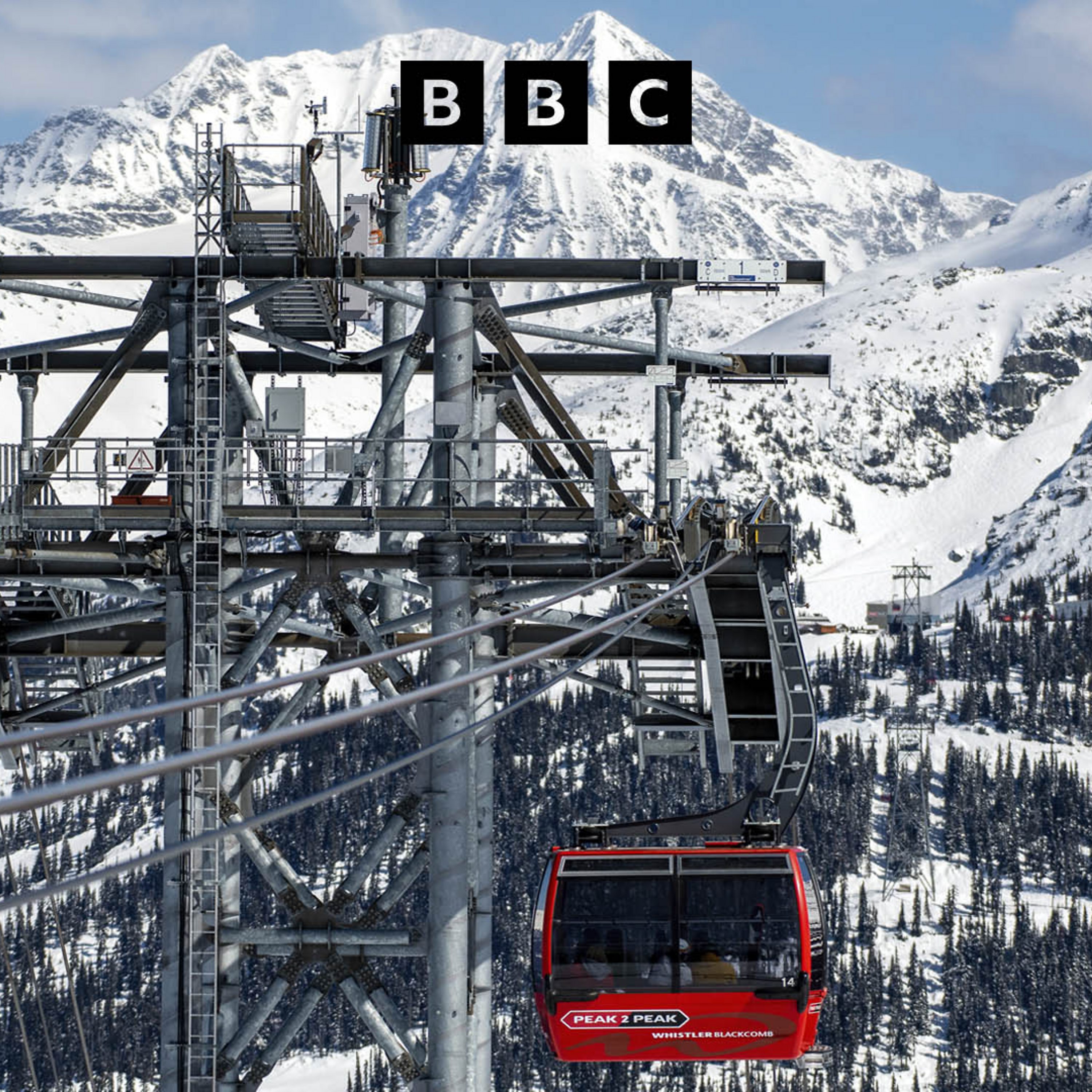
Whistler: Creating one of the world’s biggest ski resorts
In 2003, Whistler Blackcomb won its bid to host the Winter Olympic Games for the first time. It was sixth time lucky for the Canadian ski resort which had been opened to the public in 1966. The mountain – which is named after the high-pitched whistle of the native marmot – has been through a lot of iterations and one man has been there to see nearly all of them.Hugh Smythe, known as one of the ‘founding fathers’ of Whistler, has been sharing his memories of the mountain with Matt Pintus.(Photo: Whistler mountain. Credit: Getty Images)
Columbus Lighthouse
In 1992, Columbus Lighthouse opened in Santo Domingo, the capital of the Dominican Republic. It was designed to house the ashes of explorer, Christopher Columbus. The huge memorial is built in the form of a horizontal cross and has 157 searchlight beams that when turned on project a gigantic cross into the sky. The light is so powerful it can be seen from over 300km away in Puerto Rico. Tour guide and historian, Samuel Bisono tells Gill Kearsley about the struggle to get the monument built.(Photo: Columbus Lighthouse. Credit: Gill Kearsley)
Trans murder in Honduras
In June 2009, transgender sex worker and activist Vicky Hernandez was murdered in the Honduran city of San Pedro Sula.The killers were never identified or punished, but in 2021 the Inter-American Human Rights Court found the Honduran state responsible for the crime. It ordered the government to enact new laws to prevent discrimination and violence against LGBT people.Mike Lanchin hears from Claudia Spelman, a trans activist and friend of Vicky, and the American human rights lawyer Angelita Baeyens.A CTVC production for the BBC World Service.(Photo: A protestor holds a sign saying “Late Justice is not Justice”. Credit: Wendell Escoto/AFP/Getty Images)
Icelandic women's strike
In October 1975, 90% of women in Iceland took part in a nationwide protest over inequality.Factories and banks were forced to close and men were left holding the children as 25,000 women took to the streets.In 2015, Vigdís Finnbogadóttir, later Iceland's first female president, told Kirstie Brewer about the impact of that day.(Photo: Women take to the streets. Credit: The Icelandic Women's History Archives)
The Soviet scientist who made two-headed dogs
In the 1950s, Soviet scientist Dr Vladimir Demikhov shocks the world with his two-headed dog experiments.He grafts the head and paws of one dog onto the body of another. One of his creations lives for 29 days.He wants to prove the possibilities of transplant surgery, which was a new field of medicine at the time. Consultant cardiothoracic surgeon, Igor Konstantinov, tells Vicky Farncombe about the "difficult emotions" he experiences when he looks at photos of the creatures.This programme includes a description of one of the experiments which some listeners may find upsetting.(Photo: Vladimir Demikhov. Credit: Getty Images)

Supermalt: The malt drink created after the Nigerian civil war
In 1972, a food supplement used by soldiers during the Nigerian civil war was turned into a popular malt drink by a brewery in the Danish town of Faxe.It was called Supermalt and it became so popular that the Nigerian government decided to ban all imports of malt into the country. Peter Rasmussen created the drink and he has been sharing his memories with Matt Pintus.(Photo: Supermalt. Credit: Royal Unibrew Ltd)
The small Irish town known as ‘Little Brazil’
Gort in the west of Ireland is known by the nickname ‘Little Brazil’ because it’s home to so many Brazilians.They first came to Ireland in the late 1990s to work in the town’s meat factory.Lucimeire Trindade was just 24-years-old when she and three friends arrived in the town, unable to speak a word of English or Irish.Nearly 25 years later, Lucimeire considers Gort her true home.She tells Vicky Farncombe how being in Ireland changed her outlook on life.“I learned that a woman can have their own life, especially going to the pub alone without their husbands!”(Photo: Traditional Brazilian carnival dancers strut their stuff in Gort. Credit: John Kelly, Clare Champion)
The Juliet letters
The Juliet Club is in Verona, Italy, a place known throughout the world as being the city of love. The club has been replying to mail addressed to Shakespeare’s tragic heroine, Juliet since the early 1990s. The story of the Juliet letters started in the 1930s when the guardian of what is known as Juliet’s tomb began gathering the first letters people left at the grave and answering them. The task was taken on by the Juliet Club which was founded by Giulio Tamassia in 1972. His daughter, Giovanna, tells Gill Kearsley that thousands of love letters from around the world are each given a personal response.(Photo: Letters to the Juliet Club. Credit: Leonello Bertolucci/Getty Images)
Patty Hearst: Rebel heiress
When wealthy newspaper heiress Patty Hearst was kidnapped by far-left militants in February 1974, America saw her as a victim.But two months later, she announced she had decided to join the group. Soon, she was accompanying it on an attempted bank robbery.In 2010, Louise Hidalgo spoke to Carol Pogash, a journalist who followed the story.(Photo: Patty being led to her trial. Credit: Bettmann/Getty Images)