
Who Arted: Weekly Art History for All Ages
785 episodes — Page 12 of 16

Frida Kahlo
Frida Kahlo was a painter in the early 20th century associated with the Surrealist movement. While she had some moderate success as a painter during her lifetime, her fame grew in the decades after her passing. Today she is among the most popular figures in art history. She is best known for her self-portraits that give viewers a sense of her pain but more importantly, her strength. Arts Madness Tournament links: Check out the Brackets Tell me which artist you think will win this year's tournament Give a shoutout to your favorite teacher (the teacher who gets the most shoutouts on this form by Feb 27 will get a $50 Amazon gift card) Who ARTed is an Airwave Media Podcast. Connect with me: Website | Twitter | Instagram | Tiktok Support the show: Merch from TeePublic | Make a Donation As always you can find images of the work being discussed at www.WhoARTedPodcast.com and of course, please leave a rating or review on your favorite podcast app. You might hear it read out on the show. Learn more about your ad choices. Visit megaphone.fm/adchoices

Janet Sobel
When you think of bold and revolutionary modern artists from the 20th century, you probably don't think of a grandmother laying across her living room floor painting, but maybe you should. Janet Sobel was a Ukrainian American painter who was dripping paint across the canvas long before Jackson Pollock "invented" the technique. More episodes to explore: Art Smart: Surrealism Art Smart: Abstract Expressionism Ai Weiwei Alexander Calder Norman Rockwell Roy Lichtenstein Georgia O'Keeffe Arts Madness Tournament links: Check out the Brackets Tell me which artist you think will win this year's tournament Give a shoutout to your favorite teacher (the teacher who gets the most shoutouts on this form by Feb 27 will get a $50 Amazon gift card) Who ARTed is an Airwave Media Podcast. Connect with me: Website | Twitter | Instagram | Tiktok Support the show: Merch from TeePublic | Make a Donation As always you can find images of the work being discussed at www.WhoARTedPodcast.com and of course, please leave a rating or review on your favorite podcast app. You might hear it read out on the show. Learn more about your ad choices. Visit megaphone.fm/adchoices

Alexander McQueen
Alexander McQueen quickly rose to prominence in the 1990s with his dramatic looks that were impeccably tailored. He is one of 64 artists selected for this year's Arts Madness Tournament where listeners will decide which artist is better in a series of head to head matches until just one is left. Listen to the full episode to learn more: Alexander McQueen | Jellyfish Ensemble Arts Madness Tournament links: Check out the Brackets Tell me which artist you think will win this year's tournament Give a shoutout to your favorite teacher (I'll send a $50 Amazon gift card to the teacher who gets the most shoutouts on this form by Feb 27) Who ARTed is an Airwave Media Podcast. Connect with me: Website | Twitter | Instagram | Tiktok Support the show: Merch from TeePublic | Make a Donation As always you can find images of the work being discussed at www.WhoARTedPodcast.com and of course, please leave a rating or review on your favorite podcast app. You might hear it read out on the show. Learn more about your ad choices. Visit megaphone.fm/adchoices

Jim Davis
Jim Davis is famous for creating Garfield. He was born and raised in Indiana. As a child he wanted to be a farmer like his father, but found that he was much better suited to indoor life. He found his love of drawing early in life and developed his talents first in school, then working in advertising and assisting in the Tumbleweeds comic. Davis's first comic, Gnorm Gnat, was a bit of a flop. People felt his jokes and illustrations were great, but bugs just made for an offputting subject. Davis took the setback in stride and began developing a new comic about a cartoonist named Jon. The Jon comic was later renamed Garfield, and it went on to be published in hundreds of papers read by hundreds of millions of people. Arts Madness Tournament links: Check out the Brackets Tell me which artist you think will win this year's tournament Give a shoutout to your favorite teacher (the teacher who gets the most shoutouts on this form by Feb 27 will get a $50 Amazon gift card) Who ARTed is an Airwave Media Podcast. Connect with me: Website | Twitter | Instagram | Tiktok Support the show: Merch from TeePublic | Make a Donation As always you can find images of the work being discussed at www.WhoARTedPodcast.com and of course, please leave a rating or review on your favorite podcast app. You might hear it read out on the show. Learn more about your ad choices. Visit megaphone.fm/adchoices
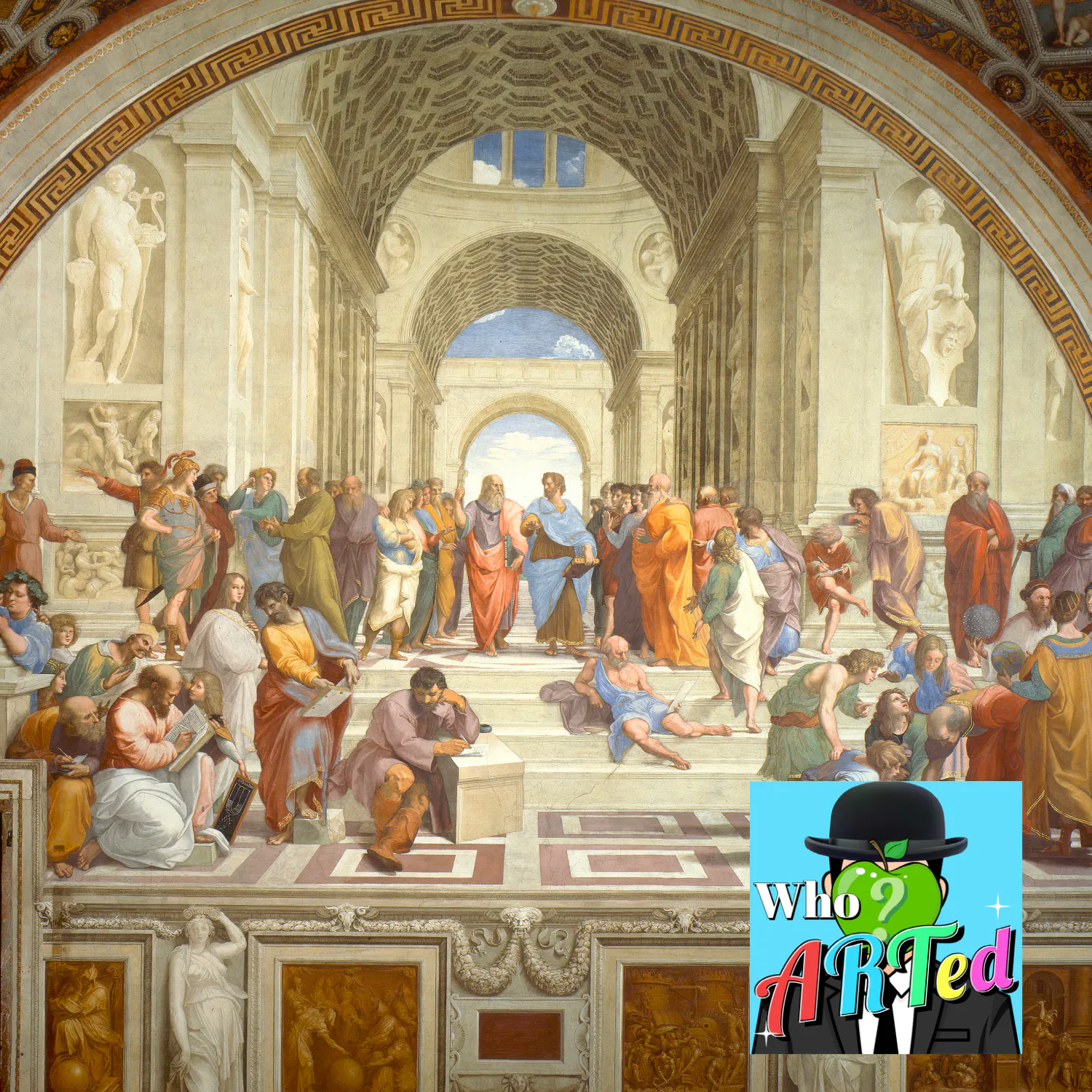
Raphael
While Raphael sadly passed away just in his 30s his work has lived on for hundreds of years. Learn a bit about the great Renaissance painter and architect as well as his most famous work, The School of Athens. Other episodes to check out: Art Smart: The Renaissance Michelangelo Arts Madness Tournament links: Check out the Brackets Tell me which artist you think will win this year's tournament Give a shoutout to your favorite teacher (I'll send a $50 Amazon gift card to the teacher who gets the most shoutouts on this form by Feb 27) Who ARTed is an Airwave Media Podcast. Connect with me: Website | Twitter | Instagram | Tiktok Support the show: Merch from TeePublic | Make a Donation As always you can find images of the work being discussed at www.WhoARTedPodcast.com and of course, please leave a rating or review on your favorite podcast app. You might hear it read out on the show. Learn more about your ad choices. Visit megaphone.fm/adchoices

Pablo Picasso | Guernica
Pablo Picasso was among the most influential artists of the 20th century and Guernica is possibly his greatest work. While I am not a fan of Picasso as a person, his significance as an artist is undeniable. More to check out: The Art of Education University's NOW Conference Pablo Picasso Art Thief? Art Smart: Cubism Arts Madness Tournament links: Check out the Brackets Tell me which artist you think will win this year's tournament Give a shoutout to your favorite teacher (I'll send a $50 Amazon gift card to the teacher who gets the most shoutouts on this form by Feb 27) Who ARTed is an Airwave Media Podcast. Connect with me: Website | Twitter | Instagram | Tiktok Support the show: Merch from TeePublic | Make a Donation As always you can find images of the work being discussed at www.WhoARTedPodcast.com and of course, please leave a rating or review on your favorite podcast app. You might hear it read out on the show. Learn more about your ad choices. Visit megaphone.fm/adchoices

Meret Oppenheim | Object (Luncheon in Fur)
In 1936, Meret Oppenheim sat down in a cafe with Pablo Picasso and Dora Maar. Picasso took note of Oppenheim's bracelet and commented that anything could be wrapped in fur. Meret replied "even this tea cup" and thus found inspiration for one of the greatest Surrealist sculptures of all time. Other episodes for to explore: Meret Oppenheim | Object (full episode featuring Janet Taylor from The Art of Education University) Art Smart: Surrealism Arts Madness Tournament links: Check out the Brackets Tell me which artist you think will win this year's tournament Give a shoutout to your favorite teacher (I'll send a $50 Amazon gift card to the teacher who gets the most shoutouts on this form by Feb 27) Who ARTed is an Airwave Media Podcast. Connect with me: Website | Twitter | Instagram | Tiktok Support the show: Merch from TeePublic | Make a Donation As always you can find images of the work being discussed at www.WhoARTedPodcast.com and of course, please leave a rating or review on your favorite podcast app. You might hear it read out on the show. Learn more about your ad choices. Visit megaphone.fm/adchoices

MC Escher
MC Escher is known for his tessellations, transformations and impossible realities. In many ways he defies categorization. His work is surreal with unexpected connections, but also very geometric and academic. Unfortunately, Escher was not super popular in the fine art world. A lot of the high-brow art establishment didn’t really like his work. He didn’t have the dramatic flair that a lot of well-known artists did. He was quiet and methodical in his work. He was in an odd space where he wasn’t doing the epic sort of lyrical and expressive work that was popular in the late 19th and early 20th centuries, but then he didn’t really fit with the conceptual avante garde that came a bit later. He found an audience largely with fans of psychedelics and math. He is probably the only person to have received fan mail from both the mathematician, Roger Penrose, and the musician, Mick Jagger. Check out these episodes to learn more: MC Escher | Circle Limit III MC Escher | Portrait of GA Escher Art Smart: Surrealism Salvador Dali | The Persistence of Memory Arts Madness Tournament links: Check out the Brackets Tell me which artist you think will win this year's tournament Give a shoutout to your favorite teacher (I'll send a $50 Amazon gift card to the teacher who gets the most shoutouts on this form by Feb 27) Who ARTed is an Airwave Media Podcast. Connect with me: Website | Twitter | Instagram | Tiktok Support the show: Merch from TeePublic | Make a Donation As always you can find images of the work being discussed at www.WhoARTedPodcast.com and of course, please leave a rating or review on your favorite podcast app. You might hear it read out on the show. Learn more about your ad choices. Visit megaphone.fm/adchoices

Barbara Kruger | Don't Be a Jerk
Barbara Kruger is a contemporary artist well known for her use of text and images. She started off in the late 1960s and 70s creating work reclaiming "craft" as a part of the feminist movement using materials that had long been marginalized. After she went to teach at UC Berkley, she started to gravitate toward words. In the late 1970s, she self published a book juxtaposing text and images. She would put a photo on one page and write a small poem or phrase on the page next to it. Her work really started to take off in the 1980s as she created bold graphic works in black, white and red overlaying text on found images. Her work speaks to how labels can define who we are and who we aren't as well as confronting the viewer very directly. The next evolution of her work came in the 1990s as she shifted from creating loud images to immersive installations that were viewers could not escape these messages. The text and image were no longer just out there in the gallery space, the text and images were the space. Some related episodes: Barabara Kruger | Don't Be a Jerk (full episode with Jen Leban) Bisa Butler | The Safety Patrol Faith Ringgold | Dancing at the Louvre Arts Madness Tournament links: Check out the Brackets Tell me which artist you think will win this year's tournament Give a shoutout to your favorite teacher (I'll send a $50 Amazon gift card to the teacher who gets the most shoutouts on this form by Feb 27) Who ARTed is an Airwave Media Podcast. Connect with me: Website | Twitter | Instagram | Tiktok Support the show: Merch from TeePublic | Make a Donation As always you can find images of the work being discussed at www.WhoARTedPodcast.com and of course, please leave a rating or review on your favorite podcast app. You might hear it read out on the show. Learn more about your ad choices. Visit megaphone.fm/adchoices
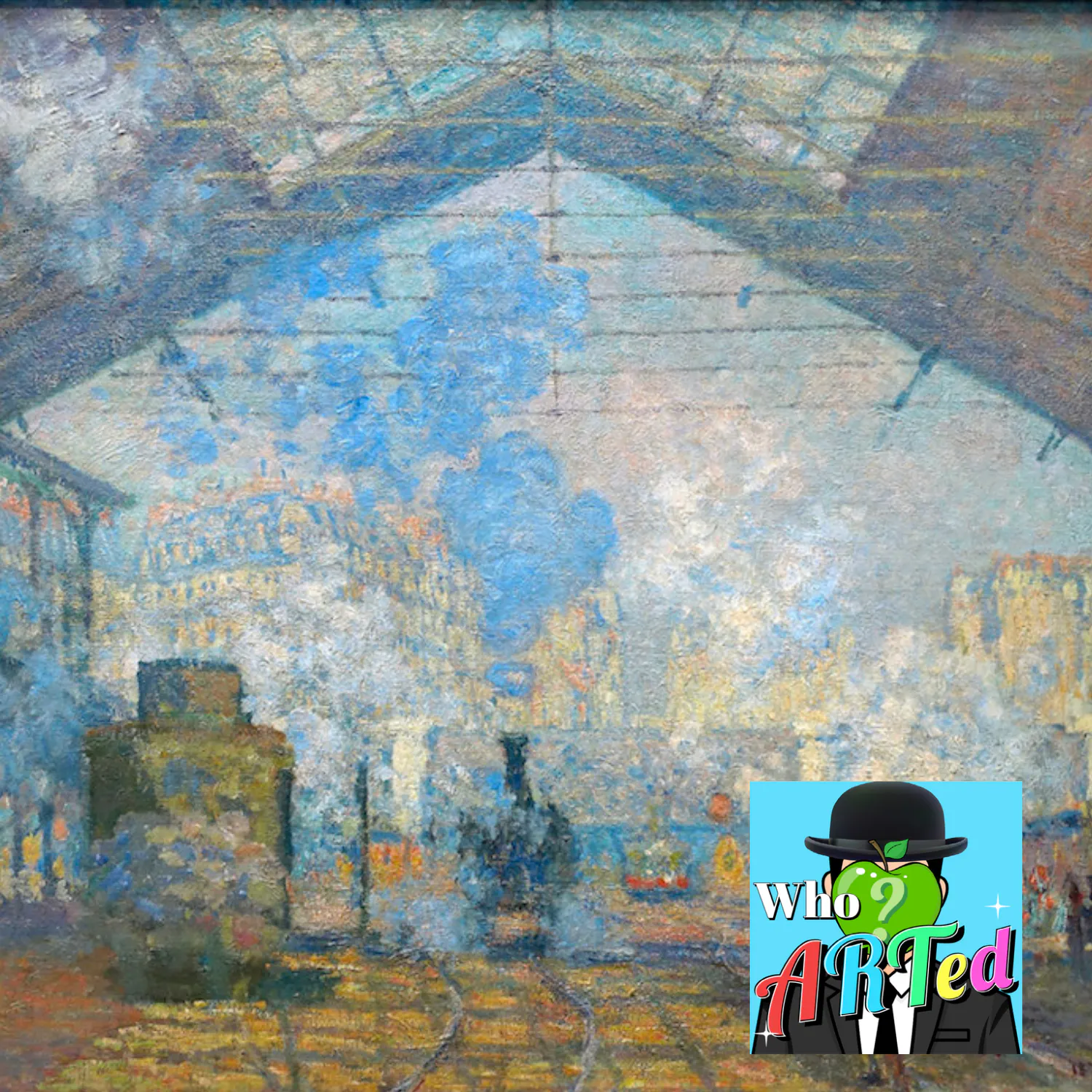
Claude Monet | The Gare Saint-Lazare
Claude Monet loved his garden and made about 250 paintings of water lilies. He and his Impressionist contemporaries were focused on color, light, and how our eyes perceive the world, but I would say technology was also central to the development. In his paintings of the train station, The Gare Saint Lazare, Monet gives us a glimpse of iron and glass station filled with the smoke of the steam engines. One critic wrote, “Unfortunately thick smoke escaping from the canvas prevented our seeing the six paintings dedicated to this study.” While the Impressionists were overtly apolitical, there is always a statement made by what is shown and what is not shown. Even if the artist himself or herself strives to be objective simply holding a mirror to their world, which way they aim that mirror matters. Monet shows the steam engine in its element as the subject of the work not merely something in the background. Technology of course drives change in our world. In the middle of the 19th century, painters suddenly had to compete with the camera. As photographs could quickly and easily capture the lines, shapes and proportions of a subject, painters shifted their focus to the color, an element cameras could not capture at that time. The tube of paint and numerous synthetic pigments also came about in the 19th century giving artists easy access to a wider range of colors. As I look at Monet’s use of so many colors, the pinks and blues of the cloud rising from the steam engine, I think of the critics the defenders of the status quo feeling threatened by change. They feel overwhelmed by the subject and begin to choke at the sight of roaring engines filling the space with smoke and they want to look away. They want the grand facades buildings and well-dressed elites walking city streets, not the workers and machines that powered the advancements. Monet though was unwavering. He meticulously studied his subjects at different times and in different seasons to find the beauty of even the smoke and engines in the industrial space. While the critics wanted grand visions of mythology, Monet showed what he and countless others experienced in the real world. Other episodes to listen to: Claude Monet | Water Lilies Art Smart: Impressionism & Post Impressionism Arts Madness Tournament links: Check out the Brackets Tell me which artist you think will win this year's tournament Give a shoutout to your favorite teacher (I'll send a $50 Amazon gift card to the teacher who gets the most shoutouts on this form by Feb 27) Who ARTed is an Airwave Media Podcast. Connect with me: Website | Twitter | Instagram | Tiktok Support the show: Merch from TeePublic | Make a Donation As always you can find images of the work being discussed at www.WhoARTedPodcast.com and of course, please leave a rating or review on your favorite podcast app. You might hear it read out on the show. Learn more about your ad choices. Visit megaphone.fm/adchoices

The Aztec Sun Stone or The Calendar Stone
The Sun Stone is probably the first bit of Aztec art I became familiar with even before I studied art. On its face, we see a beautiful image full of symbols laid out in radial symmetry that is just so visually satisfying, but as we look a little closer and get to know the symbols, this stone image is a lot deeper and heavier than I realized. Arts Madness Tournament links: Check out the Brackets Tell me which artist you think will win this year's tournament Give a shoutout to your favorite teacher (I'll send a $50 Amazon gift card to the teacher who gets the most shoutouts on this form by Feb 27) Art Smart is an Airwave Media Podcast. Connect with me: Website | Twitter | Instagram | Tiktok Support the show: Merch from TeePublic | Make a Donation As always you can find images of the work being discussed at www.ArtSmartPodcast.com and of course, please leave a rating or review on your favorite podcast app. You might hear it read out on the show. Learn more about your ad choices. Visit megaphone.fm/adchoices

Michelangelo
Michelangelo was considered to be one of the greatest examples of a Renaissance man. He is also one of the worst examples of personal hygiene. Learn a little bit about the artist who painted the ceiling on the Sistine Chapel. Related episodes: Michelangelo | The Sistine Chapel Ceiling Art Smart: The Renaissance Arts Madness Tournament links: Check out the Brackets Tell me which artist you think will win this year's tournament Give a shoutout to your favorite teacher (I'll send a $50 Amazon gift card to the teacher who gets the most shoutouts on this form by Feb 27) Who ARTed is an Airwave Media Podcast. Connect with me: Website | Twitter | Instagram | Tiktok Support the show: Merch from TeePublic | Make a Donation As always you can find images of the work being discussed at www.WhoARTedPodcast.com and of course, please leave a rating or review on your favorite podcast app. You might hear it read out on the show. Learn more about your ad choices. Visit megaphone.fm/adchoices

Jean-Michel Basquiat
Basquiat as the artist himself was like tofu, able to soak up and take on so many different flavors. Middle class child, homeless teen, bankable star of the art world. He was a graffiti artist selling postcards on the street, celebrated painter wearing armani suits to work in his studio. Basquiat inhabited so many different worlds, people can pick the story that resonates with them because as Basquiat famously said, “I am not a real person. I am a legend.” It seems an impossible task, but I always like to look for stories that will help to understand the real person behind the legend. With Basquiat, I first learned of him as a graffiti artist turned studio artist. The graffiti work that helped him rise to prominence was a team effort. Basquiat and his friend Al Diaz made humorous, thoughtful and critical text based pieces on the walls of Manhatten. In Diaz’s telling when he got to know Basquiat as a teen, it was immediately obvious to him, that Jean Michel was not a graffiti artist. Diaz laughed as he said Basuiat “drew the sliding doors in a subway car and put his name in it: ‘Jean the Bohemian.’ That was his tag.” To learn a little more: Jean-Michel Basquiat | Untitled Skull (full episode with Todd Leban) Jean-Michel Basquiat | Horn Players Arts Madness Tournament links: Check out the Brackets Tell me which artist you think will win this year's tournament Give a shoutout to your favorite teacher (I'll send a $50 Amazon gift card to the teacher who gets the most shoutouts on this form by Feb 27) Who ARTed is an Airwave Media Podcast. Connect with me: Website | Twitter | Instagram | Tiktok Support the show: Merch from TeePublic | Make a Donation As always you can find images of the work being discussed at www.WhoARTedPodcast.com and of course, please leave a rating or review on your favorite podcast app. You might hear it read out on the show. Learn more about your ad choices. Visit megaphone.fm/adchoices

Njideka Akunyili Crosby | Predecessors
Njideka Akunyili Crosby is a Nigerian-born artist who moved to America as a teen and her work Predecessors looks at how her family has changed over generations. She uses painting and collage techniques to share her memories and connect different aspects of her identity as she has roots in both Nigeria and America. If you want to learn more, check out the full episode I recorded with Janet Taylor, an artist, art teacher, and writer for The Art of Education University. Njideka Akunyili Crosby (full episode) Arts Madness Tournament links: Check out the Brackets Tell me which artist you think will win this year's tournament Give a shoutout to your favorite teacher (I'll send a $50 Amazon gift card to the teacher who gets the most shoutouts on this form by Feb 27) Who ARTed is an Airwave Media Podcast. Connect with me: Website | Twitter | Instagram | Tiktok Support the show: Merch from TeePublic | Make a Donation As always you can find images of the work being discussed at www.WhoARTedPodcast.com and of course, please leave a rating or review on your favorite podcast app. You might hear it read out on the show. Learn more about your ad choices. Visit megaphone.fm/adchoices
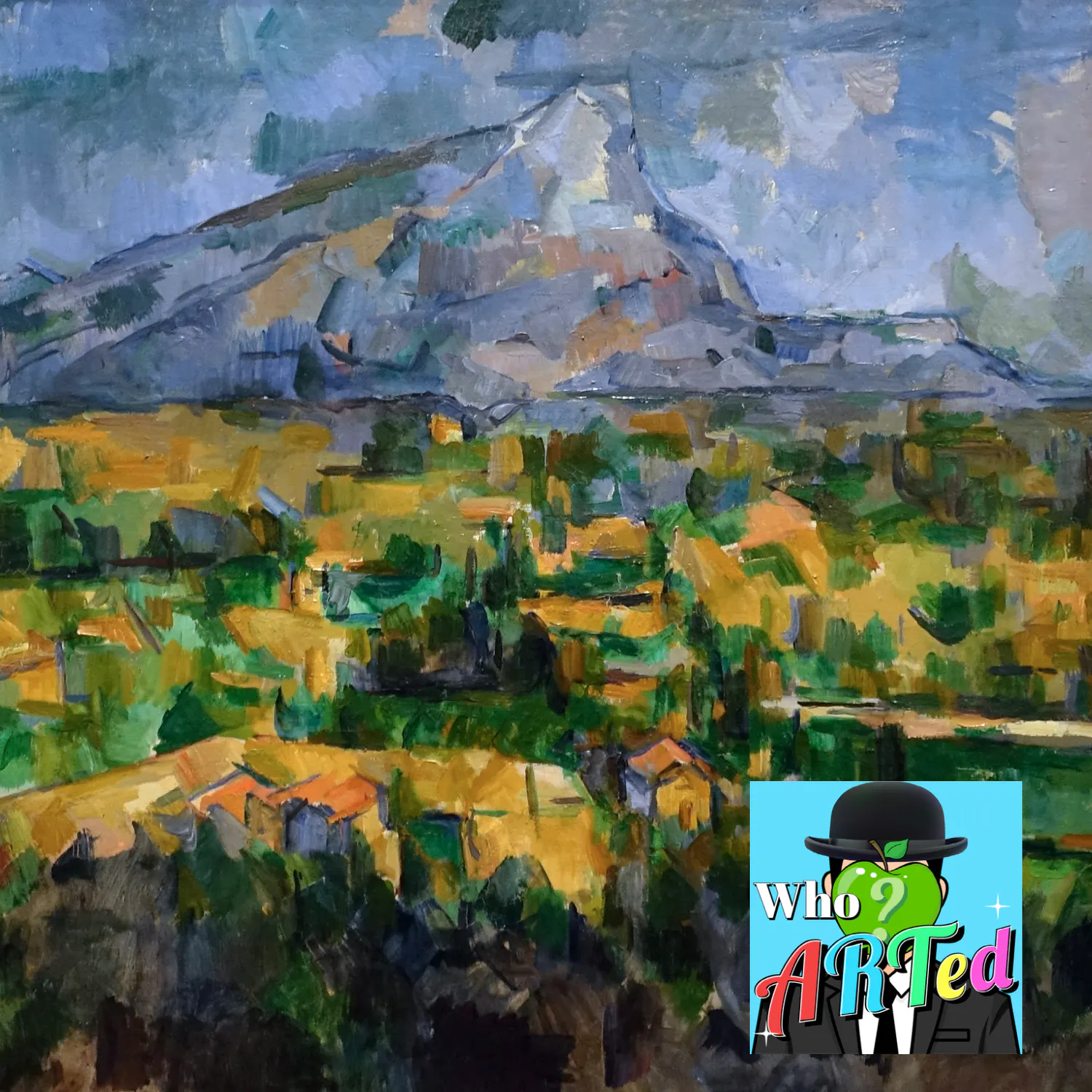
Paul Cezanne | Mont Sainte-Victoire
Cezanne is widely celebrated today, but he struggled early on. He was rejected by Beaux Arts multiple times. He went back home to work at the bank for a while but he felt compelled to pursue the arts and he persisted. He met other artists like Renoir and Monet who had also been rejected by academic establishment and many critics of the day. The supported each other and learned from each other. In 1863, people were so sick of being rejected by the Paris Salon, they actually set up “Salon des Refuses” (salon of the rejected) next to the official salon to exhibit works by Monet, Manet, Pissarro. Cezanne would have loved to have his paintings exhibited in The Paris Salon, but his work hung in The Salon des Refuses. Related episodes to check out: Paul Cezanne (full episode) Art Smart - Impressionism & Post Impressionism Arts Madness Tournament links: Check out the Brackets Tell me which artist you think will win this year's tournament Give a shoutout to your favorite teacher (I'll send a $50 Amazon gift card to the teacher who gets the most shoutouts on this form by Feb 27) Who ARTed is an Airwave Media Podcast. Connect with me: Website | Twitter | Instagram | Tiktok Support the show: Merch from TeePublic | Make a Donation As always you can find images of the work being discussed at www.WhoARTedPodcast.com and of course, please leave a rating or review on your favorite podcast app. You might hear it read out on the show. Learn more about your ad choices. Visit megaphone.fm/adchoices

Roy Lichtenstein | Look Mickey
Season 6 is covering the artists in this year's Arts Madness Tournament. I will be releasing 64 mini episodes in 64 days to give you a quick refresher on all the different artists and artworks in the tournament. By the 1960s Roy Lichtenstein was intrigued by the ideas of pop art and began dabbling in the style. Of course, if you want fresh new ideas, the best source is often the younger generation. Roy Lichtenstein was pushed by his young son. One day in 1961, the younger Lichtenstein taunted his father holding up his copy of the Disney book Donald Duck: Lost and Found. He pointed to an illustration and said, “I bet you can’t draw something as good as that?” In what can only be described as one of the greatest “so there’s” of all time Roy Lichtenstein made a direct copy of the illustration painting onto a canvas four feet tall and almost six feet wide. In doing so, he was not only successful in sticking it to his son, Roy Lichtenstein became a tremendous success in the art world. Arts Madness Tournament links: Check out the Brackets Tell me which artist you think will win this year's tournament Give a shoutout to your favorite teacher (I'll send a $50 Amazon gift card to the teacher who gets the most shoutouts on this form by Feb 27) Episodes to check out for further learning: Who ARTed - Roy Lichtenstein Art Smart - Pop Art Art Smart - Abstract Expressionism Who ARTed - Zaria Forman Who ARTed is an Airwave Media Podcast. Connect with me: Website | Twitter | Instagram | Tiktok Support the show: Merch from TeePublic | Make a Donation As always you can find images of the work being discussed at www.WhoARTedPodcast.com and of course, please leave a rating or review on your favorite podcast app. You might hear it read out on the show. Learn more about your ad choices. Visit megaphone.fm/adchoices

Christian Dior | The New Look
I am releasing a mini episode every day in the run up to this year's Arts Madness Tournament to give you a quick refresher on all 64 artists/artworks. In this mini episode, I covered Christian Dior and The New Look from 1947. If you want to learn more, you can listen to the full episode I recorded back in October with Cassie Stephens Christian Dior | Bar Arts Madness Tournament links: Check out the Brackets Tell me which artist you think will win this year's tournament Give a shoutout to your favorite teacher (I'll send a $50 Amazon gift card to the teacher who gets the most shoutouts on this form by Feb 27) Who ARTed is an Airwave Media Podcast. Connect with me: Website | Twitter | Instagram | Tiktok Support the show: Merch from TeePublic | Make a Donation As always you can find images of the work being discussed at www.WhoARTedPodcast.com and of course, please leave a rating or review on your favorite podcast app. You might hear it read out on the show. Learn more about your ad choices. Visit megaphone.fm/adchoices

Gustave Eiffel | The Eiffel Tower
The Eiffel Tower was by far the largest structure built for the 1889 World’s Fair in Paris. Eiffel was an entrepreneur and he had two engineers working with him to plan the iron tower, but not everyone was on board with the design. Audiences today may be surprised to hear that many Parisians thought the design was an eyesore and a blight on their beautiful city. The architect Stephen Sauvestre was commissioned to work on the design to make it less ugly. He drafted arches, glass-walled halls on every level, stonework around the base, and other ornamental details throughout the structure. Ultimately they stripped it down to a more utilitarian structure but they kept his idea of arches at the base. The form of the tower is largely determined by the engineers' calculations to cut down on wind resistance. The primary resistance came from writers and artists who criticized the tower throughout its construction. I think my favorite description came from Francois Coppee who called it “this mast of iron gymnasium apparatus, incomplete, confused and deformed.” Of course, this criticism faded as the world’s fair began and the tower was a huge hit. Over 2 million visitors came to marvel at it. While it did prove successful, the Eiffel tower was not intended to be a permanent fixture in the city. It was built to wow visitors in the fair and then to be torn down later. Eiffel only had a permit to have the structure stand for 20 years. The idea that the tower would be temporary provided an interesting opportunity for another sort of creative visionary. A truly remarkable con artist named Victor Lustig sold the tower for scrap… two times. While truly awful, his plan was quite clever. He posed as an official with the French government, but instead of claiming a high-status post, he pretend to be a mid-level, government official. He met with heads of various scrap iron companies telling them that because of the sensitive nature of such a high-profile project he was trying to meet with people discretely to get bids for the roughly 7,300 tons of iron used to build the tower. He then met privately with the least successful of the bidders and tried to appear empathetic. He told the guy, look I know you are up and coming, it’s hard to compete with these bigger companies, I feel for you. I’m just a mid-level government employee, I’m struggling too. Maybe we can help each other out. He actually got the guy to bribe him for the contract for all the scrap iron which did a few things. It made him seem a little more credible to the guy he was conning, but more importantly for Lustig, it made his mark less likely to report the crime as doing so would be not only embarrassing but also implicate him for bribery. Lustig got the money and then fled to Austria where he watched the papers to see if there were any reports of his crime. He was correct that the businessman would be too embarrassed to report the crime. In the ultimate show of hubris, Lustig returned to Paris and attempted to repeat the same scam. The second time around he was not so successful and ended up fleeing the country yet again. He went on to carry out numerous other audacious crimes before he was arrested and sent to the notorious Alcatraz prison in the United States. Arts Madness Tournament links: Check out the Brackets Tell me which artist you think will win this year's tournament Give a shoutout to your favorite teacher (I'll send a $50 Amazon gift card to the teacher who gets the most shoutouts on this form by Feb 27) Who ARTed is an Airwave Media Podcast. Connect with me: Website | Twitter | Instagram | Tiktok Support the show: Merch from TeePublic | Make a Donation As always you can find images of the work being discussed at www.WhoARTedPodcast.com and of course, please leave a rating or review on your favorite podcast app. You might hear it read out on the show. Learn more about your ad choices. Visit megaphone.fm/adchoices

Auguste Rodin | The Burghers of Calais
Season 6 is all about the annual Arts Madness Tournament. I am releasing 64 mini episodes over 64 days to give you all a quick refresher on the diverse artists that will be up for consideration as we narrow the field down to just one ultimate Arts Madness Champion. To make it more fun, I will be using my ad revenue from the month of February to give out some prizes, so tell your friends about the show. The more listeners we get, the more prizes I can give out. Today's mini-episode is about Auguste Rodin and his sculpture of The Burghers of Calais. The story behind the piece is an inspiring tale that defines courage. Arts Madness Tournament links: Check out the Brackets Tell me which artist you think will win this year's tournament Give a shoutout to your favorite teacher (I'll send a $50 Amazon gift card to the teacher who gets the most shoutouts on this form by Feb 27) Who ARTed is an Airwave Media Podcast. Connect with me: Website | Twitter | Instagram | Tiktok Support the show: Merch from TeePublic | Make a Donation As always you can find images of the work being discussed at www.WhoARTedPodcast.com and of course, please leave a rating or review on your favorite podcast app. You might hear it read out on the show. Learn more about your ad choices. Visit megaphone.fm/adchoices

Salvador Dali | The Persistence of Memory
Get ready for this year's Arts Madness Tournament with a quick refresher on Salvador Dali. Season 6 of Who ARTed will have 64 mini episodes over the next 64 days to help you learn about all the artists/artworks listeners can vote on in this year's tournament. Arts Madness Tournament links: Check out the Brackets Tell me which artist you think will win this year's tournament Give a shoutout to your favorite teacher (I'll send a $50 Amazon gift card to the teacher who gets the most shoutouts on this form by Feb 27) Salvador Dali's most famous painting is The Persistence of Memory from 1931. The painting is surprisingly small just 9 ½ by 13 inches or slightly larger than the average sheet of paper. It is one of the most widely recognized and referenced images of the surrealist movement. For those who don’t know it by name, you will likely recognize the description of clocks melting in the desert. The melting of clocks much like the ambiguous figure in the middle of the composition reference a metamorphosis. Things are in a state of flux. Ants crawl all over the clocks like fruit left to rot on the ground. Dali referred to this work describing time as a soft cheese and yet with all of the absurdity, there are realistic elements drawn from the landscape of his home in Spain. There is an unsettling mix of the real and absurd which served as a device surrealist artists would use to call into question the rational world and whether things truly are as hard and fast as we might at first perceive them to be. The clocks melt because even time, like all things, is relative and malleable. Other episodes to check out: The full episode on Salvador Dali from season 3 Art Smart - Surrealism Who ARTed is an Airwave Media Podcast. Connect with me: Website | Twitter | Instagram | Tiktok Support the show: Merch from TeePublic | Make a Donation As always you can find images of the work being discussed at www.WhoARTedPodcast.com and of course, please leave a rating or review on your favorite podcast app. You might hear it read out on the show. Learn more about your ad choices. Visit megaphone.fm/adchoices

Keith Haring | Three Eyed Smiley Face
Today I want to talk to you about a few things. First off, as it is Friday, I want to share a fun fact about one of my absolute favorite artists, Keith Haring. One of his most famous and popular images, the three eyed smiley face came about by accident. In October 1981, Haring was invited to paint directly on the wall of the Annina Nosei Gallery. He was participating in a group show of Neo Expressionist Painting, because in the early days, that’s how Haring’s work was categorized. So he began painting. He started outlining the border and working his way in to fill out the composition. Keith was an artist who always brought a youthful, joyous spirit ot his work and he decided to pull some inspiration from his childhood. He thumbed through the pages of his old workbook and decided to paint following the instructions for a guided drawing of Mickey Mouse. He started with a large, grinning mouth then added one of Mickey’s oval eyes. Except he quickly realized he had rendered it off center. The eyes were too far apart, but he couldn’t exactly wipe it off the wall and start fresh. He compensated by adding a third eye to balance the composition in one of the most compelling proofs that Bob Ross was right in declaring "We don't make mistakes; we just have happy accidents." Who ARTed is an Airwave Media Podcast. Connect with me: Website | Twitter | Instagram | Tiktok Support the show: Merch from TeePublic | Make a Donation As always you can find images of the work being discussed at www.WhoARTedPodcast.com and of course, please leave a rating or review on your favorite podcast app. You might hear it read out on the show. Learn more about your ad choices. Visit megaphone.fm/adchoices

Zaria Forman | Lincoln Sea, Greenland
Zaria Forman is known for her pastel drawings documenting the environment and climate change. The thing is, her work is so much bigger than that statement would lead you to believe. Her works are not your average pastel drawings. First off, they are massive. They are of a size that forces you to stop and take notice. The choice of soft pastels is fitting as these drawings, much like the environment, are beautiful but fragile. My guests were Kaitlyn and Corbie, hosts of the podcast, Those Art Teachers. You can find Those Art Teachers on your favorite podcast app, and they are active on Instagram. Learn more about your ad choices. Visit megaphone.fm/adchoices

Vincent van Gogh | Sunflowers
While many artists took inspiration from all types of flowers Vincent van Gogh became closely associated with one type in particular. While he did color studies using several types of flowers, he loved the sunflowers. Vincent wanted to be known as the painter of sunflowers. The man and the flower became so closely associated that at his funeral many friends paid their respects bringing sunflowers to the funeral. The sunflower is an interesting choice though. Most artists shied away from sunflowers. They preferred the soft and delicate petals of roses, carnations and lilies. The sunflower was coarse and unrefined. I would say that is likely what drew Van Gogh to the sunflower. He always had a soft spot for those on the fringes. Who ARTed is an Airwave Media Podcast. Connect with me: Website | Twitter | Instagram | Tiktok Support the show: Merch from TeePublic | Make a Donation As always you can find images of the work being discussed at www.WhoARTedPodcast.com and of course, please leave a rating or review on your favorite podcast app. You might hear it read out on the show. Learn more about your ad choices. Visit megaphone.fm/adchoices

Andrew Fuller | It Is Cake!
Andrew Fuller first earned viral fame with a pie that appeared to have a human face in it. He has appeared on a few shows: Halloween Baking Championship (2018), Candy Land (2020) but the Netflix hit baking competition show, Is it Cake? really catapulted him to the next level. On this episode, I talked with Nathan Ragland, host of Post Modern Art Podcast about Fuller and his mindblowing, hyperrealistic cake. You can find Post Modern Art Podcast on all the major platforms. Here are links to find Nathan and his work: Website Discord Merch Of course, as we are talking about Andrew Fuller who is doing such amazing things all the time, you may want to check out his site https://www.sugarfreakshow.com/ which has links to his social media so you can follow him to see more. Who ARTed is an Airwave Media Podcast. Connect with me: Website | Twitter | Instagram | Tiktok Support the show: Merch from TeePublic | Make a Donation As always you can find images of the work being discussed at www.WhoARTedPodcast.com and of course, please leave a rating or review on your favorite podcast app. You might hear it read out on the show. Learn more about your ad choices. Visit megaphone.fm/adchoices

Sand Mandalas
The Buddhist monks of Tibet who are known for their tradition of sand mandalas destroy the work after completing it. The word mandala comes from Sanskrit meaning “circle” but a mandala is not your average two-dimensional shape consisting of an outer boundary called the circumference made up of points all equidistant from a fixed center point. A mandala representation of the universe. While many people talk about Mandalas in reference to radial symmetry, mandala designs have spiritual significance beyond mere repetition. The act of creating a sand mandala is meditative. It requires monks to focus, to be calm, still and deliberate in their actions. And then, after completing the construction, they move on to a ritual deconstructing the piece. Even the deconstruction is a part of the artistic process with spiritual significance. Destroying the sand art is a reminder of the transitory nature of the universe. Who ARTed is an Airwave Media Podcast. Connect with me: Website | Twitter | Instagram | Tiktok Support the show: Merch from TeePublic | Make a Donation As always you can find images of the work being discussed at www.WhoARTedPodcast.com and of course, please leave a rating or review on your favorite podcast app. You might hear it read out on the show. Learn more about your ad choices. Visit megaphone.fm/adchoices
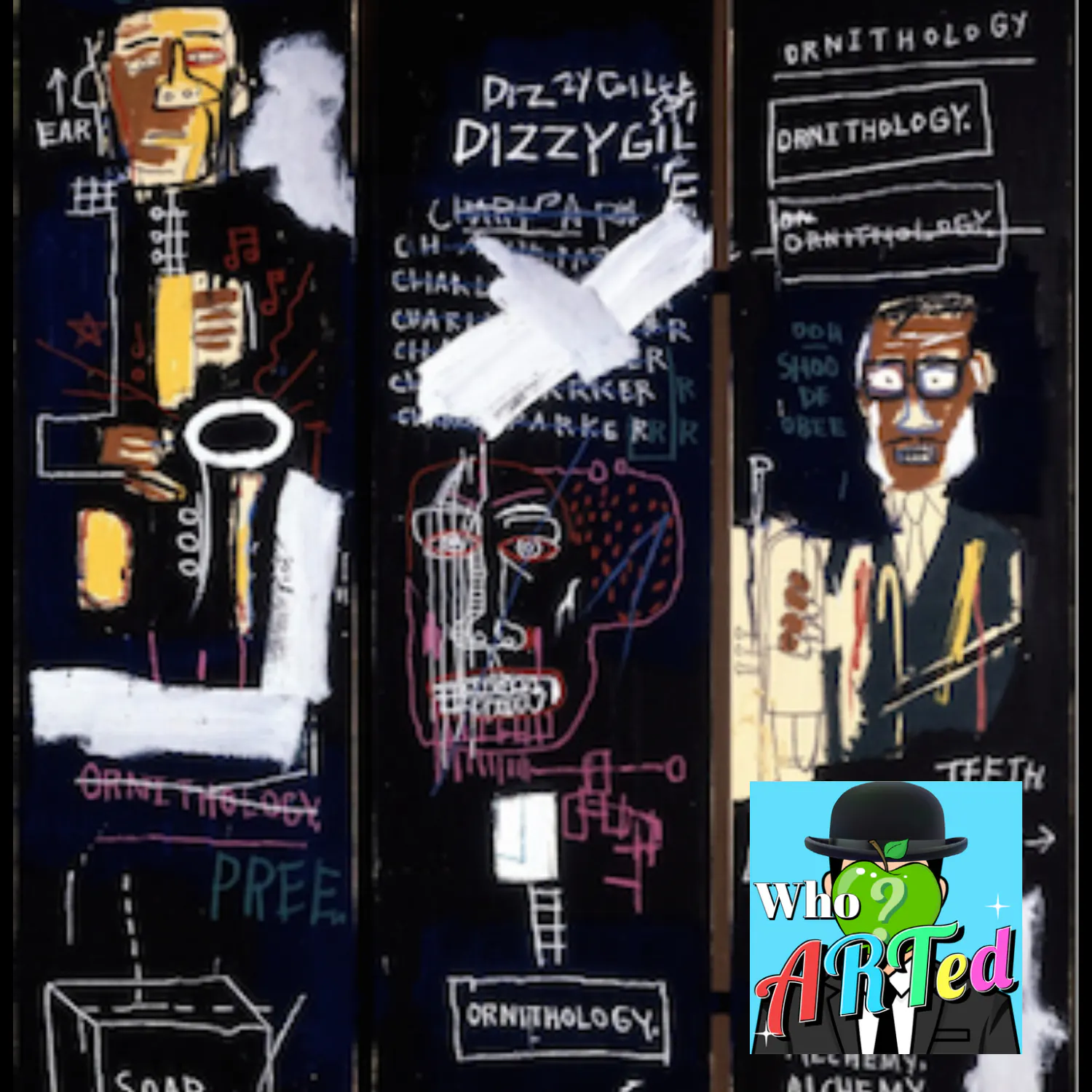
Jean-Michel Basquiat | Horn Players
Jean-Michel Basquiat has created some of the most highly valued American paintings ever to go on auction. Basquiat sought to remake art history in his image, and I would say he was successful. His triptych, Horn Players, is one of the artworks required for the AP Art History curriculum studied by American high school students. In the middle of February 1981, a group exhibition opened at P.S.1 in New York. The show featured over a hundred different artists from the underground art scene. There were paintings, drawings, photographs, objects and graffiti all mixed together in an explosive portrait of the post-punk scene. The show was called New York/New Wave and many affectionately referred to it as the armory show of the 80s. The armory show was of course the famous exhibition from 1913 that introduced European modern art to the American audience. This time though, it wasn’t European artists upending the New York gallery scene. This time, the revolution was coming from inside the community. Among the artists on display was a 20 year old by the name of Jean-Michel Basquiat. He had previously made a name for himself as a graffiti artist. Basquiat and his friend Al Diaz created a text-based project SAMO spraypainting messages around new york. They were particularly active in the area where numerous gallery spaces were located. SAMO often sought to be a little bit humorous, but also gives an outsider’s perspective on the art world with phrases like “SAMO AS AN END TO PLAYING ART” or “SAMO FOR THE SO-CALLED AVANT-GARDE”. Who ARTed is an Airwave Media Podcast. Connect with me: Website | Twitter | Instagram | Tiktok Support the show: Merch from TeePublic | Make a Donation As always you can find images of the work being discussed at www.WhoARTedPodcast.com and of course, please leave a rating or review on your favorite podcast app. You might hear it read out on the show. Learn more about your ad choices. Visit megaphone.fm/adchoices

Piet Mondrian | Composition with Red Blue and Yellow
Piet Mondrian is best known for painting primary colored squares and rectangles. For this episode, fellow art teacher, Jeff Arndt and I talked about the big ideas that led Mondrian to make such simple work. He pushed the ideas of modern abstract art farther than anyone else. Mondrian limited himself to basic elements of simple lines, shapes and colors to focus on the principles of design like balance and proportion. A common misconception about Mondrian is that his personal life was as bland as his art. Mondrian was actually quite charming. He took pains to be elegantly dressed at all times, he was kind and and avid dancer. He was said to be great at the foxtrot and the charleston in particular. The ladies loved him, and he had multiple relationships including an engagement he called off in 1911, but he never married. I think my favorite odd bit though is according to a biographer, among the women of Amsterdam, Mondrian “developed a reputation for interesting, prolonged kisses, sometimes lasting for more than half an hour.” but back on point, he loved dancing and he loved music. While he was in Paris, he was particularly fond of the black American musicians that passed through including greats like Louis Armstrong. Mondrian talked about how the pianist accompanying Armstrong “allowed the bass line played with his left hand to fall out of sync, contrasting with the rhythmically varied ‘melody’ played by his right hand” Mondrian was all about the rhythm. Who ARTed is an Airwave Media Podcast. Connect with me: Website | Twitter | Instagram | Tiktok Support the show: Merch from TeePublic | Make a Donation As always you can find images of the work being discussed at www.WhoARTedPodcast.com and of course, please leave a rating or review on your favorite podcast app. You might hear it read out on the show. Learn more about your ad choices. Visit megaphone.fm/adchoices

Faith Ringgold | Dancing at the Louvre
Dancing at the Louvre is part of Faith Ringgold's series of 12 story quilts called The French Collection and it is on the AP Art History list (it is one of 250 artworks American high school students study for AP Art History courses, which give them the chance to earn college credit). In her Dancing at the Louvre quilt, Ringgold is writing the story of Willa Marie Simone, a fictional character that seems to be inspired a bit by Ringgold and her mother. Willa moves to Paris, meets major figures like Henri Matisse,the iconic artist, Josephine Baker, the American born French singer, dancer and actress who became the first black woman to star in a major motion picture and Rosa Parks, the legend of the civil rights movement. Over the series of 12 story quilts, known as the French Collection, Willa Marie Simone goes on many adventures and becomes a successful artist and businesswoman. In Ringgold’s life, she had been taught to admire the achievements of men like Pablo Picasso who innovated by copying African masks. In her education, she was told to study art education because fine arts was only for men. She looked at all of these societal bariers and envisioned a figure who could push past them. In Ringgold’s story, the protagonist is a black woman and the white male european artists, have a walk on role. The Louvre is an iconic cultural institution, home to some of the finest artworks in the history of the world and Ringgold’s Willa Marie Simone feels unintimidated. She joyously flouts conventions and dances in the hallowed halls. In this episode, I mentioned The Art Explora Academy from the Art Explora Foundation, which was kind enough to include some of my episodes in their media library and gave my show it's first big break. Check out The Art Explora Academy here: Academy.ArtExplora.org Who ARTed is an Airwave Media Podcast. Connect with me: Website | Twitter | Instagram | Tiktok Support the show: Merch from TeePublic | Make a Donation As always you can find images of the work being discussed at www.WhoARTedPodcast.com and of course, please leave a rating or review on your favorite podcast app. You might hear it read out on the show. Learn more about your ad choices. Visit megaphone.fm/adchoices

JMW Turner | The Slave Ship
I am sick with Covid and with the ups and downs of the illness, I wasn't sure when I would be up for recording this week. Consequently, I made this a mini episode with no guest, which is fine because it is on a topic that pretty much no guest wants to talk about anyways, JMW Turner's painting, The Slave Ship. Just as a side note, while I am mildly miserable at times, my experience of Covid would be a lot worse if I weren't up to date on my vaccines. Please be sure to get vaccinated if you are able to. It not only protects you, but also helps to protect those around you. Turner's painting of The Slave Ship from 1840 was originally titled "Slavers Throwing Overboard the Dead and Dying" and the event that inspired this work is exactly as horrific as it sounds. The captain of the ship was throwing men overboard in order to collect insurance money on those lost at sea, or to use a more accurate term, murdered. In this episode, I mentioned that one of my favorite fellow Airwave Media podcasts, The Constant, did an episode about how ships would be sent to sea to sink for the insurance money. Check out that episode here: The Constant | Shipwreckless Who ARTed is an Airwave Media Podcast. Connect with me: Website | Twitter | Instagram | Tiktok Support the show: Merch from TeePublic | Make a Donation As always you can find images of the work being discussed at www.WhoARTedPodcast.com and of course, please leave a rating or review on your favorite podcast app. You might hear it read out on the show. Learn more about your ad choices. Visit megaphone.fm/adchoices

Your Brain on Art
I was asked to create an episode about how art affects the brain. I found there is quite a bit of research conducted by neuroscientists around the world indicating that engaging with the arts makes people smarter, happier, and healthier. Let me know what you think of this episode. Do you want to hear more like this? Are there other topics you want me to cover? Email [email protected] Who ARTed is an Airwave Media Podcast. Connect with me: Website | Twitter | Instagram | Tiktok Support the show: Merch from TeePublic | Make a Donation As always you can find images of the work being discussed at www.WhoARTedPodcast.com and of course, please leave a rating or review on your favorite podcast app. You might hear it read out on the show. Learn more about your ad choices. Visit megaphone.fm/adchoices

Nick Cave | Soundsuit
Nick Cave is a contemporary artist whose work is part fashion, part sculpture, part performance and entirely fascinating. For this episode, I spoke with Kaitlyn and Corbie, fellow art teachers and hosts of the podcast Those Art Teachers. You can find Those Art Teaches on your favorite podcast platforms such as Apple Podcasts (remember leaving them a rating/review really helps podcasts become more visible) and follow them on Instagram. Who ARTed is an Airwave Media Podcast. Connect with me: Website | Twitter | Instagram | Tiktok Support the show: Merch from TeePublic | Make a Donation As always you can find images of the work being discussed at www.WhoARTedPodcast.com and of course, please leave a rating or review on your favorite podcast app. You might hear it read out on the show. Learn more about your ad choices. Visit megaphone.fm/adchoices

Georges Seurat | A Sunday on La Grande Jatte
Georges Seurat | A Sunday on La Grande Jatte In 1894, George Seurat began going out to an idyllic little island away from the urban center of Paris. It was a place where people of various classes would relax. While the image is of people at leisure, Seurat was anything but relaxed. He was a disciplined artist on a mission to create a work that would be significant in art history. He spent years developing this work. He made dozens of preparatory sketches to work out the composition and technique. While the 1890s was the heyday for Impressionists, Seurat was part of a new breed. Some consider him a post-impressionist or neo-Impressionist. Today his technique is called pointillism, but in his day, Seurat preferred the term divisionism. He was dividing the image into discrete bits, carefully painted, uniform dots of paint like pixels that make up our digital images. While his process was careful and hand-crafted, Seurat was fascinated by science. He developed his approach after reading the works of scientists like Michel Eugene Chevreul and Ogden Rood. One of the key concepts that Seurat latched onto had to do with how color is perceived in relation to its surroundings. Seurat read about the trouble restoring tapestries because they could not simply dye to match a piece, they had to account for surrounding colors. Seurat’s idea was that by dividing the image into discrete dots of color, the painter could arrange combinations that would heighten the contrast and make the colors more vibrant. Seurat wanted to make his work even more vibrant by painting a frame of colored dots around the perimeter of his painting and that was offset by a clean white painted frame. Who ARTed is an Airwave Media Podcast. Connect with me: Website | Twitter | Instagram | Tiktok Support the show: Merch from TeePublic | Make a Donation As always you can find images of the work being discussed at www.WhoARTedPodcast.com and of course, please leave a rating or review on your favorite podcast app. You might hear it read out on the show. Learn more about your ad choices. Visit megaphone.fm/adchoices

Introducing: Art of History
Today I am giving you an episode of another art history podcast. The show is called Art of History. It is hosted by Amanda Matta, who is everyone’s favorite TikTok royal commentator and just generally smarter than me. Art of History is another Airwave Media podcast, and she is absolutely killing it. If you listened to my episode on Fragonard’s The Swing, you may recall, I did about 5-10 minutes on it but Amanda goes way deeper so, please give Art of History a listen, and if you like it please follow her show, leave a rating or review on your favorite podcast app. That is one of the easiest, totally free ways to support your favorite podcasters. Who ARTed is an Airwave Media Podcast. Connect with me: Website | Twitter | Instagram | Tiktok Support the show: Merch from TeePublic | Make a Donation As always you can find images of the work being discussed at www.WhoARTedPodcast.com and of course, please leave a rating or review on your favorite podcast app. You might hear it read out on the show. Learn more about your ad choices. Visit megaphone.fm/adchoices

Stan Lee & Steve Ditko | The Amazing Spider-Man
In 1991, Marvel became the first comic book company listed on the New York Stock Exchange. The newspapers declared “Spider-Man is coming to Wall Street.” It seems a bit unlikely that a character that’s part nerdy teen and part bug would become the face of the company and one of the most iconic figures in comic book history. Of course, everyone loves a good underdog story so for this mini episode, we are going to cover how Stan Lee and his friends created the Amazing Spider-Man. In this mini episode, I referenced Jack Kirby and Jim Davis. If you want to learn more about either of those artists, listen to the episodes linked below. Jack Kirby Jim Davis Who ARTed is an Airwave Media Podcast. Connect with me: Website | Twitter | Instagram | Tiktok Support the show: Merch from TeePublic | Make a Donation As always you can find images of the work being discussed at www.WhoARTedPodcast.com and of course, please leave a rating or review on your favorite podcast app. You might hear it read out on the show. Learn more about your ad choices. Visit megaphone.fm/adchoices

Christian Dior | Bar
This week, my guest is the one and only Cassie Stephens. She is an amazing art teacher well known for her unique style and wonderful lessons in all media. Find her books, podcast, lesson plans, and more on her website. Our subject for this episode is Christian Dior. Dior was an influential designer in the mid 20th century. He made a splash in the design world when he introduced "The New Look" in his first collection just after starting his own design company after World War 2. His work was structured in the top, narrow in the waist contrasted with a big, flowing skirt. The use of so much fabric was seen as decadent in some circles, but Dior was seeking to move past the rationing and austerity of the war era and bring the joy back with his fresh designs. Who ARTed is an Airwave Media Podcast. Connect with me: Website | Twitter | Instagram | Tiktok Support the show: Merch from TeePublic | Make a Donation As always you can find images of the work being discussed at www.WhoARTedPodcast.com and of course, please leave a rating or review on your favorite podcast app. You might hear it read out on the show. Learn more about your ad choices. Visit megaphone.fm/adchoices

Fan Pick: Ivan Albright | The Picture of Dorian Gray
Today's fan pick episode is about Ivan Albright. Ivan Albright is considered to be a great macabre painter. He is known for his portraits and still lives that have a sense of rot showing the frailty of life. His style is considered magical realism. He meticulously rendered portraits that were unlike anything else in his day. In this episode, we discussed the painting he created for the film adaptation of Oscar Wilde's Picture of Dorian Gray. The Picture of Dorian Gray is housed at The Art Institute of Chicago Who ARTed is an Airwave Media Podcast. Connect with me: Website | Twitter | Instagram | Tiktok Support the show: Merch from TeePublic | Make a Donation As always you can find images of the work being discussed at www.WhoARTedPodcast.com and of course, please leave a rating or review on your favorite podcast app. You might hear it read out on the show. Learn more about your ad choices. Visit megaphone.fm/adchoices
Fan Pick: Louis Daguerre
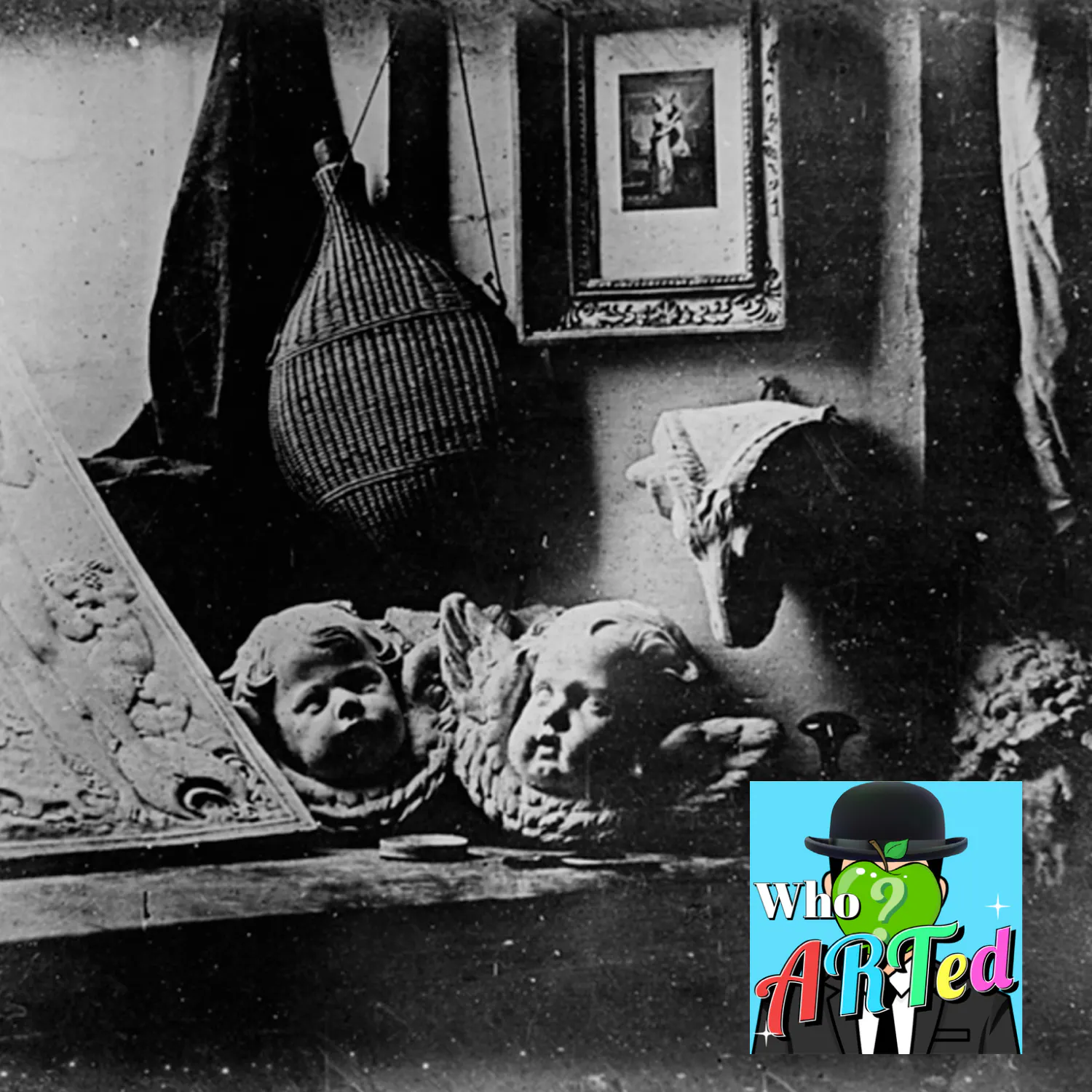
Fans voted Louis Daguerre as one of the most popular subjects covered in 3 years of Who ARTed, so I made a mashup of my two mini-episodes about Daguerre and the early days of photography. The history of photography has some really interesting and surprising facts. For example, the camera is about 2000 years older than photography. The earliest known camera obscuras were documented as far back as the 4th century BCE in China, while photography didn‘t really come about until the 18th Century. In the early 19th century, Louis Daguerre was working hard to improve the photographic method. His innovations helping to develop a latent image drastically cut down on exposure times making photography much more practical. Of course, while I say it drastically cut down exposure times, it cut the times down from hours to minutes, but it was still too long to be practical for most people to be captured in a photo. The first photograph of people actually happened by accident as one man‘s decision to get his shoes shined in 1838 led to his likeness being captured in an image that would make history. Who ARTed is an Airwave Media Podcast. Connect with me: Website | Twitter | Instagram | Tiktok Support the show: Merch from TeePublic | Make a Donation As always you can find images of the work being discussed at www.WhoARTedPodcast.com and of course, please leave a rating or review on your favorite podcast app. You might hear it read out on the show. Learn more about your ad choices. Visit megaphone.fm/adchoices

Fan Pick: Ai Weiwei | Sunflower Seeds
Ai Weiwei is a contemporary artist best known for his tendency to be a thorn in the side of the Chinese government. His name is a blocked search term on some social media platforms, he was detained by the government, he destroyed and defaced ancient artworks, he modeled the Olympic stadium after a toilet seat, and he was a top rated blackjack player. He is quite possibly the most interesting man in the world. In this episode I talked to Nathan, the host of Post Modern Art podcast about Ai Weiwei and his piece with 100,000,000 Sunflower Seeds. Who ARTed is an Airwave Media Podcast. Connect with me: Website | Twitter | Instagram | Tiktok Support the show: Merch from TeePublic | Make a Donation As always you can find images of the work being discussed at www.WhoARTedPodcast.com and of course, please leave a rating or review on your favorite podcast app. You might hear it read out on the show. Learn more about your ad choices. Visit megaphone.fm/adchoices

Fan Pick: Jean-Michel Basquiat | Untitled Skull
Every day this week, I am rebroadcasting a fan pick to celebrate 3 years of exploring visual arts in an audio medium. Today's fan pick is Jean-Michel Basquiat. This was the most popular episode in the early days. It was the first episode I had to get over 1,000 downloads. Thanks to everyone who has supported me with this podcast by listening, telling friends about the show, or leaving a rating/review to help others discover Who ARTed. Who ARTed is an Airwave Media Podcast. Connect with me: Website | Twitter | Instagram | Tiktok Support the show: Merch from TeePublic | Make a Donation As always you can find images of the work being discussed at www.WhoARTedPodcast.com and of course, please leave a rating or review on your favorite podcast app. You might hear it read out on the show. Learn more about your ad choices. Visit megaphone.fm/adchoices

Fan Pick: Rangoli
This week I am playing fan favorite episodes in the run-up to my 3rd anniversary show. To kick things off, I have this mini episode on Rangoli, which is perfect for this time as many people are creating Rangoli designs as a part of their celebration of Diwali right now. Who ARTed is an Airwave Media Podcast. Connect with me: Website | Twitter | Instagram | Tiktok Support the show: Merch from TeePublic | Make a Donation As always you can find images of the work being discussed at www.WhoARTedPodcast.com and of course, please leave a rating or review on your favorite podcast app. You might hear it read out on the show. Learn more about your ad choices. Visit megaphone.fm/adchoices
The Unbelievable Story of Han van Meegeren
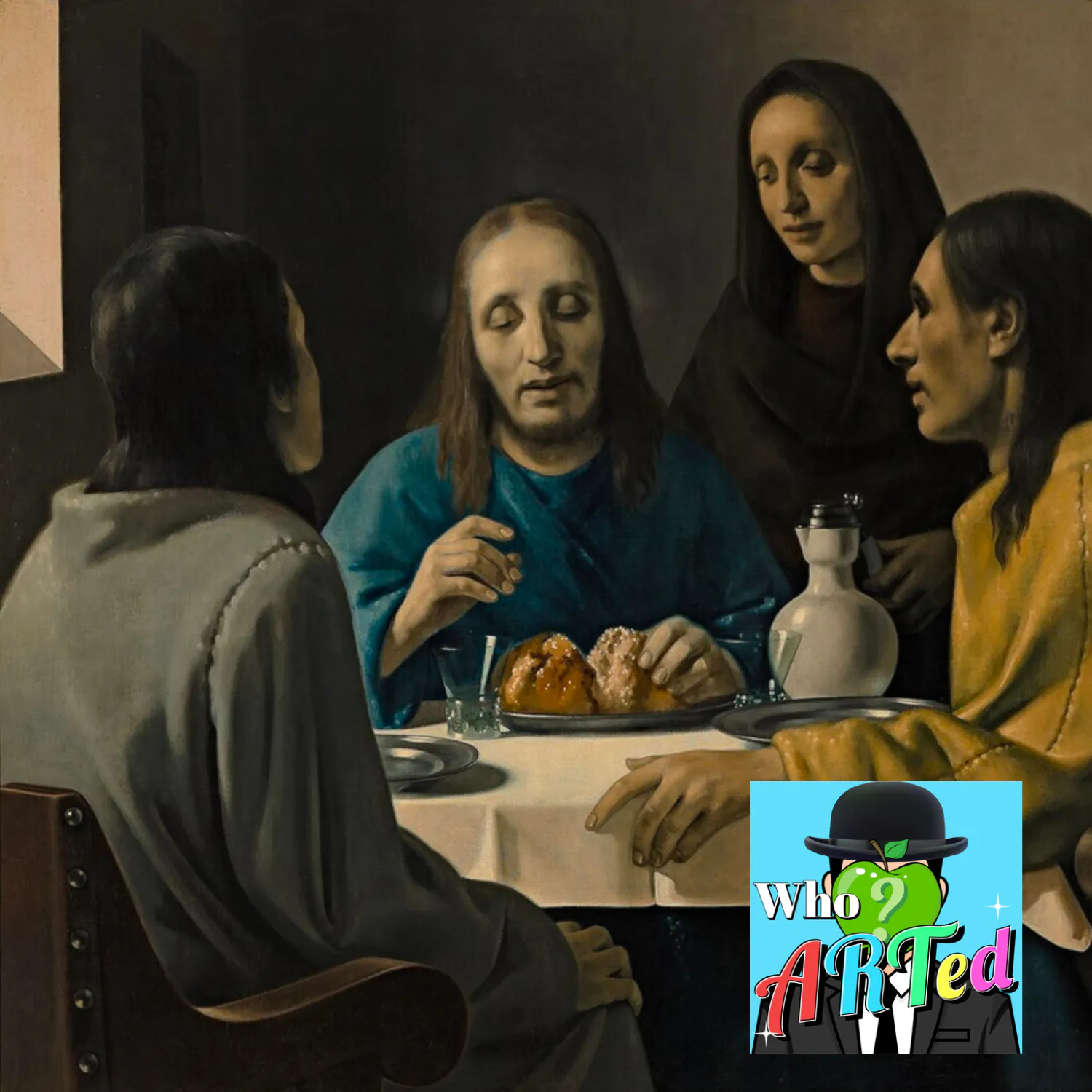
The late 1930s were a rough time in Europe. Nazis were on the rise, and museums began hiding their most treasured works or even shipping them off to safe locations. As all of these works were floating around in the art world and many pieces being hidden, Hans van Meegeren emerged as an art dealer with some lost Vermeers. As I explained in the previous episode about the Vermeer stolen from the Isabella Steward Gardner museum, there aren’t a lot of Vermeer paintings and much of his biography is unknown. There are some historians who believe Vermeer studied under an artist who was heavily influenced by Caravaggio. Van Meegeren was celebrated for bringing the world the gift of these lost Caravaggio influenced Vermeer paintings. The critics loved the paintings and they loved Van Meegeren for discovering these lost works. He sold them for huge amounts and over just a few years amassed a fortune of about $30 million in today’s money. The thing is Van Meegeren would sell to anyone with money, including the Nazis. Hermann Goering, Hitler's vice chancellor was an art lover. He particularly loved the Vermeer painting he got from Van Meegeren. In the 1940s, the allies came knocking to ask why Han van Meegeren was doing business with the Nazis. Now whatever they expected to hear as his response, I guarantee they were surprised. Van Meegeren declared that he deserved to be treated as a hero for his dealings with the Nazis because all of the works he sold them were fakes. He claimed that by selling and trading these forgeries he was able to get 137 authentic Dutch masterpieces from the Nazis. It was an interesting defense, that he was not a war criminal but simply forger. It would be hard for anyone to feel sympathy for the victims of this crime but most found it too hard to believe. Who ARTed is an Airwave Media Podcast. Connect with me: Website | Twitter | Instagram | Tiktok Support the show: Merch from TeePublic | Make a Donation As always you can find images of the work being discussed at www.WhoARTedPodcast.com and of course, please leave a rating or review on your favorite podcast app. You might hear it read out on the show. Learn more about your ad choices. Visit megaphone.fm/adchoices

Johannes Vermeer | The Concert
Who ARTed has been giving you weekly art history for three years now. Help me celebrate the milestone by telling my your favorite episodes from the last three years. Go to www.WhoARTedPodcast.com/vote to tell me your favorite episodes and get a chance to win a $25 Amazon gift card. There are only 36 Vermeer paintings in the world today and one was stolen from the Isabella Stewart Gardner Museum in 1991. The case remains unsolved to this day. In this episode, Emily Fiedler and I discussed the museum heist along with the Vermeer painting that has been missing for the last 30 years. Who ARTed is an Airwave Media Podcast. Connect with me: Website | Twitter | Instagram | Tiktok Support the show: Merch from TeePublic | Make a Donation As always you can find images of the work being discussed at www.WhoARTedPodcast.com and of course, please leave a rating or review on your favorite podcast app. You might hear it read out on the show. Learn more about your ad choices. Visit megaphone.fm/adchoices

Spirit Photography | Some Spooky Fun Historic Hoaxes
William Mulmer was born in 1832. For historical context, the oldest known Daguerrotype is from 1837, so Mulmer was born right around the same time as photography, and he loved the new medium, but started off as a hobbyist. Mulmer worked as a jewelry engraver, but in his spare time, he liked taking photographs of his family and friends. In 1860 though, he took a selfie that would change the course of his life. In his self portrait, he noticed something strange. There appeared to be a ghost behind him. It just so happened that his wife was a healing medium who would help people make contact with the spirits of dead loved ones. The spiritualist movement was quite popular in the late 19th century and William Mulmer had found a way to use the latest scientific technology to photograph spirits providing dramatic and compelling images as evidence to validate the seances. While Mulmer created his spirit photographs using double exposure, basically he would put a plate of the “ghost” in front of the sensitive photographic plate while he took the spirit photo, double exposure is not the only trick people can use to capture a ghost on film. A famous ghost image was created in 1891 without a double exposure. In the image we see a seemingly empty room with a faint image of a ghostly man on a chair. We barely see the man as really only his head and arm are visible. He seems to be fading from the image and just a part of the ghostly body hangs in the air. The photo was taken in the library of Combermere Abbey shortly after Lord Combermere died in a riding accident. He was being buried at the time the photo was taken leading many to the seemingly obvious conclusion that the man in the picture was the ghost of Lord Combermere. In reality, it was a quirk of a long exposure photograph. Learn more about early photography with these episodes of Who ARTed: The World's First Photobomb Louis Daguerre The Artist's Studio Who ARTed is an Airwave Media Podcast. Connect with me: Website | Twitter | Instagram | Tiktok Support the show: Merch from TeePublic | Make a Donation As always you can find images of the work being discussed at www.WhoARTedPodcast.com and of course, please leave a rating or review on your favorite podcast app. You might hear it read out on the show. Learn more about your ad choices. Visit megaphone.fm/adchoices

Frank Lloyd Wright | Falling Water
Frank Lloyd Wright is one of America's most celebrated architects. He developed his distinctive prairie style emphasizing the horizontal planes of the landscape because he wanted his buildings to be in harmony with nature and fit in with their surroundings. While Wright was a highly respected and influential architect in the early 20th century, by the 1930s, he was seen by many as past his prime. Falling Water was a comeback piece for him demonstrating that decades into his career he could still innovate and leave people awestruck. Part of what sets this house apart from the average home built in the woods was that Wright didn't design the house to look at the scenic waterfall; he designed the house to be a part of the waterfall. My guest this week was Tim Bogatz, host of Art Ed Radio from The Art of Education University. Check out Art Ed Radio on your favorite podcast app Who ARTed is turning 3 years old. Go to www.whoartedpodcast.com/vote to vote for your favorite episodes and get a chance to win a $25 Amazon gift card. Who ARTed is an Airwave Media Podcast. Connect with me: Website | Twitter | Instagram | Tiktok Support the show: Merch from TeePublic | Make a Donation As always you can find images of the work being discussed at www.WhoARTedPodcast.com and of course, please leave a rating or review on your favorite podcast app. You might hear it read out on the show. Learn more about your ad choices. Visit megaphone.fm/adchoices

The Radium Girls
Who ARTed: Weekly Art History for All Ages is turning 3 years old on October 31. Please help me celebrate the milestone. Go to www.WhoARTedPodcast.com/Vote to tell me which were your favorite episodes. One voter will win a $25 Amazon gift card. The other day, one of my students asked me what would happen if he drank paint. He was joking, but it reminded me of a story of women who sometimes played around painting selves but regularly ingested microscopic bits of paint with devastating consequences. From 1917 to 1926, there was an advancement in science leading to the creation of new luminous paints. These new paints were particularly helpful with the US military in making watches that would be visible even at night. The company called these watches “Undark” I can only imagine how many hours the marketing department debated before coming up with such a brilliant name. Unfortunately, the watch didn’t quite live up to its name. While the paints did glow, the story of these watches and the people who produced them is pretty dark. Starting in 1917, the US Radium Corporation hired a bunch of young women to paint watch faces with radium based paints that would glow in the dark. For these young women, it seemed like a great job. They were paid about 3 times what the average working woman was getting at that time, they got to work with this cool new material that glowed like something from science fiction, and the job was relatively easy. They just had to lip, dip and paint. But that first part, the lip part turned out to be a major problem. The women were using camel hair brushes to paint tiny details on watch faces and instrument dials. As any painter could tell you, after just a few brush strokes, the bristles start to splay requiring them to point their brush. The women working for the US Radium Corporation, and a few rival companies of that day were all told to use their mouths to point the brush. While they could have achieved similar results with water and rags, it was more efficient for the workers to simply put the brush in their mouth using their lips, teeth and tongues to get the bristles realigned. Listeners today would no doubt be horrified at the prospect of putting radioactive material into their mouths, but for the so called radium girls, it was part of the job and for many of them, it seemed like a fun perk. There are stories of the young women painting their teeth, or their nails with the radioactive paints. Of course, as the old saying goes, it’s all fun and games until someone’s jaw falls off. Unsurprisingly, it was the dentists who first noticed the health effects of radium ingestion. The radium girls developed a condition referred to as radium jaw or necrosis of the jaw which simply put means the cells in their jaws were dying from radiation poisoning and along with that teeth fell out and bones would become distorted due to tumors or even they might be left with holes in the jawbones. Who ARTed is an Airwave Media Podcast. Connect with me: Website | Twitter | Instagram | Tiktok Support the show: Merch from TeePublic | Make a Donation As always you can find images of the work being discussed at www.WhoARTedPodcast.com and of course, please leave a rating or review on your favorite podcast app. You might hear it read out on the show. Learn more about your ad choices. Visit megaphone.fm/adchoices
Hilma Af Klint | What a Human Being Is
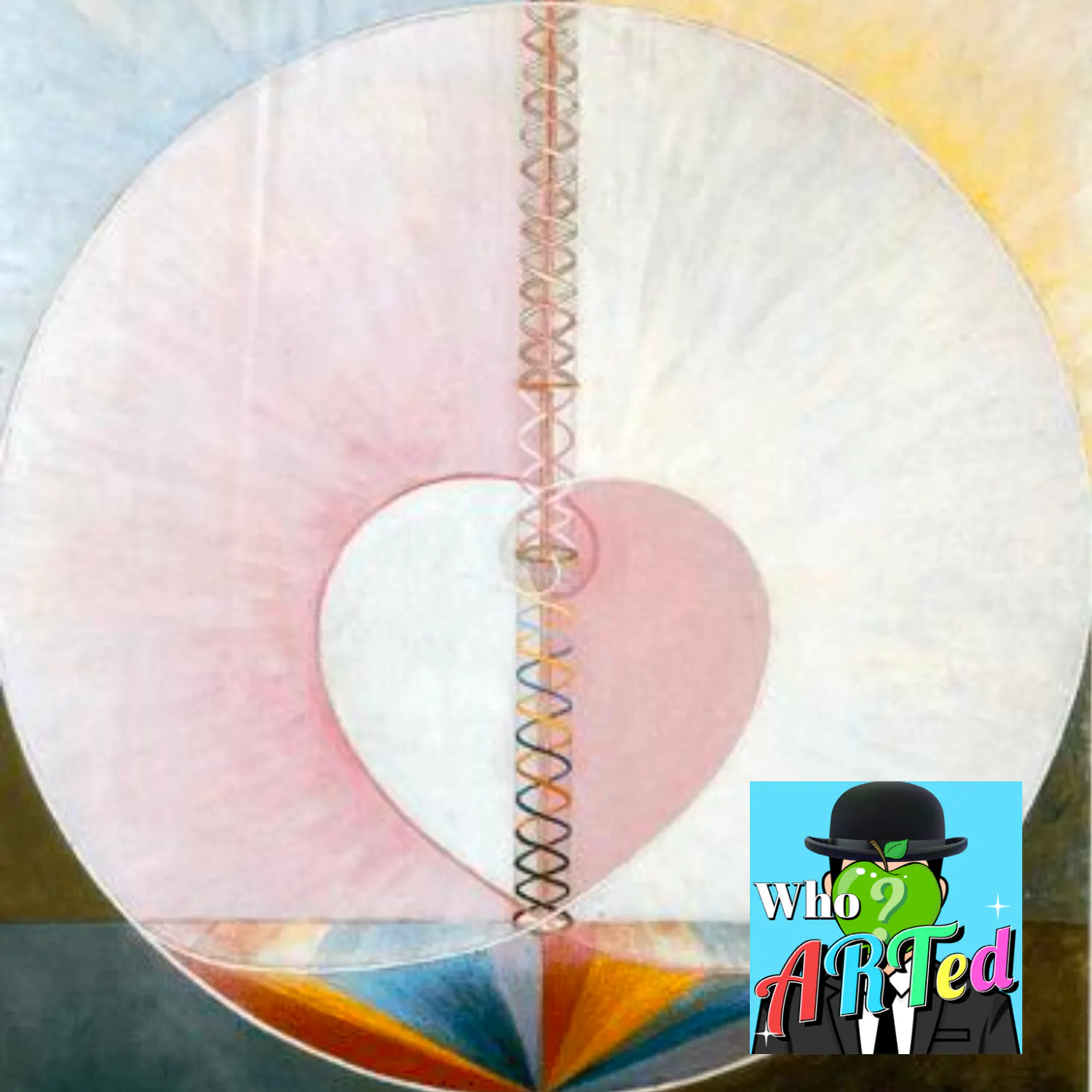
My guest this week was Natalie for the podcast, Reframables. Click here for the link tree showing all the places you can find her podcast. Who ARTed is turning 3 years old. Go to www.whoartedpodcast.com/vote to vote for your favorite episodes and get a chance to win a $25 Amazon gift card. Hilma Af Klint was making abstract paintings before Kaninsky and Mondrian. She was exploring automatic writing and drawing guided by the subconscious decades before the surrealists. The term avant garde literally refers to those going ahead of the rest. Hilma Af Klint was among the greatest avant garde artists in history. Hilma Af Klint’s long time in relative obscurity is partly due to the stipulations of her will. She stated that her works should not be shown until 20 years after her death. She was medium who said that her abstract paintings were guided by otherworldly entities. She was a part of a collective known as The Five and the women would hold seances which guided their artistic practices. Hilma Af Klint said her works could not be understood or appreciated until decades after her death because while most artists are chasing trends, Hilma Af Klint was using her intuition to create paintings that would blow the minds of future generations. Who ARTed is an Airwave Media Podcast. Connect with me: Website | Twitter | Instagram | Tiktok Support the show: Merch from TeePublic | Make a Donation As always you can find images of the work being discussed at www.WhoARTedPodcast.com and of course, please leave a rating or review on your favorite podcast app. You might hear it read out on the show. Learn more about your ad choices. Visit megaphone.fm/adchoices

The First Picture Book for Children
In 1658, John Comenius created Orbis Sensualium Pictus, which translates to The World Around Us in Pictures. Comenius was a teacher from what is now the Czech Republic and he published his book in Latin and German, though it was a huge hit so it was quickly translated into English as well. Like so many teachers, he created his own resources to help his students learn. He created a book with 150 illustrations to make it engaging and accessible to learners of all ages with the idea that engaging the senses would help students learn. In the book, he covered a range of topics including animals, nature, the elements and religion. Interestingly while it was extremely popular and numerous copies were printed and distributed, not many are around today. That is because Orbis Sensualium Pictus was a book that was used in children’s daily education rather than stored on the shelf and through that process of repeated use, the pages were torn and bindings worn out. Help me celebrate 3 years of Who ARTed: Weekly Art History for All Ages. Who ARTed launched on October 31, 2019. Over the last 3 years and 5 seasons, I have covered a lot of stories of different artists and artworks. At the end of the month, I am planning to celebrate by rebroadcasting the most popular episodes voted by my fans. Vote for your favorite episode from each season for your chance to win a $25 Amazon gift card (Prize and raffle are from Who ARTed and not provided or run by Amazon) Click here for the voting page This week's fan fact came from a junior high student, Malena, who wanted to share a bit about Beatrix Potter. Who ARTed is an Airwave Media Podcast. Connect with me: Website | Twitter | Instagram | Tiktok Support the show: Merch from TeePublic | Make a Donation As always you can find images of the work being discussed at www.WhoARTedPodcast.com and of course, please leave a rating or review on your favorite podcast app. You might hear it read out on the show. Learn more about your ad choices. Visit megaphone.fm/adchoices
Who ARTed Trailer
trailerWho ARTed is weekly art history for all ages. Every episode tells the story behind a different work of art. Who ARTed is dedicated to celebrating the arts in all forms, from all cultures and all times. Learn more about your ad choices. Visit megaphone.fm/adchoices

Paul Cezanne | Mont Sainte-Victoire
Paul Cezanne was an influencial post impressionist painter. He was a very thoughtful and deliberate painter taking an almost scientific approach to the landscape reducing nature to brush strokes that would indicate the various planes. He famously sought to reduce all subjects to a collection of geometric forms. For this episode, I was joined by Dr. Lex, host of the LuxeSci Podcast. Find her show on Apple Podcasts, Spotify, or wherever you listen to podcasts. Who ARTed is an Airwave Media Podcast. Connect with me: Website | Twitter | Instagram | Tiktok Support the show: Merch from TeePublic | Make a Donation As always you can find images of the work being discussed at www.WhoARTedPodcast.com and of course, please leave a rating or review on your favorite podcast app. You might hear it read out on the show. Learn more about your ad choices. Visit megaphone.fm/adchoices

Fantasmagorie | The World's First Animated Cartoon
In 1908, Fantasmagorie premiered as the first hand drawn cartoon paving the way for artists like Disney and what we think of as modern animation. See Fantasmagorie here Who ARTed is an Airwave Media Podcast. Connect with me: Website | Twitter | Instagram | Tiktok Support the show: Merch from TeePublic | Make a Donation As always you can find images of the work being discussed at www.WhoARTedPodcast.com and of course, please leave a rating or review on your favorite podcast app. You might hear it read out on the show. Learn more about your ad choices. Visit megaphone.fm/adchoices