
Volts
444 episodes — Page 8 of 9

Volts podcast: Dr. Ye Tao on a grand scheme to cool the Earth
In this episode, Dr. Ye Tao discusses his vision for combatting climate change by using fields of mirrors that reflect solar radiation.(PDF transcript)(Active transcript)Text transcript:David RobertsGeoengineering — using large-scale engineering projects to directly cool the Earth’s atmosphere — is an intensely controversial topic in climate circles. On one hand, such schemes strike many people as dangerous hubris, interfering with large-scale systems we don’t fully understand, risking catastrophic unintended consequences. On the other hand, there is good reason to believe that even a wildly successful program of decarbonization will not be enough to avoid devastating levels of heat in the atmosphere.Dr. Ye Tao was early in his career as a researcher at Harvard’s Rowland Institute, working on nanotechnology, when he became gripped by the problem of climate change. As he dug into the research, he concluded that even rapid decarbonization — especially insofar as it reduces the aerosol pollution that temporarily cools the atmosphere — would leave the Earth roasting in levels of heat hostile to most life forms.As he reviewed available options for carbon capture and geoengineering, he realized that none of them were safe or scalable enough to do the necessary cooling work in time. So he came up with a technique of his own: mirrors.The MEER project — Mirrors for Earth’s Energy Rebalancing — is a nonprofit established to advance Tao’s vision, which involves covering some mix of land and ocean with fields of mirrors. The mirrors would reflect solar radiation, and thus heat, back up out of the atmosphere. If 10 to 15 percent of developed agricultural land could be covered with mirrors, Tao has calculated, it would return Earth’s heat to safe preindustrial levels, providing a range of local benefits to agriculture and water in the meantime.It’s a brash idea, somewhere between crazy and obvious, and I was excited to hear more from Tao about why he thinks it’s necessary, how it would work, the materials that would be required, and how the MEER framework changes the way we view carbon dioxide in the atmosphere. Alright. Ye Tao. Welcome to Volts. Thanks for coming on.Ye TaoYeah, thanks for inviting.David RobertsYe I have to confess when I first invited you on the pod, I had not yet really done a deep dive into into the MEER Project, and I was just sort of thinking, "Oh, a bunch of mirrors. How novel. That sounds fun. Let's talk about that." But I've spent a while now digging in and listening to more of your presentations and reading more, and there's really a lot going on here. There's a lot going on here. The mirrors are at the end of a sort of chain of reasoning that in many, many ways contradicts conventional wisdom about climate change.So I do want to get to the mirrors. I'm excited to talk about the mirrors, but let's do a little background building first. So I want to start with, it seems like the key to understanding your whole framework here is the distinction between CO2 and heat. We sort of conflate carbon and heat. When we talk about climate change, what's the problem? It's more carbon, and carbon causes heat. How do we reduce heat? We reduce the carbon dioxide emissions. We sort of have those coupled in our mind. And you say it's important to decouple them. So talk a little bit about why we need to keep them conceptually distinct, and then also decouple them in terms of the physics of the system.Ye TaoOkay, yeah, that's a good place to start. It's true that we created this problem by emitting CO2, and it's important to shut it down as quickly as we can manage, practically. And in the Earth system, everything is basically linked. So it's only natural that when you perturb one important component to a very significant extent, such as CO2 concentrations, you should expect some downstream consequences — and the most urgent of which is overheating of the planet. And heat is really the driver of weather patterns and precipitation patterns. So when you have excess thermal energy that's really different from the state Earth was before the CO2 perturbation, that you can expect downstream extreme events and also perturbation to the biochemical cycle.And if we look at the responses of different organisms and plants, insects, and mammals, and how they respond to individual perturbations in CO2 versus temperature, universally they really suffer when temperature gets ramped up to a few degrees above their normal temperature niche values. But in terms of CO2, essentially most species, like 90% plus or more, are actually not perturbed really by the current increase in CO2 levels. So basically, we initiate this avalanche by burning CO2. But the real environmental stressor that's really creating havoc are a combination of overheating and the resulting drying of land and moisture.David RobertsSo what we talk about as the effects of climate change are the effects of heat, basically, our heat playing its way through the system. A

Volts podcast: Chris Hayes on how his politics have changed since 2015
In this episode, Chris Hayes of MSNBC discusses how American politics and society changed after the Obama years, where things might head in the future, and how his own views have shifted along the way.(PDF transcript)(Active transcript)Text transcript:David RobertsI often reflect on a particular moment in the summer of 2015. It was not long after the Supreme Court made gay marriage legal across the nation in Obergefell v. Hodges. And America was in the middle of one of its regular fights over Confederate monuments and flags, which were being pulled down by progressives across the country.One afternoon I ran across a cartoon — I think it was on Facebook? — showing a Confederate flag being lowered and the LGBTQ flag being raised in its stead.Hot damn, I thought. Maybe we really do get it right eventually.I now think back on that moment as the peak of my belief in what you might call the Obama creed, which the nation's first black president repeated in one way or another in virtually every speech: that the essence of America is its continuous struggle toward the egalitarian ideals of its founding. Again and again it delays and falls short and takes two steps back, but it never stops striving, improving, bit by hard-fought bit. The arc of history is long, but it bends toward justice.To a first approximation, everything that has happened since then has sucked. We fell into the ugly 2016 Democratic nomination fight, followed by the ugly presidential election, then four years of daily insults to dignity and compassion by Trump, then a plague that we bungled in countless ways and that has killed more than a million of us, and now, the Supreme Court is systematically dismantling the pillars of the modern administrative state while Biden and the Democrats fumble their way through a slow-motion catastrophe, setting up an openly seditious Republican Party to seize near-total power in the coming two elections.To put it mildly, these developments have been rough on the Obama creed, at least for me and many people I know. Much of what Obama himself did was crushed or reversed by Trump, and Biden has barely begun rebuilding from the wreckage. More than that, America's reactionary minority seems ascendent. And its intentions are clear: to follow Viktor Orban's lead in Hungary. To whittle democracy down until it's entirely hollow, one-party rule in all but name. It finds echoes in similar reactionary backlashes currently rising in nations across the globe.Is America redeemable? Is white Christian patriarchy ready and willing to destroy the country before it gives up power? Is the arc of history bending, or is it merely flailing back and forth, with no larger purpose or pattern? Is modern multi-racial, multi-cultural democracy still a viable long-term project?To help ponder these weighty questions, I've turned to the inimitable Chris Hayes, who, as they say, needs no introduction. You've seen his shows on MSNBC, you've listened to his podcast, you've read his essays and books, you know that he is one of the leading liberal voices of our time. He’s also a friend. We are part of the same generation of journalists, living through the same dumpster fires, seeing the same patterns, and our paths have crossed regularly over the years. I’ve also been on several of his shows! We go way back.I’ve always felt that Chris and I share similar political and intellectual instincts — one of the few people at the commanding heights of US journalism and punditry about whom I can say that — so I’m curious to hear how his political outlook has changed since 2015, whether he still believes in the Obama creed, and what he thinks is coming in America’s near future. So with that portentous wind-up, let's bring him into the conversation.Chris HayesThat was great. I love that. I found that very moving.David RobertsOh, great. Alright, well, thanks for coming on Volts.Chris HayesI should say I'm a Volts reader, too.David RobertsThank you. Thank you. I appreciate it. We're talking during a very dark time. Dark. I mean, it's all shades of dark these days. It's particularly dark in the wake of the latest ...Chris HayesChild murder?David RobertsChild murder. Yes, child mass murder. That we're all going through the motions as we always do, until that fades and something else horrible comes up in the news. But let's pull the lens back. I want to do some big picture talking, and then a little bit more close in, like proximate, what's our proximate future talk? But let's start with the big picture. So I just want to start by asking you in the most general possible terms, if you think back to 2015, which I mark as sort of the last normal year, how has your political outlook changed?I think of you as basically sort of a Left liberal, Scandinavian, welfare-state kind of guy. Has any of that fundamentally changed? Or if not, have you changed your mind about any big things? How have you evolved since then?Chris HayesYeah, I think my basic orientation, which is like,

Volts podcast: Danny Cullenward on California's shaky climate plans
In this episode, policy analyst Danny Cullenward of CarbonPlan talks about the disconnect between California’s ambitious climate goals and its actual practical plans for achieving them.(PDF transcript)(Active transcript)Text transcript:David RobertsCalifornia has long been known, nationally and internationally, as a leader on climate policy. The sheer scale of its economy and the stringency of its emissions targets have made it a model for other states with climate ambitions. As a role model, its successes (and failures) reverberate far beyond its borders.So it matters a great deal whether California has a practical plan to meet its aspirations. This year offers something of an answer, and … it’s not great. Volts is a reader-supported publication. To receive new posts and support my work, consider becoming a free or paid subscriber.Every five years, the California Air Resources Board (CARB) issues a “scoping plan,” laying out how it intends to meet the state’s targets. The last one, in 2017, raised serious questions about whether the state’s cap-and-trade system could do the emission-reduction work that the state planned to require of it through 2030. This year’s draft scoping plan (there’s still time for public comment) answers none of those questions, and instead, looking out to 2045, raises new questions about whether carbon-dioxide removal (CDR) can do the work the state plans to require of it.That’s a lot of questions. To hash through them, and get a sense of just how prepared California is to meet its climate targets, I called up Danny Cullenward, a long-time policy analyst in the state. (Volts fans will remember him from one of the very first Volts posts.) He is currently policy director at the nonprofit CarbonPlan and a research fellow at American University’s Institute for Carbon Removal Law & Policy. Cullenward and I discussed what policies have worked to reduce emissions in California, whether the cap-and-trade program can do what’s asked of it, why the current scoping plan leans so heavily on CDR, and whether there’s still time to improve the plan before it’s locked in for five years.Without any further ado, Danny Cullenward. Welcome to Volts. Thanks for coming.Danny CullenwardThanks for having me on, Dave.David RobertsDanny, you were the first interview I ever did for Volts a couple of years ago. And as far as I know, now you're the first return guest.Danny CullenwardAnd the first to pivot to audio. This is fun.David RobertsYeah, the first to pivot to audio. I'm sure this is the kind of accomplishment you used to dream about as a young man.Danny CullenwardIf I were still an academic, it would be going on my CV.David RobertsAlright, so the purpose of our conversation here today is to get a handle on California and climate, sort of where it's been, where it says it's going, and whether it is in fact prepared to go where it says it's going. Before we get there, though, let's do just a little sort of scene setting, a little background. I think everybody hears about laws coming out of California all the time. California is doing this, doing that, and it becomes a little bit of a blur. So let's just sort of clarify what are the targets to which California is committed by statute, and sort of what are its other targets which are less statutory.Danny CullenwardI think that's the formal legal definition. That's great.David RobertsSemi statutory.Danny CullenwardWell, so there's a reason people talk about California and also why people, I think, sometimes get confused about exactly what's going on. And the reason that it matters is California was one of the first states to move forward on some of the macro climate policy issues, and many states are either copying or learning from its experience. So what it does turns out to matter a lot to sort of what other people start to do. I think the story begins in earnest in climate policy with the passage of AB 32. Our famous climate law back in 2006.David RobertsUnder Arnold.Danny CullenwardUnder Arnold Schwarzenegger, and a progressive Democratic legislature came together, found common ground on this bill, did a couple of things.It set a target to reduce emissions back down to 1990 emissions, by the year 2020. And it empowered the climate regulator, the California Air Resources Board, with the authority to undertake new regulations, including a cap-and-trade program, as well as to coordinate with other agencies, like our clean energy regulators that had already been pushing on renewables in the past. And that sort of set up the meta-framework and delegated the planning exercise to this regulator. So that's target number one. Target number two is about a decade later. In fact, one of the same principal legislators, then-Senator Fran Pavley, led a bill called SB 32, which codified a target of 40% below 1990 levels by the year 2030.So both of those are statutory targets. They're legally binding. The regulator is obligated to plan to and meet those targets. And the
Volts podcast: Abigail Hopper on the trade case that is crushing the US solar industry
In this episode, Abigail Hopper of the Solar Energy Industries Association discusses the trade complaint that has cast a pall over the US solar industry, why she believes it should be dismissed, and the complexities of tariff policy.(PDF transcript)(Active transcript)Text transcript:David RobertsBack in 2012, the Obama administration levied tariffs on solar panels from China, to punish the country for unfairly subsidizing its panels in an attempt to corner the market. In the ensuing years, US imports from China fell off sharply and imports from Cambodia, Malaysia, Thailand, and Vietnam rose just as quickly.Early this year, a tiny California-based solar manufacturer, Auxin, filed a trade complaint with the US Department of Commerce, alleging that China is effectively laundering its solar supply chain through third-party countries, thereby illegally circumventing tariffs. It asked Commerce to apply commensurate tariffs on imports from those countries. (Canary Media has extremely thorough coverage of the case, if you want to catch up.)Commerce is investigating. Meanwhile, the industry has been thrown for a loop — imports have fallen off, projects are being cancelled, and projections of growth are being revised radically downward. The tariffs could be anywhere from 30 to 250 percent, which would radically change the economics of big solar projects, and if applied, will be retrospective over the past two years, which means even existing contracts are in jeopardy. The uncertainty has cast a pall over the entire sector.The Solar Energy Industries Association (SEIA) has been advocating against tariffs from the beginning and is calling on Commerce to dismiss the complaint. I contacted Abigail Hopper, the head of SEIA, to talk about the merits of the case, whether building a domestic solar supply chain is a good goal, whether tariffs work, and what other policies might be preferable. With no further ado, Abigail Hopper of SEIA. I'm not going to say the whole thing. Welcome to Volts. Thanks for coming.Abigail HopperThanks for having me. I'm glad to be here.David RobertsSo this is a knotty and complicated issue we're going to get in here.Abigail HopperIs that the K-N-O-T-T-Y naughty?David RobertsYes, exactly.Abigail HopperOkay, just checking.David RobertsAlso, perhaps naughty, we'll see at the end. So I want to kind of go through it piece by piece, before we get to the tariff dispute, the tariff case that's at issue here, let's go back a little bit and just talk about the tariffs. These date back to Obama, the Obama era. So why don't maybe you just tell us sort of what tariffs are in place, and what is the rationale for tariffs, like when Obama put these in place in 2012? What is the sort of stated rationale? What are they meant to accomplish?Abigail HopperSure. And you already have displayed more knowledge than the average person around the multiple layers of tariffs that the solar industry is dealing with. So, yes, these go back to 2012. And at that time, there was an allegation and then a finding, that China was dumping its product into United States. That meant that the Chinese government was unfairly subsidizing production of solar cells and solar modules and then selling them into the United States below cost. So if it cost $10 to make it, they would sell it in for $5, and the Chinese government would suck up the other $5.David RobertsAnd presumably this is not just, like, unfair or unsporting. This violates some law or treaty.Abigail HopperYes, it violates the trade laws, and therefore the tariffs were put in place to address that unfair practice.David RobertsAnd then there were more under Trump. What did he add?Abigail HopperSo the ones we just talked about, people refer to usually as the ADCBD, Anti-Dumping Countervailing Duties cases, and those are from 2012, and those apply to products coming out of China. In 2017, a case was initiated, and then in 2018, President Trump imposed tariffs. And those are the Section 201. That's the section of the statute it applies to. And those were placed on cells and modules coming from any country in the world. There were a couple of specific exceptions, but generally, any country in the world, these tariffs applied and they started at 30% and stepped down.There's a whole drama around the bifacial modules and that exclusion, I'm happy to talk about. But those were additive to whatever ADCBD tariffs that were already in place.David RobertsSo specifically, then, imports from China would face both of these tariffs added together.Abigail HopperCorrect.David RobertsI mean, the rationale for the first set makes sense. If China is doing something illegal under trade law, that makes sense. But what is the rationale for just slapping tariffs on all imports? That can't be that all importers are breaking trade laws. What's the rationale there?Abigail HopperYeah, it's a totally different theory of the case. It is not a claim based on fault or anyone being nefarious or violating laws. Ra

Volts podcast: Lauren Melodia and Kristina Karlsson on energy inflation and how to tame it
In this episode, Lauren Melodia and Kristina Karlsson of the Roosevelt Institute explain why it’s counter-productive to increase domestic oil and gas production when energy prices rise, and how building out clean-energy infrastructure is the actual best way to address the price volatility of fossil fuels. (PDF transcript)(Active transcript)Text transcript:David RobertsAmericans are struggling with two related problems: one, there’s general inflation, which means pretty much everything is expensive; two, there’s energy price inflation, which means that energy in particular (specifically, oil and gas) is expensive.This has led some politicians, mainly Republicans-and-Joe-Manchin, to propose a dual solution: cut back on government spending (to tame inflation) and increase domestic oil and gas production (to tame energy prices). This approach is wrong-headed and counter-productive on both counts. The reasons why are laid out in a new issue brief from the Roosevelt Institute, the first in a series called “All Economic Policy Is Climate Policy” (which, hell yes).Lauren Melodia, deputy director of macroeconomic analysis at the Roosevelt Institute, and Kristina Karlsson, the institute’s program manager for climate and economic transformation, argue that fossil fuel prices are inherently volatile, and that volatility has serious macroeconomic effects; on the flip side, electricity prices — specifically renewable electricity prices — tend to be far more stable and manageable.It follows that government spending to build out clean-energy infrastructure is itself anti-inflationary; it removes a source of price instability and replaces it with stability. This argument is my favorite kind — it put words to something that’s been rattling around in my head for years — so I was excited to talk to Melodia and Karlsson about the volatility of fossil fuels, why we’ve come to accept it as an inevitable fact of life, and why it is, in fact, a choice that we could make differently. With no further ado, Lauren Melodia and Kristina Karlsson from the Roosevelt Institute. Welcome to Volts. Thanks for coming.Kristina KarlssonThanks for having us.Lauren MelodiaThanks so much for having us.David RobertsYou have written this report about energy and inflation. It's one of my favorite kinds of reports, in that, after I read it, I was like, "Oh, well, duh, of course that's true." But it's like it hadn't occurred to me before. It's one of those things where just hearing it stated clearly, I think is very eye-opening. So let's walk through a little bit, the pieces of it, and then we'll get into what it means for policy. So to start with, something I found interesting and didn't really know, which is that these traditional measures of inflation, which are gently sort of like bundles of products through which inflation is measured and tested, exclude energy.Typically, energy is not included in them because energy is sort of inherently volatile and is swinging up and down all the time. And so the idea, I think, is if we include that, it's going to sort of obscure what we're trying to look at. So we'll set that aside and look at another bundle of products, and if they are going up, then it's real inflation. This is sort of how things are typically done. But as you say, this can be somewhat misleading since energy price volatility plays a huge role in inflation, and, specifically, is playing a huge role in current inflation.So explain briefly sort of the role of energy prices in the inflation we are currently experiencing.Lauren MelodiaSure, absolutely. I mean, I think that there's two ways that they're at play, despite the fact that the Fed or certain macro analysts might not want to think about energy prices in the overall inflation rate. One is simply that people spend a lot of money on energy. And so even if the core CPI, Consumer Price Index, or other indicators show that there's price stability, people are experiencing rising gasoline prices. And we've seen over the past year, that really fuel the conversation around inflation.David RobertsConsumers definitely don't hold energy as some separate category, right. Like they experience it as inflation when prices rise.Lauren MelodiaExactly. So if we're talking about rising prices in society and trying to ground that conversation and connect with consumers, people who are consuming the media, your constituents, these are the prices that people are going to be talking about. The other way that they really do influence kind of the overall economy is that these energy price volatility, the changes in energy prices, actually do have a huge impact on our economy overall even if we don't want to be thinking about them when it comes to inflation. And that simply is because energy is foundational to business operations and household consumption.If there's a spike in gasoline prices or other energy prices, it is something that people just have to deal with. You can't delay consuming energy, you have to pay

Volts podcast: Jesse Morris on building an operating system for distributed energy
In this episode, Jesse Morris of international nonprofit Energy Web discusses his group’s work toward building a transparent and trusted “operating system” for distributed energy resources, with an end goal of enabling a more sophisticated and resilient energy grid.(PDF transcript)(Active transcript)Text transcript:David RobertsRecent years have seen an explosive rise in distributed energy resources (DERs) — energy devices that are located “behind the meter,” on the customer side, like solar panels, batteries, electric vehicles (EVs), and smart appliances.Distributed energy has the potential to change the grid for the better, making it cleaner and more resilient, but as things stand, there’s a problem.Consider an EV. The customer has a relationship to it, a way to see its capacity and behavior; it wants to operate the EV in a way that best serves their own transportation needs. The aggregator — an entity that gathers DERs and treats them as a single entity, to sell their services — has a different relationship with the EV; it wants to operate the EV to meet contractual requirements. The distribution utility has a different relationship; it wants to operate the EV to maintain grid stability. And the market manager (ISO) has yet a different relationship; it wants to operate the EV in the way that best serves the market.All these entities want different things from the EV, but they’ve all built bespoke systems to track it — systems that do not communicate with one another. Consequently, most DERs are wildly underutilized. This can not last. Confusion and crossed wires will only grow with distributed energy. What the world needs is a common, transparent, trusted way to track DERs, their capacity and interaction with the grid. That is what Energy Web, an international nonprofit, aims to provide: “an operating system for DERs” that will assign each DER a record on the blockchain (yes, the blockchain), allowing all interested entities to have a common source of information and tracking.I am a bit of a skeptic of toward blockchain hype, but this seems like an excellent use of it, which could unlock a much more sophisticated and resilient grid. I’m eager to talk to Energy Web CEO Jesse Morris about what the product is, how it can help DERs, and where we might see it adopted next.Alright, then. With no further ado, Jesse Morris of Energy Web. Thanks for coming to Volts.Jesse MorrisThank you for having me. Looking forward to the conversation.David RobertsYou know, I want to get into the nuts and bolts of Energy Web, but I feel like we should do a little background, a little scene setting, a little contexting. So let's start, then, because Energy Web is, I think, primarily a way of solving the problems, some of the problems posed by distributed energy. And so I don't want to assume too much background knowledge on the part of listeners. So why don't you just really quickly sort of tell us what qualifies as distributed energy? What's the sort of technical definition of distributed energy? What is it? How much of it is there? How much is coming on board? And what challenge does it pose to the grid?Jesse MorrisSo I think that is a very accurate statement, in terms of our primary focus at Energy Web and the problems we're trying to solve. For us, distributed energy, and I'll add the additional word on here, distributed energy resources. What are we talking about there, at least in kind of Energy Web's world? So we're really talking about any kind of electricity using, storing, or generating device. So that could range from a battery in a home, a battery in a commercial and industrial building, an electric vehicle, a charge point, a heat pump, any kind of load that can be flexed over time.So our definition of distributed energy resources, at least in terms of the work that we're doing, is actually quite broad. And if I think about the challenges and opportunities there, these are things that anyone working kind of under the broad umbrella of the energy transition, especially you, David, would be super familiar with. We know that in many grids around the world, we're undergoing one of the biggest shifts in the 100+ year history of the grid. More and more customers are adopting these distributed energy resources. Again, I'm sitting here in California, massive amounts of rooftop solar coming online.The model three is the fastest selling and the best selling automobile in the state. So all of these distributed energy resources, in some places, are presenting problems. We do a lot of work in Australia, where they have too much solar at specific times of the day. It's literally backfeeding into the transmission system. It's unbelievable. But then we also are in places where those same resources can provide immense value to the grid. My electric vehicle can help reduce congestion at certain times of the day to prevent our overhead lines from overheating and starting more wildfires. So a little bit of the context about what we're f

Volts podcast: Doug Thompson defends the deep state
In this episode, Doug Thompson, associate professor of political science at the University of South Carolina, sings the praises of bureaucracy and its essential role in the fight against climate change.(PDF transcript)(Active transcript)Text transcript:David RobertsIt’s well-understood that the modern US conservative movement is a mix of two primary forces, fiscal and social conservatism. (See: fusionism.) Put more crudely: it’s the oligarchs and the evangelical white nationalists. The left’s pushback to social conservatism — anti-racism and civil rights more broadly — is well-developed and richly articulated. But what about the oligarchs and their stated mission to, in Steve Bannon’s words, “deconstruct the administrative state”? Where is the left’s defense of the administrative state, or as it’s less fondly known, the bureaucracy, or even less fondly, the “deep state”? Who will speak up for the deep state?The left has an ambivalent relationship with bureaucracy (which, after all, only overlapped with democracy for the last century or so) and has largely failed to articulate a coherent defense, even as Biden’s administration scrambles to rebuild the agencies Trump decimated. The right has told a clear, consistent story: government bureaucracies are corrupt, inefficient, incompetent, and expensive. It has been repeated to the point that it is folk wisdom. To this day, the left does not have a similarly clear and consistent counter-story about the merits of bureaucracy, or, to use a less loaded term, administrative capacity.State administrative capacity may not be well-theorized on the left, but it is nonetheless a necessary condition of virtually all progressives’ solutions to contemporary problems, climate change chief among them. The wealthy can not be taxed, corporations can not be forced to follow the rules, and wealth can not be transferred to those in need without a robust, competent administrative state. My guest today, Doug Thompson, an associate professor of political science at the University of South Carolina, has been thinking and writing about bureaucracy lately, as part of a larger book project on authoritarianism in America. He wondered why aspiring autocrats invariably degrade administrative capacity the second they are able — what they know about it that small-d democrats don’t seem to — which led him to an investigation of bureacracy that traced through Tocqueville and du Bois.Anyway, I’m excited to geek out with Thompson about the intense oligarchic hatred of the administrative state, America’s rich and somewhat surprising history with bureaucracy, and the kinds of positive arguments that can be made on behalf of administrative capacity as such.Without further ado, Doug Thompson, welcome to Volts. Thanks for coming.Doug Thompson: Thank you very much for having me. It's a pleasure to be here.David Roberts: We're going to talk about bureaucracy, which many people mistakenly think is a boring subject; we're going to set them straight. One of the points you make in your writing is that bureaucracy and democracy have somewhat separate histories and only really intertwined recently. As a consequence, our ways of thinking and talking about democracy were shaped in a pre-bureaucratic age and we don't have a robust language to defend democratic bureaucracy as such. Tell us a little bit about that history and how it’s shaped political science and political views.Doug Thompson: Sure. Bureaucracy has been around for thousands of years. The first unified Chinese Empire was founded and established by putting together all of these little statelets that had been at war with each other for a few hundred years. All of these states, over the course of their development, had acquired pretty significant administrative capacity. They had a dedicated, somewhat professionalized bureaucracy that was able to levy taxes and measure the population and measure land and take all that information down to help the first Chinese emperors rule. This set China on this path that it continues to be on to this day, of the rise and fall of dynasties but the constant reconstruction of those dynasties on the basis of a pretty significantly powerful and centralized bureaucratic state. Of course, those are autocratic societies. On the other hand, democratic societies typically developed not only in the absence of bureaucracy, but in many cases because of the absence of bureaucracy. If you're a ruler and you want to demand your people pay some taxes, you can't just yell it from the treetops and expect them to pay up. If you don't have a dedicated administrative system to collect that kind of revenue – the kind of policy that nobody likes; no one wants to pay taxes – then you have to go to other elites in your society, or perhaps even a broad swath of the population if it's a relatively democratic place, and you have to consult with them and convince them to pay up and why it's in their interests. We see the development of early dem

Volts podcast: Andy Frank on how to sell whole-home retrofits to skeptical consumers
In this episode, Andy Frank, president and co-founder of Sealed, discusses his company’s pay-for-performance model for home electrification.(PDF transcript)(Active transcript)Text transcript:David RobertsOne of the greatest riddles of the decarbonization effort is the residential sector, responsible for about 20 percent of US energy-related carbon emissions. There are about 142 million housing units in the US, around 83 million of which are “owner-occupied.” Substantially changing them involves dealing with 83 million separate owners, each with their own circumstances and preferences.Residential decarbonization seems incredibly difficult to scale up, and attempts to date have not been particularly successful. At the rate we are going, it will take hundreds of years to decarbonize America’s housing stock. The crew at New York-based climate tech company Sealed is trying something new, imported from the commercial efficiency market. Rather than trying to persuade homeowners to buy and install things with their own scarce resources, Sealed covers all the upfront costs and coordinates the work with trusted contractors. Homeowners pay the retrofit back out of energy savings, which means Sealed only gets paid if there are, in fact, measurable energy savings. This kind of pay-for-performance arrangement is called an energy services agreement (ESA). Listeners of my pod with Rob Harmon will recognize the concept: customers are paying for metered energy efficiency, in the same way they would pay for energy. Sealed started small but is growing quickly, so I’m excited to talk to its president and co-founder Andy Frank about the frustrations and failures of residential energy efficiency to date, what he’s learned about homeowner preferences, and what kind of benefits come along with having a fully electrified home. Without further ado, Andy Frank of Sealed, welcome to Volts. Thanks for coming.Andy Frank: Thanks for having me.David Roberts: Where do residential emissions and energy use sit in the larger picture? How big of a piece of the climate puzzle are they?Andy Frank: They’re a pretty big piece of the puzzle. Home energy use represents about 20 percent of US carbon emissions. It's a big enough piece where we're really not going to be able to meet our climate goals without nailing residential efficiency and electrification. It is a large opportunity, but also one that has historically been very frustrating to make progress on.David Roberts: The arguments for home energy efficiency stand regardless of climate change; it makes sense to save money and use less energy to do so. We've talked for decades about weatherization and nation-wide retrofits, etc., but nothing ever seems to get off the ground. Why has this been such a tough nut to crack and why have previous efforts not cracked it?Andy Frank: There have been many more ambitious goals than there have been success stories. There's essentially been what I'd call 50 years of failure. The first efforts to really promote energy efficiency – they mostly called it conservation back then – were around 1973, with the first oil embargo, the first big energy crisis. Fast forward to today, we're still not in a great place. At the current pace of retrofits, it's going to take us more than 500 years to retrofit every single home. We don't have 50 years, much less 500, so we definitely need to do something.David Roberts: What have we been trying and why hasn't it been working? Andy Frank: We've tried a lot of things; not a lot of them have worked. A lot of people associate the early days of energy efficiency with Jimmy Carter asking Americans to wear a sweater. But actually, President Nixon, a Republican, was the first one to push for conservation in the early 70s – to turn down thermostats and take shorter showers and change your behavior. Obviously, we're American, we don't like conservation, we don't like having to sacrifice. So the next wave, which was through the late 70s and 80s, was led by legends of this field: Amory Lovins, who was a big inspiration to me, and Art Rosenfeld, and folks saying hey, this isn't about sacrificing; this is about producing more with less, a better quality of life. The old line “people don't want kilowatt hours, they want cold beer and hot showers” – that was the next wave, and that, of course, makes sense and has always made sense. One of the original sins of the energy efficiency industry, at least in my mind, is it was created by government for government, and through the utilities and local contractors. What that meant was you were essentially pushing largely home energy audits, very technocratic solutions, on the populace. I loved your pod recently talking about the economic style of thinking; that was very en vogue with energy efficiency. The idea was, if only we could educate people and give them exactly the right amount of information about what they're doing with home energy use and how much energy they can save, of course they would spe

Volts podcast: Fran Moore on how to represent social change in climate models
In this episode, UC Davis assistant professor Fran Moore discusses her research team’s effort to construct a climate model that includes (instead of ignores) effects from the interplay of social conditions and policy change.(PDF transcript)(Active transcript)Text transcript:David RobertsOne of my long-time gripes about the climate-economic models that outfits like the IPCC produce is that they ignore politics. More broadly, they ignore social change and the way it can both drive and be driven by technology and climate impacts. This isn’t difficult to explain — unlike technology costs, biophysical feedbacks, and other easily quantifiable variables, the dynamics of social change seem fuzzy and qualitative, too soft and poorly understood to include in a quantitative model. Consequently, those dynamics have been treated as “exogenous” to models. Modelers simply determine those values, feed in a set level of policy change, and the models react. Parameters internal to the model can not affect policy and be affected by it in turn; models do not capture socio-physical and socio-economic feedback loops.But we know those feedback loops exist. We know that falling costs of technology can shift public sentiment which can lead to policy which can further reduce the costs of technology. All kinds of loops like that exist, among and between climate, technology, and human social variables. Leaving them out entirely can produce misleading results. At long last, a new research paper has tackled this problem head-on. Fran Moore, an assistant professor at UC Davis working at the intersection of climate science and economics, took a stab at it in a recent Nature paper, “Determinants of emissions pathways in the coupled climate–social system.” Moore, along with several co-authors, attempted to construct a climate model that includes social feedback loops, to help determine what kinds of social conditions produce policy change and how policy change helps change social conditions.I am fascinated by this effort and by the larger questions of how to integrate social-science dynamics into climate analysis, so I was eager to talk to Moore about how she constructed her model, what kinds of data she drew on, and how she views the dangers and opportunities of quantifying social variables. Without further ado, Fran Moore, welcome to Volts. Thanks so much for coming.Fran Moore:Thanks for having me.David Roberts: In climate modeling, we put in values for what we think is going to happen to the price and then watch the model play out. I've been looking at climate modeling my whole career, and I've always thought that what's actually going to determine the outcomes are our social and political processes, which are not in the model. So really, the models amount to a wild guess, we're all wallowing in uncertainty, and we just have to live with it. You confronted the same situation, and being a much more stalwart and ambitious person than I, said, “I'm going to try to get the social and political stuff into the model to make the model better.” In conventional climate modeling, these sociopolitical variables are treated as exogenous. What does it mean for them to be exogenous to the model?Fran Moore:Exogenous means that they come in from outside, so as the researcher using the model, you have to specify that. In particular, when we're thinking about climate change, those really important exogenous variables are the ambition of climate policy, whether that be in terms of trajectories of carbon prices, or target for temperature, or target for emissions levels. Typically, those are things that you set and they appear exogenously in two ways.One is, in climate modeling, you take some radiative forcing trajectory, or some greenhouse gas concentration, and you ask, what does the climate system do in response to that? But it also comes up in other types of modeling, like energy modeling, where these policies appear exogenously as constraints on the model. So you're asking an energy model to tell you what's the least cost pathway for getting to a 2° temperature target, or to a certain carbon concentration limit in the atmosphere. Those are both versions of exogenous inputs of policy into climate-relevant modeling.David Roberts: The upshot is that the modeler is basically specifying the trajectory of policy and then asking the model: given that, what will happen? What it means to make it endogenous, then, is allowing social and political factors to be affected by other variables and to affect them in return inside the model. What does it look like for something like this to be endogenous? What does that mean to us?Fran Moore:The way it works in our model is that climate policy becomes endogenous. We don't specify what it does; it arises from modeling of more fundamental social-political processes that we think are going to drive or enable climate policy as it might play out over the future. By taking that step back we see this policy not just as something

Volts podcast: Nan Ransohoff on how (and why) Stripe is kick-starting the carbon-removal market
In this episode, Nan Ransohoff, head of carbon at Stripe, discusses the company's new spinoff, Frontier, which will pool money from partners and make it available to early contenders in the carbon dioxide removal (CDR) market. We chat about that market, the technologies that show promise in it, in the role of private industry in accelerating it. This is a public episode. If you'd like to discuss this with other subscribers or get access to bonus episodes, visit www.volts.wtf/subscribe

Volts podcast: Michael Terrell on Google's pursuit of 24/7 clean energy
In this episode, Google’s director of energy, Michael Terrell, explains the company's new goal of supplying all of its facilities with clean energy 24 hours a day, 7 days a week, 365 days a year. We discuss how its going, what kinds of new technologies will be needed, and what new policies could help move things along. This is a public episode. If you'd like to discuss this with other subscribers or get access to bonus episodes, visit www.volts.wtf/subscribe

Volts podcast: Horace Luke on decarbonizing the world's two-wheelers
In this episode, I discussed swappable, rechargeable batteries in two-wheeled electric scooters with Horace Luke, the CEO of Gogoro. Luke’s company is selling subscriptions to batteries in bustling emerging-market cities like Taiwan. We talked about consumer requirements for swappable batteries, the other kinds of technologies that might use them, and his plans for expansion.Full transcript of Volts podcast featuring Horace Luke, April 22, 2022(PDF version)David Roberts:Electric vehicles are all the rage these days, but at least here in the western world, most of the attention has focused on four-wheeled passenger vehicles, first Tesla and then all the companies trying to catch up with Tesla. However, across the globe, more than 50 percent of commute miles are undertaken on two-wheelers — scooters, mopeds, and the like. China, India, and Indonesia alone contain more than 500 million two-wheelers; anyone who has visited big cities in those countries has seen the vehicles swarming the streets.And they are dirty as hell. Their two-stroke motors emit as much as five times the pollutants of the average new car in the US. Millions of people have died from two-wheeler pollution, to say nothing of the climate impacts.But two-wheelers are difficult to electrify. Their owners tend not to have extra cash; theft is a constant danger; and urban density makes plugging in, especially in a place sheltered from the elements, difficult.Today’s guest, Horace Luke, set out to solve this problem with his company Gogoro, founded in 2011. The idea was simple: consumers would own the scooters, but Gogoro would own the batteries, which would be made available in stations across the urban fabric, such that riders could easily find one to swap. Consumers would subscribe to the service, effectively ensuring that they would always have a charged battery available. The company took a different course than he expected — Gogoro ended up building its own scooters, stations, and batteries, doing far more hardware than the software-minded Luke had originally envisioned — but his persistence won out and the model is taking off, preparing to expand from Taiwan (where it started) to a range of other burgeoning megacities in emerging economies. It’s a clever model, a mental shift that opens up all kinds of new possibilities, so I was excited to chat with Luke about the problem of two-wheelers, the consumer experience of subscribing to Gogoro, and the other kinds of things, outside of transportation, that cities might be able to do with thousands of distributed, swappable batteries. So without further ado, welcome, Horace Luke, to Volts. Thanks for coming. Horace Luke:Thanks, David. David Roberts:I'm so taken by this whole idea. Tell us a little bit about the problem of two-wheelers: where they are, how dirty they are, and how big a part of the climate problem they are.Horace Luke: Most of the people in the audience probably don't realize that more than 50 percent of all commute miles done globally every day are done on two-wheelers.While we in the United States look at it as more of a recreational or very short-distance commute, in the East – Vietnam, Thailand, China, India, Indonesia – you can't cross the street without being hit by one if you’re not careful. They're just everywhere. In China, India, and Indonesia alone, there are more than 500 million two-wheelers roaming around every day – taking people to school, to work, to the market. They are the absolute utility dependency vehicle that people look for when they're moving around town, and people on average ride somewhere between 300-700 miles a month. Unfortunately, because of the economics of it, the chance of them being clean is not very high. When compared to a gasoline vehicle in, let’s say, California, there are five times more pollutants coming out of the tailpipe per kilometer, easily. On top of that, you have people not using premium fuel and other carelessness that makes owning a two-wheel vehicle extremely polluting. On top of that, they're usually being used in densely populated cities where thousands of people are living on top of each other. If you're walking down the street, you can definitely smell them, you can feel the heat from them. It is a central problem that we need to solve.I grew up on the west coast of the United States. I worked for Microsoft, where I was one of the original founders of Xbox, then eventually was fortunate enough to lead the Windows XP user experience and product experience side of the business. Eventually I moved to Taiwan, where I worked for a company called High Tech Computer (now HTC). I created some of the world’s first Android phones – the T-Mobile myTouch, the Verizon Droid – and was pretty successful there. At age 40 I was traveling around Asia, thinking, “I made that company number one in the world, shipping 43 million phones a year – now what? As the world is moving to 5G and then to 6G and beyond, is that really the end game? Is human c

At long last, I have an EV
For years now, I’ve been dithering about getting an electric vehicle (EV). Much of that dithering has been done in public, on Twitter and for various sites I’ve worked for — just a few weeks ago I subjected you to my handwringing about an EV test drive — so I figured I might as well document how the journey finally ended.Long story short, we bought a used 2017 Chevy Bolt. That is about the least sexy sentence one can write about EVs in the year of our lord 2022, but there you have it. We thought about leasing or buying one of the fancy new EVs, the Kia EV6 or the Ford Mustang or a Tesla. But we’re pretty cheap and didn’t want to pay that much. And we felt slightly guilty about buying a new car. And those cars feel like statements. As Mrs. Volts put it, “I just don’t want to say that much with my car.” The Bolt (along with the Nissan Leaf) is the closest thing to an econo-box option in the EV market, and that’s more our speed. We paid $25K — considerably more than we would have paid for the same car 12 months ago, thanks to lingering supply issues, but less than half of a tricked-out, new version of any of the fancier models. In terms of value, though, there’s a twist — the “cheat code” of the current EV market. As you probably know, there has been a massive recall of Bolt batteries. Every battery in every Bolt from 2017 to 2022 will be replaced, at no charge, by Chevrolet. That means, at some point in the next year (my local Chevy dealer estimates seven months from now), they’ll call me, I’ll drop the car off at the dealership, they’ll put in a brand new, 260-mile-range battery, and I’ll get it back the next day. Given that the rest of the car is in good shape (~57K miles on the odometer), this will effectively be like getting a new EV for the cost of a used one. Score.The econo-box of EVsThe car itself is somewhat spartan, if comfortable. It has the “premier” trim, so I got my beloved heated steering wheel, Mrs. Volts her beloved heated seats. It has one-pedal driving and lane assist and parking assist and all-around cameras and Android Auto. The only fancy-pants feature I notice missing is wireless phone charging (which I got used to real quick in the Mustang). As for acceleration, even if it isn’t the insane road-rocket the Mustang was, it is considerably zippier than either of our aged current vehicles, more than zippy enough to make it fun getting around the city. (It has a “sport” mode, with higher torque and lower range, but I haven’t had occasion to use it yet.)The interface is lower end, which means it involves more physical buttons and knobs and less screen real estate than newer EVs, but to be honest I like that much better. There’s less occasion and temptation to look at the screen. I can find most stuff I really need with my fingers. There’s not enough console space and the Bluetooth interface with phones is somewhat janky — listening to music on my phone involves a lot more button-poking than I’d like — but it’s tolerable. As for accessories, I bought a back-seat cover (for the dogs) and a level-two charger (we had a 220-volt outlet already installed). I can’t think of much else we need. We are now driving (semi-)guilt-free. Getting an EV is easier than everOne final note: early in this process I was contacted by a company called Link that is devoted to making it easy for people to get EVs. You can use their site to shop for the EV you want — they offer an advisory service — and then they’ll arrange the lease or purchase for you.After wasting way too much time shopping around, I told Link I wanted a used Bolt. For a few weeks, they sent me notices of Bolts (that had been inspected) as they came on the market. When we saw one we liked, they did all the purchasing and transferring of titles. They mailed me the paperwork (including detailed inspection reports), I signed and mailed it back, and then the car was dropped off in my driveway. I never had to haggle or talk to a salesperson. All I had to do is register it at the DMV and let the Chevy dealership know I had it. It could not have been easier. Link is mostly operating on the West Coast for now, but if you have been dithering about an EV like I was, I can’t recommend it enough. (I know other services like this are springing up — it’s a big and eager market, I would think.)Anyway, that’s the story of how I finally got an EV. You’ll hear no more dithering from me. Instead I’ll to go back to daydreaming about living somewhere where I don’t need a car at all. This is a public episode. If you'd like to discuss this with other subscribers or get access to bonus episodes, visit www.volts.wtf/subscribe

Volts podcast: Elizabeth Popp Berman on the "economic style of thinking" that consumed US policy
In this episode, sociologist Elizabeth Popp Berman discusses her new book, Thinking Like an Economist, about the “economic style of thinking” and how it took over in US policy circles in the post-war period. It remains embedded there to this day, but alternatives are beginning to emerge. This is a public episode. If you'd like to discuss this with other subscribers or get access to bonus episodes, visit www.volts.wtf/subscribe

Volts podcast: Paulina Jaramillo on the IPCC's new climate-solutions report
In this episode, Carnegie Mellon professor Paulina Jaramillo discusses the IPCC's working group 3 report, “mitigation of climate change,” of which she was a co-author. It's the most comprehensive look to date at the economic sectors that emit greenhouse gases, the strategies and technologies that can reduce emissions, and the state of play in climate policy around the world. This is a public episode. If you'd like to discuss this with other subscribers or get access to bonus episodes, visit www.volts.wtf/subscribe

Me, on the Some More News podcast
Earlier this year, I stumbled on the news videos from the team at Some More News. They are like The Daily Show, but longer, smarter, more in-depth, more profane, and free of Jon Stewart’s unfortunate navel-gazing centrism. But still funny as hell!In other words: they might as well be targeted directly at me. I’ve been gorging on them for months. (You could start with this one on critical race theory.) Anyway, imagine my delight when I discovered that Some More News also has a podcast, Even More News, and they wanted me to come on it! So that’s what today’s episode of Volts is: an episode of Even More News that the team has graciously allowed me to send to you on the Volts channel. We talk about IPCC stuff briefly, but I also got to let loose on Joe Manchin, lament Dems’ general media fecklessness, and heap scorn on Elon Musk’s Twitter moves. It was fun to get away from the wonky stuff for a while and just riff. It’s a different side of Dr. Volts! You can decide for yourself whether it’s better or worse. You should definitely subscribe to Some More News and support the team via Patreon. The left needs much more of this kind of thing — new ways of reaching people where they are. Also! Last week I was on PBS Newshour to discuss the new IPCC report and the state of clean-energy technology. You can watch here:I always underestimate the reach of PBS — it’s wild how many people saw this and contacted me! And how many saw it and contacted my parents. Love you, PBS. Back later this week with some nerdy pods of my own! This is a public episode. If you'd like to discuss this with other subscribers or get access to bonus episodes, visit www.volts.wtf/subscribe

Me, interviewed by Noah Smith
Economist Noah Smith runs the excellent substack Noahpinion, where he writes and podcasts about … pretty much everything. Economics. Politics. The war. Housing. Technology. On and on. The guy is ludicrously productive. This week, he interviewed me! We talked about the new IPCC reports, the state of technology, some dumb tweets of mine, and NIMBYs, among other things. It was a fun and wide-ranging conversation. Check it out! (And subscribe to Noahpinion.)The video is below. The audio is posted as a podcast above. This is a public episode. If you'd like to discuss this with other subscribers or get access to bonus episodes, visit www.volts.wtf/subscribe

Volts podcast: Matthew Metz & Janelle London on gasoline superusers & smarter EV subsidies
In this episode, activists Matthew Metz and Janelle London discuss their new report on gasoline “superusers” — the subset of drivers who drive long distances each year — and the policy recommendations around EV subsidies that it contains. It's a clever idea I haven't been able to stop thinking about. This is a public episode. If you'd like to discuss this with other subscribers or get access to bonus episodes, visit www.volts.wtf/subscribe

Volts podcast: Audrey Schulman and Zeyneb Magavi on how to replace natural gas with renewable heat
In this episode, activists and entrepreneurs Audrey Schulman and Zeyneb Magavi discuss their audacious plan to replace the nation's natural gas distribution infrastructure with a series of networked geothermal heat pumps. Basically, neighborhoods would be heated by warm water rather than natural gas. It would be the most efficient collective heating option available in the world. This is a public episode. If you'd like to discuss this with other subscribers or get access to bonus episodes, visit www.volts.wtf/subscribe

Volts podcast: Rob Harmon on how to scale up energy efficiency
In this episode, entrepreneur Rob Harmon discusses his new method for tracking and monetizing energy efficiency in commercial buildings. Traditionally, efficiency policy has consisted in subsidizing equipment up front. Harmon explains how to get reliable numbers about actual performance and begin to build a market around them. Surprisingly fascinating. This is a public episode. If you'd like to discuss this with other subscribers or get access to bonus episodes, visit www.volts.wtf/subscribe
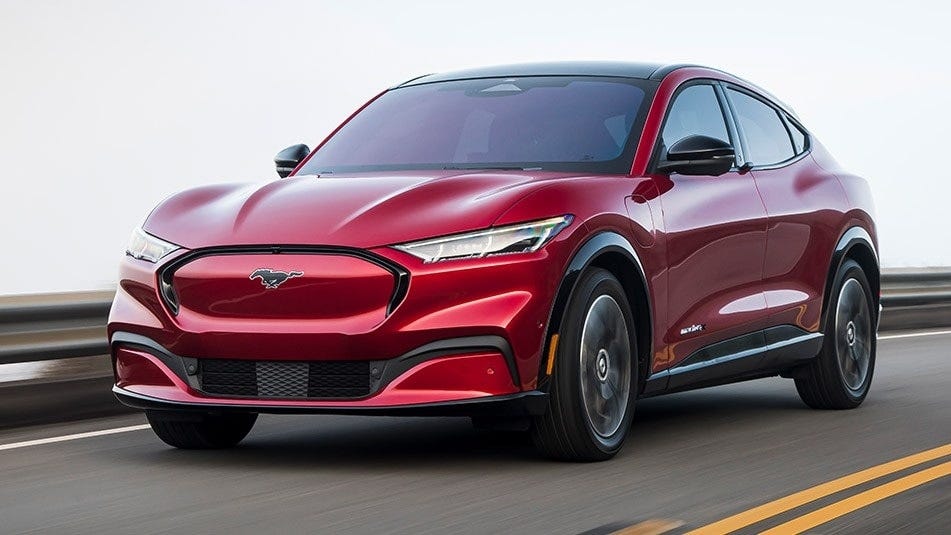
The lovely Ford Mustang Mach-E and the danger of electric cars
(Hey y’all — I’m attempting to dictate this post rather than type it, so please forgive any sins of grammar or structure.)My family and I own two extremely old cars, a 2001 Honda Odyssey minivan and a 2009 Toyota Prius hybrid. The van is literally falling apart, so we have been looking around lately for a new vehicle. Obviously, we would prefer an EV.A representative from Ford saw me musing about it on Twitter, contacted me, and offered to loan me a Ford Mustang Mach-E electric vehicle for a week. I've been driving it for a few days and I thought I would report my early impressions, along with some larger reservations.Holy s*** EVs are fun to driveI should note up top that I’m not a car guy. I don’t know much about them, don’t much like them, and don’t much like driving them. I never learned to drive a stick shift or change the oil. I don’t drool over muscle cars or know what “hemi” means. Truth be told, I kind of hate car culture.I should also note that I have only ever driven two EVs in my life. The first was the Kia EV6, which I test-drove last week. The second is this Ford. I can say very little about the fine differences in EV driving experience.In short, I am the least qualified car reviewer on the planet.As I said, both of my current cars are extremely old, so I am easily impressed by modern vehicular technology. I still get a kick out of remote key fobs. With this car, when you approach, it lights up, unlocks, and projects a picture of a Mustang on the ground next to the vehicle.There are heated seats, a heated steering wheel, a wireless phone-charging pad, and a giant touch screen with about 50 menus. It all feels like a spaceship to me.The first thing anyone notices when they drive an EV for the first time is the acceleration. With either of my gasoline vehicles — even the Prius when it’s driving in electric mode — there is a lag between pressing the accelerator and speeding up. You are always thinking a second or two ahead, about what speed you'll need to be going, and trying to anticipate. With the EV, acceleration is instant. You are going the speed you want to go the second you want to go it. It is wild.And when you use one-pedal driving mode, when you let off on the accelerator, you immediately slow. It’s difficult to put in words, but it adds up to a sense of much more precise control.I was driving home from a restaurant on Tuesday evening and fiddling with the Spotify menu when I drifted slightly onto the middle line between lanes. With a tiny little push — boomp — the car nudged me back into my lane, as though it were semi-sentient. I hadn’t even thought about the driver-assist features before that, but my one experience with them so far was reassuring, albeit faintly creepy.I’m one of those old guys who resists getting a Tesla because I don’t want to be forced to do every-dang-thing with a touch screen. Give me something physical, with feedback that goes beyond a haptic buzz. I like knobs! Ford’s screen has one giant knob toward the bottom, for volume — it’s better than nothing. In general, Ford has done a pretty good job with its screens and interface. Crucially, unlike in the Tesla, there’s a second screen just under eye level with key information like speed and range. On the bigger center screen, finding the basic stuff is painless. And there are some cool things if you poke around — you can save different profiles (mirror and seat positions, music playlists) that attach to different key fobs. Or you can use your phone as a key fob. I haven’t used any of these features enough to know how they’ll age, but it’s all pretty dazzling. The ride is smooth and quiet, the stereo system kicks ass, and that heated steering wheel … I mean, I’ve found nothing to complain about. And I’m pretty good at complaining. Car & Driver named the Ford Mach-E its EV of the year in 2021 and far be it from me to disagree.It’s not clear Americans can handle this kind of powerHowever! As I was driving home, hands blissfully warm, thinking I might take the long way so I could drive more, I started feeling some reservations. I started thinking about what it would mean for EVs to become dominant, the default choice, with most people driving them.For one thing, they make driving much more fun, even for someone like me who has a deep-seated antipathy toward cars and has never enjoyed driving. All the electric gizmos and screens and features, combined with the unbelievable torque and acceleration, make driving feel like a game in which you’ve just leveled up. It's difficult to believe that if driving is more fun … people won't do it more. And electric or not, less driving is better.The other thing is, the acceleration puts an enormous amount of power in your hands. For someone like me, who drives fairly carefully and pays attention, it can feel more precise and controlled, and thus safer. But it's not difficult to see how this kind of power could be misused. These cars can leap across intersections, going from standing

A note to readers
Hey, y’all, just a short note to catch you up on my current situation and my plans for the coming weeks.Long story short: I have tendonitis in both arms. I’ve had problems with pain in my forearms for years, but it always faded or went away after a while and was manageable. A few months after quarantine started, in 2020, it started getting worse, to the point I had to give up playing bass guitar — my one non-computer hobby. Then, a few months ago, it started getting a lot worse, quickly. I have been to see two physical therapists, done stretches and exercises, received regular therapeutic massage, bought a split keyboard and a vertical mouse, worn compression sleeves during the day and braces at night, iced both arms every day, taken a bunch of goofball supplements (hoping for some placebo effect at least), and even ordered one of these widgets. Nothing has worked, at least not yet; it’s just gotten worse and worse. It feels like a boulder rolling downhill. Nothing slows its momentum. (And don’t bother suggesting resentment and self-pity — I’ve tried those too.)One result is that typing has become a chore. I can get through about a paragraph before my wrists and forearms start to ache and I have to take a break. What’s worse, it has messed up my thinking. Over many years of writing, the act of laying my hands on a keyboard has become a somatic cue that triggers my thinking; I can not write without it. But now it involves pain, and the pain is clouding the thinking. This has made it difficult to write the next piece in my minerals series. It’s made it difficult to write anything. Just contemplating writing makes my arms ache. Of all the advice I’ve gotten, one bit seems reliably true: the only thing that fixes this problem is rest. I’ve got to stop doing the repetitive motions that damaged the tissues. In my case, that means I need to cut way back on holding my phone and typing. I’m told these things take from four to six months to heal.Four to six months of no typing obviously presents something of a challenge for someone who makes his living with a newsletter. Quite a challenge indeed. [eye twitches]So, just to be fully transparent about it, here’s my plan:Next week, I’m taking the week off. It’s winter break and my 16-year-old and I are heading down to Bend, Oregon, to see friends and do some snowboarding/skiing on Mt. Bachelor (where it hasn’t snowed in weeks, sigh). I’m going to endeavor to get through the week with a minimum of screens.After that, I am going to shift — at least temporarily — to doing more podcasting and less writing. This pains me. As much as I make writing a misery for myself, I love it. But working my way into a permanent state of diminished capacity is not something I’m ready for at the tender young age of almost 50. Six months of no typing sounds bad; 20 years of no typing (and no bass playing) sounds way worse. I’m also going to have a go at dictation software; if I can’t type, I can always speak. I admit this fills me with horror. I hate Siri. I hate Alexa. I hate talking to computers. It’s … demeaning. This has been one of my stalwart Dad Things for years; it’s a running joke in my house. But I’m going to bite the bullet. (By the way, Dragon no longer makes dictation software for Mac and apparently nothing else is as good. Let me know if you’ve heard of alternatives. I’m aware that Mac has built-in dictation, but trust me, it sucks.)I’m also going to start doing hot yoga again. I did it regularly for years and it was a blessing. It cured my lifelong back pain and generally warded off the decay of my aging body. I stopped doing it early in the pandemic, and it feels like, in the last year or so, all that aging I held off for those many years has found me at once.Hopefully I can recapture some of the magic. Or at least keep from puking or passing out in my first class back. So, that’s what I’m thinking, at least for now. I don’t know how this will ultimately impact Volts and I’m somewhat reluctant to make any promises at this point — this thing could get worse or it could get better. I need to put my health first. If any of this, now or going forward, affects anyone’s subscription decisions, no worries, I get it. We here at Volts management apologize for any inconvenience.With that said, I’m going to sign off, pack for my trip, and try to forget about my arms for a while. I hope you have a pleasant week and that when I return, the climate parts of Build Back Better will have passed. This is a public episode. If you'd like to discuss this with other subscribers or get access to bonus episodes, visit www.volts.wtf/subscribe

Volts podcast: Gerald Butts and Catherine McKenna on Canada's carbon tax
In this episode, Gerald Butts and Catherine McKenna discuss their experiences passing a carbon tax in Canada, as advisor to prime minister Justin Trudeau and minister of the environment respectively. In particular, we focus on a key feature of the Canadian tax: all the revenue collected goes back to the province from which it was collected, mostly as per-capita dividends. Butts and McKenna believe that feature was central to selling the public on the policy.Full transcript of Volts podcast featuring Gerald Butts and Catherine McKenna, February 16, 2022(PDF version)David Roberts:In 2015, after nearly a decade of conservative rule, Justin Trudeau and his Liberal Party won a majority of seats in the Canadian parliament and control of the federal government. Part of Trudeau’s election platform was a carbon tax.The proposed tax had a few key features. First, it would only be imposed on provinces that did not have their own pricing system that met a few minimum requirements. And second, all the money collected from a province would be returned to that province as carbon dividends.After years of vigorous advocacy and negotiations, Trudeau’s liberals got the tax passed through parliament. It was implemented in early 2019, just before another federal election that became widely seen as a national referendum on the tax.Liberals won again. The carbon tax was affirmed. It’s going to stick — and rise to a whopping $170 a ton by 2030. This is a startling success story for climate policy that was largely overlooked in the US. We, uh, had some other stuff going on. But it’s worth taking a closer look at how Canada pulled it off.Two people at the core of the tax pitch were Gerald Butts, who was principal secretary to the prime minister from 2015 to 2019 and Trudeau’s closest personal advisor, and Catherine McKenna, who was the minister of environment and climate change during the same period.Butts and McKenna were in the trenches and they have the scars to show for it. Both of them noticed the piece I published on Volts in January on carbon tax refunds — and they objected to the conclusion that dividends did not make the carbon tax more popular in Canada.So I had them on the pod! We talked about how the carbon tax was conceived, what enabled it to secure majority support (yes, they say, refunds were important), and where the politics of carbon pricing stand as we move into the 2020s. Not only were my spirits lifted — it’s nice to know there’s a sane country out there somewhere — I learned an enormous amount. I think you will too. Without further ado, Catherine McKenna and Gerald Butts, welcome to Volts. Thanks for coming.Catherine McKenna:Very happy to be on.Gerald Butts: It's great to be here.David Roberts: When Justin Trudeau announced his candidacy [for prime minister of Canada] in 2015, the carbon tax was part of his initial pitch. How far back does the carbon tax idea go? Who got it in Trudeau’s ear? How long had it been bouncing around up there before it made its debut on the national stage? Gerald Butts: The first time it was a real issue in Canada was during the federal election campaign in 2008. Important for the context of the story, for reasons I'll go into later, is that the Liberal Party proposed something called the Green Shift, which was an elaborate take on a carbon tax, under the leadership of Stéphane Dion. But it was easily caricatured as a regional wealth redistribution program, because the revenue from the tax was paid into the consolidated revenue fund at the federal government, and it was redistributed by the federal government to programs of its own choosing, not all of which were environmentally related. To me, there were a lot of reasons beyond the Green Shift that the Liberal Party lost the election in 2008, but that was the fundamental flaw in the policy.David Roberts: The idea is that you're just taking wealth from carbon-intensive provinces and redistributing it elsewhere.Gerald Butts: Absolutely. That, of course, has a history in this country that goes back to when the current Prime Minister Trudeau’s father was prime minister and he created the National Energy Program. The conservative government in 2008, under Stephen Harper — which, to be diplomatic, was not inclined to climate action — easily caricatured this as the second coming of the National Energy Program in Western Canada in particular, and made it out to be that the Liberal Party was after Western money to pay for Eastern programs, which is always death in politics in Canada. When we designed our program, there were lots of people within the party who thought we should stay a million miles away from it, because they were convinced that they lost the election in 2008 because of carbon taxes. We were very careful to make sure that any of the revenue collected went back to the province from which it originated. That, I think, was what unlocked the political constituency for carbon pricing in Canada.David Roberts: So that design — money

Volts podcast: Rebecca Dell on decarbonizing heavy industry
In this episode, Rebecca Dell, who runs the industry program at the ClimateWorks Foundation, offers a comprehensive overview of the problems of industrial decarbonization, the most promising technological solutions in steel, cement, and chemicals, and the kinds of policies that could accelerate progress. Incredibly informative.Full transcript of Volts podcast featuring Rebecca Dell, February 11, 2022(PDF version)David Roberts:For most of the carbon-intensive sectors of the economy — electricity, transportation, buildings — we have a pretty good sense of how to eliminate carbon emissions. None of those sectors will be easy to decarbonize. Every one is an enormous practical challenge. But in each case, the basic path to zero is clear, and it mostly involves switching out fossil-fueled machines with machines that generate or run on clean electricity. Then there’s that other wedge on the pie chart, the one that gets less attention: industry. Manufacturing, mining, construction, and waste processing are responsible for about a third of global carbon emissions (about a quarter of US emissions).The path to zero emissions in heavy industry is much murkier than it is for other sectors. Low-carbon alternatives are early in development and commercialization; in some cases, there are no alternatives except to capture and bury the carbon when it’s emitted.In future pods, I might get deeper into some specific industries (like steel). But for this one, I wanted to attempt a broad overview: What You Need to Know About Decarbonizing Industry.Nobody knows the sector and its challenges better than Rebecca Dell, who runs the industry program at the ClimateWorks Foundation. Dell previously worked at the Department of Energy, where she helped coordinate Obama’s climate action plan, and before that was a research scientist at Scripps Institution of Oceanography. She’s a researcher, author, and, as more attention turns to industry, an increasingly frequent podcast guest. (She was on Canary’s Catalyst pod last month.) It takes a while — okay, almost two hours — but Dell and I manage to cover all the big industrial sectors, why they emit so much, prospects for reducing emissions, and the policies that could make it happen. If you’re looking for a one-stop-shopping primer on industry and climate, this is for you. Without further ado, Rebecca Dell, welcome to Volts.Rebecca Dell: Thanks so much for having me. I'm really happy to be here.David Roberts:I'm excited for this. We are going to attempt to cover a lot of ground. I want to try to give a 30,000-foot overview of industry and decarbonization; obviously any of the subtopics could be podcasts of their own. Among the Volts audience, people are probably basically familiar with the famous Energy Information Administration pie chart of where US greenhouse gases come from. There are wedges for transportation, electricity, buildings, agriculture — I think people mostly have their heads around how to decarbonize those. Then there's that big wedge that just says “industry.” My sense is that, to a lot of people, that is a bit of a black box — it’s not clear what's in it or how to approach decarbonizing it. Historically, that has been the neglected stepchild of the decarbonization conversation. But am I right in saying that attention on that little wedge has rapidly increased in recent years?Rebecca Dell: Yes, and for people who work on this area, it's been exciting to see how much new interest has come in the last year or two. David Roberts:Do you have an explanation for why?Rebecca Dell:The phenomenon that is more in need of explanation is why so few people were looking at this area until the last year or so, considering that the industrial sector globally, under the most parsimonious accounting, is responsible for a quarter of all greenhouse gas emissions, and under a broader definition, it's responsible for more than a third.David Roberts: Does that roughly echo the US pie chart? Or is the US different because we have deindustrialized a little bit?Rebecca Dell: The US is a little lower in terms of the portion of our emissions that come from the industrial sector. But if you add back in the greenhouse gas emissions that come from manufacturing products in other countries that will be consumed in the United States — you can think of those as our imported emissions — then you get back to something pretty close to the global average.David Roberts: So let's say about a third — that's a lot of emissions to neglect for this long. When we say industry, what do we mean by that? What does that category inclue? What are the boundaries? And what, in terms of greenhouse gas emissions, are the top line items?Rebecca Dell: That's a really important question, because when we talk about “industry” in the climate community, it’s a piece of stealth jargon. It’s the worst kind of jargon: it's a word that sounds like a normal word, but it actually is a jargon word. Basically, what we're talking about when we

The minerals used by clean-energy technologies
In a previous post, I offered a broad overview of the problems related to minerals needed for the clean-energy transition. To recap: * clean-energy technologies are more minerals-intensive to build than their fossil-fuel counterparts; * the growth of clean energy will rapidly raise demand for a set of key minerals;* mining and processing of those minerals is geographically concentrated, often in countries with weak labor and environmental protections;* mineral mines and processing facilities often pollute water, scar landscapes, and impoverish communities;* production may not be able to expand fast enough to keep up with demand, which could cause supply constrictions and price fluctuations and slow the transition away from fossil fuels.That’s the big picture. In today’s post, I want to take a take a closer look at some of the biggest clean-energy technologies and the minerals required to build them. Specifically, I’ll cover batteries, solar PV, wind, geothermal, concentrated solar, and carbon capture and storage (CCS). I’m not going to get too deep into any one of these — just a quick tour.I’ll be drawing heavily on a 2020 World Bank report that projects demand for key minerals under rapid decarbonization scenarios from the International Energy Agency (IEA) — specifically the RTS (reference technology scenario, or current policy), 2DS (2-degree scenario), and B2DS (beyond 2-degree scenario, aiming for 1.5). (The World Bank and IEA use the word minerals to refer to the mineral and metal value chain, and I do the same in this post.)This tour will reveal which minerals are expected to be most in demand — which ones are certain to be needed and which depend on the direction taken by particular technologies. It will help focus attention on possible supply stress points. It will also reveal that there is enormous uncertainty about the pace and scale of demand growth for specific minerals and minerals generally. Much depends on unpredictable developments in technology, policy, and politics. Epistemic humility is called for, along with policy focused on resilience. (More on policy in the next post.)One fact that is certain: the more ambitious the world’s decarbonization efforts, the higher mineral demand will rise. Here’s an overview table of energy sources and technologies and the key minerals they use:Let’s start the tour with the 800-pound gorilla of minerals demand: batteries.Batteries are the biggest growth sector for minerals demandOf all the clean-energy technologies set to boom in coming decades, none will put a strain on minerals supply like batteries, shown as energy storage in the chart above. They account for about half of the projected growth in minerals demand over the next two decades in a rapid decarbonization scenario.In large part, this has to do with the expected rise in battery-powered electric vehicles (EVs), which represent 90 percent of battery demand growth; the other 10 percent will come from growth in stationary storage, used to balance out wind and solar on the grid. If the world targets 2°, minerals demand from energy storage will double from the baseline scenario; if the world targets 1.5°, it will more than double again.Batteries, readers of my battery series will recall, are composed of two electrodes, a cathode and an anode, and an electrolyte through which they exchange ions. (The outlier is redox flow batteries, which pump a liquid electrolyte past electrodes.)Depending on what those three parts are made of, batteries require different minerals. Many EVs still use lead-acid batteries, which use lead and sulfuric acid, but lithium-ion batteries (LIBs) are expected to rapidly take over the market, so demand for lead-acid batteries won’t grow much.As for LIBs, most use graphite as the anode, which means graphite will be the most sought-after mineral in energy storage. Cathodes vary more widely. The most common use nickel, with various mixes of cobalt, lithium, and manganese also common. (It should be noted that lithium is used across all LIBs, not just for the cathode.)It should be noted that these projections out to 2050 are to a large extent guesses, just an extension of the “average” LIB into the future. In fact, LIB technology could evolve a number of different ways, and other storage technologies could play bigger roles in subsequent decades. “The assumption that Li-ion batteries dominate both the mobile and stationary market for the next decade is conservative,” the World Bank writes. “Post-2030, the scale of uncertainty is much greater, with a wide range of options in both markets.”Consider the options for LIBs. For cathodes, NMC111 batteries use one part nickel, one part manganese, and one part cobalt, while newer NMC811 batteries use much more nickel and less cobalt. Tesla and other automakers are trying to eventually eliminate cobalt from their batteries; it’s too early to say how far they’ll get.Right now, almost all anodes are graphite (a market dominated by China) but the

Volts podcast: using DOE loan guarantees to accelerate clean energy, with Jigar Shah
In this episode, Jigar Shah, the recently appointed head of the Department of Energy’s Loan Programs Office (LPO), discusses how he and his team have reformed the office and pulled into into the modern age, the kinds of help LPO is offering entrepreneurs, and the frontier technologies that have him most excited.Full transcript of Volts podcast featuring Jigar Shah, February 2, 2022(PDF version)David Roberts:Back in 2010, the Department of Energy’s Loan Programs Office (LPO) briefly became what kids these days call the main character, the focus of a storm of controversy and media attention, thanks to the bankruptcy of Solyndra, a solar company that received the very first loan guarantee under Obama’s Recovery Act and then promptly gone bankrupt. Despite that wildly overhyped controversy, the LPO did reasonably well under Obama. It ultimately turned a profit for the government and was arguably crucial to the explosive subsequent growth in markets for utility-scale solar and wind. Under Trump, the LPO basically went dormant, doing little beyond shoveling money into the ill-fated Vogtle nuclear plant in Georgia. Now the LPO is being revived, reformed, and reinvigorated by new director Jigar Shah. Shah has a long history on the business side of clean energy — he was the co-founder and president of Generate Capital and before that founded “no money down” solar pioneer SunEdison — but he’s perhaps best known to energy nerds as the co-host of the late, lamented podcast The Energy Gang. (The team behind The Energy Gang now has a new show: The Carbon Copy.)He wants to streamline the process of getting loan guarantees from LPO and rethink how the office approaches risk. And he’s got about $40 billion to work with, more if Build Back Better passes. (For the best account of Shah’s new approach, read these two Canary pieces — one, two — from Jeff St. John.) Under Shah’s leadership, the LPO has been doing due diligence on the hundreds of applications that have flooded in since the office reopened for business. In December, it issued its first new conditional commitment for a loan guarantee, to a plant in Nebraska that will transform methane into hydrogen and carbon black. Many more loan guarantees are in the pipeline.I’ve been looking forward to chatting with Shah about how the office is reforming under Biden, how to think about risk and communicate it to the public, and the kinds of clean-energy technologies that have him excited these days. Without further ado, Jigar Shah, welcome to Volts.Jigar Shah: Thanks for having me.David Roberts: I'm a longtime fan of your career and your many podcasts, so it's great to finally get you on here.Jigar Shah: Well, the feeling's mutual.David Roberts: Give us the elevator pitch: What is the Loan Programs Office, what does it do, and what is it meant to accomplish?Jigar Shah: The Loan Programs Office was originally conceived of by Senator Pete Domenici in the 2005 Energy Act. It was first funded in 2009 during the Obama stimulus. The main rationale for its existence is that the Department of Energy does so much great work on basic fundamental research; it gets all these technologies to what they call Technology Readiness Level 7, which means that you can actually verify that the technology works; but then they leave them there waiting for the private sector to pick them up and take them the rest of the way. And the private sector is saying, “we're happy to do it, but we can't get any debt for these technologies because the commercial banks are saying, ‘we don't want to spend the effort to understand all the nuances of this and get all the expertise lined up for one project, so until there are 100 projects to do, we’re not in.’”David Roberts: This is the famous “valley of death”?Jigar Shah: That's right. In this case, it's a valley of death that focuses on debt. The vast majority of valley-of-death conversations focus on equity: raising venture capital or raising private equity. In this case, you're talking about debt. When you talk about solving climate change, you're generally talking about trillion-dollar scale, and trillion-dollar scale only exists in infrastructure. In venture capital, we had a banner year last year; it was about $60 billion. That's not trillion-dollar scale. What does it take for the trillion-dollar-scale people to get comfortable with a technology? That's a commercial debt conversation. How do we underwrite a deal for commercial debt? I talked to most of the money center Wall Street banks last year and they said, “Jigar, one thing we will confirm is that the due diligence that comes out of your office is of such high quality that we know that a technology is ready if it gets through your office.”David Roberts: That's one thing that maybe average people don't understand: you're not just handing companies money. The whole process of assessing the company and its technology is a long and labor-intensive process. The bulk of the service you're providing the industry

Volts podcast: Panama Bartholomy on decarbonizing America's buildings
In this episode, Panama Bartholomy, head of the Building Decarbonization Coalition, discusses the need to decarbonize buildings, the many challenges facing the effort, and the cities and states that are making progress. You better believe we get way into heat pumps and induction stoves. Full transcript of Volts podcast featuring Panama Bartholomy, January 28, 2022(PDF version)David Roberts:Fossil-fuel combustion in buildings — mostly natural gas for space and water heating — is responsible for around 10 percent of US greenhouse gas emissions. Getting to net-zero will require heating, cooling, and powering all those buildings with carbon-free energy.It’s an enormous challenge — or rather, a huge thicket of challenges. There are technical issues, political issues, public-opinion issues, and policy issues, all of which decompose into dozens of discrete issues of their own. To help me wrap my head around all of it, I’m eager to talk to Panama Bartholomy, who is, I promise, a real person and not a Dr. Seuss character. Bartholomy has been wrestling with building decarbonization for decades, at (in reverse chronological order): the Investor Confidence Project, the California legislature, the California Energy Commission, the California State Architect, and the California Conservation Corps. He’s served on a variety of boards, collaborated with various expert organizations, worked on climate issues in over 30 countries, and all kinds of other stuff, but if I tried to include it all I would never get to the conversation.Bartholomy is currently running the Building Decarbonization Coalition, a multi-sector alliance of companies, nonprofits, and government agencies working on buildings, so he’s up to date on where progress is being made (think New York and California), the biggest political impediments (think the natural gas industry), and whether heat pumps really work in cold climates (think yes, they do).Without further ado, Panama Bartholomy, welcome to Voltscast.Panama Bartholomy: Thanks, Dave. Good to be here. Long-time listener, first-time caller.David Roberts: Let's talk about buildings. There's so much to get into here, but I want to start with a few broad scene-setting questions. Just to orient us, tell us where buildings fall on the climate policy hierarchy of needs. What portion of the problem are our buildings?Panama Bartholomy: Maslow's hierarchy of needs for buildings and climate, I love it. We — by which I mean the building sector — come in right about 25 to 30 percent of overall emissions nationally, and about the same globally. Depending on the state you're in and the grid mix of your electricity, it may be a little higher or lower, but we’re right about in that sweet spot of 20 to 30 percent. One of the challenges is that in this sector, unlike industry or the electricity sector or even the transportation sector, you have millions if not billions of little machines that have a lot of consumer choice. You can't just shut down a coal plant and all of a sudden get a lot of benefit. You have to involve a lot of players in this.David Roberts: Yes, this seems like the decarbonization sector that involves the most logistics and the most high-touch human interaction. You have to think about sociology and psychology. It's a tangle.Panama Bartholomy: It is, and that's why I appreciate you spending some time in our funny little corner of the climate world. We need a lot more attention to it. Every time somebody buys a new furnace or a gas water heater or stove, they're locking in 20 or 25 years of carbon emissions from there. So attention is one of the key things that we need on this issue.David Roberts: In recent years there's been something of a consensus forming in carbon circles that electrification is the premier decarbonization strategy. When we look at buildings, is electrifying them the whole game? How far will electrification get us and how big is the remainder once you're done electrifying?Panama Bartholomy: We haven't seen a lot of good alternatives at this point. When you think about electrifying buildings, you’re talking about space heating, water heating, cooking, and probably clothes drying. You do have some arguments with people about their gas fireplaces and their pool pumps, but that's a pretty small amount, all in all. When you look at the alternatives, are we going to pump incredibly expensive renewable natural gas through pipes to power those? Are we going to replace the entire gas system with a new hydrogen system to do that? I don't think so. These are pretty low-level technologies, when it comes down to it, in the use of energy, and using expensive fuels just doesn't make sense either from an economic perspective or a climate solutions perspective. So electricity is the path we need to go down on buildings. They're making cold-weather heat pumps that can operate well down to -15 degrees, so here in 2022, we have much if not all the technology we're going to need for electrification of b

Do dividends make carbon taxes more popular? Apparently not.
Arguments over carbon taxes go back as far as discussions of climate change itself. Economists have long insisted that pricing carbon is the most efficient way to reduce greenhouse gases. For years, they hijacked the climate discourse, with untold money and effort put behind proposals for various increasingly baroque pricing schemes, to very little effect.Over time, political experience with carbon taxes has highlighted a truth that should have been obvious long ago: carbon taxes are taxes, and people don’t like taxes. People don’t like paying more money for stuff. More broadly, carbon taxes are an almost perfectly terrible policy from the perspective of political economy. They make costs visible to everyone, while the benefits are diffuse and indirect. They create many enemies, but have almost no support outside the climate movement itself. All the political intensity is with opponents. (More here.)One response to this critique that has grown increasingly popular in recent years is the notion of refunding the tax revenue — giving the money back to voters. Various ways to do this have been proposed, the simplest being an equal dividend to each taxpayer. Some proposals have all the tax revenue refunded; some have a limited portion refunded. The idea is that the tax would discourage carbon-intensive activities, while the dividend would mute political opposition. In most of the proposed schemes, the lower half of the income scale comes out ahead — dividends are larger than tax burdens — and in some cases, up to 80 percent of taxpayers come out ahead. A refunded carbon tax is basically large-scale wealth redistribution from the biggest fossil fuel users to middle- and working-class citizens. This kind of “fee and dividend” framework is endorsed by the Climate Leadership Council (centrist/bipartisan elites), the Citizens’ Climate Lobby (left-leaning grassroots campaigners), and one-time presidential candidate Andrew Yang, though they differ on important details.The logic of the policy is compelling to proponents — and to many people who first hear about it — and they feel deeply confident that it will compel the public too. The evidence, however, is mixed. Do refunds increase the popularity of carbon taxes? At last, some field research.There are numerous studies showing that, in a polling or focus-group setting, the inclusion of refunds increases public support for a hypothetical carbon tax — see here and here, among others. But that kind of polling has not translated into victories in, for example, Washington state, where a fee-and-dividend policy lost badly in a public referendum in 2016.More to the point, because there have been so few fee-and-dividend policies implemented in the real world, there’s been very little field testing of the public’s actual response to it.That brings us to a new paper in the journal Nature Climate Change by political scientists Matto Mildenberger (UC-Santa Barbara), Erick Lachapelle (University of Montreal), Kathryn Harrison (University of British Columbia), and Isabelle Stadelmann-Steffen (University of Bern). They do something novel: look at public opinion in the places where carbon fee-and-dividend policies have been implemented. It turns out there are only two. Switzerland established a rebate program in 2008. The carbon tax reached 96 Swiss francs (about $105) per tonne in 2018; about two-thirds of the revenue is rebated on a per-capita basis, with everyone (including children) receiving an equal share. Canada established a rebate program in 2019 as part of its national carbon-pricing strategy. So far, the scheme covers four of 10 provinces, with more than half of the national population. The price was initially set at 20 Canadian dollars (about $16 U.S.) a tonne, rising to CA$50 by 2022; recently the government released a new schedule that would target CA$170 by 2030. The refund, or Climate Action Incentive Payment, is based on the number of adults and children in the household, with a 10 percent boost for rural households. It is highly progressive; 80 percent of households get more back than they pay.The Nature Climate Change paper looks at public opinion in both countries. In Canada, it draws on a longitudinal study, which surveyed the same residents — “from five provinces, two subject to the federal carbon tax (Saskatchewan and Ontario), one with provincial emissions trading (Quebec), and two with provincial carbon taxes (British Columbia and Alberta)” — five times from February 2019 through May 2020, during which time the scheme was proposed, debated, passed, and implemented. In Switzerland, the paper draws on a survey of 1,050 Swiss residents in December 2019.So what do these surveys tell us? It’s not great.Refunds don’t change opinions much; many recipients don’t know they exist In Canada, throughout the period in which the refund was hotly debated, passed, and implemented, public approval … didn’t change much. What’s more, opinions on the policy were divided primarily

Minerals and the clean-energy transition: the basics
Recently, there’s been a lot of talk in the energy world about the minerals needed by clean-energy technologies and whether mineral supply problems might pose a threat to the clean-energy transition. To hold warming beneath 1.5°C over pre-industrial levels, the world must cut greenhouse gas emissions in half by 2030 and reach net zero by 2050. To do that, it must radically ramp up production of solar panels, wind turbines, batteries, electric vehicles (EVs), electrolyzers for hydrogen, and power lines. Those technologies are far more mineral-intensive than equivalent fossil fuel technologies. “A typical electric car requires six times the mineral inputs of a conventional car,” writes the International Energy Agency (IEA), “and an onshore wind plant requires nine times more mineral resources than a gas-fired plant of the same capacity.” (The IEA report uses the word minerals to refer to the entire mineral and metal value chain from mining to processing operations, and I do the same here.)Power transmission and distribution require aluminum and copper. Batteries and EVs require cobalt, lithium, and nickel. Wind turbines require rare earth elements. And so on.In its encyclopedic 2021 report on the subject, IEA estimates that “a concerted effort to reach the goals of the Paris Agreement would mean a quadrupling of mineral requirements for clean energy technologies by 2040. An even faster transition, to hit net-zero globally by 2050, would require six times more mineral inputs in 2040 than today.”Some individual minerals will see particularly sharp jumps. The World Bank says, “graphite and lithium demand are so high that current production would need to ramp up by nearly 500 percent by 2050 under a [2 degree scenario] just to meet demand.”A clean-energy transition sufficient to hit 1.5° will mean an enormous rise in demand for these minerals.This fact has been seized on by a variety of people to raise questions about the speed and sustainability of the clean-energy transition. Are we just trading one resource curse for another?So I looked into it. It’s a complicated subject — each of these minerals poses its own specific challenges, with its own specific suppliers, supply lines, customers, and possible pain points. There’s no neat single story here.Nonetheless, I’ll try to summarize what I found, starting at the end, with what I think are the key big-picture lessons. In the next post, we’ll get into specific technologies and minerals.The clean-energy transition will be an environmental boonYes, it is true that demand for minerals will rise and that several of those minerals are currently produced in environmentally and socially problematic ways. This is a real problem — or rather, a whole nest of problems, which warrant concern and concerted action.That being said, it’s important to keep in mind that, even under the grimmest environmental prognostications, the transition to clean energy will be a boon for humans and ecosystems alike.It will certainly involve lower greenhouse gas emissions. The World Bank says that, under a 2 degree scenario, through 2050, renewable energy and storage would contribute approximately 16 gigatons of carbon dioxide equivalent (GtCO2e) greenhouse gases, “compared with almost 160 GtCO2e from coal and approximately 96 GtCO2e from gas.”If the concern is material intensity, energy researcher Saul Griffith has done some back-of-the-envelope calculations that put the transition in perspective. Here’s what he told me:Assigning all 328 million Americans equal share of our fossil fuel use, every American burns 1.6 tons of coal, 1.5 tons of natural gas, and 3.1 tons of oil every year. That becomes around 17 tons of carbon dioxide, none of which is captured. It is all tossed like trash into the atmosphere. The same US lifestyle could be achieved with around 110 pounds each of wind turbines, solar modules, and batteries per person per year, except that all of those are quite recyclable (and getting more recyclable all the time) so there is reason to believe it will amount to only 50-100 pounds per year of stuff that winds up as trash. That is a huge difference: 34,000 pounds of waste for our lifestyles the old way versus 100 pounds the new, electrified way. These are only illustrative figures, but they show that the scale of resource extraction in a decarbonized world will be vastly, vastly smaller than what’s required to sustain a fossil-fueled society. Close to 40 percent of all global shipping is devoted to moving fossil fuels around, a gargantuan source of emissions (and strain on the ocean) that clean energy will almost wipe out. In a net-zero economy, there will be, on net, less digging, less transporting, less burning, less polluting.The fact is, fossil fuels are a wildly destructive and inefficient way to power a society. Two thirds of the energy embedded in them ends up wasted.That inefficiency has been rendered invisible by fossil fuels’ ubiquity and the lack of alternatives. Now that a

Volts podcast: me and Adam McKay in an exciting podcast crossover event
Hey Volties! As you know, last week I interviewed Don’t Look Up director Adam McKay for the podcast. Then the talented folks at Canary Media’s Carbon Copy podcast (which you should subscribe to) interviewed me — about the movie, climate change in art, and McKay — and interweaved bits of that interview with bits of my interview with McKay.The result is the first-ever Volts/Carbon Copy crossover episode! They did an amazing job. Even if you’ve already listened to my interview with McKay, I think you’ll get something out of it. If you didn’t have time to listen to that 90-minute conversation and would prefer the 30-minute highlight reel … here it is!Let me know what you think and if you’d like to see more crossover episodes in the future. This is a public episode. If you'd like to discuss this with other subscribers or get access to bonus episodes, visit www.volts.wtf/subscribe

Volts podcast: Jason Bordoff & Meghan O’Sullivan on the geopolitics of clean energy
In this episode, international scholars Jason Bordoff and Meghan O’Sullivan discuss the geopolitical tensions that could be caused or exacerbated by the clean-energy transition, including supply constrictions in oil and gas and the geographical concentration of key clean-energy minerals. This episode is a great antidote to the notion that clean energy is going to make for smooth sailing in geopolitics.Full transcript of Volts podcast featuring Jason Bordoff and Meghan O’Sullivan, January 19, 2022(PDF version)David Roberts:When one contemplates the thorny geopolitics of oil and gas — with its century-long string of crises, conflicts, and moral compromises — it’s easy to think that the transition away from fossil fuels to clean energy will usher in a saner and more peaceful world. And that may happen, in the long term, once the transition is complete. But the road from here to there, over the course of the next few decades, is likely to be bumpy. Policymakers need to start planning for the predictable disruptions headed our way.That is the message of a recent essay in Foreign Affairs by Jason Bordoff, director of the Center on Global Energy Policy at Columbia University, and Meghan O’Sullivan, longtime foreign policy operative and professor of international affairs at the Harvard Kennedy School. Bordoff and O’Sullivan outline a number of risks the world faces in the short- to mid-term as it endeavors to ramp up clean energy and ramp down fossil fuels. Investment in fossil fuels could decline faster than demand, which would perversely strengthen the position of Gulf states sitting on the cheapest oil. Production of the minerals needed to build clean-energy technologies is highly concentrated, often in countries with unstable politics and poor or no labor standards, like the Democratic Republic of Congo. Processing of almost all clean-energy minerals is heavily concentrated in China, giving it enormous leverage and exposing world markets to economic or political upheavals there. Trade sanctions or tariffs could slow the spread of innovations. The US’s inability to get its act together could sour relations with the EU, which is moving ahead with ambitious, coordinated policy. And so on. Clean energy will eventually diminish the sway of fossil fuel geopolitics, but the transition will create its own geopolitics, its own tensions, disputes, and chokepoints. I’m eager to talk to Bordoff and O’Sullivan about some of those risks and what might be done to prepare for them. Jason Bordoff and Meghan O'Sullivan, welcome to Volts. Thanks for coming.Jason Bordoff: Great to be with you. Thanks for inviting us.Meghan O'Sullivan: Thank you, Dave.David Roberts: I want to begin by quoting your great piece in Foreign Affairs. You say: “Talk of a smooth transition to clean energy is fanciful. There is no way that the world can avoid major upheavals as it remakes the entire energy system, which is the lifeblood of the global economy, and underpins the geopolitical order.” In a sense, the whole piece is addressed at a naive view of what the clean energy transition is going to involve. A lot of people think there's all this messy, nasty geopolitics around oil and gas, and if we just subtract that, then you have a world that's running smoothly and at peace. Can you, at a high level, describe why people have that naive view and why you think it's wrong?Jason Bordoff: You describe the motivation for the piece very accurately. I recall sitting a few years ago at a round table at the Munich Security Conference, talking about Nord Stream 2, a pipeline very much in the news these days as the US and Russia try to see if we can prevent conflict in Europe. There was a comment that I remember: “Why are we spending so much time on this? It won't matter soon anyway, because the geopolitics of oil and gas is simply going to fade.”That struck me — and Meghan as well, because we've talked a huge amount about it — as simplistic. The geopolitics of energy since at least the Arab oil embargo in the early 1970s, probably much longer, has largely been about oil and gas, whether it's the concerns about OPEC’s control over oil markets, or Russia's gas supply into Europe, or anything else. So it's a hopeful vision to say, when we decarbonize and move away from oil and gas, those geopolitical risks will become a thing of the past. We were making two points in the piece. One is that, that end state of beyond oil and gas is pretty far away. There's a multi-decade period when you have the new geopolitics of clean energy layered on top of the old geopolitics of oil and gas — and even a net-zero world is not zero oil and gas, necessarily. But also, there will be new risks created by the emergence of clean energy, from critical minerals, to trade conflicts, to new zero-carbon fuels like hydrogen and ammonia that might move around by ship — a range of new issues that we want to make sure people are thinking about, because our concern is that those geopolitical and

Volts podcast: "Don't Look Up" director Adam McKay on the challenges of making movies about climate change
In this episode, writer and director Adam McKay reflects on the critical and audience reaction to his movie Don’t Look Up. We also talk about making an emotional connection to climate change, some of the other climate-related projects he’s working on (or at least thinking about), and why he ended the movie the way he did.Full transcript of Volts podcast featuring Adam McKay, January 12, 2022(PDF version)David Roberts:The film Don’t Look Up, available on Netflix as of late last month, has become something of a phenomenon. It has drawn wildly varying, often quite personal and intense, critical responses. Its critics’ score on Rotten Tomatoes is just 55 percent.But climate scientists loved it. I loved it. And the public loved it. Its audience score is 78 percent. In the week of December 27, it broke a Netflix record, with more than 152 million hours of streaming. As of this week, it the second biggest movie ever on the streaming service (just behind Red Notice, just ahead of Bird Box).Audiences have ignored critics and embraced the film, which is not something you’d necessarily predict for a thinly veiled climate change allegory about the difficulty of grappling with bad news in today’s information environment, especially one with such a (spoiler alert) bleak ending. It’s not the first successful curveball thrown by its writer and director, Adam McKay. McKay first made a name for himself as head writer on Saturday Night Live. In the early 2000s, he formed a production company with partner Will Ferrell and wrote and directed a string of beloved comedies, from 2004’s Anchorman through 2010’s The Other Guys. But in 2015, he took a turn, writing and directing an adaptation of Michael Lewis’s book The Big Short, about the 2008 subprime mortgage crisis. It, too, was an unexpected hit, scoring McKay an Academy Award for adapted screenplay. His 2018 film Vice, about Dick Cheney, scored Oscar nominations for picture, director, and original screenplay.He has demonstrated that, despite what the chattering class often seems to believe, audiences are hungry to confront real issues. All along, he has wanted to find a way to make a movie about climate change. With Don’t Look Up, he finally figured out how. I’m delighted to get a chance to talk to him, to hear about what he makes of the movie’s critical reception, what his other ideas for climate movies are, and how he navigates the politics of speaking out on serious issues from inside Hollywood. Welcome, Adam McKay, to Volts.Adam McKay: Thank you, Mr. Roberts, for having me. I've been an admirer of your work for a long time, an avid reader of your writing, and it is a pleasure to be here.David Roberts: Thanks, I'm an avid watcher of your movies. So we have a mutual fan club here.[Don’t Look Up] has been out on Netflix for a couple of weeks, so we've had enough time now for you to gather some feedback. Let's start with the fact that this movie has gotten more streams than anything in Netflix history. Did I read that right? Adam McKay: It's a bit crazy. I was shocked by the response from audiences. Netflix uses viewing hours now as their metric — they used to use accounts that signed on, but viewing hours is a more accurate number — and we had the most amount of viewing hours in any single week of any release Netflix has ever put out. I understand we're about to pass Bird Box as the number two all-time movie [on Netflix], and we've got a chance to be number one, who knows. David Roberts:Who's number one?Adam McKay:It's a movie called Red Notice that just came out. It stars The Rock, Ryan Reynolds, and Gal Gadot. If you had told me that our ridiculous-slash-dark climate satire would be contending with Ryan Reynolds, The Rock, and Gal Gadot in an action film, I would have said, “you're nuts.” So it's pretty fantastic. More importantly, the moment-to-moment online responses have been incredible — just seeing people excited by it, laughing, a lot of people moved by the ending of the movie, talking about crying, having emotional moments with it. So that's the thing that's been really exciting is seeing this worldwide response to this movie, and a lot of people having the response of, “oh my god, I'm not crazy.” Really cool.David Roberts: Or at least, “we're crazy together.”On the other hand, there's the critical response, which has been … all over the place. I don't know what I expected, but it's been such a bizarre range. What do you make so far of the critical response?Adam McKay: I've never experienced anything like it. We test these movies, we screen them for audiences, and the last three screenings we had played great — people were laughing the whole way through, at the end there was great discussion. Then I saw those critical responses … and in fairness to the critics, I don't expect them to mirror a test audience. They look at it with different eyes. So with all due respect, but some of the reviews were so extreme and angry, and I was like, “whoa, what's going on here?” But

Climate legislation and Congress: the current state of play
My last substantial post of last year was a summary of where things stand with Congress and climate. I ended by reiterating my confidence that Sen. Joe Manchin (D-WV), who has been such an impediment throughout the process, would find his way to supporting some form of the Build Back Better Act, the Democrats’ last and only hope of taking substantial action on climate change. Mere days later, Manchin threw up his hands and said, “I can’t get there — this is a No on this legislation.” So much for that prediction. However! As we head into 2022, there are signs that Manchin’s tantrum was less apocalyptic than it appeared. His objection to BBB — which, to be fair, was his objection for months; the Democrats just thought they could eventually get through to him — is that the bill contains a bunch of new programs that are only funded for a year, or a few years, and since they will inevitably be renewed (according to Manchin), the bill’s price tag is deceptive. He wants to include only programs that are funded for the full 10-year term of the bill, under the artificial budget cap he himself imposed. That would mean stripping a number of popular programs out of the bill. The process blew up because the other Democrats refused to believe that he was serious about doing so much damage to the legislation. However, as Eric Levitz writes in New York magazine, as anachronistic, stupid, and cruel as Manchin’s views are, he’s not willing to move on them. For any bill to pass, it will have to conform. Insofar as there’s any good news in this young year, it is that Manchin seems positively disposed toward the climate portions of the bill. “The climate thing is one that we probably can come to an agreement much easier than anything else,” he told reporters on Tuesday. Other Democrats have expressed confidence that the climate portion of the bill will survive in some form. This is in part because Manchin already stripped the bill of any sticks, anything that might penalize fossil fuels (most notably the Clean Electricity Performance Program). What’s left are $555 billion worth of carrots: grants, tax breaks, and other money showered on every form of clean energy, from R&D through demonstration projects through commercialization — very much including carbon capture at fossil fuel power plants, a Manchin fave. “There’s a lot of good things in there,” he said.Somewhat oddly, Manchin also supports some of the reforms to federal oil and gas leasing that are in the House version of the BBB. All of this seems to at least imply that he’s still open to some kind of bill. What he appears to want is a version of the BBB that, at a minimum, strips out the Child Tax Credit — which can not possibly fit under his cap on spending ($1.75 trillion), at least not when funded for 10 years, at least not if the bill is to contain anything else. The Child Tax Credit kept millions of children out of poverty last year and could potentially cut child poverty by almost half. It ran out at the end of the year, and now at least 50,000 children in West Virginia stand to slip back into poverty. Manchin is choosing to allow millions of children to suffer a little more based on vague and ill-founded worries about inflation. It’s ghoulish and unforgivable.Nonetheless, it is what it is, so Democrats will need to put together a diminished form of the BBB that protects the climate provisions. They still need to try; the stakes are too high not to. “If they can’t pull this off, then we failed,” John Podesta told The New York Times. “The country has failed the climate test.”There are no signs of any such efforts thus far. “There is no negotiation going on at this time,” Manchin said on Tuesday, the same day Senate Majority Leader Chuck Schumer (D-NY) said, “I've talked to Sen. Manchin numerous times during the break.” Oof. Still, also on Tuesday, a group of senators expressed renewed determination to get the climate portions of the bill over the finish line. "We're going to get this done, come hell or high water,” said Sen. Brian Schatz (D-HI), “and right now, we have both hell and high water.""Frustration isn't a strategy,” said Sen. Tina Smith (D-MN), in what I can only interpret as a direct attack on yours truly. “We have to get it done." Volts is a reader-supported publication. To receive new posts and support my work, consider becoming a free or paid subscriber.The senators even made a point of noting that Sen. Kyrsten Sinema (D-AZ), who has been such a problem on other parts of the bill, is “nothing but supportive of the climate provisions here," as Schatz put it. Schumer, as usual, seems determined to press on. He said, “I intend to hold a vote in the Senate on BBB, and we’ll keep voting until we get a bill passed.” Good, I guess?Meanwhile, what Senate Dems are actually moving forward on is some kind of filibuster reform or exemption intended to enable them to pass a voting rights bill without Republicans. In a letter to colleagues, Schumer said:Over the com

Volts podcast: how the left can suck less at messaging, with Anat Shenker-Osorio
In this episode, messaging expert Anat Shenker-Osorio — a researcher, campaigner, author, and speaker — discusses the elements of an effective message, what’s required to spread messages, and the right way to test whether they’re working. We also get into the best way to craft climate messages and the current debate over “popularism.”Full transcript of Volts podcast featuring Anat Shenker-Osorio, December 20, 2021(PDF version)David Roberts:People involved with politics are obsessed with messaging: what to say, and how to say it, to sway voters or politicians to their side. Everyone has strong opinions about messaging, but almost everyone’s opinions are drawn from their personal experiences, preferences, and priors, which are rarely reliable guides to what works in practice. There are, however, people down in the trenches doing real message testing in the field, as part of real grassroots campaigns, like Anat Shenker-Osorio, head of ASO Communications and author of the book Don't Buy It: The Trouble with Talking Nonsense about the Economy. She helps campaigns communicate for a living, and she discusses the lessons learned from successful campaigns on her podcast Words to Win By. Shenker-Osorio is a co-founder of the Race-Class Narrative project, which is developing a coherent response to America’s familiar racial dog-whistle politics. She has advised several environmental campaigns and done a lot of thinking about the right way to message around climate change, as well as its place in the race-class narrative. As long-time readers know, I have a love-hate relationship with the subject of messaging, so I’m happy to dig in with Anat to figure out what we really know about good and bad message testing, the elements of a good message, how to actually get messages to voters, and how to talk about climate change in a compelling way. Without further ado, welcome, Anat, to Volts. Thanks for coming on.Anat Shenker-Osorio: Thanks for having me.David Roberts: I'm excited to talk about messaging. I want to start with a distinction. The side of messaging that people think about most often is word selection: choosing your words, slogans, catchphrases, and verbiage for your ads. But the other side of messaging is about the infrastructure that allows you to get the messages you've developed to voters: the spokespeople, institutions, media outlets, social media pages, civic groups, all the mechanisms that allow those messages to reach their intended audience. It's always seemed to me that it is on this latter side of messaging where the left is really getting its ass kicked. It seems like the right has a robust ecosystem that's very coordinated and capable. If they have a new message — you know, “Critical race theory is taking over schools” — they can get that to the ears and eyes of every single conservative in the country basically at will. The left, it seems to me, lacks that ability. What does it need to do to build that kind of infrastructure? Anat Shenker-Osorio: There are so many ways into this question. First, of course, I agree with you. That's something that I have remarked upon myself, frequently: A message nobody hears is, by definition, not persuasive. It doesn't matter how fancy your survey or RCT or field test, everything that you did to create that thing: If nobody hears it, it didn't persuade them. I think it is too simple a distinction to put those things in two buckets, and here's why. Part of the problem we have is, if your base won't carry the message, then the middle isn't going to hear it. Yes, it would be amazing to have an actual functional media that would properly do its job. Yes, it would be amazing to have a left-wing specialized media infrastructure of the size and capability of Fox News and OAN and conservative talk radio and all the rest of it. Yes, those would all be great things to have, and we would be much, much better off. But we do have the knowledge that a message is like a baton that needs to be passed from person to person to person, and if it gets dropped anywhere along the way, it is, by definition, not persuasive. Why was it possible for the left to spread the message “love is love” and “love makes a family” and with it shift culture, shift perception of gay and lesbian unions (what used to be called gay marriage and is now properly called marriage equality)? Why was it possible in city after city and then state after state to spread a message of Fight for $15? Why was it possible in the post-election for us to create content, with a crackerjack team of designers and artists, that said Count Every Vote? Those memes were viewed more than a billion times, and that's just a domestic US audience. There are times when we have broken a signal through the noise, despite all of the disadvantages that you point to — and those have been the times when we have properly attended to that wording question. So again, I don't disagree with your diagnosis, I just think that the way that we resolve

The year in federal climate politics and what lies ahead
The year is coming to a close, which means us bloggers are obliged to do a year-end post, looking back on the year’s events and looking ahead to what’s next. I’ll be honest, I had second thoughts about whether to publish this post at all — my outlook is pretty gloomy and I don’t want to be a spreader of gloom — but I figure you pay me for the straight scoop. So here it is.The broad story is that, as bad as it sometimes felt going through it, we are coming to the end of the most productive year of federal climate politics that any of us are likely to experience for a long, long time. I’m not sure it ever really sank in with most people, including Democrats in Congress, but this was the last big shot. After the Build Back Better Act passes (if it passes), that will be it for federal climate legislation. After that, those of us hoping for climate progress will have to forget about first-best solutions and begin thinking in terms of guerrilla actions, in states, cities, and the private sector. That’s a very different mindset than the push for a centralized solution.Let’s begin with a quick review of the events of the last year.Democrats’ inevitably disappointing legislation limps toward the finish lineJoe Biden entered his first term as president in an impossible situation. He was swept into office on a wave of high hopes, given total Democratic control over the federal government, in the wake of an election marked by expansive policy promises and record voter turnout. At the same time, his majority in the Senate — salvaged by the two miraculous Democratic wins in Georgia — is razor-thin. Given the effectively automatic use of the filibuster by Republicans these days, absent filibuster reform, Democrats simply can’t pass bills under regular order. They can only pass bills through budget reconciliation, and even on that, they need the votes of every single one of their senators to do anything. Given that basic structure, disappointment was inevitable. Biden and the Democrats started strong out of the gate. Congress delivered the Covid relief bill. Biden issued a flurry of executive orders. Vaccination rates began rising. As long as Democrats were doing stuff, taking action, controlling the news cycle, Biden’s approval rating held up.Around July-August, two things happened. First, Biden withdrew US troops from Afghanistan, after which the Taliban quickly took control, sparking an extended wave of hysterically negative mainstream press coverage. (Coverage of Biden in right-wing media was, of course, hysterically negative on day one and has been ever since.)Second, legislative action ground to a halt and segued into months of frustrating negotiations, which continue to this day.They split their big bill in two, allowing a bipartisan group of senators to hash out a roads-and-bridges infrastructure bill (the bipartisan infrastructure framework, or BIF) while leaving everything else to a second bill. The idea was to give Sens. Joe Manchin (D-WV) and Kyrsten Sinema (D-AZ) their bipartisan achievement, but to require that they pass it alongside a Dems-only reconciliation bill, the Build Back Better Act (BBB). At the time, Democrats from Biden and Senate Majority Leader Chuck Schumer (D-NY) and House Speaker Nancy Pelosi (D-CA) on down pledged that the BIF would not pass without the BBB. The bills were a single package, they all emphasized. “It's going to be either both or nothing,” Sen. Bernie Sanders (I-VT) said.What happened instead is that the bipartisan group put together a relatively bare-bones bill and got it passed through the Senate. That put immense pressure on the House to follow suit, despite everyone’s pledges. The progressive caucus, led by Rep. Pramila Jayapal (D-WA), held together and refused to pass the BIF for as long as it could, but in November, it relented and the House passed the bill. Progressives voted for the BIF based on a promise from Biden that he could secure Manchin’s vote for the BBB in something close to its present form. By all appearances thus far, that promise was worth very little. Manchin showed no sign at the time, and has showed no sign since, that he’s willing to vote for BBB as it stands. In fact, before and after the BIF passed, he has done nothing but talk down the BBB, set arbitrary limits on its total size, and demand that elements be eliminated (like the Clean Electricity Payment Program) or radically pared back (like paid leave).Sinema has been frustrating throughout the process, but at least for now, it looks like she got what she wanted — protecting Pharma from price competition and corporations from higher taxes — and is now ready to vote the bill through.Manchin, on the other hand, has been nothing but a jerk, from the very beginning and at every stage. He’s been more of a jerk than is explicable even given the red lean of his state, even given his outlandishly corrupt conflicts of interest. He’s been a vain, inconstant, ill-informed font of conservative economic gibberi

Don't Look Up: the first good movie about climate change
One of the most devilish aspects of climate change is that it resists good art. But Adam McKay, director first of comedies like Anchorman and later of more serious fare like The Big Short, has cracked the code. Don’t Look Up (in theaters today; coming to Netflix on Dec. 24) is the first climate movie — the first work of art about climate change of any kind — to hold my rapt attention from start to finish. It is fantastic.One reason it’s so good is that it isn’t really about climate change at all. It’s about a pair of scientists, played by Leo DiCaprio and Jennifer Lawrence, who discover that a large comet is heading directly toward Earth and will strike, and wipe out all life on the planet, in just over six months. They try to tell people. It does not go well. Don’t Look Up attempts to capture, not so much climate change itself, but one of the most vertiginously weird aspects of understanding climate change: you know this terrible thing is coming and yet … no one’s acting like it. You end up feeling like the ranting guy on the street corner waving a sign about how the end is nigh. The movie is about having knowledge but being unable to make the knowledge matter, being unable to make anyone hear or act on it. By compressing the timeline to six months and making the threat a singular force, visible in the sky, it brings the absurdity of the situation to the surface. It’s hilarious, and if you’ve spent years banging your head against a wall trying to get people to pay attention to climate change, you will find a great deal of catharsis in the laughter. Before we get to the movie, a word on climate and art.Climate change makes for bad artBy its very nature, climate change is abstract, the sum of millions of observations and long chains of reasoning. It unfolds slowly, over the course of decades and centuries. Its effects are felt incrementally, across the globe, in disparate ways. In short, climate change isn’t a good villain. It has no plans or intentions. It’s not even a singular force, it is simply the descriptor we apply to the panoply of changes happening around us. The magic trick of good art is that it uses specificity — particular people, places, and relationships — to evoke universal human feelings. We have been designed by evolution to feel most intensely about things that are close to us, within spatial and temporal boundaries that are legible to us. We’re not designed to feel anything about a projected 50-year change in global average temperature.We can know and understand that forecast in an intellectual way, but to really feel it, to integrate it into one’s basic narratives and worldview, requires conscious cultivation. It does not come naturally; it is not universal.That makes climate change a lousy subject for art. Over the years that I have been writing about it I have been exposed to many, many songs, poems, documentaries, short stories, and novels about it. They are all like vegan food: the intentions are commendable, the spirit is good, it even looks on the outside like normal food, but the taste … let’s just say, it feels like I’m supposed to be eating it, and if I weren’t supposed to, I’d be eating something else that tastes better.(Vegans: I love you. Please do not write me angry emails.) So too with climate art. It runs into one or more of four main dangers. One, it can be treacly. This is most climate documentaries: swelling orchestral music beneath shot after shot of Natural Beauty Under Threat. Two, in order to compress climate change into something dramatic on a human time scale, it can mangle the science, as in 2004’s The Day After Tomorrow, wherein a key scene finds our heroes fleeing from an oncoming wall of, uh, freezing. It’s not that I’m a stickler for strict scientific accuracy in art, but once you make climate change into a disaster fit for a disaster movie, you’ve changed all the structural features that make the climate crisis what it is. You’re not illuminating anything about the reality.Three, it can be overly oblique, a metaphor for climate change that is so generic — “nature is good” (Avatar); “dystopia is bad” (Snowpiercer) — as to say nothing about climate change in particular. Fourth, it can end up being didactic or educational. Though it is by all accounts informed and magisterial, I could could not get through Kim Stanley Robinson’s The Ministry for the Future. After an intense first chapter, it became a series of white papers teaching me stuff I already know. If I wanted to read PDFs I’d just read PDFs. Climate is perilous territory for art. That brings us to Don’t Look Up.Don’t Look Up defies the trendI went into this film with extremely low expectations. I’ve seen the subject of climate change humble too many eager artists and storytellers to have much faith that anyone in Hollywood would get it right. When I heard the basic setup — an analogy that everyone in the climate world has pondered at some point — my expectations did not rise. There are so many ways a s

Volts one-year anniversary: a letter to readers
On Dec. 7, 2020, one year ago, I sent out the first Volts post. At the time, I was extremely nervous. I had left behind a stable job at Vox and had no idea if a newsletter dedicated to clean energy and politics would find any readers, much less readers who would pay. Over the last year I dug into carbon markets, transmission systems, lithium-ion batteries, and 24/7 carbon-free energy. I profiled new clean-energy legislation in Washington state, Colorado, and Illinois. There was a little philosophy and a lot of politics and policy. For the podcast, I talked to researchers, analysts, activists, and politicians. I have reason to believe Volts has reached the corridors of power, though Joe Manchin has by all accounts remained immune to its charms. I have a long list of topics for next year: clean-energy materials and recycling, embodied carbon, hydropower, hydrogen, and the possibilities for political progress under a dysfunctional (and possibly soon fascist) national government.Anyway, one year in is probably too soon to draw any definitive conclusions, but from what I can tell, it’s working. I am absurdly grateful. I try not to indulge in too much navel-gazing — mostly I keep that stuff confined to my neurotic inner monologue — but in this post I want to reflect a little bit on why I started Volts and what to expect from it in the coming year. And I want to ask you, if you haven’t already, to sign up for a paid subscription — or, if you have a subscription already, to purchase one for someone else, perhaps as a holiday gift. So: why did I start Volts? Two basic reasons.Writing for my people …One, although Vox gave me tons of latitude, there are limits to what you can do at a general-interest, ad-supported publication. You have to aim wide, to try to snare as many people as possible. Readers are likely to encounter your headline floating on Twitter or in their Facebook news feeds — you can not assume they know anything about you, your past work, or your subject matter. So every new piece has to be an introduction. You can’t use any allusions to your previous work. You can’t reference any inside jokes. You can’t take anything for granted. (I can’t count how any times I had to explain that renewable energy is good because it reduces carbon emissions, which is good because it slows climate change, which is bad.) And you can’t be too weird or idiosyncratic. Ultimately, though it is much more flexible than many publications, Vox needs every piece to be, at a basic level, a Vox piece. It has to represent the brand. That’s true for any publication or institution.There’s nothing wrong with that — Vox has a great brand! If you visit, as I regularly do, you’re guaranteed to find a bunch of good Voxy pieces. But I got tired of writing for everyone and no one in particular. I was ready to write for my people, to gather them up and take them with me so that we could learn together, follow ongoing themes and narratives, develop some in jokes, and shower the appropriate amount of love and attention on my dogs.I’m well aware that I reached more people at Vox than I ever will at Volts. My gamble was simply that there would be enough of my people, and that they would be generous enough, that I could make a living writing for them — just them, not any “average reader” or editor or boss or publication. I wanted to strip everything else away — the pressure to please higher-ups, the imperatives of attention-hunting in modern mass media — and focus purely on adding value, being of use.… rather than The ManThe second reason I started Volts is that I am, at heart, a child of Gen X: I don’t want to work for The Man. I don’t want to make money for Comcast, or any giant media company, or any company at all, really. I don’t want to feel beholden to any advertiser or sponsor. I don’t want to be a representative of any faction or institution.At Volts, I have only one incentive: to provide a service that you, my readers, find valuable enough to pay for. There’s no one here but you and me. That feels like an honest living. It feels like something solid I can hang on to in increasingly turbulent times. Volts survives entirely through subscriptionsI am editor-at-large for Canary Media, a relationship that allows my posts to be reprinted and reach more readers. But I live or die through paid subscriptions to Volts. There are certain things I could do to boost my revenue that I’m not willing to do. I don’t want to put content behind a paywall — I want to be as useful as possible to as many readers as possible, even those who can’t afford a paid subscription. And I don’t want to hassle my mailing list with reminders and special offers and fundraising drives and bonus content. That stuff feels squicky to me.But I do need to make enough money to live. And I’d like to make enough to be able to expand Volts and bring on new features and guest writers. So I’m asking you, if you value what I do here and are in a financial position to do so, to sign up f

24/7 carbon-free energy: everything in one place
When I first started looking into 24/7 carbon-free energy (CFE) — a company or city matching its electricity consumption with clean electricity production on an hourly basis, throughout the year — I intended to write a single post on it. That worked out about as well as usual.Below are summaries of and links to each of the 24/7 CFE posts. Above is a 24/7 CFE mega-pod, with the last three pods strung together into one podcast. * An introduction to energy's hottest new trend: 24/7 carbon-free electricityWhat it would mean to supply a company or city with clean energy for every hour of its electricity consumption, every day of the year; why a company or city would want to do that; what kind of technology could do it; what market reforms are required to enable it.* Is 24/7 carbon-free energy the right goal?Critics say that companies would be better off focusing solely on reductions in carbon emissions — after all, from the atmosphere’s perspective, no company’s emissions are more significant than any other’s. But proponents say 24/7 CFE accomplishes things beyond reducing carbon emissions.* The long-term promise of 24/7 carbon-free electricitySome new modeling of 24/7 procurement out of Princeton reveals what it will do to carbon emissions, how much more it will cost, and the innovation and development it could spark in clean energy. Volts is free of ads or sponsorships; it runs entirely on reader subscriptions. If you value this kind of explanatory journalism, please consider becoming a paid subscriber to Volts, or giving someone you know a subscription as a gift. I appreciate you all. This is a public episode. If you'd like to discuss this with other subscribers or get access to bonus episodes, visit www.volts.wtf/subscribe

The long-term promise of 24/7 carbon-free electricity
Over the course of the last few days … [checks calendar] … er, month, I’ve been digging into the new trend in voluntary climate action: procuring 24/7 carbon-free electricity (CFE), matching consumption with production every hour of every day.In my first post, I introduced the idea and explained what motivates it and what it entails. In my second, I puzzled through the biggest controversy around it, which is about whether it’s the right goal at all — whether companies and cities ought instead to focus solely on reducing emissions (with no regard to who produced them, or where). This post will make a great deal more sense to you if you’ve read those.Today, in the final post in this series (promise), we’re going to look at some new modeling of 24/7 procurement from Princeton’s ZERO Lab and see if it can shed some light on the trade-offs among different procurement strategies. Then we’ll wrap up with some provisional conclusions.The modelZERO Lab models three scenarios for voluntary corporate clean-energy procurement, with 10 percent participation from the commercial and industrial (C&I) sector: no procurement (as a baseline), procuring for 100 percent annual match on a volumetric basis, and procuring for 24/7 match. Each scenario is run in two separate markets, California and the PJM Interconnection (an electricity balancing area that covers 13 Northeastern states and DC). Modeling in two markets helps tease out how 24/7 could unfold differently depending on how clean a grid is to begin with — high penetration of variable renewables in California vs. a relatively dirty grid in the Northeast.The model is premised on the idea that participating C&I customers aggregate their demand and pool their purchasing power, effectively acting as a miniature balancing authority. This may or may not be how things play out in the real world. Customers could act on their own, disaggregated and uncoordinated. The lab’s going to model that kind of scenario soon.Note: The lab did not model a procurement strategy optimized to reduce maximum carbon emissions. (Jesse Jenkins, who leads the lab, refuses to use the word “emissionality.” He insists on “carbon-optimized procurement.” Don’t worry, he’ll crack like the rest of us.) Modeling carbon-optimized procurement would have been a lot of extra work and the funder of the research, Google, did not ask or pay them to do it, so if you’re a wealthy corporate or philanthropy out there reading this, pay the lab to model it!Let’s look at a few of the findings.24/7 procurement reduces the carbon intensity of a company’s energy portfolioAs companies push their CFE scores higher — meaning, as they match more and more of their hourly consumption with hourly production of CFE — they reduce the carbon intensity of their portfolio. At a certain level of CFE, they reduce it beyond what they would accomplish with 100 percent annual matching.Take California. It already has a fairly clean grid — every company starts with a minimum CFE score of 64 percent, just by being located there. If a company procures the cheapest clean energy to match 100 percent of its annual consumption, its CFE score gets to 75 percent. There are still 25 percent of hours in which it is drawing on at least some fossil energy. As a company’s CFE scores rise beyond 75 percent, the emissions rate of its portfolio falls further, steadily to zero at a CFE score of 100 percent.(Another note here: “Current technologies” means wind, solar, batteries, and, at least in California, conventional geothermal. “Advanced technologies, no combustion” includes advanced geothermal and nuclear, along with long-duration energy storage. “Advanced technologies, full portfolio” includes all of the above, plus natural gas with carbon capture and sequestration [CCS] and combustion turbines running on zero-carbon hydrogen fuels. The reason the green bar never fully reaches a zero emissions rate is that there are residual emissions associated with natural gas and CCS.)PJM is a different story. It’s pretty dirty — participants there start with a baseline CFE score of just 22 percent. So a simple strategy of 100 percent annual matching results in a huge drop in emissions rate, though it only gets participants to a CFE score of 62 percent. Once again, as participants raise their CFE scores beyond that, the emission rate declines to zero. However, 24/7 procurement does not just reduce participants’ own emissions rates.24/7 procurement drives more system-level carbon reductions In California, if 10 percent of the C&I sector participates, 24/7 procurement would reduce more system-level (as opposed to participant-level) emissions than a 100 percent annual matching strategy, starting at a collective CFE score of 88 percent. There are two explanations for this. The first is a volume effect — participants doing 24/7 matching simply have to buy more CFE, and with more CFE, more fossil generation is displaced. The second is a timing effect — participants doing 24/7

Is 24/7 carbon-free energy the right goal?
Last week, I wrote an introduction to the hot new trend in energy: 24/7 carbon-free energy (CFE), i.e., matching a company or city’s power consumption with production of clean electricity throughout the day, every hour of every day. If you haven’t read it yet, you’ll want to check it out before reading this post.Today, I want to talk about a big debate around 24/7 CFE, regarding whether it’s the right goal for companies and cities to adopt at all. Exploring that debate will help us get our heads around what 24/7 CFE can and can’t accomplish.But first, a quick refresher. Here’s the idea: right now, in addition to generating electricity, renewable energy projects generate renewable energy certificates (RECs), one for each megawatt-hour. They can sell the RECs to any entity looking to buy renewable energy. For instance, a company or city that wants to go “100 percent renewable” can simply buy enough RECs to cover its yearly electricity consumption.At least two changes would be required to make 24/7 CFE possible. First, “renewable energy” would expand to “carbon-free energy.” Any generator putting out electrons without carbon emissions, including nuclear or natural gas with carbon capture and sequestration (CCS), would qualify. And second, RECs, rather than coming in month- or year-long chunks, would be issued in time-stamped increments of an hour, so that buyers could target procurement at the particular hours of the day when they need CFE. Eventually, each hourly REC would contain information about avoided carbon emissions, so buyers could tally up the carbon impact of their purchases. That’s the vision.In this post, I’m going to discuss an objection to 24/7 and some counter-arguments to the objection. Then, in my next post (yes, this is turning into 24/7 Month), I’ll look at some new modeling of the impact of 24/7 procurement and try to draw some conclusions. We’re going to have a good time.Measuring carbon is mostly doableAn intrinsic part of the 24/7 CFE vision is that each hourly REC will be tagged with a certain amount of avoided carbon. This will allow buyers to make procurement decisions that take emissions into account.There are some issues and controversies around calculating avoided carbon, though they’re not the ones I’m going to focus on today. Some carbon counters have proprietary formulas (like WattTime) and some are trying to develop open-source methods (like EnergyTag). The numbers they produce are not radically different, but they do differ. They vary in how they calculate the marginal (most expensive) energy source on the grid at a given moment — the marginal generator is the one that will spin down to make room when the CFE is produced. They differ in how to draw the geographic boundary of analysis, which can affect results. And other stuff like that. “To go from the generation data to the local carbon emissions data is not trivial,” says Toby Ferenczi, founder of EnergyTag, “because you're trying to model the flow of electrons. Until you can track a single electron through the system, there will always be different types of approximations.” There’s also the question of how distributed energy resources (DERs) are treated. Right now, grid operators tend to have little visibility into or control over DERs; energy generated locally, on a distribution grid, is viewed by grid operators as reduced demand on that grid. Bringing DERs more fully into the picture as deployable resources is an important long-term challenge.There are data issues too. If you look at electricityMap, which seeks to track the carbon intensity of every grid in the world, at every hour, you will see that there are still big holes, areas where utilities have not made the data public. New regulations and laws requiring grid operators to make these numbers available is another priority.Anyway, I’m not going to dig into these technical issues. I have faith that, if an hourly REC market gets going, these kinds of questions will be ironed out. The general sentiment is that it is more important to have a common set of numbers than it is for those numbers to be accurate down to the decimal. Instead, let’s turn to the more fundamental challenge to 24/7 CFE.24/7 vs. emissionalityUnlike air pollution, which concentrates where it is emitted, carbon dioxide diffuses completely into the atmosphere. It doesn’t matter where it is emitted; all tons are the same, from a climate perspective. One company or city’s emissions are no different than any others. There’s nothing about your hourly emissions that make them special.It follows that, if you’re a company that wants to reduce carbon emissions, the thing to do is buy clean energy on the dirtiest grid possible, wherever it will displace the most carbon-intensive energy and thus prevent the most emissions. If you take an international perspective, that will probably be somewhere overseas, in Asia or Africa; if you take a US perspective, it will be in states like West Virginia, Wyoming, and Ken

Don't get too bummed out about COP26
Hey y’all, just a quick thing today (as I work on my follow-up to Friday’s post).I was on Pod Save America last week:One of the things I talked about is the COP26 climate summit in Glasgow, Scotland, which wrapped up last week with a final agreement that … say it with me … represented real progress but fell short of what’s needed. Just like all the other COP agreements.I had a pretty deflationary take on the whole thing on the pod. Given the melodramatic rhetoric around COP26 — the same rhetoric that attends every international climate summit — I thought I’d briefly explain why I don’t think COP26 is worth getting down about. By way of background, remember that there were effectively two climate events at the COP, as there always are. One was the COP itself, the business of the United Nations Framework Convention on Climate Change (UNFCCC). The other was a kind of climate festival-cum-trade-show, featuring governments, nonprofits, and private-sector actors announcing all kinds of new campaigns and initiatives alongside the UNFCCC process — and protestors marching outside.First event first. The Paris Agreement continues to play outThe actual business of COP26 mostly involved negotiators from various countries in cramped conference rooms hashing out technical details of elements of the Paris Agreement — about monitoring and verification, about who is contributing how much to the climate fund for poorer countries, about how often countries will report new targets, and so forth. None of that stuff was particularly dramatic; it was all the usual incremental, too-slow movement forward. There was some drama at the last minute when India — which had started COP26 with a bang, promising to hit net-zero emissions by 2070 — demanded that a provision on a global coal “phase-out” be rewritten to say “phase-down.” (This was disappointing, but keep in mind this is the first time fossil fuels have been specifically mentioned in a COP agreement at all.)Much was made of this and other shortcomings of the final agreement, but there’s a weird kind of disconnect around this commentary. What people seem to forget is that the UNFCCC has no real power to enforce anything and there isn’t the unity needed among participating countries to create a binding target with real consequences. This was the origin of the Paris Agreement: the realization that the best the UNFCCC could do is structure and publicize voluntary national goals and commitments. The idea was to do with transparency and peer pressure what decades of adversarial negotiations couldn’t: steadily increase ambition.A shorter way of saying this is that a COP agreement can’t make a country do anything. Whether and how fast India phases out coal has nothing at all to do with what its diplomat says in Glasgow and everything to do with domestic Indian politics, which have their own logic and are only faintly affected by international politics. The utility of the Paris process is that every few years it provides the equivalent of a giant camera flash, revealing where everyone stands. That is useful. International transparency and peer pressure can sometimes move national governments. But it is a mistake to invest any particular hopes for change in the UNFCCC process — it can’t really do anything. It can only illuminate what is being done.What is being doneThe good news is, we’re making progress. A decade ago, we were on track for 4° to 6° Celsius average warming by the end of the century, which would have been species-threatening.As this report from Climate Action Tracker shows, thanks to actions taken by national governments since then, we have “bent the curve” on climate change, as it were, and brought the average expected warming down to 2.7°C. That would still be devastating. But we’re not going to stop there. Progress is only accelerating. If every country that has submitted a 2030 carbon target in the Paris process — an NDC, or nationally determined contribution — hits that target, average warming will be 2.4°C.If all short- and long-term targets submitted thus far are achieved, it’s down to 2.1°C. In CAT’s “optimistic scenario” — in which all targets announced by anyone anywhere are met — the average is 1.8°C. As the CAT report emphasizes, that’s still short of the Paris goal. There’s still a credibility gap between what countries say they want to achieve and what they are willing to offer. There’s certainly no reason for complacency. But the trajectory is in the right direction. There’s still plenty of reason to fear where we are currently headed, but at the same time, there’s no reason to think that five years from now, at the next major Paris “stocktake,” we’ll still be headed there. We’re bending the curve and lots of forces and institutions are lining up behind the effort. Speaking of which …Climate WoodstockAlongside every official COP is a kind of international festival where everyone who’s doing anything on climate goes to talk about it. Bi- and multi-lateral coal

An introduction to energy's hottest new trend: 24/7 carbon-free electricity
When a company or city claims to be “100 percent powered by clean energy,” what it typically means is that it has tallied up its electricity consumption, purchased an equal amount of carbon-free energy (CFE), and called it even.That’s fine, as far as it goes. But now, the next horizon of voluntary climate action has come into view: a brave few companies and cities aspire, not just to offset their consumption with CFE on a yearly basis, but to match their consumption with CFE production every hour of every day, all year long. Running on clean energy 24/7 — that’s new hotness. The list of entities in the US that have committed to 24/7 CFE is short: Peninsula Clean Energy (a community choice aggregator in California) has committed to it by 2025; Google, Microsoft, and the Sacramento Municipal Utility District have targeted 2030; the Los Angeles Department of Water and Power and, somewhat anomalously for this California-heavy list, the city of Des Moines, Iowa, have targeted 2035. Ithaca, New York, is rumored to be contemplating something similar.That’s it for now. But the idea is catching on quickly and drawing tons of attention. In September, a broad international group of more than 40 energy suppliers, buyers, and governments launched the 24/7 Carbon-free Energy Compact, “a set of principles and actions that stakeholders across the energy ecosystem can commit to in order to drive systemic change.” Biden’s original American Jobs Plan contained a promise to pursue “24/7 clean power for federal buildings.” That language has fallen out of the Build Back Better budget reconciliation bill in Congress, but rumor has it Biden may issue an executive order on the subject soon.There are already efforts afoot to standardize hourly tracking of clean energy and build it into markets, as well as numerous active discussions about how to update markets and policy to accommodate it. Anyway, it’s getting to be a big deal. It’s time to wrap our heads around what’s going on. Happily, it turns out to be a fascinating story with all kinds of twists and turns. Let’s dive in!A history of “powered by clean energy”To understand what “100 percent powered by clean electricity” has meant to date, you have to understand at least the basics of renewable energy certificates, or RECs.Originally, RECs were a mechanism that utilities used to comply with statutory requirements for deploying renewable energy. A wind or solar farm that generated 1 megawatt-hour of renewable energy also generated 1 REC, which was submitted to regulators as proof of compliance. Then voluntary REC markets came along. In a voluntary REC market, a power generator can “unbundle” its REC from the megawatt-hour of energy it generates and sell it into a market where it could be traded numerous times before being retired, or taken off the market. (For accounting purposes, whoever retires the REC gets to claim the environmental benefits.) Corporate, institutional, and government entities could purchase, trade, and retire RECS. The idea was that the ability to sell RECs as a second income stream would induce developers to build more clean energy projects. And it worked for a while, as long as solar and wind came at a cost premium and RECS were relatively expensive.But then, wind and solar started getting super-cheap: the cost of an unbundled REC went from $5 in 2008 to under $1 in 2010 (where it stayed through 2019, though it has risen back up to $3-$5 in the last couple years). Voluntary REC markets became quite robust but it became clear at a certain point that all these unbundled RECs were not actually driving many new renewable energy projects. A 2013 study found that “the investment decisions of wind power project developers in the United States are unlikely to have been altered by the voluntary REC market.” To their credit, corporate and industrial (C&I) buyers took notice. In 2014, Walmart stated that it would no longer offset its energy use with unbundled RECs, and many other buyers followed suit. The market began to trend toward long-term contracts — power purchase agreements (PPAs) — through which a buyer pledged to buy both the energy and the RECs (“bundled” RECs) from a prospective project for 10 to 25 years. That gave developers more confidence and has prompted a surge of building of clean energy projects. In 2020 alone, C&I buyers in the US procured 10.6 gigawatts of renewable energy, which represents a third of all renewables capacity added in the country. Voluntary procurement by the C&I sector has become a major driver of the energy transition.There are still plenty of entities buying cheap unbundled RECs and claiming carbon neutrality, but the leaders in the space are generally bundling them under PPAs. But there is still a problem with RECs, even the good ones.Volts is a reader-supported publication. To receive new posts and support my work, consider becoming a free or paid subscriber.The problem with RECSWhen a C&I buyer purchases a REC, whether bundled o

Volts podcast: Amy Westervelt on disinformation and propaganda
In this episode, journalist and researcher Amy Westervelt discusses the history of the public relations industry in the US and the ubiquitous, if largely unacknowledged, role it has played, and still plays, in shaping how Americans think about the environment. Amy has tons of great stories!Full transcript of Volts podcast featuring Amy Westervelt, October 27, 2021 (PDF version)David Roberts:In recent years, there’s been a lot of talk about America’s polluted information environment — the ubiquity of disinformation — driven by social media and “fake news.” What is less discussed is that purposefully crafted disinformation designed to shape public opinion to the benefit of the wealthy and powerful is nothing new. In fact, it’s almost as old as the country itself. Amy Westervelt, a long-time, award-winning environmental journalist, has spent her career uncovering disinformation and exposing the methods of those who generate and spread it.She’s perhaps best known as the host of Drilled, a “true-crime podcast about climate change” that has spent six seasons (so far) exposing the propaganda generated and spread by the fossil fuel industry. And she’s editor-in-chief of the Drilled News site.She’s also the founder of Critical Frequency, a woman-run podcast network, as well as the co-host of the climate podcast Hot Take with climate essayist Mary Annaïse Heglar (it’s currently on hiatus; returning next year), the co-host or producer of several other podcasts (including Scene on Radio and Crooked Media’s This Land), and the author of Forget Having It All, a 2018 book on the challenges of motherhood in the US. Now Westervelt has a new project, launching today: Rigged. The foundation of the site is a treasure trove of original documents, some dating back more than a century, about the founding and growth of the modern public relations industry and its development of tools of mass persuasion.Atop that database is a series of pieces charting the landscape, offering a glossary of disinformation techniques, profiles of the (anti-)heroes of the business, and stories on various inglorious chapters in disinformation history, from chemicals to railroads to tobacco to fossil fuels. It is equal parts fascinating and horrifying — fascinating that the tools of disinformation are so well and publicly documented; horrifying that they are still working so effectively. Here’s just one fun fact: Edward Bernays, one of the pioneers of early 20th century opinion shaping, coined the term “public relations” because the Germans, he said, had “given the word propaganda a bad name.” You can also thank Bernays, Sigmund Freud’s nephew, for men wearing wristwatches, women smoking, and bacon being a standard part of American breakfast. These stories are wild.I’ve been admiring Westervelt’s work from afar for years, so I was psyched to talk to her about Rigged, the long history of disinformation, the many ways the fossil fuel industry has shaped public opinion, and why the US left seems so incapable of dealing effectively with disinformation to this day.Amy Westervelt, welcome to Volts.Amy Westervelt: Hi, thanks for having me.David Roberts: Glad you could squeeze me in between your dozens of projects. Let's start with the newest one. Tell me about Rigged: How did you come to be doing this, why are you doing it, and what would you like it to accomplish?Amy Westervelt: A little more than a year ago now I did a season of my other podcast, Drilled, looking at the history of fossil fuel propaganda. When I first started Drilled, I was just going to do one six-part season about the origins of climate denial. Then, in the course of doing that, I started thinking, climate denial is such a dumb tactic; why did it work? It's dumb to just be like, “Nuh-uh.” It's not a genius strategy. Of course, it's telling people what they want to hear, like this problem might not be that bad and maybe we don't need to do anything drastic. But I also felt like there must be more to it. So I started to look at what the industry was doing before; it's not like they just started doing PR when global warming was researched. The more I dug into that, the more I realized that they really spent a lot of time and thought to shape how people view the world in general, and especially how people view environmental issues, for a really long time, before anyone was talking about climate change. That has a lot to do with, once this issue appears, how we actually process and deal with it. But in the course of doing that, I also found all this stuff about what the PR firms and the PR people who were working for Big Oil were doing for all these other industries at the same time, and it seemed important to me for people to understand that this is a longstanding system and set of strategies that really was created to circumvent democracy. The modern PR industry comes about when you have journalists criticizing America's captains of industry for the first time, you have the vote expanding beyo

Can the US reach Biden’s climate goal without the CEPP?
Last week, Sen. Joe Manchin (D-WV) finally stopped playing games and said that he will not vote for a budget reconciliation bill that contains the Clean Electricity Performance Program (CEPP).You can read my interview with Sen. Tina Smith (D-MN) for more on the CEPP and this post to understand why it is so centrally important to serious climate policy. I won’t get into all those arguments again. Suffice it to say, it’s a good policy and losing it is bummer.Insofar as Manchin has offered any reason for killing the CEPP, it is an alleged concern over “using taxpayer dollars to pay private companies to do things they’re already doing.”But that is just incorrect. Utilities are not “already doing” what the CEPP requires, i.e., increasing their share of clean energy 4 percentage points year-on-year, every year. Only a tiny handful of the nation’s thousands of utilities are on that trajectory.The sector as a whole is slowly decarbonizing, but the whole point of the policy is to accelerate the process to meet US carbon targets. Manchin knows that. It’s precisely what he’s trying to prevent. He told CNN flat out, “I'm not going to sit back and let anyone accelerate whatever the market's changes are doing.”Why not? Well, he wants to keep fossil fuel power plants open, which is incompatible with Biden’s publicly stated goal of 50 to 52 percent carbon reductions from 2005 levels by 2030. Manchin is standing up for local fossil fuel interests (including his own) against the president, 49 of his colleagues in the Democratic caucus, a majority of legislators in the House, a majority of voters, and even a majority of West Virginia voters.He also wants to slash the child tax credit. He’s just a jerk. It is what it is.At this point, it’s unclear what will and won’t survive into the final Build Back Better Act (or whether there will be a final bill at all). Reports are that staffers are scrambling to find ways to make up the lost emission reductions through other policies.The question is, how big of a hole are they trying to fill? How big a hit is it to lose the CEPP?A few analyses released in the past week are helpful in getting our heads around this.Energy Innovation says the loss of CEPP could cost the bill up to 35% of its emission reductionsThe first is from research firm Energy Innovation, which uses its Energy Policy Simulator to determine how much emissions would be reduced by the policies in the House Democrats’ version of the Build Back Better Act and the bipartisan infrastructure bill that was passed by the Senate over the summer. Obviously, predicting circumstances a decade hence is a fraught undertaking. Energy Innovation ran four scenarios: a business-as-usual scenario, with only existing policies, and low, moderate, and high emission-reduction scenarios based on different assumptions about the price of energy and the efficacy of various provisions in the bills. They didn’t model all the policies in the bills, just the ones that are relatively easy to quantify. Some emission reductions have gone uncounted, so the estimates Energy Innovation produced are almost certainly a lower bound. Here are the topline results:In the high scenario, clean energy reaches an 85 percent share of US electricity by 2030; in the moderate scenario, it’s 80 percent; in the low scenario, about 70 percent. As you can see in the moderate scenario below, by far the biggest tranche of emission reductions (about half) would come from the combination of the CEPP and clean-energy tax credits:The good news is that passing both bills could, “with supporting state and regulatory policy,” at the high end of the high emission reduction scenario, just barely get the US to its 2030 target. That’s if everything is included in the bills. The question now is, what do those numbers look like without the CEPP? Luckily, Energy Innovation ran a couple of variations of its moderate scenario with no CEPP (a high one, which assumes tax credits are maximally effective, and a low one, with lower take-up of tax credits).Long story short, “emissions are likely to be 250 to 700 MMT higher per year in 2030” than they would be with the CEPP, “which could eliminate more than a third of the total emissions reductions under the Infrastructure Bills.”As the scenarios show, a great deal depends on factors that can’t be precisely predicted: the price of fossil fuels, the cost curves of clean technologies, and the efficacy and impact of the clean-energy tax credits and other BBB policies. The loss of the CEPP could reduce the emissions impact of the bill anywhere from 20 to 35 percent. Resources For the Future agrees but says a carbon fee could make up for itEnergy Innovations’ findings jibe with the second analysis, from Resources for the Future (RFF). RFF modeled three policies, in various combinations: * the clean-energy tax credits, which it calls CEAA for the “Clean Energy for America Act,” a bill from Sen. Ron Wyden (D-OR) that is largely included in the BBB Act;* th

Volts podcast: the good news about clean energy, with Kingsmill Bond
In this episode, longtime carbon market analyst and strategist Kingsmill Bond explains why he is so optimistic about the future of renewable energy. Though it remains a small portion of total global energy, its rate of growth and declining costs indicate that it is on the precipice of enormous, rapid expansion. Markets and geopolitics will be transformed by it. (There is also an abridged version of our conversation available on Canary.) Full transcript of Volts podcast featuring Kingsmill Bond, October 11, 2021(PDF version)David Roberts:It seems like good news is difficult to come by in the US these days, what with democracy on the verge of crumbling and the last big chance to address climate change held in the fickle and ill-informed hands of the Senate’s most conservative Democrat, who lives on a yacht and literally makes money off of coal plants. As it happens, I have a stash of good news I’ve holding in reserve — a guest I’ve been meaning to talk to forever, but have been treating like a break-glass-in-case-of-emergency thing. I felt grim enough this week that I finally called him up.His name is Bond. Kingsmill Bond. (Sorry, had to do it.) He’s an energy strategist at the think tank Carbon Tracker, where he arrived after decades of doing market analysis and strategy for big financial institutions like Deutsche Bank and Citibank. Bond’s experience and research have led him to the conclusion that the shift to clean energy has become unstoppable and that it will be the dominant force shaping financial markets and geopolitics in the 21st century. He argues that we are on the front end of a massive, precipitous wave of change to rival the industrial revolution — one that will unfold even if policy support is weak and erratic, purely on the strengths of economics and innovation.We need to update our mental model of climate mitigation, he says. It’s not about pain, about how to distribute extra costs and who will be the most altruistic. It’s about gain, about which countries will benefit most and fastest from the tapping of almost limitless new markets and opportunities for growth. There are no fundamental limits to the spread of zero-carbon energy. There’s more than enough renewable energy, accessible with today’s technology, to supply the world’s energy needs. Not only do we know how to get there, it is where we are headed, based on current market and technology trends. The key to succeeding on climate change is simply accelerating what is already underway, pushing a rolling boulder a little faster. Like I said, I’m in need of good news like this, so I was excited to talk to Bond about the cost of renewable energy, the peak in fossil fuel demand, and the inevitability of a 100 percent clean-energy system.Without further ado, Kingsmill Bond, welcome to Volts.Kingsmill Bond: Thank you for having me on the show, David.David Roberts: Kingsmill, I've been following you for years and you've been a reliable source of good news. You recently published an article arguing that we need to flip our story on climate change mitigation: It's not one of pain, about distributing costs and sacrifice and who's going to be more altruistic; it's about gain, about who's going to claim the giant rewards that are waiting. So before we dive into the specifics, give me the elevator-pitch version of why people confronting the daunting task of addressing climate change should feel better than they generally do.Kingsmill Bond: Well, thanks very much for putting it in those terms. The point here simply is that we have got this new, enormous, cheap energy resource in solar and wind that we've unlocked with technology, and we're just starting to be able to apply it. As we apply it, it gets cheaper, because it's on learning curves. Therefore, we've unlocked an enormous cheap source of energy that can be used to provide all of our current energy demands and, indeed, the energy demands of those who have very limited amounts of energy. It's an exciting opportunity and moment to do that.David Roberts: The center of that story is the learning curves for renewable energy. You single out four different technologies on steep learning curves that, if we project them continuing, bear all kinds of good news. Tell us what those technologies are and what the curves look like right now.Kingsmill Bond: The four most clear technologies which are on established learning curves are solar PV for producing electricity; wind for producing electricity; batteries for storage; and electrolyzers to convert that electricity into hydrogen. All four of them have been the subject of a recent paper by Oxford University looking at their learning curves, that is to say, the amount that their costs drop for every doubling in deployment. All of their learning curves are between 16 and 34 percent, which was already fairly well known. But the additional point that's being made by this paper is that when technologies get onto learning curves, they tend to stay on them for very

A rant about economist pundits, and other things, but mostly economist pundits
Over the years, readers, I have had numerous occasions to be irritated with economists, particularly economists acting as political pundits. I thought today I would explain why. There are those in climate circles who lay most of the blame for the failure of climate action to date at the feet of economists. I’m not one of those people. I just lay … some of the blame at their feet. The fact is, rapidly transforming the entire industrial base of every country on earth was always going to be difficult — lots of extremely powerful interests stand to lose a great deal of money and power — and was probably going to go slowly no matter what economists did.Nonetheless, I think there’s a good argument to be made that, when it comes to the interface of economics and politics, climate economics and climate economists have blown it pretty comprehensively — and have not necessarily learned all the lessons they should have learned. I’ll start by recounting a notable episode and then contemplate two sorts of lessons that might be learned from it, one of which seems like it’s sinking in and and one of which … less so.The case of carbon pricingThis is a familiar story, so I’ll keep it short.The theoretical benefits of carbon pricing, as explored ad nauseam by economics over the last several decades, are well-understood. If you have all the stocks and flows of an economy in a giant spreadsheet, and you tweak the “price of carbon” variable, changes cascade throughout the spreadsheet. Every column in which carbon plays a part (which is almost every part of the US economy) adjusts.Modern neoliberal economics tends to seek the optimally efficient policy, and on that score — maximum results from minimum intervention in the economy — a price on carbon is the winner. It’s one variable you can adjust to optimize your whole spreadsheet. These arguments on behalf of carbon pricing are, I hasten to emphasize, valid. In a spreadsheet economy, turning the carbon-price knob is the most efficient way to reduce carbon emissions.But the economy isn’t a spreadsheet and carbon pricing isn’t just another knob on some policy console. Carbon pricing faces political-economy problems that are, at this point, almost as well-understood (at least by those who have been paying attention) as its theoretical merits. In fact, the closer a carbon price gets to the economist’s ideal — pegged to the social cost of carbon, equal across sectors, covering the whole economy — the more political-economy problems it faces. Its efficiency varies in inverse proportion to its feasibility.The more sectors are roped in under the carbon price, the more simultaneous enemies the policy makes. Different industries have different levels of power and influence and need to be compensated in different ways for their political acquiescence, but a carbon price applies to all industries equally, so it can not compensate any of them in particular. Thus, it has no friends (except economists).Carbon pricing policies can be and have been tweaked to overcome these difficulties, but with every tweak, optimal efficiency recedes in the rearview mirror. For one thing, pretty much every extant carbon price is the world is too low, well beneath the social cost of carbon. In the real world, other sector-specific industrial policies that are more politically manageable, like feed-in tariffs and renewable energy standards, have prevented far more emissions.Anyway, I won’t rehearse all these arguments again. If you want to read up, start with this piece I did for Vox, this piece from Jesse Jenkins, or this three-part interview I did with David Victor and Danny Cullenward, who wrote a whole book on the subject. For years, economists acted like serious grappling with political-economy constraints was beneath them, and they bullied big environmental groups into becoming economist wannabes, preaching their “market-friendly” gospel. The entire decade of the 2000s was spent preparing for a national climate-pricing push in 2008 that ended up producing precisely nothing. It wasn’t until 2020 that another shot came around at the federal level — thankfully, Dems aren’t repeating their mistake (at least that mistake).The capture of the climate policy debate by carbon-price-obsessed economists in the late 20th century helped send national and international climate policy down a multi-decade cul-de-sac in which very little was accomplished and much precious time was wasted. So what can be learned from that experience? I think there are two broad lessons, the first about the substance of climate economics and the second about the political behavior of economists. Conventional economics has mostly gotten climate change wrongPart of what prompted me to write this post in the first place is this piece by economist Daron Acemoglu about the failures of economics on climate change and some longstanding assumptions that need to be updated. It’s a smart, approachable distillation of some critiques that will be famili

Volts podcast: all about methane, with Sarah Smith of the Clean Air Task Force
In this episode, I talk with Sarah Smith of the Clean Air Task Force about methane, the greenhouse gas that falls out of the atmosphere more quickly than carbon dioxide but trap a lot more heat while it’s there. We discuss sources of methane pollution, opportunities for reduction, and recent policy developments. Full transcript of Volts podcast featuring Sarah Smith, September 29, 2021(PDF version)David Roberts:Methane is having a moment. Methane — chemical name CH4 — is a fuel. It is the primary ingredient in natural gas, which generates about 40 percent of US electricity and heats about half of US homes. It is also an air pollutant, a precursor to ground-level ozone, which is toxic to humans. And it is also a greenhouse gas, much shorter lived in the atmosphere than CO2, but much more potent while it is there. Methane in the atmosphere comes from leaks along oil and gas infrastructure, from agriculture (primarily cow burps and manure), and from landfills. Rising concern over methane pollution has culminated in the Global Methane Pledge, announced by President Joe Biden’s White House last week, which would have participating countries (which include the EU, the UK, and Mexico) reduce methane emissions at least 30 percent by 2030. This followed the United Nations Environment Program’s Global Methane Assessment in May, which found that substantially and rapidly reducing methane is the only way to meet the international goal of keeping warming under 1.5°C. Clearly, for those of us who haven’t been paying as close attention as we should, it’s time to tune into the methane debate. The Clean Air Task Force has been tracking methane pollution and advocating for reductions for years. So I was eager to talk to Sarah Smith, the head of CATF’s Super Pollutants program, about the basics of methane: where it comes from, how it can be reduced, and the battles over it in US methane policy. (See also: Smith’s op-ed in Canary.)Without further ado, Sarah Smith, welcome to Volts. Thanks for coming.Sarah Smith: Thank you so much for having me, David.David Roberts: For those of us who have not been tracking the details of methane as closely as they might: what exactly is methane? Sarah Smith: Methane is an invisible, odorless gas that is commonly known as the main constituent of natural gas. It has flown under the radar for far too long. It's currently contributing to about half the warming that we're experiencing today.David Roberts: Methane is a greenhouse gas that traps more heat in the atmosphere than CO2, but for a shorter period of time. What is the climate change potential of methane, and how does it differ from CO2?Sarah Smith: Every pound of methane heats the climate more than 80 times as much as a pound of CO2. But methane only lasts for about a decade in the atmosphere, which is a big opportunity, because quickly reducing the amount of methane in the atmosphere would very quickly slow warming, whereas carbon dioxide is slowly building up over time and takes much longer to reduce.David Roberts: I’ve seen it compared to stock vs. flow. With CO2, if you stock it up in the atmosphere it stays, so you have to worry about the total amount. Methane is a flow problem; it's constantly coming out of the atmosphere. Is it fair to say that if we reduced the addition of methane into the atmosphere to the rate at which it was coming out of the atmosphere, we would basically stabilize its temperature effect? In other words, theoretically, there is some level of methane emissions at which you're not making things warmer.Sarah Smith:Exactly, and that's the goal: to get back to those pre-industrial concentrations of methane by ensuring that less methane is being added than removed.David Roberts: It is startling that methane has caused half of historical climate warming thus far. How was that discovered, and how did we not know it for so long?Sarah Smith:I ask myself that question all the time. The latest report from the Intergovernmental Panel on Climate Change finally shone a bright light on methane; you saw the CO2 bar next to the methane bar and clearly, methane was causing a substantial amount of the warming, about half as much as CO2. Subsequently, the attention is growing, as it should, and as it has been for years, but finally, we're really reaching a crescendo here.David Roberts:What are the implications for policy? What does this allow us to do if we grab hold of the methane lever?Sarah Smith: A powerful lever it is. We don't have a lot of time left — perhaps 10 to 15 years, maybe less — to bend the warming curve in order to stave off irreversible changes to our climate, including self-reinforcing feedbacks where the world warms itself, like the loss of the remaining reflective sea ice, which would add the equivalent of a trillion tons of CO2 to what's already been added. There's also the Amazon tipping point, where the Amazon could be canceled out as a carbon sink. And many others. So we're in this race now to slow warming,

Taking an Uber or Lyft just makes everything worse
Here’s a question: is it better to drive somewhere or to take a ride-hailing service like Uber or Lyft? I don’t mean better for you personally — faster or cheaper. I mean better for the world, for society, for the air and atmosphere … better, all things considered. A clever new study from researchers at Carnegie Mellon University attempts to answer that question.Ride-hailing services carry more external costs than private vehiclesIn the paper, Jacob Ward, Jeremy Michalek, and Constantine Samaras attempt to tally up the relative costs to the environment and society of taking a trip via a privately owned vehicle vs. taking the same trip in what they call a transportation network company (TNC) like Uber or Lyft, in six of the companies’ biggest markets.This involves two steps in each market. First, they add up how many miles the respective vehicles travel per trip. Then, they add up the total externalities — in vehicle emissions, congestion, crashes, and noise — represented by each mile traveled. (These externalities, notoriously, are not priced into transportation decisions; thus the name.)To understand the results, you have to understand one key fact: TNC vehicles travel more miles per trip. They have to drive between where they drop off one fare and pick up another, which sometimes involves quite a bit of just wandering around. This time spent with no passenger is called “deadheading,” and those miles must be added to their trip miles.Here’s a clear visual representation:Those dotted black lines on the bottom half? That’s deadheading. Those extra miles traveled represent more externalities — more cost to the environment and society. On average, a TNC trip carries 32 to 37 cents more in external costs than a private vehicle trip. (See also this recent MIT study, which found that TNC vehicles increase urban road congestion.)There are three countervailing factors, but only the third is big enough to flip the equation enough to give TNCs the advantage in some limited circumstances.Ride-hailing services reduce air pollutionFirst, though additional miles lead to more greenhouse gas emissions, congestion, crashes, and noise, somewhat counterintuitively, they lead to less air pollution. The secret here is that the bulk of particulate air pollution is generated from “cold starts,” i.e., engines turning over to start up. By contrast, TNC vehicles arrive “hot.” Their engines are already running, so they don’t do cold starts. In addition, TNC vehicles are, on average, newer, and thus cleaner.On average, TNC trips represent a 50 to 60 percent decline (9–13¢ per trip) in air pollutants like NOx, PM2.5, and VOCs.If TNC vehicles electrify faster than private vehicles, that advantage will grow, because EVs generate no tailpipe pollution. But if private vehicles electrify equally fast, the comparative advantage will stay the same.Regardless, the difference is not enough to overcome the other externalities. TNC trips represent a 20 percent increase in costs from greenhouse gas emissions and a 60 percent increase in costs from congestion, crashes, and noise (all told, about 45¢ more per trip). Overall, a 9–13¢ decrease and a 45¢ increase add up to 32 to 37 cents more per trip, on average.Electric ride-hailing vehicles … are still mostly worse than private vehiclesThe second countervailing factor is vehicle electrification. Doesn’t that reduce externalities? What the researchers found is that a) if the TNC car is electric, while b) the private vehicle alternative is an internal combustion engine car, and c) the TNC car charges entirely with zero-carbon electricity, then the overall environmental and social costs of a TNC trip and a personal vehicle trip are … about the same. Of course, those conditions are rarely met. On real-world grids, which are still powered overwhelmingly by fossil fuels, electrification of TNCs reduces the relative advantage of personal vehicle trips by about 16 or 17 percent. It does not eliminate the advantage. And of course, that advantage will shrink as the private vehicle fleet electrifies. So what, then, is the third countervailing factor, the one that can actually make a TNC trip better than a personal vehicle trip? Shared ride-hailing vehicles are better than private vehiclesMaybe you’ve already guessed the answer: it’s ride-sharing. Put two people in the TNC car — i.e., have one TNC trip substitute for two personal vehicle trips — and voilà, you flip the script and your TNC trip is a net positive for the world. “When a TNC trip is known to be pooled,” the paper says, “shifting travel from a private vehicle reduces net external costs by a mean value of $0.60/trip.”Wow, if you pooled three people you could save even more. Or four people. You could even pool dozens of people on large vehicles that travel on fixed routes and timetables. You could reduce all kinds of externalities! I wonder if anyone has tried that. Speaking of which, what if the TNC trip displaced a trip on public transit, where the

Illinois' brilliant new climate, jobs, and justice bill
In 2016, Illinois passed a decent enough energy bill. It shored up the state’s (relatively modest) renewable energy standard and kept its existing nuclear power plants open. It was a compromise among varied interests, signed into law by a Democratic legislature and a Republican governor. At the time, I figured it was the best any state in the coal-heavy Midwest was likely to do.Well, that will teach me to go around figuring. Just five years later, Illinois has raised the bar, passing one of the most environmentally ambitious, worker-friendly, justice-focused energy bills of any state in the country: The Climate and Equitable Jobs Act. Illinois is now the first state in the Midwest to commit to net-zero carbon emissions, joining over a dozen other states across the country. It is also a model for how diverse stakeholders can reach consensus. What’s changed in IllinoisA great deal has changed since that 2016 bill was passed.First and foremost, in 2018, Democrats gained a trifecta in state government, increasing their lead in both houses of the Illinois General Assembly and putting Democrat J.B. Pritzker in the governor’s office. As I have emphasized numerous times now, Democratic control is a necessary (if not sufficient) condition for ambitious state energy policy.Soon after the 2018 election, negotiations over a new energy bill began in earnest. The state’s labor community was sensitive to the fact that it had largely been left out of the 2016 bill; the legislation contained no labor standards, and recent years have seen Illinois renewable energy projects importing cheaper out-of-state workforces. Labor didn’t want to get left behind in the state’s energy transition, so it organized a coalition of groups under the banner Climate Jobs Illinois and set about playing an active role in negotiations. Renewable energy developers — cognizant of the fact that Illinois is falling short of its renewable energy goals (it’s at 9 percent; it’s supposed to be at 21) and state funding has dried up for new renewable energy projects — organized as Path to 100. Environmental and climate-justice groups organized as the Illinois Clean Jobs Coalition.All the groups introduced energy bills of their own. And then they spent years banging their heads together.But there was another key difference: this time around, utilities were not at the table. Exelon subsidiary ComEd had been caught up in a bribery scandal that left it disempowered and weak, under a deferred prosecution agreement. The scandal also led to House Speaker Michael Madigan, a reliable utility ally, being removed from his position. Utilities were, to put it crudely, on the s**t list, allowing political leadership to restrain their historic (and largely counterproductive) influence.Nonetheless, by all accounts, negotiations were difficult; the bill was declared dead several times. Senate President Don Harmon (D) said several times that it is the single most complex piece of legislation he’d ever worked on. There were uncertainties and impasses right up through the final week. But they got it done! It passed with bipartisan supermajorities: 83-33 in the House and 37-17 in the Senate. Pritzker signed it on September 15.One crucial piece of the puzzle was new political leadership, from Pritzker on down. Harmon, who became Senate president in 2018, is a longtime champion of renewable energy. In January 2021, Rep. Chris Welch, a widely respected deal-maker, replaced Madigan as House Speaker. Welch pursued what his office calls “distributed, collective leadership” — key members of the House Democratic leadership took responsibility for acting as liaisons to the legislature’s Black caucus, the environmental community, and coal communities.By all accounts, everyone performed their roles ably, holding an unwieldy coalition together through choppy waters. Illinois politics reporter Rich Miller has a nice rundown of the final passage, which he calls “a spectacular victory.”From the beginning, everyone involved was more or less aligned around rapid growth of renewable energy and full decarbonization of the electricity sector by 2045. The most contentious issue proved to be the schedule for decarbonization. The environmentalists in the Clean Jobs Coalition wanted steady 20 percent reductions every five years, starting in 2026. The labor groups in Climate Jobs Illinois were worried that shutting down fossil fuel plants that fast would lead to the state being forced to import fossil fuel power from out of state, sacrificing jobs to no environmental gain.Particularly thorny was a municipally owned coal plant, the 10-year-old Prairie State Energy Campus in southwestern Illinois, which is the state’s biggest greenhouse gas emitter and a horrendous financial boondoggle that costs more to run than its power is worth. Part of the problem is that the plant, owned by a consortium of nine public power agencies, was largely funded by municipal bonds from the communities meant to receive its po

Volts podcast: 20 years of solar advocacy, with Adam Browning of Vote Solar
In this episode, veteran solar advocate Adam Browning reflects on 20 years of running campaigns as the founder and leader of Vote Solar, one of the scrappiest and most successful solar advocacy organizations in the US. Browning, who is stepping down from leadership this year, helped grow the group from four people to 40, and along the way he’s learned a few things about how nonprofit campaigns can succeed against better funded opponents. Full transcript of Volts podcast featuring Adam Browning, September 17, 2021(PDF version)David Roberts:There aren't a lot of positive, hopeful stories competing for attention in the US these days, but one ray of light — if you'll pardon the pun — comes in the form of solar power. During the 21st century it has plunged in price, to the point that it is the cheapest available source of power in most big energy markets. Though it provides just 3 percent of US electricity today, analysts say it could provide close to half by mid-century. Adam Browning has lived through every stage of this extraordinary ongoing story. He co-founded Vote Solar, a nonprofit that advocates for solar energy at the state level, in 2002, to push for solar on public buildings in San Francisco. Since then, he has helped build a team of 40 people that operates across the country and has led numerous campaigns for state policy and regulatory changes. For as long as I’ve been doing energy journalism, I’ve known Adam and Vote Solar to be reliable sources — smart, practical, and results-oriented. I read all their emails, which regular listeners will know is high praise.Now, after 20 years, Browning is stepping back, shifting to an advisory role and handing off day-to-day leadership of Vote Solar. Given his long experience, I thought it would be interesting to talk to him about what he has learned, how much things have changed for solar, and where solar and climate advocacy need to go next. Adam Browning, welcome to Volts.Adam Browning: Thanks, really pleased to be here.David Roberts: You’ve been at this for 20 years now. Tell me the Adam Browning origin story. How did you gravitate to this particular field? It must have been relatively soon after you were out of college; it must have been one of the first things you did and stuck with it. Tell us how you got into all of this.Adam Browning: You're too kind. My youthful demeanor — I’ll have to tell my stylist. It wasn't quite right out of college. I've never had a plan that I put into place; I've always moved from the thing that seemed really interesting to me at the time, and then was open to that next opportunity. After college, I did Peace Corps in West Africa, which was in many ways an incredibly formative experience, a moveable feast that I continue to look back on and think about, and that experience continues to nourish. After that, I joined EPA in San Francisco, the Region 9 office, and worked there for about eight years. The origin story — not of Adam Browning, but really Vote Solar, which is probably more to the point here — was really born out of spending a good chunk of time with the federal government doing environmental protection. I was doing a lot of enforcement and inspecting smokestacks, and fines were exceeding limits in some ways.David Roberts: This would have been during the Clinton years, yes? Adam Browning: Yes, and then a little bit of the Bush years. So that experience was a wonderful introduction to how environmental protection works and doesn't work in this country. When I was nearly 30, I had a beer with a college buddy, and he was working for then-San Francisco Mayor Willie Brown. This friend, David Hochschild, is now a California energy commissioner, the chair of the Commission. He had just put solar on his roof at home. At the time, solar was really expensive, and there wasn't much of it; it was very much a hippie pipe dream. But he put it on his house and was enthralled by it. And he was like, “Hey man, we should try to put this on City Hall. We need to have governments take the lead.” Through that beer and subsequent napkin diagramming, we came up with the idea of a revenue bond to put solar and energy efficiency on public buildings in San Francisco and then use the avoided energy costs, the energy payments, to pay down the bonds, so you have long-term, low-interest capital. It all penciled out. That turned into first a campaign to get it on the ballot as a ballot initiative, and then a citywide campaign to pass this ballot initiative. That was Prop B. This is back in 2001. That experience was really galvanizing, transformative for me in a couple of different ways. One: this idea of solar as an emission-free technology. I’d been spending all this time trying to control smokestacks; how about if we just didn't have any at all? That really dropped for me. Secondly, we had this campaign where you could actually do solar — then, again, really expensive — but we could do it cost effectively, the way that we'd had this scoped out. Th