
Volts
444 episodes — Page 9 of 9

A close look at the clean energy legislation offered by House Democrats
After months of anticipation, Democrats have begun to reveal pieces of their upcoming Build Back Better Act (aka the budget reconciliation bill), including the key clean energy provisions. On Monday, the House Energy and Commerce Committee began markup of its full set of recommendations for the bill. Meanwhile, the House Ways and Means Committee released its draft tax package for the bill, including the clean energy tax credits.As negotiations around the reconciliation bill move forward, I’ll have more to say about the politics, economics, and larger implications of all this Democratic energy policy. For now, I just want to get the specifics on the record. For one thing, there’s a lot of policy here, and it will take some time to think it through. For another, it will be important to track what gets added and (more likely) cut when the bill goes to the Senate, so this post can serve as our baseline for comparison.Let’s start with Energy and Commerce and its Clean Electricity Performance Program (CEPP), arguably the most important single piece of energy policy on offer.E&C: the CEPP and some other good spending (For a quick introduction to the CEPP, see highlights from my interview with Sen. Tina Smith.)The $150 billion CEPP would offer grants to utilities that increase their year-on-year share of clean energy by at least 4 percentage points; it would charge fines to utilities that fall short of that goal. (“Utilities” here includes any and all end-use electricity providers: vertically integrated utilities, investor-owned utilities, co-ops and munis, etc.)For the purposes of the bill, “clean energy” is energy that emits no more than 0.1 tons of CO2-equivalent per megawatt-hour of electricity generated. This 0.1t/MWh threshold is notably stringent — it would exclude all fossil fuels and biomass unless they are equipped with carbon capture and storage.The grants are based on a somewhat complicated formula: $150/MWh x (YoY percentage point increase in clean share - 1.5 percentage point) x total retail sales.Say a utility boosted its year-on-year clean share by 5 percentage points. Five percentage points minus 1.5 percentage points is 3.5 percentage points. So the utility would get a one-time grant of $150/MWh for 3.5 percent of it retail sales that year.The formula for the fines is: $40/MWh x (4 percentage points - YoY percentage point increase in clean share) x total retail sales.Say a utility grew its share 3 percentage points. Four percentage points minus 3 percentage points is 1 percentage point, so it would pay a one-time fine of $40/MWh for 1 percent of its retail sales. (The exception here is utilities with a clean share at 85 percent or above; they are exempt from fines, but still eligible for grants.)A utility is not allowed to fall steadily behind; any shortfall is added to the following year’s target. If it only hits 3 percentage points growth one year, the next year a utility must hit 5 percentage points growth. Utilities can choose to tally up their performance over a two- or three-year period, to smooth over year-to-year spikes or valleys; for instance, if a utility hits 3 percentage points in year one and 3 percentage points in year two but 6 percentage points in year three, it averages out to 4 percentage points a year and it receives the grants.This is all a bit convoluted; it would definitely keep accountants and lawyers busy. There are five things worth noting about the CEPP at this point.First, $150/MWh is real money. Spread out over a 10-year power purchase agreement (PPA), it’s about $15/MWh/year, not that different from (but additive to) the clean-energy tax credits. That, coupled with the tight definition of clean energy, makes this a relatively strong offering, design-wise. Second, a lot of details would be left up to the Department of Energy, which would administer the program, such as how distributed and behind-the-meter resources will be counted, how much compliance can be done through renewable energy credits (RECs), and so forth. There are lots of devils in those details.Third, it is not accurate to say that the CEPP targets, much less guarantees, 80 percent emission reductions in the electricity sector by 2030. That is Biden’s goal, and the aspiration for the full suite of policies Dems are trying to pass, but the CEPP, by design, does not guarantee any particular outcome. How would utilities respond to this level of incentives and fines? We hope to find out! It’s a new program; it’s never been tried before. (It would kick off in 2023.)Fourth, a study by the independent firm Analysis Group found that, through 2031, the CEPP would expand the US workforce by 7.7 million new jobs, add $907 billion to the national economy, raise $154 billion in tax revenue, and lead to over 600 gigawatts of new clean energy. It’s not a cost, it’s an investment.Fifth, there’s no guarantee Sen. Joe Manchin (D-WV) will let this pass unmolested, or let it pass at all. He chairs the Senate Energy and Natur

Volts (guest) podcast: an episode of Know Your Enemy on living with climate change
As a dog walker and kitchen cleaner, I listen to a lot of podcasts. One that I’ve been enjoying quite a bit lately is Know Your Enemy, which bills itself as “a leftist's guide to the conservative movement.” Sponsored by Dissent Magazine and hosted by Matthew Sitman and Sam Adler-Bell, it typically interviews experts, analysts, and activists about the current (lamentable) state of the US conservative movement. It is unusually smart and thoughtful, offering more illumination than rage bait.Recently it had a different kind of episode: a pod on climate change. The guests were Daniel Sherrell, an activist and organizer who just released a book called Warmth: Coming of Age at the End of the World, and Dorothy Fortenberry, a playwright and television writer currently working on Extrapolations, an upcoming limited series for Apple TV+ that focuses on climate change.I’ll be honest: I don’t typically enjoy climate change content. It’s mostly a bunch stuff I already know, arguments I already agree with, and exhortations I don’t need. But this one was different. Rather than focusing on politics, policy, or science, it’s about, well, living with climate change. How to think about it. How to acknowledge its horror and weight without being crushed and immobilized. How to make fiction about it. How to imagine a future in its shadow. Lots of philosophical and even spiritual stuff that I haven’t focused on much here at Volts.Anyway, I asked Matthew and Sam if I could share it with Volts listeners and they were kind enough to say yes. It is long, but rich and full of interesting ideas. I hope you enjoy it. Don’t forget to support Know Your Enemy on Patreon! This is a public episode. If you'd like to discuss this with other subscribers or get access to bonus episodes, visit www.volts.wtf/subscribe

Volts podcast: Sen. Tina Smith on the promise of a Clean Electricity Payment Program
In this episode, Sen. Tina Smith (D-MN) discusses a policy that she has proposed in the Senate and is working to get included in the upcoming reconciliation bill: a Clean Electricity Payment Program (CEPP), which would aim to reduce carbon emissions in the US electricity sector 80 percent by 2030. She also shares some excellent thoughts on the filibuster!Full transcript of Volts podcast featuring Sen. Tina Smith (D-MN), September 1, 2021(PDF version)David Roberts:There are lots and lots of policies being discussed for inclusion in the Democrats’ upcoming budget reconciliation bill, from a childcare tax credit to universal pre-K to a wide range of climate and clean-energy measures.According to the office of Senate Majority Leader Chuck Schumer (D-NY), the climate provisions in the bill would collectively reduce total US greenhouse gas emissions 45 percent below 2005 levels by 2030 — getting us close to America’s Paris agreement pledge. Schumer’s numbers have not yet been backed up by outside analysts, so they should be taken with a grain of salt for now. But what’s clear, and unlikely to change, is that the bulk of the emission reductions will come from the electricity sector — specifically, from the clean-energy tax credits and the Clean Electricity Payment Program. As regular Volts readers know, the Clean Electricity Payment Program is a version of the more familiar Clean Energy Standard that has been modified to fit within the rules of budget reconciliation. It would set up a federal program that would offer utilities financial incentives to increase their proportion of clean energy and levy fines on those that failed to do so. Its goal would be to reduce emissions from the US electricity sector 80 percent by 2030.As Schumer’s graph shows, the Clean Electricity Payment Program, in combination with the extension and expansion of the clean-energy tax credits, would be responsible for almost 42 percent of the bill’s total reductions. To hear more about the program and how it will work, I talked with Minnesota Senator Tina Smith (D), the policy’s sponsor and its greatest champion in the Senate. Smith is one of the handful of senators with in-depth knowledge of the dynamics in the US electricity sector, and she’s deeply involved in budget negotiations, so I was excited to ask her about how the program would work, what kinds of jobs and projects it might produce, how it might affect coal states, and of course, because I am me, what she thinks about the filibuster. Senator Tina Smith, thank you so much for coming on Volts. Sen. Tina Smith:Well, thank you, David. It is terrific to be with you. David Roberts:We're going to talk today about clean electricity policy and the politics of getting it passed, which are two of my very favorite subjects in the world, so let's just dive right in. Senator Smith, I’m pretty confident that Volts listeners are familiar with state-level policies, renewable portfolio standards or clean energy standards at the state level, that mandate that utilities in the state increase their proportion of clean energy. It’s a regulatory mandate passed by the state government; these are familiar, there are dozens of them across the country. The Clean Electricity Payment Program that you have proposed is not quite that. So why don't you start by telling us what it is and how it is similar and different to these more familiar state policies? Sen. Tina Smith: Well, the basic goal is the same. We want to move the power generating sector so that it is adding clean energy. One way of doing that is to have a regulatory framework that says, you will add clean energy, and if you don't, you'll pay a penalty. But another way of achieving that goal of adding clean power is to do what we're doing with the Clean Electricity Payment Program. This is a plan that says: We will provide financial incentives to utilities to add clean power; there'll be a fee if you fail to add clean power; and our goal is to get, on a national average, 80 percent of our power generation from clean energy sources by 2030. So the goal is the same: adding clean power. The mechanism is a little bit different. I think this mechanism has some real advantages, because under a regulatory framework, adding that clean power costs money in the short term (though it saves money in the long term) and often those costs are passed on to ratepayers. With the clean electricity plan that we're proposing, this federal incentive would defray the costs that utility ratepayers would normally pay. That's the real advantage of this approach.David Roberts: It’s worth pointing out something I've heard from a couple of the architects: costs on ratepayers tend to be regressive, whereas federal money comes from more progressive income taxes. So you get a progressivity advantage by drawing the money from the federal pot.Sen. Tina Smith: Absolutely. That's exactly right. We need to be on this path to a clean energy transition, but what you don't want to have hap

West Virginia needs the Biden energy agenda
As we speak, Democrats in Congress are hashing out the details of the budget reconciliation bill that will contain the vast bulk of President Joe Biden’s domestic agenda. It is meant to be passed alongside the recent bipartisan infrastructure package that came out of the Senate. One of the unique features of this political moment is that virtually every individual Democrat has the power to sink the whole enterprise — there are zero Dem votes to spare in the Senate and only a handful in the House — but if any of them sink it, it all goes down. If progressive Dems kill the bipartisan infrastructure bill, conservative Dems will kill the reconciliation bill, and vice versa. (House Speaker Nancy Pelosi recently agreed to hold a vote on the bipartisan bill on Sep. 27, but progressives have pledged not to vote for it unless reconciliation also gets a vote.)They either all succeed together or all fail together. And if they fail, the party will get crushed in 2022 and 2024. None of them will escape unscathed. They’ve got to make it work.For obvious reasons, there’s an enormous amount of speculation about how various Democrats will play their hands in these negotiations. I can’t claim to understand the motivations of everyone involved. The recalcitrant House “moderates” are some mix of irrational and malicious. Sen. Kyrsten Sinema is utterly opaque.But Sen. Joe Manchin makes sense to me, for the simple reason that I believe he has West Virginia’s best interests at heart. And that’s why I’m confident he’s going to find his way to supporting an ambitious reconciliation bill. He knows West Virginia needs it.The simple fact is, West Virginia’s energy economy is not on a sustainable course. US coal is on the way out.This is true across the country and it’s true in West Virginia. One of the state’s two big utilities, American Electric Power (AEP), will shut down 5,574 megawatts of WV coal generation by 2030, and the rest of it by 2040. The other, First Energy, has pledged carbon neutrality by 2050. The number of US coal mines continues to fall.Many of the states biggest private sector employers, like Walmart, Kroger, Lowe’s, and Proctor & Gamble, have set aggressive emission-reduction goals and are looking for clean electricity (which they must currently purchase out of state). The people of West Virginia largely understand that an inexorable energy transition is underway. They are scared it will leave them and their communities behind. West Virginia needs new investment and new jobs. They need leadership. Passing some version of Joe Biden’s American Jobs Plan (AJP) would be an enormous boon to the state and a political win for Joe Manchin.The American Jobs Plan would invest in West VirginiaLast week, the Center for Energy and Sustainable Development at the WVU law school released a new analysis showing what a few key provisions of AJP would do for West Virginia’s economy. (It builds on a previous analysis demonstrating the feasibility of rapid decarbonization in the state.) Specifically, it models a “Clean Innovation Pathway” that would reduce carbon emissions from the state’s electricity system roughly 80 percent by 2030, taking into account two key policies from the AJP: extension/expansion of the clean-energy tax credits and the 48C Advanced Manufacturing Tax Credit, which invests in clean-energy manufacturing projects. Through 2040, the Clean Innovation Pathway reduces the cost of electricity by $855 million and increases employment by the equivalent of 3,500 full-time jobs, while pulling in $20.9 billion in investment in new solar, wind, energy storage, and other clean-energy projects. If Manchin’s American Jobs in Energy Manufacturing Act (which would expand 48C) were passed as part of the AJP, it would draw an additional $1.7 billion in manufacturing investments and create an additional 3,250-4,350 manufacturing jobs (plus 9,300-12,400 jobs created indirectly). Importantly, these numbers capture only a fraction of the AJP’s benefits to West Virginia. There are other investments in Biden’s plan that would land in the state.Carbon capture, utilization, and storage (CCUS) would get money for demonstration projects; money for a series of “pioneer projects” applying CCUS to steel, cement, and other heavy industrial plants; and a tax credit for carbon capture and storage.There’s money for economic development in coal country, reclamation of mines and wells, weatherization of buildings, regional innovation hubs, and much else that would channel investment into the WV energy sector. Perhaps most importantly: the analysis, done back in April, does not take into account the effects of a Clean Energy Payment Program (CEPP), which would offer federal payments to utilities that increase their deployment of clean energy — whether it’s solar, wind, geothermal, hydrogen fuels, or natural gas with carbon capture — and levy fines on those that fell short. In effect, federal revenue would pay for West Virginia’s transition to clean e

Economists have quantified the economic risks of climate "tipping points." It's grim.
A trickle of transcripts!First up, an administrative note: many, many people have requested written transcripts of the Volts podcasts. And I want to provide them. But it’s going to take a while.I could produce the transcripts in a few hours if I were willing to simply send the sound files through a robot transcriber like Otter and accept the somewhat choppy results (which are generally around 85 percent accurate).However, I’m way too anal retentive to do that. And Volts readers deserve better! I want to clean the transcripts up — remove all the “sort of’s” and “kind of’s,” delete aborted or repeated sentences, polish up the grammar — so that they are as pleasant to read as they are to hear. (I’m not that precious about preserving the exact original words; I’m more interested in clearly capturing meaning in readable form.)That means closely copyediting these files, some of which are more than 10,000 words. So far, with a little help, I’ve gotten through … one. And it took about 10 people-hours of work. Sigh.Here’s the full transcript of my podcast with Rep. Sean Casten on “Hot FERC Summer” (and here’s a PDF version). For those who’d like a more compact version, here’s a highlight reel running on Canary.Hopefully these will get somewhat faster and easier going forward. I will let you know as they come out. Now, on to the main event.Pulling tipping points into climate economicsJust about everyone familiar with climate change has heard about “tipping points.” Famed climate scientist Wallace Broecker first raised the possibility way back in 1987, and ever since then, they’ve loomed large in the climate discussion.The idea behind tipping points is fairly simple and familiar: as heat accumulates in the atmosphere, Earth’s geophysical systems may not simply adjust in linear fashion, alongside the incrementally rising temperature; in some cases, they may “tip over” some unpredictable threshold and enter a fundamentally new state, sometimes called a “phase shift.” Think of ice that has slowly cracked suddenly shattering, or “the straw that broke the camel’s back.” The commonly cited examples of potential tipping points are the Greenland and West Antarctic ice sheets. As warming has progressed, they have been shedding water and developing deep fissures. It is possible that at some (unpredictable) point, one or both will lose integrity and begin breaking apart altogether, irreversibly, raising global sea level dozens of feet in relatively short order.Because the consequences of some oft-discussed tipping points are rather apocalyptic, they have been used and misused for a long time in climate communications. It has somewhat annoyed climate scientists, because not only are these tipping points not a sure thing, each one is, in its own right, relatively unlikely.Civilization-ending changes are not likely, but they’re not zero probability either. Legendary Harvard economist Martin Weitzman called these low-probability, high-impact possibilities “tail risks” and was famous for warning that economists are not taking them into account — and are thus underestimating the need for rapid decarbonization. In his book Climate Shock, co-authored with his protégé, New York University’s Gernot Wagner, he argued that the right way to think about climate mitigation is not through a cost-benefit lens, as though particular levels of spending avoid specific levels of damages, but instead as a kind of insurance. We purchase insurance to cover against tail risks all the time, not because we think they’re likely to happen, but because the consequences would be so dire if they did. Weitzman has passed away, but Wagner and others have carried on this argument long enough that it has begun to break through in mainstream climate economics. However, it leaves a key question unanswered: yes, the risk of tipping points raises the value of mitigation, but how much? It has never been quantified.Into that breach comes a new paper in the Proceedings of the National Academy of Sciences (PNAS), from Wagner and a group of colleagues: Simon Dietz and Thomas Stoerk of the Grantham Research Institute on Climate Change, and James Rising of the University of Delaware. “Economic impacts of tipping points in the climate system” represents the first formal attempt to quantify the economic impacts of tipping point risks. The results are startling: the economic impact of carbon emissions is much higher than appreciated, as is the value of reducing emissions. Not that we needed much more evidence, but this study makes it clear that there is virtually no way we could overdo it on decarbonization. As Wagner told me when I called him to discuss the results, “I don't see a downside to doing too much too quickly.”The devilishly difficult task of quantifying risksThe PNAS authors adopt a common definition of tipping points: “subsystems of the Earth system that are at least subcontinental in scale and can be switched—under certain circumstances—into a qualitatively differe

Crunch time: this is America's last chance at serious climate policy for a decade
This is it, folks! The home stretch. It’s time to pay attention, call your members of Congress, and mobilize your networks. Congress is working on what is likely to be its last big shot at climate change policy for a decade or more. If things go well, the legislation will include a clean energy standard (CES) and clean energy tax credits, which together would revolutionize the US electricity system. If things don’t go well, there will be no substantial climate legislation for many years to come.That’s the only question being decided: Will we get a CES and tax credits, or will we get nothing that will tackle fossil fuels this decade? That’s the binary. It’s time to focus.Looking around, it doesn’t seem like clean energy supporters, climate hawks, or the left more broadly really get that. So let’s talk about why this is such an important moment and what’s at stake. The reconciliation bill is likely the last chance for big federal climate legislationThe Democratic approach for a while now has been to proceed along dual tracks. On one track, there’s the bipartisan infrastructure bill, hammered out by a group of just over 20 senators from both parties. On the other track, there’s the budget reconciliation bill, which is meant to contain … everything else in Biden’s agenda. The former needs 60 votes; the latter can pass with 50 Democratic votes.This has always been a fraught and delicate strategy. It could crash and burn in any number of ways. But so far, at least, it is hanging together.The bipartisan group unveiled its bill this week; it is slowly inching toward a vote, though Senate Minority Leader Mitch McConnell (R-Ky.) is doing everything he can to slow it down and gum it up. It contains decent chunks of money for things that will indirectly help clean energy — transmission, demonstration projects, R&D — but it lacks anything that will directly confront fossil fuels in the coming decade, the sine qua non of adequate climate policy. As Robinson Meyer argues in The Atlantic, it is not a climate bill, not really. There’s no guarantee the bipartisan bill will pass, and there’s no way to know how the Senate’s bipartisanship fetishists, Sens. Joe Manchin (D-W.V.) and Kyrsten Sinema (D-Ariz.), will react if it doesn’t.But whether it passes or not, when it comes to decent climate policy, it’s all about the reconciliation bill. There won’t be another bill this big while Democrats control Congress, and they won’t control Congress for long. What Democrats are able to get through in the reconciliation bill is likely to be the last big federal climate legislation for a decade at least. This is the key thing to understand, so I’m going to repeat it: What Democrats are able to get through in the reconciliation bill is likely to be the last big federal climate legislation for a decade at least.(You may be thinking: can’t Democrats do another reconciliation bill next year? Yes, they can, but the midterms will be in full swing, moderates will be feeling even more cowardly than usual, political appetite for big spending will have dried up in the face of a recovering economy, and focus will have turned, hopefully, to voting reform. This one is it.)Absent substantial federal voting reform — which is looking less and less likely, certainly nothing anyone should bet on — all signs point toward Republicans taking back the House in 2022. It’s unclear what will happen in the Senate, but regardless, if the GOP controls either house, no climate legislation will pass (and no voting reform). Republican presidential candidates can win despite larger and larger losses in the popular vote. And the chances of Democrats controlling both houses of Congress again are only getting dimmer. The structural advantages that favor the GOP in the US system are only tilting further in its favor, while the party is actively extending those advantages with a wave of voter-suppression laws at the state level and an accompanying wave of gerrymandering, which alone could win the GOP the House in 2022, even absent any Dem seats being lost. The GOP is protected in this endeavor by a hyper-conservative Supreme Court (which, by the way, could get even more conservative if the disastrously vain Stephen Breyer hangs on until there’s a Republican president again).The conservative movement in the US is attempting to engineer one-party control of US government (along the lines of their new hero, Hungarian autocrat Viktor Orban). There’s no way to know how successful the endeavor will ultimately be, but it’s a pretty good bet, given current trends, that Democrats won’t control the presidency and both houses of Congress at the same time again for a long while. Last time they lost full control (just before a wave of gerrymandering in 2010), it was a decade until they got it back.That all begins in January 2023 — which makes this year’s reconciliation bill the Democrats’ last big shot at climate and clean energy policy. There are two key clean-energy policies on the tab

There's real long-duration energy storage now. Can it find a market?
(If you prefer listening to reading, just click Play above.)I’ve spent a lot of time on Volts discussing energy storage. As those who read my battery series know, lithium-ion batteries (LIB) currently dominate short-duration storage — in devices, cars, and buildings — and the durations they are able to economically provide are creeping up, from two to four to eight hours and beyond. However, as I explained in a separate post, the grid of the future, run primarily on renewable energy, will also need long-duration energy storage (LDES), capable of discharging energy for days or weeks. As that post covered, there are two basic challenges facing LDES. The first is technological: what sort of materials and processes can hold large amounts of energy for cheap?The second is economic: how can an LDES company make money? Currently, the role they propose to play on the grid (“firming” renewable energy) is being played by natural gas power plants. In a theoretical future clean-energy grid, those plants will be gone, or at least they will be saddled with the additional costs of carbon capture, but for now, they exist, and they are quite cheap. Consequently, there just isn’t much of a market for LDES, as battery industry veteran Cody Hill points out:A hot new startup called Form Energy believes it can overcome both challenges.Form Energy has the technology; now it needs customersI mentioned Form Energy in a previous post. The company — a kind of battery dream team, with Mateo Jaramillo (who built Tesla’s energy storage business), MIT’s Yet-Ming Chiang, and other veterans of previous battery companies — has finally revealed the battery it has been working on lo these many years. It uses iron as a cathode and air as an anode, in a process called “reversible rusting.” The best place to catch up on the news is Julian Spector’s piece. (Canary is doing amazing coverage of energy storage.) See also Russell Gold’s piece in the Wall Street Journal for deeper background on the company and its technology. Neither piece, however, gets deeply into the subject that most interests me, which is the second challenge: where to find markets. So I called Jaramillo to find out more. Not surprisingly, he sees a clear pathway to profitability. “We see a very compelling business environment for us over the next 10, 20, 30 years,” he says. “It's as much as we can go after, frankly.”Early markets for clean firmingIn terms of its function on the grid, the best way to think of Form’s battery is not as storage, but as the equivalent of a carbon-free natural gas plant. Rather than methane, it runs on renewable energy as fuel, but from the grid’s perspective, it provides basically the same service, which is reliable, dispatchable generation that can run for 100 hours or more when needed. The problem, as I said, is that natural gas is quite cheap. According to conventional wisdom, natural gas plants will dominate the firming game until policy begins driving them out of the system (or forcing them to install carbon capture). That’s what the models show: when decarbonization of the electricity grid (using mostly renewables and LIBs) goes past about 80 percent, costs begin to spike and more expensive clean firm options like LDES and nuclear become competitive. That conventional wisdom may be correct at the 30,000 foot level, but closer to the ground, things are much more complicated and varied. As Jaramillo notes, “there's no time at which the country will uniformly be at 80 percent renewables.” In fact, some nodes on the grid are close to that already. More to the point, Jaramillo says, there are a variety of situations in which grid operators need the services a natural gas plant provides but are leery about (or prohibited from) investing in gas.“Every single US coal plant in the system today has a retirement date on it,” he says, “and all of those dates are sooner than they were five years ago, and they will probably be sooner in two years than they are today.” That means lots of utilities around the country need to replace large chunks of power capacity.To date, they’ve been doing so with natural gas, but that may be changing. Remember, Form is not talking about entering the market in earnest until 2025. Between now and then, Jaramillo expects two macro trends to continue: first, renewables will keep getting cheaper and cheaper, and second, utilities will grow more wary of natural gas. “It's not full steam ahead to replace coal with natural gas,” he says. “Indiana [utility regulators] recently rejected a 850-megawatt combined-cycle gas plant and they specifically cited the risk of stranded assets.” Similar rejections of natural gas have taken place recently in Minnesota and Virginia. Great River Energy, a Minnesota-based electricity co-op, is hosting Form’s first demonstration project, a one-megawatt system capable of discharging for 150 hours continuously. Great River needs to replace lost coal capacity, but while they are under no statutory mandate

Subsidies really do matter to the US oil & gas industry -- one in particular
Fossil fuel subsidies are a vexed and peculiar topic. On one hand, everyone seems to agree they’re bad and should be eliminated (it’s in Biden’s jobs bill, for instance). On the other hand, they never go anywhere. In part, it’s because we lack a clear understanding of what constitutes a subsidy and what impact they have. Analysts are forever arguing over exactly what counts, trying to tally up the total subsidies fossil fuels receive, but there are very few bottom-up attempts to document the concrete effects of subsidies on the economics of oil and gas projects.That’s why I was interested in this new paper in Environmental Research Letters, by Ploy Achakulwisut and Peter Erickson of the Stockholm Environment Institute and Doug Koplow of Earth Track. It breaks down the effect of 16 specific, direct US fossil fuel subsidies on the profitability and emissions of US oil and gas production. As for those subsidies, there are three basic categories: “forgone government revenues through tax exemptions and preferences; transfer of financial liability to the public; and below-market provision of government goods or services.” (Note that this study does not get into unpriced environmental externalities like air pollution and greenhouse gases, which are themselves a kind of subsidy.)Subsidies either enrich oil & gas investors or spur new oil & gas projectsOne reason there aren’t many bottom-up analyses like this is that it’s devilishly difficult to pin down the economic effect of a subsidy. Doing so always involves a counterfactual baseline — what would have happened absent the subsidy. Anytime counterfactuals are involved, there lots of assumptions to make and variables to account for.To take just a couple of examples, the effect a subsidy will have on the decision whether to invest in a new oil and gas project will depend on oil and gas prices and the hurdle rate. (The hurdle rate is the rate of return investors require to fully cover risks; more aggressive decarbonization efforts will presumably mean more risk and thus a higher hurdle rate.) The study actually runs several different scenarios based on different values for those variables, producing a cost curve for each region of the US. It gets complicated.For clarity, they chose to highlight two scenarios: 2019’s higher oil and gas prices with a 10 percent hurdle rate and 2020’s lower prices with a 20 percent hurdle rate. Here are the results:We find that, at 2019 average market prices of oil and gas, the 16 subsidies could increase the average rates of return of yet-to-be-developed oil and gas fields by 55% and 68% over unsubsidized levels, respectively, with over 96% of subsidy value flowing to excess profits under a 10% hurdle rate. At lower 2020 prices, the subsidies could increase the average rates of return of new oil and gas fields by 63% and 78% over unsubsidized levels, respectively, with more than 60% of oil and gas resources being dependent on subsidies to be profitable under a 20% hurdle rate. The way to think about this is, subsidies can have one of two negative effects, depending on market circumstances. With higher prices and a lower hurdle rate, “only 4 percent of new oil and 22 percent of new gas resources would be subsidy-dependent, pushed into making profits,” Achakulwisut told me. That means most of the projects didn’t really need subsidies and the extra money is all going to bigger profit margins for oil and gas investors.With lower prices and a higher hurdle rate, “subsidies would matter a lot,” she says, “and 61 percent of new oil and 74 percent of new gas would be subsidy-dependent.” The subsidies would directly lead to more production. Achakulwisut summarizes: “In one case, it's going to profit, amplifying the incumbent status of the oil and gas industry. In another, under more aggressive decarbonization policy and low oil and gas prices, it's actively working against the climate goal by spurring additional production.”Either of those effects is bad. In 2021, we don’t want bigger profit margins for oil and gas companies and we don’t want more oil and gas production.One subsidy to rule them allWhat’s interesting is that the benefits to oil and gas are not spread evenly over different subsidies. In fact, one in particular dwarfs the others: the expensing of intangible exploration and development costs (“intangible drilling costs,” or IDC), a policy that’s been around for over a century.The chart below shows the “average effect of each subsidy on the internal rate of return (IRR) of new, not-yet-producing oil and gas fields, at average 2019 prices of USD2019 64/barrel of oil and USD2019 2.6/mmbtu of gas.”As you can see, in every region, the IDC deduction is the dominant subsidy. It “increases US-wide average IRR by 11 and 8 percentage points for oil and gas fields respectively.”The IDC deduction has been the subject of controversy for ages. The Committee for a Responsible Federal Budget (CRFB) has a good breakdown here. A definition: Intangib

Volts podcast: Rep. Sean Casten on Hot FERC Summer
In this episode, Rep. Sean Casten (D-Il.), the House Democrats’ resident clean-energy expert, discusses the importance of the Federal Energy Regulatory Commission, the influence it has over US decarbonization, and the urgent need for Biden to appoint a new commissioner. We also get into our favorite FERC orders!Full transcript of Volts podcast featuring Rep. Sean Casten, July 28, 2021 (PDF version)David Roberts:Greetings. Welcome to the Volts Podcast. I am your host, David Roberts. As Volts subscribers are well aware, the fastest way to decarbonize the US economy is through clean electrification — decarbonizing the electricity sector and shifting energy use in other sectors like transportation and buildings over to electricity.How can the federal government help that process along? Most control over power utilities and markets lies at the state level. There's only one federal agency with real jurisdiction over electricity: the Federal Energy Regulatory Commission, or FERC.FERC is not an agency people many people follow, or even know about — in fact, in the Volts household, it has become a kind of jokey shorthand for "the boring stuff dad writes about."But it could play a key role in implementing Biden's climate agenda. And it has come to a crucial crossroads. FERC has five commissioners. Currently, three are Republicans, but one of them, Neil Chatterjee, came to the end of his term on June 30. He has agreed to stay on temporarily because Biden, somewhat inexplicably, has yet to formally nominate anyone to replace him. Until he does, and the Senate confirms, the commission will not have a Democratic majority and won’t be able to get anything big done. That’s unfortunate, because FERC has lots of big decisions to make — about transmission, electricity rates, and markets — with potentially transformative consequences. But the agency moves slowly, with rulemakings taking months or years, and it only has three and a half years to get everything done. Biden needs to get someone in that seat.Enter Rep. Sean Casten. The Democrat from Illinois' 6th District, which includes wide swaths of the western suburbs of Chicago, is trying to draw attention to FERC and the importance of a bold and climate-minded new commissioner. He’s leading a communications campaign called "Hot FERC Summer," a twist on Megan Thee Stallion's "Hot Girl Summer." (Hey, nobody said getting eyes on FERC was easy.) Casten, a member of the House Select Committee on the Climate Crisis, recently delivered a floor speech filled with Stallion-related puns of varying cheesiness, calling on Biden and Dems to nominate and approve a new commissioner quickly. He has also co-authored bills on transmission siting and ratemaking that clarify and reinforce FERC's obligation to take climate change into account in its decisions.I have known Sean since the 2010s, when he was the CEO of a waste heat recovery company called Recycled Energy Development. His long experience in the clean energy industry informed some sharp analysis, and he occasionally wrote guest posts for my blog at Grist, the environmental news site I worked for at the time. As you can imagine, it was a delight to see him win a seat in Congress in 2018, bringing his deep energy expertise to a body that has often lacked it. I was excited to geek out with him about FERC and the state of congressional energy politics.Rep. Sean Casten, welcome to Volts! Rep. Sean Casten: So happy to be here, David. David Roberts:Sean, I knew you back when you reached the pinnacle of your career: I'm talking, of course, about when you were writing guest blog posts for me at Grist. Rep. Sean Casten:Really, it's been downhill for both of us since we left Grist. David Roberts: Suffice to say, you know more about energy than the average bear; probably considerably more, I would say, than the average congressperson. So before we get to FERC: When you got to Congress, would you say that the average clean-energy literacy of your colleagues in Congress was higher or lower than you expected going in? Rep. Sean Casten:Oh, that's the kind of question that could get me in trouble for throwing people under the bus, but let me maybe offer one of the best pieces of wisdom I got on getting sworn in. Jamie Raskin, who of course everybody knows now because of his work on impeachment, is just a wonderfully kind and decent person. And he said to me, when I was just sworn in and trying to figure out the ropes of this place, he said, “This is a job that makes you very broad, but it's very hard to have the time to get deep. And if you want to know how to get things done, ask people why they first ran, because that's a really good shorthand way to find out where people are deep. If you really want to do something on healthcare policy or criminal justice, it'll help to know who those are.” So I've tried to follow that policy. I've asked around, and I will tell you that I have not met a lot of people who said, “I ran because I care about energy po

Volts podcast: rampant environmental rule-breaking and how to fix it, with Cynthia Giles
In this episode, career environmental regulator Cynthia Giles discusses the rampant rule-breaking common in environmental rule and regulations and how to solve the problem — not with greater enforcement, but with smarter rule design.Full transcript of Volts podcast featuring Cynthia Giles, July 14, 2021(PDF Version)David Roberts:The US has hundreds of environmental rules and regulations on the books, meant to achieve various environmental goals — clean up coal plants, reduce toxins in consumer products, limit agricultural waste, and so on.Once these rules and regulations are put in place, most people don’t give them a lot of thought. To the extent they do, they tend to believe two things: one, that environmental rules are generally followed (maybe, what, 3-5 percent break the rules?), and two, that the answer to noncompliance is increased enforcement.According to Cynthia Giles, both those assumptions are dead wrong. Giles was head of EPA’s Office of Enforcement and Compliance Assurance for all eight years of Obama’s presidency — and had a long career in environmental enforcement before that — so she knows something about rules and enforcing them. Through the Harvard Environmental & Energy Law Program, where she is a guest fellow, Giles has been writing a series of pieces (which will be issued as a book in 2022) on “Next Generation Compliance: Environmental Regulation for the Modern Era.” In those pieces, she reveals that environmental rule-breaking is absolutely rampant — and that there’s surprisingly little increased enforcement can do about it. Instead, the key is to design rules better, such that compliance is the default choice.I’m a sucker for policy design, so I was eager to talk to Giles about what she’s learned, how to design rules well (or poorly), and most of all, the best way to design climate rules. With no further ado, welcome to Volts, Cynthia.I really enjoyed your articles. As I was saying on Twitter earlier, I love it when I discover an expert who's making a well-argued, well-cited argument in favor of something I believe already but didn't have the chops to defend myself. I feel vindication. There's a number of mind-blowing things in here, but one of the initial mind-blowing things that people don't understand very well is just how common violations and rule-breaking are. You spent eight years as head of EPA enforcement for Obama. I'm curious: before going into that position, did you know this about environmental rules? Cynthia Giles: This is certainly something I had strongly suspected for a long time. I've worked in the environmental enforcement arena for a long time and I persistently saw a mismatch between what I was seeing in the field and what I was hearing so many people say — that compliance with environmental rules was good. After I started in my position in the Obama administration, I asked folks to pull together everything we know about how compliance is with environmental rules. And I discovered that the evidence supported what I had suspected all along, which is that the rate of violations is substantially higher than most people think.David Roberts: What do we mean by substantially higher? Give us a sense of the scale here.Cynthia Giles: I'll give you the contrast between what's popularly believed and what the facts are. As I mentioned, I have spent most of my professional career in environmental and compliance-related work. During that time, including during the Obama administration, I've asked a lot of people what they think the rate of non-compliance with environmental law is. The most common answer I get, including from people who have also spent their entire professional careers working in this area, is 5 to 10 percent. That's what people think.It's nowhere near that. Not close. The rate of serious violations, the ones we care about the most, is 25 percent in most programs. And there are plenty of programs, I'm sorry to tell you, with rates substantially worse than that. It's not rare to find serious violation rates in the 70 percent and higher range. I want to make sure I'm clear: when I'm saying someone has serious violations, I'm not saying they're violating every single thing, every day, 24/7 — but they are having a lot of violations we care about, in terms of protecting people's health. So the rate is substantially worse than most people think. And that's just the ones we know about. There's plenty where the data is thin — indications are bad, but the data is not there to say anything definitive about it. David Roberts: There are all sorts of bad things about common violations, but the central bad thing is that we're not achieving the goals of these rules and regulations. If violations are 50 percent, you're getting 50 percent of what you think you're getting out of the rule, right?Cynthia Giles: There's a lot of areas where we know there are environmental problems — over 130 million people in the United States live in areas that don't meet the health standards for a

On climate policy, there's one main thing and then there's everything else
Last week, I wrote that there is no “moderate” position on climate change. Either we act rapidly and at massive scale to avoid the worst consequences … or we suffer the worst consequences. Either outcome involves radical change. There’s no avoiding radicalism. Lots of activists, politicians, and ordinary citizens understand this need for ambitious action — they are convinced by the scale and severity of the problem — but there is less clarity about what qualifies as ambitious. In an atmosphere of legislative scarcity, when tough decisions are being made and policies are being prioritized, what exactly should climate advocates be pushing for? What’s a simple way to distinguish between climate policy and good climate policy? In the great climate policy feast, what is the entrée and what are the side dishes?We lack a common framework for judging climate policy, which creates a fog in which dedicated advocates can lose focus and malefactors can get up to shenanigans. Within the fog, people tend to pick their favorite markers of climate commitment based on instinct and affective affiliation (shut down pipelines! ramp up nuclear power! impose a carbon tax!). What counts as good policy becomes a matter of identity rather than what would most effectively ratchet down carbon emissions. The fog allows weak and marginal policies to be branded as moderate, or, other times, to masquerade as radical. It leads activists to diffuse their energy, while core policies often don’t receive the coordinated support they need.We need to clear away the fog, fast. Policy decisions are being made over the next few weeks that will reverberate for decades. This is crunch time on climate policy and everyone who wants serious action needs to be (at least roughly) aligned.So I want to spend a few minutes laying out a simple framework to help people think about how to prioritize climate policies. It doesn’t cover everything, but it’s a pretty good rough-and-ready guide.Clean electrification is the entrée. Everything else is a side.How can the US hit net-zero emissions by or before 2050, a goal shared by almost every Democrat and, at least rhetorically, by some Republicans?The key is to immediately begin reducing emissions and maintain a rapid pace of reduction for the coming three decades. That is the only way we have a shot. If we wait another decade to start rapid reductions, the curve will simply be too steep. It has to start now. So we can think of the work in two parts. Job One is to rapidly push fossil fuels out of the system using technologies and strategies that we have on hand, such that we reduce carbon emissions by around 50 percent by 2030. Job Two is to research and develop the technologies and strategies we will need to continue rapidly reducing emissions from 2030 onward, such that we hit net-zero on or before 2050. Job Two is important. But Job One is the main thing. Job One is the entrée. Without it, you don’t have a meal. What does Job One consist of? This is important: while different climate models disagree about which policies and technologies will be needed to clean up remaining emissions after 2030, virtually all of them agree on what’s needed over the next decade. It’s clean electrification: * clean up the electricity grid by replacing fossil fuel power plants with renewable energy, batteries, and other zero-carbon resources;* clean up transportation by replacing gasoline and diesel vehicles — passenger vehicles, delivery trucks and vans, semi-trucks, small planes, agricultural and mining equipment, etc. — with electric vehicles; and* clean up buildings by replacing furnaces and other appliances that run on fossil fuels with electric equivalents.Or as I summarize it: electrify everything!Clean electrification is the entrée. If you decarbonize electricity, transportation, and buildings, you’ve taken out the three biggest sources of emissions in virtually every country. The technologies and policies we need to do it exist today, ready to deploy. Exactly how much of the US economy can be decarbonized through clean electrification is an open question. Saul Griffith of Rewiring America is an optimist. He thinks electrification can reduce between 70 and 80 percent of US emissions by 2035, and probably in the 90s eventually. (Listen to my podcast with Griffith.)We’ll see. Today, there are all sorts of edge cases that are difficult to electrify — bigger trucks, airplanes, trains, ships, steel, concrete, a variety of high-heat industrial applications — that might be easier with cheaper zero-carbon electricity and a decade of innovation. There’s no way to know in advance how far electrification can get, though it’s worth noting that critics have underestimated it at every stage thus far. Regardless, whether it can ultimately get at 60 or 90 percent, clean electrification will do the bulk of the work reducing emissions over the next decade. It is the entrée.None of this is to diminish the scale and difficulty of Job Two — all

Volts podcast: treating fossil fuels like nuclear weapons, with Tzeporah Berman
In this episode, longtime activist Tzeporah Berman discusses the need to track and reduce fossil fuel production (not just consumption) and the Fossil Fuel Non-Proliferation Treaty that she and other activists created to help coordinate those efforts. Full transcript of Volts podcast featuring Tzeporah Berman, July 7, 2021(PDF version)David Roberts:For as long as I've been covering climate change, it's been conventional wisdom among economists — and the kind of people who aspire to please economists — that the proper focus of climate policy is on demand. We must reduce demand for fossil fuels, the argument goes, otherwise any supply we shut down will just pop up somewhere else.Activists have always disagreed with this logic. For many of them, the fight against climate change is a fight for places — specific places, with histories, peoples, and ecosystems — and every fossil fuel project is, in some way or another, an assault on a place. Over the last decade, more economists and policy wonks have come around to their way of thinking, questioning both the economics and the sociology of the demand-focused conventional wisdom. As things stand now, wealthy fossil fuel–producing countries are making grand emission reduction commitments while continuing to ramp up production. All that fossil fuel has to go somewhere. It creates its own set of commitments and investments, its own momentum.My guest today, Canadian activist Tzeporah Berman, has been fighting for places since grunge and flannel were big. There is no way to do her resume justice in a short intro, or else I would never get to the podcast, but here are some highlights.In the 1990s, she fought clear-cutting projects with blockades and civil disobedience. In 2000, she co-founded ForestEthics, which uses clever communications campaigns to shame companies into using less old-growth wood. In 2004, she turned to climate change, founding her own nonprofit advocacy group, PowerUp, to defend BC’s carbon tax; in 2010 she became co-director of Greenpeace International's 40-country climate and energy program, where she led its storied Arctic and Volkswagen campaigns; in 2015, she was appointed to the BC government’s Climate Leadership Team to advise on climate policy; in 2016, she was appointed as co-chair of the Alberta government’s Oil Sands Advisory Group. She also led the effort to secure the Great Bear Rainforest agreement, which protects more than 40 million hectares of old growth forest. Her activism continues today — she was just arrested in May defending old growth forests on unceded Pacheedaht and Ditidaht Territories on Vancouver Island, BC.Anyway! In 2019, Berman received the Climate Breakthrough Project Award from a coalition of foundations, which came with $2 million to create “breakthrough global strategies” on climate change. She used the money on a project she’s been thinking about for a while: the Fossil Fuel Non-Proliferation Treaty. The IPCC is clear: there are already enough fossil fuels in known reserves to blow the world past its 1.5°C temperature limit. Yet fossil fuel production continues to increase.Fossil fuels have become a threat to all of humanity, as nuclear weapons are, and just as with nuclear weapons, Berman believes we need a global agreement to cap their growth and ramp them down. The Fossil Fuel Non-Proliferation Treaty is meant to be a template for such an agreement.Though the treaty is relatively new, it has already been signed by nine cities and subnational governments, more than 480 organizations, and over 12,000 individuals, including a wide array of academics, researchers, and scientists.I called Berman to hear more about the need to address fossil fuel supply, the motivations behind the treaty, and where it might go in the future. Tzeporah, welcome to Volts.Tzeporah Berman:Thank you. David Roberts:I'm so happy to have you here. It seems like the last time we talked was either a few years ago or 100 years ago.Tzeporah Berman: It definitely feels like a very long time ago, but so does last week. Time is fungible right now.David Roberts:Time is meaningless. OK, so I want to talk to you about many things, including the Fossil Fuel Non-Proliferation Treaty. But before that, I'd like to just hear a little bit about what pulled you into all of this. You were born into a middle class Jewish family in London, Ontario, and went to school originally for fashion design, yes? Tzeporah Berman: You’ve been digging far back!David Roberts:And you were even lauded, even won some fashion-y awards -- then took a sharp left turn. So what in your youth pulled you toward environmental activism?Tzeporah Berman: Like a lot of my privileged generation, I took a trip to Europe, with a Let’s Go Europe in my hand and a train ticket, in my first year of university, in the summer, and at the time my dream was to go to the Acropolis. I was studying Art and Art History and Fashion Arts Design because I had to have a career and all I wanted to do was art. T

There is no "moderate" position on climate change
Perhaps the most politically difficult aspect of climate change is that, after decades of denial and delay, there is no longer any coherent “moderate” position to be had. To allow temperatures to rise past 1.5° or 2°C this century is to accept unthinkable disruption to agriculture, trade, immigration, public health, and basic social cohesion. To hold temperature rise to less than 1.5° or 2°C this century will require enormous, heroic decarbonization efforts on the part of every wealthy country. Either of those outcomes is, in its own way, radical. There is no non-radical future available for the US in decades to come. Our only choice is the proportions of the mix: action vs. impacts. The less action we and other countries take to address the threat, the more impacts we will all suffer. Politicians who hamper the effort to decarbonize and increase resilience are not moderates. They are effectively choosing a mix of low action and high impacts — ever-worsening heat waves, droughts, floods, and hurricanes. There is nothing moderate about that, certainly nothing conservative. For years, climate scientists, advocates, and activists have been trying to get politicians to understand this about climate change: that indifference and inaction are not neutral. Every day that goes by, more damages are baked in and getting the problem under control is more difficult. The cost of preventing future impacts is tiny relative to the cost, in lives and money, of adapting to them. The only way to conserve what Americans love in this country is to act aggressively to limit carbon emissions, commercialize clean-energy technologies, and wind down fossil fuel production — and help other countries to do the same. To do less means to conserve less, to accept more loss. Has the Democratic Party taken this message to heart? We’re going to find out in coming weeks. I’m going to describe some political forces that threaten to limit or constrain Democrats’ climate ambitions in favor of “moderation” and then take a closer look at the political drama going on in DC these days around infrastructure. We’re about to get an unusually clear test case of Democrats’ commitment to climate policy.The right is creating a new “other side” in the climate debatePretty much every demographic outside of hard-core conservatives is concerned about climate change and wants to address it — most notably young people, who aren’t exactly flocking to the GOP these days. A few people on the right are belatedly and begrudgingly recognizing this fact and its electoral implications.Lisa Friedman of The New York Times brings news of a budding Republican climate caucus. The story is hilarious and sad and worth reading, but here is the nut of it:“There is a recognition within the G.O.P. that if the party is going to be competitive in national elections, in purple states and purple districts, there needs to be some type of credible position on climate change,” said George David Banks, a former adviser to President Trump …So, at least some Republicans think science denialism is no longer working and the party needs “some type of credible position on climate change.” The question is, what is the minimum viable position? What’s the least they can do while appearing to do something?Here is the party’s opening gambit:A package of bills [House Minority Leader Kevin] McCarthy [R-CA] introduced on Earth Day championed carbon capture, a nascent and expensive technology that catches carbon emissions generated by power plants or factories and stores them before they escape into the atmosphere. It also promoted tree planting and expansion of nuclear energy, a carbon-free power source that many Republicans prefer over wind or solar energy.Friedman rightly notes that these policies would do very little to reduce emissions. But she also calls them “limited government, free-market policies,” which is a bit of right-wing spin we ought to reject. Carbon capture is entirely dependent on government subsidies and regulatory support. So is nuclear power. So is large-scale reforestation. These are all the very opposite of limited government.What unites these proposals is that they can plausibly be said to address climate change in some way or another, but they do nothing to limit or otherwise inconvenience GOP donors, especially fossil fuel companies. In fact, carbon capture can be viewed — and likely is viewed by Republicans — explicitly as a bid to protect fossil fuels from climate policy.Remember, the problem for which Republicans are solving is not climate change but the need to be seen as having “some type of credible position” on climate change, enough for suburban voters to reassure themselves that the GOP is not unreasonable on the issue — that there are once again two legitimate sides. Science denial looks ugly and extreme. But rhetoric about “small-government solutions” that are more sensible than the “tax and spend” Democratic alternatives? Well, that’s as soothing and familiar as

Volts podcast: Saul Griffith and Arch Rao on electrifying your house
In this episode, Saul Griffith (co-founder of Rewiring America) and Arch Rao (founder and CEO of Span, which makes smart electrical panels) discuss the need to electrify US homes, the challenges standing in the way, the kinds of solutions that will ease the process, and much more.Full transcript of Volts podcast featuring Saul Griffith and Arch Rao, June 28, 2021 (PDF version)David Roberts:Those of you who have been reading or listening to Volts for a while know that I am fairly obsessed with clean electrification, which involves shifting all the things we do now with fossil fuels over to electric equivalents (while cleaning up electricity supply).One important nexus of electrification is the residential sector. US homeowners are in a position to electrify their power supply (with solar panels), their heating and cooling (with heat pumps), and their transportation (with electric vehicles). How can we induce millions of them to make the decision to electrify, starting today? How can we make it cheaper and easier for them? To discuss that and related issues, I was excited to connect with two of the smartest people working in this space. The first is analyst, inventor, tinkerer, and entrepreneur Saul Griffith, who will be familiar to longtime readers — I've cited his work numerous times, especially his most recent work with Rewiring America, which advocates for rapid electrification. There is probably no one on earth with a better understanding of the US energy system. (He’s got a book on electrification coming out in October.)Griffith is a backer of and investor in a startup called Span, which makes smart electrical panels that offer homeowners fine-grained control over all their individual appliances, lights, and devices (via an app on their phones, of course). The founder and CEO of Span, my other guest, is Arch Rao. Rao was the project lead for Tesla's Powerwall home battery before leaving to start Span, so it goes without saying that he is intimately familiar with the technical and economic challenges of home electrification.Welcome to Volts, Saul and Arch! Saul, I want to start with you. We're going to talk about home electrification today, and just by way of setting context — it's pretty easy to make the case that home electrification is fun, it's cool. But what is the case that it is necessary, and not only necessary, but necessary quickly? Set the bigger picture for us.Saul Griffith: There's a few components to that. Let's start with the climate component: the urgency. There's a concept called committed emissions — that is the emissions that a machine that exists today will emit while it lives out its lifetime. So if you bought a petrol or gasoline car last year, it'll keep burning gasoline for another 20 years; if you bought a natural gas furnace last year, it'll keep burning natural gas for 25 years; a hot water heater, 15 years; an oven burning natural gas, another 12 years. So those are committed emissions, the same as a new coal plant opening last year would go on operating for another 50 years. We now know that if all of the machines that exist on the planet today live out their natural life, the committed emissions of those machines take us to about 1.8 degrees Celsius, over three degrees Fahrenheit of warming. So the practical reality is every time any of our machines fails or needs to be replaced, we need to upgrade it with a zero-carbon option. And the only real zero-carbon option that has emerged is electrification, and that's electrification of our heat with heat pumps, of our vehicles with electric vehicles, and then tying that all together and balancing the grid.David Roberts: Right. And what chunk of emissions comes from residential? Saul Griffith: Historically, we put emissions into sectors: residential, commercial, industrial, and transportation. The residential sector is responsible for 10 or 15 percent of total emissions, by that measure, but it's actually much higher than that because in reality, you make the decision about your car and your home. And when we electrify our cars, they're going to be charged at home. And then today, as it stands, a huge amount of our economy in the U.S. — close to 10% — is used to find, mine and refine fossil fuels, so that's the pipelines and the trains moving coal. And that's all filed under industrial emissions. So if you wrap up your pro rata share of that in your household, you wrap up the electrification of your vehicles, the decisions you make around your kitchen table are actually about 40 or 42 percent of our total emissions. In our small businesses and offices, what's traditionally known as the commercial sector, it's about another 20 percent. As I like to say now, there's two types of emissions. There's a small number of big machines, and there's a large number of small machines. The small number of big machines is a few hundred coal plants and a few hundred LNG terminals and a few hundred oil tankers, but the real game in town is the 200

Long-duration storage can help clean up the electricity grid, but only if it's super cheap
Here at Volts, I recently spent a week … OK, a month writing about batteries, which store energy for electronic devices, electric vehicles, and, at least for short periods of time (four to six hours), the power grid.Lithium-ion batteries are extremely good at those tasks — and they’re getting better, and cheaper, all the time.But here’s the thing: a net-zero-carbon grid is going to need storage that lasts a lot longer than six hours. It’s going to need durations of up to 100, 300, 500 hours or more, and it’s going to need them cheap. Lithium-ion batteries just aren’t going to work for that. What will work? Good question! No one really knows yet. Whatever it is will require substantial research, development, and scaling, and possibly some good geographical luck. We can’t know yet what technology or technologies might win that race, but we do have a good sense of what they need to accomplish, thanks to some new research in Nature Energy from a team at MIT (along with Jesse Jenkins, who used to be at MIT but is now at Princeton). Their findings on long-duration energy storage (LDES) are daunting and somewhat deflationary. In a nutshell: LDES needs to get extremely cheap before it will play a substantial role in a clean grid — cheaper than almost any candidate technology today, and cheaper than any geographically unconstrained technology is likely to get any time soon. Let’s start with some background on the need for LDES.Renewables on the grid need firmingThe cheapest large-scale renewable energy sources are wind and solar, but wind and solar are variable. They come and go with the sun and the wind, and as you may have heard, the sun is not always shining and the wind is not always blowing. We cannot turn them on or off, up or down.The supply of wind and solar energy will not always match the “demand curve,” i.e., the level of electricity demand throughout the day. As more and more wind and solar are added to the grid, there’s more and more need for flexible resources that can fill the gaps when supply doesn’t match demand.Today, those gaps are overwhelmingly filled by natural gas power plants, which are 100 percent “firm” in that they can be turned on at will and run as long as necessary. As the grid is decarbonized, however, fossil fuel plants (at least those without carbon capture) will be phased out of the electricity system and wind and solar penetration will increase. As that happens, other resources will be needed to firm the system. There are four basic options.* Transmission: connecting larger geographical areas raises the chances that sun or wind will be available somewhere within them.* Low-carbon (“clean”) firm generation: the MIT team’s paper lists “nuclear, fossil fuels with carbon capture and storage (CCS), bioenergy, geothermal, or hydrogen and other fuels produced from low-carbon processes.” (The first three items are anathema to some climate activists, but they may end up being necessary.)* Negative emissions technologies (NETs): technologies that permanently bury carbon dioxide can offset emissions from firm fossil fuel plants. * Long-duration energy storage (LDES): technologies that can store enough energy, for long enough, to displace firm generation. (Note: natural gas power plants are much cheaper than any of these options, save perhaps some transmission. There will be no market or pressure for any of them unless there are policies that require reduced greenhouse gases.)NETs are likely to stay expensive and transmission can only do so much, so the real fight is likely to be between clean firm generation and LDES. The new research is an extremely detailed modeling look at the role LDES might play in a decarbonized energy grid — how much clean firm generation it might displace and how much it might reduce energy system costs.The LDES “design space”The researchers took an interesting and (to me at least) somewhat novel approach. The problem with trying to study LDES is that a bunch of incredibly heterogenous technologies are claiming that mantle, with different mechanisms and different performance characteristics, at different levels of development and commercialization, competing for different market niches. It can be difficult to compare them or to say anything meaningful about them as a class. So instead of focusing on particular technologies, the researchers modeled different combinations of performance characteristics. Specifically, they used a high-resolution model to represent five separate LDES technology parameters:1) energy storage capacity cost (using a bathtub as an analogy, think of the cost of increasing the size of the tub); 2) charge power capacity cost (cost of enlarging the faucet); 3) discharge power capacity cost (cost of enlarging the drain); 4) charge efficiency (how much water is lost when filling the tub), and 5) discharge efficiency (how much water is lost when draining the tub).Here’s how they went about it:We modelled a total of 1,280 discrete combinations of thes

Volts podcast: Adam Jentleson on how to make the US Senate work
Long-time readers know that I am a veteran hater of the US Senate, the graveyard of good ideas and progressive policies. America’s upper chamber is one of the world’s least productive and most ridiculous legislative bodies, its dysfunctions matched only by its boundless self-regard. Don’t get me started.Instead, get Adam Jentleson started! Now there’s a guy who has earned his ire at the Senate. As a senior aide to Democratic leader Harry Reid from 2011 to 2016, Jentleson saw up close and personal how the institution’s antiquated rules (especially the filibuster) can be weaponized against reformers. He shared what he learned in a book that came out earlier this year: Kill Switch: The Rise of the Modern Senate and the Crippling of American Democracy. I didn’t want to have Jentleson rehash the book — it has been favorably reviewed and he has been on every podcast under the sun to discuss it — but I was quite interested in his thoughts on the current Senate standoff. Are Democrats going to let the filibuster prevent them from keeping their promises, improving people’s lives, and getting reelected … again? Are they going to allow a small handful of conservative Democratic senators to squelch a once-in-a-decade chance at legislating … again? Can that still be prevented, and if so, how?Basically, I asked him to explain Joe Manchin to me. Enjoy.(Anthony Cheng)David RobertsHey there, welcome to Volts. I'm your host, David Roberts. Lots of people these days feel a deep scorn and antipathy toward the US Senate, one of the most dysfunctional and ridiculous legislative bodies in the world. I very much include myself in that number. But few people have done as much to earn their antipathy as Adam Jentleson, who worked in the bowels of the Senate as a Deputy Chief of Staff for Democratic Majority Leader Harry Reid from 2011 to 2016 – the fateful final years of Obama's two terms. Jentleson got an up close and personal look at all the ways that the rules of the Senate are stacked against reformers, especially the filibuster. He shared what he learned in a new book that came out earlier this year: Kill Switch: The Rise of the Modern Senate and the Crippling of American Democracy. I know that this newsletter is supposed to be about clean energy; I have not forgotten that, I promise. But US democracy is falling apart around us, and it's got me rather preoccupied. So I thought it would be nice to talk to Jentleson, not so much about this in its ugly past, although we will touch on that a little bit, as much as its current politics. What's going on there today, and what can we expect? Basically, I want him to explain Joe Manchin to me. So with that, welcome to Volts, Adam.Adam JentlesonThank you so much. It's great to be here.David RobertsSo as we speak, just a few minutes ago, we found out that the Senate Republicans are in fact expected to filibuster the creation of a commission to investigate the January 6th insurrection. This seems like a straightforwardly reactionary move. You know, as I look back on the last few uses of the filibuster, they seem straightforwardly reactionary. You go back a little further to the 60s and 70s, and it was used in pretty straightforwardly reactionary purposes then. Has the filibuster always been a straightforwardly reactionary tool? Or is there anything that a Democrat could point to and say, “Look, it works for us too!” or “Look, there are reasons for us to support it going forwards.” Has it ever worked for Democrats?Adam JentlesonWell, I’m going to give you a yes and no answer there. I think the filibuster was reactionary from the very beginning. It was conceived of as a reactionary tool. It was not supposed to exist – it didn't exist for the first half century or so of the Senate's existence. It came into existence largely to empower, not vulnerable minorities to protect them from being trampled by the mob, but rather to increase the power of already powerful minorities, who wanted to have even more power, and in most cases, to stop the marching progress of the majority.The number one powerful minority that the filibuster was invented to protect was slaveholders in the antebellum period. We could talk about this more, but it was first just this talking filibuster, and there was no super majority threshold. I think something that's really important to understand, that is easy to get lost because of our bias towards the new, is that the Senate was a majority rule body for most of its existence for 200 plus years. It was really only recently that the super majority threshold, this idea that things need 60 votes to pass, started to become frequently used at all. So all that is to say, that it was reactionary in its invention.David RobertsSo is it fair to say that all this stuff about protecting the rights of the minority and ensuring the small states have a voice and all that is sort of reverse engineered? The original Senate preceded those rationales?Adam JentlesonThat's right. I mean, a lot of

Rooftop solar and home batteries make a clean grid vastly more affordable
(If you’d rather listen than read, just click Play above.)Energy nerds love arguing over the value of distributed energy resources (DERs), the rooftop solar panels and customer-owned batteries that are growing more popular by the day. There’s a fight in California right now over the value of energy from rooftop solar, just the latest skirmish in a long war that has ranged over numerous states. The conventional wisdom in wonk circles is that the value provided by DERs is not sufficient to overcome the fact that the energy they produce is, on a per-kWh basis, much more expensive than that produced by utility-scale solar, wind, and batteries (residential solar is roughly 2.5 times as expensive as utility-scale solar, according to NREL).For that reason, many wonks view DERs as a kind of boutique energy and argue that public funds are better spent on utility-scale energy. Turns out: no, that’s wrong. Some groundbreaking new modeling demonstrates that the value of DERs to the overall electricity system is far greater than has typically been appreciated. The work didn’t get the attention it deserved when it came out in late December, so I want to spend some time with it. First, though, let’s get clear on what we’re talking about.The misguided battle between centralized and distributed energyTo understand the difference between centralized and distributed energy, it’s important to understand the distinction between transmission grids, the high-voltage power lines that carry electricity over longer distances, and distribution grids, the nests of low-voltage power lines (strung from the familiar brown poles) that carry electricity to local consumers. If the transmission grid is the interstate highway system of electricity, distribution grids are the local road systems that branch off those main trunks. Centralized energy generally refers to utility-scale power generators (or energy storage) hooked up directly to the transmission grid: coal or natural gas plants, wind farms, solar fields, grid-scale battery stacks, what have you. The big stuff.Distributed energy consists of anything that generates, stores, or manages electricity on distribution grids: rooftop solar panels, ground-mounted “community solar” arrays, consumer batteries, electric vehicles, building energy management software, and the like. (And then there’s truly distributed energy, in the form of off-grid installations that don’t connect to any larger grid. We won’t be getting into that today.)To paint in broad and somewhat crude strokes, advocates for centralized renewable energy tend to view advocates for distributed energy as crunchy pastoral proto-hippies who can’t handle modernity. They note that utility-scale energy is cheaper and capable of powering highly energy-dense modern economies, whereas distributed energy is expensive and diffuse. Advocates for distributed energy tend to view advocates for centralized energy as corporate capitalists in thrall to perpetual growth. They note that distributed energy brings a range of benefits, from resilience and independence to savings on avoided infrastructure, whereas utility-scale energy tends to do greater damage to landscapes and concentrate economic power.Like many disputes in the energy world, this one has hardened into an identity battle, which is annoying and unproductive, since the answer, like with so many other disputes, is both-and.Nonetheless, it’s worth noting that advocates for distributed energy have been at something of a disadvantage to date. It can be devilishly difficult to quantify the benefits of DERs, so a lot of the discussion gets into hand-wavey intangibles.It can be especially difficult to quantify the benefits of DERs to larger grid systems, because energy modeling to date has effectively ignored distribution grids (which represent about a third of US spending on electricity). It has treated them purely as load, as demand to be satisfied, rather than as active, flexible participants in grid management. Until now! Or, until a few months ago anyway. In December, energy modeler Christopher Clack (a familiar name to Volts readers) and his team at Vibrant Clean Energy (VCE) debuted a new way to model the energy system that takes into account DERs and the services they provide. They used it to study the effect of DERs on the electricity system and the results are summarized in “A New Roadmap for the Lowest Cost Grid.” (Full technical report here; slideshow presentation here.)Spoiler: the cheapest possible carbon-free US grid involves vastly more centralized renewable energy, but it also involves vastly more distributed energy. What’s more, far from being alternatives, they are complements: the more DERs you put in place, the more centralized renewables you can put on the system. DERs are a utility-scale renewable accelerant. The practical implication is that going all out on DERs is to everyone’s benefit, up and down the electricity supply chain, from utilities to consumers. It is diffi

Volts podcast: Will Wilkinson on libertarianism, pluralism, and America's political crisis
I have been reading Will Wilkinson’s writing since I was a baby blogger, way back in the early 2000s. By then, I had already left behind the libertarianism that gripped me in college, but Will was still a professional libertarian at the Cato Institute. I disagreed with him about many things, but I always found him rigorous and engaging.Over the years, I’ve followed as he’s moved from Cato to the center-right Niskanen Center (where he got canceled) to, now, the Progressive Policy Institute, where he is a senior fellow. In the process he left behind libertarianism for “liberaltarianism” and now some some kind of synthesis that doesn’t quite have a name but lands in the vicinity of social democrat, with an emphasis on small-d democracy.And of course, like everyone who’s anyone, he has his own newsletter: Model Citizen.There’s something nice about following a mind you admire as it tries to work its way toward higher and better understanding — it is so rare these days to witness anyone change their minds about anything — and there’s something especially nice when it ends up converging with your own thinking. I feel much more confident about things I believe when Will articulates them.Both Will and I have come to spend less time thinking about what might be the correct or optimal political philosophy and more time thinking about the workaday challenges of pluralism and democracy: how people of different cultures, ethnicities, genders, beliefs, and personalities, whose disagreements and conflicts are unlikely ever to be entirely resolved, can live together in relative peace.All of which is to say, I’ve wanted to talk politics with Will forever. We got around to it a few weeks ago and now I’ve finally got the thing produced. If you're in the mood for almost two hours of nerdy talk about Ayn Rand, rationalism, freedom, social insurance, the relationship between markets and government, and the perils of pluralism, strap on those headphones and travel along. (Note: several times in the pod I say “non-zero” when I mean “non–zero sum,” which bugs me now, but what can you do.)VOLTSD: Hello, welcome to volts. I am your host, David Roberts. Today I'm excited, as I have as a guest Will Wilkinson who is currently a senior scholar at the Progressive Policy Institute, which is sure to be of some amusement to those who have followed Will's career which began at the extremely different Cato Institute. So rather than try to explain Will’s whole history, which we're going to get into, I'll just say that I've been reading Will’s work for years now, and have been following his intellectual and political journey that he's been on, which has paralleled my own in a lot of ways. And so I thought I would talk with him about that journey, and about where he's ended up, and how we move forward in American politics from now. So we're taking on all the big questions today. So thanks for coming, Will, we appreciate you being on. WW: Thanks, Dave. I'm ready. DR: So before getting into the meat of things, just start by telling us a little bit about where you're from and how the story of Will Wilkinson that ended with you being a young, teenage Ayn Rand enthusiast, what's the what's the origin story?WW: Well, I was born the child of a poor sharecropper. Just kidding. That's, yeah, that's The Jerk. which describes me pretty well.I grew up in a little town in the middle of Iowa - Marshall town - it’s a small city of about 27,000 people. It's the county seat. So that makes it locally important. And it's exactly the same size as it was when I grew up there, which is interesting, because the composition of the population is very different today, but I moved there when I was five, because my dad had taken a job as the chief of police. So my entire childhood my dad was the chief of police in my hometown. My mother was a nurse for a large part of my childhood, she stayed at home, but she also worked as an obstetrics nurse and a home health nurse when I was a little bit older. I’ve got two older sisters. You know, go Bobcats. I don't know, what do you want to know about?DR: It's so American. Well, it's a small town, the chief police dad, the nurse Mom, it's, you know,WW: It's like, I really liked encyclopedia brown books because his dad was a police chief and his mom was a nurse. I grew up in a John Cougar Mellencamp song, I even would suck down chili dogs outside the Tasty Freeze, for real. So, one of the things that I find interesting, and I've been working for a long time on a book proposal of a version of this density divide paper that I wrote a couple of years ago. And I've been using my hometown as a model of things that have changed in the economy and how that's affected where people settle. And I didn't know when I was a kid that I was enjoying peak Marshalltown, Iowa; it was as good as it ever was in its existence. And it was as good as it was ever going to be. You know, it was a really healthy, vital little town with small manufacturers. The sc

Volts podcast: Sunrun CEO Lynn Jurich on the promise of electrification
It is now widely agreed among energy wonks that the fastest, cheapest way to reduce greenhouse gas emissions is to, as I like to put it, electrify everything. That means cleaning up the electricity system while shifting other energy uses — especially transportation and buildings — off of fossil fuels, onto electricity.When it comes to electrification, one technology in particular sits at the nexus, helping to decarbonize the electricity system, vehicles, and buildings all at once. I'm speaking, of course, of the humble solar photovoltaic panel, a technology that has defied predictions for decades, getting cheaper and cheaper, spreading faster and faster.But the spread of solar panels is just the leading edge of a much larger, more important shift to electrified homes and communities. As I've followed electrification and all its implications, one of the people I've learned the most from, in conversation and through her writing, is Lynn Jurich. In addition to being an insightful observer of the US energy system, Jurich also happens to be the co-founder and CEO of America's largest residential solar company. Sunrun has been around since 2007 and seen some ups and downs, but lately it has been all ups. The company adapted relatively quickly to the pandemic shutdown, invested heavily, and had a banner year in 2020. Then, to top it off, it bought Vivint, its leading competitor, for $3.2 billion. It is now sitting at the top of a burgeoning residential solar market, with a valuation of some $22 billion.I talked with Jurich about her new deal with Ford, the reason US residential solar costs twice what it costs in Germany, the ways distributed energy can help the grid, and the next steps for electrification. Thanks to her for coming on and to you for listening. If you value this kind of work, please consider becoming a paid Volts subscriber. This is a public episode. If you'd like to discuss this with other subscribers or get access to bonus episodes, visit www.volts.wtf/subscribe

Battery Week: everything in one place
As you might have gathered from the name, when Battery Week began … a month ago, I did not anticipate it going on quite so long. Since it has dragged out a bit, I thought it might be helpful to pull everything together in one place.If you click play above, you will find a lithium-ion battery megapod: all the battery pieces read aloud, plus the podcast with Chloe Holzinger, strung together into one three-hour-long beast.Links to all the pieces:* Why lithium-ion batteries are so important* A primer on lithium-ion batteries: how they work and how they are changing* The many varieties of lithium-ion batteries battling for market share* Competitors to lithium-ion batteries in the grid storage market* Volts podcast: battery analyst Chloe Holzinger on possible futures for lithium-ionAs always, thank you for reading and listening. If you value this kind of work, please consider becoming a paid subscriber to Volts. Forest says Happy Spring! This is a public episode. If you'd like to discuss this with other subscribers or get access to bonus episodes, visit www.volts.wtf/subscribe

Volts podcast: battery analyst Chloe Holzinger on the possible futures for lithium-ion
Welcome back, my Volts friends, to the Battery Week that never ends. (Just kidding — this is the last of it.) For several weeks now, I have had my head buried in batteries, specifically, lithium-ion batteries: how they work, why they have taken over so fast, what different varieties are competing for which markets, and where innovation will take them in the future.Even with as many PDFs as I’ve read, I'm still learning every day just how much I don't know. I'm not going to lie: I still have the Wikipedia page for lithium-ion batteries open in a tab.So I thought it would be nice to round out battery week with someone who actually knows what they're talking about. To that end, I was happy to chat with Chloe Holzinger, a battery analyst at IHS Markit. (At least, that’s what she was when I spoke with her, and how I introduce her on the pod; since then, she’s become an Investment Associate with The Engine, a venture capital firm spun out of MIT.)Chloe keeps up with lithium ion batteries for a living, so I was eager to talk with her about the growing market, the raw materials that make up batteries and their possible supply problems, the coolest new innovations in batteries, from solid state to liquid metal, and much more. She was generous with her time and I learned a ton. Enjoy.David Roberts Hello, everyone, this is Volts and I am your host, David Roberts. For several weeks now, I have had my head buried in batteries, specifically, lithium ion batteries: how they work, why they have taken over so fast, what different varieties are competing for which markets, and where innovation will take them in the future. Even with as many PDFs as I have under my belt now, I'm still learning every day just how much I don't know. I'm not going to lie, listeners, I still have the Wikipedia page for lithium ion batteries open in a tab. So I thought it would be nice to round out battery week with someone who actually does know what they're talking about. To that end, I am joined today by Chloe Holzinger, a battery analyst with the clean energy technology and renewables team at IHS Market, a research and analysis firm. Chloe keeps up with lithium ion batteries for a living. So I was eager to talk with her about the growing market, the raw materials that make up batteries and their possible supply problems, the coolest new innovations in batteries, from solid state to liquid metal and much more. She was generous with our time and I learned a ton. So without further ado, let's get to the conversation.Welcome, Chloe. Thanks for coming on Volts.Chloe HolzingerThanks, David. Thanks for having me.David Roberts All right, let's start maybe just a little bit by telling us how you ended up in the battery area studying batteries, analyzing batteries in the battery market. It's a strange niche field; how'd you end up there?Chloe Holzinger Yeah, I sort of fell into it by accident, as so many people do. I got my undergraduate degree in Marine Chemistry and my master's degree in Mechanical Engineering, and happened to find the one startup in the Boston area that was developing batteries for underwater applications. So I joined them as employee number six, got a patent, and worked for them until they got acquired by a defense contractor. I then hopped over to the market intelligence field, where I've been covering the broader next generation battery technology area, and the various end applications for batteries. And I've been here ever since.David Roberts How long has that been? How long have you been immersed in batteries? Chloe Holzinger Total, including the startup experience, is probably about five years.David Roberts It's been an active time in that field! Let's just briefly talk about what lithium ion batteries are and where they came from. I think everybody's heard of them. At this point, they've kind of gotten a lot of hype, but maybe tell us when they entered the market, their market development and why they're kind of reaching this crescendo of hype right now. Chloe Holzinger Sure. So I can provide a very brief history here. Lithium ion batteries were kind of invented separately at different stages by different companies. If I remember correctly, Kodak did some innovation on actual tape casting, which is the process that's used to actually make lithium ion batteries. Some of the core lithium ion battery technology itself was actually developed at Exxon way back when; they just kind of sat on that. Then some other different key breakthroughs were also developed at different corporations; I think Sony was one of them as well. I may apologize if I got any of that wrong. But they really were initially commercialized for the consumer electronics industry. Then smartphones and computing power got much better, laptops became more commonplace, they were able to eventually make the jump from consumer electronics and these small applications, to electric vehicles, whether you're talking about a Tesla or Toyota hybrid, lithium ion batteries ha

Competitors to lithium-ion batteries in the grid storage market
(If you don’t want to read, you can listen! Just click play above.)Hello! Welcome back to Battery Week here at Volts … where we use the term “week” somewhat loosely.Up to now, we’ve been focusing on lithium-on batteries (LIBs) — why they are so important, how they work, and the varieties of LIBs that are battling it out for the biggest battery market, electric vehicles (EVs). It’s fairly clear from that discussion that LIBs, in some incarnation, are going to dominate EVs for a long while to come. There is no other commercial battery that can pack as much power into as small a space and lightweight a package. Plus, LIBs have built up a large manufacturing base, driving down prices with scale and learning. Their lock on the EV market is likely unbreakable, at least for the foreseeable future. But there’s another battery market where some competitors hope to get a foothold: grid storage. They think there’s space in that market waiting to be claimed.Currently, there’s a robust and growing short-duration grid storage market, offering storage of anywhere from seconds (to provide grid services like voltage and frequency regulation) to four hours. LIBs have about 99 percent of that market locked up; in some areas, projects with solar power coupled with four hours of storage are bidding in competitively with natural gas. Most energy wonks believe that, to fully shift the grid to zero-carbon energy, we will eventually need long-duration storage as well, to the tune of weeks, months, or even seasons. LIBs are almost certainly not going to cut it for that purpose, so it will be some combination of other technologies. (I’ll write about long-duration storage some other time.)In between short and long, there’s something that might be called mid-duration storage, covering the range between four and 24 hours. What technologies will cover that range? LIBs can do it, of course — theoretically they can cover any duration; you just stack more and more batteries — but the economics get extremely difficult. Mid-duration projects will require lots of capacity but might run comparatively rarely. As duration gets to four hours and above, the cost of LIBs, at least today’s LIBs, starts to get prohibitive.This is where other batteries come in, challengers to LIBs that hope to beat them at longer durations — though they aren’t quite there yet. “There really aren't competitive technologies in the battery electric vehicle space aside from all these different lithium ion batteries,” says Chloe Holzinger, an energy storage analyst at IHS Markit, but “there's a ton of different battery technologies for grid storage. They just tend to be significantly more expensive than lithium ion batteries.”These challengers believe they are better suited to the needs of the mid-duration grid storage market, where energy density matters less than capacity, calendar and cycle life, and safety. They think they can bring costs down to competitive levels at those durations. (Some of them think they can find other niches as well, but it’s grid storage that offers the most realistic shot.)Flow batteriesFlow batteries operate on a fundamentally different principle than the batteries we’ve looked at so far. Rather than storing energy in metals on the electrodes, energy is stored as a dissolved metal in an aqueous electrolyte. The anolyte is stored in one tank; the catholyte is stored in another; pumps circulate the fluids past electrodes (sometimes in a fuel cell), where they don’t quite mix, thanks to a thin separator, but they exchange ions and electrons, generating electricity.The key conceptual difference is that flow batteries separate energy (the amount stored) from power (the rate at which it can be released). If you want more power, you make the electrodes bigger. If you want to store more energy, you make the tanks of electrolytes bigger. And electrolytes are fairly cheap, so it’s cheap to increase capacity. This is in contrast to LIBs, which double in cost with each doubling of energy capacity. In theory, flow batteries can scale up to almost any size, relatively cheaply. So as the demands for storage get bigger — six hours, eight hours, 12 hours — the economics of flow batteries look better and better relative to LIBs. A variety of different metals can be used in the electrolyte. For a long while, vanadium was expected to be the breakout candidate, but materials costs remain stubbornly high. Companies have tried with zinc (like the late ViZn, and also see below) and iron (like ESS, which is still going strong). Recent history is littered with failed flow battery companies.“Flow batteries have been the next big thing for a really long time,” says Purdue University assistant professor and battery expert Rebecca Ciez, “but they've never quite gotten there.”The problem, as ever, is the steady march of LIBs down the cost curve. “For a three-or four-hour system, a lithium ion battery outperforms any flow battery now,” says Dan Steingart, a materials scientis

Volts podcast: Washington Rep. Joe Fitzgibbon on the Evergreen State's excellent new climate laws
Greetings! Last week, I wrote about the ambitious slate of climate and energy policies that the state of Washington has put in place over the last two years — culminating, a few weeks ago, with the passage of the Climate Commitment Act, which would cap the state’s emissions and reduce them 95 percent by 2050. It’s a dizzying amount of progress in a short period of time. As I talked to those involved about how it happened, one name came up again and again: Rep. Joe Fitzgibbon (D) of the 34th District, which encompasses West Seattle and areas southwest of the city. Fawn Sharp, president of the National Congress of American Indians, had this to say: “Representative Joe Fitzgibbon is now a living legend for his miraculous legislative diplomacy and pure, selfless heart; he deserves to win every legislator of the year award in existence.” This is not the kind of thing one typically hears about legislators after years of difficult negotiations, but in this case, it was a fairly typical sentiment. So I knew I needed to talk to Fitzgibbon — about his entry into politics, his approach, and what enabled this burst of progress. Please enjoy our conversation. And please consider becoming a paid Volts subscriber, so that I can continue to do this work. David Roberts: Hello, welcome to Volts. I am your host, David Roberts. As longtime listeners know, Volts is headquartered in Seattle, in the great state of Washington, on the superior of America's two coasts. As it turns out, this is the place to be for climate policy. Over the last few years, the Democratic legislature in Washington has been engaged in a veritable frenzy of activity, cranking out climate and energy bills, a 100 percent clean electricity bill, bills on hydrofluorocarbons, bills to decarbonize buildings and boost electric vehicles – bills, bills, bills. Most recently, the legislature passed what are arguably the two key remaining pieces of the carbon policy puzzle. The first is a clean fuel standard, or CFS, like the one in place in California, Oregon, and BC, which will slowly ratchet down the carbon content of liquid fuels in the state. The second, the big kahuna, is the Climate Commitment Act, or CCA, which puts in place a cap and invest system that will ratchet down economy-wide greenhouse-gas emissions from 1990 levels 45 percent by 2030, 70 percent by 2040, and 95 percent by 2050. With the passage of the CCA, Washington now has, in my opinion, the most comprehensive and ambitious climate policy plan in the country – and yes, I have heard of California. I just got done writing a big story on this, and according to everyone I talked to, one legislator was particularly important in shepherding the CCA and some of the other bills in question through the House, while ensuring that they remained ambitious: Representative Joe Fitzgibbon of the 34th Legislative District containing West Seattle and Vashon Island.Fitzgibbon was elected to the legislature in 2010, when he was just 24 years old. Yes, he's a bona fide millennial. But instead of moping around his parents’ basement and eating avocados, which is what I'm told millennials do, he has been immersing himself in the wonky details of climate policy, and pushing his state into the future. So I'm happy to have him with me today to discuss climate policy and state progress. Representative Fitzgibbon, welcome to Volts.Joe Fitzgibbon: Thanks for having me, David.David Roberts: Let's start with a little bit of your history. I was thinking back on what I was doing when I was 24. I was in grad school, snowboarding a lot, smoking a bunch of pot, definitely not fit for running anything. What drew you to politics at such a young age? Is it the people aspects or the policy aspects?Joe Fitzgibbon: To your credit, you went to grad school. I'm a grad school dropout.David Roberts: Oh, I dropped out eventually. But I just stayed longer.Joe Fitzgibbon: I've always been really motivated by environmental issues, and that included a general concern for the direction things were going. I don't know how much of that can be attributed to Captain Planet and media when I was a kid. But as the climate crisis came into focus for me, probably in college, I realized, whatever I'm going to do with myself, whether that's nonprofit work or government work or something else, I want it to be about doing the most I can to make progress on the climate crisis. When I got out of college and looked around to figure out where I could do the most, state or local government seemed much more appealing to me than going to DC and being a really, really small fish in an enormous ocean. I had enough friends who had gone and done that and become disillusioned that I thought state seemed more exciting to me, so I'm happy that's where I landed. I started out as a staffer; I worked in the legislature for my predecessor in the House. She went on to serve in the Senate as Senate Majority Leader, and when she ran for the Senate, I ran for her seat in the House

Washington state now has the nation's most ambitious climate policy
In May 2019, I wrote in Vox that “one weird trick can help any state or city pass clean energy policy.” Spoiler: the one weird trick is electing Democrats. My home state of Washington elected a whole mess of Democrats over the last several cycles and it is paying off handsomely. Without much national attention, the last few years have seen Washington quietly put into place the most comprehensive and ambitious slate of climate and energy policies of any US state. Yes, I’m talking to you, California.The legislature just passed a carbon cap that will reduce economy-wide greenhouse gas emissions 95 percent by 2050 (it awaits Gov. Jay Inslee’s signature). I want to talk about that bill, but first, to understand its significance, we need to quickly review all the other stuff the Washington legislature has been up to lately. Let’s run through the last three years. It’s a lot. (And this is only the climate stuff; there’s much more: police reform, a capital gains tax, reduction in penalties for drug possession, etc.)In 2019, the legislature passed:* the Clean Energy Transformation Act (CETA), the most significant energy bill in state history, which will require state utilities to reach carbon neutrality by 2030 and 100 percent self-generated carbon-free electricity by 2045; it also contains a bunch of sexy utility business-model reforms;* the Clean Buildings bill, a first-in-the-nation program that requires large commercial building owners to address the energy efficiency of their existing buildings;* a bill on hydrofluorocarbons (HFCs), which will phase out dangerous ozone-depleting (and climate-warming) aerosols, foams, and refrigerants (making Washington the second state, after California, to do so); and* HB 2042, which puts about $170 million toward transportation electrification, through tax incentives for mid-market EVs, money for charging stations, and money to transit agencies to electrify buses. In 2020, it passed:* SB 5811, which adopts California’s Zero-Emissions Vehicle (ZEV) program and California’s Advanced Clean Truck Rule, requiring rising sales of ZEV passenger vehicles and heavy- and medium-duty trucks, respectively; and* an update of the state’s greenhouse gas emission goals: 45 percent reduction from 1990 levels by 2030, 70 percent by 2040, and 95 percent/net-zero by 2050. In 2021 so far, it has passed:* HB 1050, another HFC bill that goes beyond recently adopted federal standards;* HB 1084, the Healthy Homes and Clean Buildings Act, which would take a number of steps to gradually phase out natural gas utility service and boost building electrification [Correction: 1084 did not actually pass; it died in the Appropriations Committee, but several of its provisions passed via the state budget]; and* HB 1091, which would establish a clean fuels standard (CFS) that gradually reduces the carbon content of liquid fuels in the state, similar to laws already in place in California, Oregon, and British Columbia (making a declining carbon standard for fuels the law of the land from the Mexican border to the Yukon). This has been a long fight in Washington — the CFS is one of Big Oil’s least-favorite policies — and this is the third attempt to pass it, so victory is sweet.So, the legislature has already passed laws specific to electricity, transportation, buildings, and fuels. All of this activity sets the context for last week’s finale: SB 5126, the Climate Commitment Act (CCA — here’s the bill text). I wrote last year that carbon pricing has been dethroned in left-leaning carbon policy circles, in favor of industrial policy — sector-specific standards, investments, and justice (SIJ). But the dream of carbon pricing never died in the hearts of Jay Inslee and Washington legislators. The CCA is a “cap-and-invest” program that would impose a declining cap on emissions and distribute allowances under the cap, thereby placing an escalating price on carbon. There’s lots to say about this, but the first thing to note is that this is not carbon pricing instead of SIJ — note all the sector-specific policies passed before and alongside it. It is carbon pricing as a complement, part of a comprehensive suite of carbon policies.Note also that this bill comes at the tail end of a long record of failure on carbon pricing in Washington, including two citizen-led ballot initiatives, one based on economists’ recommendations and one based on the environmental left’s recommendations, both of which were defeated. There’s a lot of history here. Politically, there are two salient facts bounding the bill. On the downside, implementation of both the CFS and the CCA is contingent on the passage of a transportation package containing a boost in the gas tax of at least five cents per gallon. Many state climate activists are angry about this, because in its current condition, the transportation package is highway-heavy. (I’ll get into this more later.)On the upside, once it is in effect, the CCA is authorized to stay in effect until it
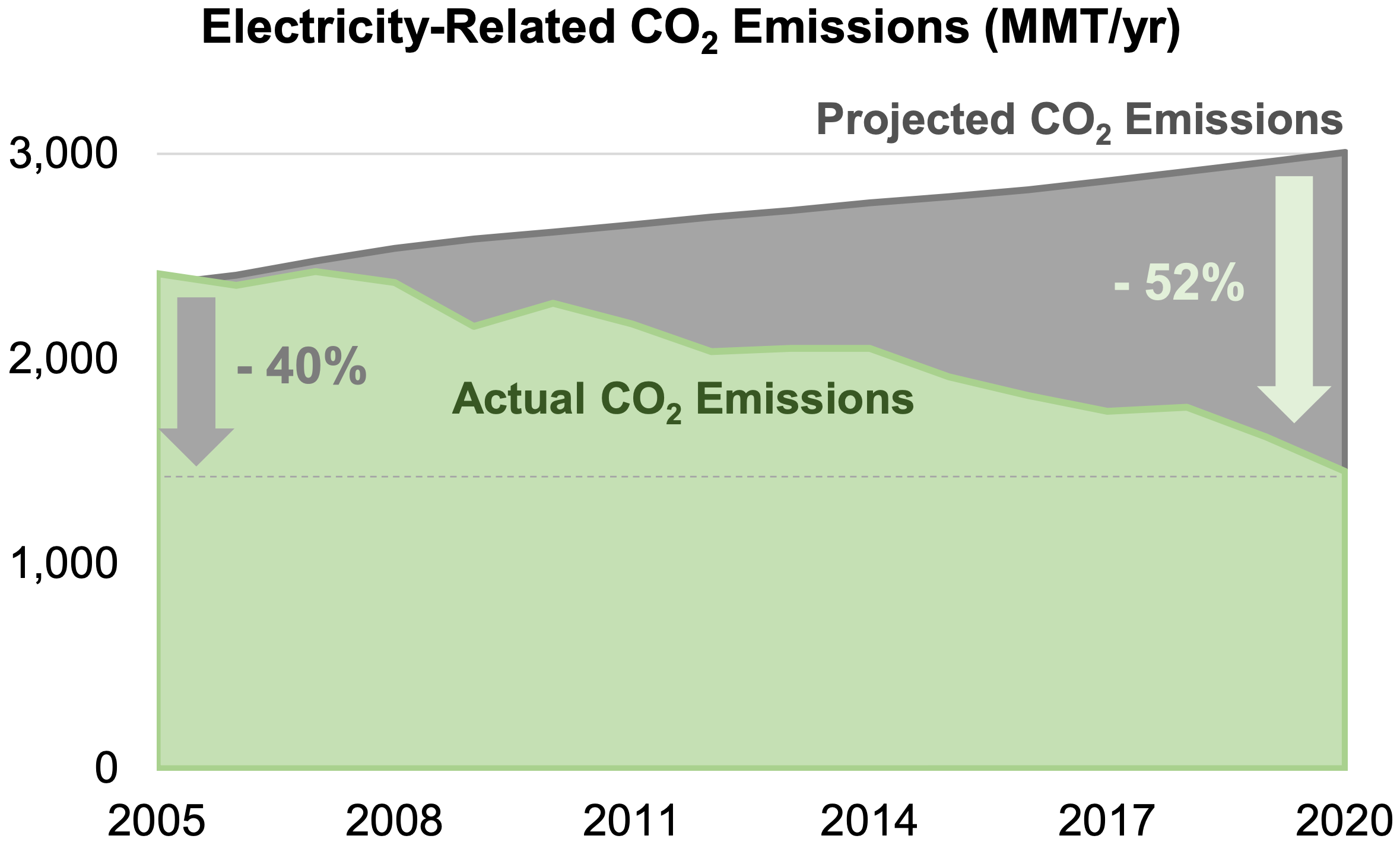
US electricity emissions are halfway to zero
(Hey Volties! The following was going to be a column on Vox, but they decided they wanted something newsier, so I’ll be doing something about Biden’s pledge over there, soon. In the meantime, enjoy this writeup of a fun new paper, or listen by clicking play above. We’ll get back to Battery Week next week.)Climate change can sometimes seem like an intractable problem, so it is useful to remember periodically that progress is possible — indeed, that we are making progress, and know how to make more.This is especially true of the electricity sector.Electricity is the focus of some of our biggest ambitions. Climate policy analysts (and Joe Biden) agree that we need to decarbonize the electricity sector entirely by 2035 — that’s what Biden’s Energy Efficiency and Clean Energy Standard aims for, if he’s able to pass it. That’s an incredibly ambitious target for the next 15 years, but a look at the last 15 years shows that rapid change is possible.The US electricity sector is decarbonizing faster than expectedTo illustrate the point, Lawrence Berkeley National Laboratory senior researcher Ryan Wiser undertook a simple project. He went back 15 years and looked at the US Energy Information Administration’s 2005 projections for the electricity sector, to compare them with what actually happened. Specifically, he looked at the EIA’s business-as-usual (BAU) scenario, its projection of what would happen if 2005 policy were frozen in place. (He also looked at other projections, to make sure EIA wasn’t an outlier.) Here’s the top-line conclusion:Fifteen years ago, many business-as-usual projections anticipated that annual carbon dioxide (CO2) emissions from power supply in the United States would reach 3,000 million metric tons (MMT) in 2020. In fact, direct power-sector CO2 emissions in 2020 were 1,450 MMT — roughly 50% below the earlier projections. By this metric, in only 15 years the country’s power sector has gone halfway to zero emissions. [my emphasis]Not bad!Of course, as Wiser acknowledges, this is about the rosiest possible lens through which to look at this data.2020 was an unusual year; the pandemic drove demand (and emissions) down. Using 2019 numbers instead, the decline from BAU is 46 percent.If you measure how much power sector emissions fell from 2005 to 2020 in absolute terms — rather than relative to expectations — the decline is 40 percent. Measuring absolute decline with 2019 numbers gets you 33 percent. If you look at total energy-related emissions — not just electricity but all energy — they are down 39 percent relative to BAU. It’s evident that electricity is making the fastest progress.Nonetheless, no matter how you look at it, in terms of emissions, we’re doing much better than BAU in the electricity sector. Here’s a breakdown of emission declines in the electricity sector (and its component subsectors), relative to BAU projections and absolute levels, for both 2020 and 2019.(Look how much difference 2020 made in transportation — that’s the pandemic talking.)That’s how electricity GHG emissions did. Let’s look at a few other metrics.Coal died while natural gas and renewables grewFour big trends in the sources that power the electricity sector helped push emissions below BAU. First, coal died — just absolutely plunged relative to expectations. Second, natural gas boomed, thanks to the shale revolution, and stayed much cheaper than expected. Third, renewables boomed, thanks to policy support that drove rapid cost declines. And fourth, demand stagnated, thanks to declining manufacturing and energy efficiency.Here’s a graph that shows, on top, how supply and demand sources came in relative to EIA’s 2005 BAU, and on bottom, how they performed in absolute terms.You can see the four stories plain as day: coal plunged, natural gas and renewables boomed, and demand stagnated. Here’s another way of looking at the data:Electricity bills have not increased …The dynamic in electricity prices is interesting. EIA’s 2005 BAU projection had electricity retail prices falling slightly by 2020, but average consumer electricity bills rising substantially, thanks to increased demand. What happened instead: retail prices stayed about the same, and so did average bills.With all the cheap natural gas and renewables flooding the system, why didn’t prices go down? Wiser cites research uncovering the primary culprit: “declining power production costs due to decreasing prices for natural gas, wind, and solar have been offset by increases in sector-wide transmission and distribution costs.”Curses, transmission again! (Time to spend some infrastructure money.)… but pollution has plungedCoal is the dirtiest electricity source, so the unexpected plunge in coal means a commensurate plunge in local air pollutants and greenhouse gases. Wiser calculates both the climate damages (by using the government’s social cost of carbon) and the air pollution damages avoided by sectoral changes over the last 15 years. They are stunning.Even th

The many varieties of lithium-ion batteries battling for market share
(If you would rather listen than read, just click play above.)Hello, everyone, and welcome back to Battery Week! We’ve talked about why lithium-ion batteries (LIBs) are so important and we went through a basic primer on how they work. Today, we’re going to get into the competition within the broad lithium battery family, among all the different kinds of batteries that use lithium and exchange charged lithium ions. (See the previous post for a full list.)There are a few clear leaders — lithium nickel manganese cobalt oxide (NMC), lithium nickel cobalt aluminum (NCA), and lithium ferro phosphate (LFP) — that have achieved mass market scale and several others looking to get in on the action. The market prize is likely to exceed a trillion dollars within the next decade, so if any of these competitors can even carve out a substantial niche, it could be worth billions. Let’s look at the players. Better NMC and NCAThe bulk of LIB research these days is going to improve the dominant batteries on the market, mainly by reducing the amount of cobalt (the most toxic and expensive ingredient). Most EV makers use NMC batteries; Tesla uses NCA. In the past, it’s been difficult to push down the amount of cobalt in these batteries (it plays an important balancing role), but manufacturer LG recently introduced an NMC 811 battery: 80 percent nickel, 10 percent manganese, 10 percent cobalt. GM will use them in its new line, including in the Hummer, and Tesla will put them in some of its Model 3s in China.Most big battery manufacturers, including Panasonic (which supplies many of Tesla's batteries), have vowed to gradually reduce and eventually eliminate cobalt. Nickel is the key to energy density. Tesla, VW, and others are working on special high-nickel battery varieties that will be used for specialty vehicles that require extra-high energy density, like larger SUVs and trucks.But not every vehicle needs that, and nickel supply constraints are looming, so work is also being done to further boost manganese — a much more stable, abundant material — and reduce cobalt.Silicon anodesMany LIB developers are experimenting with silicon as an anode coating, partially or completely replacing graphite. Tesla has been working to increase the proportion of silicon in its anode since at least 2015.Silicon holds on to nine times more lithium ions than graphite, so energy density improves (range expands by 20 percent), and a silicon battery can charge and discharge much more quickly than graphite batteries, so power density improves as well. But silicon expands when it absorbs ions, so it breaks down quickly; cycle life is still much lower than graphite. If engineers can overcome that problem (and Tesla has vowed it can), LIBs could take a leap forward soon. SILA Nanotechnologies, in its brief on the future of LIBs, considers silicon anodes the biggest potential near-term market-shifting breakthrough in the space. It summarizes:[T]here are no high-volume commercial Li-ion batteries (yet!) in which a silicon anode entirely replaces the graphite one. When it does arrive, the reward will have been worth the wait. We expect automotive cells with NCA or NCM cathodes paired with Si-dominant anodes will increase energy density by up to 50%, thereby dropping the $/kWh cost by 30-40% in less than a decade. That is a mind-boggling prize, if any manufacturer can unlock it. (Read Canary’s Julian Spector on Sionic, a battery company that has recently debuted a silicon anode that it says can fit into existing LIB manufacturing.) Silicon anodes are technically “cathode agnostic,” though most testing so far has used NMC cathodes. If engineers can crack the code and make silicon anodes with high cycle life, it could benefit any and all cathodes (e.g., see LFP below).Fluorides as cathodesOne thing I didn’t mention about silicon-as-anode: it doesn’t operate via intercalation. Instead of nestling into the anode, ions react with the silicon and bond with it, a process called “conversion.” That makes it more difficult to peel the ions off without damage, but it can hold way more ions.With anodes (which are the limiting factor on most batteries now) improving, there’s more room for cathode improvement. SILA is big on research into fluorides — it cites metal fluoride-based cathodes (like iron fluoride or copper fluoride) and sulfur-based cathodes — which also operate via conversion rather than intercalation and can also store more ions. It writes:It’s plausible that with a conversion cathode and an engineered low-swell silicon anode, the cycle life of Li-ion can be extended all the way to 10,000 full cycles while also having the highest energy density in the market — thus breaking the [power vs. energy] compromise.SILA believes it’s only that combination — a conversion-based anode and a conversion-based cathode — that can bring LIB prices down to “~$50/kWh by 2030 and ~$30/kWh by 2040.” If it happened, that would be absolutely wild and almost certainly crush all c

A primer on lithium-ion batteries: how they work and how they are changing
(If you don’t want to read, you can listen. Just click play above.)Greetings! Welcome back to Battery Week here at Volts. In my last post, I went over why lithium-ion batteries (LIBs) are so important to decarbonizing both transportation and the electricity sector. Next week, we’re going to get into the nuts and bolts of different kinds of LIBs, to see how different chemistries offer different kinds of performance and are competing for different market niches.Before that, though, it’s worth the time to do a little review of battery basics. If you’re like me-a-month-ago, you probably have a hazy understanding at best of the structure of batteries and the processes involved in running them.I’m not going to get into any complicated chemistry — believe me, no one wants that — but I thought it would be helpful later, when we get into the competition within battery markets, to have some rudimentary terms and concepts clear in our heads.Batteries 101F’ing batteries, how do they work?As the name suggests, electrochemical batteries store energy via chemical reaction. Discharging the battery involves a chemical reaction that produces electrons; recharging the battery involves a chemical reaction that stores electrons.The basic unit of the electrochemical battery is the cell. In the cell, two electrodes — negative (anode) and positive (cathode) — are separated by an electrolyte. When the anode and cathode are connected in a circuit, two things happen.1. Negatively charged electrons flow from the former to the latter, generating power. The amount of power is determined by two factors: * current, the number of electrons traveling in a given circuit, and* voltage, the force with which the electrons are traveling.Power = current X voltage. It’s like a river: the force exerted by the water will depend on how much there is and how fast it’s moving. You can get the same force with less water if it moves faster, or with slower water if there’s more of it. Similarly, you can get the same power with less current if you have more voltage, and vice versa.2. The anode releases positively charged ions into the electrolyte, to balance the reaction, and the cathode absorbs a commensurate amount. (Some batteries have a thin semi-permeable barrier within the electrolyte to regulate the flow of ions.) Recharging a battery basically involves reversing the reaction, returning the electrons and the ions to the anode.The anode will be a material that gives up electrons easily in chemical reaction with the electrolyte. The cathode will be a material eager to absorb them. The propensity to shed/absorb electrons is known as standard potential, and the difference in standard potential between the anode and cathode will determine the battery’s total electrical potential. The bigger the difference, the more potential.The whole game of battery design and development is to find a combination of anode, cathode, and electrolyte that performs well along a broad set of criteria — holds a lot of energy, releases energy quickly, operates safely, lasts a long time, is cheap, etc. The tragedy of battery development is that there are always trade-offs. High performance on one criterion generally means lower performance on another. Optimize for holding more energy and you limit how quickly energy can be released; optimize for safety and you limit energy density; and so on. Battery development has seen dozens of chemistries come and go, but four have stuck and scaled to mass-market size: lead acid, nickel cadmium (Ni-Cd), nickel metal hydride (NiMH), and lithium-ion (Li-ion).LIBs have hit on a combination of anode, cathode, and electrolyte that performs well enough along several criteria (especially cost) to work for most short-duration applications today. They dominate consumer electronics, electric passenger vehicles, and short-duration grid-scale storage, and are expanding in other markets as well (though lead-acid batteries remain a $45 billion global market). They have gotten very cheap and a large-scale manufacturing capacity has grown up around them.Let’s take a closer look at LIBs.Lithium-ion batteries 101LIBs have been around in commercial form since the early 1990s, though obviously they’ve improved quite a bit since then. Today’s most common and popular LIBs use graphite (carbon) as the anode, a lithium compound as the cathode, and some organic goo as an electrolyte. They boast two key advantages over prior battery chemistries.First, they need very little electrolyte. LIBs are what’s known as “intercalation” batteries, which means the same lithium ions nestled (intercalated) in the structure of the anode transfer to be intercalated in the cathode during discharge. The electrolyte only has to serve as a conduit; it doesn’t have to store many ions. Consequently, the cell doesn’t need much of it. Saving on electrolyte saves space and weight. (Bonus: the process is almost perfectly reversible, which gives LIBs their high cycle life.) Second, LIBs squee

Why lithium-ion batteries are so important
People of Volts! At long last, Battery Week is here. It is time to get into batteries. Waaay into batteries.Over the next few posts, I’m going to cover how lithium-ion batteries (LIBs) work and the different chemistries that are competing for market share, but I thought I would start off with a post about why I’m doing this — why batteries are important and why it’s worth understanding the variety and competition within the space.Lithium-ion batteries are crucial to decarbonization in two important sectorsWe know that the fastest, cheapest way to decarbonize, especially over the next 10 years, is clean electrification: shifting the grid to carbon-free sources and shifting other sectors and energy services onto the grid. LIBs are accelerating clean electrification in the two biggest-emitting sectors of the US economy, transportation and electricity. (Each is between a quarter and a third of emissions.)First, they are colonizing the EV market and enabling ever-higher performance and range. The global EV market is on the front end of explosive growth:Researchers at Deloitte expect growth to accelerate through 2030:As BloombergNEF analysts show in their “Electric Vehicle Outlook 2030,” it’s not just passenger EVs, either. The fastest growing EV segment will be buses, followed by scooters. The global market for EV batteries alone is expected to hit almost a trillion dollars by 2030. Sustaining that growth is going to require lots and lots of new batteries. The more energy-dense, cheap, and safe LIBs can get, the faster the electrification of transportation will happen.Second, LIBs are being used both for distributed, building-level energy storage and for large, grid-scale storage installations. As the grid shifts from firm, dispatchable sources of energy like coal and gas to variable, weather-dependent sources like sun and wind, it will need more storage to balance things out and stay stable. Batteries can help at the grid level (they can even serve as transmission assets) and they can serve local resilience at the building and community level. Overall, the research firm Wood Mackenzie expects the global storage market to grow at an average of 31 percent a year over the coming decade, reaching 741 gigawatt-hours of cumulative capacity by 2030.The more energy-dense, cheap, and safe LIBs can get, the faster storage will be infused throughout the grid and the more renewable energy the grid will be able to integrate. All together, here’s what the Department of Energy projects for the global energy storage market through 2030:As this graph shows, the vast bulk of the demand for batteries is going to come from transportation, meaning EVs of various kinds. Whatever is used for EVs is probably going to end up getting so cheap, just from scale, that it dominates energy storage as well.There’s one other cool aspect of batteries that gets too little attention. Storing substantial amounts of electricity for cheap is a relatively new thing in human affairs. We are only just now beginning to explore what can be done with it. What’s happened in the relatively short history of lithium-ion batteries is that, as they get cheaper and more powerful, we find new uses for them. Way back in 2015, energy analyst Ramez Naam called this the “energy storage virtuous cycle.” Lithium-ion batteries can do more and more stuffThere’s a reason why, in 2019, the three chemists behind the initial development of lithium-ion technology won the Nobel Prize in chemistry. LIBs boast incredibly high energy density and specific energy, which is to say, they cram lots of oomph into a small, lightweight package, and they are capable of cycling many more times than their predecessors. The first LIBs, commercially introduced in the early 1990s, were expensive, but found a market foothold in small electronic devices — phones, laptops, camcorders — where energy density is at a premium. They have since all but completely taken over the consumer electronics market. As manufacturing scale grew, prices fell and more uses opened up: power tools, lawnmowers, scooters. Scale grew more, prices fell more, and LIBs displaced other chemistries as the top choice for EVs. Especially in recent years, the growth (and anticipated growth) in the EV market has driven an enormous surge of public and private investment to LIBs, with dramatic effects on prices. According to recent research by BNEF, “lithium-ion battery pack prices, which were above $1,100 per kilowatt-hour in 2010, have fallen 89% in real terms to $137/kWh in 2020. By 2023, average prices will be close to $100/kWh.” (It wasn’t that long ago that most experts agreed $100/kWh was an impossible target.)And so the cycle continues. Prices fall and more new uses open up: big trucks, buses, airplanes, data centers, distributed energy storage, and large-scale grid-storage installations. From BNEF:BNEF’s analysis suggests that cheaper batteries can be used in more and more applications. These include energy shifting (movi

Biden's tax plan goes after the little fossil fuel subsidies, but not the big ones
(If you’d rather listen than read, just click play above.)President Joe Biden has released the tax plan that is meant to pay for his $2+ trillion infrastructure plan. You can read the New York Times for a full breakdown. The bulk of the revenue will come from a set of changes to corporate tax law, raising the corporate tax rate from 21 to 28 percent, imposing a minimum tax on global profits, and discouraging offshore tax havens.All that stuff is great. I just want to say a few quick things about one of the provisions, which would roll back various fossil fuel subsidies in the tax code. In one sense, this is cool, and a big deal insofar as Democrats can actually do it — they’ve been trying for years, to no end. But in another sense, it reveals that the hue and cry over fossil fuel subsidies in the US is somewhat of a tempest in a teapot, more a political symbol than a real source of revenue or decarbonization.Direct US fossil fuel subsidies aren’t that big in the grand scheme of thingsThe administration projects that closing oil and gas tax loopholes will raise $35 billion over the coming decade.That’s 1.4 percent of Biden’s $2.5 trillion in tax-plan revenue. A Treasury Department report from the administration says: “The main impact would be on oil and gas company profits. Research suggests little impact on gasoline or energy prices for U.S. consumers and little impact on our energy security.” (It cites this study.)There are two reasons the changes would have “little impact on gasoline or energy prices.” The first is that oil is a globally traded commodity, with prices set globally — a US company can’t raise its prices without losing out on the global market. So it eats any extra cost as slightly lower profits.But the second is that $35 billion over 10 years just isn’t that much money. Even in 2020, a truly shitty year for US oil companies, Exxon made revenues of $181 billion. That was down 31.5 percent from $265 billion in 2019. For companies with revenues in the hundreds of billions, experiencing market swings of $85 billion a year, an extra $3.5 billion a year spread out over the whole sector just isn’t going to register much.Last year, Rep. Ilhan Omar (D-Minn.) and Sen. Bernie Sanders (I-Vt.) introduced the “End Polluter Welfare Act,” which takes a much more expansive view of what counts as a fossil fuel subsidy and pulls together $15 billion a year in tax changes. That would be $150 billion over the next 10 years — 6 percent of the revenue Biden’s plan will raise. (This even-more-aggressive study from Oil Change International found $20 billion a year in subsidies, though the oil and gas industry hotly contests some of the choices it made.)The point is, to get to real revenue, you have to bring in indirect fossil fuel subsidies.The big fossil fuel subsidies are the externalitiesWhen Greenpeace says that US fossil fuel companies get $62 billion a year in subsidies, it refers to this study, which examines what it would take to “correct market failures brought about by climate change, adverse health effects from local pollution, and inefficient transportation.”In other words, the study tallies up the oil and gas industry’s externalities, the costs it imposes on society that are not reflected in market prices. (And it doesn’t even include the costs of defending global oil supply, which are substantial.)Whether it is fair or accurate to call these unpaid costs “subsidies” is largely a matter of semantics, or, worse, metaphysics, but it doesn’t really matter. Fossil fuel companies don’t pay the costs; other people do. A 2017 International Monetary Fund study pegged the global value of direct and indirect fossil fuel subsidies at $5.2 trillion — that’s 6.4 percent of global GDP.Of course, making fossil fuel companies pay those costs would involve more than modest tax code tweaks. It would involve a new carbon tax. How much could that raise? A 2017 study by the Treasury Department modeled a carbon tax that starts at $49 per metric ton in 2019 and rises to $70 per metric ton in 2028 (not far out of line with some popular carbon tax proposals). Over the course of that 10 years, the tax would raise $2.2 trillion in revenue — just about enough to fund Biden’s infrastructure plan!It’s a perfect match. It’s notable, then, that no one on either side of the aisle has proposed it, despite an ongoing hunt for revenue. Carbon tax people are always saying it has bipartisan appeal, but in practice, it seems bipartisan in that both parties want nothing to do with it.Anyway, Biden’s run at fossil fuel subsidies (the latest in a long line from Dems) isn’t really about revenue.This story is mostly about political power and social licenseIn every article you read about the portion of Biden’s plan that goes after fossil fuel subsidies, you will see some version of this: “Previous attempts to eliminate subsidies on oil and gas met with stiff industry and congressional opposition.”Despite the fact that $35 billion over 10 years is

The coolest parts of Biden's expansive infrastructure plan
Hey, everybody! President Joe Biden has unveiled his first infrastructure proposal and … hot damn. The eight-year "American Jobs Plan" would spend $2.25 trillion on a huge range of initiatives, from highways to the energy grid, water systems, airports, transit systems, broadband, energy R&D, and — paging a Sen. Joe Manchin — abandoned coal mine clean-up. This is an amazing document. Yes, there’s stuff in it that I would take out (some highway spending) and stuff I would add (more transit spending). Yes, a serious transition to sustainability would probably take closer to $10 trillion. Yes, there’s a very good chance the plan gets cut or compromised on the way to passage, if it passes at all, which is far from certain. Still. As presented by the Biden team, it represents not only an enormous total investment, but some really smart investments, in areas where the positive knock-on effects for the clean energy transition could be enormous. There were some true-blue energy wonks involved in writing this thing.I’ll just quickly go over the parts that are most exciting to me and then mention a couple of benefits that are getting underplayed.TransportationThe plan would put $174 billion toward a plan to “win the EV market,” which is on the verge of enormous growth. Biden wants to create a domestic supply chain for batteries and EVs (something that is virtually nonexistent today) and domestic manufacturing capacity to make the EVs, all of which will create domestic jobs. It would offer point-of-sale rebates to purchasers of domestic-made EVs, “while ensuring that these vehicles are affordable for all families and manufactured by workers with good jobs.” It would offer grants and incentives to state and local governments and private businesses to install EV charging stations, with the goal of 500,000 up and running by 2030.And I love this, though I wish it were much bigger: “Replace 50,000 diesel transit vehicles and electrify at least 20 percent of our yellow school bus fleet through a new Clean Buses for Kids Program at the Environmental Protection Agency, with support from the Department of Energy.” This will put us on “a path to 100 percent clean buses.”I have sung the praises of electric city buses; see Vox’s Kelsey Piper on electric school buses. Not only do they save money over time, but they generate immediate air quality benefits for some of the most vulnerable populations — kids and low-income and POC communities, who bear the brunt of diesel pollution. The benefits wildly outweigh the costs. (On the campaign trail, Bernie Sanders proposed $407 billion just for electric buses, which is more like it.)Finally, oh, by the way: the plan “will utilize the vast tools of federal procurement to electrify the federal fleet, including the United States Postal Service.” Whaaat? As Sarah Kaplan reported in The Washington Post in January:There are some 645,000 vehicles in the federal fleet. They include roughly 200,000 passenger vehicles, 78,517 heavy-duty trucks, 47,369 vans, 847 ambulances and three limousines.That’s a lot of vehicles.As for electrifying the 225,000 Postal Service vehicles, I have written at great length about what a fantastic idea that is. This part of the plan is honestly like a present to me. Thank you, Joe Biden.It’s not all about cars and trucks, though. The plan also has $85 billion for public transit (“to modernize existing transit and help agencies expand their systems to meet rider demand”), which would double existing federal investment in transit, and at least $80 billion for rail (“to address Amtrak’s repair backlog; modernize the high traffic Northeast Corridor; improve existing corridors and connect new city pairs; and enhance grant and loan programs that support passenger and freight rail safety, efficiency, and electrification.”)As for transportation infrastructure, there’s $20 billion for “a new program that will reconnect neighborhoods cut off by historic investments and ensure new projects increase opportunity, advance racial equity and environmental justice, and promote affordable access” and $25 billion “for a dedicated fund to support ambitious projects that have tangible benefits to the regional or national economy but are too large or complex for existing funding programs.”In my dream world I would spend much more on transit and rail, but this is a huge improvement over previous infrastructure bills, even from Democrats. TransmissionReaders of Transmission Month know that long-distance transmission is very much needed for national decarbonization and currently very difficult to build. The big news in the plan is that Sen. Martin Heinrich’s federal transmission investment tax credit (ITC) made it in. The fact sheet doesn’t specify the size of the ITC, but Heinrich’s proposal is 30 percent. The idea is to spur “the buildout of at least 20 gigawatts of high-voltage capacity power lines and mobilize tens of billions in private capital off the sidelines.”And remember my post on usi

The most important job ahead for Democrats
(If you don’t want to read the post, click play above and I’ll read it to you.)Hello, beloved readers and listeners! Today I’m going to make an argument that is very important to me: Democrats must pass substantial democracy reform before the 2022 elections. If Dems don’t get this done, the US is in for a long period of political darkness. Democracy in America could very well perish. Climate change will become unsolvable. Every goal progressives seek — taxing the rich, funding infrastructure, fixing immigration, boosting unions, you name it — will move out of reach. It is, I say with some risk of understatement, the most important thing in the world.Let me try to explain why.Biden’s 2020 victory temporarily arrested, but did not stop, the US slide toward minority ruleWhen Biden was elected in November, I felt a conflicting mass of emotions. Most of all, of course, was relief. It is no exaggeration to say that a second Trump term would have meant the end of the American experiment with democracy. But alongside that relief was a persistent sense of dread. The larger context of the 2020 election is an ongoing process whereby America’s mostly white, rural, and suburban conservative minority — which hasn’t won the popular vote in a presidential election since 2004 — is gaining greater and greater structural political advantages each passing year. Republicans are overrepresented in the Senate, overrepresented by the Electoral College, gerrymandered into safe House seats, and busy passing voter suppression bills at the state level. What Dems needed in 2020 was commanding majorities in both houses and a few key state legislatures, enough to stop the next round of GOP gerrymandering and pass substantial democracy reform through Congress.They got majorities, but, far from commanding, they are whisker thin, smaller in the House than in 2018. And Republicans maintained control of all the state governments key to redistricting. That makes Democrats’ job much, much more difficult.Nonetheless, it remains the job. Getting Trump out of office was the first step, but it won’t mean anything in the mid- to long-term if Dems don’t repair democracy. Absent substantial structural reform, the most likely outcome remains the one that Matt Yglesias predicted in 2015: “America’s constitutional democracy is going to collapse.”I would put it this way: Democrats either pass substantial democracy reform (including statehood for DC) through Congress in the next 18 months or they will lose one or both houses in 2022 and remain locked out of congressional majorities for a decade if not longer. Without voting system reform, Dems are screwed in 2022The most likely outcome of the 2022 elections is that Democrats lose their House majority. To keep it, they would have to defy both history and Republican gerrymandering.Historically, midterm elections are a “shellacking” for the president’s party, as Obama (whose party lost 63 House seats in 2010) put it. With only two exceptions — Clinton Democrats in 1998 and Bush Republicans in 2002 — this has held true all the way back to 1934. Even if they defy that historical trend, Democrats won’t be fighting on a level playing field. Because they retained control of the key state legislatures involved in redistricting, Republicans could win a House majority in 2022 purely with new seats created by redistricting, even if they don’t flip a single blue seat red. To buck these trends and keep the House in 2022, Democrats will need not just the historic turnout that elected Biden, but more. It would take something of a miracle. “If we replicate the GOP’s post-9/11, 2002 midterm performance, we have a chance,” political analyst David Shor told New York magazine’s Eric Levitz. “If we replicate the second-best presidential-party midterm from the past 40 years, we lose.”The Senate will be more competitive in 2022: out of 34 races, Republicans are defending 20 seats and Democrats 14. Nine of those races are considered competitive, roughly evenly divided between parties. But it almost doesn’t matter: if Democrats lose the House, legislation of any substance will become impossible. And odds are getting increasingly stacked against Democrats in both houses, so it could be a long-ass time before they have Congress again. Perhaps there’s some path to bipartisan democracy reform? Ha ha, no.Republicans will fight democracy reform to the deathIf either house of Congress goes to Republicans, any kind of positive voting reform becomes impossible. If they get unified control again, they are much more likely to pass national versions of the kind of targeted voter restrictions they are passing at the state level. Democrats will never get a scrap of help from Republicans on democracy reform, only implacable, relentless opposition. Conservatives will fight it with everything they’ve got, for the same reason they fought it during Reconstruction or the Civil Rights era: to the extent voting in the US becomes easier, fairer, and more

Voltscast: Jesse Jenkins on energy modeling
Hello, People of Volts! Today I’ve got a special treat for you: a podcast with Jesse Jenkins, energy modeler and assistant professor at Princeton.Those of you on #EnergyTwitter already know Jesse. He’s been doing this as long as I have, working his way up from take-haver to think tanker to graduate researcher at MIT to Princeton prof. Along the way he’s developed a reputation not only as one of the sharpest, most empirically informed energy analysts in the country, but as a scrupulously nice guy, always willing to share what he knows and engage in good faith with questions and arguments. As a journalist, I’ve found him indispensable.So it was a real treat to sit with Jesse for an in-depth conversation on energy system modeling. What exactly is it? How does it work? What does it tell us about the kinds of energy technologies we will need to decarbonize, and their relative scale? How do politicians use — and misuse — models?We get into all of it (as you will hear, I kept Jesse talking so long that I started worrying I might be violating the Geneva Conventions). I hope you enjoy it as much as I did. Here are a few links either mentioned in, or relevant to, the discussion:* A three-part series on the “rebound effect,” whereby energy efficiency reduces the price of a service, which then increases demand for the service, which then wipes out some of the energy and environmental gains of the efficiency. I wrote it in 2012 for Grist.* Jesse’s old blog Watthead, with posts going all the way back to 2005.* A 2015 post of mine about how the International Energy Agency (IEA) consistently overestimates the cost of renewable energy.* The Princeton University Net-Zero America project, an effort to model a variety of pathways to deep decarbonization in the US. * A presentation on the Net-Zero project with Jesse and Princeton’s Eric Larson.Question for the type of folks who read to the bottom: would you be interested in a written transcription of this episode? It would be some work, but if enough people want it I’d be up for doing it, perhaps as a bonus for community members. Let me know in comments or at [email protected] for reading. If you value work like this, please consider becoming a paid subscriber. This is a public episode. If you'd like to discuss this with other subscribers or get access to bonus episodes, visit www.volts.wtf/subscribe

Lessons from the Texas mess
Hello there, Voltron! It’s been an interesting week, hasn’t it? A guy writes a tediously long and wonky series on energy transmission and, next thing you know, transmission grids are dominating the news. By now, the story of what happened in Texas last week is familiar: an extraordinary cold snap simultaneously a) raised demand on the grid to well higher than the grid operator’s worst-case winter projections, and b) knocked out more than 30 gigawatts worth of energy generators. Supply and demand must be kept in perfect balance on a self-contained grid like Texas’, so when demand spiked and supply plunged, something had to give — thus the not-so-rolling blackouts.Most of that lost generation was natural gas and coal. Freezing afflicted not only the water used in power plants but the mining, distribution, and storage of fossil fuels. And, yes, some wind turbines froze, though wind actually performed better than the modest expectations set by ERCOT, Texas’ grid operator.I’m not going to go through the story in detail. I just want to talk a bit about what it means and what we can learn from it. To learn more about what happened, those affected, and the role Texas’s grid and regulations played in events, I recommend reading the following:* The Houston Chronicle had a great story on the events as they unfolded and is, in general, all over it. * In The New Republic, Kate Aronoff has a great overview, with crucial historical context for why the Texas grid is isolated and why it has an energy-only power market.* In the Atlantic, Rob Meyer has great coverage of the Texas planning failures. * The team at ProPublica has a piece on how Texas regulators “have repeatedly ignored, dismissed or watered down efforts to address weaknesses in the state’s sprawling electric grid.”* In the Los Angeles Times, Sammy Roth has another great wrap-up, with a focus on grid vulnerability.* In the New York Times, a team of journalists pulls together a great backgrounder on Texas’s unique power market structure and grid independence. * In the New York Times, Princeton energy analyst Jesse Jenkins has a piece on the crucial failure of Texas utilities to future-proof their assets. * In the Wall Street Journal, Katherine Blunt and Russell Gold have a story on the implications of the disaster for the energy-only market.* In Utility Dive, Alex Gilbert and Morgan Bazilian write on what happened and what it means for Texas grid regulation.* The New York Times’ Brad Plumer explains what climate impacts will mean for the nation’s power grids.* At Gizmodo, Molly Taft reports on how much the oil and gas industry is paying Republicans to lie about what happened.* And here’s the Wall Street Journal editorial board lying about what happened.Any handful of those stories (save the last) will fill you in on what happened and why. Now let’s talk about what we can learn from it.It was going to be bad in Texas regardlessOne thing worth emphasizing up front is that Texas just faced an extremely unusual event. It got much colder, much faster, and dumped more snow and ice, for longer, and took out more energy infrastructure than even the grimmest forecasts predicted. Yes, the state has had cold snaps before — including in 2011 and 2014, producing a set of recommendations and guidelines that state regulators made voluntary and state utilities largely ignored — but this was extreme even in context. We’re going to touch on better planning, helpful technologies, and reformed regulatory structures, but the grim truth is that there is probably no alternative set of planners or regulations that would have adequately prepared for what took place last week. They certainly could have done better, but this event was fated to be rough.If we’re going to start seriously preparing the electricity system for long-tail, low-probability events — the kind climate change is making more likely — it will be a new thing, not something that’s been mastered by any current entity or regulatory body.Small picture: Texas electricity and natural gas systems need to be weatherized The Texas mess is being characterized as a grid crisis, but it was actually a generation crisis. Two-thirds of the state’s power comes from natural gas, and a) natural gas wells and pipelines froze (cutting normal production by about 20 percent), b) commercial and residential heating got priority access to natural gas, per state policy, and c) natural gas power plants froze. [Clarification: national natural gas production fell by 20 percent; Texas production fell by 50 percent.]Some coal plants and wind turbines also froze up, and one of the state’s nuclear plants went offline for unrelated reasons, but the bulk of the 30+ gigawatts of energy generation that went offline was natural gas power plants (many were also down for scheduled winter maintenance).Natural gas production and distribution falls under the purview of the Railroad Commission of Texas, so it is the RRC that will need to update regulations to make

Transmission month: everything in one place
Greetings, People of Volts! We have come at last to the end of Transmission Month, née Week. It’s been quite a journey.Below are links to and summaries of all the transmission posts. Above is a mega-podcast — all the posts, read by me, strung together, for when you have a couple of hours free. * The subscriber-only discussion post that started everything. Thanks for all the ideas!* Why we need more big power linesAn explanation for why the US needs more big, long-distance power lines to decarbonize, relieve grid congestion, and reduce the cost of power. * How to start building more big power linesBuilding new power lines in the US is absurdly difficult, a kaleidoscope of dysfunction from planning to financing to permitting to siting. Local resistance ends up killing anything ambitious. The federal government needs to step in.* Burying power lines next to rail & roads to make a national transmission gridOne way to avoid siting hassles and local battles is to bury new transmission lines alongside existing rail and road infrastructure. One big line doing this, connecting Iowa wind to the Chicago area, is underway now. * How to make the existing grid work betterA set of “grid-enhancing technologies” stand ready to increase the capacity and improve the performance of the existing transmission grid, from “dynamic line ratings” to “topology optimization.” Utilities just need incentives to install them.* Two more ideas to quickly boost the transmission gridA couple of final proposals to improve existing transmission. One is using energy storage to supplement transmission; the other is replacing existing AC lines with HVDC lines.* Volts podcast: the challenges of building transmission in the US, and how to overcome them, with Liza ReedA discussion with clean-energy researcher about the obstacles facing long-distances transmission lines and some policies that might help clear them away. If you value this kind of deep-dive explanatory journalism, please consider becoming a paid Volts subscriber. I don’t have any advertisers or sponsors; the only way I can do this is with your support. Thanks for reading and listening. This is a public episode. If you'd like to discuss this with other subscribers or get access to bonus episodes, visit www.volts.wtf/subscribe

Transmission month: two more ideas to quickly boost the transmission grid
Greetings, faithful Volts readers! Welcome back to the Transmission Week that never ends. The news these last few days has been filled with talk about electricity grids. Texas is suffering from an unprecedented cold snap that has left more than four million people without power for days. It’s a terrible situation. There’s a lot to say about it, what can and can’t be learned, and perhaps I’ll get to it next week.But you didn’t sign up for a breaking-news email, you signed up for Volts! So today brings what I believe what I believe will be my last big transmission post, though I may do a wrap-up after this. Thank you for traveling with me on this longer-than-expected journey.Today, we’re going to look at a couple of final ideas to make the transmission grid work better, short of building new lines — a remainder bin of grid-enhancing technologies, if you will. Idea #1: Using energy storage as a transmission assetAt least since the Energy Policy Act of 2005, the US government has acknowledged that energy storage technologies can be used to ease grid congestion and increase the reliability and flexibility of energy transmission. In recent years, there has been increasing interest in “storage as a transmission asset” (SATA), which refers to energy storage installations that are treated as transmission assets — meaning utilities can “rate base” them and receive a guaranteed rate of return plus any tariffs or incentives for transmission assets. Basically, it means allowing some storage to be treated — legally, financially, and operationally — like a piece of the transmission system.SATA projects — sometimes known as “virtual power lines” — offer a range of benefits to regional energy grids. When a line is congested, it can offload some power to storage. At times of lower congestion, stored power can be injected to maintain high line utilization. Storage can thus relieve congestion and make the grid more reliable. It is much cheaper and quicker to deploy than new transmission, its footprint is much smaller, and it faces a much less onerous regulatory process. It is extremely modular and scalable, which means it can start small and be scaled up precisely to need, and even relocated as grid needs change.Congestion on a power line often causes “inefficient dispatch,” meaning grid operators must ask generators on one side of the line to curtail their output and generators on the other side of the line to ramp theirs up, even if that isn’t the most cost-effective option. Storage on either side of the line can help reduce inefficient dispatch.Another key service storage can provide is to free up unused line capacity. A grid capacity standard called “N-1” holds that the grid must maintain safe operation if a “contingency event” takes out one of the lines. This means all lines must maintain some reserve capacity to absorb energy in the event of an N-1 situation. But storage can serve that purpose — rapidly injecting energy into, or absorbing energy from, the grid in the case of a contingency event — even better than power lines. Adding SATA projects can free up some of that reserve line capacity to carry more power. As with most things transmission, Europe is way ahead of the US on this. Most notably, Germany is developing 1,300 MW worth of SATA in a project known as Netzbooster (grid booster) to free up line capacity otherwise reserved for an N-1 contingency. (Germany has notorious congestion between the wind-heavy north and load centers in the south.) The US has nothing at the GW scale like that, but a few RTOs are moving forward. In August 2020, FERC approved MISO’s proposal for the rules and processes by which it would integrate storage into its planning and project selection.One twist: FERC has indicated that it is “permissible as a matter of policy” in the US for a storage project to be “dual use,” to serve as a transmission asset and receive fixed returns and simultaneously to participate in wholesale energy markets and receive market returns.This move has drawn some criticism, since it seems to blur the canonical separation between energy market participants and the “wires companies” that are supposed to offer them non-discriminatory access to the grid. If a wires company owns a storage asset that is drawing market returns, it has every reason to give that asset privileged grid access.FERC has said dual use is subject to the following four principles:* must be cost-competitive with transmission,* must avoid double recovery for providing the same service,* cannot suppress market bids, and* cannot jeopardize ISO/RTO independence.It’s not entirely clear how dual use storage could, in practice, avoid bumping up against those principles. So far as I know, none of the big RTOs/ISOs has yet hashed out exactly how to make the dual-use thing work. (Here’s an issue paper in which California ISO wrestles with the problem.)There are reasons to remain skeptical of SATA projects. Batteries are still relatively expensive compared

Transmission month: how to make the existing grid work better
(If you’d rather listen to this post than read it, just click play above.)Welcome back to Volts, where every week is Transmission Week!In my three transmission posts so far, I have focused mostly on the challenges of building new long-distance energy transmission lines in the US — the poor planning, the inefficient financing, the permitting and siting hassles. Today I’m going to turn to a different subject: the various ways that the performance of the existing transmission system could be upgraded and improved through so-called “grid-enhancing technologies” (GETs).To be honest, I probably should have tackled this subject first. Though new lines are going to be needed regardless, it is faster and cheaper to upgrade the existing system, with fewer regulatory barriers. GETs can achieve short-term relief from grid congestion while new lines are being developed.There are three techs that are typically classified as grid-enhancing technologies, and I will focus on them in this post. In my next post, I’ll cover a couple of extra options that I haven’t found any other way to fit in. Let’s jump in. (I should note here up top that I will be drawing heavily from a 2019 report on GETs from the Brattle Group and Grid Strategies.)Closer monitoring to improve line performanceWhen electricity passes through transmission lines, they heat up. As they heat up, they sag. If too much electricity is run through a line, it can exceed its maximum operating temperature or sag to the point that it brushes up against trees or other structures, potentially sparking fires.Grid operators want to avoid that, so they do not load lines to their full rated capacity. They set an operational limit well below theoretical capacity, to create a safety margin. But how far below capacity should the limit be set? That is the question.The heat and sag of a given line are changing in subtle ways all the time. They vary with the ambient temperature, humidity, barometric pressure, and wind speed. If it’s warmer, the line will heat up faster; if there’s a breeze, it will heat more slowly. Because the heat and sag are in constant flux, so too is the maximum safe capacity of the line.“The number we love to quote is, an increase in wind blowing across a power line of three feet per second results in a 44 percent increase in the capacity of that power line,” says Jonathan Marmillo, co-founder of LineVision, a company that makes equipment for monitoring lines. “That's the equivalent of a light breeze.” (Note: this means that the capacity of transmission lines increases as the production of wind energy increases. Handy!)But transmission system operators do not generally have that kind of real-time information about the heat and sag of their lines. They are forced to estimate, to use an average. In some cases, they assign a line a single “static rating,” well below full capacity. In some cases, they assign the lines seasonal ratings, adjusting for seasonal conditions. These estimates are, necessarily, conservative.As a result, “most transmission lines are loaded at 40 or even 30 percent of their rated capacity,” says Marmillo. That’s an enormous amount of usable capacity going unused, to hedge against the lack of information.That has changed with the development of “dynamic line ratings” (DLRs), whereby lines are continuously monitored and their capacity continuously updated.DLRs have been around for a couple of decades, but the first generations of devices were cumbersome. They were installed directly on the power lines (which involved taking the lines out of commission) and proved unreliable in operation.Technology marches on, though, and the latest generation of DLRs is vastly improved. LineVision’s DLR devices, for instance, have “no-contact” installation, which means no messing with the lines; they attach to the transmission tower. They are topped with LIDAR — the same technology used by autonomous vehicles — which gathers fine-grained data that is then crunched to determine the “net effective perpendicular windspeed,” the most important variable for determining line temperature. “We essentially use the conductor as a giant hot wire anemometer,” says Marmillo.Of course, if you abandon averages in favor of real-time measurement, sometimes capacity will be below what the static average would have indicated. But “we see capacity above static [ratings] about 97 percent of the time,” says Marmillo. It turns out those static ratings are extremely conservative. Allowing more power to travel through lines relieves grid congestion, which is valuable to grid operators. Marmillo says a recent installation of LineVision’s device on a PJM line paid itself back in three months.DLRs are particularly cheap if you compare them to more dramatic solutions to grid congestion. “The cost of deploying a DLR system on a transmission line,” says Marmillo, “is less than 5 percent the unit cost of reconstructing or rebuilding the line.”(Note: there’s an open FERC proposal on the su

Transmission fortnight: burying power lines next to rail & roads to make a national transmission grid
Happy Monday! Welcome back to Transmission Fortnight here at Volts. Today’s a fun one.In my previous post, I described the many difficulties facing new high-voltage, long-distance transmission projects, from planning to financing to permitting and siting. It’s a bureaucratic slog.Today we’re going to look at a clever idea for bypassing many of those problems, namely, stitching together a national power grid by burying power lines along existing rail and road infrastructure, where rights-of-way are already established, thus eliminating the endless haggling with local governments and landowners. The idea has been gaining steam in the policy community for the last few years. FERC issued a report in June on challenges to transmission; siting along existing infrastructure was cited as a promising solution. In his Build Back Better plan, Biden promised to “take advantage of existing rights-of-way — along roads and railways — and cut red-tape to promote faster and easier [transmission] permitting.” This op-ed in The Hill sums up the benefits quite nicely, both of a national grid and of building it without siting battles. The vision is taking hold. And at least one small piece of that vision has gone beyond speculation into an actual permitting process. The SOO Green line will carry Iowa wind power to ChicagoA company called Direct Connect is currently in the development and permitting phase of a privately financed, $2.5 billion project called the SOO Green HVDC Link, a proposed 349-mile, 2.1-gigawatt (!), 525-kilovolt transmission line to run underground along existing railroad from Mason City, Iowa, to the Chicago, Illinois, area. It aims to go into operation in 2024.Going underground will allow the line to minimize environmental and visual impact. It will be much more resilient than an overhead line against weather, temperature shifts, sabotage, or squirrels. Two side-by-side cables will run through tubes of Cross-Linked Polyethylene (XLPE) and will be self-contained, lightweight, and easy to handle. They won’t get hot, interfere with signaling equipment (unlike AC lines), or affect rail operations. There are fiber-optic sensors along the lines to monitor sound and heat for any problems. (Nemo Link, the world’s first 400 kilovolt line using XLPE, runs undersea between the UK and Belgium; it began operation in January 2019.)Running alongside the railroad means SOO Green will have no need to claim land via eminent domain. Almost all of that railroad is owned by Canadian Pacific (one of seven large “class one” railroads in the US), so there are a tractable number of parties to deal with. A deal like this offers railroads a new passive revenue stream; royalty fees well exceed what they get from similarly buried fiber-optic lines, of which there are more than 100,000 miles along US railroads. And it’s also a chance for railroads to be part of a positive sustainability story. The project is privately funded, so there will be no need for any complicated cost-allocation formulas. The financiers (including Siemens, which very rarely puts direct capital in transmission projects) will make their money back from those who use the line — the suppliers that put power on it, the shippers that sell power across it, and the buyers that consume the power — through competitive bidding for capacity. SOO Green is holding an open solicitation right now to allocate its 2,100 megawatts among them. The aim is to create a more robust energy market by, for the first time, connecting the MISO and PJM territories. (MISO and PJM are regional transmission organizations; see previous post for details.) Wind power projects are backed up in MISO, waiting to connect, stymied by grid congestion. Meanwhile, nextdoor neighbor PJM is the largest liquid energy market in the world. The idea is that SOO Green will unlock renewable energy development in MISO; Direct Connect projects four to six new gigawatts. That energy will be transported to population centers in PJM, easing grid congestion, reducing the carbon intensity of the East Coast energy mix, and lowering power prices. The connection will also allow MISO and PJM to share reserves for the first time, which could reduce the need for reserve capacity, increase reliability, and save consumers money. Because the MISO side will be drawing from such a geographically broad region, it is likely to be in use almost continuously. “When the wind isn't blowing in North Dakota, it likely is in Minnesota,” Trey Ward, the CEO of Direct Connect, told me. “We anticipate upwards of 90 percent line utilization.”“It's as if we teleported a 2,100-megawatt wind turbine with a 90 percent capacity factor from Iowa into suburban Chicago,” he says. In fact, the converter station in PJM has applied to be treated as a capacity source in that market. (That will require some updating of regulations, just as power market regulations had to be updated to accommodate batteries.) The converter stations at each end of the line ar

Transmission week: how to start building more big power lines
Welcome back to Transmission Week here at Volts!In my previous post, I explained why the US needs lots of new high-voltage power lines. They will help stitch together America’s balkanized grids, connect remote renewable energy to urban load centers, prepare the country for the coming wave of electrification, and relieve grid congestion. And oh yeah — we won’t be able to decarbonize the country without them. Nonetheless, they are not getting built! It’s a problem.Today, we’re going to walk step by step through the process and show why they’re not getting built. At each stage, we’ll look at what Congress can do — and what Biden can do without Congress’ help — to get the process moving. This is some wonky stuff, but I’ve tried to keep it as simple as possible.Before we start …Transmission-related acronymsThis post will involve numerous acronyms, so to make things easier, I’ve put together a little acronym guide here at the beginning for you to check as needed. If you’re already an electricity system wonk, you can skip this.* DOE: The Department of Energy. The federal agency responsible for, among many other things, energy research.* FERC: The Federal Energy Regulatory Commission. The federal agency that regulates interstate transmission of, and bulk sale of, electricity and natural gas. * IOU: Investor-owned utility. Privately owned companies acting as public utilities. Excepting some federally owned and municipal utilities, most utilities in the US are IOUs. * ISO: Independent System Operator. For our purposes here, you can think of these as the same as RTOs (see below). This is why you constantly hear people in this field using the unwieldy phrase “RTOs and ISOs.” * NIETC: A National Interest Electric Transmission Corridor, designated by DOE as an area in particular need of new transmission to ease costs or congestion. * NREL: The National Renewable Energy Laboratory, a DOE-run research lab.* PMA: Power Marketing Administration. Federal agencies that operate electric systems and sell the electrical output of federally owned hydroelectric dams in 33 states. They are: Bonneville Power Administration (BPA), Western Area Power Administration (WAPA), Southeastern Power Administration (SEPA), and Southwestern Power Administration (SWPA).* RTO: Regional Transmission Organization. Non-governmental organizations (which nonetheless have government-like powers) that oversee transmission planning and wholesale energy markets in areas of the country that have been “restructured,” i.e., where generation, transmission, and distribution are owned by separate utilities. RTO membership is composed of the utilities in a particular region. Here are the US RTOs and ISOs: CAISO, ERCOT, SPP, MISO, PJM, NYISO, and ISO-NE.All right, let’s get to it! There’s still not much inter-regional (much less national) transmission planningFor most of the history of the US electricity system, up to the 1990s, almost all utilities were “vertically integrated,” meaning they owned the whole electricity value chain in a given territory, from generators to transmission and distribution. They built large central-station power plants close by to population centers and then ran transmission lines out to them. There was neither much need nor much appetite for building longer regional or inter-regional lines. Over all that time, states developed a persistently parochial lens and tight control over transmission planning. Two things have changed in recent decades. One, renewable energy expanded rapidly and got really cheap, which is why solar and wind are the fastest growing sources of new electricity capacity. However, as we saw in the previous post, the most intense sun and wind in the US are distant from population centers. This suggests the need for a wider scope of planning.Two, a wave of reforms in the 1990s and 2000s led to “restructuring” in regions containing around half the nation’s electricity ratepayers. Vertically integrated utilities were broken up: generation owners were separated from transmission owners and both were separated from distribution-system operators (i.e., the local utility that sends you a power bill). Transmission planning in these restructured regions was given over to RTOs and ISOs. This suggests there ought to be capacity for a wider scope of planning.Indeed, FERC has acknowledged the need for larger-scale, regional and inter-regional transmission planning for decades, and attempted to make it happen through orders 888 (1996), 2000 (1999), 890 (2007), and 1000 (2011). I won’t get into all those orders other than to note that order 2000 created RTOs (membership in which was voluntary for utilities) and was explicitly meant to encourage (though not mandate) broader regional transmission planning. Part of the idea was to create competitive regional markets for transmission, similar to wholesale markets for generation, in which merchant (non-utility) projects would compete on a level playing field with IOU projects. As Ari Pes

Transmission week: why we need more big power lines
[If you would rather listen to the post than read it, click play above.]Hello, Volties, and welcome to Transmission Week here at Volts! It’s been delayed almost as many times as Infrastructure Week, but it’s finally here. All week, we’re going to be digging into the US energy transmission system. For those of you new to the subject, “transmission system” refers to the big, high-voltage power lines that carry electricity over long distances, usually perched along tall metal towers. To use a road analogy, transmission lines are like the interstate system, whereas lower-voltage “distribution systems” are like the nests of highways and streets that serve local populations.I’ve always been fascinated by distribution systems, but I’ve never really taken a deep dive into the transmission side of things. Until now!And now that I have, I understand better than ever why I put it off for so long. It’s complicated, y’all. There are lots and lots of acronyms, agencies, and obscure policies involved. It’s not the sexiest stuff.But it’s important. Transmission is one of the key tools to help decarbonize the country and also one of the biggest, most dangerous bottlenecks standing in the way. We (probably) can’t decarbonize at the scale and speed we need without more of it, but laws, rules, and systems designed for a different century and a different electricity system are slowing it to a snail’s pace. The entire transmission process badly needs attention and reform. And there are signs it may finally be getting some. There’s bipartisan political support for it, along with support from big unions like the International Brotherhood of Electrical Workers. “I'm excited about transmission,” says Fatima Ahmad, senior counsel for the House Select Committee on the Climate Crisis. “I see jobs benefits, I see bipartisan interest, I see more and more climate policy advocates taking the time to get educated about these issues — all those things make me excited. This is just such a clear next step.”So here’s what we’re going to do. Today, I’m going to try to convince you that transmission matters: we need more of it, we’re not building it, our decarbonization goals are at risk, but we’re at a moment when real reform is possible.In the next post, we’ll get into the weeds. Getting a transmission line built requires planning, financing, permitting, and siting, and right now every single step of that process is dysfunctional and constipated. In each case, we’ll look at what Biden can do (through the agencies) and what Congress can do to expedite the process. Expect acronyms.In the post after that, we’ll look at a related issue: not how to build new transmission lines, but how to improve the existing transmission system with “grid-enhancing technologies.” (Get excited about topology optimization algorithms!)And finally, we’ll review what we’ve learned and contemplate the political landscape ahead.It’s gonna be so much fun!Why we need more transmissionI wrote about the need for more transmission here and here for Vox, if you want to really dig in, but here’s a quick review of the top reasons.We need more transmission to decarbonizeA group of researchers at Princeton recently did some comprehensive modeling of US decarbonization scenarios. Of the scenarios that achieved net-zero, the one with the least new transmission — the RE- scenario, which includes lots of nuclear power and natural gas with carbon capture and sequestration — doubles US transmission capacity by 2050. In the more renewables-heavy scenario, E+, transmission triples. Modeling from Dr. Christopher Clack at Vibrant Clean Energy has produced similar results, as have many other studies.If the US wants to decarbonize at all, it’s going to have to build the sh*t out of some new transmission.We need a national energy grid anywayDespite my road analogy above, the US transmission system is different from its interstate system in one important way: we have a true national interstate network. No matter where you are in the system, you can drive to anywhere else in the system. The US does not have a true national energy network. Instead, functionally speaking, it has three transmission grids: the Eastern Interconnection, the Western Interconnection, and ERCOT (a Texas grid, basically). Though there are a few small ties between them, very little energy is exchanged. They mostly operate in isolation.(As you can see from all the labels below, the Eastern Interconnection is divided up among several functional transmission regions, but they are all connected to a common physical grid.)This is goofy. Linking them together with high-voltage direct current (HVDC) lines — i.e., creating a true national energy network — would allow them to share, exporting energy when they have oversupply or importing it when supply is stretched. Early morning solar in Arizona could go to New York at the peak of its afternoon demand. Evening wind power in North Dakota could go to California when everyone is turni

A few interesting bits of news
[If you don’t feel like reading this post, just click Play above and I’ll read it to you.]Happy Inauguration Day, Voltsians! I know it’s getting somewhat tedious to keep saying this, but yes, I’m still working on that transmission post. I swore when I started my own publication that I was not going to rush anymore — that I would research and work on stuff until I was happy with it. But I never swore not to be neurotic and apologetic about it! Anyway, it’s in the works. Until then, let’s look at a few interesting news developments from this eventful past week. Biden administration pledges to come out of the gate swingingA few weeks ago, I shared some simple advice with the Biden administration: blitz. Do everything within your power, as fast as possible, and don’t get tripped up trying to finesse the media narrative or secure chimerical congressional cooperation.In what is clearly a direct response to my piece (I mean probably), the administration recently leaked plans for its first term, to be kicked off with a 10-day spree of executive actions — roughly a dozen on Day One alone. CTV News got the scoop from a memo by incoming Biden Chief of Staff Ron Klain, which Politico subsequently confirmed.I really encourage you to click over and read the list — it’s the best I’ve felt in ages. So many lives will be immediately improved through health, immigration, and Covid relief measures. Elections really do matter.But we’re here to talk about climate and energy, so I went through and picked out the relevant stuff:Wednesday, after inaugurationDeclaration that the U.S. is rejoining Paris climate accord.Start of a process to restore 100 public health and environmental rules that the Obama administration created and President Donald Trump eliminated or weakened.Not included in the memo but confirmed by CNN reporting: rescind the permit for the Keystone XL pipeline. By February 1Executive actions to address climate change.BeyondWin passage of a $2 trillion climate package to get the U.S. to net-zero carbon emissions by 2050.Win passage of a plan to spend $700 billion boosting manufacturing and research and development.The list suggests that the administration is going to move aggressively on multiple fronts, but it doesn’t reveal much about what direction it will go on climate. The last two items are going to be pure messaging efforts — as long as the filibuster remains in place, neither has a chance of passage in Congress.The first item, getting back in the Paris agreement, is low-hanging fruit, more symbolic than impactful. Ultimately, a Paris pledge is simply a pledge to pass domestic carbon policy, so it’s the domestic carbon policy that really matters. The second item, cleaning up Trump’s regulatory mess, is extremely important, but it’s a matter of restoration, not building. The third item, Keystone XL, is a genuinely nice-to-see nod to climate activists, but not that big a deal in carbon terms.So everything rides on that vague fourth item: “Executive actions to address climate change.” Will Biden’s EPA launch work on new rules to tackle fuel economy? A new plan to decarbonize the electricity sector? More stringent rules on air pollution? Rules that encourage building electrification? My fear is that the administration will put off that work, thinking that being gentle will make legislation easier. It won’t. Just do the rules!Court strikes down Trump’s plan to (not) regulate power plantsTuesday brought a bit of good fortune that will make Biden’s work easier: a federal court struck down one of Trump’s most important climate rollbacks, and not only that, repudiated the legal argument it was based on.Some background: The Obama administration’s plan to reduce greenhouse gas emissions from power plants — the Clean Power Plan — was stuck in legal limbo, waiting on a federal court ruling, when Trump came into power and squashed it for good. It never got the ruling or went into effect.The argument before the court was over whether the Clean Air Act grants EPA the authority to regulate air pollutants “beyond the fenceline.” The Clean Power Plan was extremely flexible, allowing states to meet their reduction targets through a portfolio of compliance strategies, many of which (like building new renewables or increasing energy efficiency) took place outside of the regulated power plants themselves — beyond the fenceline. Republican lawyers argued that EPA regulations can only mandate changes “within the fenceline,” which, when it comes to something like a coal plant, amounts to some modest efficiency improvements.When the rule and the lawsuit were scrapped, Trump’s EPA developed a replacement plan based on that legal interpretation: the Affordable Clean Energy (ACE) rule. Now, pretty much all the rules that came out of the Trump administration were shoddy and ridiculous, but ACE was something special. Studies found that the rule would lead to an increase in carbon emissions, because it would enable some coal plants to run mo

Voltscast: How to decarbonize the electricity sector through budget reconciliation
Greetings, peoples of the Volts! I’ve got a special treat for you today. It’s not my first podcast, exactly, but it’s my first Official Podcast, with music and fancy-pants guests and everything. My guests are:* Dr. Leah Stokes, an assistant professor of political science at the University of California, Santa Barbara, and author of the excellent recent book Short Circuiting Policy: Interest Groups and the Battle Over Clean Energy and Climate Policy in the American States; and* Sam Ricketts, former climate director for the Jay Inslee presidential campaign, cofounder of Evergreen Action, senior fellow at the Center for American Progress, and general climate-political man about town. Our subject? How to pass a national clean energy standard through budget reconciliation. If those words mean nothing to you, I recommend reading my previous post, about the Georgia Senate wins and what they mean for clean-energy policy. But I’ll run through some quick background.Biden may need to squeeze his signature climate plan through a budget billOne of the most important elements of Joe Biden’s climate plan — arguably the centerpiece — is a national clean energy standard (CES) that would require the electricity sector to steadily decarbonize until it reaches net-zero greenhouse gas emissions by 2035. This is important not just because the electricity sector is responsible for about a third of emissions, but because a lot of other emitting sectors like transportation and heating are going to shift to electricity in coming years, driving up demand. It’s important to have clean electricity for them to use.While Biden does have a Democratic Congress, his majority in the Senate remains slim and the filibuster is likely to remain in place, which means a big climate bill is unlikely. Any big bill at all is unlikely. Probably the only thing that will pass Congress is what’s called a budget reconciliation bill, which can not be filibustered and thus can get by with a simple majority.The only things allowed in a reconciliation bill are budget-relevant items, i.e., measures that raise or lower government revenue. Biden’s CES is a purely regulatory measure — it just changes the rules. It probably couldn’t get through reconciliation.However! Could a CES be tweaked or modified or redesigned in some way so that it is budget relevant and could pass through reconciliation? Could Biden pass his top climate priority after all?That is precisely what Leah and Sam have been working on, and that’s what we discuss, at some length, in today’s podcast. It’s way more interesting than it sounds! (That may be my new tag line.)Bonus MabelLife is a donut, y’all. Grab onto it with all your fearsome teeth. This is a public episode. If you'd like to discuss this with other subscribers or get access to bonus episodes, visit www.volts.wtf/subscribe

What the Georgia Senate wins do (and don't) mean for climate policy
[If you do not feel like reading today’s post, you can listen to it. Just hit play above.]Y’all, before we get started today I have to share the funniest thing that’s ever happened. You know how I went on MSNBC a few weeks ago to talk about how Joe Biden should do everything at once? And you know how former Saturday Night Live comedienne and all-around awesome person Leslie Jones frequently tapes herself watching MSNBC and commenting on people and their rooms? Well get a load of this:Lol. It’s even funnier to read the comment thread beneath the tweet. Apparently I look like all the white bearded guys rolled into one. Anyway. Good times. On to business!I’m working on a longer post about electricity transmission (join the preliminary discussion), but the news cycle has intervened. To wit: on Tuesday, Democrats officially won both the Senate runoffs in Georgia. Joe Biden will have a Democratic Senate!This news has Forest shaking with excitement.So before we get to transmission, let’s talk about what these Senate wins mean, in general and specifically for clean-energy policy. I’ll end with a little bit of advice for the Democratic Congress, which is the same advice I gave Biden: go for it. Control over the Senate mattersDemocrats have 50 senators (well, 48 plus Independents Bernie Sanders and Angus King) and Vice President Harris casts the tie-breaking vote, so technically they have a majority in the Senate — albeit the slimmest possible majority.But in the US Senate, the one-vote difference between being in the minority and being in the majority is a chasm. Just ask incoming Senate Minority Leader Mitch McConnell. Most importantly, the Senate majority leader controls which bills come to the floor. McConnell was forever refusing to bring bills to a vote unless he had the entire GOP caucus behind him — even bills with enough bipartisan support to pass. It was an incredibly effective weapon to suppress and obscure the Democratic agenda. New Senate Majority Leader Chuck Schumer will be able to control the tempo and focus now. Secondly, Senate committees will now be chaired by Dems, who can choose what to hold hearings on, and when. Thirdly, this is going to make it much easier for Biden to get his appointments confirmed by the Senate, which is a huge relief — those fights would have drained his attention and political capital. The day after the election, Biden announced that he would nominate Merrick Garland for attorney general. Ha ha, suck it, Mitch.Fourthly, if Dems can maintain their unity (which is never a given), they can begin populating the federal bench with competent progressive judges to offset the incompetent reactionaries McConnell has been cranking out. And if Justice Stephen Breyer should choose to retire [makes the sign of the cross] they will have an opportunity to get a solid progressive on the Supreme Court.Losing the Senate would have been a disaster for Dems. Congress would have passed nothing, leaving Biden virtually alone to accomplish everything his coalition needs to hang together in 2022 and 2024. Instead they have a narrow majority in the Senate to match their increasingly narrow majority in the House. So it is a non-disaster. That said, it’s not going to lead to progressive legislation.A 50-50 Senate will be owned & operated by Joe ManchinPre-November, Democrats were pretty high on election optimism — smoking some bad polls, as it turns out — and there was talk of a sweeping, New Deal-esque agenda, beginning with aggressive democracy reform and moving quickly into climate change. (Biden’s published plans constituted the most progressive agenda any Democratic presidential candidate has run on in decades.)That was all premised on the idea of Democrats winning 52 or 53 seats in the Senate. And if we’re being honest with ourselves, even that wouldn’t have been nearly enough of a margin for Dems to pass the kind of agenda Biden ran on.But with only 50 seats, Democrats will need unanimity for every move they make. Republicans will be united in obstructionism. It is what they know best; it is where they shine. There are only a few Republican senators who even pretend to be “moderate” any more — Susan Collins (ME), Lisa Murkowski (AK), and Mitt Romney (UT), basically — and even if one or two Republicans can be picked off for a given vote, that’s not enough to fully offset losing conservative Dems like Joe Manchin (WV, now chair of the Senate Energy and Natural Resources Committee), Kyrsten Sinema (AZ), and Jon Tester (MT), plus Independent Angus King (ME).Basically, the rightmost handful of Dems in the Senate will be the narrow aperture through which all legislation must pass, and as such, they will have almost total veto power over every part of the agenda. They will decide what gets through.Manchin does not want to pass Medicare for All or a Green New Deal. He doesn’t even want to pass Biden’s actual climate plan. He doesn’t want to do anything big at all, which he has made very clear:Senator

Why I am a progressive
Hey, Volts readers, guess what? Now you can be Volts listeners! If you would prefer to hear the post below read aloud, by me, just click play above. And if you like having the posts read like this, let me know. If enough people are into it, I might see about getting some better equipment and actually learning how to edit a sound file.Before we jump in, some housekeeping:* Remember, as of Jan. 1, free subscribers will receive one post a week. The other posts, and the ability to comment on posts and discussion threads, will be reserved for members (paid subscribers). I’m somewhat loath to do this — in my perfect world, it would all be free — but I need to, like, live. And buy dog food. So please join! We’re gonna have fun. * There are 20% subscription discounts for groups of four or more and students and educators. If you’re an educator who wants Volts access for your class or group, let me know and we’ll figure something out. * If you want to subscribe but can’t afford it right now, let me know and I’ll set you up. You can reply to this email and I’ll get it. * The Covid-relief/omnibus megabill, containing an enormous energy bill that I discussed last week? Trump signed it. It’s law! (I also discussed it with Matt Yglesias on the first Volts podcast.)Anyway, on to business.Today I’m going to do something a little different. It might seem like an odd digression into philosophy and ethics, but it comes back around to politics. In fact, it explains my core political orientation about as well as anything can.I’m going to explain why I hate the Trolley Problem.The Trolley Problem and its variantsThe Trolley Problem is a famous “thought experiment” in ethics. It traces back to philosopher Philippa Foot, who first wrote about it in 1967, but in the years since there have been dozens upon dozens of variations, in both the philosophical literature and the popular press.You’ve probably heard some version. The most basic goes like this: There’s an out-of-control railcar hurtling toward five people who are tied to the track. You’re next to a switch that could divert the car to another track, but on that track is a single worker who would be killed if you do. What do you do?Variations are endless. What if the person on track two is your son? What if the choice is between five people you know to be murderers and one good person? What if the choice were made from a switch house where you couldn’t see any of the people? The point of these thought experiments is to probe your intuitions and principles. Is it better to do nothing and allow five deaths or to take affirmative action that leads to one death? Does the difference between acting and refraining from acting matter? Does the number of lives matter? Etc. The recent development of autonomous vehicles has brought the Trolly Problem back into popular consciousness yet again. If robots are going to be driving, how will they make these decisions? Will they be utilitarians, maximizing the number of lives saved at every juncture, or Kantians, refusing to knowingly sacrifice one life for another? Presumably however we program them. So maybe we have to decide after all.The Trolley Problem served as the basis for a fan-favorite sequence on the show The Good Place:And of course, times being what they are, it has inspired all manner of memes.Despite its enduring appeal, the Trolley Problem is Bad. It is misleading about moral decision making and, more importantly, misleading about how to improve moral decision making.It’s not moral principles but moral agents that matter mostSome of you know that I spent several years in the late 1990s getting an MA in philosophy and then starting on (but not finishing) a PhD. Anyone who studied analytic philosophy — as I did, at least at first — has spent lots of time with thought experiments. I spent a semester reading the pinnacle of pure intellectual gymnastics, Derek Parfit’s Reasons and Persons, which is full of thought experiments moral, epistemic, metaphysical, and otherwise. The book is revered in the field, considered one of the great philosophical works of the 20th century, and it completely turned me off. It’s one of many things that led me away from philosophy entirely. As the Trolley Problem is structured, you, the moral agent, have an utter paucity of knowledge about the situation. You don’t know why you’re there, any of the people involved, any history, any detail. All you know is, one life or five lives. The problem is designed to make the agent (the decider) invisible, to isolate the decision itself away from embedded, embodied experience. Which is fine, if you’re just having a think. But discussing the ideal ranking of moral principles is like discussing Kant’s noumena, the thing-in-itself. No human can directly perceive it and wouldn’t know if they had, so there’s an angels-on-the-head-of-a-pin aspect to it. All we have are the perceptual and analytic tools available to us, so we should focus on improving them. If you want trol

The first Volts podcast!
Happy Christmas Eve, everyone. I hope you are somewhere safe and warm.Here’s a little holiday treat for you: I recorded my first Voltscast.Matt Yglesias runs a newsletter called Slow Boring. He is interested in the energy bill that Congress passed this week. I just wrote a long post about that energy bill.We wanted to chat about it. Starting a whole official podcast with professional editing and music and a name and all the rest sounded a bit daunting, so as an experiment, we decided, in the immortal words of Bill O’Reilly …We talked, we recorded it, and we’re sending it to you, unedited. Fast and loose. Let me know what you think and if you’d like to see (er, hear) more like this. I’d like to get into doing more audio in the future. Apparently some people don’t have time to read 3,000-word pieces, but they can listen to me read pieces while they wash the dishes or walk the dog, so I might try a bit of narration. And I’ve had a few early talks with people about doing something more professional and produced.I’ll be honest: I don’t really want to launch an Actual Podcast and get tied to a particular format and schedule. I’m terrible at satisficing and I know if I did it I would obsess over it and it would eat up all my time, and I’d rather spend my time writing. I’d like to do it on a less formal basis, though, at least if y’all are into it, so let me know.In the meantime, stay cozy like Mabel and Forest. This is a public episode. If you'd like to discuss this with other subscribers or get access to bonus episodes, visit www.volts.wtf/subscribe