
The Swyx Mixtape
540 episodes — Page 10 of 11

Ep 93Bayesian Thinking [Julia Galef]
See video for illustration: https://www.youtube.com/watch?v=BrK7X_XlGB8Julia has other great videos:Big Think normie intro versionIs Bayesian thinking a sham?and more on her youtube (inactive)
Ep 92We've Hit Peak Social Media [Cal Newport]
Audio source: https://www.listennotes.com/podcasts/deep-questions/ep-95-how-do-i-maintain-the-G-UVTlaN1b7/Recommended read: https://stratechery.com/2020/social-networking-2-0/
Ep 91Balaji Srinivasan: Overrated or Underrated? [Brian Armstrong]
Audio source: https://a16z-live.simplecast.com/episodes/the-good-time-show-the-coinbase-story-with-founders-brian-armstrong-fred-ehrsam (30 mins in - Balaji speaks first, then Brian Armstrong)https://en.wikipedia.org/wiki/Balaji_SrinivasanBalaji's Talk: Silicon Valley's Ultimate Exit - video at Startup School 2013 (16 mins)Reactions to his talk: "Software Is Reorganizing the World". Wired. ISSN 1059-1028. Retrieved 2021-04-30.^ "Tech Should Make It Easier To Escape Government Control, Says Startup Veteran Balaji Srinivasan". Reason.com. 2013-10-30. Retrieved 2021-04-30.^ "Silicon Valley's Elite Don't Want to Secede. They Just Want to Stay on Top". Wired. ISSN 1059-1028. Retrieved 2021-04-30.^ "Is Silicon Valley Arrogant? Not by My Definition". Bloomberg.com. 2013-11-08. Retrieved 2021-04-30.^ Giridharadas, Anand (2013-10-28). "Silicon Valley Roused by Secession Call". The New York Times. ISSN 0362-4331. Retrieved 2021-04-30.^ Manjoo, Farhad (2013-11-04). "Silicon Valley Has an Arrogance Problem". Wall Street Journal. ISSN 0099-9660. Retrieved 2021-04-30.
Ep 89The Worst Job You Ever Had [Andrew Wilkinson]
Audio source: https://soundcloud.com/venturestories/andrew-wilkinsons-lessonsTwitter thread on anti-goals (and blogpost)Help me share this on Twitter!
Ep 88[Angel Investing] E2E Encryption Keyservers with Ashoat Tevosyan
See their public Notion doc which got me very interested: https://www.notion.so/Comm-4ec7bbc1398442ce9add1d7953a6c584They are hiring: https://www.notion.so/commapp/We-re-hiring-b0a4cef3f8b34b8c91e3236c98aabcb3Watch the video version if you prefer that (there is some screensharing at the end): https://youtu.be/lWCOruAWpW4---Transcriptswyx: [00:00:00] Some of you might know that I do some angel investing on the side and I keep a cold email address open for that purpose. So a few weeks ago I was called emailed from someone trying to raise money for an end to end encryption startup. And that's something that I don't normally play in because they don't know anything about encryption.So I almost turned this down except I click through and read their notion doc. And it's the most comprehensive and concise pitch I've ever received through a cold email. So I took the meeting and this conversation with Ashoat is what happened. He's building Comm, which is an end to end encryption startup, but his go to market is an alternative end to end self hosted version of discord, focused on privacy.Of course. The long term vision is that it could replace Dropbox, Gmail, Facebook, Mint, 1Password, and so on. If he gets this key server protocol right, and successful, he gets some kind of market adoption. So that's a very big if, but the upside is also huge. And whenever you encounter one of these things, that becomes a very interesting angel investment because you'll probably lose your money, but if it succeeds, it succeeds very big.He's looking to hire senior engineers and a product and a design lead. So stick towards the end for those hiring and collaboration details. If you are interested, all right. Enjoy. Yeah, good to meet you too, man. It was very impressive. Your notion doc. Ashoat Tevosyan: [00:01:26] Thanks. I'm glad you read it. A lot of folks kind of skim through so it's great to see that you want in detail.Wait, so, so you wanted to record this right? Was that swyx: [00:01:35] yeah. Literally it's just like adjusting. I think it would be interesting to either share if you want to, if you. Don't mind sharing. We can always cut stuff out if you're not comfortable with it or you can just keep it to yourself and then look back in four years or something and think about how things have changed.It's always nice to request stuff. Ashoat Tevosyan: [00:01:54] Yeah. Yeah. I'm when you say shared, do you have like a social media thing that you want to share? Yeah, I have, swyx: [00:01:59] I have a YouTube or an F a personal podcast where I recorded conversations that are interesting with people. Ashoat Tevosyan: [00:02:05] Yeah. I'm honestly, I'm down. I'll tell you, I've done.I've done this pitch like a hundred times now, so I'm pretty good at it. So I'm pretty comfortable being recorded. Let me ask this, what's your setup? I sometimes record meetings. I use green, but I think that's more for I don't know getting transcripts to share with the team and stuff like that.I don't know. What do you usually use? swyx: [00:02:23] For recording. Yeah. I mean, I've, because zoom is going to kick out two audio sources. Then I might edit in audacity for echo or like noise or whatever. And then the scripts for cutting out ums and AHS and word gaps and stuff like that.Sometimes if a conversation needs a lot of VR rearranging, I might have to like, so I did this one episode where. There was the two guys talking about a concept, tofu, MOFU, and BOFU, top of funnel, middle funnel, and bottom of funnel. And they'd collected to define it until the end of the episode.He spent the entire epistle talking about it and I had to go cut the thing and then put it on top and then, Ashoat Tevosyan: [00:03:03] yeah. Okay. Okay. I got it. I got it. It sounds like you have a more, much more professional setup than I do. So, I mean, whatever works for you, swyx: [00:03:10] it's immature. Put with a little effort put in. I think people can get along way towards instead of just dumping raw audio, which most people seem to do.Ashoat Tevosyan: [00:03:19] Cool. swyx: [00:03:20] Yeah. Cool. So I read through it, I read through your thing, which is why, I, it seems like you've practiced this for a bit. You have a really interesting background. I've always wanted to visit as a Biogen. Like when I saw backhoe, I was like, wow. I recognize that for me, I was memorizing it Ashoat Tevosyan: [00:03:33] just some background.I think we Armenian and there is huge ethnic tension between Armenia is or vagina. You can. Think of my family more as refugees. Yeah. Were like Armenian refugees from Azerbaijan. We actually can't visit us every Shawn. If an Armenian person with an Armenian name tries to visit as her vagina, they won't let you in, my parents have not been able to visit their home since they were kicked out.So yeah. It's a weird background, but yeah. Just that swyx: [00:03:58] I'd share that. Yeah. Cool. That's cool. Lots of history. The, obviously the most famous Armen

Ep 87Pokémon 8-Bit Jazz Breakdown [Charles Cornell]
Full video is worth watching: https://www.youtube.com/watch?v=Dq8Ufh8OCzU
Ep 86Snow White in a Fur Coat [The Moth]
Alana Kinarsky's story: https://themoth.org/stories/snow-white-in-a-fur-coat
Ep 85Luck vs the Definite Future [Peter Thiel]
Audio source: https://www.listennotes.com/podcasts/the-intellectual/peter-thiel-different-t5016qW_GCo/#1Transcript[00:00:00] swyx: [00:00:00] I always enjoy Peter Thiel's non-consensus takes on everything. And in the age where we have everyone thinking in probabilities, Annie Duke is making books where it's talking about thinking in bets. [00:00:10] Peter Thiel was making a very strong argument for investing in founders who just have a strong belief in the definite future of the world. These are the people that are likely to stay with it and make for the big bets rather than the professional CEOs. So here's a clip:[00:00:25] Peter Thiel: [00:00:25] I think the internal story in these businesses is one that's strikingly, not one about, Oh, we're going to take crazy risks or anything like this. It's one where it's destined to succeed. It's going to happen. As a venture capitalist, you always want to invest in the ones where they speak indefinite, future tense. Something you have to sometimes be careful. They're not totally crazy people but that's the sort of person you want to invest in.[00:00:48] And you do not want to invest in people who are talking too much about probabilities or risks or things like that. Because my experience has been that the people who think they're involved in some sort of lottery ticket, like dynamic are already setting themselves up to somehow get the probabilities wrong and invariably lose.[00:01:06] And there's a similar version of this that I experienced as an investor. There's always this very tricky question of what the role of luck and chance is in these things working. And there's there certainly is this external.[00:01:16]Truth perspective that there is a certain amount of luck that's built into the nature of the universe. And you try to model it. You try to get the probabilities right. And so that when people say that luck is involved, this is a statement about the deep nature of our universe.[00:01:32] And then there is the internal truth version where whenever we've thought that it's a matter of luck psychologically, I can say this has often been a very bad sign where you say we don't know if this is going to work. Maybe it works. Maybe it doesn't. So let's just invest a slightly smaller amount to just for our lack of knowledge.[00:01:50] And as a pattern, I would say those are investments that have generally gone very badly wrong and has explained why. It's something like when you think you're multiplying a small probability by a big payoff, you psych yourself into playing the lottery and you psych yourself into losing because you somehow are being sloppy and not doing that much work.[00:02:09] And so the external account of luck is that something about the nature of reality, the internal account of it is that you talk about luck when you're too lazy to think for yourself. And that you start talking about luck when you're too lazy to think through the various contingencies and try to make sense of what happens. And so that it's a moral failing and not a metaphysical statement about reality. [00:02:30] I think the much larger narrative has been one where the word some very powerful, definite visions of the future that animated the founders and the Facebook version. It's hard to do this in retrospect, but even very early on, there were all these discussions of how unbelievably important this company was going to be. And they had to be very careful who would control it because it was going to change the media landscape in all these sorts of ways. And there are ways in which this sort of internal view of.[00:03:00]The determination of human agency, us being able to determine the future. If we set our minds to, it gets you to a very different set of outcomes from the external view, that it's all a matter of contingencies and chance. The most important single moment in the history of Facebook in my mind was in July of 2006, we were about two years into the company's history and we received a $1 billion acquisition offer from Yahoo.[00:03:24]The company had about 40 million in revenues, no profits. It was just a college site. I think the management team was a little bit nervous about the 22 year old CEO they had generally And there are three of us on the board, myself and other venture capitalists, Mark Zuckerberg. And and I think in fairness, the two of us probably thought that we should take the billion dollars Zuckerberg sort of started the board meeting and it started with , it'll just going to take 10 minutes when you just have a quick formal board meeting to turn this down. And I said we should probably talk about it a little bit more. And then we had a six hour long discussion about the pros and cons of doing it. And it was like Mark, you're 22 years old, you on a quarter of the company.[00:04:01] You'd make a quarter of a billion dollars. There are many things you could do with this money. This is the indeterminate account of the future. Money is always the ultimate va
Ep 84How Buffett Missed Intel [Acquired.fm]
Audio source: https://www.acquired.fm/episodes/berkshire-hathaway-part-iTranscriptI think maybe in part because of this mindset of like I'm going to stay true to do what I'm good at, he makes the biggest missed opportunity ever maybe in history. I was teasing Ben, over the last couple days texting him saying, I've got something in this episode that I don't know if you know but is just the most unbelievable thing that you will never imagine.Ben: Lay it on me.David: In 1967, he writes his partners saying that he's introducing a new ground rule to the partnership. This one is quite literally the opposite of Don Valentine. He says, “We will not go into businesses where technology, which is way over my head, is crucial to the investment decision. I know about as much about semiconductors or integrated circuits as I do about the mating habits of this chrząszcz.” It a Polish word. It means beetle in Polish. Typical Warren way with words here. “This is very unfortunate.”Ben: What was the company?David: “Very unfortunate decision to make.”Ben: Let’s see, 1967. It predates Microsoft by seven years, predates Apple. It’s way after IBM. What's around this time, DEC? No, it’s post-DEC.David: No, you'll get it if you think about it enough. Silicon Valley, or just as we talked about it a lot on the show.Ben: Is it an early Sequoia investment?David: Just pre-Sequoia. Sequoia was started in 1972, but this is all the crew that Don Valentine—Ben: Is it an Arthur Rock investment?David: It is an Arthur Rock investment.Ben: Is it Intel?David: We're talking about Intel here.Ben: No way.David: Get this. Buffett, at this point, is on the board of Grinnell College in Iowa. He's a trustee of Grinnell College, which by the way, he was introduced to by Susie. Susie became an incredible civil rights activist and Grinnell College was involved in the civil rights movement. Martin Luther King spoke at Grinnell College six months before he was killed. Susie brings Warren to the college to listen to King speak. Warren is like incredibly moved by Dr. King.He decides after that to join the board. They were trying to recruit him to join the board, so he does. Do you know who else was on the board? One of Grinnell College's most famous alumni, alongside Warren Buffett?Ben: Noyce or Moore.David: Yes, bingo. Robert Noyce.Ben: Wow.David: Alumni of Grinnell College, inventor of the integrated circuit, part of the traitorous eight, who left Shockley Semiconductor to start Fairchild, and then co-founder of Intel with Gordon Moore and Andy Grove is on the board of Grinnell with Warren. Not only has that, but Warren chairs the endowment investment committee at Grinnell. Of course, that would make sense. When Noyce leaves to start Intel and Arthur Rock is putting the deal together to finance Intel, Noyce brings it to the investment committee at Grinnell College and says, there's $100,000 piece. I think Grinnell should invest in this company. I think this is really going to be big. I know what I'm doing.Ben: He saw the deal.David: Warren approves the investment and Grinnell does invest $100,000 in the Intel seed round effectively. But Warren never goes near it for the partnership, for himself. In fact says, I will never invest in technology companies. Unreal.Ben: Basically held to that for another 45+ years.David: Totally. Not until Apple and I think—I haven’t done the research yet—Apple bubbles up within Berkshire from Todd Combs, not from Warren. Talk about sins of omission. This is before Sequoia. Imagine if Warren had financed Intel, Warren Buffett could have been Warren Buffet plus Sequoia Capital.Ben: Wow. Realistically, what would he have done with it if he did invest in it? First of all, he’s never invested in technology business to this point. He's never invested in something that early. Everything he's bought has been pieces of public companies.David: Yup. Established on-going cash flow businesses.
Ep 83[Weekend Drop] Grifters and Content Creation Traps
Welcome to Weekend Drops! Every weekend I drop one full length interview or conversation I had recently. This is for folks who want to keep up with me — if you came for the 5 minute mixtapes, I hope its easy enough to delete! Let me know how I can improve this for you.Video source: https://www.youtube.com/watch?v=sL_uefhT51gShare original tweet: https://twitter.com/swyx/status/1372013877731368961TranscriptMaksim Ivanov: [00:00:00] having a one today. We're going to be talking with Shawn Wang. Who is mostly known as Swyx and we're going to discuss, Oh Shawn, could you please introduce yourself first? swyx: [00:00:19] Hey everyone. I'm Shawn. I am also known as Swyx. I am head of developer experience at Temporal dot IO, but I'm also on Twitter a lot, and a general content creator.And my principal capacity. So I'm here to talk about that. Maksim Ivanov: [00:00:32] I mostly know about Shawn by reading his article learning in public, which is great. And also other essays. You probably know him as well. If you read this article, it's about we surely learning in public, actually showing your progress, sharing your progress putting out the material and learning by, by doing right.swyx: [00:00:49] Yeah, exactly. It's something that when I reflect on my own career every time I've done it it's really been the determinant of the majority of my success. So that's when I went to do a speech for my bootcamp. That was the title of my speech. I wrote it down in like one afternoon and then I tweeted it and it just went viral.I was like, okay, this is something that people want to hear about. And three years later I'm still doing it. It's it's still amazing. And I want to spread the word. Maksim Ivanov: [00:01:14] Shawn has some great essays. So for sure, Shawn knows how to make some great content, but I would like to give some backstory to this call.Let me share my screen. I want to show the tweet and what will be the matter of today's discussion. Share this screen. swyx: [00:01:29] It's always scary. It's always scary when people show you on three you're like, what am I going to say? Yeah. Maksim Ivanov: [00:01:36] So there is this thing in Twitter, which I understand totally. And I also did it.This is why we're doing this stream today. So their power is growing, the singularity approaches and then a bunch of tweet threads with five websites or whatever amount of websites that will save some amount of time. Per week or per day or per something you can see I'm here as well. One funny thing though, is that they have on the one, like, and retweet, but whatever, usually they get a lot of engagement and this is why people do it.swyx: [00:02:06] It is even if ours, that's what this is a problem. Maksim Ivanov: [00:02:10] That's a problem. So, as I understand, do you think that this is a wrong approach to create concentrate? And first of all, like to discuss. What is wrong with this thing? swyx: [00:02:20] Wrong is a strong word. I'm making fun. And it's okay to make fun is looking at me.Funny things. That's all. That's all. So, what that team was doing was that what, if you took them seriously, right? Like, cause every tweet was like, I was, this tweet will save you two hours per week. And then the next day it was like four hours. And then she was taking five. It makes me think it's 10.So I was like, why did you just edit it all up? Will you just not need to work anymore? Maksim Ivanov: [00:02:43] Yeah eventually this is why this is a tweet where I posted about this stream. I said eight hours a day, straight ahead. So we can skip the whole word. They be swyx: [00:02:51] free. Yeah. So it's obviously making fun of the exaggeration.And I mean, I get why people do it, so yeah, that's, as far as I go, I don't call it out as like anything evil. I just think it's obviously not a very genuine, because nobody really thinks that you're saving any amount hours. So you're obviously lying to your own people just to get some clouds.And it's also, I think that there's a Buzzfeed notification of Twitter where people are. Yeah, people are trying to turn their threads into listicles. Basically the promise, something absurd at the top, and then they'll list five or seven or 10 projects. Most of which they just saw when Googling around just before tweeting that they don't actually use.Right. I see a lot of this as well on grifter Twitter with like, here are the top seven JavaScript projects ranked by a number of GitHub stars. Well, thank you very much. I didn't know that. And it's very clear that there's just no effort put into it now, but people just like it.Maksim Ivanov: [00:03:45] Yeah. It's the path of the least resistance. And actually I was with my Twitter was actually even less genuine. I was actually. I didn't even care for the actual content or they wanted to see if does this technique work. So it was like double to let two layers of swyx: [00:04:01] uninjured equity, I guess nine is fine.Yeah. I mean, monkey see monkey do we are all Twit
Ep 82Why Angel Investing is Dumb [Shaan Puri, Codie Sanchez]
Codie Sanchez recently appeared on the My First Million podcast and gave a really good answer to her perspective on Angel Investing.Audio Source: https://www.listennotes.com/podcasts/my-first-million/176-with-codie-sanchez-MqNCtEfGm0y/Why Angel Investing is Dumbswyx: [00:00:00] I started angel investing at the end of 2020, the opportunity just presented itself. And it was such a compelling company that I just did it. and since then I've done about five deals and each of them have been about five to $10,000. So it's starting to become a significant chunk of my net worth. And I always knew at the back of my mind that it's not the best use of funds. Like I am a seasoned investor in the stock market. And I know that I shouldn't be speculating so much because I don't have that much of an edge, but I do have smart friends. Anyway, I think that it's worth discussing the problems with angel investing as it's starting to become more popular. And I thought that this discussion between Cody Sanchez and Shaan Puri was very intellectually honest. So here it is. Shaan Puri: [00:00:39] Angel investing is largely dumb. Codie Sanchez: [00:00:41] Is that painful? Because we both are angel investors too. And do you have a rolling fund? No, I actually say this often and people are like, you have a rolling fund and I'm like, yeah. Of all my investment types that I do, this is, I would say the worst one, but I think it's still good and fun.And I do it anyways, but I have two or three better ones that I do besides this. One of my good friend's name is Justin Donald, and we're both pretty obsessed with deal structuring. One of the biggest things I have a problem with angel investing is it's too fun. It's like gambling, right?Like you get excited about the founders and guess what founders are charismatic. That's how they raise millions of dollars. And so you end up getting sold and it's not their fault. And then, there's fraud. And, I wrote this whole piece about this one guy that we lost $2 million with.Because he just the super egotistical and like big images of himself on the wall. Like all this stuff later that I got added to my due diligence questionnaire of like, how many images of yourself do you have in your office? But but the the thing with angel investing is, this, you need 20, 30, 40 deals for every 1 to 4 that are going to go through.And so I think that the other thing that we do a disservice is telling people to invest in angel early on. Once you've made a few million dollars, and I mean that literally, then I think go into angel investing, or if you're on a path where you're making really good money and you've made at least half a million bucks, then I think you can start angel investing, but until then, let other people lose money and learn from it. You said it like you were like, take a DocuSign image of every deal you want to do. Write down how you do it, timestamp it so people can see and then decide later on how good you are at it. Without burning through a few tens of thousands of dollars.Shaan Puri: [00:02:19] Yeah, exactly. Okay. So I have a bunch more thoughts there, but I largely agree with you. And I would say it's one of those here's my red flag is. In order to talk in order to justify angel investing, you have to give a blend of reasons. It's it's really fun. I like learning about the, the future and the Martin, and these are all true things by the way.So it is fun. You do learn a shit ton. So it's like an education. You can make great money if it pans out as you assemble your basket and, you should over you should be netting, a 20% plus IRR. It just takes a long time. It's a liquid And it's not too much work because you're largely investing in your network that you've already built for 10 years.That's the thing. And so there's like this blended reason, and anytime you have a blended reason, it just really means that there's not one really great reason to do something. And so those are always like, sub-optimal choices. I find for myself, at least whenever I have to come up with a blend.And and I, and because I tell everybody this around me, whenever they hear me justifying something with a blended reason, they're like, Oh, interesting. So that's a pretty big blend and I'm like, Oh yeah, we should just not do it. Nevermind. Take it all back. Because I'm giving you this huge list. And instead of just saying, we should do this because of X, right?We should invest in this business because it's growing like a weed and if it wins, it's going to be this big that I can get behind. And some angel investors do fall into that. But the act of angel investing as like a job or a hobby is Is it's more like when you describe playing basketball with your friends Oh, that's great.I get to hang out. My friends, I get a good running. I get exercise. I, it's, I get outdoors. It's you're giving this blend of reason for doing the really fun thing you just really want to do. And you're justifying it. But the reality is you just
Ep 81Young and Successful; Old but Broke [Tammy Lally]
Audio source: https://www.npr.org/programs/ted-radio-hour/945080108/a-century-of-money (6 mins in)This is a story I only vaguely knew and I enjoyed this retelling of the Great Depression leading up to the FDIC.
Ep 80How FDR stopped the Great Depression [Kathleen Day]
Audio source: https://www.npr.org/programs/ted-radio-hour/945080108/a-century-of-money (6 mins in)This is a story I only vaguely knew and I enjoyed this retelling of the Great Depression leading up to the FDIC.
Ep 78[Weekend Drop] swyx on Dev Community & Deep Work vs Learning in Public
Audio Source: https://share.transistor.fm/s/d717f16dFollow Julia Che's work on Openess, her new open source funding/community startup.Topics Discussed in sequential order, but timestamps arent available bc the audio has been cleaned.Swyx shares about his background, previous career in finance, Gamestop & shorting it, transitioning to tech at age 30, community building.What it means to be a GitHub star, what’s so appealing about open-source & why participate?"Open-source sets tech apart from every other industry because we share so much.”Figma CTO Evan Wallace’s design tool, esbuild.The future of open-source, corporatization of open-source.The biggest pain points in open-source.GitHub sponsors, Patreon and HackerOne.Learning in public, React and the beginner's mindDeep work vs. learning in public, Andy Matuschak’s working with the garage door up.On creators being enslaved by their own structures and systems in producing creative content.Living your life in high-definition, idea velocity.Building a personal brand as a developer.The Developer’s Journey & community building.Diversity, equity & inclusion in open-source.Where open-source devs could use a helping hand.Governance“Ultimately software is an expression of values and if you fundamentally disagree with the values of the people running the project, then you will eventually disagree with the code as well because it will just encode the values over time. Having welcoming and inclusive values is important.”Swyx’s favorite open-source project: Svelte.Hawker markets in Singapore, “Food is the great equalizer in Singaporean society because rich & poor people eat the same things.”How to get started in open-source as a developer.Space in the community for non-technical contributors.Transcriptswyx: [00:00:00] I was recently on the building openness podcasts with Julia Che. Julia is building a startup to solve open source funding and build open source communities. This is her first time doing a podcast interview, so there is a little bit of awkwardness here, but I thought it went off relatively well. We talked a little bit about learning in public, being a GitHub star and building developer community. So here it is! Julia Che: [00:00:26] Swyx I am so excited to chat with you today. Thank you so much for agreeing to do this inaugural interview of this podcast. You're my, literally my very first guest ever on the show. So I couldn't be more delighted, honestly, So you have a pretty strong following of dev community on Twitter.And so they know who you are, but for others who might not have come across you before, can you share an overview about yourself, who Shawn Swyx Wang is and what you're currently up to? swyx: [00:00:55] Sure. And thanks for having me. It's it's an honor to be considered and I'm happy to help launch your podcast, which is pretty exciting.I'm Shawn. Aye. Work at Temporal is head of developer experience. And I'm originally from Singapore. Mostly work in New York previous career in finance, where I did everything from currency derivatives to treating GameStop in, shorting it and actually making money. But I transitioned to finance transition to tech at age 30, and then essentially did a bootcamp.And since then I've been, I've worked at Netlify AWS and now at Temporal on the side, I do quite a bit of community work. So I used to be the moderator of our stature, BRGs, which is the subreddit for reactive Oliver's the largest JavaScript framework. And that, that grew from like something like 40,000.When I joined to over 200,000 now I recently left that to run my own paid community, which I run for my book. And that's available at learninpublic.org as well as a, another framer community, just cause I like it. But this time starting from zero, I literally started to, I think we just hit like 9,000 or something like that.And we're going to launch our third conference this month. So, yeah. I like community stuff. I like blogging. Happy to talk about any of that. Julia Che: [00:02:10] Awesome. Yeah. I mean, you're a very active member in the open source community. You're even a good pub star. So I'd love to know what that means.And furthermore, what open source means to you? swyx: [00:02:23] Honestly, it's just. Beta test slash super user program. Just like a lot of companies have like some kind of recognition for people who are maybe prominence users. Also, they give you some swag. So this microphone that I'm using is what I'm good hub. And yeah they give you events, look at some of their upcoming features and it can ask you for feedback.So it's a little bit of a status in recognition in exchange for some work, but every one of us love give up, get up so much that we don't mind. Cool. Julia Che: [00:02:54] And so what do you find appealing about open source and what makes you want to participate? swyx: [00:02:58] The source is one of the things that make makes tech. So different from every other industry.Particularly, I came from financ
Ep 7935 Principles for 35 Years
This is a narrated version of my blogpost. You can share the tweet thread version here!---I turn 35 today. Here are 35 principles I have accumulated and try to live by:Life is too Short for Short Term Games. We only have so many years for long term games to compound.Writing is Stupendously High Leverage.It helps to organize my thoughts and learning (aka Building My Second Brain). I win even if nobody reads me.It enables me to share great ideas even while I sleep (as a Friendcatcher). I am constantly shocked at the caliber of people that read my work and DM me their thoughts. There is absolutely no other way I would be on their radar.Blogging helped me sell $4k worth of an empty PDF on the day I decided to write my book because people trusted me.It's led to multiple job opportunities from great companies (e.g. Netlify, AWS, Temporal) that I would have otherwise struggled to be hired at.Learn in Public. Most of you know me for this one... (read up if you're new round here, welcome!)Good Enough is Better than Best. In a world of infinite abundance, you can lose yourself constantly chasing the hottest new thing. Satisfice rather than Maximize.Less is More. Minimalism wins: Subtracting is harder than Adding. Quantity reduces perceived quality. Depth and whitespace stand out. (yes I realize the irony of this principle in a list of 35)Create Clarity. Simple Explanations of What, Why, and How are extremely Optimize for Change. Optimizing for anything else tends to make systems MORE fragile, not less. If you learn only one lesson from React and GraphQL, learn this. https://overreacted.io/optimized-for-change/Seek First To Understand, Then To Be Understood. Don't get defensive about your point of view or perception of reality - understand theirs first. Either you will learn something new or you'll understand how to better get your point across. Hold multiple perspectives in your head and be able to summarize the best arguments of all major parties in a way that THEY agree with.Praise in Public, Criticize in Private.As satisfying as it might be to dump on someone publicly, I need to remember how it makes them feel.Everything is not awesome, and I despise fake positivity. But I can either help or make them feel bad about it and the former is more effective than the latter.Exception for companies and people that are actively harming or misleading the vulnerable.Build an Empathy Check Habit. I can't take back an impulsive response that hurts someone. When I can't check with trusted friends, I need to think before I tweet.People remember how you made them feel, before what you said. A good story has more power than a good argument.Treat Others How They Want To Be Treated. The Golden Rule is -sadly- not good enough when your privilege is higher or expectations are lower than others'. Time for The Platinum Rule.Complete Truths are Not Welcome.Most people are more interested in...being entertainedsharing outragefeeling good about themselvesdefending their reputation...than debating truth or improving themselves.Trying to change them is ineffectual.Let them be, and seek out like minds.Organize IRL Events. You can do a lot to create excitement and connection in a community simply by organizing dinners and meetups and conferences. Svelte Society started on a whim exactly like this. Now there are thousands of members drawn to the Svelte community that wouldn't have before.Don't offer unsolicited help. Make Sure Help Is Wanted Before Offering It. Men - be especially wary about this when women are talking about their problems. Sometimes they just need support, not solutions. (But sometimes it really IS about The Nail...)Ask For Help More. People are happy to help and like you more when they have helped you. Don't worry about showing weakness; you are getting something far more valuable in return. Use a Help Timeout.Log Your Wins. e.g. when you ship something big or small, or when someone says nice things about you. They can help when you are feeling emotionally down, or when writing a brag document. Help others celebrate their wins too. P.S. a brag slack channel can serve as an OLTP store of personal wins.Don't End The Week With Nothing. The reason you don't see any of my work prior to 2017 is because I thought it was sufficient to just work hard at my finance job. Now all of my intellectual output from my 20's - some of the best research and writing I have ever done - is locked up in some mailbox somewhere. Never again.Pick Up What They Put Down. Guarantee feedback by giving feedback. https://www.swyx.io/PUWTPDSpeak Succinctly. Stop speaking in trailing sentences and double-barreled questions. Set the general direction and shut up. If they're off-track, interject. This is preferable to preempting all conversation paths to show how smart you are.Optimize for Retention, not Consumption. We are the sum total of still-relevant knowledge we still remember, not the total of the volume of content we consume.Illustrate Your Point. Adding
Ep 77[Weekend Drop] Going from Junior to Senior Q&A
This Clubhouse-style Q&A was held as part of my support for React Summit 2021 (https://remote.reactsummit.com/). Moderated by Robert Haritonov, CEO of GitNation.Timestamps2:30 How do you keep up with the changing landscape?5:00 Balancing Learning Time with a Job7:15 What are the top technical and soft skills to transition from junior to senior?12:30 The Importance of Communication and How to Do it Well17:30 Prioritization, Batching and Pair Programming19:20 What can Seniors Do to Help Foster Juniors? Apprenticeships, Mentoring, Sponsorship and Allyship23:15 How to convince older devs to try new tech? Address their concerns, do proofs of concept, know when to fold.28:45 Nontraditional background. How to convince people to let you through the door? Networking and Personal Content Marketing.34:00 How do you make technical decisions as a senior and avoid getting stuck? Innovation Tokens, Action Produces Information, Pay for Advice40:30 Fall in Love with the Problem, Not the Solution42:00 Can you still be a fullstack engineer?If you enjoyed this chat, you're welcome to check out our career community for 30% off!Mentioned LinksChapter 5 - Junior to Senior (free PDF)Gergely Orosz's Tech Resume Inside OutMy Podcast RecommendationsEvery Public Engineering Career LadderSponsorship: https://larahogan.me/blog/what-sponsorship-looks-like/Allyship: https://www.samanthabretous.com/blog/black-women-equal-pay-day-heres-how-you-can-help/ Diversity Resources (this is a work in progress list, hence not yet published, but i've been sharing these with pple who ask): https://gist.github.com/sw-yx/7aeedbeac1bb81017cd4f9d66b223b63Ninah Mufleh Airbnb ResumeInnovation TokensIf you'd like to see my React Summit talk, check out: https://youtu.be/yLgq-Foc1EETranscriptRobert Haritonov: [00:00:00] So yeah, I'll let you get to your Shawn just, go ahead as you please? swyx: [00:00:03] Hey everyone. Hey, I'm Shawn, also known as Swyx on the internet.I'm a React fan and but also a Svelte fan and one of my talks, that I speaking later on in an hour or so is seven Lessons to Outlive React. But this discussion room is a different topic. It's a non-technical topic. It's related to the book I published last year.Basically talking about how people can go from junior to senior, how the non-technical elements of the software engineering job is very relevant for our career progression and something that we don't really talk about enough. And yeah, I'm very interested in sharing my experience, the experiences of the people that I learned from.If you wanna check out the, the amount of research I did you can check out the site at LearnInPublic.org.I'm going to just explain a little bit of what I wrote on the junior and senior chapter. So essentially part of what I was trying to do here was define what a senior engineer is.And it's one of those things where everyone has a different opinion and it's more of a pay scale than it is a well accepted metric. To some people you have to have at least three years at a high growth startup. Others can take up to eight years to become a senior engineer. Or there's, let's just say they don't care about the number of years, right? It's more about what you can do. And ultimately I think for me is what I really care about is for everyone to have the prerequisite skills enough of the prerequisite skills, and accomplishments that you can make a strong case for a senior developer, but then also market yourself as meeting enough so that people notice you and hire you whether, internal promotion or externally when you do a lateral transfer to another company. And I think a lot of times it involves acting like a senior engineer before you officially become one. So it's a bit of a chicken and egg, right? And I think that's something that we have to recognize more and study more. . Because I don't think we have enough of a conversation about how to convert juniors to seniors and It's the biggest gap in the industry, everyone wants to hire seniors, but there are so many juniors trying to try to upskill themselves. 2:30 How do you keep up with the changing landscape?I've just invited avocado Mayo. Are you able to speak hi, can you hear me? Hey, how's it going? Shawn? The eye. Good. Thank you. I'm a developer based in Canada. I am, I have a question for you a general career advice.So I, I feel that the front end landscape is constantly changing and the web is constantly evolving. A question that I have for you is what are some ways that you kept up with the cutting edge so that your call I'll still the learning and what are some ways that you kept up with the changing landscape in development?Great question. It's something I get a lot, but honestly I don't, I haven't really slowed down to like document a process. I just do whatever comes to mind. So this is a bit off the cuff. So something I care a lot about I think it would not be an exaggeration to say that I do get a lot of my tech news off of Twitter and the things that, so
Ep 76Lynn Jurich of SunRun, Pt 2: Growth
Listen to Part 1: Origins here.Audio Source: https://www.sunrun.com/quick-reads-from-ceo/masters-of-scale-podcast-sunrun-ceo-lynn-jurichTranscript: https://mastersofscale.com/wp-content/uploads/2021/01/rapid-response-transcript-lynn-jurich.pdfSAFIAN: You mentioned climate change. With health concerns rising over the last year, itsometimes felt like climate's become, I don't want to say a secondary priority, but it's beenpushed down. Sustainability now certainly includes health in a way that maybe it didn't a yearago. What do you think the long term implications of that will be?JURICH: I think that we're seeing more impact from extreme weather than maybe thequestion appreciates. If you think about California as an example, with people at home,working from home, schooling at home, and the fact that the power is getting turned offbecause of fire risk, that is a very visceral experience for people, and we'll see more ofthis.Puerto Rico is another example where the energy system is just frail. I think 70% of theenergy assets are old, and extreme weather is only making it worse. So I do believe thatit is and will increasingly become visceral for people. And back to that change formula, Ithink that dissatisfaction is, and that pain will drive awareness and attention to it.We're taking a different approach, which is, independent of your view on climate, we canoffer you a better lifestyle and meet carbon emission goals. If you look at the home,there are about four big choices you can make around energy that lead to your carbonfootprint: your car, how you power your home, your heating, and your cooking. Anelectric vehicle is less expensive. An induction stove is superior. An electric hot waterheater can save you money, and solar saves you money. So if you look at what we cancreate for a household, it's an average of $1,000 to $2,000 of savings. So you don't haveto be a climate warrior to adopt these products.The challenge is really social and political and financing, because many of these greenassets, they're more expensive upfront, but they're less costly over time. And that wasthe innovation of starting Sunrun was we saw solar as a technology that would clearly bethe future.What was so breakthrough about solar is that it can be distributed. You can site it locallywhere the power is actually going to be used. In the U.S., two-thirds of your power bill istransmission and distribution. From a first principle standpoint, if you're able to useexisting infrastructure and put the solar on there, it will be a more affordable solution. Wejust needed to eliminate the upfront cost, and so we invented the business model ofsolar as a service where we paid to install the solar system and the homeowner justbuys the electricity, just like they would from the utility, only it's cheaper and it's green.When we think about climate, we don't think it needs to be this ethereal thing. It's abouteveryday savings, a better lifestyle, and job creation.SAFIAN: Now, when you describe all that, it raises the question of why residential solar isn'tmore ubiquitous. It's still a small proportion of residential homes have solar. So what is thatabout?JURICH: First, because this is called Masters of Scale, I’ll throw out a few scale facts foryou all, so one, we already have 500,000 customers, just Sunrun, and we've raisedcapital to install about nine billion dollars worth of solar. Sunrun is the second largestowner of solar in the U.S. behind NextEra, the huge utility. Residential does have scalenow and will increase.If you look at a market like Hawaii, where the value proposition was strongest first, it'sabout 30 to 35% of households have solar power. California is about 12%, the rest of thecountry is about 1 to 2%. It will all get there. The amount of power you can get off of arooftop with solar would serve 75% of California's energy needs, it would serve 40% ofthe U.S. energy needs, so it is a scale technology. What's holding us back is inertia. It'swhy do I want to do it now? 90% of Americans are in favor of solar. The interest is there.It's just the challenge of friction in the process.SAFIAN: So I have to ask you, your biggest competitor is Tesla, which took over SolarCity a while back. What's it like to compete against Elon Musk?JURICH: Well, you never underestimate him, that's for sure. I think we're still in theadoption phase where a rising tide lifts all boats. So I'm very pleased with their brandbeing well-known, well-liked because it just increases the awareness of solar energy. Aswe mentioned, it's only 1, 2% penetrated right now, so that'll help lift us. Recently when Ilooked at the data in the markets where we're both competing, we have a higher closerate, effectively. Again, it's this normalization of solar that's a benefit. It's the awareness,it's the trust in their brand, and I aspire to, over the years, have the Sunrun brand bebetter known in terms of turning your home into an electric energy asset.
Ep 75Lynn Jurich of SunRun Pt. 1: Origin
Listen to Part 2: Growth hereLynn Jurich started her solar energy company in the depths of the 2007-2008 financial crisis, as a 26 year old with no prior experience in the industry. Now it is a $10b giant beating Elon Musk's SolarCity at its own game.Audio source: https://socapglobal.com/2019/02/ep-17-lynn-jurich-ceo-of-sunrun/ (5 mins in)TranscriptNina Bernardin: [00:00:00] What are some of the very first steps that you guys took? I mean, starting like a coffee company, I can like understand like basic elements of starting a coffee company, but starting a solar company...? Lynn Jurich: [00:00:12] Yeah. Well, so, so I used a lot of my analytical skills and experience to, to start to learn more quickly.And the first thing I did was look at a network of Stanford alumni who were in the energy industry and just started calling them and interviewing them and asking questions about, Hey, how viable is solar? Is it in your plan? I was talking to utility executives, anybody who would really take my phone call out of the Stanford alumni database and what I heard.Very clearly from everybody was, Oh, it'll never work. There's, yep. Solar's getting cheaper, it's getting better. But there's so many sophisticated people doing this that, be careful, implying that I wasn't sophisticated or that I was young and naive or inexperienced and energy.And that it wouldn't work, but I was 26 probably, but they validated to me that there was a business opportunity. It was just, the commentary was very much like, Oh no, but it's not for you. So that also kind of gets me going, gets me motivated a little bit. And so I did that. And then we started talking to potential customers.So some of the early customers that day w solar, where universities were, other public schools governments. Some businesses, some forward thinking businesses. So we just started calling customers, trying to understand what they wanted, what their needs were. And so it was really a lot of, I, because it's, it was a nascent industry, there wasn't a lot of research to do.It was very first person just kind of calling around anybody who would take your phone call. So that's really how we got started. so what we figured out fairly quickly was there's a lot of interest in solar, but there was a lot of complexity to it and there was a high upfront cost.And so the model that we came up with was, Hey, people will switch to this. If you can just make it easy. And if you can just turn it into a monthly bill, like what they're used to paying for energy. They'll adopt it. So we came up with a model where we would pay for the installation of the solar panels and just sign customers up to long-term contracts to buy the electricity for us.And there were some early subsidies for it. So we could actually, even though solar was fairly expensive 10 years ago, compared to where it is now we could sell electricity. Just for a slight premium versus what the utility company was selling it for, even with zero upfront cost for customers.But we had to get convinced consumers to sign up for a long-term contract, because the business model from Sunrun's perspective was we had to pay $50,000 to install a system on a homeowner's house. Upfront. So the only way to recover that over time, if you're only billing a customer $150 a month is to get them to sign a long-term contract.So we had to launch the business by convincing people, Hey, work with this startup sign a 20 year contract. That's what we are. And still today, our customers signed 20 year contracts. To buy the electricity for us. And and so we had to go out and convince a number of customers to do that, that as you might imagine, was quite expensive because that $50,000 a pop you're putting the cash out for that with these 20 year contracts, that you're going to get the money back over time, but you have to find a way to finance it.And so then we had to go to banks to, to figure out how we could pool enough of our home owners together. To go to a bank to say, Hey, can you give us a million or so dollars upfront? We're going to in return pledge you these, 200 homeowners their cash flows for the next 20 years. So it's a very, it was a financing model.And so what we had to do, which was in retrospect, quite risky, was spent all of our own money upfront buying all these systems. So we funded the company ourselves about $3 million. To get started, which was, as you might imagine, a lot of our savings and didn't pay ourselves for quite a long time. And and then we're able to go out and raise capital from people that we had worked with before venture capitalist.So we raised $7 million from venture capital firms. But still we were spending all of that equity capital to buy these projects. We did not have the project financing lined up. So we didn't have that bank financing lined up that was going to help us make the upfront cost, and pledge the customer cash flows to pay back the bank.So we had to make a bet that we could get enough consumers

Ep 74Jesse Pujji's Execution Loop
Audio Source: https://joincolossus.com/episodes/10262551/pujji-a-primer-on-performance-marketing?tab=transcriptTranscriptThe Execution LoopPatrick: [01:17:01] Can you walk us through this idea of the loop, the execution loop, and maybe it's specifically... I don't think it is specifically just suited to bootstrapped founders or businesses. I think it's very generally applicable. It's an interesting combination of quantitative rigor, and acknowledging that you don't know what the future holds. Maybe there's some over the horizon vision, or goal, or whatever, but that you have to be very flexible along the way, but also be very rigorous. So not loosey-goosey along the way, like hold yourself to hard standards, and that there's this happy medium for the best operating cadence within a business. Can you walk us through this loop?Jesse: [01:17:39] Let me talk a little bit about why we built it, because I think that's a very important piece of backdrop. So we started the business when we were 25. In the first few years, like most businesses, it was really fun. And then the business actually had real revenues in EBITDA. And then we realized we were waking up, more often than not, shit-scared that somehow the golden goose was going to go away. And we said, "You know what? We thought we wanted to build something long-term and cashflow, but let's just sell it. Let's get this thing into an exit." We grew up really fast. Glassdoor started popping up with very negative things about the culture. My wife was like, "What's up, dude? You don't seem that happy doing this anymore." And we really got to the point where we said, "Man, we're not enjoying this and our culture is not great. People don't like the culture." And it is a very common entrepreneur offense, especially in the first business. And so we started working with a coach, and we said, "What's what's going on here?" And there was a few things, we started doing this thing in the Conscious Leadership Program. There's this book, The 15 Commitments of Conscious Leadership, which has been pretty life-changing for me. And I'll just share a couple of the concepts and then I can talk about the loop.So the first concept was types of motivation. And there's these five types of motivation, according to this paradigm, and it's fear, extrinsic, intrinsic, play or genius, and then empathy or love. And that's more about the human experience, not about a person individually. And these are all, again, these are fractal. So we might feel these all five of them in any given day for given different things that are going on. And in general, we're motivated by them. And you think about fear, motivation as like a chip on someone's shoulder, "I'm not great enough." "I'm going to go conquer the world." And you think of empathy and love as like, "Man, Mother Teresa, I'm going to make everyone's life a little easier." Extrinsic is money, titles. Intrinsic is my own thing. Play and genius, I think of like Buffet, where it's like, "Oh, I just love what I'm doing. I'm enjoying it."And they talk about fear... They're all effective forms of motivation by the way, and there's none better than worse... Fear tends to leave a negative residue on yourself and other people. And it tends to run out on a non-renewable resource. It's the common thing where someone goes, "I got my number." And you get to your number and you go, "Oh, no. Now I want that other number because I was scared. Now I'm here and I've run out of motivation." And love and empathy, and play and genius, tend to be renewable, and they tend not to leave a negative. They tend to lift people up as you do them. And so we started learning about this and had this moment where we were like, "Oh my God, we've been, more or less, totally fear motivated for a very long time. And no wonder the culture, no wonder everyone feels negative"fullscreen And the other concept I'd tie into this is the concept of context versus content. And this is just another paradigm, which is, oftentimes, some really bright people especially go, "Oh, do I like healthcare? Do I like marketing services? Do I like..." And I got to this point personally, where I was like, "I don't like marketing services. Why did I start a business like this? And I'm not motivated to keep doing it." And with the help of my coach, he was like, "You were fear motivated. You made some money, you sold a part of your company and now you don't feel scared anymore and so you're struggling with what motivates you." And we went through this whole process.And the context versus content idea is, it sort of like, from where are you doing it? And there's people who are mission-driven, cancer-curing companies, but if they wake up every morning and they're coming from a place of fear, or they're worried about how they show up in the trades, or how much money they're going to make, you'll hear that they're not happy, their cultures are not happy. On the flip of that, you'll hear of like insurance brokerag
Ep 73Dunbar's Number: Pt 2 - Age
Robin Dunbar did an interview to coincide with his new book, and there are surprising depths to Dunbar's Number that isn't normally picked up by commentators.Audio source: https://play.acast.com/s/intelligencesquared/thescienceoffriendship-withrobindunbarandhelenczerskiShare this clip on Twitter!swyx: [00:00:00] Something I also learned about the Dunbar number is that it's very tied to age. We don't always stay at. 150, we start with about one or two wishes, our parents then we get to about five with our closest friends. Then in our twenties and thirties, we overshoot and go to about 200, 250 people. By our thirties that drops to 150. And then into our sixties and seventies, it continues to decline. And there's an age related dynamic to this which i didn't really appreciateHelen Czerski: [00:00:30] Albert wants to know about the correlation between age and the ability to form friendships. And what's, why is there a connection between age and new friendships? And he also, I assume it's, he says at the end, I've personally found there to be a negative correlation which is. Diplomatic, I guess.Robin Dunbar: [00:00:47] Yeah. So I used to getting very close to home to what happens to be age. Yes. So actually you can think of this really as a sort of arc that you start out at birth and it's an arc, which involves the circles. So we do seem to acquire the circles of friendship as complete circles, as it were over time and correspondingly, we lose them as we age, but th the arc looks something like this.You start out. With as in a core of about one and a half there, obviously your parents, as it were by about five, you can reach the five threshold. And then as you age, you can accrete the various layers as your social and cognitive skills developing, and you can handle them.They want, it seems to happen is in the late teenager, early twenties. You overshoot as it were, but they commonly get up to about in terms of face-to-face and meaningful friendships, roundabout 200, 250 people. And then it's by the thirties that will cut down and drop to about 150, which is the sort of, obviously there's various individuals vary around these numbers, but these are the average numbers from about the thirties through to.Perhaps the late sixties, it's very stable at about 150. And then you go into. This sort of period of terminal, I'm afraid decline from perhaps 65 70 onwards, where you gradually lose the layers and end up if you live long enough, backup one and a half. Again. Now that's a consequence of that end of losing people in your sort of layers dying, or maybe even moving away or becoming unavailable for other reasons.And. If you were in your 20 somethings or teenager, if somebody moved away like that, you would simply replace them with somebody else. You would go to the usual venues that, that, where you meet people and you would find somebody else to add in and replace the missing person. I think what happens when you get to all this, the general sense in the literature is w w.We've only done a small amount on on, on this aspect of it. Once you get to the older age, you just no longer have the motivation and the energy to get up and go to places where you're going to meet new people to fill out that. And also you're not sure what people. Talk about anymore, if they're younger than you or complete strangers who built up this cozy little world, which has been very stable in the latter decades of your life and you're embedded so much within that you're probably less well engaged with the wider community.Than you would be when you're younger. So you don't, you're not sure about going to, clubs or whatever, where you would stick out like a sore thumb anyway. And B you don't know how to ask or invite a conversation. What kind of conversation do you have? What do you want to talk about?Helen Czerski: [00:03:36] So it's not that you can't form friendships. It's more that, there are a few opportunities and you're possibly a bit fussier about, that's anecdotal entirely, but I think people spot what they want in a friend. Yeah. Robin Dunbar: [00:03:48] Yeah. I think this is what happens in this. So the overshoot in, in the late teens, early twenties is that w we look at it as a younger people being careful shoppers, they're checking around all the supermarkets to see what's available out there in terms of the possibilities for finding good friends and romantic partners and all that kind of thing.And once they've had a look at what the market looks like, then they start to narrow down in their thirties because the other big thing that rather forces this. Narrowing down is if you reproduce and as all those who have young children will remember, babies and social life, absolutely incompatible.If it takes a long time to emerge from it.

Ep 72Dunbar's Number: Pt 1 - Hierarchy
Robin Dunbar did an interview to coincide with his new book, and there are surprising depths to Dunbar's Number that isn't normally picked up by commentators.Audio source: https://play.acast.com/s/intelligencesquared/thescienceoffriendship-withrobindunbarandhelenczerskiShare this clip on Twitter!swyx: [00:00:00] I think people who work in community and social networks think a lot about Dunbar's Number, and i was pretty surprised to hear Robin Dunbar actually talk about it recently so here's a clip from his recent interview:Helen Czerski: [00:00:12] Let's get onto the numbers a little bit. There are these numbers that seem to be surprisingly robust. Tell us a little bit about the hierarchical structure on what those numbers are. Robin Dunbar: [00:00:21] If you look at how often people talk with their friends and extended family, what you find is. That you can string everybody out from the person who devote most time to the person who devote less time to, but actually it's not a sort of simple line of declining contact.It's rather bumpy. And those bumps occur in various specific. Places which cause your social network, the sort of collection of friends and extended family, you have to look like a set of ripples on a pond. If you like, where a stone has been thrown. If you think of yourself as the stone, right in the center, you're surrounded by these ripples, which go further and further out.And in fact the analogy is quite good because the inner most ripples are usually a bit higher than the outer, most ripples of getting towards flat as the energy dissipates. So the inner most layer, or the ones you devote most time to, in fact, you devote 40% of your total social effort to that inner core of just five people.And then beyond that, you titrate your time, according to the value of the relationships in many ways. And you end up with these quite distinct layers and the layers count cumulatively you see. So each layer includes the layer inside it, but there technically one and a half, right in the center, five, 15, 50, 150.And then they extend beyond that 150 is your sort of natural social networks, but they extend beyond to 500, 1500, 5,000. That's the largest circle we know anything about. And it really seems to differentiate between. Completely anonymous people, people you've seen before somewhere, or you recognize the photo, but it's probably as much as we can actually cope with, but those layers, we pick them up.Not only in face-to-face interactions, we pick them up in telephone databases, if you look at how often people phone each other. You can see it in Facebook, if you look at the frequency with which people post to named individuals. We've even picked it up on Twitter. Pretty much anything you look at. If you look at the structure of organizations, the structure of natural groupings of humans, you see the same layers.They're extremely robust.swyx: [00:02:32] There's an implication here of how Dunbar communities form an us versus them approach. And Robin Dunbar actually proposes that there are some ways in which we find connection across very, very large groups.Helen Czerski: [00:02:43] You can't just have a group that gets bigger and bigger and bigger. Eventually it'll split into two groups. And even you say, around the dinner table, if you have eight people, it tends to split into two groups.There's a lot of what feels like tribalism to me in society is a lot of us. And then you're all a lot or you're there a lot and a lot of people and I have to confess I'm one of them would just, wouldn't it be nice if everyone just stopped being in a tribe and just all got on, is that is nine nice that LIDAR of everyone.Not belonging to a very strong, bonded social group and just, accepting people. Is that a pipe dream? Are we programmed that there has to be an us under them at some points, because if you've got people in your social group by definition, there are people that are outside it. Robin Dunbar: [00:03:21] Partly obviously it's all the screaming stuff, but we also do it at a cognitive level, a psychological level, whereby we look for people who are rather similar to us, so-called homofeely effect, which is why we get these echo chamber effects. We tend to like people and spend, want to spend those time with people who are similar to us and a whole tranche of in particular cultural dimensions, which we call the seven pillars of friendship.And these are things like shared interests and shared moral views and shared sense of humor, shared musical tastes and so on and so forth. And it turns out that we're very good at building kind of mega communities out of one single dimension. So normally. With your nearest and dearest you'd perhaps share.Six or seven of these seven pillars wisdom. So if you'd like to think of them as a supermarket barcode of your kind of interests in hyphen and so on, on your forehead or accepts that you speak them obviously, but sort of when you get down to the nether, reason regions of
Ep 70[Weekend Drop] Swyx on Svelte — CodingCat Podcast
Video: https://www.youtube.com/watch?v=JfZm0tPUxjESite: https://codingcat.dev/podcast/1-15-whats-up-with-svelteDetailsShawn or perhaps more popularly known as, Swyx, is a frequent writer and speaker best known for the Learn in Public movement and recently published The Coding Career Handbook with more advice for engineers going from Junior to Senior. He has worked for Netlify and AWS and is also the co-host of the Svelte Radio podcast.QuestionsWhere are you living these days?What is Svelte and how is it different from other frontend "frameworks"?The website Svelte.dev explains a lot about why I love Svelte. It says, write less code in languages you already know, compiles the framework away to a tiny vanilla JS bundle, and easy out of the box reactive state management. All of this sounds fantastic, so why are companies still choosing the other big 3 frameworks. Is there anything Svelte missing?a. https://www.swyx.io/svelte-sites-react-apps/I saw you have a course on egghead on Design Systems with React and Typescript in Storybook. Do you think Svelte would be a good choice when building a design system since it is so close to base HTML?Built in animations and actions out of the box are 2 things that really make Svelte stand out for me. Can you explain more about what actions are and how you use them in Svelte?a. https://github.com/sw-yx/svelte-actionsThe Svelte docs are really nice, but when it comes to video tutorials there isn't much out there. Where would you tell people to go that wanted to get started learning Svelte and would you ever think about creating a course for Svelte?We've all heard the rumors that SvelteKit is coming soon and I know you don't work on that specifically. But, with this new solution coming out that will supposedly handle static site generation and server side rendering, do you know if Sapper is going away or what is happening there?Additional Links Mentionedhttps://sveltesociety.dev/https://github.com/sw-yx/svelte-actionshttps://svelte.dev/https://svelte.dev/examples#actionshttps://www.svelteradio.com/https://egghead.io/courses/getting-started-with-svelte-3-05a8541ahttps://frontendmasters.com/courses/svelte/https://www.youtube.com/channel/UCZSr5B0l07JXK2FIeWA0-jwhttps://sveltesummit.com/https://podrocket.logrocket.com/swyxhttps://svelte.dev/blog/whats-the-deal-with-sveltekitPurrfect PicksThese are fun picks of the week. Maybe something you bought online, a great show you are currently watching, or that last book that you thought was amazing.Shawn WangThreejs JourneyBrittney Postmahttps://www.swyx.io/svelte-sites-react-apps/Draggable Kanban App with Svelte - https://www.youtube.com/watch?v=mcaYol_XFk4&t=1529sAlex Pattersonhttps://undraw.co/https://github.com/sw-yx/spark-joy/blob/master/README.md#illustrationsTranscriptAlex Patterson: [00:00:00] Welcome back. Perfect peeps to perfect ad dev today on the show we have Shawn Wang also known as Swyx. Hey Shawn, how's it going? swyx: [00:00:11] Hey, thanks for having me. Yeah, happy to be here.Alex Patterson: [00:00:15] Thanks. Thanks for coming on. A little bit about Shawn, or perhaps popular known as Swyx is a frequent writer and speaker best known for the learning public movement. And recently published the coding career handbook with more advice for engineers going from junior to senior, he has worked for Netlify AWS and is also the co-host of felt radio podcasts. That was quite a bit of stuff.swyx: [00:00:39] Yeah. Is that too long of a bio? I've been thinking about cutting it down?Alex Patterson: [00:00:42] I don't think so. I think it's perfect. Honestly, I really like busy. Brittney Postma: [00:00:47] That's really cool. We like swyx: [00:00:48] all the content. Okay. Making up for lost time. I was a career changer, so from 2011 to 2017, I was finance. And now I'm trying to make up for it.Alex Patterson: [00:00:59] I think you're doing a great job. You've probably leaped over a lot of us. So I probably varied deleted as I always tend to do, because I'm just so excited about the guests. Usually not as much, well equally as the sidle and subjects. So, today we're talking about what's up with felt. And possibly some things there.Brittany will probably lead a lot of this conversation today. Folks, you probably hear too much from me, but Brittany loves fell. And so, I'm going to let her take charge on this one quite a bit. The only things that I want to know before we dive in is felt where are you these days? Are you at home or where are you? swyx: [00:01:32] Not for those watching on video. This is clearly not daylight. It is 3:00 AM my time in Singapore. And basically this is where I was born and raised and where my family lives. Normally I live in New York but. You know exactly a year ago, I fled New York because I wasn't sure if the healthcare system could take me if I got COVID.So I came back to the only place I knew, which is here. And I've been here. It was supposed to be like, I actually packed for like two months and I l
Ep 71Webflow's Near Death Experience
Today Webflow is valued at 2 billion, profitable, and is a leader of the No Code movement.Share this on Twitter Vlad's Webflow Journey: https://twitter.com/callmevlad/status/1095333269946621958Audio source: https://saastr.libsyn.com/saastr-438-webflow-ceo-vlad-magdalin-on-building-an-enduring-company-one-hard-lesson-at-a-timeswyx: [00:00:00] Vlad Magdalin started Webflow and his story , starting it several times over 16 years is when it's super inspiring and also just jaw dropping. He told a little bit of it in the SaaStr podcast, and I encourage you to listen to the whole story, but here's a clip where it really got to the wire. Vlad Magdalin: [00:00:16] I sold all the stock that I could, that I had at Intuit had basically my entire life savings, which total about 20 grand with the stock sales and poured it all into the company and got my wife on board. Got her convinced that, we were going to raise a ton of funding and a couple months, and it was off to the races.My brother Sergey moved into our tiny little condo where we had our kids' room that we cleaned out that he crashed on the floor. We somehow had this kind of perception that we had to do all of this stuff to run a startup. Like we spent half a day in a park taking professional headshots, even though we didn't have a product, we didn't have a website.We didn't have anybody who cared about like what we were building, but we just like somehow had this checkbook, like. List of things in our minds around like what real startups do. But in retrospect it was silly. And then we thought that, Hey, we have almost unlimited money.That's what it felt like at the time we have 20 grand that's in this business account. And what do you do with that first by brand new Mac books, which is exactly what we did. And here's my wife, the voice of reason saying is that the. The best idea and me rationalizing.Yeah. Like you need to have the best equipment to, to make the house, but don't worry. We're going to do this Kickstarter and we're going to raise 300 grand and everyone's going to love this product and it's going to buy into it. So, of course we pour in something like $12,000 into this Kickstarter video.We have to rent like this massive flat that looks like modern. We record this entire video around the idea of what flow, the product we're going to build. And of course it's like a plea to the Kickstarter users from other videos that we've seen that were successful. So at this point, most of our money is gone.We even had like this, the guy convinced us to do a little bit keyboard, cat impression that surgery almost. Made on the internet, but I'm glad we spared the world from that happening. And then reality started to hit at this point. We're almost out of money, but we still have all this optimism that we're going to post a Kickstarter.It's going to go bonkers. We're going to get all this money and we're going to build the product, et cetera. And on that emotional high, we decided to apply to YC thinking that, Hey, we have this great idea. We have this Kickstarter video that we're about to put up. And in the matter of two days, we got both a rejection from my saying that, they're not open to interviewing us in that round.And the Kickstarter telling us. Hey, actually, we don't support SAS software. It either has to be downloadable or it has to be something that you physically shipped to people. And of course our entire videos, like, Hey Kickstarter, Hey kicks like you can't just like ad-lib or Madlib Indiegogo in or something like that through post-production.It was essentially a completely shot project that we had to throw away. So we went into like just deep work mode, two, we moved to this place called the hacker dojo, which is. Completely free, but also pretty, you had to fight for space and had to be there like super early in the day to get a table to work on.And then. We're at the precipice of like nothing's working, we got rejected from ICU. This Kickstarter doesn't work. And right at the end of the year of 2012, my daughter gets really sick and with a life-threatening condition. And of course, when we started the company in September I had personally made the calculation of like, Hey families, healthy kids are young.If something happens, like, all we really need is catastrophic health insurance. So our health insurance was of the variety where it's like a. 10 $15,000 deductible where just the tests alone to figure out what kind of surgery she'll need came to like $12,000 or whatever. And because it's close to the end of the year before the surgery actually happens, it rolls over to January 1st and the deductible resets and all of a sudden, like we're completely out of money.I'm borrowing money on credit cards. Things are really tense at home. Thankfully, we're able to borrow enough to like pay for the surgery. And she's perfectly fine now. But things are getting so, so tense that we're just like scraping together money. We sold the family car that we had a li
Ep 69Past, Present, Future of No-Code
Emmanuel Straschnov (@estraschnov) is the founder and co-CEO of Bubble.Audio source: https://www.spreaker.com/user/10197011/how-no-code-is-enabling-entrepreneurshipswyx: [00:00:00] I've always been interested in no-code and I think it's a pretty cool to see Emmanuel Straschnov give a brief overview of the past present and future of no-code on a recent podcast with a village global. So here he is Erik Torenberg: [00:00:16] Emmanuel. I'm really intrigued because you started this so early. Give a little bit of the overview of the different phases of sort of no code acceptance.Like what were the inflection points by which it became much more accepted and much more prominent and ineffective. Emmanuel Straschnov: [00:00:33] So the very first phase for us, I mean, between 2012 and 2014 was, wait, why are you doing this? Squarespace is already here. And it's great. So that was the first phase where you had to explain.Yeah, I mean, Squarespace is great, but if you want to start Airbnb, you can do it on square Squarespace. So that's what we're working on, but that was not necessarily a messaging that was working very well because the product was not ready yet. Like no code is very much something that until you have a great product to show people are not going to believe it.Okay, then we have the community of early adopters starting in 2015. Uh, in fact, our first visible launch on product hunt, uh, in October, 2015, that went very well. I think, I mean, you know, Eric product did very well. So then I think we got on our first week, maybe like 2000 votes or something, which back then was a lot at that point in 2015.And so that was a committee of early adopters. Playing with it. Most engineers were like, this is never going to work. Uh, but you know, product people or non-technical product people in particular started being a little bit more excited about it. And then I think it's toward the end of 2018 where the community of, uh, early adopters, you know, Ben also heart of product.And like also also the macropod people started, you know, communicating more about educating the market about no-code. Turned it into the point where early 2019, when you're what Ryan Hoover, it's a lot of product and people here. Uh, Ryan Hoover wrote that post about no code where it started being much more on the map as an interesting way to build things.And then it really blew up, at least from what we could see right at the beginning of COVID where I think it was not necessarily, there's no logical relation to that, except that people had just more time to learn things. And so they had an opportunity opportunity to start spending time learning new tools.And at that point, the tools were just good enough that it became what it is today, where today I hear investors. When people pitch them, Hey, I'm building this. I have like 2 million of AR and spit on bubble. People are not going to be like, Oh, I can't invest in this. It's built on the code. People are like, okay, show me what you have.Um, and so we're not that maturity stage yet. I mean that we'll consider maturity where engineers use Bo no-code themselves, you know, to build things. And we probably need to wait another couple of years to get there, but we suddenly getting to a point where people are not surprised anymore. When you tell them you're building a no code.Erik Torenberg: [00:02:56] Yeah. You were saying that the why now is, is partially that people have have more time. Where's the, where's it going? Uh, how do you expect to evolve in the next, uh, the next few years? Emmanuel Straschnov: [00:03:06] W what I'm hoping, I think that's where it's going. It's also like a vision I have. So, you know, I hope it turns out to be true.My hope is that five years from now, we don't talk about no code anymore. And it's just, he knows the way to build things similarly to, you know, Ruby on rails. Uh, react became the new way to build things. You don't have that many people who use, you know, C plus plus to do things it's like, low-level right.And so I'm hoping that five years from now, so default stack will be a local platform, hopefully bubble. But if it's not us, I hope it's someone else because it's very much some things that world needs. And then engineers will just be part of the picture when something new is needed and they need to extend the platform with code that's where I hope it's going.
Ep 68Set Explicit Help Timeouts
This is the narrated version of my latest blogpost.Set Explicit Help TimeoutsThis is the backstory of how a 1-2 hour task stretched into 2 weeks because I kept it to myself.A few weeks ago a customer conversation resulted in a simple documentation request. Take something undocumented, and document it. I've done this a gazillion times. I happily took it on.But when I actually looked into it, this task was different. I knew in theory how it worked, but I had never personally used this functionality before. So to document it, I had to learn it. And there was no source material, no YouTube tutorial, no Stackoverflow answer.I felt that little "uh oh" pit of despair. Our CTO had given some pointers, so I fired up my sample code, and tried them out. Didn't work. Several variations also didn't work. By then my time was up and I had to go to the next meeting.The next attempt, I realized that I didn't have an optional dependency (Elasticsearch) configured for this feature to work. Stupid me! Of course nothing I tried worked! That was on us for not having helpful errors to warn about such things, but that's a task for another day. I enabled it, and went on to try out the exact same pointers given.Still didn't work. Several variations also still didn't work. Then my time was up.If you had asked me, at the outset, how long this task would take, I would have said 1-2 hours at most. I ended up intermittently banging my head on it for 2 weeks before admitting defeat.Only when I asked for help after 2 weeks - literally typing "I need help" into Slack - did I find out that the pointers given were incorrect and we needed a deeper inspection of the source code.There were multiple failures here - my failure to go back to my CTO to pin down what exactly he meant, my lack of familiarity with something I only conceptually understood, my failure to open up source code when surface level attempts didn't work (something I preach!).But I think my biggest failure of all was letting it drag on for 2 weeks. I should have just asked for help after the first day. Or first week. Anything would've been better than 2 weeks.The real reason was this: I was new at the company and wanted to appear like I knew what I was doing, so I didn't ask for help. Keep in mind I'm someone tells people to embrace the power of ignorance. And yet, that's what I did. I was in a supportive environment and it still felt embarrassing to type the words "I need help".From now on I'll make it a point to simply call out where I'm stuck when I'm stuck.Personal Help Timeout PolicyThe trick is setting the "help timeout" — how long before you ask for help? Clearly zero timeout is too noisy, and 2 weeks is too quiet. I put it to a poll:If you have a daily standup, this is the kind of "blocker" that is ideally brought up there, limiting your help timeout to 1 day. However, in practice, there are many long-running async tasks, "important but not urgent", that don't get brought up as blockers in daily standups.It's obviously context dependent, but I'm personally fine with a 1-4 hour timeout for most things I do. Struggle is useful and you can learn a lot through it, but you should never have to struggle for more than 4 hours alone on a problem, when you have a team.Shared Help Timeout PolicyAs much as this policy might be helpful individually, I think it might be even better when set as a team. I am not in any real danger when I ask for help. But others might feel like they are.Without having a real conversation about help timeouts, it is easy to end up in a situation where implicit help timeouts vary from 1 hour to infinity, and team progress is slowed by having to overcome this barrier every time. Make it explicit, and shared, and you enable lampshading of lack of progress and normalize asking for help. Team leaders should role model this too, instead of merely saying it's ok for everyone else to ask for help.Disclosures: This is a new policy I have made for myself, but have not applied at a team level yet.
Ep 67[Weekend Drop] GraphQL, Learning in Public, and AWS with Loren Sands-Ramshaw
Loren Sands-Ramshaw: https://lorensr.me/The GraphQL Guide (coming soon): https://graphql.guide/TranscriptLoren Sands-Ramshaw: [00:00:00] So welcome Shawn to the GraphQL Guide interview with Shawn Swyx Wang. Is that swyx: [00:00:04] it? I pronounce that, right. It's it's my Chinese and English initials. And it's just a branding that I'm leaned into because it's unique. Yeah. I think it's great. Loren Sands-Ramshaw: [00:00:11] Yeah, definitely unique. So for those of our readers who don't yet know you, swyx: [00:00:15] Who are you, what do you do?Cool. I'm Shawn. I guess I work on developer experience at Temporal. I should be more assertive. I am head of developer experience at Temporal.io. It's a Small startup that does microservices orchestration, which is a very, very fancy name that basically runs an open-source framework spun out of Uber that we can go into more details, but really, I've done.I sort of migrated from finances, which is my first career. Then I went into Front end. So I did a JavaScript bootcamp then went into front end D started doing some speaking and writing in 2017 and got noticed by Netlify. And that's how I got into developer education, which is what we're here to talk about, I guess, and then started getting into graph QR because it was all tied into the react world.At the time. You could not ignore graph QL and Gatsby and Apollo and all the other ecosystem in, in, in place. I did. Then I then went to AWS to do the same job, essentially where they have amplify an app sync apps think is AWS has graph QL gateway as a service, which we can talk about. And I recently left to join Temporal.Loren Sands-Ramshaw: [00:01:18] Going back to when you were getting noticed you were like writing blogs and doing talks and getting out a spot Netlify how did you decide to get into developer education? swyx: [00:01:25] I didn't, there wasn't actually a decision. It was just like, let's just try this. And see what happens. So that the context was that the boot, the first job I got out of bootcamp was at Two Sigma, which is a well-known Quant hedge fund in New York.The problem was that I was in a, I didn't know it, but I got into a bad part of Two Sigma where they were severely underusing their engineers to the point where four days out of five, we were not doing anything like specifically not standing on our desk. Cause we had stand up desks. And.Explicitly given to have the okay. To do whatever we wanted, whatever because we just didn't have work. And that was, it's a, it's an enviable position, right. For for a lot of people like, Oh yeah. Paid around and do whatever you want. That's that sounds like a great job, but I don't think it's a very good job for a junior.Like someone just starting out. Right. You're not going to grow up very much. So it's like frustration. Really that I was like, okay, I'm not getting any learning at work. My, my team lead was like not doing his job. So I just started blogging and, making my own mentors, like, externally New York city has a pretty vibrant meetup scene.So I just, started doing my own talks, even though I didn't feel like an expert. And then I started doing blogging and I think the first one that really picked up for me was. When react announced that it was working on async react like concurrent mode as it is known today, but back then it was async react.So it was announced at a conference in JS conf on March in March, 2018. And I remember that night because it was a big shock to the react ecosystem and it was like a sweeping change. They touching every single part of react. So I just stayed up all night to write a walkthrough of the talk, the demo, and just really like went through everything at it.And that was the first blog post that. We've got really some notice for me and that really still bald since then. And since then I've kind of enveloped everything into this principle I've learned in public. Like when you find something interesting write it up in your own words and share it with people.And at least the people involved in working on the thing will probably read it. And if you're saving some work and if you have some unique perspective than other people will find it helpful as well. Loren Sands-Ramshaw: [00:03:26] Was there a moment where you were like, I'm going to write my own blog posts instead of reading other people's.swyx: [00:03:32] I've been doing it, unsuccessfully for like the two years prior. So there was no one single moment. It was just like focusing it on something that people actually cared about. It turns out that, you want to write things that people want to read. And that's that was a pretty big insight for me.It's not, it didn't seem like that big of an insight until you look at it. The vast quantities of developer blogs out there. And a lot of them are sort of very inward facing. They don't really answer the question of why should you care? And so I, I definitely had my mentality changed around like, okay.Like it has to be an inter
Ep 66Steve Jobs vs. the Customer
An untold story from Adam Grant's new book, Think Again, with special appearance by Ed Catmull and Rufus Griscom.Audio Source: https://play.acast.com/s/the-next-big-idea/gid%3A%2F%2Fart19-episode-locator%2FV0%2F8eGHqU6ud87TFzlI-OG-ar2xD8QTim65hR_4cgCWV9cTranscriptswyx: [00:00:00] I've been listening to Adam Grant, do the podcast book tour with this new book. Think again. And none of them really connected with me until this one. On the next big idea podcast. I think it resonated because he's friends with Rufus, the host. And there's a lot of good ideas in there:Challenge networksDon't let your ideas become your identityTreat arguments like a scientistAnd some thoughts on opening other people's minds by preaching, not prosecuting, having fewer pointsasking how the other person arrived at their conclusiondoing motivational interviewing. complexifying the world avoiding binary bias. So a lot of good ideas in there. I recommend listening to the whole thing. But the clip that I'm going to show you today is a, an untold story. That's not in the book about how Steve jobs was often wrong and that runs against the typical. Impression that we have a leadership that it needs to be very definitive in certain. So here it goes Rufus Griscom: [00:00:58] I think it's so nice to see examples of leaders who are more comfortable with their humility. The examples of the young Steve Jobs and the Barry Dillers of the world have always frustrated me. I feel like a lot of people have a desire to have this kind of obnoxious resolute leader mythology.Adam Grant: [00:01:17] It's interesting Rufus. I I cut a chapter from the book that just wasn't quite working. It was basically about the idea that. We think of Steve jobs as a visionary thinker. And the story we tell the myth anyway is that it was his reality distortion field, his ability to bend the world to his will, that made up a grade.And I think if you really study the history of Apple, if. Steve jobs. Hadn't surrounded himself with people who knew how to change his mind, that he might've never changed the world. He, he didn't want to make a music player. He insisted, he swore that he wouldn't make a phone. And it was, it was the team of designers and engineers around him who convinced him to do a lot of rethinking.I ended up scrapping the chapter from the book because it felt a little bit too tactical, but something really interesting happens just this was week and a half ago now. I got an email from ed Catmull out of the blue and I've admired ed, since I first became aware of Pixar, he invented computer animation, founded Pixar led it.And I got this note from him saying he was listening to my book on audible and going through the hardcover in between. And I'm just going to read this to you because I thought it was so interesting and he said, As I was listening well, am I spinner a flood of memories came back. I think I worked longer for Steve than anyone else, and I watched him change considerably, but he was always someone who understood viscerally that there's no upside in being wrong.And that was such an interesting contrast to the, the popular portrayal of Steve jobs. It doesn't mean he wasn't stubborn. But it does mean he was willing to be convinced. And ed said he said, I believe you have the essence, he was rethinking all the time. And I got my way two thirds of the time either because I convinced him or he gave up and let me do it my way.Interesting. And my question there was, I've heard from so many people that ed Catmull brought out the best in Steve jobs. Steve jobs was kinder that he was more, open-minded more thoughtful when dealing with ed than anyone else. What I'm so curious about, and I'm reaching out to ed to find out what his answer is on this.Is that just because Steve had so much respect for Ed's intellect or is it because of the strategies that ed used to open his mind or some combination of the two? Rufus Griscom: [00:03:28] Yes. Yes and no. I think this is a part of the Steve jobs story that is often ignored, which is. Again, I think we have this attraction to like the asshole, like just incredibly decisive and certain, startup founder who just drives their way forward.And the fact that Steve jobs famously had this view that people don't know what they want. He was in some sense, it was perceived to be the opposite of the scientific method. He was basically like our consumers don't know what they're going to want in five years. We have to tell them what they're going to want.But I think there was this evolution of Steve jobs to some degree in that he started off as a pretty, stubborn, difficult character. But you do get the sense reading about him that Pixar, as you say, was this incredible culture of collaboration. And I think that Steve evolved as a leader and precisely because maybe of ed Catmull and that Pixar culture.Yeah, Adam Grant: [00:04:23] I think that culture had a big impact on him from everything I've heard. It seems getting kicked out of hi
Ep 65Your Calendar as Todo List
My tweet thread: https://twitter.com/swyx/status/1364107473724919809?s=20Audio source: https://fs.blog/knowledge-project/nir-eyal/ (40 mins in)Future edit: Followup episode with Cal Newport on Time Block PlanningMain Points1. Prioritize the hard stuff not the distracting stuff 2. Todo lists don't have constraints, Calendars do3. Self image of Person Who Gets Things DoneTranscriptswyx: [00:00:00] I want to share with you an idea that I've been recently very obsessed with, and it comes like many things from Cal Newport. But I'm going to use my own words. And here it goes: your Calendar as Todo List. (Why I'm getting into time block planning). We are besieged by to-do lists, open browser tabs, YouTube watch later podcast queue, Twitter, bookmarks, unread emails, notifications messages. To do lists aren't good enough. They just solve the easy problem: storage. The actual hard problems: prioritization and scheduling. Calendars or to-do lists with prioritization and scheduling built in. You have to answer questions like: what should I do first? And what's my time budget for this? Most people's calendars only track meetings with others, but why shouldn't we make appointments with ourselves? Your calendar is the only todo list, where you have a chance at a 100% completion rate. So I heard a version of this in Shane parishes podcasts with near IUL. And I wanted to clip his version of his as well, because he writes about it in his book Indistractible. Nir Eyal: [00:01:04] So the second step is to make time for traction. That's the second big strategy making time for traction essentially acknowledges that you can't call something a distraction unless you know what it distracted you from. And so, yeah, this is where we're actually. Yeah. So this is a really, really important insight.Most people out there don't keep any sort of a schedule, what they keep as a to-do list. And to-do lists are horrible Shane Parrish: [00:01:26] validated right now. Oh, you're not a big to-do list guy either. No, I hit two. Do I put every, almost everything in my calendar? Nir Eyal: [00:01:32] Yes. Okay. Thank goodness. So you're already a convert and this is, this has been around for decades.Actually. This is one of the most. Well-researched time management techniques out there. This is called making an implementation intention. Literally thousands of studies have shown that you are much more likely to do what you say you're going to do when you plan a time and place to do it. It's common sense.And it's incredible how few people say, Oh, I use my to do list to get things done because that's what some guru told me. Or I read some books that's what I'm supposed to do. And they don't realize. That to-do lists are killing your productivity and they kill your productivity for a few reasons. I know I'm killing a sacred cow right now, but this is really, really important.I'm not saying don't write down things. Okay. If what you do is a brain dump of here's all the things I need to get done. That's fine. What I'm saying specifically is don't run your life with a to-do list. Don't wake up in the morning and look at your to-do list. As the first place you look, you should be looking at your calendar.Your calendar is your best todo list. And the reason todo lists are so toxic is for a few reasons. Number one, when people look at it to do list first thing in the morning, as opposed to their calendar. Do you think the first thing they do in the morning is the important thing, the hard thing, the thing they know, they really need to get done. No, of course not. They do the easy stuff, right? They do the stuff. That's not that important. The distracting stuff. It doesn't really matter if they did. That's what we tend to do. The second big problem with, to do lists is that they're not, there's no constraint to a Todo List. So what people do with to-do lists, they just add more and more and more and more and making them even less likely to finish what they say they're going to do. I've never met anybody who actually finishes everything they say they're going to do on there to do this. Unless they keep a calendar. They never finish everything. And this was me by the way, five years ago. I This is very autobiographical. And the third reason this is so toxic is that when you live like this, when day after day, week after week, month after month, year after year, you don't do what you said you're going to do. You still have unfinished tasks at the end of your day on your to-do list, you are reinforcing a self image of someone who doesn't live with personal integrity. Right? That you are reinforcing another day, went by and I didn't do what I said. I'm going to do. I lied to myself yet again, I didn't go to the gym. I didn't finish that project. I didn't make time for my kids, whatever the case might be. I didn't do what I said I was going to do. And that over time begins to become acceptable. And that's where we really lose the war. We begin to think of oursel
Ep 64Don't Throw in JavaScript
Audio source: https://www.svelteradio.com/episodes/svelte-language-tools-with-simon-holthausen (55 mins in)My blogpost: Errors are Not Exceptionsswyx: [00:00:00] A while ago, I started learning Go and found that there was an interesting difference between how Go handles errors and exceptions compared to JavaScript. So I wrote a blog post called errors versus exceptions. And that blogpost really stuck in my mind so much so that in a recent episode of Svelte Radio i pulled it out again as my unpopular opinion so here it is.All right. Other unpopular opinions. I've got a quick one, I've been learning goal recently for my new job and I realized that. Other languages handle exceptions and errors differently than JavaScript. And I did not know that there was any other way to do this because my only prior exposure was Python and JavaScript and they treat them the same, the exact same way, but in go, or let's say in rust, you don't really throw unless you really like shit is hitting the fan and the error the program needs to end right now.Whereas in JavaScript is pretty normal to throw. Whatever area you want. And then you would just expect someone you document that someone above should catch you. You expect someone to catch you somewhere. And then the program is going to recover and continue. From an error. And so I I realized this when I, yeah.I was just like, exploring like, what is, what's the difference between errors and exceptions like that? I don't know if you guys have ever thought about it. Antony: [00:01:12] I have thought about it because in Java where I originally came from, it's two very different concepts. So it and an error, sorry.An exception is something quite normal. It's an exception to the flow of the program or the circumstance you're in. And you can even do exception, different programming, which I used to do quite a lot, where you just have. So Java has very good exception catching it. Doesn't have like JavaScript.We have to inspect what kind of code is or read some texts out of the message. It has explicit types around what you're throwing. So you can make a catch date with multiple catches and just say this type, do this, this type, do this. So an error in Jarvis thing that if you throw an error in Java, your program equates that's the end, right?And error is critical. It's your system is broken and you always never used them. Yeah. When you're programming regularly, you never really used it. You shouldn't use them, especially web apps, but for an exception, that exception is quite a normal thing. And it literally means the truest term. It's an exception to.The flow you expect to be happening. swyx: [00:02:11] Yeah. So that, that was what it took me a long while to actually get there because I've never used Java. And then th the other thing that was confusing was go actually names them the opposite way around. So which ones are errors and then areas are Antony: [00:02:22] that's complex.swyx: [00:02:24] So it really, really screwed me up. But anyway the unpopular opinion is you should not use. Throw in JavaScript, unless you can really, really avoid it. You should use, you should return an error or you should return it in some sort of error objects. I see Simon and give me a thumbs up. Yeah, definitely.That Antony: [00:02:38] is a hard wiring rework of my brain. If I was to do that, to be honest, swyx: [00:02:43] this is so normal to throw, but we should not be randomly throwing like that. It's not, it's an abusive thrill. Simon Holthausen: [00:02:48] There, there are concepts in, for example, a functional programming with this either. So you either return the normal thing or something that exception, so to speak, and then you are forced to handle that all the way up the chain.But I think that's also why it hasn't gotten so popular because if you have to explicitly handle it every time, which is generally a good thing, I think. Many people are just lazy and say, okay, I'm just going to throw a, try, catch somewhere, very up the chain and just deal with it there instead of having to pass around this either all the way up.But I think it would make for a much more robust code. More Antony: [00:03:31] predictable quotas. If you're programming, if yeah. I if you're writing a language, like you said, um, If you make it too different to everything else, that's out there, you split the camp into two types of people as those who will adopt it and change their program habits, which should be few.There are people who will just ignore it completely because it's so different to what they used to. And then there'll be the fanatics who absolutely just love it. The fact does everything differently. Again, be a small counter centers. Describe the. The Elm language quite well, possibly I've not looked at Allen swyx: [00:04:00] quite possibly either or maybe yeah.Monads yeah, and then for me, the final realization was that anytime you throw within the anything async, and the moment you have, you, you call pr
Ep 63Spencer Kimball Pt. 2: Competing with Big Clouds
Adopting BSL to defend against AWSa "truly serverless" experience for CockroachA perpetually free relational database - what Gmail did to email4 scales for cloud: Free tier -> sustained throughput -> sole tenancy for scale -> dedicated multitenancy cluster (for the big enterprise)it turns out that developing a multitenant hosted service also helps develop for large enterprise that wants dedicated multitenant serviceAudio source: https://changelog.com/founderstalk/75Blogpost: Why we're relicensing CockroachDBShare/Comment via Tweet: https://twitter.com/swyx/status/1376470276918050818Spencer Kimball: [00:00:00] The real challenge is how do you build and deliver cockroach as a service? And that's that's where I think the future of our success is going to be made or lost. And it's a, it's a transition right now.The world's biggest companies. They want to run a relational database themselves. They want to self hosted. They want to buy software licenses. They might want to put it in private data centers or hybrid across private and public clouds. On the other hand in five years, even those companies much less, every other startup and high growth tech company, you know, they're all going to be using databases as a service in 10 years.The entire world will be, so we have to not just win where we originally set out to build cockroach DB , the way that you might run Oracle or Postgres, or my SQL if you're running yourself. But we have to also now succeed with Amazon as a direct competitor and Google and Microsoft at these big clouds that are offering databases as a service and doing quite well with those businesses.So how do we deliver Cockroach as a database as a service and effectively compete? There's a lot of really interesting answers to that question. It's by no means a foregone conclusion that a company like AWS, which is the cloud vendor incumbent really has as many advantages as you might think they have.Adam Stacoviak: [00:01:17] I didn't do that thing because unless he pays for Cockroach cloud, you say. Cockroach cloud is the simplest way to deploy a cockroach DB and is available instantly. And here's the key on AWS and Google cloud. So what's your current answer. I'm sure over time, your answer will evolve, but what's your current solution to competing with these big players?Spencer Kimball: [00:01:38] There's a number of different aspects to the successful strategy. And as you say, ours will continue to evolve. And one is you out innovate. And I think Google is probably the only of the cloud vendors that has a truly comparable technology. Amazon's better at repackaging existing open source. And, and part of that out innovating is you may have read, we made some license changes to the core of cockroach.So we adopted something called the BSL, and that's a, that's part of how you continue to out innovate. It gives you a little bit of protection. Then there's. The idea of being multi-cloud or cloud agnostic, and that includes private clouds. So the deployment flexibility is extremely important to the world's big companies that have been around for a couple of decades and have lots of existing investments in data centers and high value use cases that aren't going to be easily moved to the public cloud.And so that I think is incredibly important. You know, part of something that's worth touching on further is just how much innovation can be done in the database as a service model. And that's something that we're, we're pushing really hard on right now. Ultimately we'd like to deliver databases and with a lot less friction than they currently are delivered as a service.Right now, when you get a database as a service, there's quite a bit of cost to it. I mean, even like a sort of production ready, encrypted instance of RDS, that's sort of the minimal footprint still costs you about a hundred dollars a month. Just a lot. And you're choosing the size of nodes where those nodes are located.And there's a number of decisions that increase the friction of the process. We'd like to drive to a world where databases are, are truly serverless. And the sense that when you get a relational database, it's something that you can pay for exactly what you use. Not worry about what kind of machines, how many and so forth, or even where they're located.You just get a database and that database is truly capable of global operation. Hey, if you only use it, the East coast of the United States, great. You want to add the EU? That's extremely simple as, as simple, essentially as setting a different value in for a column and a table specifying what region the data should be stored in, or whether it should be global as an example.And further, we actually think that price is a major impediment to using something like a relational database as a service we'd like to make these things perpetually free for developers for a pretty generous tier. So think about what Gmail did in 2003, where they're effectively making a gigabyte of em
Ep 62Spencer Kimball Pt 1: Consistent Synchronous Replication
I enjoyed learning about how Cockroach is leaderless and synchronous and that makes it a lot more resilient than alternatives.Audio source: https://changelog.com/founderstalk/75Spanner paper: https://static.googleusercontent.com/media/research.google.com/en//archive/spanner-osdi2012.pdfShare/Comment via Tweet: https://twitter.com/swyx/status/1376470276918050818Adam Stacoviak: [00:00:00] So when did you encounter the problem that you're solving today? Spencer Kimball: [00:00:04] Yeah, so databases it turns out that they have been extraordinarily central in my career. Back as early as the.com startup. I did, we go systems we built sharded, Oracle and sharded Postgres as the two sort of flavors we supported. And I got to tell you when I was at Berkeley, I wasn't very interested in databases.I mentioned graphics. That was really. Probably my key interest databases. I didn't take until my first and only year of grad school. And I just kinda took it to get some credits. I ended up being pretty interested in the course, but I didn't really think they'd be central to my career. But as soon as I hit the quote, unquote, real world databases became a central problem of big source of frustration at Wego.And then when I got to Google, that was one of the first projects that got thrown onto, which was the AdWords system, which you know, was nascent then in 2002. But it was running into problems with sharded, my SQL. And you hear this word, "sharded", but it really, you know, for listeners that aren't aware of what that implies it's, it's about taking a monolithic database like Postgres or my SQL or Oracle that really is meant for you know, a single machine.Even if that machine can be quite large and you say, well, maybe this is going to be large enough. And this is the case of ad-words when I got put on that project. So you'd say, okay, we're going to use two databases. I'll put half our customers on the first database, half on the second. And maybe at some point you start reaching capacity on those two.And so then you say, we're gonna use four, we're going to use five, or we're going to use it got up to about 32. I think when I was at that project at Google and all these different problems started to occur as you started, you know, the application complexity became quite high. Just one ridiculous practical example:the, my SQL databases had too many connections coming into them and you know, that started to cause them to cavitate. And so we solve these problems. Every morning, we had this ads war room to solve the latest set of problems related to this just basically scalability challenge with the database.And you know, I would just say that in Google AdWords by the time they replaced that sharded my sequel architecture, they'd gotten to a thousand shards. So it became, you know, thousand my SQL instances. And I've heard that Facebook has hundreds of thousands of my SQL instances. So there's kind of no end to both how scalable that architecture is.But also how much time you have to put in to truly keep scaling it. So that's, that's a scalability challenge. There's also resilience challenges. And that is you really don't want to have a database that has a primary and a secondary, and that's been the standard way to operate databases for, you know, most of my lifetime.The problem with that solution is that the secondary. He's getting an asynchronous replication stream of data. And even if you put it in another data center, so you have a really nice failure scenario, so you can lose a data center and fail over that fail over might imply data loss because that asynchronous replication stream might not have fully made it over to the secondary when the primary dies.So you've switched over to the secondary and you realize, Oh, wait a second. I thought I had just sent that email out as an example, but it's not in my outbox. What happened? Well, the replication stream just didn't get that email into the outbox on the secondary. So it's almost like you've moved backwards in time.You've regressed to an earlier version of the state that you had in an application. And that causes huge headaches, right? I mean, if a data center was lost at Google back in 2004, let's say it would be many teams scrambling to figure out what might've gone wrong. You know, did we charge a customer twice?You know, are there. Consistency problems in the data. Cause some of the stuff got replicated and some other stuff didn't and you'd have to write cleaners and scripts that would go through things. And you just try to reason through what might've gone wrong with your use case that that's not the right way to do database replication.And certainly not. In 2020 Google started to play around with better ways to do that. As early as 2004, 2006, they built big table. Then they built in called mega store and then they built something called Spanner. And Spanner is really what inspired cockroach. And so there's scalability, there's resilience.Those are two of the b

Ep 61[Career Jam] Big Tech Interviews with Adam Rackis
The tweet thread here: https://twitter.com/AdamRackis/status/1370874399390367756This is the edited audio of our conversation; Coding Career community members can find the transcript and video on Circle!Timestamps00:00 Introductions01:35 Coding on the Fly09:09 Use Terminology13:29 Fundamentals over Frameworks17:27 TypeScript20:18 Storytelling29:30 Misc: Ownership, System Design, Teaching37:45 Working at Spotify40:28 Svelte vs React45:45 Reading Tech Books51:21 Tech Careers in Non-Tech Hubs

Ep 60Nicole Scherzinger as Christine
This has a slow start but REALLY ramps up toward the end. Hang in there!Also featuring the voices of 4 Phantoms - Simon Bowman, Earl Carpenter, Ramin Karimloo and John Owen-Jones.Audio source: https://www.youtube.com/watch?v=tE6SRBnDHx8 See also: Nicole singing Never EnoughNicole's bio on WIkipedia
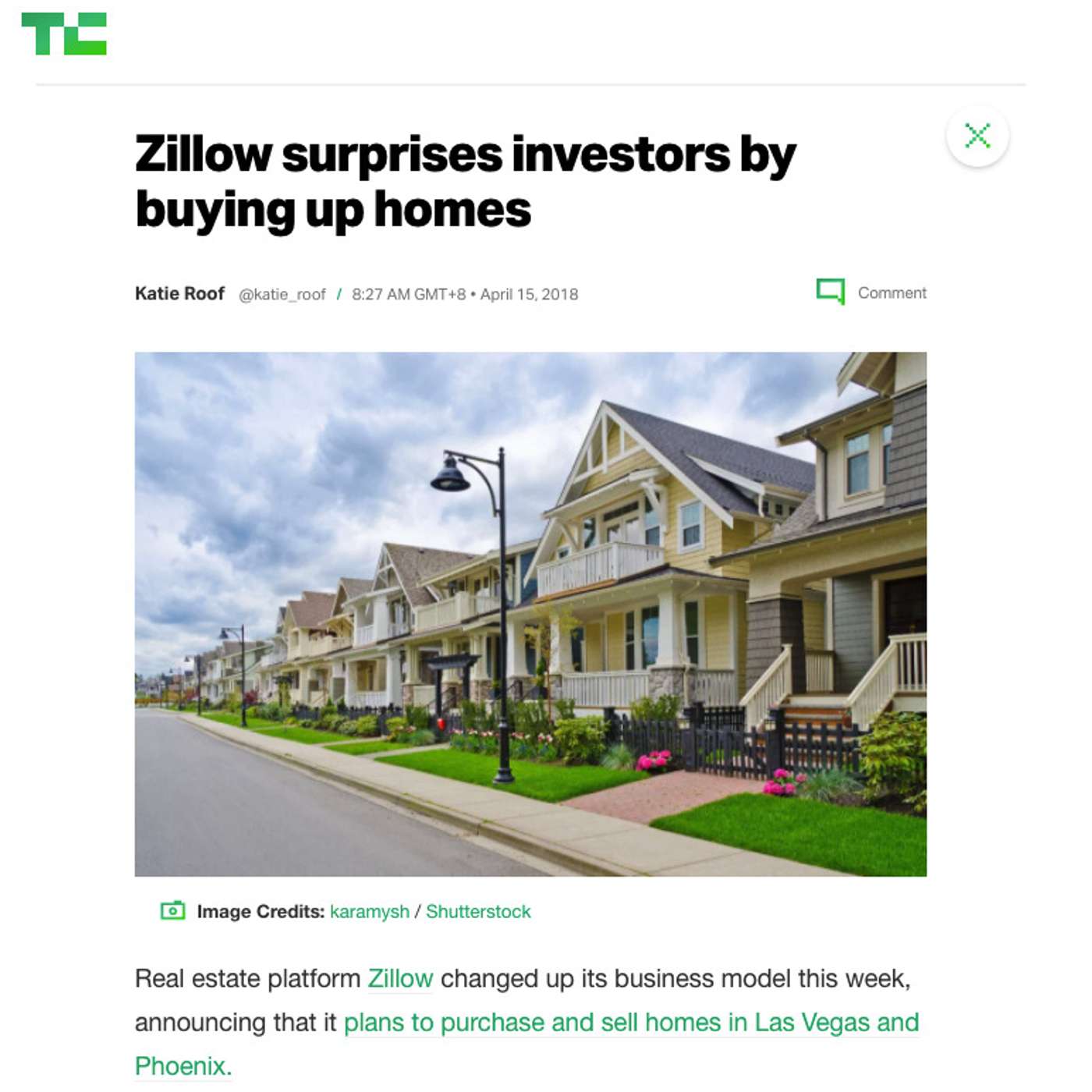
Ep 59Disrupting Yourself
Audio source: https://www.youtube.com/watch?v=bOo6XSYW66cSpencer took on the competitive threat of OpenDoor at Zillow when he didn't need to, taking a tiny competitor startup seriously and pivoting a $5 billion company into a $30 billion one without a crisis.News at the time:- https://techcrunch.com/2018/04/14/zillow-surprises-investors-by-buying-up-homes/- https://www.geekwire.com/2018/zillow-group-will-start-buying-selling-homes-taking-open-door-expanding-real-estate-footprint/Transcriptswyx: [00:00:00] Normally, I try to make these clips under five minutes, but for today I absolutely could not because this is one of the most fascinating business stories and business moments that you can encounter. And this is the best explanation of a recent pivot that was very, very high profile and very successful. So I want to give you the story of Spencer Rascoff pivoting, Zillow as a successful company, not against the wall, and succeeding. Despite having an incumbent startup where the classic disruption theory would tell you that he had an innovator's dilemma. He got past that, and it was just nearly a train wreck, as he will tell you towards the end. But he had enough friends to give them good advice and he took it and he paused at the right time and he went for it at the right time. And it was just an amazing, amazing, real life story. Spencer Rascoff: [00:00:51] And then I guess the second takeaway from Zillow would be the importance of disrupting yourself. And this is all about Zillow's move into ibuying and the business of buying and selling homes directly, which was a very controversial, difficult decision that I made. And it was very much the right one.It's what moved Zillow's market cap from 5 billion. A couple of years, post IPO to 30 billion today was deciding to put at risk the core business. Of selling ads to real estate agents by launching a new business of buying homes from people, renovating them and selling them to other people. And pulling off that business transition or business extension was a lot of sleepless nights, but it was very much the right move.Do you mind James Besheara: [00:01:37] walking me through almost the specifics of one of those sleepless nights and what that internal dialogue was like and where that internal for use uncertainty lied? Spencer Rascoff: [00:01:47] Sure. Let me paint a picture. So as Zillow goes public in 2006, We do 16 acquisitions. We buy Trulia, we buy StreetEasy in New York.We buy hot pads at the top rental site. And now here we are in 2000, like 12 ish, and it's about a $5 billion market cap. We've got like a thousand employees top of the world. We won, online, real estate and we consolidated the category. Victory is ours. Okay, we're done. But then we see this startup Opendoor.And open doors, buying homes for people sight unseen. And we're like that's crazy. That's not going to work. And we have to decide, do we enter that business? And the first, the first thought that I had and the team had was. What about the core, w we have about a billion of revenue selling ads to real estate agents.And if we start buying houses ourselves, real estate agents, aren't gonna like that very much. Because there might not be agents in those transactions. Now, it just so happens that when we eventually entered a year or two later, we did put real estate agents in those transactions as a way to, to keep the peace.But after I left Zillow started. Hiring those agents themselves at Zillow and cutting agents, other agents out of the transaction. And so now Zillow's in, in unchartered territory with respect to the, how the industry perceives it and that might or might not, we'll see put a strain on the core business of selling ads.So it's very similar just to give an analogy that can listeners have experienced as a consumer. Think about the Netflix business with DVD by mail. So Netflix has a great business DVD by mail. It's probably a I dunno, $10 billion market cap company. This was whatever, five, five, 10 years ago.What about streaming? The idea that you could press a button and start to see the movie right away on your computer was crazy. Like instead you just press a button and the DVD arrives in the mail to, two days later, but Netflix decided to disrupt their core business and shift to streaming and put at risk the whole core business and.It worked and then they did it again when they decided to create originals. Cause like they had a great business. Now they're a $50 billion market cap, but you know what, all their content comes from the studios. And now they say we're going to create our own shows. How are the studios going to feel about that?That's crazy. Don't do that. Like why risk it? You're doing great. They have a 300 billion market cap today. Why? Because. They pulled off the pivot to originals. So Netflix is like the rare company I can think of has done this twice. Zillow has basically done it once so far. But anyway, so back to the decision-making first risk is what
Ep 58Tobi Lütke on Software and Blacksmithing
Audio source (with video): https://thisweekinstartups.com/tobi-lutke-on-shopifys-impact-on-the-creator-economy-covid-forcing-focus-early-internet-breakthroughs-evolving-as-a-remote-manager-much-more-e1184/Software and Blacksmithingswyx: [00:00:00] So recently Tobi Lutke, the CEO of Shopify was on theThis Week in Startups podcast with Jason Calacanis and he has some really interesting thoughts about software, which I shared. But it sounds better coming from him around why software engineering is an attractive career it's because we get to make tools that we then use to help us the next day. And so if you apply this over a 40 year career, you can really compound your productivity and your output. And here he is:Jason Calacanis: [00:00:30] Do you still write code ever? I think sometimes. Yeah. Yeah. You miss being, 12 hour a day, coder.Tobi Lutke: [00:00:36] Yeah, it's a really good question. I think the 12th hour day coding has never been a goal, but sometimes happened just because there wasn't anything more interesting going on in plateau and figuring something out to read like it's so in a way that's not the objective, but I love coding. I find, I think the, all, I think the narrative around programming is more interesting than people have realized just because really, since blacksmithing, we never really had a craft that makes whether the craftsman actually make their own tools.And I think there's, the who's had it first we make two of the tools and number two, it's make us I'm making this part of it. Yeah. I think, Jason Calacanis: [00:01:15] I mean, to make tools, right? Like you see this gorillas take sticks and stick them into the Antell to get the bugs out, to eat, to get the heads out, to eat and say Tobi Lutke: [00:01:24] it's purely cause and effect vote for four primary purposes.I think what we do is I'll give you a genetically no different in the last 70,000 years, we event like so the difference between aspect van, and now it's really the tools we have available that don't really invent the stories we tell each other. And it's amazing that we can put people on the moon or, go to space on your usable, the rockets and do all these things and have internet based on just to a building point to a building.And then of course softwares, like what would you make of. Plenty of leverage because you have zero marginal cost copying infrastructure that everyone on planet earth can add to and constantly come up with trying to come up with better ideas. So I'm like, this is the thing that I'm really excited by and why I love being here programmer, because for leverage, you get as an individual, being able to build something that then is available to everyone.It's just enormous. I'd like obviously Shopify as a good example of that. And I, I think that's that's really important. There's so many stories about, w what you said earlier is totally true about, Ethernet, like DSLR camera and an SM7B microphone.But in a way If you need technologists to come in and make it so that someone can buy a single thing and then plug it into one thing. And then all of this needs to work well. And you need to marshal the complete infrastructure that we've built around machine learning to to take tiny microphones and make them sound good.And we need to like all of this. Like it needs to be like significant movement to make the setup you and I have here, which we can do because we have tinkerers available to everyone, this kind of democratization of goodness studio. Yeah. It's important. Jason Calacanis: [00:02:57] Yeah. I mean, it's really interesting.I love the thought of the compounding nature of software and it's also happening in hardware. Now, if you just think about what happened with the smartphone revolution, If we hadn't an Apple hadn't produced and Android phones, billions of smartphones and billions of batteries and billions of charging stations and got obsessed with how fast can we charge these phones?It would have never trickled down into your Tesla and that would have never trickled into your quad-copter. And now the quad copters, I don't know if you said Joby is going public Reid. Hoffman's taking a public Mark Pincus. I said, read on the pod, talking about it. That would have not been possible if Elon haven't made a million cars with those battery packs, because now the battery management and fast charging allows you to have a Vitol.So you're going to be able to go from Ottawa to the airport in a veto, and it's going to have eight rotors and it's going to I would never get an, a helicopter. Those things are death traps, but a veto with eight rotors and to go out and it just the software it's like, Oh, two Rutgers are out just.Redeploy the energy and it's done, and it feels like that's happening with software so quickly. Startups today, I had a startup that built a million dollar business, basically on Slack, like just charging people subscriptions to go into a soccer room. And I was like, there's no, you don't have
Ep 57Metallica vs Napster, Pt. 2 - 2011
Listen to Part 1 and the original audio source from Spotify here: https://share.transistor.fm/s/5badde12Gustav Soderstrom: [00:00:00] So nearly a decade after Napster shut down, Lars Ulrich got another unexpected call from his manager cliff. We Lars Ulrich: [00:00:05] got a call from cliff again, saying that Sean Parker wanted to talk to Gustav Soderstrom: [00:00:10] us.I'll let Sean and Lars tell the rest of the story from Lars Ulrich: [00:00:13] here. Sean Parker: [00:00:14] So I finally was able to a meeting and they said we want you to come up.We want to meet on our turf, come to our studio up North of San Francisco, where they've been operating for decades. I was very nervous. They said, come alone. Don't bring an assistant. Don't bring anyone, come by yourself, Lars Ulrich: [00:00:33] Cliff encouraged him to come alone. And, he showed up at HQ in San Rafael and, came in and was brave walked in through the door.And there were the fourth members of Metallica. Sean Parker: [00:00:43] I'm walking into this room full of people who I've been in litigation with, and I've never met and they've never met me. And I'm way out numbered. Like I don't know what I'm walking into, , is this some sort of, am I going to regret?I was sweating profusely, it wasn't even that hot. It was just like a normal. Cool day in San Francisco. And I just remember feeling like clammy and just thinking I'm like, what am I, what have I gotten myself into? Because this has all become very real now, Lars Ulrich: [00:01:14] obviously.None of us are assholes. None of us are nasty people. Hi, how are you? Come on in. Nice to see you. Would you like a beverage? Like some cheese, some coffee, whatever. We're trying to make him feel comfortable and obviously. It was pretty clear that he was I don't know, nervous, uncomfortable, Sean Parker: [00:01:30] whatever somebody I and I walk in and, they're all they take me to this room kinda just like a nondescript conference room with a bunch of Metallica branded merchandise everywhere.And. They're all sitting around the table, just waiting. And I go around and introduce myself, but it's like not a normal, it's not a normal introduction. Because we have no idea where this conversation is going to go. And the first, I don't know, hour was almost like a group therapy session.Lars Ulrich: [00:02:02] And she came in and we try to make them feel at home and be respectful. And we had some very good healthy discussions about the past about his view and how he felt about everything that had happened in 2000, 2001. And then we talked about our experience and our version of those events.And even though. We agreed on some things. And I think we very much felt that both of us were unprepared for what happened and making it up as we went along to the best of our ability and we said, we were quite open about that. We agreed to disagree on certain elements of it, but I think it was very respectful.Sean Parker: [00:02:43] But when he when we got talking about what we were really feeling like, what did it feel like, to live through that kind of scrutiny and what did it feel like for him? And he made it really clear that it really hurt him that we took down all those Metallica users and I said, I kinda did that to you.That was my. That was like, that was definitely a calculated move, to try to punish you guys for. For what you did. And then Lara said, this one was a street fight, Wilson's nothing personal. We're just two rival gangs. It was a bra. And I said, yeah, it's just, I was just 19 at the time.So you guys were a lot more mature and really successful. And I felt powerless. And so we had this sort of kumbaya, like group therapy session and I feel like I teared up a couple of times and. Somehow out of that process, I had this realization that, so I, we had been so vilified by some, but also embraced by others.And we were at the center of this maelstrom and Metallica was equally, had put themselves in the center of it and our experience of being in the middle of this media moment and dealing with the positive and negative ended up having way more in common with each other. Then. Then let's say if I met a random Napster fan on the street and they said, I used to download a hundred hundreds of songs on Napster.I loved Nasser was so great. They didn't live through the street fight. So th there's this realization that I had a lot more common experiences, shared experiences with Lars than I did with most people. Lars Ulrich: [00:04:07] There's a word you learned, that's not necessarily part of your vocabulary when you're 19 years old and full of Spock and that's the word empathy.And so when you start understanding things from another person's point of views, your adversary, in this case, it helps a lot. And I felt a kindred spirit and Sean. And so to have the dialogue, to be able to get the points of view across, to be able to express how we ended up. In that street fight and why we ended up in that street fight and hel

Ep 56Metallica vs Napster, Pt. 1 - 2000
Audio source: https://anchor.fm/spotify-rd/episodes/00-The-most-epic-battle-in-music-history-es7j2l (10 minutes in)- I Disappear: https://en.wikipedia.org/wiki/I_Disappear#Release- Metallica v Napster Inc. lawsuitHighly recommend subscribing to this Spotify miniseries, it is excellently produced and Episode 2 has nice technical detail on the founding of Spotify from Daniel Ek.Gustav Soderstrom: [00:00:00] In fact, Sean estimates that about 70 million people were using Napster at the height of its popularity, but not everyone was a fan. Lars Ulrich: [00:00:07] We were all completely in over our heads. Gustav Soderstrom: [00:00:10] That's Lars Ulrich. You may know him as the drummer in Metallica, or you may know him as a plaintiff in the now historic Metallica versus Napster lawsuit.Lars Ulrich: [00:00:18] It's easy to sit 20 years later and see the chain of events and how one domino would cause another domino and cause another domino to fall and so on and so forth. And then we ended up. Basically in this shitstorm and ended up, suing each other and ended up being on Capitol Hill and blah, blah, blah.And it was such a circus. You know,Gustav Soderstrom: [00:00:50] the circus started when Lars got a call about an unreleased Metallica track. called "I disappear" from long time manager, cliff going, "There's Lars Ulrich: [00:00:56] a radio station in St. Louis, Missouri, that's playing "I disappear"". That was if he had called up and started speaking Russian to me. So a day or two later, I get a call back going well, there's a company called Napster who offer the service over the internet, where you can go and download songs and then people can play him. Basically long story short, we tracked down the fact that this I disappear song. That was a work in progress.We hadn't even decided which version of the song we were going to share with the world at leaked through this Napster. And then now I think subsequently 20 or 30 radio stations in America were playing the song. We felt so, I guess violated, is the right word because the song wasn't even done and then all of a sudden it's being played on all these radio stations.So these people took our song. So we're like, well, let's get our song back.Gustav Soderstrom: [00:02:03] What followed was were both Lars and Sean referred to as a back alley, brawl. A back alley brawl that was about to get much, much bigger than just one song. In April, 2000 Metallica, officially filed charges. They accused Napster of "copyright infringements, unlawful use of digital audio interface, device, and violations of the racketeering influenced and corrupt organizations act".And they sought a hundred thousand dollars per illegally downloaded song in damages. Two weeks later, Lars showed up unannounced at Napster's office. A rundown old bank building in San Mateo, California, with a special delivery for Sean and his co-founder a complete list of the 335,435 Napster users who had illegally downloaded Metallica songs, all neatly printed out on 60,000 sheets of paper.Lars Ulrich: [00:02:56] This cavalcade of black SUV shows up and Lars, or it gets out of them with the sunglasses on. And ceremonially marches in with the first box followed by an army of people carrying the other boxes of names and made a point to do this in person, the Gustav Soderstrom: [00:03:13] camera. So they clearly knew how media worked.The Lars Ulrich: [00:03:15] San Mateo police had had come because there were crowds of protesters who were angry at Metallica. And then there were crowds of Metallica supporters who were cheering them on, and then they weren't just like casual kind of looky-loos who were, who were. You know, interested in the spectacle. And, and so I, I was there when, when Laura's walked those names into our office and sort of like glanced at me and glanced at Sean, the other Sean, and it was sort of the extent of it.Then we snuck out. So the two of us went outside and just put like hoodies on and walked across the street and just watch this bizarre spectacle, Gustav Soderstrom: [00:03:50] but Lars wasn't the only one adept at working the media. Sean struck back hard Napster did ban the Metallica fans on largest list, but when they open up the app, every single band user, all 335,000 of them.So a popup window that simply said band by Metallica. This was like a punch in the stomach to Lars for decades, Metallica private itself on being fan friendly. And now overnight, they were being presented as the symbol of corporate greed. The effect was immediate and devastating. We Lars Ulrich: [00:04:21] made it about Metallica, Napster, Napster made it about Metallica and our fans.And that was the smartest move that they could do because they, they took themselves out of the equation. But it was this thing of you're either for Napster or you're against Napster. If you're against Napster, you're greedy. And if you're against Napster, you're a Luddite and you don't understand technology.And if you're for Metallica,
Ep 55[Weekend Drop] a16z on Infra #1
See my notes here on DX Circle!Audio Source: https://a16z-live.simplecast.com/episodes/a16z-infra-1-2iEyBTf5a16z on InfraIntroductions and Backgrounds [00:00:00]Martin Casado: [00:00:00] So this is the a16z infrastructure show. This is actually the very first one. Where are we going to be talking about infrastructure companies investing in them, building them products? It just turns out that we're three GPS at a16z, and we all have a lot of experience in info.Like all of our companies were infrastructure companies. We do a lot of infra investing. So the way that we're going to structure this session is first, we're going to introduce, our backgrounds in context of that. Many of you know, us, many of you have worked with us. But we do want to give you a sense our relationship with infrastructure and how we went through it.So we'll and we each go through our own kind of bios that way and I'll orchestrate that. Okay. Th then we're going to talk about why infrastructure is different. This isn't B2B, this is an enterprise, this isn't vertical SAS. It's specifically infrastructure. And it's my it's my favorite topic and my favorite area.So we'll go through that. We've got a lot of great questions on Twitter, and so we're going to try and get through those. And then if we still have time, then we'll open up to questions. Uh, for everybody else. So that's rough, we plan to have this every two weeks and we want to cover everything as things go, we want to cover category creation and we want to cover open-source and we want to cover the shifts and go to market and the cloud and investing and everything else.So we're going to go ahead and start with our intros and just, yeah, very quickly. So for the, if you don't know, so I'm Martine I'm a GPN Andreessen Horowitz, and. I actually want to start by introducing Ben actually having him introduce himself, but I want to let you know how I met Ben. So I was doing my PhD at Stanford in the networking space, and we spun out and we started a company called this Sera.This is the software defined networking space. And we started it right before. Like the great recession, the nuclear winter had set in and we were struggling. And one of our investors who was also on our board was Andy Rachleff, who was actually a professor at Stanford at the time, but he's this super famous investor from benchmark.And we were at the, we were at the bottom of the recession and we're like, we had a professor as a CEO and he needed a new CEO and we were talking with Andy Rachleff and we're like, who would be the best person on earth? It's well, there's this guy that just sold the company to HP.And his name is Ben. And I had never heard of him at the time. And and we should talk to him. So this I, this was in 2008, so I got introduced in the band and he came in, of course, Ben's you have so insightful and he'd just done it. Like he just built a company at the same thing. And uh, so I asked Ben if he would be our CEO, actually.Ben, do you remember what you said in response to that? I don't. I don't. I said, no, you said I'm too rich.You're like to be CEO of a company like this. You gotta be piped in. And so instead, however, Ben and Mark invested Ben ended up joining the board. And so much of what I've learned has been with Ben. And so I thought it'd be great if Ben, most of you know him, but it'd be great if he just gave you a quick rundown of kind of his background with respect to infrastructure that we'll move on to David.So Ben, if you wouldn't mind. Ben Horowitz: [00:02:36] Yeah. Sure. And that, that did bring that a, man's got to know his limitations. If you know how hard a job is if you're going to give somebody a really, really hard, nearly impossible job, it's it really helps if they're not rich, I have to say, yeah, that's a good hiring tip as well.At some point, rich people are just like, this is too hard. I'm going to the Martin Casado: [00:02:54] beach. Things we learned multiple times, I think, in, in our Ben Horowitz: [00:02:57] careers. Yeah. Yeah. So yeah kinda my career, actually, my, probably my career in infrastructure, I started way back when I was an engineer at Silicon graphics and kind of the first.I was working on, we were, we had to put, we had an operating system called IRX or truss Unix-based and we were the first we had built the, the original multiprocessor machines. And so there was this task of having to. Put semaphores on all the Colonel processes and so forth so that they went collide and you wouldn't have all these weird race conditions, which was I would say probably the most complicated engineering job I ever had, but.Eventually then eventually went to a company called Netscape where I was in charge of kind of the web servers and then we needed a directory kind of project. And so we that's where we. I got the idea to popularize LDAP and kind of make up the directory standard.And that was like my big infrastructure thing there. And then Mark and I founded a company c
Ep 51[Weekend Drop] Marketing to Developers, Learnin in Public, and Communities as Marketplaces with Patrick Woods on the Developer Love Podcast
After this podcast recording, I wrote Technical Community Builder is the Hottest New Job in Tech which went into further detail on my thoughts on Community! Audio source: https://www.heavybit.com/library/podcasts/developer-love/ep-15-learning-in-public-with-shawn-swyx-wangSHOW NOTESGeoffrey Moore’s Crossing the Chasm/r/ReactJSTaming the Meta Language by Cheng LouAvis is No. 2. We Try HarderMetcalfe’s LawReed’s LawClubhouseCMXUdemyThe Community FundWorking in Public by Nadia EghbalHacking Communities by Laís de OliveiraPrettierTransistor.fmStripeTRANSCRIPTPatrick Woods: Awesome. Swyx, thanks so much for coming on the show today.I'm really excited to have this conversation.I'm sure lots of folks are aware of who you are and probably follow you on Twitter, but for those that don't, would you mind giving us a little bit of an overview about who you are and what you're working on?Shawn "Swyx" Wang: Sure. Thanks for having me on.Been enjoying the podcast, and this is my second Heavybit podcast alongside JAMstack radio.So I'm Shawn, I also go by Swyx, that's my English and Chinese initials.It's a complicated history, but I was at Netlify, passed through AWS and most recently just left AWS to join Temporal.And have been primarily active in the front-end/ serverless space.And I've been very interested in this whole idea of developer experience.I did not know to call it developer love until I came across Orbit.And I think Orbit's model is fascinating and really nails it.But to me, the way I've been breaking down developer experience is developer tooling and developer communities.So kind of straddling both.I was a moderator of r/ReactJS subreddit, going from about 40,000 members to over 200,000.Recently stepped down from that to help run the Svelte society, which is the community organization for the Svelte framework. And I think it's just a magical thing to be able to enable a community around a certain technical topic. Patrick: Yeah. Thanks for the overview.So you mentioned developer experience as a concept and a practice that you're very interested in.What do you think led to that point for you?Swyx: Honestly, it was Netlify branding their developer relations people as developer experience engineers, which I was pretty skeptical about, because if you are devrel, just say your devrel, don't try to put some unique spin on it.But then I think they really envisioned something bigger than traditional devrel, which was building our integrations and also working on community building, which is not like me talking to everyone, but also enabling others to talk to everyone else.And so I think many to many is a really noble goal.It's very challenging obviously, because you have to influence without any formal authority, but it's also a very appealing goal economically, because then you don't have to scale their number of employees linearly with your number of users, which I think makes a lot of sense.Patrick: So you mentioned developer experience for you is really comprised of tooling and communities.Can you talk a little bit about the relationship between those two pillars?Swyx: I don't know if I have a formal relationship in my head.The framework that I come from is actually from Cheng Lou, who used to be on the React Core team.I think he's on the Reason or ReScript core team now. And he gave a talk at Facebook's internal conference called Taming The Meta Language, and the argument of that--And it's a very good talk. I recommend people check it out.The argument on that talk was essentially that every programming language or every framework has a core and a periphery, and the more developed it gets, the core which is kind of like the code that runs, is a smaller and smaller part of it.And really the middle language starts to go around it, which involves tutorials, docs, workshops, community, jobs, third party libraries, yada yada.And so in his original slides, he had a long list of these things that are wrapping around a very popular framework, which for him was reacts, but you can extend this to basically anything.But for me, I think it essentially just breaks down to, okay, the code that is not core but makes all the developer experience much better, so that's the developer tooling, and then developer communities, which is all the people around the code, which isn't core to the code, but makes using that code a lot better.So it's just code and people.Patrick: Yeah. I love that.So as a project or a framework grows the core, maybe it becomes smaller as a percentage of the overall footprint with the periphery, the middle language increasing.What's that tipping point look like, do you think, when it switches from code to community being the bigger part?Swyx: Yeah. This is something you can tie in to Geoffrey Moore's idea of Crossing the Chasm.So for people who haven't heard about this, it's like a five stage adoption process going from 0% of the total population to 100% of the total population.And then it's a bell curve from 0
Ep 54How to Edit for Virality
Audio Source, and Shaan's viral thread. Transcript below. "Write Drunk, Edit Sober" - HemingwayWhat Reaction is this meant to get?1. LOL2. WTF/Outraging3. AWW/Heartwarming4. AWE/"Wow"5. Confirmation bias, aka "Finally, someone said it"6. "Did you know", aka Take a familiar thing and share a new fact about it:- the Duolingo business model- Tom Cruise's real name- Made to Stick- ContagiousHow to Edit for Viralityswyx: [00:00:00] Shaan Puri had a viral tweet about clubhouse recently, and I was interested in that, but also more interested in the way that he drafted it for virality. So here he is explaining it to Sam Parr on their podcast, My First Million. Shaan Puri: [00:00:12] I just went on this rant on the phone about this. It just came out of my mouth, but just the way I explained it here and, without the whole like, dramatized TV show script, but just the reasons why I think it's going to struggle. That was great. That was amazing. And I was like, shit, I should have wrote that down. I feel like that would have been a good piece of content. And I was like, I got to go and I hung up the phone and I went to my computer and I just typed the whole thing out I did your tip, which was, I took a break for an hour, went and did something else, came back and I edited it for about 30 mins Sam Parr: [00:00:40] Editing is the magic to everything. It doesn't matter if you're talking about a viral tweet, a good email, editing is the magic. They say, write drunk, edit sober. Shaan Puri: [00:00:47] Oh, that's a great one.I've never heard that. I love that. I used to just edit in the moment like I'd write it, that was a mistake. The tip you gave me a while back was go do other shit. Let it simmer in your head while you do other things. Don't even actively think about it. By the time you come back, you can make it twice as good in 20 Sam Parr: [00:01:02] minutes, the science behind it.I can't tell you the exact science off the top of my head, but basically, you know how there's like a shower thought. So there's like science behind, like doing something really hard and then not doing it. And then things hit you. There's. Science behind why that works. So that's what you're doing, Shaan Puri: [00:01:16] basically like the brain relaxes in some way.And then when it relaxes, it's able to be creative in a new way. At the top of every page, I have a template. At the top, there's seven lines. It says, what reaction is this meant to get? And I have seven emotions. LOL like this is meant to be really funny. Is it WTF where it's like, dude, what the fuck? And that's when you're talking about something that's really unjust or people are pissed off. Then there's other ones like, Aww, something really cute. AWE awe. Like that's something that's awesome. Like, wow. That is kind of amazing.Sam Parr: [00:01:46] So the way to go viral is you start with the emotion that you're trying to get out of someone we already know that certain emotions get more shares. For example, creating depression or sadness that doesn't get shares. Creating outrage gets far more. And what small tweaks, you can make something sad, outrageous, and that's far better.Right. Shaan Puri: [00:02:04] So it's either amazing. It's super funny. It's really outraging. It's really touching and heartwarming. That's another one hard to do. And then the one I had for this, which is like a new emotion, which was, I wrote FINALLY, SOMEONE SAID IT and I actually think that's its own genre that I didn't even have it in my template.Cause I was like, I think this is going to go viral, but it doesn't match any of these. I was like, I think for some people is going to be WTF. Like, dude, this guy's a jerk. Why is he predicting failure? What an asshole. But I thought, no, it's going to go viral. Because if you say something that a lot of people have been thinking, but they've been afraid to say, or they couldn't put words around it.Exactly. But they had this hunch. They will share it because they agree with your Sam Parr: [00:02:39] idea. Do you have recognizing something that you feel that you weren't sure if other people feel, but you see it on paper? The emotion that you just evoked was like, finally, I didn't think I was the only one who thought, like it's a recognizing something type of vibe Shaan Puri: [00:02:51] and they're really sharing because I, like, I knew it I'm right.So they're not saying, wow, he's so right. They're actually saying, I'm right. Read this, this proves I'm right. Which is like a real subtle thing. But I'm so interested in studying the psychology around why people do what they do. Why do they share what they share? Because I want to grow an audience and this is the best way to grow it.Sam Parr: [00:03:10] When I start with the emotion, then I start with. The package, like, how am I packaging this? And then I start with the headline, then the preview image.And then I work backwards from there. the exact emotion that you just had of this guy is crazy. That is

Ep 53The Egg
Audio source: https://www.youtube.com/watch?v=h6fcK_fRYaIStory source: http://www.galactanet.com/oneoff/theegg_mod.htmlThe EggBy: Andy Weir You were on your way home when you died.It was a car accident. Nothing particularly remarkable, but fatal nonetheless. You left behind a wife and two children. It was a painless death. The EMTs tried their best to save you, but to no avail. Your body was so utterly shattered you were better off, trust me.And that’s when you met me.“What… what happened?” You asked. “Where am I?”“You died,” I said, matter-of-factly. No point in mincing words.“There was a… a truck and it was skidding…”“Yup,” I said.“I… I died?”“Yup. But don’t feel bad about it. Everyone dies,” I said.You looked around. There was nothingness. Just you and me. “What is this place?” You asked. “Is this the afterlife?”“More or less,” I said.“Are you god?” You asked.“Yup,” I replied. “I’m God.”“My kids… my wife,” you said.“What about them?”“Will they be all right?”“That’s what I like to see,” I said. “You just died and your main concern is for your family. That’s good stuff right there.”You looked at me with fascination. To you, I didn’t look like God. I just looked like some man. Or possibly a woman. Some vague authority figure, maybe. More of a grammar school teacher than the almighty.“Don’t worry,” I said. “They’ll be fine. Your kids will remember you as perfect in every way. They didn’t have time to grow contempt for you. Your wife will cry on the outside, but will be secretly relieved. To be fair, your marriage was falling apart. If it’s any consolation, she’ll feel very guilty for feeling relieved.”“Oh,” you said. “So what happens now? Do I go to heaven or hell or something?”“Neither,” I said. “You’ll be reincarnated.”“Ah,” you said. “So the Hindus were right,”“All religions are right in their own way,” I said. “Walk with me.”You followed along as we strode through the void. “Where are we going?”“Nowhere in particular,” I said. “It’s just nice to walk while we talk.”“So what’s the point, then?” You asked. “When I get reborn, I’ll just be a blank slate, right? A baby. So all my experiences and everything I did in this life won’t matter.”“Not so!” I said. “You have within you all the knowledge and experiences of all your past lives. You just don’t remember them right now.”I stopped walking and took you by the shoulders. “Your soul is more magnificent, beautiful, and gigantic than you can possibly imagine. A human mind can only contain a tiny fraction of what you are. It’s like sticking your finger in a glass of water to see if it’s hot or cold. You put a tiny part of yourself into the vessel, and when you bring it back out, you’ve gained all the experiences it had.“You’ve been in a human for the last 48 years, so you haven’t stretched out yet and felt the rest of your immense consciousness. If we hung out here for long enough, you’d start remembering everything. But there’s no point to doing that between each life.”“How many times have I been reincarnated, then?”“Oh lots. Lots and lots. An in to lots of different lives.” I said. “This time around, you’ll be a Chinese peasant girl in 540 AD.”“Wait, what?” You stammered. “You’re sending me back in time?”“Well, I guess technically. Time, as you know it, only exists in your universe. Things are different where I come from.”“Where you come from?” You said.“Oh sure,” I explained “I come from somewhere. Somewhere else. And there are others like me. I know you’ll want to know what it’s like there, but honestly you wouldn’t understand.”“Oh,” you said, a little let down. “But wait. If I get reincarnated to other places in time, I could have interacted with myself at some point.”“Sure. Happens all the time. And with both lives only aware of their own lifespan you don’t even know it’s happening.”“So what’s the point of it all?”“Seriously?” I asked. “Seriously? You’re asking me for the meaning of life? Isn’t that a little stereotypical?”“Well it’s a reasonable question,” you persisted.I looked you in the eye. “The meaning of life, the reason I made this whole universe, is for you to mature.”“You mean mankind? You want us to mature?”“No, just you. I made this whole universe for you. With each new life you grow and mature and become a larger and greater intellect.”“Just me? What about everyone else?”“There is no one else,” I said. “In this universe, there’s just you and me.”You stared blankly at me. “But all the people on earth…”“All you. Different incarnations of you.”“Wait. I’m everyone!?”“Now you’re getting it,” I said, with a congratulatory slap on the back.“I’m every human being who ever lived?”“Or who will ever live, yes.”“I’m Abraham Lincoln?”“And you’re John Wilkes Booth, too,” I added.“I’m Hitler?” You said, appalled.“And you’re the millions he killed.”“I’m Jesus?”“And you’re everyone who followed him.”You fell silent.“Every time you victimized someone,” I said, “you were victimizing yourself. Every act of kindness you’ve done, you’ve done to yourself. Every happ
Ep 52Twitter's Revival, Pt. 2
Packy is a self described "narrative investor" and so does not do anything remotely close to objective analysis. But his is still a nice recap of what Twitter has done recently and could continue to do.You can catch Twitter's Revival, Pt. 1 with Kayvon Beykpour, Twitter's head of consumer product, here. Audio Source: https://www.notboring.co/p/how-twitter-got-its-groove-back---How Twitter Got Its Groove Back2020 was a good year for Twitter. Since Elliott Management and Silver Lake took board seats in March, $TWTR is up 94%. As of Q3, the company had 187 million monetizable Daily Active Users (mDAU) up 29% from the previous year. For context, Facebook grew DAUs by 12% over the same period, albeit off a much higher base. At the start of the pandemic, Twitter decided to prioritize its revenue products, and after a slow Q2 due to the pandemic, the company roared back. Revenue grew 14% YoY to $936 million in Q3, smashing estimates. Twitter has mostly focused on brand advertising to date, but aided by the rebuild of its ad server, it has started rolling out direct response ad formats, and will launch a new Mobile Application Promotion offering this year. It’s also working on tools to let SMBs better self-serve ads, overhauling what has traditionally been an absolutely terrible product. It might be working, too. Last night, @nongaap highlighted a few ads during the Super Bowl that seem more targeted, timely, and relevant than anything I’ve ever seen on Twitter. If Twitter finally gets ads right, that’s a huge tailwind, but the most exciting thing about Twitter is that it’s started making moves against the Fantasy Jack Twitter Roadmap. Verification. After nearly four years of letting verification languish, shrouded in uncertainty, Twitter announced in November that it’s bringing back its verification program. It will keep its focus on organizations and influential individuals for now, and isn’t moving all the way towards verifying all real people and companies, but it’s a step in the right direction that shows it’s listening to users. Subscription Products. While Twitter hasn’t launched any subscription products yet, it has publicly announced that it’s planning to, and that it’s being more thoughtful about it than the Prof. At the Oppenheimer Technology, Internet, and Communications Conference in August, CFO Ned Segal said: When we think about subscription, I wouldn't want you to think too narrowly about the opportunities. There could be subscription opportunities for advertisers. There could be subscription opportunities for consumers. There could be -- whether they are people who use the service a lot to create content or those who tend to be viewing content more or those who are somewhere in between. We don't feel constrained when we think about these opportunities, and I wouldn't want you to think so either.Notice that he didn’t mention Kim Kardashian’s 69 million followers once, but he did highlight Creators. Products for Creating, Sharing, and Monetizing Ideas. This is where Twitter has gotten most aggressive recently. Let’s break it out. In If I Ruled the Tweets, we suggested that Twitter should build or acquire products for newsletter creation, podcast consumption, and audio-only rooms, among other things. After years of soporific product development, they’re actually starting to make moves! In December, Twitter acquired social screen-sharing app Squad and announced the launch of Spaces, its answer to audio-chat unicorn Clubhouse. Spaces lets Twitter users host conversations directly within the app, and the Squad team will work on the product. In early January, Twitter acquired Breaker, a social podcasting app, to help build Spaces. Then, two weeks ago, on January 25th, Twitter acquired newsletter platform Revue. Combined, these moves point to a more confident Twitter, that, election behind it and Trump out of its hair, is focused on the future. It is going to build Creator-focused products and diversify its revenue streams. The pieces are starting to come together. Twitter’s Creator BundleWith the launch of Twitter Spaces and the acquisition of Revue, Twitter is building a Creator ecosystem in which it keeps some of the value it creates. It’s competing with two hot, a16z-backed startups, Clubhouse and Substack, to own the conversation and the associated monetization opportunities. I think it will win the newsletter wars, which will give it a leg up in the audio wars. When Twitter acquired Revue, Ben Thompson wrote about the acquisition, calling it “the sm...

Ep 50The Mona Lisa of Digital Art: CryptoPunk #7804
For the record, I don't own any crypto art or endorse it. But there's clearly a movement, Dylan is constantly ahead of the rest of us, and this was a great speech.Audio source: https://www.youtube.com/watch?v=hb5LapixLbk (59 mins in)The sale: https://twitter.com/cryptopunksbot/status/1369812648288804865/photo/1Vincenzo Peruggia: https://en.wikipedia.org/wiki/Vincenzo_PeruggiaPeruggia's statement: https://twitter.com/peruggia_v/status/1370258347341934593Dylan's comments: https://twitter.com/zoink/status/1370649011821060097Help share this clip: https://twitter.com/swyx/status/1371913108684349441Sriram Krishnan: [00:00:00] Dylan Field is really very well known in our industry for being the founder and CEO of Figma. But what a lot of people may not know is he's been involved with crypto and especially CryptoPunks since the very beginning, which I think in some ways could be the beginning of where a lot of this art moment came from, and Dylan, you had quite the interesting week too, which I'll let you describe.So can you talk to us about just crypto art, CryptoPunks? You know, your profile picture, your history there, and also what happened this year. Dylan Field: [00:00:31] So for those who don't know, CryptoPunks was the first Ethereum crypto art project. It was created in 2017 by two visionary artists, Matt hall, and John Watkinson.There are only 10,000 CryptoPunks, which anyone could claim for free in the early days. And of those 10,000 CryptoPunks. There are only 88 zombie punks, 24 apes, nine aliens, and exactly one alien punk smoking a pipe. His name is 7804. And I personally believe that in 100 years, we'll look back on 7804 as the Mona Lisa of digital art.My relationship with 7804 started in January, 2018. When I bought it for 12 ETH, or 15 K USD. At that point, most CryptoPunks traded for about $100 or $200. So why would I pay 15 K for this picture of an alien? It wasn't just how rare it was though. It was rare. 7804 compelled me.It had gravitas. I found it to be absolutely magnetic and I had a sense that others out there would feel the same way. I also believe that the question of "what is art" would propel the crypto art movement forward. So: what is art and what does it mean to own art? What does it mean to have relationship with art in the case of crypto punks?The answers to all these questions are unclear, which is part of why I personally find the project so, so fascinating. Let's start with "what is art". You might say that crypto punks art piece is the algorithm. Matt and John used generate images. Or we might claim that the art piece is each individual punk. I personally believe that the actual art piece is the CryptoPunks community, which has been feverously speculating on and trading punks and discussing funds over the past three and a half years.And this might sound absurd to people listening, but many of us in the community have formed deep relationships with our punks. We set them to our avatars. We discuss them ad nauseum. We even dream about them. The punks become deeply intertwined with our identities. They effectively function as mass.So why I sell 7804? To be completely honest is because I wanted to see 7804 become the Patron Saint of digital art, or perhaps the patron alien, if you will. It bothered me that it was not universally acknowledged that 7804 was the best, most valuable crypto punk. It bothered me that it was not a symbol for the entire crypto art movement.And there's a paradox because 7804 can not be seen as the symbol for the crypto art movement, unless it changes hands. So I priced it at 4,200 ETH, which was extremely aggressive. It's still a believable price point for someone who resonated with 7804, as much as I did, knowing that it was bought for that price point, it would bring even more attention to her defense, to the project.And also the 7804 as a piece of art. 7804 was purchased earlier this week by a mysterious figure known only as Peruggia. Peruggia is of course a reference to Vincenzo Peruggia who stole the Mona Lisa on August 21st 1911 and this theft was heavily covered in the news and made the Mona Lisa, the most known piece of art in the world. Since purchasing 7804 Peruggia has made a beautiful statement on Twitter, which I encourage all of you to read.And I, as I reflect on it,, 7804 has been surprisingly emotional for me, which I think speaks to its power. It's emotional not because I think I could get more money from it, rather because I had a relationship with the work. As I reflected on that sale. I also felt a very deep bond. To Peruggia, the new owner of 7804 and I don't know who it is. I don't know what their gender is or what ethnicity they are or they live. But I have finally found someone who appreciate 7804 as much as I do. So with that it's time for me to change my mask. Sriram Krishnan: [00:04:30] This is like an Apple keynote.Dylan Field: [00:04:34] Hopefully it's updated for all of you. If you're out there listening, enjoy your time with 7
Ep 49Twitter's Revival, Pt. 1
Interview source with Transcript: https://www.theverge.com/22319527/twitter-kayvon-beykpour-interview-consumer-product-decoderKayvon Beykpour's impressive CV: https://www.linkedin.com/in/kayvon-beykpour-2b264b4/The growth of TopicsSo health, conversations, and interests have been our big rocks for the last two and a half years. We’ve been taking bigger and bigger swings in each of those areas. At our Analyst Day event, we went in-depth on a few of them. Within “interest,” for example, last year we launched a product called Topics, which we got started — very nascent with our work there, but we’ve really accelerated. Today there’s 6,000 topics that people can follow. And it’s very simple. Rather than just following people on Twitter, you can follow a specific topic, and Twitter does the work of recommending the best content or tweets about that topic. So you don’t have to know exactly who to search for.Again, we didn’t release that at our Analyst Day event, we just gave an update on it and shared some of the substantial progress. In Q3 of this last year, we announced that there are 70 million people that have followed topics. And then just yesterday, we announced that there now are over 100 million people that have followed topics. So a pretty good clip of growth. And we’re seeing really promising signs that Topics is a really useful way for people to connect to their interests.Reticence Taking Big BetsThis won’t be in any particular order, but when I joined the company, one of the first things that I felt was a reticence and an uneasiness around taking big bets. And I think there’s a lot of reasons for that. It’s hard to pinpoint one. Certainly, churn in leadership is one. After a revolving door of heads of product, people stop taking any product strategy particularly seriously, because it’s like, okay, well, let’s wait until that strategy changes. And so I think there was a little bit... while no one would say that explicitly, there was this reticence to commit to long-term speculative bets, because it was rare for them to be able to be seen through.So that’s one that I think was somewhat ingrained in the culture. Which is difficult. It’s difficult for PMs, engineers, designers who really want to push and evolve the product to come up against an organizational resistance that is not tuned to take big, speculative bets.And really, unwinding that, I think, has been the biggest unlock that we’ve had as a company. Today, when we contemplate solving more ambitious customer problems and in turn, postulating more ambitious product solutions, we don’t get the “no, but” as much. Every once in a while, there’s pessimism around, “oh, can we pull that off?” But we get way more of a “yes, and” vibe, and a willingness, and a patience for terrifying, ambitious bets. Whereas three years ago, any idea you would come up with, there was just a lot of pessimism around — that’s going to take a long time to build. Which is true, we’ve got a lot of infrastructure debt to work through. And also like: that’ll never ship, that would never get approved, our customers will freak out.Product velocity during PandemicI do think our pace of development has sped up. I’m trying to think about how the pandemic specifically could have impacted that. I think of it more — and this is obviously just through the lens of Twitter, not comparing it to other companies who’ve probably had their own formula here — but we have been on a multi-year journey to speed up our development. And so I would like to think that... we’ve had our own hiccups, obviously, but we’re reaping the rewards of that investment over the last few years in our process, our culture, our hiring, our infrastructure work. And so the pandemic, I would probably say it slowed us down, it slowed that journey down for a little bit, as everyone was adjusting to the new normal. I wouldn’t say that it was a net accelerant by any means.People, our team included, but people even outside of Twitter, have a lot on their minds, and it’s really stressful when you’re trying to do your job with your kids at home without child care. It’s been a taxing time for everyone, so I don’t think it was a net accelerant. What we’ve done through the pandemic, beyond just continuing to accelerate, obviously, is we did make some focusing decisions around, “Hey, these two projects that were kind of in our periphery and articulated as part of our long-term strategy” [shifted to] “this is the forefront now and all this other shit’s going to pause.” We made a bunch of those decisions that I think helped narrow the aperture, which accelerated some projects and paused or slowed down other projects.And frankly, energy and momentum is infectious, right? As you see the company and other teams build quickly and you see customers noticing that, it inspires and motivates everyone else to want to live up to that. And so we’ve seen a bunch of that, I think, and we’re seeing it right now with Spaces.Spaces, we love that our

Ep 48[Weekend Drop] Clubhouse, Ghostwriting, and Parodying on the LogRocket Podcast
Had a really good chat with Brian (Director of Content) and Ben (Co-Founder) from LogRocket and towards the end we even found out a long kept secret about Ben's JS Parody alter-ego!Show notes and audio source: https://podrocket.logrocket.com/swyxShare via tweet: https://twitter.com/swyx/status/1369348560198713363
Ep 47Preemptive Pluralization is Probably Not Evil
See associated blogpost, Preemptive Pluralization is (Probably) Not Evil.Clip from The Art of Product (13 mins in)Preemptive Pluralization is Probably Not EvilSwyx: [00:00:00] For a while I've been observing that it's much easier to take things from 2 to 3 or 3 to 4, basically anything to N, than it is to take things from 1 to 2, especially in code. And I didn't really have a frame around this until i heard this part in a recent Art of Product podcast. So I'm going to let Derrick Reimer and Ben Orenstein explain.Derrick Reimer: [00:00:20] I'm starting to get the sense that like, all right, I can see the boundaries where the abstractions should be, where they aren't currently today and building this, like building another client, building another major integration, like this forces you to get those abstractions, right. Because, or you're going to just hack stuff in which don't want to do so once those abstractions are truly right with truly two different adapters in place, then it's going from two to three, like you said, shouldn't be that bad.Ben Orenstein: [00:00:45] Yeah. Once you make the, like one to N abstraction . The N becomes pretty arbitraryDerrick Reimer: [00:00:50] I'm excited for the possibilities of what that'll open up once I go into the N territory on that. Ben Orenstein: [00:00:56] I have this theory and this is like pretty half baked.I probably will always be half baked, but like in programming, as soon as you go from one to two, you should just go from one to N. As soon as you're like, Oh, there's not just one kind of user, there's a user and there's an admin. It's like, just assume there's going to be some number of user types and build the abstraction to handle the N and maybe by default, instead of ever assuming there's one of anything, assume there's an, if anything, and if there happens to be one great.And then when you want to go to two or more, don't change anything. It's like, what if every time you use hasOne in rails you instead just use hasMany, and do you use map over things like, you know, map over the collection and to do that as opposed to being like there's exactly one, do the thing to it.Derrick Reimer: [00:01:39] I've had to face a couple of those in building SavvyCal, like with respect to integrations, you know, a lot of times you end up coding things like I will assume this person will have one zoom account. So you're only allowed to have one of these types of integrations and it's like, no, I'm going to make sure it's multi, because you always remember this at Drip — we always encountered scenarios where like, couldn't imagine it when shaping the product, but sure enough, someone's like, no, I've got these two Stripe accounts and this is the exact justification. Why? And I need to do this thing. And it's like, okay, well, And it's painful having to re architect in that direction.Ben Orenstein: [00:02:09] I've done this refactoring a million times, I'll be like, I thought there would only ever be one subscription, team, user, plan, name, address, and it always ends up being like, Oh, actually there's more. I've done this a million times. I always never go the other way. What if you just paid the upfront cost of thinking: "this is just always a collection"?So given that, what should I do and solve that problem as part of the initial design, never build up all these assumptions about singleness and then you have effortless expansion into the N over time. Yeah. Derrick Reimer: [00:02:40] Like as much as you can centralize your logic around accessing, like, if you're treating it as one for now, the hard part is sometimes to not sprinkle hacky things all over the place, like always taking the first element off the array, basically. If you can centralize that in one place so that if you end up expanding it down the line, it's pretty, you only have to change in one place. That's, I've found I've had to refactor that multiple times in that direction. Totally. Ben Orenstein: [00:03:04] Yeah. This comes up in Ruby in particular. I think this is almost extra true for Ruby because you end up with nil in certain places.Like if you're like user dot address dot capitalize or whatever, it's like, Oh, address was nil. So you can't call it capitalized. But if you say like user dot address dot map, capitalize. It's like, okay, well, if it's an empty array, no problem. That's just you'll have an empty array or at the end.And if it's got one thing in it, you get that. And if it's got a thousand things in it, you get that. And it's just ah, like the map abstraction just clears this up for you and handles those cases. And you're never calling stuff on nail. Like right now in Tuple, it's like, you can be on one team.It's like, yep. It might be nice to change that one day, but just imagine the magnitude of that change. It's huge. Whereas if we just said users could have many teams and in practice, they only have one, but we just know this always comes back with the collection. And so we operate

Ep 46Tyra Banks on Authenticity
Audio Source with transcript: https://mastersofscale.com/tyra-banks/ (11 mins in)---BANKS: I gave myself one year to be successful in Paris, and that did not meansupermodel. That meant direct bookings, meaning a client would just call and say, "Wewant Tyra." Then you don't have to be a supermodel for a client to say that. I was like, "Iam not pounding the pavement with auditions for a year.”HOFFMAN: With only days to go before she left the country, Tyra put herself through a crashcourse on designer branding.BANKS: I found a fashion library in downtown LA. And I took the bus to the fashionlibrary, and the library pulled all these tapes of designers, and books, and all this type ofstuff, and I studied, studied, studied, studied.I was like, "Yves Saint Laurent loves their women with the hair in a bun. Red lipstick.Very elegant walking. Karl Lagerfeld, curls, fun, big pearls, smiling on the runway."HOFFMAN: Armed with this very specific information about Fashion Week designers and theirsignature runway styles, Tyra hit the streets of Paris.BANKS: So, what I did, Reid, is before I went into every single audition, I would goeither in the alley, or on the side of the building, or in the lobby, change my hair, changemy lipstick, my makeup, and then walk what the research told me that designer liked.Within those two weeks of doing auditions for Fashion Week, I broke history. I was theonly model that booked 25 fashion shows her first season.HOFFMAN: This is a perfect example of how authenticity and craft come together. At everystage of your journey, it’s important to be very strategic.People often misinterpret authentic as, “I shouldn’t change a thing about me, no matter who I’mtalking to. I’m me, deal with it!” But I do not recommend that as a strategy when pitchinginvestors or onboarding clients.A critical part of authenticity is being so confident in who you are that you don’t mind meetingsomeone halfway on something simple.Tyra didn’t change anything about herself that couldn’t be undone in the lobby of the nextbuilding. And her willingness to do the research demonstrated a core competency that wasinstantly valuable.We don’t always discuss it, but branding is a two-way conversation. It relies on the beholder aswell as the beheld. You can still be YOU and adjust to your audience. That’s just smart selling.---BANKS: Over time, I gained some weight, if we want to talk about the booty. And everyseason there were less and less designers that wanted to use me because my body waschanging.My agent gave my mother a list of eight designers that said, "We're not using Tyrabecause she's too big." By the way, I was 120 pounds, but back then it was too big.HOFFMAN: No, I'm also aware about how crazy the world is. 120 pounds is too big,you're like, "What?"BANKS: “Really?”HOFFMAN: "Okay."BANKS: If I was 120 pounds now, you guys would be like, "Go give her a sandwich.”My mom gave me this list, and I start crying. I was like, "I don't know what to do. I gaveup college for this. Okay, I guess I need to like eat super salads for breakfast, lunch, anddinner.” And my mom just shook me. She took my arms, and she shook me, and shesays, "I will be damned if my baby starves for these b*tches in black." Because she usedto call the fashion people “b*tches in black.”And then we went to a pizzeria in Milan, Italy, and the pizzeria had a tablecloth. Youknow the tablecloths that are made of paper, and she put a pen in my hand, and shesaid, "You write down every client in this industry that likes ass." I was like, "What do youmean ass?" "Write down who likes ass."And I was like, "Victoria's Secret?" "Write it down." "Sports Illustrated? SwimsuitEdition?" "Write it down." And so then I had a list of 10 clients that it was okay if you hadcurves, and then she drew a line down the paper, and she said, "On this side, write downwho has an ass." And I was like, "What do you mean? Everybody has an ass." "A thickerass. Who got a thicker ass in your industry?"And I was like, "Cindy Crawford?" "Write it down." And I was like, "Claudia Schiffer?""Write it down.” And these are models today that's not curvy. Back then, it was curvy.And so then she said, "These are your future clients, and these are the careers that youcan be inspired by, but you're going to make it your own."HOFFMAN: This is great advice. This wasn’t like when Tyra was auditioning in Paris andchanging hair and shoes in the lobby. Her industry was asking for something both fundamentaland harmful. They wanted to chip away at what made Tyra stand out, and her self-image alongwith it.This is where true authenticity becomes critical to developing the startup of you. Every industryhas compromises that don’t quite sit right. You have to know how to decide where to draw theline.
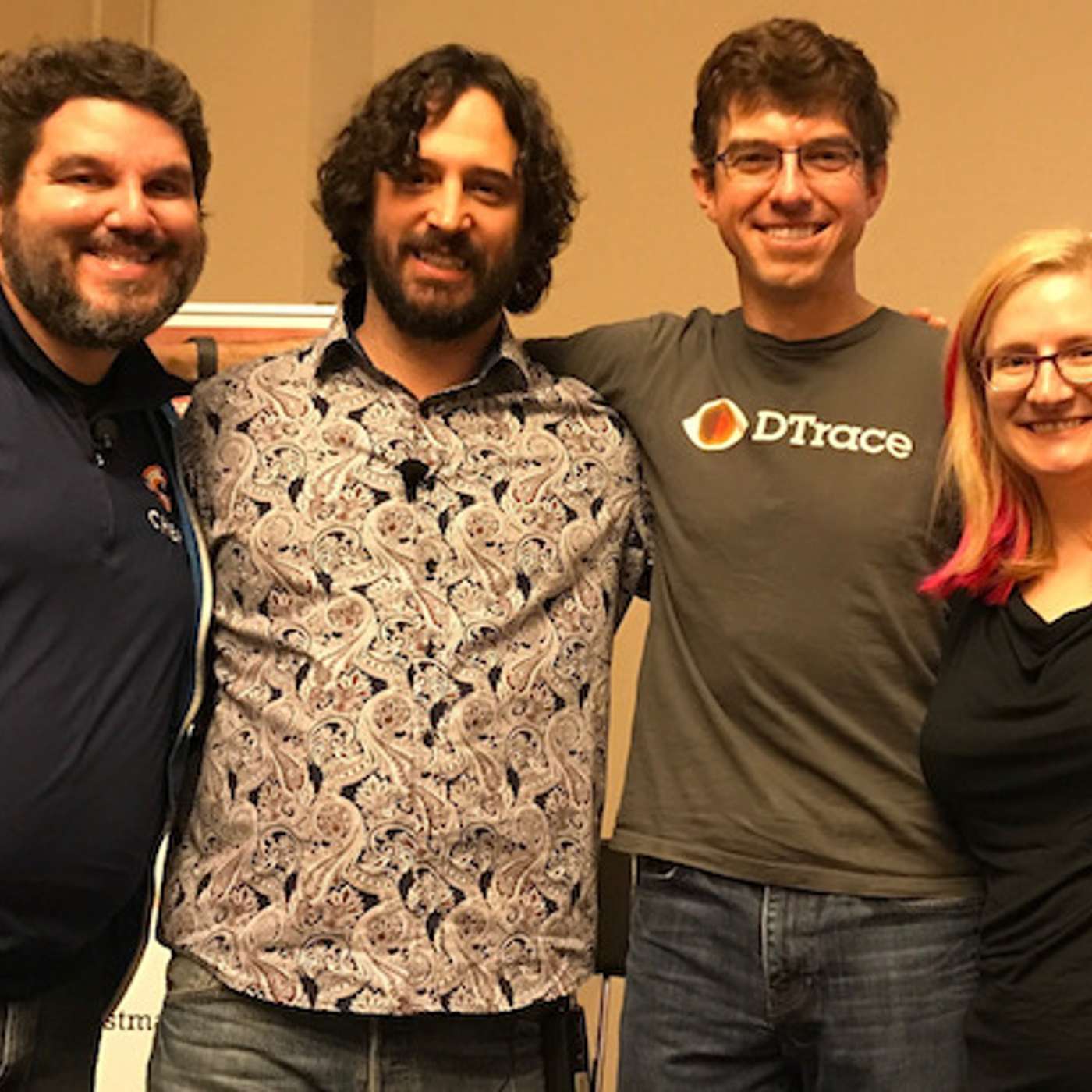
Ep 45Bryan Cantrill's Larry Ellison Rant
Source: https://www.arresteddevops.com/yelling-at-cloud/ (15 minutes)thanks to Matthew DiSabatino for the recommendation!
Ep 44TOFU, MOFU, and BOFU Content
This week's clip from the Startup To Last podcast: https://www.startuptolast.com/episodes/hardcore-week-building-a-content-siteFurther reading on TOFU/MOFU/BOFU: https://www.lucidchart.com/blog/what-is-tofu-mofu-bofu---Transcript:Swyx: [00:00:00] I was listening to the Startup to Last podcast by Rick Lindquist, the founder of LegUp Ventures and Tyler King, the founder of Less Annoying CRM. And they were talking about this interesting marketing concepts called TOFU, MOFU and BOFU. And I'm going to let them explain itRick Lindquist: [00:00:16] Tofu is top of the funnel T O F U MOFU is middle of the funnel, MOFU and BOFU is bottom of the funnel. Tyler and I worked this out on one of those trips to Utah one week where bottom of the funnel basically means branded terms like Less Annoying CRM, middle of funnel means like basically the product that you offer, but non-branded, so in Tyler's case, small business CRM, , and then TOFU is basically something that a small business might search in general, like a, small business tools.For TOFU content to work, it has to be so creative and it is truly throwing darts, blindfolded against a dark, like after being spun 10 times at a dartboard, it really is entrepreneurial work.Whereas like MOFU and BOFU, especially with where you are now, it's blocking and tackling, it's... what was that saying that you brought to the podcast once was like, get it to 70% or 90%, or I don't know what it was, but yeah, once you get it to that point, it feels like MOFU and BOFU for where you are, are there and it's about optimization and doing more of what's already working versus trying to figure something out.Swyx: [00:01:24] I think it's an interesting mental model, which I wish that I had in my previous work, The main idea is tofu. Content is the viral content that everyone wants to read. But doesn't necessarily connect to your particular business or brand and MOFU and BOFU. Further down the funnel where people are more and more interested in what you specifically are selling. So in the next clip, they talk about how tofu is actually damaging to your brand It might help you go viral, but not actually help with any conversions. So they took it out of their website. Tyler King: [00:01:54] Like right now, if you go to the blog on less annoying CRMs, like we just redesigned it a little bit for web flow. We used to have three sections.We basically, we didn't call it this, but tofu, MOFU, and BOFU. And we basically removed tofu and the blog posts are still there, but there's not a section for it. We could maybe re-add it, but it just links off to Less Annoying business. , Rick Lindquist: [00:02:12] TOFU content on your main product website is so dilutive to the brand.if it's not related to CRM it's not going to be on less annoying crm.com, which means when someone goes to last long crm.com, they're either like just poking around and saying what it's about, or they're a potential customer.Tyler King: [00:02:29] for example, to your point, it's so hard to measure conversion rates from someone hitting your website to signing up for a free trial. Cause it's like, what if they were reading a blog post about whether or not to raise money for their startups?Like, should we really count that as a failure that they didn't sign up? So, yeah, I like that a lotSwyx: [00:02:45] As someone who works in developer marketing, I've had to deal with this quite a bit. When we were involved in debates on the company blog about whether the blog should be about the company or whether it should be about. Anything that our customers care about, like front end development or the future of JavaScript. And basically there's a civil war inside of the company. And I think that happens with a lot of companies. I think you also see the result of some companies going all out on tofu, like digital ocean and log rocket. And that's a very valid marketing strategy, but then to expect to mix it together with And BOFU content in the same blog. I think could be a very confusing content strategy. So this terminology really clear things up for me.

Ep 43A World Without Email
The fundamental incompatibility of email and Deep Work collide.- Clip from Lex Fridman podcast (~1:45:00)- Was Email a Mistake? New Yorker article- A World Without Email (book): https://amzn.to/3blXyjv