The Road to Autonomy
460 episodes — Page 8 of 10
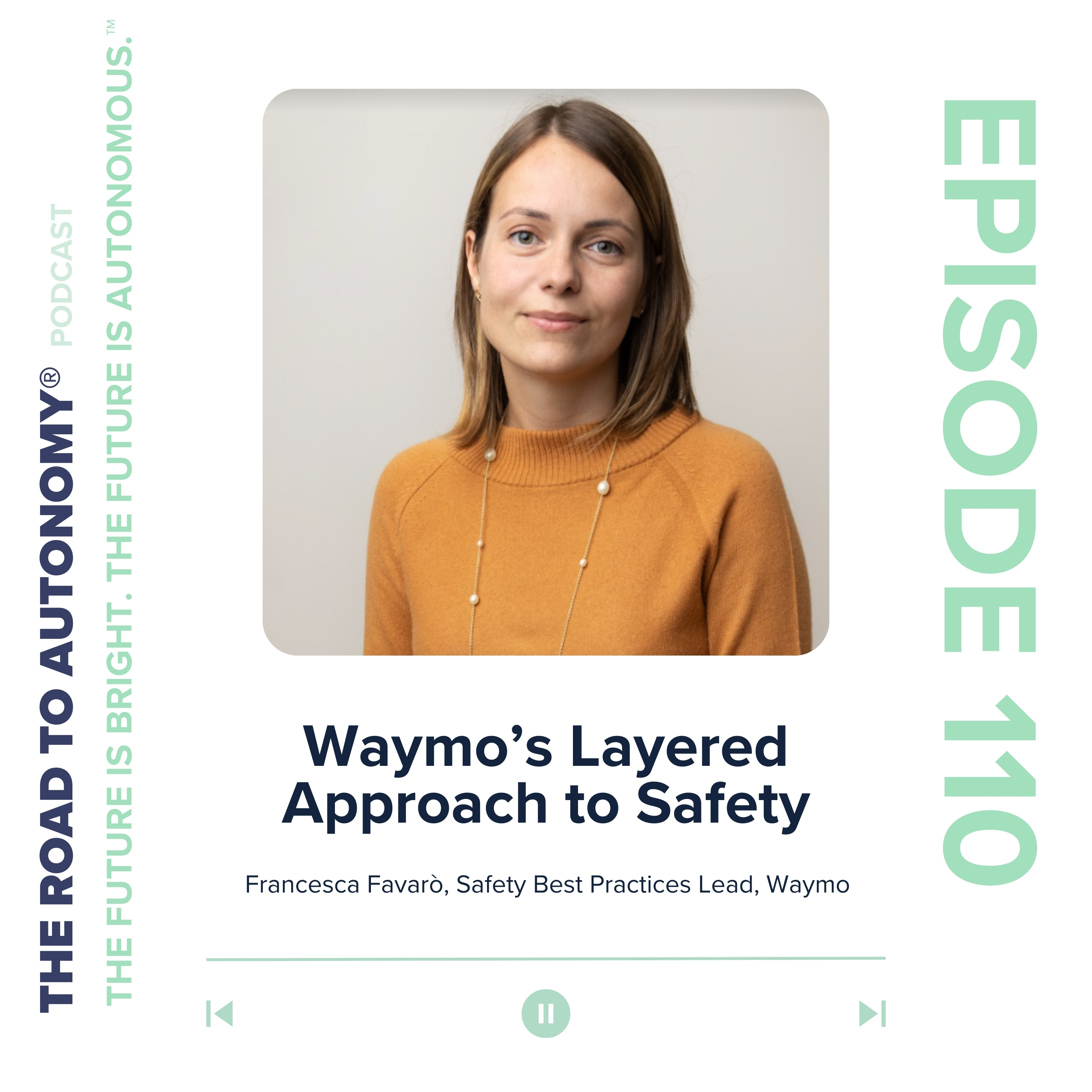
Ep 110Episode 110 | Waymo’s Layered Approach to Safety
Francesca Favarò, Safety Best Practices Lead, Waymo joined Grayson Brulte on The Road to Autonomy Podcast to discuss Waymo’s layered approach to safety. The conversation begins with Francesca discussing how Waymo approaches safety for autonomous vehicles. Waymo has an approach that we call a layer approach to safety. – Francesca FavaròWaymo’s layered approach to safety is a combination of the architecture layer (hardware), behavior layer (software) and the operations layer. This approach allows Waymo to take a holistic approach to safety that is both robust and redundant. The Waymo Driver as a technology actually allows consistent learning across an entire fleet. The operations layer is where everything starts coming together and we ensure that going from the Waymo Driver to the Waymo service we are in fact deploying a safe product in a scalable fleet. – Francesca FavaròThe layered safety framework started with the realization that no single metric could define safety. The safety framework is the combination of methodologies that basically allows you to make the determination of safety with regards to architecture, behavior and operations. – Francesca FavaròAs Waymo expands into new cities, the safety framework is applied to each and every ODD (Operational Design Domain) where Waymo operates. The company is looking into historical driving data, vulnerable road users data and distracted driving patterns that lead to crashes. Another issue that Waymo studies and plans for from a safety standpoint is fatigued driving.Fatigue can impair judgments, prevent an appropriate mental state and lead to distracted driving. NHTSA estimates that fatigued driving accounts for 20% of highway driving crashes and Harvard Medical School estimates that 24-hours awake which can occur during a sleepless night is akin to a blood alcohol level of 0.1.With fatigue playing an outside role in safety, Waymo developed the Fatigue Risk Management Framework to address the issue of fatigue and how to prevent it when testing autonomous vehicles with autonomous specialists. Francesca goes onto explain in-depth how Waymo is mitigating fatigue risk while the autonomous vehicles are being tested with autonomous specialists.In the local communities where Waymo is testing autonomous vehicles, the Fatigue Risk Management Framework with law enforcement, local officials and first responders so they can truly understand the role that autonomous specialists play while monitoring the autonomous vehicles.This approach ties directly into Waymo’s culture of safety and transparency.Safety does not happen overnight. You have to be intentional in creating the appropriate safety culture. – Francesca FavaròWaymo is focused on developing an SAE Level 4 system as the continuous monitoring of the automated driving system can be subject to complacency coupled with an altered state of attention that can hinder the safety of the overall operation. Wrapping up the conversation, Francesca shares her insights on how she sees the Waymo Driver evolving over the coming years.Recorded on Friday, October 7, 2022--------About The Road to AutonomyThe Road to Autonomy® is a leading source of data, insight and commentary on autonomous vehicles/trucks and the emerging autonomy economy™. The company has two businesses: The Road to Autonomy Indices, with Standard and Poor’s Dow Jones Indices as the custom calculation agent; Media, which includes The Road to Autonomy and Autonomy Economy podcasts as well as This Week in The Autonomy Economy newsletter.See Privacy Policy at https://art19.com/privacy and California Privacy Notice at https://art19.com/privacy#do-not-sell-my-info.
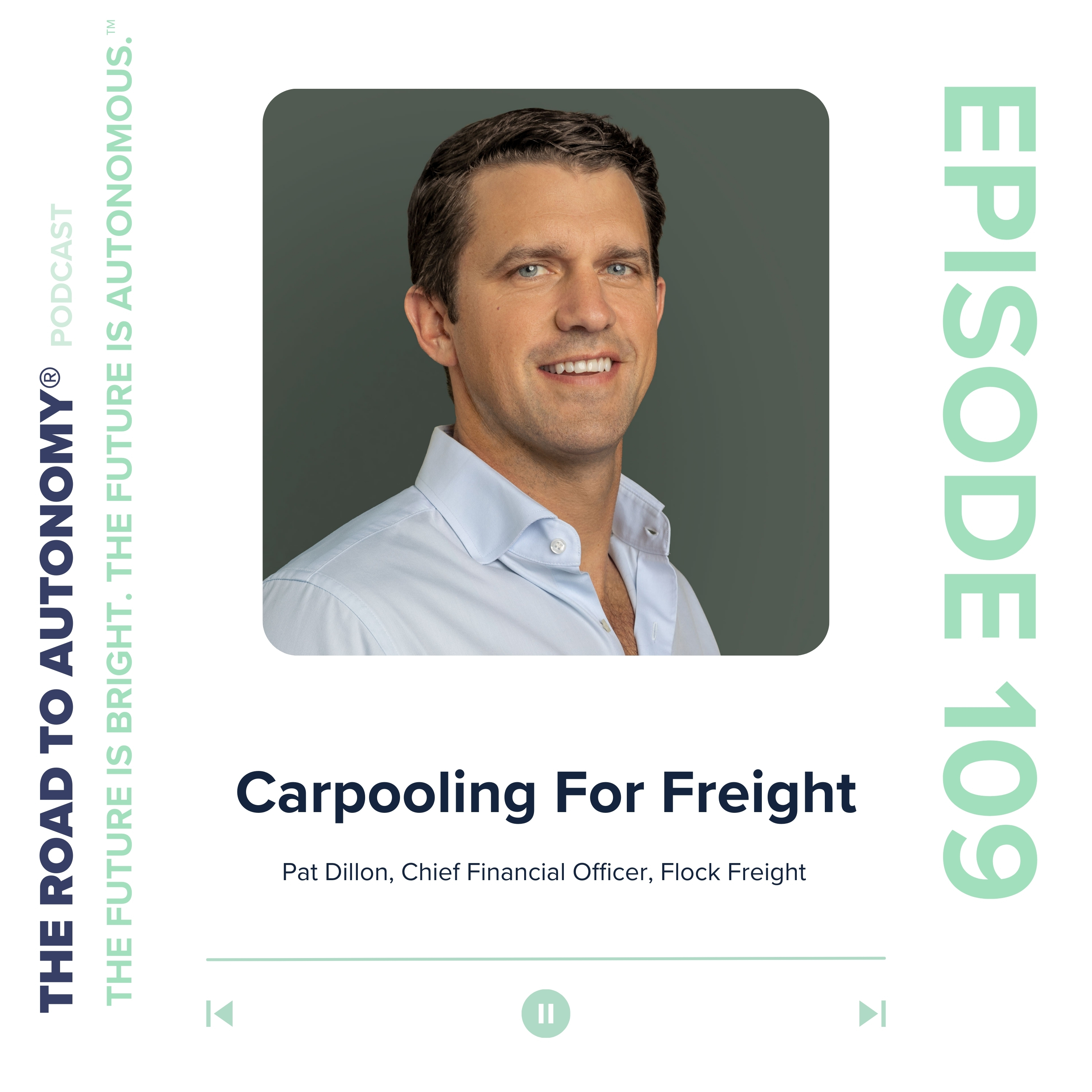
Ep 109Episode 109 | Carpooling For Freight
Pat Dillon, Chief Financial Officer, Flock Freight joined Grayson Brulte on The Road to Autonomy Podcast to discuss the current economic outlook and Flock’s carpooling for freight model that unlocks value for shippers and carriers. The conversation begins with Pat sharing his insight on how as CFO, he is preparing Flock Freight for a potential recession in the United States which is currently being forecasted at 50% according to the Bloomberg United States Recession Probability Forecast. We are certainly cognizant of the broader macro environment and how that impacts our business. It certainly means that as consumer behavior changes or industrial production, the demand for freight transportation has an impact on that, so that certainly translates into our business. – Pat DillonWhile Flock Freight is still a growth company, the company is taking prudent measures to be prepared for the scenario that the United States economy falls into a recession. One of the company’s economic advantages is that they operate an asset-light shared truckload platform that enables cost savings for their customers. Shared truckload would mean that we can take a 20 ft shipment from Customer A and a 25 ft shipment from Customer B and pool those together into a single truckload, so it never has to go on a hub and go through a warehouse. And you are getting point-to-point transportation. It’s essentially carpooling for freight. – Pat DillonShipping using shared truckloads can reduce carbon emissions up to 40% due to higher utilization through fewer driven miles. As an important metric as this is, truck tonnage in the United States increased 7.4% in August 2022, year-over-year. The growth can be partially attributed to the catch-up effect as the global supply chain has begun to normalize. While the global supply chain has normalized today, the freight market will continue to fluctuate with the driver shortage and a potential slowdown in consumer spending. Creating opportunities for Flock that CNBC has taken notice as the company has climbed from #42 on the CNBC Disruptor 50 list in 2021 to #14 in 2022. With a potential recession on the horizon, Pat discusses what impact consolidation in the truck freight market will have on Flock Freight. Unlike a lot of other markets that might already be pretty consolidated, were further consolidation has signifiant pressure on margins, this is not that type of market. It’s hyper fragmented and we do not see it having much of a day-to-day impact from that perspective on Flock Freight. – Pat DillonFrom a technology perspective, autonomous trucks are preparing to scale and the timing could not be better as there is a growing demand for freight and a growing driver shortage. Like a lot of things, there are big problems throughout the truck freight world and big problems are big opportunities. That’s how you create new capacity when you are constrained on the number of drivers. – Pat DillonAutonomous trucks will compliment Flock Freight as they be able to provide autonomous shared truckload capacity. As new technologies come online such as hydrogen fuel-cell and electric heavy-duty trucks, Flock will look at ways to potential integrate those technologies into their platform.Wrapping up the conversation, Pat shares his thoughts on the future of freight.If you are a player in freight you will need to be able to have a more diversified approach in terms of the offerings you give to your customers. – Pat DillonRecorded on Friday, September 30, 2022--------About The Road to AutonomyThe Road to Autonomy® is a leading source of data, insight and commentary on autonomous vehicles/trucks and the emerging autonomy economy™. The company has two businesses: The Road to Autonomy Indices, with Standard and Poor’s Dow Jones Indices as the custom calculation agent; Media, which includes The Road to Autonomy and Autonomy Economy podcasts as well as This Week in The Autonomy Economy newsletter.See Privacy Policy at https://art19.com/privacy and California Privacy Notice at https://art19.com/privacy#do-not-sell-my-info.
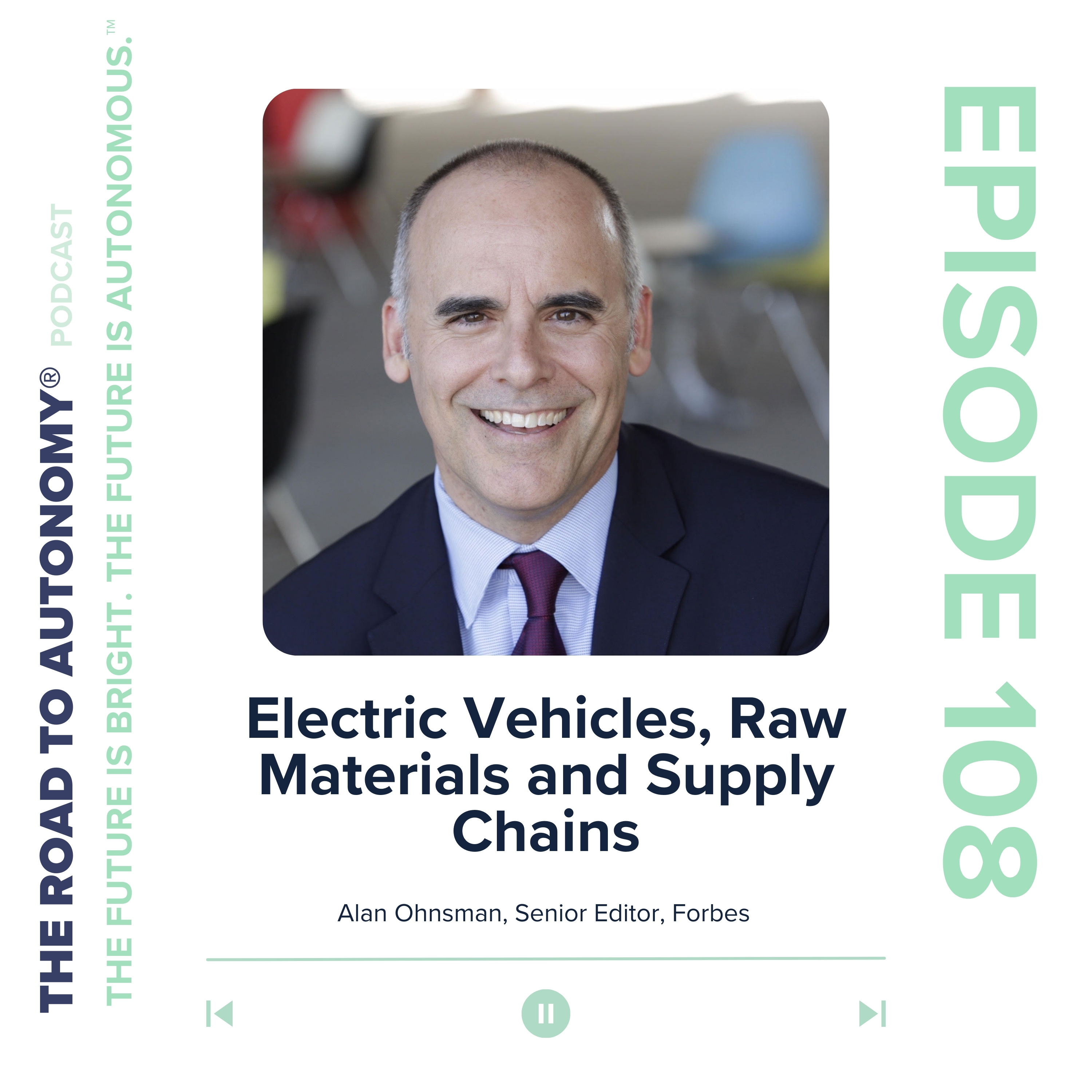
Ep 108Episode 108 | Electric Vehicles, Raw Materials and Supply Chains
Alan Ohnsman, Senior Editor, Forbes joined Grayson Brulte on The Road to Autonomy Podcast to discuss the complex supply chains for electric vehicles and the growing shortage of raw materials and refining capacity for those materials. The conversation begins with Alan discussing the shortage of raw materials and the lack of refining capacity to enable an all-electric future. The push to shift to EVs happened faster than any of the major OEMs anticipated. – Alan Ohnsman The major car manufacturers with the exception of Tesla and Chinese OEMs were caught flat footed with the pace of transition from internal combustion engines to electric vehicles. Over the past year, the price of lithium has increased 122% YTD, forcing EV manufacturers to increase the price of EVs by an average of 54.3% due to the increasing costs of raw materials. How did this happen? The major car manufacturers were simply just not prepared for the consumer demand for EVs. What you are seeing with the run-up in prices especially for lithium would be exactly that. There was not a lot of advanced planning and now suddenly whether it’s General Motors or Ford, or VW and everyone else saying we need lots of this stuff, we need it now. Well it’s supply and demand. The price is going to react to that when demand suddenly spikes. – Alan Ohnsman With the average price of a new electric vehicle in the United States being $66k, does this create an opportunity for the used hybrid market to grow? Could this create an opportunity for Toyota to sell new hybrid models as well? Possibly. Alan breaks down what he calls the Tesla Effect and its effect on the market. While Tesla is having an effect on the market and driving the average price of a new EV higher, there is also the supply chain issue that is causing elevated prices. Furthermore there is a reported shortage of over 384 graphite, lithium, nickel and cobalt mines and an undisclosed shortage of refining capacity for raw materials globally according to Benchmark Minerals. If you look at the scale of demand and where it’s going to be throughout the 2020’s and into the 2030’s, we are not ready. We need far more sources of supply. – Alan Ohnsman One new potential source of supply that could be coming online in the near feature is The Salton Sea lithium deposit in California. For an article that Alan authored for Forbes, titled; California’s Lithium Rush For EV Batteries Hinges On Taming Toxic, Volcanic Brine he visited The Salton Sea to learn about the opportunity first-hand. Governor Newson has called The Salton Sea the “Saudi Arabia of Lithium”. Could this indeed be true? Alan shares his first-hand account of what he learned from visiting the region and meeting the lithium producers. This has never really been done before. Getting Lithium from brine is not a new thing. Getting lithium from this particular type of brine is completely new. It has a lot of challenges. It’s going to be fascinating to see. If it works, it’s so beneficial for everyone, because it would be a more environmentally friendly sustainable way to do this since you are just tapping into a stream that already exists. – Alan Ohnsman While this method is still unproven, the State of California has moved forward and proposed a flat-rate lithium tax which would impose a tax of $400 per tonne for the first 20,000 tonnes of lithium produced annually, $600 per tonne for the next 10,000 tonnes, and $800 per tonne with output of 30,000 tonnes or more. Is this a classic case of putting the cart before the horse? Could this create an opportunity for Nevada to step in and offer economic incentive packages for mining companies to relocate to Nevada and explore their lithium deposits? The market will be defined by economics and business viability. Grayson and Alan discuss what the economic impact of the proposed tax will have on the Salton Sea region. If they perfect the technology, the tax is probably not that big of a deal as time goes on. But in those critical early years, it is a problem and it will add to the expense of what is already a fairly complicated thing. – Alan Ohnsman Prior to becoming a destination for lithium extraction, The Salton Sea was the Speedboat Capital of the World in the 1920’s and 30’s. It was a destination for Hollywood to escape the hustle and bustle of LA. The sea became toxic over years due to the runoff from agriculture chemicals and a lack of fresh water from the Colorado River. Today, The Salton Sea is no longer a tourist destination. It’s a toxic area that is causing health problems for the individuals who live in the region. It’s a ghost town. The lithium extraction companies are hoping that they can revive the ghost town and turn into an old fashion mining town that is buzzing with industrial activity. We’ll see whether it takes shape. They got to prove that they can re
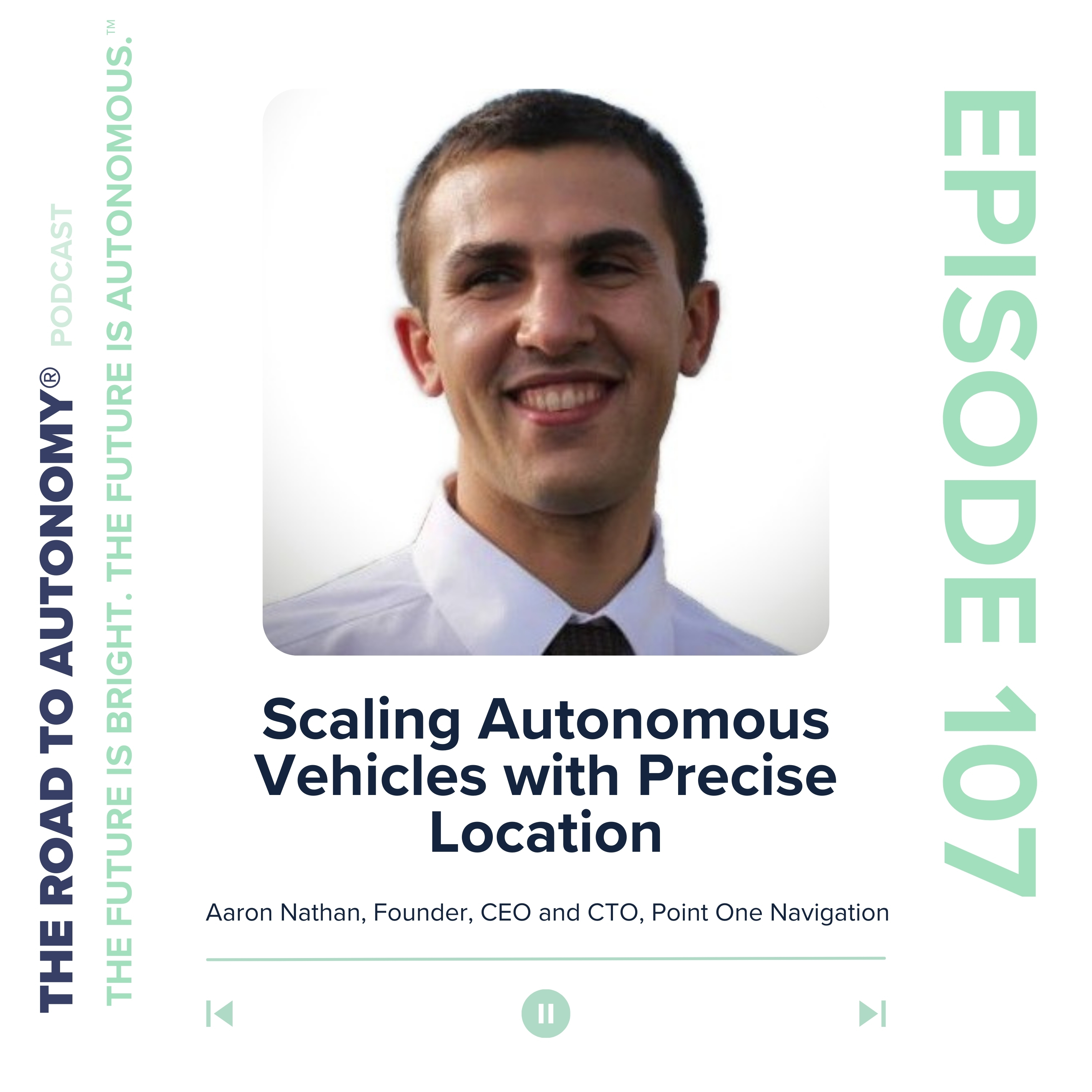
Ep 107Episode 107 | Scaling Autonomous Vehicles with Precise Location
Aaron Nathan, Founder, CEO and CTO, Point One Navigation joined Grayson Brulte on The Road to Autonomy Podcast to discuss safety and scaling autonomous vehicles with precise location services. The conversation begins with Grayson and Aaron discussing how we can make cars safer today, due to a rising trend of speeding on roads that is leading to an increase in crashes and fatalities. One potential way to dent this trend is to solve for the issue is for companies to actively embrace and implement active safety solutions that can predict and act before an incident takes place. Ultimately making systems that can detect something that is going to happen and then actually do something to avoid those type of tragic incidents. That is really where I think this industry is going to have a big impact in the near term. – Aaron NathanWith rising crashes across the world, could the general public become more open to trying and eventually embracing autonomous vehicles as part of their daily lives? AVs do not get distracted, text or speed. They simply follow the rules of the road and take you to and from your destination safely. Safety will be one defining factor that ultimately leads to a future with autonomous vehicles. The other factor that will ultimately drive consumers towards autonomous vehicles is convenience. We are starting to see the early phases of this trend with the introduction of Apple‘s Crash Detection that is featured on the iPhone 14, Apple Watch 8 and Ultra. As much as this is a safety feature, it’s a convenience.Feeling that your device is really helping you be safe, that technology that kind of feeling is something that we are going to see, not just from companies like Apple, but also car companies that are building these technologies. – Aaron NathanCould Apple’s introduction of Crash Detection be the first step towards the much speculated Apple Car? Possibly. Grayson and Aaron discuss why an Apple Car would be an another platform for Apple to grow their services businesses through the introduction of augmented reality experiences in-vehicle complimented with a commerce layer. To achieve this vision, Apple has to develop an autonomous vehicle stack.While Point One Navigation is not developing an autonomous vehicle stack, they are however enabling AVs to know where they are all of the time and updating other vehicles in the fleet in real-time on road trends with their precise location. We are the common language that the cars can use to talk to about where they saw something. – Aaron Nathan Real-time data can be used to update an autonomous vehicle on traffic patterns and advise the passenger on the best time to leave the destination when they summon an autonomous vehicle. Point One’s technology can also apply to traditional vehicles as well. This is convenience and this is the future of mobility. Tying the digital and physical worlds together, that is a building block that we are enabling. – Aaron NathanIt’s not just traffic data, it’s the real-time precise location of the vehicle that makes Point One’s technology so important to the future of autonomy. Wrapping up the conversation, Aaron shares his thoughts on the future of precise location services. Location is one of the most important and invisible sensors in all of robotics, not just self-driving vehicles. – Aaron NathanRecorded on Thursday September 15, 2022--------About The Road to AutonomyThe Road to Autonomy® is a leading source of data, insight and commentary on autonomous vehicles/trucks and the emerging autonomy economy™. The company has two businesses: The Road to Autonomy Indices, with Standard and Poor’s Dow Jones Indices as the custom calculation agent; Media, which includes The Road to Autonomy and Autonomy Economy podcasts as well as This Week in The Autonomy Economy newsletter.See Privacy Policy at https://art19.com/privacy and California Privacy Notice at https://art19.com/privacy#do-not-sell-my-info.
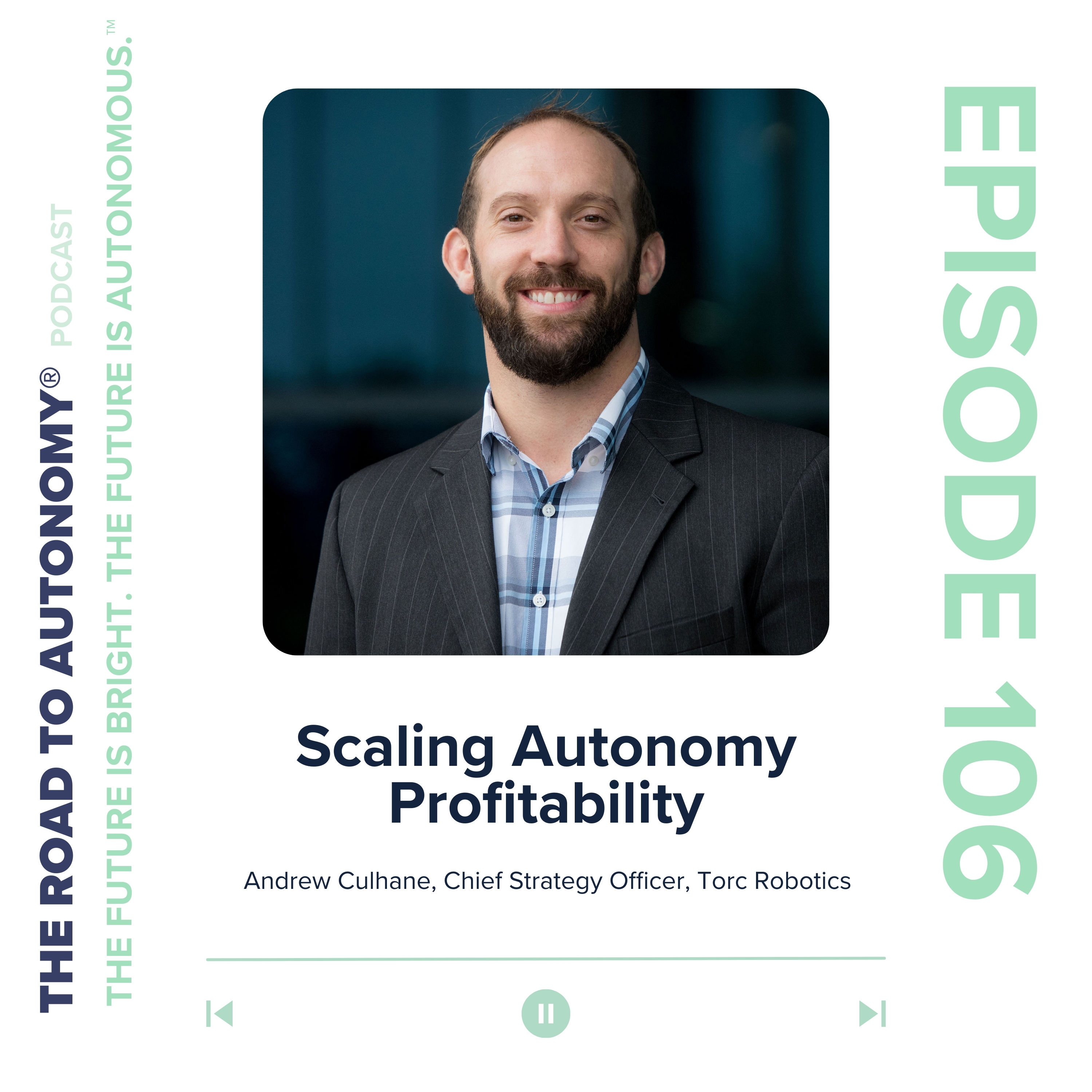
Ep 106Episode 106 | Scaling Autonomy Profitability
Andrew Culhane, Chief Strategy Officer, Torc Robotics joined Grayson Brulte on The Road to Autonomy Podcast to discuss scaling autonomy profitability along with Torc’s strategic relationship with Daimler.The conversation begins with Andrew reflecting on the last 14 years of Torc, as he first joined the company in 2008 as a Sales Engineer. Up until Daimler acquired a majority stake in 2019, the company never took any outside funding and was profitable each and every year. Torc was bootstrapped from day one. We had no outside capital into Torc until the Daimler deal. – Andrew CulhaneThis is a success story. This is Torc. The can do attitude of running a growing profitable business has proven to be extremely successful for the company. While it’s successful today, it was a journey that was full of hard decisions and moments of uncertainty. It’s these moments of uncertainty that laid the groundwork for Torc pivoting to autonomous trucking as Andrew explains in detail. These decisions led to what the company is today, a company with a Daimler partnership that is solely focused on autonomous trucking.We had learned a lot of lessons over all of those years and really understanding what it was going to take, and made that move to trucking before anybody else. – Andrew CulhaneThe decision to pivot from passenger vehicles, mining and military to focus solely on autonomous trucking was not an an easy decision. While the decision was not an easy one, it allowed the company to focus their entire effort on autonomous trucking. As part of their focus on autonomous trucking, the company is focused on a hub-to-hub model. This model was chosen based on experience and listening to the needs of their customers. It has been three years since Daimler took a majority stake in Torc and there has been a great deal of collaboration during this time. It’s been a really interesting partnership and collaboration. – Andrew CulhaneThis approach follows Torc’s track record of not overhyping and not making promises that they cannot keep. Torc has never publicly set a date to remove the driver and operate driver-out operations as they have always kept true to who they are. With this in mind, Grayson and Andrew discuss the boom and bust hype cycles of autonomy. While Torc is not making timeline promises, the company is clearly laying the groundwork towards commercialization as the company recently appointed Peter Vaughn Schmidt (Head of Daimler Truck Autonomous Technology Group) as CEO. Wrapping up the conversation, Andrew discusses what drove Torc’s financial discipline from day one.Recorded on Tuesday September 13, 2022--------About The Road to AutonomyThe Road to Autonomy® is a leading source of data, insight and commentary on autonomous vehicles/trucks and the emerging autonomy economy™. The company has two businesses: The Road to Autonomy Indices, with Standard and Poor’s Dow Jones Indices as the custom calculation agent; Media, which includes The Road to Autonomy and Autonomy Economy podcasts as well as This Week in The Autonomy Economy newsletter.See Privacy Policy at https://art19.com/privacy and California Privacy Notice at https://art19.com/privacy#do-not-sell-my-info.
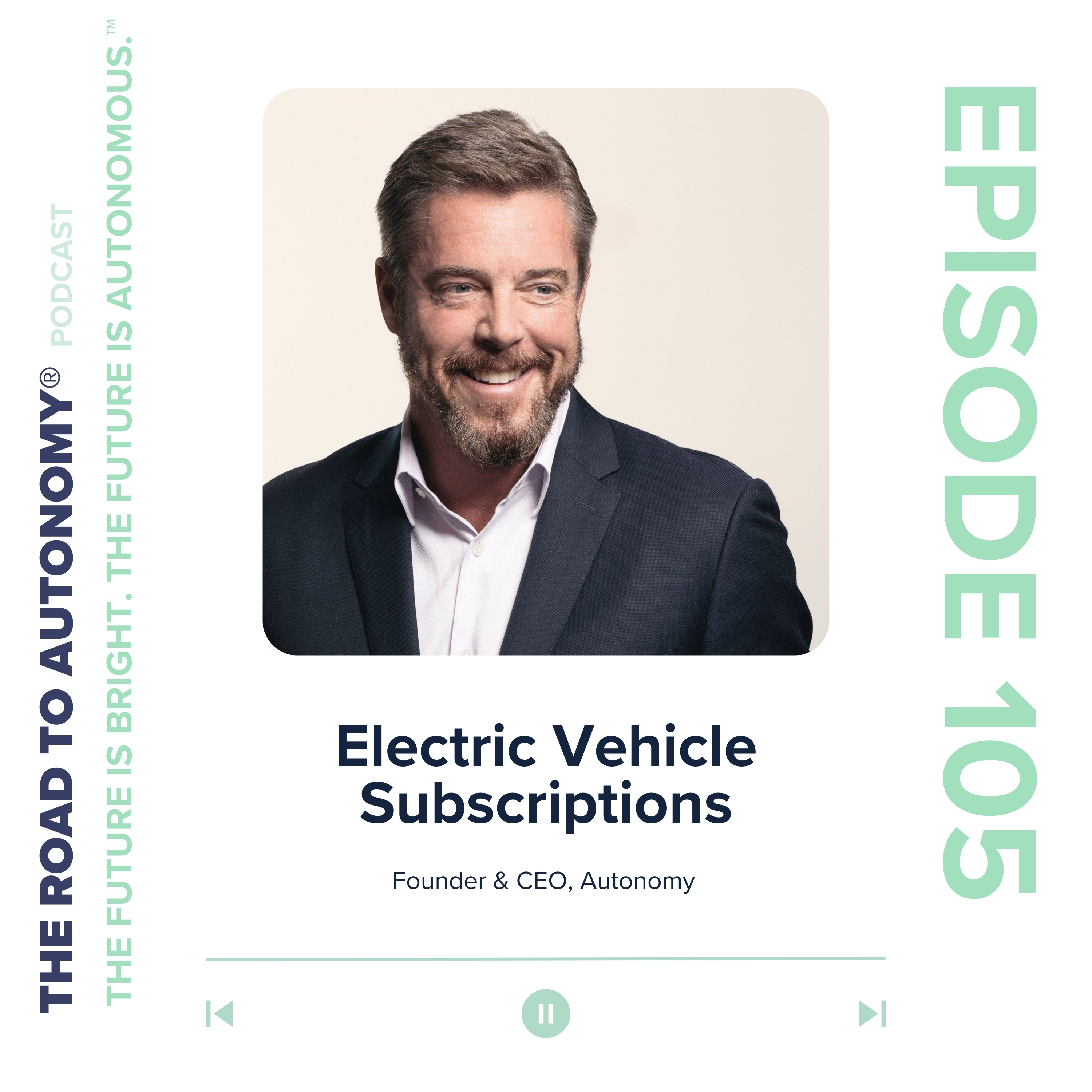
Ep 105Episode 105 | Electric Vehicle Subscriptions
Scott Painter, Founder & CEO, Autonomy joined Grayson Brulte on The Road To Autonomy Podcast to discuss Autonomy’s approach to electric vehicle subscriptions. The conversation begins with Scott discussing why he founded Autonomy.I think that great entrepreneurs, great companies have to solve a real problem. – Scott PainterOne of the key hurdles to the adoption of electric vehicles is affordability and that is the problem that Autonomy is solving with their subscription model. For those individuals who are uncertain about electric vehicles and/or concerned about range, Autonomy offers a low commitment way to discover and experience an electric vehicle without a long-term commitment. Because Autonomy owns the fleet and gathers data in real-time about the vehicles, the company is able to offer time based episodic insurance for subscribers. With this model, subscribers only pay for insurance when they are driving the vehicle, leading to a lower operating cost than a traditional lease. Overall, an Autonomy subscription is about 15% less than a traditional lease. When compared to a Tesla lease, an individual needs to have a minimum 720 FICO score in order to qualify for a lease. With an Autonomy subscription, an individual can secure a subscription with a minimum 640 FICO score. What we are really focused on is giving people the ability to get flexible access to mobility without necessarily having to go into debt. – Scott PainterThe other key differences are that an Autonomy subscription is minimum of three months as compared to traditional Tesla lease that is 36 months. A Tesla lease will report as debt on consumers credit reports, while an Autonomy subscription will not report as debt. The fact that a subscription, an Autonomy subscription in particular does not show up on your credit report as debt is a very big deal. Which also allows us to open up another really key value proposition, which is you can pay for it with a credit card. You can not pay a traditional car lease or a car loan with a credit card, because it is illegal to pay debt with debt. – Scott PainterWith rising consumer credit card debt, Grayson and Scott discuss how Autonomy approaches underwriting and how the company is constantly evaluating potential subscribers from a credit risk standpoint. In addition to the consumers’s credit report, Autonomy also looks at potential subscribers insurability.The goal here is to have dramatically better outcomes than a traditional auto lender or auto lessor. We just do not want to have bad debt on the books. We want to see good quality revenue coming in. – Scott PainterTo scale up the business, Autonomy has placed an order for nearly 23,000 electric vehicles from 17 different automakers for a capital expenditure of $1.2 billion order. This order represents 1.2% of the projected U.S. electric vehicle production through the end of 2022. Wrapping up the conversation, Scott discusses how he plans to expand the business in the coming years.Recorded on Thursday, September 8, 2022--------About The Road to AutonomyThe Road to Autonomy® is a leading source of data, insight and commentary on autonomous vehicles/trucks and the emerging autonomy economy™. The company has two businesses: The Road to Autonomy Indices, with Standard and Poor’s Dow Jones Indices as the custom calculation agent; Media, which includes The Road to Autonomy and Autonomy Economy podcasts as well as This Week in The Autonomy Economy newsletter.See Privacy Policy at https://art19.com/privacy and California Privacy Notice at https://art19.com/privacy#do-not-sell-my-info.
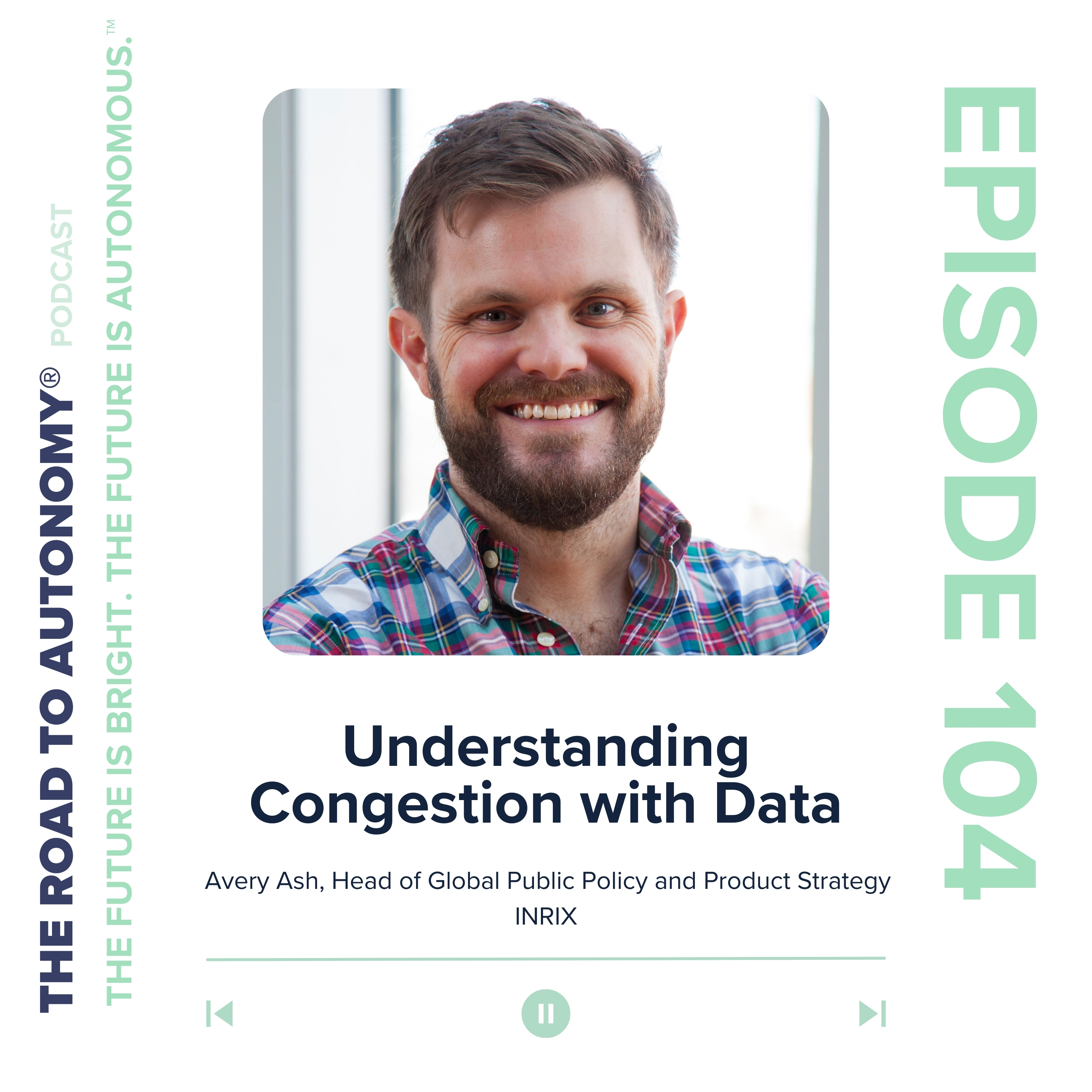
Ep 104Episode 104 | Understanding Congestion with Data
Avery Ash, Head of Global Public Policy and Product Strategy, INRIX joined Grayson Brulte on The Road To Autonomy Podcast to discuss how data can help cities and DOTs (Department of Transportations) better understand congestion and how to properly plan for it. The conversation begins with Avery discussing how INRIX gathers anonymous data from 500 million vehicles, mobile devices, mobile apps, parking lot operators, mobile carriers and smart meters all in real-time.Expanding their data gathering capabilities, INRIX recently announced a partnership with GM where data from 15 million vehicles will be used in a collaborative manner to create Safety View. This product leverage the promise of connected vehicles to improve safety planning in local communities. As local communities plan for safe road ways, data will play a vital role in determining the best way to improve safety. In Washington, D.C. for example, 20% of drivers travel at least 10 mph above the speed limit in school zones. Knowing this data, schools will be better prepared to implement safety solutions such solutions as speed bumps, crossing guards, lowering speed limits in surrounding neighborhoods and working with local law enforcement to increase the police presence. You can not expect one silver bullet solution that is going to solve this problem. – Avery AshOnce the new safety measures are put in place, schools can measure the impact of the changes thanks to the data. Data is also having an impact on how cities tackle the issue of congestion. Each year, INRIX publishes their Annual Global Traffic Scorecard and this year the company reported that the average American driver lost 36 hours in 2021 due to congestion. With all of this data being gathered, how can cities effectively use the data to reduce traffic? That is the million dollar question. In London which is the world’s most congested city, where drivers lost 148 hours to congestion in 2021, the city has not figured out how to effectively reduce traffic even as the city has a daily £15 congestion tax. New York City is currently debating on whether to follow London’s lead and introduce a congestion tax. But NYC has a crime problem that three quarters of New Yorkers have called a very serious problem. Crime is driving New Yorkers tourists alike to single occupancy vehicles out of an abundance of caution. When planning for congestion, it’s important to take into account a variety of data points and not just rely on one source of data. It’s really important to enter into these sorts of policy changes with eyes wide open and with a willingness and frankly a plan for how you are going to measure the impact. – Avery AshCould autonomous vehicle drop-off and pick-up zones be a potential solution in the future as AVs scale and are deployed in cities around the world? Grayson and Avery discuss drop-off and pick-up zones as a potential solution for congestion in cities.Wrapping up the conversation, Avery shares his opinion on the best way cities can prepare for the large scale deployment of autonomous vehicles. The first step is to get a really clear understanding of how your roadways are currently being used and what behavior looks like across your road networks, across all road users. – Avery AshRecorded on Tuesday, August 30, 2022--------About The Road to AutonomyThe Road to Autonomy® is a leading source of data, insight and commentary on autonomous vehicles/trucks and the emerging autonomy economy™. The company has two businesses: The Road to Autonomy Indices, with Standard and Poor’s Dow Jones Indices as the custom calculation agent; Media, which includes The Road to Autonomy and Autonomy Economy podcasts as well as This Week in The Autonomy Economy newsletter.See Privacy Policy at https://art19.com/privacy and California Privacy Notice at https://art19.com/privacy#do-not-sell-my-info.
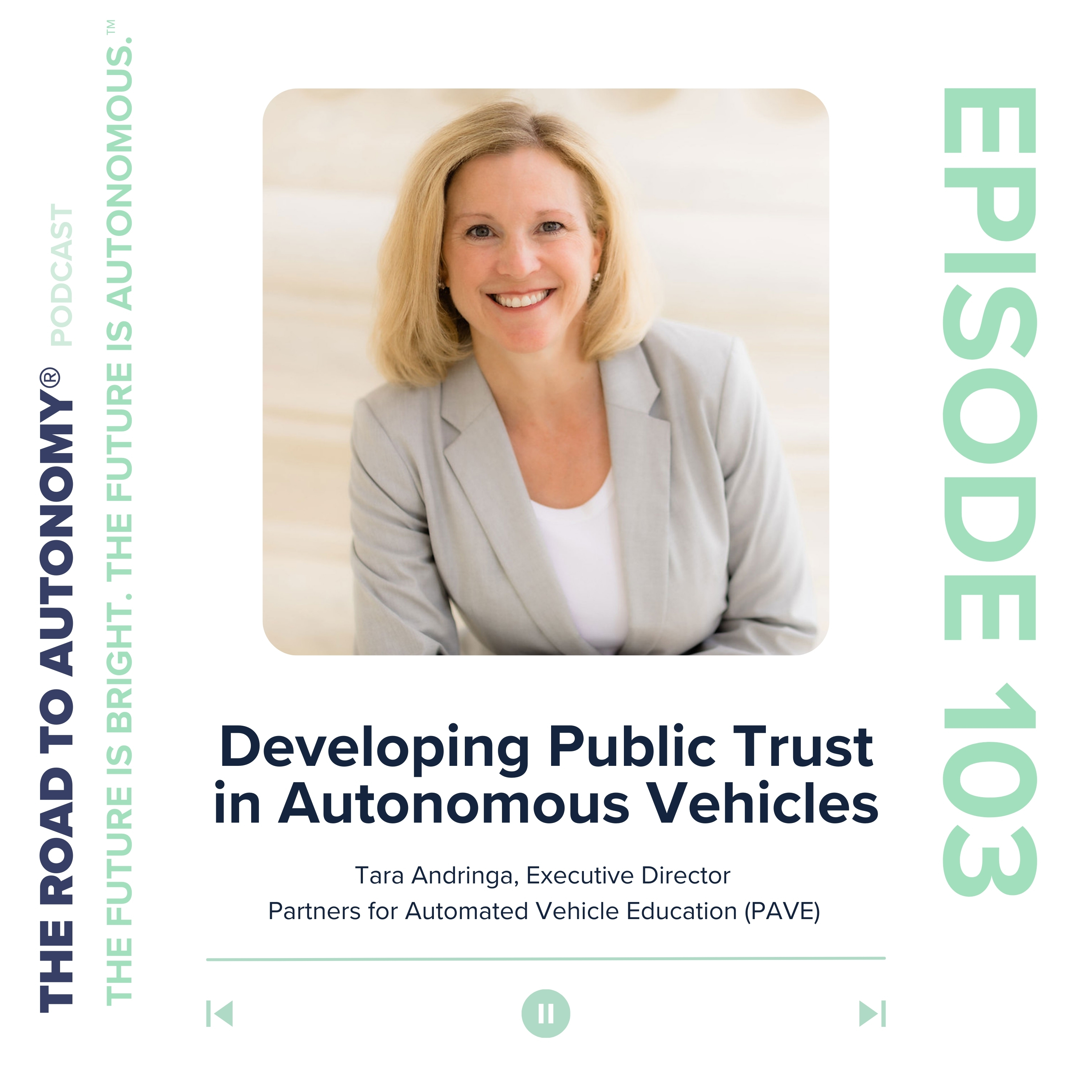
Ep 103Episode 103 | Developing Public Trust in Autonomous Vehicles
Tara Andringa, Executive Director of Partners for Automated Vehicle Education (PAVE) joined Grayson Brulte on The Road To Autonomy Podcast to discuss developing and maintaining public trust in autonomous vehicles and trucks.The conversation begins with Tara discussing how PAVE is working on developing public trust of autonomous vehicles. I really like to think of it as a conversation with the public. Every single person is a stakeholder in transportation, and so what we want to do is let everyone have a voice in thinking about what the future of our transportation system looks like. – Tara Andringa One of the biggest hurdles to over come on the road to developing public trust in autonomous vehicles is misleading headlines that erode public trust in the technology. This is one of our biggest challenges right now. – Tara Andringa These headlines are eroding public trust as they are confusing ADAS (Advanced Driver Assistance Systems) with autonomous vehicles, which is causing confusion with the public. Some individuals are over-trusting that the ADAS system will operate like an autonomous vehicle, meaning that they will not have to pay attention when the vehicle is driving, potentially leading to tragic situations. One reason these headlines are being printed is the amount of traffic that they generate for news outlets. While the traffic leads to higher ad revenue, the headlines could potentially lead to unfortunate events and an overall erosion of public trust in autonomy. It’s much easier for them to write self-driving car then it is to say a car that under limited circumstances with an attentive human behind the wheel can handle some driving tasks. That just does not roll off the tongue. It gets simplified to really dangerous results. – Tara Andringa It is very important to point out that you cannot buy an autonomous vehicle today and that all autonomous vehicles are currently operated as part of a fleet. To try and clear the confusion, PAVE partnered with AAA, J.D. Power, The National Safety Council, SAE International and Consumer Reports on the CLEARING THE CONFUSION: Common Naming for Advanced Driver Assistance Systems document. There are two different naming issues and I really want to distinguish between them. One is that we need clear language for what is available today and the other issue is that we need clear language to distinguish today’s technology from future technology. – Tara Andringa With over 40 different names for Automatic Emergency Braking (AEB), consumers are unsure of what the technology can do, potentially causing confusion. The is why the common naming document is so important. Perhaps the common naming document can be transferred into emojis that everyone around the world no matter what language they speak can understand what it means.There are examples from history that can help pave the road with trust. One example is The Vagabonds, a group composed of Henry Ford, Thomas Edison, Harvey Firestone, and John Burroughs who made yearly camping trips in Ford vehicles between 1916 and 1924 with the goal of developing trust in the automobile. A more modern example is what Voyage did in The Villages to develop trust of autonomous vehicles with the residents of the community. When you really give people exposure to the technology, they start thinking about it in a much more real way. – Tara Andringa Building upon history, a diverse group of members from leading startups, to established automakers to insurance companies to non-profits, to software providers came together to form PAVE with the goal of developing public trust in autonomous vehicles and trucks.Wrapping up the conversation, Tara shares insights on how communities and Governments are preparing for the large-scale deployment of autonomous vehicles. Recorded on Tuesday, August 23, 2022--------About The Road to AutonomyThe Road to Autonomy® is a leading source of data, insight and commentary on autonomous vehicles/trucks and the emerging autonomy economy™. The company has two businesses: The Road to Autonomy Indices, with Standard and Poor’s Dow Jones Indices as the custom calculation agent; Media, which includes The Road to Autonomy and Autonomy Economy podcasts as well as This Week in The Autonomy Economy newsletter.See Privacy Policy at https://art19.com/privacy and California Privacy Notice at https://art19.com/privacy#do-not-sell-my-info.
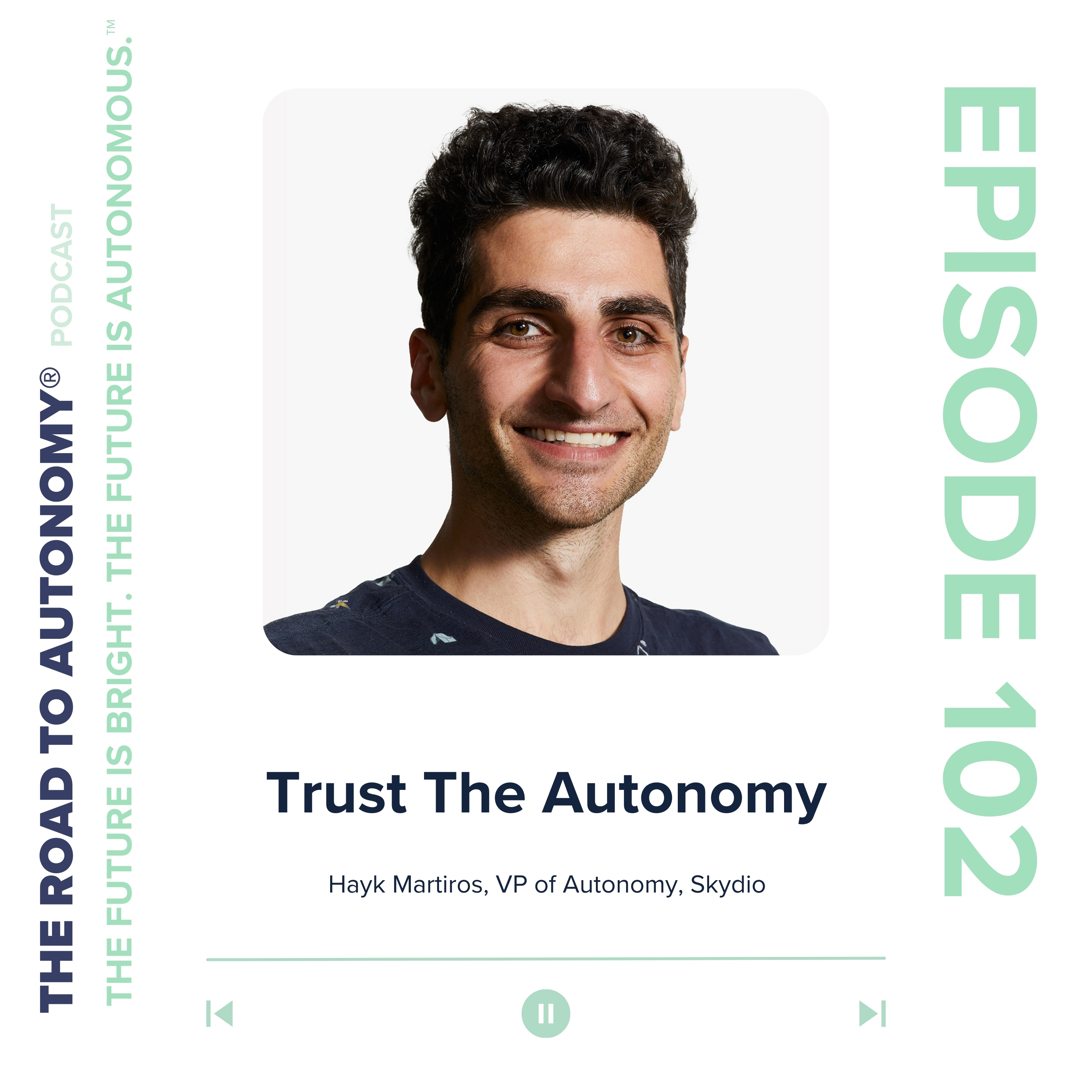
Ep 102Episode 102 | Trust The Autonomy
Hayk Martiros, VP of Autonomy, Skydio joined Grayson Brulte on The Road To Autonomy Podcast to discuss developing a vision-based autonomous drone complete with obstacle avoidance and why this system enables pilots to trust the autonomy. The conversation begins with Hayk discussing what makes Skydio different from other drone companies.The whole premise of Skydio is to build a vision-based autonomous drone. A drone that uses cameras to see and understand the world around it, and then navigate in that world so that the user does not have to be an expert pilot. They do not have to worry about avoiding objects or knowing exactly how to have your fingers on the sticks ready to go, but rather you are just interacting with this robot that you feel that you can trust. – Hayk MartirosSkydio drones operate a vision-based autonomous system with cameras instead of radar and LiDAR because cameras are the only way to make an autonomous drone that just works. Cameras also enable the drone to have a longer battery life as they are lighter and less power intensive when compared to radar and LiDAR. Designing everything, form and function together to absolutely optimize for weight is kind of everything with a flying machine. – Hayk MartirosWhile the drones are designed for weight, the vision-based autonomous system has an obstacle avoidance system that operates smoothly while in-flight. The system develops trust with the pilot and enables them to fly without having to worry about the drone crashing into a visible object. We invested a huge amount of effort into this. We were the first company and team to use deep learning for robot obstacle avoidance in a real product. – Hayk MartirosAutonomy combined with an obstacle avoidance system is one of the key ways that trust with drones will be developed in the future. This will lead to trust being built with regulators such as the FAA when companies request permission to fly beyond the visual line of sight. Skydio customer Dominion Energy was recently granted FAA approval to fly beyond the line of sight in seven U.S. States to inspect power generation facilities. Our approach has been let’s try to prove our case and prove the trust worthiness of our autonomy through data and work with the FAA to make progress. – Hayk MartirosWhen flying beyond the line of sight, Skydio has a return to home feature where the drone will autonomously fly back to the launch point or a pre-specified point if the battery runs low or connectivity is lost for example. The drone autonomously makes this decision based on data from the on-board health monitoring system. Autonomy combined with the ease of use makes Skydio special. – Hayk MartirosEvolving from a software company to a vertically integrated hardware and software company has allowed Skydio to design an autonomous drone that just works. The autonomy system was first developed in 2014 when the company was focused solely on software. Since then the technology has continuously advanced as more and more edge cases are added into the autonomy stack leading to the system becoming more robust and more autonomous. Wrapping up the conversation, Hayk shares his thoughts on the future of autonomous drones. Recorded on Tuesday, August 16, 2022 --------About The Road to AutonomyThe Road to Autonomy® is a leading source of data, insight and commentary on autonomous vehicles/trucks and the emerging autonomy economy™. The company has two businesses: The Road to Autonomy Indices, with Standard and Poor’s Dow Jones Indices as the custom calculation agent; Media, which includes The Road to Autonomy and Autonomy Economy podcasts as well as This Week in The Autonomy Economy newsletter.See Privacy Policy at https://art19.com/privacy and California Privacy Notice at https://art19.com/privacy#do-not-sell-my-info.
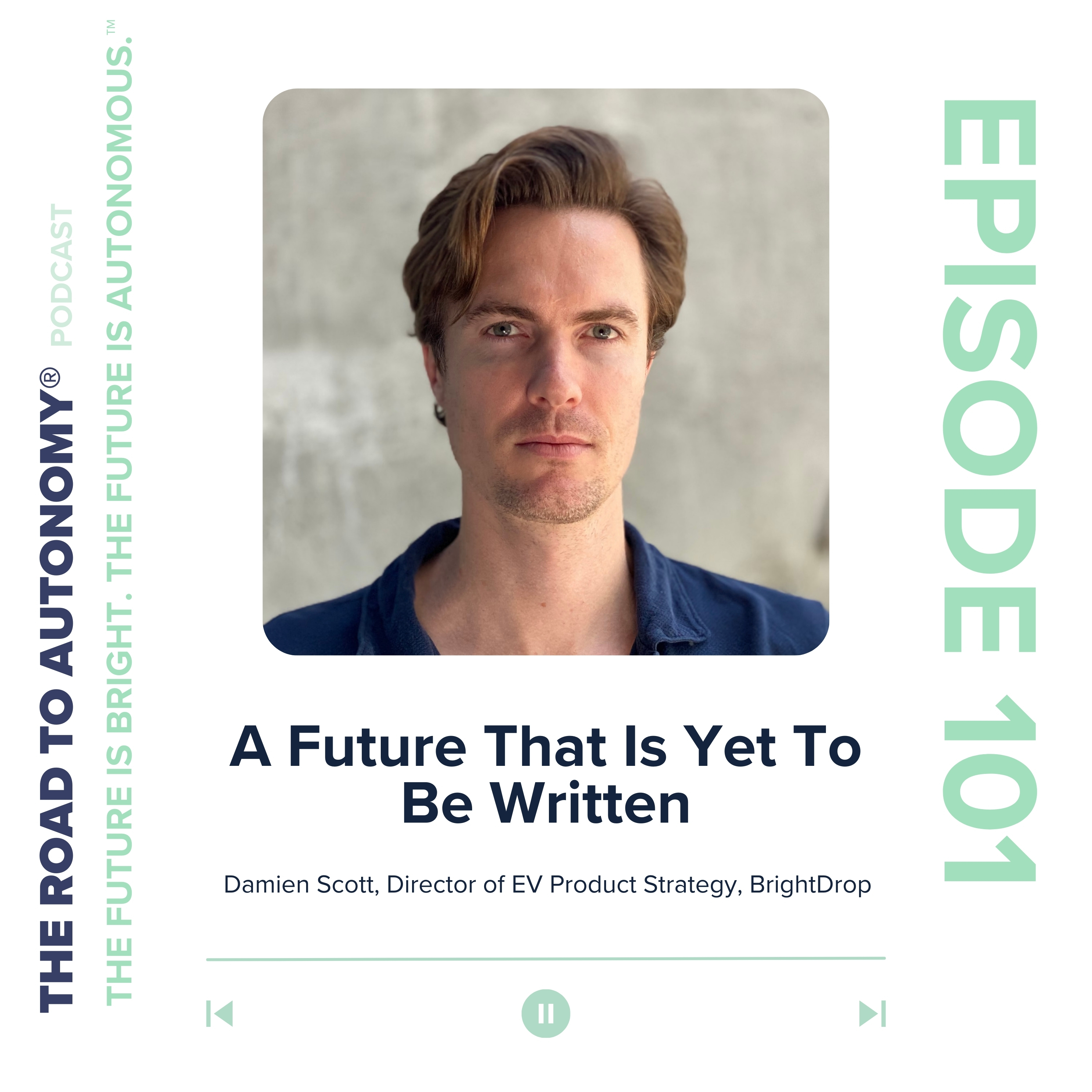
Ep 101Episode 101 | A Future That Is Yet To Be Written
Damien Scott, Director of EV Product Strategy, BrightDrop joined Grayson Brulte on The Road To Autonomy Podcast to discuss energy and the role that managing energy usage in real-time will play in a future with electrified transportation. The conversation begins with Damien discussing growing up in Botswana, flying around the country with his father who was a medical doctor and why his parents made the decision to homeschool him and his sisters. One of the amazing things about living on a remote game farm in Botswana is you have to become incredibly practical fixing vehicles, borehole pumps, electricity frequently goes down, and so there is a lot of direct exposure to the fundamental things that we use in our life. – Damien ScottHaving been exposed to medicine and aviation at an early age, Damien made the decision to go into technology after being inspired by science fiction. He wanted to work on technology that would bring about some of the more positive visions of the future that involved energy and transportation. While living on the farm, Damien’s father installed their first solar powered borehole pump, which reduced the families dependence on diesel. This was the first time that Damien was exposed to solar and the true benefits of the technology. Having experienced solar energy in a remote part of the world first-hand, Damien discusses the opportunities that he sees for solar energy. The market for renewable energy such as solar continues to grow and is projected to make up 27% of the world’s energy by 2050, coal still accounts for 27% of the world’s primary energy, roughly the same level as 50 years ago. In 50 years from now, how will the world’s mix of energy sources change?This is the big question. I think it boils down to a set of actions that technology companies will take, the policy makers will take. It’s not determined what this mix is going to look like, it is really ours as a species to make these decisions. – Damien ScottEnergy demand is growing globally and The US Energy Information Administration is projecting that the global energy demand will grow by 47% by 2050. To be prepared to handle this increase in demand, we have to start paying attention to energy demand and its impact on the energy grid. One of the first things to look at is, can we optimize what we have already and take the assets that we have — the electricity grid we have today and the one that we expect to evolve in the short to medium term and just use it more efficiently. – Damien ScottWhat happens when you electrify large fleets of commercial vehicles? What will their impact be on the energy grid? How do you manage the energy usage. This is the problem that Marain set out to fix and they are now doing it as part of BrightDrop.In order to create the future that we want, we have to simulate it. It’s really expensive to make the wrong decisions in our infrastructure buildout with the electricity grid. – Damien ScottThis approach will ensure that commercial EV fleet owners are properly prepared and not caught flat footed as they scale up their global electric vehicle fleets. As we are still early in the adoption of electric vehicles, the future is yet to be written in terms of how fleet operators will manage their fleets. Wrapping up the conversation, Damien shares his thoughts on the future of global energy consumption. The next decade leading up to 2030 is going to be the most important for energy and transportation across all areas, technology, business models, policy. – Damien ScottRecorded on Tuesday August 9, 2022--------About The Road to AutonomyThe Road to Autonomy® is a leading source of data, insight and commentary on autonomous vehicles/trucks and the emerging autonomy economy™. The company has two businesses: The Road to Autonomy Indices, with Standard and Poor’s Dow Jones Indices as the custom calculation agent; Media, which includes The Road to Autonomy and Autonomy Economy podcasts as well as This Week in The Autonomy Economy newsletter.See Privacy Policy at https://art19.com/privacy and California Privacy Notice at https://art19.com/privacy#do-not-sell-my-info.

Ep 100Episode 100 | Insights into the Consolidating Electric and Autonomous Vehicle Markets
David Welch, Detroit Bureau Chief, Bloomberg and Author of Charging Ahead, General Motors, Mary Bara, and the Reinvention of an American Icon joined Grayson Brulte on The Road To Autonomy Podcast to discuss market consolidation in the electric and autonomous vehicle markets along with his new book.The conversation begins with David sharing his thoughts on market consolidation in the autonomous vehicle market and who he thinks could potentially be acquired.Not all of these companies have to sell right now, but if capital markets stay as tight as they are, I think you are going to see a lot of action there. – David WelchOn the electric vehicle side of the equation, EV start-ups are having a hard time raising cash and when they successful raise capital, the capital is expensive. Some of the EV companies are spreading themselves too thin by focusing on multiple markets instead of having a a singular focus on developing a great electric vehicle. A subset of the electric vehicle market that is becoming over saturated is the last-mile electric van delivery market as GM scales BrightDrop and Ford scales their E-Transit van.Anyone trying to get into this business, including Rivian, they are going to have a tough time because Ford and GM not only have vans that are already being built, they have the industrial prowess and the factories to make a big go of it. – David WelchOutside of the electrification of vans, GM has made several savvy moves by acquiring Cruise and Marain among other all the while preparing for the future of mobility which will be on-demand, electric and autonomous. From an economics standpoint, GM is funding Cruise to the tune of $1 billion a year and Ford and VW are investing significant funds into Argo each and every year. The big question is, how long will GM continue to fund Cruise and how long will Ford/VW continue to fund Argo? David shares his thoughts on what the future could hold for Cruise and Argo and when GM and Ford will further tap outside investors and/or spin out the divisions once they start generating significant revenue. Waymo similar to Cruise is generating revenue from their robo-taxi business in addition to their Waymo Via trucking logistics business. Grayson asks David: what will it take and when does he think Alphabet will have their Amazon AWS moment and breakout Waymo earnings for the first time? I do not know if it’s monetary or has a number on it, I think it’s more a strategic thing. – David WelchWhile this will be a strategic decision, the bigger question at present time, do the autonomous vehicle companies have the right executive leadership to commercialize, scale and eventually run a profitable business? Grayson and David discuss the current state of management talent and why Cruise’s competitive commercial advantage could be the executives who joined from Delta and Southwest.Commercializing an AV company to running a profitable AV company requires a different set of management skills. While management will play a key role, a larger question is; will the robo-taxi business ever be profitable in it’s current state? This is not a high-margin business. It’s just one that they can do and has the potential to get very big in terms of revenue. – David WelchLooking at different commercial models, do we get to the point where one of the large AV developers pivots from operating a robo-taxi business to operating a licensing business? Possibly. I think there is a business there. – David WelchBased on the way Waymo is currently structured and being owned by a large technology company instead of an auto manufacturer, it’s a possibility. Grayson offers that the service could be called Waymo Drive and offered as a monthly add-on option for JLR vehicles. The core software would run on Google Cloud, leading to increased revenue in a division that is under Wall Street pressure to gain more marketshare. Or there is Walmart which is currently battling high-inflation make a move to acquire an autonomous trucking company with the long-term goal of lowering operating expenses? Grayson and David discuss as Walmart kicked the tires on acquiring Zoox prior to Amazon buying the company. Would Walmart consider acquiring Gatik?I do not think they are going to want to necessarily own these assets if they do not have to, they just need the benefits of it. – David WelchStaying on the topic of Wall Street, could SoftBank which is the second largest shareholder of Aurora with an 11.8% stake, force the company to split in two by merging the trucking side of the business with Uber Freight of which they are a 3.18% owner (of Uber) and possibly selling the car side of the business to Toyota which owns 6.72% of Aurora? Grayson and David discuss if this is possible and would it create long-term shareholder value?Or could a U.S. Class 1 Railroad mak
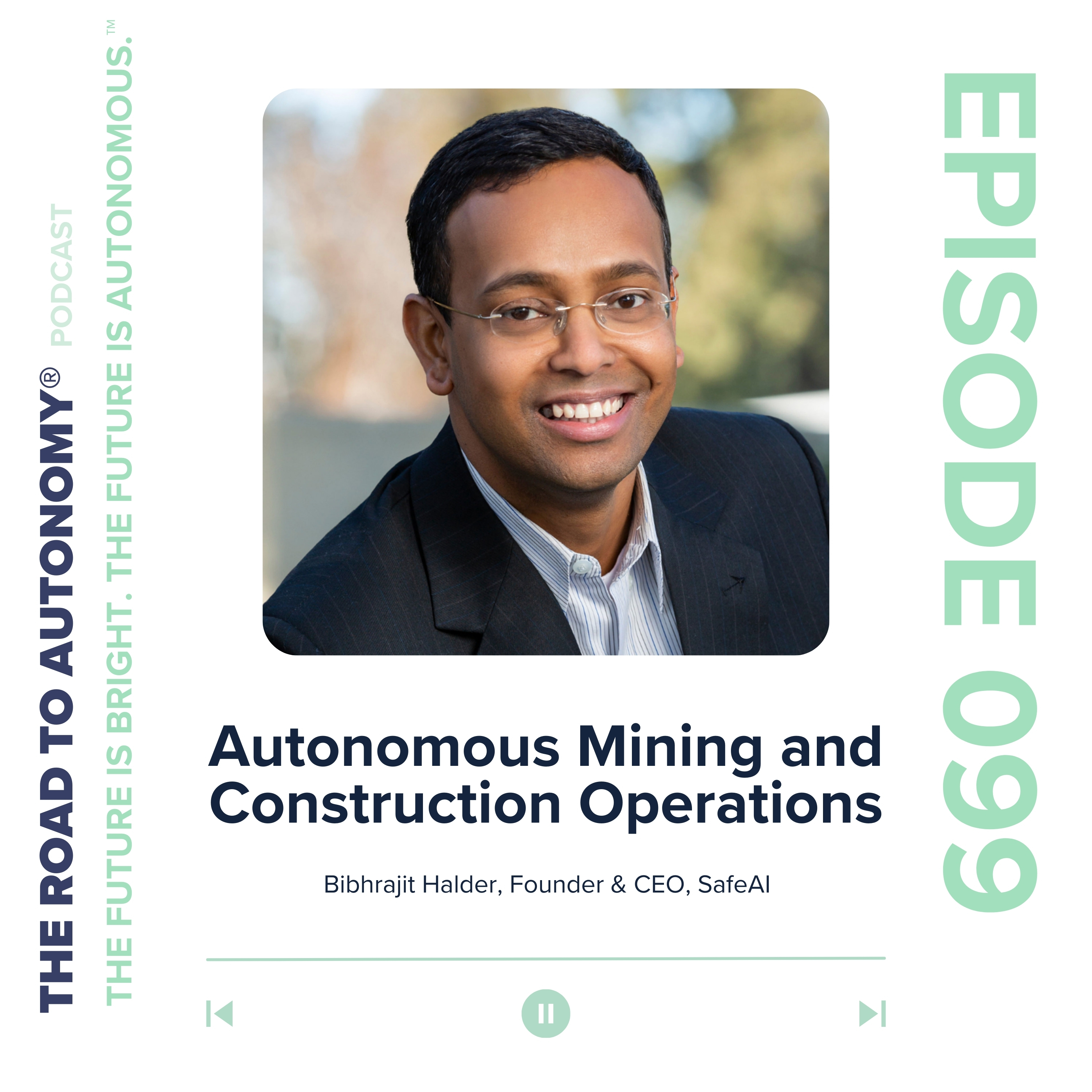
Ep 99Episode 99 | Autonomous Mining and Construction Operations
Bibhrajit Halder, Founder & CEO, SafeAI joined Grayson Brulte on The Road To Autonomy Podcast to discuss autonomous mining and construction operations. The conversation begins with Bibhrajit discussing why in 2017 when the market was full of hype and investment dollars for passenger autonomous vehicles, that he bucked the trend and made the strategic decision to focus on the heavy equipment industry. Bibhrajit’s strategic decision is paying dividends today as the global mining industry is a $2 trillion dollar market with accelerating growth thanks in part to the growth of the electric vehicle market. The heavy equipment industry is a key supplier to this market, setting SafeAI up with the perfect scenario for growth, all the while helping to improve safety and increase operational efficiency through autonomy.This industry is also not the most safest industry. This industry also wants to run more efficiently. – Bibhrajit HalderThe largest deployment of heavy equipment autonomous vehicles is located in Australia where there are over 1,000 actively heavy equipment autonomous vehicles in operation today. The thousand autonomous trucks that have been running for seven or eight years, and they have moved about 4 to 5 billion tons of material over 24/7 operations without a single fatal accident. – Bibhrajit HalderMines in Australia are capitalizing on the efficiencies unlocked by autonomy and the positive benefits that this technology has on society. In Western Australia, SafeAI has a partnership with MACA to retrofit 100 heavy equipment trucks for autonomy. While Australia is a booming market for heavy equipment autonomous vehicles, the markets of Chile, Argentina, Brazil, Canada and Japan are emerging markets with growth potential. With autonomy scaling in the mining industry, Grayson compares the mining industry to the agricultural industry and asks Bibhrajit if he sees a global miner making autonomy acquisitions similar to the way John Deere has done to grow their business.If you look at in general, any industry this kind of fundamental technology, there will be consolidation. No doubt about it. There will be consolidation and that consolidation happens naturally as different players come up and show their strengths and weaknesses. – Bibhrajit HalderWhile consolidation will happen at some point in the global mining industry, Bibhrajit is laser focused on serving his customers for the long-term. That is both in the mining industry and the construction industry where SafeAI is actively expanding their business through a partnership with the Obayashi Corporation in Japan.This is the first step of our way to expand autonomous construction in Japan, and we are working hand-in-hand with Obayashi. – Bibhrajit HalderWrapping up the conversation, Bibhrajit explains how autonomy compliments the mining and construction industries.Recorded on Tuesday, August 2, 2022--------About The Road to AutonomyThe Road to Autonomy® is a leading source of data, insight and commentary on autonomous vehicles/trucks and the emerging autonomy economy™. The company has two businesses: The Road to Autonomy Indices, with Standard and Poor’s Dow Jones Indices as the custom calculation agent; Media, which includes The Road to Autonomy and Autonomy Economy podcasts as well as This Week in The Autonomy Economy newsletter.See Privacy Policy at https://art19.com/privacy and California Privacy Notice at https://art19.com/privacy#do-not-sell-my-info.
Ep 98Episode 98 | The Changing Landscape of Cities
John Rossant, Founder & CEO, CoMotion and Advisory Board Member, NEOM joined Grayson Brulte on The Road To Autonomy Podcast to discuss the changing landscape of cities. The conversation begins with John discussing the vision for the futuristic region of NEOM which is roughly the size of Massachusetts located in the Northwest of Saudi Arabia. 95% of the NEOM region will be preserved in it’s natural state and there will be no highways or carbon emissions. Sustainability is at the core of NEOM.NEOM is a very big bet on hydrogen. The core energy of NEOM is hydrogen. – John RossantThe heart of NEOM should be THE LINE development which is a 75-mile long and 1,600 foot skyscraper which is connected by a high-speed train.The world does needs a radical experiment like this. We can not continue urbanizing as we have been, we are ruining the planet. If we can think of a way to do this in a sustainable way using renewable energy, that could be pretty interesting. – John RossantIn the United States, the City of Miami is growing and changing as new individuals move into the region from around the world. However the issue facing Miami today is the city’s all-in approach to cryptocurrency without diversification. Could the lack of the City’s diversification lead to another classic Miami boom and bust cycle? Grayson and John discuss the current state of Miami’s economy, while offering their unique opinions on the future of Miami. Miami, it’s a much much much bigger story than just crypto. – John RossantOne of the stories emerging in Miami is the focus on decarbonizing ocean transport. Over in NEOM, there is a a mixed-use urban development called OXAGON located in the Red Sea which when completed will be the largest floating structure in the world. In time, I think the Red Sea will become the new Mediterranean in terms of kind of yachting in paradise, boating, etc. – John RossantThe story emerging in Dubai is Cruise preparing to deploy the fully autonomous Cruise Origin in 2023 on public roads. With the advancement of NEOM and the emerging Cruise deployment in Dubai, the Middle East is beginning to emerge as a growing market for autonomy. While the Middle East is a growing market for autonomy, New York City is a shrinking market for mass-transit.Mass-transit and public transportation have to be made fun and seamless. – John RossantThis is where multi-modal and on-demand mobility is thriving as consumers want what they want, when they want it without friction. Wrapping up the conversation, Grayson and John discuss why the future of mobility is choice. Recorded on Tuesday, July 26, 2022--------About The Road to AutonomyThe Road to Autonomy® is a leading source of data, insight and commentary on autonomous vehicles/trucks and the emerging autonomy economy™. The company has two businesses: The Road to Autonomy Indices, with Standard and Poor’s Dow Jones Indices as the custom calculation agent; Media, which includes The Road to Autonomy and Autonomy Economy podcasts as well as This Week in The Autonomy Economy newsletter.See Privacy Policy at https://art19.com/privacy and California Privacy Notice at https://art19.com/privacy#do-not-sell-my-info.
Ep 97Episode 97 | Waymo’s Rider-Only Experience
Sonca Nguyen, Product Manager, Waymo joined Grayson Brulte on The Road To Autonomy Podcast to discuss Waymo’s rider-only experience. The conversation begins with Sonca comparing and contrasting her first Waymo rider-only ride in Chandler, Arizona in 2019 to her first rider-only experience in San Francisco in 2022. From 2019 to 2022, the Waymo driver has matured and is now capable of handling even more demanding situations. The maturing of the driver was cultivated with the introduction of the 5th-generation Waymo Driver.The maturing of the Waymo driver really allowed us to expand our Waymo One service. – Sonca NguyenThe technical advancements and the maturing of the autonomous driving system has allowed Waymo to expand to downtown Phoenix and the Sky Harbor International Airport. With the resort town of Scottsdale being located 8.4 miles from the Sky Harbor Airport and 11 million tourists visiting Scottsdale each year, Grayson asks Sonca if there are plans to eventually offer a Waymo Sky Harbor to Scottsdale service. Waymo is fully committed to expanding our service there. – Sonca NguyenThe vehicles operating at Sky Harbor will be the Jaguar I-PACEs which have 25.3 cubic feet of cargo space. This space can hold 5 roller carry-on bags and will be available for travelers to store their bags on the journey to their destination, as the Waymo compute stack has gotten significantly smaller and more efficient over the years. Could Waymo’s airport expansion come to other cities such as San Francisco? It’s a possibility, but nothing is confirmed yet. However today in San Francisco, Waymo is operating a trusted-tester program for members of the public and is operating rider-only for employees. During this time Waymo has a learned how to improve the product, scale operations and operate a service with passengers. As the service opens up to members of the public, Waymo will continue to gather feedback which will further help to improve the product. As the service opens to the public in San Francisco, Sonca walks listeners through what the Waymo rider-only experience will be like in San Fransisco. One of the interesting things that Waymo has learned from passengers in San Francisco is that they prefer to be picked up in parking lots as opposed to the street. Wrapping up the conversation, Sonca shares her thoughts on how she sees autonomous driving technology evolving over the next decade. Recorded on Friday, July 1, 2022--------About The Road to AutonomyThe Road to Autonomy® is a leading source of data, insight and commentary on autonomous vehicles/trucks and the emerging autonomy economy™. The company has two businesses: The Road to Autonomy Indices, with Standard and Poor’s Dow Jones Indices as the custom calculation agent; Media, which includes The Road to Autonomy and Autonomy Economy podcasts as well as This Week in The Autonomy Economy newsletter.See Privacy Policy at https://art19.com/privacy and California Privacy Notice at https://art19.com/privacy#do-not-sell-my-info.
Ep 96Episode 96 | Enhancing ADAS Safety
Manju Hegde, CEO, Uhnder, joined Grayson Brulte on The Road To Autonomy Podcast to discuss why 4D Digital Imaging Radar will enhance ADAS (Advanced Driver Assistance Systems) safety. The conversation begins with Manju discussing why he gave a talk at the Univeristy of Michigan College of Engineering called; “When We Should Trust Self-Driving Cars” on July 28, 2016. The talk revolved around the topic of trust and the critical role it will play in the adoption of autonomous vehicles. Trust is important. Trust is in fact, critical. – Manju HegdeWithout trust, there will not be autonomous vehicles. Consumers have to trust that the autonomous vehicle will get them to and from their destination, safely and on-time. Trust is a thing that you have to earn slowly. It cannot be accelerated. – Manju HegdeTo build and maintain trust in autonomous vehicles, the proper exceptions have to be set. To properly set exceptions with the market and investors, Uhnder has focused on the ADAS market because as Manju says; “as a start-up revenue rules”. This philosophy was adapted and implemented because Uhnder is a semiconductor company which by definition is capital intensive. Radar which first got its start in World War II has traditionally been a capital intensive business, but it has been a business that has saved millions of lives around the world. Building upon the first radar systems which were produced in 1935 by Sir Robert Watson-Watt, Grayson asks Manju how radar has evolved since World War II. It’s the progress in electronics, because remember in the Second World War, the integrated circuit was not there yet. So that was a huge advance. Then the progress in communications, that’s more recent. I would say that from 1940’s to say the 1990’s, it was a tremendous increase in electronics. – Manju HegdeToday, a majority of vehicles on the road have radar. Radar on vehicles increases safety due to their ability to detect objects on the road. The next evolution of radar is 4D Digital Imaging Radar. 4D Digital Imaging Radar has advantages over analog radar such as increased resolution.The first vehicle that the Uhnder 4D Digital Imaging Radar will be available on will be the Fisker Ocean. Manju goes onto share the following about Henrik Fisker: He is kind of the like the Frank Lloyd Wright of automotive design. – Manju HegdeAs the market for 4D Digital Imaging Radar evolves, Manju shares his thoughts on how he sees the market maturing. Wrapping up the conversation, Manju highlights the benefits of ADAS (Advanced Driver Assistance Systems).We should have better ADAS right now. – Manju HegdeRecorded on Friday, June 17, 2022--------About The Road to AutonomyThe Road to Autonomy® is a leading source of data, insight and commentary on autonomous vehicles/trucks and the emerging autonomy economy™. The company has two businesses: The Road to Autonomy Indices, with Standard and Poor’s Dow Jones Indices as the custom calculation agent; Media, which includes The Road to Autonomy and Autonomy Economy podcasts as well as This Week in The Autonomy Economy newsletter.See Privacy Policy at https://art19.com/privacy and California Privacy Notice at https://art19.com/privacy#do-not-sell-my-info.
Ep 95Episode 95 | Connected Car Ecosystem
Peter Virk, Vice President, IVY Product & Ecosystem, Blackberry joined Grayson Brulte on The Road To Autonomy Podcast to discuss how the connected car ecosystem is reducing friction and enabling new experiences for both drivers and passengers. The conversation begins with Peter discussing how his passion for cars first began and the summer holidays he spent repairing vehicles with his Uncle who worked at Ford.The passion first began with the toy cars that my parents bought me. That is where the obsession started. – Peter VirkFrom playing with toy cars as a child to repairing vehicles in the summer with his Uncle, Peter followed his passion and joined the Rover Group for a 25 year run. With 25 years of experience building and developing new technologies for Range Rovers, Grayson asks Peter how he thinks about the future of mobility.The future, if we were to really push the boundaries is, it should be, you should not have to think about it. You shouldn’t have to plan. My life, my schedule, will be planned. It’s got to know I have to get on the Eurostar tomorrow, and a vehicle will just turn up for me. – Peter VirkThe future of mobility is a frictionless experience that is always on-demand and always available. It’s a future that involves a lot less planning and a lot more enjoyment of moving from point A to point B. Connecting the dots and enabling this frictionless future is where the Blackberry IVY platform comes into the picture. The way that you reduce friction is, you make things happen. You make it easy. – Peter VirkAs we look into the future, the car of tomorrow will be connected and act as an IoT device which will unlock new features and experiences.The car of tomorrow with IVY will adapt. It will adapt to you. It will know your preferences. It will change. We’ve got software over-the-air around us now. So there will be new features. There will be ecosystem partners that we can allow to come in and work. These are not new innovations, these are expectations from consumers. – Peter VirkThese features will be platform agnostic and part of the connected car ecosystem. This ecosystem will be maintained and highly scalable. Consumers will demand that the ecosystem is always up to date and new features are added on a regular basis as they are accustomed to this from their smartphone and connected devices at home. It’s a term that I have used for many years, the always on, always connected, maybe even always listening and always available. These are foundational pieces that we expect, because that is what we got used to in our lives. Our smartphone may look like the screen is off, but it is actually on. It’s available, it’s listening, it’s giving me alerts when I need them. Why wouldn’t I not expect the same from my vehicle? – Peter VirkThe consumer expectation is coming to the vehicle and Blackberry IVY is the platform that will enable consumer expectations to be met in the vehicle. Blackberry’s heritage of encryption and security are translated into the IVY platform. It’s a pillar of strength for IVY.As consumers shift from internal combustion engines to electric vehicles, the health of the battery is starting to become a hot topic. How will the health of the battery be monitored and how will the data be shared and with whom? IVY can solve this problem as it’s a scaleable platform built on encryption and security that developers can develop apps for the ecosystem. A software defined platform is the future.Wrapping up the conversation, Peter and Grayson discuss how automation can improve the user experience in the vehicle. Recorded on Tuesday, June 14, 2022--------About The Road to AutonomyThe Road to Autonomy® is a leading source of data, insight and commentary on autonomous vehicles/trucks and the emerging autonomy economy™. The company has two businesses: The Road to Autonomy Indices, with Standard and Poor’s Dow Jones Indices as the custom calculation agent; Media, which includes The Road to Autonomy and Autonomy Economy podcasts as well as This Week in The Autonomy Economy newsletter.See Privacy Policy at https://art19.com/privacy and California Privacy Notice at https://art19.com/privacy#do-not-sell-my-info.
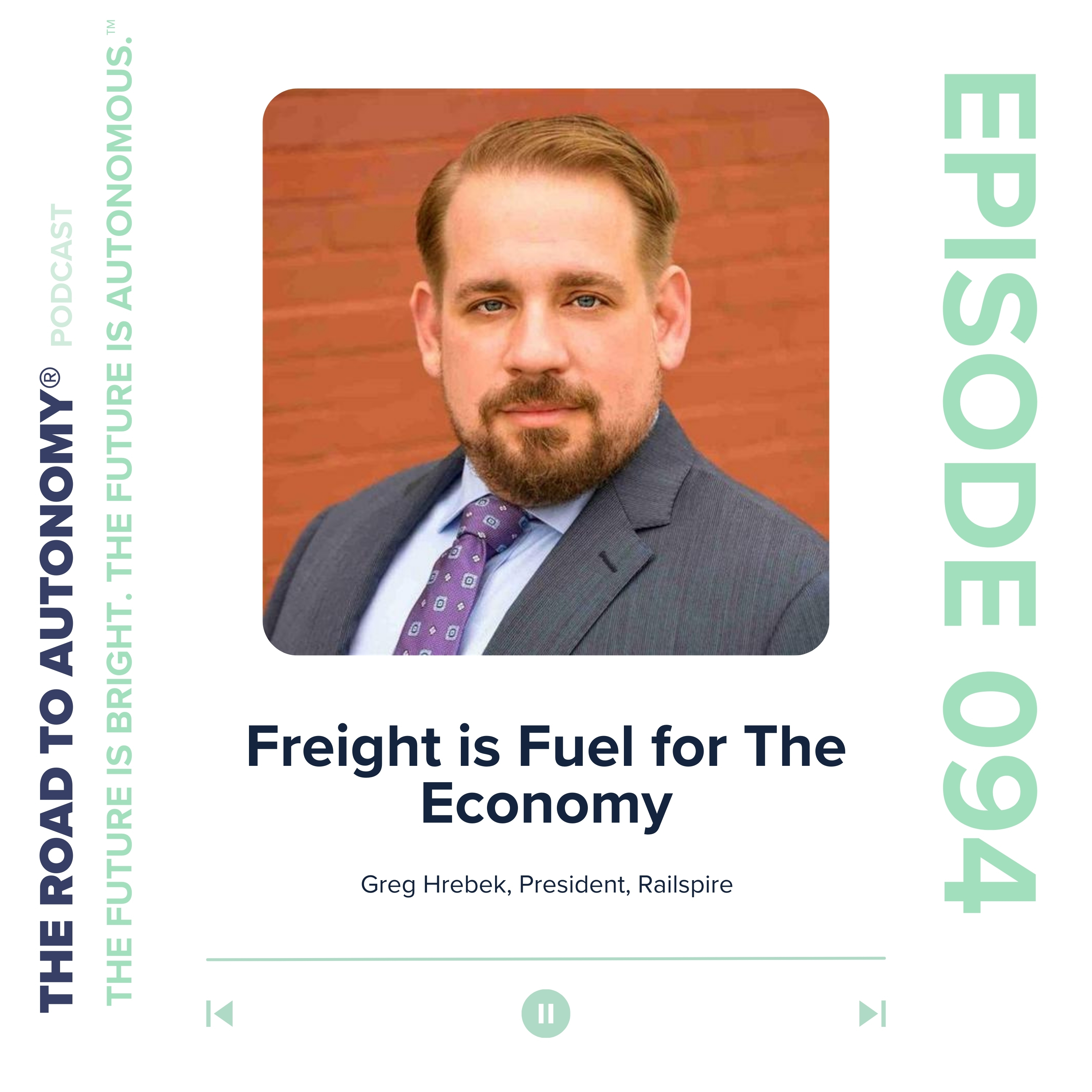
Ep 94Episode 94 | Freight is Fuel for The Economy
Greg Hrebek, President, Railspire joined Grayson Brulte on The Road To Autonomy Podcast to discuss autonomous trains and their impact on the economy. The conversation begins with Grayson and Greg discussing the first partially automated train which debuted on London’s Victoria Line in 1967 and how train automation has evolved over the last 55 years. Looking to the future of autonomous trains, Greg shares the following insight:Where autonomy comes in is when you start treating autonomy as a tool, rather than the goal. If you have autonomy, you can then start doing more complex interactive interactions, we call that orchestration. – Greg HrebekOrchestration will lead to the growth of intermodal as shippers look to develop infrastructure as-a-service model when large logistics companies begin to leverage autonomous trucks and autonomous rail due to efficiencies. Today there are a lot of inefficiencies in the rail industry that can be solved with autonomy. Today, when a train comes into a yard with a crew, there is the chance that the crew could have to stay on the locomotive for 4 to five hours due to yard traffic. With autonomy, the wait is eliminated as the crew can disembark, while the locomotive waits and eventually drives itself into yard.It increases the efficiency of the network in the sense that you are not waiting on that crew to timeout. – Greg HrebekIn the rail industry there is a current lack of workers as railroads are struggling to hire. Jim Foote, CEO of CSX stated the following publicly at a 2022 AllianceBernstein Holdings conference: “CSX is turning away freight from customers, ceding cargo business to truckers as the railroad struggles to hire workers.” Technology is now a conversation of growth, not about labor savings. – Greg HrebekAs autonomy is introduced into the rail industry, it will help railroads grow and expand, which will have a positive impact on the economy. The technology will create new jobs various facets around the industry including maintenance as autonomous trains drive the track the same exact way each and every single journey. When you remove variants and variability out of something, things tend to break the same way over and over again. – Greg HrebekTaking a global approach, Greg shares his thoughts on autonomous train technology being exported to the world and where the technology will first be implemented. Grayson then asks Greg what role he wants Railspire to play as autonomous train technology scales.We want to be the folks that one enable yard operation, yard throughput. We really want to fundamentally get folks thinking around that orchestration layer. What is the next step beyond autonomy? Autonomy now we know how to do it. I call it an exercise in engineering, there is still a lot to figure out, there is a lot of logistics, but we see that we have proven it out. What is next? Once we have autonomous trains, what are the things we need to focus on? What are the things we have not thought about? Our goal is to help highlight those things. – Greg HrebekWrapping up the conversation, Greg shares is thoughts on how the freight rail market will change when autonomous locomotives scale. Recorded on Tuesday, June 7, 2022--------About The Road to AutonomyThe Road to Autonomy® is a leading source of data, insight and commentary on autonomous vehicles/trucks and the emerging autonomy economy™. The company has two businesses: The Road to Autonomy Indices, with Standard and Poor’s Dow Jones Indices as the custom calculation agent; Media, which includes The Road to Autonomy and Autonomy Economy podcasts as well as This Week in The Autonomy Economy newsletter.See Privacy Policy at https://art19.com/privacy and California Privacy Notice at https://art19.com/privacy#do-not-sell-my-info.
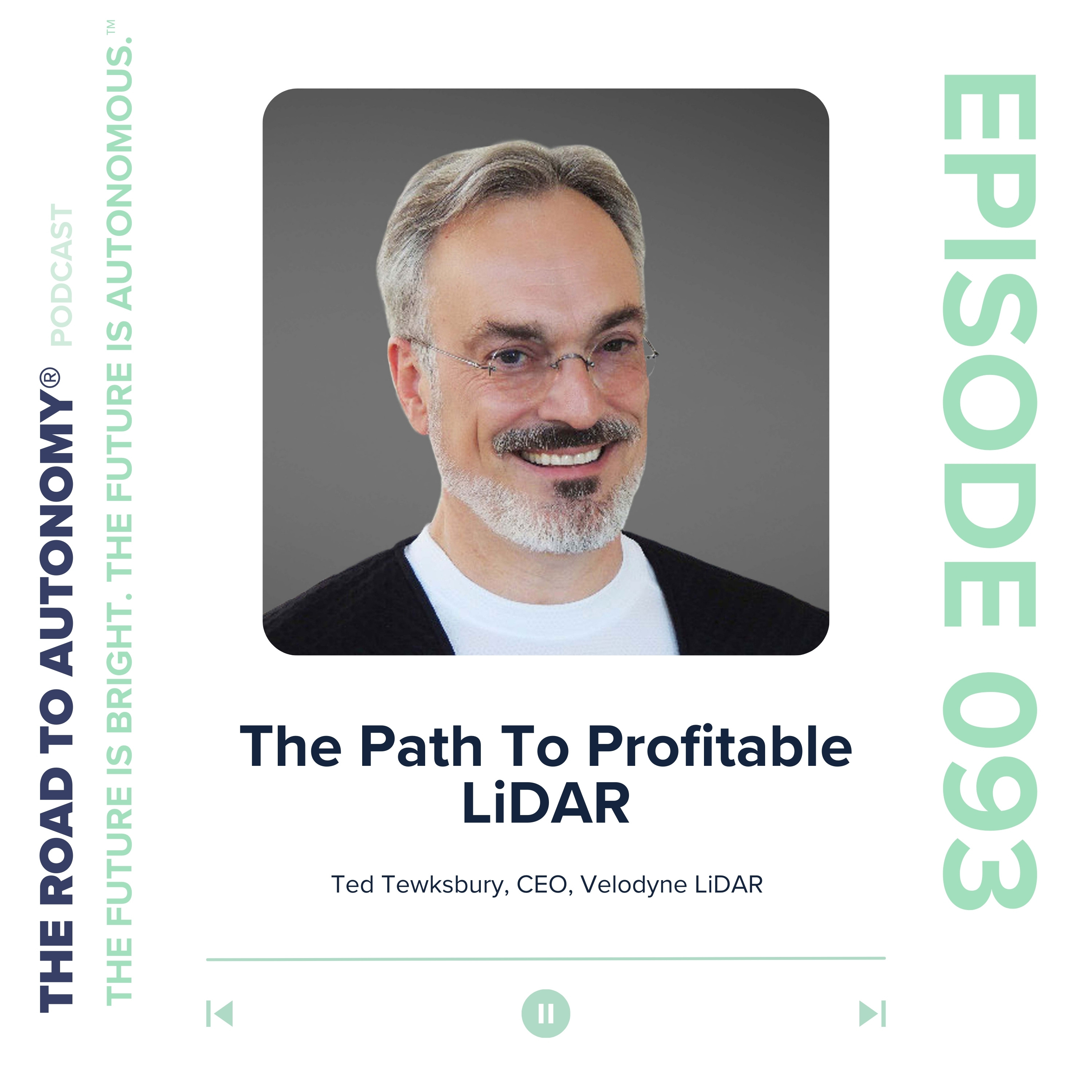
Ep 93Episode 93 | The Path To Profitable LiDAR
Ted Tewksbury, CEO, Velodyne Lidar joined Grayson Brulte on The Road To Autonomy Podcast to discuss Velodyne’s path to profitable LiDAR. The conversation begins with Ted discussing why he joined Velodyne now. I joined the company for three very simple reasons, first of all, I believe passionately that LiDAR is going to be an enormous market and it’s going to transform virtually every industry as we know it. Second, I believe that Velodyne has the right technologies at the right time to really capitalize on that opportunity. And, thirdly I knew that I had the right set of skills and expertise and grey hair to really help parlay the company’s technologies strengths into revenue growth, profitability and shareholder value. – Ted TewksburyIn 2021, Velodyne put in place a strong foundation for growth, including new executives and an upgraded Board of Directors. Now that the foundation has been laid, the company’s top priority for 2022 is to accelerate the company’s path to profitability. We are doing that by rationalizing our cost structure, while at the same time driving deployments of LiDAR at scale into a wide range of industries. – Ted TewksburyTaking a look at the current state of markets, Velodyne is prioritizing the industrial robotics and the intelligent infrastructure markets as the company focuses on generating profitable revenue today. Overlapping this market is the rapid growth of e-commerce fulfillment centers which inherently relay on industrial robots to move goods from the shelfs to the shipping line. It’s not just about sensors. At the end of the day, our customers are solving a business level problem, so we offer the full stack solution, software plus sensors. – Ted TewksburyUnder Ted’s leadership as CEO, the company is taking steps to lower the cost of LiDAR to sub $500 by offshoring manufacturing to Thailand. When the sub $500 LiDAR sensor is achieved, growth will be accelerated, especially in the automotive market. The biggest single challenge that faces not only Velodyne, but the entire LiDAR industry is cost. Because the competition is very inexpensive. The competition is radar and camera. – Ted TewksburyIn order to achieve cost reduction, the company has implemented a platform based design (MLA – Micro Lidar Array) strategy. With the company’s manufacturing occurring in Thailand and the current delay of 111 days for foods shipped from Asian Ports to the United States, Grayson asks Ted how he is managing the business for supply chain delays. We’re taking very proactive steps to alleviate bottlenecks. We are not just sitting idly by and waiting for the macro crisis to subside. First of all, we have lined up multiple sources for critical components, which gives us more flexibility. Second, we have redesigned some of our sensors to use more readily available components.Third, we’re judiciously building inventory on long lead-time components. Under those circumstances, that’s risky, and so we are requiring non-cancelable, non-returnable purchase orders from our customers. – Ted TewksburyBehind this strategy is Ted’s goal of Velodyne becoming the world’s first profitable LiDAR company. To achieve this goal, risk has to be managed and this is where the non-cancelable, non-returnable purchase orders strategy into comes into play. Velodyne is showing shrewd business acumen.Wrapping up the conversation, Ted shares his outlook on the economy. Recorded on Monday, June 6, 2022--------About The Road to AutonomyThe Road to Autonomy® is a leading source of data, insight and commentary on autonomous vehicles/trucks and the emerging autonomy economy™. The company has two businesses: The Road to Autonomy Indices, with Standard and Poor’s Dow Jones Indices as the custom calculation agent; Media, which includes The Road to Autonomy and Autonomy Economy podcasts as well as This Week in The Autonomy Economy newsletter.See Privacy Policy at https://art19.com/privacy and California Privacy Notice at https://art19.com/privacy#do-not-sell-my-info.
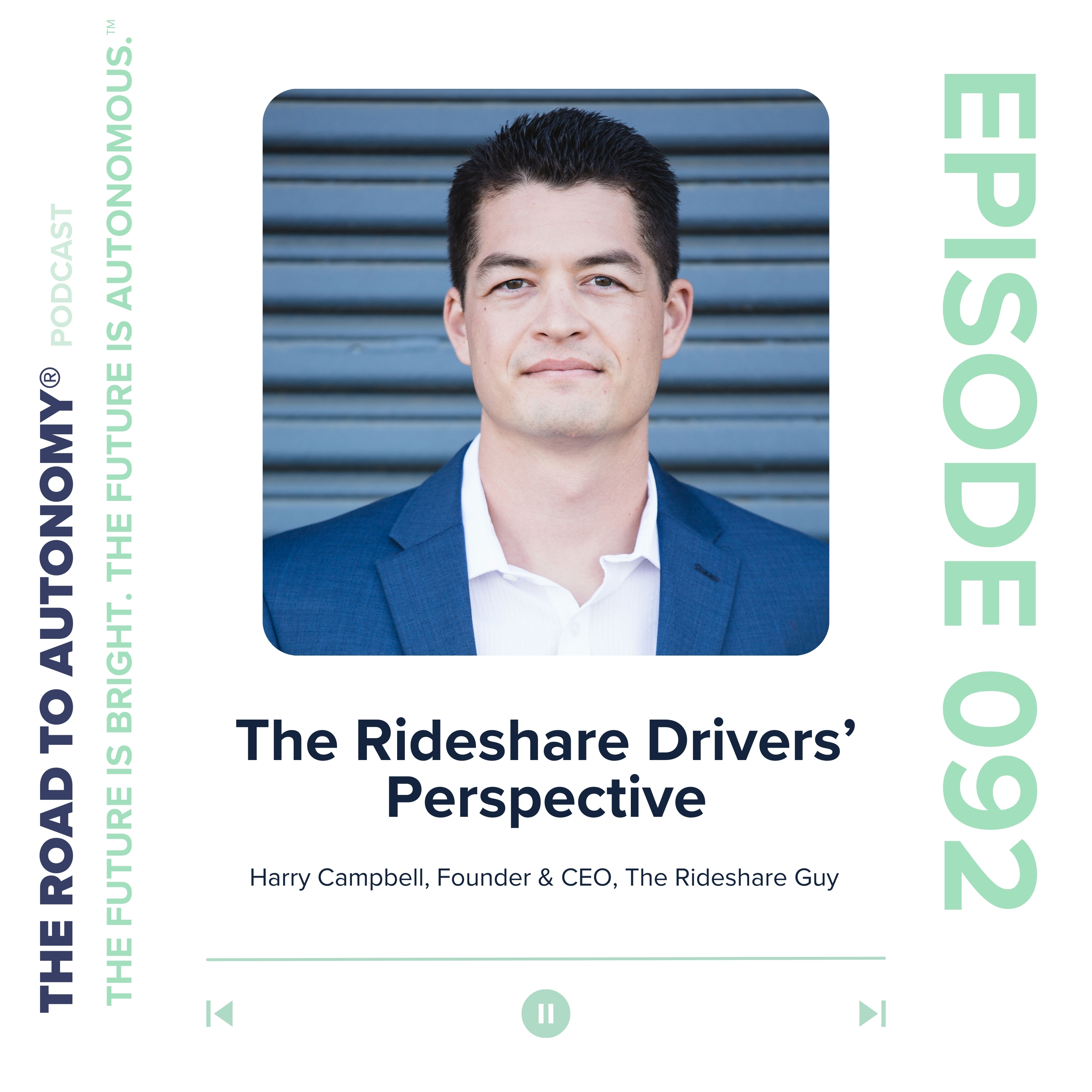
Ep 92Episode 92 | The Rideshare Drivers’ Perspective
Harry Campbell, The Rideshare Guy joined Grayson Brulte on The Road To Autonomy Podcast to discuss the current state of the rideshare industry from the drivers’ perspective. The conversation begins with Harry sharing his thoughts on the current state of the rideshare business. One thing that has defined the rideshare is the shortage of drivers. The shortage on the supply side, and this extends to the macro environment too. Many industries across the board have kind of reported for various reasons that they cannot hire enough workers, and Uber and Lyft have been no stranger to that. – Harry CampbellA shortage of drivers is leading to steadily increasing rates for passenger rides. With inflation currently at 8.3% and the average gallon of gas being $4.60 in the United States, the question now becomes is it even profitable for rideshare drivers to drive for Uber and Lyft in this economic environment? For sure, it’s definitely profitable. – Harry CampbellHarry goes onto to break down the economic data that encompasses a rideshare ride for the listeners from both his personal experience and data released by Uber. To achieve profitability, it all comes down to the rideshare drivers’ strategy.With a potential recession on the horizon, Grayson asks Harry if rideshare drivers are currently preparing for an economic downturn and the impact it could have on their earnings. Unfortunately, not. – Harry CampbellUnfortunately this common throughout the rideshare industry as one of the most popular Uber features for Uber Drivers is Instant Pay. The popularity of the Instant Pay feature is inherently part of a larger overall socioeconomic trend. Planning for a rainy day or building savings is not top of mind for a majority of drivers as they are focused on day-to-day finances. This trend carries over to insurance requirements as certain rideshare drivers do not carry the proper insurance. If you are interested in learning more about all the facets of the Rideshare business, Harry authored the The Rideshare Guide: Everything You Need to Know about Driving for Uber, Lyft, and Other Ridesharing Companies book which breaks down the rideshare business in great detail. The business of ridesharing is not currently profitable for operators such as Uber and Lyft. Grayson poses the question to Harry: “Can Uber and Lyft ever become profitable based on the current ways the businesses are structured?” Grayson then asks Harry whether Uber Eats is weighing down the company’s opportunity to achieve profitability. On a unit economics basis, Uber Eats is dragging down Uber the ride side of the business. – Harry CampbellWith Uber constantly doubling down on their Eats business, does DoorDash with $4.2 billion of cash on their balance sheet and a market cap of $27 billion make a run and try to acquire Lyft which has a market cap of $6.1 billion to try and compete with Uber? Grayson and Harry discuss the potential for an M&A transaction. I wouldn’t be shocked if something like that happened in the future. – Harry CampbellIf this transaction were to happen, how would Uber react? Would this further Uber’s super app push? Harry shares his thoughts on how Uber could potentially counter the move. Could Uber look to sell Uber Freight which currently operates at a 1% margin to shore up their balance sheet and focus on their core business of rides and delivery?Wrapping up the conversation, Grayson and Harry discuss the future of the rideshare business and what happens when autonomous vehicles scale globally. Recorded on Tuesday, May 31, 2022--------About The Road to AutonomyThe Road to Autonomy® is a leading source of data, insight and commentary on autonomous vehicles/trucks and the emerging autonomy economy™. The company has two businesses: The Road to Autonomy Indices, with Standard and Poor’s Dow Jones Indices as the custom calculation agent; Media, which includes The Road to Autonomy and Autonomy Economy podcasts as well as This Week in The Autonomy Economy newsletter.See Privacy Policy at https://art19.com/privacy and California Privacy Notice at https://art19.com/privacy#do-not-sell-my-info.
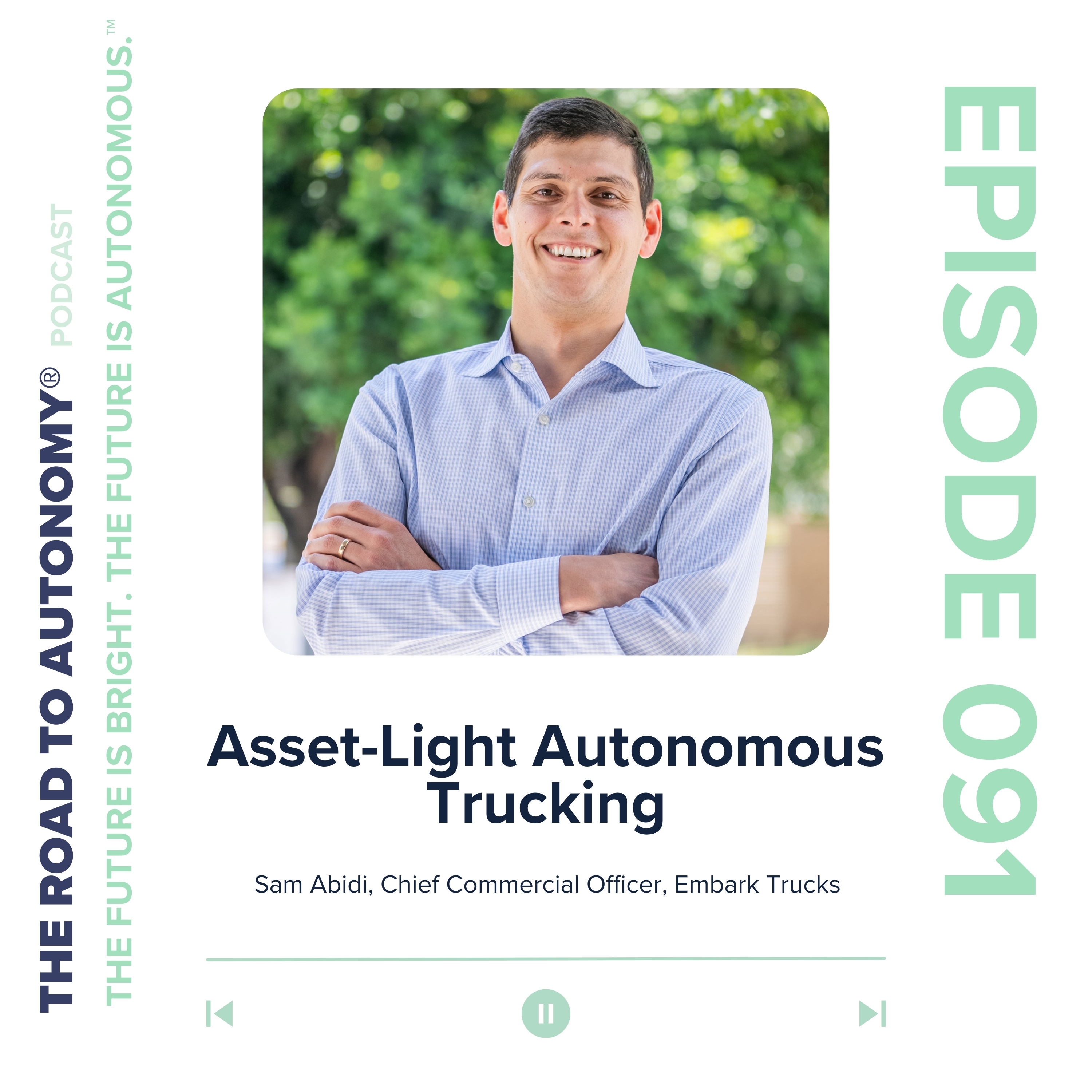
Ep 91Episode 91 | Asset-Light Autonomous Trucking
Sam Abidi, Chief Commercial Officer, Embark Trucks joined Grayson Brulte on The Road To Autonomy Podcast to discuss Embark’s asset-light approach to autonomous trucking. The conversation begins with Sam discussing how Embark as a pre-revenue company is approaching commercialization. We expect to scale operations by way of our carriers who will haul goods for the shippers that we work with, and we expect to work with Tier 1’s and OEMs to deliver that. – Sam AbidiTo deliver on this model, Embark has a partnership with Knight-Swift where Knight-Swift will own and operate the autonomous trucks running Embark’s Universal Interface. We set out on a rather large effort to develop a standardized set of sensors and compute with flexible mounts and communication interfaces, so that our AV system could go from one OEM to another. – Sam AbidiEach truck running the Embark Universal Interface will have a very similar user interface and experience across multiple OEMs which makes the system scalable. Embark’s system will allow carriers to add more capacity due to hours of service regulations which increases the amount of time it takes for a load to reach its final destination. With the U.S. inflation rate currently at 8.3%, a 40-year high and a driver shortage which is only growing, Grayson and Sam discuss why autonomous trucking is not being embraced as a tool to help reduce inflation by stabilizing the supply chain. It’s a complicated story, you got to have a second order understanding of how supply chains work, you got to understand hours of service, you got to understand relay networks and hub networks, to really recognize how autonomy unlocks e-commerce and two-day delivery, and everyone’s desire for cheap goods. – Sam AbidiWhen autonomous trucking is fully embraced by regulators, politicians and the public, the U.S. economy will benefit from job creation and lower inflation. For autonomous trucking to truly scale, partnerships are key. Embark has a partnership with Alterra for autonomous trucking terminals. At those depots, Ryder will be providing on-site services that are required to properly operate an autonomous trucking operation. From an infrastructure standpoint there are minor upgrades that have to be made to begin autonomous trucking operations, which will allow Embark to scale their terminal networks with partners.With the average price of diesel in the U.S. being $5.52 a gallon, Embark is beginning to look at alternative forms of fuel.We look forward to a platform that can run on electric or hydrogen for the distances that make sense for autonomy. – Sam AbidiWrapping up the conversation, Sam shares his thoughts on the current state of the autonomous trucking industry. Recorded on Tuesday, May 24, 2022--------About The Road to AutonomyThe Road to Autonomy® is a leading source of data, insight and commentary on autonomous vehicles/trucks and the emerging autonomy economy™. The company has two businesses: The Road to Autonomy Indices, with Standard and Poor’s Dow Jones Indices as the custom calculation agent; Media, which includes The Road to Autonomy and Autonomy Economy podcasts as well as This Week in The Autonomy Economy newsletter.See Privacy Policy at https://art19.com/privacy and California Privacy Notice at https://art19.com/privacy#do-not-sell-my-info.
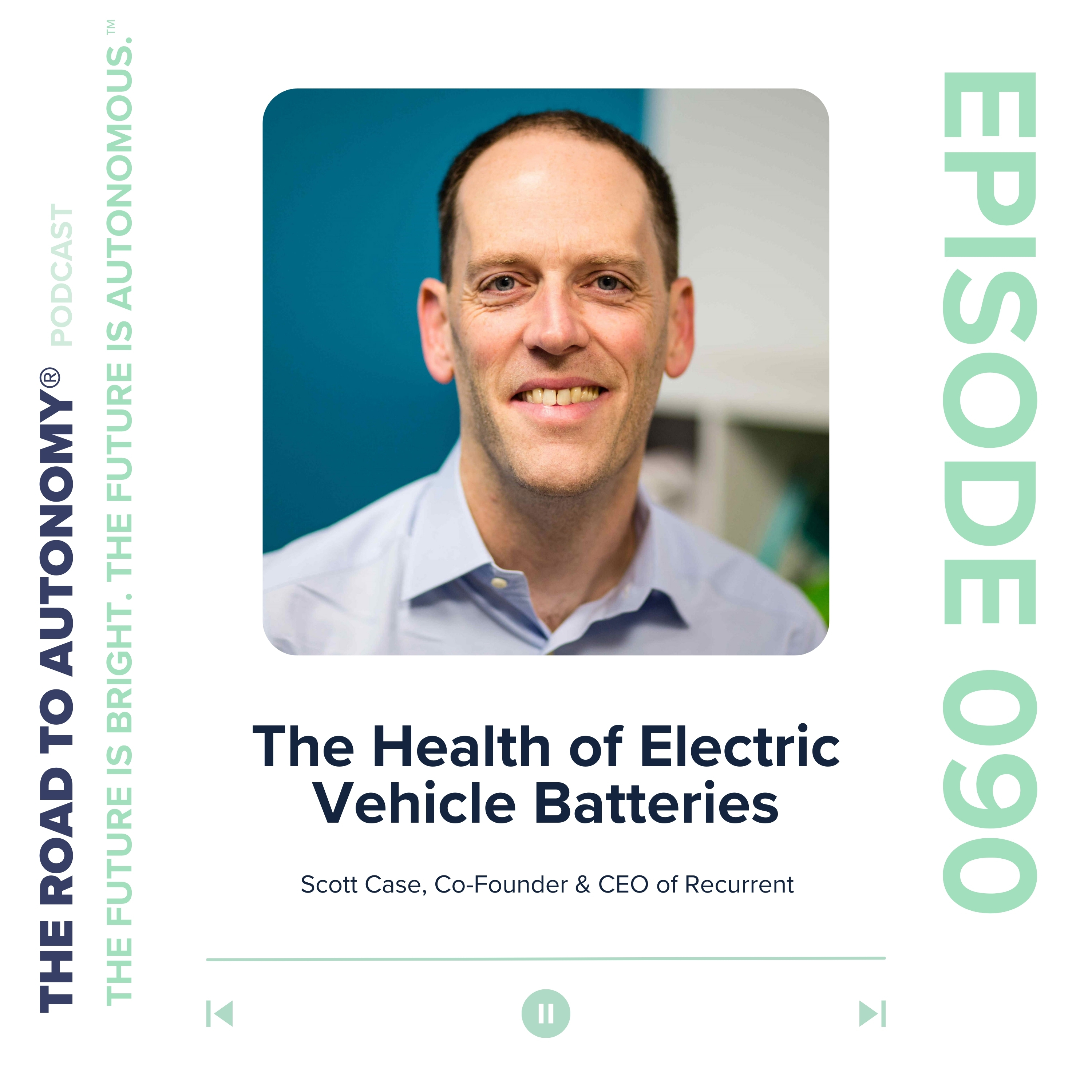
Ep 90Episode 90 | The Health of Electric Vehicle Batteries
Scott Case, Co-Founder & CEO of Recurrent joined Grayson Brulte on The Road To Autonomy Podcast to discuss using data to understand the true health of electric vehicle batteries.The conversation begins with Grayson asking Scott about the BloombergNEF 2040 electric vehicle forecast. I think every forecast made by everyone is wrong and too low. – Scott CaseWith over 9,000 vehicles currently on the Recurrent platform and the market for electric vehicle sales projected to grow globally 17.25% annually into 2040, Recurrent is preparing for the rapid growth of their platform. The Recurrent platform is gathering insights on how electric vehicle batteries perform in different climates, whether it’s a cold or hot weather region. Exposure to extreme heat over time will break down the battery, it will wear it out more quickly. – Scott CaseOn the other hand, exposure to extreme cold will not wear about the battery more quickly. With the wear on the battery, electric vehicles sold and driven in these environments could have a positive or negative impact on the resell value of the vehicle depending on the conditions. Grayson asks Scott from an economic standpoint if the health of the battery will be the determining factor when it comes to the price of an electric vehicle.It’s not yet, but it is going to be. – Scott CaseThis raises the question of what happens when electric vehicles come out of rental car fleets and are sold as used vehicles. How will they be properly priced? Will the pricing be based on the odometer reading or the health of the battery? Grayson and Scott discuss the possible ways the vehicles could be priced and whether a battery swap will be needed prior to selling the used electric vehicle.With the majority of Recurrent’s data coming from individual EV owners and the United States currently dealing with record high gas prices of $4.58 a gallon, Grayson asks Scott if he is seeing consumers switching from gas cars to electric cars due the high gas prices.High gas prices haven’t factored into that at all. Not yet, they are going to. – Scott CaseMaking reference to data to validate his point, Scott points to data from the Argonne National Laboratory.With J.P. Morgan projecting the national average price to hit $6 per gallon by the end of the summer, the transition to electric vehicles could accelerate. However, there could be an issue charging those newly bought electric vehicles as the North American Electric Reliability Corporation, the regulatory body that oversees grid stability is publicly stating that power supplies in the much of the United States and Canada will be stretched. If the grid issues persist, the adoption of EVs could be slowed. Wrapping up the conversation, Scott discusses how he sees the used EV market growing and evolving over the next decade.Recorded on Friday, May 20, 2022--------About The Road to AutonomyThe Road to Autonomy® is a leading source of data, insight and commentary on autonomous vehicles/trucks and the emerging autonomy economy™. The company has two businesses: The Road to Autonomy Indices, with Standard and Poor’s Dow Jones Indices as the custom calculation agent; Media, which includes The Road to Autonomy and Autonomy Economy podcasts as well as This Week in The Autonomy Economy newsletter.See Privacy Policy at https://art19.com/privacy and California Privacy Notice at https://art19.com/privacy#do-not-sell-my-info.
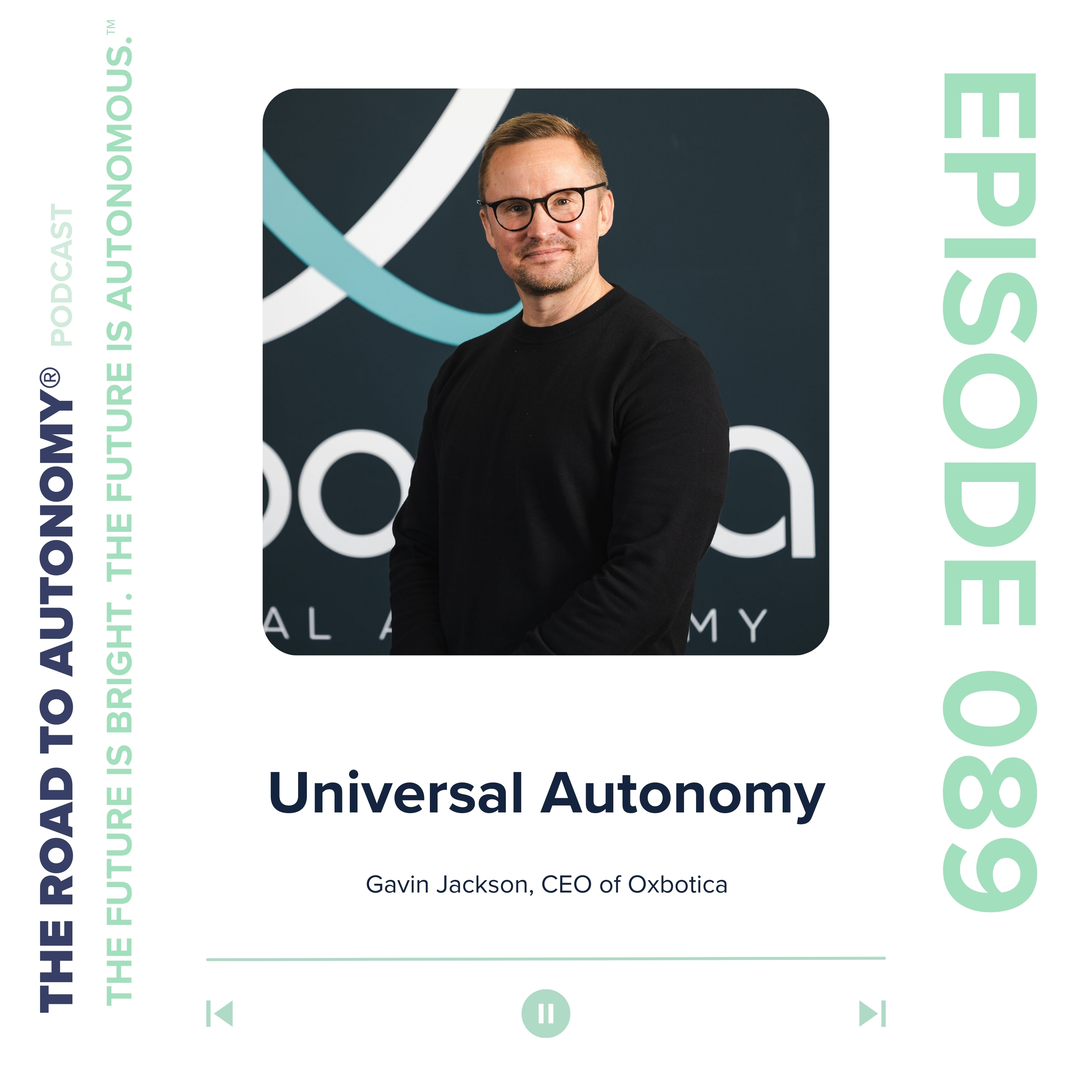
Ep 89Episode 89 | Universal Autonomy
Gavin Jackson, CEO of Oxbotica joined Grayson Brulte on The Road To Autonomy Podcast to discuss how the Oxbotica platform is enabling universal autonomy. The conversation begins with Gavin discussing why he came on as CEO of Oxbotica in December 2021. I feel that the autonomy space still is in the very very early stages of being quite a transformative technology, and almost a generational shift in how people and goods will move forever. It’s attractive to me to be so early in such a movement. It’s attractive to me, because I think that the impact that this sort of technology can have on the world will be profound. – Gavin JacksonWith Gavin’s background at Amazon and Microsoft, he is positioning the company to become a platform. As a universal platform we are able to compose solutions for different verticals, different vehicle types and different domains. With the very same Oxbotica driver platform, you are able to drive big heavy 600 ton trucks in a mine, or 40 ton trucks on a hub-to-hub on a highway or urban densely populated old fashioned victorian London street for goods delivery or indeed for passengers. – Gavin JacksonThe platform approach allows Oxbotica to develop solutions that are both convenient for riders and friendly to the environment through the reduction in carbon emissions. Being based in the UK, Gavin shares his thoughts on the UK market as it relates to autonomous vehicles.All of the infrastructure that exists in the UK is there for excellence. – Gavin JacksonAs Oxbotica scales, the company has global ambitions. In Germany at BP’s Lingen refinery, Oxbotica trialed an autonomous vehicle at the refinery as part of BP’s technical due diligence prior investing in the company. Deploying an autonomous vehicle at a refinery requires trust and transparency. This is exactly what Oxbotica did and they thrived at it, as it lead to an investment by BP which was a clear validation of their approach.With the proven success of operating at a BP refinery, the company is looking to expand their business in the Oil & Gas market as they prepare to scale their industrial autonomy platform.We think that autonomy is going to change the game. – Gavin JacksonOxbotica’s industrial autonomy platform is also being deployed in the mining industry through a partnership with Wenco, a wholly owned subsidiary of Hitachi Construction Machinery. By using autonomous vehicles in mines, global miners are able to reduce carbon emissions due to the lack of idling and in some cases, the electrification of heavy-duty mining vehicles. From autonomous shuttles to autonomous cars to heavy duty mining trucks, Oxbotica is taking a platform approach to autonomy. The diversity of vehicle type is really attractive to us, because it really ignites what we are here to do, which is universal autonomy. One unified platform to drive all of these vehicles. – Gavin JacksonWrapping up the conversation, Gavin shares his vision for the future of Oxbotica.Recorded on Tuesday, May 10, 2022--------About The Road to AutonomyThe Road to Autonomy® is a leading source of data, insight and commentary on autonomous vehicles/trucks and the emerging autonomy economy™. The company has two businesses: The Road to Autonomy Indices, with Standard and Poor’s Dow Jones Indices as the custom calculation agent; Media, which includes The Road to Autonomy and Autonomy Economy podcasts as well as This Week in The Autonomy Economy newsletter.See Privacy Policy at https://art19.com/privacy and California Privacy Notice at https://art19.com/privacy#do-not-sell-my-info.
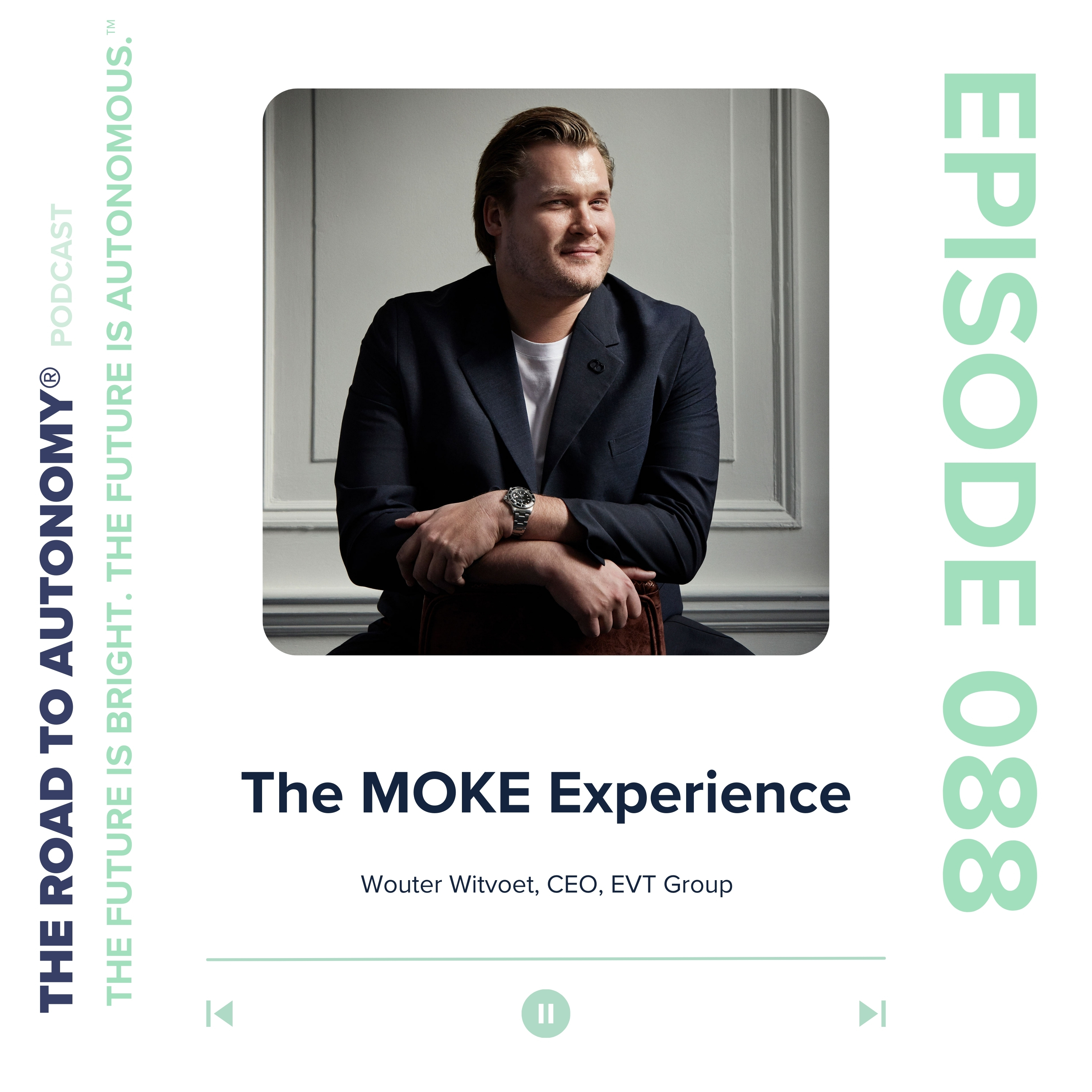
Ep 88Episode 88 | The MOKE Experience
Wouter Witvoet, CEO, EVT Group, joined Grayson Brulte on The Road To Autonomy Podcast to discuss electrifying the iconic MOKE and reinvigorating a brand that was built around lifestyles and experiences. The conversation begins with Wouter discussing how as the largest shareholder of MOKE International, he is planning on reinvigorating the iconic MOKE brand. What we are effectively doing at EV Technology Group with the MOKE brand is that we take a lot of this excitement that exists around this brand, a lot of the following that is there and just creating an electric version of this that is effectively suitable for today’s age which is very much an electric age. – Wouter WitvoetAs car brands around the world begin the process of electrifying their iconic vehicles, some brands are taking this as an opportunity to redesign the vehicle, instead of focusing on the heritage of the brand. MOKE International has made the decision to lean into the future by electrifying, all the while respecting the heritage and the design of the iconic vehicle.When a brand electrifies a vehicle:It always has to start where the brand left off. – Wouter WitvoetBy taking this approach, the MOKE brand is building upon its heritage and the famous photos of Bridget Bardot driving the vehicle around Saint-Tropez. As the 2022 Season begins in Saint-Tropez, EVT will be integrating the MOKE experience into the overall Saint-Tropez experience through partnerships with villa rental operators and concierge services.In Saint-Tropez, you are coming here for an experience. You are not coming here because you need to be in Saint-Tropez. In the same logic you drive a MOKE because you want to drive a MOKE, not because it is necessarily the best car to go from A to B. It’s about an experience. – Wouter WitvoetThe new electric MOKE will be introduced as a subscription plan for €650 a month Saint-Tropez Season Pass and three year subscription service options. Looking to the future and enhancing the subscription service, there is a possibly that EVT will introduce a MOKE subscription plan that travels with you around the world.It’s about just having access to an EV wherever you go. – Wouter WitvoetExpanding the brand from a vehicle to a lifestyle, EVT will be introducing Casa MOKE this summer in Saint-Tropez. If Casa MOKE proves to be successful, the concept will be exported to iconic locations around the world and localized to the environment. If you have a MOKE, then something must be good in your life. – Wouter WitvoetAs EVT looks to expand the MOKE brand into new markets, the brand will introduce region specific MOKE experiences. Our thesis is that if you are talking about a luxury brand, you are talking about experiences. You need to launch a car on the market with a certain activity that is locally for that market. – Wouter WitvoetWrapping up the conversation, Wouter discusses EVT’s strategy as the company expands their brand portfolio. Recorded on Tuesday, May 3, 2022--------About The Road to AutonomyThe Road to Autonomy® is a leading source of data, insight and commentary on autonomous vehicles/trucks and the emerging autonomy economy™. The company has two businesses: The Road to Autonomy Indices, with Standard and Poor’s Dow Jones Indices as the custom calculation agent; Media, which includes The Road to Autonomy and Autonomy Economy podcasts as well as This Week in The Autonomy Economy newsletter.See Privacy Policy at https://art19.com/privacy and California Privacy Notice at https://art19.com/privacy#do-not-sell-my-info.
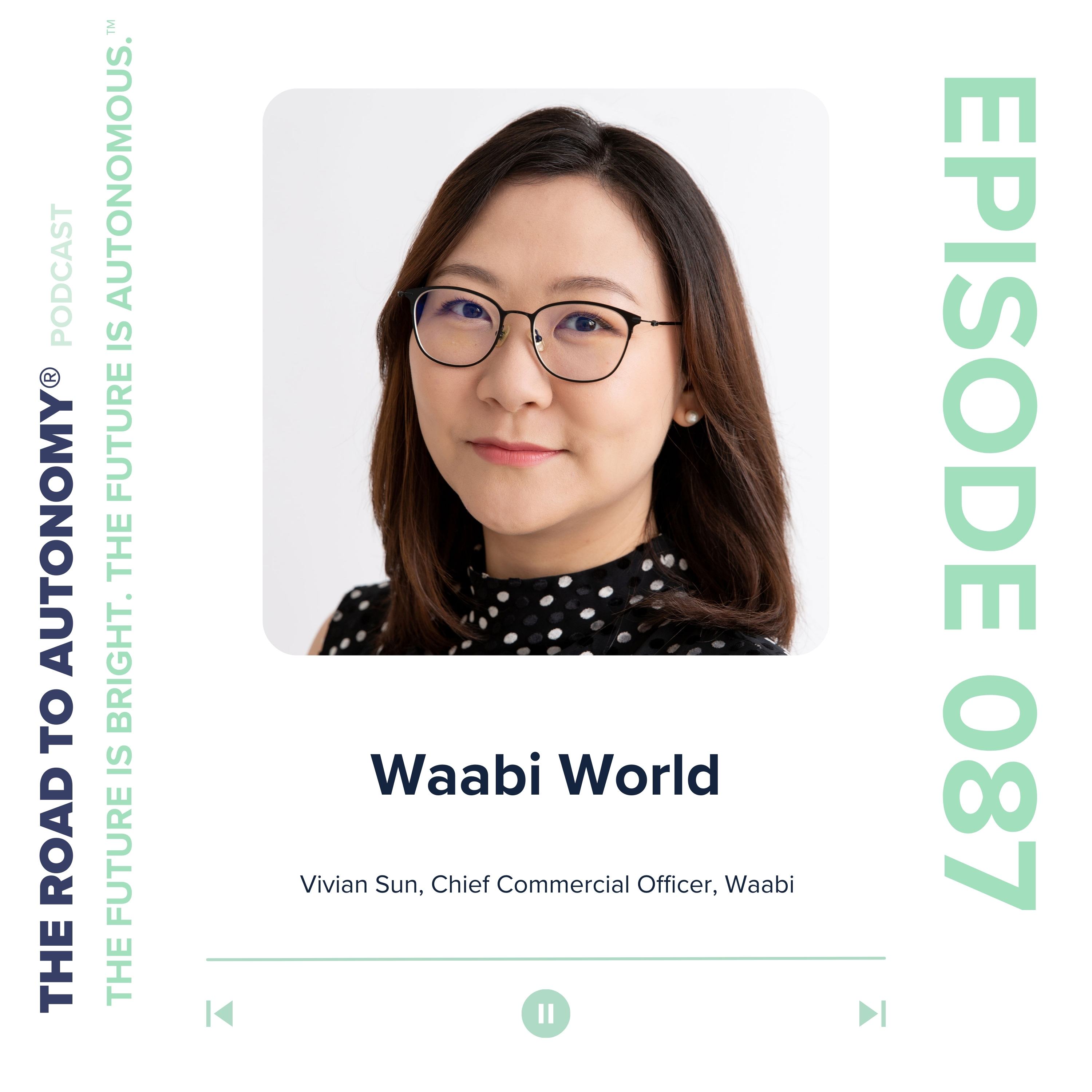
Ep 87Episode 87 | Waabi World
Vivian Sun, Chief Commercial Officer, Waabi, joined Grayson Brulte on The Road To Autonomy Podcast to discuss Waabi World and a simulation-first approach to autonomous trucking. The conversation begins with Vivian sharing her thoughts on when consolidation comes to the autonomous trucking industry. While consolidation is on the horizon, Waabi (which was founded in June 2021) is taking a different path to developing and scaling autonomous trucks. Autonomy is a marathon. – Vivian SunTheir approach to autonomy using a simulation-first approach is one that could completely change the end-to-end development process of autonomous trucks. As Waabi prepares to scale, Vivian shares some of the lessons that she learned earlier in her career and how Waabi can avoid those situations. It is really important that we have a scalable, adaptable technology. – Vivian SunA simulation-first approach to autonomy is allowing Waabi to operate a leaner corporate structure with less overhead as they develop the technology. From an economic standpoint, with the Federal Reserve raising rates as well as the European Central Bank, operating an autonomous trucking with a lean overhead will become a completive advantage as credit markets tighten.There are huge advantages of a more cost efficient way of developing self-driving technology. – Vivian SunThe key technology enabling this approach to autonomy is Waabi World, a high fidelity driving simulator. Inside of Waabi World, weather elements such as rain, fog, wind, ice and snow can be simulated to create real-world driving scenarios. These scenarios, combined with real-world traffic data, will help to develop a confident and safe Waabi Driver. While the Waabi Driver is being developed in simulation, professional truck drivers are playing a key role in the system — the Waabi Driver is learning from million plus miler drivers. We want to create a new paradigm to solve autonomy. – Vivian SunWrapping up the conversation, Vivian discusses Waabi’s partnership strategy and the company’s plans for commercialization. Recorded on Tuesday, April 19, 2022--------About The Road to AutonomyThe Road to Autonomy® is a leading source of data, insight and commentary on autonomous vehicles/trucks and the emerging autonomy economy™. The company has two businesses: The Road to Autonomy Indices, with Standard and Poor’s Dow Jones Indices as the custom calculation agent; Media, which includes The Road to Autonomy and Autonomy Economy podcasts as well as This Week in The Autonomy Economy newsletter.See Privacy Policy at https://art19.com/privacy and California Privacy Notice at https://art19.com/privacy#do-not-sell-my-info.
Ep 86Episode 86 | Decarbonizing the Supply Chain
Craig Harper, Chief Sustainability Officer and Executive Vice President, J.B. Hunt Transport Service joined Grayson Brulte on The Road To Autonomy Podcast to discuss decarbonizing the supply chain. The conversation begins with Craig discussing the reason why he stepped into the role of Chief Sustainability Officer in late 2020. When he began to develop J.B. Hunt’s sustainability plan he started by understanding how J.B. Hunt is perceived in the marketplace and by rating agencies. It’s been a good progress, steps to go through looking at those different rating agencies seeing how they each interpret different segments of the business and where we need to improve. – Craig HarperOn Monday, April 4, 2022 J.B. Hunt launched their CLEAN Transport Program to help customers reduce the carbon footprint of their supply chain. Intermodal is a great offering that we have, provides significant benefit to our customer, to citizens across the globe with a 60% reduction on the amount of carbon that it takes to move the same load from point-to-point all the way by truck versus what it takes to move intermodal. But even when you get that 60% reduction, you still have some residual carbon. And it’s like what are we going to do with this? This is where carbon offsets come in, and what that does it allows a customer to purchase offsets that fund an activity that reduces carbon and make their transport carbon neutral. – Craig HarperWhile we wait for electric trucks to scale, intermodal offers an opportunity for shippers to reduce their carbon emissions by 60% today.As an organization we said publicly we feel like there is somewhere between 7 to 11 million more loads that could be converted to intermodal. – Craig HarperAnother way to reduce carbon emissions is renewable diesel. In 2020, 51% of all of the fuel J.B. Hunt purchased was a bio-blended diesel product. Today, the company’s total weighted average of fuel from renewable sources is 8%. More and more renewable diesel is coming online each and every day, that is going to be great for the industry. – Craig HarperJ.B. Hunt has a culture of innovation. From embracing renewable diesel to entering into a market study with Waymo to pilot autonomous trucks, J.B. Hunt continues to look forward towards the future. Prior to entering into a market study agreement, Craig visited the Waymo team in Chandler, AZ and took a ride in Waymo’s fully autonomous vehicle. The trip was a culmination of a trusted relationship. As it relates the deployment of autonomous trucks, Craig shared the following insight:We believe that the technology will indeed pull certain types of freight on certain lanes and we are excited to play a part in it. – Craig HarperEven as autonomous trucks scale, skilled professional drivers will continue to play a significant role in the future of the trucking industry. Wrapping up the conversation, Craig and Grayson discussed the infrastructure that is needed to scale electric heavy-duty trucks.Recorded on Monday, April 4, 2022--------About The Road to AutonomyThe Road to Autonomy® is a leading source of data, insight and commentary on autonomous vehicles/trucks and the emerging autonomy economy™. The company has two businesses: The Road to Autonomy Indices, with Standard and Poor’s Dow Jones Indices as the custom calculation agent; Media, which includes The Road to Autonomy and Autonomy Economy podcasts as well as This Week in The Autonomy Economy newsletter.See Privacy Policy at https://art19.com/privacy and California Privacy Notice at https://art19.com/privacy#do-not-sell-my-info.
Ep 85Episode 85 | Decarbonizing Last Mile Delivery
Rachad Youssef, Chief Product Officer, BrightDrop joined Grayson Brulte on The Road To Autonomy Podcast to discuss decarbonizing last mile delivery.The conversation begins with Rachad discussing why January 2021 was the right time to launch BrightDrop.January 2021 was a great opportunity to announce what BrightDrop was going to do, because it was a real date in terms of our ability to deliver. – Rachad YoussefWith delivery traffic projected to grow 78% by 2030 and the global commitment to decarbonization, BrightDrop created the right product at the right time. One year after announcing the BrightDrop vans, their customers vans are out in the field currently delivering goods to homes and business in the LA region. The first vans were delivered to FedEx in December 2021, less than one year after launching the company.It took 14 months to put a vehicle on the road. During that time you have to incorporate a tremendous amount of learnings from studies in the field as well as the ability to find a vehicle platform that can accommodate those needs, and truly tailor it for the use case. – Rachad YoussefBrightDrop vans are utilizing GM’s Ultium battery platform providing range of 250 miles on a single charge. As the Ultium battery platform becomes more dense, those new longer range batteries will find their way into the vans. The ability for us to incorporate new chemistries and new technologies with regards to the battery itself is a commitment from BrightDrop from Day 1. – Rachad YoussefBrightDrop is focused on fully integrating software and hardware together to deliver an experience for the delivery driver that is easier than today’s traditional vans. An example of this commitment is the Trace vehicle concept which is integrated into the van’s design. The Trace vehicle allows delivery drivers to move goods quicker and easier. It’s really about ease of doing business. It’s really about showing our customers that we get it and that we are with them through their deployments. – Rachad YoussefOne of those customers is Walmart. Walmart is using both the Zevo 400 and Zevo 600 vans as part of their decarbonization strategy for delivery. The decarbonization of last mile delivery using electric vans is only going to accelerate as more companies adopt and implement an ESG strategy.Wrapping up the conversation, Rachad discusses how his time at Zoox influenced how he approaches design.Good design for me in this space comes with purpose. In other words, you are really looking for elegant ways to bring simplicity to complex situations. – Rachad YoussefRecorded on Tuesday, April 12, 2022--------About The Road to AutonomyThe Road to Autonomy® is a leading source of data, insight and commentary on autonomous vehicles/trucks and the emerging autonomy economy™. The company has two businesses: The Road to Autonomy Indices, with Standard and Poor’s Dow Jones Indices as the custom calculation agent; Media, which includes The Road to Autonomy and Autonomy Economy podcasts as well as This Week in The Autonomy Economy newsletter.See Privacy Policy at https://art19.com/privacy and California Privacy Notice at https://art19.com/privacy#do-not-sell-my-info.
Ep 84Episode 84 | The Current State of the Oil & Gas Markets
Dean Foreman, Chief Economist, American Petroleum Institute (API) joined Grayson Brulte on The Road To Autonomy Podcast to discuss the current state of the oil and gas markets.The conversation begins with Dean discussing the the unprecedented move by the Biden Administration to release 1 million barrels of oil per day for 180 days from the Strategic Petroleum Reserve and the global demand for oil.The U.S. Energy Administration estimated coming into this year, in December that we were at a global deficit of more than 3 million barrels per day. That’s with global demand outstripping or exceeding the supply or production level globally for oil. – Dean ForemanFurther putting this into perspective, in February 2022, the U.S. petroleum demand was 21.6 million barrels per day. The highest level of demand since August 2005. A portion of the demand is being driven by freight shipping partly as a result of the increase in online shopping. Another factor driving petroleum demand is COVID-19 tests as they are made from plastic. The molecules for the tests made of plastic start as oil and natural gas. In February 2022 more then 7 million barrels of oil out of the 21.6 million barrels of U.S. petroleum demand, about a 3rd were used to create petrochemical from a refining process that directly correlates with the global increase in demand for COVID-19 tests, which are made of plastic. Out of the 21.6 million barrels of U.S. petroleum demand, 4.3 million barrels a day were distillates (diesel). Between plastics and the increase in online shopping, almost 50% of U.S. petroleum demand (February 2022) was driven by consumer behavior. With petroleum demand increasing, the Keystone XL pipeline could help fill the demand. Dean shares what economic impact it would have on the market if the pipeline came online and heavy crude starting flowing from Western Canada to the United States. Expanding upon this conversation, Grayson and Dean discuss the current state of the U.S. economy and what the potential economic outlook looks like as the Federal Reserve begins to taper. As the economy goes, so does demand. – Dean ForemanDiving back into the oil markets, Grayson highlights the price of U.S. New York Harbor Jet Fuel which has risen 83% in the last 30 days to $744.32 a barrel (as of April 5, 2022). The price increase is a local issue, due to the lack of regional refining and the fact that jet fuel in the New York region has to be imported. From a global perspective, the global demand for oil was 100 million barrels per day in Q1 2022. The demand for oil is outpacing market supply by 3.2 million barrels per day.Demand is continuing to outstrip supply. – Dean ForemanGlobal Oil & Gas drilling activity is down 38% compared with February 2019. With a slowdown in drilling and a growing global demand for oil, Dean discusses the market from an economic standpoint. From a global perspective you got to have 4 to 6 million barrels per day of new oil just to sustain the production level this year. – Dean ForemanThe growth is only going to continue as according to the International Energy Agency, 46% of the world’s energy will be produced by oil and natural gas. Wrapping up the conversation, Dean shares his thoughts on the future of energy.Recorded on Friday, April 8, 2022--------About The Road to AutonomyThe Road to Autonomy® is a leading source of data, insight and commentary on autonomous vehicles/trucks and the emerging autonomy economy™. The company has two businesses: The Road to Autonomy Indices, with Standard and Poor’s Dow Jones Indices as the custom calculation agent; Media, which includes The Road to Autonomy and Autonomy Economy podcasts as well as This Week in The Autonomy Economy newsletter.See Privacy Policy at https://art19.com/privacy and California Privacy Notice at https://art19.com/privacy#do-not-sell-my-info.
Ep 83Episode 83 | Creating Value Through Services
Mike Plasencia, Group Director, RyderVentures & New Product Strategy at Ryder System, Inc. joined Grayson Brulte on The Road To Autonomy Podcast to discuss how Ryder creates value through services for customers and partners. The conversation begins with Mike discussing how Ryder became the central nervous system for autonomous trucking. Ryder noticed the trend of autonomy early and embraced the trend by investing and preparing the company for the future. The company has an 89 year history dating back to 1933 of being forward-thinking and innovative in ways it approaches business opportunities. As technology has continued to bring efficiency to the market, it has also brought challenges. That’s the name of our game and so over the next 50 years as technology continues to develop and business models change, we want to be that partner that customers can outsource to. We may look very different in the next 50 years, but ultimately our core task of solving difficult problems for our customers is still going to be our mantra. – Mike PlasenciaAs Ryder builds out their autonomous trucking portfolio, the company has partnered with Embark, TuSimple, Waymo and Gatik to assist them with scaling their autonomous operations. Mike goes onto discusses why Ryder is focused on partnering with autonomous trucking companies and not building out their own solution. You will never see us building the truck, you will never see us coding the driver. – Mike PlasenciaWhile Ryder might not build the truck or code the driver, they will however invest in the technology. As part of Gatik’s Series B round, RyderVentures invested in the company. It’s not just autonomy that RyderVentures is investing in, the fund is looking into investing opportunity in asset sharing, ecommerce, warehouse automation, big data and next generation vehicles. We try to be on the forefront of every new technology related to vehicles for our customers. – Mike PlasenciaRyder’s core advantage is that the company can provide services that unlock value for their customers and partners. Ryder’s partnership with Waymo is focused on being the company’s maintenance partner. [Waymo] can focus on being what they are really good at as a technology company, and we can focus on what we are really good at, maintaining vehicles. – Mike PlasenciaRyder is clearly focused on the providing value to the autonomous trucking ecosystem as on the company’s Q3 2021 earnings call, Mr. Robert Sanchez, Chairman & CEO of Ryder highlighted the company’s strategic alliances with several autonomous trucking companies. As the logistics industry grows with the introduction of new technologies, Grayson asks Mike how he sees the future of logistics evolving as more autonomous trucks come online. Optimization starts to take a big front-row seat. – Mike PlasenciaWrapping up the conversation, Mike discusses the data-driven study that Ryder commissioned in partnership with Georgia Tech and what they learned.Recorded on Tuesday, March 29, 2022--------About The Road to AutonomyThe Road to Autonomy® is a leading source of data, insight and commentary on autonomous vehicles/trucks and the emerging autonomy economy™. The company has two businesses: The Road to Autonomy Indices, with Standard and Poor’s Dow Jones Indices as the custom calculation agent; Media, which includes The Road to Autonomy and Autonomy Economy podcasts as well as This Week in The Autonomy Economy newsletter.See Privacy Policy at https://art19.com/privacy and California Privacy Notice at https://art19.com/privacy#do-not-sell-my-info.

Ep 82Episode 82 | Interacting with Law Enforcement
Brett Fabbri, Head of Law Enforcement Policy and Highway Safety, Kodiak Robotics joined Grayson Brulte on The Road To Autonomy Podcast to discuss how law enforcement interacts with autonomous trucks.The conversation begins with Brett discussing his 30-year career in law enforcement and how a ride-along with his cousin led to a career in law enforcement.At that time I was hooked. This is great. This is a very rewarding career. – Brett FabbriLaw enforcement plays a key role in the local community from interacting with business owners and residents of the community to keeping the community safe while simultaneously building trust with the community.Community engagement is the entire key to everything that law enforcement does. We are kind of guardians of the community. – Brett FabbriThe California Highway Patrol covers 186,000 miles. With the coverage map being so vast, engaging with the local community could be challenging, but that is not the case for the CHP. Brett explains how the California Highway Patrol interacts with the local community through area offices that function similar to local police stations.During his time at the California Highway Patrol, Brett served as the Special Services Commander for Northern California where he oversaw the commercial enforcement unit and the motor carrier safety unit for all of Northern California. It was in this role, that Brett was first introduced to autonomous vehicles.From the California Highway Patrol to autonomous trucks, Grayson asks Brett what he saw in the market when he decided to retire from law enforcement and join Kodiak Robotics. Brett saw the opportunity to build upon law enforcement’s mission of saving lives.In the end, this has the potential to save lives. In my law enforcement career that is where it all starts – saving lives and now it continues on with Kodiak. – Brett FabbriAs Kodiak prepares to scale, the company has to build trust and credibility in the industry, the local communities and the law enforcement community where Kodiak operates. Maintaining trust is key and Brett explains how Kodiak maintain that trust using his 30-year experience in community building.Everyday in local communities there are thousands of trucks being inspected for safety with 20% of those trucks failing inspection, creating a potential hazard on the nation’s roadways. This is a hazard that autonomous trucks will be able to solve.We are taking all the emotion out of driving. – Brett FabbriWith autonomous trucks on the verge of scaling nationwide, Grayson asks Brett what his peers in law enforcement think about autonomous trucks.They have a lot of good questions. They want to know about traffic stops, collisions and how inspections processes are going to work. – Brett FabbriWith lots of questions, it is important to have an open line of communication with law enforcement to ensure there are no surprises and those officers know which companies are operating autonomous trucks in their jurisdiction.Officers need to know how to pull over an autonomous truck with no safety driver on-board. This process has to be documented by the autonomous trucking company and shared with local law enforcement where the trucks are operating.Then there is the question of what happens if the autonomous truck is involved in a crash.If one of our vehicles is involved in an accident, that Kodiak truck will notify the operations center that will notify law enforcement that there has been a collision. That Kodiak truck will be programed to move to the right shoulder or to a safe location, unless it becomes disabled because of the collision. – Brett FabbriThe amount of data the trucks gather from LiDAR, cameras and sensors will assist law enforcement when they investigate the incident. This is one of the positives that will come out of a potential crash.To achieve all of these positives, a Law Enforcement Interaction Plan has to be developed, implemented and shared with law enforcement.We are working with law enforcement as we develop the plan, because we want to make it a collaborative effort and we want it to be successful. We want it to be comprehensive. – Brett FabbriWrapping up the conversation, Brett discusses what has to be done from a law enforcement perspective as Kodiak scales to multiple states.Recorded on Tuesday, March 22, 2022--------About The Road to AutonomyThe Road to Autonomy® is a leading source of data, insight and commentary on autonomous vehicles/trucks and the emerging autonomy economy™. The company has two businesses: The Road to Autonomy Indices, with Standard and Poor’s Dow Jones Indices as the custom calculation agent; Media, which includes The Road to Autonomy and Autonomy Economy podcasts as well as This Week in The Autonomy Economy newsletter.See Privacy Policy at https://art19.com/privacy and California Privacy Notice at https://art19.com/privacy#do-not-sell-my-info.
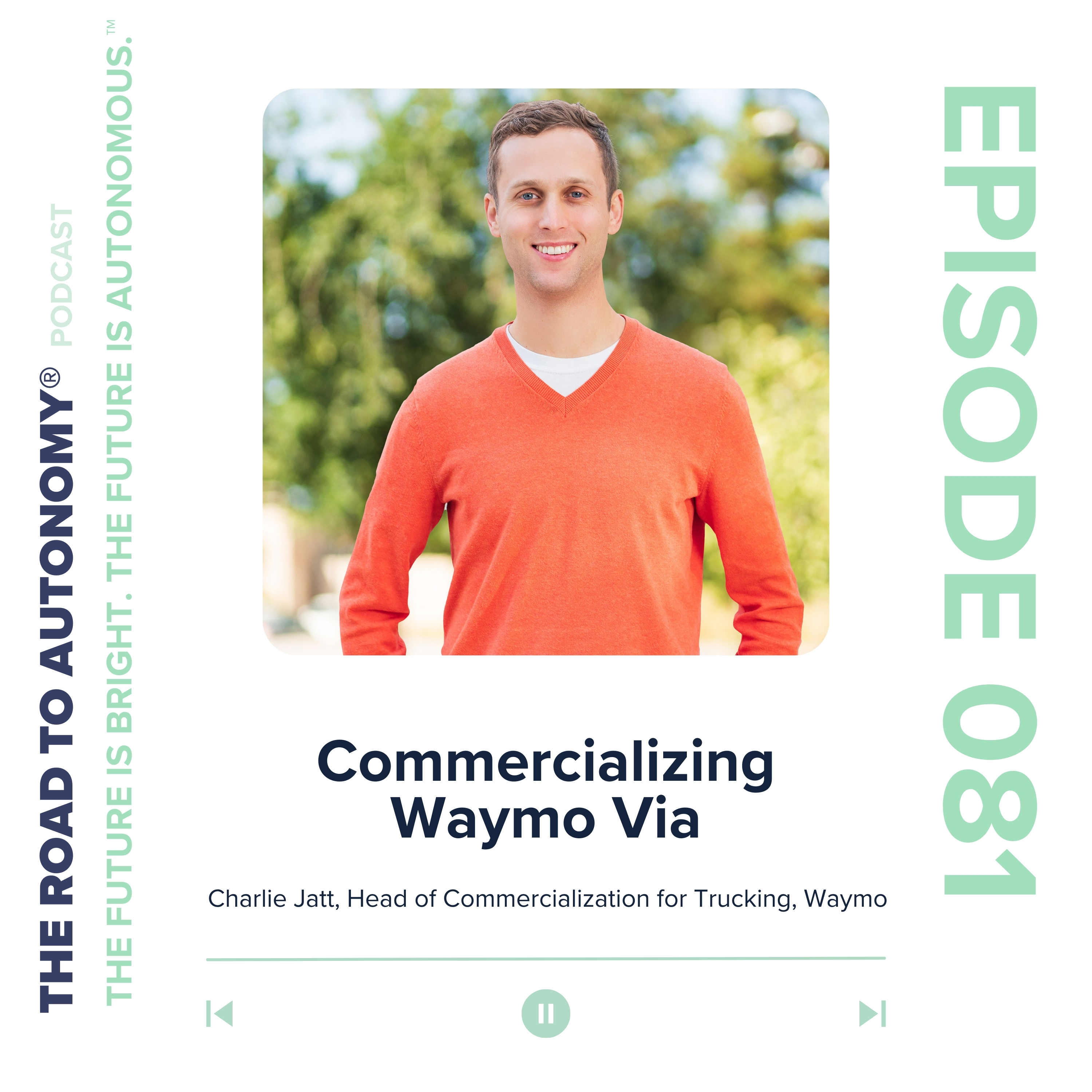
Ep 81Episode 81 | Commercializing Waymo Via
Charlie Jatt, Head of Commercialization for Trucking, Waymo, joined Grayson Brulte on The Road To Autonomy Podcast to discuss commercializing and scaling Waymo Via.The conversation begins with Charlie discussing why Waymo entered the autonomous trucking industry.The philosophy and the theory of our technology was we’re building a driver and that driver can be used for lots of different applications, different types of vehicles. The mission of the company was always to build that technology in a way that could be applied to many different exciting use cases.It has always been on our roadmap to explore diverse applications and trucking and logistics is a huge one of those. In 2017, when we then put our first autonomous truck on the road it was the right time for us to put that theory to test. – Charlie JattAs Waymo scales up autonomous trucking operations on public roads, Charlie talks about how Waymo builds public trust with the local community, law enforcement, and first responders. Waymo is also building trust with the professional truck driver community by engaging with them and learning from their millions of miles of on-road experience.Drivers play a very critical role for us and it is going to be a partnership between autonomous technology and professional truck drivers for many years to come. – Charlie JattShifting the conversation to commercialization and economics, Grayson and Charlie discuss autonomous trucking and its potential impact to help reduce inflation which is currently at a 40-year high.There is a huge opportunity for autonomous trucking to increase efficiencies in the supply chain, reduce blockages in the supply chain, reduce costs and prices in the supply chain. – Charlie JattWith the driver shortage, growth of e-commerce, and a strained global supply chain, the opportunity for autonomous trucking is only growing. With this growing opportunity, Grayson asks Charlie what role market conditions play as Waymo moves further towards commercialization.They don’t necessarily play a big role in our strategic decision-making process because the time scale that we’re talking about bringing the Waymo Via technology to market, kind of sits above some of those year-over-year changes in market conditions. – Charlie JattWhile market conditions can be volatile, trends tend to gain traction and grow over years. One of those trends is ESG. ESG seemingly comes up in every conversation as companies are fully committed to the trend. One of those companies is J.B. Hunt, which has gone from pilot to a long-term commercial agreement with Waymo.Charlie pulls back the curtain and tells the story of how the partnership with J.B. Hunt evolved from a pilot to Waymo’s first fully autonomous customer through an alliance that consists of four main components.As Waymo Via scales, the company will not become a trucking company and operate its own fleet. Waymo will be commercialized as a Driver-as-a-Service model partly through partnerships with Daimler Trucks and Ryder.Wrapping up the conversation, Charlie shares his views on how he sees the autonomous trucking industry evolving over the next 10 years.Recorded on Tuesday, March 15, 2022--------About The Road to AutonomyThe Road to Autonomy® is a leading source of data, insight and commentary on autonomous vehicles/trucks and the emerging autonomy economy™. The company has two businesses: The Road to Autonomy Indices, with Standard and Poor’s Dow Jones Indices as the custom calculation agent; Media, which includes The Road to Autonomy and Autonomy Economy podcasts as well as This Week in The Autonomy Economy newsletter.See Privacy Policy at https://art19.com/privacy and California Privacy Notice at https://art19.com/privacy#do-not-sell-my-info.
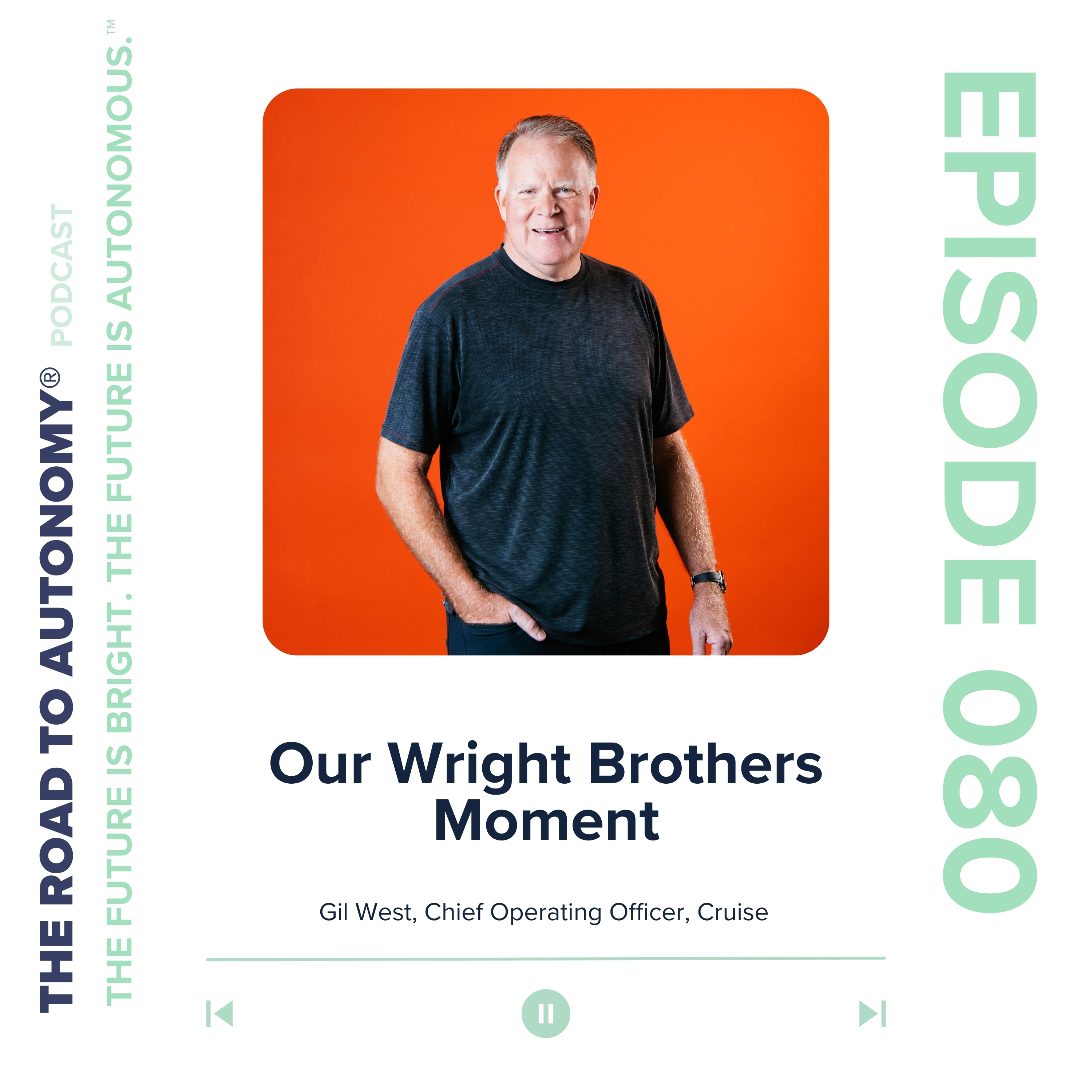
Ep 80Episode 80 | Our Wright Brothers Moment
Gil West, Chief Operating Officer, Cruise joined Grayson Brulte on The Road To Autonomy Podcast to discuss commercializing Cruise and why it’s their Wright Brothers moment.The conversation begins with Gil discussing Cruise’s road to commercialization.At a high level, we are making the pivot from an R&D company to commercial operations. – Gil WestWith a background as the former COO of Delta Airlines, Gil knows how to scale complex commercial operations while ensuring world-class customer service for customers.If you are able to run great operations, it is a real springboard for the customer experience. – Gil WestGreat customer service becomes fuel for a business and this is the path that Cruise is on as the company shifts its focus to commercializing its service. This is exactly what Delta did when the company purchased an oil refinery, introduced employee profit-sharing, stock options, and merged with Northwest Airlines.Over time you just have to drive the results to back up your vision and that was the approach. – Gil WestComparing and contrasting the airline business to the autonomous vehicle business, Gil and Grayson break down the airline industry and what the autonomous vehicle industry can learn from 100+ years of operations experience.The Cruise Origin vehicle will operate in a similar to Boeing or Airbus planes on fixed maintenance and upgrade schedules. Each Origin’s lifespan will be a million miles and after its service, the Origin will be recycled.It was only 93 years ago that Delta operated its first commercial flight. 93 years later, Cruise autonomous vehicles are now driving around the streets of San Fransico with no driver behind the wheel. Technology has come a long way during this time and has forever changed the world.Gil reflects on history and offers the following powerful statement:This is our Wright Brothers moment. – Gil WestAs autonomous vehicles operations scale, the economic benefits will have a profound effect on the global economy.I am old enough to remember the advent of personal computers. It was kind of the same thing there as people would look at it and go what does this mean, what does it mean to me, even my job. And then you realize, It’s a tool and it just drives additional productivity and I think that’s ultimately how autonomous will emerge. It just creates time advantages and productivity advantages that give us all another leg up in society. – Gil WestWhen Cruise expands to new cities and scales, the company has to ensure the reliability of its service. Cruise is able to do this because of the amount of data the vehicles gather. The data gathered is used to develop extremely accurate predictive maintenance models by using machine learning.As reliable as the airlines were, we have a chance actually to be even more reliable because of the data that we have and our ability to use it. – Gil WestWrapping up the conversation, Gil discusses growing up in his father’s auto parts store and what he learned during that time. Bringing the conversation full circle, Gil shares insights into what is next for Cruise.Recorded on Thursday, March 10, 2022--------About The Road to AutonomyThe Road to Autonomy® is a leading source of data, insight and commentary on autonomous vehicles/trucks and the emerging autonomy economy™. The company has two businesses: The Road to Autonomy Indices, with Standard and Poor’s Dow Jones Indices as the custom calculation agent; Media, which includes The Road to Autonomy and Autonomy Economy podcasts as well as This Week in The Autonomy Economy newsletter.See Privacy Policy at https://art19.com/privacy and California Privacy Notice at https://art19.com/privacy#do-not-sell-my-info.
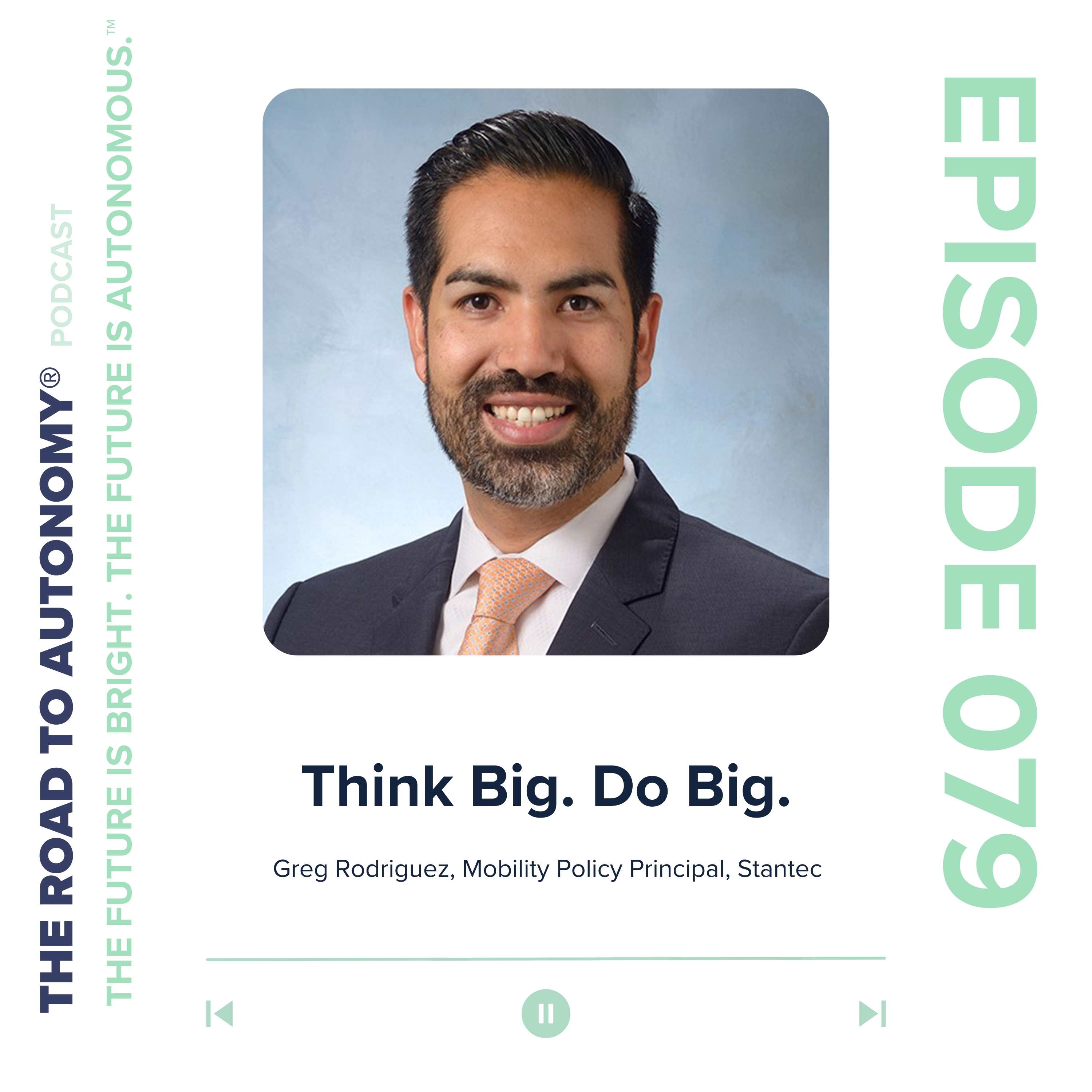
Ep 79Episode 79 | Think Big. Do Big.
Greg Rodriguez, Mobility Policy Principal, Stantec joined Grayson Brulte on The Road To Autonomy Podcast to discuss autonomous vehicle policy, federal infrastructure funding, and how both policy and funding impact the deployment of autonomous vehicles and trucks. The conversation begins with Greg sharing his thoughts on the current state of autonomous vehicle policy at the federal level.It changes yearly, if not daily. One word to describe it all right now, lacking. – Greg RodriguezWith the start, stop nature of how autonomous vehicle legislation has progressed on Capital Hill, Greg and Grayson discuss the challenges the AV industry faces from a federal policy perspective and why trust is the key to developing a national autonomous vehicle framework.With the uncertainty of federal autonomous vehicle legislation in the United States, other countries are using this as an opportunity to leapfrog the U.S. to take the lead on AV policy. During China’s 2022 National People Congress, Chen Hong, Chairman of SAIC Motor (China’s largest automaker) put forward a proposal to clarify the legal status of autonomous driving systems with the aim of speeding up the commercialization of smart vehicles.Will this motion motivate Congress to move on a national autonomous vehicle framework? At this time, it looks very unlikely due to the geopolitical issues the world is facing and the looming mid-term elections. More likely we will continue to see States introduce AV legislation over the course of the next three to four years.States such as Arizona, Arkansas, Florida, Louisiana, Nevada, and Texas have all enacted AV legislation. The legislation is having a positive impact on the States from an economic perspective as companies have opened offices and set up operations. Texas in particular has emerged as the home of autonomous trucking as companies flock to the State due to the freight capacity and the friendly AV regulatory environment.Staying on the theme of autonomous trucking, Grayson and Greg discuss the role that dedicated autonomous truck toll roads that connect ports to intermodal hubs could play in the future of freight logistics.It’s thinking about the impacts that currently exist in the way we do things and how can we minimize those impacts. It’s thinking about how we can create more efficiencies to move goods. – Greg RodriguezTo achieve these efficiencies, we have to think big and do big. This is exactly what Janno Lieber, CEO of the Metropolitan Transportation Authority (MTA) is doing. Mr. Lieber is showing leadership by being honest about the current state of public transportation in New York City and preparing for a future where millions of riders just don’t return.When you think big, new opportunities arise to do big. Grayson and Greg discuss new ways that MTA can offer transportation services by implementing point-to-point on-demand mobility services.The more mobility options that we can provide people access to, the more likelihood people will realize, oh wow I do not need to own my car anymore. – Greg RodriguezMobility options offer choice. Choice gives consumers the ability to choose which mobility service works best for them and their families. At the end of the day, consumers will end up determining the future of mobility as it will be driven by consumer spending.Wrapping up the conversation, Greg shares his vision for the future of mobility.Recorded on Monday, March 7, 2022--------About The Road to AutonomyThe Road to Autonomy® is a leading source of data, insight and commentary on autonomous vehicles/trucks and the emerging autonomy economy™. The company has two businesses: The Road to Autonomy Indices, with Standard and Poor’s Dow Jones Indices as the custom calculation agent; Media, which includes The Road to Autonomy and Autonomy Economy podcasts as well as This Week in The Autonomy Economy newsletter.See Privacy Policy at https://art19.com/privacy and California Privacy Notice at https://art19.com/privacy#do-not-sell-my-info.
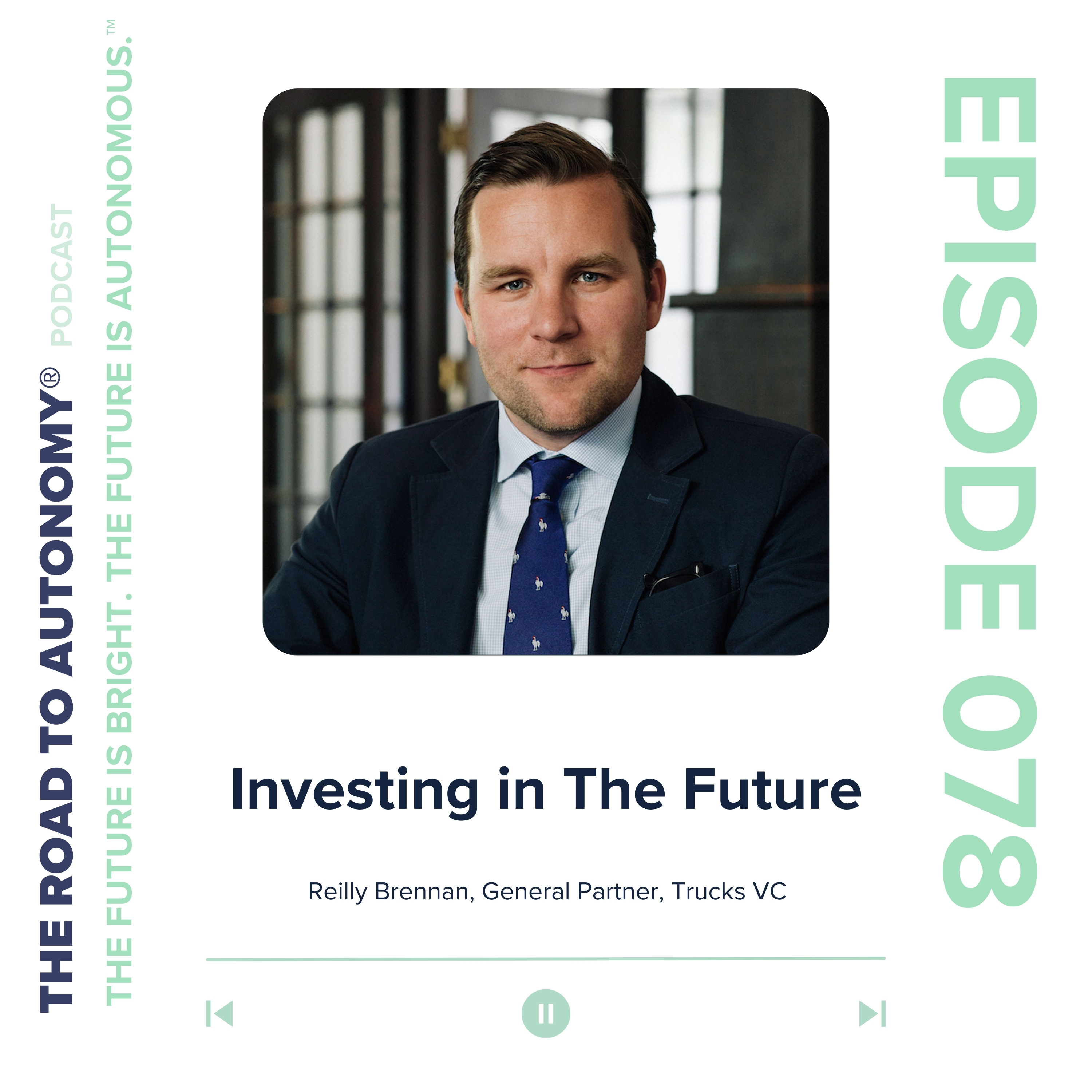
Ep 78Episode 78 | Investing in The Future
Reilly Brennan, General Partner, Trucks VC joined Grayson Brulte on The Road To Autonomy Podcast to discuss investing in the future.The conversation begins with Reilly and Grayson discussing what is going to happen when consolidation begins in the autonomous vehicle industry.This is a period of consolidation because you have essentially a lot of the robo-taxi ideas turned into commercial applications, probably around logistics and parcels. – Reilly BrennanThen there are the startups such as Bear Flag Robotics (acquired by John Deere – August 2021) and Gatik that have been focused on specific applications since day one. Shifting the conversation to industrial use cases, Grayson asks Reilly what his thoughts are on the industrial market as it relates to autonomy.One of those specific industrial markets is mining. With global mining companies hitting record profits and Rio Tinto recently announcing a $7.7 billion half-year dividend, Grayson asks Reilly if a global mining company could potentially acquire an autonomy startup.No doubt. Electrification and AV to those specific players is as much on their mind as the way you would think about DHL, UPS, Amazon, etc adding autonomy and electrification to theirs. It’s just a component of how they make money or will make more money in the future. – Reilly BrennanThere is a growing segment of the startup market has is beginning to focus on the opportunities in the industrial market. One aspect of the startup industrial market that is booming is the autonomous trucking industry.The autonomous trucking industry is generating revenue and shoring up the supply chain through automation, as consumers battle ever-increasing inflation. Reilly rightly points out that this industry is heavily dependent on partnerships to scale and return capital to shareholders and investors.One of the key partnerships in the future will be railroads. Grayson makes a prediction that in the next 18 to 24 months, a railroad will buy an autonomous trucking company.Another segment of the industrial market is maritime. Looking at investment opportunities in the space, Reilly is currently studying hydrography and shipping routes. There is an emerging opportunity to map waterways which will increase shipping efficiencies.The depths within ports can change so much that it impacts how much payload you can take. – Reilly BrennanAs maritime shipping routes get optimized, it’s time to allow autonomous trucks to enter and operate at ports.The partnership dynamics of autonomous trucking is arguably one of the most important parts of the business. In fact, we have seen some of the logistics companies take investments from entities that own or have access to those ports for that specific reason.It’s a fundamental question that there is not any one company, even Waymo that can lay claim to a leadership position for those specific pickup points. That is a big opportunity and in fact, it’s probably more important than saying you are running 10,000 trips a day on this route in Texas.If someone came to us and said if I secured the access to these specific vital ports in the United States, I think that is actually saying something a great deal.– Reilly BrennanStaying on the topic of Waymo, Grayson asks Reilly if Waymo will eventually split into two separate companies: Waymo Via focused on autonomous trucking and Waymo One focused on autonomous vehicles.It has always been a question in my mind whether we were at the point in this area of autonomy where you could have a multi-silhouette autonomy company. – Reilly BrennanIs Waymo the only company that could pull off a multi-silhouette approach to autonomy, because of Alphabet’s continued long-term financing commitment? It looks that way as Aurora has seemingly shifted a majority of its focus to autonomous trucking.For companies that don’t have a Google as a supporter and an investor, I think you probably have to pick one thing you are world-class in. – Reilly BrennanWithout an Alphabet-like financing partner, does Aurora get to a crossroads where they decide to sell off their autonomous vehicle division and focus solely on trucking? It’s a possibility as the autonomous vehicle market is beginning to consolidate around Argo AI, Cruise, and Waymo.Then there is May Mobility which is focused on structured routes. Pick-up and drop-offs from airports are a huge opportunity that the autonomous vehicle industry is currently not exploiting. The true opportunity for airports and AVs is in resort towns with limited traffic and high-amounts of passenger traffic during predefined periods of time throughout the year.Looking at the overall investment landscape, Reilly shares a story and his insights into how the team at Trucks VC uncovers potential investment opportunities.When we look at companies, we tend to not really look for ideas, we kind of just wait for great founders to reveal something to us and
Ep 77Episode 77 | Electrification of Industrial Logistics
Alan Ohnsman, Senior Editor, Forbes joined Grayson Brulte on The Road To Autonomy Podcast to discuss the electrification of industrial logistics.The conversation begins with Alan and Grayson discussing who is going to win as multiple industries shift to electrification.Most of the attention has gone to say Tesla and the passenger car market. But what’s happening on the heavy-duty industrial vehicle side, I think is probably more exciting because they can actually move a lot faster. It’s hard to get consumers to change buying habits. – Alan OhnsmanWhile a lot of attention in and around electrification is currently being paid to passenger and heavy-duty industrial vehicles, freight rail is beginning to emerge as an interesting opportunity for electrification.A freight train is a power plant on wheels. – Alan OhnsmanAs freight trains begin to become electrified, an opportunity arises to connect freight rail to electric heavy-duty trucks, creating intermodal 2.0. One of the keys to making this happen is positive train control which has created a more intelligent rail network.You both have the opportunity to move way more freight more efficiently than ever before, and if you can electrify it, so much the better. If you could then tie your railheads and depots into autonomous trucking networks, you got something really interesting going on.So there is so much potential to increase efficiency, while also cutting carbon emissions from rail and freight movement across the United States over the next five to ten years. It’s really remarkable. – Alan OhnsmanWith the shift to global electrification, a majority of the infrastructure for heavy-duty industrial applications still has to be developed. Additionally, there are still uncertainties around the global supply chain for precious metals that are needed to make batteries. Is there enough supply?Based on current technologies, there is probably not enough supply out there. There just isn’t. – Alan OhnsmanDoes a potential global shortage of precious metals, create a market opening for hydrogen to gain market share and acceptance with industrial applications? Grayson and Alan discuss the potential opportunities for hydrogen and why an industrial company could embrace hydrogen as an alternative to gas.But at its current stage, hydrogen is not clean. The same could be said for the mining of lithium as Serbia’s government recently revoked a lithium mining permit due to the potential environmental costs of the project.In California, there are also environmental concerns around mining for lithium in the Salton Sea. With a projected capability of mining 600,000 metric tons of lithium a year from the Salton Sea, will this become a political issue? Potentially as there is a great economic incentive and potential national security issue developing around lithium.With potentially limited precious metals and a focus on carbon impact, there is an opportunity to introduce and create a circular economy. Volvo is taking the first steps with their soon-to-be-introduced Polestar Zero.Wrapping up the conversation, Alan discusses what happens if hydrogen could be made from renewable sources of energy and the impact that would have on industrial logistics.Recorded on Tuesday, February 8, 2022--------About The Road to AutonomyThe Road to Autonomy® is a leading source of data, insight and commentary on autonomous vehicles/trucks and the emerging autonomy economy™. The company has two businesses: The Road to Autonomy Indices, with Standard and Poor’s Dow Jones Indices as the custom calculation agent; Media, which includes The Road to Autonomy and Autonomy Economy podcasts as well as This Week in The Autonomy Economy newsletter.See Privacy Policy at https://art19.com/privacy and California Privacy Notice at https://art19.com/privacy#do-not-sell-my-info.
Ep 76Episode 76 | Intermodal 2.0
Cheng Lu, President & CEO, TuSimple joined Grayson Brulte on The Road To Autonomy Podcast to discuss Driver Out and Intermodal 2.0.The conversation begins with Cheng reflecting on the last twelve months. From a traditional IPO to Driver Out, TuSimple has made incredible strides as the business and technology scale.Driver Out is one of our big milestones we had for 2021. It’s clearly a critical path to commercialization. -Cheng LuAs TuSimple prepares to commercialize its Driver Out autonomous freight operations, the company announced on February 2, 2022, that it had successfully completed over 550 miles of Driver Out on open public roads in real-world conditions. Cheng goes on to explain how the company is planning to scale the program.Over the next two years we are scaling the ODD (Operational Design Domain), so day time, new routes. – Cheng LuThe annual inflation rate for overall trucking costs is 17%. For the long-haul trucking sector, the annual inflation rate is 25%. With TuSimple successfully launching Driver Out, Grayson asks Cheng how TuSimple’s autonomous trucks can help to lower their customer’s inflation costs.Our mission is to lower the cost of freight transportation. – Cheng LuWith Driver Out in the process of scaling, TuSimple and Union Pacific announced a partnership in which TuSimple will help Union Pacific extend their operations. The partnership will allow Union Pacific to expand their network by using autonomous trucks where rail infrastructure is not available.If you could mix autonomy into their supply chain and to their network, it could add a lot more flexibility to their network. It can also help them expand their reach of their network, that today their train tracks do not get to. It’s very expensive now to build any new railroad tracks and so if you can leverage autonomy for that, it’s significant. – Cheng LuThis is another example of Union Pacific embracing emerging trends that will have an overall positive benefit on their business. Union Pacific had a similar move in 1936 when the company developed Sun Valley and connected the resort to Los Angeles via rail. The all-encompassing travel experience package was invented.Could the Union Pacific / TuSimple partnership usher in the future of freight shipping? Cheng and the team at TuSimple view it as intermodal 2.0 where autonomous trucks, rail, and human-driven trucks will all complement each other to shore up the supply chain.Autonomous trucking could be intermodal 2.0. – Cheng LuWrapping up the conversation, Cheng discusses the economic benefits of Driver Out and scaling the TuSimple business.Recorded on Monday, February 7, 2022--------About The Road to AutonomyThe Road to Autonomy® is a leading source of data, insight and commentary on autonomous vehicles/trucks and the emerging autonomy economy™. The company has two businesses: The Road to Autonomy Indices, with Standard and Poor’s Dow Jones Indices as the custom calculation agent; Media, which includes The Road to Autonomy and Autonomy Economy podcasts as well as This Week in The Autonomy Economy newsletter.See Privacy Policy at https://art19.com/privacy and California Privacy Notice at https://art19.com/privacy#do-not-sell-my-info.
Ep 75Episode 75 | Moving Past Misconceptions
Ariel Wolf, General Counsel, Autonomous Vehicle Industry Association joined Grayson Brulte on The Road To Autonomy Podcast to discuss misconceptions in the marketplace as it relates to AV technology.The conversation begins with Ariel discussing the rebranding of the Self-Driving Coalition for Safer Streets to the Autonomous Vehicle Industry Association.[The brand] showcases the evolution of both the AV industry and the organization’s role with policymakers and the public. – Ariel WolfAs AV technology advances, building and maintaining public trust is critical to the adoption of autonomous vehicles. In addition to public trust, there is a need for a National Autonomous Vehicle Framework that promotes the safe and swift deployment of autonomous vehicles in the United States.In the market, there are misconceptions around what an autonomous vehicle is as some consumers are mistaken that ADAS (advanced driver-assistance systems) equipped vehicles are indeed autonomous vehicles.One of the key challenges is the confusion in the public between the features and benefits of driver-assist technology and autonomous vehicle technology. – Ariel WolfThe Autonomous Vehicle Industry Association has called on Congress, policymakers, journalists, and the industry to clearly distinguish between ADAS and autonomous vehicles. When the terms are intermingled, it leads to confusion in the market and erodes public trust.When you look at the perception of AV technology, it’s influenced unfortunately by unrelated ADAS technology and that leads to a diminishment of consumer trust that is really unjustified. – Ariel WolfOn February 2, 2022, Ariel testified during The Road Ahead for Automated Vehicles hearing, part of the Committee on Transportation and Infrastructure, Subcommittee on Highways and Transit in Congress. During his testimony, he highlighted the important safety benefits of autonomous vehicles.Deploying AV technology to make the roads safer should be part of a holistic solution. – Ariel WolfAV technology will not just make the roads safer, the technology will create jobs and shore up the supply chain. A steady supply chain that is complimented with AV technology will help to lower inflation. With a 40-year high inflation rate in the United States, Grayson and Ariel discuss autonomous trucks and the benefit the technology will have on the U.S. economy.According to recent data released by the U.S. Bureau of Labor Statistics, the annual inflation rate for overall trucking costs is 17%. For the long-haul trucking sector, the annual inflation rate is 25%.With record-high inflation, Grayson asks Ariel why the United States is not embracing autonomous trucking as part of a comprehensive strategy to reduce inflation. The autonomous trucking industry is willing to step up, but there is a need for a national framework and engaging conversations between the Government and the industry.Conversations also need to take place between the Ports and the autonomous trucking industry as the costs to ship goods have gone up due to the supply chain crisis. At the Ports of LA and Long Beach, it can take anywhere from 28 to 52 days to ship a pair of shoes produced in China from Shanghai to Los Angeles, up from between 17 and 28 days before the pandemic. And the total cost has gone up by $1.77 per pair. Yet the Ports will not engage with the autonomous trucking industry.Today, autonomous trucks can not test and/or deploy in California due to the regulatory environment. This is having a negative impact on not only the citizens of the State of California but all Americans, as 31% of all imports to the U.S. enter the country through the Port of LA and Port of Long Beach.Autonomous trucking is going to be a positive for everyone involved. – Ariel WolfThe California Alliance for Freight Innovation (CAFI) was founded to transform how freight moves across the State of California to the benefit of everyone. With the future of autonomous trucking unsure in California, the industry has opened operations in Texas and is actively hauling freight in the State.Wrapping up the conversation, Grayson and Ariel discuss the environmental benefits of autonomous trucks.Recorded on Friday, February 4, 2022--------About The Road to AutonomyThe Road to Autonomy® is a leading source of data, insight and commentary on autonomous vehicles/trucks and the emerging autonomy economy™. The company has two businesses: The Road to Autonomy Indices, with Standard and Poor’s Dow Jones Indices as the custom calculation agent; Media, which includes The Road to Autonomy and Autonomy Economy podcasts as well as This Week in The Autonomy Economy newsletter.See Privacy Policy at https://art19.com/privacy and California Privacy Notice at https://art19.com/privacy#do-not-sell-my-info.
Ep 74Episode 74 | Peak of The New Gold Rush
Sean Ackley, eMobility Segment Lead, Americas, Hitachi joined Grayson Brulte on The Road To Autonomy Podcast to discuss why the electric vehicle industry is at the peak of the new gold rush.The conversation begins with Sean discussing how he first became interested in electric vehicles. From building a performance golf cart to electric race cars, he shares insight into how his passion for racing turned into building his own EVs and eventually a career.From passion to a career, Sean has incredible real-world insight into EVs. With this insight in mind, Grayson asks Sean what his thoughts are on the current state of the electric vehicle market.It’s exciting. It’s certainly at a fever pitch of attention globally, both from people who are looking at it as an opportunity to invest in new commercial models, companies looking to dabble in new technologies. I almost feel like we are at the peak of the new gold rush. – Sean AckleyWhile the EV market is at the peak of the new gold rush, what happens next?There is going to be a lot of winners. There is going to be a lot of people striking gold. – Sean AckleyWith a gold rush underway, there are still hurdles that have to be crossed and one of those is the inconsistency in EV charging. There are numerous complaints from EV owners about chargers being broken when they need to charge.A broken charger does not necessarily reflect poorly on the charging company, the majority of the time it reflects negatively on the car company. This is a problem that needs to be solved in order for EV market share to grow.There is a lot of frustration in what you might call uptime and reliability of charging infrastructure. – Sean AckleyConsumer frustration with EV charging infrastructure is creating new opportunities for traditional oil and gas companies to enter the space. Shell is beginning to explore charging infrastructure with plans to operate over 500,000 chargers by 2025.Users expect a parity to their experience to a petrol car or a gas engine vehicle. – Sean AckleyWhile the ability to quickly charge today is limited, does this create an opportunity for convenience stores to install EV charging stations? Grayson and Sean discuss what would have to happen from an infrastructure perspective to make EV charging at convenience stores a reality.As more electric vehicles come online along with EV charging infrastructure, the grid will have to be upgraded to support the additional load demand.We need to continue to invest in a robust and resilient grid and then supplement it where time is a critical factor with grid edge technologies. And then build out from there as technology continues to grow in efficiency. – Sean AckleyFor EV owners who live in dense urban environments, access to EV charging can be challenging. Grayson and Sean discuss what the future of EV charging in cities might look like.Wrapping up the conversation, Sean shares his vision of what the future of electrification looks like.Recorded on Tuesday, January 25, 2022--------About The Road to AutonomyThe Road to Autonomy® is a leading source of data, insight and commentary on autonomous vehicles/trucks and the emerging autonomy economy™. The company has two businesses: The Road to Autonomy Indices, with Standard and Poor’s Dow Jones Indices as the custom calculation agent; Media, which includes The Road to Autonomy and Autonomy Economy podcasts as well as This Week in The Autonomy Economy newsletter.See Privacy Policy at https://art19.com/privacy and California Privacy Notice at https://art19.com/privacy#do-not-sell-my-info.
Ep 73Episode 73 | Electrifying an Iconic Brand
Pete Bigelow, Senior Reporter, covering self-driving tech and the future of mobility, Automotive News joined Grayson Brulte on The Road To Autonomy Podcast to discuss Ford and the electrification of an iconic brand.The conversation begins with Grayson and Pete discussing the incredible performance of Ford under CEO Jim Farley in the public markets. As Ford electrifies their brand, the company has implemented a savvy strategy built around iconic Ford brands: F-150 and Mustang.As car companies such as Ford begin to electrify their lineup of vehicles, it’s important not to lose sight of the circular economy. Ford clearly understands the positive impact that the circular economy will have on the EV supply chain and the environment as Ford is an investor in Redwood Materials (a battery recycling startup).Everybody suddenly sees the writing on the wall that the chip shortage of 2020 to 2023 is going to quickly turn into the battery supply shortage of 2024 to 2028. – Pete BigelowWhile the supply chain will pose long-term challenges for automakers, the model of selling vehicles to consumers is changing. Consumers are demanding a direct-to-consumer model and shying away from dealers due to the overall buying experience.The dealership networks of today are not well set up to sell electric vehicles. They are an obstacle in a lot of ways. They are not incentivized to sell electric vehicles. It’s a whole different thing where you are selling an ecosystem and you need to answer questions about utility bills and getting a charger installed in your home. – Pete BigelowAs certain car dealers look to charge more for a vehicle due to demand, it ends up having a negative long-term effect on the automaker’s brand, not the dealer. It’s important for car companies to take a stand and protect their brands. Ford is doing this by not allowing dealers to mark up the vehicle due to demand.Startups such as Rivian (which Ford owns 12%) do not have dealer networks. Does this create an inherent competitive advantage? Grayson and Pete discuss the pros and cons of the Rivian brand and the appeal of outdoor (Patagonia, The North Face) brands. Grayson raises the question: Does Rivian’s van business devalue the brand’s overall value?Competition in the electric van market is heating up with GM’s Brightdrop, Stellantis’ Ram ProMaster, and Ford’s E-Transit vans coming online in the near future. Could these vans become autonomous in the future?Wrapping up the conversation, Grayson and Pete discuss the airport opportunity for autonomous vehicles and why the future of autonomy might not be shared.Recorded on Monday, January 17, 2022--------About The Road to AutonomyThe Road to Autonomy® is a leading source of data, insight and commentary on autonomous vehicles/trucks and the emerging autonomy economy™. The company has two businesses: The Road to Autonomy Indices, with Standard and Poor’s Dow Jones Indices as the custom calculation agent; Media, which includes The Road to Autonomy and Autonomy Economy podcasts as well as This Week in The Autonomy Economy newsletter.See Privacy Policy at https://art19.com/privacy and California Privacy Notice at https://art19.com/privacy#do-not-sell-my-info.
Ep 72Episode 72 | Seeing Around Corners
Jason Eichenholz, Co-Founder & CTO, Luminar joined Grayson Brulte on The Road To Autonomy Podcast to discuss optoelectronics, lasers and seeing around corners.The conversation begins with Jason telling the story of how he first became interested in imaging systems and optoelectronics during a physics demonstration he witnessed in high school.I vividly remember the day that I saw that laser beam going across. And I was like OK, I want to do this and learn everything I can about lasers and optics and imaging and the things we could do. I thought there were all sorts of applications. Little did I know that [this event] would shape the direction of my career, that I would be using lasers to make autonomous vehicles safely operate on highways. – Jason EichenholzFast forward from high school to a career and Jason is following his lifelong passion by commercializing optics and photonics as Co-Founder & CTO of Luminar.From Day 1, we wanted the technology to be deployable, scalable, and we never sacrificed on the technology-based upon what was available. We made the technology work to enable the application. – Jason EichenholzLuminar has a commercial partnership with Volvo where Luminar LiDAR will be standard on Volvo’s to be announced all-new electric SUV and an upcoming autonomous driving subscription called Ride Pilot. This partnership validates Luminar’s technology and looks to usher in the future of transportation.I look at the automotive industry and I look at the ability to bring technology and innovation forward. The overall industry is going through a transformation. I think it is the single largest transformation to transportation since the Model T. – Jason EichenholzAt CES 2022, Luminar demonstrated its Proactive Safety system to great success. The system was able to detect a safety dummy crossing the road and came to a complete stop. In the other lane, a vehicle that was not equipped with the Proactive Safety system ran over the safety dummy. Grayson and Jason go on to discuss the system as to how it was able to detect the safety dummy.Proactive Safety is about preventing accidents, not mitigating or minimizing them. It’s about preventing them. – Jason EichenholzFor the last 25 years, Jason has served as a volunteer firefighter in Orange County, Florida. During his service, he has seen sights and heard sounds that stop and make you realize how truly dangerous the roads of America can be at any time of the day. Continuing the safety conversation, Jason discusses the safety benefits of LiDAR and how Luminar tests for edge cases in all conditions.Wrapping up the conversation, Jason shares a personal story about why autonomous vehicles are so important for society and what he is doing to enable the future of autonomy.Recorded on Tuesday, January 11, 2022--------About The Road to AutonomyThe Road to Autonomy® is a leading source of data, insight and commentary on autonomous vehicles/trucks and the emerging autonomy economy™. The company has two businesses: The Road to Autonomy Indices, with Standard and Poor’s Dow Jones Indices as the custom calculation agent; Media, which includes The Road to Autonomy and Autonomy Economy podcasts as well as This Week in The Autonomy Economy newsletter.See Privacy Policy at https://art19.com/privacy and California Privacy Notice at https://art19.com/privacy#do-not-sell-my-info.
Ep 71Episode 71 | Narratives Shape Reality
Finch Fulton, Vice President of Policy and Strategy, Locomation joined Grayson Brulte on The Road To Autonomy Podcast to discuss the current state of autonomous trucking policy and why narratives shape reality.The conversation begins with Finch sharing his outlook for 2022 and what he is expecting to see in the autonomous trucking industry. The potential impact of the April 2021 Executive Order Establishing the White House Task Force on Worker Organizing and Empowerment on autonomous trucking.With rising inflation, labor politics, and a lack of truck drivers, Grayson and Finch discuss how autonomous trucking can shore up the supply chain and lower the costs of goods delivered to consumers. From an investment standpoint, investors in the public markets are starting to look at the autonomous trucking industry as an investment opportunity due to the technology’s ability to shore up the supply chain and its environmental benefits.The transportation sector as a whole represents 28% of total greenhouse gas emissions, and heavy-duty trucks account for 23% of that. – Finch FultonLocomation’s ARC (Autonomous Relay Convoy) technology will allow its customers to reduce greenhouse gas emissions by 22%. This reduction in greenhouse gases will have a positive environmental impact. The environmental benefits and the shoring up of the supply chain are two of the major benefits of autonomous trucking.When U.S. Labor Secretary Walsh was Mayor of Boston he fully embraced autonomous vehicles when he signed an executive order in 2016 welcoming autonomous vehicles to Boston. Over the last six years, has his stance on autonomy changed. Grayson and Finch discuss Secretary Walsh’s changing approach to autonomy and the impact these changing views might have on the autonomous trucking industry.The reality of what [truck drivers] face today is different than what the perceptions are. So we really have a lot to do to inform and educate [truck drivers] on what this technology can do to make their jobs better. – Finch FultonTo start this process, the industry has to build trust. The trust has to be built with truck drivers, politicians, regulators, and the public. Grayson floats the idea of the industry partnering with Disney to create a new Pixar movie about autonomous trucks that could help develop public trust in the technology. Finch fills in the storyline with real-world data.Wrapping up the conversation, Grayson and Finch discuss the positive economic impact that autonomous trucking will have on the U.S. economy.[The United States] lets innovators innovate and we do not start with no. – Finch FultonRecorded on Monday, January 3, 2022--------About The Road to AutonomyThe Road to Autonomy® is a leading source of data, insight and commentary on autonomous vehicles/trucks and the emerging autonomy economy™. The company has two businesses: The Road to Autonomy Indices, with Standard and Poor’s Dow Jones Indices as the custom calculation agent; Media, which includes The Road to Autonomy and Autonomy Economy podcasts as well as This Week in The Autonomy Economy newsletter.See Privacy Policy at https://art19.com/privacy and California Privacy Notice at https://art19.com/privacy#do-not-sell-my-info.
Ep 70Episode 70 | Doubling Down on Innovation
Dustin Koehl, Senior Vice President Of Sales, U.S. Xpress joined Grayson Brulte on The Road To Autonomy Podcast to discuss why U.S. Xpress is doubling down on innovation and what the future of the trucking industry looks like in the coming years.The conversation begins with Dustin sharing an overview of U.S. Xpress and why the company is constantly doubling down on innovation. From Variant which is reengineering the truck diver experience for the better to autonomous trucking which will shore up the chain, U.S. Xpress is constantly focused on the future of trucking.With a pending truck driver shortage of over 80,000 drivers, the trucking industry will change dramatically over the next 5 to 10 years. One of the major changes that will affect the industry is the focus on sustainability and what the industry will do to reduce greenhouse gas emissions.Our trucks travel over 600 million miles a year and over 1.2 million deliveries are made per year. It’s a great opportunity to be good stewards of our environment. – Dustin KoehlU.S. Xpress’ commitment to sustainability extends to the local community as the company gives back by rolling up its sleeves and participating in the Chattanooga Preparatory School mentor program. The Chatt Prep mentor program could eventually pave the way for students to enter the trucking industry.The trucking industry is currently in a phase of optimization to improve performance and dwell time.With a driver, they have a fourteen-hour day or an eleven-hour clock that they drive. Well, the industry average is about six and half hours is really all they drive each day. – Dustin KoehlA large part of the discrepancy in time on and driving is due to parking and congestion. With parking being a major issue for trucking, Grayson and Dustin go on to discuss the issue and what can be done to solve the issue and increase hours driven each day by a truck driver.Putting the pieces together, Grayson asks Dustin how the company is preparing for the future of autonomous trucking.U.S. Xpress became one of the first fleets if not the first fleet to say let’s be at the tip of the spear here. We have really pressed in from a regulatory space, we have pressed in from an operational playbook. – Dustin KoehlExpanding the conversation, Grayson and Dustin talk about how the industry at large is preparing for the future of autonomous trucking.States are also preparing to welcome autonomous trucking, but California is not allowing the technology to operate on public roads in the State. Brulte & Company and U.S. Xpress are both founding members of the California Alliance for Freight Innovation which is working to foster innovation and advancement in freight transportation.While the autonomous trucking technology is being developed in California, it is being deployed in Arizona, New Mexico, Texas, and Florida. California is missing a large positive economic impact by not embracing autonomous trucking deployments as the State acts merely as Texas’ R&D lab as companies are actively deploying autonomous trucks in Texas.Autonomous trucking can spur on $111 billion in aggregate investment across the U.S. economy. – Dustin KoehlWrapping up the conversation, Dustin discusses U.S. Xpress’ 2022 technology investment plans.Recorded on Friday, December 17, 2021--------About The Road to AutonomyThe Road to Autonomy® is a leading source of data, insight and commentary on autonomous vehicles/trucks and the emerging autonomy economy™. The company has two businesses: The Road to Autonomy Indices, with Standard and Poor’s Dow Jones Indices as the custom calculation agent; Media, which includes The Road to Autonomy and Autonomy Economy podcasts as well as This Week in The Autonomy Economy newsletter.See Privacy Policy at https://art19.com/privacy and California Privacy Notice at https://art19.com/privacy#do-not-sell-my-info.
Ep 69Episode 69 | What is Self-Driving?
Russ Mitchell who covers the rapidly changing global auto industry (with special emphasis on California, including Tesla, electric vehicles, and driverless cars) at The Los Angeles Times once again joined Grayson Brulte on The Road To Autonomy Podcast to discuss what is self-driving.The conversation begins with Grayson posing the question to Russ: are we in an electric vehicle bubble?Yes, we are in an EV bubble, but that’s part of a greater stock market bubble. – Russ MitchellThe conversation evolves into the electric vehicle charging market and if that market is in a bubble. The conclusion is yes. Staying on the economics theme and price performance of companies and markets, Russ discusses Tesla’s current public market valuation.A large portion of the general public believes that a Tesla is a self-driving car due to the vehicle’s FSD (Full Self-Driving) feature. This feature has created scenarios that are dangerous and have led to crashes as members of the public are overly confident that their Tesla will drive them home safely. While in fact, a Tesla is not a self-driving car (today).Regulators and politicians are beginning to take notice and ask questions about whether Tesla’s FSD system is a self-driving vehicle or if it’s a Level 2 ADAS (advanced driver-assistance systems) that requires drivers to be fully engaged at all times.California Senate Transportation Committee Chair, Lena Gonzalez recently sent a letter to the CA DMV questing the CA DMV’s approval in allowing Tesla to operate vehicles with the FSD (Full Self-Driving) feature enabled on public roads in California.The letter from California State Senator Gonzalez raises the question does the CA DMV even has the legal authority to impose regulations on FSD since it’s technically an ADAS system and not a self-driving vehicle.As an example, there have been multiple police reports of Teslas with FSD engaged being involved in crashes and nothing happens from a regulatory standpoint. When Pony AI, which is authorized to test autonomous vehicles on public roads in California, got into a crash on October 28, 2021, the company had its testing permit suspended by the CA DMV.With multiple regulatory bodies vying to regulate autonomous vehicles in California, will passenger AV companies look to follow non-AV businesses by relocating to Texas and Florida? It’s possible, but Russ brings up the point that engineering talent is located in the Bay Area.Wrapping up the conversation, Grayson and Russ discuss what the AV industry will look like in California over the next 10 years and what consumers can expect in the market.People shouldn’t assume that any car for sale right now can drive itself because it can’t. – Russ MitchellRecorded on Monday, December 16, 2021--------About The Road to AutonomyThe Road to Autonomy® is a leading source of data, insight and commentary on autonomous vehicles/trucks and the emerging autonomy economy™. The company has two businesses: The Road to Autonomy Indices, with Standard and Poor’s Dow Jones Indices as the custom calculation agent; Media, which includes The Road to Autonomy and Autonomy Economy podcasts as well as This Week in The Autonomy Economy newsletter.See Privacy Policy at https://art19.com/privacy and California Privacy Notice at https://art19.com/privacy#do-not-sell-my-info.
Ep 68Episode 68 | Commercializing Autonomous Vehicles
David Welch, Detroit Bureau Chief, Bloomberg joined Grayson Brulte on The Road To Autonomy Podcast to discuss commercializing autonomous vehicles and the growth of the electric vehicle market in the United States.The conversation begins with David sharing his thoughts on the current state of the autonomous vehicle industry.Right now you are kind of seeing a race to get some sort of autonomous business to market. – David WelchAs autonomous vehicle companies prepare to commercialize their service, Grayson and David discuss the strategic advantages that Cruise has with GM/Honda and Argo AI has with Ford/VW. Cruise and Argo AI have the advantage of having a traditional automaker to help them build and test their AVs for safety requirements.As a competitor, Waymo does not have the traditional automaker relationship, but it does have Alphabet’s cash. The question is, how long will Alphabet continue to invest in Waymo without seeing a return on capital?I do not think they have unlimited time and unlimited money to do this anymore. The parent company, Alphabet has basically said that they do not want to forever pump billions of dollars into science projects. [Waymo] has to start earning its way over time. – David WelchAs AV companies prepare to commercialize their service, Grayson asks David why the industry has an obsession with launching in San Francisco as the City is hostile to the technology. As David explains, it all comes down to the engineering talent that is lives in and around the City.Cities are a great place to deploy autonomous vehicles if the City is welcoming to the technology and if the infrastructure is properly developed. Sports stadiums will have to update their infrastructure as well to ensure that the fan experience is convenient and frictionless.Today, fans do not like walking long distances to find an Uber or Lyft and in the future, they will want AVs to pick them up at the front gate without having to walk to a remote lot. The future of passenger autonomy will be defined by convenience and the overall passenger experience.The adoption and growth of electric vehicles will come down to convenience and how easy it is to charge the vehicle without downloading multiple apps.I do not think people want 27 apps for charging on their phone. – David WelchIs this a problem for Apple to solve? Could fixing the EV charging problem be one of the things that Apple is working on as part of Project Titan? Possibly, but most likely Project Titan will be than just EV charging.With a shortage of semiconductors and an unstable supply of minerals for electric vehicles, Grayson and David discuss what can be done to shore up the U.S. supply chain for EVs. While the supply chain is a work in progress, there are still questions around how the minerals for electric vehicles are mined and refined.Wrapping up the conversation, Grayson and David compare and contrast GM’s and Ford’s vision for electric vehicles.Recorded on Monday, December 13, 2021--------About The Road to AutonomyThe Road to Autonomy® is a leading source of data, insight and commentary on autonomous vehicles/trucks and the emerging autonomy economy™. The company has two businesses: The Road to Autonomy Indices, with Standard and Poor’s Dow Jones Indices as the custom calculation agent; Media, which includes The Road to Autonomy and Autonomy Economy podcasts as well as This Week in The Autonomy Economy newsletter.See Privacy Policy at https://art19.com/privacy and California Privacy Notice at https://art19.com/privacy#do-not-sell-my-info.
Ep 67Episode 67 | The Business of Tomorrow
Dirk Smillie, Author, The Business of Tomorrow: The Visionary Life of Harry Guggenheim: From Aviation and Rocketry to the Creation of an Art Dynasty joined Grayson Brulte on The Road To Autonomy Podcast to discuss Harry Guggenheim and the role he played helping to usher in the future of aviation.The conversation begins with Dirk discussing who Harry Guggenheim was and the role he played in transforming the Guggenheim family business. As Harry became established in business, he was appointed Ambassador to Cuba and had personal relations with five U.S. Presidents.As the co-owner of Newsday on Long Island, Harry’s political ideologies often clashed with those of his wife, co-owner, and publisher Alicia Patterson. When John F. Kennedy received the Democratic nomination for President, Newday endorsed Kennedy while Harry wrote an op-ed for the paper endorsing the Republican nominee Richard Nixon.This was not the first nor last time that Harry and Alicia would disagree on issues that were important to them. One such issue was an airfield on Long Island that Harry wanted to see transformed into an airport, while Alicia wanted it closed. Due to her savvy move in having Newsday endorse John F. Kennedy for President, she was able to persuade then-President Kennedy to shut down the airport over a private lunch.Aviation was deeply personal to Harry as he viewed it as the business of tomorrow. His relationships in the emerging industry ran deep as he developed a life-long friendship with Aviator Charles Lindbergh. Harry and Charles met before his famous Spirit of St. Louis flight at Mitchell Field on Long Island.Capalitizing on the momentous occasion of the historical flight, Harry organized the Spirit of St. Louis Tour to develop public trust that flying in a plane was safe. The tour had 82 stops in 48 states over the course of 3 months.The idea [of the tour] was to prove that the flight from New York to Paris was not a fluke. It was a function of the fact, generally speaking, were reliable and safe. Lindbergh sought to prove that by landing at a different city every day at exactly two-o’clock and then he would go through the same kind of protocols where he would make a speech and then maybe there would be a dinner and a parade and then he would get back in the plane and got to the next city. – Dirk SmillieAs the relationship between Harry and Lindbergh matured over the years through countless days at Falaise (Harry’s estate on the Gold Coast of Long Island) and through innumerable letters, Lindbergh introduced Harry to Robert Goddard. Robert was a professor studying rockets in Massachusetts who would later go on to become known as “America’s Father of the Space Age”. It was the introduction by Lindbergh to Harry that paved the way for the rocket age, as the Daniel Guggenheim Fund funded Goddard’s work.One could make the assumption that if it were not for the visionary Harry Guggenheim, aviation could possibly have been slower to take off and liquid-cooled rockets might have been developed years later.It was the kind of spark plugs that Harry put into place that accelerated the sector. – Dirk SmillieThe other accelerator of aviation was the Daniel Guggenheim Fund for the Promotion of Aeronautics which funded programs focused on aviation engineering and education. The fund had a limited term as it was set up to accelerate the emerging aviation industry.The idea was, put the spark plugs in place and then let industry take over. – Dirk SmillieWrapping up the conversation, Dirk and Grayson discuss what they think will be the businesses of the future.Recorded on Monday, December 6, 2021--------About The Road to AutonomyThe Road to Autonomy® is a leading source of data, insight and commentary on autonomous vehicles/trucks and the emerging autonomy economy™. The company has two businesses: The Road to Autonomy Indices, with Standard and Poor’s Dow Jones Indices as the custom calculation agent; Media, which includes The Road to Autonomy and Autonomy Economy podcasts as well as This Week in The Autonomy Economy newsletter.See Privacy Policy at https://art19.com/privacy and California Privacy Notice at https://art19.com/privacy#do-not-sell-my-info.

Ep 66Episode 66 | Commodities Digital Twin
Ellen Carey, Global Head of Sustainability, Circulor joined Grayson Brulte on The Road To Autonomy Podcast to discuss the global supply chain and the importance of tracking commodities in real-time.The conversation begins with Ellen and Grayson discussing the sustainability of the global supply chain.We are thinking about our supply chains at more levels and more deeply than we have ever before. – Ellen CareyExpanding the supply chain conversation from Christmas toys to electric vehicles, Grayson asks Ellen when do we get to the point where there is clear transparency on how the raw earth minerals for EVs are mined and eventually refined? Now.In terms of the market dynamics, customers are demanding that their purchase power goes towards supporting responsible sourcing, sound businesses. – Ellen CareyThe market is past the point of goals and press releases to the point where consumers and investors are demanding to see proof of sustainability on a quarterly basis.At Circulor we like to think of ourselves as the pioneers of proof. – Ellen CareyThis is exactly what Circulor is doing as they are tracking the physical flow of materials in real-time from source to manufacturing. Real-time tracking allows corporations and companies to report on ESG standards and to make smarter decisions.For the tracking of the raw material to be traced, Circulor creates a digital twin of the commodity/material and then traces that digital twin through the industrial process. Looking back at the history of the global commodities market, the move by Circulor to be the pioneers of proof was ground-breaking.Circulor’s system and approach are based on trust and transparency.It has to be a secure system that grows trust and has immutable records of the supply chain so that it enables participation. It enables trust. – Ellen CareyTrafigura, one of the world’s largest commodity trading houses has engaged Circulor to provide traceability and CO2 tracking for their nickel and cobalt trading division.By providing transparency of its cobalt and nickel supply chains and by tracking, dynamically tracking its CO2 emissions throughout, it provides a new value proposition to its downstream customers. – Ellen CareyTransparency is the future. Transparency is coming to all industries across the global economy due to customer and investor demand.Wrapping up the conversation, Grayson and Ellen discuss the future of sustainability.Recorded on Tuesday, November 16, 2021--------About The Road to AutonomyThe Road to Autonomy® is a leading source of data, insight and commentary on autonomous vehicles/trucks and the emerging autonomy economy™. The company has two businesses: The Road to Autonomy Indices, with Standard and Poor’s Dow Jones Indices as the custom calculation agent; Media, which includes The Road to Autonomy and Autonomy Economy podcasts as well as This Week in The Autonomy Economy newsletter.See Privacy Policy at https://art19.com/privacy and California Privacy Notice at https://art19.com/privacy#do-not-sell-my-info.
Ep 65Episode 65 | The Vegas Experience
Chris Anderson, President, Sala Consulting joined Grayson Brulte on The Road To Autonomy Podcast to discuss the Vegas Experience and why mobility companies can offer unique immersive autonomous vehicle experiences only in Vegas.The conversation begins with Chris discussing the current state of the Las Vegas Economy.It’s recovering quickly. It’s going really well. If you go down to the Strip on a Thursday, Friday, Saturday night, Sunday, it is packed as it ever was. – Chris AndersonOver the years, Vegas has constantly reinvented itself and introduced new trends that would be exported to the world. One of those trends is experiences. Chris explains why the trend of immersive experiences truly began in Vegas when Jay Sarno developed Caesars Palace in 1966.[Caesars Palace] was really a project that took Las Vegas from being just gambling halls and extremely gaming-focused to a more of an experiential resort. – Chris AndersonThe trend of immersive experiences accelerated with Steve Wynn opening the Bellagio Hotel in 1998. The opening of the Bellagio also transformed the image of Vegas from midnight buffets and cheap rooms to a luxury destination.With Vegas emerging as a hub of mobility with Aptiv, The Boring Company, Lyft, Motional, Nuro, Uber, and Zoox, all operating in Vegas, Grayson, and Chris discuss why Las Vegas.We have a very welcoming community that is very welcome to innovation and new people, new companies. Our regulatory framework reflects that. – Chris AndersonIt’s not only the community and the regulatory framework it’s the Vegas brand.It’s the ultimate branding opportunity. If you launch in Las Vegas, you are going to get hundreds of millions, if not billions of impressions around the world, because Las Vegas is such a destination. – Chris AndersonWhile a majority of the revenues generated in Las Vegas today are non-gaming revenues, online gaming is growing at a rapid pace. With the growth of online gaming and Motional and Zoox preparing to offer autonomous vehicle services for paying passengers, Grayson asks Chris when bespoke online gambling experiences will be offered in resort branded autonomous vehicles.There is no doubt that that is going to happen. Obviously, we have great online sports betting opportunities right now. Sometime in the future, I can see full internet gaming being an option. So, when those products are ready for it and the autonomous vehicle industry is ready for it, there is no doubt in my mind that that will happen. – Chris AndersonAutonomous vehicles companies that will benefit from this trend the most, are companies that have chosen to build a bespoke vehicle from the ground up.Autonomous vehicles that are not retrofitted will enable unique partnerships with gaming companies due to the design and the user experience in the vehicle. The immersive user experience will expand to sports teams such as the Las Vegas Raiders and the Golden Knights.Wrapping up the conversation, Grayson and Chris discuss Casinos and their role in the growth of online gaming and how in-autonomous vehicle gamming could expand globally.Recorded on Tuesday, November 11, 2021--------About The Road to AutonomyThe Road to Autonomy® is a leading source of data, insight and commentary on autonomous vehicles/trucks and the emerging autonomy economy™. The company has two businesses: The Road to Autonomy Indices, with Standard and Poor’s Dow Jones Indices as the custom calculation agent; Media, which includes The Road to Autonomy and Autonomy Economy podcasts as well as This Week in The Autonomy Economy newsletter.See Privacy Policy at https://art19.com/privacy and California Privacy Notice at https://art19.com/privacy#do-not-sell-my-info.
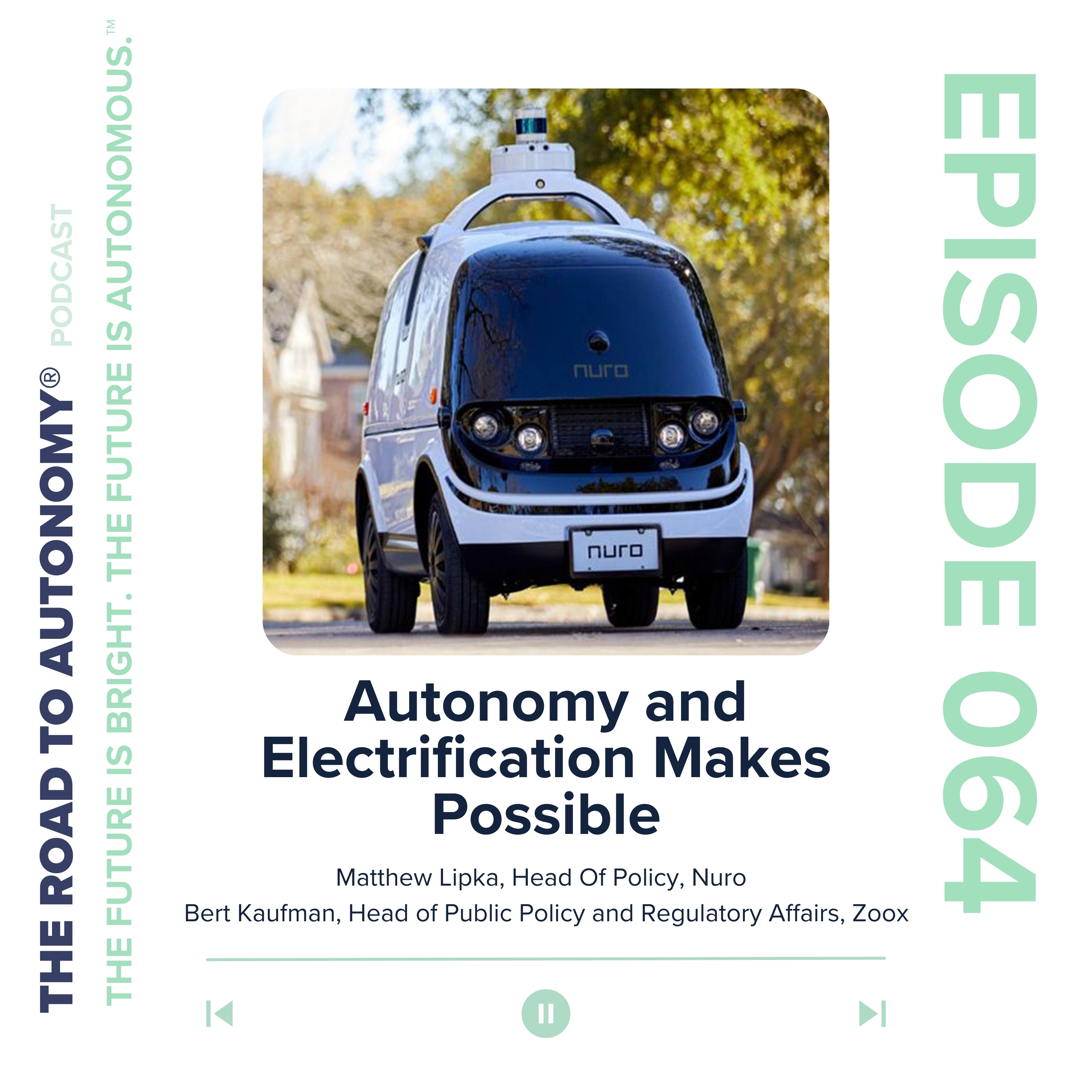
Ep 64Episode 64 | Autonomy and Electrification Makes Possible
Matthew Lipka, Head Of Policy, Nuro and Bert Kaufman, Head of Public Policy and Regulatory Affairs, Zoox joined Grayson Brulte on The Road To Autonomy Podcast to discuss why autonomy and electrification make the future of mobility and delivery possible.The conversation begins with Matthew and Bert discussing what the SAVE Coalition is and why the coalition was founded. The idea for SAVE was originally hatched at an autonomous vehicle conference in late 2017 and further formulated during a coffee meeting at Philz Coffee in San Mateo, CA between Matthew and Bert.Both Nuro and Zoox had and still have a unique point of view on autonomy. Both companies along with Local Motors decided not to retrofit a vehicle for autonomy and instead choose to build purpose-built vehicles from the ground up.We got a unique point of view because we made the deliberate decision to not retrofit. – Bert KaufmanWhen companies choose to build a bespoke vehicle, it creates new opportunities but also unique policy challenges such as updating the Federal Motor Vehicle Safety Standards (FMVSS).If you are rethinking the car then you are not going to be building an internal combustion engine. You are not going to be building a vehicle that is designed just for protecting that those inside. It is also going to be thinking about those outside of the vehicle. There are a lot of opportunities this creates both in the robotaxi as well in the delivery space. – Matthew LipkaAs companies such as Zoox prepare to commercialize their robotaxi services, they are working to properly set expectations.The first to know is that it is going to be a very shallow ramp into society for these fully autonomous vehicles to start driving around on public roads. – Bert KaufmanTrust is the other key component to ensuring the safe deployment of autonomous vehicles. First responders have to trust that they can safely engage with the vehicle. The public has to trust that the vehicle will get them to and from their destination safely. Once trust is developed and the public’s expectations are set, robotaxis and autonomous vehicle delivery services can scale.One of the most effective ways to build trust is through education. SAVE is working to educate policymakers and the public about the benefits of bespoke electric autonomous vehicles. One of the best ways to educate the public and to build trust is through interactive autonomous vehicle demo days where individuals can experience the technology first-hand.People who have interacted with an autonomous vehicle, more than 75% of them say they trust autonomous vehicles, I would use it again. But people who haven’t, the number is much lower. – Matthew LipkaAutonomy and electrification are enabling designers and engineers to completely reimagine what is possible. This is exactly what Nuro and Zoox are accomplishing through design.There are all sorts of new designs that may be necessary or possible created by autonomy. We are just at the beginning of learning that. – Matthew LipkaIn order for this to happen, policies and regulations have to be updated. Policymakers and regulators have to look past what is considered normal and to a future that prioritizes safety innovations.These new technologies offer the promise of new safety innovations for our roadways. – Bert KaufmanWrapping up the conversation, Matthew, Bert, and Grayson discuss the future of autonomy.Recorded on Monday, November 15, 2021--------About The Road to AutonomyThe Road to Autonomy® is a leading source of data, insight and commentary on autonomous vehicles/trucks and the emerging autonomy economy™. The company has two businesses: The Road to Autonomy Indices, with Standard and Poor’s Dow Jones Indices as the custom calculation agent; Media, which includes The Road to Autonomy and Autonomy Economy podcasts as well as This Week in The Autonomy Economy newsletter.See Privacy Policy at https://art19.com/privacy and California Privacy Notice at https://art19.com/privacy#do-not-sell-my-info.
Ep 63Episode 63 | An All-Electric Future
Dr. Dean Bushey, Vice President, Global Social Innovation Business, Hitachi joined Grayson Brulte on The Road To Autonomy Podcast to discuss an all-electric vehicle future.The conversation begins with Dean discussing his 25-year career in the United States Air Force and his first-hand experience with unmanned aircraft.When you fly a drone, you actually get combat hours. – Dr. Dean BusheyFrom military applications of unmanned aircraft to civilian applications, Grayson asks Dean his thoughts on the consumer drone market. It’s an exciting market with a lot of use cases.If you look at a drone it’s a platform that holds a sensor and the sensor is what makes it sexy. Whether it’s a camera used in photography, a camera used in mapping. A sensor used to measure the depth of water at a mining facility. – Dr. Dean BusheyShifting the conversation to Hitachi, Grayson asks Dean how Hitachi is evolving as a business with a strong focus on an ESG future. As part of this focus, Hitachi is focused on the societal conversion from internal combustion engines to electric vehicles.In order to achieve a successful conversion to electric vehicles, companies need a plan. A plan is needed for the vehicles, energy grids, maintenance solutions, and infrastructure. Dean breaks down what a plan looks like and what is needed to start the electric vehicle planning process. The key to the planning process is optimization.Currently, there is no optimized way to pay for electric vehicle charging when you travel unless you drive a Tesla as there is a standardized payment solution.When there is a standardized payment solution it will have to be:Convenient, seamless, and secure. – Dr. Dean BusheyStaying on the security theme, Grayson asks Dean what can be done to secure an electric vehicle when the vehicle is connected to the energy grid and charging.We need to recognize that it is a critical infrastructure piece. If you are plugging into the grid and you are operating a vehicle based on your charge down the highway it becomes a national safety concern. – Dr. Dean BusheyAs society moves towards an all-electric vehicle, Grayson and Dean discuss major obstacles that might slow down the adoption of electric vehicles. To make an all-electric future a reality, it has to be convenient.A big concern, one that you are already seeing — supply chain disruption is going to be a big one. – Dr. Dean BusheySupply chain disruptions extend from the chip shortage to the mineral supply chain. Similar to the electric vehicle industry, the autonomous vehicle industry is facing similar supply chain issues. The future of electrification and autonomy will overlap in the coming years as the technology and hardware mature.The emerging industries of electric vehicles and autonomous vehicles will create new high-paying jobs. Grayson and Dean discuss the new jobs that will be created as autonomous vehicles and trucks scale.In the future, these vehicles will be electric and they will have to be optimally charged and integrated into the fleet. The question is how? Dean discusses how delivery fleets can optimize their charging times based on delivery routes.Wrapping up the conversation, Dean shares his thoughts on the mobility trends he sees emerging in 2022.Recorded on Tuesday, November 9, 2021--------About The Road to AutonomyThe Road to Autonomy® is a leading source of data, insight and commentary on autonomous vehicles/trucks and the emerging autonomy economy™. The company has two businesses: The Road to Autonomy Indices, with Standard and Poor’s Dow Jones Indices as the custom calculation agent; Media, which includes The Road to Autonomy and Autonomy Economy podcasts as well as This Week in The Autonomy Economy newsletter.See Privacy Policy at https://art19.com/privacy and California Privacy Notice at https://art19.com/privacy#do-not-sell-my-info.
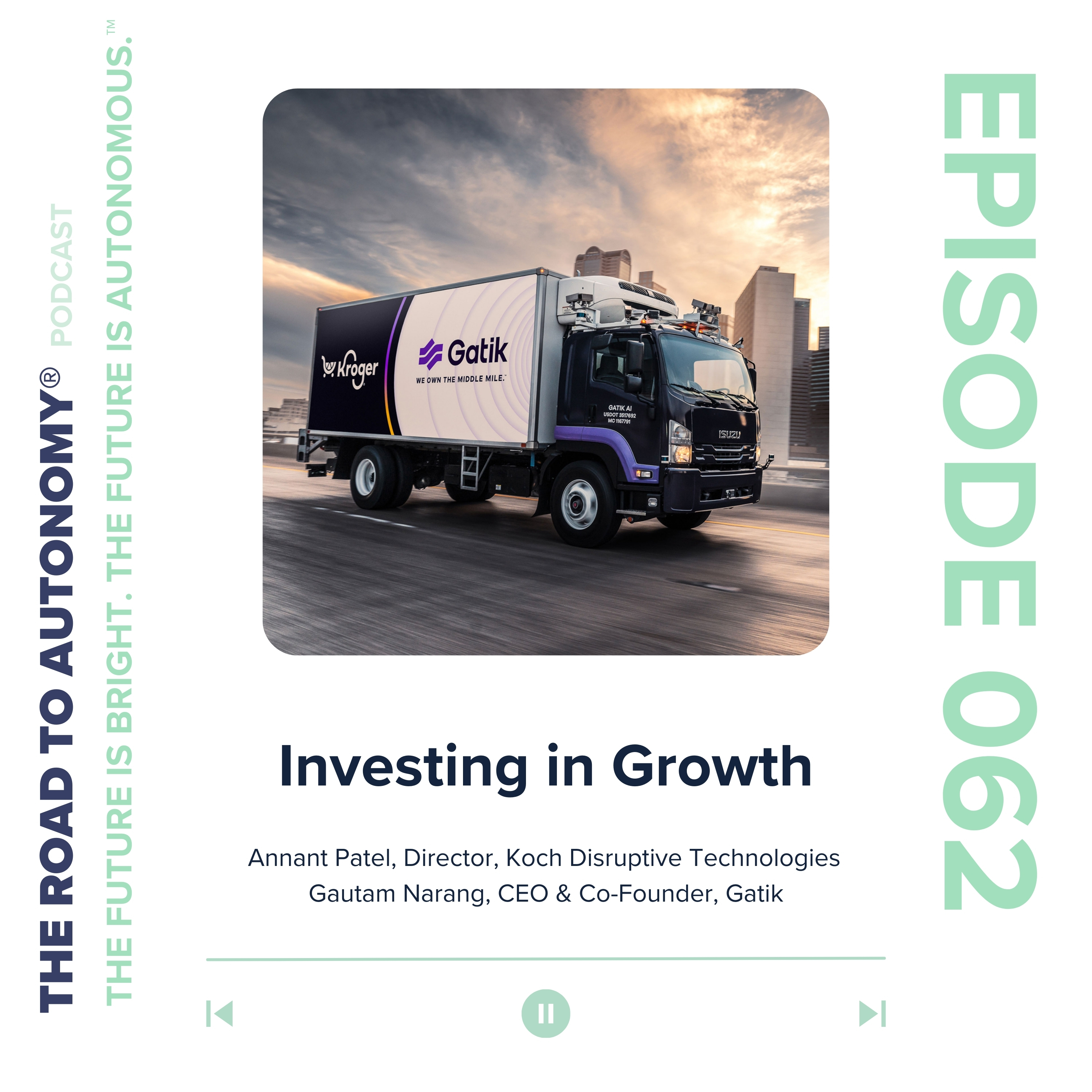
Ep 62Episode 62 | Investing in Growth
Annant Patel, Director, Koch Disruptive Technologies, and Gautam Narang, CEO & Co-Founder, Gatik joined Grayson Brulte on The Road To Autonomy Podcast to discuss investing in growth.The conversation begins with Gautam discussing why he decided to run Gatik as a business from day one and why the team focused on the middle mile.When we started Gatik we decided to focus on an opportunity that was being overlooked by almost every AV developer, which was automating on-road goods transportation. – Gautam NarangAs Gatik has scaled and grown as a business, Grayson asks Annant what first attracted Koch Disruptive Technologies to Gatik.We saw the tech is disruptive, going back to the investment philosophy, it was disruptive to Koch, it was disruptive to the supply chain and it’s good for society. – Annant PatelShifting the conversation to economics, Gautam explains how Gatik has been able to achieve profitability at the vehicle level.Our operations are highly efficient. We operate our trucks over 20 hours daily, 7 days a week. – Gautam NarangWith a highly efficient operation, Gatik has begun to pass on savings to customers. In the history of Gatik, the company has not lost a single customer or partner. As Gatik prepares to turn five years old next year, the company is accelerating growth through partnerships with Walmart, Loblaw, Goodyear, Ryder, and Koch Industries.Koch Disruptive Technologies is helping Gatik accelerate growth.The alignment between KDT and Gatik was there since the very first meeting. – Gautam NarangOne of the advantages of a Koch partnership is Koch Labs that strategically accelerates growth for portfolio partners. Annant explains how Gatik is leveraging the Koch Labs opportunity.Koch is investing for long-term growth.We invest 90% of earnings back into Koch. That translates to about to $133 billion invested in growth and improvements since 2003. $30 billion was spent on technology investments and acquisitions in the last six years alone. – Annant PatelWith a long-term growth mindset, Grayson asks Annant what Koch’s vision is for autonomy.The future is now. Gatik is pulling the future forward as we think about it. If you are not experimenting with automation and supply chain transformation, the way I say it is that we are already many years behind. – Annant PatelWith the supply chain disruptions actively affecting the economy and autonomous trucking and delivery vehicles offering a solution, Gautam shares his thoughts on the commercialization of autonomy and Gatik’s partnership with Walmart.Gatik is laser-focused on the middle mile. Gautam explains why:All of this started with the customer pain-point and the customer need. – Gautam NarangThe team at Gatik clearly saw the emerging trend of same-day delivery which would require new smaller distribution centers located closer to consumers.Wrapping up the conversation, Annant and Gautam discuss the current state of the global supply chain.Recorded on Thursday, October 21, 2021--------About The Road to AutonomyThe Road to Autonomy® is a leading source of data, insight and commentary on autonomous vehicles/trucks and the emerging autonomy economy™. The company has two businesses: The Road to Autonomy Indices, with Standard and Poor’s Dow Jones Indices as the custom calculation agent; Media, which includes The Road to Autonomy and Autonomy Economy podcasts as well as This Week in The Autonomy Economy newsletter.See Privacy Policy at https://art19.com/privacy and California Privacy Notice at https://art19.com/privacy#do-not-sell-my-info.
Ep 61Episode 61 | Future of Local Commerce
Greg Rogers, Public Policy Manager, Nuro joined Grayson Brulte on The Road To Autonomy Podcast to discuss the future of local commerce.The conversation begins with Greg discussing Nuro’s plan for the new manufacturing facility and test track in Las Vegas, Nevada. The facility will employ 250 individuals and generate as much as $2.2 billion in economic benefits for Nevada in the first 10 years.This is the first such factory in America which will have the capacity to manufacture tens of thousands of autonomous delivery vehicles. – Greg RogersWith the factory being built to manufacture and scale the autonomous delivery robots, Grayson asks Greg what has to be done from a policy perspective to ensure that the company can scale. As Nuro looks at policy, the company was one of the founders of the SAVE Coalition with Zoox and Local Motors.Often new technologies that are transformational do not look like anything that came before it. – Greg RogersAs autonomous vehicle technology and electric vehicle battery technology merge, an opportunity arises to completely rethink the design of vehicles. This is exactly what Nuro is doing with the R2. The R2 was designed from the ground up for delivery.In Houston, Texas, Nuro’s R2 is actively autonomously delivering pizzas through a partnership with Dominos. The R2 is bringing smiles and joy to the residents of Houston as the robot becomes part of the community.R2 is designed to be a friendly introduction to autonomous vehicles. – Greg RogersBesides pizzas, FedEx packages are being delivered in Houston with the R2. It is important to note that Nuro’s partnership with FedEx is a multi-year, multi-phase agreement that is revenue-generating for Nuro.Since the structure of this partnership is uncommon in the autonomous vehicle industry as it is not a pilot, Grayson asks Greg how Nuro was able to secure this deal.We have a goods-only focus. That is a benefit. We are laser-focused on delivery. The companies that we are partnering with are laser-focused on delivery as part of their business model.Since delivery is our business as it is with our partners, we do not look at delivery as an alternative go-to-market plan. We do not look it at something that we dabble in. Our partners know that our interest unequivocally aligns with theirs. – Greg RogersShifting the conversation to a personal level, Greg discusses growing up in the Central Valley of California and the impact it had on him.It’s ground zero for food insecurity. The breadbasket of the world is actually where a lot of people struggle with hunger. – Greg RogersWanting to pursue a career in politics, Greg moved to Washington, D.C. After quitting his job as a political consultant, Greg started driving for Lyft and Uber full-time and blogged about his experience. During these rides, Greg noticed a trend of individuals ordering rides to grocery stores. With the autonomous delivery of groceries, individuals will save money and time, all the while having a positive impact on society.Wrapping up the conversation, Greg shares his thoughts on the future of mobility.More mobility is a good thing. – Greg RogersRecorded on Tuesday, October 19, 2021--------About The Road to AutonomyThe Road to Autonomy® is a leading source of data, insight and commentary on autonomous vehicles/trucks and the emerging autonomy economy™. The company has two businesses: The Road to Autonomy Indices, with Standard and Poor’s Dow Jones Indices as the custom calculation agent; Media, which includes The Road to Autonomy and Autonomy Economy podcasts as well as This Week in The Autonomy Economy newsletter.See Privacy Policy at https://art19.com/privacy and California Privacy Notice at https://art19.com/privacy#do-not-sell-my-info.