The Road to Autonomy
460 episodes — Page 5 of 10
Ep 260Episode 260 | Autonomy Markets: 2025 Autonomy Outlook, Legacy Automakers’ Innovation Paralysis, Will FSD Return Tesla to Growth?
In the first episode of Autonomy Markets in 2025, Grayson Brulte and Walter Piecyk discuss the ever-evolving landscape of autonomous vehicles and the growth of big tech. Waymo’s technical advancements and steady expansion made the company the clear leader in robotaxis in 2024. While Waymo cemented their role as the leader in robotaxis, Tesla is nipping at their heels as the company prepares to introduce a robotaxi service with the Cybercab. As Waymo and Tesla advanced in 2024, investors fears in Uber’s robotaxi strategy only escalated.While investors fear Uber’s robotaxi prospects, investors cheered when GM shutdown Cruise. Was this the right move? Or this another example of traditional automakers being unable to innovate a create new tech forward products? All this and more on this week’s edition of Autonomy Markets. Episode Chapters0:00 2025 Autonomy Markets Outlook7:21 Share Buybacks 9:07 Traditional Automotive OEMs 15:07 Leaning into The Future17:45 Tesla Q4 2024 Deliveries 18:35 Tesla FSD (Full Self-Driving) Take Rates22:25 Tesla Cybertruck/Trump Hotel Attack25:21 Elon Musk’s Focus on Policy27:36 Beijing Gives Green Light to Autonomous Vehicles 30:46 Autonomy M&A34:11 MAG 735:56 Waymo37:32 Warning Triangles 42:19 CES 2025Recorded on Friday, January 3, 2025--------About The Road to AutonomyThe Road to Autonomy® is a leading source of data, insight and commentary on autonomous vehicles/trucks and the emerging autonomy economy™.Sign up for This Week in The Autonomy Economy newsletter: https://www.roadtoautonomy.com/autonomy-economy/See Privacy Policy at https://art19.com/privacy and California Privacy Notice at https://art19.com/privacy#do-not-sell-my-info.
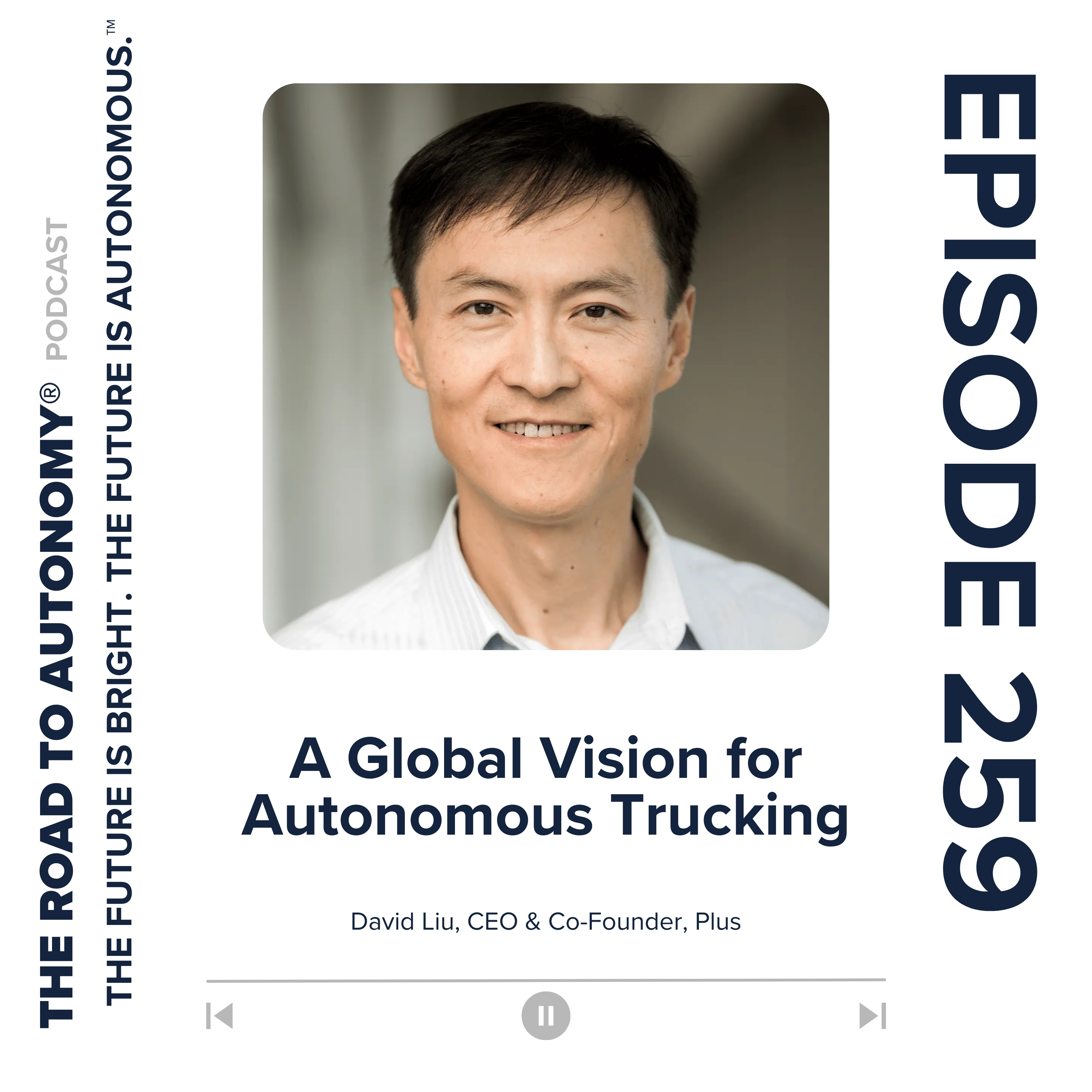
Ep 259Episode 259 | A Global Vision for Autonomous Trucking
David Liu, CEO & Co-Founder, Plus joined Grayson Brulte on The Road to Autonomy podcast to discuss Plus’ global vision for autonomous trucking.Plus is taking a global approach to autonomous trucking as a technology enabler rather than a fleet operator with three global OEM partnerships with Traton Group, Hyundai Commercial Vehicle, and IVECO. These partnerships are enabling Plus to focus solely on building a virtual driver, while the partners develop and build the physical truck. Currently Plus is testing their autonomous driving software in the United States, Sweden, and Japan as they prepare for commercial operations in 2027 with their OEM partners. Recorded on Wednesday, December 18, 2024Episode Chapters0:00 Founding of Plus2:55 Is 2025 The Year Autonomy Goes Mainstream?5:24 Plus / Traton Partnership 7:06 Plus / Hyundai Commercial Vehicle Partnership8:38 Partnership Development 12:09 Global Testing, Development and Operations14:54 Data Models17:06 Low Power / Small On-Board Hardware23:53 Vision Only27:28 Redundancy 29:53 Developing and Maintaining Trust 32:49 Plus Business Model36:17 Advancements in AI 41:09 Future of Plus--------About The Road to AutonomyThe Road to Autonomy® is a leading source of data, insight and commentary on autonomous vehicles/trucks and the emerging autonomy economy™.Sign up for This Week in The Autonomy Economy newsletter: https://www.roadtoautonomy.com/autonomy-economy/See Privacy Policy at https://art19.com/privacy and California Privacy Notice at https://art19.com/privacy#do-not-sell-my-info.
Ep 258Episode 258 | Autonomy Markets: Tesla FSD 13, Autonomous Trucking’s Regulatory Roadblocks, Waymo’s Path to SFO
This week on Autonomy Markets, Grayson Brulte and Walter Piecyk discuss Tesla FSD 13, autonomous trucking’s regularity roadblocks and Waymo’s path to offering service at theSan Francisco International (SFO) Airport. Tesla’s FSD 13 is as a major technical leap forward. While we have been impressed with its more natural driving style and improved responsiveness to traffic flow, it’s not ready for deployment on the Cybercab. Later the conversation shifts to recent government actions affecting the autonomous vehicle industry, including the Biden administration’s denial of warning triangle exemptions for autonomous trucks and the introduction of AVSTEP, a new voluntary reporting framework from NHTSA. The podcast concludes with an analysis of Waymo’s potential expansion to San Francisco International Airport and broader implications for autonomous vehicle deployments. Episode Chapters0:00 Tesla FSD 1315:21 Cybercab / FSD Driver-Out Predictions 19:09 FMCSA Warning Triangle Exemptions 26:33 AV STEP33:20 DOGE35:24 Scaling Autonomous Vehicles in China38:35 Waymo is One Step Closer to SFO Deployment 41:24 Waymo on Highways and Future Airport Deployments 46:41 Light Mapping / No Mapping Approach to Autonomy47:26 2025 OutlookRecorded on Saturday December 28, 2024--------About The Road to AutonomyThe Road to Autonomy® is a leading source of data, insight and commentary on autonomous vehicles/trucks and the emerging autonomy economy™.Sign up for This Week in The Autonomy Economy newsletter: https://www.roadtoautonomy.com/autonomy-economy/See Privacy Policy at https://art19.com/privacy and California Privacy Notice at https://art19.com/privacy#do-not-sell-my-info.
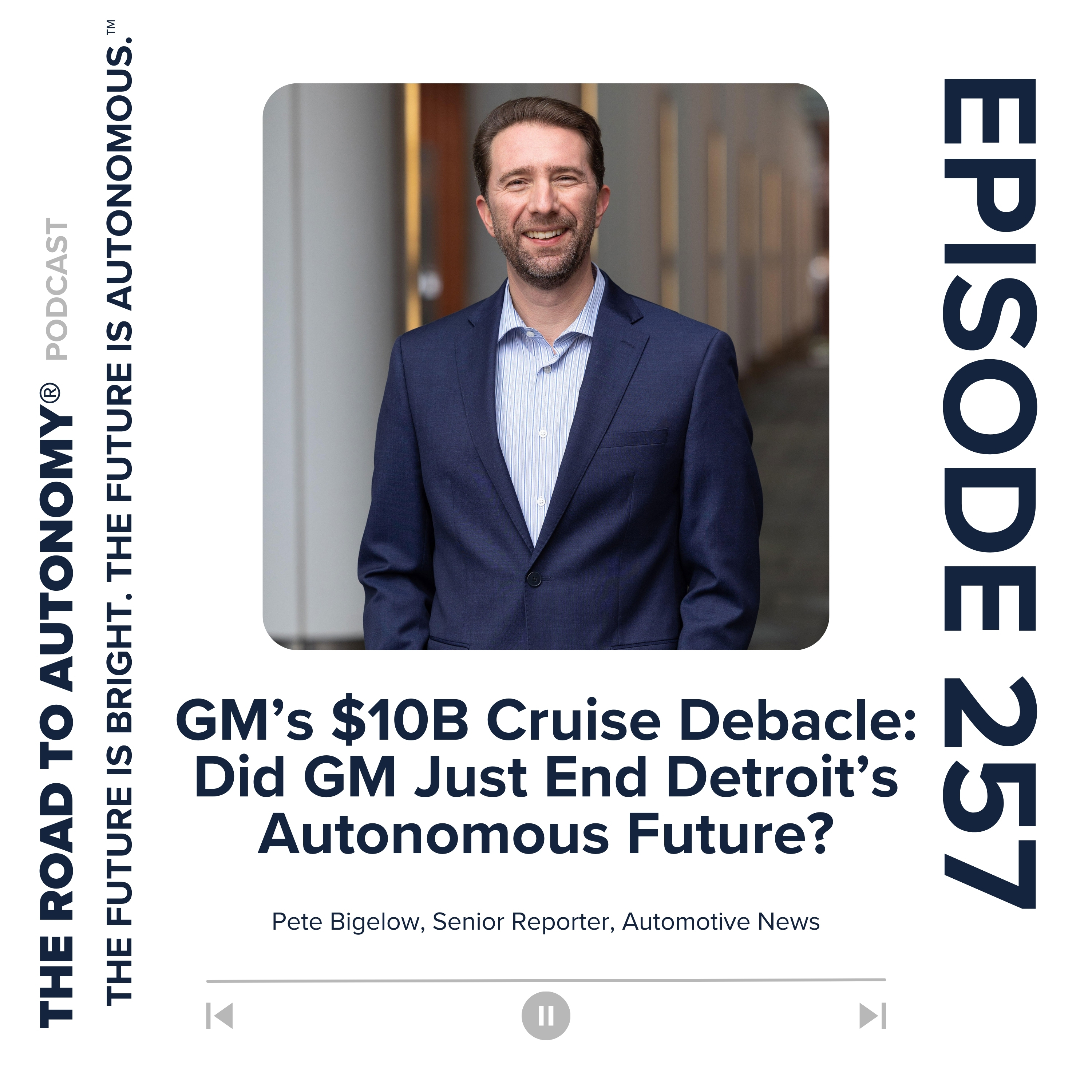
Ep 257Episode 257 | GM’s $10B Cruise Debacle: Did GM Just End Detroit’s Autonomous Future?
Pete Bigelow, Senior Reporter, Automotive News joined Grayson Brulte on The Road to Autonomy podcast to discuss Detroit’s future in autonomy. When GM shutdown Cruise, did they end Detroit’s autonomous future?GM has a pattern of getting to the one-yard line and fumbling with innovations like the EV1, skateboard architecture and now Cruise. As the fundamental challenges facing legacy automakers only increase, is Detroit on the verge of becoming Foxconn City?GM’s decision making has direct parallels to IBM’s decline in tech innovation. Could GM be following the same path as IBM? Only time will tell, but serious questions remain about GM and Detroit’s ability to compete in an increasingly software-driven, autonomous automotive future.Recorded on Monday, December 16, 2024Episode Chapters0:00 Detroit’s Future in Autonomy5:22 Dan Ammann’s Cruise Strategy9:49 December 16, 202412:22 Autonomy Tailwinds14:20 User/Driver Experiences17:37 Does Detroit Become Foxconn City?19:58 Is GM Afraid of Change?29:22 Is GM the new IBM?35:30 Could Waymo License the Origin from GM?39:47 Economics of Autonomous Vehicle Rides41:57 LiDAR Market45:04 Human in the Loop--------About The Road to AutonomyThe Road to Autonomy® is a leading source of data, insight and commentary on autonomous vehicles/trucks and the emerging autonomy economy™.Sign up for This Week in The Autonomy Economy newsletter: https://www.roadtoautonomy.com/autonomy-economy/See Privacy Policy at https://art19.com/privacy and California Privacy Notice at https://art19.com/privacy#do-not-sell-my-info.
Ep 256Episode 256 | Autonomy Markets: Apple to Revive Robotaxi Ambitions? Waymo Expands to Japan, Uber’s Fleet Strategy
This week on Autonomy Markets, Grayson Brulte and Walter Piecyk discuss Apple’s potential return to the robotaxi market through Foxconn. If Foxconn is successful in acquiring Nissan, it would create a path for Apple to re-enter the autonomous vehicle sector. Rather than building their own autonomous driving system from the ground-up, Apple could partner with Wayve to power the autonomous system, while Foxconn could be the contract manufacturer to build the vehicle. This approach would mirror Apple’s historical approach of gradually developing in-house capabilities while initially relying on partners, as they did with iPhone modems and chips. Additionally this week, Waymo announced a road trip to Japan and Uber continues to develop their fleet strategy.Episode Chapters0:00 Waymo Heads to Japan2:39 Waymo’s Zeekr Dilemma 6:52 Masayoshi Son / Softbank8:21 Could Apple Return to Autonomous Vehicles with Foxconn?17:51 Uber’s Fleet Ambitions 23:36 Are Uber’s Robotaxi Fears Overblown?30:15 Pony AI’s Projected China Market Growth32:41 Autonomous Vehicle Policy36:36 Kodiak Deploys an Autonomous F-150 in the Snow38:22 Next WeekRecorded on Wednesday, December 18, 2024--------About The Road to AutonomyThe Road to Autonomy® is a leading source of data, insight and commentary on autonomous vehicles/trucks and the emerging autonomy economy™.Sign up for This Week in The Autonomy Economy newsletter: https://www.roadtoautonomy.com/autonomy-economy/See Privacy Policy at https://art19.com/privacy and California Privacy Notice at https://art19.com/privacy#do-not-sell-my-info.
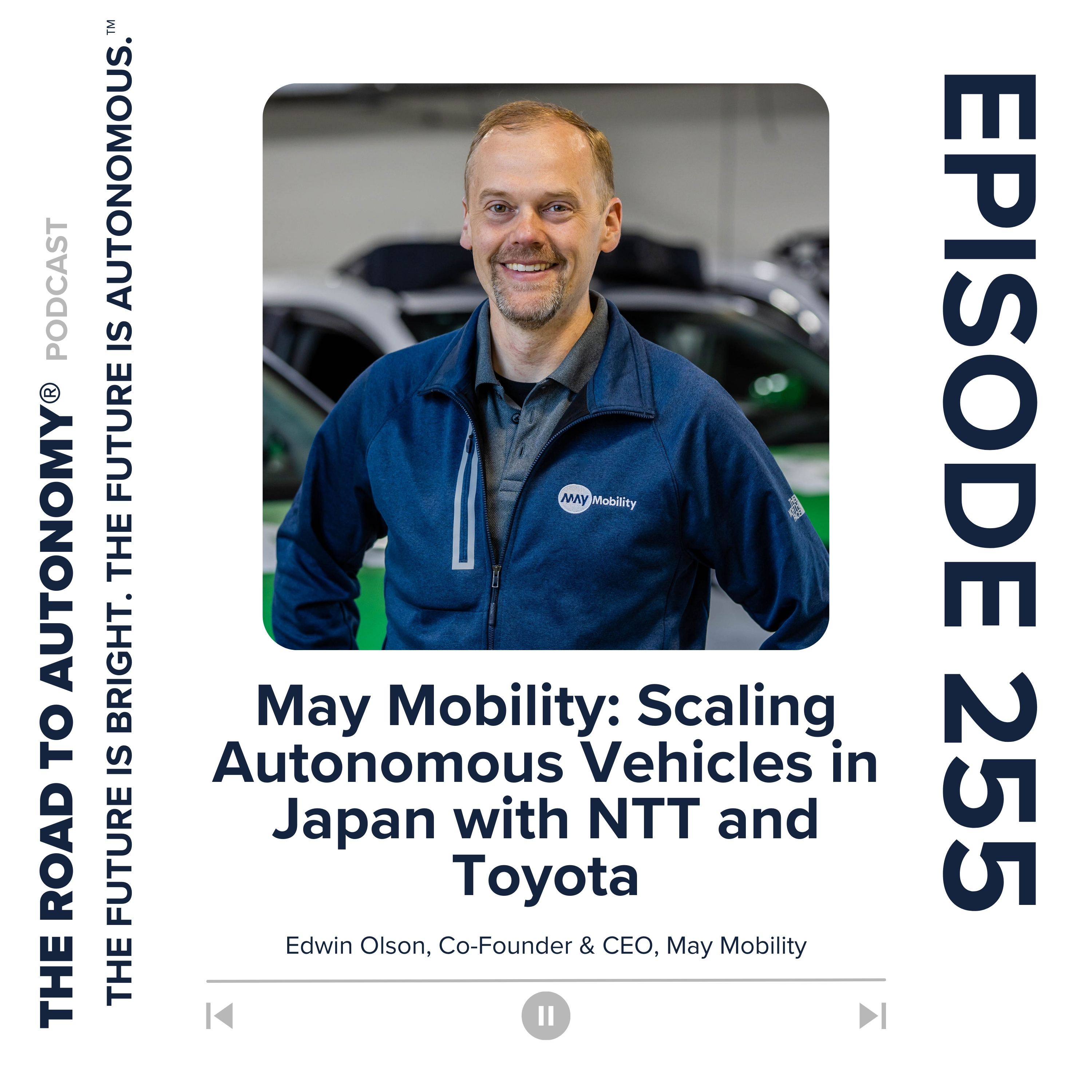
Ep 255Episode 255 | May Mobility: Scaling Autonomous Vehicles in Japan with NTT and Toyota
Edwin Olson, Co-Founder & CEO, May Mobility joined Grayson Brulte on The Road to Autonomy podcast to discuss May Mobility’s strategic expansion into Japan through partnerships with Toyota and NTT and their plans to launch with Lyft in Atlanta in 2025.May Mobility is focused on creating scalable, low-power autonomous vehicles that are profitable. One of the keys to May Mobility’s success so far has been their multi-policy decision making (MPDM) system that runs on the edge, primarily with CPUs instead of GPUs, requiring less compute power.Recorded on Tuesday, December 10, 2024Episode Chapters0:00 May Mobility in Japan3:11 May Mobility’s Approach to Autonomous Driving7:23 Autonomous Driving Models (LLMs)10:56 On-board Compute14:23 Multi-Policy Decision Making (MPDM)20:46 Japan Deployments 24:25 Simulation 26:16 MPDM on the Edge29:12 Scaling May Mobility34:57 Passenger Experience42:24 Atlanta Expansion / Lyft Partnership48:50 Freeways52:33 Future of May Mobility--------About The Road to AutonomyThe Road to Autonomy® is a leading source of data, insight and commentary on autonomous vehicles/trucks and the emerging autonomy economy™.Sign up for This Week in The Autonomy Economy newsletter: https://www.roadtoautonomy.com/autonomy-economy/See Privacy Policy at https://art19.com/privacy and California Privacy Notice at https://art19.com/privacy#do-not-sell-my-info.
Ep 254Episode 254 | Autonomy Markets: GM Shuts Down Cruise, Uber’s Autonomy Dilemma and Torc’s Future
This week on Autonomy Markets, Grayson Brulte and Walter Piecyk discuss the dramatic turn of events that led GM to abruptly shut down Cruise, just days before a planned driver-out launch in Houston. The decision made by CEO Mary Barra, reportedly stems from fears of another incident.With the decision to pull the plug on Cruise, GM burnt $9 billion of investment dollars with nothing to show for it. The Cruise shutdown highlights the ongoing challenges of how traditional automakers are approaching autonomy. As traditional automakers falter, Waymo and Tesla continue to accelerate as the market is beginning to consolidate around them as the leaders in robotaxis.As we look to 2025, more consolidation is likely on the way, with Daimler Truck potentially scaling back their in-house autonomous trucking program (Torc Robotics). Then there is Uber which is struggling to define their autonomy narrative to the market. What moves do they make to calm market jitters?Episode Chapters0:00 GM Pulls the Plug on Cruise7:57 Uber & Lyft in the Era of Autonomy16:47 Zoox and Amazon. What is the Path Forward?22:45 Could Daimler Truck Follow GM and Shutter Torc Robotics?29:25 Amazon and Autonomy31:06 Walmart32:15 Cybercab in 2026?33:10 Aurora33:51 Next WeekRecorded on Thursday, December 12, 2024--------About The Road to AutonomyThe Road to Autonomy® is a leading source of data, insight and commentary on autonomous vehicles/trucks and the emerging autonomy economy™.Sign up for This Week in The Autonomy Economy newsletter: https://www.roadtoautonomy.com/autonomy-economy/See Privacy Policy at https://art19.com/privacy and California Privacy Notice at https://art19.com/privacy#do-not-sell-my-info.
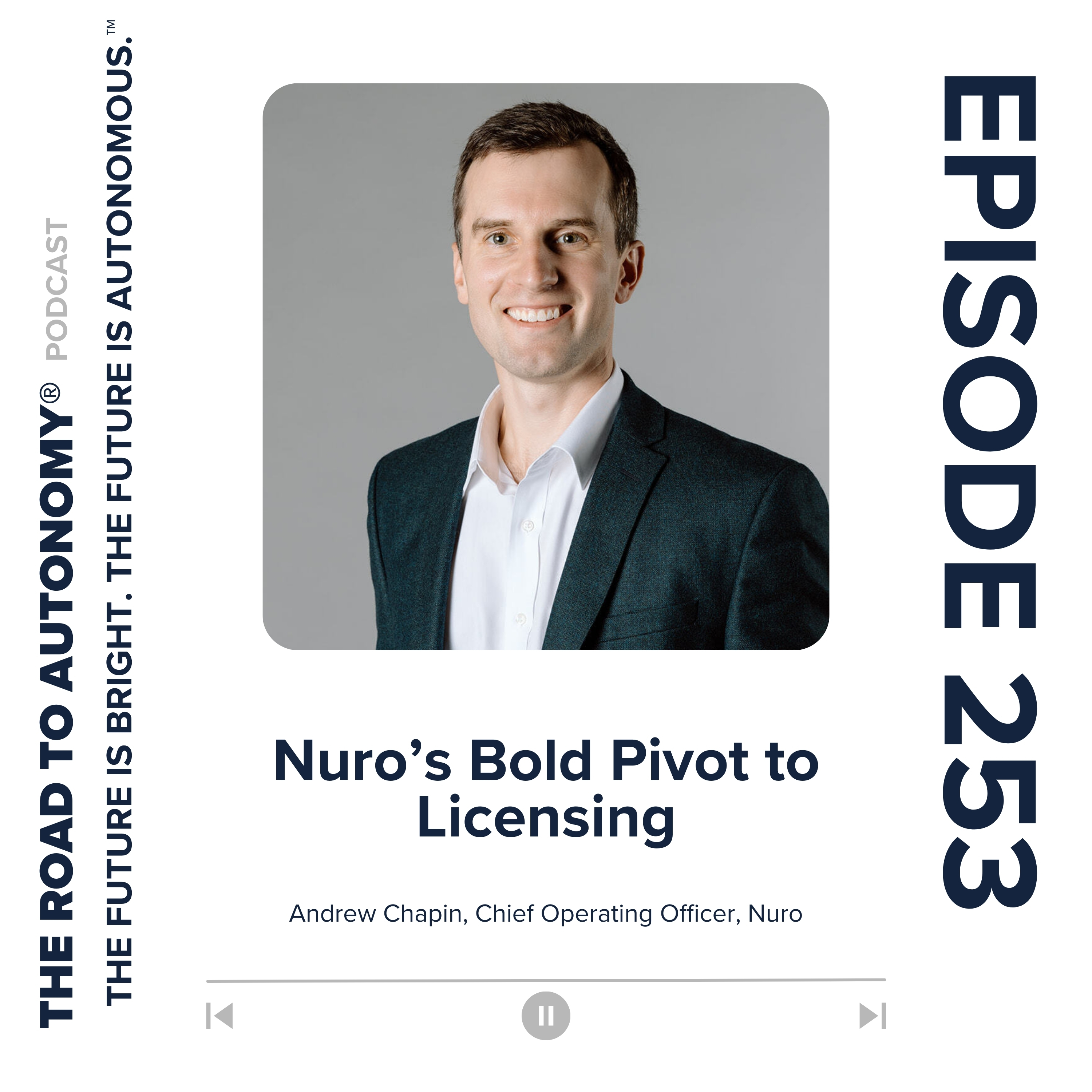
Ep 253Episode 253 | Nuro’s Bold Pivot to Licensing
Andrew Chapin, Chief Operating Officer, Nuro joined Grayson Brulte on The Road to Autonomy podcast to discuss Nuro’s bold pivot to licensing their autonomous driving stack instead of scaling their autonomous robot delivery business. As part of the strategic pivot, Nuro has developed the Nuro Driver, which can drive on surface streets and is designed to be adaptable across multiple vehicle platforms. Nuro’s strategy centers on licensing its autonomous driving technology to mobility service platforms, OEMs, and potential fleet operators, with a focus on North America. By remaining an independent company, Nuro aims to provide flexibility in tailoring solutions to customer needs and maintaining capital efficiency. The company expects to power robotaxis, delivery services, and L2+ to L3 autonomous systems in the coming years.Recorded on Tuesday, December 3, 2024Episode Chapters0:00 Nuro’s Pivot to Licensing 4:36 Advantages of Being Independent 7:08 Capital Allocation10:42 Nuro Licensing Model 15:51 Could More Autonomy Companies Pivot to Licensing?17:44 Nuro Driver ODD21:01 Driver-Out on Highways23:31 Nuro Vehicle Platforms 27:53 Scaling Nuro’s Licensing Business 32:32 Insurance + Validation 35:41 Future of Nuro--------About The Road to AutonomyThe Road to Autonomy® is a leading source of data, insight and commentary on autonomous vehicles/trucks and the emerging autonomy economy™.Sign up for This Week in The Autonomy Economy newsletter: https://www.roadtoautonomy.com/autonomy-economy/See Privacy Policy at https://art19.com/privacy and California Privacy Notice at https://art19.com/privacy#do-not-sell-my-info.
Ep 252Episode 252 | Autonomy Markets: Waymo Heads to Miami, Tesla Releases FSD 13 and The Future of Rideshare
This week on Autonomy Markets, Grayson Brulte and Walter Piecyk discuss Waymo's expansion to Miami, Uber and Lyft's future in the era of autonomy and Tesla's releases of FSD 13.Waymo is expanding to Miami in 2025 without one of their partners—Uber. Instead, Waymo chose Moove as their fleet management partner. Could this signal something more broad, as Moove is also taking over the fleet management operations for Waymo in Phoenix?Tesla released Full Self-Driving (FSD) 13.2 this week and it appears to have lived up with the hype with Alphabet CEO, Sundar Pichai acknowledging that he currently views Waymo and Tesla as the two leaders in the development and commercialization of autonomous vehicles.Episode Chapters0:00 Football0:38 Waymo Expands to Miami + Impact on Uber Partnership10:43 Uber and Lyft in the Era of Autonomy16:31 Fleet Management for Autonomous Vehicles26:17 Tesla FSD 1333:13 Waymo vs Tesla / WholeMarsBlog Ride Comparison36:59 Scaling the Tesla Cybercab40:25 Tesla Delaware Judge Ruling42:30 May Mobility Expands in Japan45:49 Next WeekRecorded on Thursday, December 5, 2024--------About The Road to AutonomyThe Road to Autonomy® is a leading source of data, insight and commentary on autonomous vehicles/trucks and the emerging autonomy economy™.Sign up for This Week in The Autonomy Economy newsletter: https://www.roadtoautonomy.com/autonomy-economy/Order your very own Make Autonomy Great Hat here: https://store.roadtoautonomy.com/products/make-autonomy-great-hatSee Privacy Policy at https://art19.com/privacy and California Privacy Notice at https://art19.com/privacy#do-not-sell-my-info.
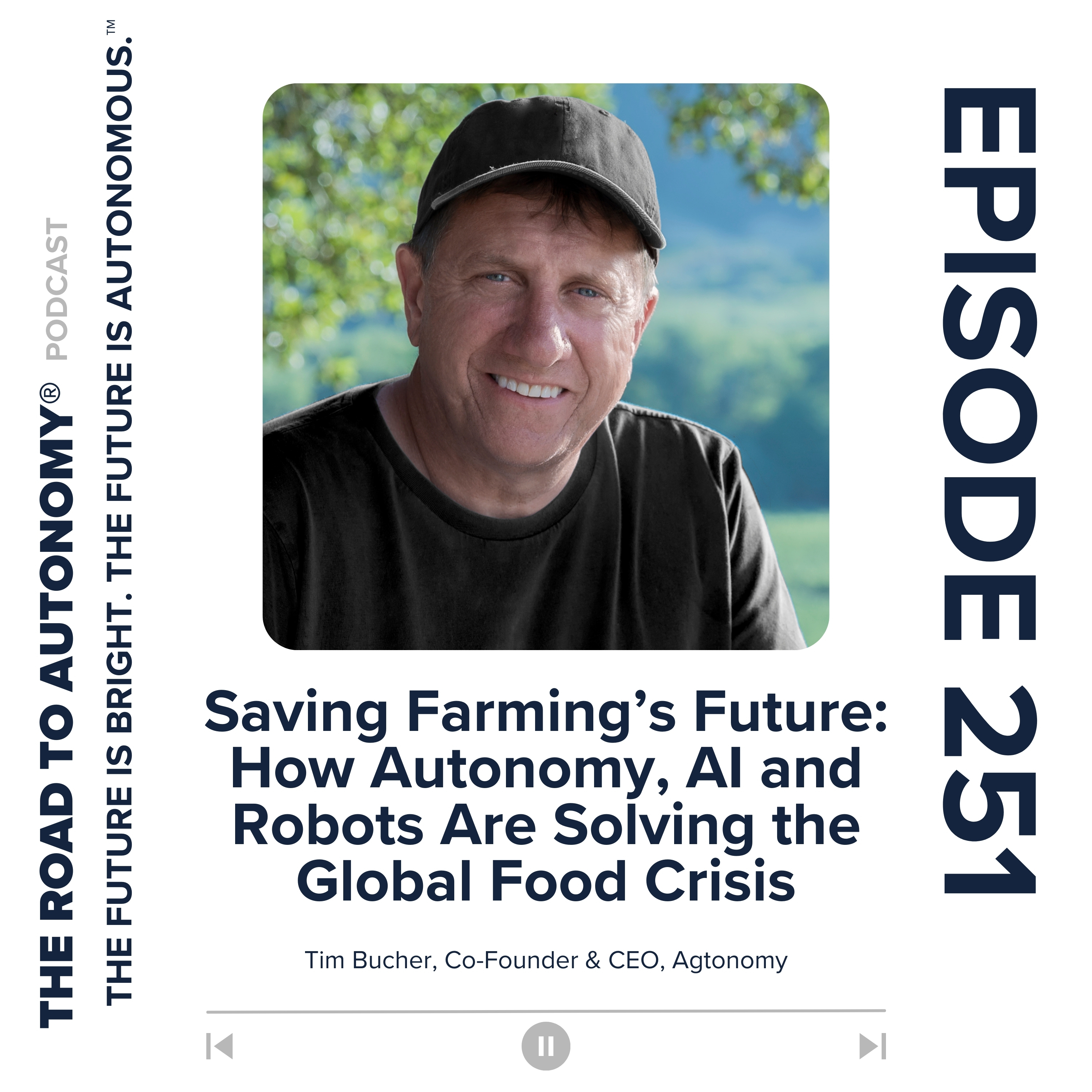
Ep 251Episode 251 | Saving Farming’s Future: How Autonomy, AI and Robots Are Solving the Global Food Crisis
Tim Bucher, Co-Founder & CEO, Agtonomy joined Grayson Brulte on The Road to Autonomy podcast to discuss how autonomy, AI and robotics can solve the global food crisis. There is a global food shortage that is only projected to grow because of labor concerns. In 2023, over 281.6 million people in 59 countries faced high levels of acute food insecurity. Autonomy, AI and robotics can solve this by ensuring that farmers can continue to farm amidst the backdrop of a severe labor shortages, rising wages and the declining interest of younger generations in farming.Agtonomy is addressing these critical challenges in agriculture by scaling autonomy on farms in a cost efficient manner to farmers globally. Recorded on Tuesday, November 19, 2024Episode Chapters0:00 Agtonomy’s Approach to Autonomy on Farms3:36 Tractors4:36 Productivity Increases from Autonomy on Farms 10:16 Attracting Farm Talent 15:37 Deploying Autonomy on Farms19:50 Precision Ag 21:57 Deploying Agtonomy on Farms25:27 Computer Vision and Sensors29:35 The Opportunity to Deploy Autonomy on Farms34:33 Agtonomy’s Approach to the Market41:16 New Verticals for Agtonomy44:51 Future of Automation on Farms--------About The Road to AutonomyThe Road to Autonomy® is a leading source of data, insight and commentary on autonomous vehicles/trucks and the emerging autonomy economy™.Sign up for This Week in The Autonomy Economy newsletter: https://www.roadtoautonomy.com/autonomy-economy/See Privacy Policy at https://art19.com/privacy and California Privacy Notice at https://art19.com/privacy#do-not-sell-my-info.
Ep 250Episode 250 | Autonomy Markets: Tesla Fleet API, Cybercab Hype and the Pony AI IPO
This week Tesla unveiled their fleet API which could be a precursor to Tesla introducing a Cybercab service with 3rd party fleet operators. The company also begun the process of strategically positioning Cybercabs in showrooms, malls around the world and at high-profile events such as Art Basel in Miami. Tesla is effectively using these displays as a form of brand advertising.While brand advertising builds interest, IPOs launch companies. This week, Pony AI went public raising $260 million and achieving a market capitalization of over $4 billion, despite having relatively low revenue. Pony AI is currently trading at 60 times revenue with a primary focus on the Chinese market. This approach could potentially have geopolitical implications as the company grows. Episode Chapters0:00 Pony AI IPO8:46 Tesla API for Fleets13:22 Cybercab16:21 Tesla Brand Advertising21:07 Does Waymo Need Brand Activations? 23:04 EV Politics 26:03 New Mexico's Changing AV Regulations 28:27 FTC29:33 xAI33:31 Waymo LA Crash36:43 Next WeekRecorded on Friday, November 29, 2024--------About The Road to AutonomyThe Road to Autonomy® is a leading source of data, insight and commentary on autonomous vehicles/trucks and the emerging autonomy economy™.Sign up for This Week in The Autonomy Economy newsletter: https://www.roadtoautonomy.com/autonomy-economy/See Privacy Policy at https://art19.com/privacy and California Privacy Notice at https://art19.com/privacy#do-not-sell-my-info.
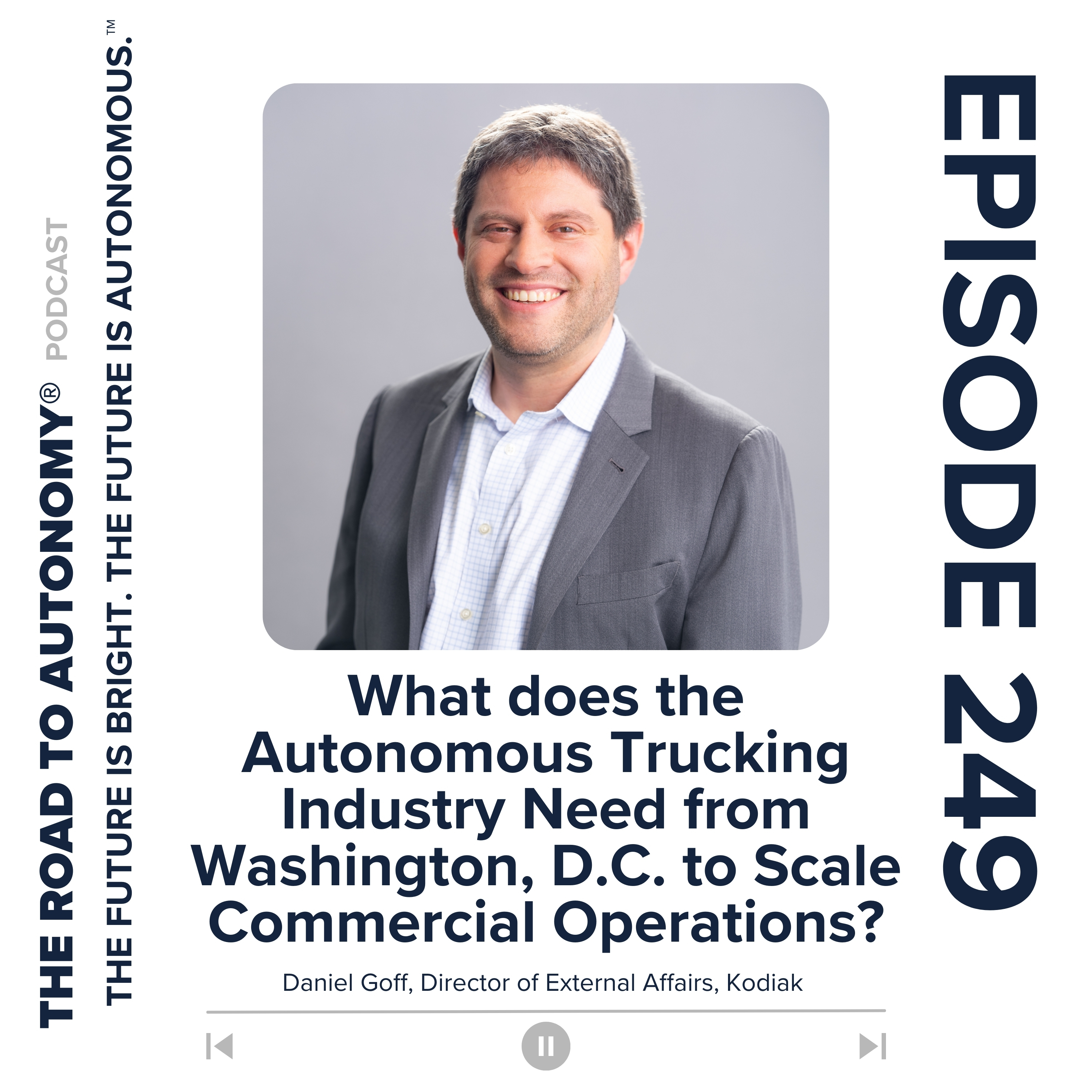
Ep 249Episode 249 | What does the Autonomous Trucking Industry Need from Washington, D.C. to Scale Commercial Operations?
Daniel Goff, Director of External Affairs, Kodiak joined Grayson Brulte on The Road to Autonomy podcast to discuss what the autonomous trucking industry needs from Washington, D.C. in order to scale commercial operations. Autonomous trucking regulations are often misunderstood. Contrary to popular belief, the legal and policy frameworks for deploying autonomous trucks on U.S. roadways are more advanced than many assume. The necessary regulatory elements are already in place, allowing for immediate deployment and scaling of autonomous trucks. While the necessary regulatory elements are already in place, what does the autonomous trucking industry need from Washington, D.C. to have regularity certainty? Tune in to find out. Episode Chapters0:00 Current State of Autonomous Trucking Regulations 3:58 Investor Thoughts on Autonomous Trucking Regulations 6:11 Public’s Perspective on Autonomous Trucks and Vehicles 10:17 Human Trafficking 13:02 Law Enforcement Interaction 20:22 Federal Autonomous Vehicle Framework30:59 National Security Issues 33:41 Tech and Labor Tensions 40:15 Autonomous Trucks in California 44:00 2025 OutlookRecorded on Monday, November 25, 2024--------About The Road to AutonomyThe Road to Autonomy® is a leading source of data, insight and commentary on autonomous vehicles/trucks and the emerging autonomy economy™.Sign up for This Week in The Autonomy Economy newsletter: https://www.roadtoautonomy.com/autonomy-economy/See Privacy Policy at https://art19.com/privacy and California Privacy Notice at https://art19.com/privacy#do-not-sell-my-info.
Ep 248Episode 248 | Autonomy Markets: Trump Signals Major Autonomous Vehicle Push, China's Growing AV Market and What Investors Need to Know
A significant shift in autonomous vehicle policy appears imminent with President-elect Trump’s plans to implement a national autonomous vehicle framework. Key cabinet appointments, including Congressman Duffy for Transportation Secretary and Pam Bondi for Attorney General, signal strong support for autonomy. The incoming administration is strategically positioning pro-autonomy officials, with the America First Policy Institute playing a crucial role in policy implementation. Regulatory clarity could accelerate autonomous vehicle deployment across state lines and investment, though bureaucratic resistance within the Department of Transportation and NHTSA remains a concern.The market implications of these developments are already evident, with Altimeter Capital’s Brad Gerstner selling his entire Uber position due the growing competition Tesla and Waymo. Meanwhile, competition from has China intensified as Baidu completed 691,000 fully autonomous rides in Q3 2024, even though this still trails Waymo’s estimated 2 million autonomous rides in Q3. The emergence of Chinese autonomous vehicle companies including WeRide and Pony AI in public markets, along with Baidu’s announcement of a sub-$35,000 self-driving car, indicates the global race for autonomous vehicle leadership is accelerating as we prepare to enter 2025.Episode Chapters0:00 Investor Sentiment on Autonomous Vehicles4:51 Tesla, Uber, Lyft Catalysts14:28 Uber Autonomy Investments15:46 Toyota and Pony AI17:12 Jaguar's Rebrand Impact on Waymo19:28 Trump's Autonomous Vehicle Personal27:02 Autonomous Vehicles in China20:35 U.S. Policies37:37 Next WeekRecorded on Friday, November 22, 2024Order your very own Make Autonomy Great Hat today! https://store.roadtoautonomy.com/collections/make-autonomy-great--------About The Road to AutonomyThe Road to Autonomy® is a leading source of data, insight and commentary on autonomous vehicles/trucks and the emerging autonomy economy™.Sign up for This Week in The Autonomy Economy newsletter: https://www.roadtoautonomy.com/autonomy-economy/See Privacy Policy at https://art19.com/privacy and California Privacy Notice at https://art19.com/privacy#do-not-sell-my-info.
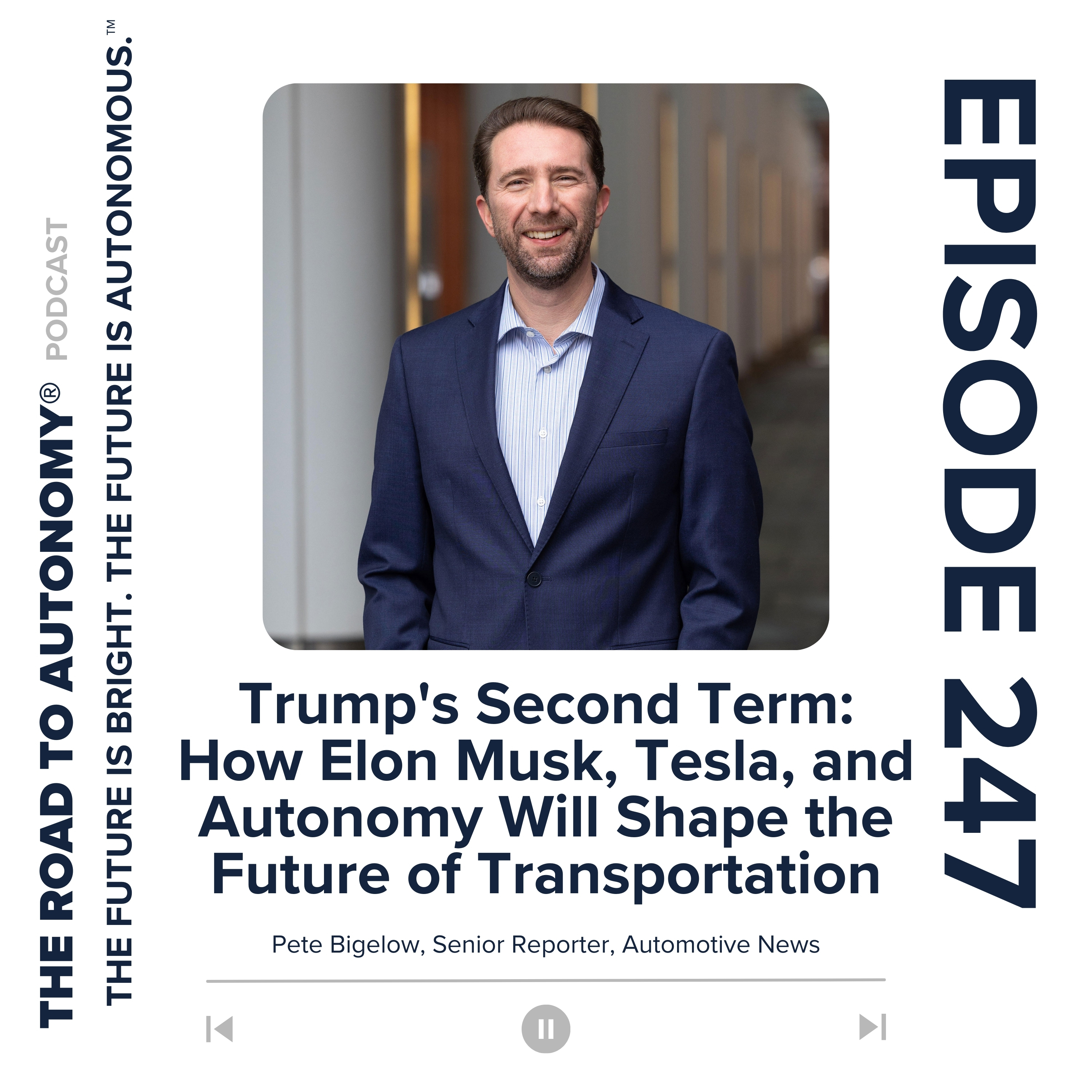
Ep 247Episode 247 | Trump's Second Term: How Elon Musk, Tesla, and Autonomy Will Shape the Future of Transportation
Pete Bigelow, Senior Reporter, Automotive News joined Grayson Brulte on The Road to Autonomy podcast the potential implications of Donald J. Trump’s second term as U.S. President on the advancement and commercialization of autonomous vehicles. With significant deregulation anticipated in Trump’s second term, there is optimism about the “golden age” of autonomy that could be ushered in with a national framework for autonomous vehicles that addresses liability concerns and regulatory patchworks.Episode Chapters0:00 EVTOLs3:35 Autonomy Under Trump7:34 Waymo15:43 Zoox20:49 Autonomous Vehicle Industry24:59 Trump Autonomous Vehicle Policy29:18 Electrification40:35 Key TakeawaysRecorded on Tuesday, November 12, 2024--------About The Road to AutonomyThe Road to Autonomy® is a leading source of data, insight and commentary on autonomous vehicles/trucks and the emerging autonomy economy™.Sign up for This Week in The Autonomy Economy newsletter: https://www.roadtoautonomy.com/autonomy-economy/See Privacy Policy at https://art19.com/privacy and California Privacy Notice at https://art19.com/privacy#do-not-sell-my-info.
Ep 246Episode 246 | Autonomy Markets: Waymo Launches in LA, Zoox Debuts in San Francisco and Bot Auto Emerges
In this episode of Autonomy Markets, Grayson Brulte and Walter Piecyk discuss the Waymo’s public launch in LA, Zoox’s debut in San Francisco and the emergence of Bot Auto. This week Waymo removed the waitlist and opened the service to the public in Los Angeles in an 80 square mile area. Even though the public can now ride in the vehicles, there are extended wait times (up to 40 minutes) and the inability to use freeways, increasing the average ride time. Without freeways, the Waymo service is limited in major markets such as LA and San Francisco because of the increased travel time. While Waymo is working on highway driving, the service is not available to members of the public, yet.In autonomous trucking, we are on the precipice of the emergence of the “big three”: Aurora, Kodiak, and Bot Auto. Each company has distinct advantages—Aurora’s partnership with Uber Freight, Kodiak’s diversified business model and capital efficiency, and Bot Auto’s plan to operate their own trucking service. Episode Chapters0:00 Waymo’s Los Angeles Public Launch 4:10 Autonomous Vehicles on Freeways 9:54 Zoox Hits The Road in San Francisco18:27 Bot Auto21:12 Autonomous Trucking Market25:48 Highway Driving 28:16 Instacart 31:47 Off-Road Autonomy Market 33:38 Next WeekRecorded on November 13, 2024--------About The Road to AutonomyThe Road to Autonomy® is a leading source of data, insight and commentary on autonomous vehicles/trucks and the emerging autonomy economy™.Sign up for This Week in The Autonomy Economy newsletter: https://www.roadtoautonomy.com/autonomy-economy/See Privacy Policy at https://art19.com/privacy and California Privacy Notice at https://art19.com/privacy#do-not-sell-my-info.
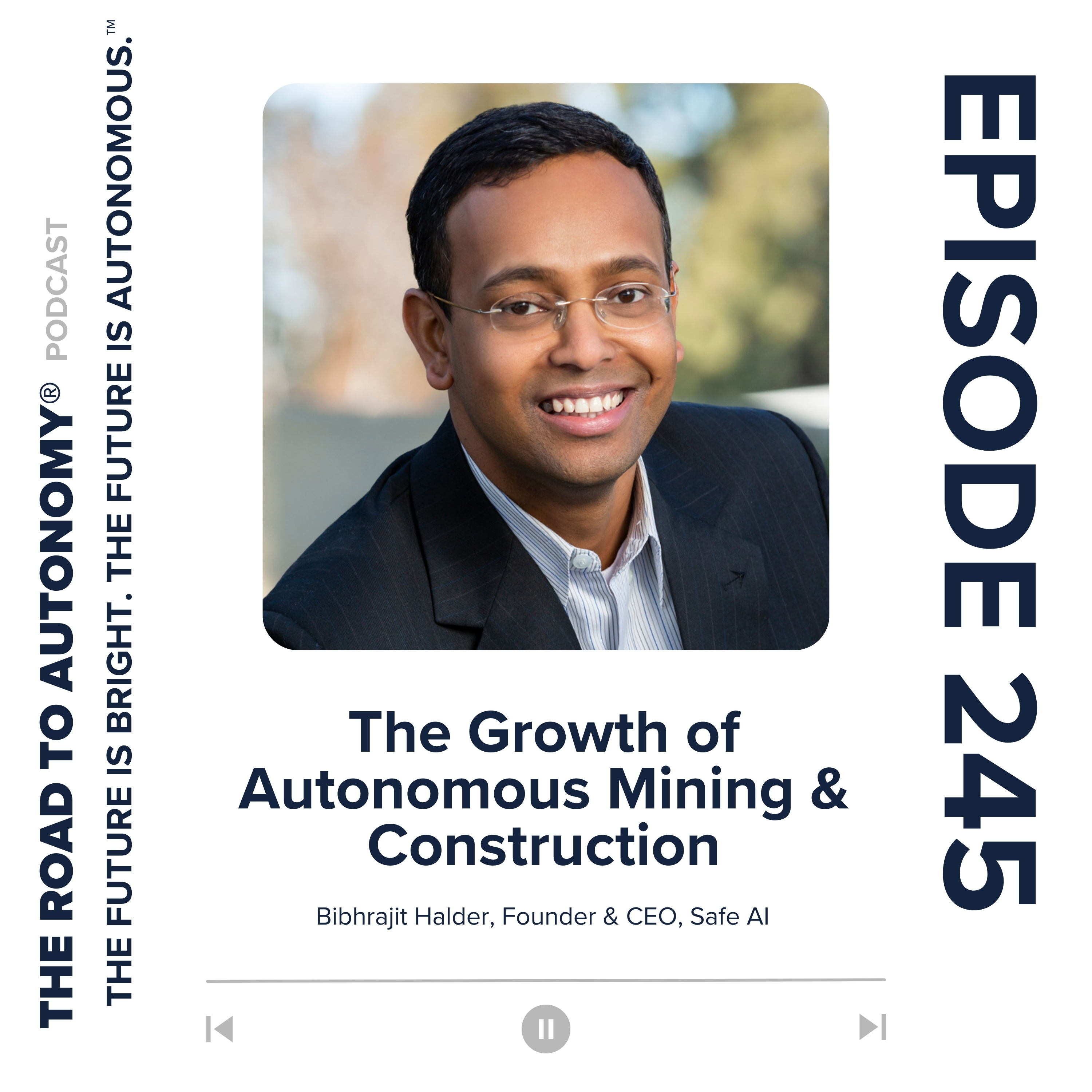
Ep 245Episode 245 | The Growth of Autonomous Mining & Construction
Bibhrajit Halder, Founder & CEO, Safe AI joined Grayson Brulte on The Road to Autonomy podcast to discuss the growth of autonomous mining and construction. The surging demand for autonomous equipment in mining and construction is being driven partly by severe labor shortages and potential productivity gains in the range of 20-25%.Episode Chapters0:00 Current State of Autonomous Construction and Mining Markets 5:04 Connectivity 8:40 End-to-end Models13:52 LiDAR Debate21:05 Retrofitting Trucks for Autonomy28:59 Redundancy30:20 Safe AI Use Cases 32:35 Electrification35:23 Future of Autonomous Construction and MiningRecorded on Friday, November 1, 2024--------About The Road to AutonomyThe Road to Autonomy® is a leading source of data, insight and commentary on autonomous vehicles/trucks and the emerging autonomy economy™.Sign up for This Week in The Autonomy Economy newsletter: https://www.roadtoautonomy.com/autonomy-economy/See Privacy Policy at https://art19.com/privacy and California Privacy Notice at https://art19.com/privacy#do-not-sell-my-info.
Ep 244Episode 244 | Autonomy Markets: Self Driving's Next Chapter: Trump Policies, Lyft Partnerships, and Musk's Influence
The election of Donald J. Trump as the 47th President of the United States could dramatically reshape the autonomous vehicle industry, with Elon Musk positioned as a key influence in the new administration. A national framework for autonomous vehicles and trucks is expected to be a top priority, potentially overriding state-specific regulations like California’s strict regulations. Episode Chapters0:00 Impact of the Presidential Election on Autonomy Markets 11:07 Toyota & May Mobility15:25 Lyft17:02 Zoox23:24 Autonomous Vehicle Policy27:05 Tesla33:18 Next WeekRecorded on November 7, 2024--------About The Road to AutonomyThe Road to Autonomy® is a leading source of data, insight and commentary on autonomous vehicles/trucks and the emerging autonomy economy™.Sign up for This Week in The Autonomy Economy newsletter: https://www.roadtoautonomy.com/autonomy-economy/See Privacy Policy at https://art19.com/privacy and California Privacy Notice at https://art19.com/privacy#do-not-sell-my-info.
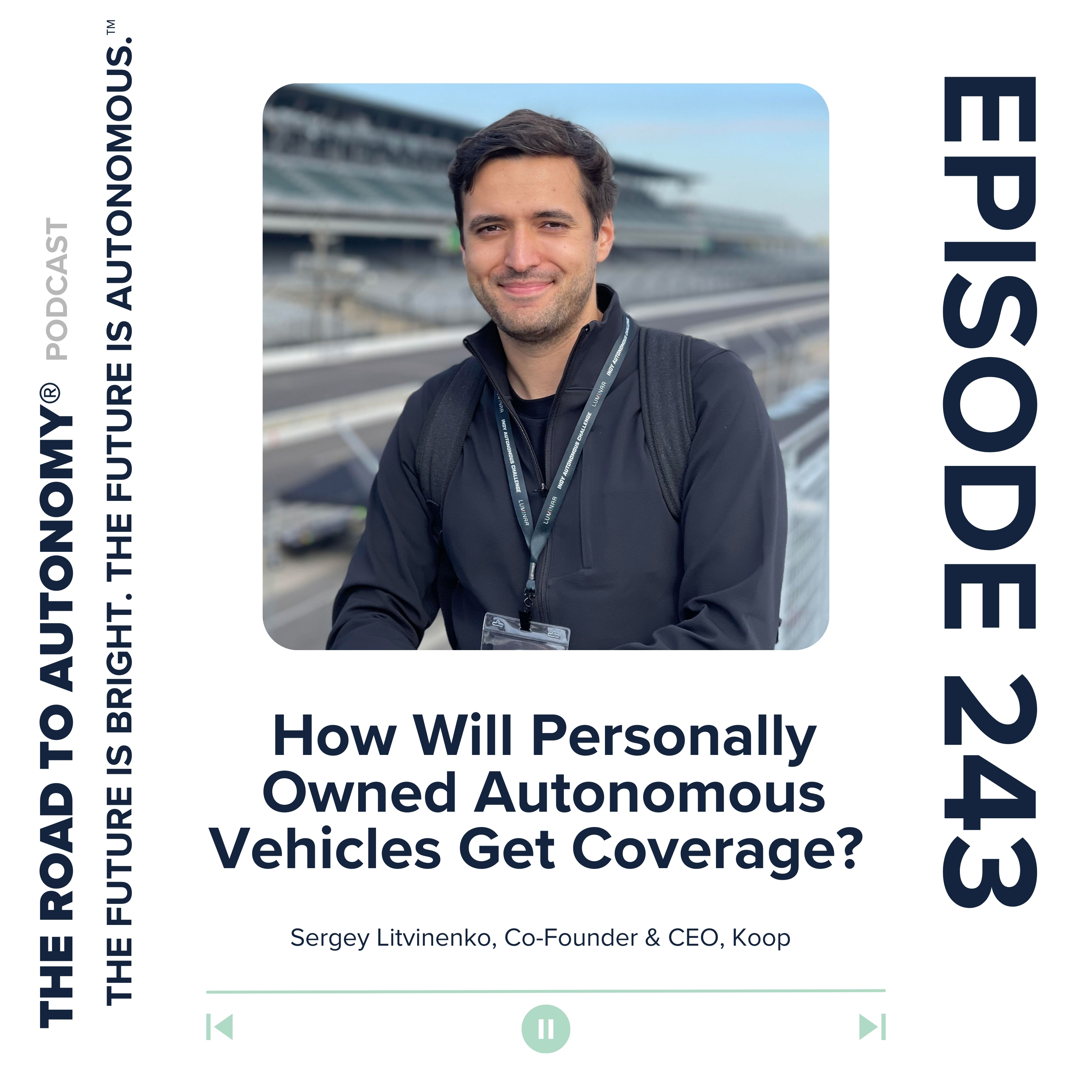
Ep 243Episode 243 | Tesla's CyberCab Insurance Challenge: How Will Personally Owned Autonomous Vehicles Get Coverage?
Sergey Litvinenko, Co-Founder & CEO, Koop joined Grayson Brulte on The Road to Autonomy podcast to discuss insuring personally owned autonomous vehicles beginning with the Tesla Cybercab. Insuring autonomous vehicles without steering wheels and pedals presents unprecedented challenges that could potentially halt widespread adoption if the insurance is not figured out. While there currently isn’t an insurance product for personally owned fully autonomous vehicles, perhaps Tesla Insurance may have been created specifically to address this challenge? A critical aspect of insuring personally owned autonomous vehicles will be the handling of post-accident repairs and liability. OEM-backed insurance, particularly Tesla Insurance, is best positioned to handle these challenges due to their direct access to vehicle data, repair capabilities, and understanding of their unique vehicle designs. While there may be initial concerns about litigation and fraudulent claims, the comprehensive data collection from autonomous vehicles will help combat false claims. The future of personally owned autonomous vehicle insurance is likely to see rates decrease over time as safety performance improves.Episode Chapters0:00 Insuring CyberCab4:23 Insuring Personally Owned Autonomous Vehicles 7:13 Liability for Personally Owned Autonomous Vehicles with No Manual Controls9:01 Repairing Personally Owned Autonomous Vehicles 13:23 In The Event of a Crash, Who is Responsible? 23:36 Rider Liability Insurance 26:54 Underwriting Risk36:43 First Personally Owned Autonomous Vehicle Policies 38:27 Key TakeawaysRecorded on Tuesday, October 29, 2024--------About The Road to AutonomyThe Road to Autonomy® is a leading source of data, insight and commentary on autonomous vehicles/trucks and the emerging autonomy economy™.Sign up for This Week in The Autonomy Economy newsletter: https://www.roadtoautonomy.com/autonomy-economy/See Privacy Policy at https://art19.com/privacy and California Privacy Notice at https://art19.com/privacy#do-not-sell-my-info.
Ep 242Episode 242 | Autonomy Markets: Waymo’s New EMMA Model for Autonomous Driving, Zoox’s Pending Launch and The Great Tesla Divide
In this episode of Autonomy Markets, Grayson Brulte and Walter Piecyk discuss Waymo’s new EMMA model (End-to-End Multimodal Model) for Autonomous Driving, their increased weekly ridership and how a shortage of skilled mechanics and technicians could slow down the growth of the Waymo One service. As Waymo grows their service, Zoox is now preparing to join the party and launch a robotaxi service in both San Francisco and Las Vegas next year. While Zoox is about to join the robotaxi party, Tesla and their desire to launch a robotaxi service continues to divide the public and the market.Episode Chapters0:00 Waymo3:02 Autonomous Vehicle Mechanics 5:46 Uber11:20 Pricing Waymo One14:53 Economy18:12 Waymo EMMA model (End-to-End Multimodal Model) Paper21:53 Tesla Shade27:28 Zoox31:41 Aurora Delays Driver Out Until April 202538:45 Lyft39:36 WeRideRecorded on October 31, 2024--------About The Road to AutonomyThe Road to Autonomy® is a leading source of data, insight and commentary on autonomous vehicles/trucks and the emerging autonomy economy™.Sign up for This Week in The Autonomy Economy newsletter: https://www.roadtoautonomy.com/autonomy-economy/See Privacy Policy at https://art19.com/privacy and California Privacy Notice at https://art19.com/privacy#do-not-sell-my-info.
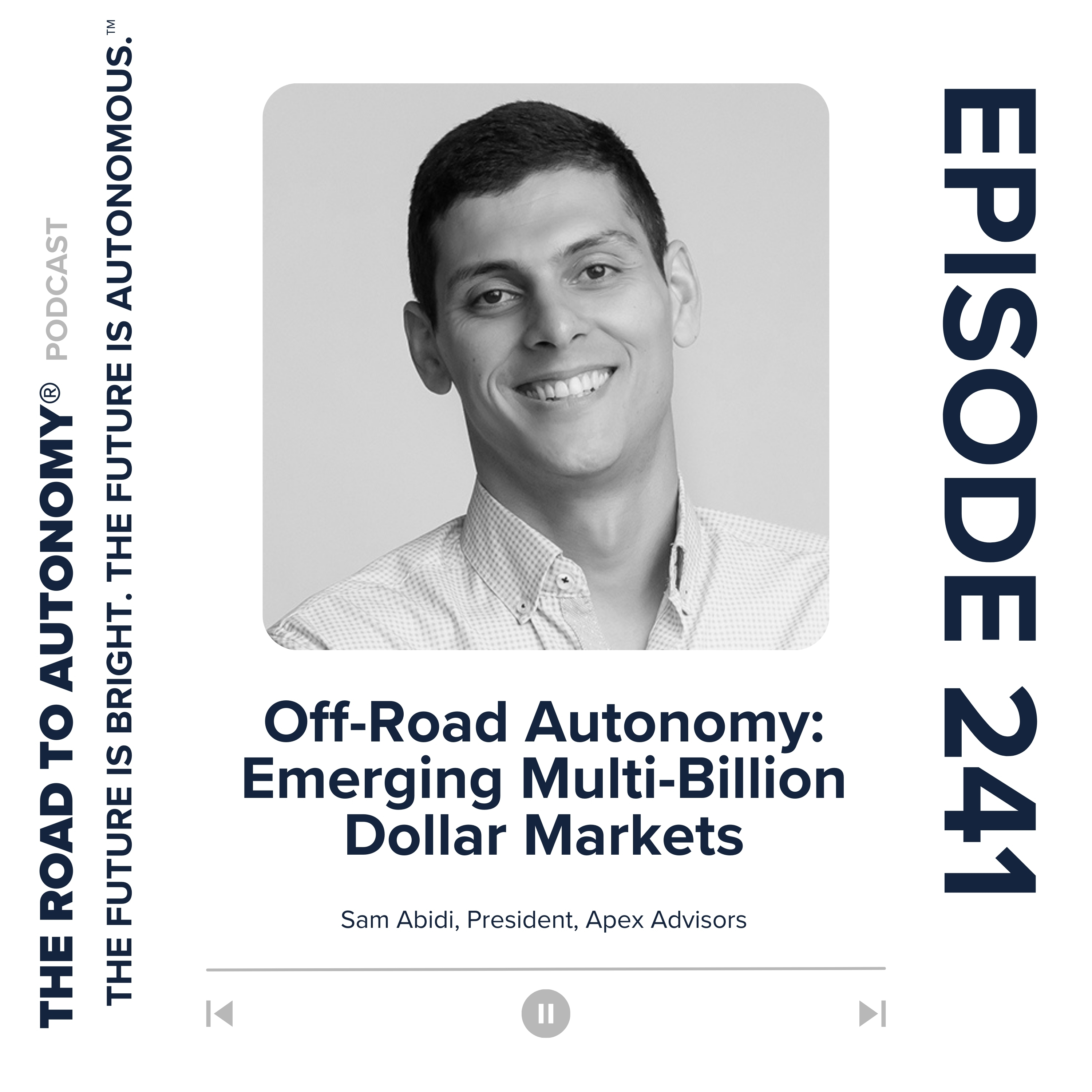
Ep 241Episode 241 | Off-Road Autonomy: Emerging Multi-Billion Dollar Markets
Sam Abidi, President, Apex Advisors joined Grayson Brulte on The Road to Autonomy podcast to discuss the rapidly evolving off-road autonomy market, its unique dynamics and why the market is full of opportunity. Autonomy is transforming off-road industries, from sprawling mine sites to vast agricultural fields and busy construction sites. As traditional equipment manufacturers and innovative startups race to meet surging demand, autonomous systems are proving to be more than just a solution to persistent labor shortages—they’re becoming a cornerstone of operational excellence.The economics are compelling: autonomous vehicles operate longer, work more efficiently, and significantly reduce operational expenses. Mining companies can run their haul trucks around the clock, farmers can precisely manage their fields with fewer workers, and construction sites can maintain productivity even amid staffing challenges.This convergence of necessity and innovation has sparked intense competition, as both established heavy equipment giants and agile tech startups vie to capture their share of this rapidly expanding market. What’s driving this gold rush? The promise of scalable operations and robust profit margins, underpinned by proven success stories across multiple sectors.Episode Chapters0:00 Off-Road Autonomy Market2:35 Ag Autonomy8:51 Startups Competing with Established Industrial OEMs11:01 OEM Deals13:20 Off-Road Autonomy Regulatory Market 16:05 Western Australia Mines20:10 Apex Advisors 24:20 Workforce Development 27:34 Private Equity Roll-Ups 35:17 Growth of the Off-Road Autonomy Market38:31 Future of Off-Road AutonomyRecorded on Monday, October 18, 2024--------About The Road to AutonomyThe Road to Autonomy® is a leading source of data, insight and commentary on autonomous vehicles/trucks and the emerging autonomy economy™.Sign up for This Week in The Autonomy Economy newsletter: https://www.roadtoautonomy.com/autonomy-economy/See Privacy Policy at https://art19.com/privacy and California Privacy Notice at https://art19.com/privacy#do-not-sell-my-info.
Ep 240Episode 240 | Autonomy Markets: Autonomy IPOs Heat Up: Tesla's 20% Rally, WeRide’s $440M IPO, & Waymo’s $5.6B Funding Round
In this episode of Autonomy Markets, Grayson Brulte and Walter Piecyk discuss the opening of the autonomy IPO market and investors increasing desire to own autonomous vehicle companies. On October 23rd, Tesla’s stock rallied 20% following earnings that beat the street and Elon Musk’s continued commentary about Tesla’s robotaxi ambitions. WeRide completed its NASDAQ IPO raising $440M on October 25th, the same day Waymo announced a massive $5.6B funding round led by Alphabet with participation from Tiger Global and Sliver Lake.Episode Chapters0:00 Capital Markets are Open3:07 Tesla Robotaxi Service in Palo Alto?5:43 The Interrelationships and Risks of the Elon Musk Companies10:43 WeRide IPO19:37 Waymo's Latest Funding Round23:17 Lucid is Finding Out Autonomy is Hard29:40 Wayve32:02 Cruise Goes Driverless in Houston33:16 Uber37:02 Next WeekRecorded on October 25, 2024--------About The Road to AutonomyThe Road to Autonomy® is a leading source of data, insight and commentary on autonomous vehicles/trucks and the emerging autonomy economy™.Sign up for This Week in The Autonomy Economy newsletter: https://www.roadtoautonomy.com/autonomy-economy/See Privacy Policy at https://art19.com/privacy and California Privacy Notice at https://art19.com/privacy#do-not-sell-my-info.
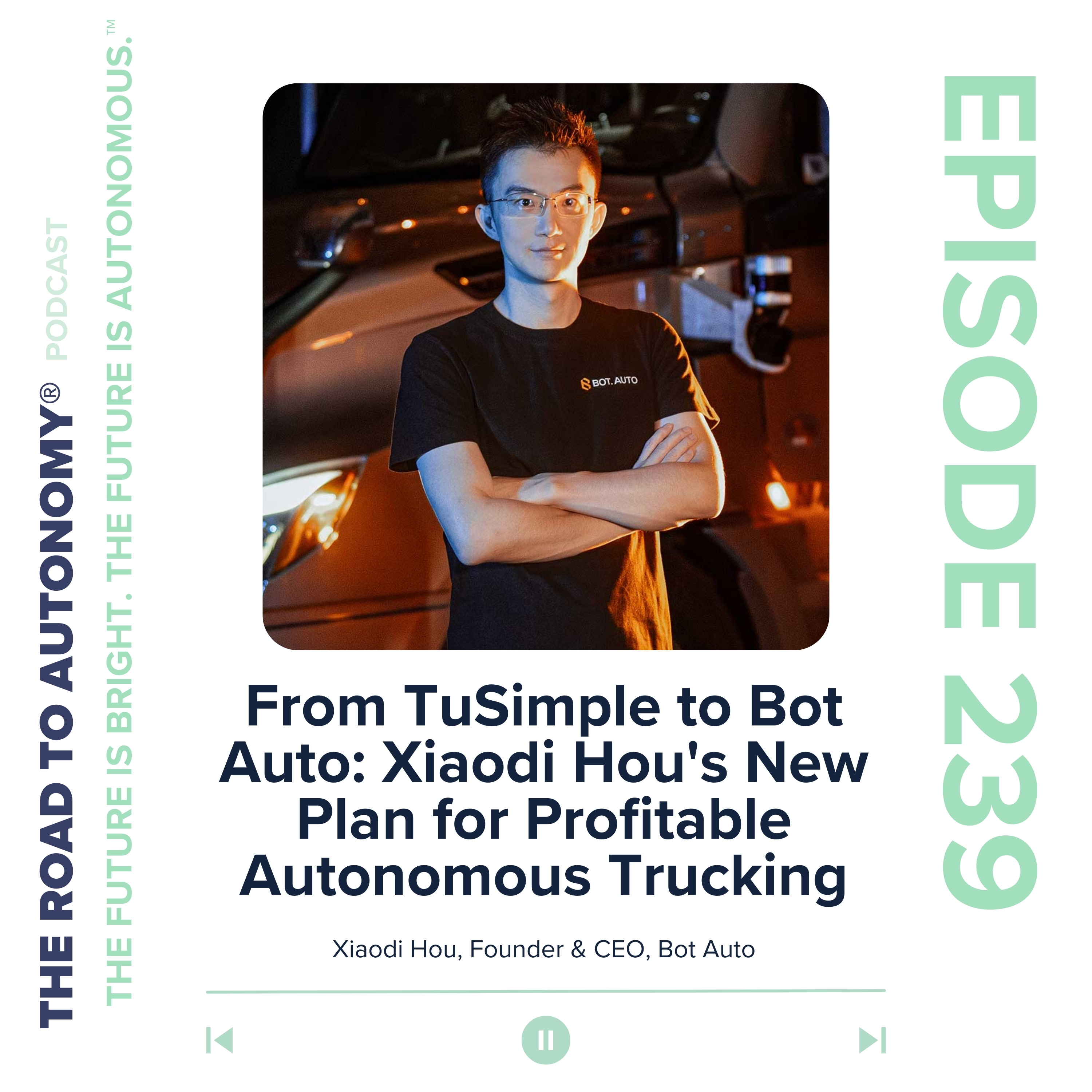
Ep 239Episode 239 | From TuSimple to Bot Auto: Xiaodi Hou's New Plan for Profitable Autonomous Trucking
Xiaodi Hou, Founder & CEO, Bot Auto joined Grayson Brulte on The Road to Autonomy podcast to discuss his plans for building and scaling a profitable autonomous trucking company.In a revealing conversation Dr. Xiaodi candidly discusses his departure from TuSimple and the founding of Bot Auto, offering candid insights into lessons learned, decisions he made and why his new approach to building an autonomous trucking business is largely focused on profitability over rapid scaling.Episode Chapters0:00 What Happened at TuSimple3:52 What if TuSimple Did Not Go Public6:46 Decision Making9:41 Bot Auto Business and Commercialization Strategy 20:39 Bot Auto Cost Structure 24:07 Making a Truck Autonomous and Going Driver-Out30:18 Safety33:11 Tesla FSD (Full Self-Driving)37:08 Bot Auto Lanes39:47 Small Teams44:53 Commercial Operations Timeline50:35 GPUs52:17 TakeawayRecorded on Monday, October 14, 2024--------About The Road to AutonomyThe Road to Autonomy® is a leading source of data, insight and commentary on autonomous vehicles/trucks and the emerging autonomy economy™.Sign up for This Week in The Autonomy Economy newsletter: https://www.roadtoautonomy.com/autonomy-economy/See Privacy Policy at https://art19.com/privacy and California Privacy Notice at https://art19.com/privacy#do-not-sell-my-info.
Ep 238Episode 238 | Autonomy Markets: More Details Emerge on Tesla's FSD 13 Robotaxi Bet, Uber's Ambitions, Emerging Autonomy IPO Market
In this episode of Autonomy Markets, Grayson Brulte and Walter Piecyk discuss the details emerging from Tesla’s robotaxi unveiling at We, Robot. Tesla’s robotaxi is projected to have a 200-mile range with FSD 13 powering Full Self-Driving Unsupervised. Could FSD 13 be Tesla’s breakthrough autonomy moment? Or will it be a later version of FSD? Later the conversation shifts to the emerging news about Uber’s potential acquisition of Expedia and what that acquisition would mean to both the travel and autonomy markets.The IPO market for autonomy is heating up, as Horizon Robotics has filled for an IPO on the Hong Kong Exchange and Pony AI is preparing for a U.S. listing. Could this be a sign of things to come?Episode Chapters0:00 We, Robot 15:39 Autonomy Use Cases 18:48 Horizon Robotics and Pony.AI IPOs 24:46 Potential; Uber / Expedia Deal 33:24 Lyft Makes a Move? 40:06 Next WeekRecorded on October 17, 2024--------About The Road to AutonomyThe Road to Autonomy® is a leading source of data, insight and commentary on autonomous vehicles/trucks and the emerging autonomy economy™.Sign up for This Week in The Autonomy Economy newsletter: https://www.roadtoautonomy.com/autonomy-economy/See Privacy Policy at https://art19.com/privacy and California Privacy Notice at https://art19.com/privacy#do-not-sell-my-info.
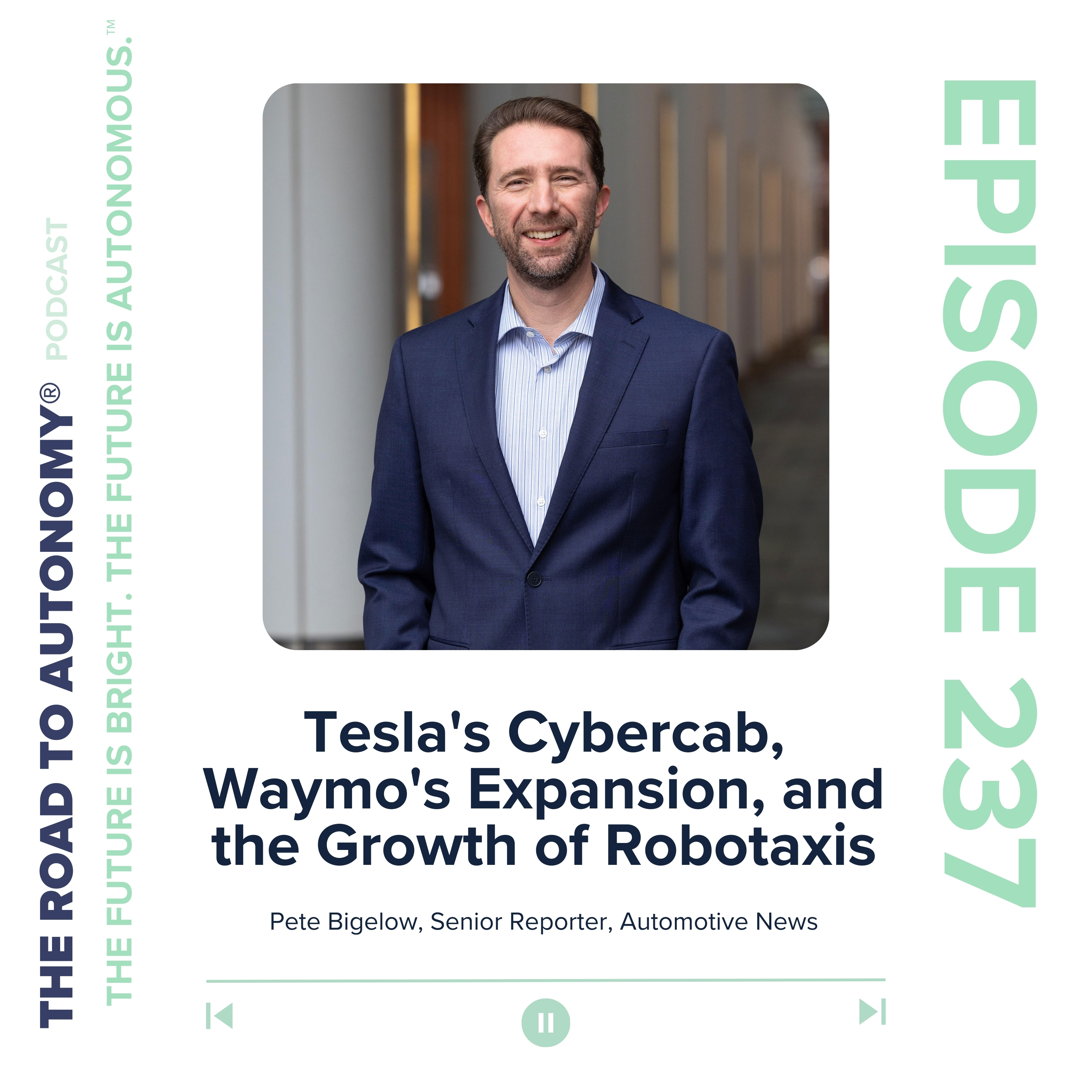
Ep 237Episode 237 | Tesla's Cybercab, Waymo's Expansion, and the Growth of Robotaxis
Pete Bigelow, Senior Reporter, Automotive News joined Grayson Brulte on The Road to Autonomy podcast to discuss the latest developments in the autonomous vehicle industry including the introduction of Tesla’s Cybercab, Waymo’s expansion and the growth of robotaxis. On 10/10 Tesla unveiled Cybercab, a two passenger robotaxi as Waymo ramps up operations in multiple cities around the U.S., Hyundai works on their Motional strategy and Zoox prepares to launch commercial service in Las Vegas in 2025. Even as Robotoaxis scale, certain OEMs are still focused on developing SAE Level 3 systems which come with complex regulatory issues. Along with the regulatory issues comes liability and who is at fault in the event of a crash. It’s a problem that has not been solved yet and one that certain special interest groups might not want to be solved.Episode Chapters0:00 We, Robot6:55 President Tump on Autonomous Vehicles8:34 Shared Rides11:45 Zoox in Las Vegas14:00 Motional / Hyundai21:14 Tort Reform29:02 Tim Kentley Klay's HYPR33:10 Mobileye34:47 VW ID Buzz Autonomous Vehicle Service37:33 Robotaxi OutlookRecorded on Friday, October 11, 2024 --------About The Road to AutonomyThe Road to Autonomy® is a leading source of data, insight and commentary on autonomous vehicles/trucks and the emerging autonomy economy™.Sign up for This Week in The Autonomy Economy newsletter: https://www.roadtoautonomy.com/autonomy-economy/See Privacy Policy at https://art19.com/privacy and California Privacy Notice at https://art19.com/privacy#do-not-sell-my-info.
Ep 236Episode 236 | Autonomy Markets: Tesla's We, Robot Event: AI Confusion or Cybernetic Revolution
In this episode of Autonomy Markets, Grayson Brulte and Walter Piecyk discuss Tesla’s We Robot event, an event that Grayson has dubbed as “Autonomy Disneyland” and the markets mixed market reaction to the event.While the We Robot event was impressive and Disneyesque, it fell short on providing concrete details about timelines, financial projections, and technological progress in Tesla’s development of full self-driving (FSD). The lack of substantive details led to an 8% drop in Tesla’s stock price, while Uber and Lyft’ stocks gained on no further details about Tesla’s proposed robotaxi network service. Overall, the We Robot event was impressive. Cybercab, Robovan are Tesla’s vision for an autonomous future. Optimus is getting closer to moving into homes, and we suspect Tesla has something else up there sleeves. Episode Chapters0:00 Optimus (Robots)2:35 Full Self-Driving (FSD)9:40 Cybercab19:24 Uber & Lyft26:12 Does Amazon Integrate Zoox into a Prime Mobility Tier?28:33 Inductive Charging 32:56 Autonomy Disneyland34:54 Next WeekRecorded on October 11, 2024--------About The Road to AutonomyThe Road to Autonomy® is a leading source of data, insight and commentary on autonomous vehicles/trucks and the emerging autonomy economy™.Sign up for This Week in The Autonomy Economy newsletter: https://www.roadtoautonomy.com/autonomy-economy/See Privacy Policy at https://art19.com/privacy and California Privacy Notice at https://art19.com/privacy#do-not-sell-my-info.
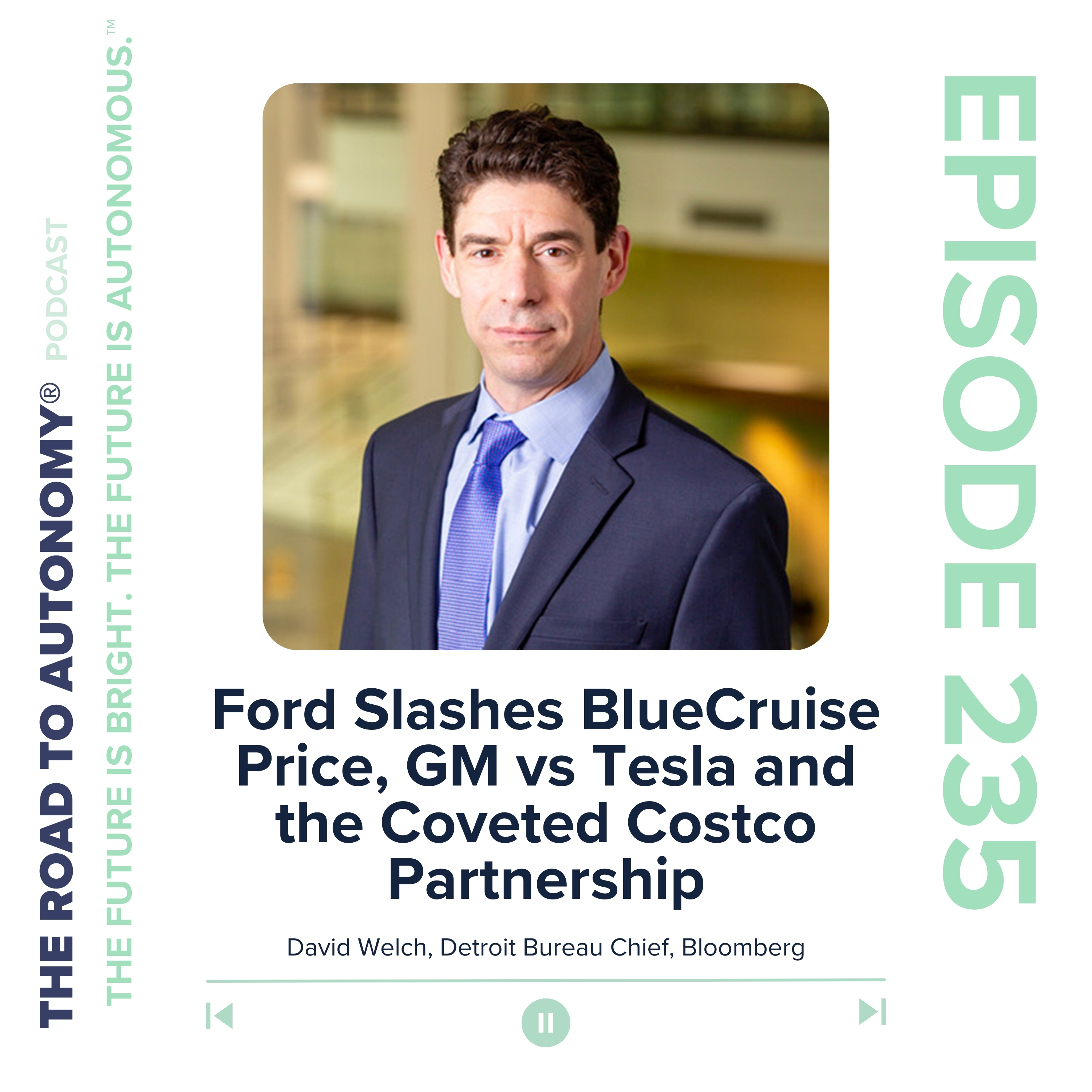
Ep 235Episode 235 | Ford Slashes BlueCruise Price, GM vs Tesla, Coveted Costco Partnership
David Welch, Detroit Bureau Chief, Bloomberg joined Grayson Brulte on TheRoad to Autonomy podcast to discuss Ford's BlueCruise price cut and GM's burgeoning competition with Tesla for personally owned autonomous vehicles. Ford continues to face headwinds without an autonomous driving partner as GM prepares to once again commercialize Cruise and Tesla prepares to introduce the robotaxi on 10/10. Without a partner and Waymo currently open to doing deals with several OEMs, could Ford once again strike a partnership this time not with Google but with Waymo?There are a lot of questions to be answered as the market for personally-owned autonomous vehicles begins to emerge. When the market is fully emerge, one of the biggest questions that remains is which company will secure the coveted Costco partnership?Episode Chapters0:00 Car Software Subscriptions 8:06 GM Cruise Subscription 10:53 GM vs. Tesla13:03 Could Ford Go Back to Waymo?15:31 May Mobility18:53 Autonomous Driving Stacks20:52 AVRide21:38 Commerce Dept. Connected/Autonomous Vehicle Proposed Rules24:22 Autonomous Driving Stacks for Select Markets25:32 Hyundai 28:32 FSD Approach 30:19 Zoox37:03 Costco Autonomous Vehicle Partnership 39:12 Aurora Driver-Out 40:03 Key Takeaways Recorded on Tuesday October 3, 2024 --------About The Road to AutonomyThe Road to Autonomy® is a leading source of data, insight and commentary on autonomous vehicles/trucks and the emerging autonomy economy™.Sign up for This Week in The Autonomy Economy newsletter: https://www.roadtoautonomy.com/autonomy-economy/See Privacy Policy at https://art19.com/privacy and California Privacy Notice at https://art19.com/privacy#do-not-sell-my-info.
Ep 234Episode 234 | Autonomy Markets: Tesla's 10/10 We Robot Event, Waymo's Austin Launch, and Zoox's New Vegas Partnership
In this episode of Autonomy Markets, Grayson Brulte and Walter Piecyk discuss Tesla’s highly anticipated 10/10 We Robot event and what could be announced. Could Optimus have a friend? Could Tesla introduce Full Self-Driving (Supervised) for Tesla Semi? Will the robotaxi be a two passenger vehicle? There are lots of questions that will be answered next week live on the Warner Bros. backlot in Burbank, CA. As Tesla is poised to potentially change the market, Waymo has begun their early rider program in Austin, Texas in a 37 square mile ODD. Next up for early rider, Atlanta. We expect Waymo to begin Atlanta early rider access in November 2024. Then there is Zoox which announced a new partnership with the Vegas Golden Knights and delayed their Vegas robotaxi launch until 2025 as part of the announcement. Wrapping up the episode, Grayson and Walter discuss Xiaodi Hou’s new start-up, Bot Auto and Uber Freight’s growing role in the autonomous trucking ecosystem. Episode Chapters0:00 10/10 Tesla We Robot Event1:50 Venture Capitalists and Wall Street’s Outlook on Autonomy Investments5:25 Perhaps a Two Passenger Tesla Robotaxi?7:06 Tesla Semi10:14 Waymo’s Increased Testing of the Zeekr Vehicle 13:18 California’s Autonomous Vehicle Bills Vetoed18:20 Waymo Begins Early Rider Access in Austin20:51 Zoox / Golden Knights Partnership 25:25 AVRide26:43 Sidewalk Delivery Bots30:12 Bot Auto33:38 Next WeekRecorded on October 3, 2024--------About The Road to AutonomyThe Road to Autonomy® is a leading source of data, insight and commentary on autonomous vehicles/trucks and the emerging autonomy economy™.Sign up for This Week in The Autonomy Economy newsletter: https://www.roadtoautonomy.com/autonomy-economy/See Privacy Policy at https://art19.com/privacy and California Privacy Notice at https://art19.com/privacy#do-not-sell-my-info.
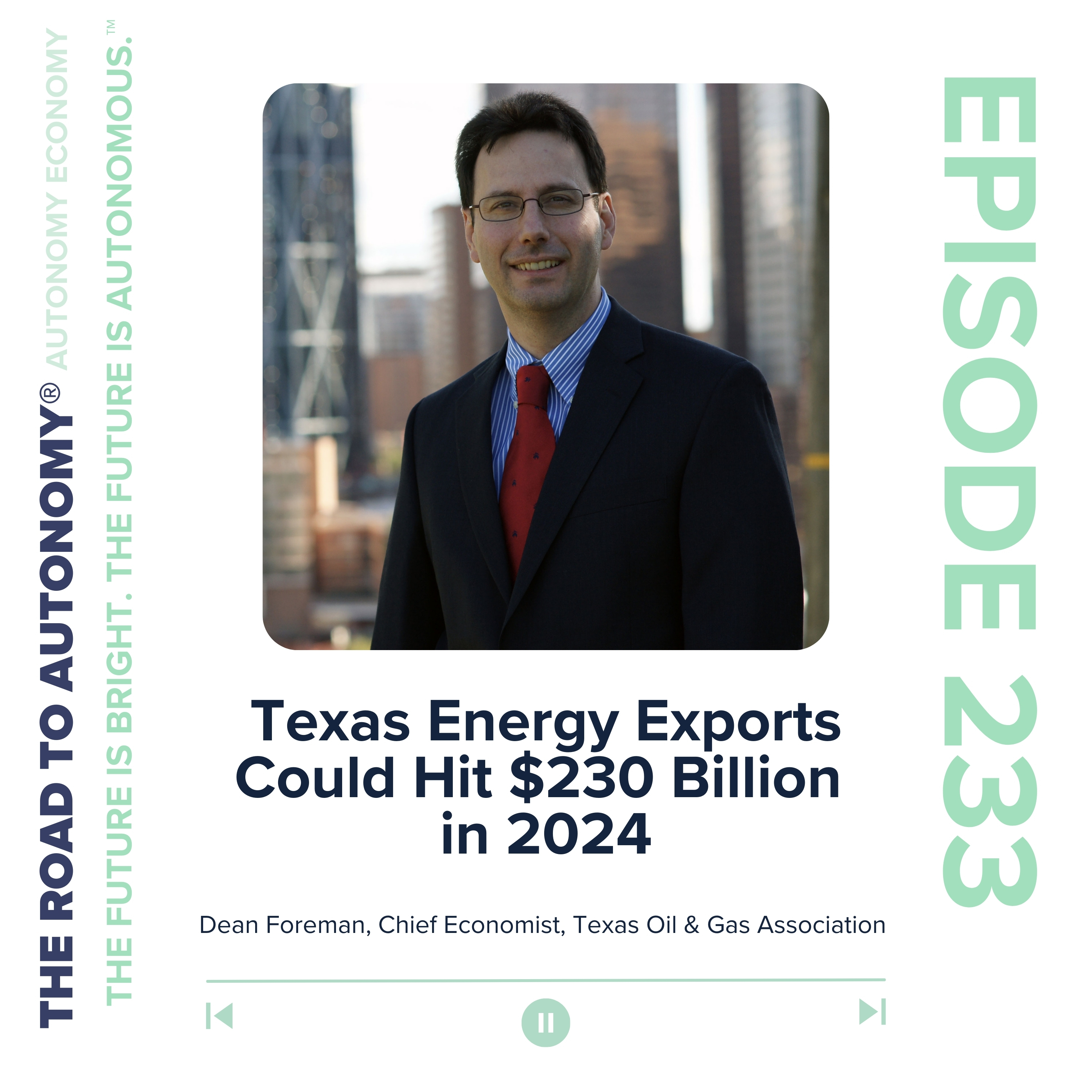
Ep 233Episode 233 | Autonomy Economy: Texas Energy Exports Could Hit $230 Billion in 2024
Dean Foreman, Chief Economist, Texas Oil & Gas Association joined Grayson Brulte on the Autonomy Economy podcast to discuss the growing demand for oil and how Texas energy exports could hit $230 billion by the end of the year. In Q3 2024, global oil demand reached a record of 103.4 million barrels per day. To keep up with the global demand for oil and in an effort to maintain marketshare, Saudi Arabia recently announced that the Kingdom will increase daily oil production by 1 million barrels at day to 9.9 million barrels per day by December 2025. While Saudi Arabia is increasing output, Texas continues to output millions of barrels of oil per day as well. As of July, Texas is currently outputting 5.7 million barrels per day of crude oil and 3.85 million barrels per day of natural gas liquids. As global oil demand continues to outstrip supply, Texas is working to close the gap by leveraging technology to bring new wells online. The oil and gas industry is thriving in Texas. So much so, that the industry paid $26.3 billion in state and local royalties and taxes in 2023.Episode Chapters0:00 Preparing for Hurricanes 2:35 Growing Oil Demand 11:33 Oil Markets & Interest Rates 14:34 International Longshoremen's Association Port Strike 19:42 Interest Rates and the Impact on Drilling 23:22 Increasing Productivity Through Automation 27:28 Oil & Natural Gas Industry's Impact on Texas' Economy 31:28 Growing Household Debt & Delinquencies 35:48 Strengthening Euro 37:42 Rising Oil Demand Continuing in 2025 40:21 Quarterly Oil OutlookRecorded on Friday, September 27, 2024--------About The Road to AutonomyThe Road to Autonomy® is a leading source of data, insight and commentary on autonomous vehicles/trucks and the emerging autonomy economy™.Sign up for This Week in The Autonomy Economy newsletter: https://www.roadtoautonomy.com/autonomy-economy/See Privacy Policy at https://art19.com/privacy and California Privacy Notice at https://art19.com/privacy#do-not-sell-my-info.
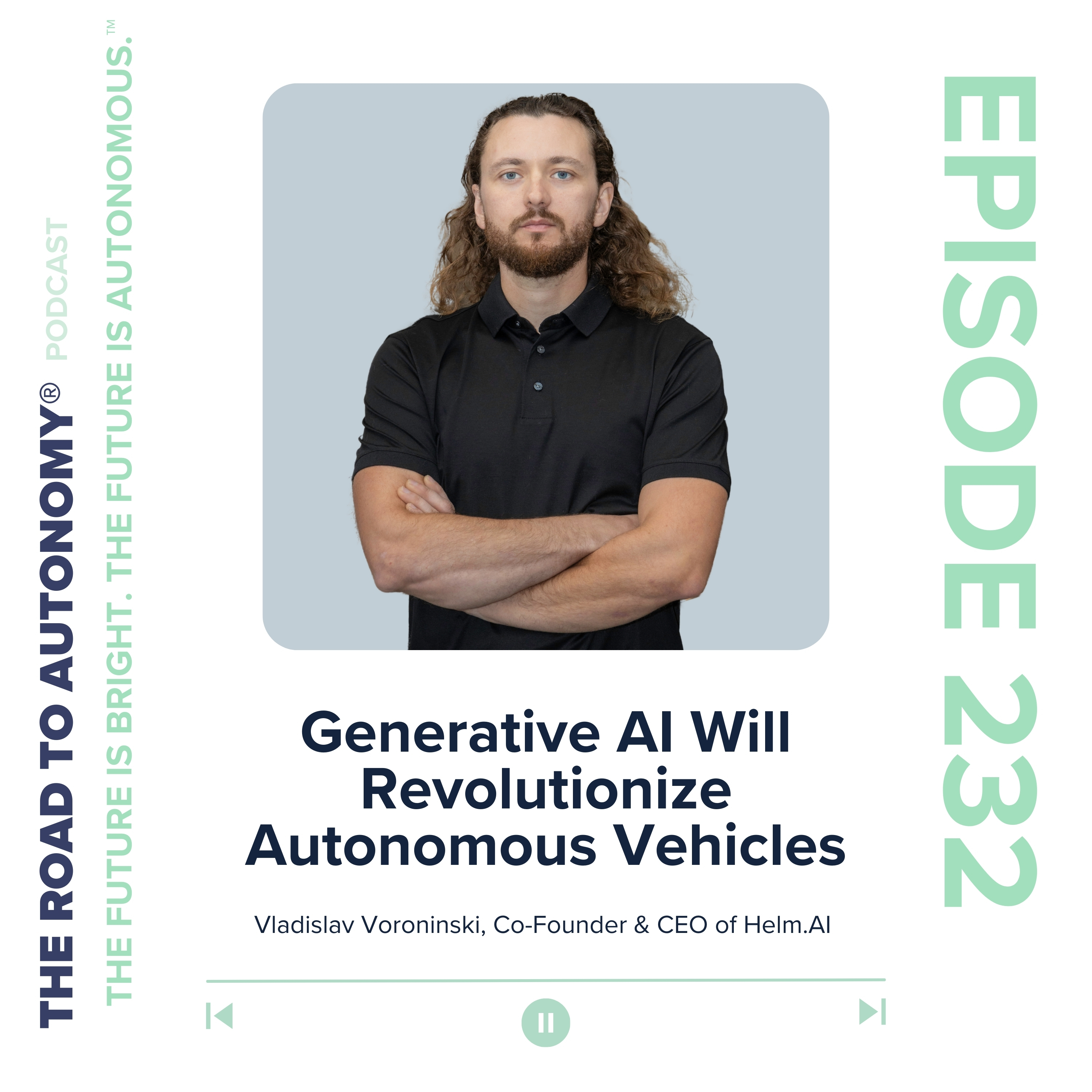
Ep 232Episode 232 | Generative AI Will Revolutionize Autonomous Vehicles
Vladislav Voroninski, Co-Founder & CEO of Helm.AI joined Grayson Brulte on The Road to Autonomy podcast to discuss how generative AI will revolutionize autonomous vehicles. Generative AI has the potential to revolutionize the development of autonomous vehicles, while shortning the development time required to build autonomous driving systems. Helm.AI's unsupervised learning approach to autonomous driving is enabling more compute-efficient AI models for autonomous driving.Episode Chapters0:00 Current State of GenAI5:52 AI Simulation Models8:02 Autonomous Driving Bottlenecks 11:36 Validate Decision Making 13:56 Tesla’s Approach to Full Self-Driving18:22 Helm AI’s Simulation Platform 23:06 Unsupervised Learning 25:05 Helm AI Decision Making Models 29:27 Helping OEMs Develop Autonomous Driving Systems 35:04 Autonomous Vehicle Market Outlook39:23 Key Takeaways Recorded on Thursday, September 26, 2024--------About The Road to AutonomyThe Road to Autonomy® is a leading source of data, insight and commentary on autonomous vehicles/trucks and the emerging autonomy economy™.Sign up for This Week in The Autonomy Economy newsletter: https://www.roadtoautonomy.com/autonomy-economy/See Privacy Policy at https://art19.com/privacy and California Privacy Notice at https://art19.com/privacy#do-not-sell-my-info.
Ep 231Episode 231 | Autonomy Markets: U.S. Chinese Autonomous Vehicle Ban, Tesla’s ‘We Robot’ Event, GM’s Surprise Move and a Waymo LA Prediction
In this episode of Autonomy Markets, Grayson Brulte and Walter Piecyk discuss the U.S. Commerce Department’s proposed ruling to prohibit the sale or import of vehicles that have hardware and software integrated into the vehicle connectivity system (VCS) and software integrated into the Automated Driving System from China and Russia. They explored the potential impact of the proposed rule and what the broader implications for trade relations could be in the future. Later the conversation delves into Waymo’s LA expansion and Grayson predicts Waymo will open the service to all members of the public within the next two months. As Waymo prepares to open the service to the public in LA, Grayson and Walter examine the communication strategies of autonomous vehicle companies, making the case for more transparent and frequent updates to build public support and investor confidence.As investor hype is building as we get closer to Tesla’s “We Robot” event on October 10th, could GM try and get ahead of Tesla’s 10/10 event and make an announcement at GM investor day on 10/8 about a potential personally owned autonomous vehicle? Wrapping up the episode, Grayson and Walter debate the decision by Apple to shut down Project Titan.Episode Chapters0:00 U.S. Commerce Department Proposed Autonomous Vehicle Ruling4:10 Upcoming Autonomous Vehicle Policy Hearings in Texas8:44 Uber / WeRide Partnership11:13 Zoox16:53 Waymo’s LA Expansion 19:52 Airport Pickups in Autonomous Vehicles22:18 Autonomous Vehicle Media Strategies 26:16 Shrinking LiDAR Market28:12 Tesla’s 10/10 We Robot Invites Are Out29:53 GM Investor Day on 10/833:06 Jony Ive & Apple36:02 Augmented Reality in Autonomous Vehicles39:37 Next WeekRecorded on September 26, 2024--------About The Road to AutonomyThe Road to Autonomy® is a leading source of data, insight and commentary on autonomous vehicles/trucks and the emerging autonomy economy™.Sign up for This Week in The Autonomy Economy newsletter: https://www.roadtoautonomy.com/autonomy-economy/See Privacy Policy at https://art19.com/privacy and California Privacy Notice at https://art19.com/privacy#do-not-sell-my-info.

Ep 230Episode 230 | Autonomy Insights: Click a Button Get a Car
In Las Vegas, Vay has completed over 5,000 teledriven trips as the fleet has expanded to 150 vehicles. Justin Spratt, Chief Business Officer, Vay joined Grayson Brulte on Autonomy Insights to discuss the business of teledriving. Vay's teledriving system, VayNet, minimizes latency through advanced compression techniques and redundant networks. Their business model offers the potential to reduce costs by up to 50% compared to traditional ride-hailing services.Theit technology has the potential to unlock new efficiencies in transportation, from improving operations in seaports and airports to enhancing car rental services and supporting the growth of autonomous vehicles.Chapters0:00 Vay's Approach to Teledriving1:10 Automotive Safety Case3:57 Vay Business Model9:12 Economics of Teledriving10:10 Vay Use Cases 12:57 Telemarket OutlookRecorded on Wednesday September 18, 2024--------About The Road to AutonomyThe Road to Autonomy® is a leading source of data, insight and commentary on autonomous vehicles/trucks and the emerging autonomy economy™.Sign up for This Week in The Autonomy Economy newsletter: https://www.roadtoautonomy.com/autonomy-economy/See Privacy Policy at https://art19.com/privacy and California Privacy Notice at https://art19.com/privacy#do-not-sell-my-info.
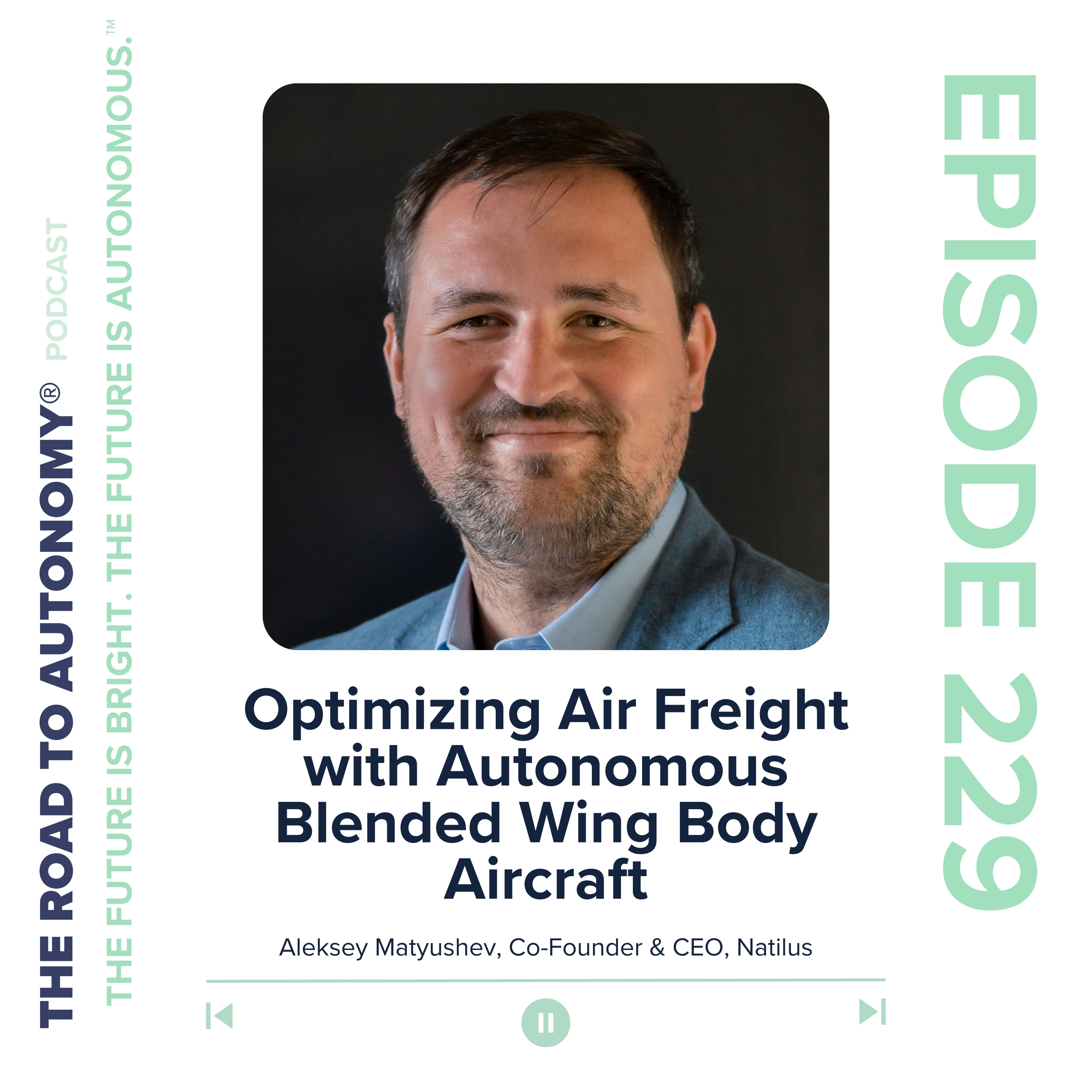
Ep 229Episode 229 | Optimizing Air Freight with Autonomous Blended Wing Body Aircraft
Aleksey Matyushev, Co-Founder & CEO, Natilus joined Grayson Brulte on The Road to Autonomy podcast to discuss optimizing air freight with autonomous blended wing body (BWB) aircraft. A blended wing aircraft body enables 20% more volumetric space and 30% better fuel efficiency for freight cargo when compared to traditional aircraft design. 10% of the world’s good travel by air freight, yet comprise 90% o the value. With most of the world’s electronics being made in Asia, including the iPhone, air freight plays a vital role in the global supply chain. With a growing global pilot labor shortage, autonomous blended wing body aircrafts can ensure that the world’s supply chain continues to function without hiccups.Episode Chapters0:00 Current State of the Air Freight Market2:38 Air Freight Routes8:57 Natilus Flight Distances 10:09 Blended Wing Body (BWB) Design14:07 Economics of Natilus17:59 Manufacturing the Aircraft22:10 Why Build an Autonomous Aircraft?26:14 Fuel28:56 Scaling Manufacturing30:08 Projected Aircraft Costs31:05 Inspiration for Natilus33:58 Future of NatilusRecorded on Thursday September 19, 2024--------About The Road to AutonomyThe Road to Autonomy® is a leading source of data, insight and commentary on autonomous vehicles/trucks and the emerging autonomy economy™.Sign up for This Week in The Autonomy Economy newsletter: https://www.roadtoautonomy.com/autonomy-economy/See Privacy Policy at https://art19.com/privacy and California Privacy Notice at https://art19.com/privacy#do-not-sell-my-info.
Ep 228Episode 228 | Autonomy Markets: Waymo’s Potential Pivot to Hyundai and Zoox’s Upcoming Launch
In this episode of Autonomy Markets, Grayson Brulte and Walter Piecyk discuss Waymo’s potential pivot away from Zeekr to Hyundai, Zoox’s commercialization strategy and why Uber is the platform for autonomy. Waymo’s potential deal with Hyundai for the IONIQ 5 platform could mark the end of Waymo’s deal with Zeekr, ending what we have termed an unforced error. If Waymo is indeed abandoning the Chinese made Zeekr, could there be a broader shakeout of Chinese technology in the autonomous vehicle industry? Then there is Zoox which is operating in a secretive manner as they prepare to launch commercial operations “soon”. Could Zoox’s secretive approach potentially lead to potential consequences because of their lack of transparency with both the market and consumers? To accelerate the adoption of autonomous vehicles, Congress needs to pass an Autonomous Vehicle National Framework that incudes trucks weighing over 10,000 pounds to accelerate the autonomous vehicle adoption and investment in the United States. A national autonomous vehicle framework will unlock investment that will lead to economic growth. Walt and Grayson also explore the potential catalysts that could drive faster autonomous vehicle adoption, including consumer experiences, economic pressures, and the upcoming U.S. election. Throughout the discussion, they stress the importance of pushing for more aggressive expansion into challenging environments to truly advance the technology and gain public trust.Episode Chapters0:00 Waymo in San Francisco6:44 Zoox14:37 Waymo / Hyundai 18:48 Autonomy Economy25:02 Autonomy and Elections27:22 Autonomous Vehicle Experiences 29:19 Investing in Autonomous Vehicles21:23 Next WeekRecorded on September 19, 2024--------About The Road to AutonomyThe Road to Autonomy® is a leading source of data, insight and commentary on autonomous vehicles/trucks and the emerging autonomy economy™.Sign up for This Week in The Autonomy Economy newsletter: https://www.roadtoautonomy.com/autonomy-economy/See Privacy Policy at https://art19.com/privacy and California Privacy Notice at https://art19.com/privacy#do-not-sell-my-info.
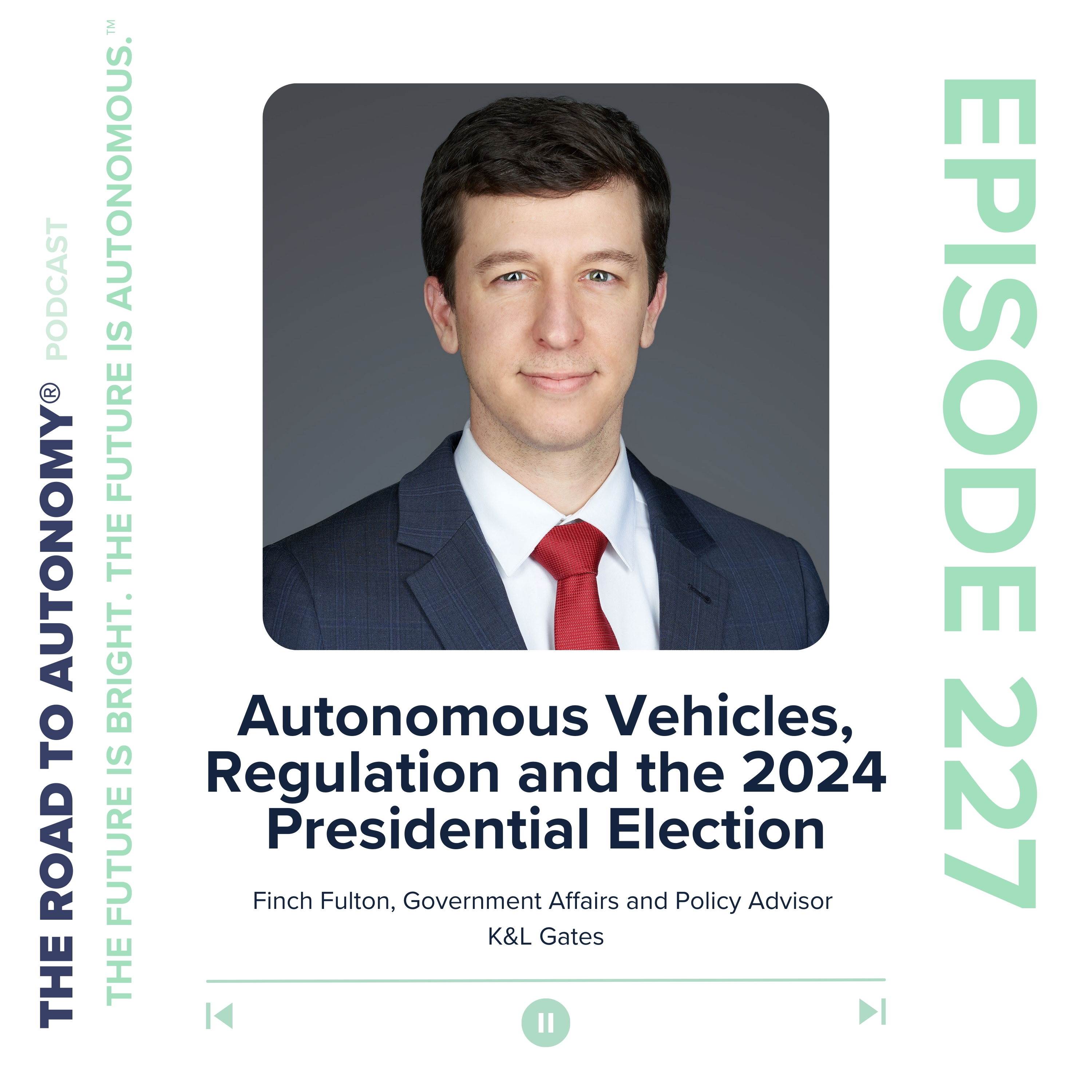
Ep 227Episode 227 | Autonomous Vehicles, Regulation and the 2024 Presidential Election
Finch Fulton, Government Affairs and Policy Advisor, K&L Gates joined Grayson Brulte on The Road to Autonomy podcast to discuss autonomous vehicle policy, regulation and the impact that the 2024 Presidential Election could have on the development and commercialization of both autonomous vehicles and autonomous trucks. Under a second President Trump administration or a Harris administration there will be different approaches to regulating autonomous vehicles. While the approaches will be different, it is important that the next administration takes a balanced approach that fosters innovation while ensuring safety and the ability to operate commercial autonomous vehicle and truck businesses. During the conversation, Grayson and Finch cover a range of topics, including California’s AI regulation efforts, the positive economic benefits of autonomous vehicles on consumers budgets, and the recently expanded partnership between Uber and Waymo.Episode Chapters0:00 Impact of the 2024 Presidential Election on Autonomous Vehicle Policy6:00 AI Regulation 14:52 AI Regulation’s Potential Impact on Autonomous Vehicles17:44 California Autonomous Trucking Regulations 20:55 California vs Organized Labor 24:30 Positive Economic Benefits of Autonomous Vehicles28:15 Uber/Waymo Austin & Atlanta Partnership 34:16 Tesla Robotaxi Platform36:28 Emerging Personally Owned Autonomous Vehicle Market38:09 Licensing Autonomous Driving 39:28 Key TakeawaysRecorded on Friday, September 13, 2024--------About The Road to AutonomyThe Road to Autonomy® is a leading source of data, insight and commentary on autonomous vehicles/trucks and the emerging autonomy economy™.Sign up for This Week in The Autonomy Economy newsletter: https://www.roadtoautonomy.com/autonomy-economy/See Privacy Policy at https://art19.com/privacy and California Privacy Notice at https://art19.com/privacy#do-not-sell-my-info.
Ep 226Episode 226 | Autonomy Markets: Silicon Valley's Changing Autonomous Vehicle Landscape: Licensing, Experiences, Personally Owned AVs
In this episode of Autonomy Markets, Grayson Brulte and Walter Piecyk discuss the latest developments in the autonomous vehicle industry, drawing insights from Grayson's recent trip to Silicon Valley.There is an emerging shift towards developing autonomous driving stacks and licensing the technology to OEMs and mobility platform providers. Nuro is embracing this trend as they announced their new business models this week.As the autonomous vehicle business models change, consumer exceptions are changing in parallel. There is an increasing focus on premium experiences in autonomy as both startups and global OEMs begin to develop plans for personally owned autonomous vehicles.While the best laid plans often go awry, this time around OEMs are learning from the mistakes that they made when they jumped two feet into electrification with no real consumer strategy and no EV supply chain strategy.With growing competition from Chinese autonomous vehicle companies, U.S. based autonomous vehicle companies are beginning to focus on costs. As they focus on costs, the debate around LiDAR and if it's needed to develop an SAE Level 4 autonomous vehicle continues to rage.Wrapping up the episode, Grayson and Walt discuss the latest buzz surrounding the autonomous vehicle industry including potential pivots and partnerships in the industry.Episode Chapters0:00 Back from Silicon Valley3:41 Nuro 5:08 California's 33% Commercial Insurance Fee for Rideshare Rides 9:17 Personally Owned Autonomous Vehicles 16:34 Mobility Platforms 21:42 Experiences25:10 California Business Climate 26:29 Safety 30:59 Regulatory Environment 36:09 Impact of a Potential Alphabet Breakup on Waymo 38:56 The Latest Autonomous Vehicle BuzzRecorded on September 12, 2024--------About The Road to AutonomyThe Road to Autonomy® is a leading source of data, insight and commentary on autonomous vehicles/trucks and the emerging autonomy economy™.Sign up for This Week in The Autonomy Economy newsletter: https://www.roadtoautonomy.com/autonomy-economy/See Privacy Policy at https://art19.com/privacy and California Privacy Notice at https://art19.com/privacy#do-not-sell-my-info.
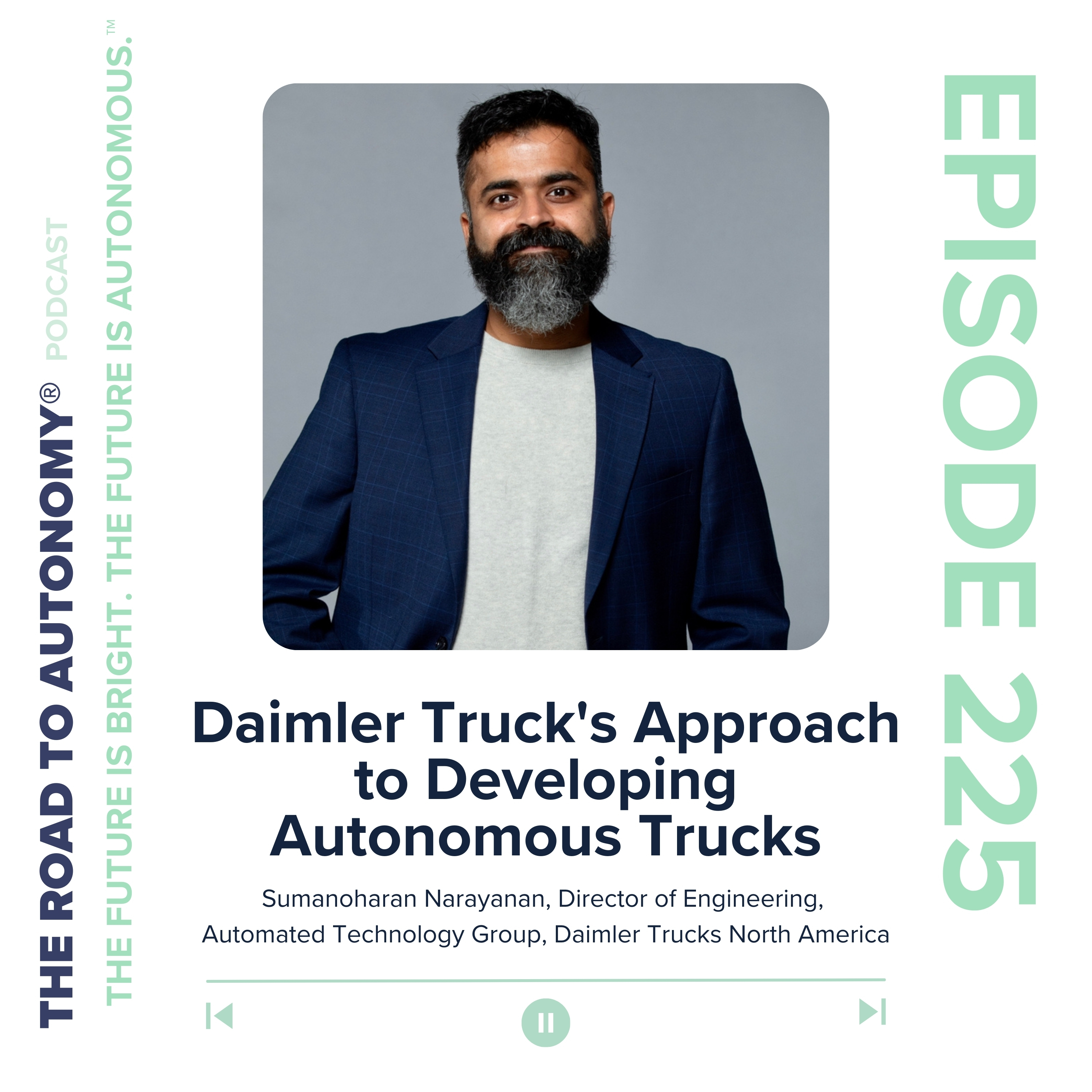
Ep 225Episode 225 | Daimler Truck's Approach to Developing Autonomous Trucks
Sumanoharan Narayanan, Director of Engineering, Automated Technology Group, Daimler Trucks North America joined Grayson Brulte on The Road to Autonomy podcast to discuss the development of the autonomous-ready Freightliner Cascadia.Episode Chapters0:00 How do you Build an Autonomous Truck04:47 The Idea Behind Daimler Trucks Autonomous Trucking Program8:34 The First Step in Building an Autonomous Truck11:33 Designing an Autonomous Truck15:37 Retrofitting18:07 Autonomous Ready Cascadia Propulsion & Reduncy Systems 31:20 Technicians and Maintenance34:37 When Do Mirrors Go Away?38:17 Sensor Suite44:26 Tesla Semi52:18 Future of Autonomous Trucking57:40 Key Takeaways --------About The Road to AutonomyThe Road to Autonomy® is a leading source of data, insight and commentary on autonomous vehicles/trucks and the emerging autonomy economy™.Sign up for This Week in The Autonomy Economy newsletter: https://www.roadtoautonomy.com/autonomy-economy/See Privacy Policy at https://art19.com/privacy and California Privacy Notice at https://art19.com/privacy#do-not-sell-my-info.
Ep 224Episode 224 | Autonomy Markets: Autonomy, A Threat or Strength for Uber? Waymo's Unforced Error and the Affordability of Delivery
Grayson Brulte and Walter Piecyk, discuss Wall Street's perspective on autonomy, the implications that autonomy could have on Uber and whether it'a s strength or weakness for Uber. Along with the impact of Tesla entering the robotaxi market and the growth of Waymo.Later in the conversation they explore topics such as the potential for autonomous vehicles to be marketed as a premium service, the challenges of integrating Chinese-made vehicles into U.S. markets, and the future of food delivery services.Episode Chapters0:00 Wall Street's Perspective on Autonomy3:33 Uber13:01 Autonomous Vehicle Insurance16:32 Autonomy as a Premium Service18:55 Waymo30:37 Uber Freight33:42 Delivery (Uber Eats & Instacart)38:46 Until Next WeekRecorded on September 5, 2024--------About The Road to AutonomyThe Road to Autonomy® is a leading source of data, insight and commentary on autonomous vehicles/trucks and the emerging autonomy economy™.Sign up for This Week in The Autonomy Economy newsletter: https://www.roadtoautonomy.com/autonomy-economy/See Privacy Policy at https://art19.com/privacy and California Privacy Notice at https://art19.com/privacy#do-not-sell-my-info.

Ep 223Episode 223 | Micron's Vision for Safer Roads: How Memory Drives the Future of Autonomous Vehicles
Bruce Franklin, Senior Directive of Automotive, Micron joined Grayson Brulte on The Road to Autonomy podcast to discuss the crucial role of memory in autonomous vehicles and the broader automotive industry.Micron has been a key player in automotive memory for over 30 years, with a steadfast commitment to quality, safety, and innovation. Memory requirements in cars has evolved over the years from no memory to basic infotainment systems to advanced driver assistance systems (ADAS) to memory that enables autonomous vehicles to operate safely.Episode Chapters0:00 Micron's Automotive Business 9:14 In-Vehicle User Experience 11:42 Micron's Approach to Autonomy21:03 Driver Monitoring 24:38 What if a Vehicle Did Not have Memory?26:39 Memory for Different Vehicle Platforms and Sensors 32:31 Investing in ISO Standards37:37 Future of Micron39:08 Key Takeaways --------About The Road to AutonomyThe Road to Autonomy® is a leading source of data, insight and commentary on autonomous vehicles/trucks and the emerging autonomy economy™.Sign up for This Week in The Autonomy Economy newsletter: https://www.roadtoautonomy.com/autonomy-economy/See Privacy Policy at https://art19.com/privacy and California Privacy Notice at https://art19.com/privacy#do-not-sell-my-info.
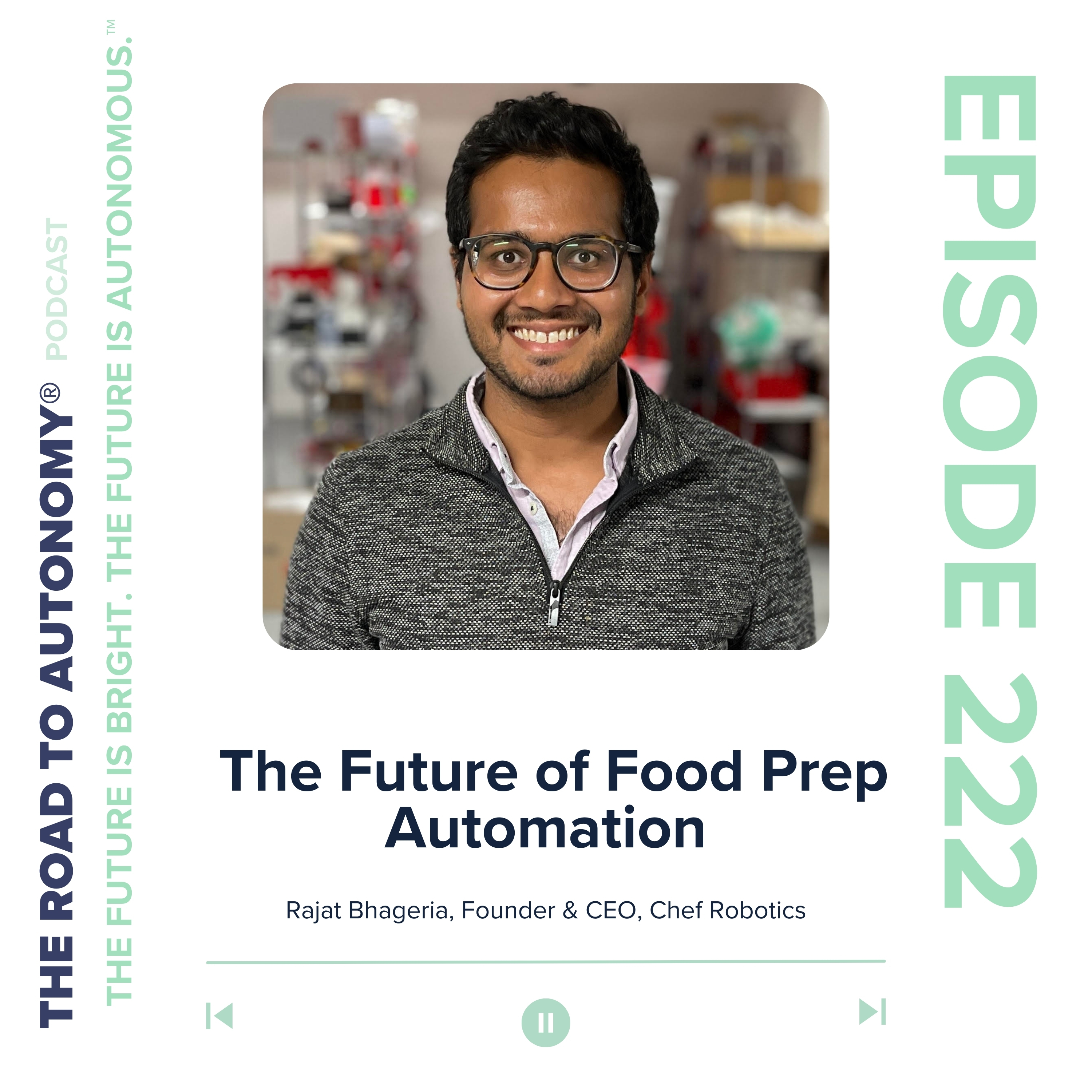
Ep 222Episode 222 | The Future of Food Prep Automation
Rajat Bhageria, Founder & CEO, Chef Robotics joined Grayson Brulte on The Road to Autonomy podcast to discuss the future of automation in food industry and the impact of rising labor costs.Chef is addressing the critical labor shortage in the food industry that is being driven by higher labor costs and increased turnover through automation. They’ve developed and deployed robots that are capable of performing assembly and plating tasks with high precision and consistency by leveraging computer vision. Their robots are designed to be seamlessly integrated into existing production lines, occupying the same footprint as a human worker. Chef’s systems can handle a variety of food items and are particularly adept at “scoopable” foods. To enable food packaging companies the ability implement the automation system without a high CapEx investment, Chef is deploying the system as a “robotics as a service” model as a yearly subscription with ongoing software and hardware updates.Companies that have implemented a Chef system have seen a 20% increase in production capacity, significant reduction in food waste (giveaway) and improved food portion consistency.Episode Chapters0:00 California Fast Food Minimum Wage4:36 Chef6:31 Packaging and Plating 10:33 Chef Autonomous System23:50 Food Portion Consistency26:25 Chef Commercial Model30:50 Customer Results33:07 Why Chef?35:06 Installing Chef37:08 Inspiration Behind Chef39:58 Food Packaging Automation42:59 Key Takeaways--------About The Road to AutonomyThe Road to Autonomy® is a leading source of data, insight and commentary on autonomous vehicles/trucks and the emerging autonomy economy™.Sign up for This Week in The Autonomy Economy newsletter: https://www.roadtoautonomy.com/autonomy-economy/See Privacy Policy at https://art19.com/privacy and California Privacy Notice at https://art19.com/privacy#do-not-sell-my-info.
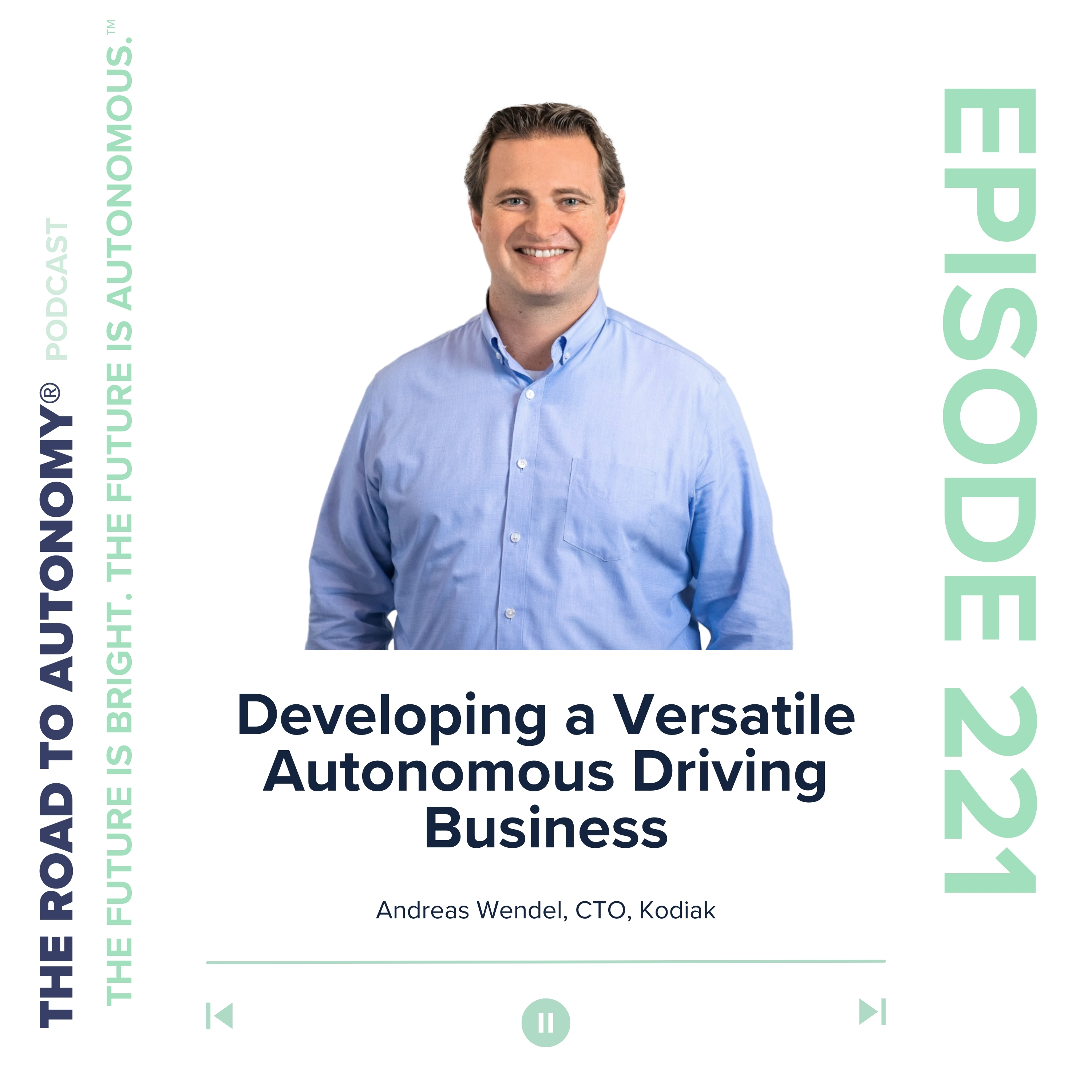
Ep 221Episode 221 | Developing a Versatile Autonomous Driving Business
Andreas Wendel, CTO, Kodiak joined Grayson Brulte on The Road to Autonomy podcast to discuss developing a versatile autonomous driving business. Chapters0:00 Developing an Autonomous Driving Stack7:10 Verifiable AI 10:49 Maps13:07 Autonomy for the Military 16:07 SensorPods22:36 Changing Approach to the Autonomous Driving Stack26:47 Moving Away from LiDAR29:17 Launching Fully Autonomous Operations with Atlas Energy34:40 Hardware Enclosures 37:18 Operating Environments and Future Vehicles 41:05 Growing The Kodiak Business44:14 Key Takeaways --------About The Road to AutonomyThe Road to Autonomy® is a leading source of data, insight and commentary on autonomous vehicles/trucks and the emerging autonomy economy™.Sign up for This Week in The Autonomy Economy newsletter: https://www.roadtoautonomy.com/autonomy-economy/See Privacy Policy at https://art19.com/privacy and California Privacy Notice at https://art19.com/privacy#do-not-sell-my-info.
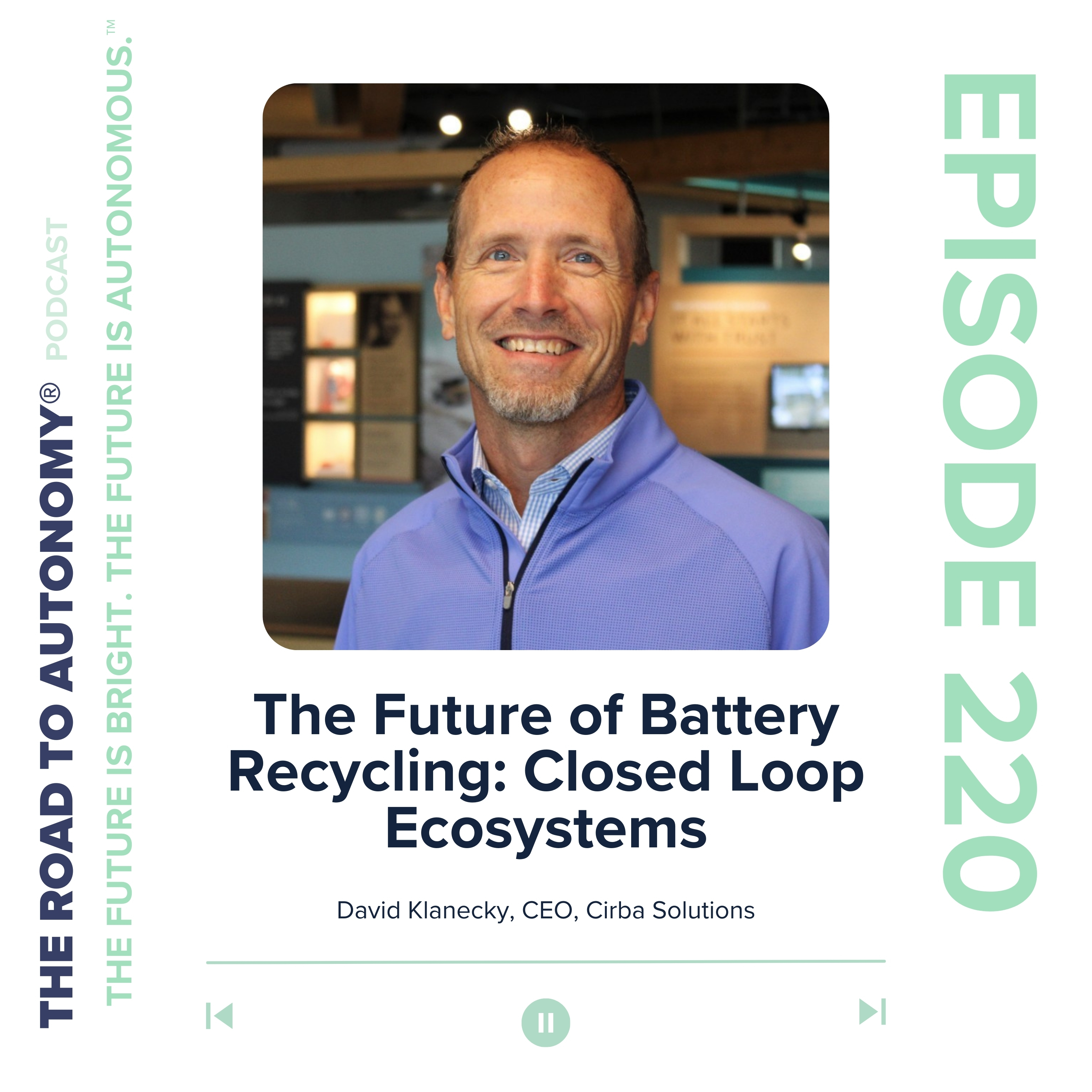
Ep 220Episode 220 | The Future of Battery Recycling: Closed Loop Ecosystems
The future of battery recycling is a closed loop ecosystem. David Klanecky, CEO of Cirba Solutions joined Grayson Brulte on The Road to Autonomy podcast for a wide-ranging discussion about the future of battery recycling.With growing demand for critical minerals, geopolitics and fluctuating commodity prices it's vitally important to build out the closed loop ecosystem of battery recycling. Batteries from consumer devices, electric vehicles, and industrial applications can all be recycled and enter a second phase of life if the right protocols are put in place at the end of life of the product.In addition to the environmental benefits of battery recycling, including a reduced carbon footprint and the creation of a closed-loop supply chain for battery materials, there are positive economic implications.Recycled batteries could potentially lower the cost of electric vehicles and other battery-powered devices. For this to happen, a closed loop ecosystem will have to be developed, scaled and monetized.Chapters0:00 Current State of Battery Recycling Market5:24 Quality Control8:13 More Efficient Battery Recycling12:05 Battery Recycling Process17:21 Commodities21:57 Battery Degradation23:16 Recycled Batteries29:08 Maritime Batteries31:14 Solid-State Batteries33:39 Future of Battery Recycling Business36:15 Key Takeaways--------About The Road to AutonomyThe Road to Autonomy® is a leading source of data, insight and commentary on autonomous vehicles/trucks and the emerging autonomy economy™.Sign up for This Week in The Autonomy Economy newsletter: https://www.roadtoautonomy.com/autonomy-economy/See Privacy Policy at https://art19.com/privacy and California Privacy Notice at https://art19.com/privacy#do-not-sell-my-info.
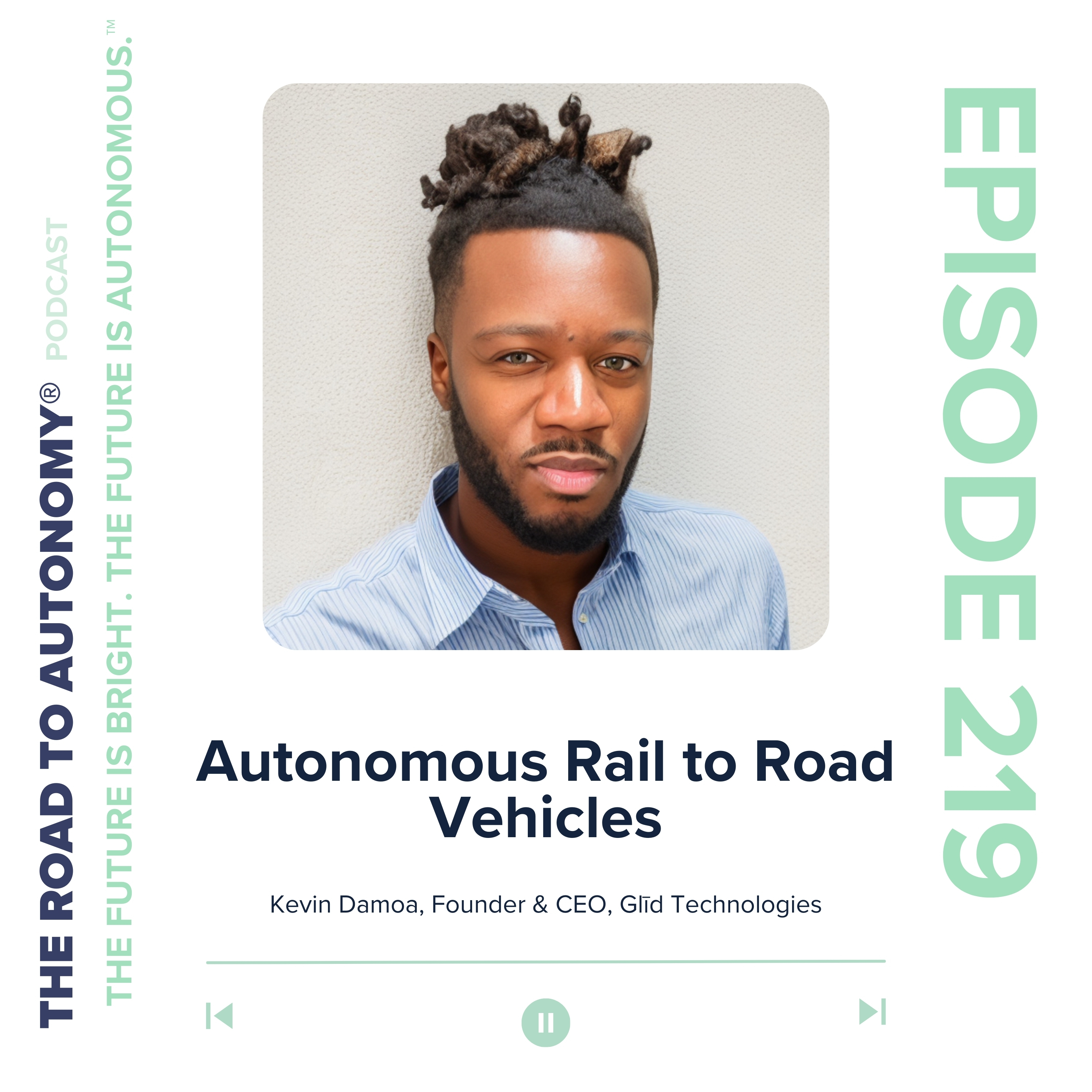
Ep 219Episode 219 | Autonomous Rail to Road Vehicles
Kevin Damoa, Founder & CEO, Glīd Technologies joined Grayson Brulte on The Road to Autonomy podcast to discuss Glīd’s autonomous to rail system.Kevin is a veteran with two tours in Iraq and experience in the National Guard, is the entrepreneur behind Glīd, a company developing autonomous vehicles capable of operating on both rail and road. Glīd’s technology aims to revolutionize first-mile logistics and intermodal operations.One of Glīd’s key advantages is its ability to eliminate multiple material handling steps in the logistics process, potentially reducing carbon emissions and improving efficiency. Beyond logistics innovation, Glīd has a strong social mission. The company plans to create jobs in marginalized communities near ports and rail yards, offering training and employment opportunities without requiring formal education. This approach aims to provide economic mobility and inspire future generations.Looking ahead, Glīd aims to democratize first-mile transportation, starting in the United States with plans to expand globally. Their goal is to improve logistics efficiency, reduce costs, and positively impact communities adjacent to ports and rail yards, potentially contributing to lower consumer prices and an improved quality of life.Chapters0:00 Military Service0:53 Inspiration for Glīd1:39 Glīd Weight Restrictions3:21 Maintaining Glīd4:25 Job Creation7:45 Glīd Target Markets9:07 Glīd System19:54 Road to Rail Transition24:02 Railroads25:04 Regulatory26:43 State of Glīd’s Technology28:13 SpaceX Manufacturing29:30 Romeo Power31:32 Future of Glīd--------About The Road to AutonomyThe Road to Autonomy® is a leading source of data, insight and commentary on autonomous vehicles/trucks and the emerging autonomy economy™.Sign up for This Week in The Autonomy Economy newsletter: https://www.roadtoautonomy.com/autonomy-economy/See Privacy Policy at https://art19.com/privacy and California Privacy Notice at https://art19.com/privacy#do-not-sell-my-info.
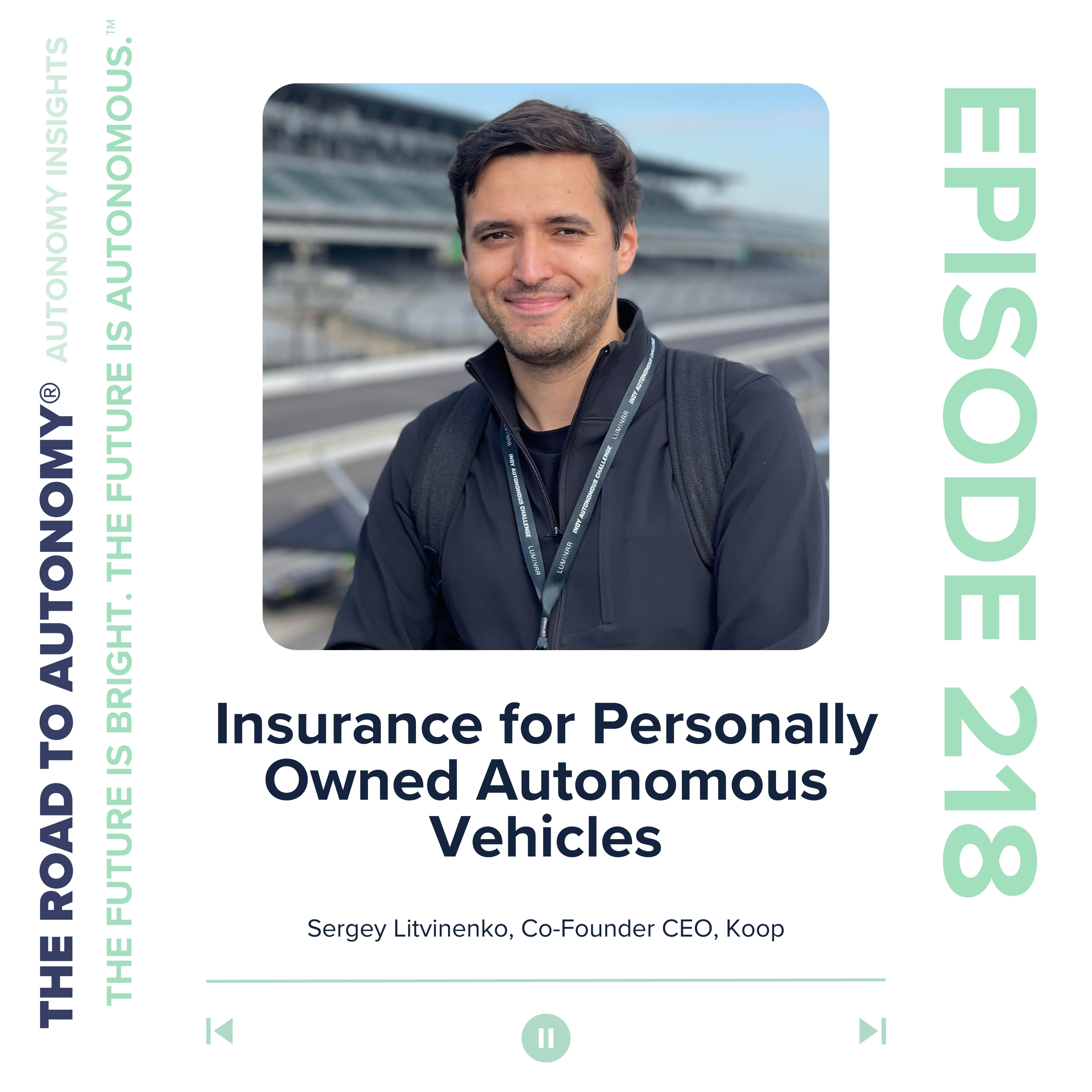
Ep 218Episode 218 | Autonomy Insights: Insurance for Personally Owned Autonomous Vehicles
You bought a personally owned autonomous vehicle (self-driving car). But do you need insurance? Wondering how you are going to insure the vehicle? Sergey Litvinenko, CEO of Koop Insurance joined Grayson Brulte on Autonomy Insights to explain how insurance and personally owned autonomous vehicles will work and who will be responsible in a crash.Chapters0:00 Insuring Personally Owned Autonomous Vehicles4:30 What Happens in a Crash? Who is Responsible?8:05 OEMs as Insurance Companies10:44 Reinsuring the Risk12:45 Future of Personally Owned Autonomous Vehicle Insurance--------About The Road to AutonomyThe Road to Autonomy® is a leading source of data, insight and commentary on autonomous vehicles/trucks and the emerging autonomy economy™. Sign up for This Week in The Autonomy Economy newsletter: https://www.roadtoautonomy.com/autonomy-economy/See Privacy Policy at https://art19.com/privacy and California Privacy Notice at https://art19.com/privacy#do-not-sell-my-info.
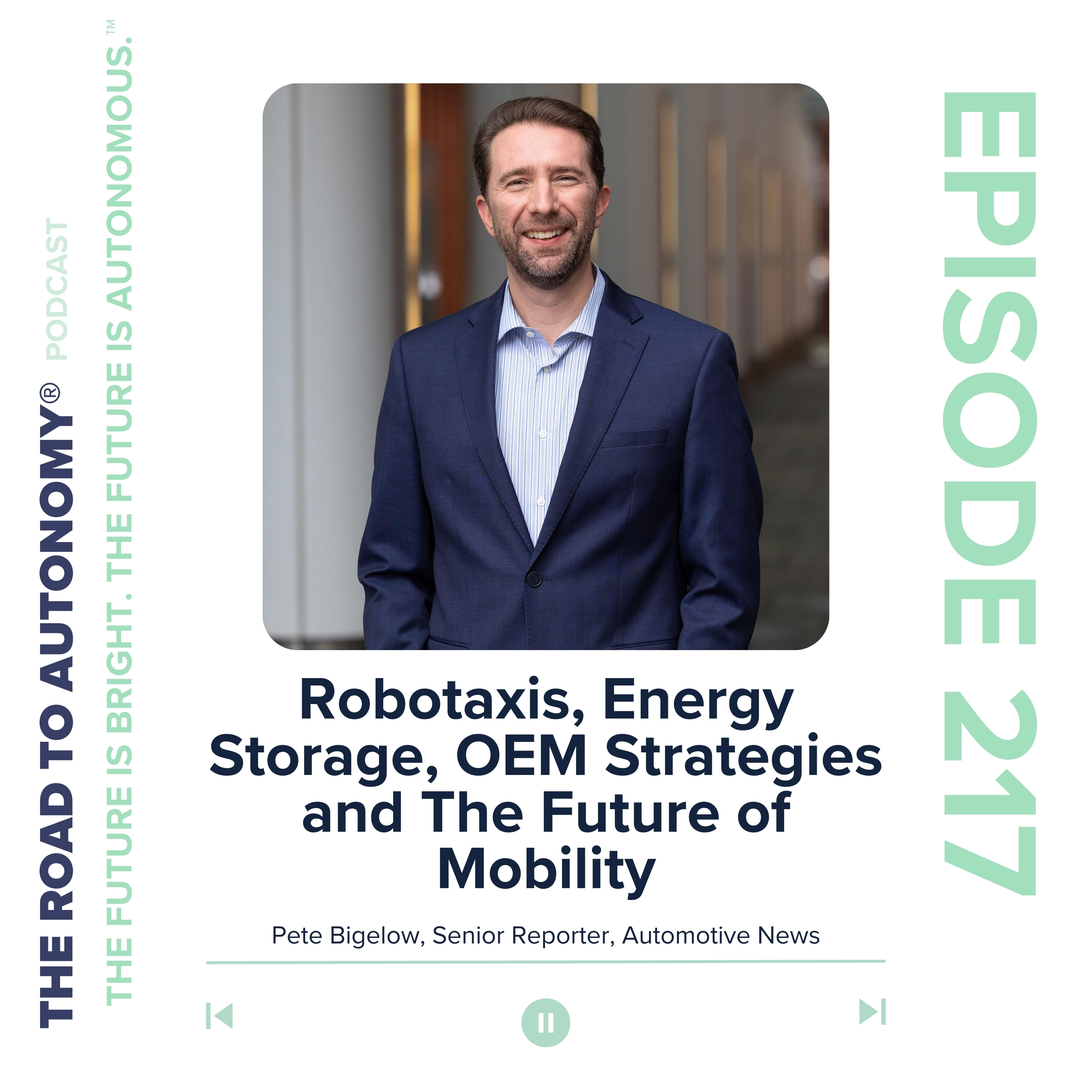
Ep 217Episode 217 | Robotaxis, Energy Storage, OEM Strategies and The Future of Mobility
Pete Bigelow, Senior Reporter, Automotive News joined Grayson Brulte on The Road to Autonomy podcast to discuss Alphabet's additional $5 billion investment into Waymo, energy storage and traditional automakers autonomy strategies.Chapters0:00 Alphabet Goes All In on Waymo7:17 Waymo compared to Uber in San Francisco10:21 Waymo's Pending Vehicle Problem12:49 Zoox23:21 Cruise25:38 Licensing Tesla FSD33:04 Ford40:03 Trends42:08 Key Take AwaysSee Privacy Policy at https://art19.com/privacy and California Privacy Notice at https://art19.com/privacy#do-not-sell-my-info.
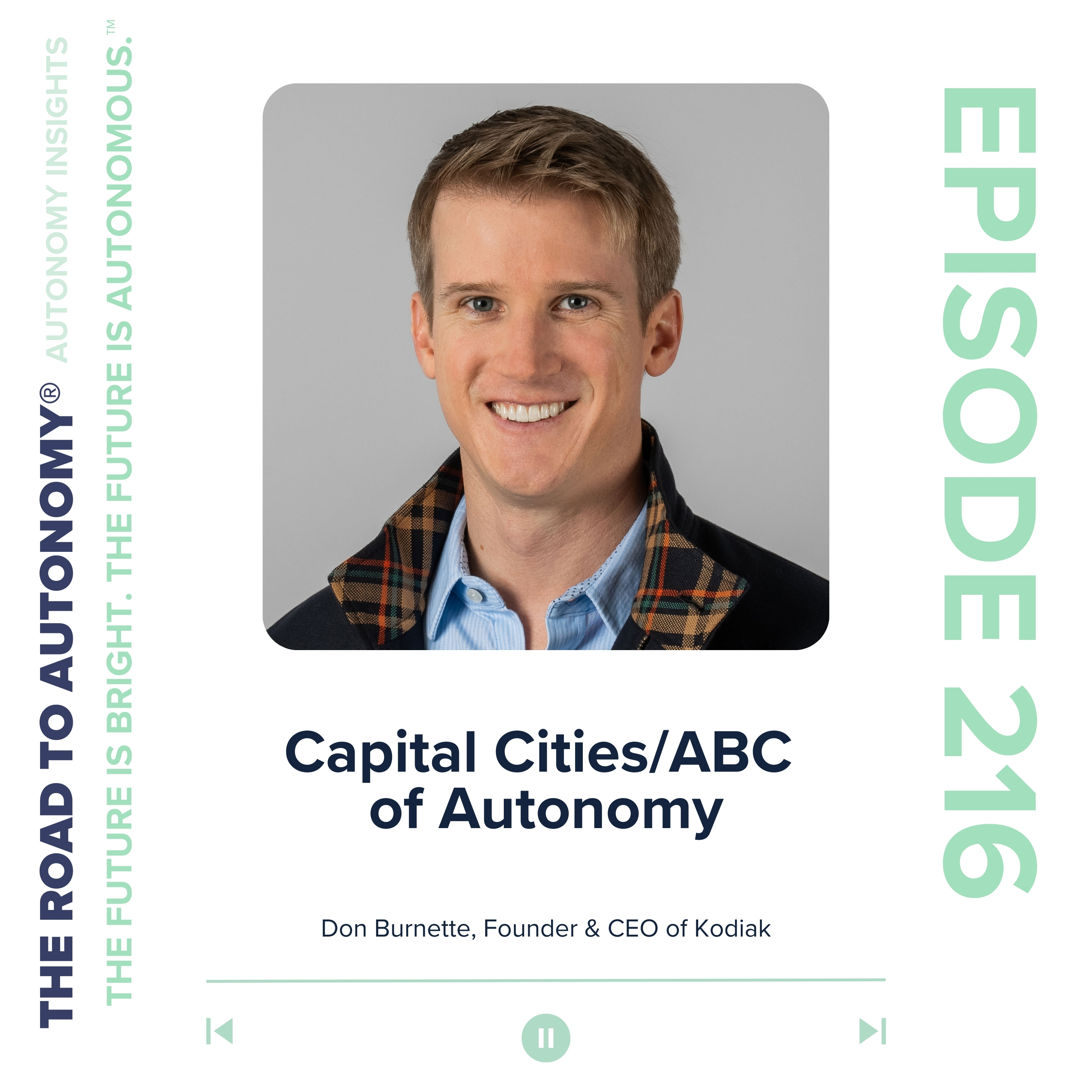
Ep 216Episode 216 | Autonomy Insights: Capital Cities/ABC of Autonomy
Tom Murphy, CEO of Capital Cities/ABC excelled at capital allocation. Following the example set by Mr. Murphy, Don Burnette, Founder & CEO of Kodiak is implementing his version of Capital Cities/ABC capital allocation strategy as he grows Kodiak. Don Burnette joined The Road to Autonomy Founder Grayson Brulte on Autonomy Insights to discuss Kodiak’s focus on growing long-term profitable revenue and achieving industry best EBITA margins. Mr. Burnette is keeping a keen eye on expenses and ensuring that capital is allocated to growing the business, not frivolous expenses. By keeping costs low and offering valuable solutions to customers, Kodiak was able to expand into Defense and off-road autonomy in a deal with Atlas Energy in the Permian Basin. The deal with Kodiak is potentially profitable enough to sustain Kodiak as a business even without its other business lines (defense and on-road trucking). Kodiak is in the process of transforming from a R&D-focused company to an operations company. In the mold of Capital Cities/ABC, Kodiak implementing a capital allocation strategy that ensures long-term growth.Recorded on Friday, July 26, 2024Episode Chapters0:00 Kodiak’s Expansion into Off-Road Autonomy 2:39 The Decision to Diversify 5:02 EBITA Margins 6:42 Capital Cities/ABC of Autonomy 10:06 Core Pillars of Kodiak’s Business 11:32 What’s Next For Kodiak--------About The Road to AutonomyThe Road to Autonomy® is a leading source of data, insight and commentary on autonomous vehicles/trucks and the emerging autonomy economy™. The company has two businesses: The Road to Autonomy Indices, with Standard and Poor’s Dow Jones Indices as the custom calculation agent; Media, which includes The Road to Autonomy and Autonomy Economy podcasts as well as This Week in The Autonomy Economy newsletter.See Privacy Policy at https://art19.com/privacy and California Privacy Notice at https://art19.com/privacy#do-not-sell-my-info.
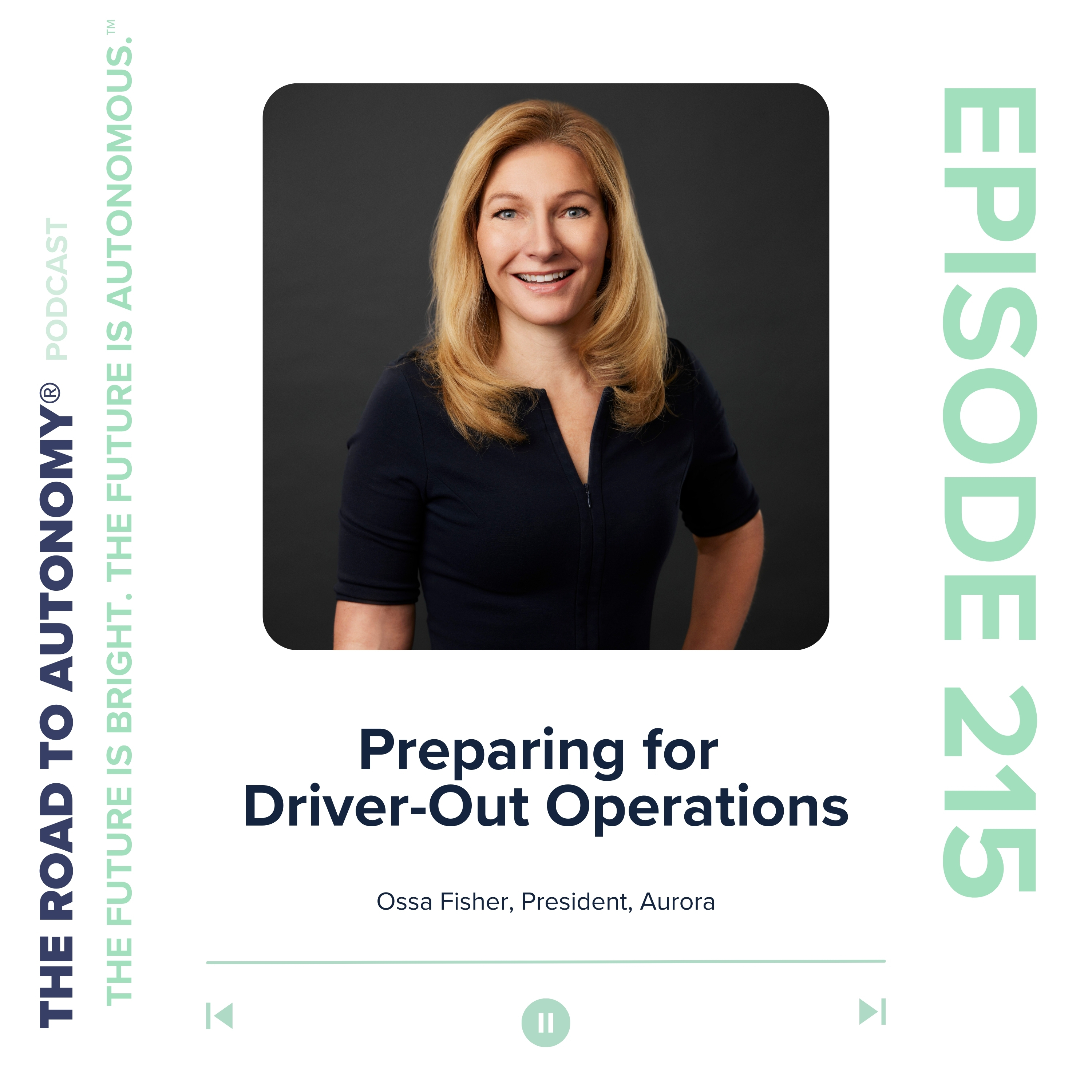
Ep 215Episode 215 | Preparing for Driver-Out Operations
Ossa Fisher, President of Aurora joined Grayson Brulte on The Road to Autonomy podcast to discuss how Aurora is preparing for driver-out operations in Texas by the end of the year. Aurora is taking a disciplined approach that Ossa likens to the preparation of elite athletes training for the Olympics.Aurora’s advanced perception system combined with their proprietary FirstLight LiDAR is assisting the company in their journey towards driver-out operations. The FirstLight LiDAR can detect obstacles up to four football fields away, significantly enhancing safety. Aurora’s development strategy combines on-road testing, controlled track environment testing, and extensive simulations. They’re rigorously preparing for various weather conditions and rare events to ensure maximum safety and reliability. The company’s partnerships with PACCAR, Volvo and Uber Freight will enable the company to scale operations and build a meaningful business overtime. The business model could change over time as it was developed to be flexible as the company scales driver-out commercial operations.The first lane that Aurora will operate driver-out will be Dallas to Houston followed by El Paso to Fort Worth. It’s has been a big journey for Aurora to get to driver-out operations and it will be a bigger journey once driver-out operations commence and expand to multiple lanes.Recorded on Tuesday, July 9, 2024Episode Chapters0:00 Preparing for Driver-Out4:46 Uber Freight Partnership7:14 Customer Exceptions for Driver-Out9:06 Driver-Out Lanes9:48 Fright Lane Patterns11:05 Scaling Aurora14:09 Safety19:29 Building Trust22:11 Driver-Out Operations & Infrastructure23:47 OEM Partnerships26:55 CDL30:57 Economics of Aurora 37:26 Aurora’s Impact on the Trucking Industry 39:46 Key Takeaways--------About The Road to AutonomyThe Road to Autonomy® is a leading source of data, insight and commentary on autonomous vehicles/trucks and the emerging autonomy economy™. The company has two businesses: The Road to Autonomy Indices, with Standard and Poor’s Dow Jones Indices as the custom calculation agent; Media, which includes The Road to Autonomy and Autonomy Economy podcasts as well as This Week in The Autonomy Economy newsletter.See Privacy Policy at https://art19.com/privacy and California Privacy Notice at https://art19.com/privacy#do-not-sell-my-info.
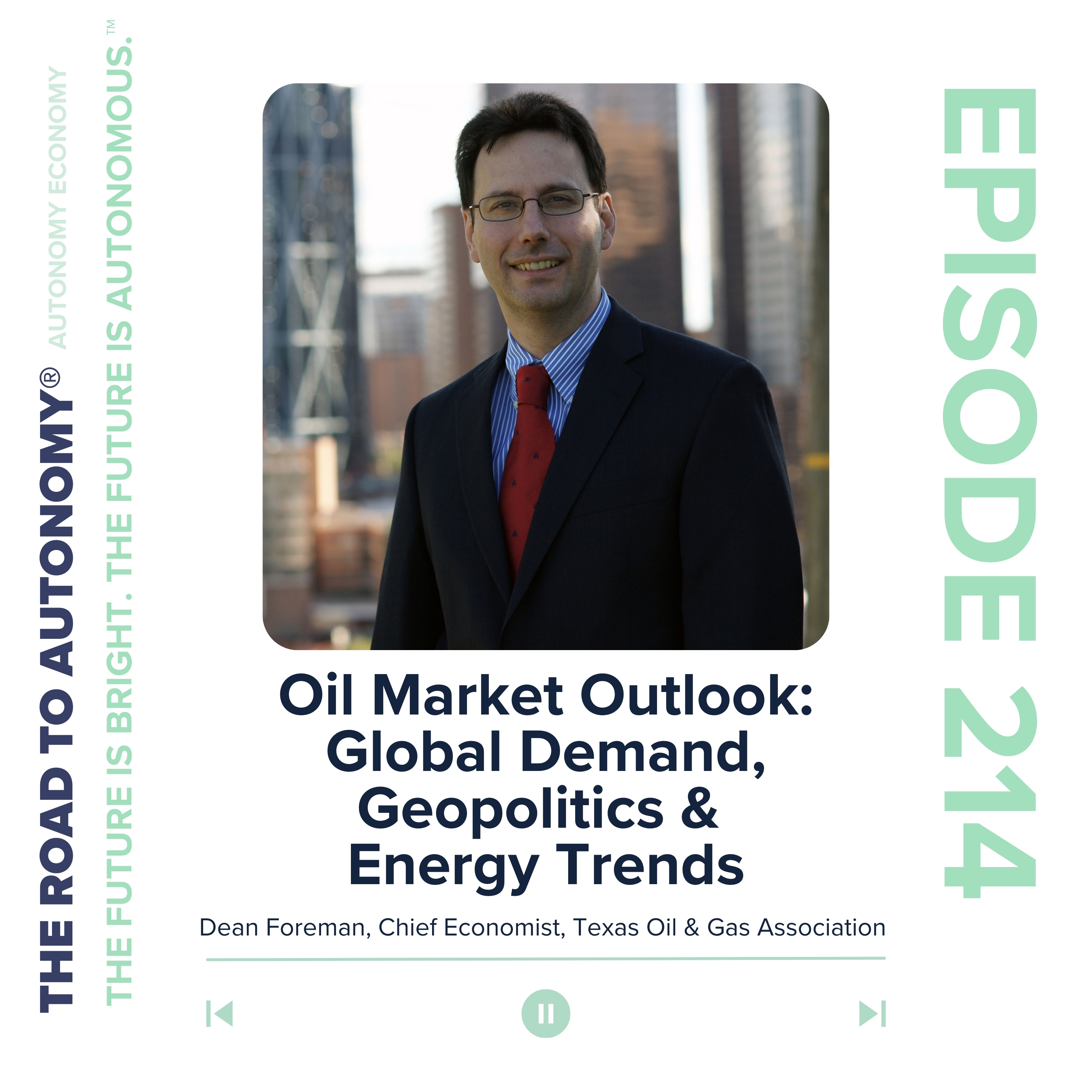
Ep 214Episode 214 | Autonomy Economy: Oil Market Outlook: Global Demand, Geopolitics & Energy Trends
Dean Foreman, Chief Economist, Texas Oil & Gas Association joined Grayson Brulte on The Autonomy Economy podcast to discuss key trends and geopolitical issues that are impacting the global oil and natural gas markets. Today, there is record high global demand for oil and natural gas, driven by economic growth and increased consumption of petrochemicals. Despite efforts to transition to renewable energy, oil and gas remain critical to economic activity worldwide and without energy there is no form of economic activity. During the conversation, Grayson and Dean discuss several issues impacting the oil and natural gas markets including the geopolitical factors affecting energy markets, including the U.S. presidential election, potential conflicts in the Middle East, and shifting alliances in Europe. Dean emphasizes the importance of stable policies and international trade relationships for long-term energy investments.The conversation also covers the status of the U.S. Strategic Petroleum Reserve, which is at historically low levels. Dean expresses concern about the government’s reluctance to replenish the reserve despite potential global instability.Regarding the U.S. economy, Dean notes high levels of consumer debt and its potential impact on spending and economic growth. Grayson and Dean go onto discuss the Federal Reserve’s approach to interest rates and inflation and what impact interest rate cuts could have on the oil and natural gas markets.Throughout the podcast, Dean stresses the interdependence of energy markets, economic growth, and geopolitical stability. With regard to energy policy, Dean suggests a balanced approach that recognizes the ongoing importance of oil and gas while also addressing environmental concerns.Recorded on Tuesday, July 2, 2024Episode Chapters0:00 Fed Rate Cut Impact in the Oil & Natural Gas Markets4:39 Oil and Texas’ Economy11:27 Exporting Natural Gas to Mexico13:18 Record Demand for Oil & Natural Gas17:29 Argentinean Shale Oil19:30 Impact of the U.S. Presidential Election on the Oil Markets20:48 EU Energy Policies24:20 Currencies Impact on the Oil Markets 27:41 Consumer Debt28:50 Strategic Petroleum Reserve (SPR)36:20 Hurricanes 38:51 Key Takeaways--------About The Road to AutonomyThe Road to Autonomy® is a leading source of data, insight and commentary on autonomous vehicles/trucks and the emerging autonomy economy™. The company has two businesses: The Road to Autonomy Indices, with Standard and Poor’s Dow Jones Indices as the custom calculation agent; Media, which includes The Road to Autonomy and Autonomy Economy podcasts as well as This Week in The Autonomy Economy newsletter.See Privacy Policy at https://art19.com/privacy and California Privacy Notice at https://art19.com/privacy#do-not-sell-my-info.
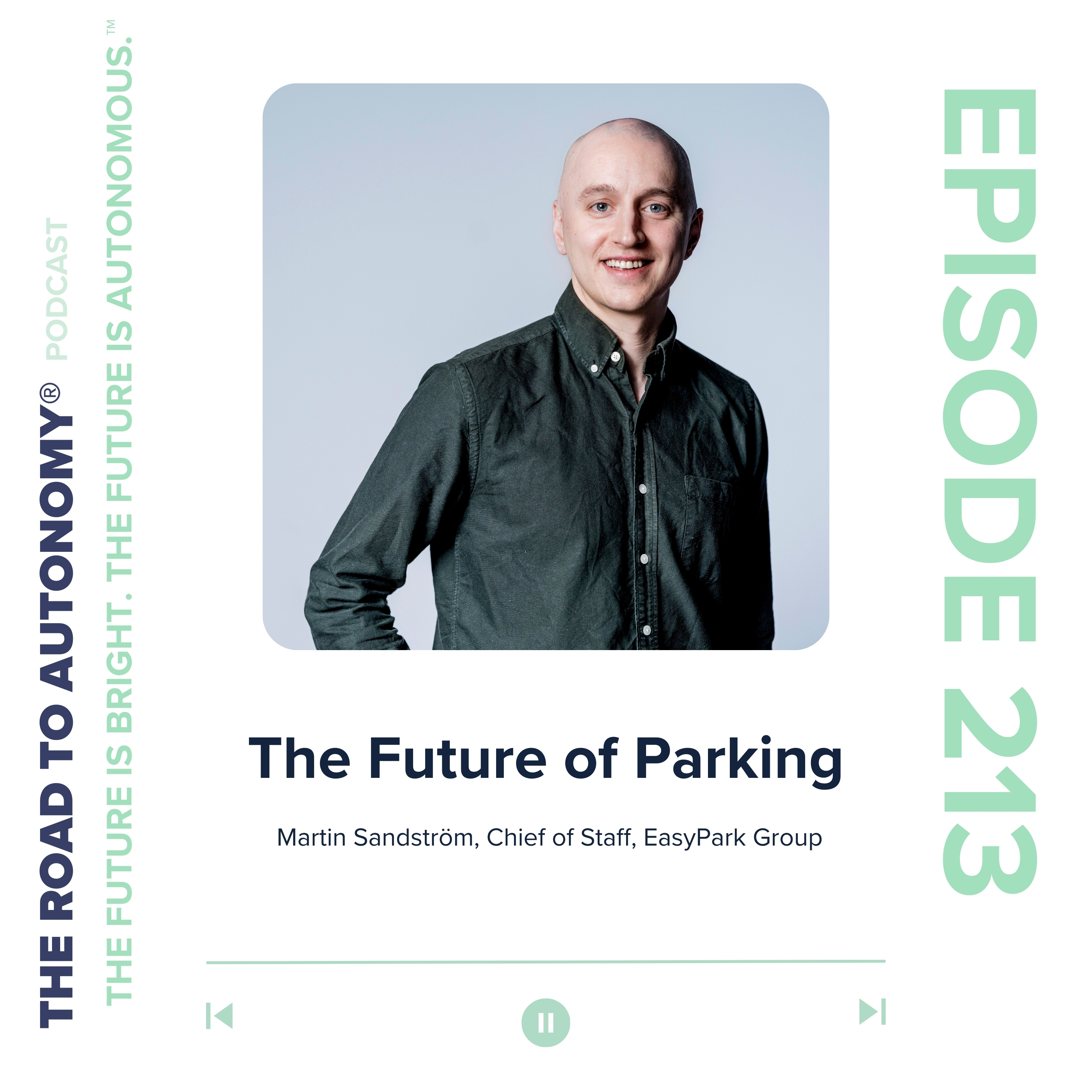
Ep 213Episode 213 | The Future of Parking: How Autonomous Vehicles Will Transform Urban Mobility
Martin Sandström, Chief of Staff, EasyPark Group joined Grayson Brulte on The Road to Autonomy podcast to discuss the evolving landscape of urban parking and its intersection with autonomous vehicles and city planning. Parking is a crucial tool for cities to manage mobility as it’s often the second-largest revenue stream for municipalities after taxes. During the conversation Grayson and Martin explore how digital layers and data are transforming parking management, allowing cities to implement more effective pricing and policies based on supply and demand. Add autonomous vehicles into the picture, and the opportunity to solve issues such as overstaying in charging spots and reducing congestion is greatly improved. Then there is electric vehicles and the challenges that those vehicles bring to the urban mobility landscape. There are challenges implementing electric vehicle charging infrastructure in parking facilities, including the high upfront costs and current reliability issues. In some European countries, particularly Scandinavia, governments are mandating the installation of charging in parking garages.Looking to the future, Martin envisions parking becoming more technology-driven with less human interaction. He sees the potential for parking to be bundled into autonomous vehicle subscriptions and for parking operators to evolve into mobility hubs offering various services.Parking and mobility management will become increasingly important as urbanization continues, especially in emerging megacities in Africa, Asia, and Latin America. Eventually, consumers won’t need to think about parking at all because of autonomous vehicles. But before we get there, parking technology is needed to ensure a smooth parking experiences in urban cities.Recorded on Friday, June 28, 2024Episode Chapters0:00 The Business of Parking7:48 Large Events and Parking11:31 Autonomous Vehicles and Parking21:11 EV Charging and Parking31:21 EU Parking Policies 32:35 Founding of EasyPark 36:23 Future of Parking37:58 Key Takeaways--------About The Road to AutonomyThe Road to Autonomy® is a leading source of data, insight and commentary on autonomous vehicles/trucks and the emerging autonomy economy™. The company has two businesses: The Road to Autonomy Indices, with Standard and Poor’s Dow Jones Indices as the custom calculation agent; Media, which includes The Road to Autonomy and Autonomy Economy podcasts as well as This Week in The Autonomy Economy newsletter.See Privacy Policy at https://art19.com/privacy and California Privacy Notice at https://art19.com/privacy#do-not-sell-my-info.
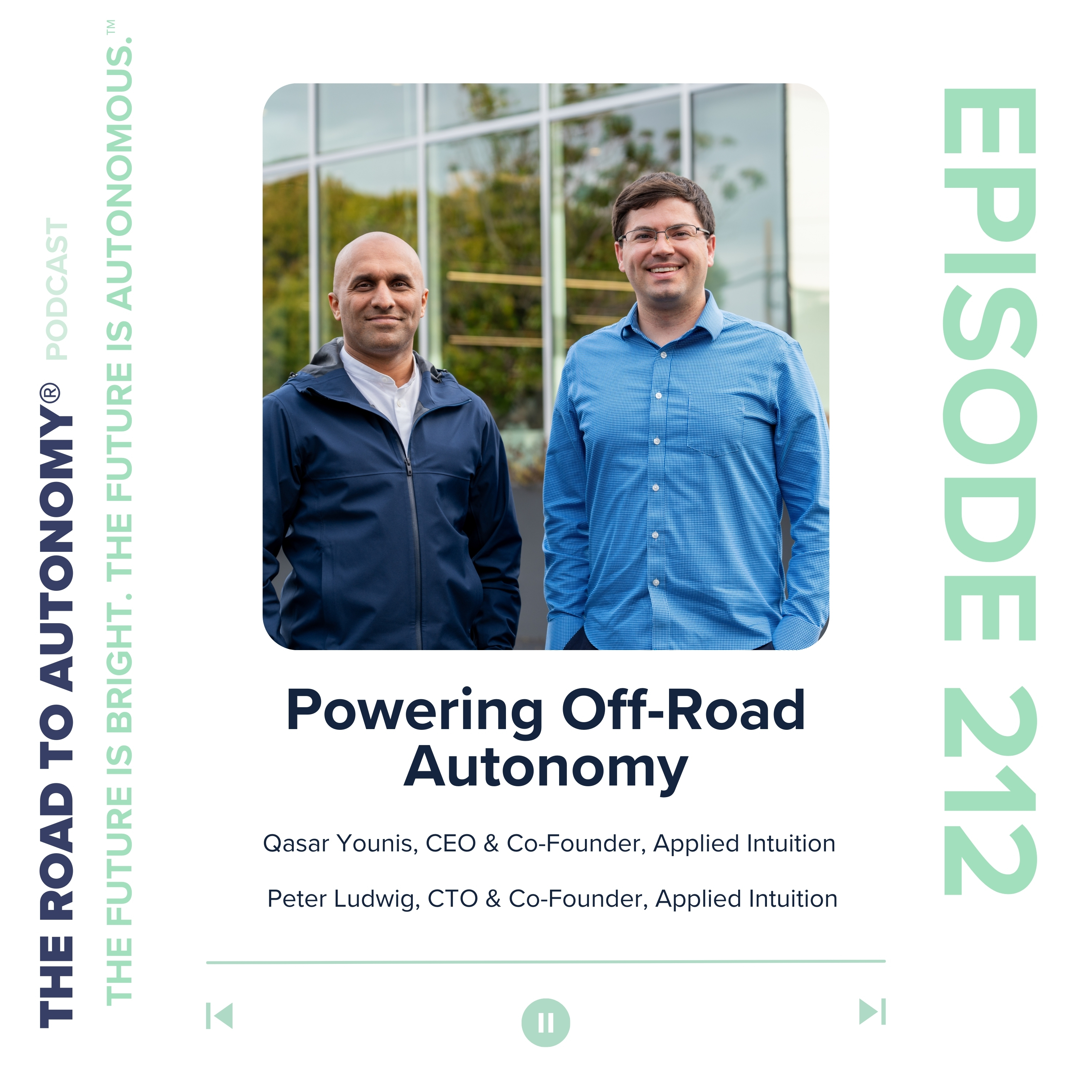
Ep 212Episode 212 | Autonomy Insights: Powering Off-Road Autonomy
Applied Intuition is developing an off-road autonomy stack to address the growing demand for autonomous solutions in industries such as mining, agriculture, and defense. Qasar Younis, CEO and Peter Ludwig, CTO, Co-Founders of Applied Intuition joined The Road to Autonomy Founder Grayson Brulte on Autonomy Insights to discuss Applied’s approach to off-road autonomy. The company’s approach to developing an off-road autonomy stack is driven by industry needs, particularly labor shortages in remote locations and safety concerns. Applied Intuition’s off-road strategy involves creating a modular, adaptable solution that can be customized for various vehicle types and industries. This approach allows them to distribute development costs across multiple customers, making it more economical for companies to adopt their technology rather than developing in-house solutions. Their technology is designed to work with a range of vehicles and tasks, with the philosophy that if a human can control a vehicle off-road, their autonomy stack should be able to accomplish the same task.As the company grows, they are positioning themselves as a key enabler in the emerging autonomy economy, providing the tools and technology necessary for companies to succeed in implementing and scaling autonomous solutions across multiple sectors.Episode Chapters0:00 Why Develop an Off-Road Autonomy Stack?9:48 Off-Road Autonomy and Defense10:54 Off-Road Autonomy as a Growth Market13:20 What’s Next For Applied Intuition?--------About The Road to AutonomyThe Road to Autonomy® is a leading source of data, insight and commentary on autonomous vehicles/trucks and the emerging autonomy economy™. The company has two businesses: The Road to Autonomy Indices, with Standard and Poor’s Dow Jones Indices as the custom calculation agent; Media, which includes The Road to Autonomy and Autonomy Economy podcasts as well as This Week in The Autonomy Economy newsletter.See Privacy Policy at https://art19.com/privacy and California Privacy Notice at https://art19.com/privacy#do-not-sell-my-info.
Ep 211Episode 211 | The Dawn of Affordable Robotics: How Vayu is Revolutionizing Autonomous Systems
Anand Gopalan, CEO & Co-Founder Vayu Robotics joined Grayson Brulte on The Road to Autonomy podcast to discuss the dawn of a new era in robotics and autonomous systems. Anand believes the industry is on the cusp of a breakthrough, moving from fragmented point solutions to horizontal intelligence applicable across various robotic applications.Vayu’s approach focuses on developing high-quality, low-cost autonomous systems. Vayu achieves this through innovative passive sensing technology, which extracts multiple properties of light beyond just intensity, inspired by biological systems. This method allows for robust perception without the energy inefficiency and detectability issues of active sensors like LiDARS.The company utilizes low-power ARM processors instead of expensive GPU clusters, significantly reducing both cost and energy consumption. This efficiency enables Vayu’s robots to operate for 6-8 hours on a single battery charge, dramatically lowering the carbon footprint of goods movement.Anand emphasizes the importance of foundation models in robotics, but highlights the challenges of data scarcity and edge computing. Vayu addresses these issues through intelligent use of synthetic data generated in gaming-like simulators, focusing on domain-independent aspects of movement and interaction.The conversation touches on the broad applicability of Vayu’s technology, from defense to various commercial sectors. Deploying the same intelligence across multiple applications creates significant growth and business opportunities. As a business Vayu is focused on drastically reducing hardware costs, and building robotics that can transform a capital-intensive industry to one with rapid return on investment. He envisions Vayu monetizing its intelligence and hardware reference designs rather than becoming a robotics operations business.In closing the conversation Anand suggests robotics are entering a golden age, driven by new tools and the ability to solve real economic problems. He encourages listeners and viewers to recognize this potential while remaining grounded in addressing the hard technical challenges of edge computing, cost reduction, and energy efficiency.Recorded on Thursday, June 27, 2024Episode Chapters0:00 Current State of the Robotics Market4:58 Cost of Sensors9:27 Cost of Labor Accelerating the Adoption of Autonomy13:29 Value of Robotic Autonomy 15:19 Lower Power Chips vs GPUs17:03 Energy Efficiency 21:03 Passive Sensing 27:43 AI Foundational Models31:40 Simulation 37:45 Vayu Business--------About The Road to AutonomyThe Road to Autonomy® is a leading source of data, insight and commentary on autonomous vehicles/trucks and the emerging autonomy economy™. The company has two businesses: The Road to Autonomy Indices, with Standard and Poor’s Dow Jones Indices as the custom calculation agent; Media, which includes The Road to Autonomy and Autonomy Economy podcasts as well as This Week in The Autonomy Economy newsletter.See Privacy Policy at https://art19.com/privacy and California Privacy Notice at https://art19.com/privacy#do-not-sell-my-info.