The Road to Autonomy
460 episodes — Page 6 of 10
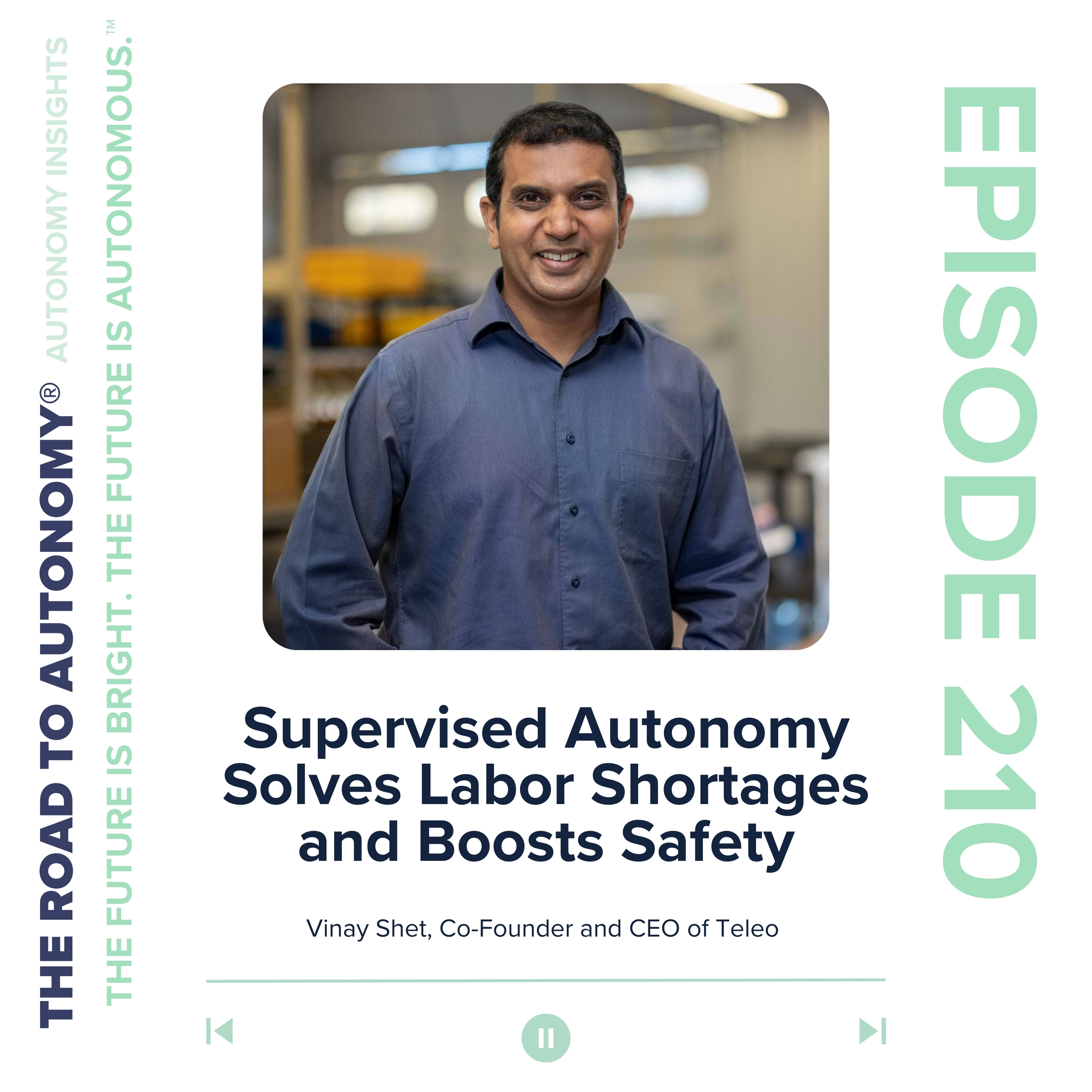
Ep 210Episode 210 | Autonomy Insights: Supervised Autonomy Solves Labor Shortages and Boosts Safety
Vinay Shet, Co-Founder and CEO of Teleo joined Autonomy Insights to share his perspective on why Teleo is partnering with construction companies like Ajax Paving and Tomahawk Construction to deploy supervised autonomy in their operations. Supervised Autonomy allows operators to control heavy machinery remotely from a comfortable office setting, rather than sitting in the cab of the machine.Episode Chapters0:00 Ajax Paving / Teleo Partnership3:17 Health Benefits of Supervised Autonomy 6:41 Growth of the Construction Industry9:56 Teleo's Florida Expansion10:34 Retrofitting Equipment for Supervised Autonomy 11:39 Growth of the Supervised Autonomy Market13:09 What's Next For Teleo--------About The Road to AutonomyThe Road to Autonomy® is a leading source of data, insight and commentary on autonomous vehicles/trucks and the emerging autonomy economy™. The company has two businesses: The Road to Autonomy Indices, with Standard and Poor’s Dow Jones Indices as the custom calculation agent; Media, which includes The Road to Autonomy and Autonomy Economy podcasts as well as This Week in The Autonomy Economy newsletter.See Privacy Policy at https://art19.com/privacy and California Privacy Notice at https://art19.com/privacy#do-not-sell-my-info.
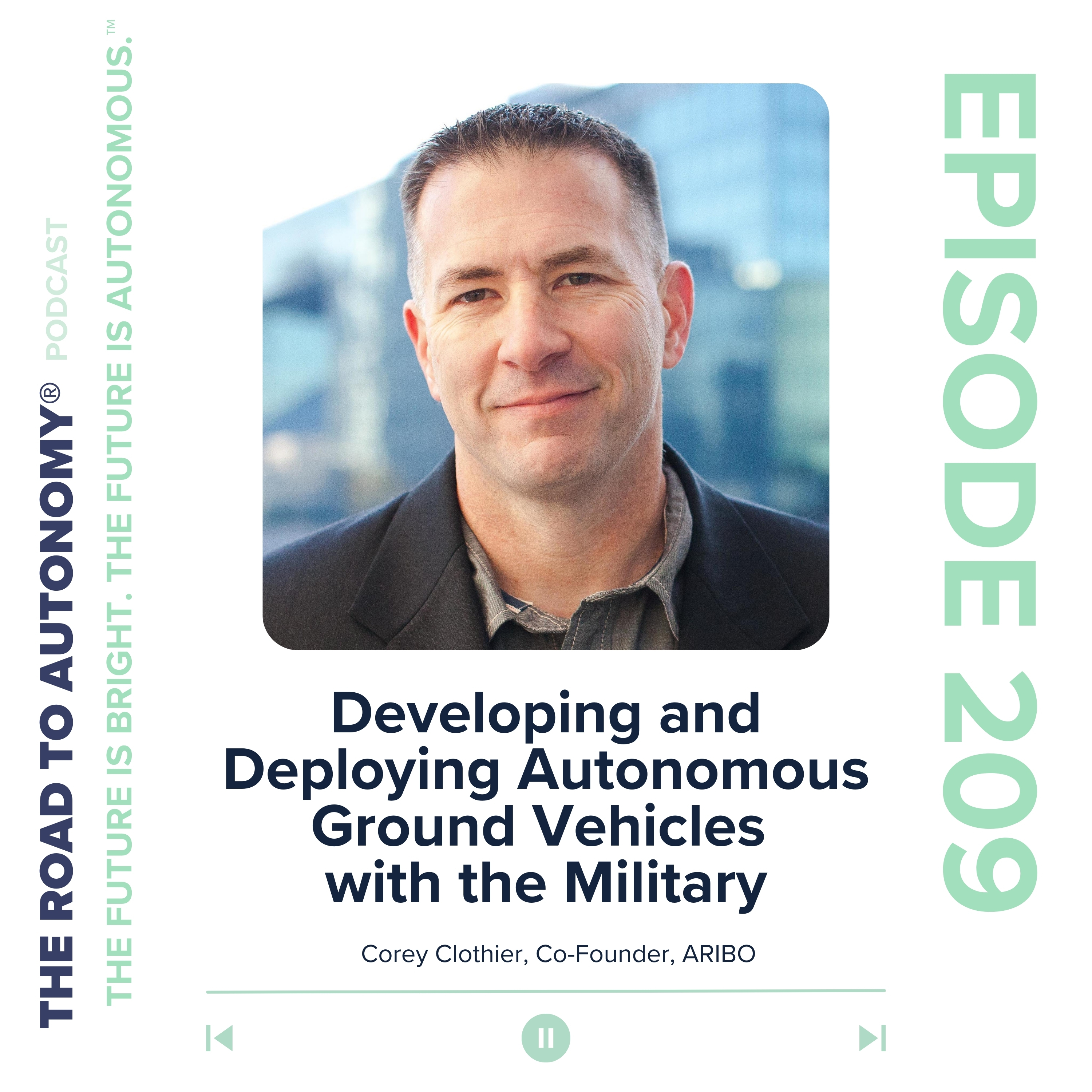
Ep 209Episode 209 | Developing and Deploying Autonomous Ground Vehicles with the Military
Corey Clothier, Co-Founder, ARIBO joined Grayson Brulte on The Road to Autonomy podcast to discuss developing and deploying autonomous ground vehicles with the military. In this insightful episode, Grayson and Corey explore the rapidly evolving world of autonomous vehicles, with a special focus on military applications and their spillover into commercial sectors. The discussion begins with a look at the current state of autonomous vehicles outside the well-known robotaxi market. Corey highlights the diverse applications in mines, ports, terminals, and campus-based environments. He emphasizes that autonomy is far more extensive than just passenger vehicles, touching on crucial areas such as logistics, security, industrial operations and military applications. With a background in working with the military on ground autonomy, Corey shares his experiences, detailing projects ranging from autonomous security vehicles to logistics trucks. He discusses the challenges and opportunities in deploying these technologies on military bases and in combat zones, touching on issues like reliability, safety protocols, and regulatory hurdles.The conversation also delves into the future of autonomy in both military and civilian contexts. Corey predicts a steady growth in adoption and innovation over the next decade, with potential catalysts like competition from China and Tesla’s anticipated entry into the robotaxi market further accelerating development.Throughout the conversation Grayson and Corey both highlight the interconnectedness of military and commercial autonomous vehicle technologies. Wrapping up the conversation, Corey shares his thoughts and insights on emerging trends, particularly in logistics and campus-based autonomous vehicle systems. He emphasizes the need for collaboration, competition, and strong leadership to drive innovation in this rapidly advancing field.Recorded on Friday, June 21, 2024Episode Chapters0:00 Current State of Autonomous Vehicle Market1:43 Deploying Autonomous Vehicles at Airports6:12 Autonomous Vehicles on Military Bases 11:05 Military Collaboration on Autonomy 16:11 Autonomous Tanks22:04 Reliability 26:51 Leader Follower Program30:25 Opportunities for the Army in Autonomous Vehicles 34:52 DARPA Grand Challenge 36:07 Autonomy Evolving Over the Next Decade42:34 Key Takeaways--------About The Road to AutonomyThe Road to Autonomy® is a leading source of data, insight and commentary on autonomous vehicles/trucks and the emerging autonomy economy™. The company has two businesses: The Road to Autonomy Indices, with Standard and Poor’s Dow Jones Indices as the custom calculation agent; Media, which includes The Road to Autonomy and Autonomy Economy podcasts as well as This Week in The Autonomy Economy newsletter.See Privacy Policy at https://art19.com/privacy and California Privacy Notice at https://art19.com/privacy#do-not-sell-my-info.
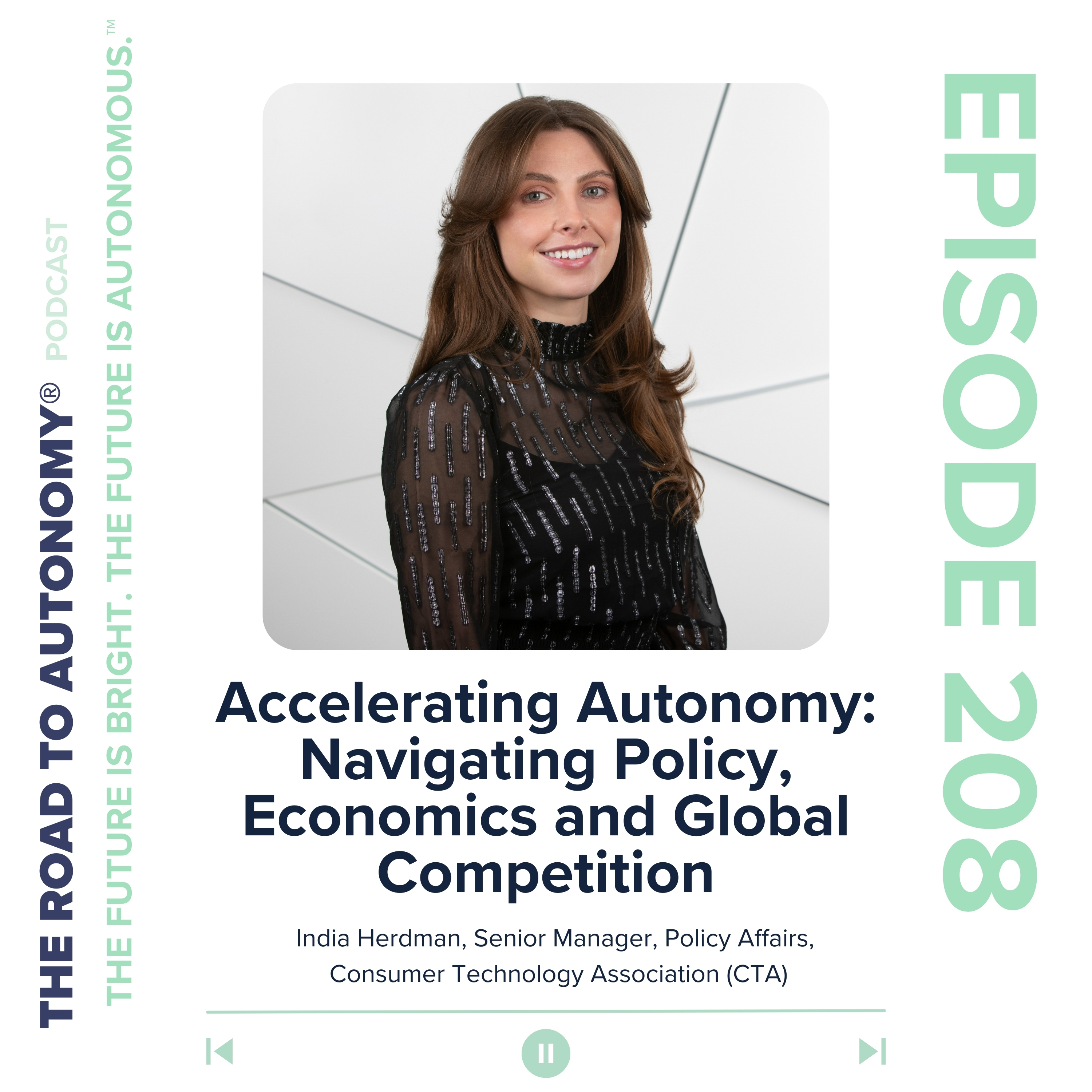
Ep 208Episode 208 | Accelerating Autonomy: Navigating Policy, Economics and Global Competition
India Herdman, Senior Manager, Policy Affairs, Consumer Technology Association (CTA) joined Grayson Brulte on The Road to Autonomy podcast to discuss the current state of autonomous vehicle / truck policy and why a National Autonomous Vehicle Framework will unlock economic growth in the U.S. The conversation begins by examining the current state of autonomous vehicle policy, highlighting the patchwork of regulations at the state level and the stagnation at the federal level. India emphasizes the importance of passing comprehensive federal legislation to unlock the potential of autonomous vehicles, pointing out the safety and economic benefits they could bring to the U.S.The conversation then delves into the political landscape surrounding autonomous vehicle policy. India outlines the challenges faced on both sides of the aisle, including labor union concerns for Democrats and China-related issues for Republicans. She stresses the need for compromise and a balanced approach to move forward to ensure that the United States is not left behind on the development and commercialization of autonomy. In addition to discussing autonomy, Grayson and India touch on other related issues, including the AM radio mandate for vehicles, the role of trial lawyers in shaping policy, and the need for public education on autonomous vehicles. One of those platforms to showcase the future of autonomy is the CES (Consumer Electronics Show) as it serves as a platform for showcasing autonomous vehicle advancements and engaging policymakers.Throughout the episode, both Grayson and India emphasize the economic potential of autonomous vehicles and express frustration at the lack of political will to advance the technology for the benefit of the economy. They call for a more proactive approach from the industry to educate the public and policymakers about the benefits of AVs.Wrapping up the podcast they urge listeners and viewers to recognize the urgency of the situation and the need for immediate progress on autonomous vehicle policy to ensure U.S. competitiveness and that the American public can reap the safety and economic benefits of this transformative technology.Recorded on Tuesday, June 18, 2024Episode Chapters0:00 Current State of Autonomous Vehicle and Truck Policy3:57 Autonomy is Good for the Economy6:18 Politicians, Special Interests and the Media11:33 Distracted Driving14:17 Public Trust in Autonomous Vehicles15:37 CES19:19 Geopolitics 31:18 Tort Reform 34:06 AM Radio Mandate40:29 Future of Autonomous Vehicle Policy--------About The Road to AutonomyThe Road to Autonomy® is a leading source of data, insight and commentary on autonomous vehicles/trucks and the emerging autonomy economy™. The company has two businesses: The Road to Autonomy Indices, with Standard and Poor’s Dow Jones Indices as the custom calculation agent; Media, which includes The Road to Autonomy and Autonomy Economy podcasts as well as This Week in The Autonomy Economy newsletter.See Privacy Policy at https://art19.com/privacy and California Privacy Notice at https://art19.com/privacy#do-not-sell-my-info.
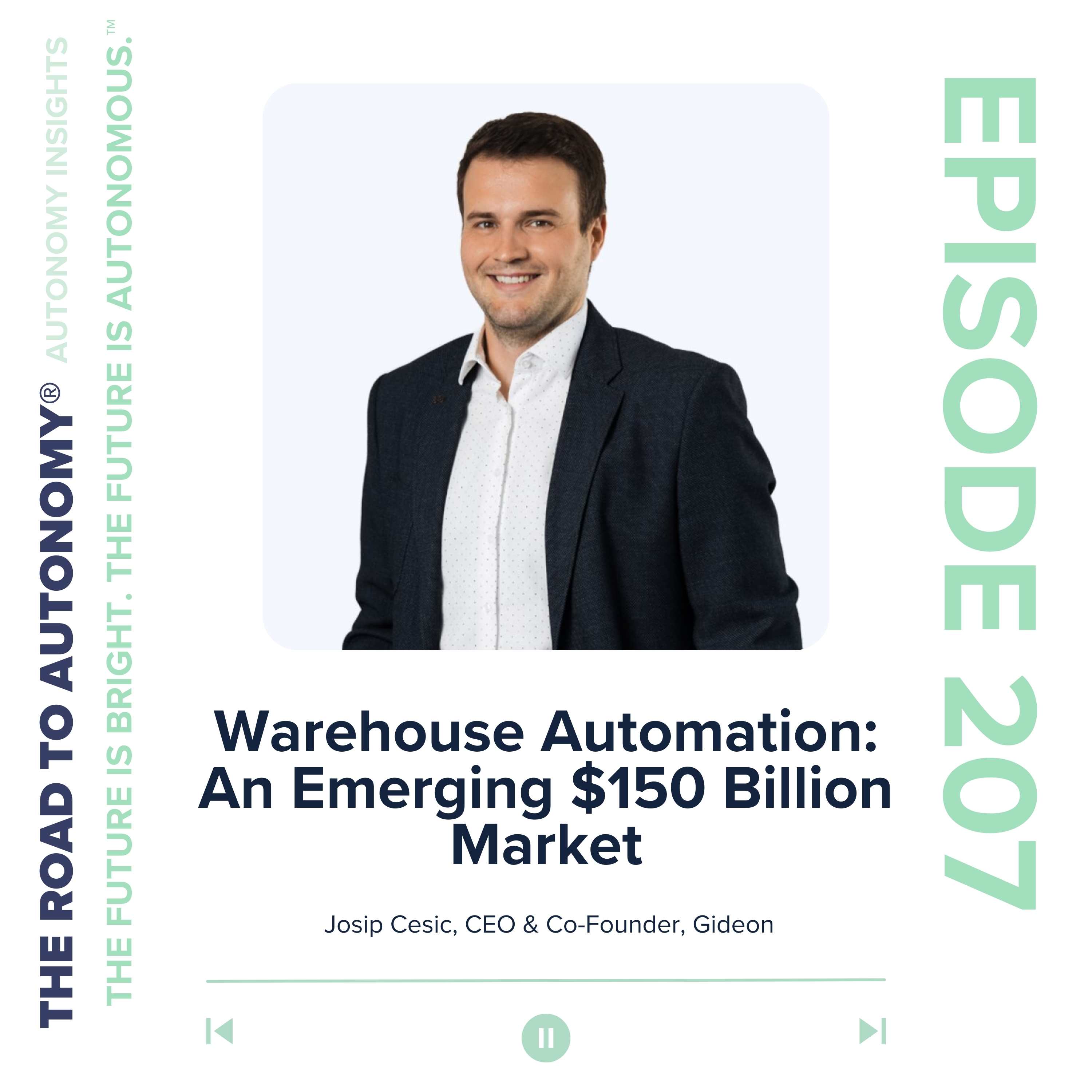
Ep 207Episode 207 | Autonomy Insights: Warehouse Automation: An Emerging $150 Billion Market
Dive into the cutting-edge world of warehouse automation as Josip Cesic, CEO & Co-Founder, Gideon joined The Road to Autonomy Founder Grayson Brulte to discuss the current state and future of this rapidly evolving market. During the conversation they discuss how AI and robotics are revolutionizing supply chain operations, particularly in the realm of autonomous forklifts.Discover why major Fortune 100 companies are doubling down on warehouse automation and learn why it’s no longer reserved for early adopters. Josip explains the driving forces behind this trend, including labor shortages, changing workforce desires, and the quest for operational efficiency.Key highlights include:The $150 billion market opportunityHow AI is enabling end-to-end automation solutionsThe global impact of forklift driver shortages, from Japan to the UKGideon’s partnership with NVIDIA and its implications for the industryInsights on market adoption across different sectorsJosip also addresses the challenges of developing autonomous systems for various applications and why staying focused on solving specific problems is crucial for success. He shares his perspective on the future of warehouse automation, predicting a completely reinvented supply chain landscape within the next decade.Whether you’re interested in robotics, AI, supply chain management, or investment opportunities in emerging technologies, this discussion provides a comprehensive overview of the warehouse automation revolution. Join us as we explore how autonomous forklifts and AI are reshaping the future of logistics and distribution.Don’t miss this opportunity to stay ahead of the curve in one of the most dynamic and rapidly growing sectors in technology and logistics. Watch now to understand the $150 billion revolution that’s transforming warehouses worldwide.Episode Chapters0:00 Current State of Warehouse Automation 4:13 Gideon / NVIDIA Partnership5:23 Robotic Software + Hardware Stacks7:51 Autonomous Forklift Market Size9:08 Venture Capital Investing in Autonomous Forklifts10:46 Consolidation in the Autonomous Forklift Industry 12:09 Future of the Warehouse Automation Market--------About The Road to AutonomyThe Road to Autonomy® is a leading source of data, insight and commentary on autonomous vehicles/trucks and the emerging autonomy economy™. The company has two businesses: The Road to Autonomy Indices, with Standard and Poor’s Dow Jones Indices as the custom calculation agent; Media, which includes The Road to Autonomy and Autonomy Economy podcasts as well as This Week in The Autonomy Economy newsletter.See Privacy Policy at https://art19.com/privacy and California Privacy Notice at https://art19.com/privacy#do-not-sell-my-info.
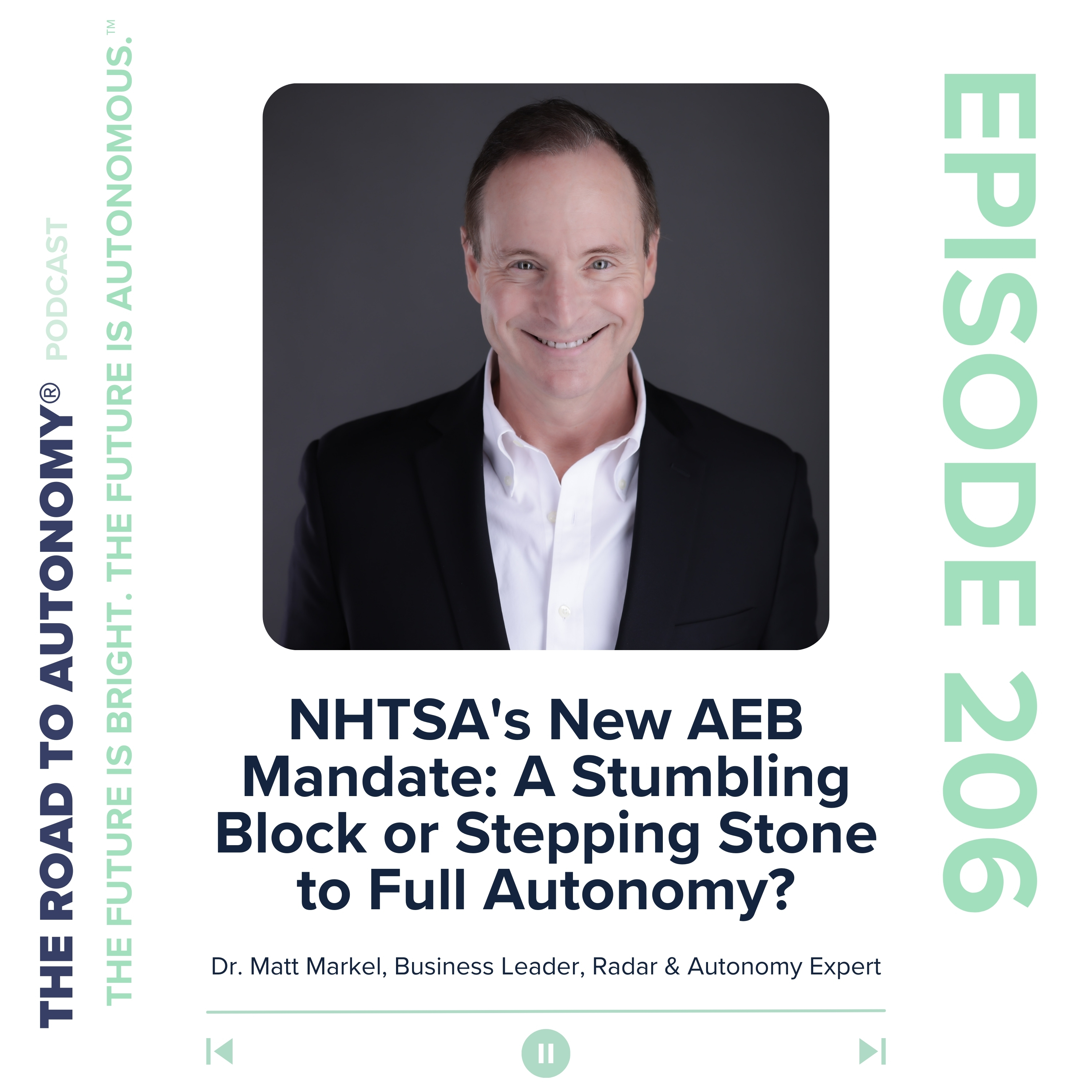
Ep 206Episode 206 | NHTSA's New AEB Mandate: A Stumbling Block or Stepping Stone to Full Autonomy?
Dr. Matt Markel, Business Leader, Radar & Autonomy Expert with experience at Waymo and in the defense industry joined Grayson Brulte on The Road to Autonomy podcast to discuss the NHTSA mandate requiring AEB (automatic emergency braking) systems in all new light vehicles by 2029 and what impact this mandate will have on the development of autonomous vehicles.While the mandate doesn't specifically require LiDAR, Dr. Markel believes a radar+camera sensor fusion approach will likely be the dominant solution that automakers implement to meet this new regulation. He sees the mandate as a positive for wider adoption of radar, but doubts it will spur major radar technology breakthroughs since full autonomy (SAE Level 4) remains the real driver of sensor advancement.During the conversation, Dr. Markel raised concerns about the potential unintended consequences that the mandate could cause, such an increase in "false alarm" brake activations from the AEB systems detecting non-threats because of interference. If a driver finds the system not to be functioning correctly, the regulation restricts automakers from allowing drivers to disable the AEB system, which could create towing/repair headaches if the system suffers a failure. While the mandate aims to save lives, Dr. Markel argues the safety benefits will be small compared to the potential of full autonomy. He advises autonomy companies to "run their own race" and not be distracted by this regulation from their core SAE L4 missions which offer vastly greater safety upsides.Recorded on Tuesday, June 11, 2024Episode Chapters0:00 NHTSA AEB Mandate4:24 Radar Data Generation9:09 AEB Battery Draw12:49 Integrating Radar into a Vehicle Design 15:15 L3 vs L4 Debate24:26 Is the AEB Mandate a Distraction to L4 Goals?31:59 Unintended Consequences of AEB Mandate41:49 Impact of Slowing EV Sales on AEB Mandate42:57 Key Takeaways --------About The Road to AutonomyThe Road to Autonomy® is a leading source of data, insight and commentary on autonomous vehicles/trucks and the emerging autonomy economy™. The company has two businesses: The Road to Autonomy Indices, with Standard and Poor’s Dow Jones Indices as the custom calculation agent; Media, which includes The Road to Autonomy and Autonomy Economy podcasts as well as This Week in The Autonomy Economy newsletter.See Privacy Policy at https://art19.com/privacy and California Privacy Notice at https://art19.com/privacy#do-not-sell-my-info.
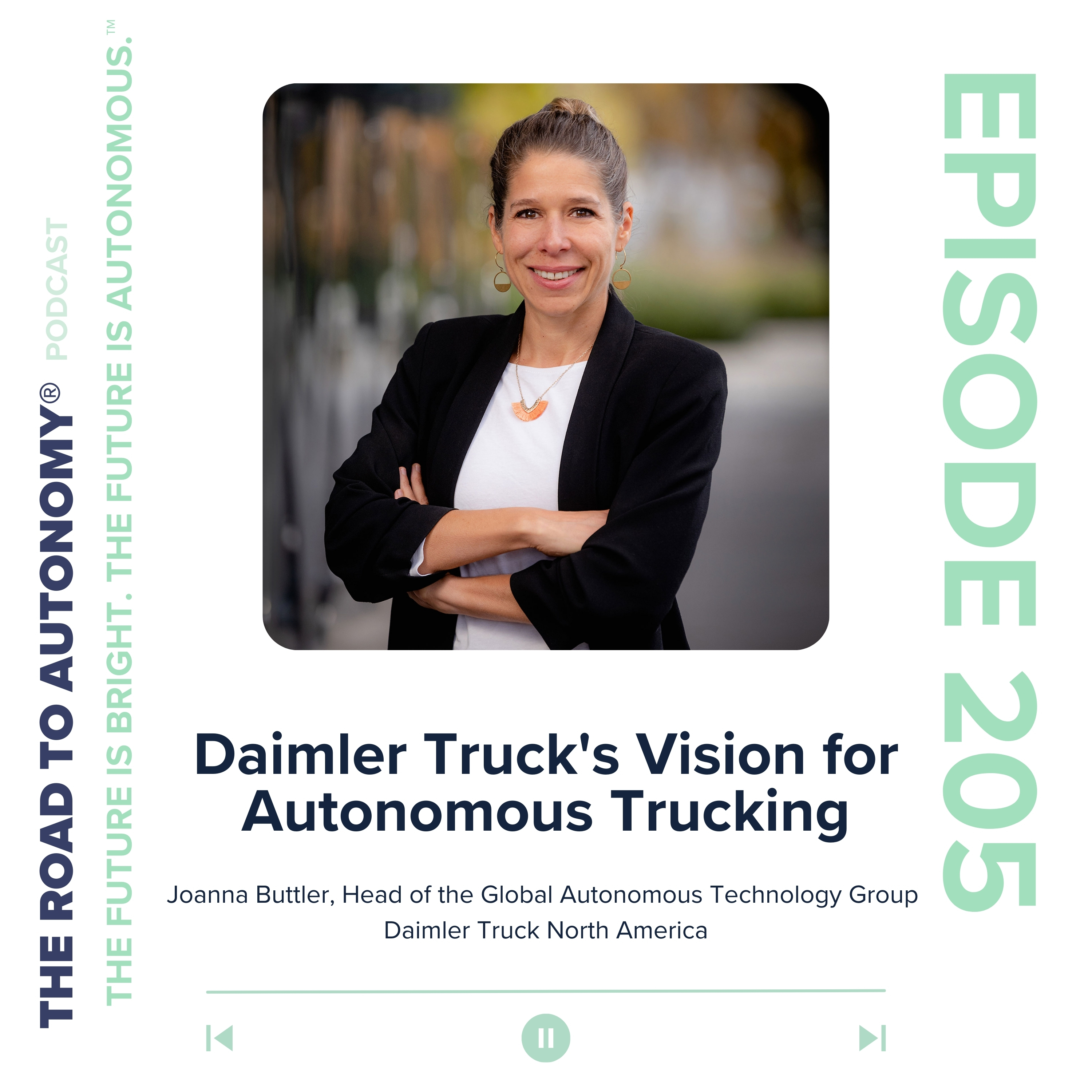
Ep 205Episode 205 | Daimler Truck's Vision for Autonomous Trucking
Joanna Buttler, Head of the Global Autonomous Technology Group, Daimler Truck North America joined Grayson Brulte on The Road to Autonomy podcast to discuss the introduction of the autonomous battery electric Freightliner eCascadia demonstrator, Daimler’s 2027 autonomous truck commercial launch and the company’s vision for the future of autonomous trucking. 2027 will be a pivotal year for Daimler Truck as the company commences commercial operations. In just under 3 years, Daimler Truck will be in the market offering SAE Level 4 autonomous trucking solutions to their customers. It’s a journey that started in 2019 when Daimler Truck went “all in” on autonomy, driven by the immense potential to solve major challenges like driver shortages and enable 24/7 freight movement for their customers. Daimler Truck’s vision for autonomy is an ambitious one that leverages their decades of experience and translates it into autonomous-ready commercial trucks. While the excitement today is around battery electric trucks, Daimler is taking a propulsion-agnostic approach, aiming to integrate their autonomous driving systems seamlessly across diesel, electric, and potentially hydrogen fuel cell platforms. Daimler’s goal is to provide their customers with the ultimate flexibility to deploy autonomous trucks optimized for different use cases, lanes and routes.Underpinning Daimler’s autonomous strategy is an absolute commitment to safety and doing it “the right way” by factory-installing production-ready systems and not relying on retrofits. Joanna is optimistic that Daimler Truck’s manufacturing prowess, established sales/service networks, and decades building customer trust will be key competitive advantages.Looking ahead to 2030, Joanna sees consolidation in the autonomous trucking market, but with Daimler aiming for a decisive market leadership position leveraging their traditional truck expertise, production capabilities, partners, and established dealer network. As autonomy scales, autonomous trucking could potentially become larger than Daimler Truck’s traditional business.Recorded on Friday, May 24, 2024Episode Chapters0:00 Autonomous Battery Electric Freightliner eCascadia Demonstrator4:53 The Role of Dealers6:46 Autonomous Truck Maintenance 8:59 Propulsion Agnostic 15:20 Infrastructure as a Catalyst 17:40 Autonomy Success Metrics20:47 New Autonomous Trucks?23:10 Daimler Truck’s Passion for Autonomy25:26 Why 2027?27:13 Factory Grade Autonomous Trucks28:57 Autonomy in 202731:05 Future of Daimler Truck--------About The Road to AutonomyThe Road to Autonomy® is a leading source of data, insight and commentary on autonomous vehicles/trucks and the emerging autonomy economy™. The company has two businesses: The Road to Autonomy Indices, with Standard and Poor’s Dow Jones Indices as the custom calculation agent; Media, which includes The Road to Autonomy and Autonomy Economy podcasts as well as This Week in The Autonomy Economy newsletter.See Privacy Policy at https://art19.com/privacy and California Privacy Notice at https://art19.com/privacy#do-not-sell-my-info.
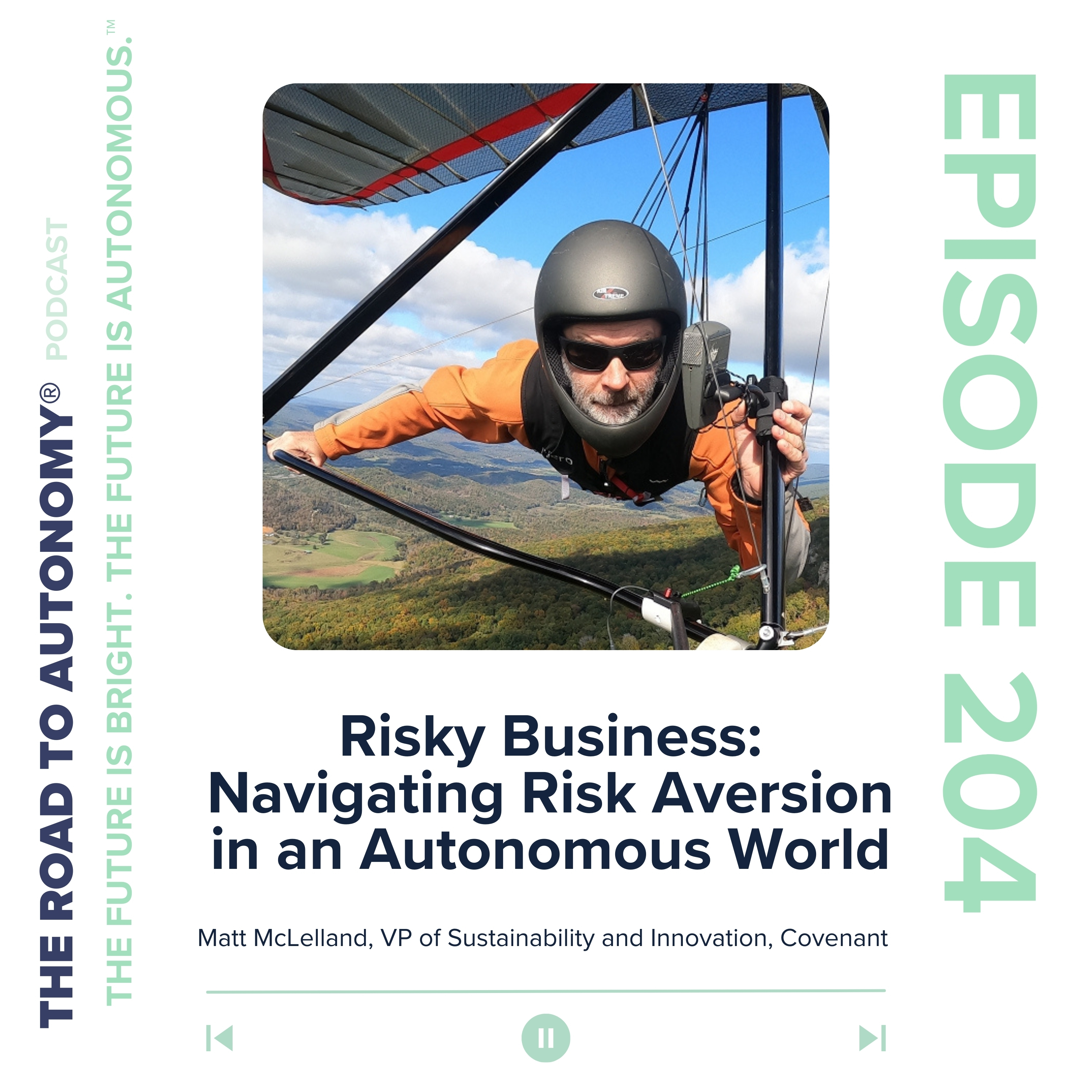
Ep 204Episode 204 | Risky Business: Navigating Risk Aversion in an Autonomous World
Matt McLelland, VP of Sustainability and Innovation, Covenant joined Grayson Brulte on The Road to Autonomy podcast to discuss why certain trucking companies aversion to risk could slow down innovation and have negative economic consequences on their businesses if they delay the rollout of autonomous trucks.This is a thought-provoking, unstructured yet insightful conversation about the complex relationship between risk aversion and the development of autonomous vehicles and autonomous trucks. During the conversation, Grayson and Matt explore how society’s growing fear of risk is stifling progress in the autonomous trucking industry, drawing parallels to historical examples of transformative innovations such as the space program and the development of the airplane that may have never come to fruition in today’s risk-averse climate.Throughout the discussion, Grayson and Matt grapple with the multifaceted nature of risk perception, from individual responsibilities to the role of tort law and media sensationalism. They argue that the disproportionate attention given to rare autonomous vehicle accidents, coupled with a litigious environment, is creating an atmosphere of fear that threatens to slow the adoption of this life-saving technology that will have positive economic benefits.The conversation also delves into the economic implications of risk aversion, with Grayson asserting that the rising costs associated with insurance and legal liability are becoming a significant burden for companies pioneering autonomous trucks and vehicles. Matt shares his firsthand experience with these challenges at Covenant Logistics, highlighting the need for tort reform and a shift in public perception.Despite the obstacles, both Matt and Grayson remain optimistic about the future of autonomous vehicles and trucks. They emphasize the importance of personal responsibility, education, and a willingness to embrace calculated risks in order to continue pushing the boundaries of innovation. The episode concludes with a call to action, urging listeners to recognize their own role in shaping societal attitudes towards risk and to support the brave innovators who are working to create a safer, more efficient future through autonomous technologies.Recorded on Thursday, May 16, 2024Episode Chapters0:00 Risk26:27 Fear30:54 Managing Risk32:25 Conquering the Fear of Risk41:32 Key Takeaways--------About The Road to AutonomyThe Road to Autonomy® is a leading source of data, insight and commentary on autonomous vehicles/trucks and the emerging autonomy economy™. The company has two businesses: The Road to Autonomy Indices, with Standard and Poor’s Dow Jones Indices as the custom calculation agent; Media, which includes The Road to Autonomy and Autonomy Economy podcasts as well as This Week in The Autonomy Economy newsletter.See Privacy Policy at https://art19.com/privacy and California Privacy Notice at https://art19.com/privacy#do-not-sell-my-info.
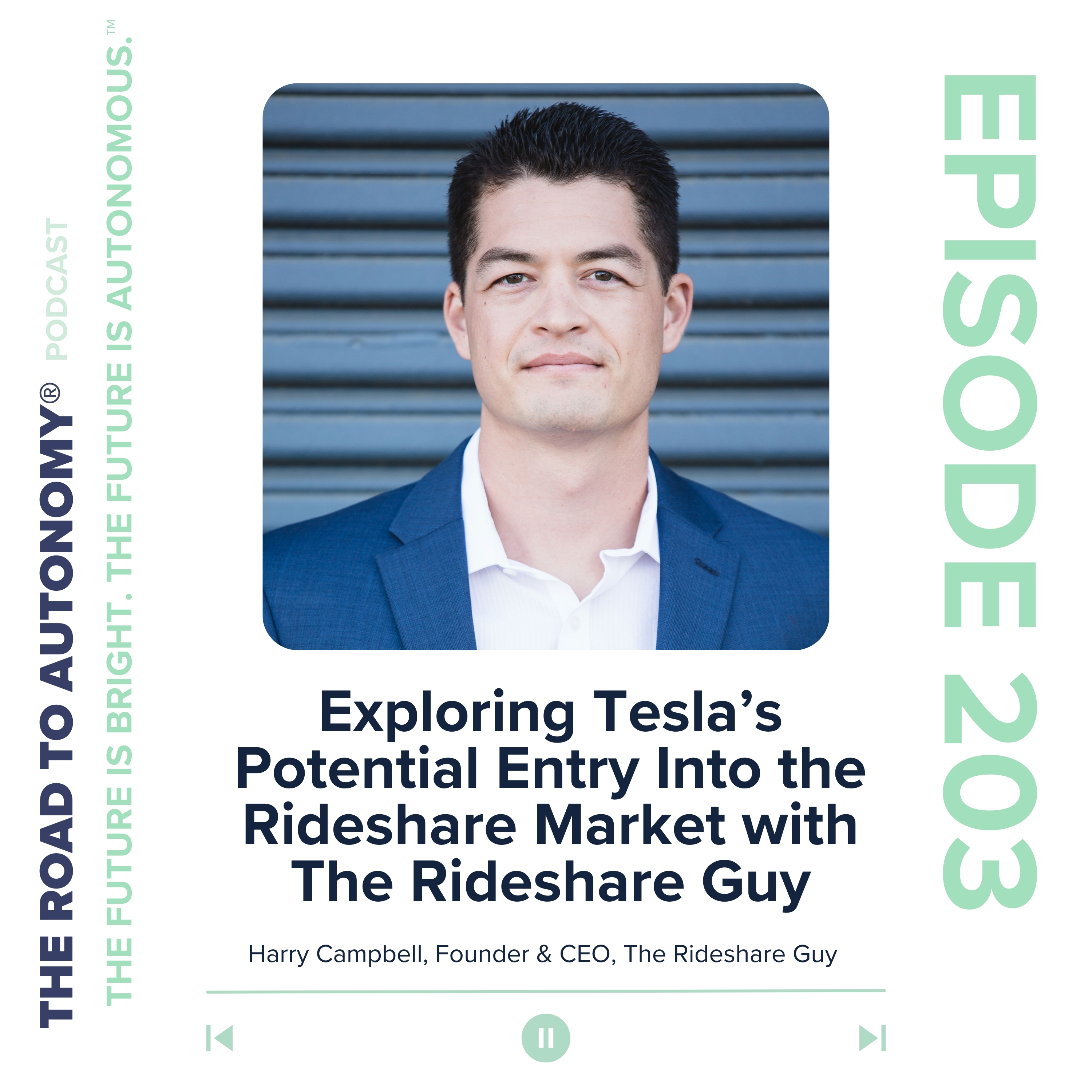
Ep 203Episode 203 | Exploring Tesla’s Potential Entry Into the Rideshare Market with The Rideshare Guy
Harry Campbell aka The Rideshare Guy joined Grayson Brulte on The Road to Autonomy podcast to discuss the potential of Tesla entering the rideshare market both with human driven vehicles and autonomous vehicles. In a wide-ranging discussion, Grayson and Harry touch on several key topics surrounding Tesla’s potential entry into the rideshare market and how those moves could affect the overall market. As Tesla explores potentially entering the market, the company’s brand appeal and the millions of vehicles already on the road give them a potential edge, especially once Tesla achieves full self-driving (FSD).Throughout the episode, Grayson and Harry provide insightful analysis and predictions about the future of the rideshare industry, highlighting the technological advancements and strategic decisions that will shape its evolution.Looking ahead, Harry sees two major factors shaping rideshare’s future outside of Tesla: the rollout of robotaxis, and a new generation forgoing car ownership and relying more heavily on Uber and micro-mobility options such as e-bikes. Despite challenges such as rising insurance costs, he remains optimistic about the industry’s prospects as personal car ownership potentially declines.Recorded on Tuesday, May 14, 2024Episode Chapters0:00 Tesla Rideshare Market2:32 FSD 126:44 The Hybrid Network (Human Driven Vehicles and Robotaxis)13:51 Rising Insurance Premiums 19:15 Tesla Ridehail Network33:45 Economics of the Uber Platform37:02 What if Tesla Bought Lyft?43:06 Tesla Subscription Service47:14 Future of Rideshare--------About The Road to AutonomyThe Road to Autonomy® is a leading source of data, insight and commentary on autonomous vehicles/trucks and the emerging autonomy economy™. The company has two businesses: The Road to Autonomy Indices, with Standard and Poor’s Dow Jones Indices as the custom calculation agent; Media, which includes The Road to Autonomy and Autonomy Economy podcasts as well as This Week in The Autonomy Economy newsletter.See Privacy Policy at https://art19.com/privacy and California Privacy Notice at https://art19.com/privacy#do-not-sell-my-info.
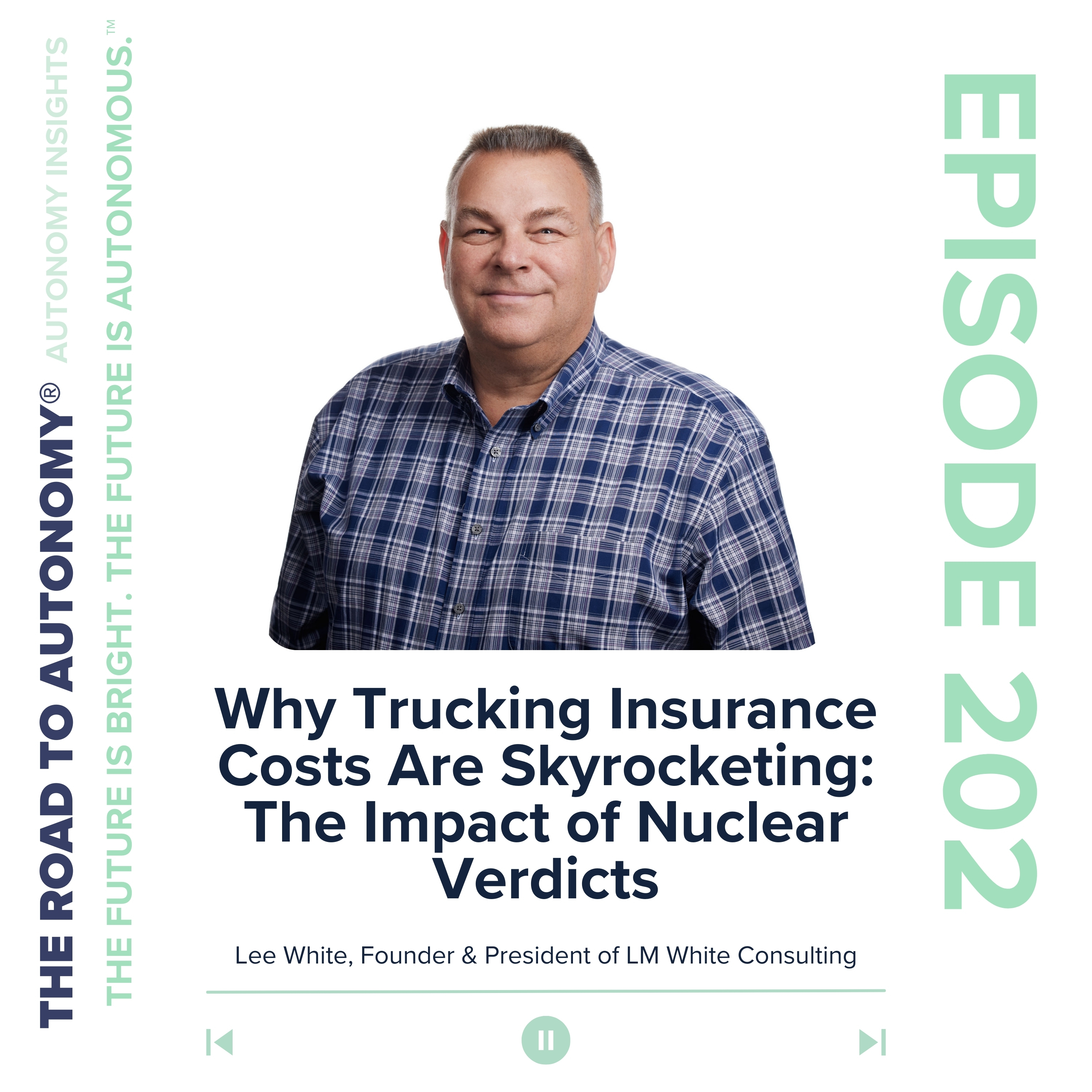
Ep 202Episode 202 | Autonomy Insights: Why Trucking Insurance Costs Are Skyrocketing: The Impact of Nuclear Verdicts
The skyrocketing costs of commercial vehicle insurance in the trucking industry is a pressing issue that is causing economic harm. Commercial insurance premiums rose a staggering 9.8% in Q1 2024, driven by three main factors: the proliferation of nuclear verdicts over $10 million, a shortage of experienced drivers, and inflated vehicle repair costs. Nuclear verdicts, with an average of $33.8 million, have made insurance unaffordable for many smaller fleets, forcing them into bankruptcy. The current macroeconomic environment, with high inflation, rising insurance premiums, and increasing regulatory costs, is creating a “perfect storm” that could accelerate the adoption of autonomous trucks. Lee White, Founder & President of LM White Consulting joined The Road to Autonomy Founder Grayson Brulte discuss the impact insurance rates and nuclear verdicts are having on the trucking industry and why autonomous trucking could be the solution. Recorded on Friday, May 17 2024Episode Chapters0:00 Skyrocketing Commercial Insurance Costs 3:31 Nuclear Verdicts 8:54 High Insurance are Helping to Usher in Autonomous Trucking 12:23 Future of The Trucking Industry--------About The Road to AutonomyThe Road to Autonomy® is a leading source of data, insight and commentary on autonomous vehicles/trucks and the emerging autonomy economy™. The company has two businesses: The Road to Autonomy Indices, with Standard and Poor’s Dow Jones Indices as the custom calculation agent; Media, which includes The Road to Autonomy and Autonomy Economy podcasts as well as This Week in The Autonomy Economy newsletter.See Privacy Policy at https://art19.com/privacy and California Privacy Notice at https://art19.com/privacy#do-not-sell-my-info.
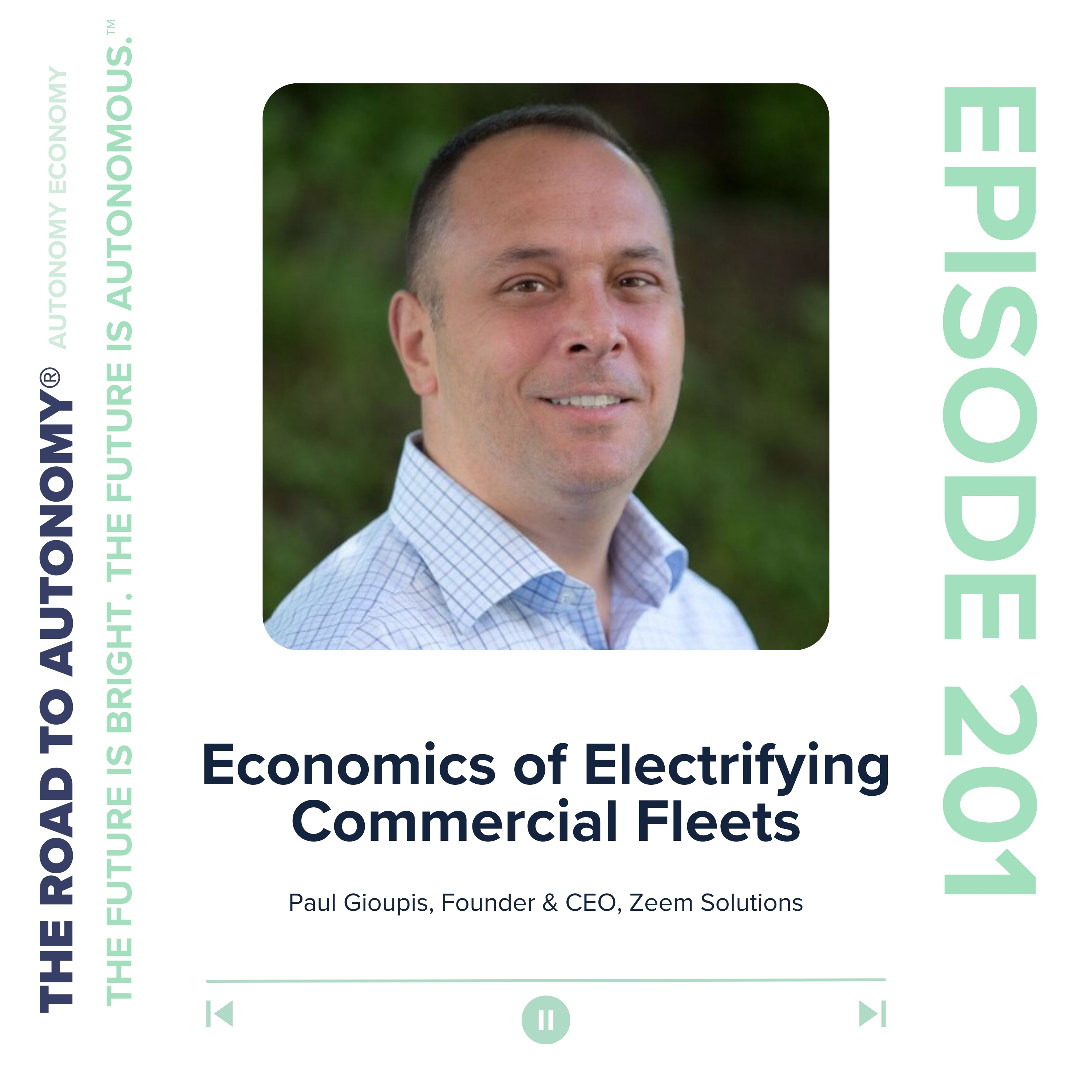
Ep 201Episode 201 | Autonomy Economy: Economics of Electrifying Commercial Fleets
Paul Gioupis, Founder & CEO, Zeem Solutions joined Grayson Brulte on The Autonomy Economy podcast to discuss the economics of electrifying commercial fleets and the current state of the electric commercial fleet market.As the global push for sustainability intensifies, the trucking industry faces immense pressure to transition towards zero-emission solutions. However, the path to electrification is riddled with economic challenges, regulatory and operational complexities. As society shifts to electrification, there is a growing global taxation effort underway to fill the estimated $110 billion dollar fuel tax shortfall by 2025 that is being caused by the switch to electric from oil.Paul candidly addresses the potential $110 billion fuel tax shortfall that is projected by 2025. The potential fuel tax shortfall highlights the need for solutions that strike a balance between environmental goals and economic feasibility. Drawing from his Wall Street background and a deep understanding of economics and how to scale a profitable business. Throughout the conversation, Paul discuss Zeem’s bold approach to tackling the electrification conundrum. From meticulously mapping customer demand through 1.8 million fleet phone calls, to strategically selecting locations based on origin, destination, and energy accessibility, Zeem implemented a data-driven strategy.Recognizing the software glitches and inferior products plaguing the EV market, Paul calls for a consumer-centric approach, where vehicles must stand on their own merits – delivering superior performance, range, and cost-effectiveness. He emphasizes the need for ground-up EV designs, challenging traditional OEMs to raise their game and innovate beyond mere compliance.Looking ahead, Paul envisions Zeem’s depots as future micro-grids, seamlessly integrating with the existing utility infrastructure while alleviating grid stress through distributed energy solutions. With a steadfast focus on economics, scalability, and operational excellence, Zeem is poised to lead the charge in reshaping the trucking industry’s electrified future.Recorded on Wednesday, May 8, 2024Episode Chapters0:00 Global Budget Shortfalls Caused by Electrification 3:43 Operational Efficiency of the Zeem Business8:38 Zeem’s Business Model16:57 Zeem Locations22:34 Electrification of Fleets 34:55 U.S. Highway Trust Fund37:58 Opportunities for Electrification 41:55 Key Takeaways--------About The Road to AutonomyThe Road to Autonomy® is a leading source of data, insight and commentary on autonomous vehicles/trucks and the emerging autonomy economy™. The company has two businesses: The Road to Autonomy Indices, with Standard and Poor’s Dow Jones Indices as the custom calculation agent; Media, which includes The Road to Autonomy and Autonomy Economy podcasts as well as This Week in The Autonomy Economy newsletter.See Privacy Policy at https://art19.com/privacy and California Privacy Notice at https://art19.com/privacy#do-not-sell-my-info.
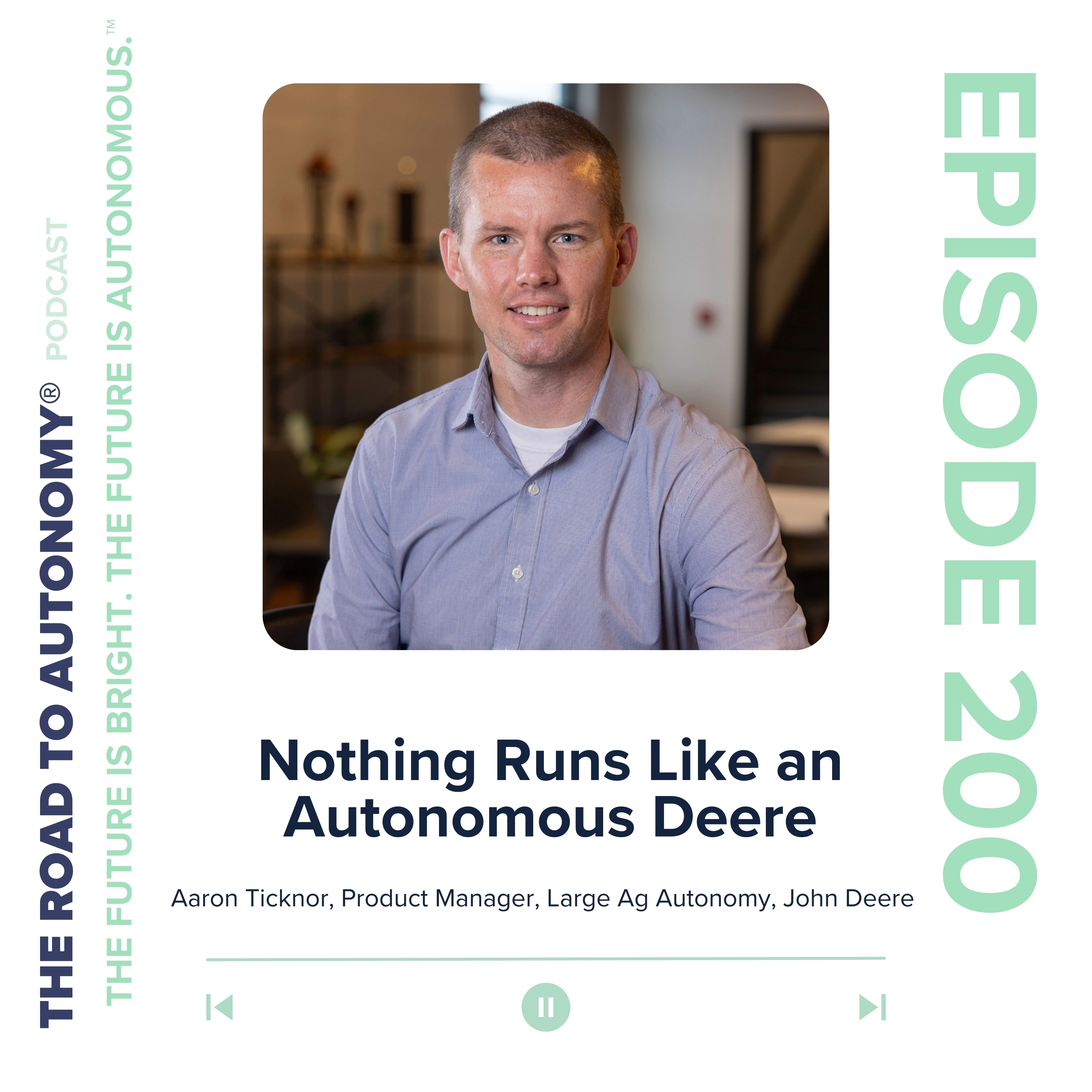
Ep 200Episode 200 | Nothing Runs Like an Autonomous Deere: Increasing Efficiency on Farms
Aaron Ticknor, Product Manager, Large Ag Autonomy, John Deere joined Grayson Brulte on The Road to Autonomy podcast to discuss the future of autonomous tractors on farms. Farming has remained one of humanity’s most essential endeavors since the dawn of civilization. But in the 21st century, a technological revolution is transforming traditional farming — autonomy. At the forefront of this transformation is Deere & Company, an agricultural powerhouse pioneering the future of autonomous tractors. We go behind the scenes with Deere to explore their trailblazing work in autonomous tractors and what the positive impacts will be for implementing full autonomy across the farming cycle. From tilling and planting to crop management and harvesting, Deere is developing autonomous solutions that are increasing efficiency, optimizing yields, and helping farmers do more with less.We’ll dive deep into the cutting-edge technology making this possible, like advanced perception systems, artificial intelligence, robotics, and machine learning models that allow Deere tractors to navigate fields without a human operator. Deere is creating entire autonomous ecosystems, with cloud-based monitoring, control systems, data analytics, and more — providing farmers a degree of oversight, optimization and decision-making capabilities never before possible.You’ll learn how autonomous farming technology is poised to solve major challenges facing global agriculture – from labor shortages to supply chain vulnerabilities to the imperative of feeding a growing population. Deere’s autonomous solutions represent the future of feeding the world sustainably.Whether you’re a farmer, technologist, or someone passionate about world-changing innovation, this podcast offers a fascinating look at the autonomous farming revolution underway. Join us as we explore how Deere is driving this transformative shift and delivering on the promise of smarter, more productive, and more sustainable agriculture.Recorded on Wednesday May 1, 2024Episode Chapters0:00 Deere Approach to Autonomy2:33 Deploying Autonomy on Farms6:57 Deere’s Autonomous Perception System10:32 Why Deere Embraced Autonomy13:38 Deere’s Autonomy Business19:28 Autonomous Deere Tractors24:52 Future of Deere--------About The Road to AutonomyThe Road to Autonomy® is a leading source of data, insight and commentary on autonomous vehicles/trucks and the emerging autonomy economy™. The company has two businesses: The Road to Autonomy Indices, with Standard and Poor’s Dow Jones Indices as the custom calculation agent; Media, which includes The Road to Autonomy and Autonomy Economy podcasts as well as This Week in The Autonomy Economy newsletter.See Privacy Policy at https://art19.com/privacy and California Privacy Notice at https://art19.com/privacy#do-not-sell-my-info.
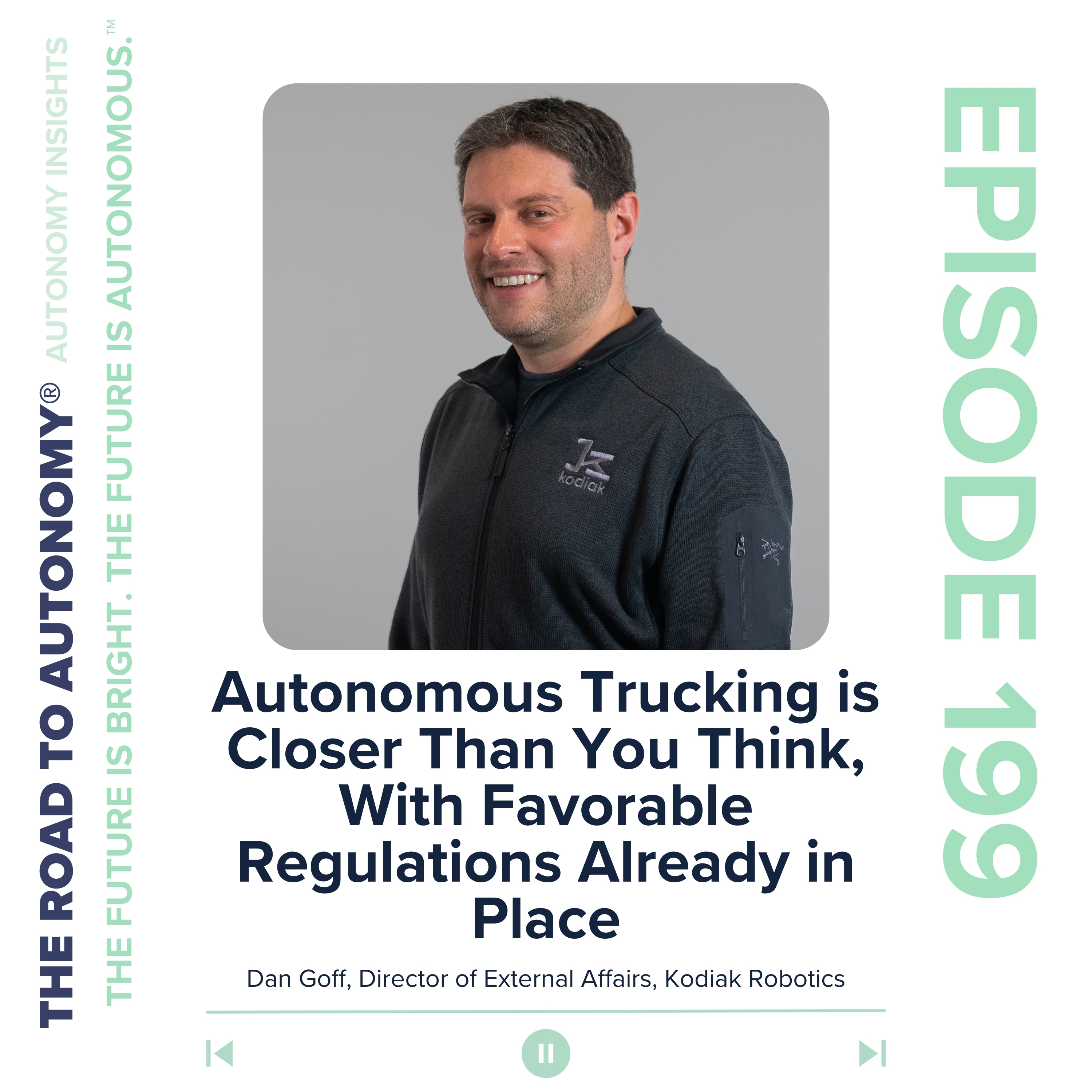
Ep 199Episode 199 | Autonomy Insights: Autonomous Trucking is Closer Than You Think, With Favorable Regulations Already in Place
In 2019, the U.S. Department of Transportation (US DOT) issued guidance through their AV 3.0 framework that specifically stated that going forward, federal trucking regulations from the FMCSA will no longer assume that a commercial vehicle driver must be a human present in the vehicle. This cleared the way for self-driving trucks to operate legally, as long as they comply with existing trucking regulations.Dan Goff, Director of External Affairs, Kodiak Robotics joined The Road to Autonomy Founder Grayson Brulte to discuss the current regulatory landscape for autonomous trucks in the United States.While in the long-term there will need to be new regulations crafted specifically for autonomous trucking, in the near-term, the existing rules provide a sufficient framework to begin deploying autonomous trucks in a compliant manner. Today, there are only a handful of regulations that don't neatly apply, and the industry has been working to solve those lingering issues.One key regulatory hurdle that Kodiak has worked on was developing an enhanced inspection program with the Commercial Vehicle Safety Alliance (CVSA) that enables autonomous trucks to demonstrate an elevated level of vehicle safety checks compared to today's methods. Enhanced inspections have helped build confidence with law enforcement around autonomous trucking deployments.Today, 25 U.S. States have passed laws enabling and regulating autonomous vehicle deployments, further validating their legal ability to operate autonomous trucks complying with applicable regulations.While the patchwork of differing state laws is manageable currently, Dan believes eventually there will need to be a unified national regulatory framework governing autonomous trucking to enable broad interstate operations. But, the existing legal foundations for autonomous trucking deployments are in place today.Recorded on Wednesday, May 15, 2024Episode Chapters0:00 Current State of Autonomous Trucking Regulations3:28 Enhanced Inspections8:52 Evolving Autonomous Trucking Regulatory Landscape11:48 Autonomous Trucking Misconceptions--------About The Road to AutonomyThe Road to Autonomy® is a leading source of data, insight and commentary on autonomous vehicles/trucks and the emerging autonomy economy™. The company has two businesses: The Road to Autonomy Indices, with Standard and Poor’s Dow Jones Indices as the custom calculation agent; Media, which includes The Road to Autonomy and Autonomy Economy podcasts as well as This Week in The Autonomy Economy newsletter.See Privacy Policy at https://art19.com/privacy and California Privacy Notice at https://art19.com/privacy#do-not-sell-my-info.
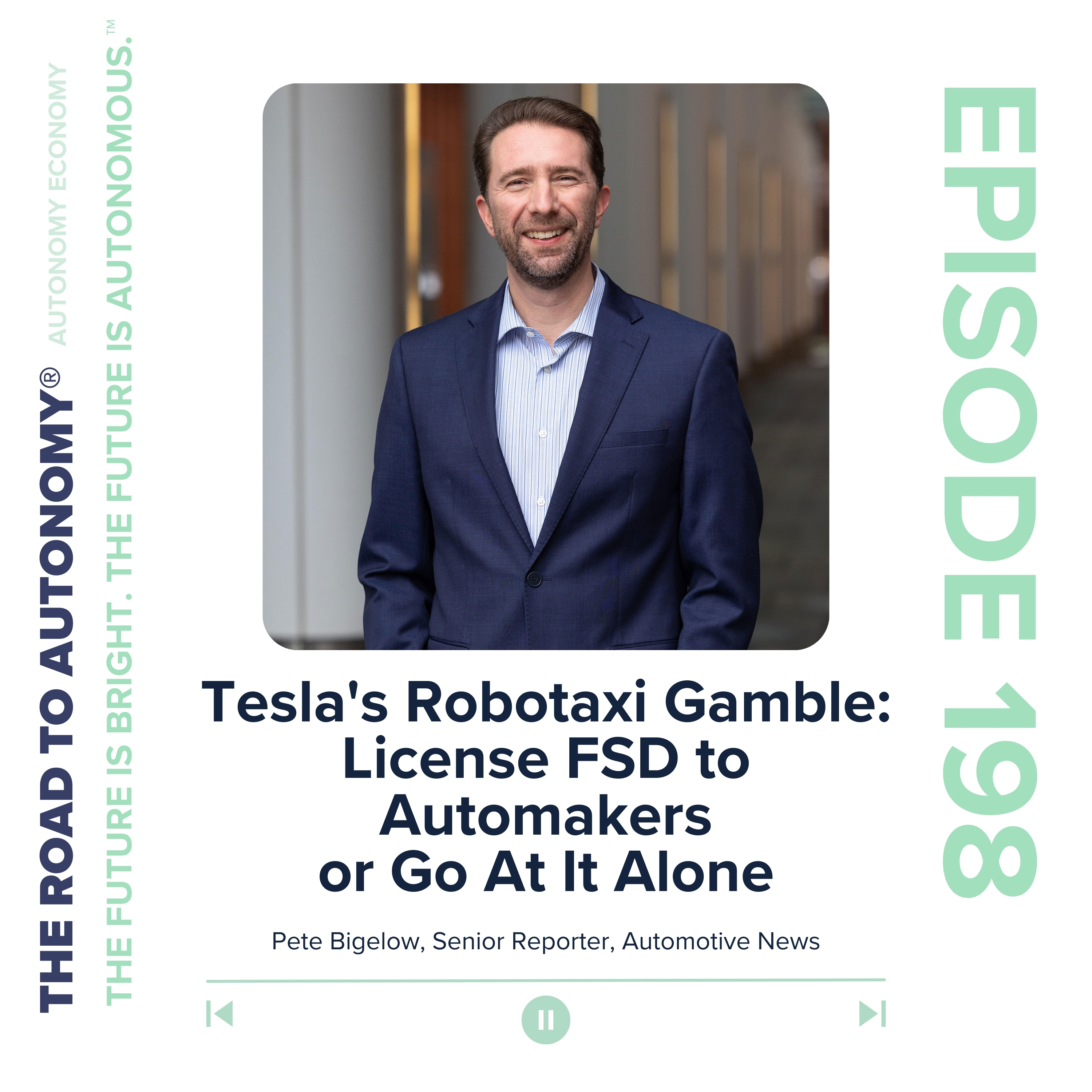
Ep 198Episode 198 | Autonomy Economy: Tesla's Robotaxi Gamble: License FSD to Automakers or Go At It Alone
Pete Bigelow, Senior Reporter, Automotive News joined Grayson Brulte on The Autonomy Economy podcast to discuss Tesla’s robotaxi gamble and the prospects for Tesla to license FSD. In this wide-ranging conversation, Grayson and Pete dive into the bold promises and ambitious plans surrounding Tesla’s bid to launch CyberCab and a robotaxi service. As Tesla prepares to unveil more details on August 8th, they analyze what it could mean for the future of autonomy and mobility.Grayson and Pete explore whether Tesla will actually show two separate vehicle models — one with traditional controls (potentially the Model 2) and a fully autonomous version without a steering wheel or pedals. The big questions linger: When will Cybercab realistically deploy commercially? And just how good will the self-driving technology be when it is first deployed?The rise of Tesla’s robotaxi ambitions has sparked concerns about being Uber being potentially disrupted. But making the economics work with such an expensive vehicle platform remains a huge challenge. Could a Tesla subscription service bundled with incentives make a Tesla robotaxi more accessible?As the conversation evolves, Grayson and Pete also analyze the strategic options for established automakers and if they should consider licensing Tesla’s self-driving software. Or should they choose to develop their own systems with Nvidia and Qualcomm? Or pursue potential licensing agreements with Cruise, Waymo or Zoox? Zoox is interesting as the company is planning to launch service in Las Vegas which gives the company unique opportunities to embrace Vegas and create “experiences” such as mobile gambling in partnership with casinos.Ultimately, the road to Tesla deploying commercial robotaxis at scale remains riddled with technological, regulatory and business model hurdles. But with Tesla all-in on the robotaxi future, the stakes are escalating for the entire auto industry to map out its autonomy strategy.Recorded on Friday, April 26, 2024 Episode Chapters0:10 Tesla CyberCab2:20 Tesla Mobility Platform5:14 Tesla Subscription Platform19:55 Camera Only23:30 Licensing FSD35:10 Licensing Cruise, Waymo, Zoox38:39 NVIDIA & Qualcomm41:05 Zoox & Casinos --------About The Road to AutonomyThe Road to Autonomy® is a leading source of data, insight and commentary on autonomous vehicles/trucks and the emerging autonomy economy™. The company has two businesses: The Road to Autonomy Indices, with Standard and Poor’s Dow Jones Indices as the custom calculation agent; Media, which includes The Road to Autonomy and Autonomy Economy podcasts as well as This Week in The Autonomy Economy newsletter.See Privacy Policy at https://art19.com/privacy and California Privacy Notice at https://art19.com/privacy#do-not-sell-my-info.
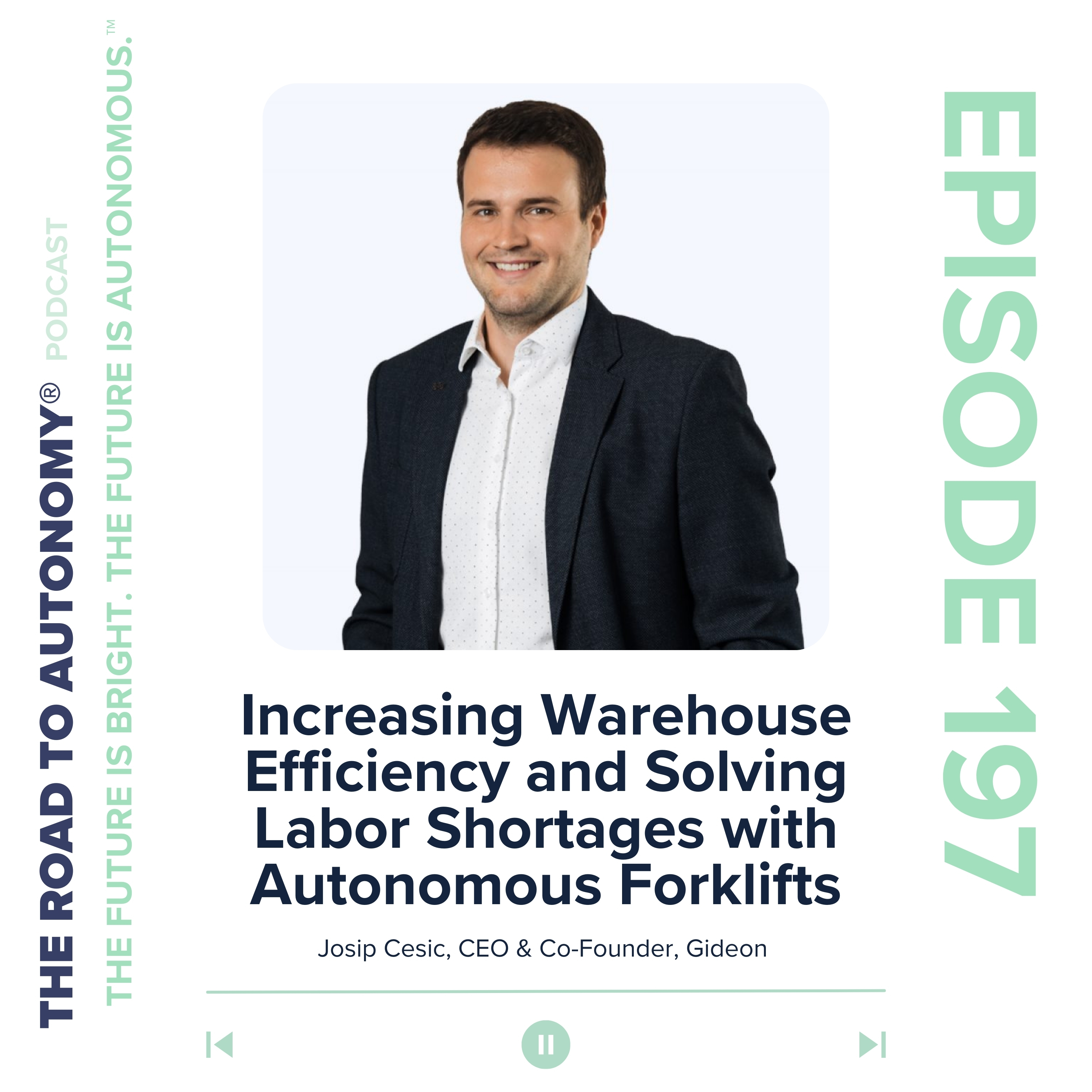
Ep 197Episode 197 | Increasing Warehouse Efficiency and Solving Labor Shortages with Autonomous Forklifts
Josip Cesic, CEO & Co-Founder, Gideon joined Grayson Brulte on The Road to Autonomy podcast to discuss the transformation that the warehouse logistics industry is undergoing driven by an urgent need for increased efficiency and automation. Labor shortages are rampant, with younger generations showing less interest in roles such as forklift driving. Gideon’s autonomous forklifts which are deployed to load and unload trailers achieve a return on investment within 1-3 years by maintaining or increasing throughput compared to manual operations. Gideon’s compelling unit economics, combined with soaring labor costs and challenges in attracting workers, is propelling major companies such as Walmart, Loblaw, DHL, and FedEx to double down on warehouse automation.Josip explains how Gideon retrofits off-the-shelf forklifts with its autonomy kit comprising sensors including LiDAR and cameras, enabling safe and efficient autonomous trailer loading/unloading. As the technology scales, further cost reductions are anticipated through optimized computing solutions.As Gideon scales, Josip sees autonomous trailer loading/unloading as merley just the starting point, The big goal is to fundamentally reimagine the entire supply chain through autonomy. During the conversation, Josip stresses the importance of thinking several steps ahead and forming strategic partnerships, as early successes attract fierce competition in this blossoming market.Ultimately, Josip emphasizes that while robotics plays a pivotal role, the true bet is on people – adopting, driving, and benefiting from the revolutionary efficiencies that autonomous solutions will unlock across industries facing existential labor challenges.Recorded on Monday, April 15, 2024 Episode Chapters0:09 Warehouse Automation Outlook8:15 Warehouse Automation Market Evolving Over Next Decade 14:40 Gideon Autonomous Forklifts26:26 Global Autonomous Forklift Markets 31:10 Future of Gideon--------About The Road to AutonomyThe Road to Autonomy® is a leading source of data, insight and commentary on autonomous vehicles/trucks and the emerging autonomy economy™. The company has two businesses: The Road to Autonomy Indices, with Standard and Poor’s Dow Jones Indices as the custom calculation agent; Media, which includes The Road to Autonomy and Autonomy Economy podcasts as well as This Week in The Autonomy Economy newsletter.See Privacy Policy at https://art19.com/privacy and California Privacy Notice at https://art19.com/privacy#do-not-sell-my-info.
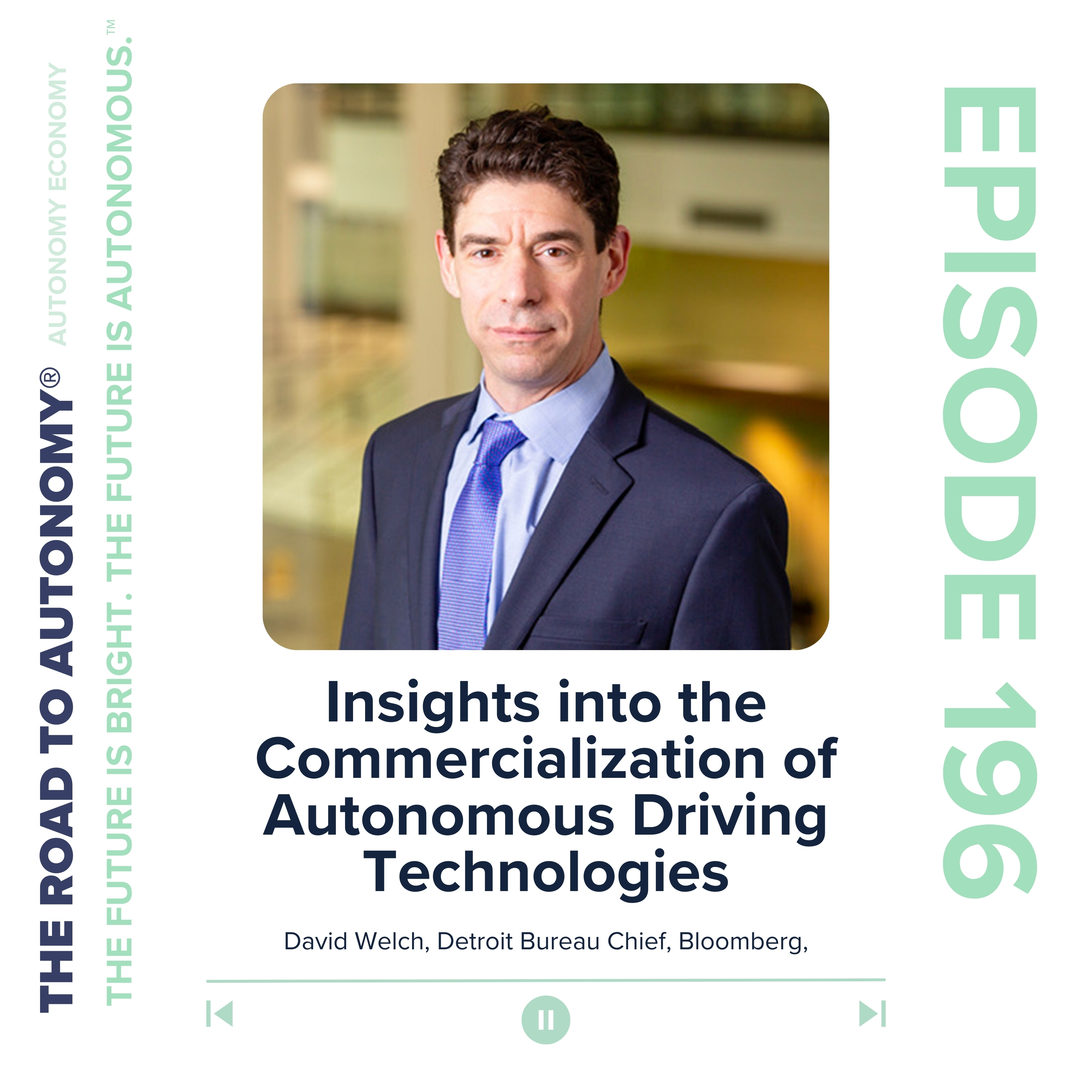
Ep 196Episode 196 | Autonomy Economy: Insights into the Commercialization of Autonomous Driving Technologies
David Welch, Detroit Bureau Chief, Bloomberg joined Grayson Brulte on The Autonomy Economy podcast to discuss the commercialization of autonomous vehicles and autonomous trucks. In this insightful conversation they discuss the latest developments and prospects in the autonomous vehicle, autonomous truck and electric vehicle markets. Collectively they analyzed Tesla’s upcoming robotaxi unveiling, offering perspectives on how the market might react and the challenges with Tesla achieving full self-driving.The discussion explores the competitive landscape with Waymo, Cruise, and Aurora diligently working towards commercializing autonomous vehicles and autonomous trucks. While examining the technical hurdles, regulatory environment, and investor sentiment surrounding autonomy.Looking at the broader EV market, they dissect Tesla’s recent sales dip, the arrival of more affordable EV models, and consumer readiness to embrace this shift. The conversation also touches on the struggles legacy automaker GM has faced in executing new technology ventures; Ultium batteries and their autonomous vehicle subsidiary Cruise.Overall, this podcast provides a comprehensive look at the road ahead for autonomy and electrification, marked by both immense potential and significant challenges yet to still be overcome. Both David and Grayson offer candid insights into the key players, market forces, and make-or-break factors that will shape the future of transportation.Recorded on Thursday, April 18, 2024 Episode Chapters0:11 Tesla CyberCab 3:19 Chinese AVs & EVs10:13 Investor Sentiment on Autonomy13:44 Autonomy and Defense20:07 Amazon24:13 Licensing Autonomous Driving Technology26:46 May Mobility 30:31 Cruise 36:38 GM43:12 What To Watch for in the Autonomy Markets--------About The Road to AutonomyThe Road to Autonomy® is a leading source of data, insight and commentary on autonomous vehicles/trucks and the emerging autonomy economy™. The company has two businesses: The Road to Autonomy Indices, with Standard and Poor’s Dow Jones Indices as the custom calculation agent; Media, which includes The Road to Autonomy and Autonomy Economy podcasts as well as This Week in The Autonomy Economy newsletter.See Privacy Policy at https://art19.com/privacy and California Privacy Notice at https://art19.com/privacy#do-not-sell-my-info.
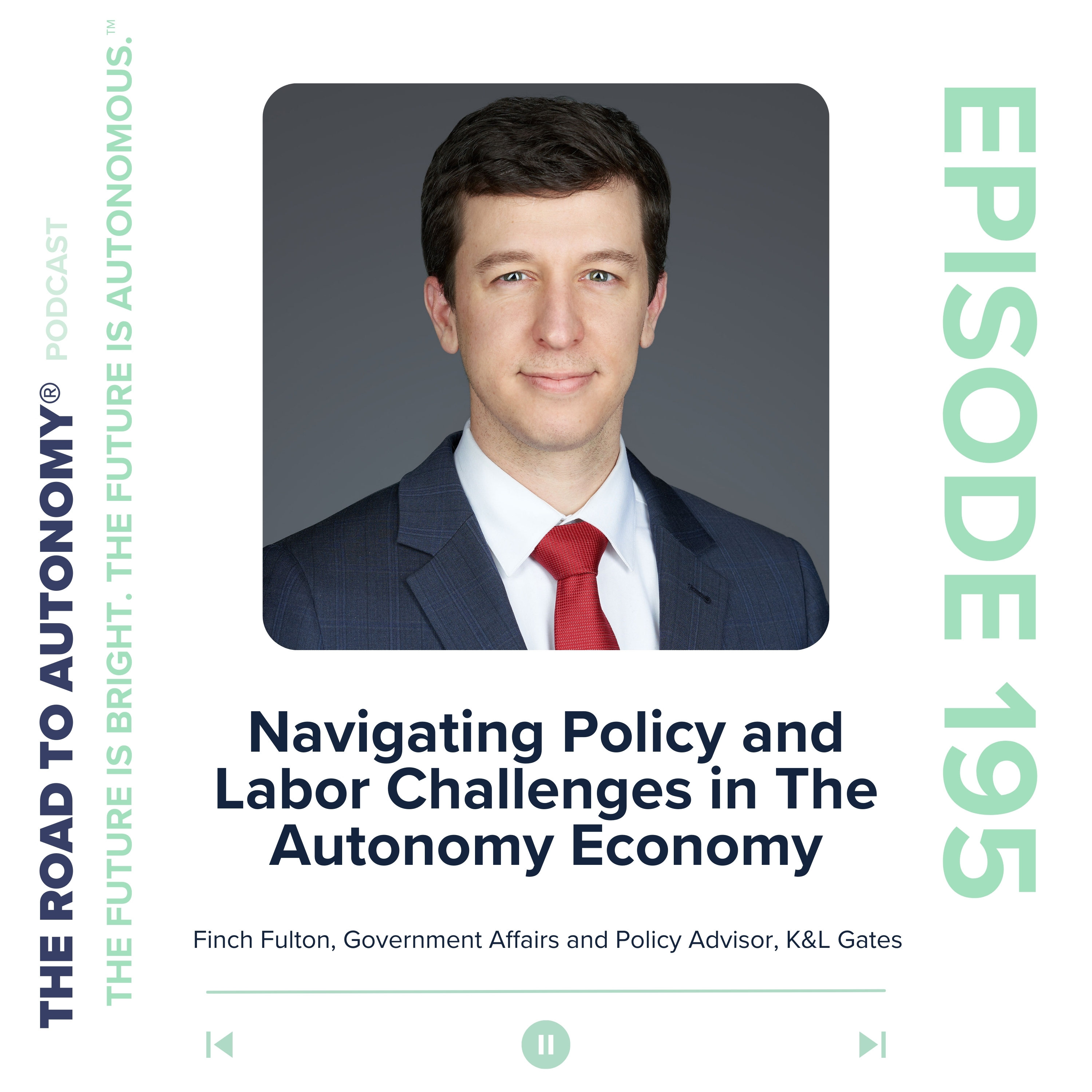
Ep 195Episode 195 | Navigating Policy and Labor Challenges in The Autonomy Economy
Finch Fulton, Government Affairs and Policy Advisor, K&L Gates joined Grayson Brulte on The Road to Autonomy podcast to discuss the policy and labor challenges currently facing the emerging autonomy economy. As the development of autonomous trucks and vehicles gains momentum, it faces significant policy and labor hurdles. There are complicated policy issues that autonomous trucking and vehicle companies must navigate to ensure that autonomous trucks and vehicles can be deployed on America’s roads.During the conversation Finch provides an insider’s perspective on the pushback against automation, autonomous trucks and autonomous vehicles under the guise of safety concerns. He highlights how overly restrictive policies could cripple innovation and America’s competitiveness, driving commerce and jobs to other countries.The discussion also delves into the role of federal agencies like the FMCSA and NHTSA in establishing a clear regulatory framework for autonomous trucks and autonomous vehicles. Delays in key rule-makings are examined as well as what happens when nothing happens. Along with the economic impact of those non-decisions are and who ultimately benefits. When autonomous trucks are actively hauling freight on the roads of America and autonomous vehicles are common in cities around the country, America wins. The economy becomes stronger, inflation begins to subside and the roads become safer. When this happens we will begin to usher in the autonomy economy. Recorded on Wednesday, April 3, 2024Episode Chapters00:15 Election Season and Policy Implications for Automation01:31 The Electric Vehicle Market and Tesla's Influence04:58 Supply Chain Challenges and National Security Issues08:15 The Future of Autonomous Technologies and Labor20:21 Silicon Valley's Shift Towards Defense Innovation22:35 Policy Prospects for Autonomous Vehicles in Future Administrations28:41 Decoding the Politics of Safety Regulations29:47 The Stalled Progress on Automated Vehicle Safety Standards31:36 The Impact of Rulemaking Delays on Autonomous Vehicle Safety33:05 Exploring the Role of Organized Labor in Autonomous Vehicle Regulation34:01 State vs. Federal: The Battle Over Autonomous Vehicle Legislation36:52 The Future of Autonomous Vehicle Policy and Investment44:46 Navigating the Challenges of Electrification and Autonomous Trucks50:56 A Call for Common Sense in Autonomous Vehicle Policy--------About The Road to AutonomyThe Road to Autonomy® is a leading source of data, insight and commentary on autonomous vehicles/trucks and the emerging autonomy economy™. The company has two businesses: The Road to Autonomy Indices, with Standard and Poor’s Dow Jones Indices as the custom calculation agent; Media, which includes The Road to Autonomy and Autonomy Economy podcasts as well as This Week in The Autonomy Economy newsletter.See Privacy Policy at https://art19.com/privacy and California Privacy Notice at https://art19.com/privacy#do-not-sell-my-info.
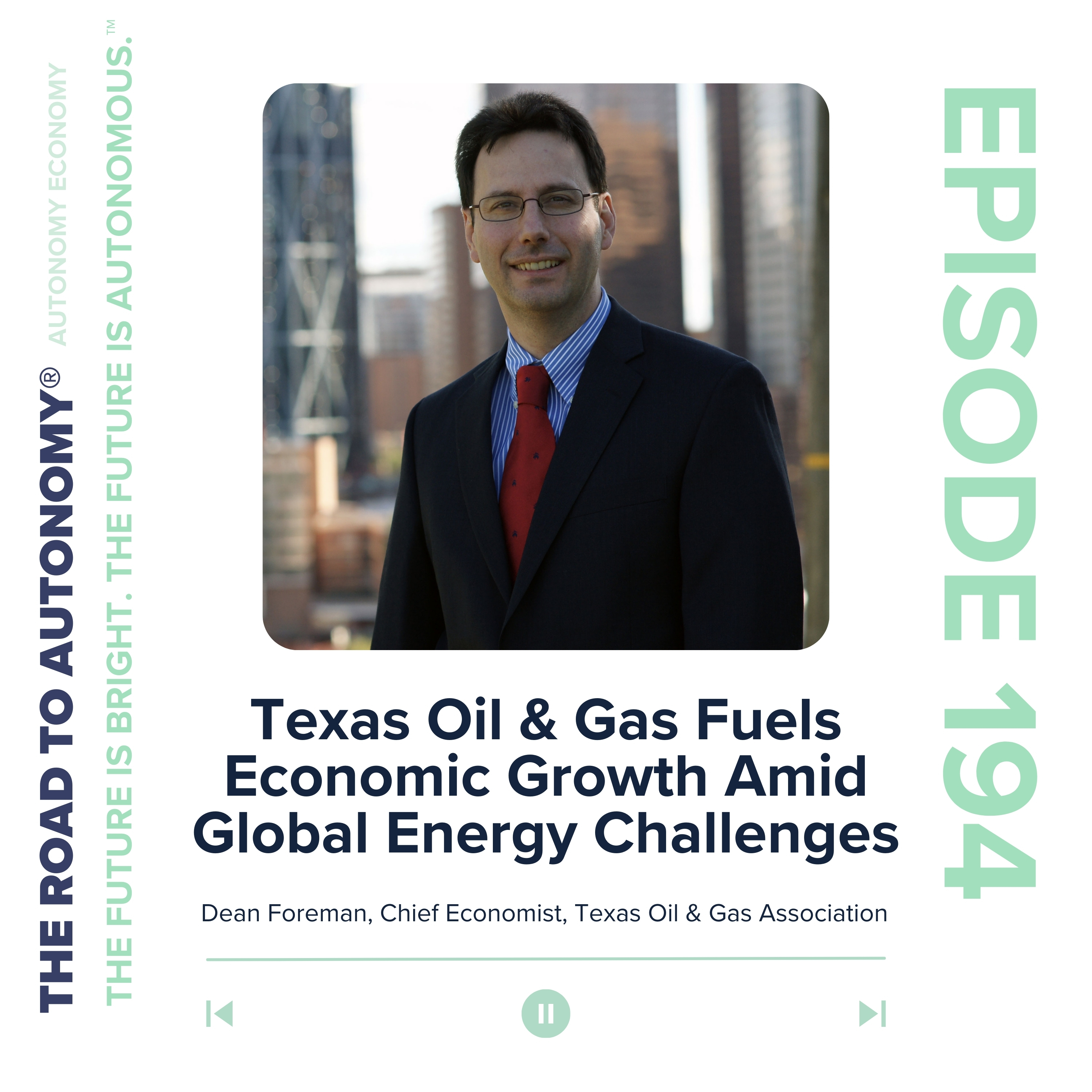
Ep 194Episode 194 | Autonomy Economy: Texas Oil & Gas Fuels Economic Growth Amid Global Energy Challenges
Dean Foreman, Chief Economist, Texas Oil & Gas Association joined Grayson Brulte on The Autonomy Economy podcast to discuss the pivotal role the oil and gas plays in the global economy. With a backdrop of geopolitical uncertainty, Dean provides an in-depth analysis of how geopolitical factors like the Russia-Ukraine war and tensions with Iran impact oil markets. He examines the increasing demand for natural gas, particularly from Asia and Texas’ position as one of the leading producer and exporters of oil and gas.During the conversation, Dean and Grayson explore the implications of rising interest rates and inflation on the energy sector and the broader economy, including California’s controversial electricity pricing based on household income. Additionally, Grayson and Dean discuss the U.S.’s growing national debt and how it could potentially impact the energy markets as there is an interdependence between economic growth and energy demand. This comprehensive conversation is a must-listen for anyone interested in understanding the intricate dynamics of the global energy landscape and it’s profound influence on economic development.Recorded on Wednesday, April 10, 2024Episode Chapters0:11 The Impact of Geopolitics4:41 Monetary Policy Impact on Oil & Natural Gas Markets13:34 Growing Demand for Natural Gas19:24 California Energy Policy26:40 Oil & Gas Impact on the Global Economy34:02 Impact of the Growing U.S. Debt on the Economy 41:34 China Oil Imports 43:48 Things to Watch in the Oil Markets--------About The Road to AutonomyThe Road to Autonomy® is a leading source of data, insight and commentary on autonomous vehicles/trucks and the emerging autonomy economy™. The company has two businesses: The Road to Autonomy Indices, with Standard and Poor’s Dow Jones Indices as the custom calculation agent; Media, which includes The Road to Autonomy and Autonomy Economy podcasts as well as This Week in The Autonomy Economy newsletter.See Privacy Policy at https://art19.com/privacy and California Privacy Notice at https://art19.com/privacy#do-not-sell-my-info.
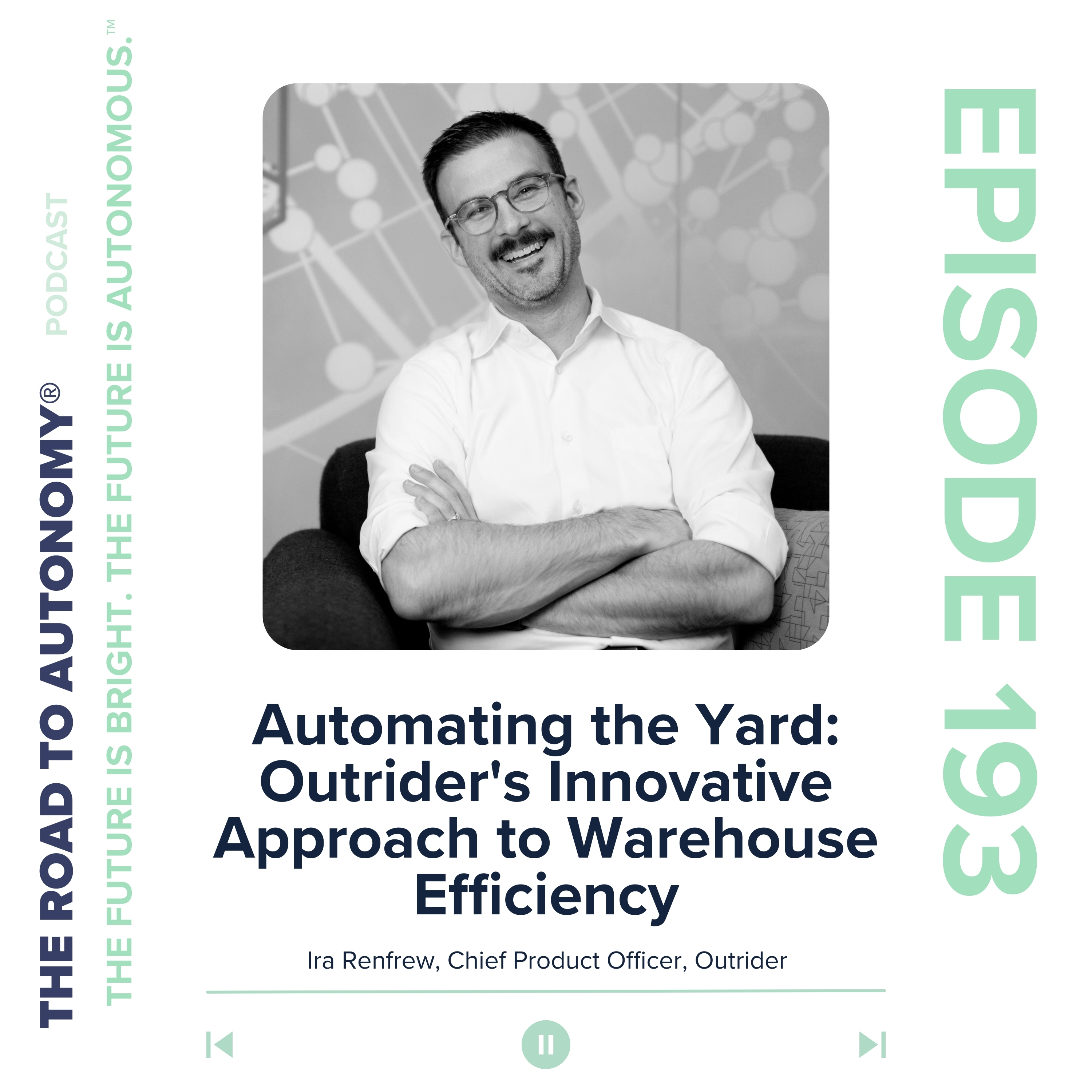
Ep 193Episode 193 | Automating the Yard: Outrider's Innovative Approach to Warehouse Efficiency
Ira Renfrew, Chief Product Officer, Outrider joined Grayson Brulte on The Road to Autonomy podcast to discuss how Outrider is developing autonomous yard operations that improve efficiency, safety, and resiliency for warehouse operations. Outrider has developed an innovative autonomous yard truck system that can connect and disconnect trailers autonomously using their patented Trailer Connect technology. Yard automation is as an untapped opportunity for automation that Outrider correctly identified in 2017 when the company was founded by Andrew Smith.The Outrider stack was designed for mixed traffic environments in warehouse and distribution yards. One of the advancements that has been made since the company was founded is the introduce of their autonomous “glad hand” trailer connection process.By automating the entire process, Outrider is able to achieve human-level throughput for trailer moves while enabling 24/7 operation and optimization across the yard truck fleet, leading to increased efficiency. Closing out the conversation Ira discusses Outrider’s roadmap, scaling plans, the benefits of electrification when combined with autonomy at customer sites, and Outrider’s vision for fully automated supply chains enabled by AI and robotics.Recorded on Tuesday, April 2, 2024Episode Chapters0:09 The Evolving Warehouse Automation Market5:11 Increase Warehouse Efficiency with Autonomous Yard Trucks8:58 Outrider Market Positioning12:47 Outrider Tech Stack22:43 Scaling Outrider26:05 Trailer Connect28:42 Fully Automated Supply Chain--------About The Road to AutonomyThe Road to Autonomy® is a leading source of data, insight and commentary on autonomous vehicles/trucks and the emerging autonomy economy™. The company has two businesses: The Road to Autonomy Indices, with Standard and Poor’s Dow Jones Indices as the custom calculation agent; Media, which includes The Road to Autonomy and Autonomy Economy podcasts as well as This Week in The Autonomy Economy newsletter.See Privacy Policy at https://art19.com/privacy and California Privacy Notice at https://art19.com/privacy#do-not-sell-my-info.
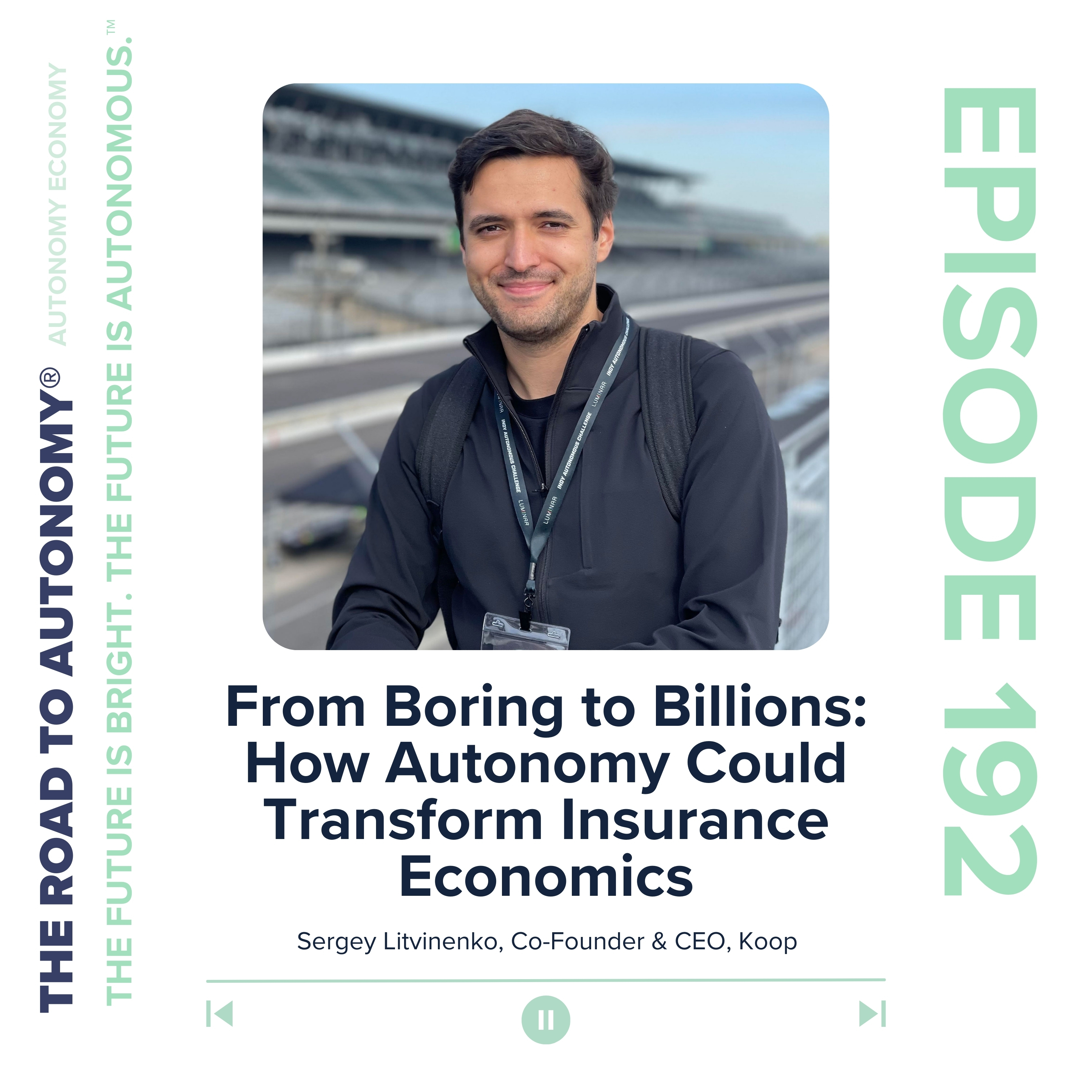
Ep 192Episode 192 | Autonomy Economy: From Boring to Billions: How Autonomy Could Transform Insurance Economics
Sergey Litvinenko, Co-Founder & CEO, Koop joined Grayson Brulte on The Autonomy Economy podcast how autonomy could transform insurance economics. As autonomous vehicles and robotic automation spread across industries, a massive new risk ecosystem is emerging that will require innovative insurance solutions. In a fascinating podcast interview, Sergey Litvinenko, co-founder & CEO of insurtech pioneer Koop, provided rare insights into how his company is leading the charge in underwriting this technological transformation.Traditional insurance carriers have been hesitant to dive into insuring autonomy risks like self-driving cars and warehouse robotics due to a lack of data and technical expertise. As Sergey explained, “If you can’t model the risk, you can’t underwrite it profitably.” This knowledge gap has created a massive greenfield opportunity for insurtechs focused specifically on robotics and AI.Koop has developed proprietary systems that ingest and analyze real-world sensor data from robots and autonomous vehicles to precisely model their behavior and safety performance. Using this cutting-edge approach, Koop has achieved stellar underwriting results, with loss ratios under 5% for its robotics book – compared to 70%+ for traditional P&C lines.This lucrative capability is allowing Koop to rapidly scale and cement its position as the dominant player in the burgeoning autonomy insurance market. Sergey believes large incumbents will be forced to partner with or acquire specialist providers like Koop rather than build expertise in-house. He forecasted robotics insurance could be a “tens of billions” dollar market delivering 30%+ underwriting profits.As AI ushers in a “Cambrian explosion” of robotic use cases across industries, demand for intelligently underwritten insurance solutions will skyrocket. Koop is uniquely positioned with the technical foundations, proprietary data, and risk modeling skills to capture this unprecedented opportunity.In Sergey’s words, “When you intersect tens of billions of deployed robots with insurance where you can deliver 30% annual returns…it just makes me very excited about the space.” The autonomy economy is materializing rapidly – don’t be surprised if the pioneering innovators insuring this revolution turn out to be young insurtechs like Koop rather than industry giants.Listen to the full podcast for more fascinating insights from Sergey Kravchenko on the future of autonomy insurance. The robotics risk market is open for disruption – will your company be leading or following?Recorded on Tuesday, March 26, 2024Episode Chapters0:10 2024 Insurance Market Outlook5:14 Cyber Security Insurance9:40 Underwriting Autonomous Vehicles and Trucks35:36 How Companies Should Prepare for Autonomy and Automation 37:44 AI Impact on Insurance 40:26 The Evolving Underwriting Markets for Autonomous Vehicles 42:34 Key Take Aways--------About The Road to AutonomyThe Road to Autonomy® is a leading source of data, insight and commentary on autonomous vehicles/trucks and the emerging autonomy economy™. The company has two businesses: The Road to Autonomy Indices, with Standard and Poor’s Dow Jones Indices as the custom calculation agent; Media, which includes The Road to Autonomy and Autonomy Economy podcasts as well as This Week in The Autonomy Economy newsletter.See Privacy Policy at https://art19.com/privacy and California Privacy Notice at https://art19.com/privacy#do-not-sell-my-info.
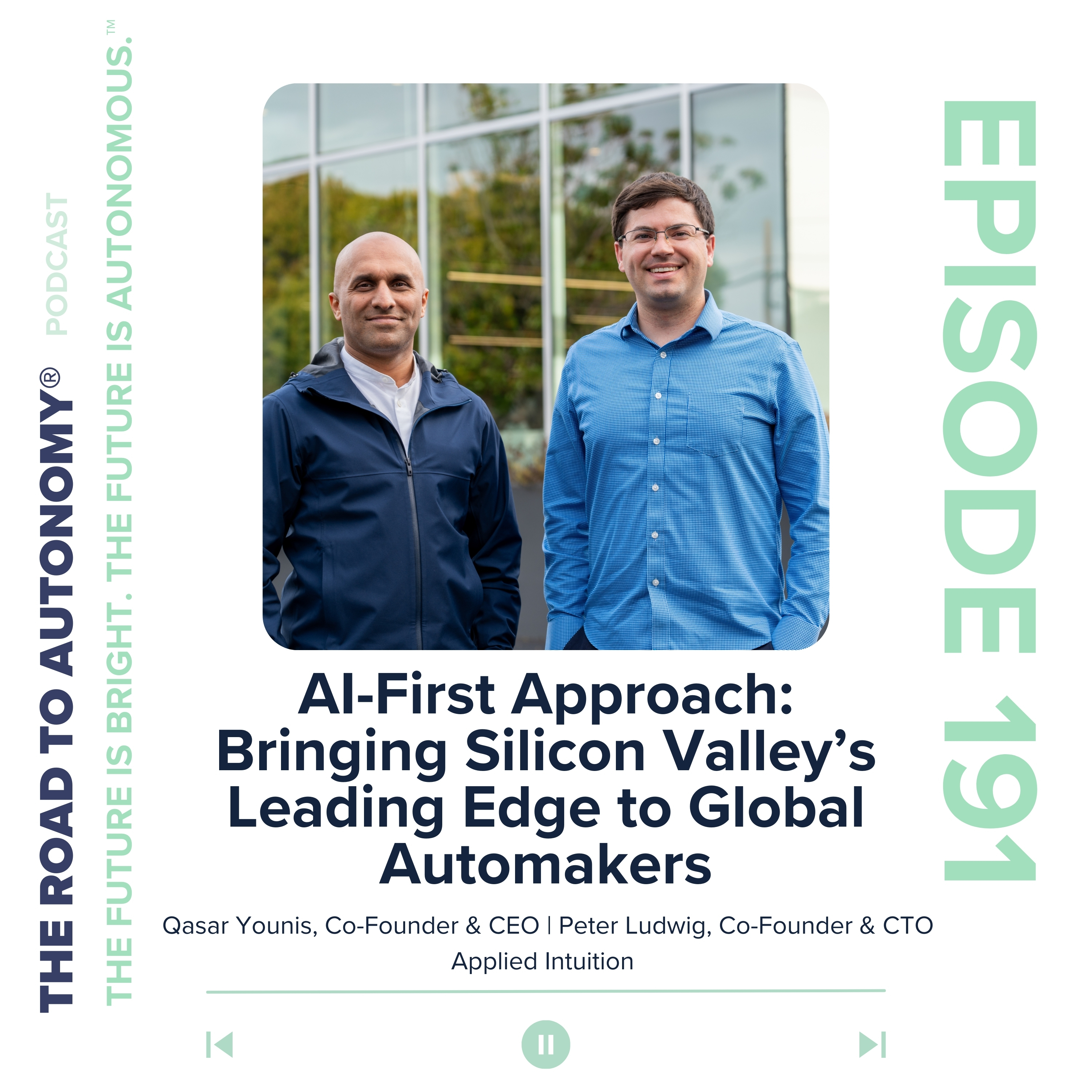
Ep 191Episode 191 | AI-First Approach: Bringing Silicon Valley’s Leading Edge to Global Automakers
Are you ready to go behind the scenes and uncover the secrets of the company playing a pivotal role in the future of autonomous and electric vehicles? In this riveting episode, we dive deep into the world of Applied Intuition, the Silicon Valley company partnering with automotive giants such as Porsche to develop groundbreaking software that will make self-driving cars a reality.Join us as host Grayson Brulte sits down with Qasar Younis and Peter Ludwig, the visionary co-founders who are fusing cutting-edge artificial intelligence with decades of automotive expertise. You'll gain unprecedented insights into their bold mission to accelerate safe autonomy across industries – from transforming in-vehicle experiences to tackling defense applications.But that's not all! Brace yourself for insights into Applied Intuition's pioneering work, including their multi-stack strategy to future-proof technology, ambitious vehicle software platform to revolutionize mobile electronics, and the innovative ways they're empowering automakers to control the consumer experience like never before.Don't miss this opportunity to understand the forces driving autonomy and witness the birth of a new era in intelligent machines. Listen now and immerse yourself in a world where the boundaries of possibility are constantly being redefined.Episode Chapters0:00 The Road to Autonomy Index Introduction0:56 Series E Funding3:44 Applied Intuition AI Roadmap5:58 AV 2.010:00 Insights into the Chip Market11:04 Applied Intuition Trust Layer14:37 Autonomous Driving24:36 Applied Intuition x Porsche27:45 Software Development with OEMs36:54 Applied Intuition Defense Business39:24 Future of Applied IntuitionRecorded on Friday, March 29, 2024 --------About The Road to AutonomyThe Road to Autonomy® is a leading source of data, insight and commentary on autonomous vehicles/trucks and the emerging autonomy economy™. The company has two businesses: The Road to Autonomy Indices, with Standard and Poor’s Dow Jones Indices as the custom calculation agent; Media, which includes The Road to Autonomy and Autonomy Economy podcasts as well as This Week in The Autonomy Economy newsletter.See Privacy Policy at https://art19.com/privacy and California Privacy Notice at https://art19.com/privacy#do-not-sell-my-info.
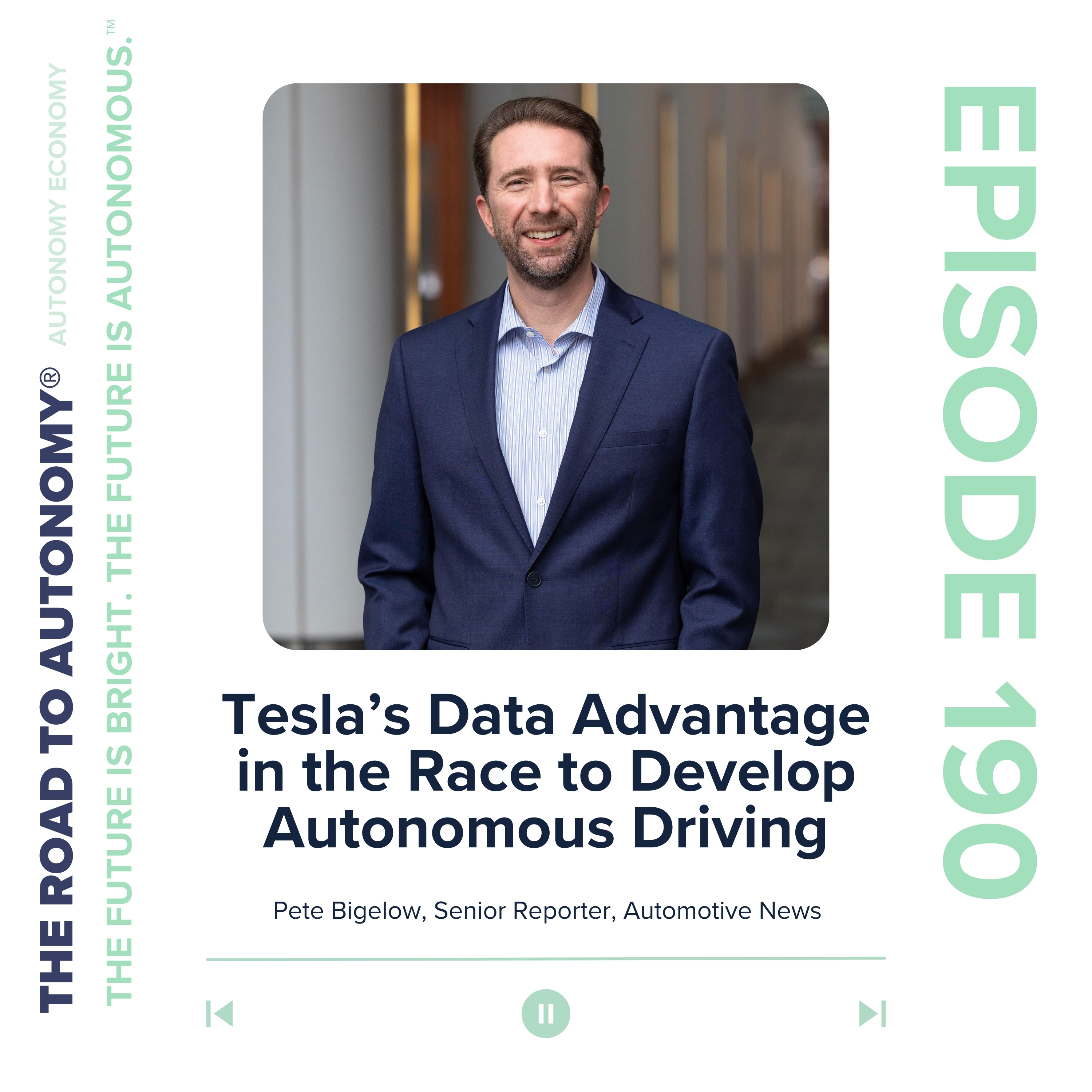
Ep 190Episode 190 | Autonomy Economy: Tesla’s Data Advantage in the Race to Develop Autonomous Driving
Pete Bigelow, Senior Reporter, Automotive News joined Grayson Brulte on The Autonomy Economy podcast to discuss Tesla’s data advantage and what it means to the development and commercialization of autonomous driving. The conversation begins with Pete and Grayson discussing Tesla FSD (Full Self-Driving) and the advantages Tesla has with their data gathering abilities. Tesla has over 5 million vehicles fitted with FSD hardware and software on the road today, driving an estimated 50 billion miles per year — 100,000 miles per minute. This on-going data collection gives Tesla a massive advantage over competitors developing an end-to-end neural net self-driving stack.Mobileye is taking a similar approach to Tesla by gathering real-world driving data to train their autonomous models. Currently Mobileye has over 26 years of data equaling over 200 petabytes of driving footage, equivalent to 16 million 1-minute driving clips. But is it enough data to train their autonomous driving models and scale a business?It has yet to be determined if there is a business there for Mobileye as year-over-year revenues are expected to be $226.35 million, down 50.6% from the year-ago. To try and accelerate revenue growth, Mobileye is moving the business away from ADAS chips to the autonomous driving sector which has larger margins. [Mobileye is] talking about going from roughly $50 dollars of revenue per unit to $1,500 with Supervision to $3,000 per car with Chauffeur. So I think that the path mobilize sees forward is really ramping up production of those systems, finding buyers for those systems, particularly in China.– Pete BigelowWhile it’s well known that Tesla is gathering driving data, it’s not well known that Mobileye is gathering driving data. Could consumers push back and demand to be paid a fee for gathering data for Mobileye? If consumers demanded to be paid, the Mobileye autonomous driving business model would be at risk. Then there is the political risk. What if a U.S. Congressman or Senator introduced a “Car Owner Bill of Rights”?The data being gathered by vehicles is going to be an asset class at some point in the future. When it becomes an asset class, owners of the vehicle will demand to get paid the same way publishers are demanding to be paid today when their content is used to train large-language models (LLMs). Data is the asset that unlocks future business models. One of the most significant business models that will emerge from the development of autonomous driving is licensing. If FSD use rates pick up and Tesla does indeed license FSD, RBC is projecting that Tesla will generate $35 billion in FSD revenue and $18 billion in licensing a year by 2035 for a total of $53 billion a year in revenue.Then there is Qualcomm. In Q1 FY 2024, Qualcomm reported automotive revenue of $598 million up from $456 million in Q1 FY 2023. An increase of $142 million, year-over-year. Sales were partly driven by the Snapdragon Digital Chassis Solution. Their year-over-year automotive revenue is growing faster than both NVIDIA and Mobileye. With a $30 billion dollar design pipeline and focus on ADAS, Qualcomm is well positioned to enter the autonomous driving market in a big way.Qualcomm has become already the quiet giant of the automotive industry. – Pete BigelowWrapping up the conversation, Pete shares his insights into how he sees autonomous driving market evolving over the next five years.Recorded on Friday, March 8, 2024 Episode Chapters0:10 Tesla FSD5:15 Mobileye19:51 Licensing Autonomous Driving Software 29:10 Qualcomm34:48 Evolving Autonomous Driving Market--------About The Road to AutonomyThe Road to Autonomy® is a leading source of data, insight and commentary on autonomous vehicles/trucks and the emerging autonomy economy™. The company has two businesses: The Road to Autonomy Indices, with Standard and Poor’s Dow Jones Indices as the custom calculation agent; Media, which includes The Road to Autonomy and Autonomy Economy podcasts as well as This Week in The Autonomy Economy newsletter.See Privacy Policy at https://art19.com/privacy and California Privacy Notice at https://art19.com/privacy#do-not-sell-my-info.
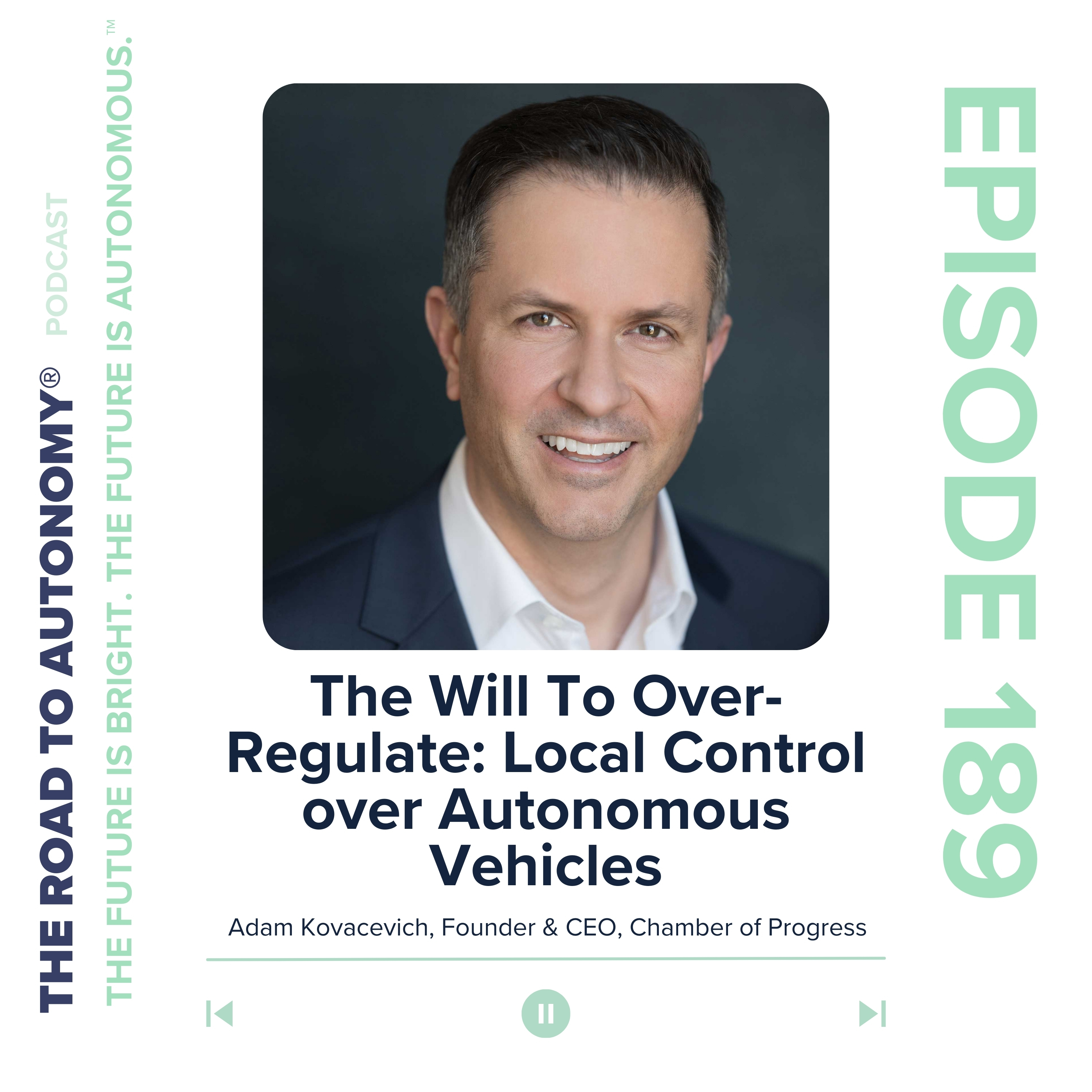
Ep 189Episode 189 | The Will To Over-Regulate: Inside California Legislators Fight for Local Control over Autonomous Vehicles
Adam Kovacevich, Founder & CEO, Chamber of Progress joined Grayson Brulte on The Road to Autonomy podcast to discuss the regulatory environment for autonomous vehicles in California and what impact if passed, local control would have on the deployment on AVs in California.The conversation begins with Adam discussing why autonomous vehicles are so divisive in California. Today, there is a divide between the entrenched “status quo” and the residents of California that are excited to use autonomous vehicles on a daily basis. In someways this is such a threat to the status quo that unfortunately city leaders in both LA and San Francisco have resisted. – Adam Kovacevich, Founder and CEO, Chamber of ProgressPhoenix is taking the opposite approach of both LA and San Francisco. The city and the greater Phoenix metro region have welcomed autonomous vehicles into their communities with great success. Waymo vehicles operating in the region do not get high, they do not get distracted and the do not drive drunk. Yet, when the positive benefits are presented to officials in California, they do not want to hear it.I would like to think that Los Angeles will ultimately be one of the great markets in the world for autonomous vehicles, just because the car is so central to LA. – Adam Kovacevich, Founder and CEO, Chamber of ProgressWhile LA could ultimately be one of the great markets for autonomous vehicles, legislators in the State Assembly and State Senate are actively working to pass regulations that would effectively ban autonomous vehicles in California. If autonomous vehicles are essentially banned in California, the state’s economy would ultimately suffer from an economic downturn.One of the ways that clever legislators are trying to ban autonomous vehicles is by passing legislation that would give local municipalities regulatory control over autonomous vehicles. Each municipality would have its own set of regulations, and perhaps even their own DMV to enforce the regulations. If signed into law, the local control over autonomous vehicles bill would be an effective ban on autonomous vehicles in the State of California. Could you image if this proposed local control law was applied to drivers? If you wanted to drive to the beach from Downtown LA, you would pass through Los Angeles, West Hollywood, Beverly Hills, Santa Monica all before ending up in Malibu. Five different cities, five potentially different sets of regulations. What if one of those cities decided they only wanted residents to drive in that city? You could potentially blocked from reaching the beach. Would this violate the California Coastal Act in some form or fashion? What is being proposed is not realistic. It’s being driven by special interests that want to see autonomous vehicles banned in the state. This is not about the citizens of the state or residents of the cities were autonomous vehicles operate, this is about control and appeasing special interests. It’s not practically about local control, it’s really effectively a ban. – Adam Kovacevich, Founder and CEO, Chamber of ProgressIf the local control bill is passed, signed into law and autonomous vehicles are effectively banned in California, the business exodus from the state would further accelerate. Businesses want to operate in a regulatory environment that is predictable, manageable and stable. Wrapping up the conversation, Adam and Grayson discuss what it would look like if autonomous vehicles were regulated at the federal level.Episode Chapters0:11 Why Autonomous Vehicles are so Divisive in California4:20 Benefits of Autonomous Vehicles7:41 Pending Autonomous Vehicle Legislation in California 19:55 Business Exodus from California28:33 Developing Public Trust in Autonomous Vehicles 34:11 Federal Regulation of Autonomous VehiclesRecorded on Friday, March 29, 2024 --------About The Road to AutonomyThe Road to Autonomy® is a leading source of data, insight and commentary on autonomous vehicles/trucks and the emerging autonomy economy™. The company has two businesses: The Road to Autonomy Indices, with Standard and Poor’s Dow Jones Indices as the custom calculation agent; Media, which includes The Road to Autonomy and Autonomy Economy podcasts as well as This Week in The Autonomy Economy newsletter.See Privacy Policy at https://art19.com/privacy and California Privacy Notice at https://art19.com/privacy#do-not-sell-my-info.
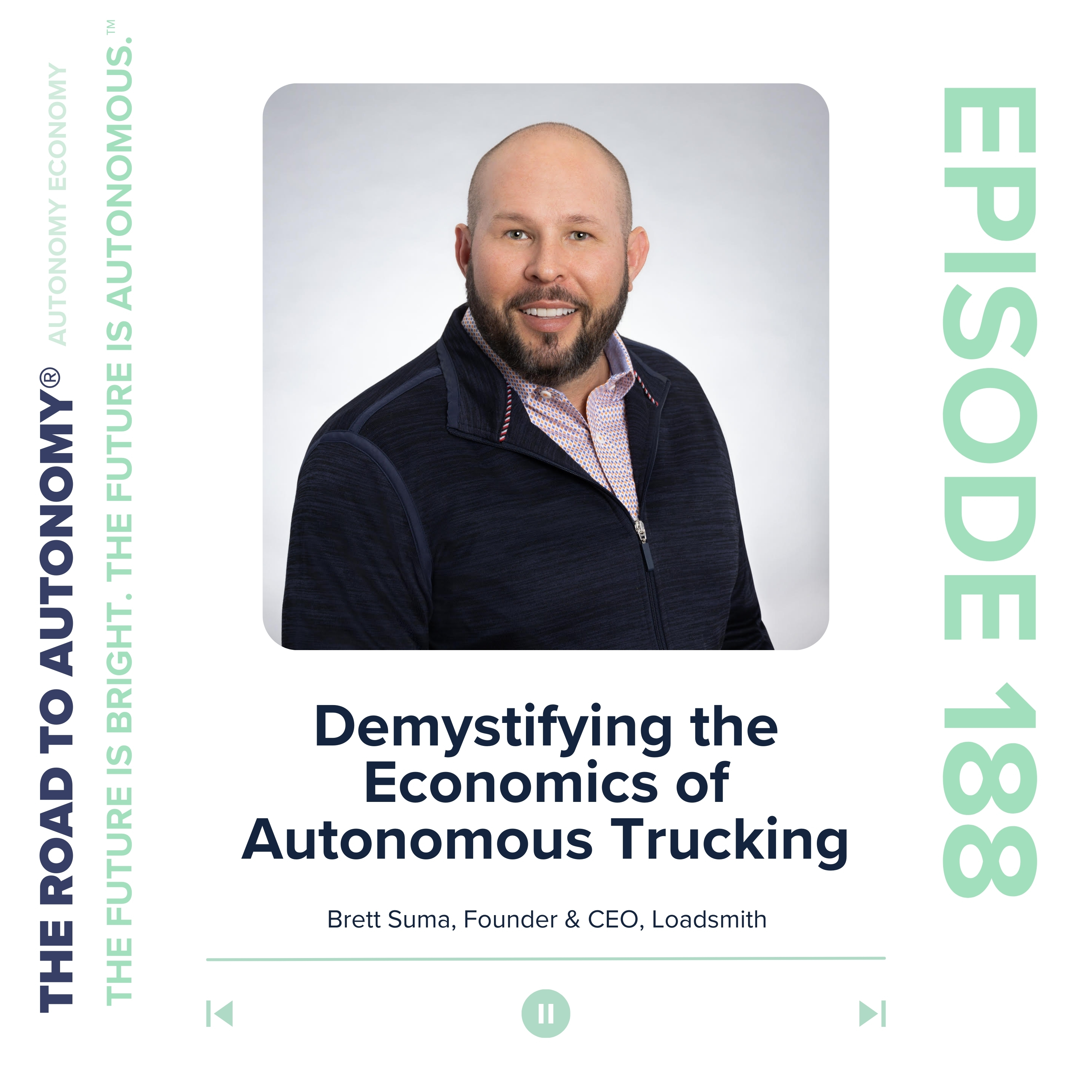
Ep 188Episode 188 | Autonomy Economy: Demystifying the Economics of Autonomous Trucking
Brett Suma, Founder & CEO, Loadsmith joined Grayson Brulte on The Autonomy Economy podcast to discuss the unit economics of autonomous trucking and the Loadsmith self-balancing freight network. The conversation begins with Brett discussing the unit economics of traditional trucking.Trucking and the most successful trucking companies look at unit economics. However they are measuring their business, they are going to do it in a very unit way. Whether you are looking at revenue per truck per day, revenue per truck per week, revenue per truck per hour, depending on your business and how your business is operating, revenue per mile obviously. When you start looking at things like fuel surcharge per mile, your deadhead miles, your out of route miles, all of the things that build into those unit economics, that is the basis of trucking. So you have to look at things at a unit economic perspective. – Brett Suma, Founder & CEO, LoadsmithWhen autonomous trucks are introduced into the fleet the economics are going to change. Well, the whole thing is going to change. The entire economics of trucking are going to change and not in every lane on day one, and not even in every lane forever. But the economics of, let’s just call it your 20 most dense lanes in the United States are going to probably change very drastically, very quickly.Then it will continue to expand to the top 100 lanes from a density perspective, and it may settle in somewhere 150 to 250 total lanes that can support autonomous from an economics perspective. – Brett Suma, Founder & CEO, LoadsmithAutonomous trucks are first going to be deployed on over-the-road long haul routes, while the last-mile routes will still be driven by professional drivers. This dichotomy is going to lead to job creation and higher wages because of the demand for for first and last mile drivers. To capitalize on the hybrid network that is going to emerge from the mass deployment of autonomous trucks, Brett founded Loadsmith.Along with the emergence of autonomous trucks, zero-emission trucks are also beginning to come online. However, the unit economics of zero emission trucks do not calculate today due to their higher upfront costs which is 50% more on average than traditional diesel trucks. I’m very, very pro zero emission. I’m very, very pro autonomous. I do not think because of the cost of the truck that you’re going to be able to have zero emission in the middle mile at scale without it being autonomous. – Brett Suma, Founder & CEO, LoadsmithThis is partly because of the infrastructure and the economics to operate the service with a professional driver. Where zero emission trucks could thrive is in the first and last mile. While autonomous trucks will thrive in the middle-mile. To scale up their autonomous freight network, Loadsmith partnered with Kodiak. Wrapping up the conversation, Brett shares his opinion on the future of the freight industry.Episode Chapters0:23 Economics of Trucking3:24 Impact of Insurance Costs on Trucking Economics15:36 Economics of Autonomous Trucks24:56 Building a Hybrid Freight Network31:55 Founding of the Loadsmith Freight Network36:04 Unit Economics of Zero Emissions Trucks39:41 Economic Advantages of the Loadsmith Freight Network 42:20 Freight Balancing 48:24 Partnership with Kodiak51:24 Future of Freight IndustryRecorded on Thursday, February 29, 2024--------About The Road to AutonomyThe Road to Autonomy® is a leading source of data, insight and commentary on autonomous vehicles/trucks and the emerging autonomy economy™. The company has two businesses: The Road to Autonomy Indices, with Standard and Poor’s Dow Jones Indices as the custom calculation agent; Media, which includes The Road to Autonomy and Autonomy Economy podcasts as well as This Week in The Autonomy Economy newsletter.See Privacy Policy at https://art19.com/privacy and California Privacy Notice at https://art19.com/privacy#do-not-sell-my-info.

Ep 187Episode 187 | Scania's Customer-Centric Approach to Autonomous Trucking
Peter Hafmar, Vice President & Head of Autonomous Solutions, Scania (part of the TRATON Group) joined Grayson Brulte on The Road to Autonomy podcast to discuss Scania’s customer-centric approach to autonomous trucking and their partnership with Plus. The conversation begins with Peter discussing Scania’s autonomy efforts and the four core principles of their approach:Focusing on the customer journey perspective.Concentrating on long-haul transport and confined mining applications.Maintaining control over their systems through strategic partnerships.Coordinating efforts across TRATON’s brands.Strategic partnerships are key to the development and commercialization of autonomous trucks. TRATON recently announced a partnership with Plus for the development and commercialization of SAE Level 4 autonomous trucks. The cultural fit and shared values between the two companies were one of the critical factors in the deal coming to fruition. Even with the Plus partnership, Scania intends to continue developing its own autonomous driving technologies in parallel. If we don’t understand the product, we will not be a good partner for Plus or anyone else either. – Peter Hafmar, Vice President & Head of Autonomous Solutions, ScaniaThis dual-track approach allows Scania to maintain deep technical expertise in autonomous driving. When it comes to commercializing autonomous trucking solutions, Peter details Scania’s “driver-as-a-service” model. Rather than competing directly with customers for transportation services, Scania aims to integrate autonomous driving into their existing operational systems and workflows seamlessly.The initial autonomous lanes will be determined entirely by customer needs and existing transportation routes. These lanes will most likely be long-haul routes due to the economics and acute driver shortages.Throughout the discussion, Peter underscores that partnerships, culture fit, and shared values are critical for scaling autonomous trucks successfully. It’s easy to forget about culture and values when you talk about technology, because it is essential that technology works, but it’s actually people that are developing everything behind. – Peter Hafmar, Vice President & Head of Autonomous Solutions, ScaniaWrapping up the conversation, Peter reaffirms Scania’s customer-first philosophy as the driving force behind their autonomous pursuits, ensuring solutions that unlock tangible value for their transportation partners.Chapters:0:11 Scania's Approach to Autonomous Trucking5:33 Scania's Autonomous Trucking Commercialization Strategy8:18 Autonomous Solutions for Minning11:02 Driver-as-a-Service Lanes13:45 Plus / TRATON Partnership16:06 Scania's History in Autonomous Trucks18:10 Customer Approach to Autonomy21:44 E.U. Autonomous Trucking Policy23:09 Rolling out Autonomous Trucks in the U.S. and E.U.26:34 Key TakeawaysRecorded on Tuesday March 19, 2024--------About The Road to AutonomyThe Road to Autonomy® is a leading source of data, insight and commentary on autonomous vehicles/trucks and the emerging autonomy economy™. The company has two businesses: The Road to Autonomy Indices, with Standard and Poor’s Dow Jones Indices as the custom calculation agent; Media, which includes The Road to Autonomy and Autonomy Economy podcasts as well as This Week in The Autonomy Economy newsletter.See Privacy Policy at https://art19.com/privacy and California Privacy Notice at https://art19.com/privacy#do-not-sell-my-info.
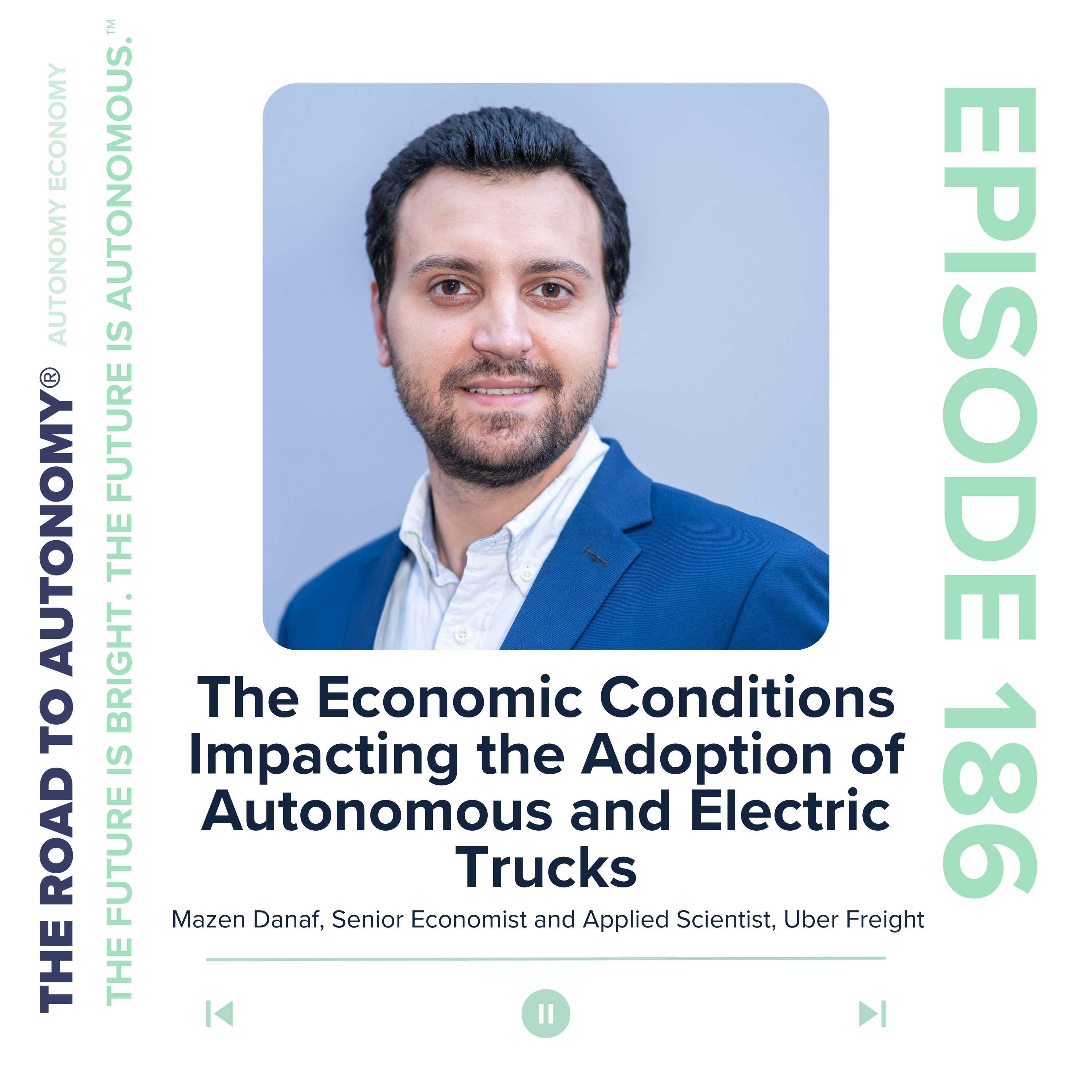
Ep 186Episode 186 | Autonomy Economy: The Economic Conditions Impacting the Adoption of Autonomous and Electric Trucks
Mazen Danaf, Senior Economist and Applied Scientist, Uber Freight joined Grayson Brulte on The Autonomy Economy podcast to discuss the economic conditions impacting the adoption of autonomous and electric trucks. In this engaging economic discussion, Mazen provides valuable insights into the forces molding the future of autonomous and electric trucking. With $18 billion of freight under management, Uber Freight has a unique vantage point into wider market dynamics.A key focus of the conversation is the recent rebound in consumer spending on goods, which increased 5% year-over-year in 2023 after a two-year stagnation. This positive demand signal bodes well for increased freight volumes and a potential freight market recovery emerging in Q2 2024, according to Mazen. Other indicators such as improving manufacturing data, reduced truck orders, and employment in long-haul trucking are creating conditions conducive to higher freight demand.However, Mazen cautioned that the $1.13 trillion in U.S. consumer credit card debt, while elevated, has returned to a manageable 5% debt-to-income ratio consistent with pre-pandemic levels. Monitoring factors like unemployment will be crucial to gauge if the consumer remains able to sustain spending.Turning to transformative freight technologies, Mazen emphasized the importance of analyzing autonomous and electric truck adoption through a comprehensive economic lens rather than a tech lens. Long-term, he expects a decades-long transition facilitated by a hybrid approach of both autonomous and professional driver operations.For electric trucks, substantial public and private investment is needed to build out charging infrastructure at scale. Freight-dense interstate corridors like Los Angeles-Inland Empire and Dallas- Houston are prime candidates for targeted electrification efforts to maximize emissions reduction.The overarching theme of the podcast was consumer behavior, market forces, infrastructure, and the regulatory environment will all shape trucking’s autonomous and electric future as much as the technology itself. Mazen stressed, “it’s interesting to look at the broader context…because it will definitely have an effect.” Uber Freight’s vast data intelligence provides a powerful economic prism through which to forecast this transformation.Chapters:0:00 Introduction 0:40 Consumer Spending and The Economy 6:50 Fed Interest Rate Cuts 9:12 Real Estate Markets 11:08 Layoffs 12:50 Decline in Freight Market Job Growth 14:40 Carriers Investing in Autonomous Trucks 21:04 Autonomous Trucks and Intermodal 24:13 Autonomous Trucking in California 27:34 Autonomous and Electric Trucks Impact on Jobs 31:15 Introducing Electric Trucks into Fleets 41:27 Q4 2023 Truck Sales Decline 43:44 Freight Recovery 45:43 Key TakeawaysRecorded on Thursday, February 15, 2024--------About The Road to AutonomyThe Road to Autonomy® is a leading source of data, insight and commentary on autonomous vehicles/trucks and the emerging autonomy economy™. The company has two businesses: The Road to Autonomy Indices, with Standard and Poor’s Dow Jones Indices as the custom calculation agent; Media, which includes The Road to Autonomy and Autonomy Economy podcasts as well as This Week in The Autonomy Economy newsletter.See Privacy Policy at https://art19.com/privacy and California Privacy Notice at https://art19.com/privacy#do-not-sell-my-info.

Ep 185Episode 185 | AV 2.0, Wayve's Approach to Autonomous Driving
Alex Kendall, Co-Founder & CEO, Wayve joined Grayson Brulte on The Road to Autonomy podcast to discuss Wayve’s AV 2.0 approach to autonomous driving.The conversation begins with Alex discussing the founding of Wayve and how their autonomous driving stack has evolved.Yes, we started with cameras, but a common misconception is that we think camera only is the way to go. Actually I think the sensing stack you need to use should be based on safety, scalability and economics. – Alex KendallWayve’s approach to autonomous driving has attracted world class investors such as Microsoft. Last year, Microsoft co-founder Bill Gates visited Wayve and took a ride in their autonomous vehicle through the central London and Soho on an unmapped, un-planned route. The whole thesis behind our approach is to build a system that can learn behavior. – Alex KendallThis approach is called AV 2.0. It is being developed with end-to-end neural networks that are economically scalable. Does this approach end up being the most common approach to solving autonomous driving? Tesla is taking a similar approach with the introduce of FSD 12.0. Could Wayve and Tesla usher in a future with end-to-end neural net autonomous vehicles?As Wayve begins to commercialize their autonomous driving technology, they are first deploying their software as a driving assistance system with OEMs.We don’t need to change any hardware, add-on or retro-fit anything. We can work with production vehicles today and have the neural network deployed. The advantage of this is that we can start to give consumers exposure to embodied AI, rather than dropping in an L4 solution from day zero. We give them an exposure to a companion co-pilot driver assistance system and it can learn overtime quickly developing to a point where it can become L4 and autonomous. – Alex KendallThe advantages of this approach is that it allows Wayve to generate revenue today, gather more data to train the neural nets all while building public trust. The more data, the better the neural nets and there is also the opportunity to license data to other autonomous vehicle developers. It’s a strategic approach with lots of options as Wayve has chosen to partner with OEMs and not build their own vehicle. Wrapping up the conversation, Alex share his thoughts on embodied AI and the future of Wayve.Episode Chapters0:08 Founding of Wayve 5:34 Bill Gates Goes For a Ride6:35 AV 2.019:22 Wayve Commercialization Model24:22 Testing Autonomous Vehicles in London26:02 Data as an Asset Class29:51 Partnership Approach30:59 Future of WayveRecorded on Friday, March 8, 2024--------About The Road to AutonomyThe Road to Autonomy® is a leading source of data, insight and analysis on autonomous vehicles/trucks and the emerging autonomy economy™. The company has two businesses: The Road to Autonomy Indices, with Standard and Poor’s Dow Jones Indices as the custom calculation agent; Media, which includes The Road to Autonomy podcast and This Week in The Autonomy Economy newsletter.See Privacy Policy at https://art19.com/privacy and California Privacy Notice at https://art19.com/privacy#do-not-sell-my-info.
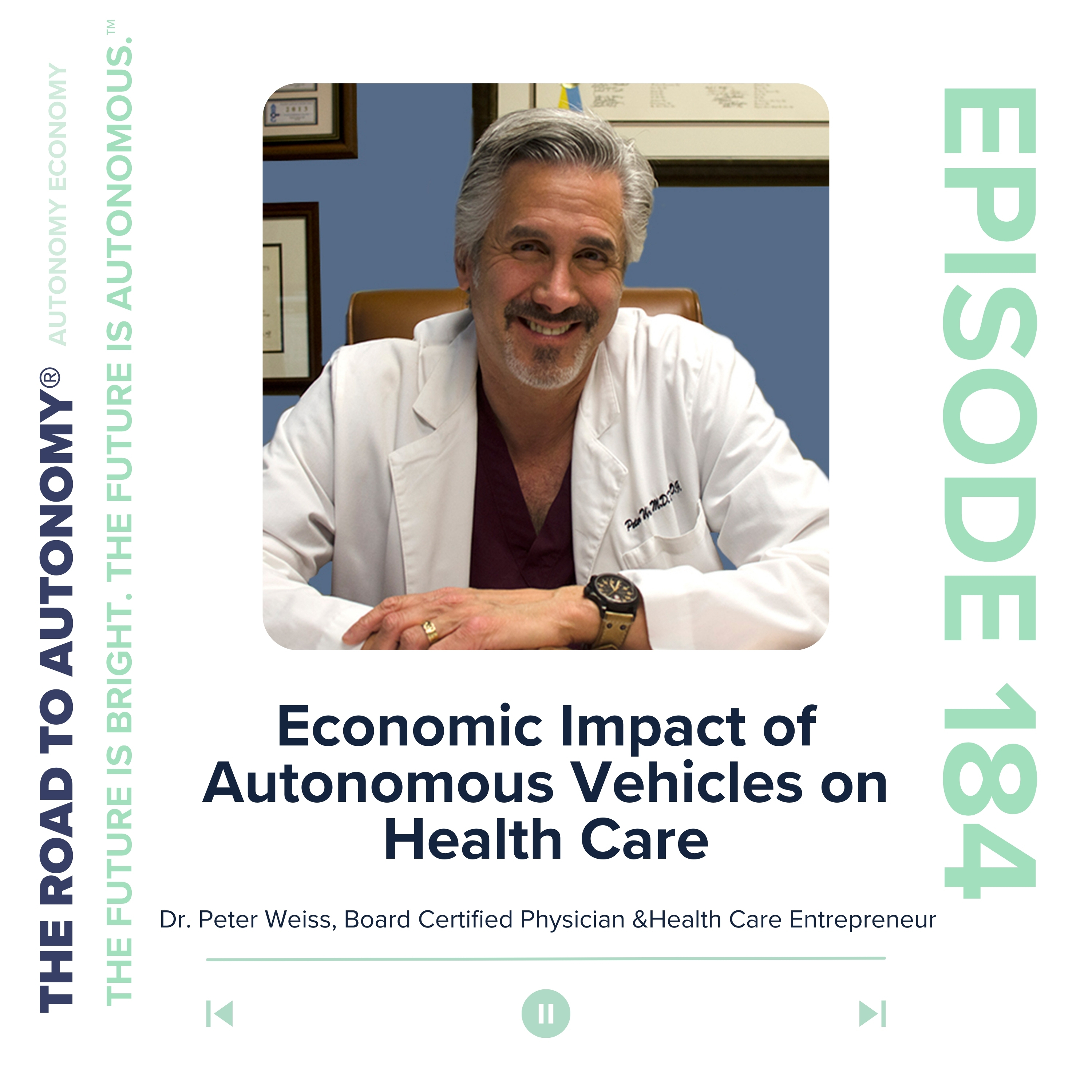
Ep 184Episode 184 | Autonomy Economy: Economic Impact of Autonomous Vehicles on Health Care
Dr. Peter Weiss, Board Certified Physician and Health Care Entrepreneur joined Grayson Brulte on The Road to Autonomy: Autonomy Economy podcast to discuss the economic impact that autonomous vehicles will have on health care.The conversation begins with Dr. Weiss discussing how he views autonomous vehicles and the delivery of health care complimenting each other in the future.Health care is more then just seeing the physician or a health care provider, it’s about getting from point A to point B to provide that care. – Dr. Peter WeissIn the future autonomous vehicles will have the capability to determine if a passenger is having a heart attack, potentially saving their life. The question of who makes the decision to re-route the autonomous vehicle to a hospital is yet to be determined. The vehicle could ask the passenger for permission, but what if that individual is unconscious? Then what happens? If the passenger is unable to respond to the question, then the car should be able to then directly take the passenger to the hospital and at the same time notify the hospital that we have a patient coming in with certain blood pressure, certain atrial fibrillation. All this information that can could really save a life. – Dr. Peter WeissIs legislation needed to limit the liability of that decision? Most likely, as the decisions made will open a formidable maze of legal liabilities. Then there is the aspect of insurance and what hospital the passenger is rerouted to for medical care. Are those doctors and hospital in-network or out of-network? Who is responsible for the difference in cost?In 2022, hospital expenditures grew 2.2% to $1.35 trillion according to the U.S. Centers for Medicare & Medicaid Services. Could rerouting autonomous vehicles with unwell passengers add to the growing hospital expenditures? Yes. When health care is able to be delivered in an autonomous vehicle, there could be cost savings that would offset those growing expenditures.It’s not just hospital expenditures that are growing, it’s the overall cost of delivering health care. In 2022 U.S. consumers spent 8% of their income on health care, only 4.8% less than they spend on food according to the U.S. Centers for Medicare & Medicaid Services. Overall health care expenditures grew 4.1% to $4.5 trillion equaling $13,493 per person, accounting for 17.3% of GDP. A percentage of the increasing expenditures could be correlated to motor vehicle crashes. Motor vehicle crashes are a leading cause of death in their United States with over 100 people dying everyday. In 2015, more than 2.5 million drivers and passengers were treated in emergency rooms as a result of being injured in motor vehicle traffic crashes. The economic impact of these crashes is notable. For crashes that occurred in 2017, the cost of medical care and productivity losses associated with occupant injuries and deaths from motor vehicle traffic crashes exceeded $75 billion. If autonomous vehicles can eliminate a majority of these crashes, the economic not to mention societal impact could be astronomical. You would save billions of dollars in costs that could be provided for underserved communities that need treatment for asthma, for all of these other things that could be done. There is a greater utilization of the money that could be provided for care. – Dr. Peter WeissAutonomy and autonomous vehicles are good for society and the economy. They will have a positive economic impact on health care while making the roads safer. Wrapping up the conversation, Dr. Weiss share this thoughts on the future of medicine. Episode Chapters0:00 Introduction0:43 Autonomous Vehicles and the Delivery of Health Care6:48 Growing Medical Expenditures17:41 End of Life Medical Care Costs 20:32 Personal and Business Spending on Health Care 27:28 Economic Impact of Motor Vehicle Crashes 33:42 Neuralink37:17 Future of MedicineRecorded on Sunday, February 4, 2024--------About The Road to AutonomyThe Road to Autonomy® is a leading source of data, insight and commentary on autonomous vehicles/trucks and the emerging autonomy economy™. The company has two businesses: The Road to Autonomy Indices, with Standard and Poor’s Dow Jones Indices as the custom calculation agent; Media, which includes The Road to Autonomy and Autonomy Economy podcasts as well as This Week in The Autonomy Economy newsletter.See Privacy Policy at https://art19.com/privacy and California Privacy Notice at https://art19.com/privacy#do-not-sell-my-info.
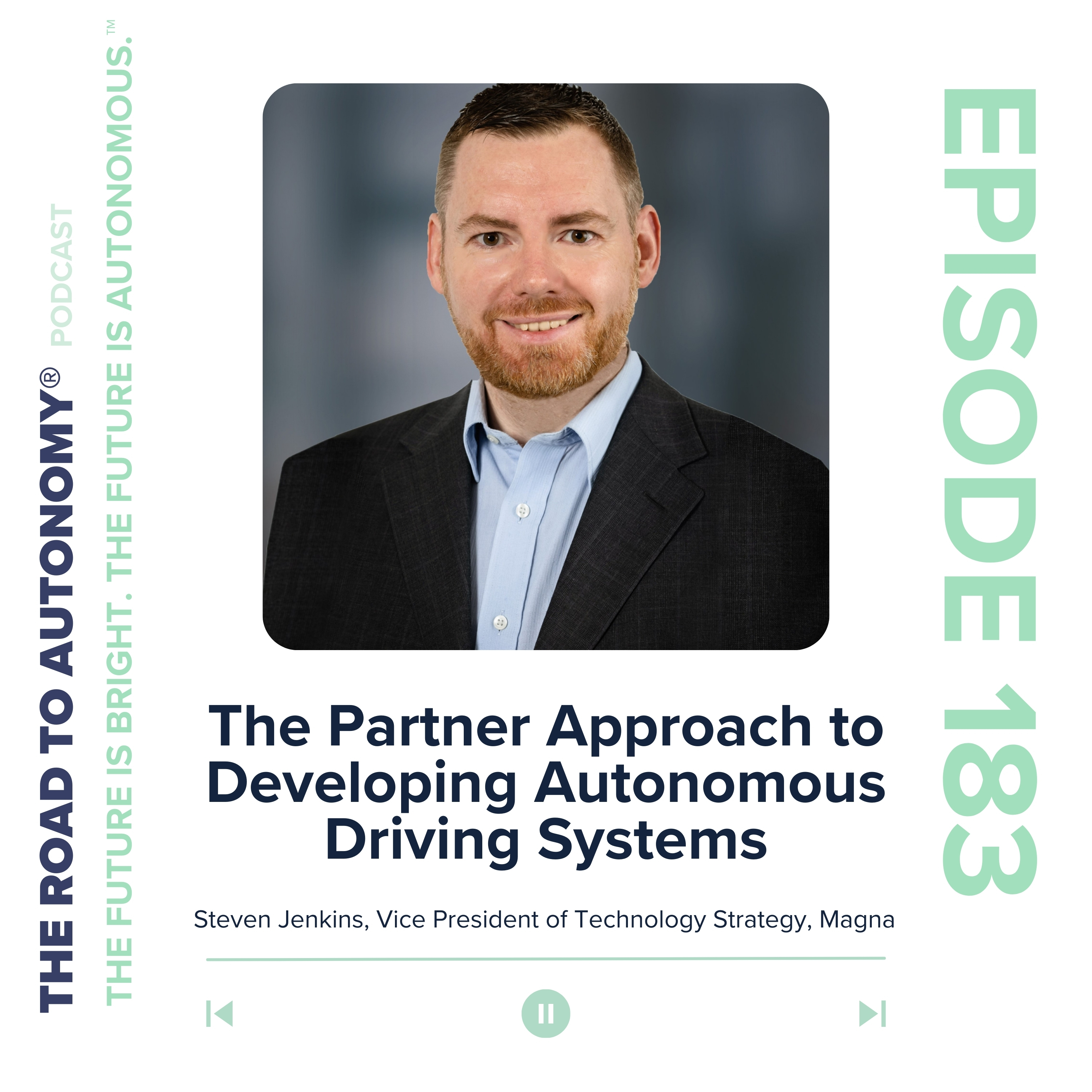
Ep 183Episode 183 | The Partner Approach to Developing Autonomous Driving Systems
Steven Jenkins, Vice President of Technology Strategy, Magna joined Grayson Brulte on The Road to Autonomy podcast to discuss Magna’s partner approach to developing autonomous driving systems. The conversation begins with Steven discussing how Magna is approaching safety systems. Magna is one of the only real few suppliers that has the entire set of enablers to make it happen and do a complete system. So we are thinking about the whole system as a package rather then individual pieces of the package, and that allows us to develop these market leading products that deliver the enhanced safety and convenience for the driver. – Steven Jenkins The software defined vehicle will unlock continuous updates to the vehicle, unlocking new features and functions. Eventually these software updates will be able to upgrade vehicles to enable autonomous driving functionality depending on their sensor package. As vehicles become more advanced with higher levels of autonomy, the debate around driver monitoring creeps into the conversation and ultimately leads to the question; when is the right time to introduce driver monitoring? That question ultimately comes down to the OEM. While the OEM makes that decision, Magna is working on a series of in-cabin monitoring solutions that benefit the driver and the passengers. This approach will benefit their OEM customers as they introduce higher levels of autonomy. Magna is approaching autonomy as as a step-wise approach.In a kind of autonomous scenario you are really taking a kind of huge leap in terms of what you can do with a vehicle, but you are not taking as big as a leap when it comes to technology. A lot of things are pretty similar. – Steven Jenkins A hybrid market that comprises of both robotaxis and personally owned autonomous vehicles could emerge at some point in the future. How the economics of these models emerge will depend on the companies that make the product available and take the risk from a financing perspective. Either way, Magna will be there from a technological standpoint to help their partners and customers usher in the future of autonomy. Wrapping up the conversation, Steven shares his opinion on the future of mobility. Episode Chapters0:00 The Road to Autonomy Index Introduction0:56 Magna’s Complete Safety System Approach 4:25 Software Defined Vehicles6:07 Neural Network Approach to Autonomous Driving10:28 Driver Monitoring16:31 Magna’s Approach to Autonomous Driving31:09 New and Emerging Technologies37:07 Staying Ahead of the Market38:54 Future of MobilityRecorded on Monday, March 11, 2024Magna International is a The Road to Autonomy Index component company--------About The Road to AutonomyAbout The Road to AutonomyThe Road to Autonomy® is a leading source of data, insight and commentary on autonomous vehicles/trucks and the emerging autonomy economy™. The company has two businesses: The Road to Autonomy Indices, with Standard and Poor’s Dow Jones Indices as the custom calculation agent; Media, which includes The Road to Autonomy and Autonomy Economy podcasts as well as This Week in The Autonomy Economy newsletter.See Privacy Policy at https://art19.com/privacy and California Privacy Notice at https://art19.com/privacy#do-not-sell-my-info.
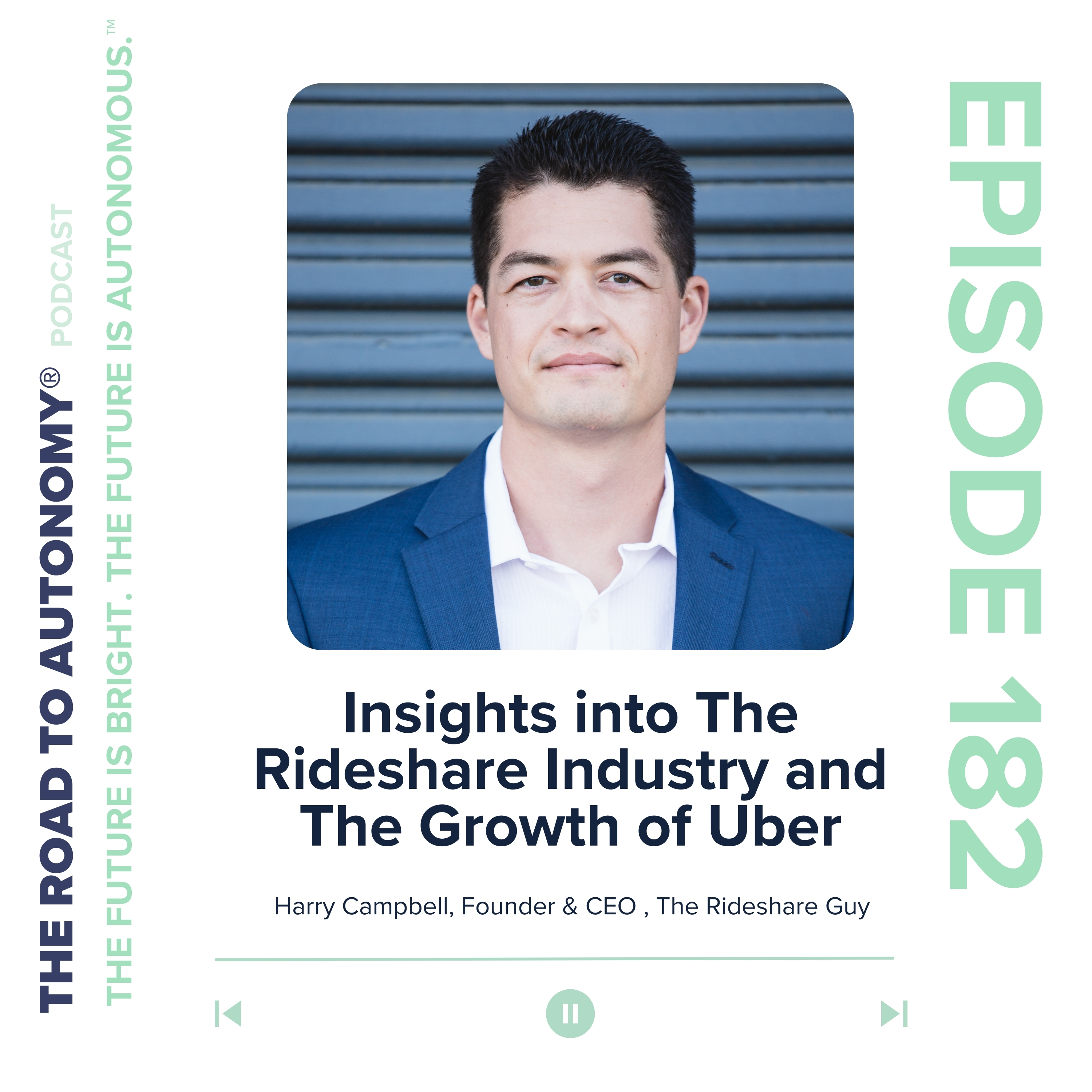
Ep 182Episode 182 | Insights into The Rideshare Industry and The Growth of Uber
Harry Campbell aka The Rideshare Guy joined Grayson Brulte on The Road to Autonomy podcast to discuss the rideshare industry, the role that power drivers play in the ecosystem and his thoughts on Uber’s growing hybrid network.The conversation begins with Grayson and Harry discussing Uber’s outperformance compared to the S&P 500. Over the last 12 months, Uber has outperformed the S&P 500 by 102%. While Uber is outperforming the market, their competitor Lyft is struggling to figure out the future of their business. Drivers are the backbone of both Uber and Lyft. According to J.P. Morgan, the average Uber driver earns $33 an hour. The estimated average hourly earnings are only for Period 3, commonly referred to as active time. Period 1 is when a driver is on the Uber app waiting for a ride. Period 2 is when a driver has accepted a ride and are driving to pick up the passenger. Period 3, that’s when you make the most amount of money as a driver. You want your wheels moving, you want to be going fast, you want to be going far. That’s kind of how you make the most amount of money. $33 an hour is basically saying drivers make $33 an hour when they are driving to a customer or they have a customer in the car, but we are not going to count any of the downtime. – Harry Campbell While drivers are the backbone of the platforms, there are divergences in how Uber and Lyft attract and retain drivers. Both companies use incentives to retain drivers, Lyft is starting to increase the amount incentives to attract power drivers away from Uber. Power drivers are drivers who drive more than 40+ hours a week or roughly 6,000 miles per month. Accounting for 20% of the driver inventory at any moment.As Uber continues to grow and shed non-core assets, the company is laying the foundation to transform Uber into a hybrid platform with both drivers and autonomous vehicles. Today, you can hail a Waymo in Phoenix on the Uber app and have Uber Eats delivered in a Motional autonomous vehicle in Santa Monica. When it comes to Uber’s strategy with AV, I think it’s kind of a no-brainer. – Harry Campbell This is the right strategy for Uber. Dara Khosrowshahi made the strategic decision to sell Uber ATG to Aurora and focus on becoming a platform again. Uber was able to shed the billions in development costs, while fully embracing the power of Uber — the platform. This decision has allowed Uber to focus on growing their free cash flow while becoming profitable. The Uber 2.0 strategy will enable Uber to collect a fee very similar to the way Mastercard and Visa collect swipe fees every time a consumer makes a purchase with their credit card. The more consumers choose to ride in Waymo vehicles on the Uber platform, the more revenue Uber will generate. Uber’s new autonomous vehicle strategy will pay dividends as Waymo scales up. If the price of a Waymo is on par with Uber X, consumers in our opinion will overwhelmingly choose Waymo because of the consistent experience. Either way, Uber benefits as the company will collect a platform usage fee. Wrapping up the conversation, Harry shares his opinion on the future of Uber. Episode Chapters0:00 The Road to Autonomy Index Introduction0:55 Uber vs S&P 5002:05 Does Lyft Survive?3:32 Rideshare Drivers: Driving for Uber and Lyft17:41 Uber and Lyft Driver Incentives 21:40 Most Popular Rideshare Vehicles 25:33 Dara Khosrowshahi29:36 Do Uber Drivers Buy UBER Stock?35:20 Changes Drivers Would Like to See on the Uber and Lyft Platforms41:50 Autonomous Vehicles as Rideshare Vehicles (Robotaxis)44:50 Uber’s Autonomous Vehicle Strategy49:10 Lyft’s Earnings Blunder50:38 Uber’s Product Compared to Waymo53:44 Expanding the Uber Platform1:07:56 Uber Freight1:10:20 The Future of UberRecorded on Thursday, February 22, 2024Uber is a The Road to Autonomy Index component company--------About The Road to AutonomyAbout The Road to AutonomyThe Road to Autonomy® is a leading source of data, insight and commentary on autonomous vehicles/trucks and the emerging autonomy economy™. The company has two businesses: The Road to Autonomy Indices, with Standard and Poor’s Dow Jones Indices as the custom calculation agent; Media, which includes The Road to Autonomy and Autonomy Economy podcasts as well as This Week in The Autonomy Economy newsletter.See Privacy Policy at https://art19.com/privacy and California Privacy Notice at https://art19.com/privacy#do-not-sell-my-info.

Ep 181Episode 181 | Stopping and Swapping: Hybrids for Trucks
Ian Rust, Founder & CEO, Revoy joined Grayson Brulte on The Road to Autonomy podcast to discuss the development of Revoy and why hybrid is the right approach to electrifying Class 8 trucks. The conversation begins with Ian discussing Revoy’s approach to hybrid technology for electrified trailers.We view hybrid definitely the most viable solution for electrification in the Class 8 market. – Ian RustThe Revoy EV hooks up in-between a tractor and a trailer in a matter of minutes. Revoy is able to do this, because they deliver pre-charged EVs to their customers, eliminating the charging downtime. By bringing in that pre-charged battery pack we can integrate in under five minutes. – Ian RustOne of the major benefits to the Revoy system is an increase the MPG (miles per gallon). The Revoy test fleet has been able to achieve 67 mpg in a diesel class 8 truck. When trucks are traveling on hilly roads, the extra torc delivered by the hybrid system allows trucks to keep pace with the other motorists on the road. When coming down a hill, the system’s regenerative braking activates, assisting the professional driver and increasing safety. We can actually stop a tractor trailer with a Revoy EV applied 30% sooner. – Ian RustRevoy’s EVs will not be sold, they will be leased on a per mile basis with zero up-front payment. They will be deployed at strategically located hubs where the drivers will stop and swap their Revoy EV in four minutes. You can just have essentially uncapped long-haul range on electric power by just stopping and swapping in four minutes. – Ian RustWrapping up the conversation, Ian shares his thoughts on what the future will look like for electrified class 8 trucks. Recorded on Tuesday, February 20, 2024Episode Chapters0:00 Introduction 0:37 Revoy’s Approach to Electrified Trailers3:03 Increases in MPG (miles per gallon)5:08 Safety and Insurance Benefits8:49 Revoy Business Model12:56 Infrastructure 20:28 Stop and Swap24:20 Hybrid Technology 31:42 The Inspiration for Revoy34:40 Scaling Revoy 40:35 Future of Hybrid Solutions for Class 8 Trucks--------About The Road to AutonomyThe Road to Autonomy® is a leading source of data, insight and commentary on autonomous vehicles/trucks and the emerging autonomy economy™. The company has two businesses: The Road to Autonomy Indices, with Standard and Poor’s Dow Jones Indices as the custom calculation agent; Media, which includes The Road to Autonomy and Autonomy Economy podcasts as well as This Week in The Autonomy Economy newsletter.See Privacy Policy at https://art19.com/privacy and California Privacy Notice at https://art19.com/privacy#do-not-sell-my-info.

Ep 180Episode 180 | The Rise and Fall of Digital Freight Brokerages and the Growth of Autonomous Trucking
Timothy Dooner, Host, WHAT THE TRUCK?!?, joined Grayson Brulte on The Road to Autonomy podcast to discus the rise and fall of digital freight brokerages and the growth of autonomous truckingThe conversation begins with Dooner discussing his outlook for the freight market.There is 8. 1% less brokerages than there were a year ago at the start of this year. But there’s still 17% more brokerages than we started at the pandemic. Everyone’s been waiting for not just volumes to go up, but the way freight works, it’s volume plus capacity. They’ve been waiting for the capacity to go down. Volumes are looking a little bit better. Things are receding and this year I’m hearing a lot more optimism. – Timothy DoonerThe optimism is being shared by Walmart as there are rumors circulating that Walmart is looking to develop a digital freight brokerage. Since Walmart operates their own fleet, they have a unique data set that could potentially help them leapfrog the competition when and if they are introduce a digital freight brokerage service. The freight market is currently turbulent as the demand for freight and the capacity to haul the freight are not in sync. Then there is the California electric truck mandate which will ultimately end up increasing the costs to ship freight, hurting both the carriers and the consumer. Could these mandates help to accelerate the adoption of autonomous truck as they are cheaper to operate? It’s possible and as we are seeing in California, autonomous vehicle technology is not always welcome. in San Francisco vandals set fire to a Waymo autonomous vehicle with a firework, burning the vehicle to the ground. If the regulatory environment in California eventually allows autonomous trucks to operate, will similar vandals also try to cause damage to autonomous trucks? Autonomous trucking is going to play a major role in the future of trucking and the global economy. As the technology is developed different business models are going to come to fruition and one of those is the licensing model. Kodiak has the potential to license their SensorPods technology, creating a lucrative revenue stream as they develop their autonomous trucking platform. This is in addition to their growing defense business.Then there is Uber. Uber has investments in Aurora and Waabi, and has the Uber Freight division. Yet they do not operate an autonomous trucking fleet. Grayson and Dooner go onto dicuss Uber’s autonomous trucking investment strategy and who ultimately owns the asset.Wrapping up the conversation, Dooner shares his 2024 outlook for the trucking market. Recorded on Wednesday, February 14, 2023Chapters0:00 Introduction 1:34 Freight Market Outlook 7:31 Walmart’s Rumored Digital Freight Brokerage 10:42 Are Electric Truck Mandates Accelerating the Adoption of Autonomous Trucks 13:57 Vandals in San Fransisco Set Fire to a Waymo Autonomous Vehicle 18:20 Commercializing Autonomous Trucking 25:32 The Business of Kodiak Robotics28:15 Autonomous Delivery Drones 31:55 Uber’s Autonomous Trucking Investment Strategy 39:18 Who Owns the Asset? 42:59 Tesla Cybertruck 43:52 Apple Vision Pro 51:08 2024 Trucking Outlook--------About The Road to AutonomyThe Road to Autonomy® is a leading source of data, insight and commentary on autonomous vehicles/trucks and the emerging autonomy economy™. The company has two businesses: The Road to Autonomy Indices, with Standard and Poor’s Dow Jones Indices as the custom calculation agent; Media, which includes The Road to Autonomy and Autonomy Economy podcasts as well as This Week in The Autonomy Economy newsletter.See Privacy Policy at https://art19.com/privacy and California Privacy Notice at https://art19.com/privacy#do-not-sell-my-info.

Ep 179Episode 179 | The Year of Autonomous Drone Delivery
Shannon Nash, Chief Financial Officer, Wing, an Alphabet company joined Grayson Brulte on The Road to Autonomy podcast to discuss Wing’s operations in the Dallas Fort Worth (DFW) region and why 2024 is the year of autonomous drone delivery. The conversation begins with Shannon discussing how Wing is approaching autonomy and how the service works. The most commonly delivered item is hot coffee. In Frisco, Texas through a partnership with Walmart, Wing is able to deliver hot coffee (without spilling it) to customers with-in five minutes. Wing’s autonomous delivery drones have FAA approval to fly Beyond the Visual Line of Sight (BVLOS) enabling the company to scale the service.In the Dallas Fort Worth area with Walmart we are able to go six miles from the location of the Walmart to the customer’s home. – Shannon NashIn the Dallas Fort Worth region, Wing is currently operating in two locations with Walmart — Frisco and Lewisville. These two strategic locations enables Wing to reach over 60,000 residences. In addition to these two locations, Wing will be expanding drone delivery operations with Walmart later this year in the DFW region. Wing and Walmart’s goal is to cover 75% of the DFW region with a drone delivery service. Autonomy is one the keys to scaling in addition to fitting into the existing workflow of delivery. When you introduce a service like Wing you want to make sure that you don’t disrupt those workflows. – Shannon NashWorkflow integration is clearly working as Wing has successfully completed over 350,000 deliveries across three continents to date. When Wing looks to launch service in a new city or region they engage with the local community to understand their needs, wants and desires and most importantly explain the service to them. They host events in the local community and bring the drones along for show and tell days, so when they launch commercial service there are no surprises. We will continue as we expand to do that community outreach and really that community partnership. – Shannon NashTo scale, Wing is developing the Wing Delivery Network which will unlock efficiencies as the drones will not return to base, instead they will go to the next pickup location. When the network is up and operating, Wing will be able to increase deliveries beyond 1,000 packages a day.Today, Wing drones can carry packages weighing up to 2.6 pounds and they recently announced a new drone known as the Big Box Plane that is capable of handling packages up to 5 pounds. These drones are capable of flying up to 65 mph. Wrapping up the conversation, Shannon shares her vision for the future the future of Wing.Recorded on Tuesday, February 13, 2024--------About The Road to AutonomyThe Road to Autonomy® is a leading source of data, insight and commentary on autonomous vehicles/trucks and the emerging autonomy economy™. The company has two businesses: The Road to Autonomy Indices, with Standard and Poor’s Dow Jones Indices as the custom calculation agent; Media, which includes The Road to Autonomy and Autonomy Economy podcasts as well as This Week in The Autonomy Economy newsletter.See Privacy Policy at https://art19.com/privacy and California Privacy Notice at https://art19.com/privacy#do-not-sell-my-info.
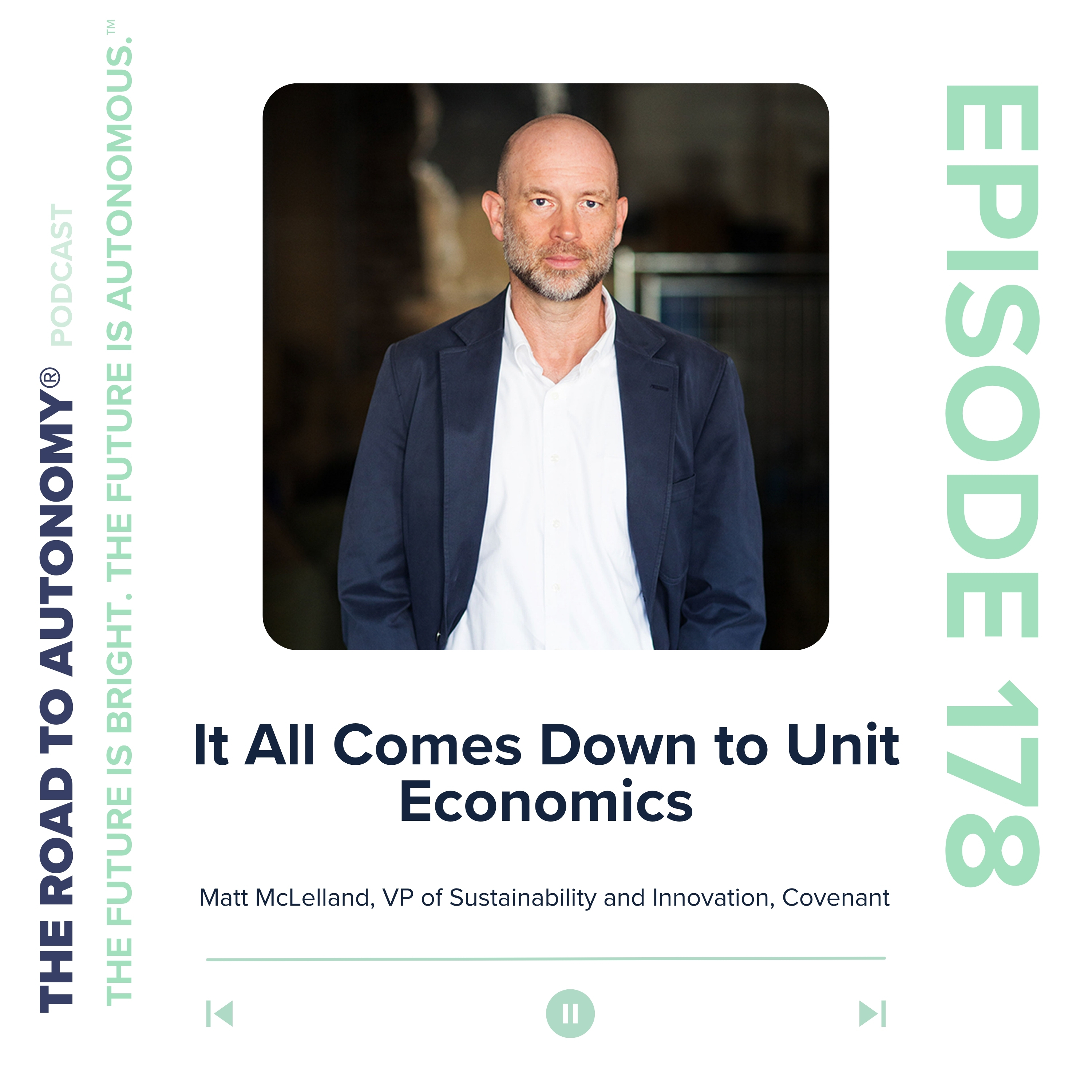
Ep 178Episode 178 | It All Comes Down to Unit Economics
Matt McLelland, VP of Sustainability and Innovation, Covenant joined Grayson Brulte on The Road to Autonomy podcast to discuss why it all comes down to unit economics when fleets are evaluating new trucking technologies such as battery electric trucks and autonomous trucks. The conversation begins with Matt discussing how Covenant is thinking about implementing battery electric trucks into their fleet. With limited range and reduced weight capacities, the right lane and freight have to be matched up to ensure a successful run. The fleet of the future is actually going to be something that is made up of a lot different pieces of equipment that reflect the different and diverse needs of our customer base. – Matt McLellandReduced capacity comes with increased cost, as battery electric trucks cost roughly 50% more then traditional diesel trucks. Factor in stubborn inflation, slim margins and a Fed Funds interest rate of 5.33%, fleets are hamstrung when it comes financing the increased cost of battery electric trucks.Is a hybrid solution the right solution? As companies look to lower their carbon emissions, could electrified trailers be the solution? Or it could be renewable diesel or B100 (pure biodiesel)?Hybrid solutions that are not full on zero-emission vehicles, that’s what I think the future is. – Matt McLellandThe costs to implement low carbon, zero-emissions technologies for trucks is going to cost more. For the business model to work, that cost is going to have to passed onto the consumer. But the economic reality is, consumers will not pay more for shipping as they are used to fast free shipping commonly known as the “Amazon effect“. Could the push towards low carbon and zero-emissions trucks inadvertently accelerate the implementation and adoption of autonomous trucks?It all comes down to the unit economics. – Matt McLellandAutonomous trucks offer better unit economics than traditional trucks, and the economics only get better as the size of the fleet increases. Covenant is taking a measured approach to autonomous trucking by rolling up their sleeves and developing relationships with the developers. This approach has led to commercial relationships with Aurora and Torc. Wrapping up the conversation, Matt shares his thoughts on the future of the trucking industry.Recorded on Friday, February 9, 2024--------About The Road to AutonomyAbout The Road to AutonomyThe Road to Autonomy® is a leading source of data, insight and commentary on autonomous vehicles/trucks and the emerging autonomy economy™. The company has two businesses: The Road to Autonomy Indices, with Standard and Poor’s Dow Jones Indices as the custom calculation agent; Media, which includes The Road to Autonomy and Autonomy Economy podcasts as well as This Week in The Autonomy Economy newsletter.See Privacy Policy at https://art19.com/privacy and California Privacy Notice at https://art19.com/privacy#do-not-sell-my-info.
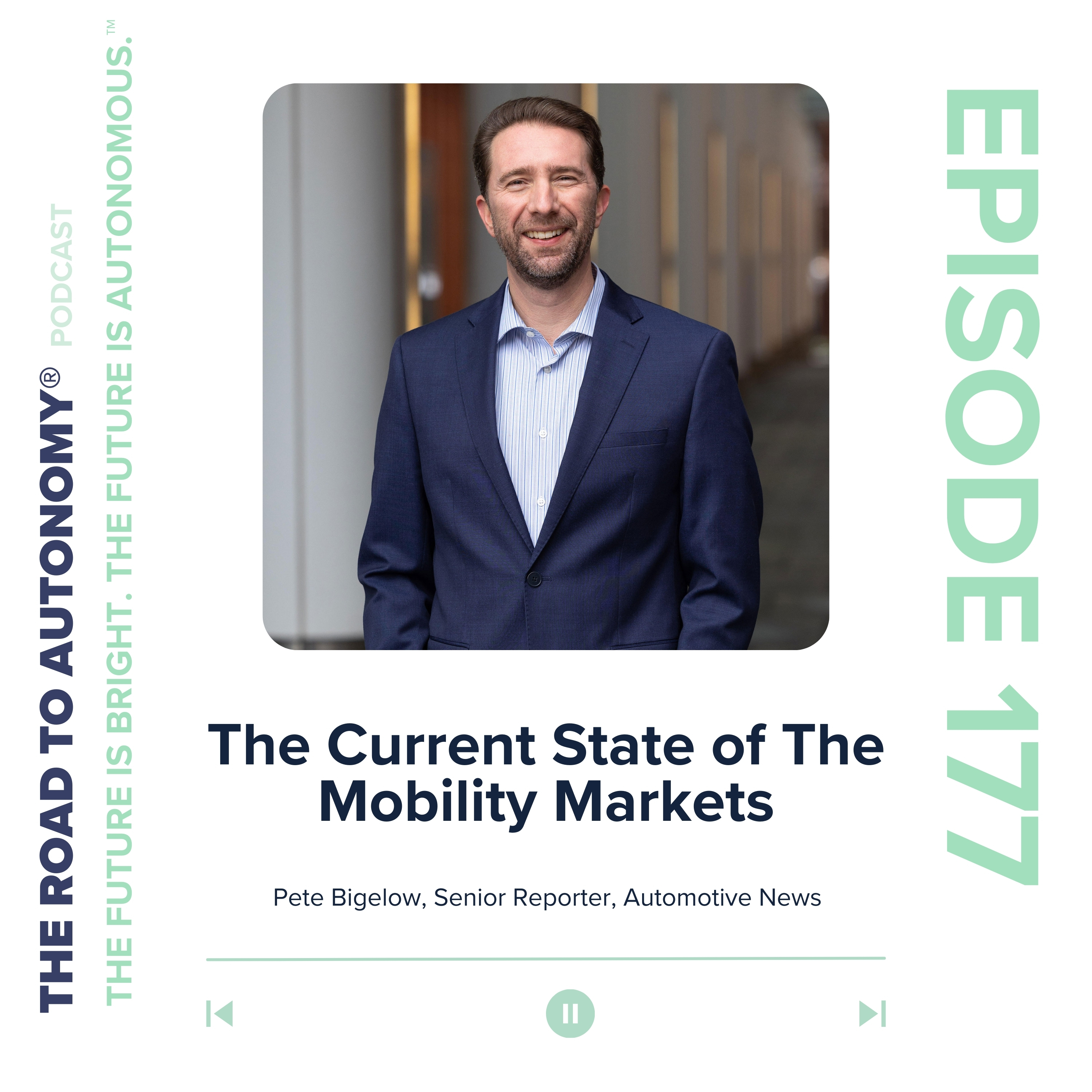
Ep 177Episode 177 | The Current State of The Mobility Markets
Pete Bigelow, Senior Reporter, Automotive News joined Grayson Brulte on The Road to Autonomy podcast to discuss the current state of the mobility markets. Markets that are in flux with EV sales falling, GM rebooting Cruise, while Waymo scales and the autonomous truck industry prepares to launch commercial operations. The conversation begins with Pete sharing his insights into the electric vehicle market with the backdrop of 5,000 U.S. car dealers sending a second letter to President Biden urging the administration to “hit the brakes” on the EV push. Are these dealers urging The President to hit the brakes because non-Tesla EVs are simply not selling? The EV market can’t be lumped into a monolith, it’s really how certain companies are approaching a change from early adopters to mass-market consumers and that’s where we get into the nitty gritty of a potential slowdown. – Pete Bigelow Tesla with an EV U.S. marketshare north of 55% continues to dominate the market. Raising the question, is there even an EV market in the U.S.? Or is the market for electric vehicles in the U.S., simply Tesla?Tesla is running away with the domestic market right now. – Pete Bigelow Could this change when BYD enters the U.S. market? If and when BYD enters the U.S. market, they will be able to undercut the Detroit automakers as their cost structure is dramatically lower. Is an $18,000 EV the tipping point that supercharges the EV market to the detriment of Detroit?Or does the potential Apple Car become the tipping point? The average Apple user spends 5 hours a day on their Apple devices. Spending more time in an Apple car would only help Apple strengthen their ecosystem and grow the services business. That’s the promise of the Apple Car, they are just going to capture your attention in one more living space. – Pete Bigelow A company that has captured the attention of the industry, regulators and the overall automotive market is Cruise. The company is in the midst of a reboot following an unfortunate incident. How will the reboot work? What role will GM play in a rebooted Cruise? Will GM be forced to rebrand Cruise as they look to rebuild public trust? Grayson and Pete discuss a myriad of possible scenarios. While GM works on a reboot plan for Cruise, Waymo is expanding. When Waymo officially expands operations in the San Francisco Bay Area and Los Angeles, they will be operating in a 635 square mile ODD (operational design domain). This will be the largest deployment of autonomous vehicles anywhere in the world.Soon the autonomous trucking industry could surpass the Waymo deployment as the industry prepares to launch driver-out commercial operations later this year. The autonomous trucking industry is growing and new partnerships are being developed that will impact the industry long-term. Wrapping up the conversation, Pete shares what he is watching in the mobility markets this year.Recorded on Friday, January 26, 2024--------About The Road to AutonomyThe Road to Autonomy® is a leading source of data, insight and commentary on autonomous vehicles/trucks and the emerging autonomy economy™. The company has two businesses: The Road to Autonomy Indices, with Standard and Poor’s Dow Jones Indices as the custom calculation agent; Media, which includes The Road to Autonomy and Autonomy Economy podcasts as well as This Week in The Autonomy Economy newsletter.See Privacy Policy at https://art19.com/privacy and California Privacy Notice at https://art19.com/privacy#do-not-sell-my-info.
Ep 176Episode 176 | The Politics of Electric Vehicles
Mike Murphy, Republican Political Strategist, Co-Host of Hacks of Tap and CEO, EV Politics joined Grayson Brulte on The Road to Autonomy podcast to discuss the politics of electric vehicles and their impact on the 2024 election.The conversation begins with Mike discussing his cross-country journey from central New Hampshire to Los Angeles in a VW ID.4 electric vehicle over the summer, and how this adventure led to the founding of EV Politics. Today, electric vehicles have become full of politics and a presidential campaign issue. I just do not like the bashing because I am a free market conservative. I think people to aught to make a choice and these cars have become loaded with politics. – Mike MurphyWhen consumers choose to buy and drive a non-Tesla electric vehicle, they feel overwhelmed by the fact that public charging networks are unreliable — leading to charging anxiety. Which is further stoking the political divide with EVs. This could all be changing as the EV industry moves to the North American Charging Standard (NACS) created by Teslaand developed into a standard by SAE International. Drivers of non-Tesla vehicles will soon have the ability to use the Tesla Supercharger Network, increasing their ability to access reliable charging. In a national survey of 600 voters with household income of $50K+ representing 67% of U.S. 2020 electorate, EV Politics conducted a campaign style poll to gather the pulse in America of electric vehicles. When asked what their biggest concern about owning an EV is, the top two answers were expensive (58%) and insufficient range for trips (53%). Outside of the top two answers, 43% of respondents cited unreliable charger networks. From a political perspective, both Republicans and Democrats agree that cost and insufficient range for trips are their biggest concerns when it comes to buying an EV. However, they disagree about what their friends and relatives will think if they bought an EV.Electric vehicles are not perceived as cars, they are perceived as political statements. – Mike MurphyThen there is Elon Musk. Is he a good ambassador for electric vehicles? It all depends on who you ask. Republicans have a favorable opinion, as 61% agree while only 34% of Democrats agree. Then there is China and the underling issue of Chinese EVs coming to America. How will this potentially impact the politics of EVs and how Americans view EVs? The future of mobility around the world is going electric. Do we want America to be a big player in that or do we want to be Britain in the 70’s and we just keep closing Rover plants? – Mike MurphyAmerica has a choice to make as it relates to the future of mobility. If politics overtake commonsense, America will be left behind. America has to invest in the mining and refining of critical minerals in the U.S. Controlling the EV supply chain is a national security issue and one that should not be taken lightly as the world transitions to electric vehicles. With the 2024 presidential campaign underway and the possibility of a change in The White House, the question around EV subsidies will continue to linger. What impact could a second President Donald Trump administration have on the EV industry? Would Tesla be invited to The White House to promote American ingenuity? Or would the company continue to be sidelined as it has been for the past four years? These are all outstanding questions that will be answered over the next 12 months. Wrapping up the conversation, Mike discuss how he see the EV market evolving over the next four years from a political standpoint.Recorded on Tuesday, January 23, 2024--------About The Road to AutonomyThe Road to Autonomy® is a leading source of data, insight and commentary on autonomous vehicles/trucks and the emerging autonomy economy™. The company has two businesses: The Road to Autonomy Indices, with Standard and Poor’s Dow Jones Indices as the custom calculation agent; Media, which includes The Road to Autonomy and Autonomy Economy podcasts as well as This Week in The Autonomy Economy newsletter.See Privacy Policy at https://art19.com/privacy and California Privacy Notice at https://art19.com/privacy#do-not-sell-my-info.
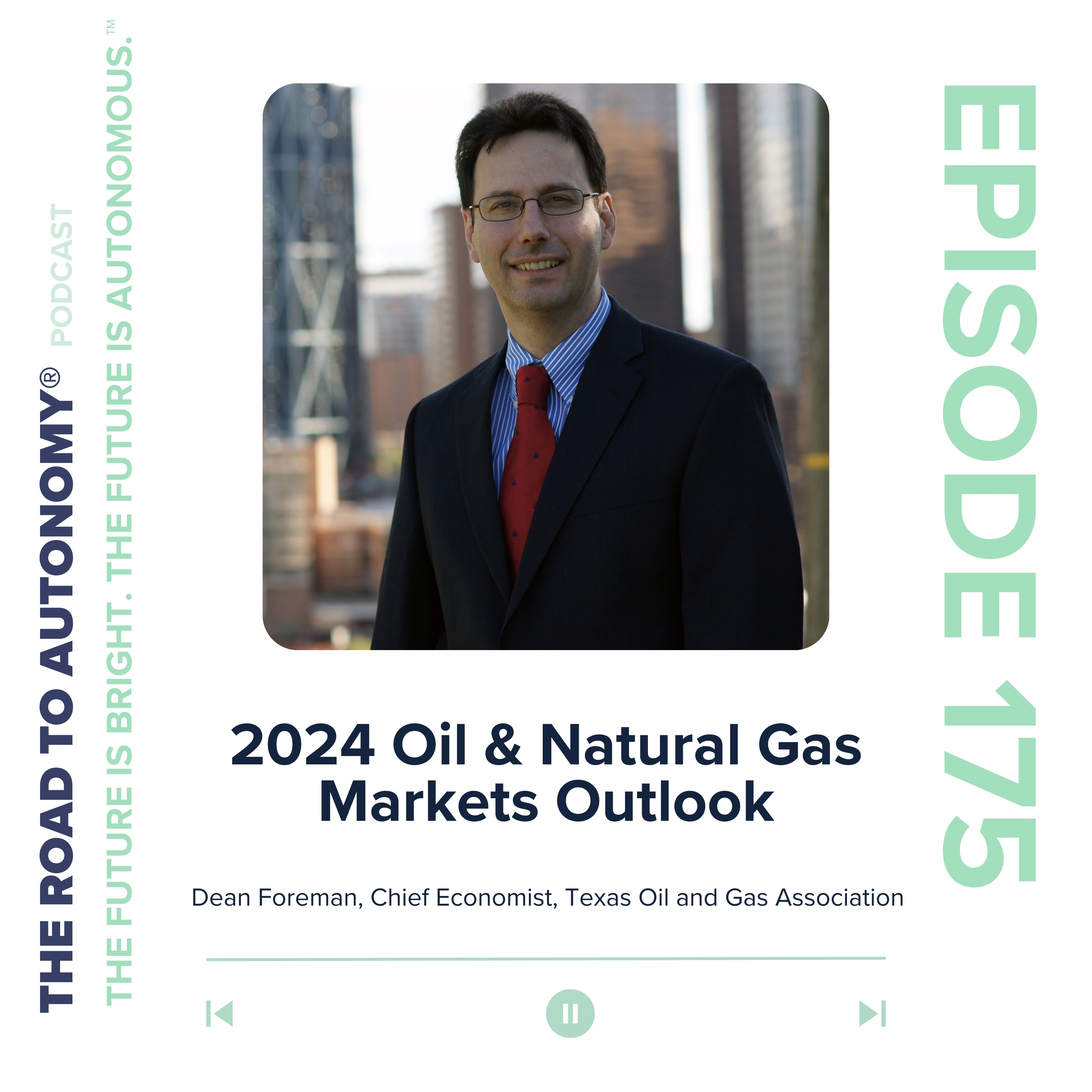
Ep 175Episode 175 | 2024 Oil & Natural Gas Markets Outlook
Dean Foreman, Chief Economist, Texas Oil and Gas Association joined Grayson Brulte on The Road to Autonomy podcast to discuss his 2024 outlook for the oil & natural gas markets. The conversation begins with Dean sharing his outlook for the oil and natural gas markets.The outlook for oil and natural gas looks bright. – Dean ForemanLast year, the world set a new record high for oil demand of 101 million barrels per day. As we begin 2024, attention is now turning to geopolitics and global economic concerns. In Argentina, Javier Milei was sworn in as President on December 10th in a referendum on the economy with aspirations to rebuild the economy and lower inflation by unleashing economic growth. With economic and political reforms, Argentina has the ability to become an exporter of oil from the Vaca Muerta shale formation. It has been estimated that the Vaca Muerta formation has the ability to produce more than 1 million barrels of oil per day by 2030.Argentina because it has shale oil, the Vaca Muerta formation in Neuquén. It’s like the Marcellus in the United States, expect it’s much deeper and super high quality rock. They have the potential to really flip and become an exporter much like the United States. But they haven’t had the business climate to be able to support from a macro perspective companies with predictability trusting to go in and invest a lot in the ground. – Dean ForemanIf the business climate changes, it will be interesting to watch and see what multi-national companies begin to invest in the Vaca Muerta formation. In the United States, economists are projecting a soft landing for the economy. If indeed a soft landing is achieved, more investments are going to be needed to bring the amounts of oil and natural gas to the market that are needed to sustain growth.A portion of economic growth can be attributed to tourism demand, as Bloomberg is reporting that 2024 will be a record-setting year for travel. The International Air Transport Association is projecting that 4.7 billion individuals globally will board planes in 2024, generating $964 billion in airfare revenue. The cruise ship industry is also seeing growth as it is estimated that 35.7 million passengers will board a cruise ship in 2024, up from 31.5 million in 2023. If the consumer trend of opting experiences over purchasing goods continues, there could be an uptick in global oil demand. With the Federal Funds Rate at 5.53%, one has to question how long consumers will continue to spend on travel until they feel the weight of the high interest rate environment. If consumers cut back on travel, what is the impact on oil and will diesel demand offset the potential weakness in gasoline? Grayson and Dean discuss the potential scenarios and what the outcome could look like. One of the biggest uncertainties coming into this year, from a household and a corporate perspective is the delayed impact of the pent up effect of having raised interest rates so much, so fast. – Dean ForemanAnother trend to watch is the re-emergence of hybrid sales in the U.S. In 2023, U.S. individuals purchased over 1 million hybrids, up 76% year-over-year. It’s a clear signal that consumers are still willing to purchase vehicles that have an internal combustion engine. Whether this is being driven by a pricing decision or the simple fact that consumers want reliability and consistency has yet to be determined. What has been determined is that there is clearly a trend emerging. A tree that is powering Texas to produce 5.7 million barrels of oil per day, its highest level since 1981. In 2023, Texas accounted for 54.7% of U.S. drilling, it’s highest level since 2019. In Q3 2023, the Permian Basin set a new production record of 10 million barrels per day of oil equivalent. Today, the Permian Basin accounts for 27% of the total U.S. oil and natural gas production. It has the ability to continue to expand, again because of the quality of resources as well as the ability to get pipelines without dealing with the morass of many of the federal energy regulatory commission, interstate pipeline regulations. With Texas’ nimble intrastate pipeline system, it has the unique ability to attract capital and respond to upstream production. That’s why the Permian Basin has really stood out versus anywhere else in the country. – Dean ForemanWrapping up the conversation, Dean shares his insights on what to watch in the oil and natural gas markets over the next quarter.Recorded on Thursday, January 4, 2024--------About The Road to AutonomyThe Road to Autonomy® is a leading source of data, insight and commentary on autonomous vehicles/trucks and the emerging autonomy economy™. The company has two businesses: The Road to Autonomy Indices, with Standard and Poor’s Dow Jones Indices as the custom calculation agent; Media, which includes The Road to Autonomy and Autonomy Economy podcast

Ep 174Episode 174 | Driverless in Sun City
Edwin Olson, CEO & Co-Founder of May Mobility joined Grayson Brulte on The Road to Autonomy podcast to discuss going driver-out in Sun City, Arizona and the economics of the business. The conversation begins with Edwin discussing what went into launching fully driverless operations in Sun City, Arizona. There is a bunch of technology that has to come together to meet your safety requirements and your capabilities. But actually pulling a safety driver out is about so much more than the technology. We have to bring our riders, our partners, the regulators, insurance companies, first responders. There is a huge amount of work that has to come together to get everyone ready to give this project a thumbs-up. – Edwin OlsonMay Mobility chose to launch in Sun City because of the driving environment and the economic potential. From a technical standpoint they were able to go driver-out in Sun City because of their Multi-Policy Decision Making system. May Mobility’s Multi-Policy Decision Making system has enabled them to deploy in multiple geographic and weather environments such as downtown Detroit, northern Minnesota and Sun City, Arizona. You are never going to become a Babe Ruth by only playing tee ball. You have to start to taking the pitches and playing the hard game. – Edwin OlsonAll of May Mobility’s deployments operate year round, in sun, rain, snow and are revenue generating. The business model being implemented by May compliments public transit as it offers a better return on transit investments for cities and transit agencies. Currently it costs roughly $150 an hour to operate a transit bus in most cities. Our revenue potential is about $150 an hour per vehicle. – Edwin OlsonThe service being provided by May Mobility is as an on-demand point-to-point service being delivered in micro-transit model. As the company gradually removes the safety driver from operations, margins are expected to be around 60%. Driverless operations will ensure a better service without having to rely on drivers who might not show up for work. By switching into a rider-only product we can solve the labor problem and be able to turn on this very high margin business. – Edwin OlsonAs May continues to grow, the company will look to add new vehicles to the mix in addition to their current fleet of fully redundant Toyota Sienna hybrid minivans. We are constantly evaluating other platforms that could help expand our platform offerings so that we can grow our accessible market and grow the business in turn. – Edwin OlsonMay Mobility is a business. Edwin understands this as he is highly focused on developing a business model that is scalable and profitable long-term. When he meets with investors, he breaks down the economics of the May Mobility model and why they are different from the traditional robo-taxi business. In addition to operating an autonomous vehicle business, May is licensing their data to insurance companies. Creating an entirely new revenue stream for the company. Wrapping up the conversation, Ed shares his vision for the future of May Mobility. Recorded on Thursday, December 21, 2023--------About The Road to AutonomyThe Road to Autonomy® is a leading source of data, insight and commentary on autonomous vehicles/trucks and the emerging autonomy economy™. The company has two businesses: The Road to Autonomy Indices, with Standard and Poor’s Dow Jones Indices as the custom calculation agent; Media, which includes The Road to Autonomy and Autonomy Economy podcasts as well as This Week in The Autonomy Economy newsletter.See Privacy Policy at https://art19.com/privacy and California Privacy Notice at https://art19.com/privacy#do-not-sell-my-info.
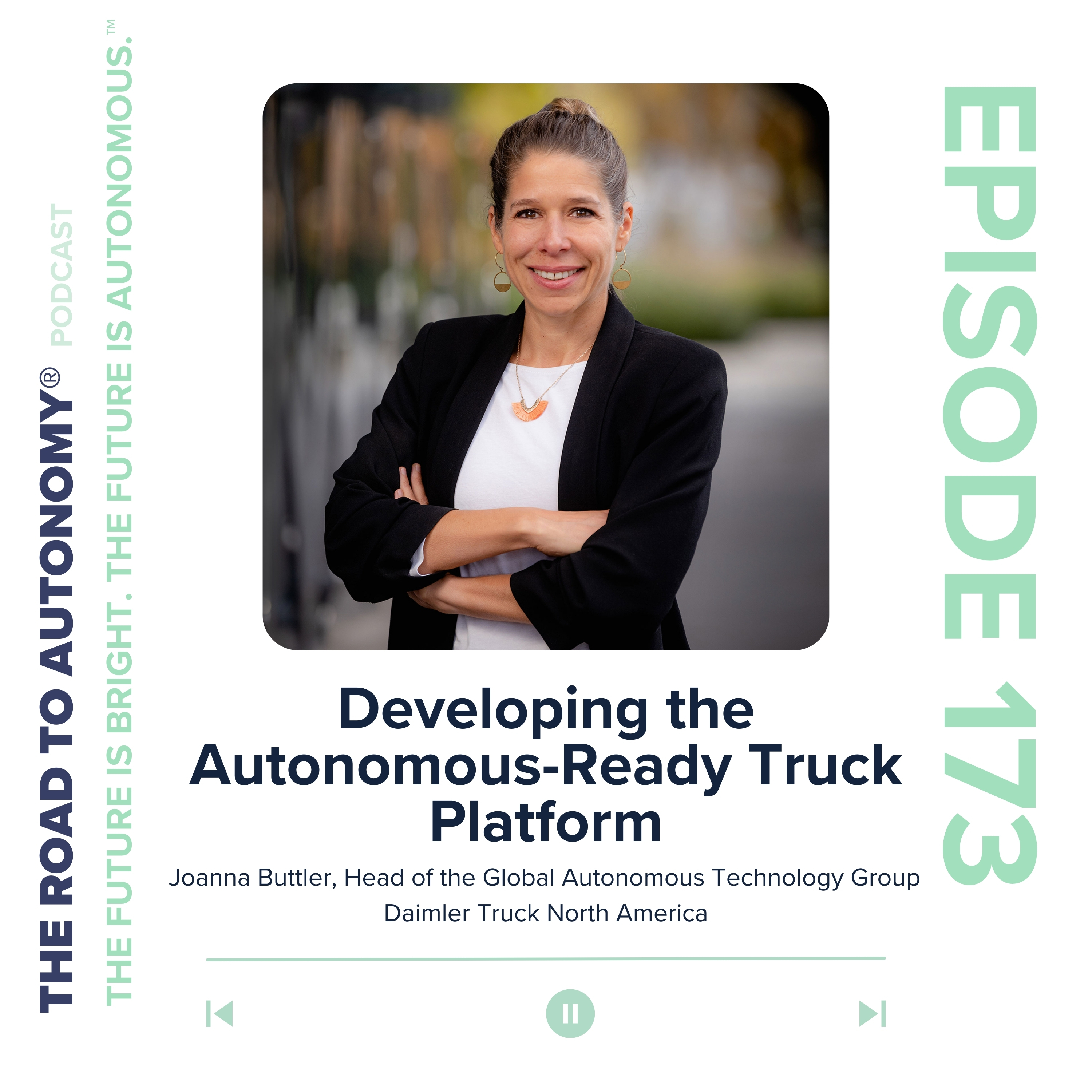
Ep 173Episode 173 | Developing the Autonomous-Ready Truck Platform
Joanna Buttler, Head of the Global Autonomous Technology Group, Daimler Truck North America joined Grayson Brulte on The Road to Autonomy podcast to discuss the development of the autonomous-ready Freightliner Cascadia and Daimler Truck’s outlook for autonomous trucking. The conversation begins with Joanna discussing how Daimler Truck North America is approaching autonomy. We see autonomous as one of the biggest opportunities for us as a company. – Joanna ButtlerTo execute on this opportunity, Daimler Truck is focused on deploying long-haul autonomous trucks in the United States as part of a hub-to-hub strategy. As part of the strategy, Daimler is developing the autonomous-ready Freightliner Cascadia and Torc Robotics is developing the autonomous driving software. At Daimler Truck Capital Market Day 2023 in July, the company announced that autonomous trucks were a strong strategic pillar. Projecting that autonomous trucks have the potential to deliver € 3 billion in revenue by 2030 with the official launch for Daimler’s trucks scheduled for 2027.When Daimler commercializes autonomous trucks, customers will purchase the autonomous-ready Freightliner Cascadia from Daimler Truck and an autonomous driving software subscription from Torc with flexible pricing models. To simplify the sales process, Daimler will coordinate the entire transaction and offer financing through Daimler Truck Financial. Daimler Truck’s customers will be able to achieve a higher utilization with autonomous trucks as they will be able to operate 24/7 with limited downtime. Higher utilization could lead to lower shipping costs and increased margins for fleets. To achieve their vision for autonomous trucking, Daimler is developing a redundant autonomous-ready chassis to ensure the highest levels of safety and functionality. The development process started with a list of 1,500 requirements that they jointly developed with Waymo and Torc to identify the systems, features and tasks that are required to enable autonomous driving. When autonomous trucks scale, the benefits to society and the economy will be immense. Autonomy can and will bring great benefits for society. – Joanna ButtlerWrapping up the conversation, Joanna shares her outlook for autonomous trucking.Recorded on Thursday, December 14, 2023--------About The Road to AutonomyThe Road to Autonomy® is a leading source of data, insight and commentary on autonomous vehicles/trucks and the emerging autonomy economy™. The company has two businesses: The Road to Autonomy Indices, with Standard and Poor’s Dow Jones Indices as the custom calculation agent; Media, which includes The Road to Autonomy and Autonomy Economy podcasts as well as This Week in The Autonomy Economy newsletter.See Privacy Policy at https://art19.com/privacy and California Privacy Notice at https://art19.com/privacy#do-not-sell-my-info.
Ep 172Episode 172 | Scaling an Autonomous Trucking Company with Financial Discipline
James Reed, COO, Kodiak Robotics joined Grayson Brulte on The Road to Autonomy podcast to discuss how Kodiak is scaling the business with financial discipline, economic scenario planning and operational readiness as the company ramps up commercial operations heading into 2024. The conversation begins with James sharing his thoughts on the current state of the autonomous trucking industry.Next year DARPA will have been 20 years ago, finally all of us that our on this path are at the point were autonomous vehicles are real and driver-out autonomy in the trucking business is going to happen in the very near future. – James ReedOver the next decade the autonomous trucking industry is going to enter the commercialization phase with a strong focus on financial discipline. Financial discipline is one of James’ strong suits as he was previously CEO of USA Truck that was successfully sold to DB Schenker in September 2022 for $31.72 per share in cash. It’s not just success that James brings to Kodiak, it’s a deep understanding of economic cycles and how those impact operations and cash-flow. In the depths of 2008 financial crisis, James served as Division CFO at Washington Mutual. The bank was ultimately acquired by J.P. Morgan Chase because of their sub-prime mortgage portfolio. During the banking crisis James saw first hand how one division that takes on too much risk can sink an entire corporation. I learned about this dichotomy of you can be widely successful and still fail as a team. – James ReedBeing in banking is about risk management and this is a skill that influences how James runs operations at Kodiak. To manage risk, the team matters. You have to hire the best to mitigate the risk and limit your potential downside exposure. Including planning and forecasting as the economic environments can change suddenly. As we prepare to enter 2024, we could be entering a potential recessionary environment depending on the actions of the Federal Reserve and how the economy reacts to those actions. Well run companies plan for upsides, downsides including recessions as part of their on-going operations. – James ReedKodiak is planning for this potential economic environment as was an economic growth environment. Planning for all economic environments and what the potential impact will be on the Kodiak business is one of the core strengths that James brings to the team from his years of financial experience. The Kodiak business is not a pure-play autonomous trucking business, it’s a diversified business with a defense division because of the ability of their autonomy stack to work in unstructured environments. On December 5th, it was announced that Kodiak has been awarded a $49.9 million, 24-month United States Department of Defense agreement to help automate future U.S. Army ground vehicles. Moving forward, defense will be a key pillar of the Kodiak business. We plan to become a defacto prime in the autonomous software space. – James ReedIn 2024, Kodiak will continue focus on commercialization, industry partnerships and driver-out operations on public roads. Wrapping up the conversation, James shares his vision for the future of Kodiak which includes a potential IPO.Recorded on Tuesday, December 12, 2023--------About The Road to AutonomyThe Road to Autonomy® is a leading source of data, insight and commentary on autonomous vehicles/trucks and the emerging autonomy economy™. The company has two businesses: The Road to Autonomy Indices, with Standard and Poor’s Dow Jones Indices as the custom calculation agent; Media, which includes The Road to Autonomy and Autonomy Economy podcasts as well as This Week in The Autonomy Economy newsletter.See Privacy Policy at https://art19.com/privacy and California Privacy Notice at https://art19.com/privacy#do-not-sell-my-info.
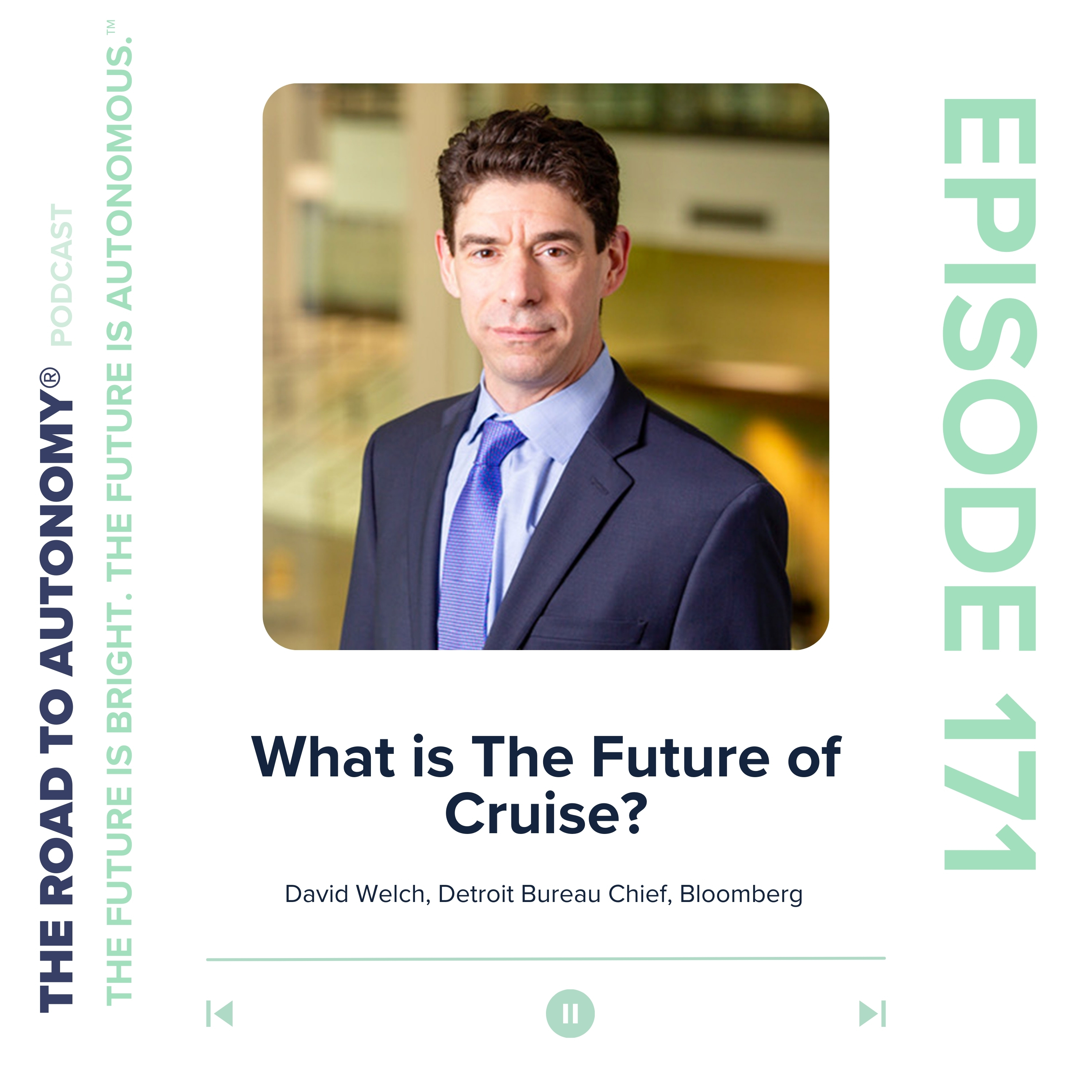
Ep 171Episode 171 | What is The Future of Cruise?
David Welch, Detroit Bureau Chief, Bloomberg joined Grayson Brulte on The Road to Autonomy podcast to discuss the future of Cruise and how the robo-taxi market will shakeout. What moves will Waymo, Zoox and Motional make now that Cruise has been sidelined for the foreseeable future?The conversation begins with David discussing how GM moves forward with Cruise after an October 2, 2023 incident involving a pedestrian in San Fransisco was allegedly mired in a coverup. The supposed actions led to the grounding of the Cruise fleet, the resignation of Co-Founder & CEO Kyle Vogt and a 24% reduction in the workforce including nine key executives. They are going to start-off in one city, so they are sort of stepping back 18 months. In terms of their roll-out, you know it does raise a big question if they even really push robo-taxi, or does this at some point does this become part of General Motors developing self-driving personally owned autonomous vehicles. – David WelchOn the news of the 24% reduction in the workforce at Cruise, GM’s stock rallied 6.65% to close at $36.08 on December 14, 2023. If Cruise is indeed absorbed by GM, the questions become what division will Cruise become part of, will there be a big pivot away from robo-taxis to personally owned autonomous vehicles and how will GM retain and hire new AI talent?Or could GM shift the Cruise model to that of a licensing model? A model where GM licenses Cruise’s autonomous driving technology to other OEMs? This model could resonate with Wall Street as there would be a clear path to Cruise becoming a self-sustaining business unit of GM with high-margins. I think that could eventually be the real race or battle between Cruise and Waymo, licensing this technology to the car companies. – David WelchLicensing will be one of the core elements of autonomous driving technology in the future. Today autonomous vehicles are a luxury product, not a mass market product. With autonomous vehicles being a luxury product, there is an opportunity to build a commerce layer into the rider experience. Could Alphabet look to possibly integrate YouTube into the Waymo as a monitizable experience?With Cruise currently sidelined, could Waymo look to take advantage of the market conditions and accelerate the roll-out of the Waymo One program? Potentially, but Waymo appears to be sticking to their well managed roll-out that includes ride-hailing tours and an early rider program. Then there is Zoox, an Amazon company. When do they make their move? Zoox has been very quiet as the autonomous vehicle market accelerated and then contracted over the last year. Is now the time that Zoox takes advantage of the market conditions and introduces a paid robo-taxi service that could be added at a later date? Or is Amazon working on a Prime-Mobility tier?Wrapping up the conversation, David shares his insights and thoughts on how he sees the robo-taxi market evolving over the next five years. The thing that is really going to have to change and evolve is what the business model is. – David WelchRecorded on Tuesday, December 19, 2023--------About The Road to AutonomyThe Road to Autonomy® is a leading source of data, insight and commentary on autonomous vehicles/trucks and the emerging autonomy economy™. The company has two businesses: The Road to Autonomy Indices, with Standard and Poor’s Dow Jones Indices as the custom calculation agent; Media, which includes The Road to Autonomy and Autonomy Economy podcasts as well as This Week in The Autonomy Economy newsletter.See Privacy Policy at https://art19.com/privacy and California Privacy Notice at https://art19.com/privacy#do-not-sell-my-info.
Ep 170Episode 170 | What if we Electrified the Trailer?
Ali Javidan, Founder & CEO, Range Energy joined Grayson Brulte on The Road to Autonomy podcast to discuss electrified trailers and the impact that these trailers will have on truck fleets. The conversation begins with Ali sharing what inspired him to create an electrified trailers startup. It all starts with a question he asked himself; What if we electrified the trailer? Taking a survey of the industry, nobody was paying attention to trailers, expect for a few nerds and myself. So I decided to a start a venture trying to help bring some real technology to the trailer and really help hybridize these fleets in a meaningful way without disrupting how the fleets work. – Ali JavidanWhen fleets deploy an electrified trailer they are achieving on average 30% – 40% increase in fuel efficiency on a mixed route that includes city and highway driving. If the truck is exclusively driving in cities with heavy loads such as beverages, fleets are seeing a 40% – 50% increase in fuel efficiency.40% reduction in fuel consumption actually equals somewhere around 70% reduction in harmful emissions output. – Ali JavidanIncreasing fuel efficiency is wonderful, but do professional drivers enjoy driving the trucks equipped with electrified trailers? They very much do so, as the electrified trailers increase the overall operational efficiency of driving the truck. As these trailers scale, there could be potential safety increases as these trailers will have a higher-level of traction that could potently lead to safer driving conditions in adverse weather. As autonomous trucks scale commercial operations, there is an opportunity to attached electrified trailers and automate the slider adjustment, lift gate door or the lift gate. Automating the trailer compliments the autonomous truck, enabling a true autonomous operation. This is possible because the electrified trailer has a controls platform, a power platform and a communications platform. As much as we can be framed as disrupters in this industry, we don’t want to disrupt anything. We just want to give everybody better tools. – Ali JavidanRange Energy is going to commence commercial operations in 2024 with pilot customers, followed by a larger pilot deployment in 2025 leading up to the full commercial launch in 2027/2028. Wrapping up the conversation, Ali shares his thoughts on how he sees the electrified trailer market evolving. Recorded on Friday, December 8, 2023--------About The Road to AutonomyThe Road to Autonomy® is a leading source of data, insight and commentary on autonomous vehicles/trucks and the emerging autonomy economy™. The company has two businesses: The Road to Autonomy Indices, with Standard and Poor’s Dow Jones Indices as the custom calculation agent; Media, which includes The Road to Autonomy and Autonomy Economy podcasts as well as This Week in The Autonomy Economy newsletter.See Privacy Policy at https://art19.com/privacy and California Privacy Notice at https://art19.com/privacy#do-not-sell-my-info.

Ep 169Episode 169 | Future of In-Car Experiences
Jana Breitkopf, Managing Director, Mercedes pay USA joined Grayson Brulte on The Road to Autonomy podcast to discuss how Mercedes pay is enabling the future of in-car experiences. The conversation begins with Jana discussing how Mercedes is approaching in-car payments. We want to make it as easy and as convenient as possible for our drivers to use services like parking, charging or fueling. – Jana BreitkopfMercedes began creating Mercedes pay over five years ago to meet the expectations of their drivers. As technology advances, in the future drivers and passengers will be able to say “Hey, Mercedes” order golf balls from Amazon. When this moment happens, the era of in-car commerce will be ushered in.This moment will overlap with the commercialization of personally owned autonomous vehicles as Mercedes pay will enable in-car experiences as it will be the payment layer that makes those experiences possible. Autonomous driving will leverage in-car commerce as a revenue channel. – Jana BreitkopfWhen autonomous vehicles are combined with a payment platform, a global commerce platform will be created. The future of in-car experiences will be built around apps and services that will create value for passengers. Unlocking this value creates new profitable revenue opportunities for Mercedes. Mercedes pay is available today in 44 markets around the world. In Germany, Mercedes pay has a partnership with Mastercard where customers can pay for fueling directly from their vehicle. This partnership eliminates the paying for gas friction in Germany, as there is no pay at the pump service. Instead motorists have to go into the store and pay, which can be inconvenient and frustrating at times. Over the coming years, new markets for Mercedes pay will be coming online. As new markets come online, Mercedes pay will adapt to the local markets customs, data compliance/security and regulatory requirements. Ensuring that the system just simply works with the tap of a button or a simple “Hey, Mercedes”. Wrapping up the conversation, Jana shares her vision for the future of Mercedes pay.Recorded on Friday, December 8, 2023--------About The Road to AutonomyThe Road to Autonomy® is a leading source of data, insight and commentary on autonomous vehicles/trucks and the emerging autonomy economy™. The company has two businesses: The Road to Autonomy Indices, with Standard and Poor’s Dow Jones Indices as the custom calculation agent; Media, which includes The Road to Autonomy and Autonomy Economy podcasts as well as This Week in The Autonomy Economy newsletter.See Privacy Policy at https://art19.com/privacy and California Privacy Notice at https://art19.com/privacy#do-not-sell-my-info.
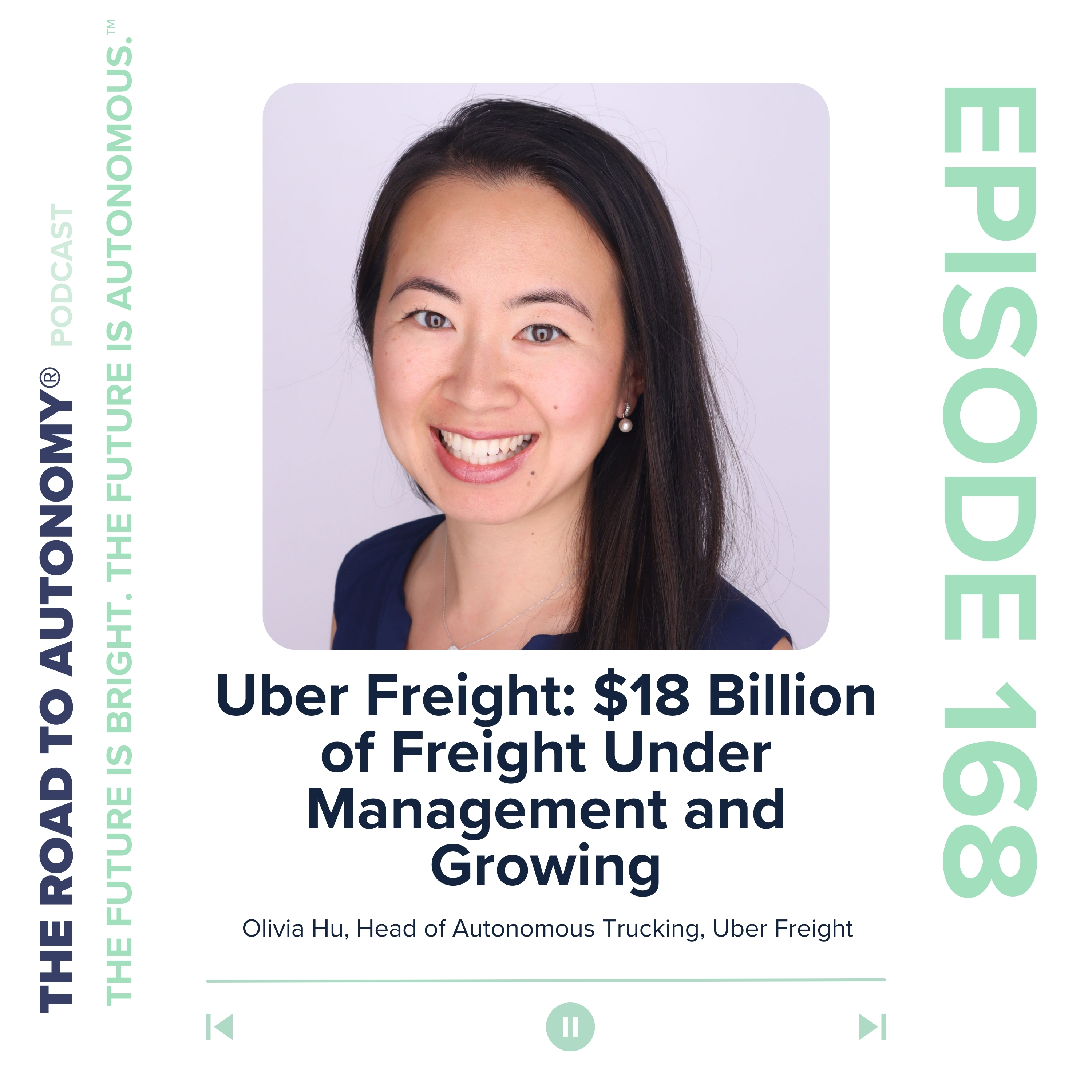
Ep 168Episode 168 | Uber Freight: $18 Billion of Freight Under Management and Growing
Olivia Hu, Head of Autonomous Trucking, Uber Freight joined Grayson Brulte on The Road to Autonomy podcast to discuss how autonomous trucking is going to complement and accelerate the growth of Uber Freight’s $18 billion of freight under management platform. The conversation begins with Olivia discussing the current state of the autonomous trucking industry. The autonomous trucking industry right now is just at this very exciting moment, when its going from purely a technology and R&D pilot or project to let’s look at go to market. What is the long-term strategy? How do we bring different ecosystem players from OEMs, Tier 1s, autonomous trucking developers, maintenance providers, fleets, shippers, networks like ourselves all together to start planing that long-term commercialization strategy? – Olivia HuCollectivity the autonomous trucking industry is preparing for the next phase — commercialization. When commercialization begins in earnest, Uber Freight stands to benefit as they will be the platform that connects the autonomous trucking companies with the freight. The first autonomous trucking lanes to come online will be in the Texas Triangle, from Dallas/Fort Worth to Houston and Dallas/Fort Worth to El Paso. These lanes will be used to learn how autonomous trucks operate in a commercial environment and what the operations will look like when at scale. When autonomous trucks are operating at scale, the industry will have to build and maintain public trust. One of the best ways in our opinion to build public trust is to host an “Autonomous Trucking Grocery Store Day” where everything in the store is 20% off for one-day because it was delivered by an autonomous truck. Autonomous Trucking Grocery Store Daydemonstrates to the public the positive economic that autonomous trucks will have on the cost of living as they suffer under high inflation. As it relates to professional drivers, fleets and shippers, Uber Freight is also working to build trust and educate them about how autonomous trucks could fit into and compliment their existing operations. For me, what’s most important about building trust is being very transparent, honest and giving them the time to ask questions. – Olivia HuWhen Uber Freight brings autonomous trucking partners onto the platform they engage in a KYC process (Know Your Customer) that evaluates the company’s safety framework including the safety culture, technical capabilities, leadership team and the go-to-market strategy. We think having the right go-to-market strategy will be really critical and that includes working with other ecosystem players like OEMs, like ourselves, network providers, shippers and fleets. – Olivia HuUber Freight’s KYC policy was developed and implemented to limit the potential risks that might arise if and when regulation takes hold in the industry. Today, Uber Freight has partnerships with Aurora and Waabi and previously had a partnership with Waymo Via prior to the division being shutdown. In the future, Uber Freight will look to add more partners to the platform, but they will not partner with every autonomous trucking company.We only partner if it makes sense. If we truly believe that they have a safe reliable product with a long-term strategy that is the right commercial application for our customers. – Olivia HuThe right long-term strategy is one that is grounded in economics that enables pricing power. Uber Freight’s Insights AI tool gives their customers to optimize their operations, pricing structure and what lanes make the most sense to deploy autonomous trucks.Wrapping up the conversation, Olivia discusses the role the Uber Freight will play as autonomous trucking scales. Recorded on Thursday, November 30, 2023--------About The Road to AutonomyThe Road to Autonomy® is a leading source of data, insight and commentary on autonomous vehicles/trucks and the emerging autonomy economy™. The company has two businesses: The Road to Autonomy Indices, with Standard and Poor’s Dow Jones Indices as the custom calculation agent; Media, which includes The Road to Autonomy and Autonomy Economy podcasts as well as This Week in The Autonomy Economy newsletter.See Privacy Policy at https://art19.com/privacy and California Privacy Notice at https://art19.com/privacy#do-not-sell-my-info.
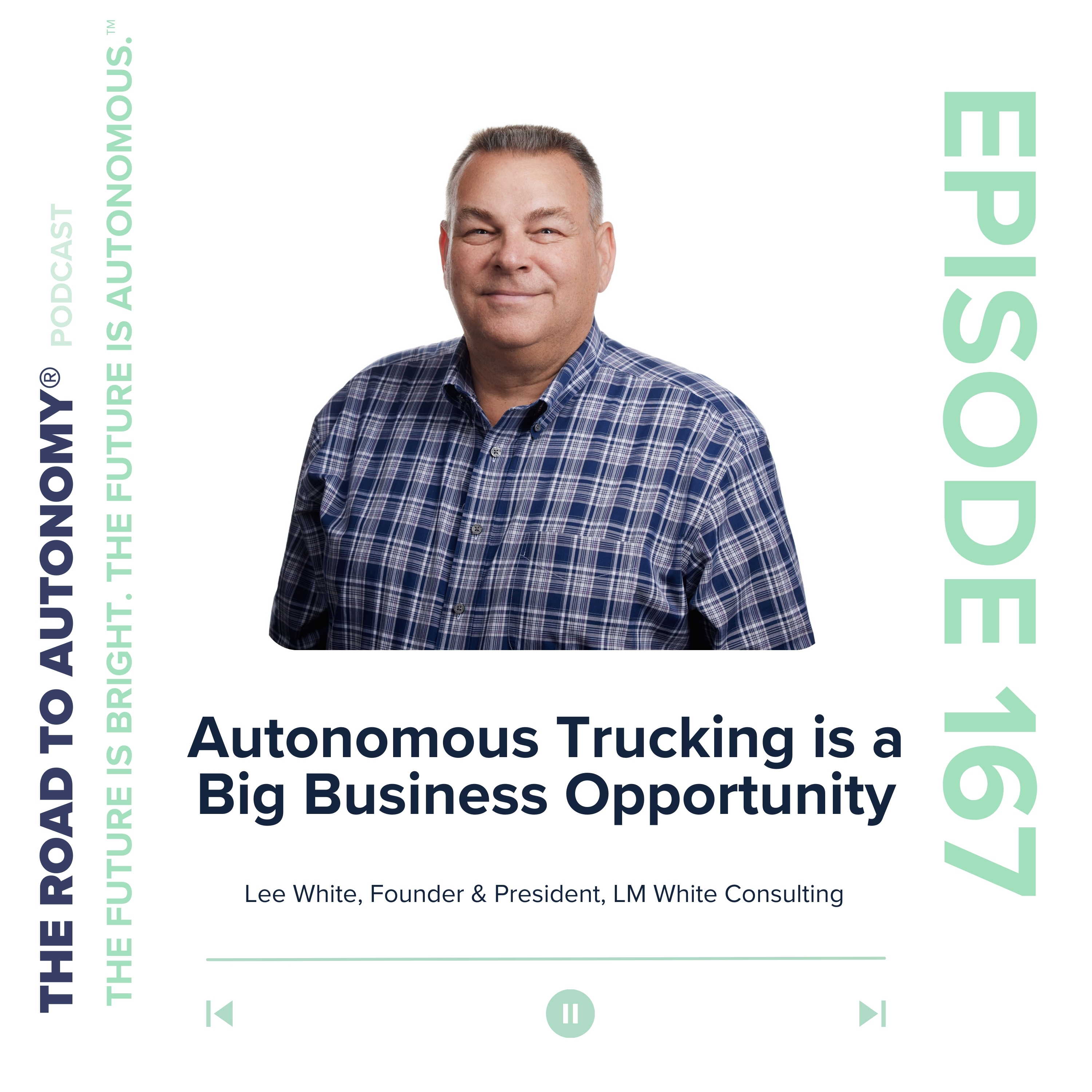
Ep 167Episode 167 | Autonomous Trucking is a Big Business Opportunity
Lee White, Founder & President, LM White Consulting joined Grayson Brulte on The Road to Autonomy podcast to discuss why autonomous trucking is a big business opportunity and what the economics of that business will look like when autonomous trucks are operating commercially. The conversation begins with Lee discussing the current state of the autonomous trucking industry. We are on track, we are on plan, we are moving forward. – Lee WhiteThe autonomous trucking industry is healthy and the health of the industry is being validated with the continued investments from institutional investors such as T. Rowe Price and Softbank. While economically healthy, the industry is currently under strain from the perceived notion that autonomous trucks and autonomous vehicles are one in the same.The consistently for the AV trucking operations is a very positive advantage over robo-taxis, and I think the trucking group has to begin to separate itself from this clumping everything together. – Lee WhiteTo truly demonstrate the benefits of autonomous trucking, the industry has to take a hold of the narrative and demonstrate to the public, policymakers, investors and the traditional trucking industry the true benefits of autonomy. Autonomous trucks will lead to lower cost goods (helping to reduce inflation), more productivity, and more robust and secure supply chain. Daimler Truck is taking the lead on messaging to investors and Wall Street. During their Capital Market Day 2023, Daimler Truck announced that autonomous trucking would be one of the key pillars of their business. By 2027, autonomous trucking will begin to unlock a new high-margin business. By 2030, Daimler Truck is projecting revenue north of €3 billion with EBIT potential north of €1 billion.To unlock this business Daimler Truck is investing responsibly and managing their capital expenditures. For the first nine months of 2023, Daimler Truck has invested €155 million in “other business activities and corporate items which comprised primarily of operational expenses related to their autonomous driving business”. Up from €139 million for the nine months of 2022, an increase of €16 million year-over-year. This is a responsible investing strategy that is both prudent and sustainable for Daimler Truck long-term. It’s one that more companies developing autonomous trucks should follow. The model for developing and commercializing autonomous trucks varies widely. Volvo is taking a slightly different path to autonomous trucking through their transport-as-a-service model where they will own and operate the autonomous trucks.[Volvo] wants to sell you you transportation as service and that becomes how they sell trucks now. It’s like the airline industry, you don’t buy an airplane engine anymore from GE or Rolls-Royce, you buy time, you get run hours. If that’s the new model, that will be very successful. – Lee WhiteAs we head into the holiday season with a slowing economy and consumers deprioritizing spending on physical goods and prioritizing spending on experiences, the freight industry will have to adapt to the changing consumer spending patterns. The slowdown in the freight market has been ongoing for sometime and YELLOW, a 100 year-old LTL carrier was a casualty of market conditions and union negotiations, as the company filed for voluntary Chapter 11 petitions on August 6th, 2023.97% of all trucking companies have 20 or less trucks. There is going to be a lot of them that are right on the edge. – Lee WhiteWrapping up the conversation, Lee and Grayson discuss the impact that California’s zero-emissions trucks regulation will have on the trucking market. Recorded on Thursday, November 9, 2023--------About The Road to AutonomyThe Road to Autonomy® is a leading source of data, insight and commentary on autonomous vehicles/trucks and the emerging autonomy economy™. The company has two businesses: The Road to Autonomy Indices, with Standard and Poor’s Dow Jones Indices as the custom calculation agent; Media, which includes The Road to Autonomy and Autonomy Economy podcasts as well as This Week in The Autonomy Economy newsletter.See Privacy Policy at https://art19.com/privacy and California Privacy Notice at https://art19.com/privacy#do-not-sell-my-info.
Ep 166Episode 166 | Autonomous Tractors Take the Wheel Amidst Labor Shortages
Sam Abidi, Chief Commercial Officer, Monarch Tractor joined Grayson Brulte on The Road to Autonomy podcast to discuss Monarch’s autonomous MK-V tractor and how the growing labor shortages are accelerating the adoption of autonomous tractors on farms around the world. The conversation begins with Sam discussing how Monarch Tractor is approaching autonomy. From day one we were thinking about how you could build an autonomy kit that could go on a tractor, that can essentially reach a price point that most farmers can use, and where we landed is that you need to do a bottom up build of the tractor — that tractor is called the MK-V. – Sam AbidiWith the global economy shifting to a labor light economy, due to a growing labor shortage, autonomy applications on farms is rapidly accelerating. If you actually go talk to some of our farmers, many of them are coming to us because it is an alternative to having no one do that job. – Sam AbidiMonarch takes a farmer frugal approach to autonomy as they know every dollar counts on a farm. The farmer frugal approach enables Monarch to charge farmers $800 a month to unlock the autonomous capabilities of the $90,000 MK-V tractor, which is less the equivalent labor cost. In the future as the model evolves, Monarch is exploring the possibility of introducing a tractor-as-a-service model for select regions around the world. If this model comes to fruition, Monarch will not hold the asset (tractor) on their balance sheet. Instead they will look to a partner to hold the assets (tractor) as it is not an effective use of their capital to hold tractors on their balance sheet.Today, Monarch has a financial services agreement with CNH Industrial Capital America to provide financing for the MK-V tractor. The Monarch MK-V is an all-electric tractor with a swappable battery that can run 14-hours. Financing is an important part of farm economics. – Sam AbidiWhen a Monarch tractor is deployed on a farm, farmers control all the applications of the autonomous tractor with their proprietary WingspanAI digital platform. If you automate a tractor and you have a dozen tractors or two dozen tractors running the farm and then you connect those to a digital platform, that essentially tracks everything from when they are dispatched to what they are doing to how well they are doing it, you have essentially digitized the farm. – Sam AbidiThe data that Monarch’s autonomous tractors are gathering will enable the company to create new revenue streams in the future by monetizing the rich amount of data that the tractors gather on a daily basis. To scale, Monarch has a partnership with Foxconn to manufacturer the MK-V at their Ohio facility. The decision to engage Foxconn for manufacturing was made from the lessons that the founders learned from their years in the automotive industry. Wrapping up the conversation, Sam shares his vision for the future of Monarch Tractor.Recorded on Tuesday, November 7, 2023--------About The Road to AutonomyThe Road to Autonomy® is a leading source of data, insight and commentary on autonomous vehicles/trucks and the emerging autonomy economy™. The company has two businesses: The Road to Autonomy Indices, with Standard and Poor’s Dow Jones Indices as the custom calculation agent; Media, which includes The Road to Autonomy and Autonomy Economy podcasts as well as This Week in The Autonomy Economy newsletter.See Privacy Policy at https://art19.com/privacy and California Privacy Notice at https://art19.com/privacy#do-not-sell-my-info.
Ep 165Episode 165 | The World’s Best Product is a Very Profitable Product
Sterling Anderson, Co-Founder & Chief Product Officer, Aurora joined Grayson Brulte on The Road to Autonomy podcast to discuss the founding of Aurora, the economics of the Aurora business model why the world’s best product is a very profitable product. The conversation begins with Sterling discussing why Chris Urmson, Drew Bagnel and himself came together to form Aurora in 2016. We saw a lot of players in the ecosystem at the time struggling to figure out the right path. A credible independent player in our view could change the game for them and unlock the potential of a powerful ecosystem from OEMs to carriers to private fleets to even Tier 1’s and companies who provide some of the backend service. We felt like a credible autonomy player who played our position and enabled or unlocked the rest of the industry could deliver tremendous value here, and we did not see much of that at the time. – Sterling Anderson Being an independent company is one of the keys to Aurora’s success as it has allowed them to build an industry wide solution that unlocks potential for both cars and trucks. The original product roadmap for the company which is still intact today was to look at trucking, ride-hailing and local goods delivery.Trucking was top of the list in terms of the first product that we wanted to go to market with. – Sterling Anderson In 2018, Aurora began laying the foundation for their autonomous trucking product when they integrated their autonomous driving stack into a Volvo truck and began testing on a track in partnership with Volvo. Trucking is the first product, ride-hailing will follow. – Sterling Anderson The Aurora business model for trucking today is transportation-as-a-service, as the business and technology matures, the model will evolve into a driver-as-a-service model. This is a model where we are licensing the self-driving system, inclusive of the hardware, the software and the data services required to operate it to our customers who are in turn purchasing either the truck from the OEM who provides it or purchasing a set of solutions. – Sterling Anderson Customers who sign up for the driver-as-a-service model will pay a utilization service fee (per mile fee). To keep the trucks up and running at optimal performance, Aurora trucks are designed for reliability and serviceability. This design approach allows Aurora to optimize the economics of their operations. In my view the world’s best product is also a very profitable product. – Sterling Anderson As Aurora prepares for driver-out commercial operations in late 2024 with 20 trucks on the Dallas to Houston lanes, the autonomous trucks will be operated under the transportation-as-a-service model. In 2025/2026, the customers operating under the transportation-as-a-service model will begin to transition to a driver-as-a-service model where they will own and operate the assets. Wrapping up the conversation, Sterling shares his vision for the future of Aurora. Recorded on Friday, October 27, 2023Chapters:0:00 The Road to Autonomy Index0:56 Introduction1:18 Why Chris Urmson, Drew Bagnel and Sterling Anderson founded Aurora3:38 The Vision for Aurora8:07 Going Public with Volvo and PACCAR10:57 Local Goods Delivery and the Middle Mile12:34 Aurora Trucking Business Model24:52 Preparing for Commercial Driver-Out Operations27:48 A Focus on Profitability34:45 Terminal Operations40:43 Autonomous Trucking Grocery Store Day46:00 Aviation History--------About The Road to AutonomyThe Road to Autonomy® is a leading source of data, insight and commentary on autonomous vehicles/trucks and the emerging autonomy economy™. The company has two businesses: The Road to Autonomy Indices, with Standard and Poor’s Dow Jones Indices as the custom calculation agent; Media, which includes The Road to Autonomy and Autonomy Economy podcasts as well as This Week in The Autonomy Economy newsletter.See Privacy Policy at https://art19.com/privacy and California Privacy Notice at https://art19.com/privacy#do-not-sell-my-info.
Ep 164Episode 164 | Growing Global Demand for Oil and Its Economic Impact
Dean Foreman, Chief Economist, Texas Oil & Gas Association joined Grayson Brulte on The Road to Autonomy podcast to discuss the growing global demand for oil and its economic impact on the global economy. The conversation begins with Dean discussing the current state of the oil markets. It’s a tight market and despite everything that has been going on we really have tightness to watch in terms of supply and demand and where that supply is going to come to meet that demand. – Dean ForemanThe growing demand for oil in the United States is coming from jet fuel, 1.8 million barrels per day and diesel fuel, 3.6 million barrels per day. With an additional 6 million barrels per day being refined for materials. With the growing demand for oil the United States is looking to increase volume by lifting sanctions on Venezuela. The demand for oil is not just limited to the United States, it’s a global phenomenon.China is now the single largest importer of crude oil, over 13 million barrels per day. – Dean ForemanWith China being the single largest importer of crude oil, the country embraced electric vehicles to slow their dependence on foreign oil imports. A big part of the traditional push by China to get into electrification wasn’t just to strategically control the value chain, it was to prevent, as their economy grew an unsustainable growth in their oil imports. – Dean ForemanU.S. Energy Information Administration is projecting demand of 103 million barrels per day in 2024, an increase of roughly 200,000 barrels per day year-over-year. Over the coming years, the United States will be the largest single source of growth of oil supply.We’ve seen record production this year, U.S. crude oil production for the first week of October struck 13.2 million barrels per day, that’s a record high. Our previous high was in March 2020 of 13.1 [million]. – Dean ForemanThe growing demand for oil is good for the Texas economy. Texas, as of September is producing 5.9 million barrels of crude oil per day. For the first eight months of 2023, Texas has driven 43.2% of U.S. oil production, its highest since 1981. For the first seven months of 2023, Texas has exported $125 billion of oil, natural gas and derived products globally. Wrapping up the conversation, Dean shares his outlook on the oil markets for the next quarter. Recorded on Thursday, October 19, 2023--------About The Road to AutonomyThe Road to Autonomy® is a leading source of data, insight and commentary on autonomous vehicles/trucks and the emerging autonomy economy™. The company has two businesses: The Road to Autonomy Indices, with Standard and Poor’s Dow Jones Indices as the custom calculation agent; Media, which includes The Road to Autonomy and Autonomy Economy podcasts as well as This Week in The Autonomy Economy newsletter.See Privacy Policy at https://art19.com/privacy and California Privacy Notice at https://art19.com/privacy#do-not-sell-my-info.
Ep 163Episode 163 | Rail Industry: On the Rails of Economic Growth
Matt Soule, CEO and Co-Founder, Parallel Systems joined Grayson Brulte on The Road to Autonomy podcast to discuss how Parallel Systems will act as an economic growth engine for the rail industry. The conversation begins with Matt discussing how Parallel Systems business has evolved since he last joined Grayson Brulte on The Road to Autonomy roughly year ago. During this time, Parallel has been testing their Gen2 vehicle in the United States and has deployed a Gen1 vehicle overseas. As they gear up to deploy their Gen2 vehicle, the company is preparing up to test railworthiness at the Transportation Technology Center (TTC) in Pueblo, Colorado. We will run our vehicle through a series of tests there, to most importantly validate the models that we have already built up to predict how the vehicle will perform. – Matt SouleWhen Parallel begins to commercialize their business, they are going to compliment the traditional rail business by offering the rail industry a solution to expand their freight operations inside of the traditional 500 mile routes. With Parallel’s smaller scale we can serve freight lanes that do not require massive volumes to have that daily arrival and departure. That’s the core of our strategy. – Matt SouleA pillar of this strategy is replacing trucks on drayage routes. A large opportunity is moving freight on rail from the Ports of Los Angeles, San Pedro and Long Beach to the Inland Empire, one of the largest industrial complexes in the United States with over 4,000 warehouses. Parallel’s autonomous and electric vehicles will have a range of roughly 500 miles between charges. The vehicles will be operating in a platoon of 20 and will charge while they are being unloaded and loaded at the terminal.When we go into a terminal, we will have charging nests kind of like a robotic vacuum cleaner going to it’s charging dock alongside the rail and the vehicles will go to those locations and automatically dock with the chargers, and while they are charging the freight is unloaded and loaded. – Matt SouleThe next version of the vehicle (Gen3) will be the commercial product that drives up reliability and drives down cost. Looking towards the future when Parallel is operating a commercial business, Matt sees autonomous trucks complimenting the business. The economics get better and better and better the more productive that asset is. So I think that is where there can be a real compliment, where a self-driving truck can handle the complex first and last mile if there is a service that does not require us to go directly to that customer. – Matt SouleWith the current economic backdrop of a slowing global economy, Matt is preparing the business to take advantage of the emerging autonomy economy that will arise out of the economic situation partly due to the global labor shortage. Wrapping up the conversation, Matt shares his outlook for the future of Parallel Systems.Recorded on Tuesday, October 17, 2023--------About The Road to AutonomyThe Road to Autonomy® is a leading source of data, insight and commentary on autonomous vehicles/trucks and the emerging autonomy economy™. The company has two businesses: The Road to Autonomy Indices, with Standard and Poor’s Dow Jones Indices as the custom calculation agent; Media, which includes The Road to Autonomy and Autonomy Economy podcasts as well as This Week in The Autonomy Economy newsletter.See Privacy Policy at https://art19.com/privacy and California Privacy Notice at https://art19.com/privacy#do-not-sell-my-info.
Ep 162Episode 162 | Supervised Autonomy: Increasing Efficiency in a Labor Light Economy
Vinay Shet, Co-Founder & CEO Teleo joined Grayson Brulte on The Road to Autonomy podcast to discuss Teleo’s approach to supervised autonomy in a labor light economy.The conversation begins with Vinay discussing how Teleo is approaching supervised autonomy and it’s benefits.By switching between tele-operations and autonomy and switching between machine one, machine two and even machine three, [operators] are able to control multiple machines at the same time. – Vinay ShetTeleo’s approach to autonomy allows trained machine operators to increase their daily production while improving the overall operational efficiency of the job. This approach to autonomy developed to create value for construction companies that are facing a growing labor shortage. Labor is the number one problem that our customers flag to us for themselves. They are simply unable to find enough people to do the work that they have signed up to do. Across the board they have more work to do then they have people available. To the point where our customers tell us that they literary park their machines, because they are unable to find people to operate the machines. – Vinay ShetFacing a growing labor shortage, Tomahawk Construction is deploying Teleo-enabled semi-autonomous trucks to move dirt at a residential community job site in Naples, Florida. This repetitive task is now automated, enabling Tomahawk to develop the residential community with great efficiency. As the community development scales, Teleo-enabled semi-autonomous trucks at the job site will eventually scale up to twelve trucks.To scale the business, Teleo is utilizing a dealer network to sell their retrofit kits and have them installed on large machines. As the labor shortage grows and the Bank of America coined labor-light economy begins to take shape, Teleo is poised to prosper as their technology can help to fill the labor gap. Autonomy augments people. I think it’s really about making people more productive and making their lives more comfortable. – Vinay ShetWrapping up the conversation, Vinay shares his vision for the future of autonomy. Recorded on Friday, October 13, 2023Chapters:0:00 The Road to Autonomy Index0:56 Introduction1:22 Teleo's Approach to Autonomy4:06 Remote Operations7:17 Construction Industry Use Cases11:02 Labor Light Economy13:22 Teleo Business Model18:34 How Teleo's Construction and Mining Compliment Each Other20:40 Multi-Site Deployment24:48 Future of Teleo--------About The Road to AutonomyThe Road to Autonomy® is a leading source of data, insight and commentary on autonomous vehicles/trucks and the emerging autonomy economy™. The company has two businesses: The Road to Autonomy Indices, with Standard and Poor’s Dow Jones Indices as the custom calculation agent; Media, which includes The Road to Autonomy and Autonomy Economy podcasts as well as This Week in The Autonomy Economy newsletter.See Privacy Policy at https://art19.com/privacy and California Privacy Notice at https://art19.com/privacy#do-not-sell-my-info.
Ep 161Episode 161 | Robots Do Not Bleed, Autonomy for Defense
Gabe Sganga, Head of Commercial Growth, RRAI joined Grayson Brulte on The Road to Autonomy podcast to discuss RRAI’s focus on autonomy for military and defense applications and how they have been able to apply the learnings from battle to their civilian business.The conversation begins with Gabe discussing why RRAI is focused on autonomy for military and defense applications.RRAI has always been a defense-first company. Strategically we are focused on delivering defense capabilities to support funded programs right now. – Gabe SgangaRRAI’s autonomous vehicles have been deployed in theater around the world. When deploying autonomous vehicles in theater, the autonomous driving stack is hardened for the harsh environment of war. Through their deployments in theater, RRAI has been able to apply the learnings from battle to their civilian business. Operating in these conditions is not unique to defense, it’s unique to end-users who tackle the hardest jobs that keep the industrial heart of our country and economy running. – Gabe SgangaDefense is a large part of RRAI’s business, but it is not the sole focus of the business. In addition to their defense business, RRAI has a growing commercial business with a keen focus on off-road autonomy applications. The company chose to focus on this commercial market as they viewed it as being underserved. The business model that RRAI operates under is autonomy-as-a-service. For autonomy-as-a-service, we wrap everything into a single license price.– Gabe SgangaThis model allows RRAI to update their fleet when new hardware and technology comes online and deploy it to their customers applications without having to charge them an upgrade fee. The model will only be enhanced when RRAI is able to secure a OEM deal for factory grade trucks built with their hardware and software fully integrated. For on-road applications, RRAI is focused on controlled environments such as distribution center yards, ports and logistics centers because of the regulatory environment. Wrapping up the conversation, Gabe discuses RRAI’s $220 million Series A round led by Softbank in January 2023.Recorded on Friday, October 6, 2023Chapters:0:00 The Road to Autonomy Index0:56 Introduction1:23 Why Autonomy for Defense6:10 Learnings from Autonomy Deployments in Defense Applications13:54 Economics of RRAI's Defense Business21:04 RRAI's Military Background25:00 RRAI's Autonomous as a Service Business Model30:27 RRAI's OEM Approach37:28 RRAI On-Road Autonomy39:00 Yard Trucks43:58 RRAI Investors45:30 Future of RRAI--------About The Road to AutonomyThe Road to Autonomy® is a leading source of data, insight and commentary on autonomous vehicles/trucks and the emerging autonomy economy™. The company has two businesses: The Road to Autonomy Indices, with Standard and Poor’s Dow Jones Indices as the custom calculation agent; Media, which includes The Road to Autonomy and Autonomy Economy podcasts as well as This Week in The Autonomy Economy newsletter.See Privacy Policy at https://art19.com/privacy and California Privacy Notice at https://art19.com/privacy#do-not-sell-my-info.