The Road to Autonomy
460 episodes — Page 9 of 10
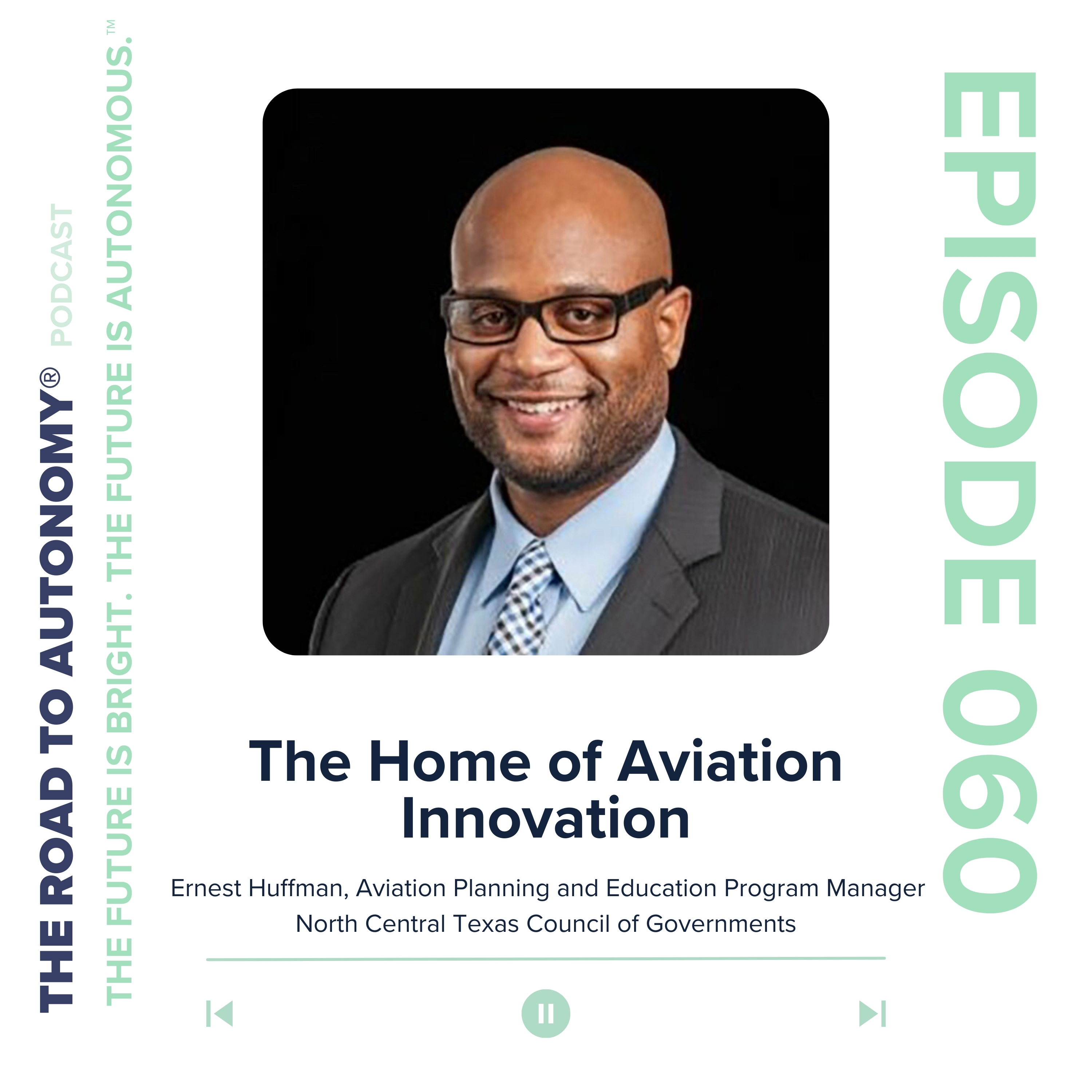
Ep 60Episode 60 | The Home of Aviation Innovation
Ernest Huffman, Aviation Planning and Education Program Manager, North Central Texas Council of Governments joined Grayson Brulte on The Road To Autonomy Podcast to discuss why North Texas is the home of aviation innovation.The conversation begins with Ernest sharing a story about how a high school teacher changed his life and put him on the course of becoming a pilot, which lead to a career in aviation.Looking at [the aviation industry] from a holistic, macro perspective and my early background in doing some economist work, I think of aviation as a competitive industry, a means for folks to get out of their current situations in urban communities. – Ernest HuffmanPutting his words into action, Ernest worked with Tuskegee NEXT to inspire at-risk youth to explore career opportunities in the aviation industry.I had my pilot’s license before I had my driver’s license. – Ernest HuffmanShifting the conversation to North Texas, Grayson asks Ernest about the North Central Texas Council of Governments NASA partnership to study the potential of drone technology and integrate it into future transportation plans.The North Texas region is emerging as the home of aviation innovation due to the economic strength and the business climate in the region.We like the growth. We are going to keep attracting these great businesses here. – Ernest HuffmanIn February, a Bell autonomous drone successfully delivered a package at Hillwood’s AllianceTexas Mobility Innovation Zone out of the line of sight which requires significant regulatory approval.It is a monumental achievement. To do it in the current regulatory environment that we have for those types of flights is an achievement. – Ernest HuffmanLooking to the future, there are plans for a more significant flight to take place in 2023. Taking it one step further, Grayson asks Ernest if there are plans to connect the DFW airport to the Dallas Cowboys football stadium with an eVTOL service. This type of experience would enhance the fan experience on GameDay for fans who fly into Dallas for the game.That is definitely a use case that we are exploring heavily. – Ernest HuffmanTo enable this future, there has to be a public trust. The public has to trust that the eVTOL aircraft will get them there on time and safely. NCTOG is working on this issue through their Unmanned Aircraft Systems Safety and Integration Initiative.Wrapping up the conversation, Ernest shares his vision of how advanced air mobility will be rolled out in the Dallas-Fort Worth region.Recorded on Tuesday, October 12, 2021--------About The Road to AutonomyThe Road to Autonomy® is a leading source of data, insight and commentary on autonomous vehicles/trucks and the emerging autonomy economy™. The company has two businesses: The Road to Autonomy Indices, with Standard and Poor’s Dow Jones Indices as the custom calculation agent; Media, which includes The Road to Autonomy and Autonomy Economy podcasts as well as This Week in The Autonomy Economy newsletter.See Privacy Policy at https://art19.com/privacy and California Privacy Notice at https://art19.com/privacy#do-not-sell-my-info.
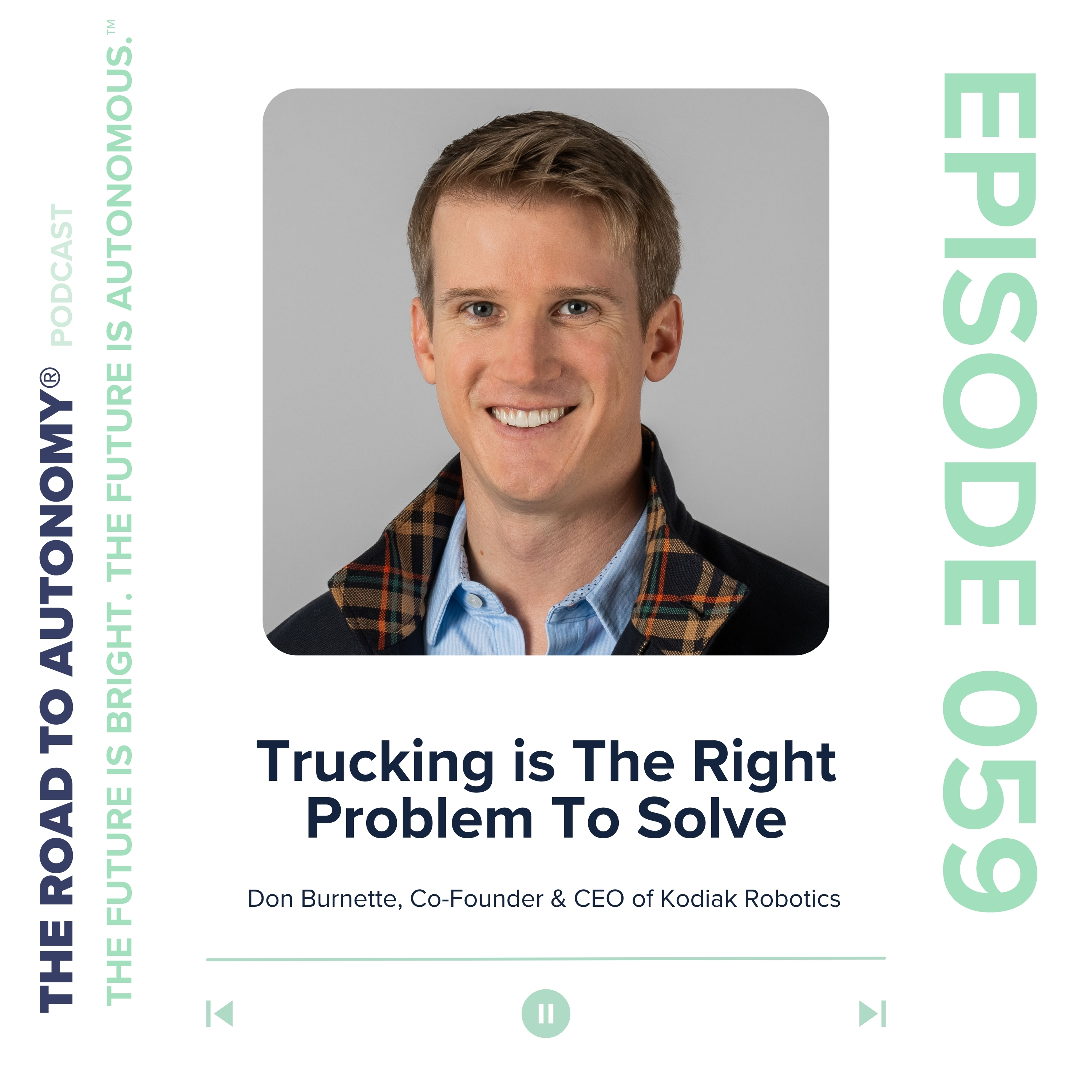
Ep 59Episode 59 | Trucking is The Right Problem To Solve
Don Burnette, Co-Founder & CEO of Kodiak Robotics joined Grayson Brulte on The Road To Autonomy Podcast to discuss why trucking is the right problem to solve.The conversation begins with Don discussing the early days of the Google Self-Driving Project.The early days were really an exciting time for those of us who were aware of the self-driving industry, which was very few folks at the time. – Don BurnetteIt was during this time that Don began to understand the business use case challenges that would soon come to face the self-driving car industry. During these early days, the team on the Google Self-Driving Car Project also thought about trucking, but it was dismissed.It was dismissed fairly early on, not because of technical reasons, just because at the time we all envisioned this as a very sexy technology. The leadership at Google was really focused on personal mobility. They wanted people to be able to touch and interact with the technology in a very direct way. So robo-taxis was the obvious direction for us to try and head. – Don BurnetteLooking at the trucking industry and what is happening today with the driver shortage, the growth of e-commerce, and the shortages in the global supply chain, it becomes very obvious that trucking is the right problem to solve.You have this gap that can actually can be solved, I think fairly uniquely with autonomy. – Don BurnetteIn the autonomous vehicle industry, we are beginning to see “The Great Pivot To Trucking” as the economics of autonomous trucking are far greater than those of the current robo-taxi models.It is the combination of the technical challenge combined with the commercial viability that I think is pushing other programs toward trucking. – Don BurnetteIt’s not only the economics of trucking that is appealing, it’s the fact the industry as a whole is welcoming autonomous trucking. The technology is not disrupting the market, it is helping to shore up industry and the United States economy.You are seeing that market really embrace it in a way that is unprecedented up until today. – Don BurnetteWall Street is beginning to pick up on the financial upside of autonomous trucking as several companies have gone public this year.Wall Street along with most of the AV industry has finally realized that the strong business case for autonomous trucks has been defined. – Don BurnetteRecently several analysts went on a tour to meet with autonomous trucking companies and came away impressed with the current state of technology. As Wall Street takes notice and Kodiak’s competitors have gone public, Grayson asks Don why Kodiak has not gone public. Don shares his honest insight into why Kodiak has opted to stay private.Shifting the conversation to Kodiak’s Generation 4 Autonomous Truck, Grayson asks Don about the company’s mirror pods innovation. Mirror pods were designed to be repaired or replaced in the field by non-skilled technicians with just four bolts.As Kodiak prepares to build out its business, Don shares Kodiak’s business model and the role that Kodiak Express and the Kodiak Driver will play in scaling the business.Once the safety case is proven out, we are also going to offer technology as a subscription. This is where customers can run the Kodiak Driver technology on the trucks that they own specifically. – Don BurnetteWrapping up the conversation, Grayson asks Don if he views Kodiak as more of a trucking company or a technology company.Recorded on Tuesday, October 5, 2021--------About The Road to AutonomyThe Road to Autonomy® is a leading source of data, insight and commentary on autonomous vehicles/trucks and the emerging autonomy economy™. The company has two businesses: The Road to Autonomy Indices, with Standard and Poor’s Dow Jones Indices as the custom calculation agent; Media, which includes The Road to Autonomy and Autonomy Economy podcasts as well as This Week in The Autonomy Economy newsletter.See Privacy Policy at https://art19.com/privacy and California Privacy Notice at https://art19.com/privacy#do-not-sell-my-info.
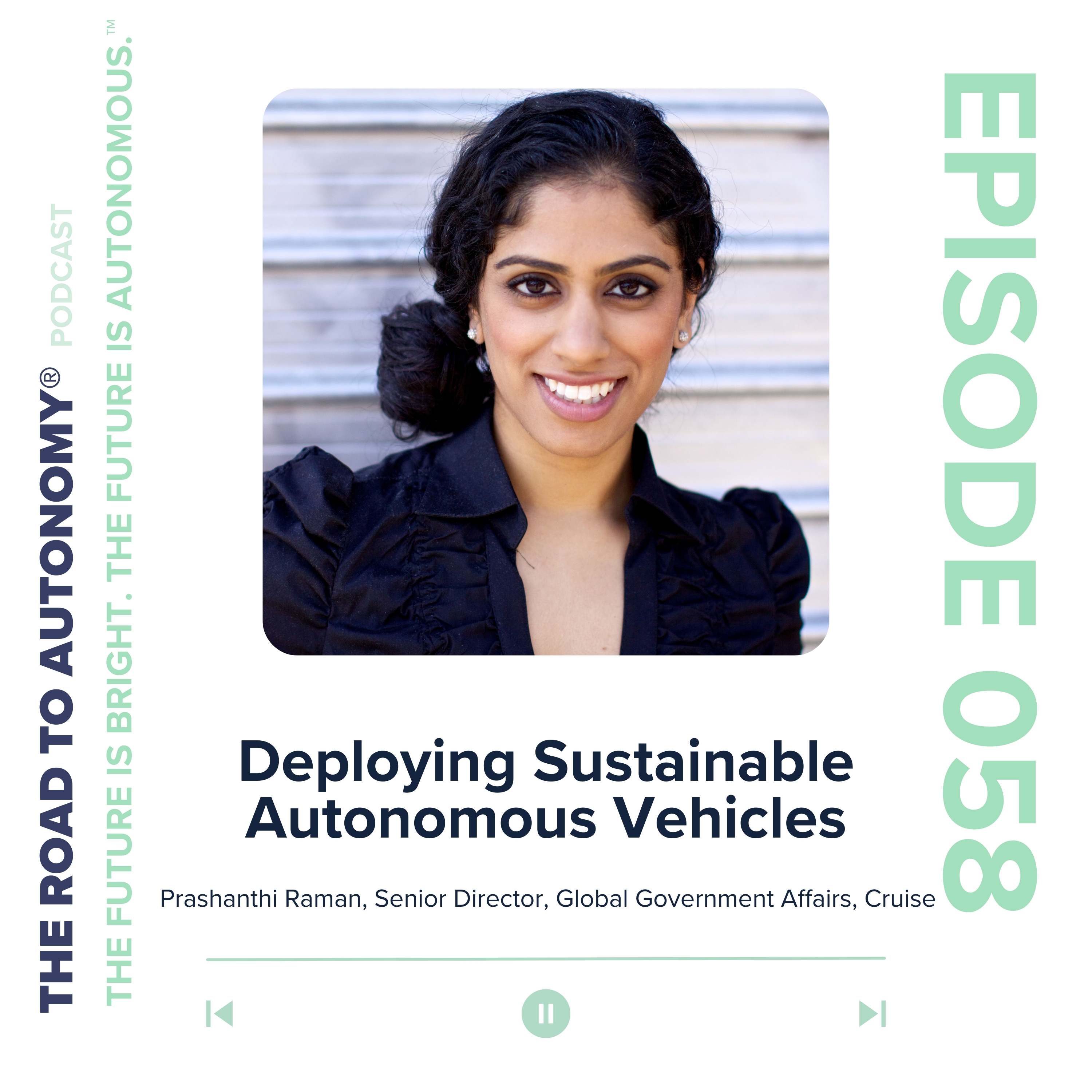
Ep 58Episode 58 | Deploying Sustainable Autonomous Vehicles
Prashanthi Raman, Senior Director, Global Government Affairs, Cruise joined Grayson Brulte on The Road To Autonomy Podcast to discuss deploying sustainable autonomous vehicles.The conversation begins with Prashanthi discussing why she wants to make the world a better place and what she learned from her mother.To [my mother] honor, reputation, people being able to trust you is something that you need to hold sacred. That is something that I really carry with me. – Prashanthi RamanWith a background steeped in health care, Grayson asks Prashanthi when she thinks health care services will be available in autonomous vehicles. When health care services become available in autonomous vehicles, lives will be able to be saved. For example, when a rider experiences a cardiac event in the vehicle, the vehicle will be able to be rerouted to a hospital with the doctors on duty being notified instantly about the incoming patient.While this is the future, Cruise is currently focused on impact. During the height of the COVID-19 pandemic, Cruise delivered 1.6 million meals and groceries to families and individuals in San Francisco.Operating in San Francisco, the conversation naturally shifts to policy and what it takes to deploy an autonomous vehicle in the City of San Fransico. Prior to joining Cruise, Prashanthi was the Head of State and Local Government Relations at Lyft where she learned the importance of educating consumers and elected officials on new and emerging mobility technologies.Autonomous vehicles will have a profound positive impact on society when they are deployed in meaningful numbers.Cruise’s desire is to launch into ride-sharing in a fleet-managed approach that is more accessible and affordable to more people. We want to do so in a more sustainable way than any other AV company. – Prashanthi RamanWhen Cruise deploys in a city, they want to be part of the local community. Being based in San Fransico and the 2021 baseball playoffs underway, Grayson asks Prashanthi when the SF Giants win their next World Series title, will the parade feature Cruise vehicles? While it’s always a possibility, Giants legend Willie Mays has been for a ride so you never know what the future might hold.What we do know that the future holds is sustainable autonomous vehicles. Sustainability is something that is core to the Cruise mission and near and dear to the team’s heart.We actually think that real innovation is zero-emission. – Prashanthi RamanWrapping up the conversation, Grayson, and Prashanthi discuss Cruise’s holistic approach to sustainability.Recorded on Tuesday, September 28, 2021--------About The Road to AutonomyThe Road to Autonomy® is a leading source of data, insight and commentary on autonomous vehicles/trucks and the emerging autonomy economy™. The company has two businesses: The Road to Autonomy Indices, with Standard and Poor’s Dow Jones Indices as the custom calculation agent; Media, which includes The Road to Autonomy and Autonomy Economy podcasts as well as This Week in The Autonomy Economy newsletter.See Privacy Policy at https://art19.com/privacy and California Privacy Notice at https://art19.com/privacy#do-not-sell-my-info.
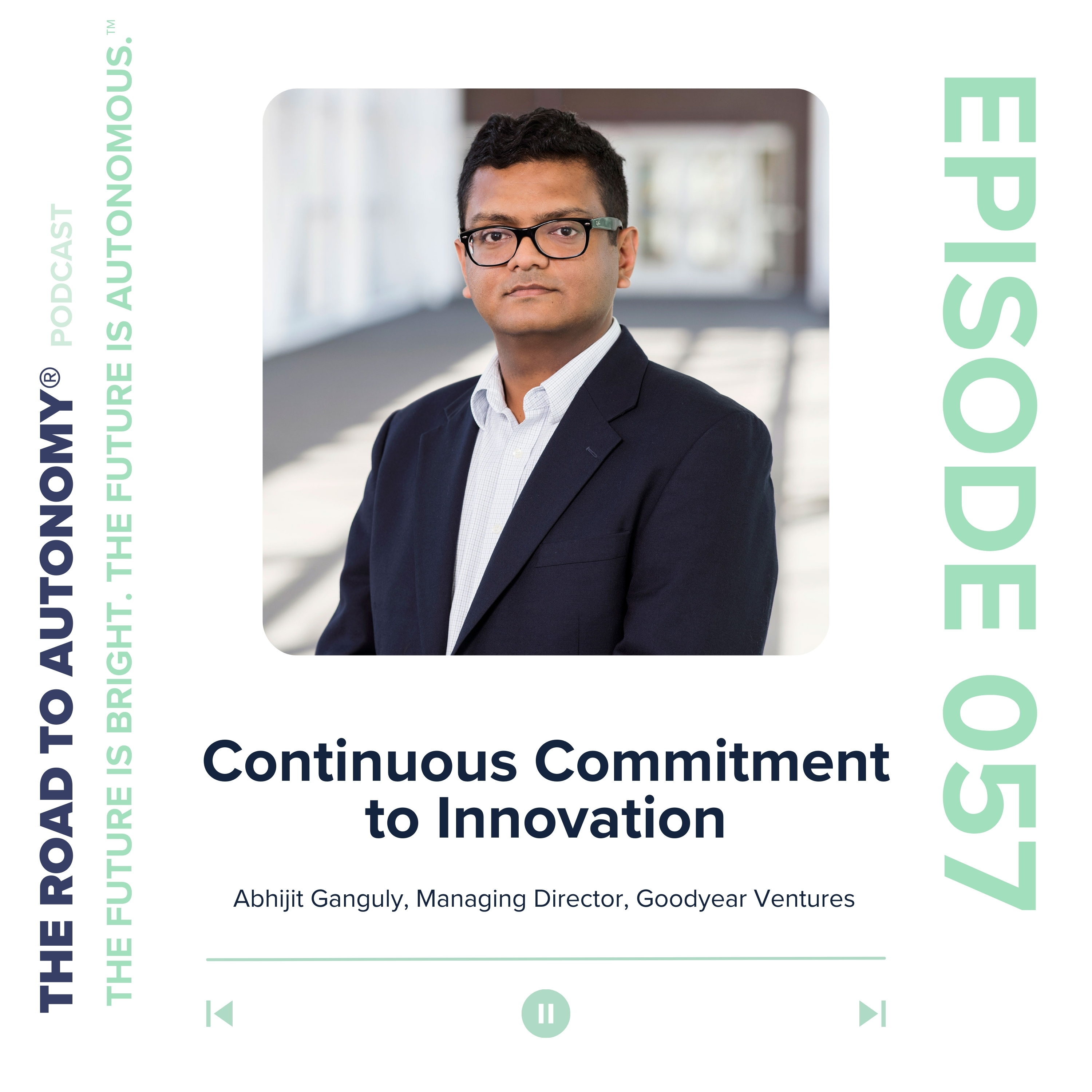
Ep 57Episode 57 | Continuous Commitment to Innovation
Abhijit Ganguly, Managing Director, Goodyear Ventures joined Grayson Brulte on The Road To Autonomy Podcast to discuss Goodyear’s continuous commitment to innovation.The conversation begins with Abhijit discussing Goodyear’s continuous commitment to innovation since 1898.We have a rich history and proven track record of innovating in the mobility space. – Abhijit GangulyAt CES 2020, Goodyear announced the Goodyear Ventures fund.We announced the fund at CES with the goal of letting everyone know that we were ready to build these strategic relationships with startups. – Abhijit GangulyA little over a year has passed since the fund was launched. With a successful exit already under the fund’s belt with the IPO of TuSimple, Grayson asks Abhijit what his thoughts are on the current state of autonomy. With the global truck driver shortage and the rapid expansion of e-commerce, a perfect storm is created for the development and deployment of autonomous trucks.The Port of LA which handles 40% of the nation’s imports is currently experiencing a backlog that is having a profound negative impact on the supply chain. Autonomous trucks can help to shore up the supply chain and deliver goods in an efficient manner. Goodyear Ventures is currently looking at investment opportunities around autonomous delivery and the supply chain.We are actively looking to support the acceleration of these trends and support them from our products and services building capabilities for new companies. – Abhijit GangulyShifting the conversation to tires and the impact that tires have on delivery, Grayson, and Abhijit discuss Goodyear’s SightLine, a suite of tire intelligence solutions. Since tires are the only thing on a vehicle that makes contact with the road, tires have the unique ability to gather real-time intelligent data on the driving conditions.We have the ability now to start telling the vehicle what the tire is feeling from the road. That knowledge allows the vehicle to drive safer and in a more efficient way. – Abhijit GangulyElectric vehicles will have a different set of requirements for tires, partly due to the weight of the vehicle and the sudden acceleration of the vehicles. With a growing EV market, Goodyear is actively supporting the trend of electrification by investing in tire technology.As EVs will need to charge, Goodyear Ventures invested in AmpUp to learn about charging. Today there a several charging companies in the market and no standard on payment. A software layer that allows for a seamless payment experience no matter which charging service that a consumer is using will be one of the keys to the mass adoption of electric vehicles.Looking to the future of mobility, Grayson asks Abhijit to share his vision of the future of mobilityI do feel like mobility can be much safer than it is today. It can be much more efficient than it is today. I hope it can be more fun than what it is today. – Abhijit GangulyWrapping up the conversation, Grayson, and Abhijit discuss the role that private capital plays in the advancement of autonomous mobility.Recorded on Tuesday, September 21, 2021--------About The Road to AutonomyThe Road to Autonomy® is a leading source of data, insight and commentary on autonomous vehicles/trucks and the emerging autonomy economy™. The company has two businesses: The Road to Autonomy Indices, with Standard and Poor’s Dow Jones Indices as the custom calculation agent; Media, which includes The Road to Autonomy and Autonomy Economy podcasts as well as This Week in The Autonomy Economy newsletter.See Privacy Policy at https://art19.com/privacy and California Privacy Notice at https://art19.com/privacy#do-not-sell-my-info.
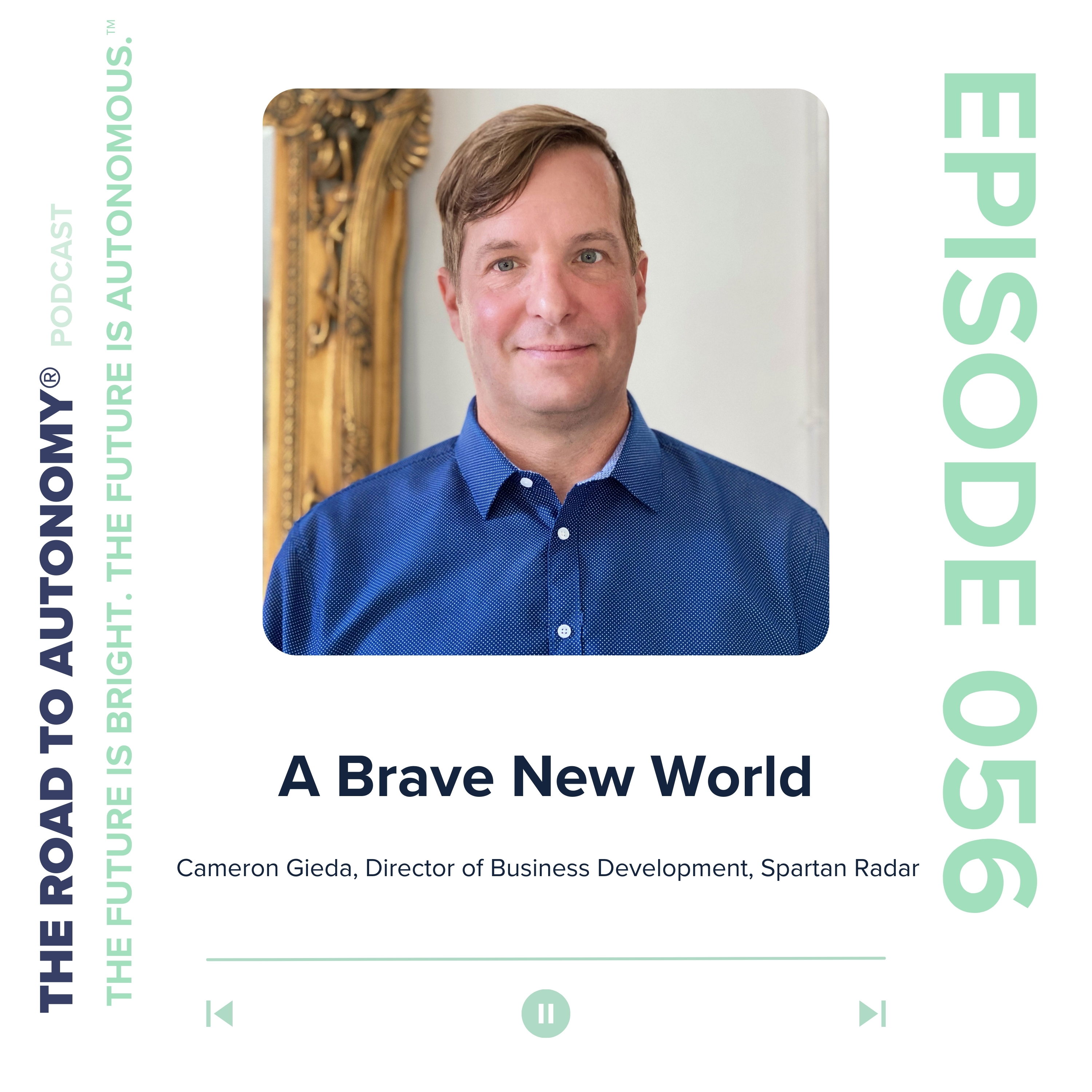
Ep 56Episode 56 | A Brave New World
Cameron Gieda, Director of Business Development, Spartan Radar joined Grayson Brulte on The Road To Autonomy Podcast to discuss why 4D radar is a brave new world.The conversation begins with Grayson and Cameron talking about surfing, sharks, and the impact Jaws had on society. The movie and the music make you think twice before getting in the water now.Learning to kinda overcome those primal fears and other fears that were generated by media is a challenge, but it is quite cathartic when you can finally relax in that situation understanding the odds. – Cameron GiedaComparing and contrasting surfing with mobility, Grayson and Cameron discuss the unique similarities between riding a wave and find a parking spot at the beach. Shifting the conversation to autonomy and when Cameron worked at AutonomouStuff, his office was stop #1 for most mobility start-ups in Silicon Valley. He shares his thoughts on the current state of autonomy.Covid helped drive far greater adoption of autonomy in the logistical space. – Cameron GiedaStaying on the theme of logistics and autonomy, Grayson and Cameron discuss the global supply chain and how autonomous trucking can help shore up the global supply chain. The Port Of LA is currently experiencing a massive shortage of trucks and workers which is forcing ships to idle out at sea for days until there is the capacity to unload the cargo.During a recent weekend at the beach, Cameron counted over 70 ships waiting to go into the Port of LA.It’s the very beginning of our economic funnel. – Cameron GiedaThere is a glaring need for U.S. Ports to embrace autonomous trucking as this technology will have a positive impact on the U.S. economy. To get here, though we need political leadership, however that this something that is lacking at the moment.Shifting the conversation to radar, Cameron explains why we joined Spartan Radar and what he saw in the company’s technology.The main reason I came to talk to Spartan was really because they look at it very differently. They take a very holistic systems engineering approach to the design. – Cameron GiedaSpartan radar can run on low-power ARM chips which is a competitive advantage for the company. The trend towards low-power will continue to accelerate as society begins to shift towards electric vehicles. After consumers shift to electric vehicles, they will shift to autonomous vehicles.Radar will not only play an important role in the driving aspect of autonomy but also the health and wellness of passengers and drivers of SAE Level 2 and 3 vehicles.You can use radar to monitor the heart rate of a driver. It can see through your chest and basically listen to your heart. – Cameron GiedaBeing able to detect a heart rate will save lives. Grayson and Cameron go on to discuss all of the health and wellness benefits that radar will be able to deliver in-vehicle.Wrapping up the conversation, Grayson, and Cameron discuss what’s next for Spartan Radar.Recorded on Tuesday, September 9, 2021--------About The Road to AutonomyThe Road to Autonomy® is a leading source of data, insight and commentary on autonomous vehicles/trucks and the emerging autonomy economy™. The company has two businesses: The Road to Autonomy Indices, with Standard and Poor’s Dow Jones Indices as the custom calculation agent; Media, which includes The Road to Autonomy and Autonomy Economy podcasts as well as This Week in The Autonomy Economy newsletter.See Privacy Policy at https://art19.com/privacy and California Privacy Notice at https://art19.com/privacy#do-not-sell-my-info.
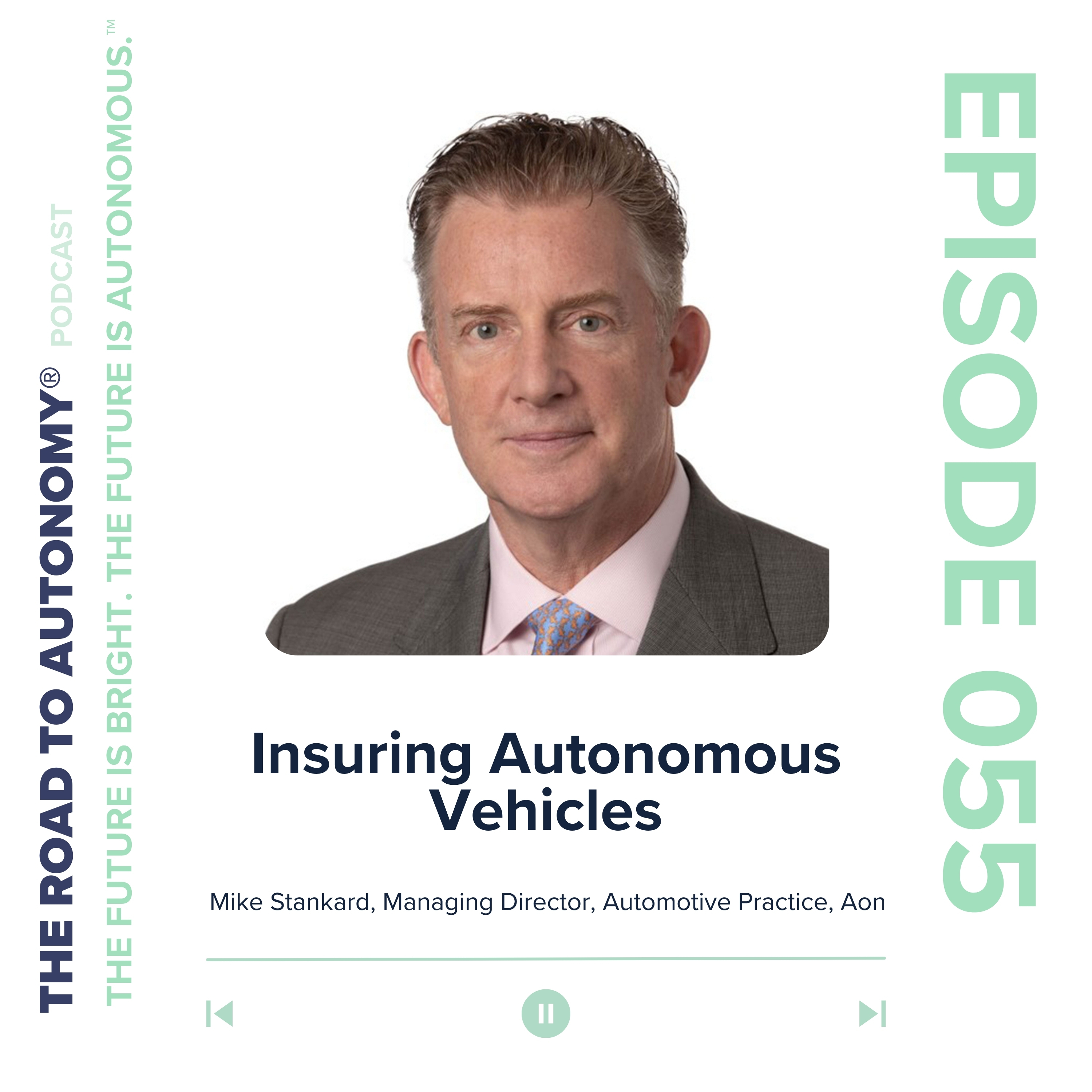
Ep 55Episode 55 | Insuring Autonomous Vehicles
Mike Stankard, Managing Director, Automotive Practice, Aon joined Grayson Brulte on The Road To Autonomy Podcast to discuss insuring autonomous vehicles.The conversation begins with Mike sharing his thoughts on the current state of the insurance market for autonomous vehicles.Overall, it’s pretty healthy. – Mike StankardThe right insurance policy for autonomous vehicle companies is absolutely critical. As AV companies move from testing and development to commercialization their insurance needs will change as the risk will change when paying passengers are involved.The risk profile of that vehicle raises dramatically when you move to that next step. – Mike StankardWhen AV companies are ready to take the next step and commercialize their service, the insurance markets are comfortable with insuring the risk as the technology has matured. The insurance markets are comfortable with insuring delivery, trucking, and passenger autonomous vehicle companies.The insurance for autonomous vehicle companies also carries over to directors and officers liability insurance when AV companies decide to go public.When a private company goes public, the risks that the directors, officers, investors, and other stakeholders are exposed to are substantially increased when you are going to be making a public offering. – Mike StankardIf the board of an AV company decides not to go public but instead accepts an offer to be acquired by another company, a new insurance program is developed to manage those risks. Managing risks throughout the lifecycle of an AV company is extremely important as it will ensure that the company is not blindsided by a risk that could be insured.For AV companies that are younger and are in the process of raising their Series B round, it is important to start a risk management program as the risk profile of the company will change.One of the biggest risks in a rapidly growing company is attracting and retaining top talent. – Mike StankardThe insurance policies that are written for autonomous vehicle companies are bespoke and unique to a company’s operations and overall risk profile. Inside the insurance industry, there are several companies that have dedicated teams focused solely on autonomous vehicles.In the long run, all humans are going to have interaction with autonomous vehicles. – Mike StankardHaving dedicated teams focused on AVs allows the insurance companies to better understand the risk and how to price it. The trend of dedicated teams specializing in this technology will only increase as the technology matures and AV companies increase the size of their deployments.Wrapping up the conversation, Mike and Grayson discuss the future of the insurance business as it directly relates to autonomous vehicles.Recorded on Tuesday, September 7, 2021--------About The Road to AutonomyThe Road to Autonomy® is a leading source of data, insight and commentary on autonomous vehicles/trucks and the emerging autonomy economy™. The company has two businesses: The Road to Autonomy Indices, with Standard and Poor’s Dow Jones Indices as the custom calculation agent; Media, which includes The Road to Autonomy and Autonomy Economy podcasts as well as This Week in The Autonomy Economy newsletter.See Privacy Policy at https://art19.com/privacy and California Privacy Notice at https://art19.com/privacy#do-not-sell-my-info.
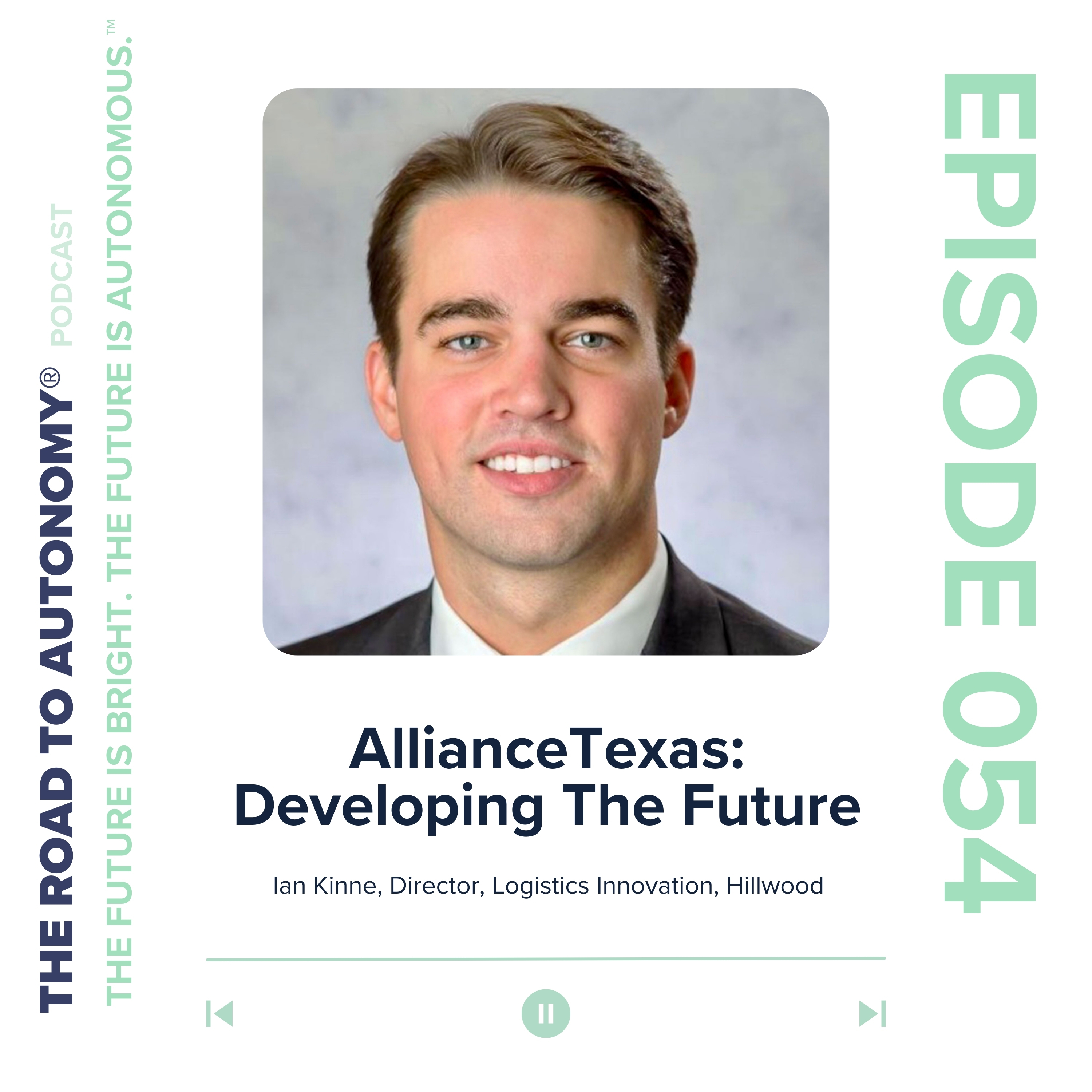
Ep 54Episode 54 | AllianceTexas: Developing The Future
Ian Kinne, Director, Logistics Innovation, Hillwood joined Grayson Brulte on The Road To Autonomy Podcast to discuss AllianceTexas and the Mobility Innovation Zone.The conversation begins with Ian describing the vision behind Hillwood’s AllianceTexas development, a 27,000-acre development that has generated $92 billion in economic impact and created over 63,000 jobs in just 30 years.Our platform grew from being a land development company to an industrial development company to a mixed-use development company which is now Alliance. – Ian KinneWith Texas seeing unprecedented growth of companies either expanding or relocating their headquarters, there is still room to grow at Alliance as the development is only about 50% built-out. Alliance was built around innovation as Hillwood made the decision early on to embrace fiber connectivity due to the leadership of the Perot family.The Perot family is incredibly forward-thinking. – Ian KinneWith Amazon operating a regional air hub, FedEx operating a regional sort hub, UPS operating a ground hub, and BNSF operating an intermodal hub at Alliance, Ian has incredible insight into the global supply chain. With this insight, Grayson asks Ian what he is seeing in the supply chain.The past 18 months really exposed some challenges in the global supply chain. – Ian KinneWhile the global supply chain faces challenges today, there is another challenge on the horizon — the truck driver shortage. This is where autonomous trucking comes into play as the technology will help to shore up the global supply chain. TuSimple recently opened their 2nd Texas autonomous trucking depot which will be part of their Autonomous Freight Network (AFN) at Alliance.With the autonomous trucking industry actively expanding to the Dallas / Fort Worth region, Grayson asks Ian why Hillwood decided to embrace autonomous trucking early on.We saw long-haul trucking leading the adoption of autonomy. – Ian KinneAutonomous trucking will complement the rail industry as the consumer demand for goods continues to rise. Ian and Grayson go on to discuss how these two industries will work together and why Alliance is well-positioned to embrace this soon-to-be emerging trend from an infrastructure standpoint.Wrapping up the conversation, Ian and Grayson discuss the Mobility Innovation Zone and how Alliance is planning for the next 30 years.Recorded on Tuesday, August 31, 2021--------About The Road to AutonomyThe Road to Autonomy® is a leading source of data, insight and commentary on autonomous vehicles/trucks and the emerging autonomy economy™. The company has two businesses: The Road to Autonomy Indices, with Standard and Poor’s Dow Jones Indices as the custom calculation agent; Media, which includes The Road to Autonomy and Autonomy Economy podcasts as well as This Week in The Autonomy Economy newsletter.See Privacy Policy at https://art19.com/privacy and California Privacy Notice at https://art19.com/privacy#do-not-sell-my-info.
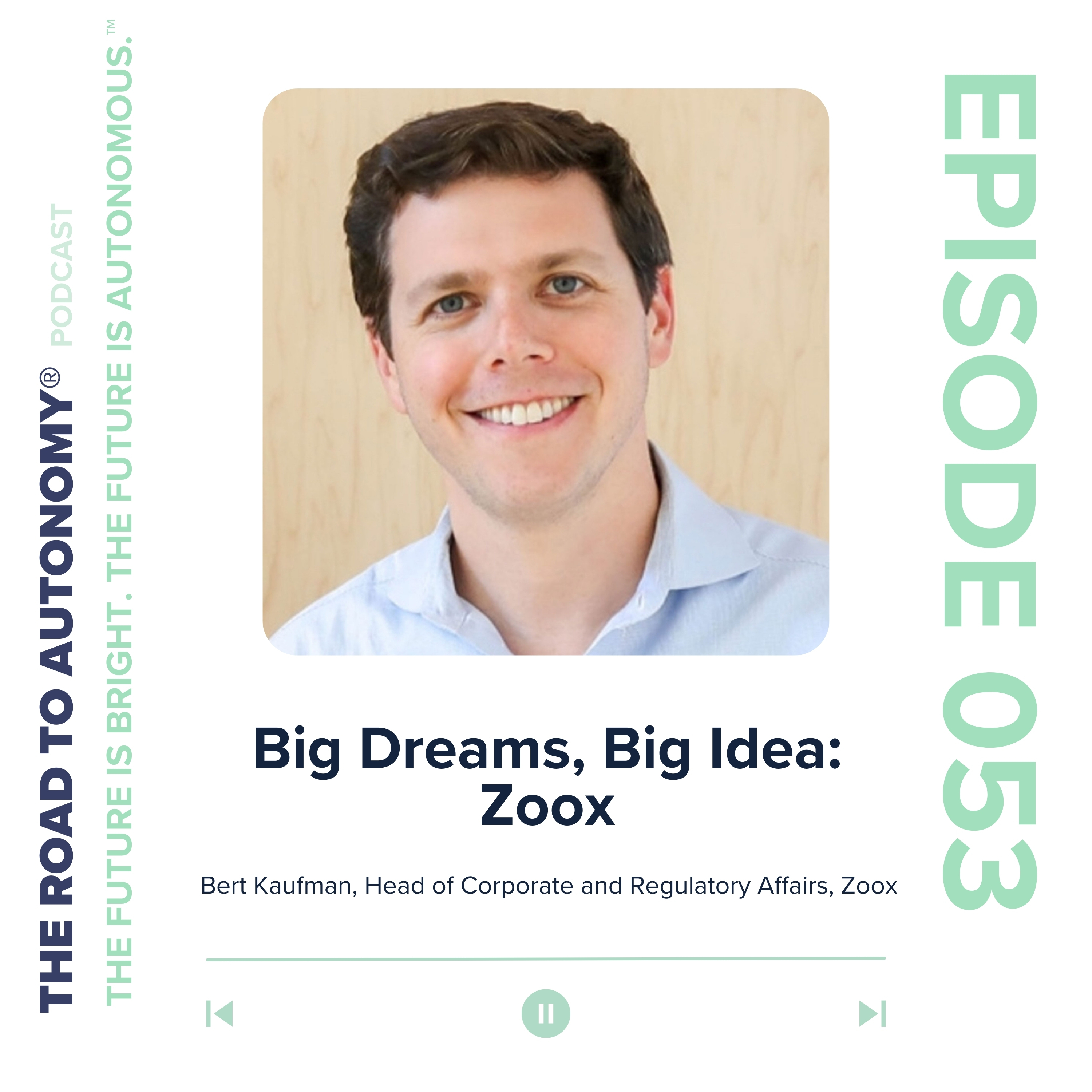
Ep 53Episode 53 | Big Dreams, Big Idea: Zoox
Bert Kaufman, Head of Corporate and Regulatory Affairs, Zoox joined Grayson Brulte on The Road To Autonomy Podcast to discuss big dreams, big ideas, and the role that policy plays in the future of autonomous vehicles.The conversation begins with Bert discussing his experience serving as a Senior Advisor in Secretary Penny Pritzker’s Office of Business Liaison inside of the Department of Commerce during the Obama Administration.Public service is really important. If people have the opportunity in their careers or lives to serve the public in shape or form, take it seriously, think about it, consider it. It can be incredibly rewarding. – Bert KaufmanBert served for a little over two-and-half years during the second term of the Obama Administration in the Department of Commerce. During his tenure in Government, he helped launch the Presidential Ambassadors Global Entrepreneurship program that exported innovation from Silicon Valley to the rest of the United States and the World.It was during his time in Government that Bert took his first ride in a self-driving car when Google invited him to take a ride in one of their self-driving Lexus’ on a highway outside of Washington, D.C. in 2014. The ride in the self-driving Lexus would change Bert’s life and become a defining moment for him.It was one of those moments where you are like, yeah, everything is going to change with this technology. – Bert KaufmanIn 2016, Bert left the Administration and moved out to Silicon Valley with the hope and dream of joining something early on that would solve bring problems for the world.I am a problem solver. I am really really driven by helping to solve big problems for society. – Bert KaufmanIt was the big idea that is the Zoox vision and the idea that this vision could increase safety and have a positive impact on society is what ultimately attracted Bert to the company. The Zoox vision of developing technology for the right reasons is as strong today as it was when Bert first joined in 2016.It’s not developing technology for technology’s sake. What is the reason why the technology is being developed? Who is it for? At Zoox the vision is for it is for everyone. It’s for the world. – Bert KaufmanAs Zoox prepares to deploy their beautifully designed purpose-built vehicles in cities around the world, policy moves to front and center in the conversation as currently there is no national autonomous vehicle framework in the United States.With no national autonomous vehicle framework, the regulation of the industry is falling to the State and local level. Each State seemingly has a different policy and certain cities/counties are trying to enact their own policies to the detriment of their local constitutes. Still, the industry is progressing forward as autonomous technology will save lives and reduce crashes around the world, all the while having a positive impact on society.One of the key differentiators of Zoox is the rider experience. The rider experience is prominently featured in Khalid’s New Normal music video. With the music industry embracing autonomous vehicles, Grayson and Bert discuss hip-hop culture and what the autonomous vehicle industry can learn from artists.Wrapping up the conversation, Bert and Grayson discuss why electrification was core to the Zoox idea from day one and when Zoox will begin to commercialize their service.Recorded on Thursday, August 12, 2021--------About The Road to AutonomyThe Road to Autonomy® is a leading source of data, insight and commentary on autonomous vehicles/trucks and the emerging autonomy economy™. The company has two businesses: The Road to Autonomy Indices, with Standard and Poor’s Dow Jones Indices as the custom calculation agent; Media, which includes The Road to Autonomy and Autonomy Economy podcasts as well as This Week in The Autonomy Economy newsletter.See Privacy Policy at https://art19.com/privacy and California Privacy Notice at https://art19.com/privacy#do-not-sell-my-info.
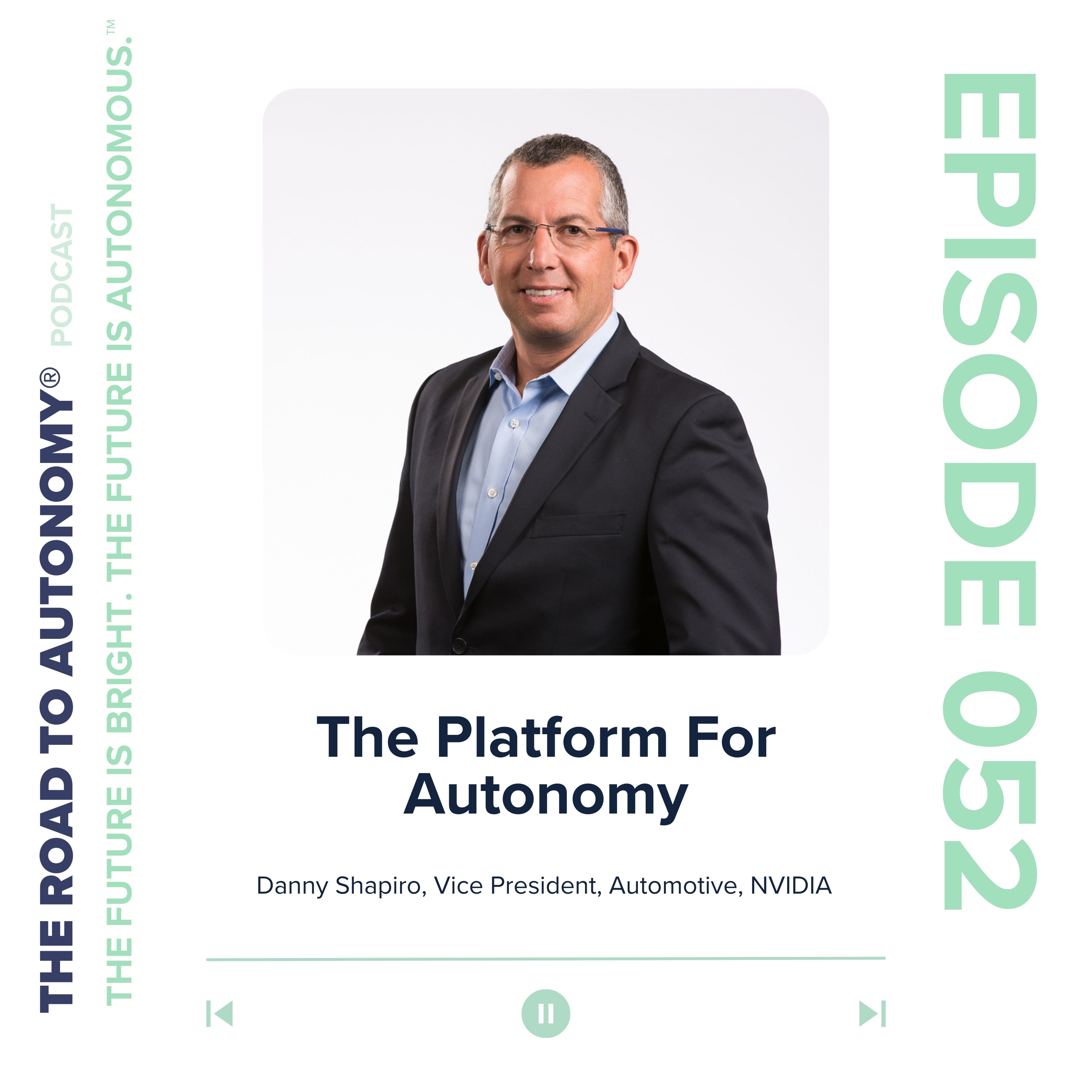
Ep 52Episode 52 | The Platform For Autonomy
Danny Shapiro, Vice President, Automotive, NVIDIA joined Grayson Brulte on The Road To Autonomy Podcast to discuss why NVIDIA is the platform for enabling autonomy.The conversation begins with Grayson and Danny discussing how NVIDIA developed the platform for autonomous vehicles and why NVIDIA first entered the automotive market.We’ve created an open platform. It’s an accelerated computing platform for autonomous vehicles. – Danny ShapiroIn 1999, NVIDIA invented the GPU to overcome performance bottlenecks of the CPU.Think of it as lanes on a highway, where a CPU maybe would be a dual-core or quad-core. It would have two lanes or four lanes for data to travel. The GPU has thousands of lanes. A highway with a thousand lanes is going to accommodate a lot more traffic. – Danny ShapiroWith over 370 automakers, tier 1 suppliers, developers, and researchers as partners, NVIDIA is playing a crucial role in ushering in the future of autonomy. A lot more goes into an autonomous vehicle than just the autonomous driving stack. The user experience will be an important element to success and NVIDIA’s GPUs are being used to improve speech recognition in-vehicle.Speech is very complex. You have many different languages. You have different accents. You have the same word that can mean different things, so the context matters. – Danny ShapiroNVIDIA is working on bringing natural language processing to the edge with the goal of reducing latency and improving the user experience inside of the vehicle. As an example, Danny shared the following scenario:You could say it’s warm and the car would respond, do you want me to turn on the AC or roll down your window? You can say, I will roll down the window. The car will also be able to recognize was it the driver or the passenger speaking.That’s a multi-modal approach where we are using AI on the voice and also with a camera inside that can monitor the occupants, read lips and determine who was talking. It would roll down the appropriate window based on who was speaking. – Danny ShapiroThis is the future of in-vehicle experiences and Mercedes, through a partnership with NVIDIA, is beginning to deploy the early stages of this technology in their new flagship 2022 EQS sedan. In the future when SAE Level 4 autonomous vehicles become available, the inside of the vehicle could become an interactive gaming experience.Integrating the motion of the vehicle with what is happening in virtual reality can be a really amazing experience. – Danny ShapiroIn the interior of SAE Level 4 autonomous vehicles, window glass will become augmented and screens will be ubiquitous, suggests Grayson. This new digital real estate will allow brands to create bespoke experiences for paying passengers, creating new potential revenue streams.Disney is an example of a brand that stands to benefit as it can extend the “Disney Experience” into the vehicle. Grayson shares an example of how Disney can potentially create Star Wars autonomous vehicles to further enhance the new Star Wars: Galactic Starcruiser two-night immersive experience at Walt Disney World in Orlando, Florida.The same technology that is used to develop immersive experiences is used to develop autonomous vehicles — simulation. With DeepMap joining NVIDIA, DeepMap’s maps will be used to enhance NVIDIA’s simulation technology.Through simulation, we can train the vehicle to be smarter. – Danny ShapiroInside of NVIDIA, there is one centralized engineering organization, which has many benefits as engineers are able to learn from each other and apply processing techniques to different industries from autonomous driving to health care.If you look at something like autonomous driving where we are taking images from front-facing cameras and trying to detect pedestrians, our health care group and the work they are doing in medical imaging and cancer research leverages a lot of that same technology. Because if you do a scan, an MRI, an X-Ray, you are looking for cancer cells. It’s not that different to process from what we are doing with pedestrian detection. – Danny ShapiroWith NVIDIA’s core approach towards engineering and solving the world’s biggest challenges through compute, the company was busy simultaneously building an autonomous trucking business at the same time they were building their automotive business. Today, NVIDIA has 15 truck partners to complement its 370+ automotive industry partners.We are not building the trucks, we are not building the cars, but we are helping our customers do their life’s work and create amazing products. – Danny ShapiroWrapping up the conversation, Grayson and Danny discuss NVIDIA’s data center strategy and the advantage for autonomous vehicle and trucking companies to build autonomy solutions on the NVIDIA platform.Recorded on Tuesday, August 10, 2021--------About The Road to AutonomyThe Road to Autonomy® i
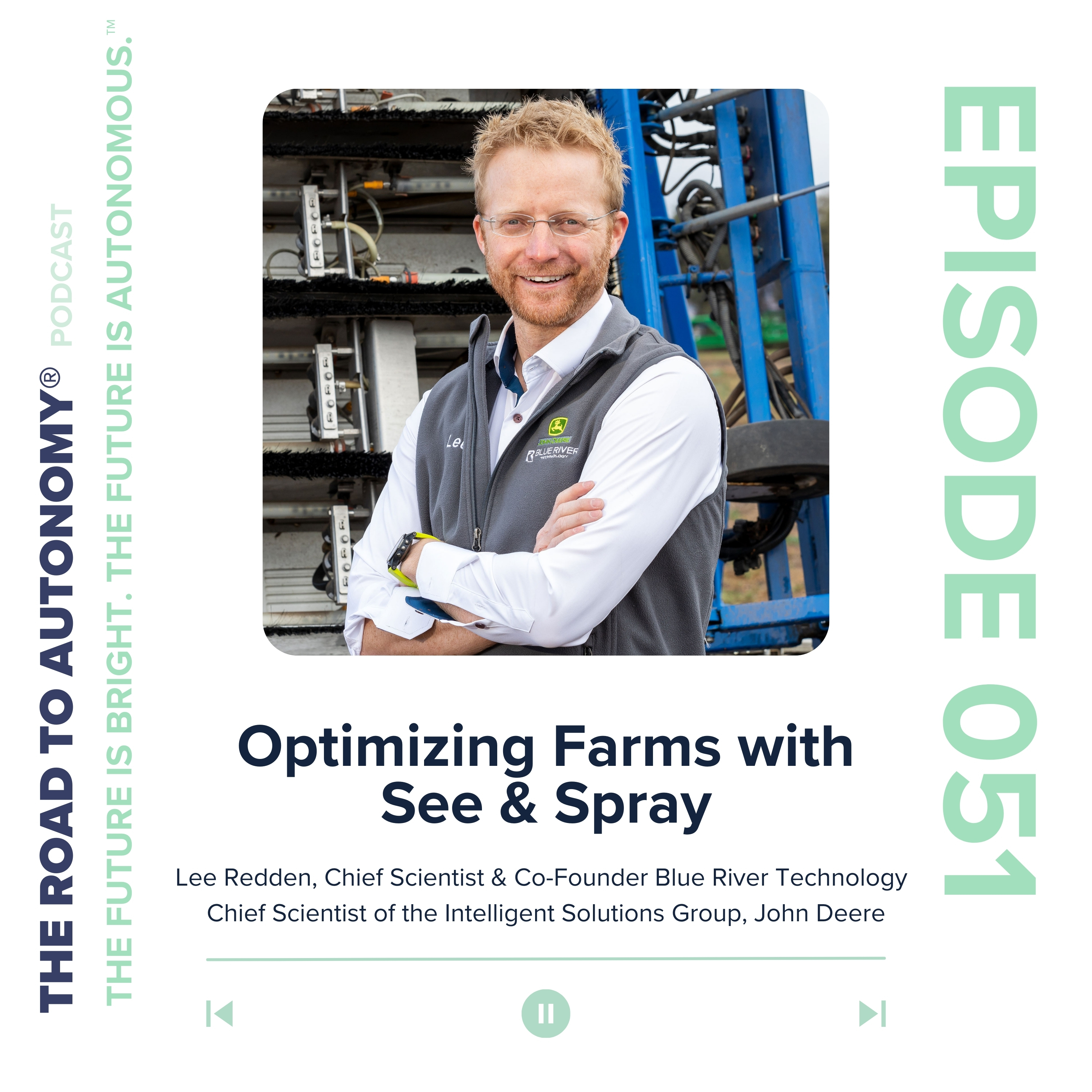
Ep 51Episode 51 | Optimizing Farms with See & Spray
Lee Redden, Chief Scientist & Co-Founder Blue River Technology and Chief Scientist of the Intelligent Solutions Group at John Deere joined Grayson Brulte on The Road To Autonomy Podcast to discuss how See & Spray can help farmers optimize farms.The conversation begins with talking about growing up in Nebraska and how having a shop at the back of his house would have a profound impact on his life.We had a shop on the back of my house and I would spend 4 or 5 hours a day in the back of the shop just putting things together. I built a couple of go-karts, I built a car, I just have so many fond memories of just being back there welding something up, grinding something down, and building. – Lee ReddenLee’s hands-on experiences in the shed led to him enrolling at the University of Nebraska where he designed microcircuit boards for miniature surgical robots. During his time on campus, Lee watched a documentary about the DARPA Grand Challenge. Little did Lee know at the time, but the documentary would change his life.One of the things growing up in Nebraska, I wasn't really exposed to a lot of computer science. What that documentary did was show that there was this computer science group that was basically taking a stock car and adding a couple of sensors to it, but not putting too many sensors on it.Then it was a computer science problem and it really kind of paved and showed me the way for what was possible with computer science in an area that I thought was really cool and was cars and autonomy and I just saw that as like oh my gosh if you can make this car do things it couldn’t do before, it just becomes so much more useful. Totally game-changing in the possibilities. – Lee ReddenThe documentary exposed Lee to the possibilities of machine learning, computer vision, and AI. Eventually, he enrolled at Stanford to learn computer vision.I knew this is what I needed to do to really get up to speed to work in the field I wanted to. – Lee ReddenAt Stanford, the seeds were planted for the founding of Blue River Technology when Lee met his co-founder, Jorge Heraud. From autonomous lawnmowers to the autonomous weeding of carrots to the thinning of lettuce. Lee and Jorge kept pivoting until they had their breakthrough moment with high-precision weeding machines.During the early days of See & Spray, farmers provided invaluable feedback on the system as it was rolled out to farms in the United States. With feedback from farmers in hand, Blue River began to test in different geographies to build the data sets that are required to fully optimize the system.The diversity of data you have really matters. – Lee ReddenIn 2017, John Deere acquired Blue River Technology. Being part of John Deere is allowing Blue River to take a longer-term view on the development of the technology.It has been really fantastic for the company to be able to have that longer-term view. – Lee ReddenAfter the acquisition, Lee took a step back to focus on control systems.We will see shifts in machine form and how machines are designed and put together based on control systems. – Lee ReddenWhile control systems are next, Lee is still dedicated to See & Spray. With an estimated 250 species of herbicide-resistant weeds, uncontrolled weeds result in annual losses of approximately $43 billion in corn and soybean crops, Blue River is using their computer vision technology to identify the weeds to help farmers save money when they use the See & Spray system.The See & Spray system reduces the number of herbicides used by 77%, having a positive economic impact on farms and a positive impact on the environment.Higher precision and plant by plant care is a win, win, win situation. – Lee ReddenWrapping up the conversation, Grayson and Lee discuss the global population growth and how automation on farms can help feed the growing global population.Recorded on Tuesday, July 27, 2021---------About The Road to AutonomyThe Road to Autonomy® is a leading source of data, insight and commentary on autonomous vehicles/trucks and the emerging autonomy economy™. The company has two businesses: The Road to Autonomy Indices, with Standard and Poor’s Dow Jones Indices as the custom calculation agent; Media, which includes The Road to Autonomy and Autonomy Economy podcasts as well as This Week in The Autonomy Economy newsletter.See Privacy Policy at https://art19.com/privacy and California Privacy Notice at https://art19.com/privacy#do-not-sell-my-info.
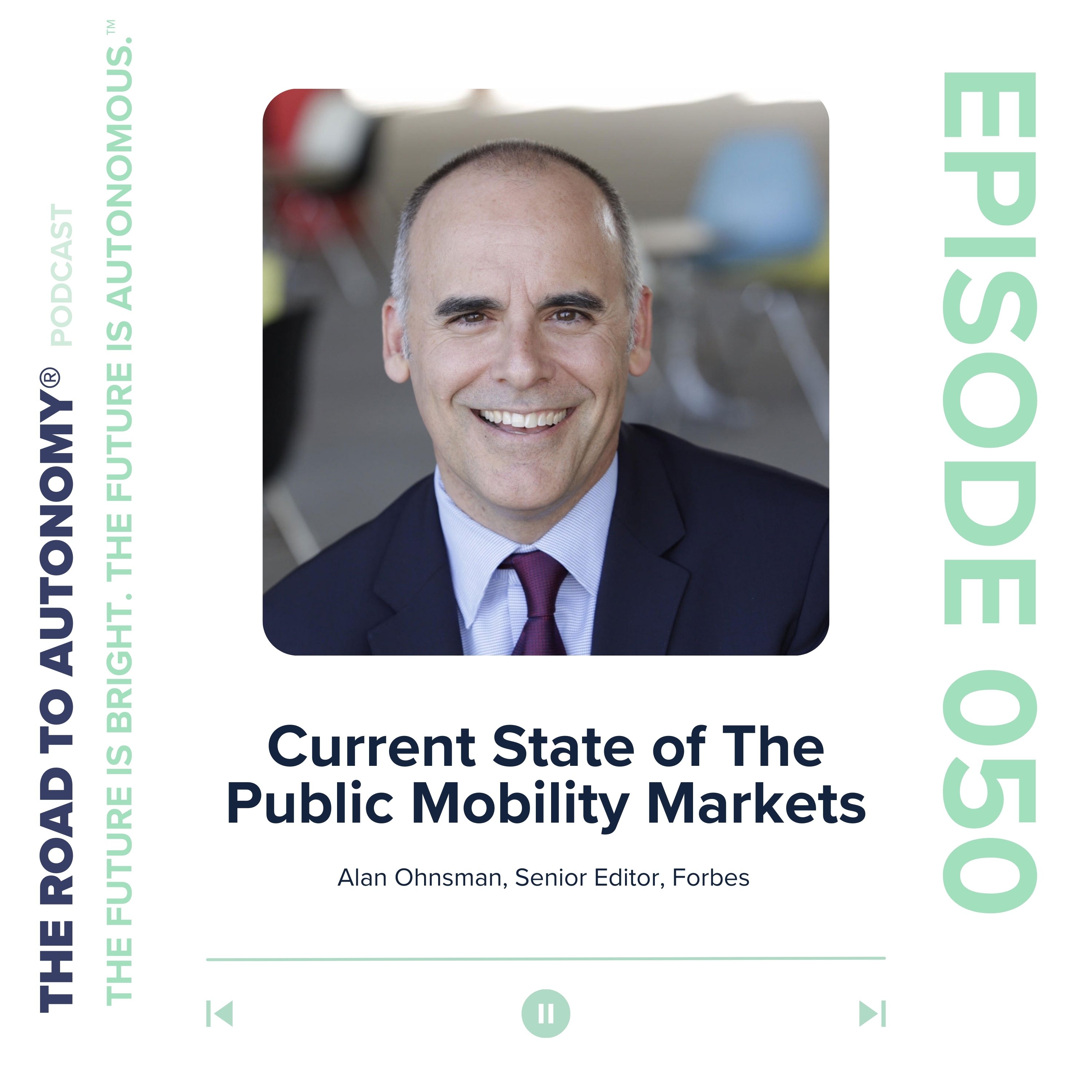
Ep 50Episode 50 | Current State of The Public Mobility Markets
Alan Ohnsman, Senior Editor, Forbes joined Grayson Brulte on The Road To Autonomy Podcast to discuss the public mobility markets. From SPACs to Tesla to traditional IPOs, Grayson and Alan discuss the current state of the public mobility markets, electric vehicles, autonomous vehicles, and autonomous trucking.The conversation begins with Alan and Grayson discussing the current state of the SPAC market.SPAC activity in both the EV and AV space is just astonishing. I think there is an increasing concern about the quality of some of these offerings. Not all companies are created equal. Not all startups are the same. – Alan OhnsmanAs the SPAC market matures and companies begin the process of de-spacing, issues around the business models and the strength of the balance sheet are being to come into question. A major issue with SPACs is the lack of disclosure as compared to a traditional IPO. We are seeing this very issue play out today with Lordstown Motors as they are under investigation by the Department of Justice over the pre-order numbers of their vehicles.Alan points out the lack of disclosures will lead to increased regulation.The amount of investor litigation aimed at some of these companies is going to be high. I think it’s inevitable that the regulator is going to step in and say slow your roll. We really need to vet these a little more carefully and set some better ground rules. – Alan OhnsmanTesla which went public in 2010 continues to dominate the public electric vehicle market while capturing the public’s imagination.There is going to be so much competition in the EV space that Telsa has a first-mover advantage. The brand is well established. It is clearly popular in many markets. – Alan OhnsmanWhile Tesla is dominating the electric vehicle market today, Toyota is well poised to gain market share in the future. As the economics of electric vehicles improve and electric vehicle charging becomes more readily available, the market is going to change as Toyota and Hyundai move into the market.With the lack of electric vehicle charging around the United States, Grayson raises the point that hybrid vehicles will become the dominant vehicle type sold over the next 10 years. This is where Toyota wins as they are the clear leader in hybrid technology. Until we achieve ubiquitous electric vehicle charging, consumers will be unsure about adopting and embracing EVs.Ubiquitous charging. It has to be everywhere and people have to know where it is. It has to be a no-brainer. – Alan OhnsmanShifting the conversation back to autonomous vehicles, Grayson asks Alan about the Aurora SPAC and specifically highlights one of the risk factors in the investor presentation:We operate in a highly competitive market and some market participants have substantially greater resources. If one or more of our competitors commercialize their self-driving technology before we do, develop superior technology, or are perceived to have better technology, it could materially and adversely affect our business, prospects, financial condition, and results of operations.This risk factor is a clear reference to Waymo, which continues to raise billions of dollars.The amount of funding for [autonomous vehicles] is enormous. Just astonishing. – Alan OhnsmanBoth Aurora and Waymo are focused on developing a universal driver which can drive a robo-taxi and an autonomous truck. As Aurora begins life as a public company, investors and analysts could begin to question the universal driver approach due to economics and the business model.The same can be said for Waymo if and when Alphabet spins out Waymo as a publicly-traded company. If this was to happen, investors would have the opportunity to invest in a pure-play. Waymo for the robo-taxi market and Waymo Via for the logistics market.The money maker in the near term certainly is going to be trucking and logistics. No question about it. That is going to be where everyone makes their money at the outset. – Alan OhnsmanWith the iShares US Transportation ETF ($IYT) having returned 15.16% YTD (as of Monday, July 19, 2021), Grayson asks Alan when will we see an autonomous trucking company added to the index. Alan believes by 2023 we will start to see autonomous trucking companies added to the index. Those companies could be TuSimple and Waymo.Staying on the 2023 theme, Alan discusses why this could be the year that autonomous trucking becomes a two-horse race between TuSimple and Waymo. With TuSimple and Waymo’s growing fleets of autonomous trucks, the companies are well poised for the future.Fielding an ever-larger fleet is important. You can do a lot on modeling in computer simulation, but having physical fleets and getting real-world data day-in and day-out, it’s really hard to substitute that. – Alan OhnsmanWhile fielding an ever-larger fleet is critically important, having real-world experience and hiring indi
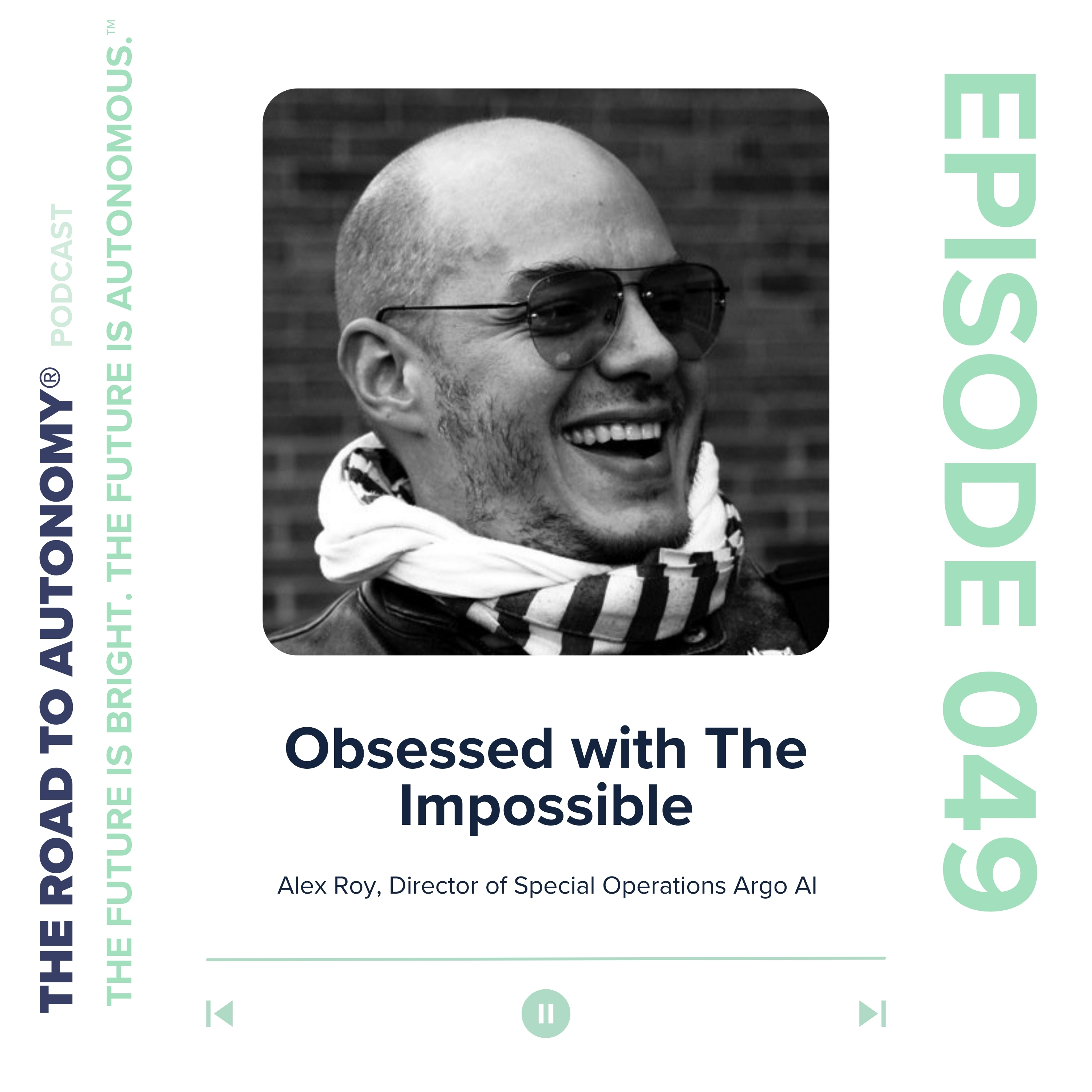
Ep 49Episode 49 | Obsessed with The Impossible
Alex Roy, Director of Special Operations Argo AI, Host of The No Parking and Autonocast Podcasts, Editor-at-Large, The Drive, Founder of the Human Driving Association, author of The Driver, and Producer of APEX: The Secret Race Across America joined Grayson Brulte on The Road To Autonomy Podcast to discuss why he has always been obsessed with the impossible.The conversation begins with Alex discussing his 2007 U.S. Cannonball Run in a BMW M5 and how he was able to break the record using data.I have always been obsessed with things that people said are impossible. Someone says something is impossible, I want to try it. Or as an investor, I want to invest in it because the future is always built by optimists. – Alex RoyIt was during this time that Alex first learned about mapping and how creating a map with intricate details such as construction zones and potential police hiding places could enable the U.S. Cannonball record to be broken.16, 17 years ago, we created map data sets around road construction, road conditions, police locations, and looked at NOAA (National Oceanic and Atmospheric Administration) [for] weather, and created a very comprehensive data set and plan. – Alex RoyThe U.S. Cannonball Run changed Alex’s life after the story was published in Wired Magazine. The FBI called and invited Alex to speak at the FBI Academy about how he used free off-the-shelf mapping tools to create datasets to do the impossible – breaking the Cannonball record.With the record broken, the FBI asking how he did it, corporations asking for advice on mapping, an appearance on The Tonight Show with David Letterman, the Alex Roy brand was born.Years later, Alex would meet Bryan Salesky, Co-Founder & CEO of Argo AI. That meeting would change Alex’s life when Bryan asked him how he did it and said the following:So basically you were using for bad all of the technology that we use for good. You have an engineer’s mind but not the education. Have you ever considered how else you might use that knowledge?It was at that moment that Alex put his knowledge to good and joined Argo AI.Very few people in life are lucky enough to have such an opportunity, so I was going to take it. If I had lasted one week, I would have said that was the best week of my life because I could point back and say that was a good thing. – Alex RoyWhile Argo operates as a business, other companies in the industry are solely focused on perfection and not necessarily the business of autonomy. Grayson asks Alex for his thoughts on this trend and what is behind it. Alex emphasizes the importance of studying and understanding history.Every successful technology and business built around it learns from the prior one. Or at least the successful companies do. – Alex RoyLooking at history, Grayson discusses his theory on why autonomous vehicles will become platforms that will enable businesses to build experiences and expand margins. Staying on the history theme, Alex talks about the ascending room and how elevators enabled profitable experiences.[Elevators] were installed by the department stores because as spectacles and experiences the thought was that they would compel or inspire shopping. – Alex RoyCombining an Only in Vegas experience with a mobile gambling platform and an autonomous vehicle, casinos can expand their highly profitable gaming operations into mobility. Grayson and Alex discuss why this could become a product.Each city will have multiple products based on and around the autonomous vehicles. Some may exist today, but what you really want is to create experiences and products around autonomy that don’t exist today. What is the number one lesson in entertainment? Give them something that they can’t get anywhere else and if you can, let them have it twice. – Alex RoyTaking this experience outside of Vegas to cities around the world, this experience will become possible as States continue to legalize online gambling. In the future fans will be able to ride in bespoke autonomous vehicles to sports events. These vehicles will be fully stocked for tailgating with beverages, food, and the ability to gamble. From a safety perspective, fans will no longer be driving home from the game after consuming adult beverages.With the advancements of AR (augmented reality), new experiences will be created in the mobility sector that will turn into new profitable revenue streams for autonomous vehicle companies which operate as platforms. This is the future of the much-rumored Apple Car. The Apple Car will be a platform that allows Apple to expand its fast-growing services business.Airbnb will be another very large player in the autonomous vehicle industry in the future as the company looks to expand its experiences business. The music industry will also benefit as it is an experiences business. On an episode of The No Parking Podcast, Alex and Bryan spoke with Ba
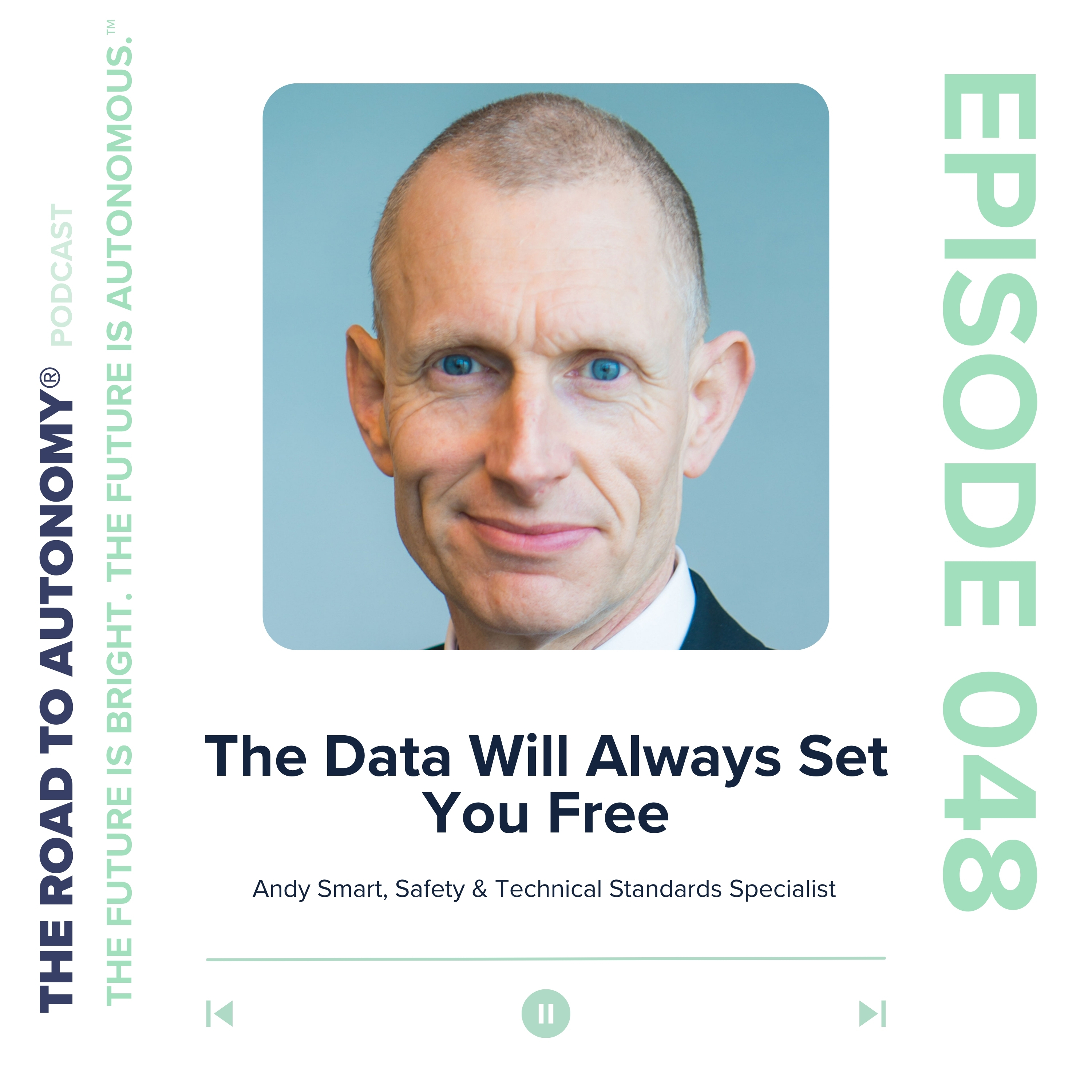
Ep 48Episode 48 | The Data Will Always Set You Free
Andy Smart, Safety & Technical Standards Specialist joined Grayson Brulte on The Road To Autonomy Podcast to discuss why the data will always set you free when an organization embraces and implements a culture of safety.The conversation begins with Andy talking about the first time he experienced mobility freedom when he got his first bike at age ten in Scotland. Today, Andy rides a fixed-gear bike without brakes as he wants to be in control and fully aware of his surroundings at all times.It’s all about the awareness of your surroundings and your connectivity to your environment. You will never be more connected in that sense when you are riding [a fixed-gear bike without brakes] as you have to be tuned in both from an acoustic point of view, visual and acoustic. – Andy SmartWhen Andy is driving a vehicle he uses the same visual and acoustic tactics that he uses while riding a bike. Once on a cross-country drive from Michigan to California with his wife, Andy overtook a truck as he heard the sound of little pieces of rubber hitting the windshield because it was only a matter of time before the truck tire would blow. Potentially avoiding a crash because he was fully aware of his surroundings.It is all about the feeling. – Andy SmartWhile driving a vehicle or riding a motorcycle or a bike, Andy is always aware of his surroundings.I am looking through the lens of the driver and also the environment and the connection between the two. – Andy SmartTaking a look at the current driving environment, a lot of drivers do not pay attention while driving as they are distracted by their phones. What these drivers fail to realize and what Andy points out very clearly is that a vehicle is a lethal weapon that has to be treated with care and respect.Building upon Andy’s real-world experiences, Grayson shifts the conversation to autonomous vehicles and how Andy approaches AV safety. One of the most important elements of AV safety is the organization’s commitment to safety.The whole basis of a safety culture in an organization is above any business objectives. It has to be you are held to a higher level. Business decisions should not be built around safety. Safety decisions are made because of safety, not through business decisions. – Andy SmartA holistic approach to safety is what is required to develop a culture of safety. It’s an approach that is built around all aspects of the operation and takes into account both off-vehicle and on-vehicle operations. Without a globally recognized safety standard, Grayson asks Andy how AV safety can be measured.As engineers, it is our responsibility to go in and look and to say ok who already does this. Let’s benchmark other industries. We are not unique. We are into some groundbreaking stuff here, but hey would you believe that mining has been automating mining trucks for the last 35 years.Maybe we can learn a bit from them. It’s different but learn, adapt, because as engineers you have to put your hand on your heart and say I did my best and I did everything I could do to find out what was the right way to do it. – Andy SmartWith the advancements of ADAS (advanced driver-assistance systems) and the growing trend of consumers over-relying on SAE Level 2+ systems, Grayson and Andy discuss who is responsible for a crash and what can be done to improve safety.The person who is making the decisions is responsible, they have primary responsibility. – Andy SmartWrapping up the conversation, Grayson and Andy discuss how consumers approach safety. Why dealer training for ADAS is important and the role driver monitoring will play in the future of ADAS.Recorded on Tuesday, July 13, 2021--------About The Road to AutonomyThe Road to Autonomy® is a leading source of data, insight and analysis on autonomous vehicles/trucks and the emerging autonomy economy™. The company has two businesses: The Road to Autonomy Indices, with Standard and Poor’s Dow Jones Indices as the custom calculation agent; Media, which includes The Road to Autonomy podcast and This Week in The Autonomy Economy newsletter.See Privacy Policy at https://art19.com/privacy and California Privacy Notice at https://art19.com/privacy#do-not-sell-my-info.
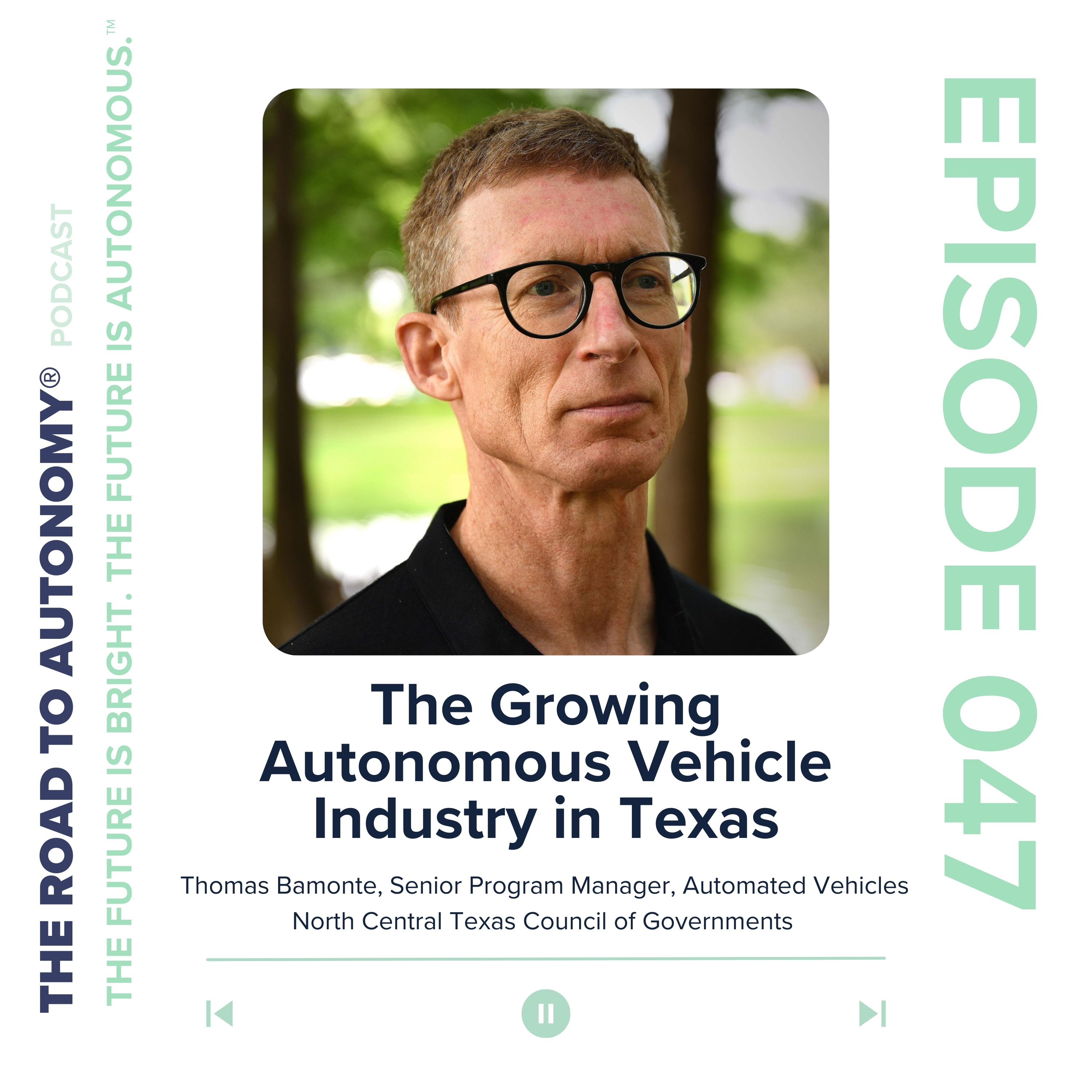
Ep 47Episode 47 | The Growing Autonomous Vehicle Industry in Texas
Thomas Bamonte, Senior Program Manager, Automated Vehicles, North Central Texas Council of Governments joined Grayson Brulte on The Road To Autonomy Podcast to discuss the growing autonomous trucking and autonomous vehicle industries in Texas.The conversation begins with Tom discussing how he first became interested in autonomous vehicles. In 2006, Tom wrote an article about merging the best of highway transportation and transit through autonomous vehicles.Little did Tom know at the time, but this article would go on to have a profound effect on his career. After writing the article, Tom started attending conferences and became one of the earliest individuals discussing the positive impact that autonomy will have on society.Being based in the Dallas Fort Worth Region, Tom has a front-row seat to autonomy as the region is emerging as the home of autonomous trucking. The geographical features of the region are land, land, and more land. With these geographical features, Tom explains why the region has openly embraced autonomous trucking.We are a large inland port and we have to be extra scrappy because we do not have a river or a seaport, we just have land. We have to be extra innovative and extra supportive of our freight partners. – Thomas BamonteThe region is part of the Texas Triangle and the home to DFW (Dallas Fort Worth International Airport) which is a major cargo hub. The airport has a yearly $20 billion economic impact on the North Texas Region. With welcoming State and Regional Governments, a major cargo hub, and freight companies located in the region, the area is well-positioned to fully embrace the future of autonomous trucking.We are well situated at the apex of the Texas triangle to host freight operations. It’s a great central U.S. location where AV freight can reach basically all of the country within a reasonable amount of time. – Thomas BamonteAs the Texas population continues to grow as individuals and families relocate from other States, Grayson asks Tom how the North Central Texas Council of Governments is continuing to drive the economic growth from autonomous vehicle companies relocating to the region.We are investing in our AV 2.0 program. We’re advancing six automated vehicle deployments and we’re moving from thinking of deployments as individual exercises. We are trying to build a regional AV program that has everything from sidewalk delivery bots. We are investing in what may become the nation’s first automated truck port. That is one of the six projects.We are signaling through our investments that we are open for business and willing to effectively partner with our private sector AV developer partners. – Thomas BamonteExpanding the conversation to other regions of Texas, Grayson asks Tom about Argo AI’s deployment in Austin and Nuro’s deployment in Houston.All of the Texas cities are evolving into very diverse AV environments. – Thomas BamonteWhen Drive AI operated a self-driving passenger service for the public in Frisco and Arlington, Texas in 2018 and 2019, they interacted with the community and did outreach to the local community to encourage future engineers to learn about the technology. The community/school outreach program was a tremendous success with Tom summing it up as a Norman Rockwell moment.With the AV 2.0 plan, NCTCOG has partnered with Dallas College to stand up and invest in an AV-oriented curriculum with a focus on trucking and autonomy. Additionally, NCTCOG organized the North Texas Center For Mobility Technologies.We are looking for every opportunity to work with the AV companies to develop the curriculum and engage with the next generation of workers in the transportation and related sectors. – Thomas BamonteShifting the conversation to autonomy and urban environments, Tom shares his thoughts on what autonomous passenger vehicle and delivery deployments will look like in the future.I can see delivery expanding from individual items to experiences and a richer sort of interaction, instead of just having stuff dropped off. – Thomas BamonteWith the Dallas Cowboys and Texas Rangers being located in the Dallas Forth Worth region, there is a tremendous opportunity for bespoke day-of-game autonomous vehicle experiences.Wrapping up the conversation, Tom makes the case on why autonomous vehicle and autonomous trucking companies should consider expanding to Texas.Recorded on Tuesday, June 22, 2021--------About The Road to AutonomyThe Road to Autonomy® is a leading source of data, insight and commentary on autonomous vehicles/trucks and the emerging autonomy economy™. The company has two businesses: The Road to Autonomy Indices, with Standard and Poor’s Dow Jones Indices as the custom calculation agent; Media, which includes The Road to Autonomy and Autonomy Economy podcasts as well as This Week in The Autonomy Economy newsletter.See Privacy Policy at https://art19.com/priva
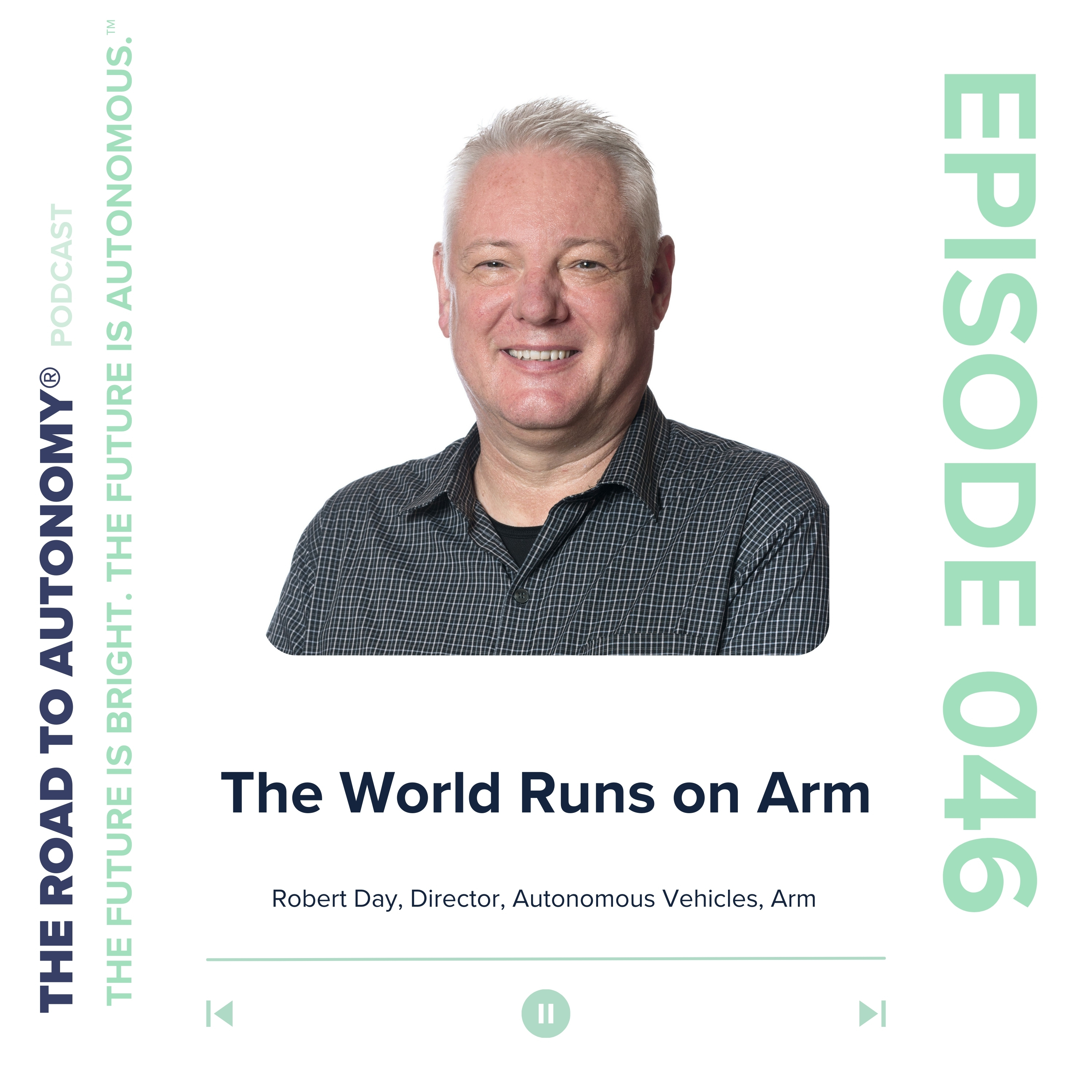
Ep 46Episode 46 | The World Runs on Arm
Robert Day, Director, Autonomous Vehicles, Arm joined Grayson Brulte on The Road To Autonomy Podcast to discuss why the world runs on Arm.The conversation begins with Robert discussing Arm’s partnership approach and how over 190 billion devices around the world contain Arm-based chips.It’s really all about the partnership approach. It’s all about working with our silicon partners and giving them the right technology to allow them to address the different markets they want to put their silicon into. – Robert DayFocusing on Arm’s partnership approach, Robert discusses how Arm was able to ship a record 7.3 billion Arm-based chips in Q4 2020 as the global markets faced a supply chain crunch.Our partners like to work with us because we are continuously innovating. – Robert DayShifting the conversation to autonomous vehicles, Grayson asks Robert when and why did Arm first enter the autonomous vehicle industry. Arm has been in the automotive industry for a long time. Building upon this experience, Arm expanded into the autonomous vehicle industry as companies prepare for the mass deployment of autonomous vehicles as they will need great silicon.As autonomous vehicle companies such as Cruise actively prepare for the commercialization of their service, Grayson asks Robert if custom chip architectures are currently being developed for autonomous vehicles.Whether people will develop custom silicon to do it, I do not know. As they get closer to deployment, it’s what is available. What is out there? It costs a lot of money to develop a custom chip. If our silicon partners have the right SOCs based on our technology, they will probably just pick those up off the shelves.There might be certain applications, there might be certain parts of the vehicle that may be doing sensor intelligence where they might want to do some of their own silicon. At the moment you have to get closer to the actual deployment before it will be obvious which way people will go. – Robert DayTaking a look at the autonomous vehicle industry as a whole, Robert shares his thoughts on the current state of the autonomous vehicle market. The adoption of autonomous vehicles will come down to trust. Grayson and Robert go on to discuss how brands and experiences and help to develop trust with autonomous vehicles.When developing relationships and engaging with the autonomous vehicle industry, Arm asks the following:What do you need in order to make autonomy deployable? Mass deployable. – Robert DayArm has been having these discussions for years as Arm considers autonomous vehicles a growth market.It really is an industry and a market that we want to make sure that Arm is front and center in. – Robert DayAs society begins to shift to electric vehicles and the autonomous vehicle industry embraces electrification, Arm is well-positioned as the company specializes in low-power, high-performance chips.Energy efficiency, thermal efficiency, it will all be really important for deployment. Especially in vehicles that are fit-for-purpose or vehicles that we actually drive as higher levels of autonomy come into them. – Robert DayWith higher levels of autonomy, safety is paramount. Robert discusses Arm’s commitment to functional safety and why it is mission-critical for the safe deployment of autonomous vehicles.Putting the entire conversation into context, Grayson asks Robert what role he sees Arm playing in the autonomous vehicle ecosystem as the industry matures.It’s all about deployability and what’s required for autonomous vehicles to be deployed. – Robert DayWrapping up the conversation, Robert shares the story of how he first became interested in autonomous vehicles. It all started with an episode of Knight Rider. Grayson expands the conversation into the role popular culture will play in the adoption of this technology and why in the future there will be an Elvis autonomous vehicle service in Las Vegas.Recorded on Tuesday, May 25, 2021--------About The Road to AutonomyThe Road to Autonomy® is a leading source of data, insight and commentary on autonomous vehicles/trucks and the emerging autonomy economy™. The company has two businesses: The Road to Autonomy Indices, with Standard and Poor’s Dow Jones Indices as the custom calculation agent; Media, which includes The Road to Autonomy and Autonomy Economy podcasts as well as This Week in The Autonomy Economy newsletter.See Privacy Policy at https://art19.com/privacy and California Privacy Notice at https://art19.com/privacy#do-not-sell-my-info.
Ep 45Episode 45 | Simulation First Approach to Autonomy
Qasar Younis, CEO & Co-Founder, and Peter Ludwig, CTO & Co-Founder, Applied Intuition joined Grayson Brulte on The Road To Autonomy Podcast to discuss simulation and why a simulation first approach to autonomy is key to building and scaling autonomous vehicles.The conversation begins with Qasar talking about what the marketplace looked like when he co-founded Applied Intuition with Peter in 2017. This was the same year that Waymo began testing autonomous minivans in Chandler, Arizona without a safety driver on public roads. Reflecting on this, Peter shares his take on the marketplace.Generally speaking, there is not really winner take all dynamics in the automotive ecosystem. There is always going to be many companies. There are going to be many players, [with] Waymo being sort of in front in autonomy technology. What is great for Applied is that they are showing the world what is possible and that we are building tools which frankly enable any automotive company to compete at that level. – Peter LudwigQasar expands upon this to share his perspective on how the autonomous vehicle industry operated in 2016, 2017.In 2016, 2017 the only pattern was the Waymo pattern. Which is raise tons of money and build everything in-house. That’s just not the case anymore. I do not think there a single sophisticated in-house sim team that isn’t also working with somebody in some capacity that is not inside. – Qasar YounisBuilding upon this, Qasar dives into the economics of build versus buy and why it makes economic sense to buy instead of building in-house simulation tools. With technology advancements over the past four and a half years and new powerful chips being introduced, Applied has been able to close the sim to real gap.You want simulation to be as close as possible to the real-world performance of the system, while still being cost-effective to run. – Peter LudwigAs Applied matures as a company, the company has begun to assume a leadership position in the autonomous vehicle industry. Applied has recently published their Best Practices for The Testing and Deployment of Autonomous Vehicles guide that can be downloaded here.In the guide, Applied summarizes best practices for the testing and development of autonomous vehicles. It is an important guide that can be incorporated into your development workflow today.Our goal of the company is to move the entire autonomy ecosystem forward. – Qasar YounisTaking a step back for a moment, Qasar discusses simulation and references an interview where a Waymo Senior Director of Product Management stated that simulation is roughly responsible for 80 to 85% of their progress.Fundamentally there are many things that you cannot test safely in the real world that are necessary for ensuring the safe operation of the vehicle. You can model those scenarios in simulation. – Peter LudwigIn a 2018 interview with Bloomberg, Peter spoke to Mark Bergen about scenarios. Grayson asks Peter how the team comes up with scenarios to model in simulation. Taking it to a local level, Grayson shares several scenarios and Peter explains how simulation can help to prepare autonomous vehicles for those ODDs (Operational Design Domains).Shifting the conversation from autonomous vehicles to autonomous trucks, Grayson asks Peter what are the main differences between simulation for autonomous vehicles and autonomous trucks. Peter explains in-depth how there is a large difference in the approach to simulation for trucks due to the fact the way trucks are built and how they are driven.While there are different forms of simulation, Applied has been solely focused on autonomy since day one.Fundamentally we think that the autonomous industry will be very, very large. We believe that everything that moves will be autonomous. We want to enable that reality. – Qasar YounisExpanding different forms of simulation, Peter explains how Applied’s simulation platform differs from a system designed to generate images for movies and video games.Wrapping up the conversation, Qasar and Peter discuss why everything that moves will be autonomous.Recorded on Thursday, June 17, 2021.--------About The Road to AutonomyThe Road to Autonomy® is a leading source of data, insight and commentary on autonomous vehicles/trucks and the emerging autonomy economy™. The company has two businesses: The Road to Autonomy Indices, with Standard and Poor’s Dow Jones Indices as the custom calculation agent; Media, which includes The Road to Autonomy and Autonomy Economy podcasts as well as This Week in The Autonomy Economy newsletter.See Privacy Policy at https://art19.com/privacy and California Privacy Notice at https://art19.com/privacy#do-not-sell-my-info.
Ep 44Episode 44 | If You Bought It, A Truck Brought It
Robert Brown, Senior Director of External Affairs, TuSimple, Jordan Coleman, General Counsel & Vice President of Policy, Kodiak Robotics, and Jonny Morris, Head of Public Policy & Communications, Embark Trucks joined Grayson Brulte on The Road To Autonomy Podcast to discuss the current state of the autonomous trucking industry.The conversation begins with Robert Brown sharing his thoughts on the current state of the autonomous trucking industry from a policy perspective.We are doing quite well as an industry. It is a testament to the core folks that work in this industry. We work very closely at a State and Local level in all of the States that we operate in. We all come from the adage that we do not like to surprise anyone. – Robert BrownExpanding upon Robert’s comments, Jordan talks about the efforts that are being made around education and building trust with elected officials and regulators.Trust is absolutely paramount in this industry. Showing that deep commitment to engagement on a State, Regional and Local level. As well as that deep commitment to building those relationships first. – Jordan ColemanRounding out the conversation about the current state of autonomous trucking, Jonny shares a detailed overview of policy and the regulatory environment.Even though autonomous trucking is cutting-edge technology, it is an emerging industry. We are not entering into a blank slate from a regulatory environment perspective. There are plenty of requirements, rules, authorities that exist in the trucking industry today. – Jonny MorrisPutting the regulatory environment into perspective, Grayson asks Robert why Arizona, New Mexico, and Texas are emerging as the leading hubs for the testing and deployment of autonomous trucking.It has a lot to do with the regulatory environment. All three States now have legislation on the books that allows [autonomous trucking] testing and deployment. – Robert BrownIn January 2021, Kodiak successfully completed a disengage-free customer delivery from Dallas to Houston, Texas. Grayson asks Jordan how the company prepared for the run from a policy perspective. Jordan explains that before Kodiak started operations in Texas, the company met Governor Abbot’s office, State Legislators in both chambers, the Texas Department of Public Safety, the State Highway Patrol, and regional and local partners.Shifting the conversation to California, Jonny talks about the importance of the California market for autonomous trucks and what the current state of autonomous trucking policy looks like in California. Robert chimes in about his love of living in San Diego and why autonomous trucking will create new high-paying jobs in California.Looking at the priorities of the Governor and the California State Legislature, Jonny explains why the autonomous trucking industry is aligned with California’s goals on climate change and emissions.Automation is something that can be adapted for any drivetrain, whether it’s diesel, natural gas, or electric vehicles. Furthermore what we have seen is that automation can take any drivetrain and make it more efficient because it is a more efficient driver than a human driver. – Jonny MorrisWith the electrification goals of California, Grayson asks Jordan if Class 8 trucks will ever become electric.It’s absolutely a when not an if. – Jordan ColemanAs Jonny and Jordan clearly explained, the autonomous trucking industry is clearly aligned with the goals of California. With California’s unemployment rate currently holding at 8.3%, Robert talks about the positive economic impacts that autonomous trucking will have on the State and the new high-paying jobs that this industry will create.If California does this, it is a true game-changer from an economics perspective. – Robert BrownHighlighting the U.S. Department of Transportation VOLPE Macroeconomic Impacts of Automated Driving Systems in Long-Haul Trucking study as an example, Robert explains why autonomous trucking will create new high-paying jobs and have economic benefits on the U.S. economy.With the industry projected to have a positive economic impact on the U.S. economy the group discusses how the industry interacts with lawmakers and regulators on a federal level. Jonny addresses the misnomers around what the autonomous truck industry does and does not need from a regulatory and legislative standpoint.[There is a misnomer] that this is the wild west and there are no rules for autonomous trucks. The fact of the matter is that the trucking industry is heavily regulated at the federal level. – Jonny MorrisStaying on the theme of misnomers, Jonny, Robert, and Jordan all address the workforce issue and clearly explain that if you are a truck driver today, you can retire a truck driver. There is an enormous need for high-quality truck drivers today partly due to the increase in e-commerce.If you bought it, it’s bee
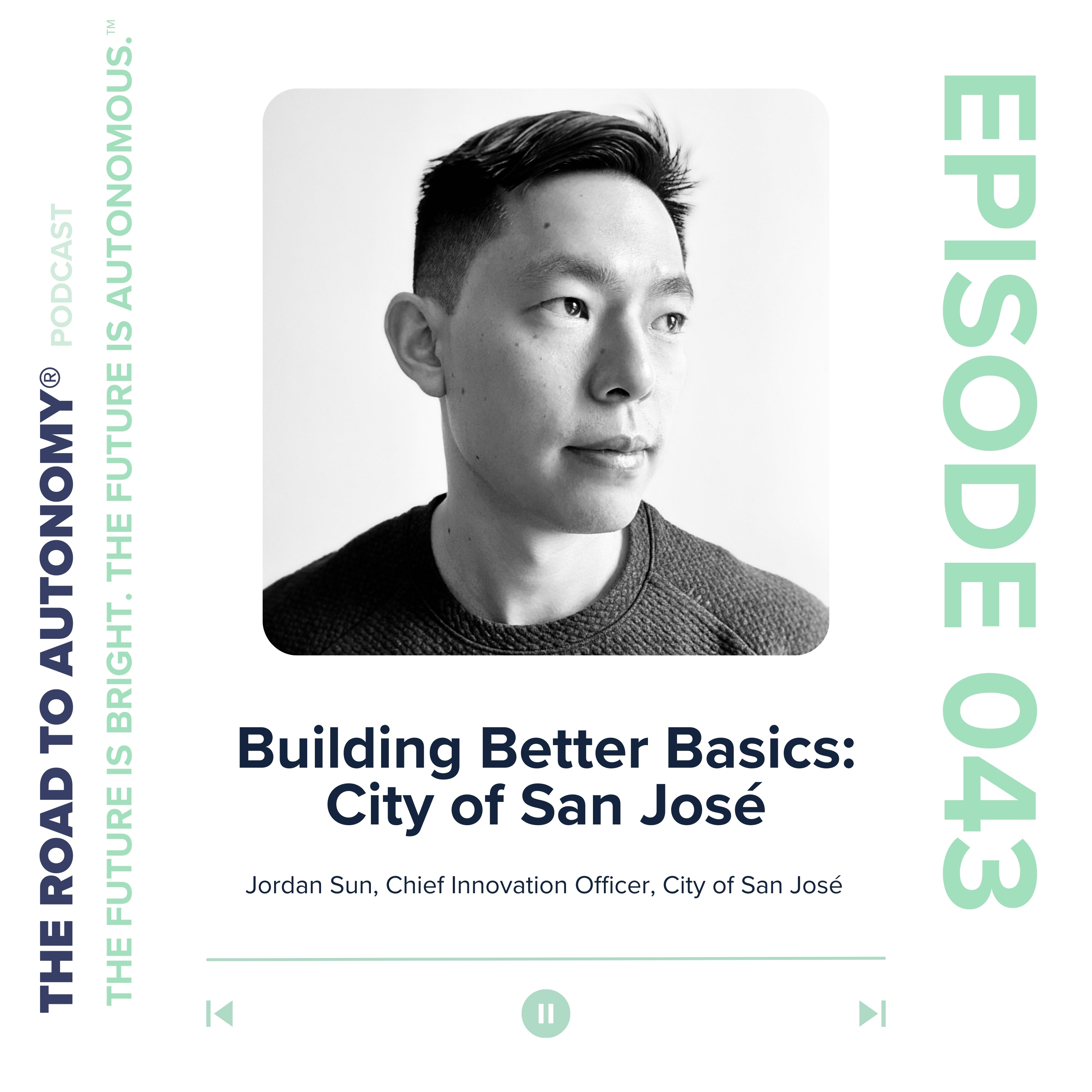
Ep 43Episode 43 | Building Better Basics: City of San José
Jordan Sun, Chief Innovation Officer, City of San José joined Grayson Brulte on The Road To Autonomy Podcast to discuss building better basics in the City of San José through innovation and technology.The conversation begins with Jordan discussing his time serving two tours of duty (2012 and 2020) in Afghanistan with the U.S. Army. Comparing and contrasting his experiences, Jordan talks about his time and what he learned during each tour of duty. During his 2020 tour of duty, Jordan and his team built and shipped a software product from the battlefield.Continuing to serve his country, Jordan serves as a Tech Scout for the U.S. Army where he develops and builds relationships with innovative companies in Silicon Valley.I am interested in all things tech-related. – Jordan SunDuring his stint at the U.S. State Department, Jordan continued to study international relations. Putting all of his skills to work from his time in the military, finance, and diplomacy, Jordan joined the City of San José in 2020 as Chief Innovation Officer to make a difference.What attracted me initially was, the pandemic hit, I spent most of my service overseas when I served. I really didn’t feel like I did enough for the community. Sometimes I would scratch my head and was like well what could I actually do tangibly to change someone’s life in terms of here in America. – Jordan SunAfter his first meeting with the Mayor and being unable to sleep that night, Jordan knew that he had to step up and make a difference for the community of San José.If not me then who, and if it is me, I need to put skin in the game and give it a try. – Jordan SunIn November 2020, The Center for Digital Government announced that the City of San José was named the nation’s most innovative local Government. Being extremely humble, Jordan talks about how it was a team effort to the recognition and how it’s merely just a starting point to where the City wants to go in the future.Looking to the future, Grayson asks Jordan how the City is working to bridge the digital divide. In the latest budget, the Mayor directed $10 million dollars to improve broadband connectivity for residents of San José.With a City of over 1 million residents, Grayson asks Jordan how he is approaching innovation.It’s about getting to more tangible outcomes. – Jordan SunJordan looks at every digital service/website that the City builds as a product and how the residents of San José will interact with it and use the product. This philosophy ties directly into Jordan’s Three Pillars of a Smart City: Data, Digital Product/Engagement, IoT Network which he discusses in depth.Shifting the conversation to mobility, Grayson asks Jordan what role mobility will play in his vision of a City of the Future. Mobility is just not the movement of passengers, it is the moment of goods. Mobility will also have a positive impact on health care as society shifts to autonomous vehicles.With 50 companies currently testing in California, Grayson asks Jordan about the City’s relationship with the autonomous vehicle industry.There is a very healthy relationship. – Jordan SunLooking to the current trend of privacy, Grayson asks Jordan what the City is doing to ensure the privacy of its residents as they embrace and deploy new technologies.We have a foundational privacy policy that protects our residents that lays the groundwork and lays the commitment by the City for us to understand privacy as it pertains to not just surveillance, but overall. – Jordan SunWrapping up the conversation, Jordan discusses the big issues that the City is going to tackle as the world emerges from the global pandemic.Recorded on Friday, May 21, 2021--------About The Road to AutonomyThe Road to Autonomy® is a leading source of data, insight and commentary on autonomous vehicles/trucks and the emerging autonomy economy™. The company has two businesses: The Road to Autonomy Indices, with Standard and Poor’s Dow Jones Indices as the custom calculation agent; Media, which includes The Road to Autonomy and Autonomy Economy podcasts as well as This Week in The Autonomy Economy newsletter.See Privacy Policy at https://art19.com/privacy and California Privacy Notice at https://art19.com/privacy#do-not-sell-my-info.
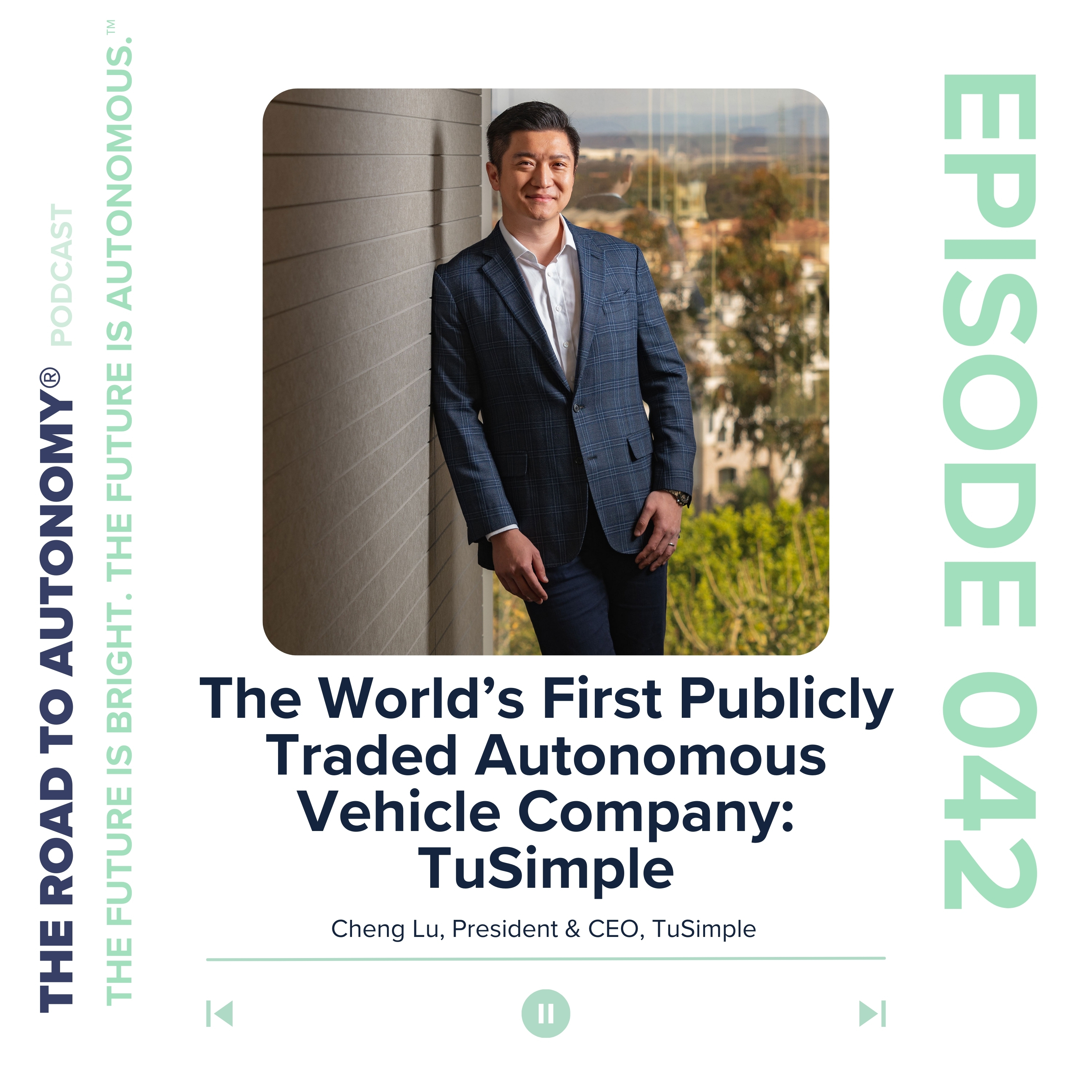
Ep 42Episode 42 | The World’s First Publicly Traded Autonomous Vehicle Company: TuSimple
Cheng Lu, President & CEO, TuSimple joined Grayson Brulte on The Road To Autonomy Podcast to discuss taking TuSimple public and the company’s plans for growth.The conversation begins with Cheng discussing why TuSimple chose to go public as a traditional IPO rather than a SPAC and what the journey was like to become the world’s first publicly traded autonomous vehicle company.We priced above our range. We raised $1.3 billion dollars as a company. We have a market cap of $8 billion dollars. – Cheng LuTaking a step back, Grayson asks Cheng about his time studying the economics of online platforms at the University of Virginia. At that time, Facebook was beginning to grow into an enterprise and the age of online platforms was about to change the world with the introduction of Uber, Lyft, and delivery services.Thinking about what happens in the next 10, 20, 30 years, it’s safe to say that it will be the age of artificial intelligence. Autonomous driving is certainly one of the hardest use cases, but one of the biggest opportunities. Autonomous trucking is a massive opportunity. – Cheng LuComparing and contrasting the rapid growth of Facebook, Grayson asks Cheng how he is preparing for the growth of TuSimple’s Autonomous Freight Network (AFN).At the heart of TuSimple, we are an artificial intelligence software company. We are building the most advanced Level 4 autonomous driving system. We are also building the hardware in conjunction with our OEM Tier 1 partners. – Cheng LuThe AFN will be TuSimple’s 5G network and their purpose-built autonomous trucks will be their 5G phones.Shifting the conversation to the supply chain, Grayson and Cheng discuss how autonomous trucks can shore up the supply chain. They discuss the relationship between autonomous trucking and railroads (including TuSimple investor Union Pacific) and how these two industries will complement each other to the benefit of society.We have the opportunity to help enable new freight capacity to address the supply chain constraints. – Cheng LuDoing things the right way is a common trait for TuSimple. The company has a partnership with Navistar to develop automotive-grade autonomous trucks that are manufactured in a factory and are not retrofitted.If you want to scale autonomous freight operations you have to have purpose-built trucks that are factory-produced. – Cheng LuWith 6,775 reservations for factory-built TuSimple autonomous trucks, Grayson asks Cheng how his customers are planning to use these trucks. Customers are looking to use their new autonomous trucks for long-haul applications.Staying on the topic of orders, Grayson asks Cheng what is TuSimple’s business model for the trucks and how will TuSimple manage and monetize the trucks once they are sold to customers.When a customer buys a truck from Navistar that is powered by the TuSimple Autonomous Driving System, the customer will subscribe to TuSimple Path, which is a per-mile subscription. – Cheng LuTuSimple has been focused on autonomous trucking since day one. Grayson asks Cheng why the company made the decision to focus on trucking from day one and why they did not divert their attention to robo-taxis.The number one thing to get adoption into a very disruptive technology is are you providing something of value to the existing key stakeholders. Autonomous trucking checks all of those marks. – Cheng LuAs seen in a 60 Minutes episode, TuSimple has a culture of safety that is built around the company’s core five values. The company also has a culture of transparency. Cheng discusses why this is important and why the company focuses on safety and transparency. This culture will play a vital role as TuSimple prepares for driver-out runs which will be revenue-generating runs and not demos.TuSimple is the only company that has demonstrated the ability to drive on not only highways but surface streets. – Cheng LuWrapping up the conversation, Cheng discusses TuSimple’s partnership with McLane, a Berkshire Hathaway company.Recorded on Friday, May 14, 2021--------About The Road to AutonomyThe Road to Autonomy® is a leading source of data, insight and commentary on autonomous vehicles/trucks and the emerging autonomy economy™. The company has two businesses: The Road to Autonomy Indices, with Standard and Poor’s Dow Jones Indices as the custom calculation agent; Media, which includes The Road to Autonomy and Autonomy Economy podcasts as well as This Week in The Autonomy Economy newsletter.See Privacy Policy at https://art19.com/privacy and California Privacy Notice at https://art19.com/privacy#do-not-sell-my-info.
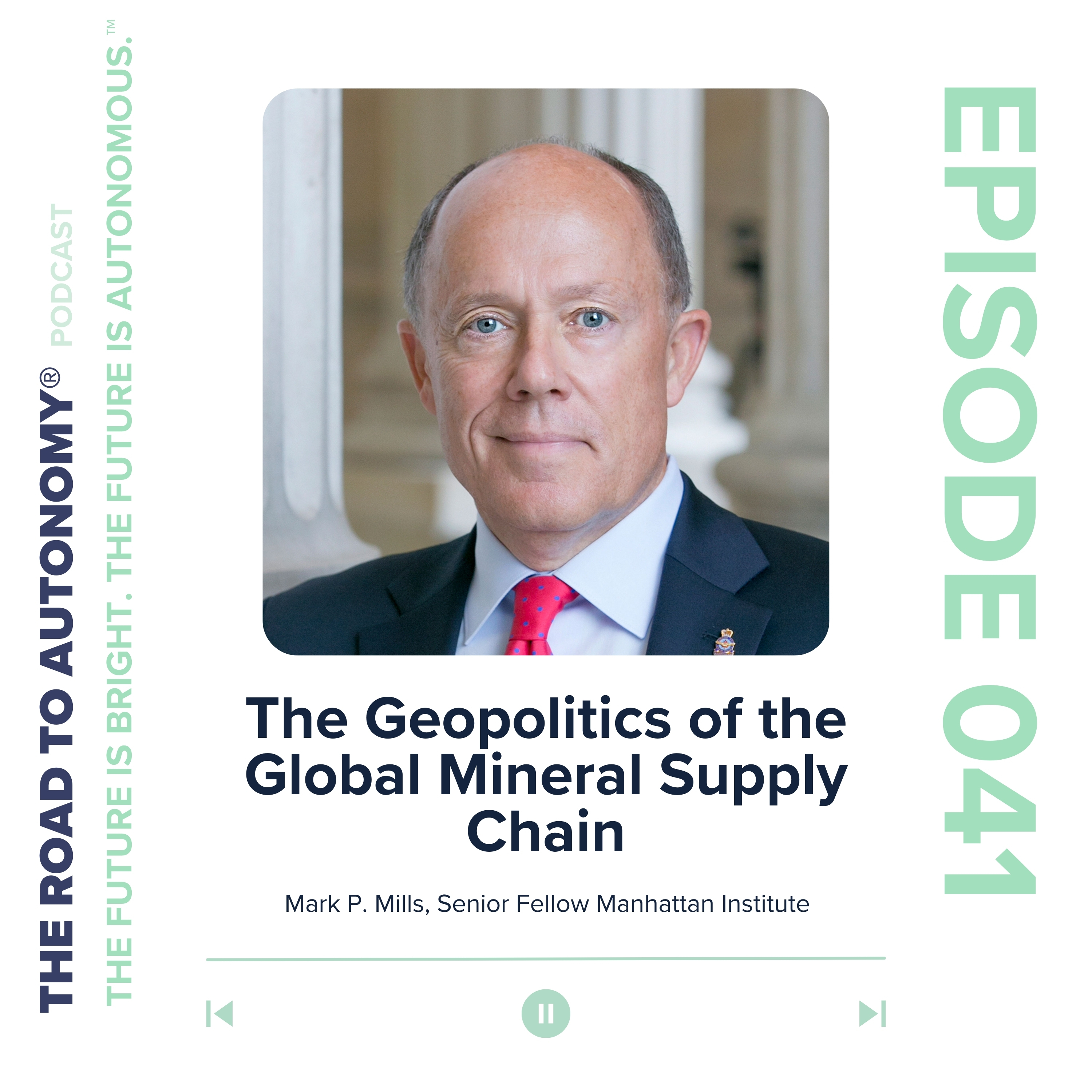
Ep 41Episode 41 | The Geopolitics of the Global Mineral Supply Chain
Mark P. Mills, Senior Fellow Manhattan Institute, Faculty Fellow Northwestern University School of Engineering, and Partner in Montrose Lane, an Energy-Tech Venture Fund joined Grayson Brulte on The Road To Autonomy Podcast to discuss the geopolitics of the global mineral supply chain.The conversation begins with Mark discussing his review of the book Unsettled by Physicist Steven Koonin in the Wall Street Journal and how it led to the Manhattan Institute’s Facebook page being temporarily suspended. Grayson raises the point about debates and how debates were instrumental in the founding of The United States.Shifting gears, Grayson asks Mark about his time as a physicist at Bell Northern Research and at the RCA David Sarnoff Research Center.RCA was then the company of consequence. RCA was the company that did as much for communications as Apple and Google and Cisco and others of the modern era did back then. – Mark P. MillsWith everything becoming more efficient, crypto mining farms popping up everywhere, and more electric vehicles coming online daily, Grayson asks Mark if the world has enough electricity to support the increased energy demand. We currently produce enough, but that could change in the future.The single most important thing about electricity is not how you make it. That is derivative. It’s how you make it to support the two objectives which is: As I need it at scale, the price matters, because the more of it you use, you want it to be cheaper, not more expensive. And, I want to have the electricity when I need it. – Mark P. MillsMark goes on to discuss the history of the energy grid and how the grid is a series of networked grids. With the colonial pipeline having been recently hacked, Grayson asks Mark how secure the electric grid is today and what can be done to secure the grid from potential cyber-attacks.The electric grid is remarkably secure, currently. – Mark P. MillsStaying on the topic of resources and what is need to ensure that energy can continue to flow uninterrupted, Grayson asks Mark what happened in 1990 that led The United States to lose its position as the world’s number-one producer of minerals. This was caused by regulation and the political environment at that time. Sensing an opportunity, China expanded its mining and refining capabilities.China is the world’s biggest refiner of critical minerals. – Mark P. MillsThe United States is 100% dependent on the importation of 17 key minerals and imports over half of its needs for another 29 minerals. These minerals are needed for electric vehicles. At this time, The United States does not have a secure supply chain for electric vehicles.This raises the question of how can The United States transition to an all-electric vehicle future when the supply chain is controlled by a geopolitical foe, China?If your energy system is dependent on a handful of supply chain routes and a hand full of supply chain suppliers, if anything happened that took that handful out, there is a massive impact. You do not have optionality. You do not have optionality at any price. – Mark P. MillsThe supply chain for minerals is volatile with Chile, China, and the Democratic Republic of the Congo controlling the mineral supply chain and mineral refining. With a lack of new mines coming online and limited access to copper and minerals, Mark explains what the economic impact would be on the economy.Every single feature of the minerals world relevant to energy is on track to rising, not declining prices. – Mark P. MillsAfter focusing on the economics of minerals and the impact of the supply chain, Grayson and Mark discuss mining minerals and how minerals are mined.Wrapping up the conversation, Grayson and Mark discuss why the geopolitical issues of the mineral supply chain are not broadly discussed. Securing the mineral supply chain for electric vehicles is the only way to ensure the adoption of electric vehicles.Recorded on Wednesday, May 12, 2021--------About The Road to AutonomyThe Road to Autonomy® is a leading source of data, insight and commentary on autonomous vehicles/trucks and the emerging autonomy economy™. The company has two businesses: The Road to Autonomy Indices, with Standard and Poor’s Dow Jones Indices as the custom calculation agent; Media, which includes The Road to Autonomy and Autonomy Economy podcasts as well as This Week in The Autonomy Economy newsletter.See Privacy Policy at https://art19.com/privacy and California Privacy Notice at https://art19.com/privacy#do-not-sell-my-info.
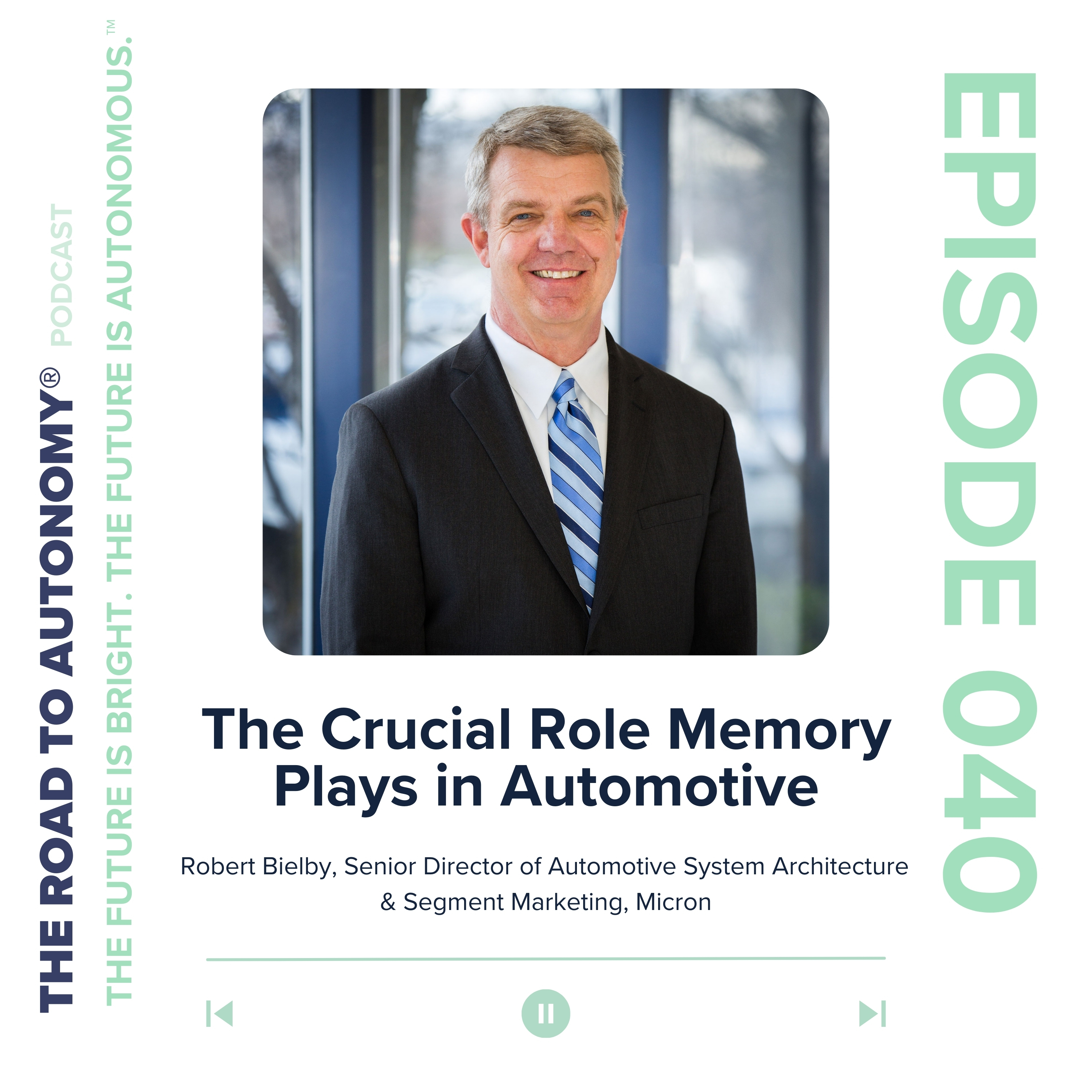
Ep 40Episode 40 | The Crucial Role Memory Plays in Automotive
Robert Bielby, Senior Director of Automotive System Architecture & Segment Marketing, Micron joined Grayson Brulte on The Road To Autonomy Podcast to discuss the crucial role that memory plays in automotive.With the automotive industry focused on electrification and statements made by Jim Farley, CEO of Ford, and Bryan Salesky, Co-Founder & CEO of Argo AI about the computer power needed for self-driving cars, Grayson asks Robert to share his thoughts on how to best optimize for energy efficiency in autonomous vehicles.We are focused on how do we optimize power consumption. – Robert BielbyWith over 30 years of experience in automotive, Micron currently has a 40% market share for memory. As we look to the next 30 years, Micron is focused on growing that market share.We continue to make the investments because for Micron automotive is an important market. – Robert Bielby60% of Micron’s automotive business is centered around in-vehicle experiences. Infotainment and in-vehicle experiences are becoming the most important features for consumers.Customers are making their purchasing decisions based upon the cockpit, and features and the functionality, and the cool displays. – Robert BielbyWhen SAE Level 4 and 5 autonomy is achieved, Grayson asks Robert what experiences will look like in autonomous vehicles.This is definitely going to be an element that is going to define the brand identity of the vehicle. A Ford is going to look a certain way, a BMW is going to look a certain way. You will make purchasing decisions on I can connect to Apple or Android. I can answer emails, I can edit word documents, excel spreadsheets. – Robert BielbyWhile memory will enable great in-vehicle experiences, memory will also increase safety in the vehicle. Memory will help to enable occupant detection that can enable air conditioning to turn on if a child is left unattended in a vehicle during a hot day.Staying on the theme of safety, Grayson and Robert discuss augmented reality and how it can be used to build trust with adaptive cruise control.Micron has 13 customer labs around the globe where they work with customers to optimize memory performance for their automotive applications. The company also has a partnership with Nvidia where they are jointly working to enable “True AI”.The impact that memory has on system performance can and will be profound. – Robert BielbyRobert expands upon the conversation with a dive deep into AI and what he expects to see in the future as AI begins to be fully integrated into the vehicle experience.The expectation is that the vehicle is a natural extension of my lifestyle. – Robert BielbyWith everything being connected and the vehicle being an extension of consumers lifestyles, Grayson and Robert discuss security. How verification will work and what role memory plays in securing the experience and paying for services such as gas using the infotainment system.Wrapping up the conversation, Grayson and Robert discuss functional safety and the ISO 26262 safety standard.Recorded on Tuesday, May 4, 2021--------About The Road to AutonomyThe Road to Autonomy® is a leading source of data, insight and commentary on autonomous vehicles/trucks and the emerging autonomy economy™. The company has two businesses: The Road to Autonomy Indices, with Standard and Poor’s Dow Jones Indices as the custom calculation agent; Media, which includes The Road to Autonomy and Autonomy Economy podcasts as well as This Week in The Autonomy Economy newsletter.See Privacy Policy at https://art19.com/privacy and California Privacy Notice at https://art19.com/privacy#do-not-sell-my-info.
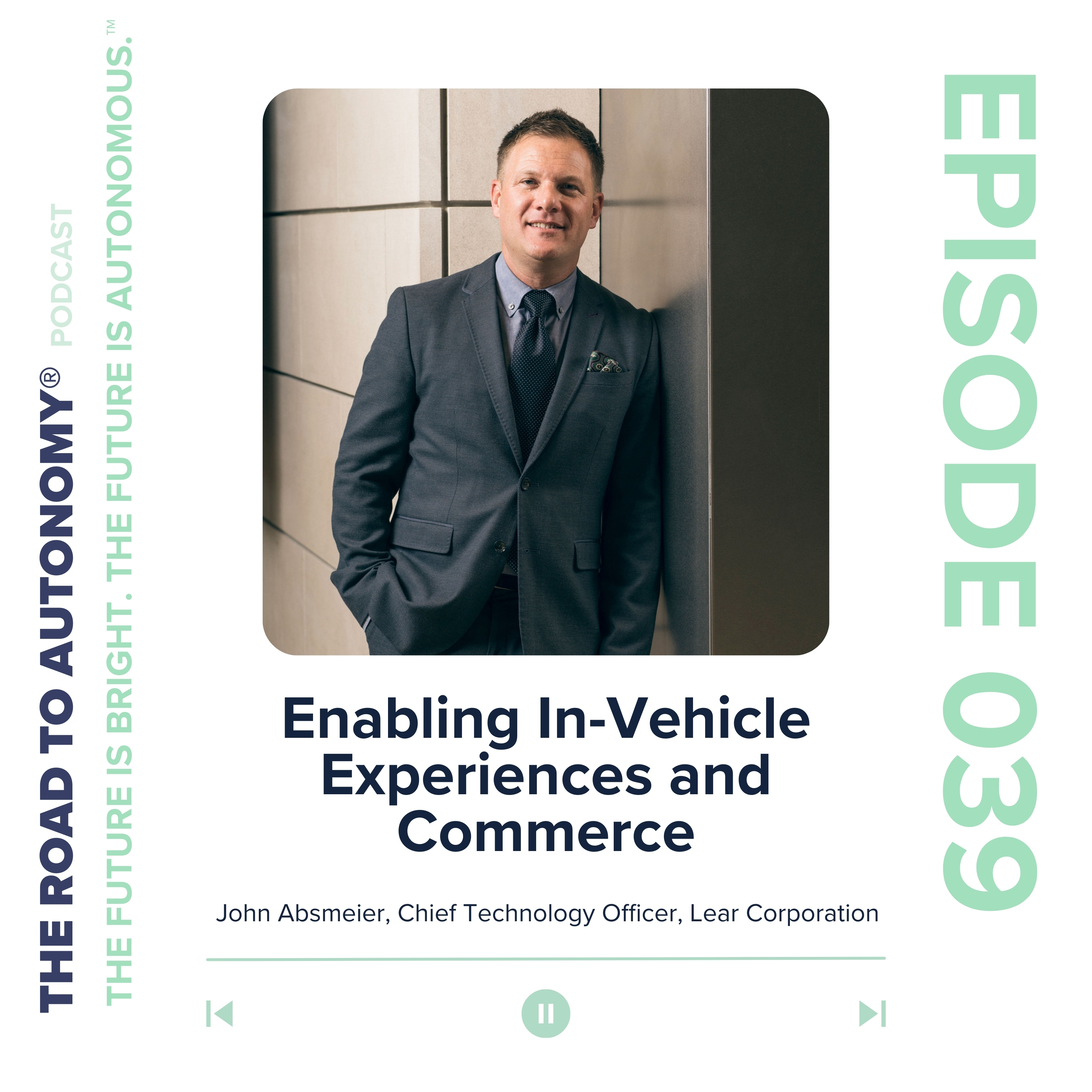
Ep 39Episode 39 | Enabling In-Vehicle Experiences and Commerce
John Absmeier, Chief Technology Officer, Lear Corporation joined Grayson Brulte on The Road To Autonomy Podcast to discuss Seating as a Service and how Xevo will enable in-vehicle experiences and commerce.The conversation begins with John discussing his time in the United States Marine Corps and what he learned as a Sergeant E5 motor transport mechanic. John learned leadership skills that have translated into an extremely successful career as an innovator and business leader.As a young engineer, John worked on the inductive charge panel connection system for the GM EV1.I got highly interested in electrification 25 years ago. – John AbsmeierIt was this project that sparked John’s interest in electrification. In 2012, John set up Delphi Labs and led the lab’s development of its autonomous vehicle platform. In 2015 a Delphi Labs autonomous vehicle completed a coast-to-coast trip from San Francisco to New York City. During this time, John put his leadership skills to work as he worked with the team to solve the complex problem of autonomous driving.With a background in solving complex problems, Grayson asks John what attracted him to join Lear. John goes onto discuss his time at Samsung and when Mr. Ray Scott, CEO of Lear Corporation approached him about becoming CTO.We need to start to focus on innovation and technology as a priority in our mission. We need someone who has experience and wants to drive that. – Mr. Ray Scott, President & CEO, Lear Corporation as told by John AbsmeierWhen John joined Lear, he became the company’s first CTO. As CTO of Lear, John became CTO of a publicly-traded company with a market cap at that time of $13 billion (June 2018). As CTO of a publicly-traded company, Grayson asks John how he is keeping Lear 2 to 3 steps ahead of the competition in autonomous vehicles.Autonomous vehicles for Lear are a bit of a different thing. We are not directly competing in the full-stack development. But, all of our products are affected by the changes that happen. – John AbsmeierAs mobility changes and new shared services are introduced, there is one common denominator – passengers will continue to ride in seats. New business models will emerge such as ‘Seats as Service” where customers can opt to take a ride in a vehicle that offers an in-vehicle seat massage.With the growth of the gaming world, Grayson asks John if Lear is taking inspiration from the gaming world as it relates to in-vehicle seat design.The user experience is now the main differentiator in cars. – John AbsmeierExpanding the conversation of experiences, Grayson asks John about Lear’s acquisition of Xevo in 2019. Why did Lear acquire Xevo? Xevo will allow Lear to expand its “seating as a service” compliment it with in-vehicle experiences and commerce.Looking to the future, Grayson asks John when he expects to see AR (augmented reality) experiences in vehicles. Taking a step back, John talks about CES 2014, when Samsung showcased an AR experience in a Tesla Model S. Staying on the CES theme, Grayson talks about the Warner Bros. / Intel immersive entertainment experience which they demonstrated in 2019.As companies look to develop in-vehicle experiences, Grayson shares his thoughts on why Disney will introduce a Star Wars in-vehicle experience at Walt Disney World in Orlando, FL. Comparing and contrasting Disney with Lear, Grayson asks John about the footprint of the Xevo platform.Xevo is currently running in over 50 million vehicles globally. The Xevo commerce platform has over 400,000 retail outlets which are available to customers today. All of the data generated through driver interactions is owned by Xevo’s OEM customers.To enable in-vehicle commerce a payment method is needed. Grayson asks John how Xevo approaches payments and integrates the ability to pay for goods and services into the platform. Xevo does not store credit card data, instead, they aggerate payments through a secure wallet. When the vehicle becomes autonomous, the wallet can reside in the mobility provider’s app.Wrapping up the conversation, Grayson and John discuss the current state of M&A in the autonomous vehicle industry.There [are] very few companies in the world that have the balance sheet to create an entire autonomy stack. I estimate that it is somewhere in the $50 billion to the $100 billion range to create a full autonomous stack solution. – John AbsmeierConsolidation is coming across the board as companies start to turn their attention to the economics of autonomy.Mobility is only going to get a lot better. – John AbsmeierRecorded on Thursday, April 29, 2021--------About The Road to AutonomyThe Road to Autonomy® is a leading source of data, insight and commentary on autonomous vehicles/trucks and the emerging autonomy economy™. The company has two businesses: The Road to Autonomy Indices, with Standard and Poor’s Dow Jones Indices as the custom calculation agent; Media, which include
Ep 38Episode 38 | Economic Impact of the U.S. Oil Industry
Dean Foreman, Chief Economist, American Petroleum Institute (API), and Prentiss Searles, Petroleum Marketing Policy Manager, American Petroleum Institute (API) joined Grayson Brulte on The Road To Autonomy Podcast to discuss the economic impact of the U.S. oil industry.The conversation begins with Dean sharing an overview of the current state of the U.S. oil markets.We have historically strong demand, potentially record demand this year and next combined. Weak drilling activity, weak investment. That opens the question of just the extent that the U.S. can participate in this recovery. – Dean ForemanThe U.S. is no longer an exporter of oil, the U.S. is once again a net-importer of oil.In 2020 [The United States] was a net-exporter of between $15 and $16 billion dollars. We have gone from imports of $300 to $400 billion dollars a year to exports of $15 to $16 billion and potentially is the U.S. energy revolution remains intact the ability to grow that. – Dean ForemanA recent report has stated that the United States could be heading for an oil shortage in 2022. Grayson asks Dean about this report and what the potential impact will be on the economy and the average consumer. Dean explains how this could lead to higher costs for transportation and the shipment of goods.With a potential oil shortage, Grayson asks Prentiss what it will mean for U.S. consumers and their driving habits. Looking back in history, Prentiss discusses how U.S. drivers changed their driving habits to save money and why consumers may opt for hybrid vehicles if this scenario happens.Hybrids definitely provide economic ways to achieve higher fuel economy. – Dean ForemanAs society starts to shift to electric vehicles, Grayson asks Dean about the economics and the potential impact policy will have on cost increases for consumers.By having an EV mandate built into the economy will impact the amount of vehicles that are available for the secondary market to purchase. That ends up having an additional cost and EVs are $10 to $15 thousand dollars more compared to an equal-sized vehicle. – Prentiss SearlesStaying on the theme of policy, Grayson asks Dean about a Tampa, Florida Council Member who proposed banning fossil fuels and any new fossil fuel infrastructure in the city of Tampa by 2030. Dean who is originally from Tampa, explains what the negative impact would be on Florida’s economy.This would be one way to really grid Florida’s economy to a halt. – Dean ForemanThe natural gas and petroleum industry supports more than 10 million jobs in the United States. The average salary in the industry is $50,000 above the nationwide average.Shifting the conversation back to passenger cars, Grayson asks Prentiss what would the current state of the electric vehicle market look like if there were no subsidies? Prentiss explains that there would still be a market for electric vehicles, but the market would not be as large as it is today. He cites Georgia as an example, when the electric vehicle tax credit was removed, EV sales plunged by 90% in the State.Referencing an article in the Wall Street Journal about how automakers are trying to increase sales of electric vehicles by demanding higher taxes on conventional vehicles that burn gas and diesel fuel, Grayson asks Dean when do shareholders raise the economic concerns of this strategy.The conversation flows into a discussion about free markets and when do market-based economics return instead of markets being driven by policy.Consumers are ultimately going to be the ones who have to choose. Affordability is going to rule. We have to have an embedded faith that consumer preferences will ultimately speak and that this will play out. – Dean ForemanLooking at the passenger vehicle market, Prentiss shares his thoughts on free markets and consumer choice of vehicles. Consumers will end up choosing vehicles that meet their needs.Regardless of how quickly EVs take off as a percentage of sales, in 20 years, the majority of vehicles are still going to remain internal combustion vehicles. – Prentiss SearlesExpanding upon consumer choice, Prentiss discusses the best ways to reduce carbon emissions of vehicles without having a negative economic impact. As more electric vehicles come online with charging infrastructure, Dean discusses what the potential economic impact will be on the petroleum market.Wrapping up the conversation, Dean and Prentiss discuss the future of the petroleum industry.Recorded on Thursday, April 22, 2021--------About The Road to AutonomyThe Road to Autonomy® is a leading source of data, insight and commentary on autonomous vehicles/trucks and the emerging autonomy economy™. The company has two businesses: The Road to Autonomy Indices, with Standard and Poor’s Dow Jones Indices as the custom calculation agent; Media, which includes The Road to Autonomy and Autonomy Economy podcasts as well as This Week in The Autonomy

Ep 37Episode 37 | Brightline: The Mobility Experience Company
Patrick Goddard, President of Brightline Trains joined Grayson Brulte on The Road To Autonomy Podcast to discuss how Brightline is building a mobility experience company.The conversation begins with Patrick discussing how his background in hospitality partly inspired the way Brightline was developed and how it is managed today. Customer service and the emotional connection with the experience are the keys to success in the experience business.We are first and foremost an experience-focused company. – Patrick GoddardPrior to boarding the train, the customer journey begins the moment that individual leaves their home or hotel. You have to think about that journey and look at it through the five senses. Patrick discusses how the five senses create an emotional connection.Understanding the door to door to experience for a traveler has become more and more important. – Patrick GoddardExpanding upon this thought, Patrick dives into the experience economy and how it is now starting to transform the transportation industry. The transportation industry is actively learning from the hospitality and restaurant industries on how to implement and scale meaningful experiences with an emotional connection.The experiences economy is upon us. It has been upon us for some time. – Patrick GoddardFocusing is on the Brightline experience, Patrick discusses in great detail the Brightline experience and how it was designed. From digital infrastructure to physical infrastructure, Brightline has completely thought through every single element of the experience.Looking to the future, Grayson asks Patrick if Brightline will partner with an autonomous vehicle company to provide a branded Brightline mobility experience destination to destination.We have to think about transportation as an ecosystem. – Patrick GoddardBrightline is actively looking into what those mobility experiences might look like with a variety of non-exclusive partners. These services will be fully integrated into the Brightline experience without friction and without having to make multiple payments to multiple service providers.As Brightline expands to Orlando / Walt Disney World and adds new stops, Grayson asks Patrick how the Brightline experience will not be diluted. Patrick shares a great example of driving from Miami to Walt Disney World with his family and all of the possible issues including traffic which could make the trip longer and stressful.When you get on our trains, you stop worrying about the time. It’s not about the time. It’s about the reliability and the experience. – Patrick GoddardOn the train, you are relaxed, having a drink, or taking a nap. You arrive at the destination calm and ready to have fun at Walt Disney World.Connecting Miami to Orlando with Brightline will have a positive impact on Florida’s economy. Grayson shares data from a previous podcast with Dr. Jerry Parrish, Chief Economist and Director of Research, Florida Chamber Foundation about how tourism dollars will be spent when tourists have a frictionless way to travel to different parts of the State.Looking back in history, Patrick discusses the history of Henry Flagler’s Florida East Coast Railway and how Brightline is building upon that history. The Florida East Coast Railway was built to support Flagler’s hotel operations. Brightline is following a similar model by developing the land around the stations.Wrapping up the conversation, Patrick discusses the future of Brightline and why Brightline is a mobility experience company.Recorded on Thursday, April 8, 2021--------About The Road to AutonomyThe Road to Autonomy® is a leading source of data, insight and commentary on autonomous vehicles/trucks and the emerging autonomy economy™. The company has two businesses: The Road to Autonomy Indices, with Standard and Poor’s Dow Jones Indices as the custom calculation agent; Media, which includes The Road to Autonomy and Autonomy Economy podcasts as well as This Week in The Autonomy Economy newsletter.See Privacy Policy at https://art19.com/privacy and California Privacy Notice at https://art19.com/privacy#do-not-sell-my-info.

Ep 36Episode 36 | The Future of Parking: Integrated Payments & Mobility Hubs
Neil Golson, Executive Vice President of Marketing and Strategic Partnerships, FLASH joined Grayson Brulte on The Road To Autonomy Podcast to discuss how software and partnerships are enabling the future of parking —integrated payments and mobility hubs.The conversation begins with Neil sharing his insight into the current state of the parking business. While parking demand is still down 65% pre-COVID, the industry is beginning to rebound as consumers begin to travel again.FLASH has an interesting insight into the parking industry as they do not own the asset, they are the software layer that enables parking operators to efficiently manage their facilities.Our role is to enable [parking operators] and to drive their technology so that they can differentiate their own asset. – Neil GolsonOne of the neat ways FLASH is enabling parking operators to create new sources of revenue is their digital wallet offering that integrates services such as Ticketmaster and OpenTable. This eliminates friction for parking customers and simplifies the transaction.Another way, FLASH is eliminating friction is by re-thinking having a redundant system in place for when the tickets run out at a parking kiosk. FLASH's system automatically switches to another mode such as scanning your license plate or using your credit card as a ticket.This all boils down to what is the best customer experience and what can we do to enhance the customer experience. Neil goes onto explain the ways that FLASH is constantly working to improve the parking experience and ways to increase revenue for parking operators.Our system can change on a dime. – Neil GolsonWith a flexible system, customers benefit as FLASH can remotely change lane directions to ensure individuals can get into the game faster and exit faster with dynamic lanes. Grayson asks Neil, what’s the next step in improving the customer experience. Neil goes onto explain how FLASH is working with Target to integrate a parking and charging experience which is tied to purchases.One of the keys to building out mobility hubs is partnerships. One of the partnerships that FLASH has is with EVBox. Grayson asks Neil about the partnership and why FLASH ultimately decided to partner with EVBox.EVBox really saw the opportunity to separate hardware from software. – Neil GolsonUltimately it was EVBox’s open-architecture platform that sealed the deal as FLASH could customize the software for their customers. With FLASH actively preparing for a future with electric vehicles, Grayson goes onto to ask Neil how the company is actively preparing for a future with autonomous vehicles.The company is actively preparing for an autonomous future by fully understanding the asset down to the curb, the size of the parking space, and how the vehicles will pay to park.We power the Porsche app. Porsche only wanted to put parking spaces that were of a certain width to make sure that Porsche drivers didn’t get dinged. – Neil GolsonThis approach creates value for the Porsche brand as Porsche customers do not have to worry about parking in a space that is too close to another car.In Las Vegas, FLASH has a partnership with the City of Las Vegas to allow Uber drivers to park in a staging area while waiting for a ride. Looking to the future, Grayson asks Neil if FLASH is using the data from this partnership to model for a future with autonomous vehicles.Rounding out the mobility hub strategy, FLASH has a partnership with SwiftMile to solve the clutter issue with scooters laying around parking assets.Wrapping up the conversation, Grayson and Neil discuss parking infrastructure assets and what happens when individuals begin to travel in large numbers again.Recorded on Thursday, April 1, 2021See Privacy Policy at https://art19.com/privacy and California Privacy Notice at https://art19.com/privacy#do-not-sell-my-info.

Ep 35Episode 35 | Cyber Intelligence
Bryan Hurd, Vice President, Chief of Office, Aon Cyber Solutions (Stroz Friedberg) joined Grayson Brulte on The Road To Autonomy Podcast to discuss the current state of cybersecurity and why cyber intelligence is critically important for Governments and Publicly Traded Companies.The conversation begins with Bryan discussing the founding of the U.S. Navy’s First Cyber-Counterintelligence Program at Naval Criminal Investigative Service (NCIS). Expanding upon the founding of the program, Bryan goes onto discuss Cliff Stoll, “Hanover hackers” and nation-state cyber attacks.Then there is the emerging threat of the non-nation state of hackers which are having an impact on society.Popular culture makes it cool to be a hacker. – Bryan HurdGrayson asks Bryan what assets hackers are looking to steal and compromise. International organized crime is focused on ransomware and IP Theft, while nation-state hackers are focused on gathering intel and plans on how the military develops planes and sensitive military assets.The dwell times for these bad actors vary depending on the sophistication of the organization and what they are looking to achieve. At times international organized crime will gather all of the data they want, then lock the data and demand a ransom that is paid in crypto coin.Ransomware is a clear and present danger to the United States. – Bryan HurdWith ransom being paid in crypto coin, Grayson and Bryan go onto discuss the potential regulation of Bitcoin and the impact it would have on the market if a “know your customer” regulation would be put into place. Shifting the conversation to transportation, Bryan discusses the founding of the No Fly List and how it was developed using machine learning.As society beings to shift towards electric vehicles, Grayson asks Bryan why there is not a larger conversation taking place on how you secure the energy grid from a potential cyber attack. Securing the energy grid is critically important as millions of consumers begin to drive charge their electric vehicles.Securing intellectual property (IP) for large knowledge-based companies is also critical as the valuations of those companies are partly based on their IP portfolios. Using the Waymo vs. Uber lawsuit as an example, Grayson brings up Exhibit 22 from the trial as an example of why cyber intelligence and on-the-ground intelligence is critically important for companies developing new technologies.If your entire company’s net worth is based on intellectual property (IP), a formula for a soft drink, a vaccine formulation, or intellectual property on how to make the next driverless automobile, then that is information that needs to be protected from an IT and tagging/data loss prevention and employee contracts for the level that is appropriate to your company. – Bryan HurdThis raises the question of how connected should the Board of Directors be to the industry of the company of the board that they are sitting on?Just the right bit of intel at the right time can either save you billions in research and development or get you there faster than the people who actually founded it. – Bryan HurdLooking at the current state of the world and events shaping the global economy, Grayson asks if bad actors are looking at the economic and supply-chain damage that the Ever Given container ship caused when it blocked the Suez Canal as an idea for a possible cyber attack. What if cyber terrorists could take control of container ships to cause economic harm globally?Bryan talks about the current state of cyber terrorism, what bad actors are targeting and what the response could look like in the future. As society becomes more and more connected, it will be inherently important for companies to build trust around their products and services.Trust is not only to the brand. It is to the uptick of any new technology or service. Spending a little bit more at the beginning to ensure that trust has a good foundation is going to be a more central discussion. – Bryan HurdWrapping up the conversation, Bryan discusses what we can do as a society to stay pro-active and why cyber intelligence will continue to be top of mind for Government, companies and individuals.Recorded on Tuesday, April 6, 2021--------About The Road to AutonomyThe Road to Autonomy® is a leading source of data, insight and commentary on autonomous vehicles/trucks and the emerging autonomy economy™. The company has two businesses: The Road to Autonomy Indices, with Standard and Poor’s Dow Jones Indices as the custom calculation agent; Media, which includes The Road to Autonomy and Autonomy Economy podcasts as well as This Week in The Autonomy Economy newsletter.See Privacy Policy at https://art19.com/privacy and California Privacy Notice at https://art19.com/privacy#do-not-sell-my-info.
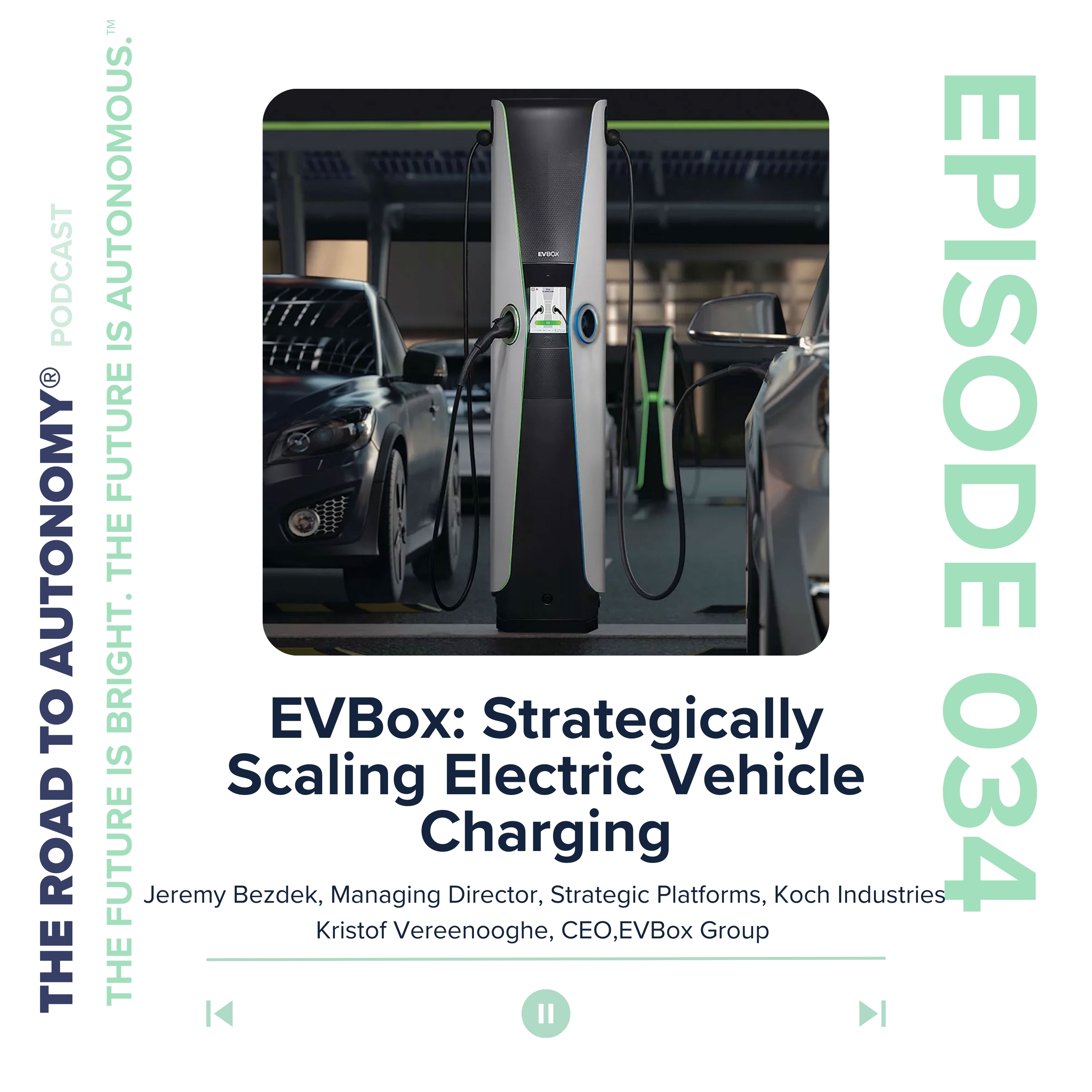
Ep 34Episode 34 | EVBox: Strategically Scaling Electric Vehicle Charging
Jeremy Bezdek, Managing Director, Strategic Platforms, Koch Industries (KSP), and Kristof Vereenooghe, CEO of EVBox Group join Grayson Brulte on The Road To Autonomy Podcast to discuss scaling electric vehicle charging globally through strategic partnerships.The conversation begins with Jeremy sharing a high-level overview of Koch Strategic Platforms and the company’s mandate.Koch Strategic Platforms mandate is to look for companies to invest in tail-wind industries and companies looking for growth equity. Either as public companies or late-stage private companies, maybe soon to be public companies. We invest in key verticals, specifically industry 4.0, connectivity, healthcare technology, and energy transformation. – Jeremy BezdekTaking a look at the EV charging industry, Kristof discusses fragmented markets and how EVBox’s market share in Europe combined with their open-architecture platform gives the company a strategic advantage.We are headquartered in what I call the Silicon Valley of EV charging. – Kristof VereenoogheAs EVBox begins to scale in the United States, Koch Strategic Platforms is actively collaborating with EVBox to assist the company with scaling the business in the U.S. In addition to the strategic capital relationship with Koch Strategic Platforms, EVBox has a partnership with TPG.With the partnership with TPG and going public, it will give us the capital and the resources to scale. Most importantly, many competitors in the U.S. are closed systems and do not provide the same benefits as EVBox. There is a real need for our model and our software here in the U.S. market. – Kristof VereenoogheKoch’s has a long-term relationship with TPG. It is through this relationship that Koch first developed a relationship with EVBox, and later invested.With their footprint, their European leadership position, and quite frankly our energy transformation vertical it made sense. It was a perfect fit for what we were looking for. With the vision that Kristof had to do a U.S. rollout, we felt that our capability could be applied to help them. It was a perfect fit for us to invest. – Jeremy BezdekShifting the conversation to strategy, Grayson asks Kristof to discuss the EVBox strategy and the company’s relationship with three out of the four largest European automakers. EVBox’s competitive advantage is the company’s open-architecture platform.With the competitive advantage of the open-architecture platform secured, EVBox is focused on developing a world-class brand that will have a positive impact on society.We are planting a tree for every charging station that we ship. – Kristof VereenoogheOperating in over 70 countries presents opportunities and challenges. The brand has to be adapted to local customs, habits, and languages. Today, EVBox software is running software in over 21 languages.With Koch being a global company with over 130,000 employees there are a lot of opportunities inside of Koch Industries. Jeremy goes onto to explain how Koch Industries and EVBox are collaborating on opportunities from installing charging stations to helping with the supply chain for materials.Wrapping up the conversation, Jeremy and Kristof explain the opportunity for electrifying fleets.Recorded on Thursday, March 18, 2021--------About The Road to AutonomyThe Road to Autonomy® is a leading source of data, insight and commentary on autonomous vehicles/trucks and the emerging autonomy economy™. The company has two businesses: The Road to Autonomy Indices, with Standard and Poor’s Dow Jones Indices as the custom calculation agent; Media, which includes The Road to Autonomy and Autonomy Economy podcasts as well as This Week in The Autonomy Economy newsletter.See Privacy Policy at https://art19.com/privacy and California Privacy Notice at https://art19.com/privacy#do-not-sell-my-info.
Ep 33Episode 33 | Augmented Reality: Window To The World
Chen-Ping Yu, Co-Founder & CEO, Phiar joins Grayson Brulte on The Road To Autonomy Podcast to discuss why augmented reality is the window to the world.The conversation begins with Chen-Ping discussing his time at Stony Brook University followed by Harvard. At Harvard, Chen-Ping was a Postdoctoral Research Fellow in the Cognitive and Neural Lab where he studied the brain.I had the pleasure to work with a group of cognitive and neural scientists to combine what they have learned about the brain with deep-learning computer vision. – Chen-Ping YuIt was during his time driving in Boston, that Chen-Ping had an “ah-ha” moment that would lead to the founding of Phiar.Why couldn’t someone show me my route by overlaying that to the actual camera feed instead of drawing it on a map? – Chen-Ping YuSince no one was doing it, Chen-Ping decided to go for it and solve the problem that he experienced driving in Boston. He set out to build AR navigation.Phiar was founded in 2017 when VR (virtual reality) was dominating headlines and film studios were building labs to better understand the technology. Consumers were associating Google Glass with AR (augmented reality) leading to a general misunderstanding in the marketplace about what is AR.Today, a lot has changed. Studios are no longer investing in VR (virtual reality) and companies such as Apple, Amazon, Facebook, and Google are all rumored to be working on AR products.Chen-Ping goes onto share his thoughts on the current state of AR and why software combined with hardware is the path forward.AR is absolutely exciting. – Chen-Ping YuWith a clear understanding of software integrated with hardware being the path forward, Chen-Ping decided to focus on the automotive market. Software integrated with hardware is the Apple model.Grayson asks Chen-Ping what his thoughts are on a possible AR automotive services business for Apple.People are looking at automotive vehicles as the next big platform for software. Even automotive players are trying to redesign and upgrade their whole architecture into a more software-driven [approach]. – Chen-Ping YuLooking to the future, Grayson asks Chen-Ping if Phiar will stay platform-agnostic and what his thoughts are on a potential Phiar App Store. It is possible, but only time will tell.Shifting the conversation back to services, Grayson talks about why Airbnb will be one of the biggest benefactors of augmented reality in vehicles. In a post-COVID world, there will be a huge demand for experiences. AR will be able to unlock digital experiences that are not possible today. This will create massive new revenue opportunities for companies such as Airbnb.Wrapping up the conversation, Chen-Ping and Grayson discuss how to make an augmented reality map without pre-mapping and the role that AI plays in enabling AR.Recorded on Friday, March 12, 2021--------About The Road to AutonomyThe Road to Autonomy® is a leading source of data, insight and commentary on autonomous vehicles/trucks and the emerging autonomy economy™. The company has two businesses: The Road to Autonomy Indices, with Standard and Poor’s Dow Jones Indices as the custom calculation agent; Media, which includes The Road to Autonomy and Autonomy Economy podcasts as well as This Week in The Autonomy Economy newsletter.See Privacy Policy at https://art19.com/privacy and California Privacy Notice at https://art19.com/privacy#do-not-sell-my-info.

Ep 32Episode 32 | The New Economy of Movement
Chris Ballinger, Founder & CEO, MOBI (Mobility Open Blockchain Initiative) joins Grayson Brulte on The Road To Autonomy Podcast to discuss the new economy of movement.The conversation begins with Chris discussing international economics, monetary economics, and private money.Marginalism. The idea that prices are determined on the margin. That it is the margin that matters. It’s the marginal transaction that determines the cost, the opportunity, the opportunity cost. – Chris BallingerWith over 28 years of experience in the finance industry, Chris shares his thoughts on digital currency and the potential impact of regulation on digital currencies.Touching on Facebook’s Libra digital currency, Chris explains why Government policy and Government opposition can change the path and plans of an organization as large as Facebook. Breaking this down further, Chris lays out the reasons why Government’s around the world opposed the new digital currency.The plan was to hold reserves in relativity safe sovereign and bank assets. Well, the problem is if you are running a reserve and your revenue source is carried on that reserve, then there is a strong temptation to stretch a little bit, to take a little more risk to increase the return.That works out great in most environments, but as soon as you have a shock, then the additional risk, the additional leverage that has been put in can cause problems.If you have a breakdown or a sudden failure of trust in a global world currently that is out of Government control, then you have a real problem. – Chris BallingerWith the crypto market becoming extremely heated, Grayson asks Chris about financial bubbles and what patterns he saw during his years on trading floors. After Chris’ insight, Grayson asks how those patterns might apply to today’s low-rate environment.The underlying technology of cryptocurrency is blockchain. With a strong foundation laid in financial markets, Grayson shifts the conversation to discuss what is possible when applying blockchain to mobility.You can link the vehicle’s digital twin (decentralized digital identifier) to location. If you can link location and the vehicle’s trusted identity, then you can create a trusted trip.If you can create a trusted trip, you can pay as you go for things. You can do micro-tolling, you can do road usage charge, you can do usage-based insurance, there are all kinds of things that now become possible. – Chris BallingerGrayson expands the conversation into in-vehicle commerce and what is possible when the vehicle has a trusted identity. Chris discusses the digital VIN and the role it will play in the future of digital commerce.A digital VIN in the future will be a “living birth certificate” which helps to eliminate fraud such as lemons and increase trust in the chain of custody.[With blockchain] you can trace the chain of custody of data back to the original source. – Chris BallingerTelematics combined with a digital VIN opens the opportunity to fund infrastructure development in new ways such as micro-tolling. Doing this digitally will save tax-payers money as Governments will not have to build-out physical tolling infrastructure. This is all possible with an in-vehicle digital wallet.With everything being connected and tracked, privacy concerns are being raised by consumers. Chris explains why the data belongs to the customer and what is being done to protect consumer privacy using mobility services with blockchain.On March 8, 2021, The MOBI Connected Mobility Data Marketplace (CMDM) Working Group released standards to enable a marketplace that could securely commodify mobility data and ensure data privacy for mobility users.Standards will play a large role in the future of mobility. Standards will enable the future of autonomy. Grayson asks Chris if standards are needed to enable secure in-vehicle commerce.Money is a standard. Driving on the left or right side of the road in different countries in a standard. – Chris BallingerIndeed they are needed. Chris goes onto explain coordinated autonomy and why standards are needed to make this a reality.Wrapping up the conversation, Grayson and Chris discuss digital IDs and how they will enable in-vehicle commerce. Chris explains how digital IDs can enable autonomous organizations. These organizations will be autonomous vehicles that will be able to conduct commerce autonomously on the edge and buy other less profitable autonomous vehicles.Recorded on Friday, March 5, 2021--------About The Road to AutonomyThe Road to Autonomy® is a leading source of data, insight and commentary on autonomous vehicles/trucks and the emerging autonomy economy™. The company has two businesses: The Road to Autonomy Indices, with Standard and Poor’s Dow Jones Indices as the custom calculation agent; Media, which includes The Road to Autonomy and Autonomy Economy podcasts as well

Ep 31Episode 31 | Florida: A Growing and Diversified Economy
Dr. Jerry Parrish, Chief Economist and Director of Research, Florida Chamber Foundation joins Grayson Brulte on The Road To Autonomy Podcast to discuss the diverse and growing economy of Florida.The conversation begins with Dr. Parrish discussing the current state of the Florida economy and The Florida Scorecard. Expanding upon the conversation about the economy, Dr. Parrish talks about The Florida 2030 Blueprint and what the Florida Chamber is doing to prepare for the continued growth of the Florida population.Before COVID, Florida since 2015 was creating 1 out of every 11 jobs in this county. – Dr. Jerry ParrishToday 800 net new individuals a day are moving to Florida.Because of COVID, you will see more and more people move to Florida. – Dr. Jerry ParrishIndividuals are moving to Florida for the quality of life, job opportunities, and the #1 Higher Education System in the United States.The State also has a vast hospitality and tourism industry that employs hundreds of thousands of individuals in the State.Our tourism industry has been the trainer of people for all industries in the State of Florida and has been for a long time. – Dr. Jerry ParrishIndividuals working in these jobs understand people skills and how to deal with conflicts without escalating the situation. This is an incredible skill that is tremendously valuable for any industry. Dr. Parrish goes onto discuss why these skills are so important.The Space Coast is back and operating at full capacity once again with the average manufacturing job in Brevard County paying $90,000 a year.Over the past few years, Florida has been growing manufacturing jobs at 3 times the U.S. rate. – Dr. Jerry ParrishFlorida also has a thriving agricultural business with over 47,000 commercial farms and ranches using over 9.45 million acres in the States to farm and raise livestock.Palm Beach County is the #1 agricultural county in the State of Florida. – Dr. Jerry ParrishThe agricultural industry in Florida employs over a million individuals and contributes more than $131 billion to the state’s economy each year.With an influx of tech companies relocating to Florida and creating new high-paying jobs, Grayson asks Dr. Parrish what new businesses might be founded in Florida over the next 10 years.Florida has a booming autonomous vehicle industry with Argo AI operating and expanding in Miami-Dade County. With the signing of HB 311 by Governor DeSantis, Florida became the most AV-friendly State in the country. With great weather, an incredible talent pool and some of the best universities in the world, the future of the autonomous vehicle industry is being developed in Florida.With the Florida 2030 Blueprint, we are setting the stage for by 2030, we can have an economy that nobody will want to leave. There won’t be any reason why somebody wouldn’t want to come to Florida to do business.Florida will be a business-friendly State. We will have the technology that we need. We will have the talent that we need. Talent is the key to economic development. – Dr. Jerry ParrishWrapping up the conversation, Grayson and Dr. Parrish discuss Mayor Suarez‘s savvy use of Twitter to recruit tech companies to Miami and what Florida’s economy will look like in the future.Recorded on Tuesday, February 23, 2021--------About The Road to AutonomyThe Road to Autonomy® is a leading source of data, insight and commentary on autonomous vehicles/trucks and the emerging autonomy economy™. The company has two businesses: The Road to Autonomy Indices, with Standard and Poor’s Dow Jones Indices as the custom calculation agent; Media, which includes The Road to Autonomy and Autonomy Economy podcasts as well as This Week in The Autonomy Economy newsletter.See Privacy Policy at https://art19.com/privacy and California Privacy Notice at https://art19.com/privacy#do-not-sell-my-info.
Ep 30Episode 30 | The Big Idea
Florida State Senator Jeff Brandes joins Grayson Brulte on The Road To Autonomy Podcast to discuss the big idea and why Florida is the perfect environment to operate autonomous vehicles.The conversation begins with Senator Brandes discussing his experience serving in Operation Iraqi Freedom as a transportation officer. During his time in Iraq, Senator Brandes read Capitalism and Freedom by Milton Friedman. This book had a profound effect on him and changed the way he sees the world, chooses to govern, and propose legislation.Operating convoys in Iraq also had a tremendous impact on Senator Brandes. One that would lead to one Senator Brandes Big Ideas a Florida State Legislator.It would be a lot safer if I did not have to have soldiers in these convoys and they could operate autonomously. – Florida State Senator BrandesAs an incoming State Senator in 2012, Senator Brandes wanted to distinguish himself from a great class of legislators. To do this, he reached into his past experience and embraced a Big Idea – Autonomous Vehicles after watching Sebastian Thrun‘s Google’s driverless car TED Talk over a dozen times.There is one big idea in every area of public policy. – Florida State Senator BrandesTo make this Big Idea a reality, Senator Brandes reached out to Google and sought their assistance. The legislation which made testing autonomous vehicles on public roads legal passed unanimously and HB 1207 was signed by Governor Rick Scott in 2012.HB 1207 laid the groundwork for what Florida has become today, the Capital of Autonomous Vehicle deployments and commercialization in North America.Florida has the best laws on the books as it relates to self-driving. We have the best laws on the books as it relates to ride-sharing. – Florida State Senator BrandesInnovative companies have a long history of moving and expanding their operations to Florida from California partly due to regulation. This trend started in earnest when Walt Disney began acquiring land in the 1960’s to develop Walt Disney World.Today, history is repeating itself as innovative autonomous vehicle companies such as Argo AI and Luminar are operating in the State. They are creating high-paying jobs and having a positive impact on the economy.You have to be competitive globally, not just amongst the States. What can we do to remove the barriers? Florida has the perfect environment to operate these types of vehicles. – Florida State Senator BrandesWhen you combine Florida’s tourism industry with frictionless mobility services, magic happens.Florida is a mobility story as much as it is anything else. Whether it be Henry Flagler or Walt Disney. These are all mobility stories. – Florida State Senator BrandesFrom autonomous mobility to space flights, Florida is leading on innovation. Florida is also leading on issues such as criminal justice reform. It is an issue that Senator Brandes has championed as it is a big idea.Senator Brandes shares the story of how he first became interested in criminal justice reform. It’s a powerful heart-wrenching story. A story that leads Senator Brandes to take a leadership position working on solutions that will have a positive impact on society.Another issue that is impacting businesses and schools today is COVID-19. Senator Brandes has filed legislation to protect health care providers, businesses, and schools from COVID-19 liabilities. The conversation evolves into a discussion about Governor Ron DeSantis’ decision to open schools and the long-term positive impact on children in Florida.It was the best decision [Governor Ron DeSantis] made since the beginning of COVID. – Florida State Senator BrandesWith schools open, businesses open, companies are flocking to Florida in droves. The trend did not just start with COVID, it just accelerated. The trend began when Argo AI chose Miami as one of the autonomous vehicle test cities in 2018.We have created this environment where technology can thrive and where the taxes are of a lower nature. Where it’s a strong incentive to consider relocating here. – Florida State Senator BrandesWrapping up the conversation, Grayson and Senator Brandes discuss the major mobility changes they see happening in Florida over the next ten years. Including how the State is preparing for the transition to electric vehicles and how safely evacuate individuals’ electric vehicles during a hurricane.Recorded on Friday, February 19, 2021--------About The Road to AutonomyThe Road to Autonomy® is a leading source of data, insight and commentary on autonomous vehicles/trucks and the emerging autonomy economy™. The company has two businesses: The Road to Autonomy Indices, with Standard and Poor’s Dow Jones Indices as the custom calculation agent; Media, which includes The Road to Autonomy and Autonomy Economy podcasts as well as This Week in The Autonomy Economy newsletter.
Ep 29Episode 29 | Human Intuition for Autonomous Vehicles
James Gowers, Vice President of Strategy & Business Development, Perceptive Automata joins Grayson Brulte on The Road To Autonomy Podcast to discuss developing human intuition for autonomous vehicles.The conversation begins with James talking about leading the Harvard Business School soccer team to two National Championships and what he learned about teamwork as an Army Ranger in the German Federal Armed Forces.Being part of a team, being a leader does not mean that you are autocratic. The more important way to lead is by influencing. Being a solid part of the team, carrying your weight, and leading by example. – James GowersWith a clear understanding of the rigors of leadership and a background in business from the Harvard Business School, Grayson asks James how he first joined the autonomous vehicle industry.James shares a wonderful story of how a friendship with Mark Wheeler, Co-Founder & CTO of DeepMap led to him joining the industry. After a successful run at DeepMap, James joined Perceptive Automata to help them successfully raise their Series A round.Getting from Series A to Series B is hard work. – James GowersPerceptive Automata is working on developing human-like intuition for autonomous vehicles as driving is inherently a social activity. James goes onto explain how Perceptive Automata is developing machine-learning models that can glance at a human and make powerful predictions on their intent to cross the road.Grayson asks James if the machine-learning models can learn situational awareness. For example, can the models learn if an individual is walking, wearing headphones to staring at their phones, and generally not paying attention to the surroundings? Yes. James explains how the models capture behavior.Perceptive Automata’s approach to situational awareness caught the attention of Jim Adler, Founding Managing Director of Toyota AI Ventures which invested in the company’s Series A $16m round.Along with the investment, Jim wrote a Medium blog post titled: “Predicting the World Around Autonomous Vehicles: Our Investment in Perceptive Automata” about “theory of mind” and why Toyota AI Ventures invested in Perceptive Automata.In the Medium blog post, Jim wrote the following:As I’ve said before, cars are “social.” They exist alongside other human-operated vehicles, cyclists, and pedestrians. When we’re behind the wheel, we constantly survey the roads looking for clues to help predict what other people will do. Will that teenage skateboarder jaywalk? Will the minivan driver speed up as I try to make an unprotected left-hand turn? Who goes first at a four-way stop if we all arrive at the same time?People use a “theory of mind” to face those kind of split-second decisions all of the time. However, what comes relatively easily to us humans is incredibly difficult for autonomous vehicles. To improve safety for passengers and pedestrians alike, it is so important to have an intuitive self-driving system that is able to recognize, understand, and predict human behavior.– Jim Adler, Founding Managing Director of Toyota AI VenturesJim’s Medium blog post summed up Perceptive Automata’s approach to situational awareness brilliantly. This approach is critical for autonomous vehicles which are deployed in dense urban environments.Grayson and James go onto discuss prediction models and planning for scenarios such as a baseball game a European football game getting out. Creating a situation where large groups of individuals are pouring out on the sidewalks and the roadway.Autonomous vehicles have to learn and be prepared for all situations. From large groups of individuals at sporting events to first-responder vehicles traveling down the road at high-speeds. Driving is unpredictable and human intuition is a critical part of driving safely.Perceptive Automata is developing human intuition for autonomous vehicles to make the roads safer for both passengers in autonomous vehicles and pedestrians walking or riding bicycles.Humans have this unique ability to glance at pedestrians and make, immediate, effortless predictions about someone’s intent based on social cues, body language, etc. – James GowersThis is exactly what Perceptive Automata is developing for autonomous vehicles. Grayson asks James if this technology could be deployed into the security industry to spot potential bad actors through behavior.James explains how this technology can be applied to the security industry and the potential applications. Not only can Perceptive Automata’s technology be applied for security applications, but it can also be used in the retail business to predict intent. Will the consumer purchase this product? Do they like the color of the product? The potential applications for predicting human intuition are endless.Wrapping up the conversation, Grayson and James discuss the current state of the autonomous vehicle industry and what happens if and when Apple unveils a
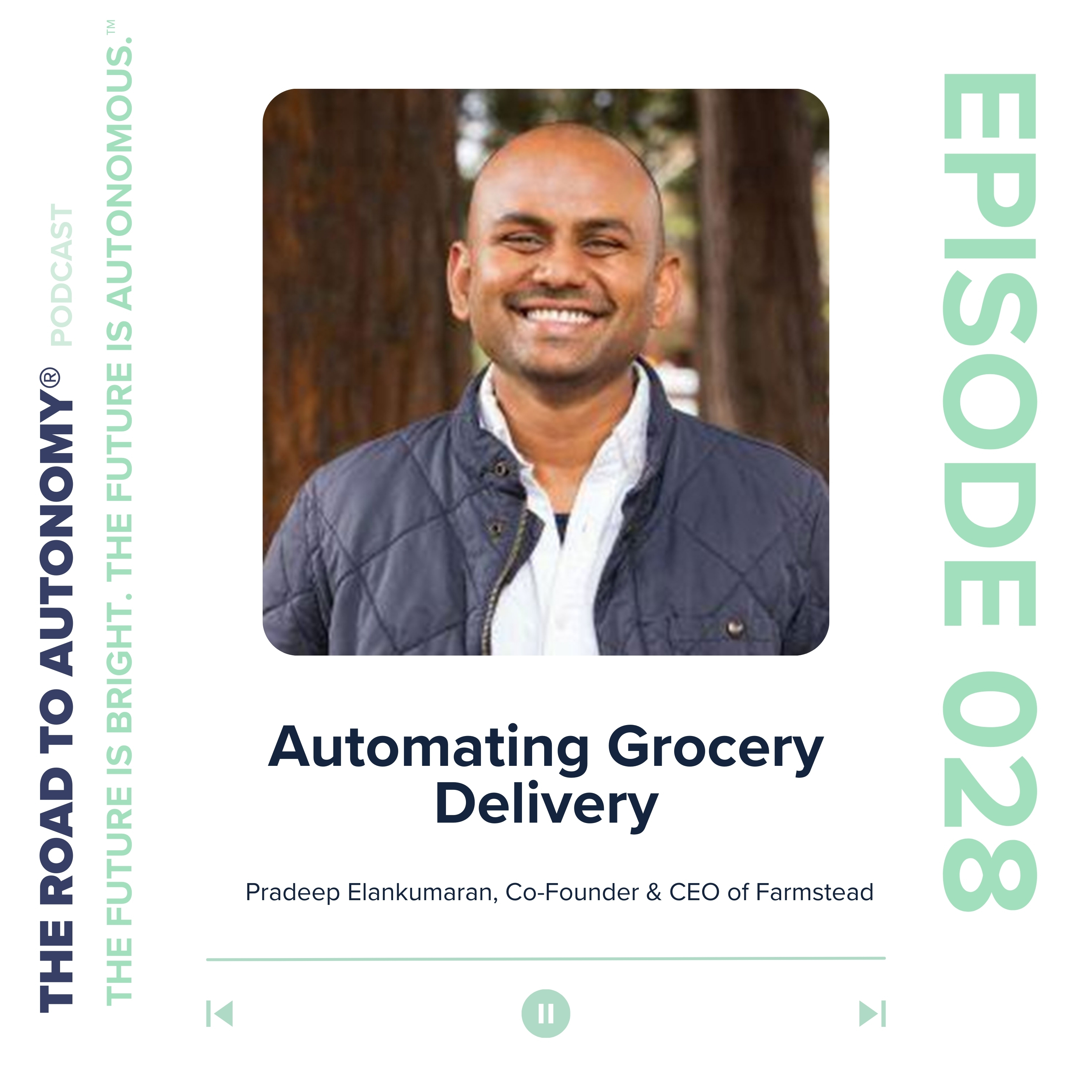
Ep 28Episode 28 | Automating Grocery Delivery
Pradeep Elankumaran, Co-Founder & CEO of Farmstead joins Grayson Brulte on The Road To Autonomy Podcast to discuss automating grocery delivery.The conversation begins with Pradeep sharing how bad experiences with grocery delivery led to the founding of Farmstead. Armed with an idea, Pradeep posted the idea on Nextdoor Mountain View to see if there was a demand for his idea of a better grocery delivery experience. Indeed there was a demand. In 2 days, 200 new potential customers expressed interest in the idea.One of the key selling points to those potential Farmstead customers the substitution policy.We told customers that we would guarantee the item. – Pradeep ElankumaranNo longer would items that you did not order show up on your doorstep. This eliminates stress for parents who would no longer have to worry if their child’s favorite milk or ice cream will arrive instead of a substitute.Our approach is software and a lot of prediction and a lot of very precise control of the data that is inserted into our system which makes the software better.As the software gets better, prediction gets better. As the prediction gets better, your experience gets better. – Pradeep ElankumaranOne of the other elements of the Farmstead business model is that the company does not pick items from a supermarket, instead, they operate out of dedicated 15,000 – 25,000 square foot warehouses.Supermarkets are not great places to fulfill online grocery orders. – Pradeep ElankumaranFarmstead is able to operate this model because of its prediction software. As the Farmstead expands to cities around the United States, the company is using a demand model to gauge interest in the market. One of those markets is Miami.As Farmstead scales, Grayson asks if Amazon and their growing grocery ambitions are a threat to Farmstead. Pradeep shares an interesting thesis on the grocery market comparing Amazon to Walmart and how Farmstead is well-positioned to gain market share in the online grocery market.One of the key differences between Amazon and Farmstead is that the company uses reusable packaging. Grayson and Pradeep have an in-depth conversation about packaging and why it is so important for grocery delivery.The crux of the market of the packaging should really be: is it recyclable? Is it returnable? – Pradeep ElankumaranFrom packaging to the current in-store experience, Grayson and Pradeep have a long conversation about consumer habits and their shopping experiences.Selection no longer matters, curation matters a lot more. – Pradeep ElankumaranFarmstead is saving consumers time by curating groceries from specialty retailers all within the app. As Farmstead onboards new customers, they are adding new products that appeal to their customers' needs and wants. All the items that are stocked and the quantity of those products are chosen by Farmstead’s predictive software.With an incredible software solution that is creating massive efficiencies for the company and its customers, Grayson asks Pradeep if Farmstead will adapt its model for autonomous vehicle delivery services.It all comes down to the customer experience. It’s not about the shiny technology. – Pradeep ElankumaranWhen automation can increase the customer experience, Farmstead will go all in.Wrapping up the conversation, Pradeep shares his vision for the future of Farmstead.Recorded on Thursday, February 11, 2021--------About The Road to AutonomyThe Road to Autonomy® is a leading source of data, insight and commentary on autonomous vehicles/trucks and the emerging autonomy economy™. The company has two businesses: The Road to Autonomy Indices, with Standard and Poor’s Dow Jones Indices as the custom calculation agent; Media, which includes The Road to Autonomy and Autonomy Economy podcasts as well as This Week in The Autonomy Economy newsletter.See Privacy Policy at https://art19.com/privacy and California Privacy Notice at https://art19.com/privacy#do-not-sell-my-info.
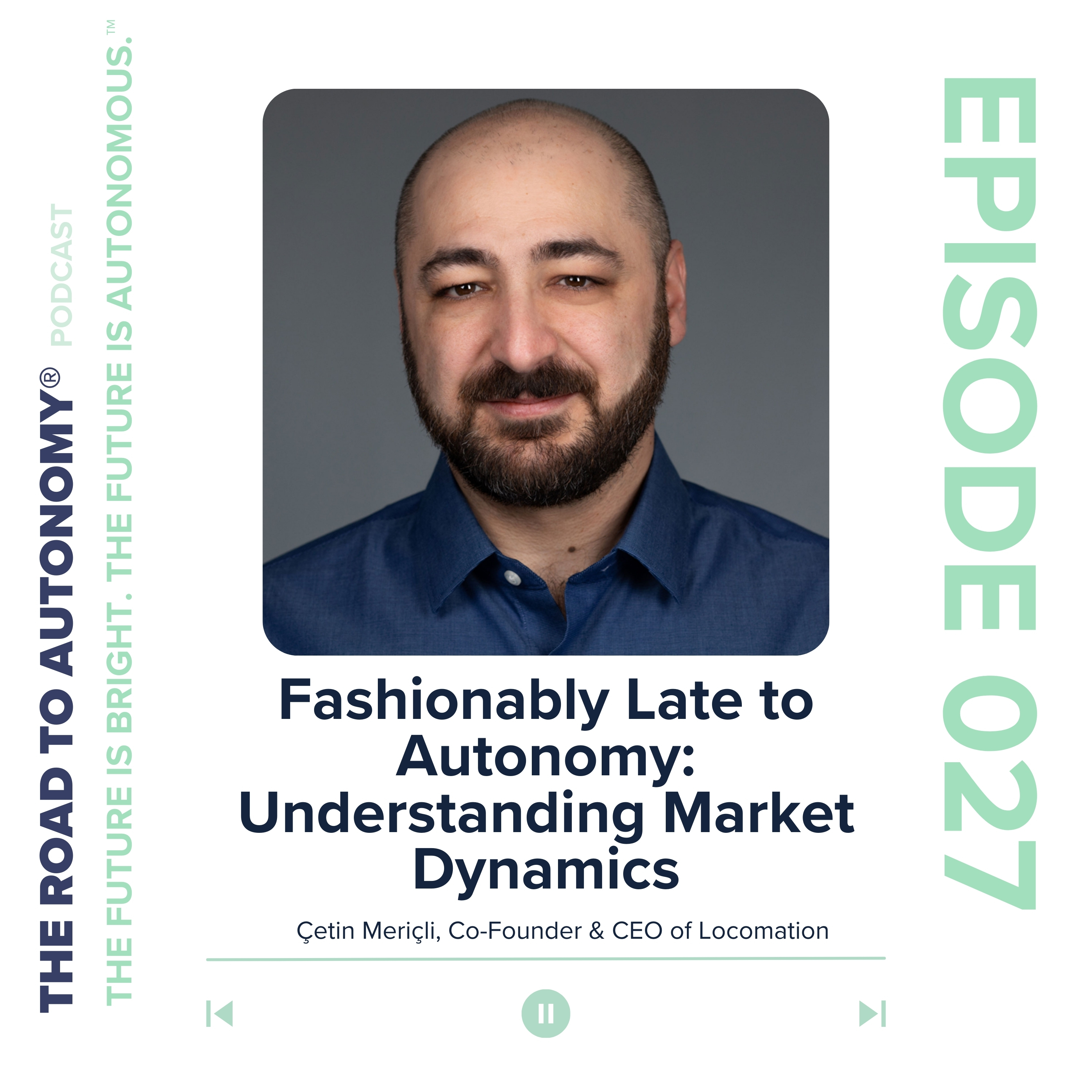
Ep 27Episode 27 | Fashionably Late to Autonomy: Understanding Market Dynamics
Çetin Meriçli, Co-Founder & CEO of Locomation joins Grayson Brulte on The Road To Autonomy Podcast to discuss what he saw in the market when he launched Locomation into a maturing autonomous trucking market in 2018.The conversation begins with Çetin discussing growing up in Istanbul, Turkey, and how his family encouraged curiosity and asking questions to learn.Curious to us was something that was particularly promoted in our family. – Çetin MeriçliWith unlimited curiosity and an always learning philosophy, Çetin taught himself computer programing when his Uncle gifted him a small home computer.I started learning computer programing. Very quickly I ran out of the idea of just getting the computer to do what I wanted it to do. Then I started exploring the idea of what if the computer can make the decisions? What if it can surprise me? – Çetin MeriçliAfter several years of hard work, Çetin moved to America to study robotics at Carnegie Mellon in 2009 and be part of the history.CMU (Carnegie Mellon University) was equal to Top Gun for me. I wanted to come here, I wanted to learn from the Red Whittaker’s, Al Kelly’s, Tony Stentz’s of the world. – Çetin MeriçliWhile a Senior Robotics Engineer at the National Robotics Engineering Center at Carnegie Mellon, Çetin co-authored the Slip-aware Model Predictive Optimal Control for Path Following paper which was published by IEEE. This paper heavily influenced the founding of Locomation as several of the co-founders were authors.Locomation was founded in 2018 just as the autonomous trucking market was starting to mature. Grayson asks Çetin what he saw when he made the decision to join a maturing market.We were not deterred, but we were actually nervous. We were scared to death. That is just normal because you are about to enter into a race where there are quote on quote more established players.– Çetin MeriçliKnow-how is very valuable. With a history in robotics and automation, the team at Locomation sat back and watched as the market matured. They were learning the market and discovering opportunities based on their technical backgrounds. While others made mistakes, Çetin learned and studied until the time was right.Being fashionably late to the party we did not lose the entire window of opportunity. We got our feet into the game at the right time. We got to observe what others were going after. – Çetin MeriçliSitting back and observing the market, Çetin was able to develop an autonomous trucking business model that would resonate with the market.The business model resonated with Wilson Logistics after a chance meeting at a conference. Then in September 2020, the companies announced a deal where 1,120 Wilson Logistics trucks will be equipped with Locomation’s autonomous relay convoy technology.Currently, Locomation has tested trucks in Pittsburgh, Ohio, Michigan, Oregon, Idaho, Texas, and Louisiana. Grayson goes onto asks Çetin what the company is learning from testing in different environments with different climates and driving habits.Not all tests are created equal. – Çetin MeriçliGrayson shifts the conversation to commercialization and asks Çetin when the company plans to start deploying trucks for customers and when the company will become profitable.In late 2022, Locomation trucks will start operating commercially and by 2023, the company will be cash-flow profitable optionally.Wrapping up the conversation, Çetin shares his thoughts on the current state of the autonomous trucking industry.Recorded on Tuesday, February 2, 2021--------About The Road to AutonomyThe Road to Autonomy® is a leading source of data, insight and commentary on autonomous vehicles/trucks and the emerging autonomy economy™. The company has two businesses: The Road to Autonomy Indices, with Standard and Poor’s Dow Jones Indices as the custom calculation agent; Media, which includes The Road to Autonomy and Autonomy Economy podcasts as well as This Week in The Autonomy Economy newsletter.See Privacy Policy at https://art19.com/privacy and California Privacy Notice at https://art19.com/privacy#do-not-sell-my-info.

Ep 26Episode 26 | The Building Blocks of Mobility
Sahas Katta, Founder & CEO of Smartcar joins Grayson Brulte on The Road To Autonomy Podcast to discuss the building blocks of mobility – standardized APIs (Application Programming Interface).The conversation begins with Sahas discussing the founding of Smartcar and growing up in Silicon Valley. Growing up in Silicon Valley has its advantages as one is able to build and develop a network early in life.This network becomes extremely valuable as one is exposed to new and emerging technologies prior to individuals located in other geographical regions. Expanding upon this, Grayson asks Sahas when the automotive industry first turned its attention to Silicon Valley.Automotive has always had a heart in Silicon Valley. – Sahas KattaThe trend began to take hold in 2015 with the adoption of connected cars. Capitalizing on this trend, Sahas and his brother Sanketh secured a pitch meeting (view the Smartcar pitch deck here) at Andreessen Horowitz which led to $2m in venture capital funding.With funding secured, Sahas and Sanketh got to work developing a standardized API for connected cars to solve the connected car problem.If you are a mobility company trying to bring your product or service to the market, you may today have to do proprietary integrations with a dozen or two dozen different car brands. Each integration might take 6, 9, or 12 months to get through that process.The end result in the world pre-Smartcar, companies decided not to even do it. It was too much work, too expensive, and too time-consuming. – Sahas KattaToday with a standardized API for connected cars, companies and developers can build new products and services without having to dedicate an immense amount of resources.As connected cars become autonomous, Smartcar’s platform will be the plumbing that enables the “non-sexy” parts of the business to function at full capacity.From unlocking doors to ensuring the vehicle is fully charged to making certain that the vehicle is properly cleaned. This is all possible with Smartcar’s platform.Staying on the theme of what is possible with Smartcar’s platform, Grayson and Sahas discuss vehicle miles traveled (VMT). How does VMT work and what has Smartcar learned from its pilots in California and Oregon?With California’s plan to phase out gasoline-powered cars by 2035, Grayson shifts the conversation to focus on electric vehicles. Sahas explains how the Smartcar platform can be used to optimize vehicle charging and monitor the health of EV car batteries.We are not the innovators coming up with these ideas to solve these problems. We provide the building blocks for incredible entrepreneurs to build really amazing applications which create a lot of value for both consumers and businesses. – Sahas KattaOne of the applications that uses Smartcar’s platform is Turo. Smartcar’s platform has enabled Turo to digitize their business all the while eliminating consumer friction. This same approach can be applied to fleet operators.With Smartcar operating in the United States, Europe, and Canada, the company takes the time to understand the culture and localizes its product to comply with local rules and regulations.Wrapping up the conversation, Sahas shares his thoughts on what mobility will look like in the United States over the next four years.Recorded on Thursday, January 21, 2021--------About The Road to AutonomyThe Road to Autonomy® is a leading source of data, insight and commentary on autonomous vehicles/trucks and the emerging autonomy economy™. The company has two businesses: The Road to Autonomy Indices, with Standard and Poor’s Dow Jones Indices as the custom calculation agent; Media, which includes The Road to Autonomy and Autonomy Economy podcasts as well as This Week in The Autonomy Economy newsletter.See Privacy Policy at https://art19.com/privacy and California Privacy Notice at https://art19.com/privacy#do-not-sell-my-info.
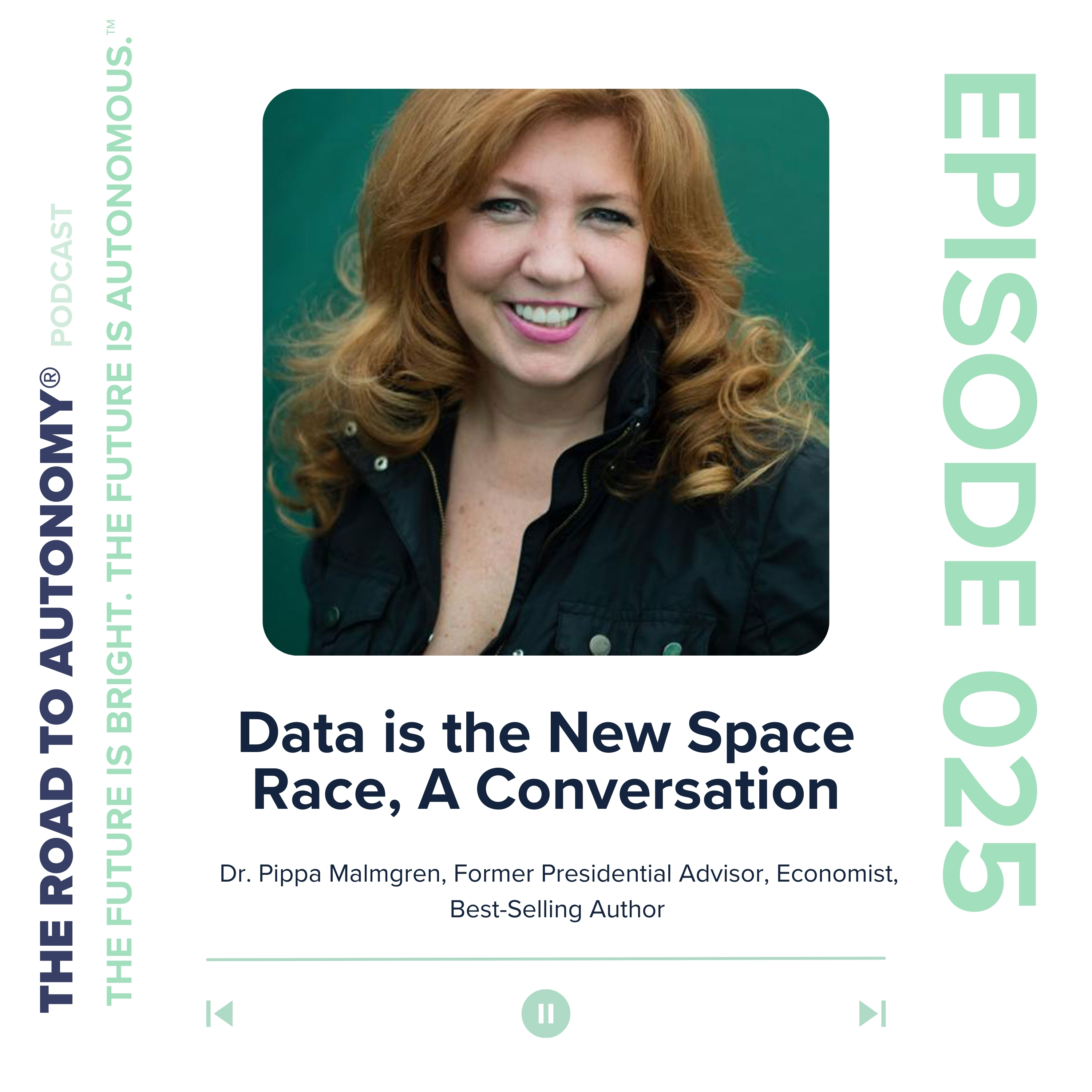
Ep 25Episode 25 | Data is the New Space Race
Dr. Pippa Malmgren, Former Presidential Advisor, Economist, Best-Selling Author, and Policy Analyst joins Grayson Brulte on The Road To Autonomy Podcast to discuss why data is the new space race.The conversation begins with Pippa sharing insight into what her father, Mr. Harald Malmgren, a senior advisor to four consecutive U.S. Presidents (President John F. Kennedy, President Lyndon Johnson, President Richard Nixon, and President Gerald Ford) taught her about relationships.My dad taught me how important it is to have trusted relationships even with people who are your opponents. – Dr. Pippa MalmgrenWhen Pippa first joined the George W. Bush White House she called her counterpart who worked for President Bill Clinton to learn and develop a relationship.Bipartisanship is something that is not very common today. Grayson and Pippa go on to discuss why bipartisanship is the way forward.You are not elected to just represent one side. You are elected to represent the American public. – Dr. Pippa MalmgrenPippa has a talk to everyone policy which has allowed her to understand complex issues from different perspectives. With a new incoming administration, Grayson and Pippa discuss what the Biden administration should focus on as it relates to economic policy.As America awakes from a COVID-19 slumber, entrepreneurs will emerge with new, stronger businesses that will create jobs and have a positive economic impact on society.Americans now have increased savings, stimulus checks, and commission-free trading. This is causing consumer habits to change. The world is becoming digitized and consumers are investing in the stock market like never before.While consumer habits are changing, Government habits are changing as well. The United States is printing trillions of dollars with no plan to repay the National Debt. Does the debt even matter?Can the United States keep printing money? Grayson asks this question to Pippa and the answer might even surprise you – The United States can keep printing money indefinitely.With a highly digitized society, comes security issues that can have a profound impact on geopolitical politics and the global economy. Pippa and Grayson go onto discuss data gathering and the U.S. Department of Commerce Entity List.Data gathering is just the first step in capturing emotions.If you know how I emotionally react, then you know how to sell to me, but you also know how to negotiate with me.Facial recognition is really about deep insight into your thought process that even you do not know. – Dr. Pippa MalmgrenWhat happens when autonomous vehicles start to gather data? Pippa shares examples of how that data can be used against consumers and why it could eventually lead to Surveillance Capitalism.Grayson asks Pippa about privacy. What regulations are needed to protect consumers from the invasion of privacy? What happens if consumers are forced to show their medical history before entering a restaurant or getting on a plane?This is a future that some individuals envision and want to see happen for their own personal and political gains. The big ideas coming out of California are not resonating as a record number of individuals and businesses are leaving the State in droves.One of the places those individuals and businesses are moving to is Austin, TX. The movement is being driven by years of bad policy and over-regulation. This conversation evolves into a discussion about open communication and why individuals are done with being censored and de-platformed.Grayson and Pippa discuss China and the current situation with Alibaba founder, Jack Ma. This situation raises the question of, who wants to do business in China. Does it lead to an exodus of foreign capital from China?With the potential exodus of foreign capital from China and a revamped manufacturing industry in the United States, apprenticeships could make a comeback. These apprenticeships will lead to new high-paying jobs.As the economy becomes more digitized and automated, Grayson and Pippa discuss the myth that automation will kill jobs. In fact, it is the opposite. Automation will create jobs. Pippa goes onto share historical contexts of why automation will create jobs.You cannot say that automation equals unemployment because it’s just not true. Automation equals better employment. – Dr. Pippa MalmgrenAutomation requires semiconductors and software to operate. Grayson and Pippa discuss the growth of the semiconductor industry. The exponential growth of Taiwan Semiconductor and the geopolitical issues that this is causing in Asia.Wrapping up the conversation, Pippa shares her thoughts on what new trends she sees emerging over the next four years.Recorded on Monday, January 18, 2021--------About The Road to AutonomyThe Road to Autonomy® is a leading source of data, insight and commentary on autonomous vehicles/trucks and the emerging autonomy economy™. The company has two businesses: The Road t
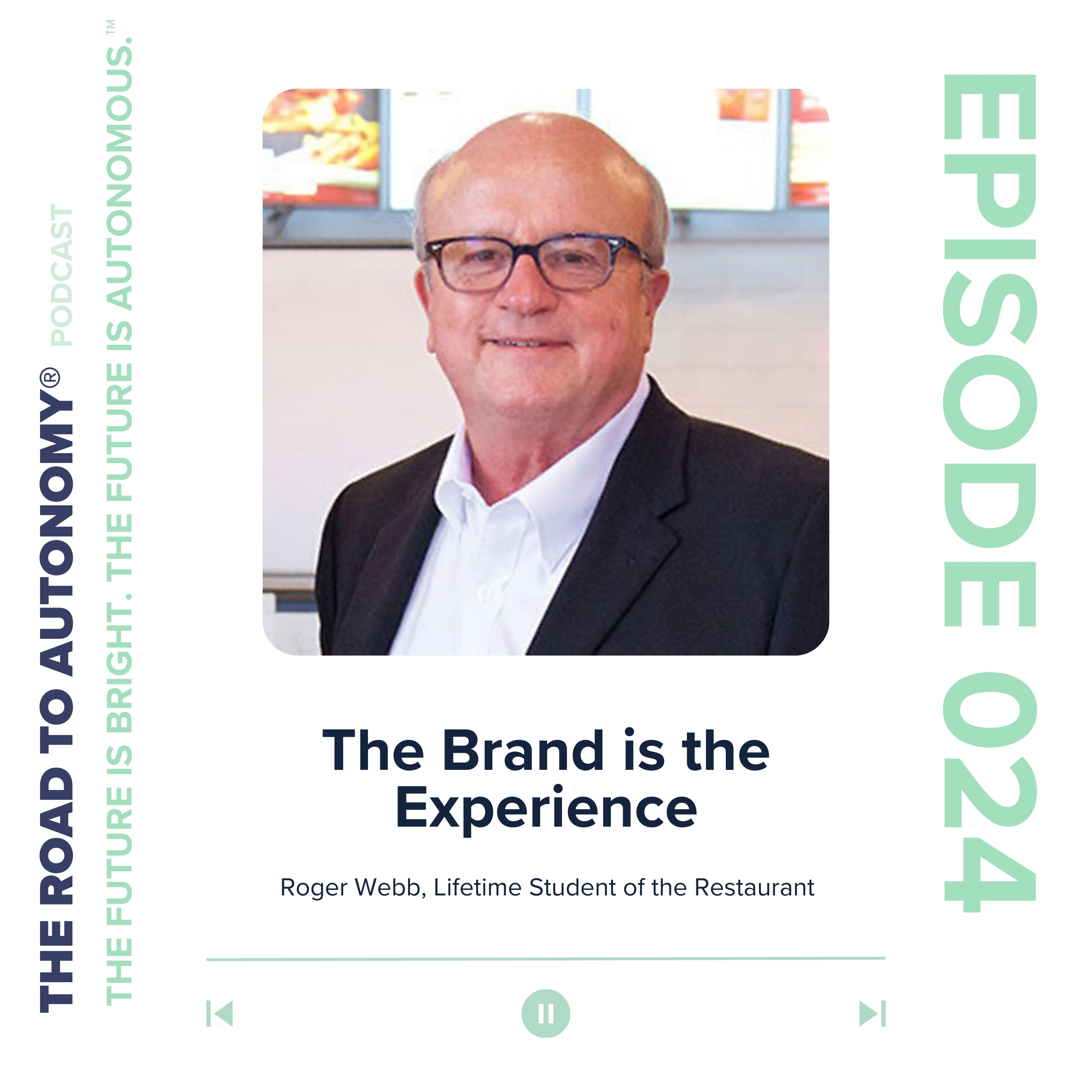
Ep 24Episode 24 | The Brand is the Experience
Roger Webb, Lifetime Student of the Restaurant Industry joins Grayson Brulte on The Road To Autonomy Podcast to discuss why the brand is the experience.The conversation begins with Roger sharing the story of how he first met Dave Thomas, Founder of Wendy’s. Later he shares his experience of when he first joined Wendy’s as the company opened its third restaurant.Today there over 6,500 Wendy’s around the world and the brand is known and loved by millions of individuals. From the VP of Franchise to a Wendy’s franchisee, Roger had an incredible career with Wendy’s.Roger was the first Wendy’s franchisee to join the U.S. Department of Energy’s Better Buildings Challenge in 2016. Before joining the challenge, Roger had a company-wide energy policy.We had a very strict policy, never have a light out. – Roger WebbNever having a light out is part of the experience of going to a restaurant. It’s an experience that consumers look for and one that the restaurant industry has to deliver on each and every-time.The experience is the thousands of little things that have to be executed perfectly every time. – Roger WebbExpanding upon the conversation of the little things that make an experience, Grayson and Roger go on to discuss brands and experiences and why they are crucial to the ultimate success of a restaurant.Your brand is the experience. – Roger WebbWith a great brand, the future is bright and scalable if you are innovative and ahead of trends. Taking a look at the future of the restaurant industry, Grayson and Roger discuss the design of restaurants. Will they have to change with the growth of delivery and eventually autonomous delivery via delivery bots such as Nuro.With an increase in delivery services, comes the need for new innovative packaging. Roger shares his thoughts on packaging and what needs to be done to ensure the french fries that arrive at your house are warm and crispy.From drones to autonomous vehicles to delivery cars, the packaging has to be developed for the operating environment. The packaging used in delivery will be different than the packaging used for food picked up at a drive-through.The drive-through is a booming business for the restaurant industry today. Roger explains how the drive-through operates and what the keys to success are for successfully operating one.The drive-throughs of today might not look like the drive-throughs of the future. Chipotle is pioneering their Chipotlanes concept throughout the United States to great success.Chipotlanes are Chipotle’s most-profitable experience because of the higher check averages. This raises the question: Is this the future of the restaurant business? Grayson asks Roger and he goes onto say restaurants are always evolving.While restaurants are always evolving they must never stop building their brand equity. This lesson can be traced back to Sam Bronfman, Founder of Distillers Corporation who was always focused on quality and the appearance of his brands.Discounting can impact brand equity in a negative way. Roger explains why discounting is something that should be done with caution.Brand equity is what you do every day, every minute, every hour, and that should be a part of everything that you do when you are building a brand. – Roger WebbLooking at the current trend of Cloud / Ghost Kitchens, Grayson asks Roger how these types of restaurant businesses can develop a brand. Without a brand, customers will be unsure whether to try a new concept that they might never have heard of before.For Cloud / Ghost Kitchen concepts to be successful, they will have to have a brand that customers know, like and trust. A brand combined with a bespoke delivery service and pick-up service will thrive in resort communities.Wrapping up the conversation, Roger discusses delivery fees and the economics of delivery services.Recorded on Thursday, January 14, 2021--------About The Road to AutonomyThe Road to Autonomy® is a leading source of data, insight and commentary on autonomous vehicles/trucks and the emerging autonomy economy™. The company has two businesses: The Road to Autonomy Indices, with Standard and Poor’s Dow Jones Indices as the custom calculation agent; Media, which includes The Road to Autonomy and Autonomy Economy podcasts as well as This Week in The Autonomy Economy newsletter.See Privacy Policy at https://art19.com/privacy and California Privacy Notice at https://art19.com/privacy#do-not-sell-my-info.
Ep 23Episode 23 | Automating Fleet Optimization
Aarjav Trivedi, Founder & CEO of Ridecell joins Grayson Brulte on The Road To Autonomy Podcast to discuss how digitizing and automating fleet management leads to increase revenue and profitability for logistics and mobility companies.The conversation begins with Aarjav discussing the founding of Ridecell 1.0 in Atlanta, GA. The experience of waiting for the bus in the cold and not knowing if and/or when the bus would show up gave Aarjav the inspiration to change transportation.Three years in a row this experience on an almost daily basis grinds into you this feeling – there has got to be a better way. – Aarjav TrivediDuring this time, Uber had yet to exist. The iPhone was just being introduced and Aarjav Trivedi an engineer from Georgia Tech decided to change transportation by combining trust and payments.In 2011, Aarjav moved to San Fransisco and launched Summon. Summon was the first on-demand taxi company in California to receive a permit and operate legally. While operating Summon, Aarjav saw that partners such as BMW and companies such as Google needed a fleet optimization management software solution.The relationship and trust Aarjav developed with BMW during the Summon days led to BMW’s i Ventures team leading Ridecell’s $11.7 Series A round.Most great investors are very focused on creating impact. If you create impact the revenues follow. – Aarjav TrivediToday, Ridecell is a global enterprise operating in multiple countries around the world including the United States, Europe, and India. Aarjav discusses how he manages a global team and understands local cultures and customs.The COVID-19 pandemic forced companies to pivot and embrace new business models. Aarjav discusses how Ridecell was well prepared for the pandemic as the company was well-diversified with digital-first solutions.With digital-first solutions for fleet operators and the growth of e-commerce, Ridecell’s logistics business is growing as more companies around the globe adopt digital-first solutions. Aarjav explains how Ridecell’s software platform helps logistics companies operate more efficiently and profitability.One of Ridecell’s strongest value propositions is being able to automate the decisions that increase revenue, decrease cost, increase yield while increasing sustainability. – Aarjav TrivediGrayson asks Aarjav, how the Ridecell platform can help optimize courier services for the delivery of goods. It all comes down to digitization and using the data to optimize the fleet to ensure optimum up-time. The courier also benefits from a comfort perspective. Before getting into the vehicle, the temperature and music are set for the driver’s preference.What happens when the vehicles are autonomous? Grayson and Aarjav go on to discuss autonomy and Ridecell’s acquisition of Auro Robotics in 2017. Expanding upon the autonomy theme, they discuss the economics of autonomous vehicles and what the business model might look like in the future.Grayson asks Aarjav if fleet optimization the key to achieving profitability with autonomous solutions. Fleet optimization along with the eco-system of operating a service is the key. From managing the health of the vehicle to in-vehicle entertainment. All the parts of the eco-system have to work together in harmony.The core problem is to not let data live in silos so that decisions are made in efficient ways. The core thing is to connect the data from the vehicle. – Aarjav TrivediWrapping up the conversation, Aarjav shares his thoughts on the future of mobility and the role that Ridecell will play.Recorded on Tuesday, January 12, 2021--------About The Road to AutonomyThe Road to Autonomy® is a leading source of data, insight and commentary on autonomous vehicles/trucks and the emerging autonomy economy™. The company has two businesses: The Road to Autonomy Indices, with Standard and Poor’s Dow Jones Indices as the custom calculation agent; Media, which includes The Road to Autonomy and Autonomy Economy podcasts as well as This Week in The Autonomy Economy newsletter.See Privacy Policy at https://art19.com/privacy and California Privacy Notice at https://art19.com/privacy#do-not-sell-my-info.

Ep 22Episode 22 | Thermal Imaging: Making Roads Safer
John Eggert, Automotive Business Development, FLIR Systems joins Grayson Brulte on The Road To Autonomy Podcast to discuss how thermal imaging is making roads safer.The conversation begins with John sharing his thoughts on the current state of the autonomous vehicle industry while looking back to 2015 when he first started his career in the industry.[The industry] has become a lot more professional. – John EggertToday, the industry as a whole is spending money more wisely. It’s maturing, but certain companies still do not have a path to profitability. Expanding upon this, Grayson and John discuss the economics of the autonomous vehicle industry and properly setting expectations for investors and the public.Diving deeper into the economics discussion, Grayson asks John to talk about his experience of owning a Quiznos franchise in San Fransisco. John shares what he learned and how difficult it was to operate a business in San Fransico.With John’s unique experience of having owned and operated a business in San Fransisco, Grayson asks John why the autonomous vehicle industry is determined to launch a service in a city that is extremely unwelcoming to the technology.John explains that the talent pool is currently driving the decision, but that could change in the future as the reality of economics and regulation set in as the companies move to commercialize their services.Could Miami end up becoming the Autonomous Vehicle Capital of North America as companies are fleeing California every single day? Grayson and John discuss why and what is driving the growth of the autonomous vehicle industry in Miami.Looking back on his days at Velodyne, John shares some intimate stories about the early days of LiDAR including a meeting with George Hotz, Founder of Comma AI where he showed him the latest Velodyne LiDAR.The conversation evolves into a discussion about Comma AI and how George Hotz understood the economics of LiDAR. At the prices, George knew that it would be impossible to scale Comma AI with LiDAR due to the cost of LiDAR.LiDAR is one of the key technologies to enable full self-driving. The other technology is thermal imaging.There is no technology in vehicles today more capable of identifying or classifying or detecting a human or any living creature for that matter than thermal imaging. – John EggertJohn goes onto explain the safety benefits of thermal imaging and how this technology can be incorporated into automatic emergency braking systems to save lives. Today, thermal imaging is not included in AEB systems due to the cost.Grayson makes the case that it is not about the cost, it is about saving lives and doing good by society. In March of 2020, The National Highway Traffic Safety Administration (NHTSA) reported that 76% of all 2018 pedestrian fatalities involving vehicles happened after dark.This conversation evolves into a discussion around safety and how Volvo built a brand around safety. Expanding upon brands, Grayson and John discuss Zoox and their relationship with Amazon.Grayson goes on the record to predict that Amazon will launch an Amazon Prime Mobility Tier in the future which will include unlimited Zoox rides.Closing out the conversation, Grayson and John go onto discuss FLIR Systems and the many use cases for thermal imaging around the world.Recorded on Friday, December 18, 2020--------About The Road to AutonomyThe Road to Autonomy® is a leading source of data, insight and commentary on autonomous vehicles/trucks and the emerging autonomy economy™. The company has two businesses: The Road to Autonomy Indices, with Standard and Poor’s Dow Jones Indices as the custom calculation agent; Media, which includes The Road to Autonomy and Autonomy Economy podcasts as well as This Week in The Autonomy Economy newsletter.See Privacy Policy at https://art19.com/privacy and California Privacy Notice at https://art19.com/privacy#do-not-sell-my-info.
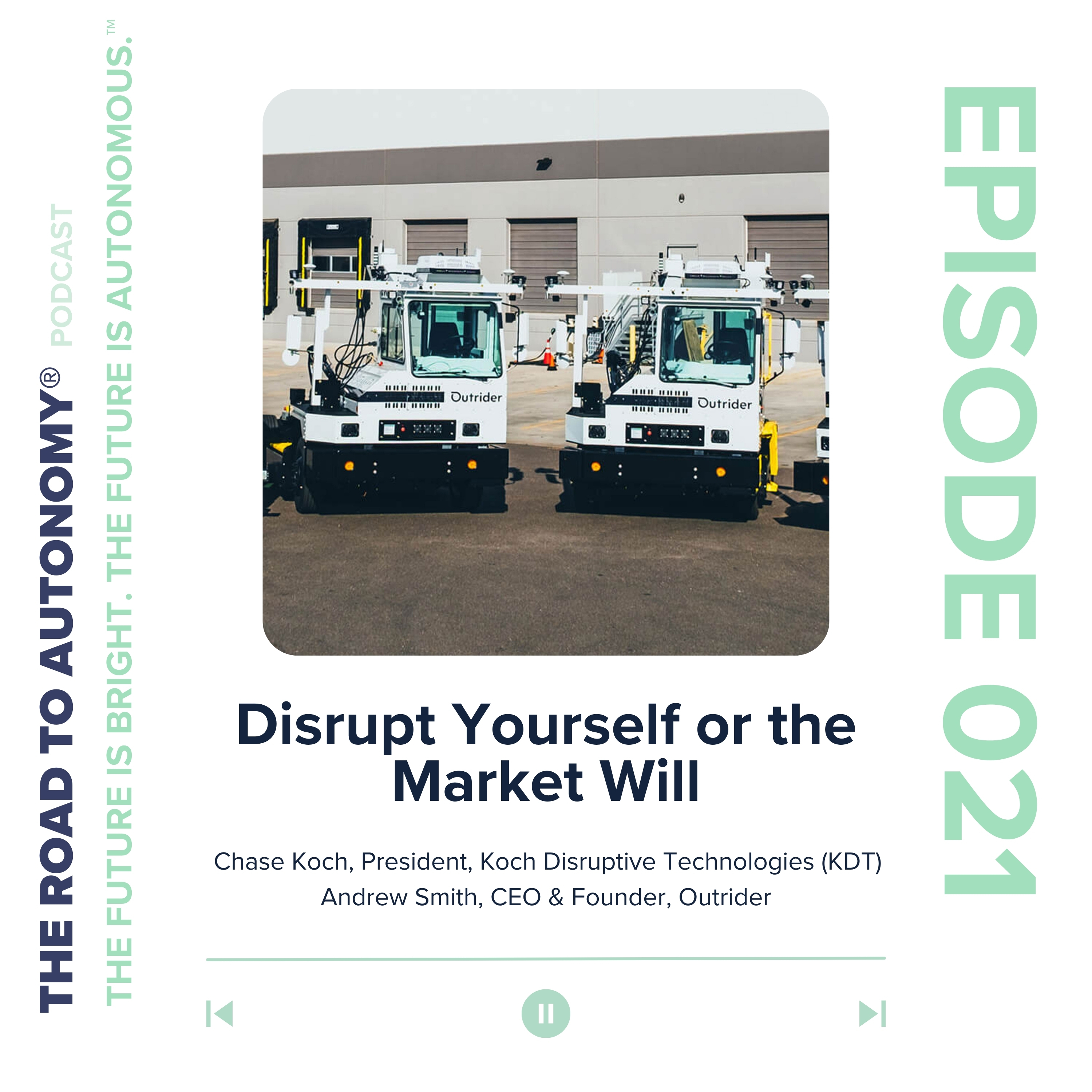
Ep 21Episode 21 | Disrupt Yourself or the Market Will
Chase Koch, President of Koch Disruptive Technologies (KDT), and Andrew Smith, CEO & Founder of Outrider join Grayson Brulte on The Road To Autonomy Podcast to discuss automation, partnerships, and the power of the Koch network for principled disruptive entrepreneurs.The conversation begins with Grayson sharing a high-level overview of Koch Industries and the company’s economic impact globally. Koch Industries is a private company that generates annual revenues of $115 billion according to Forbes and employs over 130,000 individuals in 70 countries around the world.Following the introduction of Koch Industries, Chase explains the Koch Laboratory approach to entrepreneurship.We can give entrepreneurs with a lot of upside a place to experiment, grow, and transform their technology and their business model to help them unlock their potential. – Chase KochKoch Disruptive Technologies (KDT) vision is to be the preferred partner in accelerating value creation for principled disruptive entrepreneurs while helping to transform Koch Industries.Koch Industries success comes in part from the company’s Market Based Management (MBM) philosophy which was developed by Mr. Charles Koch. This same philosophy is applied to Koch Disruptive Technologies and the Koch Laboratory.It’s the whole Joseph Schumpeter model, disrupt yourself or the market will. – Chase KochKoch incentives every employee to create value not just for their P&L, but for the entire organization. Expanding upon this conversation, Chase explains Koch’s Republic of Science approach and how it benefits founders who work with Koch Disruptive Technologies.One of the companies that Koch Disruptive Technologies has invested in is Outrider. Andrew Smith, CEO & Founder shares his inspiration for why he founded Outrider and what the market opportunity is for Outrider.One of the biggest market opportunities facing today’s business leaders is essentially to reinvent how we move things, power things, produce things to support higher and higher standards of living. – Andrew SmithWhile leading an expedition to the Arctic National Wildlife Refuge to witness the caribou migration, Andrew came up with the idea for Outrider.Outrider is the perfect example of how innovation allows us to avoid unnecessary tradeoffs. – Andrew SmithGrayson asks Andrew, why yard automation. Andrew explains that there are over 10 billion tons of cargo moving around the United States on a daily basis. A majority of the cargo is moving over trucks and yard trucks are being used to move the trailers around yards.Automation has become more and more a key driver for our transformation vision across all of our businesses. – Chase KochThe partnership with Koch Industries gives Outrider a massive path to scaling operations. Andrew talks about his working relationship with Chase and how their organizations are working together.Chase expands upon Andrew’s thoughts and shares his own thoughts on the power of relationships and partnerships. Additionally, they discuss their mutual commitment to the environment and sustainability.The Koch Industries vision is applied to everything that Koch does:We want to create products, services, and solutions that are better than customers’ alternative but do this responsibility while always consuming fewer resources. – Chase KochOver the past five years, Koch Industries has invested over $30 billion in technology alone. This investment in technology is only going to continue to grow.Using fewer resources and being a sustainable company is one of the key goals of Outrider. Sustainability is core to who Outrider is as a company.Wherever your gift is, you have to lean into it. Where passion meets your gift, you have to lean into because that is how you are going to unlock your potential. – Chase KochPrior to founding Outrider, Andrew founded ATDynamics and sold it to STEMCO in 2015. During his time running ATDynamics, Andrew learned a lot and he shares his knowledge and how this experience prepared him for Outrider.To succeed in transportation logistics, it’s not just about fancy technology. It’s about reliability, simplicity, and durability. – Andrew SmithAndrew discusses why having the right investors is key to succeeding. The team at Outrider works closely with their investors including Prologis to ensure that the company is creating value.Prologis is working with Outrider to ensure that their warehouse yards are designed for yard automation. Increasing the efficiencies of the yard benefits both Prologis and their customers.Closing out the conversation, Chase and Andrew share their thoughts on the future of automation and supply-chain management.Recorded on Friday, December 11, 2020--------About The Road to AutonomyThe Road to Autonomy® is a leading source of data, insight and commentary on autonomous vehicles/trucks and the emerging autonomy economy™. The company has two b
Ep 20Episode 20 | What’s Next: Insight from an Angel Investor
Joshua Schachter, Investor, and Founder of Self Racing Cars joins Grayson Brulte on The Road To Autonomy Podcast to discuss what’s next and the current state of investing in the private markets.The conversation begins with Joshua sharing his thoughts on new trends that he is starting to see emerge and his philosophy regarding investing. One of his key investment traits is the emotional deal in which he invests based on his gut and intuition.Out of the two-hundred plus companies [that I have invested in] this has probably happened 6,7,8 times, but 5 of those have IPOed. – Joshua SchachterInvesting in tech start-ups is based on patterns and that is what Joshua looks for when he is making an investment.By the time people have identified trends, it’s a little lagging. – Joshua SchachterWhile fintech is hot now, it’s an area that Joshua is currently not investing in, despite his experience on Wall Street. Joshua spent a decade on Wall Street working for Morgan Stanley.Before fintech became an identified trend, Joshua’s long-standing relationship with Jack Dorsey led to an early investment in Square. This conversation evolves into a discussion about reputation and it’s importance in investing.I will absolutely take it on the chin to make sure that a founder is not screwed over. – Joshua SchachterWith a great reputation, one can build life-long relationships. To learn a new industry, one must invest. This is one of the main reasons why Joshua created Self Racing Cars. He wanted to develop relationships in a sector where he did not have any connections.Joshua goes onto explain what Self Racing Cars is and how his love of racing inspired the event. Grayson asks Joshua about how he is planning to maintain the homebrew club feel of the event as it scales and becomes more popular.This conversation evolves into the current state of markets. With a red-hot IPO market and stocks of electric vehicle companies soaring, Grayson asks Joshua to share his thoughts on the current state of the private market.It’s a much more slowly moving system. I think venture goes throw waves of contraction and relaxation. – Joshua SchachterAs a seed-stage investor, Joshua looks for companies that have a market value of $10 – $12 million. Investing at this stage is risky and takes years to realize returns.With the current global pandemic, Grayson asks Joshua what new opportunities might be bubbling up for investors in the private market. Additionally, why investors are following the herd mentality by investing large sums into loss-making electric vehicle startups.Expanding upon his thoughts, Joshua explains the difference between enabling and enabled companies. An electric vehicle start-up (excluding Tesla) is an enabled company as the companies depend on battery technology to create and deliver their product.There are still a lot of enabling technologies that have yet to be unlocked. In the future, new technologies will be invented which completely change the current state of the electric vehicle market.New technologies (such as autonomous vehicles) will become mainstream one day. But before they get there, there will be a massive round of consolidation in the industry. Grayson and Joshua have a lively discussion around investments in autonomous vehicle companies and the current state of the market.The shape of organizations will change as consolidation begins. Joshua explains the impact that this will have on the teams that are working on the technology. With Uber ATG being in the news (and eventually sold to Aurora), Grayson and Joshua discuss the program and why it was not in Uber’s best interest to start the program.Looking at programs and acquisitions, Grayson shares his thoughts on Zoox and why Amazon made a brilliant purchase. With Amazon being the “Everything Store”, Grayson and Joshua discuss why the Amazon Prime Mobility tier might one day become a reality.Looking at the competitive advantages that certain companies have as they look to enter the autonomous vehicle sector, Grayson discusses why the Apple Store will be one of Apple’s competitive advantages. Joshua goes onto explain Voyage‘s competitive advantage with master-planned communities. The master-planned community strategy was one of the main reasons why Joshua invested in Voyage.Closing out the conversation, Grayson and Joshua discuss the current state of the autonomous vehicle market and who will ultimately be the winners.Recorded on Friday, December 4, 2020--------About The Road to AutonomyThe Road to Autonomy® is a leading source of data, insight and commentary on autonomous vehicles/trucks and the emerging autonomy economy™. The company has two businesses: The Road to Autonomy Indices, with Standard and Poor’s Dow Jones Indices as the custom calculation agent; Media, which includes The Road to Autonomy and Autonomy Economy podcasts as well as This Week in The Autonomy Economy newsletter

Ep 19Episode 19 | Becoming a Chef: Timing, Passion, and Risk
Chef Hugo Bolanos, Executive Chef, and Co-Founder, Búho Rouge joins Grayson Brulte on The Road To Autonomy Podcast to discuss timing, passion, and risk.The conversation begins with Hugo sharing his memories of growing up in Guatemala and the influence that his grandfather and father had on his life.After a bad investment in textiles, Hugo’s father took a huge gamble and moved the family to America to provide his family a better quality of life for his family. Twenty years after moving to America, the family was able to achieve U.S. Citizenship.Wanting to achieve the American Dream, Hugo wanted to shoot for gold and enter the restaurant business by becoming a waiter at 17. At that time the required age to be a waiter was 21. During the interview, the manager of the restaurant offered Hugo an opportunity as a runner, but he had to prove himself.During that time in the kitchen, Hugo developed a relationship with Chef Fred Iwasaki who would become his very own “Mr. Miyagi”. Wanting to learn to be a chef, Hugo asked Chef Iwasaki to teach him.The Chef replied:I will not pay you anything. If you want to come in, I will pay you in lessons. You come in the morning, you clean the bathrooms, you clean the floors, and if you can hack it- at the end of the day I will teach you a lesson every single day.One day a chef did not show up for work and Hugo got his first big break as a Line Chef. When the restaurant closed its doors, Chef Iwasaki took Hugo to cook at the Oscars as part of the Wolfgang Puck Catering team. This was a life-changing moment for Hugo which would go on to alter the course of his career.At that time in his life, he wanted to work at the Cheesecake Factory, which was always busy and looked cool. Hugo went through six interviews, including a physiological test and he ultimately did not get the job.I tell myself all the time when I drive by the Cheesecake Factory, if I would have gotten that job, it would have changed my whole life. It would have taken me down a different road. – Chef Hugo BolanosAfter being turned down for the Cheesecake Factory job, Hugo received a phone call from his mentor, Chef Iwasaki, who invited him to join him once again cooking for Wolfgang Puck Catering. This time it was not for the Oscars, but a private party at the home of the actor David Carradine in Beverly Hills.Hugo was in charge of driving the catering van this evening. This evening turned into a make or break moment. When the party was over, backing out the van, Hugo crashed into Wolfgang Puck’s prototype Mercedes.With the fear of getting fired, Hugo went into the party to inform Chef Wolfgang Puck that he had crashed the van into his car. Wolfgang asked if was OK and told him that it was fine.You have to get over your own fears to see what you are capable of. – Chef Hugo BolanosThe next day, Hugo had to report to Spago for a demo for Chef Charlie Trotter. Feeling like “death”, Hugo shows up and has no idea what is about to happen. Will his parents get a phone call. Will he lose his job. What will happen?During this time, Wolfgang Puck and Chef Lee Hefter were talking about the event and how it went. Wolfgang told Chef Hefter about the incident which did not go over well, to say the least.As Wolfgang makes the rounds during the demo, he locks eyes with Hugo and says:You are that stupid kid who hit my car.Wolfgang calls over Chef Hefter, who respects Hugo for the fact that he showed up at Spago after the incident. Chef Hefter transferred Hugo from Catering to Spago to repay the debt. Once again it was about timing as Hugo owned the situation.Hugo ended up spending 10 years at Spago working his way up to #3 in the kitchen. When famous chefs such as Daniel Boulud or Alain Ducasse would visit Spago, Hugo would ask to join their operations for a summer to learn new cooking techniques.He made it happen and paid his own way. The world’s kitchens were Hugo’s internship.You cannot cook great food or give a great experience unless you received that great food. Received that great experience and seen that for yourself. – Chef Hugo BolanosFrom Spago, Hugo transferred to the Hotel Bel-Air where he created the annual End-of-Summer Barbecue. This conversation evolves into a discussion around not giving up when facing obstacles in life.With COVID-19 impacting the world, Hugo’s dream of opening his own restaurant was starting to diminish. Having to make a big life decision, Hugo pivoted and shifted to a takeaway restaurant business – Búho Rouge.With takeaway food, packaging and ingredients are crucial. Grayson and Hugo have an in-depth conversation around packaging and foods that can be packaged for takeaway and delivery.Building upon packaging, Grayson asks Hugo for his thoughts on cloud kitchens and what the experience will look like for customers when the food is delivered.I am looking for whatever that next platform is. – Chef Hugo BolanosClosing out the conversation, Grayson and Hugo discuss culinary exper
Ep 18Episode 18 | Gas Stations of the Future: Electric Charging Hubs
Colin Roche, Co-Founder & CEO of Swiftmile joins Grayson Brulte on The Road To Autonomy Podcast to discuss gas stations of the future - electric charging hubs.The conversation begins with Colin telling the story of how entering a raffle during a Christmas party and eventually winning an electric bike inspired him to co-found Swiftmile.Taking a step back in history, Colin shares the story of how he came up with the idea for Penagain during an all-day Saturday detention during High School. Penagain has gone on to sell millions of pens around the world. Colin tells the story of how he grew the business, secured manufacturing, and had a positive impact on society.Grayson steers the conversation back towards Swiftmile and asks Colin about one of his first bosses, Alex Edelstein who told him to:Go Make Something Happen. – Alex EdelsteinLater Alex Edelstein became the first investor in Swiftmile after a dinner in which Colin said:What if the world really adopts these PETS (personal electric transports)? – Colin RocheAlex wrote the check on the spot, reinforcing the strength of life-long relationships.2015 was a banner year for Swiftmile as the company raised its first investment and was one of the winners of Verizon’s Powerful Answers contest. Swiftmile won $250,000 and developed a long-term relationship with Verizon.What is the big picture? How can we impact the world? – Colin RocheColin asked this question to his team prior to entering the contest. Today, Swiftmile is having a positive impact on the world by increasing renewable transportation in cities around the world.With investment and guidance from Thayer Ventures, Swiftmile is expanding into the hospitality industry.A big part of our plan is working with hotels. – Colin RocheBy having a micromobility hub at the hotel, guests will be able to experience cities in new and fun ways with little to no friction. The hubs will end up becoming part of the experience and integrated into the hotel’s guest app.Micromobility solutions are also being deployed on Military bases to assist troops moving around the base. Colin discusses Swiftmile’s current deployments at U.S. Military bases and the positive impact that their solution is having on base life.From cities to hotels to Military bases, Swiftmile is aiming to become the gas station for micromobility solutions.Swiftmile will become a gas station for scooters. – Colin RocheBuilding upon this comment, Colin expands upon this statement while taking history into account. This evolves into a conversation about Standard Oil and the initial roll-out of Standard Oil gas stations.Grayson raises the question, what would Standard Oil be without Henry Morrison Flagler? Would there have been vertical integration and distribution innovation that would have allowed Standard Oil to stay ahead of the competition?Staying ahead of the curve, Swiftmile is planning to add new forms of charging to the stations while planning for the eventual consolidation in the micromobility industry.Closing out the conversation, Grayson asks Colin about the economics of micromobility charging and why charging infrastructure is one of the keys to enabling profitable scooter deployments.Recorded on Tuesday, November 17, 2020--------About The Road to AutonomyThe Road to Autonomy® is a leading source of data, insight and commentary on autonomous vehicles/trucks and the emerging autonomy economy™. The company has two businesses: The Road to Autonomy Indices, with Standard and Poor’s Dow Jones Indices as the custom calculation agent; Media, which includes The Road to Autonomy and Autonomy Economy podcasts as well as This Week in The Autonomy Economy newsletter.See Privacy Policy at https://art19.com/privacy and California Privacy Notice at https://art19.com/privacy#do-not-sell-my-info.
Ep 17Episode 17 | Shangri-La of Mobility: Robotaxis
Alvaro Ramis, VP of Business Development and Alliances, Bestmile joins Grayson Brulte on The Road To Autonomy Podcast to discuss why robotaxis are the Shangri-La of mobility.The conversation begins with Alvaro talking about his career which started in banking and later the travel industry, before joining the mobility industry. Throughout his career, Alvaro has always had a focus on innovation.My background is someone who feels extremely comfortable with uncertainty. – Alvaro RamisStaying on the theme of being extremely comfortable with uncertainty, Alvaro joined Car2Go in 2014 as Chief Marketing Officer. When he first tried a free-floating car-share service, Alvaro thought the following:It was that moment when I opened that car with my app that the lights turned on. I walked into the vehicle and the panel told me hello with my name. I was like man, this is the future. I fell in love. – Alvaro RamisBringing this conversation full circle, Grayson asks Alvaro about the current state of free-floating car sharing. The market is stagnating due to competition from Uber and Lyft and the inherent asset-heavy business model.Staying on the topic of asset-heavy business models, Grayson and Alvaro discuss who is going to own the autonomous vehicles on their balance sheet. Will it be the banks? Will it be rental car companies?Alvaro go into discussing who will “go to school” to learn the model of asset-heavy mobility as the industry and venture capital firms continue to focus on asset-light companies. Without the asset, there is no mobility service.The future of mobility is about electric, shared, and autonomous. – Alvaro RamisWhile the future may be electric, shared, and autonomous, it has to be profitable. As autonomous mobility companies continue to focus on the robotaxi business, they are starting to diversify into trucking as there is a clear path to revenue and profitability.Waymo has their Waymo Via service which is focused on the delivery of goods and Aurora is now expanding into self-driving trucks. Both Waymo and Aurora were solely focused on the robotaxi market until the path to revenue and profitability was marginalized for the short-term.The end game is the robotaxi. That is the big prize. That is the Shangri-La of mobility. It’s the biggest market by a lot. – Alvaro RamisIs there a path to profitability in the robotaxi business? With highly indebted businesses, Alvaro makes the comparison to the telecommunications industry.Grayson agrees with the comparison, but he states the case that the robotaxi business will not spit-off nearly as much cash as the AT&Ts and Verizons of the world. Robotaxi companies will not be able to pay a 4%+ dividend.However, the Beep's and Voyages of the world which operate in controlled environments with captive audiences will be able to generate large amounts of cash and eventually become extremely profitable.Once you have an enclosed environment, you can add more services around it. Also, you are not fighting for that customer in a similar environment that you would have in a traditional ride-hailing market where you would have to buy the supply and demand which is a race to the bottom. – Alvaro RamisAutonomous vehicle companies operating in these environments will not face the same customer acquisition costs as the robotaxi business.However, a majority of autonomous vehicle start-up founders are still attracted to Shangri-La, while Oliver Cameron, CEO of Voyage is instead focused on the riches in niches business model.Building upon the business model conversation, Grayson asks Alvaro about the current state of autonomy in Europe. Europe is behind the United States in terms of funding, deployments, partnerships, and legislation.To operate an SAE Level 4 autonomous vehicle in Europe today, companies have to apply for an exemption. This process is cumbersome and challenging with national security issues playing a large role.National Security is a huge issue for the deployment of autonomous vehicles. Grayson and Alvaro go on to have an in-depth conversation about national security and what has to be done to ensure that remote operations of AVs are secure.You cannot allow artificial intelligence or autonomous vehicles to decide where to go when a terrorist attack happens in a city. – Alvaro RamisThe issue of terrorism and the potential of a terrorist attack is very real and it is an issue that the autonomous vehicle industry needs to plan for as they build out their remote operations. As part of VW’s autonomous vehicle deployment for the 2022 World Cup in Qatar, the Government required remote operations in case of a potential incident.Closing out the conversation, Grayson and Alvaro discuss the development and deployment of autonomous vehicles in China.Shangri-La is not technology per se, its the problems that it solves. – Alvaro RamisRecorded on Thursday, November 12, 2020--------About The Road to AutonomyThe Road

Ep 16Episode 16 | American Success Story: AutonomouStuff
Bobby Hambrick, Founder & CEO, AutonomouStuff and Chief Autonomous Officer, Hexagon joins Grayson Brulte on The Road To Autonomy Podcast to discuss the founding of AutonomouStuff, the acquisition by Hexagon, and why AutonomouStuff is an American success story.The conversation begins with Bobby telling the story of how he founded AutonomouStuff in a barn in his backyard and eventually sold his house and rental properties to scale the company.I was born with this natural innate motivation and this drive to succeed. I have always taken this fearless approach to accomplish whatever task I had on hand. – Bobby HambrickAs the company grew, Bobby reinvested every dollar that the company made back into the company to help it grow. He grew the company without venture capital as he invested in himself and his company. Every month Bobby operated the company it was was profitable.The conversation naturally evolves into SPACs and why companies are going public with little to no revenue and zero profitability. Grayson and Bobby discuss the importance of operating a business that is profitable.Building upon this, Bobby shares an insightful story from when he was interviewing an engineer who did not know how to use tools. This opened his eyes in a meaningful way.Hard work and common sense can get you a long way. To be a successful entrepreneur, being smart is not enough. You have to be able to understand how things work and even more important is the power of the relationships that you have. – Bobby HambrickThe ethic of hard work was ingrained into Bobby during his time growing up in the Midwest. The Midwest historically has had a reputation of hard work. Understanding this, Bobby founded and scaled the company in Morton, Illinois.As Bobby was contemplating selling the company to Hexagon he thought about the following:If I am going to sell to a larger company, I want to take care of the people who helped me. They are like family to me. – Bobby HambrickAs part of the transaction, there was a clause that AutonomouStuff would stay in Morton for good. The impact that AutonomouStuff has had on the town of Morton cannot be measured. It is felt at the dinner table when employees discuss building the future and their travels around the world.CES 2020 was one of those moments when it all came together when Hexagon showcased AutonomouStuff right next to the Google installation. Bobby goes on to explain that is merely just the beginning for AutonomouStuff. With the resources of Hexagon, the future is extremely bright for AutonomouStuff.While the future is bright for AutonomouStuff, the rest of the industry is going through growing pains.This is marathon This is not a sprint to whoever can show the best concept of driving around in the urban area. This is a serious business, people are spending billions of dollars and now they are realizing that it is not that easy.This is probably one of the biggest engineering challenges of mankind. – Bobby HambrickClosing out the conversation, Bobby shares his advice for entrepreneurs who want to start their own business while staying true to their roots.Recorded on Friday, November 6, 2020--------About The Road to AutonomyThe Road to Autonomy® is a leading source of data, insight and commentary on autonomous vehicles/trucks and the emerging autonomy economy™. The company has two businesses: The Road to Autonomy Indices, with Standard and Poor’s Dow Jones Indices as the custom calculation agent; Media, which includes The Road to Autonomy and Autonomy Economy podcasts as well as This Week in The Autonomy Economy newsletter.See Privacy Policy at https://art19.com/privacy and California Privacy Notice at https://art19.com/privacy#do-not-sell-my-info.

Ep 15Episode 15 | Insurance Markets and the Digital Economy
Jillian Slyfield, Digital Economy Practice Leader, Aon joins Grayson Brulte on The Road To Autonomy Podcast to discuss the current state of the insurance markets and the digital economy.The conversation begins with Jillian sharing a high-level overview of Aon and the current state of the insurance markets.It’s the hardest market that we have seen in 25 years. – Jillian SlyfieldWith a hard market comes reduced capacity in the marketplace which leads to increased pricing for renewals.The markets are hardening with anywhere from 25-40 %, sometimes, even more, delivering at times a 70% year-over-year increase in costs. – Jillian SlyfieldThe hardening markets are not just leading to price increases for companies, insurance companies are also reducing their capacity. Aon is working with it’s clients to ensure that they are prepared for the current state of the insurance markets.The current state of the insurance markets conversation evolves into one about being underinsured. With significant price premium increases, some companies are having to make hard decisions about how much insurance they can afford and what to do to ensure they are still properly insured for risk.The insurance market is currently facing the “perfect storm” due to the current state of the world. Jillian dives into the issues that are affecting the insurance markets, which is leading to increased premium increases.It all flows up to the reinsurance markets, very data driven underwriting in that space. – Jillian SlyfieldAs more certainty comes into view on monetarily policy and elections, the insurance markets should start to stabilize. Monetary policy and elections have direct effects on markets across the globe.Looking at the capital markets, one of the biggest trends of 2020 has been SPACs (Special Purpose Acquisition Company) which have raised $51.3 billion this year as compared to $111.6 billion raised in traditional IPOs.Grayson asks Jillian how the insurance is different for SPACs as compared to traditional IPOs and how underwriters view the risk of SPACs.Interestingly the markets see SPACs being less risky than a traditional IPO, which can be very positive. – Jillian SlyfieldThe biggest risk for a company going public either through a SPAC or a traditional IPO is the D&O (Directors and Officers) insurance. For a company going public, insurer selection is extremely important and that the carrier understands your business model and industry.Aon works with their clients to ensure that if this then that scenario happens, their clients are fully protected with the right insurance.Claims occur all of the time. That is why the insurance is there. That is why you have strong advisors like Aon beyond you. Should something arise, you get the best counsel possible. – Jillian SlyfieldStaying on the theme of working with clients, Grayson asks Jillian how Aon works with underwriters to properly insure asset-light companies. The risk issues, the data used for underwriting is different for asset-light companies.Jillian gives a masterclass on how insurance can be used to protect third-party transactions such as Airbnb and Uber. Looking to understand these asset-light businesses, underwriters are actively using the products and services to fully understand the business.By driving for Uber or listing your home on Airbnb, underwriters are experiencing how the business operates first-hand and what potential risks are associated with the business model. This hands-on approach allows underwriters to properly understand the risk.With an autonomous future on the horizon, Grayson and Jillian discuss what happens when autonomous vehicles are operating in cities around the world. Autonomous vehicles do not get distracted or sleepy, which will lead to a decrease in claims.Jillian goes onto explain how insurance carriers are planning for a future with autonomous vehicles and who will be responsible for the risk and pay the insurance premiums.Expanding upon this conversation, Grayson and Jillian discuss how underwriters are looking at insuring self-driving trucks and delivery bots.Closing out the conversation, Grayson asks Jillian what impact will mobility and innovation have on the broader insurance market over the next 25 years.Recorded on Tuesday, October 20, 2020--------About The Road to AutonomyThe Road to Autonomy® is a leading source of data, insight and commentary on autonomous vehicles/trucks and the emerging autonomy economy™. The company has two businesses: The Road to Autonomy Indices, with Standard and Poor’s Dow Jones Indices as the custom calculation agent; Media, which includes The Road to Autonomy and Autonomy Economy podcasts as well as This Week in The Autonomy Economy newsletter.See Privacy Policy at https://art19.com/privacy and California Privacy Notice at https://art19.com/privacy#do-not-sell-my-info.
Ep 14Episode 14 | Mobility SPACs: Hype or Reality?
David Welch, Detroit Bureau Chief, Bloomberg joins Grayson Brulte on The Road To Autonomy Podcast to discuss the mobility SPAC market.The conversation begins with David sharing his thoughts on the current state of the mobility SPAC market. He brings up the valid point of who is conducting the scouting and due diligence on the deals.Grayson then asks David about the supposed due diligence that Steve Girsky’s VectoIQ Acquisition Corp. did prior to merging with Nikola and taking the company public via a SPAC transaction. Building upon that conversation, David talks about the in-progress Nikola / GM deal that has yet to close.Expanding upon the conversation around Nikola and GM, Grayson asks David if Nikola would even have made it through a traditional IPO. David does not think Nikola would have made it through a traditional IPO process.David suggests that GM originally did the deal with Nikola because the company had a hot stock at the time. Was the Nikola stock craze driven by retail investors on Robinhood? Perhaps, but we do not know.Now SoftBank and Apollo Global Management have announced that are launching SPACs.Real money is getting into the game. To me, that is a good sign. Those guys are professionals who invested in everything from publicly traded stocks already to startups and other private players.They have made a lot of money so it’s more clear that they know how to do due diligence.It’s a better bet than the more well-known SPACs that are out there. – David WelchCould this be a trend of blue-chip investment companies investing in less-risky electric mobility companies? BlackRock has invested billions in Rivian and Arrival. Both companies are being deemed less-risky than other mobility start-ups by the market. Rivian also has backing from Amazon.Staying on the Amazon theme, Grayson and David discuss Amazon and mobility. What are the plans for Zoox? Will Amazon end up acquiring Rivian? Does Amazon introduce a mobility Prime service in the future powered by Zoox?Amazon could have their own competitor to Uber and Lyft with Zoox controlled self-driving vehicles. – David WelchBut who wants to own and manage the fleet? Does someone buy Hertz out of bankruptcy to carve out an autonomous vehicle management business? Or does Penske expand outside of trucks into autonomous vehicles?Rounding out the fleet management conversation, Grayson asks David to share his thoughts on the Great Pivot from Self-Driving Cars to Self-Driving Trucks. The two discuss the economics of self-driving trucks and how the business has a path to profitability.Did this path to profitability, impact Waymo’s decision to introduce self-driving trucks as the Waymo Via service? Grayson and David discuss Alphabet’s appetite to continue investing in Waymo without revenue.When Alphabet breaks out Waymo revenue for the first time, it will have a positive impact on Alphabet’s stock price. One just has to look to the time when Amazon broke out AWS (Amazon Web Services) revenue and the impact the revenue breakout had on Amazon’s stock.While Waymo is developing the Waymo Driver, Embark, Kodiak, and TuSimple have been focused solely on trucking from day one. Does this give them a competitive advantage? Perhaps.Grayson and David go on to discuss the Universal Driver debate and how developing autonomous technologies for trucks operating on highways is different than developing the tech for dense urban environments such as San Francisco.Staying on the theme of companies that are developing the Universal Driver, Grayson and David discuss Aurora and their many pivots. The two discuss Aurora’s business model and their seemingly never-ending stream of partnerships with no commercially viable products. Evolving into a larger discussion, the two discuss the need for partnerships in the autonomous vehicle industry.Closing out the conversation, Grayson asks David when Tata Motors will make a move and introduce self-driving Jaguars and Land Rover Range Rovers through a partnership with an autonomous vehicle company.Recorded on Friday, October 16, 2020--------About The Road to AutonomyThe Road to Autonomy® is a leading source of data, insight and commentary on autonomous vehicles/trucks and the emerging autonomy economy™. The company has two businesses: The Road to Autonomy Indices, with Standard and Poor’s Dow Jones Indices as the custom calculation agent; Media, which includes The Road to Autonomy and Autonomy Economy podcasts as well as This Week in The Autonomy Economy newsletter.See Privacy Policy at https://art19.com/privacy and California Privacy Notice at https://art19.com/privacy#do-not-sell-my-info.
Ep 13Episode 13 | Autonomous Trucking Logistics
Jordan Coleman, General Counsel and Vice President of Policy, Kodiak Robotics joins Grayson Brulte on The Road To Autonomy Podcast to discuss autonomous trucking logistics.The conversation begins with Jordan talking about his journey from corporate lawyer to start-up lawyer. His love of being a lawyer and working on transformative technology and what happened when Kodiak Robotics Co-Founders, Don Burnette, and Paz Eshel asked Jordan to join Kodiak as General Counsel.As my parents like to say, I was a lawyer when I was two-years old at the dinner table, well before I ever went to law school. – Jordan ColemanExpanding upon the dinner table conversation, Grayson asks Jordan to dive into family dinners and to share his insight into what his family would discuss over dinner. Jordan credits his parents and family for encouraging him to explore intellectual curiosity and have healthy debates.My dinner table was a debate club, my dinner table was public speaking 101 and my dinner table was definitely law school 101. – Jordan ColemanThe conversation evolves from the dinner table to a discussion on why autonomous trucks and what problems autonomous trucks can solve. The impact autonomous trucks will have on the economy and society as a whole.The economy can not function well without a well functioning logistics system. – Jordan ColemanAutonomous trucks will make the roadways of the United States safer for every single driver and passenger on the road. Autonomous trucks will be safer than human drivers as they do not get distracted, they do not drink and drive and they do not tailgate.For individuals who grew up in the ’80s with a third-row rear-facing seat in the back of their parent’s station wagons commonly known as the way-back, don’t worry your children will still be able to play the “Truck Honk Game”.There is nothing more mom and apple pie Americana than pulling the old air horn sign and the truck honking that horn. – Jordan ColemanThe perception team at Kodiak is actively working on ensuring that when a child does the “Truck Honk” arm pull, the autonomous truck will honk.In addition to working on the “Truck Honk”, Kodiak is actively delivering loads in Texas and learning how to operate in Texas. Kodiak is developing a technology that is solving pain-points and ensuring customer happiness.While Kodiak is purely focused on highway driving for autonomous trucks, a majority of the autonomous industry is focused on passenger vehicles in dense urban environments such as San Fransisco. San Fransisco is a notoriously complex city to drive in (both human and autonomously), not to mention a stringent regulatory environment.With the uncertainty around business models and the complexity of driving in dense urban environments, Grayson asks Jordan about “The Great Pivot to Autonomous Trucking” and why companies are pivoting from passenger vehicles to trucks.Part of the pivot is being driven by the economics of autonomous trucking as there is a clear path to profitability. The other part of the pivot is being driven by the fact that autonomous highway driving is an easier problem to solve than driving in dense urban environments.Then there is the opportunity based on trends, the growth of e-commerce, and cooking at home with farm-to-table ingredients. These goods and ingredients are shipped to consumer homes on trucks.Wrapping up the conversation, Grayson and Jordan discuss the economics of autonomous trucks, the trend of asset-light businesses, and why autonomous trucking as-a-service will become a reality in the future.Recorded on Tuesday, October 13, 2020--------About The Road to AutonomyThe Road to Autonomy® is a leading source of data, insight and commentary on autonomous vehicles/trucks and the emerging autonomy economy™. The company has two businesses: The Road to Autonomy Indices, with Standard and Poor’s Dow Jones Indices as the custom calculation agent; Media, which includes The Road to Autonomy and Autonomy Economy podcasts as well as This Week in The Autonomy Economy newsletter.See Privacy Policy at https://art19.com/privacy and California Privacy Notice at https://art19.com/privacy#do-not-sell-my-info.
Ep 12Episode 12 | California's Electric Future
Russ Mitchell who covers the rapidly changing global auto industry (with special emphasis on California, including Tesla, electric vehicles, and driverless cars) at The Los Angeles Times once again joins Grayson Brulte on The Road To Autonomy Podcast to discuss California’s Electric Future.The conversation begins with a discussion about California Governor Newsom’s executive order to phase out gasoline-powered cars. Why this was politically savvy to appeal to the climate front, but the uncertainly that this will cause around the economics as an electric vehicle costs on average 30% more than a gasoline-powered car.Grayson and Russ go onto discuss why this might create a grey market for gasoline-powered cars and what the supply chain for electric vehicles currently looks like in the Congo and China.Following on this topic, they go onto discuss the conditions in which these minerals are mined, and if consumers will take the same active approach to blood cobalt as they took to blood diamonds and demand ethical mining.Russ who lives in Berkeley, CA says that his friends who drive electric vehicles have not even thought about the ethical mining of cobalt. Companies are currently focused on shoring up the mineral supply chain at the moment.While the supply chain and the ethical mining of minerals for electric vehicles remain a concern, the bigger question still remains: “How do you recycle electric vehicle batteries”. Grayson and Russ go onto to discuss this issue and how EV batteries can be reused for backup batteries for homes.In California, Toyota and Honda were the top two selling brands in 2019, accounting for over 30% of all new vehicles sold in the State. Grayson and Russ go onto discuss why Toyota and Honda have to start investing in fully-electric vehicles today to not lose market share in California when new gasoline-powered car sales are banned.In the late 2000s, the Toyota Prius was the “It Car” when it became a Hollywood status symbol thanks in-part to Leonardo DiCaprio who was driven to the 2008 Oscars in a Prius. Not to mention the thousands of photographs of him driving around LA in the car.Today, Toyota no longer has the “It Car”, but they popularized the idea of driving an environmentally friendly car. The current “It Car” is Tesla.While California may be on the edge of emerging trends, consumers are still not sold on electric cars. Only 2% of the 17 million light cars and trucks sold in the United States in 2019 were electric.Could this be due to charging and charge time? Grayson and Russ discuss why consumers want to charge quickly and efficiently. This conversation raises the question, can the energy grid handle an increase in new electric vehicles?With new electric vehicles coming on the market, Grayson and Russ discuss what the market would look like without Tesla’s Model 3. They go on to discuss how Elon Musk built Tesla into a brand that is a lifestyle choice for millions of individuals.Grayson goes onto discuss how Elon Musk captured the public’s imagination that an electric can be cool, part of your lifestyle, accessible and approachable.This evolved into a deep conversation about Tesla and what Elon has to do to continue to dominate the public’s imagination on electric vehicles. While the public’s imagination is important, quality control is even more important.Wrapping up the conversation, they discuss the current state of the electric vehicle market and when brands such as Porsche, Land Rover, and Mercedes will make their big moves to gain EV market share from Tesla.Recorded on Tuesday, October 6, 2020--------About The Road to AutonomyThe Road to Autonomy® is a leading source of data, insight and commentary on autonomous vehicles/trucks and the emerging autonomy economy™. The company has two businesses: The Road to Autonomy Indices, with Standard and Poor’s Dow Jones Indices as the custom calculation agent; Media, which includes The Road to Autonomy and Autonomy Economy podcasts as well as This Week in The Autonomy Economy newsletter.See Privacy Policy at https://art19.com/privacy and California Privacy Notice at https://art19.com/privacy#do-not-sell-my-info.

Ep 11Episode 11 | Innovation Improves Lives
Jesse Blumenthal, Vice President, Technology & Innovation, Stand Together and Director, Technology & Innovation at the Charles Koch Institute joins Grayson Brulte on The Road To Autonomy Podcast to discuss how innovation improves lives.The conversation begins with a discussion around innovation in society and the positive impacts it has had throughout history.Innovator used to be basically a synonym for a heretic. An innovator meant someone who challenge[s] the King or challenged the Church. – Jesse BlumenthalAs more individuals are able to try new things, there are more attempts at innovation which has a positive impact on society. Following on this trend, the conversation expands to platforms and how they grow knowledge in society through access to information.Today billions of individuals around the world access information through a simple search or a scroll of a newsfeed. But in 1992, that was not the case as only 10 million individuals around the world had Internet access. In 1994, only 24% of Americans had a computer at their home.During the Clinton Administration, President Clinton and Vice President Gore encouraged the private sector to lead on the internet and develop technologies that will help usher in the “New Economy”.It is the policy of the United States that the private sector should lead on the internet. Internet innovation should be lead by the private sector and not the public sector.During the mid-’90s, consumers did not have a credit card on file. There was a healthy level of skepticism about doing business online. This all changed when the Clinton Administration stepped up and lead on innovation.Staying on the topic of policy and innovation, Grayson and Jesse discuss the AV Start Act and why a national framework for autonomous vehicles is needed. Individuals do not think about driving from Boston to New Hampshire, but without a national framework, they will have to as the autonomous vehicle will not be able to travel over State lines.While there is the national issue of an autonomous vehicle framework, there is the California State issue of Prop 22 and AB5. AB5 came to be law because of special interests and their desire to curtail the rapidly growing gig economy.While special interests and the politicians who they back are trying to slow down innovation, entrepreneurs across America continue to innovate and look to the future.Tech Moves Faster than Government and that is a good thing. – Jesse BlumenthalStaying on topic. Grayson and Jesse discuss the politics of ride-sharing, the gig economy, and the economic impact on society. The gig economy gives individuals flexibility and voters value flexibility.With voters valuing flexibility, they also value their privacy. Apple has clearly demonstrated that consumers value privacy. While this approach works for Apple, it might not work for other companies.Apple’s approach to privacy will benefit the company if and when they decide to introduce an autonomous vehicle service.Closing out the conversation, Grayson and Jesse discuss what can be done to ensure that America continues to lead on innovation. Innovation that will improve lives and create new opportunities for entrepreneurs to build companies with outcome-based approaches.Recorded on Tuesday, September 29, 2020--------About The Road to AutonomyThe Road to Autonomy® is a leading source of data, insight and commentary on autonomous vehicles/trucks and the emerging autonomy economy™. The company has two businesses: The Road to Autonomy Indices, with Standard and Poor’s Dow Jones Indices as the custom calculation agent; Media, which includes The Road to Autonomy and Autonomy Economy podcasts as well as This Week in The Autonomy Economy newsletter.See Privacy Policy at https://art19.com/privacy and California Privacy Notice at https://art19.com/privacy#do-not-sell-my-info.