The Road to Autonomy
460 episodes — Page 7 of 10
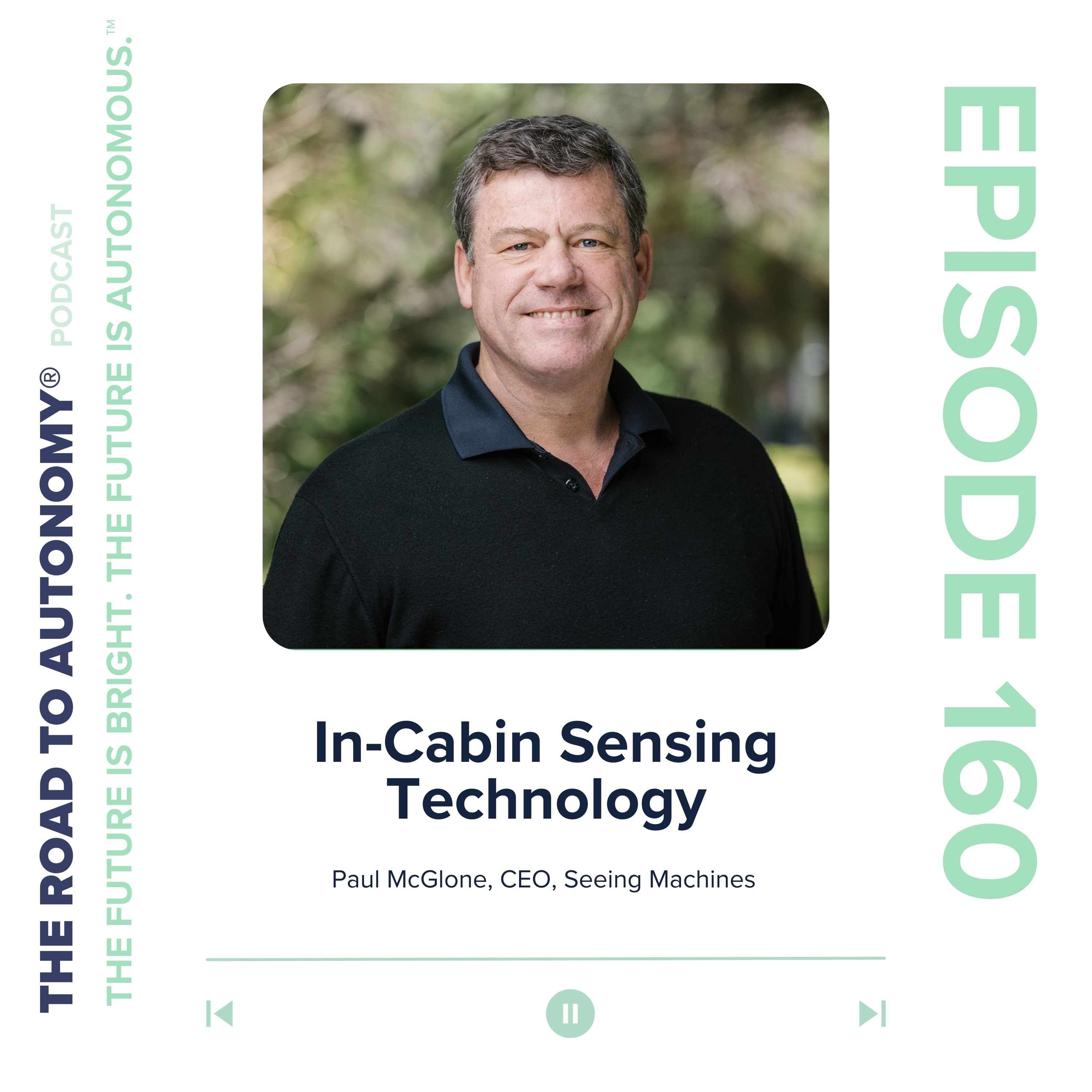
Ep 160Episode 160 | In-Cabin Sensing Technology
Paul McGlone, CEO, Seeing Machines joined Grayson Brulte on The Road to Autonomy podcast to discuss scaling Seeing Machines in-cabin sensing technology. The conversation begins with Paul discussing how Seeing Machines in-cabin sensing technology adapts to meet consumer and regulatory demand.The primary driver of demand is regulatory. – Paul McGloneToday, the in-cabin sensing technology senses the human condition which can be composed of body jesters, head position, eyelid movement and direct gaze (pupil tracking) and soon lip movement. By monitoring the cabin, Seeing Machines can detect distraction, fatigue, passenger occupancy and if someone is holding a phone while driving. As the technology evolves there is the potential to add health monitoring systems into the vehicle that can potentially detect when a driver or passenger is experiencing a heart attack or medical condition. Setting the stage for autonomous vehicles to scale and handle adverse in-vehicle situations. The core target market for our technology is Levels 2 – 4, but certainly as the companies that are managing fully autonomous, say 3rd party vehicle fleets will need someway to detect the well-being of the occupants, particularly if they are paying for the service. – Paul McGloneIn Fiscal Year 2023, Seeing Machines generated $13.6 million in annual recurring revenue, up 27% over Fiscal Year 2022. This revenue was generated from the company’s commercial fleet business (after-market) where the Seeing Machines devices are installed into vehicles. One of the big drivers of the revenue growth was fleet managers looking to reduce driver fatigue and distraction because of rising insurance costs.Fatigue and distraction are the two primary drivers of insurance claims costs in commercial vehicle fleets worldwide. – Paul McGloneFor their automotive business, Seeing Machines has 15 programs with 10 OEMs and over 1 million cars globally have a Seeing Machines system installed. Their automotive business model is a royalty based model where the company is paid a royalty for every car that is manufactured for the life of the model that features their technology. The model has generated $320 million in royalties to date.As we consider our business going forward, we are not only going to see significant growth rates, but we are going to see a mix change in revenue from sort of engineering services, low-margin to primarily royalties which are very very high-margin. – Paul McGloneOutside of automotive, Seeing Machines is expanding into aviation through a partnership with Collins Aerospace. One the areas of focus is a monitoring system for air traffic control to monitor distraction and fatigue.We think that almost every industrial opportunity that has a human-machine interface is an opportunity for accurate eye-tracking to improve either a safety or performance outcome. – Paul McGloneWrapping up the conversation, Paul shares his opinion on the future of in-cabin monitoring. Recorded on Tuesday, October 3, 2023Chapters:0:00 The Road to Autonomy Index0:56 Introduction1:17 The Evolution of Seeing Machines Technology6:01 In-Cabin Sensing System13:16 Seeing Machines Commercial Vehicle Revenue Growth17:57 Seeing Machines Royalty Revenue19:34 Magna Partnership27:37 Collins Aerospace Partnership35:48 Growing Royalty Revenue41:00 Privacy--------About The Road to AutonomyThe Road to Autonomy® is a leading source of data, insight and commentary on autonomous vehicles/trucks and the emerging autonomy economy™. The company has two businesses: The Road to Autonomy Indices, with Standard and Poor’s Dow Jones Indices as the custom calculation agent; Media, which includes The Road to Autonomy and Autonomy Economy podcasts as well as This Week in The Autonomy Economy newsletter.See Privacy Policy at https://art19.com/privacy and California Privacy Notice at https://art19.com/privacy#do-not-sell-my-info.
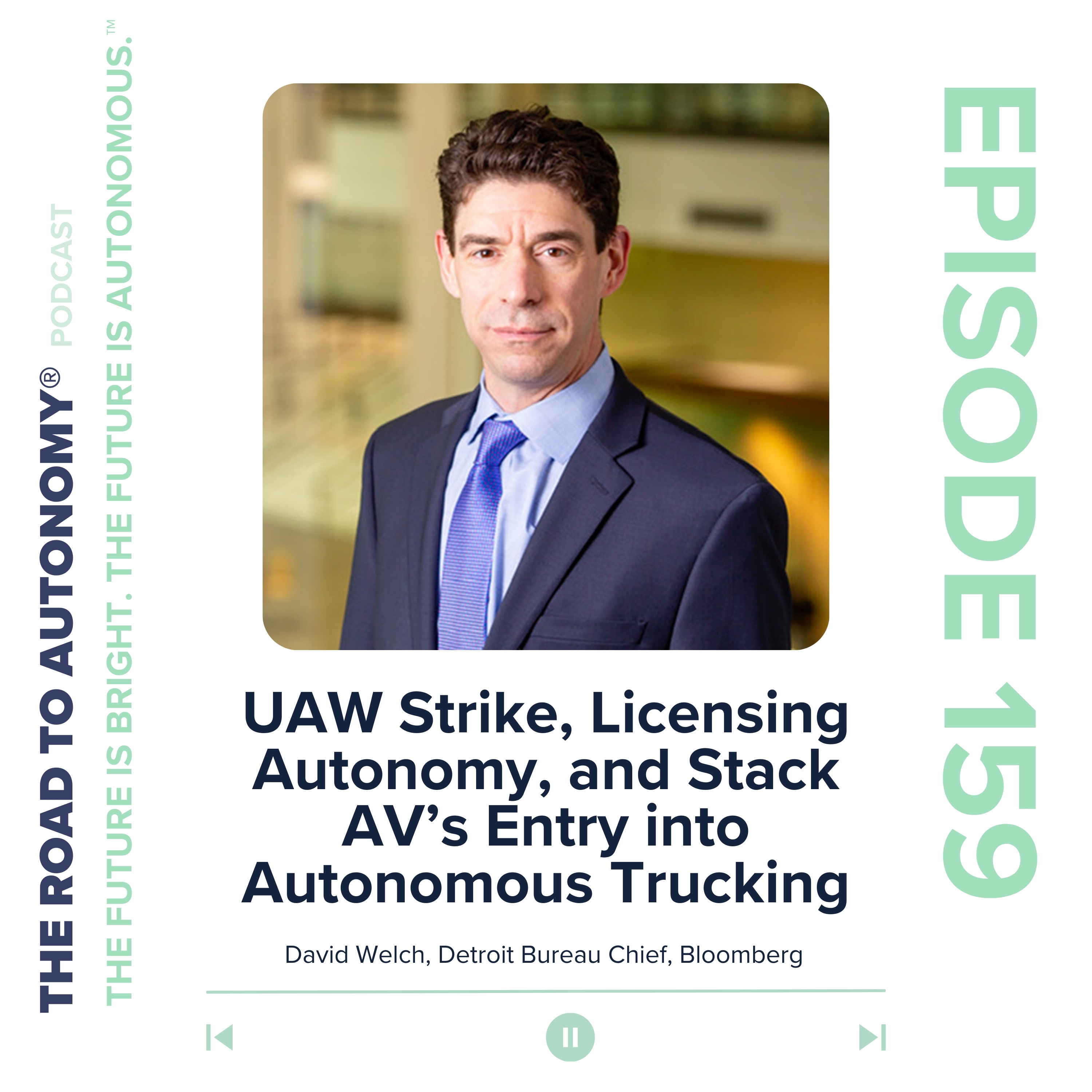
Ep 159Episode 159 | UAW Strike, Licensing Autonomy, and Stack AV’s Entry into Autonomous Trucking
David Welch, Detroit Bureau Chief, Bloomberg joined Grayson Brulte on The Road to Autonomy podcast to discuss the UAW strike and the launch of Stack AV. The conversation begins with David sharing the latest on the UAW (United Auto Workers) strikes against the Big 3 (Ford, GM and Stellantis). UAW President Shawn Fain has taken a different approach to the negotiations from his predecessors as a way to build trust and loyalty with his members. Shawn Fain has to show that he is not another management crony, he is a real union guy. Hence no handshake. – David WelchAnother reason why Sean Fain is taking such an aggressive approach towards the negotiations is that he has to build trust with his membership and show union leadership. The tactics that Sean Fain is implementing is right out of the Bernie Sanders playbook. Several members of Senator Sanders presidential campaigns are now advising the UAW on media strategy. [Sean Fain] wants to reignite a labor movement in America. – David WelchOne of the main sticking points in the strike is jobs and worker pay. The longer the strike drags on, the more it benefits Tesla. It has even been reported that no matter what happens, Tesla comes out the winner from the strikes as the Big 3 will be forced to raise prices of their electric vehicles. Tesla forced GM, Ford and Stellantis forced to build electric vehicles after they validated the market and gained signifiant marketshare. Tesla clearly showed that there was a market for electric vehicles. Could Tesla do the same thing with autonomy in the future? If and when Tesla licenses their FSD (Full Self-Driving) technology, will Cruise and Waymo be compelled to license their self-driving technology to appease investors? Waymo, definitely because they are not a car company. – David WelchFor GM, will they make the same mistake they did with OnStar years ago and not license it? Only time will tell. If GM eventually spins out Cruise, the path for licensing the Cruise self-driving technology becomes a lot more visible. On the autonomous trucking side of autonomy, Kodiak is planning to license the Kodiak Driver to fleets. Investors are watching the sector as the technology evolves and the business models are formalized. Softbank recently invested in Stack AV founded by Bryan Salesky, Peter Rander, and Brett Browning (Argo AI founders). Stack AV is going to focus on long-haul autonomous trucks, but are they entering the market too late? I do not think it’s too late, but they have to move if they want to catch up. – David WelchCould Softbank look to potentially export Stack AV to Japan to capture marketshare in an emerging market that is not yet saturated with competition? Wrapping up the conversation, David shares his thoughts on what to watch in autonomy for the end of the year.Chapters:0:00 The Road to Autonomy Index0:56 Introduction1:13 UAW Strikes16:21 Tesla Beneficial Winner of the UAW Strikes?21:20 Licensing Tesla FSD and Autonomous Driving Systems30:00 Softbank and Stack AV41:40 Autonomy Outlook for the End of the YearRecorded on Thursday, September 21, 2023--------About The Road to AutonomyThe Road to Autonomy® is a leading source of data, insight and commentary on autonomous vehicles/trucks and the emerging autonomy economy™. The company has two businesses: The Road to Autonomy Indices, with Standard and Poor’s Dow Jones Indices as the custom calculation agent; Media, which includes The Road to Autonomy and Autonomy Economy podcasts as well as This Week in The Autonomy Economy newsletter.See Privacy Policy at https://art19.com/privacy and California Privacy Notice at https://art19.com/privacy#do-not-sell-my-info.
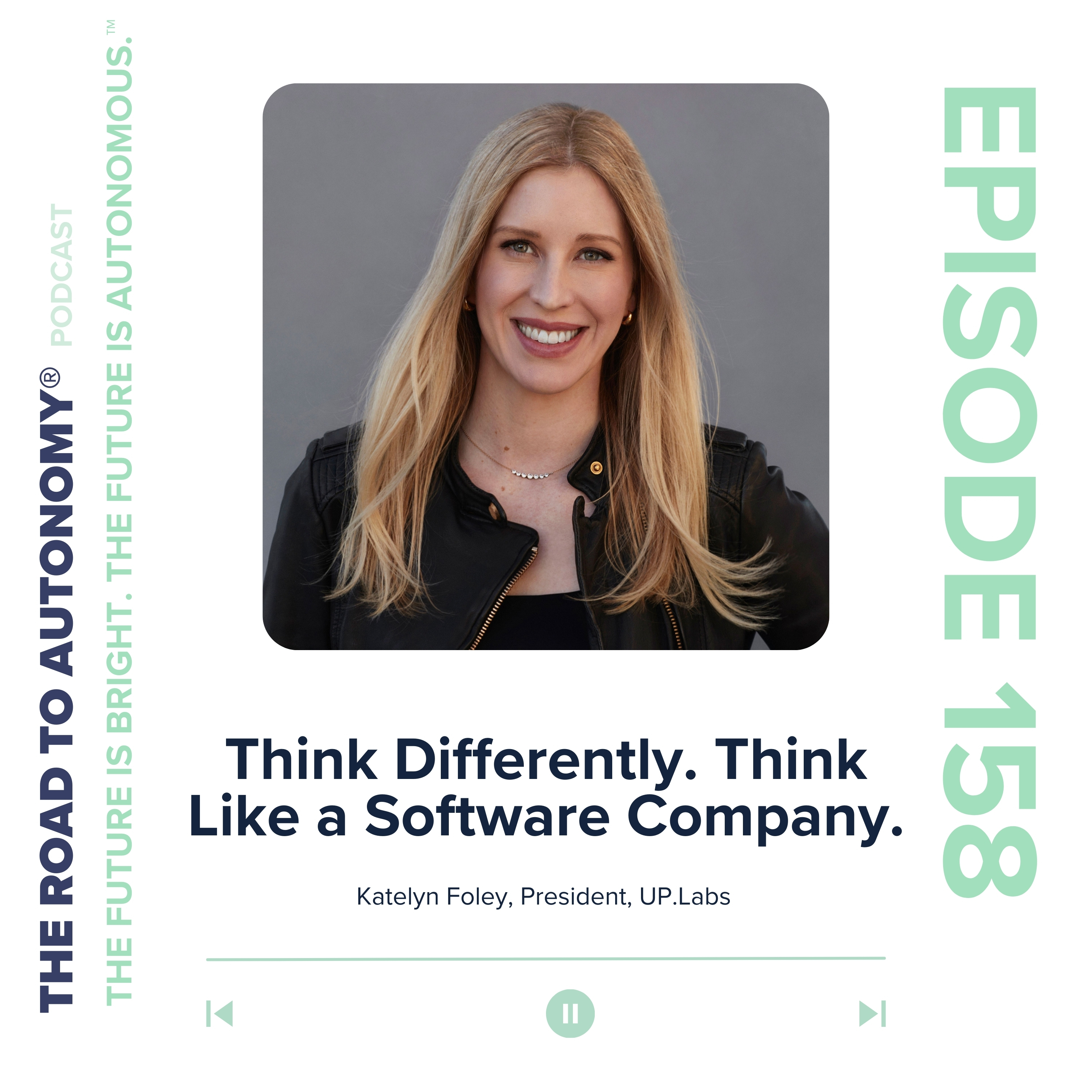
Ep 158Episode 158 | Think Differently. Think Like a Software Company.
Katelyn Foley, President, UP.Labs joined Grayson Brulte on The Road to Autonomy podcast to discuss why companies should think differently and think like a software company.The conversation begins with Katelyn sharing her thoughts on the current state of the mobility markets. To me it’s a story about product pivots. There has been incredible movement to EVs and ultimately to autonomous vehicles. – Katelyn FoleyFor traditional OEMs to capture marketshare, they need a relentless focus on developing user-friendly digital interfaces that consumers will want to use on a daily basis. As daunting as this might sound, UP.Labs is ushering in this model with partner, Porsche. Part of what we are doing is to help them think differently. To think like a software company. – Katelyn FoleyPorsche and UP.Labs came together to create six new companies by 2025 that could eventually be acquired by Porsche. Collectively they are looking at opportunities that can enhance the Porsche owner experience through data, efficiency and a robust digital interface. As UP.Labs and Porsche explore opportunities for new businesses, they are respecting the heritage of the brand and embracing it’s status as a luxury brand. This strategy allows Porsche to lean in, embrace innovation and think differently about their business. Being a luxury brand comes with responsibilities. With the shift to electric vehicles, consumers are beginning to ask questions about the provenance of the materials in the battery and the leather on the seats. Consumers want to know that these materials were cultivated in a way that did not have an impact on the environment. Overall, luxury brands should approach electrification by taking the bespoke route and creating a new vehicle that is built from the ground up to be electric. Porsche embraced their heritage of speed and handling by creating the Taycan, which has dazzled consumers. Every brand has to think about what they stand for. What are those few core principles, and the EV really needs to embody those and not just be an EV. – Katelyn FoleyWrapping up the conversation, Grayson and Katelyn discuss network optimization. Recorded on Tuesday, September 19, 2023--------About The Road to AutonomyThe Road to Autonomy® is a leading source of data, insight and commentary on autonomous vehicles/trucks and the emerging autonomy economy™. The company has two businesses: The Road to Autonomy Indices, with Standard and Poor’s Dow Jones Indices as the custom calculation agent; Media, which includes The Road to Autonomy and Autonomy Economy podcasts as well as This Week in The Autonomy Economy newsletter.See Privacy Policy at https://art19.com/privacy and California Privacy Notice at https://art19.com/privacy#do-not-sell-my-info.
Ep 157Episode 157 | Cruise: The Future is Here Now
Gil West, Chief Operating Officer, Cruise joined Grayson Brulte on The Road to Autonomy podcast to discuss how Cruise is scaling operations across the world. The conversation begins with Gil discussing GM’s revenue target for Cruise of $1 billion in revenue by 2025.We are on target. – Gil WestCruise is on target to hit their revenue goal because they are scaling. Currently Cruise has operations in 15 cities in 10 states. As Cruise scales, they are creating a flywheel effect that continuously improves their operations. We are creating a flywheel effect as we go to market and scale. – Gil WestThe Cruise experience from city to city is consistent from a rider perspective. Behind this consistency is an operational playbook that is deployed in each new city that Cruise expands service. One of the key elements of this playbook is partnerships. When Cruise enters a new city, the company is focused on leveraging underutilized assets to ensure the most cost efficient operations. In San Francisco, Cruise is installing chargers at Oracle Park (Home of the San Francisco Giants) that the company will use when a baseball game is not taking place. When a game is taking place, fans will be able to use the chargers. When it comes to potential expansion cities, Cruise looks at the ODD (operation design domain) that fits the technologies capabilities, commercial opportunity in the market, market density, the availability of infrastructure and the regulatory environment. Our goal is to bring driverless tech to as many people as possible in many places as we can. – Gil WestAs we have seen in San Francisco and Phoenix, overtime Cruise will expand their service area in new cities to eventually cover the entire city. As Cruise expands the amount of ride supply in a city, they are conscious about passenger pick-up wait times. Our goal here of course is to provide a consistently better experience and more accessibility at an affordable price point, and have people be able access the vehicles in a very timely manner. – Gil WestThe experience that Cruise provides in the future is only going to be enhanced when the service becomes integrated into stadiums, concert venues and airports. No more waiting in line trying to catch an Uber or finding your driver. With autonomy and integrations, these headaches will become a thing of the past. As part of their vision for autonomy, Cruise designed and built the Cruise Origin in partnership with GM. The Origin is currently testing on public roads in San Francisco and Austin as the company prepares to deploy the vehicle for commercial operations pending NHTSA approval. We will be introducing the Origin commercially soon and then in multiple cities. – Gil WestWrapping up the conversation, Gil shares his opinion on the future of Cruise which includes new vehicle form factors.Chapters:0:00 The Road to Autonomy Index0:55 Introduction1:17 Cruise $1 Billion 2025 Revenue Target Reaffirmed2:45 Scaling Cruise and Maintaining the Experience9:13 Expansion into New Cities22:41 Pick-up Times24:37 Future Cruise Experiences29:54 Cruise Origin35:53 Operating a Profitable Business39:22 Future of CruiseRecorded on Tuesday, September 12, 2023--------About The Road to AutonomyThe Road to Autonomy® is a leading source of data, insight and commentary on autonomous vehicles/trucks and the emerging autonomy economy™. The company has two businesses: The Road to Autonomy Indices, with Standard and Poor’s Dow Jones Indices as the custom calculation agent; Media, which includes The Road to Autonomy and Autonomy Economy podcasts as well as This Week in The Autonomy Economy newsletter.See Privacy Policy at https://art19.com/privacy and California Privacy Notice at https://art19.com/privacy#do-not-sell-my-info.
Ep 156Episode 156 | The Road to Profitable Autonomy
Alan Ohnsman, Senior Editor, Forbes joined Grayson Brulte on The Road to Autonomy podcast to discuss Gatik and the road to profitable autonomy. The conversation begins with Alan and Grayson discussing AB 316 — the future of autonomous trucking in California. The State wants to support the tech and get it out there, and sees the benefits of that. But at the same time you have active opposition from a very powerful labor group that represents a lot of truckers in the State of California. – Alan OhnsmanThe conversation expands from policy to the future of AI and Gatik, a middle-mile autonomous trucking start-up that is on the road to profitable autonomy. Gatik is a company that did not raise billions of dollars, and Gatik did not come out of the gate saying were going to use autonomy for everything. We are going to do robotaxi, we are going to do trucking, we are going to do food deliveries, you name it, we are going to do it. They focused on one thing — middle-mile delivery from a distribution center to a large retail store, that’s it. Nothing else. – Alan OhnsmanCompared to their peers that have raised billions in capital, Gatik has raised a mere modest $120 million. To achieve their goals, the company does not need billions as they are highly disciplined when it comes to operating the business. For every contract that Gatik signs with a customer, each vehicle that goes into service is contractually guaranteed revenue of $200,000 per year. For every 100 vehicles the company puts into service, the company will generate $20 million in yearly revenue. At this time, Gatik currently has 50 vehicles in service, generating $10 million in yearly revenue. Gatik is forecasting that the company could potentially be profitable within as little as two to three years (2025-2026). As the company ramps up towards profitability, they are going to gradually start expanding to highway driving in addition to city streets. Their goal is to overtime, they will move into highway trucking. They will move into Class-8 trucking, they will move into other types of delivery services that they are not doing now, and it’s going to be this gradual evolution of the business. All of it is premised on the fact that it has to a revenue generator. – Alan OhnsmanLooking to the future, Gatik will not explore a potential IPO until the company is profitable on a GAAP basis. Rounding out the conversation, Grayson and Alan discuss the autonomous trucking industry as a whole and the Waymo Via shutdown. Wrapping up the conversation, Grayson and Alan discuss licensing and the future of Zoox.Chapters:0:00 The Road to Autonomy Index0:56 The Road to Autonomy Introduction1:23 AB 316 and Autonomous Trucks in California6:01 AI and the Push Back from Unions10:39 Gatik and The Road to Profitable Autonomy42:58 Licensing the Waymo Driver45:16 Future of Zoox?50:10 Future of AutonomyRecorded on Monday, August 28, 2023--------About The Road to AutonomyThe Road to Autonomy® is a leading source of data, insight and commentary on autonomous vehicles/trucks and the emerging autonomy economy™. The company has two businesses: The Road to Autonomy Indices, with Standard and Poor’s Dow Jones Indices as the custom calculation agent; Media, which includes The Road to Autonomy and Autonomy Economy podcasts as well as This Week in The Autonomy Economy newsletter.See Privacy Policy at https://art19.com/privacy and California Privacy Notice at https://art19.com/privacy#do-not-sell-my-info.
Ep 155Episode 155 | Volvo Autonomous Solutions Commercialization Strategy
Nils Jaeger, President, Volvo Autonomous Solutions, Volvo Group joined Grayson Brulte on The Road to Autonomy podcast to discuss Volvo Autonomous Solutions commercialization strategy. The conversation begins with Nils discussing how the Volvo Group is approaching autonomy. It’s about leveraging autonomous tech for productivity gains, for efficiency gains. – Nils JaegerVolvo Autonomous Solutions is operating in the quarry and mining, ports and logistics and hub-to-hub sectors. These sectors were chosen as they compliment each other and are viewed as long-term growth markets. As a stand-alone business area inside of Volvo Group, Volvo Autonomous Solutions has full development responsibility and are responsible for the commercialization of Volvo Group’s autonomous solutions. Being structured this way, means Volvo Autonomous Solutions has full P&L responsibility. With P&L responsibility, Nils and the team at Volvo Autonomous Solutions are focused on building a business.For us it’s not just the technology, it’s building a business. Building a business is really the core reason why Volvo Autonomous Solutions was created. Having a clear focus on commercialization and having an attractive business model. – Nils JaegerThe commercial business model for Volvo Autonomous Solutions is not a one-size fits all model. It’s a model that is tailored to each one of the sectors where they operate. In the Dallas Fort-Worth region, Volvo Autonomous Solutions will be operating a hub-to-hub autonomous transport solution as a service. Commercializing the hub-to-hub autonomous transport business will require partnerships. As part of the initial roll-out, Volvo Autonomous Solutions has partnered with DHL and Uber Freight. To prepare for autonomous operations, Volvo has begun hauling freight manually in the Texas Triangle. We have actually started this year to pull loads manually for both DHL and Uber Freight. We are putting in place all of the procedures, the processes which are needed to develop this new transportation value chain and to do this of-course in a safe and reliable form. – Nils JaegerFrom a truck asset perspective, Volvo Group is going to own the autonomous trucks on their balance sheet as the service begins commercialization. In these early days there will not be a minimum amount of volume needed to tap into the service, however the volume will have to make economic sense. Wrapping up the conversation, Nils discusses the driver-out fully autonomous operations at the Brönnöy Kalk mine in Velfjord, Norway.Chapters:0:00 The Road to Autonomy Index0:56 The Road to Autonomy Introduction1:23 Volvo Group's Approach to Autonomy7:14 Volvo Autonomous Solutions Commercial Business Model17:33 Volvo Autonomous Solutions Terminal (Hub) Strategy21:16 Autonomous Truck Assets & Virtual Driver Strategy24:22 Economics of Volvo Autonomous Solutions Transport as a Service Model27:57 Volvo Autonomous Solutions Quarry & Mining Business35:20 The Future of AutonomyRecorded on Thursday, August 22, 2023--------About The Road to AutonomyThe Road to Autonomy® is a leading source of data, insight and commentary on autonomous vehicles/trucks and the emerging autonomy economy™. The company has two businesses: The Road to Autonomy Indices, with Standard and Poor’s Dow Jones Indices as the custom calculation agent; Media, which includes The Road to Autonomy and Autonomy Economy podcasts as well as This Week in The Autonomy Economy newsletter.See Privacy Policy at https://art19.com/privacy and California Privacy Notice at https://art19.com/privacy#do-not-sell-my-info.
Ep 154Episode 154 | bp pulse: Fleet Charging as a Service
Vic Shao, President, bp pulse fleet joined Grayson Brulte on The Road to Autonomy podcast to discuss fleet charging as a service. The conversation begins with Vic discussing bp pulse’s electric vehicle fleet charging strategy, the importance of up-time and reliability. To ensure the up-time for partners such as Hertz, bp has developed a software layer that monitors the health of the charging infrastructure to ensure optimal up-time.Software is the enablement tool that makes it efficient and reliable. – Vic Shao The charging stations that bp is installing for Hertz will be open to the public and located at high traffic locations such as city centers and airports. At airport locations, rideshare drivers will be able to access the chargers and charge their vehicles while they wait for passenger pick-ups. By early 2024, 25 locations in several states will be online. As a traditional oil and gas business, bp pulse is complimenting the core business by expanding into new fuel types.bp looks at electrification as just another fuel type. It’s a really attractive fuel type for any number of reasons, but it’s another fuel type. In the future bp is also going to go into hydrogen. – Vic Shao As fleet managers begin the process of transitioning their fleets from internal combustion engine vehicles to electric vehicles, economics are driving the decision process. The cost to transition large fleets to electric vehicles is expensive as it requires all-new vehicles along with a complex network of charging equipment. bp has a solution that will enable fleets to convert to electric without the upfront charging infrastructure capital expenditure — charging as a service. One of the big upsides to charging as a service is scalability and upgradability. As NACS (North American Charging Standard) becomes the de facto charging plug standard as the CCS plug is slowly faded out, the charging infrastructure will be upgraded to support the new plug.A large opportunity for charging as a service are ports that have drayage operations that operate on fixed daily routes. A lot of these drayage operations are operated by smaller carriers who might not necessarily have the financial wherewithal to invest in fleet charging. With charging as a service, these fleets will have the ability to transition to electric trucks without the capital expenditure.By 2030, bp is on track to have over 100,000 electric vehicle charging stations online. Wrapping up the conversation, Vic shares his opinion on the future of electric vehicle fleet charging.Chapters:0:00 The Road to Autonomy Index0:57 Introduction1:23 bp pulse feet Electric Vehicle Fleet Charging Strategy6:07 Reliable Electric Vehicle Charging10:09 Scaling Reliable EV Charging Infrastructure17:57 Fleet Managers Approach to Electric Vehicles20:57 Charging as a Service35:11 The Road to 100,000 Charge Points37:12 Future of Electric Vehicle Charging for FleetsRecorded on Thursday, August 24, 2023--------About The Road to AutonomyThe Road to Autonomy® is a leading source of data, insight and commentary on autonomous vehicles/trucks and the emerging autonomy economy™. The company has two businesses: The Road to Autonomy Indices, with Standard and Poor’s Dow Jones Indices as the custom calculation agent; Media, which includes The Road to Autonomy and Autonomy Economy podcasts as well as This Week in The Autonomy Economy newsletter.See Privacy Policy at https://art19.com/privacy and California Privacy Notice at https://art19.com/privacy#do-not-sell-my-info.
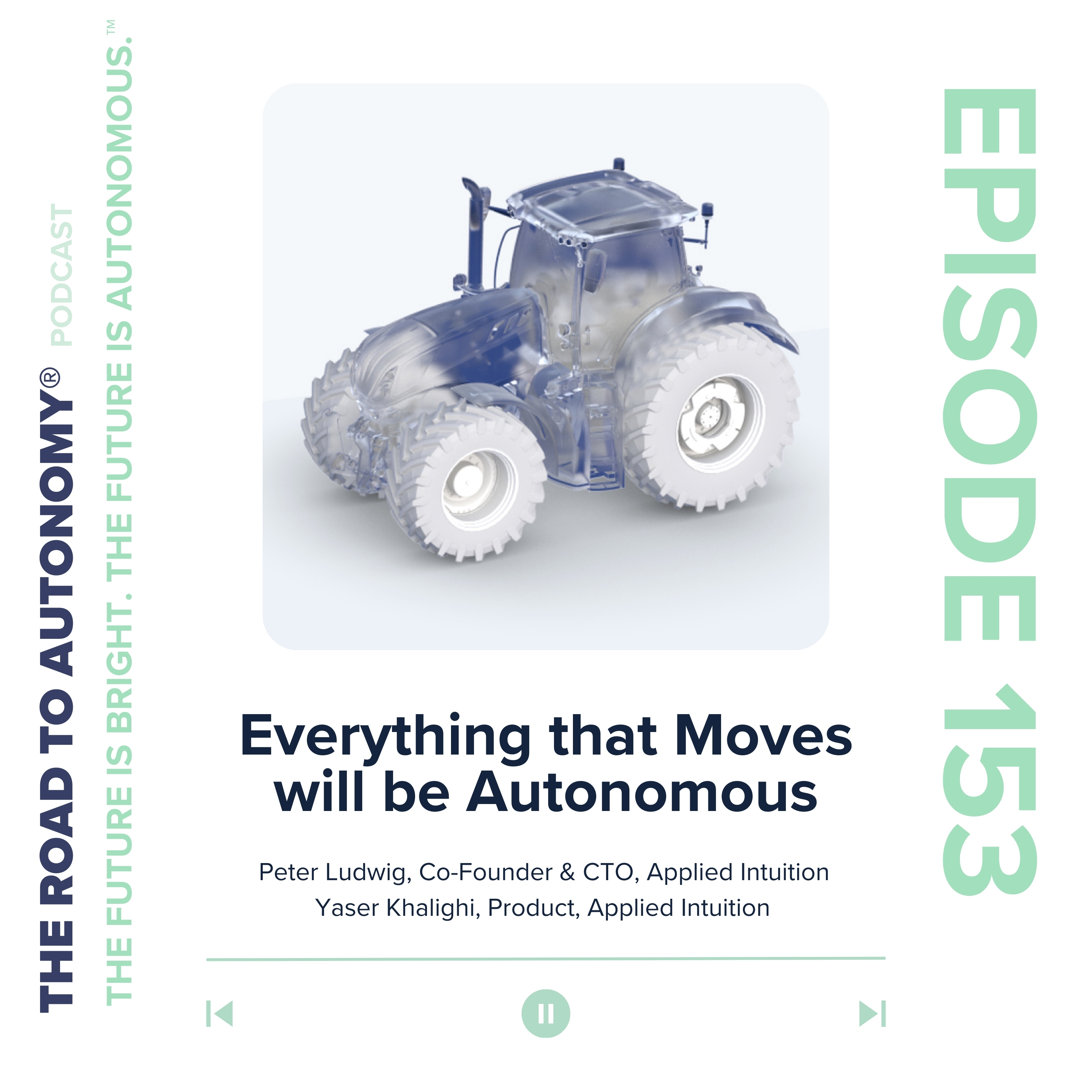
Ep 153Episode 153 | Everything that Moves will be Autonomous
Peter Ludwig, Co-Founder & CTO, Applied Intuition and Yaser Khalighi, Product, Applied Intuition joined Grayson Brulte on The Road to Autonomy podcast to discuss the acquisition of SceneBox and why everything that moves will be autonomous in the future. The conversation begins with Yaser discussing why he made the decision to sell SceneBox to Applied Intuition in March 2023.The vision of building SceneBox, my vision was enabling customers in their autonomy journey. The reason that we exited to Applied was exactly to double down on that vision. – Yaser KhalighApplied is in the process of integrating SceneBox into their product offering, while retaining the user-friendliness of the SceneBox platform. The ultimate goal is that it’s a completely seamless experience in what we call the ADP (Applied Development Platform). – Peter LudwigThe integrated SceneBox / Applied product offering will help autonomous vehicles and autonomous trucks scale safely and quickly. To further enhance the Applied product, Applied acquired Embark Trucks for $71 million in August 2023. Prior to the acquisition, Embark was a long-time Applied customer. With the acquisition we are discontinuing the autonomy trucking program, we are not entering Level 4 trucking. But we are going to be able to repurpose the tools they had built around the Applied development platform, and in fact bring some of those into our platform were it makes sense. – Peter LudwigThe data that Applied acquired from Embark will help their customers accelerate the development of their autonomous driving stack for Class-8 trucks. When it comes to training a virtual driver, unique data sets are needed to train the driver. Data gathered for Class-8 trucks can not necessarily be translated over to a developing a virtual driver for robotaxi operations.Taking a step out of the virtual world, Applied is has a partnership with NI (National Instruments) for hardware-in-the-loop validation. This partnership will allow their customers to scale quickly and safely and puts Applied ahead if and when certifications for autonomous driving systems become required by regulatory bodies. Wrapping up the conversation, Peter and Yaser share their opinions on the future of autonomy.Chapters:0:00 The Road to Autonomy Index0:56 Introduction1:38 Applied Intuition acquires SceneBox17:27 Peter Ludwig — Why Applied Intuition acquired Embark Trucks21:16 ML (Machine Learning) Models for Autonomous Driving34:02 Applied’s Synthetic Datasets (How they are Developed)43:00 What is the Future of Autonomy?Recorded on Tuesday, August 15, 2023--------About The Road to AutonomyThe Road to Autonomy® is a leading source of data, insight and commentary on autonomous vehicles/trucks and the emerging autonomy economy™. The company has two businesses: The Road to Autonomy Indices, with Standard and Poor’s Dow Jones Indices as the custom calculation agent; Media, which includes The Road to Autonomy and Autonomy Economy podcasts as well as This Week in The Autonomy Economy newsletter.See Privacy Policy at https://art19.com/privacy and California Privacy Notice at https://art19.com/privacy#do-not-sell-my-info.
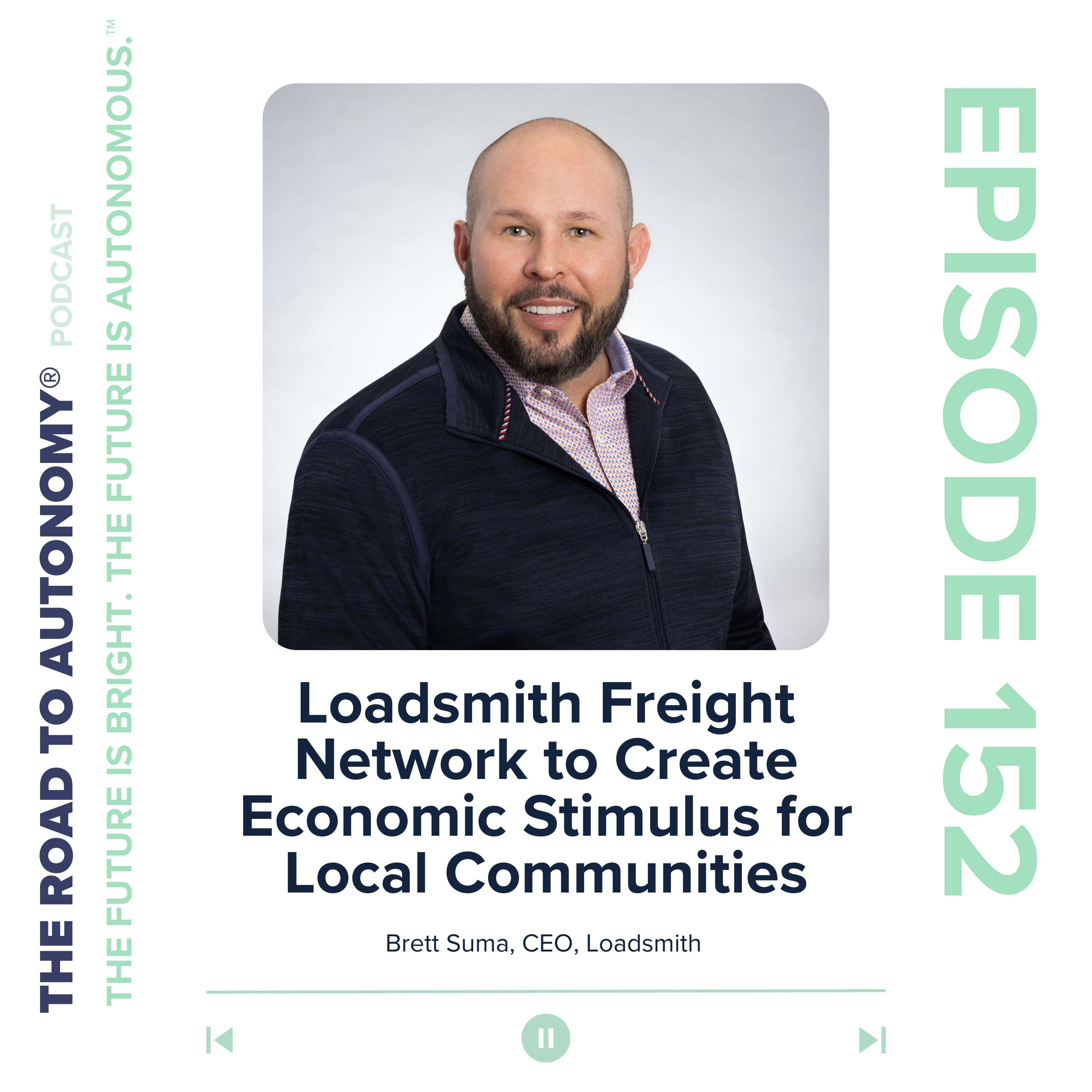
Ep 152Episode 152 | Loadsmith Freight Network to Create Economic Stimulus for Local Communities
Brett Suma, CEO, Loadsmith joined Grayson Brulte on The Road to Autonomy podcast to discuss the development of the Loadsmith Freight Network and how the network will create economic stimulus in local communities. The conversation begins with Brett discussing the development of the Loadsmith Freight Network. You can look at the LFN and compare it somewhat to a railroad and their ability to capture capacity. – Brett SumaThe Loadsmith Freight Network will consist of both professional drivers and autonomous trucks. Autonomous trucks on the LFN will mostly operate on the 350 to 900 mile runs, while the professional drivers will focus on the shorter first and last mile routes. For the Loadsmith Freight Network to operate at peak performance, the company developed a digital software layer that enables “Precision Trucking”. The cost savings derived from Precision Trucking will be reinvested in first and last mile operations in terms of higher pay for professional drivers and amenities. With higher pay for first and last mile drivers, local communities will begin to experience a form of economic stimulus through higher spending. Spending will help drive economic growth in those communities and help to off-set increased the cost of goods and services due to inflation.The lanes where autonomous trucks are first introduced will be based on freight flow, regulatory environment, technical feasibility and the economics of the lane. Everything we know about current pricing is going to change when autonomous starts hitting the street. – Brett SumaNot all lanes are created equal from an economic standpoint. The Dallas to Houston lane is oversaturated and it will be a race to the bottom in terms of pricing when autonomous trucks are rolling on that lane 24/7. That is not where Loadsmith is going as they focused on unit economics. Through their development partnership with Kodiak, Loadsmith is collectively studying the unit economics of lanes. It’s this economic discipline that is going to enable their partnership to scale. The respect that Brett and the Loadsmith team has for professional drivers comes from the simple fact that they are listening. We’re doing this, because we are listening to workers. – Brett SumaProfessional drivers are telling them that they want to be home every night and have consistency in their paycheck. Wrapping up the conversation, Brett shares his thoughts on the future of trucking.Recorded on Friday, August 4, 2023--------About The Road to AutonomyThe Road to Autonomy® is a leading source of data, insight and commentary on autonomous vehicles/trucks and the emerging autonomy economy™. The company has two businesses: The Road to Autonomy Indices, with Standard and Poor’s Dow Jones Indices as the custom calculation agent; Media, which includes The Road to Autonomy and Autonomy Economy podcasts as well as This Week in The Autonomy Economy newsletter.See Privacy Policy at https://art19.com/privacy and California Privacy Notice at https://art19.com/privacy#do-not-sell-my-info.
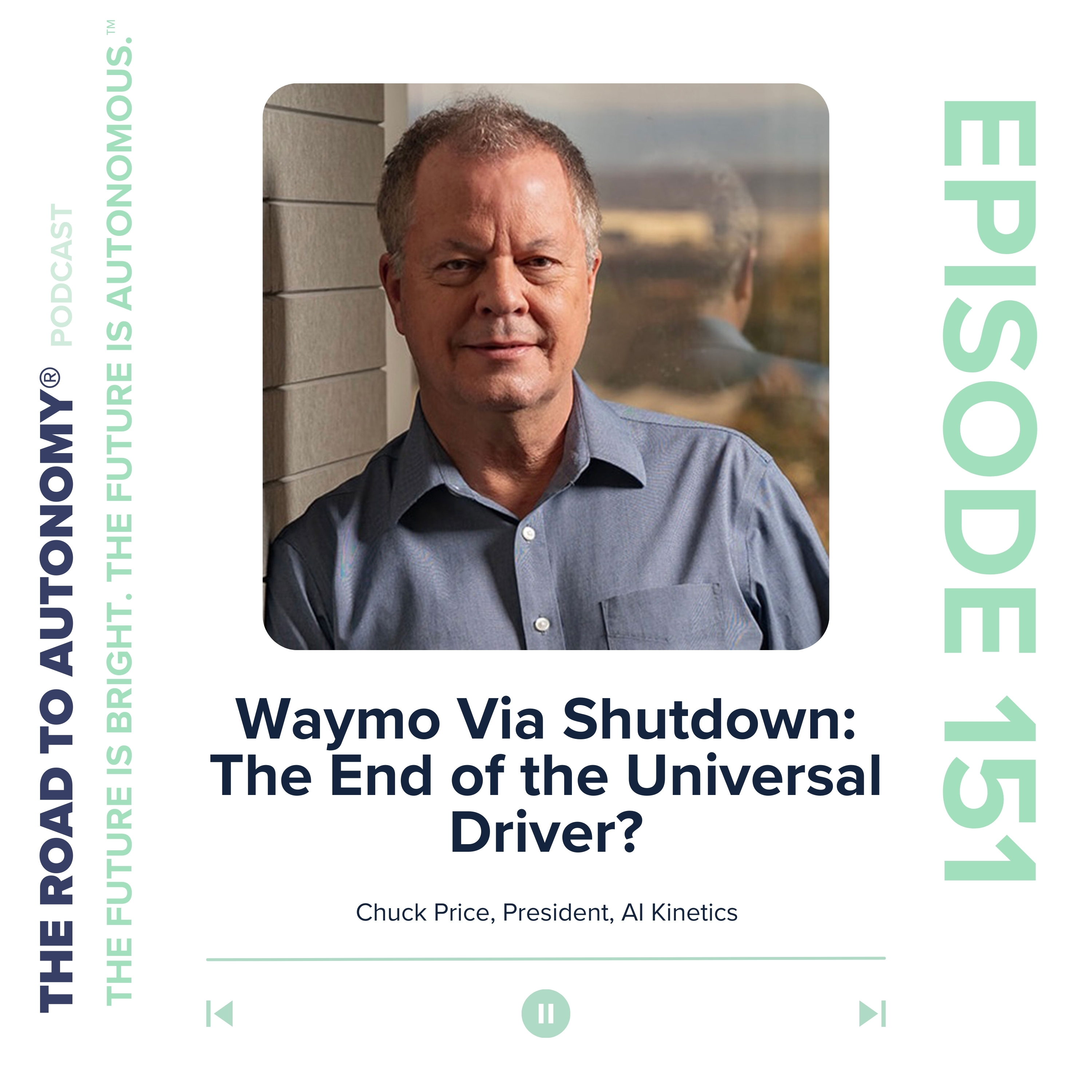
Ep 151Episode 151 | Waymo Via Shutdown: The End of the Universal Driver?
Chuck Price, President, AI Kinetics joined Grayson Brulte on The Road to Autonomy podcast to discuss the shutdown of Waymo Via and what it means for the development of the universal driver. The conversation begins with Chuck sharing his thoughts on the current state of the autonomous trucking industry.We are going through change. What we’re seeing is the early phase of this development which was largely science doing science, now moving to doing engineering and commercialization. Some of the companies that have been involved in this thought ahead for that and are prepared and others are struggling or have struggled. What we are seeing is a consolidation and some changes in strategy that I think are normal and healthy for an industry as complex as this. – Chuck PriceThe consolidation currently occurring in the autonomous trucking industry is healthy — the market is functioning properly. On Wednesday, July 26th, Alphabet announced Waymo will be shutting down their autonomous trucking division — Waymo Via. While this may have come as a surprise to many, there were rumors in the market and public statements by Alphabet on earnings calls that laid the foundation for this announcement. Waymo did the right thing for a lot of reasons. – Chuck PriceBy shutting down Waymo Via, Waymo is now going to focus exclusively on their robotaxi business — Waymo One. As Mr. Price stated, this is indeed the right thing for Waymo to do as they are in a head-to-head competition with Cruise. Cruise is a formidable opponent with the resources to compete. Not to mention, Cruise is currently expanding at a much more rapid pace than Waymo. Cruise is in the driver’s seat, while Waymo follows behind. From a technical perspective, was this an admission by Waymo that the Universal Driver did not work as they expected? Or is this more inancial discipline coming from Waymo as the division will have a new de facto CEO on September 1st — Ruth Porat, President & Chief Investment Officer of Alphabet. In her new role Ms. Porat will be responsible for investments in Alphabet’s “Other Bets”. To further streamline the business and appease Wall Street, could Ms. Porat look to license the Waymo driver to global OEMs? Or raise additional capital outside by collateralizing Waymo’s IP? Aurora Innovation with 1,450 patents related to autonomy recently raised $820 million in new capital. I am confident that the formal IP developed by Aurora gave them a huge advantage when they went to raise money, and without that they probably would not have been able to raise. – Chuck PriceEven though Aurora recently raised $820 million in new capital, the company has a cash burn rate of $45.3 million a month. It’s expensive to operate, Aurora. With Waymo signaling that the Universal Driver did not work, Aurora continues ahead with developing their version of the Universal Driver. Would Aurora be wise to shut down their passenger car business and focus solely on autonomous trucking? This decision would allow Aurora to streamline their business and lower their cash burn rate — the economics point the way forward. But the question remains, what path will Aurora choose as the company matures and grows?I haven’t seen a Universal Virtual Driver yet, but I have seen focused drivers come to fruition. We’ve seen cars that are now self-driving without safety drivers. We’ve seen trucks that are self-driving without safety drivers. Both have been achieved. The science is done for those specific use cases. – Chuck PriceTo scale an autonomous trucking startup, the startup has to have a production relationship with a truck OEM. To achieve this relationship, the autonomous trucking startup will have to commit $50 to $100 million to the relationship.Wrapping up the conversation, Chuck shares his thoughts on how he sees the autonomous trucking industry evolving over the next five years.Recorded on Tuesday, August 1, 2023--------About The Road to AutonomyThe Road to Autonomy® is a leading source of data, insight and commentary on autonomous vehicles/trucks and the emerging autonomy economy™. The company has two businesses: The Road to Autonomy Indices, with Standard and Poor’s Dow Jones Indices as the custom calculation agent; Media, which includes The Road to Autonomy and Autonomy Economy podcasts as well as This Week in The Autonomy Economy newsletter.See Privacy Policy at https://art19.com/privacy and California Privacy Notice at https://art19.com/privacy#do-not-sell-my-info.
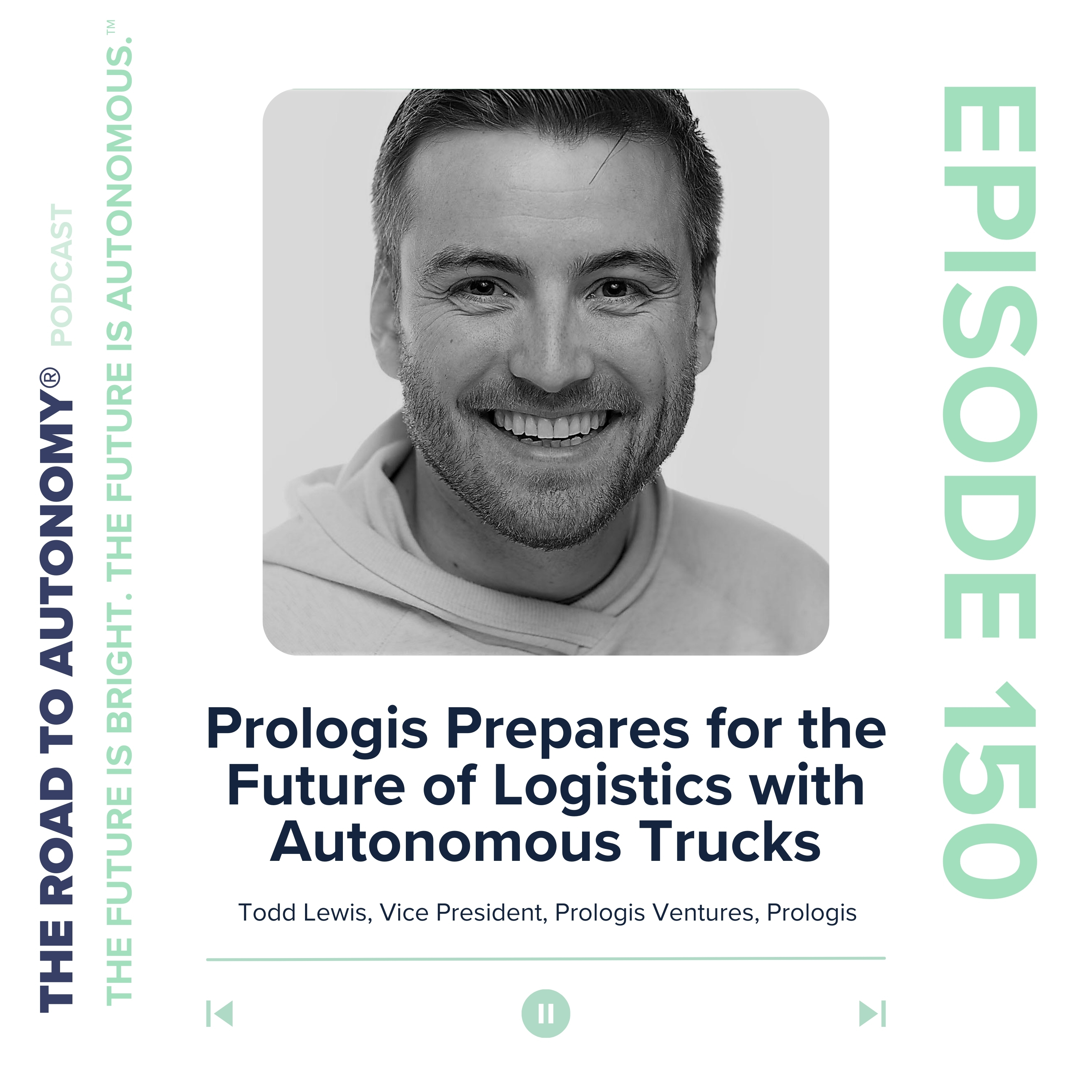
Ep 150Episode 150 | Prologis Prepares for the Future of Logistics with Autonomous Trucks
Todd Lewis, Vice President, Prologis Ventures, Prologis joined Grayson Brulte on The Road to Autonomy podcast to discuss how Prologis is preparing for the future of logistics with autonomous trucks.The conversation begins with Todd discussing how Prologis is approaching the future of autonomy as autonomous trucks will be operating at their customers facilities. Our role across many of our customers footprints is how can we be an accelerant for adoption, for things that can be transformative to their bottom line, to their top line, to their day-to-day growth. Because we want to have customers that can thrive using our existing footprint today. – Todd LewisTo prepare their facilities for autonomous trucking, Prologis is putting plans in place today to update the infrastructure and add services such as fiber to support autonomous operations. As Prologis plans for autonomy, the company is taking a measured approach to leasing by hedging their capital risk for infrastructure development and capital investment.To limit their capital risk, Prologis develops their infrastructure to be future-proofed. Whether it’s the switch to electric vehicles and laying the conduit needed for energy to designing the yards for autonomous trucks, Prologis is developing for the future. From an underwriting perspective, the company has a robust due diligence process that looks at the long-term viability of the potential company leasing the real estate. Including if they have a corporate parent with superior credit and a healthy balance sheet who could co-sign the lease.We choose partners that have the highest likeliness of success. We try to stay true to picking partners and customers who have operations and new business practices that have, what we would consider staying power. – Todd LewisTo prepare for all the changes currently happening in the market, Prologis created a mobility division to focus on accelerating EV adoption and preparing for autonomy. Focused both on automation outside and inside the facility as by 2027, it is projected that 26% of all warehouses will have some level of automation.I believe that you have to enable automation in order for it to be properly utilized. It’s the nuances that matter. – Todd LewisOutside of the facility, the yard of the future is going to change as there will be autonomous truck launch and landing pads. The changes from an infrastructure standpoint will be minor, but from a human interaction standpoint, major. As both autonomous trucks and human driven trucks will operate at the same facility.The interaction with the human element is something that over time will have to be fleshed out a bit, in order for those systems to work properly. – Todd LewisWrapping up the conversation, shares his thoughts on the future of logistics. Recorded on Monday, July 10, 2023--------About The Road to AutonomyThe Road to Autonomy® is a leading source of data, insight and commentary on autonomous vehicles/trucks and the emerging autonomy economy™. The company has two businesses: The Road to Autonomy Indices, with Standard and Poor’s Dow Jones Indices as the custom calculation agent; Media, which includes The Road to Autonomy and Autonomy Economy podcasts as well as This Week in The Autonomy Economy newsletter.See Privacy Policy at https://art19.com/privacy and California Privacy Notice at https://art19.com/privacy#do-not-sell-my-info.
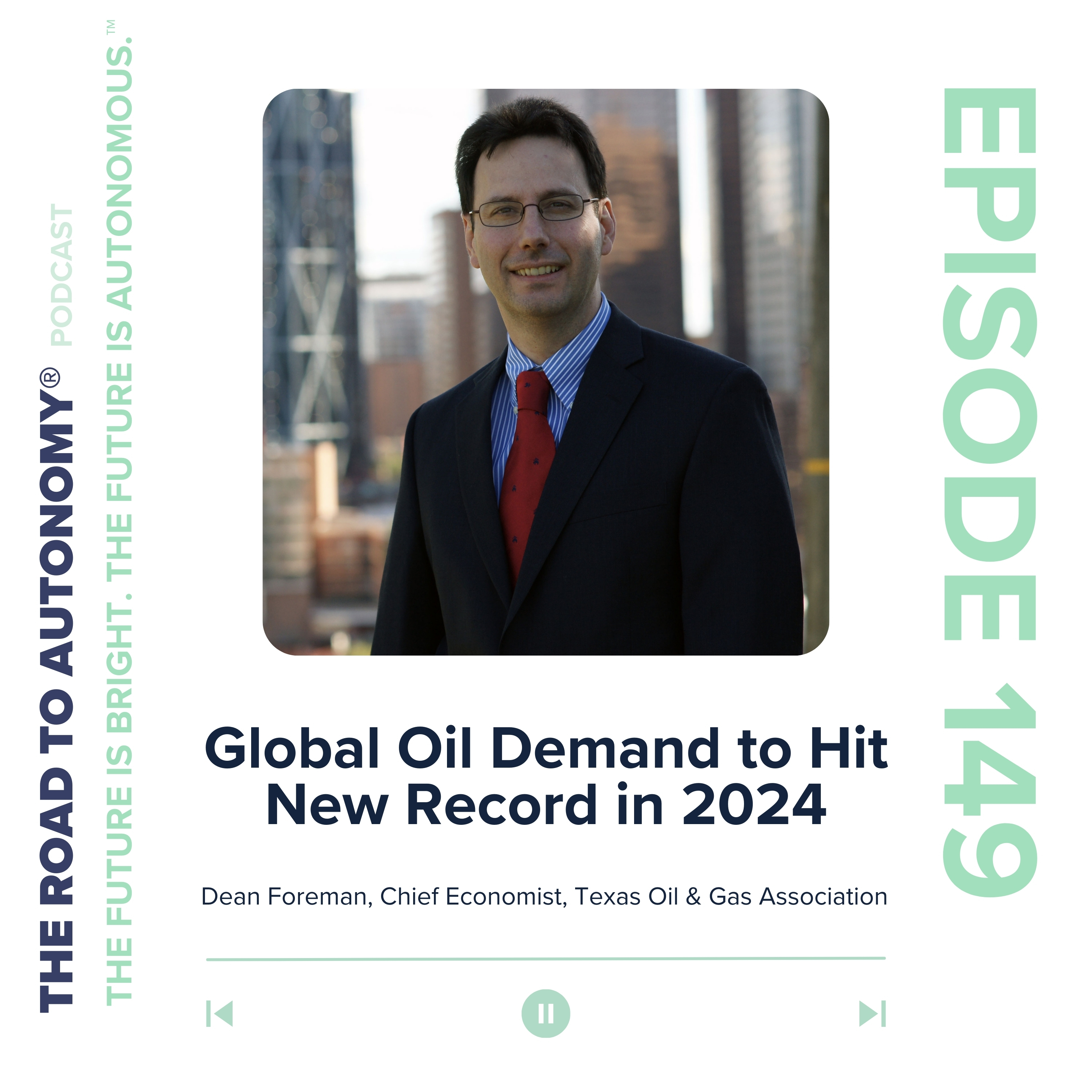
Ep 149Episode 149 | Global Oil Demand to Hit New Record in 2024
Dean Foreman, Chief Economist, Texas Oil & Gas Association joined Grayson Brulte on The Road to Autonomy podcast to discuss the global record demand for oil and the Texas economy.The conversation begins with Dean discussing the current state of the oil markets. In a nutshell they are deceptively tighter than relativity modest prices, of plus or minus $70 a barrel recently would indicate. – Dean ForemanEven though we are currently in a tight oil market, global oil demand is projected to increase to 102.7 million barrels per day in 2024 — a record high. If the economy stays on track and continues to hum along and not fall into a recession, the oil supply pressures could continue to mount. Historically in a rising rate environment, the demand for oil and commodities in general has decreased. This time however, we are seeing the demand for oil continuing to be strong. The increased demand for oil is primarily coming from emerging markets. We’re seeing emerging markets drive the majority of economic growth this year, projected again over the next two years and hand-in-hand with that has come the energy demand to go with it. – Dean ForemanIf the demand for oil continues as projected, The United States can bring more supply online. In the United States, Texas currently produces 5.4 million barrels per day of oil. With global demand for oil increasing, Texas’ economy has led the nation in economic growth for the last two quarters. Texas economy is growing at an average annual pace of 7.6%, more than 2.5 times the U.S. average. From January 2023 to April 2023, Texas generated $73.2 billion of state export revenues. When Texas does well, the U.S. does well. – Dean ForemanWith 43.6% of the oil in the United States being produced in Texas, the industry puts safe guards in place to protect against the potential impacts of hurricanes to ensure that oil can continue to flow. Wrapping up the conversation, Dean shares his outlook for the global oil markets and what he expects to see occur over the next quarter. Recorded on Friday, July 7, 2023--------About The Road to AutonomyThe Road to Autonomy® is a leading source of data, insight and commentary on autonomous vehicles/trucks and the emerging autonomy economy™. The company has two businesses: The Road to Autonomy Indices, with Standard and Poor’s Dow Jones Indices as the custom calculation agent; Media, which includes The Road to Autonomy and Autonomy Economy podcasts as well as This Week in The Autonomy Economy newsletter.See Privacy Policy at https://art19.com/privacy and California Privacy Notice at https://art19.com/privacy#do-not-sell-my-info.
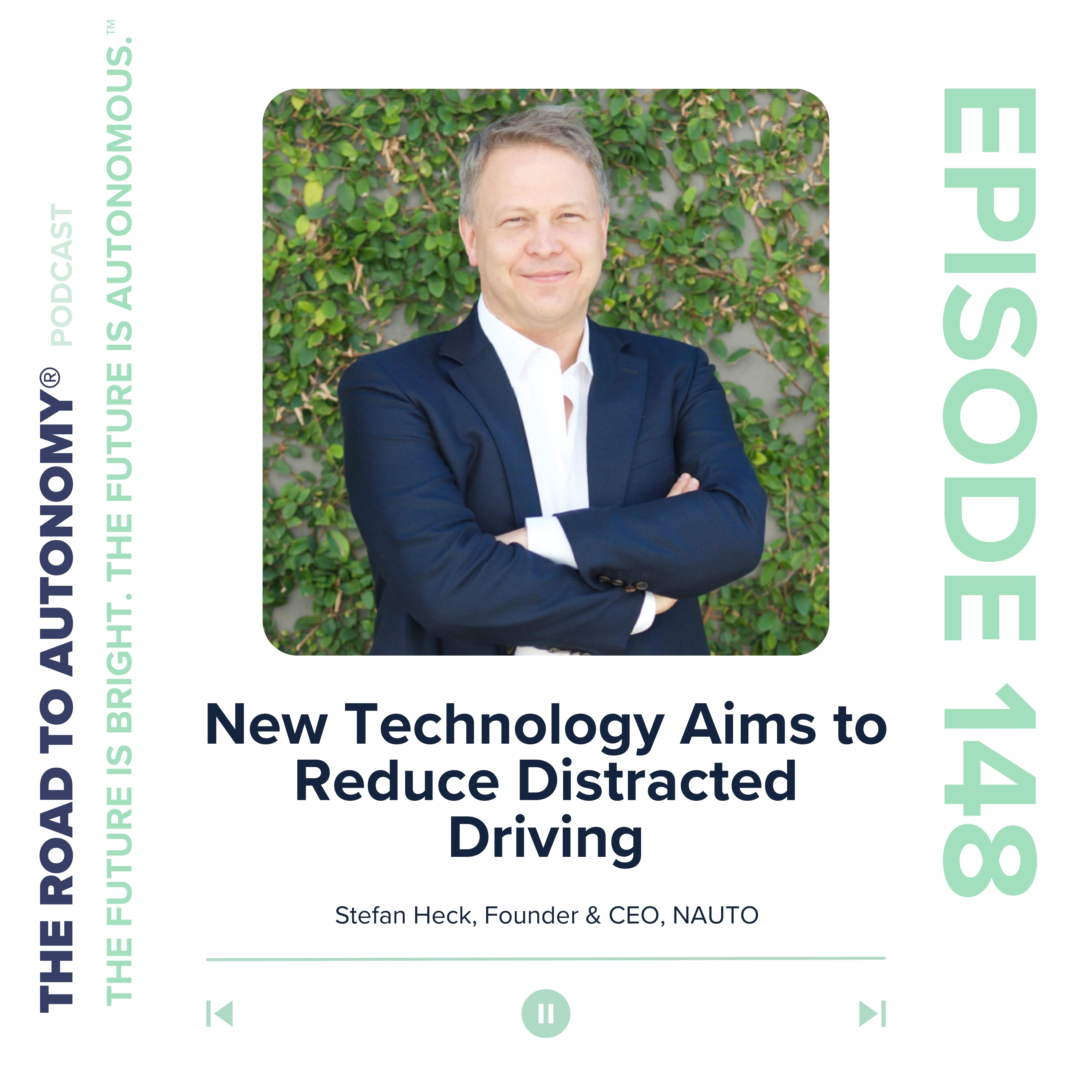
Ep 148Episode 148 | New Technology Aims to Reduce Distracted Driving
Stefan Heck, Founder & CEO, NAUTO joined Grayson Brulte on The Road to Autonomy podcast to discuss how NAUTO’s predictive-AI software is helping to reduce distracted driving. The conversation begins with Stefan discussing what he saw in the market when he founded the company in 2015 and what he learned from collision data. There is nothing as dangerous as distracted driving. – Stefan HeckAccording to NAUTO’s propriety data, on average, a commercial driver is distracted 7 times per driving hour, equating to roughly every 9 minutes. To help mitigate the distracted driving risk and reduce potential crashes, the NAUTO system monitors drivers behaviors and offers audio cues to gain the drivers attention. With-in the first week of using NAUTO, about 80% of all the distractions and nearly 100% of the severe long distractions are eliminated. – Stefan HeckThe system acts as a virtual coach that keeps drivers engaged while driving, giving them feedback in real-time on their driving behavior. The feedback comes in the form of a virtual coach that inspires change. When a driver realizes that their behavior as dangerous, they are more likely to change that behavior. In the data NAUTO has seen 80% to 90% of the drivers drop their risk behavior based on feedback from the virtual coach.This virtual coach, predictive-AI system is able to identify potential dangerous scenarios because it has been trained on 3 billion miles with over 200,000 high-risk driving events. The accuracy of all of these interventions is really important. There’s nothing as upsetting as telling you, hey there is a bicycle here and there is no bicycle. Or you are tailgating and there is nobody in front of you. So, we spent years making sure that all of detectors, all of our interventions are super accurate. – Stefan HeckIf the system is not accurate, drivers will begin to distrust the system and figure out a way to turn it off. This behavior is common amongst individuals who own vehicles with lane-keep assist. They simply turn it off because it’s inaccurate and annoying. A system that is accurate is a system that works and does it job to help avoid dangers driving scenarios. NAUTO’s system caught the attention of Stellantis, as the company invested with a plan to offer the system in their commercial fleet vehicles. At first the system will use the NAUTO hardware and in the future, the software system will run natively on the vehicles by leveraging the on-board sensors without the NAUTO hardware. In addition to Stellantis, NAUTO has a partnership with Brightdrop where fleets can order can order the system pre-installed directly from the factory today. As robo-taxis scale around the world, the NAUTO system could be used for occupant detection and safety routing applications. As autonomy grows, NAUTO’s market grows. Wrapping up the conversation, Stefan shares his opinion on the future of AI as it relates to mobility.Recorded on Wednesday, July 5, 2023--------About The Road to AutonomyThe Road to Autonomy® is a leading source of data, insight and commentary on autonomous vehicles/trucks and the emerging autonomy economy™. The company has two businesses: The Road to Autonomy Indices, with Standard and Poor’s Dow Jones Indices as the custom calculation agent; Media, which includes The Road to Autonomy and Autonomy Economy podcasts as well as This Week in The Autonomy Economy newsletter.See Privacy Policy at https://art19.com/privacy and California Privacy Notice at https://art19.com/privacy#do-not-sell-my-info.
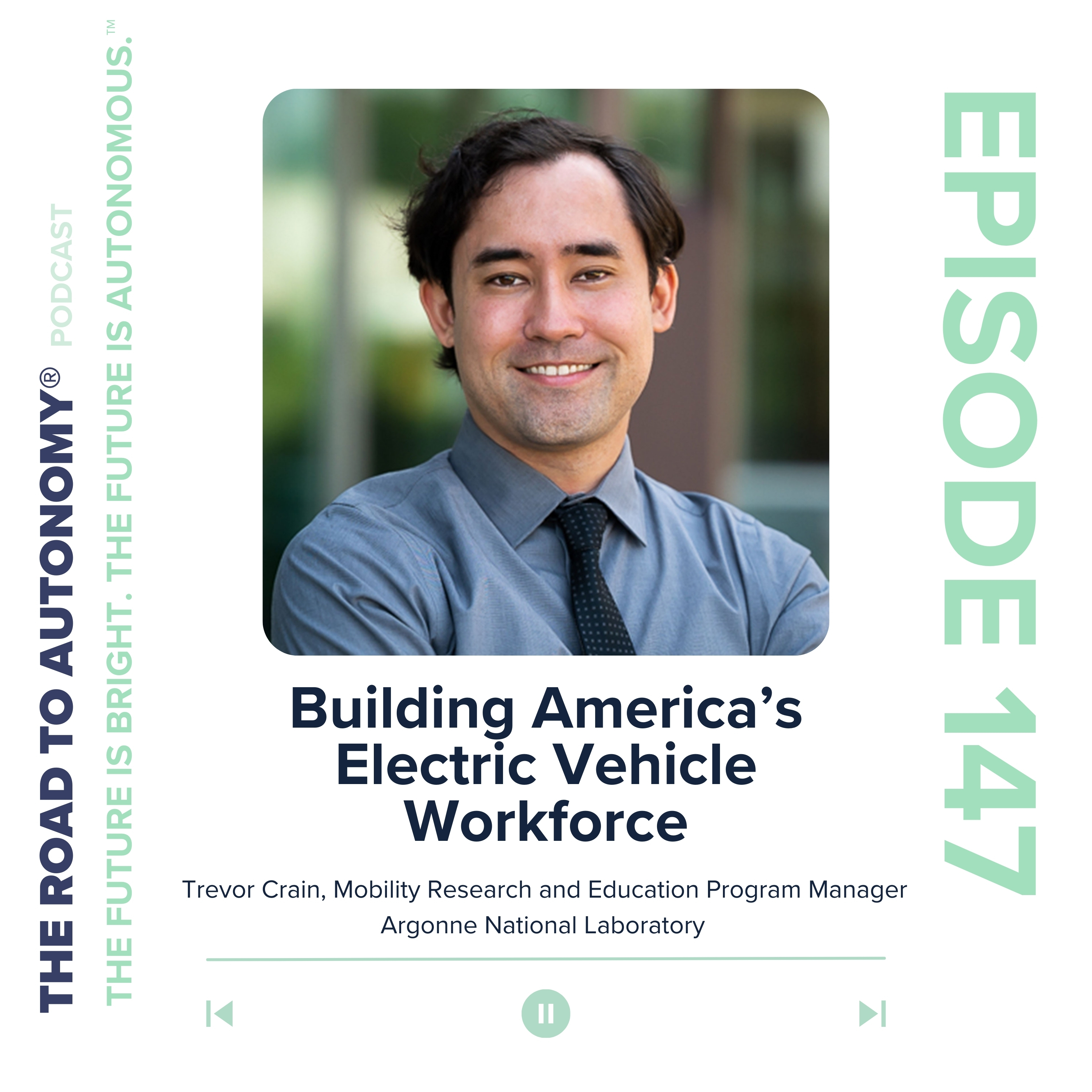
Ep 147Episode 147 | Building America’s Electric Vehicle Workforce
Trevor Crain, Mobility Research and Education Program Manager, Argonne National Laboratory joined Grayson Brulte on The Road to Autonomy podcast to discuss building America’s electric vehicle workforce. The conversation begins with Trevor sharing his thoughts on developing the workforce of the future as society shifts to electrified forms of mobility and how this skill set can transition to other industries. Our team here at Argonne looks at how do we build revolutionary and innovative programs that help all of our workforce program participants be able to address all these different technologies. – Trevor CrainAs the workforce is developed to work on electric vehicles and the infrastructure needed to support EVs, Argonne is working to ensure that students have the skill sets needed to succeed even when the technology or standards change. One of the ways that Argonne is helping students develop the skill set of the future is through the EcoCar Challenge. The EcoCar Challenge is a multi-year program where 15 North American universities teams come together to develop next generation electric vehicle technologies and automation are energy efficient. These teams are getting real-world, hands on experiences.We are taking things out of the research realm and into the actual application realm onboard our real test vehicles. – Trevor CrainBernstein Research is projecting that battery electric vehicles will reach 40% marketshare globally by 2030. If this forecast comes to realization, the workforce development and the skills needed to service these vehicles will has to be accelerated and developed today.One way to potentially accelerate the work force development for EVs is through apprenticeships where students do not take on debt. This is just one of the many options that could be implemented to ensure that the workforce of the future is ready today.Expanding the conversation, Trevor discusses the skill set that students learn as part of the EcoCar Challenge. As part of the challenge, students are encouraged to think from a customer centric approach. Would a consumer want this feature? Would a consumer pay for this feature? Does this feature increase the range of the vehicle?Wrapping up the conversation, Trevor shares his thoughts on electric vehicles.Recorded on Tuesday, June 20, 2023--------About The Road to AutonomyThe Road to Autonomy® is a leading source of data, insight and commentary on autonomous vehicles/trucks and the emerging autonomy economy™. The company has two businesses: The Road to Autonomy Indices, with Standard and Poor’s Dow Jones Indices as the custom calculation agent; Media, which includes The Road to Autonomy and Autonomy Economy podcasts as well as This Week in The Autonomy Economy newsletter.See Privacy Policy at https://art19.com/privacy and California Privacy Notice at https://art19.com/privacy#do-not-sell-my-info.
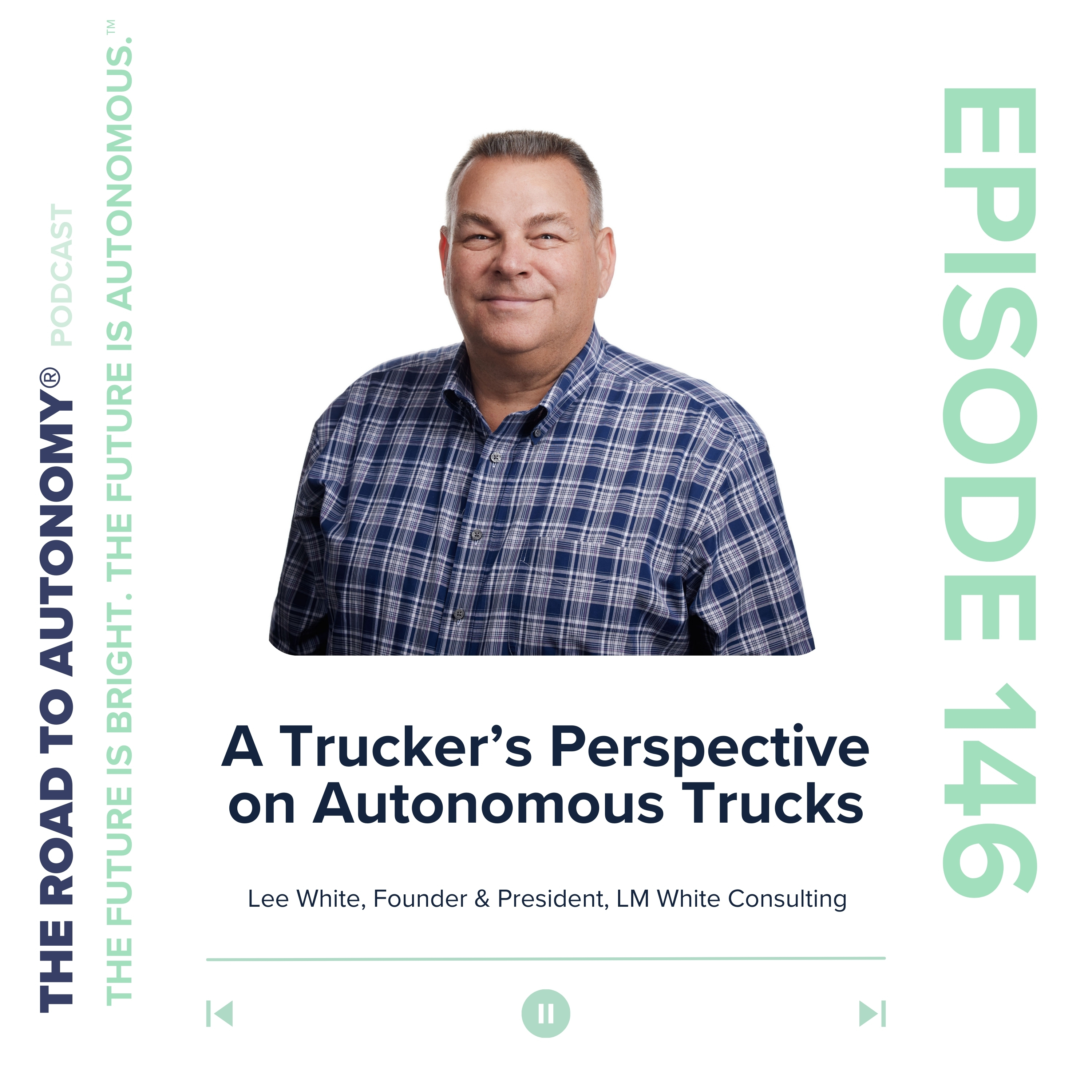
Ep 146Episode 146 | A Trucker’s Perspective on Autonomous Trucks
Lee White, Founder & President, LM White Consulting joined Grayson Brulte on The Road to Autonomy podcast to discuss scaling autonomous trucking operations. The conversation begins with Lee explaining why after a 38-year career at UPS he decided to joined the autonomous trucking industry. In 2018, Lee took his first ride in an SAE Level 4 autonomous truck and it changed the way he looked at trucking forever. I remember standing outside that truck and looking back at it and saying; you know I am never going to be able to look at trucking the same way. – Lee WhiteLee’s insight into how large truck fleets operate is absolutely crucial to scaling revenue generating autonomous trucking operations. As the traditional trucking companies operate on extremely slim margins with tight timeframes for deliveries. For example, J.B. Hunt currently operates at a 6.4% margin, while Werner operates at a 4.8% margin. These margins leave little room for error. Enter, autonomous trucks. Autonomous trucks will enable traditional trucking companies to expand margins and utilize them on routes that benefit their operations the most. While professional drivers handle the other routes. Autonomous trucks and professional truck drivers will not compete for jobs. Instead, they will compliment each other, shore up the supply chain and enable trucking companies to optimize their operations.I don’t ever see an environment where you don’t have drivers. – Lee WhiteThe optimization will come from integrating autonomous trucks, intermodal, dedicated and over-the-road operations. Autonomous trucks at first will be deployed on high-density lanes with repeatable routes. In order for autonomous trucks to scale, there has to be infrastructure — truck terminals. These terminals will most likely be shared, yet there are no standards as it relates to how the infrastructure has to be built to accommodate autonomous trucks to launch and land. Furthering the conversation Grayson and Lee discuss how the autonomous vehicle market compares to the autonomous trucking market from a revenue and total addressable market (TAM) standpoint. Wrapping up the conversation, they discuss if Volvo Autonomous Solutions and Daimler become the Waymo and Cruise of autonomous trucking. Recorded on Friday, May 19, 2023--------About The Road to AutonomyThe Road to Autonomy® is a leading source of data, insight and commentary on autonomous vehicles/trucks and the emerging autonomy economy™. The company has two businesses: The Road to Autonomy Indices, with Standard and Poor’s Dow Jones Indices as the custom calculation agent; Media, which includes The Road to Autonomy and Autonomy Economy podcasts as well as This Week in The Autonomy Economy newsletter.See Privacy Policy at https://art19.com/privacy and California Privacy Notice at https://art19.com/privacy#do-not-sell-my-info.
Ep 145Episode 145 | Cyber Security for Autonomous Vehicles
Charles Eagan, Chief Technology Officer, BlackBerry joined Grayson Brulte on The Road to Autonomy podcast to discuss cyber security for autonomous and electric vehicles.The conversation begins with Charles sharing the current state of the cyber security market as it relates to electric and autonomous vehicles.The more software, the more network connectivity, and the more autonomous behaviors you have along with that comes a reciprocal cyber impact. – Charles EaganAs cars get smarter, the cyber security risks increase.What I am hoping is that cars will become much more secure than cell phones, because we will learn from the computer attacks, the cell phone attacks, the networking attacks and then we can take those best practices and make sure we are applying them. – Charles EaganThe risks increase when the vehicle infrastructure becomes connected. For example, when a consumer plugs their vehicle into charge they are mostly unaware of the cyber risks. Plugging a simple charging cable into an electric vehicle could potentially be a cyber security risk with real-world consequences.The vulnerabilities that exist in today’s Government infrastructure or computer infrastructure, those vulnerabilities will also apply to the EV infrastructure. – Charles EaganThe big challenge becomes how do we make software-defined infrastructure and vehicles secure against cyber attacks from Nation-State actors. Attacking the infrastructure and locking electric vehicles to the charger for example could cause severe economic damage.To help mitigate the risks, we have to audit the software supply-chain and ensure that only the software intended for the vehicle is being used. This becomes critically important as society begins to shift towards over-the-air updates and autonomous vehicles.With a software-defined vehicle comes payments. In the future vehicles, will have a payment layer built into them which allow either the driver or passengers to conduct commerce. To ensure a secure transaction, the payments will have to be secured with identity information.The more connected, and the more vehicles, and the more software, the more monitoring that you need to do. – Charles EaganTo monitor vehicles and the enterprise, Blackberry created CylanceGUARD. Monitoring allows Blackberry on behalf of customers to monitor the behavior of the network and determine if the unexpected happened. If the unexpected happens, Blackberry notifies the proper authorities who implement their action plan.Wrapping up the conversation, Charles shares his insights into how Blackberry is approaching cyber security for autonomous vehicles.Recorded on Monday, May 15, 2023--------About The Road to AutonomyThe Road to Autonomy® is a leading source of data, insight and commentary on autonomous vehicles/trucks and the emerging autonomy economy™. The company has two businesses: The Road to Autonomy Indices, with Standard and Poor’s Dow Jones Indices as the custom calculation agent; Media, which includes The Road to Autonomy and Autonomy Economy podcasts as well as This Week in The Autonomy Economy newsletter.See Privacy Policy at https://art19.com/privacy and California Privacy Notice at https://art19.com/privacy#do-not-sell-my-info.
Ep 144Episode 144 | The Next Generation of Radar
Dr. Matt Markel, President, Spartan Radar joined Grayson Brulte on The Road to Autonomy podcast to discuss how software is enabling the next generation of radar. The conversation begins with Matt discussing the current state of the radar.I think it’s a really interesting time for radar. – Dr. Matt MarkelWhen deploying radar on commercial vehicles, the radar has to be optimized and designed for the use-cases that the commercial vehicle will be undertaking on a regular basis. Today, commercial vehicles are using radar to increase safety and in the future it will be used to enable autonomy. Increasing efficiency by using autonomy is a force multiplier. – Dr. Matt MarkelAutonomy is not a one-size fits all solution. Autonomy will be achieved in a variety of ways with different tech stacks. One of the hottest debates today is the LiDAR vs radar. Breaking the debate down, Matt shares his thoughts and insights, and explains the environmental limitations to each solution. Can autonomous vehicles operate at SAE Level 4 with only camera and radar?Yes, but the real question is what are those conditions? What are those Operational Design Domains? What are those ODDs that this combination can operate in? – Dr. Matt MarkelA camera, radar system that could operate at SAE Level 4 on highways and SAE Level 3 on suburban roads could help to usher in the personally owned autonomous vehicle market. When it comes to robo-taxis operating in dense urban environments, a full stack including LiDAR, camera and radar is the ideal solution due to the complexity of the ODD.One of the key ingredients in the autonomous driving stack is software. Spartan very similarly to Waymo is using software to enhance the performance of radar. One of the key differences between Waymo and Spartan’s approach to radar is that Spartan is making their software available to everyone. We do believe that there is a lot of performance being left on the table with automotive radar today. We can help Tier 1’s unlock that with our software products. – Dr. Matt MarkelSpartan’s approach is being validated with an investment from Microsoft and a partnership with Tier-1 automotive parts supplier — Valeo. Because we are adding software capabilities to these systems, it provides flexibility for the Tier-1. It makes them relevant to multiple OEMS, multiple applications, multiple RFQs without a change in the hardware. – Dr. Matt MarkelWrapping up the conversation, Matt shares his thoughts on how he sees the radar market evolving over the next decade. Recorded on Tuesday, June 6, 2023--------About The Road to AutonomyThe Road to Autonomy® is a leading source of data, insight and commentary on autonomous vehicles/trucks and the emerging autonomy economy™. The company has two businesses: The Road to Autonomy Indices, with Standard and Poor’s Dow Jones Indices as the custom calculation agent; Media, which includes The Road to Autonomy and Autonomy Economy podcasts as well as This Week in The Autonomy Economy newsletter.See Privacy Policy at https://art19.com/privacy and California Privacy Notice at https://art19.com/privacy#do-not-sell-my-info.
Ep 143Episode 143 | Insurance Markets in Flux: How Technology is Reshaping the Insurance Industry
Ed Walker, Vice President, Shared Economy & Mobility, Hub International joined Grayson Brulte on The Road to Autonomy podcast to discuss how technology and autonomous vehicles are reshaping the insurance industry.The conversation begins with Ed discussing the current state of insurance markets for the gig economy. The current environment is a really broad spectrum of winners and losers. – Ed Walker The current environment is having an impact on the consumer as the average auto insurance liability rate has increased of 10% over the last year. This increase is on top of the industry average of 10% all claims filled in 2022 were fraudulent across all the insurance markets.There are more people on the roads without insurance then there has ever been right now in the United States. Underinsured and uninsured motorist coverage which is not provided in every State has become what used to be a consideration on a renewal to an absolute requirement in my opinion. – Ed Walker While in Ed’s opinion this an absolute requirement, we are starting to see the trend of bring your own insurance for gig economy workers and individuals who subscribe to a vehicle subscription service. In some cases, these individuals are not properly insured which could potentially have negative ramifications on them personally. When you have a bring your own insurance model, what you have is a subscription model where the car is not owned by the customer. However that customer is going to a personal limes agent or a program in order to get the vehicle insured. – Ed Walker The insurance they purchase might not be perfect, but in their minds it’s still insurance and it allows them to drive the vehicle. For those individuals who drive as for a service such as Uber, Lyft, Uber Eats and DoorDash a large portion of their take-home pay goes to insurance premiums. The insurance is costing your operation anywhere between 10 to 40 cents per mile depending on [The] State and the carrier. – Ed Walker With gig economy drivers getting squeezed with rising costs due to inflation and tight insurance markets, the question becomes how long is this model sustainable in it’s current form. The economics of the model today are opening the door to a future where ride-sharing services will be primarily operated with autonomous vehicles. I see autonomous vehicles as our ultimate light at the end of the tunnel if these situations do not improve. – Ed Walker The autonomous vehicle and autonomous truck markets are rapidly evolving as companies scale operations across the United States. As these companies scale their operations, the insurance market underwriting operations will continue to evolve. The more we do it, the better, smarter we get at it. The more carriers can make money at it, the more carriers show up, the more competitive the market gets. – Ed Walker Wrapping up the conversation, Ed shares his thoughts on the future of insurance.Recorded on Thursday, April 27, 2023--------About The Road to AutonomyThe Road to Autonomy® is a leading source of data, insight and commentary on autonomous vehicles/trucks and the emerging autonomy economy™. The company has two businesses: The Road to Autonomy Indices, with Standard and Poor’s Dow Jones Indices as the custom calculation agent; Media, which includes The Road to Autonomy and Autonomy Economy podcasts as well as This Week in The Autonomy Economy newsletter.See Privacy Policy at https://art19.com/privacy and California Privacy Notice at https://art19.com/privacy#do-not-sell-my-info.
Ep 142Episode 142 | Tele-Driving First Approach to Autonomy
Thomas von der Ohe, Co-Founder & CEO, Vay joined Grayson Brulte on The Road to Autonomy podcast to discuss why Vay is taking a tele-driving first approach to autonomy.The conversation begins with sharing the current state of autonomy in Europe. Could Europe be the market that first ushers in personally owned autonomous vehicles? With Porsche announcing a deal with Mobileye to offer semi-autonomous features in new models and Mercedes-Benz introducing DRIVE PILOT, European OEMs could usher in this market.But what happens when that vehicle potentially needs assistance when the vehicle exits the highway? This is where Vay comes into the picture as they are developing teledriving technology. Vay’s technology could be offered as a complimenting feature to vehicles with SAE Level 3 driving capabilities. This combination of highway driving in Level 3 or Level 4 fashion and then urban driving through teledriving could be a really really strong combination. – Thomas von de OheVay is taking a tele-driving first approach to autonomy. The big advantage of tele-driving is that we believe that we can get something into the market much much earlier that is able to scale.– Thomas von de OheThe approach that Vay is taking is resonating with regulators in the E.U. In February 2023, Vay became the first company to operate a vehicle without an individual in the vehicle on European public roads. Now that Vay is operating on public roads in the E.U., the use cases for their technology only becomes stronger.Imagine going out to dinner, having a bottle of wine and then instead of driving home, Vay tele-drives your vehicle home for you that evening? It’s possible and that is just one of the many potential use cases for Vay’s tele-driving technology. While this is just one example of what is possible, Vay is currently focused on urban driving and launching a service in the future. Wrapping up the conversation, Thomas discusses how tele-driving can change the way we live in cities. Recorded on Tuesday, May 16, 2023--------About The Road to AutonomyThe Road to Autonomy® is a leading source of data, insight and commentary on autonomous vehicles/trucks and the emerging autonomy economy™. The company has two businesses: The Road to Autonomy Indices, with Standard and Poor’s Dow Jones Indices as the custom calculation agent; Media, which includes The Road to Autonomy and Autonomy Economy podcasts as well as This Week in The Autonomy Economy newsletter.See Privacy Policy at https://art19.com/privacy and California Privacy Notice at https://art19.com/privacy#do-not-sell-my-info.
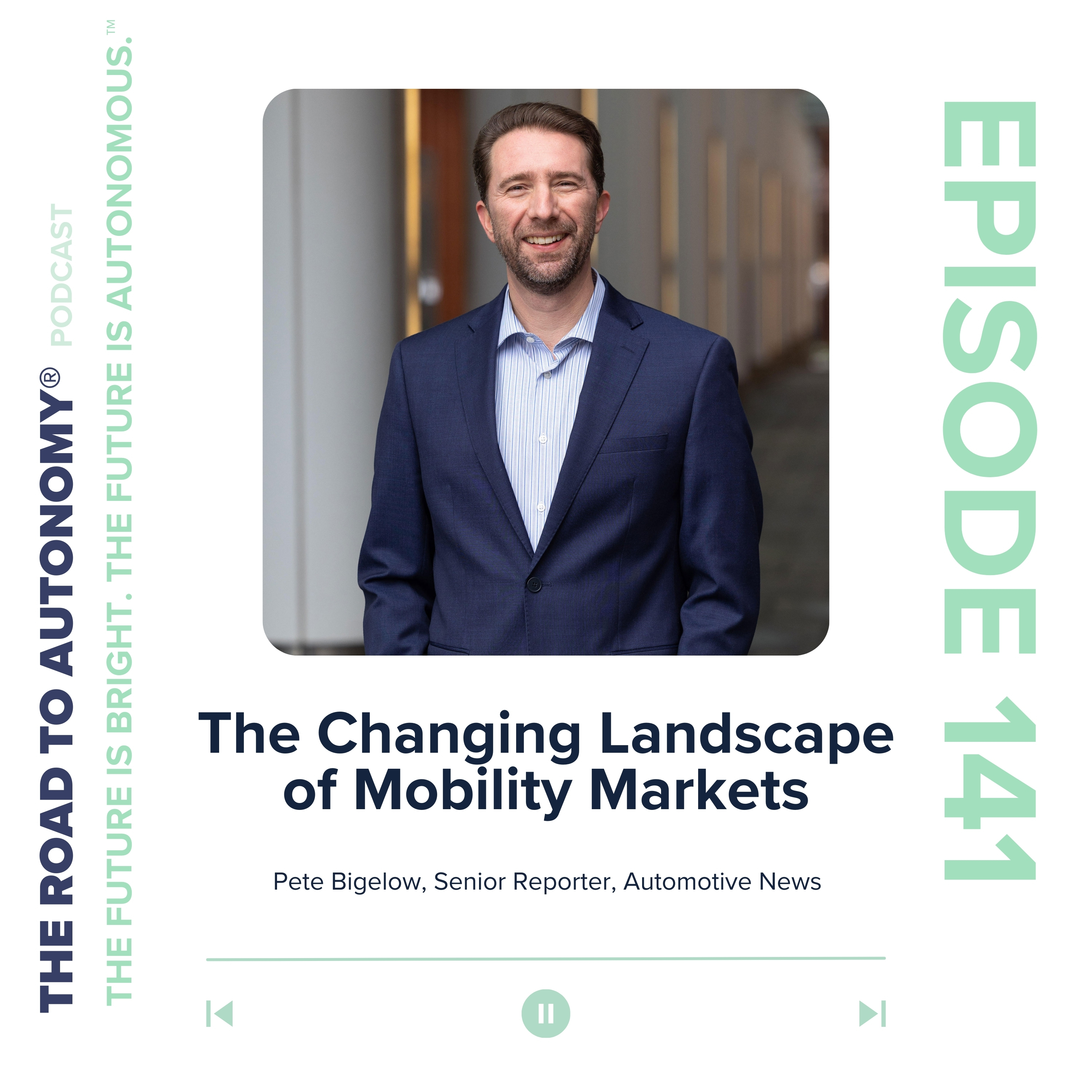
Ep 141Episode 141 | The Changing Landscape of Mobility Markets
Pete Bigelow, Senior Reporter, Automotive News, joined Grayson Brulte on The Road to Autonomy podcast to discuss the changing landscape of mobility markets. The conversation begins with Pete discussing how the automotive industry is preparing for a potential economic recession and the impact that Tesla’s price cuts are having on the market. The other major effect that Tesla is having on the market is the adoption of software-as-a-service in vehicles today.Tesla’s FSD (Full Self-Driving) is highly profitable and it’s success from an economic standpoint is changing global automakers in-vehicle software strategy.The business strategy behind it is very sound and enticing. – Pete BigelowNot all global automakers are feeling the Tesla pinch just yet. Ferrari with €1.38 billion in cash a 23% profit margin and no pension liabilities is currently over subscribed in terms of their order book. But looking to the future, Ferrari like all of the other global automakers will have to adapt to a world with autonomous vehicles. Personally owned autonomous vehicles are coming and Ferrari owners will want one. Will Ferrari listen to their customers and introduce an autonomous Ferrari at some point in the future? Grayson and Pete discuss the possibilities. Or could it be Mercedes-Benz that takes the plunge first introduces a personally owned autonomous vehicle?Over at VW under Oliver Blume, the company has been focused on IPOing their iconic brands starting with Porsche. Could a Lamborghini or Bentley IPO be next? Possibly. But what we do know is that under Mr. Blume’s leadership, VW is unlocking value for shareholders.While Mr. Blume has taken a diligent approach to the VW brand IPOs, the autonomous vehicle industry over the last 24 months rushed into SPACs and IPOs with limited and sometimes no revenue. Now they are struggling as the reality of public markets begins to set in and Mr. Market does his job to paraphrase the famed investor Howard Marks.Everyone saw the EV SPAC succeeding and raising so much money that they did not want to be left out. It was fear of missing out, fear of missing out on that big burst of cash upfront and they thought they were going to make it through to the other side. Now that is very clearly flat not the case in a lot of places or it puts a lot of people in a very precarious position.– Pete BigelowThe autonomous vehicle companies that stayed private such as Cruise and Waymo are now in a position of greater strength as consolidation has begun to sweep the industry and certain competitors have ceased to exist. It’s in this market that Cruise and Waymo along with Motional will be able to gain market share thanks in part to their strategic financial partners. Wrapping up the conversation, Pete shares his thoughts on how he sees mobility changing over the next decade. Recorded on Thursday, April 20, 2023--------About The Road to AutonomyThe Road to Autonomy® is a leading source of data, insight and commentary on autonomous vehicles/trucks and the emerging autonomy economy™. The company has two businesses: The Road to Autonomy Indices, with Standard and Poor’s Dow Jones Indices as the custom calculation agent; Media, which includes The Road to Autonomy and Autonomy Economy podcasts as well as This Week in The Autonomy Economy newsletter.See Privacy Policy at https://art19.com/privacy and California Privacy Notice at https://art19.com/privacy#do-not-sell-my-info.
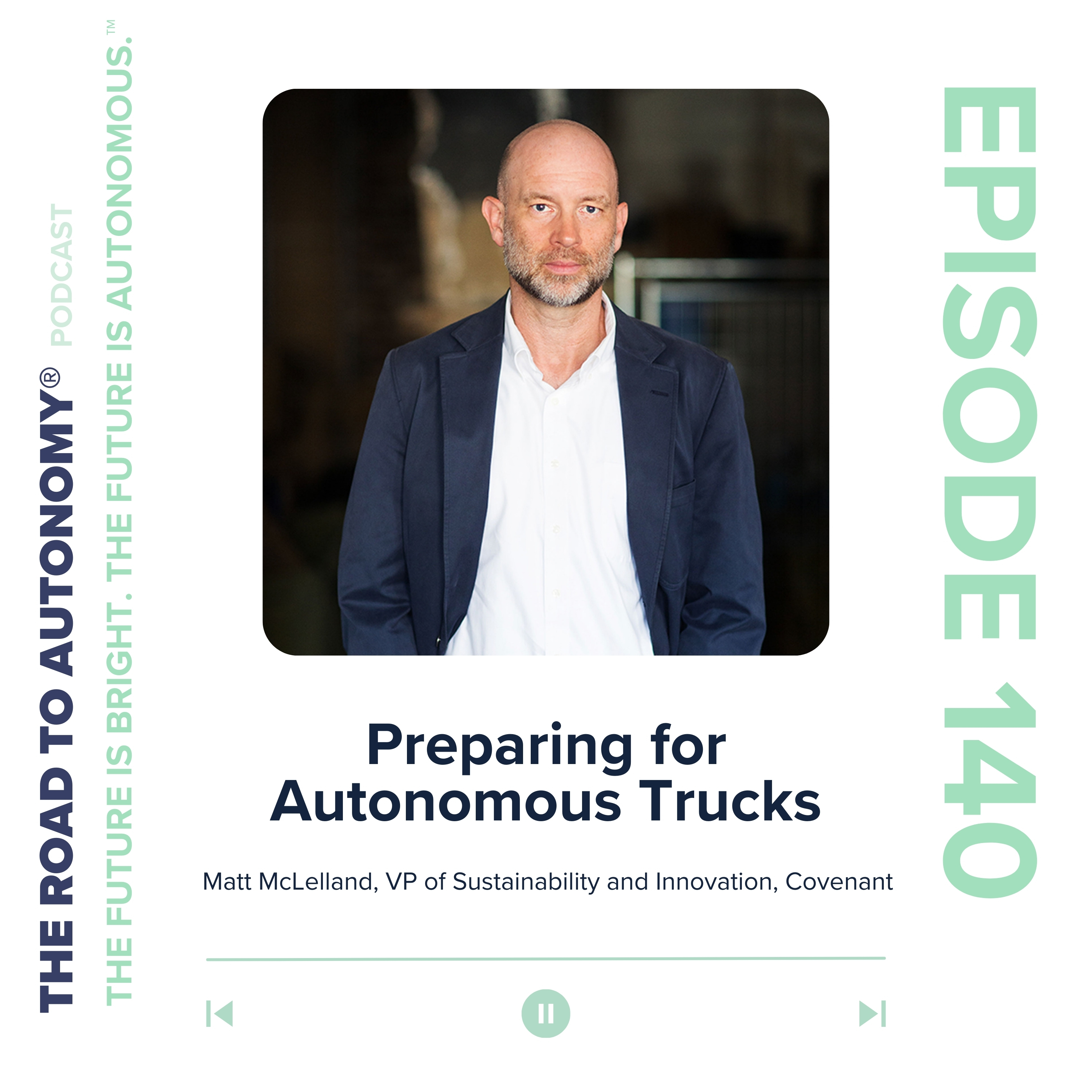
Ep 140Episode 140 | Preparing for Autonomous Trucks
Matt McLelland, VP of Sustainability and Innovation, Covenant joined Grayson Brulte on The Road to Autonomy podcast to discuss why Covenant always has a seat at the table as it relates to new technologies and how they are preparing for autonomous trucks.The conversation begins with Matt discussing how he is currently thinking about autonomous trucks as it relates to over-the-road operations. We figured that we needed to have a seat at the table, because autonomy was going to be a way to potentially augment our business. We have been involved since the very beginning. – Matt McLellandHaving a seat at the table and understanding the business is highly important to Matt as he shares insights from his recent four-day ride-along with a professional over-the-road driver. It gives you more context and experience into that whole kind of analogy of walk a mile in somebody else’s shoes. – Matt McLellandAs part of their having a seat at the table strategy, Covenant has a partnership with Aurora where the two companies are actively exploring the integration of Aurora’s virtual driver (Aurora Horizon) into Covenant’s operations. It’s not just from a technical perspective, it is also from a operations perspective.In order for autonomous trucks to scale, there has to be standardized operations around launching autonomous trucks from different sites. This is because there will be different technicians and employees at each site operating autonomous trucks for a variety of companies as the depots/launch sites will most likely be shared. Once the industry agrees on a shared launch strategy, the next issue that the industry is going to have to agree on is fuel. Diesel and the value proposition of autonomy is asset utilization, making that truck stay on the road to cover the most miles possible as efficiently as possible. – Matt McLellandWith the clear value proposition that diesel has for autonomous trucking, society is shifting to low-carbon solutions, opening the door for renewable diesel. While renewable diesel offers a bridge solution, there is not enough renewable diesel in the market today to support the wide-scale adoption. It’s the perfect bridge to zero emissions, its a solution available today that will get us to a much better place then where we are [today]. – Matt McLellandWhile it’s a solution, it comes at a premium cost to shippers that is being coined the “green premium”. The green premium is opening the door to autonomy as an autonomous truck can operate longer hours with less idling time and more efficiently. Covenant estimates that autonomous trucks can operate 8% to 12% more efficiently per truck. On Covenant’s autonomous journey today, today the company has partnerships with Aurora and Torc Robotics as they actively prepare for a future with autonomy. Wrapping up the conversation, Matt shares his thoughts on sustainability. Recorded on Friday, April 11, 2023--------About The Road to AutonomyThe Road to Autonomy® is a leading source of data, insight and commentary on autonomous vehicles/trucks and the emerging autonomy economy™. The company has two businesses: The Road to Autonomy Indices, with Standard and Poor’s Dow Jones Indices as the custom calculation agent; Media, which includes The Road to Autonomy and Autonomy Economy podcasts as well as This Week in The Autonomy Economy newsletter.See Privacy Policy at https://art19.com/privacy and California Privacy Notice at https://art19.com/privacy#do-not-sell-my-info.
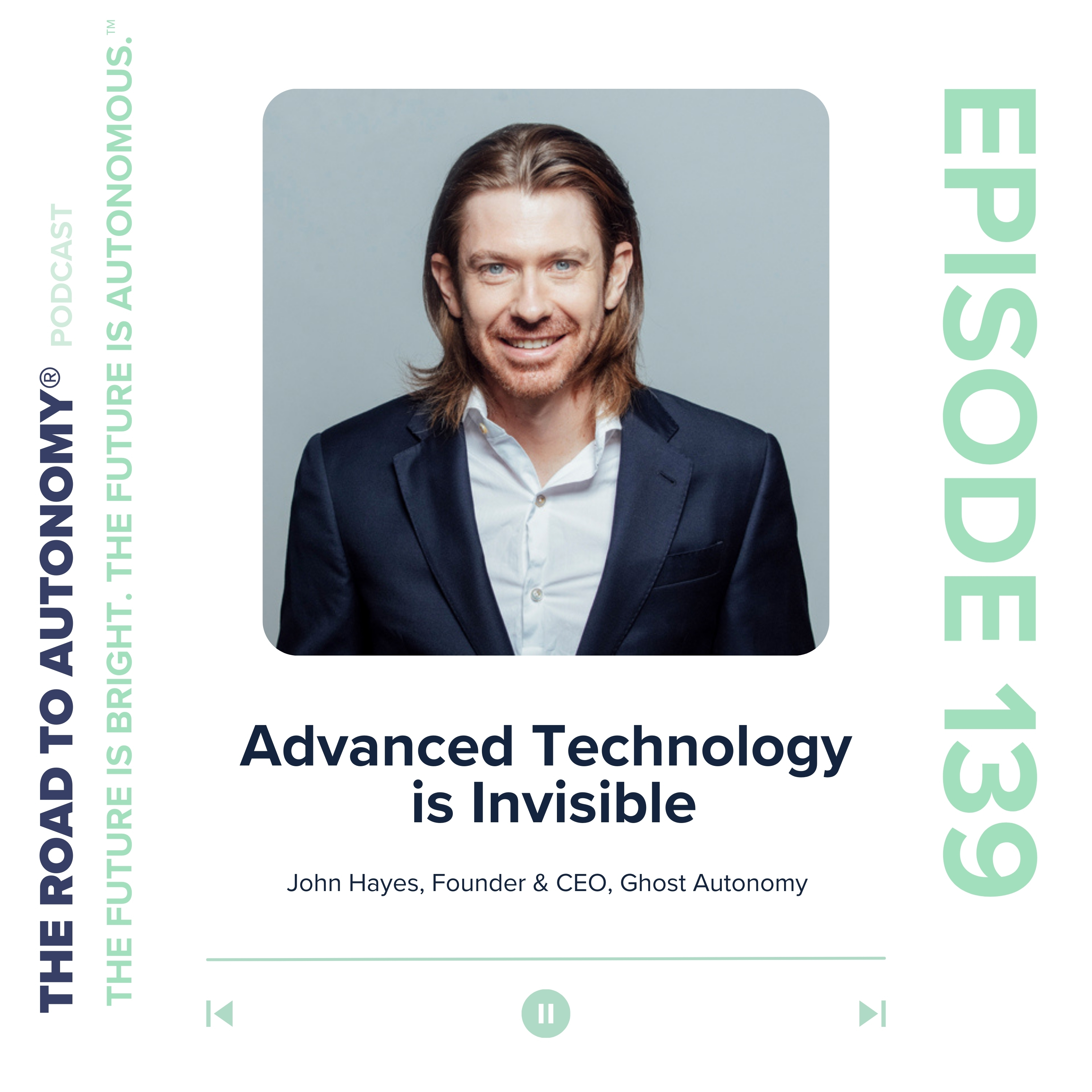
Ep 139Episode 139 | Advanced Technology is Invisible
John Hayes, Founder & CEO, Ghost Autonomy joined Grayson Brulte on The Road to Autonomy podcast to discuss why advanced technology is invisible and how Ghost plans to scale autonomous driving. The conversation begins with John discussing the founding of Pure Storage and what he say in the market when he founded that company and how that compares to the founding of Ghost Autonomy.Our data storage company was actually founded on the basis of trends and consumer technology. – John HayesSimilar to the way that storage was changing, John saw an opportunity to build a new modern autonomy stack that was not built on the DARPA Urban Challenge stack, but one that was based on consumer technology. Let’s look at what emerging trends are out there in hardware and where can we make smart software and what industry can we go into. – John HayesWhen Ghost first started to develop their autonomy stack, they started with a stereo camera-only approach and in the middle of 2021, they added radar to the stack. The direction we took with radar was to go in a software defined direction. – John HayesOne of the main defining aspects of the Ghost Autonomy stack is that they have engineered the stack to make it as invisible as possible. In addition to being almost invisible, the stack operates on low-power which will allow electric vehicles running their autonomy system to have more range. The hardware running on this low-power compute are four camera pairs and one high-resolution radar pointing forward. From a use-case scenario Ghost has engineered an SAE Level 4 design for highway use and an SAE Level 2 design for non-highway use. It’s a rolling ODD where you increase the competence at slower and slower speeds over time. – John HayesComparing and contrasting the Ghost Autonomy system to a traditional SAE Level 2 system, the system is more intuitive. From the user experience point of view, we focus very much on a concept system called collaborative driving, where there isn’t a button that you push to activate it. You are on the highway, it says you can drive anytime you want by turning and indicator blue and you let go of the steering wheel and it turns green. And you do not set anything, the car just goes and picks a reasonable speed and a reasonable following distance. – John HayesThis is built on John’s fundamental belief that that advanced technology is invisible in a way. The Ghost system does not have button or nobs, the system just works. Today a human has to click the ticker to change lanes, but in the future Ghost is working on a navigation system where the vehicle will simply just change the lane without being promoted to by the driver. I want to make the system extremely scalable so that you wouldn’t have to enter a destination to activate it. You just start driving and if you just want to let go of the wheel for 30 seconds to send a text, that’s a perfectly valid way to interact with the system. – John HayesFrom a business standpoint, Ghost is going to commercialize the product by licensing their software to OEMs.Wrapping up the conversation, John discusses the future of Ghost Autonomy.Recorded on Friday, April 7, 2023--------About The Road to AutonomyThe Road to Autonomy® is a leading source of data, insight and commentary on autonomous vehicles/trucks and the emerging autonomy economy™. The company has two businesses: The Road to Autonomy Indices, with Standard and Poor’s Dow Jones Indices as the custom calculation agent; Media, which includes The Road to Autonomy and Autonomy Economy podcasts as well as This Week in The Autonomy Economy newsletter.See Privacy Policy at https://art19.com/privacy and California Privacy Notice at https://art19.com/privacy#do-not-sell-my-info.
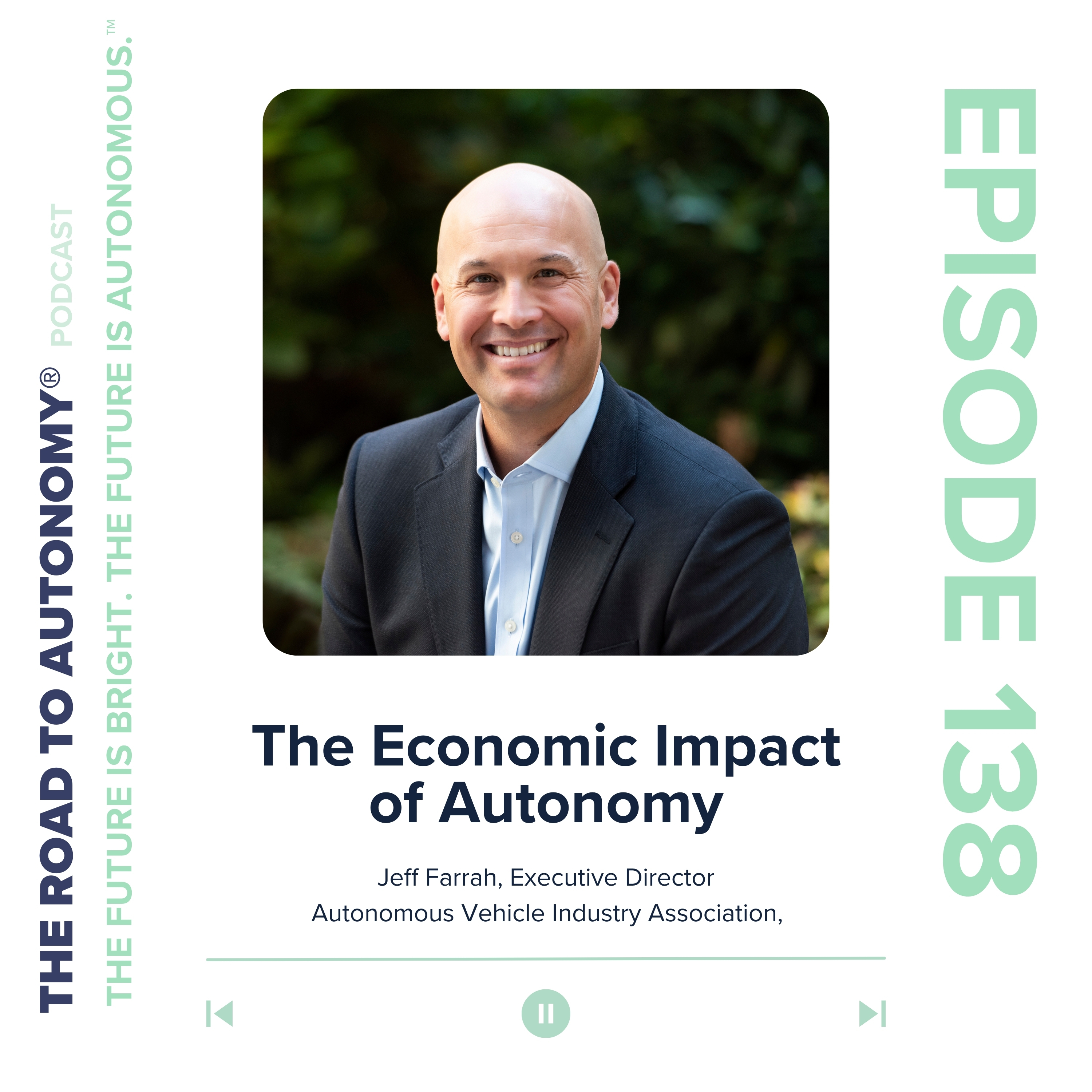
Ep 138Episode 138 | The Economic Impact of Autonomy
Jeff Farrah, Executive Director, Autonomous Vehicle Industry Association, joined Grayson Brulte on The Road to Autonomy podcast to discuss the economic impact of autonomy and why autonomy is the future.The conversation begins with Jeff discussing how the autonomous vehicle industry will navigate the potential economic downturn that is on the horizon.There is an expression in the venture capital world that some of the very best companies are built in down markets. – Jeff FarrahWhile this is an expression, Founders and Executives in the autonomous vehicle industry are hard at work commercializing, scaling and generating revenue from autonomy. The industry today is entering the next phase as AV companies move away from full-time research and development and into the operations stage of their companies lifecycle. As AV companies mature, the market is taking notice. There is a tremendous amount of excitement kind of up and down the economy to ultimately have a piece of this [market].– Jeff FarrahAs the market takes notice, consumers are starting to take notice as well as autonomy will create high-paying jobs. Along with the new jobs created by autonomy, the technology will have a positive economic impact on the global economy by creating new jobs, shoring up the supply chain and ultimately helping to lower inflation. For AVs to truly scale, we need a National Autonomous Vehicle Framework that enables regulatory certainty. With regulatory certainty, investment into the sector will flourish. We do not want to have a situation where this industry does poorly because there are giant question marks hanging over it that policy makers could have ultimately clarified. – Jeff FarrahToday, there is no National Autonomous Vehicle Framework and the industry is left with a patchwork of laws that makes scaling difficult. In California, legislators are currently considering bill AB316 that would prohibit the operation of autonomous vehicles with a gross vehicle weight of 10,000 pounds on public roads for testing and commercial operations without a driver in the vehicle. This bill in it’s current form will kill jobs and have a negative impact on the economy of the State of California.You have a situation where many of the leading autonomous trucking companies are based in California. Despite that, the State in many circles tends to be taking a posture of no thanks, we are not interested, please go elsewhere. – Jeff FarrahWhen the industry goes elsewhere, jobs will follow. In the communities that embrace AVs, new jobs will be created, new businesses will open and those communities will experience the positive economic impact of AVs. Recently, Governor Reeves of Mississippi signed HB 1003 welcoming autonomous vehicles to Mississippi.With the signing of HB 1003, autonomous trucks can now travel along the I-10 from Arizona to Florida fully autonomous.Wrapping up the conversation, Jeff shares his view on the future of autonomous vehicles and trucks.Recorded on Tuesday, April 4, 2023--------About The Road to AutonomyThe Road to Autonomy® is a leading source of data, insight and commentary on autonomous vehicles/trucks and the emerging autonomy economy™. The company has two businesses: The Road to Autonomy Indices, with Standard and Poor’s Dow Jones Indices as the custom calculation agent; Media, which includes The Road to Autonomy and Autonomy Economy podcasts as well as This Week in The Autonomy Economy newsletter.See Privacy Policy at https://art19.com/privacy and California Privacy Notice at https://art19.com/privacy#do-not-sell-my-info.
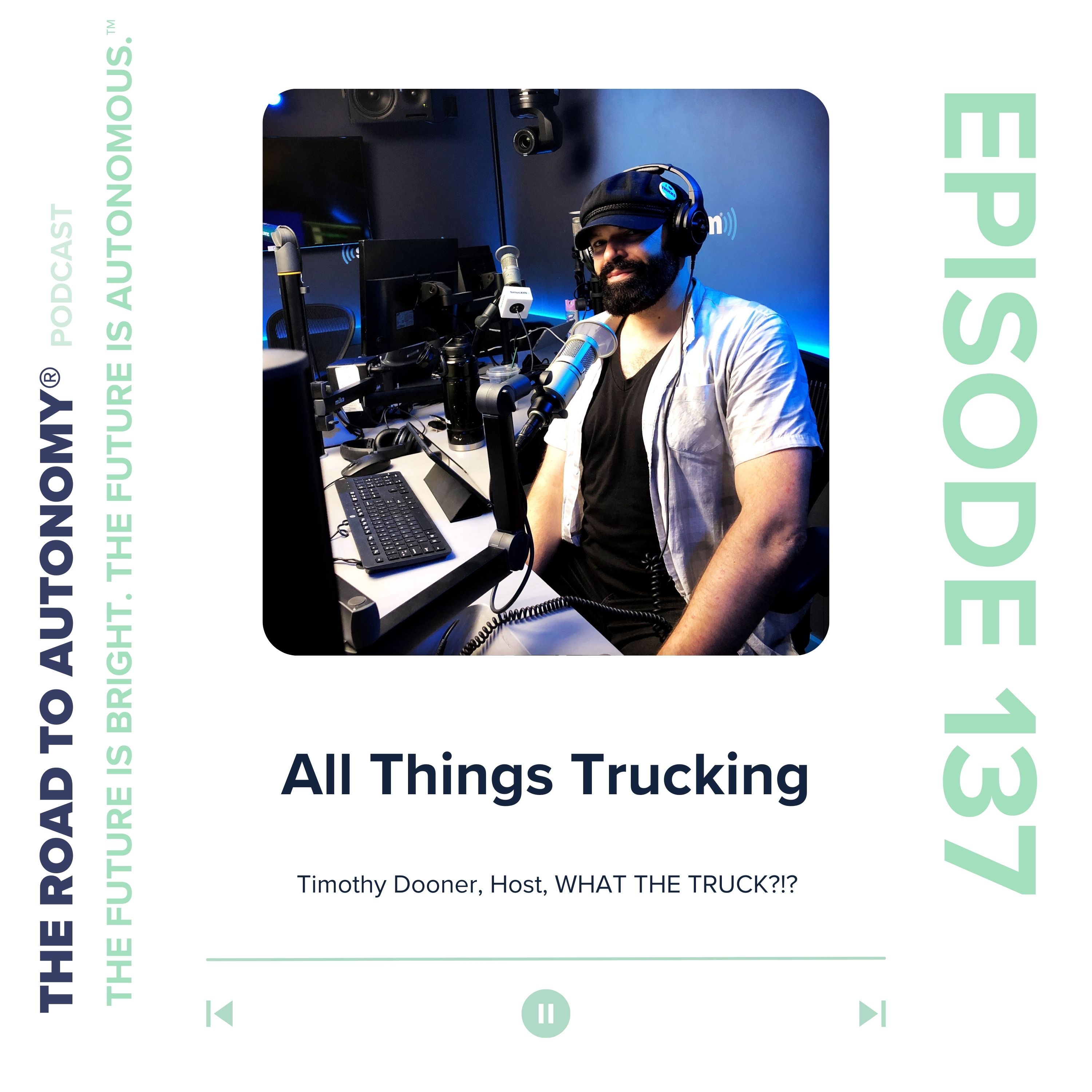
Ep 137Episode 137 | All Things Trucking
Timothy Dooner, Host, What The Truck, joined Grayson Brulte on The Road to Autonomy podcast to discuss all things trucking and the current state of the trucking industry.The conversation begins with Grayson and Dooner discussing the importance of securing DoD (Department of Defense) contracts when developing autonomous trucks as those contracts provide reliable revenue and stability as the autonomous trucking companies ramp up commercial operations. Where do you get money if the carriers won’t give it to you, and you are in an economy right now also where the venture cap is not free and you just want YOLO a SPAC out there to the retail traders? – Timothy DoonerAs the Fed continues to raise interest rates, the days of free money are over for the foreseeable future. With the monetary environment being tight, autonomous trucking companies with little to no revenue will find it very hard to raise capital and at some point will have to shutter. While the monetary environment remains tight, the geo-political circumstance stance remains fraught as China escalates their pressure on Taiwan. With a geo-political scenario that is uncertain and Taiwan controlling the global semi-conductor industry along with China controlling the electric vehicle supply chain, the potential for a global economic disaster that brings a halt to a future with electric trucks is elevated. A future with electric trucks is a complex future as there are the supply chain issues in addition to the charging infrastructure issues that are also plaguing the industry. It has been reported by some carriers that it is taking months to get the electrical backhaul needed to operate heavy-duty charging at certain locations. When the electric heavy-duty chargers are up and running, the next issue to tackle is time. Freight is messy. There is a lot of stuff and a lot of delays and the last thing you want to consider is taking an equation where it used to cost 20 minutes to fuel to now maybe it costs an hour to two. – Timothy DoonerIn the market there are 250,000 carriers with less then six trucks. These operations are small and they do not have the balance sheet to add electric trucks to their operations, but yet in some States they are being forced due to regulation. The change in regulation could lead to further consolidation in the traditional trucking industry while further opening the door to autonomy.I think the future model, the realistic future model does look like autonomy in that middle-mile and delivery in that short mile with electric vehicles. – Timothy DoonerWith the door furthering opening to autonomy in the trucking industry, Grayson and Dooner go onto discuss the current state of autonomous trucking. Wrapping up the conversation, Dooner shares his vision for the future of trucking. Recorded on Friday March 31, 2023--------About The Road to AutonomyThe Road to Autonomy® is a leading source of data, insight and commentary on autonomous vehicles/trucks and the emerging autonomy economy™. The company has two businesses: The Road to Autonomy Indices, with Standard and Poor’s Dow Jones Indices as the custom calculation agent; Media, which includes The Road to Autonomy and Autonomy Economy podcasts as well as This Week in The Autonomy Economy newsletter.See Privacy Policy at https://art19.com/privacy and California Privacy Notice at https://art19.com/privacy#do-not-sell-my-info.
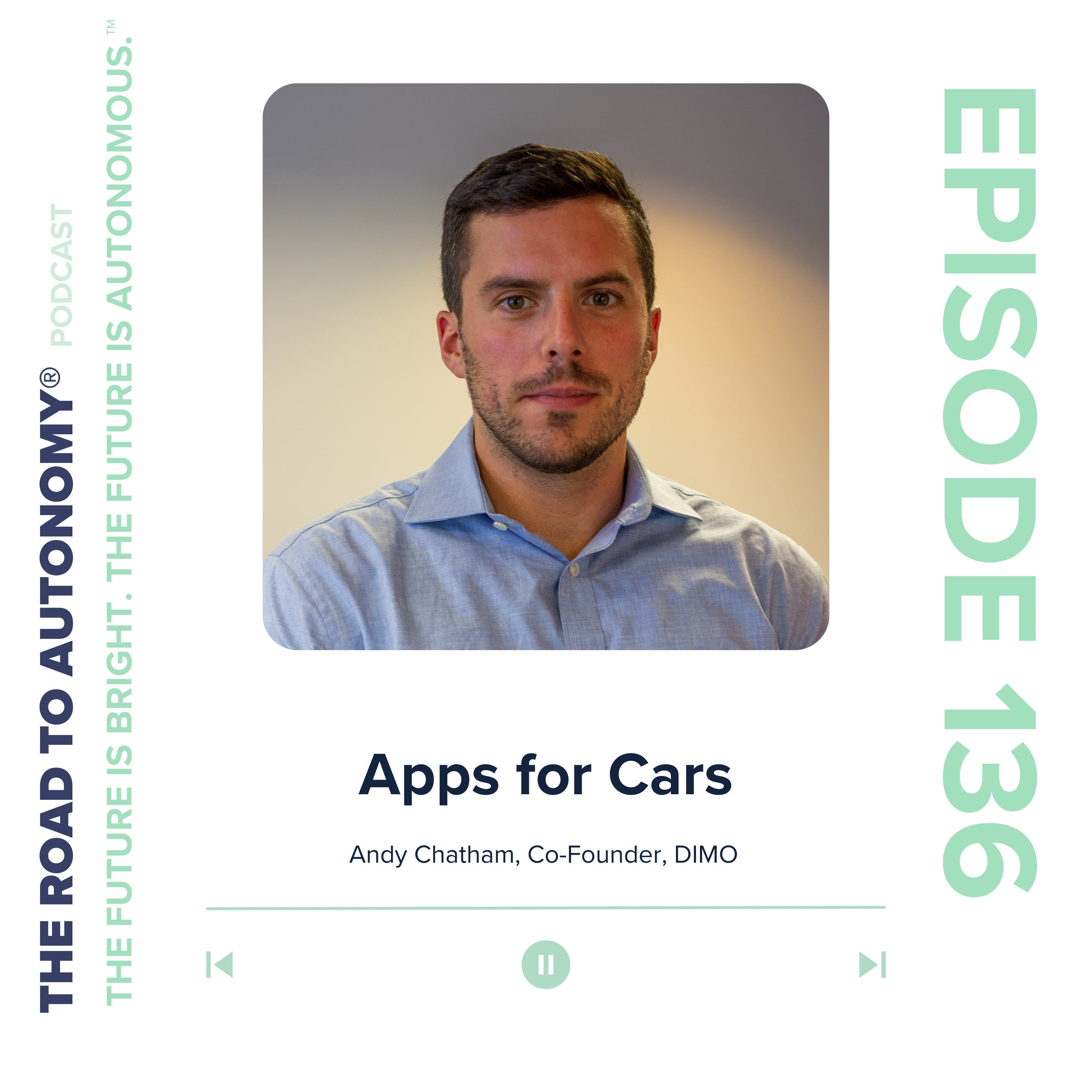
Ep 136Episode 136 | Apps for Cars
Andy Chatham, Co-Founder, DIMO joined Grayson Brulte on The Road to Autonomy podcast to discuss the DIMO open-connected vehicle platform and why there are no good apps for cars today. The conversation begins with Andy discussing why he decided to build DIMO and what he saw in the market when he launched the company.Cars are becoming more intelligent, they are taking over more of the driving task from end-consumers, but were still waiting for that first deployment where millions of people are able to actually take their hands and eyes off the road and give control over to a computer. – Andy ChatmanWith the rapid increase in ADAS (Advanced Driver Assistance Systems) systems being available in cars today, combined with consumers believing that an SAE Level 2 system is a self-driving car, Grayson brings up the point that consumers will want to own personally owned autonomous vehicles when they are ready. If this does indeed come true, what impact will it have on the robo-taxi market?I think there will be some real markets in which robo-taxis are able to deliver value to consumers and provide a useful service. – Andy ChatmanThen there is Tesla, What happens if and when Tesla can figure out SAE Level 3? What impact will it have on the emerging personally owned autonomous vehicle market? What impact this have on Tesla from a business perspective? One thing that were very sure of, is that it will increase the value of the data coming from the car in some relatively non-obvious ways. – Andy ChatmanThis is where DIMO comes into the picture. We want to give ownership of the data coming from the vehicle to the owner of the vehicle and the occupant of the vehicle, and make sure that they are able to do whatever that want with it. – Andy ChatmanAt some point in the future, consumers are going to want to own and control their own data as it relates to their mobility experiences. Today, consumers can take control of their data with DIMO and take advantage of apps that create value for their driving experience. One of the apps, that developers have built on the platform is battery health monitoring. With electric vehicles having surpassed 10% of global sales for the first time in 2022 and used electric vehicle sales in the United States rising 32% in the first three months of 2023, knowing the health of the EV’s battery becomes extremely important. We can provide you insights into how your battery is performing in the real-world. How quickly are you able to charge it. How quickly it’s discharging. When you are repeatedly charging it from zero to 100%, we can give you insights around, hey this is going to degrade the value of your battery overtime. – Andy ChatmanIn addition to battery health data, DIMO is able to offer insights into real-world EV charging performance and what chargers are charging at what speeds. There are inconsistencies in the public charging network that is leading to charging anxiety for non-tesla EV drivers. The difference is that Tesla built, owns and maintains their own EV charging network. Tesla drivers really experience range anxiety. – Andy ChatmanWith all of the data coming off of connected vehicles, one of the key elements that OEMs will have to maintain is trust. Consumers are going to have to trust that their vehicle is going to always work, always be secure and work when they need to drive somewhere. One of DIMO’s goals is to become a trusted platform for mobility. We look at what we doing as creating the first truly open developer platform for cars. – Andy ChatmanWrapping up the conversation, Andy shares his opinion on the future of mobility.Recorded on Tuesday, March 28, 2023--------About The Road to AutonomyThe Road to Autonomy® is a leading source of data, insight and commentary on autonomous vehicles/trucks and the emerging autonomy economy™. The company has two businesses: The Road to Autonomy Indices, with Standard and Poor’s Dow Jones Indices as the custom calculation agent; Media, which includes The Road to Autonomy and Autonomy Economy podcasts as well as This Week in The Autonomy Economy newsletter.See Privacy Policy at https://art19.com/privacy and California Privacy Notice at https://art19.com/privacy#do-not-sell-my-info.
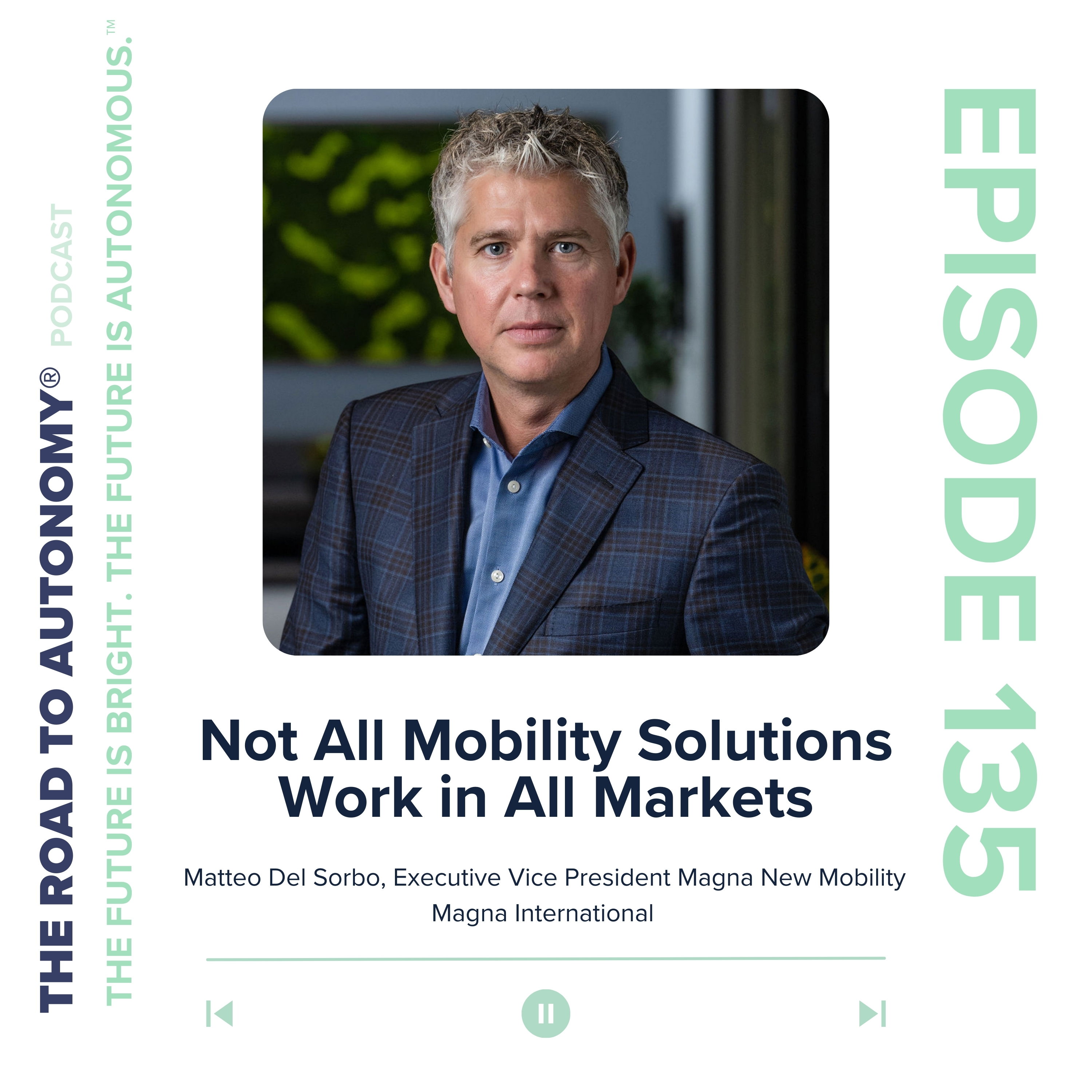
Ep 135Episode 135 | Not All Mobility Solutions Work in All Markets
Matteo Del Sorbo, Executive Vice President Magna New Mobility, Magna International joined Grayson Brulte on The Road to Autonomy podcast to discuss why not all mobility solutions work in all markets and Magna’s mobility investments in India. The conversation begins with Matteo discussing how Magna approaches autonomy. Our approach at Magna here is to develop robust and reliable features that fulfill the needs of the market, our customers, the regulations, all the while we still have a careful eye on the future and mega trends that impact mobility and in the end, autonomous driving. – Matteo Del SorboThis approach allows Magna keep their pulse on the future of mobility as the company continues to operate a profitable revenue generating organization. It’s a wise strategy that allows Magna to engage in an autonomous vehicle market that is now consolidating around a handful of winners who are well financed and poised for long-term growth. We are going to play a very important role in autonomy and ADAS. – Matteo Del SorboIt’s not just autonomy and ADAS, Magna is also embracing micromobility and energy while deploying solutions in emerging markets including India. India is a market of 1.4 billion individuals with a GDP that is projected to grow 6.5% this year. I have always said that not all solutions work in all markets. I think micromobility is a perfect example. Certain solutions work in well in one geographic region, but not in another. You need to really understand the market, the needs, the people that drive the right solutions. – Matteo Del SorboTo understand the mobility market in India is to understand the infrastructure challenges in the urban environments and why micromobility works. Battery swapping is allowing companies to operate electric mobility solutions in India to overcome the constraints of limited electricity reliability and the overall infrastructure challenges in the country. With a mandate from the Indian Government to convert roughly 200 million two-wheelers from gas to electric, the opportunity for battery swapping is enormous. This is where Magna thrives as the company knows how to scale and engineer world-class products. Magna is rapidly scaling operations with their customer Yulu Mobility/Yulu Energy, they are also an investor. Currently Yulu Mobility has has 10,000 electric scooters in operation which Magna is helping to scale by the tens of thousands over the next year.We are going to be adding 10,000 units every month for the next 12 months. By the end of year we will have over 100,000 units. – Matteo Del SorboWhile the recipe to scale operations in India is there, Magna is also looking to expand their footprint to other emerging markets where their expertise can provide value and shareholder return. At the end of the day, you have to solve a problem. Just bringing a bunch of kick scooters to a city because they are cool will not solve problems, it will not give you scale, the market, people demand a scaled quality product. – Matteo Del SorboTo achieve success in these new emerging markets Magna has teams focused on new emerging mobility technologies will be that will impact these markets. Wrapping up the conversation, Matteo and Grayson discuss the future of delivery. Recorded on Tuesday, March 7, 2023--------About The Road to AutonomyThe Road to Autonomy® is a leading source of data, insight and commentary on autonomous vehicles/trucks and the emerging autonomy economy™. The company has two businesses: The Road to Autonomy Indices, with Standard and Poor’s Dow Jones Indices as the custom calculation agent; Media, which includes The Road to Autonomy and Autonomy Economy podcasts as well as This Week in The Autonomy Economy newsletter.See Privacy Policy at https://art19.com/privacy and California Privacy Notice at https://art19.com/privacy#do-not-sell-my-info.
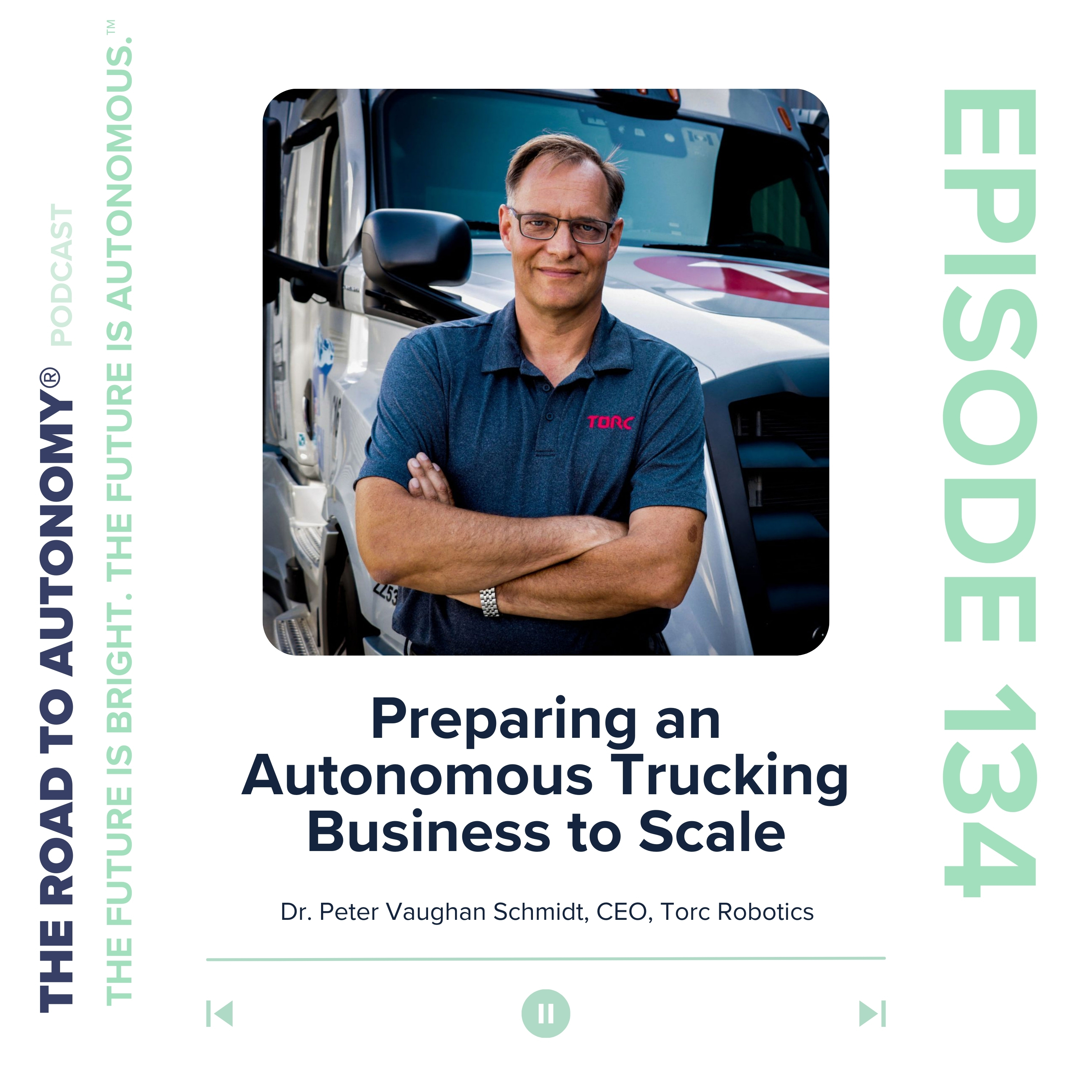
Ep 134Episode 134 | Preparing an Autonomous Trucking Business to Scale
Dr. Peter Vaughan Schmidt, CEO, Torc Robotics joined Grayson Brulte on The Road to Autonomy podcast to discuss how Torc is preparing to scale their autonomous trucking business. The conversation begins with Peter discussing why he joined Torc Robotics. One of the defining factors as to why he decided to join was the company’s culture. The company’s culture is one that is both humble and collaborative. It’s this culture which has allowed Torc to thrive and one that appealed to Peter when he led Daimler Trucks majority investment in 2019. Since the investment, Torc has accelerated the technological development of their autonomy stack as they work towards their operations at scale by 2030 goal. Autonomy will be at scale within this decade by 2030. – Peter Vaughan SchmidtFor autonomous trucking commercial operations to scale, there has to be a redundant autonomous truck platform that will enhance safety and increase uptime efficiency. Through their relationship with Daimler Trucks, Torc will have access to Daimler’s new redundant autonomous truck platform based on Freightliner’s Cascadia with 1,500 new upgrades. Eventually these new trucks will be fitted with Torc’s autonomy stack and tested in various areas around the world including Albuquerque, New Mexico where Torc currently has a base of operations. One of the unique advantages to testing in Albuquerque is the elevation changes on I-40. We thought if you could do Albuquerque you can really do most cities, most interstates. – Peter Vaughan SchmidtIt’s not just testing in Albuquerque that goes into developing the Torc driver. Torc is also learning from experienced professional drivers on know how to “drive” a truck and what the courtesy maneuvers look like when driving on the highway. Daimler Trucks is also providing support from a hardware perspective. As Torc prepares to scale and commercialize the business, the company will embrace a subscription model, however the company is open to other potential models as well based on market demand.We will try to make it as easy for customers as possible to apply this new technology and the way of paying for it. – Peter Vaughan SchmidtWhen the customers take possession of the Torc autonomous trucks, they will be factory built by Daimler Trucks and deployed in a hub-to-hub model. Wrapping up the conversation, Peter shares his thoughts on how he sees autonomous trucks being deployed over the next decade. Recorded on Monday, March 6, 2023--------About The Road to AutonomyThe Road to Autonomy® is a leading source of data, insight and commentary on autonomous vehicles/trucks and the emerging autonomy economy™. The company has two businesses: The Road to Autonomy Indices, with Standard and Poor’s Dow Jones Indices as the custom calculation agent; Media, which includes The Road to Autonomy and Autonomy Economy podcasts as well as This Week in The Autonomy Economy newsletter.See Privacy Policy at https://art19.com/privacy and California Privacy Notice at https://art19.com/privacy#do-not-sell-my-info.

Ep 133Episode 133 | DARPA Urban Challenge to Commercialization
Jan Becker, CEO & Co-Founder, Apex AI joined Grayson Brulte on The Road to Autonomy podcast to discuss how the autonomous vehicle industry has evolved from the 2007 DARPA Urban Challenge to the dawn of the era of commercialization in 2023. The conversation begins with Jan discussing the 2007 DARPA Urban Challenge and his role on Stanford's team.People called it the Woodstock of Robotics. – Jan BeckerThe DARPA Challenges showed the world that it was possible to make a car drive itself. It was these challenges sponsored by the U.S. Goverment and led to the founding of the autonomous vehicle industry.One of the outcomes of the DARPA Urban Challenge was that Google started and funded Waymo and Waymo then really showed in my opinion the automotive companies that autonomous driving can be done as a product. – Jan BeckerIt has been 15 years since the DARPA Urban Challenge and the world of autonomy has changed drastically. Autonomy is now maturing, scaling and commercializing. The hype cycle of 2000’s has faded along with the timeline as autonomous vehicles are now becoming a commercial business. One of the trends that is beginning to emerge is the personally owned autonomous vehicle. While this trend is still in it’s early days, it its a trend that will have a significant impact on the future autonomy as consumers will come to expect this feature. Then there are autonomous trucks which will initially roll out as a hub-to-hub model where the trucks will operate fully autonomously on the highway. When they arrive at the hub (depot), the freight will be switched to smaller vehicles some of which will be autonomous. The low hanging fruit in my opinion is really to automate the hub-to-hub transportation. – Jan BeckerWith the industry maturing, Apex AI is developing safety-certified, developer-friendly and scalable software that allows developers to build safe reliable software for mobility platforms. By building on Apex AI, developers can do what they do best – build applications. What we provide are the libraries, the functionality to enable our customers, the developers, the car companies to build software that scales. – Jan BeckerWrapping up the conversation, Jan shares his thoughts on the universal driver and how he sees autonomous vehicles scaling. Recorded on Tuesday, February 28, 2023--------About The Road to AutonomyThe Road to Autonomy® is a leading source of data, insight and commentary on autonomous vehicles/trucks and the emerging autonomy economy™. The company has two businesses: The Road to Autonomy Indices, with Standard and Poor’s Dow Jones Indices as the custom calculation agent; Media, which includes The Road to Autonomy and Autonomy Economy podcasts as well as This Week in The Autonomy Economy newsletter.See Privacy Policy at https://art19.com/privacy and California Privacy Notice at https://art19.com/privacy#do-not-sell-my-info.
Ep 132Episode 132 | Capturing Equity at The End of a Car Lease
Zander Cook, Co-Founder & Chief Operating Officer, Lease End joined Grayson Brulte on The Road to Autonomy podcast to discuss how consumers can capture equity at the end of their car lease. The conversation begins with Zander sharing his insights into what he is currently seeing in the leasing market. Putting this into context, the average price of a new vehicle has risen more than $10,000 since the start of the pandemic to $47,920 in January 2023, creating the opportunity for more leases. To this point it has been a little counterintuitive, actually leasing had its worst year as a percentage of new vehicle sales in decades last year. – Zander CookOne of the factors that drove the decrease in new lease originations was the rising interest rate environment. Even with excess cash from the covid stimulus, new lease originations stumbled while the market for flipping electric vehicles such as at the Tesla Model 3, Model Y and the Ford Mach-E only grew. Now that the covid stimulus has dissipated, the market for new lease originations is beginning to show signs of rebounding. With a shortage of new vehicles due to the semiconductor shortage and historically high used car prices, consumers had equity in their leased vehicles when the leases matured. This scenario is not common and was driven partly by geopolitics and a vulnerable supply chain. Lessees of Honda vehicles historically tend to have the highest average equity as the vehicles hold their equity. Could this change as more electric vehicles come online and consumers choose to lease EVs? If it does change, how will the battery be valued?For those individuals lucky enough to have equity in their vehicle at the end of a lease, their options to tap into the equity are traditionally limited. This is where Lease End comes into the picture. Lease End was built to streamline the buyout process at the end of a lease. Our entire business is streamlining the lease buyout process. – Zander CookBy streamlining the process, Lease End is saving consumers time and money. In as quick as 25 minutes, consumers can be on their way as Lease End handles all of the logistics and financing. Could this become the future of ending a lease? Perhaps, but consumers will have to learn more about their options to end a lease. In my opinion the biggest thing there is going control back to the consumer. Right now most consumers think they do not have any other option besides going into a dealership and dealing with the dealership and doing what the dealership tells them to do. That’s not the case, that’s why Lease End was founded. – Zander CookWrapping up the conversation, Zander shares his vision for the future of leasing. Recorded on Thursday, February 23, 2023--------About The Road to AutonomyThe Road to Autonomy® is a leading source of data, insight and commentary on autonomous vehicles/trucks and the emerging autonomy economy™. The company has two businesses: The Road to Autonomy Indices, with Standard and Poor’s Dow Jones Indices as the custom calculation agent; Media, which includes The Road to Autonomy and Autonomy Economy podcasts as well as This Week in The Autonomy Economy newsletter.See Privacy Policy at https://art19.com/privacy and California Privacy Notice at https://art19.com/privacy#do-not-sell-my-info.

Ep 131Episode 131 | Scaling Motional
Akshay Jaising, VP of Commercialization, Motional joined Grayson Brulte on The Road to Autonomy podcast to discuss Motional’s commercialization strategy and how Motional is scaling robotaxi operations in multiple cities.The conversation begins with Akshay discussing Motional’s commercialization strategy. We have taken a very partner centric approach. We want to focus on what we do best, which is building the autonomy stack and then partners with players in the ecosystem to make robotaxis a reality. – Akshay JaisingSince 2022, Motional has had a partnership with Uber. Beginning with autonomous Uber Eats deliveries in Santa Monica, CA, the partnership has since evolved into a 10-year multi-market deal where consumers will be able to order a ride in one of Motional’s all-electric IONIQ 5 robotaxis. This will be the largest deployment of autonomous vehicles on a ride-haling platform. Las Vegas will be the launch city followed by Los Angeles. With the expansion into Los Angeles, Motional will be operating in the 2nd largest city in the United States. Los Angeles is a diverse region that has an interest in alternative transportation modes. Anything to reduce the amount of time sitting in stop and go traffic while having to pay attention becomes a win for the millions of individuals who call Los Angeles home. We feel it’s a pretty critical market that has shown customer acceptance for ride-hailing. Our initial pilots and tests in Los Angeles with Uber Eats have been extremely promising and well received. It’s a really strong proving ground to demonstrate how this technology could scale and solve very critical transportation challenges. – Akshay JaisingAs Motional and the autonomous vehicle industry as a whole begins to scale and commercialize, attention is starting to turn from the technology to the economics of the business. Do the unit economics make sense and can the business operate profitability? These are big questions that will have to be answered. In order to answer these questions, AV companies will need long-term patient capital and this exactly what Motional has with Aptiv and Hyundai. In addition to Motional’s access to long-term patient capital, the company through the Aptiv/Hyundai joint-venture is currently having robotaxis built to automotive grade standards on the line. A factory-built autonomous vehicle is scalable. With over 130,000 autonomous vehicle rides completed to date, Motional is preparing to further scale in Las Vegas and fully commercialize the service. One of the main advantages to scaling in Las Vegas is that individuals arrive in Vegas and stay on average for 72 hours. When they are there, they gamble and enjoy all of the experiences that Vegas has to offer. They come flush with cash and open mind to trying to new experiences.Creating the perfect opportunity to scale a profitable autonomous vehicle company as riding in an AV for the first time is an experience. Adding to the experience element, by the end of the year, Motional is planning to operate fully driverless in Las Vegas. Queue up the TikTok and Instagram posts. Another defining moment will be Super Bowl 58 which will be taking place in Las Vegas. With 325,000 visitors expected to attend the Vegas Super Bowl, Motional is actively preparing driverless operations which will be operating during Super Bowl Week.We do expect to have driverless vehicles on the road in February 2024 when Super Bowl 58 will be there, and we are excited about that. – Akshay JaisingAs Motional scales operations in multiple cities including Las Vegas and Los Angeles, Motional will be taking a hybrid approach when it comes to drop-off and pick-up zones. The company will utilize zones when they are available and at times they are not, the robotaxis will integrate into the normal traffic patterns. Wrapping up the conversation, Akshay discusses how Motional will roll-out service in each market from an economic standpoint.Recorded on Tuesday, February 21, 2023--------About The Road to AutonomyThe Road to Autonomy® is a leading source of data, insight and commentary on autonomous vehicles/trucks and the emerging autonomy economy™. The company has two businesses: The Road to Autonomy Indices, with Standard and Poor’s Dow Jones Indices as the custom calculation agent; Media, which includes The Road to Autonomy and Autonomy Economy podcasts as well as This Week in The Autonomy Economy newsletter.See Privacy Policy at https://art19.com/privacy and California Privacy Notice at https://art19.com/privacy#do-not-sell-my-info.
Ep 130Episode 130 | Building an Autonomous Trucking Business
Don Burnette, Founder & CEO, Kodiak Robotics joined Grayson Brulte on The Road to Autonomy podcast to discuss building an autonomous trucking business and why Kodiak did not SPAC.The conversation begins with Don discussing the last 18 months in autonomous trucking and why Kodiak did not SPAC. We had multiple SPAC offers, but at the end of the day we felt like we just didn’t have the metrics, what didn’t have what it took to be a public company. – Don BurnetteDon, and the team at Kodiak understood the difference between being a private company and a public company. Don along with the team and the board, made the decision to stay private as they felt it would put Kodiak in the best position for growth, benefiting investors, employees and the entire company.What you are seeing not just in the AV market, but beyond the AV market. You are are seeing a lot of blowback from companies that do not have any of the metrics that public investors want to see and while I think there was some hype and excitement early on in the SPAC craze cycle if you will call it, that excitement, that hype, that fervor has essentially evaporated and know companies are left with their fundamentals and unfortunately those fundamentals are not really strong. – Don BurnetteToday there are 250 registered autonomous trucks available for deployment, while there are currently 4 million Class 8 trucks in operation. With less than a 1% market share, the time for an autonomous trucking company to go public is not there as the technology currently does not have the marketshare and/or the profitability to succeed as a public company when compared to the traditional trucking industry. Don recognized this fact and resisted the temptation of taking Kodiak public via SPAC.I definitely think that Kodiak’s decision to stay private was the right one in the end. – Don BurnetteIn order to stay a private company in a challenging economic environment, you have to have financial discipline. Along with the financial discipline, you have to have the right team that works hard and does not get distracted. At Kodiak we have been focused on over-the-road long-haul trucking, autonomy and that was our mission statement on day one and that’s still our mission for the company almost five years in. That focus and not allowing ourselves to get distracted has been a big component of our success. – Don BurnetteAs part of this discipline, Kodiak has never done a free run. All of the freight that the company has hauled since day one has been paid. On day one, Don made the decision to run Kodiak as a business, not a science project. This decision has been rewarded in terms of partnerships and the revenue that Kodiak is generating from hauling freight.With all of the pieces in place, Kodiak is beginning to scale their business and preparing for driverless operations. To achieve driverless operations, Kodiak has developed a redundant safety critical system that ensures the safe operation of the truck.Driverless operations will first be rolled out in the southern part of the United States partly due to the weather and the updated infrastructure. In addition to scaling autonomous trucking across the United States, Kodiak is working with the Department of Defense to develop autonomous technology that can save lives. Wrapping up the conversation, Don discusses the future of the autonomous trucking industry. Recorded on Thursday, February 16, 2023--------About The Road to AutonomyThe Road to Autonomy® is a leading source of data, insight and commentary on autonomous vehicles/trucks and the emerging autonomy economy™. The company has two businesses: The Road to Autonomy Indices, with Standard and Poor’s Dow Jones Indices as the custom calculation agent; Media, which includes The Road to Autonomy and Autonomy Economy podcasts as well as This Week in The Autonomy Economy newsletter.See Privacy Policy at https://art19.com/privacy and California Privacy Notice at https://art19.com/privacy#do-not-sell-my-info.

Ep 129Episode 129 | Decarbonizing Mining
Christian Spano, Director of Innovation, International Council of Mining and Metals joined Grayson Brulte on The Road to Autonomy Podcast to discuss decarbonizing mining and how the circular economy can be ushered in through building stocks of materials that can be reused forever.The conversation begins with Christian discussing what is being done to decarbonize mining transportation operations as there are roughly 28,000 large mine hauling trucks in operation collectively emitting 68 million tons of Co2 a year. Health and safety at global mining operations was one of the early factors that started the conversation around the decarbonization of mining. From trucks equipped with ADAS to autonomous trucks, the aspect of how new technologies can improve the health and safety of mining operations is paramount to global mining organizations. From 30 to 50 to 80 percent of the emissions of a mine come from haul trucks. – Christian SpanoICMM members are collectively working together to usher in the future of mining; a future that is sustainable and safe. To usher in this future, the infrastructure will have to be upgraded to accommodate hydrogen and electric vehicles. The contribution of a mine turning net-zero starting with the mobile equipment, it’s a contribution to the country that is trying to decarbonize, but also accelerating the availability of all these solutions at scale for many other industries. – Christian SpanoAs companies begin to decarbonize mining operations, new jobs are being created. It’s not just jobs inside of the mine that will be created, it’s jobs outside of the mine that support the operation. Jobs such as material traceability will be created, but in order for traceability there has to be a global standard. The demand for a global standard and material traceability will end up being driven by the consumer who demands transparency into the battery that powers their vehicle. The demand for EVs is not slowing down as in 2022, global EV sales surpassed 10% for the first time. From a minerals and metals perspective, it is estimated that there could be a 20-fold increase in demand for nickel and cobalt by 2040. To meet this demand, we have to usher in the circular economy. Recycling is not the circular economy. The circular economy is about building stocks that we can reuse forever. It’s about building stocks of materials that are durable. – Christian SpanoThe circular economy is a design opportunity. It’s an opportunity to redesign and rethink how we as a society approach metals and materials. With this approach, we have to keep all options on the table and approach the future of sustainability with an open mind. Autonomous vehicles will play a role in the future of sustainability as autonomous trucks deployed in mines around the world will be cleaner and safer. ICMM members are actively embracing autonomy and deploying at their mine sites around the world. Wrapping up the conversation, Christin discusses the future of decarbonizing mining operations. Recorded on Friday, February 3, 2023--------About The Road to AutonomyThe Road to Autonomy® is a leading source of data, insight and commentary on autonomous vehicles/trucks and the emerging autonomy economy™. The company has two businesses: The Road to Autonomy Indices, with Standard and Poor’s Dow Jones Indices as the custom calculation agent; Media, which includes The Road to Autonomy and Autonomy Economy podcasts as well as This Week in The Autonomy Economy newsletter.See Privacy Policy at https://art19.com/privacy and California Privacy Notice at https://art19.com/privacy#do-not-sell-my-info.
Ep 128Episode 128 | Scaling Cruise
Oliver Cameron, VP, Product, Cruise joined Grayson Brulte on The Road to Autonomy Podcast to discuss scaling Cruise, the passenger experience and the role AI plays in the Cruise product. The conversation begins with Oliver reflecting on the last four years in autonomy.The biggest change for me that has happened over the last four years is that in 2019 everyone in the industry was waking up to answer the question can we make a car safer than a human, a self-driving car that is safer than a human. – Oliver CameronNow it’s 2023 and Cruise is scaling a safe autonomous vehicle service in multiple cities with no safety drivers. As Cruise scales, Cruise is listening to passengers and gathering feedback and incorporating their feedback into the product.There is just something about self-driving cars that really sparks a sense of optimism in people. – Oliver CameronIt’s a sense of optimism that brings joy and happiness. The Cruise experience is a consistent experience that only gets better over time. The Cruise virtual driver never becomes distracted, gets upset or emotional. It simply drives you to and from your destination safely each time ride in one of the vehicles, it’s a consistent experience. The human equivalent is not very consistent. You can have the world’s best driver and the world’s worst driver from trip to trip. Our experience is very consistent and it only gets better over time and that is something that is very special and unique to autonomous vehicles that the human driven equivalents will simply just never be able to match because of the inconsistency of humans. – Oliver CameronAs autonomous vehicles scale, they benefit as they gather more data that can be used to improve the product. As an example in less then 90 days, Cruise was able to launch fully driverless operations in two cities, Austin, TX and Phoenix, AZ. Oliver goes onto explain how Cruise was able to achieve this goal.If our technology was not generalizable, well frankly there is no chance of us deploying driverless in Austin in less then 90 days. – Oliver CameronAs Cruise scales, The Origin will play a critical role in operations. The Origin will be an eye-catching vehicle that makes you feel like you are living in The Jetsons when you first see it. When you first enter the vehicle you will realize how spacious it is. From a comfortable experience to one that is controlled by voice, The Origin is ushering in the future of mobility. Through their partnership with Honda, Cruise is currently testing in Japan. When it comes to expanding to new international markets, the team at Cruise is working hard to understand local customs and how individuals in those countries pay for goods and interact with digital devices on a daily basis. This technology can definitely scale a lot faster then people think. – Oliver CameronTo enable the future of autonomy we need AI breakthroughs. Oliver and Grayson go onto discuss the latest breakthroughs in AI and how Cruise is leveraging their machine learning infrastructure to improve their product. Wrapping up the conversation, Oliver shares his outlook for the future of the autonomous vehicle industry.Recorded on Friday, January 27, 2023--------About The Road to AutonomyThe Road to Autonomy® is a leading source of data, insight and commentary on autonomous vehicles/trucks and the emerging autonomy economy™. The company has two businesses: The Road to Autonomy Indices, with Standard and Poor’s Dow Jones Indices as the custom calculation agent; Media, which includes The Road to Autonomy and Autonomy Economy podcasts as well as This Week in The Autonomy Economy newsletter.See Privacy Policy at https://art19.com/privacy and California Privacy Notice at https://art19.com/privacy#do-not-sell-my-info.
Ep 127Episode 127 | Traditional Trucking to Autonomous Trucking
Jim Mullen, Founder & President, Mullen Consulting joined Grayson Brulte on The Road To Autonomy Podcast to discuss how traditional trucking and autonomous trucking compliment each other and their combined benefits to the U.S. freight network.The conversation begins with Jim discussing what is causing the decline rates in spot truckload rates, which are down 57.3% year-over-year.It is clearly a supply and demand issue right now. – Jim MullenDuring the 2008 financial crisis, the S&P Transportation Select Industry Index feel from a high of $1,998.20 on February 20, 2007 to a low of $626.27 on March 9, 2009, a 68.63% decline. It took the Index four years until February 19, 2013 to regain the losses from the economic crisis. If history is to repeat itself and we enter into a potential recession, you could see further downward pressure on spot truckload rates. With new entrants in the market and deteriorating market economic conditions, the market currently remains strained.With all these new entrants who are really just trying to stay afloat, they are going to take freight they ought not be taking or at least be taking freight at rates they ought not be taking. Until you expunge the marketplace of that lack of discipline with those types of folks that are quote desperate you will continue to see that down kind of pressure. – Jim MullenTaking an holistic approach to the trucking industry as a whole, it is a very vibrant industry. It is a healthy industry that is preparing for a future with autonomous trucks. It is an industry that is working in tandem with their shippers and customers to ensure that it is a win-win when the economic conditions stabilize and return to growth.When economic conditions stabilize and there is a return to growth, autonomous trucks will be scaling in a regulatory environment that is made up of patchwork of State laws as there is currently no national framework for autonomous trucks.Additionally there is no plan for a national framework for autonomous trucks at this time. Is it even necessary? Unsure at the moment, as soon autonomous trucks will be able to operate legally from Arizona to Florida on the 1-10, when Mississippi comes online with their new autonomous trucking regulations.No matter the regulations, the industry is going to have to develop public trust in each and every State that they operate. This is something that the autonomous trucking industry takes seriously and Jim shares his thoughts from his time at FMCSA (Federal Motor Carrier Safety Administration) where he served as Acting Administrator on the importance of public trust in autonomous trucks.While trust has to be developed with the public, the traditional trucking industry is approaching autonomous trucking in a mixed fashion.There is a mixed bag. Some of the motor carriers are much more aggressive and more involved in looking at how autonomy is going to change their freight networks. But if you look at the blue-chip motor carriers, I say that they are predominantly fully engaged on how autonomy is going to change their business model and freight network. – Jim MullenTo achieve commercial Level 4 autonomy in with the autonomous trucking industry, it ill take partnerships. Torc has a partnership with Daimler and Waymo has a partnership with J.B. Hunt. Then there are the Truck OEMs that are exploring transportation as a service. Could transportation as a service be how autonomous trucks are deployed in the future? Possibly. Then there are the autonomous trucking companies who are unable to secure an OEM deal, could they potentially explore licensing deals? Possibly.The future for how autonomous trucks will roll out has yet to be written. It will be interesting to watch how it all plays out and who emerges victoriously.Wrapping up the conversation, Jim shares his thoughts on the future of the trucking industry.Recorded on Tuesday, January 24, 2023--------About The Road to AutonomyThe Road to Autonomy® is a leading source of data, insight and commentary on autonomous vehicles/trucks and the emerging autonomy economy™. The company has two businesses: The Road to Autonomy Indices, with Standard and Poor’s Dow Jones Indices as the custom calculation agent; Media, which includes The Road to Autonomy and Autonomy Economy podcasts as well as This Week in The Autonomy Economy newsletter.See Privacy Policy at https://art19.com/privacy and California Privacy Notice at https://art19.com/privacy#do-not-sell-my-info.
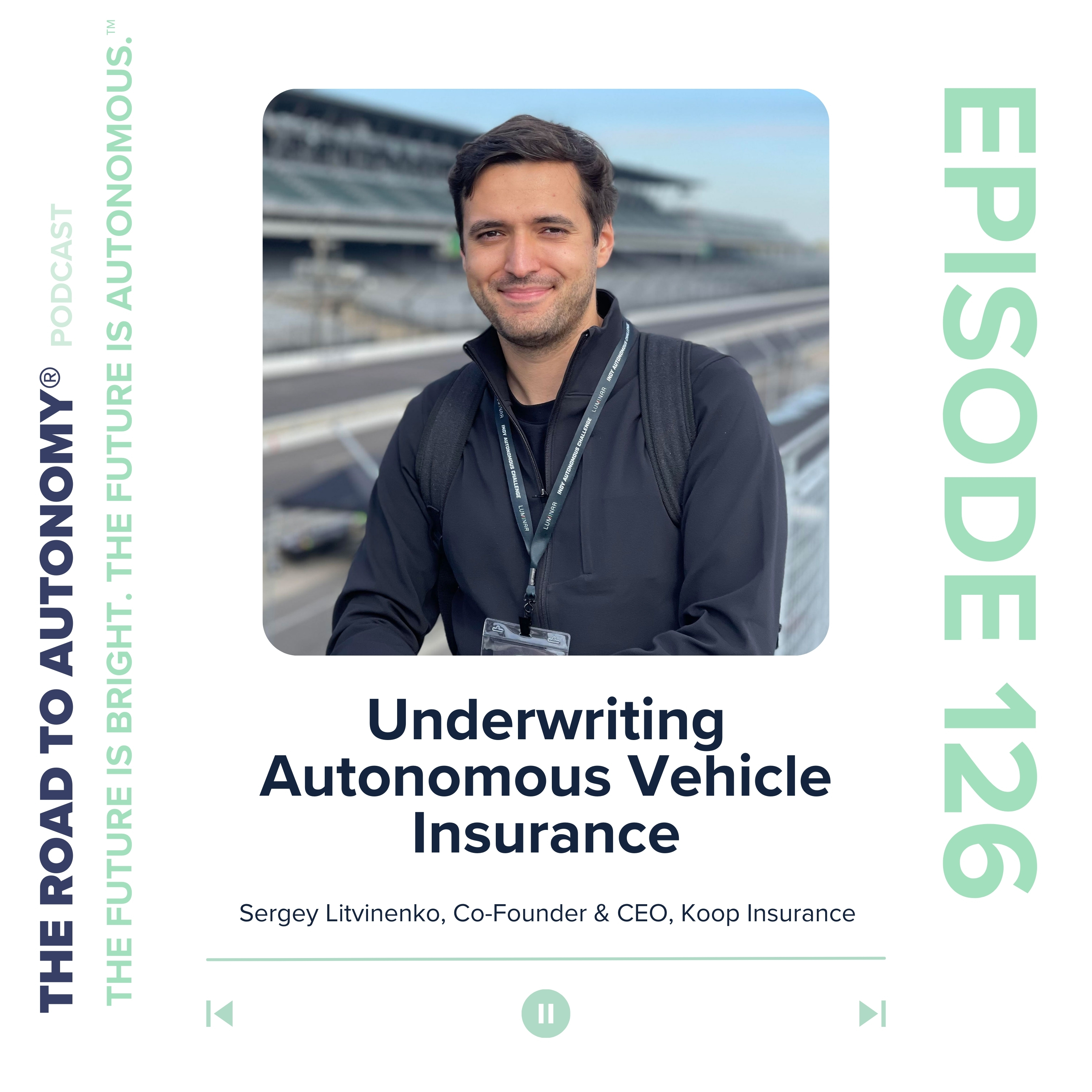
Ep 126Episode 126 | Underwriting Autonomous Vehicle Insurance
Sergey Litvinenko, Co-Founder & CEO, Koop Insurance joined Grayson Brulte on The Road To Autonomy Podcast to discuss how Koop is reimagining how you underwrite autonomous vehicle insurance. The conversation begins with Sergey describing Koop.We are an insurance technology startup that is focused on everything automated. We focus on fully autonomous vehicles that go on public roads like robotaxis, trucks and shuttles to off-road applications in robotics, in agriculture, construction, mining, warehousing, manufacturing and aerial use cases. – Sergey Litvinenko For Koop to properly insure their clients, they have developed a proprietary underwriting platform focused on autonomy, filling a void in the market. Today the market for autonomous vehicle/truck insurance is limited with little flexibility as traditional insurers do not truly understand the risk. The main bottleneck why the insurance industry is not able to innovate at the moment is because the insurance industry cannot get the data that would allow them to build the insurance product around the autonomous vehicle risk. – Sergey Litvinenko Koop gathers data such as the technical specs of the autonomy system, exposure data and performance data of the vehicles they insure. With the data Koop can properly price the insurance as they understand the risk better then their competitors. As Koop primarily operates as an underwriter they work with traditional insurance brokers. Keeping with their theme of being innovative, Koop recently introduced Broker Universe to streamline the process of quoting an insurance policy. What the brokers and Koop deliver together is a high quality insurance offering.It’s high quality insurance which is going to allow the autonomous vehicle industry to scale. Without high quality insurance, the AV industry will not be able to scale as their risk profile would be to exposed to situations that they can not control, but they can insure against. Furthermore, high quality insurance builds trust with regulators, investors and members of the public. Trust is what is allowing Cruise, Waymo and Motional to scale operations in multiple cities around the United States. While these AV companies are scaling and generating revenue, analysts are divided over their valuations with one analyst evening assigning a zero value to Cruise. In my view, in the next ten years, Cruise itself could be worth more then the rest of GM combined. It’s a great move for GM to have Cruise because it could drive more than 50% of the revenue of the company in the near future. – Sergey Litvinenko In a September 2022 Bloomberg Intelligence report, an analyst mentioned that Waymo may be able to generate about $5 billion in revenue by 2025. To achieve this number, Waymo might have to license their technology. If they do indeed license their technology, what is the impact on insurance? Sergey goes onto explain how it would work and who is responsible when a crash occurs. Wrapping up the conversation, Sergey and Grayson discuss the economics of autonomy. Recorded on Thursday, January 19, 2023--------About The Road to AutonomyThe Road to Autonomy® is a leading source of data, insight and commentary on autonomous vehicles/trucks and the emerging autonomy economy™. The company has two businesses: The Road to Autonomy Indices, with Standard and Poor’s Dow Jones Indices as the custom calculation agent; Media, which includes The Road to Autonomy and Autonomy Economy podcasts as well as This Week in The Autonomy Economy newsletter.See Privacy Policy at https://art19.com/privacy and California Privacy Notice at https://art19.com/privacy#do-not-sell-my-info.
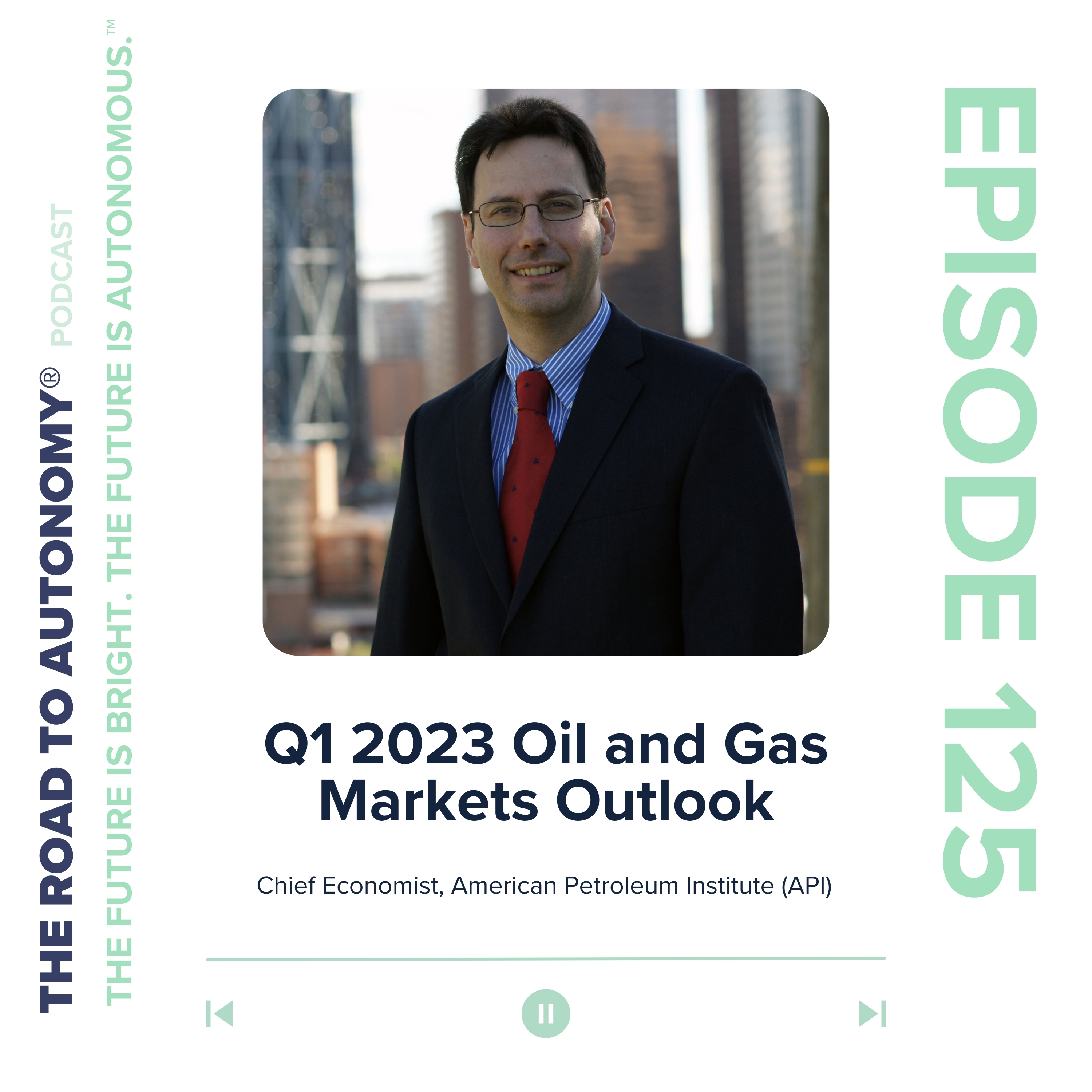
Ep 125Episode 125 | Q1 2023 Oil and Gas Markets Outlook
Dean Foreman, Chief Economist, American Petroleum Institute (API) joined Grayson Brulte on The Road To Autonomy Podcast to discuss his 2023 Q1 outlook for the oil and gas markets.The conversation begins with Dean sharing his thoughts and insights into the current state of the oil and gas markets. As the economy goes, that is what we are going to look for in oil and gas markets. – Dean ForemanThe demand for oil has been strong. The U.S. Petroleum demand in December 2022 was 20.5 million barrels per day. For 2022, oil demand grew by 2.2%. Going back to 2000, 2022 was the forth highest year for growth. It says that on the heels of the pandemic, $20 trillion dollars worth of economic stimulus has continued to have a pretty positive effect for the economy, despite Fed Funds rate hikes, despite concerns about a recession, despite individual sectors that have been under pressure. – Dean ForemanThe trend of demand outpacing supply has continued for over a year now with inventories that are at historic lows. Oil demand is growing because of the rebound in travel and the increase in cargo shipping by air. During the last six months in 2022, 1.5 million barrels per day (1.5% of the global market) of new oil globally came online from Government reserves. While there was some downward price movement, there was also long-term negative consequences as oil companies were discouraged to start new drilling and new infrastructure projects. This could lead to a global imbalance as there will not be enough infrastructure to meet demand. The official estimates for demand growth this year range between basically 1 million barrels per day or about 1% of the market, up to 1.7 million barrels per day. – Dean ForemanIn order to meet this demand, investment has to be made and drilling has to expand around the world to ensure that new supply can come to the market. Adding more context to this, the U.S. Energy Information Administration is predicting that global oil demand is expected to reach a record-high of 101 million barrels per day in 2023. The U.S. Strategic Petroleum Reserve ended 2022 at the lowest point since 1983. When comparing 2022 to 1983, the U.S.’s oil consumption was more than 33% higher. There is little margin for error with solid oil demand and a dwindling Strategic Petroleum Reserve. When you factor in geo-politics and weather, the situation becomes even more unpredictable.In 2022, the U.S. dollar rose 6.23%. So far this year (2023) the U.S. dollar has begun to weaken. With a weakening U.S. dollar that is projected to weaken by 3% this year according to Bloomberg, oil is beginning to trade on local currencies. For Q1 2023, the trends to watch in the oil and gas markets are the Russia/Ukraine conflict, systemic risks to the global food supply and emerging markets debt.Wrapping up the conversation, Dean discuses the global economics and the impact it has on household budgets. Recorded on Tuesday, January 17, 2023--------About The Road to AutonomyThe Road to Autonomy® is a leading source of data, insight and commentary on autonomous vehicles/trucks and the emerging autonomy economy™. The company has two businesses: The Road to Autonomy Indices, with Standard and Poor’s Dow Jones Indices as the custom calculation agent; Media, which includes The Road to Autonomy and Autonomy Economy podcasts as well as This Week in The Autonomy Economy newsletter.See Privacy Policy at https://art19.com/privacy and California Privacy Notice at https://art19.com/privacy#do-not-sell-my-info.
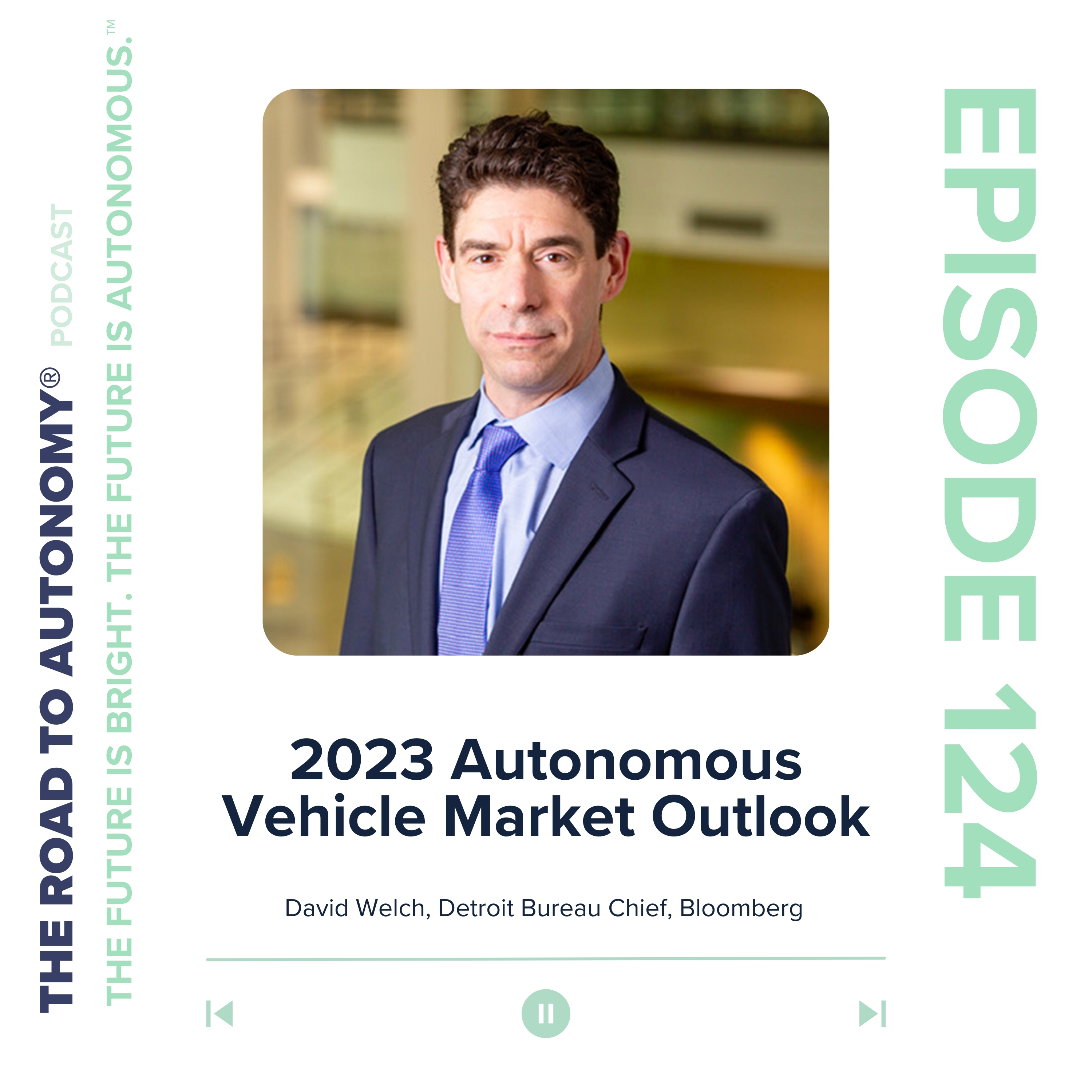
Ep 124Episode 124 | 2023 Autonomous Vehicle Market Outlook
David Welch, Detroit Bureau Chief, Bloomberg and Author of Charging Ahead, General Motors, Mary Bara, and the Reinvention of an American Icon joined Grayson Brulte on The Road To Autonomy Podcast to discuss his 2023 outlook on the autonomous vehicle market. The conversation begins with David sharing his outlook for the autonomous vehicle market in 2023. David shares his thoughts on the market and insights into how investors are currently valuing autonomous vehicle companies.As the conversation evolves, Grayson asks David if it is time for Aurora to split the business in two and focus solely on autonomous trucking. I think there is so much of a focus on their trucking side that for all practical purposes it’s one company. I do not know that they need to split it, because I do not know if there is enough activity going on on the other side to make a difference. – David WelchIf Cruise and Waymo build a large enough of a lead in robotaxi deployments, there is the possibility that Aurora becomes a technology company for the trucking industry. If Aurora’s stock continues to decline, while at the sametime their technology continues to improve, a traditional trucking company could make a move and acquire Aurora. With all the moves being made in the autonomous vehicle industry, Microsoft is steadily making strategic investments that will help drive the growth of the company’s Azure cloud platform. Over the last 18 months, Microsoft has invested in Cruise, Gatik and Spartan Radar. Microsoft, this is not a venture cap fund, they have to see something before they put money in it. It’s a good sign for anyone who gets funded by them.– David WelchMicrosoft has an advantage when it comes to other cloud providers as the company does not have an in-house autonomous vehicle program. Amazon has a program with Zoox and Alphabet has a program with Waymo. For awhile, Zoox was at the forefront of every autonomous vehicle conversation, and then slowly overtime the company has quietly disappeared from the AV dialogue. What are Amazon’s plans for Zoox? Grayson and David discuss what Amazon’s plans for Zoox could be. Could Zoox’s autonomous technology be integrated into Amazon’s Rivian delivery vans? It’s a possibility as Amazon is major investor in Rivian. Another major question in the market is what happens to Lyft? Who steps in and buys the company? It’s not a profitable business. It’s way too expensive for what it is right now for anyone to buy it. – David WelchOr could an airline possibly step in and buy Lyft and integrate the company into their passenger operations? If they were to do this, the airline would need an autonomous vehicle strategy. Taking a broader look at the AV industry, David and Grayson discuss Motional and the company’s strategy to scale. Does Motional have enough capital to scale and compete against Cruise and Waymo?Then there is the second tier of autonomous vehicle companies led by May Mobility. May’s strategy to operate in rural suburban areas that lack public transit is winning over politicians, riders and investors as the company scales in these areas. I think it’s a very interesting company. – David WelchTesla is also an interesting company. Looking to the future does Tesla open the Dojo platform and does the company create a true SUV? Grayson and David discuss the possibilities. Wrapping up the conversation, David shares his thoughts on what he sees happening in the autonomous vehicle market over the next 12 months. Recorded on Tuesday, January 10, 2023--------About The Road to AutonomyThe Road to Autonomy® is a leading source of data, insight and commentary on autonomous vehicles/trucks and the emerging autonomy economy™. The company has two businesses: The Road to Autonomy Indices, with Standard and Poor’s Dow Jones Indices as the custom calculation agent; Media, which includes The Road to Autonomy and Autonomy Economy podcasts as well as This Week in The Autonomy Economy newsletter.See Privacy Policy at https://art19.com/privacy and California Privacy Notice at https://art19.com/privacy#do-not-sell-my-info.
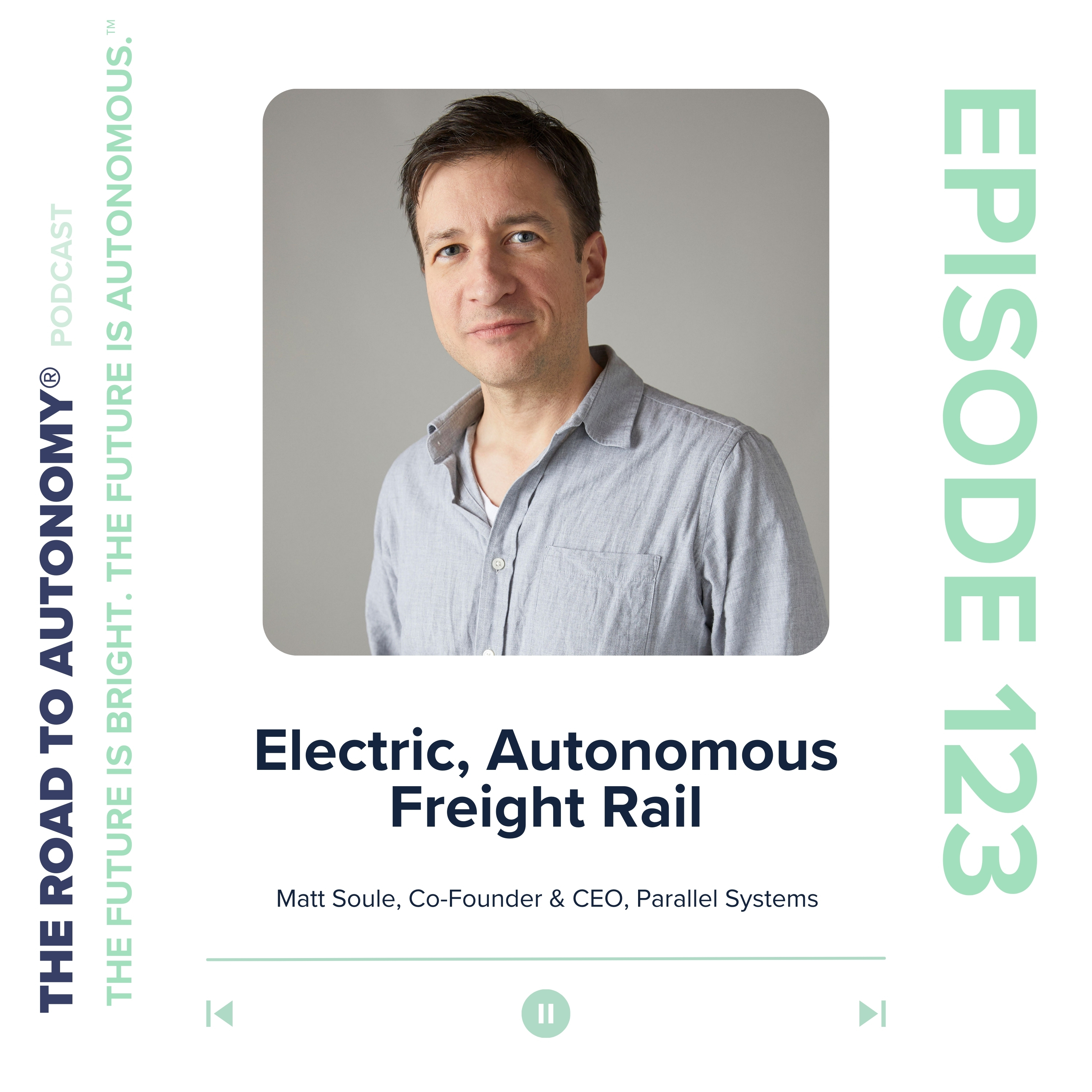
Ep 123Episode 123 | Electric, Autonomous Freight Rail
Matt Soule, Co-Founder & CEO, Parallel Systems joined Grayson Brulte on The Road to Autonomy Podcast to discuss Parallel’s electric, autonomous freight rail system. The conversation begins with Matt discussing the founding of Parallel Systems.The energy efficiency of rail uniquely allows for reduction in energy and therefore reduction in CO2. – Matt SouleParallel Systems is working to re-imagine how freight moves on rail by going smaller and simpler with autonomous battery rail cars. The system is flexible and it works with legacy rail operators, which allows those operators further optimize their capacity.Parallel is developing a system that allows rail to expand their addressable market. – Matt SouleTo help rail become more competitive with trucks, Parallel’s system allows truck unit economics without the massive scale. Our economics do not require amortization over large amounts of freight. – Matt SouleThe system operates autonomously on rail routes that compete with drayage operations a platoon. The autonomous rail platoon will max out around 50 cars as it’s the most efficient means of moving freight on the Parallel system. Unlike traditional trains that can block road roadways for extended periods of time, Parallel’s contact-based platooning system allows for the cars to disconnect and reconnect as to not slow traffic for an extended period of time.When Parallel starts the process of commercializing their technology, the company wants to be a vendor to rail operators. They are not going to act as a service provider and compete with the traditional rail industry. During the dwell time when cars are loaded and unloaded, Parallel’s cars will be able to charge. To charge, the system will require 3 to 10 megawatts of charging capacity. Parallel cars will get around 500 range of mile with a 250 kilowatt battery. One of the major advantages of the Parallel system is the system’s ability to dramatically change the braking force, allowing the train to stop faster. What Parallel is doing is developing a braking system that does close the loop and we are able to dramatically change our braking force depending on the track conditions, the adhesion of the train wheel to the track, as well as how heavily we are loaded. We are trying to stop as fast as physics will allow us. – Matt SouleDynamic braking helps the system operate more safely. The Parallel approach to rail has caught the attention of the U.S. Department of Energy as Parallel was rewarded a $4.4 million grant to fund a 29-month advanced testing program with the goal of quantifying the environmental impact and the overall vehicle stability of their system. Wrapping up the conversation, Matt shares his opinion on the future of freight.Parallel is creating capacity for freight. – Matt SouleRecorded on Friday December 9, 2022--------About The Road to AutonomyThe Road to Autonomy® is a leading source of data, insight and commentary on autonomous vehicles/trucks and the emerging autonomy economy™. The company has two businesses: The Road to Autonomy Indices, with Standard and Poor’s Dow Jones Indices as the custom calculation agent; Media, which includes The Road to Autonomy and Autonomy Economy podcasts as well as This Week in The Autonomy Economy newsletter.See Privacy Policy at https://art19.com/privacy and California Privacy Notice at https://art19.com/privacy#do-not-sell-my-info.
Ep 122Episode 122 | Travel Centers of the Future
John Tully, Vice President of Strategy and Business Development, Pilot Flying J joined Grayson Brulte on The Road to Autonomy Podcast to discuss how Pilot Flying J is developing the travel centers of the future.The conversation begins with John discussing how Pilot Flying J will continue to prosper as Bloomberg New Energy Finance is projecting that road fuel demand will peak in 2027. Simply stated, our job is to provide the fuel, the amenities, for our customers where they want it. – John TullyWhether its gas, diesel, hydrogen or electric, Pilot Flying J will be providing their customers with the right fuel for their vehicle. For the professional over-the-road drivers, the company provides food, showers, parking and Wi-Fi. Over the next three years, Pilot Flying J will be investing over one billion dollars to upgrade the stores and the amenities offered to drivers and customers. In addition to upgrading the stores and amenities, Pilot Flying J is upgrading the infrastructure to support electric vehicles and electric heavy-duty trucks. The EV infrastructure is being rolled out across 500 locations with 2,000 charging stalls through a partnership with GM and EVGo. We are approaching this to try and help answer as a collective, with Pilot as part of that collective the range anxiety question. We are not just doing this where the highest utilization is, we are doing it where we can connect via the corridor urban areas to urban areas. – John TullyAs part of the rollout of EV charging stations, Pilot Flying J is focused on uptime. They want to ensure that when you show up, the chargers are online, working and convenient.We are putting in 350kw chargers with two hoses with the idea of being able to provide that premium service for our customers. – John TullyFor trucks, Pilot has a partnership with the Volvo Group to build a charging network for medium and heavy-duty electric trucks. While the partnerships with GM, EVGo and Volvo Group might seem exclusive, they are are not. The charging infrastructure being installed will be open to all drivers. What we are trying to do is setup an ecosystem that works for all of our customers. – John TullyIn addition to leaning into the future with fuels, Pilot Flying J is leaning into the future of autonomous trucks through an investment in Kodiak Robotics. As part of the investment in Kodiak, John joined the board. One of the defining factors of the investment was Kodiak’s culture and how it aligns with the Pilot Flying J culture. We think that autonomous trucking is solving a real problem that exists. We think that it is something that lives alongside our existing fleet customers and the drivers. Drivers are super core to us. It’s how can we continue to provide and improve what we are doing for our drivers while also looking ahead and seeing where our customers are heading and make sure that we can provide part of those solutions for the autonomous world as well. – John TullyWrapping up the conversation, John shares his insights into Pilot Flying J’s long-term strategy of fueling life’s journeys. Recorded on Tuesday December 6, 2022--------About The Road to AutonomyThe Road to Autonomy® is a leading source of data, insight and commentary on autonomous vehicles/trucks and the emerging autonomy economy™. The company has two businesses: The Road to Autonomy Indices, with Standard and Poor’s Dow Jones Indices as the custom calculation agent; Media, which includes The Road to Autonomy and Autonomy Economy podcasts as well as This Week in The Autonomy Economy newsletter.See Privacy Policy at https://art19.com/privacy and California Privacy Notice at https://art19.com/privacy#do-not-sell-my-info.
Ep 121Episode 121 | Destination Electric Vehicle Charging
Mike Doucleff, Senior Vice President & Global Head of eMobility Division, Schneider Electric joined Grayson Brulte on The Road to Autonomy Podcast to discuss destination electric vehicle charging solutions. The conversation begins with Mike sharing his opinion on the current state of the electric vehicle industry. We are really starting to enter the S curve of EV adoption. – Mike DoucleffIn Q3 2022, global passenger electric vehicle sales grew 73% to 2.9 million units. For the entire year, it is estimated by Bloomberg that global EV sales were 10.3 million units. While EV sales are growing, the issue of charger reliability is also growing and it is beginning to create anxiety, which could lead to a decline in new EV sales. To overcome charging anxiety, more destination charging has to come online as it is more convenient and cost effective. It’s 20% to 50% cheaper to charge when you have a connection to a home or a building then it is in public. – Mike DoucleffAt the center of destination charging will be energy management solutions. Energy management solutions will become crucial as destination charging comes online at multi-family housing units and commercial buildings. When you install an EV charger at your home or multiple chargers in your building you need to revisit the entire electrical distribution and energy management, because you are bringing new loads. You are bringing new loads to your home and you are bringing new loads to your building. – Mike DoucleffThis is where Schneider Electric shines as they are leaning into the future of energy by providing connected energy solutions to their customers. Energy management systems will become the defacto standard in the future as energy demand is growing globally. The future is going to be integrated with home energy management systems, it’s going to be integrated in buildings with building management systems. – Mike DoucleffTo prepare for an all-electric future, consumers have to build awareness that electric vehicles are convenient and they do not have to be charged everyday in certain circumstances. Wrapping up the conversation, Mike shares his thoughts on what the future of destination EV charging will look like as the technology evolves. Recorded on Thursday, December 8, 2022--------About The Road to AutonomyThe Road to Autonomy® is a leading source of data, insight and commentary on autonomous vehicles/trucks and the emerging autonomy economy™. The company has two businesses: The Road to Autonomy Indices, with Standard and Poor’s Dow Jones Indices as the custom calculation agent; Media, which includes The Road to Autonomy and Autonomy Economy podcasts as well as This Week in The Autonomy Economy newsletter.See Privacy Policy at https://art19.com/privacy and California Privacy Notice at https://art19.com/privacy#do-not-sell-my-info.
Ep 120Episode 120 | Scaling Electric Vehicle Fleet Charging
Matt Horton, CEO, Voltera joined Grayson Brulte on The Road to Autonomy Podcast to discuss scaling electric vehicle fleet charging. The conversation begins with Matt discussing a Bloomberg Intelligence report that states there needs to be at least $42 billion in EV charging infrastructure investments by the end of the decade to keep up with the projected electric vehicle adoption. I think in fact we may even need to deploy more capital and do it more quickly to really meet the demand that we are seeing from customers. – Matt HortonIn order to succeed in the charging business, you have to have a real estate strategy that has to have the right locations that both consumers and fleet operators want to charge their vehicles. The challenge is not all of these locations have current access to the power needed to charge EVs at scale. A big part of the challenge ahead of us is fundamentally rewiring the grid to deliver power where it’s going to be needed for transportation uses, not just for commercial, residential, and industrial. – Matt HortonThis is where Voltera comes into the picture as they are working with utilities, acquiring real estate and developing turnkey sites for commercial EV fleet charging operations. Voltera has deep experience in this model, as the company was spun out of EdgeConneX in 2009. This is the same year that Facebook first built their own data center in Oregon. The significance of this milestone is that the EV fleet charging business will mimic the rollout of corporate data centers for cloud operations built and operated by 3rd parties.Today large fleet owners want to develop their own charging centers, instead of relying on 3rd parties. This approach is capital intensive and limits fleet operators ability to scale. Comparing and contrasting to data centers, this approach is a pre-cloud approach. When the cloud scaled, start-ups such as Netflix, Uber and Airbnb were able to build businesses and scale without having to own and operate their own data centers, saving them an immense amount of capital. There really are a lot of important lessons that the charging industry can learn from the digital infrastructure space, from wireless telecom, from data centers, and we want to deploy a lot of that learning and a lot of the approach to really build charging right so that it will be reliable and cost effective. – Matt HortonLarge EV fleet operators are choosing Voltera to be their charging partner because to do it on your own is time consuming and capital intensive. The risk to Voltera from a capital investment standpoint is limited as charging is a key element for EV fleet operators being able to operate their business. Today we are not having any problem getting customers to sign up to very long-term contracts, because they are just like we are, they are making a long-term commitment to electrifying the business. – Matt HortonIn addition to EV fleet operators, Voltera is starting to see interest from Class-8 truck operators as they look to electrify their fleets. To source the energy that will be needed to charge Class-8 trucks, Voltera is developing power procurement strategy. While developing a power procurement strategy, one has to take into account power distribution and timing.In most places in the country there isn’t a challenge of power production, it’s more a challenge of power distribution and timing. – Matt HortonIt’s not just EV fleet operators and Class-8 truck operators which are electrifying, it is also autonomous vehicle operators. The value proposition for Voltera is clear, they own and manage the real estate and charging while their customers focus on their core business of transportation. Wrapping up the conversation, Matt shares his thoughts on how he sees EV charging evolving. Recorded on Tuesday, November 29, 2022--------About The Road to AutonomyThe Road to Autonomy® is a leading source of data, insight and commentary on autonomous vehicles/trucks and the emerging autonomy economy™. The company has two businesses: The Road to Autonomy Indices, with Standard and Poor’s Dow Jones Indices as the custom calculation agent; Media, which includes The Road to Autonomy and Autonomy Economy podcasts as well as This Week in The Autonomy Economy newsletter.See Privacy Policy at https://art19.com/privacy and California Privacy Notice at https://art19.com/privacy#do-not-sell-my-info.
Ep 119Episode 119 | Open Autonomy
Paul Newman, Founder, Oxbotica and Andrew Pyne, President & CEO, Wenco International Mining Systems joined Grayson Brulte on The Road to Autonomy Podcast to discuss their partnership and open autonomy. The conversation begins with Paul discussing the founding of Oxbotica in 2014 and his thoughts on applying autonomy to the mining sector.The economics made a ton of sense, it’s important, it’s doable technically, the business case is made and if I am honest, it’s an epically awesome industry. – Paul NewmanIn May 2019, Wenco and parent company Hitachi Construction Machinery became the first company to announce support for open autonomy. Wenco made this decision based on feedback from customers as they wanted to continue to use Hitachi excavators, and not be forced to switch to a new closed autonomous stack solution. Customers really want to have choice and what we are enabling them to do is actually to have that choice. Whether that is to use the Hitachi excavator, the Wenco technology or even some of our competitor technologies. – Andrew PyneThe open autonomy approach is allowing Hitachi’s customers to save money and keep control of their operations. The partnership between Wenco and Oxbotica works because it is a relationship that is built on mutual trust and respect. It’s this trust that allows for a maximum amount of flexibility when applying autonomy to mining operations around the world. It’s been and I am not making a false statement here, the most comfortable collaboration that I have been involved with in my time. – Andrew PynePaul feels the same way about the relationship. When there is mutual trust and respect between the partners, the customers win and that is exactly what is happening with Wenco and Oxbotica’s customers.One of our leadership principles is to be a learn it all. It’s the antithesis of a know it all. – Paul NewmanWhen open autonomy is applied to mining operations, operators can save millions in terms of the cost of labor which is roughly calculated at $1 million per haul truck. The high-cost of labor is one of the driving factors that is driving the adoption of autonomy in Western Australian mines. To scale, Wenco and Oxbotica have created a Global Mining Group to define SAE Level 5 autonomy for any ISO 23725 open Drive-by-Wire standard. This standard benefits the industry as it creates an environment where other companies can enter the industry. Wenco views this as a positive as the company takes a long-term view approach to business. If there is a standard by which you must have an interface to comply, it’s only ever a win. Only ever a win. – Paul NewmanAs the technology is deployed in mines around the world, Wenco is focused on high-value use cases that can scale. Autonomy is resonating with miners because they are innovative and looking for solutions that can allow them to grow their businesses. Miners are innovative. They are very keen to try and look for new innovations because they are compromised. – Andrew PyneWrapping up the conversation, Paul and Andrew discuss how they see the relationship between Oxbotica and Wenco growing and evolving over the next decade.Recorded on Thursday, November 17, 2022--------About The Road to AutonomyThe Road to Autonomy® is a leading source of data, insight and commentary on autonomous vehicles/trucks and the emerging autonomy economy™. The company has two businesses: The Road to Autonomy Indices, with Standard and Poor’s Dow Jones Indices as the custom calculation agent; Media, which includes The Road to Autonomy and Autonomy Economy podcasts as well as This Week in The Autonomy Economy newsletter.See Privacy Policy at https://art19.com/privacy and California Privacy Notice at https://art19.com/privacy#do-not-sell-my-info.
Ep 118Episode 118 | Nothing Runs Like an Autonomous Deere
Igino Cafiero, CEO & Co-Founder, Bear Flag Robotics joined Grayson Brulte on The Road to Autonomy Podcast to discuss autonomous tractors, the technology’s benefits to farmers and the acquisition of Bear Flag by John Deere. The conversation begins with Igino discussing what it has been like since John Deere acquired Bear Flag Robotics in August 2021 and what the impact has been to date. One of the most impactful things has been how we have been able to really just accelerate the technology development that Bear Flag has been working on, and have a means to have this actually have the impact in the world that we have always wanted it to have and that has been possible with Deere. – Igino CafieroTogether Bear Flag and Deere are complementing each other as they enable and accelerate autonomous tractor operations. Deere has made a very significant and bold investment in the Autonomous 8R, which was announced at CES earlier this year. It has had a remarkably successful season in the field this year, and one of the ways that Bear Flag is complementing that is by pointing our efforts towards autonomy in orchards. – Igino CafieroBy enabling and accelerating autonomy, farmers will benefit as the economics of the farm will no longer be limited by a growing labor shortage. There is this massive labor shortage that farmers are facing and it is perhaps most acute in these markets that we are focused on in California for high-value crops. There is this misconception in agriculture that there is this infinite line, sort of workers available on the farm. That just couldn’t be further from the truth. So complementary technologies such as autonomy will continue to help farmers and also drive sales for John Deere. – Igino CafieroAutonomous tractors will make farmers more profitable as they are able to fully utilize the land and optimize their operations. When Igino co-founded Bear Flag he focused on recurring revenue on day one because the company had to demonstrate to investors that the technology would work and that they had a product market fit.We developed this service go-to-market, where growers would pay for the work that was actually done. – Igino CafieroThe recurring revenue model validated to investors that the technology worked and that farmers would pay for the autonomous tractor service. In the early days of Bear Flag, when Igino met with farmers to discuss their technology and operations the conversations were based around the cost efficiency of using autonomous tractors as a service. The model allowed farmers to use their best employees in other areas of the farm while the autonomous tractor focused on tillage. When it came to determine the best way to price the service, Bear Flag ultimately chose a model that would benefit farmers. Ultimately what was obvious in hindsight is we just charged per acre. We said, you pay us when you are happy with the job. – Igino CafieroToday as part of Deere, Bear Flag is focusing on building highly reliable autonomous software that will help farmers due their job more efficiently. Deere is going to scale autonomous tractors as John May, CEO of Deere stated the following during analyst meetings with J.P. Morgan in September 2022. Going forward every John Deere tractor will be autonomous-ready with the necessary computing power. – John May, CEO of Deere & Company (John Deere)Bear Flag will play a vital role in Deere’s autonomy strategy as the technology scales and farmers implement autonomous tractors on farms around the world. Wrapping up the conversation, Igino discusses what he is looking to forward to accomplishing at Deere over the next decade. Recorded on Friday November 11, 2022--------About The Road to AutonomyThe Road to Autonomy® is a leading source of data, insight and commentary on autonomous vehicles/trucks and the emerging autonomy economy™. The company has two businesses: The Road to Autonomy Indices, with Standard and Poor’s Dow Jones Indices as the custom calculation agent; Media, which includes The Road to Autonomy and Autonomy Economy podcasts as well as This Week in The Autonomy Economy newsletter.See Privacy Policy at https://art19.com/privacy and California Privacy Notice at https://art19.com/privacy#do-not-sell-my-info.
Ep 117Episode 117 | Creating the Cruise Origin
Jason Fischer, Executive Chief Engineer, Autonomous Vehicles, GM joined Grayson Brulte on The Road to Autonomy Podcast to discuss the creation of the Cruise Origin and how GM is going to manufacturer and scale the Origin. The conversation begins with Jason discussing how important the Cruise Origin is to GM’s autonomous vehicle plans. The Cruise Origin is incredibly important to GM’s autonomous plans. We believe that at General Motors we’re pursuing what we believe is the most comprehensive path to autonomous mobility in the entire industry. – Jason FischerAs the Origin was developed the team took away a lot of learnings from the Bolt AV. The Bolt AV laid the foundation for GM to develop the Cruise Origin in a scaleable manner. The Bolt AV really sets the foundation for us to be able to quickly put the Cruise Origin out in a scaleable manner. The Bolt AV is kind of our learning opportunity before we expand the Cruise Origin. – Jason FischerIn order to be able to scale, you have to have world-class manufacturing facilities and this is exactly what GM and Cruise are doing with the Origin. The Origin is being manufactured at the GM’s Factory ZERO plant in Detroit. Cruise is tapping into GM’s heritage of building world-class vehicles that are reliable and safe. This becomes a competitive advantage for Cruise as the company scales operations around the world.GM has a 100 year history of making great products and you see them on the road every day. We haven’t wavered from that, especially from a safety perspective. We haven’t wavered from that when we bring these autonomous vehicles out. – Jason FischerAs Cruise prepares to deploy the Origins on public roads, one of the key ways that Cruise is going to be able to build and maintain trust with the public is GM. As the public will know that the vehicle was built by world-class engineers on an assembly line that prioritizes safety. Prior to deploying an Origin on public roads, the vehicle will go through the same safety validation that each and every GM vehicle goes through in addition to a complete system-wide software and sensor validation. We’re not cutting any corners. That’s not the way GM does work. It’s always going to be safe deployment. It’s always going to be customer safety first. – Jason FischerWhen a consumer first steps into the Cruise Origin it will be an inviting experience that welcomes you to walk into the vehicle. Through the use of light and color, Cruise has designed the vehicle in a manner that makes it easy to understand how to put your seat belt on and start the ride.Inviting is really the word that I think of when I think of the Cruise Origin and how it’s going to interact with the customer. – Jason FischerFor the business of autonomous ride-sharing to truly operate at peak performance, up-time of the vehicle will be mission critical. Cruise has a developed an operating range metric which will allow operations to be opportunistic as when to charge the vehicle. The autonomous vehicle industry can learn a lot from the airline industry and this exactly what Cruise is putting into practice by hiring airline executives to develop and implement the operations strategy. Very similar to fuselage that airlines use to move passengers around the world, GM developed the Cruise Origin to last for a long time. Our strategy was, we want the body to last as long as it possibly can. Our body right now from a structural perspective will last over a million miles. – Jason FischerGM has taken a very aggressive stance towards autonomy and embraced it throughout the entire company. It’s a strategy that has allowed Cruise to flourish and one that will allow Cruise to scale operations around the world. Innovations come to GM to live. – Jason FischerAs we move into the future GM will keep innovating as the company is committed to introducing and deploying a personal-owned autonomous vehicle by the end of the decade. Wrapping up the conversation, Jason shares his thoughts on the future of autonomous vehicles. The future of autonomous is endless. We are just starting to scratch the surface. – Jason FischerRecorded on Tuesday, November 1, 2022--------About The Road to AutonomyThe Road to Autonomy® is a leading source of data, insight and commentary on autonomous vehicles/trucks and the emerging autonomy economy™. The company has two businesses: The Road to Autonomy Indices, with Standard and Poor’s Dow Jones Indices as the custom calculation agent; Media, which includes The Road to Autonomy and Autonomy Economy podcasts as well as This Week in The Autonomy Economy newsletter.See Privacy Policy at https://art19.com/privacy and California Privacy Notice at https://art19.com/privacy#do-not-sell-my-info.

Ep 116Episode 116 | From Range Anxiety to Charging Anxiety
Russ Mitchell who covers the rapidly changing global auto industry, with special emphasis on California, including electric vehicles, driverless cars and vehicle safety at The Los Angeles Times once again joined Grayson Brulte on The Road to Autonomy Podcast to discuss overcoming electric vehicle charging anxiety. The conversation begins with Russ discussing how voters in California are leaning on Prop 30 which would raise taxes on California residents with an annual income over $2 million by 1.75% to a State Income tax of 15.05%. The ballot measure has significant backing from Lyft, as they contributed $45 million to influence voters to vote yes on Prop 30.Lyft made the political contribution because the State of California is requiring 90% miles driven in rideshare vehicles to be electric by 2030.As everybody knows, drivers aren’t employees, but contractors buy those cars. So they want to make it easier for their drivers to be able to buy an EV and be able to use the EV. – Russ MitchellLyft’s biggest competitor Uber, has not made a contribution or a public statement in regards to Prop 30. They have been silent. While Uber has been silent, Governor Newsom of California has been publicly questioning why Lyft is funding Prop 30 in TV ads and mailers. Then there is the recent UC Berkley/LA Times poll which found that only 20% of California consumers plan to buy an electric car as their next vehicle. With 80% of consumers not planning to buy an EV as their next vehicle, Grayson and Russ discuss what will happen to rideshare prices and the 2035 mandate banning the sale of new gas-powered cars.The law was passed, the arguments were made and it’s just expected to happen. It will be a political fight, both within bureaucracy and in the Legislature and in the Governor’s office to deal with it if it proves impossible. – Russ MitchellIf the ban is pushed back due to the fact that it turns out to be impossible, who is to blame and what will be the political blowback? Grayson and Russ discuss what it could look like from a political perspective. With the State of California clearly moving towards an all-electric future, the demand for EV charging infrastructure is only going to grow. While the demand for charging infrastructure grows, the need to ensure that the chargers are reliable grows as well. Without a reliable charging network, consumers anxiety will only grow leading to decline in EV adoption. The California Energy Commission is dolling out billions of dollars in funding to build out EV charging infrastructure with the requirement that EV chargers are functional at least 97% of the time. While 97% reliability sounds good in theory, however there is no standard to define what defines charger up-time.The charger companies are coming up with all sorts of different formula that would in effect as a consumer coming up to a gas pump expecting that 97 times out of a 100 it would be working may not be anywhere close to that. – Russ Mitchell Without guaranteed up-time and reliability, consumers will begin to experience charging anxiety the same way they experienced range anxiety when electric vehicles were first introduced. On a recent trip down I-5 in California in a Ford F-150 Lighting, Russ experienced the California EV charging experience first-hand and it was not pretty. At a charging stop along the route where only one charger was working, Russ spoke with a fellow traveler about charging and that individual said; “I do not have range anxiety, I have charger anxiety”. Charging anxiety is the new range anxiety. In order to usher in an all-electric future, the consumer has to trust the technology and the fueling mechanism the same way that the trust gas-powered car and the gas stations where they refuel. The question is with so many problems, and with so many billions of dollars raining down is this going to be fixed? That is really an open question and the entire viability of the EV market is going to depend on the public charging situation and whether they can get it fixed. – Russ MitchellThis is where Tesla shines, Tesla owners trust when they pull into a Tesla Supercharger station the chargers are going to work. When compared to all other electric vehicles, Tesla has the most superior charging network as they developed it from the ground-up without relying on 3rd party charging partners. In the future do other electric vehicle companies form a consortium to own and operate their own chargers that are reliable and meet up-time guarantees that consumers trust? It’s possible as EV manufacturers outside of Tesla still have to develop charging trust with their customers. Wrapping up the conversation, Russ shares his opinion on what the future of energy looks like in California.Recorded on Thursday, October 27, 2022--------About The Road to AutonomyThe Road to A
Ep 115Episode 115 | Ushering in the Era of Autonomous Commerce
Rich Steiner, Head of Policy & Communications, Gatik joined Grayson Brulte on The Road to Autonomy Podcast to discuss how Gatik is ushering in the era of autonomous commerce through policy innovations and partnerships.The conversation begins with Rich discussing how Gatik approached the mid-term election from a policy perspective. Gatik’s priorities at the Federal level will remain the same. There is a huge amount of work to be done at the Federal level to continue promoting our agenda and that of the broader AV trucking industry and the benefits that we can provide from an economic, safety, and societal perspective. – Rich Steiner On the State level, Gatik was able to successfully demonstrate the benefits of autonomous vehicles in support of SB313 in the Kansas State Legislature. When Governor Kelly signed the bill on May 13, 2002, autonomous vehicles were able to legally operate on public roads in the State. A successful triumph for the entire autonomous vehicle industry.While the bill in Kansas was a triumph, there is an inconsistent policy approach to autonomous vehicles, as autonomous vehicles cannot legally operate in all 50 States. With Gatik currently operating in Arkansas, Kansas, Louisiana and Texas, Grayson asks Rich if a national autonomous vehicle framework is needed at this time to help Gatik scale its operations.It’s a hugely important piece of the strategy. – Rich Steiner While a national autonomous vehicle framework is important, there has not been an overwhelming bipartisan support for a framework to date. The question is, how can we overcome this impasse to ensure that The United States continues to lead on the development and the deployment of autonomous vehicles? It could happen at the ballot box as consumers begin to reap the benefits of lower costs of goods and increased safety on the roadways and vote for politicians that want a national framework that benefits society. Autonomy will benefit all aspects of society and autonomy will not just be constrained to the United States as Gatik has expanded to Toronto, Ontario, Canada where they have a partnership with Loblaw. Canada was chosen as the first international expansion for Gatik because of the tech ecosystem and talent pool in the province of Ontario.The common denominator between Gatik’s operations in the United States and Canada are their world-class partnerships with big-box retailers. In the Canada there is Loblaw and in the United States there is Walmart. Both Loblaw and Walmart have experienced the supply chain crunch and the demand by customers to pick up their goods with-in an hour of ordering them online, creating stress on their current inventory systems. Gatik offered the right solution at the right time.We presented a solution to the retail industry, e-commerce space at a time when they needed that solution and that’s why some of our partnerships came together so quickly. – Rich Steiner It’s a solution that is in use today in Arkansas as Gatik operates a fully autonomous 7.1 mile route from a Walmart dark store to a Walmart retail store on a daily basis. It’s a seamless integrated efficient solution. – Rich Steiner Wrapping up the conversation, Rich shares his thoughts on the future of autonomy.Recorded on Tuesday, October 25, 2022--------About The Road to AutonomyThe Road to Autonomy® is a leading source of data, insight and commentary on autonomous vehicles/trucks and the emerging autonomy economy™. The company has two businesses: The Road to Autonomy Indices, with Standard and Poor’s Dow Jones Indices as the custom calculation agent; Media, which includes The Road to Autonomy and Autonomy Economy podcasts as well as This Week in The Autonomy Economy newsletter.See Privacy Policy at https://art19.com/privacy and California Privacy Notice at https://art19.com/privacy#do-not-sell-my-info.
Ep 114Episode 114 | Scaling Public Electric Vehicle Charging with Ford
Matt Stover, Director of Charging & Energy Services, North America, Ford Motor Company joined Grayson Brulte on The Road to Autonomy Podcast to discuss Ford’s strategy for public electric vehicle charging. The conversation begins with Matt discussing the current state of public electric vehicle charging. When we look at public charging right now, the industry is in its infancy. It’s been around for about 10 years, but the network growth I should say it’s a toddler going to early teen ages. – Matt StoverOn a global basis less then 7% of vehicles on the road are electric vehicles, so we are still very early in the journey to an all-electric future. With the potential for electric vehicle adoption to grow, the charging infrastructure needs to grow to support the demand for EVs. As new charging infrastructure, it’s vitally important that the charges are up and operating in a fashion similar to a gas-station, to ensure consumer satisfaction with the EV experience. When you look at charging we’re early in the development of the infrastructure, the way that the infrastructure develops is going to be different than what we think about with gas right now. Right now with gas we have a typical venue for filling up your vehicle at a gas station. They all kind of look alike, there in similar types of places. Charging is going to be different from that. You are going to have charging on gasoline forecourts for sure. You are going to have charging in parking lots at your local retailer and you are going to have chargers at work. – Matt StoverWhen the EV charging infrastructure is up, running and reliable, range anxiety will begin to dissipate. Once a customer starts to understand that there is infrastructure out in the market and in their daily life, they can get over the idea of the fear of range anxiety. Because the technology that we are putting into these vehicles is giving them that confidence that the vehicles can go a long distance on a particular charge. – Matt StoverOne of key locations to deploying EV charging infrastructure are retail locations as consumers spend on average 30 to 60 minutes inside of a big-box retailer. During their time shopping, consumers will be able to charge their vehicles in a frictionless manner. The thing that we will be really surprised by is where you end up seeing chargers and how you engage with those chargers from a transaction standpoint. – Matt StoverAs builders develop new master-planned communities and multi-family residences, EV charging infrastructure will be built into the development from the initial planning stages. An example of a new community that was built from the ground-up for electric vehicles is Babcock Ranch in Punta Gorda, FL. While Babcock Ranch was built for EVs, a majority of pre-existing residential infrastructure currently does not support EV charging. With a growing demand for electric vehicles and one-third of American’s currently living in a rental home in the United States, having access to EV charging at home will become a consumer differentiator. In the future renters could opt for a residence that has EV charging. When you buy a house, having a charger in the house will be seen as an asset. And when you go rent a property and if there is charging that is there for you, you will perceive that as an asset, therefore pay more for that asset. – Matt StoverSince a majority of renters currently do not have access to EV charging at their residence, they have to rely on public charging infrastructure which tends to be unreliable. To address this issue, Ford has introduced the Ford Charge Angels program. Charge Angles actively monitor charger performance, communications, and billing protocols to ensure that chargers in the Ford BlueOval Charging Network are operating properly. There needs to be an improvement in the reliability of the charging infrastructure. – Matt StoverThe Ford BlueOval Charging Network is a network of networks. What we have done is worked with our partners to create access for our Ford customers to the most AC and DC public chargers in North America. – Matt StoverIn the network there are currently 75,000 EV chargers that allow EV drivers to charge without having to download multiple apps and create new accounts as it all runs through the FordPass app.Wrapping up the conversation, Matt shares his thoughts on the future of EV charging. Recorded on Tuesday, October 18, 2022--------About The Road to AutonomyThe Road to Autonomy® is a leading source of data, insight and commentary on autonomous vehicles/trucks and the emerging autonomy economy™. The company has two businesses: The Road to Autonomy Indices, with Standard and Poor’s Dow Jones Indices as the custom calculation agent; Media, which includes The Road to Autonomy and Autonomy Economy podcasts a
Ep 113Episode 113 | Geopolitics of the Electric Vehicle Supply Chain
Henry Sanderson, Author, Volt Rush: The Winners and Losers in the Race to Go Green joined Grayson Brulte on The Road to Autonomy Podcast to discuss the geopolitics of the electric vehicle supply chain and his book.The conversation begins with Henry discussing why he wrote the book.I really wanted to capture the idea that the energy transition, the move to clean energy wasn’t as simple as putting up some solar panels or wind turbines or swapping your just swapping car for electric. It actually involves a creation of whole new supply chains and opening people’s eyes to what this means. – Henry SandersonThe electric vehicle supply chain is fragile and comprised of geopolitics. When global carmakers first started to prepare for their supply chains for electric vehicles, they were caught flat footed when they entered the world of commodity trading. In the book, Henry documents a meeting between executives at VW and a group of global cobalt traders where VW demanded a discount because they are VW. There was no discount, no cobalt sold and VW learned a hard lesson, they could no longer dictate pricing. They thought of batteries and other things as commodities that they as big car makers could just buy and the suppliers would come running to be part of the VW supply chain. – Henry SandersonWith the growth of electric vehicles, new suppliers are coming online to meet the global demand. Sony which first commercialized the lithium-ion battery in 1991 could be entering the EV battery space as they look to commercialize their VISION-S EV. In South Korea, LG Chem and SK Innovation continue to invest in producing electric vehicle batteries. Then there is China which for all practical purposes controls the global EV supply chain. It’s all part of making the world safe for China’s rise and knitting countries together into a sort of China, new China world order. – Henry SandersonIn 2013, President Xi of China gave a series of strategic speeches as part of China’s Belt and Road Initiative that were made in locations that possess the rich minerals needed for electric vehicles. As part of those speeches, China announced strategic investments in those countries. While the investments were not specifically targeted at electric vehicles, they indeed had a strategic purpose. If China takes aggressive action towards Taiwan, the likelihood of the country becoming isolated from global trade is highly likely. Grayson and Henry discuss what the impact would be on China economically and the clean energy supply chain.It’s amazing when you get into the nuts and bolts of it how integrated China is into the global economy and especially in clean energy where you got 80% of the solar supply chain, 90% of rare earth magnets, 80% of lithium-ion batteries, processing of almost all of these minerals in China. – Henry SandersonWhen it comes to the EV supply chain, China is operating a strategic advantage. In the private sector, Glencore is operating at a strategic advantage because of their cobalt mines in the Democratic Republic of the Congo. While Glencore has a strategic advantage, the company is not without its own controversies.The DRC is one of those countries that I think wants to benefit from the energy transition, and when you think of developing countries being victims of climate change, we need to help them, we need to step in. – Henry SandersonIn Indonesia runoff from the nickel mines are polluting the ocean and damaging the country’s coral reefs. As negative environmental impacts come to light along along with human rights abuses, consumers will start to demand transparency in the supply chain. In this whole transition the opportunity for innovation is huge and it’s not beyond our wits as man to solve some of these issues. You are exactly right, consumer pressure as we have seen in cobalt can actually really play a big part. – Henry SandersonWhile consumers demand transparency, Governments around the world are working on ways to diversify away from China for the EV supply chain. This change is being driven partly by the Inflation Reduction Act in the United States. In the United Kingdom, the country is looking to possibly bring the Cornwall lithium mines online one again. The global trend of diversify away from China will only continue as the electric vehicle industry continues to grow and prosper. Wrapping up the conversation, Henry shares his opinion on how he sees the global electric vehicle supply chain evolving in the coming years.Recorded on Monday, October 17, 2022--------About The Road to AutonomyThe Road to Autonomy® is a leading source of data, insight and commentary on autonomous vehicles/trucks and the emerging autonomy economy™. The company has two businesses: The Road to Autonomy Indices, with Standard and Poor’s Dow Jones Indices as the custom calculation agent; Media, which includes The Road to Autonomy and Aut
Ep 112Episode 112 | Volvo Group: Transforming From a Hardware Business to an As a Service Business
David Hanngren, Investment Director, Volvo Group Venture Capital joined Grayson Brulte on The Road to Autonomy Podcast to discuss how the Volvo Group is transforming from a hardware business to an as a service business, and the role that the venture capital group is playing in Volvo’s transformation. The conversation begins with David discussing how all of the Volvo Group’s businesses with a $31 billion dollar market cap compliment each other ranging from heavy-duty trucks to construction equipment to buses to heavy-duty engines and marine industrial engines. We are earning a lot of money which we invest in new technologies. – David HanngrenAll of the business are business-to-business (B2B) that operate under a CAST (Common Architecture Share Technology) model. Components and technologies amongst the various businesses are shared which allows the Volvo Group to optimize the business as they shift to electrification. Heavy-Duty trucks account for 60% of Volvo Group’s revenue. As the Volvo Group prepares to move from a 100 year old hardware business to an as a services business, the company sees heavy-duty truck business continuing to grow and gaining market share. We are moving from hardware to services. – David HanngrenWith the shift to services and electrification, Volvo has created two new divisions: Volvo Autonomous Solutions and Volvo Energy. The as a services model will carry over to autonomous trucks.We do not plan to sell an autonomous truck, we will provide a transport service. Both on-road or off-road. – David HanngrenThe autonomous transport service will be offered for the following applications: mining/quarries, ports/logistics and on-the-road hub-to-hub autonomous trucking. This new service model will allow the company to continue to grow their revenue while they continue to invest in new technologies. As Volvo Group develops an autonomous transport solution for North America, the company entered into a partnership with Aurora in 2021 to accelerate the plans.It’s not a traditional situation where an OEM is supplying a truck and Aurora is developing the software, we do this together. We have hundreds of engineers working on the virtual driver and we do it together with Aurora. We want to develop a self-driving transportation service together with them. In the end when it’s ready, Volvo will then offer a transport service to our customers. Together we will make it happen. – David HanngrenWhile Volvo Group is developing an autonomous transport solution with Aurora, it is not an exclusive partnership. More partnerships could be coming as Volvo transforms into services oriented company. The venture capital group will play a key role in this transformation. We want to be one of the ways to transform Volvo from a product centric company to a service oriented company. We see ourselves as an important piece of the puzzle. – David HanngrenVolvo is going to scale their autonomous transport solution by leveraging all of their brands; Volvo, Mack and Renault Trucks in North America, Europe and Asia. Over the last 12 months, 249,000 Class 8 truck orders have been placed and some dealers are sold out for all of 2023. The demand for freight is up, the demand for Class 8 trucks is up. This environment is creating the perfect backdrop for Volvo to launch their autonomous transport solution.Staying true to their new as a service model, Volvo is currently testing selling Class 8 trucks as equipment as a service. As Volvo introduces more electric heavy-duty electric trucks, these trucks will primarily be sold as a equipment as a service.In Europe, Volvo has a 42% market share for electric heavy-duty electric trucks. Volvo expects this market share to grow as Amazon will be taking possession of 20 Volvo heavy-duty electric trucks in Germany by the end of the year. The trucks that Amazon will be using in Germany are projected to drive over 621,000 miles a year. With 36% of Germany’s domestic transport emissions originating from heavy goods vehicles and other commercial vehicles, Volvo’s electric heavy-duty truck business is poised to flourish as the world begins to decarbonize. In 2030, half of all the products that we sell will be zero emissions. So either electric or fuel-cell technology. In 2040, which is less than 20 years away all of the new sales should be zero emissions. Then we hope by 2050 that the entire running fleet will be zero emissions. – David HanngrenWrapping up the conversation, David discusses the strategic advantages of working with Volvo Group Venture Capital. We care a lot about the well being of the start-up. Our focus is not on how Volvo can just profit, our focus is on how can we help the start-up. – David HanngrenRecorded on Tuesday, October 11, 2022--------About The Road to AutonomyThe Road to Autonomy® is a leading source of data, insight and commentary on autonomous vehicles/trucks

Ep 111Episode 111 | Hub-to-Hub Autonomy
Mazen Danaf, Senior Economist, Uber Freight joined Grayson Brulte on The Road to Autonomy Podcast to discuss the current state of surface freight transportation market and Uber Freight’s approach to autonomous trucking starting with a hub-to-hub strategy. The conversation begins with Mazen discussing how he sees the $1.06 trillion dollar surface freight transportation market evolving over the coming years. We will continue to have more automation over the coming years. – Mazen DanafWhile more automation will becoming to the market, sustainability and transparency are also coming to the market as well. Over the past 24 months the spot rates for shipping have been extremely volatile and the contracts have become inefficient. We need more tools that can adapt to this level of volatility, and we think that tools like Market Access, which is a class model is one of the best tools out there. Shippers know what the current rates are in the market and then they are paying for that based on a cost-plus model. – Mazen DanafUber Freight which participates in this market generated $2.134 billion in revenue in 2021, and the company is on pace to generate $7.84 billion in 2022. This growth is being driven by technology, expansion into new verticals and market tailwinds. We are using technology to drive costs lower for everyone. For carriers and for shippers. – Mazen DanafWith the trend of reshoring manufacturing back to the United States, Grayson poses the question to Mazen, will there be enough freight capacity to move goods. It’s a cycle. I would say freight capacity is aways chasing demand and the equilibrium level is so elusive that we can’t get to it, so sometimes we undershoot and sometimes we overshoot. – Mazen DanafAt this point, there is enough capacity to handle the trend, but a potential recession in the United States could change the scenario. This is a scenario that Mazen is modeling for to determine what impact on the freight market will be if consumer spending on goods slows down. If a recession happens, we are expecting a single digit reduction in freight volumes. – Mazen DanafIn a recessionary scenario, spending on durable goods will decrease and unemployment will rise. With a truck driver shortage estimated to be 84,000 truck drivers this year and a potential recession, the cost to ship freight could potentially increase due to a lack of capacity. The trend of the driver shortage is forecasted to grow to 160,000 drivers by 2030.A large amount of truck drivers who are currently driving trucks today are starting to prefer to drive local routes instead of long-haul over-the-road routes, which is further putting strain on the freight market. These market conditions are creating the perfect opportunity for autonomous trucking to fill the void and shore up the demand in the market for long-haul trucking.Serving the middle-mile is the perfect opportunity for autonomous trucking. – Mazen DanafThis is the opportunity that Uber Freight is focused on which Mazen and his co-authors highlighted in their The Future of Self-Driving Technology in Trucking, A road map for evolving freight transportation with autonomous trucks paper. The hub-to-hub model will have economic benefits for customers of the Uber Freight platform in terms of cost savings. By leveraging their vast amounts of data, Uber Freight is able to work with their autonomous trucking partners to determine the most ideal locations for the transfer hubs. At first these hubs will be located near major freeways, which will increase the utilization and uptime of the trucks. At the transfer hub, the autonomous trucks will drop the load and the final mile delivery will be done by a professional truck driver, creating efficiencies. With the hub-to-hub model, there is no limit to the amount of freight that can pass through this model, the only restraint is the amount of freight available in the market. The hub-to-hub model is merely just the starting point to how Uber Freight sees the autonomous trucking model evolving.We do not think this is the final model. We think of this as a stepping stone and we believe that one day we will be able to achieve end-to-end operations where autonomous trucks will be able to drive from the source facility to the end facility. – Mazen DanafWrapping up the conversation, Mazen shares his thoughts on the future of Uber Freight. Recorded on Monday, October 10, 2022--------About The Road to AutonomyThe Road to Autonomy® is a leading source of data, insight and commentary on autonomous vehicles/trucks and the emerging autonomy economy™. The company has two businesses: The Road to Autonomy Indices, with Standard and Poor’s Dow Jones Indices as the custom calculation agent; Media, which includes The Road to Autonomy and Autonomy Economy podcasts as well as This Week in T