The Reading Instruction Show
339 episodes — Page 3 of 7

S22 Ep 12THE MINNESOTA LIE
Minnesota passed legislation, The Read Act, manding that I lie to my preservice teachers. It's the law, that I must ignore my 30 years as a scholar, teacher, and tutor and tell my students things that are not true.

S22 Ep 11There Are No Reading Messiahs
Lucy Calkins has made some tremendous contributions – but at the end of the day, she does not represent balanced literacy or a meaningful-based approach to literacy instruction. At the end of the day, Lucy represents Lucy. She speaks for Lucy Calkins. She’s promoting her books, her programs, her products, and her Units of Study. And that’s good. Meaning-based literacy educators are not reliant on any external products. She doesn’t represent the ILA, the ILEC, or anybody else She does not represent meaning-based educators. She doesn’t represent those who opposed the Science of Reading nonsense. She doesn’t speak for those of us who advocate teacher empowerment, smaller classes, better pay and working conditions for teachers, adequate health care, and economic opportunities, or those of us pushing for racial equity and social justice. She doesn’t. But there’s no reading messiahs here. There are no reading messiahs. The only messiah that meaning-based reading educators have is a wide body of research using diverse research methodologies. That is our messiah. That is our holy book. That is our religion.

S22 Ep 10Consensus Among Researchers, Intensive Phonics, and Word-Building Instruction
I’m spending time analyzing Jessica Winter’s article in a series of podcasts because it accurately represents the dis-representation and un-understandings of literacy instruction being portrayed by the SoR community as well as other media outlets who are willing to stray far outside the boundaries of accuracy and journalism. They are obviously willing to write or say anything to boost their readership or viewership.In this podcast, I unpack some of her whacky, zany, nutty comments related to research, balanced literacy, intensive phonics instruction, the science of reading, and word-building instruction

S22 Ep 9When Business paradigms are Used in Education
The podcast looks at two different types of systems. Arthur Combs (1999) described two common types of systems used in organizations: top-down (managed) closed systems and person-centered open systems. This podcast contrasts the effects of a top-down closed system and a person-centered open system applied in an educational setting

S22 Ep 8WHAT IS READING WORKSHOP AND WHY DOES EMILY HANFORD HATE IT?
Reading workshop is an approach to reading instruction that falls within the parameters of whole language. It may seem more complicated, but once you understand the process and structure of reading workshop, a lot easier, and a lot more effective to implement. And it is multilevel and can be individualized to the specific needs and interests of your students.Reading workshop is not a method with step-by-step procedures that must be followed (with fidelity) like a recipe. Rather, it is an approach to reading instruction based on research and research-based theory related to how humans learn literacy.Reading workshop is not standardized. In a reading workshop, what you would see would be based on the teacher, students, age, level, etc. What works with one class doesn’t always work with another. Thus, in each teacher's classroom, you might see different things. Reading workshop is structured, it’s planned, there’s very direct and explicit instruction based on individual students' needs, and it’s strongly research-based, using real reading science, based on how real humans best learn.

S22 Ep 7TEACHER ACCOUNTABILITY, THE MINNESOTA COMPREHENSIVE ASSESSMENT EXAM, AND THE READING LEAGUE
Beware of simplistic answers for complex problems. They are alluring but alluringly ineffective. One of these simplistic, alluringly ineffective answers to a complex problem is the idea that we can fix all problems in education by holding somebody “accountable.”

S22 Ep 6Interview with Marvin Melvinhaus from Moms for Liberty
This is an interview with Marvin Melvinhaus from the Moms for Liberty. In this podcast we discuss freedom, schools, and LGBT rights.

S22 Ep 5Forward to the Past: The History of Basals and the Science of Reading
In the 1980s, basals were the main tool used to teach reading (they still are). A basal is a teaching manual for reading. It includes an anthology of stories for students to read, a teacher’s manual with directions for how to teach reading, and consumable workbooks to use to teach reading subskills. This podcast describes the beginning of my journal from basal instruction to reading workshop.

S22 Ep 4Pictures, Word Cues, and Memorization: Falderal or Foolishness in Reading Instruction
Corrine Hess published an article titled, Teacher Prep Programs Not on the Same Page as Wisconsin’s New Reading Law on the Wisconsin Public Radio website. I'm analyzing this article because the severe un-understandings of the reading, reading science, and reading instruction displayed here is illustrative of what we see on the national level.

S22 Ep 3Endings, Happiness, and Love: The Reading Instruction Show?
I used to think the world existed to make me happy. I looked for happiness and wondered why I couldn't find it. Eventually, I learned that I exist to make others happy. I discovered that happiness had been there all the time, waiting for me. This is something I wish my literacy professor had told me 40 years ago.

S22 Ep 2Dysresearchlia and the Science of Reading
Dysresearchlia is an unwillingness to read or an inability to understand reading research. It impacts 3% to 5% of the population. Contrary to popular belief, it is not a brain disorder. That is, even though brain imaging research has shown there to be anomalies in the brains of dysresearchiliacs; … with a basic educational research course, these anomalies largely disappear. Also, scientists have proven that listening to Dr. Johnson’s podcasts helps mitigate the effects of dysresearchlia in 75.3% of cases. Further, researchers have shown that reading his books cures dysresearchlia in 98.7% of cases. And these are real researchers and scientists … the one’s who wear white lab coats and do commercials about toothpaste and bent carrots on TV. Not those fake ones who publish in academic journals.

S22 Ep 1Reading Instruction: Angels, Vampires, Lies, and the Educational Overlords
The educational overlords would have me teach lies to the students in my undergraduate literacy methods course. I am required to lie.

S21 Ep 20Interview with Paul Gardner: A Scary Picture of Christmas Yet to Be for Reading Instruction
This is an interview with Paul Gardner. He was a lecturer in England before moving to Australia. He describes a reading instruction police state that cost him his job. If we don't continue to act, this is our Christmas Yet to Be.

S21 Ep 19The Lesson: Total Literacy Experience Activities, Problem-Solving and Change
You may think you’re teaching reading. This may be so on the surface level, but on the deep level, you’re really teaching your students life. Reading good books, talking about good books, writing our stories, and listening to the stories of others is life. Helping students to use literacy to find out who they are and what they may become is helping them come alive. Teaching students to develop their full literacy potential is bringing them fully to life. Teaching students to be and become literate is life-giving. We’re not here to just teach children to sound out words. That would not be life-giving. We’re here to help them to be and become literate. To be and become literate is to use reading and writing for authentic purposes. Don’t let the phonics penguins, the number monkeys, and the educational overlords distract you from this.

S21 Ep 18Problem Solving and Total Literacy Experience Activities
I had an undergraduate class that didn't go as I would have liked. We've all had these. You do a lot of planning, you plan some activities, and it's clear that students are just not that into it. In this podcast, I use cognitive modeling as I go through a simple 5-step problem-solving process. This process can be used to problem-solve in a classroom or any place else. I then demonstrate how to use a Total Literacy Experience (TLE) activity to solve the problem. With modification, you can use TLE's and the 5-step problem-solving process in any classroom.

S21 Ep 17Wrestling with Balanced Literacy Instruction in Wisconsin
This is my second podcast looking at reading instruction issues in the state of Wisconsin. I have two behavior objectives for this podcast: (a) Listeners will be able to define balanced literacy and (b) listeners will be able to provide at least two reasons to explain why the Wisconsin State legislature seems to be part of the clown club.

S21 Ep 16The Reading League Wisconsin and Personal Attacks.
This podcast is about Wisconsin, but it’s also about the various kinds of attacks perpetrated by those within the Science of Reading movement. By the way, do you know how much Emily Hanford charges for speaking fees?

S21 Ep 15A Wonderful Conversation with Susan Vincent
Susan Vincent is a knowledgeable, experienced literacy educator. This is an incredible conversation.

S21 Ep 14What Jessica Winter Got Wrong: Curriculum, Intensive Phonics, and Vocabulary Building Instruction
I’m, analyzing all the things that Jessica Winter got wrong in her article, ‘The Rise and Fall of Vibes-Based Literacy’ because that’s what I do. I’m using my teeny-tiny little podcast to point out the errors and misinformation of her article written for The New Yorker with a circulation of over 1 million readers. I am assuming her errors weren’t intentional. We are left to conclude that that her errors are based on a lack of knowledge, what is sometimes known as ignorance.

S21 Ep 13Jessica Winter's Clown-Based Understanding of Early literacy
Jessica Winter is an editor at The New Yorker, where she also writes about family and education. She wrote an article for the New Yorker entitled, ‘The Rise and Fall of Vibes-Based Literacy’. I’m spending time analyzing this article in a series of podcasts because it mis-describes reading instruction in a way that’s really hard to imagine. In so doing, it perfectly represents the mis-descriptions and un-understandings of the SoR movement. Normally I wouldn’t waste a lot of time on a clown like Jessica Winter. As stated earlier, a clown in literacy terms is one who thinks they know a great deal about literacy when in fact, they know relatively little. They know so little, that they don’t even know how little they know. What makes a clown a clown is that they go around making decisions, promoting policies, and advocating change based largely on personal anecdotes, I-think-isms, and selected bits of research. Now, if one limits one’s clownism to the privacy of their own home, clownery would not be a problem. But when clowns with large platforms, like Jessica Winter and Emily Hanford, use their large platforms to spread clownery like an infectious disease, we must waste our time and energy creating an intellectual prophylactic. This is time that could have been spent helping children to achieve their full literacy potential.

S21 Ep 12Jessica Winter, Lucy Calkins, and the Way to Get Good Reading Instruction
Jessica Winter is an editor at The New Yorker, where she also writes about family and education. She wrote an article for the New Yorker entitled, ‘The Rise and Fall of Vibes-Based Literacy’. In this series of podcasts, I’m analyzing this article because it describes or mis-describes reading instruction. As I started reading, I soon realized that Jessica Winter had no idea of what she was talking about. Her misrepresentation and un-understanding could have a negative impact if readers actually take her seriously. Since the New Yorker has a circulation of over a million readers, I felt I should say something. Will my humble little podcast actually make a difference? Will it change anybody’s mind? Jessica Winter’s article represents everything that’s wrong and harmful about the current Science of Reading movement. That’s why I’m analyzing it. It’s based on a knowledge base related to reading instruction that’s shallow and disjointed at best. It relies on anecdotes, personal experiences, and emotions to create a picture that’s not at all accurate. And like the science of reading movement, this article uses a very un-scientific process to try to understand reading instruction. And when you use un-scientific methodology to come to know things you must expect to get cartoonish portrayals and misinformation. It is a bit ironic that a movement with “science” in the title (science of reading), is in actuality so very unscientific in its methods used to understand reading reality.

S21 Ep 11Jessica Winter and Reading Workshop: A Gentler Approach
Yesterday I recorded a podcast that was full of sarcasm and biting comments about an article that Jessica Winter wrote for the New Yorker where she used the term "Vibes-Based Literacy" to demean something she obviously didn't understand. Some have said I was a little harsh. In this podcast I explain why we (I) sometimes have to resort to sarcasm and other childish things.
S21 Ep 10Jessica Winter Tries to Understand Reading Workshop
This podcast examines an article written in The New Yorker called, 'The Rise and Fall of Vibes-Based Literacy'. It was written by Jessica Winter. She's an editor at The New Yorker, where she also writes about family and education. She is also, a clown. A clown, in literacy terms, is a person who thinks they know much about literacy, when in fact, their knowledge base is very shallow and disjointed. What makes a clown a clown is their clownery. This is when they write or speak as if they know a lot about things with which they actually know very little. We laugh at clowns. I laugh at Jessica Winter. I also laugh at Emily Hanford because they’re clowns and they don’t realize that they’re clowns. They see themselves as great crusaders for the betterment of our “children’s” education. Ha, ha, ha. Very funny. This is the first in a series of podcasts examining this article. In this podcast, I try to help Jessica Winter understand what Reading Workshop is.
S20 Ep 9Emily Hanford, Reading Instruction, and an Age of Clownery
We live in an age of clownery. In today’s clown age, radio journalists (Emily Hanford) get more attention from schools, state legislators, and even groups like the Illinois Reading Council than do teachers, serious academicians, researchers, and scholars when talking about reading instruction. In this age of clownery, for-profit groups are making decisions about what gets taught in our schools and what kind of professional development teachers receive. The voices of teachers and literacy experts, scholars, researchers have been silenced while the faceless moneychangers from the educational industrial complex are amplified But one of the problems in combating clowns is the effectiveness of their own clownery. Amongst the clutter of jokes disguised as facts, it can be difficult to get accurate (truthful) information out to the public. Today, know-nothing radio journalists are considered experts in reading instruction. As well, an article or column in a newspaper or magazine, written by a reporter who is hired to write about stuff about everything, gets more attention than a solid, peer-reviewed article published in an academic journal. That’s just the way of things. That’s how most come to understand reality. Decision makers are bottle-fed the warm milk of distortion from the teat of American Public Media.
S20 Ep 8Understanding Commonly Misunderstand Terms for Literacy Instruction
00:48 Phonemic Awareness08:25 Reading14:04 Word Recognition26:02 Decoding29:03 Professional Development34:28 Dyslexia40:20 Balanced Literacy51:10 Reading Crisis55:57 Orthography58:10 Systematic Phonics Instruction1:00:23 Alphabetic Principle
S20 Ep 7Conversation with A Master Teacher -- Anna Hamman
This is a conversation with Anna Hamman, another master teacher. We are looking to have teachers like this impacting our field.
S20 Ep 7Hello, I'm Ignorant: Penguins "Debunking" the Three Cueing Systems
if you’re one of those people running around saying the three cueing systems has been debunked, you might as well get one of those ‘hello’ stickers, and write, “Hello, I’m ignorant” on it. Then stick it right in the middle of your forehead. Because that’s what you’re saying to the world. "Hello, I'm ignorant!"
S20 Ep 6Conversation with a Master Teaching, Parent, and Literacy Advocate: Stephanie Fuhr
This is my conversation with Stephanie Fuhr. She is a master teacher who was forced to leave her classroom because she couldn't bring herself to committee educational malpractice. We can't afford to lose our master teachers.
S20 Ep 5Conversations with Master Teachers of Reading: Ronda Schlumbohm
This is my conversation with master literacy teacher, Ronda Schlumbohm. Why in heaven's name are people listening to no-nothing clowns like Emily Hanford and not knowledgeable expert teachers of reading like Ronda Schlumbohm?
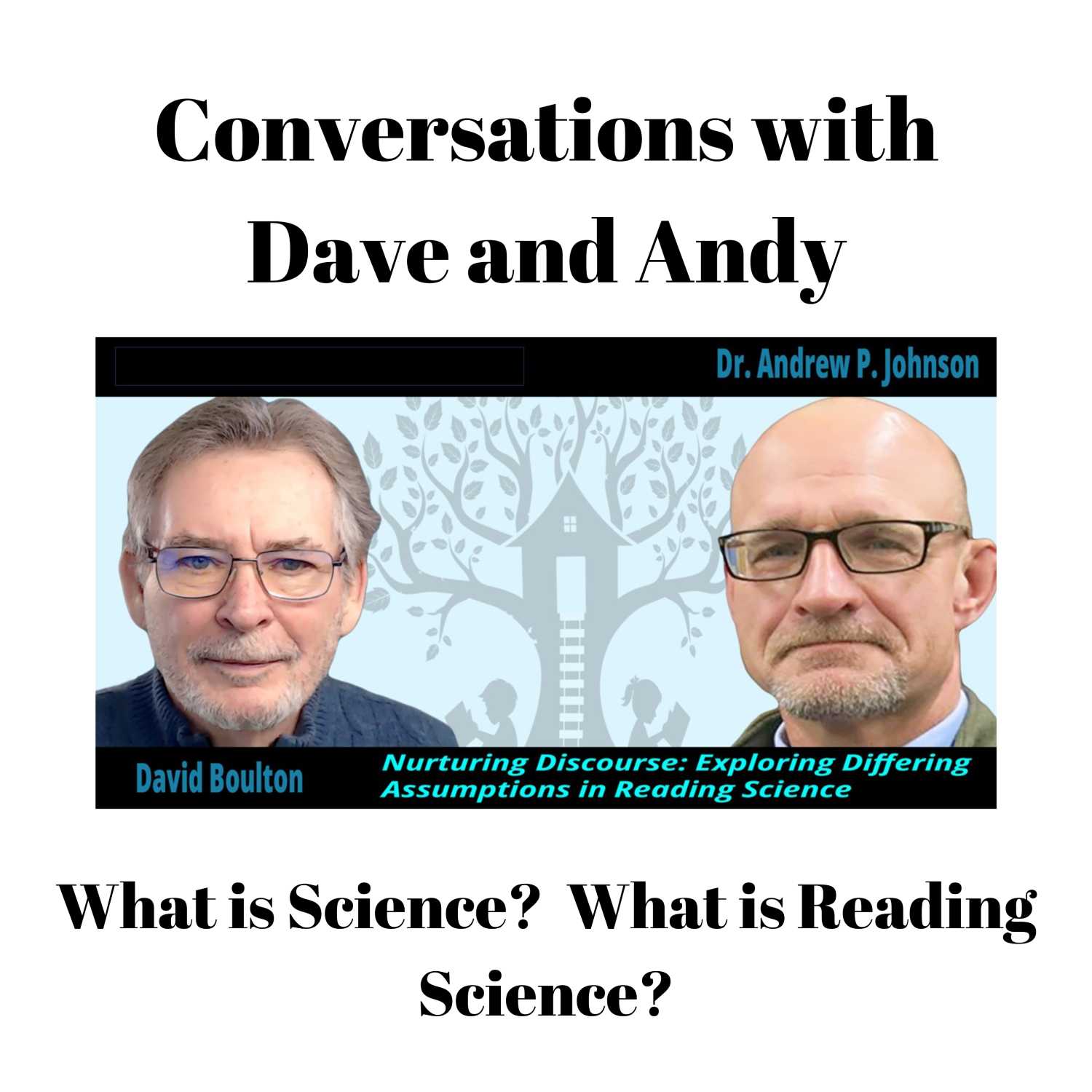
S20 Ep 3Conversations with Dave and Andy
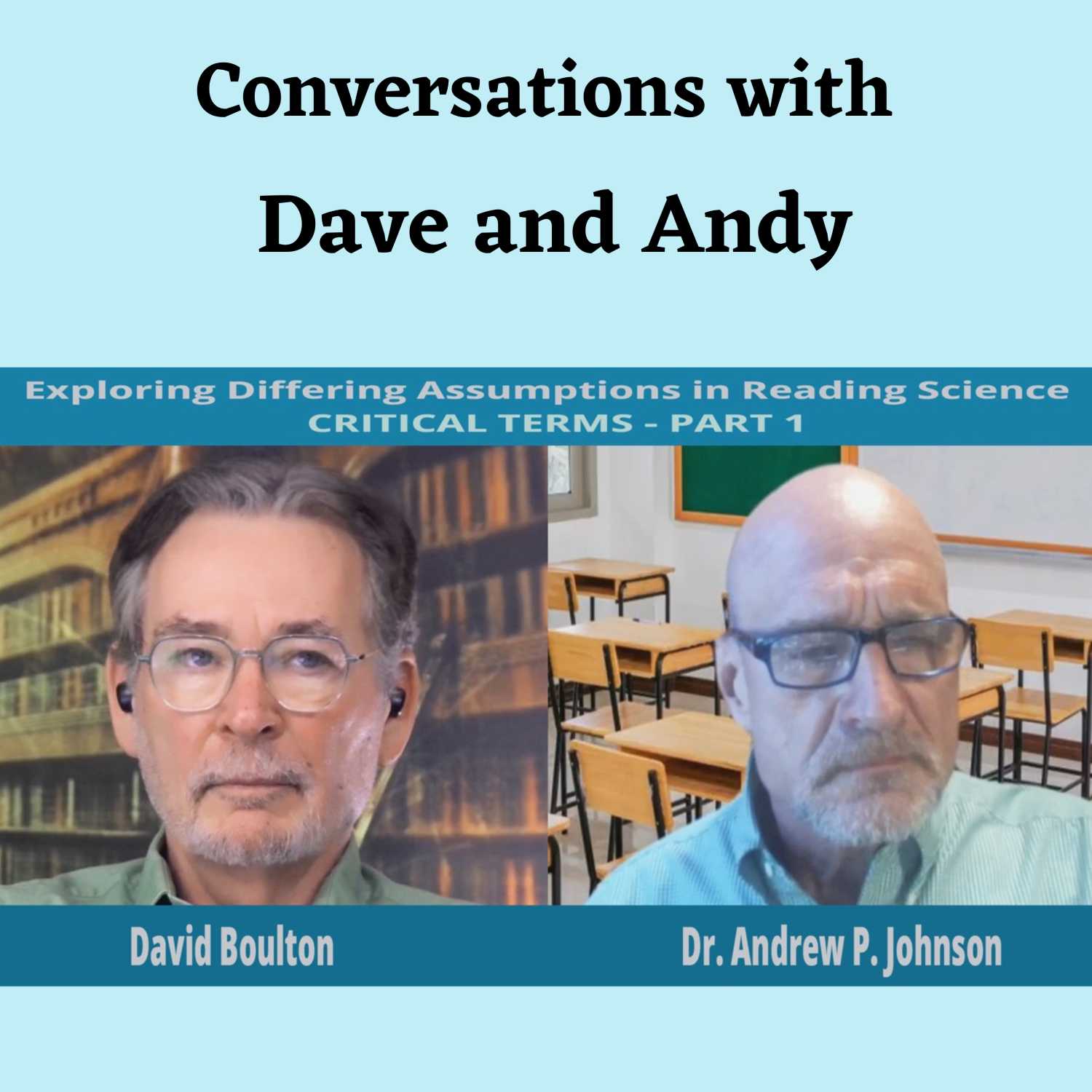
This is a recording of a conversation with Dave Boulton. He and I have different views on reading instruction. Hopefully, we are modeling how to have respectful academic discussions.

S20 Ep 32 Causes of Ineffective Reading Instruction
Why is it that reading instruction sometimes ineffective? This podcast addresses two reasons: (a) the myth of standardization and (b) a lack of understanding related to the reading process,

S20 Ep 2Ortis Hamminggil, PBIS, and the Science of Reading
Children naturally want to learn. They want to make sense of their environment. They naturally want to create meaning with print. However, when you teach children in ways that don’t align with their natural inclination, you make learning harder. You create more frustration and failures. And when children communicate their frustration with their behavior, you use PBIS to try to make the behaviors go away. You seek to suppress and correct the behaviors for which you are largely responsible. You are addressing the effect instead of the cause – but you (Emily Hanford, Louisa Moats, and SoR ideologists) are the cause. I am not saying that bad SoR reading instruction is the cause of all bad behavior. I am not saying that PBIS should never be used. But I am saying that when students are engaged in their learning and when they are enjoying what they’re doing, and when they are successful at what they’re doing, and when learning is something they do instead of something that’s done to them … there are far, far, far fewer behavior problems and much more learning. I'm just saying.
S20 Ep 1It's Research-Based:
Point #1: Teachers and administrators must become informed and responsible consumers of educational research. When somebody says, “research shows this” or “research proves that …” We must always ask, “What research? Give me a citation. Effective for what? At what level? For what purpose? How?” And then we must look at the research study. Point #2: State and federal legislators, those who want to impose mandates on teachers, telling them what and how to teach. Pull your heads out of your collective asses. Do what is right not what is politically expedient. If you’re not going to review the research related to reading instruction, at least call in those who have. Stop making educational decisions based on the testimony of radio journalists. Point #3: We want all students to achieve their full literacy potential. Science of Reading ideologists, I know that’s your intent. It’s a good intent. But intent does not mitigate impact. In five years, when the full impact of what you’ve done will be realized, and people understand just how much time, money, and resources you have wasted, I’ll be doing another podcast. This one will be called, “I Told You So.”
S19 Ep 20How to Prepare Expert Teachers of Reading
Knowledge is important in any endeavor. It’s what separates novices from experts. Experts have more of it. Novices have less of it. Expert teachers have four kinds of knowledge:(a) content knowledge – knowledge of what they’re teaching. This would be math, if you’re a math teacher. Science if you’re a science teacher. And everything if you’re an elementary education teacher. (b) pedagogical knowledge. This is knowledge of basic teaching strategies such as discovery learning, question-asking, discussions, inquiry learning, and cooperative learning.(c) pedagogical content knowledge – This is knowledge of teaching strategies for specific content areas. In reading, this would reading methods. You have strategies for fluency, comprehension, vocabulary, etc.(d) and knowledge of learners and learning. You know how humans learn and develop. This is the ed psych stuff – which is the basis of all things. To move from novice to expert is a rather simple thing. Simply increase knowledge in all four areas. It’s not that complicated.
S19 Ep 19A Humpty-Dumptian Approach to Early Literacy Instruction is Ineffective
There are two basic approaches to literacy instruction for students in the early grades: a skills-based, Humpty-Dumptian approach and a child-centered, meaning-based approach. Both approaches involve explicit skills instruction. The difference is not in the ‘what’ of explicit skills instruction; rather, it’s the ‘how’, and the ‘how much’ of explicit skills instruction.
S19 Ep 18Science of Reading - Why are you Blocking Me? What are you Afraid Of?
I’ve been blocked from posting comments on some literacy Facebook groups and other websites related to reading instruction. They don’t want my words to appear on their pages. I had the temerity to post thoughts with which they disagree. Imagine that. I had an idea that was a bit different than theirs. As a matter of fact, it pointed out some of the possible science of reading shortcomings. They would have none of that. They need to protect their members. But for any field to evolve, it needs to encounter new ideas. The field of literacy education will evolve only to the extent that we are able to engage in civil discourse and respectful academic dialogue. My Facebook page welcomes all thoughts: https://www.facebook.com/readingdisabilities
S19 Ep 17You Can't Be Just a Little Science of Reading
If you are going to embrace the science of reading, you can’t be just a little bit SOR. You can’t be partial SOR, or somewhat SOR. You can’t be semi-science of reading. If you are going to be a SOR advocate, you must embrace and apply SOR principles completely and consistently. In other words, if you are for the SOR and support related legislation, then you would use the same SOR principles to identify the reading problem, the cause of reading problems, and possible solutions to the reading problem.
S19 Ep 16The Basics of Science and Reading Science
In order to understand the science of reading, and how this term is misused, we must first get a better handle on science. I will cover some of the basics and end with a description of 7 questionable claims, based on I-think-isms, often brought up by Science of Reading advocates.
S19 Ep 15The Science of Reading or the Ideology of Reading?
Despite having the word “science” in their title, the ideas put forth by the Science of Reading are not grounded in science at all, but in pseudo-science, I-think-isms, and anecdotal evidence. In fact, they are promoting an ideology. An ideology is a system of ideas and beliefs. Hence, the SOR would be more accurately named, the Ideology of Reading. What the SOR promotes is based far more on a reading belief system than reading science. Real science puts forth conclusions and recommendations based on a wide body of research. An ideology puts forth a dogma based on a very narrow range of data that must be adhered to.
S19 Ep 14How Science Works: Reading Science, Reading Research, and Reading Theories
This podcast explains what reading science is, how data collected from research studies are used to create theory, how theories are used to inform practice, and how one should used research to inform policy, practices, and programs.
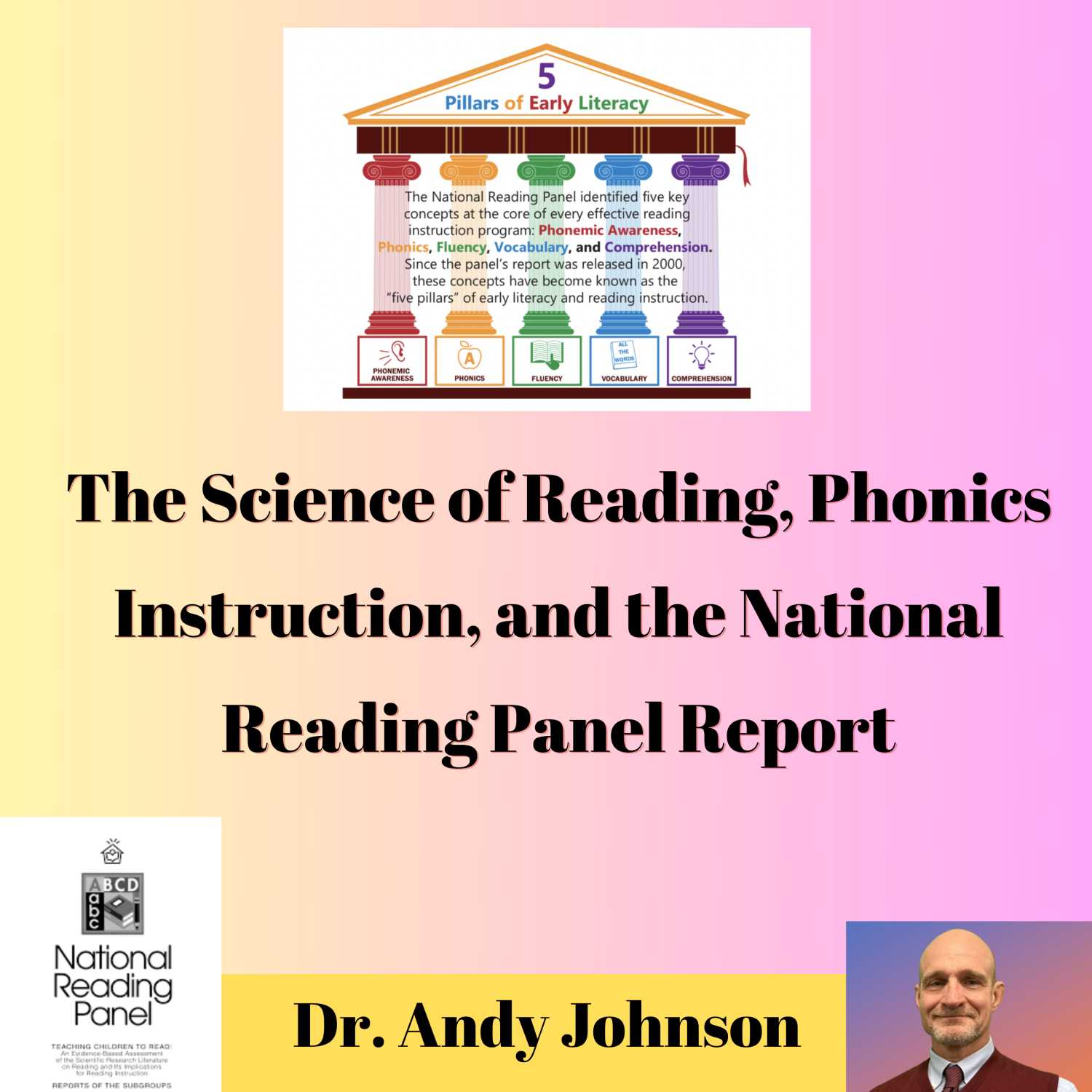
S19 Ep 13The Science of Reading, Phonics, and the National Reading Panel Report
In this podcast, I offer a definition of reading science that I got from an article written by Tim Shanahan. And since the Science of Reading clown club seems so enamored with phonics, we'll look at what the National Reading Panel Report actually says about phonics and balanced reading instruction. Spoiler alert: heads will explode.
S19 Ep 12A Comprehensive Literacy Program and the Science of Reading
Comprehension means total or complete. In defining comprehensive reading instruction, I will rely heavily on data from the NRP report. I would encourage all to read it. Not the executive summary, but the actual report. The five pillars of reading instruction are usually attributed to this report. However, to be comprehensive, a reading program needs to include 10 pillars. These are described here.
S19 Ep 11LACK OF PROFESSIONAL RESPECT LEADS TO TEACHER SHORTAGES
A variety of research studies conducted over the years have shown that of all the variables impacting the quality of teaching and the amount of learning that goes on in the classroom, the most significant variable is . . . the teacher. Yet, we underpay, undervalue, and disempower this most significant of significant variables and expect them to come back year after year because they “love” kids. Is there a teacher shortage? Yup. But even worse, there’s an excellent teacher shortage. In this podcast, I address 10 factors that, if addressed, would alleviate both the teacher shortage and the excellent teacher shortage.
S19 Ep 10The Pseudo-Science of Reading and Space Alien Gravity Theory
The essence of science is this: you ask a question and then collect data to answer that question. That is science. It’s a process. It’s a verb. To science. With science, the data can’t just be collected higgily-piggily. There must be an approved method and that method must be systematic. There are many systematic methods that can be used to collect the data used to answer questions. And there are many types of data to collect. Hence, there is no single scientific method; rather, there are methods of science. An important distinction to be made between science and pseudo-science: Science – asks a question and then collects data to answer the question. Pseudo-science starts with the answer, and then collects data to support that answer.
S19 Ep 9Science of Reading Advocates are Teaching Children to Guess at Words!!!!
Tim Shanahan, Louisa Moats, Linnea Ehri, Wilson Reading Systems, Orton-Gillingham profiteers, SOR advocates, the International Dyslexia Association, and other plucky little phonics penguins are advocating that we teach children to read by guessing at words. Their skills-first approach to reading instruction is based on the phonological processing model. Sometimes called the simple view of reading, this model defines reading as a combination of decoding (sounding out words) and listening comprehension. Essentially, you sound out words and listen to the speech in the headIf you come to a word you don’t recognize, students are taught to put sounds to each of the letters, then put all the sounds together, then guess what the word is based on the sounds. This is nothing more than a grapheme-phoneme word-guessing game. We’ve got to put a stop to this horrible, horrible travesty of reading instruction.
S19 Ep 8The Importance of Art in the Language Arts
The language arts is the study of grammar, punctuation, composition, spelling, and speech that’s usually taught as a single subject in elementary and middle school. This chapter is not about this. I’m taking a bit of a different approach. This podcast is about language art (emphasis on ‘language’). Language art is art that uses language to create an aesthetic response. It is the act of putting words together in certain ways to create a certain effect.comedy monologspoemscreative fictionspersonal essaysnovels/novellastwitter storiesletterssong lyricsvideo writingcreative fictionsautobiographiesmemoirsgreeting cardscomic stripscomic bookspodcastsmovie and tv scriptsplaysspeechesshort storiesblogscolumn writingflash fiction (micro fiction)rap
S19 Ep 7A Pramatic Way to Address Academic Standards for Writing
The impact of academic standards on students’ ability to write is questionable. Some believe that they impede more than enhance effective writing instruction. However, academic standards are part of our current educational life, thus this podcast I will (a) present some ideas for evaluating and assessing academic standards related to writing and (b) describe how you might pragmatically document students’ mastery of them. We will start by defining our terms. An academic standard defines what you want students to know or be able to do in a general sense. Benchmarks in education are the products or performances used to determine if students have met a standard. Benchmarks must be measurable or observable. This means it could be a student product found in a portfolio or a measure of that product using a checklist or rubric. Benchmarks are used to help you meet the standard and to document that the standard is being met.
S19 Ep 6ASSESSING WRITING: A HEALTHY ALTERNATIVE - PART 2
The purpose of this podcast is to provide an overview of portfolios, checklists, and anecdotal records used to document students' growth as writers. These are some healthy alternatives to standardized tests, writing tests, and rubrics. Six points:1. To be of use; however, these healthy alternative assessment strategies must reflect your values, philosophy, teaching style, and students (Calkins, 1994). In other words, your system needs to be yours. You can’t assess effectively using somebody else’s system. Thus, I will present some simple ideas here with the expectation that you will discuss them with your colleagues and use them to develop your own assessment system.2. Your assessment system is not a permanent entity. Expect that it will evolve and change over time as you get more knowledge and experience.3. An effective assessment system utilizes multiple forms of assessment. Include multiple kinds of data. No single assessment strategy should be used exclusively.4. Big picture – The role of a parent and teacher is to become obsolete. You want to prepare students for the world they will encounter such that you are no longer needed. Similarly, the role of good assessment is to become obsolete – to prepare students to evaluate their own work. Thus, an important part of assessment is to teach students how to assess their own work (Graves, 1992).5. Students should be involved in the assessment process. It should be something students do, not just something that’s done to them (see below).
S19 Ep 5Assessing Writing - Documenting Students' Growth: Part 1
Why do we assess? For what purpose? In terms of writing, I hope the answer is this: We assess so that we can help students become better writers. If not, we’re wasting our time. We assess to determine strengths to build upon and weaknesses to address. We assess to document growth. But ultimately, we assess to find out what we can do to help students become better writers. However, too often assessment is used to “hold teachers accountable”. Ugh. Why is it that some groups continue this war against teachers and insist on the de-professionalization of education? Hold teachers accountable? We want intelligent, creative teachers to enter the field – but then we treat them like young, way-ward adolescents. We don’t trust them. We think we need to hold them accountable. We tell them what they must teach and how they must teach it. We assign standards and measures that must be used. Maybe we should give them a curfew as well. That’s it, let’s give all teachers a curfew and a mandatory bedtime – and restrict their TV watching and phone access if test scores fall below a certain percentage. Yeah, that’s the ticket. Certainly. However, what happens when groups continually try to hold teachers accountable? Teachers teach to the accountability measure. In other words, they teach to the test. I mean, who wouldn’t? The result of this accountability nonsense is that instead of testing what is taught, teachers teach what is tested. This is called ass-backwards in some circles. Utter clownery in other circles. With such ass-backward clownery, the curriculum becomes narrowed, focusing only on that which can be measured and quantified by an external entity
S19 Ep 4WE DO NOT TEACH CHILDREN TO GUESS AT WORDS!
This podcast will clarify a couple of un-understandings related to whole language reading instruction:(1) Cueing is NOT an approach to reading instruction.(2) We do NOT teach children to guess as words.(3) Tinfoil hats do NOT keep the FBI from reading your mind.