The Reading Instruction Show
339 episodes — Page 2 of 7

S24 Ep 7Forward to the Past: Writer Over to People
One of the reasons why the Science of Reading people have been so successful is that they’ve been writing to the people over there. They’ve used stories and radio documentaries that sound very much like the way people talk. They’ve enabled the people over there to see and hear real people while our quiet very reasoned third-person voice has been ignored

S24 Ep 5Reading Wars and the Education Science Reform Act of 2002
There never was a reading war. A war assumes there are two armies meeting on a field of battle. This didn’t happen. But there was a reading coup. There was a hostile takeover of the field of literacy instruction by profiteers who saw public education as their own private ATM machine. This group of profiteers is part of the educational industrial complex which includes Cambium-Lexia Learning, Pearson Education, Cengage Learning, Hough Mifflin Harcourt, McGraw-Hill Education, Voyager Sopris Learning, TAL Education Group, Bright Horizons, and KinderCare Learning. Their armies of well-paid toadies (consultants) promise schools simple solutions to complex problems. “Just buy our shiny new products,” they say. “Pay for our services,” they say. “Get trained by our experts,” they say, “and all your literacy problems will go away. All your students will be reading above grade level.”“Well, I don’t know,” the school says. “That’s a lot of money.” “Look,” they say, “look at all the colorful charts and graphs. Look at all the pretty, pretty numbers.”“Well,” the school says, “you do have numbers. That must mean it’s real.” “Wouldn’t you like to have colorful charts and graphs like this? Wouldn’t you like to have pretty, pretty numbers?”“Yes,” the school says. “Yes, I would.”And that, my friends, is how education lost its soul.

S24 Ep 4Cognitive Science and Reading
Neuroscience is a study of the nervous system including the brain, spinal cord, and neurons (NIH, 2025). The neuroscience of reading looks at how the brain functions during reading using imaging techniques to detect blood flow and electrical energy (Gotlieb, et al., 2022). Cognitive science is based on the word ‘cognition’ which means thinking. Cognitive science looks at human thinking (Robinson-Riegler & Robinson-Riegler, 2012). One studies the physical brain as it thinks and the other studies the thinking the brain does. But we can’t observe thinking directly. We can only observe the effects of thinking. Thus, both fields look at the effects of thinking to make deductions about thinking itself.The first part of this podcast is designed to help you understand how reading works from a purely cognitive perspective. This provides an important context for the second part where I examine the theory of orthographic mapping (Ehri, 2014). Orthographic mapping is a theory based on logical deductions made from research. The questions we must ask are how robust is the theory, how valid are the data upon which it is based, and how logical are the deductions? My conclusions are, not very, not very, and not very.

S24 Ep 3Orthographic Mapping: Weak or Robust Theory?
In this podcast, I try to make sense of orthographic mapping, a term invented by Linnea Ehri and introduced in Chapter 15 (Ehri, 2014). We’ll start with her definition: “Orthographic mapping occurs when, in the course of reading specific words, readers form connections between written unit, either single graphemes or larger spelling patterns, and spoken units, either phonemes, syllables, or morphemes. These connections are retained in memory along with meanings and enable readers to recognize words by sight. An important consequence of orthographic mapping is that the spellings of words enter memory and influence vocabulary learning, the processing of phonological constituents in words, and phonological memory” (Ehri, 2014, pp. 5-6) This is written with all the stunning clarity of a Rorschach inkblot. Let’s do a bit of unpack-O-rating.

S24 Ep 2Everybody Uses Direct Instruction For Reading
The term “direct and explicit instruction” is often used to sell products or to persuade state legislators to make bad decisions. But everybody already uses direct instruction in some form. It's not the 'what' of direct instruction that is in question; it's the 'how' and 'how much' of direct instruction. T

S24 Ep 1Research to Support the Three-Cueing Systems
Our big human brains have evolved to become very efficient predicting machines (Hawkins, 2004). They are constantly accessing multiple data sources in order to give us a sense of what will happen next. Most of this is done at levels below our conscious awareness. For example, baseball players are able to run to the right spot to catch balls in the outfield because they can predict where it’s going to come down. Their big human brains instantly process a variety of information related to the sound of the bat hitting the ball as well as the height, speed, and angle of trajectory. The same prediction process is used in language comprehension and reading (Gavard & Ziegler, 2022; Lupyan & Clark). Here, our prediction machine uses semantic, syntactic, and phonological information to make micro-predictions about words and meaning during the process of reading (Goodman, 1967; Laroche & Decon, 2019). Very much like baseball players catching pop flies, this enables us to efficiently and effectively create meaning with the print before us.
S23 Ep 29Orton-Gillingham: Behind the Pretty Words
The problem with Orton-Gillingham and similar for-profit products (Lindamood, Wilson Language Training, Barton System, etc.) is that they try to reduce teaching to an algorithm. An algorithm is a formula for solving problems in which you follow a step-by-step set of procedures (with fidelity) to achieve a specific outcome. In other words, by correctly following a prescribed set of steps in the specified order, you will be led to a predefined solution. Algorithms are useful in mathematics and computer science for calculation, data processing, and automatic reasoning. For teaching of any kind? Not so much.However, Orton-Gillingham would have you believe that if the teaching algorithm is followed explicitly, the teacher can be assured that students will learn to read. And if the algorithm does not work, you run them through the algorithm again … and again … and again. What these algorithmic programs offer is a false sense of certainty. Despite all the certainty thrown about, research to support the long-term effectiveness of these “direct, explicit, multi-sensory, structured, sequential, diagnostic, and prescriptive” instruction, it is simply not evident (Compton, et. al., 2014).

S23 Ep 28Defining the Science of Reading
When somebody askes you, “What’s the Science of Reading?” what do you say? Is it a process? Is it a set of strategies? An approach or method? A reading program? A group or organization? In this chapter, I will attempt to define the Science of Reading. And notice that I’m using capital letters. This enables us to differentiate between a science of reading as one of several sciences of reading and the Science of Reading as a proper noun or title,The Science of Reading seems to refer to a general consensus related to the strategies and practices that lead to improved reading outcomes. These strategies and practices have been determined to be effective using experimental or quasi-experimental research and conducted in authentic learning environments. Also, this research has established a causal link between strategies or practices and student outcomes (reading achievement). Thus, the Science of Reading can be thought of as a process that uses the standards in Figure 16.2 when making decisions related to reading instruction and policy. However, the SoR might best be described today as a self-defined movement that advocates these standards be used for making decisions related to reading policy and instruction.
S23 Ep 27What Elephants Can Teach Us About Reading Instruction
The really big point is this: It’s the semantic connections that are most important, not orthographic, graphemic, or phonemic connections. When you encounter the words ‘elephant’ you don’t connect with short /e/ words. You don’t activate words containing the /ant/ letter pattern or words with silent ‘ph’ blends. You connect with elephant things, regardless of the letter sounds or patterns.Just hearing the word ‘elephant’ brought some of the elephant things in your elephant schemata to consciousness. Meaning that, if elephant were followed by the words sock, trunk, swallow, you’d be able to identify the word ‘trunk’ microseconds faster than the other non-related words (Higgins, Rholes, & Jones,1977). This is called priming. Priming looks at how something that comes before primes or impacts what follows. The very word ‘elephant’ primed the pump so that I would be able to identify elephant words quicker and more efficiently. We’ll be looking at some of these research studies below.
What Elephants Can Teach Us About Reading Instruction
The really big point is this: It’s the semantic connections that are most important, not orthographic, graphemic, or phonemic connections. When you encounter the words ‘elephant’ you don’t connect with short /e/ words. You don’t activate words containing the /ant/ letter pattern or words with silent ‘ph’ blends. You connect with elephant things, regardless of the letter sounds or patterns.Just hearing the word ‘elephant’ brought some of the elephant things in your elephant schemata to consciousness. Meaning that, if elephant were followed by the words sock, trunk, swallow, you’d be able to identify the word ‘trunk’ microseconds faster than the other non-related words (Higgins, Rholes, & Jones,1977). This is called priming. Priming looks at how something that comes before primes or impacts what follows. The very word ‘elephant’ primed the pump so that I would be able to identify elephant words quicker and more efficiently. We’ll be looking at some of these research studies below.

S23 Ep 26The 3 Q-ing Systems: What it Isn't and Is
1. It’s not a strategy to teach students.2. It’s not a pedagogical strategy that teachers use.3. It doesn’t exclude phonics instruction.4. It doesn’t encourage children to use picture clues to figure out words.5. It’s not an approach to teaching reading.6. It’s not a method of “decoding” printed text.7. It’s not a “staple of early reading instruction”.8. It’s not whole language9. It doesn’t exclude explicit and systematic instruction.

S23 Ep 25Metaphysicial Perspectives
In his book, Global Mind Change (1989), Willis Harman describes three views of reality which he calls metaphysical perspectives. Metaphysical here refers to ontology or the question of the origins of the universe and the nature of reality. These perspectives are materialistic monism, dualism, and transcendental monism.

S23 Ep 24Belief Systems and Mental Sets
Why do we sometimes believe the unbelievable? Why is it our views are sometimes data-resistant? We like to think that reality determines our beliefs; however, at higher levels of belief systems, our beliefs determine reality. It's just the way of things.

S23 Ep 23Being and Becoming Responsible Consumers of Educational Research
There’s a difference between (a) reading research related to reading instruction and (b) reading what others have said about research related to reading instruction. It’s important to know the difference. When you read research articles, you get to evaluate the methodology and interpret that data. When you read what somebody else has written about research, you must trust that their evaluation is fair, and their interpretation of the data is accurate. You are reliant on the relative clarity of their lens.So, far too often you’re left with people like me whose job it is to continually read and evaluate research. But this chapter is written so that you will be able to do this. It’s written to make me obsolete.

S23 Ep 22The Psycholinguistic Guessing Game
This is what Ken Goodman wrote in 1967: “Reading is a psycholinguistic guessing game. It involves an interaction between thought and language. Efficient reading does not result from precise perception and identification of all elements, but from skill in selecting the fewest, most productive cues necessary to produce guesses which are right the first time. The ability to anticipate that which has not been seen, of course, is vital in reading, just as the ability to anticipate what has not yet been heard is vital in listening (Goodman, 1967, p. 127) The term, psycholinguistic guessing game” has been commonly taken out of context and misunderstood by those who would propose a skills-based approach to reading instruction. Remember, context matters. In the context in which it was used, this term refers to the process used by your brain to maximize efficiency during reading.

S23 Ep 21Whole Language and Evidence-Based Reading Instruction
In 1967, Ken Goodman published an article in Reading Research Quarterly with the title` Reading: A Psycholinguistic Guessing Game (Goodman, 1967). Here he applies Psycholinguistic Theory to the reading process. A pretty good article. I highly recommend reading it. However, two words have been pulled from the title ‘reading’ and ‘guessing’. These two words have become a Rorschach inkblot test for those who would disagree with or who don’t understand Dr. Goodman’s ideas. All sorts of dark and scary images have been projected upon them. These Rorschach-ian projections have been used for the last 50 years to misrepresent whole language and to discredit the work of Ken Goodman.

S23 Ep 20Conversation with Claude Goldenberg
This is a wonderful conversation that I had with Claude Goldenberg. He has different ideas about things but he is a delight to talk with.
Interview with Joe Lockavitch
This is an interview with Joe Lackavitch

S23 Ep 19The Music of Balaned Literacy Instruction
As said throughout this book: if you are against something, you should at the very least know a little somebody about that which you are against. SoR enthusiasts are often against something that isn’t. In this case, they are against what they call balanced literacy, but it certainly isn’t balanced literacy. It turns out that they’re against their un-understanding of balanced literacy. So let’s begin by defining our terms: Balanced literacy is merely balancing skills instruction with opportunities to practice those skills in authentic reading contexts. And what that balance is depends on the student. Some students need more skills instruction and less practice, others need less skills instruction and more practice. But all students need lots of reading practice. Could you imagine getting better at anything without practice? Could you imagine being able to play the piano if you never practiced playing real music? How effective would your early learning be if you just did scales and fingering exercises without playing music? Which is a nice transition to the next section.

S23 Ep 18Whole-to-Part vs. Part-to-Whole Reading Instruction
Structured literacy is based on the idea that people learn complex things best by mastering each little part separately and then putting the parts together to create the whole. This is called part-to-whole instruction or Humpty-Dumptianism. Applied to reading, you would pull apart each of the eight strands of Scarborough’s reading rope, then teach all the little subparts related to each of the eight strands (one little subpart at a time) until all the eight strands and their corresponding subparts were mastered. The theory is that at some point, children would be able to put all the subparts back together again and engage in the act of reading. It just makes good sense, yes?There are 26 letters used to make the 44 phonemes found in the English language. These 44 phonemes are represented by over 280 letter-sound combinations. You teach children how to “decode” by first teaching them how to put together all the 280 letter-sound combinations so they can apply them to all the words they will ever encounter. It just makes good sense, yes?

Ropes, Humpty Dumpty, and Systems Theory
The SoR is based on the simple view of reading (Cervettie, et. al, 2020; Duke & Cartwright, 2021; Hoffman, 2017). According to this theory, skilled reading is a result of decoding and language comprehension (Gough & Tunmer, 1986) (see Figure 9.1). In other words, you decode each word (sound it out) and then listen to the decoding occurring in your head. What could be simpler than this? Yes?Later iterations of this theory would change it slightly. Scarborough (2001) created his now famous reading rope based on this (see Figure 9.2). According to this theoretical model, skilled reading is like a rope comprised of two sets of strands. Word recognition strands. The word recognition strands represent three low level skills related to: (a) phonological awareness (syllables, phonemes, etc.), (b) decoding (alphabetic principle and spelling-sound correspondence), and (c) sight word recognition (orthographic mapping). These skills are to be learned and practiced until they become increasingly automatic. That means that students do it without thinking.Language comprehension strands. The language comprehension strands represent five higher level skills related to: (a) background knowledge, (b) vocabulary, (c) language structures (syntax and semantics), (d) verbal reasoning (inferring, predicting, and (e) literacy knowledge (print concepts, genres, etc.). These elements are to be learned in ways that enable students to consciously apply them as needed. (They become increasingly strategic.)As the smaller strands within each set become increasingly intertwined, two sets of strands eventually become intertwined. And as the intertwining becomes increasingly tighter, one becomes more skilled as a reader.

Ropes, Humpty Dumpty, and Systems Theory
The SoR is based on the simple view of reading (Cervettie, et. al, 2020; Duke & Cartwright, 2021; Hoffman, 2017). According to this theory, skilled reading is a result of decoding and language comprehension (Gough & Tunmer, 1986) (see Figure 9.1). In other words, you decode each word (sound it out) and then listen to the decoding occurring in your head. What could be simpler than this? Yes?Later iterations of this theory would change it slightly. Scarborough (2001) created his now famous reading rope based on this (see Figure 9.2). According to this theoretical model, skilled reading is like a rope comprised of two sets of strands.

S23 Ep 17Little Timmy Learns to Read: A True Story
Phonics is important, but if that’s all you’re teaching, you limit students’ ability to recognize words and create meaning with print. And that is the end goal – to create meaning, not to fill out phonics worksheets, or pass end-of-unit tests, or sound out words in isolation

S23 Ep 16Chilren of the Code: Hard-Wired to Learn Reading
I was having a discussion with a fellow online who insisted that early reading instruction should consist primarily of direct instruction of phonics. His argument was that unlike learning to use oral language, learning to use written language is not a natural process for humans. “We’re not wired to learn these skills” he insisted. “Reading is a uniquely human invention,” he said. According to him, children, starting around age 5 or 6, need lots of direct instruction of letter-sound relationships in order to learn “the code”. When they learn the code, then they can read (or decode).This is a commonly held idea that seems to make good sense to many. But we want reading instruction to be based on good science, not good sense. So, let’s do a bit of unpack-o-rating:

S23 Ep 15Defining the Science of Reading and SoR Research Standards
If you threw a rock into the middle of a pond but that rock was not a rock, can you still be said to have thrown a rock? Likewise, can a standard be said to be a standard if it is not standardized? We know that science is a good thing, and using science in reading instruction is a good thing. But what exactly is meant by the “science of reading”? What exactly is the Science of Reading? Is it a noun? Is it a verb? Or has it become an adjective or perhaps a metaphor used to indicate something else?

S23 Ep 14Understanding Science, Research, and Research Methods
Basic terms are often misunderstood or misapplied by SoR advocates. My goal in this podcast is to bring a little more clarity to three important and often misunderstood terms: science, research, and research methods. In doing so, I hope to move the needle a little bit in helping you become more critical consumers of educational researchScience is both a noun and a verb. It’s a noun when it refers to a field or a system of knowledge within a particular area such as physics, chemistry, or zoology. It is a verb when it references the processes used to develop that system of knowledge (research).

S23 Ep 13Dr. Elana Aydarova. Science of Reading Mythologies
Dr. Elena Aydarova is an Assistant Professor in the Department of Educational Policy Studies at the University of Wisconsin-Madison and a fellow with the National Education Policy Center. Dr. Aydarova’s research examines the interaction between educational policies, education reforms, and policy advocacy. She is an award-winning author of over 40 publications. Dr. Aydarova received postdoctoral fellowships from the National Academy of Education/Spencer Foundation and the American Association of University Women.

S23 Ep 12It’s Easier to Blame Teachers than to Fix Problems
If you can blame students, teachers, and colleges of education, we won’t see the social problems that impact learning. It’s much easier to blame teachers than to fix the actual cause of social problems. However, there is one thing of which we can be certain: If Cengage Learning, Houghton Mifflin Harcourt, McGraw-Hill Education, Pearson Education, and Scholastic could sell products to fix one of these social problems, that problem would be the cause of the next educational crisis.

S23 Ep 11The Ample Testimony of Reading
To fully understand this current reading “crisis” (which really isn’t a crisis at all), it must be seen in the context of similar “crises” occurring in the past (which weren’t really crises either). This current “crisis” is not the first reading crisis to come along (Aydarova, 2024; Berliner & Biddle, 1995; McQuillan, 1998; Thomas, 2024), and it certainly won’t be the last. And when this crisis runs its course, there will be a lull followed by another crisis, and then another, and then another. That’s because there will always be those willing to create the illusion of crises for political and economic gain (Altwerger, 2008; Aydarove, 2023). And sadly, it’s an effective tactic … for a time anyway.

S23 Ep 10Understanding the Limitations of Data and Research in Educational Research
The thing about research is that it doesn’t prove anything, at least not in the social sciences. There is no single research that conclusively proves anything once and for all about reading instruction. Research may support a hypothesis. It may provide evidence for something, show something, indicate something, or demonstrate something, but in the social sciences, research doesn’t prove things. The results may indicate, implicate, or illustrate, but educational research doesn’t prove things.SoR advocates often claim that there is a “proven science” of reading. But when working with variable human beings interacting in variable social situations there are simply too many variables to say that something proves something else conclusively. Instead, research provides evidence for things. A lot of research provides strong evidence. A little research provides weak evidence. There are evidence-based practices (see Chapter *) but there is no “proven science” of reading. But even saying something is evidence-based says nothing about the quality of the evidence or the validity of the evidence.

S23 Ep 9The Reading Crisis the Isn't: Context Matters
Words are always encountered in the context of a sign, product, or sentence. In the same way, to be understood, data must be understood and evaluated in the context in which it was collected. Reading research can only be fully understood in the context of a wider array of research studies within a theoretical perspective. And theories must be understood in the context of a paradigm. The Science of Reading movement must be understood in the greater social and political context and in the context of past educational reform movements (NCLB).

S23 Ep 8Reading Instruction in the Context of Crisis
If you were to consume a lot of popular media today related to education, you would be led to believe that there is a reading crisis. Apparently, it’s all “deeply concerning”. I can’t help but wonder if this current crisis is a new crisis or an extension of an old crisis. In 1983 the United States was said to be “at risk” because of a crisis that started in 1963 (National Commission on Excellence in Education, 1983). Was that crisis ever resolved? Is this crisis an extension of that crisis? Or is it brand new crisis? In 1983 teachers were told they need to get back to the basics. Did we not get back far enough? Did we not get basic enough? Did our basic backtracking not take? Do we need to get back to basics much harder? Are we still basic backtracking? If we’re not getting back to basics, what are we getting to?

S23 Ep 7LETRS Does Not Meet Basic SoR Standards
ConclusionsThe Science of Reading promotes the exclusionary use of strategies and practices that have been shown to be effective using controlled experimental or quasi-experimental research conducted in actual classroom settings. Further, this standard should be the basis upon which decisions should be made about reading instruction and reading policies. LETRS fails to meet this basic SoR standard.

S23 Ep 6LETRS: Weasels or Engery Efficient Light Bubls
This podcast examines Language Essentials for Teachers of Reading and Special (Lexia) or LETRS. I wanted to find the “reliable, trustworthy, and valid evidence” that “has demonstrated” that LETRS had “a record of success in increasing students' reading competency in the areas of phonological and phonemic awareness, phonics, vocabulary development, reading fluency, and reading comprehension”. I was eager to start reading all the research showing that LETRS professional development had a demonstrated record of success in increasing students’ reading competency. Specifically, I was looking for three things:1. A vast, interdisciplinary body of scientifically-based research linking LETRS to improved teaching performance.2. A vast, interdisciplinary body of scientifically-based research linking LETRS to improved student reading outcomes.3. A vast, interdisciplinary body of scientifically-based research providing evidence that LETRS was more effective than other types of professional development in improving teacher performance or student reading outcomes.

S23 Ep 5Of Mice and Minnesota: Mouse World and Reading Instruction
Yes, state legislatures have the right to impose statues. Absolutely. But teacher's unions have the right, and the moral obligation to respond. The Read Act and other SoR mandates strip away teachers' right and obligation to provide the type of instruction that is best for their mice-students. They’re forcing teachers to spend hours in state-mandated professional development programs, paid for by state tax dollars. They force schools to purchase state-mandated reading programs. The teaching profession is being de-professionalized and you say nothing. Teachers are now expected to open the teachers’ manual and follow the script. We don’t have mouse-teachers, we have script-followers.Teacher empowerment has been central to good education. Teachers' unions led to better schools, better educational outcomes, and better teachers. Yet, teachers' unions have let outside interests change public education. You have sat silent as teachers have been asked to do more with less. You’ve sat silence as teachers are forced to implement one-size-fits-all scripted reading programs. Teachers are forced to engage in state-mandated educational malpractice for reading instruction … and you say nothing.Anybody can say nothing.The only thing worse than not having a union is having a union that does nothing.

S23 Ep 4Emily Hanford is the Alexa App of Reading Instruction
A fact may be true. But the truth of the fact is limited to the context in which it was found. Outside a meaningful context, the fact may mean something different. Also, facts without context can be misapplied and misunderstood. This is true of many of the facts used to support SoR structured approaches to reading instruction known as structured literacy. It is a house built on a series of decontextualized facts.

S23 Ep 3The New Reading Anti-Science Movement in Minnesota
This is an interview with a Minnesota reading Professor. Ideology has replaced science when it comes to reading instruction in Minnesota.

S23 Ep 212 Essential Elements of a Comprehensive Reading Program
In 1997 Congress asked the National Institute of Children’s Health and Development to work with the U.S. Department of Education to establish a National Reading Panel. Their task was to evaluate existing research in order to find the best ways of teaching children to read. In 2000 the panel issued their 500-page report (National Reading Panel, 2000). This report has been widely cited in books and journal articles related to reading instruction. The NRP describes five-pillars are reading instruction. The SoR zealots and state reading laws describe these as five foundation reading skills. They are: phonemic awareness, phonics, comprehension, vocabulary, and fluency. It's not that I disagree with the five "pillars" of reading instruction as described by the NRP report and repeated ad nauseam by SoR zealots. My concern is that they're seven pillars short of a full load. In this podcast, I describe the 12 essential elements of a comprehensive reading program – or comprehensive literacy instruction.

S23 Ep 1I Was Wrong: Holy Books, Sacred Texts, Theories, Paradigms, and Reading Instruction
Questions: How is it that one interprets the same thing differently across time? How is it that one can read a book, have an experience, or observe phenomena and draw completely different conclusions when the only thing different is the time in which it was read, experienced, or observed? Is time a variable in comprehension or understanding? Is it a variable in constructing meaning? A book that seemed so insightful at one point, with the passage of time, can become meaningless. Likewise, books that I once thought meaningless can sometimes become filled with insight, interesting, and important ideas with the passage of time. Same book. Same person. Same brain.

S22 Ep 24I'm Woke!!!
There are conditions that tip the scale in favor of some groups and restrict or disadvantage others. There are communities, that seem to get the economic opportunities, good schools, good teachers, health care, good nutrition, housing opportunities, small class sizes, community libraries, well-stocked school and classroom libraries … Go to a 3rd-grade classroom in a poor, inner-city school, or poor rural district. Now go to a 3rd grade classroom in a weather suburb. It's like going to a different planet. Not everybody has the same opportunities. A person is privileged because of their environment and station in life. Communities that are predominantly white seem to have disproportionately more of these privileges and more opportunities. Communities that are predominantly black seem to have more restrictions and fewer opportunities.
S22 Ep 22The Read Act and the Lessons Beyond the Lesson
Recently, the Minnesota State Legislature passed the Read Act, sponsored by Democratic representative Heather Edelson. It’s a law based on the fad of the day; the shiny new thing called the “science of reading”. Ironically, this law is based on misconceptions and un-understandings related to both science and reading. This law states that I and other literacy professors in Minnesota must follow, with fidelity, the mandates put forth by state lawmakers. These are lawmakers who have never taught a kid to read, who have never read a research article related to reading instruction, and whose knowledge about reading instruction is reliant on the information given to them by radio journalists and podcasters (present company excepted). As part of the Read Act, the Minnesota Department of Education is now forcing me, a literacy professor at Minnesota State University, to teach things to my students that a wide range of research has shown to be ineffective in helping young children to become literate (that is, to use reading and writing for real purposes). I am forced to teach the preservice teachers in my literacy methods courses at Minnesota State University to engage in educational malpractice in their future classrooms. The Minnesota Department of Education mandates that these future teachers learn strategies that will impede their future students’ ability to achieve their full literacy potential. I must promote the de-literalization of children by telling teachers to focus primarily on lower-level reading subskills instead of higher-level cognitive functions related to reading and comprehension. Worse, I must teach them how to suck all the joy out of reading.
S22 Ep 21Zealotry in the Guise of Reading Science
I could live with a science of reading if the SoR zealots applied the scientific principles they claim to worship and adore to all of reading reality. That is, if the scientific principles that they insist be used to determine what is effective reading instruction were also used to establish cause and effect, I could live with the zealotry. But, they abandon their cherished scientific ideals when identifying problems and evaluating solutions to problems. Look at the reading laws passed by 32 state legislatures. Look at the testimony by “experts”. You will see the word “science” used a lot, but science if much different from ‘I-think-isms’, anecdotal evidence, and personal experiences.
S22 Ep 20The Dance and the Joy of Reading Instruction
Dance has much to teach us about five areas of reading instruction:1. Motivation. 2. Practice. 3. Dance dyslexia4. Whole dancing.5. Context. Whenever a new SoR reading law is passed, the SoR zealots gather a bunch of children together for a picture, and they’re told to smile. And you get pictures of happy smiling children with happy parents all smiling and being happy. Wonderful. It’s a joy façade.Behind the façade is an unwritten narrative. These children were once unhappy and oppressed because of reading instruction. But then a reading law was passed. Now look at them. Glory hallelujah, they’ve got SoR in their heart. They’ve been saved by orthographic mapping. Their lives are better because of decodable texts. Now just look at how happy they are. How can you possibly argue with happiness? And why would you balanced-literacy devils make these happy children unhappy with your hell-based 3 cueing systems?
S22 Ep 19Science of Reading: Where's the Joy?
There is only one emotion that is good for learning: happiness and all its derivations. Joy is a derivation of happiness. Joy is pleasurable. Humans are rewarded by their emotions for doing things that bring them joy. They tend to repeat these behaviors. Fear keeps us from doing certain things. Fear of failure. Fear of humiliation. Also, things that make us sad or unhappy keep us from doing certain things. Being forced to sit in a chair and perform like a trained seal creates sadness, boredom, and frustration.The SoR zealots fail to realize that we’re teaching children who just happen to be developing human beings, who happen also to be emotional and social beings existing in a sociocultural context. We read and emote with the same brain. It’s silly to think that one would not impact the other. Positive emotions enhance learning, and negative emotions impede learning. Take that to the bank, baby. We’ve got plenty of research to support this. So, we can say with some confidence that creating a positive emotional environment in which there is social interaction, safety, and joy is a research-based strategy.
S22 Ep 18Reading, Religion, and Time
There are five kinds of time in a reading class.Allocated time. There is the amount of time allocated for instruction. Off-task time (OTT). There is OTT when students are doing things unrelated to the lesson or learning objective. TOT. There is also time on task (TOT), where students are actively engaged in learning activities. AET. There is Academic Engagement Time (AET). This is the time when students are cognitively and behaviorally on-task or engaged in learning activities that are within their zone of proximal development. Flow state time. Here the student is completely absorbed, focused on a single task or activity. They are directing all their attention toward something that they are motivated to do or be engaged with. Academic engagement time is good, but flow state time is the best for learning. Magic teachers, if they are empowered to make the choices that are best for their students know how to align reading instruction with students’ interests to create flow state time. But this does not occur in a structured literacy class.A teacher's #1 job is to help children fall in love with books. After that, much of reading instruction takes care of itself.
S22 Ep 17LETRS, Orthographic Mapping, and Ignorance Mapping
In becoming responsible consumers of educational research, we must ask four questions when claims are made that research has “proven these expensive, code-oriented, one-size-fits-all reading programs to be effective.1. Are the results of these code-oriented reading programs persistent? That is, do they last after the code-oriented instruction has been discontinued?2. Do the skills learned in these code-oriented reading programs transfer to real-life situations? 3. Do these code-oriented programs enhance students’ ability to create meaning with print? There’s a difference between scores on a DIBELS test and creating meaning with print.4. Are these expensive, mind-numbering code-oriented reading programs more effective than balanced literacy instruction which includes reading and talking about good books, and writing a sharing students' authentic writing or stories?
S22 Ep 16Three-Cueing, Orthographic Mapping, and Ignorance Mapping
The Science of Reading zealots in Minnesota and in other states around the country (Wisconsin, Texas, Ohio, and others) have done something pretty remarkable. (It’s remarkably bad, but still remarkable.) They have banned words. It is now against the law in Minnesota for me to include ‘the three cueing systems’ on my syllabi, reading assignments, or course outlines. Imagine that. A law telling me what I can and cannot say or can and cannot teach in my literacy methods class. A law put together by people who know nothing of literacy instruction or research. A law put together by people who sound out words instead of reading for meaning. A law put together by people who look at every letter when they read. A law put together by people who ignore syntax and semantics when they read. A law that says I must ignore my three decades of research, scholarly work, and teaching experience. It’s a law that states that I must ignore what a body of research from a variety of different fields has determined to be an empirical fact: that we use multiple forms of information to recognize words while creating meaning with print. According to this brand-spank-n-new Minnesota law, I must instead lie to the students in my literacy methods classes.
S22 Ep 15Emotions, Logic, Intuition, Knowledge and the Science of Reading
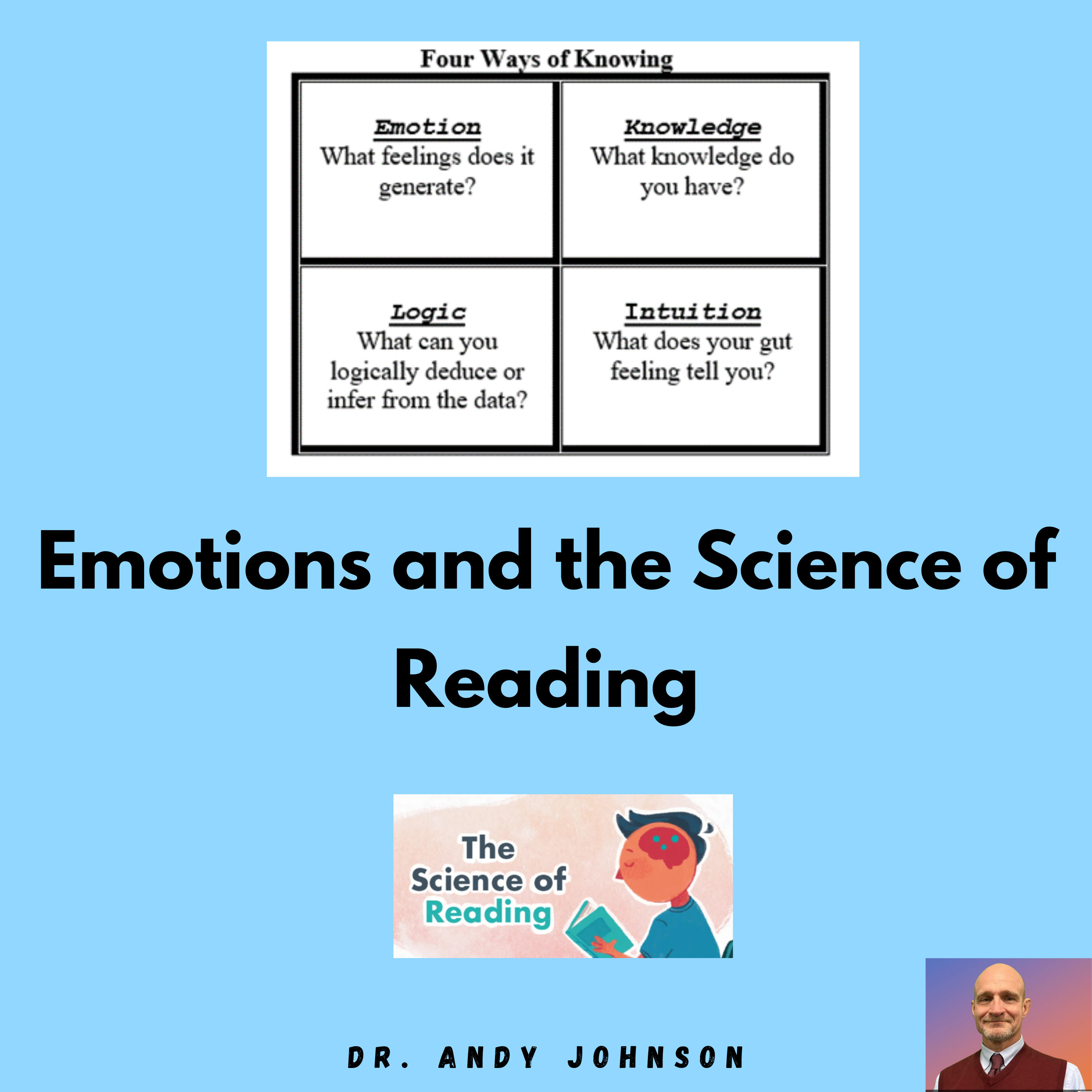
It’s an emotional response, make no mistake about that. The decision to abandon good reading instruction and move to what the SoR zealots call structured literacy is an emotional response. The decision to use hyperbole and pejorative statements to dismiss that with which you are unfamiliar is an emotional response. The decision to take the argument out of an academic realm to a political realm, and to threaten and bully those who disagree is an emotional response. The decision to give credence to a radio journalist and ignore real literacy experts is an emotional decision. Now, there’s nothing wrong with an emotional response. Emotions are wonderful things. They are part of what makes us wonderfully and uniquely human. I wish more decisions were more emotional. However, good decisions, just like good literacy instruction – is balanced.

S22 Ep 14Exploring Creativity with Sven Johnson
In this podcast I interview Sven Johnson to talk about creativity and the creative process.

S22 Ep 13Killing Cows, Burning Witches, and Reading Instruction in Minnesota
There's a literacy inquisition going on in Minnesota. Science of reading zealots are on a holy crusade. They are banning books, banning words, and banning ideas. Books, words, and ideas are dangerous things. They could enable people to think – to think about things – and to think critically. There is a law now in Minnesota, based on the Read Act, sponsored by Representative Heather Edelson that I am NOT to teach the 3-cueing system. I cannot say it. I cannot mention it. I cannot have it on my syllabus. It's illeagal. I can’t even think about it. It’s dangerous. It’s a dangerous thing.