
The Pomp Letter
521 episodes — Page 11 of 11

We Need More Software Engineering And Less Financial Engineering
This installment of The Pomp Letter is free for everyone. I send this email to our investors daily. If you would also like to receive it every morning, join the 50,000 other investors today.To investors,Napoleon Hill wrote one of the best personal finance books in history called Think and Grow Rich. In it, he said “There are no limitations to the mind except those we acknowledge. Both poverty and riches are the offspring of thought.” These thoughts are driven by an underlying mindset held by each individual.This mindset ultimately determines the actions you take. It is the guiding force. As the baseball pitcher Roger Clemens once said, “I think anything is possible if you have the mindset and the will and desire to do it and put the time in.” This is not rocket science. Any athlete or competitive person intuitively knows this.I say all of this because I have noticed a significant difference in mindset between Silicon Valley and Wall Street. These are obvious over-generalizations, but they are worth mentioning since they are more true than not. Silicon Valley has a builder’s mindset. They come up with ideas, work to implement them, and attempt to create value from scratch. The game is not zero sum. You can win and your neighbor does not have to lose. There are enough big problems in the world for everyone to solve one using technical solutions. This community is built on the idea that the men and women in the arena can solve their own problems by building and those that are successful will be rewarded economically. I like to say that Silicon Valley has a software engineering mindset.Wall Street has a wealth redistribution mindset. They are playing a zero sum game. If you win, your neighbor loses. The market is made by having at least two participants that each believe something different is going to happen in the future. One is right and one is wrong. This wealth redistribution mindset is based on getting access to better information, being able to better analyze information, or having a larger balance sheet. There is lots of capital movement, but it is merely the same capital changing hands over and over again. I like to say that Wall Street has a financial engineering mindset.Again, these are over-generalizations of each industry, but I think there is merit in discussing how these two mindsets play out in times of crisis. Over the past three months, the coronavirus has created an economic crisis at a scale that we haven’t seen since the Great Depression. It has affected everyone. No company, whether big or small, has been safe. The virus is a silent, unseen enemy that does not discriminate, which makes this a good time to evaluate how software engineering and financial engineering plays out. The first area where we saw a major difference between the two mindsets was around the government bailouts. The Wall Street response was generally one of encouragement and acceptance. Large corporations that spend a lot of mental energy on financial engineering ran to the government begging for the bailouts. In some cases, they were even demanding them as if they had a god-given right to government relief. Now obviously this was not every company or investors’ position, but it was definitely the overall sentiment.The pro-bailout perspective was in direct contrast to the Silicon Valley response. Multiple venture capital investors immediately spoke out against the bailouts. These equity investors understood that being anti-bailout could mean that they would actually be financially hurt themselves, but they felt the risk-reward mechanism of capitalism was much bigger than any one person, company, or fund. In an April 15th article, Charles Levinson highlighted direct quotes from two of Silicon Valley’s best known investors:* Social Capital CEO and Golden State Warriors owner Chamath Palihapitiya went viral after he told a CNBC interviewer that the billionaires and hedge funds backing poorly performing companies "deserve to get wiped out" by the pandemic.* Bill Gurley, Benchmark general partner and early Uber backer, joined the fray as well: "I invest in equity as a living, and I beg you — wipe the equity," Gurley tweeted. He argued, "If you believe in business & capitalism, then there are zero circumstances where the government should bail out equity holders."There will be many people who point to the fact that not every single Wall Street investor wanted the bailout, so I think it is important to cite a few of the headlines from recent weeks. Matt Taibbi wrote a Rolling Stone article titled “How the COVID-19 Bailout Gave Wall Street A No-Lose Casino.” Jesse Eisinger wrote a ProPublica article titled “The Bailout Is Working — For The Rich.” And Steven Pearlstein wrote a great piece in the Wall Street Journal titled “Wall Street’s next big ask: A bailout for ‘junk’ credit.”A big difference between Silicon Valley and Wall Street is that Silicon Valley actually encourages failure. The idea is that if no one is failing, then t

Quantitative Easing Is The Ultimate Drug And America Is Addicted To Getting High
This installment of The Pomp Letter is free for everyone. I send this email to our investors daily. If you would also like to receive it every morning, join the 50,000 other investors today.To investors,The current economic climate continues to get worse as millions of people are filing for unemployment each week and GDP falls further. The US government understands that the situation is dire, so they have done their best to inject liquidity into the economy. This has included various lending programs, asset purchases, and monetary stimulus packages directly aimed at helping businesses and individuals.The last stimulus package was approximately $2 billion. It was obvious at the time that it wouldn’t be enough.At the time of the package approval, I explained where the money was going and why this entire exercise was hard.“Here are the high level details of the new deal:* There will be one-time checks sent to Americans under pre-determined income levels. Adults will receive $1,200 and children will receive $500.* There will be a significant increase in unemployment benefits, including new coverage for gig workers, freelancers, and other types of employees previously not covered. There will also be an increase of unemployment assistance of approximately $600 a week for four months as well.* There will be approximately $350 billion for loans to small businesses, which is intended to help keep more Americans on the payroll.* There will be around $500 billion in aid that is earmarked to be lent to corporations as part of a bailout effort.The stimulus package has drastically increased in size (basically doubled) over the last few days, but the details that we know right now seem to be directionally positive. This is an impossible task for anyone, including politicians. They are being asked to come up with a highly complex solution for a highly complex problem, but to also do it while hundreds of millions of people are watching. Not to mention that they have to come up with the solution on a frantic timeline because people need help immediately.”The exercise continues to remain difficult, because the current situation is so complex. There is a health crisis that is being evaluated based on inaccurate data. No one actually knows how many people have been infected. There are major questions about the death data as well. Either way, that health crisis has led to a government mandated shut down of majority of the economy. This reaction has now caused an economic crisis that has seen 30+ million Americans file for unemployment and thousands of businesses shut down for good.The Democratic party believes that the situation is so dire that we need another $3 trillion of monetary stimulus to continue mitigating the economic impact. Yes, you read that correctly. If their most recent proposal was approved, there would be more than $5 trillion in stimulus in last than 90 days.This doesn’t come as a surprise as you can see from this tweet in late March. The government was always underestimating how bad the economic carnage was. They were looking at various data points, but they weren’t talking to business owners on the ground. The data points are lagging indicators of the truth. The business owners were and are living it every day. Before we get into the ramifications of the newest proposal, here is an overview of what is actually in the relief package:* Nearly $1 trillion in relief for state and local governments * A second round of direct payments of $1,200 per person, and up to $6,000 for a household* About $200 billion for hazard pay for essential workers who face heightened health risks during the crisis* $75 billion for coronavirus testing and contact tracing — a key effort to restart businesses* An extension of the $600 per week federal unemployment insurance benefit through January (the provision approved in March is set to expire after July)* $175 billion in rent, mortgage and utility assistance * Subsidies and a special Affordable Care Act enrollment period to people who lose their employer-sponsored health coverage* More money for the Supplemental Nutrition Assistance Program, including a 15% increase in the maximum benefit* Measures designed to buoy small businesses and help them keep employees on payroll, such as $10 billion in emergency disaster assistance grants and a strengthened employee retention tax credit* Money for election safety during the pandemic and provisions to make voting by mail easier* Relief for the U.S. Postal ServiceLong story short, there are a lot of ways to spend $3,000,000,000,000. The Republican party is already publicly stating that there is no way that this proposal will be approved. The truth is that the package will likely grow in size, rather than shrink once the two political parties come to the table to negotiate. The latest $2 trillion stimulus package actually started out as a $1 trillion proposal before it doubled in size over a matter of days.So how should we think about the actu
The Airlines Have Officially Fleeced The Government Twice In The Airline Bailouts
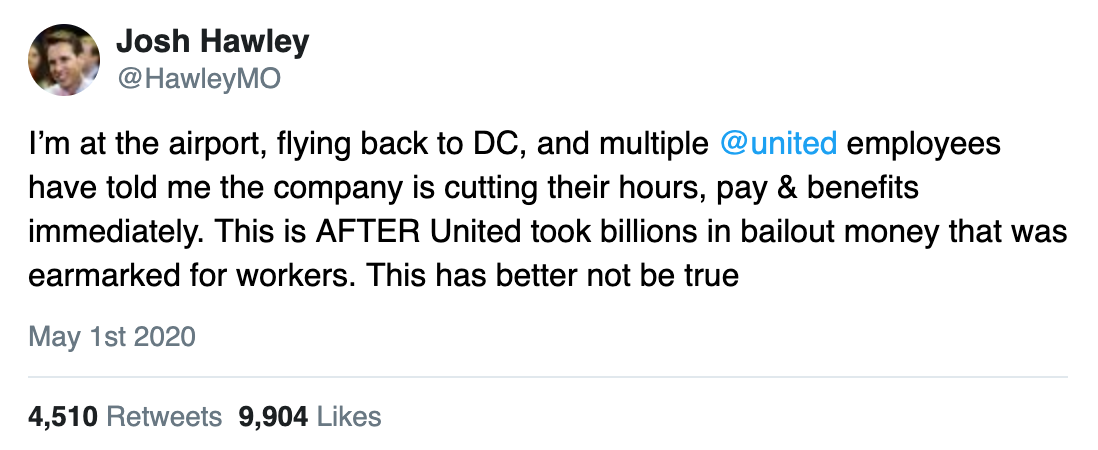
This installment of The Pomp Letter is free for everyone. I send this email to our investors daily. If you would also like to receive it every morning, join the 45,000 other investors today.To investors,The airline industry was bailed out to the tune of approximately $50 billion by the federal government. The goal of this money was to help companies retain workers and prevent even greater levels of unemployment. As you would expect, the federal relief came with specific rules that each company had to follow in order to be eligible for the funds.We are now only a few weeks since the stimulus package was passed and we are already seeing the nefarious, unethical behavior of corporate America. Lets use United Airlines as the example here.United received approximately $5 billion in the bailout and they are applying for even more money under the CARES Act. The $5 billion is structured as a $3.5 billion grant and a $1.5 billion loan. Yes, you read that right. United Airlines was given $3.5 billion of tax payer money in exchange for NOTHING. Zilch. They just got a handout from the government to the tune of $3.5 billion.One of the stipulations for this money is that the company must agree to continue employing their workers, while also refraining from lowering salaries or hourly wages. Makes sense, right? Right. But of course United Airlines and their lawyers got out their magnifying glasses to find the loophole.Nowhere in the rules does it say that United is prevented from cutting the hours of their workers, so this is exactly what they have decided to do. United Airlines is cutting 25% of the hours for 15,000 employees. They will go from working 40 hours a week to only 30 hours a week. This loophole allows the company to decrease the income of each worker by 25% without violating the rules of the federal bailout.This was obviously not the point of the bailout. As you can see, some legislators are pissed that the companies have found a loophole in the law and are exploiting it. But who should be blamed here? Should the company be the bad guy for finding the loophole? Or should lawmakers be reprimanded for writing a law that didn’t account for this type of behavior? The blame is probably not exclusive to either group, but rather shows the complexity of the situation, along with the incentive for bad behavior during a time of economic stress.As if this wasn’t bad enough, United also recently sent out a memo to approximately 11,500 administrative staff employees telling them that the company will likely layoff 30% of them in October. Why October? Because the federal relief timeline will have expired by then, so United will get to keep the money and then will be free to fire thousands of employees. Additionally, the company is requiring any non-union workers to take 20 days of unpaid leave as well. This entire situation sucks. It is unpleasant for the corporate leadership. It is worse for the employees. None of them foresaw this type of issue, nor did they contribute to the rise of a virus that sent everyone home. But just because they didn’t cause the problem, doesn’t mean they get a free pass either. This is how the game of business works. You have to handle the good and bad times. Sometimes you make decisions that change your situation and other times your situation changes because of things outside your control.At the end of the day, we are now seeing the downsides to bailing out corporations. A bailout is really the government trying to prevent a natural market correction. If they didn’t intervene, United Airlines would file for bankruptcy protection and the assets / equity would be bought by new ownership. That transition would hopefully land the company in better hands that would be better prepared in the future. This is the risk that equity holders take. By not allowing this natural market function to occur though, the government is changing the risk-reward framework for equity owners and actually incentivizing bad behavior. We should have let the airlines fail, rather than bail them out and now force me to write this letter today about all the dumb and nefarious things that the companies are doing. The US government has a “God-complex” when it comes to the markets. They think they can do no wrong and they believe that they can solve any problem by interfering. The issue is that they are actually making the situation worse. They are preventing a free market from going through the natural cycle. The allure of a short term bandaid actually drives a much larger, long-term problem.United Airlines should be forced to give the money back if they cut workers hours. They tricked the US government into giving them billions of dollars of taxpayer money for free. There is not an investor in the equity or debt markets that would have done this deal. No investor would depart with billions of dollars for nothing in exchange. This is a sweetheart deal that proves the government is the idiot in the room when it comes to negoti
Is It Really Debt If You Never Plan To Pay It Back?
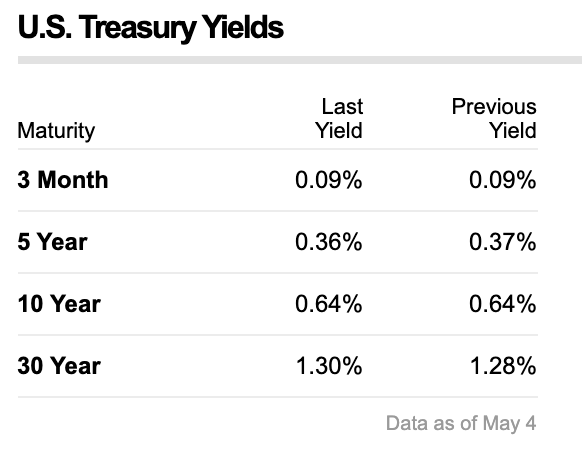
This installment of The Pomp Letter is free for everyone. I send this email to our investors daily. If you would also like to receive it every morning, join the 45,000 other investors today.To investors,The United States has approximately $25 trillion in debt. The country was expected to experience a $1 trillion deficit this year, which is the difference between how much money they spend and how much money they earn. But then coronavirus hit. And as the great Mike Tyson once said, everyone has a plan until they get punched in the mouth.The health crisis required an unprecedented government response that led to a near complete shut down of the global economy. This put many businesses and individuals in a tough spot. They had their source of income shut down or materially hindered. More than 30 million Americans lost their jobs. And numerous industries saw their revenue vanish.In an effort to mitigate the economic carnage, the Federal Reserve and US government began announcing monetary stimulus packages aimed at putting money in the hands of those who needed it. People will debate whether the programs were structured perfectly or not, but no one can deny that the Fed was quick to act and was much more aggressive than many predicted. The packages saw increases in unemployment benefits, forgivable loans to small businesses, and bailouts of major industries. This all costs a lot of money for the federal government to fund. So they are obviously just funding everything with the revenue that they get from our taxes and other income sources, right?Wrong. At the same time that spending had to drastically increase to address coronavirus issues, revenue for local, state, and federal governments was drastically decreasing as well. Remember, everyone has been sitting at home for almost two months now, so naturally each income source has drastically decreased.Whether you’re a business, a family, or the government, it is never a good situation when you have to spend way more than you make. This violates one of the core principals of finance. And this was after the US government was already expecting to run a $1 trillion deficit for the year without coronavirus happening.So how does the government fund so much spending if they don’t already have the money? They do what any business or individual would do — they borrow what they need. And yesterday we were told that the US Treasury is planning to borrow $2.99 TRILLION dollars in the 90 day period between April and June. To put that in perspective, the US government has $25 trillion in total debt so this would be more than a 10% increase in just 90 days.Now obviously the Treasury is run by a bunch of smart people who spend time thinking about this every day. They aren’t perfect, but they also aren’t complete idiots. Why would they borrow so much money right now? Easy — the cost of borrowing money is so low that they are actually financially incentivized to do it.The way this works is through Treasury bonds. They issue an IOU to investors saying “give me X dollars and I will pay you back in a certain amount of time at the Treasury bond rate.” These bonds can mature at various times from 3 months to 30 years and the interest rates are all sub 1% except for the longest timeline bond.So when the US government needs money, they issue bonds to raise capital. Those bonds represent debt. But here is the big question — is it really debt if you never plan to pay it back? Now I don’t mean that the US government is planning to not make people whole on the Treasury bonds. That is possible, but it is a very, very small probability in my opinion. I’m more specifically talking about the idea that the US government continues to increase the national debt and doesn’t have a plan to (a) run a budget surplus, nor (b) eventually pay off all the debt.What they are really running is a mirage of confidence. As long as investors continue to believe that the US government will find a way to pay back their Treasury bonds, those investors will continue to lend money to the government. The funds to pay back individuals can come from revenue-generating activities (ex: taxes) or from the proceeds of issuing more debt (ex: essentially re-financing the original bonds).If the confidence is ever lost though, there would be a massive problem. The United States would owe almost $30 trillion to investors and no one would believe they are going to be paid back. It would lead to one of the largest defaults in history. Again, I don’t think we are close to that scenario yet, but I do believe that the Treasury is playing a game that has become impossible to win.The federal government will never be able to pay their debt. They can’t drive enough revenue to get to profitability and issuing more debt to raise capital would only make the situation worse. Investors are constantly betting billions of dollars in the markets on what they believe will be the second and third order effects of this situation, so I won’t opine o
The Data Is Finally Revealing How Bad The Economic Carnage Really Is
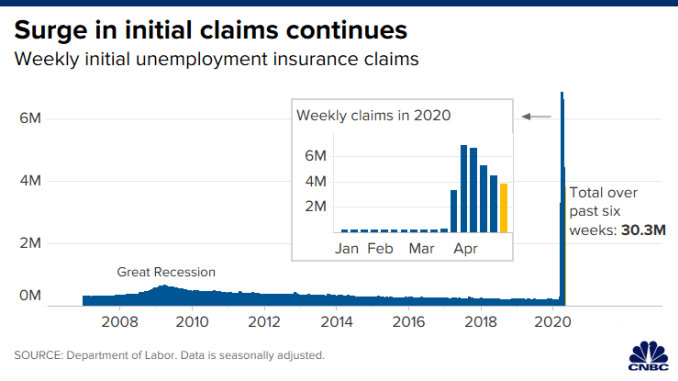
This installment of The Pomp Letter is free for everyone. I send this email to our investors daily. If you would also like to receive it every morning, join the 45,000 other investors today.To investors,There were 3.8 million Americans who filed for unemployment last week. This brings the total new claims to over 30 million in the last 6 weeks. The speed and gravity of which the unemployment situation has transpired is breathtaking. The good news is that the number of first-time jobless claims continues to fall week-over-week since mid-March. The bad news is that we are becoming desensitized to the size of these numbers. There were more than 3,800,000 people who lost their job and filed for unemployment insurance last week. That would have been more than a 50% increase in national unemployment back in February, but now we view this as an encouraging number.The unofficial numbers for unemployment are likely to be over 20% at this point. Some of these people will hopefully find relief in the coming weeks as various cities begin to re-open. This is going to be easier said than done:* What metrics will determine when a city opens versus when it doesn’t?* How is success measured when re-opening? What will signal it isn’t working?* Can a city re-open all businesses immediately or do they allow certain industries before others?* What are the requirements on citizens during the re-opening? Masks? Social distancing? Curfews? * What is the process for pausing the re-opening if it is not going according to plan? Can a city stop the re-opening and reinstitute the shelter at home order?This is a highly complex situation. There is unlikely to be one right answer. Each city and population are different. People will politicize whatever decisions are made, which will only add pressure and scrutiny. There are people much smarter than me that will focus on the re-opening of the economy. The truth is that the economic reality is much worse than what is being represented in the stock market. We are starting to get some of the economic and corporate data that is necessary to help us measure the true carnage. Take American Airlines for example:“American Airlines lost more than $2.2 billion in the first three months of the year — its biggest quarterly loss since 2008 —as the coronavirus pandemic drove down demand for air travel.American’s revenue dropped nearly 20% from a year earlier to $8.52 billion, slightly below analyst estimates. Shares were down more than 3% in morning trading.American, like other airlines is facing a sharp decline in passengers because of the coronavirus pandemic. U.S. airline travel volumes dropped by about 95% in recent weeks from a year earlier as travelers stay home because of concerns about the virus and shelter-in-place orders.”These sound like crazy numbers, until you realize that American Airlines is losing $70,000,000 a day right now. This level of economic damage would have been unfathomable only 6 weeks ago. They aren’t the only ones though.Bob Pisani wrote a nice summary of various companies that are sharing good and bad news at the same time during their earning reports:“Shipping giant UPS is getting more revenues from Americans shopping online, but delivery of shipments to businesses has shrunk dramatically. 3M is making money selling its N95 masks and noted strong growth in personal safety products but it is still laying off workers in other divisions and withdrew its full-year guidance.Music streaming service Spotify reported a loss that was less than expected and added more users, both paying customers and those who listened to its free ad-supported category. But it lowered its revenue guidance for the year as ad sales fell.Even food companies are having a tough time figuring out what is going on. You’d think snack maker Mondelez would be doing better: They make Oreos. They did beat estimates, and consumers certainly stockpiled food. But the company withdrew its 2020 forecast due to uncertainty surrounding the impact of the virus.You’d think the lab-testing business would be booming, but no. Even testing giant Laboratory Corp., which reported better-than-expected profits and is rolling out a new coronavirus antibody test, is withdrawing 2020 guidance due to the pandemic, and taking other actions including furloughing workers.”What a weird, unprecedented time we are living in. To make things even more confusing, the public market is not acting how most would have predicted. The economic data is obviously bad, including a 4.8% drop in GDP.But there are a lot of people scratching their head as to why the economic data is so bad, yet the stock market continues to rally. In fact, the stock market is ending one of the best months ever. According to CNBC:“Wall Street came into Thursday’s session on pace for one of its best monthly performances in decades. The S&P 500 was up more than 12% for the month and on track for its biggest one-month gain since 1987. The Dow was up 11% in April, which would

The United States Is Facing The Ultimate Decision
This installment of Off The Chain is free for everyone. I send this email to our investors daily. If you would also like to receive it every morning, join the 45,000 other investors today.To investors,The economic situation has deteriorated at an even faster pace than most expected. On March 18th, I wrote that “the unemployment numbers in the United States have the potential to quickly match the numbers from the Great Depression. I understand that the statement may seem ridiculous at first glance, but let me walk you through some math.”The claim only a month ago that we could hit unemployment numbers equal to the Great Depression was so absurd to many that I had to explicitly acknowledge that they would disagree with what I was saying. Unfortunately, the situation has transpired even faster than I anticipated, which means that we are seeing much bigger numbers than I thought possible.In that March 18th letter, I explained that the Great Depression unemployment numbers are usually misunderstood. The letter stated:There was a relatively slow ramp up in unemployment in the beginning of the Depression. Here are the year by year unemployment statistics in the US:* 1929 — 3.1%* 1930 — 8.7%* 1931 — 15.9%* 1932 — 23.6%* 1933 — 24.9%* 1934 — 21.7%* 1935 — 20.1%So as you can see from the data, it took until the third year of the Depression before we hit double-digit unemployment numbers. People always focus on the peak number of 24.9%, but they forget that 3 of the 5 years of the Depression (1929-1933) had unemployment levels under 20%. This doesn’t mean that 8 - 20% unemployment levels are good. It just means that the peak number isn’t a great representation of the entire period.Finally, I stated that it was possible that we could start to see Great Depression unemployment numbers by the end of Q3 2020. That thought was summarized by saying “the second year of the Great Depression saw 8.7% unemployment, which would 2.4x increase from our February unemployment numbers. It makes me incredibly sad to say this, but I think we could see those types of numbers by the end of Q3 2020. Year 3 of the Great Depression saw 15.9% unemployment, which would be 4.5x from our February numbers. Again, this type of increase over a long period of time would be crazy, but the early data we are seeing would suggest that many states have seen larger increases on a percentage basis just in the last few days.” The unemployment claims that were reported today totaled more than 5.2 million Americans for the last week. This is on top of the 16+ million Americans that filed for unemployment in the three weeks before that, which means that almost 22 million people have filed for unemployment in the last month. 22,000,000 people in a month. This brings the total unemployed in the United States to nearly 28 million people when you include the 5.8 million people who were already unemployed before COVID-19 took over.There are about 165 million people in the US labor force, so this puts the current unemployment level over 16%. That means that in less than 6 weeks, we went from historic lows in unemployment to levels greater than the second year of the Great Depression. While this is scary, the more concerning thing is the rate at which this is happening. If we continue on this trend, we could see 20-25% unemployment by the end of Q3 2020. This would be more than double what I originally thought was possible. Now that we understand what the problem is, we have to ask ourselves how can we solve it? The easy answer is that we have to get people back to work. We have to turn the American (and global) economy back on. Obviously there is a health crisis transpiring though, so we must do it in an intelligent and safe way. There are experts who are much smarter and more experienced that I am who will determine the exact details of that economic re-start, but that is the simplest answer.The more complex answer includes numerous aspects of government aid or relief. We have already seen the recent stimulus package that (a) beefed up the amount of money available via unemployment insurance and (b) promised to give most Americans a one-time check of up to $1,200. These stimulus efforts will definitely help, but they are unlikely to be the complete answer if this crisis lasts into May (highly likely).The average rental payment for an apartment in the United States is about $800, so if an individual receives the full $1,200 than they would have enough money to pay their rent and buy groceries for a month basically. They would be out of luck for anything past that one month of coverage. This leads to a new proposal that has been floated by two lawmakers — the Emergency Money to the People Act.This proposal states that every American that makes under $130,000 and is over the age of 16 years old will receive $2,000 a month until the economy fully recovers and unemployment levels drop back to pre-COVID levels. This is an interesting proposal for a number of reasons. Fi
The Magician Has Been Exposed
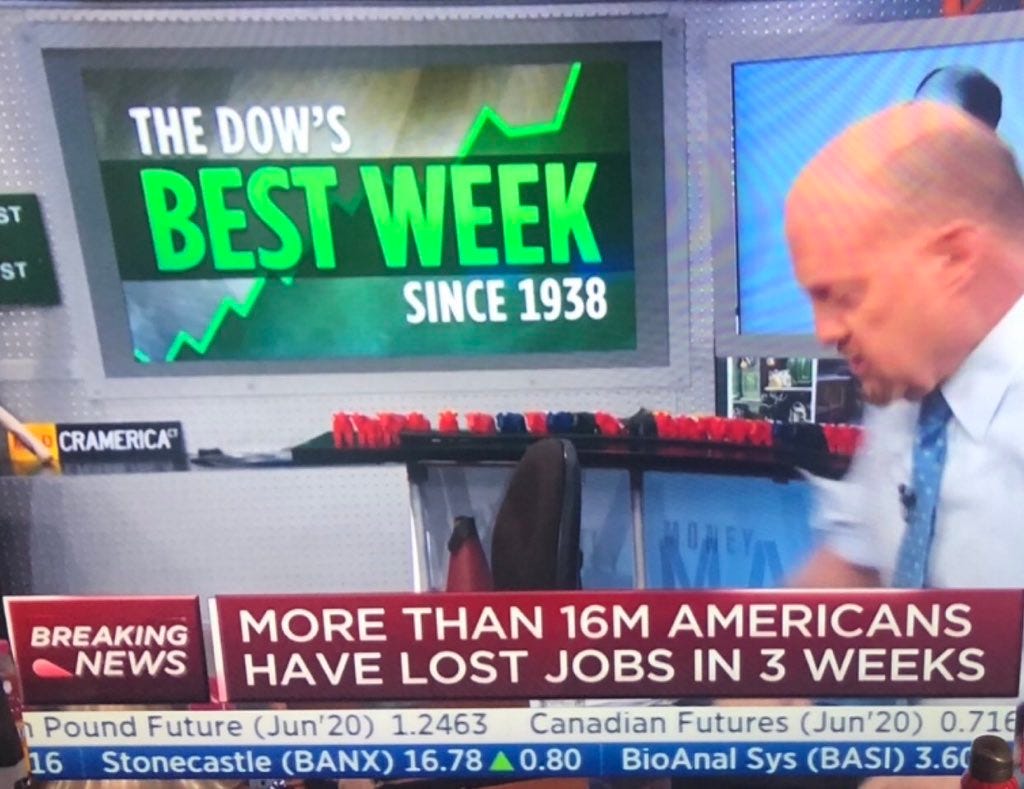
This installment of Off The Chain is free for everyone. I send this email to our investors daily. If you would also like to receive it every morning, join the 40,000 other investors today.To investors,The general public is starting to realize the greatest magic trick of our generation is actually a magic trick. What do I mean? The average citizen is starting to recognize that US dollars, like all fiat currencies, are just funny money.Most people in finance already know this and go along with it because that is how the game is played. The wealthy and powerful benefit from the game. They are financially incentivized to keep the game going. The same can’t be said for the average citizen. They are actually hurt by fiat currencies. The average Joe doesn’t own any stock. They don’t own real estate. They own no gold or bonds either. They simply live paycheck-to-paycheck and have no inflation adjustment in their wage contracts.This has been going on for decades and the wealth inequality gap has only widened. So why are people starting to pay attention now, rather than some other time? They are seeing blatant examples of how the Federal Reserve, Treasury, and US government create money out of thin air. There is more transparency than ever right now and people are paying attention because they are scared.This single image explains a lot of what is going on in the Western world. The stock market is surging, while unemployment continues to reach all-time highs.There are over 21 million Americans in the labor force who are unemployed right now. Over 16 million of those people have lost their jobs and applied for unemployment insurance in the last three weeks. And these are just the people who have successfully filed their claim. The reality on the ground is much worse.So now you have millions of Americans sitting at home with very little to do other than pay attention to finance and the economy. There are no sports being played. There are no birthday parties or nights out on the town to look forward to attending. There is nothing but social media, Netflix, and the daily news updates on COVID-19 and the economy.These people continue to see the Federal Reserve create trillions of dollars out of thin air, while simultaneously claiming that they have unlimited money. This is like kicking someone when they are down. The average citizen is wondering how they can weather this horrific financial storm and the Fed is boasting on national television that they will never run out of money. The magic trick is being revealed. It is becoming so obvious that you see people like Dave Portnoy, the founder of Barstool Sports, publicly sharing content calling out the nonsense to his 1+ million followers on Twitter.This is the exact type of content that informs the non-finance audience about how money actually works. Remember, we don’t teach this information in schools. Not because no one ever thought to teach financial education, but rather because the economy depends on majority of people not understanding how it works. Frankly, just a sad reality of the world we live in today. As if the current situation of people getting a crash course in money wasn’t bad enough, politicians are now trying to bribe the general public with “gifts” that will make them more likable. First we saw the stimulus checks of up to $1,200 get announced and then we saw President Trump announce no student loan payments for at least 6 months. These developments have been presented as “we want to help you!,” but in reality these are merely bribes to keep the peace.The truth is that the government has shut down the US economy. Those 16 million Americans that lost their job can point their finger directly at the current administration as the cause of their jobless status. That would piss a lot of people off, especially since it appears there will be millions more laid off in the coming weeks. So how does the government avoid social unrest? They tell everyone to stay home for their own safety, they use the police and military to enforce that order, and they start bribe the people with stimulus checks, rent abatements, and student loan deferrals.The problem is that these short term solutions will help our society from spiraling into social unrest, but they reveal that money is only a belief system over the long run. The unintentional consequence of these actions is that millions of Americans are receiving the financial education about money that isn’t taught in schools. As the great Henry Ford once said, “It is well enough that people of the nation do not understand our banking and monetary system, for if they did, I believe there would be a revolution before tomorrow morning.”This is the risk that the current administration is taking. They have to keep the peace in the short term, but they also have to avoid teaching the masses that the Federal Reserve can simply print as much money as they want. Some of you will think that is a ridiculous statement, so why am I saying t
We Continue To Be Headed Towards Great Depression Unemployment Numbers
This installment of Off The Chain is free for everyone. I send this email to our investors daily. If you would also like to receive it every morning, join the 40,000 other investors today.To investors,The United States economy has been shut down due to the coronavirus quarantine. As I wrote a few weeks ago, there is a high likelihood that we could reach levels of unemployment not seen since the Great Depression. The write-up included the year-by-year unemployment numbers:“There was a relatively slow ramp up in unemployment in the beginning of the Depression. Here are the year by year unemployment statistics in the US:* 1929 — 3.1%* 1930 — 8.7%* 1931 — 15.9%* 1932 — 23.6%* 1933 — 24.9%* 1934 — 21.7%* 1935 — 20.1%So as you can see from the data, it took until the third year of the Depression before we hit double-digit unemployment numbers. People always focus on the peak number of 24.9%, but they forget that 3 of the 5 years of the Depression (1929-1933) had unemployment levels under 20%. This doesn’t mean that 8 - 20% unemployment levels are good. It just means that the peak number isn’t a great representation of the entire period.”This morning we got the first data point on how bad the unemployment situation is looking already. The US Department of Labor reported that 3.28 million Americans filed for unemployment claims in the week ending March 21. That is more than 4x the worst previous week of unemployment claims ever (695,000 in October 1982).(Photo by Alex Proimos)This record number of unemployment claims is not a surprise to most people given the fact that the economy has been shut down. People were told to go home and businesses were ordered to shut down. When you go from a thriving business to $0 in revenue, people are going to lose their jobs. In fact, A LOT of people are going to lose their jobs very quickly. The national numbers are obviously concerning, but the state numbers are even crazier. According to CNBC, “Pennsylvania increased 20-fold, from 15,439 to 378,908. New York saw its number more than quintuple, rising from 14,272 from the previous week to 80,334, while California tripled to 186,809. Louisiana, where coronavirus infections have risen at a dangerous pace, went from 2,255 a week ago to 72,620.”Maybe the numbers sound big, but the graph will tell a different picture? Nope. The graphical representation of this jump in unemployment claims actually makes it look even worse.It goes without saying that these millions of Americans need help immediately. The stimulus package that was approved this morning will provide some help, but it leaves a lot to be desired. The package will see a one-time payment of $1,200 to adults under a certain income threshold and $500 to every child. It includes a few hundred billion dollars for small business loans that the government will forgive if the business retains their employees. And there is an added $600 a week for those filing for unemployment benefits. These items can dull some of the pain, but it won’t solve the problem that 3.28 million Americans just filed for unemployment.So where does this leave the United States?Unfortunately, this puts us on the path to numbers that will be higher than the Great Depression as I predicted. We ended February with 3.5% unemployment (5.8M Americans), which is similar to the 3.1% unemployment at the start of the Great Depression in 1929. As I wrote recently, “the second year of the Great Depression saw 8.7% unemployment, which would 2.4x increase from our February unemployment numbers. It makes me incredibly sad to say this, but I think we could see those types of numbers by the end of Q3 2020.”After today’s unemployment claims report, we are sitting around 5% unemployment and have more than 9 million Americans in the workforce but without jobs. If we see a return to net new “normal” levels of unemployment, that could include an estimated 1 million Americans filing new unemployment claims each month. We would reach 9%+ unemployment by the end of August if this was to happen, which would be more than the first full year of the Great Depression (1930). Unfortunately, I think 1 million new unemployment claims a month is going to be overly conservative.We just had 3.28 million claims filed in the last week. Most small businesses have between 15 and 30 days of cash on hand to run operations without revenue. My guess is that a lot of them let staff go last week, but there will be more layoffs in the coming weeks. This also is not just a food service industry problem. We are seeing layoffs happen everywhere — from travel to hospitality to startups to manufacturing. The number of unemployment claims that was just reported is higher than I expected, so now I am starting to think we could see 10% unemployment by the end of Q3. That would be 25% higher than what I was thinking just 10 days ago. Time will tell what happens, but investors need to be prepared for the worst here.The United States has one of the strongest economi
The Economic 'Circle of Life' Has Been Broken
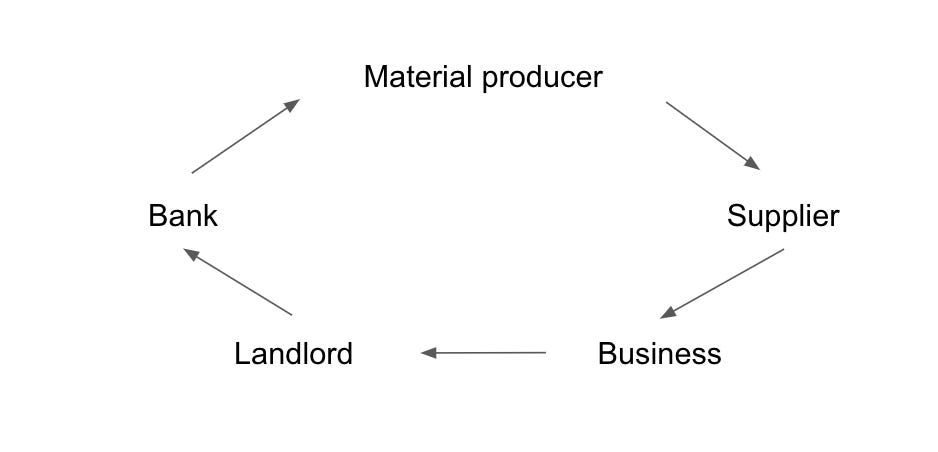
This installment of Off The Chain is free for everyone. I send this email to our investors daily. If you would also like to receive it every morning, join the 40,000 other investors today.To investors,The Lion King is an animated movie that has captured the imagination of young children for decades. There are many life lessons that can be taken from the film, but one of the core ideas presented is “the circle of life.” In the movie, this has a double meaning — (a) the young cub eventually grows up and becomes King of the Jungle after his father’s death, which is followed by him having his own cub and (b) the animal kingdom relies on energy passing through various forms (ex: animals eat the grass, other animals eat those animals, etc).This idea of a repeating circle is very obvious in nature, but it also exists in an economy. An over-generalized version of an economy’s circle of life would look something like this:Materials are produced and sent to suppliers. Suppliers turn those materials into products. Businesses buy the products and re-sell them to consumers. Those businesses take revenue from the consumers and use it to pay rent to the landlords that provide office and retail space. Those landlords make payments to the banks in exchange for financing the purchase of the buildings. And finally, those banks provide capital to the material producers to restart the circle of life. Obviously this is not a perfect description of how the economy works, mainly due to a lack of desire from myself to incorporate complexity into the diagram, but you get the general idea.This economic circle of life is important to understand right now, because we are about to witness a chain reaction that will start creating problems for every participant in the circle. Everything starts with the businesses right now — they are the most vulnerable link in the circle.We have recently seen a significant drop in consumer demand coupled with a government-mandated shut down of many businesses. Consumers became scared of COVID-19, which led them to stop spending money on travel, hospitality, and other industries. As the virus became a more serious concern, the government stepped in and began ordering the shut down of any “non-essential” businesses in many cities and states across the United States. The lack of consumer demand combined with the government-mandated closure of businesses has created a break in the economic circle of life. This has two major impacts on the other participants:* Upstream impact — As businesses close, they no longer need the supplies from their suppliers and vendors. They go from consistent weekly and monthly orders to zero overnight. This obviously leads to lost revenue for the suppliers, along with existing inventory that they can not sell (Read this piece to see how this works in the restaurant industry). The suppliers then need to slow their ordering from the material producers, which creates significant issues for them as well. You can think of the upstream impact as a dam in a river — once the dam is in place, everything upstream backs up and just sits there until the dam is opened or removed.* Downstream impact — Most businesses in America are seeing revenue drop significantly, including many cases where it is going to zero. This could be from the lack of consumer demand or because the government forced the business to shut down. In either case, the company has less money coming in the door, but they still have their fixed costs to pay for. Rent is one of the largest fixed costs for most businesses, so there is immediate pressure applied to a business from the perspective of “how are we going to pay our rent?” This downstream impact is what I want to spend time talking about today.Estimations that we could see GDP drop 25-50% in the second quarter this year. That would be an unprecedented drop, but this is not just a random number in a spreadsheet. It has a direct impact on how many businesses can continue to pay their rent without revenue coming in the door — short answer: very few.This puts landlords in a really bad place. They can be overly understanding and give tenants deferred rent plans or some version of rent abatement. It sounds good in theory, but the landlord has loan payments to make to the bank. Unless the bank makes concessions to the landlord, the landlord is likely unable to make concessions to the tenant. So why wouldn’t the banks make concessions to the landlords? Because that may lead to questions of solvency for many bank lenders.Don’t take my word for it.Billionaire Tom Barrack published an article last night that outlined a lot of this in a articulate, yet urgent, manner. There are many important points from his piece that I think are worth calling out. He highlights the breaking of the economic circle of life when he says:“Now everyone, from corporations and small and mid-sized businesses to employees and laborers from all walks of life, has been displaced from the normal chain of
The Best And Worst Assets Coming Out Of The Corona Financial Crisis
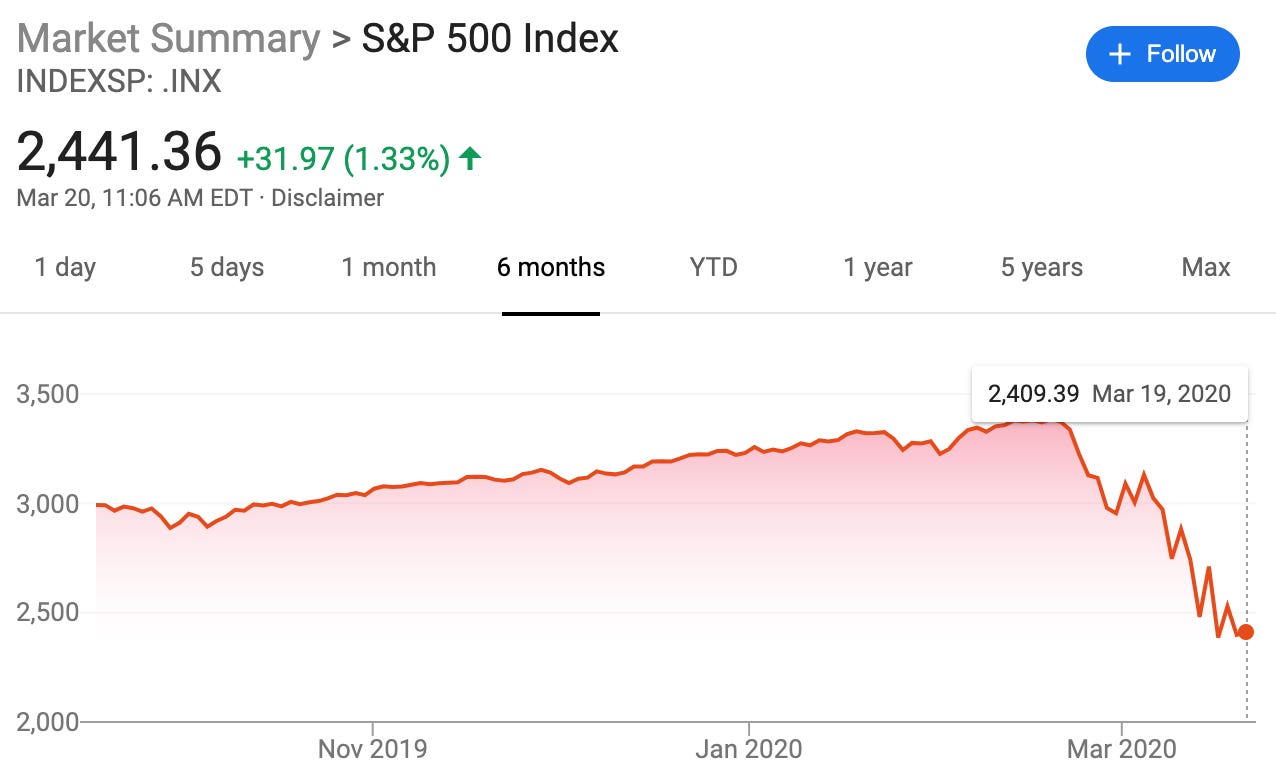
This installment of Off The Chain is free for everyone. I send this email to our investors daily. If you would also like to receive it every morning, join the 40,000 other investors today.To investors,The market chaos has continued across asset classes this week. We are seeing incredible levels of volatility, which is exacerbated by the likelihood that the US will see more than 2 million unemployment claims this week alone.Many investors are losing control of their emotional discipline. You can see confusion, fear, panic, and uncertainty in different sectors and strategies. It seems like every day a different billionaire is calling into CNBC with their hot take on how bad the economic situation is, what industries need to be bailed out, or which monetary stimulus option they are supportive of.While this makes for entertaining television, it doesn’t do a lot to help the average investor navigate these chaotic times. Below I have tired to put together my thoughts on a few assets and how they are likely to perform over the next 18-24 months. You should know up front that making accurate predictions is nearly impossible, so that is not my intention here. Instead, my goal is to document my thought process at this point in time. It will serve me well in the future as a data point to look back on, but hopefully it can inform a few people today as well.Obviously, I am not giving investment advice. Do your own research. Never invest more than you are willing to lose. And frankly, try not to be an idiot :)In order to share what I think is going to happen in the coming months and years, let’s start with an understanding of where we sit at the time of this writing:* Equities — The S&P 500 and Dow Jones Industrial Average are both down approximately 30% in the last month. The same thing goes for the Vanguard Emerging Markets Stock Index and other variations of public equities. * Oil — The price of oil is currently down about 60%, which includes a recent 25% rally that brought a barrel of oil from around $20 to just over $25.* Gold — The price of gold is currently down about 12% from a local high of approximately $1,700.* Bitcoin — The price of Bitcoin is down approximately 40% from around $10,000 to approximately $6,000 currently.I am intentionally leaving out the bond market from this analysis. I may cover that in a different letter, but unfortunately don’t have the time to research and produce valuable analysis there for today’s letter.We have seen large drawdowns in asset prices across markets, so where do we go from here?The answer is quite simple — almost every asset price is going to rise substantially in the next 18-24 months. It doesn’t take a rocket scientist to realize this. In fact, as long as you believe the United States will not fail and certain assets won’t go to zero, then these dips in price are actually attractive opportunities to increase your return although you are buying the same assets.But which assets are actually going to perform the best? The worst? I’ll break each asset down to elaborate on what I am anticipating will occur over the coming 18-24 months. Before I do that though, it is important to understand that these asset prices are dropping rapidly because the US dollar is strengthening. Any liquidity crisis presents a desire for investors to gain access to dollars. They will sell any asset they own that has a liquid market so that they can get liquidity.Over time, the dollar will have to be weakened in order for markets to stabilize and eventually recover. This is done by flooding the market with liquidity (dollars) which will devalue the global reserve currency. Let’s dig into what that means for the various assets:Equities [8 out of 10 rating]Most stocks are being sold off as part of the larger trend. The S&P, DJIA, and emerging markets are down about 30%. The sectors that are getting hit the hardest (hotels, airlines, hospitality, food services, etc) are seeing drawdowns that range from 50% (ex: Marriott Hotels) to 75% (ex: United Airlines). The big question on these “corona-impacted sectors” (CIS) is whether (a) they can survive multiple months of near complete loss of revenue, (b) will have to declare bankruptcy, or (c) the government will step in with assistance that bails out the industry.I separate the US public equity market into CIS and non-CIS because the non-CIS equities are likely to make a faster recovery during the next 24 months. I don’t think we will see a full recovery back to February 2020 highs. That type of recovery would likely take 3-5 years. This means that investors are likely looking at 20-30% return over the next two years in public equities if prices don’t go lower. If they do extend lower before the recovery starts, you would be looking at 40-70% returns over 24 months in non-CIS stocks (based on a total market drawdown of 40-50%). The “corona-impacted sector” (CIS) is a different story. The big risk here is that these companies could go bankrupt because most o

We May See Unemployment Numbers That Match The Great Depression By The End of 2020
This installment of Off The Chain is free for everyone. I send this email to our investors daily. If you would also like to receive it every morning, join the 40,000 other investors today.To investors,I interviewed Raoul Pal, the CEO of Real Vision Group and macro trader, about two weeks ago. He predicted that the COVID-19 issue would become the greatest financial event of our lifetime. At the time of the interview, many people were questioning the salacious nature of Raoul’s statement. That is no longer the case though. Many people are now worried that he may actually be correct.The country is grinding to a halt. Every day brings new challenges for small businesses and individuals. We are seeing some cities and states ordering bars and restaurants to close, while other cities are asking people to “shelter in place” and not leave their homes for any non-essential activity. It is not possible to have material economic activity or growth when everyone is sitting in their homes for weeks at a time. These letters have been focused on the macroeconomy and the Fed’s actions the last few days, but I want to take time today to talk about what is on the horizon — the unemployment numbers in the United States have the potential to quickly match the numbers from the Great Depression.I understand that the statement may seem ridiculous at first glance, but let me walk you through some math. The United States currently has about 164.5 million people in the work force and the unemployment rate is hovering around 3.5% (5.8M Americans).Here are the statistics on the Great Depression:* Timeline: August 1929 - March 1933* Duration: 43 months* Size of total labor force: 49 - 51 million people* Peak global unemployment: 24.9%* Low of US unemployment: 3.1% in 1929 (1.5M Americans)* High of US unemployment: 24.7% in 1933 (12.8M Americans)* Real GDP decrease during depression: 25%It goes without saying that the Great Depression was incredibly bad. At the peak, 1 in 4 Americans were unemployed. But the Depression started off in 1929 with a relatively low unemployment rate (3.1%), which is actually 40 basis points lower than where the United States was in February 2020.There was a relatively slow ramp up in unemployment in the beginning of the Depression. Here are the year by year unemployment statistics in the US:* 1929 — 3.1%* 1930 — 8.7%* 1931 — 15.9%* 1932 — 23.6%* 1933 — 24.9%* 1934 — 21.7%* 1935 — 20.1%So as you can see from the data, it took until the third year of the Depression before we hit double-digit unemployment numbers. People always focus on the peak number of 24.9%, but they forget that 3 of the 5 years of the Depression (1929-1933) had unemployment levels under 20%. This doesn’t mean that 8 - 20% unemployment levels are good. It just means that the peak number isn’t a great representation of the entire period.Today the United States is sitting at 3.5% unemployment as of the end of February 2020. This means that 5.8M Americans are without a job but still counted in the workforce. In order to reach the various annual unemployment levels of the Great Depression, here are the number of Americans that would be without a job:* 9% unemployment = approximately 14.8M Americans without a job* 15% unemployment = approximately 24.7M Americans without a job* 25% unemployment = approximately 41.1M Americans without a jobGiven that we only have 5.8M people unemployed today, these numbers feel astronomical and frankly, unattainable. That may not actually be the case though. Most people don’t realize that we are facing one of the greatest immediate drops in unemployment in American history. There has been a near complete shutdown of the hospitality industry and a significant blow dealt to the travel industry. Plenty of other businesses are being crushed as well. According to the US Bureau of Labor Statistics, there are approximately 16.8M people employed in the hospitality industry, including 14.3M in the Accommodations & Food Services Sector and 2.5M in the Arts, Entertainment, and Recreation Sector. The hospitality industry is obviously getting hit incredibly hard as multiple cities and states are ordering the closure of restaurants, bars, theaters, and other related venues. In many cases, these businesses are run on super thin margins, so the owners of the business are forced with the decision to immediately fire majority, if not all, of the staff or run at deep losses due to a lack of material revenue. Here are the various levels of national unemployment we would have according to specific percentages of the Accommodations and Food Services (AFS) Sector being laid off:* 10% AFS layoff = 1.68M people = 4.5% US unemployment (current + 10% AFS)* 25% AFS layoff = 4.2M people = 6.1% US unemployment (current + 25% AFS)* 50% AFS layoff = 8.4M people = 8.6% US unemployment (current + 50% AFS)* 75% AFS layoff = 12.6M people = 11.2% US unemployment (current + 75% AFS)I highly doubt that we are going to see more than 50% of the Accommodat
The Economy Needs Help So Where Will It Come From?
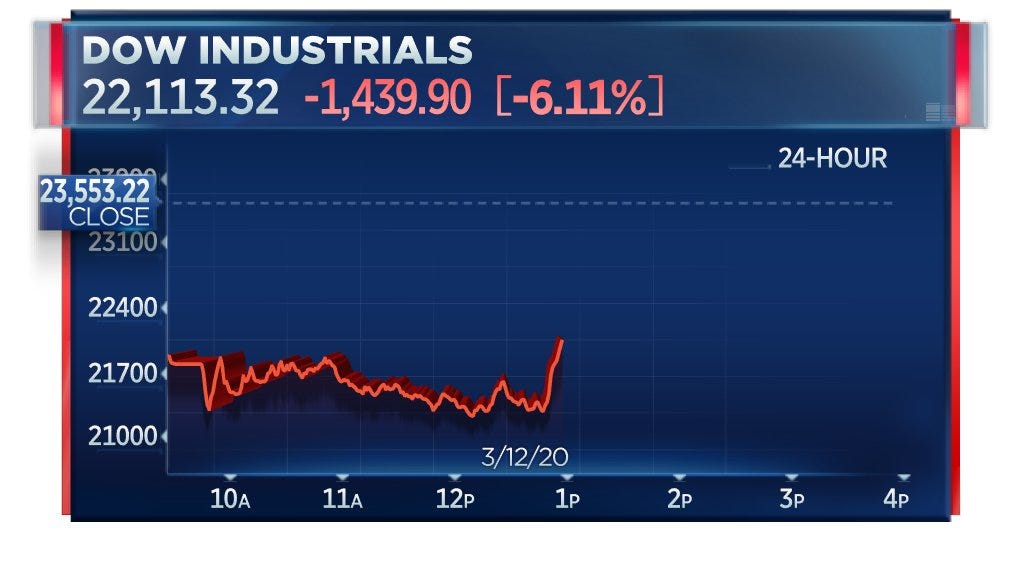
This installment of Off The Chain is free for everyone. I send this email to our investors daily. If you would also like to receive it every morning, join the 40,000 other investors today.To investors,The main focus for many people right now is to stimulate economic activity. The COVID-19 issue has driven cities and states to heavily encourage people to stay in their homes, which is grinding the US economy to a halt across numerous industries. While airlines and hotels are seeing significant drops in demand, there are bars and restaurants in major cities that are being ordered to shut down for weeks on end.This is a tough situation. We know that social distancing is effective in “flattening the curve” in the spread of COVID-19. We also know that many businesses, regardless of how fiscally prudent they have been, will suffer in a material way. In a way, we are watching those in positions of leadership have to make the decision between the health of the people and the health of the economy. Obviously the health of the people appears to be winning, but that doesn’t lessen the burden on the thousands of small businesses across the country.Many people believe that the government should step in with relief for the small businesses, along with help for the average citizen. There are a lot of different ideas that have been floated, but many of them fall into two camps:* Monetary stimulus — The US government should inject capital into the small business through various forms of payment. This could be a one time payment per business, a payment per business per day affected by shutdowns, or a payment per employee that the business continues employing. A few other plans involve extending loans on attractive terms to these small businesses as well. The exact details of each proposal are thin at best, but the general idea would be that the government conducts a version of UBI for small businesses for a period of time.* Fiscal stimulus — The US government should lower tax obligations or provide tax credits to small businesses in an attempt to put more cash in their hands. These include payroll tax cuts, federally funded paid sick leave, and tax relief for specific industries. This could be done in a variety of ways, but again many of the proposals are thin on details given how early we still are.The short answer is that there is not a single bullet that is going to solve the current problem set. We have structural issues in the legacy finance system (credit bubble, etc). We have small businesses that are going to suffer to the point of possibly having to go out of business in a matter of weeks. We have half our country that lives paycheck to paycheck, so they will start to worry about financial demands within 2-4 weeks. You need different solutions for different groups. Some of the solutions will have to be monetary stimulus and some will have to be fiscal. The ideal solution will expertly weave together both forms of stimulus to create the intended benefits, while mitigating the potential downside. Unfortunately, I’m not sure if there will ever be agreement on that ideal solution.While I have been thinking through these challenges and the potential solutions, two things keep dominating my mental energy — federal tax income relief for people and the share buyback vs bailout debate. I’m going to do my best to explain both of these below.First, lets look at the federal tax income relief for people. The argument would be that the federal government voids federal income tax for individuals for 2019. If you already paid your federal tax, you would receive a 100% refund. If you owe something for your federal taxes, you would be relieved from having to pay that amount. This would obviously be a big boost in cash for people, which could range from 10-37% of a single year’s income. The downside of this plan is that about 45% of Americans don’t pay federal income tax, so they wouldn’t receive a direct benefit from this effort. As I said before, we shouldn’t expect every solution to have an impact on every potential group. Instead, we should try to find easy to enact solutions that will have a positive impact on large quantities of people quickly. I think the federal income tax relief could be one of those solutions. Additionally, someone sent me a tweet this morning that highlighted that France is doing something even more aggressive:As many people pointed out, the payment of taxes is likely something that can be repeated in other countries, but the relief from utility bills is likely a France-only thing because much of their utilities are centralized via government control. Either way, it is interesting to see the suspension of taxes for companies, so it wouldn’t be a stretch to extend that same type of relief to the individual.Speaking of companies vs individuals, this brings me to the highly controversial debate of stock buybacks and bailouts. The basics of the debate are that companies have been using a lot of their free cash f
Wall Street Is Addicted To Stimulus And The 'Capitalists' Are Begging For Bailouts
This installment of Off The Chain is free for everyone. I send this email to our investors daily. If you would also like to receive it every morning, join the 40,000 other investors today.To investors,Yesterday was an absolute bloodbath across markets. It feels like I am writing that almost every day now. There is not a person participating in financial markets that doesn’t have a pit in their stomach. This feeling can only be described one way — it sucks. Prices keep falling and falling. There is no end in sight. We all know that every asset is not going to zero, but the uncertainty of it all can be overwhelming to some.There is one main difference between all these market drops though. Every financial market in the world except one has hours of operation and structural mechanisms to prevent high levels of volatility. Take the US stock market for example. It trades from 930am to 4p EST every day. If stocks ever fall 7% in a single day, trading is halted for 15 minutes. If they proceed to fall 13% in a day, trading is halted again. And god forbid they fall 20% in a single day, trading is over for the day. Why does the market operate this way? Those in power believe it is the best way to protect investors.But this is not how free market capitalism works. Take the Bitcoin market as a comparison. There are no hours of operation. Bitcoin trades 24/7/365 on a global basis. The market can go up as much as it wants and it can go down as much as it wants. Circuit breakers are non-existent. For example, Bitcoin literally dropped more than 50% at one point yesterday, before rallying back significantly to end the day only down approximately 30%.That is a level of volatility that most traditional investors couldn’t stomach. They are too used to the non-volatile, traditional asset markets. But the current liquidity crisis is screwing up that level of comfort. We are watching the traditional investors get uncomfortable really fast. Yesterday, the S&P 500 was down 9.5% for the day. If you look at historical volatility levels, this would be the equivalent of Bitcoin dropping 51%. The difference is that Bitcoiners are used to the volatility, while the stock investors are acting like the world is ending.Additionally, the S&P fell 9.5% even though (a) the circuit breakers went off after the initial 7% fall upon the opening of the market and (b) the Fed announced a monetary stimulus plan that totaled more than $1.5 trillion. Yes, you read that right. The S&P 500 was as volatile as Bitcoin’s 51% price drop on a relative basis, yet this all happened in spite of the market structure mechanisms that have been put in place. Most traditional investors will argue that those market structure mechanisms are net positives, but I would argue the exact opposite.The stock market is full of fragile assets. They can’t withstand volatility or pressure. The investors are soft. They don’t know what true free markets look like anymore. Whenever something bad starts to happen, they just start yelling for the Fed to come in and bail them all out. This isn’t capitalism, this is a form of socialism. The rich people just don’t like to use that word when they’re the ones doing the begging for help. Why should majority of Americans pay for the misdeeds and bad decision making of the investors who keep buying the stock market equivalent of shitcoins?! Short answer — they shouldn’t.But this isn’t just my opinion though. In a weird new development, the market is starting to call the bluff of the Fed. When the Federal Reserve announced $1+ trillion in monetary stimulus yesterday, the stock market recovered about 200 basis points for a few minutes before puking even lower. Simply, the market doesn’t believe that the monetary stimulus will work. We already know that the market has priced in a near 100% chance that the Fed will cut rates at the next rate decision and most people believe an eventual 0% interest rate is a foregone conclusion at this point. This leaves the big decisions on the quantitative easing side — how much money can the Fed print?The short answer is that the Fed can print as much money as they want. It is literally backed by nothing other than the belief of people. If the market is unresponsive to $1.5 trillion in stimulus, this may be a sign that the Fed will have to print trillions of dollars. Yup, I wrote trillion with an “s” on the end. Absolutely insane.Remember, economies are like crack addicts. The crack addict was once sober. Then they tried a little bit of crack and got high. They liked it. So they do it again. And again. And again. Each time they try to get high, it takes a little more crack. At some point, the crack user becomes a full-fledged addict and needs incredible amounts of crack to get the same high.This is how economies become dependent on monetary stimulus too. They were once void of it. Then they tried a little bit of stimulus and it worked. They liked it. So they did it again. And again. And again. Every time they d
The Liquidity Crisis Will Drive Monetary Stimulus, Which Will Force The Adoption Of Sound Money Properties
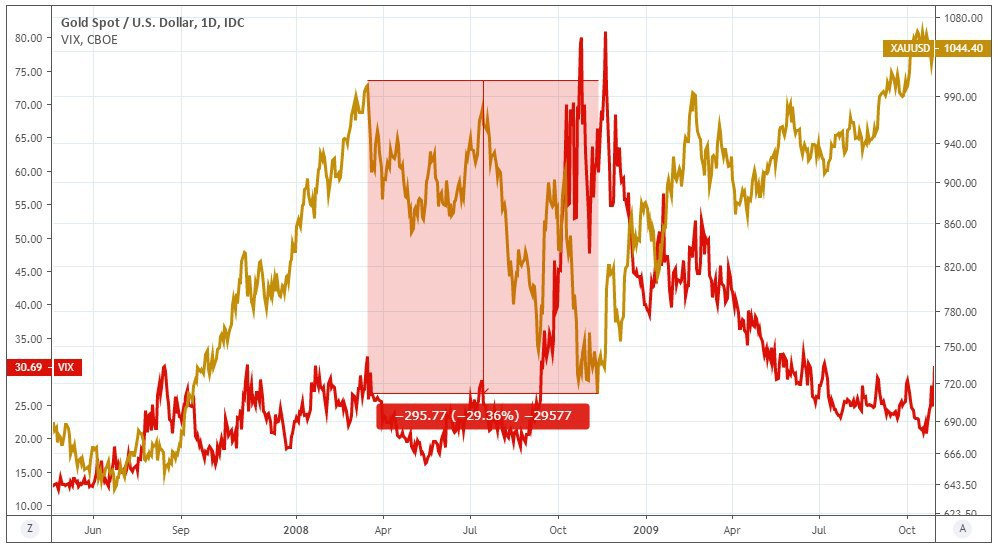
This installment of Off The Chain is free for everyone. I send this email to our investors daily. If you would also like to receive it every morning, join the 40,000 other investors today.To investors,We are watching history unfold. There will be books written about the events that are transpiring in financial markets right now. Every day feels like a month. Fear and panic are dominating the minds of most people. As I wrote earlier this week though, like most things in life — this too shall pass.Before we get into my thoughts about where we are, here is what has happened in the last 24 hours or so:* The big news was that President Trump gave a national address last night related to COVID-19 and the subsequent economic / health impact. The key points of the speech were that travel from Europe to the US will be greatly hindered for the foreseeable future, the government is working on financial relief for small businesses and/or individuals affected by COVID-19’s economic slowdowns, and the IRS is likely to extend the tax reporting date for some. * The NBA season was suspended indefinitely after a member of the Utah Jazz team tested positive for COVID-19.* The Italian government “ordered all shops in the country to close except for grocery stores and pharmacies until March 25. Public transportation as well as financial and postal services will continue, but the country’s normally vibrant restaurants, cafes and bars will be shut. Factories can continue operating, but only with precautions.”* The S&P 500 dropped 7% on opening this morning and immediately triggered the circuit breakers, which puts a halt on trading for 15 minutes. * The Dow Jones Industrial Average is down approximately 8.5% this morning.* Bitcoin is down approximately 23% this morning. * Oil is down approximately 8% this morning.* Gold is down approximately 2.5% this morning.This is just a small selection of the various developments. It can all be summed up with a simple framework:* COVID-19 has officially been labeled a pandemic by the World Health Organization. The necessary response requires social distancing and shutting down of large gatherings or various forms of economic activity.* The virus is grinding economies around the world to a halt.* The structural flaws in various markets are exposed when economies slow down, including too much leverage and lack of liquidity.Unfortunately, we are watching a liquidity crisis play out in real-time. These liquidity issues are well understood structurally, but feel much worse than expected when they occur in reality. A liquidity crisis means that investors all rush to the exit doors at the same time, but there are so many more sellers than buyers that investors actually have a hard time offloading their assets for cash. Quite literally, investors begin aggressively lowering the price they are willing to accept for each asset in exchange for the cash which they are desperately seeking right now.This is why you are seeing any asset with a liquid market tanking so hard right now. Additionally, the US treasury market (the most liquid market in the world) is experiencing incredible pain right now as well. These two charts show that volatility is exploding and there is increasing levels of illiquidity in the UST market. If this is happening in the most liquid markets, you can imagine how bad this is becoming in less liquid markets.Which brings me to assets like Bitcoin and gold. These assets have historically shown to be (a) non-correlated and (b) serve as safe haven assets. That all changes during a liquidity crisis though. In the short term, any asset that can be sold into a liquid market for cash is likely to be sold. Investors are incredibly insensitive to price. They need cash so badly that they will make traditionally irrational decisions in order to optimize for liquidity. These sellers (and liquidity seekers) include retail investors, hedge funds, banks, and pretty much anyone else that has exposure to financial markets. This type of imbalance in buyers and sellers also explains why the Fed is stepping in to repo markets (overnight borrowing) with such significant size (recently increased to $175 billion). The statement that the Fed put out explains it well:“Consistent with the FOMC directive to the Desk, these operations are intended to ensure that the supply of reserves remains ample and to mitigate the risk of money market pressures that could adversely affect policy implementation. They should help support smooth functioning of funding markets as market participants implement business resiliency plans in response to the coronavirus.”If the Fed doesn’t step in, there is even larger liquidity issues. Before we get off on a tangent though, I want to get back to the sell off in safe haven assets. Remember, the short term optimization for investors is for liquidity. If an asset has a liquid market, the asset will be sold for cash. There is not an asset on the planet that is immune from this market d

Footballs and Carpenters – How Commissioner Peirce Reinvigorated An Industry
Below is a guest post from Amy Davine Kim, Chief Policy Officer of the Chamber of Digital Commerce. I will be attending their blockchain summit on March 11th and wanted the organization to give a preview of the types of conversations that will happen at the event. Enjoy this guest post and hope each of you has a great weekend!One of the most difficult questions plaguing the digital asset industry is that of when is a digital asset a security, and when is it not? What are the rules? In some cases, this is obvious – for example, a digital representation of a physical equity or debt is itself a security. But in others, more consideration is needed. For example, when an investment contract is formed between a digital asset (token) provider and a buyer, and the buyer then receives the token, has been the subject of much discussion. In fact, the question is so thorny that the SEC has issued at least 17 pieces of guidance, and taken 48 enforcement actions, of which 26 have gone to court.The questions surrounding this space are creating a chill in the United States for blockchain development projects. Having the perspective of our more than 220 members and almost six years of experience representing our industry, we can see a clear shift toward projects overseas. Anywhere overseas. And businesses are not just looking for friendlier regulatory regimes. They are looking for clear rules of the road, with goal posts and yard lines well-marked, points delineated for certain accomplishments, penalties spelled out for clearly defined violations. Imagine if you were a football player, and the referees may or may not acknowledge your touchdown or call a penalty. Would you reconsider your playbook? Would you play the game at all?The Chamber has long taken the position that violations of law must incur penalties. Orderly application of laws creates a fair marketplace. It seems, however, that we have fully embraced this role, without the corresponding consideration of how to support innovative technologies to create new and better networks.That’s why Commissioner Peirce’s safe harbor proposal is important. In it we see the Commissioner attempt to create a period of time in which developing companies can grow a network that is never intended to be a security or operate as one. Certain consumer protection principles must be met to comply with the requirements, and the platform must meet “Network Maturity” within three years to receive the full benefit of the safe harbor and, presumably, not be considered a security at the other end.Notably, Network Maturity is reached when a platform is decentralized or functional. This is important because it demonstrates an evolution from Director Hinman’s speech, Digital Asset Transactions: When Howey Met Gary (Plastic) in June 2018, in which he determined that certain tokens, such as bitcoin and ether, have become so decentralized that they are no longer considered securities (if they ever were). Decentralization, if we are able to define it sufficiently, would eliminate the presence of one factor in the Howey test, reliance on the efforts of others. However, the safe harbor also allows for another option, functionality. These do not need to be achieved together, but are alternatives, either of which defeats the Howey analysis because, at functionality, the item has become a consumable good.The achievement is also notable because it no longer forces companies into one business model – that of decentralization. While decentralization is one of the true transformations that Bitcoin and other protocols offer (allowing those who do not know or necessarily trust each other to interact), requiring this element as the only way to avoid the application of the securities laws forces businesses into one type of business model. Why should founders be forced to create something that must be released to a broad community and step back from the project, relying on smart contracts and a network of validators to continue to function? While Bitcoin and others like it are extraordinary, we have seen some projects that would greatly benefit from the founders’ continued involvement to enhance or evolve the protocol’s functionality. Businesses are not static; they adapt to changing environments, competition, customer needs, and demand. We should allow for the possibility of this dynamic environment for blockchain platforms as well.Commissioner Peirce joined the Chamber for a private meeting last week to detail her views on this proposal and take questions from our members directly. While many of our members are supportive, some asked questions probing certain points. In my view, receiving critical views can sometimes be even more productive – causing creators to think carefully about proposals and enhance them to address all angles. While we have recommendations to help enhance Commissioner Peirce’s proposal, I appreciate her effort to develop such an innovative idea and create clear rules for players to follow.
Bitcoin fundamentals continue to strengthen
Join thousands of others who receive this daily analysis of crypto markets & news in their inbox every morning - subscribe now.Bitcoin’s price is up almost 50% since the start of 2019. Instead of obsessing over the volatile price movements, it is important to stay focused on the underlying fundamentals of the transaction settlement network.Here is the current state of Bitcoin’s fundamentals:There are just under 17,700,000 of the 21,000,000 total Bitcoins in circulation.The hash rate securing Bitcoin’s network has increased more than 10x over the last two years.Miners are making almost 3.5x more Bitcoin (in USD value) on a daily basis than they were two years ago.The cost per transaction has more than doubled in the last two years, but has fallen more than 60% over the last 12 months.The number of transactions per day on the Bitcoin blockchain have increased over 70% in the last two years and continues to rise over the last 12 months after hitting a local low point in May 2018.The total number of Bitcoin blockchain wallets has increased over 2.5x in the last two years.With more computing power securing the network, and more users holding & transacting the scare, decentralized digital currency, it is no surprise that an individual Bitcoin is worth more than 440% today than it was two years ago.Bitcoin is a highly volatile asset. It is misunderstood by many. But one thing is certain, the digitally native currency continues to strengthen over time. As with anything important in life, the maturation and mass adoption of Bitcoin will take time.Those that have the patience and discipline to stick around will be rewarded handsomely.-PompThe “Off The Chain” podcast has been downloaded 800,000+ times in 160 countries. You can listen to the latest episode with Viktor Radchenko, Founder of Trust Wallet here: Click here for Off The Chain podcastTHE RUNDOWN:Tennis Star Serena Williams Reveals Investment in Coinbase: Serena Williams, one of the world’s most successful tennis players of all time, has revealed that she is an investor in cryptocurrency exchange Coinbase. Williams recently announced her VC firm Serena Ventures – which was secretly founded in 2014 – and listed some of its investments, including Coinbase and startups in areas such as fitness, clothing, food and women’s health and community. Read more.You Can Now Shop With Bitcoin on Amazon Using Lightning: Bitcoin spenders can now use the lightning network to shop at e-commerce sites like Amazon. Crypto payment processing startup Moon announced today that any lightning-enabled wallet can now also be used through Moon’s browser extension. Before this lightning feature, roughly 250 beta users already used Moon to spend crypto on e-commerce sites by connecting the browser extension to exchange accounts like Coinbase. Read more.JPMorgan Expanding Blockchain Project With 220 Banks to Include Payments: JPMorgan Chase is planning to expand an existing blockchain project to include settlement features as it seeks to fend off competition from payments upstarts such as TransferWise and Ripple. The blockchain-based Interbank Information Network currently allows its over 220 banking members to quickly address payments that contain errors or get held up for compliance reasons – problems that can takes weeks to solve with multiple banks being involved across the payments chain. Read more.Campaign to Raise $1M in Crypto for Venezuelans Registers 60,000 Beneficiaries: A charitable campaign to enable the direct transfer of $1 million in crypto donations to Venezuelans has registered around 60,000 verified beneficiaries and raised $272,000 to date. the campaign, dubbed “Airdrop Venezuela,” is using the existing blockchain and bank-connected e-wallet infrastructure from Mexico-based startup AirTM. Read more.Hacked Crypto Exchange Zaif Resuming Full Services Under New Owner: Japanese cryptocurrency exchange Zaif, which was hacked for about $60 million last year, is under new management. The exchange announced on its corporate website on Friday that, as of Monday, April 22, the firm will have signed over its business to publicly listed Japanese investment firm Fisco and full operations will be reinstated Tuesday. Read more.Interested in crypto research? Look no further. The premier research firm in the space, Delphi Digital, has two subscription offerings for individuals and institutions alike. Take a look at their Bitcoin and Ethereum reports to get a taste of their analysis. [Click here]If you enjoy reading “Off The Chain,” click here to tweet to tell others about it.Nothing in this email is intended to serve as financial advice. Do your own research. This is a public episode. If you'd like to discuss this with other subscribers or get access to bonus episodes, visit pomp.substack.com/subscribe

Those that control the audience, control the future
Join thousands of others who receive this daily analysis of crypto markets & news in their inbox every morning - subscribe now.Founders are realizing that transparency, audience, and engagement are significant advantages in today’s business environment.The invention of the internet, and the adoption of social media specifically, has led to a new set of tools being available to entrepreneurs as they build their companies. Rather than operating behind closed doors, a new crop of companies are using these tools to build highly defendable moats. Here are a few examples:* Austen Allred and Lambda School — The company is taking on the big, bad higher education system by providing free computer science education to students. Think of it as a coding bootcamp on steroids. The best part? Students don’t pay for the education unless they earn $50,000 or more post-Lambda School. The cost isn’t paid with debt either, but leverages Income Sharing Agreements instead. Austen has expertly used Twitter to build a loyal following, drive the acquisition cost of students down, drastically increase the tech community’s support of the company, and generally create a situation where Lambda School has a sense of inevitability to it now. It would be incredibly difficult for someone to recreate the magic of Austen’s Twitter account, let alone compete head-to-head with the fast growing startup. * Barstool Sports — The controversial media startup has grown from a one-man operation into a $100+ million empire. Dave Portnoy and his band of social media mavens have created one of the most engaged audiences on the internet, which allows the company to rally the troops around ideas, sell merchandise, drive attendance at events, and monetize a media company in a way that was previously unseen. When the company makes a mistake, they immediately admit it publicly and keep pushing forward, which has led to a level of authenticity and raw fanaticism that is rare in business. * Kraken — The cryptocurrency exchange was recently faced with navigating the highly debated BitcoinSV debacle, which left the exchange wondering if they should continue to support the Bitcoin fork or delist it. Rather than try to make the decision in a unilateral manner, Kraken ran a Twitter poll that made the decision easy. This level of transparency and customer engagement is absent in the legacy financial system, which helps companies like Kraken stand out. As Paul Graham of YCombinator famously says, find 100 customers that absolutely love you, rather than 1,000 customers that sort of like you. Each of the examples above, along with many more for-profit companies today, are figuring out that highly engaged, loyal audiences are a defendable moat worth building. As crypto networks become more popular and pervasive, I anticipate that this community/network building skill set will become more important. Teams will start to sink significant dollars into building repeatable, scalable models that produce these audiences. We started to see this with the “Telegram community building” during the 2017 ICO boom (teams would race to get as many people into their Telegram messaging chats and then brag about it to investors as a sign of traction), but that was just the tip of the iceberg.Audience is a new currency. Those that have it, have incredible power. Those that don’t are starting at a disadvantage. Whether entrepreneurs are building crypto networks or for-profit companies, those who control the message, control the future.-PompThe “Off The Chain” podcast has been downloaded 800,000+ times in 160 countries. You can listen to the latest episode with Jeremy Gardner, Managing Partner at Ausum Ventures here: Click here for Off The Chain podcastTHE RUNDOWN:Trading App eToro Launches Crypto Versions of 8 Major Currencies: A popular trading app is betting people will have an appetite for digitized versions of other major currencies including euros, yen, and Swiss francs. On Tuesday, eToro said it would offer a total of eight stablecoins as part of the broader launch of a crypto exchange service called eToroX. CEO Yoni Assia said the introduction of the stablecoins is just the start of an ambitious plan to offer tokenized version of other assets, including precious metals and fine art. Read more.Startup Arca Seeks SEC Approval for US Treasury Bond-Backed Stablecoin: Arca Investment Management is seeking regulatory approval to sell a new type of stablecoin to retail investors. The Los Angeles-based digital asset manager filed a prospectus with the Securities and Exchange Commission Friday for a bond fund whose shares would be tokenized on the ethereum blockchain. The Arca U.S. Treasury Fund is expected to be approved later this year, a spokesperson said. It would be available to the general public, but not traded on any stock exchange or alternative trading system, according to the filing. Read more.Sirin Labs Lays Off 25% of Staff Amid Poor Blockchain Phone Sales: Israel-based Sirin Labs
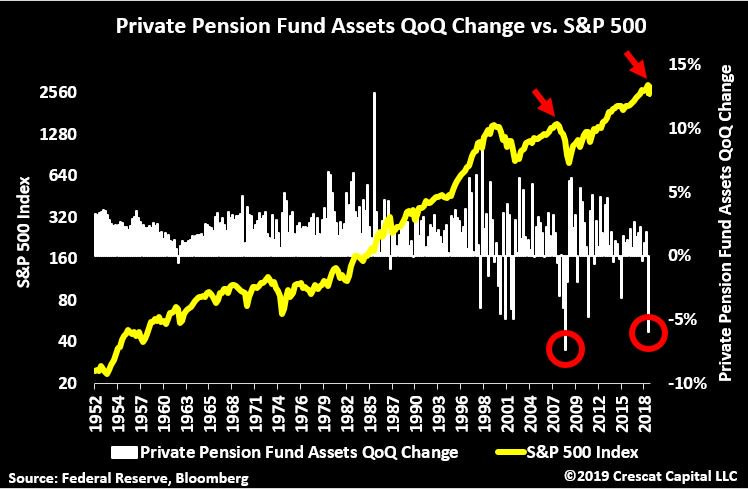
Pensions are in big trouble & Bitcoin can save them
Join thousands of others who receive this daily analysis of crypto markets & news in their inbox every morning - subscribe now.Private pension funds may be in more trouble than you think.In Q4 2018, these funds realized the second largest percentage loss in assets since the 1950’s and the largest loss since 2008. As Tavi Costa pointed out on Twitter, the more than 5% drop in assets leads many to believe that the retirement funds of tens of millions of people are likely to be exposed to a much higher degree of risk than previously understood. Take Japan’s Government Pension Investment Fund, the world’s largest pension fund, who has ~50% of their assets in global equities. During Q4 2018, they saw a 9.1% drop in assets, which is about $136 billion. Read that again….one of the most conservative capital allocators in the world has a portfolio that is constructed in such a way that they experienced uncommon levels of volatility and almost lost a double digit percentage of their assets in 90 days.It is no secret that equity valuations are incredibly high and we experienced the longest bull market in history over the last few years. But no one should be investing based on past performance, but instead focusing on what is likely to happen in the future. As my partner Mark Yusko says, “Humans do two things really well — they buy what they should have bought and they sell what they are about to need.”The highly concentrated equity portfolios of many pensions is a scary scenario that will turn ugly really fast when valuations begin to return closer to long term averages. So what should these institutions do? As I have been saying for months, they need to immediately evaluate the option of gaining exposure to Bitcoin, cryptocurrencies, and the blockchain industry. The assets have proven to be low correlation to date and have an asymmetric return profile. A simple 1% allocation has the potential to materially negate any losses that could be experienced through an equity market fall.In fact, the numbers are quite compelling. If Japan’s Government Pension Investment Fund had moved to #GetOffZero and gain exposure to cryptocurrency through our Digital Asset Index Fund last year, they would have seen a 46% return on the investment year to date or 0.46% increase in overall portfolio performance. With these trends playing out over the next 2-3 years, my anticipation is that the Digital Asset Index Fund will continue to drastically outperform the S&P 500. (We were literally willing to bet on it).Additionally, adding the low correlation and asymmetric nature of Bitcoin and crypto to these pension portfolios should actually decrease the portfolio’s risk profile, rather than increase it based on modern portfolio theory. We are at an important moment in time — the retirement funds of tens of millions of Americans are in significant danger and it is important that capital allocators understand the benefits that Bitcoin and crypto present.These people have been promised there will be money waiting to support them in retirement as long as they work hard and do their jobs. The people have upheld their end of the bargain…it is important that the institutions now deliver on their promise. Rather than running from innovative technology, the best investors in the world (Yale, Stanford, MIT, Notre Dame, UNC, etc) are embracing Bitcoin, cryptocurrencies, and blockchain technology. Hopefully the majority of investors follow suit before it is too late. -PompThe “Off The Chain” podcast has been downloaded 800,000+ times in 160 countries. You can listen to the latest episode with Avichal Garg, Managing Partner at Electric Capital here: Click here for Off The Chain podcastTHE RUNDOWN:Bitcoin Exchange Kraken Sued by Former Trading Desk Manager: A former employee of Kraken, one of the oldest Bitcoin exchanges, is suing the crypto platform for allegedly failing to pay him for work he did. Jonathan Silverman, who was hired in April 2017 to manage Kraken’s institutional sales and trading desk in New York, is demanding compensation in excess of $900,000, according to a suit filed April 4 in New York. That’s based on an agreement Silverman says he reached with Jesse Powell, the San Francisco-based exchange’s founder, who offered him a $150,000 salary and orally agreed to pay him a 10 percent commission of the trading desk’s annual profit. Read more.SEC Guidance Sparks Fear and Loathing in Crypto Industry: When the Securities and Exchange Commission this week issued guidelines for cryptocurrency companies that want to sell digital tokens, many in the industry praised the SEC for new regulatory clarity, but also privately seethed the agency had gone too far. “This feels like an overt declaration of war on cryptocurrencies,” said a senior lawyer who advises crypto firms. “The guidance is terrible but people say ‘we have to say nice things or they’ll prosecute us.’ Everyone is afraid the SEC is full of thin-skinned bureaucrats, and now they’re so used to g
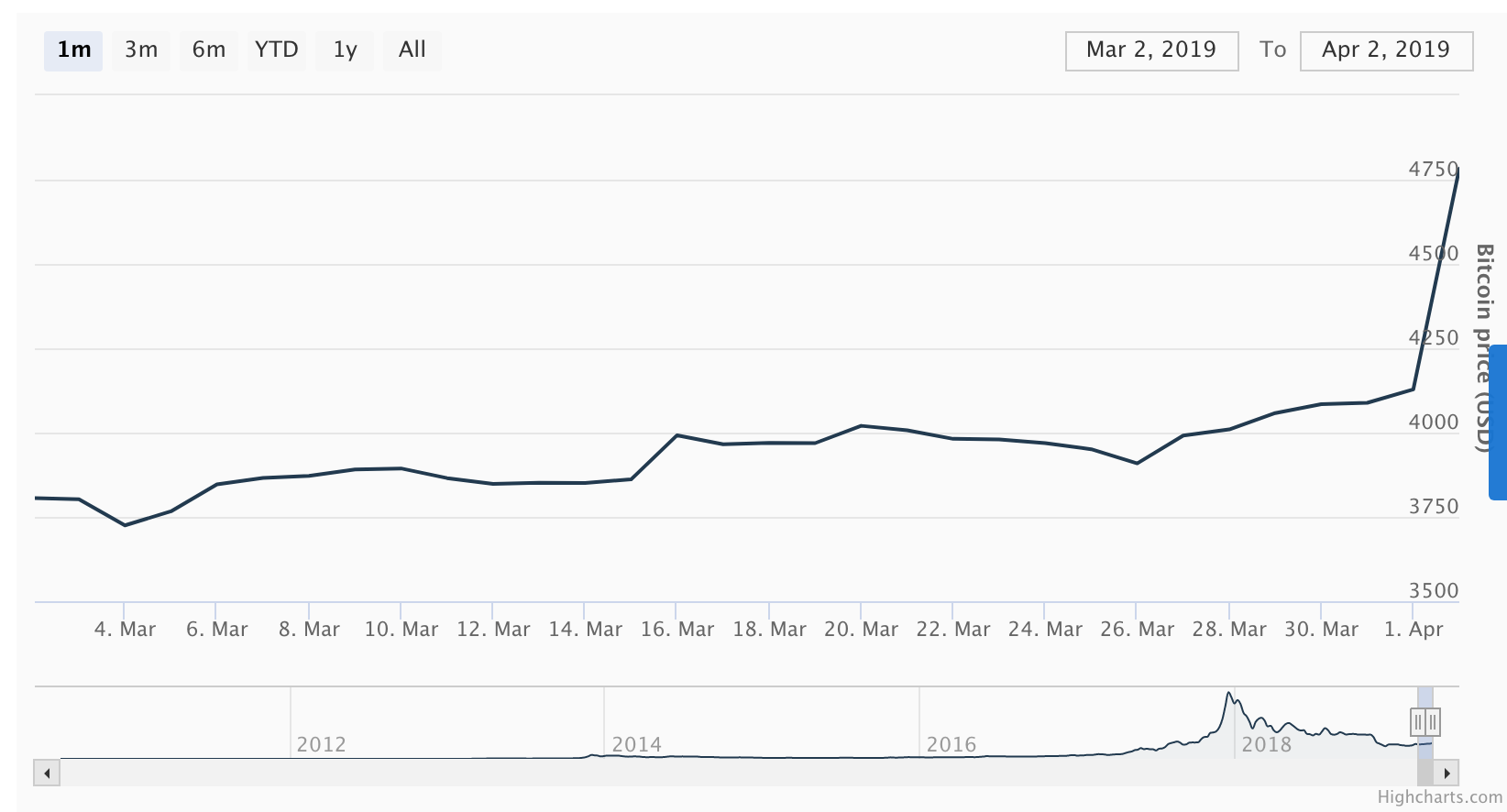
Bitcoin: The Long Term Investor's Dream
Join thousands of others who receive this daily analysis of crypto markets & news in their inbox every morning - subscribe now.Bitcoin is back, baby.The decentralized digital currency ripped 20% over night and surpassed the $5,000 mark for the first time in months. This quick price action was met with exuberance and fanfare from crypto enthusiasts. There are very few assets in the world as volatile as Bitcoin, and when the volatility is playing out, there is a level of exhilaration that is hard to match. Many times I hear people talk about Bitcoin’s volatility in a negative way, but I believes this is the wrong way to look at assets and their price movements. Volatility historically plays out in short time horizons, but investors focused on long time horizons actually want the short term volatility. Why is this?Long time horizon investors have the stomach for the volatility so it doesn’t tempt them to make short-term decisions that are driven by fear, greed, or other emotions. They also understand that volatility in new assets is necessary to create price appreciation over a long period of time.Forget about Bitcoin and cryptocurrencies for a second. Amazon is one of the most valuable companies in the world. Nearly every investor owns a piece of it through various passive funds. However, it wasn’t always the big, steady blue chip stock that it is today. In fact, Jeff Bezos had to defend Amazon stock’s volatility in a 60 Minutes interview in 1999 (highly recommend watching this).Since the company has gone public, Amazon has drawn down 90% or more twice. And the average intra-year drawdown for more than 20 years is 30%+. That makes Amazon stock the definition of volatile. But it hasn’t mattered. If you bought Amazon on the day it went public and held till today, you would have received more than 120,000% on your investment. That means a small $100 investment would be worth more than $120,000 right now. Obviously, very few people bought the initial IPO and have held through the volatility. People need liquidity. They are emotional. They get nervous. And they make short term decisions.Regardless, short-term volatility doesn’t matter to the long-term investor. Bitcoin will be no different. The digital currency is one of the most volatile assets we have seen in awhile, but that means there is incredible opportunity for investors who have the stomach to handle it.As I have said many times, Bitcoin is a game of accumulation. If an investor has done their own research, understands the risks, believes in the system design, watches the fundamentals, and has a low time preference, they stand a chance to be rewarded handsomely. This doesn’t have to be accomplished over night either.Many of the investors that have made the most money in Bitcoin didn’t buy a bunch of Bitcoin in a single slug. They slowly accumulated more and more over months or years. They took a long term outlook on the asset. Shockingly, many of them not only haven’t sold their positions after incredible gains, but are still buying more today.The world of investing works in weird ways. The investors with patience, conviction, and courage look wrong for a long time….until they are right. Bitcoin’s recent move has brought back a level of excitement that the market hasn’t seen in over a year.While fun, keep it in perspective. This is a long game and we haven’t even left warmups yet.-PompThe “Off The Chain” podcast has been downloaded 800,000+ times in 160 countries. You can listen to the latest episode with Dan Zuller, Partner at Vision Hill Advisors here: Click here for Off The Chain podcastTHE RUNDOWN:The SEC Wants to Hire a ‘Crypto Securities’ Advisor: The U.S. Securities and Exchange Commission is seeking to hire yet another “crypto specialist.” The SEC’s Division of Trading and Markets plans to hire the new legal expert in order to help develop a “comprehensive plan” to address crypto and digital asset securities. One of the key responsibilities of the new hire would be to apply their “knowledge of federal securities laws to digital asset securities and crypto matters, i.e., broker-dealer, exchange, clearing agency and transfer registrations, exchange product applications, sales and trading practices, etc.” Read more.Canadian Police Freezes Assets of FUEL Token Issuers due to Alleged $22 Million Fraud: Canadian police have frozen assets of the founders of blockchain consulting firm Vanbex, which raised $22 million in an alleged fraudulent initial coin offering. The development was reported in a court document released on March 14. Vanbex founders Kevin Hobbs and Lisa Cheng claimed to the public that they operated a Vancouver-based cryptocurrency firm, starting from 2017. The firm, which was interchangeably called Vanbex and Etherparty, is actually a shell company that developed no useable products, the court document argues. Read more.Coinbase Expands Into Cross-Border Payments: American major cryptocurrency exchange Coinbase has expanded into cross-bo

Data quality in crypto is improving quickly
Join thousands of others who receive this daily analysis of crypto markets & news in their inbox every morning - subscribe now.The crypto market is maturing.Previously, a big problem with the industry was that data was hard to find and there were major questions about the validity of different data sets. This issue has recently jumped to the forefront after a Morgan Creek Digital portfolio company, Bitwise Asset Management, created a 226 page presentation for the SEC on why the public perception of Bitcoin market data may be inaccurate. The presentation is worth checking out. Bitwise is in the asset management game though. There are a number of companies that have been created to address the market data issues. Here are a select few:* Digital Assets Data — the company has built a powerful enterprise-grade platform that allows fund managers and corporations to conduct analysis of blockchain-specific data in a more efficient way. The product is quickly becoming a go-to resource for the top organizations in the industry. It helps that the founders have previously built and sold a similar data company in the past, along with adding talent from Bridgewater Associates’ team that helped build portfolio generation and investment modeling tools. Check them out here. (I’m an investor)* Messari — the company is curating daily insights, market data, and research for clients. They acquired OnChainFX in recent months and combine the onchain data with proprietary analysis and tools. One of their big focuses in recent months has been an open source disclosures database called Messari Registry that aims to become a central repository for project information that can be freely accessed industry-wide. Check them out here.* Delphi Digital — the company is an independent research boutique providing institutional-grade analysis on the digital asset market. They have written incredibly in-depth pieces on Bitcoin and Ethereum, along with high-quality analysis on a number of smaller cap tokens and projects. The team comes from the equity research world and the work they produce meets the bar that the public equities market expects. Check them out here. (I sit on the board of directors)In order for the industry to continue maturing, and for institutional investors to gain more confidence in allocating capital here, we will need to see continued maturation across various aspects of the industry’s data. Investors will need to be able to (1) locate the desired data easily, (2) access it in a user-friendly interface, (3) have confidence in the data’s validity, and (4) be able to massage and manipulate it in a way that drives decision making. I am personally excited to see cleaner, more structured data being used. The more we know, the better everyone is positioned to make sound investments. The crypto industry was operating in the dark for the better part of ten years, but finally there appears to be a light at the end of the tunnel.-PompThe “Off The Chain” podcast has been downloaded 800,000+ times in 160 countries. You can listen to the latest episode with John McAfee, Founder of McAfee Software here: Click here for Off The Chain podcastTHE RUNDOWN:Peter Thiel-Backed Crypto Brokerage Tagomi Just Got Its BitLicense: Tagomi, an institutional investor-focused crypto brokerage backed by Peter Thiel, received approval to do business in New York on Wednesday with a BitLicense from the Department of Financial Services. Following a roughly seven months-long application process, the New Jersey-based firm will now be able to work with institutional clients based in the world’s financial center—making it the 18th company to receive a BitLicense, a permit which allows companies to buy and sell virtual currency for customers in New York. Read more.Börse Stuttgart, Axel Springer to Jointly Launch Crypto Trading Venue: Germany’s second largest stock exchange Börse Stuttgart is partnering with European digital publishing titan Axel Springer and its subsidiary Finanzen.net to jointly launch a blockchain-powered trading venue. The new initiative will aim to combine investment information services and a blockchain-powered trading venue under the canopy of one platform. Read more.TechCrunch Founder’s Crypto Fund Tops $100 Million, Completes First Acquisition: One of Arrington XRP Capital’s largest limited partners has injected a fresh $30 million into the digital asset firm, according to its founder Michael Arrington. “The reason is, like everyone, we didn’t do particularly great last year, but we did better than the market. And that was a win,” Arrington told CoinDesk. With the additional investment, Arrington says the fund has now surpassed its initial target of raising $100 million. Read more.Pantera Capital Nears $175 Million Target for Third Venture Fund: Cryptocurrency hedge fund Pantera Capital is close to completing funding for its third venture fund, already raising $160 million. Pantera, which debuted its first fund in 2013, has since risen to
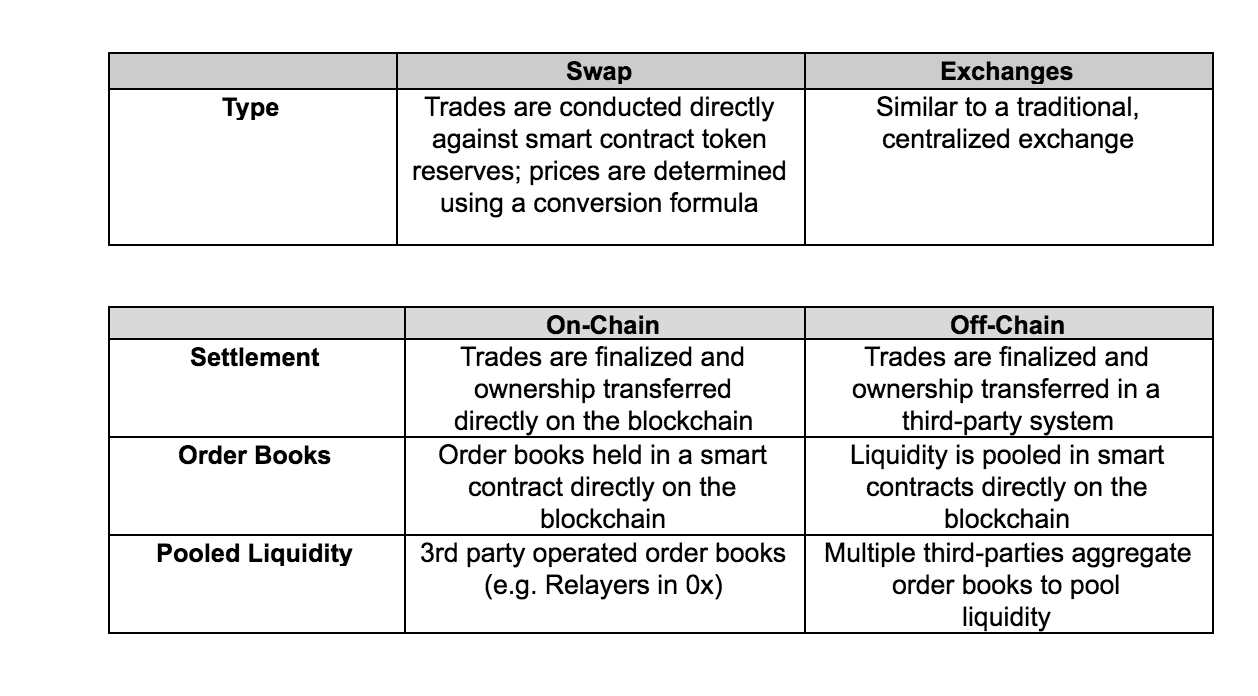
Decentralized Finance summary and report
Today’s Off The Chain post is brought to you by Delphi Digital, the premier research firm dedicated to digital assets and DLT. Their in-depth report on Decentralized Finance (DeFi) released earlier this week has sparked great discussion among the crypto community. Below they highlight the biggest takeaways from the report. Full disclosure: I currently sit on the board of Delphi Digital.Decentralized Finance (DeFi), also known as Open Finance, represents a broad category of financial applications being developed on open, decentralized networks. The objective is to build a multi-faceted financial system, native to crypto, that recreates, and improves upon, the legacy financial system. Some of the potential benefits of such a system include:* Permissionless financial services anyone with an internet connection can access, boosting financial inclusion.* Censorship resistance means no third-party can stop a transaction.* Immutable ledger where no third-party can reverse a transaction.* Reduced counterparty risk as there’s no need to trust a centralized third-party to custody funds or validate transactions.* Programmable smart contracts allow specific tasks to be automated or self-executed, leading to more efficient processes.* Composability allows for the creation of new financial products and services by combining different protocols.So who is building this new decentralized financial system? Turns out there is a plethora of projects pioneering this nascent industry ranging from decentralized exchanges to lending & borrowing platforms to derivatives and prediction markets. This list goes on and on.One of the more interesting trends we see accelerating is composability: the integration of multiple DeFi projects and protocols. A notable example is Veil, a peer-to-peer prediction market built on top of Augur and 0x (one of the most prominent decentralized exchange protocols). It utilizes 0x for faster trading by moving order creation and cancellation off-chain.We broke down a few of these examples in the full report by categorizing some of the leading projects, which helps put perspective around how innovative this industry is becoming.Decentralized exchanges (DEXs)Decentralized exchanges are one of the more well-known sectors of the DeFi ecosystem. At their core, DEXs enable the peer-to-peer exchange of assets without giving custody of those assets to a third-party. This is very different from the centralized exchanges people are most familiar with where users deposit money or crypto assets to an exchange wallet before making trades. However, many DEXs are unique in their own way, so we broke down four key characteristics to simplify some of the major differences.We also categorized some of today’s prominent DEXs into each of these categories to illustrate their unique features.Decentralized exchanges are just one example of the infrastructure being built to support decentralized finance applications. Projects like MakerDAO and Compound are building decentralized lending and borrowing platforms, with over 2% of ETH’s supply locked up in Maker’s CDPs. Augur’s decentralized prediction markets have garnered attention in recent months as users get comfortable wagering on anything from the midterm election outcome to BTC’s year-end price. Again, the list goes on and on.Despite the seemingly endless potential of this growing sector, it is important to recognize the risks and concerns behind the DeFi movement. Links to physical/traditional assets is non-existent currently, limiting the product/market fit of some of these projects. DEXs struggle with low liquidity. Many on-chain scaling solutions are still under development, capping transaction throughput. This is on top of the regulatory risk this nascent sector faces, which is arguably most important at this stage. Maturation of this market will likely alleviate some of these concerns, but they’re important to keep in mind as this sector evolves.The open source nature of crypto should accelerate many of these trends as new projects emerge to build on top of today’s DeFi infrastructure. Our team is excited to keep an eye on projects integrating multiple DeFi protocols to offer new and unique products for users.You can read the full report here: https://www.delphidigital.io/defiThe “Off The Chain” podcast has been downloaded 800,000+ times in 160 countries. You can listen to the latest episode with John Wu, CEO of Digital Assets at Sharespost here: Click here for Off The Chain podcastTHE RUNDOWN:Square Is Staffing up for a New Cryptocurrency Unit: Square CEO Jack Dorsey said he wants to hire a few cryptocurrency engineers and a designer, to conduct work that will contribute to advancing an accessible, Internet-based financial system that benefits the greater community. The new employees be able to work from wherever they want, report directly to Dorsey, and can even be paid in Bitcoin, if they so choose. Read more.Facebook Seeks Counsel to Forge Blockchain Partnerships f