SANDCAST: Beach Volleyball with Tri Bourne and Travis Mewhirter
551 episodes — Page 11 of 12
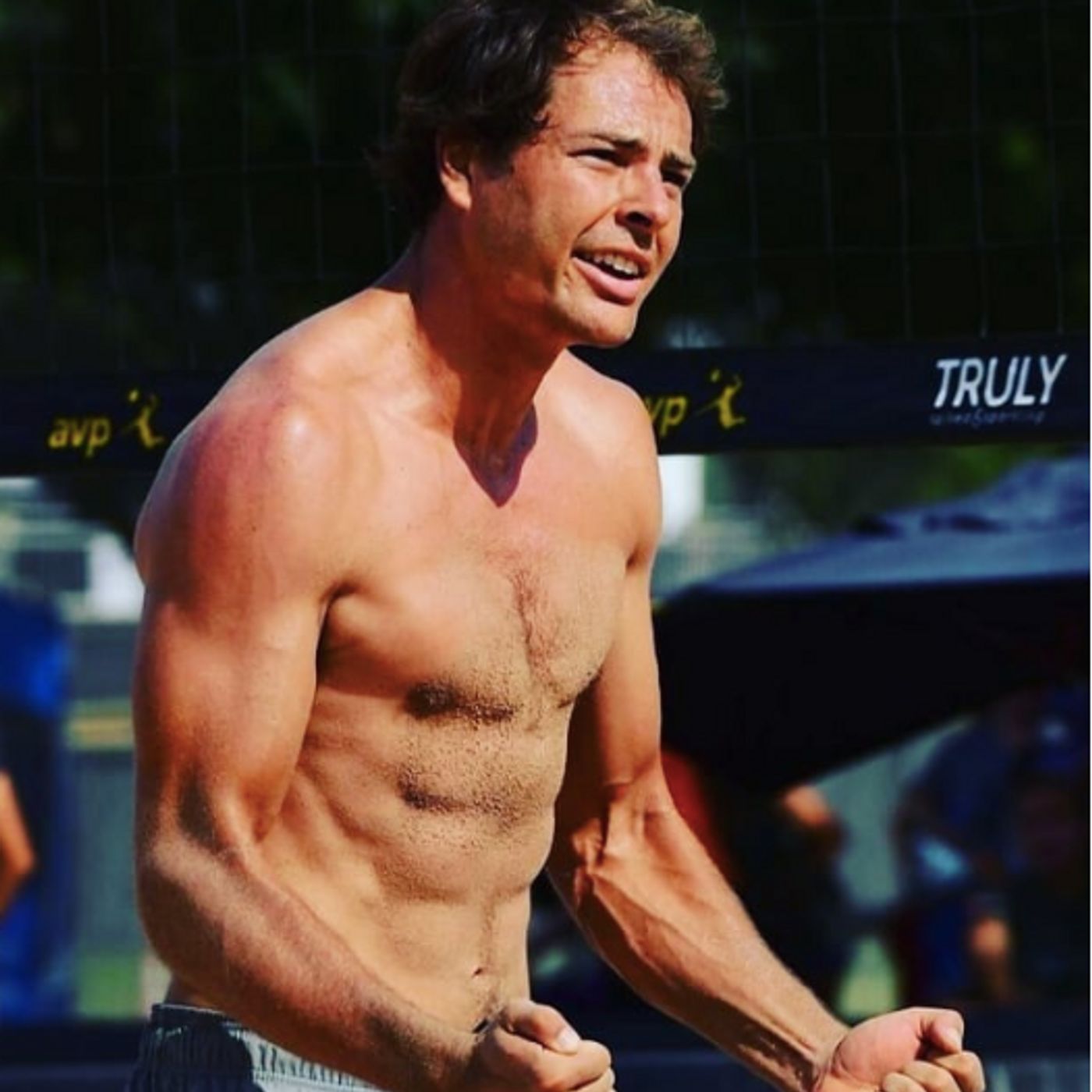
Ep 52Eric Zaun: The Happy Gilmore of the AVP Tour
The first thing you must know about Eric Zaun is that you cannot call him Eric Zaun. Don’t laugh. He’s serious. Maybe. Sort of. Well, you never can know with Zaun. “I’ve actually been going by Danny Fahrenheit lately,” Zaun said on SANDCAST: Beach Volleyball with Tri Bourne and Travis Mewhirter. “You introduced me as Zaun but I like Danny Fahrenheit. I just don’t like the name Eric.” If you know Zaun, nothing about this is surprising. If you do not know Zaun, the 37 words above are an apt summation of what it’s like to be around Eric Zaun, or Fahrenheit, or whatever it is you’d like to call him. He’ll take anything but Eric at this point. “[Piotr Marciniak] actually calls me Cookie,” Zaun said. “I used to go by Cookie Robinson exclusively on the NVL. Everybody called me that. A lot of my good friends still call me that.” So his current partner calls him Cookie, he occasionally moonlights as Danny Fahrenheit, though he’s also immensely proud of tricking a reporter covering Pottstown that his name was Lamb Rivermore. When the paper ran the next morning, and Zaun was quoted under that alias, he finished the weekend known as Mr. Rivermore, Lamb Rivermore. “They wrote that in the newspaper!” he said, laughing. Just Zaun being Zaun…or Fahrenheit or Cookie or Reebok Hernandez or Lamb Rivermore, whatever you want to call him. But don’t let him fool you, either. There’s more to Zaun than he lets on. Much more. One does not simply earn the AVP Rookie of the Year by chance. Nor does one make a Sunday in his first season on Tour, and in the next, win Waupaca, Seaside and six-man – the biggest non-AVP domestic stops of the year – without putting in the work to do so. Zaun puts in his work. Plenty, actually. This is a season that began with a two-month trek through New Zealand and Australia, in which he and Adam Roberts won a handful of tournaments in New Zealand before claiming fifth in an FIVB in Shepparton, his second career international tournament. “That takes a lot out of your off-season training,” Zaun said. So he just kept going. To Iran, Aguascalientes, China, Austin, Wisconsin, Oregon, Dallas, “Just getting used to the grind,” he said. “I got a lot more FIVB points, compared to zero at this time last year.” The points are nice, yes, but Zaun isn’t much for material things, even if it concerns his career. Ed Ratledge still has his Rookie of the Year plaque. He once took off an FIVB jersey and handed it to a ball girl. An oversized check from Seaside? Gave it to a random kid, just because. The only prize he’s ever kept from volleyball is the money he’s made, which really just funds the next one, and the next one, piling up experience after experience. That’s what he’s after, anyway. Experiences. Stories. Perspective. “It’s really unfortunate that we can go to all these places but we don’t really have any time for fun,” he said. “It’s almost brutal, mentally, these new places I’ve never been before, I have to fly right back for an AVP. But it’s cool because even though you’re going to China or Iran or the middle of nowhere Mexico, it’s not like a total loss because a lot of people never get to see that and see how they live. “You really take for granted how great your life is in America. Even if you didn’t get to do anything in Iran, you still got to see another place in the world. You’re not even allowed to go to Iran! America’s pretty great. You realize that once you travel.” Though the volleyball season will be over after this weekend, Zaun’s travels have just begun. As soon as the final ball hits the sand in Chicago, he’s off to South America, on what promises to be nothing shy of a winding, epic, story-filled “road trip with the boys.” A morale-booster. He’s the first to admit that his second season on tour was “a bit of a sophomore slump,” he said. But he’s learned. He’s dabbling on the right side, expanding his skill set. He’s recognized that his defense is still lacking, that his weight can’t fluctuate as much as it has over the course of his career. “I don’t think I’m that great of a defender,” he said. “Just kind of overall everything – digging hard driven balls, staying balanced. I don’t have a volleyball background. I started playing beach volleyball late so it’s not like I have all those fundamentals drilled into me. I just don’t think I have that many touches or reps or coaching.” So he’s going to get into film. He’s going to get more touches. But first, he’s taking a road trip with the boys. For Danny Fahrenheit to play to the best of his abilities, morale needs to be high. Hosted by Simplecast, an AdsWizz company. See pcm.adswizz.com for information about our collection and use of personal data for advertising.
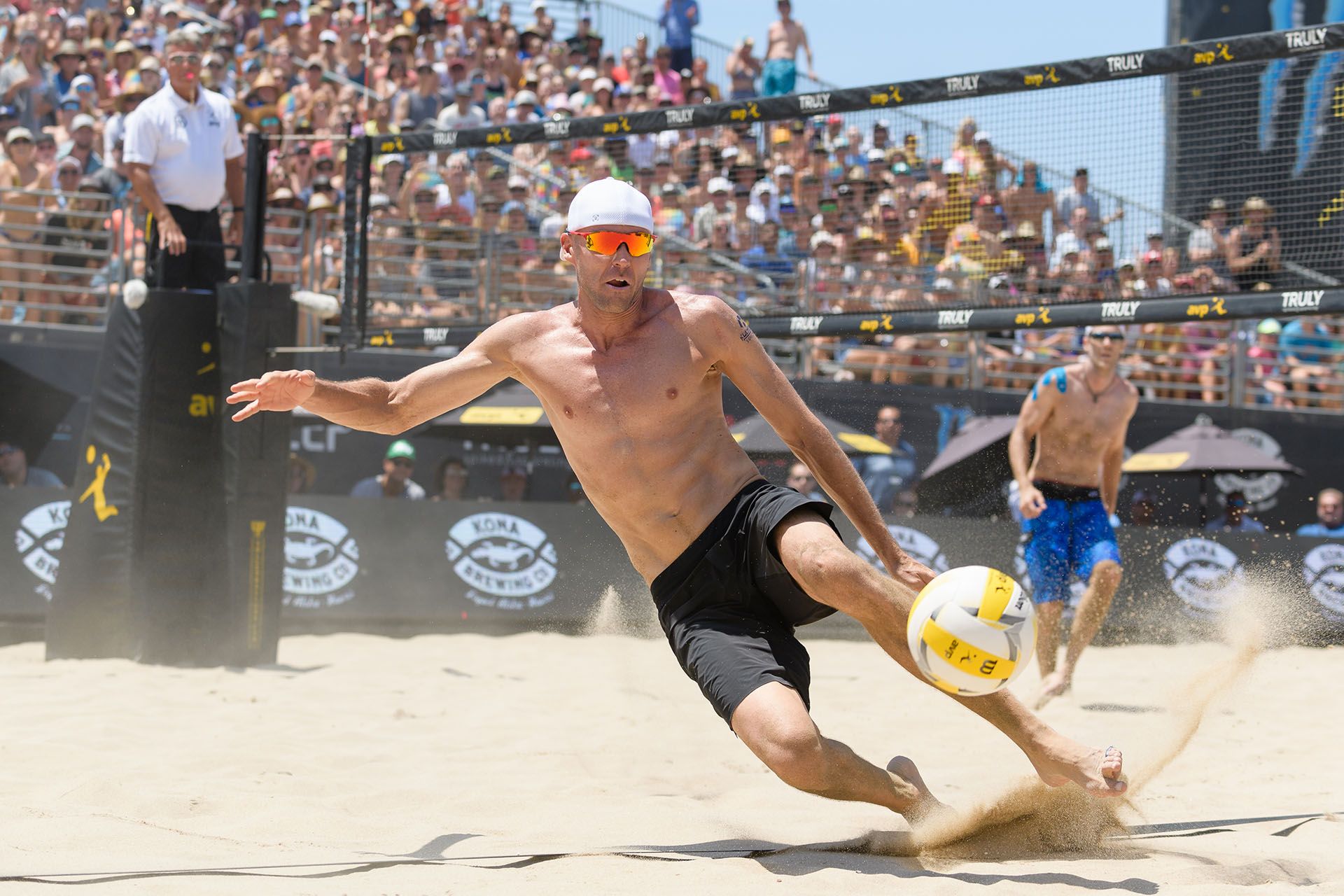
Ep 51Jake Gibb isn't finished playing just yet
There are exactly two indicators in Jake Gibb’s house that there is a professional volleyball living there. One is a panorama of the 1976 Manhattan Beach Open, the year Gibb was born. The other is a panorama of the 2005 Manhattan Beach Open, the first of three occasions in which Gibb would win and cement his name onto the famed Manhattan Pier. “It’s just kind of cool to see what it was when I was born, and you see the crowd just lined up like 30 deep watching, I think it was [Steve] Obradovich and I forget who he was playing with,” Gibb said on SANDCAST: Beach Volleyball with Tri Bourne and Travis Mewhirter. “Then I have my first win, we played actually Nick and Phil, and I played with Stein [Metzger], and it’s a picture that Stein gave me after.” After that? Nothing. Nothing from the guy who has been to three Olympics and once, in 2012, finished ranked No. 1 in the world alongside Sean Rosenthal. “Those,” he said of the Manhattan panoramas, “are the only volleyball pictures I have.” It really shouldn’t be all too surprising coming from Gibb, who has for years been one of beach volleyball’s most humble ambassadors. It’s not uncommon that his fellow AVP veterans liken him to Tim Duncan, the soon-to-be Hall-of-Famer after a brilliant career with the San Antonio Spurs. It’s easy to see the comparison, for the most notable characteristic the two share – aside from being excruciatingly modest, rarely succumb to any theatrics, unanimously respected by their peers – is this: They just get the job done. Since the AVP began hosting full seasons again in Donald Sun’s second year of ownership, in 2013, Gibb has won 16 AVP tournaments and competed in five more finals. He has won in Salt Lake City and Cincinnati, in Shanghai and New York, St. Pete’s and Atlantic City. He has won in the torrential rain, as he did in New Orleans of 2015, and stifling heat (Manhattan Beach, 2016). And, age be damned, at 42 years young, he’s doing it as well as he ever has. In four events this season, his second with Taylor Crabb, Gibb has made at least the semifinals in all four and thrice competed in the finals, beating Dalhausser and Nick Lucena in Seattle. “I feel like age really isn’t in the equation for me,” he said. “It’s how I’m playing and how I feel and my desire to play and I love playing and I feel like I’m playing well and I feel like I can keep increasing my knowledge of this sport so I want to keep doing it.” At the moment, it seems he’ll be doing it for another several years longer. Throughout the year, he and Crabb have only improved, finishing their last three FIVB events in the top 10. They claimed a fourth in a major in Gstaad, losing a thriller against current world leaders Anders Mol and Christian Sorum that would have pushed them into the finals. Two weeks later, at a major in Vienna, they came out of the qualifier to take fifth. Two weeks after that? Manhattan Beach, Gibb’s favorite stop. Again, he was in the finals, and had it not been for a swing that went two inches too long at the score freeze in the second set, he’d have had his fourth plaque on the Manhattan Beach Pier with his fourth partner. “It’s raw right now is where it is,” he said. “I’m going to need some time to let it sit. Like anything, you need time to learn from it, because right now I’m not in that space. Right now, it’s a car ride home by myself with a lot of F bombs and grabbing the wheel.” There’s not much time for reflection. Two days after Manhattan, Gibb began coaching duties for his son’s soccer team. Then a NORCECA qualifier on the day after that, one that begins the Olympic qualification process. Then it’s onto Chicago, the Netherlands, Hawaii, Vegas, maybe China, he isn’t sure yet. What he is sure of is this: He wants to go to Tokyo. And he isn’t ready to retire just yet. Hosted by Simplecast, an AdsWizz company. See pcm.adswizz.com for information about our collection and use of personal data for advertising.
Ep 50Tri Bourne is BACK ON THE BEACH
Phil Dalhausser stands, hands on his hips, shaking his head. “That,” he says, “looks so boring.” He’s watching a young man play volleyball by himself, tossing a ball, hitting it line, tossing another, hitting a cut, tossing another, hitting a high angle. Over and over and over, nearly two hours on end. Many of the passerby on the Manhattan Beach Pier that day could have reasonably concluded one of a few things: the guy was either bored, as Dalhausser suggested, had no friends to play with, or was just borderline crazy. There was, however, a fourth option. Tri Bourne was actually having the time of his life. Weeks later, Bourne is in Bear Valley, California. He skipped out of AVP San Francisco early. It’s tough to be around the sport you once dominated, watching others who had never beaten you win titles you’re sure would be yours for the taking. So he’s visiting his sister, Kai, and his nieces and nephew instead. They’re barefoot minions, those three, ages two, four and six, charging around the forest, biking down hills, rumbling through creeks and swimming in the lake nearby. It’s suggested that they’re already addicted to exercise, and it’s also pointed out that it’s not the worst addiction to have. Bourne purses his lips, looks down. “It is,” he says, “when the one thing you can’t do, is exercise.” *** This is not a comeback story. No, no. That’s not how Bourne views it, and it’s not how he’d like you to view it, either. This is a reinvention, a rebirth, though not of the holy sort. Tri Bourne isn’t returning to the AVP Tour, to beach volleyball, the same person he was when he and John Hyden finished second in the world rankings in 2016. He’s coming back as Tri Bourne 2.0. More well-rounded. A different person with a different perspective. A mindset that goes far deeper than pass, set, hit. A skill set that is relevant east of the Pacific Coast Highway, too. Weeks before the onset of the 2017 season, Bourne and Hyden were registered to play the Fort Lauderdale Major. Bourne was still on the heels of ankle surgery, but all seemed fine. His mobility was good enough, jump felt no different, cardio was up to his world-class standard. Except there was something going on with his hands. He’d block a ball and his hands would sting and throb, eventually swelling to the point that he wore mitts at practice. He thought it was carpal tunnel syndrome, where the hands experience tingling and numbness from a pinched nerve. He got it checked out. The doctors didn’t know what it was, just that it was not carpal tunnel. Neither did the next doctors. Nor the next. It wouldn’t be until Bourne went to the University of Utah, site of the United States Olympic Committee’s medical center, that he would receive a diagnosis. It wasn’t carpal tunnel syndrome, the doctors confirmed. It was an autoimmune disease, something called myositis, which means, generally speaking, inflammation of the muscles that you use to move your body. It means Kryptnonite to the boy who grew up paddling, surfing, canoeing, playing volleyball, basketball, hiking – “just charging,” as he would put it. The boy whose life was, to that point, based on movement, was no longer allowed to move. “Basically,” he said, “I just had to shut it down.” Friends began to see changes in him. He wasn’t quite the same. Something was off. Because of course something was off. Bourne’s entire life, entire existence, had been flipped upside down and inside out. “You know when it’s raining and you have to sit in the house all day?” he said. “Yeah, that was me, every day. It was basically that. That’s what it was like. Everyone who knows me knows I’m pretty damn ADD. I come from a family that’s pretty much addicted to working out, that’s definitely a thing. Yeah, man, it’s intense. That’s why I had to go internal with everything because it was a lot, it was getting to be too much. It was, uh, it sucked. It sucked for a while, because I still had that drive, coming out of the Olympic qualifier, and my ego was just huge, I was ready to be the top guy in the U.S. “I was still ready to work hard, but what could I do? It was ‘Do nothing.’” He couldn’t surf, so he would body-surf occasionally, until his heart rate went too high and he’d have to sit back down. He couldn’t play volleyball, and watching film was almost as tortuous as blocking with the mitts. He couldn’t eat, well, anything. Anything that could potentially inflame his muscles – dairy, gluten, alcohol, just about everything not named broccoli, rice, and organic chicken breasts – was removed from his diet. The snacks in his pantry shifted spectacularly, from chips and salsa to dry-roasted peanuts and pumpkin seeds. His weight plummeted, nearly going south of 170 pounds. “It was definitely one of the tougher things to see someone go through,” Trevor Crabb, Bourne’s partner for AVP Manhattan, said. “You can’t imagine missing out on a whole year and a half of your job and your love. Seeing him last year, when it first started
Ep 49Caitlin Ledoux: Just doux you
It’s a wonder how Caitlin Ledoux did it, given that she operates with the same 24 hours a day, the same seven days a week, as the rest of us. There she was, working full-time at Lululemon. There she was, coaching two or three club teams and a high school team. There she was, playing full-time professional beach volleyball, making three quarterfinals and her first career Sunday in Hermosa Beach, capping the year as the AVP’s Most Improved player. “I worked a lot,” she said on SANDCAST: Beach Volleyball with Tri Bourne and Travis Mewhirter. “Literally seven days a week coaching for four hours a day. That’s what I mean. I was overworked, I was exhausted, my body was struggling to keep up with what I was doing mentally, physically, everything. I just needed to hit that reset button.” On the court, 2017 had been her most successful year. Off it, it had been both mentally and physically debilitating, something that didn’t go unnoticed by her partner for the final three tournaments, Maria Clara Salgado. “She knew I was struggling here with my nutrition and my workouts and my working, I had been working a ton. It was too much. She said ‘Come down to Brazil, let’s see what works for you, because what you’ve been doing isn’t really working. Let’s put the reset button on and see if it works.’” And so, for three months of the “off-season,” Ledoux went to Brazil, getting reps six days a week from four different coaches. She switched her weight routine, swapping out Olympic lifting for more functional movements. She overhauled her nutrition. “It was the first time I’ve ever felt like a professional athlete,” said Ledoux, who has been playing professionally since she first qualified on the AVP in 2012. “That was career changing. It was amazing.” Indeed, it seems it has been career-changing. This year, Ledoux has arguably the best case to again take home the AVP’s Most Improved Player, making the quarterfinals in New York with Salgado before getting the call of a lifetime, from perhaps the most dominant female player in the game today: April Ross. "It was pretty funny because in New York she texted me and said 'Hey I need a practice partner for these days, can you practice with me?' And I had never played or practiced with her so I was stoked to practice with her for two days," Ledoux said. "And I was in the car with my mom and she texted me and I said 'Mom! Guess what just happened?' And she said 'April asked you to play.' And I said 'Yes!' It was awesome." With Ross playing behind her block, Ledoux made her first final, which may be the match of the year on the AVP thus far, a 21-19, 19-21, 16-18 loss to Emily Day and Betsi Flint. Two weeks later she did it again with Geena Urango, making her third career Sunday and second straight losing once more to Day and Flint in the finals, 17-21, 21-16, 7-15. Another three weeks after that, in Hermosa, Ledoux was back on a Sunday, falling in three to Ross and Alix Klineman, 14-21, 21-18, 9-15. “A lot of it is just personal growth about myself and having the right support system around myself the last year and a half,” Ledoux said of her blink-and-you-missed-it rise. “Having that support system and the coaches and helping you figure out what you need to do, I’d say that honestly is the biggest thing.” What you need to do. It’s a simple concept for Ledoux. Identify what your goal is. Figure out the next step. Just do. Olympics, she knew, has been her goal since she was a little girl. How would one get into the Olympics? Travel. A lot. With no promises of a return anytime soon. So there her and Irene Pollock went, jet-setting across the world, beginning in Russia of 2014. Over the next three years, they went to 16 FIVBs in 10 different countries, qualifying in some, whiffing on others, taking every risk they could, because there were goals to reach and one ladder to get there. Just go. “It was hard, but the same time it wasn’t,” Ledoux said. “Irene and I had the same goal and that’s to make the Olympics and we knew that was what we needed to do. We needed to just drown ourselves in all the experience of traveling and losing and having to play these single elimination matches to get that experience. I look back on that year and it was a very draining year but I also learned a lot. “When you look at the end game: what’s your goal? I had to do it. It’s a no-brainer.” And sure, it may have been rough for a while. There may have been a learning curve on how to travel internationally, particularly when doing so in, say South Africa. The investment is beginning to see returns, dividends in the form of a bronze medal (in China with Sarah Sponcil), a silver (in Australia with Jace Pardon) and a gold (in Thailand with Emily Stockman). “I think there’s probably a more responsible way to do it than the way I did it,” Ledoux said of climbing the ranks of the FIVB. “But I’ve really enjoyed my life the last five years of just doing it and saying yes to a bunch of experiences. One of the cool things
Ep 48Steve Obradovich: The last true beach volleyball entertainer
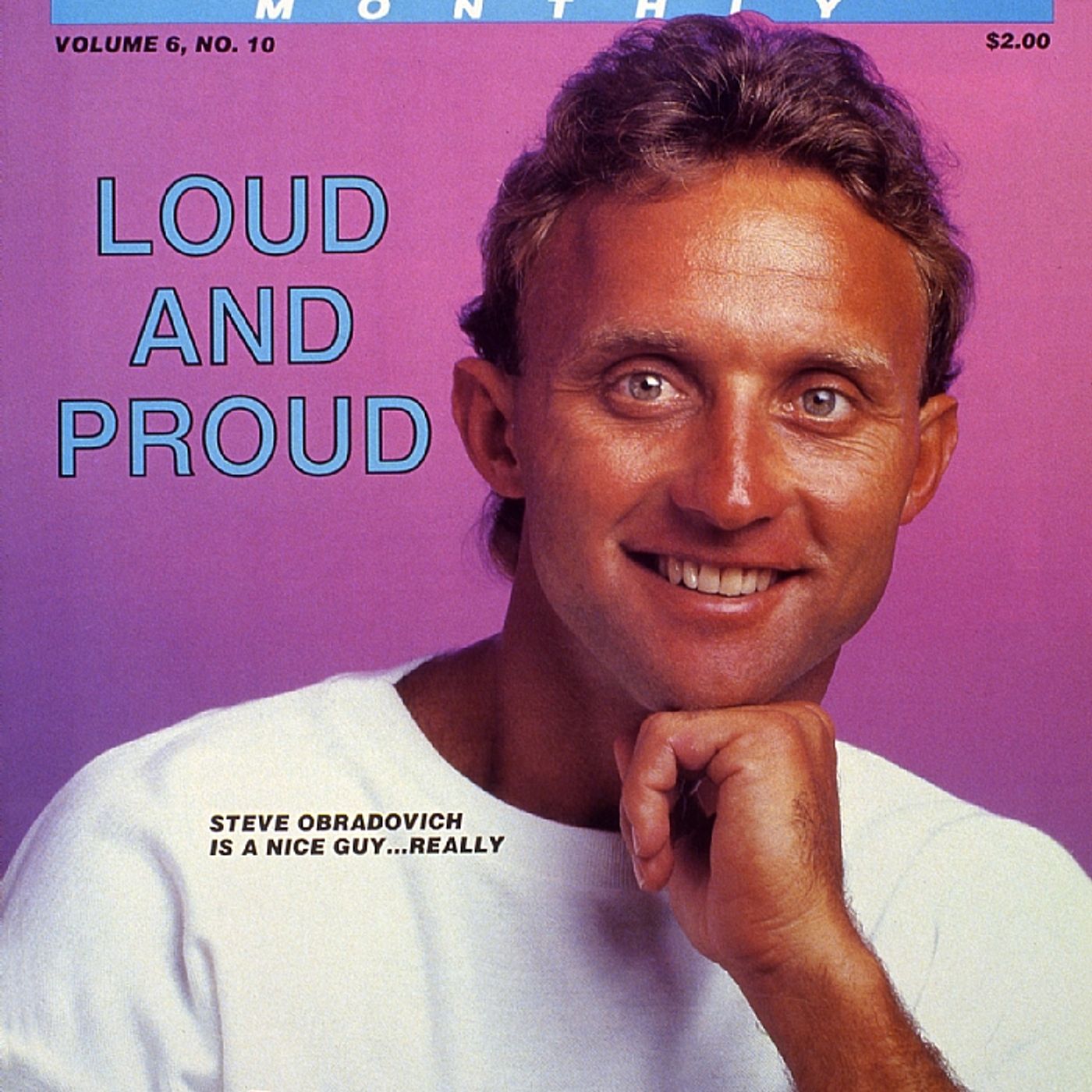
Rolling with laughter. That’s likely what Steve Obradovich would be doing at the level of trash talk – what little there is, anyway – on today’s AVP Tour. Passive aggressive Instagram comments? Staredowns under the net? A few over the top celebrations? Ha. That's peanuts. Especially to the old school bona fides, the entertainers like OB. Take this snippet from an LA Times article from August of 1989: “You see, Obradovich is the bad boy of the beach. He's "OB," the last of the old-time volleyball rogues. Brash and colorful, an entertainer and, well, not exactly humble. One volleyball publication described him as "the best *!%$&!*% player on the beach (just ask him)." Anyone who has come upon a beach volleyball event since the mid-1970s would likely remember him. He's the quintessential beach boy with the wavy blond hair and piercing eyes who was doing some or all of the following: (1) shouting at his partner; (2) shouting at the referee; (3) shouting at a loudmouth in the crowd; (4) shouting at himself and (5) using a tremendous leap and lightning quick arm swing to spike the ball at improbable downward angles. Such an athlete. And such language . Enough to make Zsa Zsa blush. "I've got a kid on the way, I've played 17 years--I've given half my life to the game--and it's time to move on," said Obradovich as he sat at an outdoor table at Julie's, the restaurant across from USC that his family bought 10 years ago and OB now runs. "I don't want to go out mid-year like Mike Schmidt, hitting .220. I didn't want to go out kneeling in the sand getting the . . . beat out of me." Memorable? Oh, yes. Obradovich’s name still carries weight, a Hall of Famer with a bigger reputation that is as much about his behavior as it is his talent and record. “A lot of it was just play acting,” he said on SANDCAST: Beach Volleyball with Tri Bourne and Travis Mewhirter. “That’s what it was. I figured that volleyball just needed somebody like that. I’ve always been a clown, always been loud. I was kicked out of a lot of classes. I wanted to be an entertainer. It was just ‘You guys are so boring. We’re never going to get anybody watching us unless there’s some idiot out there. I don’t think they have any idiots now. They put some tight control on them.” So talented was he that when Chris Marlowe discovered Obradovich finished his career with 11 open wins, including the 1976 Manhattan Beach Open, he was genuinely confused, telling the LA Times that, had OB put his min dto it, he could have won 30 or 40. Not that OB disagreed. The two-sport athlete at USC was a known critic of everyone else, but he was hard on himself, too, the first to admit that “I didn’t practice.” Which isn’t to say he didn’t improve alarmingly, staggeringly fast. The first time he played beach volleyball he was 16. By the time he was 21, his name was on the Manhattan Beach Pier. But he knew the beach, financially, was never a career option, not in his time period, at least. He had to work full-time, selling liquor, driving from Manhattan Beach to Huntington, working at “grubby bars that were open until six in the morning.” Then he worked at his parents’ restaurant, Julie’s, of which he was a part-owner. “The question of why I kept playing?” he said. “Well, I was good at it, and I liked playing. I just couldn’t – I had to work. I always had to have a job. I wasn’t the type of guy to go lay around, and I didn’t want to be a waiter. I wanted to do something legit.” He did. He moved to Laguna Beach, got into real estate. Had a family to provide for, you know? It wasn’t the illustrious year of some of his peers like, say, Sinjin Smith and Karch Kiraly or Mike Dodd or Randy Stoklos. But it was equally as memorable. “I got more out of it winning 11 tournaments than guys who won 40 tournaments. Everyone wants to talk to me because I was the John McEnroe, I was the color. Nobody wants to talk to a boring guy. People still come up and talk to me…they remember me, because you’re loud.” Hosted by Simplecast, an AdsWizz company. See pcm.adswizz.com for information about our collection and use of personal data for advertising.
Ep 47Rafu Rodriguez-Bertran: Winning weird in semi-retirement
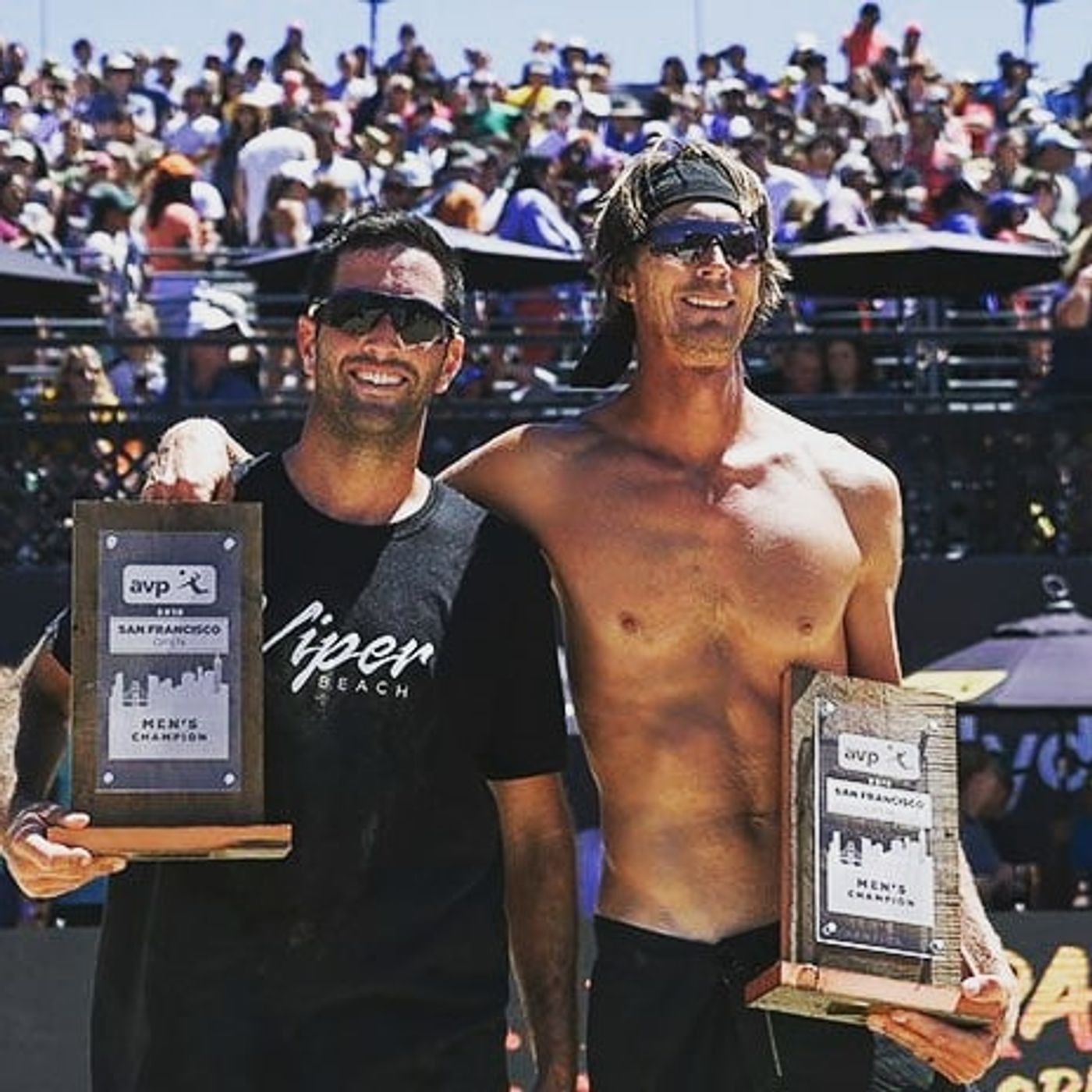
Rafu Rodriguez-Bertran was not supposed to win an AVP this year. Heck, he wasn’t even sure if he’d play an AVP this year. This past winter, he had a son, Nico, his first child. His club in Temecula, Viper Volleyball, was growing and taking off. He’d had an excellent career, one that took him as high as the 2015 World Championships. It was time for a shift in priorities. He told this to his partner, Piotr Marciniak, who nodded and went to Ty Loomis for Austin. Rafu sat out. And then beach volleyball happened. Partners changed. Eric Zaun moved from Ed Ratledge to Tim Bomgren, leaving Ratledge without a partner. Which brings us to another point: Ed Ratledge was not supposed to win an AVP this year. He’s 41, been trying for 18 years. Dumped by the partner with whom he’d had his most career success, Ratledge, it seemed, was on his way out, no different than Rafu. Like Rafu’s club, Rateldge’s business, VolleyOC, was constantly expanding. And so the most wonderful band, one quasi-retired, one sort of reprioritizing, was formed. “It’s sort of stepping out, kind of doing it part-time slash full-time,” Rafu said on SANDCAST: Beach Volleyball with Tri Bourne and Travis Mewhirter. “I have some other stuff to do but I still want to train and I still want to compete because In like competing but for sure, I never had it in my mind that I would be in that final. Ed is the same way: he loves playing. We do it for fun because that’s what we want to do. That takes away all of the pressure.” So what did their pre-semifinal routine look like? What was the master strategy to toppling Billy Allen and Ryan Doherty and then Sean Rosenthal and Chase Budinger? What was the key to unlocking 18 years of championship buildup for Ratledge? “It’s like, ‘Let’s just go out and play.’ We didn’t even have a strategy going into the semifinals,” Rafu said, laughing when saying it aloud, as if it just occurred to him how outrageous that is. “[Sunday] morning he was on the phone, setting up his tournaments back home, on the phone, and then we skateboard down to the site and ‘Hey, let’s just play!’ It worked out. I don’t know why. No pressure. Just play. It’s so fun because there’s never a single drop of pressure between us.” They play free and weird, and in this world, weird is the most supreme of compliments. Ratledge’s dialogue with the fans is one of a kind, and his arm swing, coined the “wet noodle” by Tri Bourne and Trevor Crabb on the New York livestream a year ago, is the most frustrating swing on tour, one that doesn’t bring a tremendous amount of pace but was, by tournament’s end, the most effective of any player in San Francisco. “And,” Rafu added, “he optioned at least 50 percent of balls I passed.” Unconventional. Weird. Quirky. From the dialogue to how they’ve both taken half-steps back in order to achieve their career bests. But really, is there any other way it could have gone? “It’s kind of crazy, all the messages and all the people that are interested and are aware of what’s going on and watching,” Rafu said. “It’s pretty fun, it’s pretty cool to have all that support. Even when you don’t know there’s not many people watching you. It’s cool.” Hosted by Simplecast, an AdsWizz company. See pcm.adswizz.com for information about our collection and use of personal data for advertising.
Ep 46Suckin' down Lobes and sharing sarcasm with Brian Cook
In December of 2017, the AVP made a landmark announcement: It would be partnering with Amazon Prime for the upcoming season, and several seasons after that. The partnership would include a much-improved livestream experience, with viewers able to watch on one of the most rapidly growing platforms, with a professional announcing team and a camera crew and interviews and features and everything one might expect when an athletic league teams up with one of the country’s most popular businesses. It was a widely lauded move, and it has since been met with enthusiasm and approval -- and the occasional critique, an inevitable side effect of launching a new platform -- from the beach fans that be. Yet here’s what hasn’t been announced in any official capacity, since the individual in question does not operate under any official capacity anyway: the launching of Brian Cook’s wildly popular Instagram stories, in which he follows and posts about the AVP from his apartment in Manhattan Beach, creating a character that is at once overtly sarcastic and deeply knowledgeable, hilarious yet also sort of correct in his analysis, and the best brand ambassador Michelob Ultra never knew it wanted. “The whole thing started with the first tournament in Austin,” said Cook, who isn’t playing because of a series of surgeries required after years of playing indoor in college at Stanford and overseas in Italy and Greece. “I was just watching the livestream, and that one was kind of a negative story, it wasn’t the nicest story, but I had no bad intentions and still don’t have any bad intentions for anyone. But I gained a little following because a lot of people were frustrated with the Amazon Prime stream. It was their first time, it was understandable, and I just wanted to let them know – look, you gotta make it a little better.” And, uh, you know, he had just undergone hip surgery, so “I was also on a lot of Percocet and was a lot more vocal.” Indeed, the sarcasm, and brutal honesty, is strong with this one. It has become something of a phenomenon, though. At most AVP events, a good number of the players closely follow Cook’s stories, some of which contain legitimate, if not barbed, feedback… and some of which just contain hysterical, mostly nonsensical posts about Michelob Ultra. He’s here to make you laugh. And he’s very good at it – so long as you don’t take him too seriously. And besides, he doesn’t mean most of what he says. Like all jokes, only a kernel of it is true, the rest is exaggeration, entertainment for the masses. “Let’s give [Amazon Prime] some credit: What they’re doing is hard,” said Cook, whose sister, Karissa, made the semifinals with Katie Spieler in Austin. “They’re going eight-hour days on stream? That’s insane. That’s really hard. But when you’re watching every single second of the coverage, you’re going to catch some bloopers, and I’ve documented them.” And it’s not only Amazon that is on the receiving end of Cook’s jokes. He pokes fun at April Ross and Alix Klineman, who hug between each point, whether it’s an error or an ace. “I’m all about Team Hugs,” he said. “They’re great sports about me counting how many times they hug. In two matches I think they eclipsed 300. It’s exciting if you’re not at the event. You can definitely catch the livestream and count the hugs yourself.” Sometimes the jokes go well. Sometimes, as it goes in comedy, they don’t. Cook couldn’t resist the opportunity to lean into Reid Priddy’s struggles at the score freeze, posting a picture of a frozen man stuck in a freeze. “Little did I know he’d get a little mad,” Cook said, “and block me on Instagram.” He said this after acknowledging that Priddy has long been one of Cook’s idols, someone he looked up to throughout his prolific indoor career. “He’s one of the best players of all time,” Cook said. Sometimes sarcasm gets you laughs. Sometimes it gets you blocked on Instagram. In any event: Cook has picked up quite the following from his satirical stories, a fun way to bide his time while he recovers from surgery before he can get back out on the beach himself. In the meantime, "There is,” he said, “an absolute revolution going on.” Hosted by Simplecast, an AdsWizz company. See pcm.adswizz.com for information about our collection and use of personal data for advertising.
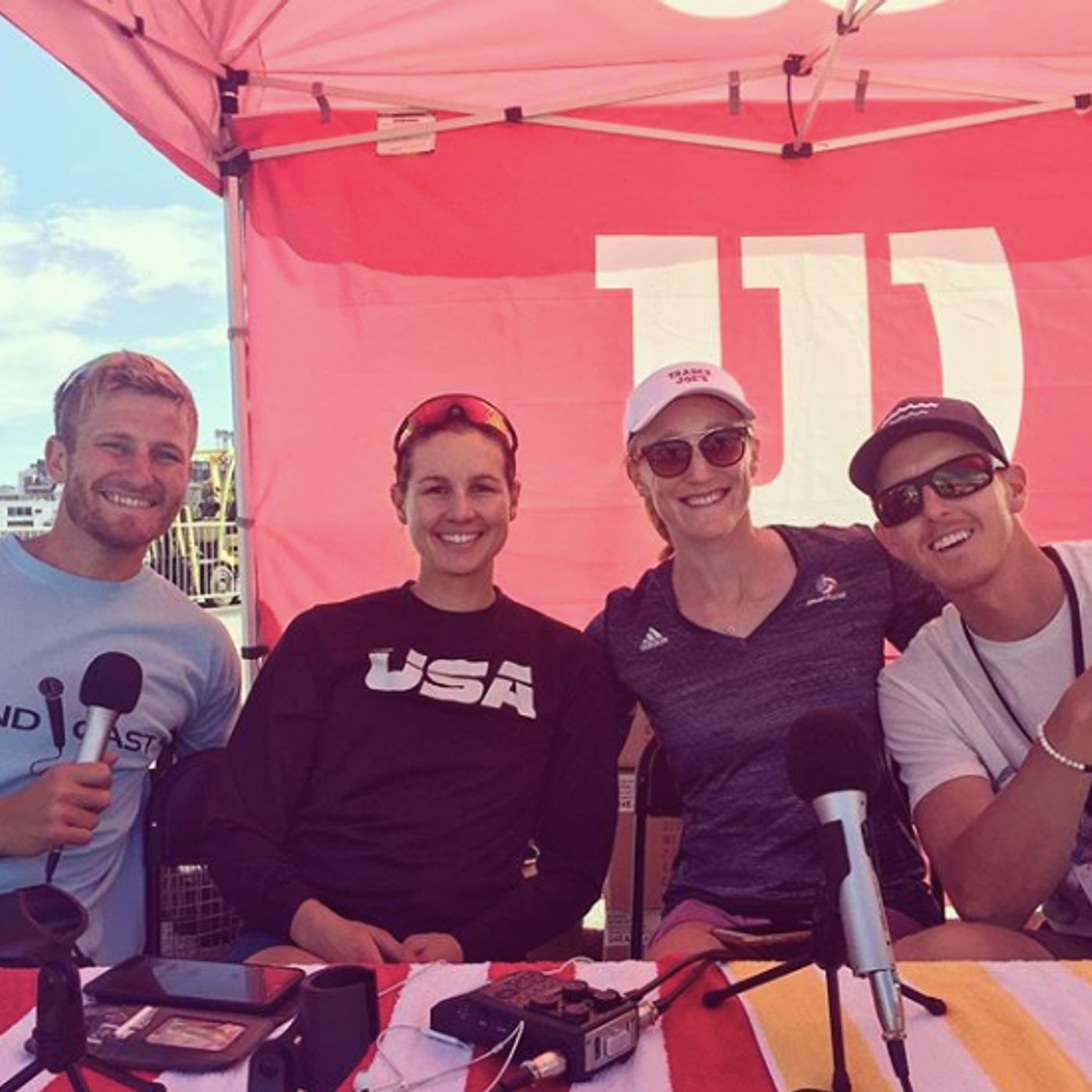
Ep 45Emily Day and Betsi Flint: Weekend warriors
It was a look that featured a strange blend of joy and exhaustion, one athletes know all too well. Emily Day and Betsi Flint had just wrapped up their first day at AVP San Francisco, playing the maximum number of sets (six), two of those going into extra points. Worse yet, they had lost their second match of the day, relegating them to the contender’s bracket, portending a long grinder of a road ahead if they were to make the finals in San Francisco and defend the Seattle title they earned two weeks before. And oh, they were only getting started. Before they would cap the weekend with another AVP title in San Francisco, finishing with a 21-17, 16-21, 15-7 win over Geena Urango and Caitlin Ledoux, before they would play 16 sets in three days, before they would win their second title in as many AVPs, they had a plane to catch. “We went straight from Seattle,” said Flint, who alongside Day beat April Ross and Ledoux in the finals 19-21, 21-19, 18-16, “just jumped in the lake and hopped on a plane to Poland, where we had to qualify on Wednesday.” And they did, winning both matches, the second, of course, going to three. They “came out flat,” Flint said, in the main draw, losing to Agatha and Duda in the first match and another pair of Brazilians, Josemari Alves and Liliane Maestrini in the second. Not that they had much time to wallow and recover, for it was straight to San Francisco. “We definitely have to stay hydrated,” Day said. “That flight to Poland was pretty rough. I may have cramped in the airport changing room. But that’s what we want to do. We want to play every weekend and so we’re out there to play every weekend. We’ll do whatever.” So they do what every over-traveled, underslept, exhausted athlete does: They convinced themselves they were fine. “It’s interesting because you think you feel ok,” Day said. “You talk yourself into it, like ‘I feel good, blah blah blah, I came off a win,’ then you get on the court and it’s like ‘Oh, God, don’t feel as good as I thought.’ But mentally we know that every team is good on the world stage so we just need to take it point by point, but winning Seattle gave us confidence. We actually had a huge comeback to qualify for Poland. We might have been down 8-2 in Poland and we came back to win 15-12. Not sure if that’s ever going to happen again but we took it and ran with it.” Evidently so. They took it and ran with it all the way back to San Francisco, coming back – again – in the contender’s bracket, rallying from a first-set loss to Lara Dykstra and Sheila Shaw to win 20-22, 23-2, 15-12. A win and a forfeit later, they were in the semifinals, rematched with the team that put them in the contender’s in the first place: Brittany Howard and Kelly Reeves. They won, 21-14, 21-13. A finals rematch with Ledoux awaited, and again, it went – and how could it not? – to three sets, where Day and Flint prevailed, 15-7. Three weeks, three tournaments, 16 matches, 37 sets, two AVP wins, one FIVB qualification. Standard month for Day and Flint. “Qualifying is an awesome accomplishment and not something we ever take for granted,” Day said. But it’s pretty special winning an AVP and getting the champagne, family and friends. Just trying to win.” Hosted by Simplecast, an AdsWizz company. See pcm.adswizz.com for information about our collection and use of personal data for advertising.
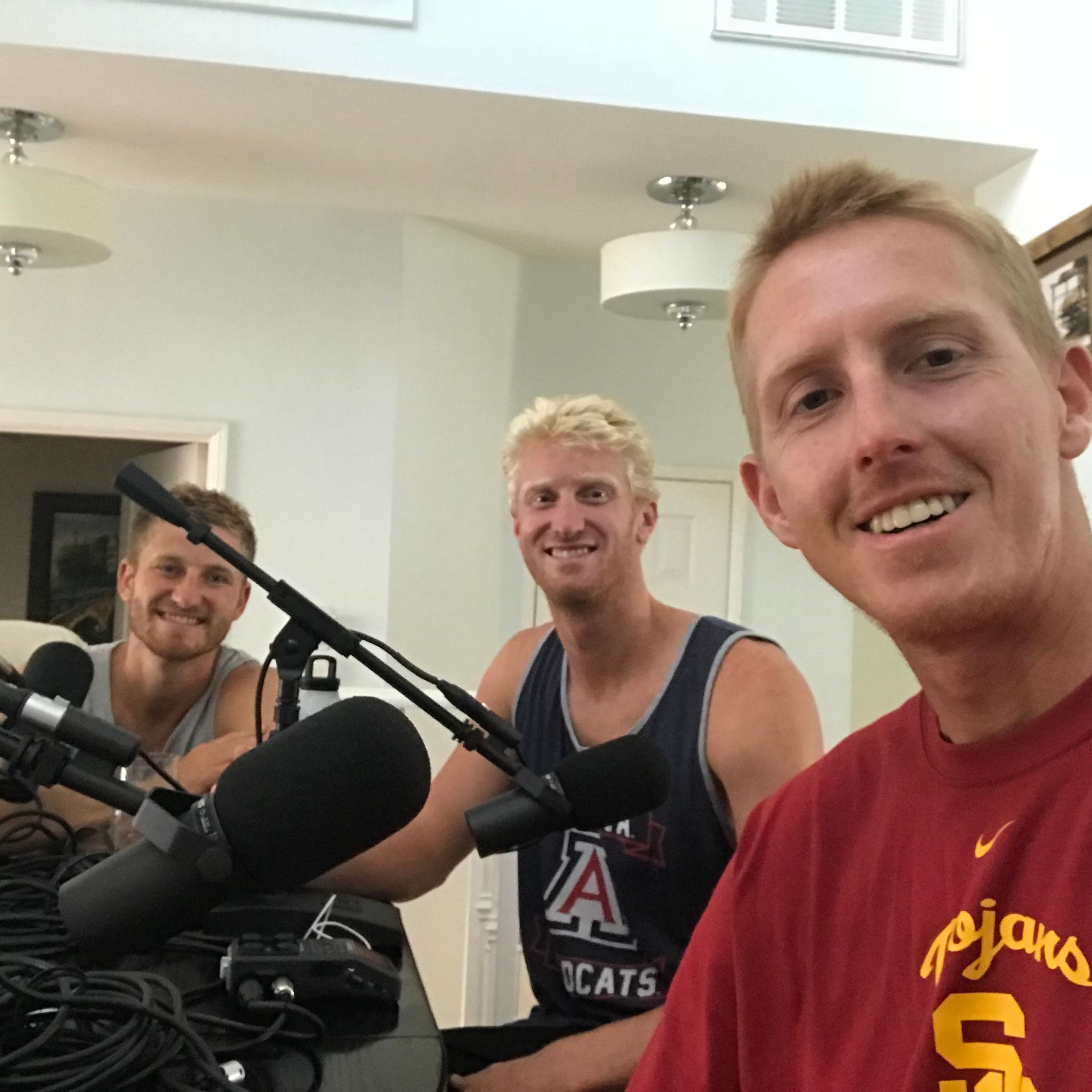
Ep 44Chase Budinger: Dunking over P Diddy to bouncing on the AVP
Oh, God. It was happening again. Chase Budinger had felt this before. He’d felt these nerves, that extra surge – no, surge might not do it justice, the extra deluge – of adrenaline. He knew what happened the last time. And here it was, all over again. His first point as a professional beach volleyball player, partnered with one of the all-time greats in Sean Rosenthal, matched up with the hottest team in the world in Alexander Brouwer and Robert Meeuwsen, set on stadium court of the biggest domestic tournament of the year, was a swing into the net. Then another. Then another in which he got stuck in the sand, to the point that the guy who was once in an NBA Dunk Contest couldn’t get his feet off the ground. “I don’t think that’s ever happened to me in practice,” Budinger said. “And in that game, it happened to me twice.” This type of debut might scar some. Budinger? Not really. He’d been here before. On a bigger stage, with more viewers, higher stakes. In his first game with the Houston Rockets, who had traded for Budinger after he was drafted by the Detroit Pistons with the 44th pick of the 2009 NBA Draft, he had two straight turnovers and an airball. “I get taken out right away, and I’m like ‘Wow, that was embarrassing, there’s no way he’s going to put me back in,’” Budinger recalled. “And he actually does put me back in in the second half and I finally got a fastbreak layup and I remember after I got that layup my nerves just kind of flushed.” Then he hit a jump shot, put down a dunk, finished with six points in 15 minutes. A quick recovery after an inauspicious start. So yes, Budinger had been there before when he struggled in that opening match against Brouwer and Meeuwsen. He knew, just as Rosenthal did, that it would take time, that his body would soon learn to not freak out prior to a match, that the adrenaline drip would be a bit less intense. That he’d be just fine. And he would be. A week later, he and Rosenthal would travel to Lucerne, Switzerland, seeded No. 28 in the qualifier. They mopped up two qualifying matches in straight sets, and promptly upset the No. 1 team in the tournament, Switzerland’s Nico Beeler and Marco Krattiger, in consecutive sets as well. “I never had that moment where the nerves went away,” Budinger said. “It just went away over time. Winning those games definitely helped with the confidence.” With each tournament, the wins mounted, and the confidence seemed to subsequently bloom. In New York, for the second AVP of the season, Budinger helped Rosenthal knock out his old partner, Trevor Crabb, and John Mayer. Then he toppled Olympian Casey Patterson and Stafford Slick before succumbing to John Hyden and Theo Brunner, finishing fifth. In just two tournaments, Budinger had eclipsed the best finish of his older brother, Duncan, who has been playing in AVPs since 2005. Ah, yes, Chase’s older brother plays professionally, too. As does his sister, Brittanie, the only volleyball player in University of San Francisco history to have her number retired. Funny story about that, too. When Budinger was still in the NBA, he had a practice at the University of San Francisco, and there, at the top of the rafters, was a jersey with the last name Budinger on it. His teammates looked up, laughed, wondered what the heck that was all about, and Chase just shrugged. Yep, his family can ball. So competitive were the Budingers that Duncan and Chase were barred from playing one-on-one basketball. Even board games were nixed. Such are the compromises a family must make when all three children reach the top levels in their respective sport, and in Chase’s case, sports is plural. He has a long way to go. He knows that. The Olympics are a goal, yes, but right now the focus is on fine-tuning – subtle nuances of blocking, setting, passing, siding out more consistently. Hosted by Simplecast, an AdsWizz company. See pcm.adswizz.com for information about our collection and use of personal data for advertising.
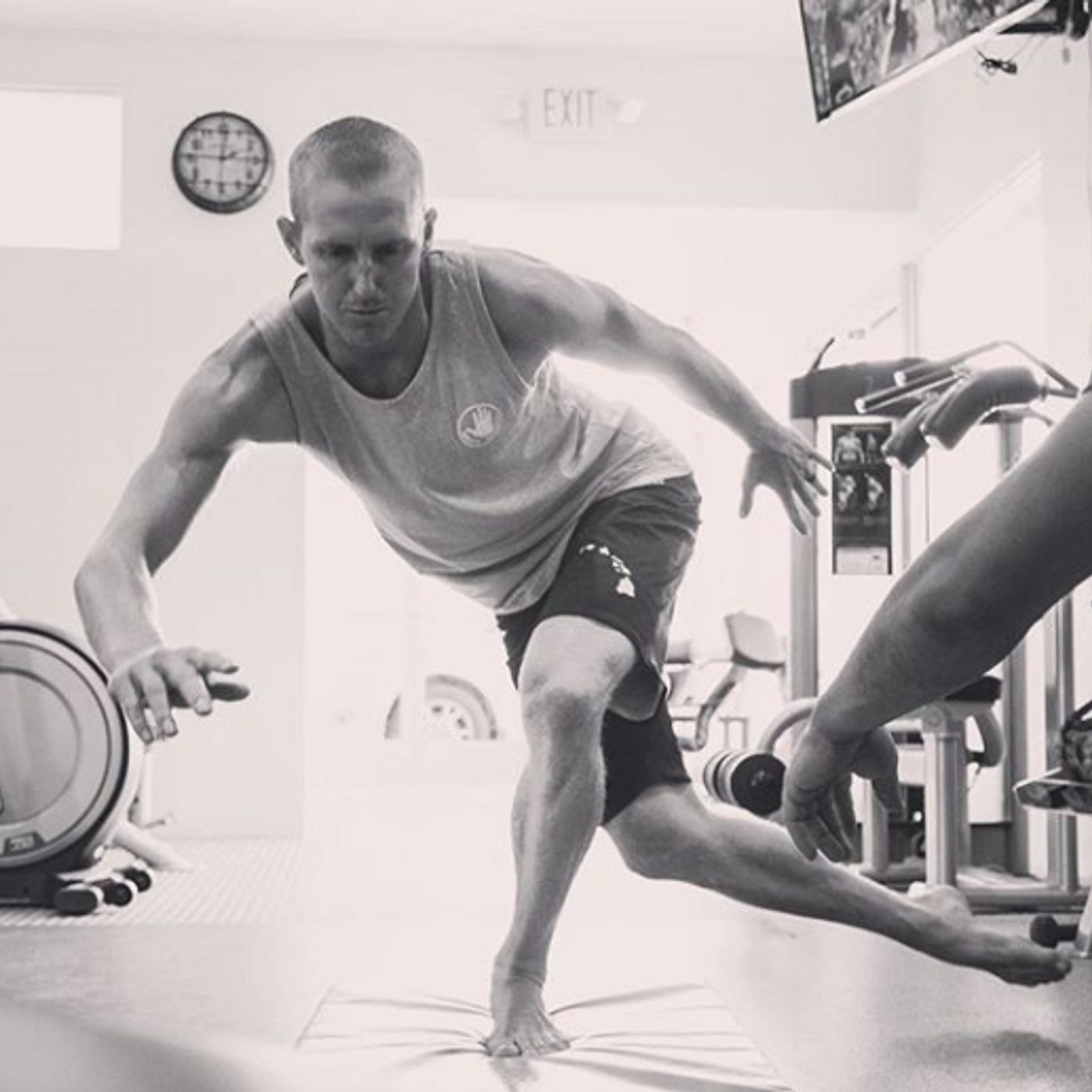
Ep 43Tri Bourne: I'm not back yet, but the warm up has begun
I’m not exactly back, BUT things are finally getting interesting for me! I’ve been touching the ball and hitting the gym for a few weeks now and mentally it feels amazing. Physically, it hurts so good. My health is not totally under control but things seem promising. Can your health ever be totally under control? Despite being asked [rightly so] almost daily about when l’ll come back and who I’ll be playing with by fans and peers, over the last year or so I did my best to not think about what the future might hold for me in the beach volleyball arena. Now that I'm feeling better and getting my health under control, I’ve finally allowed myself to start thinking about what kind of future I want to manifest for myself for [the beginning of] the rest of my career. I’ve been enjoying watching NBA free agency because I feel like I can relate those athletes who have to decide where to play and what contracts to take. It’s exciting, yet stressful… I wish I had their “$$ problems". ;) As of right now there are still quite a few unknowns, but I've recently learned to embrace the challenges that the unknown brings to my life. A quote that has stuck with me over the last few months is, “The best way to know the future is to create it.” - Honest Abe. So despite currently not knowing whether I’ll for sure be ready to play, I signed up for the Moscow and Vienna FIVBs after realizing that in order to even have an opportunity to play I had to sign up 37 days in advance. So there’s a possibility that I play this season… As far as the domestic tour, I don't know what my plans are yet. Luckily they don't make you sign up over a month in advance. Anyway, listen in to the podcast for updates on my status… Shoots then! Hosted by Simplecast, an AdsWizz company. See pcm.adswizz.com for information about our collection and use of personal data for advertising.
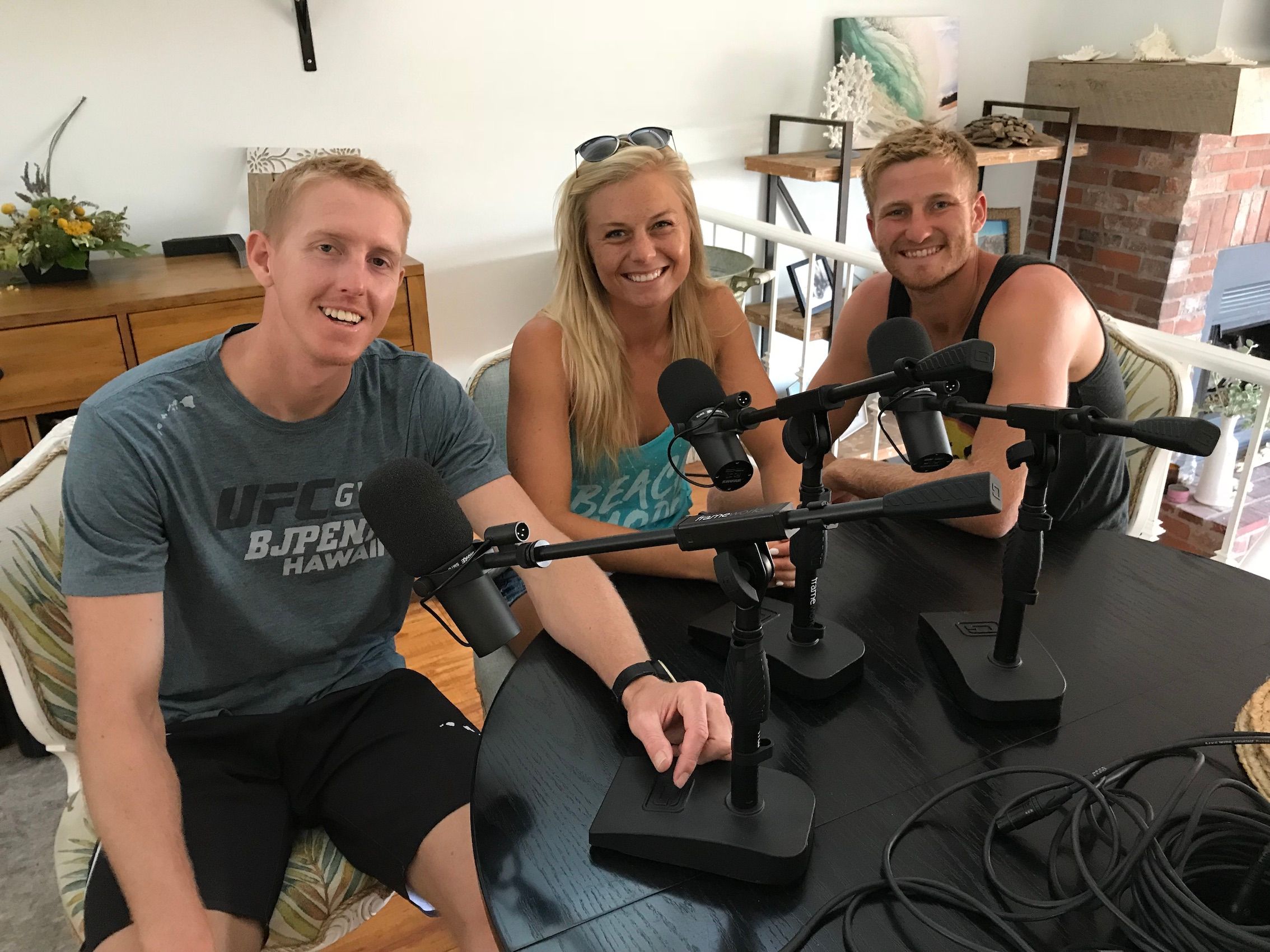
Ep 42Nicolette Martin: Just keep playing
It’s just after 6 a.m. on June 23, and Nicolette Martin leans into her seat at the Seattle-Tacoma Airport, a massive cup of coffee in hand, exhausted from both an early morning travel-day wake up and seven matches in the past three days at AVP Seattle. Her voice is gone, as it should be, for it was hardly 12 hours ago that she was battling in a white-knuckler of a three-set quarterfinal match against Amanda Dowdy and Irene Hester-Pollock. Up 13-12 in the third set, Martin and Allie Wheeler couldn’t hang on, their legs finally giving way to 18, seven of which came during Thursday’s qualifier. She doesn’t mind the qualifiers. They’re good to build a rhythm and get live reps before the main draw, but it would be nice, she admits, not to have those extra three matches, to not be so worn down by the quarterfinals. Seattle marked the second time in as many tournaments that Martin made the quarterfinals after coming out of the qualifier. She did the same in Austin with Sarah Day, succumbing in the quarters to Katie Spieler and Karissa Cook. An hour prior to the quarterfinal match, Spieler couldn’t believe that Martin and Day had already begun warming up. Hadn’t they already played 15 sets that weekend? In heat that had regularly eclipsed triple-digits? How were they still going? Just Nicolette being Nicolette. To catch Martin in the airport is to catch her on the strangest of days: A day off. No volleyball. No reps. No working out. Just coffee and naps. “I don’t know where that came from,” she said of her nonstop motor. “Just being at [USC], they really pushed us. We were training six days a week and Sunday was our rest day. It was an hour lifting then a three-hour practice. Doing that for four years, it’s like ‘Ok, we won three national championships. Something about that worked, so I need to keep going, I can’t stop.’” It is that type of work ethic – or play ethic, really – that has enabled Martin to steadily climb the ranks of the AVP, from making one of three main draws in 2016, to six of seven in 2017 with a best finish of seventh, to two for two in 2018 with consecutive fifths. “We started in Huntington and did awful,” Martin said, laughing. “We got a wild card into the main draw and went 0-2. The two games we played went to three and we lost both of those, so I think we used that as our fuel for our fire for Austin, so we went into Austin and yeah, we took a fifth. “I think behind all of that, we’ve been working with our coach and we’ve been super open with each other and talking about our goals and how we’re feeling. We would just talk about things, where we’re at with our bodies, what we can give each other today, learning to talk to my partner more and being super open and honest and really trusting your partner and knowing they’re going to give 100 percent made me more free with my volleyball.” And free, it seems, no matter who she’s playing with, whether it be Sarah Day, with whom she took a fifth in Austin, or Allie Wheeler, her former teammate at USC with whom she took a fifth in Seattle. It would be difficult to miss the joy with which Martin plays. She’s constantly talking, cheering, yelling, smiling, laughing – something is coming out of her mouth. Sometimes it’s a joke, as it was when she found herself down 11-9 in the third set of the second round of the qualifier. Sometimes she’ll ask her partner what she wants to dinner, “just to put your mind somewhere else for a second,” Martin said. “Like, ‘Ok, relax.’” Whatever works. At the moment, that seems to be mostly everything for Martin. Hosted by Simplecast, an AdsWizz company. See pcm.adswizz.com for information about our collection and use of personal data for advertising.
Ep 41Melissa Humana-Paredes and Sarah Pavan, the No. 1 team in the world with an even higher ceiling
The pause, so slight, so innocuous, but present nonetheless, said more than words could. And, to be fair, Melissa Humana-Paredes did put a nice verbal spin on her and Sarah Pavan’s quarterfinal loss against Brooke Sweat and Summer Ross in Fort Lauderdale earlier in the year. She called it thrilling. “But…” and then came the pause, ever so brief, just enough to know that a fifth place for Canada’s top team, even in an FIVB Major, even in the first big event of the year, is nowhere near this team’s expectation. And justifiably so. In their previous six international tournaments, their worst finish had been fourth, in a run that included a silver in Poland, bronze in one of the top events of the year in Gstaad, and a gold in Porec. “I can tell you guys are cringing about it,” Tri Bourne said on SANDCAST: Beach Volleyball with Tri Bourne and Travis Mewhirter. “We don’t want people to think ‘Oh, fifth, terrible,’” Pavan said. “Like, for all intents and purposes, it is a good finish but our goal is to be in the semifinals or on the podium every tournament, because that means we are playing well. Fifth is not bad, but we have high expectations.” It hasn’t taken long to build them. This is just the second year of the Pavan-Humana-Paredes partnership, and in that short time they have already raced to the top of the FIVB rankings and finished on a podium in six different countries, three of those podiums resulting in medals of the gold variety. “We kind of became addicted and wanted it to happen all the time,” Pavan said. “Even though we are in a second year and every team is elevating their level, we still have been able to hold onto that spot. And we still have so many things we want to get better at and that we’re working on and we know that we can still get so much better so we’re excited about that. The first year was about laying the foundation, now it’s time to find our identity as a team.” As it goes in a search for identity, and switching sides, and switching partners, there are inevitable stumbles along the way. And as it goes with exceptional, world-class athletes, sometimes those stumbles, such as a fifth place in one of the biggest events of the year, are to most accomplishments. And, of course, sometimes those stumbles may seem more obvious, such as their upset at the hands of Delaney Knudsen and Jessica Sykora in the AVP New York qualifier a week ago. “We’re having some ebbs and flows,” Pavan said, as Humana-Paredes laughed in the background. “Some ups and downs, which I think is normal in the second year of a partnership. We are having moments where we are playing great and amazing and we are having moments where we finished the game wondering ‘What the heck just happened? What were we doing?’ “Obviously, we always want to win. We all do. But I’m glad it’s happening now because we do have time to work out those kinks and have those hard conversations because we’re always learning and always looking at the opportunities in front of us. So yeah, it’s been a little up and down but heading into this next phase of the season, we’re looking to get our feet under us and make some big strides.” Those strides will, however, be taking place exclusively on the FIVB, and no longer on the AVP. According to Pavan, due to a new rule instated by the USAV, unless the AVP, or any domestic tour, pays a fee to the USAV for each event featuring international players, said international players will not be permitted to play on the AVP Tour. “This has never been a rule before,” Pavan confirmed. “So yeah, Mel and I talked about it and if we were in the AVP’s position, we would find it hard to reason paying that much money too.” Twelve hours prior to New York, Pavan and Humana-Paredes didn’t know if they were even allowed to play. So they missed their initial flight from Canada to New York because they weren’t sure. Then they moved it back and missed their next for the same reason. Then they got the OK from the AVP. They were good to go. So they woke up at 3 a.m., jumped on a plane at 6, landed at 8, rolled into Manhattan at 9, snuck in a quick nap, grabbed some oatmeal, jumped onto the court and attempted to play the world-class volleyball they were accustomed and expected to play. “We’re not going to make excuses,” Humana-Paredes said. “Those qualifiers are deadly. They are crazy. We had three games within a span of three or four hours, which I haven’t done since youth. It was definitely a challenge, both physically and mentally.” Indeed. Physically, they – somewhat hilariously – may have mixed up creatine and electrolytes. Mentally, they were playing a brutal qualifier with no sleep, little food, no warm ups – and with a freeze rule Humana-Paredes had never experienced before. And though the loss is fresh, and it is not difficult to see the disappointment, they cannot help but laugh a bit at the mania of it all, from the missed flights to the quick nap to the accidental nutritional mishap. “It was definitely not our finest
Ep 40Sarah Sponcil, Pac-12 Champ, National Champ, AVP finalist
It may seem difficult to imagine at first, what with a Pac-12 title, an NCAA Championship and an AVP final under her belt in the span of just a few weeks, but yes, Sarah Sponcil does struggle from time to time. Take Spanish, for example. “I have not taken it since I was in fifth grade,” she said on SANDCAST: Beach volleyball with Tri Bourne and Travis Mewhirter. “A lot of people take Spanish in high school, so it was elementary Spanish and I was like ‘Ok, we’re chillin’ with the colors and the weather and all that stuff and the lady is like ‘Ok so the next class we’re going to be speaking in full Spanish. And I was like ‘Wait, what? What did I sign up for? Is there a level below this?’ So that’s been kind of a struggle.” But on the court? It may take some digging to find a soft spot in Sponcil’s game. Partnered with Lauren Fendrick for Austin, Sponcil won her first four career AVP main draw matches in straight sets, setting up a final against April Ross and Alix Klineman. “I think I just had that mentality – people are going to be stronger, faster,” Sponcil said. “I think I just tried to put the pressure on, trying to stay aggressive. I think a lot of people go to shots if they get blocked, they kind of just do that. I felt like I was full force. I just want to swing, if I get blocked, I’ll just work around.” She worked around Angela Bensend and Olaya Pazo, Caitlin Ledoux and Kendra VanZwieten, Janelle Allen and Kerri Schuh, Karissa Cook and Katie Spieler. It was one thing to play alongside an Olympian and Stanford’s assistant coach. It was an entirely different feeling to play against Ross, the player Sponcil has looked up to since she began playing volleyball. “I mean, you’re playing against April Ross,” Sponcil said. “I literally had pictures of her when I was like, 14 and 17. Just to be playing against her and seeing me stack up against her was really cool. It was a really great experience.” She watched the film a few times, enough to know that she stacked up just fine. Ross and Klineman had only dropped a single set prior to the finals, yet there was Sponcil, pushing the two-time Olympic medalist to a 24-22 first set, and again to a 25-23 second set. “We basically played a third game,” Sponcil said, laughing. “I felt like I was taking it point by point. I don’t know. I thought it was an amazing challenge. You look up to someone for so long and you don’t want to miss this opportunity. You want to show them like ‘Ok, I deserve to be here. It wasn’t a fluke that we were here.’ “Right after we lost, as long as we gave them a run for their money, that was ok with me. Just to be that close and within striking distance gives me hope and just makes you want to play that much more and get that much better so you have the opportunity to face off with them again.” She will. There is no doubting that. She had to skip New York for her finals, though she plans on playing Seattle and the remainder of the AVP season, and she’s entertaining the possibility of sprinkling in some FIVB stops as well. At the end of the day, it is this: Sarah Sponcil just wants to keep winning. “I’m just trying to get to know the beach volleyball world,” she said. “Now it’s like ‘Ok this is a completely different world. Book your own flights, book your own practices with different people.’ “I’m just going to keep trying, keep getting into AVPs, and I’ll see what happens from there.” Hosted by Simplecast, an AdsWizz company. See pcm.adswizz.com for information about our collection and use of personal data for advertising.
Ep 39Taylor Crabb just keeps playing -- and just keeps winning
There stood Taylor Crabb, arms raised, trophy in hand, smiling for cameras. A familiar pose that’s becoming quite regular for Crabb. It doesn’t matter if he’s on the left side or the right, with Jake Gibb or Tim Bomgren or Chase Budinger – Crabb can and will win with whomever he’s sharing the court, wherever the court may be. Outrigger Canoe Club? He can win there, as he did on myriad occasions, with myriad partners, as a youth. New York City? Yeah, he can win there too, alongside Gibb. It’s the site of his first AVP victory, and could very well be the site of his third by the end of this weekend. Austin? He can push it to the finals there as well. Despite Gibb being injured. Despite only one day of practice with Tim Bomgren. Despite Bomgren playing on a sprained ankle that by the following Monday morning it would resemble a purple and blue softball more than it did an ankle. Laguna Beach? In a tournament he never intended on playing? With a partner, Budinger, he’d never played with? Not even a practice? On a side he hadn’t played in more than a year? He’ll take that $4,000 winner’s check, thank you very much. This is what Crabb does. Not necessarily the winning, though he does that plenty. He just plays. He plays everything. Always has. Likely always will. Nothing at the moment seems to indicate otherwise, anyway. “I’m pretty good at listening to my body,” he said, before admitting that “I do have injuries, but I do try to stay on top of them, one being my shoulder. A lot of rehab for my shoulder. Just keeping it strong helps a ton. “Honestly, I’m sure you know, this is only my third year on the beach so far. Your first three years coming from indoor – the sand felt so good. Your body is way better. Right now, that’s where I am: 26, off the hard court, feeling good, diving around in the sand, nothing is going to hurt me.” He’s feeling so good, in fact, that his coaches – Rich Lambourne and Tyler Hildebrand – have to order him not to practice. And even then, he still hops in for a drill or two, because there’s a new defensive position to learn, more reps to get, more playing to do. He’s done this his whole life. Doesn’t matter if it’s an impromptu dunk contest on the outdoor hoops across the street as a kid. Or basketball. Or soccer. Or living room volleyball. Or local tournaments that he’d win as a teen, “and I think everybody hated us,” he said, laughing. “All these 14, 15, 16-year-old kids winning all the tournaments.” But when you look at those kids now, it’s easy to understand why most victories went their way. There’s Trevor Crabb, winner of two FIVBs this year, and Tri Bourne, once ranked No. 2 in the world in 2016. There’s Spencer McLaughlin and Brad Lawson, two of the top-rated recruits from their respective high school classes. There is the Beard Brothers before they became the Beard Brothers. There is Micah Christensen, who is arguably the best setter in the world, and the Shoji brothers, Erik and Kawika, Olympians both. And Taylor. Once the runt of the litter, so small that his aunt called him “Bug,” Taylor has since established himself as perhaps the best of the bunch, discussed among the top beach defenders in the country despite only being in his third year playing beach volleyball professionally. He whiffed in New Orleans of 2015, qualified for the next two – and then took a third in Manhattan Beach with Trevor. Since then? He’s been in six finals and another six semifinals, with wins in New York and Hermosa Beach. “I have goals in life,” he said. “And not one of those goal is to be better than someone. The short-term goal is to defend my title in New York. That’s No. 1 right now.” Hosted by Simplecast, an AdsWizz company. See pcm.adswizz.com for information about our collection and use of personal data for advertising.
Ep 38Patty Dodd: Manhattan Champ, National Champ, and more importantly, Coach
Patricia Orozco knew Mike Dodd was serious the day he picked her up at UCLA in 1985. She knew he was serious because, after taking her to Marine Street for a crash course in beach volleyball, he took her to The Kettle for lunch in Manhattan Beach. “And it was like ‘Whoa!’ If you get taken to The Kettle for lunch then this he’s serious,” she said on SANDCAST: Beach Volleyball with Tri Bourne and Travis Mewhirter. Serious enough that, a year later, they wed, and Patty took Dodd’s last name, and 33 years later they remain not only happily married, but business partners and elite coaches in the Manhattan Beach area where Patty began to learn the beach game. Well, Patty is at least an elite coach. Mike is technically, and hilariously, the equipment manager at MB Sand Volleyball Club, and he takes his job seriously enough that when Patty couldn’t make it one day, one of the 12-year-olds commented that MB Sand must be running terribly low on coaches because the equipment guy had to fill in. She had no idea the equipment guy was a five-time Manhattan Beach Open champion and Olympic silver medalist. “The mom just could not wait to call me, because she knows Mike’s background,” Patty said, laughing. “That’s what 12-year-olds can say. The janitor is going to run practice.” Some janitor. And some janitor’s wife, too. Let’s, for a moment, put their prolific playing careers aside – and indeed they were prolific – and examine only their coaching backgrounds. When Patty graduated from UCLA, she took up an assistant opening with the Bruins indoor team. They won a national championship in the very first year. “I knew early on that I wanted to do this,” she said. “I just fell into being a graduate assistant in my fifth year and we won NCAA and it’s like ‘Oh, yeah, alright, I like this. I really like this.’ I was so young at the time, but the fact that what you said had an effect on the player or the play or the outcome, I was hooked. “It just took me a while to get to the coaching part because I was doing my playing part.” And she did her playing part well. A native of Bogota, Colombia, Dodd graduated from high school in 1980 and moved to Santa Fe Springs, where she could learn English and play volleyball for a local club team. Within those six months she had offers to play for UCLA, Hawaii, USC and Oregon. "I remember when I first saw her at a Christmas tournament," then-UCLA women's volleyball Coach Andy Banachowski, who has led his teams to four national championships, told the Los Angeles Times. "I was looking down in the Sports Arena and I saw this girl move incredibly well. What really caught my attention is that I didn't know who she was because I know all the kids in the area with talent." "When Andy came up to me," Orozco told the Times, "I couldn't even understand him. I was even named all-tournament and didn't even know what that meant." The accolades, she’d soon become quite familiar with, setting UCLA single-season kills (627), single-match kills (33) and single-match digs (30). As a senior in 1983, she led the Bruins in kills with 403. She still had yet to step foot on a beach. She finished her grad year at UCLA and competed for a year in Italy, where she initially met Dodd. Who better to teach her the beach game, then, but the man she met in Italy who was in the midst of winning four consecutive Manhattan Beach Opens? Yes, the janitor can coach, too. She proved a quick learner, too, Patty. By 1989, just four years after Mike took her to Marine Street and provided the Beach Volleyball 101 crash course, Patty, partnered with Jackie Silva, won 11 of 13 tournaments. Four times that year, Patty and Mike won tournaments on the same weekend, becoming the first married couple to do so. By the time they finished competing, with six total Manhattan Beach Opens to the family name, the Dodds combined for 89 wins and nearly $2 million in prize money. Now they’re teaching others to compete and thrive like they once did. Aside from serving as the most over-qualified equipment manager in beach volleyball history, both Mike and Patty help with USAV National Team practices. She loves the quiet tenacity of April Ross, the genial intensity of Kelly Reeves, the efficiency of Taylor Crabb and Billy Allen. More than that, above all, as it almost always has been, she loves to coach. Loves to teach. Loves to pass on the gifts that to this day she’s still developing herself. “I’m really enjoying MB Sand,” she said. “It really gives me immense joy to see the kids develop their game and to see them make friendships and different partners. It’s such a healthy environment to build beach volleyball. “I love that about beach volleyball, that the kids need to be great at all of the skills. It just brings me a lot of joy to do it.” Hosted by Simplecast, an AdsWizz company. See pcm.adswizz.com for information about our collection and use of personal data for advertising.
Ep 37Mailbag No. 2: Who's the best U.S. player not named Phil?
The mailbag is back! On the second SANDCAST mailbag, Tri Bourne and Travis Mewhirter, alongside Podcast Mama Gabby Bourne, answer a wide variety of questions from you, the listeners. Before we get into the questions, a way to reach out to SANDCAST. If you have any questions, feedback, tips or suggestions, email us at [email protected]. Thanks to all who sent in questions for this week! We answer one of the most oft-wondered questions in American beach volleyball: Aside from Phil Dalhausser, who has been the best American male in the past decade? Jake Gibb? Sean Rosenthal? John Hyden? Nick Lucena. - The AVP has stopped at Madison Square Garden and played in front of a sold out crowd. If you had to pick one venue or site to play a tournament, where would it be? Both hosts, shockingly enough, may have biased answers based on hometowns and rooting interests. - The United States, when compared to countries like Brazil, Poland, and Norway, among a number of others, is woefully behind in the development of young male talent. What's being done to produce higher-level talent at a younger age for the men? - Finally, beach volleyball is slow to the game in terms of statistical and tangible analysis and breakdowns. Is that a direction the game is going, and if so, how? If you like us, let us know and subscribe give a review on iTunes! Follow us on Podbean to catch up with all episodes! If you’re digging what we’re wearing, go ahead and give our sponsors some love at Plastic Clothing! If you’re looking for some new board shorts or bikinis, check out Rox and their 80 PERCENT OFF SALE! Popular on SANDCAST: SANDCAST 20: Brotherly love with Maddison McKibbin SANDCAST 17: Is p1440 the next big thing in beach volleyball? SANDCAST 13: Sara Hughes embraces new responsibility: Role model SANDCAST 12: Talking’ sh** with Trevor Crabb SANDCAST No. 9: Chase Frishman and the AVP’s next wave of talent SANDCAST 8: Phil Dalhausser has another mountain to climb SANDCAST 6: A glimpse into greatness with April Ross, Part 2 SANDCAST 5: A glimpse into greatness with April Ross, Part 1 SANDCAST 3: It’s finally (finally) video game season for Kelly Claes SANDCAST 1: The new Tri Bourne: Buddha Tri Bourne Recover the right way with Firefly: Accelerated Athletic Recovery Choose the ball the pros use. Choose Wilson, and use our 20 PERCENT DISCOUNT CODE: WILSONSAND! Hosted by Simplecast, an AdsWizz company. See pcm.adswizz.com for information about our collection and use of personal data for advertising.
Ep 36Tim Bomgren, from Minnesota to the finals of AVP Austin
One day. That’s it. That’s all Tim Bomgren and Taylor Crabb had for practice prior to AVP Austin. Crabb needed an emergency fill-in after Jake Gibb broke his toe. To the lefty from Minnesota he turned, despite never having played with Bomgren before, despite never having played with a lefty before. Not that any of this is unusual for Bomgren. He lives in Minnesota yet is one of the best blockers in the country. While many in Southern California are training four or five days a week in April, sometimes using sand socks because it’s too hot, Bomgren is shoveling snow, sometimes using sand socks because it’s too cold. The only other time Bomgren had made an AVP semifinal was in New Orleans of 2015, in which he and his brother, Brian, practiced for maybe two weeks prior. One day? Sounds about right. “We talked about blocking calls and all that, we talked about who’s taking middle, who’s making the call when someone’s serving,” Bomgren said. “Taylor and Jake run a push to the outside – high, middle, low. Most teams do the same thing and I do the same thing with Brian. We talked about what his calls are, what my calls are and where to err. “I prefer the ball to be further inside than outside and Taylor’s the same way. Talking those things out makes a huge difference in how the game flows.” Indeed. Whatever adjustments Bomgren and Crabb made, they worked. In a 16-team draw that featured a fully-loaded field, in which the only absent American was the one for whom Bomgren filled in, they made the finals. Every team on their road to the finals had made at least the semifinals in the past year. “It was extremely difficult,” Bomgren said. “I personally had to take myself out of the play, just kind of take it step by step, and I’m not trying to look at ‘I need to win three more matches today.’ It’s ‘I need to pass this ball, where it needs to be, so Taylor can set me.’ It was breaking it down for me, when we’re serving and receiving, taking it step by step and doing what you can, seeing how the plays turn out.” Most turned out quite well. Some didn’t. They lost their second match, against Ryan Doherty and Billy Allen, a match in which Bomgren sprained his ankle, though he made sure to note on SANDCAST that the sprain was not the reason they lost. Allen and Doherty played better. That was it. “In the first game, we controlled the match, we controlled our side of the net, and what happened was game two and game three we had a slow start, and that was largely due to what we did on our side of the net,” Bomgren said. “They were things we can control. So we tried to refocus that, and credit to Billy and Ryan, they played phenomenal volleyball. They ended up controlling the last two games and, ultimately, the match. “We tried to refocus and we kept things simple on our side. Control our side of the net, do what we can do, and not do too much.” And in not doing too much, ironically, Bomgren, on a bum ankle, with a partner he had never played with, after just a week or so of touching a ball, in heat that is entirely foreign to his native Minnesota, did more than he ever has on the AVP Tour. He and Crabb won their next four matches, including the always-alluring Crabb on Crabb quarterfinal matchup, including a three-set, nearly two-hour grinder in a rain-soaked semifinal against Reid Priddy and Jeremy Casebeer. Just Tim being Tim. “I think I played once and had four drilling sessions,” he said of his preparation, laughing. “Brian and I are both the type of players, and we’re very gracious for it, but we’re not the type of players who need 1,000 reps a day to stay fresh and stay on top of our game. We kind of pick it up as we go. “Ultimately, what it comes down to, you get into that game situation, especially on the AVP Tour, and it doesn’t matter. If you’re focused, you know what you’ve been practicing, you know what you’ve been doing. Once I’m focused, and I’m into the game, I’ve done it 1,000 times. Once you get into that game mindset, everything comes back to you.” All the way from Minnesota to the finals. Hosted by Simplecast, an AdsWizz company. See pcm.adswizz.com for information about our collection and use of personal data for advertising.
Ep 35Adam Johnson: The Hall of Famer hiding in plain sight
Adam Johnson couldn’t believe it. He’d had some rough losses in his day, narrow losses with a lot on the line. Twice he had been the first team out of the Olympics, and twice it was because of a random, head-scratching injury. In 1996, when Johnson was partnered with Randy Stoklos in the Olympic trials in Baltimore, the two had to win just one of their next two matches, the first of which would come against the Mikes – Mike Whitmarsh and Mike Dodd. Thirty seconds before the match, Stoklos hit one final warm up jump serve, landed on a ball and sprained his ankle. Johnson and Stoklos would lose the next two matches, and their bid for the Olympic Games. Four years later, it was Johnson and Karch Kiraly, needing essentially only to qualify for one final tournament to seal their spot in the Athens Games – and then it was Kiraly who suffered an injury. Again, Johnson was the first team out. “Thanks for reminding me,” he said, wistfully, on SANDCAST: Beach Volleyball with Tri Bourne and Travis Mewhirter. Eighteen years have passed since just missing out on the 2000 Games, but stakes are still high for Johnson on the volleyball court. Now, he’s wagering In N Out burgers. “I’ve never lost to my girls,” he said. “Now I will say that with a little asterisk, because I am getting a little bit older, and I was up 22-10 when one of the girls shot the ball over on one and I turned to go get it and I heard my hammy go a little bit.” Johnson wanted to call it quits. The girls wouldn’t have it. He made a bet: Loser takes the winner out to In N Out. “They wanted to know when we were going,” he said, laughing. “I’m here going ‘I’m up 22-10, and you’re telling me you’re not giving me another shot?’ And they’re like ‘Well can you go right now? Or you forfeit.’ They are pretty ruthless.” A competitive edge, perhaps, gleaned from their coach. This was a man who, in his first full season on the beach after years playing on the indoor national team and overseas in Italy, won five tournaments and labeled that as being “kicked around.” From 1994-1999, Johnson, playing with an armada of partners who would cement themselves as some of the best in the game – Jose Loiola, Kent Steffes, Kiraly, Tim Hovland, Stoklos – won at least four tournaments per season, in fields that were stacked with one Hall of Famer after the next. That drive is still there. “I don’t know if I ever gave up on being a player,” said Johnson, who retired in 2000, made a brief reemergence in 2005, before retiring again. “I’m always still trying to get up a ball up on my girls who can’t get it up, just using my foot or putting it back in play if it’s over the bench or something. “I love coaching. I feel like I have a lot to offer. If they ask questions and want to learn, I feel like they can get better.” Perhaps even more important: They might be able to get some In N Out. Hosted by Simplecast, an AdsWizz company. See pcm.adswizz.com for information about our collection and use of personal data for advertising.
Ep 34SANDCAST Mailbag: Tri's secret to jumping high, Travis's journey into volleyball
You guys asked – literally, you did ask questions, though not specifically for an entire episode of them – and SANDCAST is delivering. This is our first “mailbag” or “Sandbag” or whatever you’d like to call it. The premise, of course, is to answer your questions, about partnerships, about skill development, about stories, about where the game is headed, about whatever it is that you’re wondering about beach volleyball. This week, we answered as many as we could in our self-imposed 30-minute time limit, and we also awarded our favorite question, or questions in this case, with a signed Jose Loiola mini ball as well as a signed backpack. Thank you to everyone who wrote in questions, and if you’d like us to answer your questions in future episodes, shoot us an email at [email protected] or find us through our website, sandcastvolleyball.com. This week, in a wide variety of topics, we covered: Travis Mewhirter’s journey from a Maryland sports writer to beach volleyball player, podcaster, writer He will be writing a full blog series, set to begin on June 16, exactly four years to the day after picking up a volleyball, either indoor or beach, for the first time, though he covers the basics, beginning at a bar in Florida to where he is now – on the verge of qualifying while picking the minds and annoying the greats on this podcast. Tri Bourne’s secrets to jumping high USA Volleyball, and many college trainers and personal trainers at your gym, stress Olympic lifting. For some, this works. For others, like Bourne, a different approach is more effective. AVP Next zones: Do the Californians feel slighted? The Manhattan Beach Open awards eight automatic bids per year via the AVP Next regional bids. It begs the question: Do Southern Californians, who compete in the most difficult region in the country, feel slighted by the gauntlet they must go through to win the bid? The short answer: No. Is the 48-team format in Huntington Beach sustainable or scalable? FIVB/AVP Huntington Beach was an undeniable success. But is it sustainable? Is it scalable? Can it be replicated, particularly over the next two years when Olympic qualification is on the line? We discuss. Why do our men peak so late? Six of the best players in the United States are either nearing 40 or already there and past it. While the rest of the world – Russia, the Netherlands, Norway, Brazil – has younger players medaling already, why is the United States so far behind? And is that a bad thing? Thank you again to all who emailed in questions. Reach out with questions and feedback at [email protected]! Hosted by Simplecast, an AdsWizz company. See pcm.adswizz.com for information about our collection and use of personal data for advertising.
Ep 33Adam Roberts: Beach volleyball's talent finder
Lay out? Was that what Adam Roberts’ friends said? He didn’t even know what that meant. So you just walked down by the ocean, put a blanket down, and… laid there? Nope. Not Adam Roberts, this week’s guest on SANDCAST: Beach Volleyball with Tri Bourne and Travis Mewhirter. His whole life, then as it is now, had been based on movement. Raised in High Point, North Carolina, Roberts grew up on a steady diet of soccer, cross country, track and basketball, receiving offers from ACC schools to run the 800 meters but also an offer from Elon College, which was just 30 miles down the road, to play point guard on its basketball team. He took the full ride to Elon, started every game in his last three years and earned All Colonial Athletic Association honors. During breaks, however, he would live at his parents’ house in South Carolina, and it was there, rather than laying out, that he discovered volleyball, a game that was quite similar to basketball in its movements – lots of quick lateral steps and explosive leaps – but it was on a beach. So he would play pickup beach volleyball every day over the summers, and it paid off with an eight-inch increase in his vertical leap in the gap between his sophomore and junior years. In his junior season, he was leaping so high that he won four dunk contests. “I had tried everything, man,” he said in a previous interview. “I tried the strength shoes, the SuperCat Jump Machine. It wasn’t until I began training on the sand with a weighted vest that I saw that increase, so I just used it as a cross-training sport.” And when he graduated with a dual-degree in business and econ, Roberts was good enough that he had some small-time offers to play basketball professionally in Europe. He wasn’t interested. “I was way too into volleyball,” he said. So he spurned the offers overseas and moved to Myrtle Beach, where his parents had built a three-bedroom house on the beach. “I said ‘Sure I’ll live for free on the ocean and play beach volleyball,’” Roberts said, laughing. “It has a full hot tub, fire pit, a really nice volleyball court on the property on the ocean. It’s a great set up and very conducive for guys to train in.” It didn’t take long for word to spread of the Roberts House of Volleyball in South Carolina. For nearly a decade, players cycled in and out, drinking and playing volleyball, living a life many dream of but few realize. And in the spring of 2003, when Roberts and his roommate, Matt Heath, a 6-foot-6 former collegiate soccer player turned blocker from Fort Myers, Florida, were playing in a tournament in south Florida, they happened across “a skinny white kid and a tall guy wearing steel-toed boots” that were damn good. “That,” Roberts says, “is how I met Phil Dalhausser.” Not long after, Dalhausser and the skinny, fiery white kid, Nick Lucena, moved to South Carolina. They were going to become beach volleyball players. “We would go out, I don’t know, probably on average four times a week,” Dalhausser said in a previous interview. “Adam pretty much ran the town so we’d drink for free. And those days we would roll out of bed at eleven or something like that and we’d stroll out to the courts at two.” After the hangovers had been massaged and they were able to play, they’d head out to the court and train for a few hours and then, in between marathons of Halo, pour over film of Karch Kiraly and the greats at night. “That house was volleyball one hundred percent of the time,” Heath said. “We’d be on a road trip discussing ‘Hey what do we do in this situation?’ It was just kind of an open forum and we just did a lot of homework on it. It was a good time. We all raised our level.” But still, even in the Adam Roberts House of Volley, Dalhausser was different — “a freak,” Heath says, and he means it as the highest of compliments. “His improvement was meteoric, to be honest.” When they popped in movies or played X-Box, Dalhausser would grab a volleyball and set to himself for all two hours. “His concept was that he wanted really soft hands, almost that you couldn’t hear it coming in and out,” Roberts says. “That was his thing that he would set the ball so quietly that we could still watch the movie.” During the winters, Dalhausser and Lucena would pick up shifts as substitute teachers and Roberts would help out with Showstopper, his parents’ dance competition production company. When it would be too cold to play on the beach, they took to the basketball courts, joining men’s leagues and dominating pickup games. And it was there – not during passing drills or watching Dalhausser set to himself during movies or winning tournaments over the summer – that Roberts knew just how limitless Dalhausser’s potential was. “I had seen some good athletes, Division I basketball athletes, but when I saw Phil’s touch on the basketball court – he could dribble, he had a good hook shot, he could bring the ball up the court – I was like ‘Wow,’” Roberts says. “We played in a winter league, Nick is flying
Ep 32For the Netherlands' Brouwer and Meeuwsen, it's all or nothing
They’re strategy was, simply, to dream on, because what else could they really do? Alexander Brouwer and Robert Meeuwsen had no prior experience to call upon in the 2013 World Championships. The young Dutchmen had never made it further than the quarterfinals in an FIVB of any kind, let alone the biggest FIVB of the year. Yet there they were, in the semifinals against Germany’s Kay Matysik and Jonathan Erdmann, a pair of Olympians. They were in the semifinals against the most unlikely of odds, navigating a gauntlet of a bracket that included Netherlands legend Reinder Nummerdor, to whom both would point as a source of inspiration the way Karch Kiraly and Sinjin Smith are to Americans. They toppled Austrians Cleens Doppler and Alexander Horst, stunned Brazilians Pedro Solberg and Bruno Schmidt in the quarterfinals – and now what? “We just said to keep on dreaming,” said Meeuwsen, now 30 years old and the blocker of the two, on SANDCAST: Beach Volleyball with Tri Bourne and Travis Mewhirter. So they dreamt, and they won, a 21-13, 21-17 pasting of the Germans, which preceded an equally dominant 21-18, 21-16 over Brazilian legend Ricardo and his young defender, Alvaro. Against all odds, Brouwer and Meeuwsen, at just 23 and 25 years old, respectively, were the world champs. “We got first at the World Championships,” Brouwer said. “But we were definitely not the No. 1 team in the world. Because the next weekend we got third.” “You wish we got third,” Meeuwsen said, laughing. “We got fourth.” “As soon as you realize it, your feet are back on the earth,” Brower said. That win in Poland for the World Championships was their first career victory on the FIVB Tour. It would also be, as Brouwer suggested, the last for quite some time. It is difficult to imagine a tournament in which the Dutch are not a favorite to win or at least make a podium. Yet for nearly two years, their world championship victory seemed more a fluke than a harbinger of things to come. They played 11 tournaments in 2014 and made it to the quarterfinals just twice, finishing outside of the top 10 in nearly half, once falling as far to take a 25th. Difficult conversations were had. The topic of switching partners, no small ordeal in a country of just 17 million and what Brouwer estimates to be 150,000 volleyball players, significantly less of which play beach, came up. Brouwer had previously played with up-and-coming basher Christian Vaarenhorst. At 6-foot-10, with a booming jump serve and a vicious swing, Meeuwsen’s options wouldn’t be limited. “2014 was a difficult year for us,” Brouwer said. “Bad results and then after that season you come to a point where you think of the options you have. But I think for us both that we both made the decision to stick together and to work on improving things and get better as a team instead of choosing the easy way and switching partners. “I really like this challenge that even when you have those moments where you feel like ‘Shit this is really bad’ and you can face it not as a challenge but just as a problem and you work on it and you come out stronger.” Stronger. Physically. Mentally. As individuals. As a team. In the first tournament of the 2015 season they were back in the finals. Then they were back again a month later. A month after that, in Porec, they were back again, this time beating Canadians Josh Binstock and Sam Schachter for the gold, their first since winning the 2013 World Championships. In the span of three tournaments they had completely altered the narrative, from a physical team with a high ceiling but little results to show for it to a bona fide power, one of the best in the world. In 2016 they added another title to their names: Olympians. Better yet: Olympic medalists, beating Russia in the bronze medal match after losing a thrilling three-setter to eventual gold medalists Alison and Bruno in the semifinals. “The only two moments beach volleyball is really broadcasted in the Netherlands were the World Championships in 2015 and the Olympic Games,” Brouwer said. “That’s where we have to shine and have our moment as a sport.” They had their moment. They have lots of moments. This week, in Huntington Beach, could be another. Their focus has shifted from simply playing well in tournaments to winning them. This year, they’ve already won two. “Usually of course before the start of every season we make our new goals and that’s been a big change,” Meeuwsen said. “Before we were always talking about making semifinals and wanting to get medals. In 2015 and ‘16 we were able to do that quite often and we were happy with that result but in that moment, you think ‘Ok, we made it this far but now it’s more about getting those gold medals more often’ and we know that’s a really tough thing but our goal for Tokyo is to win a gold medal. In order to reach that you need to start winning more tournaments and learning how to play with the mindset of ‘Ok, I’m playing this tournament to win. All or nothing.’” Hos
Ep 31For Kelly Reeves and Brittany Howard, it's all gucci vibes
It would seem that Kelly Reeves and Brittany Howard have been playing together for years. At the very least, it would seem as if they’ve been close for quite some time. They smile constantly. Laugh even more. On more than one occasion on SANDCAST: Beach Volleyball with Tri Bourne and Travis Mewhirter, one finished the other’s sentence or filled in a blank. Little about their natural chemistry, which is evident both on a volleyball court and in a podcast studio, suggests that the two have only recently begun a partnership and, by extension, deepening a friendship. And yet here they are, exactly two tournaments in, complete with two bronze medals in a pair of NORCECA events, in Aguascalientes and La Paz, respectively, with a main draw just one week away for FIVB Huntington Beach. For Reeves, this is no longer a novel concept, to pick up with a new partner and enjoy immediate success. She’s done this at every level of her career. Doesn’t matter if it was at Cathedral Catholic High School, where she won four straight CIF titles and graduated as the all-time kills and digs leader in San Diego County. “I think that’s been passed,” she said, laughing. She one-upped herself at UCLA, winning a national championship indoors in 2011 –- technically, she was also a member of the 1991 national championship winning team, rooting on the Bruins from the womb as her mother, Jeanne, was an assistant coach -- before hitting the beach and becoming the first UCLA All-American on the sand. The AVP was no different, either. Reeves’ career began in 2016, in Huntington Beach, and a fifth-place finish with Ali McColloch assured her that she wouldn’t have to grind through an AVP qualifier again. She was named rookie of the year, and a year later, partnered with Jen Fopma, she reached the semifinals twice. Two events into the 2018 season, she’s matched that total, with a partner who is a bit stunned herself by the pair’s quick success. “A year ago, if you would have told me this is where I would be, that I’d be partnered with Kelly Reeves, playing in a NORCECA, I would definitely not believe you,” Howard said. “It’s just been really cool and awesome experience.” A year ago, Howard had no plans to play AVP at all. After graduating from Stanford with a degree in Science, Technology and Society, Howard had a job offer in El Segundo. She planned to take it, maybe play in a few CBVAs. Nothing more, save for maybe the occasional local AVP tournament. But Corinne Quiggle, her partner at Pepperdine, where Howard competed for a fifth year as a grad student, asked if Howard might want to play a few, beginning with New York in early June. They had just come off a third place finish at the USAV Collegiate Beach Championships, pushing USC’s indomitable duo of Sara Hughes and Kelly Claes to three sets. Why not? So off to New York they went –- and lost in the first round of the qualifier. Then to Seattle with the same result. San Francisco saw a second-round exit before a breakthrough in Hermosa and Manhattan Beach, where they coasted through both qualifiers in straight sets. By season’s end, Howard, who had no plans to play on the AVP Tour, was a three-time main-draw player, a stunningly fast learning curve from a girl who readily admits she had a “rough start” to the beach at Pepperdine. The rough start is firmly in the rearview, as Howard, technically still a rookie, is now partnered with one of the most athletic defenders on Tour, taking thirds in NORCECAs, enjoying champagne showers before the season has really even begun. “We definitely celebrated on the podium for sure,” Reeves said, laughing. “That was my first time doing the champagne and I just sent it. Full send … It was our last pair of nice clothes and we were just drenched in champagne.” A good problem to have. Or, rather, as the ever-affable Reeves is prone to saying: A “Gucci” problem to have. Hosted by Simplecast, an AdsWizz company. See pcm.adswizz.com for information about our collection and use of personal data for advertising.
Ep 30Jose Loiola's legend only continues to grow
To read through the old LA Times archives, to dig through all of the gushing, flattering pieces, is to remember Jose Loiola as a man of near mythical proportions, a beach volleyball Paul Bunyan. How hard he could hit! How high he could jump! How entertaining he was to watch! How loud and brash and charismatic he was! Loiola laughs at those memories. He laughs through a glass of wine, even though he has sworn off alcohol during the week. It’s just one glass, right? Nothing compared to what he and the boys could put down during the 90s, when the AVP was a rollicking party dishing out tens of millions per year and Brazil was in its nascent stages of becoming a bona fide beach volleyball power. Loiola was the first, and for the 48-year-old there is no forgetting the day he and Eduardo Bacil took down the Gods. Back then, in the late 80s and early 90s, the Gods were known as Smith and Stoklos. In the 86, 87 and 88 seasons, Sinjin Smith and Randy Stoklos would win 44 of 71 AVP tournaments and three of four FIVBs. You could count on one hand the teams who had a shot at beating them, and Jose Loiola would not have been among them. It is with a delicious stroke of irony that Loiola and Bacil, a fellow Brazilian, stunned the Americans in their primes. Beach volleyball had been a weekend activity in Brazil prior to 1987. Nothing more. It was a soccer-mad state with beautiful beaches and recreational volleyball. It was Smith who had a vision for the sport to grow internationally, Smith who worked with then-FIVB president Ruben Acosta to grow the game overseas, Smith who helped form an exhibition match in Rio de Janeiro, awakening the dormant beach volleyball giant that is the nation of Brazil. Without Smith’s and Acosta’s efforts to establish the game in Brazil when they did, it’s quite possible we might never have heard of Loiola and Bacil. Without the FIVB establishing a beach volleyball branch to its indoor league, there may not be beach volleyball in the Olympic Games, and by extension no reason for Americans to pay attention to Brazilian beach volleyball at all. But in 1993 there was no longer a choice. They had to watch, and with rapt attention, as Loiola and Bacil, who earned a wildcard to a pair of AVP events, in Fort Myers and Pensacola to begin the season, and then made every main draw after that on points, established themselves as one of the only international teams who could be reasonably expected to beat the Americans. “I had the opportunity to play with and against the players I had grown up idolizing, the players I had grown up watching,” Loiola said on SANDCAST. “To me, that was the best thing. I’m competing with them and I’m beating all of them. From that point on, I realized if I put my time in and I become more professional and learn the hoopty-hoops, with the discipline and the perseverance, I knew I was going to get far.” Loiola is not a man prone for understatement, and yet for him to describe his career as able to go far, and not to distances never before seen by a Brazilian beach volleyball player, is an understatement indeed. For at the end of that 1993 season, Loiola had been awarded the AVP Rookie of the Year, the first international player to do so. In ’95, playing in an indoor beach tournament in Washington D.C., he and Bacil beat Stoklos and Adam Johnson in the finals, marking the first time an international team had claimed an AVP title. “The AVP was the NBA of volleyball,” Loiola said. “It attracted the best players on the planet. It was, by far, the best tour.” So much so that the AVP’s status as the premiere tour began to create animosity both in the U.S. and elsewhere. The Brazilian federation wanted Loiola to quit playing on the AVP and join the Brazilian national team so he could represent his native country in the 1996 Olympics, its inaugural year as an Olympic sport. The Americans, meanwhile, fought over a similar fault line: Why would they compete on the FIVB, an inferior tour with inferior money, to qualify for the Olympics? What could possibly compel them to travel overseas to play in a tournament for less prize money, against teams that couldn’t compete on the AVP, rather than stay home and play against the best? While the Americans fought for a U.S.-based Olympic trial, Loiola demurred. He wasn’t going home to compete for a Brazil on the FIVB. He didn’t care about the Olympics. He cared about playing against the best. And in those halcyon days, the AVP featured the best. “In 1996, I had the choice,” Loiola said. “Either I go to the Olympics or I stay here and play AVP. I didn’t go to the Olympics. Why would I want to go to the Olympics when I could stay here, play 25 or 26 tournaments, making three times more money, why would I want to go to the FIVB and travel all over the world?” He didn’t, choosing to remain in America while Brazil sent Emanuel Rego and Ze Marco de Melo and Roberto Lopes and Franco Neto to Atlanta. Neither finished better than ninth. Loiola had no real re
Ep 29'Weird-athletic, scrappy twig-noodle' Witt sisters prepared for rookie seasons
Don’t let these Witts fool you, with their Colgate smiles and constant giggles and impossibly amiable personalities. Then again, how could you not be fooled? Was that McKenna in the Oakleys or Madison? Wasn’t McKenna on the right? Or did they switch? Hold on…it was Madison with the 4-centimeter tear in her ab…right? Or was that the other one, the one who looks just like her, down to the cascade of dirty blonde hair and almond-shaped eyes and what they call “twig-noodle” frames? Kerri Walsh couldn’t figure it out when she played the Witts in 2016. Neither could their high school teachers on the one occasion they swapped places in math and Spanish, though so overwhelming was their guilt and nerves that they never did it again. “I was so nervous,” McKenna Witt, now McKenna Thibodeau, said. Yes, the Witt sisters are technically no longer. McKenna is now a Thibodeau, and Madison, recently engaged, will soon become a Willis. The Thibodeau-Willis sisters don’t exactly have the same ring as the Witt Sisters. No matter. They still have the same identical looks, despite an NVL official once attempting to change that, marking Madison with a No. 1. Or hold on. Was that McKenna? Not that it mattered. She washed it off anyway. McKenna had a tear in her ab, and she wasn’t going to be picked on. Beyond that, Madison wasn’t going to let another team complain about playing a pair of identical twins, especially when one of them is injured, and exposing which one that was could mean furthering the injury. Simply put: You don’t mess with a Witt, and you certainly don’t mess with one when the other is on the same court. “We’re fierce competitors,” Madison said,. Killers with a smile. So hungry for success are they that in less than five years playing beach volleyball they’ve become All-Americans, finished their four years at Arizona with an 85-33 record, qualified for an AVP in San Francisco in 2016, grinded through an NVL qualifier in 2017 and advanced to the semifinals, picked up their Masters degrees doing a grad year indoors with Cal Baptist all the while planning McKenna’s wedding. Now they’re the poster girls for P1440, selected as one of the tour’s developmental teams. It appears to have been a smooth ride for the Witts. Little turbulence, few setbacks, the American Dream from a pair of sisters who are as likable as they are marketable. Their path has been quite the contrary, and they like it that way. They love telling the story about how they were cut from their seventh-grade team, touching a ball for the first time in an organized setting in eighth grade. They aren’t necessarily enamored with their 13-15 record at Arizona as freshmen, but they’re able to look back upon it with fondness, for prior to the season, they had to relearn how to throw a ball, let alone hit one. They’re not kidding, either. Their coach, Steve Walker, didn’t like how they threw a ball, which replicates the mechanics for an arm swing. So in their first week as collegiate beach volleyball players...they threw volleyballs. “Looking back, we loved the process,” Madison said. “Steve would always say ‘Rome isn’t built in a day’ and man is that true… The process is beautiful. You don’t grow on mountaintops.” They didn’t. And their steep growth created a style they refer to as “scrappy, weird athletic, and fun.” The weird athletic can be up for interpretation. The fun part is not. They’re contagious, these Witts, forever smiling, laughter providing the soundtrack to their conversations, humble from an upbringing ground in faith. “We’ll do whatever is takes to win,” McKenna said. “But we’ll still be nice.” Hosted by Simplecast, an AdsWizz company. See pcm.adswizz.com for information about our collection and use of personal data for advertising.
Ep 28Stanford beach volleyball continues to strive for more, with Andrew Fuller
Stanford beach volleyball is, in one aspect at least, no different than any other athletic team in that every member has their role. Like, say, the player whose job it is to remind everyone of their inevitable mortality, and that all things should be taken in perspective. Or the one who brings in studies on the positive impact of placebo effects. Or the researcher who is studying the physiological effects of forgiveness. Or the yoga instructor. Or the Olympic assistant coach. Or the sports psychologist, who “does sessions with the team that are very different,” coach Andrew Fuller said on SANDCAST: Beach Volleyball with Tri Bourne and Travis Mewhirter. “We’re inserting different voices and perspectives and voices into their world, because you never know what’s going to stick… People at the national level don’t have this type of support.” Welcome to Stanford, the most academically rigorous and, almost paradoxically so, one of the most athletically competitive universities in the country, with the resources and exceptional minds to prove it. “One of the things that really excites me about being at Stanford is not only the abundance of resources but the level of access to the resources and I would be remiss if I was not taking advantage of people who aren’t just easily accessible but are super stoked on what’s happening in athletics and want to help out,” Fuller said. “I think there’s a particular irreverence to Stanford that I enjoy.” That unique level of expectations, that irreverence, is as much an advantage as it is a challenge. Some schools, like LSU, for example, are limited geographically. Stanford’s excellence, and its demands to continue to be excellent, are, ironically, its biggest hurdle. This year, 47,450 students applied to Stanford. Only 2,040 were admitted – 4.2 percent, the lowest acceptance rate in the country, ever. “It’s very self-selecting, and we can have some conversations that are very brief,” Fuller said. “We can have a conversation with a young student-athlete who, athletically, is wonderful, and is perhaps a very good cultural fit for us. And then we see the transcript and the conversation just stops. Stanford’s a choice, and some students don’t want to do the work that is required to get there. It’s my belief that for some students, Stanford is worth the work. And is it going to be easy? Not at all. It’s going to be difficult. And people who are up to that challenge and go through it thrive at Stanford.” Indeed. One in particular, a name volleyball fans are likely to become familiar with in the years to come, is Kathryn Plummer, Stanford’s 6-foot-6 sophomore who already owns a lengthy list of accolades – Pac-12 Freshman of the Year on the beach, the ESPN W Player of the Year indoors among them. “She’s doing things from a technical standpoint we haven’t really seen in players her size, ever,” Fuller said. “If any listeners get to watch her, KP is hand setting every ball that she can. If she can get her hands on it, she will. I’m trying to remember the last player her size who has ever hand set. I would love it if someone could name someone who’s 6-foot-6 who’s saucing. She’s kind of breaking the history of someone what it means to be a tall player… The approach she’s taking and the chance she’s taking and the risk – those are the things I’m stoked about, the way she’s approaching the future of her game.” Plummer is exceptional, yes. But her mind, her approach, is also befitting the Stanford culture – the top one percent of the one percent. “I’ve learned that if I don’t have a damn good reason for doing something, they’re going to find the holes in it and just blow me up,” Fuller said, laughing. “That’s the greatest gift. Whether that’s some game or drill that I come up with, they’ll immediately pounce on the loophole of it and sometimes I’m like ‘You guys are right.’ They just crush me all the time. What’s that old adage? Surround yourself with people who are better than you? At any point, I am the dumbest person in the room.” The dumbest person with a bachelor’s degree from Virginia Tech and an MFA from the Academy of Art in San Francisco, who also happened to have a fair volleyball career of his own. Not a bad option to have for a head coach. Hosted by Simplecast, an AdsWizz company. See pcm.adswizz.com for information about our collection and use of personal data for advertising.
Ep 27LSU coach Russell Brock on building a beach power...without a beach
A common issue being navigated by the vast majority of college beach volleyball coaches: “What tools did they have in their indoor game?” LSU coach Russell Brock said. "Being able to evaluate them on film or in person, to be able to say ‘You know what, this is the stuff that’s going to translate really well to our game, or these are the things that are going to limit our ability to be successful on the short term.’ It’s gotta be a fast transition. “What do they do well and how can I help them understand how it can directly translate to the beach game?” Whether it’s LSU or USC or Pepperdine or UCLA, nearly every college beach coach will have to make that evaluation – how much of a player’s game will have to be modified from indoor to fit the sand? Brock, though, and every other sand program not located on one coast or another, has another obstacle: How do you get volleyball players to play beach volleyball for a school that is nowhere near a beach? LSU is located in Baton Rouge, a good four hour drive from Gulf Shores, Alabama, site of the NCAA Championships and likely the closest natural beach there is for the Tigers. It presents an obvious dichotomy from, say, USC, UCLA, Pepperdine, Hawaii, Long Beach State, Cal Poly, Loyola Marymount and a number of other programs that have a bounty of beaches to choose from. Manhattan Beach or Hermosa? Santa Monica or Huntington? LSU plays at a bar. Ok. That sentence is misleading. Yes, Mango’s Beach Volleyball is a bar and restaurant, but it also comes equipped with 13 beach volleyball courts that are well-lit, well-maintained and as deep, if not deeper, than Manhattan Beach’s famously deep sand. It is, objectively speaking, an excellent complex, one that prides itself on being the home of LSU beach volleyball. But it’s not a beach. While as close a representation as a sand complex can get, Brock recognizes that the location of California alone is “just a massive advantage from a recruiting perspective,” he said. “And I went to [U]SC, so I understand the passion that’s involved with the tradition of all the schools out there with UCLA and Long Beach, and the girls who have wanted to go there growing up because their parents played and their grandparents played and it’s what they just do. Inevitably there’s a big advantage to that. “The realistic perspective is, a lot of those players aren’t interested in leaving California, and I get it. I don’t hold it against them, it’s a beautiful place. There’s a ton of opportunities to play a sport at a really high level out there. For us, it’s about building our brand as a beach program to prove that we can play the game and play it well, to become attractive to people, regardless of where they’re from, to respect it and to know that we can train them and we can give them opportunities moving forward to continue to play the game and compete at the highest level. And that’s what takes time.” But not, it seems, a tremendous amount of time. LSU is already one of the top programs in the country, consistently in the top 10 of the AVCA coaches poll, beginning the season at No. 6. “We’re looking for the very best talent, wherever it might be,” Brock said. “We can’t care where they come from… and LSU is a pretty unique place. When people do move here from wherever they come from, they’re always impressed. There’s a lot of things that if you want it, we can provide it, and we can provide it at a super high level.” Hosted by Simplecast, an AdsWizz company. See pcm.adswizz.com for information about our collection and use of personal data for advertising.
Ep 26Maddison McKibbin and the making of the Beard Bros
The McKibbins are not all that different from any other set of siblings, if not a touch more hirsute and athletically inclined. They fight. They argue. They point out one another’s flaws, sometimes a bit gleefully. And they do this often. Often enough for Riley McKibbin to film a video blog detailing the frustrations of volleyball, and playing volleyball with your brother, and how to deal with these frustrations. “I think we would both agree that we have a hard time listening to each other,” Maddison McKibbin said on SANDCAST: Beach Volleyball with Tri Bourne and Travis Mewhirter. “Just because you’re brothers, if you hear one word of critique, you go straight back to the last thing he messed up on, and you’re thinking ‘Dude don’t talk to me when you’re doing this.’ You revert to it and it’s so bad. I would never treat anyone else like that. “It’s this battle of trying to take suggestions and criticisms and critiques constructively and I know that sounds very basic but it’s hard when it’s your brother.” Their relationship is at once their biggest strength and vulnerability. On a tip from defender Geena Urango, a fellow USC Trojan, the McKibbins now pick out three aspects or skills each of them want to work on in practice, which has both improved their volleyball and reduced the resistance to critiques from a sibling. “If we mess up on something else, it’s ‘I’m not going to get mad at you, you’re not going to get mad at me, we’re just working on these three things,’” Maddison said. “And then enforcing at the end of practice one thing that went well and one thing that we’re working on. The idea is to cut down on the frustration and whatever you want to call it between you and your partner, because when you have a plan, you can call someone out if you really want to, like ‘Hey, Riley, you suck at number two.’” It’s why this past season was so different for Maddison, who hadn’t played with anyone aside from Riley since 2011. When Riley hurt his hand in the season-opening event in Huntington Beach, Maddison was forced to explore partner options, to play with someone he didn’t share a childhood with, didn’t share the USC court with, didn’t travel throughout Europe with, didn’t grind through the qualifiers with. What he found was this: Finding, and keeping, partners, is tough. Meshing with new partners is tough. Playing without your brother is kinda weird. He played Austin and New York with Reid Priddy, and in the subsequent shuffle prior to Seattle, he wound up with Ty Loomis. And after getting swept out of Seattle, they stunned no small number of people in winning San Francisco just two weeks later. Most would have thought Maddison and Loomis would stick together. A no-brainer. They were champs! Then again, most don’t understand the bond between the Beard Brothers. “When I played with Reid I told him ‘When Riley’s coming back, I’m playing with Riley’ and it was the same thing I told to Ty,” Maddison said. “And Ty wanted to keep going and I completely understand. But to me, I’m an incredibly loyal person, and I love the game of beach volleyball, but we both know that, financially, it’s hard to sustain, and playing with my brother, I love playing with my brother. “When we win, it’s that much better, and when we lose, it sucks. In order to make this lifestyle sustainable, we have to create content, we have to develop a brand within the sport, and I’m not saying I’m only playing with him because of our brand, but when you win with someone who’s had your back for that long, or has encouraged you to pursue so many different things, that in itself is enough to say that ‘I know I had success with this one person but I’d much rather win with you.’ So my goal is: ‘I want to win with you. I want to be these idiotic beard brothers on the AVP. That’s where I want to be in life.” Hosted by Simplecast, an AdsWizz company. See pcm.adswizz.com for information about our collection and use of personal data for advertising.
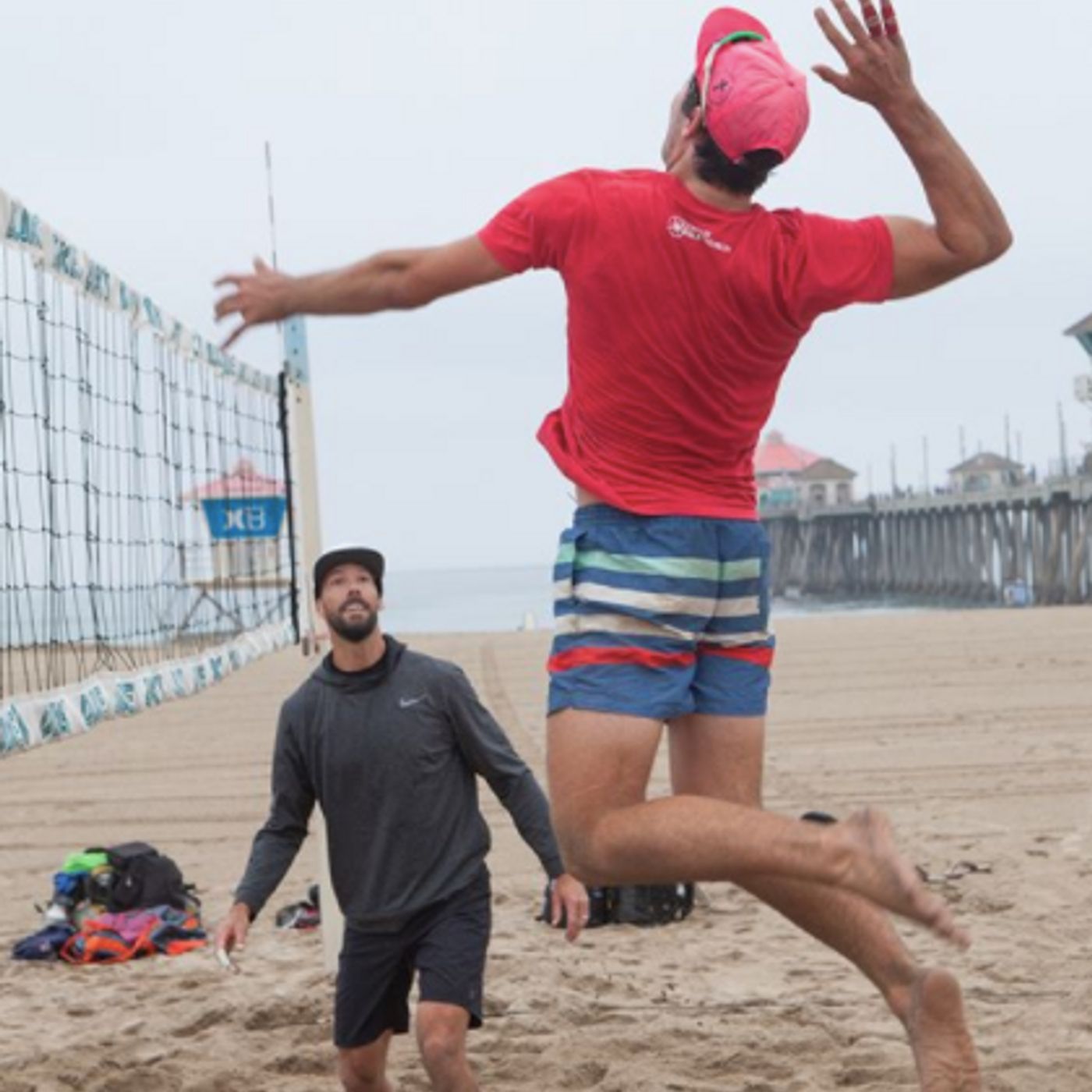
Ep 25Newcomers highlight first Norceca of the beach volleyball season
Troy Field was, in his own words, “terrified.” “Just so scared to mess up,” he said on SANDCAST: Beach Volleyball with Tri Bourne and Travis Mewhirter, “to, you know, disappoint this incredible athlete.” It helped, then, that the incredible athlete in question during last week’s Norceca qualifier was Reid Priddy, and few in volleyball understand what Field was going through more than Priddy. He’s been to four Olympics. He’s won a gold medal. He’s won a bronze medal. In just a single year on the beach, he was one point away from making a final, in San Francisco. “He’s got some pretty amazing wisdom to offer,” Field said. Priddy told the 24-year-old that nerves are good. Nerves mean you’re excited, that you care. Focus on what you can control. Not passing or setting or swinging or serving. Just breathing. Which is exactly what Field did. “I’d see him take a deep breath, which reminded me to take a deep breath,” Field said. Simple. And effective. Priddy and Field opened with a three-set win over Adam Roberts and another up-and-comer, Spencer Sauter, which put them into the de facto finals – two teams come out of a Norceca qualifier, so the actual final match is of little consequence – against 2017 AVP Rookie of the Year Eric Zaun and veteran blocker Ed Ratledge. “It was just high level volleyball,” Field said. “Just side out after side out after side out. We battled, battled, battled and took the first set like 27-25. With all that momentum, we were able to figure out what they were doing and Zaun wasn’t really hitting any balls and we were able to work our defense around that and we ended up winning like 21-16 or 21-15 or something like that… Reid was playing out of his mind, just making unbelievable defensive plays.” It didn’t much matter that the two would lose the next match against Avery Drost and Chase Frishman. They were in, earning spots into a series of tournaments, two of which will be in Mexico, the final in Cuba. Those three tournaments, should the two choose to play in all of them – they are more than likely not, as the Cuba tournament will run too close to AVP/FIVB Huntington Beach in the first week of May – would add up to one more professional tournament than Field has played in his career. In 2017, he played in a pair of AVPs, failing to make it out of the Hermosa Beach qualifier before making it through in Manhattan Beach with Puerto Rican Orlando Irizarry. “It’s pretty unreal,” he said. “I’ve never been the person to get super overly excited because I feel like the more you build it up you’ll get disappointed. Everyone has been telling me to just enjoy the moment.” On the women’s side, another newcomer, Brittany Howard, earned a bid as well. There’s a better chance you’ve heard of Howard than Field. She competed for four years indoors at Stanford before doing a grad year on the beach for Pepperdine, though she was so rusty on the beach that she admitted to DiG Magazine that “I was terrible.” It’s become apparent she’s a quick learner. Playing with Kelly Reeves, the 2016 AVP Rookie of the Year, Howard beat Amanda Dowdy and Irene Pollock and then the new partnership of top-seeded Kelley Larsen and Emily Stockman, earning their Norceca bid despite also losing the final match to Kim Smith and Mackenzie Ponnet. “I definitely kind of explored my options,” Reeves said on SANDCAST. “Brittany Howard was always someone I’d been watching from afar and I told her I’d love to get in the sand and try it out. We did and it just felt super comfortable, I don’t know, the chemistry thing was big. We’re definitely volleyball people and I definitely understood where she was as far as up-and-coming. Just the first time we stepped in the sand it was ‘Oh, this girl, she’s got some game.’” Game enough to have qualified for the final three events of the AVP season, in Hermosa Beach, Manhattan Beach and Chicago, respectively. Game enough to have actually beaten Reeves in Manhattan Beach. Game enough to have found her new partner for the 2018 season. Reeves played the majority of the 2017 season with Jen Fopma, though with Fopma pregnant, she had to find either a new blocker or a scrappy defender to play with in 2018. Enter Howard. “She just did some really funky stuff like ‘Ok I can work with that,’” Reeves recalled when she played Howard. “And then looking to next year, knowing Jen was out, I was like ‘Alright she’s definitely someone I would want to play with.' As soon as we got in the sand, there was just this one play, she had this nice scoop, maybe a block pull move, and she dug it and I set her and she just crushed this ball and I was like ‘Ok she’s got some game.’” They proved as much last week, and now they’ll be taking two trips to Mexico though the third stop, in Cuba, is unlikely, for the same reasons as Field and Priddy will likely be skipping as well. There’s Huntington, with more to prove, more to learn, a bigger platform on which to play. “We’re both still new to the game,” Reeves said. “Grantred this
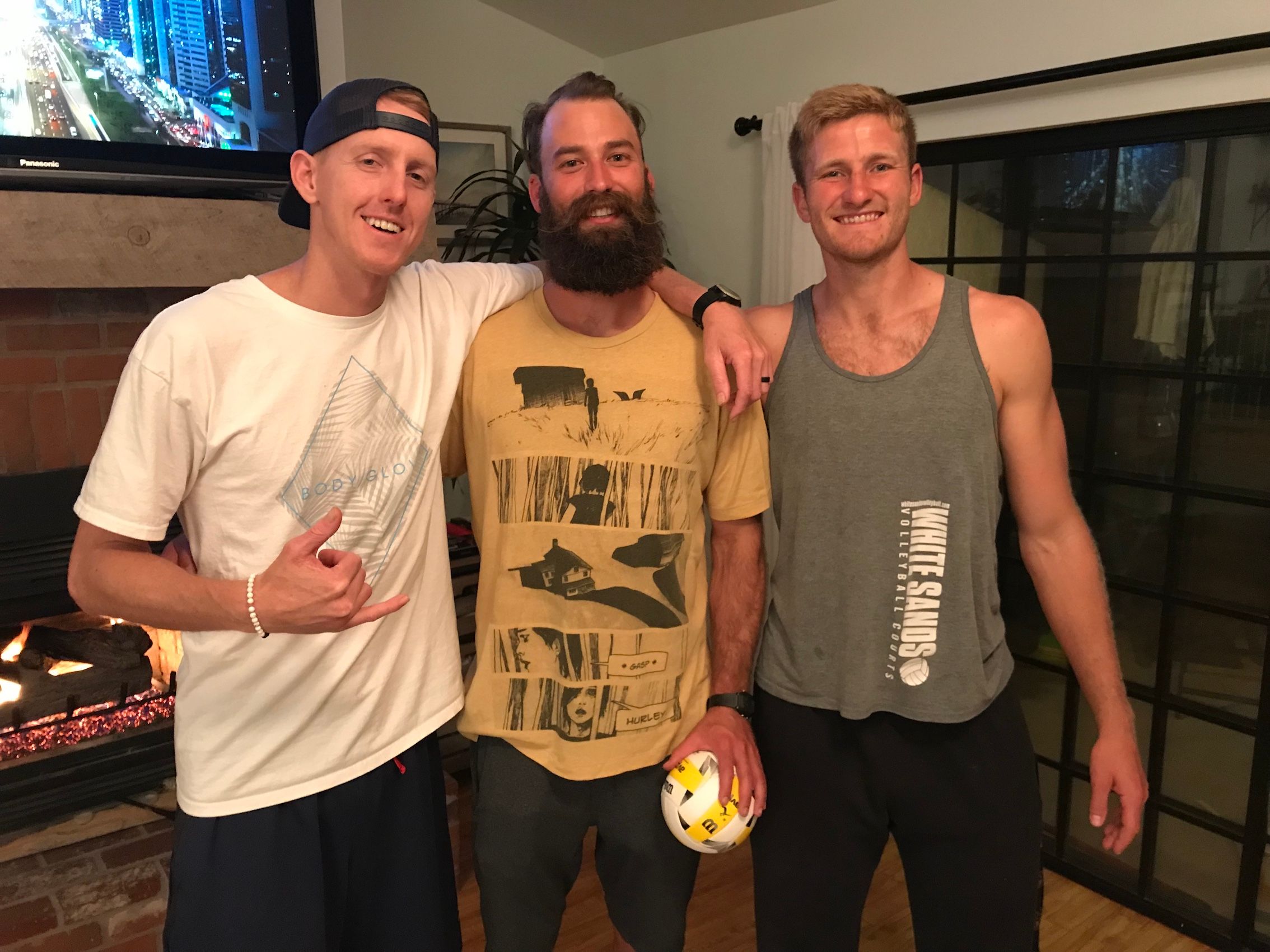
Ep 24Brotherly love with Maddison McKibbin
Maddison McKibbin was finished. Finished with volleyball. Finished with being overseas. Finished with not being paid. Finished with the shady ownership of international volleyball teams. Finished with it all. He had played the game long enough, beginning at Hawaii’s famed Outrigger Canoe Club then onto Punahou School, where he became a three-time state champ, which preceded four years at USC, where he made a pair of Final Four appearances. And now there he was, in Greece, looking at his bed, where a random Brazilian man was laying, fast asleep. Evidently, the owner of McKibbin’s team had signed a new outside hitter. He didn’t tell McKibbin, though apparently he did give the new Brazilian outside the keys to the apartment. That was it. McKibbin was out. He was going home. Was going to finish his Master’s Degree. Was getting out of volleyball. Time for something else. Riley McKibbin, Maddison’s older brother of two years, had other plans. He was going to play in Italy. Would Maddison want to come, just to kick it for three months, drink some wine and hang out in Italy? For that, sure, he could delay grad school for a few months to hang in Italy. So long as he wasn’t playing volleyball, he was in. And then Riley had another idea. “What if we give beach a try?” They had the talent. There was no questioning that. They had been raised in uber-competitive Hawaii, alongside Taylor and Trevor Crabb, Spencer McLaughlin, Brad Lawson, Tri Bourne, competing occasionally against AVP legends Stein Metzger and Kevin Wong and Mike Lambert. Both of the McKibbins had played in FIVB Youth tournaments, and they proved they were good enough indoors to compete and make a living at a professional level. The transition from indoor to beach sounds simple enough. It's a similar game with similar skillsets, where the underlying principle is the same: pass, set, hit. It, of course, was not. They weren’t entirely sure what the state of their beach skills was, so they bought a handful of AVP volleyballs from Costco and exiled themselves to a court in Venice Beach, a few zip codes away from any serious players. And so there it was that you could find two professional volleyball players, practicing in Venice Beach, legitimately mortified that someone might see them dusting off the rust of a game they hadn’t played for the better part of a decade. “We couldn’t even hit it over the net,” Riley said in an earlier interview. “The transition from indoor to the beach is so hard. We’re both indoor players, and making that switch is a lot harder than people think.” Unless, of course, you’re the McKibbins. In the first qualifier they entered, not long after scraping the rust off their beach games, in New York City in 2015, they qualified. And thus the Beard Bros were born. Their relationship is both like that of any other siblings – fighting and squabbling wrapped in brotherly love – and yet it is also nothing like that of any other siblings. The McKibbins are partners in everything they do. They’re roommates. They’re business partners. They're AVP partners. They shoot the wildly popular McKibbin Volleyball videos together. They vlog together. They play together. Even when Maddison won AVP San Francisco while Riley sat out with an injury, even when he was fielding calls from Reid Priddy, even when he had no shortage of partner options, there was never any question whom he would be playing with: Riley McKibbin. “Riley,” he said on SANDCAST, “is the reason I’m playing volleyball right now.” And so it is that Maddison, so long as Riley is healthy, will not play with another who's last name is not McKibbin. They're a package deal. Whether they're vlogging about the frustrations of volleyball, filming a tutorial from Kelly Reeves on the nuances of bumpsetting, or practicing against Sean Rosenthal and Chase Budinger, they're going to do it together. The only thing, for now, that it seems isn't on their agenda? Shaving. Hosted by Simplecast, an AdsWizz company. See pcm.adswizz.com for information about our collection and use of personal data for advertising.
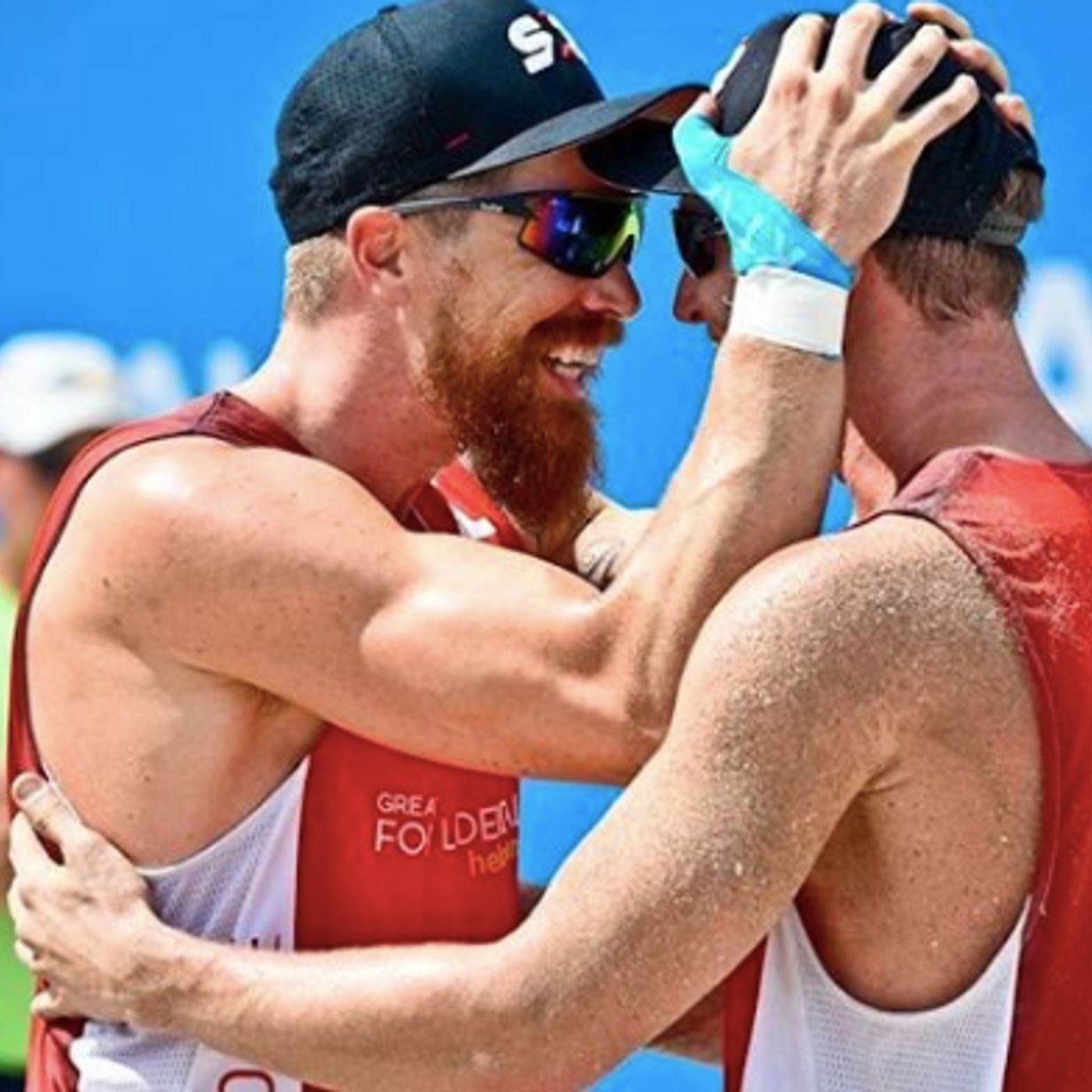
Ep 23There's no crying in volleyball, with Sam Schachter and Sam Pedlow
Sam Pedlow remembers the crying. There he was, a full-fledged Canadian, playing hockey, his country’s past-time sport, the American equivalent of football, at a fairly high level, living up to the expectations of all of those around him. And then he abandoned it. He left a youth playoff hockey game for a volleyball practice. In some parts of Canada that might very well be considered treason. “I felt like I was disappointing everybody,” Pedlow recalled on SANDCAST: Beach Volleyball with Tri Bourne and Travis Mewhirter. “I was no longer playing hockey. But in order for our sport to continue to survive we need people to continually replace us. I want to be a place where people are continually beating me. Our program has been on the rise these past five years. We need to keep that momentum going, and we need people to fill in for us when we ultimately retire.” There is not an especially urgent rush in that regard. Should Pedlow and his partner, 6-foot-6 defender Sam Schachter, remain together, they could legitimately have three more Olympic Games in their futures. Pedlow is just 30, Schachter, already an Olympian in 2016 with Josh Binstock, just 27. As partners, they’re only beginning to hit their stride, logging their eighth consecutive top 10 finish on the FIVB World Tour with a ninth in Fort Lauderdale this past weekend, beating Austrians Clemens Doppler and Alexander Horst before bowing out in three sets to Spain’s Adrian Gavira and Pablo Herrera. But beyond their own individual gain and fame, which is on the rise, thanks to the active and wonderful social media from Pedlow, they’re looking to develop a latent beach volleyball community in Canada, which hasn’t won an Olympic medal since 1996, when John Child and Mark Heese claimed bronze in 1996. Schachter’s ninth-place finish in Rio was Canada’s best since 2004. “We need people starting to play all over the place,” Schachter said. “This sport is so unbelievable because you don’t have to be the biggest and strongest like you would in indoor. It’s so much a mental game where you have to be smart and strategy and you don’t have a coach so there’s an independence factor and the girls are beautiful.” Looks aside, the Canadian women’s program, which has yet to win an Olympic medal, is becoming a bona fide power in its own right. Two teams – Sarah Pavan and Melissa Humana-Paredes and Heather Bansley and Brandie Wilkerson – claimed top-10 finishes in Florida, and both landed in the top 10 in the world rankings at the close of the 2017 season. The only team with more points than Pavan and Humana-Paredes? Brazil’s Talita and Larissa, excellent company to be keeping for a hockey-crazed country. “Our women’s program is going to be strong for a long time,” Pedlow said. With Pedlow and Schachter climbing the world ranks, the men’s program has an auspicious look as well. Perhaps soon enough, with a few more top finishes on the word tour, there will be no more crying in volleyball. Hosted by Simplecast, an AdsWizz company. See pcm.adswizz.com for information about our collection and use of personal data for advertising.
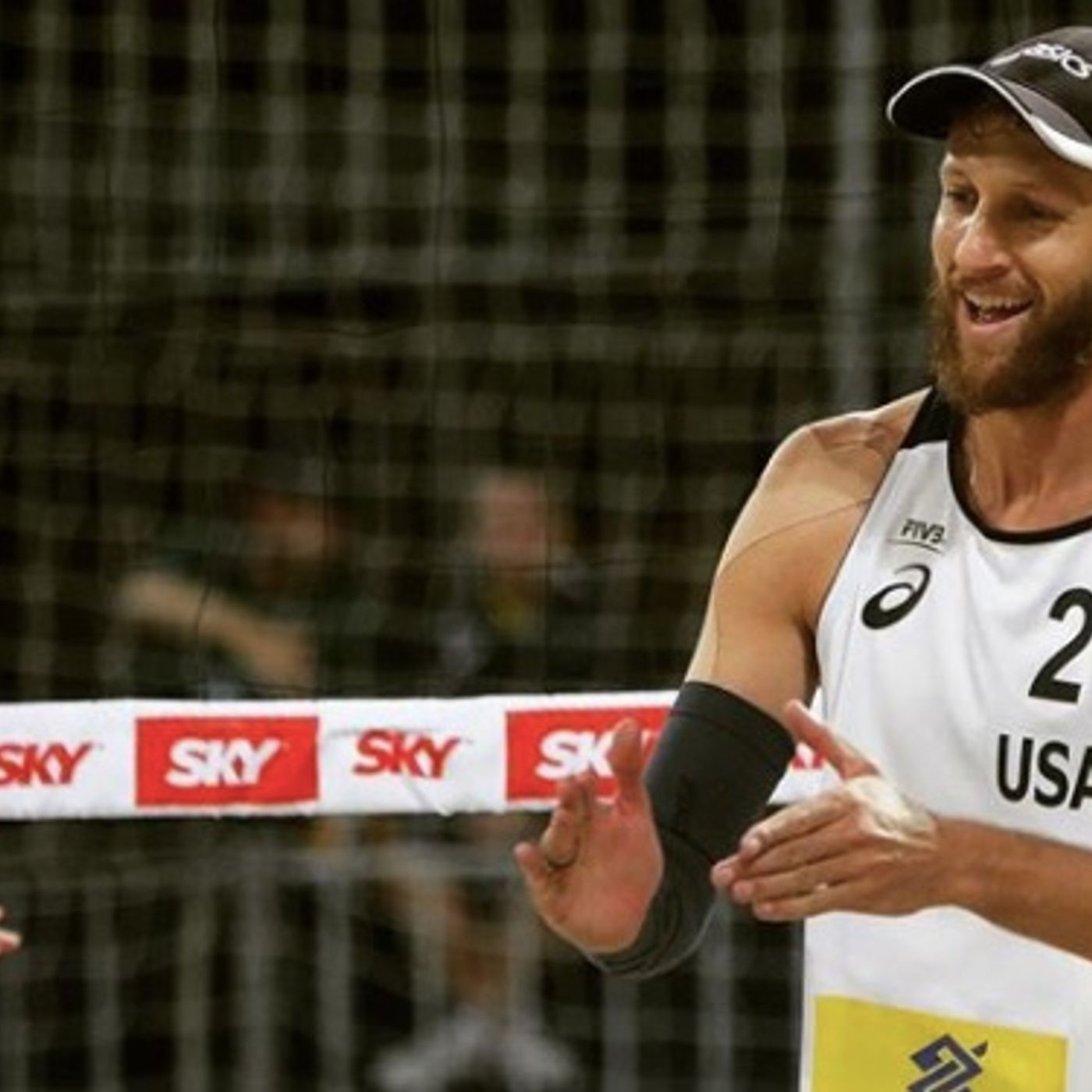
Ep 22Breaking down the Fort Lauderdale Major with Theo Brunner
Fifth place? Had you told Theo Brunner, prior to the Fort Lauderdale Major this past weekend, that he’d take fifth place, in a field featuring every top beach volleyball team in the world, after being limited in training, admittedly a bit out of shape, with a new partner, after re-injuring his bad ankle and spraining his other... yeah, he’d have taken that. He was, as he said on SANDCAST: Beach Volleyball with Tri Bourne and Travis Mewhirter, just happy to play at all. At the end of last season, Brunner had sprained his ankle, an injury that has limited his training “70 or 80 percent” this off-season, he said. Add into that the fact that he was playing with a new partner in John Hyden, and add onto that the fact that he mildly reinjured that same ankle a few weeks ago, and onto that another sprain of the opposite ankle his first day of training in Fort Lauderdale and fifth isn’t too shabby. “This was just ridiculous,” he said. “I feel so out of shape…I’m normally pretty on top of my conditioning, probably do too much in the off-season as far as running all the time before practice, on the gym, in the sand, and I couldn’t do that this year. There were times when I was just struggling to catch my breath and I was like ‘Dude you’re probably not going to win this set. Just collect yourself, get a little bit going.’ “It’s just hot and humid out there, and if you’re gas to the floor the entire match, even if you’re in really good shape, it’s not going to be the best result for you. I was just trying to conserve, and when things were getting out of hand, I’m not jumping max and trying to slam this ball, I’m trying to conserve so I can get up on my block and side out consistently the next game.” Brunner admitted that perhaps that’s not the best spot to be in, though here’s the thing: It worked. Four of his five matches went to three sets, and Brunner and Hyden came out on top in three of them. They beat Austrians Martin Ermacora and Moritz Pristauz-Telsnigg 15-8 in the third set in a do-or-die match in the modified pool play format, eliminated Canadians Ben Saxton and Grant O’Gorman 15-11 in the first round of playoffs, survived, 18-16, over Jake Gibb and Taylor Crabb to get to the quarterfinals before succumbing, 13-15, in the third to Brazilians Pedro Solberg and George Wanderley in a match that Brunner knows he should have won. The Americans were up, 13-10, before giving up five straight. “I’ve been reliving it the last 24 hours,” he said. “I went back and watched the video and they made a couple good plays… but I had a mindset ‘Alright, it’s a little windy, the sets are blowing off the net, I’m just going to hit a good shot, make them work for it.’ I think I should have just been a little more terminal… I think I tried to be a little too cute.” Next up for Brunner and Hyden, as it is for the majority of the Americans, is Doha from March 6-10, then Xiamen in mid-April before a four-star in Huntington Beach the first week of May. “Notwithstanding how we went out,” he said. “It was a good result for us.” Hosted by Simplecast, an AdsWizz company. See pcm.adswizz.com for information about our collection and use of personal data for advertising.
Ep 21One and done volleyball with Sam Schachter and Sam Pedlow
April is when the full-time volleyball begins. But the real battle annually begins in late January and early February, when Canadians Sam Schachter and Sam Pedlow stop by Hermosa Beach for a few weeks of high level training prior to FIVB Fort Lauderdale, the first major international event every year. The real battles, of course, do not take place on the courts themselves. Nah, they’re on Instagram, where Pedlow has curated one of the best social media accounts across all of sports, right up there, it’s easy to argue, with Joel Embiid, the troll savant of the NBA. He’ll post highlights and bloopers, funny sound bytes and inspirational quotes, a little bit of everything. What makes it fun is that for the few weeks the Canadians are in town, the U.S. players they practice with – namely Jake Gibb and Taylor Crabb, Casey Patterson and Stafford Slick, Phil Dalhausser and Nick Lucena in Florida prior to Fort Lauderdale – fire it right back in a friendly, if not still competitive, manner. “It’s a self-proclaimed rivalry by Casey and Slick,” Schachter said, laughing. “In Canada, beach volleyball isn’t as publicized as it is in the States,” Pedlow, the more active of the two, added. “They do a great job of making everybody know who you are. If we want people to know who we are we need to do some work, do some ground work. Every time we come down to the United States and play with these guys and post some videos it’s good for us, because now we might get some Sam Times Two fans.” Patterson did his part in making sure his followers knew the Sams plays were fake (they’re not), while his are real (they are). “People think we’re kinda going at each other but it’s all in good fun,” Pedlow said. “Now, I don’t post a whole lot of rallies we don’t win.” If you follow them closely enough, you’ll know that isn’t true. Pedlow and Schachter both enjoy a good blooper as much as the rest of us. But here’s the thing: The rallies they lose are becoming exceedingly harder to come by. Last year, 2017, marked their first as a team, Schachter having needed a replacement for the since-retired Josh Binstock, and Pedlow in potential need of an upgrade from Grant O’Gorman (perfectly enough, the Sams are in the same pool as countrymen O’Gorman and Ben Saxton, former partner of transfer American Chaim Schalk). Their first tournament together was at this very same event a year ago, where they took ninth, having beaten O’Gorman and Michael Plantinga and Austrian Olympian Robin Seidl and Tobias Winter to break pool. Eventually, they were knocked out by Gibb and Crabb, though it was an auspicious start for what would become Pedlow’s best season, one in which the Sams – or SamX2 or Sam Squared, whichever you prefer – would improve upon their seed in every single FIVB tournament they played in. Those finishes are thanks to what the two call “one and done volleyball,” a nod to their height and physicality. Pedlow, the 2017 Most Improved Player on the FIVB, stands 6-foot-5 and Schachter, the defender, 6-foot-6. They’re the first to admit they won’t dig as many balls as, say, a Crabb, who’s light and nimble and quicksilver fast, but when they do, they’re more likely to put it away, relying more on offensive and transition efficiency than long, dragged out rallies. They’re ok with that. It works. Most importantly, for the fans and those following on social media: It’s fun to watch. Hosted by Simplecast, an AdsWizz company. See pcm.adswizz.com for information about our collection and use of personal data for advertising.
Ep 20Can p1440 change the landscape of beach volleyball?
It’s not a tour. That’s the first thing that Dave Mays, this week’s guest on SANDCAST: Beach Volleyball with Tri Bourne and Travis Mewhirter, wants you to know about p1440, of which he is a founding partner. It is many different things with many different meanings. Take, for example, the name itself. The 1440 is assured: It represents the 1,440 minutes we all have per day. But the p? Platform seems to be the most popular word for it, though, as Mays says, it’s up to your own interpretation. It could be purpose. Or power. Or people. Or whatever word that starts with ‘p’ you’d like to use to represent how you’d like to use your 1,440 minutes in a day. Would you like to use it to strengthen your relationship with people? People it is. Or strengthening your mind, body and soul? Power it is. That sort of the point: p1440, and how you spend your minutes, is up to you. To some, yes, that means it’s a beach volleyball tour or league, and currently, there are eight events on the schedule, which bridges 2018 and 2019. The first four are set – Chicago in September, with Huntington Beach, San Diego and San Jose to follow – while the next four, which will be held in early 2019, are in limbo, though the sites have been whittled down to a few catchy options. There’s Vegas – Vegas! – a major city in Texas (Dallas and Houston, namely), Miami, Hawaii. An ambitious start. An exciting start. And that hardly scratches the surface, for each event is not just a beach volleyball tournament. It is, as Kerri Walsh-Jennings, a co-founder along with her husband, Casey Jennings, and Mays, has taken to saying: “Part Wanderlust, part Coachella, part beach volleyball league.” Each event, tantamount to the World Series of Beach Volleyball, will feature a tournament, but it will also serve as a music festival of sorts, replete with concerts and fanfare and everything you’d expect of the triumvirate Walsh-Jennings mentioned. How, you may be wondering, can an upstart tour fund eight events while also doubling as a music festival? Beach volleyball has been a notoriously volatile space in the market, in spite of the sport itself growing every year, to the point that more girls play volleyball than soccer or track and field or basketball. For females, it’s the most popular sport in the country. And yet nobody has been able to monetize the market in a sustainable enough fashion for it to work. The business model has remained the same since a company named Event Concepts began putting on professional events in 1976. They’d find a sponsor – Schlitz Beer was the first – or many sponsors, to throw in money, and that money would then be translated into prize money, which would draw talent and a crowd to watch that talent. Sponsors would be happy because they got the eyeballs they wanted, players would be happy because they got the prize money they wanted. And so it went. Until, of course, the tabs being run up by the tour were too hefty for the sponsors to cover, and one gigantic failure led to the next. Event Concepts was booted in 1984, thanks to a player protest at the World Championships of Beach Volleyball, and in came the AVP, an organization led by the players and a young, savvy agent named Leonard Armato. The AVP changed hands in 1990, when Armato was replaced by Jeff Dankworth, who in 1994 was replaced by Jerry Solomon, whose gross mishandling of the finances led to a bankruptcy, only for the AVP to be revived by – who else? – Armato in 2001. Nine years later it was bankrupt again, and in 2012, Donald Sun took over and put on a pair of events, and since then he has done a fine job of steadying the frighteningly tenuous heartbeat of beach volleyball, increasing prize money and events and introducing a “Gold Series” and putting the sport back on television. And yet the business model remains relatively the same, though there are certainly various nuances, as 1976: sponsor-driven. “If we were to start a new pro beach volleyball tour tomorrow, we would fail,” Mays says on SANDCAST. “So that’s why we’re not starting a pro beach volleyball tour. We’re taking the sport of volleyball and we’re celebrating it, what works and what doesn’t. We’re applying some principles of what have worked and what do work, to this.” And here is where the differentiation between p1440 and the AVP Tour begins. p1440 will charge a $40 gate fee, every tournament. The AVP allows its fans, which pack stadiums, for free, though there are paid box seats. But the entry gate will hardly be the chief source of revenue for p1440. That’s where the “platform” comes in. Above all else, above volleyball and music and entertainment, p1440 is built upon four pillars: competition, development, health and wellness, entertainment. The platform, an online resource featuring myriad digital media, will host webinars, coaching, nutrition, live clinics – any type of wellness resource you might need, be it mental, spiritual or physical. It’s not live yet – it is scheduled to launch in July – an
Ep 19From Australia with gold, with Avery Drost and Amanda Dowdy
Contrary to popular belief, the first gold medal of the winter was not, in fact, won by 17-year-old snowboarder Red Gerard, who snatched the slopestyle gold medal in the 2018 Olympic Games from Canadian Max Parrot. The initial golds of the month were not even won in PyeongChang, but in Shepparton, Australia, on a beach, and not in the perversely intriguing snow volleyball, which is currently an exhibition event for the Winter Olympics. The first went to Amanda Dowdy – one of two guests this week on SANDCAST: Beach Volleyball with Tri Bourne and Travis Mewhirter – and Irene Pollock, who won five straight matches, the last three of which went the full three sets. Shortly after, Avery Drost – Dowdy’s partner on SANDCAST – and Chase Frishman, playing in their first international event together, claimed a gold of their own, making for the first gold medal sweep of the winter season, soon to be followed by American snowboarders in the halfpipe and slopestyle in the PyeongChang Games. “I’m so happy,” Drost said afterwards. “They’re a great team. They play a fun style of volleyball. It was our privilege to play against them, in Australia. To be doing this with Ledge here, who’s become like a brother to me – I love this guy, and just so humbled by this moment, with this guy, with you guys, it’s so wonderful.” Yes, it is wonderful. And, for Drost, entirely unexpected. He had written off the one-star events for the obvious reason: They’re entirely, financially speaking, unfeasible. “I remember looking at the star system when it first came out and breaking it down and thinking these one-stars don’t make sense,” said Drost, who split 1,000 with Frishman, as did Pollock and Dowdy. “Financially it doesn’t add up. Points are great but this is kind of ridiculousness when it comes to finances.” The NORCECA path seemed more doable, though the continental tour is notoriously mercurial, known for cancelling events last second. Then again, as Drost said: “There’s not an abundance of doing things other ways.” So there was this: world tour competition, available points, far less of a chance of an abrupt cancellation. And, of course, Australia. “There are worse places to go,” Drost said. Indeed, and Dowdy and Pollock actually one-upped their male counterparts in that department, hitting New Zealand’s tour for an event prior to claiming the top of the podium in Australia. It underscores a slight difference between the goals for the two teams: Pollock and Dowdy are looking for points, yes, as are all teams seeking the climb the international ladder, but perhaps more than that, they just want to play some ball. “The more I can play the better it is for me,” said Dowdy, a 27-year-old who set the all-time kills record as a four-year starter at Texas Tech. “We see it as opportunity. We’re trying to climb that ladder and it’s more of a sacrifice right now because it’s not great financially, I’m not going to sugarcoat that. For us, we’re using it as opportunity. You can only control what you can control, that’s the position we’re in. We’re trying to close that gap.” And the gap is beginning to close, much faster than they could have anticipated. The points boost they received pushed them into the country quota in the Fort Lauderdale Major. It’s a position some teams justifiably loathe, but to Pollock and Dowdy it was a welcome surprise. They had initially planned on potentially playing in four-stars in April. In a matter of five matches, they’re in a position to compete in a five-star in February. “That just goes to show how important these smaller tournaments are,” Dowdy said. “We got that opportunity a lot sooner than we thought we would.” And a gold medal before the rest of Team USA’s winter athletes. GIVEAWAY: Our first Wilson giveaway will be a SIGNED WILSON VOLLEYBALL BY AVERY DROST AND AMANDA DOWDY. To enter, follow us on Instagram, @sandcast_podcast and comment with your FAVORITE QUOTE from any SANDCAST episode. Tri and Travis will select the winner based on their favorite quote from the comments. Hosted by Simplecast, an AdsWizz company. See pcm.adswizz.com for information about our collection and use of personal data for advertising.
Ep 18At age 36, Brittany Hochevar is only just arriving
Forget daggers. The look that Brittany Hochevar gave on SANDCAST: Beach Volleyball with Tri Bourne and Travis Mewhirter could bore a hole straight through a human soul. The discussion had turned to partnership dynamics, and how it was with Hochevar and her partner, Emily Day. Day, it turns out, is the more organized one – there is always a more organized one – and I said something along the lines of Hochevar just sort of following along from there. No no. Brittany Hochevar? Just sort of following along? Brittany Hochevar doesn’t simply follow along. She gets after it. You can look at her workouts on Instagram or her website. They have a ballistic focus and can be slightly terrifying, though Hochevar also blends this with a focus on mindfulness and equanimity. Stillness. It’s a unique approach, one she labels as “all in but also all out,” and it’s also inarguably working. In 2017, at the age of 36, Hochevar won three AVPs and took third in another two. Her 14th year on Tour was, crazy as this might sound, her breakout. “I feel like I’m in my prime,” she said. “It’s wild. I can do stuff – wisdom, timing, that’s another piece. There’s a different timing to things. It’s fun to see that slowdown. When you arrive you just know it and sometimes that’s at 36.” Who would have guessed she would have arrived here, at 36, in her 14th season, at the top of the game? Of all people, Hochevar wouldn’t have been one of them. Prior to 2016, Hochevar’s career had been a Sisyphean one, rolling that boulder all the way to the top – only to see it tumble back down. “I was that 13th player on a 12-man roster type of kid,” she said. “It’s my blessing and my curse.” At Long Beach State, she replaced Misty May as the setter, took the 49ers to a pair of Final Fours and a national title game – and lost in the final. In a three-year stint with the United States National Team from 2002-2004, she worked her way onto the roster – only to be the first alternate in the 2004 Olympic Games in Athens. In 2009, her 51st event on the AVP Tour, she made a final with Jen Fopma, losing in three sets to Dianne DeNecochea and Carrie Dodd. It would be seven years until she took one home. But what a platform on which to do it: the 2016 Manhattan Beach Open. Hochevar’s first career victory came on the sport’s biggest stage, with a plaque on the Manhattan Beach Pier to prove it. “Bout time,” May texted her. “Sometimes,” Hochevar said, “timing is funny.” Somehow, she had done something exceptionally few athletes across any sport have ever been able to do. Hochevar had begun to reach her athletic peak at age 35. She opened the 2017 season with a win in Huntington Beach and then won back-to-back championships in Hermosa Beach and Manhattan again. By season’s end, only one team had won multiple events on the AVP Tour: Hochevar and Day. Together, they had flipped the script, broken the narrative. Had Hollywood been writing the 2017 season, with Kerri Walsh-Jennings forgoing the AVP and April Ross in partner limbo, it would have been time for the youngsters to take over. Oh no. Not yet. Hochevar had fallen in love with the game again, “fallen in love with passing again,” she said. All those years of coming so close to the peak, of being the 13th on the 12 man roster, of rolling that boulder so high, only for it to tumble back down, had paid off. All those years in Puerto Rico and Spain and Turkey and Siberia had paid off. All of those ballistic workouts and pilates and meditating and taking care of her body had paid off. She has a pair of tattoos on her arms, “Here” written on the left, “I am” written on the right. At 36 years young, here Hochevar is. Sometimes, you arrive, and you just know it. Hosted by Simplecast, an AdsWizz company. See pcm.adswizz.com for information about our collection and use of personal data for advertising.
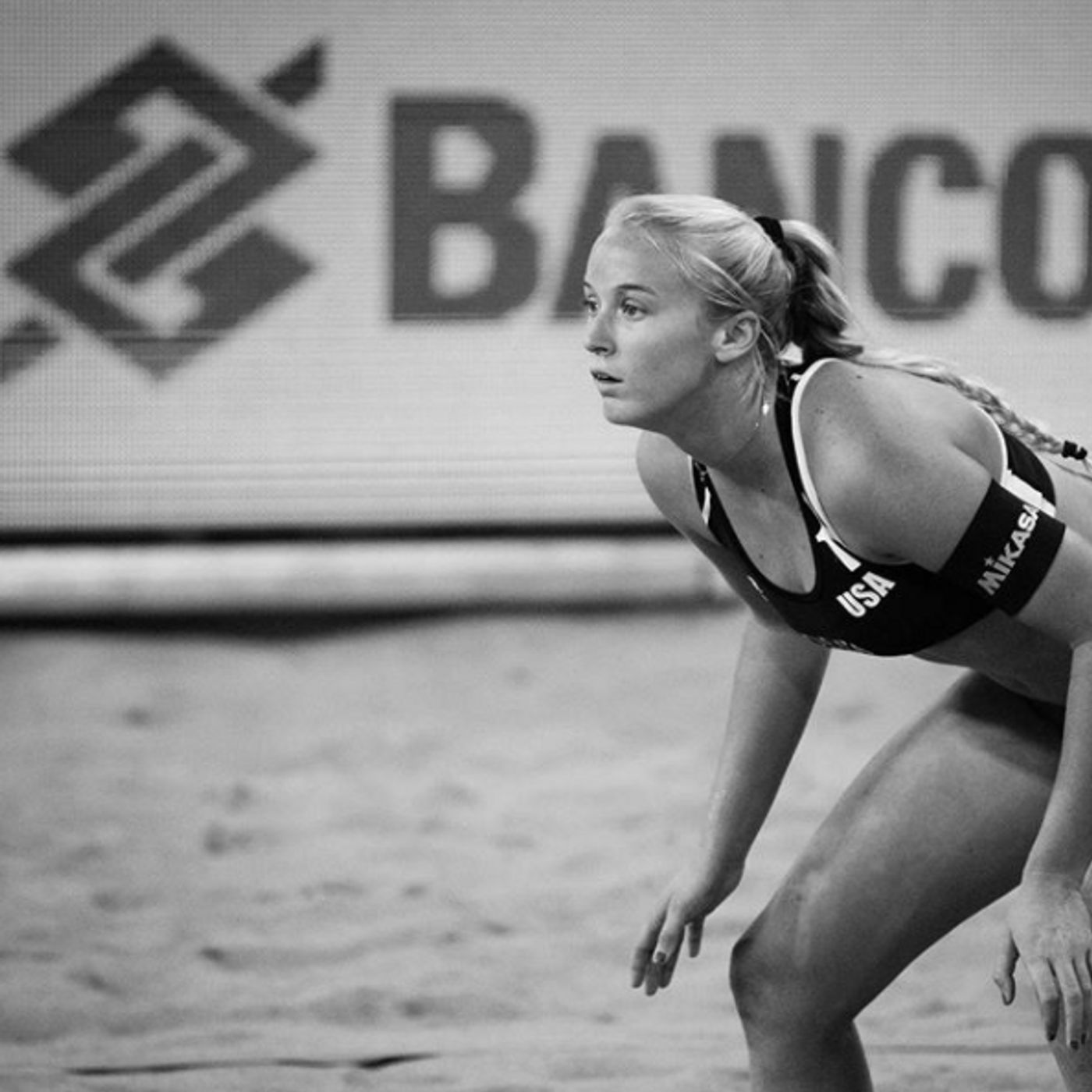
Ep 17Sara Hughes: Beach volleyball's next top role model, part 2
Perhaps you needed proof. Proof that Sara Hughes is, indeed, the one to fit the headline of this very podcast: That she is fit to become the next face of beach volleyball. Had you stopped by Huntington Beach last Friday morning, you’d have had all the proof you’d need. There, on court one, was Hughes, this week’s repeat guest on SANDCAST: Beach Volleyball with Tri Bourne and Travis Mewhirter, and partner Kelly Claes. There was coach Jose Loiola and mentor Misty May-Treanor. There was Ben Vaught and Tanner Woods, because, yes, Hughes and Claes train with professional men on occasion. And there, lining the court was a dozen or so girls, member of the Long Beach City beach volleyball team, watching, studying, looking on. Taking notes on Hughes. Yes, they were at the Huntington Beach Pier that day because they had practice – but a Long Beach-based team doesn’t necessarily need to come to Huntington Beach to practice. There were there because that’s where May-Treanor, the director of beach volleyball operations at LBC, was, and May-Treanor was there because, well, Hughes. There’s a reason Hughes and Claes have landed one Hall of Famer (Loiola) and another who could go down as one of the greatest talents in volleyball history as their coaches. It could be argued – and it often is – that Hughes and Claes, both 22 years old, have more potential than any individual or team in the world, more, even, than the precocious Duda, the 19-year-old Brazilian star and 2016 FIVB Rookie of the Year. Already, Hughes and Claes have won an AVP, the 2017 season-finale in Chicago. Already they have reached FIVB quarterfinals and landed some of the game’s top names as sponsors. Already they have broken previous goals and established new ones. In their first season as professionals, breaking pool in international play was the goal. In their first event, a four-star in Rio, they finished fifth. Now, in just one season as full-time professionals, and a truncated one at that, seeing as they had to miss the early season events while they wrapped up what figures to be the most dominant college run for quite some time, Hughes and Claes see anything less than a podium finish as a shortcoming. Finishes, though, are but one tangible measurement for the success of Hughes and Claes. There is no barometer through which to measure their “inspiration” to the next generation of beach volleyball players. For now, you can see it yourself, right there, on the sidelines of court one, watching, observing, taking notes – figuring out ways to become the Next Sara Hughes. Hosted by Simplecast, an AdsWizz company. See pcm.adswizz.com for information about our collection and use of personal data for advertising.
Ep 16Sara Hughes: Beach volleyball's next top role model, part 1
On one of the walls in Sara Hughes’ bedroom is a poster of Misty May-Treanor. It’s been there since she was little, when Hughes began getting into volleyball, serving as a reminder of what she might become one day should she continue to pursue this beach volleyball dream of hers. So it struck her when, during a tournament this season, a parent of a young fan approached her and told Hughes that, on one of the walls in her daughter’s bedroom, is a poster of Hughes. “I was like ‘No way that’s actually happening,’” Hughes recalled on SANDCAST: Beach Volleyball with Tri Bourne and Travis Mewhirter. “I am so grateful for that and I hope I can keep being a person young people can look up to for a long time and thank you to everyone who does.” Did you catch that, at the end? Hughes thanked the fans for looking up to her, not the other way around. In an era where celebrities grow more and more closed off, taking instead to social media to communicate behind iPhones and laptops, Hughes remains open, willing to talk to anyone, pepper with anyone, give back any way she can. “I’m always just trying to help people,” she said. “If anybody wants to ask, just come up to me, you can ask me directly.” No different than May-Treanor continues to treat her. When her age could still be measured with a single digit, Hughes would head down to the Huntington Beach Pier and sit on the wall, waiting for a chance, any chance, to simply shag balls for May-Treanor. Sometimes May-Treanor would let her pepper or hop in for a drill or two, creating an indelible memory that Hughes will cherish more than likely the rest of her life. “I love talking to people and I love talking to young girls because I don’t think I’d be in the position I am today if I didn’t have the coaches I had and people like Misty May taking the time to talk to me,” she said. “I love doing the same to everyone else.” She’s a sponsor’s dream, Hughes. She has the looks – blonde hair, blue eyes, Colgate smile – the smarts – she’s currently on a one-year track to earn her Master’s degree, just a year after delivering a graduation speech at USC – the media savvy, the talent, a voracious competitive drive juxtaposed with a disarmingly charming personality. Oh, yes. She has earned this position, the right to have Mikasa run her through photo shoots and turn those shoots into posters for young girls to hang on their walls, to point to each night and morning and say “I want to be like that.” Her accolades at USC could fill a small book’s worth of pages, and it’s a wonder if some of her records – four consecutive national titles, a winning streak that eclipsed 100 matches, a perfect 48-0 junior season, four-time All-American – will ever be broken. Justifiably, this drew no small amount of media coverage, and while she was appreciative – always thanking anyone for taking the time and interest in her – it drove her a bit insane, how those reporters would invariably walk right past her exceptionally talented teammates. On the occasion that the media showed interest in the rest of USC’s indomitable team, more often than not they’d ask questions not about how their match went, but what they thought about Sara and her partner, Kelly Claes. “I hated that when it was just ‘Oh! Sara and Kelly and Team USC!’” Hughes said. “I was like ‘No, you don’t realize, these girls who are on [teams] two, three, four, to the eighth team, they’re our support system. We would not be close to being good or successful without our teammates. They deserve just as much fame and respect as we do because we’re out there on the same hot court at USC and we’re training, every day, together.” Her teammates, as she said, were plenty talented, and a number of them – Nicolette Martin, Terese Cannon, Jenna Belton, Sophie Bukovic, Allie Wheeler, to name a few – have already begun making a name for themselves on the AVP Tour. Yet Hughes, as May-Treanor was, will be the name fans point to as the next in this massive wave of beach volleyball talent rising from the college ranks. She will be the one on the posters, and in the commercials for Oakley and KT Tape and Mikasa and any other sponsor wise enough to sign her. She’s becoming the next generation’s version of May-Treanor – the one everyone looks up to – quicker than she could have possibly realized. The final question of SANDCAST is reserved for the athletes to discuss anything else they’d like to discuss, anything the hosts may have missed. Most demur, maybe shout out a sponsor or two, thank us for the time. Hughes, instead, had a message for her fans: “For the young players and any parents who are listening, I love the indoor game and the beach game, of course. So a lot of players are making this decision where they love the indoor but they have to play the beach in college because they think that’s the only thing they can play. I just think it’s huge for young girls to play both if they love both.” You can teach any volleyball skill there is. But to become the next
Ep 15BONUS: Bourne is (almost) back on the beach, with Murphy Troy
In this episode of SANDCAST: Beach Volleyball with Tri Bourne and Travis Mewhirter, we discuss SANDCAST host Tri Bourne's current health situation as he continues to wait patiently for the doctors to clear him to play again. ‘Patience' is the word that continues to cross my mind as I keep my vision set on Tokyo 2020. We also dive into what it's like stepping away from the game of volleyball, both physically and psychologically, with 2011 NCAA Player of the Year and 2016 Rio Indoor Olympian, Murphy Troy. My blood test levels are back into the safe and normal range that the doctors and I have been waiting for. So now it's a waiting game to see if these results from the blood tests stay in this range as I wean myself off the medicine that got me here. If my body maintains the healthy levels once the medicine gets to a low enough dosage then the doctors will clear me to play. This would allow me to begin my comeback within five weeks -- just more than a month! Once I'm cleared by the doctors, I'll begin training with rehab in the gym to balance the body out, then move into light technique work, then weight/ resistance training and playing. Needless to say, I won’t be back on Tour immediately upon getting cleared. I have committed to training “smarter not harder” this time around. As you can imagine, being forced to step away from the game you’ve played your whole life in the prime of your career is very difficult, to say the least. While I can definitely give us an intimate perspective on what it like to be forced to undergo that processs, we were able to bring in a special guest who has also stepped away from the game in his prime but for for a different reason. Murph Troy, joins us to share his insight and perspective after voluntarily retiring from volleyball after the Rio olympics. Hosted by Simplecast, an AdsWizz company. See pcm.adswizz.com for information about our collection and use of personal data for advertising.

Ep 14SANDCAST No. 12: Talkin' sh** with Trevor Crabb
If you didn’t get to the Hermosa Beach Pier early on July 22, you would have been too late. There would have been no seats left, nowhere for you to watch the first clash of the Crabbs, Taylor and Trevor, brothers and former partners turned, it seemed, bitter rivals. This wasn’t even the final – that would be a day later. This was the quarters, an oft-ignored round, one normally you’d sit and watch should you be there but not one to schedule your day around. And, yet, of course, this was no ordinary quarterfinal. This was a can’t miss match, on a Saturday. The reason can be effectively summarized in two words: Trevor Crabb. *** You may not like Trevor. You may love him. There’s a better chance you’re in one camp or the other, and not in the gray area in between, which is as much a societal trend as it is one regarding the elder of the Crabb brothers. He likes that it’s quite possible he’s in a similar – relatively speaking – popularity category as Tom Brady and LeBron James, who are, paradoxically, both the most liked and disliked players in their respective leagues. He digs how much attention his verbal digs get – sand-throwing fools and goggle-wearing fools and a hungover fool. His mouth has earned him almost daily jabs on social media from Ty Loomis (the sand throwing fool) and the on-court animosity of his brother, Taylor (the hungover fool), who reserves stare downs across the net almost exclusively for Trevor. Maddison McKibbin was at his most vocal when he and Loomis played Trevor and Sean Rosenthal in Hermosa Beach on July 21. It wasn’t much of a match, with Crabb and Rosenthal winning 21-16, 21-13, and yet the interest in it never waned, so close were the possibilities for explosions. Thanks, in large part, to the fuses that Crabb had lit. He did not invent trash talk on the beach. But Crabb has done what we can to revive it in what has been a largely amicable half-decade for the AVP under Donald Sun. He still laughs at the attention it gets, because when you think about it, what, in the wide scheme of sporting trash talk, has Trevor Crabb really done? He called Loomis a sand-throwing fool, though Loomis is the first to take immense pride in his quirky celebrations, in which he is, indeed, making himself as sandy as possible, either by showering himself with it or rolling in it. Crabb called Slick a goggle-wearing fool, and indeed, Slick does wear military-grade goggles to shield his eyes. Taylor Crabb’s hard-partying ways are hardly breaking news. All three give it right back, too. Most of this is good-natured. Some of it flirts with the line of needling and perhaps a bit too far. He’s not altogether concerned either way. “That’s what makes it fun,” Crabb said on SANDCAST: Beach Volleyball with Tri Bourne and Travis Mewhirter. His most notorious rub is with Reid Priddy, a four-time indoor Olympian who, in his first year full-time on the beach, made the semifinals of the Manhattan Beach Open, where he met Crabb and Rosenthal. Crabb blocked Priddy early, and by Crabb’s accounting of the event, he waved for the crowd – and particularly to Rosie’s Raiders – to grow louder. Priddy, according to Crabb, told him to try to block the next one with his eyes open. Crabb says he told Priddy to go back to indoor. Some have said Crabb went further, that he made things personal. On SANDCAST, Crabb shrugged it off and said that was basically that. Either way, when the match ended, there was an icy standoff between the two. The beach volleyball world subsequently lost its collective mind, and had you been following it purely on social media, you might have thought they brawled instead of played. They simply walked opposite directions. It’s a wonder what the reaction would have been to a player like, say, Kent Steffes, or Tim Hovland or Steve Obradovich, some of the sharpest, brashest trash talkers the game has known, bastions of a bygone era. In 1992, three years after Crabb was born, Steffes, who remains one of the most well-known American beach volleyball players, told the Los Angeles Times that "I'd been taught aggressive, loud-mouthed, obnoxious volleyball. You try to humiliate the other team because they're trying to humiliate you. I didn't go out to win, I went out to destroy." And, much to the delight of beach volleyball fans – and there were tens of thousands of them back then – that in your face style made for some provocative matches, on the court and off. Later that year, Steffes had Randy Stoklos running so hot that Stoklos followed him to his hotel after a match and they nearly came to blows. Steffes told the New York Times the next day that "you know why Randy and I got in that fight? Because I blocked him at 13-all to break open the game, 14-13. And I went, 'Yeahhhh.' And I turned around and high-fived Karch. And he thought I shouldn't cheer when I blocked him, that he'd been involved in the sport for so long, he'd played for 10 years, that I ought to respect him enough not to cheer when I block him.
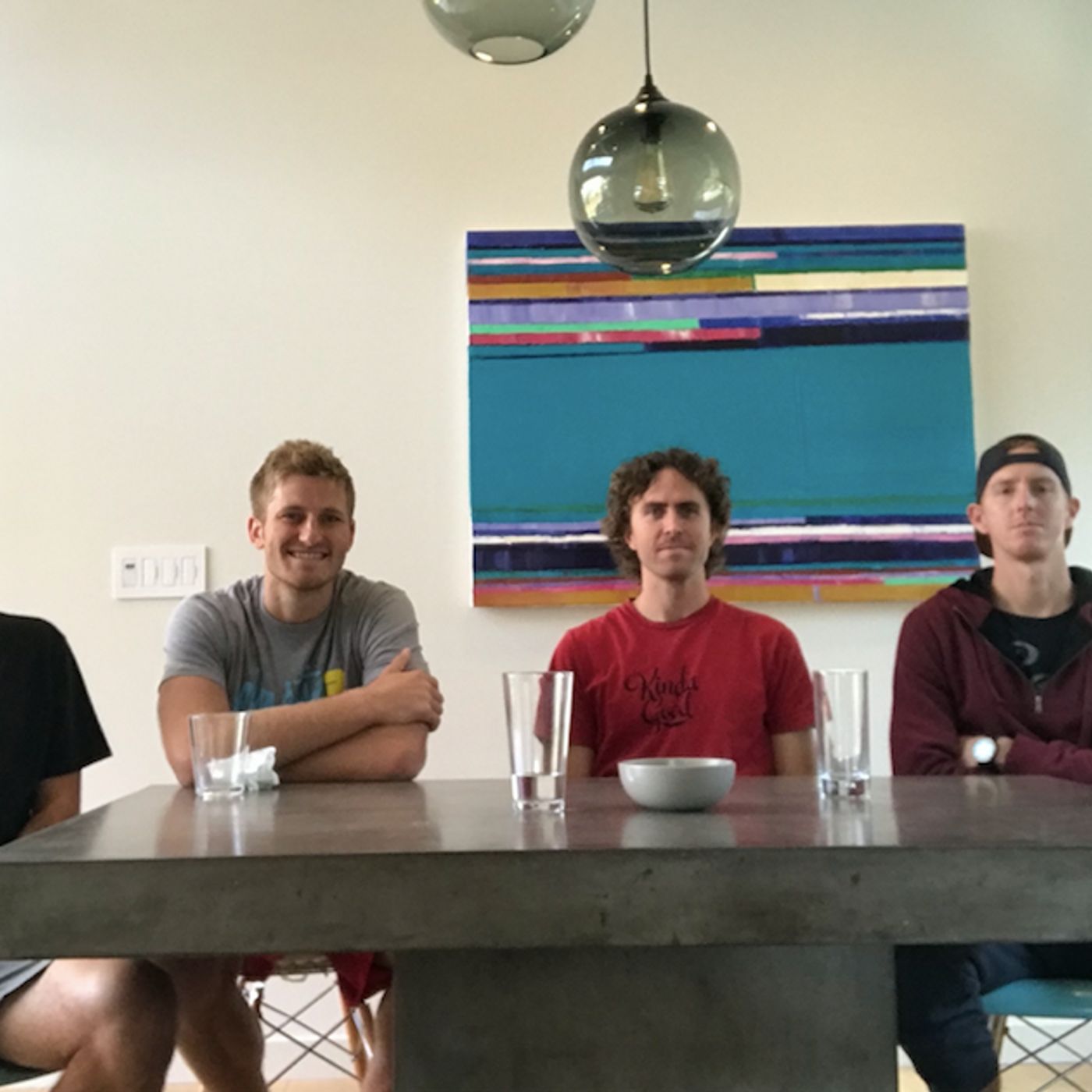
Ep 13SANDCAST Your Brains Out with Billy Allen and John Mayer, Part 2
It’s a wonder how they’re not brothers, John Mayer and Billy Allen. Similar demeanors – calm, collected, neither too high nor too low. Similar styles of play – crafty, ball-control-oriented, hyper-efficient. Similar hobbies – reading, coaching, dadding. Mayer thinks Allen has always been the better of the two. Allen thinks the same about Mayer. Any pandering to the crowd is done mostly in jest, Allen flexing after a float serve ace or a poke kill, though that’s more than Mayer will generally do. He might offer the slightest of smiles. One of their chief similarities one might notice – and will inevitably notice if you listen to their podcast, Coach Your Brains Out – is the importance they place on mindset, emphasizing the difference between a fixed mindset and a growth mindset. “One thing I’ve learned is that we all have fixed mindsets and we don’t even realize we have fixed mindsets,” Mayer says on SANDCAST: Beach Volleyball with Tri Bourne and Travis Mewhirter. “It’s really hard and the shift is never ending.” And neither, it’s become evident, is their improvement. Mayer, after making just three career AVP finals in his first 11 years on Tour – it should be noted that he also made a pair of Corona Wide Open finals in 2011 – made four in 2015 alone, winning in New Orleans with Ryan Doherty. It culminated in him being named AVP MVP. Allen has seen a similar ascent. From 2004-2015, he failed to make a single AVP final, which set up a breakout pair of seasons in 2016 and ’17, winning his first career AVP in Seattle in 2016 with Theo Brunner and following it up the next year with Stafford Slick. His win with Slick was sandwiched between a pair of finals appearances, the first in New York, where he fell to Taylor Crabb and Jake Gibb, and then San Francisco, where an injury limited Slick. Allen and Mayer discuss their ascents, their shifts in mindsets and what their future looks like on SANDCAST. Hosted by Simplecast, an AdsWizz company. See pcm.adswizz.com for information about our collection and use of personal data for advertising.
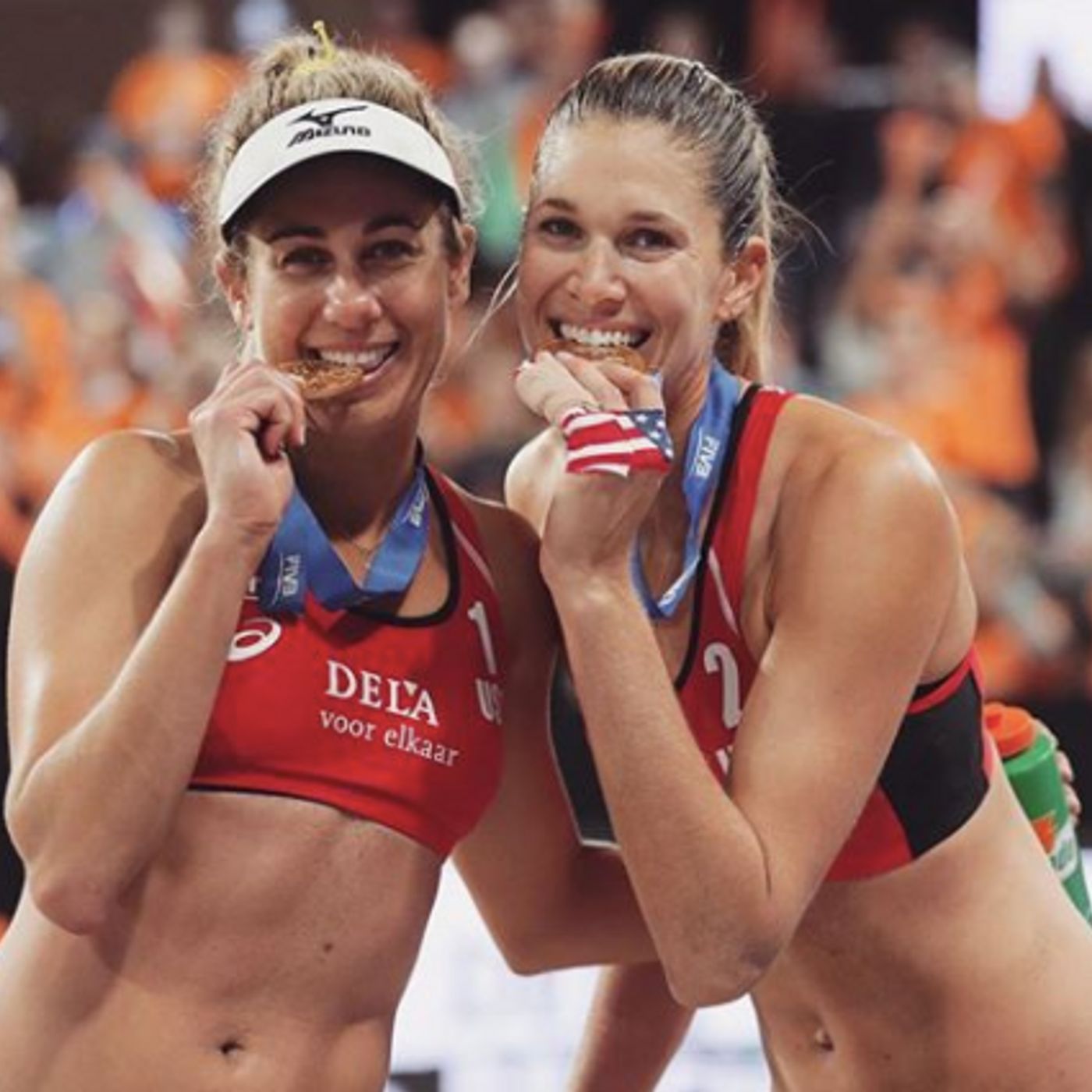
Ep 12SANDCAST BONUS EPISODE: Breaking down The Hague with Trevor Crabb
The 2018 beach volleyball season is, remarkably, upon us. In a way, at least. The FIVB kicked off the 2018 year in the very first week of the year, hosting an indoor beach tournament at The Hague, a four-star event to open the season, hauling in a variety of new partnerships and unfamiliar faces. One of those new partnerships, of course, was that of April Ross and Alix Klineman, who took the longest road possible, battling through a pair of country quota matches, two more in the qualifier, and then running off six straight-set wins in the main draw to claim gold, beating Brazil’s Maria Antonelli and Carolina Salgado – another team that came out of the qualifier – in the finals. “I’m going to be riding high on this win for awhile and this week in The Hague was a blast,” Ross wrote on Instagram afterwards. “Pretty excited or this journey.” It was Klineman’s first international beach tournament, though far from her first time on a big stage, having played on both the Brazil and Italian indoor leagues. As for the rest of the U.S. teams, though, it wasn’t quite the start to the year many would have desired. Sara Hughes and Kelly Claes finished ninth, while Brooke Sweat and Summer Ross took a 17th and Lauren Fendrick and Karissa Cook finished 25th. The men didn’t fare much better, with the new partnership of Billy Allen and Ryan Doherty claiming the highest finish of American teams at ninth. Casey Patterson and Stafford Slick and Miles Evans and Billy Kolinske both finished 17th. "It was definitely a little weird overall," said Trevor Crabb, who failed to make it out of the qualifier, on SANDCAST: Beach Volleyball with Tri Bourne and Travis Mewhirter. "Me and [Sean Rosenthal] pretty much decided we won't practice together before we left for the trip because I went back to Hawaii for the offseason and pre-season for six weeks, doing some training there, and I'm not exactly sure how much training he was doing. It was so early in the year, it's the end of off-season and beginning of pre-season, and it affected us for sure." Hosted by Simplecast, an AdsWizz company. See pcm.adswizz.com for information about our collection and use of personal data for advertising.

Ep 11SANDCAST Your Brains Out with Billy Allen and John Mayer, Part 1
Much to the disappointment of the listeners of Coach Your Brains Out and SANDCAST: Beach Volleyball with Tri Bourne and Travis Mewhirter, there will be no Anchorman-esc battle between the two podcasts. We’re now on the same team. That’s right. VolleyballMag.com is now the distributor for both podcasts, which are as similar as they are different, both focusing on the same sport while diving into it in vastly dichotomous angles. Coach Your Brains Out began as many podcasts do: A few friends with a similar interest, an iPhone, and a bit of editing know-how. John Mayer, Billy Allen and Nils Nielsen put an iPhone on a table and just talked about whatever volleyball and coaching topics came to mind. Allen would edit, they’d post, and, as they joke frequently on the show, maybe a few people would even listen. They enjoyed doing it. Soon, they realized more than a few actually enjoyed listening. The show expanded in every way a podcast could. The audience grew, the technology evolved from one iPhone to a few mics. Guests have been some of the top performers in their respective spaces, including the likes of volleyball legends Phil Dalhausser and Karch Kiraly, authors Joshua Medcalf and James Kerr, and coaches John Kessel and Tom Black, among dozens of others. It isn’t just coaching they analyze, but traits and features of high performing individuals and teams, digging into the various recipes for greatness, both physiological and psychological. “Around the time we were starting it we were turned on to ideas like Train Ugly’s website, a lot of ideas like motor learning and different ways to teach the game,” Allen said. “That was a lot of what sparked our first couple episode and we were fired up on that. Before we did the podcast it was fun to pick [John’s] brain and just talk, that kind of stuff, and now we’re still able to do that and get some great coaches from around the world too.” “We try to find people striving for mastery in whatever they do,” Mayer added. “Whatever ways we can find to be our best.” Coach Your Brains Out publishes on Thursdays, typically in 30-minute episodes. Hosted by Simplecast, an AdsWizz company. See pcm.adswizz.com for information about our collection and use of personal data for advertising.
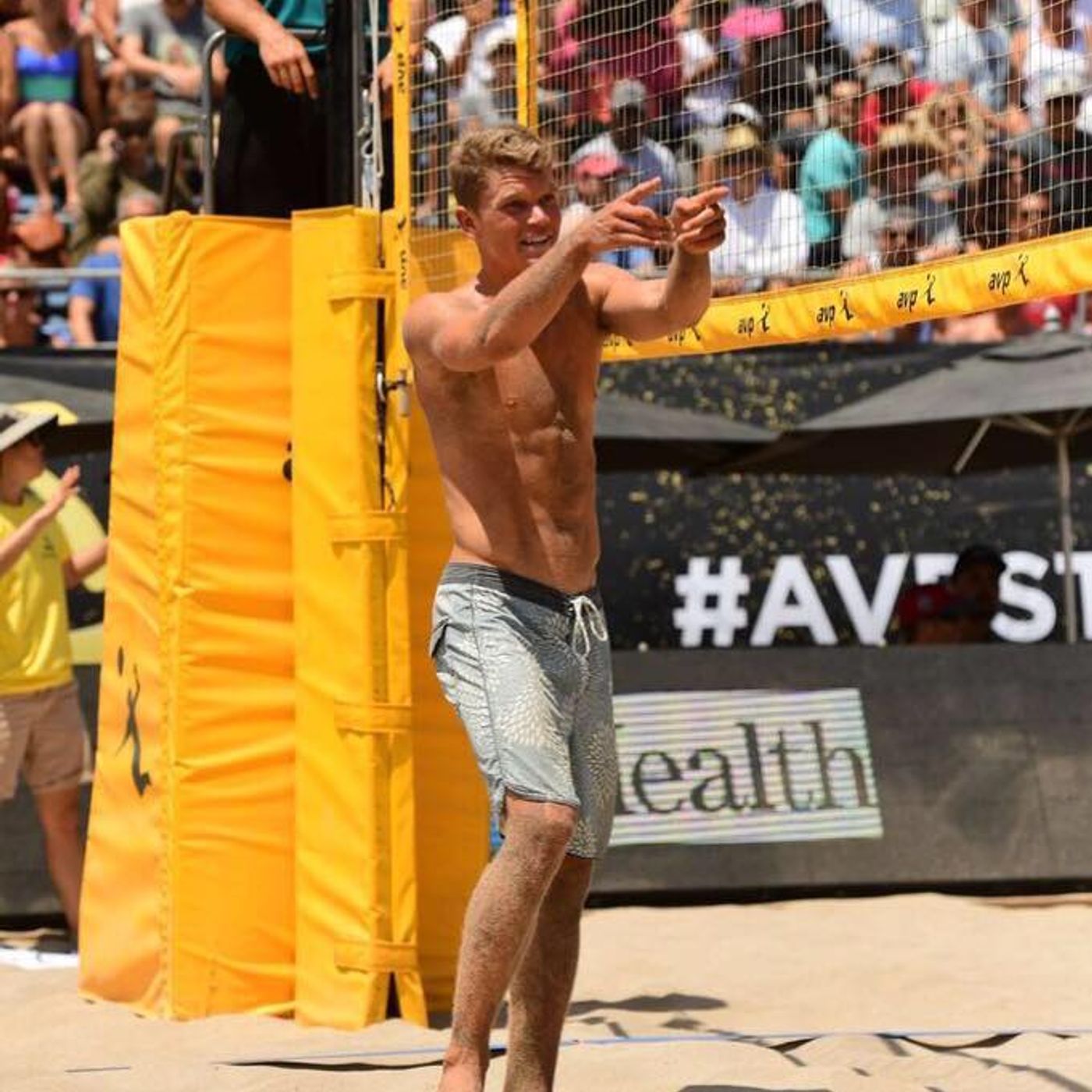
Ep 10SANDCAST No. 9: Chase Frishman, and the next wave of AVP talent
It has become impossible to ignore: The top players in the United States are getting older. Nick Lucena is 38. John Hyden, ageless as he may be, is 45. Casey Patterson is 37, as is Phil Dalhausser and Sean Rosenthal. Jake Gibb is 41. “We’re definitely holding it down for USA Volleyball,” Phil Dalhausser said last week on SANDCAST: Beach Volleyball with Tri Bourne and Travis Mewhirter. Holding it down until a new wave of talent establishes itself to fill in for the longtime veterans and representatives of the United States on the world stage. Chase Frishman is one of the most likely members of that next wave, and he considers himself to be, as he should. In just his second year on the AVP Tour, Frishman, partnered with Avery Drost, made his first semifinal, in Hermosa Beach, where, he admits on SANDCAST, “we got our bell rung.” By year’s end, the 26-year-old nearly tripled the prize money from his Rookie of the Year campaign in 2016, taking five top-10 finishes in 2017 as compared to two in 2016. With Lucena, Hyden, Patterson and Rosenthal having, at most, one more quad left in them, Frishman sees himself as part of a group of four up-and-coming defenders under 30, including 25-year-old Taylor Crabb – “the golden boy,” Frishman says – 24-year-old Eric Zaun, and 28-year-old Miles Evans. He’s not wrong. One aspect the three of them have in common is a Rookie of the Year Award, with Frishman succeeding Crabb and Zaun succeeding him. Evans has only played in one AVP main draw, choosing instead to compete internationally this past season with Billy Kolinske. But Frishman, of course, has one element those three – or anyone else on tour not named Sean Rosenthal, for that matter – do not have: Ledge’s Legion. Aside from the infamous Rosie’s Raiders, Frishman boasts the largest, loudest, rowdiest crowd on tour. They’ve bestowed themselves the nickname ‘Ledge’s Legion’ as an eponym of Frishman’s nickname, ‘Ledge,’ doled out because, as his former partner Mike Brunsting said, “When you watch him play, he just looks like a legend.” Hosted by Simplecast, an AdsWizz company. See pcm.adswizz.com for information about our collection and use of personal data for advertising.
Ep 9SANDCAST No. 8: Phil Dalhausser has another mountain to climb
There is little that Phil Dalhausser has yet to accomplish in beach volleyball. He’s won more than 50 tournaments domestically and another 30-plus internationally. He’s won an Olympic gold medal and owns the longest active win streak on the FIVB Tour, having won a tournament in each of the past 12 years. But the 37-year-old Dalhausser isn’t finished. Not yet. He has a Defensive Player of the Year to win. Just kidding. Maybe. You’ll recall that Dalhausser did make the finals in the AVP’s season finale in Chicago split-blocking with Nick Lucena, and the one award that the Thin Beast has yet to win in his lavishly long list of awards is a Defensive Player of the Year. “If I could play with Evandro [of Brazil], we could just sit back and bomb serves and whatever, if we dig a ball it’s a bonus,” Dalhausser said on SANDCAST: Beach Volleyball with Tri Bourne and Travis Mewhirter. “And playing behind Evandro would be a lot easier than playing behind Nick.” He’s joking, though it speaks to Dalhausser’s brilliant career that he is devoid of just one accolade, for a position he doesn’t play. He has no plans – “no shot” – to split-block (Chicago is likely a one-time ordeal), for Dalhausser does indeed still have mountains to climb. He wants a World Championship. He wants another Olympic gold in Tokyo 2020. But first, he’s bidding farewell to California. Dalhausser and his family are packing up and moving to Orlando, just a few hours from Lucena in Tallahassee. “It’s a little bit of risk as far as volleyball goes,” he said on SANDCAST. “There will definitely be a transition.” A transition back to their roots. Dalhausser and Lucena have been close for more than a decade, having met playing against one another in Florida, when Dalhausser was at Central Florida and Lucena at Florida State. Their respective journeys have taken them from northwest Florida to South Carolina to Southern California and now, for the final act of their decorated careers, back home. “I’d like to grab the 2019 World Champs and 2020 Olympic gold,” Dalhausser said. “That’s the goal. We’ll see what happens.” Hosted by Simplecast, an AdsWizz company. See pcm.adswizz.com for information about our collection and use of personal data for advertising.
Ep 8SANDCAST No. 7: Geena Urango, the intern who dug her way to the top
Geena Urango didn’t expect to be playing on the AVP Tour. After playing volleyball for five years at USC – four indoors, one on the beach – Urango, who studied digital marketing, was just stoked to have a job: Interning with the AVP Tour. “My first day on the job I get called into Donald [Sun’s] office just to do a little meet and greet,” Urango recalled on SANDCAST: Beach Volleyball with Tri Bourne and Travis Mewhirter. “He’s like ‘Yeah, so you’re going to play too, right?’ And I was like ‘What?’ I didn’t even know that was an option. “Just that one sentence sparked it.” That question was both a blessing and a burden for Sun, who was able to retain Urango for a year and a half before Urango ultimately realized that she still had a passion for the game, to the point that she quit her job with the AVP to focus full-time on her career as a player. Her decision has proved to be prescient. Since concentrating on beach – she still freelances as a marketer – Urango has become one of the top defenders on the AVP Tour, making four finals over the course of the 2015, ’16, and ’17 seasons with partner Angela Bensend. It was a partnership that began on a last-minute scramble prior to the 2015 Manhattan Beach Open and has since become one of the most recognizable on Tour, both for their play, their nickname – “TexMex” – and garish bikinis, kudos of Goldsheep. “Benny and I, what was great about playing together, we were always on the same page, what our goals were for the season,” Urango said. “Each season we progressively got better and better, so it was ‘Why break what’s not broken?’ We had a great balance. She was fiery and brought a lot of energy and I was more calm and collected.” Bensend, however, has since moved to Philadelphia, and with a balky back her future on the beach is uncertain, leaving Urango one of the more talented free agents on Tour. For now, Urango is content traveling the world, snowboarding, spoiling her dogs. Find our full show notes at VolleyballMag.com. Hosted by Simplecast, an AdsWizz company. See pcm.adswizz.com for information about our collection and use of personal data for advertising.
Ep 7SANDCAST No. 6: A glimpse into greatness with April Ross, Part 2
The cat’s out of the bag: April Ross is playing with Alix Klineman, a 6-foot-5 blocker out of Stanford. On paper, the two will be a formidable pair, Ross one of the best defenders in the world, Klineman a standout indoor blocker who has an AVP final and a third under her belt. One problem: Klineman has just one year of full-time beach experience. The road to Tokyo 2020 will not be easy, though as Ross says on SANDCAST: Beach Volleyball with Tri Bourne and Travis Mewhirter, “it’s not supposed to be easy.” “What is the meaning if what you’re doing if you’re not being challenged?” she says. “If you don’t have these things that will help you grow and things to help you overcome, what’s the point?” On Part Two, Ross discusses the path ahead, the inevitable challenges ahead, her mindset moving forward, as well as pairing up with former partner Jen Kessy, who will be coaching Ross-Klineman through Tokyo, site of the 2020 Olympic Games. Ross and Kessy, of course, are one of the best teams in American beach volleyball history, medaling in 17 out of 20 FIVB tournaments in a stretch from 2008-2010, finishing with a silver medal in the 2012 Olympic Games in London, where they lost to Kerri Walsh and Misty May. Few, if any, in the game know Ross’ style better than Kessy. “One of the things I learned the importance of,” she said, “is building a like-minded team around yourself: having the same mentality, the same goals, the same work ethic are all really important. Alix and I don’t know each other very well but it’s funny how connected we feel.” The first glimpse the beach volleyball world will have of Ross-Klineman will be in The Hague on January 3, where Ross, who has won 21 international tournaments, will likely be in a country quota. “We’re training every day,” Ross said. “Doing everything we can to get better every day.” Hosted by Simplecast, an AdsWizz company. See pcm.adswizz.com for information about our collection and use of personal data for advertising.
Ep 6SANDCAST No. 5: A glimpse into greatness with April Ross, Part 1
There has only ever seemed to be one gear for April Ross: Go. Such is how the Newport Beach native has garnered a laundry list of accomplishments that include, among others: A Gatorade National Player of the Year award at Newport Harbor High School; two national championships at USC (where she never even planned on playing, but more on that in Part 2); a two-year stretch with partner Jen Kessey between 2008-2010 in which she medaled in 17 of 20 FIVB events; an undefeated AVP season in 2014 with Kerri Walsh-Jennings; two Olympics medals, one silver, one bronze. And every time Ross thinks it’s time to unwind, to relax – well, there’s always another mountain to climb. “It’s so hard. It’s so hard. What I find happens is I convince myself to find that balance a little bit and not stress about it and not work so hard,” she said. “And then I’ll go to a competition, underperform, and I’m like ‘F this! I’m going to home, step it up. I’m not training hard enough, not focused hard enough. If you just want to win that bad – it’s so hard to take a step back and find that balance.” This season was, as Ross describes it on SANDCAST, full of “hiccups.” A last-minute breakup with Walsh-Jennings, with whom Ross won a bronze medal in the 2016 Olympic Games, along with a toe injury that had more of an effect that she realized until she watched video of her approach, made for a mercurial year, though certainly not a bad one – not by most standards, anyway. Ross still won a pair of AVP tournaments, in Austin split-blocking with Whitney Pavlik, and in New York defending for Lauren Fendrick. She still made the World Championship finals in Vienna, pushing the 2016 Olympic gold medalists Laura Ludwig and Kira Walkenhorst to three sets. But one of those hiccups – having a constantly-changing partner situation – is resolved for 2018. In Alix Klineman, the 2017 AVP Rookie of the Year, Ross has partner stability once more. “It was really hard to figure out what to do,” Ross said. “There weren’t many chances to compete and to try people out. It came down to really intangible things. I decided to go with Alix Klineman to take a shot at Tokyo.” Hosted by Simplecast, an AdsWizz company. See pcm.adswizz.com for information about our collection and use of personal data for advertising.
Ep 5SANDCAST No. 4: Welcome to the United States, Chaim Schalk
Chaim Schalk had been to the United States before. The Alberta native has actually been an American citizen his entire life -- his mother is an Iowan -- but as a kid raised in Red Deer, Schalk has been competing in the Canadian pipeline his entire life. Until now. After the 2017 season, Schalk, who finished fifth at the 2017 Beach Volleyball World Championships with longtime partner Ben Saxton, the 6-foot-5 defender made the decision to transfer to compete for the United States, homeland of his wife, Lane Carico, another top-flight U.S. defender whom he married on New Years Eve of 2015. “It was probably halfway through the season when I considered what my options were going to be,” Schalk said. “Me and Ben, we weren’t, I don’t think, were on the same page after a certain period of time. We had a really good run over five years but I was hoping we were going to become more consistent and we never actually won a tournament, and every team around our level has won a tournament. Every team. And that was one thing I wanted to do: I wanted to win. “We’d get into these tournaments where we were so close and every time, something happened. Not to say that’s the reason why I wanted to move on, because if it’s not Ben, who am I going to win with?” And that remains the No. 1 question for Schalk moving forward: Who will the erstwhile Canadian partner with? Because of an FIVB transfer rule, Schalk will have to sit out of FIVB tournaments until October of 2019. He’ll be an exclusively AVP talent, though it's possible he could compete in the World Series of Beach Volleyball, should it not fall under the FIVB umbrella, as it did not this past season. He hasn’t decided on anything; he hasn’t ruled anything out. It’s just as possible he plays with Brazilian blocker Ricardo Santos, with whom he played in AVP New York and stunned Phil Dalhausser and Nick Lucena in the first round, as with a young and developing blocker. For now, Schalk is rehabbing his pinky finger post-surgery, though the next time he steps on the sand, it’ll be as a member of USA Volleyball. WATCH: SANDCAST host Tri Bourne plays against SANDCAST guest Chaim Schalk in the Toronto semifinals: https://www.youtube.com/watch?v=t8BHlrar2wc&t=934s Where to find Chaim Schalk: Twitter: @chaimschalk Instagram: @Chaimer Website: ChaimSchalk.com Hosted by Simplecast, an AdsWizz company. See pcm.adswizz.com for information about our collection and use of personal data for advertising.
Ep 4SANDCAST No. 3: It's finally (finally) video game season for Kelly Claes
In a frenetic span of 120 days, Kelly Claes was able to accomplish what the vast majority of the beach volleyball world would be satisfied with in a career. She won a national championship with USC, which was preceded by the USAV Collegiate Beach Championships. She stunned 2016 Olympic gold medalists Laura Ludwig and Kira Walkenhorst to claim a bronze medal in the World Series of Beach Volleyball. She won an AVP during the season finale in Chicago, which came with the added bonus of boosted prize money, money she was alas able to accept. She even won a NORCECA qualifier – playing defense with Lauren Fendrick. And Claes isn’t done yet. Not even close. “I want to be the best blocker in the world,” she says repeatedly throughout the podcast. She’s not far off, despite playing professionally for less than one full season (she had to skip the AVP’s opener in Huntington Beach). While her and partner Sara Hughes, the FIVB Rookie of the Year, finished the collegiate season No. 1 in the country and national champs for the fourth straight season, they also finished No. 16 internationally and sixth on the AVP. On the podcast, Claes discusses her remarkable partnership with Hughes, which includes a record 103-match winning streak, and what she learned by playing with Fendrick and AVP MVP April Ross in an FIVB in China. “You can only learn so much from one person,” she says. “I feel like reaching into another hat is always helpful. I feel like I learned from both of them and I wouldn’t trade that for anything. It was a really cool experience.” With a little less than three months to go before the opening event of the 2018 season, in The Hague, Claes and Hughes are back on the sand. Claes discusses what her training looks like, what events she’s looking forward to in the 2018 season, her aspirations both immediate and long term, and how she plans on developing into the best blocker in the world. Where you can find Claes: Twitter: @kellyclaes3 Instagram: Kellyclaes3 Facebook: Kelly Claes Of course, this podcast would not be possible without our generous sponsors from Marriott Vacation Club Rentals, which offer the best vacation accommodations in the world’s best vacation destinations. Wherever you travel… Florida to Hawaii, Europe to California, choose to rest in our luxurious guest rooms, suites or villas for your next getaway. Villas offer all of the comforts of home including a full kitchen, living and dining area and separate bedrooms. Stay with the Marriott name you know and trust. Book Big Spaces in Great Places today. Visit www.MVCRentals.com! Hosted by Simplecast, an AdsWizz company. See pcm.adswizz.com for information about our collection and use of personal data for advertising.
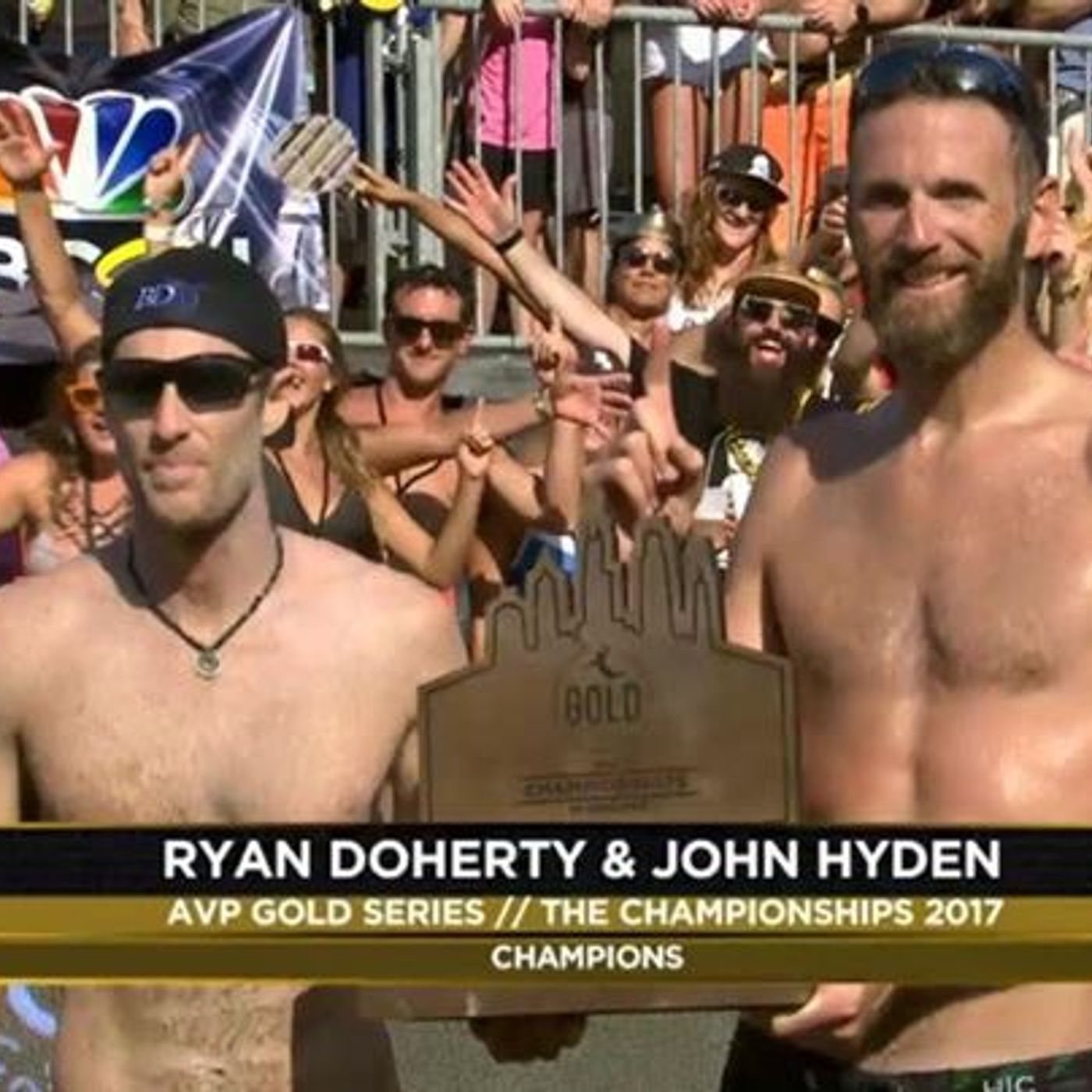
Ep 3SANDCAST No. 2: Ryan Doherty, the Most Interesting Man in Beach Volleyball
Dos Equis had it all wrong when the beer company casted actor Jonathan Goldsmith as its "Most Interesting Man in the World" campaign. It missed out on Ryan Doherty. Even amongst a group of peers with circuitous routes into beach volleyball, Doherty’s path has been exceptionally itinerant. A star pitcher out of the baseball-mad town of Toms River, New Jersey, Doherty threw for Notre Dame in college. He left early, going undrafted but getting scooped up by the Arizona Diamondbacks, where he spent two years in the minor leagues, years filled with long bus rides, pitching well, pitching not so well – until he got the call from the manager’s office. Doherty was cut. It was, as rock bottom moments can often be, a watershed moment for Doherty, as serendipitous as it was crushing. After couch surfing for a bit in South Carolina, where he was routinely beaten down in beach volleyball by high schoolers, Doherty had made up his mind: He was moving to California, and he was going to play professional beach volleyball. Since, the 7-foot-1 – well, 7-foot-and-a-half – blocker has partnered with Olympians Casey Patterson, Nick Lucena, Todd Rogers and John Hyden. He has beaten Phil Dalhausser. He has represented the United States internationally and domestically, becoming a mainstay on both the AVP and FIVB Tours. Doherty discusses all of that and a great deal more on SANDCAST: Beach Volleyball with Tri Bourne and Travis Mewhirter. Mentioned in the show: Doherty wrote a book, Avatar’s Guide to Beach Volleyball. You can get that on Amazon here: Where you can find Doherty: Twitter: @RyanDVolley Facebook: Ryan Doherty As always, this show would not be possible without the sponsorship of Marriott Vacation Club Rentals, who offers the best vacation accommodations in the world’s best vacation destinations. Wherever you travel… Florida to Hawaii, Europe to California, choose to rest in our luxurious guest rooms, suites or villas for your next getaway. Villas offer all of the comforts of home including a full kitchen, living and dining area and separate bedrooms. Stay with the Marriott name you know and trust. Book Big Spaces in Great Places today. Visit www.MVCRentals.com! Hosted by Simplecast, an AdsWizz company. See pcm.adswizz.com for information about our collection and use of personal data for advertising.