
Relentless Health Value
664 episodes — Page 4 of 14

Ep 422EP422: Some Indie Pharmacy Upshots That Surprised Me—and I Thought I Was Pretty in the Know, With Benjamin Jolley, PharmD
Episode 422: The Financial Struggles and Unexpected Insights of Independent Pharmacies with Benjamin Jolley In this episode, Stacey Richter interviews Benjamin Jolley, a multi-generational pharmacy leader and consultant, who discusses the financial challenges faced by independent pharmacies. Jolley reveals that a significant portion of a pharmacy's profits comes from a mere 10% of prescriptions. The conversation dives into the detrimental impact of Pharmacy Benefit Managers (PBMs) on pricing and reimbursement, the inefficiencies in the system, and explores potential models like direct pharmacy care to create more sustainable business practices. The discussion also touches on the broader implications for local communities and the healthcare system overall. === LINKS === 🔗 Show Notes with all mentioned links: https://cc-lnk.com/EP422 ✉️ Enjoy this podcast? Subscribe to the free weekly newsletter: https://relentlesshealthvalue.com/join-the-relentless-tribe 🫙 Support the podcast with a small donation to the Tip Jar: https://relentlesshealthvalue.com/join-the-relentless-tribe 🎤 Listen on Apple Podcasts https://podcasts.apple.com/us/podcast/feed/id892082003?ls=1 🎤 Listen on Spotify https://open.spotify.com/show/6UjgzI7bScDrWvZEk2f46b 📺 Subscribe to our YouTube channel https://www.youtube.com/@RelentlessHealthValue === CONNECT WITH THE RHV TEAM === ✭ LinkedIn https://www.linkedin.com/company/relentless-health-value/ ✭ Threads https://www.threads.net/@relentlesshealthvalue/ ✭ Bluesky https://bsky.app/profile/relentleshealth.bsky.social ✭ X https://twitter.com/relentleshealth/ 04:47 Benjamin Jolley's recent revelation. 06:14 What are the 10% of drugs that provide all the profit for pharmacies? 09:21 What's happening with the other 90% of drugs that pharmacies are filling? 11:05 What is the breakdown of costs when fulfilling prescriptions and running a pharmacy? 18:50 EP379 with AJ Loiacono. 21:42 What is the "cost savings" within the "insane system" of PBMs not sharing profit with independent pharmacies? 23:00 What is one of the things that PBMs and pharmacies don't often talk about? 26:39 What can employers do so that patients aren't getting overcharged by PBMs? 27:51 "How do I make the PBMs irrelevant?" 33:30 What's the difference between an independent pharmacy delivery service and a service like Express Scripts? 34:36 What's the other potential solution in solving the problems independent pharmacies face, and why does Benjamin Jolley feel that it's not the best solution to pursue?

Encore! EP392: When Patient Journeys Don't Fit in the EHR, With Emily Kagan Trenchard
In this encore episode of 'Relentless Health Value,' Stacey Richter speaks with Emily Kagan Trenchard about the limitations of Electronic Health Records (EHR) in capturing comprehensive patient journeys. Emily, SVP and Chief of Consumer Digital Solutions at Northwell Health, discusses the importance of integrating other platforms such as Customer Relationship Management (CRM), cloud data platforms, and data exchanges to create a more holistic and efficient healthcare experience. Emphasizing the importance of reducing friction for providers and patients, Emily outlines how health systems can move beyond traditional EHR architectures to support patients not just in clinical settings but throughout their daily lives. The episode also touches on the need for proactive outreach, team-based care, and the crucial role of accurate and comprehensive data in enhancing patient care. Love the show? Please consider signing up for our weekly newsletter. We'll send you an article covering the latest episode with show notes, mentioned links and a transcribed intro. Join the RHV Tribe. === LINKS === 🔗 Show Notes with all mentioned links: https://cc-lnk.com/encore392 ✉️ Enjoy this podcast? Subscribe to the free weekly newsletter: https://relentlesshealthvalue.com/join-the-relentless-tribe 🫙 Support the podcast with a small donation to the Tip Jar: https://relentlesshealthvalue.com/join-the-relentless-tribe 🎤 Listen on Apple Podcasts https://podcasts.apple.com/us/podcast/feed/id892082003?ls=1 🎤 Listen on Spotify https://open.spotify.com/show/6UjgzI7bScDrWvZEk2f46b 📺 Subscribe to our YouTube channel https://www.youtube.com/@RelentlessHealthValue === CONNECT WITH THE RHV TEAM === ✭ LinkedIn https://www.linkedin.com/company/relentless-health-value/ ✭ Threads https://www.threads.net/@relentlesshealthvalue/ ✭ Bluesky https://bsky.app/profile/relentleshealth.bsky.social ✭ X https://twitter.com/relentleshealth/ 07:08 How does customer digital solutions fit into the larger technology infrastructure in healthcare? 09:07 "Where else do you have centers of gravity that you should respect in the architecture?" 09:25 "There is a constellation of need here." 11:05 "We interact with way more than just patients." 13:42 "We have to be able to understand the network of relationships in a population." 14:25 How do EHRs and CRMs interact as two tentpoles in healthcare? 16:45 "The question is, where does a human being work?" 19:07 How are patients staying on a nonfragmented care journey in a proactive way? 23:00 "Anybody who's a consumer of our digital offerings has a relationship with us." 28:46 "The medicine is being practiced not only on our physical bodies but on our digital bodies."

Encore! EP372: Step One for Employers and Unions—Get Your Data, With Cora Opsahl
Harnessing Data for Smarter Health Fund Management with Cora Opsahl from 32BJ In this encore episode of Relentlessly Seeking Value, Stacey Richter talks with Cora Opshal, Director of the 32BJ Health Fund, about the imperative for employers and unions to obtain and effectively use their health data. The conversation details the significant benefits of data analytics, such as smart decision-making, reducing waste, and forecasting financial trends. Various case studies, including kicking out an expensive hospital network to save millions and offering low-cost maternity and joint replacement programs, are discussed. The episode emphasizes the critical role of data ownership and transparency in managing healthcare costs and improving benefit designs for members. Love the show? Please consider signing up for our weekly newsletter. We'll send you an article covering the latest episode with show notes, mentioned links and a transcribed intro. Join the RHV Tribe. === LINKS === 🔗 Show Notes with all mentioned links: https://cc-lnk.com/EP488 ✉️ Enjoy this podcast? Subscribe to the free weekly newsletter: https://relentlesshealthvalue.com/join-the-relentless-tribe 🫙 Support the podcast with a small donation to the Tip Jar: https://relentlesshealthvalue.com/join-the-relentless-tribe 📺 Subscribe to our YouTube channel https://www.youtube.com/@RelentlessHealthValue 🎤 Listen on Apple Podcasts https://podcasts.apple.com/us/podcast/feed/id892082003?ls=1 🎤 Listen on Spotify https://open.spotify.com/show/6UjgzI7bScDrWvZEk2f46b === CONNECT WITH THE RHV TEAM === ✭ LinkedIn https://www.linkedin.com/company/relentless-health-value/ ✭ Threads https://www.threads.net/@relentlesshealthvalue/ ✭ Bluesky https://bsky.app/profile/relentleshealth.bsky.social ✭ X https://twitter.com/relentleshealth/ 06:53 How much data does 32BJ Health Fund have, where do they get it, and how do they use it? 08:52 How did 32BJ Health Fund successfully demand their data from 100% of their vendors? 09:42 "We feel it's really important that we own this information ourselves." 10:05 "It always concerns me—if a vendor doesn't want to give you the information, what are they hiding?" 10:32 "It's not just getting the data; it's then using the data." 13:41 "Without data, you're really just taking a guess; and guesses are never gonna get you where you need to go." 15:19 EP285 with Dawn Cornelis. 15:40 Is the cost of creating a data analytics team worth the cost savings of those data discoveries? 19:03 "The use of data has really built our knowledge." 20:52 "It's really important to us that as we make benefit decisions, we're doing it smartly." 25:27 EP358 with Wayne Jenkins, MD. 25:38 How is 32BJ Health Fund making their data knowledge actionable? 28:11 "If we can figure out how to make telehealth accessible … there may be an opportunity for telehealth … to upset some of these … monopoly systems or low-choice options." 30:22 "It's really easy to think that we can solve this problem through benefit design … but in the end … it's the price."

Ep 421EP421: Wildly Improving Outcomes When the Patient Is, for Reals, in the Center—For Maternity and Beyond, With Jodilyn Owen
Improving Maternity Outcomes: The Role of Trust and Community-Based Care To read the full article and show notes with links mentioned as well as a full transcript, click here. In Episode 421, 'Wildly Improving Outcomes When The Patient Is, For Reals, In The Center. For Maternity and Beyond,' host Stacey Richter interviews Jodilyn Owen, clinical director of the Rainier Valley Birth and Health Center. They discuss the systemic issues in the U.S. healthcare system where financial incentives do not align with patient outcomes, especially in maternity care. They highlight Jodilyn's clinic's successful outcomes despite being located in a medically underserved area. They explore the importance of relationship-based care, the economic challenges of quality care provision, and the failures of venture-backed healthcare startups to understand community needs. The conversation underscores the need for trust, listening, and community integration in improving maternal health outcomes. Love the show? Please consider signing up for our weekly newsletter. We'll send you an article covering the latest episode with show notes, mentioned links and a transcribed intro. Join the RHV Tribe. 07:12 How much cost savings is there when you avoid a NICU admission? 09:43 How is "slow care" feasible among an ob-gyn shortage in many communities? 10:42 "Start people at the risk that they are appropriate for." 11:37 EP407 and Summer Shorts 3 with Vivek Garg, MD, MBA. 13:50 "To effect change, we have to unwind what has been wound so tightly and so carefully through medical … education." 14:13 "It's not a people problem; it's a system problem." 18:46 What does relationship-based care mean? 22:32 "Everything in pregnancy at least is a trend." 28:01 How does Jodilyn's practice work with payers? 31:08 EP409 with Larry Bauer, MSW, MEd. 32:24 Why is it important to address the root of this problem in the education space?

Ep 420EP420: Paying Cash for Generic Drugs—Some Finer Points That Had Totally Gone Over My Head, With Ge Bai, PhD, CPA
Uncovering the Economics of Paying Cash for Generic Drugs with Ge Bai To read the full article and show notes with links mentioned as well as a full transcript, click here. In this episode, Stacey Richter talks with Dr. Ge Bai, a professor at Johns Hopkins, about the rationale and financial implications of paying cash for generic drugs instead of using insurance. The discussion highlights the inherent inefficiencies and high administrative costs associated with PBMs (Pharmacy Benefit Managers) and insurance systems when it comes to low-cost generics. Key insights from studies are discussed, revealing that for a significant portion of generics, paying cash is often cheaper than using insurance. The conversation also explores alternative solutions such as Health Savings Accounts (HSAs) and the role of policy and market dynamics in improving drug affordability. Love the show? Please consider signing up for our weekly newsletter. We'll send you an article covering the latest episode with show notes, mentioned links and a transcribed intro. Join the RHV Tribe. 06:13 What is the background on generic drugs that is need-to-know? 06:39 EP344 with Steven Quimby, MD. 07:04 Do we have affordability for generic drugs? 15:40 What's the policy failure around generic drugs? 18:34 Why is there a huge health equity issue? 20:13 How do PBMs have both a monopoly and a monopsony? 21:59 What should be the goal for cheap generics? 23:36 "Whenever we have no competition, we'll see high price." 26:00 What's the best approach to addressing operational challenges behind generic drug costs? 28:42 How do we solve generic drug costs on the back end? 31:15 "Healthcare insurance is not the same as health." 36:07 "It's time for us to reflect and think whether there is a better way to try."

Ep 419EP419: The Financialization of Health Benefits for Boards of Directors and C-Suites of Self-Insured Employers, With Andreas Mang
The Financialization of Health Benefits: A Boardroom Imperative To read the full article and show notes with links mentioned as well as a full transcript, click here. In episode 419 of Relentless Health Value, Stacey Richter interviews Andreas Mang from Blackstone on the financialization of healthcare benefits for corporate boards and C-suite executives. The discussion highlights the transformation of healthcare benefits into a significant business aspect, emphasizing the importance of C-suite involvement to combat waste and financial exploitation by vendors. Andreas offers practical steps to save companies up to 10% on healthcare costs while improving employee satisfaction, including self-insurance and careful selection of brokers. The episode underscores the need for enhanced purchasing discipline and strategic alignment among company leadership to manage healthcare expenses effectively. Love the show? Please consider signing up for our weekly newsletter. We'll send you an article covering the latest episode with show notes, mentioned links and a transcribed intro. Join the RHV Tribe. 04:19 Why Andreas starts every conversation with the question, "How's your healthcare company?" 07:04 Why is it important, as a self-insured employer, to treat your business as a small healthcare company? 08:42 Why is it unnatural for companies to be providing health insurance? 10:13 What can be achieved when there is alignment between employers and insurers? 12:07 What things can a company do to reduce spend by 10%? 13:40 Why is it better to have CFO engagement in the benefits plan throughout the year? 15:51 Why does self-insurance save 5% to 9% for companies automatically? 17:41 "The funding isn't a healthcare thing; it's a CFO thing." 17:54 Why is it vital to have a reliable, trustworthy broker? 24:38 When is the last time your company has RFP'd their health plan? 27:06 Why does changing a health plan feel scary but is necessary? 27:58 What is a dependent eligibility audit? 30:48 Why are employers better together? 34:02 How do employers truly get a flat-fee model with brokers?

Encore! EP381: For Reals, Becoming Customer-centric, Transforming, or Innovating at a Very Large Organization, With Karen Root
Encore: Achieving Customer-Centric Transformation in Large Organizations with Karen Root To read the full article and show notes with links mentioned as well as a full transcript, click here. In this encore episode of 'Relentless Health Value', host Stacey Richter speaks with Karen Root, Director of Experience Strategy at BI, about achieving customer-centric transformation and innovation in large organizations. The discussion highlights the importance of change management, systems thinking, and effective leadership with a compelling vision. Key steps include identifying quick wins, leveraging influencer support, storytelling, and focusing on emotional 'moments that matter'. The conversation also delves into the J-curve, emphasizing the necessity for leaders to sustain hope and overcome the initial challenges during the transformation process. Love the show? Please consider signing up for our weekly newsletter. We'll send you an article covering the latest episode with show notes, mentioned links and a transcribed intro. Join the RHV Tribe. 08:51 What skills does leading a large company in customer centricity require? 10:36 What needs to be included in a vision for customer-centric change? 11:01 "In transformation, we have to adjust the approach to that vision. We have to break it down into a couple of key steps." 11:39 What is the J curve? 12:26 "Disruption is going to happen; it's just how do we minimize its impact." 14:00 Why is hope so important for success in change? 17:22 "Leverage your people; understand where they are in the change curve." 26:24 "We can't manage what we don't measure." 26:33 "We have to not only measure in quantitative ways but qualitative." 27:35 What's the downside to not being able to innovate? 28:55 Why does leadership need to have a story to tell? 31:19 "We have to remember that these are human beings and to look for those tells."
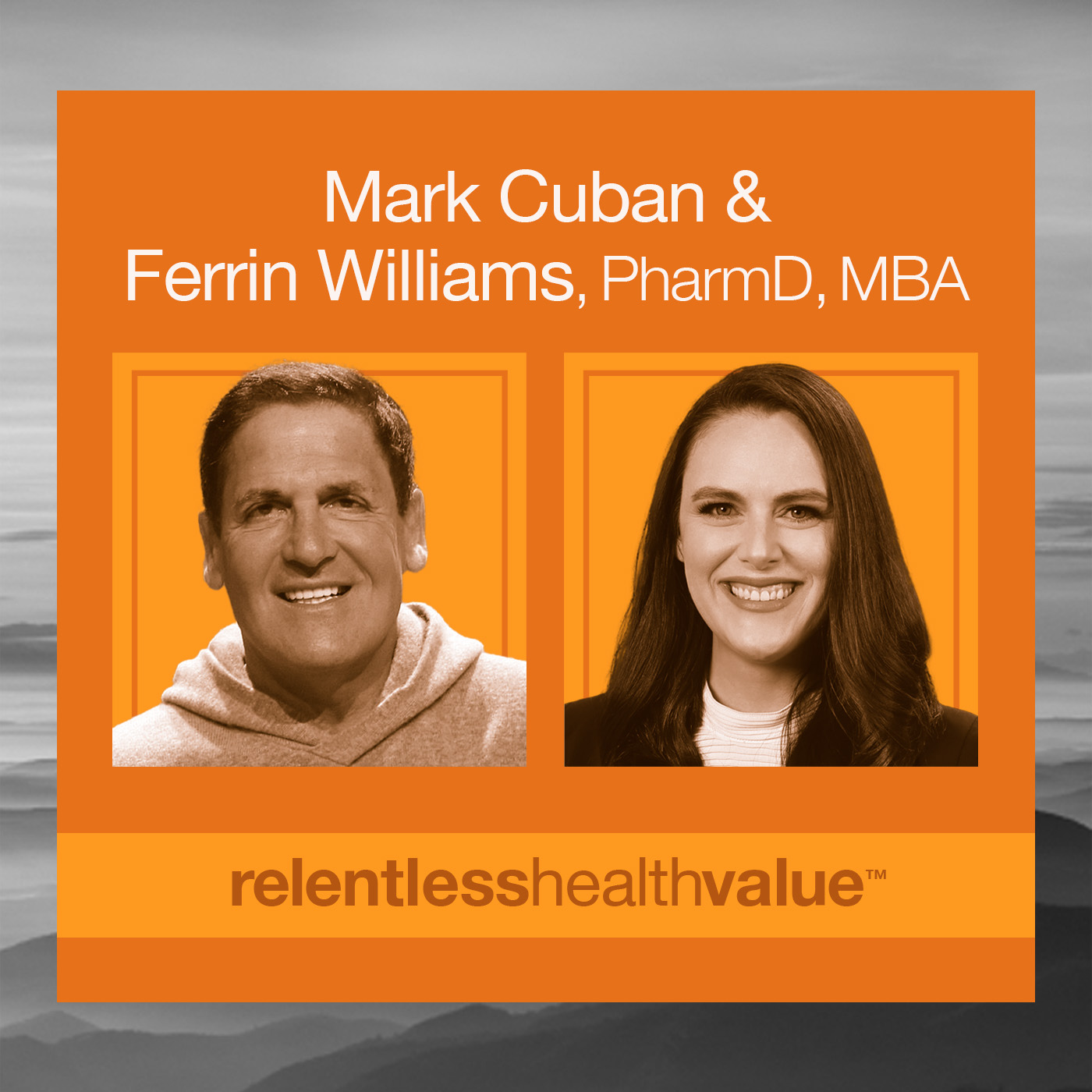
Ep 418EP418: Mark Cuban With Some Advice for CEOs and CFOs of Self-insured Employers, With Mark Cuban and Ferrin Williams, PharmD, MBA, From Scripta
EEpisode 418: Mark Cuban's Insights on Reducing Healthcare Costs for Self-Insured Employers To read the full article and show notes with links mentioned as well as a full transcript, click here. In Episode 418 of Relentless Health Value, Mark Cuban, CEO and founder of Mark Cuban Cost Plus Drugs, joins host Stacey Richter, and guest Farron Williams, Chief Pharmacy Officer at Scripta, to provide critical advice for CEOs and CFOs of self-insured employers. The podcast delves into the financial intricacies of the healthcare industry in 2023, emphasizing the importance of direct involvement by company executives in managing healthcare benefits to save substantial costs. Cuban discusses how his company saves money on drug costs through transparency and direct purchasing from manufacturers, offering actionable steps for businesses to replicate these savings. The episode also highlights partnerships, like the one between Scripta and Mark Cuban Cost Plus Drugs, and discusses strategies for simplifying the healthcare benefits system. The conversation touches on the broader impact of these practices, legal implications under ERISA, and the importance of financial prudence and transparency in managing healthcare expenditures effectively. Love the show? Please consider signing up for our weekly newsletter. We'll send you an article covering the latest episode with show notes, mentioned links and a transcribed intro. Join the RHV Tribe. 05:41 What was Mark Cuban's own journey as a self-insured employer with Cost Plus Drug Company? 06:56 What did Mark find when he decided to go through and look through his company's benefit program? 08:23 "When you think it through, you start to realize that money is being spent primarily by your sickest employees." —Mark 09:13 How do you get CEOs and CFOs of self-insured employers to realize that their sickest employees are the ones subsidizing their checks? 12:10 What is the role of insurance in healthcare? 13:42 "If you can't convince them, confuse them and hide it." —Mark 14:35 The reality behind getting a rebate check. 15:32 Why are rebates going away, and why isn't that changing PBM earnings? 18:17 How do you get CEOs and CFOs to dig into their benefits plan? 20:13 Does morally abhorrent move the needle? 20:47 "What we're trying to do is just simplify the [healthcare] industry." —Mark 23:33 What's been changing in consumer behavior? 24:18 "Transparency is a huge part of building that trust." —Ferrin 24:33 Why CEOs and CFOs really have the power to change healthcare. 31:42 What are Cost Plus Drugs' plans to expand? 38:36 Where is the future of the prescription drug market going? 41:25 What will happen to the prescription drug market in 10 to 20 years? 47:56 The wake-up call self-insured employers should be acknowledging now. 51:18 Where is the real change in the healthcare industry going to come from?

Encore! EP385: Morgan Health and the 5 Things Self-insured Employers Should Do Right Now, With Dan Mendelson
5 Strategies for Self-Insured Employers to Enhance Employee Health To read the full article and show notes with links mentioned as well as a full transcript, click here. In this encore episode of Relentless Health Value, host Stacey Richter revisits her discussion with Dan Mendelson, CEO of Morgan Health at JPMorgan Chase. They delve into five pivotal actions self-insured employers can take to improve employee health significantly. These actions include expanding accountable care models, investing in data access for health outcomes, aligning health benefits with population health outcomes, prioritizing adaptable care models, and making care navigation central to benefit packages. The episode underscores the critical role of employer engagement in advancing healthcare quality, affordability, and equity within local markets. Mendelson also shares insights into Morgan Health's current initiatives, such as their new accountable care framework in Columbus, and emphasizes the importance of local provider partnerships and digital health accessibility. Love the show? Please consider signing up for our weekly newsletter. We'll send you an article covering the latest episode with show notes, mentioned links and a transcribed intro. Join the RHV Tribe. 05:01 Why did Dan direct his article about health benefits at CEOs? 06:03 What does an accountable care model mean to a self-insured employer? 07:58 "This alignment of value will never work … if the 150 million Americans … getting their health insurance through their employer are not also aligned in the same way." 11:28 "We're offering them a higher level of service." 11:40 "Everything that we do is intended to be scalable and not just for us." 12:09 "We have an obligation to do better for our employees." 14:52 "Employers need to understand, the only way to get outstanding care is locally." 17:28 Encore! EP206 with Ashok Subramanian and EP358 with Wayne Jenkins, MD. 18:18 Why is getting quantitative metric data important? 18:50 Encore! EP308 with Mark Fendrick, MD. 20:58 "This is a much broader vision of accountable care than … primary care." 22:48 "Until everything is aligned, the employer is just not going to be providing an optimal product." 23:39 "There are substantial issues with … health equity, and employers are paying for the care of 150 million Americans in this country." 25:23 Is digital health access important for creating meaningful relationships between patients and providers? 29:50 What is the myth that employers need to tackle? 30:18 Why is care navigation important for employees? 31:44 EP334 with Sunita Desai, PhD.

Ep 417EP417: 5 Kinds of Payer and Provider Collaborations and 5 Must-Haves for Said Collaborations to Work, With Josh Berlin, JD
Exploring Effective Payer-Provider Collaborations: Insights and Key Strategies To read the full article and show notes with links mentioned as well as a full transcript, click here. In episode 417 of Relentless Health Value, Stacey Richter engages in a detailed discussion with Josh Berlin from Rule of Three consulting firm about the dynamics and strategies behind successful provider and payer collaborations in the healthcare industry. They delve into the historically adversarial relationship between these entities and explore five distinct types of collaborations, ranging from data sharing to risk-bearing partnerships. Berlin outlines five crucial 'must-haves' for these collaborations to succeed, including scalability, sustainability, flexibility, effective collaboration, and compatible risk profiles. They further examine real-world examples of both successful and failed healthcare collaborations, emphasizing the importance of mutual goals and adaptive strategies to enhance patient outcomes and improve market competitiveness. The conversation offers practical insights for healthcare executives aiming to foster stronger, more innovative partnerships in a complex and evolving industry. Love the show? Please consider signing up for our weekly newsletter. We'll send you an article covering the latest episode with show notes, mentioned links and a transcribed intro. Join the RHV Tribe. 06:06 Why should payers want to collaborate with providers? 09:46 "Collaboration … is bilateral. … Both sides, plan and provider, should be equally as interactive with the individual populations they work with." 12:37 What are the must-haves for collaboration between providers and payers? 13:10 What are the five different types of collaboration? 16:03 What are the five characteristics you want to be focused on in partnership? 21:35 EP359 with Dan O'Neill. 22:16 In order to collaborate, do you have to be collaborative? 26:11 Ochsner as a great example of collaboration. 27:46 Episodes with David Carmouche, MD, and Eric Gallagher. 28:51 A collaboration failure in Haven.

Ep 416EP416: Why Should Med Schools Teach the Business of Medicine? With Adam Brown, MD, MBA
Now, I'm being pretty careful here because med schools are super sensitive about their curriculums. And I am sensitive to the fact there's much to teach in four years. So, throwing no shade here, what do I know from the Krebs cycle? Choices of what to teach are tough. With that disclaimer, in this healthcare podcast I am speaking with Adam Brown MD, MBA, about an article he wrote entitled "Dear Medical Schools, Educate Students on the Business of Medicine—Without it, you are doing your students a disservice." Let me give you Dr. Brown's list for the "why teach the business of medicine." He says: 1. The role of physicians in medicine has changed, and we dig into this in the episode. 2. There's an expectation mismatch. Docs are investing 10 years and, on average, $200K to $300K in real dollars to get that MD or DO. You don't want those new physicians quitting on the quick because the reality is so different from what they thought it would be. Not being up front about the business of medicine is like hiding the reality of the situation instead of preparing them. 3. If you don't understand the business of medicine, you do not know how to advocate for yourself or the profession or even patients in a way that is compelling to the current set of decision-makers. As maybe a corroboration here, may I just report that I probably have gotten (conservatively) 100, 150 emails and LinkedIn notes from physicians who say basically some version of the same thing: Thanks so much for Relentless Health Value. I wish I would have learned even the basics of what you cover in med school. If I had, I would have been able to help myself and help myself help patients far better. 4. Docs are the ones with the prescription pads. Docs are just functionally the gang who are driving costs that patients and employers and taxpayers ultimately incur. Not knowing the how much or just the whole story here can inadvertently contribute to clinical morbidity, because patients who fear they cannot afford care do not follow doctors' orders. We should get real about that. Or if they do follow doctors' orders and go into debt … I mean, there's just study after study in oncology and otherwise that shows patients who cannot afford their care have worse outcomes. We cannot hide from this any longer. 5. The last reason is that there's lots of things that docs can do besides just be at the bedside. Not giving insight into these alternative paths seems unfortunate for any doc who maybe wants to mix it up some because they're feeling burned out or in a different season of their life looking for something more aligned with where they are as a person. So, now let's think about this whole question from the standpoint of the system itself—from the standpoint of doing better by patients. Why is it important to teach docs the business of medicine? Let's start here. When physicians do not understand the business of medicine, it's harder for docs to get into boardrooms and have their voices heard. Not teaching the business of medicine in med school might be one reason why there is such a shockingly small percentage of doctors on the boards of directors at major nonprofit hospitals (listen to the show with Suhas Gondi, MD, MBA [EP404]) and why there's so little "dyad leadership" in the ranks of both clinical and payer organizations, etc. And even fewer nurses are in organizational decision-making roles, by the way, despite nurses actually being the most trusted profession—even more trusted than doctors by 14 percentage points, according to Gallup. One way to interpret this lack of docs and other clinicians in the boardroom is simple cause and effect. Doctors are losing control and ownership—and I mean this in literal terms—of the organizations that run the business of medicine, which controls the medicine of medicine. Chad Erickson wrote a comment about this on LinkedIn that I thought was great. He wrote, "Opportunities for physicians to really control or even impact the 86% of healthcare outside of their practice are being reduced every year. We expect doctors to make the decisions and be accountable for patients and outcomes, yet we are taking away their ability to do so." And going one level deeper here on how not having enough docs in admin roles becomes a snowball rolling downhill kind of downward spiral, I'm gonna quote Jeremy Granger, MD, FAAP. He wrote, "When you are a physician administrator, it can be very strange. There is tremendous pressure from administrators to think and act like one of them and give insight into how to best coerce physician behavior to align with administrator-determined goals without necessarily involving the physician with setting those goals. When you advocate instead with your physician hat, you can find yourself ostracized from that administrator clique. You realize that they view physicians as knaves and you as the Judas goat. You either pick a side or, if you're lucky, you land with a team that has physician leaders equipped

Ep 415EP415: Some Jumbo Employers Buying Better Healthcare Outcomes While Saving 15% on Total Cost of Care, With Rob Andrews
Improving Healthcare Outcomes and Reducing Costs: Insights from Rob Andrews of HTA To read the full article and show notes with links mentioned as well as a full transcript, click here. In Episode 415, Stacey Richter speaks with Rob Andrews, CEO of the Health Transformation Alliance (HTA), about how jumbo employers are achieving better healthcare outcomes while saving on total care costs. The discussion highlights the significant positive impact of targeted healthcare strategies on reducing readmissions and overall costs, particularly related to maternal health. Andrews elucidates how addressing root causes, negotiating data-driven contracts, and holding intermediaries accountable can create win-win scenarios for both employers and employees. The episode underscores the importance of using data to drive healthcare improvements and the role of self-insured employers in transforming healthcare delivery. Love the show? Please consider signing up for our weekly newsletter. We'll send you an article covering the latest episode with show notes, mentioned links and a transcribed intro. Join the RHV Tribe. 07:29 How did Rob get to his current role? 09:11 The problem of maternal health and mortality rate, and how self-insured employers wind up directly and indirectly paying for this. 10:36 Why economic consequences move the needle, and why sometimes they don't. 12:36 Why the best way to address costs isn't to re-shift costs but to address them directly. 14:34 Why compensation that isn't dependent on outcomes is a problem. 18:09 "Strategy's not what people say; it's what they do." 21:40 How do you operationalize saving money with better outcomes? 29:46 How do employers turn conflict into collaboration? 31:41 What is the win-win-win structure among employers, payers, and providers in Rob's eyes? 34:13 To whom should the task of risk adjustment fall? 38:03 "Better contracts do improve outcomes."

Ep 414EP414: An IRL How-To for Delivering Better Care and Getting Paid for It—A Value-Based Case Study, With Justina Lehman
Delivering Better Care and Getting Paid: A Value-Based Healthcare Guide with Justina Lehman To read the full article and show notes with links mentioned as well as a full transcript, click here. In Episode 414 of 'Relentless Health Value,' host Stacey Richter interviews Justina Lehman to explore practical strategies for healthcare practices to provide coordinated, high-value care while achieving financial growth. The discussion covers the detailed steps for developing and implementing value-based care models, including assembling a committed team, defining ideal care pathways, navigating payer relationships, and engaging with self-insured employers. Lehman emphasizes the importance of close collaboration between physicians, clinicians, and payers to enhance patient outcomes and reduce costs. The episode provides actionable insights for healthcare professionals aiming to transition from fee-for-service to value-based care. Love the show? Please consider signing up for our weekly newsletter. We'll send you an article covering the latest episode with show notes, mentioned links and a transcribed intro. Join the RHV Tribe. 07:35 What has Justina been up to, and why is it relevant to this conversation? 08:23 What is high-value care, and how do we figure out what it is in reality? 08:59 EP412 with Robert Pearl, MD, on the art and science of medicine. 10:08 "What is the clinical design of … high-value care?" 10:21 Care as usual vs ideal care. 11:11 Summer Shorts 8 with Larry Bauer. 12:23 How does Justina figure out what the benchmark is for high-value care? 12:36 Meeting patients where they are at, not where we want them to be. 17:42 EP402 with Amy Scanlan, MD. 18:28 "What is the story as a group to the payer? What is the story as a group to the self-funded employer?" 19:19 How do you align business operations and the financials? 20:16 What are the four avenues for getting paid for high-value care? 21:58 What are highly engaged payers most intrigued by in high-value care? 24:11 What are the different ways a practice can get compensated? 28:52 Are there programs that have advanced without payers leading the way? 29:37 What's the "hook" for payers? 31:12 What's a winning message to payers and employers? 33:04 Summer Shorts 4 with Eric Gallagher. 34:13 "Not everyone needs to participate." 38:24 Can a program be successful even if a physician is a passive participant in the program?

Ep 413EP413: The Intersection of Healthcare Waste, Value-Based Care, and the Potential Rising Power of PCPs, With Will Shrank, MD
Reducing Healthcare Waste: Aligning Incentives and Empowering Primary Care Physicians To read the full article and show notes with links mentioned as well as a full transcript, click here. In Episode 413 of 'Relentless Health Value,' Stacey Richter interviews Dr. Will Schrank on the intersection of healthcare waste, value-based care, and the rising influence of primary care physicians (PCPs). Dr. Schrank's extensive background includes roles at CMMI, CVS Health, UPMC, and Humana, and he is currently a venture partner at Andreessen Horowitz. The discussion delves into a study estimating nearly a trillion dollars of annual waste in U.S. healthcare, categorized into administrative failures (fraud, complexity, pricing) and clinical failures (care coordination, delivery, low-value care). Solutions like aligning financial incentives with higher quality care and primary care-driven models are explored. The episode also highlights challenges in shifting away from fee-for-service models, the potential evolving power of banded PCP groups, and the imperative for health systems to adopt value-based approaches. Love the show? Please consider signing up for our weekly newsletter. We'll send you an article covering the latest episode with show notes, mentioned links and a transcribed intro. Join the RHV Tribe. 05:56 Can we cut healthcare waste while improving patient care? 06:35 What does "healthcare waste" consist of? 06:48 What are the six categories of "healthcare waste"? 09:25 EP363 with David Scheinker, PhD. 09:39 How much money does Dr. Shrank estimate is wasted each year in healthcare? 12:11 Where is that healthcare waste going, and why does it happen? 19:09 Uncaring by Robert Pearl, MD. 20:20 "We've built a backbone of extraordinary waste on a fee-for-service chassis." 21:18 EP409 with Larry Bauer, MSW, MEd. 23:26 EP359 with Dan O'Neill. 25:04 Dr. Shrank's warning to providers out there. 29:04 Summer Shorts 2 with Scott Conard, MD. 30:43 Why there might be a generational shift among younger providers looking to work with different models.

Ep 411EP411: Getting Paid (or Paying) for New Innovations Used in Hospitals as Part of a Procedure or a DRG—Also Bloodstream Infections and Dialysis, With Secretary David Shulkin, MD, and Erin Mistry
The following episode covers my intro to the episode and thoughts on the topic of new innovations used in hospitals as part of procedure including bloodstream infections and dialysis. Oh, hey, some unexpected news. This interview is unavailable at this time. One of these days we may be able to make it available, and if so, this will be announced in our weekly email. So please subscribe by going over to our website at RelentlessHealthValue.com. The episode emphasizes the remarkable progress made by the Relentless Tribe in improving outcomes for chronic kidney disease (CKD) patients and highlights the obstacles hospitals face in adopting expensive new technologies under the DRG payment model. The discussion also covers the significant impact of hospital-acquired infections, particularly those leading to sepsis, and explores the role of Medicare's NTAP (new technology add-on payment) in incentivizing the use of innovative treatments. The episode underscores the complex balance between cost and patient outcomes in healthcare. 00:00 Introduction to Episode 411 00:36 Acknowledging the Relentless Tribe 02:30 Interview with Secretary David Shulkin and Erin Mistry 03:53 The Issue of Bloodstream Infections 04:52 Understanding DRG and Hospital Economics 06:19 Medicare's NTAP and Hospital Payments 07:44 Guest Backgrounds and Acknowledgements 08:43 Acronym Alerts and NTAP Recap 09:54 Conclusion and Subscription Information

Encore! EP361: The Gap in Closing Care Gaps, With Carly Eckert, MD, PhD(c), MPH
The Reality of Closing Care Gaps: A Conversation with Dr. Carly Eckert To read the full article and show notes with links mentioned as well as a full transcript, click here. In this encore episode titled 'The Gap In Closing Care Gaps,' host Stacey Richter interviews Dr. Carly Eckert, exploring the pervasive issue of care gaps in the U.S. healthcare system. Care gaps arise from fragmented medical transitions and tend to recurred if root societal causes are left unaddressed. The conversation reveals the shortcomings of reactive care gap mitigation strategies, likening them to a futile game of 'whack-a-mole.' Dr. Eckert highlights the importance of proactive solutions, such as population health models and community-based interventions. The podcast emphasizes the need for a systemic shift towards holistic and continuous patient care, integrating social determinants of health and enhancing provider-patient relationships. Love the show? Please consider signing up for our weekly newsletter. We'll send you an article covering the latest episode with show notes, mentioned links and a transcribed intro. Join the RHV Tribe. 05:31 What is the true goal in making population health successful? 05:58 How does the clinical pathway need to manifest in population health? 06:29 How do we get a nonfragmented state of care? 06:54 What is the best model of care? 08:37 "Identifying and addressing care gaps is an important element of population health." 11:30 Closing care gaps vs creating a nonfragmented system of care. 15:38 "I think you have to take small steps with people." 16:45 "There's a lot of power in peer support." 17:18 Why should provider organizations connect with peer groups? 19:05 "The key is that it's not going to be the same for everybody." 23:09 Why is diversity of the workforce key to closing care gaps? 23:33 EP322 with Monica Lypson, MD, MHPE. 23:37 EP347 with Ian Tong, MD. 28:36 Where can providers improve transparency to help close care gaps?

Ep 412EP412: Leadership of the Art and Science of Medicine, With Robert Pearl, MD
Leadership in Modern Medicine: Balancing Art and Science with Dr. Robert Pearl To read the full article and show notes with links mentioned as well as a full transcript, click here. In Episode 412 of 'Relentless Health Value,' Stacey Richter interviews Dr. Robert Pearl, former CEO of Kaiser Permanente, to discuss the evolution and current state of leadership in medicine. The conversation explores the balance between the art and science of medicine, touching on how advancements in technology and data have transformed healthcare. Dr. Pearl emphasizes the importance of evidence-based practices while maintaining the human element of patient care. He introduces his A to G model for effective healthcare leadership, which includes aspirations, behaviors, context, data, engagement, faculty, governance, and incentives. Throughout the episode, the focus remains on improving patient outcomes and clinician engagement in a rapidly changing medical landscape. Love the show? Please consider signing up for our weekly newsletter. We'll send you an article covering the latest episode with show notes, mentioned links and a transcribed intro. Join the RHV Tribe. 04:50 What is the idea of the art of medicine? 09:29 EP407 with Vivek Garg, MD, MBA. 09:32 Why has the intrinsic motivation of doctors plummeted? 09:48 Patient perspective versus doctor subjective response. 12:36 Why is there a fundamental change in what doctors and medical professionals can take pride in? 14:38 What did change management look like in the past? 15:24 "What does a patient really want? They'd like not to have a stroke, a heart attack … in the first place." 20:23 "How do leaders achieve evolution?" 23:57 "Incentives always work … the problem in medicine is, they rarely work the way you planned." 24:20 What's the way to make change happen, and why doesn't it involve financial incentives? 28:10 What do leaders in organizations today consistently underestimate? 29:11 What are the three parts of leadership? 29:25 What is the hardest part about leadership? 31:31 Dr. Pearl's two books, Mistreated and Uncaring.

Are Physicians (and the Rest of Us, Nothing for Nothing) Knights, Knaves, and/or Pawns? With Larry Bauer, MSW, MEd—Summer Shorts 8
Summer Shorts: Knights, Knaves, and Pawns in Healthcare To read the full article and show notes with links mentioned as well as a full transcript, click here. In this episode, Stacey Richter speaks with Larry Bauer about the societal perceptions of physicians as knights, knaves, or pawns, inspired by a 2010 JAMA article by Dr. Sachin Jain and Dr. Christine Kassel. They delve into how these perceptions influence healthcare policies, the moral dilemmas faced by physicians, and the need for greater integration of doctors in policy-making processes. Throughout the episode, they stress the importance of understanding physicians' motivations and the significant impact of involving medical professionals in discussions about healthcare reform. Love the show? Please consider signing up for our weekly newsletter. We'll send you an article covering the latest episode with show notes, mentioned links and a transcribed intro. Join the RHV Tribe. 07:36 Are physicians knaves or knights? 10:05 "Most of the people … that [I've met], I would actually put under the cap of knights." 10:21 "By and large, the healing community is quite ubiquitous." 10:38 What is more important than accountability in the healing community? 13:42 Why is it important to recognize our own biases in how we view physicians and the medical community? 18:10 EP266 with Matt Anderson, MD, MBA. 18:16 Is it "the suits" versus "the scrubs"? 19:08 Why is it important to get doctors on committees and get policymakers on the ground?

Why Do Actuarial Risk Horizons Really Matter for Anybody Trying to Improve Patient Outcomes? With Keith Passwater and JR Clark—Summer Shorts 7
Understanding Actuarial Risk Horizons in Healthcare with Keith Passwater and J.R. Clark To read the full article and show notes with links mentioned, click here. In this episode, Stacey Richter speaks with Keith Passwater and J.R. Clark, healthcare entrepreneurs and executives, about the importance of actuarial risk horizons in improving patient outcomes. They discuss how different risk horizons impact healthcare costs, benefit designs, and plan strategies. Keith and JR explain the key differences in risk management between short-term and long-term healthcare plans, such as individual exchanges and employer group insurance, and emphasize the significance of including the patient as a stakeholder in actuarial models. The episode highlights the complexities and challenges faced by actuaries in the healthcare system and the potential benefits of innovative, patient-focused actuarial practices. Love the show? Please consider signing up for our weekly newsletter. We'll send you an article covering the latest episode with show notes, mentioned links and a transcribed intro. Join the RHV Tribe. 02:39 Why is it a problem for actuaries to ignore the patient as stakeholders in benefit design plans? 04:37 What is a risk horizon for actuaries? 05:38 "What's the time interval over which we hope to impact healthcare costs?" 07:25 What is a risky investment from an actuary's point of view? 08:05 How do you keep premiums down when the time horizon is short in an actuary's point of view? 10:31 How do actuaries assess risk horizons or health insurance, and why do they choose those risk horizons? 14:05 What options are on the table when the risk horizon is longer? 16:06 How does the length of risk horizon affect benefit design?
Should You Not Give Employees the Benefit Design They Think They Want? With Lauren Vela—Summer Shorts 6
Lauren Vela is back on the pod today with a summer short that originally was a section of episode 406 that, unfortunately, I had to cut. It was a little bit tangential to the "why with the employer inertia" theme that the original episode was about. But tangential does not mean unimportant. This clip has some really critical insights on a different topic that may or may not to a greater or lesser degree contribute to inertia. And I'm gonna call this other topic the benefit design that most employees might ultimately be the most satisfied with might not be the one that they are explicitly asking for. Let's start with three kinds of market research insights that Lauren Vela, my guest in this healthcare podcast, uncovered when interviewing friends and neighbors not in the healthcare industry about their benefits: 1. Nobody reads their benefit information. 2. They are unhappy with their benefits. 3. The most important thing for them is to have choice. They want to avoid the notion of "managed care." In thinking about this, I was reminded of a Henry Ford quote: "If I asked my customers what they wanted, they would have told me a faster horse." Or Steve Jobs famously said, "Some people say, 'Give the customers what they want.' But that's not my approach. Our job is to figure out what they're going to want before they do." Jobs's whole thing, after all, was that true innovation often comes from anticipating customer needs and desires before they can articulate them themselves. So, let me reconcile Lauren's findings when she interviewed people about what they want in their benefits and what Henry Ford and Steve Jobs have to say about the matter. First of all, patients/plan members—most people have never experienced a comprehensive primary care situation where they are assisted in finding the highest-quality specialists or sub-specialists and have their care coordinated. They have never had someone worrying about them in their "in-between spaces," as Amy Scanlan, MD (EP402), put it, between appointments. This is all just a fantasy. It is a reputed Shangri-la that almost no one has ever seen with their own two eyes. But what many have seen—I have; you have—are narrow networks in which cost containment is wielded like a brute-force weapon, where, for example, the NCI-designated cancer centers are out of network as a way to make sure that people with cancer don't sign up for your plan … or don't last long on your plan if they do. (Did I say that out loud?) Do I sound like I suffer from a brutal lack of trust? Yes, I do—and I was just role-playing there an employee probably pretty accurately. Most of us remember the HMO a-go-go years when your PCP was an administrative gatekeeper and you had to see them to get a specialist appointment—except you never could see them. Wait times were weeks or months, obviously by design, right? But this way-too-expensive PPO model is the devil I know because, even if it totally sucks, it's better than the conspiracy theories and/or accurate or exaggerated recollections of other options. Here are my recommended next steps. Listen to the shows with Vivek Garg, MD, MBA (EP407), and Scott Conard, MD (EP391), and Douglas Eby, MD (EP312), as a start. All three make it really clear that advanced primary care—maybe even direct primary care—can not only save money, but it also can produce better health and patients are super happy and usually clinicians, too. It's like a quadruple aim home run. But none of this can happen if we say "integrated care or advanced primary care and you have to go there to get a referral" and then leave whatever that means up to employees' or plan members' imaginations. Communication is really required here, as it is when rolling out most new things—not just cars or cellular telephones. You can learn more about Lauren's work by connecting with her on LinkedIn. Lauren Vela is a passionate advocate for a more rational and sustainable healthcare system and recognizes the influence had by employers and other commercial purchasers through their oversight of employer-sponsored insurance plans. As an independent consultant, she partners with entities that are committed to changing the ineffective status quo. Previously, Lauren was the director of health care transformation with Walmart, where she partnered with the Walmart Benefits team to identify solutions concerning low-value care, site of care, and vendor evaluation. Prior to her tenure at Walmart, Lauren led market strategy and member initiatives for the Purchaser Business Group on Health, where she cumulatively spent two decades working within various healthcare sectors, including health information technology, provider organizations, and pharmacy benefit management. Lauren also served, for seven years, as the executive director of the Silicon Valley Employers Forum, a trade association of high-tech employers collaborating on innovative delivery of both domestic and international benefits. 05:15 Do employees really unde

Payers Trying to Differentiate Themselves by Working With Provider Organizations … or Not, With Jacob Asher, MD—Summer Shorts 5
This summer short is about the dynamic between payers and providers. An opening point that Jacob Asher, MD, my guest in this healthcare podcast, makes in the interview that follows is that, for a payer, it's super hard to competitively differentiate from both a cost and/or a quality perspective when you and all of your payer competition use the exact same PPO (preferred provider organization) networks. I mean, what? Are these same exact doctors gonna somehow do a better job with your members than with the rest of their patients? This is even more true if you think about this from a physician or a practice point of view. Will clinical teams in their clinical workflow figure out who your members are, first of all, which is a thing, and then switch up what they choose to do for your members that is special? Even theoretically, that sounds like an executional fandango, which is exacerbated in markets with lots of payers. I guess I am not shocked when I hear stories like Dr. Asher was talking about: Doctor sits down at desk after a long day and sees 27 "Dear Doctor" letters from all of the payers in his or her payer mix. "Hey, Doc. Let me tell you about our amazing new thing." And Doc's like, "Pajama time awaits." And—boom!—the letters, unopened, right in the recycle bin. From a payer's standpoint, back to square one, I guess. Now, I will chuck in the mix here—and this has nothing to do with the conversation with Dr. Asher that follows—but one thing I've spent my entire career doing is helping organizations set up programs to collaborate with other organizations. If I authentically solve an actual, authentic, prioritized problem, I usually can find many people who seem pretty pleased to work with me. Now, is this easy to do? No. It takes strategic thinking and executional competence and/or grit to see it through. You really have to understand and account for vested interests and all the weird perverse incentives. Personally, I gotta work with a whole team of others coming at this from all different directions to untie this Gordian knot. But anyone who really wants to or needs to reach across the aisle and engage with other stakeholders or customers, even in any sort of systemic way, it's just not possible to phone it in. Anyway, I just want everyone to succeed in working together. It is impossible to have a longitudinal patient journey if everybody is all up in their own silos fragmenting care. You can learn more by connecting with Dr. Asher on LinkedIn. Jacob Asher, MD, completed a residency in otolaryngology–head and neck surgery at the University of California, San Francisco, after receiving degrees from Brown University and the Boston University School of Medicine. Dr. Asher then practiced as an ENT (ear, nose, and throat) surgeon with Kaiser Permanente in Northern California and also served on the board of directors of The Permanente Medical Group, where he focused on physician compensation reform, member satisfaction initiatives, and retirement benefits. After transitioning to full-time health plan management, Dr. Asher served as a California commercial market medical director between 2008 and 2022 for Anthem Blue Cross, Cigna, and UnitedHealthcare. In those roles, he supported membership growth and retention in both fully insured and self-funded product lines and promoted value-based reimbursement, including capitation. He has led utilization management teams, collaborated with internal and external population healthcare advocates, and worked to develop clinical initiatives that sought to achieve the Triple Aim. In his role as the clinical face of the health plan to the local market, he worked with network colleagues on accountable care organization partnerships and hospital and physician contract renewals with integrated pay for performance, supported Obamacare exchange participation, engaged in quality improvement collaboratives, and supported regulatory compliance efforts. Currently, Dr. Asher is serving as a mentor for the Stanford Master in Medical Informatics program while exploring innovative solutions to healthcare delivery. 03:38 Why providers contracted with multiple health plans don't have a financial incentive to do something unique with one payer over another. 04:01 Why it doesn't make sense for providers to offer unique pathways for different payer organizations. 05:23 Why, broadly speaking, standards of care between payer policies aren't really differentiators in clinical practice. 06:47 Why financial incentives might not be aligned to make providers want to standardize their care. 09:16 What improvement has there been in plans making providers more aware of the benefits they offer? 11:47 Why won't providers off-load their pop health? You can learn more by connecting with Dr. Asher on LinkedIn. @JacobAsher18 discusses #payers and #providers on our #healthcarepodcast. #healthcare #podcast Recent past interviews: Click a guest's name for their latest RHV episode! Eric Gallagher (Summer Shorts

Supergroups, Super ACOs, and Ochsner's Value-Based Care Journey, With Eric Gallagher—Summer Shorts 4
Here's a quote from Rolling Stone magazine: "A supergroup is a very fragile thing. Rock bands are always about balancing huge egos, but when those egos are oversized from the get-go it can lead to huge problems. That's why supergroups like Blind Faith often fail to go beyond a single album, and why long-lasting ones like CSNY had drama that never seemed to end." Hmmm … that's apropos because, turns out, super ACOs (accountable care organizations) may have some similar issues. A super ACO means multiple ACOs or CINs (clinically integrated networks) which are each comprised of multiple practices or provider organizations, and it's all under different ownership. Said another way, there are multiple levels of competitors—frenemies, if you will—trying to work together or not work together as the case may be. There's a lot of infrastructure complexity and process complexity and, frankly, inefficiency. There's trust issues. There's the problem that rule #1 of change management is to create "quick wins" so that everyone can smell potential success and realize it's possible, so momentum happens. But if doing anything is hyper-complicated, then it's really tough to have a quick win. Today in this summer short, this is what I am chatting about with Eric Gallagher. We talk about how Ochsner evolved from a super ACO or super CIN into its current form. This summer short is a 13-minute clip that went a little far afield from the main topic of episode 405, which was the full episode with Eric Gallagher, and therefore, I cut it. But as I always do when I cut an actually pretty great section from a show for reasons of time, I have been on the edge of my seat to share it with you. This show is actually a very nice follow-on to the one with Dan Serrano (EP410) from last week. As Eric describes Ochsner's history and its path forward, it is a case study of some of the recommendations that Dan mentioned. This summer short also really echoes some of the themes in episode 409, which was the one with Larry Bauer, and also one upcoming with Jodilyn Owen. What will work in one local market, don't count on it working elsewhere—or not work as well at a minimum. Healthcare is local. This is a lesson many investors and entrepreneurs looking for rapid scaling prototypes have learned the hard way, and listening to Eric, it's really easy to catch the why for that. If this topic intrigues you, also listen to the show with Dr. Amy Scanlan (EP402). Also episode 349 with Lisa Trumble. And lastly, I would recommend the show with David Carmouche, MD (EP343). Dr. Carmouche was talking about Ochsner's work improving patient outcomes with a Medicare Advantage plan. One final note/point to ponder: scale. To really get value-based contracts, you need it. You need it to afford the infrastructure, and you need it to demand a seat at the table. But yeah with that … everything in moderation, I guess, because any scale that starts to approach monopoly proportions seems to invite bad behavior. You have to get big enough to matter in the market but not so big that your big footprint squashes market dynamics, because it seems like many succumb to the siren song at that point of putting profits over patients. You can learn more at Ochsner Health Network. Eric Gallagher, chief executive officer for Ochsner Health Network (OHN), is responsible for directing network and population health strategy and operations, including oversight of performance management operations, population health and care management programs, value-based analytics, OHN network development and administration, strategic program management, and marketing and communications. Prior to joining Ochsner in 2016, Eric held leadership positions in healthcare strategy and execution—including roles at Accenture, Tulane University Health System, and Vanderbilt University and Medical Center. A New Orleans native, Eric earned a bachelor's degree in human and organizational development from Vanderbilt University and an MBA from Tulane University. 04:23 How Ochsner Health went from a super ACO to their current value-based care model. 06:09 What signs did Ochsner Health see that helped them recognize that the clinically integrated networks they were building wouldn't help them achieve the outcomes goals they were aiming for? 07:42 Why Ochsner Health's story is a classic example of change management. 08:41 What tough decision did Ochsner Health have to make that's ultimately led to much higher success rates? 10:46 "Really … it's about changing the economic model." 11:03 Why was CMS a driver of change? 13:00 What's the more sustainable business model in Ochsner Health's market? 15:09 How has Ochsner Health been ahead of the game in the healthcare market? You can learn more at Ochsner Health Network. Eric Gallagher of @OchsnerHealth discusses #valuebasedcare and #superACOs on our #healthcarepodcast. #healthcare #podcast Recent past interviews: Click a guest's name for their latest RHV episode! Dan Serrano, Larr

Ep 410EP410: The Imperative and a 201-Level Financial How-To for Payers and Provider Organizations to Collaborate to Help CKD Patients and Others With Chronic Conditions, With Dan Serrano
In this healthcare podcast, I am talking with Dan Serrano; and we're talking about payer/provider collaboration—blocking and tackling, I'm gonna say—from primarily a financial and revenue point of view. I'd classify this as, say, a 201-level discussion (ie, not entry level, but it's also not super deep in the weeds). We mainly cover the ins and outs of why a provider organization should probably be looking to get paid to better take care of patients with chronic disease and drive better patient outcomes at lower downstream costs and, to some degree, also why payers should be helping provider organizations in their local communities to do so by providing some help and shelter on the journey from here to a capitated payment. The focus today is really, I'd have to say, on the messy middle, where a provider organization does not have capitated contracts nor access to any premium dollars, which, by all accounts, is the holy grail here. The premium is where it's at, and provider organizations might want to be aiming to get a piece of that action. The why for this "get the premium dollar" prime directive is pretty self-evident when you look at the big bucks rolling around in the coffers of those who are collecting said premium dollars. So, this "get the premium" endgame is, for sure, a big piece of the why—why, if I am a provider organization, I might want to take the time and energy and spend the money to embark on a path that might lead me to be able to get compensated for the stuff that patients really want and need to do better, which includes all of the things that I spoke about with Eric Gallagher in episode 405. Also, Vivek Garg, MD, MBA, in episode 407 and Amy Scanlan, MD, in episode 402. Spoiler alert: It's not easy. Now, I asked Dan Serrano, as aforementioned my guest today, to offer up his advice here in the context of CKD (chronic kidney disease) patients. Why did I ask Dan to use the CKD case study, as a touchstone? Well, first of all, talking about this topic in totally theoretical terms is not ideal. We need an actual example for a lot of this to kind of make sense, combined with the first step for most outcomes improvement programs, which is to study your data and pick a patient population to focus on where the data suggests that you can have a big impact. And speaking of impact, did you know that an underlying reason why heart failure patients get hospitalized and rehospitalized is because of underlying CKD? So, impact in the short term and longer term, which I'll get to in a sec. Another reason is—and I'm quoting John Rodis, MD, MBA, here, who is the independent medical director of QC-Health®—Dr. Rodis said the other day, "I sure as heck hope I don't get CKD, because if I do, chances are I'm not going to be diagnosed. And even if I am diagnosed, I won't be treated properly." So, there's that. And I can see why he's saying that. Two out of five patients with ESRD (end-stage renal disease) don't even know they have kidney disease at all. And the number of patients with progressing CKD on any kind of evidence-based treatment plan is stunningly low. But also, here's another reason I asked Dan Serrano to talk about CKD patient populations specifically as his example: I and Dr. Rodis and the team at QC-Health are not the only ones who have figured out that CKD patients are notoriously expensive and way underdiagnosed. You know who else has figured this out? Payers. Also, private equity. In fact, I was in a meeting with a payer recently, and they stated they had to get CKD patients into point solutions. This payer—and I've heard of others, too—none of these entities are waiting around. And I guess, fair enough, if you look at some of the population health data, that I'm sure these payers and others are looking at. But if you work for a payer and you're listening right now, what I would say, "Okay, with the point solutions, one that you have carefully vetted, of course, because we have patients suffering right now and dollars being frittered away right now." But I also would submit that those point solutions will perform a whole lot better if we are all gunning for synergies. PCPs (primary care physicians) and traditional FFS (fee-for-service) models in this country need your help. The payment models and admin burden are decimating. Payers certainly are a group with some culpability here. (Sorry to be saying the quiet part out loud.) Instead of forgoing them, please help PCPs. Am I saying be altruistic? Actually, no. Listen to episode 409 with Larry Bauer or episode 391 with Scott Conard, MD, or an upcoming show with Jodilyn Owen and what you will hear is the amazing ability for clinicians rooted in the community to actually drive change in their local markets. In fact, I'd hypothesize that these community-rooted organizations probably have a better track record for actually moving the needle on patient outcomes than any snazzy tech that I have seen, although I am sure that there are one or two very effe

Ep 409EP409: 3 Really Cool Innovative Primary Care Bright Spots and a Few Notes for Policymakers and Payers, With Larry Bauer, MSW, MEd
In this healthcare podcast, we are talking about innovative primary care teams and, by way of Larry Bauer, my guest today, bringing you three inspiring case studies. Much can be inferred from these case studies, as much from how they are alike as how they are different. It is wildly important at the same time that it is wildly underappreciated how different local markets are. I love how Cody Coonradt put it on LinkedIn the other day. He wrote: "Healthcare is not a $4T market—it's 500 some-odd interconnected markets ranging in size from $1-50B. [It is] not a singular problem … each market [is driven] by unique third party payer incentives with unique patient cohorts. … "Before you figure out the next great idea—seek to understand the underlying health economic, revenue cycle, service provider contracting, and cash conversion processes that undergird it all. [That] is how to truly disrupt healthcare." Or, said another way, if you're part of the community, if you are already caring for patients in that community because you're a doctor or another clinician, you probably have the best shot at truly—and in meaningful ways—helping patients in that community. This whole statement is a really uncomfortable truth for many in private equity and anybody else who wants to find the easy button to fix healthcare with some big-ass, scalable, rapid-fire bulldozer approach. It's also a very uncomfortable truth for any national payer looking for one model or one point solution to roll out in a broad stroke to every one of these 500 some-odd interconnected markets that Cody mentioned. One size does not fit all here, and leveling up patient outcomes and care is hard grueling work that requires local market knowledge, being rooted in the community with relationships to succeed. You gotta get a little closer to the ground. Policymakers, please take some notes here. And you, too, self-insured employers, payers. So many universal lessons are embedded in these three examples that Larry Bauer, my guest, shares today. But bottom line—and round of applause required—you go, all you doctors and nurses and other clinicians or mission-oriented teams who take it upon yourselves to find ways to address the problem of human suffering in your local area. Stay tuned for an upcoming show with Jodilyn Owen, where we dig into this whole dynamic hard. I'm talking about the dynamic where some barbarian at the gate (ie, some venture-funded start-up) has gotten money—in some cases, lots of money—while there are community-based organizations out there who are doing amazing work really helping patients in the community improving outcomes and cutting costs and struggling, scrambling for every penny they can manage to get their hands on. So, that's in the future. Talking about today, though, we're gonna cover the bright spots when you get a really creative and committed PCP (primary care) team who is part of their own community and who wants to do better by patients locally and got some money to attain that goal. Today, as I said earlier, I am talking with Larry Bauer, who has been working with innovative PCPs and other docs for decades. All three of these case studies that Larry describes on the show today concern frail elderly adults, and this is on purpose (this using of the same patient population) for a couple of reasons. One of them is just to highlight that the same population in different geographies is not the same population and, therefore, the solution set is going to be different if we're gonna reach out and care for them. The second reason for selecting three solutions that all pertain to frail elders is that this group is notoriously expensive and care is notoriously poor. Everybody has a story about how their frail elderly family member or friend died a bad death or did not "finish well," as Larry Bauer puts it. It's a patient population at the mercy of this industry and unable, a lot of times, to advocate for themselves. So, solutions here solve, in a way, for the worst-case scenario and might be a great starting point for anybody contemplating how to help other patient populations, too. The three innovations we discuss today are: 1. Dan Hoefer, MD, and Suzie Johnson in their Transition Program in San Diego helping those at the end of their lives to "finish well." This is a capitated program. 2. Ken Coburn, MD, who, along with his team, created Health Quality Partners in Pennsylvania. This is a nurse navigator program, and it is paid for by a CMS grant. 3. Alan "Chip" Teel, MD, at Full Circle America with a program to wire up patient homes so that the clinical team could monitor what was going on in the home, intervene in case of emergencies, as well as organize community services. This program is paid for by the patient or the patient's family, but, point of note, it is 10 times cheaper than a nursing home. I do ask Larry Bauer, by the way, how to best walk the line between right-sized care and not enough care (ie, the whole death panel

Does Advanced Primary Care Reduce Access for Patients? With Vivek Garg, MD, MBA—Summer Shorts 3
I cut this clip out of episode 407 with Vivek Garg, MD, MBA, from Humana; and it's actually a really nice follow-on from the show last week with Scott Conard, MD, where we talked about the blowback that happened with clinicians at a clinic. This clinic had put into effect a bunch of the comprehensive primary care kinds of things that Dr. Garg talks about in this summer short. But what happened in Dr. Conard's case is a new practice manager tried to go back to the olden days, and, spoiler alert, it was a kerfuffle. All the docs and the rest of the clinicians staged what sounded like a "mutiny on the bounty" moment from the way Dr. Conard described it. So, this summer short you're about to hear and the one from last week again share one key point: Doctors, advanced practice clinicians, medical assistants, pretty much everybody on the team really likes a well-executed, operationally excellent transformed primary care model. And it produces better patient care. I was reading Dr. Robert Pearl's book Uncaring the other day, and he summed up the reason why, I think, these transformed primary care practices do better. He was quoting Atul Gawande, and here's the quoted quote: "The public's experience is that we have amazing clinicians and technologies but little consistent sense that they come together to provide an actual system of care, from start to finish, for people. We train, hire, and pay doctors to be cowboys. But it's pit crews people need." I interviewed Dr. Pearl, by the way, so stay tuned for that show coming up. In this summer short, Dr. Garg digs into one common objection to more comprehensively comprehensive primary care, and that is that by improving care, we decrease throughput and, therefore, access to primary care, especially in areas where there are not enough primary care doctors. You can learn more at humana.com, centerwellprimarycare.com, and the Humana report. Vivek Garg, MD, MBA, is a physician and executive dedicated to building the models and cultures of care we need for loved ones and healthcare professionals to thrive. He leads national clinical strategy and excellence, care model development and innovation, and the clinical teams for Humana's Primary Care Organization, CenterWell and Conviva, as chief medical officer (CMO), where they serve approximately 250,000 seniors across the country as their community-based primary care home, with a physician-led team of practitioners, including advanced practice clinicians, nurses, social workers, pharmacists, and therapists. Dr. Garg is the former chief medical officer of CareMore and Aspire Health, innovative integrated healthcare delivery organizations with over 180,000 patients in over 30 states. He also previously led CareMore's growth and product functions as chief product officer, including expansion into Medicaid primary care and home-based complex care. Earlier in his career, Dr. Garg joined Oscar Health during its first year of operations as medical director and led care management, utilization management, pharmacy, and quality, leading to Oscar's initial NCQA accreditation. He was medical director at One Medical Group, focusing on primary care quality and virtual care, and worked at the Medicare Payment Advisory Commission, a Congressional advisory body on payment innovation in Medicare. Dr. Garg graduated summa cum laude from Yale University with a bachelor's degree in biology and earned his MD from Harvard Medical School and MBA from Harvard Business School. He trained in internal medicine at Brigham and Women's Hospital, received board certification, and resides in New Jersey. 02:31 Does advanced primary care reduce access to patients? 03:01 Are five-minute visits with patients really access? 04:17 Will advanced primary care provide outcomes that make certain PCP responsibilities unnecessary? You can learn more at humana.com, centerwellprimarycare.com, and the Humana report. @vgargMD discusses #advancedprimarycare on our #healthcarepodcast. #healthcare #podcast Recent past interviews: Click a guest's name for their latest RHV episode! Dr Scott Conard, Brennan Bilberry, Stacey Richter (INBW38), Scott Haas, Chris Deacon, Dr Vivek Garg, Lauren Vela, Dale Folwell (Encore! EP249), Eric Gallagher, Dr Suhas Gondi
What Happens When Someone Tries to Un-transform a Transformed PCP Practice? With Scott Conard, MD—Summer Shorts 2
Back at the beginning of this year, I was so sad when I had to edit out the clip that follows from the original and extremely popular episode 391 with Scott Conard, MD. In the literally probably three minutes that follows in this clip with Dr. Conard after I finish my ramblings here, Dr. Conard introduces the impact that changing the practice model in a PCP practice in Queens, New York, had on the staff and patients alike. Spoiler alert: No way no how were they going back to the old way of doing things. The "Before" here was a clinic where the waiting room was filled to overflowing out into the hall with patients waiting to be seen, and this included a mix of really sick people who really needed to be seen and also … others. And thus they had, among a whole host of other bad things going on, the whole issue of suboptimal ER (emergency room) visits and urgent care usage. Anyone who couldn't wait just headed elsewhere. Also, as it is so many places, care was pretty transactional. A patient who wasn't in clinic had an "out of sight, out of mind" relationship with their PCPs. There was no systemic way for the clinical teams to really think about the "in between spaces," as Amy Scanlan, MD, put it (EP402)—the spaces in between office visits. But then as a result, of course, we wind up dealing with uncontrolled chronic conditions and the failure to prevent preventable disease. We wind up with urgent needs for care and acute situations that had, frankly, no business getting to that stage in the first place. So, Dr. Scott Conard and his team worked on practice transformation, including focusing on operational excellence. I say all that to say, here's Dr. Scott Conard: DR. CONARD: We went and did one pilot clinic, which is, I think, the right way to do it. And then the practice manager was recruited by a competing group. They put another person in the clinic, another practice manager. And she immediately came in and thought that her job was to go back and put the old way of doing things in place, and within literally four or five days, they got together and sat down and said, "Look, we understand where you're coming from, but we will never go back. We are not going back to that old system. We are going to do things in this new way because it makes our lives—and we work together—so much better. And we enjoy being together, and we're seeing … we like not having 30 people waiting to get here at work. We like people getting … having a waiting room be close to empty as we just have one or two of the next people coming in. And we will never go back to that old system." And, to her credit, she's like, "Okay … cool. Let me understand this." And she's now one of the strongest leaders in that organization for this transformation. STACEY: So, the PCPs … it was like mutiny on the bounty. They were like, "No way no how are we going back." DR. CONARD: Oh, it was the entire team: their receptionist, the telephone operator, the MAs. They have a patient navigator, which is another part of the equation we haven't talked about that's really important. And so, the whole team said no. Listen to the full episode 391 to learn more about Dr. Scott Conard and his team's approach to practice transformation. But in the meantime, Peter Watson, MD, captured a few learnings from the original episode really nicely on LinkedIn. Dr. Watson has some other really great posts on the topics of value-based care and primary care. I would highly recommend following him on LinkedIn. Should you continue to be interested in this topic of transformational primary care, additional shows on transforming primary care—including bright spots and challenges—are the shows with Eric Gallagher (EP405) and, as aforementioned, the show with Dr. Amy Scanlan (EP402). Also check out the upcoming show with Larry Bauer, which will be approximately episode 409, should I get my act together. And Vivek Garg, MD, MBA (EP407), who, by the way, is coming up in next week's summer short talking about the common rebuke of comprehensive primary care, which is that it diminishes patient access because PCP patient panel sizes tend to be smaller in comprehensive primary care models. Since the original show with Dr. Scott Conard aired, his new book Which Door? came out. I'm gonna say that this book is relevant. It's written for employers but still relevant here because employers have a terrible track record for helping (ie, paying for healthcare) in a way that enables PCPs who want to do comprehensive primary care to actually do comprehensive primary care. When an employer lets the status quo prevail, employees get fragmented care provided by PCPs struggling under the weight of brutal administrative burden and often nasty and counterproductive incentives. You can learn more by emailing Dr. Conard at [email protected]. Scott Conard, MD, DABFP, FAAFM, is board certified in family and integrative medicine and has been seeing patients for more than 35 years. He was an associate clinical p

How Come There Aren't More Hospital Antitrust Cases? With Brennan Bilberry—Summer Shorts 1
May I just take a moment and thank the Healthy economist for leaving a super nice review on iTunes? The title of the review is "Best podcast on the healthcare industry," and the Healthy economist writes, "There's no one simple fix [for the healthcare industry], but [Relentless Health Value] contains valuable insights on what actions can be taken to make things better for consumers and patients." Thank you, Healthy economist. In this summer short, I am talking with Brennan Bilberry; and we're talking about why everybody isn't suing health systems for behaving badly in sometimes pretty egregious ways. Why isn't anybody stepping in to prevent all of this consolidation that we all know, at this point, is pretty bad news? FTC, where are you? Brennan Bilberry cites three reasons for the way fewer antitrust lawsuits than you'd think would be going on: 1. A continuing lack of transparency. It's tough to sue someone when you aren't really sure what they're up to, and, even if you do, it's hard to prove because you can't get the data you need to prove it. 2. Political power of hospitals means legislatures have a hard time telling their major donors to kiss off and pass laws that actually enable legal recourse. 3. Turns out the FTC is a little toothless when it comes to those with tax-exempt (ie, nonprofit) status. Nobody expected nonprofits to act the way that some nonprofits are acting, and the laws haven't caught up with the reality of the situation. My guest in this healthcare podcast as aforementioned is Brennan Bilberry, who is a founding partner over at Fairmark Partners, which is a law firm litigating some of these antitrust lawsuits against some of these hospital chains. The original pod with Brennan (EP395) is entitled "Consolidated Hospital Systems and Cunning Anticompetitive Contracts." Here's a link to an article I was thinking about while recording this show about Daran Gaus's hypothesis for how mergers will impact hospital prices. And here's a link to an article about how commercial prices for outpatient visits were 26% higher for patients receiving care at a health system than those visiting nonsystem physicians and hospitals. Covering some of the consequences of consolidation and what it tends to do in local markets is the show with Cora Opsahl (EP373) and also the encore with Dale Folwell, state treasurer in North Carolina. One last link is to the conversation I had with Scott Conard, MD (EP391), where the local hospital bought a local ACO (accountable care organization) physician organization and the community paid an additional $100 million to the hospital the following year. You can learn more at fairmarklaw.com. Brennan Bilberry is a founding partner of Fairmark Partners, LLP, a law firm focused on fair competition issues, especially in the healthcare industry. Fairmark has filed numerous antitrust cases against dominant hospital systems, seeking to tackle anticompetitive practices that lead to higher prices for businesses, consumers, and unions. Prior to founding Fairmark, Brennan worked as a policy consultant and political operative whose work included overseeing environmental public policy campaigns in numerous countries, providing international political intelligence for US investors, advising political campaigns around the world, and designing consumer and legal advertising. Brennan also worked on numerous US political campaigns, including serving as communications director for Terry McAuliffe's 2013 successful campaign for Virginia governor, serving as deputy executive director of the 2012 pro-Obama Super PAC Priorities USA, and developing research and policy communications for the House Democrats. Brennan is a native of Montana and South Dakota and has lived in Washington, DC, for the past 15 years. 00:23 Healthy economist's review of Relentless Health Value. 00:52 Why aren't more people suing hospitals? 01:16 How is the lack of transparency diminishing the number of lawsuits? 01:41 Why is the FTC a "little toothless" when it comes to nonprofits? 02:12 EP395 with Brennan Bilberry. 02:35 Why aren't there as many antitrust cases as there are instances of antitrust laws being broken? 03:10 Has consolidation of hospitals systems been good or bad? 03:45 What quirk in the law creates an impediment for FTC? 04:17 What are certificates of public advantage? 05:03 Why is private antitrust litigation important? You can learn more at fairmarklaw.com. @brbilberry discusses #hospital #antitrust cases on our #healthcarepodcast. #healthcare #podcast Recent past interviews: Click a guest's name for their latest RHV episode! Stacey Richter (INBW38), Scott Haas, Chris Deacon, Dr Vivek Garg, Lauren Vela, Dale Folwell (Encore! EP249), Eric Gallagher, Dr Suhas Gondi, Dr Rachel Reid, Dr Amy Scanlan

INBW38: What I'm Up to Right Now, Big RHV Plans for the Summer—Also Doug Pohl, Justina Lehman, and Dr. Amy Scanlan
Thanks for joining me as we kick off the summer season. Here's what we're gonna talk about today in our 10-ish-minute conversation. Keeping it short and sweet. First up, we got three super interesting voice messages left by your fellow members of the Relentless Tribe that I wanted to share with you. Next up, I will cover plans for the summer, because this summer, we have plans. And then after that, just wanted to chat a little bit about what I am up to right now. Agenda item #1: Episodes 399 and 400 of Relentless Health Value were me sharing my manifesto as it were. At the end of the show, I said that if you have a manifesto of your own, to share it by going to relentlesshealthvalue.com and hitting the orange leave a voice mail button. Doug Pohl, CEO of HealthTech Content, did so; and here is what he had to say: "My name is Doug Pohl. I'm the founder and CEO of HealthTech Content, and I'm pretty frustrated by the lack of progress toward making the improvements we need for healthcare. So, I put this out there to sort of be a bat signal for anyone else who feels the same way I do but to also hold myself accountable to be congruent outwardly with how I feel inwardly. No longer will I accept healthcare's prioritization of the bottom line. No more will I ignore the flagrant victimization of our society. I won't sit silently while shortsighted greed ruins families. I don't accept a profit-first model that kills people daily. I can't let complacency keep me from taking action. I won't let my voice wither away in fear. I can't—and I won't—remain quiet. I believe in the potential of regular people. I know how powerful we can be working together. Every one of us is affected by healthcare eventually, and it will take all of us to create the healthcare we deserve. The first step is rejecting the status quo. I'm tossing it out the window. How about you?" And now let me share two more voice mail messages, and here's why they both are meaningful. We know that this journey to transform the healthcare industry in this country can be long and slow and, at times, lonely. But together we are stronger and more able to help patients receive the care that they need and deserve at a price that we all can afford. So, thank you for being part of our community, and here's two perspectives on why you being here matters. Here's a voice mail from Justina Lehman from the Infinite Health Collaborative (iHealth): "When you are in the work of creating change in healthcare and really working to align with value for the patient, value for the physician, the clinician so they have an environment that they can thrive in, the work can feel hard. And it can feel lonely, and you can feel on an island. And Relentless Health Value podcast is your people. We often say this in our team of … when you look to that podcast, you're reminded of all the amazing people across this country doing incredibly meaningful work. And linking up with one another can create that strength and help you with your resiliency, especially on those days where you're feeling down and that the work is hard and that you're doing it alone. And sometimes you may even question: Is this work of value? Will it be valued of others? The Relentless Health Value podcast, Stacey, all of her guests have really been those people for us. Not uncommon for us to share podcasts amongst each other during the work of reminding each other of the people out there doing great things. So, so incredibly grateful for what Stacey's built and for all the guests that have been on her show and the value it's adding and the support it's giving to those of us who are out in the trenches trying to make this happen. So, thank you, Stacey." And here's a message from Amy Scanlan, MD, who was also a guest on episode 402: "Hi, Stacey. It's Amy Scanlan. Wanted to say thank you for your latest episode. It's so helpful to be reminded that, even though we're making little steps, we are making progress and we're part of a greater movement. Thanks so much for the inspiration and for always doing the good work. Bottom line, here's my point and call to action: Share this show, especially with colleagues, with anybody trying to find a path forward who may be helped by a little companionship along the way. I just got a note, in fact, from Rajiv Patel, MD, MBA, FACP, from Bluestone Physician Services, and he wrote, "I am only a six-month listener and pretty upset to have not found this podcast earlier." So, help spread the word and there are some people out there—not everybody, but some people—who you would be doing, frankly, a great service to. It sucks to feel alone. Agenda item #2: Let's talk about our summer plans here at Relentless Health Value. These plans are made possible because I am a collector. I grew up in Pennsylvania Dutch country. What can I say? We don't throw things away. We get a recycled jar and start throwing, I don't know, old keys into it until—it's like a magic trick, really—suddenly we have a collect

Encore! EP365: The Real Deal With PBM Contracts and Drug Rebates, With Scott Haas
I hope you enjoy this encore episode of one of the most popular shows in the last 12 months. One of my mentors often said price is irrelevant. He said he would sell anything for any price as long as he could define the terms of the deal. During this conversation today with Scott Haas about PBMs (pharmacy benefit managers), that quote was playing in my head like an earworm. I'm henceforth gonna struggle with the term rebate to define dollars that the PBM gets back from Pharma, because, according to my guest in this healthcare podcast Scott Haas, it turns out "rebates" comprise only about 40% of those back-end dollars that some PBMs manage to score from pharma manufacturers. I don't have any insight really into this, but Scott Haas certainly does—and this is the average that he has seen in his work and that we're going to dig into today. But in sum … wow! Let me just repeat that a mere 40 cents on the dollar of the gross amount that PBMs take in "rebates" from Pharma these days winds up going back to plan sponsors, even plan sponsors who are getting "100% of the rebates." If you didn't understand what I just said, no worries. I'm gonna explain it right now. If you did and you know the why behind all of this also, you could probably skip ahead about five minutes. Here's the backstory on this whole rebate fandango. Let's start with part one of what is a two-part transaction. So, part one: the deal between pharma manufacturers and PBMs. In general, a pharma manufacturer signs a deal with a PBM to give back whatever percentage of their gross sales revenue to the PBM at the end of the year, say. It's along the same lines as a cash-back coupon for the PBM. Why would a pharma company be up for giving cash back like this? Well, to get on a PBM's formulary, giving cash back is like the price of admission. PBMs have a lot of leverage, after all—at least the big ones. They control access to millions and millions of patient lives. So, if Pharma wants their drug to be accessible to those millions and millions of lives, they have to play the cash-back game, otherwise known as the rebate game. They have to agree to give back to the PBM a certain amount of cash on the back end. So, PBM pays Pharma's list price up front—that's the gross amount paid, based on the list price of the drug—and then after all the cash back gets toted up at the end of the year, there'll be a net price. List price or gross price minus the cash back equals net price. It's this net price that's the true kind of final price which the pharma company gets paid per script by said PBM at the end of the day. These days, most everybody pretty much knows that PBMs are getting these so-called rebates—this cash back from pharma companies that I just explained. And it's pretty common knowledge the so-called gross-to-net bubble (the gross-to-net dollar amount) is pretty huge, meaning the rebate or cash-back amount is pretty huge. And many have also noticed that the gross-to-net dollar amounts seem to be growing bigger and bigger every year. I mean, for one insulin manufacturer, consider this: Their list price, their gross price, is $350 per script. And their net price after cash back/rebates was $52 this past year. Wait ... what? After all the cash back to the PBM, the insulin manufacturer got paid 86% less than their list price—$350 went down to $52 per prescription. The PBM vacuumed up 86% of the dough for every script written for this particular brand of insulin. Okay … so, say Pharma gives $100 back to the PBM based on the terms of their deal. Call that part one of this example transaction. Here's part two: the deal between PBMs and health plans or self-insured employers. Health plans and self-insured employers are customers of the PBM. They hire PBMs to manage the pharmacy benefits for their members or employees. So, because everybody knows this whole rebate thing is going on, as part of the contracts that the PBMs put in place with their customers (meaning the health plans or employers), the PBMs tell their customers that they're going to give 100% of the rebates back to the plan/employer. So, you'd think that if the pharma manufacturer paid $100 to the PBM, that the customers of the PBM (the plan sponsors) would get the $100 back then, right? The PBM would pass on 100% of the savings, as it were, if they're saying that they're gonna give 100% of the rebates. I mean, if this is actually true, that $100 in and $100 out, then the PBM is potentially performing a useful service, right? They're lowering drug costs for their customer, the plan sponsors for their members and employees. Except … turns out, not so much. Because what is a rebate, really? A rebate can be anything the PBM defines as a rebate. And it turns out that, on average, as I said before, according to those in the know, something like $60 of that $100 is not a rebate. It's an administration fee. Or a data fee. Or an education fee. A clinical program fee. Some other name that is not rebate. As my g

Ep 408EP408: Who's Suing Who? An Overview of Healthcare Legal Goings-on, With Chris Deacon
I couldn't resist the "who's suing who" because, yeah, you can't go wrong with Aretha Franklin references. Back on the pod we have Chris Deacon, who is going to give us a rundown of the legal goings-on going on right now that impact self-insured employers, carriers, hospitals, and taxing authorities like cities. Chris breaks down the legal activity into three main categories, and then we discuss some examples of lawsuits in each category. So, here's the outline of our upcoming conversation: 1. Breach of Fiduciary Line of Cases Against Carriers a. Bricklayers vs Anthem Class Action b. Mass Laborers vs Blue Cross Blue Shield c. Member vs Cigna 2. Carrier vs Hospital (upcoding) and Hospital vs Carrier (underpayment) a. United vs TeamHealth b. TeamHealth vs United 3. Taxing Authority vs Nonprofit Hospitals a. Tower Health line of cases in Pennsylvania b. Pittsburgh vs UPMC This episode itself is a little on the longer side—and I didn't want to edit too many of Chris's words of wisdom—so I'm gonna make this a little bit shorter, this intro. But just one point that I'll make, and this is about the first category of legal activity wherein self-insured employers mostly try to pass the "who is actually the fiduciary" hot potato to carriers, ASOs (administrative services only), and TPAs (third-party administrators). And the carriers, ASOs, and TPAs are like, "It ain't us." Moving forward here, I'm just gonna say carriers as a catchall for carriers, ASOs, and TPAs to save myself a mouthful. But bottom line on this topic, I just want to underscore something that Chris makes clear later on in the show: Plan sponsors (ie, self-insured employers) are the fiduciary, the sole fiduciary, at least according to the carriers who are getting sued right now. This is the position that you can see them taking in every lawsuit that I have seen. What the carriers say also, as a follow-on, is that if there is any contractual language between the carrier and the employer that violates the CAA (Consolidated Appropriations Act) or any other regulations, it is or was the employer's responsibility to not sign the contract. It's not the carrier's responsibility to point out that there's stuff in their own contract that's in violation for the employer to sign. And this includes contracts that don't give self-insured employers the right to their own data, which is pretty much a rate critical for any and all CAA compliance. As Justin Leader wrote the other day in reference to the bricklayer case, "To get to the point of filing the suit, there was a solid 2 years of failed negotiations [for the bricklayers to get their own claims] data." Two years trying to get claims data that is necessary for a fiduciary to have from a carrier who is saying essentially, "Good luck with that. You're the ones that signed our contract." Here's one of Chris Deacon's latest LinkedIn posts about this topic. And here's another one from Jeff Hogan that was interesting. Also, here's the link to the earlier episode with Chris (EP342), where we dive into the deep end on the topic of the CAA, which was signed into law at the beginning of 2022 and states that self-insured employers have certain rights and responsibilities based on their role as the fiduciary of their health plan. For more on the Member vs Cigna case, check out the encore episode with Dawn Cornelis (Encore! EP285). The show with Vikas Saini, MD, and Judith Garber, MPP (EP394) comes up where we talked about hospitals and their charitable giving. And lastly, I mention the show with Suhas Gondi, MD, MBA (EP404) about who is on the board of directors of hospitals, big nonprofit hospitals in particular. My guest in this healthcare podcast, Chris Deacon, is a lawyer by training. She ran the state health plan for the state of New Jersey, which covered about 820,000 public-sector lives. She now has an independent consulting firm, VerSan Consulting. You can learn more at versanconsulting.com and connect with Chris on LinkedIn. You can also email her at [email protected]. Chris Deacon has a deep understanding of the fiduciary role health plan administrators hold and should be leveraging in order to drive value for their plan sponsors and members. An attorney by training, Deacon formed VerSan Consulting, LLC, in order to educate and engage employers to be more prudent purchasers of healthcare. From creative procurement methodologies and demanding contracts to population health initiatives and primary care investment, Deacon believes that large employer-sponsored health plans have not only an opportunity but an obligation to drive healthcare transformation that delivers value for the market. Prior to founding VerSan Consulting, Deacon ran one of the largest health plans in the country for the New Jersey Department of Treasury, which covered over 820,000 public-sector lives, including state employees, teachers, and uniformed professionals. During her tenure, Deacon was credited with helping the state save ov

Ep 407EP407: Considering Comprehensive Primary Care at Humana, With Vivek Garg, MD, MBA
Okay … let me get real here for a sec. For a few reasons, I wanted to chat with Vivek Garg, MD, MBA. Dr. Garg is CMO (chief medical officer) of primary care at Humana. Dr. Garg is an inspiring and incredibly articulate individual, and I like to both learn from and also be kept on my toes by the likes of such folks. But also, yeah, I'm suspicious of vertically consolidated payers. I mean, you listen to this podcast. I don't need to recap what the financialization of the healthcare industry has done to patient care. But you heard my manifesto in episode 400. It's about trying to find the right path forward and being open to exploring options here. It's considering what doing well by doing good actually means. It's contemplating whether to celebrate some good stuff going on in the industry even if there's some not-so-good stuff going on in that same sector or even in that same company. Bottom line: We're living in the real world here, and utopia is not on the table, at least anytime soon. So, that means there is always going to be one thing that we are always going to have to have to weigh in our consideration set, in our assessment equation that I talked about in my manifesto in episode 400. What's this one thing? It's self-interested, shareholder-centric goal setting. In other words, just because I spot a self-interested, shareholder-centric goal doesn't mean I'm automatically gonna get out my red Sharpie and cross off the whatever with a sour expression on my face because … yeah, if I did that, a whole lot of Americans are not gonna get, even incrementally, better healthcare. The right equation to determine if something is net-net good is always going to be nuanced. The equation should weigh the impact of the self-interest, which is always going to be there, against the impact on patient care and patient financials and how the whole thing impacts clinicians at a local level or maybe a national level, depending on what's going on. I'd also suggest that there's no real broad strokes here, because the equation for any given initiative or pilot or approach is really singular. I think it'd be a big mistake to lump together, for example, all payviders across the country and assume that their impact is all the same. Or all Medicare Advantage plans. Or anybody doing advanced primary care. All of these words/groups I just referenced are relevant to the conversation today. You have some payviders, for example, doing all kinds of crap with dummy codes and/or anticompetitive contracts and/or steering only to their own medical groups which they staff inadequately and/or blanket denials of anything that will throw off their medical trend calculations and/or prescribing and care pathways coinciding with their own highly financialized PBM (pharmacy benefit manager) formularies. But then, on the flip side, you also have some interesting things going on that help patients and their communities. A key ingredient of these interesting things is taking into account longer time horizons. Longer time horizons are actually pretty key here for anybody trying to do anything preventative or anything involving forming patient relationships. Also, of course, you have those who are doing some combination of the good stuff and the not-so-good stuff; and one of the reasons why the not-so-good stuff becomes so ingrained is that risk adjustment (especially if you're a payvider) across the board has anything but a longer time horizon. So, let's dig into what Dr. Vivek Garg has going on at Humana Primary Care, which includes CenterWell Senior Primary Care and also Conviva Care Center. I ask Dr. Garg some pretty hard questions about balancing the tension between being a payer with a PBM with an incentive to deny care and a provider organization seeing patients that is also beholden to those same shareholders. Dr. Garg taught me a new term, and that's the "dyad model," where you have doctors and admins working together or clinicians and admins working together. You get the clinical team to shadow the administrative team, and you get administrative team to shadow the clinical team. You teach doctors and others the business of medicine, and you teach admins what it's like to be a clinician or a patient on the other end of some of those policies. Now, if you have a good memory, you are probably also recalling that Eric Gallagher from Ochsner (EP405) talked about this exact same concept (ie, working together, ie, the scrubs and the suits coming together into this dyad leadership model). There's a quote from Denver Sallee, MD, in episode 402 with Amy Scanlan, MD, talking about pretty much this exact same thing. And furthermore, this whole getting doctors up to speed on the business of medicine is gonna be the topic of an upcoming episode with Adam Brown, MD, MBA. So, yeah … this is becoming a thing—the idea of teaching clinicians the business of medicine. But the opposite should also get some focus—teaching admins the medicine of medicine. Dr. Garg c

Ep 406EP406: The Inertia Show: 5 Excellent Reasons for the "Why" With the Inertia in Benefits Departments, With Lauren Vela
I'm gonna run through the five reasons Lauren Vela talks about in this healthcare podcast for the "why" with the inertia in benefits departments of self-insured employers. But before I do, let me report that, in sum, they add up to … in many cases, benefits folks sit between a rock and a hard place. You really can't poke fingers at benefits teams who don't have the bandwidth, the resources, the expertise, or the organizational power to, in essence, run a small insurance company in-house and also do the rest of their jobs. This is especially true when benefits teams get no help or air cover from the CFO or CEO of their companies. So, the bosses are, in effect, telling benefits teams to manage the second-biggest company expense—this uncontrolled thing growing at multiples of the rates of inflation. They say, "Go get a handle on that but also don't make any noise, don't disrupt anything." And meanwhile, I don't know, is the CFO under the impression that all he/she needs to do is pop by once or twice a year, issue some nastygrams about renewal rates to people who have no training in any of the financial and probably other skills required to manage this huge spend? And/or, on the other hand, the CHRO doesn't report to the CFO—so, same result, opposite problem. Here's the five pillars for the "why" with the inertia that I explore pretty deeply with Lauren Vela on the show today: 1. Transforming the healthcare industry is not actually in the job description of benefits professionals. 2. Outsourcing to consultants. Benefits departments a lot of times don't have the resources or adequate staffing to get deep into the complexities of healthcare, which means that lots gets outsourced to consultants. If you have listened to the episode with Paul Holmes (EP397) or AJ Loiacono (EP379), the problem here is that many traditional EBCs (employee benefit consultants) and brokers have a very vested interest to maintain the status quo. Currently, some are able to skim commissions of up to 30% of pharmacy spend, of employer healthcare spend, into their own pockets. These consultants have zero interest in upending absolutely anything. Employer inertia is paying for their vacation home, after all. 3. Nobody gets fired for hiring the same ASO (administrative services only) or TPA (third-party administrator) or PBM (pharmacy benefit manager) or whomever as their predecessor hired or they've been using for years. But they might get fired for doing something new that doesn't go so well. There might be no patience for even the shortest of learning curves or the smallest amount of disruption. There's also the aspect of a benefits team being capable of selling a transformational idea up the organizational ladder. Does the benefit department really know what the goals of the C-suite are? And if they aren't crystal clear on C-suite goals and aren't the best presenters in the world, it's gonna be a no-go on the new idea and then, yeah … inertia. 4. There's no obvious solution, no magic bullet, or easy answers. It might be hard to even figure out what to do that might have the positive impact a benefits team might be looking for. And then we get into the "is the juice worth the squeeze" discussions. 5. There is a status quo bias. Inertia is human nature. But at the same time, employers are wasting up to 30% or more of their healthcare benefits spend. That's a lot of money. These dollars are getting siphoned right off the top and going into someone's pockets in ways that do not help employees get better health. Dollars that could have been used to give tens of thousands of dollars in raises. Dollars wasted by the employer. But also, the employee gets ensnared in this financial lack of oversight because employees have deductibles and coinsurance. So, it's everybody sagging under the current model of some EBCs and payers and providers and PBM executives getting rich and hardworking Americans paying for it. So, let's cut to the chase. What are two solves? There's many more, but here's two. And Lauren Vela and I sort of ran out of time before we could adequately explore more, but these two will get anyone who wants to started: 1. C-suites. Yeah … you. Get involved. Provide adequate air cover for your benefits teams to move in new directions and also resource and staff your benefits teams with the kind of stuff and skills that they desperately need right now. Attracting and retaining employees has a whole new reality and opportunity, and a benefits team staffed for the market environment 10 years ago but not for the market today is a growing competitive and financial disadvantage. 2. There is a playbook for how to go about this. Listen to the show with Lee Lewis (EP244) for his, but step one of almost everybody's playbook is to find the right consultants working at the right consultant organizations. These right consultants and companies are the ones who are not taking indirect money under the table from an employer without that employer's knowled

Encore! EP249: The War on Financial Toxicity in North Carolina as a Case Study Everybody Should Be Keeping Their Eye On, With Dale Folwell, North Carolina State Treasurer
In this episode of Relentless Health Value, we delve into the perplexing state of healthcare legislation in North Carolina. Unlike the proactive measures taken by other states such as Texas, Indiana, and Wisconsin, North Carolina seems to be an outlier with its current legislative actions, despite its Republican majority legislature. Normally, a bit of divergence can be intriguing, but the current direction in North Carolina raises significant concerns for families and businesses struggling with healthcare costs. The situation here serves as both a case study and a cautionary tale for the rest of the country. We examine two key pieces of legislation moving through North Carolina's Senate and House. One involves Blue Cross Blue Shield (BCBS) pushing for the ability to create a holding company to invest policyholder payments into for-profit ventures, despite BCBS being a nonprofit. Historical precedents of similar actions suggest a likely increase in premiums, as discussed by Chris Deacon. The second bill involves UNC Health Care potentially gaining the green light to expand its reach with less oversight, supposedly to support struggling rural hospitals. However, evidence suggests that such unfettered consolidation often harms local communities financially without improving patient outcomes. To provide deeper insight, we revisit a 2019 interview with North Carolina State Treasurer Dale Folwell. He shares the frustrating journey of the State Employees Health Plan (SEHP) in attempting to implement a transparent pricing schedule for network hospitals, a move opposed by some of the state's largest hospital chains. Tune in to understand the implications of these legislative moves and the broader impact on healthcare costs and quality in North Carolina and beyond. Learn more about these issues at nctreasurer.com and connect with Treasurer Folwell on Twitter at @DaleFolwell or on Facebook at Dale Folwell.

Ep 405EP405: What Else Physicians Trying to Clinically Integrate in the Real World Really Need to Know, With Eric Gallagher
Let's cut to the chase. You've gotten to the point where you have a gang of physicians/clinicians/physician practices who have expressed a desire to work together. What do you need to know right now? Eric Gallagher, CEO of the Ochsner Health Network, is my guest in this healthcare podcast; and I largely asked him the same question that I had asked Amy Scanlan, MD, from the UCHealth/Intermountain clinically integrated network in Colorado in episode 402 a couple of weeks ago. The question I asked both Eric and Dr. Scanlan is: What are you doing to help align physician practices into an integrated model? How are you going about that? Now, let me remind you, Ochsner Health Network is practically long in the tooth when it comes to clinically integrated networks; and it also exists in an environment that is unique, as are most local markets. But Ochsner's local market is mostly Louisiana, which has an older population and a huge Medicare Advantage penetration. That is quite a different local market from what's going on in Colorado, which is the location of Dr. Scanlan's joint. As we all know, different stages of any journey require different solution sets; and different local markets certainly require different solution sets. But what was so interesting to me was to notice that despite the market differences and the where-are-we-in-the-transformation-journey differences, how many of the things that you'll hear about in this episode are in the same spirit as the stuff that we talked about in that earlier show with Dr. Scanlan. Eric Gallagher lists three things that he says are essential in the transformation journey: 1. Making sure that physicians, care teams, and those working directly with patients are part of the transformation process, both from a practice standpoint but then also from a financial standpoint. This makes so much sense when I state it explicitly here, but so frequently, it doesn't happen. So frequently there's a value-based care team that tinkers around in a silo and then an announcement comes over the loudspeaker one day that henceforth we shall add some more clicks … but trust us, it's important for some reason we aren't going to bother to tell you about … you'd be bored by it or you wouldn't understand it. Even if this was not the intention (and it probably wasn't), the result is going to be the bad taste in your mouth that I just left you with. Eric Gallagher's #1 here, that everybody be part of the transformation, might be the umbrella really over the first thing that Dr. Scanlan talked about in that earlier episode, which was to make sure to give practices the tools that they need to succeed—not what you think they need but what you've discerned they actually need because you've listened to them. It's a bidirectional exchange here with everybody working together. Eric adds some new ground to that. He says that to make sure that everybody can productively contribute to this transformation process (and probably know what tools they may need), it's vital that everybody understands the "why" behind what the organization needs to do, meaning educating physicians and other clinicians in the business of medicine and the financial reasons for the "why" with the whatever. Insulating docs from the real world here helps no one, and it's not really viable actually in the world that we live in today … … which is a callback to the point that Denver Sallee, MD, made also in episode 402, which, in a nutshell, was that he thinks that unless docs, as a gang, start learning a lot more about the business of medicine, that we'll continue to see this value extraction and financial toxicity and moral injury–inducing environments that we see right now. Dr. Sallee wrote, "I needed more education in order to truly help patients." So, let me posit that this "everybody works together and gets educated together" step can help the practice and help patients in a myriad of ways, both at the practice level and at the patient level and also probably at a national level. 2. A recognition that practice transformation requires process transformation and thinking about things very differently. Now, all of a sudden, we are getting paid to coordinate care. We must work as a team because there are people on staff who can influence social determinants of health, for example. We have a vested interest to create a community board advocating for food banks and sidewalks and air pollution controls so all the kids who play soccer don't wind up with asthma. Ochsner actually set up a school because they realized educated communities are healthier communities. Dr. Scanlan's clinically integrated network? They're much earlier in the journey. They're at the point where they're working hard to get participating practices the tools that they need to succeed and help doctors and other clinicians help patients through what Dr. Scanlan calls the "in-between spaces"—the times between appointments. But all of this really rolls up to the point tha

Ep 404EP404: What Now? Who's on the Board of Those Big Hospitals? With Suhas Gondi, MD, MBA
So much of this episode (and this podcast as a whole, really) is about one consistent theme: How do we reset or redesign our healthcare industry, including hospital chains—mostly talking about the big consolidated ones that have a lot of money here—but how do we redesign these leviathans to be more consistent with our values as a country and the values of the doctors and other clinicians and others who work in these places and who went into the healthcare profession for a reason that had, you know, something to do with patients? And I mean something to do with patients that doesn't involve dressing up for Halloween as a giant cardboard dollar sign, like some finance department guy did at one large nonprofit hospital in the spirit of shaking money out of poor patients (see article here). Or listen to previous episodes about hospitals raising prices way higher than the rates of inflation. Not to belabor this because we've already talked about it so very often, but you also have the whole thing with big, well-funded, nonprofit hospital chains going on cost-cutting extravaganzas and, at least in one case, basically creating their own staffing crisis. Do these activities have a familiar ring to them? Do they strike you as a page out of a playbook you may have seen elsewhere? I don't know about you, but they remind me of things that private equity or financial folks run around doing. I mean, the classic stepwise for how to maximize the financial value of an "asset" from a financial industry standpoint is to cut costs and raise prices. Piling on this "kind of sounds like a B-school group project" thesis, what about the thing with a bunch of these big, consolidated hospital systems with rich endowments crying crocodile tears about how much money they lost last year? Except … in a whole bunch of cases, the money they lost—some of which came from the COVID CARES relief act funds they got, by the way—but this money was lost when their risky stock market investments tanked. Those are their losses. Stock market losses. From speculative investments. Are you kidding me? But hospitals are charities, right? They are nonprofits. They aren't owned by private equity. They aren't owned by an investment bank or a team of financiers, so you wouldn't expect them to be acting like they are owned by Wall Street. But … oh, wait … how weird. You know who is on the boards of some of these very well-known nonprofit hospitals? If you don't, I'm not surprised, because in too many cases, if you ask me, you have to dig around in tax filings and other bureaucratic paperwork to unearth the names of these members who have quite a large amount of power (it turns out) over what goes on in the hospital. But you know who is on these boards? Yeah … almost half of board members tend to have a financial background. Almost none of them are nurses. And what about doctors? Are physicians on these boards? Well, almost one-third of hospital boards did not have a single physician member. So, there's that. Here's a quote from a STAT news article written by my guest in this healthcare podcast, Suhas Gondi, MD, MBA, and also Sanjay Kishore, MD, about a study that the two of them coauthored about who is on hospital boards. Here's the quote: Our findings are cause for concern. If hospital executives are largely held accountable by finance professionals and corporate leaders, instead of by clinicians and patients, might they focus more on revenue and expenses than the needs of their communities or staff? While some argue that margin facilitates mission, the measure of a nonprofit organization is how these priorities are balanced by leaders who ultimately answer to their board. So, I get there's balance. You have to be financially sustainable. But I also get that, apparently, tigers don't change their pinstripes. The pin-striped suit remains even when the finance tigers become the board members of a charitable organization that's supposed to be serving the surrounding community paying its freight in the form of its tax exemptions. This is what this conversation is about today: Who is on these hospital boards? How much power do these hospital boards have? And what might be done to switch it up some so that we can get hospitals that are reflective of our values as a nation and what we want for ourselves and our families? Today, as aforementioned, I'm speaking with Suhas Gondi, MD, MBA, who, along with his coauthor Sanjay Kishore, MD, wrote a paper on this exact topic. Check out some great Tweets and comments. Following are some suggestions that Dr. Gondi makes in this podcast interview that follows to help us get a little less misaligned. Here's one mandate and three suggested models for current hospital boards, which (let's get real) are currently comprised a lot of times of a group of people making decisions in closed boardrooms that impact a whole lot of people. First of all, there should be transparency about who is on the board and what they are doing in those

Ep 403EP403: The Mix & Match With the How Doctors Get Paid, With Rachel Reid, MD, MS
This is a conversation about physician compensation, which is often oddly misaligned from the way that the whole physician or provider organization is getting paid. Now, first thing to point out: There are lots of different kinds of physicians doing all kinds of different things. As with most everything in healthcare, lumping everybody together and making general proclamations about what is best is a really cruddy idea. With that disclaimer, if you think about the main models of physician compensation, there are two; and this is oversimplified, but let's call one fee for service (FFS), which is really getting paid for generating RVUs (relative value units)—in short, getting paid for volume. The more you do (especially the more expensive things you do), the more you get paid. And then we have getting some kind of capitation payment. A capitated payment is some kind of per member per month-ish flat payment to ideally keep patients healthy, and you will make the most money if you can figure out how to have the least volume of expensive stuff. As an individual doc getting a salary to care for a patient panel of a certain size, let's just consider commensurate with that. These incentive models obviously have a big impact on any given doctor's ability to get paid to do things that they think they should be doing. For example, the current fee-for-service RVU fee schedule frequently rewards those doing the stuff a lot of specialists do much more than those doing primarily cognitive work, including those doing work for patients who aren't sitting in the exam room at the time—like a PCP arranging for a patient to go to hospice or answering patient portal questions. In my opinion, the goal here should be to pay docs and others fairly for providing high-value care. These payments also should actually be proven to actually incent that high-value care. Here's the obvious problem: Neither of these two things, either the quantifiable definition of high-value care and/or the best way to pay for it, has any kind of canon. There are no rules which are considered to be particularly authoritative and definitive here, really. So, what is the downside of not aligning physician compensation models to what good looks like, meaning to the kind of care that patients really need in that particular community? A couple of downsides for you: One is moral injury. Not the only reason, but a reason for moral injury is getting paid in misalignment with what is best for patients. That sucks. You want to help your patients as best you can, and then you can't earn a living and/or you get in trouble with the boss if you do what you think is right. This can cause real mental anguish for especially PCPs but also others who see the need to do anything that doesn't have a billing code. Here's another downside to not worrying about physician compensation, and it's for plan sponsors (employers, maybe) who are trying to get integrated care or a medical home for their employees. I was talking to Katy Talento about this. She was telling me that in ASO (administrative services only) contracts, there are often line items for value-based care and for capitated payments. So, good news? Well, let's follow the dollar here, because we wind up with a disconnect that doesn't help patients but certainly can earn a nice little kitty for those who can get away with it. Here's where that dollar goes: This VBC (value-based care) or capitated payment kitty may go to a health system that the ASO says is to be a medical home for employees or plan members. But the PCPs mainly who are treating members in those medical homes are getting paid, it often turns out, fee for service with maybe some quality kickers. So, the plan is paying a value-based care payment, but the PCPs are getting paid FFS. Is anyone shocked when the members report that they don't actually feel like they are getting integrated care, that they are getting rushed in and out because maximizing throughput becomes a thing when you're getting paid for volume? Dan O'Neill also talks about this at length in episode 359, because IPAs (independent physician associations) are doing kinda the same thing. Getting so-called value-based care contracts with MA (Medicare Advantage) plans or CMS or employer groups, I'd imagine, and then paying all the individual practices or the solo practitioners fee for service and scooping up the excess payments themselves, most docs manage to provide high-enough-quality care that the contract holder can scoop up the profit off the capitation without actually having to share the capitation to achieve this high-enough-quality care. In this healthcare podcast, I am digging into all of this physician compensation ballyhoo with Rachel Reid, MD, MS. She was an author on a study at the Center of Excellence on Health System Performance at RAND. This study specifically set out to look at how health systems and provider organizations (POs) affiliated with those health systems incentivize and c

Ep 402EP402: What Physicians Trying to Clinically Integrate Care in the Real World Need to Know, With Amy Scanlan, MD
So, let me just cut to the chase here with very little preamble, and all of this is a setup to the interview that follows, although it is not really what the interview that follows is all about. A mentor of mine used to say, you can't legislate the heart. Let me also suggest you can't give someone in finance financial incentives and then expect them to not prioritize financial incentives. It stands to reason that if the healthcare industry is found to be quite attractive to those who are money focused, then do I need to say this? The money focused amongst us will, of course, do the whatever to the extent that they can make money. They aren't gonna be throwing their backs into quality or cost effectiveness or taking care of patients. They are throwing their backs into making money. Is anyone shocked? Now, don't get me wrong; I'm not a Pollyanna. And in this country, in order to run a healthcare business, you have to make money; otherwise, you'll go out of business. So, do well by doing good and all of that. But how much money is too much money? This is an important line to figure out because that's where you are doing well but you've stopped doing good—you've tipped into financial toxicity. You are taking more than the good you are doing, and the net positive becomes a net negative. But complicating fact of current life, it's becoming increasingly obvious that in order to stand up a practice that can take advantage of value-based care payments—payments where primary care docs mainly at this time can get paid more and likely more fairly to care for patients well—you need a lot of infrastructure. You need data, you need tech, you need a team. Translation: You need money, maybe a lot of money, to invest in all of this. And let me ask you this: Who has a lot of money in this country? Here's the point of everything I just said: These are the external realities that hit anyone trying to do right by patients from every direction. But on the other hand (or maybe different fingers on the same hand), as Amy Scanlan, MD, says in this healthcare podcast, physicians are the backbone of this system. Dr. Scanlan talks in the interview today about the opportunity, and maybe the responsibility, that physicians have here for patients; but also the Eric Reinhart article comes up again about rampant physician moral injury (unpaywalled link with my compliments). Right now might be a great time to read something from Denver Sallee, MD. He wrote to me the other day. He wrote, "Like many physicians, I did not have much understanding of the business side of medicine, as I mistakenly thought as long as I helped take great care of patients that I was doing my job. More recently, it became apparent to me that by ceding the management of medicine to nonclinical administrators and to companies interested primarily in value extraction for the benefit of shareholders that I needed more education in order to truly help patients." Today as aforementioned, I'm talking with Amy Scanlan, MD, who is chief medical officer of the clinically integrated network (CIN) that is the new joint venture between Intermountain Health and UCHealth in Colorado. We talk about what it's like to be in the kind of messy middle of transformation to integrated care in a clinically integrated network, trying to figure out how to help physician practices and the CIN itself navigate the external environment in a way that empowers different kinds of practices at different points in their transformation journey that empowers physicians to be in charge, and considering clinical and financial outcomes (ie, the business of healthcare). Dr. Scanlan brings up four main factors to consider when plotting strategy from here to there: 1. Give practices the tools that they need to succeed—not what you think they need but what you've discerned they actually need because you've listened to them. 2. Many times, these tools will consist of some combination of data, tech, and also offering the team behind the scenes to help doctors and other clinicians help patients through what Dr. Scanlan calls the "in-between spaces"—the times between appointments. 3. Medical culture really has to change, and in two ways: doctors learning how to be part of and/or leading functional teams and building functional teams. Because there are teams, and then there are teams. Well-functioning teams can produce great results. Nonfunctioning teams, however, are, as Dr. Scanlan puts it, just a series of handoffs. And don't forget, handoffs are the most dangerous times for patients. The DNA of team-based care—real team-based care—for better or worse, are the relationships between team members, between physicians who work together, between doctors and patients, between clinicians and clinicians. So, fostering relationships, creating opportunities to collaborate and talk, is not to be underestimated. How do you re-create the doctors' lounge in 2023? 4. Getting out from underneath the long shadow of fee-for-servic

Ep 401EP401: The Most Interesting Questions About the IRA Drug Price Negotiations, With Peter J. Neumann, ScD
Somebody wrote on Twitter the other day that he was gonna give a talk on the use of evidence in drug policy, and Barrett Montgomery replied, "That'll be a short talk then!" So, let's talk about the IRA (Inflation Reduction Act) for a moment, specifically the "CMS can negotiate for drugs for Medicare patients" part of the IRA. There's one topic I don't hear discussed what I would consider maybe often enough. Will these negotiations result in pricing that is evidence based? Will good drugs that companies developed using less taxpayer money for R&D, drugs that positively impact the patient lives or have spillover benefits for society or save downstream medical costs, drugs that have solid comparative evidence data, drugs that are a meaningful therapeutic advancement over competitors ... will these drugs be priced in line with that value? Everything I just mentioned, by the way, are things that CMS is supposed to take into account during its negotiations. So, that's what this show is all about. To have this conversation, I invited Dr. Peter Neumann on the podcast because Dr. Neumann (along with his two coauthors, Joshua Cohen and Daniel Ollendorf) just wrote a book about pharmaceutical pricing entitled The Right Price. I convinced Dr. Neumann to come on the show and talk about what the likely impact the IRA will have on these right drug prices. And short version, Dr. Neumann told me that "presumably drugs that offer more therapeutic advances will do better under these negotiations." Here's a really, really top-line summary of the negotiation provisions that are in the IRA: CMS will negotiate prices on the highest gross spend top 10 Part D drugs in 2026, 15 Part D drugs in 2027, and 15 drugs from Medicare Part B and D for 2028. Small molecule drugs become negotiation contenders after 9 years, and biologics after 13 years. Once a generic or biosimilar comes out (ie, the patent is well and truly expired), then this negotiation provision is no longer in play. Now, CMS is given some discretion over how it's going to do things, and they will issue guidance and figure out how to implement the law over the next couple of years. As with so many things (and Chris Deacon talked about this recently on LinkedIn), it's how that law is operationalized that actually determines if it achieves this "right price" goal and/or—and Dr. Neumann, my guest in this healthcare podcast, makes this point really clearly, too—maybe the point of the law is as much about cost containment, frankly, as it is about achieving value-based "right" prices. And cost containment and value-based pricing are not the same thing. I'm gonna do a show on this coming up. So, what are the likely effects of the IRA pharma price negotiation provisions? And not talking about the whole IRA here and the cadre of other stuff like patient out-of-pocket caps and inflation caps. This show is complicated enough just talking about the negotiation portion and just talking about its potential to achieve pricing based on "value." Here's a summary of likely impact of Medicare drugs being negotiated, some of which we talk about in this episode. There's "seven-ish" main implications: 1. "Some Medicare patients will benefit substantially from negotiations …, as a reduction in the drug's price will result in lower coinsurance and liability during the deductible phase." Okay … this makes sense. 2. "Overall, negotiations are projected by the CBO [Congressional Budget Office] to reduce premiums, resulting in lower costs for all Medicare beneficiaries." References: CBO estimates drug savings for reconciliation. Committee for a responsible federal budget. Accessed April 11, 2023. https://www.crfb.org/blogs/cbo-estimates-drug-savings-reconciliation Congressional Budget Office. Estimated budgetary effects of Public Law 117-169, to provide for reconciliation pursuant to Title II of S. Con. Res. 14. Published 2022. Accessed April 11, 2023. https://www.cbo.gov/system/files/2022-09/PL117-169_9-7-22.pdf Okay … so, this #2 here is kind of thought provoking, especially when it's unclear at this time whether the negotiated price will refer to the list price, the AWP (average wholesale price), or the rebated price (ie, the price after rebates are applied). There are many, many implications if the negotiated price is before or after rebates, just given how "addicted" plans are to rebates and use the rebates, and cost shifting to patients, in a convoluted and super-inefficient way to try to keep premiums down. Listen to the show with Chris Sloan (EP216) for more on this. 3. There's more incentive to go after biologics than small molecule drugs—obvious, due to the 9-year versus 13-year thing. There's additionally some incentive for rare-disease and orphan drugs, most of which are biologics, in other parts of the IRA. 4. More interest in drugs for non-Medicare markets (ie, drugs for diseases of younger populations, perhaps) 5. Possibly less pharma innovation, fewer drug launches Oh, boy, with this

Ep 400EP400: My Manifesto, Part 2: Where the Rubber Hits the Road
I hope you listened to episode 399, which was Part 1 of this two-part exploration of my manifesto, meaning my aims and my path or framework to achieve those aims. Regarding the first part of my manifesto, episode 399 from two weeks ago, here's the tl;dl (too long, didn't listen) version; but please go back and listen to that show (Part 1) because it's about you—and it's a compliment and a thank you, and you deserve both. Just to quickly recap, Part 1 of my manifesto is that I started this show because I want to, and wanted to, provide information to those in the healthcare industry trying to do the right thing by patients, to get you the insights that you might need to pull that off, to create a Coalition of the Willing, as I've heard it called. When we get reviews like the one from Megan Aldridge, a self-proclaimed Relentless Health Value binge listener, I feel very gratified because it makes me feel like I'm chipping away at this mission and in a non-boring way. Thank you, Megan. Along these lines, there was also a recent review from Mallory Sonagere, who says she listens to learn new things and to be a little sharper at how she approaches her day job. And just one more I'll mention: I loved the review from Mark Nixon calling Relentless Health Value the best healthcare podcast out there. Every review like this I take as validation that maybe I can count some measure of success toward achieving the mission to empower others on their journeys to make it better for patients or to transform the healthcare industry. But this whole endeavor to create a manifesto is also borne out of me struggling personally to figure out what "having personal integrity" in this business actually means when it comes to deciding what to do and what not to do, when it comes to deciding who or what to try to help or support or who or what to step away from either passively or actively. I mean, how this podcast gets funded is my business partner and I pay for it with money from our consulting business and from some tech products that we have on offer. Who do we choose to take on as clients, and what are we willing to do for them or help them with? These are questions that literally keep me up at night. And this is what this episode, Part 2, is all about. It's about my struggle and how I attempt to navigate my own path forward. And holy shnikeys, it's tough to find a path, especially when you have the sort of perspective that I've wound up with over these past however many years. It can feel like no matter what I do, there's negatives as it relates to the Quadruple Aim. You raise one of the quadrants, and something else for somebody else certainly has the potential to be negatively impacted. We cannot forget here in the short term, but, for sure, often in the longer term as well, it's a zero-sum game. Every dollar someone takes in profit under the banner of improving health or even saving money is a dollar that someone else paid for. Is the amount of profit fair? Where'd that money come from? Is there COI (conflict of interest), and if so, what's the impact? I think hard about things like this. An inescapable fact is that there has been a financialization of the healthcare industry, and that includes everybody who also gets sucked into the healthcare industry whether they want to be or not (ie, patients/members and plan sponsors and, oftentimes, physicians and other clinicians, too). But the financialization of healthcare means that most everybody at the healthcare industry party has a self-interest to either make money or save money. And sometimes the saving money means saving money for themselves, not necessarily anything that is ever gonna accrue to patients or members. Now let's say I'm trying to determine if I want to take on a new client or decide if I personally want to promote or do something or other. This self-interest that abounds all around matters here because it means it is often very tough to find some kind of "pure" initiative to hitch your wagon to. The crushing reality that we all face is you gotta earn a living. The other reality is that often the person that benefits from the thing you want to do (ie, the patient) is not gonna pay for it. And frequently, physician organizations won't either. If everybody was lining up to pay to get something fixed, the problem would not be a problem, after all. But the only way your moral compass is the only moral compass in play is if you're doing whatever you're doing for free, really, or by yourself—and thus you are not encumbered by anybody else or any self-interest beyond your own … and your own motives are the only motives that you can control. I hear all the time initiatives and coalitions and advocacy organizations and even research funded by grants … these things also get bashed as suspect because who'd that money come from and whose "side" are the funders on. Nikhil Krishnan wrote on LinkedIn the other day (and I'm gonna do a little bit of editing, but yeah). He wrote: "

Encore! EP285: Who Is Auditing These Healthcare Bills? Also, That Cigna Lawsuit, With Dawn Cornelis, Cofounder and Director of Transparency at ClaimInformatics
Well, this episode became extremely relevant again after that Cigna case bubbled up in the news. Here's the "too long, didn't read" version: Attorneys filed a class action lawsuit against Cigna, alleging that the carrier is overcharging for lab services or did overcharge for lab services. The plaintiff is an individual member of a Cigna plan. The complaint tells a pretty wild story. On the Explanation of Benefits (EOB) that this member received for lab services, the amount billed was over $17,000. My understanding is, this member went to Labcorp to get those lab services. Cigna claimed it had negotiated a discount of over $14,000 for those lab services, meaning the remaining balance was something like $2700. OK … good news, I guess. Instead of the lab services costing $17,000, they cost $2700 to the plan and member. Except Cigna said to this member that they were only gonna pay $471 on the member's behalf. This left the member with the responsibility to fork out over $2000 in deductible and coinsurance payments. I'm rounding the numbers here for brevity. So, in sum, member's told she owes $2000+ out of pocket for charges that were allegedly originally over $17,000. Now, a couple things: The cash price for an uninsured customer at Labcorp for the same services was $449, according to the complaint. Also, weirdly, on the Explanation of Benefits, Cigna allegedly said that the lab services provider was not Labcorp. It was "Health Diagnostic Lab" (or everything I just said in all caps with some letters missing) instead of the actual provider Labcorp. Then the plot thickens … The lawsuit alleges that this "HLTH DIAG LAB" is a pseudonym for Cigna Healthcare of Arizona and that this Cigna affiliate used their pseudonym to create a fake invoice. This is also a quote from the complaint. Bottom line, and this is the real point I wanna make here, the actual out of pocket to the payer was something less than $500, $600, you would think. But it appears that the plan was hoping to get almost 5x that out of the plan member. And had this plan member met her deductible that year, I would speculate that this 5x would have come out of the pocket of the plan sponsor. Either way, 5x margin? That's some pretty sweet returns. Look, the point I'm making here isn't about this particular case. It's about the totality of the thing. This case just got a whole bunch of attention because, as Julie Selesnick put it on LinkedIn recently, "This case … hits all the high notes—overcharging, keeping the spread, fraudulent billing." But think about this for a second. You think this was an isolated incident? That someone in Arizona had a brainstorm to juice their quarterly earnings and set up a whole company to jack up one person's lab payments? I don't know. What do you think? As Lee Lewis mentioned on LinkedIn, while this case has a lot going on, a member getting charged $2500 for what should cost $450 or whatever … he wrote, "I've seen worse." I say all this to say: Plan sponsors? Hi there. Are you getting your claims data, and are you having it audited for stuff like this? And by whom are you having your claims data audited for stuff like this? And that's not a rhetorical question. I mean, here we have a well-respected payer opening up (allegedly) a reseller of lab services sending allegedly fake invoices. That's one way to vertically integrate, I guess. Here's another way you can vertically integrate that maybe we all should be aware of: companies that provide audit services that many plan sponsors use to check if claims have been paid properly. Those same auditing companies, these same companies oftentimes have another book of business besides their auditing claims for plan sponsors work. They also work with provider organizations doing revenue optimization. Right. They help providers maximize their revenue, revenue that is coming from … claims they send plan sponsors. Sometimes when I talk about this stuff, I feel like I'm in a cartoon—like that meme with all the Spider-Men pointing at each other and nobody knows who is actually Spider-Man because everybody is dressed up in the same costume pointing and saying the other guy is the one causing the problems here. As Dawn Cornelis says in this episode today, approximately 30% of healthcare spending (ie, healthcare payments) are some combination of fraud, waste, and/or abuse. It's a $1-billion-a-day problem. In this episode, we dig into the three main issues that Dawn tends to find when looking at the claims that were going to hit the checkbook of a plan sponsor as per their payer or TPA (third-party administrator): 1. Claims that were not paid correctly: Turns out, 5% to 10% of claims just aren't paid right. There's a whole motley crew of errors that can transpire, but bottom line, the bill was for $10 and somehow the plan sponsor was gonna pay $15. Or they double paid. 2. Things that, if we knew about them, we could do better in the interest of the member: Jeff Hogan put this really well on

Ep 399EP399: My Manifesto, Part 1: The Relentless Health Value Tribe, I Salute You.
This week and in episode 400 of Relentless Health Value, at the encouragement of the Relentless Health Value team, I'm gonna do two shows entitled "My Manifesto," Part 1 and Part 2. In other words, why did I start Relentless Health Value and what's the goal around here? I started contemplating this mission to define the mission thinking about how healthcare will ultimately be transformed and my role (if any) in all of this—or, more accurately, your role as a listener of this show and, often enough, someone who has the ability to take action. You there, listening right now, you are the alchemist who will transform the words that you hear here into something tangible. And that is how this show makes a difference. It is through the Relentless Health Value Tribe, and you, whether you realize it or not, are a very special person. But before I continue along this complimentary vein, let me back up for just one sec and talk about how I realized how special you are to begin with. It's a funny thing because I get asked all the time who listens to this show, sometimes with a "Who listens to this show?" vibe. I mean, we talk about complicated topics; and when I say we talk about complicated topics, I mean we hurl ourselves right in the middle of them. Acronyms and 400-level perplexities abound. I used to say who listens to this show when asked—and this is absolutely true—I used to say that more than 40% of you are senior-level executives with decision-making authority, which might mean you are a doctor or a nurse or other clinician and a leader of some kind, either formally or informally. You could work at a provider organization, a payer, a digital health company (big or small). Maybe you make policy, you're a researcher, private equity … You're an EBC (employee benefit consultant) or work in benefits at an employer. Maybe you do something in the population health space. You could be a legislator looking for insight. A journalist. Right? We get around. But while the audience of this programme is big (very big by some standards), I run across healthcare industry peeps often enough in decision-making roles who listened to half a show one time and decided it wasn't for them. It took me a long time to put my finger on who listens and who does not, and this was also the moment that I started thinking about our listeners as a tribe. The people who listen 99% of the time are listening to figure out how to do the right thing for patients or members. They want to know how what they do fits into the larger picture, this larger healthcare ecosystem. And they want to know this for actionable reasons. I mean, frankly, this is a lot of the reason why I started this show to begin with: because I found myself in a similar situation (still am, truth be told). I started to understand that doing something in healthcare is like a game of pachinko. The action, which might feel like it logically should result in X good thing for patients, bounces around in this black box that is the healthcare ecosystem and may pop out the other side in ways that are the opposite of what was originally intended. I want to have positive impact, right? All of us do, or you wouldn't be listening right now. And that is the common thread that holds us all together—besides, of course, being smart, capable, curious, and incredibly charming individuals. And I say all this with evidence: Every single person I have met who listens to this show on the regular meets all of these criteria. You are great people, and it is a distinct honor and a privilege to spend time with you every week. I am proud, really proud of what this group of individuals has accomplished. We have moved needles, and we have pushed agendas. Now, I know you people. You are going to be doing one of two things right now. Twenty percent of you are gonna be smiling and thinking about the program you started or the work that you did and the accolades that followed. Or maybe you're just simply aware of what you've done because you have data, or patients or members or family members thanked you and you saw that look in their eyes and you knew how much what you did meant for them. Or you work for a company that is laser focused on some kind of disruption, and it's small enough that you can clearly see your impact. But there's a lot of you (the majority of you, frankly) I get on the phone with, and you're less sure if you've actually had any impact. You are frustrated—and a little depressed maybe—because you see all this madness and ways patients are harmed all around you. You see maybe decisions that you realize have a deleterious (ie, bad) impact on patients or members. You are now eyes on, and now you feel largely powerless. I will tell you the same thing that I tell every member of the Relentless Health Value Tribe who says this. I don't doubt it might be more difficult to see the impact you are having if you work for a larger company or if you work for one of these incumbents, especially when you hav

Ep 398EP398: Why Is the Commercial Payer Marketplace in California Completely Boring? With Jacob Asher, MD
Yeah, so while the commercial payer marketplace is completely boring, the reasons it's boring are not. Let me walk you through this conversation I have in this healthcare podcast with Jacob Asher, MD. First, we establish that the relative number of each carrier's commercial members in California don't seem to change year over year … and this has been true for years. When you rank order carriers by member count, the song remains the same. It's Groundhog Day. Here's a link to the 2022 CHCF (California Health Care Foundation) enrollment almanac, which shows for the large group market, Kaiser has captured and retained just over half of enrollees. Anthem comes in next with 14%, Blue Shield gets 9%, and then bringing up the rear we have UHC, Aetna, Cigna, Centene, and all others in descending order splitting the remaining 21%. Hmmm … intriguing, the whole idea that these relative member counts remain so consistent. Then Dr. Asher and I dissect what is anybody actually doing to cut into the Kaiser market share or try to grab share from the two blues plans, if anything. Dr. Jacob Asher was a great guy to have this conversation with. He was a practicing head and neck surgeon with Kaiser Permanente, and then he also served on the Permanente Medical Group Board of Directors. Then he changed careers and became a full-time health plan chief medical officer for, first, Anthem, then Blue Cross, then Cigna, then UHC (UnitedHealthcare). Now he's "retired" and reflecting back on unsolved and unaddressed issues within healthcare. And we've covered one here: Why is the commercial payer market as boring as it appears to be in California? Now, after I had this conversation with Dr. Asher, I called up Wendell Potter, who everybody already knows (EP384), and Lauren Vela, who everybody also probably already knows, but she has spent her career at various employer coalitions and now works at a big employer transforming their health benefits (and she lives in California). I learned a few things that really helped me frame my thoughts on some of the issues that surfaced in the conversation that I had with Dr. Asher and that you'll hear today. So, let's get to it. Why doesn't the relative market share of the big payers change year over year in California in the commercial space. May I present six reasons: 1. Everybody I talked to—Dr. Asher, Wendell Potter, Lauren Vela—first thing right out of the gate that practically everybody mentioned is employer inertia. Trying to get an employer to switch carriers is like trying to pull Excalibur from its stone. And right, not so surprising, it's disruptive and obnoxious for employees and also benefit teams if carriers are switching all the time. 2. EBCs (employee benefit consultants). They have deals with carriers and others, and they also have a lot of power over employers. Listen to the show with AJ Loiacono (EP379) and Paul Holmes (EP397) for more on this. 3. As Wendell Potter put it, "The commercial market is [as a whole] stagnant. No real growth nationally. And in many states, the real money for carriers is not in the self-funded market; so they don't care much about aggressively competing for market share." Given that chart that just came out the other day showing the insane relative gross margins that carriers are making on Medicare Advantage patients, which is over double other lines of business … yeah, totally. 4. Just keep this in mind before we barrel into reason #4 here for a stagnant and maybe not exactly competitive market. Kaiser excluded, all of the rest of the California payers have what amounts to largely the same provider network. I'm exaggerating slightly here, but largely the same hospitals, the same consolidated integrated delivery networks. And one thing that's pretty clear (not just in California but across the country): Plans who bring the most members get the best prices from these hospitals and other provider organizations. Also, as Dr. Asher mentions in the show today, he never saw an employer buy on quality. Most were far more concerned about discounts. So, right … we have some circular reasoning here or circular logic. The big plans get the best prices, and then, because they have the best prices, they maintain their market share. But wait … there's more to this one, and it's not just big gets you lower prices. Remember from episode 395 with Brennan Bilberry? He talked about the concept of the Most Favored Nation (MFN) anticompetitive clauses in hospital contracts. This concept is also super relevant here for payers as well if you think about it. This MFN Most Favored Nation anticompetitive clause, this is where a big hospital and "big carrier" have a chat … in a back room. The hospital agrees to not give any other carrier a lower price than the "big carrier." These MFN clauses are, of course, terrible for competition and plan sponsors and any patient with cost sharing. A lot of states have started to ban, restrict, and limit these clauses. The DOJ brought a case in M

Ep 397EP397: The Minefield That Is a PBM Contract and Also Some Advice for EBCs Who Are Taking Money Under the Table, With Paul Holmes
If this were a video show, I would stare into the camera with steely eyeballs right now and say that I have a special message for employer CFOs. If you aren't a CFO, pretend that you are so that you get the full effect here. So, now that we're all CFOs, let's pull up the company P&L (Profit and Loss) statement. This is what keeps us all up at night, right? Making sure that the net profit line at the bottom looks good. We could decide to lay off a few people. Reorg something or other. Beat up a vendor. Stop buying the gold paper clips. We also could go over and have a strident conversation with sales leadership about what they can do to jack up their sales revenue. Top line begets bottom line, after all. Or, here's another idea: In this healthcare podcast, I am speaking with Paul Holmes, who is an ERISA (Employee Retirement Income Security Act) attorney with a specialty in PBM (pharmacy benefit manager) contracts, especially the PBM contracts from the big PBMs that get jammed in employer plan sponsor faces by whomever and which they are told look fine and that the employer plan sponsor should just go ahead and sign. Now, if we, meaning all of us CFOs, sign that paper, or someone on our benefits team signs the paper … fun fact, our company just spent 30% to 40% over market for our pharmacy benefits. That contract we just signed contains all kinds of expensive little buried treasures—treasures accruing to the PBM and other parties, to be clear, and coming at our expense. There's 17-ish very common treasures in your typical PBM contract, and none of us will ever spot them unless we know what we are looking for. But let's dig into this for a sec, especially for all of us newly minted CFOs because the real ones already did this math. Say our company spends whatever—we're a bigger company, and we spend $100 million a year on our drugs. That's a minimum of $30 million that we got taken for … $30 million a year. That's a metric load of our cold hard cash that got dumped out back and burned. Because of the huge dollars at stake (30% to 40% of drug spend), it's certainly the advice of almost anybody that you talk to who's an expert in PBM contracts to have a third party—not your EBC (employee benefit consultant), which we'll get into in a sec, but somebody else (a third party)—review every PBM contract. I mean, what's the worst that can happen for anybody considering having an independent third party review their PBM contract? It costs a couple grand in lawyer fees, and they give it a stamp of approval. Knowledge is power, and now we know. But let's just say this third-party review doesn't happen. We all go with a "devil may care" about this whole PBM overcharging us by 30% to 40% possibility. And let's say the PBM contract is, in fact, a ride on the Hot Mess Express, but we don't know it. Here's two pretty bad downsides, especially now, this year, since the passage of the CAA (the Consolidated Appropriations Act) at the beginning of 2022. Number one bad thing: Plan sponsors may get sued as per the CAA for ERISA violations. It's not just the company paying that extra $30 million, or 30% to 40%, right? It's also employees. This is risk exposure, bigly. Just like it was on the 401(k) side of the house, which Paul Holmes, my guest today, mentions later on in the interview. He talks about just how much those lawsuits cost and, yeah, exposure. As I mentioned three times already, today I am speaking with Paul Holmes about PBM contracts in all their stealthy glory. The one thing I came to appreciate is that these things are works of art … if you're into those paintings of pretty flowers where, if you look hard enough, you spot a skull tucked in the greenery (memento mori). Paul is a longtime ERISA attorney. He has dedicated his career to helping plan sponsors in their negotiations with PBMs and trying to help them reduce drug spend, especially drug spend that isn't actually paying for drugs. Here's a link to an article we discuss about how a school district in Florida is suing their longtime EBC for taking $2 million a year in alleged secret payments. We also mention an episode with AJ Loiacono (EP379). And along similar lines, Jeff Hogan mentioned on LinkedIn the other day, "It's pretty amazing that just in the course of the [past few] weeks, I'm reading, seeing, and hearing about big new CAA breach of fiduciary duty cases." So, Paul Holmes says this more eloquently, but if you're a plan sponsor, definitely get your PBM contract reviewed and maybe consider working with an EBC who's happy to sign the disclosure statement that your lawyer has provided without disclaimers. Oh, hey … one last thing and new topic. Here's a cool goings-on: Right now, the March Healthcare Classic is in full swing. Each spring, Josh Berlin's rule of three team collaborates with other experts to predict which major trend will find itself at the top of the healthcare agenda over the next 12 months. This year, their selection committee includes Anisha

Ep 396EP396: How to Answer This Question: Will Humira® Biosimilars Reduce Drug Spend? With Anna Hyde
There are two facets of the Humira biosimilar market and launch that Anna Hyde, my guest in this healthcare podcast, talks about. One is market dynamics. The second is provider and patient confidence. These two concepts are tangled up together and cannot be separated. But let me back up a sec and explain, although Anna Hyde covers this really well and offers context in the interview that follows. So, first facet: market dynamics. This means fostering competition so the price of something goes down. That is the basis of capitalism. After all, you need competition to get in there and try to steal customers from each other by scuffling over price. In 2023, there's supposed to be 12 biosimilar products for Humira that come out. So, we'll see scuffling and lower prices? Hmmm … maybe not so fast. Second intertwined facet: provider and patient confidence that the biosimilars are as effective and have similar side effects (ie, there is confidence that the biosimilars are actually, for reals, interchangeable with the so-called reference product [ie, Humira]). Bottom line, if providers and patients are not confident in the biosimilar, then no prescribing is gonna happen. Couple those provider and patient clinical concerns with a concern about manufacturer financial assistance. If providers and patients are worried that the out of pocket will be too high and the biosimilar manufacturers are not gonna offer any financial assistance, then, again, no confidence, no prescribing. So, if either or both of these concerns is present and the no prescribing is the result, this vote of no confidence means there will be no or limited uptake of the biosimilars. And what does the no uptake mean? It means no lower prices. Having competition per se isn't gonna lower the prices because the monopoly remains the monopoly. It's having uptake of the competition that will erode the monopoly. It's having patients who are willing to migrate to the competitive products. And this is pretty vital here because, right now, there's a lot of cynicism out there about this biosimilar launch and that it is not really going to lower the cost of these drugs much for plan sponsors. And, you know, is anyone terribly surprised given it sure seems like AbbVie, who is the manufacturer of Humira, still has a lot of dominance in the market? "How do they still dominate the market even though their patent thicket years are officially over?" you might ask. For one, they have payers over a barrel because members who need the Humira molecule are still 100% on Humira. Thus, AbbVie can still demand contract terms for Humira like the demand that Humira has the lowest patient out of pocket for patients or has an equivalent out of pocket to any formulary biosimilars. And this is currently going on. (Listen to the show with Dea Belazi [Encore! EP293] for why that matters so much from a market dynamics standpoint.) A second reason why Humira can still dominate the market even after their patent expiry is that plans and PBMs (pharmacy benefit managers) are, as Chris Sloan put it in episode 216, "addicted to rebates"; and Humira offers big rebates, which they will likely increase to match any pricing pressure from biosimilars. Here's a quote from the Goodroot white paper on this Humira biosimilars business, which is otherwise known as the "hottest topic in pharmacy." Goodroot says, "Given the cost-rebate power play—and the monetary loss that PBM[s] ... assume when rebate dollars are removed—we don't anticipate any significant shift to biosimilars or cost savings as Humira biosimilars become available." So ... doom? Not so fast. The Goodroot white paper continues with this next quote, and this is exactly what Anna Hyde also talks about and gives some historical proof points for, actually. Goodroot says, "There may be a tipping point in biosimilar pricing where the net cost differential will be significant enough to force [plan sponsors/payers] to make their PBMs prefer the biosimilars." And then the white paper says exactly what Anna Hyde also says, and which I reiterated moments ago: "[For this tipping point to happen], this significantly lower net price must be coupled with a significant shift in market share to make up for the loss of [the] Humira rebate." Let me translate that: Provider and patient uptake has to happen here for the prices in this therapeutic category to go down across the board to meet that tipping point. Anna Hyde gives some great advice, and this advice is all summed up on a landing page on the Arthritis Foundation Web site. This landing page includes advice for health plans, and a big part of that advice is to communicate clearly with physicians and other providers and also, essentially, with members and patients. Patients cannot find out that they just got switched to a biosimilar when they get a different box in the mail with a different med with a different delivery device that they have never seen before with a needle that's gonna pop out from som

Encore! EP293: Game Theory Gone Wild: Co-pay Cards, Co-pay Accumulators, and Co-pay Maximizers, With Dea Belazi, PharmD, MPH, President and CEO of AscellaHealth
Well, this episode is suddenly incredibly relevant again just with all the stuff going on with co-pay maximizers. If you're gonna understand maximizers, though, you really have to start here. In a nutshell, this whole thing is a battle royale between co-pay cards and patient assistance programs offered by pharma companies versus co-pay accumulators and co-pay maximizers deployed by health plans and PBMs (pharmacy benefit managers). I just want to start by getting everyone grounded on a few really key points. #1: Drug abandonment is a thing. Patient goes into the pharmacy to pick up their Rx and the out of pocket is too expensive, so they leave without their drug. This can happen on the first fill, like, "Oh, wow, I guess I don't really need that new drug my doctor just told me I should pick up." Or it can happen downstream, like in January when, all of a sudden, a deductible kicks in. But in all cases, we have a patient getting sticker shock on the out of pocket for a med and then going without the drug … or pill splitting or rationing or doing other things to save money. #2: How PBMs shake rebates out of pharma manufacturers is to use what I just said (that whole abandonment possibility) as a leverage point. Pharma goes into a PBM that controls access for drugs for, I don't know, 100 million lives. The PBM says, "Hey, you, Pharma! If you want to be on our formulary, you gotta kick out this much in rebates." Pharma says, "No, that is too much rebate. I cannot pay it." PBM says, "Well, then … OK, you're not on formulary or you are poorly positioned on formulary. And let me translate what that means. Now the out of pocket for your drug will be so expensive that patients are gonna walk out of the pharmacy without your drug because I, the PBM, have control over patient out of pocket and I will make it very expensive." From a pharma's standpoint, all those patients that aren't picking up the drug … that means a loss of market share. And that market share can translate into a lot of lost revenue for the pharma company. And thus begins the whole war of the co-pays/out of pockets. So now, let's fast-forward through the past, say, 10-plus years. It'll be like one of those movie montages with the action sped up so fast you don't need words to see what's going on … except this is an audio podcast, so I guess you do need words. Alright, so this is what happens next: Pharma starts raising its prices combined with there's more super expensive specialty pharmacy drugs. Reaction by the PBMs to this was to try to get more aggressive with Pharma demanding increasingly high rebates and other concessions, keeping in mind the prize and leverage point that the PBMs offered Pharma to secure those PBM rebates was lower co-pays or out of pockets for patients. Again, it's a well-known fact that the higher the patient out of pocket, the lower the market share of the drug because the higher the patient cost, the more patients abandon at the pharmacy counter. It's the old supply and demand curve at work. At a certain point here in all of this, the pharma companies start to get really pissed about their dwindling net prices as rebates start going up and up and their market share kind of doesn't because the PBMs are keeping the money and maybe not passing it along to plan sponsors or patients. It's a zero-sum game fight over the money, and Pharma feels like the PBMs are getting more than their share. And they're pretty smart, these pharma manufacturers. So, Pharma comes up with a Houdini move to escape PBMs holding Pharma hostage for rebates by using their control over how much patients pay or don't pay at the pharmacy counter. Fasten your seatbelts and let the games begin. Pharma decided to hand out co-pay discount cards. Then Pharma doesn't have to pay PBM rebates to get lower patient out-of-pocket costs. They can finesse lower patient out-of-pocket costs all by themselves. Take that, PBMs! Except now, the PBMs see this—and they raise. Enter co-pay accumulators and also co-pay maximizers. For this part of the extravaganza of game theory at its finest, I'm gonna let Dea Belazi, PharmD, MPH, my guest in this episode, explain further. However, one more thing to point out before we begin. In the olden days, this whole war of who has leverage over who transpired in the context of small molecule drugs in competitive markets a lot of times. So, like Lipitor versus Crestor and the brands all cost, like, $100 a month and, maybe, there was a generic equivalent. If the health plan made it too expensive for a patient to get one of those drugs, they usually made another one in the same class attractive financially. So, the patient had (theoretically, at least) options; and the stakes were also a lot lower. The dollar volumes that we're talking about here were a lot lower. Now this same war is being fought on the specialty side of the house, where drugs cost thousands or tens of thousands a month and the patient may have but one option. So, if it's

Ep 395EP395: Consolidated Hospital Systems and Cunning Anticompetitive Contracts, With Brennan Bilberry
Thanks, shurx, for this review on iTunes entitled "Prepare to Learn." Shurx wrote: "[RHV] provides key insight from experts that you won't find anywhere else. It paints the picture of how our healthcare is tangled, and who benefits because of it. Whether it's drug pricing, PBM shenanigans, hospital billing, or market trends that are challenging the status quo, this podcast is worth your time. I've shared many of the episodes with my pharmacy colleagues who have replied, 'I didn't know that's how it worked.' Now they do thanks to Stacey and her team." I wanted to kick off this particular show with this review because today we are again digging into the business of hospital care in this country. That's actually how Sanat Dixit, MD, MBA, FACS, put it on LinkedIn recently. He said some of the hospitals these days aren't in the healthcare business; they're in the hospital care business. And when I say some hospitals, I mean some people in decision-making roles at some hospitals. There was an opinion piece in the New York Times the other day by Eric Reinhart, and here's my highlight from his essay. He writes, "But the burnout rhetoric misses the larger issue in this case: What's burning out health care workers is less the grueling conditions we practice under, and more our dwindling faith in the systems for which we work." Relentless Health Value is here so that our Relentless Tribe has the information that you need to influence what goes on in some of the boardrooms where some of these decisions are being made. With that, let's move on. You know why my guest, Brennan Bilberry, got into his current line of work battling hospital chain anticompetitive practices? He got into it because this behavior, which is normalized in healthcare, would never be tolerated in any other sector of the economy. No one would get away with it because these anticompetitive practices are, hey, anticompetitive. They spell the death of functioning markets. We kick off our conversation, Brennan and I, going through the typical hospital system consolidation playbook and how anticompetitive practices are kinda part of the typical gig here. It's quite clever, by the way, for hospital system executives to think this way. I mean, it's illicit and, some would say, unethical but clever if your main metric is revenue maximization. Anticompetitive contract terms are, after all, a flywheel. You consolidate to get enough market power to effectively force everyone to sign your anticompetitive contracts. And then step two: After that, you break out your anticompetitive contract terms spatula and you scrape out any remaining competition from your area. Which leads you to step three: Rub your hands together and raise prices and donate to politicians so legislation becomes even less likely. And then step four: Continue to raise your prices. Don't you love it when a plan comes together? In this healthcare podcast with Brennan Bilberry, we talk about four contract terms that any self-respecting anticompetitive hospital contract should include and how each of them restricts competition unfairly and causes higher prices for communities, taxpayers, patients, employers … basically everybody, including people who work at the health system, who wind up needing medical care. In a nutshell, here's the four anticompetitive contract terms that we dig into in this episode: All-or-nothing contracting, wherein a hospital system says if you want us in your network, you must include every single facility that we have in your network and at the monopoly-level prices we demand, even in areas that might be competitive. There is a reason why a hospital system might be all hachi machi to buy a rando not super profitable hospital in a rural area. The payer must include that hospital in their network then because of network adequacy or whatever. And then from then on, all of their care settings are now in network—even the lower-quality ones—and all of them at the highest prices. And there's no price negotiation that's possible after that. Anti-steering and anti-tiering clauses: This means that a payer/ASO (administrative services organization)/TPA (third-party administrator)/plan sponsor cannot steer members to lower-cost or higher-quality hospitals, nor can it offer benefit designs that have tiers (ie, lower co-pays if a member goes to specified high-value hospitals). So, any chance of using consumerism or navigation as a way to get members to better places is just eviscerated by this little move. Pricing gag clauses: It's when contract terms prohibit an ASO/TPA from telling its plan sponsor customers or members what the price of services are before (or sometimes even after) the service is rendered, claiming it's important to not let employers or patients know these costs because revealing actual prices will [checks notes] cause hospital prices to go up. I'm speechlessly mystified by this logic, but OK … I only have a bachelor's in economics. Contract terms that restrict other

EP394: Spoiler Alert: It Is Counterintuitive Which Hospitals Offer the Most Charity Care, With Vikas Saini, MD, and Judith Garber
You would think that hospitals with the most money would offer the most charity care—trickle down and all of that. If my health system is big and I have lots of money and profitable commercial patients, I can stuff more dollar bills into the charitable donation balance sheet bucket, right? Except, in general, it's a fairly solid no on that. Let's talk about some of my takeaways from the conversation that I had with Vikas Saini, MD, and Judith Garber from the Lown Institute. During the conversation, there's also mention of a powerhouse of a New York Times article. So, let's circle up on but a few of the more interesting (according to me) reasons why some rich hospitals fail to offer the level of charity care that you might think they could or should: #1: Chasing commercial contracts because they are very profitable means building in areas where there are frankly not a whole lot of poor people. You see hospital chains doing this all of the time and saying at the 2023 JPM (J.P. Morgan) conference that they intend to do more of it, opening up in a fancy suburb with no affordable housing. When this happens, there is just less opportunity to offer charity care. The need for financial aid in that ZIP code is just less. #2: The Ambulatory Surgical Center (ASC) movement, which is weird to say because, in other respects, I'm a big fan. There are a lot of services and surgeries moving out of the hospital into ambulatory surgical centers or just the outpatient setting, and this is going on for a bunch of reasons, including Medicare and employers being very on board with this to save facility fees. But here's a consequence: Surgeons and other docs are now not in the hospital. So, indigent patient shows up in the emergency room and needs an emergency surgery or some intervention. But wait … those physicians and their teams are no longer in the hospital. And now the hospital doesn't have the "capability or the capacity" to serve that patient. I heard from a surgeon the other day, and when he's on call at his hospital, he's getting patients shipped to him on the regular from hospitals in other states. Now, about this "oh, so sorry … we can't possibly help you so we're gonna stick you in an ambulance and take you to another state" plan of action. I called up emergency room expert Al Lewis. He told me that if this "ship 'em out" is being done routinely as a pattern by hospitals who have an ER, you could call it evidence of an EMTALA (Emergency Medical Treatment and Labor Act) violation on several levels. You can't have an emergency room and then routinely not be able to handle emergencies, especially when the emergencies you can't handle always seem to be of a certain kind and for a certain kind of patient. Speaking of violations, one more that reduces the need and level of charity care is canoodling with ambulance companies to take the poor people to some other hospital and the rich people to your hospital, which was allegedly transpiring in New Jersey, based on a recent lawsuit. #3: [play some foreboding music here] This last one is the big kahuna underlying reason why some very rich hospitals may not offer the level of charity care which you'd think they would. This was superbly summed up by Tricia Schildhouse on LinkedIn the other day. She knew a physician leader who would go around saying, "Non-profit and for-profit is a tax position, not a philosophy." Bottom line, this whole thing boils down to what has been normalized as OK behavior at some of these rich hospitals. You have people in decision-making roles taking full advantage of their so-called tax position to jack up their revenues—revenues which they have no interest in frittering away on charitable causes. Why would they do that when they can use the money to, I don't know, stand up a venture fund or make Wall Street investments? Don Berwick's latest article in JAMA is entitled "The Existential Threat of Greed in US Health Care." And, yeah … exactly. Back to that New York Times article that we talk about in this healthcare podcast, here's what it says about a hospital in Washington State. It says: "The executives, led by [the hospital's CFO] at the time, devised … a program called Rev-Up. "Rev-Up provided [the hospital's] employees with a detailed playbook for wringing money out of patients—even those who were supposed to receive free care because of their low incomes." All of this being said, there are hospitals out there who are, in fact, living up to their social contract and serving their communities well with very constrained resources. You also have hospitals just in general working within some really whack payment models that we have in this country, which easily could be a root cause precipitating this suboptimal-ness. Dr. Saini and Judith Garber mention three direct solves for hospital charity shortfalls and also the larger context of the issue. So, there's, of course, better reporting and better auditing, which is pretty nonexistent in any kind of stand

Ep 393EP393: How Do You Know if a Practice or a CIN (Clinically Integrated Network) Is Actually Clinically Integrated? With David Muhlestein, PhD, JD
Hey, thanks so much to kwebs14 for your super nice review on iTunes the other day. Kwebs wrote: [I have] learned so much, shared so many episodes with colleagues, clients … and gained so much value from regularly listening to [Relentless Health Value]. … Thank you … for providing the platform for so many that believe that we can consistently do better in healthcare. Thanks much for writing this. I think our Relentless Tribe is a unique group, and every day of every week I admire your willingness to hear some things that might be pretty hard to hear because they may hit pretty close to home. Dr. Benjamin Schwartz was talking about the podcast on LinkedIn the other day, and he said he doesn't always agree with guests or the discussion but he always learns something and each episode stimulates and challenges his thoughts and opinions. Yes … to all of this. This is our goal in a nutshell: to help those who want to do better in healthcare to have the insight, the information, the other side of the story, the differing opinion, whatever you need to conceive of the action that you want to take. So, thank you so much to everybody who listens. You are the ones who are going to make a difference, and I thank you from the bottom of my heart for doing what you do every day for patients and communities. Alright, so in this healthcare podcast, we are going to answer an FAQ—a listener question I have gotten a lot lately in various forms. Let me common denominator the inquiry: What does it mean to be clinically integrated, and how does a provider organization/practice/CIN (clinically integrated network) know if they are actually clinically integrated or not? Also, the corollary to this question, which is how do CINs—or anybody, really—know if they are clinically integrated enough to start thinking about taking on downside risk? I asked David Muhlestein this question, and then we talk about his answer for 25 minutes. So, like most things in healthcare, it is filled with nuance; but if I was going to oversimplify his answer in one sentence, it's this: Did the practice change how they are practicing medicine in order to drive predetermined outcomes? This is the litmus test for whether care is integrated. Did practice patterns change within participating entities from whatever they were before to a new way of working? Did the team(s) reorient with a goal to attain some documented patient outcomes, be those outcomes patient satisfaction and/or clinical endpoints and/or functional endpoints? If no sort of fundamental change happened, probably it's a no on the clinical integration question. Another litmus test question I've also heard is this: Is the practice looking to get paid more for successes they've already had in upside risk arrangements with kind of little or no desire to transform the practice into a new practice model? If yes, then again, it's gonna be a no on the clinical integration question. The thing is with all of this … well, let me quote Dr. John Lee, who said this pretty succinctly on LinkedIn recently. He said, "Downside risk fundamentally changes how you have to think as a physician and how you manage your patient cohort. You start thinking about team-based care and using analytics." Yes … interesting. The point Dr. Lee is making — which is kind of inferred, actually, in the listener questions, so let me just state the obvious, which is so obvious it could easily be overlooked — if you are able to take on downside risk and succeed, you're probably clinically integrated. If you're not, you probably aren't. Said another way (this might get a little chicken and egg-y), do you clinically integrate so that you can get the kind of risk-based contracts that enabled Iora, for example, to represent 5% of One Medical's patient base and 50% of its revenue? I have heard similar profitability stories about ChenMed and Oak Street. They all have capitated downside risk accountable care contracts. And have you seen what some of their leadership teams are minting? Obviously, the capitated downside risk when you're integrated gig can be highly profitable. But ... seems like also the community and outcomes are kind of great. Are they doing well by doing good? I'll grant you I might be convinced based on what I've seen. Galileo is another one. Cityblock. But the fundamental question is, do you integrate first and then go after the contracts? Or is it best to wait until there's a decent accountable opportunity on offer and then, sufficiently incented, change the practice? I do not know. I do know, however, what Scott Conard, MD, said in episode 391. I will poorly paraphrase. He said that if better patient outcomes are desired, there must be clinical integration and practice pattern changes. He said his practice went ahead and instituted these changes to improve patient care and did so within a pretty full-on FFS (fee-for-service) environment. My conclusion with all of this? It takes strong leadership with team-building skills and

Encore! EP355: The 5 Business Models for Digital Health Companies, With Nikhil Krishnan
This week, I am with my Aventria team on-site at one of our clients. We are holding a full-day workshop to help our client figure out who all across the healthcare industry they will need to get aligned with to achieve greater success in the market and how to handle all of these inevitably conflicting interests strategically and also potentially from a messaging standpoint. I'm one of the subject matter experts who gets to pipe up during the part where we talk about all of these market dynamics, what everybody is up to, and who is going to want what so the client team can do their thing and get paid for it. Anyway, I say all this to say that this week, I am pretty darn busy but also thrilled to encore this episode with Nikhil Krishnan, founder of Out-Of-Pocket, and one of our most popular episodes in the past 12 months. My guest in this healthcare podcast is Nikhil Krishnan, who is the founder of the Out-Of-Pocket newsletter. I was talking with Nikhil, and we identified—or, more accurately, he identified—five business models of digital health. What makes each model distinct is a few factors. If you weren't in the healthcare industry, you'd probably expect that I'm going to say that the biggest factor a business model must hinge on must have something to do with patient outcomes or care or something that has something to do with the hopes and lives of patients. Except no. Mostly, our models do not define themselves by attributes of their patients, except on one dimension: who is paying their bills. Who is paying has enormous downstream consequences that I don't think people outside of healthcare, or even people inside of healthcare sometimes, really appreciate. It's because of all of the perverse incentives. It's a tangled web we weave. For example, let's just say you're a start-up founder trying to cook up your unique selling proposition. You can't just decide you're gonna lower costs and improve patient care as general constructs. Because let's just say you do that—that's your USP (lower costs and improve patient care)—and then you try to sell your thing to Medicare Advantage plans or large provider organizations. Oh, right … Medicare Advantage plans or even commercial ones—they don't care about the total cost of care. Neither do provider organizations unless they take on sufficient risk to care, and many do not. In fact, as came out in that JAMA article the other day, it could be construed that entities such as these carrier health plans have a perverse incentive to see total costs of care go up. So right, you naively (you're the start-up founder again in this case study, don't forget) trot into some administrator's office with a great something or other to reduce total costs of care—and you'll get cast out upon your petard on the quick. Every single day of the year in my world, I see people make this same mistake over and over again: not tailoring their product market fit to any particular market, with the recognition that some in this healthcare industry have a vested interest to see costs going up and some have a vested interest in costs going down. Either way, if we're talking about large organizations here and even some small ones, the money wins over patient care. So sad to have to say that, but listen to EP351 with Dr. Eric Bricker and you'll get all the context you need on that point. Here's the thing, though. I don't know about you, but I can't tell you how many digital health start-ups I run across where I look at their decks or have a conversation with a founder, and I ask who their customer is. Is it employers or health plans or … ? And they don't know. They're gonna figure this out later. I don't get how to successfully do that. I'm indubitably wrong here given all of the pivots I hear about that seem to go OK, but the prospect of completely redefining my operational goals and operations and market positioning at some point in the future seems like a daunting and avoidable prospect. I would be remiss not to mention, however, the number of really good mission-driven healthcare companies out there really trying hard to figure out how to create a sustainable business, a fair profit, while at the same time serving patients really well. There are companies adding value commensurate with the dollars that they come by, and I certainly applaud everything that they are doing. At the same time, given all this, here's a message for all of you VCs and private equity etc—people with money—out there. Let me quote Dr. Vivek Garg here (@vgargMD on Twitter): "If you're financing care delivery without board-level focus on clinical outcomes, you're part of the problem." So, let's talk about these five business models that health and healthcare start-ups eventually settle themselves into after they figure out who their customer is. Nikhil Krishnan, my guest today, and I discuss how they can be financially viable and if we think they'll actually be able to provide superior patient outcomes. [Trumpets play here] I

Ep 392EP392: When Patient Journeys Don't Fit in the EHR System, With Emily Kagan Trenchard From Northwell Health
So, a few things to remind everybody. First of all, don't forget EHRs (electronic health records) were purpose built originally for billing. This is no secret. People quite openly have called EHR systems glorified cash registers. If I want to be generous, maybe I would restate this to say that EHRs were designed to document patient interactions. This is what their core architecture was built to achieve. But today, there's a lot that goes on that isn't a traditional patient interaction. First of all, me even calling it, frankly, a patient interaction should give longtime listeners a clue where this is headed. I mean, say you're sitting at home on your couch. I don't know. You're probably not considering yourself a patient. You're considering yourself a person sitting on your couch. However, say you're sitting on your couch and you haven't taken your COPD maintenance therapy. Potentially that is something of clinical significance that maybe should get figured out and noted somewhere—potentially prior to the acute event going down. Or, still talking about things that are relevant to patient health but which don't naturally tuck into an EHR system's native architecture, maybe we have social workers and nutritionists and all kinds of people who are not doctors or nurses or PAs (physician assistants) in this mix. Most of the time, these people don't even have access to the EHR. I mean, what percentage of things that are going to impact a person's health outcomes can be classified as traditional patient encounters that EHRs were designed to document? I mean, you've got your scheduler who wants to tell the transportation company something about a patient. Anything RPM. Where's the caregiver or the family in that garden-variety patient interaction? In sum, what is happening between codes getting written in patient health records? Where's all that information going? I mean, what order set are you gonna use to get all that in and out of the system? Am I saying anything revolutionary that many of you don't already know extremely well? No, I am not. But I am shining the spotlight on it to challenge what might have become a sort of default position at provider organizations today, which is to make the EHR the one ring to rule them all, which might be something to consider revising strategically. My guest in this healthcare podcast, Emily Kagan Trenchard, makes a super point about all of this that I haven't heard made so succinctly or so eloquently. Emily puts it this way: She says just integrating into the EHR as a reflex without contemplation is kind of the olden days. She talks about identifying the core functionalities, the centers of gravity that are needed to bring together providers and patients and everybody else in the mix. Then you find the best systems—call them platforms if you want. But if, at a fundamental level, you have a technology designed for one thing and you're trying to shoehorn it to do something else and this something else is a critical business function, maybe this is something to think about at the highest levels. Of course, it goes without saying that these platforms have to work together (obviously); but you kind of gotta get the right platform for the right job. Now, to make one point clear as glass, what we are not talking about here is cobbling together a bunch of point solutions. What we are talking about is getting the fundamentals, the core architecture here, solidified. Pam Arora talks about this at length in episode 246. She's the CIO at Texas Children's. Pam Arora says that if a health system doesn't get its technology infrastructure rock solid, if that infrastructure is janky in any way, then everything built on top of it will require duct tape and workarounds and probably not go as well as planned. On the show today, Emily Kagan Trenchard continues that theme. She talks about the four platforms that she feels are very necessary to underpin or be the chassis to best support helping providers and others help patients and people in and out of the clinic. She calls each platform a tentpole. These four platforms are: The EHR A CRM (customer relationship manager). And, by the way, when Emily says CRM, she's talking about more than software. It's more like a philosophy or a whole approach around relationship building with patients/people/customers. A cloud platform for data and analytics A data exchange One last takeaway, for me at least. Emily has talked about two basic facts that inform her thinking: (1) Providers and patients alike are increasingly not tolerant of friction. (2) What is easiest is the most likely to happen. Something that we don't get into in this show but certainly bears considering is the larger context here. Yeah, we got Amazon, we got Google—not only what they are doing alone but also what they are investing in. They have platforms that are purpose built to remove friction and to be really, really easy … one-click easy. So, let's talk about the WIIFM (the "what's in