
POMEPS Middle East Political Science Podcast
266 episodes — Page 5 of 6
Politics and the Welfare State in Iran: A Conversation with Kevan Harris (S. 6, Ep. 6)
Kevan Harris speaks about his new book, A Social Revolution: Politics and the Welfare State in Iran. Harris is Assistant Professor of Sociology at the University of California, Los Angeles. "In the book, I lay out the main social welfare organizations— both that preceded the 1979 revolution and the ones that germinated afterwards. And then I asked the question, 'How can we explain the expansion of both social policy organizations and access to these organizations by the majority of the population because expansion of social policy and access to social welfare has grown since 1979," said Harris. "Very few scholars have looked at the institutions themselves, and historically trace the development of them. So I ask why, and how, did a particular social welfare organizations in Iran grow— and continue to be created?" "Iran is not Lebanon. Iran has a population of 80 million. You can't explain mass politics in Iran through single anecdotal stories of clientelism. We get surprises on a regular basis in Iranian politics," said Harris. "I think we need to look at the middle institutions, a mezzo level understanding of Iran and many other organizations."If we historize and look at the ways that they were created, I think we'll come up with a wider set of conceptual tools to understand why the Middle East is the way it is today."
Black Markets and Islamist Power: A Conversation with Aisha Ahmad (S. 6, Ep. 5)
"There are market forces that explain why jihadists succeed in civil wars— when so many other types of groups look like they should have traction on the ground— don't," says Aisha Ahmad. "In order for your movement to succeed, and you have enough money to buy the bullets and feed your foot soldiers. And so there is a logic that's taking place behind the scenes that explains why these seemingly illogical movements rise to power." "Where jihadists do well is in a vacuum in the political chaos of a failed state," says Ahmad. Ahamd is the author of Jihad & Co.: Black Markets and Islamist Power, which looks at financing through two sets of case studies: the Afghanistan/Pakistan cluster and Somalia. "When we look at these sorts of war economies, we need to have a holistic understanding of the kind of businesses that take place— which span both licit and illicit activities," says Ahmad. Ahmad is an assistant professor at the University of Toronto, a senior fellow at Massey College, and the co-director of the Islam and Global Affairs Initiative and a senior researcher of the Global Justice Lab at the Munk School of Global Affairs.
Voices from Syria: A Conversation with Wendy Pearlman (S. 6, Ep. 4)
Wendy Pearlman speaks on our podcast this week about her new book, We Crossed a Bridge and it Trembled: Voices from Syria. "Ultimately, I was asking people, 'Tell me about your story.'" said Pearlman. "And the people I interviewed told me anything they wanted to tell me." "The book has a trajectory and has an arc. It begins with a sense of fear, intimidation, and silence— a sense of futility under authoritarianism. Then it moves through the euphoria of people participating in protest. Then it becomes increasingly dark, increasingly fragmented— and by the end there are stories of despair." Pearlman's book is structured in different sections outlining Syrians' experiences through its modern history (you can watch Pearlman's book talk at GW here). "I thought, 'What what does a reader need to know to understand Syria? What are the kinds of questions that occur to most readers about what does this regime all about?'" Pearlman said. "All the kinds of things that I thought readers might want to know— and the kinds of things from our shared political science background we know— were important parts of the story... I also found that the testimonies that could say them on their own. I just had to put it in a place that could walk the readers through the story." Pearlman is an associate professor of political science at Northwestern University, where she also holds the Martin and Patricia Koldyke Outstanding Teaching Professorship and is a faculty fellow at the Buffett Institute for Global Studies. "So arranging the sequence was about thinking how each excerpt could connect to what went before it and also bridge to what came after. In a way that the reader would get lost, and would leave feeling like they understood Syria better— but all of it through Syrians' words, and all of it intensely profoundly human not theoretical abstractions. By individuals saying how all of this mattered for their lives, as real people."
Why Iraq & Libya Failed to Build Nuclear Weapons: Målfrid Braut-Hegghammer (S. 6, Ep. 3)
This week's guest is Målfrid Braut-Hegghammer, who is the author of a new book, Unclear Physics: Why Iraq and Libya Failed to Build Nuclear Weapons. Braut-Hegghammer is an associate professor of political science at the University of Oslo. "The main ambition [of my book] is really to tell a history of these nuclear weapons programs and set them in the context of these regimes. One of my frustrations has been that many have discounted and suggested that the program wasn't successful— and that more broadly that authoritarian leaders will inevitably fail in their efforts to pursue nuclear weapons. Now, with North Korea, we can we can see that that doesn't seem right." "The Iraqi program was actually on the threshold of success in 1991, when the Gulf War interrupted the program. Whereas the Libyan program dwindled down until 2003, without ever coming close to any kind of success and breakthrough," Braut-Hegghammer says. "These are very different outcomes even though neither country ended up with nuclear weapons. Iraq easily could have— if Saddam had not invaded Kuwait in 1990." The Iraqi nuclear program "was managed in a very different way than I had expected. That's one of the important findings of my research is that there was much more delegation and, frankly, chaos than I had expected." "One of the fascinating discoveries was just the ways in which scientists, engineers, and officials designed Iraq's program to be difficult to oversee. They would report on it selectively, in terms of what they were achieving and not achieving, but that they would report in a way that was very technical— difficult for anyone who wasn't a scientist to decipher." The Liyan nuclear program differed from the Iraqi program. "it's a fascinating story and I suspect that the Libyan case is a unique one," says Braut-Hegghammer. "Consistently throughout this program— which started in 1970 and ended in 2003— you see that there were there was a small number of Libyan scientists who made very sound decisions, laid out plans that made sense. But any time these scientists tried to implement something, it all fell apart. It's a long history of initiatives that disintegrated as soon as someone had to try and organize something." "The main reason is that Gadhafi's project was to dismantle the state. He wanted what he called a 'stateless state.' Now, if you want a successful nuclear weapons program, you have to have functioning state institutions that can plan and launch and implement and review a program that is very complex with many different components that have to work together." "The main lesson is we can't just assume that personalist leaders will fail in these programs," says Braut-Hegghammer. "We see that the Iraqi program came close to success. When you look at North Korea today, you see a very sophisticated program."
Conflict in Iraq: A Conversation with Carter Malkasian (S. 6, Ep. 2)
Carter Malkasian speaks about the recent history of conflict in Iraq and how it it laid the foundation for the Islamic State to flourish. His new book is Illusions of Victory: The Anbar Awakening and the Rise of the Islamic State. "The question confronting every tribal leader in Anbar was: 'How do I stand up against the Islamic state if that means siding with the government— and siding against Islam?'" Malkasian also speaks about the way the military action has changed— and what lessons we should take from Iraq. "I think if you talk to generals in the military today, you would get a much greater degree of skepticism about what one can attain. There is more worry about, 'If we're doing here is going to last? Can there be success?' I think you have much more skepticism of, 'You can have complete victory.'" "I think this should give us pause for thinking about future interventions. So we're going into an intervention. We should be thinking, 'Well, if we're going to be putting troops there, we're going to have something there for a long time.' That means the cost— even if it's small— every year, over time we're really talking about a decade or more here that cost is going to go up. And when you see that that should make us question if we should do it in the first place that should make us question if whatever is at stake in this conflict whatever attack we think is going to occur and the United States that we should make a careful judgment is is it really that bad to warrant this kind of commitment or a very long commitment. Can't we manage this? Can't we be resilient?" "We should not assume we will achieve victory in those cases, where we think the threat is big enough we need to do something about it. We should be looking to strategies that are thrifty that can be employed over a long time— versus something that's been fairly expensive."
The Gulf Crisis: A Conversation with Kristian Coates Ulrichsen (S 6, Ep. 1)
"The fact that Qatar is, after all, a tiny state— but clearly with a lot of leverage that can amplify their message." Kristian Coates Ulrichsen speaks about the crisis within the GCC with Marc Lynch in our first POMEPS podcast in the launch of our fall season. Ulrichsen is a fellow for the Middle East at the Baker Institute for Public Policy at Rice University in Houston. His latest book is The United Arab Emirates: Power, Politics and Policy-Making. Ulrichsen explains this summer's diplomatic showdown in historical context. "We've been here before. Like many other people, I was taken quite by surprise when this whole crisis erupted again. I had thought that the Qatari decision in September 2015 to send a thousand troops to Yemen signified the return of Qatar to the GCC fold."

The Dictator’s Army: A Conversation with Caitlin Talmadge (S. 5, Ep. 40)
Caitlin Talmadge talks about her her book 'The Dictator’s Army: Battlefield Effectiveness in Authoritarian Regimes.' Her book works to explain why authoritarian militaries sometimes fight very well―and the opposite. Talmadge is an assistant professor of political science and international affairs at George Washington University. "In my book, I present a different argument noting that we really have to look— not only at regimes military capabilities an external threats that it faces— but we have to look at the internal threats that may be facing a particular regime. In particular, in situations where authoritarian regimes consider their own military perhaps to be a liability because the military actually has the ability to overthrow the regime in a coup." In the podcast, Talmadge goes into detail on the dynamics of the Iran-Iraq war in the 1980s and what it says about each country's governments.
Egypt in a Time of Revolution: A Conversation with Neil Ketchley (S. 5, Ep. 39)
Neil Ketchley speaks about his new book Egypt in a Time of Revolution: Contentious Politics and the Arab Spring. Ketchley is a Lecturer in Middle East Politics, King's College London. "The book really tries to make a contribution by drawing on a range of new and unique data sources and methods— from analyzing video footage of crowd dynamics at Tahrir, police radio transcripts from the formative early days of the mobilization, to event data from Arabic-language newspapers. In terms of the kind of a conceptual contribution, the argument is really geared around an assumption and belief: that the dynamics of street level mobilization— and contentious politics more generally— are really formative in their own right. The book argues that the ways in which Egyptians banded together and ousted Mubarak were not some kind of manifestations of cheering grievances, but also powerfully constituted the postman-Mubarak process." "And if you want to understand the kind of key questions and episodes, you really have to take street politics very seriously."
The Idea of the Muslim World: A Conversation with Cemil Aydin (S. 5, Ep. 38)
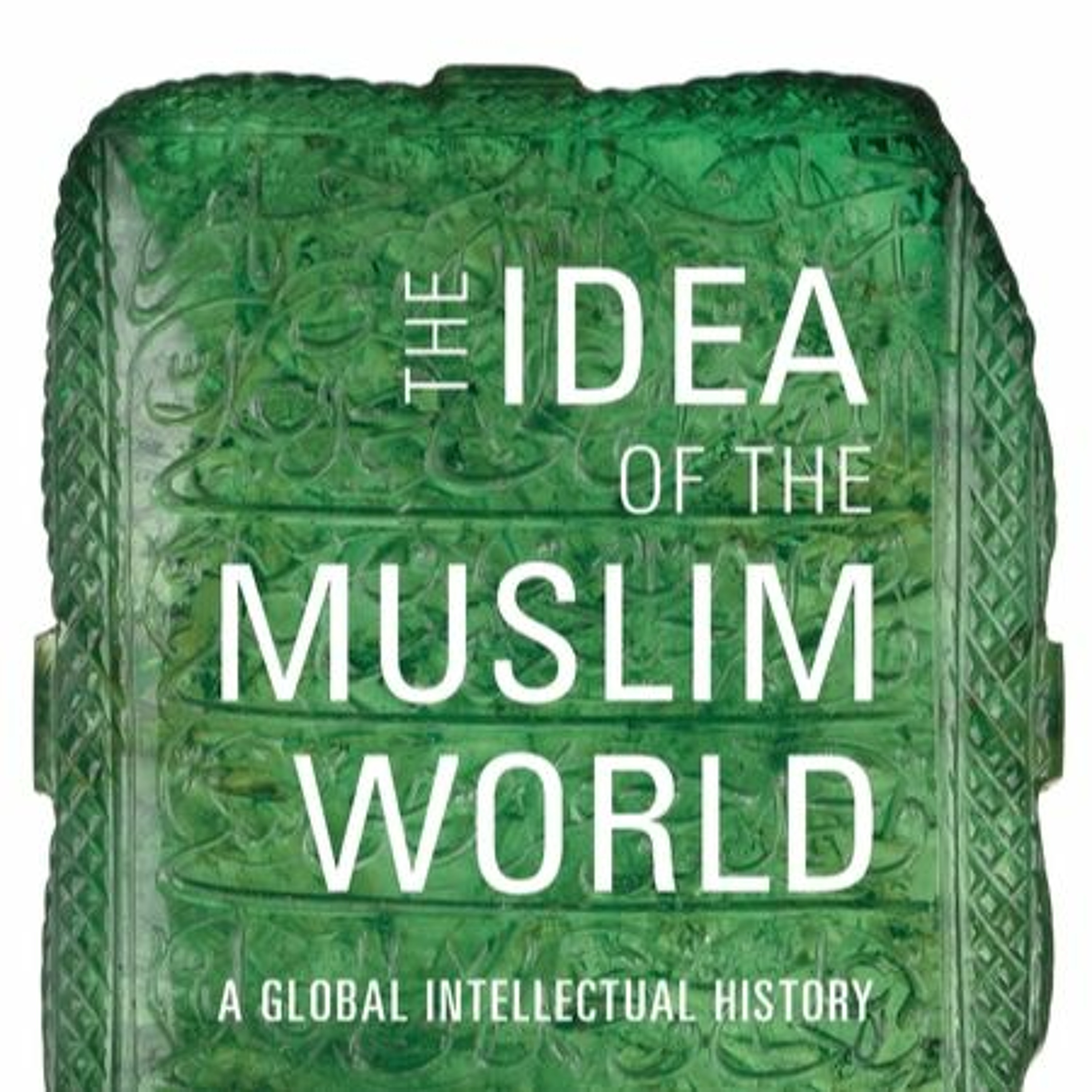
How did the idea of a unified global Muslim community come about? That's the question Cemil Aydin and Marc Lynch tackle in this week's podcast. Aydin's new book explores the how the world's 1.5 billion Muslims have become seen as a single religious/political bloc. "In many ways, I wanted to engage with the contemporary discussions of Muslim unity, Muslim solidarity or Muslim exceptionalism by going back to the last 200 years to try to understand the genealogy and the roots of the idea of Muslims constituting a global community and a shared political project," says Aydin, an associate professor of history at the University of North Carolina at Chapel Hill. In his book, Aydin makes the argument that up until the 19th century, there really was no Muslim world. "That doesn't mean there were many different Muslims in different parts of the world. They have always had different global or regional imaginations— but it doesn't match with our current conceptions of a Muslim world extending from Senegal or Morocco to Indonesia. Different Muslim legal scholars may have categorizations about the 'land of Islam' versus the 'land of the land of non-Muslims,'" says Aydin. "But these are legal classifications. We need to ask, 'Who made them?' or 'Who read them and how they applied them.'The fact that there were such legal categories doesn't mean that these categories are almost like a party program or a doctrine that every Muslim child had to read.... and memorize it and imagine the world accordingly." "We have to account for the fact that Muslims lived in empires— and different empires and different empires of the world to work with. There were so many different Caliphates." Aydin sees the history he just wrote about reflected in current events. "Publishing this book after Donald Trump is also very ironic in the sense that Trump's Muslim ban— or a kind of 'new' Islamophobia, which actually originates from the 1980s onward, after Salman Rushdie appears— again created the kind of outer boundaries of the Muslim world. The new racism against Muslims actually creates a context for Muslims to defend themselves. So I have one message for Muslims: ask for your rights, whether in America or Europe or other places, without being trapped by poisonous, bad narratives. Sometimes they think that the old narrative of Muslim solidarity to preserve themselves, or to negotiate with the colonial powers, might actually not serve their interests, but further try to 'racialize' them." "There was an assumption that only Muslim solidarity could help Muslims, which created the counter-narrative that Muslims are almost isolated from the rest of humanity. So I try to think about these symbiotic relationship between racism against Muslims in the West and the Muslims or Muslim's own pan-Islamic thinking that their solidarity is needed to empower them." By showing how deconstruction this is, "We can think differently. We can imagine a different future. That doesn't mean that Muslims don't have a right to imagine a politics based on their religious values. As a Muslim, I also do that— some of my values come from the example of Prophet Mohammad and others. But that shouldn't be a trap. Some of my values also come from the examples of Martin Luther King Jr. or Nelson Mandela. So why am I only thinking that they will only come from a specified, narrow notion of religion?"
Protest, Democracy, & Violence in the New Middle East: Conversation with Steven Cook (S. 5, Ep. 37)
Protest, Democracy, & Violence in the New Middle East: Conversation with Steven Cook (S. 5, Ep. 37) by Marc Lynch
Iran’s Elections: A Conversation with M. Ali Kadivar (S. 5, Ep. 36)
Iran holds presidential elections later this week, and Marc Lynch talks with M. Ali Kadivar about what to expect. Kadivar is a postdoctoral fellow at Brown University's Watson Institute. "Ahmadinejad's era was significant for several reasons, but one reason was that the process started to replace the old guard of the Islamic Republic with a new set of elites," said Kadivar. "I think Rouhani represents the different strands: one is the old guard again, being back and exerting control. The other is the social support that Rouhani has. A lot of the reformist people who ruled for democratic change now see Rouhani as the most viable candidate that can push forward their agenda." "An interesting thing about the conservative candidates is that you see the conservative discourse is very weak in their electoral platforms. They don't talk about Islamic values or the Western invasion the culture of Iran. Most of what they're talking is the economic promises," said Kadivar. "In a way, I can see this election as kind of a defeat for conservative discourse. I think they have realized that to win a presidential election they cannot talk about those things." The conservative candidates will "criticize Rouhani for not being able to translate the nuclear agreement to economic gains for peace," said Kadivar. "So they say, 'We gave up on our rights. But people are not seeing that in their daily life. They don't have jobs." "On the other hand, Rouhani is saying, 'I'm the person who has delivered on promises. I promised to do this. I delivered this. We have been able to sell our oil, a barrier for banking has been removed,' and then he's promising to deliver more." "Many people believe that this presidential election is not just about presidents. So Iran's supreme leader is elderly and, I think, he wants to publicly recognize that he may not live longer so people are thinking and talking about his next successor. Ebrahim Raisi is being talked about as the hardliners' candidate for Iran's supreme leader, Ayatollah Khomeini... many people believe that he ran for president to set the stage for being Iran's next supreme leader."
National Movements in the Middle East: A Conversation with Peter Krause (S. 5, Ep. 35)
On this week's POMEPS podcast, Marc Lynch talks with Peter Krause, an assistant professor at Boston College. Krause's new book, Rebel Power: Why National Movements Compete, Fight, and Win , focuses on the internal balance of power among nationalist groups, who cooperate with each other to establish a new state while simultaneously competing to lead it. "The book itself answers several questions to people who study national movements, nationalism, or political violence. The first question is why some nations get states and others don't," said Krause. "These groups simultaneously have, what I call, organizational goals— which is, they want to have power. They want to have power and notoriety. They want to survive. They want to increase their membership. At the same time they have these strategic goals of statehood or independence. From the work I've done, it's clear to me that groups and individuals in them care about both of these objectives," said Krause. "My argument is simply that: most of the time you never go broke betting on the fact that groups care more about their organizational goals. They always want to make sure that they're maximizing their power. The argument is simply: when maximizing their power means that they should pursue and achieve strategic goals, that's when it happens. That's the idea that if you're the hegemon, the best way to become stronger is actually to win to achieve victory to achieve a new state. Because now you get the office, the wealth, and the status that comes along with it. However, if you are a weaker organization and you're not in line to inherit the throne, then you actually have an incentive to 'spoil a deal.' Not necessarily trying to prevent independence forever, but hold it off for now." "If you look at studies of national movements and insurgencies, it's pretty close to consensus that foreign support matters," said Krause. "What I argue, however, is what nature of that support takes and how effective it is depends a great deal on the internal balance of power inside the movement."
Islam in America: A Conversation with Nadia Marzouki (S. 5, Ep. 34)
Nadia Marzouki explores how the topic of Islam has become so contentious in America. Marzouki says her research showed her that controversies around Muslims living in America don't just express Islamophobia. "They betray and express a deeper discomfort and unease with an understanding of law, an understanding of rights, and an understanding of equal democracy. This is really what's at stake in the conversations among the disputes around mosques, Sharia law, and also— in a more minor way— the headscarf... or various forms of religious rituals related to the Islamic communities." As an observer from Europe, Marzouki says, "It was really surprising to see how similar all the rhetorical tropes animating anti-Muslim movements were similar in Europe and the United States. This was all the more surprising because all the sociologies of Islam in Europe and United States. You don't have the same Muslim communities. They don't come from the same ethnic backgrounds. They don't have the same socio-economic level. They don't have the same level of education. In general, they're much more educated and have a better social economic level in the U.S. Before 2001, and even more so before 2008, Islam was never such a big problem in domestic politics in the United States." "What's really completely absurd and problematic in the current situation both in Europe and in the U.S. is that we are deciding policies based on stereotypical discourse— and without any account for the empirics and the lived realities of Muslim communities." Marzouki is an Andrew Carnegie Centennial Fellow, Ash Center for Democratic Governance and Innovation, and a research fellow at Harvard's Belfer Center’s Middle East Initiative.
Turkey’s Constitutional Referendum: A Conversation with Lisel Hintz (S. 5, Ep. 33)
Lisel Hintz speaks about what lead to and the significance of this weekend's constitutional referendum in Turkey. "The question: is how long will [Erdogan] stay in power? Right now, this could leave him in power up until 2029— possibly even longer, depending on some certain circumstances. We suspect that he's probably grooming you know his son-in-law, who's currently a minister, to to take his place. Will he be willing to give up those reins? We've seen successive purges of his own party from those who don't agree with him. It is important to go back and understand the AKP's trajectory, which was that not everyone agreed with Erdogan," said Hintz. "It's going to be fascinating to see— both from institutional and from a personal perspective— how Erdogan plans to continue this, particularly given that Turkey— from an economic standpoint— is in a very fragile state." "From an identity politics perspective— and also just sort of an institutional party politics perspective as well— not a whole lot has changed." said Hintz. "I'm not really optimistic about a really strongly united opposition that can come forward and challenge the AKP." "[Erdogan] doesn't have the coalition that he would like to enact some of the reforms he would like in the future. He has been courting the Nationalist Action Party, but only some of them supported the referendum. There was actually quite a big split." "What we know is that the AKP is probably going to do is push for the death penalty to be reinstated because that's something that polls at about 65-70 percent across Turkey— and would really be able to rally up a lot of support for him. So I think he has channels to further consolidate the regime." Hintz is a visiting assistant professor in the Political Science Department at Barnard College, Columbia University. Next fall, she will be an
Islamist Movements: A Conversation with Mohammed M. Hafez (S. 5, Ep. 32)
"One of the most interesting puzzles to emerge out of contentious Islamist movements is the fact that these movements are not united," says Mohammed M. Hafez on this week's POMEPS Conversations podcast. "The common finding today is that— in civil wars, insurgencies, and civil conflicts in general— these movements are fragmented, they're competitive, and sometimes they're fratricidal. Hafez talks about these fratricidal movements globally and throughout the Middle East region. Hafez is an associate professor in the Department of National Security Affairs at the Naval Postgraduate School in Monterey, California. Hafez focuses on Islamic fundamentalism, radicalization and counter-radicalization.
The Politics of Militant Group Survival: A Conversation with Ora Szekely (S. 5, Ep. 31)
On this week's POMEPS podcast, Marc Lynch speaks with Ora Szekely, an assistant professor of political science at Clark University. Szekely's recent book, The Politics of Militant Group Survival in the Middle East, compares the performances of four key non-state actors in the Arab-Israeli conflict ecosystem: the PLO, Hamas, Hizbullah, and Amal. "Why is it that you can have two militant groups— fighting against the same adversaries, same territory— and yet you get these really different outcomes?" said Szekely. "The answer to that—or at least the answer we see embedded in a lot of reporting on the Middle East or on non-state actors in general is...this sort of implicit assumption that how well these guys do is basically a function of how much material resources they have. But when you look a little bit more closely, it turns out that even groups that have pretty similar amounts of equipment can have really different outcomes. What I found is that it's not so much the stuff— it's how you got it in the first place that really matters in shaping how you're going to do in the long run."
Women’s Activism on the Israeli & Palestinian Religious Right: Lihi Ben Shitrit (S. 5, Ep. 30)
Lihi Ben Shitrit speaks about her new book, Righteous Transgressions: Women's Activism on the Israeli and Palestinian Religious Right. Shitrit is an assistant professor at the School of Public and International Affairs, University of Georgia, Athens. "The book is a comparative study of women's activism in the Israeli and Palestinian right, but specifically four groups: the Jewish settlers in the West Bank, the ultra-Orthodox Shas movement, the Islamist movement in Israel, and the Palestinian Hamas," said Shitrit. "What motivated me to do this was the fact that you can still pick up a book on any of these movements and not find any women mentioned— not by name, not even by subject, not even the category of women. As if women are not important to the politics of these movements. And for me that was a glaring gap because we know women support these movements." "One thing that I found was that women in these movements think that they're not recognized enough in terms of the general public— the media and academia don't cover them and don't recognize their contributions. Their own movements recognize their contributions, but the wider public doesn't," said Shitrit. "So they wanted also to convey their message. And at the end of the process, I had so much access and great support by women who really supported what I was doing." "The question that I'm asking is how do women in very conservative religious movements— with very clear ideas about women and men's different public and private roles— how are they able to participate in forms of activism that seems to seem to transgress or go beyond what the movement say that they should do?" Shitrit said. "And why do we see variation? Why do we see that in some movements, women's activism really adhere to the very conservative ideology of their movement— and in other movements women totally transgress and participate in much more expansive forms of activism." "I'm hoping what would come out from the book would be that the people I worked with actually read the book— and maybe find that they have so much in common with women in these movements. Maybe this could be a kind of fresh step towards seeing the others as someone who has something in common with you."
Iran’s Revolutionary Guards: A Conversation with Afshon Ostovar (S. 5, Ep. 29)
"The IRGC's powers are often exaggerated.... but on the flipside of that, I think it's also often dismissed— where particularly from the U.S. perspective, they see the IRGC as a convenient foil. How do we how do we make the case against Iran? We use the IRGC and all of its nefarious activities as an excuse," Afshon Ostovar said. "You see this in Yemen in particular, where there's countless articles that come out that say the IRGC is not important in Yemen... This sort of thing I think is also missing the point" "It's hard to get them right, but it's easier to sort of exaggerate or minimize their influence." Ostovar is an Assistant Professor of National Security Affairs at the Naval Postgraduate School. His recent book, Vanguard of the Imam: Religion, Politics, and Iran’s Revolutionary Guards examines the rise of Iran’s most powerful armed force—the IRGC—and its role in power politics, regional conflicts, and political violence. "I see the IRGC as being much not just devoted to [Ali] Khamenei, but being devoted to the office of the supreme leader. The supreme leader itself is the centerpoint of the Islamic system of Iran...And I think that the symbolic importance of the supreme leader is something that that the IRGC doesn't want to doesn't want to do without," said Ostovar "A few years ago, particularly after 2009 when the IRGC was involved in the crackdown, and you had a lot of talk about their rise in power at that time. One of the discussions was, 'Well is is Iraq moving towards a dictatorship or are they just going to squeeze out the supreme leader?'" "One of the arguments that I make in my book is I don't think that they'll do that because I think I think the supreme leader is very much not just important to them symbolically, but he is tied into their identity. They are the servants of the supreme leader. They are literally the guardians of that Islamic system. They don't want to be the leaders of it. That doesn't mean that they don't want to have their way— they get their way more often than not— but they they survive when they don't get their way."
Syria’s International Politics: A Conversation Chris Phillips (S. 5, Ep. 28)
"I think the most important change [in Syria] was a stepping back by the United States," said Phillips. "You get a desire by all passing opportunities being seen by other emerging regional powers: notably, Turkey, Qatar, and Saudi Arabia in opposition to the rise of Iran. They all want to take advantage, or to push their own agendas more. as the U.S. seems to step back. Because they have a particular interest in Syria, Syria ends up pretty early on a battle ground for these regional rivalries. One thing that really struck me doing this research was going right back to the summer of 2011, after the Arab Spring begins to settle down a little bit— and Syria continues to escalate into conflict. Most of these regional actors are looking at Syria, not with Islam, but as an opportunity. And I would argue that they are on their own way pouring fuel onto the fire of the conflict, rather than to sort of try to deescalate. I think that's a major reason why you see a rush to arms answer." On this week's podcast, Marc Lynch speaks with Chris Phillips about international politics in Syria. Phillips is a Senior Lecturer at Queen Mary University of London He is also an associate fellow at the Middle East and North Africa program at Chatham House. His most recent book is The Battle for Syria: International Rivalry in the New Middle East. "I don't think you'll see much change from the Saudis, rather than just trying to back the non-jihadist groups in a non-Muslim Brotherhood groups," said Phillips. "Turkey, on the other hand, you do see a full 180— and it's been quite recent. It's almost too late and sort of getting a little bit negligent on the threat posed by jihadists, even after ISIS capture Mosul. Turkey is very reluctant to join the United States coalition against ISIS— and only after it starts getting targeted at home by ISIS attacks does it begin to switch and turn on ISIS." "Now, most recently in 2016, it actually recognized that the threat coming from Syria— both jihadism and forms of Kurdish nationalism— as great and the threat to assets are only recently we've seen Turkey actively drop the policy of going after Assad. But that took five years, and arguably it was quite clear that this current policy wasn't working for about 2013 really." "The purely theoretical approach doesn't explain that you do need to look at those internal factors. I wouldn't sort of put my thoughts on looking at the system side of things," said Phillips. "I wouldn't lump myself so clearly in a sort of a 'hard systemic realist camp' because I think that actually the internal dynamics interact with those systems of system level."
Obama’s Foreign Policy: A Conversation with Colin Kahl (S. 5, Ep. 27)
Colin Kahl speaks with Marc Lynch about U.S. foreign policy during the Obama administration. Kahl is an associate professor in the Security Studies Program at Georgetown University’s Edmund A. Walsh School of Foreign Service. From October 2014 to January 2017, he was Deputy Assistant to the President and National Security Advisor to the Vice President. On Iran, Kahl spoke about the strategy behind the JCPOA. "I can't think of an actual bonafide Iran expert on on planet Earth that believed that you were going to resolve this problem without giving the regime some face-saving way out on enrichment. And that was, I think, an inflection point in the decision of the Obama administration, which was ultimately not to drive the program to zero— not because we wouldn't prefer a world in which every nut and bolt of Natanz and Fordow enrichment facility was dismantled— but because that's a perfect world that perfect scenario was impossible to achieve. No matter how much pressure you were going to you were going to put on the regime." "We found that in the case of countries— like Israel, Saudi Arabia or others— they want us to do two things, ultimately that the president was unwilling to do because of his overall theory of the role of military force in the region. One was they very much wanted us to engage in regime change— especially as it related to Iran. At the end of the day, the Israelis and the Saudis will never will never tolerate an Iran that's a strong actor in the region as long as this regime is in power. At the end of the day, they were more concerned about the regime and its had hegemonic ambitions than its nuclear program— even though the Israelis continually dialed up the existential language on the nuclear program. They did not believe that the threat from Iran— whether its nuclear or anything else— could be settled with anything short of regime change. And so, that was their preference: to basically leave the sanctions in place until the regime in Tehran went out of existence. And if they crossed some mythical red line, smash them like we smashed Saddam. The president wasn't going to go in for that." "The second issue is the president was extraordinarily clear about: defending our allies from external aggression. Which is why we did so much to bolster their own capabilities— unprecedented amounts of military assistance to Israel, unprecedented steps to maintain their qualitative military edge— even as we were providing unprecedented degrees of security assistance to our partners in the Gulf, to Jordan, and otherwise. But what we weren't going to do is give them a blank check to drag us into conflicts that we believed didn't serve their interests. And certainly didn't serve our interests," Kahl said. " I think it all goes back to Obama's fundamental humility about what military forces can and can't accomplish." Kahl also addressed criticism of foreign policy during the Obama administration. "Probably no area of the Obama administration's foreign policies came under more criticism than the approach to Syria. And yet every proposal— whether it was arming the opposition, putting in place a no fly zone or safe zones, or standoff strikes, or even you name it— whatever big idea was was out there in think tank land or in the academic world. They were deliberated over and over and over again. And so it doesn't mean that policy makers always make the right decision. They're human beings. They have incomplete information. They make wrong decisions all the time. But they're a lot smarter than you think." "The last point I will make just briefly is that I also think academics probably don't appreciate the degree to which things that seem relatively banal— like process, budgets and whether human beings are getting enough sleep— actually affect the outcome of certain things. And those are just constraints— bureaucratic and human."
Drafting a Constitution: A Conversation with Asli Ü. Bâli (S. 5, Ep. 26)
Drafting a Constitution: A Conversation with Asli Ü. Bâli (S. 5, Ep. 26) by Marc Lynch

Saudia Arabia’s global religious influence: A conversation with Michael Farquhar (S. 5, Ep. 25)
On this week's podcast, Marc Lynch speaks with Michael Farquhar about the history of the Islamic University of Medina in Saudi Arabia, where more than 11,000 young men have studied religion in Saudi Arabia. "There were obviously suggestions and not always ill-founded suggestions that this had fed into the rise of a very morally conservative Salafi understanding of Islam in lots of context around the world, and that that in turn kind of fed into dynamics of sectarianism and intolerance and communal conflict, and perhaps even violence in some contexts," said Farquhar. "My feeling was that there was room for a lot more attention to some more theoretical questions. So, questions about what it really means in practice to kind of export a particular cultural framework like Wahhabism. To kind of pick it up and move it to another location, and what that really looks like in practice. And questions about how ideas -- religious ideas -- can perhaps transform as they cross borders, and can perhaps be put to new uses and new contexts." Michael Farquhar is a lecturer in Middle East politics at King's College London. His new book is from Stanford University Press and called Circuits of Faith: Migration, Education and the Wahhabi Mission.
Iran Today: A Conversation with Nader Hashemi (S. 5, Ep. 24)
“As it approaches year 40, the Islamic Republic of Iran is suffering from a deep crisis of legitimacy,” Nader Hashemi says on this week’s POMEPS Conversation podcast. “The biggest threat that I think the regime faces— from its own statements and policies— is really the threat that it fears, like other authoritarian regimes, from its own population and groups that want political change.” Hashemi is an associate professor and director of the Center for Middle East Studies at the University of Denver.
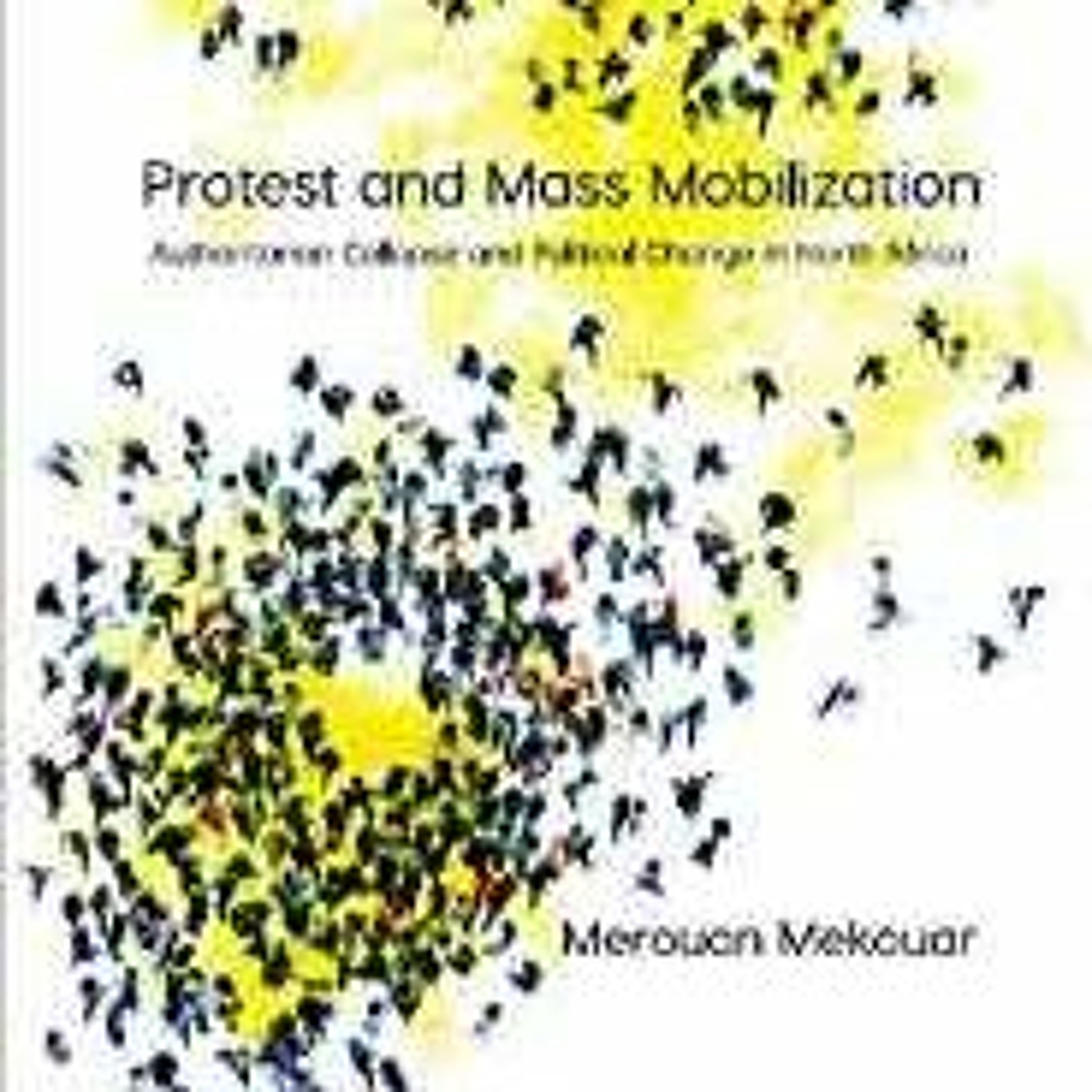
Protest and Mass Mobilization: Book Discussion with Merouan Mekouar (S. 5, Ep. 23)
This semester, POMEPS hosted Merouan Mekouar to speak about his latest book, Protest and Mass Mobilization: Authoritarian Collapse and Political Change in North Africa. Mekouar is an assistant professor in the Department of Social Science at York University in Toronto, Canada. "Without respected actors willing to use their prestige to raise the attention of the rest of the population, their institutional networks to help spread social mobilization, and their international contacts to call the attention of foreign media, cases of isolated protests remain largely confined to where they were born," said Mekouar. This week's podcast is an edited version of Mekouar's talk at George Washington University.
Creativity and the Arab Uprisings: A Conversation with Marwan Kraidy (S. 5, Ep. 22)
"I felt paralyzed when the Arab uprising started unfolding. I saw the focus back then on on social media to be missing something and I did not know quite what I felt it was missing," said Marwan M. Kraidy. On this week's Middle East politics podcast, Marc Lynch has a conversation on creativity and the Arab Uprisings with Kraidy, the Anthony Shadid Chair at the University of Pennsylvania, . "So I did not write anything. I started thinking about it." Kraidy spent a year in Beirut, traveling the region and collecting items that showed people creatively expressing dissent, like leaflets, media, and taking photos of graffiti. From that research, he wrote his latest book, The Naked Blogger of Cairo: Creative Insurgency in the Arab World, which looks at radical and gradual activism in the modern Middle East. "The main argument that I make in the book is that this kind of political creativity is nearly always collective," said Kraidy. With the tense situation in many Middle Eastern countries, Kraidy acknowledges that creative insurgency often goes dormant for periods of time. "There is such a thing as war fatigue, so the thing with this kind of creative energy is that it goes underground. But it's always there and it waits for activists. It waits for auspicious opportunities to emerge," said Kraidy. "They can also be overground, but typically not in the Middle East. If you go to Berlin, Amsterdam, or New York, you have so many of these graffiti artists you know they may be doing designs for Louis Vuitton, or they may be having a residential fellowship at MOMA, but they're still practicing their skills. They're becoming more well-known. They're writing comic books about the revolution. I don't think these energies are lost. They've been redirected." Kraidy says that these creative dissidents' locations away from the region matters, "But not not as much as would would have mattered in revolutions past, where if you're not there you're just not there. I think people are waiting for the right opportunity."
Egypt and Pop Culture Post-Revolution: A Conversation with Walter Armbrust (S. 5, Ep. 21)
"I was in Egypt during the revolution," Armbrust said, "As probably everybody knows the first 18 days of the revolution when the Mubarak regime was overthrown was a period of great euphoria...this is this is exactly what you should expect but ritual is a name that we give for dealing with social transitions that we know will happen." This week, Marc Lynch talks with Walter Armbrust to talk about Egypt and the 2011 uprisings, and how his latest research project as he was living in Egypt in 2011, researching another project. "The initial period of euphoria then transforms into a state of everybody choosing sides and reckoning power, which is what happened in the revolution. And actually it explains many revolutions. Revolutions often end up with unintended consequences. That was certainly the case in the Egyptian revolution, but it's actually very common in revolutions," Armbrust said. Armbrust also spoke about his research into how Islamists are portrayed in Egyptian cinema and in Egyptian television dramas. "Prior to the revolution, there was no such thing as Islamist TV production. Islamists had many other channels into media. They flourished in an environment of decentralized media," Armbrust said. Ambrust is the Hourani Fellow and a University Lecturer in modern Middle Eastern studies at St. Antony's College, Oxford.
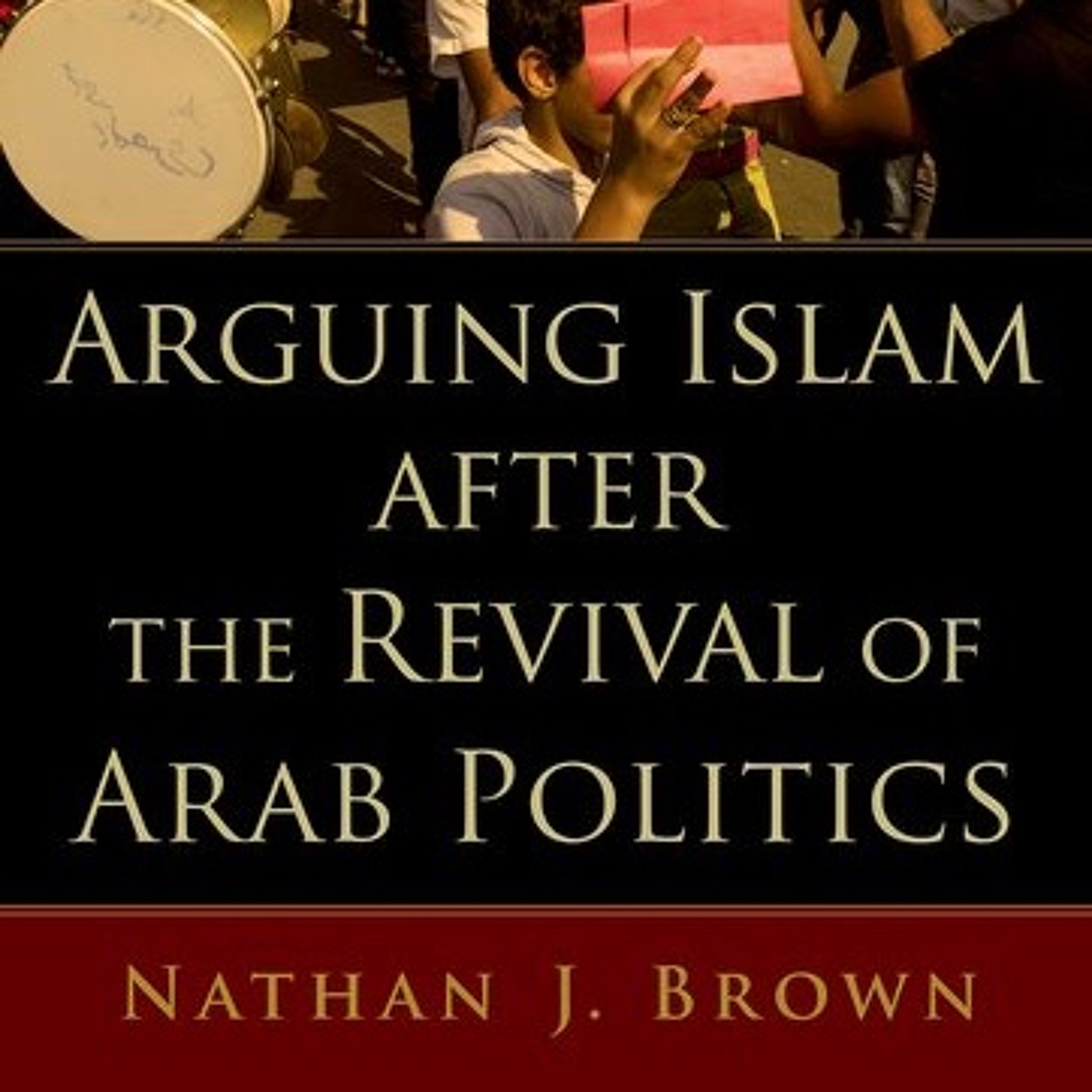
Arguing Islam after the Revival of Arab Politics: Book discussion with Nathan Brown (S. 5, Ep. 20)
Yesterday, POMEPS held a dynamic conversation with Nathan Brown about his latest book— out this week— Arguing Islam after the Revival of Arab Politics. Brown was joined by Jocelyne Cesari, a senior fellow at the Berkley Center for Religion, Peace, and World Affairs and associate professor of the practice of religion, peace, and conflict resolution in Georgetown’s Department of Government, and Peter Mandaville, a senior advisor to the special representative for religion and global affairs at the U.S. Department of State. Brown spoke about the current state of Arab politics: "The polarization that has set in is partially a result of [mobilizing your followers]. There are few points at which, the vital public argumentation actually changes from abstract argumentation about what should be done to concrete political processes that produce political outcomes. And so people remain very strongly in their own camps. The polarization we see so deeply entrenched in the Arab world from that way is therefore may not be so much the disease as the symptom. That is to say, not so much the cause but is as an effect very much of political systems that have opened themselves up to political debate, but not given very healthy ways in which to translate political debate into political outcomes."
The Politics of Islamist Parties: A Conversation with A. Kadir Yildirim (S. 5, Ep. 19)
This week, Marc Lynch speaks A. Kadir Yildirim about his new book, "Muslim Democratic Parties in the Middle East: Economy and Politics of Islamist Moderation," which analyzes Islamist parties' moderation trajectories and the impact of economic liberalization processes on moderation in Egypt, Morocco and Turkey. Yildirim is a research scholar at Rice University's Baker Institute for Public Policy. "Typically when we see studies on Islamist parties, we see a focus on the parties themselves. But at distance, we see their links to the constituency and support base. These are political parties, so we need to look at the relationship between the two," says Yildirim. "I look at how changes in the constituencies of these parties actually pushes the parties into changing their positions." "In which ways can we try to entice Islamist parties to change themselves? One takeaway point is that this is a very long process. We have to recognize these are political parties, and they speak to certain constituencies. Unless we take those into account, it's really difficult," says Yildirim. "In my book, I look at Turkey, Morocco and Egypt. I chose these countries because they allow us to look into the operation of economic liberalization to different degrees."
Morocco’s Elections: A Conversation with Adria Lawrence (S. 5, Ep. 18)
Adria Lawrence speaks about about the recent elections in Morocco on this week's POMEPS podcast with Marc Lynch, "The outcome isn't really surprising, though very few people expected a big surprise. The PJD [Party of Justice and Development, a moderate Islamist-oriented party] took more seats than its rival." Adria Lawrence is Associate Professor of Political Science and a research fellow at the MacMillan Center for International and Area Studies. Her research reflects her expertise in the politics of the Middle East and North Africa. "It was probably quite expected for the PJD to continue its prior mandate for the last five years with a majority of seats in the parliament," Lawrence says. "Secularists were worried about what an Islamist party would do, but the PJD hasn't pushed for that much of an Islamist agenda." In fact, Lawrence says, the PJD has not accomplished a lot in the last five years. They "haven't managed to make major steps forward on their major platforms, like corruption. They've had some pretty serious problems to face: there's been a drought in Morocco, there's an unemployment crisis. They've had a lot of obstacles, and I think they've done what they could in the parliament." Still, voter turnout was low. "It would appear that turnout was worse in this election than in 2011— still less than half of eligible voters."
State Formation in the Middle East: A Conversation with David Patel (S. 5, Ep. 17)
In this week's POMEPS conversation, Marc Lynch speaks with David Patel about the borders of the Middle East and the legacy of Sykes–Picot. "When Westerners talk about reimagining the borders of the Middle East, what they're thinking of is smaller states." But, says Patel, "we should be careful when we talk about 'reimagining the borders.'" Patel is a lecturer in the department of politics and senior research fellow at the Crown Center for Middle East Studies at Brandeis University. Looking at the rhetoric of Sykes-Picot. "ISIS isn't a secessionist movement. It's not trying to break away from Iraq or Syria. ISIS talks about Sykes–Picot and the conspiracy of it." "People don't know what to call ISIS now. Calling it a 'state,' even if it dies and becomes a 'failed state,' is a political statement. But it's been there for three years, governing lives... you can travel from one end of the Islamic State to the other with a piece of paper that says, 'This person is allowed to transport agricultural goods. Those are state-like features, and it's survived for quite a long time."
Americans and Arabs in the 1970s: A Conversation with Salim Yaqub (S. 5, Ep. 16)
The 1970s was a pivotal time for U.S. foreign policy in the Middle East. In this week's POMEPS Conversations podcast, Salim Yaqub talks about how that decade was the most influential time for the emergence of the Arab world as a major player in international politics — a topic he explores in depth in his new book, Imperfect Strangers: Americans and Arabs in the 1970s. "As a historian, I'm often reluctant to opine too directly on what's going on today," Yaqub says. "If you want to understand the course that U.S.-Arab relations have taken— that curious state of affairs — you have to take a look at what happened in the 1970s. " "Geopolitical developments that generate ill will between the two societies [in the 1970s], also at the same time create possibilities for better relations and for more favorable perspectives. It plays itself out in the petrodollars story, but also in Arab-Israeli diplomacy," Yaqub says. Yaqub is a professor at UC Santa Barbara, and directs UCSB’s Center for Cold War Studies and International History.

Why Palestinian Elections are Postponed: A Conversation with Diana Greenwald (S. 5, Ep. 15)
Local Palestinian elections across the West Bank and Gaza were scheduled to take place next month, but they have been suspended. On this week's POMEPS podcast, scholar Diana Greenwald explains that, while elections are frequently canceled or postponed in the Palestinian territories, "This was set to be a significant one because both Fatah and Hamas were set to compete against each other for the first time since 2006." "It's largely being seen by observers as a means by Fatah, the ruling party in the West Bank, to postpone— or even cancel— this vote to avoid an embarrassing loss at the polls." Greenwald is a doctoral student in comparative politics at the University of Michigan where she focuses on the politics of revenue mobilization in transitional settings, including new states, aspiring states, and conflict/post-conflict states. Greenwald was a 2012 recipient of our POMEPS Travel-Research-Engagement grant. "We can't look to local elections as a driver of change at a larger level in the conditions of the conflict. I think anyone who is framing these as a 'release value' for the Palestinian public to blow off steam and forget about the larger issues surrounding them is probably mistaken."
Jordan Heads to the Polls: A Conversation with Curtis Ryan (S. 5, Ep. 14)
Next week, Jordan is scheduled to hold parliamentary elections. Coming in the midst of intense economic challenges and security fears, the vote will be the first held under a new electoral law, and the first contested by multiple Islamist movements. On POMEPS Conversation #82, Marc Lynch speaks with Curtis Ryan, author of Jordan in Transition: From Hussein To Abdullah, to preview those elections and their potential significance.

Sectarian Dangers in the Middle East: A Conversation with Raymond Hinnebusch (S. 5, Ep. 13)
"Sectarianism tends to internally fracture societies. It's extremely dangerous," says Raymond Hinnebusch. "Compare that to the way pan-Arabism was used to integrate the various Arabic speaking minorities who previously felt excluded, but if Arab identity was the common identity, it didn't matter if you were a Sunni or Shia, an Alawite or Druze, you were included in the community." Marc Lynch speaks with Hinnebusch about international relations in the Middle East and emerging sectarianism in the region. Hinnebusch is a professor of international relations at the University of St. Andrews. "People have many identities and sect may only be one of them. For quite a long time, people embraced Arab nationalism as an inclusive identity," says Ray Hinnebusch. But what went wrong in the Middle East to see the rise of sectarianism we see today? "If you got a similar situation to what we had in Iraq— namely, people in a failed state where people can't depend on the state for security so they fall back on their sectarian group, armed if possible. If you had a situation like that, then you would get the replication of the Iraqi disaster. And we have seen that— particularly in Syria and one could say in Yemen." "You have Al Qaeda and the Islamic State taking advantage of this," Hinnebusch says, "The invasion of Iraq created this environment where Al Qaeda could regain its stature and its never looked back since then." Looking to the future, Hinnebusch says: "I think people still have many identities, and the sectarian one is perhaps the most salient one at present. There is the risk a new generation will be brought up with only that one, but clearly there are other potential identities: Syrian, Arab, Sufi...there are many that are in competition and they could come back in a period of reconstruction and peace. That's what I hope."
The Role of Militaries in the Middle East: A Conversation with Kevin Koehler (S. 5, Ep. 12)
"If you compare the Egyptian military and the Tunisian military, obviously these are two very different institutions from and organizational perspective, but also their understanding of their political role." Kevin Koehler says. "The Egyptian military sees itself as a political institution and has a history of this in their country, which is not true in the same extent for the Tunisian military." On this week's podcast, Marc Lynch speaks with Kevin Koehler about the role of militaries in Middle East governments and how political scientists study Arab military. Koehler is an assistant professor at the department of political science at the American University in Cairo. Koehler also speaks about his research interviewing the Syrian army deserters. "One of the main conclusions which came out of this is that the level of control and supervision— even in the context of the ongoing civil war— is extraordinary, relative to other militaries and what common sense explanations would suggest about what drives desertion and loyalty in the Syrian military." Koehler says. "It's much less about identity factors or sectarian factors and it's much more about the lack of trust."
Tunisia’s Ennahdha Party: A conversation with Monica Marks (S. 5, Ep. 11)
Critical analysis of Tunisia and the Ennahdha party by Monica Marks. Marks is an Oxford PhD candidate, Rhodes Scholar and visiting fellow at the European Council on Foreign Relations. Despite the shift Ennahdha has made from Islamism. Marks argues it is a formalization of already-held beliefs. "Ennahdha has a higher objectives- based view of how religion should inform politics. The idea is that the principles can give shape and purpose to policies but that shari'a and Islam do not offer a policy handbook. This is not a new development for Ennahdha. "We should questions terms like 'secularism,' 'post-Islamism,' and 'Islamism' itself— and to what extent they really even apply to the actors we look at. Because Ennahdha is inhabiting a politics place where separating religion and politics is not truly possible in the way Western liberals might conceive it." Marks says that regional context is important to understanding Ennahdha. "The Egypt coup exacerbated re-exsisting patterns of compromise inside Ennahdha. That's not to say the coup didn't have an effect— or wasn't important— it was. But it didn't fundamentally change the direction. It just made a lot of people in Ennahdha say, 'The stakes are even higher. We need to do this.'" "The real turning point moment in Tunisia that forced the hard-line thinkers in Ennahdha to ride the minimalist train was the twin assassinations of Chokri Belaid and Mohamed Brahmi. They sparked off the Bardo crisis of summer 2013 and it really created a huge political crisis, where you had a lot of actors calling for the anti-democratic ouster of Ennahdha." "You could argue that the post-Islamist turn happened in the 1980s with Ennahdha. This movement was repeatedly in conversation with opposition movements....it's important to have a broader contextual view."
How Jordanians feel about Syrian Refugees: A Conversation with André Bank (S. 5, Ep. 10)
André Bank, a senior research fellow at the German Institute for Global and Area Studies (GIGA), talks about how Jordan is dealing with the influx of Syrian refugees by looking at how Jordanians perceive the Syrian crisis and how it shapes their political economies. "Jordan is doing a relatively good job with the Syrian refugees when compared to Lebanon or northern Iraq." However, Banks says, "The Jordanian state still upholds the image that the Syrians ultimately will return....though it seems as though the Syrians will be there for the longterm, so solutions will need to be found." "We've visited schools and seen some resentment from Jordanians— the school teachers now have to teach double shifts— it's usually the case that Jordanian kids go in the morning and Syrian kids go in the afternoon for three hours — if the go at all. Roughly half of Syrian kids go to Jordanian schools." This resentment has bonded Jordanians of different heritage. "When you look at this historically, in the mid-2000s, with an influx of Iraqis you had similar tendencies [to today, with Syrian refugees]. Palestinian-Jordanians and Jordanian-Jordanians bonded against the Iraqis. It seems whenever a new group of refugees comes to a place like Jordan, you have some of these discourses against them. But, in a country like Jordan, these exclusionary discourses remain verbal and almost never leave to direct violent action."
Interviewing Displaced Syrians: A Conversation with Wendy Pearlman (S. 5, Ep. 9)
We hear from Wendy Pearlman, an associate professor in the department of political science at Northwestern University. Pearlman has carried out open-ended interviews with displaced Syrians since 2012. "Like many people watching the Syrian uprising from afar, I was fascinated of the individual-level experience of what this must have been like for Syrians who went out into the streets, what drove them to do so, what drove them to stay. How people were experiencing protest, how people were experiencing violence. How people ultimately fled the country as refugees. I decided there was no better way to understand that lived experience— the personal experience of dramatic political phases— than to get to individuals themselves and ask them to tell me their stories." "For the most part, it's not that the people are telling the same anecdote. They're telling very different anecdotes of their own personal experiences. They'll tell personal stories of their childhood under Assad's Syria, and when they went to their first demonstration and what it was like. They'll tell different stories how it felt to live under shelling. But I see very similar themes coming out of those anecdotes that connect them all." Pearlman and Lynch also discuss the ethics of conducting fieldwork with people in vulnerable situations. You have to get concent, but there's an added level, too. There have been times when people have agreed to speak with me, but I could tell they really didn't want to....it's wise at that point as an interviewer to pull back. Technically, that person has consented to an interview du jour; de facto, that person is being put in an uncomfortable position and doesn't really want to talk? At that point, I think you say, 'Thank you very much,' and get out— to not cause that person harm."
New Forms of Sectarianism: A Conversation with Bassel Salloukh (S. 5, Ep. 8)
On this week's POMEPS Conversation podcast, Marc Lynch speaks with Bassel Salloukh, an associate professor of political science at the Social Sciences Department at Lebanese American University. "Many countries are becoming like Lebanon where people start thinking of sectarian/tribal/ethnic divisions and identities as primordial. And then the only way to get out of the conflict is through the institutionalization of these identities into a new, power-sharing pact. But what that does is to freeze these identities and make it very difficult to move away from." "At the end of the day, the major problem is that people start looking at these identities as primordial. And they start behaving as if these identities have always been with us as part of these ancient hatreds. It becomes very difficult to come up with a counter-narrative."
What We Can Learn from Syrian Refugees: A Conversation with Daniel Corstange (S. 5, Ep. 7)
On this week's POMEPS Conversation podcast, Marc Lynch speaks with Daniel Corstange, an assistant professor in the Department of Political Science and the School of International and Public Affairs at Columbia University. Corstange talks about his current research, which focuses on gathering data from Syrian refugees. "You can think of a lot of different stories we tell ourselves about why there's a war going on. And it doesn't seem to be the case that any of them are the true story." "So we're trying to understand why people think this is happening. There are actually very interesting patterns about why people think one thing versus another thing." "This is an existential crisis for a lot of people. It's completely destroyed their lives at home. They are picking up the pieces elsewhere — sometimes they haven't even been able to pick up the pieces. But it's not the case that they've managed to get across the border and they can shut off what's happening in the civil war."
Political Economy & Refugees in Jordan: A Conversation with Pete Moore (S. 5, Ep. 6)
On this week's POMEPS Conversation podcast, Marc Lynch speaks with Pete Moore about the political economy and refugees in Jordan. Moore is an associate professor of political science and director of graduate studies in the Department of Political Science at Case Western University. Looking at how past events influence current relationships, Moore says, "What we see today in terms of the U.S. role in Jordan was incubated in the early 80s vis-à-vis the Iran-Iraq war." By the 1990s, "Jordan was caught between the demands of the U.S. regarding sanctions, but is stuck with of a transport sector and industrial sector that was wedded to Iraq and does not want to see that relationship weaken." Moore says, "The regime wanted to hold on to those linkages...after the U.S. invasion of Iraq in 2003, those relationships will be looked at less in an economic realm and more in the security realm." "It takes the monarchy a long time, but essentially they vote to let die that industry and transport sector. And that's one of the reasons for Jordan's highest unemployment rate in the region."
On the Leftist Groups in Middle East Political Science: Sune Haugbølle (S. 5, Ep. 41)
On this week's POMEPS Conversation Podcast, Marc Lynch speaks with Sune Haugbølle. Haugbølle is an associate professor at Roskilde University, and much of his research focuses on Leftist movements in the Middle East. "Before the Arab uprisings, I had a sense for a long time that there's a real gap in the historiography of the modern Middle East. Leftists groups,"Haugbølle says, "Have really been understudied. There's a lot we don't know about them— and I think that lack of knowledge came from the notion that somehow the left had ceased to be important." "I'm trying to see what the historical memory of failures and trasitions of the Left in the last couple of decades means today for the Leftist activitists, militants, intellectuals today," says Haugbølle. "The history of the Arab Left is global." In today's world, Haugbølle argues, "The new Left is a fragmented field of smaller movements. It's by definition a vast array of influences." "Obviously the Middle East is not in the throes of the American homogeneity that it used to be years ago. And they're trying to find their feet in that." The Left must question of imperialism, especially with the conflict in Syria, says Haugbølle. "We re-conceptualize the struggle in this confused, post-revolutionary period that we're in. That comes for the fore in the question of: Syria. Do you see the Russian intervention as a sort of protection of a popular regime with legitimacy, a people's army that needs to be protected from America's attempt to smash it? Or do you see that equally as imperialism? Most of the international socialists have taken the line that the Russian intervention is also a form of imperialism. You get splits over that." "There's an intellectual history and a political history. There's so much we don't know. There's so many achieves people haven't looked at. Journals people haven't read yet," says Haugbølle.

Sexual Harassment in Egypt: A Conversation with Vickie Langohr (S. 5, Ep. 5)
On this week's POMEPS Conversation podcast, Marc Lynch speaks with Vickie Langohr about public sexual harassment faced by women in Egypt and the rest of the Middle East. Langohr is an associate professor at the College of the Holy Cross, focusing on Middle East politics, nationalism and democratization. "Egyptians will often tell you that several decades ago, [sexual harrasment] was not something that was happening a lot. But we have data from 2008 — before the revolution — that shows pretty close to the same number of women polled saying they experienced harassment even on a daily basis." "Public sexual harassment has become an issue of 20 or 30-somethings is because they're in public more, particularly in protests. I do think there is a generational angle to it." Langohr said a lot of sexual harassment happens on crowded subways. "Any time there's mass crowding on public transit, sexual harassment increases." Langohr spoke with young Egyptians about their political involvement. "In the interviews I've done with many members of these groups...many would say 'I never even dreamed anybody but Mubarak could be in power.' Not because they liked him, but because the political horizon of the imaginary was not there." While Egypt has tightened its laws on protesting in public, Langohr says that activism is still happening. "Even though activists can't work in the streets anymore, there has been a spread into the institutions, like Cairo University." Still, even after a 2014 amendment that increased penalties and made it slightly easier to prosecute, "Many women don't want to bring charges because, unfortunately, people in their family believe that if they've been harassed, they must have brought it on themselves in some way." "So there's a lot that remains to be done."
The Origins of Syria’s Crisis: A Conversation with Reinoud Leenders (S. 5, Ep. 4)
On this week's POMEPS podcast, Marc Lynch speaks with Reinoud Leenders about the origins of the Syrian conflict. Leenders is a reader in the Department of War Studies at King's College London. "In the beginning, it was a question of who would move first, and where." Leenders says. "Why it happened in certain places and not others, it is because of local characteristics." Aleppo, Leenders says, held back. "It was a very conservative, middle class [place] that felt it was too much to get involved and put a stop on mobilization initially." "In hindsight, lots of people have said it was a mistake of the [Syrian] regime to have applied such vast levels of repression," Leenders said. "But I think that, beyond moral considerations, I don't think the repression as such was a mistake...The brutality of the regime touched on some really sensitive registers, include dignity and honor of women." Even as Leenders's research focuses on the parsing out the conflict through the lens of two narratives, "We are five years down the road, and every day the conflict goes on, I get more questions than answers."
Iranian Revolution, Arab Uprisings, Mobilizations: A Conversation with Charles Kurzman (S. 5, Ep. 3)
Charles Kurzman speaks with Marc Lynch about how past failed mobilizations can explain the challenges facing the Middle East after the 2011 uprisings. Kurzman is a professor of sociology at the University of North Carolina at Chapel Hill and co-director of the Carolina Center for the Study of the Middle East and Muslim Civilizations. "There's the sense of disillusionment when things don't turn out well. The hopes and dreams that come crumbling down when the new institutions turn out not what you thought they ought to be. We saw this in Iran, when a huge portion of the population that was so active in bringing down the shah, then feels that their revolution was hijacked. This new Islamic Republic doesn't represent what they meant at all. We see it again after the uprisings of the Arab Spring; huge portions of the populations saying, 'No, no. This isn't what we wanted.'"
Saudi Arabia’s New Challenges: A Conversation with Greg Gause (S. 5, Ep. 2)
Saudi Arabia is facing challenges: the global oil slump, the future of the GCC's collective stability and its intervention in Yemen. "Yemen was the place they decided to strike back," Greg Gause tells Marc Lynch in this latest POMEPS podcast. "I think both because they've always seen it as their backyard — part of their special preserve — where they were least likely to directly confront the Iranians. You do something like they're doing in Syria, and you're fighting the Iranians directly." There are signs, Gause says, that an end may be in sight. "The fact there was a Houthi delegation in Riyadh in April show that those in charge are looking for an exit ramp." Saudi Arabia's economic challenges lie beyond low oil prices. "The Saudi private sector has been a job creating machine in the last decade. It's just that almost all of those jobs have gone to foreigners...the real core of this how do you make it so Saudi private sector hire more Saudis without destroying the business model they've created. I don't see that in vision 2030." Gause says he believes the stability of Saudi regime is sound. "Fiscal crisis can create regime crisis." But Gause notes, "I don't see the kinds of fissues in the ruling family that could lead to serious problems in Saudi Arabia." Back in the 1980s and 90s, Saudi Arabia "ran their debt up to a 100% of GDP. There's no indication the Saudis won't be able to sell their government bonds. I think they actually have plenty of room to put off fiscal crisis." Looking beyond Saudi to its neighbors, "when things are really serious, the GCC comes together." But, Gause warns, "It would be a mistake for us to overestimate the policy coherence of the GCC, even now." F. Gregory Gause, III is the John H. Lindsey ’44 Chair, Professor of International Affairs and Head of the International Affairs Department at the Bush School of Government and Public Service, Texas A&M University.

Crisis in Turkey: A Conversation with Kristin Fabbe (S. 5, Ep. 1)
"The crisis in Turkey has been a long time coming," Kristin Fabbe says about the current political situation in Turkey. Fabbe, an assistant professor at Harvard Business School, speaks with Marc Lynch on this week's POMEPS podcast about the "very scary" climate in Turkey. "There was this key moment between the first election in 2015 and the second, and what happened in between those two elections was very scary for Turkish politics. You see this bombings in Ankara and then members of the AKP get up and say, 'This happened because there was no government. This did not happen on our watch.' They use the fact they lost control of the parliament... to basically say, 'You're better off under our thumb.'" Their conversation looks at how President Erdogan is leading his party in the midst of terrorism and the refugee crisis, their economic situation, and Turkey's relationship with the European Union. "Turkish democracy does better when Turkey is engaged with Europe. When Turkey is disengaged, Turkish democracy does worse. I think there's really something to that argument," Fabbe said. "The question is... is this the kind of engagement you want Turkey to have with Europe over the refugee and migration issue?"
A Conversation with Rory McCarthy (S. 4, Ep. 20)
Marc Lynch speaks with Rory McCarthy about Tunisia's Ennahda party, and its transition through the uprisings to present day.
POMEPS Conversations: Steffen Hertog (S. 4, Ep. 19)
Marc Lynch speaks with Steffen Hertog about the current economic situation and challenges faced in the GCC, specifically Saudi Arabia's recent reforms in subsidies for citizens and public sector employment.
POMEPS Conversations: Bessma Momani (S. 4, Ep. 18)
Marc Lynch speaks with Bessma Momani to discuss her book, "Arab Dawn: Arab Youth and the Demographic Dividend They Will Bring." Momani is an Associate Professor in the Department of Political Science at the University of Waterloo and the Balsillie School of International Affairs in Canada.