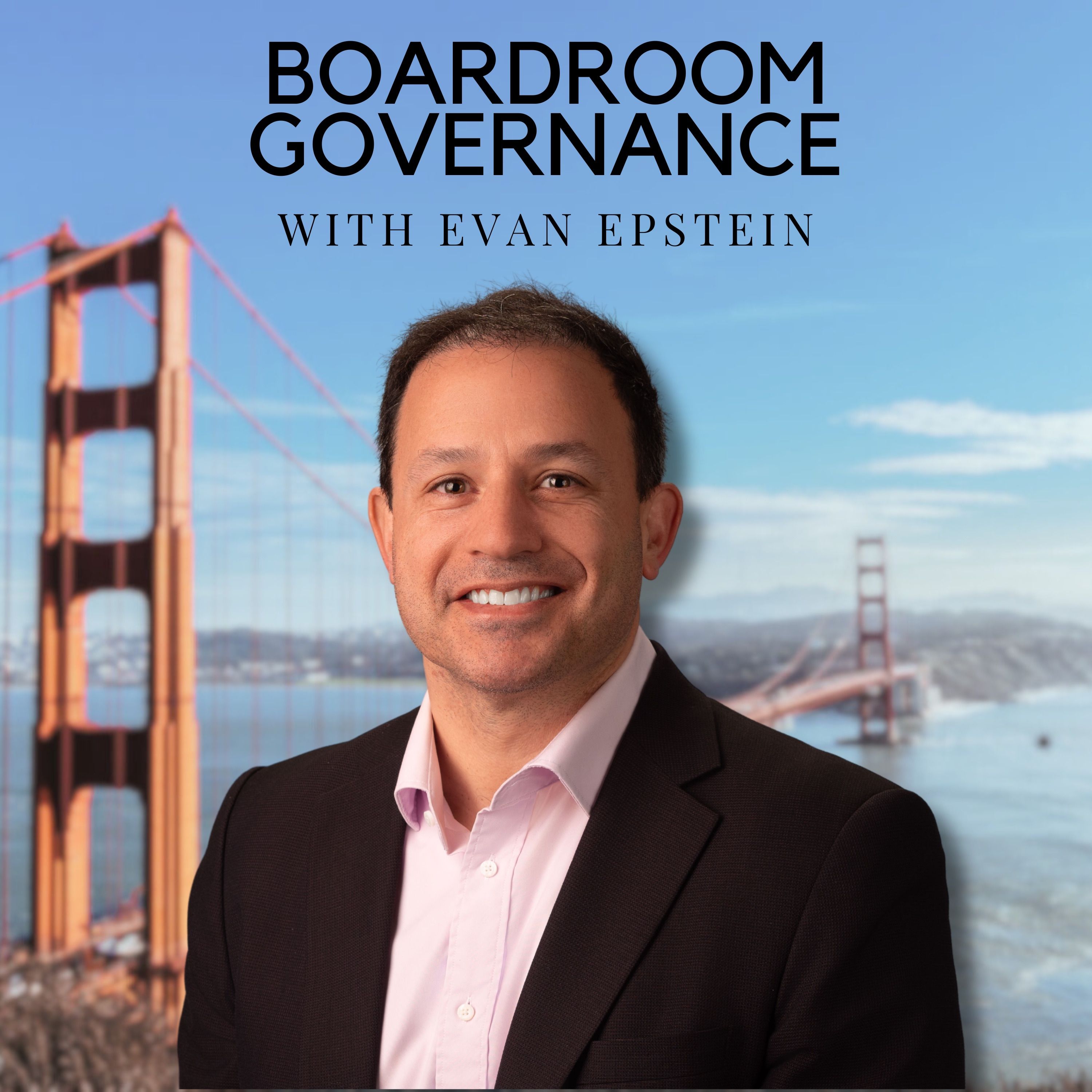
Boardroom Governance with Evan Epstein
220 episodes — Page 2 of 5

Ep 169Emily Melton: Mechanics of Venture Investing, the Age of AI, and Implications for Boards
(0:00) Intro(1:15) About the podcast sponsor: The American College of Governance Counsel(2:02) Start of interview(2:45) Emily's origin story(8:27) Her start in venture capital through DFJ with Tim Draper in 2000.(11:56) About the history and evolution of VC(13:42) Investing thesis (founding principle) at her firm Threshold Ventures.(19:21) The venture mechanics of Threshold Ventures. "One of our SLAs is we'd like to be the founder's first call."(21:30) On navigating boardroom dynamics in venture-backed boards. "Building trust is critical" (26:20) On dealing with conflicts of interests at the board level in the VC context. "Decisions with an investors' hat vs board member hat"(31:35) Mention of the VC-Backed Board Academy in SF on May 14, 2025, and NYC on Oct 28, 2025.(32:31) The role of independent directors in VC-backed companies. "I love bringing in independent directors early."(38:09) On board observers. "I always try to think about [board roles] in a two-year cycle"(42:44) The state of diversity in VC. Discussion about All Raise (founded in 2018).(48:12) Navigating the AI Landscape "it's a different world"(55:10) Books that have greatly influenced her life:The Soul in the Game by Vitaliy Katsenelson (2022)(55:43) Her mentors: Heidi Roizen (E6, E108 and E116)(57:07) Quotes that she thinks of often or lives her life by. "Happiness = Reality - Expectation"(57:56) An unusual habit or an absurd thing that she loves. (58:31) The living person she most admires.Emily Melton is a co-founder of Threshold Ventures. She is looking for entrepreneurs who are genuinely excited about being agents of change and have an almost irrational drive to make things better. You can follow Evan on social media at:X: @evanepsteinLinkedIn: https://www.linkedin.com/in/epsteinevan/ Substack: https://evanepstein.substack.com/__To support this podcast you can join as a subscriber of the Boardroom Governance Newsletter at https://evanepstein.substack.com/__Music/Soundtrack (found via Free Music Archive): Seeing The Future by Dexter Britain is licensed under a Attribution-Noncommercial-Share Alike 3.0 United States License

Ep 168Joe Hurd: Governance in Times of VUCA (Volatility, Uncertainty, Complexity, and Ambiguity)
(0:00) Intro(1:26) About the podcast sponsor: The American College of Governance Counsel(2:13) Start of interview(2:45) Joe's origin story(4:07) His early career starting in London, with law firm Linklaters. (6:43) His move to Friendster in Silicon Valley.(8:00) His time at Videoegg.(9:24) His time at the International Trade Administration in the Obama Administration.(11:30) His return to private practice with Gannett and Facebook's emerging products.(13:10) His operating role at SOSV, a global venture capital firm (2019-present)(15:10) How he got started with his board service. First board experience: a UK public company called GoCompare.(16:50) Difference between a "good" and a "great" director. (18:34) Distinguishing the concept of overboarding between public and private VC-backed companies. Reference to VCBA (5/14/25)(21:06) Some differences between U.S. and U.K. governance practices.(24:57) On the increasing politicization of corporate governance, including ESG and DEI (plus boardroom diversity). "Let's bend it, not end it."(27:47) The origin story of the bio books that he compiles.(31:07) On the impact of AI in the boardroom. Boards need to 1) move faster on AI, and 2) focus on the transformation, not only the tech.(35:50) On navigating in VUCA times (Volatility, Uncertainty, Complexity, and Ambiguity). "Act proactively, not reactively"(38:18) Challenges for boards in next 5-10 years: 1) time management and 2) increasing focus on director skill sets.(35:50) On navigating the regulatory landscape in VUCA times (Volatility, Uncertainty, Complexity, and Ambiguity).(41:27) On board evaluations.(46:00) Will governance regulations harmonize internationally? Example: climate change disclosures.(49:15) The UK's approach for boards to engage with employees: workers' council, board representation, or DNEDs.(46:00) Will governance regulations harmonize internationally? Example: climate change disclosures.(51:50) Books that have greatly influenced his life:How to Win Friends and Influence People by Dale Carnegie (1936)Range, by David Epstein (2019)(52:38) His mentors: Barry Williams (E153)(54:13) Quotes that he thinks of often or lives his life by. "Be kind, for everyone you meet is fighting a hard battle" and "I never lose, I either win or learn."(56:27) An unusual habit or an absurd thing that he loves. (57:10) The living person he most admires.Joe Hurd is a purpose-driven public company board director and strategic advisor who focuses on digital transformation, international expansion and stakeholder engagement. You can follow Evan on social media at:X: @evanepsteinLinkedIn: https://www.linkedin.com/in/epsteinevan/ Substack: https://evanepstein.substack.com/__To support this podcast you can join as a subscriber of the Boardroom Governance Newsletter at https://evanepstein.substack.com/__Music/Soundtrack (found via Free Music Archive): Seeing The Future by Dexter Britain is licensed under a Attribution-Noncommercial-Share Alike 3.0 United States License

Ep 167Jorge Titinger: Leadership, Governance, and the Erosion of Trust
(0:00) Intro(1:15) About the podcast sponsor: The American College of Governance Counsel(2:02) Start of interview(2:48) Jorge's origin story(6:03) His executive career in Silicon Valley (including computer and semiconductor industries)(9:00) On his board experience (he has served in ~20 boards)(11:32) Distinctions between serving on different types of boards (public/private/non-profits/etc). On non-profits: "the board is really there for what they call the 3 W's: wisdom, work, or wealth."(12:55) On startup governance.(19:24) On the backlash on ESG/DEI and his book Differences that Make a Difference (2019). "I think the companies that embarked on DEI programs for the sake of checking a box or purely for the sake of compliance are the ones that need to change or got in trouble."(28:49) Differences between CEO coaching and board membership. "Most engineers need to get way better at EQ. When you get into leadership, it's a lot more about influence than being right."(31:26) On founder-led companies and governance.(37:00) On the impact of AI on business and boards. *Reference to E162 with Nora Denzel on NACD's BRC on tech in the boardroom.(44:30) On trend of AI companies incorporating as PBCs.(46:55) Books that have greatly influenced his life:Good to great by Jim Collins (2001)Crossing the Chasm, by Geoffrey Moore (1991)The Hard Thing About Hard Things, by Ben Horowitz (2014)Philosophy: Buddhism(48:42) His mentors: parents, Russell Redenbaugh, and his karate instructor.(51:44) Quotes that he thinks of often or lives his life by. (52:37) An unusual habit or an absurd thing that he loves. Sports examples and analogies with business world.(54:38) On the impact of work from home. "Trust has gone from imperative to imperiled"(58:00) The living person he most admires: Reed Hastings. *Reference to Netflix board case studyJorge Titinger is the founder and CEO of Titinger Consulting, a boutique consulting firm focused on strategy development, the cultural aspects of M&A, corporate transformations and leadership coaching. You can follow Evan on social media at:X: @evanepsteinLinkedIn: https://www.linkedin.com/in/epsteinevan/ Substack: https://evanepstein.substack.com/__To support this podcast you can join as a subscriber of the Boardroom Governance Newsletter at https://evanepstein.substack.com/__Music/Soundtrack (found via Free Music Archive): Seeing The Future by Dexter Britain is licensed under a Attribution-Noncommercial-Share Alike 3.0 United States License

Ep 166David Chun (CEO, Equilar): The Boardroom Diversity Backlash—A Shifting Pendulum
(0:00) Intro(1:38) About the podcast sponsor: The American College of Governance Counsel(2:25) Start of interview. *Reference to prior episode with Dave (E25 from Dec 2020)(3:30) Equilar's current focus. New: Equilar Research Intelligence Copilot ERIC(7:49) The current status of boardroom diversity. Latest (Q3 2024) Equilar Gender Diversity Index(10:05) On boardroom refreshment(11:25) On digital/technology/AI directors(13:15) Executive (and Director) Compensation trends.(17:36) On the current ESG/DEI backlash ("at the end of the day you have to do what's best for the business")(20:13) On the boom and bust of SPACs ("incentives were misaligned")(23:05) On the governance of private equity and VC backed companies. Reference to VCBA in SF 5/14 and NYC on 10/28(28:15) AI's impact on governance and new corporate structures (PBCs) (32:36) On the growing influence—and disruption—of Silicon Valley in Washington, D.C. ("this feels like Uber")(37:27) The evolving dynamics of California’s business landscape ("if it wasn't for the AI boom, I think we'd be in a pretty hurting spot")(41:21) On the current backlash against Delaware and Elon Musk's pay package at Tesla *Reference to Delaware's SB21(44:43) Looking Forward: the importance of AI in the boardroom ("the genie is out of the bottle")David Chun is the Founder & CEO of Equilar, a leading provider of executive intelligence solutions for board and executive recruitment, compensation, and governance strategies. You can follow Evan on social media at:X: @evanepsteinLinkedIn: https://www.linkedin.com/in/epsteinevan/ Substack: https://evanepstein.substack.com/__To support this podcast you can join as a subscriber of the Boardroom Governance Newsletter at https://evanepstein.substack.com/__Music/Soundtrack (found via Free Music Archive): Seeing The Future by Dexter Britain is licensed under a Attribution-Noncommercial-Share Alike 3.0 United States License

Ep 165Rick Alexander: On the Rise of PBCs in the AI Industry and Firm-Specific vs. Diversified Investor Duties
(0:00) Intro.(1:33) About the podcast sponsor: The American College of Governance Counsel(2:20) Start of interview. *Reference to prior episode with Rick (E14 from Aug 2020)(3:32) Update on Public Benefit Corporations (PBCs) from prior episode (2020)(6:00) Surge of VC investments in PBCs driven by AI startups. *Reference to E159 with David Berger on Anthropic's structure(9:48) The OpenAI Controversy (conversion from non-profit to PBC)(13:25) On Dual-Class Share Structures in tech companies(17:10) On Danone and BP as examples of shareholder activism from hedge funds.(18:57) On "Stay private vs Go Public" debate. *Reference to E157 with Tom Callahan, CEO of Nasdaq Private Market(27:17) On the current ESG/DEI backlash ("I think it's an anti-shareholder backlash")(30:52) On the current backlash against Delaware as the favored corporate home(35:26) The McRitchie v. Zuckerberg Case (firm-specific vs diversified equity investors' fiduciary duties)(46:54) On the concentration of power by institutional investors *Reference to E118 with John Coates, from Harvard Law School. Reference to Freshfield's report A Legal Framework for Impact (2021) (52:03) Looking Forward: US boards under the EU Directive on Corporate Sustainability Due Diligence.Rick Alexander is the CEO of Shareholder Commons. He is also a leading expert in public benefit corporations. You can follow Evan on social media at:X: @evanepsteinLinkedIn: https://www.linkedin.com/in/epsteinevan/ Substack: https://evanepstein.substack.com/__To support this podcast you can join as a subscriber of the Boardroom Governance Newsletter at https://evanepstein.substack.com/__Music/Soundtrack (found via Free Music Archive): Seeing The Future by Dexter Britain is licensed under a Attribution-Noncommercial-Share Alike 3.0 United States License
Ep 164Jonathan Goodman (Deloitte): Governing Strategy
(0:00) Intro(1:35) About the podcast sponsor: The American College of Governance Counsel(2:21) Start of interview(3:00) Jonathan's origin story(5:10) His start in journalism(7:05) Founding Monitor Canada with Roger Martin (1987)(9:43) Transitioning to Deloitte Monitor (2013) (12:18) About Deloitte Canada’s Podium Club for Directors that he leads.(13:38) How Trump's tariffs may impact Canada (note: this podcast was recorded on 1/24, before tariffs went into place)(17:57) What is strategy? "I think of strategy as choice"(20:20) The role of the board in strategy. "The best CEOs seek advice from their boards, not a grade"(25:39) The questions board members ask matter. "The question is the asset" "Ask questions and question the answers" (30:40) Rethinking Board Information Approaches *Reference to Netflix board case study(33:30) Embracing Uncertainty and Risk(37:55) Private vs. Public Strategy Dynamics(42:10) The Role of Culture and Talent in Strategy (scope of company founders)(46:55) Key Strategic Priorities for Directors (beyond idiosyncrasies of each company): 1) Geopolitics; 2) Technological Shifts (AI, Cyber, etc); and 3) Talent (Workforce and People).(53:10) Books that have greatly influenced his life:Atlas Shrugged by Ayn Rand (1957)The Final Days by Bob Woodward and Carl Bernstein (1976)On Becoming a Person by Carl Rogers (1961)(55:58) His mentors.(56:41) Quotes that he thinks of often or lives his life by. Jonathan Goodman is a vice Chair and member of the board of Deloitte Canada, where he leads the firm’s CEO and Boardroom programs, including Deloitte Canada’s Podium Club for Directors. He is also Global Chair and former global Managing Partner of Monitor Deloitte. You can follow Evan on social media at:X: @evanepsteinLinkedIn: https://www.linkedin.com/in/epsteinevan/ Substack: https://evanepstein.substack.com/__To support this podcast you can join as a subscriber of the Boardroom Governance Newsletter at https://evanepstein.substack.com/__Music/Soundtrack (found via Free Music Archive): Seeing The Future by Dexter Britain is licensed under a Attribution-Noncommercial-Share Alike 3.0 United States License

Ep 163Jeff Thomas (Nasdaq): The State of Public Markets in 2025
(0:00) Intro.(1:52) About the podcast sponsor: The American College of Governance Counsel(2:39) Start of interview. *Reference to prior episode with Jeff (E46 from Oct 2021)(3:42) On Nasdaq's IPOs in 2024 (180 IPOs raising $23B). Looking ahead in 2025.(6:23) What to expect facing new Administration. Reference to Nasdaq's IPO Pulse Index.(8:59) The three priorities for boards considering an IPO: strategic quality, risk management, and succession planning (people).(11:14) On the ruling striking down the Nasdaq Diversity Rule(14:27) On the political backlash against ESG and DEI in the US(18:00) On global markets and the new geopolitical landscape. Nasdaq as "the trusted fabric of the financial markets". Reference to article by Nelson Griggs, Nasdaq President.(22:32) On the "stay private vs go public" debate, and arguments for public listings: 1) access to capital, 2) liquidity, 3) creating an acquisition currency, and 4) having the brand and the trust of a public company.(27:00) Private Equity backed companies going public.(29:50) On the influence of AI in public markets and in governance. Boardvantage's AI solutions for directors.(35:30) Outlook for 2025.(39:55) On direct listings and SPACs (50 SPACs on Nasdaq in 2024)(40:36) On board education. Reference to the 3rd VC-Backed Board Academy (VCBA) on May 14, 2025, at Cooley in SF.Jeff Thomas serves as EVP, Chief Revenue Officer, and Global Head of Listings at Nasdaq. You can follow Evan on social media at:X: @evanepsteinLinkedIn: https://www.linkedin.com/in/epsteinevan/ Substack: https://evanepstein.substack.com/__To support this podcast you can join as a subscriber of the Boardroom Governance Newsletter at https://evanepstein.substack.com/__Music/Soundtrack (found via Free Music Archive): Seeing The Future by Dexter Britain is licensed under a Attribution-Noncommercial-Share Alike 3.0 United States License

Ep 162Nora Denzel: Technology Leadership in the Boardroom
(0:00) Intro.(1:47) About the podcast sponsor: The American College of Governance Counsel(2:34) Start of interview. *Reference to prior episode with Nora (E74 from Oct 2022)(3:42) About the 2024 NACD Blue Ribbon Commission on Technology Leadership in the Boardroom: Driving Trust and Value(7:29) On the evolving role of the board overseeing technology and cybersecurity(10:41) On the surge of AI technology and its underlying infrastructure(13:15) The role of trust in the age of AI(17:22) How to think about ROI in technology from the boardroom(20:12) Board composition and technology expertise(27:19) Recommendations or takeaways from the BRC Report.(31:00) On AI regulation "It's really important to self-regulate"(34:13) Technology strategy and board committee structures(38:38) Tech aptitude in directors: 1) digital outsiders, 2) digital immigrants, 3) digital early adopters and 4) digital natives(41:52) On board education "needs to be more like Call of Duty" "directors should be learn-it-all's, not know-it-all's"(43:25) Best practices for board evaluations "you can only operate at the speed of trust" "the chair sets the tone"(46:42) On "Zero-based agenda setting"(49:14) Priority items for boards in 2025: talent in the boardroom/company, and having "THE meeting to govern Tech/AI"(52:02) On being "courageously optimistic" and how to address AI doomsayers(56:22) Nora's Top 6 Recommendations for Board Members to Become more Familiar with AINora Denzel is a Silicon Valley technology executive. She serves as the Lead Independent Director and Chair of the NomGov Committee at AMD. She also serves on the Gen Digital (NASDAQ: GEN), SUSE S.A. and NACD boards. You can follow Evan on social media at:X: @evanepsteinLinkedIn: https://www.linkedin.com/in/epsteinevan/ Substack: https://evanepstein.substack.com/__To support this podcast you can join as a subscriber of the Boardroom Governance Newsletter at https://evanepstein.substack.com/__Music/Soundtrack (found via Free Music Archive): Seeing The Future by Dexter Britain is licensed under a Attribution-Noncommercial-Share Alike 3.0 United States License

Ep 161Joe Grundfest: Reflecting on 2024 and What’s Next for Business and Governance
(0:00) Intro(2:06) About the podcast sponsor: The American College of Governance Counsel(2:53) Start of interview. *Reference to prior episodes with Joe (E1 from '20, E35 from '21, E84 from '23, E123 from '24)(4:53) The future of the SEC with Chairman Paul Atkins (6:30) New approach to crypto by SEC(9:40) On the politicization of corporate governance(10:48) On the future of ESG ("Extremely Subjective Guessing") and DEI ("Decrease Emphasis Immediately")(14:18) On DOGE, and how it plays out(17:13) On the influence of Silicon Valley in the new Trump Administration(21:40) On Delaware’s Corporate Landscape (two canaries in the coalmine: pre-IPO incorporations and re-domestications)(25:01) On the Tornetta v Musk case, and challenging the award of $345 million in attorneys' fees to the plaintiffs(28:54) AI and the malpractice insurance system. "How AI eats the world"(32:52) On OpenAI's structure and PBCs. On "exit tax" from converting from non-profit to for-profit.(36:49) How do corporations relate to (an increasingly polarized) society: big theme for 2025.(38:05) Biggest winner and loser in business in 2024(40:38) Biggest business surprise in 2024 (42:46) Best and worst corporate governance trend from 2024(43:05) What’s the biggest corporate governance trend to watch out for in 2025Joe Grundfest is the William A. Franke Professor of Law and Business Emeritus at Stanford Law School and Senior Faculty at the Rock Center for Corporate Governance. You can follow Evan on social media at:X: @evanepsteinLinkedIn: https://www.linkedin.com/in/epsteinevan/ Substack: https://evanepstein.substack.com/__To support this podcast you can join as a subscriber of the Boardroom Governance Newsletter at https://evanepstein.substack.com/__Music/Soundtrack (found via Free Music Archive): Seeing The Future by Dexter Britain is licensed under a Attribution-Noncommercial-Share Alike 3.0 United States License

Ep 160Ben Joseloff: The Board's Guide to CFIUS and Evolving National Security Reviews
(0:00) Intro(1:43) About the podcast sponsor: The American College of Governance Counsel(2:29) Start of interview(3:11) Ben's origin story(9:39) His start at Cravath in 2010(10:54) His time at the U.S. Treasury Department and the White House. (15:04) About CFIUS. Reforms from FIRRMA (2018). Control transactions and minority investments in critical technologies, critical infrastructure, or sensitive personal data.(24:45) Trends in transaction reviews. CFIUS Annual Report to Congress – CY 2023(30:00) Presidential prohibitions under CFIUS. (32:23) CFIUS and crypto.(34:02) The TikTok case.(36:14) Restrictions on outbound investments in China: AI, semiconductors, and quantum computing.(42:13) De-risking vs de-coupling from China. Geopolitics and the boardroom.(44:40) Industrial policies.(47:21) Advice for corporate directors on national security matters.(49:30) Books that have greatly influenced his life:Wind, Sand and Stars by Antoine de Saint-Exupery (1939)Elements of Style by Strunk and White (1918)(51:46) His mentors. (53:04) Quote that he thinks of often or lives his life by. The "Spirit of Liberty" Speech Judge Learned Hand (1944)(54:34) An unusual habit or absurd thing that he loves.(55:42) The person he most admires. You can follow Evan on social media at:X: @evanepsteinLinkedIn: https://www.linkedin.com/in/epsteinevan/ Substack: https://evanepstein.substack.com/__To support this podcast you can join as a subscriber of the Boardroom Governance Newsletter at https://evanepstein.substack.com/__Music/Soundtrack (found via Free Music Archive): Seeing The Future by Dexter Britain is licensed under a Attribution-Noncommercial-Share Alike 3.0 United States License

Ep 159David Berger: Ending the One-Size-Fits-All Model of Corporate Governance
(0:00) Intro.(2:14) About the podcast sponsor: The American College of Governance Counsel(3:01) Start of interview. *Reference to prior episode with David (E24 from Nov 2020)(4:22) David's description of the ACGC(7:56) Post-Election Governance Changes (SEC, FTC, etc). ESG and DEI considerations. Federal vs state regulatory matters.(13:06) On crypto and digital assets in the new Trump administration.(14:51) On DOGE led by Elon Musk and Vivek Ramaswamy(18:46) Delaware's challenge as the Favored Corporate Home(26:54) Elon Musk's Rescinded Compensation in Tornetta v Musk, the plaintiff attorneys' fees.(31:04) On the Rome Conference on AI, Ethics, and the Future of Corporate Governance (April 2024).(35:18) Public Benefit Corporations (PBCs) in the AI industry. On Anthropic's LTBT. On corporate purpose.(46:56) ServiceTitan's compounding IPO ratchet (reference to my article about it). IPO market.(52:06) Biggest winner and loser in business in 2024(53:54) Biggest business surprise in 2024 (55:10) Best and worst corporate governance trend from 2024(57:41) Charter competition among states, and Federal vs. State Corporate Governance(1:00:04) What’s the biggest corporate governance trend to watch out for in 2025David Berger is a partner at Wilson Sonsini and serves as the President of the American College of Governance Counsel. You can follow Evan on social media at:X: @evanepsteinLinkedIn: https://www.linkedin.com/in/epsteinevan/ Substack: https://evanepstein.substack.com/__To support this podcast you can join as a subscriber of the Boardroom Governance Newsletter at https://evanepstein.substack.com/__Music/Soundtrack (found via Free Music Archive): Seeing The Future by Dexter Britain is licensed under a Attribution-Noncommercial-Share Alike 3.0 United States License

Ep 158Richard Blake: 2024 Silicon Valley 150 Corporate Governance Report
(0:00) Intro.(2:09) About the podcast sponsor: The American College of Governance Counsel.(2:56) Start of interview. *Reference to prior episode with Richard (E126 from Feb 2024).(3:46) About his firm's 2024 SV150 Corporate Governance Report.(9:04) On Virtual (Stockholder) Meetings (89% of SV150).(11:23) Board Committee Structures. Audit, Comp, NomGov, and Others.(14:02) On SV150's approach to ESG, impact of new SEC.(18:53) On the evolution of boardroom diversity, impact of CA laws and Nasdaq Diversity Rule.(21:40) Why private ordering will become more important in corporate governance.(22:28) On dual or multi class share structures (-30% of SV150, and of those, 91% have sunset provisions).(25:25) On ServiceTitan's compounding IPO ratchet (reference to my article about it). "Governance is a spectrum"(31:29) On evolution of shareholder proposals in SV150. *Reference to E15 with Jim McRitchie.(36:30) On shareholder activism (7.4%) in SV150.(41:41) On the clawback policies of SV150 companies(48:27) On the backlash to Delaware incorporations and SV moving out of CA. Reference to WSGR's DE's Status as the Favored Corporate Home.(51:49) Biggest winner in business in 2024(53:27) Biggest loser in business in 2024(54:27) Biggest business surprise in 2024 (56:53) Best and worst corporate governance trend from 2024(58:28) What’s the biggest corporate governance trend to watch out for in 2025Richard Blake is a partner at Wilson Sonsini and the leader of the firm's public companies’ practice. You can follow Evan on social media at:X: @evanepsteinLinkedIn: https://www.linkedin.com/in/epsteinevan/ Substack: https://evanepstein.substack.com/__To support this podcast you can join as a subscriber of the Boardroom Governance Newsletter at https://evanepstein.substack.com/__Music/Soundtrack (found via Free Music Archive): Seeing The Future by Dexter Britain is licensed under a Attribution-Noncommercial-Share Alike 3.0 United States License

Ep 157Tom Callahan, CEO of NPM: Unlocking Liquidity in Private Markets
(0:00) Intro.(2:05) About the podcast sponsor: The American College of Governance Counsel.(2:52) Start of interview. (3:36) Tom's origin story.(5:37) The start of his career with Merrill Lynch (1991-2008).(7:00) The financial crisis and his transition to the NYSE (2009-2013).(10:53) His time at BlackRock (2013-2022).(15:14) Defining private markets: "VC-backed pre-IPO private companies typically worth $1b ie. unicorns." Comparing public and private markets. Impact of the JOBS Act (2012).(18:47) About the Nasdaq Private Market (NPM). Why companies do tender offers in private companies. Managing secondary liquidity.(26:31) Distinguishing liquidity for employees, founders, and investors (cap table cleanup). Function of IPO.(32:40) On regulation of private markets ("private markets are under regulated"). Difference between public and private markets: information asymmetry.(41:23) Current private market dynamics (2021-2024). "We're optimistic that 2025 will be a great year"(45:32) On the role of AI: "it has been the story of the public markets and private markets in 2024."(50:26) Books that have greatly influenced his life.How to Win Friends and Influence People, by Dale Carnegie (1936) Never Split the Difference, by Chris Voss (2016) "Tactical empathy"(52:52) His mentors. (54:47) Quote that he thinks of often or lives his life by: "Whether you think you can, or think you can't - you're right," (Henry Ford)(57:05) Cultural differences in venture between NY and Silicon Valley.(58:19) An unusual habit or absurd thing that he loves: he's a volunteer pilot for Dogs for Good.(59:38) The person he most admires.Tom Callahan is the CEO and Manager of the board of managers of Nasdaq Private Market (NPM). You can follow Evan on social media at:X: @evanepsteinLinkedIn: https://www.linkedin.com/in/epsteinevan/ Substack: https://evanepstein.substack.com/__To support this podcast you can join as a subscriber of the Boardroom Governance Newsletter at https://evanepstein.substack.com/__Music/Soundtrack (found via Free Music Archive): Seeing The Future by Dexter Britain is licensed under a Attribution-Noncommercial-Share Alike 3.0 United States License

Ep 156Andrew Shagrin and David Chekroun: Co-Founders of ICG at ESCP Business School in Paris
(0:00) Intro(3:27) About the podcast sponsor: The American College of Governance Counsel.(4: 14) Start of interview. (4:56) Drew Shagrin's origin story.(8:12) David Chekroun's origin story.(14:15) About the Institute of Corporate Governance at ESCP Business School, based in Paris.(19:13) The focus of ICG between students, alumni, execs, directors, investors, state representatives, judiciary, and regulators.(24:57) Corporate purpose under French law: changed in 2019 to explicitly take into consideration E&S issues.(27:53) Comparing ESG trends from France & EU. The G is rooted in each member state, but E&S falls under the EU green deal.(33:50) On board diversity: differences between US, France & EU. Sources: Copé Zimmermann Law (2011), Gender Equality Index (2018): on gender pay gaps, and Rixain Act (2021).(41:32) On State Owned Enterprises (SOEs) and the role of the state in corporate governance.(45:46) On the role of the state in promoting tech industry (startups and scale ups). BPI.(48:55) On employee representation in the boardroom. In France, since 2013.(54:19) On Entreprise à Mission structures and PBCs, balancing profit with social responsibility (in AI). The Danone case.(58:24) Challenges of corporate governance in France: share value, board composition, and stewardship. AFEP and MEDEF.(50:38) What are the 1-3 books that have greatly influenced your life: David:The World of Yesterday by Stefan Zweig (1942)Lost in Translation: A Life in a New Language by Eva Hoffman (1989)The Anatomy of Corporate Law by Reiner Kraakman (2004)Drew:How Will You Measure Your Life? by Clayton Christensen (2012)(1:03:48) Who were their mentors, and what they learned from them.(1:06:11) Quotes they think of often or live their life by.(1:07:22) An unusual habit or an absurd thing that they love.(1:08:20) The living person they most admire. You can follow Evan on social media at:X: @evanepsteinLinkedIn: https://www.linkedin.com/in/epsteinevan/ Substack: https://evanepstein.substack.com/__To support this podcast you can join as a subscriber of the Boardroom Governance Newsletter at https://evanepstein.substack.com/__Music/Soundtrack (found via Free Music Archive): Seeing The Future by Dexter Britain is licensed under a Attribution-Noncommercial-Share Alike 3.0 United States License

Ep 155Wolfe Tone & Heather Gates (Deloitte): Insights on Private Company Governance
(0:00) Intro(1:12) About the podcast sponsor: The American College of Governance Counsel.(1:59) Start of interview. (2:57) Heather Gates' "origin story."(5:17) Wolfe Tone's "origin story."(10:23) On the governance of privately-owned businesses. Distinction with having "outside investors." (15:20) On the nuances of family-owned businesses. *Reference to my podcast series on Succession show.(18:28) On growth of LLC structures.(20:53) On VC-backed company governance. *Note UC Law SF's VCBA.(23:42) On the value of boards and good governance. When is the right time for a more formal governance structure.(27:40) Deloitte Private Company Pulse Survey on Governance (from July 2024).(31:40) On Climate Risk and ESG in private companies.(34:16) On Cybersecurity Risk.(38:20) On the evolving role of independent directors in private companies.(42:28) On the rise of the public benefit corporation (PBC) structure in AI companies(46:08) On the role of the board in developing talent.(48:38) On the future of trust as a core tenant of governance.(50:38) What are the 1-3 books that have greatly influenced your life: Wolfe:The Art of War by Sun Tzu (roughly 5th century BC)Anything by Stephen Covey.When the Game Is Over, It All Goes Back in the Box by John Ortberg (2007)Heather:The Hard Thing about Hard Things by Ben Horowitz (2014)Boundary Boss by Terri Cole (2021)The Untethered Soul by Michael Singer (2007)(51:52) Who were their mentors, and what they learned from them.(53:36) Quotes they think of often or live their life by.(54:13) An unusual habit or an absurd thing that they love.(54:40) The living person they most admire.Wolfe Tone is the leader of Deloitte Private for the US and globally, and Heather Gates is the national Emerging Growth Company (EGC) business leader for Deloitte, overseeing the firm’s EGC, Private Equity, and Deloitte Private Audit & Assurance teams. You can follow Evan on social media at:X: @evanepsteinLinkedIn: https://www.linkedin.com/in/epsteinevan/ Substack: https://evanepstein.substack.com/__To support this podcast you can join as a subscriber of the Boardroom Governance Newsletter at https://evanepstein.substack.com/__Music/Soundtrack (found via Free Music Archive): Seeing The Future by Dexter Britain is licensed under a Attribution-Noncommercial-Share Alike 3.0 United States License

Ep 154Valeria Café: Leading Governance Innovation in Brazil as IBGC CEO
(0:00) Intro.(1:20) About the podcast sponsor: The American College of Governance Counsel.(2:06) Start of interview. (3:20) Valeria's origin story.(6:14) On joining IBGC, its mission and focus: governance training, research, and regulatory work with CVM, B3, Congress, etc.(9:03) On the 25th IBGC Annual Summit.(11:11) On the state of ESG in Brazil.(15:15) On boardroom diversity in Brazil (20% female representation in public companies).(17:40) Geopolitics, and where Brazil stands between the U.S. and China.(20:56) Innovation and AI in Brazil.(24:44) On compliance and anti-corruption measures by boards in Brazil (post Lava Jato).(29:17) On the future of corporate governance in Brazil and her vision for IBGC.(32:52) The importance of board education and constant learning. On the issue of overboarding (new rule from Novo Mercado).(35:53) Books that have greatly influenced her life:Feliz ano velho. By Marcelo Rubens Paiva (1982)Theory U. By Otto Scharmer (2007) The Moment of Lift. By Melinda Gates (2019)(36:54) Her mentors. Her Dad.Pedro MeloVicky Bloch.(37:32) Quotes that she thinks of often or lives her life by.(38:00) An unusual habit or absurd thing that he loves.(38:32) The person she most admires.Valeria Cafe is CEO of IBGC, the Brazilian Institute of Corporate Governance. You can follow Evan on social media at:X: @evanepsteinLinkedIn: https://www.linkedin.com/in/epsteinevan/ Substack: https://evanepstein.substack.com/__To support this podcast you can join as a subscriber of the Boardroom Governance Newsletter at https://evanepstein.substack.com/__Music/Soundtrack (found via Free Music Archive): Seeing The Future by Dexter Britain is licensed under a Attribution-Noncommercial-Share Alike 3.0 United States License

Ep 153Barry Lawson Williams: Addressing Board Refreshment—"the Most Pressing Issue in Corporate Governance Today"
(0:00) Intro.(1:26) About the podcast sponsor: The American College of Governance Counsel.(2:13) Start of interview. (3:03) Barry's origin story.(7:00) Barry's board journey.(9:39) On distinctions between serving on public and private company boards: "you have the same fiduciary duties."(11:57) Evolution of boards in the last 30-40 years: "they have evolved for the better, but I don't think they've evolved enough." On board refreshment. On "non-traditional candidates" to boards.(15:52) About his Bay area Black Directors Succession Project (2015-2016) *Reference to the Black Directors' Conference.(18:40) About his Black Corporate Directors Time Capsule Project (2020)(19:51) About his Black Directors Video Archive Project (Current)(23:18) On board committee work. "As a new director, you ought to start in the audit committee."(26:44) On the Black Corporate Board Readiness (BCBR) Program at SCU, and its endowment under his name.(31:34) On the impact in California of SB-826 and AB-979. "I'm not a quota mandate person... but it worked." "I think we need to emphasize the business case for diversity."(37:20) On the backlash against ESG and DEI. "Two requests for Silicon Valley: to create interactive databases 1) aggregating all diverse board candidates, and 2) Dates/schedule of openings of board seats." *Reference to VC-Backed Board Academy (VCBA) on Oct 29, 2024 at Nasdaq in NYC.(45:54) Books that have greatly influenced his lifeCry, the Beloved Country. By Alan Paton (1948)Citizen Creek. By Lalita Tademy (2014) *his wifeJames. By Percival Everett (2024)(49:12) His mentors. Colin Powell and Vernon Jordan.George Schultz (at Bechtell, "start out with an executive summary, be brief")Franklin Williams(50:15) Quotes that he thinks of often or lives her life by.Nelson Mandela: "I never fail. I either win or learn."Vernon Jordan: "I'm here because I stand on many, many shoulders."Yogi Berra: "When you come to the fork in the road, take it."(50:58) An unusual habit or absurd thing that he loves: "Win the Day List"(52:08) The person he most admires.Barry Lawson Williams is a retired director who has served on the boards of 14 public companies. Since 2012, Barry has dedicated himself to promoting diversity in corporate boardrooms and mentoring Black professionals. Widely regarded as an icon in the Black corporate board community, he has led several impactful board-related projects. You can follow Evan on social media at:X: @evanepsteinLinkedIn: https://www.linkedin.com/in/epsteinevan/ Substack: https://evanepstein.substack.com/__To support this podcast you can join as a subscriber of the Boardroom Governance Newsletter at https://evanepstein.substack.com/__Music/Soundtrack (found via Free Music Archive): Seeing The Future by Dexter Britain is licensed under a Attribution-Noncommercial-Share Alike 3.0 United States License

Ep 152Boardroom Diversity and the Black Corporate Board Readiness Program
(0:00) Intro.(1:25) About the podcast sponsor: The American College of Governance Counsel.(2:11) Start of interview. (2:56) Zain Oke's origin story.(5:08) Dianna Jones's origin story.(8:25) Dennis Lanham's origin story.(12:00) How executive education works (as opposed to degree conferring programs)(14:22) On the origin and mission of the Black Corporate Board Readiness (BCBR) program at Santa Clara University.(17:41) On the role of community and mentorship at BCBR.(22:11) On lawyers serving on corporate boards.(30:50) On the legal challenges to SB-826 and AB-979 in California (board diversity laws).(40:00) On the politicization of the boardroom and the push back on ESG and DEI.(51:23) Recommendations for executives seeking to join their first board, and for boards considering diverse candidates. You can follow Evan on social media at:X: @evanepsteinLinkedIn: https://www.linkedin.com/in/epsteinevan/ Substack: https://evanepstein.substack.com/__To support this podcast you can join as a subscriber of the Boardroom Governance Newsletter at https://evanepstein.substack.com/__Music/Soundtrack (found via Free Music Archive): Seeing The Future by Dexter Britain is licensed under a Attribution-Noncommercial-Share Alike 3.0 United States License

Ep 151Maggie Wilderotter: Strategic Oversight and the Attributes of Great Directors
(0:00) Intro.(1:30) About the podcast sponsor: The American College of Governance Counsel.(2:15) Start of interview. (3:05) Maggie's origin story.(7:08) Maggie's board career. Reference to HBS case study on her. On staying on boards between 8-12 years to remain independent.(10:19) On distinctions between serving on public and private company boards. The role of directors in each. *Reference to VC-Backed Board Academy (VCBA) on Oct 29, 2024 at Nasdaq in NYC.(13:37) On PE-backed company governance.(14:58) Debate on staying private vs going public.(18:07) On creating her own board bootcamps for women and minorities, and placing directors on boards. "She's trained ~750 people: over 70% have been placed on their first board"(21:49) On the evolution of boardroom diversity. Getting into the nomination-governance committee.(24:21) On board leadership as chair of the board and/or other committees. "As a board chair, I'm a facilitator, not a dictator."(28:04) On the board's role in strategy: 1) oversight, 2) insight, and 3) foresight (3-5 year increments). (30:37) Costco's strategy (including details on its famous $5 rotisserie chicken). Legacy of Charlie Munger.(36:30) On attributes of great directors: "They're great listeners and learners. In addition to participants, they know when to lean back and they know when to lean in. They ask questions versus making statements. They spend time outside the boardroom with senior leaders and with other board members to get to get to know them."(38:30) On stepping up as a CEO at Docusign, and dealing with its leadership transition.(41:30) Increasing importance of transparency, and explaining "the why" to stakeholder and stockholders.(42:37) Books that she enjoys.(42:53) Her mentors. (43:36) Quotes that she thinks of often or lives her life by.(44:18) An unusual habit or absurd thing that she loves.(46:26) The person she most admires.Maggie Wilderotter is a seasoned executive and board member with extensive experience leading both Fortune 500 companies and startups. She currently serves on the boards of Fortinet, Costco, and Sana Biotechnology, and she is the Chairwoman of DocuSign. You can follow Evan on social media at:X: @evanepsteinLinkedIn: https://www.linkedin.com/in/epsteinevan/ Substack: https://evanepstein.substack.com/__To support this podcast you can join as a subscriber of the Boardroom Governance Newsletter at https://evanepstein.substack.com/__Music/Soundtrack (found via Free Music Archive): Seeing The Future by Dexter Britain is licensed under a Attribution-Noncommercial-Share Alike 3.0 United States License

Ep 150Peter Gleason: CEO of NACD on 2024 Board Practices and Oversight Surveys – Trends and Takeaways
(0:00) Intro.(1:23) About the podcast sponsor: The American College of Governance Counsel.(2:10) Start of interview. *Reference to prior episode with Peter (E83 from Jan 2023).(3:00) NACD Surveys on Board Practices and Oversight: Private Company Results and Public Company Results.(3:44) 1/ On Technology Oversight: "We are seeing boards go after technology, not necessarily expertise, but experience."(11:16) 2/ On CEO Succession Planning. "Succession is always a challenge at companies, especially with founder CEOs."(14:37) 3/ On Board Leadership Succession Planning. "Governance is more art than science, it depends on the board."(20:26) 4/ On Board Reporting. Reference to paper on Netflix Governance by Larcker and Tayan (2018). (23:43) NACD's BRC Report on Culture as the Foundation. *Reference to episode with Sonita Lontoh (June 2024).(25:23) NACD's BRC Report on Technology Oversight. *Reference to episode with Nora Denzel (Oct 2022).(32:12) On Cybersecurity concerns for boards and directors.(33:56) On AI concerns for boards and directors.(35:27) On trend of alternative corporate structures used by new AI companies including public benefit corporations.(41:41) On the upcoming NACD Directors Summit Oct 6-9, 2024, in Washington, DC. *My reference to keynoting the 25th IBGC Summit in Brazil.(46:35) On geopolitics and the increasing politicization of the boardroom.Peter Gleason has been the CEO of NACD since 2017. You can follow Evan on social media at:X: @evanepsteinLinkedIn: https://www.linkedin.com/in/epsteinevan/ Substack: https://evanepstein.substack.com/__To support this podcast you can join as a subscriber of the Boardroom Governance Newsletter at https://evanepstein.substack.com/__Music/Soundtrack (found via Free Music Archive): Seeing The Future by Dexter Britain is licensed under a Attribution-Noncommercial-Share Alike 3.0 United States License

Ep 149Cedric Bru: CEO of Taulia (now part of SAP) on Boardroom Dynamics and the Value of Teamwork
(0:00) Intro.(1:03) About the podcast sponsor: The American College of Governance Counsel.(1:50) Start of interview. (2:24) Cedric's origin story.(4:30) U.S. talent management insights (cultural differences with other countries): current merit.(6:00) On his management career with HP, Visa, and Syncada from Visa (a joint venture between Visa and U.S. Bank).(8:13) His transition to Taulia, a venture-backed company, in 2013.(11:04) On managing board dynamics as CEO and Chair of Taulia as a venture-backed company. *Reference to VC-Backed Board Academy (VCBA) on Oct 29, 2024 at Nasdaq in NYC.(15:20) The role of the Chair, and challenges of managing a large board, even when the business is thriving. "[It is] important to have a couple of directors that can anchor the entire group in addition to the chairman or the CEO."(17:32) The exit strategy behind the acquisition of Taulia by SAP in 2022 and the business of Taulia and Supply Chain Management. "[I]t's all about free cash flows and moving liquidity across the economy." "Cultural fit is one of the number one success indicators of an M&A transaction." "I think someone will write a book at some point about this M&A transaction because it has been successful on all fronts." "Taulia is managed independently and autonomously, which is not maybe a standard setup."(23:28) On transitioning from a VC-backed board to a board of a fully-owned subsidiary of SAP. Going from private to public: "[T]he first advantage is that we don't have to do capital raise anymore if we wanted to invest in some areas. If we need some capital, we have access to a line of credit that SAP can provide." "If I was spending 20% of my time on investors, capital raise, and so forth in the the past. Now I spend 20% with SAP executives, regional presidents, to make sure that we can sell Taulia to as many clients as possible."(28:56) Decision-making on exit strategies for Taulia (and in general): i.e. IPOs, SPACs, M&A, and PE.(33:50) The impact of AI in business.(37:14) On managing geopolitical risks. "Two angles: 1) customers, and 2) compliance, law, and governance."(40:53) On the current economic landscape. "The number of M&A transactions is actually picking up, especially with companies that have a good bottom line." "I think that the best companies have built agility in their financial architecture to really adjust their business profile based on what the market can cope with."(44:48) On director education for board members, particularly venture-backed companies. "I would encourage VCs to recommend [not mandate] their [portfolio] CEOs to go through a training about governance, how to manage a board, how to make the board evolve, how to recruit board members, how to interview board members."(45:39) Books that have greatly influenced his life: Tribal Leadership, by Dave Logan, John King, Halee Fischer-Wright (2008)Good to Great, by Jim Collins (2001)Sports magazines and newspapers(46:13) His mentors. (47:37) Quotes that he thinks of often or lives her life by.(50:15) An unusual habit or absurd thing that he loves: cold plunges.(53:13) The person he most admires.Cedric Bru is CEO of Taulia, a fintech provider of working capital management solutions. In March of 2022, Taulia became part of SAP. Before Taulia, Cedric served as Global Head of Sales, Marketing, and Business Development at Syncada from Visa. Cedric has over two decades of experience in financial services and software industries, including positions at Visa and Hewlett-Packard. You can follow Evan on social media at:X: @evanepsteinLinkedIn: https://www.linkedin.com/in/epsteinevan/ Substack: https://evanepstein.substack.com/__To support this podcast you can join as a subscriber of the Boardroom Governance Newsletter at https://evanepstein.substack.com/__Music/Soundtrack (found via Free Music Archive): Seeing The Future by Dexter Britain is licensed under a Attribution-Noncommercial-Share Alike 3.0 United States License

Ep 148Yvonne Wassenaar: On Boardroom Dynamics and Trends from Silicon Valley
(0:00) Intro.(1:03) About the podcast sponsor: The American College of Governance Counsel.(1:50) Start of interview. *Reference to E137 with Coco Brown (CEO of Athena Alliance).(2:47) Yvonne's origin story.(5:49) Her executive career starting with Accenture, and later with VMware, New Relic, and CEO of Airware and Puppet.(9:03) On her board journey. Distinctions between private and public company service. Plus non-profits.(17:43) Explaining board composition and dynamics in VC-backed companies.(23:23) Explaining board composition and dynamics in PE-backed companies. "It's much more straightforward, structured, and contained."(27:39) On the 'Stay Private vs Go Public' debate and other considerations on private markets.(34:29) On the AI boom and how to think about it from a board's perspective: "how do you experiment and lean in without committing?"(39:06) On the increasing relevance of cybersecurity in the age of digitization. "Cyber attacks are like earthquakes in California. They're going to happen."(42:33) On geopolitics and the boardroom. "How you think about it really depends on what type of company you're in, how big it is, and what you're trying to achieve."(45:40) How to think about the ESG landscape.(49:56) Podcasts that she regularly listens to: Boardroom Governance with Evan Epstein :)The Economist PodcastsGrit Podcast with Joubin MirzadeganAcquired Podcast(52:03) Her mentors and sponsors. Carl Eschenbach John Chambers(54:44) Quotes that she thinks of often or lives her life by: "Be the change you want to see in the world" by Mahatma Gandhi,(55:15) An unusual habit or absurd thing that she loves: misting plants.(56:35) The living person she most admires: MacKenzie Scott.Yvonne Wassenaar is a seasoned Silicon Valley C-level executive and board member with experience across public, private equity-backed, and venture-backed companies. She currently serves on the boards of Forrester, Rubrik, Arista Networks, JFrog, Alation, Braze, and InfoBlox. She also serves on the boards of Harvey Mudd College and UCLA Anderson's Easton Technology Management Center. You can follow Evan on social media at:X: @evanepsteinLinkedIn: https://www.linkedin.com/in/epsteinevan/ Substack: https://evanepstein.substack.com/__To support this podcast you can join as a subscriber of the Boardroom Governance Newsletter at https://evanepstein.substack.com/__Music/Soundtrack (found via Free Music Archive): Seeing The Future by Dexter Britain is licensed under a Attribution-Noncommercial-Share Alike 3.0 United States License

Ep 147Javier Saade: From Capital Formation to Governance, plus his Top of the Game
(0:00) Intro.(1:15) About the podcast sponsor: The American College of Governance Counsel.(2:02) Start of interview. (2:49) Javier's origin story.(4:31) The blurring lines between VC and PE. Cross-over investors, growth equity investors, and other "alternative" financing.(9:01) On the capital formation cycle. Impact of interest-rates in capital allocation. The VC power law. New VC vehicles.(16:00) On the rise of cross-over investors ("starting somewhere between 2013 and 2016: rise of strategic capital")(19:34) On the rise of AI (boom and bubble): 1) algorithmic capability, 2) computing power, and 3) availability of data.(23:06) The cases of Nvidia and Google. The analogy to the 1990s (investing in infrastructure) and increasing antitrust scrutiny.(28:43) Explaining role and function of the Small Business Administration (SBA). SBIC, and SBIR & STTR. Industrial Policy and impact of geopolitics (ie. China).(40:47) On his board journey and role of corporate directors.(43:36) On "shareholder push and pull": role of institutional investors and "passive" investors. *Reference to E118 with Professor John Coates on The Problem of Twelve.(50:18) His take on boardroom diversity. *Reference to the Latino Corporate Director Association (LCDA).(55:06) On his podcast Top of the Game.(56:30) Books that have greatly influenced his life: The Road Less Traveled, by M. Scott Peck (1978)Guns, Germs, and Steel by Jared Diamond (1997)The Wealth of Nations, by Adam Smith (1776)The Founding Fathers, by K.M. Kostyal (2012)(56:49) His mentors. (57:42) Quotes that he thinks of often or lives her life by: "Deal with it"(57:53) An unusual habit or absurd thing that he loves.(58:11) The living person he most admires.Javier Saade is Managing Partner of Impact Master Holdings, Venture Partner at Fenway Summer, Operating Partner at Presidio Investors, Chairman of the Board at GP Funding, Inc., Board Member of VCheck and Global Tech Acquisition Corp. (NASDAQ: GTAC), CNBC Contributor, Executive Fellow at Harvard Business School, and host of the podcast Top of the Game. You can follow Evan on social media at:X: @evanepsteinLinkedIn: https://www.linkedin.com/in/epsteinevan/ Substack: https://evanepstein.substack.com/__To support this podcast you can join as a subscriber of the Boardroom Governance Newsletter at https://evanepstein.substack.com/__Music/Soundtrack (found via Free Music Archive): Seeing The Future by Dexter Britain is licensed under a Attribution-Noncommercial-Share Alike 3.0 United States License

Ep 146Carol Hansell: Insights on Modern Governance
(0:00) Intro.(1:10) About the podcast sponsor: The American College of Governance Counsel.(1:57) Start of interview. (2:30) Carol's origin story.(4:34) Evolution of corporate governance in Canada since the late 1980s. (5:51) The origin and focus of her firm Hansell McLaughlin Advisory Group, based in Canada.(10:13) On her personal board career and the benefits of lawyers serving on boards.(14:20) Best practices for board evaluations and distinctions between board education in Canada and the U.S.(18:57) The rise and influence of large institutional investors in corporate governance.(22:00) Shareholder activism in Canada.(24:25) On the state of ESG in Canada. (30:03) On addressing board diversity.(37:01) Impact of geopolitics and national security in the boardroom.(39:45) Impact of AI in the boardroom. "It's top of mind for everybody."(41:29) Impact of cybersecurity and talent management in the boardroom. Oil and gas directors in boards of banks?(44:01) Books that have greatly influenced her life: biographies (people that have stood up to authority).(44:48) Her mentors. (45:50) Quotes that she thinks of often or lives her life by: "A man's reach must exceed his grasp, or what's the heaven for?"(46:29) An unusual habit or absurd thing that she loves.(47:00) The living person she most admires.(48:20) The challenge in advising corporate governance: "everyone thinks they're an expert now." Plus, recognition of conflicts of interest.Carol Hansell is a Senior Partner at Hansell LLP and a member of the Hansell McLaughlin Advisory Group in Canada. You can follow Evan on social media at:X: @evanepsteinLinkedIn: https://www.linkedin.com/in/epsteinevan/ Substack: https://evanepstein.substack.com/__To support this podcast you can join as a subscriber of the Boardroom Governance Newsletter at https://evanepstein.substack.com/__Music/Soundtrack (found via Free Music Archive): Seeing The Future by Dexter Britain is licensed under a Attribution-Noncommercial-Share Alike 3.0 United States License

Ep 145Oliver Cummings: Unlocking Boardroom Excellence - Insights from Nurole's CEO
(0:00) Intro.(1:20) About the podcast sponsor: The American College of Governance Counsel.(2:07) Start of interview. (2:58) Oliver's origin story.(7:00) His experience in private equity with PE-backed boards.(9:57) About the mission and focus of Nurole, the UK-based board search firm where he serves as CEO. (12:27) On Nurole's network of 65,000+ board leaders (two parts: free and paid offerings).(20:16) Demystifying the board search process, four key stages:Briefing stageSourcing processAssessment phaseOnboarding (ongoing support)(25:19) From a board candidate perspective.(28:14) On board evaluations.(32:44) Common characteristics of directors in board placements (they place ~1,000 directors per year).(33:50) On board culture and values of directors.(37:00) On specialized directors.(43:16) Differences between UK and US boards.Role of the ChairBoard searchBoard compensationLitigation Risk(48:35) Other board issues to consider: 1) are boards generating value, and 2) revisiting board education.(52:48) About his podcast Enter the Boardroom.(55:15) His favorite episodes: Roger Martin, Baroness Helena Morrissey and Sir Richard Dearlove.(59:20) Books that have greatly influenced his life: The Aeneid, by Virgil (19 BC)Mindset, by Carol Dweck (2006)How Will You Measure Your Life, by Clay Christensen (2012)(01:00:30) His mentors. (01:02:13) Quotes that he thinks of often or lives his life by.(01:03:16) An unusual habit or absurd thing that he loves: the Eglu chicken coop.(01:04:45) The living person he most admires.Oliver Cummings is the CEO of Nurole, a UK-based board search firm with 65,000+ members globally and about 1,000 board placements per year. He's also the host of the Enter the Boardroom Podcast. You can follow Evan on social media at:X: @evanepsteinLinkedIn: https://www.linkedin.com/in/epsteinevan/ Substack: https://evanepstein.substack.com/__To support this podcast you can join as a subscriber of the Boardroom Governance Newsletter at https://evanepstein.substack.com/__Music/Soundtrack (found via Free Music Archive): Seeing The Future by Dexter Britain is licensed under a Attribution-Noncommercial-Share Alike 3.0 United States License

Ep 144Thompson Paine (Anthropic): "The Potential of AI Technology is Massive"
(0:00) Intro.(1:05) About the podcast sponsor: The American College of Governance Counsel.(1:52) Start of interview. (2:28) Thompson's origin story.(3:42) His startup work at Quizlet (joined a 5 person team) and Stripe (from 2k to 8k employees). Joined Anthropic in early 2023.(6:25) On China-US relations, and the course he teaches at Vanderbilt Law School: Emerging Technologies, Law, and U.S.-China Competition.(11:04) On startup incorporations, Delaware, and other thoughts for entrepreneurs. Reference to Stripe Atlas.(14:18) Unveiling the AI investment landscape. Increase in capital and talent in AI technologies. "Companies at the frontier of building LLMs: Anthropic, OpenAI, Alphabet and Meta."(19:15) On the international AI landscape. China wanting to overcome its "century of humiliation."(21:55) Origin story and mission of Anthropic. The eight founders left OpenAI in 2021. Claude 3.5 Sonnet.(26:14) Anthropic's Public Benefit Corporation (PBC) and Long Term Benefit Trust (LTBT) model.(29:24) How to think about AI and its paradigm shift for corporate directors.(31:05) Claude products for consumers and enterprise.(33:36) On the future of work with impact of AI.(35:17) San Francisco's evolving role as a global tech hub.(37:37) Is AI overhyped or underhyped? "The impact of AI will be somewhere between the internet platform shift to the next industrial revolution (...) and if the next internet is kind of the lower bound of the impact AI will have on society and the economy and technology more broadly, then that's a pretty significant impact."(40:05) On the "stay private vs go public" debate.(42:48) More thoughts for directors on AI. Prof Ethan Mollick: "The AI you're using today is the worst AI you will ever use." (43:48) Books that have greatly influenced his life: The Children, by David Halberstam (1998)Oracle Bones by Peter Hessler (2006)All Quiet on the Western Front by Erich Maria Remarque (1929)(46:42) His mentors. Chris Klein and Dan Crittenbrink (State Department). Chip Blacker (Stanford).(47:53) Quotes that he thinks of often or lives his life by.(48:40) An unusual habit or absurd thing that he loves: Antique maps and running everyday.(50:28) The living person he most admires.Thompson Paine is the head of business operations at Anthropic, one of the leading AI companies in San Francisco. You can follow Evan on social media at:X: @evanepsteinLinkedIn: https://www.linkedin.com/in/epsteinevan/ Substack: https://evanepstein.substack.com/__To support this podcast you can join as a subscriber of the Boardroom Governance Newsletter at https://evanepstein.substack.com/__Music/Soundtrack (found via Free Music Archive): Seeing The Future by Dexter Britain is licensed under a Attribution-Noncommercial-Share Alike 3.0 United States License

Ep 143Natasha Allen: Navigating AI Regulation, Exits, and Boardroom Challenges
(0:00) Intro(1:20) About the podcast sponsor: The American College of Governance Counsel.(2:06) Start of interview.(2:37) Natasha's "origin story." (6:25) On the risks and opportunities for AI.(8:39) On the regulatory landscape of AI in the US. Reference to President Biden's Executive Order.(11:40) On California's regulation of AI (SB 1047).(15:24) On the international AI regulatory landscape, including the EU AI legislation.(20:35) On the state of startups and venture capital in Silicon Valley.(25:34) On the 'stay private or go public' debate.(28:50) On the increased antitrust scrutiny by the FTC and DOJ, particularly in tech industry.(30:08) On the increased national security scrutiny via CFIUS reviews. The new geopolitics of dealmaking.(35:46) On the increased politicization of the boardroom, including ESG and DEI.(38:32) On boardroom diversity and challenges to SB-826 and AB-979 (California), and Nasdaq's Diversity Rule.(42:20) Books that have greatly influenced her life: To Kill a Mockingbird, by Harper Lee (1960)The Handmaid's Tale, by Margaret Altwood (1985)Animal Farm, by George Orwell (1945)(42:57) Her mentors.(43:49) Quotes that she thinks of often or lives her life by: "Don't Self-Select."(51:17) An unusual habit or absurd thing that he loves.(44:17) The living person that she most admires. One of them is Michelle Obama.Natasha Allen is a partner at Foley & Lardner in Silicon Valley, serving as Co-Chair for Artificial Intelligence, Co-Chair of the Venture Capital Committee, and a member of the Venture Capital, M&A, and Transactions Practices. You can follow Evan on social media at:X: @evanepsteinLinkedIn: https://www.linkedin.com/in/epsteinevan/ Substack: https://evanepstein.substack.com/__To support this podcast you can join as a subscriber of the Boardroom Governance Newsletter at https://evanepstein.substack.com/__Music/Soundtrack (found via Free Music Archive): Seeing The Future by Dexter Britain is licensed under a Attribution-Noncommercial-Share Alike 3.0 United States License

Ep 142Tyler Shultz: Theranos Whistleblower on Fraud and Startup Governance in Silicon Valley
(0:00) Intro(1:06) About the podcast sponsor: The American College of Governance Counsel.(1:53) Start of interview.(2:37) Tyler's "origin story." (4:50) His beginnings at Theranos.(7:07) On the culture of the Theranos, "the company was extremely secretive and paranoid."(9:41) On the lack of equity compensation for Theranos employees.(10:32) On Theranos' board of directors.(16:50) Some of the prominent investors in Theranos, and lack of due diligence.(19:24) On Elizabeth Holmes and Sunny Balwani fraud convictions, FOMO, and value of credibility from early backers (e.g. Channing Robertson, Don Lucas, George Shultz, etc).(23:57) How Tyler became a whisteblower at Theranos. His contact with John Carreyrou, at the time a WSJ reporter.(26:57) On his legal challenges (and high fees) as a whistleblower. George Shultz (his grandfather) would tell him: "I'm 90 years old. I ended the Cold War. I fought in a world war. I've seen a lot of things in my life. I've seldom been wrong. And I know what I'm looking at. And I know I'm right about this."(30:24) On the SEC's whisteblower program and his personal experience with this process. *Reference to E130 with Mary Inman (his Whistleblower attorney).(34:58) On the NDA and confidentiality agreements, "fraud is not a trade secret."(37:56) Why Elizabeth Holmes wanted Theranos to remain private and never go public.(39:04) Stanford's problematic connection to frauds. See: "What's the Matter with Stanford?"(42:14) The role of executive and board compensation in startups.(46:20) Book that he recommends reading: Salt in My Soul by Mallory Smith (2019).(48:00) His mentors: George Shultz (his grandfather) and J. Leighton Read.(50:01) Quotes that he thinks of often or lives his life by: "You Get What You Screen For"(51:17) An unusual habit or absurd thing that he loves.(52:53) The living person that he most admires: Dr Anthony Fauci."I often think back to a famous quote about character, which is, character is what you do when nobody's watching. And I actually think that the opposite is true. I think character is what you do when everyone's watching. And I experienced that."(53:57) His current endeavors.Tyler Shultz is a former Theranos employee who became a key whistleblower, exposing the company's fraudulent practices. As the grandson of former Secretary of State George Shultz, who was on Theranos' board, Tyler's decision to speak out carried significant personal and professional risks. You can find out more about Tyler at his website: https://www.tyler-shultz.com/ You can follow Evan on social media at:X: @evanepsteinLinkedIn: https://www.linkedin.com/in/epsteinevan/ Substack: https://evanepstein.substack.com/__To support this podcast you can join as a subscriber of the Boardroom Governance Newsletter at https://evanepstein.substack.com/__Music/Soundtrack (found via Free Music Archive): Seeing The Future by Dexter Britain is licensed under a Attribution-Noncommercial-Share Alike 3.0 United States License

Ep 141Ilya Strebulaev: Venture Mindset Takeaways for Board Members.
(0:00) Intro.(1:39) About the podcast sponsor: The American College of Governance Counsel.(2:25) Start of interview. Reference to E21 with Ilya Strebulaev from October 2020.(4:01) On why he wrote his book The Venture Mindset: for decision makers in large organizations.(5:37) About the first principle: Home Runs Matter, Strikeouts Don’t. Make small bets vs fear of failure.(7:23) Two types of innovation: incremental (step by step) vs. disruptive innovation.(13:32) The unique role that independent directors can play in innovation.(18:20) On corporate unicorns and intrapreneurs.(20:11) On errors of omission and building anti-portfolios.(24:01) Promoting the venture mindset for large companies to be more innovative and become more like Silicon Valley.(28:29) Red flags in decision-making ("why should I not invest?"), and the example of Theranos. Examples from Shark Tank.(34:00) On Yuri Milner's investment in Facebook (2009) and investing without taking a board seat (informal controls and indirect influence).(38:30) Formal vs informal control rights in corporate governance.(44:13) Stay private vs go public debate. On "quasi-public" companies.(49:11) On the pressures to go public for VCs and employees, and the evolution of secondary markets.(52:20) On the principle (#5) to Bet on the Jockey (put people above process).(53:22) On the principle (#7) to Double Down or Quit (allow flexibility, and phenomenon of escalation of commitment).Ilya Strebulaev is a Professor at the Stanford Graduate School of Business and is an expert in corporate finance, venture capital and private equity, corporate innovation, innovation ecosystems, and financial decision-making. His recent work has examined the valuation of VC-backed companies, decision making by venture capital and private equity investors, corporate venture capital, and impact of venture capital. You can follow Ilya on social media at:Twitter: @IlyaStrebulaevLinkedIn: https://www.linkedin.com/in/ilyavcandpe/Venture Mindset Website: https://thevcmindset.com/ You can follow Evan on social media at:X: @evanepsteinLinkedIn: https://www.linkedin.com/in/epsteinevan/ Substack: https://evanepstein.substack.com/__To support this podcast you can join as a subscriber of the Boardroom Governance Newsletter at https://evanepstein.substack.com/__Music/Soundtrack (found via Free Music Archive): Seeing The Future by Dexter Britain is licensed under a Attribution-Noncommercial-Share Alike 3.0 United States License

Ep 140Greg LaBlanc: "It's Really Hard to be a Good Board Member"
(0:00) Intro.(1:19) About the podcast sponsor: The American College of Governance Counsel.(2:05) Start of interview.(2:58) Greg's "origin story." (5:31) His teaching focus.(8:04) Discussion on startups and venture capital and the era of AI. Behavioral finance and bubbles. (11:17) Bubbles in private (VC and PE) and public markets.(15:12) Staying private vs going public fundamentals.(20:05) The role of governance and advice from directors to CEOs.(22:43) On growth of private equity.(28:00) On the rise and importance of AI. Analogy to electricity. *Reference to Paul David's research.(29:31) On Elon Musk's compensation litigation and the recent Tesla stockholder comp ratification.(36:13) On the role of directors. "It's really hard to be a good board member." "[Directors] better darn well get comfortable with asking not only tough questions, but dumb questions."(40:32) On Texas and Delaware's corporate law competition.(42:04) On the politicization of the boardroom (i.e. ESG) and geopolitics involving China.(48:11) Books that he recommends reading: The History of English Law Before the Time of Edward I by Pollock and Maitland (1895).(48:57) His mentors in the area of law.(50:47) Quotes that he thinks of often or lives his life by.(51:57) An unusual habit or absurd thing that he loves.(54:16) About his podcast Unsiloed.Greg LaBlanc is a Lecturer and Distinguished Teaching Fellow at Berkeley, Stanford, HEC Paris and other prestigious institutions. Greg teaches a wide range of subjects, including finance, strategy, law, innovation, data science, and digital transformation. He is also the host of the podcast Unsiloed. You can follow Evan on social media at:X: @evanepsteinLinkedIn: https://www.linkedin.com/in/epsteinevan/ Substack: https://evanepstein.substack.com/__To support this podcast you can join as a subscriber of the Boardroom Governance Newsletter at https://evanepstein.substack.com/__Music/Soundtrack (found via Free Music Archive): Seeing The Future by Dexter Britain is licensed under a Attribution-Noncommercial-Share Alike 3.0 United States License

Ep 139Jennifer Dulski: "To Join (Your First) Public Board, Someone Needs to Bet on You"
(0:00) Intro.(1:21) About the podcast sponsor: The American College of Governance Counsel.(2:08) Start of interview.(2:41) Jennifer's "origin story." (3:41) Founding a non-profit at the start of her career: Breakthrough Pittsburgh.(4:15) The start of her tech career with Yahoo!(7:12) Her roles post Yahoo!: founding and selling The Dealmap to Google.(9:20) Her transition and tenure as president & COO of Change.org (scaling from 18 million to 200 million users). About her Motivational Pie Chart.(11:07) About Change.org (a social impact campaigning platform) and non-profit and PBC corporate structures.(14:18) Her time at Facebook (now Meta), leading the Facebook Groups product.(16:00) About Rising Team, the company she founded and where she currently serves as CEO.(22:10) On her board journey, and distinctions among different types of companies: non-profits, startups (Little Passports), public companies (Move, TEGNA & WeightWatchers) and VC/PE backed companies. "The truth is to join a public board, somebody needs to take a bet on you if you've never been on a public board."(32:19) On serving in a VC/PE backed company as a lead independent director and comp committee Chair (Arcadia). On board observer roles. Setting board norms.(36:55) On the benefit of boardroom diversity.(39:17) On dealing with the politicization of the boardroom, including DEI and ESG matters.(42:06) On the benefits of teaching (at Stanford GSB) for her CEO and board roles .(39:17) On dealing with the politicization of the boardroom, including DEI and ESG matters.(44:15) Three things top of mind on boardroom matters: 1) Setting up boards for success (norms, board evaluations, etc), 2) Keeping up with new technologies, and 3) Crisis scenario planning.(49:00) Books that have greatly influenced her life: Gung Ho, by Ken Blanchard and Sheldon Bowles (1997)The Overstory, by Richard Powers (2018)(51:14) Her mentors.*Reference to her LinkedIn Post: 5 Mentor Archetypes.(51:57) Quotes that she thinks of often or lives her life by.(53:15) About her book: Purposeful: Are you a Manager or a Movement Starter? (2018) The 3 Cs: 1) courage, 2) community, and 3) commitment.(54:40) An unusual habit or absurd thing that she loves.(56:00) The living person she most admires: Simone Biles.Jennifer Dulski is a Silicon Valley based executive and board member. She is currently CEO and founder of Rising Team, a company that provides tools, data, and community to turn managers into amazing coaches that build happier and more successful teams. You can follow Evan on social media at:X: @evanepsteinLinkedIn: https://www.linkedin.com/in/epsteinevan/ Substack: https://evanepstein.substack.com/__To support this podcast you can join as a subscriber of the Boardroom Governance Newsletter at https://evanepstein.substack.com/__Music/Soundtrack (found via Free Music Archive): Seeing The Future by Dexter Britain is licensed under a Attribution-Noncommercial-Share Alike 3.0 United States License

Ep 138Sonita Lontoh: On Board Culture, Innovation, and Creative Tension
(0:00) Intro.(1:24) About the podcast sponsor: The American College of Governance Counsel.(2:12) Start of interview.(4:04) Sonita's "origin story." (5:45) Her professional career, starting with a startup in the gaming industry.(8:15) Her guiding principles for her career at the intersection of innovation, sustainability and digital transformation.(9:30) Her roles at HP, Siemens and PG&E.(11:00) Her board "portfolio" life starting in 2022: SunRun and TrueBlue. Advisor to Sway Ventures.(14:02) About the NACD Blue Ribbon Commission on Board Culture (where she served as a Commissioner).(17:00) Surprises and takeaways from the report.(22:30) Recommendations for handling the increasing politicization in the boardroom. (26:42) On geopolitics in the boardroom. Supply-chain vs consumer market.(31:30) On the solar and battery industry geopolitical landscape. (38:23) How should directors think about AI in the boardroom. "Everyday AI" vs "Game-changing AI". Use cases: 1) Back-office capabilities, 2) core capabilities, 3) front office, 4) New products and services. AI code of conduct. Use of data. Cybersecurity.(43:51) On the impact of AI in the workplace. *reference to study by Erik Brynjolfsson(47:09) Books that have greatly influenced her life: The Five Levels of Leadership, by John Maxwell (2011)Venture Mindset, by Ilya Strebulaev and Alex Dang (2024)Last Lecture Series at the Stanford Graduate School of Business (July 2023), by Graham Weaver.(48:06) Her mentors. (49:22) Quotes that she thinks of often or lives her life by.(50:44) An unusual habit or absurd thing that she loves.(51:30) The living person she most admires. Sonita Lontoh is a public company board director, strategic advisor, and former Fortune 100 senior executive who focuses on digital innovation, artificial intelligence (AI), and sustainability — contributing positive impact to businesses, consumers, and society. You can follow Evan on social media at:X: @evanepsteinLinkedIn: https://www.linkedin.com/in/epsteinevan/ Substack: https://evanepstein.substack.com/__To support this podcast you can join as a subscriber of the Boardroom Governance Newsletter at https://evanepstein.substack.com/__Music/Soundtrack (found via Free Music Archive): Seeing The Future by Dexter Britain is licensed under a Attribution-Noncommercial-Share Alike 3.0 United States License

Ep 137Coco Brown: Founder & CEO of Athena Alliance on Board Opportunities and Governance.
(0:00) Intro.(1:14) About the podcast sponsor: The American College of Governance Counsel.(2:02) Start of interview.(2:37) Coco's "origin story." (4:32) Her professional background with HR, comp and IT.(6:32) Her time at Taos, a professional services business in IT consulting (17yrs). Ultimately acquired by IBM in 2021.(8:35) The origin story of her founding Athena Alliance (2016) as a non-profit.(11:00) Three core issues with board placements: 1) access to opportunities, 2) positioning for the role, and 3) how to compete to win. *They have placed ~500 women to boards.(13:52) On the business model of Athena Alliance.(16:50) On transitioning from a non-profit to a for-profit model. (20:56) Distinguishing board service between companies with different capital structures (ie. public, PE, VC, ESOPs, etc).(22:18) The landscape for independent director board opportunities (~30,000 companies). On ESOP companies and closed corporations and/or family businesses.(28:18) On Athena's Board Readiness Course.(32:20) On in-person vs remote work, both on an executive and board level. "How do you scale intimacy?"(36:14) On the impact of AI in the boardroom. (39:48) Books that have greatly influenced her life: The Popcorn Report, by Faith Popcorn (1991)The Science of Evil, by Simon Baron-Cohen (2011)(43:05) Her mentors. "Different people for different things" e.g. Ivonne Wassenar and Scott Maxwell.(44:20) Quotes that she thinks of often or lives her life by.(44:41) An unusual habit or absurd thing that she loves.(45:12) The living person she most admires. Toni Townes-Whitley (CEO of SAIC)Coco Brown is the Founder and CEO of Athena Alliance, a company helping to position top 10% of executive women for advancement and board opportunities. You can follow Evan on social media at:X: @evanepsteinLinkedIn: https://www.linkedin.com/in/epsteinevan/ Substack: https://evanepstein.substack.com/__To support this podcast you can join as a subscriber of the Boardroom Governance Newsletter at https://evanepstein.substack.com/__Music/Soundtrack (found via Free Music Archive): Seeing The Future by Dexter Britain is licensed under a Attribution-Noncommercial-Share Alike 3.0 United States License

Ep 136Greg Gretsch: On Founder and Investor Trends from Silicon Valley.
(0:00) Intro.(1:17) About the podcast sponsor: The American College of Governance Counsel.(2:03) Start of interview.(3:08) Greg's "origin story." (6:53) From the University of Georgia to Apple in Cuppertino.(10:50) The start of his entrepreneurial journey in 1992 with his first company.(13:03) The boom and bust cyclical nature of Silicon Valley. "[M]y father used to say that the stock market has predicted nine of the last three recessions. And, you know, I think in Silicon Valley, the investor and entrepreneurial class has predicted nine of the last three technology waves."(17:24) His first foray with startup boards. The role and influence of Don Lucas, and Bob Frick (former CFO of BoA), on his board.(21:49) On the shifting power dynamics in founder-investor relationships (ascendance of "founder ethos").(29:02) On the differences between private equity (PE) and venture capital (VC). "Control investors"(31:29) His experience as a director of public companies: Responsys, acquired by Oracle (2013), and Upwork (IPO in 2018).(34:57) On equity comp (stock options and RSUs) in tech companies. *Reference to BG2 podcast episode.(47:35) IPOs, private markets and secondary markets. *You can check out my newsletter #52 on this topic.(54:24) On his investment in Cornershop (acquired by Uber) and Latin America market.(1:00:58) On AI as the next technology platform shift.(1:03:50) Books that have greatly influenced his life: Titan: The Life of John D. Rockefeller, by Ron Chernow (1998)Thinking Fast and Slow, by Daniel Kahneman (2011)Black Boy, by Richard Wright (1945)(1:05:36) His mentors.(1:07:00) Quotes that he thinks of often or lives her life by: "Experience is what you get when you don't get what you want."(1:07:47) An unusual habit or absurd thing that he loves.(1:08:28) The living person he most admires.Greg Gretsch is a Founding Partner and Managing Director of Jackson Square Ventures, an early stage venture capital firm that invests in software businesses. You can follow Evan on social media at:X: @evanepsteinLinkedIn: https://www.linkedin.com/in/epsteinevan/ Substack: https://evanepstein.substack.com/__To support this podcast you can join as a subscriber of the Boardroom Governance Newsletter at https://evanepstein.substack.com/__Music/Soundtrack (found via Free Music Archive): Seeing The Future by Dexter Britain is licensed under a Attribution-Noncommercial-Share Alike 3.0 United States License

Ep 135Patrick Gadson: Shareholder Activism in 2024 and its Evolving Dynamics.
(0:00) Intro.(1:23) About the podcast sponsor: The American College of Governance Counsel.(2:10) Start of interview.(2:40) Patrick's "origin story." (3:41) His time at Skadden and Olshan Frome Wolosky (leading shareholder activism legal practice).(4:38) Joining Vinson & Elkins to co-build shareholder activism practice.(6:40) Distinguishing between large, mid, and small cap activism.(10:14) Reference to Lazard's 2023 Annual Review of Activism and Patrick's 2024 trends to watch out in activism.(13:39) On ESG activism, and the impact of Exxon Mobil case ("[I]t was more of a capital allocation campaign, rather than ESG"). Distinguishing the Starbucks ESG campaign (targeting Starbucks' labor relations).(18:29) Separating E, S, and G activist campaigns. "The 'S' is inherently political"(20:29) On the evolution of Universal Proxy Rules for director elections. (27:06) On the "lifecycle of a campaign" (activists' letters, withdrawals, settlements, proxy fights, etc.)(31:36) The impact of institutional investors and proxy advisors (ISS and Glass Lewis) in shareholder activism. *Reference to the Problem of Twelve episode with HLS Prof John Coates.(37:50) The importance of shareholder engagement (with large institutional investors and proxy advisors).(40:55) On company or board preparedness for activist campaigns.(44:45) Books that have greatly influenced his life: If I Die in a Combat Zone by Tim O'Brien (1973)Thinking Fast and Slow by Daniel Kahneman (2011)David and Goliath by Malcolm Gladwell (2013)On Shareholder Activism:DisneyWar by James B. Steward (2005)Railroader by Hunter Harrison (2018)The Splendid and the Vile (Saga of Churchill) by Erik Larson (2020)(47:53) His mentors.(49:00) Quotes that he thinks of often or lives her life by.(49:55) An unusual habit or absurd thing that he loves.(50:35) The living person he most admires.Patrick Gadson is the Co-Head of Vinson & Elkins’ Shareholder Activism practice, which advises public companies in competitive proxy solicitations, strategic investor relations, and corporate governance. You can follow Evan on social media at:X: @evanepsteinLinkedIn: https://www.linkedin.com/in/epsteinevan/ Substack: https://evanepstein.substack.com/__To support this podcast you can join as a subscriber of the Boardroom Governance Newsletter at https://evanepstein.substack.com/__Music/Soundtrack (found via Free Music Archive): Seeing The Future by Dexter Britain is licensed under a Attribution-Noncommercial-Share Alike 3.0 United States License

Ep 134Leah Solivan: The Entrepreneur's Journey to the Boardroom.
(0:00) Intro.(1:10) About the podcast sponsor: The American College of Governance Counsel.(1:57) Start of interview.(2:40) Leah's "origin story." (3:41) Her time at IBM.(4:48) Her founding story of TaskRabbit (Boston, 2008).(12:43) The evolution of her board at TaskRabbit, and how to think about (startup) board composition and scaling. (20:31) First CEO succession (after $12m Series B in 2012).(25:10) Her return as CEO, raising a Series C, and adding 3 strategic independent directors.(26:13) On hiring Stacy Brown-Philpot as COO, and successor to CEO role.(30:45) Distinguishing between startup directors (management, investor, and independent directors).(36:01) Transitioning to investing as a general partner at Fuel Capital. Motto: "We're on your corner, not in your kitchen"(40:55) On the role of CEO coaches (vs board directors or advisors).(42:44) About YPO. "It has been a hugely influential organization for me."(45:21) Her thoughts on boardroom diversity. Reference to the LCDA.(48:42) Innovation in the boardroom, risks and opportunities of AI.(51:29) Books that have greatly influenced her life: Founders at Work by Jessica Livingston (2007)Books by Adam Grant.(51:51) Her mentors.(52:25) Quotes that she thinks of often or lives her life by.(52:50) An unusual habit or absurd thing that she loves.(54:15) The living person she most admires.Leah Solivan is a General Partner at Fuel Capital, a Silicon Valley-based seed stage venture capital firm. Prior to that, she was the founder, CEO and Executive Chair at TaskRabbit.You can follow her on social media at:Twitter: @labunleashed You can follow Evan on social media at:X: @evanepsteinLinkedIn: https://www.linkedin.com/in/epsteinevan/ Substack: https://evanepstein.substack.com/__To support this podcast you can join as a subscriber of the Boardroom Governance Newsletter at https://evanepstein.substack.com/__Music/Soundtrack (found via Free Music Archive): Seeing The Future by Dexter Britain is licensed under a Attribution-Noncommercial-Share Alike 3.0 United States License

Ep 133Jeffrey Saviano (EY): "I Feel Strongly That We Need a Hippocratic Oath for AI"
(0:00) Intro.(1:10) About the podcast sponsor: The American College of Governance Counsel.(1:58) Start of interview.(2:43) His role at EY and appointments at Harvard's Safra Center for Ethics (ELSCE), MIT and Boston University.(5:23) Defining AI. Reference to the 1956 Dartmouth AI conference.(8:29) GAI, AI market and valuations.(11:31) On AI Ethics for business and AI governance. Reference to Harvard's Danielle Allen.(15:10) On the concept of Multistakeholderism and AI Ethics. Hippocratic Oath for AI: "Do No Harm to the World."(19:10) Board Committee Structure for AI. "[Only] 67 of the S&P500 companies have some sort of board technology committee." NACD report on board technology committees. "You may get a financial boost from doing that" "I think that'll be 50% greater a year from now."(22:39) On board oversight. A deep dive on evolution of Caremark duties.(31:09) On AI regulation. (34:41) Geopolitics between the U.S. and China on AI.(37:44) On OpenAI's board fiasco. Unusual structures such as OpenAI, Anthropic, Inflection AI and xAI.(44:02) Recommendations for directors using AI.(47:40) The intersection between Web3 and AI.(50:00) On his EY Podcast: Better Innovation.(51:15) Other thoughts for directors: university partnerships and risks of employee use of GAI.(54:22) Books that have greatly influenced his life: Tennis related books.The Fish that Ate the Whale by Rich Cohen (2012)Disrupt Yourself by Whitney Johnson (2015) *(55:47) His mentors. At EY: Kate Barton (EY Global Co-Chair, Emeritus).(56:18) Quotes that he thinks of often or lives his life by: "Start where you are. Use what you have. Do what you can do." (Arthur Ashe) and "No matter how far you travel in the wrong direction, you can always turn around." (Winston Churchill).(56:53) An unusual habit or absurd thing that he loves.(58:04) The living person he most admires: Billy Jean King.Jeff Saviano is the EY Emerging Technology Strategy & Governance Leader. You can follow Evan on social media at:X: @evanepsteinLinkedIn: https://www.linkedin.com/in/epsteinevan/ Substack: https://evanepstein.substack.com/__To support this podcast you can join as a subscriber of the Boardroom Governance Newsletter at https://evanepstein.substack.com/__Music/Soundtrack (found via Free Music Archive): Seeing The Future by Dexter Britain is licensed under a Attribution-Noncommercial-Share Alike 3.0 United States License

Ep 132Amy Banse: On Board Dynamics and Listening Through Company Stages.
(0:00) Intro.(1:12) About the podcast sponsor: The American College of Governance Counsel.(2:00) Start of interview.(3:10) Amy's "origin story." (6:23) Her time leading Comcast Ventures, and how Corporate Venture Capital (CVC) has evolved.(9:08) Why SF/Silicon Valley as a tech hub for Comcast Ventures.(11:19) Her first public company board experience (with Adobe).(13:15) Differences on serving on public and private (venture-backed) boards. "Much more hands-on in private companies."(15:27) Differences between young and old public companies. Her experience on the board of On Running. "[M]y one advice to future board members or existing board members is to learn how to listen. And you're listening for different things, again, depending on the stage of the company."(19:42) On "adversarial boards." (24:10) On OpenAI's board fiasco. Trust in CEOs and boardrooms. Private companies and founder misbehavior. "You never fire fast enough." "You know when things are off."(32:35) On the current AI investment cycle.(36:16) On the state of San Francisco as a city and tech hub.(39:35) On women sports, and her involvement with Bay FC, a pro women's soccer team based in SF/Bay Area.(43:09) Her thoughts on the debate and politicization of ESG and DEI.(46:41) Books that have greatly influenced her life: The Innovator's Dilemma by Clay Christensen (1997)These Truths by Jill Lepore (2018)21 Lessons for the 21st Century by Yuval Harari (2018)(47:52) Her mentors: Ralph J. Roberts (founder of Comcast). (49:02) Quotes that she thinks of often or lives her life by: "Old men ought to be explorers" (T.S. Eliot) and "A house divided against itself cannot stand." (Abraham Lincoln)(50:20) An unusual habit or absurd thing that she loves.(51:07) The living person she most admires: Liz Cheney and Taylor Swift.Amy Banse is a Venture Partner at Mosaic General Partnership, a VC firm based in SF Bay Area. Amy has over 30 years of experience starting, investing in, and building businesses at Comcast and as a board member on numerous public and private companies, including Adobe, Clorox, On Running and Lennar Corporation. You can follow Evan on social media at:X: @evanepsteinLinkedIn: https://www.linkedin.com/in/epsteinevan/ Substack: https://evanepstein.substack.com/__To support this podcast you can join as a subscriber of the Boardroom Governance Newsletter at https://evanepstein.substack.com/__Music/Soundtrack (found via Free Music Archive): Seeing The Future by Dexter Britain is licensed under a Attribution-Noncommercial-Share Alike 3.0 United States License

Ep 131Teresa Johnson: On ESG, Boardroom Diversity, and Truth to Power.
(0:00) Intro.(1:04) About the podcast sponsor: The American College of Governance Counsel.(1:51) Start of interview.(2:54) Terry's "origin story." (5:18) The start of her legal career with O'Melveny & Myers.(8:35) Her time at Howard Rice and her current role at Arnold & Portner (the firms merged in 2012).(11:34) Her book ESG, the Professional's Guide to the Law and Practice of ESG, published by the American Bar Association.(14:55) On the evolution of the purpose of the corporation and emergence of ESG.(17:28) Environmental risks and opportunities (the "E" in ESG)(21:00) Her take on the new SEC Climate Disclosure Rules. "It's arguably, to me, the Sarbanes-Oxley of its generation in terms of a regulatory shift."(24:21) On the legal challenges to the SEC Climate Disclosure Rules.(28:11) Social risks and opportunities (the "S" in ESG).(33:31) On the ESG backlash. Reference to FT article ($13.3bn pulled out of BlackRock). Larry Fink's 2024 Chairman's Letter to Investors.(37:50) Challenges to CA's board diversity laws (SB-826 and AB-979)(42:14) Challenges to Nasdaq Board Diversity Rule.(44:14) The Theranos Governance Story with Tyler Schulz (event hosted by BASF).(46:22) BASF's Truth and Power Distinguished Speaker Series.(48:47) Future corporate governance trends: ESG is increasingly intersectional (i.e. sustainability and AI)(52:29) Books that have greatly influenced her life: My Life on the Road by Gloria Steinem (2015)Lady Justice by Dahlia Lithwick (2022)(54:04) Her mentors: Larry Rabkin (former partner at Howard Rice) and her Dad.(54:57) Quotes that she thinks of often or lives her life by: "To have courage for whatever comes in life - everything lies in that" (St Teresa of Avila) and "You have to see it to be it" (Billie Jean King)(55:55) An unusual habit or absurd thing that she loves.(56:14) The living person she most admires: Gloria Steinem.Terry Johnson is a partner at Arnold & Porter and the 2024 President of the Bar Association of San Francisco and its Justice and Diversity Center. You can follow Evan on social media at:X: @evanepsteinLinkedIn: https://www.linkedin.com/in/epsteinevan/ Substack: https://evanepstein.substack.com/__To support this podcast you can join as a subscriber of the Boardroom Governance Newsletter at https://evanepstein.substack.com/__Music/Soundtrack (found via Free Music Archive): Seeing The Future by Dexter Britain is licensed under a Attribution-Noncommercial-Share Alike 3.0 United States License

Ep 130Mary Inman: On Theranos, Meta and Representing High Profile Whistleblowers.
(0:00) Intro.(1:27) About the podcast sponsor: The American College of Governance Counsel.(2:14) Start of interview.(3:30) Mary's "origin story." (5:32) Her start as a whistleblower lawyer at Philips & Cohen. The advent of US Whistleblower reward programs (CFTC, SEC, IRS, Transportation, Treasury, and DOJ soon).(7:50) The Theranos case and her representation of Tyler Schulz.(14:02) More about the SEC Whistleblower Program. (24:52) The Facebook (Meta) case and her representation of Frances Haugen. On the rise of whistleblowers in Silicon Valley: The Tech Worker Handbook (created by Ifeoma Ozoma, a whistleblower at Pinterest). The Silence No More Act (CA SB 331). Reference to Mark MacGann, the Uber whistleblower.(31:00) On the health hazards to whistleblowers. Reference to New England Journal of Medicine article on impact in whistle-blowers in cases of major health care fraud. Unfortunate death of Boeing Whistleblower. The Personal Toll of Whistle-Blowing (New Yorker Magazine).(37:52) On FCPA cases, and role of whistleblowers in foreign corruption enforced by the SEC and DOJ. Reference to the Billion Dollar Whale book.(47:19) Future trends on whistleblower cases and corporate governance practices (elevation of Chief Compliance Officers).(50:50) Advice to board members: embrace whistleblowers and encourage speaking up. Reference to this study: Evidence on the Use and Efficacy of Internal Whistleblowing Systems.(52:37) Books that have greatly influenced her life: children books by William Steig (inspired her parenting).(53:17) Her mentor: Lisa Foster.(54:53) Quotes that she thinks of often or lives her life by: "The arc of the moral universe is long, but it bends toward justice." (Martin Luther King, Jr)(55:53) An unusual habit or absurd thing that she loves.(56:18) The living person she most admires: whistleblowers generally, "I call them Truth Tellers and Up Standers".Mary Inman is a partner at Whistleblower Partners LLP, a new boutique law firm specializing exclusively in representing whistleblowers under the various U.S. whistleblower reward programs. You can follow Evan on social media at:X: @evanepsteinLinkedIn: https://www.linkedin.com/in/epsteinevan/ Substack: https://evanepstein.substack.com/__To support this podcast you can join as a subscriber of the Boardroom Governance Newsletter at https://evanepstein.substack.com/__Music/Soundtrack (found via Free Music Archive): Seeing The Future by Dexter Britain is licensed under a Attribution-Noncommercial-Share Alike 3.0 United States License
Ep 129Katherine Henderson and Amy Simmerman: 2023 Delaware Corporate Law and Litigation Year in Review
(0:00) Intro(1:02) About the podcast sponsor: The American College of Governance Counsel.(1:49) Start of interview. (2:37) Katherine Henderson's "origin story."(5:05) Amy Simmerman's "origin story."(8:02) The origin and focus of their Delaware Corporate Law and Litigation Year in Review.(9:14) Caseload of Delaware Court of Chancery judges.(12:51) Cases involving director oversight duties ("Caremark duties"). Reference to the Blue Bell case (2019). "Mission critical risk areas." Reference to Section 220 Books and Records Demands.(19:56) Duty of Oversight Applies to Officers (McDonald's case). Dismissal of case against directors (McDonald's II).(23:13) Controlling Stockholders and conflicts of interest. (DE reconsiders scope of the MFW Doctrine in Match.com case)(24:57) Distinctions between public and private company litigation. Reference to the NEA vs Rich case.(30:36) On Delaware vs other states. Reference to the TripAdvisor case (Delaware company seeking to reincorporate in NV).(36:55) Innovations in AI Governance. The example of Anthropic AI (use of PBCs and LTBT).(43:24) On shareholder activism and validity of stockholder agreement-based restrictions over corporate governance matters (Moelis case).(45:13) Securities claims on misleading risk disclosures.(46:55) What are the 1-3 books that have greatly influenced your life: Amy:Obedience to Authority by Stanley Milgram (1974)Steppenwolf by Herman Hesse (1927)Katherine:The Feminine Mystique by Betty Friedan (1963)(48:02) Who were their mentors, and what they learned from them.(49:00) Quotes they think of often or live their life by.(49:52) An unusual habit or an absurd thing that they love.(50:35) The living person they most admire.__Katherine Henderson and Amy Simmerman are partners at the law firm Wilson Sonsini Goorich & Rosati. You can follow Evan on social media at:X: @evanepsteinLinkedIn: https://www.linkedin.com/in/epsteinevan/ Substack: https://evanepstein.substack.com/__To support this podcast you can join as a subscriber of the Boardroom Governance Newsletter at https://evanepstein.substack.com/__Music/Soundtrack (found via Free Music Archive): Seeing The Future by Dexter Britain is licensed under a Attribution-Noncommercial-Share Alike 3.0 United States License

Ep 128Vice Chancellor J. Travis Laster of the Delaware Court of Chancery: Ten Years of Trados, A Discussion of Fiduciary Duties.
(0:00) Intro.(2:27) About the podcast sponsor: The American College of Governance Counsel.(3:13) Start of interview. [Interviewer: UC Law SF Professor Abe Cable. Reference to his article "Does Trados Matter?" (2019)].(4:17) Summary of the Trados case by Vice-Chancellor Laster. (9:44) Concept of "residual value maximization." Distinguishing between standard of conduct and standard of review.(16:17) Explaining standards of review: 1) Business judgment rule, 2) Enhanced scrutiny and 3) Entire fairness standard. The impact of conflicted transactions.(23:55) Distinguishing governance standards from public companies and Silicon Valley-style private startups. (28:10) Social factors or dynamics that make Silicon Valley VC-backed startups a relatively lower risk environment for litigation.(31:07) Why directors should always try to maximize the value of the corporation for the residual. Emotional commitment and engagement in many cases.(33:31) "What made Trados a difficult case and a litigable case was that this really was a sideways situation where the value was in the vicinity of an area where the common could take."(36:36) How to think about maximizing the residual value. *reference to Credit Lyonnais opinion by Chancellor Allen (1991).(39:04) Other trends or cases that present some litigation risk for startup corporate directors. "I don't know if there's anything super new. What we tend to see is sort of old problems recurring because these are really problems of human nature. And so things are cyclical."Redemption Rights. Example of cases: Thoughtworks (2010), ODN Holdings (2017)280G [and 409A] Valuations. "I would really like to see people treating [those valuations] as a more substantive exercise than merely as an exercise in marketing to your employees (for employees' morale)."(45:54) The importance of outside or independent directors. "I really think that somebody has to be in the room asking the proverbial dumb question, which usually isn't a dumb question. Usually it's the question that needs to be asked."The Honorable J. Travis Laster was sworn in as Vice Chancellor of the Court of Chancery on October 9, 2009. Professor Abe Cable joined the UC Law SF faculty in 2011. He is the Faculty Director of the UC Center for Business Law San Francisco. You can follow Evan on social media at:X: @evanepsteinLinkedIn: https://www.linkedin.com/in/epsteinevan/ Substack: https://evanepstein.substack.com/__To support this podcast you can join as a subscriber of the Boardroom Governance Newsletter at https://evanepstein.substack.com/__Music/Soundtrack (found via Free Music Archive): Seeing The Future by Dexter Britain is licensed under a Attribution-Noncommercial-Share Alike 3.0 United States License

Ep 127Alexandre Rangel: Institutional Investors' Engagement in Latin America.
(0:00) Intro.(1:10) About the podcast sponsor: The American College of Governance Counsel.(1:57) Start of interview.(4:00) Alexandre's "origin story." His time as Commissioner of the Brazilian Securities and Exchange Commission (CVM) (2020-2023). (7:34) On his OECD background note on Institutional Investors' Engagement in Latin America (2023).(14:56) Local institutional investors and pension funds engagement in Brazil. *reference to E118 with John Coates: The Problem of Twelve, Index Funds and Private Equity.(17:23) On stewardship codes.(19:58) On internal stewardship teams at asset managers and passive investors.(21:05) Challenges of shareholder activism and dispersed ownership in Brazil.(25:53) Enforcement and Cooperation between U.S. and Brazilian regulators. *Reference Enhanced Memorandum of IOSCO.(28:03) On the governance of State-Owned Enterprises (SOEs).(34:24) The geopolitical landscape and where Brazil stands vis-a-vis China and the U.S.(36:38) Fintech developments in Brazil. *Reference to Pix from Brazilian Central Bank (Open Finance Project).(39:19) The future of corporate governance in Brazil, and prospects to join the OECD. Private right of action for enforcement?(41:29) Book that has greatly influenced his life: The Economic Structure of Corporate Law by Frank H. Easterbrook and Daniel R. Fischel (1991)(42:08) His mentor: his father.(42:47) Quotes that he thinks of often or lives her life by: "No need to hurry but do not waste time" by Jose Saramago. "I'm neither an optimist nor a pessimist, I prefer to be a hopeful realist." (Ariano Suassuna)(43:44) An unusual habit or absurd thing that he loves.(45:34) The living person he most admires.Alexandre Rangel is a former Commissioner of the Brazilian Securities and Exchange Commission (CVM) (2020-2023) and Consultant of the OECD (2023). He’s currently practicing law at Rangel Advogados. You can follow Evan on social media at:X: @evanepsteinLinkedIn: https://www.linkedin.com/in/epsteinevan/ Substack: https://evanepstein.substack.com/__To support this podcast you can join as a subscriber of the Boardroom Governance Newsletter at https://evanepstein.substack.com/__Music/Soundtrack (found via Free Music Archive): Seeing The Future by Dexter Britain is licensed under a Attribution-Noncommercial-Share Alike 3.0 United States License
Ep 126Richard Blake: WSGR's 2023 Silicon Valley 150 Corporate Governance Report.
(0:00) Intro.(0:55) About the podcast sponsor: The American College of Governance Counsel.(1:41) Start of interview.(2:21) Richard's "origin story." His position as Chair of WSGR's public company practice and Chair of the Nasdaq Listing and Hearing Review Council.(7:30) On the origins and focus of WSGR's 2023 Silicon Valley 150 Corporate Governance Report.(12:00) What findings were most surprising or unexpected in this year's report? Discussion on ESG disclosures.(14:40) On ESG backlash and regional differences. Importance of (institutional) investors.(15:36) On some SV150 companies leaving their CA HQs (both to other states and decentralizing with no HQ). Impact of diversity disclosure laws (SB-826 and AB-979) and taxation.(18:48) Incorporating in Delaware vs other states (prompted by Elon Musk's desire to re-incorporate from DE to TX). FYI 143/150 (95%) of the SV150 are incorporated in Delaware.(23:25) On evolution of virtual meetings (board and stockholder meetings).(26:15) On evolution of board committees structure and focus (ie. ESG/sustainability, Cybersecurity/privacy, Human Capital, Technology, AI).(32:13) Impact of Nasdaq Board Diversity Rule. *5th U.S. Circuit Court of Appeals upheld the rule (October 2023). Gender diversity in SV150: 33% boards, 22% C-level execs, 5% CEOs.(36:09) On Dual and Multi-Class Share Structures in SV150 (~30% of SV150 have them. ~91% have sunset provisions).(39:40) Shareholder Activism in SV150 (~8%) and impact of new SEC Universal Proxy Rules.(44:24) Looking ahead, what key governance issues should SV150 companies be preparing for in the next few years? Climate disclosure rules (EU, CA, SEC, investor requirements, etc) and AI.(47:00) Increase in antitrust and other regulatory enforcement. "We are in a high enforcement regulatory environment."(49:24) Book that has greatly influenced his life: The Prophet by Kahlil Gibran (1923)(49:50) His professional mentors (WSGR): Steve BochnerKatie MartinJose Macias(50:35) Quotes that he thinks of often or lives her life by: "If you start right, it's easy to end right. But if you start wrong, it's very, very difficult to get on the right path and end right" by Joseph Smith. (51:10) An unusual habit or absurd thing that he loves.(51:58) The living person he most admires: his parents.Richard Blake is a partner at Wilson Sonsini Goodrich & Rosati and the leader of the firm's public companies practice. He practices corporate and securities law with a focus on public company representation, corporate governance, and public offerings. You can follow Evan on social media at:X: @evanepsteinLinkedIn: https://www.linkedin.com/in/epsteinevan/ Substack: https://evanepstein.substack.com/__To support this podcast you can join as a subscriber of the Boardroom Governance Newsletter at https://evanepstein.substack.com/__Music/Soundtrack (found via Free Music Archive): Seeing The Future by Dexter Britain is licensed under a Attribution-Noncommercial-Share Alike 3.0 United States License

Ep 125Scott Kupor: Navigating the VC and Startup Governance Landscape in 2024.
(0:00) Intro.(1:36) About this podcast's sponsor: The American College of Governance Counsel.(2:23) Start of interview.(3:33) On the collapse of SVB and its impact to Silicon Valley and the VC industry.(9:05) On the state of private markets. *Reference to Aileen Lee's post on Unicorn update (2013-2024).(14:35) How VCs are approaching tough conversations on shutdowns, downrounds and/or recaps in this down market cycle. *Reference to Scott's book Secrets of Sand Hill Road: Venture Capital and How to Get It (2019).(19:10) On the evolution of secondary markets (including founders taking secondaries) and the idea of staying private for longer ("SPL").(24:15) On startup compensation practices (stock option vesting schedules, RSUs).(26:21) On a16z's expansion to NYC (~80 employees) and internationally to London. (28:52) On geopolitics challenges, including China. (31:06) On the crypto industry (Web3) and its regulatory challenges. (34:37) On AI as an investment thesis.(35:30) On some of the novel corporate governance structures used by some leading AI companies (PBCs, LTBTs, etc). On the OpenAI board crisis.(38:37) Fraud in private markets.(41:44) On ESG and DEI in the venture-backed startup market. *Reference to a16z Cultural Leadership Fund and Talent x Opportunity (TXO). How LPs think about this, both in the US and abroad.(44:45) On California as a tech hub and some of its "exodus".(46:35) Corporate governance matters for late stage companies, independent directors and "overboarding" in the VC context.Scott Kupor is an investing partner focused on growth-stage companies building in the bio and healthcare industries, manages the firm’s investor relations team, and is responsible for the firm’s growth initiatives. You can follow Scott on social media at:Twitter (X): @skuporLinkedIn: https://www.linkedin.com/in/scottkupor/ You can follow Evan on social media at:X: @evanepsteinLinkedIn: https://www.linkedin.com/in/epsteinevan/ Substack: https://evanepstein.substack.com/__To support this podcast you can join as a subscriber of the Boardroom Governance Newsletter at https://evanepstein.substack.com/__Music/Soundtrack (found via Free Music Archive): Seeing The Future by Dexter Britain is licensed under a Attribution-Noncommercial-Share Alike 3.0 United States License

Ep 124Nicolas Darveau-Garneau: "The Greatest AI Risk is Inaction."
(0:00) Intro.(1:28) About the podcast sponsor: The American College of Governance Counsel.(2:14) Start of interview.(3:09) Nick's "origin story." (6:36) On his first startup IMix.com (focused on music streaming)(7:55) His pivot as an equity analyst at Sanford Bernstein.(8:32) His focus on investing in and advising internet companies.(9:56) His time at Google (2010-2022), first in Canada then as Chief Evangelist.(13:21) His time at Chief Growth and Strategy Officer at Coveo, a Canadian AI company (2022-2023).(14:44) Joining the boards of the Toronto Stock Exchange, iA Financial Group, McEwen Mining, and Alida and advising boards on AI. Teaching at the Rotman School of Management, Northwestern and the Canadian Institute of Directors (ICD).(16:55) Defining AI. The types of AI: 1) Computational AI, 2) Sensors AI, and 3) Generative AI.(21:22) The future of Generative AI: Big Tech or startups? (24:42) On whether the investment mania in AI is justified. "This technology wave is likely to be much more significant than the internet." "It's the most important technology wave that I have ever seen in my career."(26:19) How corporate directors should think about opportunities and risks of AI. "The most important thing in governance for a board, in my view for AI, is making sure there is movement." Other risks: 1) Use of confidential information, 2) Creating a private version of AI, 3) Hallucinations (fake information by AI), 4) Issues of bias. Corporate training.(35:07) On where AI fits in board committees, and on surge of AI experts on boardrooms. *recommendation by Nick: Coursera class on prompt engineering (Vanderbilt University).(39:51) On AI regulation by the US (EO by President Biden), EU, Canada and others.(46:03) The US-China race on AI - geopolitical implications. *reference to Marc Andreessen's article Why AI Will Save the World.(50:03) On OpenAI's board fiasco and some of the unusual governance structures of leading AI companies.(54:45) Books that have greatly influenced his life: The Little Prince by Antoine de Saint-Exupéry (1943)1984 by George Orwell (1949)(55:50) His mentors: #1 his mother, #2 McKinsey & Co.(56:33) Quotes that he thinks of often or lives her life by: "You miss 100% of the shots you don't take" by Wayne Gretzky.(57:30) An unusual habit or absurd thing that he loves: Keeping track and data of his healthcare. He recommends the book "Outlive" by Peter Attia. Two tests that he recommends: Cleerly heart scan using AI and Galleri test for cancer detection. Tracks VO2 Max.(1:00:04) The living person he most admires: Anders Tegnell (Sweden's state epidemiologist).(1:02:18) Recommendation for corporate directors on where to get started on getting educated on AI.Nicolas Darveau-Garveau is an AI and digital transformation expert. He was Google’s Chief Evangelist and worked as Chief Strategy and Growth Officer at Coveo, a leading AI company. He currently serves on the boards of the Toronto Stock Exchange, iA Financial Group, McEwen Mining, and Alida. You can follow Evan on social media at:X: @evanepsteinLinkedIn: https://www.linkedin.com/in/epsteinevan/ Substack: https://evanepstein.substack.com/__To support this podcast you can join as a subscriber of the Boardroom Governance Newsletter at https://evanepstein.substack.com/__Music/Soundtrack (found via Free Music Archive): Seeing The Future by Dexter Britain is licensed under a Attribution-Noncommercial-Share Alike 3.0 United States License

Ep 123Joe Grundfest: "The Biggest Governance Trend for 2024 is the Corporation as a Piñata."
(0:00) Intro.(2:21) About this podcast's sponsor: The American College of Governance Counsel.(3:08) Start of interview.(3:50) On collapse of SVB & other banks. Lessons for board members. *Reference to video from Stanford Rock Center(12:00) On the state of private markets and unicorns. Downturn and shutdowns in VC-backed startups. *Per Pitchbook: “Approx 3,200 private VC-backed U.S. companies have gone out of business this year. Combined, those companies raised north of $27B.”(15:32) On the growth of AI. "The pixie dust."(18:25) On OpenAI's board fiasco and the company's controversial structure."The fundamental problem is with the idea that you can achieve what OpenAI wanted to achieve in terms of guardrails. That's the fundamental point. The second problem is the structure. The structure was all wrong. And the third problem was the people. These were the wrong people to be serving on these boards with the wrong structure, or seeking an objective that can't be obtained." *reference to public choice theory, impossibility theorem by Ken Arrow.*Reference to innovations in corporate governance structures of AI companies (OpenAI, Anthropic, xAI).(26:07) On geopolitics of AI: China not bound by same guardrails.(28:56) On the crypto industry and its regulatory challenges. The case of Ripple vs SEC.(33:11) Fraud in private markets (ie Elizabeth Holmes, SBF, Trevor Milton and other high profile convictions).(34:18) ESG/DEI backlash and the politicization of corporation governance. "This is situation where less is more."(38:27) Biggest winner in business in 2023.(40:32) Biggest loser in business in 2023.(42:46) Biggest business surprise of 2023.(45:43) Best and worst corporate governance trend from 2023.(47:24) The biggest corporate governance trend to watch out for in 2024.Joseph A. Grundfest is the William A. Franke Professor of Law and Business Emeritus at Stanford Law School and Senior Faculty of the Rock Center for Corporate Governance. He is a former Commissioner of the SEC and co-founded Financial Engines with Professor William F. Sharpe, the 1990 Nobel Prize winner in Economics. He formerly served as a director of KKR and Oracle. You can follow Evan on social media at:X: @evanepsteinLinkedIn: https://www.linkedin.com/in/epsteinevan/ Substack: https://evanepstein.substack.com/__To support this podcast you can join as a subscriber of the Boardroom Governance Newsletter at https://evanepstein.substack.com/__Music/Soundtrack (found via Free Music Archive): Seeing The Future by Dexter Britain is licensed under a Attribution-Noncommercial-Share Alike 3.0 United States License
Ep 122Elizabeth Pollman and Yifat Aran: Ousted, Startup Failure and Equity Compensation in the Unicorn Era.
(0:00) Intro.(1:28) About the podcast sponsor: The American College of Governance Counsel.(2:15) Start of interview.(3:16) Yifat's "origin story." (6:20) Yifat's bio and positions at the University of Haifa and Technion - Israel Institute of Technology.(8:00) About Elizabeth Pollman, Professor at the Penn Carey Law School at the U. of Pennsylvania.(9:57) About their article, Ousted (2023). "We use that term broadly to refer to being forced or pushed to step down from the CEO role, specifically that managerial role, despite having significant control. And what we're arguing is that there's a whole bunch of countervailing forces and factors that can work to limit the durability of the founder CEO's power and ultimately can lead to them resigning from that managerial role."(11:58) Examples of countervailing forces and factors to the founder/CEO power. Differences between public and private companies. Influence of voting rights.(15:20) Influence of margin loans (backed by founder stock) and secondary sales in corporate governance. *Reference to E41 with Maureen Farell on Cult of We (Aug 2021).(19:31) Conflict with regulators, investors and other stakeholders (example: Uber). *Reference to Elizabeth Pollman's article on Regulatory Entrepreneurship. (22:19) On employee pressure in corporate governance.(23:00) On OpenAI's board debacle (involving Sam Altman's ouster and reinstatement). (29:31) Other founder/CEO cases referenced in Ousted. *Mention of E64 with Keir Gumps, involved in Uber's governance clean-up. Cases of Elizabeth Holmes (Theranos) and Sam Bankman-Fried (FTX). On externalities from lack of corporate governance in startups, particularly unicorns. The impact of the Power Law in VC-backed companies.(36:26) Take-aways from their article Ousted. Gap between academia and practice.(40:04) Elizabeth Pollman's article Startup Failure. *Reference to E3 with Elizabeth Pollman on Startup Governance and Regulatory Entrepreneurship (May 2020)."[I]t's really important that law and culture facilitate the efficient flow of the failure of venture-backed startups and that failed startups can do so with honor because that's what sustains our system in a big way, out of which comes these few successes. But we also have to have a way of dealing with lots of failed startups (ie. M&A, acquihires, ABCs, and liquidation)."*Reference to my newsletter describing a time of "downrounds, shutdowns and recaps" on a monthly basis.(44:28) Yifat Aran's article The RSU Time Bomb: Regulating Startup Equity Compensation in the Unicorn Era. Triggered by Stripe's downround in March 2023 (raising $6.5 billion at $50 billion valuation).(52:51) On current equity compensation practices and the private/public market divides.(54:51) Consequences of startups staying private for longer (SPL) or forever.- Rapid fire questions for Yifat Aran:(58:31) Books that have greatly influenced her life: The Death of Ivan Ilyich by Leo Tolstoy (1886)(59:56) Her mentors: Dorit Beinisch (Former President of the Supreme Court of Israel)Joe Grundfest, Stanford Law School.Elizabeth Pollman, Penn Carey Law School.(01:02:30) Quotes that she thinks of often or lives her life by: "I believe that you can achieve everything, but you aren't likely to achieve everything at the same time."(01:03:13) An unusual habit or absurd thing that she loves: chic flicks and gummy bears to write papers.(01:03:46) A living person she admires: Arthur Rock.Elizabeth Pollman is a Professor of Law and the Co-Director of the Institute for Law & Economics at the University of Pennsylvania Carey Law School. She teaches and writes in the areas of corporate law and governance, as well as startups, venture capital, and entrepreneurship.Yifat Aran is an Assistant Professor of Law at the University of Haifa. She is also a lecturer in the MBA program at the Technion, Israel Institute of Technology, and a research fellow at the Rutgers Institute for the Study of Employee Ownership and Profit Sharing. She is primarily interested in corporate law and governance and securities regulation, with a focus on venture capital and entrepreneurship. __This podcast is sponsored by the American College of Governance Counsel. You can follow Evan on social media at:X: @evanepsteinLinkedIn: https://www.linkedin.com/in/epsteinevan/ Substack: https://evanepstein.substack.com/__To support this podcast you can join as a subscriber of the Boardroom Governance Newsletter at https://evanepstein.substack.com/__Music/Soundtrack (found via Free Music Archive): Seeing The Future by Dexter Britain is licensed under a Attribution-Noncommercial-Share Alike 3.0 United States License
Ep 121Larry Clinton: "The Essence of Cybersecurity is that All the Incentives Favor the Bad Guys."
(0:00) Intro.(1:21) About the podcast sponsor: The American College of Governance Counsel.(2:08) Start of interview.(2:49) Larry's "origin story." (4:49) About the Internet Security Alliance (ISA). Founded in 2000 by former Congressman Dave McCurdy, former chairman of the House Intelligence Committee. Larry joined as CEO from the beginning."The ISA view is that we need to look at not just how the attacks are occurring, we also need to look at why the attacks occur. Because unless we understand why the attacks occur, we're never going to be able to create a truly sustainable system.""Cyberattacks are cheap, easy to acquire, they're incredibly profitable, trillions of dollars a year in damage. The business plan is fabulous, same attacks all over the world constantly. It's hard for on the defense side, we're defending an incredibly porous perimeter. It's hard to show return on investment to things you've prevented, and there's no law enforcement. We prosecute maybe 1% of cybercrimes. So it's that imbalance in the economics of cybersecurity that ISA focuses on.""The reason that we have all these attacks is because it is such a profitable endeavor to do these attacks."(10:19) China's threat in cybersecurity.(12:07) About the NACD/ISA Director's Handbook on Cyber-Risk Oversight.(15:36) On the evolution of the Directors' Handbook since it's first version in 2014. International editions, and adding a 6th ESG principle ("the systemic resilience and and collaboration principle").(20:20) On the cost of cyber crimes: expected to cost the world ~$8 trillion dollars in 2023 (per the WEC)."The narrative is that the export controls and sanctions and de-risking coming out of Washington DC is simply pushing China to be more self-sufficient." "This has to be seen as a temporary measure, that gives us time to resolve the actual conflicts that exist."(24:40) Principle 1: Cybersecurity from IT risk to a strategic, enterprise risk."We would argue that cybersecurity should be considered in the same sense by a board, that they would consider finance and legal. So the board does not make any decision, any important decision, without consulting with legal and finance. We would argue in the 21st century, there's not a single important decision the board makes, major decision, that does not have a cybersecurity component to it."(27:12) Principle 2: Legal and Disclosure Obligations.(28:05) Principle 3: Board Oversight Structure and Access to Expertise."[I]t is probably not necessary, it may not even be a good thing, to have a cyber experts, so to speak, on the board. We think that this is a full board responsibility."(29:43) Principle 4: Enterprise Framework for Managing Cyber Risk.(31:03) Principle 5: Cybersecurity Measurement and Reporting."[T]he core definition of what a cyber risk is, is how much money is this going to cost our firm over a certain period of time. That's a definition of risk. And you need to be able to figure out what this means to the business. [T]here is all sorts of spending, you know, in cybersecurity. We are now seeing exhaustion with that. We're seeing boards saying, hey, we're not going to increase your budget by 200% every year. Can't do it."(33:53) On the SEC mandating cybersecurity experts in the boardroom.."ISA's number one legislative agenda is we need much more cybersecurity people. You know, one of the reasons that we can't have a cyber expert on every board is we don't have enough cyber experts for every board."(36:53) On SolarWinds' CISO enforcement action, and the case of Uber's CISO conviction.(41:40) How should boards think about China risk ("digital silk road")"I think it was General Alexander who commented that the theft of intellectual property from cyber means is the largest single theft in world history."(45:36) Regulating Artificial Intelligence (AI) and OpenAI's case."Dave McCurdy used to say that Congress does two things well, nothing and overreact. So we're in that do nothing space with AI now. We don't want to overreact."(49:28) Three other issues for boards to consider: 1) The cybersecurity personnel shortage (we currently have a shortage of about 750,000 cybersecurity jobs we can't fill); 2) We should create an economic cyber security model; and 3) Challenges to Government regulation of cybersecurity.(53:08) Books that have greatly influenced his life: Working by Stud Turkel (1974)(53:47) His mentor: his father.(54:49) Quotes that he thinks of often or lives her life by: "This argument has the added benefit of being true" by Henry Kissinger. "The Godfather is never afraid to demonstrate his friendship first." from The Godfather book by Mario Puzo.(56:12) An unusual habit or absurd thing that he loves: "(Post COVID) I spend an hour a day just with my son, an hour a day just with my wife and an hour a day working out for my own health."(58:00) The living person he most admires: Barack Obama.(59:43) About his new TV show "Fixing Cybersecurity" (launching in January 2024).Larry Clinton is t
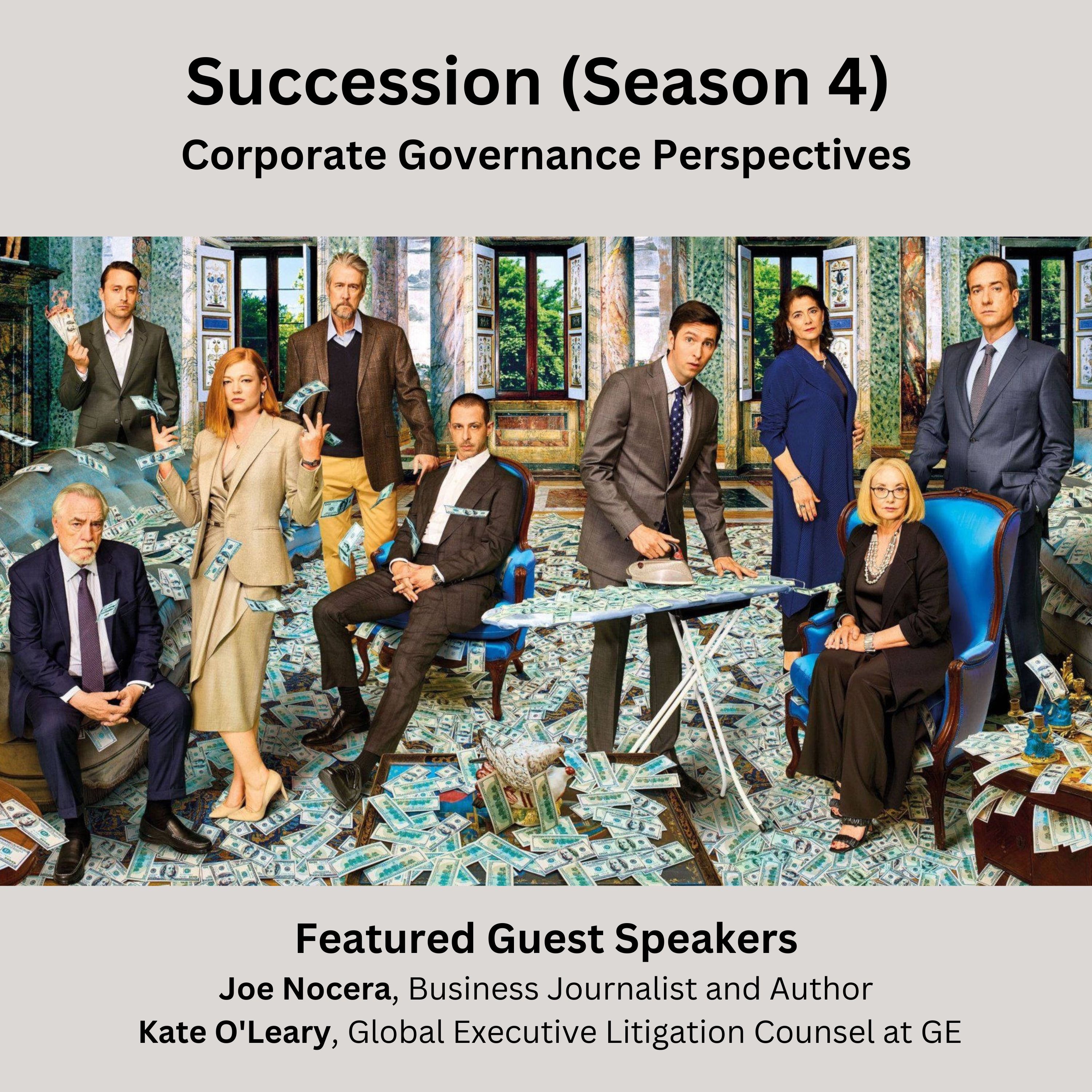
Ep 120Joe Nocera and Kate O'Leary: Unpacking HBO's Succession (Season 4).
*Prior episodes reviewing Succession:Season 1: E98 (May 22, 2023)Season 2: E102 (June 26, 2023)Season 3: E109 (Sept 11 , 2023)0:00 -- Intro.2:12-- About the podcast sponsor: The American College of Governance Counsel.2:58 -- Start of interview.3:54 -- On the influence and leadership style of Logan Roy. The "ultimate corporate governance challenge."6:41 -- Comparing the (fictional) Roy family with the (real) Murdochs and Sultzbergers. "Why is Logan trying to sell Waystar? The answer is simple. He knows his kids can't cut it. So, his way of getting out of this whole dilemma is to sell the company, give the kids billions of dollars, you know, as their share for their stock, and then let them all go their own way."09:47 -- On dual-class share structures. "[In the media business] just because you have dual shares doesn't mean you will always be protected from the vagaries of the marketplace." (example: the Bancroft family with the WSJ).13:06 -- On the role of media and politics. Joe Nocera: "My line on succession is using succession to understand corporate America is like using the Simpsons to really understand small towns." 18:42 -- On corporate money in politics: "Forget Presidential elections. The real thing that happens in real life is that companies give lots of money to congressmen and senators who are on committees that they care about and who are willing to do their bidding. That's how it works. And that's why the little guy always gets screwed in these things, because they don't have the potency. They don't have the money. They don't have the access. And in terms of influence, it's not just media. It's all kinds of companies that are doing this for their own interest. And that's the way the world works. Is it nice? Is it good? No, not necessarily, but that's how it works."19:57 -- On fraud and stockholder litigation. The overstating of subscribers in India by GoJo.24:05 -- The role of the board of Waystar Royco in the takeover negotiation with GoJo. The example of Twitter acquisition by Elon Musk, and HP-Autonomy. Joe Nocera: "Companies overpay all the time because the CEO wants to build his empire, because they think there's something there that turns out not to be there, because they're in a competition with another company and they got to have this victory. Overpaying is very normal and then you have these multi-billion dollar write-downs blah blah blah."28:23 -- Comparing Lukas Matsson to Elon Musk. "The rise of the ungovernable CEO."30:34 -- On obstacles to women in the workplace. The cases of Shiv, Geri and Ebba. Kate: "It's an extreme version, but these are real issues that real women face all the time. I don't know that there's a corporate governance solution to it, other than culture, right? You know, it all comes back to culture and how you build culture." 36:35 -- On corporate culture: Joe: "In the modern age, the Rupert Murdochs and the Logan Roys are anomalies. I mean, you've got a situation now where David Solomon at GS is being widely criticized. Why? Because he's a harsh boss, he's a brutal boss, he makes demands, he's not an empathetic person. And nowadays companies want leaders that can nurture and lead by example and can get people to do things because they want to do them for the person or the company rather than they have to. And so, and then, you know, nowadays they can't even get the employees to come to work."39:12 -- On ESG and the politicization of corporate governance. Joe: "Why did the ESG come along in the first place?A lot of the reason is because the employee base at a company like Kellogg's, or Procter & Gamble, or Xerox, or IBM, they're mostly socially liberal. They're pro-choice. They're pro-environment. They're pro-BLM. And a lot of this movement began in the first place because companies wanted to make their employees happy. They wanted to give their employees a sense of a higher purpose than just, you know, banging out copier machines. And so ESG evolved. You go to a company like General Mills or Kellogg's and you walk down the aisle [...]And all on the walls, you're going to see, you know, come and help build a house for the homeless next Saturday. Or, you know, we're going to be the greenest company in the world in five years. Here's what we need to do. Or blah, blah, blah. People inside these companies are not complaining about it. They like it. [T]he conservative movement has made a big deal about this and they've gone after Larry Fink at BlackRock, but to me, 90% of it is bullshit. It's just, you know, ESG is a way to make your employees happy. That's all it is. And for the conservatives, it's a lovely way to bash corporations."43:54 -- On the last boardroom scene, voting for the GoJo takeover.46:36 -- Take-aways for corporate directors from the Succession show. Kate: "I think it's a tremendous cautionary tale for directors and officers and leaders of companies in terms of the core part of governance, which I believe is, how do you make decisions? How does a cor