PLAY PODCASTS
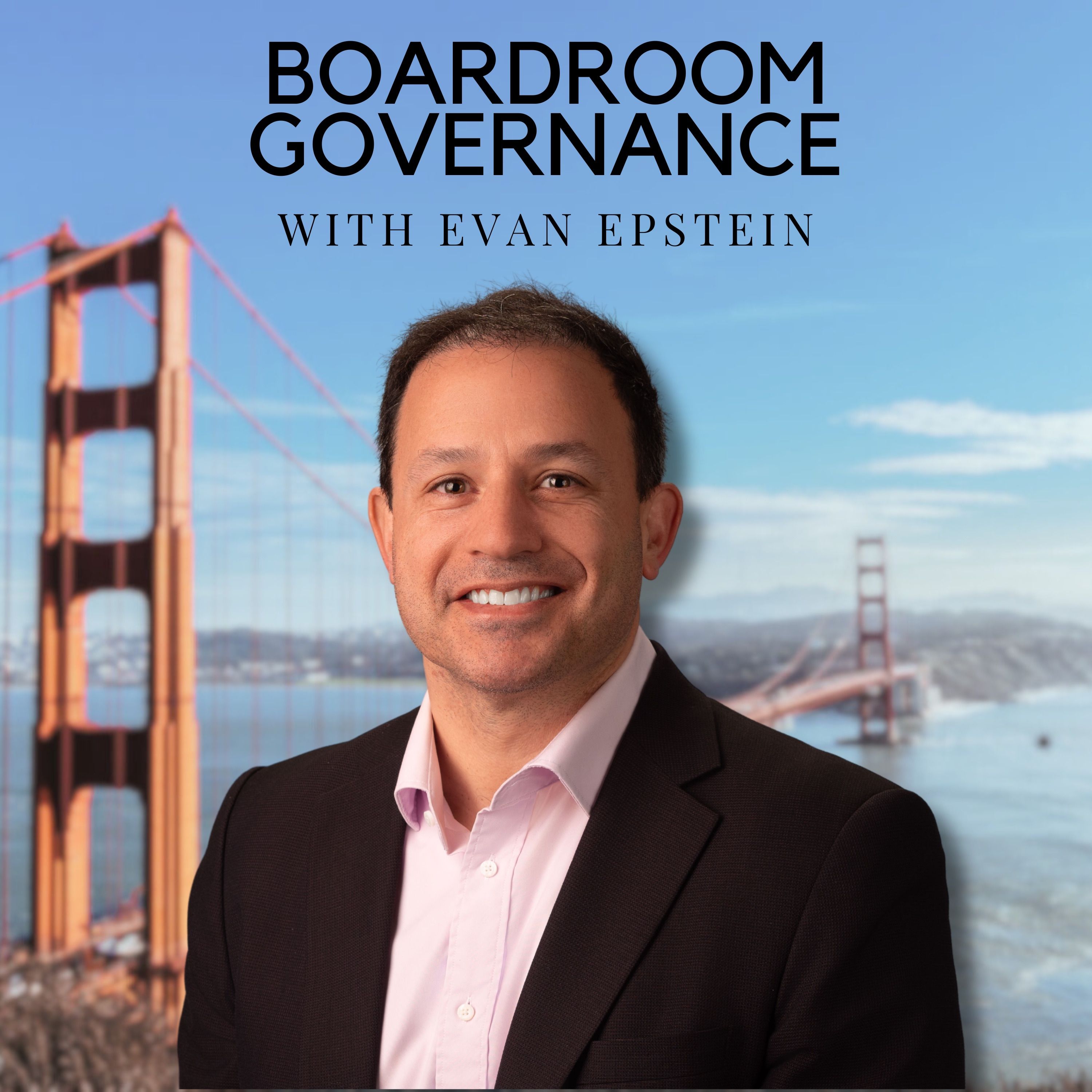
Boardroom Governance with Evan Epstein

Boardroom Governance with Evan Epstein

Evan Epstein · Pacifica Global, LLC

209 episodesEN

Show overview

Boardroom Governance with Evan Epstein has been publishing since 2020, and across the 6 years since has built a catalogue of 209 episodes, alongside 1 trailer or bonus episode. That works out to roughly 200 hours of audio in total. Releases follow a fortnightly cadence.

Episodes typically run thirty-five to sixty minutes — most land between 52 min and 1h 1m — and the run-time is fairly consistent across the catalogue. It is catalogued as a EN-language Business show.

The show is actively publishing — the most recent episode landed 3 days ago, with 13 episodes already out so far this year. Published by Pacifica Global, LLC.

Episodes
209
Running
2020–2026 · 6y
Median length
58 min
Cadence
Fortnightly

From the publisher

In-depth interview podcast with leading corporate governance experts, including world-class founders, scholars, board members, executives, investors and more. The content is structured as a long-form conversation to explore not only the latest corporate governance trends, but also to get some personal insights from some of the best and brightest minds behind America's boardrooms.

Latest Episodes

View all 209 episodes

Marie Oh Huber: Governing Through Disruption

May 11, 202657 min

Eddie Ramos: How AI Is Reshaping Investing and Boardrooms

May 4, 202659 min

Steven Lipin: Activism, M&A, and the Rising Stakes of Board Communication

Apr 21, 202656 min

Ep 205Benjamin Means: The Principles of Family Business Law and Governance

(0:00) Intro, *Reference to prior episode with Ben Means (E105) (1:36) About the podcast sponsor: The American College of Governance Counsel. (2:23) Start of interview. (3:39) The Premise of his new book Family Business Law (6:48) Understanding Shareholder Oppression (10:17) The Three-Circle Model Explained (13:34) The Personal Impact of Family Business (16:24) Boards in Family Businesses (18:09) The Importance of Voice (20:47) Overlapping Family and Business Law *Reference to my episodes on HBO's Succession (24:36) The Succession Challenge (transference to next generation or sale of company) (28:18) Fiduciary Duties and Governance. *Reference to the Market Basket litigation (34:03) Family Protocols: A Solution? (35:13) Societal Impact of Family Businesses *Reference to E204 with Eric Ries (38:24) Innovations in Governance and Family Businesses. Pros and Cons of LLCs (42:56) Features of a New Family Structure (46:05) The Rise of Family Offices Benjamin Means is a Professor of Law, the John T. Campbell Chair in Business and Professional Ethics, and Director of the Family & Small Business Program at the University of South Carolina Joseph F. Rice School of Law. You can follow Evan on social media at:X: @evanepsteinLinkedIn: https://www.linkedin.com/in/epsteinevan/ Substack: https://evanepstein.substack.com/__To support this podcast you can join as a subscriber of the Boardroom Governance Newsletter at https://evanepstein.substack.com/__Music/Soundtrack (found via Free Music Archive): Seeing The Future by Dexter Britain is licensed under a Attribution-Noncommercial-Share Alike 3.0 United States License

Apr 7, 202648 min

Ep 204Eric Ries: Incorruptible, and the Case for Long-Term Governance Reform

(0:00) Intro (1:40) About the podcast sponsor: The American College of Governance Counsel (2:26) Start of interview (3:19) Eric's origin story (5:00) The Lean Startup Journey (10:23) About The Long-Term Stock Exchange (18:00) Governance and Eric's New Book Incorruptible (24:14) On Governance in Startups vs. Public Companies and so-called "best practices." "One of the key ideas in the book is that it's always too early until it's too late." (28:37) Why the title Incorruptible. How to become an incorruptible force for good in the world. (33:15) The board members' sacred obligation. The call for a director's oath. (34:40) The concepts of Financial Gravity and Career Equity. "The force that no one controls, but everyone obeys." "The number one thing CEOs notice before and after the IPO: every employee is looking at the stock ticker every day." (41:38) Innovations in AI Governance (OpenAI, Anthropic, etc) "A new old idea" (44:36) On the Public Benefit Corporation (PBC) structure. (46:25) The Case for New Governance Structures. "The shareholder primacy debate has become completely divorced from the actual material interests of shareholders." The example of Costco. (52:45) On Dual-Class Share Structures. "I don't think emperor for life is a great political system" "[The] standard governance [model] has to be really bad for dictator for life to be an improvement." "I'm interested in trying to create what I call the architecture of institutional longevity. What would it take to create organizations that can endure for decades or even centuries? In order to do that, by definition, we have to find ways to encode the ethos." (56:51) Mission-Locked Constellations. "Structures that involve many different entities that are locked together to act as a bit of an immune system against corruption." "The spiritual holding company: a constellation of multiple entities where some entity has the responsibility of being at the center to provide basically mission protection as a service to the for-profit entities under its purview." (1:01:07) The Novo Nordisk story. *reference to the Acquired podcast episode. (1:07:10) Books that have greatly influenced his life: The Machine that Changed the World, by James P. Womack, Daniel T. Jones, and Daniel Roos (1990) Toyota Production System, by Taiichi Ohno (2001) Toyota Way, by Jeffrey Liker (2003) Dune, by Frank Herbert (1965) The Dawn of Everything, by David Graeber and David Wengrow (2021) The Enlightened Capitalists, by James O'Toole (2019) (1:12:20) His mentors. Steve Blank, Ken Duda, Maliz Beams, Dario Amodei, Brian Chesky, Matthew Prince, Sid Sijbrandij, Dustin Moskovitz, James Reinhart, Todd Park. (1:14:00) Quotes that he thinks of often or lives her life by "Nothing real can be threatened, and nothing unreal exists" (from A Course in Miracles) (1:15:25) An unusual habit or an absurd thing that he loves (1:16:08) The living person he most admires Eric Ries is the Creator of the Lean Startup method and author of The Lean Startup, he has spent two decades reshaping how companies are built and managed. He is also the founder of the Long-Term Stock Exchange (LTSE) and host of The Eric Ries Show podcast. More info on his latest book Incorruptible here. You can follow Evan on social media at:X: @evanepsteinLinkedIn: https://www.linkedin.com/in/epsteinevan/ Substack: https://evanepstein.substack.com/__To support this podcast you can join as a subscriber of the Boardroom Governance Newsletter at https://evanepstein.substack.com/__Music/Soundtrack (found via Free Music Archive): Seeing The Future by Dexter Britain is licensed under a Attribution-Noncommercial-Share Alike 3.0 United States License

Mar 31, 20261h 18m

Ep 203Benjamin Edwards: The Rise of Nevada in the Reincorporation Debate

(0:00) Intro (1:31) About the podcast sponsor: The American College of Governance Counsel (2:18) Start of interview (3:10) Ben's origin story (7:14) Embracing Nevada as Home. Joining University of Nevada Las Vegas (UNLV) in 2017. (10:14) Joining Wilson Sonsini as Senior of Counsel (2026) (13:00) The Reincorporation Movement. Competition between Delaware, Texas, Nevada and others. *Reference to E201 with Leo Strine (14:28) Tracking Company Reincorporation Movements (at Business Law Prof Blog) (16:02) The Texas vs. Nevada Landscape (17:50) Reasons Companies Move Jurisdictions *Reference to E194 with Richard Blake on SV150 companies (23:15) Delaware advantages (25:32) How Nevada is competing: "[W]e need to be able to do is reduce the friction and the barriers to picking Nevada as a jurisdiction." (26:09) Delaware's SB21 and Its Implications. *Reference to Cornerstone Research report on the increase of M&A settlements and paper Is Delaware Different? Stockholder Lawyering in the Court of Chancery by Jessica Erickson, Adam Pritchard, and Stephen Choi (31:54) The Race to the Bottom theory *Reference to E200 with Betsy Atkins (34:50) Nevada's Business Courts and Future Changes (constitutional amendment) (41:44) The IPO Landscape: Trends and Insights (Delaware fell from over 80% of IPO incorporations in 2022-2024 to just under 62% in 2025; Nevada reached ~17%, and Texas just under 4%). Bill Ackman picking Nevada for the IPO of Pershing Square. (44:45) Addressing Nevada's Reputation (the example of LQR House reincorporating from Nevada to Delaware) *Reference to the Startup Litigation Digest (49:06) Founder-Led Companies and Jurisdiction Choices. Example of Mark Pincus: Founders, Leave Delaware (While You Still Can) (53:46) Nevada’s Commission to Study the Adjudication of Business Law Cases (55:50) Books that have greatly influenced his life: Give and Take, by Adam Grant (2013) Drive, by Daniel Pink (2009) Chimpanzee Politics, by Frans de Waal (1982) (57:16) His mentors. (58:16) Quotes that he thinks of often or lives her life by "To have a friend, you got to be a friend." (58:39) An unusual habit or an absurd thing that he loves (58:57) The living person he most admires Benjamin Edwards is a Professor of Law at the William S. Boyd School of Law at the University of Nevada, Las Vegas (UNLV). Ben also recently joined Wilson Sonsini as Senior Of Counsel to provide guidance to Nevada-incorporated companies. You can follow Evan on social media at:X: @evanepsteinLinkedIn: https://www.linkedin.com/in/epsteinevan/ Substack: https://evanepstein.substack.com/__To support this podcast you can join as a subscriber of the Boardroom Governance Newsletter at https://evanepstein.substack.com/__Music/Soundtrack (found via Free Music Archive): Seeing The Future by Dexter Britain is licensed under a Attribution-Noncommercial-Share Alike 3.0 United States License

Mar 23, 20261h 0m

Ep 202Joelle Emerson: Why Company Culture Is a Core Governance Issue

(0:00) Intro (1:35) About the podcast sponsor: The American College of Governance Counsel (2:22) Start of interview (3:01) Joelle's origin story (7:00) The Journey of Paradigm, the culture company she co-founded in 2014. "Our goal is to help organizations build healthy and high performing cultures where people from all backgrounds can come together, do their best work and thrive." (11:15) On the current backlash against DEI. (16:49) On Coinbase's "mission focused company" statement in 2020. (21:53) The Politics of Company Culture, and Silicon Valley's approach. (26:15) The Shift from Public to Private Companies (29:33) AI's Impact on the Workforce (35:18) The Role of the Board on Workplace Culture (37:23) Talent executives and CHROs on Boards (39:54) Rethinking Compliance in Organizations (42:43) Evaluating an organization's culture (45:22) Books that have greatly influenced her life: Growth Mindset, by Carol Dweck (2007) Abundance, by Ezra Klein and Derek Thompson (2025) Sea of Tranquility, by Emily St. John Mandel (2022) (47:04) Her mentors. (48:24) Quotes that she thinks of often or lives her life by "Do the best you can until you know better. And then when you know better, do better." (Maya Angelou) "Forward is a pace" (heard from a Peloton instructor, Robin Arzon) (49:08) An unusual habit or an absurd thing that she loves (49:44) The living person she most admires (inspiring now): Lindsey Vonn. (50:30) The Unique Perspective of a Lawyer-CEO Joelle Emerson is the CEO and co-founder of Paradigm, a company that empowers organizations to create innovative, high-performance workplaces where everyone can do their best work. You can follow Evan on social media at:X: @evanepsteinLinkedIn: https://www.linkedin.com/in/epsteinevan/ Substack: https://evanepstein.substack.com/__To support this podcast you can join as a subscriber of the Boardroom Governance Newsletter at https://evanepstein.substack.com/__Music/Soundtrack (found via Free Music Archive): Seeing The Future by Dexter Britain is licensed under a Attribution-Noncommercial-Share Alike 3.0 United States License

Mar 9, 202652 min

Ep 201Leo Strine: Delaware’s Moment, AI Guardrails, and a Call of Conscience

(0:00) Intro (1:29) About the podcast sponsor: The American College of Governance Counsel. (2:15) Start of interview. *Reference to prior episode with Leo Strine (E100) (3:09) The Call of Conscience and The Current Moment (reference to his speech at the Weinberg Center in Oct of 2025) (5:18) Skepticism about Credibility of the Elite Among the Youth (7:02) The Ethical Muscle (8:20) Acknowledging Discrimination (8:56) The Climate Crisis (12:37) Shifts in Delaware Law (13:45) Return to Traditions. "What Delaware has done is return to its traditions that existed the entire time I was a judge." (14:28) The Controlled Company Debate and the MFW standard. (25:00) On the recent pushback against incorporating in Delaware: "I don't minimize the moment" (32:00) Section 220 Books and Records under SB21 (34:20) The statute was amended to provide more predictability. It actually looks like the Model Business Corporation Act. "I think both elements of this statute balance fairness and efficiency in a really good way." (39:54) Activist Judges and Delaware. "This was a nonpartisan initiative to restore confidence in Delaware's corporate law. I have the utmost respect for our judiciary, I'm proud to have been part of it, and I believe they will follow the law." (42:26) Delaware's Competitive Edge (48:25) The Rise of AI Companies (52:16) Energy Demand from AI. From guardrails to "trust us" (58:39) The Urgency of Leadership (1:01:59) Davos looks like a portrait of leadership failure "either eliminate it or make it real." Leo E. Strine, Jr., is Of Counsel at Wachtell, Lipton, Rosen & Katz. Prior to joining WLRK, he was the Chief Justice of the Delaware Supreme Court from early 2014 through late 2019. You can follow Evan on social media at:X: @evanepsteinLinkedIn: https://www.linkedin.com/in/epsteinevan/ Substack: https://evanepstein.substack.com/__To support this podcast you can join as a subscriber of the Boardroom Governance Newsletter at https://evanepstein.substack.com/__Music/Soundtrack (found via Free Music Archive): Seeing The Future by Dexter Britain is licensed under a Attribution-Noncommercial-Share Alike 3.0 United States License

Feb 23, 20261h 6m

Ep 200Betsy Atkins: Why Directors Must Become More Entrepreneurial and Change-Adaptive

(0:00) Intro(2:04) About the podcast sponsor: The American College of Governance Counsel(2:50) Start of interview(3:51) Betsy's origin story(9:14) The HealthSouth Board Scandal(16:35) Her preference when picking what boards to serve on(17:30) Insights VC-backed Boards and role and profile of the independent director in this context(21:20) Insights on PE-backed Boards and role and profile of the independent director in this context(25:35) Navigating International Board Dynamics. Her experience on boards of Volvo and Schneider Electric.(30:57) The Rise of Private Markets. Example of Atlas Air (Apollo backed). IPOs in 2026.(35:07) AI's Impact on the Market and other macro trends(38:10) Founder-Led Companies and Governance (including dual-class share structures).(42:25) The Impact of Geopolitics on Governance(45:11) The Impact of Politicization on Governance. Examples of Budweiser, Google, Netflix, and the mission-driven approach by Coinbase.(50:09) Adapting to Accelerating Change as Directors. The problem with incrementalist "custodian" directors in times of disruption. "It's really about being change-adaptive and comfortable making decisions with incomplete information. You look at someone like Musk, he's making decisions when he has 60% of the information. Most boards want 95% before they'll move. That's the fundamental challenge."(55:58) Books that have greatly influenced her life ("the best business book"):Good to Great, by Jim Collins (2001)(56:16) Her mentors. Craig Billings (CEO Wynn Resorts), Michael Steen (CEO Atlas Air Cargo), Jean-Pascal Tricoire (Chairman, Schneider), her mom ("her biggest mentor").(57:06) On the current state of shareholder activism(57:58) Quotes that she thinks of often or lives her life by "Perfect is the enemy of good enough." (58:19) An unusual habit or an absurd thing that she loves: she's a compulsive note-taker (plus, her recommended policy for directors)(1:00:12) The living person she most admires: Elon MuskBetsy Atkins has served on more than 38 public company boards and through 17 IPOs, in addition to scores of PE and VC-backed company boards. She brings a rare perspective shaped by crisis situations, international board service, and rapid technological change. She currently serves on the boards of Wynn Las Vegas, GoPuff, and the Google Cloud Advisory Board. You can follow Evan on social media at:X: @evanepsteinLinkedIn: https://www.linkedin.com/in/epsteinevan/ Substack: https://evanepstein.substack.com/__To support this podcast you can join as a subscriber of the Boardroom Governance Newsletter at https://evanepstein.substack.com/__Music/Soundtrack (found via Free Music Archive): Seeing The Future by Dexter Britain is licensed under a Attribution-Noncommercial-Share Alike 3.0 United States License

Feb 9, 20261h 2m

Ep 199Michael Ewens (Columbia Business School): What the Data Reveals About Startup Boards and Private Equity

(0:00) Intro(1:19) About the podcast sponsor: The American College of Governance Counsel(2:05) Start of interview (2:48) Michael's origin story. Academic Journey and Early Influences. *reference to Correlation Ventures(8:55) About his paper Board Dynamics over the Startup Life Cycle (2020) with Nadia Malenko. (11:30) Role of independent directors in VC-backed companies.(16:05) Control Dynamics in Startup Boards(17:21) The Evolution of Founder Control *Reference to E187 with Brad Feld (Oct 2025)(28:11) The Future of Private Markets(29:21) The Future of IPOs “What’s been missing from the IPO market since 1996 is the small- to mid-cap company. In my view, the solution for public markets is to restore their uniqueness by shutting down private secondary markets and making public-market liquidity distinctive again.”(33:40) The Role of Private Equity in Governance(39:47) Distinctions Between VC and PE Boards(42:24) Insights from Private Equity for Public Companies “A PE firm is really an investment bank with a consulting arm, where the partners sit on both sides and have equity in the whole game.” "What PE solves is expertise alignment, and a clear investment horizon for an exit."(47:36) The Impact of AI on Board Governance(50:20) Books that have greatly influenced his life:One Hundred Years of Solitude by Gabriel Garcia Marquez (1967)Culture Series by Ian Banks (1987-2012)A Brief History of Intelligence by Max Bennett (2023)(53:14) His mentors (54:24) Quotes that he thinks of often or lives his life by: "All models are wrong, but some are useful" by George Box(53:15) An unusual habit or an absurd thing that he loves. Watching the Big Lebowski.(55:53) The living person he most admires: Derek Thomson.(57:26) Moving from VC to PE Research in New YorkMichael Ewens is the David L. and Elsie M. Dodd Professor of Finance and co-director of the Private Equity Program at Columbia Business School. You can follow Evan on social media at:X: @evanepsteinLinkedIn: https://www.linkedin.com/in/epsteinevan/ Substack: https://evanepstein.substack.com/__To support this podcast you can join as a subscriber of the Boardroom Governance Newsletter at https://evanepstein.substack.com/__Music/Soundtrack (found via Free Music Archive): Seeing The Future by Dexter Britain is licensed under a Attribution-Noncommercial-Share Alike 3.0 United States License

Feb 3, 202659 min

Ep 198Jennifer Ceran: From Treasury to CFO to the Boardroom

(0:00) Intro(1:36) About the podcast sponsor: The American College of Governance Counsel(2:22) Start of interview(3:21) Jennifer's origin story(8:06) Journey to Treasury starting with Sara Lee Corporation, to Cisco and eBay (20-year career in Treasury)(15:05) From Box to CFO roles at Coupons.com and Smartsheet (took it public as CFO)(20:50) Building a Board Career: True Search, Auth0 (acq by Okta), Nerd Wallet, Wyze, Riskified and Klaviyo.(23:40) Private vs. Public Boards(27:47) On founder-led companies(30:01) The Role of Audit Committees(30:50) Navigating AI in the board(36:37) On increased politicization and geopolitics in the boardroom(38:44) CEO-CFO strategy and talking about the hard stuff(40:22) Qualities of a Great Board Member: "The best board members ask the right questions at the right time in the right tone" (from Anita Sands). "They're willing to help in however the company wants them to help."(44:05) Effective Board Meetings(45:59) Books that have greatly influenced her life:Gifts Differing by Isabel Briggs Myers (1980)Discover your Strengths by Donald O. Clifton and Marcus Buckingham (2001)Dare to Lead by Brené Brown (1980)(48:36) Her mentors (50:09) Quotes that she thinks of often or lives her life by "Don't take no for an answer and don't give up" (51:09) An unusual habit or an absurd thing that she loves: Family Search(53:40) The living person she most admires: Taylor SwiftJennifer Ceran is a seasoned finance executive and board member whose career spans treasury leadership, the CFO role, and public and private company board service. Jennifer currently serves on the boards of NerdWallet, Wyze, Riskified, Klaviyo, Flock Safety, and Mesh Payments. You can follow Evan on social media at:X: @evanepsteinLinkedIn: https://www.linkedin.com/in/epsteinevan/ Substack: https://evanepstein.substack.com/__To support this podcast you can join as a subscriber of the Boardroom Governance Newsletter at https://evanepstein.substack.com/__Music/Soundtrack (found via Free Music Archive): Seeing The Future by Dexter Britain is licensed under a Attribution-Noncommercial-Share Alike 3.0 United States License

Jan 27, 202655 min

Ep 197Jeff Epstein (Bessemer Venture Partners): Why Effective Boards Spend Time on Decisions Not Yet Made

(0:00) Intro(1:45) About the podcast sponsor: The American College of Governance Counsel(2:31) Start of interview(3:04) Jeff's origin story. Began career in investment banking at First Boston before transitioning to a 25-year run as CFO across media companies (King World, Nielsen) and tech (DoubleClick, Oracle).(7:16) Transitioning to Bessemer Venture Partners.(8:40) Focusing on his board career and audit committee member. ValueClick, Priceline (Booking Holdings).(11:06) Growth in Public vs. Private Markets(12:49) The State of European Entrepreneurial Ecosystem(13:41) The Role of BVP CFO Council(15:31) Understanding California and Silicon Valley's Unique Culture(18:44) AI's impact on the CFO role(20:54) Dynamics Between CEOs and CFOs(23:12) CFOs in Startups vs. Public Companies "We've observed that about 5% of the headcount of any co' at any size is in the finance dpt.")(25:25) CFOs as Board Members(27:35) Board decisions on CEO hiring and firing. "The CEO's role is to articulate an effective strategy, to hire a great team, and then to execute that strategy well using that great team." "If over five years the CEO has never changed their mind based on board input, you have the wrong board."(30:36) On effective Board Composition(32:41) Navigating Shareholder Activism, including his experience at Twilio(37:35) The Debate: Stay Private or Go Public. "There are three ownership structures: public companies, PE-owned companies (where PE controls CEO), and founder-controlled private companies" "I think you're going to see quite a few companies stay private forever or for decades."(39:30) Preparing for the Future of Venture Capital (41:13) Optimizing Board Meeting Content. "Effective boards: 2/3 of time on未made decisions. Ineffective boards: show and tell." "Best-run companies: CEO encourages board members to meet with executives outside board meetings."(45:50) Books that have greatly influenced his life:The Snowball: Warren Buffett and the Business of Life by Alice Shroeder (2008)My Early Life by Winston Churchill (1930) How to Talk So Kids Will Listen & Listen So Kids Will Talk by Adele Faber and Elaine Mazlish (1980)(47:07) His mentors (50:50) Quotes that he thinks of often or lives his life by "You want to live your life to have a seamless web of deserved trust" by Charlie Munger(53:15) An unusual habit or an absurd thing that he loves. Reading adventure stories from G.H. Henty(54:01) The living person he most admires: Warren BuffettJeff Epstein is an operating partner of Bessemer Venture Partners where he leads BVP’s CFO Council. He is a former CFO of Oracle and currently serves on the boards of Autodesk, AvePoint, Okta, and Twilio (previously at Kaiser Permanente and Booking Holdings). You can follow Evan on social media at:X: @evanepsteinLinkedIn: https://www.linkedin.com/in/epsteinevan/ Substack: https://evanepstein.substack.com/__To support this podcast you can join as a subscriber of the Boardroom Governance Newsletter at https://evanepstein.substack.com/__Music/Soundtrack (found via Free Music Archive): Seeing The Future by Dexter Britain is licensed under a Attribution-Noncommercial-Share Alike 3.0 United States License

Jan 20, 202655 min

Ep 196Joe Grundfest (Stanford): 2026 Predictions and 2025 Reflections

(0:00) Intro(2:00) About the podcast sponsor: The American College of Governance Counsel.(2:45) Start of interview. *Reference to prior episodes with Joe (E1 from '20, E35 from '21, E84 from '23, E123 from '24 and E161 from '25)(4:43) IPO Environment. Reference to paper by Mark Roe: Half the Firms, Double the Profits(11:58) Elon Musk's $1 Trillion Pay Plan "We will pay you an outrageous amount if you achieve preposterous results."(14:40) Delaware's Supreme Court Decision Reversing the Chancery's Rescission of Elon's $56B (now $139B) Tesla comp (20:08) The AI Bubble "We're either in a bubble or a bubble is inevitable."(25:24) OpenAI's Restructuring *more about the restructuring in this article(28:18) Predictions on Elon Musk vs OpenAI trial(32:47) Delaware Exodus "I describe Delaware now as the prostate of corporate law" "it's too soon to make a move from Delaware"(36:16) Evolution of the Caremark Doctrine "the big enchilada"(38:09) Delaware Attorney Fee Awards. *Reference to Joe Grundfest's paper on this topic.(40:34) SEC enforcement focus (41:20) Biggest winner in business in 2025(42:42) Biggest loser in business in 2025(44:11) Biggest business surprise in 2025(44:46) Best corporate governance trend from 2025(46:00) Worst corporate governance trend from 2025(48:28) What’s the biggest corporate governance trend to watch out for in 2026(50:00) Thoughts on SEC (and other agencies) having Commissioners from a single party(54:34) The Chicken!Joe Grundfest is W.A. Franke Professor of Law and Business Emeritus at Stanford Law School, and Senior Faculty of the Arthur and Toni Rembe Rock Center for Corporate Governance You can follow Evan on social media at:X: @evanepsteinLinkedIn: https://www.linkedin.com/in/epsteinevan/ Substack: https://evanepstein.substack.com/__To support this podcast you can join as a subscriber of the Boardroom Governance Newsletter at https://evanepstein.substack.com/__Music/Soundtrack (found via Free Music Archive): Seeing The Future by Dexter Britain is licensed under a Attribution-Noncommercial-Share Alike 3.0 United States License

Jan 12, 202656 min

Ep 195David Berger: Year-End Reflections on Corporate Governance and the Road Ahead

(0:00) Intro(1:31) About the podcast sponsor: The American College of Governance Counsel.(2:18) Start of interview. *Reference to prior episodes with David (E24 from Nov 2020 and E159 from Dec 2024)(3:22) 2025 highlights from the American College of Governance Counsel(4:55) The Rome Conference on AI, Ethics, and the Future of Corporate Governance(6:52) The Dual-Class Share Debate (reference to his paper Performance Leads Governance)(12:06) Emerging Governance Structures in AI companies, including Public Benefit Corporations (PBCs) "mission driven"(23:02) The AI Bubble Debate ("from a technology standpoint, I don't think we're in a bubble. From a valuation standpoint, we may be very well in a bubble.") Reference to my article on AI Washing Goes Criminal.(27:00) Big Tech vs. Little Tech Dynamics "We're going to have, at some point, a shakeout. It's impossible for all of these companies to be successful."(29:55) The Shift to Private Markets(34:15) Delaware's Governance Challenges (*reference to E194 on Silicon Valley 150 Report) "Since TripAdvisor, about 50 companies have left Delaware."(39:45) AI and Cybersecurity in the Boardroom(40:42) On Mandatory Arbitration(42:03) Biggest winner in business in 2025: Tech broadly, Silicon Valley particular.(43:40) Biggest loser in business in 2025: Delaware(45:15) Biggest business surprise in 2025(47:19) Best corporate governance trend from 2025: Renewed and strong focus on ethics.(50:00) Worst corporate governance trend from 2025: Partisanship(50:58) What’s the biggest corporate governance trend to watch out for in 2026: the role of politics in the boardroom(51:35) One piece of advice for directors heading into 2026: the role of AI in the boardroom and in the companyDavid Berger is a partner at Wilson Sonsini and the President of the American College of Governance Counsel. You can follow Evan on social media at:X: @evanepsteinLinkedIn: https://www.linkedin.com/in/epsteinevan/ Substack: https://evanepstein.substack.com/__To support this podcast you can join as a subscriber of the Boardroom Governance Newsletter at https://evanepstein.substack.com/__Music/Soundtrack (found via Free Music Archive): Seeing The Future by Dexter Britain is licensed under a Attribution-Noncommercial-Share Alike 3.0 United States License

Dec 23, 202553 min

Ep 194Richard Blake: Key Takeaways from the 2025 Silicon Valley 150 Governance Report

(0:00) Intro.(1:27) About the podcast sponsor: The American College of Governance Counsel.(2:14) Start of interview. *Reference to prior episodes/reports with Richard (E126 from Feb 2024 and E158 from Dec 2024)(3:11) AI dominance in public and private markets(4:14) About WSGR's 2025 SV150 Corporate Governance Report. Major Findings in DEI Disclosure (impact on board diversity)(12:25) Broader ESG Changes and Challenges to SEC Climate Disclosure Rule(16:03) California approach to climate risk disclosures (SB 253 and SB 261) and greenhouse gas emissions disclosure(19:04) State vs. Federal Regulatory Landscape(21:13) On SEC's change of policy relating to mandatory arbitration bylaws(23:41) SEC Changes Under Chair Atkins: changes in exec comp disclosures and removing quarterly reporting (27:18) SEC Changes to Rule 14a-8 proposals(29:23) On Lack of Minority Party SEC Commissioners(32:30) Delaware vs. Other States on Corporate Incorporations(39:26) Other findings from the 2025 report. Including on dual-class shares and sunset provisions.(41:12) The State of Private Markets, IPOs and VC(49:55) Biggest winner in business in 2025(50:55) Biggest loser in business in 2025(53:00) Biggest business surprise in 2025(54:32) Best and worst corporate governance trend from 2025(58:18) What’s the biggest corporate governance trend to watch out for in 2026Richard Blake is a partner at Wilson Sonsini and the leader of the firm's public companies’ practice. You can follow Evan on social media at:X: @evanepsteinLinkedIn: https://www.linkedin.com/in/epsteinevan/ Substack: https://evanepstein.substack.com/__To support this podcast you can join as a subscriber of the Boardroom Governance Newsletter at https://evanepstein.substack.com/__Music/Soundtrack (found via Free Music Archive): Seeing The Future by Dexter Britain is licensed under a Attribution-Noncommercial-Share Alike 3.0 United States License

Dec 15, 20251h 0m

Ep 193Michelle Leder (Footnoted): Uncovering Hidden Risks in SEC Filings

(0:00) Intro(1:21) About the podcast sponsor: The American College of Governance Counsel(2:08) Start of interview(2:36) Michelle's origin story(4:33) The Origins of Footnoted (started in 2003)(6:36) Understanding SEC Filings and Disclosures(7:20) The "Friday Night Dump"(9:34) The State of Public vs. Private Markets(12:40) The Rise of Private Markets and Challenges of Public Markets(18:43) Red Flags in SEC Filings(22:03) The Evolution of Executive Compensation and Elon Musk's Comp(28:53) Egregious Corporate Governance examples: Sketchers.(30:08) The problem of Related Party Transactions.(31:37) Independence and Compensation of Board Members (32:36) Quote of Charlie Munger and Warren Buffett on this topic(36:33) Are we in a AI bubble? Similarities with Enron/Worldcom era? (40:18) Reference to my article on AI washing(41:43) The Importance of SEC Changes (only 3 commissioners from a single party)(43:22) The Role of Markets in Everyday Life(47:45) Books that have greatly influenced her life:The Jungle by Upton Sinclair (1906)Germinal by Émile Zola (1885)Crying in H Mart by Michelle Zauner (2021)(48:20) Her mentors: Nell Minow, Diana Henriques, and Thornton O'Glove.(49:19) Quotes that she thinks of often or lives her life by: "Don't Postpone Joy"(50:52) An unusual habit or an absurd thing that she loves. Michelle Leder is the founder and editor-in-chief of footnoted.com, a source for uncovering important information hidden deep in SEC filings. You can follow Evan on social media at:X: @evanepsteinLinkedIn: https://www.linkedin.com/in/epsteinevan/ Substack: https://evanepstein.substack.com/__To support this podcast you can join as a subscriber of the Boardroom Governance Newsletter at https://evanepstein.substack.com/__Music/Soundtrack (found via Free Music Archive): Seeing The Future by Dexter Britain is licensed under a Attribution-Noncommercial-Share Alike 3.0 United States License

Dec 8, 202552 min

Ep 192Erik Lie: Catching Cheats, Fraud Detection, and the Board’s Evolving Role

(0:00) Intro(1:30) About the podcast sponsor: The American College of Governance Counsel(2:16) Start of interview(3:01) Erik's origin story(6:10) His role at the Tippie College of Business at the University of Iowa.(7:49) Exploring his book Catching Cheats(9:39) About the field of forensic economics(11:00) The Challenge of Private Market Data and Fraud *Reference to our Startup Litigation Digest(16:24) Board Responsibilities in Fraud Detection(19:03) Challenges for private company boards(21:22) Insights and red flags from the Madoff Case(26:30) Insider Trading and Its Challenges(31:29) The Role of Whistleblowers in Fraud. Reference to E142 with Tyler Shultz and E130 with Mary Inman (whistleblower attorney)(35:44) Cultural Perspectives on White-Collar Crime(39:59) The Intersection of Vision and Fraud(41:27) Fraud problems in academia(44:00) The Impact of AI on Fraud Dynamics *suggested read: The Trillion Dollar Governance Reckonings(49:46) The role of directors in the stock backdating scandals "they were happy beneficiaries"(51:03) Books that have greatly influenced his life:Animal Farm by George Orwell (1945)Into Thin Air by Jon Krakauer (1997)(53:45) His mentors *discussion about the Norges Bank Investment Mgmt Fund ($2T AUM) and its ethical issues.(56:23) Quotes that he thinks of often or lives his life by.(57:10) An unusual habit or an absurd thing that he loves. (58:08) The living person he most admires: Bill Gates.Erik Lie is the Amelia Tippie Chair in Finance and Professor at the Tippie College of Business at the University of Iowa. His new book, Catching Cheats: Everyday Forensics to Unmask Business Fraud, offers a compelling look at how forensic economics and data-driven analysis can help identify wrongdoing that remains hidden in plain sight. You can follow Evan on social media at:X: @evanepsteinLinkedIn: https://www.linkedin.com/in/epsteinevan/ Substack: https://evanepstein.substack.com/__To support this podcast you can join as a subscriber of the Boardroom Governance Newsletter at https://evanepstein.substack.com/__Music/Soundtrack (found via Free Music Archive): Seeing The Future by Dexter Britain is licensed under a Attribution-Noncommercial-Share Alike 3.0 United States License

Nov 24, 20251h 0m

Ep 191Sue Siegel: Innovation, Life Sciences, and Governance in a Changing World

(0:00) Intro(1:55) About the podcast sponsor: The American College of Governance Counsel(2:42) Start of interview(3:56) Sue's origin story(5:42) The Rise of Biotech and her Career Journey (BioRad, Dupont, Amersham and Affymetrix)(12:04) Transition to Venture Capital (Mohr Davidow Ventures, GE Ventures)(14:55) Evolution of Corporate Venture Capital (since ~2010) "They [now] represent about 28% of all VC dollars going into startups."(19:32) Her Board Membership Journey (since 2000, as a board member at Affymetrix where she was an executive)(21:12) The Impact of AI on Governance(21:53) Cultural Differences in Boardrooms between founders and investors: "if you do governance right, it should be an enabler, not a suffocator."(29:24) Navigating Geopolitical Risks. Example: Align Technology: We moved about 90% of our Russia based developers to Armenia.(33:01) Challenges in Life Sciences Funding(34:52) The AI Investment Boom(37:16) Activism's Influence on Corporate Boards. "They punish the lack of communication. They punish obscuring things." Reference to E189 with Joele Frank and Anne Chapman.(42:36) The Evolution of Compensation Structures "I think one of the key topics around comp is aligning pay, performance, and purpose."(45:34) Other relevant board topics: human capital, innovation, data and board culture.(47:57) The Importance of Board Refreshment (digital and IA natives that can govern in the boardroom)(49:12) Books that have greatly influenced her life:Passages by Gael Sheehy (1976)Mountains Beyond Mountains by Tracy Kidder (2003)(52:00) "People that helped her along"(54:23) An unusual habit or an absurd thing that she loves. (54:59) The living person she most admires: Francis Collins.(56:39) Quotes that she thinks of often or lives her life by.Sue Siegel is a highly accomplished executive, investor, and board member who has been at the forefront of innovation across life sciences, healthcare, and technology for more than three decades. You can follow Evan on social media at:X: @evanepsteinLinkedIn: https://www.linkedin.com/in/epsteinevan/ Substack: https://evanepstein.substack.com/__To support this podcast you can join as a subscriber of the Boardroom Governance Newsletter at https://evanepstein.substack.com/__Music/Soundtrack (found via Free Music Archive): Seeing The Future by Dexter Britain is licensed under a Attribution-Noncommercial-Share Alike 3.0 United States License

Nov 10, 202558 min

Ep 190Karen Page: Venture Boards, Founder Governance, and the Path from Startup to Scale

(0:00) Intro(1:25) About the podcast sponsor: The American College of Governance Counsel(2:12) Start of interview(3:01) Karen's origin story(3:44) Early Career and Transition to Technology(5:40) The Dot-Com Era and her time at Brobeck and later at Orrick.(8:50) Her transition to Prosper Marketplace (Chris Larsen's company) (9:40) Her time at Box, Inc. and Apple *Reference to E179 with Jack Lazar(13:14) Her journey to Venture Capital.(14:16) Joining B Capital (in 2019) and the firm's investment focus(16:16) The nature of B Capital's partnership with the Boston Consulting Group (BCG) (19:32) Governance in Early Stage Companies(20:42) Her role as a board partner of her firm. *Reference to VCBA program(23:22) Building Trust in Governance "It starts on day one. And that trust is just, is literally earned through every conversation, every interaction, and certainly every board meeting."(25:41) Founder-Friendly Terms and Market Changes(28:43) The Importance of Governance During Crisis(31:52) CEO Succession and Leadership Transition(37:45) Advisory Boards vs. Fiduciary Boards(40:06) On board observers(44:08) Board Committees and Their Evolution(48:10) The Debate: Stay Private or Go Public(51:37) Books that have greatly influenced her life:Annie Duke's Thinking in Bets (2018)Ray Dalio's Principles (2017)Shoe Dog by Phil Night (2016)(52:00) Her mentors: David Geyer (Brobeck), Aaron Levie (Box), Howard Morgan (B Capital)(52:48) Quotes that she thinks of often or lives her life by: "never cut what you can untie". And the other is "never confuse motion with progress."(53:03) An unusual habit or an absurd thing that she loves. (53:25) The people she most admires(55:50) Diversity on Boards in Venture CapitalKaren Page is a General Partner and Board Partner at B Capital. As a Board Partner, she collaborates with portfolio company leadership, B Capital’s investment team and the firm’s network of advisors to provide best-in-class strategic guidance You can follow Evan on social media at:X: @evanepsteinLinkedIn: https://www.linkedin.com/in/epsteinevan/ Substack: https://evanepstein.substack.com/__To support this podcast you can join as a subscriber of the Boardroom Governance Newsletter at https://evanepstein.substack.com/__Music/Soundtrack (found via Free Music Archive): Seeing The Future by Dexter Britain is licensed under a Attribution-Noncommercial-Share Alike 3.0 United States License

Nov 3, 202557 min

Ep 189Joele Frank and Anne Chapman: Strategic Communications, Activism, and Governance

(0:00) Intro to this episode(1:34) About the podcast sponsor: The American College of Governance Counsel.(2:21) Start of interview(3:19) Joele Frank's origin story(5:02) Anne Chapman's origin story(8:41) The history and focus of the firm Joelle Frank (now has ~250 people, with offices in NYC and SF).(12:46) Shareholder activism in today's market(15:52) The Exxon Mobil activism case [see E28 with Aiesha Mastagni from CalSTRS, starting at 23:27](18:17) Say-on-Pay and Executive Compensation Dynamics "compensation is a real emotional topic"(21:27) On mega grants.(23:17) The evolution of M&A in shareholder activism(25:44) Geopolitical Tensions in the Boardroom. Examples: US Steel (Golden share by US), MP Materials (10% equity stake).(28:38) Evolution of ESG/DEI, including boardroom diversity.(33:00) AI, PBCs, and Governance Challenges. Is it a bubble? Concern about ethical AI.(38:35) Case Study: Norfolk's Proxy Fight. Digital component to increase retail component of the vote.(44:14) How activists are proposing more qualified directors to boards (focus on individual directors post universal proxy rules).(48:50) The Changing Landscape of Board Composition(49:55) The Importance of Board Evaluations(51:45) On the "stay private or go public" debateJoele Frank is the founder and Managing Partner of Joele Frank. Anne Chapman is a Managing Director at Joele Frank. You can follow Evan on social media at:X: @evanepsteinLinkedIn: https://www.linkedin.com/in/epsteinevan/ Substack: https://evanepstein.substack.com/__To support this podcast you can join as a subscriber of the Boardroom Governance Newsletter at https://evanepstein.substack.com/__Music/Soundtrack (found via Free Music Archive): Seeing The Future by Dexter Britain is licensed under a Attribution-Noncommercial-Share Alike 3.0 United States License

Oct 27, 202554 min
2020-2026 Boardroom Governance