Beyond the Thesis With Papa PhD
371 episodes — Page 4 of 8

S4 Ep 34SHS versus sciences dures – comment se légitimer? Avec Arthur Lin
Tu aimes Papa PhD ? Laisse-moi un commentaire > ici < - une courte phrase suffit ! Et inclus ton identifiant Twitter – comme ça je pourrai te remercier personnellement !Cette semaine sur Papa PhD, je t'apporte une conversation avec Arhur Lin dont le sujet est: SHS et sciences dures, comment se légitimer. Titulaire d'une Licence d'Histoire et d'un Master en Ingéniérie de la Protection Sociale, Arthur Lin est actuellement doctorant en sciences de l'information et de la communication – son sujet traite de la RSE dans les organismes de sécurité sociale: discours et vécus.Arthur est persuadé que les questions de qualité de vie au travail et d'intégration du handicap en entreprise sont centrales et très importantes à prendre en compte pour permettre une véritable prise de conscience des compétences des personnes en situation de handicap. Les ressources de cet épisode : Arthur Lin | LinkedInProfil Malt.fr | Site Web Merci Arthur ! Si cet entretien avec Arthur Lin t'a plu, fais-lui en part en cliquant sur le lien ci-dessous et en lui laissant un message sur LinkedIn :Clique ici pour le remercier sur LinkedIn !Clique ici pour partager avec David le principal message que tu retiens de cet épisode !Si tu trouves de la valeur dans le contenu que je t'apporte chaque semaine, clique sur l'un des boutons ci-dessous et renvoie-moi l'ascenceur :) Don sécuritaire sur PayPal Deviens supporter sur Patreon ! Ou paye-moi un café :) Tu aimeras aussi ces épisodes : Marie Itoiz – S'outiller pour l'après-doctorat : PapaPhD.com/108Charlotte Hendryckx – L'aventure du doctorat à l'étranger : PapaPhD.com/193Jean-Patrick Toussaint – Mieux préparer les doctorants à l'emploi : PapaPhD.com/155Myriam Beaudry - L'importance de rencontrer d'autres chercheur.e.s pendant ton doctorat : PapaPhD.com/183
S4 Ep 33PhD Dojo – Becoming an Entrepreneur During Your PhD With Gad Sabbatier
Welcome to another collab episode of the PhD Dojo with The 2nd Lab. VIDEO https://www.youtube.com/watch?v=KSjN2Ux41bE In this new PhD Dojo episode, I pick Gad Sabbatier's brain about best practices when you want to turn your PhD into a business. This is Gad's bread and butter, so don't miss this episode if you want to become an entrepreneur! While you're here, I'll take the opportunity to announce that Papa PhD has joined the Podcast 2.0 initiative and is now set up to receive boosts from you, the listener! A boost is a value for value (V4V) contribution in Satoshis (or Sats), the smallest existing Bitcoin denomination. All received boosts will get a shoutout on the show, in appreciation for your support. Please check out the Fountain Podcast App that supports Podcast 2.0 initiatives and boost the show . Also, I'd love to get to know you better. If you have 60 seconds please fill out the listener survey in this link. Donate to the show and Support this podcast. Send a Sticker Get a Sticker: Send me your show sticker, and I will send you a Papa PhD Sticker. I'd love to have a wall of podfriend stickers! This episode’s resources: The 2nd Lab | Twitter The 2nd Lab | LinkedIn The 2nd Lab | Website If you find value in Papa PhD and in the content I bring you every week, click on one of the buttons below and send some of that value back to me :) Leave a review on Podchaser ! Support the show ! You might also like the following episodes: PhD Dojo - What Should I Invest In If I Want a Private Sector Job? PhD Dojo – When Should I Pivot to Industry? PhD Dojo – How to Gain Confidence for Job Interviews PhD Dojo – First Year PhD - Show Up and Avoid Tunnel Vision As always, if you find value in Papa PhD and in the content I bring you every week and if you're not a nerd like me and don't want to delve into Podcast 2.0, click on one of the buttons below and send some of that value back to me by becoming a supporter on Patreon or by buying me a coffee :) Support the show on Patreon ! Or buy me a coffee :)
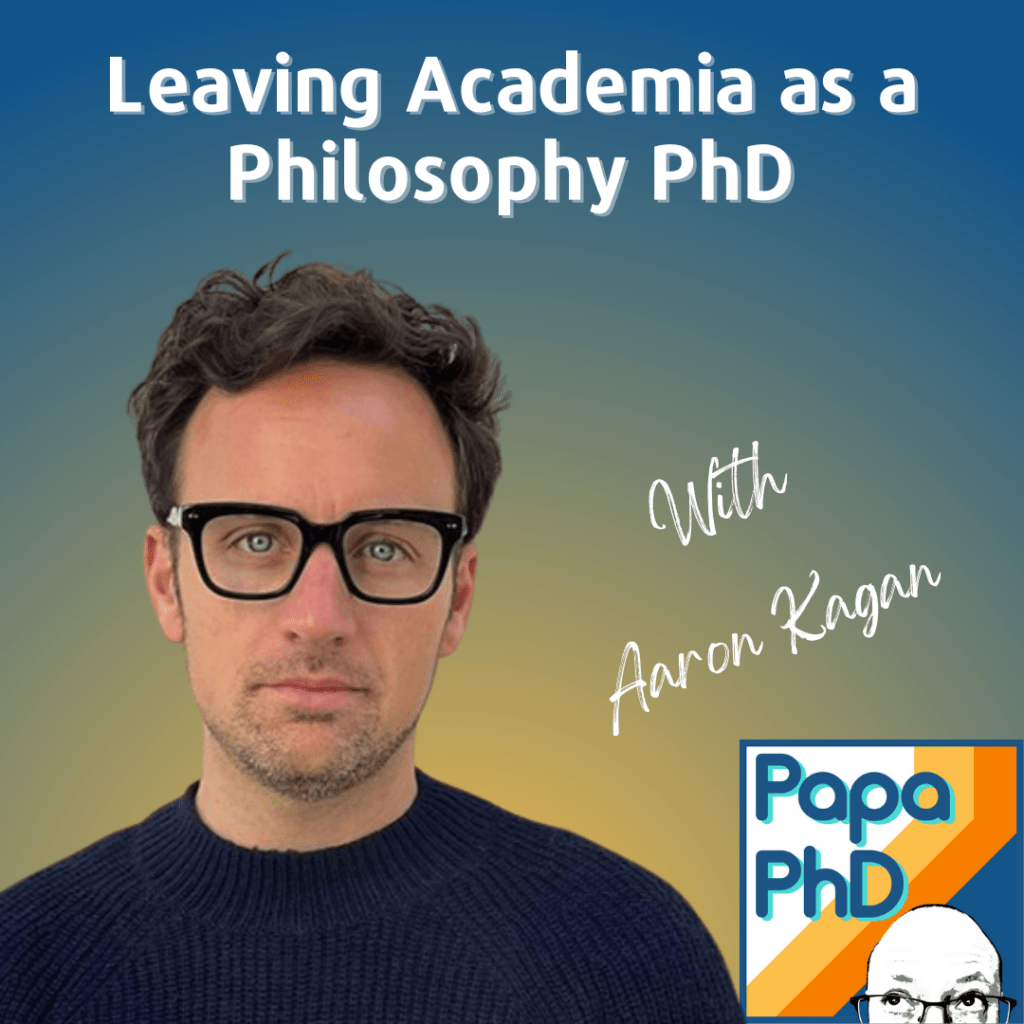
S4 Ep 32Leaving Academia as a Philosophy PhD With Aaron Kagan
What place does a philosophy PhD have in the modern marketplace?In this Papa PhD interview, I explore this question with Aaron Kagan, philosophy PhD and staff user experience (UX) researcher at Google.Reach out to me or to Aaron using the links below, if you have any feedback or any questions for us.While you're here, I'll take the opportunity to announce that Papa PhD has joined the Podcasting 2.0 initiative and is now set up to receive boosts from you, the listener! A boost is a value for value (V4V) contribution in Satoshis (or Sats), the smallest existing Bitcoin denomination. All received boosts will get a shoutout on the show, in appreciation for your support. Please check out the Fountain Podcast App that supports Podcasting 2.0 initiatives and boost the show.Also, I'd love to get to know you better. If you have 60 seconds please fill out the listener survey in this link. VIDEO https://www.youtube.com/watch?v=5ijdHULAMhw?sub_confirmation=1Aaron Kagan received his PhD in Philosophy from Fordham University in 2017. He is a Staff User Experience Researcher at Google, working on human choice, and sits on the APAs committee for non-academic careers. He has 7+ years of experience in the tech industry, holding positions at Google, Meta Reality Labs, Loon, and Native Instruments. He has published journal articles on embodiment, emotion, and enactive perception, and he is currently writing a book for Routledge on the Embodied Mind. He is a passionate advocate of the societal relevance of philosophy, and has written, presented, and spoken to undergraduate and generalist audiences about applying philosophical skills in non-academic sectors. Thank you, Aaron Kagan! If you enjoyed this conversation with Aaron, let him know by clicking the link below and leaving him a message on LinkedIn:Send Aaron Kagan a thank you message on LinkedIn!Click here to share your key take-away from this interview with David! This episode’s resources: Aaron Kagan | InstagramAaron Kagan | Website Leave a review on Podchaser ! Support the show ! You might also like the following episodes: Shaz Zamore – Building a More Diverse, More Inclusive AcademiaParag Mahanti – Networking and Job Hunting as a PhDDanielle De La Mare – Trusting the Path to Career WellnessAshley Ruba – The State of the Post-PhD Job MarketAs always, if you find value in Papa PhD and in the content I bring you every week and if you're not a nerd like me and don't want to delve into Podcast 2.0, click on one of the buttons below and send some of that value back to me by becoming a supporter on Patreon or by buying me a coffee :) Support the show on Patreon ! Or buy me a coffee :)

S4 Ep 31Podcasthon 2023 – Papa PhD présente PhDOOC (Hors-série)
Cette semaine sur Papa PhD, on est hors série avec un spécial Podcasthon 2023, où je te présente une association qui m'inspire - PhDOOC. Si tu veux savoir de quoi peut avoir l'air un MOOC sur les carrières créé et mené par et pour les doctorants, rejoins-moi dans cette conversation avec une des fondatrices, Adeline Bossu, et trois bénévoles, Lauriane Baylé, Marina Briand et Maya Anderson-Gonzalez! Bonne écoute! Créée en Septembre 2016, PhDOOC est une association loi 1901 dont le but est daccompagner les doctorant.e.s et les docteur.e.s et de favoriser la création dune communauté. Pour cela, les membres de PhDOOC organisent le premier MOOC en France sur la poursuite de carrière des docteur.e.s de toutes disciplines. Leur objectif est de construire un espace d'information, d'échange et d'entraide autour de cette thématique. Les ressources de cet épisode : PhDOOC | Facebook Site du MOOC | Site Web Merci Adeline, Lauriane, Marina et Maya! Si cet entretien avec les membres de l'équipe PhDOOC t'a plu, fais-leur en part en cliquant sur le lien ci-dessous et en leur laissant un message sur LinkedIn : Clique ici pour les remercier sur LinkedIn ! Clique ici pour partager avec David le principal message que tu retiens de cet épisode ! Si tu trouves de la valeur dans le contenu que je t'apporte chaque semaine, clique sur l'un des boutons ci-dessous et renvoie-moi l'ascenceur :) Don sécuritaire sur PayPal Deviens supporter sur Patreon ! Ou paye-moi un café :) Tu aimeras aussi ces épisodes : Marie Itoiz – S'outiller pour l'après-doctorat : PapaPhD.com/108 Charlotte Hendryckx – L'aventure du doctorat à l'étranger : PapaPhD.com/193 Jean-Patrick Toussaint – Mieux préparer les doctorants à l'emploi : PapaPhD.com/155 Myriam Beaudry - L'importance de rencontrer d'autres chercheur.e.s pendant ton doctorat : PapaPhD.com/183

S4 Ep 30Building a More Diverse and Inclusive Academia With Shaz Zamore (Rerun)
This week on the show, I'm bringing you yet another treasure from the vault - my Season 2 conversation with Shaz Zamore about their vision for the future of academia. During my conversation with Shaz, I got a glimpse at what that change can look like – we dove into the current diversity and inclusivity challenges facing academia today and into how addressing them can change the face of science and research. Enjoy! What you’ll learn about in this episode: Current roadblocks to diversity in university and in research How we can widen the horizons of minorities early on What has to change to make academia a really inclusive environment Why having a support group where you can drop your guard is key What a mentor can look like if you're working in uncharted territory Best practices for widening your network of likeminded people How changing how science and research is depicted on all media can positively impact young people who are minoritized or intersectional How to think of your PhD from the point of view of the private sector and of entrepreneuship The importance of finding joy and of giving yourself the rest you need, in whichever form it takes for you While you're here, I'll take the opportunity to let you know that Papa PhD has joined the Podcasting 2.0 initiative and is now set up to receive boosts from you, the listener! A boost is a value for value (V4V) contribution in Satoshis (or Sats), the smallest existing Bitcoin denomination. All received boosts will get a shoutout on the show, in appreciation for your support. Please check out the Fountain Podcast App that supports Podcast 2.0 initiatives and boost the show . Also, I'd love to get to know you better. If you have 60 seconds please fill out the listener survey in this link. Donate to the show and Support this podcast. Send a Sticker Get a Sticker: Send me your show sticker, and I will send you a Papa PhD Sticker. I'd love to have a wall of podfriend stickers! Shaz Zamore is a neuroengineer and STEAM Outreach Coordinator at CU Boulder. Looking to revolutionize access to STEAM learning, they are creating innovative interactive tools aimed at intersectional minoritized middle school students. Outside of work, Shaz has a penchant for creative coding, snowboarding, baking bread and woodworking. As always, if you find value in Papa PhD and in the content I bring you every week, click on one of the buttons below and leave a review or donate on PayPal - you'll be helping the show stay alive :) Leave a review on Podchaser ! Support the show ! Thank you, Shaz Zamore! If you enjoyed this interview with Shaz, let them know by clicking the link below and leaving them a message on Twitter: Click here to thank Shaz Zamore on Twitter! Click here to share your key take-away from this interview with David! This episode’s resources: Shaz Zamore | LinkedIn Shaz Zamore | Twitter Shaz Zamore | Instagram Craniate | Website Diversity In Academia | Instagram Diversity In Academia Ko-Fi | ko-fi.com/diversityinacademia You might also like the following episodes: Kimberly Duong – Goal Setting as an Early Career Researcher Özgün Ünver – How to Stop Burnout in its Tracks Danielle De La Mare – Leveraging Your PhD in the Consulting Sector Ashley Ruba – The State of the Post-PhD Job Market
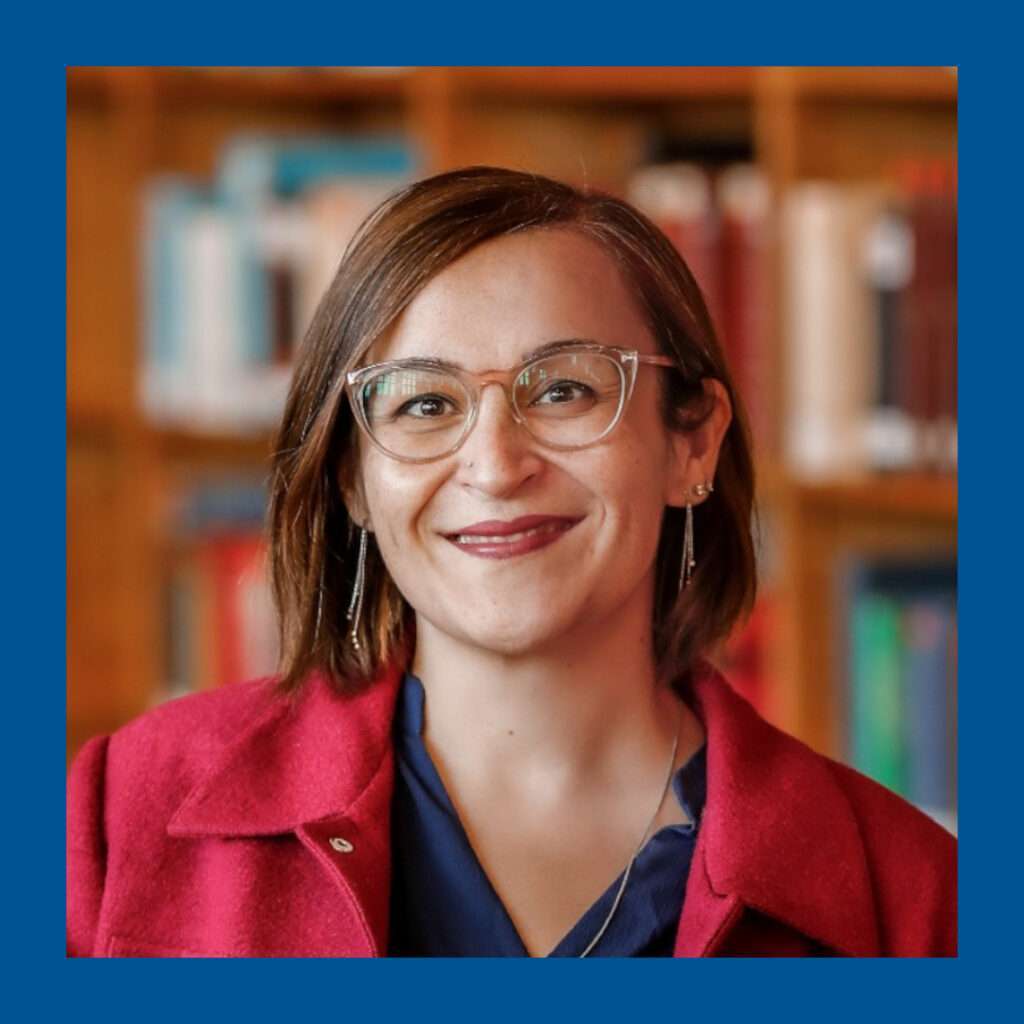
S4 Ep 29How To Stop Burnout In Its Tracks With Özgün Ünver
Burnout. You probably know someone who has gone through it, or you may have burnt out, yourself. Academic burnout is real and often taboo, and this week on the podcast, I am talking with a coach specializing in helping researchers avoid it and manage it - Özgün Ünver, form Mind Your Own Revisions.During our conversation, Özgün shares about her burnout during the PhD and postdoc and her lessons learned from her personal experience and from the experiences coaching academics.Reach out to me or to Özgün using the links below, if you have any feedback or any questions for us.While you're here, I'll take the opportunity to announce that Papa PhD has joined the Podcasting 2.0 initiative and is now set up to receive boosts from you, the listener! A boost is a value for value (V4V) contribution in Satoshis (or Sats), the smallest existing Bitcoin denomination. All received boosts will get a shoutout on the show, in appreciation for your support. Please check out the Fountain Podcast App that supports Podcasting 2.0 initiatives and boost the show.Also, I'd love to get to know you better. If you have 60 seconds please fill out the listener survey in this link. VIDEO https://www.youtube.com/watch?v=RsxM--V4mtc?sub_confirmation=1Özgün Ünver is a certified life, stress and burnout coach working with academics around wellbeing, mindset, and burnout prevention/recovery.She has a PhD in social policy, a strong interest in psychosocial wellbeing in the workplace, and a passion for normalising mental health-related conversations in every aspect of our lives.Her mission is to help academics (and everyone else) to prioritize self-care, work-life balance, and mental (as well as physical) health. Thank you, Özgün Ünver! If you enjoyed this conversation with Özgün, let her know by clicking the link below and leaving her a message on LinkedIn:Send Özgün Ünver a thank you message on LinkedIn!Click here to share your key take-away from this interview with David! This episode’s resources: Özgün Ünver | TwitterÖzgün Ünver | FacebookMind Your Own Revisions | WebsiteDonate to help Turkey rebuild | AHBAP.org Leave a review on Podchaser ! Support the show ! You might also like the following episodes: Kimberly Duong – Goal Setting as an Early Career ResearcherParag Mahanti – Networking and Job Hunting as a PhDDanielle De La Mare – Leveraging Your PhD in the Consulting SectorAshley Ruba – The State of the Post-PhD Job MarketAs always, if you find value in Papa PhD and in the content I bring you every week and if you're not a nerd like me and don't want to delve into Podcast 2.0, click on one of the buttons below and send some of that value back to me by becoming a supporter on Patreon or by buying me a coffee :) Support the show on Patreon ! Or buy me a coffee :)

S4 Ep 28Perfectionism With Dr. Isabeau Iqbal – A Self-Compassionate Professor Feed Drop
Last week on Papa PhD, I shared my recent conversation with Danielle De La Mare, creator and host of the Self-Compassionate Professor podcast. This week, I'm over-the-moon happy to have an episode of the Self-Compassionate Professor as a feed drop on Papa PhD - a conversation about perfectionism in academia with Dr. Isabeau Iqbal. Reach out to me or to Danielle using the links below, if you have any feedback or any questions for us. While you're here, I'll take the opportunity to announce that Papa PhD has joined the Podcasting 2.0 initiative and is now set up to receive boosts from you, the listener! A boost is a value for value (V4V) contribution in Satoshis (or Sats), the smallest existing Bitcoin denomination. All received boosts will get a shoutout on the show, in appreciation for your support. Please check out the Fountain Podcast App that supports Podcasting 2.0 initiatives and boost the show. Also, I'd love to get to know you better. If you have 60 seconds please fill out the listener survey in this link. Danielle De La Mare, founder of Self-Compassionate Professor, focuses on healing academics’ relationship to work, helping them to clear mental and emotional clutter, make space for their own needs and wants, and find the clarity to make sound and meaningful career decisions grounded in wellness. Thank you, Danielle De La Mare! If you enjoyed this Self-Compassionate Professor episode, let Danielle know by subscribing to her podcast and by leaving her a message on LinkedIn: Send Danielle De La Mare a thank you message on LinkedIn! Click here to share your key take-away from this interview with David! This episode’s resources: Danielle De La Mare | Website Danielle De La Mare | Podcast Self-Compasisonate Professor | Sabbatical Program Leave a review on Podchaser ! Support the show ! You might also like the following episodes: Kimberly Duong – Goal Setting as an Early Career Researcher Danielle De La Mare – Trusting the Path to Career Wellness Bryan Quoc Le – Leveraging Your PhD in the Consulting Sector Ashley Ruba – The State of the Post-PhD Job Market As always, if you find value in Papa PhD and in the content I bring you every week and if you're not a nerd like me and don't want to delve into Podcast 2.0, click on one of the buttons below and send some of that value back to me by becoming a supporter on Patreon or by buying me a coffee :) Support the show on Patreon ! Or buy me a coffee :)

S4 Ep 27Trusting the Path to Career Wellness With Danielle De La Mare
How well adjusted do you feel you are to your current career ? This week on Papa PhD, I'm sharing my recent conversation with Danielle De La Mare, creator and host of the Self-Compassionate Professor podcast, about her approach to promotion career wellness in the academic community. This is an exciting episode for me, because it's a collaboration with the Self-Compassionate Professor. Danielle will be publishing an interview I gave her a few weeks ago onw day before this one goes live, so I strongly suggest you go listen to what I shared on mic with Danielle! Reach out to me or to Danielle using the links below, if you have any feedback or any questions for us. While you're here, I'll take the opportunity to announce that Papa PhD has joined the Podcasting 2.0 initiative and is now set up to receive boosts from you, the listener! A boost is a value for value (V4V) contribution in Satoshis (or Sats), the smallest existing Bitcoin denomination. All received boosts will get a shoutout on the show, in appreciation for your support. Please check out the Fountain Podcast App that supports Podcasting 2.0 initiatives and boost the show. Also, I'd love to get to know you better. If you have 60 seconds please fill out the listener survey in this link. VIDEO https://www.youtube.com/watch?v=Y7V5CzOE4Rk?sub_confirmation=1 Danielle De La Mare, founder of Self-Compassionate Professor, focuses on healing academics’ relationship to work, helping them to clear mental and emotional clutter, make space for their own needs and wants, and find the clarity to make sound and meaningful career decisions grounded in wellness. Thank you, Danielle De La Mare! If you enjoyed this conversation with Danielle, let her know by clicking the link below and leaving her a message on LinkedIn: Send Danielle De La Mare a thank you message on LinkedIn! Click here to share your key take-away from this interview with David! This episode’s resources: Danielle De La Mare | Website Danielle De La Mare | Podcast Self-Compasisonate Professor | Sabbatical Program Leave a review on Podchaser ! Support the show ! You might also like the following episodes: Kimberly Duong – Goal Setting as an Early Career Researcher Parag Mahanti – Networking and Job Hunting as a PhD Bryan Quoc Le – Leveraging Your PhD in the Consulting Sector Ashley Ruba – The State of the Post-PhD Job Market Papa PhD is supported by NotedSource, the platform connecting academic researchers to companies for project-based opportunities across disciplines, from sciences to arts and humanities Top corporate innovation teams work with academia. But the smartest ones use NotedSource to discover and collaborate with experts like you. Easily sign up today at papaphd.com/notedsource – using google scholar and orcid imports, it only takes a few minutes to create a professional profile that lets clients know you're open to collaboration. NotedSource handles the bureaucracy so you can focus on what you know best. As always, if you find value in Papa PhD and in the content I bring you every week and if you're not a nerd like me and don't want to delve into Podcast 2.0, click on one of the buttons below and send some of that value back to me by becoming a supporter on Patreon or by buying me a coffee :) Support the show on Patreon ! Or buy me a coffee :)

S4 Ep 26Goal Setting as an Early Career Researcher With Kimberly Duong
It can be difficult projecting yourself into the future and setting goals when you are fully invested physically and emotionally with your PhD. Overwhelm and overwork are terms that come up frequently in conversation with PhD researchers, independently of their domain of research. In this Papa PhD interview, I talk with career coach Kimberly Duong about her post-PhD experience and about her approach to helping academics successfully navigating their PhD journey. Listen to the end and you will learn an exercise Kimberly uses with her coachees to help them set long-term goals for themselves! Reach out to me or to Kimberly using the links below, if you have any feedback or any questions for us. While you're here, I'll take the opportunity to announce that Papa PhD has joined the Podcasting 2.0 initiative and is now set up to receive boosts from you, the listener! A boost is a value for value (V4V) contribution in Satoshis (or Sats), the smallest existing Bitcoin denomination. All received boosts will get a shoutout on the show, in appreciation for your support. Please check out the Fountain Podcast App that supports Podcasting 2.0 initiatives and boost the show. Also, I'd love to get to know you better. If you have 60 seconds please fill out the listener survey in this link. VIDEO https://www.youtube.com/watch?v=J6OhsT-8bJ8?sub_confirmation=1 Dr. Kimberly Duong completed her PhD in Civil and Environmental Engineering at UC Irvine and successfully transitioned to industry. She wants to share lessons learned and help others succeed in their own PhD journey. Kimberly employs a tailored one-on-one approach, drawing on more than ten years of project management, leadership, STEM outreach, and mentorship experience in academia, government, nonprofits, and entrepreneurship. Her diverse background has led her to a variety of experiences, from wetlands field work in Melbourne, Australia to science policy at the National Academies of Sciences, Engineering, and Medicine in Washington, DC. In addition to coaching, Kimberly also enjoys cooking and fitness. Thank you, Kimberly Duong! If you enjoyed this conversation with Kimberly, let her know by clicking the link below and leaving her a message on Twitter: Send Kimberly Duong a thank you message on Twitter! Click here to share your key take-away from this interview with David! This episode’s resources: Kimberly Duong | Linkedin Kimberly Duong | Website Leave a review on Podchaser ! Support the show ! You might also like the following episodes: Victoria (Tory) Wobber – Hidden Opportunities in Tech for Social Sciences Graduates Parag Mahanti – Networking and Job Hunting as a PhD Bryan Quoc Le – Leveraging Your PhD in the Consulting Sector Ashley Ruba – The State of the Post-PhD Job Market Papa PhD is supported by NotedSource, the platform connecting academic researchers to companies for project-based opportunities across disciplines, from sciences to arts and humanities Top corporate innovation teams work with academia. But the smartest ones use NotedSource to discover and collaborate with experts like you. Easily sign up today at papaphd.com/notedsource – using google scholar and orcid imports, it only takes a few minutes to create a professional profile that lets clients know you're open to collaboration. NotedSource handles the bureaucracy so you can focus on what you know best. As always, if you find value in Papa PhD and in the content I bring you every week and if you're not a nerd like me and don't want to delve into Podcast 2.0, click on one of the buttons below and send some of that value back to me by becoming a supporter on Patreon or by buying me a coffee :) Support the show on Patreon ! Or buy me a coffee :)

S4 Ep 25The State of the Post-PhD Job Market With Ashley Ruba
Are you ready for what comes after getting your degree? Or after your second or third postdoc? How does the job market treat PhDs today? These are questions I had no answers to when I was finishing my PhD. My guest this week - Ashley Ruba, PhD - has taken up the personal mission to keep asking tough questions to the post-PhD community, after living a transformational transition from her postdoc position to a working as a UX researcher for Meta Reality Labs. Reach out to me or to Ashley using the links below, if you have any feedback or any questions for us. While you're here, I'll take the opportunity to announce that Papa PhD has joined the Podcasting 2.0 initiative and is now set up to receive boosts from you, the listener! A boost is a value for value (V4V) contribution in Satoshis (or Sats), the smallest existing Bitcoin denomination. All received boosts will get a shoutout on the show, in appreciation for your support. Please check out the Fountain Podcast App that supports Podcasting 2.0 initiatives and boost the show. Also, I'd love to get to know you better. If you have 60 seconds please fill out the listener survey in this link. VIDEO https://www.youtube.com/watch?v=Xvam-4wJsRY?sub_confirmation=1 Dr. Ashley Ruba (PhD in Developmental Psychology) is a UX Researcher at Meta Reality Labs, building the next generation of AR/VR technology. Prior to joining Meta, Dr. Ruba spent over a decade in academic research, studying how young children learn about emotions. Thank you, Ashley Ruba! If you enjoyed this conversation with Ashley, let her know by clicking the link below and leaving her a message on Twitter: Send Ashley Ruba a thank you message on Twitter! Click here to share your key take-away from this interview with David! This episode’s resources: Ashley Ruba | Linkedin Ashley Ruba | Website Leave a review on Podchaser ! Support the show ! You might also like the following episodes: Victoria (Tory) Wobber – Hidden Opportunities in Tech for Social Sciences Graduates Parag Mahanti – Networking and Job Hunting as a PhD Bryan Quoc Le – Leveraging Your PhD in the Consulting Sector Marc Reid – Managing Your Imposter Experience During and Beyond Your Degree with Marc Reid Papa PhD is supported by NotedSource, the platform connecting academic researchers to companies for project-based opportunities across disciplines, from sciences to arts and humanities Top corporate innovation teams work with academia. But the smartest ones use NotedSource to discover and collaborate with experts like you. Easily sign up today at papaphd.com/notedsource – using google scholar and orcid imports, it only takes a few minutes to create a professional profile that lets clients know you're open to collaboration. NotedSource handles the bureaucracy so you can focus on what you know best. As always, if you find value in Papa PhD and in the content I bring you every week and if you're not a nerd like me and don't want to delve into Podcast 2.0, click on one of the buttons below and send some of that value back to me by becoming a supporter on Patreon or by buying me a coffee :) Support the show on Patreon ! Or buy me a coffee :)
S4 Ep 24Time Management During the PhD with Gad Sabbatier
Welcome to another collab episode of the PhD Dojo with The 2nd Lab. VIDEO https://www.youtube.com/watch?v=NSLcy6gYJ9s In this new PhD Dojo episode, Gad Sabbatier and I share our advice on something that is a challenge for a lot of us - time management. Do you struggle doing all you want to fit in a day? In a week? Then this episode is for you, as Gad Sabbatier and I share our short- and long-term strategies to help you avoid feeling buffeted by the passage of time during your PhD. While you're here, I'll take the opportunity to announce that Papa PhD has joined the Podcast 2.0 initiative and is now set up to receive boosts from you, the listener! A boost is a value for value (V4V) contribution in Satoshis (or Sats), the smallest existing Bitcoin denomination. All received boosts will get a shoutout on the show, in appreciation for your support. Please check out the Fountain Podcast App that supports Podcast 2.0 initiatives and boost the show . Also, I'd love to get to know you better. If you have 60 seconds please fill out the listener survey in this link. Donate to the show and Support this podcast. Send a Sticker Get a Sticker: Send me your show sticker, and I will send you a Papa PhD Sticker. I'd love to have a wall of podfriend stickers! This episode’s resources: The 2nd Lab | Twitter The 2nd Lab | LinkedIn The 2nd Lab | Website If you find value in Papa PhD and in the content I bring you every week, click on one of the buttons below and send some of that value back to me :) Leave a review on Podchaser ! Support the show ! You might also like the following episodes: PhD Dojo - What Should I Invest In If I Want a Private Sector Job? PhD Dojo – When Should I Pivot to Industry? PhD Dojo – How to Gain Confidence for Job Interviews PhD Dojo – First Year PhD - Show Up and Avoid Tunnel Vision Papa PhD is supported by NotedSource, the platform connecting academic researchers to companies for project-based opportunities across disciplines, from sciences to arts and humanities Top corporate innovation teams work with academia. But the smartest ones use NotedSource to discover and collaborate with experts like you. Easily sign up today at papaphd.com/notedsource – using google scholar and orcid imports, it only takes a few minutes to create a professional profile that lets clients know you're open to collaboration. NotedSource handles the bureaucracy so you can focus on what you know best. As always, if you find value in Papa PhD and in the content I bring you every week and if you're not a nerd like me and don't want to delve into Podcast 2.0, click on one of the buttons below and send some of that value back to me by becoming a supporter on Patreon or by buying me a coffee :) Support the show on Patreon ! Or buy me a coffee :)

S4 Ep 23Best Practices When Writing Papers For Publication With Anna Clemens
Are you preparing to write a paper? Do you get anxious, not knowing what the outcome is going to be of this long process? Today, I'm sharing with you my conversation with Anna Clemens, whose specialty is to coach researchers on how to write for journal articles. During our conversation, Anna talked about how to systematize article writing, she talked about the importance of how to communicate with editors, and she also talked about what mindset to have while writing, even if English is not your first language.No matter what stage you're at in your research journey, I am convinced that this conversation with Anna is going to have multiple take-home messages for you that will improve your experience writing journal papers.Reach out to me or to Anna using the links below, if you have any feedback or any questions for us.While you're here, I'll take the opportunity to announce that Papa PhD has joined the Podcasting 2.0 initiative and is now set up to receive boosts from you, the listener! A boost is a value for value (V4V) contribution in Satoshis (or Sats), the smallest existing Bitcoin denomination. All received boosts will get a shoutout on the show, in appreciation for your support. Please check out the Fountain Podcast App that supports Podcasting 2.0 initiatives and boost the show.Also, I'd love to get to know you better. If you have 60 seconds please fill out the listener survey in this link. VIDEO https://www.youtube.com/watch?v=ZPwL772HIhQ?sub_confirmation=1Dr Anna Clemens is an academic writing coach with a PhD in Chemistry. In her online program, the Researchers Writing Academy, Anna helps researchers get their papers published in their target journals without procrastinating on the writing. Thank you, Anna Clemens! If you enjoyed this conversation with Anna, let her know by clicking the link below and leaving her a message on LinkedIn:Send Anna Clemens a thank you message on Twitter!Click here to share your key take-away from this interview with David! This episode’s resources: Anna Clemens | LinkedinAnna Clemens | WebsiteFree Training on writing structure with Anna | Register now Leave a review on Podchaser ! Support the show ! You might also like the following episodes: Victoria (Tory) Wobber – Hidden Opportunities in Tech for Social Sciences GraduatesAnushka Khasnobish – The Power of Mentorship During a Career PivotBryan Quoc Le – Leveraging Your PhD in the Consulting SectorMarc Reid – Managing Your Imposter Experience During and Beyond Your Degree with Marc Reid Papa PhD is supported by NotedSource, the platform connecting academic researchers to companies for project-based opportunities across disciplines, from sciences to arts and humanitiesTop corporate innovation teams work with academia. But the smartest ones use NotedSource to discover and collaborate with experts like you. Easily sign up today at papaphd.com/notedsource – using google scholar and orcid imports, it only takes a few minutes to create a professional profile that lets clients know you're open to collaboration.NotedSource handles the bureaucracy so you can focus on what you know best.As always, if you find value in Papa PhD and in the content I bring you every week and if you're not a nerd like me and don't want to delve into Podcast 2.0, click on one of the buttons below and send some of that value back to me by becoming a supporter on Patreon or by buying me a coffee :) Support the show on Patreon ! Or buy me a coffee :)
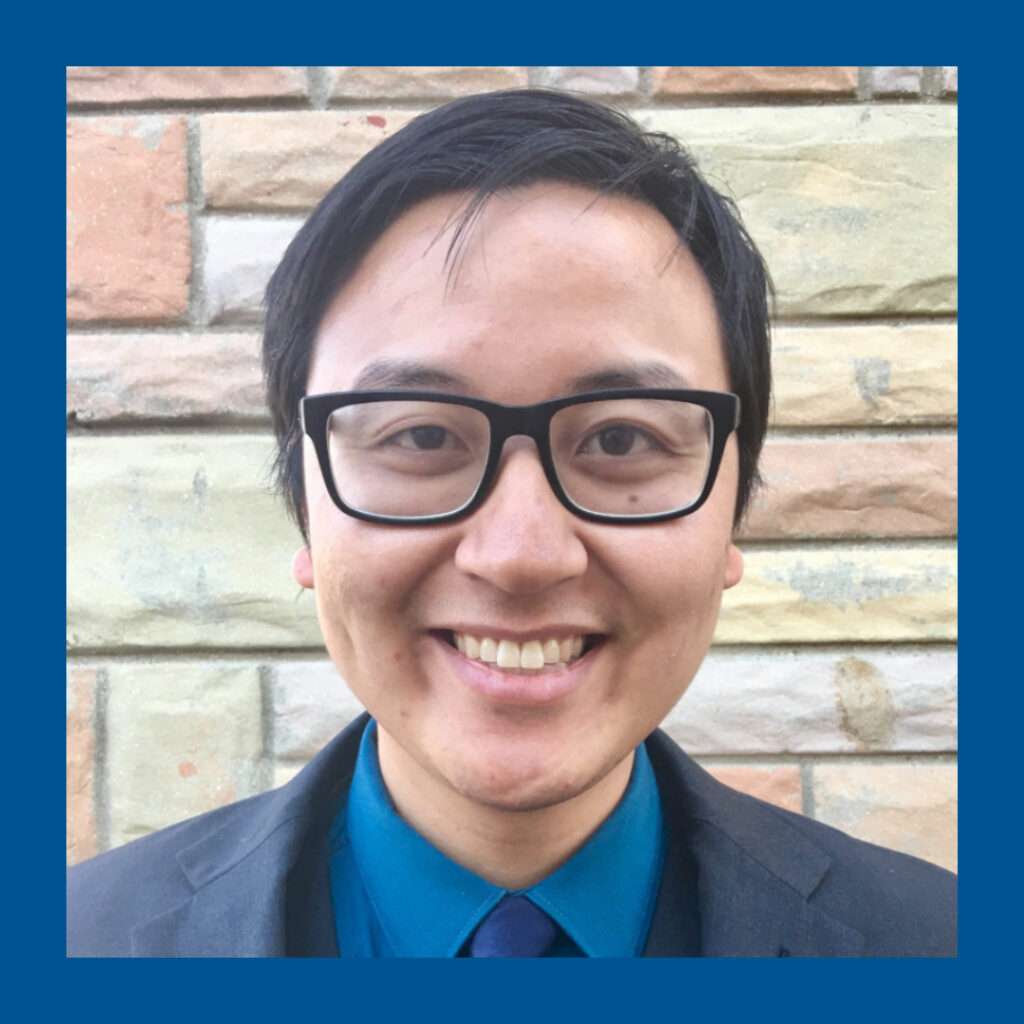
S4 Ep 22Leveraging Your PhD in the Consulting Space With Bryan Quoc Le
This week on the show, I'm sharing a story of resilience and steadfastness in career building with my guest, Bryan Quoc Le.During our conversation, Bryan shares his journey from a PhD in chemistry to being self-employed as a consultant in the food industry space.I got great feedback about this interview during our live recording, so I hope you enjoy it, too! Reach out to Me or to Bryan using the links below, if you have any feedback or any questions for us.While you're here, I'll take the opportunity to announce that Papa PhD has joined the Podcasting 2.0 initiative and is now set up to receive boosts from you, the listener! A boost is a value for value (V4V) contribution in Satoshis (or Sats), the smallest existing Bitcoin denomination. All received boosts will get a shoutout on the show, in appreciation for your support. Please check out the Fountain Podcast App that supports Podcasting 2.0 initiatives and boost the show.Also, I'd love to get to know you better. If you have 60 seconds please fill out the listener survey in this link. VIDEO https://youtu.be/cR_LrNR54WY?sub_confirmation=1Bryan Quoc Le, Ph.D. is a food scientist, food industry consultant, and author of 150 Food Science Questions Answered. He earned his Ph.D. in Food Science from the University of Wisconsin, Madison, where he studied the chemistry of savory flavors from plant-based sources. He is currently a research scholar through the Ronin Institute for Independent Scholarship, an industry expert for Carbon13 (a venture builder based in the UK), and an independent consultant for Mycelium Gastronomy (an industry network of food experts). Thank you, Bryan Quoc Le! If you enjoyed this conversation with Bryan, let him know by clicking the link below and leaving him a message on LinkedIn:Send Bryan Quoc Le a thank you message on Twitter!Click here to share your key take-away from this interview with David! This episode’s resources: Bryan Quoc Le | LinkedinBryan Quoc Le | FacebookBryan Quoc Le | WebsiteBook: 150 Food Science Questions Answered | Get Bryan's book Leave a review on Podchaser ! Support the show ! You might also like the following episodes: Victoria (Tory) Wobber – Hidden Opportunities in Tech for Social Sciences GraduatesAnushka Khasnobish – The Power of Mentorship During a Career PivotTerence Milstead – A Roadmap to Pivoting Into the Private SectorMarc Reid – Managing Your Imposter Experience During and Beyond Your Degree with Marc Reid Papa PhD is supported by NotedSource, the platform connecting academic researchers to companies for project-based opportunities across disciplines, from sciences to arts and humanitiesTop corporate innovation teams work with academia. But the smartest ones use NotedSource to discover and collaborate with experts like you. Easily sign up today at papaphd.com/notedsource – using google scholar and orcid imports, it only takes a few minutes to create a professional profile that lets clients know you're open to collaboration.NotedSource handles the bureaucracy so you can focus on what you know best.As always, if you find value in Papa PhD and in the content I bring you every week and if you're not a nerd like me and don't want to delve into Podcast 2.0, click on one of the buttons below and send some of that value back to me by becoming a supporter on Patreon or by buying me a coffee :) Support the show on Patreon ! Or buy me a coffee :)

S4 Ep 21Hidden Opportunities in Tech for Social Sciences Graduates With Victoria Wobber
This week, I'm sharing with you a conversation about a side of the post-PhD experience that is kind of a blind spot for me - the place of social science graduates in the tech space.To talk about this, I had the pleasure of having a conversation with Victoria (Tory) Wobber, growth and leadership coach and consultant.While you're here, I'll take the opportunity to announce that Papa PhD has joined the Podcast 2.0 initiative and is now set up to receive boosts from you, the listener! A boost is a value for value (V4V) contribution in Satoshis (or Sats), the smallest existing Bitcoin denomination. All received boosts will get a shoutout on the show, in appreciation for your support. Please check out the Fountain Podcast App that supports Podcast 2.0 initiatives and boost the show .Also, I'd love to get to know you better. If you have 60 seconds please fill out the listener survey in this link. Donate to the show and Support this podcast.Send a Sticker Get a Sticker: Send me your show sticker, and I will send you a Papa PhD Sticker. I'd love to have a wall of podfriend stickers! VIDEO https://youtu.be/9kjIBSzLwpA?sub_confirmation=1Dr. Victoria (Tory) Wobber received her PhD in Human Evolutionary Biology in 2012 and secured a role as a data scientist at Facebook in 2013. She now runs her own business as a career and leadership coach.Tory has three degrees from Harvard, worked at Facebook and Google, and developed the Academic Exit framework after making the transition from academia to industry herself and coaching more than 50 people through that same transition. Thank you, Tory Wobber! If you enjoyed this conversation with Tory, let her know by clicking the link below and leaving her a message on LinkedIn:Send Tory Wobber a thank you message on Twitter!Click here to share your key take-away from this interview with David! This episode’s resources: Tory Wobber | LinkedinTory Wobber | TwitterTory Wobber | WebsiteAcademic Exit Playbook | Website Leave a review on Podchaser ! Support the show ! You might also like the following episodes: Martha Boeglin – Unlocking Your Thesis Writing Super PowersAnushka Khasnobish – The Power of Mentorship During a Career PivotTerence Milstead – A Roadmap to Pivoting Into the Private SectorMarc Reid – Managing Your Imposter Experience During and Beyond Your Degree with Marc ReidAs always, if you find value in Papa PhD and in the content I bring you every week and if you're not a nerd like me and don't want to delve into Podcast 2.0, click on one of the buttons below and send some of that value back to me by becoming a supporter on Patreon or by buying me a coffee :) Support the show on Patreon ! Or buy me a coffee :)
S4 Ep 20I’m in the middle of my PhD – What Should I Invest In If I Want a Private Sector Job? With The 2nd Lab
Welcome to another collab episode of the PhD Dojo with The 2nd Lab. While you're here, I'll take the opportunity to announce that Papa PhD has joined the Podcast 2.0 initiative and is now set up to receive boosts from you, the listener! A boost is a value for value (V4V) contribution in Satoshis (or Sats), the smallest existing Bitcoin denomination. All received boosts will get a shoutout on the show, in appreciation for your support. Please check out the Fountain Podcast App that supports Podcast 2.0 initiatives and boost the show . Also, I'd love to get to know you better. If you have 60 seconds please fill out the listener survey in this link. Donate to the show and Support this podcast. Send a Sticker Get a Sticker: Send me your show sticker, and I will send you a Papa PhD Sticker. I'd love to have a wall of podfriend stickers! VIDEO https://youtu.be/MF5ZWHn5CfA In this new PhD Dojo episode, Gad Sabbatier and I answer another tough question by a 2nd Lab mentee: "Since I'm in the middle of my PhD, what should I focus more to increase my chance of finding a relevant job in a company? Should I focus on increasing the number of publications or other factors are more important?" Preparing and prioritizing can be huge challenges when you are body and soul engrossed in your PhD project, so this is a crucial question, which Gad and try to answer to based on our combined experiences. If, like me, you like podcasts, I’m sure you’re always looking for what to add to your playlist. Well, if you’re into health and genetics, this week I have a nugget for you: three-time People’s Choice Podcast Award winner in Science and Medicine - DNA Today. DNA Today is produced by past guest and friend of the show - Kira Dineen (See episode 172 – Applying to Grad School in 2022). What I love about the show is that whether the conversation revolves around the human experience of dealing with genetic diseases or around the research and innovation going on in the field, Kira’s experience as a practicing genetic counselor and her scientific-minded curiosity set the tone and keep it interesting. Having a background in genetics myself and being of mixed descent, I particularly enjoyed episodes about diversity in genome research, but also about CRISPR and about mitochondrial diseases. But there is so much more! Find "DNA Today" on Apple Podcasts or wherever you listen to podcasts! This episode’s resources: The 2nd Lab | Twitter The 2nd Lab | LinkedIn The 2nd Lab | Website If you find value in Papa PhD and in the content I bring you every week, click on one of the buttons below and send some of that value back to me :) Leave a review on Podchaser ! Support the show ! You might also like the following episodes: PhD Dojo - What Mistakes Are Keeping You Out of Industry? PhD Dojo – When Should I Pivot to Industry? PhD Dojo – How to Gain Confidence for Job Interviews PhD Dojo – First Year PhD - Assembling the Expedition Team
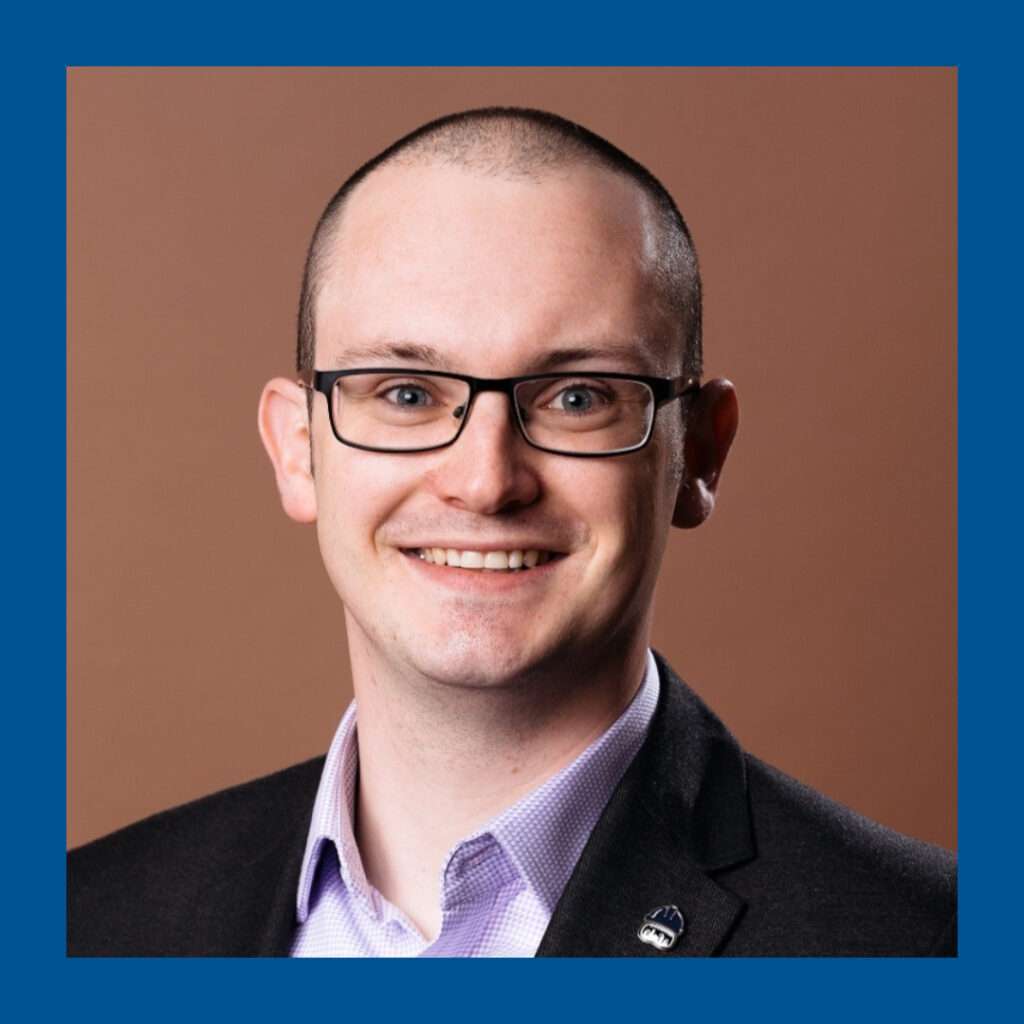
S4 Ep 19Managing Your Imposter Experience During and Beyond Your Degree with Marc Reid
This week, on the first Papa PhD episode of 2023, I am bringing you an incredibly insightful conversation about the impostor phenomenon in academia and beyond with Marc Reid, PhD, author of You Are Not a Fraud - A Scientist's Guide to the Imposter Phenomenon. Imposter feelings are ubiquitous in graduate school and throughout your career, especially after pivots into a new position or a new space. Marc has put a lot of thought into this question and was generous enough to come on the show to share his experience dealing with imposter feelings and what drove him to write a book on the subject. A great way to start the year for me and, I hope, for you, too. While you're here, I'll take the opportunity to announce that Papa PhD has joined the Podcast 2.0 initiative and is now set up to receive boosts from you, the listener! A boost is a value for value (V4V) contribution in Satoshis (or Sats), the smallest existing Bitcoin denomination. All received boosts will get a shoutout on the show, in appreciation for your support. Please check out the Fountain Podcast App that supports Podcast 2.0 initiatives and boost the show . Also, I'd love to get to know you better. If you have 60 seconds please fill out the listener survey in this link. Donate to the show and Support this podcast. Send a Sticker Get a Sticker: Send me your show sticker, and I will send you a Papa PhD Sticker. I'd love to have a wall of podfriend stickers! VIDEO https://youtu.be/_Vj4mOyiJC8?sub_confirmation=1 Marc was born and raised in Glasgow, Scotland. He completed his Masters and Carnegie Trust-sponsored PhD in Chemistry at the University of Strathclyde. Marc was then a postdoctoral research associate at the University of Edinburgh. During that time, he was inducted into the SciFinder Future Leaders in Chemistry programme. Marc’s independent academic career has been fuelled by prestigious Leverhulme Trust and UKRI Future Leaders Fellowships. He has held lecturing positions at the University of Bristol and the Hunter Centre for Entrepreneurship. In 2021, Marc completed the altMBA. His research interests include physical organic chemistry, computer vision, virtual reality, process safety, and the Imposter Phenomenon. He lives with his wife, two kids, and border terrier in 'sunny' Glasgow. Thank you, Marc Reid! If you enjoyed this conversation with Marc, let him know by clicking the link below and leaving him a message on LinkedIn: Send Marc Reid a thank you message on Twitter! Click here to share your key take-away from this interview with David! This episode’s resources: Marc Reid | Linkedin Marc Reid | Facebook You Are Not a Fraud | Get Marc's book Marc’s list of failures wouldn’t fit on a short biography (see: https://www.dr-marc-reid.com/cv-of-failures). Leave a review on Podchaser ! Support the show ! You might also like the following episodes: Martha Boeglin – Unlocking Your Thesis Writing Super Powers Anushka Khasnobish – The Power of Mentorship During a Career Pivot Terence Milstead – A Roadmap to Pivoting Into the Private Sector Natalia Bielczyk – Figuring Out Where You Fit in the Job Market as a PhD As always, if you find value in Papa PhD and in the content I bring you every week and if you're not a nerd like me and don't want to delve into Podcast 2.0, click on one of the buttons below and send some of that value back to me by becoming a supporter on Patreon or by buying me a coffee :) Support the show on Patreon ! Or buy me a coffee :) Get the Papa PhD Career Readiness Tool kit !

S4 Ep 18Are Things Changing for the Better for Women in STEM? with Krishna Kadiyala (Rerun)
In this week on the show, I'm bringing you another treasure from the vault - my Season 2 conversation with Krishna Kadiyala about her experience as a woman in the STEM space, and in particular about her decision to have children during the PhD. While you're here, I'll take the opportunity to let you know that Papa PhD has joined the Podcasting 2.0 initiative and is now set up to receive boosts from you, the listener! A boost is a value for value (V4V) contribution in Satoshis (or Sats), the smallest existing Bitcoin denomination. All received boosts will get a shoutout on the show, in appreciation for your support. Please check out the Fountain Podcast App that supports Podcast 2.0 initiatives and boost the show . Also, I'd love to get to know you better. If you have 60 seconds please fill out the listener survey in this link. Donate to the show and Support this podcast. Send a Sticker Get a Sticker: Send me your show sticker, and I will send you a Papa PhD Sticker. I'd love to have a wall of podfriend stickers! VIDEO https://www.youtube.com/watch?v=FISR2nefAdo?sub_confirmation=1 Krishna Kadiyala is an Assistant Professor of Computer Science at Texas Christian University. Prior to starting her PhD journey, she was Senior Network Engineer at AT&T Labs in Middletown, NJ for 3 years. During Krishna’s PhD candidature, she’s also mothered two beautiful girls. She is passionate about learning, teaching and helping girls in Computer Science, and is an advocate for PhD moms and moms with young kids in academia. As always, if you find value in Papa PhD and in the content I bring you every week, click on one of the buttons below and leave a review or donate on PayPal - you'll be helping the show stay alive :) Leave a review on Podchaser ! Support the show ! Thank you, Krishna Kadiyala! If you enjoyed this conversation with Krishna, let her know by clicking the link below and leaving her a message on LinkedIn: Send Krishna Kadiyala a thank you message on LinkedIn! Click here to share your key take-away from this interview with David! This episode’s resources: Krishna Kadiyala | LinkedIn Google I am Remarkable Program | Website Book by Brené Brown | The Gifts of Imperfection You might also like the following episodes: Martha Boeglin – Unlocking Your Thesis Writing Super Powers Terence Milstead – A Roadmap to Pivoting Into the Private Sector Katya Park – Staying True to Your Life Plans During the PhD Matthias Hombauer – Being a PhD, a Father and an Entrepreneur
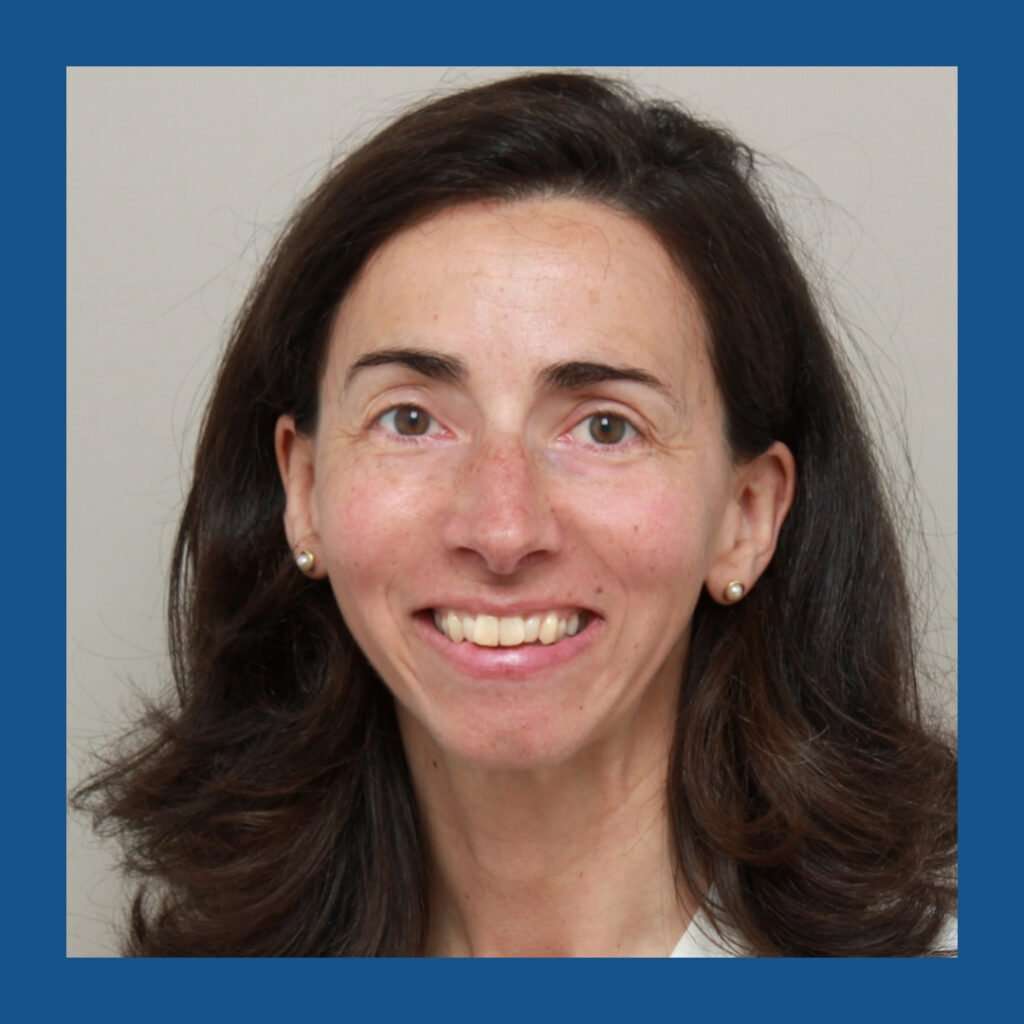
S4 Ep 17Faire le pont entre chercheur.e.s et entreprises avec Anne Bonlarron (rediffusion)
Tu aimes Papa PhD ? Laisse-moi un commentaire > ici < - une courte phrase suffit ! Et inclus ton identifiant Twitter – comme ça je pourrai te remercier personnellement ! Cette semaine sur Papa PhD, je t'apporte un des épisodes les plus écoutés de la saison 2 de Papa PhD - ma conversation avec Anne Bonlarron, fondatrice de Scienceo. Entre autres, on a parlé CIFRE, être expatrié et arrêt de thèse. On a aussi parlé de ce que fait Anne aujourd'hui, à la croisée des chemins entre la recherche et les entreprises. Pendant que tu es là, je profite de l'occasion pour t'annoncer que Papa PhD a rejoint l'initiative Podcast 2.0 et est maintenant prêt à recevoir des boosts de ta part ! Un boost est une contribution valeur pour valeur (V4V) en Satoshis (ou Sats), la plus petite dénomination Bitcoin existante. Tous les boosts reçus feront l'objet d'une mention dans l'émission, en remerciement pour le soutien. Télécharge l'application Fountain, qui soutient les initiatives Podcast 2.0, et booste l'émission. J'aimerais aussi apprendre à mieux te connaître. Si tu as 60 secondes, remplis l'enquête auprès des auditeurs en cliquant sur ce lien. Fais un don à Papa PhD et soutiens le podcast. Échange d'autocollants : envoie-moi l'autocollant de ton podcast et je t'enverrai un autocollant Papa PhD. J'aimerais bien avoir un mur d'autocollants de mes amis podcasteurs ! Anne Bonlarron a 25 ans d'expérience au croisement de la recherche et de l'entreprise et une connaissance très fine de ce que ces deux mondes s'apportent. Elle a créé Scienceo il y a 4 ans. Scienceo accompagne les cadres et dirigeants dans la définition de leur stratégie et le développement de leurs compétences au travers de learning expeditions, groupes de travail, évènements sur-mesure, qui croisent expertises de chercheurs, expériences d’entreprises, partage de bonnes pratiques, travail collaboratif, découverte de lieux innovants. Les ressources de cet épisode : Anne Bonlarron | LinkedIn Scienceo.fr | Site Web Merci Anne ! Si cet entretien avec Anne Bonlarron t'a plu, fais-lui en part en cliquant sur le lien ci-dessous et en lui laissant un message sur LinkedIn : Clique ici pour la remercier sur LinkedIn ! Clique ici pour partager avec David le principal message que tu retiens de cet épisode ! Si tu trouves de la valeur dans le contenu que je t'apporte chaque semaine, clique sur l'un des boutons ci-dessous et renvoie-moi l'ascenceur :) Don sécuritaire sur PayPal Deviens supporter sur Patreon ! Ou paye-moi un café :) Tu aimeras aussi ces épisodes : Marie Itoiz – S'outiller pour l'après-doctorat : PapaPhD.com/108 Charlotte Hendryckx – L'aventure du doctorat à l'étranger : PapaPhD.com/193 Jean-Patrick Toussaint – Mieux préparer les doctorants à l'emploi : PapaPhD.com/155 Myriam Beaudry - L'importance de rencontrer d'autres chercheur.e.s pendant ton doctorat : PapaPhD.com/183

S4 Ep 16Getting Involved in Science Policy After Graduate School With Adriana Bankston (Rerun)
This week on Papa PhD and to mark the end of the year, I share with you the first of a series of three of the most popular episodes of the show since the launch, in 2019. In this early conversation with Adriana Bankston, we covered her experience going through graduate school, but also how she started preparing for a career pivot early on. We then went deeper into the specifics of entering the science policy space, and of how Adriana navigated that transition after her PhD in biochemistry. Adriana Bankston is Principal Legislative Analyst at the University of California Office of Federal Governmental Relations in Washington, DC. Prior to this position, she was a Policy & Advocacy Fellow at The Society for Neuroscience (SfN), where she provided staff support for special and on-going projects, including SfNs annual lobby event and the society’s annual meeting. In addition to working at UC, Adriana also serves as the Director of Communications and Outreach for the Journal of Science Policy and Governance (JSPG) and is an Associate Member of the Public Policy Committee with the American Society for Cell Biology (ASCB). For the past several years, Adriana has also been an active member in the non-profit organization Future of Research (FoR), where she is currently the Vice-President and has previously served as the Associate Director of Fundraising and Strategic Initiatives. Adriana received her B.S. in Biological Sciences from Clemson University and her Ph.D. in biochemistry, cell and developmental biology from Emory University. Leave a review on Podchaser ! Support the show ! Adriana Bankston's Pearls of Wisdom: “When you’re in academia, everyone is a PhD, and everyone is like you, but when you’re here, it’s not, because most people in the office have totally different backgrounds, which is really interesting – you get to work with people who are from different worlds and all work together in this space. And having that research background is useful.” “Take advantage of university resources that exist or create them, if you can. Get involved with things that you’re interested in nationally, if there is an organization, which there probably is. Or talk to people who have jobs that you want to do.” “I think you have to just have that mindset that your career is as important as your bench work, and that’s something you have to cultivate over time. It’s going to take a while to build your CV for whatever you want to do, if it’s not academic, so start early during your PhD.” “A lot of jobs work through networking, so if you can get your name out there and people know that you are interested, and you’ve started building your CV, then once you apply for the job, you’re a little more ahead than other people. Because you can imagine that tons of people apply for the same job. So thinking about what it is that will make you stand out, but being able to have a network and people know you already before you apply, or when you apply.” Adriana's links: Adrianabankston.com; Twitter: @AdrianaBankston; www.LinkedIn.com/in/adrianabankston; www.futureofresearch.org; www.sciencepolicyjournal.org; louisville.edu/medicine/grad-postdoc/craft-seminar-series. NOTE: This post represents Adriana Bankston's personal views and not the views of her employer (University of California). Thank you, Adriana Bankston! If you enjoyed this interview with Adriana, let her know by clicking the link below and leaving her a message on Twitter: Click here to thank Adriana Bankston on Twitter! Click here to share your key take-away from this interview with David! This episode’s resources: Adriana Bankston | LinkedIn Adriana Bankston | Twitter You might also like the following episodes: Kerri Twigg – Retelling Your PhD Career Story Matteo Tardelli – Leading Informational Interviews as a PhD Simon Moore – The Reality of Working in Industry as a PhD Kirsten Sanford – Science communication Launching your podcast?

S4 Ep 15Honing Your Public Speaking Skills with Neil Thompson
This week on Papa PhD, I'm bringing you an expert on how to improve your public speaking skills - Neil Thompson of TeachTheGeek.com. If you want to get better a presenting in front of different audiences, get a pen and paper and join us on this great Papa PhD conversation! While you're here, I'll take the opportunity to announce that Papa PhD has joined the Podcast 2.0 initiative and is now set up to receive boosts from you, the listener! A boost is a value for value (V4V) contribution in Satoshis (or Sats), the smallest existing Bitcoin denomination. All received boosts will get a shoutout on the show, in appreciation for your support. Please check out the Fountain Podcast App that supports Podcast 2.0 initiatives and boost the show . Also, I'd love to get to know you better. If you have 60 seconds please fill out the listener survey in this link. Donate to the show and Support this podcast. Send a Sticker Get a Sticker: Send me your show sticker, and I will send you a Papa PhD Sticker. I'd love to have a wall of podfriend stickers! VIDEO https://youtu.be/L7WSpDhy63U?sub_confirmation=1After one too many failed presentations, Neil, an engineer, knew he had to improve. He did so, and now he works with technical professionals like himself to improve their communication skills. He hosts a podcast, the Teach the Geek podcast, interviewing technical professionals about their public speaking journeys. He is also author of the book, Teach the Geek to Speak: a No-Fluff Public Speaking Guide for STEM Professionals. Thank you, Neil Thompson! If you enjoyed this conversation with Neil, let him know by clicking the link below and leaving him a message on LinkedIn: Send Neil Thompson a thank you message on Twitter! Click here to share your key take-away from this interview with David! This episode’s resources: Neil Thompson | Twitter Neil Thompson | Linkedin Teach The Geek | Instagram Teach The Geek | Website You might also like the following episodes: Martha Boeglin – Unlocking Your Thesis Writing Super Powers Anushka Khasnobish – The Power of Mentorship During a Career Pivot Terence Milstead – A Roadmap to Pivoting Into the Private Sector Natalia Bielczyk – Figuring Out Where You Fit in the Job Market as a PhDAs always, if you find value in Papa PhD and in the content I bring you every week and if you're not a nerd like me and don't want to delve into Podcast 2.0, click on one of the buttons below and send some of that value back to me by becoming a supporter on Patreon or by buying me a coffee :) Support the show on Patreon ! Or buy me a coffee :) Get the Papa PhD Career Readiness Tool kit !
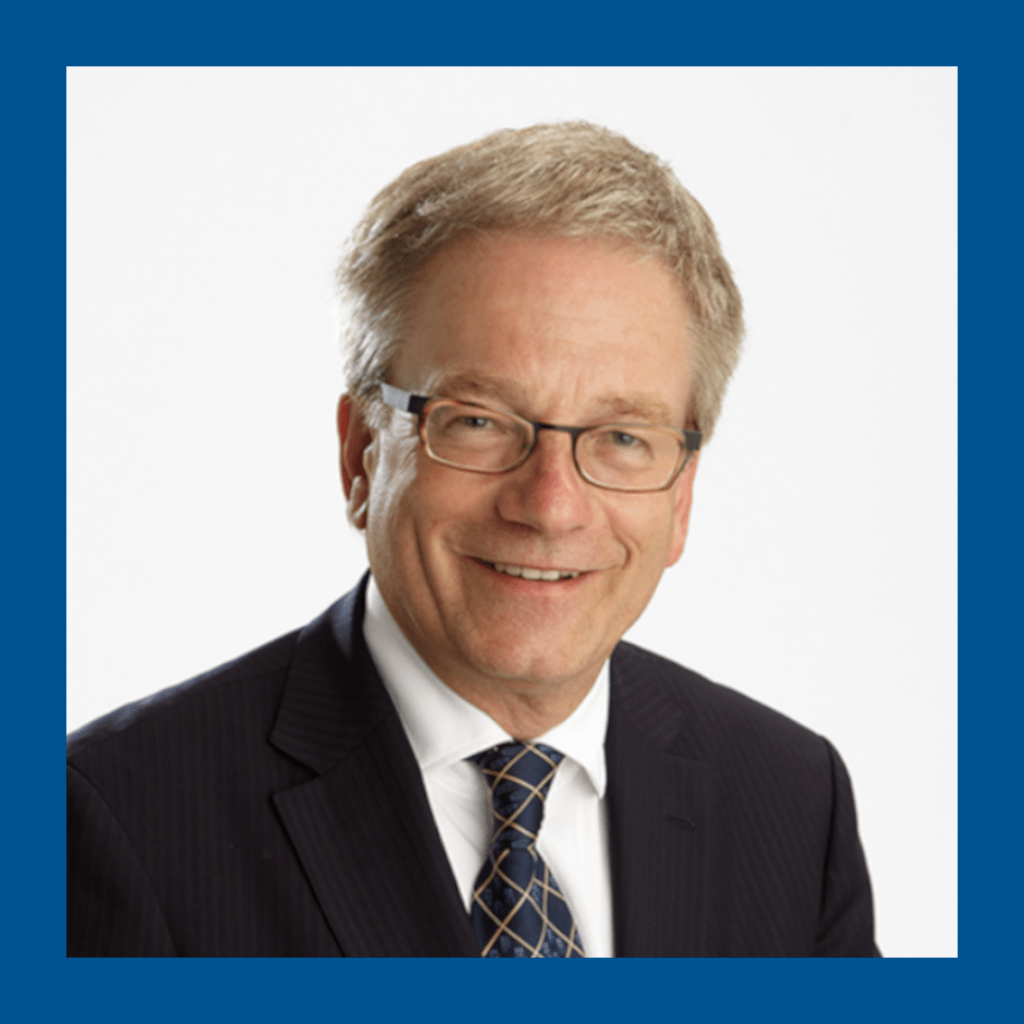
S4 Ep 14Projeter les jeunes chercheur.e.s dans des carrières d’avenir avec Rémi Quirion
La semaine où je célébrais le 200e épisode de Papa PhD, j’ai eu le plaisir d’interviewer un invité d’honneur - Rémi Quirion, le scientifique en chef du Québec - pour entendre son point de vue sur le doctorat et sur l’avenir des PhD sur le marché du travail.Durant l'enregistrement j'ai posé à Rémi les questions que vous m'avez envoyées et celles que ont été partagées en direct, sur Linkedin ou sur YouTube. Et Rémi à répondu à toutes mes questions, de la pertinence du doctorat en 2022 aux programmes offerts à la relève en recherche par les FRQ à la question de la professionnalisation et de la rémunération des doctorantes et des doctorants, donc c'est un épisode à écouter avec crayon et papier !Pendant que tu es là, je profite de l'occasion pour t'annoncer que Papa PhD a rejoint l'initiative Podcast 2.0 et est maintenant prêt à recevoir des boosts de ta part ! Un boost est une contribution valeur pour valeur (V4V) en Satoshis (ou Sats), la plus petite dénomination Bitcoin existante.Tous les boosts reçus feront l'objet d'une mention dans l'émission, en remerciement pour le soutien.Télécharge l'application Fountain, qui soutient les initiatives Podcast 2.0, et booste l'émission.J'aimerais aussi apprendre à mieux te connaître. Si tu as 60 secondes, remplis l'enquête auprès des auditeurs en cliquant sur ce lien. Fais un don à Papa PhD et soutiens le podcast.Échange d'autocollants : envoie-moi l'autocollant de ton podcast et je t'enverrai un autocollant Papa PhD. J'aimerais bien avoir un mur d'autocollants de mes amis podcasteurs ! VIDÉO https://youtu.be/oRfwpkKXAkoRémi Quirion est un chercheur québécois en neurosciences. Auteur de plus de 750 publications dans des revues scientifiques reconnues, il est l’un des chercheurs en neurosciences les plus cités dans le monde et récipiendaire de nombreux prix et distinctions.En juillet 2011, il est nommé scientifique en chef du Québec par le gouvernement du Québec devenant ainsi le premier à assumer la fonction.Il est le premier dirigeant des Fonds de recherche du Québec (FRQNT, FRQS, FRQSC) et préside, depuis septembre 2011, le Réseau international des scientifiques en chef et conseillers scientifiques (INGSA). Il devient ainsi le premier président francophone de cette organisation qui regroupe plus de 5 000 membres répartis dans environ 110 pays. Les ressources de cet épisode : Rémi Quirion | LinkedInRémi Quirion | TwitterScientifique en chef du Québec | Site WebRapport "L'université du Futur" | Site WebComité intersectoriel étudiant | Site WebBourse tremplin - Stage en milieu pratique | Site Web Merci Rémi Quirion ! Si cet entretien avec Rémi Quirion, le scientifique en chef du Québec, t'a plu, fais-nous en part en cliquant sur les liens ci-dessous et en nous laissant un message :Clique ici pour remercier Rémi Quirion sur Twitter !Clique ici pour partager avec David le principal message que tu retiens de cet épisode !Si tu trouves de la valeur dans le contenu que je t'apporte chaque semaine, clique sur l'un des boutons ci-dessous et renvoie-moi l'ascenceur :) Don sécuritaire sur PayPal Deviens supporter sur Patreon ! Ou paye-moi un café :) Tu aimeras aussi ces épisodes : Charlotte Hendryckx – L'aventure du doctorat à l'étranger : PapaPhD.com/193Erika Dupont – Le parcours doctoral est-il au service de chercheurs ? : PapaPhD.com/175Jean-Patrick Toussaint – Mieux préparer les doctorants à l'emploi : PapaPhD.com/155Myriam Beaudry - L'importance de rencontrer d'autres chercheur.e.s pendant ton doctorat : PapaPhD.com/183
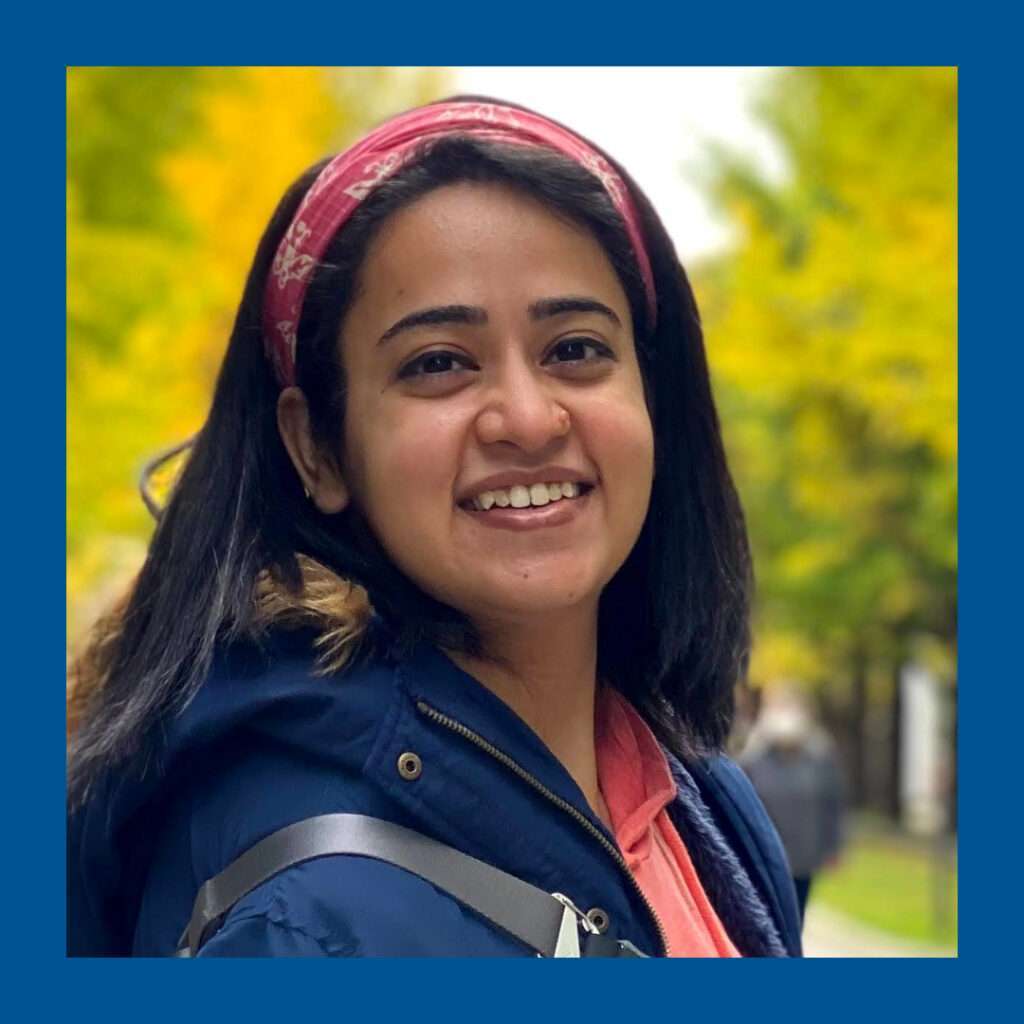
S4 Ep 13The Power of Mentorship During a Career Pivot With Anushka Khasnobish
This week on Papa PhD, I'm sharing the story of someone I've had the pleasure to mentor during her PhD to non-academic job transition - Anushka Khasnobish.I want to thank Anushka for suggesting to share this testimonial on the show and for the chance to reflect on a string of conversations that took place over a number of months and to make sense of them in retrospect.While you're here, I'll take the opportunity to announce that Papa PhD has joined the Podcast 2.0 initiative and is now set up to receive boosts from you, the listener! A boost is a value for value (V4V) contribution in Satoshis (or Sats), the smallest existing Bitcoin denomination. All received boosts will get a shoutout on the show, in appreciation for your support. Please check out the Fountain Podcast App that supports Podcast 2.0 initiatives and boost the show .Also, I'd love to get to know you better. If you have 60 seconds please fill out the listener survey in this link. Donate to the show and Support this podcast.Send a Sticker Get a Sticker: Send me your show sticker, and I will send you a Papa PhD Sticker. I'd love to have a wall of podfriend stickers! VIDEO https://youtu.be/w_EIEdWfsYY?sub_confirmation=1Anushka Khasnobish oversees scientific communications as Innovation Evangelist at TCS research. In 2021, she graduated with a doctorate from Okayama University, Japan. Her research was in the field of microbiome sciences where she worked on establishing a link between the community of microbes in our saliva and non-oral diseases. At this moment Anushka is trying to learn as much as she can about scientific communications, photography and a little bit of French language.Since the penultimate year of her PhD, she has been working with Useful Science contributors, editors and podcast hosts to break down research papers into bit-size useful summaries that one can incorporate in their lives right away. Anushka has a great desire to leverage her scientific experience and personal skills in projects involving scientific communications, intellectual property rights and science outreach. Thank you, Anushka Khasnobish ! If you enjoyed this conversation with Anushka, let her know by clicking the link below and leaving her a message on LinkedIn:Send Anushka Khasnobish a thank you message on LinkedIn!Click here to share your key take-away from this interview with David! This episode’s resources: Anushka Khasnobish | TwitterAnushka Khasnobish | LinkedinAnushka Khasnobish | Instagram You might also like the following episodes: Martha Boeglin – Unlocking Your Thesis Writing Super PowersAlbertha Joseph-Alexander – Using Scicomm to Make a DifferenceTerence Milstead – A Roadmap to Pivoting Into the Private SectorNatalia Bielczyk – Figuring Out Where You Fit in the Job Market as a PhDAs always, if you find value in Papa PhD and in the content I bring you every week and if you're not a nerd like me and don't want to delve into Podcast 2.0, click on one of the buttons below and send some of that value back to me by becoming a supporter on Patreon or by buying me a coffee :) Support the show on Patreon ! Or buy me a coffee :) Get the Papa PhD Career Readiness Tool kit !
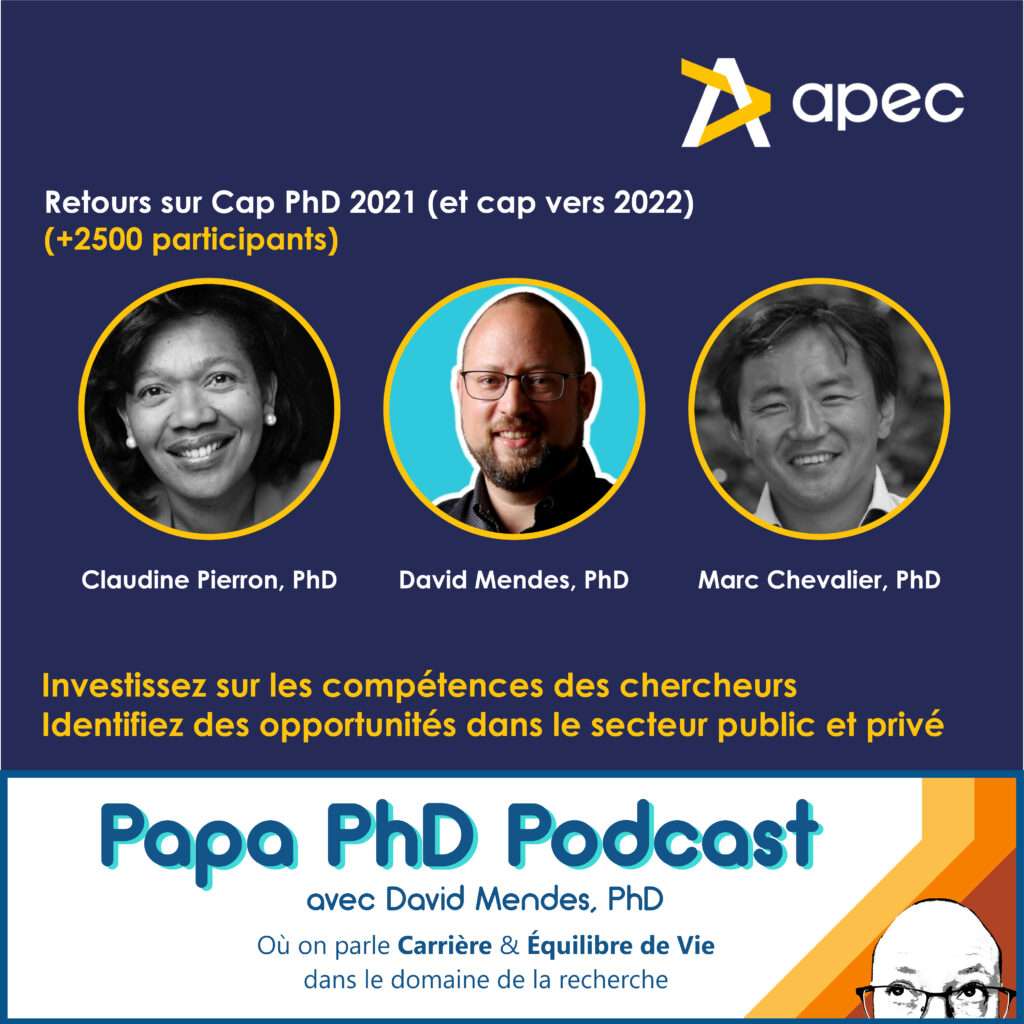
S4 Ep 12De Cap PhD 2021 à Cap Docteurs 2022 avec Claudine Pierron et Marc Chevalier
Cette semaine sur Papa PhD, une enrichissante conversation avec Claudine Pierron de l'APEC et avec Marc Chevalier, ami du podcast et champion de la promotion du succès professionnel des PhD.Au programme, un retour sur l'évènement Cap PhD, qui a eu lieu en 2021, et l'annonce de Cap Docteurs, la mouture revue et améliorée qui aura lieu les 23 et 24 novembre 2022.Ça t'intéresse ? Inscris-toi gratuitement ici : PapaPhD.com/capdocteurs VIDÉO https://youtu.be/VFRjU4K5cUIC'est quoi, Cap Docteurs ?C'est un évènement en ligne dont l'objectif est de vous offrir des pistes à suivre, des outils et des occasions de réseautage qui vous aideront à préparer à votre transition vers la vie professionnelle.On y parlera de :Carrières dans la fonction publique / l'administrationCarrières extra-académiques / dans le privéCompétences transversesIdentification des docteur.e.s en tant qu'experts scientifiquesÉvolution du recrutement des docteur.e.s et des compétences recherchéesÉtat actuel de l'emploi des docteur.e.sMobilité internationale des docteur.e.s Si tu es à la maîtrise, au doctorat ou si tu es postdoc, ne manque pas cette occasion de rencontrer tes pairs et de faire un pas important vers une transition éclairée au prochain chapitre de ton parcours professionnel.Bonne écoute ! Les ressources de cet épisode : Claudine Pierron | LinkedInMarc Chevalier | LinkedInOutils de l'APEC | Site web Merci, Claudine et Marc ! Si cet entretien avec Claudine Pierron et Marc Chevalier t'a plu, fais-nous en part en cliquant sur les liens ci-dessous et en nous laissant un message :Clique ici pour remercier Claudine Pierron sur LinkedIn !Clique ici pour remercier Marc Chevalier sur LinkedIn !Clique ici pour partager avec David le principal message que tu retiens de cet épisode !Si tu trouves de la valeur dans le contenu que je t'apporte chaque semaine, clique sur l'un des boutons ci-dessous et renvoie-moi l'ascenceur :) Don sécuritaire sur PayPal Deviens supporter sur Patreon ! Ou paye-moi un café :) Tu aimeras aussi ces épisodes : Charlotte Hendryckx – L'aventure du doctorat à l'étranger : PapaPhD.com/193Erika Dupont – Le parcours doctoral est-il au service de chercheurs ? : PapaPhD.com/175Jean-Patrick Toussaint – Mieux préparer les doctorants à l'emploi : PapaPhD.com/155Myriam Beaudry - L'importance de rencontrer d'autres chercheur.e.s pendant ton doctorat : PapaPhD.com/183

S4 Ep 11A Roadmap to Pivoting Into the Private Sector With Terence Milstead
200 episodes… I couldn’t have imagined I’d come this far when I launched back in 2019, but a little over 3 years in, it feels almost surreal.If you’re new to the show, welcome, and enjoy all the content! If you’re a long time fan, thank you for dropping by week after week! And if you want to show me some love, go to buymeacoffee.com/papaphd and donate. ????Every little bit helps!Again thank you. In this week’s amazing episode with Terence Milstead, he lays out his complete blueprint for a successful career transition from academia into the private sector.Happy listening! VIDEO https://youtu.be/BGKala5PT_8?sub_confirmation=1Terence Milstead received his Ph.D. in Urban and Regional Planning in 2008 from Florida State University where his research was focused on factors that influence people to invest time, money and emotional energy into upgrading their dwellings, even in unstable housing markets. This question led him to the former Soviet Union on a Fulbright and subsequently to other parts of the globe. But it also ignited a deep interest in qualitative research and the power of deeply listening to others.After completing his Ph.D. Terence started down the academic career path. However, after a few years he realized that a full-time career in academia was not what he had envisioned. So, in 20014, he transitioned to private sector, research-based consulting, relocating to the East Coat. But the path from academic to private-sector consultant was a crooked one and didn't happen overnight. In this episode Terence shares how he came up with a transition plan that ultimately led him to his current position as Head of Qualitative Insights at a global strategic consulting firm based in Washington D.C. Thank you, Terence Milstead ! If you enjoyed this conversation with Terence, let him know by clicking the link below and leaving him a message on LinkedIn:Send Terence Milstead a thank you message on LinkedIn!Click here to share your key take-away from this interview with David! This episode’s resources: Terence Milstead | FacebookTerence Milstead | LinkedinTerence Milstead | Website You might also like the following episodes: Martha Boeglin – Unlocking Your Thesis Writing Super PowersAlbertha Joseph-Alexander – Using Scicomm to Make a DifferenceDavid Giltner – Reconciling the Research and Development MindsetsNatalia Bielczyk – Figuring Out Where You Fit in the Job Market as a PhDAs always, if you find value in Papa PhD and in the content I bring you every week, click on one of the buttons below and send some of that value back to me by becoming a supporter on Patreon or by buying me a coffee :) Now with the added perk of receiving the brand new Papa PhD and PhD Dojo stickers! Support the show on Patreon ! Or buy me a coffee :) Get the Papa PhD Career Readiness Tool kit !
S4 Ep 10Unlocking Your Thesis Writing Super Powers with Martha Boeglin
Do you struggle to sit down and write your thesis? Is the process painful to you? Then join me in this interview a specialist, a "thesis whisperer" of sorts - Martha Boeglin of Scriptoria. During my conversation with Martha, we discuss this inevitable, yet often gruesome task that is thesis writing, and Martha shares her know-how and a number of techniques and strategies to make the exercise a pleasant and successful one. VIDEO https://youtu.be/Wu_N2gvWz6U?sub_confirmation=1 When she wanted to write her thesis in Philosophy, Martha Boeglin was paralyzed for many months by the fear of the blank page. When she eventually understood that the fear of the blank page is normal, that almost every researcher is concerned by writer’s block… ant that writing problems are tabou at university, she started to investigate the phenomenon of writing. One discovery changed her life: writer’s block belongs to the writing process – and there are lots of creative writing techniques to overcome them. More: some writing techniques hold an almost magical power. Why are they not taught at university ? Her passion for writing techniques was born. With a double consequence: first, once she overcame that initial writer’s block, she was able to write her thesis – and worte it in a wave of euphoria. Second, once she got her Dr. Titel, she created Scriptoria, the writing workshops for PhD students in 2002. Its goal? To make writing a thesis easier: when you know the right techniques, writing is no longer a chore - it can even become a source of joy. Thank you, Martha Boeglin ! If you enjoyed this conversation with Martha, let her know by clicking the link below and leaving her a message on Twitter: Send Martha Boeglin a thank you message on Twitter! Click here to share your key take-away from this interview with David! This episode’s resources: Martha Boeglin | LinkedIn Martha Boeglin | Twitter Scriptoria | Scriptoria.org | Groupe Facebook | Youtube You might also like the following episodes: Albertha Joseph-Alexander – Using SciComm to Make a Difference David Giltner – Reconciling the Research and Development Mindsets Jen Polk – Are You a Sellout if You Leave Academia After Your PhD? Natalia Bielczyk – Figuring Out Where You Fit in the Job Market as a PhD As always, if you find value in Papa PhD and in the content I bring you every week, click on one of the buttons below and send some of that value back to me by becoming a supporter on Patreon or by buying me a coffee :) Now with the added perk of receiving the brand new Papa PhD and PhD Dojo stickers! Support the show on Patreon ! Or buy me a coffee :) Get the Papa PhD Career Readiness Tool kit !
S4 Ep 9Using SciComm to Make a Difference with Albertha Joseph-Alexander
On this episode of Papa PhD, I bring you my recent conversation about science communication with Albertha Joseph-Alexander and about how scicomm has impacted her researcher career. If you are curious about science content creation and about the scicomm space, Albertha shares her journey and her lessons learned, so far. Happy listening! VIDEO https://youtu.be/yMjkOk00SRA?sub_confirmation=1 Dr. Albertha Joseph-Alexander has a PhD in Plant Science from the University of the West Indies, St. Augustine Campus, in Trinidad and Tobago. Albertha has a natural ability to tell stories and as a result, her enthusiasm for science communication allows her to simultaneously enjoy science and storytelling while disseminating knowledge for the benefit of society. Presently she is producing her first documentary. Thank you, Albertha Joseph-Alexander ! If you enjoyed this conversation with Albertha, let her know by clicking the link below and leaving her a message on Twitter: Send Albertha Joseph-Alexander a thank you message on Twitter! Click here to share your key take-away from this interview with David! This episode’s resources: Albertha Joseph-Alexander | Twitter Albertha Joseph-Alexander | Linkedin Albertha Joseph-Alexander | Facebook You might also like the following episodes: David Giltner – Reconciling the Research and Development Mindsets Katya Park – Staying True to Your Life Plans During the PhD Matthias Hombauer – Being a PhD, a Father and an Entrepreneur Natalia Bielczyk – Figuring Out Where You Fit in the Job Market as a PhD As always, if you find value in Papa PhD and in the content I bring you every week, click on one of the buttons below and send some of that value back to me by becoming a supporter on Patreon or by buying me a coffee :) Now with the added perk of receiving the brand new Papa PhD and PhD Dojo stickers! Support the show on Patreon ! Or buy me a coffee :) Get the Papa PhD Career Readiness Tool kit !
S4 Ep 8La thèse comme base solide pour mieux se connaître avec Julie Lopes
Cette semaine sur Papa PhD, je t'apporte ma récente conversation avec Julie Lopes, accompagnatrice de doctorant.e.s.La thématique - profiter du doctorat pour mieux se connaître et profiter de mieux se connaître pour avoir un trajet plus aligné et plus productif pendant la thèse.En fin d'épisode, Julie nous fait expérimenter un exercice de recentrage qu'elle utilise avec les personnes qu'elle accompagne. Si tu as besoin de calmer ton corps et ton esprit, ne le manque surtout pas ! VIDÉO https://youtu.be/NnyUIvVg7Y0Julie Lopes est docteure en microbiologie reconvertie dans l'entrepreneuriat auprès des étudiant·e·s, doctorant·e·s et docteur·e·s.Sa mission est de les accompagner vers une expansion d'eux-mêmes afin qu'ils choisissent un avenir dirigé par leur cœur plutôt que par la peur ! Les ressources de cet épisode : Julie Lopes | LinkedInJulie Lopes | Site webJulie Lopes | Instagram Merci Julie ! Si cet entretien avec Julie Lopes t'a plu, fais-nous en part en cliquant sur les liens ci-dessous et en nous laissant un message :Clique ici pour remercier Julie Lopes sur LinkedIn !Clique ici pour partager avec David le principal message que tu retiens de cet épisode !Si tu trouves de la valeur dans le contenu que je t'apporte chaque semaine, clique sur l'un des boutons ci-dessous et renvoie-moi l'ascenceur :) Don sécuritaire sur PayPal Deviens supporter sur Patreon ! Ou paye-moi un café :) Tu aimeras aussi ces épisodes : Charlotte Hendryckx – L'aventure du doctorat à l'étranger : PapaPhD.com/193Erika Dupont – Le parcours doctoral est-il au service de chercheurs ? : PapaPhD.com/175Jean-Patrick Toussaint – Mieux préparer les doctorants à l'emploi : PapaPhD.com/155Myriam Beaudry - L'importance de rencontrer d'autres chercheur.e.s pendant ton doctorat : PapaPhD.com/183
S4 Ep 7Influence and Leadership Positions – a How-To With David Giltner
On this episode of Papa PhD, I bring you my conversation with returning guest David Giltner about opportunities and obstacles PhDs face when accessing influence and leadership positions in organizations outside academia.David Giltner has covered this and other questions around career readiness for PhDs in his new book "It's a Game, Not a Formula: How to Succeed as a Scientist Working in the Private Sector". VIDEO https://youtu.be/e-AEp6aIk4Q?sub_confirmation=1David Giltner has spent more than twenty years developing cutting-edge photonics technologies into commercial products in the fields of optical communications, remote sensing, directed energy, and scientific instrumentation.In 2017 he started TurningScience to providetraining and support for scientists of all disciplines seeking to enter the private sector as employees, collaborators, or entrepreneurs. David is the author of the books 'Turning Science into Things People Need' and 'It’s a Game, Not a Formula,' and is an internationally recognized speaker and mentor on the topics of technology commercialization, product development, and career design.David has a BS and PhD in physics and holds seven patents in the fields of laser spectroscopy and optical communications. Thank you, David Giltner ! If you enjoyed this conversation with David, let him know by clicking the link below and leaving him a message on Twitter:Send David Giltner a thank you message on Twitter!Click here to share your key take-away from this interview with David! This episode’s resources: David Giltner | TwitterWebsite | TurningScience.comBook | It's a Game, Not a Formula: How to Succeed as a Scientist Working in the Private Sector You might also like the following episodes: David Giltner – Reconciling the Research and Development MindsetsKatya Park – Staying True to Your Life Plans During the PhDMatthias Hombauer – Being a PhD, a Father and an EntrepreneurNatalia Bielczyk – Figuring Out Where You Fit in the Job Market as a PhDAs always, if you find value in Papa PhD and in the content I bring you every week, click on one of the buttons below and send some of that value back to me by becoming a supporter on Patreon or by buying me a coffee :) Now with the added perk of receiving the brand new Papa PhD and PhD Dojo stickers! Support the show on Patreon ! Or buy me a coffee :) Get the Papa PhD Career Readiness Tool kit !

S4 Ep 6What mistakes are keeping you out of industry? With The 2nd Lab
Welcome to another collab episode of the PhD Dojo with The 2nd Lab. VIDEO https://www.youtube.com/watch?v=ts0fpl4BXZ0 This week on the PhD Dojo, Gad Sabbatier and I answer another great question from 2nd Lab mentee Matt Campea who asks: "What are some of the biggest mistakes people make when looking for a job outside of academia?" Thank you, Matt, for bringing up this question. Blind spots do exist and are they can can be difficult obstacles to surpass, unless someone points them out to us. Gad and I give you our reflections on these mistakes in this PhD Dojo. Call for creators ! I'm looking for sidekicks to be part of the Papa PhD team! If you're interested in podcasting and social media, and want to help me with the production of Papa PhD or the PhD Dojo in any way, email me at [email protected] and let's talk! Happy listening! And happy sharing! This episode’s resources: The 2nd Lab | Twitter The 2nd Lab | LinkedIn The 2nd Lab | Website If you find value in Papa PhD and in the content I bring you every week, click on one of the buttons below and send some of that value back to me :) Now with the added perk of receiving the brand new Papa PhD and PhD Dojo stickers, if you become a monthly supporter on Patreon or BuyMeACoffee! Donate safely through PayPal Support the show on Patreon ! Or buy me a coffee :) Get the Papa PhD Career Readiness Tool kit ! You might also like the following episodes: Sara Vero - Being Field-Ready for the Postdoc and Job Search PhD Dojo – When Should I Pivot to Industry? PhD Dojo – How to Gain Confidence for Job Interviews PhD Dojo – First Year PhD - Assembling the Expedition Team

S4 Ep 5The Importance of HBCUs and Africana Heritage With Kweli Zukeri
Welcome to Season 4 of Papa PhD! VIDEO https://youtu.be/1hemLxGgARM Kweli Zukeri was born and raised in Falls Church, Va. He has a BA in Journalism and Mass Communication and minor in social entrepreneurship from UNC at Chapel Hill, as well as an M.S. in Psychology (2018) and Ph.D. (2021) in Developmental Psychology from Howard University. Both his master thesis and dissertation focused on exploring the impact of African-centered school-based programming on American African student racial and cultural identity, as well as American African student learning. Prior to his recent graduate studies, he also studied ancient African/Kemetic language for 2 years in Howard’s department of Africana studies, and has been a facilitator of the Egypt on the Potomac Field Trip of Washington, D.C., for the last decade. Thank you, Kweli Zukeri! If you enjoyed this conversation with Kweli, let him know by clicking the link below and leaving him a message on Twitter: Send Kweli Zukeri a thank you message! Click here to share your key take-away from this interview with David! This episode’s resources: Kweli Zukeri | LinkedIn Kweli Zukeri | Twitter If you find value in Papa PhD and in the content I bring you every week, click on one of the buttons below and send some of that value back to me :) Now with the added perk of receiving the brand new Papa PhD and PhD Dojo stickers, if you become a monthly supporter on Patreon or BuyMeACoffee! Donate safely through PayPal Support the show on Patreon ! Or buy me a coffee :) Get the Papa PhD Career Readiness Tool kit ! You might also like the following episodes: Sarah Habibi - Becoming a Full-Time Science Communicator Federica Bressan – Do researchers have time for scicomm? Chris Emdin – Reimagining a More Inclusive STEM PhD Dojo – First Year PhD - Assembling the Expedition Team
S4 Ep 4Le doctorat à l’étranger, une grande aventure avec Charlotte Hendryckx
Cette semaine sur Papa PhD, on parle de cette aventure qu'est de quitter son pays pour son doctorat. Avec mon invitée, Charlotte Hendryckx, on explore les choses à faire et à ne pas faire pour en faire une expérience positive et dans laquelle vous pourrez vous épanouir en tant que personne et en tant que jeune chercheuse ou chercheur. VIDÉO https://youtu.be/A7Zk8_bCWO0Neuropsychologue belge formée à l’Université Libre de Bruxelles, Charlotte Hendryckx réalise depuis septembre 2019 un doctorat Recherche et Intervention en neuropsychologie clinique à l’Université de Montréal (Québec, Canada) sous la supervision conjointe de Pr Carolina Bottari au CRIR et Pr Nadia Gosselin au CEAMS.En Belgique, Charlotte développé une expérience clinique d’évaluation et de rééducation dans son travail dans les services de neurologie destinés aux adultes au Centre Neurologique William Lennox ainsi qu’à la clinique du Bois de la Pierre. Elle a travaillé avec des populations présentant des affections neurologiques diverses, dont les traumatismes crâniocérébraux (TCC).Actuellement, Charlotte réalise sa thèse sur les comportements problématiques, comme l’agressivité physique ou verbale ou encore l’impulsivité, chez des adultes ayant subi un TCC et vivant dans la communauté. Plus précisément, elle s’intéresse aux stratégies quotidiennes qu’ils mettent en place, eux et leurs proches aidants familiaux, pour faire face et gérer leurs comportements problématiques afin de réduire les impacts associés.Charlotte accorde aussi une grande importance au transfert de connaissances et à la vulgarisation scientifique, dans son projet de thèse et sur le traumatisme crânien en général. Elle donne ainsi des conférences cliniques et je diffuse mes résultats au domaine scientifique, afin de sensibiliser le plus large public possible. Les ressources de cet épisode : Charlotte Hendryckx | LinkedIn Merci Charlotte ! Si cet entretien avec Charlotte Hendryckx t'a plu, fais-nous en part en cliquant sur les liens ci-dessous et en nous laissant un message :Clique ici pour remercier Charlotte Hendryckx sur Twitter !Clique ici pour partager avec David le principal message que tu retiens de cet épisode !Si tu trouves de la valeur dans le contenu que je t'apporte chaque semaine, clique sur l'un des boutons ci-dessous et renvoie-moi l'ascenceur :) Don sécuritaire sur PayPal Deviens supporter sur Patreon ! Ou paye-moi un café :) Tu aimeras aussi ces épisodes : Myriam Beaudry - L'importance de rencontrer d'autres chercheur.e.s pendant ton doctorat : PapaPhD.com/183Émilie Deschênes – Le doctorat, nous prépare-t-il à enseigner ? : PapaPhD.com/191Jean-Patrick Toussaint – Mieux préparer les doctorants à l'emploi : PapaPhD.com/155Catherine Cimon-Paquet – L'importance de vulgariser : PapaPhD.com/177

S4 Ep 3What are Accessible Careers for PhDs outside R&D? With The 2nd Lab
VIDEO Welcome to another collab episode of the PhD Dojo with The 2nd Lab.https://www.youtube.com/watch?v=CD2dmV8D9jwThis week on the PhD Dojo, Gad Sabbatier and I answer a question from 2nd Lab mentee Romane Oliverio who asks: "What are the accessible careers outside R&D?".Thank you, Romane, for a great question that allowed Gad and I to dive deep into the great variety of positions open to PhDs in the job market, from medical writing, to patent officer, to business-related careers.What about you? What did you do after you PhD?Call for creators !I'm looking for sidekicks to be part of the Papa PhD team! If you're interested in podcasting and social media, and want to help me with the production of Papa PhD or the PhD Dojo in any way, email me at [email protected] and let's talk!Happy listening! And happy sharing! This episode’s resources: The 2nd Lab | TwitterThe 2nd Lab | LinkedInThe 2nd Lab | WebsiteIf you find value in Papa PhD and in the content I bring you every week, click on one of the buttons below and send some of that value back to me :) Now with the added perk of receiving the brand new Papa PhD and PhD Dojo stickers, if you become a monthly supporter on Patreon or BuyMeACoffee! Donate safely through PayPal Support the show on Patreon ! Or buy me a coffee :) Get the Papa PhD Career Readiness Tool kit ! You might also like the following episodes: Sara Vero - Being Field-Ready for the Postdoc and Job SearchPhD Dojo – When Should I Pivot to Industry?PhD Dojo – How to Gain Confidence for Job InterviewsPhD Dojo – First Year PhD - Assembling the Expedition Team
S4 Ep 2Le doctorat nous prépare-t-il à enseigner ? Avec Émilie Deschênes
Cette semaine sur Papa PhD, j'ai le plaisir de vous apporter une exploration avec mon invitée - Émilie Deschênes - sur les défis que présente le passage à l'enseignement, après le doctorat. Pendant notre conversation, nous avons aussi abordé des sujets plus larges dans le contexte de la carrière académique et, en particulier, du doctorat. Un parcours atypique et un regard lucide sur le parcours professoral - merci, Émilie ! VIDÉO https://www.youtube.com/watch?v=oUPCZBmDJHI?sub_confirmation=1 Émilie Deschênes, professeure à l’université du Québec en Abitibi-Témiscamingue, est titulaire d’un doctorat en éducation et d’une maîtrise en administration des affaires. Elle possède plus d’une quinzaine d’années d’expérience comme enseignante et en gestion de l’éducation, plus spécifiquement dans le domaine de la gestion de l’éducation au sein des communautés des Premières nations et des villages inuits. Avant de commencer ses fonctions comme professeure à l’UQAT, qu’elle occupe depuis le printemps 2020, Émilie a consacré près de deux années à la réalisation d’un postdoctorat en management interculturel portant entre autres sur l’insertion socioprofessionnelle des Premières Nations. Aussi, ses deux champs de spécialisation portent sur la gestion de l’éducation en contexte autochtone et l’éducation et la formation à tous les ordres d’enseignement des apprenants des Premières Nations et Inuit et à la suite, sur l’insertion en emploi de ces mêmes personnes. Présentement, ses recherches concernent principalement la décolonisation (notamment des institutions scolaires québécoises), la valorisation et l’inclusion des perspectives des Premières Nations et Inuit en enseignement et la persévérance des apprenants des Premières Nations et Inuit, notamment en lien avec les transitions qu’ils vivent entre leurs communautés et les milieux urbains où ils doivent déménager pour étudier et celles vers leur milieu professionnel, pour l’emploi. Les ressources de cet épisode : Émilie Deschênes | LinkedIn Merci Émilie ! Si cet entretien avec Émilie Deschênes t'a plu, fais-nous en part en cliquant sur les liens ci-dessous et en nous laissant un message : Clique ici pour remercier Émilie Deschênes sur LinkedIn ! Clique ici pour partager avec David le principal message que tu retiens de cet épisode ! Si tu trouves de la valeur dans le contenu que je t'apporte chaque semaine, clique sur l'un des boutons ci-dessous et renvoie-moi l'ascenceur :) Don sécuritaire sur PayPal Deviens supporter sur Patreon ! Ou paye-moi un café :) Tu aimeras aussi ces épisodes : Myriam Beaudry - L'importance de rencontrer d'autres chercheur.e.s pendant ton doctorat : PapaPhD.com/183 Anne-Claire Huard – Comment tisser des liens professionnels : PapaPhD.com/181 Jean-Patrick Toussaint – Mieux préparer les doctorants à l'emploi : PapaPhD.com/155 Catherine Cimon-Paquet – L'importance de vulgariser : PapaPhD.com/175
S4 Ep 1Are You a Sellout if You Leave Academia After Your PhD? With Jennifer Polk
Welcome to Season 4 of Papa PhD!To kick of this new season, I have the great pleasure of bringing you my recent conversation with someone I've been looking up to since before the launch of the podcast, someone who has been hard at work to help PhDs figure out their careers for a long time - Jen Polk or From PhD to Life!Join us on this conversation about a question many of you may have asked yourselves already: is leaving academia tantamount to being a sellout? VIDEO https://youtu.be/uFs7_zRHRIsJennifer Polk, PhD, is a career coach and educator. In addition to her work with individuals, she regularly facilitates professional development workshops and delivers presentations for graduate students and postdocs. Jen currently serves on the board of directors for CAGS, the Canadian Association for Graduate Studies. She earned her PhD in history from the University of Toronto. Visit her website, FromPhDtoLife.com, to read her writing and learn more about her other services and activities. Thank you, Jen Polk! If you enjoyed this conversation with Jen, let her know by clicking the link below and leaving her a message on Twitter:Send Jen Polk a thank you message!Click here to share your key take-away from this interview with David! This episode’s resources: Jen Polk | LinkedInFrom PhD to Life | TwitterFrom PhD to Life | FacebookFrom PhD to Life | WebsiteIf you find value in Papa PhD and in the content I bring you every week, click on one of the buttons below and send some of that value back to me :) Now with the added perk of receiving the brand new Papa PhD and PhD Dojo stickers, if you become a monthly supporter on Patreon or BuyMeACoffee! Donate safely through PayPal Support the show on Patreon ! Or buy me a coffee :) Get the Papa PhD Career Readiness Tool kit ! You might also like the following episodes: Sarah Habibi - Becoming a Full-Time Science CommunicatorFederica Bressan – Do researchers have time for scicomm?Chris Emdin – Reimagining a More Inclusive STEMPhD Dojo – First Year PhD - Assembling the Expedition Team
S3 Ep 64Networking and Job Hunting as a PhD With Parag Mahanti (rerun)
This week on Papa PhD, I'm bringing you another great conversation from Season 2 of the show.This interview was recorded during Thanksgiving, so you might hear some background noise throughout. But please bear with us, because the advice Parag shares is pure gold. For example, we talked about Parag's experience interviewing for jobs – early after his PhD, but also in his most recent career moves. What you’ll learn about in this episode: Not everyone that enrolls into a PhD is bound to do researchNot all temperaments thrive in the academic research timeframe, in terms of results and their impact on society at largeThe positive impact being part of clubs and taking extracurricular courses can have on your mental healthParag's way of making time for extra-curricular projectsThe advantages and disadvantages of choosing a well established, tenured professor, versus a young professor vying for tenure as a PhD supervisorParag's experience of the consulting pathThe advanteges of doing informational interviews when you don't need a jobRejections are not about your abilities, they are about a mutual fit that didn't happen + you should always ask for feedback after your application was rejectedWhy advice from a community is much more valuable than the advice you get from a single personThe job hunt is a process - you get better at it as you go Parag Mahanti received his Ph.D. in Chemistry and Chemical Biology in 2013 from Cornell University where his research was focused on nuclear hormone receptors, steroid signaling, and metabolomics. Since then he has moved careers thrice first to consulting then to finance, and currently in pharma.Outside of life sciences and biopharma strategy, Parag’s passions include music, both playing and listening, biotech startups and understanding the evolution of scientific reasoning and leadership skills. Parag takes an active interest in career progression of PhD students and has created a fast growing LinkedIn Group that currently has ~7500+ members. Parag also serves as a mentor for the Entrepreneurship Lab (ELabNYC) originally launched by the New York City Economic Development Corporation to provide mentorship to biotech/health-tech start-ups in the New York area. Thank you, Parag Mahanti! If you enjoyed this interview with Parag, let him know by clicking the link below and leaving him a message on Twitter:Click here to thank Parag Mahanti on Twitter!Click here to share your key take-away from this interview with David! Parag's pearls of wisdom: “Parag – Once I came here and I enrolled into a PhD programme, I was like, "Oh! This is awesome! This is Super cool, smart thinking stuff and I can thrive in this." And I started doing that for first year and second year, and then by third year, I was like, "No way...". Like, I like the smart thinking part of it, I like the science, but I don't want to do this for the rest of my life. And I think the main reason was, I love the science. In fact, I've stayed very close to the science most of my career, but it was the impact of it, right? Like, for some reason, I always thought the stuff that I was doing, you would see maybe a return or a clinical development of it in, like, 10, 15, 20 years. So there's no immediate translation of this work. David – "Talk about delayed gratification, there, right?" Parag – Exactly!”“Parag – The same guy had told me that any job, if you don't like the interview process, chances are you won't like the job. And this is something that I continue to feel through all the career progressions that I've made, that if you don't really enjoy the process and the people you're meeting, then you're not going to like the people that you're going to work with. David – "Because they represent the culture of..." Parag – Of the industry and of the company.” This episode’s resources: Parag Mahanti | LinkedInParag Mahanti | TwitterThe Grad Grid | WebsiteThe Grad Grid en Français | ...

S3 Ep 63Expanding Your Career Toolkit with Mark Herschberg (rerun)
This week on Papa PhD, I'm bringing you a great conversation from Season 2 of the show.In it, Mark Herschberg shares an incredible amount of insights and advice on how to take control of your career as a PhD, be it in academia our outside of it, so be sure to have pen and paper before hitting play! What you’ll learn about in this episode: Mark's academic journeyThe motivation behind his book - The Career ToolkitWhy time spent developing career skills is well investedYou shouldn't take your career decisions in a vacuum - start talking to people about their careers nowHow to network as an introvertThe cultural differences between academia and industryWhy you should negotiate compensation, not only salaryHow building and updating a career plan can help youHow to find your place in an organization where you're the first PhDThe importance of building your personal brand in today's market Mark Herschberg is the author of The Career Toolkit, Essential Skills for Success That No One Taught You. From tracking criminals and terrorists on the dark web to creating marketplaces and new authentication systems, Mark has spent his career launching and developing new ventures at startups and Fortune 500s and in academia. He helped to start the Undergraduate Practice Opportunities Program, dubbed MIT’s “career success accelerator,” where he teaches annually. At MIT, he received a B.S. in physics, a B.S. in electrical engineering & computer science, and a M.Eng. in electrical engineering & computer science, focusing on cryptography. At Harvard Business School, Mark helped create a platform used to teach finance at prominent business schools. He also works with many non-profits, including Techie Youth and Plant A Million Corals. He was one of the top-ranked ballroom dancers in the country and now lives in New York City.You can learn where to purchase "The Career Toolkit: Essential Skills for Success That No One Taught You" at:www.TheCareerToolkitBook.com Thank you, Mark Herschberg! If you enjoyed this interview with Mark, let him know by clicking the link below and leaving him a message on Twitter:Click here to thank Mark Herschberg on Twitter!Click here to share your key take-away from this interview with David! Support the show on Patreon ! Or buy me a coffee :) Get the Papa PhD Career Search Tool kit ! Mark's pearls of wisdom: “Negotiations are a skill that you should learn. So imagine the following scenario: You get a job outside of academia, you take your first industry job. Maybe you're 30 years old. Let's say they offer you 80,000 dollars and you negotiate to 81,000. Not a massive lift, right? We can all imagine doing that. If you do nothing else, you just sit in that job the rest of your career, you spend another 35 years working at this one job – you just made 35,000 dollars. One negotiation, tiny lift – 35,000 dollars. Now, imagine that you don't just sit in one job, right? You, of course, takes other jobs. You get promotions, you negotiate those. Again, you negotiate for maybe just a few thousand more. These aren't heavy lifts, you're not some world class negotiator – you're just doing a little better. You can literally add tens of thousands, even hundreds of thousands of dollars to your lifetime income.”“I am naturally an introvert. Here's the thing – you think about that stereotype of a networker who does go to the conference and schmoozes everyone and gives out cards. Yeah, that's not networking. It's one way to do it, but that's not the only way. If you've ever had a friend, you know how to network. It is just building a relationship. Now, it doesn't mean everyone in your network is your personal fiend, right? There's some people who are my friends and they're in my network, there's some people we're just business contacts. We don't hang out on weekends, but we can call each other, reach out, and we have a relationship.
S3 Ep 62Réussir son doctorat en SHS avec Emilie Doré (rediffusion)
Cette semaine, je t'apporte en rediffusion une conversation où, avec Émilie Doré de Réussir son doctorat, on fait une radiographie des défis actuels de l'expérience de la thèse en sciences humaines et sociales (SHS) et où on discute des pistes à suivre pour offrir aux doctorant.e.s une expérience formatrice et davantage épanouissante. Ce que tu apprendras dans cet épisode : La réalité des thèses sans financement en SHS Ce qui a mené Émilie à ne pas reconduire son contrat de postdoctorat L'état de la santé mentale des doctorant.e.s aujourd'hui Pourquoi le modèle des sciences exactes ou naturelles ne foncionne pas pour un doctorat en SHS L'importance de trouver des espaces bienveillants pour échanger avec des pairs à propos de notre expérience du doctorat L'importance d'échanger le perfectionnisme et des échéances irréalistse par la confiance et la régularité Les changements qui se font aujourd'hui dans la formation des encadrants Pourquoi la thèse en vaut la chandelle Tu aimes Papa PhD ? Laisse-moi un commentaire ici - une courte phrase suffit ! Et inclus ton identifiant Twitter – comme ça je pourrai te remercier personnellement ! Emilie Doré a soutenu une thèse en sociologie en 2009 à l'Ecole de Hautes Etudes à Paris, puis elle a commencé une carrière de chercheuse par la voie classique : un post-doctorat. Pourtant, en 2012, Emilie décidé de trouver un chemin plus aligné avec sa vision et son rythme de vie ; elle est devenue formatrice indépendante auprès des doctorants. Son rôle ? Leur permettre d'oser exprimer leur créativité et leur singularité dans leur thèse - tout en suivant les règles du jeu académique. Sa mission : que la thèse soit pour les doctorants une expérience de plaisir intellectuel et d'affirmation personnelle ! Merci Emilie ! Si cet entretien avec Emilie Doré t'a plu, fais-lui en part en cliquant sur le lien ci-dessous et en lui laissant un message sur LinkedIn : Clique ici pour la remercier sur LinkedIn ! Clique ici pour partager avec David le principal message que tu retiens de cet épisode ! Télécharge la "Boîte à outils pour le doctorat" maintenant ! Contribue à la production de Papa PhD sur Patreon ! Ou ravitaille David en café :) Les perles de sagesse d'Emilie : « Le plainte qui revient souvent c'est justement cette question du temps, à savoir "je suis trop lent, je suis trop lente – je n'arrive pas à tenir mes échéances." Et ça, c'est surtout quand on s'approche de la fin de la thèse, où la pression monte, bien sûr. Et ce qu'il y a derrière, quand on creuse un peu, c'est que le doctorant peut-être qu'il a une famille, peut-être qu'il doit travailler à côté, dans le cas des doctorantes, il peut y avoir des maternités qui arrivent. En fait, il y a la vie à coté de la thèse et ils aimeraient bien, eux, être dans un monastère, dans une bulle, et faire la thèse et ne faire que ça, s'y consacrer. Et, alors, peut-être qu'ils se disent "dans ces cas-là j'y arriverais." Mais en réalité, ça ne peut pas être comme ça. La thèse, elle se fait au sein de notre vie et elle doit se faire en harmonie avec notre vie. » « La diversité dans la recherche, elle existe, à la base, fortement. Et puis elle existe pour les maitres de conférences – un peu moins, mais quand même, encore – et pour les professeurs, c'est-à-dire qu'en fait, plus on va monter dans les échelons, plus la diversité se perd. C'est-à-dire que ça infuse lentement, en réalité. » « En étant plus ouverts, on ne va pas perdre en rigueur intellectuelle. On peut tout à fait avoir une recherche plus ouverte, qui donne plus d'espace à la créativité, à la singularité, à la liberté des doctorants et qui gardera sa qualité. Et, même, qui peut être plus qualitative, parce que ça n'est pas contradictoire avec la rigueur des raisonnements, de l'argumentation que peuvent mettre en place ces doctorants. » Les ressources de cet épisode : Emilie Doré | LinkedIn Emilie Doré | Facebook Réussir Sa Thèse | Site Web
S3 Ep 61Becoming a Full-Time Science Communicator with Sarah Habibi
This week one Papa PhD , I'm over the moon happy to have with me Sarah Habibi, aka Science Bae, to talk about her journey into full-time science communication.During our conversation, Sarah shared her academic and scientific journey and we discussed what key choices and strategies allowed for Sarah to build a brand around STEAM education robust enough to draw the attention of major corporate sponsors, while reaching other big milestones in her professional and personal life.Want to be inspired to delve into scicomm? Then this Papa PhD interview is for you! VIDEO https://www.youtube.com/watch?v=OfcDIF0SLD4Sarah Habibi is a molecular biologist, educator, and digital content creator and is the founder of the brand Science Bae.Sarah uses the power of social media to promote experimentation in STEAM and enhance student learning, through her popular page Science Bae on Instagram and TikTok and uses her 4+ years of teaching and curriculum development experience, Bachelor of Education Degree, PhD in molecular biology, and Ontario Certified Teacher (OCT) designation to make her teaching educational, accessible, and engaging. Thank you, Sarah Habibi! If you enjoyed this conversation with Sarah, let her know by clicking the link below and leaving her a message on Twitter:Send Sarah Habibi a thank you message!Click here to share your key take-away from this interview with David! This episode’s resources: Sarah Habibi | Twitter Sarah Habibi | LinkedIn Sarah Habibi | Facebook Get Sarah's free Science Experiment Activity Package | Website If you find value in Papa PhD and in the content I bring you every week, click on one of the buttons below and send some of that value back to me :) Now with the added perk of receiving the brand new Papa PhD and PhD Dojo stickers, if you become a monthly supporter on Patreon or BuyMeACoffee! Donate safely through PayPal Support the show on Patreon ! Or buy me a coffee :) Get the Papa PhD Career Readiness Tool kit ! You might also like the following episodes: Sara Vero - Being Field-Ready for the Postdoc and Job SearchFederica Bressan – Do researchers have time for scicomm?Chris Emdin – Reimagining a More Inclusive STEMPhD Dojo – First Year PhD - Assembling the Expedition Team
S3 Ep 60Le tiers secteur de la recherche avec Anaïs Trousselle
Cette semaine sur Papa PhD, je réponds à la question " Qu'est-ce que le tiers secteur de la recherche ? " avec la cofondatrice de la société à mission Narrau - Anaïs Trousselle.Au long de notre conversation, Anaïs a partagé son trajet académique, les réflexions et les passions qui ont guidé ses choix à différents moments-clés et nous avons exploré tous les contextes où les PhD peuvent s'épanouir en tant que chercheur.es, tout en contribuant étroitement à combler les besoins de leurs communautés.À écouter si tu cherches de l'inspiration et de la motivation après ton doctorat! VIDÉO https://www.youtube.com/watch?v=OMHwXSxw4_0?sub_confirmation=1Anaïs Trousselle est docteure en géographie sociale et ingénieure en agro-développement. Elle est la fondatrice de NARRAU, spécialisée dans la recherche-action en sciences humaines et sociales. La raison d’être de son organisation est de produire des données et des analyses, à partir d’une démarche scientifique en sciences humaines et sociales, pour documenter des phénomènes sociaux et environnementaux contemporains. Les ressources de cet épisode : Anaïs Trousselle | LinkedInNarrau | Site WebFilm-audio sur le projet " Migration et SARS-CoV-2 " | Vidéo Merci Anaïs ! Si cet entretien avec Anaïs Trousselle t'a plu, fais-nous en part en cliquant sur les liens ci-dessous et en nous laissant un message :Clique ici pour remercier Anaïs Trousselle sur LinkedIn !Clique ici pour partager avec David le principal message que tu retiens de cet épisode !Si tu trouves de la valeur dans le contenu que je t'apporte chaque semaine, clique sur l'un des boutons ci-dessous et renvoie-moi l'ascenceur :) Don sécuritaire sur PayPal Deviens supporter sur Patreon ! Ou paye-moi un café :) Télécharge la "Boîte à outils pour le doctorat" maintenant ! Tu aimeras aussi ces épisodes : Myriam Beaudry - L'importance de rencontrer d'autres chercheur.e.s pendant ton doctorat : PapaPhD.com/183Anne-Claire Huard – Comment tisser des liens professionnels : PapaPhD.com/181Jean-Patrick Toussaint – Mieux préparer les doctorants à l'emploi : PapaPhD.com/155Catherine Cimon-Paquet – L'importance de vulgariser : PapaPhD.com/177

S3 Ep 59When Should I Pivot Into Industry ? With The 2nd Lab
Welcome to another collab episode of the PhD Dojo with The 2nd Lab. VIDEO https://youtu.be/bWlAghDsGC0This week on the PhD Dojo, Gad Sabbatier and I answer a question from 2nd Lab mentee Karthick who asks: "When is an opportune time to transition from academia to industry?".Of course, there is a short answer to that question, but in this PhD Dojo, Gad and I drill down on different ways to start preparing the pivot early on in your graduate research journey.As always, don't hesitate to send us your comments or your own questions here on the website or on any of our social media platforms. We'd be thrilled to answer them and give you a shoutout on a future episode!Call for creators !I'm looking for sidekicks to be part of the Papa PhD team! If you're interested in podcasting and social media, and want to help me with the production of Papa PhD or the PhD Dojo in any way, email me at [email protected] and let's talk!Happy listening! And happy sharing! This episode’s resources: The 2nd Lab | TwitterThe 2nd Lab | LinkedInThe 2nd Lab | WebsiteIf you find value in Papa PhD and in the content I bring you every week, click on one of the buttons below and send some of that value back to me :) Now with the added perk of receiving the brand new Papa PhD and PhD Dojo stickers, if you become a monthly supporter on Patreon or BuyMeACoffee! Donate safely through PayPal Support the show on Patreon ! Or buy me a coffee :) Get the Papa PhD Career Readiness Tool kit ! You might also like the following episodes: Sara Vero - Being Field-Ready for the Postdoc and Job SearchFederica Bressan – Do researchers have time for scicomm?Chris Emdin – Reimagining a More Inclusive STEMPhD Dojo – First Year PhD - Assembling the Expedition Team
S3 Ep 58L’importance de rencontrer d’autres chercheur.e.s avec Myriam Beaudry
Cette semaine sur Papa PhD, je vous apporte une conversation avec Myriam Beaudry, l'animatrice du balado Tête à tête avec la science.Nous allons parler du rôle que le balado et les rencontres avec d'autres chercheur.e.s qu'il engendre jouent dans le parcours doctoral de Myriam. Nous allons aussi parler du pourquoi de cette mission qu'elle s'est donnée d'amplifier les voix des scientifiques qu'elle invite à son micro. VIDÉO https://youtu.be/AecBBLQ7fvE?sub_confirmation=1Myriam a complété son baccalauréat en sciences de la nutrition à l'Université d'Ottawa, elle est donc nutritionniste-diététiste. Son amour pour la recherche et la science la amené à poursuivre son cheminement académique au doctorat à l'Université de Montréal.Infiniment passionnée par son domaine, elle laisse libre cours à sa créativité et son plaisir de communiquer la science via sa plateforme Instagram (@myriam.beaudry.dtp) et comme animatrice du balado Tête-à-tête avec la science. Les ressources de cet épisode : Myriam Beaudry | LinkedInMyriam Beaudry | InstagramTête-à-tête avec la science | Apple Podcasts Merci Myriam ! Si cet entretien avec Myriam Beaudry t'a plu, fais-nous en part en cliquant sur les liens ci-dessous et en nous laissant un message :Clique ici pour remercier Myriam Beaudry sur Instagram !Clique ici pour partager avec David le principal message que tu retiens de cet épisode !Si tu trouves de la valeur dans le contenu que je t'apporte chaque semaine, clique sur l'un des boutons ci-dessous et renvoie-moi l'ascenceur :) Don sécuritaire sur PayPal Deviens supporter sur Patreon ! Ou paye-moi un café :) Télécharge la "Boîte à outils pour le doctorat" maintenant ! Tu aimeras aussi ces épisodes : Erika Dupont - Bien profiter de ton parcours doctoral : PapaPhD.com/175Anne-Claire Huard – Comment tisser des liens professionnels : PapaPhD.com/181Jean-Patrick Toussaint – Mieux préparer les doctorants à l'emploi : PapaPhD.com/155Catherine Cimon-Paquet – L'importance de vulgariser : PapaPhD.com/177

S3 Ep 57University and Indigenous Peoples – Paths for Reconciliation With Naiomi Metallic
This week on Papa PhD, I have the pleasure of bringing you Naiomi Metallic, member of the Listuguj Mìgmaq First Nation to talk about her academic journey and about her reflections on paths to reconciliation with indigenous peoples in the context of access and inclusion in university. VIDEO https://youtu.be/Eh3s66JJ3KU Naiomi is from the Listuguj Mìgmaq First Nation, located within the Gespègewàgi district of Mìgmàgi (on the Gaspe Coast of Quebec). She holds a BA and LLB from Dalhousie, a civil law degree from Ottawa U, a masters of law from Osgoode, and is currently pursuing her PhD through the University of Alberta. As of June 2016, she is full-time faculty at the Schulich School of Law at Dalhousie University and she holds the Chancellor’s Chair in Aboriginal Law and Policy. As a legal scholar, she is most interested in writing about how the law can be harnessed to promote the well-being of Indigenous peoples in Canada and conveying this information in accessible ways. Naiomi also continues to practice law with Burchells LLP in Halifax (where she was Associate Lawyer before joining the law school). As a member of the firm’s Aboriginal Law practice group, she has appeared before the courts of Nova Scotia, New Brunswick and the Federal courts in a number of high profile cases involving First Nations clients. Naiomi has been named to the Named to Best Lawyer in Canada® list in Aboriginal law since 2015. Thank you, Naiomi Metallic! If you enjoyed this conversation with Naiomi, let her know by clicking the link below and leaving her a message on Twitter: Send Naiomi Metallic a thank you message! Click here to share your key take-away from this interview with David! This episode’s resources: Naiomi Metallic | Twitter Naiomi Metallic | LinkedIn Naiomi's article on 30 years of the the IB&M program at Dalhousie | Website Article by A. Habermacher on attitudes towards indigenous issues in different canadian Lay schools | Website Masters thesis by SJ Franks on how the Truth and Reconciliation Commission's calls to cation in law schools | Website If you find value in Papa PhD and in the content I bring you every week, click on one of the buttons below and send some of that value back to me :) Now with the added perk of receiving the brand new Papa PhD and PhD Dojo stickers, if you become a monthly supporter on Patreon or BuyMeACoffee! Donate safely through PayPal Support the show on Patreon ! Or buy me a coffee :) Get the Papa PhD Career Readiness Tool kit ! You might also like the following episodes: Sara Vero - Being Field-Ready for the Postdoc and Job Search Federica Bressan – Do researchers have time for scicomm? Chris Emdin – Reimagining a More Inclusive STEM PhD Dojo – First Year PhD - Assembling the Expedition Team
S3 Ep 56Comment tisser des liens professionnels avec Anne-Claire Huard
Cette semaine sur Papa PhD, je parle avec Anne-Claire Huard de comment créer une communauté d’acteurs qui nous ressemblent et qui permettent aussi de trouver des opportunités professionnelles. Durant notre conversation, Anne-Claire a puisé dans son expérience en psychologie du travail pour partager des stratégies et des bonnes pratiques pour le développement et l'entretien d'un réseau professionnel qui te ressemble et qui enrichira ton cheminement et tes options de carrière. Dis-nous sur YouTube ou sur les réseaux sociaux si cette conversation a résonné avec toi ! VIDÉO https://youtu.be/kD8hikTf02o?sub_confirmation=1Anne-Claire Huard est Doctorante en première année en Psychologie à l'Université de Rouen Normandie, en France. Dans sa thèse, elle étudie les freins et les leviers de la vie à domicile des personnes handicapées sévèrement sur le plan moteur, en France.Auparavant, après avoir obtenu son Titre de Psychologue du Travail en 2020, elle a travaillé 18 mois auprès de personnes à la recherche d'un emploi, pour les accompagner et les orienter vers de nouvelles opportunités professionnelles.Anne-Claire HUARD a pu écrire sur les thématiques du genre, harcèlement, et des risques au travail, et s'intéresse aux minorités et à leur vécu subjectif. Les ressources de cet épisode : Anne-Claire Huard | LinkedInAnne-Claire Huard | Twitter Merci Anne-Claire ! Si cet entretien avec Anne-Claire Huard t'a plu, fais-nous en part en cliquant sur les liens ci-dessous et en nous laissant un message :Clique ici pour remercier Anne-Claire Huard sur LinkedIn !Clique ici pour partager avec David le principal message que tu retiens de cet épisode !Si tu trouves de la valeur dans le contenu que je t'apporte chaque semaine, clique sur l'un des boutons ci-dessous et renvoie-moi l'ascenceur :) Don sécuritaire sur PayPal Deviens supporter sur Patreon ! Ou paye-moi un café :) Télécharge la "Boîte à outils pour le doctorat" maintenant ! Tu aimeras aussi ces épisodes : Erika Dupont - Bien profiter de ton parcours doctoral : PapaPhD.com/175Gad Sabbatier – Promouvoir l'innovation et l'employabilité aux cycles supérieurs : PapaPhD.com/167Jean-Patrick Toussaint – Mieux préparer les doctorants à l'emploi : PapaPhD.com/155Catherine Cimon-Paquet – L'importance de vulgariser : PapaPhD.com/177

S3 Ep 55How to Gain Confidence for Job Interviews – With The 2nd Lab
Welcome to this first collab episode of the PhD Dojo with The 2nd Lab. VIDEO https://youtu.be/kwIRelkmmyc This week on the PhD Dojo, Gad Sabbatier and I answer a question from a 2nd Lab mentee - Marina Luginina - who asks: "How can I get more confidence for job interviews?". If you're preparing for your postdoc interviews or for any career change interview process, Gad and I cover the main best practices we've come across in our experience working on career readiness. And don't hesitate to send us your comments or your own questions here on the website or on any of our social media platforms. We'd be thrilled to answer them and give you a shoutout on a future episode! Call for creators ! I'm looking for sidekicks to be part of the Papa PhD team! If you're interested in podcasting and social media, and want to help me with the production of Papa PhD or the PhD Dojo in any way, email me at [email protected] and let's talk! Happy listening! And happy sharing! This episode’s resources: The 2nd Lab | Twitter The 2nd Lab | LinkedIn The 2nd Lab | Website If you find value in Papa PhD and in the content I bring you every week, click on one of the buttons below and send some of that value back to me :) Now with the added perk of receiving the brand new Papa PhD and PhD Dojo stickers, if you become a monthly supporter on Patreon or BuyMeACoffee! Donate safely through PayPal Support the show on Patreon ! Or buy me a coffee :) Get the Papa PhD Career Readiness Tool kit ! You might also like the following episodes: Sara Vero - Being Field-Ready for the Postdoc and Job Search Federica Bressan – Do researchers have time for scicomm? Chris Emdin – Reimagining a More Inclusive STEM PhD Dojo – First Year PhD - Assembling the Expedition Team
S3 Ep 54Devenir parent pendant le doctorat avec Michel Lacasse
Cette semaine sur Papa PhD, on met l'accent sur l'aspect " Papa " dans une conversation à propos de devenir parent pendant le doctorat. Avec mon invité, Michel Lacasse, nous abordons autant les défis potentiels liés au fait de devenir parent durant la thèse que tout ce que ce changement peut représenter dans votre carrière. Si tu es papa ou maman au doctorat, écris-nous et dis-nous si cette conversation a résonné avec toi ! VIDÉO https://youtu.be/Nl5ni4MOMmM?sub_confirmation=1 Michel Lacasse est doctorant en administration et politiques de l'éducation à l'Université Laval. Parent-étudiant depuis 2020, il vit pleinement la conciliation famille-études-travail. Ses recherches et interventions actuelles portent sur les pratiques de gestion en contexte éducatif et leurs relations avec les technologies numériques. Il accompagne depuis de nombreuses années les acteurs du réseau éducatif dans leur transformation organisationnelle, le développement de leurs compétences et leur transition numérique. Il est diplômé d'une première maîtrise en technologie éducative et d’une deuxième en éducation (profil administration scolaire), en plus de détenir un diplôme d’études supérieures spécialisées en administration scolaire et un baccalauréat en éducation préscolaire et primaire. Il oeuvre au sein du réseau universitaire québécois, dans le cadre de divers projets de recherche, de communication et de développement pédagogique interuniversitaires ou intersectoriels. Il y contribue également en tant que membre de la Commission de l'enseignement et de la recherche universitaires (CERU) du Conseil supérieur de l’éducation et prend part à de nombreux regroupements de recherche et d'intervention en éducation : le Groupe de recherche interrégional sur l’organisation du travail des directions d’établissement d’enseignement du Québec (GRIDE); l'Observatoire du numérique en éducation (ONE); le réseau PÉRISCOPE et le Centre de recherche et d'intervention sur l'éducation et la vie au travail (CRIEVAT). Les ressources de cet épisode : Michel Lacasse | LinkedIn Michel Lacasse | Site web Michel Lacasse | Facebook Michel Lacasse | Twitter Merci Michel ! Si cet entretien avec Michel Lacasse t'a plu, fais-nous en part en cliquant sur les liens ci-dessous et en nous laissant un message : Clique ici pour remercier Michel Lacasse sur LinkedIn ! Clique ici pour partager avec David le principal message que tu retiens de cet épisode ! Si tu trouves de la valeur dans le contenu que je t'apporte chaque semaine, clique sur l'un des boutons ci-dessous et renvoie-moi l'ascenceur :) Don sécuritaire sur PayPal Deviens supporter sur Patreon ! Ou paye-moi un café :) Télécharge la "Boîte à outils pour le doctorat" maintenant ! Tu aimeras aussi ces épisodes : Erika Dupont - Bien profiter de ton parcours doctoral : PapaPhD.com/175 Gad Sabbatier – Promouvoir l'innovation et l'employabilité aux cycles supérieurs : PapaPhD.com/167 Jean-Patrick Toussaint – Mieux préparer les doctorants à l'emploi : PapaPhD.com/155 Catherine Cimon-Paquet – L'importance de vulgariser : PapaPhD.com/177

S3 Ep 53How to Make an Impact With Your Career with Amani Said
Today on Papa PhD, I have the pleasure of bringing you my recent conversation with Amani Said.During this high energy conversation, Amani shares how her career transition experience after her PhD has inspired her to coach scientists to start thinking about their long-term vision and mission early on in their careers.We also talked about mental health issues when transitioning after the PhD, and about ways to reduce stress and anxiety about your professional future.And Amani shares a gift for you duning the interview, so be sure to listen to the end! VIDEO https://youtu.be/4ksVTnF9uD4As a career coach and trainer Amani Said is on a mission to empower as many scientists as possible in launching dream careers that are making an impact in our society.Today Amani can confidently say she has created not only a dream career for herself, but a dream LIFE living in Spain under the sun.But things were not always this shiny and great. She had a very bumpy ride after getting her PhD in 2007 at the Max-Planck in Dresden Germany. She believed back then that a PhD degree would magically attract all the opportunities my way. Instead, she graduated into unemployment, confusion and feeling completely worthless. She was very afraid of making the wrong choices and failing when it came to her career. To make a very long and painful story short, after trying out many different careers, countries and cities, Amani realized what needed to change was not the job but HER. That is how the journey of personal development and coaching began.Working on her mindset and changing her habits was the key that helped her overcome most of my obstacles and achieve her personal and professional goals. That is why today Amani is training and coaching 100s of scientists in doing the same, developing a growth mindset in combination with learning all the career development skills to launch their dream careers. Thank you, Amani Said! If you enjoyed this conversation with Amani, let her know by clicking the link below and leaving her a message on Twitter:Send Amani Said a thank you message!Click here to share your key take-away from this interview with David! This episode’s resources: Amani Said | TwitterAmani Said | LinkedInSuccessbeyondthelab.com | WebsiteIf you find value in Papa PhD and in the content I bring you every week, click on one of the buttons below and send some of that value back to me :) Now with the added perk of receiving the brand new Papa PhD and PhD Dojo stickers, if you become a monthly supporter on Patreon or BuyMeACoffee! Donate safely through PayPal Support the show on Patreon ! Or buy me a coffee :) Get the Papa PhD Career Readiness Tool kit ! You might also like the following episodes: Sara Vero - Being Field-Ready for the Postdoc and Job SearchFederica Bressan – Do researchers have time for scicomm?Chris Emdin – Reimagining a More Inclusive STEMPhD Dojo – First Year PhD - Assembling the Expedition Team
S3 Ep 52L’importance de vulgariser avec Catherine Cimon-Paquet
Est-ce que tu as envie de parler de ton domaine de recherche dans d'autres contextes que dans des journal clubs et séminaires, mais tu ne sais pas comment t'y prendre ? Ou bien est-ce que tu penses que ça serait déplacé de le faire ? Dans cette conversation Papa PhD, je t'apporte Catherine Cimon-Paquet, doctorante en psychologie, pour parler de comment elle a réussi à agrémenter son trajet doctoral de différentes approches de vulgarisation, entre autres, par le biais de sa plateforme - Douance.Science. VIDÉO https://youtu.be/EzQX3Hs6D-s?sub_confirmation=1 Passionnée de communication scientifique, Catherine Cimon-Paquet est présentement chercheuse doctorante à lUQAM. Elle sintéresse à des sujets de recherche variés dans le domaine de la psychologie, dont les relations interpersonnelles, la douance, le sommeil et la psychologie positive. Grâce à ses différentes implications, elle souhaite inspirer les gens à utiliser la science pour se développer et transformer leur vie. Les ressources de cet épisode : Catherine Cimon-Paquet | LinkedIn Catherine Cimon-Paquet | Site web Catherine Cimon-Paquet | YouTube Catherine Cimon-Paquet | Instagram Merci Catherine ! Si cet entretien avec Catherine Cimon-Paquet t'a plu, fais-nous en part en cliquant sur les liens ci-dessous et en nous laissant un message : Clique ici pour remercier Catherine Cimon-Paquet sur LinkedIn ! Clique ici pour partager avec David le principal message que tu retiens de cet épisode ! Si tu trouves de la valeur dans le contenu que je t'apporte chaque semaine, clique sur l'un des boutons ci-dessous et renvoie-moi l'ascenceur :) Don sécuritaire sur PayPal Deviens supporter sur Patreon ! Ou paye-moi un café :) Télécharge la "Boîte à outils pour le doctorat" maintenant ! Tu aimeras aussi ces épisodes : Erika Dupont - Bien profiter de ton parcours doctoral : PapaPhD.com/175 Gad Sabbatier – Promouvoir l'innovation et l'employabilité aux cycles supérieurs : PapaPhD.com/167 Jean-Patrick Toussaint – Mieux préparer les doctorants à l'emploi : PapaPhD.com/155 Lucile Veissier – Comment devenir journaliste scientifique : PapaPhD.com/168

S3 Ep 51Being Field-Ready for the Postdoc and Job Search with Sara Vero
Hi! If you find value in Papa PhD and in the content I bring you every week, click on one of the buttons below and send some of that value back to me :) Now with the added perk of receiving the brand new Papa PhD and PhD Dojo stickers, if you become a monthly supporter on Patreon or BuyMeACoffee! Donate safely through PayPal Support the show on Patreon ! Or buy me a coffee :) Today on Papa PhD, I have the pleasure of bringing you a conversation with Sara Vero, about how the principles she lays out in her book - Fieldwork Ready: An Introductory Guide to Field Research for Agriculture, Environment, and Soil Scientists - apply to your postdoc or job search. VIDEO https://youtu.be/qVB7u-SrL04 Sara Vero is a lecturer and researcher in soil and agricultural science. Many areas of study involve outdoor experiments which bring unique challenges, but often, training is focused on laboratory approaches only. Sara’s goal is to help students and early career researchers to develop skills that will make them successful in the field, and take away the anxiety that many feel around fieldwork. Her book 'Fieldwork Ready' covers logistics, safety, experimental design, and essential techniques for field research and I run online and in-person workshops and consultations. Many of the skills and approaches learned during field research are transferable to career development, particularly post-docs and early career researchers. Thank you, Sara Vero! If you enjoyed this conversation with Sara, let her know by clicking the link below and leaving her a message on Twitter: Send Sara Vero a thank you message! Click here to share your key take-away from this interview with David! This episode’s resources: Sara Vero | ResearchGate Fieldwork-ready.com | Website The Three T's of Successful Fieldwork | Register now Fieldwork Ready: An Introductory Guide to Field Research for Agriculture, Environment, and Soil Scientists | Get Sara's book Get the Papa PhD Career Readiness Tool kit ! You might also like the following episodes: Kira Dineen – Applying to Grad School in 2022 Federica Bressan – Do researchers have time for scicomm? Chris Emdin – Reimagining a More Inclusive STEM PhD Dojo – First Year PhD - Assembling the Expedition Team
S3 Ep 50Le parcours doctoral est-il au service des jeunes chercheurs ? Avec Erika Dupont
Bienvenue sur ce nouvel épisode de Papa PhD! Si tu trouves de la valeur dans le contenu que je t'apporte chaque semaine, clique sur l'un des boutons ci-dessous et renvoie-moi l'ascenceur :) Don sécuritaire sur PayPal Deviens supporter sur Patreon ! Ou paye-moi un café :) Est-ce que tu est au doctorat ? Est-ce que tu sens que le parcours et les outils mis en place t'aident à naviguer le processus en toute sécurité et qu'ils te permettent quotidiennement de bâtir ton profil de chercheur, mais aussi ton profil professionnel ? Cette semaine sur Papa PhD, j'ai le grand plaisir d'essayer à répondre à ces questions avec mon invitée - Erika Dupont - docteure en histoire de l'art contemporain et fondatrice de l'Agence Conseil aux acteurs de la recherche. VIDÉO https://youtu.be/isfroQKGgds?sub_confirmation=1 Erika Dupont est docteure en histoire de l'art contemporain depuis deux ans. Pendant sa thèse, Erika a connu le statut de doctorante salariée d'abord (pendant 3 ans) puis a obtenu un gros financement de l'université de Yale. Ce parcours et les obstacles rencontrés avec chacun des deux statuts lui ont donné envie de créer l'Agence Conseil aux acteurs de la recherche scientifique après l'obtention de son doctorat. Son but aujourd'hui ? Permettre aux jeunes chercheurs de surmonter les grands obstacles de la recherche, en construisant dès l'inscription un projet doctoral qui soit porteur pour eux et pour leur carrière. Les ressources de cet épisode : Erika Dupont | LinkedIn Erika Dupont | Site web Erika Dupont | YouTube Merci Erika ! Si cet entretien avec Erika Dupont t'a plu, fais-nous en part en cliquant sur les liens ci-dessous et en nous laissant un message : Clique ici pour remercier Erika Dupont sur LinkedIn ! Clique ici pour partager avec David le principal message que tu retiens de cet épisode ! Télécharge la "Boîte à outils pour le doctorat" maintenant ! Tu aimeras aussi ces épisodes : Emmanuel Martin-Jean – Accessibilité et inclusion aux cycles supérieurs : PapaPhD.com/166 Gad Sabbatier – Promouvoir l'innovation et l'employabilité aux cycles supérieurs : PapaPhD.com/167 Jean-Patrick Toussaint – Mieux préparer les doctorants à l'emploi : PapaPhD.com/155 Lucile Veissier – Comment devenir journaliste scientifique : PapaPhD.com/168
S3 Ep 49Et si mon doctorat était à refaire ? Un voyage dans le temps avec Sarah Perrier
Bienvenue à l'épisode 9 du PhD Dojo en français, avec Sarah Perrier, du podcast Plog de Thèse. VIDÉO https://youtu.be/yGxxNnUqJDk Cette semaine, le studio du PhD Dojo a été aspiré dans un trou de ver et Sarah et moi sommes atterris dans un univers où c'Est elle, Mama PhD et où c'est moi le doctorant en première année. Avec elle, je revisite mon passage au doctorat et je répondes à ses questions autour de la thématique " Et si c'était à refaire ? " Un épisode amusant où tu pourras en savoir un peu plus sur moi et sur ce qui me motive à produire Papa PhD semaine après semaine. Bonne écoute! Je cherche des acolytes pour faire partie de l'équipe Papa PhD ! Si le podcast et les médias sociauz t'intéressent, et ai tu veux m'aider dans la production de Papa PhD ou du PhD Dojo d'une façon ou d'une autre, écris-moi à [email protected] et parlons-en! Bonne écoute ! Et bons partages ! Les ressources de cet épisode : David Mendes | LinkedIn David Mendes | Instagram Sarah Perrier | LinkedIn Sarah Perrier | Instagram Plog de Thèse | Podcast Au plaisir de se retrouver entre tes deux oreilles ! Si cet épisode t'a plu, fais-nous en part en cliquant sur les liens ci-dessous et en nous laissant un message : Clique ici pour remercier Sarah Perrier sur Twitter ! Clique ici pour partager avec David le principal message que tu retiens de cet épisode ! Si tu trouves de la valeur dans Papa PhD et dans le contenu que je t'apporte chaque semaine, clique sur l'un des boutons ci-dessous et renvoie-moi l'ascenceur :) Maintenant, avec l'avantage supplémentaire de recevoir les tout nouveaux autocollants Papa PhD et PhD Dojo, si tu deviens supporter mensuel sur Patreon ou BuyMeACoffee ! Don sécuritaire sur PayPal Deviens supporter sur Patreon ! Ou paye-moi un café :) Tu aimeras aussi ces épisodes : Communiquer la science : PapaPhD.com/160 Les résolutions de début d'année : Gérer le temps et le travail avec Sarah Perrier L'entrevue informationnelle : PapaPhD.com/148 Zotero vs Mendeley : PapaPhD.com/138