Beyond the Thesis With Papa PhD
371 episodes — Page 3 of 8
S5 Ep 30Papa PhD présente Thèsez-vous – Podcasthon 2024
Cette semaine sur Au-delà de la thèse avec Papa PhD, je t'apporte un épisode spécial Podcasthon 2024, où je te présente une association dont la mission est de créer un environnement et une communauté propices à la rédaction de thèse et d'articles - Thèsez-vous.Née en 2015, lors de la première retraite de rédaction organisée par et pour les étudiant.e.s, Thèsez-vous a pour mission la mise en place d’environnements physiques et humains réfléchis pour faciliter la rédaction universitaire. L'équipe de de cet organisme à but non lucratif propose aux étudiant.e.s des cycles supérieurs et aux chercheur.e.s des conditions idéales pour rédiger un mémoire, une thèse, un article scientifique ou une demande de financement, et ceci selon les meilleures pratiques documentées par la recherche. À retenir : Solidarité et productivité : un écosystème bienveillant où la co-présence et la méthode Pomodoro fusionnent pour vaincre la procrastination et stimuler la motivation. Les étudiants en rédaction avancent ensemble, côte à côte, boostant leur concentration et leur productivité.Adaptation et accessibilité : L'équipe Thèsez-vous réfléchit constamment à comment s'adapter aux besoins de la communauté. Des services ajustés, des ateliers de soutien, et des bourses permettent un accès plus large, soutenant également les communautés BIPOC au sein du milieu académique.Impact durable et soutien post-diplomation: Le concept ne s'arrête pas à l'obtention de ton diplome. Thèsez-vous encourage ses alumni à diffuser l'esprit de collaboration et d'entraide dans leur milieu de travail. La notion de membership diplômé permet aux anciens étudiants de continuer à bénéficier et contribuer à ces espaces de travail structurés et collaboratifs.Les valeurs portées par Thèsez-vous illustrent l'importance de l'entraide dans la réussite académique. Un modèle à suivre et à propager !N'hésite pas à les rejoindre si tu veux contribuer au projet ! Les ressources de cet épisode : Thèsez-Vous | Site WebThèsez-Vous| FacebookThèsez-Vous | InstagramThèsez-Vous | Twitter / X Merci Émilie, Justine-Anne et Marion ! Si cet entretien avec les membres de l'équipe Thèsez-vous t'a plu, fais-leur en part en cliquant sur le lien ci-dessous et en leur laissant un message sur LinkedIn :Clique ici pour les remercier sur LinkedIn !Clique ici pour partager avec David le principal message que tu retiens de cet épisode ! Tu aimeras aussi ces épisodes : Michel Lacasse – Devenir parent pendant le doctorat : PapaPhD.com/Michel-Lacasse-adt/Charlotte Hendryckx – L'aventure du doctorat à l'étranger : PapaPhD.com/Charlotte-Hendryckx-adt/Jean-Patrick Toussaint – Mieux préparer les doctorants à l'emploi : PapaPhD.com/mieux-preparer-emploi/Myriam Beaudry - L'importance de rencontrer d'autres chercheur.e.s pendant ton doctorat : PapaPhD.com/Myriam-Beaudry-adt/
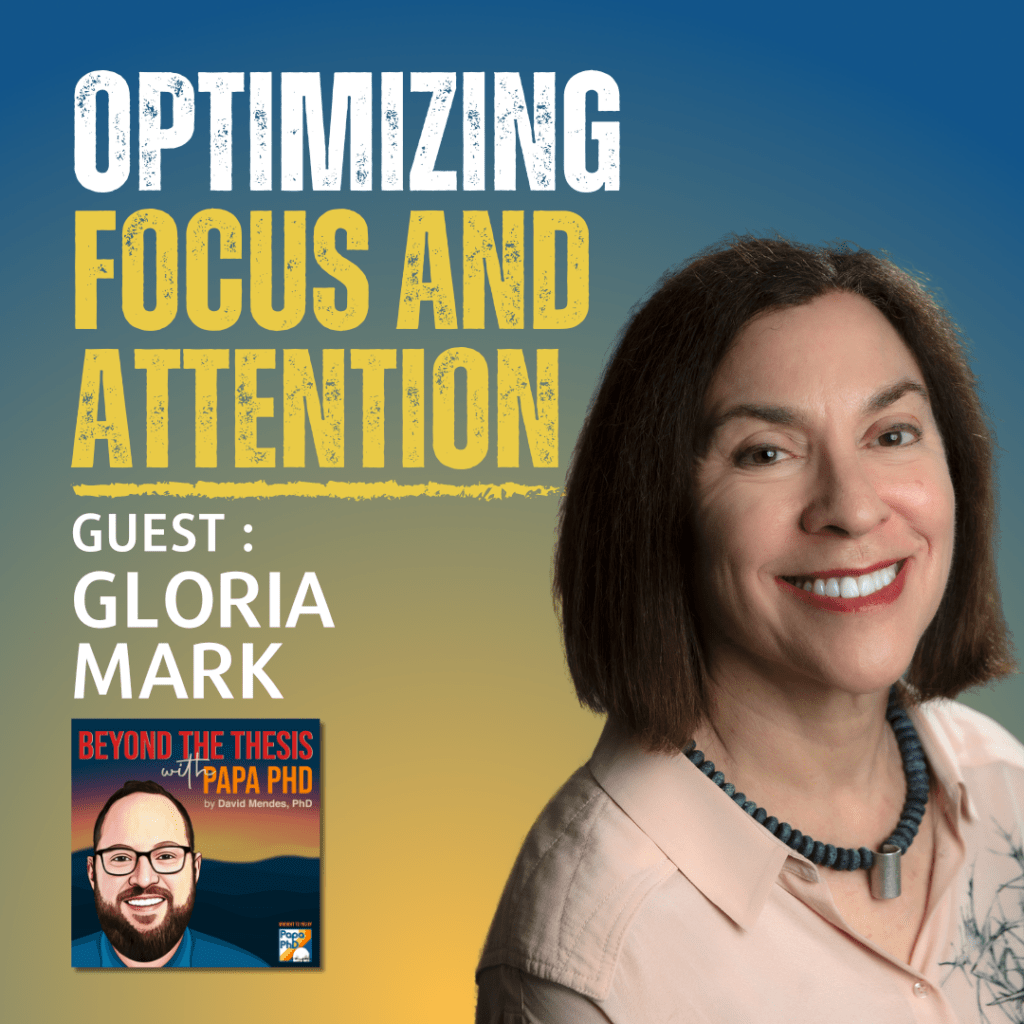
S5 Ep 29Optimizing Focus and Attention With Gloria Mark
Are you a graduate student struggling to maintain your focus amidst a barrage of digital distractions? In this episode of Beyond the Thesis with Papa PhD we dive deep with into the secrets of optimizing your focus and attention. Gloria Mark, PhD in psychology and Chancellor's Professor Emerita at UC Irvine. Discover how like meta awareness and identifying your attentional rhythms can help you make the most of your graduate school journey. Don't miss out on expert advice that promises to alleviate your anxiety and skyrocket your productivity—essential listening for anyone looking to take control of their academic success in an age of constant interruptions. Gloria Mark is Chancellors Professor Emerita at the University of California, Irvine, and also spent ten years as a visiting senior researcher at Microsoft Research. She received her PhD from Columbia University in psychology. For over two decades she has researched the impact of digital media on people's lives, studying how using our devices affect our multitasking, distractions, mood and behavior. She has published over 200 papers in the top journals and conferences in the field of human-computer interaction, has received numerous paper awards, and was inducted into the ACM SIGCHI Academy in 2017 in recognition for her contribution to the field. She has also been a Fulbright scholar and has received the prestigious NSF Career grant. Her work has been widely recognized outside of academia: she has appeared on The Ezra Klein show, NPRs Hidden Brain, Sanjay Guptas CNN Chasing Life, CBS Sunday Morning, Dax Shepards Armchair Expert, among many others. Her work has been featured in the popular media, e.g. New York Times, Wall Street Journal, NPR, The Atlantic, BBC, and others. She has been invited to present her work at SXSW and the Aspen Ideas Festival. Her recent book is Attention Span: A Groundbreaking Way to Restore Balance, Happiness and Productivity, named by The Globe and Mail as the #1 Best Business and Management book of 2023, and chosen as the Season 20 selection of the Next Big Idea Book Club. What we covered in the interview: The power of meta awareness - how to gain the upper hand over the constant pull of smartphones and social media. Curbing thesis-related anxiety - cutting through the pressure with strategic decision-making tips. Halt the multitasking madness – how "monotasking" can turbocharge your productivity and lower your stress. Recharging in nature's embrace - Gloria's recommendation for a 20-minute nature break as a key to unlocking greater creativity. This episode’s resources: Gloria Mark | Website Gloria Mark | Twitter / X The Future of Attention | Substack Thank you, Gloria Mark! If you enjoyed this conversation with Gloria, let her know by clicking the link below and leaving her a message on Linkedin: Send Gloria Mark a thank you message on Linkedin! Click here to share your key take-away from this interview with David! Leave a review on Podchaser ! Support the show ! You might also like the following episodes: Jessica Schleider –Dealing With Mental Unrest in Graduate School Sheena Howard – How to Leverage Academic Branding Amal Abuzeinab – Flourishing in Your PhD and Beyond Melissa Gismondi – The Power of Graduate InternshipsAs always, if you find value in Papa PhD and in the content I bring you every week, click on one of the buttons below and send some of that value back to me by becoming a supporter on Patreon or by buying me a coffee :) Support the show on Patreon ! Or buy me a coffee :)
S5 Ep 28Horizon PhD – Le conseil scientifique aux villes avec Julie-Maude Normandin
Bienvenue sur « Horizon PhD » - le balado qui explore des milieux insoupçonnés où tu peux mettre en valeur ton doctorat.Dans cet épisode, je t’emmène dans un univers très jeune - celui du conseil scientifique aux villes.Pour nous guider dans ce nouveau système où tu peux t'intégrer comme scientifique en résidence avec les FRQ, je t'apporte Julie-Maude Normandin - conseillère scientifique en chef à la ville de Longueil. AvecJulie-Maude, on a parlé, entre autres : De l'importance de la recherche et de l'innovation dans les administrations municipalesDu type de missions que porte Julie-Maude dans son poste de conseillère scientifique en chef.Du rôle des connaissances scientifiques dans les projets ayant un impact sur la communauté.Du profil et des compétences recherchés pour le conseil scientifique aux villes.De l'opportunité que représente le programme scientifiques en résidence des FRQ pour les jeunes scientifiques et pour les municipalités.Si tu veux en savoir davantage sur les programmes « Scientifiques en résidence » des Fonds de Recherche du Québec, rends-toi sur : PapaPhD.com/HorizonPhDFRQ Bonne écoute et bonne exploration ! Tu aimeras aussi ces épisodes : Rémi Quirion – Projeter les jeunes chercheur.e.s dans des carrières d'avenir : PapaPhD.com/carrieres-davenir-remi-quirion/Horizon PhD – Résidence scientifique à la bibliothèque de l'assemblée nationale : PapaPhD.com/horizon-phd-banHorizon PhD – Résidence scientifique dans les représentations du Québec à l'étranger : PapaPhD.com/horizon-phd-representationsNathalie Ouellette – L'astrophysique à la portée de tous : PapaPhD.com/nathalie-ouellette/
S5 Ep 27Defusing Stereotypes About the PhD Outside Academia With Fiona Robinson (Rerun)
In this treasure from the Papa PhD vault, I bring you my Season 1 conversation with Fiona Robinson. During our conversation, Fiona shares her insights on pushing through in graduate school and in life, and on her take on finding a fulfilling professional life outside of academia. Following a PhD in RNA Biochemistry at Cambridge University and a post-doc in developmental neurobiology/oncology at the Toronto Hospital for Sick Children, Fiona moved to Montréal and shifted careers into science communication/medical education. Currently she is a freelance medical editor, a lead volunteer in the local women's hockey community, and half an IronMan! As medical editor, Fiona is responsible for the creation, editing, production, and publication of educational materials for different organizations in the global bleeding disorders community. She conducts needs assessments to understand what resources are most needed and then works with volunteer subject matter experts from around the world and local freelancers to create the content, which she then edits and sees through production. Managing budgets and timelines, volunteers and contractors, and diverse cultural and socioeconomic contexts requires many of the "soft skills" that she developed working in research and, just as importantly, exploring non-research interests during her time in academia. What we covered in the interview: The value of finding your passion to instruct your career searchHow nurturing a rich life outside research can open doors for you later onDealing with the uncertainty of the non-academic job marketDefusing the socially awkward/standoffish academic stereotypeThe importance of tailoring your CV and of tailor-writing your cover letters to each potential employer and positionLooking around and keeping a job posting scrap-book as a way of identifying potentially fulfilling careers Leave a review on Podchaser ! Support the show ! You might also like the following episodes: Sheena Howard – How to Leverage Academic BrandingAmal Abuzeinab – Flourishing in Your PhD and BeyondMelissa Gismondi – The Power of Graduate InternshipsWafaa Aldhafiri –Venturing Beyond Traditional RolesAs always, if you find value in Papa PhD and in the content I bring you every week, click on one of the buttons below and send some of that value back to me by becoming a supporter on Patreon or by buying me a coffee :) Support the show on Patreon ! Or buy me a coffee :)
S5 Ep 26Dealing With Mental Unrest in Grad School With Jessica Schleider
Struggling with anxiety, the fear of evaluation, or just feeling overwhelmed in grad school? You're not alone.Join host David Mendes with special guest Dr. Jessica Schleider, Associate Psychology Professor at Northwestern University, as they dive deep into the mental health challenges faced by graduate students around the world, today. Jessica L. Schleider, PhD, is Associate professor of psychology at Northwestern University, where she directs the Lab for Scalable Mental Health. Schleider completed her PhD in clinical psychology at Harvard University, her doctoral internship in clinical and community psychology at Yale School of Medicine, and her BA in psychology at Swarthmore College. Her research on brief, scalable interventions for youth depression and anxiety has been recognized via numerous awards, including a National Institutes of Health Director’s Early Independence Award; the Association for Behavioral and Cognitive Therapies (ABCT) President’s New Researcher Award; and Forbes’s “30 Under 30 in Healthcare.” What we covered in the interview: Stigma vs. Support – Jessica uncovers the pressures that push grad students to maintain a façade of unwavering competence and how this hinders their mental well-beingInspiring Journey – Hear Jessica's personal narrative of overcoming a severe eating disorder, inspiring her to revolutionize mental health care accessibility.Cultural Nuances – David and Jessica explore the diverse experiences of international graduate students and their impact on their feelings of unrest and of agency.Empowerment through Single-Session Interventions –practical strategies to reclaim autonomy and agency amidst spiraling anxieties and overwhelming challenges. This episode’s resources: Schleider Lab | WebsiteJessica Schleider | Twitter / XLittle Treatments, Big Effects | Get the Book ! Thank you, Jessica Schleider! If you enjoyed this conversation with Jessica, let her know by clicking the links below and leaving her a message on Linkedin:Send Jessica Schleider a thank you message on Linkedin!Click here to share your key take-away from this interview with David! Leave a review on Podchaser ! Support the show ! You might also like the following episodes: Sheena Howard – How to Leverage Academic BrandingAmal Abuzeinab – Flourishing in Your PhD and BeyondMelissa Gismondi – The Power of Graduate InternshipsWafaa Aldhafiri –Venturing Beyond Traditional RolesAs always, if you find value in Papa PhD and in the content I bring you every week, click on one of the buttons below and send some of that value back to me by becoming a supporter on Patreon or by buying me a coffee :) Support the show on Patreon ! Or buy me a coffee :)
S5 Ep 25Career Cognitive Dissonance During the PhD With Gad Sabbatier
Welcome to a new collab episode of the PhD Dojo with The 2nd Lab.In this new episode of the PhD Dojo, Gad Sabbatier asks me about what I mean when I talk about cognitive dissonance about career prospects as it is experienced by graduate students.Join us in this new Dojo and write us at [email protected] if you have a cognitive dissonance story to share! This episode’s resources: The 2nd Lab | TwitterThe 2nd Lab | LinkedInThe 2nd Lab | WebsiteIf you find value in Papa PhD and in the content I bring you every week, click on one of the buttons below and send some of that value back to me :) Leave a review on Podchaser ! Support the show ! You might also like the following episodes: PhD Dojo - What Should I Invest In If I Want a Private Sector Job?PhD Dojo – Becoming an Entrepreneur During Your PhDPhD Dojo – How to Gain Confidence for Job InterviewsPhD Dojo – First Year PhD - Show Up and Avoid Tunnel VisionAs always, if you find value in Papa PhD and in the content I bring you every week and if you're not a nerd like me and don't want to delve into Podcast 2.0, click on one of the buttons below and send some of that value back to me by becoming a supporter on Patreon or by buying me a coffee :) Support the show on Patreon ! Or buy me a coffee :)
S5 Ep 24La bourse Pre-Amp avec Virginie Petel-Légaré et Michael Mee d’Amplitude Ventures
Bienvenue à ce nouvel épisode d'Au-delà de la thèse avec Papa PhD en collaboration avec la bourse Pre-Amp d'Amplitude Ventures !Cette semaine, je parle avec Michael Mee et Virginie Petel-Légaré de la bourse Pre-Amp, un programme d'été qui transporte les jeunes scientifiques ua doctorat dans l'univers de la création d'entreprises et du capital de risque. Michael Mee est directeur chez Amplitude Ventures, le principal fonds de capital-risque du Canada dans le domaine de la biotechnologie et de la santé. Après avoir obtenu son doctorat en ingénierie biomédicale dans le laboratoire de George Church à HMS, Michael a travaillé chez Flagship Pioneering dans le domaine de la création d'entreprises. Chez Flagship, il s'est concentré sur le développement de deux entreprises de microbiome dans les domaines agricole (Indigo) et thérapeutique (Kaleido), sur la cofondation et le lancement d'une nouvelle plateforme thérapeutique et d'une entreprise de thérapie génique (Cobalt Biomedicine/Sana Therapeutics) et, plus récemment, sur le développement de nouvelles entreprises dans les domaines de la mise au point de médicaments basés sur l'IA et de l'édition de gènes. L'un de ses objectifs à long terme a toujours été de ramener chez lui les enseignements tirés de Boston afin de contribuer à l'écosystème biotechnologique canadien. À cette fin, il a récemment déménagé à Montréal et se réjouit de pouvoir atteindre cet objectif avec l'équipe grandissante d'Amplitude et de Pre-Amp.Virginie Petel-Légaré est actuellement Venture Associate chez Pre-Amp. Elle a fait partie de la première cohorte de la bourse Pre-Amp en 2021 et travaille avec Amplitude depuis, d'abord en tant que consultante, puis en tant qu'employée à temps plein. Virginie a terminé son baccalauréat en physiologie à l'Université McGill et a décidé de se concentrer sur les neurosciences. Elle a obtenu une maîtrise en neurosciences de l'Université de Montréal, où elle a étudié les déficits de la mémoire de travail en relation avec les modifications anatomiques de la connectivité pariéto-frontale. Virginie a terminé son doctorat à l'Institut neurologique de Montréal (Université McGill) en se concentrant sur le rôle du dysfonctionnement mitochondrial dans la SLA et la maladie de Parkinson. Ce que tu apprendras dans cette entrevue : Comment la bourse Pre-Amp se distingue par son focus sur l'apprentissage par l'expérience tout et comment elle offre un tremplin vers des carrières diversifiées hors de l'universitéComment le fait de travailler sur des projets hors de ton champ de compétence habituel peut débloquer ta créativité et contribuer à l'innovation.Comment tes compétences académiques peuvent être transférables et précieuses dans le secteur entrepreneurial.Et bien plus.Bonne écoute !La bourse Pre-Amp t'intéresse ? Envoie ton CV et ta lettre de motivation à > cette adresse courriel < - tu as jusqu'au 31 mars 2024 pour postuler ! Les ressources de cet épisode : Bourse Pre-Amp | Page WebAmplitude Ventures | Site Web Tu aimeras aussi ces épisodes : Marie Itoiz – Se préparer à l'après-doctorat : PapaPhD.com/marie-itoiz-adtAlexandre Bran - Le doctorat, une expérience transformatrice : PapaPhD.com/260Rémi Quirion – Projeter les jeunes chercheur.e.s dans des carrières d'avenir : PapaPhD.com/203Nathalie Ouellette – L'astrophysique à la portée de tous : PapaPhD.com/nathalie-ouellette/

S5 Ep 24De la recherche doctorale à la traduction avec Sylvie Lemieux
Bienvenue à ce nouvel épisode d'Au-delà de la thèse avec Papa PhD !Cette semaine, je parle avec Sylvie Lemieux, traductrice-réviseure passionnée, détentrice d'un doctorat en linguistique dans le domaine de l’interprétation simultanée. Après avoir terminé sa recherche doctorale, Sylvie a constaté que la traduction était principalement étudiée du point de vue linguistique et des outils d'aide à la traduction, mais elle s'est intéressée à l'aspect humain de ce métier. Aujourd'hui, elle se consacre à explorer les enjeux complexes de la traduction et à promouvoir son importance dans un monde de plus en plus connecté. Avec Sylvie, on a parlé, entre autres : de la recherche doctorale de Sylvie et de sa transition vers l'entrepreneurialde l'utilisation de techniques de cohérence cardiaque pour la gestion du stressde l'utilisation de compétences acquises pendant le doctorat dans différentes carrièrede l'importance du mentorat et du réseautagede la préparation aux entretiens d'embauchede l'impact des technologies telles que ChatGPT sur la traductiondes opportunités émergentes pour les diplômes en traductionEntre autres.Bonne écoute !Tu aimes Papa PhD ? Laisse-moi un commentaire > ici < - une courte phrase suffit ! Et inclus ton identifiant Twitter – comme ça je pourrai te remercier personnellement ! Merci Sylvie! Si cet entretien avec Sylvie Lemieux t'a plu, fais-lui en part en cliquant sur le lien ci-dessous et en lui laissant un message sur LinkedIn :Clique ici pour le remercier sur Linkedin !Clique ici pour partager avec David le principal message que tu retiens de cet épisode ! Les ressources de cet épisode : Programme de mentorat Tradinter | FacebookSylvie Lemieux | TwitterSi tu trouves de la valeur dans le contenu que je t'apporte chaque semaine, clique sur l'un des boutons ci-dessous et renvoie-moi l'ascenceur :) Don sécuritaire sur PayPal Deviens supporter sur Patreon ! Ou paye-moi un café :) Tu aimeras aussi ces épisodes : Martin Carli – La vulgarisation grand public : PapaPhD.com/242Alexandre Bran - Le doctorat, une expérience transformatrice : PapaPhD.com/260Rémi Quirion – Projeter les jeunes chercheur.e.s dans des carrières d'avenir : PapaPhD.com/203Nathalie Ouellette – L'astrophysique à la portée de tous : PapaPhD.com/nathalie-ouellette/
S5 Ep 23The Power of Graduate Internships With Melissa Gismondi
This week on Beyond the Thesis With Papa PhD we delve into the transformative power of graduate internships with the insightful Melissa Gismondi.We explored her journey from academia to journalism, discussing the challenges, imposter syndrome, and the importance of seizing opportunities.From running for clarity to connecting with mentors, Melissa shared valuable insights on navigating the transition from graduate school to the professional world.If you're a PhD student or someone pondering a career change, there's much to learn from Melissa's experiences. So, tune in and gain valuable takeaways that could shape your own career journey!Share this episode with others and let's keep the conversation going. Melissa Gismondi is an award-winning writer and radio and podcast producer, whose work has appeared in major media outlets including The New York Times, The Walrus, The Globe & Mail, Literary Review and on the CBC Radio programs IDEAS, Tapestry, The Current and Writers & Company.In 2019, the Writers' Trust of Canada named her one of five 'Rising Stars' and she was the 2020-2021 New Media and Public Humanities Fellow at the Jackman Humanities Institute at the University of Toronto.Melissa holds a PhD in American history from the University of Virginia. What we covered in the interview: Finding Mentorship and Ventures Beyond Traditional Roles - Wafaa N. Aldhafiri's positive experiences with mentorship in academia and yoga training - David Mendes' academic journey and advice on transitioning from master's to PhD - Encouragement for PhD holders to consider non-traditional roles beyond academia and industry - Assessing interest in research before committing to a PhDExploring Versatile Career Opportunities - Leveraging STEM skills in various sectors such as policy, municipal systems, industry, and governmental entities - Shifting mindset from scarcity to recognizing the value of PhD skills in various sectors - Venturing beyond academia or industry and the versatility of PhD holders in various rolesOvercoming Fear and Criticism - Cautious approach to exploring career opportunities outside academia - Addressing fear of not being taken seriously and handling criticism and judgment - Weighing options and building a safety net when pursuing career paths beyond academiaEntrepreneurial Ventures and Career Exploration - Starting the Pharma Weekly Digest to fill a knowledge gap in the pharmaceutical world - Choosing a newsletter format for the digest and the process of compiling and reviewing content - Experimenting with various professional preferences and experiencesThe importance of Mentorship and Networking - Finding supportive mentors in academia, extracurricular activities, and hobbies - Importance of having multiple mentors in various aspects of life - Being open to learning, feedback, and networking opportunitiesPersonal Development and Well-being - Balancing studies, work, and extracurricular activities during a PhD program - The significance of extracurricular activities for developing confidence, time management, soft skills, and networking - Encouragement to focus on personal happiness and well-being This episode’s resources: Melissa J. Gismondi | Website Thank you, Melissa Gismondi! If you enjoyed this conversation with Melissa, let her know by clicking the links below and leaving her a message on Linkedin:Send Melissa Gismondi a thank you message on Linkedin!Click here to share your key take-away from this interview with David! Leave a review on Podchaser ! Support the show ! You might also like the following episodes: Sheena Howard – How to Leverage Academic BrandingAmal Abuzeinab – Flourishing in Your PhD and BeyondMerle van den Akker – Debunking PhD MisconceptionsWafaa Aldhafiri –Venturing Beyond Traditional RolesAs always, if you find value in Papa PhD and in the content I bring you every week,
S5 Ep 22Venturing Beyond Traditional Roles With Wafaa N. Aldhafiri
This week on Beyond the Thesis With Papa PhD we will be talking about exploring non-traditional roles for young researchers with PhD candidate Wafaa Nasser Aldhafiri. Wafaa Nasser Aldhafifi. Wafaa, a Master's graduate in Pharmaceutical Sciences and a current Ph.D. candidate at UNMC, stands out for her dynamic career.She founded 'The Pharma Weekly Digest', a popular newsletter spanning LinkedIn, Instagram, and Twitter, where she curates the latest pharmaceutical news and industry buzz.With experience as a pharmaceutical scientist in leading pharma companies, Wafaa has expanded her expertise to roles in licensing and patent specialization, showcasing her versatility beyond traditional academia and industry role. What we covered in the interview: Finding Mentorship and Ventures Beyond Traditional Roles - Wafaa N. Aldhafiri's positive experiences with mentorship in academia and yoga training - David Mendes' academic journey and advice on transitioning from master's to PhD - Encouragement for PhD holders to consider non-traditional roles beyond academia and industry - Assessing interest in research before committing to a PhDExploring Versatile Career Opportunities - Leveraging STEM skills in various sectors such as policy, municipal systems, industry, and governmental entities - Shifting mindset from scarcity to recognizing the value of PhD skills in various sectors - Venturing beyond academia or industry and the versatility of PhD holders in various rolesOvercoming Fear and Criticism - Cautious approach to exploring career opportunities outside academia - Addressing fear of not being taken seriously and handling criticism and judgment - Weighing options and building a safety net when pursuing career paths beyond academiaEntrepreneurial Ventures and Career Exploration - Starting the Pharma Weekly Digest to fill a knowledge gap in the pharmaceutical world - Choosing a newsletter format for the digest and the process of compiling and reviewing content - Experimenting with various professional preferences and experiencesThe importance of Mentorship and Networking - Finding supportive mentors in academia, extracurricular activities, and hobbies - Importance of having multiple mentors in various aspects of life - Being open to learning, feedback, and networking opportunitiesPersonal Development and Well-being - Balancing studies, work, and extracurricular activities during a PhD program - The significance of extracurricular activities for developing confidence, time management, soft skills, and networking - Encouragement to focus on personal happiness and well-being This episode’s resources: Pharma Weekly Digest | TwitterPharma Weekly Digest | Linkedin Thank you, Wafaa N. Aldhafiri! If you enjoyed this conversation with Wafaa, let her know by clicking the links below and leaving her a message on Linkedin:Send Wafaa N. Aldhafiri a thank you message on Linkedin!Click here to share your key take-away from this interview with David! Leave a review on Podchaser ! Support the show ! You might also like the following episodes: Sheena Howard – How to Leverage Academic BrandingAmal Abuzeinab – Flourishing in Your PhD and BeyondMerle van den Akker – Debunking PhD MisconceptionsEmma Brodzinski – Supporting and inspiring graduate studentsAs always, if you find value in Papa PhD and in the content I bring you every week, click on one of the buttons below and send some of that value back to me by becoming a supporter on Patreon or by buying me a coffee :) Support the show on Patreon ! Or buy me a coffee :)

S5 Ep 21Doctorat et transformation personnelle : Stéréotypes et défis – avec Alexandre Bran
Bienvenue à ce nouvel épisode d'Au-delà de la thèse avec Papa PhD !Cette semaine, je parle avec Alexandre Bran, docteur en psychologie sociale intéressé à l'étude des vécus pendant et après le doctorat. Docteur en psychologie sociale, Alexandre Bran conduit des recherche pour étudier les vécus pendant et après le doctorat. Il s’intéresse à des thématiques telles que le stress pendant le doctorat, les stéréotypes associés aux docteurs, ou encore les perceptions qu’ont les doctorantes et doctorants d’eux-mêmes. Avec Alexandre, on a parlé, entre autres : de l'identité pendant le doctorat – le passage du statut d'étudiant à celui de chercheurddes "vécus" du doctorat (enseignement, publication, stress...) et des façons dont ça nous transformedes compétences développées pendant le doctorat, en particulier celles dont on n'a pas forcément conscienceTu aimes Papa PhD ? Laisse-moi un commentaire > ici < - une courte phrase suffit ! Et inclus ton identifiant Twitter – comme ça je pourrai te remercier personnellement ! Merci Alexandre ! Si cet entretien avec Alexandre Bran t'a plu, fais-lui en part en cliquant sur le lien ci-dessous et en lui laissant un message sur LinkedIn :Clique ici pour le remercier sur Linkedin !Clique ici pour partager avec David le principal message que tu retiens de cet épisode ! Les ressources de cet épisode : Laboratoire Interdisciplinaire sur le Doctorat, Adoc Talent Management | Site webSi tu trouves de la valeur dans le contenu que je t'apporte chaque semaine, clique sur l'un des boutons ci-dessous et renvoie-moi l'ascenceur :) Don sécuritaire sur PayPal Deviens supporter sur Patreon ! Ou paye-moi un café :) Tu aimeras aussi ces épisodes : Martin Carli – La vulgarisation grand public : PapaPhD.com/242Bruno Lamolet - Écrire la science pour tous : PapaPhD.com/237Rémi Quirion – Projeter les jeunes chercheur.e.s dans des carrières d'avenir : PapaPhD.com/203Nathalie Ouellette – L'astrophysique à la portée de tous : PapaPhD.com/nathalie-ouellette/
S5 Ep 20Demystifying Academic Branding With Sheena Howard
This week on Beyond the Thesis With Papa PhD we will be talking about demystifying academic branding with Dr. Sheena Howard, author of "Black Comics: Politics of Race and Representation", "Black Queer Identity Matrix: Towards An Integrated Queer of Color Framework", "Critical Articulations of Race, Gender and Sexual Orientation", and "Encyclopedia of Black Comics", who is now preparing to publish her new book: "Academic Branding - A step-by-step guide to increased visibility, authority, and income". Dr. Sheena C. Howard is the first Black woman to win an Eisner award at San Diego Comic-Con for her first book, Black Comics: Politics of Race and Representation (2014). The Eisner is considered the ‘Oscars of Comics.’ Howard has published comic books for both Marvel (Illusion of Fairness, 2023) and DC (Fresh Air in Philly, 2021, and others) comics. She has written a graphic novel and stage play for DMC (from RUN-DMC), published with Bloomsbury (Black Comics: Politics of Race and Representation, 2014), Chicago Review Press (Encyclopedia of Black Comics, 2017), BenBella Press (Why Wakanda Matters, 2021), and more. In addition, her work has received numerous book awards, including an American Library Association’s Outstanding Reference Sourcebook award and more. Her books have been featured in Good Morning America, The New York Times, The Washington Post, and more. She is also the subject of an Emmy-nominated episode of State of the Arts. Finally, Dr. Howard writes and ghostwrites for celebrities, CEOs, and social impact companies that seek to empower, inspire and motivate. What we covered in the interview: Academic Branding: Monetizing expertise, increasing visibility, income Financial Stability: Challenges of academia, diversifying income streams Mindset: Unlearning academic norms, prioritizing personal growth Professional Growth: Expanding beyond academia, long-term planning Media Coverage: Pitching to newspapers, leveraging previous exposure Speaking Engagements: Strategically setting fees, advancing professional status Exit Strategy: Preparing for transition, building personal brand This episode’s resources: Power Your Research | WebsitePre-order "Academic Branding - A step-by-step guide to increased visibility, authority, and income" | Book Thank you, Sheena Howard! If you enjoyed this conversation with Sheena, let her know by clicking the links below and leaving her a message on Linkedin:Send Sheena Howard a thank you message on Linkedin!Click here to share your key take-away from this interview with David! Leave a review on Podchaser ! Support the show ! You might also like the following episodes: Adriana Bankston and Jamie L. Vernon – Making an Impact in Research Through Science PolicyAmal Abuzeinab – Flourishing in Your PhD and BeyondMerle van den Akker – Debunking PhD MisconceptionsEmma Brodzinski – Supporting and inspiring graduate studentsAs always, if you find value in Papa PhD and in the content I bring you every week, click on one of the buttons below and send some of that value back to me by becoming a supporter on Patreon or by buying me a coffee :) Support the show on Patreon ! Or buy me a coffee :)
S5 Ep 19Rediffusion – La thèse comme base solide pour mieux se connaître avec Julie Lopes
Cette semaine sur Au-delà de la thèse avec Papa PhD, je t'apporte un des épisodes les plus écoutés de la saison 4 – ma conversation avec Julie Lopes, accompagnatrice de doctorant.e.s.La thématique - profiter du doctorat pour mieux se connaître et profiter de mieux se connaître pour avoir un trajet plus aligné et plus productif pendant la thèse.En fin d'épisode, Julie nous fait expérimenter un exercice de recentrage qu'elle utilise avec les personnes qu'elle accompagne. Si tu as besoin de calmer ton corps et ton esprit, ne le manque surtout pas !Julie Lopes est docteure en microbiologie reconvertie dans l'entrepreneuriat auprès des étudiant·e·s, doctorant·e·s et docteur·e·s.Sa mission est de les accompagner vers une expansion d'eux-mêmes afin qu'ils choisissent un avenir dirigé par leur cœur plutôt que par la peur ! Les ressources de cet épisode : Julie Lopes | LinkedInJulie Lopes | Site webJulie Lopes | Instagram Merci Julie ! Si cet entretien avec Julie Lopes t'a plu, fais-nous en part en cliquant sur les liens ci-dessous et en nous laissant un message :Clique ici pour remercier Julie Lopes sur LinkedIn !Clique ici pour partager avec David le principal message que tu retiens de cet épisode !Si tu trouves de la valeur dans le contenu que je t'apporte chaque semaine, clique sur l'un des boutons ci-dessous et renvoie-moi l'ascenceur :) Don sécuritaire sur PayPal Deviens supporter sur Patreon ! Ou paye-moi un café :) Tu aimeras aussi ces épisodes : Charlotte Hendryckx – L'aventure du doctorat à l'étranger : PapaPhD.com/193Erika Dupont – Le parcours doctoral est-il au service de chercheurs ? : PapaPhD.com/175Jean-Patrick Toussaint – Mieux préparer les doctorants à l'emploi : PapaPhD.com/155Myriam Beaudry - L'importance de rencontrer d'autres chercheur.e.s pendant ton doctorat : PapaPhD.com/183
S5 Ep 18Rerun – Unlocking Your Thesis Writing Super Powers with Martha Boeglin
Do you struggle to sit down and write your thesis? Is the process painful to you?Then join me in one of the most listened episodes of last season with a specialist, a "thesis whisperer" of sorts - Martha Boeglin of Scriptoria.During my conversation with Martha, we discuss this inevitable, yet often gruesome task that is thesis writing, and Martha shares her know-how and a number of techniques and strategies to make the exercise a pleasant and successful one. When she wanted to write her thesis in Philosophy, Martha Boeglin was paralyzed for many months by the fear of the blank page.When she eventually understood that the fear of the blank page is normal, that almost every researcher is concerned by writer’s block… ant that writing problems are tabou at university, she started to investigate the phenomenon of writing.One discovery changed her life: writer’s block belongs to the writing process – and there are lots of creative writing techniques to overcome them.More: some writing techniques hold an almost magical power.Why are they not taught at university ?Her passion for writing techniques was born. With a double consequence: first, once she overcame that initial writer’s block, she was able to write her thesis – and worte it in a wave of euphoria.Second, once she got her Dr. Titel, she created Scriptoria, the writing workshops for PhD students in 2002.Its goal? To make writing a thesis easier: when you know the right techniques, writing is no longer a chore - it can even become a source of joy. Thank you, Martha Boeglin ! If you enjoyed this conversation with Martha, let her know by clicking the link below and leaving her a message on Twitter:Send Martha Boeglin a thank you message on Twitter!Click here to share your key take-away from this interview with David! This episode’s resources: Martha Boeglin | LinkedInMartha Boeglin | TwitterScriptoria | Scriptoria.org | Groupe Facebook | Youtube You might also like the following episodes: Albertha Joseph-Alexander – Using SciComm to Make a DifferenceDavid Giltner – Reconciling the Research and Development MindsetsJen Polk – Are You a Sellout if You Leave Academia After Your PhD?Natalia Bielczyk – Figuring Out Where You Fit in the Job Market as a PhDAs always, if you find value in Papa PhD and in the content I bring you every week, click on one of the buttons below and send some of that value back to me by becoming a supporter on Patreon or by buying me a coffee :) Now with the added perk of receiving the brand new Papa PhD and PhD Dojo stickers! Support the show on Patreon ! Or buy me a coffee :) Get the Papa PhD Career Readiness Tool kit !
S5 Ep 17Horizon PhD – Représenter le Québec à l’étranger avec Luc Bergeron et Jean-Christian Lemay
Bienvenue sur « Horizon PhD » - le balado qui explore des milieux insoupçonnés où tu peux mettre en valeur ton doctorat.Dans cet épisode, je t’emmène dans un univers très particulier... celui des représentations du Québec à l'étranger.Pour t'accompagner dans la découverte de la diplomatie scientifique et de la valeur ajoutée que tu peux y apporter avec tes talents en recherche, je parle avec Luc Bergeron, des Fonds de Recherche du Québec, et avec Jean-Christian Lemay, participant à l'édition 2018 du programme « Scientifiques en résidence » des FRQ et membre fondateur d'une communauté passionnée de jeunes scientifiques comme toi. Avec Luc et Jean-Christian, on a parlé, entre autres : Du rôle des scientifiques en résidence au sein du programme des FRQ et des types de missions qui leur sont confiées.De l'importance de l'esprit scientifique et de la polyvalence scientifique pour aborder les enjeux complexes dans les représentations du Québec à l'étranger.De l'écosystème de la recherche à l'international et de la création de partenariats dans le domaine scientifique.De l'importance de comprendre les politiques et les plans stratégiques en matière de recherche scientifique, en tant que scientifique en résidence.De pourquoi tu devrais postuler au programme des scientifiques en résidence, même si tu hésites, en ce moment.Si tu veux en savoir davantage sur les programmes « Scientifiques en résidence » des Fonds de Recherche du Québec, rends-toi sur : PapaPhD.com/HorizonPhDFRQ Bonne écoute et bonne exploration ! Tu aimeras aussi ces épisodes : Rémi Quirion – Projeter les jeunes chercheur.e.s dans des carrières d'avenir : PapaPhD.com/carrieres-davenir-remi-quirion/Martin Primeau – profession de communicateur scientifique : PapaPhD.com/martin-primeau-2Bruno Lamolet - Écrire la science pour tous : PapaPhD.com/ecrire-la-science/Nathalie Ouellette – L'astrophysique à la portée de tous : PapaPhD.com/nathalie-ouellette/
S5 Ep 16Horizon PhD – Intégrer l’équipe de la bibliothèque de l’Assemblée nationale avec Jules Racine St-Jacques
Bienvenue sur « Horizon PhD » - le balado qui explore des milieux insoupçonnés où tu peux mettre en valeur ton doctorat.Dans ce premier épisode, je rejoins Jules Racine-St-Jacques pour partir à la découverte d'une belle organisation au sein de laquelle tu peux mettre en valeur tes compétences transversales et ton diplôme doctoral - le service de recherche de la bibliothèque de l'Assemblée nationale du Québec.Si tu t'intéresses à la visualisation des données et que tu as envie de travailler sur des projets ayant un impact sociétal et politique, ta chance est peut-être venue de faire le saut et de tester les eaux au sein d'une équipe passionnée de scientifiques comme toi ! Ce que tu apprendras dans cet épisode : Qu'est-ce que le service de recherche de la bibliothéque de l'assemblée nationaleComment fonctionne l'équipe du service de rechercheLes types de mandats variés sur lesquels tu pourras travailler en tant que scientifique en résidenceLes opppoortunités de carrière au sein de l'Assemblée nationale du QuébecPourquoi tu devrais postuler au programme Scientifiques en résidence des FRQSi tu veux en savoir davantage sur les programmes « Scientifiques en résidence » des Fonds de Recherche du Québec, rends-toi sur : PapaPhD.com/HorizonPhDFRQ Bonne écoute et bonne exploration ! Tu aimeras aussi ces épisodes : Rémi Quirion – Projeter les jeunes chercheur.e.s dans des carrières d'avenir : PapaPhD.com/carrieres-davenir-remi-quirion/Nathalie Ouellette – L'astrophysique à la portée de tous : PapaPhD.com/nathalie-ouellette/Martin Carli – La vulgarisation grand public : PapaPhD.com/242Olivier Bernard – Déboulonner la pseudoscience : PapaPhD.com/olivier-bernard/

S5 Ep 15What is the Impact of AI on Higher Education? With Tim Dasey
This week on Beyond the Thesis With Papa PhD we will be discussing "What is the Impact of AI on Higher Education?" with Tim Dasey, author of the book "Wisdom Factories: AI, Games, and the Education of a Modern Worker". Dr. Tim Dasey has a long history in AI and learning science, and recently published the book “Wisdom Factories: AI, Games, and the Education of a Modern Worker.” After thirty years at MIT leading AI development for diverse government needs, Tim leapt into education due to concern that minds won’t be ready for the jobs that remain human. He has a smidge of teaching experience at corporate, higher ed, and K-12 levels. Dr. Dasey has atypical perspectives on the future of schooling built from a blend of AI expertise, experience with many industries, depth in the science of learning and judgment, and more than a decade leading development of game-based learning tools. What we covered in the interview: The role of AI in managing tasks and abstracting information: AI and other technologies are revolutionizing the way we work, freeing up our time for more strategic thinking and decision-making. Discover how AI can translate and generate content, reducing labor-intensive tasks.The challenges and opportunities in evaluating AI-generated scientific papers: Join us as we discuss the impact of AI on the peer review process and how institutions like MIT are handling the authenticity and quality of AI-generated research.Nurturing human capabilities alongside AI: Learn about the importance of self-awareness, interdisciplinary approaches, and human collaboration skills in an era of AI. Explore how AI can support individuals in areas affected by conditions like ADHD, as shared by our guest, Tim Dasey. This episode’s resources: Tim Dasey | Website"Wisdom Factories: AI, Games, and the Education of a Modern Worker" | Book Thank you, Tim Dasey! If you enjoyed this conversation with Tim, let him know by clicking the links below and leaving him a message on Linkedin:Send Tim Dasey a thank you message on Linkedin!Click here to share your key take-away from this interview with David! Leave a review on Podchaser ! Support the show ! You might also like the following episodes: Adriana Bankston and Jamie L. Vernon – Making an Impact in Research Through Science PolicyAmal Abuzeinab – Flourishing in Your PhD and BeyondMerle van den Akker – Debunking PhD MisconceptionsEmma Brodzinski – Supporting and inspiring graduate studentsAs always, if you find value in Papa PhD and in the content I bring you every week, click on one of the buttons below and send some of that value back to me by becoming a supporter on Patreon or by buying me a coffee :) Support the show on Patreon ! Or buy me a coffee :)

S5 Ep 14Making Impact in Research Through Science Policy With Adriana Bankston and Jamie Vernon
Welcome to Beyond the Thesis With Papa PhD, the podcast that delves into the diverse and impactful roles scientists can play beyond the lab.In today's episode, we explore the intersection of science and policy with our special guests, Adriana Bankston and Jamie Vernon. During our conversation Adriana and Jamie share their personal journeys from the lab to influential roles in science policy.Adriana's passion for policy was sparked during her academic career, leading to her pivotal role at Sigma Xi, while Jamie's trajectory saw him transition from being a molecular biologist to advocating for scientists' involvement in policy.Join us as we unravel the critical roles of scientists in policymaking, the launch of Sigma Xi's Civico, a groundbreaking platform connecting scientists with policymakers, and invaluable advice for early-career researchers looking to leave an impact beyond the thesis. Adriana Bankston is a Senior Fellow in Civic Science & Public Policy with Sigma Xi, where she leads a project that examines science policy engagement at the state level and determines the skills, knowledge, and resources required by scientists to successfully influence public policy.Prior to this role, Adriana was a Principal Legislative Analyst at the University of California Office of Federal Governmental Relations, where she served as an advocate for the university with Congress, the Administration and federal agencies. Adriana has had a number of roles leading to where she is today and in recognition of her contributions to the field, Adriana was named among the Top 20 in 2022 Advocacy practitioners by the Advocacy Association, and awarded the inaugural 2022 ARIS Emerging Broader Impacts Leader Award. Adriana earned her Ph.D. in Biochemistry, Cell and Developmental Biology from Emory University.Jamie Vernon is executive director and CEO at Sigma Xi and publisher of American Scientist. From 2014 to 2017, he served as Sigma Xi's director of science communications and publications and editor-in-chief of American Scientist. He was also Sigma Xi's co-director of operations from 2014 to 2015. A molecular biologist by training, he transitioned from research in 2011 to serve as an American Association for the Advancement of Science (AAAS) Science and Technology Policy Fellow and an Oak Ridge Institute for Science and Education (ORISE) Fellow in the U.S. Department of Energy. For more than a decade, he has been an advocate for the use of science in decision making at all levels of government, business, and in our personal lives. He holds a B.S. in zoology from North Carolina State University, an M.S. in biotechnology from East Carolina University, and a Ph.D. in cell and molecular biology from The University of Texas at Austin. What we covered in the interview: How early-career scientists can effectively integrate policy relevance and societal impact into their researchSpecific opportunities and resources available for scientists to engage in policy work, such as fellowships, internships, and advisory rolesHow scientists can navigate the transition from research to policy, and effective approaches for getting involved in policy work while pursuing a graduate degreeChallenges and benefits of scientists participating in policy discussions and advisory roles at the state and federal levelsHow the Civico platform aims to bridge the gap between science and policy, and what opportunities it offers for scientists at various career stagesManaging time effectively to balance graduate studies with engagement in policy work and advocacy efforts This episode’s resources: Civico Platform | WebsiteCivico Launch | VideoCivico Launch | Press Release Thank you, Adriana Bankston, thank you Jamie Vernon! If you enjoyed this conversation with Adriana and Jamie, let them know by clicking the links below and leaving them a message on Linkedin:Send Adriana Bankston a thank you mess...
S5 Ep 13Flourishing in your PhD and Beyond With Amal Abuzeinab
Welcome, friend! This week on Beyond the Thesis With Papa PhD, I'm bringing you a fascinating discussion on adaptation, resilience, and flourishing as a PhD with my guest - Amal Abuzeinab. Dr Amal Abuzeinab is the Institute Head of Research Students (IHRS), Institute of Architecture, De Montfort University, UK. Amal is currently supervising 3 PhD students, supervised 4 PhD students successfully to completion, and examined 4 PhD students. She served as the Co-Faculty Head of Research Students (FHRS) for the faculty of Arts, Design, and Humanities between 2017-2020. What we covered in the interview: The importance of being flexible and adaptable during your research journeyThe need for PhD candidates to anticipate and address potential problemsThe importance of self-selection in pursuing a PhD and becoming an independent researcherThe issue of limited tenure-track positions for PhD graduates The importance of a support system for PhD candidates This episode’s resources: Workshop for Women Higher Education Network (WHEN) | Website Thank you, Amal Abuzeinab! If you enjoyed this conversation with Amal, let her know by clicking the link below and leaving her a message on Linkedin:Send Amal Abuzeinab a thank you message on Linkedin!Click here to share your key take-away from this interview with David! Leave a review on Podchaser ! Support the show ! You might also like the following episodes: Alexandra Howson – A Career in Continuing Medical EducationKate Dahl – Reinventing Yourself after AcademiaMerle van den Akker – Debunking PhD MisconceptionsEmma Brodzinski – Supporting and inspiring graduate studentsAs always, if you find value in Papa PhD and in the content I bring you every week, click on one of the buttons below and send some of that value back to me by becoming a supporter on Patreon or by buying me a coffee :) Support the show on Patreon ! Or buy me a coffee :)
S5 Ep 12Prévoir sa carrière : Si on acceptait l’imprévu ? Avec Olivier Cadeau
Bienvenue à ce nouvel épisode d'Au-delà de la thèse avec Papa PhD !Cette semaine, je parle du rôle du hasard dans les parcours de carrière avec Olivier Cadeau, doctorant en neuropsychologie de l'enfant et explorateur/expérimentateur de l'apprentissage et du savoir. Olivier a commencé sa carrière professionnel il y a 20 ans. D’abord comme pâtissier-chocolatier, il est ensuite devenu technicien de la construction puis moniteur auto-école. C’est en se questionnant sur ce qu’était l’apprentissage et pour aider au mieux les élèves qu’il a découvert la psychologie. Tout en continuant à travailler à temps plein, il a commencé son parcours universitaire à distance. Après une licence et un master en psychologie du développement, il est devenu psychologue dans l’Éducation Nationale. Aujourd’hui, il est en doctorat en neuropsychologie de l’enfant en parallèle de son activité de psychologue à l'école. Avec Olivier, on a parlé, entre autres : de la curiosité d’aller explorer de nouvelles voiesde comment identifier et améliorer ses points forts, les points d’appui du changementde l'importance de se faire plaisir en visualisant son objectif et de se protéger des peurs des autresTu aimes Papa PhD ? Laisse-moi un commentaire > ici < - une courte phrase suffit ! Et inclus ton identifiant Twitter – comme ça je pourrai te remercier personnellement ! Merci Olivier ! Si cet entretien avec Olivier Cadeau t'a plu, fais-lui en part en cliquant sur le lien ci-dessous et en lui laissant un message sur LinkedIn :Clique ici pour le remercier sur Linkedin !Clique ici pour partager avec David le principal message que tu retiens de cet épisode !Si tu trouves de la valeur dans le contenu que je t'apporte chaque semaine, clique sur l'un des boutons ci-dessous et renvoie-moi l'ascenceur :) Don sécuritaire sur PayPal Deviens supporter sur Patreon ! Ou paye-moi un café :) Tu aimeras aussi ces épisodes : Martin Carli – La vulgarisation grand public : PapaPhD.com/242Bruno Lamolet - Écrire la science pour tous : PapaPhD.com/237Rémi Quirion – Projeter les jeunes chercheur.e.s dans des carrières d'avenir : PapaPhD.com/203Nathalie Ouellette – L'astrophysique à la portée de tous : PapaPhD.com/nathalie-ouellette/
S5 Ep 11PhD Dojo – A PhD and Then What? with Gad Sabbatier
Welcome to another collab episode of the PhD Dojo with The 2nd Lab. In this new episode of the PhD Dojo, Gad Sabbatier and I chart the current PhD job market. Join us in this new Dojo and write us if you have a PhD job to add to the list! This episode’s resources: The 2nd Lab | Twitter The 2nd Lab | LinkedIn The 2nd Lab | Website If you find value in Papa PhD and in the content I bring you every week, click on one of the buttons below and send some of that value back to me :) Leave a review on Podchaser ! Support the show ! You might also like the following episodes: PhD Dojo - What Should I Invest In If I Want a Private Sector Job? PhD Dojo – Becoming an Entrepreneur During Your PhD PhD Dojo – How to Gain Confidence for Job Interviews PhD Dojo – First Year PhD - Show Up and Avoid Tunnel Vision As always, if you find value in Papa PhD and in the content I bring you every week and if you're not a nerd like me and don't want to delve into Podcast 2.0, click on one of the buttons below and send some of that value back to me by becoming a supporter on Patreon or by buying me a coffee :) Support the show on Patreon ! Or buy me a coffee :)
S5 Ep 10Supporting and Inspiring Graduate Students with Emma Brodzinski
Welcome to another episode of Beyond the Thesis with Papa PhD!This week, I'm bringing you an inspiring conversation with someone who runs another great podcast for graduate students - Emma Brodzinski from the PhD Life Raft podcast – to share he passion for supporting and inspiring graduate students in their academic journey. Dr Emma Brodzinski is the host of The PhD Life Raft Podcast. She is Research Associate in the Department of Drama, Theatre and Dance at Royal Holloway, University of London and practices as a therapist registered with HCPC. She is an experienced PhD Supervisor and Examiner and has also acted as viva committee independent chair. Emma runs a range of courses and events as well as providing well-being support programmes for doctoral training programmes. Most importantly she is a mum to 13 year old triplets, cats Fred and Ginger, and Amber the guinea pig! What we covered in the interview: The importance of support and community in graduate schoolBuilding a network and a PhD board of directorsPreparing for the end of your PhD journeyMaintaining a sense of self in graduate schoolAchieving honorable closureEmbracing personal growth and change along the way This episode’s resources: The PhD Life Raft | WebsiteThe PhD Life Raft | PodcastThe PhD Life Raft | YouTube Thank you, Emma Brodzinski! If you enjoyed this conversation with Emma, let her know by clicking the link below and leaving her a message on Linkedin:Send Emma Brodzinski a thank you message on Linkedin!Click here to share your key take-away from this interview with David! Leave a review on Podchaser ! Support the show ! You might also like the following episodes: Alexandra Howson – A Career in Continuing Medical EducationKate Dahl – Reinventing Yourself after AcademiaMerle van den Akker – Debunking PhD MisconceptionsSirisha Kuchimanchi – Navigating Manufacturing and Engineering as a WomanAs always, if you find value in Papa PhD and in the content I bring you every week, click on one of the buttons below and send some of that value back to me by becoming a supporter on Patreon or by buying me a coffee :) Support the show on Patreon ! Or buy me a coffee :)
S5 Ep 9L’astrophysique à la portée de tous avec Nathalie Ouellette
Bienvenue à ce nouvel épisode d'Au-delà de la thèse avec Papa PhD ! Cette semaine, j'ai le grand plaisir de t'apporter ma conversation passionnante avec Nathalie Nguyen-Quoc Ouellette. Nathalie Nguyen-Quoc Ouellette est astrophysicienne, communicatrice scientifique et amoureuse de l'espace! Après avoir obtenu son doctorat en 2016, elle s'est lancé dans la communication et la gestion de projets scientifiques. Elle intervient fréquemment dans les médias canadiens comme analyste et contributrice sur tout ce qui touche à l'espace. Elle organise et participe également à des événements de rayonnement scientifique d'échelle locale à internationale, afin d'encourager l'intérêt et la participation des jeunes et du grand public aux sciences spatiales et d'accroître la culture scientifique au Canada. Avec Nathalie, on a parlé de : La passion de Nathalie pour la vulgarisation en science La communication scientifique, une mission de plus en plus importante et valorisée Le trajet académique et professionnel de Nathalie: du milieu muséal jusqu'à son poste à l'iREx et la communication pour le téléscope James Webb au Canada L'apprentissage du fonctionnement des institutions à travers les entrevues professionnelles L'astronomie et la nature - une passion de longue date Trouver des mentors - approcher les gens qui t'inspirent sans peur Les ressources de cet épisode : Astro Panda | Site Web Institut iREx | Site Web Tu aimes Papa PhD ? Laisse-moi un commentaire > ici < - une courte phrase suffit ! Et inclus ton identifiant Twitter – comme ça je pourrai te remercier personnellement ! Merci Nathalie ! Si cet entretien avec Nathalie Nguyen-Quoc Ouellette t'a plu, fais-lui en part en cliquant sur le lien ci-dessous et en lui laissant un message sur LinkedIn : Clique ici pour la remercier sur Linkedin ! Clique ici pour partager avec David le principal message que tu retiens de cet épisode ! Si tu trouves de la valeur dans le contenu que je t'apporte chaque semaine, clique sur l'un des boutons ci-dessous et renvoie-moi l'ascenceur :) Don sécuritaire sur PayPal Deviens supporter sur Patreon ! Ou paye-moi un café :) Tu aimeras aussi ces épisodes : Martin Carli – La vulgarisation grand public : PapaPhD.com/242 Bruno Lamolet - Écrire la science pour tous : PapaPhD.com/237 Rémi Quirion – Projeter les jeunes chercheur.e.s dans des carrières d'avenir : PapaPhD.com/203 Olivier Bernard – Déboulonner la pseudoscience : PapaPhD.com/olivier-bernard/
S5 Ep 8A Career in Continuing Medical Education with Alexandra Howson
Welcome to another episode of Beyond the Thesis with Papa PhD! This week, I'm talking medical writing, specifically continuing medical education, with my guest, Alexandra Howson. With Alex, we look back on her career journey after her PhD and we explore her expertise in making the PhD to CME career transition. Get your pen and paper out! You'll be wanting to take notes! Alexandra Howson is a medical writer, educator, and podcaster. A former trauma operating room nurse, Alex was faculty at the universities of Aberdeen and Edinburgh in Scotland for a decade, where she taught undergraduate and graduate courses in the sociology of the body, gender, and health. She left academia in 2004 and subsequently built a thriving freelance medical writing business in the USA that specialized in creating content for continuing education in the health professions. Alex now shares her deep expertise in health care and education with new-to-the-field medical writers. Through courses, coaching, and community, she teaches writers how to confidently create education content for health professionals and build a sustainable CME/CE writing niche. What we covered in the interview: Alex's journey from research to medical writing Disidentifying with being an academic The complexity of medical writing Using your transferable skills for medical education Day-to-day tasks in CME The importance of building relationships for finding clients Advantages of defining a niche: energy conservation, building authority Making CME writing sustainable This episode’s resources: Write Medicine | Website Write Medicine Podcast | Spotify Thank you, Alexandra Howson! If you enjoyed this conversation with Alexandra, let her know by clicking the link below and leaving her a message on Instagram: Send Alexandra Howson a thank you message on Linkedin! Click here to share your key take-away from this interview with David! Leave a review on Podchaser ! Support the show ! You might also like the following episodes: Olivier Bernard – Debunking Pseudoscience Kate Dahl – Reinventing Yourself after Academia Merle van den Akker – Debunking PhD Misconceptions Sirisha Kuchimanchi – Navigating Manufacturing and Engineering as a Woman As always, if you find value in Papa PhD and in the content I bring you every week, click on one of the buttons below and send some of that value back to me by becoming a supporter on Patreon or by buying me a coffee :) Support the show on Patreon ! Or buy me a coffee :)
S5 Ep 7PhD Dojo – Zotero versus Mendeley avec Sarah Perrier (Rediffusion)
Pendant mon doctorat, j'ai découvert et utilisé Mendeley pour gérer mes références. Dans cet épisode du PhD Dojo, un trésor de la voûte Papa PhD, Sarah Perrier et moi parlons de Zotero, de comment elle l'utilise, et nous allons partager avec toi des conseils et un « tip » qui t'aidera à optimiser l'utilisation de ce type de logiciel (pas juste Zotero) dans la gestion des références pour ta thèse. Bonne écoute ! Et bons partages ;) Les ressources de cet épisode : David Mendes | LinkedIn David Mendes | Instagram Sarah Perrier | LinkedIn Sarah Perrier | Instagram Plog de Thèse | Podcast Envoie-nous tes commentaires ! Si cet épisode t'a plu, fais-nous en part en cliquant sur les liens ci-dessous et en nous laissant un message : Clique ici pour remercier Sarah Perrier sur Twitter ! Clique ici pour partager avec David le principal message que tu retiens de cet épisode ! Contribue à la production de Papa PhD sur Patreon ! Ou ravitaille David en café :) Tu aimeras aussi ces épisodes : Comment se légitimer au doctorat en SHS - Arthur Lin : PapaPhD.com/223 Quels chemins mènent au doctorat : PapaPhD.com/132 Spécial Halloween - : PapaPhD.com/136 La vulgarisation grand public - Martin Carli : PapaPhD.com/martin-carli
S5 Ep 6Debunking Pseudoscience with Olivier Bernard
Welcome to another episode of Beyond the Thesis with Papa PhD! This week, I'm delighted to bring you my recent conversation with Olivier Bernard, a.k.a. the Pharmafist! Together, we talked about his passion for science communication and, in particular, about his mission to debunk pseudoscience. Olivier Bernard has been a pharmacist since 2004 and is a Fellow of the Ordre des Pharmaciens du Québec since 2022. He holds a master's degree in pharmacogenetics research. Since 2012, he has been involved in science popularization, as author and illustrator of the Le Pharmachien website and books of the same name. He has received the Prix Innovation from the Ordre des Pharmaciens du Québec (2015) and the Prix Marc Lebel from the Faculty of Pharmacy at Université Laval (2022) for his work in popularizing science. In 2019, he received the John Maddox International Award in London for defending science in the face of adversity, in connection with his work on the issue of injectable vitamin C in Quebec. From 2016 to 2022, he scripted and hosted the TV documentary series Les Aventures du Pharmachien on Radio-Canada. Since 2020, he has been producing a podcast – Dérives – on Radio-Canada OHdio, whose first season, entitled "Le rituel de sudation", won a gold medal at the New York Festivals Radio Awards 2021. What we covered in the interview: Understanding dangerous trends in self-improvement and spirituality Pros and cons of using humor in healthcare communication Pharmacists can be influential in communication science to the public Engaging anti-vaccine beliefs: Listening, empathizing, finding common ground The importance of allowing yourself to accept opportunities despite imposter feelings as a young professional Connecting with younger researchers, learning from past mistakes This episode’s resources: The Pharmafist | Website TV show – « Les aventures du Pharmachien » (French) | Tou.tv Thank you, Olivier Bernard! If you enjoyed this conversation with Olivier, let him know by clicking the link below and leaving him a message on Instagram: Send Olivier Bernard a thank you message on Instagram! Click here to share your key take-away from this interview with David! Leave a review on Podchaser ! Support the show ! You might also like the following episodes: Jacob Kendall – The Stuff You Don't Plan for But Should Kate Dahl – Reinventing Yourself after Academia Merle van den Akker – Debunking PhD Misconceptions Sirisha Kuchimanchi – Navigating Manufacturing and Engineering as a Woman As always, if you find value in Papa PhD and in the content I bring you every week, click on one of the buttons below and send some of that value back to me by becoming a supporter on Patreon or by buying me a coffee :) Support the show on Patreon ! Or buy me a coffee :)
S5 Ep 5Déboulonner la pseudoscience avec Olivier Bernard
Bienvenue à ce nouvel épisode d'Au-delà de la thèse avec Papa PhD !Cette semaine, j'ai le grand plaisir de vous apporter ma conversation récente avec Olivier Bernard, a.k.a. le Pharmachien ! Ensemble, on a parlé de sa passion pour la communication scientifique et, en particulier, de sa mission de déboulonner la pseudoscience. Olivier Bernard est pharmacien depuis 2004 et Fellow de l’Ordre des Pharmaciens du Québec depuis 2022. Il est détenteur d’une maîtrise en recherche dans le domaine de la pharmacogénétique. Depuis 2012, il s’implique en vulgarisation scientifique, en tant qu’auteur et illustrateur du site web Le Pharmachien et des livres du même nom.Il a été récipiendaire du Prix Innovation de l’Ordre des Pharmaciens du Québec (2015) et du Prix Marc Lebel de la Faculté de Pharmacie de l’Université Laval (2022) pour son travail de vulgarisation scientifique. En 2019, il a reçu à Londres le Prix international John Maddox pour avoir défendu la science dans l’adversité, en lien avec son travail dans le dossier de la vitamine C injectable au Québec. De 2016 à 2022, il a scénarise et animé la série documentaire télé Les Aventures du Pharmachien à Radio-Canada. Depuis 2020, il réalise le balado Dérives sur Radio-Canada OHdio, dont la première saison, intitulée « Le rituel de sudation », a remporté une médaille d’or aux New York Festivals Radio Awards 2021. Avec Olivier, on a parlé de : La passion d'Olivier pour la communicationDe son cheminement vers la vulgarisation à travers la recherche scientifiqueDu rôle des influenceurs de santé dans le contexte actuelDu mélange de chance et de travail dans le parcours d'OlivierDes défis qu'a présenté la pandémie à la communauté de communication scientifiqueDe l'importance de valoriser la communication académique Les ressources de cet épisode : Le Pharmachien | Site WebÉmission télé « Les aventures du Pharmachien » | Page Tou.tvTu aimes Papa PhD ? Laisse-moi un commentaire > ici < - une courte phrase suffit ! Et inclus ton identifiant Twitter – comme ça je pourrai te remercier personnellement ! Merci Olivier Bernard ! Si cet entretien avec Olivier Bernard t'a plu, fais-lui en part en cliquant sur le lien ci-dessous et en lui laissant un message sur LinkedIn :Clique ici pour le remercier sur Twitter !Clique ici pour partager avec David le principal message que tu retiens de cet épisode !Si tu trouves de la valeur dans le contenu que je t'apporte chaque semaine, clique sur l'un des boutons ci-dessous et renvoie-moi l'ascenceur :) Don sécuritaire sur PayPal Deviens supporter sur Patreon ! Ou paye-moi un café :) Tu aimeras aussi ces épisodes : Martin Carli – La vulgarisation grand public : PapaPhD.com/242Bruno Lamolet - Écrire la science pour tous : PapaPhD.com/237Rémi Quirion – Projeter les jeunes chercheur.e.s dans des carrières d'avenir : PapaPhD.com/203Vikie Pedneault – Mobiliser par l'humour : PapaPhD.com/vikie-pedenault/
S5 Ep 4Debunking PhD Misconceptions with Merle van den Akker
In this fourth episode of Season 5 of Beyond the Thesis with Papa PhD, I'm sharing with you my conversation about nagivating the PhD journey and avoiding misconceptions about the doctorate with Merle van den Akker. Merle van den Akker finished a PhD in behavioural science and left academia to become an applied behavioural scientist in the financial services. She has blogged and written a book about her experiences inside and outside of academia, and how to make the most of both worlds! What we covered in the interview: Merle's early academic and professional journey Studying, interviewing, and deciding on a PhDStruggling with the PhD journey, finding supportThe importance of choosing your PhD supervisor wiselyPhD and academia careersHow tunnel vision during the PhDs can hinder your professional successHow venting about academia on a blog led into Merle's recently published bookSeeking support, prioritizing health, exploring alternatives This episode’s resources: Money On the Mind | BlogMerle van den Akker | TwitterThe Ultimate Guide to Doing a PhD | Book Thank you, Merle van den Akker! If you enjoyed this conversation with Merle, let her know by clicking the link below and leaving her a message on LinkedIn:Send Merle van den Akker a thank you message on LinkedIn!Click here to share your key take-away from this interview with David! Leave a review on Podchaser ! Support the show ! You might also like the following episodes: Jacob Kendall – The Stuff You Don't Plan for But ShouldKate Dahl – Reinventing Yourself after AcademiaStephanie Fuccio – When Time Comes to Leave Your PhDSirisha Kuchimanchi – Navigating Manufacturing and Engineering as a WomanAs always, if you find value in Papa PhD and in the content I bring you every week, click on one of the buttons below and send some of that value back to me by becoming a supporter on Patreon or by buying me a coffee :) Support the show on Patreon ! Or buy me a coffee :)
S5 Ep 3Quels chemins mènent au doctorat ? – PhD Dojo avec Plog de Thèse (Rediffusion)
Bienvenue à ce trésor de la voûte, le tout premier épisode du PhD Dojo en français, avec Sarah Perrier, du podcast Plog de thèse. Aujourd'hui, on se pose la question suivante : « Y a-t-il un seul chemin vers le doctorat ? ». Et pour y répondre, on se base sur l'expérience de David, de Sarah et d'autres invités passés sur Au-delà de la thèse avec Papa PhD. Si tu veux participer à ces conversations, envoie-nous tes questions sur Patreon ou sur les réseaux sociaux (@plogdethese ou @papaphdpodcast) et suis le podcast sur LinkedIn ou sur YouTube pour participer aux directs ! Bonne écoute! Les ressources de cet épisode : David Mendes | LinkedIn David Mendes | Instagram Sarah Perrier | LinkedIn Sarah Perrier | Instagram Plog de Thèse | Podcast Est-ce que tu as aimé ma conversation avec Sarah Perrier ? Si cet épisode t'a plu, fais-nous en part en cliquant sur les liens ci-dessous et en nous laissant un message : Clique ici pour remercier Sarah Perrier sur Twitter ! Clique ici pour partager avec David le principal message que tu retiens de cet épisode ! Visite les sponsors de Papa PhD ! Contribue à la production de Papa PhD sur Patreon ! Ou ravitaille David en café :)
S5 Ep 2Reinventing Yourself Outside Academia with Kate Dahl
In this second episode of Season 5 of Beyond the Thesis with Papa PhD, I'm sharing with you my conversation about reinventing yourself professionally with Kate Dahl. Kate Dahl is the founder and career consultant for her company, Career Denmark ApS. She is an American who has lived and worked in Denmark for many years. She has helped many international job seekers successfully find and secure their dream role in Denmark. What we covered in the interview: Embracing new paths outside academia for personal growth and reinventionOvercoming setbacks and failures by not defining oneself solely as a graduate researcherThe importance of nurturing other aspects of life and embracing new experiences for overall mental healthGetting out of one's comfort zone and becoming part of new groups and tribesHow to learn the culture of a new professional environment The significance of developing soft skills and effective self-presentation for job hunting outside academia This episode’s resources: Career Denmark | FacebookCareerDenmark.dk | Website Thank you, Kate Dahl! If you enjoyed this conversation with Kate, let her know by clicking the link below and leaving her a message on LinkedIn:Send Kate Dahl a thank you message on LinkedIn!Click here to share your key take-away from this interview with David! Leave a review on Podchaser ! Support the show ! You might also like the following episodes: Jacob Kendall – The Stuff You Don't Plan for But Should100 K Listens Celebration – With Todd Cochrane, Ashley Ruba and Other FriendsStephanie Fuccio – When Time Comes to Leave Your PhDSirisha Kuchimanchi – Navigating Manufacturing and Engineering as a WomanAs always, if you find value in Papa PhD and in the content I bring you every week, click on one of the buttons below and send some of that value back to me by becoming a supporter on Patreon or by buying me a coffee :) Support the show on Patreon ! Or buy me a coffee :)

S1 Ep 15Réalisation versus mission avec Francis Etheridge
Dans cet épisode, tu vas entendre parler de gratitude, de bénévolat, de service, mais tu vas aussi entendre parler de persévérance, de sens de mission et d’entreprenariat. Ces mots peuvent te paraître de deux univers différents, mais ils se marient et trouvent un sens dans le récit que nous apporte Francis Etheridge à propos de son cheminement académique et professionnel. Bonne écoute pour cette entrevue qui, je crois, t'inspirera dans tes choix de carrière et dans ta vie. Francis Etheridge a complété un doctorat en gérontologie à l’Université de Sherbrooke. Sa thèse porte sur les difficultés persistantes des centres d’hébergement et de soins de longue durée (CHSLD) à améliorer les soins et services qu’ils offrent à leurs résidents. Ce projet doctoral lui a permis d’obtenir la bourse d'études supérieures du Canada Vanier. Après avoir occupé quelques postes de gestion dans le réseau de la santé, principalement des rôles-conseils dans des organisations offrant des services géronto-gériatriques, Francis agit désormais comme consultant. Il a fondé une compagnie, Humanique Conseil, par laquelle il offre des services de développement organisationnel et de gestion du changement principalement dans le domaine de la santé, mais aussi dans d’autres types d’organisation. Il conserve également un pied dans le monde universitaire en participant à des projets de cherche en tant que co-chercheur. Ce que tu apprendras dans cet épisode : L'importance d'avoir un objectif de vie tout le long de votre parcours académique Ce qu'on peut gagner à avoir une expérience en recherche et de publication au niveau du baccalauréat L'intérêt d'une approche de recherche active pendant vos études graduées L'importance de participer de façon bénévole à différents événements, groupes, ou organisations autour de nous La fierté que nous apporte la défense de thèse et la fermeture de ce chapitre de notre vie Le rôle important que peut jouer la vie à l'extérieur de notre projet de recherche pour notre équilibre L'intérêt de méthodes telles que le pomodoro pour augmenter sa productivité Les perles de sagesse de Francis : « J'ai toujours été quelqu'un qui disait davantage oui que non, que ce soit pour faire partie d'une association étudiante, pour faire partie des conseils d'administration. Généralement d'être ouvert, donc de participer à des entrevues, des colloques – à plusieurs types d'activités qui sont non rémunérées, qu'on fait de façon bénévole, mais qui permettent, justement, de créer des liens, d'enrichir nos connaissances. » « Je valorise une conception de la vie, disons, intégrée, et je pense que ce qui m'a aidé, c'est que mon objectif soit réellement un objectif de vie et pas juste on objectif professionnel ou académique. En fait, j'ai été aligné sur cet objectif d'aider les résidents, d'aider le personnel des centres d'hébergement depuis une douzaine d'années parce que ça m'appelle comme personne, comme être humain. Je pense que c'est ce qui m'a drivé à trouver des solutions pour atteindre cet objectif même si certaines portes se sont fermées devant moi è certaines étapes de ce cheminement. » « Ce que j'encourage, aujourd'hui, c'est de ne pas considérer le travail comme une dimension qui est externe à l'ensemble de nos vies ou qu'on vit en parallèle, mais comme quelque chose d'intégré. » « Pour moi, ce qui me permettait le mieux d'avancer, c'était des périodes intensives de travail où j'étais, peut-être, moins connecté à d'autres dimensions de ma vie, mais c'est ce qui me permettait d'avancer – des semaines de travail complètes, des fins de semaine de travail complètes pour, justement, éviter ces périodes de reprise, de travail, d'interruption. » « L'approche de recherche que j'avais adoptée pendant mon doctorat était la recherche-action. La recherche-action est un mode d'intervention tout autant qu'un mode de production de connaissance, donc ça m'a permis de développer des habiletés d'intervention que j'ai pu,

S5 Ep 1La vulgarisation grand public avec Martin Carli
Bienvenue à la cinquième saison d'Au-delà de la thèse avec Papa PhD !Pour le premier épisode ce cette nouvelle saison, je t'apporte ma conversation avec l'animateur télé et détenteur d'un doctorat en neurosciences, Martin Carli ! Animateur, enseignant, biochimiste, communicateur, vulgarisateur, Martin Carli a plus d’une corde à son arc.S’il est surtout connu du grand public pour son rôle de coanimateur de l’émission Génial! –populaire jeu-questionnaire à saveur scientifique diffusé à Télé-Québec – sa formation en surprendra plus d’un.Le populaire animateur de télé et de radio est en effet titulaire d’un baccalauréat en biochimie, en plus d’avoir complété un doctorat en sciences neurologiques à la Faculté de médecine de l’Université de Montréal.Martin Carli semble être tombé dans la science quand il était petit! Il est également magicien professionnel (mentaliste) depuis plus de 20 ans. Il a présenté plus de 1200 spectacles et a remporté le premier prix au concours québécois de micromagie en 2000. Lors de ses conférences, Martin Cali présente différentes expériences à la fois ludiques, surprenantes et spectaculaires. Le public est mis à contribution pour l’aider à réaliser sa magie scientifique!Joins-toi à nous pour en apprendre davantage sur son parcours académique et professionnel et aussi sur une face cachée de sa carrière artistique. Avec Martin, on a parlé de : Son parcours de la recherche à la vulgarisation grand publicLa vulgarisation comme exercice ludique pour comprendre le fonctionnement de la scienceL'image tronquée de la science sur les médiasLe travail d'équipe dans l'émission « Génial »Magie, théâtre, créativité : des ingrédients insoupçonnés dans la « recette secrète » de Martin CarliLes intérêts personnels et l'authenticité comme piliers de la bonne communication scientifiqueMartin Carli, le mentalisteLes ratés de la communication scientifique pendant la pandémieL'importance des gens dans notre parcours de vie et professionnel Les ressources de cet épisode : Émission télé « Génial » | Page TéléquébecÉmission radio « Martin Carli et sa science » | Page 98.5Tu aimes Papa PhD ? Laisse-moi un commentaire > ici < - une courte phrase suffit ! Et inclus ton identifiant Twitter – comme ça je pourrai te remercier personnellement ! Merci Martin ! Si cet entretien avec Martin Carli t'a plu, fais-lui en part en cliquant sur le lien ci-dessous et en lui laissant un message sur LinkedIn :Clique ici pour le remercier sur LinkedIn !Clique ici pour partager avec David le principal message que tu retiens de cet épisode !Si tu trouves de la valeur dans le contenu que je t'apporte chaque semaine, clique sur l'un des boutons ci-dessous et renvoie-moi l'ascenceur :) Don sécuritaire sur PayPal Deviens supporter sur Patreon ! Ou paye-moi un café :) Tu aimeras aussi ces épisodes : Viviane Lalande – Communiquer la science - une carrière ? : PapaPhD.com/149Bruno Lamolet - Écrire la science pour tous : PapaPhD.com/237Rémi Quirion – Projeter les jeunes chercheur.e.s dans des carrières d'avenir : PapaPhD.com/203Vikie Pedneault – Mobiliser par l'humour : PapaPhD.com/vikie-pedenault/
S4 Ep 50Être docteur.e en entreprise avec Ilhame Ameqrane (Rediffusion)
Cette semaine je t'apporte un Trésor de la Voute Papa PhD – ma conversation avec Ilhame Ameqrane à propos de son expérience comme docteure en entreprise. Durant notre conversation, on a parlé de comment mettre en valeur le doctorat dans le contexte d'un parcours professionnel atypique, des opportunités qu'offre un passage en PME après le doctorat et de la place que peuvent occuper les docteur.e.s en tant que managers au sein d'une entreprise et quelles compétences ils doivent aller chercher pour faciliter leur transition dans le milieu et dans la culture entrepreneuriale. On a aussi parlé du MBA et des considérations qu’Ilhame a pris en compte pour choisir celui qu’elle fait en ce moment. Télécharge la "Boîte à outils pour le doctorat" maintenant ! Après un doctorat en biologie et quelques années de post-doc, Ilhame a eu l'opportunité d'avoir une expérience dans le privé, au sein d'une PME en pleine croissance. Très vite promue à un poste de direction, elle a été amenée à travailler dans toutes les fonctions de la société : GRH, Management des Hommes, planification, Suivi/Prospection/réponse AO... Les trois années passées dans cette entreprise lui ont permis, de façon assez contre-intuitive au départ, de mettre en pratique les compétences développées grâce au doctorat : persévérance, capacité d'analyse et d'adaptation, force de proposition, résolution de problèmes complexes, et bien d'autres ! Aujourd'hui, Ilhame formalise cette expérience au cours d'un MBA en Management et Administration des Entreprises à l'IAE de Paris, ce qui complètera un panel de connaissances qui enrichiront d'autant plus son parcours et son profil. Les ressources de cet épisode : Ilhame Ameqrane | LinkedIn Merci Ilhame ! Si cet entretien avec Ilhame Ameqrane t'a plu, fais-lui en part en cliquant sur le lien ci-dessous et en lui laissant un message sur LinkedIn : Clique ici pour la remercier sur LinkedIn ! Clique ici pour partager avec David le principal message que tu retiens de cet épisode ! Si tu trouves de la valeur dans le contenu que je t'apporte chaque semaine, clique sur l'un des boutons ci-dessous et renvoie-moi l'ascenceur :) Don sécuritaire sur PayPal Deviens supporter sur Patreon ! Ou paye-moi un café :) Tu aimeras aussi ces épisodes : Raphaël Civade – Vivre et gérer le rebond professionnel en tant que PhD : PapaPhD.com/145 Ilhame Ameqrane – Être docteur.e en entreprise : PapaPhD.com/125 Viviane Lalande – Communiquer la science : PapaPhD.com/149 Luc Lapointe – Le courtage de connaissances en gestion : PapaPhD.com/135
S4 Ep 49Staying True to Your Life Plans During the PhD with Katya Park (Rerun)
Welcome to the third Beyond the Thesis Treasure From the Vault I am sharing with you this summer break! My great conversation about life balance as a young researcher with Katya Park. During the interview, Katya shared how during her PhD and postdoc she made sure to stay true to her life plans, namely those related to building a family, while working towards her goals, scientifically, and about how she dealt with the pressures and fears young researchers who want to start a family still experience, today. Download "Tools for Your PhD Journey" ! Katya did her PhD in molecular neuroscience at the University of Toronto, she defended when she was 7 months pregnant with her third son. Her post-doc was in molecular mechanisms involved in traumatic brain injury, and then she was the director of the Neurovascular Research team at a private health clinic. Wanting to get a broader picture of how things work, Katya left the lab and worked at the Ministry of Health. She currently manages a team of researchers and evaluators at the Ministry for Seniors and Accessibility. She misses science though and the conversations involved, so she and her husband (also a neuroscientist) have started their own scientific consulting company. Thank you, Katya Park! If you enjoyed this interview with Katya, let her know by clicking the link below and leaving her a message on LinkedIn: Click here to thank Katya Park on LinkedIn! Click here to share your key take-away from this interview with David! This episode’s resources: Katya Park | LinkedIn Katya Park | Website Support the show on Patreon ! Or buy me a coffee :) You might also like the following episodes: Graydon Snider – Building your path to data science Simon Moore – Taking the leap into Industry Margaret Magdesian – From the bench to entrepreneurship Paulo Oliveira – Entrepreneurship and outreach as an academic
S4 Ep 48What are Accessible Careers for PhDs outside R&D? With The 2nd Lab (Rerun)
Welcome to the second Beyond the Thesis Treasure From the Vault I am sharing with you this summer break! On this PhD Dojo, Gad Sabbatier and I answer a question from 2nd Lab mentee Romane Oliverio who asks: "What are the accessible careers outside R&D?". Thank you, Romane, for a great question that allowed Gad and I to dive deep into the great variety of positions open to PhDs in the job market, from medical writing, to patent officer, to business-related careers. What about you? What did you do after you PhD? Happy listening! And happy sharing! Get the Papa PhD Career Readiness Tool kit ! This episode’s resources: The 2nd Lab | Twitter The 2nd Lab | LinkedIn The 2nd Lab | Website Call for creators ! I'm looking for sidekicks to be part of the Papa PhD team! If you're interested in podcasting and social media, and want to help me with the production of Papa PhD or the PhD Dojo in any way, email me at [email protected] and let's talk! Support Beyond the Thesis! If you find value in Papa PhD and in the content I bring you every week, click on one of the buttons below and send some of that value back to me :) Now with the added perk of receiving the brand new Papa PhD and PhD Dojo stickers, if you become a monthly supporter on Patreon or BuyMeACoffee! Donate safely through PayPal Support the show on Patreon ! Or buy me a coffee :) You might also like the following episodes: PhD Dojo - What Should I Invest In If I Want a Private Sector Job? PhD Dojo – Becoming an Entrepreneur During Your PhD PhD Dojo – How to Gain Confidence for Job Interviews PhD Dojo – First Year PhD - Show Up and Avoid Tunnel Vision
S4 Ep 47Juggling Side-Interests, Graduate School, and Your Personal Life During your PhD With Gertrude Nonterah (Rerun)
Welcome to the first of four Beyond the Thesis Treasures from the Vault I am sharing with you this summer break! My great conversation with the Bold Biomed - Gertrude Nonterah. My experience going through graduate school was mostly of graduate students being fully funded and working exclusively on their PhD, at least until the time came to write their thesis. But this is not the reality for everyone and in all domains of research. In my conversation with Gertrude, she shared about her journey so far, about her side-hustles during graduate school, abouth her life balance and time management life hacks, and about how she juggles her professional, personal, and family life, today. Download "Tools for Your PhD Journey" ! Dr. Gertrude (Gee) Nonterah is a biomedical scientist, college instructor, science communicator and author. Gee is the Host of The Create and Prosper Podcast where she interviews experts and shares tips on how to make money as a writer and author. Gee also started The Bold Biomed, a YouTube channel that provides tips on the PhD life, career and productivity for students in the biomedical sciences. When she is not doing any of these things, Gee enjoys a good spy movie. Thank you, Gertrude! If you enjoyed this interview with Gertrude, let her know by clicking the link below and leaving her a message on Twitter: Click here to thank Gee Nonterah on Twitter! Click here to share your key take-away from this interview with David! What you’ll learn about in this episode: How to start freelancing as a writer and as a social media manager The key to finding those two magic hours in your day to push your side-projects forward while juggling work and family The power of having a blog for showcasing your writing/content creation abilities Gee's favorite productivity hacks/tools The importance of highlighting your hard skills and your soft skills, during your graduate studies How humility and just getting your foot in the door can help launch a fulfilling career journey Do you enjoy Papa PhD? Leave me a comment here - one short sentence is enough! And be sure to include your Twitter handle – that way, I can thank you personally! Support the show on Patreon ! Or buy me a coffee :) Gertrude’s pearls of wisdom: “Family and work is usually not the only two facets of life. You have so much more, you know? I would say – find two hours in your day or if all you have is an hour, find an hour of your day, and during that time, focus. I always used to tell people that every business that you can think about – the coffee shop in your local city or your local town has working hours, right? They usually have working hours posted. So set working hours for yourself. It's hard – personally I don't think I'm the most disciplined person, but I learned to work for 1 hour sprints and to focus on my work, so I shut off all social media, I'm not checking YouTube or anything. I just focused on my work, because I knew what I wanted. So, knowing what you want and setting aside time to do it is so critical.” “Like David said, there's a hidden job market. There's an estimated 70% of jobs in the hidden job market. That means that they actually go to people's referrals, rather than getting posted publicly. So you don't want to just rely on publicly posted jobs. You can also access jobs that are never, ever posted by knowing people. You don't have to be everybody's best friend, but nowing the people is really helpful.” “I think the biggest question for a lot of people, even at the undergraduate level, is "I'm getting this biology degree, I'm getting this PhD, but, really, I don't want to work in a lab, or I don't want to teach. I want something that pays well. Because, you know, notoriously, academia doesn't pay well. It's so funny that that's the path that everybody thinks they need to pursue, yet it doesn't pay so well... But, you know, if you have a calling for it, then that's fine.” This episode’s resources:

S4 Ep 46Écrire la science pour tous avec Bruno Lamolet
Cette semaine sur Au-delà de la thèse avec Papa PhD, on parle de l'imprévisibilité des trajets en communication avec mon invité, Bruno Lamolet ! Bruno Lamolet est rédacteur en chef adjoint des Débrouillards, un magazine de vulgarisation scientifique pour les jeunes. Auparavant, il a écrit sur la science pour divers publics adultes, y compris la communauté universitaire.À la télé, iI a été recherchiste pour la série de vulgarisation en technologie Comment ça marche ? (Z télé et Discovery Channel).Il est aussi l’auteur d’une formation destinée aux scientifiques sur la communication en congrès par affiche et à l’oral. Il détient un doctorat en biologie moléculaire et un certificat en journalisme de l'Université de Montréal. Avec Bruno, on a parlé de : Quel chemin imprévisible a mené Bruno du laboratoire à la salle de presse et, éventuellement, aux DébrouillardsLa réalité du microcosme de la recherche et la perte de perspective après le doctoratLe besoin de réseauter et d'être ouvert à de nouvelles opportunités en tant que jeune scientifiqueComment se lancer en communication scientifique aujourd'hui Les ressources de cet épisode : Bruno Lamolet | Site FlickrLes Débrouillards | Site WebTu aimes Papa PhD ? Laisse-moi un commentaire > ici < - une courte phrase suffit ! Et inclus ton identifiant Twitter – comme ça je pourrai te remercier personnellement ! Merci Bruno ! Si cet entretien avec Bruno Lamolet t'a plu, fais-lui en part en cliquant sur le lien ci-dessous et en lui laissant un message sur LinkedIn :Clique ici pour le remercier sur LinkedIn !Clique ici pour partager avec David le principal message que tu retiens de cet épisode !Si tu trouves de la valeur dans le contenu que je t'apporte chaque semaine, clique sur l'un des boutons ci-dessous et renvoie-moi l'ascenceur :) Don sécuritaire sur PayPal Deviens supporter sur Patreon ! Ou paye-moi un café :) Tu aimeras aussi ces épisodes : Rémi Quirion – Projeter les jeunes chercheur.e.s dans des carrières d'avenir : PapaPhD.com/203Vikie Pedneault – Mobiliser par l'humour : PapaPhD.com/vikie-pedenault/Jean-Patrick Toussaint – Mieux préparer les doctorants à l'emploi : PapaPhD.com/155Myriam Beaudry - L'importance de rencontrer d'autres chercheur.e.s pendant ton doctorat : PapaPhD.com/183
S4 Ep 45Engaging Through Comedy With Vikie Pedneault
This week on the Beyond the Thesis with Papa PhD, I'll be talking science popularization and humor with my guest, Vikie Pedneault, a.k.a. Biolovik! A biologist, an entrepreneur, a humorist, an improviser, a communicator, Vikie studied performing arts in high school, followed by a bachelor's degree in Biology, before finally becoming an entrepreneur and humorist in her spare time.A professional communicator and popularizer, she also has training in environmental psychology, communication and humor. What we covered in the interview: Business model and strategies for science communicationUsing comedy to enhance communication and engage the audienceTechniques and examples of comedy in scientific presentationsDifferent approaches to comedy and resources for improving comedic skillsNavigating sensitive topics and being mindful of privilegeThe importance of effective communication for driving change This episode’s resources: Vikie Pedneault | FacebookBiolovik.com | Site WebLa Baleine Nomade | Site WebHow to Write Funny | AmazonHow to Write Funnier | AmazonHow to Write Funniest | Amazon Thank you, Vikie Pedneault! If you enjoyed this conversation with Vikie, let her know by clicking the link below and leaving her a message on LinkedIn:Send Vikie Pedneault a thank you message on LinkedIn!Click here to share your key take-away from this interview with David! Leave a review on Podchaser ! Support the show ! You might also like the following episodes: Jacob Kendall – The Stuff You Don't Plan for But Should100 K Listens Celebration – With Todd Cochrane, Ashley Ruba and Other FriendsStephanie Fuccio – Whe n Time Comes to Leave Your PhDSirisha Kuchimanchi – Navigating Manufacturing and Engineering as a WomanAs always, if you find value in Papa PhD and in the content I bring you every week, click on one of the buttons below and send some of that value back to me by becoming a supporter on Patreon or by buying me a coffee :) Support the show on Patreon ! Or buy me a coffee :)
S4 Ep 44PhD Dojo – Should I Do a Postdoc? with Gad Sabbatier
Welcome to another collab episode of the PhD Dojo with The 2nd Lab. In this new episode of the PhD Dojo, I talk with Gad Sabbatier about the question of whether to embark on a postdoc or not after the PhD. There are many variables to take into consideration when taking this decision, and Gad shares his own lessons learned from doing two postdocs as well as his experience working at the interface between research and R&D. This episode’s resources: The 2nd Lab | Twitter The 2nd Lab | LinkedIn The 2nd Lab | Website If you find value in Papa PhD and in the content I bring you every week, click on one of the buttons below and send some of that value back to me :) Leave a review on Podchaser ! Support the show ! You might also like the following episodes: PhD Dojo - What Should I Invest In If I Want a Private Sector Job? PhD Dojo – Becoming an Entrepreneur During Your PhD PhD Dojo – How to Gain Confidence for Job Interviews PhD Dojo – First Year PhD - Show Up and Avoid Tunnel Vision As always, if you find value in Papa PhD and in the content I bring you every week and if you're not a nerd like me and don't want to delve into Podcast 2.0, click on one of the buttons below and send some of that value back to me by becoming a supporter on Patreon or by buying me a coffee :) Support the show on Patreon ! Or buy me a coffee :)

S4 Ep 43The Stuff You Don’t Plan For (But Should) With Jacob Kendall
Jacob Kendall was trained as an academic and was on the tenure track, when a lot changed. He underwent a second heart surgery, started a couple of businesses, left his job, got married, his father got very sick (and eventually died), he moved twice, started another grad program, and had his first child. Needless to say, this is a lot of change in little time.In this Beyond the Thesis interview, we'll be talking about the lessons Jacob has learned along the way and about his reflections on being ready for expected as well as unexpected inflection points in our lives.Here are five take-home messages from my conversation with Jacob:Pursue career paths that align with your passion, even if they deviate from traditional academic trajectories.Be proactive in planning for life events and transitions that may impact your personal and professional life, such as health issues or caregiving responsibilities.Embrace change and take risks for personal growth and making a positive impact.Seek advice and support from those who have gone through similar transitions, such as utilizing professional networks and platforms like LinkedIn.Remember that careers are not static destinations but a part of life's journey, and it's important to regularly reassess and make choices that align with personal fulfillment and well-being.Don't miss out on this great interview! Thank you, Jacob Kendall! If you enjoyed this conversation with Jacob, let him know by clicking the link below and leaving him a message on LinkedIn:Send Jacob Kendall a thank you message on LinkedIn!Click here to share your key take-away from this interview with David! This episode’s resources: The Wordsmith | Website Leave a review on Podchaser ! Support the show ! You might also like the following episodes: Kenna Barrett – Leveraging your Degree in the Fundraising Space100 K Listens Celebration – With Todd Cochrane, Ashley Ruba and Other FriendsStephanie Fuccio – Whe n Time Comes to Leave Your PhDKrishna Kadiyala – Navigating Manufacturing and Engineering as a WomanAs always, if you find value in Papa PhD and in the content I bring you every week, click on one of the buttons below and send some of that value back to me by becoming a supporter on Patreon or by buying me a coffee :) Support the show on Patreon ! Or buy me a coffee :)
S4 Ep 42Mobiliser par l’humour avec Vikie Pedneault
Cette semaine sur le direct Au-delà de la thèse avec Papa PhD, je parle vulgarisation scientifique et humour avec mon invitée, Vikie Pedneault, a.k.a. Biolovik ! Biologiste, entrepreneure, humoriste, improvisatrice, communicatrice, Vikie a fait son secondaire en arts de la scène, puis son baccalauréat en Biologie, pour finalement devenir entrepreneure et humoriste à temps perdu. Communicatrice et vulgarisatrice professionnelle, elle cumule les formations continues en psychologie de l'environnement, communication et humour. Avec Vikie, on a parlé de : L'humour comme outil pour rassembler des publics différents et sensibiliser à la protection de l'environnement L'importance du plan d'affaires en entrepreneuriat Comment adaptater son discours en fonction du public pour transmettre un message qui va résonner Conseils et pour se lancer en humour Les bases de l'écriture humoristique Les ressources de cet épisode : Vikie Pendenault | Facebook Biolovik.com | Site Web La Baleine Nomade | Site Web How to Write Funny | Amazon How to Write Funnier | Amazon How to Write Funniest | Amazon Tu aimes Papa PhD ? Laisse-moi un commentaire > ici < - une courte phrase suffit ! Et inclus ton identifiant Twitter – comme ça je pourrai te remercier personnellement ! Merci Vikie ! Si cet entretien avec Vikie Pedneault t'a plu, fais-lui en part en cliquant sur le lien ci-dessous et en lui laissant un message sur LinkedIn : Clique ici pour la remercier sur LinkedIn ! Clique ici pour partager avec David le principal message que tu retiens de cet épisode ! Si tu trouves de la valeur dans le contenu que je t'apporte chaque semaine, clique sur l'un des boutons ci-dessous et renvoie-moi l'ascenceur :) Don sécuritaire sur PayPal Deviens supporter sur Patreon ! Ou paye-moi un café :) Tu aimeras aussi ces épisodes : Rémi Quirion – Projeter les jeunes chercheur.e.s dans des carrières d'avenir : PapaPhD.com/203 Charlotte Hendryckx – L'aventure du doctorat à l'étranger : PapaPhD.com/193 Jean-Patrick Toussaint – Mieux préparer les doctorants à l'emploi : PapaPhD.com/155 Myriam Beaudry - L'importance de rencontrer d'autres chercheur.e.s pendant ton doctorat : PapaPhD.com/183

S4 Ep 42Navigating Engineering and Manufacturing as a Woman with Sirisha Kuchimanchi
The pace and lifestile in manufacturing and engineering is different from what you find in academic research. So is the culture. Namely, they have been male dominated spaces, historically. This week on Beyond the Thesis With Papa PhD, I will be takling with my guest, Sirisha Kuchumanchi, about how, as a woman in these spaces, you can own your career, pivoting and growing as your path meanders and evolves. What we covered during our conversation about the place of women in engineering and manufacturing: The challenges of cultural differences in the work place Navigating a new job How to engage in meetings, asking questions and providing solutions The importance of personal connections and of asking for help The importance of mentorship and networking Transferable skills gained from the PhD The importance of finding one's voice The challenges facing women in STEM careers and the importance of seizing opportunities Don't miss out on this great conversation! Reach out to me or to Sirisha using the links below if you have any feedback or any questions for us. Also, I'd love to get to know you better. If you have a minute, please fill out the listener survey in this link. VIDEO https://www.youtube.com/watch?v=5wf5BPX1qu4?sub_confirmation=1Sirisha is the founder of "Sahita" a Global community for South Asian Women for Career & Financial Empowerment. She hosts the Podcast “Women, Career & Life” and the Radio Show "Life Beats with Sirisha". Her podcast is listed in the top 30% of Spotify podcasts. Her mission is to provide practical ideas and resources for women to further their career & life goals as they strive toward financial independence. Sirisha is a former Global Engineering & Manufacturing Executive from Texas Instruments, a Fortune 200 company. She co-chaired the Tech & Manufacturing Women's ERG which supported over 500 employees across 3 continents and 8 countries. Sirisha is an immigrant from India and earned her doctorate in Materials Science & Engineering from Carnegie Mellon University. Sirisha’s aim is to promote gender equality by empowering more women to take control of their careers and finances. Thank you, Sirisha Kuchimanchi If you enjoyed this conversation with Sirisha, let her know by clicking the link below and leaving her a message on LinkedIn: Send Sirisha Kuchimanchi a thank you message on LinkedIn! Click here to share your key take-away from this interview with David! This episode’s resources: Sirisha Kushimanchi | Website Women Career and Life | Twitter Women Career and Life | Facebook Leave a review on Podchaser ! Support the show ! You might also like the following episodes: Kenna Barrett – Leveraging your Degree in the Fundraising Space 100 K Listens Celebration – With Todd Cochrane, Ashley Ruba and Other Friends Stephanie Fuccio – Whe n Time Comes to Leave Your PhD Krishna Kadiyala – are Things Turning for the Better for Women in STEM? As always, if you find value in Papa PhD and in the content I bring you every week, click on one of the buttons below and send some of that value back to me by becoming a supporter on Patreon or by buying me a coffee :) Support the show on Patreon ! Or buy me a coffee :)
S4 Ep 42When Time Comes to Leave Your PhD With Stephanie Fuccio
Are you deciding whether or stay in your PhD program or to leave? In this episode of Beyond the Thesis With Papa PhD, Stephanie Fuccio shares her experience of leaving her PhD program and the important lessons the experience taught her.Hear how she navigated the difficult decision of leaving, the impact on her mental health, and how she was able to write the next chapters of her professional life after leaving.Whether you are considering leaving your PhD or not, this episode offers insight and advice that is valuable to every graduate student.What we covered during our conversation: Stephanie's journey from teaching english to the PhDHew experience of teaching vs researchàNavigating grad school with health challengesDealing with debt and overworkFacing the emotions of leaving the PhD programThe power of reaching out to people a few years ahead of youThe importance of leaving an environment that is toxic to youThe importance of conversations with a wider circle of peopleDon't miss out on this candid and insightful conversation!Reach out to me or to Stephanie using the links below if you have any feedback or any questions for us.Also, I'd love to get to know you better. If you have 60 seconds please fill out the listener survey in this link.o VIDEO https://www.youtube.com/watch?v=HxZ3BbRsRgs?sub_confirmation=1Stephanie is a Podcast Content Shaper who is determined to help thought leaders get their message to the right audience with a combination of podcast, newsletters and videos. She's an American living abroad for over 20 years, a coffee addict and a lover of stories in any form. Thank you, Stephanie Fuccio If you enjoyed this conversation with Stephanie, let her know by clicking the link below and leaving her a message on LinkedIn:Send Stephanie Fuccio a thank you message on LinkedIn!Click here to share your key take-away from this interview with David! This episode’s resources: Stephanie Fuccio | TwitterStephFuccio.com | WebsiteGlobal Podcast Editors Newsletter | Substack linkPodcast to Connect Newsletter | Substack link Leave a review on Podchaser ! Support the show ! You might also like the following episodes: Kenna Barrett – Leveraging your Degree in the Fundraising Space100 K Listens Celebration – With Todd Cochrane, Ashley Ruba and Other FriendsPradeep Kumar Sacitharan – Common Obstacles to Accelerating PhD TalentAshley Ruba – The State of the Post-PhD Job MarketAs always, if you find value in Papa PhD and in the content I bring you every week, click on one of the buttons below and send some of that value back to me by becoming a supporter on Patreon or by buying me a coffee :) Support the show on Patreon ! Or buy me a coffee :)

S4 Ep 41Célébration 100 000 écoutes de Papa PhD
Bienvenue sur ce nouvel épisode d'Au-delà de la thèse avec Papa PhD ! Cette semaine je partage avec toi ma conversation avec mes invités – Marc Chevalier, Dominic Sicotte, Julien Chapdelaine et Gad Sabbatier – où l'on a discuté de la nécessité de réinventer le doctorat pour mieux préparer les doctorant.e.s à leur évolution professionnelle après l'obtention de leur diplôme. Au long de la conversation, nous réfléchissons à comment rejoindre les étudiants qui ne sont pas encore prêts à entendre ce message et nous abordons l'importance de l'aspect humain et des émotions dans le processus de la recherche doctorale. Nous discutons également des passerelles existantes vers des trajets professionnels en dehors de la recherche. Enfin, nous parlons de la nécessité de changer la manière dont le doctorat est perçu par les aacteurs du tissu socio-économique et de comment les impliquer dans cette dynamique. Un vrai cadeau pour cette célébration des 100 000 ! Si tu trouves de la valeur dans le contenu que je t'apporte chaque semaine, clique sur l'un des boutons ci-dessous et renvoie-moi l'ascenceur :) Don sécuritaire sur PayPal Deviens supporter sur Patreon ! Ou paye-moi un café :) Ce que tu apprendras dans cet épisode : La problématique de la préparation à la carrière professionnelle chez les doctorant.e.s La nécessité de réinventer le doctorat pour mieux accompagner les doctorants dans leur parcours Le besoin de repenser le doctorat en 2023 pour qu'il soit mieux compris et accepté par les employeurs potentiels L'importance de sensibiliser les doctorants à la gestion de leur évolution professionnelle dès le début de leur thèse L'importance de fournir aux doctorant.e.s un "safe space" pour mieux leur transmettre le message La nécessité d'impliquer les différents acteurs socio-économiques dans la recherche des "futurs talents" La valorisation des docteurs sur le marché de l'emplo L'importance de préparer les doctorant.e.s aux défis du monde professionnel après avoir vécu dans la "bulle universitaire" L'importance de promouvoir des conversations et d'établir des ponts entre l'université et le monde professionnel Les liens de cet épisode : Marc Chevalier | LinkedIn Dominic Sicotte | LinkedIn Julien Chapdelaine | LinkedIn Gad Sabbatier | LinkdeIn Résidences scientifiques FRQ | Site web The 2nd Lab | Site web Télécharge la "Boîte à outils pour le doctorat" maintenant ! Tu aimeras aussi ces épisodes : Rémi Quirion – Projeter les jeunes scientifiquesn dans des carrières d'avenir : PapaPhD.com/carrieres-davenir-remi-quirion Ilhame Ameqrane – Être docteur.e en entreprise : PapaPhD.com/125 Viviane Lalande – Communiquer la science : PapaPhD.com/149 Arthur Lin – Légitimer son doctorat en SHS : PapaPhD.com/legitimer-doctorat-shs
S4 Ep 40Leveraging Your Degree in Medical Writing With Rebecca Tadokera
Are you feeling stuck, wondering what career options are available beyond academia? In this episode of Beyond the Thesis with Papa PhD, Dr. Rebecca Tadokera shares her journey from a PhD in Clinical Immunology to becoming the founder and CEO of her own medical writing and scientific communication consulting company. Get inspired and learn about the exciting opportunities available today for graduates in the growing field of medical communications. Questions we cover in our conversation: What challenges do PhDs face in finding tenure-track positions as professors after completing their degree? Dealing with feelings of failure PhD graduates may experience when they do not secure a tenure-track position? What is medical writing, and what are the different types of jobs available in the field? What is the entry requirement for medical communications companies, and what is the potential for growth within the company or as a freelancer? How can freelancers establish their business and market themselves in the medical writing industry? Don't miss out on this insightful and informative conversation! Reach out to me or to Rebecca using the links below if you have any feedback or any questions for us. Also, I'd love to get to know you better. If you have 60 seconds please fill out the listener survey in this link. VIDEO https://www.youtube.com/watch?v=Qd0V59GAkj0?sub_confirmation=1Rebecca is a medical communications professional who has made a successful transition to the field after spending more than 12 years working as a research scientist in academia. Rebecca holds a PhD in clinical immunology and a Master of Public Health from the University of Cape Town and has worked as a Senior Research Scientist and Research Specialist in a number of academic and public health of institutions in South Africa. Rebecca is the founder and CEO of ScieHealth Communications, a boutique medical writing and scientific communication consulting company based in Cape Town, South Africa. Rebecca is passionate about science communication and its potential to positively impact society. She is equally dedicated to mentoring the next generation of scientists, helping them align their careers with their values and passions. When she's not working, you can find Rebecca enjoying the great outdoors and soaking up nature's beauty. She's also an avid runner, regularly completing half-marathons. Thank you, Rebecca Tadokera If you enjoyed this conversation with Rebecca, let him know by clicking the link below and leaving him a message on LinkedIn: Send Rebecca Tadokera a thank you message on LinkedIn! Click here to share your key take-away from this interview with David! This episode’s resources: Rebecca Tadokera | Twitter Rebecca Tadokera | Facebook ScieHealth Communications | Website Leave a review on Podchaser ! Support the show ! You might also like the following episodes: Kenna Barrett – Leveraging your Degree in the Fundraising Space 100 K Listens Celebration – With Todd Cochrane, Ashley Ruba and Other Friends Pradeep Kumar Sacitharan – Common Obstacles to Accelerating PhD Talent Ashley Ruba – The State of the Post-PhD Job Market As always, if you find value in Papa PhD and in the content I bring you every week, click on one of the buttons below and send some of that value back to me by becoming a supporter on Patreon or by buying me a coffee :) Support the show on Patreon ! Or buy me a coffee :)
S4 Ep 39Making an Impact With a Career in Fundraising With Kenna Barrett
Does the NGO world interest you? And did you know that the job of Fundraiser ranks no. 17 in US News Best Business Jobs?This week on Beyond the Thesis With Papa PhD, I'm talking with Kenna Barrett about a career path that has not yet been covered on the show - Fundraising - and about why it may be a great avenue for you.Reach out to me or to Kenna using the links below if you have any feedback or any questions for us.Also, I'd love to get to know you better. If you have 60 seconds please fill out the listener survey in this link. VIDEO https://www.youtube.com/watch?v=3biNCTt_9iU?sub_confirmation=1Kenna Barrett is a fundraising coach based in Silver Spring, MD. Over a 20-year period–thanks to the partnership of many donors, friends, and colleagues–Kenna has raised millions of dollars in all types of organizations, from start-ups to world-class universities. Currently, she serves as the Chief Development Officer of University Libraries for the University of Maryland.Kenna teaches fundraising at Sacred Heart University and has taught at Johns Hopkins SAIS. Kenna is a regular presenter in the fundraising community on topics such as “Making the Ask” for Introverts, the Science of Schmoozing, The Inner Game of Fundraising, and more.But here’s the thing: like many of her kin, she fell into her fundraising career quite unexpectedly. She was initially bound for academia. Along the road to becoming a professor, Kenna realized that engaging donors to support a worthwhile mission was a perfect fit for her writing skills, natural curiosity, and changemaking spirit.As a coach, Kenna loves to work with introverts, writers, working parents, career-changers, and anyone else who wants to perfect their pitch–whether to solicit a gift, land a job in philanthropy, or simply level up their professional persona. Thank you, Kenna Barrett If you enjoyed this conversation with Kenna, let him know by clicking the link below and leaving him a message on LinkedIn:Send Kenna Barrett a thank you message on LinkedIn!Click here to share your key take-away from this interview with David! This episode’s resources: Kenna Barrett | TwitterKenna Barrett | TEDx TalkPitch Perfect Fundraising | Website Leave a review on Podchaser ! Support the show ! You might also like the following episodes: Inês Moura – The Importance of Voice as an Academic100 K Listens Celebration – With Todd Cochrane, Ashley Ruba and Other FriendsPradeep Kumar Sacitharan – Common Obstacles to Accelerating PhD TalentAshley Ruba – The State of the Post-PhD Job MarketAs always, if you find value in Papa PhD and in the content I bring you every week, click on one of the buttons below and send some of that value back to me by becoming a supporter on Patreon or by buying me a coffee :) Support the show on Patreon ! Or buy me a coffee :)

S4 Ep 38100 000 Listens – A Celebration With Friends of the Podcast
Last week, you, the Papa PhD listeners, brought the show across the 100.000 listen line. Thank you!!! As an indie podcaster running Papa PhD since almost 4 years, I am over-the-moon happy and humbled. To thank you and celebrate this important milestone, I've invited a few friends of the show and some people who contributed to the show's growth that you don't know to thank them and celebrate this milestone. And I will be making a big announcement about the podcast. While you're here, I'll take the opportunity to announce that Papa PhD has joined the Podcasting 2.0 initiative and is now set up to receive boosts from you, the listener! A boost is a value for value (V4V) contribution in Satoshis (or Sats), the smallest existing Bitcoin denomination. All received boosts will get a shoutout on the show, in appreciation for your support. Please check out the Fountain Podcast App that supports Podcasting 2.0 initiatives and boost the show. Also, I'd love to get to know you better. If you have 60 seconds please fill out the listener survey in this link. VIDEO https://www.youtube.com/watch?v=L4kxq2shx8g?sub_confirmation=1 As always, if you find value in Papa PhD and in the content I bring you every week and if you're not a nerd like me and don't want to delve into Podcast 2.0, click on one of the buttons below and send some of that value back to me by becoming a supporter on Patreon or by buying me a coffee :) Support the show on Patreon ! Or buy me a coffee :) Support the show ! Leave a review on Podchaser ! You might also like the following episodes: Shaz Zamore – Building a More Diverse, More Inclusive Academia Drew Slack – Regulatory as a Career Path for PhDs PhD Dojo – What Mistakes Are Keeping You Out of Industry? Ashley Ruba – The State of the Post-PhD Job Market
S4 Ep 37The Importance of Voice as an Academic and Beyond With Inês Moura
You may have done a few oral presentations, but are you making the best out of your voice when you're speaking in public?In this Papa PhD expert interview, I talk with Inês Moura about the importance our voice can have in graduate school, in our academic career, but also outside of the university walls.If you are nervous, lose your breath or want to learn to modulate your voice better when speaking, this episode is filled with advice and techniques you can start using right away, so join us and listen through!Reach out to me or to Inês using the links below if you have any feedback or any questions for us.While you're here, I'll take the opportunity to announce that Papa PhD has joined the Podcasting 2.0 initiative and is now set up to receive boosts from you, the listener! A boost is a value for value (V4V) contribution in Satoshis (or Sats), the smallest existing Bitcoin denomination. All received boosts will get a shoutout on the show, in appreciation for your support. Please check out the Fountain Podcast App that supports Podcasting 2.0 initiatives and boost the show.Also, I'd love to get to know you better. If you have 60 seconds please fill out the listener survey in this link. VIDEO https://www.youtube.com/watch?v=ROGGLd0IbUs?sub_confirmation=1Inês Moura is an executive vocal coach, with over 10+ years of experience in helping Leaders, Business Owners & Experts take their voices to the next level. She believes that everyone has a voice that deserves to be heard! Thank you, Inês Moura If you enjoyed this conversation with Inês, let him know by clicking the link below and leaving him a message on LinkedIn:Send Inês Moura a thank you message on LinkedIn!Click here to share your key take-away from this interview with David! This episode’s resources: Inês Moura | FacebookInês Moura | InstagramVoice Power Leadership | WebsiteYoodli | Website Leave a review on Podchaser ! Support the show ! You might also like the following episodes: Shaz Zamore – Building a More Diverse, More Inclusive AcademiaDrew Slack – Regulatory as a Career Path for PhDsPhD Dojo – What Mistakes Are Keeping You Out of Industry?Ashley Ruba – The State of the Post-PhD Job MarketAs always, if you find value in Papa PhD and in the content I bring you every week and if you're not a nerd like me and don't want to delve into Podcast 2.0, click on one of the buttons below and send some of that value back to me by becoming a supporter on Patreon or by buying me a coffee :) Support the show on Patreon ! Or buy me a coffee :)
S4 Ep 36Common Obstacles to Accelerating PhD Talent with Pradeep Kumar Sacitharan
The PhD is an old institution, steeped in tradition and in compliance with a very structured set of rules. But what if, in the context of preparing for your career you could create your own rules?In this Papa PhD interview, I talk with Pradeep Kumar Sacitharan about his non-traditional academic and professional journey and ask him about his experience helping young graduates launch themselves into industry careers after graduate school.Reach out to me or to Pradeep using the links below, if you have any feedback or any questions for us.While you're here, I'll take the opportunity to announce that Papa PhD has joined the Podcasting 2.0 initiative and is now set up to receive boosts from you, the listener! A boost is a value for value (V4V) contribution in Satoshis (or Sats), the smallest existing Bitcoin denomination. All received boosts will get a shoutout on the show, in appreciation for your support. Please check out the Fountain Podcast App that supports Podcasting 2.0 initiatives and boost the show.Also, I'd love to get to know you better. If you have 60 seconds please fill out the listener survey in this link. VIDEO https://www.youtube.com/watch?v=6ubykEygPWI?sub_confirmation=1Pradeep Kumar Sacitharan an extraordinary life story. He went from teenage gangster, high school drop out to award winning scientist at Harvard in 7 years. He went on to discover drugs and become Vice President of a biotech with a revenue of 1.6 billion. Then he quit his career and founded his own 8-figure company. Thank you, Pradeep Kumar Sacitharan! If you enjoyed this conversation with Pradeep, let him know by clicking the link below and leaving him a message on LinkedIn:Send Pradeep Kumar Sacitharan a thank you message on LinkedIn!Click here to share your key take-away from this interview with David! This episode’s resources: Pradeep Kumar Sacitharan | TwitterPradeep Kumar Sacitharan | Instagram Leave a review on Podchaser ! Support the show ! You might also like the following episodes: Shaz Zamore – Building a More Diverse, More Inclusive AcademiaParag Mahanti – Networking and Job Hunting as a PhDPhD Dojo – Becoming an Entrepreneur During Your PhDAshley Ruba – The State of the Post-PhD Job MarketAs always, if you find value in Papa PhD and in the content I bring you every week and if you're not a nerd like me and don't want to delve into Podcast 2.0, click on one of the buttons below and send some of that value back to me by becoming a supporter on Patreon or by buying me a coffee :) Support the show on Patreon ! Or buy me a coffee :)
S4 Ep 35The Regulatory Domain as a Path for PhDs With Drew Slack
This week on the show, I'm bringing you yet another treasure from the vault - my Season 1 conversation with Drew Slack, where we talked about his journey from his PhD in pharmacology to his current career in the medical regulatory space. This is a special episode for me, because of the energy of this conversation and because it was the first interview where I let go of my list of questions and allowed the conversation to flow freely, based on what Drew had to share. I consider it a gold nugget from the vault and I hope you will enjoy it as I do. Happy listening! What you’ll learn about in this episode: Everyone is subject to sudden changes coming from external factors, such as the abrupt cancellation of a grant program The importance of physical activity and community outside your research as a graduate student and as a postdoc The regulatory domain as a career outlet for PhDs in the life sciences How to rebrand yourself when interviewing for a non-academic position How informational interviews can help you navigate the hiring process for jobs in governmental organizations Moving laterally inside an organization to reach a position that fits you best How your hobby or your side-gig can shape your professional future and have a tangible impact on your career opportunities The importance of committing a portion of your time to you and your own personal and professional development Drew Slack is an experienced Medical Affairs Director with accomplished career history in the biotechnology and health regulatory sectors. Skilled in Oncology, Molecular Biology, Biotechnology, Management, and Clinical Research. Scientific professional with Postdoctoral experience in Translational & Clinical Oncology Research, with Ph.D. focused in Molecular Pharmacology and Oncology from McGill University. As always, if you find value in Papa PhD and in the content I bring you every week, click on one of the buttons below and leave a review or donate on PayPal - you'll be helping the show stay alive :) Leave a review on Podchaser ! Support the show ! Thank you, Drew Slack! If you enjoyed this interview with Drew, let them know by clicking the link below and leaving them a message on LinkedIn: Click here to thank Drew Slack on LinkedIn! Click here to share your key take-away from this interview with David! This episode’s resources: Exactis | Website While you're here, I'll take the opportunity to let you know that Papa PhD has joined the Podcasting 2.0 initiative and is now set up to receive boosts from you, the listener! A boost is a value for value (V4V) contribution in Satoshis (or Sats), the smallest existing Bitcoin denomination. All received boosts will get a shoutout on the show, in appreciation for your support. Please check out the Fountain Podcast App that supports Podcast 2.0 initiatives and boost the show . Also, I'd love to get to know you better. If you have 60 seconds please fill out the listener survey in this link. Donate to the show and Support this podcast. Send a Sticker Get a Sticker: Send me your show sticker, and I will send you a Papa PhD Sticker. I'd love to have a wall of podfriend stickers! You might also like the following episodes: Kimberly Duong – Goal Setting as an Early Career Researcher Aaron Kagan – Leavong Academia as a Philosophy PhD Danielle De La Mare – Leveraging Your PhD in the Consulting Sector Ashley Ruba – The State of the Post-PhD Job Market