
Better Today Than Yesterday
171 episodes — Page 2 of 4

What's in your rucksack?
My middle one is coming home from school in a few weeks and we are going to go for a ruck. So, I’m thinking about rucksacks. //Transcript//Hey, I came across a quote this week, and I wanted to share it with you. Let me find it. Here it is. “Because here's another sneaky little truth about life. You can't be an important and life-changing presence for some people without also being a joke and an embarrassment to others. You just can’t.”That's from Mark Manson. I was in the Army for a while and one of the skills that they taught me through an incredible amount of repetition is how to carry a rucksack. Sometimes an army issued rucksack, sometimes it wasn't, but what you do is you fill it up with the bullets, beams, band aids, whatever you need for the mission. You cross load with the guys to your left and your right because you never know who's going to go down, get lost, get blown up, and you want to have everything that you need. And then you put it on and you start walking and you don't quit. And it's about the mission. Just keep going one foot in front of another. And then one night I found myself on a hilltop. And our mission was to mark a drop zone. And it was a very small DZ right up there and it was surrounded by these thick woods. And these weren't just like, I'm going to move through the trees woods. These were just, you can't move through the trees and you got to break brush to get through lots of wait a minute, vine stopping you.And in a bout of frustration, our medic just took his rucksack off and he started throwing it into the woods, breaking a path. Not good for noise discipline whatsoever, but it worked. And he just tossed it and tossed it and tossed it and eventually got out there and he could put up the marker we needed. The aircraft came in, dropped this load and we got what we needed and we moved on. Mission accomplished. Today, I still like walking in the woods with a rucksack, a real one, but I also have a metaphorical one that I walk around with too. It's filled with my responsibilities, my hopes, my dreams, my stories, my insecurities. And on my very best days, I can stop and cross load my rucksack with the people around me. I can ask for help to the people to my left and my right. And then on my very, very, very best days, I put the rucksack down on the side of the trail and I take out all the stuff that doesn't matter anymore. My insecurities, my fear, the opinions of others. And what I'm realizing in life is that what's in your rucksack or not is what's going to help you break that path in life. So you have to be really thoughtful. What you keep and what you take out and what you're intentional about cultivating. And the other part is there's people around you to cross load.There are people who will help you bear the weight of that rucksack. It's not all on you. So be really thoughtful what you put in there and then just walk forward. Don't quit. Don't give up because you're not alone. So what's in your rucksack matters. I hope you're good out there. Take care, 👋 If this was helpful, please hit like and share it with someone who will find it helpful, too. Keep Going: This is a public episode. If you would like to discuss this with other subscribers or get access to bonus episodes, visit kellyvohs.substack.com
Better Decision Making & Going To The Margin
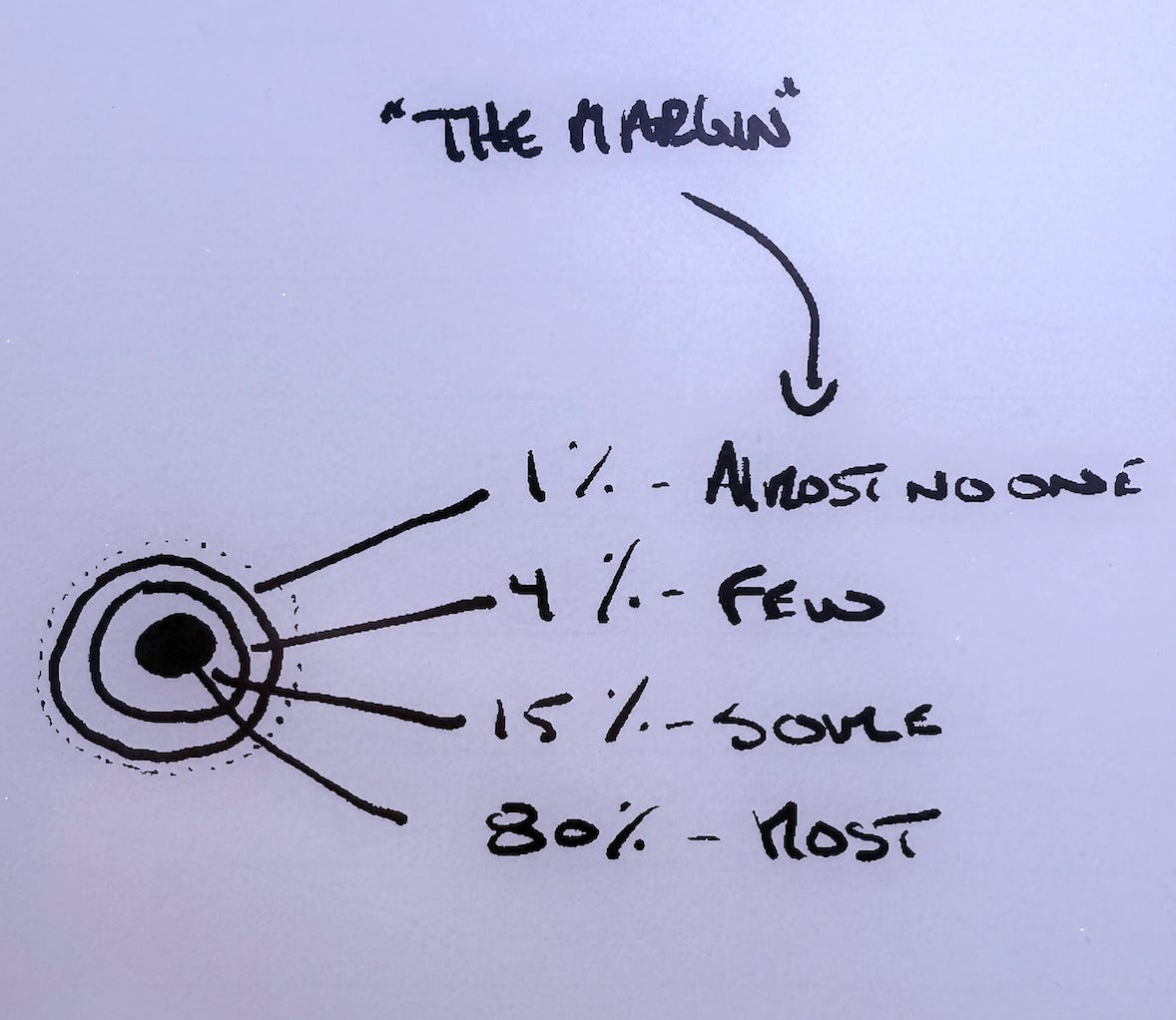
"What pulls the rope in most workplaces is the elevation and promotion of self (ego), not the elevation of others, purpose, heart, and mind (soul). It's no wonder that people feel so alone in most workplaces today. Interconnectedness gets lost when you have a team or company of people who are making decisions based on their ego's needs: What would be best for their own personal goals, not their co-workers' goals; what would be best for their personal image, not their team's."- Mike Metcalf & Shaun Peet, “12 Second Culture”“Three eggs, over medium, cooked in olive oil if you can, please.” That’s what I said an hour into a breakfast meeting last week. I read somewhere that more olive oil is good for my cholesterol. I’m not sure if that is true, but I like the taste, and it reminds me of Spain.My breakfast was with someone special. The kind of person who has succeeded at the highest levels but still shows up fully present and humble. Maybe you’ve met the type. They don’t take their eyes off you or look at their phone. They spend more time listening than talking. They radiate care and love. Somehow, you feel like you got better after spending time with them - absorbing some of them. Two hours later, that’s how I felt. One lesson from him stood out: Live on the margins, be the 1%First, we aren’t talking about 1% in the context of money. We’re talking about mastery of your craft and your humanity. As we move through life, we use our experience and mental models to decipher the world and make decisions. Essentially, we apply a lens to each situation, and those lenses help us determine what action we take. What my new friend taught me is what I’d describe as the 1% lens.* In your mind, draw a large circle and write 80% in the middle of that circle with the word “most.”* Draw another circle around that first circle. Write 15% somewhere with the word “some.”* Then, draw another and write 4% and “very few.”* Finally, draw a final circle around those three circles and write 1% with the words “almost no one.”You should have something like an inverted archery target, with 80% being a large inner circle and 1% being the outermost circle.These circles represent the types of choices we make in the effort to get better. Most people will choose comfort. Some will do a little more. Very few will choose pain or possible failure. And almost no one is willing to go all the way out to the margin.Choices:* Sleep in or workout* Scroll social or read a book* Roller bag or farmers carry a duffle bag* Shuffle emails or block four hours for deep work* Book another meeting or surprise your kid for an after-school ice cream date* Do that thing that scares you but puts at risk your status and resourcesWhat would the 1% do?Like you, I want to find my potential—as a professional and a human. To do that, I need to keep moving out to the margins. I need to go from doing what most will do to doing what almost no one will do.The farther we go from the crowd, the scary it gets - it’s lonely out there. Potentially, it means being “weird,” looking foolish, failing, and asking for help. You can stay in that center, that comfortable 80%, or move out to that 1%. That’s where better happens - on the margins.Put on those 1% glasses. Live on the margins, friend. Don’t do it for “me” do it for “we.” I hope you’re good. Take care, Kelly PS - If you like this, please share it with a friend or your team. PPS - Grab Shaun Peet's book. A good human. This is a public episode. If you would like to discuss this with other subscribers or get access to bonus episodes, visit kellyvohs.substack.com

Clarity In Chaos
No. 1In the midst of chaos, your mind cannot be chaotic. - General Jim Mattis, “Call Sign Chaos”In chaos or crisis, emotion is unhelpful and clouds judgment. Think about a 911 operator answering a frantic call. The operator is ALWAYS cool and collected while the caller panics. The operator tries to understand the situation (facts) and deploy appropriate resources. Part of their job is to calm the caller down, and they do this by staying calm. This is central to understanding reality.Leadership is the same. Because of their power, leaders have an outsized impact on the team's emotions. Be the 911 operator. Move with urgency but with calm professionalism designed to find the truth, make rational decisions, and deploy resources.When you have enough clarity on what you ‘think’ needs to be done, move faster than anyone thinks possible. Speed is essential because it’s likely that your first decision is wrong—or, at least, less than ideal. Moving fast allows you to learn more facts, adjust your decision, and shift resources.Remember: accomplishing the mission matters, not your ego or reputation. Humble leaders hold onto their ideas loosely. When the facts change, they change their minds.No. 2Speed kills, but slow is deadly. - General Jim Mattis, “Call Sign Chaos”You can’t wait to have all the facts to decide, but you need clarity before you rush off mindlessly. Clarity includes answering questions like:* What are we doing?* Why are you doing it?* What do we believe to be true?* Did what we thought would happen, happen (thesis)? Apply these questions as a filter to your actions. When the answers change, change your actions.Go fast, but do it with clarity.I hope you’re good. Take care, Kelly This is a public episode. If you would like to discuss this with other subscribers or get access to bonus episodes, visit kellyvohs.substack.com

The Dark Work
No. 1The will to victory may be demonstrated in places other than actual battle.A Roman general was leading his legions toward the enemy in a swampy country. He knew that the next day’s battle would be fought on a certain plain because it was the only dry, flat place for miles. He pushed his army all night, marching them through a frightening and formidable swamp, so that they reached the battle site before the foe and could claim the high ground. In the aftermath of victory, the general called his troops together and asked them, “Brothers, when did we win the battle? ” One captain replied, “Sir, when the infantry attacked.” Another said, “Sir, we won when the cavalry broke through.” “No,” said the general. “We won the battle the night before—when our men marched through that swamp and took the high ground.”The real battle happens before the opportunity or crisis—maybe years before. It’s fought in the quiet hours, when no one is watching, through reflection, training, practice, preparation, and self-confrontation. This puts you in a position to do what others can’t or won’t. Growth happens when you are vulnerable—out in the storm, trudging through the swamp, trying to reach higher ground.No. 2This is another key element of the Warrior Ethos: the willing and eager embracing of adversity.In 1912, the Antarctic explorer Ernest Shackleton was seeking volunteers for an expedition to the South Pole. He placed the following ad in the London Times: Men wanted for hazardous journey, small wages, bitter cold, long months of complete darkness, constant danger, safe return doubtful; honor and recognition in case of success.The next morning, 5000 men lined up to volunteer.The payoff for a life of adversity is freedom.Adversity is an opportunity to earn a type of freedom that cannot be given or bought—freedom from our fears, limitations, and external pressures.I hope you’re good. Take care, Kelly This is a public episode. If you would like to discuss this with other subscribers or get access to bonus episodes, visit kellyvohs.substack.com

Talk Less, Simplify More
Here are two quotes from The CEO Test by Adam Bryant and Kevin Sharer. The book's content is simple, practical, and actionable for most leaders. Quote No. 1“A helpful acronym for leaders to keep in mind is WAIT, which stands for, "Why Am I Talking?" because anything a leader says can quickly overwhelm a discussion and make people shut down.Asking yourself, “Why am I talking?” helps determine whether it’s more valuable to listen or contribute at that moment. Sometimes, listening is contributing. Leaders often dominate conversations due to their authority. As leaders, we must seek to understand and share the truth. That requires a balance of communication. Quote No. 2“What is clear and simple in the leader’s head is often not as clear and simple to everyone else. Because of the powerful gravitational pull in business to make things more complicated…a leader’s job is to provide the counterweight of a relentless drive to simplify complexity, and to develop a jargon-free plan for winning that everyone understands, remembers, and knows how to contribute. The simple plan will evolve over time…but the point is to start with a clear plan so you know what to adjust and why when market conditions change….The skill of simplifying complexity is not widely shared, and leaders need to make a conscious effort to practice it themselves and demand it from others.” (lightly edited for clarity)The idea that leaders are a “counterweight to complexity” is powerful. Being a leader means being a simplifier. To execute, you and your team must understand reality, which means wading through complexity to find the truth. Ask yourself:* Do I understand the truth? Understanding requires discipline, curiosity, humility, and actively fostering a culture of truth-seeking and truth-speaking.* Does everyone understand the truth? – Simplifying complex information is required to create actionable communication.* Are our actions aligned with reality? – A well-crafted email is nice, but execution is what counts. Everyone should understand what you’re trying to do, why it’s important, the “why” of decisions, what you’re struggling with, and what excellence looks like in behavior and execution. Actions:* Prioritize communication. Where will you be intentional this week? This should include how you and your junior leaders are mastering the craft of communication, including listening. * Ensure your team understands the what, why, and how of their work.* Challenge your assumptions. Just because it’s clear to you doesn’t mean it is clear to everyone else. I consistently fall into this trap. * Develop feedback loops to assess clarity and surface ideas, questions, and truth.* Be explicit about the “why” in everything to foster better decision-making and understanding.* Don’t assume people have heard your message or that they understand it—repetition is essential.I hope you’re good. Take care, Kelly This is a public episode. If you would like to discuss this with other subscribers or get access to bonus episodes, visit kellyvohs.substack.com
Tell Me Your Story
A dear friend recommended the book Bird by Bird by Anne Lamott. It took me a year to read it, which was a waste of a year. This week I scrolled through my highlights and I feel compelled to share a few with you. You don’t have to see where you’re going, you don’t have to see your destination or everything you will pass along the way. You just have to see two or three feet ahead of you. This is right up there with the best advice about writing, or life, I have ever heard. A sober friend once said to me, “When I was still drinking, I was a sedated monster. After I got sober, I was just a monster.” He told me about his monster. His sounded just like mine without quite so much mascara. When people shine a little light on their monster, we find out how similar most of our monsters are. The secrecy, the obfuscation, the fact that these monsters can only be hinted at, gives us the sense that they must be very bad indeed. But when people let their monsters out for a little onstage interview, it turns out that we’ve all done or thought the same things, that this is our lot, our condition. We don’t end up with a brand on our forehead. Instead, we compare notes.On a bad day you also don’t need a lot of advice. You just need a little empathy and affirmation. You need to feel once again that other people have confidence in you.We are given a shot at dancing with, or at least clapping along with, the absurdity of life, instead of being squashed by it over and over again. It’s like singing on a boat during a terrible storm at sea. You can’t stop the raging storm, but singing can change the hearts and spirits of the people who are together on that ship.As part of my job, I’ve had hundreds, if not thousands, of opportunities to hear people’s stories. They have been generous in sharing. Here’s what I’ve learned.The narratives vary, but the stories are strikingly similar when you peel away the layers and the armor. The parents who perceive themselves as not good enough, the young professionals who think they are behind in life, the mid-lifers that don’t think they did enough, or the leaders who are about to cave under pressure. Or, the countless people I’ve met that have beaten all the odds—going from nothing to being everything despite their fears, handicaps, and struggles.While we are diverse, everyone is working through something—fear, loss, desire, love, failure, and even success. Someone you know is losing a loved one to illness, another is struggling with an addiction, someone else just lost their relationship, and another isn’t sleeping because someone in their life is in pain. Others are waking up wondering how they got so lucky, with a slight tinge of, “I hope I don’t screw it up.” Still others had the courage to pursue their path, not the one their parents or society wanted for them. They are still fighting a struggle. People have reasons for their actions—or inactions. Sometimes these reasons are rational, sometimes they aren’t, but in the moment, they usually make sense.This week, I’m reminding myself that everyone has a story, and understanding those stories helps us understand each other. I’m thinking about how my relationships and friendships would change if I went even deeper. I know I still throw up walls and don’t always listen. I can be better.We won’t always fully understand everyone, and that’s okay. What matters is that we keep trying and remember to be kind and empathetic. Everyone is worth getting to know. After all, we’re all just stories—hoping someone will listen.I hope you’re good. Take care, Kelly PS: Here are my highlights from Bird by Bird by Anne LamottPPS: Thanks again for the recommendation. You know who you are. I’ll listen more carefully next time. This is a public episode. If you would like to discuss this with other subscribers or get access to bonus episodes, visit kellyvohs.substack.com
How you think about compensation will shape your life
I’ve been thinking about and talking about this topic a lot recently, and I found myself revisiting this post, so I’m resurfacing it for you today. I originally published this in July 2022.Note: This post is made for listening, but I’ve included the transcript if you’d rather read.TRANSCRIPT[00:00:00] Hey there. I wanted to follow up on my other note about one of two things leaders are responsible for. The second one is compensation. And there's a whole lot to unpack there, so let's try to do it through a little bit of a story. I'm going to answer a question I get all the time, and that's “why did you join the army?”[00:00:18] And the reason is pretty simple, it was about compensation.Why did I join the army? [00:00:22] Let's go back 20 years, and it's 9/11. I remember very clearly where I was maybe like, most of you. I was at The Breakers, which is a posh hotel in Palm Beach, Florida.That Tuesday morning, I found myself in a meeting room getting ready to give a presentation on a new piece of software. News started to trickle in that something had happened in New York and it wasn't clear how bad it was.More information would come and we'd realize that something horrific had happened.[AUDIO CLIP]It was a very emotional day for everyone, and we'd spend the balance of it huddled around the TV, listening and trying to learn what was going on? I'm trying to understand what was happening in new Yorkers, what would happen to our country, and what our future would be like? What we did know is it was all going to be very different.A DecisionA couple of days later, I woke up and I made a decision. Channeling a very famous scene from the movie Patton and my grandfather, I decided that I wanted to join the Marine Corps. In fact, I wanted to be a pilot. So I marched down to the Marine Corps recruiting office and I started that process.Over the course of the next few months, and a lot of tests and a lot of things, the Marine Corps told me that I wasn't cut out to do that. They wanted me to be an infantry officer and that's not what I wanted. I think if I look back, it was purely a lack of commitment on my side. Maybe too slow, maybe too colorblind, but if I wanted it, I probably could have gotten it.[00:03:48] And if I'm being honest, I quit. Now the good news is a couple of weeks later I'd say something that would change my life forever and really impact everyone around me.At the hotel, there was a long hallway, a very narrow hallway, the kind where you have to step aside so two people can pass each other. On the walls, they had motivational posters from the 1990s, complete with eagles soaring and all the things. Now, this was the time before we all started pushing pixels via email and you had to get your information from printed documents. Down on the right, there is a small room about the size of a closet. This was a mail room. This is where those documents ended up in little slots on the wall.[00:04:33] I remember that day. I remember what the room smelled like, the temperature, and a beige phone sitting on the counter. My vision started to blur and that phone was my focus and I said out loud, "If there's ever another war, I'm gonna enlist."Don't pass go. Don't collect $200. Skip all your egotistical dreams about being a Marine or a Naval aviator or any of those things. Just go get in the fight, Vohs. Now looking back, that was a little naive - but that's what happened.I had a deep, deep, emotional desire to serve a country that had given me so much. I knew for the rest of my life, that it was going to give me more. I needed to do something about it. I needed to serve. At my core, I wanted to defend freedom as hokey as that sounds. That's my, "why."[00:05:26] It's also part of the reason why I ended up picking to go and special forces because their motto is De Oppresso Liber - "to free the oppressed". Now if I reflect back and go a little deeper, there are other emotions at play here, some of them were, self-centered like a desire for admiration and an immature understanding of war highly influenced by Hollywood.So not long after that speech to myself, we would end up invading Iraq. And whether you agree with the politics or not, that at 26 year old, we returned to that moment in that mail room and that beige telephone and he got to work. Two weeks later, on my mom's birthday, I would end up enlisting. Happy birthday, mom.[00:06:09] Here's the deal. My ratio changed. My compensation ratio.The Compensation Ratio & The Three Types of CompensationEconomical[00:06:21] The first is economical. What am I going to get paid? We all need or want to put food on the table, steaks in the freezer, and Tesla's on the charger. Now as leaders, there are a couple of questions we should ask about the economical form of compensation for our team.* Are people being paid well, and how does it compare to the market?* What would it cost to replace this role?* And most importantly, do they feel valued for what you're paying them?Experientia

A Simple Truth: Everyone on the planet wants the same thing
The most powerful force that could be potentially harnessed is dogged incremental constant progress over a very long time frame.-Peter KaufmanI can’t be the only one who lets out a little sigh when the elevator stops on the way down. It’s too early, and this box feels too small. Can I just get to the bottom of the building and out to my daily caffeine spot with as little human interaction as possible, please? Usually, but not always, the newcomer gets a small smile from me, and maybe even a "good morning," just to show I’m perpetually scowling—or at least not at that moment. I'll come back to elevators in a minute.Peter Kaufman was the CEO of Glenair, a Berkshire Hathaway company. He also wrote Charlie Munger’s Almanack. I’ve come across Kaufman’s insights over the years, including notes from a class he gave that I had to promise not to share. They were incredible. Thankfully, Kaufman has also spoken publicly. Recently, my journal reminded me of a speech he gave to an economics class, and it was wonderful. I’ll include the full transcript here—it’s worth your time—but I wanted to summarize a few thoughts that stood out.Five Levels of Cognitive Prowess (from Albert Einstein):5. Smart 4. Intelligent 3. Brilliant 2. Genius 1. Simple "Simple" doesn’t mean unsophisticated. The world may seem complicated, but it’s not. Too often, we want the world to work our way instead of understanding how it really works. Few people can simplify how the world works. Kaufman shares this simple truth:“Every interaction you have with another human being is merely mirrored reciprocation.”In an elevator, if you smile and greet someone warmly, there’s a 98% chance they’ll respond in kind. Occasionally, you’ll get a negative reaction. You might feel embarrassed or even threatened. To avoid that risk, we don’t go all-in. We waste opportunities because we don’t want to look foolish. Kaufman quotes Lou Brock: “Show me a man who is afraid of appearing foolish, and I’ll show you a man who can be beaten every time.” Now, here’s the real secret Kaufman shares:Everyone on the planet wants the same thing and…we spend our lives looking for someone who is:* Trustworthy* Principled* Courageous* Competent* Loyal* Kind* Understanding* Forgiving* UnselfishHe adds, “Most people spend all day long trying to get other people to like them. They do it wrong. You do this list, you won’t be able to keep the people away. Everybody’s going to want to attach to you.”Then comes the real wisdom:All you have to do, if you want everything in life from everybody else, is first pay attention, listen to them, show them respect, give them meaning, satisfaction, and fulfillment. Convey to them that they matter to you. And show you love them. But you have to go first. And what are you going to get back? Mirrored reciprocation. Like the elevator, we have to go first. If we do these things, there’s a 98% chance they’ll be reciprocated. Sometimes, people won’t respond, and someone may take advantage of you, but that’s a risk worth taking. Bono from U2 said something similar: “I know 10% of people are going to screw me. That’s OK. If I’m not willing to be vulnerable to that 10%, I’ll miss out on the other 90%.”Try it—at home, at work, or on your next elevator ride. Try it with your partner, child, colleague, boss, or the kid scooping out that cookie indulgence you love. Show up, put your phone away, and pay attention. Show them respect and make them feel like they matter. Chances are, they’ll return the favor.This is how the world works: people mirror what you give them. People want to be seen, loved, and live fulfilling lives. They want to be around people they trust. When you find someone who has your back and wants to help you win, you’ll do the same for them. It’s simple, but we need the courage to go first.We get back what we give. Hope you're good.Take care, bye. -KellyThanks for reading Better Today Than Yesterday (BTTY)! Subscribe for free. Here is the full transcript: http://latticeworkinvesting.com/2018/04/06/peter-kaufman-on-the-multidisciplinary-approach-to-thinking/ This is a public episode. If you would like to discuss this with other subscribers or get access to bonus episodes, visit kellyvohs.substack.com

The Double Satisfaction
"…tranquility…comes when you stop caring what they say, think, or do. Only what you do." - Marcus AureliusThere is some change happening in my life. A new job, a kid left for college, and a few other things that add complexity and a touch of anxiety. Most of this change is good, some of it not. All of it is part of life. Wrestling with a few thoughts and some internal disturbance, I went back to re-read Meditations by Marcus Aurelius. Often, it's not the books you read that make a difference in your life. It's the ones you re-read. This passage stood out."If you seek tranquility, do less. More accurately, do what is essential. Which brings the double satisfaction: do less, better."Do Less, BetterHe is, if nothing, concise. Here's what I take away."Do Less" - means simplifying your life and removing the unessential. Complexity adds stress, simplicity removes it."Better" - by doing less, you have the space to focus on the essentials and get better. He goes on,"Because most of what we say and do is not essential. If you can eliminate it, you'll have more time and more tranquility. Ask yourself at every moment, "Is this necessary?"So. Do less, better.I imagine the old emperor, the last of the "five good emperors," evaluating everything through this lens. Every conversation, every piece of food on his plate, and even every thought. Is this necessary? Is it good? For the unfamiliar, he's writing these notes to himself in his journal. He closes this passage with more advice to himself,"But we need to eliminate unnecessary assumptions as well. To eliminate the unnecessary actions."Much of what we think is both unessential and often untrue. We spend time on unnecessary thoughts, assumptions, and perceptions. We add stress, work, and worry because of the stories we create. I was creating stories. What does this person think, what does that mean, and what will happen if this doesn't happen?Whether those thoughts were true or not doesn't matter - they were a waste of time and energy. The more we try to do, the less we do well. Mastery comes through focus. For me, the most essential task is to master my thoughts. Keep the essential and toss the unessential (and untrue) because, ultimately, my thoughts are the one thing I control. Those thoughts lead to my actions and ultimately who I become. I hope you're good. Take care, bye. -KellyThanks for reading Better Today Than Yesterday (BTTY)! Subscribe for free. This is a public episode. If you would like to discuss this with other subscribers or get access to bonus episodes, visit kellyvohs.substack.com

The Power of Human Teams
I believe the most effective type of team is a “Human Team.”These teams accept their members for their individual strengths and struggles. They want the entire human to show up, not just the tip of the iceberg. These teams are about helping each other, and the collective "us," find our potential. If you are on one of these teams, you feel it. It’s different, and you show up and do the best work of your life because you don’t want to let your teammates down.Recently, I read a passage in the book 12 Second Culture. Mike Metcalf and Shaun Peet are NASCAR pit crew coaches. In their book, they do a much better job of describing a human team than I can. Here it is:"As a leader, you can cultivate either an integrated or a compartmentalized culture. An integrated culture incorporates every aspect of those you are leading—their unique personalities, their personal lives, and their needs. It integrates their spirit and soul, their heart and mind, their loved ones, and their deep passions. It is essentially seeing someone for the fullness of who they are. This fullness always extends far beyond the workplace.A compartmentalized culture, on the other hand, treats those you are leading as robots—bodies for labor and ends to a means in the binary tunnel of achieving or underachieving. Compartmentalization creates a certain unawareness about people's situations and deeper needs. It satisfies the fundamental needs of shelter, food, and clothing through compensation but falls short of addressing the higher needs of authenticity, belonging, development, and fulfillment. It forces employees to create boundaries between themselves, leadership, and daily objectives: to suppress who they are and to view the workplace as nothing more than a place to subsidize a life they wish they could spend more time in.Could it be possible that empathy—elevating the humanity of every person and, therefore, their personal sufferings—taps into who we each innately are, cultivates togetherness, multiplies a deep sense of meaning on your team, integrates the personal with the professional, and ultimately inspires a more positive and efficient culture?" (Mike Metcalf & Shaun Peet, 12 Second Culture)I’ve been lucky over my life to be a member of a few teams that I would call Human. None of them perfect, and that makes sense. But all of them have cared enough about me to help me make progress on finding my potential.Hope you’re good. Take care, bye. -KellyHit like and share it with a friend. This is a public episode. If you would like to discuss this with other subscribers or get access to bonus episodes, visit kellyvohs.substack.com

Single Threaded Leadership: Amazon's Model for Ensuring Focus and Resource Allocation
Two Quotes“One of the things we try to do at Amazon is minimize the amount of energy that’s wasted on maintaining power and control and ego, as opposed to what really matters, which is helping our customers.” - Jeff Bezos"To be everywhere is to be nowhere." – SenecaA Lesson LearnedThis past week, I learned about Amazon’s single-threaded leader model. I'll explain that in a minute, but first, an admission. I once thought I could do it all, whether for ego reasons or to prove my self-worth. Whenever something needed to be done, I’d volunteer without considering the impact it would have at home or work. I kept adding more and more, which took a toll on my health, relationships, and, ultimately, my performance. Over the years, I learned:* Multitasking is impossible. It’s just high-frequency switching, and it’s expensive. * Focus over a long period is how you achieve excellence.* Saying no is a superpower.These mistakes are costly to us as individuals — they are deadly when they occur at scale inside an organization. Single Threaded LeaderAmazon’s Single Threaded Leader model assigns one person fully dedicated to owning or driving a specific project, product, or initiative. This leader is not responsible for multiple tasks or areas but wakes daily, focused entirely on one thing. Their sole responsibility is to ensure this initiative receives the necessary attention and resources.The success of the Single Threaded Leader model hinges on several critical factors:* Focus, focus, focus: They have only one job. This eliminates switching costs that tax other leaders and allows them to dive deep into details. Positioned to understand reality, they can make faster and more informed decisions.* One owner: They are ultimately responsible for strategy, execution, and results. The owner is accountable for success or failure.* Autonomy Reduces Friction: Dependencies often create a ‘speed tax’ or a ‘quality tax’ because dependencies require communication and negotiation. Reducing dependencies is crucial. * Be quick and iterate: This structure allows the leader to rapidly iterate without the distractions of managing multiple projects or dependencies. They still need to manage stakeholders, but their mandate is clear: keep working on the problem until you get it right.It might be easy to dismiss this with a comment like, “Amazon has the resources to do this.” I agree—they do. However, be careful not to rationalize away your own mistakes by blaming your operating environment. I know I’ve done it, and I still do. Here are a few other things that feel important to underscore. * If it’s important, commit. Side projects rarely get the attention and resources required to succeed. Put your best people on your biggest opportunities and be prepared for it to take longer and be more expensive than you thought. * Don’t bury important initiatives deep in the organization. Don’t worry about conventional organizational charts or little boxes. Focus on what your organization needs to be the most effective. Ultimately, that’s your job.* Fight Bureaucracy: Innovating requires moving quickly and iterating. Bureaucracy creeps in when you lack talent density, have low trust, or have high fear—usually all three.Given the volume of information and the speed at which we operate, focus is more complicated than ever — personally and professionally. Here are a few questions I’m asking myself: * What are examples of where my expectations of people are bigger than the resources I’ve given them? * Where have I not put the best people on the most significant opportunities? Instead, I leave them where they are because I’m scared. * Am I still stuck in thinking about organizational charts in a conventional way? The NVIDIA CEO has 35+ direct reports, and the company is the second most valuable in the world. It is an outlier, to be sure, but it is still worth challenging yourself. * Where am I still saying yes to things I don’t want to do? Personally and professionally. I hope you’re good. If you liked this, please hit like to let me know and share it with someone else who might like it, too. Take care, bye. -KellyThanks for reading Better Today Than Yesterday (BTTY)! Subscribe for free to receive new a short post every Sunday. This is a public episode. If you would like to discuss this with other subscribers or get access to bonus episodes, visit kellyvohs.substack.com

Great Teams Have One Thing In Common: "No Space Between"
Are you on a team or just a group working in parallel?The word "team" dates back to the 8th century and originally referred to a group of animals harnessed together to pull a cart or plow. By the 15th century, it had evolved to its modern meaning—a group of people working together, particularly in competitive contexts like sports or battles.Today, "team" means collaboration, mutual support, shared objectives, and winning.A couple of yaks harnessed together to pull a cart are just two yaks pulling a cart. Many so-called teams are like this—maybe your team is too. Just people working in parallel, trying to survive. The best teams work to reach a point that I call "no space between."Hold your hand and spread your fingers out as wide as possible, like holding your hand up and telling someone you will be there in five minutes. Now, bring your fingers together, with your thumb and fingers pointing up like you are holding your hand up to tell someone to stop. This is the difference between teams with space between and those with no space between. Here’s what I’d say to a team as we work to have no space between:1. Trust - We help each other win. Period.Great teams don’t question whether or not someone has their back: no games, no politics, no half-truths, and no trying to outdo each other. The competition is out there. We don’t have room for it in here.Allowing issues to create space between us creates a crack in our team’s wall. Cracks are normal and part of teaming. If we don’t address these cracks, they get bigger, and eventually, we will fail. A great team doesn’t let cracks grow. When you see or feel a crack, you have to fix it. Honest conversations are the mortar that repairs these cracks.Remember, trust is different for each of us. Some trust entirely at the start. For others, trust takes time. You can’t force trust. It is an action-by-action affair. Everything you do builds or degrades trust with the people around you.2. Be aggressive about transparent communicationInformation is motivation and a resource in the mission. Confidentiality is the enemy of trust. Great teams are transparent to a level that often feels uncomfortable to more conventional folks. They are clear on what they will and won’t share but err on the side of sharing.Often, we get caught in the trap that, just because it’s in our head, we think everyone knows. Everyone doesn’t know. You must keep repeating yourself. Once you start hearing others say it, it’s getting through. When they start making fun of you, it has taken hold.When General Mattis took over Central Command (CENTCOM), he made everyone put post-it notes on their phones: “What do I know? Who needs to know? And what have I told them?”3. Seek and tell the truthWe have honest conversations about the work, interactions, and ourselves. We are curious because we want to understand reality. We ask a lot of questions and relentlessly seek the truth. Our biases, history, and ego can color our perspective. We know that. When we find opportunities or issues that impact the mission, we don’t wait—we address them head-on. People’s lives may not be on the line, but their livelihoods are.Honest and meaningful conversations strengthen our wall. Two ways to start these conversations are, “The story I’m telling myself is _____” or “The way I see things from my perspective is _____. Please help me understand what I’m missing.” Then, listen, don’t talk.4. Dissent is a responsibilityWe challenge and disagree. Even if we agree, we argue the other side to expose the flaws. It’s always respectful and is about finding the correct answer, not our answer.Once we decide, and there is no silent voting, we stand shoulder to shoulder with the decision. There is no "we decided, but I was against it." Instead, it's, "We debated deeply, and this is our decision, which we all support 100%."5. Honor the MissingGreat teams don’t talk about each other behind their backs. Gossip is a four-letter word on these teams. Sometimes, you need to talk about someone when they aren’t there—that’s okay. But when you do, you must tell them what you said. Don’t say anything you wouldn’t say to someone’s face. No exceptions.When making decisions, look around and see whose perspective isn’t heard. Maybe it’s because they aren’t in the room or don’t feel they can openly share.6. We care deeplyThe best teams have a mission that each person connects with emotionally and is clear on their role in the mission. We work to establish deep connections with each other and become masters of our craft.Time is our one nonrenewable resource. We want to spend it doing things that matter to us with people who matter to us, and we won’t let them down.7. Values SynchronicityOur work is solving problems—that’s why we exist. We want our teammates to have diverse backgrounds and beliefs to solve various issues. We also want people who are culturally aligned. For example, to be on this team, you must be kind, helpful, thoughtful, and respectful. Your

Beyond Buzzwords
Clarity is arguably a leader's first job. Why are we here? What are we doing? How do we work?MISSION = WHYThis is why we exist—the mission. It’s the guiding principle that serves as the foundation for all work. When you talk about it, you should feel your energy rise. When it gets hard, this is what gets you to the other side of the hard. The mission should be clear and have deep meaning to everyone.STRATEGY = WHATThis is the plan of action to achieve the mission. This is where analytical thinking, understanding reality, and committing resources intersect.Strategy is the high-level direction, and tactics are the specific actions. One way to think about it is like a road trip. "We’re headed east" is the strategy. The turn-by-turn directions, the vehicle choice, who drives when, and keeping those fed who get hangry are the tactics.Don’t fall into the trap of believing that you must have all the answers just because you are in charge. Sometimes, you must drive, navigate, pay for gas, nap, or change a tire. Your role should constantly change depending on what the team needs from you. And don’t forget, if you could do this yourself, you wouldn’t have a team.CULTURE = HOWThe behavior of each person as they execute the work forms your culture. This happens interaction by interaction and decision by decision. Will I say "please" and "thank you"? Will I punish someone for taking a calculated risk that failed? You need to be intentional about the behavior you expect. The values on the wall often get mocked because they aren’t lived. If the values are lived, people won’t laugh at them—they’ll be proud of them. But if you say you want transparency but hoard information, they should make fun of you. If you say respect is a value but show up late to meetings, talk over people, and never listen, then you don’t believe in respect. Remember, the more power a person has, the more impact their behavior has on shaping culture.In 2009, Reed Hastings, the founder of Netflix, published a 125-page slide deck on their values. That’s right, 125 pages. It begins with:Be Clear On How - That Drives EverythingReading Scaling People by Claire Johnson, I stumbled upon Stripe’s Operating Principles. They are great. Here’s one I like:“Solve problems. Be a persistent force for progress. Our leaders must work with their teams and across Stripe to quickly and effectively solve problems—especially when they’re hard.”Amazon’s leadership principles are great, too. The original version of these was sent out by Bezos after his head of HR spent nine months interviewing people to figure out what really mattered in their culture. It has grown from 9 to 14 principles since then. Here’s a favorite:“Earn Trust: Leaders listen attentively, speak candidly, and treat others respectfully. They are vocally self-critical, even when doing so is awkward or embarrassing. Leaders do not believe their or their team’s body odor smells of perfume. They benchmark themselves and their teams against the best.”You can have a clear mission, strategy, and tactics, but it doesn’t matter if you fail to execute. Execution is all about the "how." Be clear on the behavior you want to hire, reward, and promote. Ultimately, this will be your culture. Hastings says it best, “Values are what we value.”Here’s a link to all three. They are worth a few minutes of your time.Stripe Operating PrinciplesAmazon Leadership PrinciplesNetflix Culture (2009 Version)Hit like and share it with a friend. Hope you’re good. Take care, bye. -KellyFrom the Archive This is a public episode. If you would like to discuss this with other subscribers or get access to bonus episodes, visit kellyvohs.substack.com

Are you a space taker or space giver?
Some people give space, others take it.Givers let you talk.Takers do the talking.Givers give credit and take the blame.Takers take credit and give blame.Givers seek answers.Takers are the ones with all the answers.Givers focus on improving.Takers are busy proving.We don’t ever exclusively play the role of space taker or space giver. Our role should change depending on the situation. Sometimes, you need to be a space taker. Sometimes, a space giver. The question to ask yourself constantly is, “Right now, am I helping or hurting?” If you don’t know the answer, ask the people around you. They know. When we listen, we learn. We’re getting better at our craft and connecting the dots. We’re leveraging everyone around us to come up with the right answers, not just our answers. We can foster a culture of listening and learning or one focused on proving.The team will take the attitude and behaviors of its leaders. Behave accordingly.If you liked this, hit like and share it with a friend. Hope you’re good. Take care, bye. -KellyFrom the Archive This is a public episode. If you would like to discuss this with other subscribers or get access to bonus episodes, visit kellyvohs.substack.com

Seeking Wisdom
I’m working on something that I call a MAP: Me, a Page. The idea is to give someone my instruction manual. I have quirks, beliefs, pet peeves, and ways of working. Why keep them a secret and make them learn it the hard way? They likely aren’t permanent or perfect, but they are me at this moment.In the process of doing that, I thought I’d write down my values. That seemed simple enough, but it’s not. Sitting next to Princess Buttercup, I took out a notebook and wrote down a few words. One of them was wisdom. As she read, and we both enjoyed some salt air, I thought about wisdom. What does it mean? How do you define it? So I asked a friend. Here is what ChatGPT said:“Wisdom is the ability to make sound judgments and decisions based on knowledge, experience, and insight. It involves understanding the deeper meaning of life, seeing things clearly, and acting with prudence and integrity.”With that in mind, I started writing what I thought was important. What insights do I currently hold true? As far as the “deeper meaning of life,” I don’t have that answer. If you do, please let me know. Here’s the list I came up with. Like everything I share weekly, it could be right or wrong. I’m just making it up as I go. You probably are, too. I feel obligated to stress that this list is not complete. Each week, I try to share the lessons I learn and how I’m trying to get better. So, I’m sharing it live. Maybe one or two of these resonate with you.* Understand and embrace reality. Resisting or resenting will not help. Focus on what you can control. Life is problem-solving. Get good at solving problems and/or letting them go.* Love people and events. Good or bad, both are temporary and almost always helpful for learning. Be tolerant, humble, and curious. Love helps. Hate hurts.* Truth requires curiosity. Seek and speak only the truth, especially about yourself. Understand who you really are and act accordingly. Self-awareness and self-control. Don’t conform to external expectations or superficial desires. Your maximum impact lies at the intersection of what the world needs and what you love.* Pride dulls the senses. Don’t let your ego stop you from learning and loving. A willingness to look foolish is a superpower.* Everyone struggles with something. Ask enough questions, and you’ll find out. Everyone is fighting a battle. * Respond, don’t react. Emotions cloud judgment and reality — particularly anger, fear, pride, and sadness. Don’t suppress them; work to understand and master them. If your inside game is strong, your outside game will be too. We have absolute control over our thoughts. Nothing else.* Do good, not bad, and know the difference. Good comes from good action, and evil comes from vice and moral failure.* It’s not about you. It’s about us. We are all connected, and we each have a duty to contribute to our shared harmony.* Don’t time travel. Past regrets and future anxieties are distractions and rarely real.* Simple is better. Focus on what really matters. Think and live simply.* Just because you can win the game doesn’t mean you should play. This applies to relationships, jobs, missions, and ideas. Quit when you realize you’re playing the wrong game, but make sure you’re quitting for the right reasons. It’s easy to lie to yourself when it gets hard. Most good things are hard at some point.* Appreciation takes effort. Bad things are a threat, so they’re easier to see. It takes effort to see the good and the progress in yourself, others, and society.* Happiness is a choice. It’s not always easy, but still a choice. The distance between your perception and your expectation is your amount of unhappiness. Change your perception or your expectation to close that distance. Also, it’s okay to be sad sometimes. Bad things happen.* Usually, it’s enough, and you’re enough. Just enjoy it. It doesn’t have to be any different than this moment. Take care, bye. -KellyIf you liked this, hit like and share it with a friend. From The Archive This is a public episode. If you would like to discuss this with other subscribers or get access to bonus episodes, visit kellyvohs.substack.com

Three Words That Matter
A few years ago, I was part of a technology transformation at a company. Transformation is really just a big word for fixing everything that's broken. A friend who was leading the project looked at me and said, "Listen, you can have it fast, good, or cheap, but you can't have all three. You get to pick two." That applies not only to technology but probably a lot of things in life.Lessons From Changing TiresI just finished a book by a couple of former athletes who now coach NASCAR pit crews. Like the vehicles, the pitting exercise is based mainly on rules and should be the same for everyone. Their job is to coach the team to pit a race car successfully in 12 seconds. That’s the person changing the tire, filling the fuel, etc. They take other athletes, like former Division I football players, and transform them into a team. They used three important words: overworked, underpaid, and underappreciated.Two Important ThingsIf you feel two out of those three, it's probably okay. It doesn't feel great; maybe you won't quit. But if you have all three—overworked, underpaid, and underappreciated—you’re out. And appreciation is free. That got me thinking.Everyone wants to be appreciated for what they do AND who they are.They might not need as many words of affirmation as someone else, but everybody wants to know that their time is well spent and, ideally, that what they do is good. Most people want to be good. Appreciating requires attention. That's true whether you're thinking about one of your teammates or what's happening around you. I could say something as simple as appreciating the clouds, but it takes attention to stop and look at them. The same thing is true for somebody on your team. It's about stopping and recognizing that they bring a specific contribution they may or may not be aware of, and that deserves appreciation.A Simple PracticeA while back, I started doing this thing, and I'm very inconsistent with it, but I will resurface it. I pick someone and call them on my commute home—an old-school phone call. I know not everybody likes that, and not everybody wants to answer the phone, but it's more than a text. In today's world, it's almost like a handwritten note. I give them a specific example of what you appreciate, ideally about how they are on the team and what I value in them versus some particular task they completed. Yes, you should tell them when they do a good job on something specific or put in extra effort, but sometimes it's more powerful to appreciate how they go about their work and what they bring. If true, I tell them how they make me feel better and what I’m learning from them because it is true. If we're paying attention, we can take the superpowers of the people around us and absorb some of them. But whatever you do, you have to be sincere.FuelWe spend a lot of time identifying everybody else's blind spots and weaknesses. What if we spent more time helping people figure out what they were really good at? When you can appreciate something in someone that they either are not aware of or don't understand is something they're really good at, you can help them pour fuel on their fire.There are many ways to appreciate people. Making that phone call at the end of the week is just one of them. What if your week ended with a phone call like that? How would you feel today? How would you start your Monday?Take care. Bye.-KellyIf you liked this, hit like and share it with a friend. From The Archive This is a public episode. If you would like to discuss this with other subscribers or get access to bonus episodes, visit kellyvohs.substack.com

What Do You Actually Get Paid For?
We are compensated in three ways: * Economical: We get paid.* Educational: We learn and grow.* Emotional: We love the work and/or the people we work with—ideally, both.When we have at least two of these, we feel good. When we have all three, we are fully engaged. At different points in our lives, each of these has varying levels of importance. Each can, depending on the moment and for different reasons, lead to discretionary effort. For most people, the emotional aspect tends to matter the most over a long period of time. Compensation isn’t just about money. It’s also about the learning and loving you do.Economic CompensationEconomic compensation is important for everyone. The reasons are often different: perhaps you didn’t have anything as a kid, don’t have anything now, or want to take care of someone who doesn’t have anything. Regardless, the story is “real” to you and you want to get paid.The quality of your decisions and the value you create usually correlate with the cash you receive. If that’s not true, you might be overvaluing yourself, or the market is undervaluing you. It’s crucial to find the truth here. Make sure you don’t lie to yourself. It’s easy to blame others for what you get paid.Most of the people you know get paid for their judgment. Whether they’re leading a team, making investment decisions, or designing a brochure, it’s judgment. If you want to have a bigger impact or a bigger bank account, you need to have better judgment. Here are some thoughts on how to improve your judgment and ultimately get paid more, both economically and emotionally.Gain Unique KnowledgeUnique knowledge is learned, not taught. It happens in apprenticeships, not in school. The curious and humble make the most progress here.Your knowledge shapes your judgment (good or bad). If your knowledge is not unique, you can be replaced. If your answers are a commodity or can be found in a textbook or ChatGPT, you’ll get paid like a commodity. More likely, you’ll get replaced by someone who read the same book and will do the job for less. Increasingly, the chances are that someone won’t be human.Learning ObsessionIf you can spend your days obsessively learning what you’re obsessed with, one day, you will wake up, and you’ll be the best in the world at that thing. You’ll have better judgment than anyone else on that thing. You won’t love all parts of your obsession, but it’s the parts that you love that keep you coming back when things get hard.Tom Brady, Taylor Swift, Kobe Bryant, Jony Ive, Julia Child, Mr. Beast, and Serena Williams— their judgment was/is unmatched, both in execution and in learning about their obsession.You and I can make all the excuses why it’s too late for us to do this, but they’re just excuses. When you stop growing, so do your rewards—both financial and emotional.If you were to wake up on a Saturday morning full of energy with no responsibilities, no pressures, and your family out of town, what would you spend your day learning? What YouTube rabbit hole would you go down? What stack of books would you tear into? Maybe your obsession lies somewhere in that answer.Own ItYour willingness to fail publicly and under your own name is directly connected to the impact you can have and/or the wealth you create. Renting your time (i.e., a paycheck) is less risky than building your own organization.There is a reason why owners get paid more—even inside a company. The people who “own it” take the risk away from others, and their actions say, “I got this. I’ll own this and make sure we don’t fail. It’s my responsibility, and you can hold me accountable.” They are a different kind of owner, but owners nonetheless.Naval Ravikant originated the idea of “Specific Knowledge,” but I prefer “Unique Knowledge.” Ultimately, this is about being unique. Your DNA + experiences + will = you. No one can compete with you on being you. As he says, you “productize yourself.” Depending on how much time you spend refining that product over decades will determine how valuable you are to the world.I hope you’re good. Take care. Bye.-KellyIf you liked this, hit like and share it with a friend. From The Archive This is a public episode. If you would like to discuss this with other subscribers or get access to bonus episodes, visit kellyvohs.substack.com

Escaping Competition
“Escape competition through authenticity. When you’re competing with people, it’s because you’re copying them. It’s because you’re trying to do the same thing. But every human is different. Don’t copy.” (Naval Ravikant)I don’t like the word authenticity. Maybe it’s too big, or too many books have been written about it. It’s probably because too many management consultants who couldn’t manage a lemonade stand talk about it. It’s easy to say “be authentic,“ but it’s hard to execute. Given my aversion to the word, I went in search of another word to replace it and found truthfulness. So, when we say “be authentic” we are really saying be truthful. When you think about it in that context, our choice is simple: Be authentic or lie. Let’s stop lying. Wear what makes you feel comfortable, do work you love, and love whoever you want. While I have a personal aversion to face tattoos, I’m down if it feels right for you. While we are in the spirit of stopping, let’s stop competing. Once upon a time, there wasn’t enough. Famine was widespread, resources were limited, and you died if they didn’t win against the folks across the river. While not everyone lives the life you and I have, there is enough. Today, we don’t have to compete. We choose to compete because we fear losing resources or status. Someday, we will realize that not only is there enough, but we are enough. You can’t beat me at being me. I can’t beat you. And neither one of us should try. We should spend no energy there. We should spend all our energy figuring out how to be ourselves. That means understanding what we love doing and who we love doing it with. We should obsess over those things. Once we figure that out, that’s who and what should occupy our days. It doesn’t matter if there is a degree, a job title, or a label. It doesn’t matter if they will like it at the country club, the nightclub, or the supper club. What matters is that when you put it on in the morning, it feels right. What feels right isn’t always easy, and not everyone will understand. It doesn’t matter if they understand. It matters whether you understand and are being honest with yourself. So long as you aren’t lying to yourself, keep doing you. No one can compete with you. Take care,-KellyIf you liked this, hit like and share it with a friend. From The Archive This is a public episode. If you would like to discuss this with other subscribers or get access to bonus episodes, visit kellyvohs.substack.com

Division of Labor
"Your whole life is a kind of apprenticeship to which you apply your learning skills. Everything that happens to you is a form of instruction if you pay attention." (Robert Greene, Mastery)A friend sent me photos from her trip to Yellowstone—an extraordinary place. When I visited, I couldn't help but imagine how it was centuries ago: simple, wild, and a bit scary.The idea of roaming freely is romantic, but it is also dangerous. That's why we stopped. We found a better way to survive by building communities where each of us contributes our unique skills. We divided the work, and we thrived. We're the only species that does this—division of labor. One person makes flour, another makes sugar, you bake the cake, and we all enjoy it together. Work together, and we get cake—hopefully, good cake. If someone doesn't do their job, there's no cake. The lucky (and persistent) are good at many things. Good should not be the goal; rather, it should be mastery. DaVinci, Aurelius, Monet, Einstein, and King were masters of their craft. Maybe you think they were special. They were because they made a decision to become masters. They weren't perfect, but they achieved mastery. Like you, I have excuses for why I am the way I am, why I've done what I've done, and why I do what I do. When your time is over, what do you want to have mastered? Instagram scrolling? Making money? Winning arguments? Proving yourself? I want to master patience, emotion, judgment, desire, relationships, arrogance, empathy, discipline, fear, and ego. This is where masters start. They wrestle with their demons and work to master these aspects of their lives. Getting these right opens the space to become masters of our craft at work. Some look at work as a way to make a living—a job. And it is. We shouldn't overthink it or attach too much identity to it. But it's also a duty. It doesn't matter what work you do, how much you make, what you drive, where you live, or your airline status. What matters is whether you give more to the community than you take. We must do this through mastery. It, too, is a duty. Patience, emotion, judgment, desire, relationships, arrogance, empathy, discipline, fear, and ego - those are the focuses. I also intend to keep working on the craft of loving my wife, my kids, my friends, my community, and myself. The work we do today shapes who we will be in ten years. So, check your ego, Kelly. Ask more questions and go empty the dishwasher. Your great-grandchildren may not know your name, but you're building the world they'll live in.-KellyFrom The Archive This is a public episode. If you would like to discuss this with other subscribers or get access to bonus episodes, visit kellyvohs.substack.com

Delay
We spend so much time wishing our lives were different, comparing ourselves to other people and to other versions of ourselves, when really most lives contain degrees of good and degrees of bad. - Matt Haig, The Midnight LibraryI’ve been thinking a lot about responding, not reacting. Making space between provocation, judgment, and action provides time to explore reality—an opportunity to find the truth about the situation, yourself, and what you can control. When possible, delay. If delaying your response does not reduce the chances of a favorable outcome, delay. More information often comes with time. At a minimum, things become clearer. Less emotion and more sleep always help. Writing helps, too. Write about what is happening, what you know, what matters, how you feel, and the actions available to you. Keep writing (or talking to a trusted friend) until you’ve removed the emotion (ego, fear, desire, etc.) or at least realized their collective impact on your perception. We want to find the truth about what matters, what we can control, and what should happen next. Sometimes, it’s nothing. I hope you're good. Bye.-KellyFrom The Archive This is a public episode. If you would like to discuss this with other subscribers or get access to bonus episodes, visit kellyvohs.substack.com

Incidental Vs Intentional
"A true student is like a sponge. Absorbing what goes on around him, filtering it, latching on to what he can hold. A student is self-critical and self-motivated, always trying to improve his understanding so that he can move on to the next topic, the next challenge. A real student is also his own teacher and his own critic. There is no room for ego there." (Ryan Holiday, Ego Is the Enemy)Through trial and error, I learned my skills and knowledge as a parent on the job (I'm still trying). I made so many mistakes (and still do). But, almost all were valuable and helpful, though often painful. Most of our learning happens this way: unstructured and by chance. That's incidental learning, which is useful and effective. Intentional learning is different. It is deliberate, structured, goal-oriented, and focused on acquiring knowledge or skills. In this context, you are usually drawing on BOTH your experience and the experience of others. Finishing school is where this type of learning ends for most people. If you want an advantage over almost everyone, be intentional about your learning. Decide what you want to learn, and be deliberate. Learn from both your experiences and the experiences of others. I hope you're good. Bye.Take care, Kelly This is a public episode. If you would like to discuss this with other subscribers or get access to bonus episodes, visit kellyvohs.substack.com

My Friend's Simple Advice On Leading
He is a dear friend, a long-time mentor, and one of the most remarkable people I know. He left his job as CEO to build a hotel run by folks with special needs. He's pretty special. For decades, he's drilled into me the qualities required to be a good leader. Here they are: * Humility & empathy. * Self-awareness & self-control. I've always agreed. They make sense, but I never dug in. Then, I sat with another leader for a few hours talking about leadership, and they started to crystallize. Defining these words helps. Here's how ChatGPT defines these: Humility is having a modest or low view of one's importance. It involves recognizing one's limitations and weaknesses, being open to feedback and new ideas, and valuing the contributions and perspectives of others. Humility fosters a willingness to learn, grow, and cooperate with others, and it helps build strong, respectful relationships.Empathy is the ability to understand and share another person's feelings. It involves recognizing and appreciating what others are experiencing emotionally and cognitively. Empathy allows individuals to connect with others on a deeper level, fostering compassion, support, and effective communication. It is a crucial component of healthy relationships and social interactions, as it helps individuals respond to others with kindness and consideration.Self-awareness is understanding one's character, feelings, motives, and desires. It involves recognizing one's strengths and weaknesses and how one's actions impact oneself and others.Self-control is the ability to regulate one's emotions, thoughts, and behaviors in the face of temptations and impulses. It involves delaying gratification and exercising restraint to achieve long-term goals.All these made me think of Jim Collins's definition of a Level 5 Leader from his book Good to Great. Here is a short definition of that: A Level 5 leader is humble and driven. They use their will to propel their organization to greatness. They do this through modesty, resilience, and a commitment to long-term success over personal gain.* Humility: Low ego. Serve others. We, not me. Everyone and everything is my teacher. * Empathy: Seek to understand. This will bring truth and connection. * Self-awareness: Know your truth. Behavior, strengths, weaknesses, and desires. * Self-Control: Discipline, long-term, rational, resilient. My friend says these are principles of leadership. But they also apply to everyday life. They're central to building lasting communities, families, and teams. I hope you're good. Take care, Kelly This is a public episode. If you would like to discuss this with other subscribers or get access to bonus episodes, visit kellyvohs.substack.com

Mission Matters
"The best way for me to spend any given day is to essentially figure out how to make my team a tiny bit better. Because there's really only two kinds of days-ones when your team gets better and ones when your team gets worse. And if you just spend time getting better, then over a prolonged period of time you become essentially unbeatable." -Adam Bryant and Kevin Sharer, The CEO TestMissions hold a special place in my heart. They aren’t a few words on the pretty wall at headquarters. Missions are blisters. They are sunburns. They are two weeks of eating the same food or days without food. They are clothes that can stand on their own because you sweated so much that the salt holds them up. Missions mean rationing water because you aren’t sure when you’ll find more. You meticulously plan missions. You have primary, alternate, contingency, and emergency (PACE) courses of action because you know no plan survives contact with reality. You analyze, prepare, rehearse, and execute. It means bleeding, sweating, and crying. You do whatever it takes because the mission matters. If the mission is big enough, you are on a team. Hopefully, with people who matter to you. People you never want to let down - your team. All teams need leadership. But what does that mean? Leadership is about clarity. The leader’s job is to move information and emotion. Ultimately, the leader's success is defined by how effectively the team operates. Central to this is ensuring the right people are sitting in the right seats on the bus, focused on the right things at the right time. Sometimes, leaders get it wrong—the wrong person, the wrong seat, or the wrong bus. When that happens, the team's effectiveness suffers. Leaders have to fix it. Quickly. What do you do when you've got the wrong people in the wrong seats? Two Options* Develop them* Replace themI’ve been adding filters over the years to determine which of these is the right course of action when I evaluate team members. If I had read the book Beyond Entrepreneurship, I would have spent less time stumbling in the dark. Jim Collins has done an excellent job assembling a list you can use today. Although I’m not done reading the book yet, I bought a few stacks for the office. I walked around handing it out, saying, “Page 18. Just read page 18.” Here’s Collin’s list for evaluating people. * Are you beginning to lose people by keeping this person in the seat? * Do you have a values problem, a skills problem, or a will problem? * What’s the person’s relationship to the window or the mirror? This requires some explaining. Do they take responsibility when things go wrong? Do they shine a light on others' successes? Do they blame the circumstances? Mirror mature people always ask, “What could I have done better?”* Does this person view work as a job or a responsibility? * Has your confidence in them gone up or down in the last year?* Do you have a bus problem or a seat problem? Sometimes, you have the right person in the wrong seat. * How would you feel if the person quit? I’ll add the one I’ve been using for a few years, “Knowing what you know now, would you hire them again for this role?” As leaders, our decisions often have options that are between bad and cataclysmic. The more senior you become, the more this is true. If you are a human-centric leader, your hardest decisions will be about people. Almost no one shows up and wants to do a bad job. They’re usually doing the best they can with what they have. They’re juggling their strengths and struggles, trying to harmonize their priorities. We must be,“Be Rigorous, Not Ruthless”Rigor is about truth and honesty. Not being honest is unkind. Lead with compassion, care, and communication. It will be okay if they know you have their best interest at heart and genuinely want them to win. Collins says, "To be rigorous, not ruthless, requires a blend of courage and compassion. The courage comes in being direct and straightforward, not hiding behind made-up reasons or delegating the hard task to someone else. If you don’t have the guts to take personal responsibility for making the decision and delivering the news, then you don’t have the right to lead. The compassion comes via tone and respect. Are you handling the change in such a manner that you’d feel comfortable calling this person on his or her birthday next year, and years down the road? And would the person warmly welcome the call?"Leaders don’t have to be the only ones to ask these questions. You can ask them about yourself, too. Just because you are on the bus doesn’t mean you need to stay or should stay. You won't need to drive the bus if the team is effective. Only stay out of their way. Take care, Kelly This is a public episode. If you would like to discuss this with other subscribers or get access to bonus episodes, visit kellyvohs.substack.com

Seven Meeting Considerations
"Workaholics aren’t heroes. They don’t save the day, they just use it up. The real hero is already home because she figured out a faster way to get things done." -Jason Fried and David Heinemeier Hansson, ReworkVideo calls have become a significant part of my life. Probably yours, too. People are quick to admonish them. I’m not in that crowd. They are helpful and add a level of productivity that we never had before. For me, there is no replacement for the energy you feel when sitting with someone. We have to make time for those too. I was reviewing some of my old notes on running good meetings when I came across this from Seth Godin. It’s too good not to share. Toward A Zoom Agreement by Seth Godin* If you promise not to check your email while we’re talking, we promise to not waste your time.* If you agree to look me in the eye and try to absorb the gist of what I’m saying, I agree to be crisp, cogent, and on point.* If you are clear about which meetings are a waste of time for you to attend, we can be sure to have them without you.* If you can egg me on and bring enthusiasm to the interaction, I can lean into the work and reflect back even more energy than you’re contributing.* The purpose of a meeting is not to fill the allocated slot on the Google calendar invite. The purpose is to communicate an idea and the emotions that go with it, and to find out what’s missing via engaged conversation. If we can’t do that, let’s not meet.* Multi-tasking isn’t productive, respectful or healthy.I’ll add one of my own. People don’t dislike meetings. They dislike having their time wasted. I hope you’re good. Take care, Kelly This is a public episode. If you would like to discuss this with other subscribers or get access to bonus episodes, visit kellyvohs.substack.com

Maker Time
Leadership is disappointing people at a rate they can absorb. Leadership is ultimately about driving change, while management is about creating stability. Stability is important in a work environment, but confronting challenges and realizing new ideas require discomfort. This means that you and your teams must abandon the stable and familiar in favor of an uncertain—but exciting—new direction.-Excerpt from Scaling People by Claire Johnson - Former COO of StripeThere is a difference between the manager's schedule and the maker's schedule. Managers get paid for judgment—the more valuable your decisions, the bigger the job and economic compensation (if that’s what you want).Makers create—ideas, art, code, products, etc. Information is a manager's tool. We get it in meetings, emails, and messages. This is why managers spend most of their time there. A tool of the maker is time—time to work on the problem they’re trying to solve. Managers and makers operate on two different schedules. Managers prioritize meetings because they are effective decision-making mechanisms. Makers need long periods of uninterrupted deep work focused on one problem. That is the opposite of managers. This is from Paul Graham's original 2009 essay titled Manager Vs. Maker,When you’re operating on the maker’s schedule, meetings are a disaster. A single meeting can blow a whole afternoon, by breaking it into two pieces each too small to do anything hard in. There are at least two issues.* Managers impose their way of working on makers. This can destroy value. Since managers are usually “in charge,” they get their way. * Managers don’t realize they are makers and only operate on a manager schedule. “Busy” is a way to measure productivity. It’s not always accurate. Clearing your inbox or filling your schedule is a badge of honor. Taking four hours to sit on a bench with a notebook to think through a problem is not. Maybe it should be. My business requires an incredible amount of analysis. We have brilliant humans who help us produce a view on business, sector, and economy. To do this, they need time to do deep work without interruptions. They need to make. The issue is that we don’t give them that time, and they can’t demand it.This is an unlock for me for two reasons. First, as a manager, “My actions can destroy value when I don’t give makers time to make.”Second, "I need maker time.” Whether it’s about work or life, sometimes the best thing you can do is grab a notebook and four hours of uninterrupted time. Time to think, find clarity, create, and work through important ideas. This time “making” helps me create new things and gives me energy. Maybe it might work for you, too. Take care, Kelly PS: Paul Graham started this discussion in 2009 with this essay. Farnham Street continued it with this essay. Both do a much better job of digging deeper into this than I do. If this idea interests you, I encourage you to read those articles.PPS: If you know someone who might appreciate this, please grab the link and text it to them or forward this email. This is a public episode. If you would like to discuss this with other subscribers or get access to bonus episodes, visit kellyvohs.substack.com

Your Wake
"I made up my mind long ago to follow one cardinal rule in all my writing — to be clear. I have given up all thought of writing poetically or symbolically or experimentally, or in any of the other modes that might (if I were good enough) get me a Pulitzer prize. I would write merely clearly and in this way establish a warm relationship between myself and my readers, and the professional critics — Well, they can do whatever they wish."— Isaac AsimovInspired by this, I asked a friend what cardinal rule he would apply across all areas of his life. His immediate answer was, "Confidence, laughter, and curiosity." I watch him be intentional about those words all the time. His consistency is absolute. And admirable.Asimov's message is clear: do what feels true to you, not what earns applause. He wants to connect with his readers. He cares about that, not about impressing the critics. What if you picked a word or two to guide you in all the significant areas of your life? Areas such as your job, relationships, health, time, finances, education, and even where you live. I often lean on these words from Marcus Aurelius, "If, at some point in your life, you should come across anything better than justice, honesty, self-control, courage-than a mind satisfied that it has succeeded in enabling you to act rationally, and satisfied to accept what's beyond its control - if better than that, embrace it without reservations-it must be an extraordinary thing indeed-and enjoy it to the full." If you pushed me to choose one word, it would be courage. I think we overlook courage every day. Courage is someone with anxiety who manages to go outside. Courage is the humble coworker who asks for help. It’s the friend who has the hard conversation with you, and no one else will. Courage is the alcoholic who looks around the room at their family and says, "I need help,” instead of storming out.Courage means digging deep into your own biases and defensive walls. This is uncomfortable and not easy. It may mean challenging your self-image as a "good" person. Most of us are good. We all have a little bad that needs fixing at some point, too. For me, courage is about recognizing your fears and moving through them. It's about seeking the truth and understanding reality. A new friend shared this with me this week."What is your emotional wake?"It takes courage to see what it is like to be on the other side of yourself. To see how your words, actions, or inactions send ripples. We should give ourselves credit for the good ripples and be honest about the bad ones. The other night, I apologized to Princess Buttercup for all the times it was tough to be around me—sometimes, it still is. She has had to endure the leftovers, whether after a long day of trying to lead a company or after a deployment. I was short, or negative, or downright grumpy. Maybe all of the above and then some. We shouldn’t work on being perfect, only better. It takes courage to shine the light on the worst parts of you and see the 'reality of you.' The question is, do you have the courage to be honest with yourself and take responsibility for those realities? I think we owe it to our communities to do this work on ourselves. If we can do that, we all get better. I haven’t solved any of this, but I’m working on it. Take care, Kelly If you know someone who might appreciate this, please grab the link and text it to them or forward this email. This is a public episode. If you would like to discuss this with other subscribers or get access to bonus episodes, visit kellyvohs.substack.com

FOPO Decision Filter
"In complete solitude, I stop objectifying myself. In the bush, I don’t think of myself on some social hierarchy. I don’t define my value as a comparison with others. The birds and animals don’t judge me. It’s a kind of healing in which I become human again. In complete solitude, we are not a concept of ourselves; we are ourselves." (Boyd Varty, The Lion Tracker's Guide to Life)Hi friend, What would life be like if you weren’t afraid of people’s opinions? What if you didn’t care if anyone liked you? As far back as I can remember, I’ve cared what people think about me. I know I’m not alone, and I’m sure Freud would link it to something in my childhood. The alcoholism that seemed to be everywhere I looked? My weight as a kid? The run-down rental trailer we lived in? Whatever the reason, I care. There is good news. My friends, therapy, and 46 laps around the sun have made this less of an issue. My ego gets smaller. I ask more questions and make fewer statements. Starting this year, as part of my work self-review, I wrote this as a guide to where I wanted to grow the most. “Despite my confidence level, I still worry about what people think of me (not much, but it's there 🙃). I worry that people will judge me. I have lots of stories that I tell myself. Most of them are old. Some are true, most not. Moving past what the world wants me to be in my career and life may unlock the real me and help me find my potential. Give less, you know whats 🥷. Be honest with yourself. Do what's right. Let it all play out 😈.”Do I want people to like me? Of course. Do I want people to think I’m competent? Yes. Am I hopeful that my actions help people find their potential? Yes. Do I need those words of affirmation anymore? No. A friend shared a filter that is helpful for me on this journey. When you are making a decision, ask yourself: "How would your decision change if you didn’t care what people thought about you? And you weren’t worried if they like you?”When would you say no? Who and what would no longer be a part of your life? What would you do for a living? How does your ego influence your decisions? It's worth the internal dialogue in your decision-making process. Even if you can't get to the point where you make decisions as if you don't care what people think, try to move a little closer to being fearless. I'm not there yet, but my gut says the right life, and people will be waiting. Take care, Kelly If you know someone who might appreciate this, please grab the link and text it to them or forward this email. This is a public episode. If you would like to discuss this with other subscribers or get access to bonus episodes, visit kellyvohs.substack.com

Winnowing
Don’t waste the rest of your time here worrying about other people—unless it affects the common good. It will keep you from doing anything useful. You’ll be too preoccupied with what so-and-so is doing, and why, and what they’re saying, and what they’re thinking, and what they’re up to, and all the other things that throw you off and keep you from focusing on your own mind.Roman Emperor Marcus Aurelius wrote that to himself more than 2,000 years ago. He goes on a few lines later: “You need to get used to winnowing your thoughts so that if someone says, “What are you thinking about?” you can respond at once (and truthfully) that you are thinking this or thinking that. And it would be obvious at once from your answer that your thoughts were straightforward and considerate ones—the thoughts of an unselfish person, one unconcerned with pleasure and with sensual indulgence generally, with squabbling, with slander and envy, or anything else you’d be ashamed to be caught thinking.”What if there was a screen on your forehead, and everyone could read your thoughts? Would you feel ashamed? Are they helpful or hurtful? We all think things we shouldn’t: judgment, prejudice, envy, and desire, to name a few. It takes effort and courage to be honest with yourself and recognize these thoughts. I’m not at a place where I can stop them from showing up, but I can decide how they stay. Take care, Kelly This is a public episode. If you would like to discuss this with other subscribers or get access to bonus episodes, visit kellyvohs.substack.com

Avoiding The Worst
"The more urgently you want to speak, the more likely it is that you will say something foolish." -Leo Tolstoy and Peter Sekirin, A Calendar of WisdomWe’re a few months away from one of the boys leaving the house. He’ll go away to school, and he won’t come back. At least not the way it’s been for the last 18 years. He has all of the choices in the world to make - A whole life ahead that likely won’t be what he thinks. I hope the pressures from his parents, friends, and society don’t prevent him from exploring and finding his truth. I hope he finds his problem-solving partner along the way and finds the problems he loves solving that mean something to him. There is little I want more in the world than for him to do both while being honest with himself. As he gets older, so do I. I’m excited about getting older. Each year, my ego matters less, my fear of other people’s opinions goes down, and I get more comfortable with who I am. Midlife, I welcome you with open arms. There is still a long way to go, but I’m getting clearer on what is essential and what isn’t. I lie a little less to myself about priorities and my behavior. I set more boundaries, say no more often, and react less. Hopefully, there are another four decades or so to go for me. Another forty years of getting better at being me. A better friend, husband, and most importantly, a better father. I’d be lying if I said I didn’t have regrets as a parent. Almost all of them revolve around my patience. The moments of frustration, intolerance, judgment, ego, and sometimes anger. These are all emotions I’m sure almost every other parent who has ever lived has felt, but that is no excuse. There were moments when I should have paused, breathed, looked at him, and tried to get inside him before responding. I could have worked harder to see things from his point of view instead of mine. I know at those moments, I wasn’t what he needed.I’ll try not to think about what I could’ve done differently. There is nothing I can do about that now. On balance, I think we did a pretty good job. But thank goodness for Princess Buttercup. She’s laid down some parenting wisdom over the years and keeps improving. Sometimes, I think she can see the future as she leans over and whispers, “Just wait.” I hope he’ll say that I helped more than I hurt, but those missed opportunities were chances to connect more deeply and support him on his journey. I can’t do anything about those now, but there will be more. I came across this idea, which I’ll use when that happens. “Instead of trying to be your best, ask yourself how to avoid being your worst.” If I can do that, I won’t miss any more opportunities to be the father he needs as he turns the chapters in his life: patient, accepting, loving, humble, honest, and present. Take care, Kelly Here is a post from the same week last year. This is a public episode. If you would like to discuss this with other subscribers or get access to bonus episodes, visit kellyvohs.substack.com

Anything You Want by Derek Sivers
“If you keep experiencing the same things, your mind keeps its same patterns. Same inputs, same responses. Your brain, which was once curious and growing, gets fixed into deep habits. Your values and opinions harden and resist change.You really learn only when you’re surprised. If you’re not surprised, then everything fits into your existing thought patterns. So, to get smarter, you need to get surprised, think in new ways, and deeply understand different perspectives.”-Derek SiversDerek Sivers built CDBaby in the late 90s. This was a marketplace for independent artists in a time when the only way they could sell their music was at a concert or through a distributor. Sivers would eventually sell CDBaby for $22M and give it all to charity. From time to time, he writes relatively short books. Anything You Want was 87 pages. He typically eliminates all the mainstream fluff that books published through larger houses must have (i.e., over 250 pages, etc.). I’ve compiled eight of my favorite takeaways from Anything You Want. Let’s get into it.1. Pay Attention To Your EnergyPay close attention to what excites you and what drains you. Pay close attention to when your being the real you and when you’re trying to impress an invisible jury.People have said to find your passion, and you won’t work another day. I disagree. Find what you love, and you will never work harder. But you’ll be energized. Whatever you do, just be aware when making decisions for the invisible jury in your head.2. Hell Yeah or NoUse this rule if you’re often over-committed or too scattered. If you’re not saying “hell yeah!” about something, say no.We all get there—the stress, the full calendar, and feeling overwhelmed. When this happens, apply the “Hell Yeah!” rule. Go through what’s scheduled, and if you are not a hell yeah, then don’t do it. It doesn’t mean you can say no to everything until someone offers you a trip to a tropical island. It means that what you say yes to must be an excellent use of time.By the way, I use this rule for hiring too. 3. You Aren’t Giving Your Opinion, You’re Giving A CommandThe boss’s opinion is not necessarily better than anyone else’s. But once you become the boss, your opinion is dangerous because it’s not just one person’s opinion anymore - it’s a command! So adding your two cents can really hurt.Consider if your feedback is more valuable than the confidence they will get when you say, “You nailed it.”4. Sweet People = Happy CustomersHire the sweetest, most empathetic people, and make sure they have all the time and resources they need to make your customers very happy. If they get so busy that their interactions are getting succinct, it’s time to hire another. It’s worth it.It seems not fashionable to be “sweet” in today’s world. We need sweetness. We need Gramma's homemade cookies. Find the people with deep empathy and care. Will you get burned sometimes? Yes. The fans you create will more than compensate. Let them answer the phone, and don’t measure their productivity in metrics like “minutes per contact” or others that limit the ability to make a connection. Focusing only on speed and efficiency as it relates to your customers will eventually kill your business.5. Scarcity = Bad ServiceAll bad service comes from a mindset of scarcity.People say no because they are protecting something—often status or resources. When you fear losing, you retreat to your fortress and horde your supplies. When our teams are focused on conserving and protecting, the result is often bad service. Does that $40 refund matter? Loud people are loud - whether they are complaining or complimenting. Sivers says, “Give refunds. Give them attention. Take a little loss. You can afford it.”6. Get To Know ThemTake a few minutes to get to know anyone who contacts you.When a new artist contacted CDBaby, they said, “Tell me about your music. Do you have a website?” Then, they would listen and understand a bit more about the artist while they were on the phone. They did it from a place of genuine curiosity. Only then would they say, “How can I help you?”7. Clarity Matters To EveryoneYou should feel the pain when you are unclear.Sivers shares the story of sending a regular marketing email, but it wasn’t clear. He had to answer 5,000 responses looking for clarity. As leaders, clarity is everything. The most painful lesson I’ve learned is that not everyone has access to the information I have. As a leader, you are exposed to things the rest of the team may not see. You may see it daily and believe “everyone understands” or “everyone knows,” but that’s not true. If you do this, you deserve the pain.8. What matters?It’s about being, not having.Erich Fromm said, "To have or to be? That is the question. The difference between having and being is the difference between a society that is geared to have more and a society that is geared to be more."We must consider this as we build our lives. Are you working on having more or being more? One will maxim

Are your relationships vertical or horizontal?
"The intensity of our striving for power is inversely proportional to the degree to which we can be educated."-Alfred Adler, Understanding Human NatureOrganizational charts are typically represented as pyramids, and for good reason. There is one person who is ultimately responsible, and clarity of decision-making and authority is essential. That said,Organizational charts should be inverted pyramids.Leaders are on the bottom, and their job is to support their humans ‘above them.’ Leaders must provide clarity, alignment, resources, and emotional connection. That holds whether you are on the battlefield or in the boardroom. I believe this to my core. There is a problem, though—it’s not right.The idea of organizational charts, whether upside down or not, is to categorize our relationships as vertical. Someone sits above someone else in the hierarchy of opinion, power, and priority. When we allow ourselves to view the relationship vertically (i.e., we are above or below someone or better or worse than someone), the relationship will not reach its ideal state—one based on respect and genuine openness.I’ve been a father for two decades and still feel like I’m stumbling around in the dark. The kids take turns going to the dark side of the moon, but they come back. I’ve found that the relationship is strongest when I position myself horizontally to them. They can feel the difference, and so can I. I messed this up just last night. Fortunately, Princess Buttercup was there to call me out.Perspective MattersAs we walk up the mountain together, if I stand on the rock above them, there is no way to communicate with them other than talking down. When looking down, it’s easy to judge. I’m here, you’re there, this is what I see, and why I’m right. Seeing things from their perspective is impossible if I’m not next to them.My ‘status’ as a father (or leader) does not give me the right to view myself above them. My title, experience, seniority, or wrinkles don’t make me better than anyone. With permission, my status as a teammate (and human) allows me to teach, counsel, help, learn, and sometimes protect. The best place to do that is standing next to them.Take care, Kelly About the photo: Janer, on the left, has been feeding these birds for thirty years. Anthony, center just a year. This is a public episode. If you would like to discuss this with other subscribers or get access to bonus episodes, visit kellyvohs.substack.com

Don't Waste Your Time
You succeed by finding ways to capitalize on who you are, not by trying to fix who you aren’t.-Marcus BuckinghamThomas Jefferson was not a good public speaker, but he knew it. He spent little time trying to compete with the great public speakers of his time. Instead, he wrote —and write he did. We can thank him for the Declaration of Independence. Don’t waste your time trying to ‘fix’ your weaknesses. Mitigate them and find ways to compensate, but don’t spend time there. Spend your time on what is natural. Natural doesn’t mean it’s easy or fun. You will know the difference and feel it in your bones. The pull draws you in. The pain of better will be good pain. The joy of your progress will soothe. You have one or two things where you have the potential to be the best in the world. Really. Focus your effort there. There is nothing easy about this Take care, Kelly This is a public episode. If you would like to discuss this with other subscribers or get access to bonus episodes, visit kellyvohs.substack.com

Leverage Matters
"If we allow more people to solve problems without permission, and if we tolerate (and don’t vilify) their mistakes, then we enable a much larger set of problems to be addressed." - Ed CatmullRecently, a friend said: “At a certain point, you can’t muscle it anymore.” It was one of those comments that made me stop midstride and say, “Why didn’t I think of that.” I love it when that happens, and it made me consider my own leadership and how many times I’ve ‘muscled’ it. The famous quote from Archimedes seems appropriate here, “Give me a lever long enough and a fulcrum to place it, and I shall move the world.” As organizations grow, they become more complex. As leaders, we have a responsibility to keep evolving to bear the weight of these increasing complexities. However, we can't always depend on our strength alone. Looking back, it's evident when I've needed leverage but instead muscled it. Those were times when I thought I needed to know everything that was happening, be part of each decision, be in every meeting, and try to reach in and inspire every soul personally. I needed help. I needed leverage. Those teams were amazing, and I wonder how much better they could have been if I’d seen where I was getting in the way. Six Thoughts On Leverage1. Growth Provides LeverageStart by developing the team's skills before expanding the team size. More humans might be needed, but make it a last resort. Naval Ravikant said, ”One form of leverage is labor—other humans working for you. It is the oldest form of leverage and actually not a great one in the modern world. I would argue this is the worst form of leverage that you could possibly use. Managing other people is incredibly messy. It requires tremendous leadership skills. You’re one short hop from a mutiny or getting eaten or torn apart by the mob.”Conversely, Andy Grove said, “Training is, quite simply, one of the highest-leverage activities a manager can perform.“2. Delegate and ElevateBe willing to let go and accept that others may approach the work differently (hopefully). Mistakes will happen. We bear a responsibility to the organization and give our humans opportunities to learn. 3. Seek Complements, Not ComplimentsFind team members who are good dance partners for you. It’s painful to recognize what you don’t know or aren’t good at. Sending your team over the edge in a fireball because of your ego is more painful. We get paid for our judgment. How can you improve your judgment through people who complement you?4. Authority to ActPut this as close to the issue or opportunity as possible. If you feel uneasy about your control, it's a sign you are doing it right.5. Commanders Intent (Clarity): In the military, the commander clearly communicates their expectations, often in writing. There is absolute clarity on the objective, how much authority you have, where you are expected to be decisive, and where they want to be involved. 6. You Are LeverageWhen asked for career advice, one of my responses is, "Make your boss's life easier." Said differently, provide leverage. The more leverage you provide, the more valuable you become. Our compensation, at least the economic part, is based on the value we create.How much of the work you do every day could be done by someone or something else? What are you holding onto, and why? Where are you, just maybe, getting in the way?These are some things to consider as you head into your week. Like you, I’m working on all of this too. I hope you’re good, and if you found this helpful, share it with a friend. If you have thoughts on leverage, please share them with this community in the comments. Take care, Kelly This is a public episode. If you would like to discuss this with other subscribers or get access to bonus episodes, visit kellyvohs.substack.com

What about me is keeping me from being me?
In the West, we often think of art as a blank canvas, something we add to create the final piece. In the East, artists frequently start with a piece of jade and remove parts until the art is revealed.We each have a self-image formed through our experiences. We often cling to this image, which influences various aspects of our lives—how we dress, behaviors, language, beliefs, friendships, and self-perception.I've spent my lifetime constructing “me.” Much of this was to protect myself, compensate for perceived inadequacies, and pursue necessary things or ideas. Sometimes, I've stripped away the protective layers, letting “me” come through.I’ve been thinking, "What misconceptions about myself do I cling to so tightly that they get in my way?" "What needs to be removed?" Or, put simply,"What about me is keeping me from being me?"Considerations:* What is your real fear? This is a question I’m working through. I think I'm getting closer to the answer.* Are there parts of your old self that are hindering your evolution? I know I’m holding onto parts that need to be let go.* How would things change if you were unafraid of judgment or failure? Like all of us, I do things to protect myself from both. Fear of Other People’s Opinions (FOPO) is real. Protecting resources and status is real.* Do your actions align with your priorities? Get real here. Really real.I'm trying to be deliberate about what I add to my life and even more so about what I remove. Like you, I'm a “work in potential.” I'll leave you with this thought from Anne Lamott:"I’m here to be me, which is taking a great deal longer than I had hoped." —Anne LamottI hope you’re good and you found this helpful. If you did, please grab this link and send it to a friend.https://kellyvohs.substack.com/p/what-about-me-is-keeping-me-fromTake care, Kelly This is a public episode. If you would like to discuss this with other subscribers or get access to bonus episodes, visit kellyvohs.substack.com

Confident Humility
You’re not as good as you think. You don’t have it all figured out. Stay focused. Do better….This is the characteristic of how great people think. It’s not that they find failure in every success. They just hold themselves to a standard that exceeds what society might consider to be objective success. Because of that, they don’t care much about what other people think; they care whether they meet their own standards. And these standards are much, much higher than everyone else’s. - Ryan HolidayTwo competing emotions, confidence and insecurity, play significant roles in determining whether or not we reach our potential. Insecure individuals often seek external validation. With insecurity clouding their judgment, they interpret events and relationships differently, frequently perceiving threats where none exist.In contrast, confident but humble people understand the value they bring to their team, the mission, and the world. They recognize that they could improve and view themselves as works in progress. Their humility helps them acknowledge that they don’t have all the answers and don't need to be perfect. They appreciate their mistakes and obstacles, using the pain they bring to learn and prevent future pain.Cultivating Confident Humility:* Be comfortable with who you are and who you are becoming. Stop fearing other people’s opinions (FOPO)* Be a curious learner who values listening.* Be open-minded and avoid letting success or talents blind you.* Be self-aware and open to feedback.* Be a space giver, not a space taker. Relinquish control and attention. Don’t feel threatened by the success of others or the mistakes that will inevitably happen.* Be imperfect - embrace imperfection – both yours and the world’s.* Be direct and assertive, not passive-aggressive.* Be resilient. View setbacks as learning opportunities, not personal failures.* Be grateful for the help and the luck that got you here. You know you’ll need more of it.A confidently humble person combines strength with humility, kindness with assertiveness, and success without vanity. Be confident in your skills and value, know what you know and don't know, and never stop learning.As leaders, our job isn't to 'fix' people but to help them reach their potential and improve the team. This might mean believing in people before they believe in themselves. Create an environment where they know you have their best interests at heart. Let them know where they stand and where they can go. They have to walk the path, but you can be there when they need a little help or believe in them.I asked a smart person this week for one piece of advice. He said to ask yourself this question:“What’s it like to be on the other side of me?”If you found that helpful, grab this link and send it to a friend: https://kellyvohs.substack.com/p/cultivating-confident-humilityOnward, Kelly This is a public episode. If you would like to discuss this with other subscribers or get access to bonus episodes, visit kellyvohs.substack.com
"How To Guarantee a Life of Misery" By Charlie Munger
Highlights from Charlie Munger's Commencement Speech at The Harvard School in 1986.If you found that helpful, please copy this link and send it to a friend.https://kellyvohs.substack.com/p/how-to-guarantee-a-life-of-miseryTake care, Kelly PS: What Alcohol Does to Your Body, Brain & Health - As mentioned, this. episode by Dr. Andrew Huberman may change how you view alcohol. This is a public episode. If you would like to discuss this with other subscribers or get access to bonus episodes, visit kellyvohs.substack.com

Three Ideas About Time
If you found that helpful, please copy this link and send it to a friend. https://kellyvohs.substack.com/p/three-ideas-about-timeTake care, Kelly This is a public episode. If you would like to discuss this with other subscribers or get access to bonus episodes, visit kellyvohs.substack.com
Taking The Longview (On People)
If you found that helpful, copy this link and send it to a friend who might find it helpful too. https://kellyvohs.substack.com/p/taking-the-longview-on-peopleTake care, Kelly This is a public episode. If you would like to discuss this with other subscribers or get access to bonus episodes, visit kellyvohs.substack.com

Unrealities
We are just bags of water walking around in our own unrealities. - EpictetusWe tell ourselves stories. Some of them are true, but a lot of them are not true. Stories about what we can do, and what we can’t do. And who we are, and who we aren’t. Most importantly, about who we can and cannot be. Be careful with your stories. Many of them are unrealities. When we’ve reached a conclusion we haven’t necessarily found the truth, we’ve just stopped exploring. - David CainWe can’t stop exploring our reality or we might get get caught up in our unreality. If you found this helpful, please share it with a friend. Take care, Kelly This is a public episode. If you would like to discuss this with other subscribers or get access to bonus episodes, visit kellyvohs.substack.com

The Hardest Thing
"The professional prepares mentally to absorb blows and to deliver them. They aim to take what the day gives them. They are prepared to be prudent and prepared to be reckless, to take a beating when they have to, and to go for the throat when they can. They understand that the field alters every day. Their goal is not victory (success will come by itself when it wants to) but to handle themself, their insides, as sturdily and steadily as they can." (Steven Pressfield, The War of Art)I have a fun game that I like to play with people that I want to know better. It goes like this: You get to invite any four people, living or dead, to a meal. Through some magic, you all speak the same language. We pick a location to set the stage. Maybe a waterside cottage, a first-class lounge of a Pam Am flight, a dacha in a former Soviet republic, or a campfire deep in the Andes. While I shift my dinner mates each time, one almost always makes my list.My Pick“I am the most miserable man living. If what I feel were equally distributed to the whole human family, there would not be one cheerful face on earth. Whether I shall ever be better, I cannot tell; I forebode I shall not. To remain as I am is impossible; I must die or be better.”Twenty years later, the same man would say, “Four score and seven years ago, our fathers brought forth, upon this continent, a new nation, conceived in liberty and dedicated to the proposition that all men are created equal.”President Lincoln would hold together a fracturing country, abolish slavery, and become the most important leader of the 19th century. He was born into poverty, lost his mother at 9, and had almost no formal education. He would tame his demons and shape all of our lives.Imagine the pressure leading through the Civil War. The fear, uncertainty, doubt, and criticism. The voices? The long nights lying awake thinking about his mistakes, questioning his competence, and worrying about the future. I’d have so many questions for him.How did you stay rational while your desk was filled with problems with no solution? How did you have the courage to build a team of men who were your bitter rivals just months before? How did you get them to work together? What told you to bet on an alcoholic General? You sent men and women to their deaths knowingly - over and over again. How did you live with that? The future of a free country was your responsibility, and at times, it seemed hopeless. Yet, you succeeded. All the while, you were dancing with that most devious of devils, depression. Tell me, Mr. President, how did you manage your mind? How did you not quit?I imagine he will repeat a line he’s used before, “I was just an instrument. The army did the work.”The Hardest ThingI’ve been studying and stumbling through leadership for 25 years. It’s only been in the last three years that I’ve learned that my ability to manage my psychology is the most impactful thing to unlock my potential as a leader and a human.Not everyone has a mental illness as serious as depression, but we all struggle with something. Your first task is to get and keep your head straight. This is particularly true for leadership. If we can’t do that, we won’t be able to do the other things well.Things will go wrong - your best performer will quit, you won’t be able to make payroll, your kid will do really bad kid stuff, and a lawsuit will land on your desk - maybe all in the same day. Our choices are often between bad and worse. Our teams need our calm and clarity, not our stress-induced imagination.What work must you do to show up psychologically ready for your humans? To lead with empathy, humility, and clarity - to be decisive when there is no good answer. Only you can answer this, no one else. You may need sleep, a therapist (I see one), or exercise. If you want to live up to your potential, you have to do the inside work. This is the hardest work. Where would we be if President Lincoln didn’t do the inside work?Questions to ask yourself:* What are your biggest fears? We are usually afraid of the loss of resources or status. It can keep us from taking risks or seeing the truth. Regrets and worry are a misuse of your imagination. It’s time travel. Don’t time travel.* Are you worried about what people think? Stop worrying about what people think about you. They aren’t thinking about you. Don’t let actual embarrassment or potential embarrassment hold you back.* Are you in shape? I mean mental shape. To find our optimal mental fitness, we must not lose sight of our physical fitness. This is not about marathons and pushups - this is about energy.* Are you giving yourself space? When you’re triggered by stress, breathe. Breathing increases the amount of oxygen in your brain. It also provides you time to respond, not react.It took President Lincoln a lifetime to become the leader we study. Your work will take your lifetime, too. Be intentional about your efforts to manage your mind. If you get that right, you will unlock abilit

Response, Space, & Clarity
The idea that there are “well-rounded” people is a prescription for mediocrity, if not for incompetence. Strong people always have strong weaknesses, too. Where there are peaks, there are valleys. - Peter DruckerSomeone asked me about my "leadership focus" in '24, and here is where I've landed:* Respond, Don't React: This has been at the top of my list for the past three years. A smart friend just last week described it like this: Our reaction is usually instinctual. Then we move to intuition but remain highly emotional. Responding is intellectual. It is as rational as we complicated humans get. While instinct and intuition matter, minimizing emotion in decision-making is essential. Also, we can’t forget everyone is watching - always. There’s a time and place for emotion. * Seek Clarity: Listen and seek the truth. Listening is hard. Finding the truth is harder. The most effective leaders understand reality. Ensure everyone has clarity on what we must do and what’s most important. * Find & Make Space: Find space to do the most impactful work and what only I can do. Managing time proactively is crucial. If you don’t, others will take it. I must also make space for others to do their best work and find their potential.Sometimes, leadership is about what you don’t do or say.As leaders, our job is to maximize team performance. This means that I must perform as well. This is a team, not a family, and we must earn our place on this team every day. This is especially true for me. Your title doesn’t protect you. Your performance does. Take care.Keep Going: This is a public episode. If you would like to discuss this with other subscribers or get access to bonus episodes, visit kellyvohs.substack.com

Understand Your Orientation: Ego Vs. Mastery
(The audio and video are the same, but with a bit more color than what is below. I enjoyed putting this together and hope you enjoy it, too.)“Why is everyone walking around underperforming relatively to their ability? Largely, it’s because people live their lives trying to avoid embarrassment." - Dr. Gio Valiante I’ve been lucky to study under masters. One day, a master of his craft sat me down and told me he would fire me unless I changed my communication style. It was that simple. I wasn’t old enough to drink yet, but there I was. My career suddenly seemed over before it started. I’m incredibly grateful that he had the courage and love, to be honest with me. That day, I started studying and working to master the craft of communication, leadership, and team building. A journey I’m still on. Dr. Gio Valiante is a sports psychologist and coaches some of the most successful people in the world, including hall-of-fame golfers, investors, and others. He had a conversation with Shane Parnish, and the lesson learned for me was about the difference between Ego Orientation and Mastery Orientation.Ego Orientation Vs. Mastery OrientationLESSON LEARNED: When you are focused on becoming a master of your craft, you focus on how you get better, not how people perceive you. When you are ego-focused, you are worried about external validation. Mastery orientation reacts to failure with curiosity. Ego orientation reacts with embarrassment. Mastery Orientation: A focus on mastering the craft, continuous improvement, and love of learning. With this orientation, you embrace the fact that you do not have all the answers but enjoy solving problems and aren’t afraid to look foolish. Failure is part of the process. The focus is in. It’s intrinsic. How are you improving? Your competition is yourself.Ego Orientation: You are seeking external validation, and failure is not acceptable. When failure happens, which it always does, it leads to embarrassment and potentially toxic emotions (such as anger). The focus is out. How do people perceive you? You are competing with everyone else.Which orientation you pick will determine your success—both CAN work. There is a little of both in us, and it’s likely a ratio that changes over time.From Valiante,“Two individuals, everything else being equal, same education, same ability, same training, same everything. One of them goes at their craft or their domain or at their career from a place of “I love to learn, I love to problem solve, I go into depth with these things…I'm not engaged in image management.” The second individual goes in competing against other people, caring about what people think. Success is only defined by that which is palpable or tangible. They're playing for trophies.”The difference between the two is the reaction to failure - the mastery orientation is curious, and the ego orientation is embarrassed. After the grief of losing a loved one or a child, humiliation is the most painful psychological response you can have. Like grief, you shut down, and your brain floods your body with chemicals like cortisol, and suddenly, you don’t see as clearly. You go into fear mode, and all you see is risks. Valiante,All of a sudden, there is a distortion of reality. All of a sudden, all you see is a threat, and you stop taking risks. Now it becomes some version of avoiding the pain that comes from embarrassment…why is everyone walking around underperforming relatively to their ability? Largely, it’s because people live their lives trying to avoid embarrassment.You don’t have to be mastery-oriented to win. Ego orientation can win, too, but it requires you to have and maintain confidence. If your confidence wavers, so will you. He cites the NBA player who shoots 85% of free throws in practice but in a packed arena, 50%. He cares what people think.You will fail at some point when trying to get to the “tail end of the curve,” as Valiante calls it. When that happens, how will you react? Will you respond with curiosity or with embarrassment? Only one will make you better.When we seek external success, we are competing with others. When we seek internal success, we are competing with ourselves.Keys To MasteryHumility & ConvictionThe highest performers are not always humble, but they do have humility. They have absolute conviction in what they are doing AND the recognition that they don’t know all the answers (think Thomas Edison). They are relentless on improvement or finding a better way (think Steve Jobs).ResponsibilityWith mastery, we take responsibility for our actions. With ego, we look for fault outside of ourselves as we work to protect our position, reputation, and view of ourselves. Blaming helps you feel better. Taking responsibility enables you to get better.Your TeamValiante closes with a warning, “Pick three or four people that you’re going to actually listen to, who you know love you and care about you, and who are accurate observers and who will tell you the truth.”You can practice
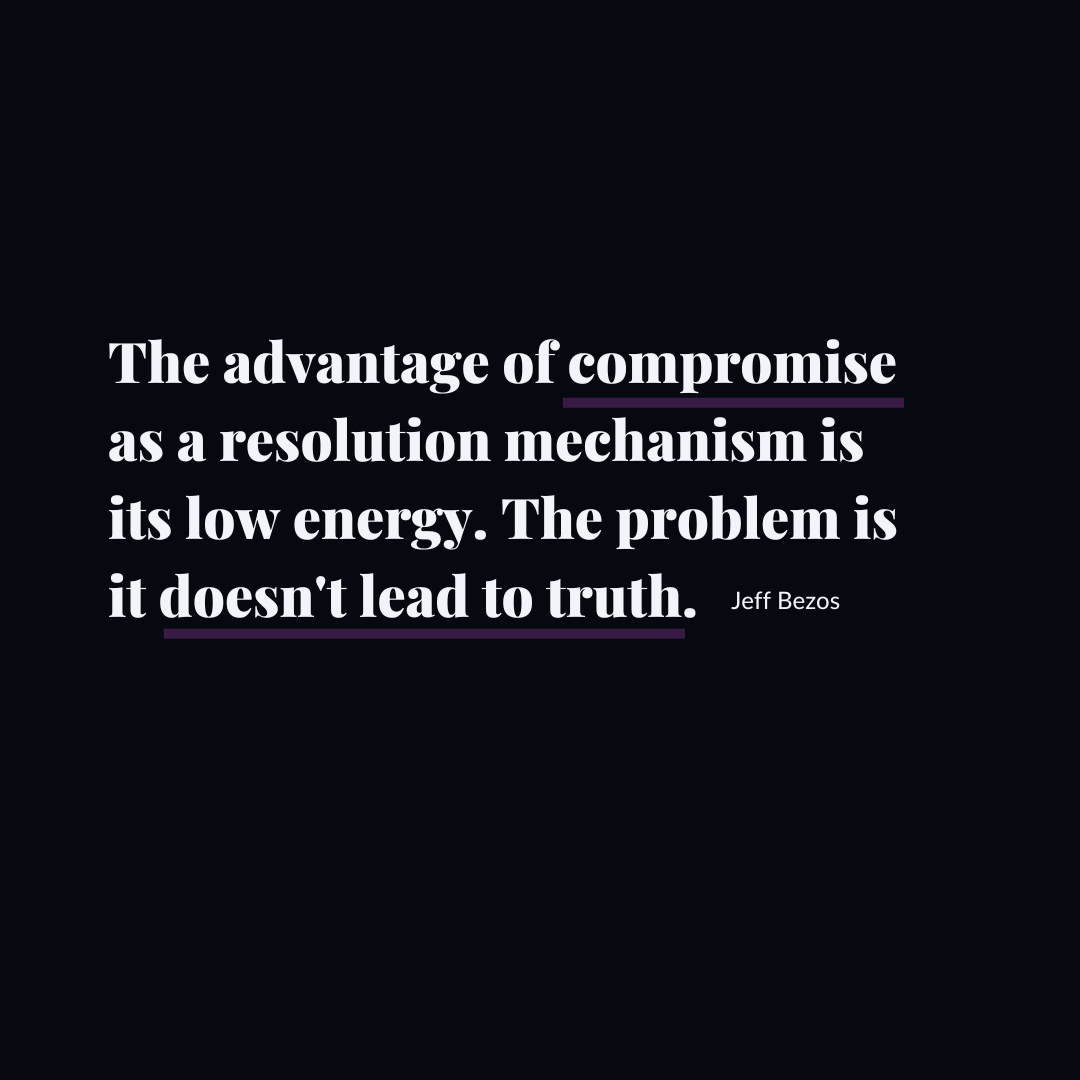
Jeff Bezos on Hiring, Compromise, Inventing, Decision Making, and Truth Seeking
(The audio and video are the same, but with a bit more color than what is below. I enjoyed putting this together and hope you enjoy it too.)Jeff Bezos, talking about hiring: "Will you admire this person? If you think about the people you’ve admired in your life, they are probably people you’ve been able to learn from or take an example from. For myself, I’ve always tried hard to work only with people I admire, and I encourage folks here to be just as demanding. Life is definitely too short to do otherwise." Lex Fridman shared his conversation with Jeff Bezos in episode #405, which yielded several lessons and reminders for me. Here we go:Invention & Efficiency Are At OddsIncremental improvement is linear and critical in everything we do. You have to work hard to make things a little bit better.Invention is different. Invention happens when you don’t know where you are going. Invention and efficiency are at odds. You must give yourself space, time, and resources to wander if you want to invent.Killing Ideas Is EasyNew ideas are not fully formed ideas. Once they pass the first level of scrutiny and you are ready to show them to someone else, it’s important to remind people,“It will be easy for you to find objections to this idea, but work with me - there’s something here.”It’s easy to kill ideas. It’s hard to do the work till it works.Brilliance Is In The Cost-Reduction PhaseThe new idea is essential. Going from a new concept to something usable generally comes in the cost reduction phase. Henry Ford didn’t invent the car. He invented how to reduce the cost. This is happening with Space X and Blue Origin. They aren’t inventing going to space. They are lowering the cost. “Cost reduction means inventing a better way.”One-Way Vs. Two-Way DoorIt's still one of my favorites. Here he said:“A two-way door decision, you pick a door, walk out, and spend a little time there. It turns out to be the wrong decision, you can come back in and pick another door. Some decisions are so consequential and so important and so hard to reverse that they really are one-way-door decisions. You go in that door, you're not coming back.”The senior team makes one-way door decisions. Two-way door decisions should be made by an individual or a very small team as close to the problem as possible. If you use a heavy-weight decision process on all decisions, you will be slower than needed and use resources better allocated elsewhere.Two-way door decisions are where you should test and fail fast. One-way door decisions should be slower and more intentional.Compromise Is BadHe goes on,“You have two executives who disagree, and they have a war of attrition, and whichever one gets exhausted first capitulates to the other one. Again, you haven’t arrived at the truth.”Exhausting the other person is not truth-seeking, and compromise is not truth-seeking. This is where you escalate the decision and ultimately ‘disagree and commit.’ This is not compromise and commitment. This is disagree and commit. By compromising, you are regressing to group thinking and likely an average decision. This will produce average results.Your organization will only move as fast as you can responsibly make decisions. Sometimes, you won’t know the truth, but take the best information possible and commit.Humans Are Not Truth-Seeking AnimalsTruths don’t want to be heard because they are uncomfortable, difficult to hear, awkward, exhausting, challenge norms, hurt egos, and threaten positions. You have to talk openly about how hard it is to find and tell the truth. It takes energy to get the truth and remind people it’s okay to be uncomfortable.“Humans are not truth-seeking animals. We are social animals. Go back 10,000 years, and you are in a small village, and you go along to get along. You survive. You procreate. If you were the village truth-teller, you might get clubbed to death in the middle of the night.”You have to set up your culture so that the truth comes to the surface, and the “most junior person can overrule the most senior person if they have the data.” Data will not always have the answer or at least won’t always be where we see the first truths. This is especially true if you are tracking the wrong metrics.“A lot of our most powerful truths turn out to be hunches. They turn out to be based on anecdotes. They’re intuition-based…I have a saying which is when the data and the anecdotes disagree, the anecdotes are usually right.”A Proxy For Truth Can Be DangerousAt some point, you began managing the success of your organization through a metric. That metric was what you used to determine success on what was most important to you, like customer happiness. That metric is not customer happiness. It’s a proxy for customer happiness.The person who created the metric understood the connection between the metric and the result you wanted. Ten years later, they are gone, and the organization forgets the truth behind why you were watching that metric. The world shifts, or th
10 Lessons I Learned This Year
Here are a few of the most important lessons I learned this year. But first, something from someone we lost this year: I think it’s a huge mistake not to absorb elementary, worldly wisdom if you’re capable of doing it because it makes you better able to serve others, it makes you better able to serve yourself, and it makes life more fun… —Charlie MungerMy 10 Lessons Learned From 2023* Be UnproductiveFocus on what 80-year-old you will care about.Don’t worry about doing it all, you can’t. Do more frivolous activities. You don’t always have to be productive. * Good Things Take A Long TimeWe overestimate what we can do in a year and underestimate what we can do in ten years. Love helps you be consistent and keep going when it gets hard - at work and home.The life you want in ten years starts today.* Be A Medieval StonemasonThey were masters of their craft.Show up, lay the next right brick. You may never get credit, but the community will be better. Do the next right thing again and again.* Don’t CompeteYour competition is yourself. Stop worrying about what everyone else has or does. People don’t think about you as much as you think.* Clean Your LensWhen you have the urge to complain, pause and reflect. There’s likely more good in your life than you realize. Complaining rarely makes it better, usually worse.* Normalize NoTime is a non-renewable resource. If you deprive yourself of time, you will suffer. It's okay to say no and prioritize yourself.* Fear Usually Points Where To GoFear of losing resources or status holds you back. Most of what you fear is not real.* Looking Foolish Is A SuperpowerEveryone looks foolish on day one. Choose progress over protecting ego.* Focus On You, Not IMost people focus on themselves, not on others. By shifting your focus outward, you will notice things others don't. This will give you an advantage over almost everyone else. It also allows you to give people what we all want - to be seen and heard.* Pay Attention To OverlapsPeople come and go. Enjoy them, learn from them, help them, and love them - today. One day, they will be gone.BonusRucksackWe're all carrying a rucksack filled with us. It's filled with our histories, stories, strengths, and struggles. The things that help us make a path. Sometimes, those things are helpful.Sometimes, they hurt us.Put your rucksack down occasionally and decide to take out or add.What's true? What's helpful? What do we need more of? We must never forget that we're also not walking down the path alone.We walk this path with our humans. You can cross-load into their rucksacks. Together, we carry what we need to make our path - together. We're not alone.I’ll leave you with this from Anna Quindlen’s 1999 Mount Holyoke Commencement Speech,“Set aside what your friends expect, what your parents demand, what your acquaintances require. Set aside the messages this culture sends, through its advertising, its entertainment, its disdain and its disapproval, about how you should behave. Set aside the old traditional notion of female as nurturer and male as leader; set aside, too, the new traditional notions of female as superwoman and male as oppressor. Begin with that most terrifying of all things, a clean slate. Then look, every day, at the choices you are making, and when you ask yourself why you are making them, find this answer: for me, for me. Because they are who and what I am, and mean to be.”2024 - it's a clean slate. Remember, you're not walking down that path alone. We're all together. I hope this year brings you joy, peace, and progress. Most importantly, I hope it's filled with love. Love for yourself—love for everyone around you.Hug your humans. Take care out there. Bye.Take care,Keep Going: This is a public episode. If you would like to discuss this with other subscribers or get access to bonus episodes, visit kellyvohs.substack.com

What does it take to win?
I am sure that neither numbers nor strength brings victory in war, but whichever army goes into battle stronger in soul, their enemies generally cannot withstand them. —Xenophon Wilma Rudolph was born in Saint Bethlehem, Tennessee, on June 23, 1940. At the age of four, she contracted polio, a debilitating disease that left her with a paralyzed left leg. Doctors initially believed she might never walk again.Despite this prognosis, Rudolph's mother, Blanche Rudolph, refused to quit and played a significant role in her daughter's therapy and rehabilitation. As a black family in the South in the 1940s, they didn’t have access to the healthcare they needed, and Blanche conducted much of the therapy and exercises at home.Eventually, Wilma would walk with the help of a leg brace and began to participate in track and field, where she excelled. Even more unbelievable was that Wilma would go on to run in the Olympics twice, in 1956 and 1960. In the 1960 Rome Olympics, she won three gold medals in the 100-meter, 200-meter, and 4x100 relay—all world records. Wilma was an icon and inspiration for her generation at a crucial time. Blanche Rudolf was the real hero. Wilma was one of 22 siblings, and Blanche never gave up on number 20.Talent plays a role in achievement. Choosing progress over excuses is even more powerful. Combine those with love and someone who will do whatever it takes to help you win means you will likely win. And while you and I might have the talent to be Wilma, we do have the talent to be Blanche. That’s a choice. If you liked this, hit like and share it with a friend. Take care,Keep Going: This is a public episode. If you would like to discuss this with other subscribers or get access to bonus episodes, visit kellyvohs.substack.com

This change will make you different from almost everyone else
“You never really understand a person until you consider things from their point of view...until you climb into their skin and walk around in it.” - Atticus FinchHi friend,Most people don’t spend as much time thinking about you as you think. They’re too busy worrying about themselves. Sometimes it’s selfish, usually it’s just survival.You and I are no exception, and it often holds us back. We can differentiate ourselves by focusing out instead of in - while others are busy protecting themselves, we can be busy making progress. By shifting your perspective from “I” to “You,” you will see what others don’t, giving you an advantage in learning, forming relationships, and gaining wisdom.Let’s not forget everyone wants to be heard and understood. If we give them that chance, we all get better. Take care,Keep Going This is a public episode. If you would like to discuss this with other subscribers or get access to bonus episodes, visit kellyvohs.substack.com

Only One Thing Will Make Tomorrow Better
"Even bad fortune is fickle. Perhaps it will come, perhaps not; in the meantime, it is not. So, look forward to better things." (Seneca)Hi friend, Here are a couple of thoughts from me: * Good or bad, most things are not permanent. Enjoy the good. Don’t overreact to the bad.* We can spend our energy complaining or changing. Only one can make things better tomorrow.* Lead with trust. You have to give it to get it. Most people won’t let you down.I’ll leave you with this from Marcus Aurelius,"No matter what anyone says or does, my task is to be good."Take care,Keep Going: This is a public episode. If you would like to discuss this with other subscribers or get access to bonus episodes, visit kellyvohs.substack.com

Life's Greatest Invention
"Dying is easy. Living is the trick." (Red Smith)Hi friend, Have you ever wondered who drinks the most coffee? This coffee party started in Ethiopia, and now you can find it growing in 70 countries and drank almost everywhere. Brazil produces the most coffee, and Finland drinks the most coffee at four cups daily. Our Scandinavian friends consume about 25 pounds of coffee per capita compared to the US at about 9 pounds.There are many species of coffee, Arabica and Robusta being the two most prominent. Arabica is known for its smoother, sweeter flavor with hints of fruits and berries. In contrast, Robusta is characterized by its strong, bitter taste with a grainy or nutty aftertaste and about double the caffeine of Arabica. Generally speaking, that Starbucks you’re sipping is Arabica, and that instant coffee you keep in your go bag in case of emergencies is Robusta. I like to think I’m not the only one who does that. Right?A decade ago, I found myself in a country that doesn’t drink much coffee. Like other parts of Central Asia, they prefer vodka and sometimes tea, with water being a close third. On this hot afternoon, I was under the tutelage of a man we will call Wayne. We were part of a close (ish) group of Americans in this small country. After a relatively brief discussion about the joys of coffee, Wayne offered to teach me how to roast coffee beans myself. Why?Because if you want freshly roasted beans as an expat in a third-world country that prioritizes beverages made from potatoes, you learn to do it yourself. A few days later, I sat on the edge of his porch. A handful of green coffee beans rolled around in my hand. My feet were in the grass as I waited for a cast iron pan to warm up. Wayne was behind me, kindly giving me a few hours of his time. Wayne had a great big smile and radiated kindness.Last week, I found out he passed away.I would think of Wayne a few times a year. The sight of coffee beans always sparked it. Sometimes, I'm in line for Princess Buttercup at Starbucks or grinding fresh beans with my adventure partner to start the day. I clicked on the link to his eulogy, and there was that smile. Just then, a friend shared, “My father believed everyone should write their eulogy.”Sitting at my dining room table, I let out an audible “Huh.” What a marvelous idea. Thank you, universe.This is from Steve Jobs’s commencement speech at Stanford,“My third story is about death. When I was 17, I read a quote that went something like, If you live each day as if it was your last, Someday you'll most certainly be right.It made an impression on me. And since then, for the past 33 years, I've looked in the mirror every morning and asked myself, If today were the last day of my life, Would I want to do what I am about to do today? And whenever the answer has been no for too many days in a row, I know I need to change something.Remembering that I'll be dead soon is the most important tool I've ever encountered to help me make the big choices in life. Because almost everything, all external expectations, all pride, all fear of embarrassment or failure, these things just fall away in the face of death, leaving only what is truly important.Remembering that you are going to die is the best way I know to avoid the trap of thinking you have something to lose. You are already naked. There is no reason not to follow your heart.“Death is life’s greatest invention.We can ignore death, but it won’t ignore us. There is no escaping, no stopping, and only a marginal ability to slow it down. It is only by wrestling with reality and our eventual death that we can be present. By cherishing our mortality, we truly live. After reading Wayne’s eulogy, I wondered what my eulogy would say. What wouldn’t it say? Who would survive me? Who would go before me? What virtues would be called out? What would the story behind my story be? What would they say about my vocation? Would my family be proud of me?What would I want to tell the kids? What haven’t they experienced yet that they may want the perspective of their Pah? What words might hug Princess Buttercup and help her celebrate our adventures, memories, and love?(and yes, I’m crying as I write this)A Challenge: In about a month, we will make promises that we mostly won’t keep. Instead of New Year’s resolutions, let’s write our eulogies. Let’s put it on paper. Carve out time with some Arabica or Robusta to celebrate your life. Think about the people who left you, those who are still here, and consider how you want to spend the time you have left.Death takes our friends and our future. It will come sooner than most of us want. Only a lucky few will say the things that need saying or have the time to consider the life they have lived. Few will realize the changes that must be made before it’s too late. Even fewer will make them.More tears found me when I first read these last words from Carolyn in the book The Noonday Demon. She said them to her husband and two grown children moments

Antelopes & Apples
"To me, the real winners are the ones who step out of the game entirely, who don’t even play the game, who rise above it. Those are the people who have such internal mental and self-control and self-awareness, they need nothing from anybody else." (Naval Ravikant)Rare for apple trees, it stands by itself. With two branches jutting at a 45-degree angle, it’s not pretty. I often wonder if the more handsome trees down the hill made it leave one day. However it got here, it’s my marker. It’s exactly a half mile from my garage door. When I’m out of shape, I force myself to make it there before walking. When I’m in shape, it gives me a little nod of encouragement as I head down the other side of the hill. Don’t get confused. I’m not a runner, but I run. It comes in waves—months and months of hitting each morning and then months and months of nothing. Princess Buttercup will sign me up for a race and then years before the next one. After long periods of no running, reaching that apple tree is hard. I barely get there. I find this frustrating because humans are the most prolific runners on the planet. It’s a combination of our cooling system (we sweat instead of panting) and how we run (upright, instead of on all fours…it’s more efficient). All this means that if you find yourself chasing an antelope on the plains of Africa, it will fall over and die before you will. Still, I don’t much care for running. I don’t like the pain, the sucking wind, the two hours it takes me to cool down on a hot day, or the numbness in my fingertips on a cold day. I don’t like the tweak in my knee, and my ego hates getting passed by some kid/old lady/old man/anyone. I do like what happens after running. The endorphins, the marginal reduction in my muffin top, and the taco rationalization (that’s when I rationalize that my run allows me to eat as many tacos as I want). I’m particularly fond of the fact that no matter what happens for the rest of the day, no matter what life smacks me with or what I don’t get done, I got my lazy, you know what, out of bed and got something done. Start stopping. Then worrying about starting. Maybe running isn’t your jam. Maybe your knee is tweaked, or your back is fused. There is probably something you want to do or need to do that you don’t do. There's a lot of pressure to start something new: a new diet, workout, probiotics, green juice, meditation, reading, blah, blah, blah. There's no room for me to add anything new to my life. The garden is full. But there's something I can do: stop. My garden needs weeding. Bad habits tend to choke the life out of what’s important. Pre-bed doom scroll and 3 PM coffee - I’m dropping those. I know both will help me sleep better and increase the chance I make it to my apple tree tomorrow, which will help me get more of what I need. Tacos.Habits matter. Happy stopping, folks.Take care, 👋 If this was helpful, please hit like and share it with someone who will find it helpful, too. Keep Going: This is a public episode. If you would like to discuss this with other subscribers or get access to bonus episodes, visit kellyvohs.substack.com

What's in your rucksack?
“Because here's another sneaky little truth about life. You can't be an important and life-changing presence for some people without also being a joke and an embarrassment to others. You just can’t.”-Mark MansonWatch, Listen, or Read :) Hey friends, My time in the army taught me a lot. How to carry a rucksack is at the top of that list. Big bag, pack it full of bullets, beans, bandaids and walk. We cross-loaded our kit to have what we needed if someone went down, got lost, or got blown up. Lots of weight. One foot in front of another. Keep going, don’t quit. The mission is what matters. One night, I found myself on a hilltop with some friends. Our mission was to mark a drop zone so an aircraft could push out much-needed supplies. The woods were thick. Impassable. In frustration, the medic on our team took off his rucksack and started throwing it into the woods. Not a good idea for noise discipline, but he did it anyway. Eventually, this rucksack-flinging bear of a man broke enough trail to allow us to mark the DZ. The aircraft pushed its load, and we moved on. My rucksack is more metaphorical now. I still pack it full of stuff and try not to quit. One foot in front of another. It’s filled with responsibilities, stories, and dreams. I’m lucky to walk with friends who will take things from me when I need help. On my best days, I know when to ask for help carrying my load. When I’m at my very best, I know when to put the rucksack down and take out all the BS I don’t need to carry anymore. What’s in your rucksack matters. Consider what you keep, cultivate, add, and throw out. Take care, 👋 If this was helpful, please hit like and share it with someone who will find it helpful, too. Keep Going: This is a public episode. If you would like to discuss this with other subscribers or get access to bonus episodes, visit kellyvohs.substack.com