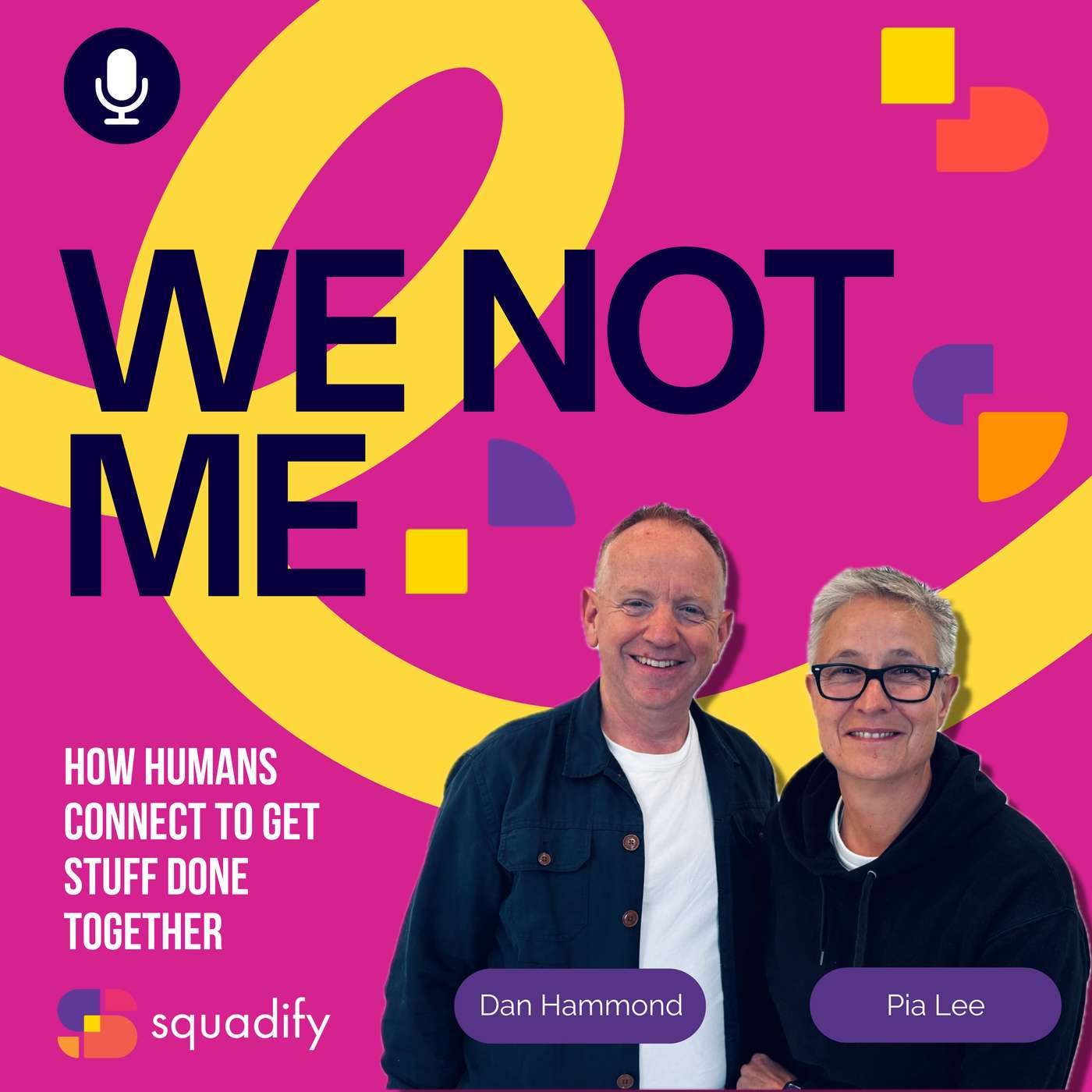
We Not Me
Exploring how humans connect and get stuff done together, with Dan Hammond and Pia Lee from Squadify.
Dan Hammond & Pia Lee · Squadify
Show overview
We Not Me has been publishing since 2021, and across the 5 years since has built a catalogue of 151 episodes, alongside 1 trailer or bonus episode. That works out to roughly 100 hours of audio in total. Releases follow a fortnightly cadence.
Episodes typically run thirty-five to sixty minutes — most land between 36 min and 45 min — and the run-time is fairly consistent across the catalogue. None of the episodes are flagged explicit by the publisher. It is catalogued as a EN-language Business show.
The show is actively publishing — the most recent episode landed 1 weeks ago, with 17 episodes already out so far this year. The busiest year was 2023, with 36 episodes published. Published by Squadify.
From the publisher
Exploring how humans connect and get stuff done together, with Dan Hammond and Pia Lee from Squadify. We need groups of humans to help navigate the world of opportunities and challenges, but we don't always work together effectively. This podcast tackles questions such as "What makes a rockstar team?" "How can we work from anywhere?" "What part does connection play in today's world?" You'll also hear the thoughts and views of those who are running and leading teams across the world.
Latest Episodes
View all 151 episodesWhy change fails and what leaders can do to get a different result - with Michael Lopez
88% of change fails. How to be in the 12%, Part 1
Leading a team to create a community
Leading in a complex stakeholder environment
Regulating your team's nervous system, with Dana Hargus
Big decisions, small budget. The team is the answer - with Steve McLeod
The human-centric business leader, with Ian Turner
The irritating patterns of senior teams, with Joel Casse
How to give the gift of feedback, with Katie Ceccarini
Stop fixing people. Fix the system
How can high-quality conversations untie the knots holding teams back?
Ep 139The family: your first team?
In this episode, Dan and Pia are joined by Danielle DeMarco and Greg Neufeld to explore a powerful idea: the family is the first and most important team we ever belong to. Drawing on their backgrounds in venture capital, startups, and leadership, Danielle and Greg share how they intentionally design family culture using the same principles that underpin high‑performing teams — clarity, shared identity, rituals, and psychological safety.The conversation spans family values, collective purpose, rites of passage, co‑leadership, and why modern parenting often creates more anxiety than clarity. Along the way, the group surfaces lessons that apply not just at home, but directly to enterprise teams, co‑leaders, and organisations navigating complexity.Three Reasons to ListenReframe family as a team — not a series of individuals Learn how shared identity, collective incentives, and simple rituals can dramatically strengthen connection and reduce fragmentation at home and at work.Practical leadership ideas you can apply immediately From family meetings to co‑leader alignment rituals, this episode offers concrete practices that translate directly into enterprise teams and leadership partnerships.A refreshing antidote to “perfect parenting” culture Danielle and Greg challenge fear‑based parenting narratives, replacing them with a zoom‑out, long‑game approach grounded in culture, intention, and compassion.Show HighlightsFamily as the first team: Why the earliest lessons about teamwork, expectations, and belonging are learned at home.Shared identity in action: The Neufeld family cheer — and how rituals instantly shift five individuals into one collective.Incentives that unite, not divide: How a shared “super ding ding ding” reward reinforces team behaviour rather than individual competition.High standards + high support: Lessons from elite investment cultures (including Ken Griffin’s Citadel) applied to family leadership.Culture lives in the present: Why great culture isn’t built for a distant future — but day by day, moment by moment.Family meetings done right: Moving beyond logistics and correction toward appreciation, learning, and connection.Rites of passage and individuation: Helping children climb their own mountains while keeping family as base camp.Co‑leadership under pressure: How to surface fear beneath non‑negotiables and stay on the same side.Why things going wrong is not failure: A powerful reframing of mistakes, hit rates, and “winning enough” in families and teams.Media recommendations with a twist: From the Founders podcast to Real Housewives as an unexpected masterclass in group dynamics.Useful Links & ReferencesThe Most Important Thing Podcast — Danielle DeMarco & Greg Neufeld Focused on intentional family culture, leadership at home, and raising capable, connected humans.Bruce Feiler – Happy Families Referenced for its research on family meetings as a cornerstone of strong family culture.The Founders Podcast Recommended by Greg for studying timeless leadership and entrepreneurial mental models.Real Housewives (Franchise) Danielle’s unconventional but insightful recommendation for observing group dynamics, power, rupture, and repair.
Ep 138Q&A: are people in their 60s unemployable?
Maintaining relevance and purpose as we age requires letting go of entitlement based on experience, embracing genuine curiosity about new things, and focusing our energy on meaningful connections and contributions within our immediate sphere of influence rather than consuming anxiety-inducing information we cannot control.Three reasons to listenExplore how to maintain relevance and purpose as you age without falling into entitlement or becoming disconnected from younger generations.Understand the balance between bringing wisdom from experience and staying curious about new developments in a rapidly changing world.Rethink what legacy means beyond career achievements, focusing on love, connection, and positive impact on the people directly around you.Episode highlights[00:00] Introduction: A Special Episode in New York[01:35] Hitting the Big 6-0: Expectations vs. Reality[03:15] Life 6.0 and Finding Comfort in Your Own Skin[04:45] Navigating Age Discrimination and Bias in Tech[06:50] The Duty of Curiosity and Learning AI[08:10] Combating the Fear of Irrelevance at 3:00 AM[10:20] Neolithic Floods: The Evolutionary Value of Elders[12:35] Defining Legacy: Family, Capitalism, and Spirit[15:45] The Power of Love and Connection in Teams[17:15] Managing Stress: Moving from Global News to Local Influence[19:30] Closing: Celebrating in New YorkLinksTrack and improve your team performance with SquadifyLeave us a voice note
Ep 137AI transformation is a leadership test, not a tech one - with Stephen Hunt
AI transformation is fundamentally a human transformation, not a technology project. Success depends on taking deliberate steps to build AI literacy across your entire organisation while managing fear and maintaining team cohesion.Most companies are still at the beginning of their AI journey. The key is to start with a clear plan that's reviewed regularly, ensure everyone from board level to front desk has basic AI literacy, and create psychological safety by addressing fears about job loss.Stephen Hunt is serial entrepreneur whose AI journey dates back to 2011, when he used machine learning and neural networks to for ad targeting. He founded the Square Wave initially as a hobby project to help him understand AI, and he now works with clients on AI transformation, providing training and helping organisations develop AI strategies.Three reasons to listenUnderstand the leadership, rather than the technical challenges posed by AI transformationStart building AI literacy immediately through research, prompting, and trainingReframe AI as an opportunity for humans to be amplified rather than replacedEpisode highlights[00:12:53] What opportunities is AI presenting right now?[00:19:46] How to start taking advantage of AI[00:22:12] Three core AI literacy skills[00:26:40] Start with clarity[00:31:12] Where to start[00:35:52] Steve's media recommendation[00:38:12] Takeaways from Pia and DanLinksConnect with Steve via LinkedInThe Square WaveStartups Decoded – Steve’s podcast recommendationTrack and improve your team performance with SquadifyLeave us a voice note
Ep 136Q&A: are you a Team in Name Only?
Many groups calling themselves teams are actually "TINOs" (Teams In Name Only) — collections of individuals focused on their own functional KPIs rather than collective goals. Transforming them into real teams needs three critical elements: a shared goal that transcends individual targets, genuine interdependence through cross-functional strategies, and executing together on making work visible and collaborative.Three reasons to listenIdentify the telltale signs you’re in a Team in Name OnlyTransform TINO behaviour into genuine teamworkBuild psychological safety and interdependence amongst team members so they feel supported rather than isolatedEpisode highlights[00:01:58] What is a TINO?[00:05:31] Defining a clear team[00:10:27] The challenges of increased visibility[00:12:53] You don't need to wait for a crisisLinksTrack and improve your team performance with SquadifyLeave us a voice note
Ep 135Three hidden patterns that could be holding your team back - with Noj Hinkins
Teams often struggle with hidden dysfunctions that disguise themselves as positive behaviours, like pretending everything’s fine when it isn't, making decisions in corridors rather than as a team, and heaping blame on a single person rather than addressing systemic issues.These patterns are particularly insidious because they hide under seemingly good intentions, making them difficult to spot and address.Noj Hinkins is a team coach and leadership development consultant. He’s been working with senior teams for the past 15-20 years, typically at director level and above, doing one-on-one coaching, team building, and leadership development work. He specialises in identifying dysfunctions that can hold teams back.Three reasons to listenRecognise when toxic positivity is preventing your team from addressing real problems and creating a disconnect between team membersIdentify and eliminate covert processes that override team decisionsSpot scapegoating patterns where teams blame one person for systemic issuesEpisode highlights[00:12:50] Team patterns in 2026[00:14:19] Toxic positivity[00:24:23] Covert process[00:30:33] Scapegoating[00:41:39] What to do first if you spot these patterns[00:43:34] Noj's media recommendation[00:44:53] Takeaways from Dan and PiaLinksCovert Processes at Work, by Robert MarshakSo Far So Good, by the Blue Moon – Noj’s media recommendationTrack and improve your team performance with SquadifyLeave us a voice note
Ep 134Balancing artificial and human intelligence - with Jon Whittle
In a working world where the conversation is increasingly dominated by AI, we need to consciously prioritise human connection and old-school practices, like face-to-face conversations, physical books, and time for deep thinking, to avoid becoming trapped in a cycle of constant acceleration that ultimately undermines our wellbeing and what makes us fundamentally human.Jon Whittle is the former CEO of CSIRO's Data61, Australia's national AI research and development centre. He led a team of around 500 scientists, engineers and support staff across Australia. Jon’s working is transitioning to helping organisations understand and adopt AI in an effective, human-centred way, particularly with boards and leadership teams.Three reasons to listenTo reframe AI adoption around human needs rather than pure efficiencyTo discover the risks of outsourcing human connection to AIAo learn how to adopt old-school practices that preserve your humanityEpisode highlights[00:10:24] Leading hundreds of scientists and engineers[00:13:14] What it means to be human in an AI world[00:23:25] The danger of sharing problems with AI rather than other humans[00:31:33] What Jon has learned from classical Indian dance[00:36:18] AI for Business[00:39:55] Jon's media recommendation[00:42:06] Takeaways from Pia and DanLinksConnect with Jon via LinkedInAI for Business – Jon’s bookCSIRO presents: Everyday AI – Jon’s podcastTurning Down the Noise – Jon’s media recommendationTrack and improve your team performance with SquadifyLeave us a voice note
Ep 133Q&A: how do you lead a team through economic uncertainty?
Leading through uncertainty means accepting complexity rather than fighting it. The most powerful tool for doing so is clarity.While conventional wisdom suggests focusing on trust-building and communication skills, Squadify data shows that starting with clarity – specifically around shared goals, processes, and measures of success – is what actually transforms groups of individuals into cohesive teams and drives performance.Three reasons to listenLearn to befriend uncertainty and focus on what you can influenceDiscover how to build team cohesion through clarity rather than trust exercisesUnderstand how teams work together as the key performance driverEpisode highlights[00:02:31] Jamie's question[00:03:36] Befriending uncertainty[00:05:38] Are you a team, or a TINO?[00:08:51] The sixth dysfunction in teams[00:11:12] The trigger question for high performance[00:13:42] Doubling down on humanity[00:16:41] Coming up in 2026LinksTrack and improve your team performance with SquadifyLeave us a voice note
Ep 132Can you have a leaderless team? With Jon Barnes
Autonomy in teams requires clarity, not chaos. Successful autonomous teams need defined authority over coordination, transparent processes, and intentional facilitation to empower people whilst maintaining alignment and effectiveness.Jon Barnes is a facilitator, coach, and co-founder of Pala, and he focuses on helping teams and organisations become more autonomous. His approach spans a spectrum from making hierarchies feel less hierarchical, to helping teams operate fundamentally without line management.Three reasons to listenCreate clarity in team structures by defining authority and decision-making processes upfrontBuild psychological safety and engagement through effective facilitation techniquesBalance empowerment with appropriate holding by learning when to let go and when to provide directionEpisode highlights[00:12:22] the two types of waste in teams[00:18:10] What does leadership look like away from hierarchy?[00:21:44] Self-management in highly-pressurised teams[00:25:37] The myth of self-governance[00:27:12] Unhelpful self-management patterns[00:32:47] Jon's biggest two levers[00:35:32] Jon's media recommendation[00:36:59] Dan's media recommendation[00:41:12] Takeaways from Pia and DanLinksConnect with Jon via LinkedInHumankind, by Rutger BregmanLonesome Dove, by Larry McMurtry – Jon’s media recommendationThe Ministry of Time, by Kaliane Bradley – Dan’s media recommendationFrom the Core, by John Wineland – Pia’s media recommendationTrack and improve your team performance with SquadifyLeave us a voice note
Ep 131Q&A: is it OK to have a big team?
There's a scientific basis for understanding optimal team size, including research on connection complexity, social loafing, and performance data that challenges common assumptions about how many people should work together effectively.In this Q&A episode, Dan and Pia dive into the science and the data, to discover the optimum team size.Episode highlights[00:01:27] Is it OK to have a big team?[00:04:15] The Ringelmann effect[00:07:22] What's the optimum team size?[00:08:18] When is a team a group?[00:10:20] What the Squadify data showsLinksRingelmann effectTrack and improve your team performance with SquadifyLeave us a voice note