
The Bullvine
656 episodes — Page 4 of 14
S1 Ep 507E507 How the Juárez Blockades Froze $1.45 Billion – and Blindsided Your Milk Check
Mexico now buys roughly 4.5% of U.S. milk production and more than a quarter of U.S. dairy export value. In late 2025, coordinated blockades at Ciudad Juárez stranded 38,000 trucks and froze about 1.45 billion dollars in exports – and dairy was the first product to nearly run out. Futures prices didn’t crash. Class III settled where the models said it should. Yet mailbox checks came in light. This episode pulls apart that disconnect and argues that treating Mexico as a “reliable customer” while ignoring corridor risk is one of the biggest blind spots in modern dairy risk management.Key Takeaways· Why the November 2025 Juárez megablockade turned “pipe risk” into a core driver of dairy profitability.· How 38,000 stranded trucks and 1.45 billion dollars in frozen exports quietly hit co‑op margins, premiums, and producer basis.· The difference between hedging price and managing corridors – and why futures, DRP, and traditional contracts can’t see a blockade coming.· Barn‑level math: what a 30–50¢/cwt basis hit over 30 days really costs 700‑, 1,200‑, and 2,400‑cow herds.· How 2026 income‑over‑feed cost projections around $10.14/cwt change the tolerance for “short‑term” export disruptions.· Concrete questions to take to your co‑op about Mexico exposure, crossing dependence, and how they sequence premium cuts when plants are backed up.· Why the July 1, 2026 USMCA review and the March 20 national mobilization in Mexico should both be on your risk calendar.· A 30‑day border stress‑test you can run on your own numbers before you sign the next supply, financing, or expansion agreement.Most risk conversations in dairy still start and end with the futures screen: Class III, Class IV, DRP, options, maybe a bit of component strategy. This episode argues that’s no longer enough. Using real export data, mail‑box price gaps, and on‑the‑ground reporting from Ciudad Juárez, we show how border blockades created a new category of risk that traditional hedging tools simply don’t touch. Listeners will hear how co‑ops facing stalled product at Juárez scrambled to reroute loads, shove volume into lower‑value domestic channels, and quietly adjust premiums, quality incentives, and over‑base pricing to absorb the shock.For the full barn‑math tables, graphics, and companion analysis, visit https://www.thebullvine.com/dairy-markets/how-the-juarez-blockades-froze-1-45-billion-and-blindsided-your-milk-check/ and look for the article linked to this episode. Additional resources, including referenced export data and policy timelines, are listed with the episode page on the site.If this kind of hard‑number, no‑nonsense analysis helps you think differently about your own risk, subscribe to The Bullvine Podcast on Apple Podcasts and leave a review so more serious producers can find it.
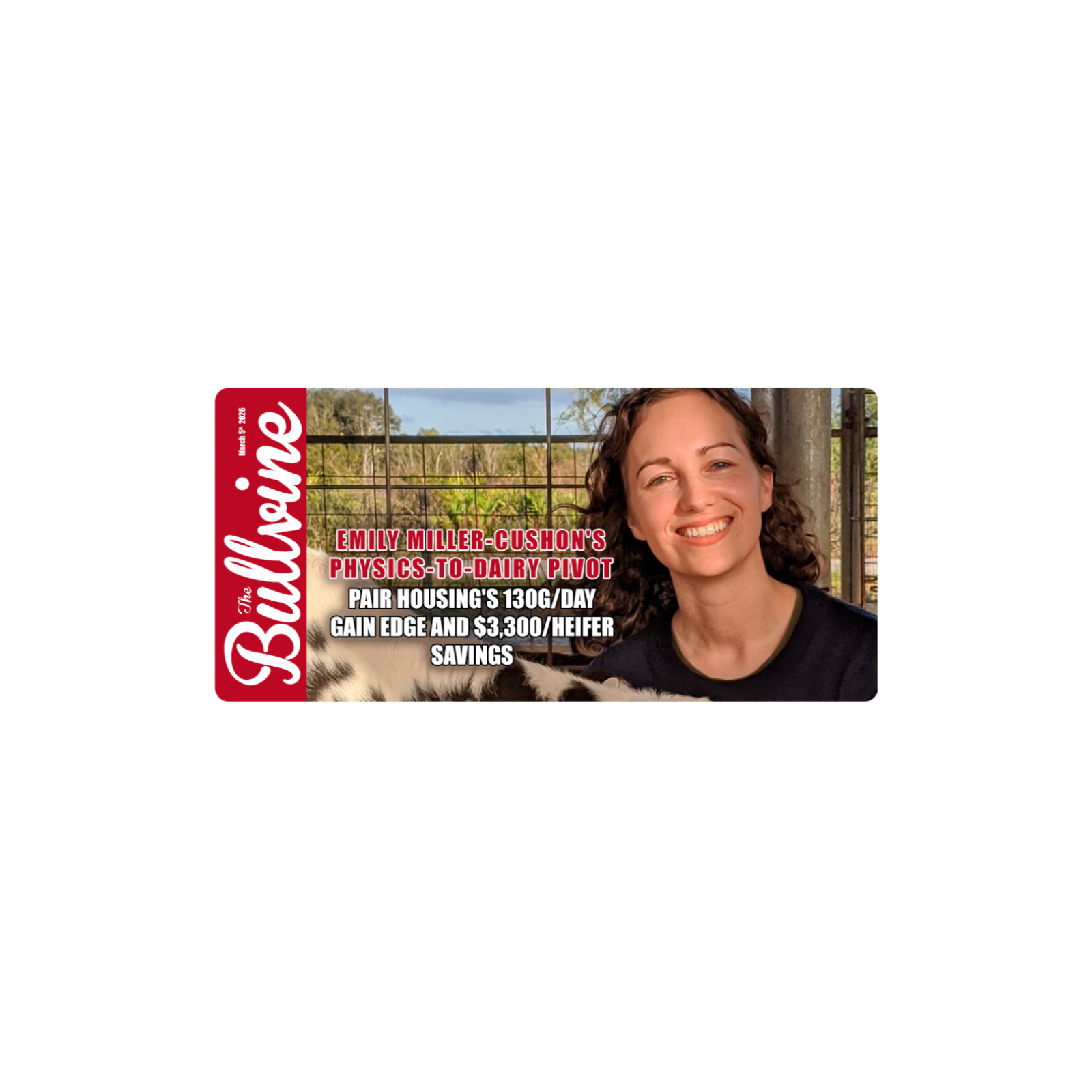
S1 Ep 506E506 Emily Miller-Cushon’s Physics-to-Dairy Pivot: Pair Housing’s 130g/Day Gain Edge and $3,300/Heifer Savings
A physicist from the University of Waterloo traded quantum equations for calf barns—and earned the U.S. government's top early-career science award (PECASE) proving pair housing isn't welfare theater. It's economics. Emily Miller-Cushon's five-year longitudinal study reveals individually raised heifers lose critical feeding behaviors, costing 300-cow dairies $9,900 annually in replacement inventory. This episode cracks open her data-driven blueprint for resilient heifers that compete at the bunk from Day 1.Key Takeaways:How pair-housed calves gain 130g/day more preweaning—and why that compounds to first-lactation milkThe bunk behavior gap: 1.5 visits/hour vs. 0.8 under pressure—your fresh heifers' real-world test$9,900/year barn math at $3,300/heifer prices: mortality drops from 6% to 4% on 300 cowsNo BRD risk (7/7 studies)—plus hay protocol kills cross-sucking30-day test plan: pair your next 10 heifers and measure the edgeEmily Miller-Cushon, University of Florida animal behavior expert and 2025 PECASE recipient, tracked Holstein heifers from birth through second lactation. Her 2024 JDS findings: pair-raised animals adapt faster to freestalls, eat 4.2 more minutes/hour under competition, and show no respiratory penalty. With heifer inventories at 1978 lows (3.914M head, USDA 2025), every saved calf = $3,300+ in pipeline value. We break down the retrofit costs, regulatory timelines (Canada 2031 mandate), and UBC's commercial validation. If your fresh heifers lag at the bunk or mortality exceeds 5%, this episode delivers the protocol to fix it—backed by data, not dogma.Full article, barn math calculator, and 30-day playbook at https://www.thebullvine.com/management/emily-miller-cushons-physics-to-dairy-pivot-pair-housings-130g-day-gain-edge-and-3300-heifer-savings/. Subscribe for the next Outsiders episode: the software engineer rewriting bull proofs. Share your pair housing results on Twitter or Facebook @TheBullvine
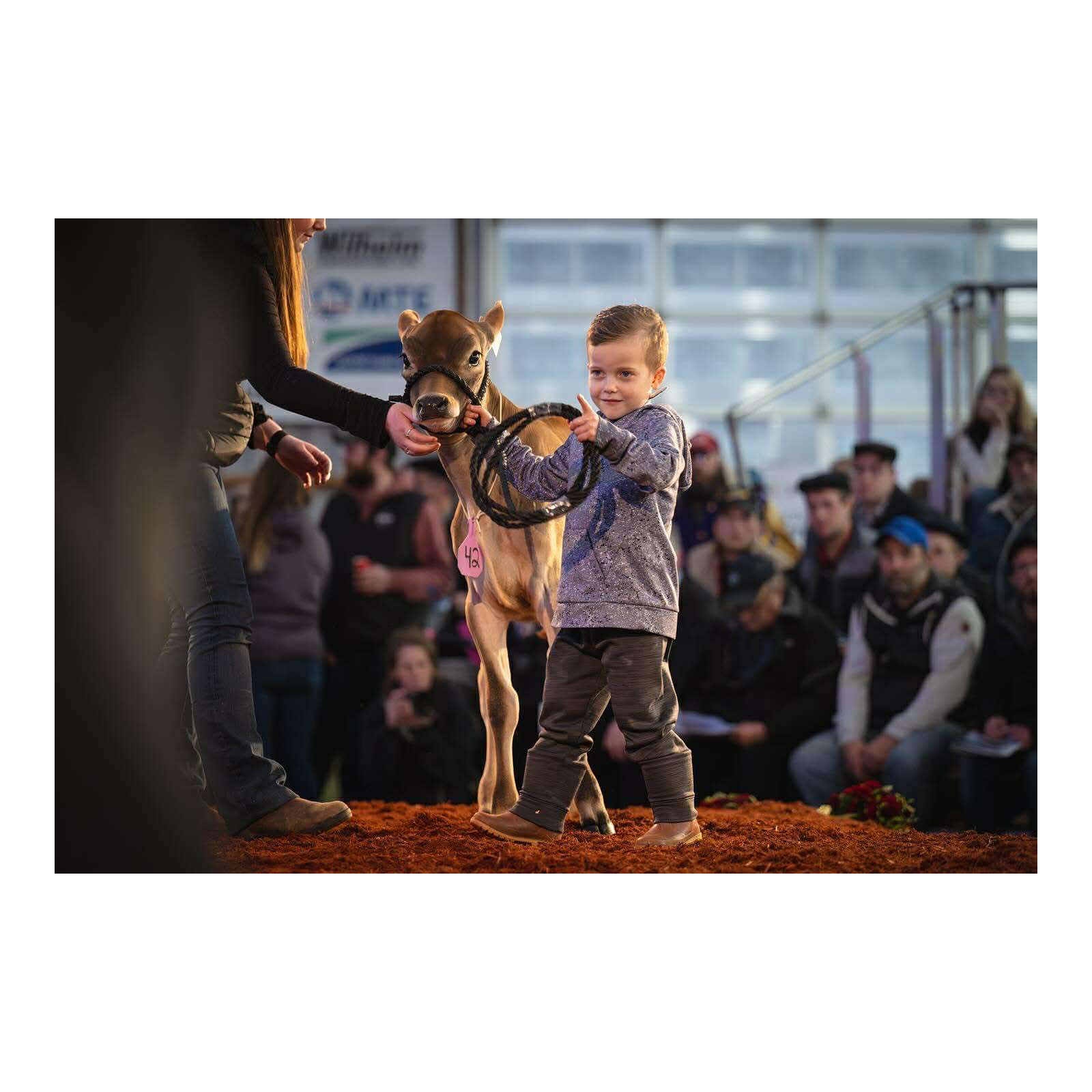
S1 Ep 505E505 Calves for a Cause $170,000 and Counting: How One Dairy Family’s Crisis United an Industry Around a Little Boy
A blue baby. A rushed ambulance ride. A dairy dad sitting in a hard plastic NICU chair, staring at a tangle of wires keeping his newborn son alive while 60 cows back home still needed milking. Somewhere between the beeps and the silence, one question started looping in his head: “How do I ever repay these people for what they’re doing for our son?” This episode follows what happened when a small Ontario dairy family tried to answer that question—and accidentally sparked a charity sale that’s now raised over $170,000 and changed how an entire industry shows up for its own.The Story You’ll HearThe night a routine birth went sideways, a baby turned bluish-grey, and a family’s world suddenly tilted toward London Children’s Hospital. The 120‑day hospital marathon that followed—and what it’s really like trying to parent from behind NICU glass while still keeping a herd, a home, and six other kids going.The nurses who quietly became “second moms,” and the moment Darryl realized they weren’t just caring for Brooks—they were holding up his whole family.The tired late‑night idea: “Maybe we sell one calf on Facebook and send a few hundred bucks to the hospital.”The phone calls and messages that came back not with polite support, but with calf offers, sale management help, online platforms, and a suddenly massive responsibility.The leap from kitchen-table auction to prime-time slot in the WeCover Cow Coliseum at Canadian Dairy XPO—and why that move changed everything.The night Brooks walked straight out of the hospital, grabbed a halter, and led calves through the sale ring while the dairy crowd leaned in and refused to leave.How Calves for a Cause grew into a “sale of the stars,” with breeders donating real genetic firepower—not culls—and buyers from across Canada and beyond.The quiet mental load behind the feel‑good story: chronic illness, infections, ports, financial pressure, and the ongoing question of how long a family can carry that weight.The unexpected playbook this journey offers any producer who’s ever thought, “We’re just a small farm—what difference could we make?”This isn’t a polished highlight reel. It’s a brutally honest look at what happens when a real dairy family gets hit with a medical curveball they never saw coming—and how the industry around them chose to respond. Darryl Markus milks 60 cows, not 6,000. He and his wife are raising seven kids on a working farm, juggling hockey bags, hospital bags, and feed bills like everyone else. That’s exactly what makes his perspective hit so hard.To go deeper into this story, including photos and a full written feature on Calves for a Cause and the Markus family, visit https://www.thebullvine.com/youth-profiles/calves-for-a-cause-170000-and-counting-how-one-dairy-familys-crisis-united-an-industry-around-a-little-boy/ and look for “Calves for a Cause: $170,000 and Counting.” Related articles and resources on farm community, resilience, and dairy family mental health are available online.
S1 Ep 504E504 The $99 Bolus That Protected Ferme Petitclerc’s Royal Winter Fair Run
Most breeders still trust eyes, instinct, and twice‑a‑day checks to protect their most valuable cattle. In this episode, we follow a real Royal Winter Fair string where a single 99‑dollar rumen bolus caught trouble long before anyone saw a sick heifer — and probably saved a five‑figure hit to sales, show results, and reputation. This isn’t a gadget review. It’s a hard look at whether precision monitoring actually pays, when it doesn’t, and why “normal” health losses may be killing more profit than low milk price ever did.Key Takeaways· How one early fever alert changed the economics of Ferme Petitclerc’s Royal Winter Fair run.· The “reputation tax” at sales and shows — and why one public health miss can erase years of genetic marketing.· The real cost of calfhood BRD and fresh‑cow disease, with numbers you can plug straight into your own herd.· Where rumen boluses outperform collars and tags, and where they’re a waste of capital.· A blunt framework for deciding if precision monitoring is insurance for your herd or just another pricey dashboard.· Practical 30‑/90‑/365‑day steps to test this tech in your own operation without betting the farm.This episode takes you inside a high‑stakes Royal Winter Fair prep, where a heifer that “looked fine” was actually hours away from becoming an expensive problem. You’ll hear how continuous temperature and rumination data changed treatment timing and show‑string risk — and then we zoom out with hard data from peer‑reviewed studies, SimHerd modelling, and university extension work on BRD, ketosis, and transition disease.For related articles, barn‑math breakdowns, and links to the studies discussed in this episode, visit https://www.thebullvine.com/technology/the-99-bolus-that-protected-ferme-petitclercs-royal-winter-fair-run/.If this conversation challenged how you think about herd health and tech investment, subscribe to The Bullvine Podcast on your favourite platform so you don’t miss future episodes. Share it with a neighbour or colleague who’s wrestling with the same decisions, and join the discussion on social by telling us how you’re using (or rejecting) precision tools on your farm.
S1 Ep 503E503 From 6 Crises to 75 Tractors: Reed Hostetler’s Death and the $470K Page That Rewrote Dairy’s Road
Everyone says “community matters,” but almost nobody in dairy has put numbers to it. This episode walks through six real crises — manure gas deaths, an ICE raid, a flood that drowned parlours, and a processing collapse that left just 18 farms in an entire state — to ask a hard question: what actually separates operations that come back from those that quietly disappear? You’ll hear the barn‑level math, the route‑density economics, and the human infrastructure that, together, form the only safety net most dairies really have.Key TakeawaysHow a 31‑year‑old dairyman’s death triggered months of unpaid labour and support — and what that reveals about “crisis‑ready” communities.What OSHA’s proposed $246,609 in fines for six dead workers really means for your own safety investments and liability exposure.The operational and financial impact of a 35‑person ICE raid on a large dairy — and what that says about labour dependency across the industry.Why Sumas Prairie herds went from losing 14 loads of milk in one flood to just one load in the next — and how planning plus neighbour networks changed the outcome.What North Dakota’s collapse from 1,810 dairies to 18 tells you about processor risk, haul distance, and how fast a region can lose all redundancy.A simple piece of barn math to calculate what a lost herd on your road costs in milk volume, genetics spend, and informal labour — and why it matters for your own margins.A 30‑day checklist to build the phone trees, backup plans, and mental‑health support that protect both your balance sheet and the people behind it.This isn’t a feel‑good community story. It’s a data‑driven autopsy of what happens when things go wrong on working dairies, and a hard look at the structures that quietly decide who stays in business. You’ll hear how one county’s response to a manure‑pit death turned into sustained chore crews, tractor guards of honour, and real operational cover — and why that kind of infrastructure doesn’t just appear when tragedy strikes. We break down OSHA citation numbers, immigrant labour dependence, and the brutal haul‑distance math that now defines entire regions, showing how each factor feeds directly into survival odds. The episode connects flood hydraulics, milk‑pickup logistics, and suicide‑risk statistics into one uncomfortable conclusion: community is not charity, it’s unpriced risk management. If you’re making decisions about capital investment, expansion, genetics strategy, or succession, this conversation will force you to rethink where vulnerability actually sits in your system — and what you can build in the next 30 days to reduce it.For the full article, barn‑math examples, and links to the cases discussed in this episode, visit https://www.thebullvine.com/management/from-6-crises-to-75-tractors-reed-hostetlers-death-and-the-470k-page-that-rewrote-dairys-road/ and look for the companion piece to this podcast. Additional resources, including OSHA documents, flood case studies, and mental‑health support links, are available via the episode page on the site. If you want ongoing analysis of dairy economics, genetics, and risk that goes beyond the headlines, subscribe to The Bullvine Podcast and to The Bullvine Weekly newsletter. Share your own experience of crisis and community on social — tag The Bullvine and join the discussion about what really keeps dairy farms alive in 2026 and beyond.
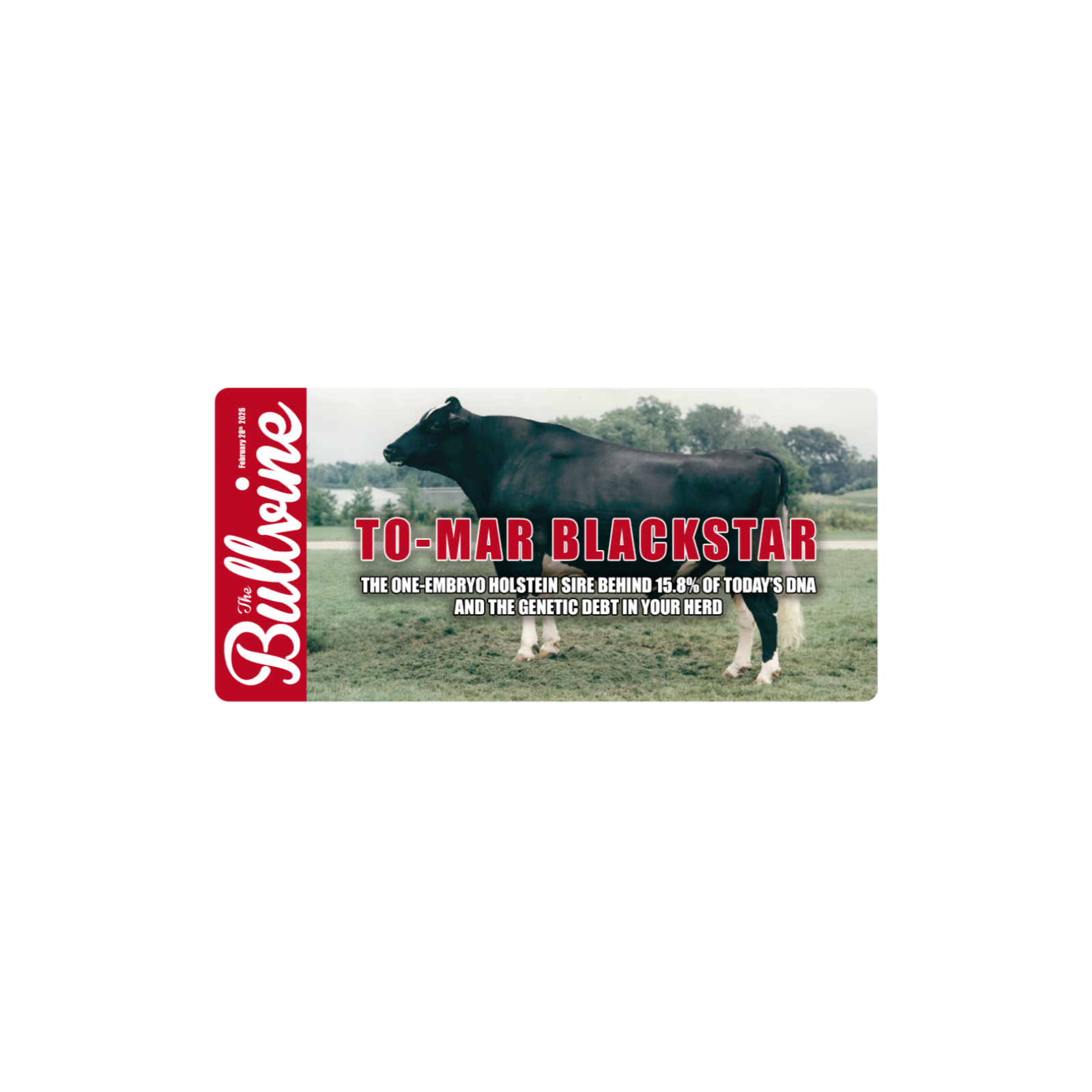
S1 Ep 502E502 To-Mar Blackstar: The One-Embryo Holstein Sire Behind 15.8% of Today’s DNA – and the Genetic Debt in Your Herd
To-Mar Blackstar began as a single embryo on a working Iowa dairy — and became the most related sire in Holstein history. Randy Tompkins flushed one cow, got one pregnancy, and named the coal-black calf that arrived on May 17, 1983, without any sense of what was coming. Nine years later, Blackstar topped the TPI list at 1,256 points, and breeders on three continents were competing for straws before dawn. This is the story behind the name in every pedigree — and the genetic bill your herd is still paying.Key MomentsHow a cow named Hanna — the kind nobody puts on a magazine cover — started a genetic chain that now touches 15.8% of every living HolsteinThe moment Ron Long at Select Sires flagged sire code 7H1897 without knowing whose bull it was — because the daughters were classifying themselvesWhy Blackstar's first proof in 1989 broke the unwritten rule that you picked type bulls or production bulls, but never got bothWhat happened when 2,500 sons were sampled from one sire — roughly half the world's capacity in a given year — and nobody hit the brakesThe daughter-to-Shottle pipeline: how Dixie-Lee Bstar Betsie, a Blackstar daughter, produced Carol Prelude Mtoto, whose son Picston Shottle sold 1.17 million doses and now sits in virtually every elite pedigree aliveWhy This Story MattersYou have seen the name To-Mar Blackstar in pedigrees for decades. What you may not know is that USDA data puts his relationship to the current Holstein breed at 15.8% — higher than Elevation, higher than Chief, higher than any individual sire in documented history. A 1999 Journal of Dairy Science study found his expected inbreeding of future progeny was 7.9%, the highest ever recorded for a Holstein bull. The breed's effective population size has since fallen into a range that conservation biologists flag as at risk. Better tools brought faster concentration, not more diversity. This episode traces how that happened through one bull's extraordinary story.But Blackstar was not a cautionary tale while he was alive — he was the answer. His daughters combined components, udder quality, and productive life in ways the breed had never seen from a single sire. LA-Foster Blackstar Lucy became world production champion. Stookey Elm Park Blackrose classified EX-96 and won Grand Champion at the Royal Winter Fair. His son Emory graduated 50% of his sons to proven status. The Comestar program in Quebec turned three Blackstar daughters into six millionaire AI sires distributed worldwide through Semex. The tension between his brilliance and his concentration cost is the tension the entire breed still lives with today.Continue the JourneyThe full feature article is live at https://www.thebullvine.com/sire-spotlight/to-mar-blackstar-the-one-embryo-holstein-sire-behind-15-8-of-todays-dna-and-the-genetic-debt-in-your-herd/. Related reading: our profiles of Carol Prelude Mtoto, Walkway Chief Mark, and Comestar Laurie Sheik. Subscribe to The Bullvine Podcast so you never miss a history episode — and share this one with someone who has seen the name Blackstar in a pedigree a hundred times without knowing the story behind it.
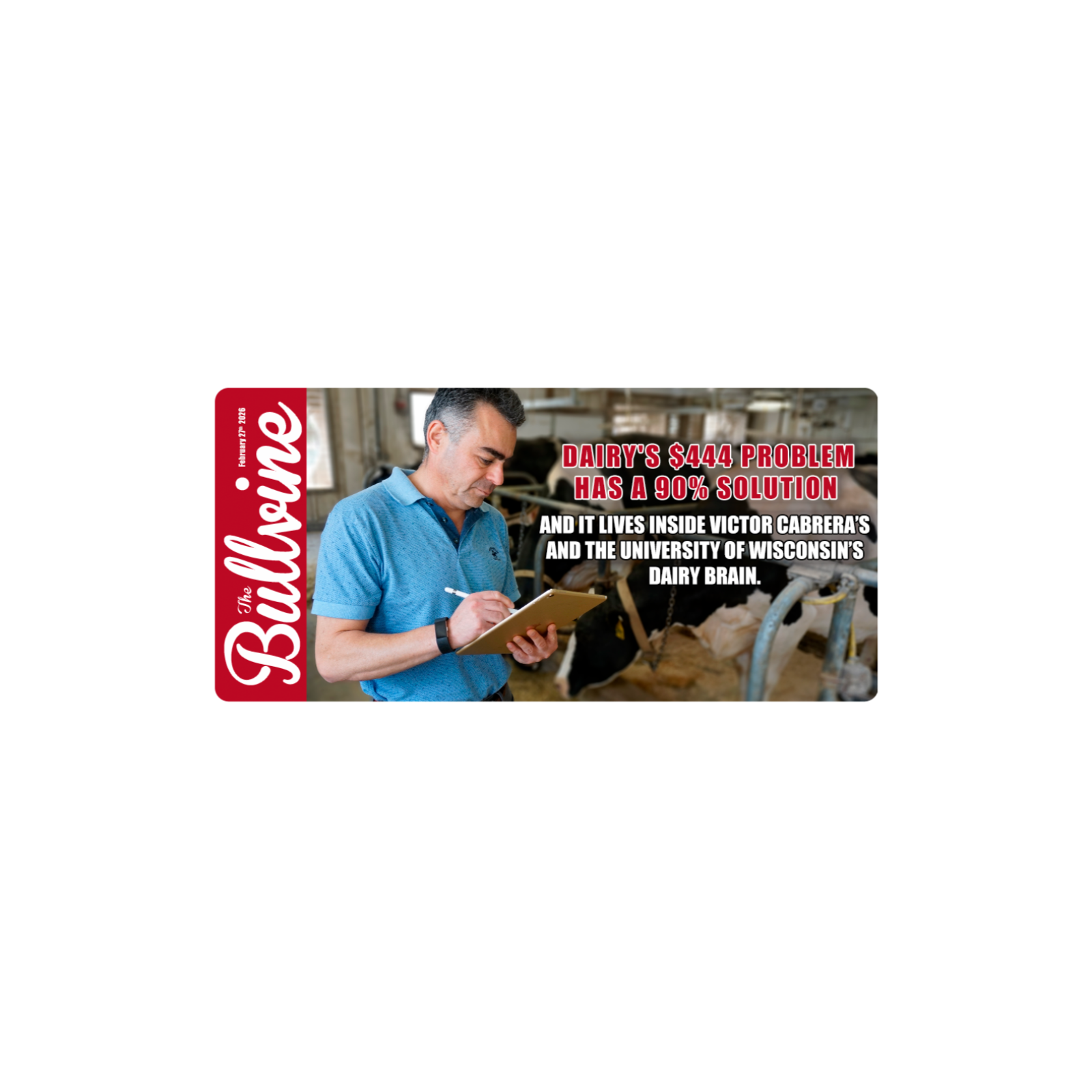
S1 Ep 501E501 Dairy’s $444 Problem Has a 90% Solution – And It Lives Inside Victor Cabrera’s and the University of Wisconsin’s Dairy Brain.
Somewhere on a Wisconsin dairy, a cow is about to get mastitis. She looks fine. Her milk's still flowing. Nobody in the parlor suspects a thing. But a system built by a man who once waited months for a single research paper to arrive by mail in Peru already knows — days before any clinical sign appears. Over 90% accuracy. Using data your farm already generates but has never connected. This is the story of Dr. Victor E. Cabrera, the University of Wisconsin–Madison researcher who spent 16 years trying to give dairy farms a brain — and the uncomfortable truth about why a $40 billion industry still can't get five software systems to talk to each other. What he's discovered will change how you think about every data point your operation touches.The Story You'll Hear:The moment a young graduate student from Peru walked into a university where the researchers he'd only read about in worn textbooks were suddenly down the hall — and what that hunger to learn built over the next two decadesWhy the most sophisticated analytics in the world are useless when your milking system, genetics software, and herd management program can't share a single data fieldThe replacement cow gut-punch — the counterintuitive math that proves culling your 50-pound cow today might be the most profitable decision you make this yearWhat happened when his team asked equipment manufacturers for basic API access — and the uncomfortable parallels to how Fortune 500 companies had to drag the tech industry into opennessThe on-farm moment when integrated data caught a silage change impacting feed efficiency in real time — before anyone in the barn noticedWhy beef-on-dairy became a mathematical trap that the industry is still digging out of — and the modeling tool that could have prevented a national heifer shortageThe sustainability paradox most critics get wrong: higher-producing cows actually leave a smaller carbon footprint per unit of milkVictor Cabrera didn't grow up in the North American dairy system. He came from Peru with the kind of appreciation for opportunity that only distance can teach — the perspective of someone who once waited weeks for access to a journal article most of us take for granted. That outsider's lens let him see what insiders couldn't: the dairy industry is drowning in data it can't use. His Dairy Brain project isn't another tech pitch. It's an attempt to solve the fundamental integration problem that costs every farm real money, every day — the five computers in the office that don't talk to each other, the PDF reports that break when someone moves a column, the breeding decisions made on gut feel when 90%-accurate predictions are technically possible. Whether you run 100 cows or 10,000, this conversation forces a hard look at the gap between the data you're generating and the decisions you're actually making with it.The full feature article accompanying this episode is live now at https://www.thebullvine.com/dairy-industry-professionals/dairys-444-problem-has-a-90-solution-and-it-lives-inside-victor-cabreras-and-the-university-of-wisconsins-dairy-brain/. Explore Dr. Cabrera's free decision-support tools, including replacement optimizers and beef-on-dairy simulators, at DairyMGT.info. Subscribe to The Bullvine Podcast wherever you listen so you never miss an episode.
S1 Ep 500E500 Six Colorado Dairy Workers Dead. OSHA’s Price: $41,101 a Life – and no jail time.
Six dairy workers — including a father, his two sons, and a son-in-law — died from hydrogen sulfide exposure in a single pump room at a Colorado dairy on August 20, 2025. Six months later, OSHA proposed $246,609 in total fines against the dairy and two contractors. That's $41,101 per life lost — less than a bulk tank, far less than a robotic milking unit, and a fraction of what civil courts typically award in confined-space fatalities. This episode breaks down exactly what happened at Prospect Valley Dairy near Keenesburg, who the six men were, why the fines landed where they did, and what every dairy operation with a manure pit, pump room, or below-grade channel needs to do this week.Key Takeaways:Who were the six workers killed, and why were four of them from the same family?What specific OSHA violations were cited — and why none were classified as "willful"The rescue cascade: why one death became six, and the single training concept that stops itWhy agriculture has no specific OSHA confined-space standard — and how that limits enforcementThe barn math: what a full confined-space safety program costs vs. a single OSHA fine vs. a wrongful death settlementWhat DFA and NMPF said after six workers died — and what they didn't doIdaho's model: how one state's dairy association built confined-space training after similar deathsA concrete 30/90/365-day confined-space checklist for your operationDeeper Dive — Why Listen:This isn't another news summary. We ran the numbers nobody else published. A basic confined-space entry program — gas monitor, ventilation blower, annual crew training, rescue tripod, written procedures — runs $3,800 to $6,500 in year one. That's roughly the price of two replacement dairy cows at today's record prices. Meanwhile, Purdue University's Agricultural Confined Space Incident Database shows wrongful death settlements in these cases typically range from $10 to $17 million.The episode traces the structural gap that made this tragedy predictable: agriculture's partial OSHA exemption, the 1976 congressional appropriations rider that shields small farms from inspection, and the absence of a confined-space standard that applies to dairy operations. We examine why OSHA could only cite "serious" violations — not "willful" — and why that classification means no criminal charges and no jail time, despite six preventable deaths.Read the full investigation, including the OSHA citation breakdown, barn math tables, and the complete 30/90/365-day confined-space checklist, at https://www.thebullvine.com/management/six-colorado-dairy-workers-dead-oshas-price-41101-a-life-and-no-jail-time/This is the first episode in our new series, The Price of a Life — examining what dairy worker safety actually costs, and what ignoring it costs more.If you or someone on your operation is struggling: call or text 988 (Suicide & Crisis Lifeline) or reach Farm Aid at 1-800-FARM-AID.Subscribe to The Bullvine Podcast so you don't miss the next episode in this series. Share this one with your herd manager, your crew lead, or anyone on your operation who walks past a manure pit this week. Find us on Facebook at The Bullvine — and tell us: when's the last time someone on your dairy did a confined-space check?

S1 Ep 499E499 2,000 Cows, a $21 Million Settlement, and Fairlife’s Woodcrest Dairy Traceability Gap
Everyone saw the animal-welfare headlines. Almost nobody is talking about the real business story: 2,000 cows leave a New Mexico dairy under investigation, and the industry can’t clearly trace which branded bottles they now fill. In this episode, The Bullvine cuts past the outrage and digs into the uncomfortable question every serious producer, geneticist, and industry pro should be asking: if the milk trail breaks inside your co-op, what does that do to your premiums, your risk profile, and your long‑term viability?Key Takeaways· Why the Woodcrest Dairy–Fairlife case is less about “bad actors” and more about structural holes in dairy supply chain traceability.· How a $21 million settlement and “zero tolerance” welfare claims collide with the reality of pooled milk and co-op marketing.· What the Select Milk–DFA $34.4 million price‑fixing settlement reveals about who really controls Southwest milk checks.· A simple barn‑math breakdown of how fast brand premiums add up — and how fast they can disappear when a welfare or governance scandal hits.· The critical difference between food safety traceability and brand integrity traceability — and why most systems only deliver the first.· Concrete questions you should be grilling your co-op and marketers on within the next 30 days.· How to read your milk marketing agreements for hidden brand‑contamination risk you’re probably not pricing.This episode takes you inside the Woodcrest Dairy investigation and Fairlife’s response, but it doesn’t stop at shock footage or PR statements. Instead, it follows the milk: from a shuttered Roswell‑area dairy, through co-op pooling, to premium brands that promise “extraordinary care” while operating inside a system that can’t always prove which farm produced which bottle. You’ll hear how Animal Recovery Mission’s undercover work, Fairlife’s $21 million settlement, and Select Milk’s ongoing legal exposure intersect to expose weaknesses in the way co-ops document and defend their supply chains.For links to the full investigative article, related legal cases, and deeper analysis on milk marketing power and consolidation, visit https://www.thebullvine.com/dairy-industry/2000-cows-a-21-million-settlement-and-fairlifes-woodcrest-dairy-traceability-gap/. While you’re there, subscribe to The Bullvine newsletter for ongoing coverage that connects headlines to hard numbers and on‑farm decisions.If this episode challenged how you think about Fairlife, co-ops, or traceability, subscribe to The Bullvine Podcast on Apple Podcasts, leave a review, and share it with another serious producer or industry colleague. Join the conversation with The Bullvine on social media and tell us: how confident are you, really, in your own milk trail?
S1 Ep 498E498 Ed Bos Picked the Same Traits for 50 Years. A Million-Cow Study Just Proved He Was Right — by $2,678 Per Cow.
What if the composite score you've been trusting to select sires is actually masking the traits that cull your cows early? Holstein Association USA matched classification records against lifetime production data for over one million U.S. Holsteins - and the results should change your next semen order. The functional traits nobody puts on show posters drove a $2,678 per cow gap in lifetime milk revenue. Meanwhile, stature - the trait the ring rewards most - is genetically dragging profit in the wrong direction. This episode tells the story through Ed Bos of Bosdale Farms in Cambridge, Ontario, whose 50-year commitment to udders, feet, legs, and rumps produced 415 Excellent Holsteins and three Master Breeder shields. The data finally caught up to the master breeder.Key Takeaways:Why top-quartile classified cows produced 13,389 lb more lifetime energy-corrected milk - not by peaking higher, but by staying 142 more days in milkThe ~50% genetic correlation between stature and UDC that inflates composite scores without improving actual udder quality - and Nate Zwald's TPI ranking demo that proves itDechow's -0.73 genetic correlation between Body Condition Score and Dairy Form: why sharp, angular cows are genetically set up to fail in transitionUniversity of Guelph research showing body depth is the most negative conformation contributor to Pro$ while heel depth is the most positive - opposite directions, same indexReal-farm results from three operations (750 to 3,500 cows) at the 2025 CDCB Industry Meeting, including one targeting a 25% replacement rateThe barn math: how adding half a lactation to a 300-cow herd saves over $255,000 in replacement costs over five years at current USDA heifer pricesA 30-day action plan to audit your classification summary for stature inflationThis episode stacks peer-reviewed evidence from three continents against one of the dairy industry's most persistent blind spots: the assumption that a high UDC or final score automatically means a cow built to last. Research from Brazil (Kern et al., 2015), Southern Africa (Setati et al., 2004), and Hungary (Torok et al., 2021) all confirm that udder depth - not stature, not dairy character - carries the strongest genetic correlation to longevity. Udder depth is three to five times more heritable than longevity itself, making it the most efficient indirect selection path available.The full feature article with barn-math tables, all research citations, and the complete 30/90/365-day action plan is live at https://www.thebullvine.com/dairy-cattle-classification/ed-bos-picked-the-same-traits-for-50-years-a-million-cow-study-just-proved-he-was-right-by-2678-per-cow/. Search 'Holstein conformation $2,678' or visit the episode page for direct links.Subscribe to The Bullvine Podcast so you never miss an episode. Share this one with someone finalizing a semen order - it might be worth $2,678 per cow to them. Connect with us on social media and tell us: what does your classification summary really say when you pull apart the composites?

S1 Ep 497E497 880M Views vs $102.7M: Nate the Hoof Guy and Farm Social Media in Dairy’s Trust Fight
A Wisconsin hoof trimmer who once used a flip phone now commands an audience of 880 million YouTube views — more reach than PETA and Mercy for Animals achieve with $102.7 million in combined annual spending. This episode unpacks how six real dairy operations across four countries built consumer trust with nothing but a phone, daily chores, and a willingness to show what actually happens in the barn. If you think social media is optional for your operation, the numbers in this episode will change your mind.Key Takeaways:How Nate the Hoof Guy went from zero video experience to 1.7 million YouTube subscribers and 880 million views — and what his content reveals about why consumers trust raw footage over polished marketingThe Fair Oaks Farms disaster: why the Midwest's premier agritourism destination — 600,000 visitors a year — collapsed overnight when undercover footage exposed the gap between the tour and the barnHow MVP Dairy in Ohio makes a 4,500-cow operation feel personal by stacking B Corp certification, DairyCARE audits, and unpolished TikTok content — the combination that actually holdsThe New York dairy that killed a PETA-driven AP story before it ever ran, without spending a dollar on crisis PRWhat Chloe Payne's Cows of New Zealand — 325,000 Instagram followers built on named cows and honest grief — teaches about the content that keeps an audience coming backWhy Big Farmer Andy's shift from humour to mental health advocacy matters for every isolated operator in the industryThe barn math: what a 30-day processor contract loss actually costs a 300-cow operation at current milk prices — and why $121,500 in lost revenue reframes the value of 20 minutes a weekThis episode goes beyond "should farmers use social media?" and into the strategic question underneath: who controls the public narrative about your barn, your cows, and your livelihood?PETA spent $77.6 million last fiscal year. Mercy for Animals added another $25.1 million. That's $102.7 million from just two organizations — before counting Humane World for Animals, which dwarfs both. You're not going to outspend that. But six operations profiled in this episode are proving you can out-trust it.You'll hear the specific patterns that separate farm content that builds durable trust from the polished agritourism model that shatters under scrutiny. The episode walks through three actionable paths — a 30-day phone test for any size operation, a 90-day weekly rhythm for producers ready to commit, and a 365-day audit-plus-content strategy for larger dairies where consumer perception is a direct business risk.Read the full feature article with all sourced data, barn math calculations, and the three-path framework at https://www.thebullvine.com/dairy-industry/880m-views-vs-102-7m-nate-the-hoof-guy-and-farm-social-media-in-dairys-trust-fight/ — search "880M Views" or find it on our homepage.Subscribe to The Bullvine Podcast so you never miss an episode. New episodes drop weekly with the data, the names, and the strategies the dairy industry needs to hear — whether it wants to or not.Share this episode with a neighbour, your co-op fieldman, or anyone in your operation who thinks social media is "not for us." The question isn't whether your farm should be online. It's whether you want to control the story — or let someone with a $102.7 million budget tell it for you.Join the conversation: tag @thebullvine on Facebook, Instagram, or X and tell us — who's telling your farm's story right now?

S1 Ep 496E496 Men’s Hockey Gold Medal Game vs Dairy’s Real Faceoff: $24,000 Quota, 1,434 Lost Herds in Canada–USA Farming
While Canada and the U.S. battled for men's hockey gold in Milan, the real cross-border faceoff was playing out in parlor pits and at kitchen tables from Quebec to Wisconsin. In 2024, the U.S. lost 1,434 licensed dairy herds — a 5% annual decline pushing the country toward fewer than 10,000 farms by 2044. Meanwhile, Ontario's February 2026 quota exchange was cancelled after 1,915 buyers chased quota from just 12 sellers at the CA$24,000/kg cap. This episode cuts through the political noise to answer the question working dairy producers on both sides of the border are actually asking: if you had to milk cows for the next 20 years under one system, which would you pick — and would your balance sheet survive either one?Key Takeaways:Why the "cushy Canadian farmer" and "free-market American" narratives are both dangerously wrong — and what the actual barn math reveals about survival under each systemHow a 15% decline in Canadian quota values pushes a typical 100-cow Ontario operation's debt-to-equity from 55% to 60.4%, crossing Farm Credit Canada's comfort thresholdWhat six months of $16.50 milk does to a 300-cow Wisconsin herd: $22,313/month in cash drain with DMC Tier I covering only 65% of outputWhy Rabobank projects 2,800 U.S. dairy closures in 2025 while USDA calls it a "golden age"How the July 1, 2026, USMCA sunset clause gives American negotiators maximum leverage — and why Canadian quota holders are the collateralThe mental health cost neither system budgets for: 57% of Canadian farmers meet anxiety classification criteria, and the stress profiles differ fundamentally between capital-weighted and market-weighted systemsA 30/90/365-day action playbook for producers in both countries heading into the most significant dairy trade reset in a generationThis episode walks through two complete stress-test scenarios — one Canadian, one American — with step-by-step arithmetic you can plug your own herd size, breakeven, and equity into. The Canadian walkthrough models what happens when USMCA concessions trigger a quota value drop, showing exactly how paper losses translate into lending conversations. The American walkthrough calculates monthly equity burn at stressed milk prices and reveals how much of a mid-size herd's output sits fully exposed beyond DMC coverage.The full article with sourced data, both stress-test walkthroughs, and the complete 30/90/365-day playbook is available now at https://www.thebullvine.com/dairy-markets/mens-hockey-gold-medal-game-vs-dairys-real-faceoff-24000-quota-1434-lost-herds-in-canada-usa-farming/Subscribe to The Bullvine Podcast so you never miss an episode. Share this one with a producer on either side of the border who needs to hear it before July 1. And tell us — what does YOUR debt-to-equity ratio look like on July 2? Find us on Facebook, Instagram, and X @TheBullvine.

S1 Ep 495E495 The Invisible Architects: How George Wiggans and Paul VanRaden Helped Double Your Herds’ Genetic Gain
You know Net Merit. You sort by it. You build your breeding program around it. But you've probably never heard the names of the two men who built the system that generates every number on every sire proof in North America.George Wiggans grew up milking cows on a dairy farm in Aurora, New York. Paul VanRaden was a 16-year-old DHI supervisor earning $2.20 an hour weighing milk for neighbors in Iowa. Neither planned to spend 38 years in the same government lab. Neither expected their math to reshape an entire industry. But from a quiet USDA facility in Beltsville, Maryland, they built the evaluation infrastructure that today drives billions of dollars in genetic decisions worldwide — and doubled the rate of genetic progress almost overnight. This is the story of how the most influential team in your barn never milked a single one of your cows.The Story You'll Hear:The calculus grade that sent a farm kid down a hallway to meet the professor who changed his lifeTwo years in Laos during the Vietnam War — and the unlikely path back to dairy geneticsWhy the "goat guy" at USDA ended up rebuilding the entire cattle evaluation systemThe moment a microscope slide with 50,000 markers made daughter proofs obsoleteThe calves that never arrived — how their math uncovered lethal genetic combinations hiding in plain sight for decadesAn industry that swore by daughter inspections forced to accept that DNA was a better answerThe $135,000 question: what genomic selection is actually worth to a 300-cow herd every decadeA Pioneer Award in Madison — and the man who retired from USDA only to walk across the hall and keep workingDr. George Wiggans and Dr. Paul VanRaden are not salesmen, AI marketers, or celebrity geneticists. They are career scientists who spent nearly four decades building the system you use every single day — the Net Merit formula, the genomic prediction model launched in January 2009, and the haplotype research that found lethal recessives your mating software now flags before you make the cross. Before their genomic evaluations went live, genetic progress was roughly $40 per cow per year. Since 2010, it has been $85. That delta is real money in real bulk tanks on real farms. Their story is a reminder that the most transformative forces in this industry don't always stand at a podium or appear in a catalog. Sometimes they sit behind a computer screen for 38 years, quietly rewriting the math underneath everything.Read the full article, "The Invisible Architects of Your Herd's Genetic Gain," at https://www.thebullvine.com/dairy-industry-professionals/the-invisible-architects-how-george-wiggans-and-paul-vanraden-helped-double-your-herds-genetic-gain/. Subscribe to The Bullvine Podcast so you never miss the stories behind the numbers that drive this industry. Have a story of your own? Reach out on Facebook or Instagram — because every herd has an invisible architect somewhere in its history.
S1 Ep 494E494 The 1,113 kg Question: Does Dairy Calf Starter Consistency Really Affect Lifetime Production?
Every kilogram of preweaning gain is linked to 1,113 kg of additional milk in first lactation. That's not a projection — it's peer-reviewed Cornell University research, published in the Journal of Dairy Science and reconfirmed by a 2025 meta-analysis of 18 independent studies. So why are most operations still buying calf starter primarily on price?This episode challenges one of the most overlooked assumptions in calf-raising: that meeting tag minimums is good enough. We dig into the science of rumen microbiome development, the real cost of feed inconsistency, USDA health benchmarks most herds are still missing, and the barn math that makes this a genuine economic decision — not a marketing pitch.KEY TAKEAWAYSWhy 1,113 kg of first-lactation milk per kilogram of preweaning ADG keeps showing up in study after study — and what it means for your herd's lifetime revenueHow rumen bugs colonize in the first weeks of life, why that microbial foundation appears to stick through multiple lactations, and what happens when feed ingredients shift every few weeksThe real USDA NAHMS numbers on calf morbidity (33.8%) and why digestive illness accounts for over half of all preweaned heifer health eventsWhere current DCHA Gold Standards sit — under 10% scours, under 15% pneumonia, 97%+ survival — and how top operations are already beating themThe economics of a 400-calf operation: what $1,200–$2,400/year in additional feed cost could return in milk yield, treatment savings, and weaning weight uniformityThree pointed questions to ask your feed supplier that reveal whether you're buying consistency or commodity — and why neither answer is automatically wrongThe connection between preweaning growth and lifetime milk production is no longer debatable. Cornell's original research has been validated repeatedly, most recently by a meta-analysis combining 18 studies across diverse herds and management systems. What remains less settled — and what this episode tackles head-on — is whether the consistency of your calf starter formulation meaningfully moves the needle beyond just hitting nutritional minimums.We walk through the biology of rumen adaptation (research shows microbiota need days to three-plus weeks to adjust when diets change), the USDA benchmarks that reveal where the industry actually stands on calf health, and a practical economic framework you can apply to your own operation tonight. A California calf manager shares how tracking her weaning weight coefficient of variation — a metric most producers never calculate — revealed a drop from 14% to under 9% within four months of switching to fixed-formulation starter.This isn't a sales pitch for premium feed. The episode also covers when feed consistency probably isn't your highest-priority investment and offers a five-step assessment framework so you can decide based on your own data, not someone else's projections.The full article with the complete economics table, supplier evaluation questions, transition timeline, and assessment framework is available a https://www.thebullvine.com/management/nutrition/the-1113-kg-question-does-dairy-calf-starter-consistency-really-affect-lifetime-production/. Research citations referenced in this episode include Soberon & Van Amburgh (Journal of Dairy Science, 2012), the 2025 Journal of Dairy Science meta-analysis, USDA NAHMS Dairy 2014, and Schären et al. (Frontiers in Microbiology, 2017).
S1 Ep 493E493 9.99% Inbreeding and Rising: How Blondin Sires Turned a Holstein Bottleneck into 75% Growth
The day Dann Brady pulled his herd’s inbreeding report, the number on the page didn’t match the cows in his head. On paper, they were elite: high indexes, big genomic promise, all the “right” sires stacked three deep. In the barn, he was watching fertility slip, mastitis cases creep up, and young cows that never made it to the kind of mature cow he’d grown up loving. Everyone told him this was just the price of progress. Instead of accepting it, he did something that went against every “play it safe” instinct in dairy: he stopped trusting the catalogs, walked away from the standard contracts, and started building his own stud from the ground up. This episode follows what happened next—and why it might change the way you look at the genetics flowing through your own bulk tank.The Story You’ll HearThe quiet moment in the office when an inbreeding number on a report made Dann realise his “elite” herd was carrying a hidden bill.Why flipping through major AI catalogs felt less like choosing sires and more like choosing the same bull in twenty different jackets.The conversation where he and his partners finally said out loud, “If we can’t buy the bulls we want, we’ll have to make them ourselves.”What it really looked like—financially and emotionally—to hang a new stud code on the wall and wait to see if anyone would trust it.The first time a customer called back, not to complain, but to say, “These daughters are different,” and what that did to their belief in the model.How it felt to stand at World Dairy Expo holding three Premier Sire banners and know they’d built that success with cows and cow families most catalogs had ignored.The late‑night doubts about whether boutique genetics could ever stack up against three global powerhouses—and the data that finally answered that question.The moment Dann realised this wasn’t just about his own herd anymore, but about giving other farms a way to buy genetics that actually matched their values and risk tolerance.Every dairy farm has that tension between chasing the latest proofs and protecting the kind of cow that actually survives in your system. Dann Brady’s story puts a human face on that conflict. Before he became the co‑founder of Blondin Sires, he was in the same spot as thousands of producers: trusting big‑name bulls, watching inbreeding creep up, and wondering why his replacement pen didn’t look like the glossy semen catalog.Whether you’re running 80 cows or 8,000, wrestling with semen contracts, or just uneasy about how tight Holstein bloodlines have become, you’ll hear a story that speaks to the same question you’re asking: how do you keep moving forward without sacrificing the future of your herd?Want to go deeper into the numbers, the bulls, and the business model behind this episode? Visit https://www.thebullvine.com/a-i-industry/9-99-inbreeding-and-rising-how-blondin-sires-turned-a-holstein-bottleneck-into-75-growth/ to read the full feature on Dann Brady and Blondin Sires, along with data‑driven articles on inbreeding, independent studs, and breeding for long‑term profit.If this episode sparked something—made you pull a report, question a contract, or rethink what “genetic progress” really means—hit follow on The Bullvine Podcast and share it with someone else who’s making big decisions in dairy.Have your own story of pushing back against the status quo in genetics or herd strategy? Reach out through The Bullvine website or tag The Bullvine on social media. Your next hard‑won lesson might be the one that helps another farmer sleep better at night.

S1 Ep 492E492 Steve Jobs Never Soldered a Circuit: How His Mac Playbook Can Free 988 of Your Hours and Add $24,000 to a 200‑Cow Dairy
The most profitable dairy farms don't have cheaper labor. They have better systems. Cornell's 2024 Dairy Farm Business Summary revealed something that should stop every herd owner mid-stride: top-quartile and bottom-quartile farms pay their workers roughly the same — about $60,000 per year. The difference? Top farms extract 1.7 million pounds of milk per worker. Bottom farms: 1.2 million. Same cost. Forty percent more output. This episode breaks down exactly why — and what Steve Jobs has to do with your pregnancy rate.In this episode, you'll learn:Why the owner who milks every shift is the single biggest bottleneck on most dairies under 500 cows — and the math that proves itHow Teagasc data shows 19 hours per week separating top and bottom quartile dairies on nearly identical herd sizes (112 vs. 113 cows)The "Milker Trap" — and Dr. John Fetrow's reproductive economics showing a 6-point pregnancy rate gap costs $24,000/year on a 200-cow herdWhat a 606-cow operation in North Devon, England did to hit a 25% pregnancy rate — top 5% nationally — with just two people running the rotaryWhy buying a robot without building protocols first means you've purchased a guilt machine, not technologyThe Steve Jobs principle applied to dairy: why designing the system always beats being the hardest worker inside itA 4-step framework to transition from grinding to designing — starting with a 30-day test any herd can run this monthMost dairy management advice tells you to work smarter. This episode tells you to work on a fundamentally different job. The data is clear: Cornell, Teagasc Moorepark, and the University of Minnesota all point to the same conclusion — the gap between top and bottom performers isn't genetics, facilities, or labor cost. It's how the owner spends their hours.We walk through the real-world case of Wayside Dairy in Wisconsin, where 17 years of protocol building and team development took pregnancy rates from 18% to 33% before a single sensor was ever installed. CowManager ear tags caught the last five points to 38%. The foundation came first. The tech amplified it.Ten years from now, the herds still standing will be owned by designers — not the "hired milker in chief." This episode helps you figure out which one you're training to be.Visit https://www.thebullvine.com/management/steve-jobs-never-soldered-a-circuit-how-his-mac-playbook-can-free-988-of-your-hours-and-add-24000-to-a-200%e2%80%91cow-dairy/ for the complete article with all the Cornell data, the Wayside Dairy case study, and the 4-step playbook. Subscribe to The Bullvine Podcast wherever you listen so you never miss an episode. And if this one made you rethink how you spend your hours — share it with a fellow producer who needs to hear it.Join the conversation on Facebook and tell us: what's the one task you know you should hand off but can't bring yourself to let go of?That clocks in at just under 3,900 characters, leaving a small buffer for any link formatting Apple Podcasts might require. The structure follows a hook → bullet takeaways → deeper context → CTA flow that Apple Podcasts listeners expect, while keeping every claim grounded in the specific data from the article — Cornell DFBS, Teagasc, and Fetrow's reproductive economics.
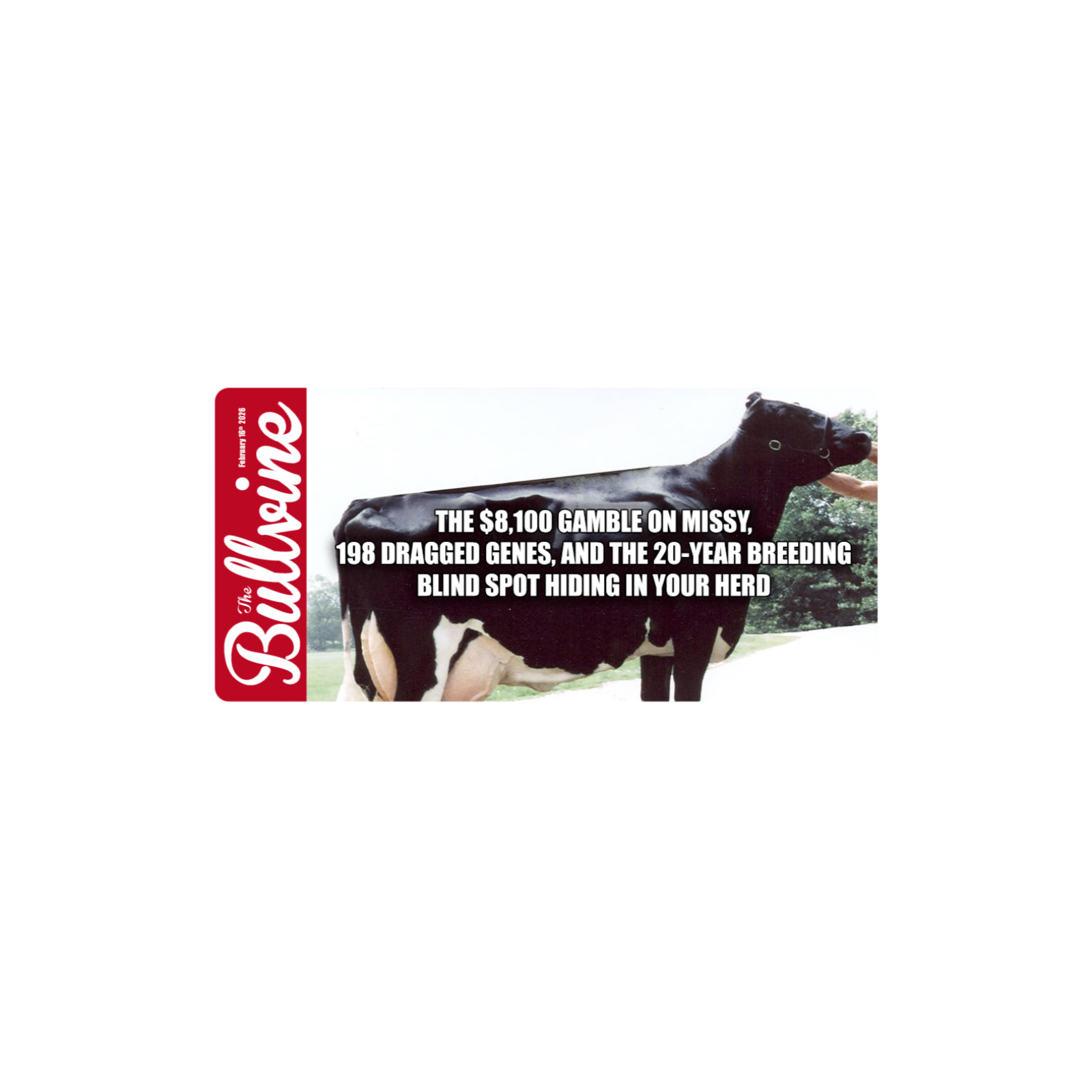
S1 Ep 491E491 The $8,100 Gamble on Missy, 198 Dragged Genes, and the 20-Year Breeding Blind Spot Hiding in Your Herd
In 2003, Matt Steiner called into a Wisconsin sale barn and bid $8,100 on a cow the room had already written off. Wesswood-HC Rudy Missy EX-92 went on to reshape Holstein genetics for two decades. But the same genomic engine that made Missy a global brood cow was quietly dragging 198 fertility genes and 67 immunity genes in the wrong direction — and nobody caught it for 20 years. This episode unpacks where the same pattern is building right now, what it's costing you per cow, and exactly what to do before your next mating run.KEY TAKEAWAYSHow genomic selection doubled genetic gain but simultaneously eroded fertility, immunity, and heat tolerance through genetic hitchhiking — and why no one noticed until billions in damage was done.The barn math most producers haven't run: why the $5,070 in extra annual milk revenue from faster genetic gain may be nearly canceled out by $4,800–$6,400 in hidden inbreeding costs on a 200-cow herd.Why your cows now start losing production at a THI of 69 instead of 72 — and why better fans and sprinklers may be masking a genetic deterioration that's quietly building your next fertility crash.What the December 2025 evaluations revealed: 22 of the top 30 NM$ bulls from a single program, and what that concentration means for the breed's long-term resilience.Four specific breeding decisions you can make this month — with the honest trade-offs attached to each one.This episode goes deeper than the headline numbers. University of Minnesota researchers maintained an unselected Holstein control line alongside the national population from 1964 to 2004 — same barn, same feed, different genetics. The selected cows gained 79% more milk and lost 30 additional days to conception. Genome-level analysis revealed the mechanism: genes for reproduction and immunity sitting near milk-boosting alleles got swept along for the ride. The estrogen receptor gene ESR1 dropped from 0.45 to 0.13 frequency. Nobody selected against fertility. It just happened.Now consider this: U.S. Holstein inbreeding climbed from 5.7% in 2010 to 15.2% by 2020. CDCB estimates the cumulative cost to the national herd at $6.7 billion. Each 1% of inbreeding costs $23–25 off lifetime Net Merit per cow. And outside Australia, virtually no country selects directly for heat tolerance — even as the genetic threshold for heat stress keeps dropping.The episode walks through four action paths grounded in real data: confirming you're on the 2025 NM$ revision with its 17.8% feed efficiency emphasis, requesting ROH-based genomic inbreeding from your genetics provider, diversifying sires across multiple AI organizations, and using productive life and livability as indirect heat-tolerance filters. Each comes with a specific trade-off so you can make the call that fits your operation.This isn't theoretical. It's the question the fertility crash should have taught us to ask in 1985: what am I not measuring that's already costing me money?The full feature article with all research sources, barn math breakdowns, and the complete action checklist is live at https://www.thebullvine.com/genetics/the-8100-gamble-on-missy-198-dragged-genes-and-the-20-year-breeding-blind-spot-hiding-in-your-herd/. Subscribe to The Bullvine Podcast wherever you listen so you never miss an episode. Share your thoughts and your own herd data with us on Facebook and Instagram — we want to hear what blind spots you're finding in your own breeding program.
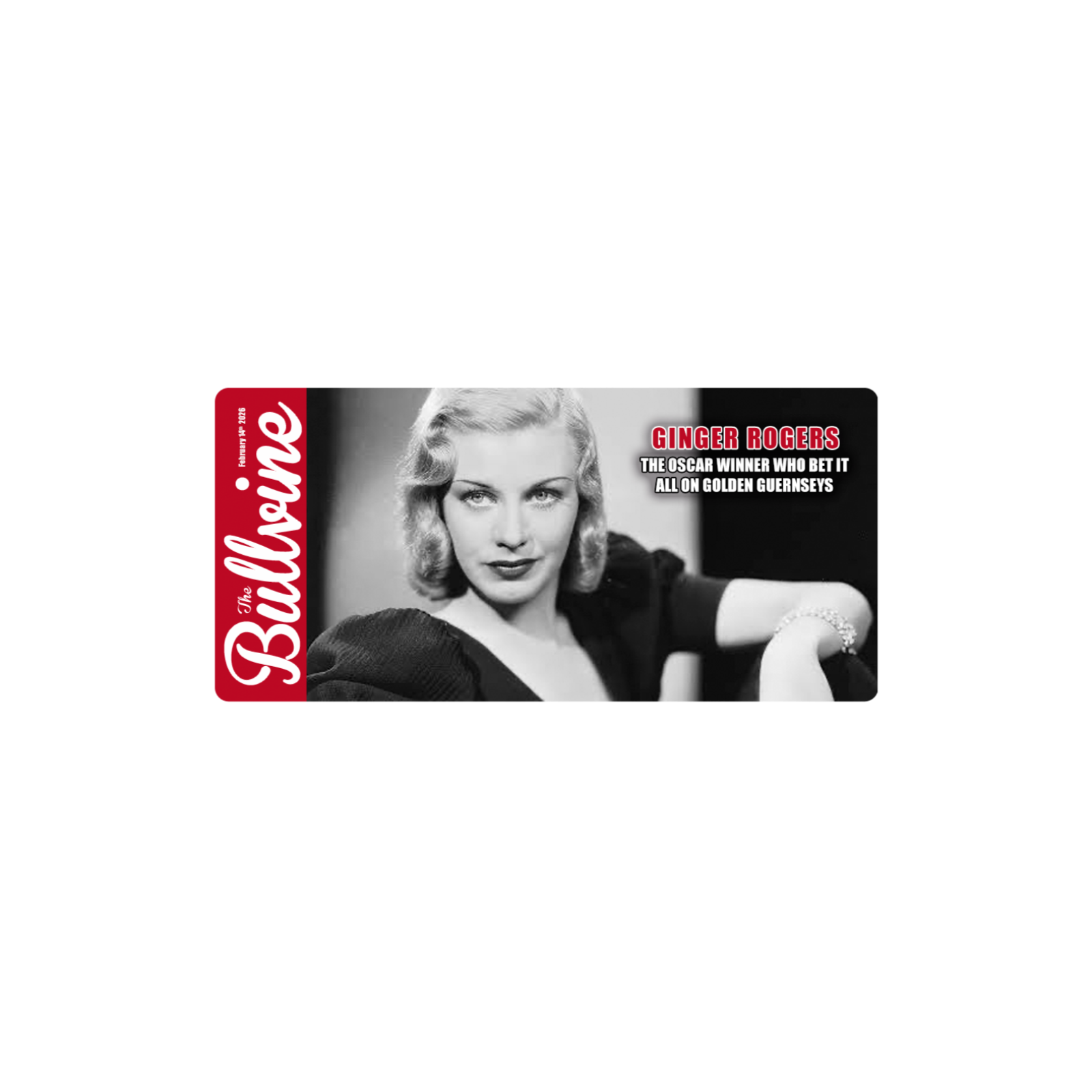
S1 Ep 490E490 Ginger Rogers: The Oscar Winner Who Bet It All on Golden Guernseys
Ginger Rogers poured her Oscar money into 32 Golden Guernseys on a thousand acres of Oregon riverfront — then lost them all to a world war. In 1941, while still the highest-paid actress in Hollywood, Rogers and her mother Lela bought a ranch on the Rogue River, built a Jamesway milking parlor from scratch, joined the American Guernsey Cattle Club, and began shipping 150 gallons of rich golden milk a day to soldiers at nearby Camp White. The wartime labor crisis killed the dairy within two years — but the breed she chose, and the bet she placed on premium components and A2 genetics, turned out to be eight decades ahead of its time.Key Moments:How a tap-dancing Academy Award winner ended up with electric milkers and a 12-cow Guernsey parlor in southern OregonThe skeptic who joked her livestock would "probably consist of nothing but bees" — and how Rogers answered himWhy she chose Golden Guernseys over Holsteins in 1941, and what that choice looks like in hindsightThe Camp White contract: 150 gallons a day, bacteria counts of 900 to 1,200 on raw milk, and a wartime market that vanished as fast as it appearedThe moment the labor shortage forced her to sell the herd — and the five decades she held the land anywayHow today's A2 Guernsey micro-dairies are finishing what Rogers started, from Promise Valley Farm in Canada to Pleasant Meadow Creamery in IdahoThe Guernsey breed Rogers chose in 1941 now sits at the center of a global A2 milk market projected to reach nearly $8 billion by 2034. Over 80% of tested American Guernseys carry the A2A2 genotype, and every Guernsey sire in AI service tests 100% A2A2. The butterfat, the protein, the golden color she was bottling for soldiers — those are the exact traits driving a new generation of small-herd, direct-to-consumer dairies that sell at three times conventional prices.The full written profile — with rare LIFE Magazine photos, the 1943 Jamesway ad, and an original Rogers' Rogue River Ranch milk bottle — is live now at https://www.thebullvine.com/breeder-profiles/ginger-rogers-the-oscar-winner-who-bet-it-all-on-golden-guernseys/. Search "Ginger Rogers" to read the complete story. Subscribe to The Bullvine Podcast so you never miss a history episode, and share this one with someone who'd appreciate knowing that the woman who danced with Fred Astaire also milked Guernseys at dawn.

S1 Ep 489E489 Gold Medal Margins: Italy Turns Less Milk into €22.8B. You’re Stuck at $18.95.
USDA’s latest outlook pegs 2026 all‑milk at about $18.95/cwt while full‑cost breakevens for many progressive herds sit closer to $19.50–$20.50. At the same time, the region hosting the Milano‑Cortina Winter Olympics is turning less milk into over €22.8 billion in dairy revenue. This episode asks a blunt question: if Italy can grow value on shrinking volume, why are so many North American farms still betting survival on commodity milk checks?Key Takeaways· Why $18.95/cwt milk against $19.50–$20.50/cwt breakevens bakes a loss into many 2026 budgets before you start.· How Parmigiano‑Reggiano and Comté use PDO rules, quotas, and consortia to deliver 2.23× value premiums and 32% higher farm profitability than non‑GI neighbors.· The hard economics of four paths: component optimization, solo farmstead cheese, regional consortium models, and demographic‑driven specialties like Hispanic cheese.· What Italy’s quota‑plus‑brand system does differently from U.S. FMMO pooling and Canadian supply management — and why “organized scarcity” can either protect stability or build premium.· Real‑world case studies from Jasper Hill, Uplands Cheese, Gunn’s Hill, and European PDO consortia that show where value‑add works, where it fails, and what it demands in capital and risk.· Six hard questions every dairy operator should ask before spending another dollar: breakeven, structural $/cwt gap, processor options, neighbor collaboration, processing build‑out, and GI politics.This is not another generic “value‑added is nice” conversation. We start with the math that’s rewriting 2026: USDA’s February WASDE lifting all‑milk to $18.95/cwt, USDA‑ERS cost‑of‑production data showing full economic costs around $19.14/cwt even for large herds, and Bullvine break‑even ranges of $19.50–$20.50/cwt for many mid‑size operations. Then we put that next to Italian and French data: Parmigiano‑Reggiano hitting €3.2 billion in 2024 turnover with 9.2% volume growth, PDO products averaging 2.23× value premiums, and Comté‑zone farms posting a 32% profitability advantage and dramatically slower attrition than non‑PDO farms.For links to the full “Gold Medal Margins” feature, supporting data, and related articles on milk price, margins, genetics, and strategy, visit https://www.thebullvine.com/dairy-markets/gold-medal-margins-italy-turns-less-milk-into-e22-8b-youre-stuck-at-18-95/.

S1 Ep 488E488 From 1,810 Dairy Farms to 18: How North Dakota’s Processing Collapse Cornered the Holle Family – and Could Corner You
North Dakota lost 99% of its dairy farms in under four decades. If you think that can't happen where you milk, this episode is for you.In 1987, North Dakota had 1,810 dairy farms. As of early 2026, just 18 Grade A operations remain — the steepest collapse of any U.S. state in modern history. This episode tells the story through the Holle family at Northern Lights Dairy, a 1,000-cow Holstein operation near Mandan that now hauls milk five hours one way to a plant in Minnesota, several times a day. When we asked what comes next, the family's answer was brutally honest: "We don't know what we are going to do."That single sentence is the starting point for a deep dive into the structural forces killing family-scale dairy — not just in North Dakota, but across the Upper Midwest and beyond.KEY TOPICS EXPLORED:How two plant closures — Prairie Farms Bismarck (Sept 2023) and DFA Pollock (Aug 2024) — broke the state's milk marketing chain overnightThe real freight math: Upper Midwest hauling charges jumped 30% in one year, and North Dakota now carries the highest average in Federal Order 30Why USDA's new make-allowance increases (effective June 2025) hit remote producers dollar-for-dollar while processors in dense regions claw some backThe $23.56/cwt cost gap between herds under 50 cows and herds over 2,000 — and what that means for mid-size operations caught in the middle"Inside the fence vs. outside the fence" — a framework for determining whether your problem is operational or structuralSix hard diagnostics you can run on your own operation this week, including freight exposure to your second-nearest plant, basis tracking, and debt service stress testsFour strategic paths forward: scaling up, building a defensible niche, investing in processing, or planning a deliberate and profitable exitWhy January 2026 Class III hit $14.59/cwt — the lowest since April 2021 — and what the 2026 price outlook means for producers already on thin marginsThis isn't just a North Dakota story. Wisconsin has lost nearly half its dairy farms in a decade and is now down to roughly 5,100 active herds. The same physics — thinning processing density, stretching routes, weakening basis — are running in Minnesota, Pennsylvania, Vermont, and beyond. The Holle family's crisis is a live diagnostic for every family dairy in America: if a 1,000-cow, fifth-generation operation doing everything right inside the fence can't see a clear path forward, what does that tell you about your own strucThe full feature article with every source, data table, and the complete six-point diagnostic framework is live at https://www.thebullvine.com/dairy-markets/from-1810-dairy-farms-to-18-how-north-dakotas-processing-collapse-cornered-the-holle-family-and-could-corner-you/If you're wrestling with any of the decisions discussed in this episode — freight, succession, processing, exit planning — the Farm Aid hotline (1-800-FARM-AID) connects producers with local support services, and most state extension programs offer confidential financial counseling.
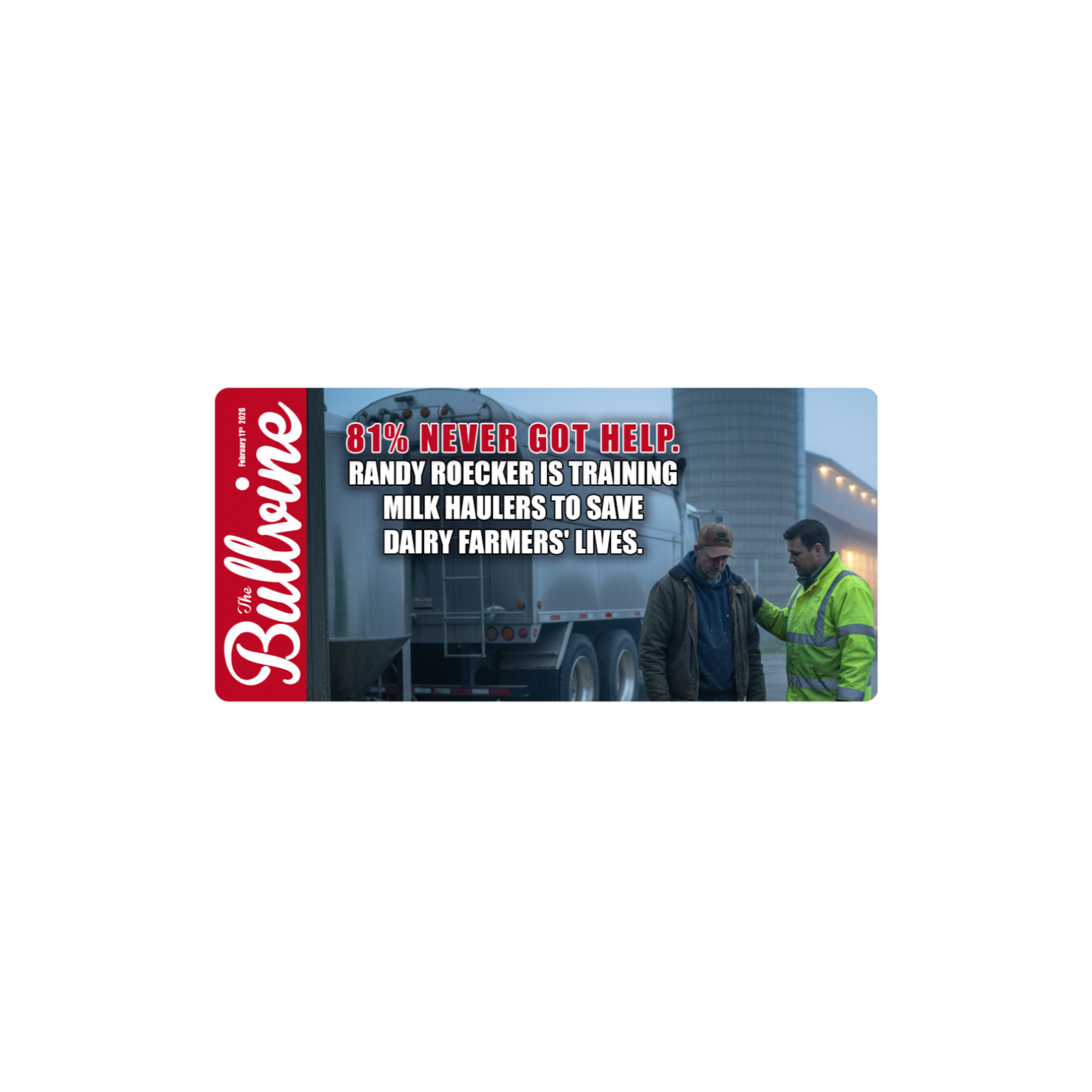
S1 Ep 487E487 81% Never Got Help. Randy Roecker Is Training Milk Haulers to Save Dairy Farmers’ Lives.
Here's a stat that should stop every dairy professional in their tracks: 81% of farmers who die by suicide never received any mental health treatment. Not most. Not many. Eighty-one percent. The clinical system isn't failing farmers at the margins — it's missing them almost entirely. This episode tells the story of Randy Roecker, a third-generation Wisconsin dairyman who fought depression for seven years, lost a neighbor to suicide, and then asked the question nobody in the industry was asking: what if the real first responders aren't therapists — they're the milk haulers, vets, and nutritionists already pulling into the driveway? What he built is changing how rural America thinks about farmer suicide prevention. And the data says your herd is already telling you when something's wrong.Key Takeaways:Why dairy farmers face a suicide risk 3.5× higher than the general population — and why 81% die without ever entering the mental health systemHow the 2008 dairy crisis pushed a leveraged Wisconsin operation from $18/cwt to below $9, triggering a seven-year battle with depressionThe neighbor's suicide that broke the silence and launched the Farmer Angel NetworkWhat QPR (Question, Persuade, Refer) training actually sounds like at 6 a.m. beside a bulk tank — and why it worksUniversity of Guelph research linking farmer anxiety and depression scores directly to severe lameness prevalence in dairy herdsThe difference between real crisis infrastructure and a hotline number printed on a milk checkA practical playbook: the "7 out of 10 for two weeks" stress threshold, how to start a local support network with three phone calls, and which crisis resources to post where everyone on your operation can see themDeeper Dive — Why Listen: This isn't a soft feature. It's a data-driven case study in what happens when an industry's most critical variable — the human managing the herd — goes unsupported.Randy Roecker expanded Roecker's Rolling Acres in Sauk County to 300 cows in 2006 with $3 million in new debt. When milk prices collapsed, he lost an estimated $30,000 a month. Seven years of treatment for depression followed. Then, on October 8, 2018, his neighbor Leon Statz — who had battled depression for more than 20 years — died by suicide. Roecker and Statz's wife Brenda co-founded the Farmer Angel Network, a peer support model built around community events, church basements, and honest conversation rather than clinical intake forms.The full written feature this episode is based on is live now at https://www.thebullvine.com/mental-health/81-never-got-help-randy-roecker-is-training-milk-haulers-to-save-dairy-farmers-lives/If you or someone you know is in crisis: call or text 988 (Suicide & Crisis Lifeline, 24/7) or the Wisconsin Farmer Wellness Helpline at 1-888-901-2558.

S1 Ep 486E486 Jack Remsberg – The Man Behind Elevation: Three Shots, Forty Thousand Cows, and the Trust That Built a Legacy
The bull didn’t want his picture taken. A 3,000‑pound Holstein named Round Oak Rag Apple Elevation was snorting at the end of the lead in an Ohio stud barn, and the man behind the camera had exactly one job: capture the image that would convince dairy farmers to risk their best cows on an unproven young sire. Three clicks of the shutter later, a Maryland farm kid turned photographer walked away with what would become one of the most important bull photos in Holstein history—taken on film, processed in a basement darkroom, long before genomics or online proofs existed. This is the story of how that moment, and the quiet life behind it, will make you rethink who you trust and what really drives your herd’s future.The Story You’ll Hear· The decision at a kitchen table in 1973, when a 150‑acre family dairy had to choose: borrow money and expand…or sell every cow and bet the future on a side‑hustle with a camera.· The neighbour in an Alaska darkroom who unknowingly lit the fuse on a 50‑year career in dairy cattle photography.· The phone call from a young AI cooperative called Select Sires that led to a long drive to Plain City—and a first look at a bull named Elevation.· The three‑shot session with Elevation: a tough bull, a patient perfectionist, and a photo that would ride along with more than 500,000 units of semen.· The dispersal sale where a cow’s bull calf brought $600,000—and the split‑second frame that captured him just before he bolted.· The quiet ways a wife who “kept the home fires burning” and four daughters shaped a career most people thought was a solo act.· The mentor who never raised his voice at the crew, only at the cattle—and how that philosophy carried into the next generation of photographers.· The moment a man who’d always been behind the camera stepped on stage at World Dairy Expo at 91, hearing his name called for the National Dairy Shrine Pioneer Award.· The ride down Main Street as Grand Marshal of his hometown parade at 98, and what it means to look back on a life spent helping other people’s genetics shine.This isn’t just a nostalgia trip about a famous bull. It’s the human story of Jack Remsberg—a kid who started hand‑milking ten pedigree cows three times a day, learned to judge cattle from his dad, learned to process film from a neighbour, and quietly became the trusted eye behind thousands of bull and cow photos across North America. Long before you could pull up genomic rankings on your phone, his pictures were the bridge between AI studs and farm kitchen tables.If this story resonates, don’t stop here. Subscribe to The Bullvine Podcast so you never miss an episode that digs into the real decisions and real people shaping modern dairy. Visit https://www.thebullvine.com/dairy-industry-professionals/jack-remsberg-the-man-behind-elevation-three-shots-forty-thousand-cows-and-the-trust-that-built-a-legacy/to read the full written profile of Jack Remsberg and explore related articles on Elevation, sire impact, and dairy cattle photography.We’d love to hear your story too—the cow, bull, or moment that changed everything on your farm. Share it with us on social or through the site, and join a community that believes the future of dairy is built on honest stories, tough questions, and better decisions.

S1 Ep 485E485 After 75 Years and 850 Doorsteps, One Number Forced Cooil’s Dairy to Choose – How Close Are You?
For 75 years, Cooil's Dairy on the Isle of Man delivered milk before dawn to over a thousand households at peak. Then the math quietly turned. Not a bankruptcy. Not a crisis. Just one ratio drifting the wrong way until a third-generation family had to make the hardest call in farming: shut the rounds, keep the cows, protect the family. If you're running or considering on-farm processing, this episode reveals the single number that predicts whether your direct-to-consumer channel is building equity — or slowly consuming it.Key Takeaways:Why your customer count is the wrong number to watch — and what your retail-to-wholesale ratio actually tells you about processing viabilityThe hidden cost of split-site operations: hauling milk between farm and processing plant on a retrofitted grain trailer, five days a weekHow COVID demand surges lie to you — Cooil's peaked at 1,000+ homes, settled at 850, but the equipment was sized for neitherWhat 20% plant utilization really costs: 5x the fixed cost per litre compared to full capacityThe staffing trap that kills mid-sized processors — too small to afford relief staff, too complex for one person to coverFour distinct survival paths compared side by side: clean cooperative exit, radical downscale, vending machines, and community-supported modelsWhy year 8 of a 12-year equipment life is your red-flag decision point — not year 12How your herd's component profile (butterfat, protein premiums) factors into the retail-vs-wholesale decisionThis episode features exclusive first-person detail from Juan Hargraves, who ran Cooil's Dairy alongside his wife Kirsty after taking over from the founding Cooil family. Juan's account is extraordinary in its honesty — describing years of "plate spinning" between midnight delivery rounds, 5 a.m. milking, six children at home, and a processing operation that handled just 20% of the herd's output while carrying 100% of the overhead.The episode builds an analytical framework around Cooil's lived experience, comparing their 80/20 wholesale-to-retail split against Carl Huxham's 100% retail model on the same island and Clark Farms Creamery's similar 75/25 closure in New York — same math, opposite side of the Atlantic. Equipment replacement costs are grounded in real grant data from the Northeast Dairy Business Innovation Center ($62K–$350K), and the discussion includes current AHDB farmgate pricing showing wholesale markets tightening into mid-2026.Read the full feature article with detailed economics, comparison tables, and decision frameworks at https://www.thebullvine.com/management/after-75-years-and-850-doorsteps-one-number-forced-cooils-dairy-to-choose-how-close-are-you/. Subscribe to The Bullvine Podcast so you never miss an episode — new deep dives on dairy profit, genetics, and strategy drop regularly. Share this episode with a fellow producer who's weighing direct-to-consumer decisions. Tag us on social media with your take: What's your ratio? We want to hear from operations making this work — and those honest enough to say the math is getting tight. Join the conversation at thebullvine.com.
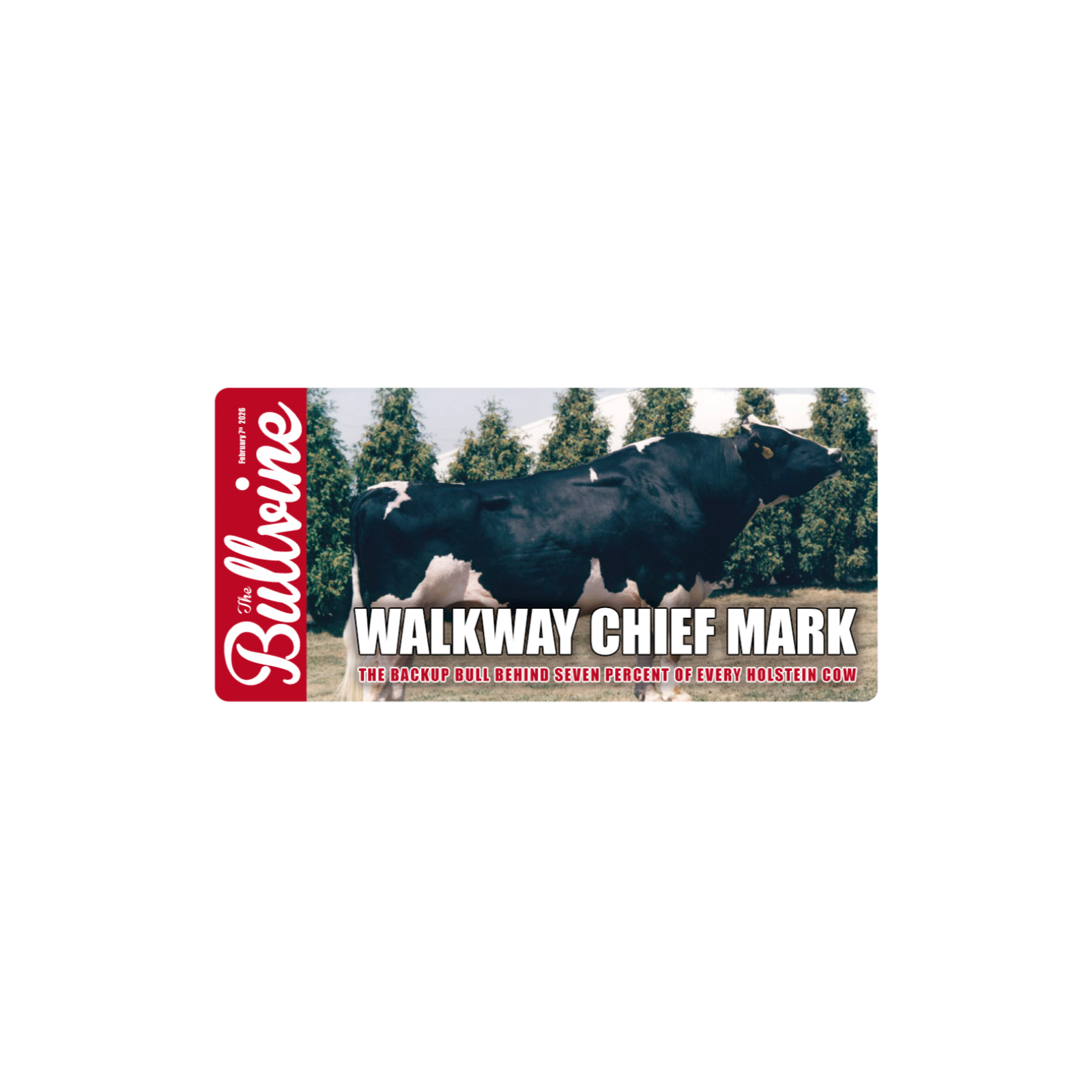
S1 Ep 484E484 Walkway Chief Mark: The Backup Bull Behind Seven Percent of Every Holstein Cow
Walkway Chief Mark was never supposed to be sampled. His brother Monroe was the plan — until Monroe died. One phone call from a young analyst named Charlie Will, who'd already been rejected by Select Sires himself, put a replacement calf from Foster Walk's modest Neoga, Illinois herd into the AI system. That calf's DNA now sits in roughly seven percent of every Holstein on the continent. This is the story of how a backup bull, a farmer with an eye for diamonds in the rough, and a rejected sire analyst accidentally reshaped the genetic architecture of an entire breed.Key Moments:How a dead brother and a rejected analyst converged on the same calf in 1978 — and why Charlie Will's first bull purchase for Select Sires became the most consequential in the organization's historyThe paradox that bewildered breeders for decades: era-defining udder improvement paired with some of the worst feet-and-leg scores in the breedThe moment Harris Lewin's team identified the APAF1 mutation in less than 24 hours — tracing half a million lost calves back to Chief Mark's sire, Pawnee Farm Arlinda ChiefWhy Chief Mark appears three times in Braedale Goldwyn's pedigree and twenty-five times in Farnear Delta-Lambda's — and what that concentration means for the modern breedThe $30 billion question: how one bull's genetic gifts outpaced his genetic costs by seventy to oneIf you milk Holsteins, Chief Mark is in your herd. Not as a historical footnote — as active, measurable DNA shaping the udders, the components, and the cow families you depend on today. His genetics flow through Goldwyn, whose daughters RF Goldwyn Hailey and Eastside Lewisdale Gold Missy became the most celebrated show cows of their generation. They flow through Seagull-Bay Supersire, the millionaire sire who dominated Select Sires' lineup. And they appear twenty-five times in the pedigree of Farnear Delta-Lambda, whose daughter West-Adub Lambda Sadie won Intermediate Champion at World Dairy Expo in 2025 — on red shavings just a hundred miles from Neoga.But this episode isn't only about genetics. It's about Foster Walk, a farmer whose Walkway prefix appeared in Holstein World ads two decades before his most famous calf was born. It's about Charlie Will, who grew up studying Foster's cattle, got turned down by Select Sires, took a territory in Wisconsin nobody wanted, and came back to buy the bull that launched his career — and earned him the 2025 NAAB Pioneer Award. And it's about the hidden costs that travel alongside greatness: the APAF1 mutation that silently killed an estimated 500,000 calves before scientists pinned it down, and the structural trade-offs that forced a generation of breeders to protect every mating or pay for brilliance below the hocks.Read the full feature article with photos, pedigree detail, and every cited source at https://www.thebullvine.com/sire-spotlight/walkway-chief-mark-the-backup-bull-behind-seven-percent-of-every-holstein-cow/ . For related stories, search for our profiles of Pawnee Farm Arlinda Chief, Braedale Goldwyn, Snow-N Denises Dellia, and Charlie Will. Subscribe to The Bullvine Podcast so you never miss a history episode — and share this one with someone who's seen Chief Mark's name in a hundred pedigrees without knowing the story behind it.
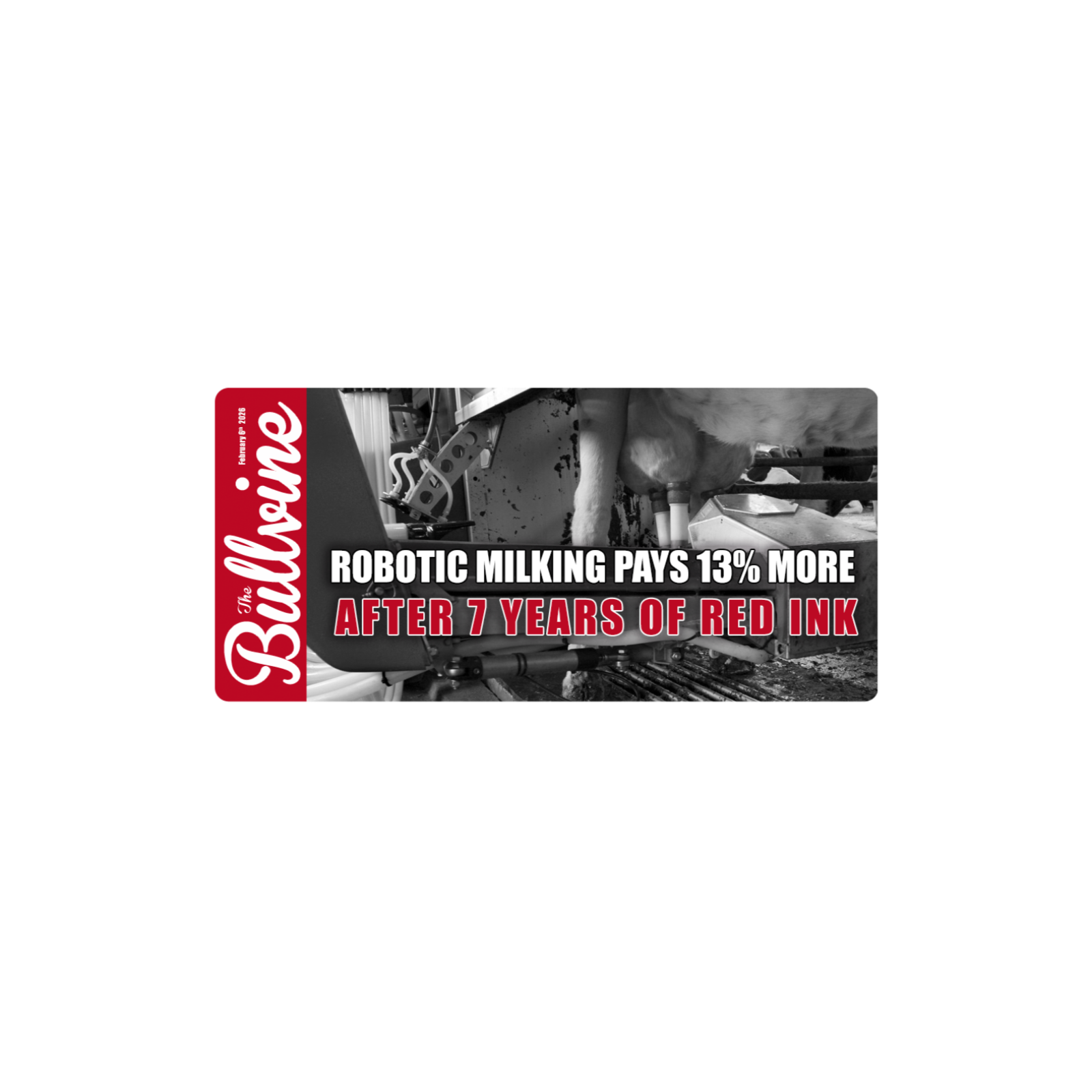
S1 Ep 483E483 Robotic Milking Pays 13% More – After 7 Years of Red Ink
Everyone’s heard the sales pitch: robotic milking boosts production, cuts labor, and “pays for itself.” The latest USDA data even says robots can lift net returns by roughly 13% on average. But buried under that headline is a hard reality most dealers never mention — many herds spend the first seven years in the red just trying to climb out of the cash flow hole. In this episode, The Bullvine takes a scalpel to the numbers, challenging the industry’s robot narrative and laying out a rigorous, economics-first framework to decide whether automation will actually make your dairy more profitable — or just more complicated.Key Takeaways· How USDA’s 2026 AMS profitability study really reads once you separate paper returns from cash flow reality.· The exact cost-per-cwt math comparing a well-run parlor to a box robot — and what that gap demands from production and labor.· Why many “10% production gain” stories are actually barn and cow-comfort wins, not robot miracles.· The maintenance curve nobody budgets for: what happens when annual robot costs jump from $5,000 to $10,000–$15,000 per unit.· Labor savings vs. mental load: why robots can cut hours and still leave you feeling like you’re “never done.”· The one number more predictive than milk per cow for AMS profitability — and how to benchmark your own herd against it.· Concrete decision rules for different starting points: 2X vs. 3X milking, retrofit vs. new build, 7-year vs. 20-year farming horizon.Why Listen This episode doesn’t recycle dealer talking points. It pulls together the newest USDA Economic Research Service report on precision dairy and robotic milking, field-tested cash flow models from Iowa State Extension, large-herd AMS survey data, and international research on farmer well‑being to deliver a brutally honest look at robot economics. You’ll hear how a “profitable” AMS investment on paper can still produce an $8,000+ annual cash flow gap once loan payments and real maintenance costs are factored in — and why a quarter of mature AMS herds report repair bills north of $15,000 per robot per year.For charts, tables, and the full article behind this episode, visit https://www.thebullvine.com/management/robotic-milking/robotic-milking-pays-13-more-after-7-years-of-red-ink/ and look for the feature on robotic milking economics and the 7‑year cash flow valley. Links to key studies and reference materials discussed in the show are available on the episode page.If this kind of data‑driven, myth‑busting analysis helps you think differently about your next investment, subscribe to The Bullvine Podcast and share this episode with someone on your team who’s talking to a robot dealer. Join the conversation with The Bullvine on social media and let us know: where does your cash flow sit in the robot debate, and what numbers are you watching most closely?
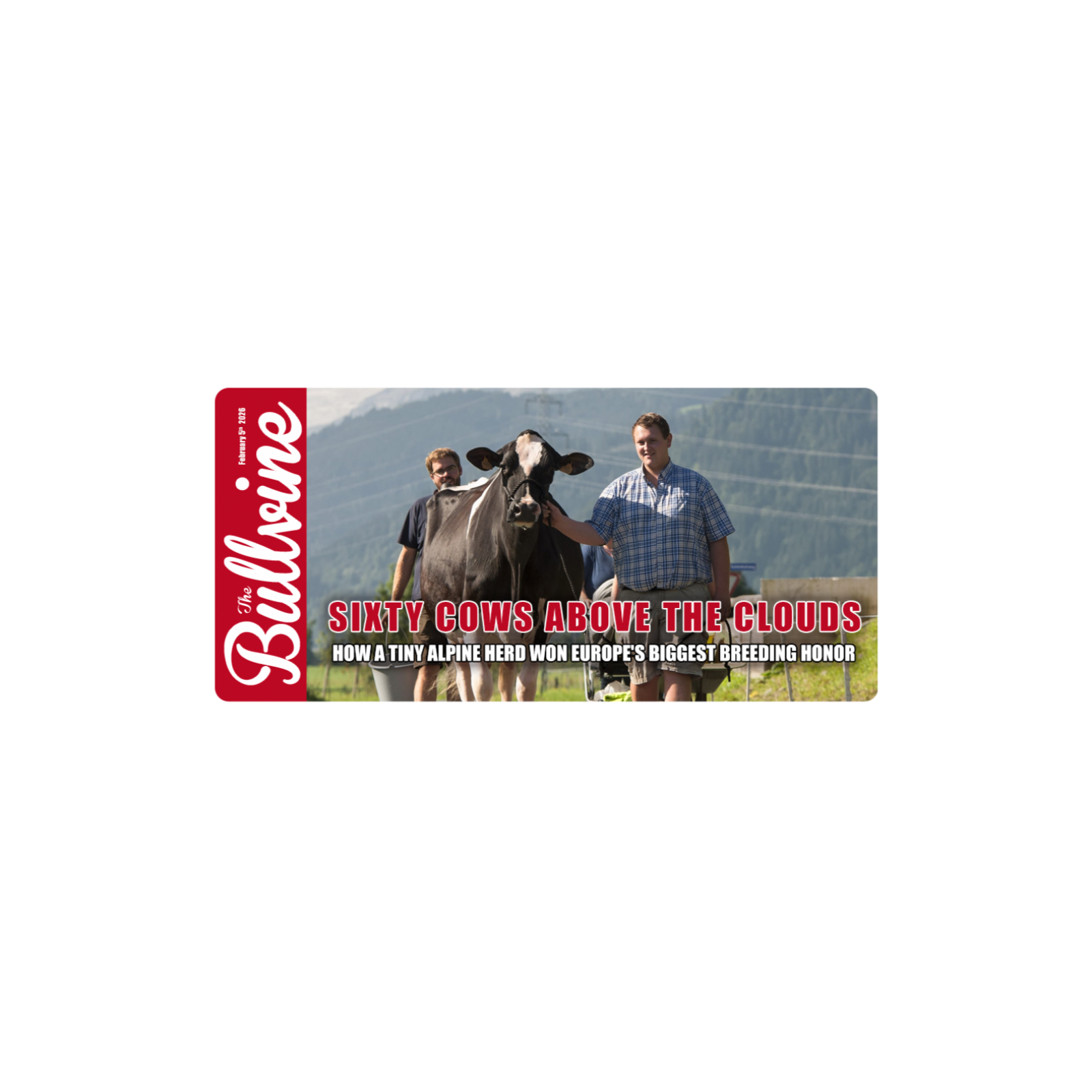
S1 Ep 482E482 Sixty Cows Above the Clouds: How a Tiny Alpine Herd Won Europe’s Biggest Breeding Honor
When Rupert Wenger was ten years old, his parents handed him a calf named Mailand. He had no idea that animal would reshape his entire life—or that twenty-two years later, he'd be standing with his family in their Austrian farmhouse kitchen, phones buzzing, tears welling, learning that their 60-cow herd had just been named European Breeder of the Year.Not by a narrow margin. By a landslide.In an industry obsessed with scale—where 2,800 American farms closed their doors last year and conventional wisdom insists you need a thousand cows to matter—one family in the Austrian Alps just proved everyone wrong.This is the story of how a "disadvantage" became an unbeatable moat, how a childhood gift became a genetic dynasty, and how patience compounded into something nobody saw coming. By the end of this episode, you'll be asking yourself: What am I apologizing for that I should be leveraging?The Story You'll HearThe moment the whole family learned they'd beaten Europe's biggest breeders—and why they almost couldn't believe itWhy Rupert's parents nearly sold the historic property to investors and walked away from farming entirelyThe "crazy" 2000 decision to abandon Fleckvieh for Holsteins in terrain everyone said would destroy themA calf gift at age ten that quietly became the foundation behind multiple championsThe cow whose loss still hurts—and what her journey from 7th place to Austrian National Champion taught Rupert about patienceWhen four elite sires all failed on the same cow family, and the gut instinct that produced DakotaThe hardest sale he ever made—setting a price he'd never asked before, then watching his cow win Reserve Grand Champion for someone elseHow fitting competitors' cattle led to friendships that transformed his breeding programThe alpine secret that lowland operations cannot replicate at any priceRupert Wenger is 32 years old. He milks 60 cows in Maishofen, Austria, where the Steinernes Meer rises 2,600 meters behind his family's barn and his father chairs the regional Holstein association in country that's historically favored Fleckvieh.The Wengers didn't fight their mountain location—they turned it into the reason elite buyers line up from across Europe. Every operation has something that makes it different. The question is whether you're apologizing for it or building your entire strategy around it.Read the full feature: Visit https://www.thebullvine.com/breeder-profiles/sixty-cows-above-the-clouds-how-a-tiny-alpine-herd-won-europes-biggest-breeding-honor/ and search "Sixty Cows Above the Clouds" for exclusive photos, the complete Rupert Wenger interview, and detailed breakdowns of the Schönhof genetic program.Subscribe to The Bullvine Podcast wherever you listen—new episodes drop regularly featuring the people and ideas shaping the future of dairy.Have a story worth telling? We want to hear from breeders, producers, and industry professionals doing things differently. Connect with us on social media or reach out through thebullvine.com.Because in the dairy industry, knowledge is profit.
S1 Ep 481E481 Dairy Calf Nutrition for Healthier, Higher‑Producing Cows
What if the weaning dip you've accepted as inevitable is actually a management decision you're making—weeks before it happens? New research reveals that a single week of scours in a calf's first month can cost you 350 kg (770 lbs) of milk in first lactation alone. That's not a treatment cost you'll see on this month's vet bill. It's a penalty that stays hidden for two years while silently compounding across your herd. This episode challenges the industry's "calves are fragile, budget for treatments" mindset and unpacks what progressive operations are doing differently—from ingredient consistency to stage-matched probiotics to one intervention that costs nothing but scheduling discipline.Key Takeaways:· Why the 350 kg milk penalty from early-life disease isn't hyperbole—and the peer-reviewed research backing it up· The hidden cost of least-cost formulations: how shifting ingredients disrupt rumen microbial development· Why using the same probiotic in milk replacer and starter is like planting the same crop in two different climates· The stress calendar approach: how separating dehorning, weaning, and vaccination prevents compounding immune suppression· Which operations should invest in systems-based calf programs—and which ones shouldn't bother· The uncomfortable truth about ROI timelines: why returns take 18–24 months to materialize and how to plan for itThis episode draws on research from some of the most respected names in calf nutrition science. Work from Dr. Michael Steele's group at the University of Guelph and Swedish researchers Svensson and Hultgren documents the staggering first-lactation milk losses tied to early-life health events. Dr. Alex Bach's findings on respiratory disease show survival rate differences of 10–20 percentage points between healthy calves and those treated for BRD before weaning. A 2025 study by Leal and colleagues confirms that suboptimal preweaning nutrition creates metabolic differences visible well into productive life.But this isn't just a research review. The episode breaks down practical application: why rumen bacteria are substrate-specific and can't simply "adapt" to constantly changing feed ingredients, how the sugar profiles in cane versus beet molasses create meaningfully different fermentation environments, and why the 2–4% cost premium for specification-guaranteed ingredients may be the smartest money you spend on calves.For the full article, research citations, and links to the studies discussed in this episode, visit https://www.thebullvine.com/management/nutrition/dairy-calf-nutrition-for-healthier-higher%e2%80%91producing-cows/. While you're there, explore our library of genetics, management, and nutrition content designed to keep progressive dairy operations ahead of the curve.
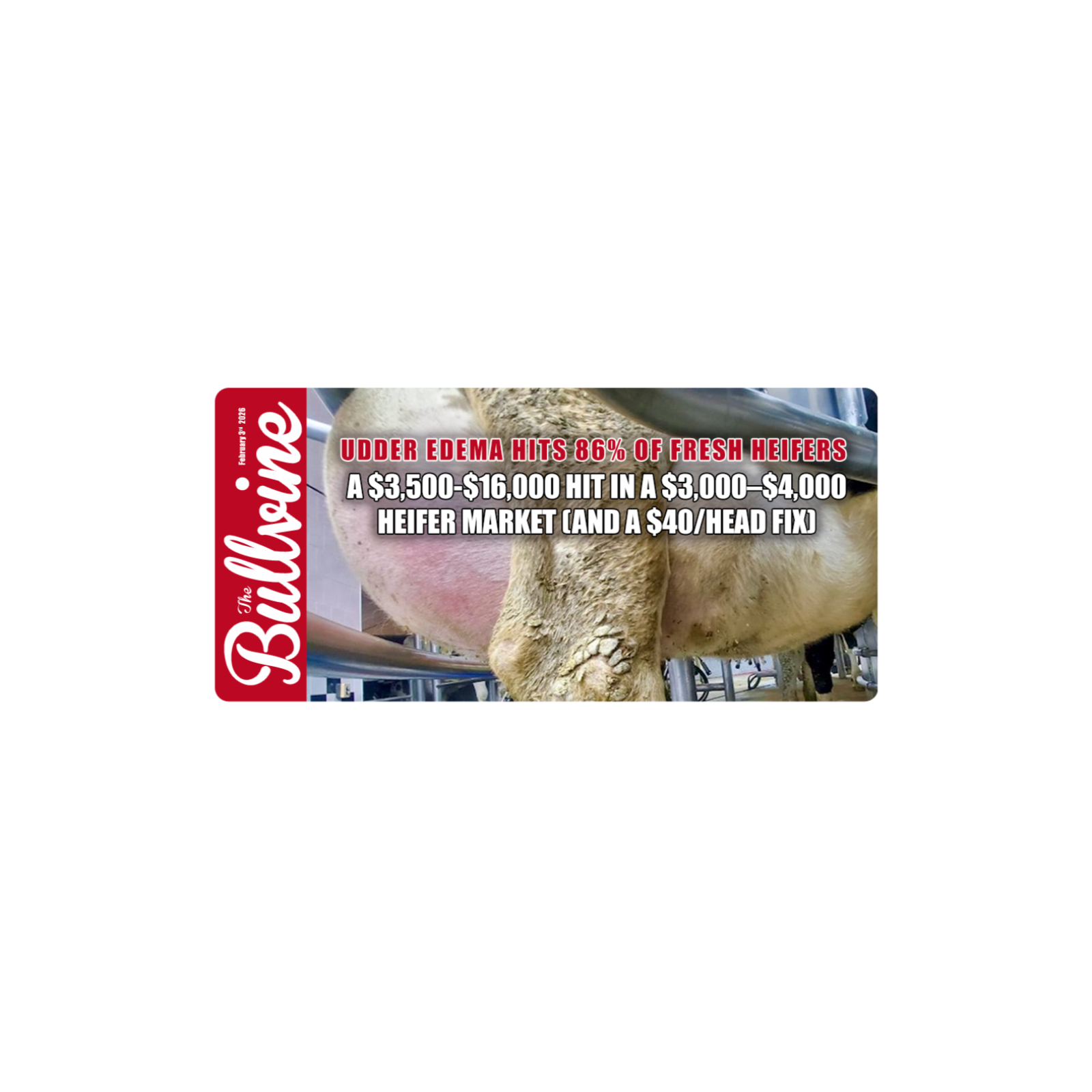
S1 Ep 480E480 Udder Edema Hits 86% of Fresh Heifers – A $3,500-$16,000 Hit in a $3,000–$4,000 Heifer Market (And a $40/Head Fix)
That swollen udder on your fresh heifer isn't "just how it is." It's a disease process — and in a market where replacement heifers cost $3,000–$4,000, it's bleeding money you can't afford to lose. Research published in the Journal of Dairy Science found udder edema in 86% of first-lactation heifers across commercial freestall herds. When you stack up milk loss, mastitis, slow-milkers, and early culls, the bill lands at $3,500–$16,000 per year on a 100-cow herd. This episode breaks down the economics, the biology, and the surprisingly affordable management fix that top herds are using to cut their edema rates in half.Key Takeaways:Why udder edema is a disease — not a cosmetic issue — and why treating it as "normal" is costing you thousands annuallyThe 2025–2026 heifer shortage reality: inventory at 20-year lows, prices nearly doubled in two years, and why every early cull now hurts more than everHow beef-on-dairy economics created a replacement pipeline crisis that won't recover until 2027The hidden opportunity cost: it's not just about buying replacements — it's about the surplus sales you'll never makeThree management levers that can push edema incidence from 70–90% down to 30–40% over 12–24 monthsThe 60%/15% decision rule: how to know when separating heifer diets moves from "nice to have" to "this month"Why feeding heifers the same prefresh ration as older dry cows is setting them up to failThe $40/heifer investment that's cheap insurance on a $4,000 animalThis episode connects transition cow health directly to your bottom line in ways most producers haven't fully calculated. We dig into Emma Morrison's landmark 2018 research showing just how prevalent udder edema really is — and why the downstream costs (mastitis, ketosis, dermatitis, early culling) compound far beyond the obvious milk loss.But here's what makes this episode urgent: the economics have shifted dramatically. CoBank's 2025 heifer inventory outlook shows U.S. dairy replacement numbers at their lowest since the late 1970s. USDA data confirms prices have climbed from around $1,700 in 2023 to $3,000–$4,000 today. Every heifer that flames out early — whether edema is the main driver or part of a bigger transition train wreck — is now a high-dollar asset you can't easily replace.You'll also get a simple scoring system and clear thresholds so you can assess your own herd and decide where edema management fits in your transition priorities. This is actionable intelligence you can implement on your next group of fresh heifers.The full article with cost breakdowns, the edema scoring system, and detailed management protocols is available at https://www.thebullvine.com/management/udder-edema-hits-86-of-fresh-heifers-a-3500-16000-hit-in-a-3000-4000-heifer-market-and-a-40-head-fix/.If this episode changes how you think about fresh-heifer management, share it with a fellow producer who's feeling the heifer squeeze. Subscribe to The Bullvine Podcast so you never miss an episode — we're here to challenge conventional wisdom and keep your operation profitable.
S1 Ep 479E479 Diane Hendricks: She Wasn’t Allowed to Milk Cows. Now She’s Worth Over $20 Billion.
She grew up on a small Wisconsin dairy where the rules were clear: the boys milked cows and drove tractor—the girls did not. She watched decisions being made at the kitchen table, knew the numbers, understood the risk, and loved the business, but was never once treated like a future owner. Years later, that “farm daughter” would build a company worth more than many co-ops combined. This episode steps into that gap between what she could have been on the farm and what she became off it—and asks what your operation might be losing in the same blind spot.The Story You’ll Hear· The childhood chore list that quietly decided who was “management material” and who wasn’t· The moment she realised the farm she loved would never truly be hers—and what that did to her drive· Why she left dairy, and how those early barn lessons still shaped every tough call she made in business· The bets she placed that most “experts” said were reckless, and why they worked anyway· What it felt like to outgrow the expectations her own family and community had set for her· How building a multi‑billion‑dollar company still traces back to one belief: treat people like owners, not hired hands· The unspoken cost to the original farm—and to our industry—when someone like this has to leave to be taken seriously· A simple, uncomfortable question every farm family should ask at the kitchen table tonightThis isn’t just the story of one woman who left a dairy and built a massive business; it’s a mirror for every family that has ever assumed “the farm will go to the son” without saying it out loud. It speaks to geneticists trying to move an operation forward but stuck inside old decision hierarchies, to farm kids who feel capable but sidelined, and to owners who know transition planning keeps getting pushed to “someday.” Her journey exposes how culture, not just economics, shapes who gets a real shot at leading—and how much value quietly walks down the laneway when people with ownership potential aren’t invited in. Listeners will not only hear a powerful personal story; they’ll feel the tension between loyalty to tradition and the need to build a future that doesn’t waste talent.For more on this story and the research behind it, visit https://www.thebullvine.com/dairy-industry/diane-hendricks-she-wasnt-allowed-to-milk-cows-now-shes-worth-over-20-billion/ to read the full profile and related articles on succession, leadership, and the hidden economics of who gets a chance to own. Subscribe to The Bullvine Podcast so you don’t miss upcoming episodes that dig into the human decisions behind genetics, technology, and profitability. If this episode hits close to home, share it with your family or team—and if you see your own story in it, we’d love to hear from you on The Bullvine website and social channels.

S1 Ep 478E478 The Importers: How 4 Visionaries in 30 Years Built the Foundation of Modern Holstein Genetics
Henry Stevens hadn't seen a cow in years. Illness had taken his sight in middle life. But every morning, he walked through his barn at Brookside Farm, running weathered fingers along toplines and udders, making breeding decisions that confounded rivals with perfect vision. His sons learned to trust their blind father's hands more than their own eyes. In 1912, a cow from his program became the first animal of any breed to produce 1,000 pounds of butterfat in a year. The blind man had seen further than anyone.This is the story of four visionaries who, in just 30 years, transformed an obscure Dutch dairy cow into the dominant force in global milk production. A Boston merchant who ordered replacement cattle the very day the government destroyed his herd. A reformer's grandson who walked his first Holsteins through October snow. Nurserymen who wanted manure for their orchards and accidentally changed an industry. And a blind farmer whose $6,000 gamble now echoes through approximately 7% of every Holstein on the planet.If you milk black-and-white cows, you milk their legacy. And this story will change how you think about the genetics in your barn.The Story You'll HearThe rum ship that docked in Boston Harbor in 1852—and the cow that changed everythingThe devastating cattle plague that destroyed one man's dream, and what he did the very same dayTwo buggies arriving at the same farmyard on the same afternoon—the founding moment of two dynastiesWhy fruit growers became the most important Holstein breeders in AmericaThe Madison Square Garden showdown where the Jersey trophy was pre-engraved—and what happened when the results came inThe bitter feud that tore a community apart but made the breed famousA blind man's hands finding what sighted eyes missedThe mansion fire that ended an era—and the legacy that survivedEvery mating decision you make builds on foundations these men laid 150 years ago. When you pull genomic proofs, you're tracing predictive power back to variation they established. When you check inbreeding coefficients pushing past 8-9%, you're navigating a genetic bottleneck that started in their barns.Subscribe to The Bullvine Podcast wherever you listen, and never miss a story that matters to your operation.Read the full feature article at https://www.thebullvine.com/breeder-profiles/the-importers-how-4-visionaries-in-30-years-built-the-foundation-of-modern-holstein-genetics/, including historical production records, traceable bloodlines to modern champions, and actionable insights for your 2026 breeding program.Have a story of your own? A mentor who changed everything, a decision that defined your herd, a moment when you saw something nobody else could? We want to hear it. Connect with us on social media or reach out through thebullvine.com.Because every registration number started with a handshake. Every great herd started with someone who believed.
S1 Ep 477E477 Dairy Farmers Face a 3.5x Higher Suicide Risk Than Farm Accidents – What Your Cows See First
Farmers are three-and-a-half times more likely to die by suicide than the general population, yet the industry still tracks every decimal of SCC while ignoring the metric that’s quietly taking out experienced operators. This episode cuts through the stigma and sentiment to look at farmer suicide as a hard business risk and a herd-health issue, not a side conversation. You’ll hear how stress shows up in your cows before it shows up in your charts, why the current economic math is pushing even strong dairies to the edge, and what a practical, numbers‑driven response actually looks like on farm.Key Takeaways* Why farmer suicide risk is 3.5x higher than the general population—and what the most credible data actually say.* How a 2021 robotic‑herd study links farmer stress directly to severe lameness, and why that matters to your bottom line.* The structural forces driving today’s mental‑health pressure: consolidation, tariff and policy shocks, labor costs, and succession dread.* How “off‑the‑books” suicides happen without a prior diagnosis—and why traditional mental‑health systems rarely catch farmers in time.* Concrete ways vets, nutritionists, and lenders become first‑line “mental‑health first aid” on the farms they already serve.* A simple, farm‑ready playbook: the 7/10 stress rule, what to watch for in your own data, and the exact question to ask when you’re worried about someone.This isn’t another vague “mental health matters” episode. It’s a hard look at suicide risk as an operational and strategic threat in modern dairy. We walk through the numbers that usually get buried: rural suicide trends, occupational death rates for agricultural managers, and how many farming‑related suicides never show up with a prior diagnosis or recent contact with the mental‑health system. Then we connect those numbers to something every serious dairy operator understands—herd data. You’ll hear how severe lameness, fresh‑cow problems, and slipping protocols often move in step with an owner’s stress level, and why lameness should be treated as both a welfare cost and a mental‑health KPI.The episode also unpacks the current economic squeeze with the same clarity you’d use for a capital‑purchase decision: long‑term attrition in states like Wisconsin, rising cost of production, realistic labor costs in the $30–35/hour range when everything is counted, and the psychological load of succession planning when there’s no clear next generation. Instead of stopping at diagnosis, we lay out what’s actually working: farmer‑specific counselling programs, telehealth and voucher models, peer‑support networks like Farmer Angel Network, and short, targeted trainings such as Mental Health First Aid and QPR that turn existing farm advisors into effective first responders. The goal is simple: give you enough data, context, and language to treat mental health with the same discipline you bring to reproduction, nutrition, and genetics.For links to the research, crisis resources, and The Bullvine feature article behind this episode, visit https://www.thebullvine.com/mental-health/dairy-farmers-face-a-3-5x-higher-suicide-risk-than-farm-accidents-what-your-cows-see-first/ and look for the full “Mental Health Is Herd Health” package. While you’re there, subscribe to The Bullvine’s free updates so you don’t miss future episodes that tie data, genetics, economics, and real‑world barn management together. If this conversation hits close to home—or if you’ve built something that’s working on your farm—join the discussion on The Bullvine’s social channels and Milkhouse community. Your experience, and your voice, might be exactly what keeps another producer in the barn lights.
S1 Ep 476E476 Where the Robots Hum and the Cows Stay Calm: The Four Oak Farms Way
It's 2 a.m. in July 2020. Marcus and Paige Dueck are standing in their tie-stall barn in rural Manitoba, staring at a machine they've never seen before—a rail-mounted robot that just rolled in from Quebec. The instructions are in French. The factory technicians are stuck at home because of COVID travel restrictions. And their newborn daughter is crying in the house.This was supposed to be the moment that changed everything. Instead, it felt like the moment that might break them."I took a deep breath and hoped we'd make it through the night," Paige remembers. "It definitely didn't feel like freedom at first."Five years later, their milk production is up 40%. They've won Manitoba's Outstanding Young Farmers award. And farmers across the Prairies are calling to ask how they did it.This is the story of what happens when you bet your family's future on something everyone says can't be done—and what it actually takes to prove them wrong.The Story You'll HearThe crossroads moment: a new baby, aging parents ready to step back, and a farm that couldn't afford to expandWhy they chose a technology no one in Western Canada had ever triedThe French instruction manual, the absent technicians, and the 72 hours that nearly broke themWhat Paige means when she says "we had to learn the robot's language"The unexpected reason they started replacing Holsteins with Brown Swiss—and it started with Marcus's mom falling in love at a cattle showHow milking three times a day changed everything without adding a single cowThe consulting business that grew from one favour for a neighbourPaige's horse-world connections and the German baler that turned hay into a safety netWhat the Outstanding Young Farmers application forced them to finally confrontThe conversation about "chasing size vs. chasing sanity" that every farm family needs to haveMarcus and Paige Dueck aren't industry celebrities. They're a young couple in their 30s running a mid-sized dairy near Kleefeld, Manitoba, trying to raise kids while keeping a family operation alive in an era when that's getting harder every year.Their story matters because it challenges one of dairy's most persistent assumptions: that you need a new free-stall barn, a bigger herd, or deep pockets to make robotics work. Four Oak Farms proves otherwise. They retrofitted an old tie-stall barn with a Quebec-built Robomax—a rail-mounted robot that travels stall to stall—and turned limitations into leverage.Subscribe to The Bullvine Podcast on Apple Podcasts, Spotify, or wherever you listen—and never miss a story that could change how you think about your operation.Read the full feature on Marcus and Paige Dueck at https://www.thebullvine.com/breeder-profiles/where-the-robots-hum-and-the-cows-stay-calm-the-four-oak-farms-way/, along with related articles on robotic milking, Brown Swiss genetics, and building diversified farm revenue streams.Got a story of your own? A moment that changed everything, a bet that paid off, or a lesson you learned the hard way? We want to hear it. Reach out on social media or email us through The Bullvine website. The best stories in dairy aren't always the biggest—they're the ones that make other farmers stop and think.
S1 Ep 475E475 38.8% Turnover Is Bleeding Dairies Dry. These Dairy Neighbours Turned Kitchen Tables into Labor Plans.
Dairy labor turnover now averages 38.8% a year in the U.S., quietly stripping profit, stability, and succession options out of herds that otherwise look “fine” on paper. This episode pulls apart the real economics of churn and then does what most industry talk doesn’t—it shows how progressive producers are rebuilding their labor models from the kitchen table out. If you’ve ever felt one resignation away from crisis, this conversation will challenge your assumptions about robots, wages, immigration, and “just hiring better people,” and give you practical models you can adapt on your own farm.Key Takeaways· Why a 38.8% turnover rate is not just a labor headache but a major hidden cost center for dairy operations of all sizes.· How to estimate the real cost of losing one experienced employee, including recruiting, retraining, SCC, repro, and cull-rate impacts.· Four community-driven labor models that are actually working on real farms—beyond “just pay more” or “just buy a robot.”· How immigration support circles and legal pathways can stabilize long‑term workers and protect the skills your herd depends on.· What separates successful robot transitions from expensive disappointments when it comes to labor relief and family quality of life.· How high-retention wage and housing strategies can reduce churn and build a crew that shows up for you—and your neighbours—when it counts.· The surprising role refugee and newcomer partnerships can play in solving chronic labor gaps in dairy regions.· A simple decision rule to know when your turnover is no longer “normal” and it’s time to redesign your labor strategy, not just repost the job ad.For deeper detail on the data and farm models discussed in this episode, visit https://www.thebullvine.com/management/38-8-turnover-is-bleeding-dairies-dry-these-dairy-neighbours-turned-kitchen-tables-into-labor-plans/ to read the full feature article and explore related resources on labor, automation, economics, and long-term herd strategy. While you’re there, subscribe to The Bullvine newsletter so you don’t miss future episodes and analysis that put real numbers behind dairy decisions.If this episode gives you something to think about for your own operation, subscribe to The Bullvine Podcast on your favorite platform and leave a rating so more producers can find it. Links to key articles and referenced studies are available on the episode page at TheBullvine.com. Join the conversation on social media by sharing how you’re tackling labor on your farm and tagging The Bullvine—your next idea or collaboration partner might start there.
S1 Ep 474E474 $30 Million, Co‑ops, and Genetic ROI: Who Really Keeps Your Dairy Barn Lights On
It's 1973, and New England dairy farmers just pulled off something that wasn't supposed to happen—$30 million in negotiated premiums in less than two years. Then they lost it all. Not to processors. Not to consumers. To each other, chasing nickels when they could have held out for dollars.This episode isn't about nostalgia. It's about a question you're facing right now, every time you look at a new milk contract: What does this do for my cash flow today—and what does it do to my community's bargaining power tomorrow?From a tired kid in a Connecticut vo-ag classroom to a widow who refused to let an AI company disappear into a candy merger, to a vet in Iowa who bet everything on embryo transfer when neighbours thought it was science fiction—these are the people who built the leverage, the genetics, and the communities that still decide which barns stay lit.By the end of this episode, you'll think differently about your next contract, your semen tank, and the people you'd call at 2 a.m. when everything goes sideways.The Story You'll Hear:The vo-ag teacher who closed the door after class and slid an economics book toward a kid who smelled like the barn—and changed 40 years of milk pricing in his regionWhy $30 million in hard-won premiums vanished, and the brutal lesson Louis Longo never forgotThe clause a candy company widow insisted on—and the day she walked into the president's office of an AI company no one expected her to runParachute semen drops into Indiana backyards, and the clothesline that got hit by mistakePigeons carrying thermoses of genetics across Japan—and why "fair" conception rates were a miracleThe 1980 Iowa bet on embryo transfer that became Trans Ova GeneticsThe question every producer should ask before signing their next milk contractThis episode is for anyone who's ever wondered whether showing up to one more co-op meeting actually matters, whether their genetics investments are paying off, or whether the "soft stuff"—neighbours, mentors, late-night phone calls—actually shows up on the balance sheet.Read the full article with the "nickels vs. dollars" contract framework and the 7-day community checklist at https://www.thebullvine.com/dairy-industry-professionals/30-million-co%e2%80%91ops-and-genetic-roi-who-really-keeps-your-dairy-barn-lights-on/Subscribe to The Bullvine Podcast so you never miss an episode. Share this one with a neighbour, a young farmer, or someone in your co-op who needs to hear it.Have a story about someone who kept your barn lights on? We want to hear it. Connect with us on social media or email [email protected].
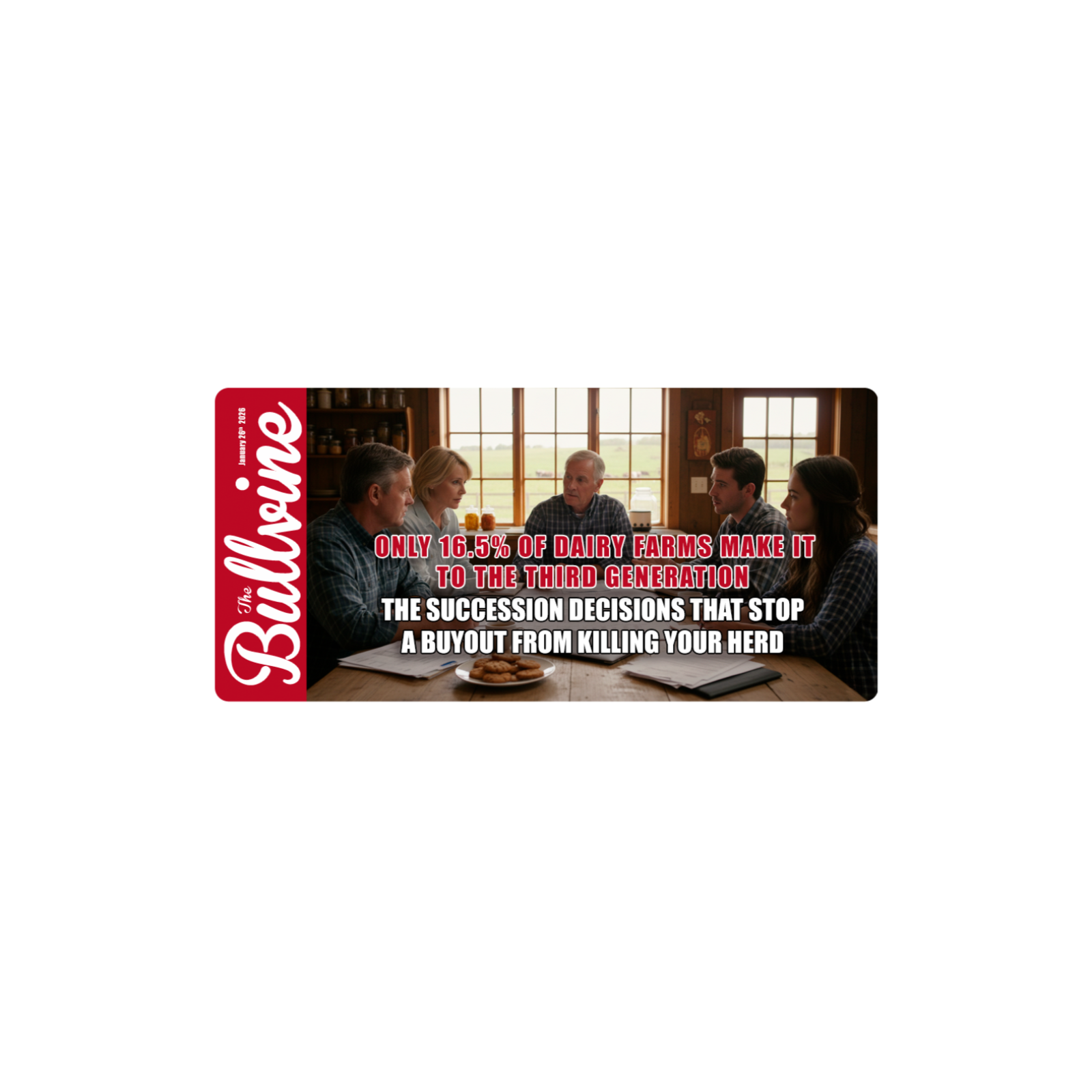
S1 Ep 473E473 Only 16.5% of Dairy Farms Make It to the Third Generation – The Succession Decisions That Stop a Buyout from Killing Your Herd
Most dairy families say they want to keep the farm in the family. But the hard data tells a different story: only about 16.5% of family farms actually make it to a third generation of ownership. The culprit isn't a lack of love for the land or the cows—it's a succession model that was designed for a different era. When a traditional "equal shares at full appraised value" buyout loads $600–$750 of debt onto every cow in a business earning a 2% return on assets, you're not planning a transition. You're planning a dispersal in slow motion. This episode breaks down what the families who beat those odds actually do differently—and why most of the conventional wisdom around farm succession is quietly setting operations up to fail.Key Takeaways:Why the "30/13/3" family business survival rule matters for your dairy—and how Tennessee researchers arrived at the 16.5% third-generation figureHow a "fair" full-value buyout can consume nearly all of a herd's annual net return in debt service aloneThe timing decision that separates survivors from the rest: why starting in your 50s beats scrambling at 68Why off-farm experience for successors is an asset, not a threat—and what "absorptive capacity" research tells us about leadershipThe difference between building a leader and just giving more jobs to the person who never says noHow holding/operating company structures, staged buy-ins, and land-lease arrangements can align retirement, fairness, and herd survivalThe "fair vs. equal" conversation: tools like sweat equity recognition and life insurance that balance outcomes without crushing the farmWhy coordinated advisory teams—accountants, lawyers, lenders, and coaches in the same room—prevent six-figure mistakesNon-family succession options when there's no heir in the barn: land-link programs, staged leases, and the Transition Incentives ProgramThe full feature article with all the numbers, the seven-decision framework, and a downloadable action checklist is available at https://www.thebullvine.com/management/only-16-5-of-dairy-farms-make-it-to-the-third-generation-the-succession-decisions-that-stop-a-buyout-from-killing-your-herd/. Head there for links to the FINBIN data, FCC fairness articles, Teagasc resources, and Tennessee's succession workbook referenced in this episode.Subscribe to The Bullvine Podcast so you never miss an episode. Share this one with a fellow producer who's thinking about what comes next for their herd—sometimes the best thing you can do is give someone permission to start a hard conversation.Join the conversation on Facebook and let us know: Where are you in your succession journey? What's the biggest obstacle you're facing? We read every comment.
S1 Ep 472E472 Locked from the Inside: Dairy’s Darkest Crimes and the Weak Spots They Exploited
A barn is burning on a cold February morning. Holsteins are screaming inside, the doors are locked from within, and a Cadillac sits at the road with its engine running while sixty head die in the flames. A few decades later, a semen straw labeled “Roybrook Telstar” turns out to be dishwater—and an Angus calf hits the straw instead of a Holstein. Then a $7,500 cow gets insured for $250,000, and two showmen are dead by their own hands within a week. These aren’t urban legends; they’re real stories pulled from Holstein history. And once you’ve heard how they happened, you’ll never look at your own paperwork, partners, or policies the same way again.The Story You’ll HearThe barn fire where the doors were locked from the inside, the calves were insured for $50,000 each, and neighbors watched a Cadillac instead of a rescue.The “friendly” buyer at the lane who knew your cows better than you did—and cashed cheques on a town that didn’t even exist.The semen dealer who refilled high‑priced straws with dishwater and cheap semen, and how a single Angus calf blew open a $500,000 fraud.The county meat racket that turned deadstock and downers into stamped “Approved” meat—and how the renderers spotted it before regulators did.The Holstein trader whose eye for a cow built great herds—but whose hot cheques and rule‑bending forced everyone around him to pick a side.The big‑name breeder whose insured cows kept dying, the son who refused to sign a false claim, and the family that paid the price.The young showman who over‑insured three cows, chased banners he couldn’t afford, and ended up as a cautionary tale no one in the tanbark world can quite shake.Underneath all the drama, this episode is really about something every dairy person lives with: trust. Trust in the buyer at the lane, trust in the cheque, trust in the semen tank, trust in the inspector’s stamp, trust in the partner who says “sign here, I’ve got it handled.” These seven stories stretch from the 1920s to the 1990s, but the weak spots they expose haven’t moved much—paperwork nobody reads closely, values nobody dares question, and a culture that sometimes puts “he’s a good cow man” ahead of “is this actually safe for my business and my family.” Whether you’re running 60 cows or 6,000, grinding genetic spreadsheets or hauling milk to town, you’ll hear pieces of your own world in these cases. You’ll feel the tension in the kitchen‑table decisions, the sick feeling when the numbers don’t add up, and the quiet courage it takes to say “no” when everyone else wants you to look the other way. This isn’t just crime history—it’s a mirror for how we run our farms, our co‑ops, and our reputations.To dive deeper into the cases we talk about in this episode, read the full feature article “Locked from the Inside: Dairy’s Darkest Crimes and the Weak Spots They Exploited” at https://www.thebullvine.com/breeder-profiles/locked-from-the-inside-dairys-darkest-crimes-and-the-weak-spots-they-exploited/, where you’ll also find related articles, numbers, and tools to pressure‑test your own systems. If this episode hits close to home—or reminds you of a story from your own county—we’d love to hear from you. Subscribe to The Bullvine Podcast so you don’t miss future episodes, and connect with us on social to share your experience, your questions, or the moment you decided where your own line was.
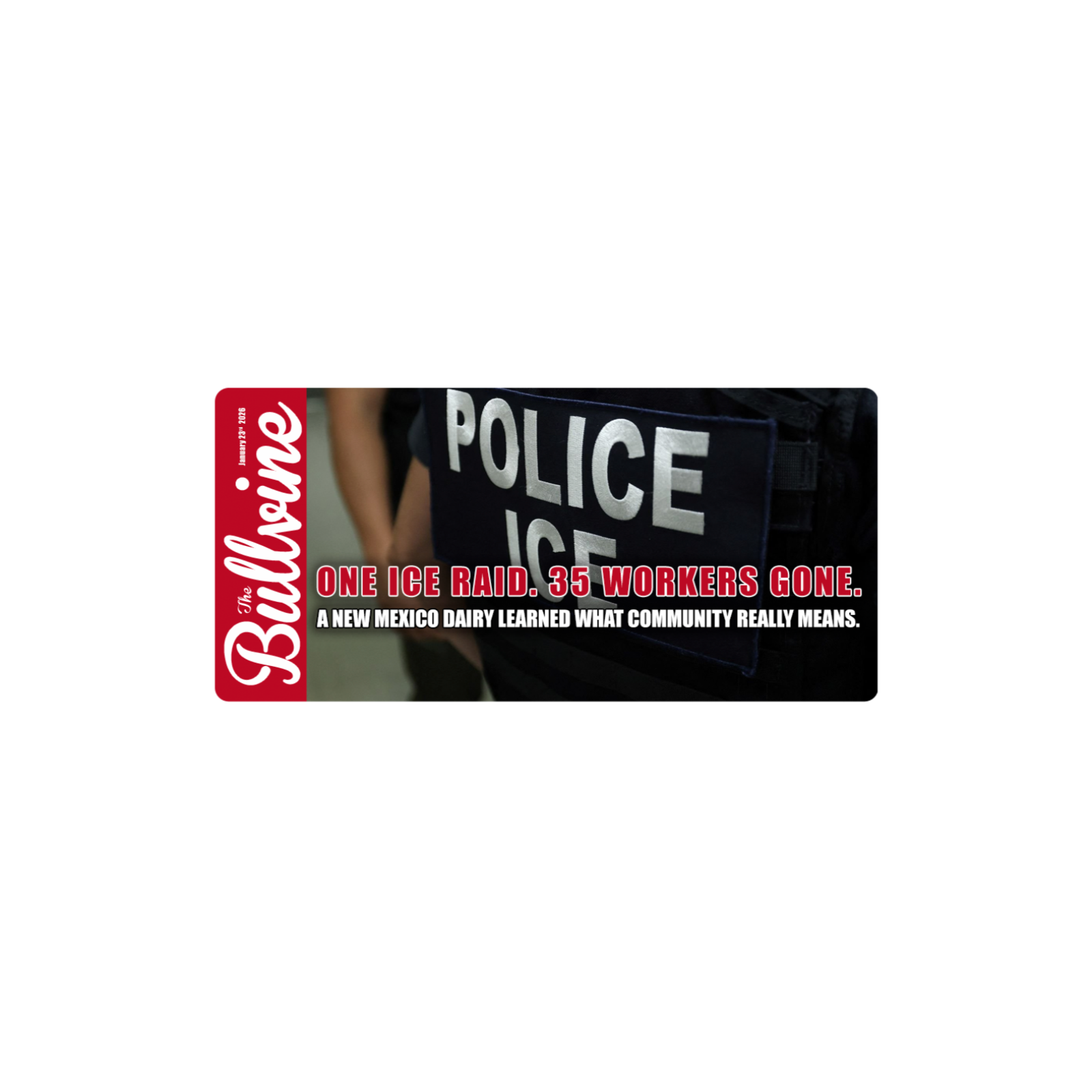
S1 Ep 471E471 One ICE Raid. 35 Workers Gone. A New Mexico Dairy Learned What Community Really Means.
June 4, 2025, started like any other morning at Outlook Dairy in Lovington, New Mexico. Cows lined up. Units clanked on. Spanish and English mixed over the familiar hum of the parlor. By sunset, 35 of 55 workers were gone—detained or terminated in a single federal enforcement action. Production had effectively ceased. The owner's own words: "We're barely able to keep going."But this isn't a story about politics or policy. It's about what happened next. It's about the neighbours who showed up before anyone called, the teenagers who traded summer break for scraping alleys, and the quiet ways a community refused to let one farm carry the crisis alone.If you've ever wondered who would show up on your worst day—or whose call you'd answer—this episode will change how you think about the people around your operation.The Story You'll Hear:The morning everything changed—and the math every listener will do in their own headWhat "production effectively ceased" actually looks like when cows still need to be milkedThe 35 workers who weren't just labour—they were neighbours, parents, and friendsWhy the local feed mill, church, and grocery store all felt the shockwaveThe teenagers and office staff who suddenly became the crewWhat happened at a town hall when a governor, church leaders, and school staff sat in the same roomThe industry-wide reality no one wants to face: who actually milks America's cowsThe quiet, unglamorous acts of community that never made the news but changed everythingA kitchen-table question that every producer needs to answer before the next crisis hitsRead the full feature article and explore related resources on dairy labour, community resilience, and workforce planning at https://www.thebullvine.com/politics/one-ice-raid-35-workers-gone-a-new-mexico-dairy-learned-what-community-really-means/Subscribe to The Bullvine Podcast so you never miss an episode. New stories drop regularly—profiles, insights, and conversations that make dairy producers and the industry more profitable.Have a story about community showing up on your operation's hardest day? We want to hear it. Connect with us on Facebook, Instagram, or X, and share what neighbours mean on your lane. Your story might be the one that helps another producer feel less alone.
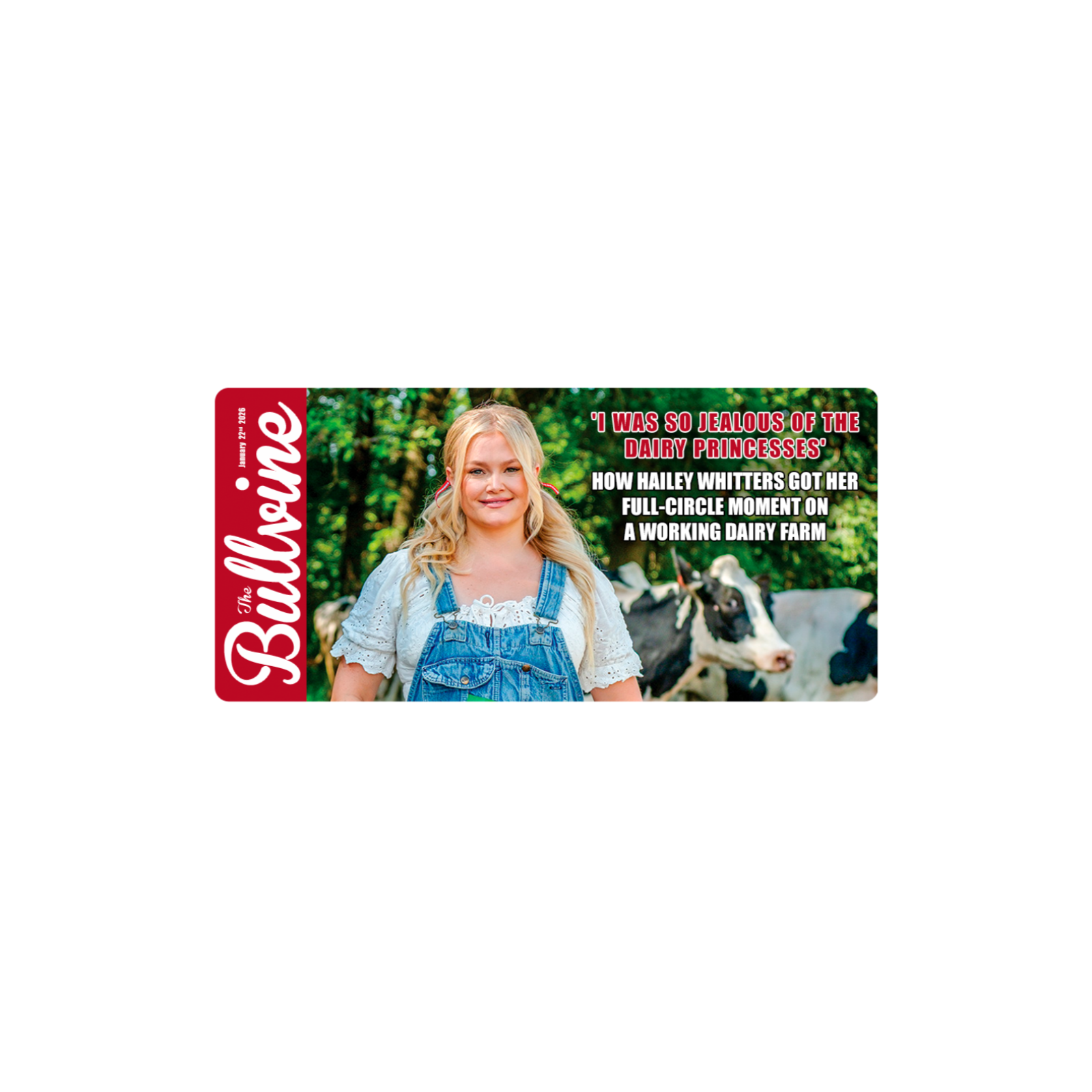
S1 Ep 470E470 ‘I Was So Jealous of the Dairy Princesses’: How Hailey Whitters Got Her Full-Circle Moment on a Working Dairy Farm
She was the kid in the baby blue trailer at the edge of an Iowa cornfield, standing at the fair fence line, watching the dairy princesses ride past on the float she’d never be allowed on. Her dad farmed corn and soybeans, not cows, so the crown—and the butter bust—were “never in the cards.” Two decades later, after twelve years of “not yet” in Nashville, that same “corn kid” walked into a working Land O’Lakes member dairy farm with a guitar on her back and cameras rolling. By the time she crouched down to talk to the calves and started playing to Holsteins with a cornfield behind them, it wasn’t a marketing gimmick anymore. It was a full‑circle moment that says as much about rural communities and dairy families as it does about one rising country star—and it might change how you think about your own legacy, whether your kids come back to the parlor or not.The Story You’ll HearThe moment a little girl at the county fair realized she’d never qualify as a dairy princess—and why that stung more than she let on.The baby blue trailer, the night shifts at the plant, and the kind of “keep showing up” work ethic that feels very familiar to anyone who’s ever milked through a bad year.The first trip to Nashville that made her feel like she’d landed on another planet—and the kitchen‑table conversation where she told her parents she was leaving anyway.Twelve years of closed doors, side jobs, and watching everyone else get the big breaks while the bills stacked up and the doubt got louder.The “Ten Year Town” moment when she almost walked away—and what pulled her back into the writing room instead.How a song about eminent domain and losing farms in western Iowa shook her—and why “Middle of America” sounds uncomfortably familiar if you’ve ever watched development creep toward your fenceline.The phone call that put her on a Land O’Lakes member dairy farm with a guitar, a camera crew, and a bunch of cows who didn’t care about charts or streaming numbers. What happened in the parlor and calf pens that proved she wasn’t just another celebrity tourist on a farm set.The quiet ways her hometown still shows up—texts, bar TVs, fairgrounds conversations—and how that mirrors the way dairy communities rally when the headlights line up in the lane.Three small, practical things any producer can do this year to keep their own community from fraying at the edges.On paper, Hailey Whitters is a country artist with a breakout record and a brand partnership. In reality, she’s a farm‑kid‑adjacent “corn queen” who grew up in the same kind of rural web that keeps a lot of dairies alive when the numbers say they shouldn’t be. Her story doesn’t dodge the hard parts: years of rejection that feel a lot like sending in another milk cheque that doesn’t quite cover everything, watching your peers seem to sprint ahead, wondering whether the life you’ve built is actually going anywhere.Read the full feature on Hailey Whitters’ dairy detour (https://www.thebullvine.com/dairy-industry/i-was-so-jealous-of-the-dairy-princesses-how-hailey-whitters-got-her-full-circle-moment-on-a-working-dairy-farm/), and explore more community‑driven stories from the barn aisle, visit thebullvine.com. While you’re there, you’ll find related articles on succession, mental health, and building stronger rural networks, plus tools to spark conversations in your own herd, family, or boardroom.

S1 Ep 469E469 How Your Ketosis Cut‑Point Is Leaking $25,000 a Year – And the Fresh Cow Playbook to Stop It
Most herds still treat the 1.2 mmol/L ketosis cut-point as a hard line: if a fresh cow tests over 1.2, she gets drenched—no questions asked. The problem is, the economics and the latest research strongly suggest that this blanket rule is quietly draining $25,000–$35,000 a year from a typical 500-cow herd while still missing the cows that matter most. In this episode of The Bullvine Podcast, we unpack why the “treat every cow over 1.2” strategy is outdated, how timing, parity, body condition, and system type completely change what a BHB number means, and what a modern, data-driven ketosis playbook looks like for herds that want both healthier fresh cows and stronger margins.Key Takeaways· Why the traditional 1.2 mmol/L subclinical ketosis cut-point was never designed to be a one-size-fits-all treatment trigger.· How realistic cost-per-case models turn “a few ketotic cows” into a $25,000–$35,000 annual hole in a 500-cow herd’s bottom line.· The crucial difference between a 1.3 reading on day 5 in a fat, fourth-lactation cow and the same 1.3 on day 15 in a high-output second-calver.· How global data on subclinical ketosis prevalence redefines what “normal” looks like—and why “normal” is often not good enough.· A practical, risk-based framework for deciding which cows to test, which cows to treat, and when to simply monitor and retest.· How to use rumination collars, milk components, and MIR-based ketosis risk traits as screening tools, not automatic treatment engines.· Why the biggest ketosis gains still come from transition fundamentals—body condition, stocking rate, bunk space, and cooling—not just more propylene glycol.· How emerging genetic tools like MIR-derived pHYK traits can help build “ketosis-resilient” cows over the next decade.If you’re ready to move beyond “treat every cow over 1.2” and build a ketosis strategy that actually protects your margins, this is an episode you don’t want to skip. For related articles, charts, and links to the research and economic models discussed, visit https://www.thebullvine.com/management/how-your-ketosis-cut%e2%80%91point-is-leaking-25000-a-year-and-the-fresh-cow-playbook-to-stop-it/ and search for the ketosis playbook feature.Subscribe to The Bullvine Podcast on Apple Podcasts so you never miss an episode focused on real numbers, real cows, and real-world profitability.Join the conversation on social media—share how you’re managing ketosis in your herd, what’s working, and where you’re still seeing challenges. Tag The Bullvine and let’s push the dairy industry forward together with data, innovation, and smarter fresh cow decisions.

S1 Ep 468E468 They Kept the Barn Lights On
The drought had already taken the cows. Then came the day the office closed and thirteen people waited to hear if they still had jobs. In another barn, a wife’s empty chair at the kitchen table made the next milking feel heavier than any pail. Somewhere else, a young breeder was told, “You’re not good enough,” by the very people who were supposed to believe in him. This episode drops you into those moments—when walking away would’ve been easier, maybe even smarter on paper—and follows the people who chose to stay, persist, or show up for someone else instead. Their choices will change how you think about resilience, loyalty, and what really keeps your own operation going.The Story You’ll Hear· The drought years that wiped out a herd—and the quiet promise to find a job for every last employee.· The phone call that turned “you’re done here” into the first step of a far bigger impact on the dairy world.· Why one husband walked back into the lab after losing the person who’d carried the home side of the farm for decades.· The moment a simple “come along with me” kept a young cow kid from leaving the industry entirely.· How a lifetime of small habits—Christmas cards, barn visits, late-night phone calls—added up to the kind of community you can’t put on a balance sheet.· What happens when genetics, research, and showring success are driven less by ego and more by a stubborn commitment to help the next person in line.This isn’t a highlight reel of trophies and titles; it’s a look at the parts of dairy we don’t usually say out loud—the doubts, the grief, the moments when the numbers say “quit” and the people around you say “keep going.” The episode follows National Dairy Shrine Pioneers whose lives stretched from ten cows milked by hand to global genetics, from small-town beginnings to research that changed human health. Their credentials are impressive, sure, but what makes their stories powerful is how they handled loss, risk, and responsibility when no one was watching.Whether you’re breeding the next generation of show winners, crunching data on fertility and health, or just trying to get chores done before the school bus arrives, you’ll hear yourself in these decisions: Who do you help when the pressure hits? How do you lead when you’re exhausted? Where do you find the courage to pivot instead of fold? This episode offers not just ideas you can steal for your own business, but also a gut-check on what success really means in an industry that never stops asking for more.When the drought, the diagnosis, or the market crash hits your farm, will the story people tell about you be that you protected your own position—or that you were the one who kept the barn lights on for everyone else?For more on the people featured in this episode, visit https://www.thebullvine.com/breeder-profiles/they-kept-the-barn-lights-on/ to read the full written profiles and dig into related articles, insights, and resources that build on the themes you’ll hear today. If this conversation hits close to home, subscribe or follow The Bullvine Podcast on Apple Podcasts and wherever you listen so you don’t miss upcoming stories. And if you’ve lived your own version of this journey, share it with us—reach out through The Bullvine website or connect on social media. Your story might be the one that keeps someone else’s barn lights on.
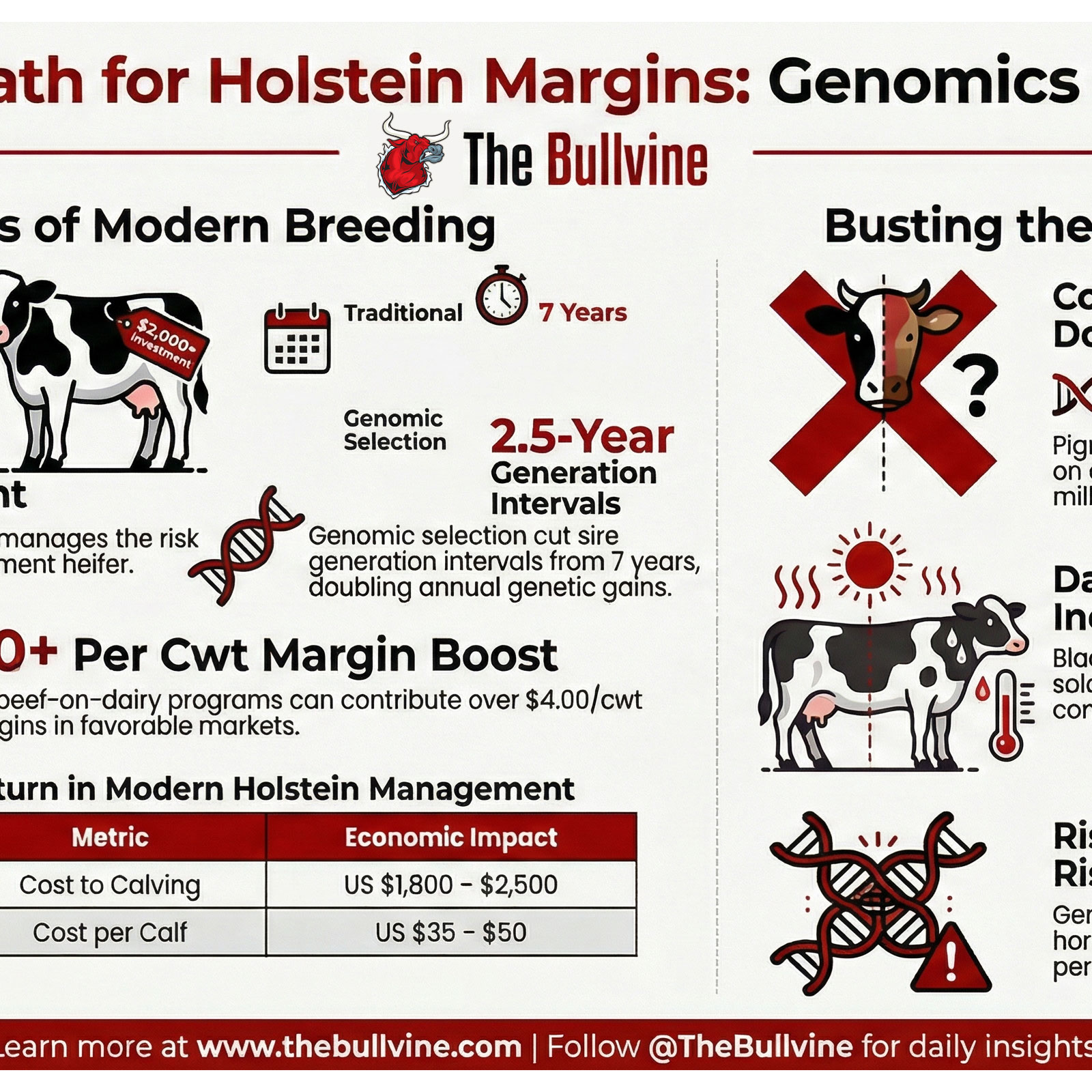
S1 Ep 467E467 Stop Breeding by Color: Genomics, Heat Stress and Beef‑on‑Dairy Math That Can Add Over $4/cwt to Holstein Margins
Most of us were taught to trust our eye and our “kind” when picking Holstein heifers. But what if breeding by coat color and style is quietly costing you real money in 2025? In this episode of The Bullvine Podcast, we dig into genomic data, heat-stress research, and beef-on-dairy economics that challenge some of the most deeply held assumptions in dairy breeding. You’ll hear how the genes that control color are not the genes that drive milk and fertility, why genomic selection has doubled genetic gain while accelerating inbreeding, and how a smarter semen and replacement strategy can unlock more than $4 per hundredweight in some herds.Key Takeaways· Why pigment genes like MC1R and COPA have almost nothing to do with the main milk and fertility loci driving Net Merit, Pro$ and other profit indexes.· How genomic selection cut sire generation intervals nearly in half and doubled genetic progress in Holsteins—while also pushing genomic inbreeding and ROH higher each year.· Where coat color really does matter: the impact of darker coats on heat load, THI, milk yield, and components in hot climates and dry-lot systems.· How 2025 beef-on-dairy modelling shows cull cows and beef-on-dairy calves can contribute $4+/cwt to margins in well-managed herds, changing the math on which cows get beef semen.· A practical, step-by-step breeding playbook: one-year “test every heifer” genomics, using a single economic index as your compass, genomic mating to manage inbreeding, and aligning sexed Holstein vs beef semen with true replacement needs.· Why your eye is still essential—but as a fresh-cow and daily management tool—while genomics and economics take over more of the long-term selection decisions.For show notes, links to the featured research, and the full Bullvine feature article behind this episode, visit https://www.thebullvine.com/genetics/stop-breeding-by-color-genomics-heat-stress-and-beef%e2%80%91on%e2%80%91dairy-math-that-can-add-over-4-cwt-to-holstein-margins/. If you’re serious about genetics, margins, and staying ahead of the next wave of dairy innovation, make sure you follow The Bullvine Podcast on Apple Podcasts and your preferred platform. Share your thoughts, questions, and on-farm experiences with genomics, heat stress and beef-on-dairy on our social channels—tag The Bullvine on Facebook and X so your ideas can shape future episodes.
S1 Ep 466E466 Snowboots Wis Milky Way: From Gunny Sack Calf to Everyone’s Favorite Brood Cow
Picture this: a two‑month‑old heifer shoved into a gunny sack, riding home on the back seat of a car from a Kansas wheat farm. She’d just sold for seventy‑five dollars in a package deal, placed 21st out of 22 the first time she ever hit a show ring, and almost stayed a 4‑H project no one outside the county fair would remember. That calf became Snowboots Wis Milky Way—EX‑97‑3E‑GMD—and the brood cow behind one of the most influential sires of the 20th century. This episode walks through the decisions, risks, and near‑misses that turned “just another heifer” into a cow whose influence still runs through modern pedigrees—and it might change how you look at the cows standing in your own pen tonight.The Story You’ll HearThe local district show where Snowboots placed second‑last—and why that didn’t stop one breeder from seeing something everyone else missed.The sleepless night a Kansas dairyman spent deciding whether to sell the best cow he’d ever owned, and the reason he finally let her go.The moment Snowboots walked into Paclamar and stood stall‑to‑stall with Harborcrest Rose Milly, setting up one of the greatest two‑cow lineups the Holstein breed has ever seen.The day Paclamar took both Grand and Reserve at Waterloo—and how it felt in the ring when “the old friend” was still winning at nearly twelve years of age.The breeding decision that made no sense on paper: mating one of the top cows in the breed to an unproven young bull, simply because the cow families “felt right.”The dispersal where Bootmaker didn’t impress at first glance, and why the early daughters nearly scared his biggest supporters away.How those same daughters quietly turned into 100 Gold Medal Dams, anchoring cow families from Colorado to Europe.The night Snowboots died in her box stall—no drama, no struggle—and what the people who worked with her every day still say about her temperament and heart.The Italian branch of the family: the Snowboots granddaughter who sold for $20,000, crossed the ocean, and produced a three‑time national champion.The Bigger Question - If a $75 heifer in a gunny sack could end up shaping cow families and sire summaries for decades, what might you be walking past in your own barn today because it doesn’t fit the current fashion or the latest index?To dive deeper into Snowboots Wis Milky Way, Paclamar Bootmaker, and the cow families featured in this episode, visit https://www.thebullvine.com/donor-profile/snowboots-wis-milky-way-from-gunny-sack-calf-to-everyones-favorite-brood-cow/ for the full written profile, photos, and related articles. While you’re there, subscribe to The Bullvine Podcast so you never miss a story that challenges how you think about cows, breeding, and the future of your herd.Have a brood cow, bull, or breeder story you think the industry needs to hear? Share it with us on The Bullvine’s social channels and keep the conversation going.
E465 Unlock $700 Per Cow: The Rumen Microbiome Strategy That Fixes Hidden Feed Efficiency Losses.
Your ration balances perfectly on paper. Your genetics are proven. So why does the bulk tank keep coming up short? A groundbreaking 2024 AI study reveals that the rumen microbiome—not your feed ingredients—accounts for 36% of the variation in feed efficiency among Holstein cows. That's a factor as powerful as genetics and diet combined, yet most operations aren't managing it. This episode exposes the three everyday management gaps quietly draining your tank and lays out a four-phase playbook that progressive herds are using to recover $500–700 per cow annually. If you've ever blamed the ration when the real problem was the routine, this is the episode that changes how you think about feeding cows.Key TakeawaysWhy the rumen microbiome now rivals genetics and ration formulation as a driver of feed efficiency—and what that means for your marginsThe "Saturday Morning Problem": How weekend feed-time drift and overnight bunk gaps cost 3.5 lb of DMI and 7.9 lb of milk per cow per dayTMR dry matter swings: The silent profit thief nobody tests often enoughParticle size and sorting: Why your cows may be eating three different rations from the same bunkThe four-phase microbiome-aware playbook: timing, physical ration, DM checks, then additives—in that orderWhy live yeast and buffers can't fix bad timing or a sortable rationReal economics: Modeling $500,000–700,000 in recoverable margin on a 1,000-cow herdHow this approach scales from 80-cow tiestalls to 8,000-cow dry lot systemsThis episode challenges the assumption that a balanced ration equals optimized performance. Drawing on peer-reviewed research from UC Davis, Penn State extension data, and real-world herd observations, we break down exactly how inconsistent feeding routines destabilize the microbial communities inside your cows—and what that instability costs in milk, butterfat, and dollars.You'll hear how a 10-hour overnight feed gap triggers slug-feeding behavior that crashes rumen pH and washes out fiber-digesting bacteria. We quantify what happens when TMR moisture drifts unnoticed and when cows sort around long particles to eat a starch-heavy diet you never intended.More importantly, we deliver a clear, phased action plan. Phase 1: tighten feed delivery and push-ups. Phase 2: tune particle size with the Penn State Separator. Phase 3: make weekly DM checks routine. Phase 4: layer in live yeast as a fine-tuning tool—not a band-aid.The economic modeling is specific and conservative. Even capturing half the projected upside represents a six-figure annual swing for larger operations. For smaller family herds, the per-cow math is identical—and the advantage is that you're already walking the alleys every day.We also address where this approach goes wrong: partial implementation, overestimating labor capacity, and expecting additives to solve structural problems. This isn't theory. It's a prioritization framework built on data that helps you decide where your next management tweak should be.Ready to put this into action? Visit https://www.thebullvine.com/management/nutrition/unlock-700-per-cow-the-rumen-microbiome-strategy-that-fixes-hidden-feed-efficiency-losses/ to read the full feature article, download the practical starting checklist, and access links to the research cited in this episode.
S1 Ep 464E464 Same Tag, Different Feed: The Molasses Problem Your Calves Can’t Tell You About
Your calf starter's guaranteed analysis says "molasses." What it doesn't say is whether this batch contains 39% sugar or 67%—a swing documented in peer-reviewed research that represents one of the widest compositional variances in animal nutrition. This episode challenges a dangerous assumption most producers make: that identical feed tags deliver identical nutrition. They don't. And for operations investing $5-6 per day raising replacement heifers, that hidden variability may be the difference between calves that survive and calves that thrive. If you've ever noticed performance dips that don't match management changes, unexplained intake variability, or inconsistent weaning results—this episode reveals what might actually be driving those patterns.Key Takeaways:Why molasses sucrose content can swing 28 percentage points between batches—and what that means for rumen developmentThe functional differences between cane and beet molasses that feed tags never specifyHow DCAD variability in molasses affects calves differently than mature cows—and why their limited buffering capacity mattersThe subtle performance indicators that signal ingredient inconsistency before clinical problems appearFive specific questions to ask your feed supplier that reveal their true commitment to qualityA 90-day monitoring approach to identify variability effects without waiting for first-lactation dataThe economic case for ingredient consistency: calculating hidden costs most producers never trackWhy the supply chain makes consistency challenging—and what "Fixed-Process Assurance" actually meansThis episode dissects research from the Journal of Dairy Science (Palmonari et al., 2020) that systematically characterized molasses samples from suppliers worldwide. The findings are striking: crude protein ranges from 2.2% to 15.6% depending on source, potassium varies nearly threefold, and DCAD swings over 200 milliequivalents between batches.But here's what makes this episode essential listening: we connect the science to your calf barn. At typical inclusion rates of 5-7% of starter dry matter, these swings won't cause dramatic clinical crises. Instead, they manifest as the subtle inconsistencies that frustrate calf managers—intake curves that fluctuate after new deliveries, variable manure in older hutch calves, uneven weaning performance.We examine field observations from Upper Midwest dairies where tracking feed deliveries against calf metrics revealed performance dips aligning with new starter batches—often because molasses sources changed without notification. Operations that switched to fixed-formulation starters reported smoother intake curves and more predictable outcomes.The complete article with all research citations, comparison tables, and the full supplier question framework is available at https://www.thebullvine.com/management/nutrition/same-tag-different-feed-the-molasses-problem-your-calves-cant-tell-you-about/. Search "Same Tag Different Feed" or check the show notes for direct links.Share this episode with your nutritionist, calf manager, or feed rep. Tag us on social media with your thoughts: Are you tracking feed deliveries against calf performance? What patterns have you noticed?The Bullvine – Because satisfactory satisfies no one.

S1 Ep 463E463 The Decade Rule: Francisco Rodriguez on Breeding Champions
In 2006, Francisco Rodriguez didn't own a single registered cow. He was a kid from the Colombian hills who fell asleep studying North American bull catalogues, dreaming of championships he had no business chasing. Seventeen years later, cars were honking and crowds were literally chanting his cow's name as Shakira claimed Supreme Champion at World Dairy Expo. But standing there on the colored shavings, Francisco wasn't thinking about the banner. He was thinking about his wife's words a few years earlier: "Francisco, I'm done." This is the story of a man who learned that breeding world-class cows and building a world-class life require the same thing—patience measured in decades, not proof runs. And it might change how you think about what you're really building.The Story You'll Hear:The moment a young vet walked away from a safe career to start a herd with 10 cows and a dream his neighbors thought was crazyWhy he spent years memorizing cow families before he could afford to own one—and how that obsession became his edgeThe car ride with a Canadian Holstein legend that gave him the only breeding advice he'd ever needHow a single mating decision in 2014 launched a ten-year journey to the Supreme bannerThe phone call from his wife that forced him to choose between his ambition and his familyWhat Michael Jordan taught him about success—and why he now refuses to let business consume more than 25% of his lifeThe "shower moment" in Colombia when watching his next champion win finally gave him language for what he'd been living all alongWhy he believes embryos are transformation and semen is evolution—and what that means for your herd's next decadeFrancisco Rodriguez isn't just a breeder who got lucky with one cow. He's a fifth-generation cattleman who built Colganados from 10 cows to 400, bred roughly half of Colombia's national champions in the last decade, co-founded a tropical genetics company now operating across three continents, and still nearly watched his marriage collapse because he couldn't stop chasing the next win.His story matters because it's the story every ambitious producer is living in some version right now—grinding through tight margins, heat stress, processor uncertainty, and the quiet question of whether any of it is actually building toward something that lasts.In a year when GLP-1 drugs are reshaping demand, heat waves are costing farms real milk every July, and processors are getting pickier about who they keep, Francisco's "Decade Rule" isn't just philosophy. It's a survival framework for anyone asking: Am I breeding for the next ribbon, or for the next ten years?You'll hear how he balances genomics with old-school eye, why he line-breeds to Apple without losing sleep, and how his 25-25-25-25 life framework—You, God, Relationships, Create—pulled his family back from the edge.Subscribe to The Bullvine Podcast wherever you listen, and head to https://www.thebullvine.com/breeder-profiles/the-decade-rule-francisco-rodriguez-on-breeding-champions/ to read the full feature article on Francisco Rodriguez and the Decade Rule. You'll find the complete timeline from Shakira to Marsella, his breeding philosophy in detail, and exclusive photos from Colombia to Madison.Because the best stories in this industry aren't just about cows. They're about the people stubborn enough to keep believing in them.
S1 Ep 462E462 The Bullvine Dairy Curve: 15,000 U.S. Farms by 2035 and Under 10,000 by 2050 – Who’s Still Milking?
By 2035, roughly 15,000 U.S. dairies will be doing the work that nearly 30,000 did a generation ago. By 2050? We're looking at well under 10,000 herds. This isn't worst-case speculation—it's the middle of the road, based on the same 4% annual decline USDA's Economic Research Service has tracked for over two decades. In this episode, we introduce the Bullvine Dairy Curve: a structural forecast and decision-making framework that shows exactly who survives consolidation—and who gets priced out. If you're running a dairy operation today, this episode lays out the math, the paths, and the five questions you need to answer before the curve answers them for you.Key Takeaways:Why 15,000–16,000 U.S. farms by 2035 and under 10,000 by 2050 is now the baseline—not the worst caseHow Canada's dairy sector tracks a similar path: from 9,256 farms today toward 6,500 by 2035 and 4,000–5,000 by 2050The three structural paths: business-as-usual, faster consolidation, and managed transition—and what drives eachWhy the 150–500 cow "middle" faces the sharpest squeeze, with $75,000–$100,000/year in structural losses for herds running average costsThe only herd size class that actually grew between 2017 and 2022—and what that signals for processor and lender behaviorWhy robots amplify whatever is already in your numbers—and when AMS makes sense vs. when it automates a lossHow to reframe "strategic exit" as harvesting equity, not admitting defeatThe five barn-level questions every producer must answer: lane choice, true cost per cwt, tech ROI, succession, and regional strategyThis episode unpacks the Bullvine Dairy Curve using hard data from the 2017 and 2022 Census of Agriculture, USDA Economic Research Service reports, and Agriculture and Agri-Food Canada's Dairy Sector Profile. Almost 40% of U.S. dairies disappeared between 2017 and 2022—yet total milk production increased. The litres aren't vanishing; they're concentrating into larger freestall and dry-lot systems as processors build $11 billion in new capacity around mega-suppliers, not 300-cow herds.For mid-size operations, the math is brutal. A 300-cow herd running "average" costs and fully exposed to commodity pricing can bleed over $100,000 a year once full labour and capital costs are counted. That's not a bad year—that's structure. The episode walks through a real-world example of a 320-cow Upper Midwest herd that discovered a $0.72/cwt gap they didn't know existed.Finally, we reframe the exit conversation. In every other sector, cashing out when equity is strong is called a successful business cycle. If the curve shows your cost structure is hitting a ceiling, executing a strategic exit is leadership—not failure. It protects generational wealth and lets you define your legacy on your terms, not the bank's.Read the full Bullvine Dairy Curve article, including the three-path scenario table and $100k squeeze breakdown, at https://www.thebullvine.com/dairy-markets/the-bullvine-dairy-curve-15000-u-s-farms-by-2035-and-under-10000-by-2050-whos-still-milking/ Subscribe to The Bullvine Podcast so you never miss an episode. Share this one with a neighbor, a lender, or a family member—these are the kitchen-table conversations that shape what dairy looks like in 2035.

S1 Ep 461E461 Did Genomics Really Deliver What We Think It Did? $238,000 Says Yes – If You Steer It Right
Genomics was supposed to revolutionize dairy breeding—but did it actually show up on your bottom line, or just in semen catalogs and sale flyers? This episode of The Bullvine Podcast digs into hard data from Canadian Holstein herds, modern LPI and Pro$ indexes, and real-world breeding strategies to answer a blunt question: are you truly cashing in on genomic progress, or quietly breeding yourself into higher inbreeding, fragile cows, and lost lifetime profit? Expect a data-driven, no‑fluff breakdown of what genomics has delivered, where it’s gone off-course, and how to redirect it toward cows that last longer, breed back better, and make more money per stall.Key Takeaways· How genomic selection has changed the rate of genetic gain for milk, fat, protein, health, and longevity—and what that actually means in dollars per cow.· Why many herds still fail to capture the full profit potential of genomics, despite using “top” bulls and high-index semen.· How modern LPI and Pro$—and their subindexes—expose the trade‑offs between production, fertility, health, and environmental impact that most proof lists hide.· The quiet cost of rising inbreeding, tighter pedigrees, and overuse of a few elite families—plus what that does to fertility, robustness, and cull rates.· The role of fertility haplotypes and recessive defects, and how ignoring them can silently drain pregnancies and calf value from your herd.· Practical strategies progressive herds use to cap inbreeding, avoid risky matings, and blend “rocket fuel” sires with “workhorse” bulls that protect functional traits.· A realistic roadmap for turning genomic information into an extra five to six figures in lifetime profit in a 400‑cow Holstein herd.This episode challenges the comfortable assumption that “genomics is working because indexes are higher.” Instead, it connects the dots between genetic trends, herd data, and cash flow. You’ll hear how the most‑used Holstein sires in Canada have shifted over the past 15+ years, what their LPI and Pro$ numbers really imply for lifetime profit, and where the gaps still are on Reproduction, Health & Welfare, and Environmental Impact. The discussion breaks down how faster genetic gain has come with a tighter gene pool and higher inbreeding—and why that matters when you’re fighting for pregnancy rate, longevity, and cows that survive past third lactation.For more articles, genetic analyses, and practical breeding frameworks, visit The Bullvine where you’ll find related pieces and references mentioned in this episode. Check https://www.thebullvine.com/genomics/did-genomics-really-deliver-what-we-think-it-did-238000-says-yes-if-you-steer-it-right/ to supporting resources, charts, and further reading on LPI, Pro$, inbreeding, and genomic strategies. If this conversation challenged how you think about genetics and profitability, subscribe to The Bullvine Podcast on Apple Podcasts so you don’t miss future episodes. Join the discussion on social media by sharing your questions, results, and breeding strategies—tag The Bullvine and be part of pushing dairy genetics toward smarter, more profitable innovation.
S1 Ep 460E460 Harborcrest Rose Milly: From Pig Money to Holstein Royalty
It's 1954, and a young Ohio farmer named John Snoddy walks out of an auction barn with a gangly, too-leggy heifer that cost him $375—every cent he made selling market hogs that fall. His neighbors laugh. His wife hopes they haven't wasted the pig money. The heifer doesn't look like much of anything.Seven years later, a man named Dick Brooks sees that heifer's daughter walking over a hillside in West Salem, Ohio, and refuses to leave until she's his. Fifteen years after that, her genetics are flowing into virtually every Holstein herd in North America through a bull calf that sold for a "disappointing" $9,000—a calf who became the most-proven sire in U.S. history.This is the story of Harborcrest Rose Milly, the three-time All-American who scored 97 points when that number meant something almost impossible. But more than that, it's the story of two breeders who saw what others missed—and bet everything on their own eyes.If you've ever looked at an animal and felt something the neighbors couldn't see, this episode is for you.The Story You'll HearThe auction night that started with pig money and ended with a heifer everyone regrettedWhy buyers walked past the same heifer for years—and what John Snoddy kept seeing that they didn'tThe moment Dick Brooks watched cows come over a hill and forgot why he'd come to OhioTwo days of negotiation between friends who both knew exactly what was at stakeThe barn where Milly stood next to her greatest rival and they pushed each other toward historyThirty ballots, thirty firsts—the unanimous All-American that wouldn't be matched for sixteen yearsA sickly bull calf nobody wanted at $9,000 who became the foundation of modern Holstein geneticsThe heartbreaking final calving that ended a dynastyWhy you can't find a high-genomic Holstein today that doesn't trace back to that pig money gambleThis episode isn't just about a legendary cow. It's about the courage it takes to trust your own judgment when everyone around you thinks you're wrong. It's about the patience required to let a breeding program prove itself over years, not months. And it's about the genetic ripples that flow from one good decision across generations of cattle and the people who raise them.Milly's story illuminates something every serious breeder wrestles with: the tension between what the market wants today and what genetics can become tomorrow. She was too leggy when leggy wasn't fashionable. Her son looked sickly at sale time. But the genetics didn't care about fashion or first impressions.What are you seeing in your barn right now that others are walking past? And do you have the patience—and the courage—to find out if you're right?Subscribe to The Bullvine Podcast wherever you listen, and visit https://www.thebullvine.com/donor-profile/harborcrest-rose-milly-from-pig-money-to-holstein-royalty/ to read the full profile of Harborcrest Rose Milly, explore her pedigree, and discover related stories of the cattle and breeders who shaped our industry.Have a story about a cow or a breeder who changed your perspective? We want to hear it. Connect with us on social media or reach out through thebullvine.com. The best stories in dairy aren't always the ones that made the headlines—sometimes they're the ones that happened in a barn when nobody else was watching.
S1 Ep 459E459 438,000 Missing Heifers. $4,100 Price Tags. Beef-on-Dairy’s Reckoning Has Arrived.
The math looked irresistible in 2023. Breed to beef, pocket $400-800 per calf, skip the $40 sexed semen straw. But biology operates on a 30-month timeline—and now that bill is coming due. U.S. dairy faces a structural deficit of 438,844 replacement heifers in 2026, heifer prices have doubled to over $4,100 per head, and the industry is accelerating toward a consolidation that will reshape who survives by decade's end. This episode breaks down exactly what happened, which strategies are actually working, and why the decisions you make in the next 6-12 months could determine your operation's future.Key Takeaways:Why the 438,844-heifer deficit is structural, not cyclical—and can't be reversed quicklyThe real math behind $4,100 heifers: what this means for a 500-cow dairy's bottom lineExtended lactation protocols: which cows qualify and how farms are cutting replacement needs by 15-25%The tiered breeding strategy progressive operations are using to capture beef premiums without mining their futureWhy processors are suddenly offering heifer financing at 4-6% and equipment subsidies—and how long this leverage window stays openThe two business models that will dominate dairy by 2028 (and what's happening to everyone in the middle)When strategic exit beats survival: the indicators that suggest selling at peak cattle prices preserves more family wealthRegional dynamics: why this plays out differently in Wisconsin vs. Texas vs. the NortheastDeeper Dive – Why Listen:This episode goes beyond headlines to deliver the analysis dairy producers actually need. Drawing on CoBank's latest research from lead dairy economist Corey Geiger, University of Florida modeling from Dr. Albert De Vries, and reproduction insights from UW-Madison's Dr. Paul Fricke, we examine why breeding decisions made 30 months ago have locked in today's shortage—and what that means for your planning horizon through 2028.The data is sobering: a 500-cow dairy that spent $241,000 on replacements two years ago now faces $532,000-588,000 in annual heifer costs. Custom heifer raisers across the Upper Midwest are fully booked through 2026. And with $11 billion in new processing capacity coming online, processors are offering partnership terms that would have been unthinkable three years ago—but only through Q1-Q2 2026.We hear directly from producers navigating this reality, including a Wisconsin dairyman processing a $4,100 heifer quote and a Minnesota couple who netted $1.4 million by timing their exit strategically. Whether you're planning to grow, position for a niche market, or evaluating whether this is the right time to transition out of dairy, this episode provides the framework and data to make that decision with clarity.This isn't theory. It's the roadmap for an industry in structural transition—delivered with the depth and candor The Bullvine is known for.Resources & Engagement:The full written analysis, including data tables, expert source links, and the CoBank research cited in this episode, is available at https://www.thebullvine.com/beef-on-dairy/438000-missing-heifers-4100-price-tags-beef-on-dairys-reckoning-has-arrived/.Subscribe to The Bullvine Podcast so you never miss an episode. New insights on genetics, profitability, and dairy's future drop regularly.Biology doesn't negotiate. But smart producers adapt. Hit play.
S1 Ep 458E458 Robert Chicoine and the Bull Nobody Wanted: The Data Revolution That Lives in Your Herd’s DNA
It's 1967, and a young geneticist is staring at an advertisement that makes his heart race. Three generations of proven excellence. Indices that promise something extraordinary. But when he brings this bull to Quebec's breeding community, they laugh him off. The dam's photo is disappointing. Her coat is speckled—meaning hours of tedious hand-drawing on registration forms. Nobody wants to deal with that.So this bull becomes a last resort. Used only when farmers don't bother to name a specific choice.What nobody could see then—what only the numbers revealed—was that this rejected animal would go on to shape more than half of all contemporary Canadian Holsteins. His genetics would flow through Madison Grand Champions. His legacy would prove that everything the industry believed about evaluating cattle was fundamentally incomplete.This is a story about trusting what you can measure over what you can see. And it might change how you think about every breeding decision you'll make tomorrow.The Story You'll Hear:The monthly gift from an uncle that sparked an obsession no one expectedA flock of Bantam chickens that became a farm boy's first genetics laboratoryThe university lecture that shattered everything he thought he knew about evaluating cattleTwenty years of patient persuasion against an industry that insisted he was wrongThe auction bid that brought home a bull the market had already dismissedThe anxious wait for proof—and the vindication that came eleven years laterA sacred rule broken, and the million-dose legend it producedThe corporate crisis that saw a general manager walk out—and the alliance forged from the wreckageOne breeding decision in 1972 that wouldn't reveal its significance for seven generationsWhy This Story Matters:Robert Chicoine grew up on a modest Quebec mixed farm, drawing cattle portraits for registration papers and memorizing pedigrees from borrowed journals. He wasn't born into industry power. He earned his influence through six decades of being right when conventional wisdom was wrong.His story illuminates a tension every modern breeder faces: the pull between what looks impressive and what the data actually shows. In an era of genomic selection, when we're asked to trust indices we can't see expressed in living animals, Chicoine's battles feel urgently relevant.But this isn't just a story about genetics. It's about patience when your strategy doesn't deliver immediate results. About building alliances when fragmentation threatens survival. About recognizing that your most impactful decisions may not reveal themselves for decades.You'll hear how a rejected bull named Senator became Quebec's best-kept genetic secret. How breaking a sacred industry rule produced one of the most-used bulls in Holstein history. How a conversation in France planted seeds that became the Semex Alliance.Resources & Engagement:Read the complete feature article at https://www.thebullvine.com/dairy-industry-professionals/robert-chicoine-and-the-bull-nobody-wanted-the-data-revolution-that-lives-in-your-herds-dna/, including rare photographs from Robert Chicoine's personal collection—the Extra sire ceremony, the Semex Alliance founding handshake, and the global travels that carried Canadian genetics worldwide.