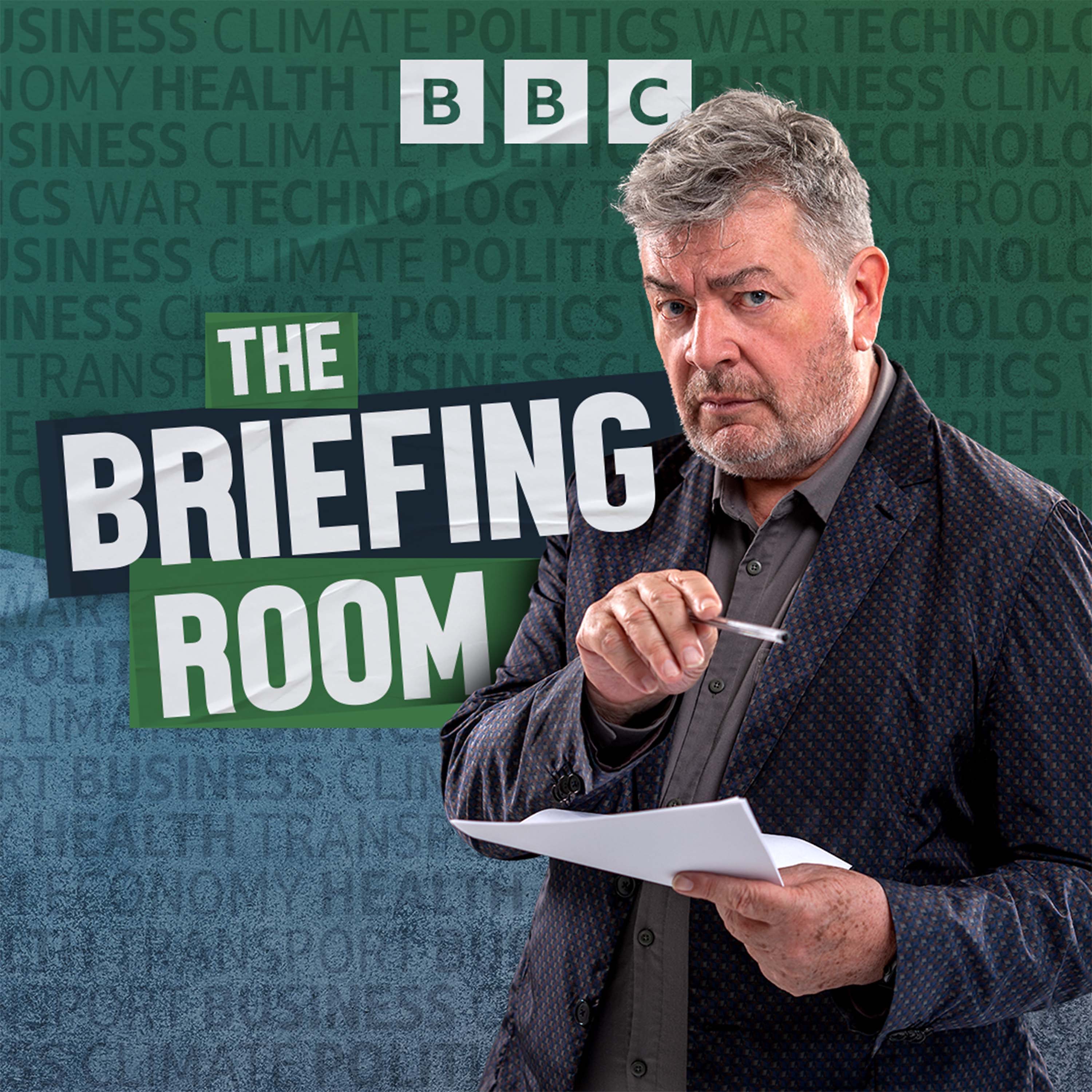
The Briefing Room
396 episodes — Page 4 of 8
NHS: Are there any quick fixes?
Prime Minister Rishi Sunak has promised 'urgent action' to tackle the NHS crisis. The experts in The Briefing Room with David Aaronovitch this week consider what can be done to tackle problems such as: chronic staff shortages; the thousands of 'bed blockers' and the backlog of people waiting for surgical procedures. Contributors: Annabelle Collins, Senior Correspondent, Health Service Journal Nigel Edwards, Chief Executive, Nuffield Trust Jill Manthorpe, Professor of Social Work at King's College London Mark Pearson, Health Expert, OECD Sally Warren, Director of Policy, King's FundProducers: Daniel Gordon Rosamund Jones Kirsteen Knight Editor: Richard Vadon Studio Manager: Rod Farquhar Production co-ordinators: Helena Warwick-Cross, Sophie Hill and Siobhan Reed
Ukraine: How will the war evolve in 2023?
David Aaronovitch and a panel of experts evaluate the current situation in Ukraine and explore how the war might evolve in the remaining winter months and into the Spring. Joining David Aaronovitch in The Briefing Room are:Michael Clarke, Professor of Defence studies and Specialist Advisor to the Joint Committee on the National Security Strategy Sir Lawrence Freedman, Emeritus Professor of War Studies at King's College London Samantha de Bendern, Associate Fellow at the Royal Institute of International Affairs, Chatham House Shashank Joshi, Defence Editor of The EconomistProducers: Ben Carter, Dan Gordon and Kirsteen Knight Editor: Richard Vadon Studio manager: James Beard Production co-ordinators: Helena Warwick-Cross, Sophie Hill and Siobhan Reed
Our Ageing World
For years, the major problem of world demography was thought to be the risk of over-population. Now, it's the fact that the global population is ageing fast.According to the United Nations, the number of people over 65 is set to double between now and 2050, to 1.6 billion people. And, at the same time, the birth rate in most of the world is falling, often sharply. This demographic shift comes with huge social and economic implications. What are they, and what can we do to cope with them? Joining David Aaronovitch in The Briefing Room are:Stephanie Hegarty, BBC Global Population Correspondent Marco Valerio Lo Prete, Economics Editor at Italian State Broadcaster RAI and author of “Italians: The Unhappy Few” Robert Kelly., Professor of Political Science at Pusan National University, South Korea Camilla Cavendish, Senior Fellow at Harvard University Ian Goldin, Professor of Globalisation and Development at the Oxford Martin SchoolProducers: Simon Watts, Kirsteen Knight and Octavia Woodward Editor: Richard Vadon Studio manager: Rod Farquhar Production co-ordinators: Sophie Hill and Siobhan Reed
Can we colonise the Moon?
The first mission in NASA’s Artemis space programme returned to Earth earlier this month, after a journey of over 1.3 million miles around the Moon and back. Over next few years NASA will launch Artemis missions two and three, with the help of the European and Japanese space agencies, as well as Elon Musk's Space X. The aim is eventually to build a permanent base for scientific - and possibly economic development - on the Moon. Meanwhile, China is pursuing a lunar exploration programme of its own. So why is the Moon back in fashion? And is the world in the grip of a new space race?Joining David Aaronovitch in the Briefing Room are: Rebecca Morelle, BBC Science Correspondent John Zarnecki, Emeritus Professor of Space Sciences at the Open University Jack Burns, Professor of Astrophysics and Professor of Physics, University of Colorado Boulder Joanne Wheeler, Space Lawyer Bleddyn Bowen, Associate Professor of International Relations, Space Policy/Warfare Expert, University of LeicesterProducers: Daniel Gordon, Kirsteen Knight and Ben Carter. Editor: Simon Watts. Studio Manager: Neil Churchill. Production co-ordinator Sophie Hill.PHOTO CREDIT: The launch of NASA's Artemis 1 rocket from Cape Canaveral, Florida (Getty Images)
Strikes: How can we avoid a return to the 1970s?
In the 1970s the UK was gripped by double-digit inflation driven by energy price shocks. Inflation was controlled by raising interest rates as a recession raged. And that prompted workers to demand higher wages. Sound familiar? This week and next will see rail workers, ambulance staff, nurses, bus drivers, baggage handlers, highway workers, Border Force, driving examiners and the Royal Mail all striking on various days. As things stand, the prospects of a resolution don’t look promising. So are we heading back to the 70s and another "Winter of Discontent’?Joining David Aaronovitch in The Briefing Room are:Keith Laybourn, Professor of History at the University of Huddersfield Alex Bryson, Professor of Quantitative Social Science at UCL's Social Research Institute Gemma Tetlow, Chief Economist at the Institute for Government Chris Giles, Economics Editor at the Financial Times Producers: Ben Carter and Kirsteen Knight Editor: Simon Watts Studio manager: Neil Churchill Production co-ordinators: Sophie Hill and Siobhan Reed
House of Lords reform
Earlier this week Sir Keir Starmer announced that Labour would abolish the House of Lords in its first term if he is elected prime minister. He’d replace it with a new, elected second chamber. Some Tories were quick to ridicule the idea and even some Labour peers have urged Starmer to focus on more urgent domestic reforms rather than get caught up in a ‘constitutional quagmire’. But how would Starmer's plan work in reality and is it a good idea?Joining David Aaronovitch in The Briefing Room are:Professor Andrew Blick, Professor of Politics and Contemporary History at Kings College London Meg Russell, Professor of British and Comparative Politics and Director of the Constitution Unit Patrick Diamond, Associate Professor of Public Policy at Queen Mary, University of London Jess Sargeant, Senior Researcher at The Institute for Government Producers: Ben Carter, Kirsteen Knight and Daniel Gordon Editor: Simon Watts Studio manager: James Beard Production co-ordinators: Siobhan Reed and Sophie Hill
China's winter of discontent
Chants of ‘Xi Jinping step down’ were heard on the lips of some demonstrators in China last weekend. A rare example of dissent against the Chinese leader. The cause of the protestors fury is pretty clear – nearly three years of the government’s zero-Covid policy has proved too much to bear for many Chinese.The Chinese Communist Party acted quickly by sending police to protest sites and increasing online censorship. But on Tuesday some local health officials began suggesting that they needed to lift lockdowns ‘as quickly as possible’.Will that be enough to prevent further protests in China, and how will Xi Jinping and his government respond to recent events? Joining David Aaronovitch in The Briefing Room are:David Rennie, Beijing bureau chief at The Economist Kerry Allen, Chinese media analyst at BBC News Dr Yu Jie, senior research fellow on China in the Asia-Pacific programme at Chatham House Professor Steven Tsang, director at SOAS China Institute Producers: Ben Carter, Kirsteen Knight and Daniel Gordon Editor: Simon Watts Studio manager: Graham Puddifoot Production co-ordinators: Siobhan Reed & Helena Warwick-Cross
UK Trade Deals
‘We will now open a new chapter in our national story, striking free trade deals around the world’ said Boris Johnson in December 2020 after the UK struck a deal with the European Union for relations after Brexit. The government say these new deals will help level up the UK, cut red tape, provide better investment opportunities and open new digital markets. But, nearly three years after leaving the EU, what deals have we negotiated, are they providing the benefits we were promised and what challenges lie ahead?Joining David Aaronovitch in The Briefing Room are: Dharshini David, BBC Global Trade correspondent Sam Lowe, partner at Flint Global, a business advisory service where he runs the trade and market access practice David Henig, Director of the UK Trade Policy Project Peter Foster, Public Policy Editor of the Financial TimesProducers: Ben Carter, Kirsteen Knight and Daniel Gordon Editor: Simon Watts Studio manager: Rod Farquhar Production co-ordinators: Siobhan Reed & Helena Warwick-Cross
Could Vladimir Putin use nuclear weapons?
The Russians are on the back foot in the war in Ukraine and have just evacuated the occupied Ukrainian city of Kherson. The setbacks for Moscow have led to increasing concern in western capitals about the prospect of President Vladimir Putin using a nuclear weapon. But what are the real chances of Russia moving from nuclear threats to nuclear action. And how might the NATO powers respond?Joining David Aaronovitch in The Briefing Room are: Sir Lawrence Freedman, Emeritus Professor of War Studies, King's College, London. Matthew Kroenig, Professor of Government at Georgetown University and Acting Director, Scowcroft Center for Strategy and Security at the Atlantic Council Patricia Lewis, Director of the International Security Programme at Chatham House.Producers: Kirsteen Knight, Daniel Gordon and Simon Watts Editor: Penny Murphy Sound engineer: Neil Churchill Production co-ordinator: Siobhan Reed and Helena Warwick-CrossImage: Russian President Vladimir Putin. Credit: Mikhail Svetlov / Getty Images
Public Spending
The volatility on the financial markets is continuing in the wake of the chancellor's announcement of massive tax cuts last month. The government's current plan is to announce full details of how it will fund those cuts and balance the books on October 31st. One of its options is to rein in public spending - the expenditure that goes on healthcare, schools, welfare, infrastructure and much more,So what is the level of public spending right now, how does it compare historically and what would be the impact on our services and benefits of any cuts? Joining David Aaronovitch in The Briefing Room are: Paul Johnson, Director of the Institute For Fiscal Studies Soumaya Keynes, UK Economics Editor at The Economist Anita Charlesworth, Director of Research at the Health Foundation Gemma Tetlow, Chief Economist at The Institute For GovernmentPHOTO: The chancellor, Kwasi Kwarteng (Getty Images)
Protests in Iran
Since mid-September, women and girls in Iran have been staging demonstrations against the regime. Social media has been full of images of female protestors cutting off their hair and removing their Islamic head-covering in open defiance of the security forces.These protests have their roots in the arrest of a young woman called Mahsa Amini for minor infractions of the Islamic Republic’s dress code and her subsequent death in custody. But there have been several waves of protest since the Iranian Revolution of 1979 - all of which have been successfully repressed. So, this time is it different? Is a regime that’s been in power for decades seriously under threat? Joining David Aaronovitch in The Briefing Room are: Khosro Kalbasi, Iran analyst at BBC Monitoring. Azadeh Moaveni, Journalist and author of Lipstick Jihad. Eskandar Sadeghi, Lecturer in Contemporary Politics and Modern History of the Middle East at Goldsmith's, University of London Ali Ansari, Professor of History at St Andrews University. Sanam Vakil, Deputy Director of the Middle East programme at Chatham House.PHOTO: Demonstrators in the Iraqi region of Kurdistan holding pictures of Mahsa Amini (Getty Images)
Turmoil on the markets
The financial markets have been in turmoil since the chancellor, Kwasi Kwarteng, unveiled a big package of economic measures last Friday. Traders responded to the prospect of major tax cuts by selling the pound. The Bank of England then had to intervene to protect the UK's pension system.What exactly is causing the financial instability and what might that mean for the British economy over the next few years?Joining David Aaronovitch in The Briefing Room are: Dharshini David, BBC Economics Correspondent. Toby Nangle, Economics commentator and former asset fund manager. Martin Weale, Professor of Economics at King’s College, London. Chris Giles, Economics Editor of the Financial Times. Stephanie Flanders, Senior Executive Editor for Economics at Bloomberg.Producers: Octavia Woodward, Daniel Gordon and Simon Watts Editor: Richard Vadon Sound Engineer: Neil Churchill Production Co-ordinators: Siobhan Reed and Helena Warwick-Cross PHOTO: The Bank of England (Getty Images)
Britain's productivity puzzle
This week the new UK government is unveiling its first major package of economic measures. They're aimed at achieving what Prime Minister Liz Truss says is her number one priority: promoting economic growth. Opposition leader Sir Keir Starmer has said he shares the same aspiration for Britain.But low growth is an entrenched problem, dating back decades. So why has the UK been performing so badly and what needs to be done to turn us into a high-growth country? Joining David Aaronovitch in The Briefing Room are: Nicholas Crafts, Professor of Economic History at the University of Sussex Business School. Chris Giles, Economics Editor of The Financial Times. Anna Valero, Senior Policy Fellow at the London School of Economics’ Centre for Economic Performance. Paul Johnson, Director of The Institute For Fiscal Studies Duncan Weldon, Broadcaster and Author of “Two Hundred Years of Muddling Through”. Producers: Paul Connolly, Arlene Gregorius and Kirsteen Knight Editor: Richard Vadon Sound Engineer: Neil Churchill Production Co-ordinators: Siobhan Reed and Helena Warwick-Cross
Ukraine: Have we reached a turning point in the war?
Ukraine's military has retaken thousands of square kilometres of territory near the north-eastern city of Kharkiv. The Russians are said to have retreated in haste and disarray, but they retaliated by shelling a large power plant, causing blackouts in Kharkiv, the country's second biggest city. Is Ukraine's successful counter-offensive a turning point in the war? Could Ukraine win? Experts say Russia's president, Vladimir Putin, won't countenance defeat, and will escalate instead of retreating or suing for peace. Might Putin launch a tactical nuclear strike? Or use mobilisation or conscription for all-out war? Joining David Aaronovitch in The Briefing Room are:- Vitaliy Shevchenko, Russia editor at BBC Monitoring and co-host of the BBC's Ukrainecast podcast - Michael Clarke, Professor of Defence studies and Specialist Advisor to the Joint Committee on the National Security Strategy - Samantha de Bendern, Associate Fellow at the Royal Institute of International Affairs, Chatham House - Sir Lawrence Freedman, Emeritus Professor of War Studies at King's College London - Shashank Joshi, Defence Editor of The EconomistProducers: Paul Connolly, Arlene Gregorius and Kirsteen Knight Editor: Richard Vadon Sound engineer: Neil Churchill Production co-ordinator: Siobhan Reed and Helena Warwick-CrossImage credit: Anton Petrus/Getty Images
Can we keep the lights on this winter?
Soaring household bills have made energy the number one issue facing the government and consumers in Britain. But in addition to the cost, there may be another problem ahead as winter approaches. Experts are increasingly worried about the supply of both electricity and gas from Europe, and how that might affect the power system here.So how worried should we be about energy shortages? And what can the government do to limit their impact?Joining David Aaronovitch in The Briefing Room are: Kathryn Porter, Energy Analyst at Watt Logic Javier Blas, Energy Columnist at Bloomberg Elisabetta Cornago, Senior Research Fellow at the Centre for European Reform David Sheppard, Energy Editor at the Financial Times Michael Bradshaw, Professor of Global Energy at the University of Warwick.Producers: Paul Connolly, Kirsteen Knight and Simon Watts. Editor: Richard Vadon. Studio Manager: James Beard. Production co-ordinator: Helena Warwick-Cross.PHOTO: An electricity substation in East London (Daniel LEAL / AFP)
The staffing crisis in the NHS
The NHS often appears to be in a state of permanent crisis. Recently, there've been headlines about long waiting times for ambulances and the huge backlog for routine surgery. Before that, the Health Service faced a two-year pandemic which may rear its head again this winter.But the NHS also has a big underlying problem. It has tens of thousands of vacancies for doctors, nurses and other medical workers – and that makes all the other pressures on the Health Service even harder to handle.So why does the NHS have a staffing problem? And what can be done to fix it?Joining David Aaronovitch in The Briefing Room are: Annabelle Collins, Senior Correspondent at Health Service Journal Alison Leary, Professor of Healthcare and Workforce Modelling at London South Bank University Suzie Bailey, Director of Leadership and Organisational Development at The Kings Fund Mark Pearson, Deputy Director of Employment, Labour and Social Affairs at the OECD, Nigel Edwards, Chief Executive of the Nuffield TrustProducers: Bob Howard, Kirsteen Knight and Simon Watts. Editor: Tara McDermott. Studio Manager: Rod Farquhar. Production co-ordinator: Siobhan Reed.PHOTO CREDIT: (Getty Images)
Fighting drought
Despite recent heavy rainfall, much of England is experiencing drought conditions. Both rivers and reservoirs are running low, and the water companies have told millions to stop using their hosepipes. Scientists warn that the current difficulties are only a glimpse of the much tougher challenges the UK will face in the future because of climate change. They estimate that there's a one-in-four chance of a drought which is so severe that drinking water has to be restricted.Joining David Aaronovitch in The Briefing Room are: Sir John Armitt, Chairman of the UK's National Infrastructure Commission Dr Heather Smith, Senior Lecturer in Water Governance at Cranfield University Jean Spencer, Director of The Water Industry Forum Sir Dieter Helm, Professor of Economic Policy at Oxford UniversityProducers: Bob Howard, Kirsteen Knight and Simon Watts. Editor: Richard Vadon. Studio Manager: Graham Puddifoot. Production co-ordinators: Siobhan Reed & Helena Warwick-CrossPHOTO CREDIT: A reservoir on Bodmin Moor in Cornwall in August 2022 (Getty Images)
The Cost of Living Crisis
There are growing calls for emergency measures to tackle the cost-of-living crisis. Energy bills are now predicted to be hundreds of pounds higher than was expected just a few weeks ago. The Bank of England has increased interest rates, and warned of the twin threat of inflation and a recession.What policy options does the government have? How can ministers get help to the growing numbers of people forced to choose between heating and eating.Joining David Aaronovitch in The Briefing Room are:Felicity Hannah, consumer affairs journalist and BBC Moneybox presenter Nicole Sykes, director of Policy and Communications, Pro Bono Economics Nick Eyre, professor of Energy and Climate Change, Oxford University Gemma Tetlow, chief economist, Institute of Government Duncan Weldon, economist and author of Two Hundred Years of Muddling Through
Scotland's drugs problem
Scotland has the worst figures for drug-related deaths anywhere in Europe. According to National Records for Scotland, 1,330 drug users died in 2021 - a slight improvement, but a death rate per capita which is still 4.8 times higher than England's.Why do so many Scots die from drugs? And what more can be done to prevent it? Joining David Aaronovitch in The Briefing Room are: James Cook, BBC Scotland Editor Kirsten Horsburgh, Director of Operations at the Scottish Drugs Forum Andrew McAuley, Glasgow Caledonian University Professor Catriona Matheson, University of Stirling Professor Alex Stevens, University of KentPHOTO: Nalaxone kits, which are being used to stop overdoses in Scotland. (Jeff J Mitchell/Getty Images)
Adapting to a hotter Britain
Last week, temperatures in the UK reached a record-breaking 40.3 degrees centigrade. As Britons sweltered in their homes and offices, railway lines buckled, fires broke out in Greater London and the tarmac on Luton Airport runway began to lift. Climate Change scientists now describe this kind of heat as 'the new normal'.How well is Britain set up to cope with extreme weather events? Do we need to start heat-proofing our houses and infrastructure? And does government need to focus more on adapting to climate change?Joining David Aaronovitch are:Mark Maslin, professor of Climatology at University College LondonGlenn McGregor, professor of Climatology at Durham UniversityRichard Dawson, professor of Engineering at Newcastle University and member of the UK's Climate Change Committee Kathryn Brown, former head of the Adaption at the UK's Climate Change CommitteeProducers: Tim Mansel, Kirsteen Knight and Simon Watts. Editor: Penny Murphy. Studio manager: Graham Puddifoot. Production co-ordinator: Helena Warwick-Cross.
Ukraine: Who is winning?
The war in Ukraine is about to enter its sixth month. The cost of Russia’s invasion has been enormous: millions of refugees; thousands of dead soldiers; thousands more dead civilians; and billions of dollars’ worth of physical damage. It’s the most consequential military conflict for a generation.This week the Briefing Room investigates what’s happening now on the ground and whether either side is close to victory or collapse. Joining David Aaronovitch are:Nina Kuryata, Ukrainian journalist with Tortoise Media Shashank Joshi, Defence Editor at The Economist Samantha de Bendern, Associate Fellow in the Russia and Eurasia Programme at Chatham House Sir Lawrence Freedman, Emeritus Professor of War Studies at King’s College, London Producers: Tim Mansel, Kirsteen Knight and Simon Watts. Editor: Richard Vadon. Studio Manager: Neil Churchill. Production co-ordinators: Siobhan Reed & Helena Warwick-CrossPHOTO CREDIT: Miguel Medina/AFP via Getty Images
Covid - how worried should we be this time?
More than two years after the emergence of Covid, infection levels are high once again. The Office for National Statistics estimates that 2.7 million people, or 1 in 25 of us, have got Coronavirus.There’s concern too about new Omicron variants BA.4 and BA.5 – mutations which help the virus re-infect our bodies.But how worried should we actually be this time? Are the mutations normal or an alarming new development? And how much of a threat does Coronavirus still face to the NHS?Joining David Aaronovitch in The Briefing Room are:James Gallagher, BBC Health and Science Correspondent Gideon Skinner, Head of Politics Research in Public Affairs at Ipsos Miriam Deakin, Director of Policy and Stategy of NHS Providers Meaghan Kall, Epidemiologist at the UK Health Security Agency Neil Ferguson, Head of the MRC Centre for Global Infectious Disease Analysis at Imperial College, London.Producers: Tim Mansel, Kirsteen Knight and Simon Watts. Editor: Richard Vadon. Studio Manager: Rod Farquhar Production co-ordinators: Siobhan Reed & Helena Warwick-Cross
What's wrong with the NHS, and how do we fix it?
Last year spending on health and social care in the UK hit nearly £200bn. That’s roughly a fifth of total government spending. Yet the perception has been that things have got worse. Have they? If so, how much worse? How do we compare with other similar countries? And what might we do differently? Joining David Aaronovitch in the briefing room are:Siva Anandaciva, Chief Analyst at the King’s Fund Professor Carol Propper, health economist at Imperial College Mark Pearson, Deputy Director of Employment, Labour and Social Affairs at the OECD Dr Jennifer Dixon, Chief Executive at The Health FoundationProducers: Octavia Woodward, Kirsteen Knight and Ben Carter Editor: Richard Vadon Studio manager: Neil Churchill Production co-ordinators: Siobhan Reed & Sophie HillImage: Paramedics unloading a stretcher Credit: Tejas Sandhy/SOPA Images/LightRocket via Getty
What's happening in Afghanistan?
Last year the Taliban launched an offensive in Afghanistan that, within a matter of weeks succeeded beyond the West’s wildest nightmares. In August Kabul fell and life changed dramatically for the Afghan people. Since then they’ve faced food shortages, a failing economy and a bombing campaign launched by Afghanistan’s own ISIS, ISIS-K. So is it Taliban 2.0 as some people hoped? How is it dealing with its domestic challenges? And how is it managing its relationships with its neighbours and countries further afield? Joining David in the briefing room are:Secunder Kermani, the BBC’s Pakistan and Afghanistan correspondent Laurel Miller, Director of the International Crisis Group’s Asia Programme, Ashley Jackson, co-director of the Centre for the Study of Armed Groups at the global affairs think tank, ODI Ahmed Rashid, journalist and author based in Pakistan who has studied the Taliban for decadesProducers: Ben Carter and Kirsteen Knight Editor: Richard Vadon Studio manager: Neil Churchill Production co-ordinators: Siobhan Reed & Sophie Hill
Is the crypto bubble bursting?
Last week cryptocurrency suffered it’s ‘black Wednesday’ moment. Investors raced to withdraw their funds and more than $200billion was wiped off the cryptocurrency market. One currency lost 98% of its value. Ironically it was a so-called “stablecoin”, whose value is meant to be pegged to currencies like the dollar, that collapsed.Was this a solitary - but very costly - blip or is the crypto bubble in danger of bursting?Joining David in the briefing room are:Gavin Brown, Associate Professor in Financial Technology at The University of Liverpool Jemima Kelly, columnist at the Financial Times Dominic Frisby, MoneyWeek columnist and author of Bitcoin: The Future of Money? David Shrier, Professor of Practice, AI & Innovation with Imperial College Business School Stephen Diehl, a software engineer and crypto writer. Producer: Ben Carter Editor: Richard Vadon Studio manager: Neil Churchill Production co-ordinators: Siobhan Reed & Sophie Hill
What impact will the Northern Ireland election have?
The election in Northern Ireland saw nationalists, Sinn Fein, win the most votes. Their leader, Michelle O'Neill, becomes first minister. It has been heralded as a historic result. But what will its impact - on Stormont politics, the protocol and the union - end up being? Joining David Aaronovitch in the briefing room are: Enda McClafferty, BBC Northern Ireland's political editor Ann Watt, director of Pivotal, an independent public policy think tank Sam McBride, Northern Ireland editor, Belfast Telegraph & Sunday Independent Etain Tannam, associate professor of international peace studies, Trinity College DublinProducers: Rosamund Jones, Kirsteen Knight & Ben Carter Studio manager: James Beard Production co-ordinators: Siobhan Reed & Sophie Hill Editor: Richard Vadon
How has the war in Ukraine changed German politics?
In late February, German chancellor Olaf Scholz described Russia's invasion of Ukraine as a ‘Zeitenwende’ - turning point - sparking the biggest shift in German foreign policy since the Cold War. The highlights included a 100bn euro package to boost the military and meet Nato’s 2 per cent of GDP defence spending obligation, send weapons to Ukraine and end his country’s dependency on Russian energy. A surprisingly bold plan from a man many had thought was - like many of his predecessors - naturally cautious. He drew applause at home and abroad, but two months on there is sense that Scholz is wavering. Can he, and will he, see his plan through?Joining David Aaronovitch in the briefing room are:Sir Paul Lever, former British Ambassador to Germany and author of Berlin Rules: Europe and the German WayProfessor Markus Ziener, Helmut Schmidt Fellow at the German Marshall Fund of the United StatesDaniela Schwarzer, Director of the German Council on Foreign RelationsSophia Besch, senior research fellow at the Centre for European ReformProducers: Octavia Woodward, Kirsteen Knight and Ben Carter Production Co-ordinators: Siobhan Reed and Sophie Hill Studio Manager: James Beard Editor: Richard Vadon
What's the impact of the Shanghai lockdown?
What will the social and economic costs be of China's full-scale lockdown of Shanghai? David Aaronovitch examines the problems with the country's vaccination programme. Joining David in the briefing room are:Robin Brant, BBC Correspondent based in Shanghai Vincent Ni, China Affairs correspondent for The Guardian Professor Nancy Qian, Northwestern University Dr Yu Jie, senior research fellow on China in the Asia-Pacific Programme at Chatham House George Magnus, economist and research associate at Oxford University’s China Centre.Producers: Rosamund Jones, Kirsteen Knight and Ben Carter Production Co-ordinator: Siobhan Reed Studio Manager: Neil Churchill Editor: Richard Vadon
Will the Rwanda plan work?
The Home Secretary, Priti Patel, has unveiled a plan to stop small boat crossings in the English Channel by sending asylum seekers to Rwanda. But will it work?Joining David Aaronovitch in the briefing room are:Mark Easton, BBC's Home Editor Alexander Betts, Professor of Forced Migration and International Affairs at the Refugees Studies Centre Nicolas Rollason, partner and head of Business Immigration at Kingsley Napley Madeleine Sumption, Director of The Migration ObservatoryProducers: Rosamund Jones, Ben Carter and Kirsteen Knight Production Co-ordinators: Sophie Hill and Siobhan Reed Studio Manager: Rod Farquhar Editor: Richard Vadon
Russia's invasion: what more can the west do to help Ukraine?
It's a month now since Russian forces invaded Ukraine. The west have sanctioned Russia and provided aid packages to Ukraine but what more can it do to help Ukraine win the war?Joining David Aaronovitch in The Briefing Room are:Gustav Gressel, senior policy fellow with the Wider Europe Programme at the European Council on Foreign Relations (ECFR) Berlin office. Dr Sarah Schiffling, International research fellow at the Humanitarian Logistics Institute in Helsinki, Finland and senior lecturer in supply chain management at Liverpool John Moores University.Javier Blas, energy and commodities columnist at Bloomberg and co-author of the 'The World for Sale’.Algirde Pipikaite, cybersecurity and digital transformation policy expert at the World Economic Forum in Switzerland.Producers: Ben Carter, Kirsteen Knight, Octavia Woodward and Louise Clarke-Rowbotham Production Co-ordinators: Iona Hammond and Siobhan Reed Studio Manager: Neil Churchill Editor: Richard Vadon
Russia's invasion: what could a peace deal look like?
Negotiations between Ukraine and Russia have been underway this week. At the same time Mariupol and other Ukrainian cities have come under savage bombardment. If some sort of peace is to be brokered what compromises might be possible and what will be required to get there? David Aaronovitch is joined by:Oleksiy Semeniy, former advisor to the National Security and Defense Council of UkraineAglaya Snetkov, author of “Russia's security policy under Putin” and a lecturer at the School of Slavonic and East European Studies in London. Anatol Lieven, senior research fellow on Russia and Europe at the Quincy Institute for Responsible Statecraft and a visiting professor at King’s College, London.Dr Julie Norman, lecturer in politics and international relations at University College London and co-director of its US politics centre. Producers: Rosamund Jones, Kirsteen Knight and Ben Carter Production Co-ordinators: Sophie Hill and Siobhan Reed Studio Manager: Neil Churchill Editor: Richard Vadon
Russia's invasion: what level of support does Putin have at home?
What's the impact in Russia of painful sanctions and a war that's not going to plan? How is President Putin controlling information and what's required for that to change? David Aaronovitch is joined by: Michael Clarke, Visiting Professor of War Studies at Exeter University and former director, Royal United Services Institute Sergei Guriev, Professor of Economics at Sciences Po in Paris and former Chief Economist at the European Bank for Reconstruction and Development Dr. Katerina Tertytchnaya, Assistant Professor in Comparative Politics, University College London Izabella Tabarovsky, Senior Program Associate at the Kennan Institute, Wilson Center (US) Dr Maxim Alyukov, fellow Kings College London Producers: Rosamund Jones, Kirsteen Knight and Ben Henderson Production Co-ordinators: Sophie Hill and Siobhan Reed Studio Manager: Neil Churchill Editor: Richard Vadon
Russia's invasion: what's the military strategy?
The war in Ukraine is a week old. What have we learned about the military strength - and tactics - on both sides? And what might that tell us about how the conflict might play out? David Aaronovitch is joined in The Briefing Room by:Vitaliy Shevchenko, Russian editor at BBC Monitoring.Colonel Liam Collins, founding director of the Modern War Institute in New York.Ed Arnold, Research Fellow in European security at RUSI and an ex British Army officer who was posted to NATOs Supreme Headquarters Allied Powers Europe in 2014 during the Russian annexation of Crimea.Kataryna Wolczuk, Professor of East European Politics at the University of Birmingham.Bettina Renz, Professor of International Security at the University of Nottingham. Producers: Rosamund Jones, Kirsteen Knight and Ben Carter Production co-ordinators: Sophie Hill and Siobhan Reed Studio manager: James Beard Editor: Richard Vadon
Russia's invasion: will sanctions work?
Russia is facing sanctions from around the world. Can they hit the country hard enough to make it change course and leave Ukraine in peace? In a live episode David Aaronovitch considers how sanctions have worked in other crises, why they are so frequently used and what circumstances are required for them to be successful.He is joined by: Lee Jones, Professor of International Politics at Queen Mary, University of London and author of the book Societies Under Siege: Exploring How International Economic Sanctions (Do Not) WorkTom Keatinge, Director of the Centre for Financial Crime and Security Studies at RUSIDr Maria Shagina, Fellow at the Center for Eastern European Studies at the University of Zurich Tyler Kustra, Assistant Professor of Politics and International Relations at the University of Nottingham Producers: Rosamund Jones, Kirsteen Knight and Ben Carter Production co-ordinators: Sophie Hill and Siobhan Reed Studio manager: Rod Farquhar Editor: Richard Vadon
What do drones mean for the future of warfare?
A few weeks ago a rebel group without an air-force managed to attack a foreign airport 1,000 miles away....from the air using drones. And theoretically what the Yemeni insurgents did in Abu Dhabi is repeatable the world over. Indeed is being repeated. Meanwhile drones are often the weapon of choice for major powers operating a long way from home. So are drones transforming the way conflicts are fought, to what extent is that a bad thing, and what can be done about it? David Aaronovitch talks to:Caroline Kennedy-Pipe, Professor of War Studies at Loughborough University Dr James Rogers, Assistant Professor at the Centre for War Studies in Odense, Denmark Shashank Joshi, Defence Editor at The Economist Dr Sarah Kreps, Director of the Tech Policy Lab at Cornell UniversityProducers: Rosamund Jones and Ben Carter Editor: Richard Vadon Production co-ordinators: Siobhan Reed and Sophie Hill Sound engineer: Graham Puddifoot
Will the levelling up plans work?
One of Boris Johnson’s key campaign promises in the run up to the last election was to level up the country. Now the government has published a white paper telling us how it intends to do that. So what are the plans, will they work and do they go far enough?David Aaronovitch is joined by:Jagjit Chadha, Director of the National Institute of Economic and Social Research (NIESR) Jennifer Williams, social affairs editor at the Manchester Evening News Paul Swinney, director of policy and research at the think tank Centre for Cities Tom Forth, founder The Data CityProducers: Rosamund Jones, Kirsteen Knight and Ben Carter Studio manager: James Beard Production co-ordinators: Sophie Hill and Siobhan Reed Editor: Richard Vadon
Is the Prime Minister’s Office fit for purpose?
How well 10 Downing Street functions is under scrutiny. Following Sue Gray's report into parties during lockdown, David Aaronovitch explores who does what at the heart of government and asks if the current problems can be fixed.Contributors: Alex Thomas, Institute for Government Professor Andrew, Blick, King's College London Jill Rutter, UK in a Changing Europe Professor Patrick Diamond, Queen Mary University of London Producers: Rosamund Jones, Ben Carter, Kirsteen Knight Studio manager: Rod Farquhar Production co-ordinators: Siobhan Reed, Brenda Brown Editor: Richard Vadon
How do we learn to live with Covid?
Plan B Covid restrictions in England have ended and the government says we must learn to live with Covid. But what does that actually mean and how sustainable is that position? In this programme we will ask how our understanding of Covid’s newest variant, Omicron, has evolved since Plan B restrictions were first imposed 7 weeks ago. To what extent might flu provide a model for how we live with Covid? And how will our hospitals cope with the strain as restrictions within wider society are eased? David Aaronovitch is joined by:Azra Ghani, Professor of Infectious Disease Epidemiology, Imperial College, London Saffron Cordery, Deputy Chief Executive of NHS Providers Lesley Powls, Head of Clinical Site & Emergency Planning, King's College Hospital Emma Thomson, Professor of infectious diseases at the University of Glasgow Centre for Virus Research Linda Bauld, Professor of public health at Edinburgh UniversityProducers: Rosamund Jones, Kirsteen Knight and Ben Carter Studio manager: Neil Churchill Production co-ordinators: Sophie Hill and Siobhan Reed Editor: Richard Vadon
BBC Funding
With the longer term funding of the BBC under pressure, David Aaronovitch and guests explore the alternatives to the licence fee. How do other nations pay for their public service broadcasters? Contributors: Professor Jean Seaton, University of Westminster Matt Walsh, Head of school of Journalism, Media & Culture, Cardiff University Vilde Sundet, University of Oslo Professor Patrick Barwise, London Business School Claire Enders, Enders Analysis Producers: Kirsteen Knight, Ben Carter, Rosamund Jones Studio manager: Neil Churchill Production co-ordinators: Sophie Hill, Siobhan Reed Editor: Richard Vadon
Inflation
Inflation is at a 30 year high. David Aaronovitch looks back to the 1970s when prices - and wages - soared. Are we returning to those times and how worried should we be? Joining him in The Briefing Room are: Stephanie Flanders, Head of Bloomberg Economics. Merryn Somerset Webb, editor-in-chief, Moneyweek. Torsten Bell, chief executive, The Resolution Foundation. Duncan Weldon, economist and author of "Two Hundred Years of Muddling Through" and "The Value Added Newsletter". Producers: Kirsteen Knight, Ben Henderson and Rosamund Jones Studio manager: Neil Churchill Production co-ordinators: Sophie Hill and Siobhan Reed Editor: Richard Vadon
Brexit: What Have We Learned?
It's nearly been a year since Brexit, so what have the costs and gains been so far, what's yet to be sorted out, and how has our relationship with our European neighbours changed?Joining David Aaronovitch in The Briefing Room are:Maddy Thimont Jack, associate director on the Institute for Government's Brexit teamSam McBride, Northern Ireland editor of the Belfast Telegraph & Sunday IndependentKatya Adler, BBC Europe EditorPeter Foster, editor of the Financial Times newsletter 'Britain After Brexit'. Anand Menon, director at UK in a Changing EuropeProducers: Rosamund Jones, Kirsteen Knight, Ben Carter and Ben Henderson Sound Engineer: Neil Churchill Production Co-ordinators Sophie Hill and Siobhan Reed Editor: Richard Vadon
Who Do We Think We Are?
Four recent by-elections in the UK - Airdrie and Schotts, Hartlepool, Amersham and Chesham, and Batley and Spen - tell us four different stories about who we are and what determines who we vote for. So how well do we know who we are and how has that ‘who’ changed over the last thirty years?Joining David Aaronovitch in the Briefing Room are:James Kanagasoorium, CEO of Stack Data Strategy Paula Surridge, political sociologist from the University of Bristol Rosie Campbell, Professor of Politics at King's College, London Rob Ford, Professor of Political Science at the University of ManchesterProducers: John Murphy, Kirsteen Knight and Ben Carter Editor: Jasper Corbett Sound Mix: Graham PuddifootImage: Liverpool by night Credit: Jenna Goodwin / EyeEm / Getty
Space Wars and Laws
Could space be the next frontier for conflict? And what would it look like? Recently the astronauts in the International Space Station had to shelter in their escape pods, after Russia destroyed one of its own satellites using a missile and leaving a dangerous trail of debris orbiting the earth. While not a deliberately aggressive act, the destruction of the satellite was an indication of the kind of weaponry that could be used in space. This summer, on the occasion of the official opening of UK Space Command, the head of the RAF, Air Chief Marshal Sir Mike Wigston, warned that any global conflict would “most likely be won or lost in space.” What is the likelihood of a space war, what form would it take and what are the laws that govern activity in space?Joining David Aaronovitch in the Briefing Room are:Dr Bleddyn Bowen, lecturer in International Relations, University of Leicester Michelle Hanlon, Professor of Air and Space Law at the University of Mississippi, United States Alexandra Stickings, Space Strategy Lead at the consultancy Frazer-Nash Shashank Joshi, Defence Editor, The EconomistProducers: John Murphy, Ben Carter and Kirsteen Knight Sound Engineer: Andy Garratt Production Coordinator: Siobhan Reed Editor: Richard VadonImage: The International Space Station in orbit Credit: Nasa / EPA
Ukraine: Could There Be War?
Russian troops are amassed close to the Ukrainian border - could this mean war, or is something else going on?Tensions between Ukraine and Russia aren't new, particularly since the annexation of the Crimea in 2014 and fighting with separatists, backed by Russia, in eastern Ukraine. The West has warned Russia of dire consequences if it invades Ukraine. Russia says it is not planning to and has the right to put its troops anywhere within its territory. So what is going on? What does President Putin want and what can NATO and the West do?Joining David Aaronovitch in The Briefing Room are:Sarah Rainsford, BBC Moscow CorrespondentAnton Barbashin, political analyst and editorial director of Riddle RussiaDr. Leslie Vinjamuri, Associate Professor of International Relations, School of Oriental and African Studies, also director of the US Programme at Chatham HouseOrysia Lutsevych, Research Fellow and manager of the Ukraine Forum, Russia and Eurasia Programme, Chatham HouseDr Liana Fix, Russia expert, Körber Foundation, Berlin Programme producers: John Murphy, Kirsteen Knight and Chris Flynn Studio mix by James Beard Programme Editor: Richard VadonImage: Ukranian servicemen on a front line near Svetlodarsk. Credit: EPA/Anatoli Stepanov
Afghanistan: What Now? What Next?
From insurgency to government - the challenges for the Taliban and the West.Four months ago the Taliban stunned the world - maybe even themselves - when they entered Kabul and took power in Afghanistan. Since then they have had to move from 20 years of fighting to setting up a central government. That has not proven easy. In the meantime the people of Afghanistan are suffering food shortages and an economic crisis. So what is going on and what might happen next?Joining David Aaronovitch in The Briefing Room:Secunder Kermani, BBC Pakistan & Afghanistan correspondentDr. Mike Martin, visiting fellow in the War Studies department, King's College London.Laurel Miller, director of the International Crisis Group’s Asia programme.Ahmed Rashid, journalist and author.Ashley Jackson, co-director of the Centre for the Study of Armed Groups at the global affairs think tank ODI.Producers: John Murphy, Ben Carter, Kirsteen Knight Studio Manager: Graham Puddifoot Editor: Richard VadonImage: Boy in Balkh camp, Afghanistan 13th November 2021. Credit: Sayed Khodaiberdi Sadat/Anadolu Agency via Getty Images
Living in a Variant World
What are variants? Where do they come from? Why do they develop and how do they take over? Currently Delta is the dominant variant in the UK and across much of the world; but now Omicron, first identified in South Africa, looks like it could take over. How does that happen? And what can we do about variants?Joining David Aaronovitch in the Briefing Room are:Emma Thomson, Professor of infectious diseases at the University of Glasgow Centre for Virus Research. Dr. Jeff Barrett, Director of the Covid-19 genomics initiative at the Wellcome Sanger Institute. Dr. Charlotte Houldcroft, virologist from the University of Cambridge.Producers: John Murphy, Ben Carter and Kirsteen Knight Studio Manager: Graham Puddifoot Editor: Richard Vadon
Europe's Covid Surge
As parts of Europe struggle to contain Covid cases we ask what that means for them and us. The World Health Organisation has warned that another 500,000 people in Europe could die of Covid by March next year unless countries take urgent action to control the spread of the virus. Austria – the country with the lowest vaccination rate in western Europe - has become the first country to legally require people to have the vaccine from next February. The German health minister has said the country is in a national emergency that could result in another national lockdown. There have been riots in the Netherlands in response to new Covid restrictions. So why is the situation so dire, what’s being done about it and what risk does the crisis on the continent pose to the UK?Joining David Aaronovitch in The Briefing Room are:Dr Louise Blair, Lead analyst in vaccines and covid variants at the health analytics firm, Airfinity. Dr Clemens Auer, Special Envoy for Health for the Federal Ministry of Labour, Social Affairs, Health, Care and Consumer Protection of Austria. He was Austria’s Covid co-ordinator until March. Professor Martin McKee, Professor of European Public Health at the London School of Hygiene and Tropical Medicine. Professor Sheena Cruickshank, Immunologist at the University of Manchester. Dr Raghib Ali, Senior Clinical Research Associate, University of CambridgeProducers: Ben Carter, John Murphy and Kirsteen Knight Editor: Richard Vadon Studio Engineer: Rod Farquhar Production Co-ordinator: Siobhan Reed
China Crisis?
For years China has been perhaps the most important economic engine driving growth around the world. Earlier this year it bounced back from the Covid shutdowns with double-digit growth. Global demand for Chinese-made products has been booming. But this week growth figures have dropped dramatically. The country has been experiencing an energy and property crisis. So, is the bubble bursting? And should we be worried?Joining David Aaronovitch in the Briefing Room are:Celia Hatton, the BBC's Asia Pacific Editor Dr. Philip Andrews-Speed, Senior Principal Fellow at the Energy Studies Institute of the National University of Singapore George Magnus, Research Associate at the China Centre, Oxford University Tom Orlik, Chief Economist at Bloomberg Economics Dr. Keyu Jin, Associate Professor of Economics at the London School of EconomicsProducers: John Murphy, Soila Apparicio, Kirsteen Knight Sound Engineer: Graham Puddifoot Editor: Jasper CorbettImage: Chenzhou in China during a blackout Credit: Alamy
Social Care - What's Changing?
For decades the difficult problem of social care - how to fund it, how to provide it - has been kicked into the long grass by government after government. But last month the Prime Minister announced a policy which he said meant no-one would have to sell their house to fund their social care. He also promised more money for social care - though not immediately. A "health and social care levy" is to be created through an increase in National Insurance contributions. So is the problem of social care being fixed? Joining David Aaronovitch in The Briefing Room are:Alison Holt, BBC Social Affairs Editor Peter Beresford, visiting Professor in the School of Health Sciences, University of East Anglia Sally Warren, Director of Social Policy at the King's Fund Jill Manthorpe, Professor of Social Work and Director, NIHR Health & Social Care Workforce Research Unit, King's College London. Producers: John Murphy, Soila Apparicio, Kirsteen Knight Sound Engineer: Graham Puddifoot Editor: Jasper Corbett
Britain's Dirty Rivers
According to campaigners, Britain has some of the dirtiest rivers in Europe. Sewage, slurry from farms and chemicals are all a problem, too often ending up in our rivers. The parliamentary Environmental Audit Committee estimates that the discharge of raw sewage accounts for 55% of rivers in England and Wales failing to reach good ecological status. Not one river has good chemical status. So what's going wrong and what can be done to fix it? Joining David Aaronovitch in the Briefing Room are:Olivia Rudgard, Environment Correspondent for the Daily Telegraph Peter Hammond, retired Professor of Computational Biology at University College London Rachel Salvidge, Deputy Editor of ENDS Report Steve Ormerod, Professor of Ecology and Co-Director of the Water Research Institute, Cardiff UniversityProducers: John Murphy, Kirsteen Knight, Soila Apparicio Sound Engineer: Neil Churchill Editor: Jasper CorbettPhoto: Chemical Pollution from Industrial Outfall Pouring into River Mersey UK. Credit: Avalon/Universal Images Group via Getty Images