The Beinart Notebook
274 episodes — Page 3 of 6
"Hopelessness is a Privilege We Don't Have"
This is a public episode. If you'd like to discuss this with other subscribers or get access to bonus episodes, visit peterbeinart.substack.com/subscribe
It Was Never About Hamas
Cited in Today’s VideoWhy Israeli doves like former Shin Bet head Ami Ayalon want Israel to release Marwan Barghouti but the Israeli government won’t, despite Hamas’ request.Why Barghouti’s son fears for his father’s life. This is a public episode. If you'd like to discuss this with other subscribers or get access to bonus episodes, visit peterbeinart.substack.com/subscribe

Historian Ilan Pappé
Our guest is Israeli-born historian Ilan Pappé, author of the new book, Israel on the Brink. We discuss why he chose a life of political rebellion against the state in which he was born and what he thinks the ceasefire in Gaza will bring. We also talk about his book, which suggests that in the coming decades, Israel may cease to exist as a Jewish state. This is a public episode. If you'd like to discuss this with other subscribers or get access to bonus episodes, visit peterbeinart.substack.com/subscribe
Thank God the Israeli Hostages Are Coming Home
A list of ways to help Palestinians in Gaza and the West Bank.If you’re in the US, consider joining the nationwide No Kings protests on October 18.This Friday’s Zoom call will be at 1 PM Eastern, our usual time. Our guest will be Israeli-born historian Ilan Pappe, author of the new book, Israel on the Brink. I’ll ask Pappe why he chose a life of political rebellion against the state in which he was born and what he thinks the ceasefire in Gaza will bring. We’ll also talk about his book, which suggests that in the coming decades, Israel may cease to exist as a Jewish state.Cited in Today’s VideoNaftali Benett asks why Palestinians and their supporters aren’t happier about the Trump deal.Things to Read(Maybe this should be obvious, but I link to articles and videos I find provocative and significant, not necessarily ones I entirely agree with.)In Jewish Currents (subscribe!), Abdullah Hany Daher reflects on the two years since October 7, 2023.James Talarico on why requiring Texas schools to post the Ten Commandments violates the Ten Commandments.Libby Lenkinski on how reparations for the Holocaust helped her family build a new life, and why Jews must demand reparations for the genocide in Gaza.Shaul Magid on being human after the destruction of Gaza.See you on Friday,PeterVIDEO TRANSCRIPT:I’ve been struggling for days to try to find the words to express how I feel about the Trump deal because my feelings are so, like, profoundly conflicted. When this airs on Monday, it looks like the remaining Israeli hostages, and the bodies of the dead hostages will be returned. This is a kind of catharsis for Jews, for me, that is really one of the most profound and powerful things that I think I will have ever experienced in my life.This entire experience of Jewish solidarity over the last two years has been extraordinary. I mean, it really has been one of the most powerful manifestations I’ve ever seen of this, you know, phrase that people use a lot, Kol Yisrael Arevim Zeh Bazeh, that all Jews are responsible for one another. I am kind of in awe of the people in my synagogue, and that I see around New York, who I see have been wearing dog tags to remember the hostages every day. I hear stories about people, you know, who have had a place at their table for a particular hostage now for the last two years. You know, in my tiny way, I’ve had the names of the hostages on my refrigerator door. We pray for them every week.I mean, this has been incredibly, incredibly powerful. It’s been one of the most powerful Jewish experiences of my life, and I want to think tomorrow, as those hostages are coming home, and think about the Trump deal only through that vein, only through this vein of Jewish solidarity: us as a small, often brutalized, persecuted people who have learned and in accordance with our traditions, to really care for one another, to care for one another. And there’s so many people who have manifested that stuff so powerfully.And to see the joy of those families returning their loved ones, and to see the way that people rally around them in this moment, and rally around those who don’t have loved ones who are coming back, is… I wish I could just stop there. I really wish that that would be the end of my message. And I thought a lot about just saying that, just saying that. Because I know that there are a lot of people who think that people on the left, like me, who criticize Israel, we don’t feel those things. And I know for me, it’s not true. I feel them like they’re some of the most profound feelings I feel.But we’re also being told that the Trump deal should be a cause of celebration for Palestinians, right? Again and again, I’m seeing on social media people taunting, you know, pro-Palestinian activists. Why aren’t you celebrating? You claim this is a genocide. Why aren’t you celebrating? You’re unhappy because all you want is for Israel to be blamed. Now that actually something is good is happening to Palestinians and Israel, you can’t recognize that.But this isn’t a day of celebration for Palestinians because it’s not fair to ask Palestinians to celebrate simply for not being bombed, right? The standard should be higher than that. Yes, it is, of course, a terrific thing that the bombs hopefully will stop, at least for a while, that Palestinians will get more food in. But if we see Palestinians as full human beings, as full human beings, we have to understand that the bar is a little bit higher than that. How dehumanizing is it to suggest that Palestinians should leap for joy and celebration simply because a genocide may be ending, and they’re returning to a state of apartheid? A state that, you know, as even Israel’s own human rights organizations have stated, a situation of blockade.I mean, look at what we know about the Trump deal. It offers no path, no path, for Palestinians to gain citizenship, the most basic fundamental right that all human beings deserve, the right to be a citizen of the country and you’re i

What Now?
This is a free preview of a paid episode. To hear more, visit peterbeinart.substack.comOur guests are former PLO negotiator, Hussein Agha and former Clinton, Obama and Biden administration official, Rob Malley. We talk about their new book, Tomorrow is Yesterday: Life, Death, and the Pursuit of Peace in Israel/Palestine and learn what they’ve learned from decades of seeing Israeli, Palestinian, and American policy from the inside.
It’s a Blessing if the Hostages Go Free and the Bombs Stop
A list of ways to help Palestinians in Gaza.This Friday’s Zoom call will be at 1 PM Eastern, our usual time. Our guests will be the former PLO negotiator Hussein Agha and the former Clinton, Obama and Biden administration official, Rob Malley. They’ll talk about their new book, Tomorrow is Yesterday: Life, Death, and the Pursuit of Peace in Israel/Palestine. I’ll ask what they’ve learned from decades of seeing Israeli, Palestinian and American policy from the inside.Cited in Today’s VideoYeshayahu Leibowitz’s essay on colonialism and terrorism.Mouin Rabbani on the Trump plan.Things to Read(Maybe this should be obvious, but I link to articles and videos I find provocative and significant, not necessarily ones I entirely agree with.)In Jewish Currents (subscribe!), Avigayil Halperin talks to Audrey Sasson about whether it’s possible to atone for genocide.39% of American Jews think Israel is committing genocide.Washington Democrats turn against AIPAC.See you on Friday,PeterVIDEO TRANSCRIPT:So, I have these two kind of contradictory feelings about the Trump plan on Gaza. The first is that I hope it goes through. I hope it’s implemented. I just desperately, desperately hope that these Israeli hostages are returned and can go back to their families. And I desperately hope that Palestinians can wake up one day in the coming days, and just not worry that they’ll be killed by an Israeli bomb, and that their children will be able to have more to eat. I mean, just at a basic human level, that would be a really just a blessing.It’s also, though, really important just to remember, because I think there’s a certain kind of discourse that tends to take place about these diplomatic negotiations, a kind of insider-y discourse about how it’s going to be implemented, and what the role the Palestinian Authority is going to play, and what different Arab governments are going to do, and all this stuff, which just can often, I just find, kind of, like, completely obscure, like, the basic foundational realities, which always need to be kept front and center, right?The basic foundational realities are that Palestinians in Gaza, the West Bank, and East Jerusalem live under the control of a state that does not grant them the most basic of rights, the right of citizenship. This state, the Israeli state, has life and death power over them, and yet they can’t vote for that government that controls their lives. This will be true after the Trump plan is implemented, if it’s implemented. It may be that the genocide ends, which would be a blessing, but before the genocide, there was apartheid, and there will be actually an even worse form of apartheid now because Israel’s blockade of Gaza is likely to be stricter, and Israel’s already said that it’s basically going to take more control over parts of the Gaza Strip, herding Palestinians even into an even smaller area of the Gaza Strip.So, remember, Gaza was deemed unlivable by the United Nations before October 7th. Human Rights Watch called it an open-air prison. My friend Mohammad Shehada has written about how everyone he knew in Gaza growing up contemplated suicide, because there was just no prospect for a better life. And when people say, well, this is gonna fundamentally change if Hamas is no longer in charge in Gaza, unfortunately, that’s just a complete illusion, because Hamas has not been in charge in the West Bank. To the contrary, the West Bank, for the last 20 years now, has been run by a Palestinian Authority, which essentially serves as Israel’s subcontractor, which is basically doing Israel’s bidding to prevent armed resistance.And what is life like for Palestinians in the West Bank? A form of apartheid that gets worse and worse and worse as Israel takes over more and more land, confines Palestinians into smaller and smaller ghettos, in which Palestinians are subjected to more and more violence by the Israeli military and also by settlers who, unlike them, have citizenship and are protected by an Israeli state that doesn’t protect them. That’s what Palestinian life looks like in the West Bank, where you don’t have Hamas running things, right?So, anyone who thinks that you’re solving the problem for Palestinians by not having Hamas be in charge in Gaza is fundamentally missing the point. It would be a good thing for Hamas to not be in charge in Gaza. I have no love lost for Hamas whatsoever. It killed a friend of mine in a bus bombing in the 1990s. It’s committed terrible war crimes even before October 7th, and then in a massive way on October 7th.But the fundamental problem is a system of brutal, brutal oppression. And the problem is that so much Western journalism and so much Jewish discourse just ignores that basic oppression. And that system of violent oppression produces violence in return. It doesn’t justify violence against civilians. Violence that targets civilians is never justified, regardless of the level of oppression. But it’s a system of oppression that produces vio

"Genocide Starts in the Mind"
This is a free preview of a paid episode. To hear more, visit peterbeinart.substack.comOur guest is the Palestinian journalist and activist Ahmed Abu Artema, a co-organizer of Gaza’s 2018 Great March of Return. In October 2023, Israel killed his eldest son, Abdullah, and five other relatives. A few weeks ago, he left Gaza for the Netherlands. He wrote about his departure in the Dutch newspaper, De Correspondent. He told us what it’s like to survive a genocide and live with the memory of those who did not.

"Go Birds, F--k ICE, and Free Palestine"
This is a free preview of a paid episode. To hear more, visit peterbeinart.substack.comOur guest is actor and comedian Hannah Einbinder. She recently used the huge platform of her Emmy acceptance speech to stand up for Palestinian freedom. Topics include:Her Zionist upbringing, and how she evolved away from itThe schism among Jews todayJewish fragility in the face of disagreement
Days of Judgement
A list of ways to help Palestinians in Gaza.This Friday’s Zoom call will be at 1 PM Eastern, our usual time. Our guest will be the Palestinian journalist and activist Ahmed Abu Artema, a co-organizer of Gaza’s 2018 Great March of Return. In October 2023, Israel killed his eldest son, Abdullah. A few weeks ago, he left Gaza for the Netherlands. He wrote about his departure in the Dutch newspaper, De Correspondent. I’ll ask what it’s like to survive a genocide and live with the memory of those who did not.Things to Read(Maybe this should be obvious, but I link to articles and videos I find provocative and significant, not necessarily ones I entirely agree with.)In Jewish Currents (subscribe!), Alex Kane and attorney Shayana Kadidal discuss new US sanctions on Palestinian human rights groups.In The Guardian, David Adler details his reasons for joining the flotilla to Gaza.Kyle’s mom from South Park confronts Benjamin Netanyahu.See you on Friday,PeterVIDEO TRANSCRIPT:So, at the heart of this period in the Jewish year, between Rosh Hashanah and Yom Kippur, what we call the Yamim Noraim, is the basic idea that human beings are judged, that we don’t know how that judgment manifests itself in the world, but there’s a faith, a fundamental belief that there is some kind of accounting, there is some kind of reckoning, ultimately. And that notion fills me this year with a sense of really tremendous fear because I know that I have been inadequate to the monstrous evil of this period: the genocide in Gaza and the destruction of liberal democracy in the United States.There are so many times when I’ve just decided to turn away because it was easier to not look at the images, or to not participate in actions of protest that I could have done, just because I had other things that I wanted to do more, that were easier for me, that were more fun for me, so I really tremble at my own accountability for this. But I guess I also take some kind of comfort in the notion that there may be some collective accounting, some collective reckoning.Again, many of the prayers that we say during these High Holidays are in the plural. And when I think about collectively, in the Jewish community, and more generally in the United States, I do take some kind of comfort in the sense that there will be some kind of accounting, because the level of cowardice that we see around us is just beyond my wildest imagination. It’s beyond my wildest imagination.I mean, Donald Trump is a fundamentally kind of deranged and deformed person, someone who just doesn’t seem, I think, to really, really understand very basic ideas like the rule of law, right? But many, many other people around him do. I mean, we know this because many of the people who are his most fanatical supporters now—J.D. Vance, Ted Cruz, Marco Rubio—they said earlier on, when they weren’t so afraid of him, they said, this man is a pathological liar, this man wants to be a dictator. We know that they believe these things. We know that they can see these things. These things are obvious, right? They’re not subtle.I mean, I almost chuckle now at the idea that Donald Trump was really concerned about antisemitism when he used antisemitism as the pretext to try to cripple the independence of American universities. Because we now see that Donald Trump doesn’t need any pretext at all. I mean, when he says that we should shut down television networks just because they criticize him, or that the Justice Department should investigate people just because they’re his political opponents, he doesn’t even need any pretext, right? It’s just the fact that they are limiting his power, and he wants dictatorial powers. That’s really all he needs.And when I see virtually the entirety of the Republican Party going along with this—you know, the Republican Party has always, you know, for as long as I can remember, liked to talk about appeasement, liked to talk about cowardice, always imagining themselves as the kind of the Churchills, the manly men, the people who could be counted on in the moment of peril to stand up to the forces of evil. You know, I mean, what an utter irony that has turned to be, right?Because it turned out that there is no greater group of appeasers, no greater group of cowards, than the people in the modern Republican Party today, who, because they’re afraid of Donald Trump, afraid that he could get them to lose their job, or afraid that he might go after them personally. Because, after all, Donald Trump goes after Republicans too, right? He’s going after John Bolton because John Bolton had the temerity to criticize him. These people who constantly talk about how tough they are and how manly they are, how they hate appeasement, and how they accuse their opponents of appeasement because they support diplomatic deals with Iran or other countries, now actually turn out to be willing to appease Donald Trump, even when he’s systematically moving to destroy equality under the law, which is the found

The Author of the IHRA Definition of Antisemitism Explains Why It’s a Threat to American Freedom
This is a free preview of a paid episode. To hear more, visit peterbeinart.substack.comOur guest is author and attorney Ken Stern, director of the Bard Center for the Study of Hate. Ken was an important figure in the drafting of the definition of antisemitism now taken up by the IHRA but has been outspoken against its current uses.
The Other Political Violence
Please Help Palestinians in Gaza.There is no Zoom call this Friday. We’ll return on Friday, October 3.With the Jewish High Holidays approaching, I’m opening up for all readers my conversation with Rabbi Ismar Schorsch, former chancellor of the Jewish Theological Seminary, who argues that what Israel is doing in Gaza and the West Bank constitutes a stain on Judaism itself.Cited in Today’s VideoEzra Klein and Ta-Nehisi Coates on the murder of Charlie Kirk.Things to Read(Maybe this should be obvious, but I link to articles and videos I find provocative and significant, not necessarily ones I entirely agree with.)In Jewish Currents (subscribe!), Alex Kane writes about the aid group favored by pro-Israel organizations.Leonard Benardo interviews Rob Malley for the Ideas Letter.In The New York Times, I wrote about the Trump Administration’s use of Charlie Kirk’s murder to crack down on dissentFor the Foundation for Middle East Peace, I interviewed David Adler, who is aboard the Sumud flotilla heading to Gaza.On Monday September 22, I’ll be discussing the parallels between Israel’s response to 10/7 and America’s response to 9/11 for the Quincy Institute.See you a week from Friday,PeterVIDEO TRANSCRIPT:So, a really interesting debate broke out, last week between Ezra Klein and Ta-Nehisi Coates about the legacy of Charlie Kirk. Ezra Klein wrote a column in which he said that Charlie Kirk was practicing politics in the right way because he was trying to persuade people. He was going to college campuses where, you know, lefty students are around, and he was engaging them in argument. And he contrasted this persuasion with this rising political violence that we see in America.And Coates was challenging that binary, and I want to explain why I agree with Coates. As I understand it, I think the point that Coates is making is not just that the kind of persuasion that Charlie Kirk is engaged in isn’t really good faith discourse, that it’s more like demagoguery, right, in which he tries to kind of make his political opponents look like fools, especially through the kind of editing of these interactions he’s having on college campuses.But I think the point is actually deeper, which is to question what we mean when we use the term political violence. Generally, the way this is used is that we’re thinking about violence by non-state actors. So, a lot of people have been saying we’re in a rising era of political violence because of the murder of Kirk, and the attempted assassination of Donald Trump, and the attack on Paul Pelosi, and the killing of this Minnesota state representative, and that’s what we define as political violence.But it’s worth noting that what that leaves out is political violence by the state, right? Violence by the state for a political purpose. It’s a little like the way we use the term terrorism, which is also basically a synonym for political violence, but only gets applied, really, generally, to non-state actors. So, we generally don’t think of the things that states do as political violence or as terrorism, although sometimes we make an exception for states we really don’t like, like Iran, let’s say, right? But states commit lots and lots of political violence, and states create lots of terror, right? If terrorism is making people feel terrified for a political purpose, then states do that a lot. And I think what Coates is doing is he’s looking at the language that Charlie Kirk is employing, the way he’s talking about trans people, the way he’s talking about Muslim people. And, of course, Charlie Kirk is not directly using violence against anybody. And it should go without saying, it should be obvious, of course, that it was fundamentally, completely wrong for this person to murder him, and that person should be prosecuted to the full extent of the law.But I think what Coates is getting at is that when we think about this binary between persuasion and violence, we have to think about the fact that Charlie Kirk was explicitly supporting a lot of violence by the state. Violence that now we’re seeing, particularly in the Trump era, right? Terrible, terrible violence that’s being used by the state against people who are claimed to be violating immigration laws, against people who are disfavored by the Trump administration in all kinds of ways. And to be fair, the definition of a state is that entity which has a monopoly on legitimate violence. But I think the question that Coates is raising is how we think about legitimate versus illegitimate political violence when it involves the state, rather than simply using the category of political violence to imply that all violence by the state is legitimate, and the only illegitimate political violence is used by non-state actors.And I think this, you know, this bears also on the question of Israel and Palestinians. As I’ve said many, many, many, many times, I think the terrorism that was used by Hamas on October 7th was fundamentally wrong. It targeted civilians

"A Kingdom of Wickedness"
This is a free preview of a paid episode. To hear more, visit peterbeinart.substack.comOur guest is Avrum Burg, the former speaker of the Knesset, who has been using traditional Jewish religious forms in remarkable ways to challenge the genocide in Gaza. He has authored a poem entitled, “If God Were in the Heavens of Gaza” and a Kaddish “for the blessed memory of all innocent” victims. We read them during our call, and discuss, in these days leading up to Rosh Hashanah and Yom Kippur, how Jews can repent for our complicity in the horror being committed in our name.
Je Ne Suis Pas Charlie
An Auction to Support the People of GazaWEDNESDAY Zoom CallThis week’s Zoom call will be at a special time, WEDNESDAY at 1 PM Eastern. Our guest will be Avrum Burg, the former speaker of the Knesset, who has been using traditional Jewish religious forms in remarkable ways to challenge the genocide in Gaza. He has authored a poem entitled, “If God Were in the Heavens of Gaza” and a Kaddish “for the blessed memory of all innocent” victims. He will read them during our Zoom call, and we will discuss, in these days leading up to Rosh Hashanah and Yom Kippur, how Jews can repent for our complicity in the horror being committed in our name.Ask Me AnythingOur next Ask Me Anything session, for premium subscribers, will be this Tuesday, September 16, from 1-2 PM Eastern time.Cited in Today’s VideoBari Weiss on “Je Suis Charlie.”Bari Weiss on overcoming “Trump derangement syndrome.”Things to Read(Maybe this should be obvious, but I link to articles and videos I find provocative and significant, not necessarily ones I entirely agree with.)In Jewish Currents (subscribe!), Sean Pergola reflects on the Los Angeles Holocaust Museum’s apology for saying “’Never Again’ Can’t Only Mean Never Again For Jews.”Sam Adler-Bell on how former Biden officials are spinning their actions on Gaza.Nadine Apelian Dobbs on a story of Palestinian survival.Daniel Levy on how Israel’s disengagement from Gaza laid the foundation for the current genocide.How many Democrats does New York Senator Kirsten Gillibrand know?I was the subject of a profile in Haaretz’s magazineSee you on WEDNESDAY,PeterVIDEO TRANSCRIPT:So, in the wake of the terrible murder of Charlie Kirk, I was struck by this tweet by Bari Weiss. And Bari Weiss writes, ‘whether you agree with him or not is completely, utterly, totally beside the point. We won’t do it. Je suis Charlie.’ That’s a kind of reference to the newspaper Charlie Hebdo, the French newspaper, where there were these terrible murders 10 years ago by people supposedly upset by the kind of the cartoons that the newspaper was doing of the prophet Muhammad. And Bari Weiss, as I understand it, is suggesting here that there’s something wrong with saying in the wake of Charlie Kirk’s murder that you think that some of his political views were reprehensible, that somehow that detracts from your opposition to his murder. This doesn’t seem to me to make any sense whatsoever.I think it’s obvious that the killing of Charlie Kirk was horrifying, that that person should be put in jail. They should be punished to the full extent of the law. No matter what someone’s political views, you absolutely have no right to resort to violence. It’s a horror for his family and all the people who cared about him. It’s just absolutely fundamentally wrong. But just because something that was fundamentally wrong was done to someone—a crime—doesn’t mean that when discussing that person’s legacy, you can’t talk about their political views. And the suggestion in this case, that Bari Weiss thinks that that conversation is illegitimate, I think is really quite revealing, right, about what she actually thinks about Charlie Kirk.Because let’s imagine, God forbid, that Rashida Tlaib were assassinated or Zohran Mamdani were assassinated. I think it’s really hard to imagine that Bari Weiss would be tweeting, you know, je suis Rashida, je suis Zohran. Of course, she wouldn’t. She would say that the murders were wrong, but she would not think it was illegitimate in any way to talk about the fact that their political views in her mind were ones that she fundamentally opposed, right?Or to take a different side of the ideological spectrum, let’s think about the assassination many years ago of the racist Israeli politician, Meir Kahane, who was assassinated, right? And that was wrong. He should not have been assassinated. That was a crime, right? But I think, I would hope no one would have responded to that by saying, je suis Meir, right? As if to say, I’m going to embrace everything about Meir Kahane simply because he was killed, right? You should be able to say, it’s wrong that he was killed. That person should be prosecuted under the law. And the man also had reprehensible racist views.And I don’t think Bari Weiss would have difficulty understanding that whatsoever if it was someone whose political views they really disagreed with. And here, I think, is really the critical point here, right, is that Charlie Kirk, among many other things, was someone who very actively supported Donald Trump’s efforts to overturn the 2020 election. He even organized to send buses of people to the rally that attacked the Capitol in trying to overthrow that democratic election. Charlie Kirk was therefore fundamentally an opponent of liberal democracy in the United States. When you try to overthrow free elections in the United States, you’re declaring war on American democracy.Again, to say it again and again and again, of course, it doesn’t mean that by any means he should ha

Dr. Abdullah Awwad is Trying to Escape the Carnage
Our guest was Abdullah Awwad, a doctor in the orthopedic department of the Al Shifa Hospital in the northern Gaza Strip. In his Fundraising page, he writes that his “once-vibrant city has been reduced to rubble” and that “we are currently living in overcrowded shelters, struggling for basic necessities like food, clean water, and medical supplies.” Because of the difficulty of connecting to WiFi in Gaza, I was only able to speak with Dr. Awwad sporadically. We used the remaining time to speak with others with information about Gaza. This is a public episode. If you'd like to discuss this with other subscribers or get access to bonus episodes, visit peterbeinart.substack.com/subscribe
Nelson Mandela’s Grandson Is Right
Friday Zoom CallThis Friday’s Zoom call will be at 1 PM Eastern, our usual time. Our guest will be Abdullah Awwad, a doctor in the orthopedic department of the Al Shifa Hospital in the northern Gaza Strip. In his Go Fund Me page, he writes that his “once-vibrant city has been reduced to rubble” and that “we are currently living in overcrowded shelters, struggling for basic necessities like food, clean water, and medical supplies.” I’ll ask him what it’s like to work as a doctor in Gaza today.The live call will be for paid subscribers only (due to capacity limits), but the full video will be made available Sunday to all subscribers, paid and unpaid. Please consider supporting Abdullah and other Palestinians.Cited in Today’s VideoMandla Mandela on why Israel’s version of apartheid is worse than South Africa’s.Things to Read(Maybe this should be obvious, but I link to articles and videos I find provocative and significant, not necessarily ones I entirely agree with.)On the Jewish Currents (subscribe!) podcast, Arielle Angel, Mari Cohen, Nathan Goldman, and I answered readers’ questions.In the Guardian, Ahmad Ibsais asks why no one believed Palestinians when they called Gaza a genocide.For the Foundation for Middle East Peace’s Occupied Thoughts podcast, Ahmed Moor talks to Marianne Hirsch, a scholar of Holocaust memory who withdrew from teaching at Columbia after it adopted the IHRA definition of antisemitism.On MSNBC, I debated whether there was a meaningful difference on Gaza between Trump and Biden.I’ll be speaking this Tuesday, September 9, at the University of Virginia.See you on Friday,PeterVIDEO TRANSCRIPT:It was an interesting interview last week with Mandla Mandela, the grandson of Nelson Mandela, in which Mandla Mandela says that what Israel’s doing to the Palestinians is far worse—those are his words—far worse than what apartheid South Africa did to Black South Africans. And I think he’s right, and I think it’s interesting to think about why that’s turned out to be the case. It’s kind of counterintuitive on its face, because there are some Palestinians under Israeli control who have the right to vote. Palestinian citizens, so-called Israeli Arabs, have the right to vote. They’re a minority of the Palestinians under Israeli control, because most of the Palestinians under Israeli control live in the West Bank and Gaza and East Jerusalem, and don’t vote, basically can’t vote.But the fact that any Palestinians under Israeli control can vote distinguishes Israel from apartheid South Africa in which no Black South Africans had the right to vote. There were, in the 1980s, two other groups, Indians and so-called Coloreds, who got certain kinds of voting rights, but Black South Africans never did. So, for that reason, one, I think, would naturally think that Israel’s domination is more benign, that Palestinians under Israeli control have more rights than Black South Africans did. But I think Mandla Mandela’s point was that modern-day South Africa, apartheid South Africa, didn’t commit a genocide against Black South Africans in the way that Israel is now doing in Gaza, and so for that fundamental reason that what Israel is doing is fundamentally worse.And I think the reason for this difference is that the apartheid regime in South Africa was dependent on Black labor. Black South Africans were the backbone of the economy, so Israel… so South Africa could not engage in mass expulsion or mass destruction of the Black population. It could certainly oppress them very brutally, but it needed their labor. Israel doesn’t need Palestinian labor nearly as much. In recent decades, Israel has moved away from relying on Palestinian labor from the occupied territories, brought in a lot of guest workers from Asia, and that has made the Palestinian population ‘disposable’ from Israel’s point of view, which is part of the reason I think you can see this widespread support now in Israel for mass expulsion of Palestinians from Gaza, and indeed, this just mass killing of Palestinians in Gaza, because Palestinians are not valuable to the state as a labor force.And beyond that, in apartheid South Africa, because Black South Africans had the power of their labor, that became a very important part of the anti-apartheid movement in the 1980s, when the Black South African trade unions went on strike and put a lot of pressure on the government. In fact, Cyril Romaphosa, the current president of South Africa, was the head of the National Union of Mine Workers, which is a critical ally of the African National Congress in the anti-apartheid struggle. Palestinians don’t have that kind of similar power, which makes them more vulnerable.The other reason that I think Mandla Medela is correct, that Israel’s version of apartheid, and Israel’s system has been declared an apartheid system by Human Rights Watch, Amnesty International, B'Tselem, and many others, is that Israel’s version of apartheid simply lasted much longer. Apartheid in South Afr

Angela Davis
Our guest is Angela Davis. We discuss…her history with Jewish peoplehow the civil rights movement saw the Palestinian strugle, and what lessons it offers todaywhen resistance turns violenthow student activism today compares to the activism of the 1960show she comes by her optimism This is a public episode. If you'd like to discuss this with other subscribers or get access to bonus episodes, visit peterbeinart.substack.com/subscribe

Shabbos Kestenbaum
This is a free preview of a paid episode. To hear more, visit peterbeinart.substack.comShabbos Kestenbaum was a student at the Harvard Divinity School and famously has sued Harvard, charging they failed to adequately deal with antisemitism on campus. He has been an outspoken defender of Israel and critic of Palestinians and their advocates, so, as you can imagine, we disagree strongly on many things. As frustrating as they can be, I think these conversations are important to have, so I’m grateful Shabbos agreed to this one.
No, You Don’t Support the Two State Solution
A new way to donate to people in Gaza.Friday Zoom CallThis Friday’s Zoom call, for paid subscribers, will be at 1 PM Eastern, our usual time. Our guest will be the renowned activist and educator Angela Davis. We’ll talk about how the Palestinian freedom struggle resembles, and differs from, the struggles of other oppressed groups, and what US policy toward Israel-Palestine says about the United States. This call will be cosponsored by Jewish Currents.Cited in Today’s VideoAdam Friedland interviews Ritchie Torres.Israel moves closer to building settlements in E1.Things to Read(Maybe this should be obvious, but I link to articles and videos I find provocative and significant, not necessarily ones I entirely agree with.)In Jewish Currents (subscribe!), Simone Zimmerman asks why so many Jewish leaders took so long to condemn Israel’s assault on Gaza.The Economist offers an “anatomy of a famine” in Gaza.Why MAGA is turning against unconditional US support of Israel.For the Foundation for Middle East Peace, I interviewed Al Jazeera’s Laila Al-Arian about Israel’s targeting of journalists in Gaza.I talked to the Brave New Something Podcast about the need for a Jewish reckoning over Gaza.See you on Friday,PeterVIDEO TRANSCRIPT:So, there’s been a fair amount of attention, at least kind of that I’ve seen on social media, about an interview that a comedian named Adam Friedland did with Congressman Richie Torres that focused on the end of the interview a lot about Israel and Gaza. And it made me think about the role of comedians in often being able to say things that the mainstream media doesn’t say. You know, we think about people like Jon Stewart and John Oliver, and a lot of these folks. And I think that one of the reasons that these interviews with comedians often really break through, is that there is something fundamentally absurd about, especially about a lot of the American kind of establishment mainstream discourse about Israel and Palestine. And so often, the mainstream media, kind of takes this discourse as on the level, as credible, right, as sincere. And what comedians are more able to do is just recognize the absurdity of these things.And one particular area where I think it would be really valuable if this just became much more common is this claim that we hear all the time by American politicians, by Jewish leaders, that they support the two-state solution, right? That’s kind of so often the refuge, right? Israel’s doing something bad for Palestinians, and people say, well, I support the two-state solution. The truth is that the vast, vast majority of people in American public office, in public life, people who lead American Jewish organizations who say they support a two-state solution simply do not. They obviously do not support the idea of a sovereign, contiguous Palestinian state. And yet, their claim to support a two-state solution is taken as serious, sincere, when it’s self-evidently not, right?So, for instance, last week we heard news that Israel is kind of taking the final steps to build settlements in a territory called E1. Now, E1 basically would completely sever East Jerusalem, which is the largest Palestinian population center in the West Bank, from the rest of the West Bank, and also largely cut off the northern part of the West Bank from the southern part of the West Bank. So, it’s pretty obvious, right, that if you wanted a Palestinian state that was worth the name ‘state,’ right, which was a contiguous piece of territory, you could not possibly think it was a good idea to build Jewish settlements in E1. And yet, if you survey the vast, vast majority of politicians in Washington or Jewish leaders, or whoever, you know, who say they support a two-state solution, you will not hear them condemning what Israel’s doing in E1. And if you say to them, do you think the United States should condition military aid to try to stop Israel from building an E1? Should the US deploy sanctions to prevent this action that would clearly make a Palestinian state much, much more difficult, they would say no, right? And yet, they still say they support the two-state solution.The Israeli government, since Netanyahu, you know, returned to power with this constellation, with Smotrich and Ben-Gvir, has been passionately doing everything in its power to destroy the possibility of a Palestinian state by funding massive new settlement growth. And yet, the vast majority of people in Washington who say they support a two-state solution are not willing to support and would in fact actively resist any meaningful U.S. effort to stop that settlement growth that clearly makes a Palestinian state much, much harder—I would argue, at this point, actually, impossible.So, it’s an absurd position to take, and there’s something ridiculous. It’s a dereliction of duty for people in the media to take claims seriously when they’re confronted by a politician or a Jewish official whose own actions so obviously make it clear that they d

Abducted: Mohsen Mahdawi
This is a free preview of a paid episode. To hear more, visit peterbeinart.substack.comOur guest is Mohsen Mahdawi, a Palestinian-American green card holder abducted by the Trump administration in retaliation for his activism at Columbia University— and later released. We discuss…Growing up in a refugee campHis conversion to BuddhismHis abduction and confinementColumbia’s abandonment and why he chose to return to Columbia despite it

A Stain on Judaism Itself
Rabbi Dr. Ismar Schorsch is chancellor emeritus of The Jewish Theological Seminary (JTS) and the Rabbi Herman Abramovitz Distinguished Professor of Jewish history. He’s had a long, illustrious career of service to the Jewish community, so some where surprised by his recent essay, A Hard Tisha B’Av, which is critical of both Israel and the lack of response from Jewish leadership. I’m honored he agreed to discuss it with me. This is a public episode. If you'd like to discuss this with other subscribers or get access to bonus episodes, visit peterbeinart.substack.com/subscribe
Why Can Jonathan Greenblatt Lie With Impunity?
A new way to donate to people in Gaza.Friday Zoom CallThis Friday’s Zoom call, for paid subscribers, will be at 1 PM Eastern, our usual time. Our guest will be Mohsen Mahdawi, a Palestinian-American green card holder abducted by the Trump administration in retaliation for his activism at Columbia University— and later released. We’ll talk about his childhood in the West Bank, his experience at Columbia, his detention, and what he’s learned from the experience.Ask Me AnythingOur next Ask Me Anything session, for premium subscribers, will be this Monday, August 25, from 2-3 PM Eastern time.Cited in Today’s VideoJonathan Greenblatt’s recent appearance on CNBC.Marwan Barghouti on the Second Intifada.The polls about Zohran Mamdani’s support among New York Jews.Things to Read(Maybe this should be obvious, but I link to articles and videos I find provocative and significant, not necessarily ones I entirely agree with.)In Jewish Currents (subscribe!), Maya Rosen and Erez Bleicher remember slain Palestinian activist Awdah Hathaleen.The Israeli military’s own data suggests that over 80% of the people it has killed in Gaza are civilians.How Pennsylvania Governor Josh Shapiro influenced the University of Pennsylvania’s response to pro-Palestinian protest on campus.Omer Bartov predicts that the International Court of Justice will find Israel guilty of genocide.Eyal Press on Columbia’s disastrous decision to adopt the IHRA definition of antisemitism.I talked to Harrison Berger about Being Jewish After the Destruction of Gaza.“Home? A Palestinian Woman's Pursuit of Life, Liberty, & Happiness” is playing in San Francisco and New York this fall.See you on Monday and Friday,PeterVIDEO TRANSCRIPT:I think when this horror in Gaza is over—this destruction, this slaughter, starvation, which so many human rights organizations and legal scholars now call genocide—when it’s over, there’s gonna have to be a reckoning in the United States. Not just in the U.S. government providing the weapons and diplomatic support, but a kind of broader cultural reckoning. Because there’s so many institutions that I think are culpable in this, that will need to look themselves in the mirror. And one of them is the U.S. mainstream media. Because even now, even after almost 2 years into this, it’s still so easy for people who support unconditional support of what Israel’s doing to go on the U.S. media and say things that are palpably, obviously untrue, and not be challenged on these things, right?And so, one example is from last week. The ADL, Anti-Defamation League, head, Jonathan Greenblatt, goes on a show called ‘Squawk Box’ on CNBC, and just says one thing after another that are just obviously untrue, right? First, he says that Zohran Mamdani, the Democratic nominee for mayor of New York ‘has visited churches and mosques, not a single synagogue. Not once has he gone to a Jewish neighborhood.’ Immediately, people started tweeting pictures of Zohran Mamdani in his mayoral campaign having gone to synagogues, because he went to multiple synagogues, he went to multiple Jewish neighborhoods, he had multiple meetings with New York Jews and different Jewish officials, right?And then Greenblatt kind of incredibly, lamely says, I just meant that he hasn’t done so since he won the primary, which is not what he said at all. But the striking thing is that he wasn’t challenged on the show when he said that, right? And then he goes on to say in reference to the Intifada, this is how Greenblatt defines the Intifada. He says, ‘the Intifada was a violent uprising in the Palestinian territories where they murdered over 1,000 people simply because they were Jewish.’ Again, obviously, factually incorrect, right? First of all, there were two Intifadas since 1967. Intifada is an Arabic word that means, kind of, uprising or shaking off. But if one’s talking about in the West Bank and Gaza since 1967, there’s a First Intifada in the late 1980s, and a second in the early 2000s, right? Greenblatt is only referring to the second, probably because the first one was actually much, much more non-violent. So first of all, that’s dishonest, right, to begin with.Secondly, he says that they murdered over a thousand people, Israeli Jews. Greenblatt never mentions that at least three times as many Palestinians were murdered, right? So, these are really, I think, blatant dishonesties by omission. But then the last part is that these people were murdered simply because they were Jewish. I don’t think there’s a single scholar who has genuine academic credentials, who studied the Second Intifada, including in Israel, who, you know, or in Jewish scholars in the United States, who believe that, right? The Second Intifada was a violent uprising against Israeli oppression. Yes, it was an uprising that committed war crimes, that violated international law by targeting civilians. There were clearly civilians targeted to a significant degree, and that’s a violation of international law. You can

Abdul El-Sayed on Reaching Across Divides
This is a free preview of a paid episode. To hear more, visit peterbeinart.substack.comOur guest is Abdul El-Sayed, a child of Egyptian immigrants to the US, a Rhodes Scholar, a graduate of Columbia University Medical School and currently a Democratic candidate for the Senate in Michigan. I’m not endorsing Abdul’s candidacy (or anyone else’s), but I was keen to talk to him about being an Arab and Muslim American politician in the age of Trump and about the political debate over Israel’s destruction of Gaza.

Larry Summers on Israel, Antisemitism, and Harvard
This is a free preview of a paid episode. To hear more, visit peterbeinart.substack.comLarry Summers, former US Treasury Secretary and Harvard President Emeritus, has been a strong defender of Israel and has been critical of what he sees as a lack of leadership from institutions like Harvard in condemning antisemitism on campus. We have some sharp disagreements on these issues, so I appreciate his willingness to hash them out with me.
Harvard Must Not Surrender
A new way to donate to people in Gaza.Friday Zoom CallThis Friday’s Zoom call, for paid subscribers, will be at 1 PM Eastern, our usual time. Our guest will be Abdul El-Sayed, a child of Egyptian immigrants to the US, a Rhodes Scholar, a graduate of Columbia University Medical School and currently a Democratic candidate for the Senate in Michigan. I’m not endorsing Abdul’s candidacy (or anyone else’s), but I’m keen to talk to him about being an Arab and Muslim American politician in the age of Trump and about the political debate over Israel’s destruction of Gaza.Ask Me AnythingOur next Ask Me Anything session, for premium subscribers, will be a week from Monday, August 25, from 2-3 PM Eastern time.Cited in Today’s VideoHarvard’s decision to shut down programs that study Palestinians at the School of Public Health and Divinity School.The IHRA definition of antisemitism.Columbia historian Rashid Khalidi’s warning that enforcing the IHRA definition would make honest teaching and scholarship about Israel and Zionism impossible.Things to Read(Maybe this should be obvious, but I link to articles and videos I find provocative and significant, not necessarily ones I entirely agree with.)In Jewish Currents (subscribe!), Alex Kane details the role of the Department of Health and Human Services in Trump’s assault on free speech on campus.Mosab Abu Toha on the kinds of planes you see in Gaza.Trita Parsi on why Israel and Iran may soon be at war again.Adam Sticklor on Gaza as a Jewish story.A new poll shows Zohran Mamdani with a huge lead among young Jewish voters.Gaza’s average life expectancy has fallen by 35 years since October 7.I talked about Being Jewish After the Destruction with Piers MorganSee you Friday,PeterVIDEO TRANSCRIPT:So, there are reports that Harvard may soon settle with the Trump administration and reportedly pay $500 million and agree to some set of terms. This would follow, you know, deals by Colombia and Brown, and probably set in motion a whole series of additional kind of agreements by universities with the Trump administration. Harvard says that this agreement will not violate academic freedom.The harsh reality is that Harvard has already seriously infringed upon academic freedom. There’s already been a very serious imprint in violation of academic freedom, even before this agreement. It’s just that it doesn’t get noticed so much because it has to do with the rights of Palestinian scholars and Palestinian students, and people who want to study the fate of Palestinians. And there’s so little attention to the academic freedom and rights of Palestinian students and scholars, as opposed to Jewish students.And so, Harvard is already shut down two programs it had that worked on the question of the rights and livelihood of Palestinians: one at the School of Public Health, which was done in partnership with Birzeit University and the West Bank. The other at the Harvard Divinity School, which, led by Israeli and Palestinian scholars, used Israel and Palestine as a kind of case study in questions of religion, conflict, and oppression. Those have already both been shut down by Harvard, under pressure from Republican lawmakers, donors, establishment Jewish. Organizations. So, there’s already been a very serious infringement. There was no kind of real academic due process that led to the shutdown of this program. It was done nakedly in response to political pressure.But the deal would be much, much more dangerous because Harvard has already, to some degree, adopted the International Holocaust Remembrance Alliance definition of antisemitism. But if it’s only adopted in name, the dangers are relatively limited. But if you make a deal with the Trump administration for some kind of enforcement mechanism in which the IHRE definition of antisemitism, which, by the way, has very little support from actual scholars of antisemitism. It’s been pushed for years, not by academics who study antisemitism, but by the Israeli government and pro-Israel organizations. If you enforce that definition, you make the teaching of Israel and Palestine basically an absurdity. You make genuine teaching and scholarship on the question of Israel-Palestine essentially impossible.Let me try to explain why. Two of the examples of antisemitism that are listed in the IHRA definition are first, denying the Jewish people their right to self-determination, e.g., by claiming that the existence of a state of Israel is a racist endeavor. And secondly, drawing comparisons of contemporary Israeli policy to that of the Nazis. So, let’s look at both of these. First of all, the language denying the Jewish people their right to self-determination is itself profoundly dishonest, right? Because Israel is not simply an exercise in Jewish self-determination. Self-determination is determination of the self. What Israel is doing is that it is determining, it is controlling the lives of millions of Palestinians, another people who lack individual and collect

Gabor Maté, Liberation from Illusion
This is a free preview of a paid episode. To hear more, visit peterbeinart.substack.comI was honored to speak with the Hungarian-Canadian physician Gabor Maté. We’ve never talked before, but I’ve long been struck by the psychological insight he brings to discussions of Israel-Palestine and the Jewish experience.

How Ms. Rachel Was Called to Speak Out
This is a free preview of a paid episode. To hear more, visit peterbeinart.substack.comOur guest is children’s educator and entertainer Rachel Griffin-Accurso, better known as Ms. Rachel, who is often described as this generation’s Mr. Rogers. She has been outspoken on behalf of children in Gaza.
The Dam Breaks
A new way to donate to people in Gaza.Friday Zoom CallThis Friday’s Zoom call, for paid subscribers, will be at 1 PM Eastern, our usual time. Our guest will be the children’s educator and entertainer Rachel Griffin-Accurso, better known as Ms. Rachel, who is often described as this generation’s Mr. Rogers. We’ll talk about her decision— despite outside pressure— to denounce the killing and starving of children in Gaza. This conversation will be cosponsored with Jewish Currents.Cited in Today’s VideoRichie Torres’ tweet about aid to Gaza.Some of the voices who were right after October 7.Things to Read(Maybe this should be obvious, but I link to articles and videos I find provocative and significant, not necessarily ones I entirely agree with.)In Jewish Currents (subscribe!), Arielle Angel calls for new Jewish institutions in the wake of the genocide in Gaza.Rashid Khalidi on why he cancelled his class at Columbia.I talked to NPR’s The World about antisemitism, to B’Tselem’s Yuli Novak for the Foundation for Middle East Peace about their report accusing Israel of genocide and on CNN about US policy toward Gaza.What the data actually says about antisemitism at Columbia.Krystal Ball and Saager Engeti challenge Senator Elisa Slotkin on US policy toward Gaza.Rajan Menon on the genocide debate.David Polsky and Barnett Rubin on Tisha b’av in a time of genocide.See you on Friday,PeterVIDEO TRANSCRIPT:So last week, Richie Torres, who’s one of the most kind of well-known defenders of the Israeli government, tweeted something somewhat surprising. He tweeted, ‘the free world has a moral responsibility to Palestinians in distress. Flood Gaza with food.’ And I think it was just one illustration of this sense over the last week or so that a kind of dam has broken in American public discourse. It hasn’t yet changed U.S. policy, tragically, but that in mainstream media discourse and public discourse more generally, that people are much more willing to say things that they were reluctant to say in the past, that there is starvation in Gaza, that it is Israel’s fault, and that beyond that, that this slaughter and starvation, this assault on the people of Gaza, has to end, and that it’s immoral.And I think this kind of dam breaking raises some really interesting questions for people who care about ending the starvation and slaughter, and more generally, who care about Palestinian freedom. And I’m not saying that Richie Torres is about to become part of a Palestinian movement for freedom, but the broader issue of people who come to these things late I think is something that now is very much on the table.And I would say I have a few thoughts about the right way to respond to this. The first is that I think it’s worth being generous to people who come to realizations that one believes are morally correct, even if they come painfully late, and much, much later than one would like. And I take this vision partly because I feel like I have to, because I myself feel like I have been very painfully late to a lot of things that I now believe are true and didn’t just hold views that I now think are wrong and perhaps immoral, but actually championed them. And so, who am I basically to stand in judgment of someone who evolves slowly, more slowly than I would like, on a set of issues when I myself have done so and have needed the kind of forgiveness and understanding and grace of other people.The second point is that I think pragmatically, if you look at moral movements that try to change U.S. policy, that to succeed, to gain the power to change policy, they have to swell beyond the initial group of activists and bring in people who may not be as morally pure as those people. But you need those growing numbers. You need these kinds of concentric circles, right?If you think about the movement to end the war in Vietnam and the people who, by 1974, the Democrats in Congress who cut off military aid, I don’t think most of those people held that view a decade earlier in 1964 and 1965 when you started to see the first real protests against U.S. ground troops in Vietnam. They weren’t as morally pure. They weren’t as radical in their critique. But it was their entrance into this movement that ultimately gave it the political heft to make change. And so, I just think it’s counterproductive to say to people who come late to these things, sorry, basically, you know, you’re not welcome because you didn’t realize this earlier.And beyond that, I think when you’re talking about politicians in particular, most politicians respond to political incentives. And so, the role of activists, of people of conscience, is to act to try to change the political incentives. And then you can’t really blame politicians for responding and shifting in terms of political incentives. I mean, it would be great if they were truly morally driven, but most will not be. And if you can change the political incentive so a politician who’s fundamentally concerned about winning reele

New York Times Columnist Michelle Goldberg
This is a free preview of a paid episode. To hear more, visit peterbeinart.substack.comOur guest is New York Times columnist Michelle Goldberg. We talk about the Democratic Party, the media, and the politics of Israel-Palestine in the age of Gaza and Trump.
Do Our Rabbis Believe in God?
Please consider supporting Medical Aid for Palestinians, which is trying to help Palestinians in Gaza and beyond.Friday Zoom CallThis Friday’s Zoom call, for paid subscribers, will be at 1 PM Eastern, our usual time. Our guest will be New York Times columnist Michelle Goldberg. We’ll talk about Zohran Mamdani, the Democratic Party, and the politics of Israel-Palestine in the age of Gaza and Trump. Please join us.Cited in Today’s VideoUSAID, Cindy McCain of the World Food Program, and even Israel’s own officials refute the claim that Israel had to shut off aid to Gaza—and shut down the UN food distribution system— because Hamas was systematically stealing aid.Nir Hasson’s report in Haaretz on Israel’s starvation of Gaza.Gideon Shimoni’s Community and Conscience: The Jews in Apartheid South Africa.Rabbi Yochanan Ben Zakkai’s blessing to his students in Tractate Berakhot of the Babylonian Talmud.Things to Read(Maybe this should be obvious, but I link to articles and videos I find provocative and significant, not necessarily ones I entirely agree with.)In Jewish Currents (subscribe!), Elisheva Goldberg writes about the Knesset’s effort to impeach Israel’s most prominent Palestinian legislator, Ayman Odeh.I spoke to Public Radio’s “The World” about antisemitism and on CNN about the starvation in Gaza.For the Foundation for Middle East Peace’s “Occupied Thoughts” podcast, I talked to University of California at Berkeley historian Ussama Makdisi about being targeted by Congressional Republicans.Alonso Gurmendi on the claim that Israel isn’t committing genocide because it could be killing more people.When American Jewish groups called out a genocide, in Myanmar.CorrectionIn last week’s video I said that Kishinev (now called Chishinau), site of the infamous 1903 pogrom, was in Ukraine. That was wrong. As my friend, the political scientist Rajan Menon explained to me: “In 1903, it was part of the Bessarabia Governorate of the Romanov Empire but not part of the Empire’s Ukrainian territories. From 1940 onward, having been part of Romania from the end of World War II, it became part of the Moldavian Soviet Socialist Republic within the USSR.” It is now the capital of the Republic of Moldova. My apologies.See you on Friday,PeterVIDEO TRANSCRIPT:So, this is the time of year when many rabbis begin to think about what they are going to say in their Divrei Torah, in their sermons on the yamim nora’im, the high holidays of Rosh Hashanah and Yom Kippur, which come in the fall when they have their largest audiences, and what do they want to say about what Judaism calls us to do? And as I think about those rabbis thinking about what they’re gonna say in their most important words of the year. The question that occurs to me is: do our rabbis believe in God? Because it seems to me, if you believe in God, and you believe that human beings—all human beings, Palestinians included—are created equal, b’tzelem elohim, in the image of God, and you see what Israel is doing to Palestinians, you have no choice but to speak out as forcefully as you can against this.I would encourage the rabbis, any rabbi who’s thinking about what they’re going to say, to just spend a couple of minutes—it really only takes a couple of minutes—watching a video, or listening to a doctor who has worked in Gaza, or listening to some of the reporters who’ve been in Gaza. Within less than a minute, I think, when I do this, I’m just rendered utterly speechless by the horror that is now before us and is not hidden. This is not the Shoah. This is not a time when technology meant that we could not see these things. We can see them very easily if we want to.Just a couple of quotations from an essay in Haaretz by Nir Hasson. He talks about a doctor in Gaza who says that tens of thousands of people, mostly children, are what he calls moving skeletons, whose organs are collapsing, and have already entered the final stage of hunger. He quotes from a video of a man, a starving man, his pants held up by a rope, who is kneeling in the sand, trying to gather flour that was spilled in the sand. And the man is saying in the video, ‘I have 10 children, and they haven’t eaten anything for a week. I’m trying to sift the flour from the sand.’So, I think the question for our rabbis to ask in the face of this is whether they believe in God. If the rabbis genuinely want to claim that this is Hamas’s fault, then they’re simply lying. They’re lying. Because we now have claims from both USAID, and from the United Nations, and Cindy McCain of the World Food Program, and from Israel’s own officials that there certainly might have been incidents of Hamas or other people, you know, stealing aid. Because, after all, when people are starving, people will try to get that aid and take it for themselves. That in fact, the claim that Israel had to deny aid for 3 months, and had to shut down the UN system of distributing aid at 400 distribution centers, and move to this Gaza Humanitarian Foundation,

How a Mind is Changed
This is a free preview of a paid episode. To hear more, visit peterbeinart.substack.comOur guest is Aharon Dardik, a Columbia University undergraduate with a remarkable story. The son of an orthodox rabbi, he spent part of his childhood in a religious settlement in the West Bank. After studying in yeshiva in Israel, he went to prison rather than serve in the Israeli military, and then enrolled at Columbia, where after October 7 he founded Columbia Jews for Ceasefire. Earlier this year, he was among the Jewish students who chained themselves to a gate to protest the university’s complicity in the detention of Mahmoud Khalil.

More deaths than Kishinev, Sharpeville or Bloody Sunday. Every Day.
Every week I link to the GoFundMe page for Hossam and Mariam Alzweidi, who live in Gaza with their four children and have been injured by Israeli bombs and displaced ten times since October 7, and are trying to leave. I know putting up a Go Fund Me for one family is totally inadequate given the scale of the horror in Gaza, and the millions of people there who need our help— and most of all, need an end to this monstrous slaughter. Still, it’s something.Please considering helping.Friday Zoom CallThis Friday’s Zoom call, for paid subscribers, will be at 1 PM Eastern, our usual time. Our guest will be Aharon Dardik, a Columbia University undergraduate with a remarkable story. The son of an orthodox rabbi, he spent part of his childhood in a religious settlement in the West Bank. After studying in yeshiva in Israel, he went to prison rather than serve in the Israeli military, and then enrolled at Columbia, where after October 7 he founded Columbia Jews for Ceasefire. Earlier this year, he was among the Jewish students who chained themselves to a gate to protest the university’s complicity in the detention of Mahmoud Khalil. How does someone so young challenge so much of what he has been taught and then endure the consequences of that rupture? We’ll talk about that this Friday.Ask Me AnythingLast week’s Ask Me Anything session, for premium subscribers, was rescheduled for technical reasons. We will meet this Wednesday, July 23, from 3-4 PM Eastern time.Cited in Today’s VideoHaaretz on Michael Spagat and Khalil Shikaki’s estimate that 100,000 people have been killed in Gaza.Things to Read(Maybe this should be obvious, but I link to articles and videos I find provocative and significant, not necessarily ones I entirely agree with.)In Jewish Currents (subscribe!), Kim Phillips-Fein writes about Fiorello LaGuardia’s lessons for Zohran Mamdani.Omer Bartov on why he believes Israel is committing genocide.Adam Shatz on the 12 Day war.An interviewer challenges former Israeli Ambassador Michael Oren about Israel’s plan for a “humanitarian city” in Gaza.Hannah Habtu on the assault on the people of Tigray.For The Foundation for Middle East Peace’s Occupied Thoughts podcast, I talked with Iyad El-Baghdadi about Israel’s vision of the Middle East.Imagine if every Democrat spoke this way about Israel and Palestine.Shaul Magid reflects on a “Nero moment” for Jews. See you on Wednesday and Friday,PeterVIDEO TRANSCRIPT:So, one of the most difficult and depressing things about this moment is that the slaughter in Gaza goes on and on and on. And yet, it’s been relegated, you know, to the back pages of the newspaper. Americans are now more consumed by our own catastrophes. And so, there’s this way in which we’ve normalized, you know, in Western media discussion in the U.S, there’s been a kind of normalization of just that is kind of routine, that every day Palestinians are dying more and more and more. And it doesn’t even really provoke that much conversation anymore. And I’ve been thinking about how you can respond to that. And obviously the people who have tried the most are the Palestinians in Gaza themselves, journalists and others who are desperately kind of recording what’s happening to them and trying to speak to the outside world. And I think one of the things that people have done very powerfully is to highlight individual stories of individuals who’ve died. Um, uh, in order to kind of humanize the people and remind us of them.But I also think there perhaps is a value in just trying to step back and look at the scale of this, and think about how desensitized we’ve become compared to other moments and places in history. So, there’s a British academic named Michael Spagat—I actually quote him in my book—at the University of London, and he basically counts death in wars. That’s his academic specialty. He did this very, very large study with the Palestinian political scientist Khalil Shakaki where they surveyed 2,000 households in Gaza in order to try to get a more accurate count of the death toll. Because the irony is that although people were constantly, especially early on after October 7th, claiming that the quote-unquote ‘Hamas’ health ministry could not be trusted, it was massively inflating the numbers, that I think overwhelmingly, the scholarly consensus is that the numbers from the Gaza Health Ministry are way too low. And it’s not hard to understand why, because they’re basically counting bodies that come to hospital morgues. But anyone who just looks at a picture of Gaza can understand that many, many people will have died and not made it to hospital morgues.So, Spagat and Shikaki do this very, very large survey, and they come to the conclusion that as of January 2025, that the number of people who were directly killed in a violent death was about 75,000, the vast majority of them killed by Israeli arms. But then people who study deaths in wars also recognize that there are going to be another group of people who di

Former Israeli Prime Minister Ehud Olmert
This is a free preview of a paid episode. To hear more, visit peterbeinart.substack.comOur guest is former Israeli Prime Minister Ehud Olmert. He has recently called Israel’s assault on Gaza a “war of devastation: indiscriminate, limitless, cruel” but denies that Israel is committing genocide and believes its actions were legitimate until the spring of 2024.

Why Two Chicago Jews Undertook a Hunger Strike for Gaza
This is a free preview of a paid episode. To hear more, visit peterbeinart.substack.comI spoke with Avey Rips and Seph Mozes, two members of Jewish Voice for Peace Chicago, who recently participated in a hunger strike to protest the starvation of Palestinians in Gaza.We talked about…Why they took this extreme stepThe responses they gotHow historic victimization of Jews leads some to compassion and others to tribalismAspects of Jewish tradition that informed their decisionWhat 18 days of hunger taught them about what Gazans are going throughWhat they feel was achieved
Zohran Mamdani Didn’t Lie on His College Application
Every week I link to the GoFundMe page for Hossam and Mariam Alzweidi, who live in Gaza with their four children and have been injured by Israeli bombs and displaced ten times since October 7, and are trying to leave. I know putting up a Go Fund Me for one family is totally inadequate given the scale of the horror in Gaza, and the millions of people there who need our help— and most of all, need an end to this monstrous slaughter. Still, it’s something.Please considering helping.Friday Zoom Call: Special TimeThis Friday’s Zoom call, for paid subscribers, will be at a special time: 11 AM Eastern. Our guest will be former Israeli Prime Minister Ehud Olmert. He has recently called Israel’s assault on Gaza a “war of devastation: indiscriminate, limitless, cruel” but denies that Israel is committing genocide and believes its actions were legitimate until the spring of 2024. He’s also argued that Israel’s current operation is fundamentally different from prior ones. I’ll ask what he would have done differently after October 7 and how he understands the fundamental nature of Zionism and the Israeli state.Ask Me AnythingOur next Ask Me Anything session, for premium subscribers, will be this Wednesday, July 16, from 11-Noon Eastern time.Cited in Today’s VideoThe New York Times on Zohran Mamdani’s application to Columbia University.Despite being expelled, Zohran Mamdani’s grandparents never stopped longing for Uganda.Mahmoud Mamdani’s fight for a multi-racial Uganda.Thabo Mbeki’s speech “I am an African.”A letter by my father, Julian Beinart z’’ll, in the 1967 issue of Transition.Things to Read(Maybe this should be obvious, but I link to articles and videos I find provocative and significant, not necessarily ones I entirely agree with.)In Jewish Currents (subscribe!), Emily Wilder reports on the group giving antisemitism trainings at Harvard.I spoke to Democracy Now about Benjamin Netanyahu’s visit to Washington.I talked on Bill Kalmenson’s podcast about a Jewish reckoning on Gaza.The Trump administration used Canary Mission to find students to detain.See you on Friday at 11 AM Eastern,PeterVIDEO TRANSCRIPT:So, I want to say something about this story that appeared in the New York Times based on hacked emails from Columbia University, that when Zoran Mamdani, who’s now the Democratic nominee for mayor of New York, that when he applied to Columbia University, he listed himself as not only Asian, but also as Black or African American. And so, this has been depicted, you know, this has been discussed in a lot of political circles as, oh, this guy was trying to game the system to get advantage of affirmative action by pretending he’s Black when he’s not Black.I think it fundamentally misunderstands who Zoran Mamdani is, who his family is. And part of the reason for this misunderstanding is there’s just such a profound ignorance in American political and media discussion, including in elite media and political discussion, of anything having to do with Africa, and in this case, Uganda. To understand why Mamdani checked off Black or African American, and then wrote—critically, wrote under it—Ugandan, you have to understand his family and the belief system of his family. His family were, on his father’s side, were South Asians who moved to East Africa, like many did, particularly from a part of India called Gujarat. And in his father’s family’s case, they didn’t just happen to be Asians who ended up in Uganda, they very much believed in the nation of Uganda as their identity.What happened was that when the dictator Idi Amin took power, he expelled the South Asians from Uganda in a kind of racist action, because of a basically political-economic power play, in which he was aligned with a group of economic interests from the tribe of Baganda that saw an opportunity if they pushed out the South Asian economic interests that were in Uganda, and basically took their industry and their wealth. And they allied with Idi Amin to expel the South Asians from Uganda. Interestingly, another person whose family was also expelled, but from a radically different political perspective, is the family of Kash Patel, Trump’s FBI director.But what’s critical to understand about the way this action was experienced by Mamdani’s family is that they saw themselves as having been expelled from their country, from their continent, even though, of course, they were not Black. That Zohran Mamdani talks about how his grandparents, once they had been expelled from Uganda to Britain, used to go every Sunday to Gatwick Airport in London and watch the planes taking off to Uganda, because they missed this place so much. It was their home. His father, Mahmoud Mamdani, the political scientist at Columbia, is one of the world’s great students of African politics, named Zohran Mamdani Kwame, right? He gave him the middle name of Kwame Nkrumah, the first president of a decolonized independent African country in sub-Saharan Africa. This was part of Mahmoud Mamdani’

Ahmed Moor and Mairav Zonszein on What's Next in Gaza
This is a free preview of a paid episode. To hear more, visit peterbeinart.substack.comOur guests are Gaza-born Palestinian writer Ahmed Moor, a regular contributor to The Guardian and a fellow at the Foundation for Middle East Peace, and Mairav Zonszein, Israel analyst for the International Crisis Group, and a regular contributor to the New York Times. Topics discussed include…How what people are calling a “ceasefire” might realistically play outWhat Hamas’s current thinking might bethe visions for Gaza in the Israeli government, the military, and the Israeli publicHow things might change for Palestinians if Hamas is removed from powerNetanyahu’s domestic political prospectshow global pressure might be affecting Israelthe difficulty for Palestinians of imagining making peace with a people who have done them so much harm
Now They Tell Us
Every week, I link to the GoFundMe page for Hossam and Mariam Alzweidi, who live in Gaza with their four children and have been injured by Israeli bombs and displaced ten times since October 7, and are trying to leave. I know putting up a Go Fund Me for one family is totally inadequate given the scale of the horror in Gaza, and the millions of people there who need our help—and most of all, need an end to this monstrous slaughter. Still, it’s something.Please considering helping.Friday Zoom CallThis Friday’s Zoom call, for paid subscribers, will be at our regular time, 1 PM Eastern. Our guests will be the Gaza-born Palestinian writer Ahmed Moor, a regular contributor to The Guardian and a fellow at the Foundation for Middle East Peace and Mairav Zonszein, Israel analyst for the International Crisis Group and a regular contributor to the New York Times. We’ll talk about what a ceasefire in Gaza might look like, what politics and society in Gaza will be like if and when the bombs stop falling, what the political repercussions will be in Israel, and about the broader legacy of this assault on an entire society.Cited in Today’s VideoThree pro-Israel podcasts now admit that Israel can’t defeat Hamas in Gaza.The (mostly Palestinian) analysts who predicted that—and were ignored—after October 7.Israel has killed roughly four percent of Gaza’s population since October 7.Things to Read(Maybe this should be obvious, but I link to articles and videos I find provocative and significant, not necessarily ones I entirely agree with.)In Jewish Currents (subscribe!), I wrote about what Democrats can learn from the way Zohran Mamdani talks about Israel and antisemitism.In The New York Times, I argued that Mamdani’s victory illustrates how rapidly Democratic public opinion is changing on Israel.I talked about Mamdani’s victory with Yousef Munayyer and Heba Gowayed for the Arab Center and on WCPT 820 in Chicago.I talked to Rudy Rochman about whether the world treats Israel unfairly.A reporter who covered the Palestinian intifadas reflects on what the term means.The (mostly Palestinian) analysts who predicted Israel’s defeat—and were ignored—after October 7.See you on Friday,PeterVIDEO TRANSCRIPT:So, I spend a fair amount of time kind of listening to people I disagree with. I try to do it on our Friday Zoom calls for this newsletter. But I just do it a lot on my own time, too. I generally find, to be honest, that actually I learn more listening to people who I disagree with than those who I generally agree with. And so, on Israel and Palestine, I spend a fair amount of time kind of listening to pro-Israel podcasts and reading pro-Israel writers. First of all, I just find that there are sources of information they have that I wouldn’t have, or people who have views more like mine wouldn’t have. I don’t find those podcasts to be very useful at all in terms of understanding what’s happening to Palestinians, or really how Palestinians might react to things. But they are quite useful in kind of giving you a sense of the perspective of Israeli political insecurity establishment, the kind of Israeli political mainstream, and often the American Jewish kind of political mainstream as well.And so, it really, really struck me, kind of listening last week to several podcasts that there was this really, really frank acknowledgement that this destruction of Gaza has failed. The destruction of Gaza has failed on its own terms. Even if you didn’t give a s**t about the humanity and the lives of people in Gaza, which, of course, you should care about profoundly. That on its own terms, it has failed, right? What were the two goals of the war? Not as defined by me, but as defined by Benjamin Netanyahu, right? The first was the release of the return of the hostages. We know, it’s been clear for such a long time now, that the only way Israel has gotten significant number of hostages back has been by ending the war, through ceasefire deals, that military action has actually led to the death of more hostages than it has gotten them released, right?But the second goal, of course, was the destruction of Hamas. Total victory over Hamas, right? And what’s astonishing to me is how you find these very, very pro-war establishment Israeli Jewish voices, now saying, very frankly, ain’t gonna happen. It’s not going to happen. That has failed. And I want to quote a few of them. So, the first is Nadav Eyal, who’s a columnist for Yedioth Ahronoth. This is him on Dan Senor’s “Call Me Back” podcast. Nadav Eyal is a kind of, you know, very centrist establishment journalist, very close to the Israeli security establishment. This is what he says about the prospect of disarming Hamas at any point.He says, ‘disarming is really not going to happen for two reasons. First of all, Hamas isn’t going to agree to that in the way we think about disarmament. And secondly, even if they will, no one will be able to verify it.’ So, he’s saying, in any future deal with Hamas, Hamas wi

Brad Lander on Cross-Endorsing Zohran Mamdani
This is a free preview of a paid episode. To hear more, visit peterbeinart.substack.comOur guest is Brad Lander, the Jewish City Comptroller of New York, and mayoral candidate, who cross-endorsed Zohran Mamdani and helped propel him to victory. In my opinion, Lander’s behavior modeled what a decent Jewish politics in America might look like. Topics discussed include…Andrew CuomoHow Lander’s relationship with Zohran Mamdani evolvedLander’s differences with Mamdani, on Israel and on local issuesCriticism from parts of the Jewish communityCriticism of Mamdani’s agenda for New York CityThe lack of support for Mamdani from prominent Democrats“Globalize the Intifada”Anti-Zionism versus liberal Zionism, one-state versus two-states
Why Are National Democrats Attacking Zohran Mamdani?
Every week I link to the GoFundMe page for Hossam and Mariam Alzweidi, who live in Gaza with their four children and have been injured by Israeli bombs and displaced ten times since October 7, and are trying to leave. I know putting up a Go Fund Me for one family is totally inadequate given the scale of the horror in Gaza, and the millions of people there who need our help— and most of all, need an end to this monstrous slaughter. Still, it’s something.On June 24, Hossam sent the following message:Today, I had the heart-wrenching experience of carrying my injured son, Mu’ayyad, through the rubble-strewn streets to the Ministry of Health headquarters. With the bombings intensifying around us, even reaching the building felt like a small miracle.At the Ministry, the head of the Overseas Treatment Department examined Mu’ayyad. His words shattered us: Mu’ayyad’s injuries are extensive and life-threatening. He urgently needs surgery and specialized care that are simply not available here in Gaza.While others in our family were also injured in the blast in 2024 and need medical attention, Mu’ayyad’s condition is far more severe. When the bomb hit, he was standing closest to the window—facing it—while the others had their backs turned. He absorbed the full force of the explosion, and his body bears the deepest wounds.Yet in the midst of despair, there is a glimmer of hope. The department has arranged for Mu’ayyad—and another child in serious condition—to meet with a specialist doctor. This appointment is critical. The doctor’s assessment will help determine whether we can complete Form No. 1, required to seek urgent treatment abroad.My wife, Miriam, our children, and I are holding on to this hope with all that we have. We are waiting to hear the appointment date, God willing. Each day, I reach out to everyone involved, praying for positive developments that could lead to a brighter future for Mu'ayyad. It aches to see him enduring these terrible injuries, and I pray that God grants him the strength and patience he needs during this incredibly tough time. Your support means a great deal to us; it fuels our determination to keep moving forward. Your presence inspires us as we strive to overcome this tragedy and seek the medical help that we urgently need.Please considering helping.Friday Zoom CallThis Friday’s Zoom call, for paid subscribers, will be at our regular time, 1 PM Eastern. Our guest will be Brad Lander, the Jewish City Comptroller of New York, and mayoral candidate, who cross-endorsed Zohran Mamdani and helped propel him to victory. In my opinion, Lander’s behavior modeled what a decent Jewish politics in America might look like. We’ll talk about Mamdani, the responses of Jewish New Yorkers to his victory, and why Lander did what he did.Ask Me AnythingOur next Ask Me Anything session, for premium subscribers, will be this Monday, June 30, from 3-4 PM Eastern time.Cited in Today’s VideoDemocratic Senator Kirsten Gillibrand, Democratic House Leader Hakeem Jeffries and Democratic members of Congress Eric Swallwell and Laura Gillen attack Zohran Mamdani.Things to Read(Maybe this should be obvious, but I link to articles and videos I find provocative and significant, not necessarily ones I entirely agree with.)In Jewish Currents (subscribe!), Mari Cohen details how, across the US, support for Palestinian freedom became considered a hate crime.For the Jewish Currents podcast, I talked with Arielle Angel, Mari Cohen, and Alex Kane about how Zohran Mamdani defeated the pro-Israel machine.For the Foundation for Middle East Peace’s Occupied Thoughts podcast, I interviewed Iranian-American journalist Negar Mortazavi.Muhammad Shehada on the ISIS-related gangs Israel is backing in Gaza.See you on Monday and Friday,PeterVIDEO TRANSCRIPT:So, what’s been really depressing to me about the response to Zohran Mamdani’s victory kind of in mainstream media discussion, particularly on TV, is not the response of Republicans. I mean, many Republicans have been kind of blatantly Islamophobic. But in the era of Donald Trump, why would anyone be surprised, you know, by that? It’s really the response by Democrats, and the kind of the conversations between Democrats in mainstream, not right-wing political anchors, on TV that I find really most dispiriting. Because the only thing that they’re interested in when it comes to the subject of Israel is Mamdani’s, you know, statements about globalize the intifada.Now, again, if you do an interview and you only talk to people about Mamdani’s, you know, record about New York, I think that’s legitimate. I mean, the guy ran on making New York affordable. But if you’re going to ask Democrats about things having to do with his views on Israel, right, how on earth is it justified to have the only thing that you ask about, his claim about globalizing the intifada? For the record, I don’t think his answer in that Bulwark interview on globalize the intifada was a good answer. The thing about intifad

Congressman Ro Khanna on Iran and the War Powers Act
This is a free preview of a paid episode. To hear more, visit peterbeinart.substack.comOur guest is Representative Ro Khanna, a Democrat from California who, along with Republican Thomas Massie, has introduced legislation invoking the War Powers Act to bar the US from attacking Iran absent congressional approval. Questions included…What lessons can Democrats take from Zohran Mamdani’s upset victory, both in general, and on the subject of Israel-Palestine?Why was the response of the Democratic leadership to Israel’s and America’s attacks on Iran so weak?What do you think about the prospects of American liberal democracy under Trump?How much do you and members of Congress fear for your physical safety?

Jonathan Chait and I Discuss Zohran Mamdani and "Globalize the Intifida"
This is a free preview of a paid episode. To hear more, visit peterbeinart.substack.comJonathan Chait recently wrote a piece for the Atlantic criticizing Zohran Mamdani for not condemning the phrase “Globalize the Intifada.” I called Chait to discuss it. Questions I raised include:* What is your problem with this particular use of the word uprising?* If someone explicitly said “globalize the intifada” to them meant peaceful resistance, like supporting sanctions, would you still object to its use?* Why should “globalize the intifada” be seen as more inherently violent than pro-Israel phrases like “Israel has the right to defend itself” or “We stand with the IDF”?* What about all the violence in the US from the pro-Israel camp?* You support Ukranian armed resistance against the Russsian occupation (soldiers, not civilians), so what’s the distinction when it comes to the 58-year occupation of Palestinians?* Have you ever been to the West Bank?JUNE “ASK ME ANYTHING”Our June AMA, for Premium paid subscribers, will be this Monday, June 30, at 3pm ET. We’ll send out a Zoom link Monday morning. If you want to upgrade your subscription to participate, just hit the button above.
What Zohran’s Victory Means
This is a public episode. If you'd like to discuss this with other subscribers or get access to bonus episodes, visit peterbeinart.substack.com/subscribe

Trita Parsi on the US Attack on Iran
This is a free preview of a paid episode. To hear more, visit peterbeinart.substack.comIn the wake of the US attack on Iran, I reached out to Iran expert, author and president of The Quincy Institute, Trita Parsi. Questions included…Why did Trump do this?Is regime change in Iran a goal of either Trump or Israel?How do you expect Iran to respond?How is the Iranian public reacting?Might the current regime fail, and what is likely to replace it if it does?
The Media is Asking the Wrong Questions about Trump’s Attack on Iran
This is a public episode. If you'd like to discuss this with other subscribers or get access to bonus episodes, visit peterbeinart.substack.com/subscribe

What Trump’s Racist Fantasies Get Wrong about Post-Apartheid South Africa
This is a free preview of a paid episode. To hear more, visit peterbeinart.substack.comAndile Zulu is a political writer and researcher at the Alternative Information and Development Center based in Capetown, South Africa.Questions include…What is the current reality around violence in South Africa, and how does it intersect with race and class?Looking back at the fall of apartheid, was there an alternative path the ANC could have taken that would’ve led to a better present?Given that violence in South Africa is more likely to afflict black people and that white people have largely maintained their privilege, where is this discourse of white persecution coming from?Why does the issue of Palestinian freedom resonate for South Africans? Does South Africa’s path from apartheid offer lessons for Palestinian liberation?
Why Israel Attacked Iran—and Why It’s a Disaster for Israel and the World
This is a public episode. If you'd like to discuss this with other subscribers or get access to bonus episodes, visit peterbeinart.substack.com/subscribe

How to Oppose Hamas without Excusing Genocide
I spoke with my friend, political analyst, and president of The Agora Initiative, Khalil Sayegh. Questions included…How are you able to face this unending horror and maintain such gentleness and generosity?What do you think of the “perfect victim” critique?After all this time, what gives you confidence that persuasion is possible, and that changing minds can lead to real-world change?How do you maintain your faith in God in the midst of so much suffering?How do you find the right balance between criticizing Hamas and criticizing Israel, given their great power disparity?How do you respond to the argument that Hamas’s authoritarianism and violence shows Israel can’t afford to give Palestinians equal rights?Do you believe Hamas truly accepts of the idea of a two-state solution?What was your response to the assasinations in Washington, DC?What do you think of the phrase “Globalize the Intifada”? This is a public episode. If you'd like to discuss this with other subscribers or get access to bonus episodes, visit peterbeinart.substack.com/subscribe

Michael Roth, President of Wesleyan, on Trump’s Assault on Academic Freedom
This is a free preview of a paid episode. To hear more, visit peterbeinart.substack.comOur guest is Michael Roth, President of Wesleyan University and author of several recent New York Times op-eds, including “Trump is Selling Jews a Dangerous Lie” and one subtitled “Higher Education Should be Tolerant but Never Neutral.” We talk about the Trump administration’s assault on independent universities, the claim of rampant campus antisemitism, and the argument that universities should be neutral on political issues.
The Gaza Debate is Over
This is a public episode. If you'd like to discuss this with other subscribers or get access to bonus episodes, visit peterbeinart.substack.com/subscribe
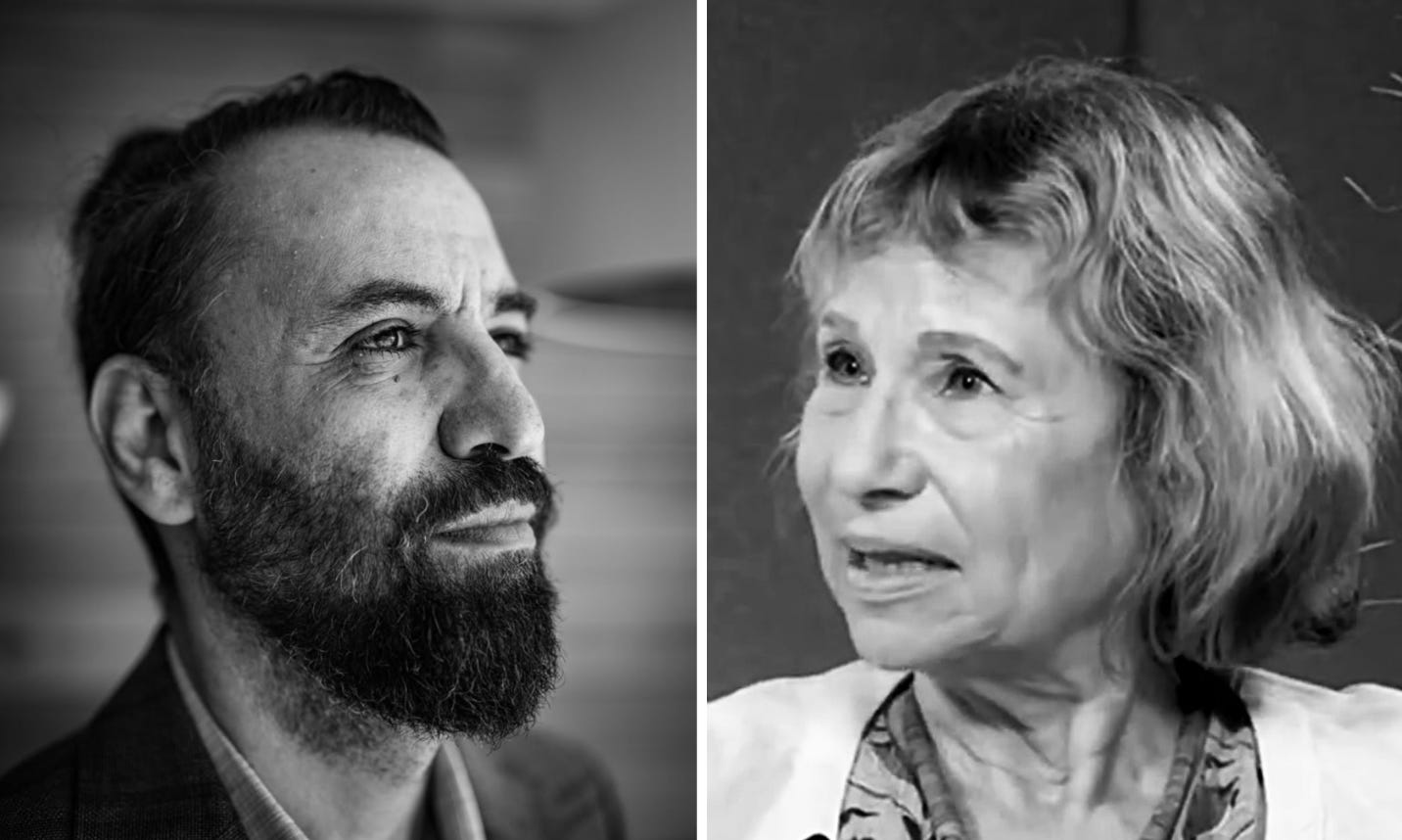
Fania Oz-Salzberger and Aziz Abu Sarah Discuss their Differences and Agreements on Israel
This is a free preview of a paid episode. To hear more, visit peterbeinart.substack.comEarlier this year, Israeli writer and historian Fania Oz-Salzberger and the Palestinian peace activist Aziz Abu Sarah debated on X whether Israel targets Palestinian civilians and how to evaluate Israel’s behavior compared to the behavior of Hamas. I’m grateful they both agreed to meet and explore their different perspectives with us.
Desecrating God’s Name
This is a public episode. If you'd like to discuss this with other subscribers or get access to bonus episodes, visit peterbeinart.substack.com/subscribe