The Beinart Notebook
274 episodes — Page 2 of 6
What Would Heschel Say?
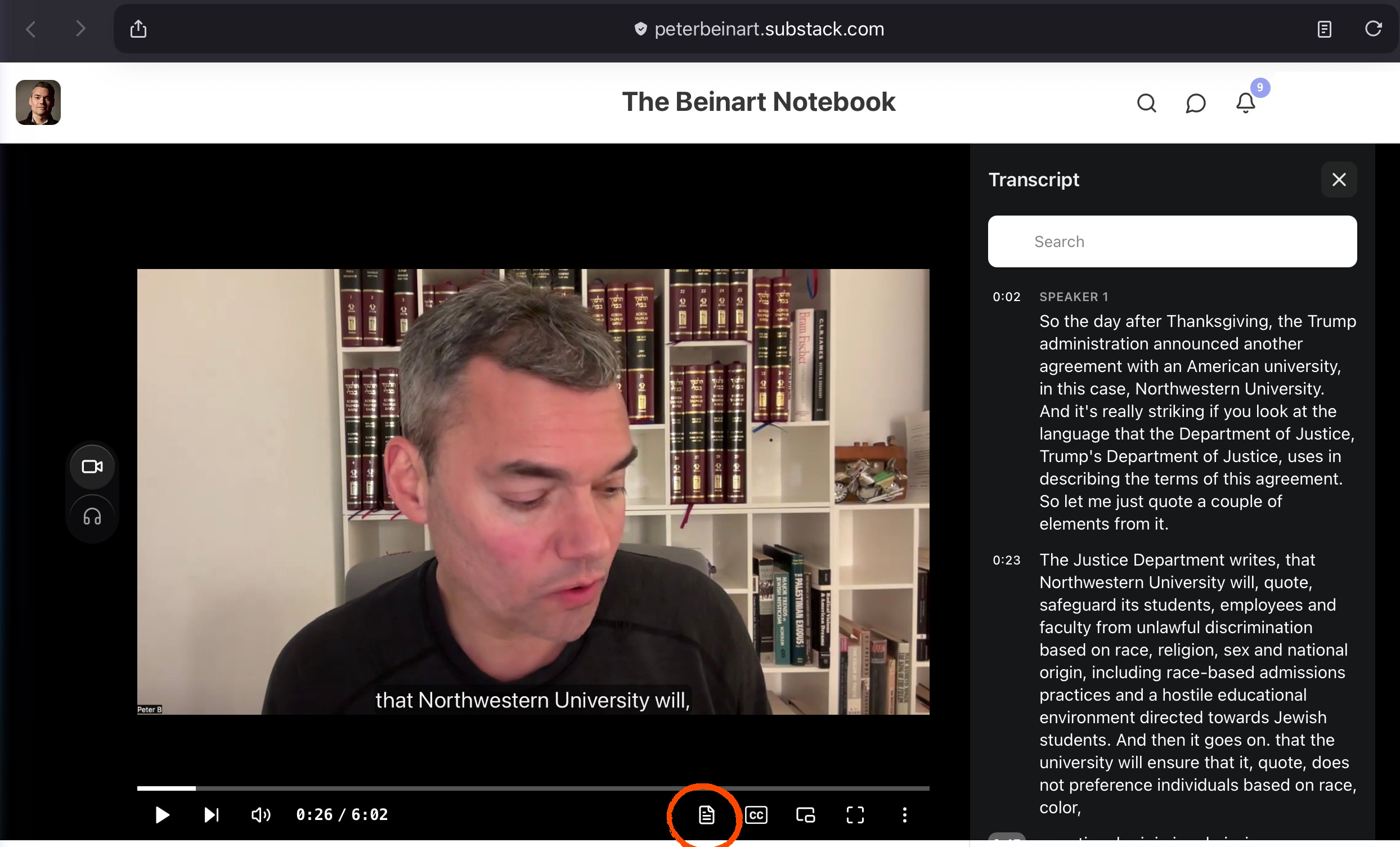
This week’s Zoom call will be at our regular time, Friday at 1 PM Eastern. In the shadow of the war with Iran, Israel is doing terrible things in Lebanon: demolishing homes, killing more than one thousand people, displacing close to a million from their homes and perhaps pushing the country toward civil war. To discuss all this, our guest will be Rami Khouri, a deeply knowledgeable commentator on Lebanese and international politics. He is Distinguished Public Policy Fellow at the Issam Fares Institute at the American University of Beirut, Director of the Anthony Shadid Archives Research Project, Nonresident Senior Fellow at the Arab Center in Washington and author of the Rami G. Khouri Substack. Please join us.Cited in Today’s VideoI’m grateful to Dr. Dror Bondi, Corcoran Visiting Chair in Christian-Jewish Relations at Boston College, who brought the Heschel quote about Abravanel to my attention. He cites it in this lecture.Things to Read(Maybe this should be obvious, but I link to articles and videos I find provocative and significant, not necessarily ones I entirely agree with。)In Jewish Currents (subscribe!), Maya Rosen details the way Israel is using the current war to seize more Palestinian land in the West Bank.On the It Could Happen Here podcast, Dana El Kurd explores intra-Palestinian debates about armed resistance.For the Foundation for Middle East Peace’s Occupied Thoughts podcast, I talked with Sari Bashi, executive director of the Public Committee Against Torture in Israel, about the dismissal of charges against five Israeli soldiers who were filmed violently abusing a Palestinian detainee in the Sde Teiman detention facility.AppearancesOn March 30, I’ll be speaking at the State University of New York at Stony Brook.On May 6, I’ll be speaking to the Joint Christian Advocacy Summit in Washington, DC.PartnershipStarting today, all paid subscribers of The Beinart Notebook get a 50 percent discount on a one-year paid subscription to Robert Wright’s Nonzero Newsletter. I’ve known and respected Bob for decades — my earliest appearance on his show will turn 20 this year, and the latest happened earlier this month. He’s a rare voice of reason on questions ranging from foreign policy to psychology of tribalism to AI, and I think you’ll find a lot of value in his writing. The NonZero Newsletter is part of a broader effort Bob has been building called the NonZero Network — a group of independent Substack voices, including mine, as well as Glenn Loury, Kaiser Kuo, and others with whom I may not always agree on substance, but who share a commitment to intellectual honesty and reasoned analysis.Reader CommentA listener (who asked that their name be withheld) commented on last week’s video, in which I argued that synagogues should remove the “We Stand with Israel” signs that dot their lawns.They write:“I think you mischaracterize attacks on Zionist institutions. I have seen these attacks’ defenders on social media, and their line is not support for attacks of synagogues as such. It is, rather, support (or at least apologia) for attacking institutions that align themselves with the Israeli state. I saw some people claiming that Temple Israel [in Michigan] was sending money to the IDF. That sounds dubious—I’m not intimately familiar with the Israeli military’s funding strategies, but it seems unlikely that American congregations play a major role—but it is certainly true that many Jewish American institutions’ support for Israel goes beyond the purely notional. To say, then, that one should not attack Americans who ‘share a religion, an ethnic, national ancestry, a race,’ with some disfavored foreign country—in this case, Jews and Israel—is to box with a strawman. To the attack’s supporters, it’s not about Jewishness as such, under whichever of the four rubrics you name one wishes to conceive of it; it’s about Zionism, and it’s about Israel.”See you on Friday,PeterVIDEO TRANSCRIPT:I recently came across a quote that just kind of stopped me, like, dead in my tracks, kind of almost dumbfounded, because it reflected a view of how Jews should live and think, which is so radically in contrast to the views propounded by the leadership of the organized American Jewish community today.The quote is from a biography that Rabbi Abraham Joshua Heschel wrote of a remarkable Portuguese 15th century figure named Isaac Abravanel. Now, Abravanel was an advisor to the Portuguese king, as well as being a very distinguished commentator on the Bible and philosopher of Jewish thought—really a remarkable synthesis of the kind that you were able to have on the Iberian Peninsula for a period of time.And then in some ways reflects the kind of possibilities that might be imaginable in the United States today, in which Jews have the freedom to both wield political power and also study Torah in a serious way. And this is what Heschel writes about Abravanel and the Jews of his period in the Iberian Peninsula.Heschel writes, ‘the Jews, who ha
“This Is Our Home”
This is a free preview of a paid episode. To hear more, visit peterbeinart.substack.comOur guest is Diana Buttu, a Palestinian lawyer and political analyst with Israeli citizenship. Since this war began, I’ve struggled to understand why most Israeli Jews support it. I discussed this last week with the Iranian, Jewish, and Israeli writer Orly Noy. But sometimes, the people who best understand a society are those who live within it as outsiders. It’s that experience of marginality, of seeing things from below, that often animates the insights of Black writers in the US and long animated the insights of Jewish writers in Europe. That’s why I’m turning to Diana, a Palestinian in Israel, to help understand Jewish Israeli society in this awful moment. She’s someone I’ve been learning from for a long time. I’m grateful I had the chance to do so again.
Thoughts on the Michigan Synagogue Attack
This week’s Zoom call will be at our regular time, Friday at 1 PM Eastern. Our guest will be Diana Buttu, a Palestinian lawyer and political analyst based in Israel. Since this war began, I’ve struggled to understand why most Israeli Jews support it. I discussed this last week with the Iranian, Jewish, and Israeli writer and translator Orly Noy. But sometimes, the people who best understand a society are those who live within it as outsiders. It’s that experience of marginality, of seeing things from below, that often animates the insights of Black writers in the US and long animated the insights of Jewish writers in Europe. That’s why I’m turning to Diana, a Palestinian citizen of Israel, to help understand Jewish Israeli society in this awful moment. She’s someone I’ve been learning from for a long time. And I’m grateful to have the chance to do so again this Friday. Please join us.Things to Read(Maybe this should be obvious, but I link to articles and videos I find provocative and significant, not necessarily ones I entirely agree with.)In Jewish Currents (subscribe!), Alex Kane explains AIPAC’s attack on liberal Zionist politicians.Greg Sargent on how the Iran War is hastening the end of the Trump coalition.An insightful discussion with Esfandyar Batmanghelidj on the American Prestige podcast about how this war might change the long term trajectory of the Gulf countries.Last week I spoke to Bob Wright (whose newsletter I strongly recommend) about Israel, antisemitism and this war.On March 26, Jason Stanley will speak with Nikole Hannah-Jones in Brooklyn about his book, Erasing History.AppearancesOn March 17, I’ll be speaking at George Washington University.On March 30, I’ll be speaking at the State University of New York at Stony Brook.See you on Friday,PeterVIDEO TRANSCRIPT:I want to say two things about this terrible attack on a synagogue in Michigan. The first is that no matter what Israel does, no matter how immoral or brutal or horrifying, it doesn’t justify attacking a synagogue or justifying attacking American Jews in any way. There’s a basic principle here. The principle is that Americans are not responsible for the actions of foreign governments or foreign organizations just because they share a religion, an ethnic, national ancestry, a race, with that state or foreign organization.So, by that principle, it is just as wrong to target a synagogue because you’re upset at what Israel did, as it was when people attacked Chinese Americans because they were angry at the Chinese government during COVID, or when people attack Muslim Americans because they’re angry at Al-Qaeda, or ISIS, or Hamas, or Iran, or as when the United States government itself held Japanese Americans responsible and put them in internment camps because of what the Empire of Japan had done in Pearl Harbor. These things are all fundamentally wrong.And—not but, but and—Synagogues in the United States should take down the signs that many have on their lawn that say, ‘We stand with Israel.’ They should take them down, because those signs make the congregants less safe, and because they are immoral. Because they create a climate of… they make the Congress less safe, because they encourage exactly the same conflation between Israel and American Jews that we must resist, and because in this moment, doing so is immoral.Now, if it were morally correct for our synagogues to say in this moment, ‘We stand with Israel,’ then I think you could make an argument that even though those signs may make the congregants less safe, that it would be legitimate to do so. You could say that it’s even courageous for Jews in a synagogue to come together and say: we’re going to take a moral action that’s going to create some risk to our safety because it’s the right thing to do.But how could one possibly argue that this is the right thing to do in this moment? That it is morally right to put yourself at risk by conflating yourself with the Israeli government when the Israeli government is doing the things that it is doing now.Let’s do a thought experiment. Let’s imagine that after Russia’s invasion of Ukraine in 2022, that the Russian Orthodox churches in the United States, that they had signs saying ‘We stand with Russia.’ By putting those signs out there, they would be putting, to some degree, the people inside those churches at risk, because there would be people who were furious about what Russia had done in Ukraine, that might take out their anger against people in those churches. But beyond that, it would be immoral to say, given what Russia has done in Ukraine, for a church to say, ‘We stand with Russia.’And what Israel has done over the past few years, to Palestinians, and now, also, in Lebanon and Iran, is worse than what Russia has done in Ukraine. It’s worse. Let’s just look, for starters, at the numbers. The best numbers we have suggest that since the war that began in 2022 with Russia’s invasion—expanded invasion, because they first invaded in
Chris Hayes
This is a free preview of a paid episode. To hear more, visit peterbeinart.substack.comOur guest is Chris Hayes, host of All In with Chris Hayes on MSNOW and the Why Is This Happening? Podcast. He’s also author most recently of The Sirens’ Call: How Attention Became the World’s Most Endangered Resource. Chris sits at a difficult and crucial intersection, between the progressive world (he’s the former Washington editor of The Nation) and mainstream television. I want to talk about how he navigates it, including on Israel-Palestine, what progressives should understand about the American media, and how his work has changed given the perils now facing American democracy.
When Your Country Attacks Your Homeland
This is a free preview of a paid episode. To hear more, visit peterbeinart.substack.comI taped a conversation with Orly Noy, an Israeli writer born in Iran who translates Farsi literature into Hebrew. We talked about the excruciating experience of watching her adopted country attack the other nation that she considers home.
The Danger This War Poses to American Jews
Cited in Today’s VideoThe video of Marine veteran Brian McGinnis shouting “No one wants to fight for Israel.” This is a public episode. If you'd like to discuss this with other subscribers or get access to bonus episodes, visit peterbeinart.substack.com/subscribe
America’s Threat to the World
Our guest is Aslı Ü. Bâli, the Howard M. Holtzmann Professor of Law at Yale. Given the magnitude of what the US, with Israel, has now done, I wanted to talk about more than just Iran, about the kind of global power the United States has become, and what it means, not just for the safety of people in the Middle East, but for people across the world. Aslı is the most brilliant thinker I know about international law, American foreign policy, and the Middle East. I’m grateful she made time for this conversation. This is a public episode. If you'd like to discuss this with other subscribers or get access to bonus episodes, visit peterbeinart.substack.com/subscribe
Nader Hashemi on Why the Iranian Regime Won’t Collapse
This is a free preview of a paid episode. To hear more, visit peterbeinart.substack.comNader Hashemi is Director of the Alwaleed Center for Muslim-Christian Understanding and an Associate Professor of Middle East and Islamic Politics at Georgetown University. We spoke about the roots of America’s antagonism with the Islamic Republic, comparisons between Iran and Cuba, and why Iranians deserve a democratic revolution but Trump and Netanyahu won’t create one.
America, Iran and the Lessons of Nuremberg
This is a public episode. If you'd like to discuss this with other subscribers or get access to bonus episodes, visit peterbeinart.substack.com/subscribe
January AMA
This is a public episode. If you'd like to discuss this with other subscribers or get access to bonus episodes, visit peterbeinart.substack.com/subscribeTopics include:* Mark Carney’s speech* the role of University Hillels* the intelligence of Zionists* Gaza and the West Bank today* Report from Minnesota* how we speak of our opponents* weighing truthfulness against political expediency* speaking to progressives and liberals* polling JewsThe monthly AMA live session and full video is a special perk for Premium paid subscribers. Sample Q&A from last month’s session is for everyone. Thanks so much to all for your support at any level.(A Substack glitch fails to distinguish between subscription tiers in these messages. You can review the various options here.)
What If Other Countries Claimed The Right to Bomb the US?
A list of ways to help Palestinians in Gaza and the West Bank.This week’s Zoom call will be at our regular time, Friday at 1 PM Eastern. Our guest will be Negar Mortazavi, Senior Fellow at the Center for International Policy and host of the excellent Iran Podcast. We’ll talk about the potential for another US and Israeli attack on Iran, how Iranian dissidents view such a move, the role of the Iranian diaspora, and America and Israel’s efforts to boost Reza Pahlavi, the son of the deposed shah.Ask Me AnythingOur next Ask Me Anything session, for PREMIUM SUBSCRIBERS ONLY, will be this Tuesday, February 24, from 11-12 AM Eastern time.Things to Read(Maybe this should be obvious, but I link to articles and videos I find provocative and significant, not necessarily ones I entirely agree with.)In Jewish Currents (subscribe!), Josh Nathan-Kazis writes about the Jewish community’s reckoning over Les Wexner, patron of Jeffrey Epstein.Muhammad Shehada on how Europe might develop an alternative vision to Trump’s plans for Gaza.My friend, the Swedish writer Goran Rosenberg, has published a beautiful memoir, Israel: A Personal History.Give a Purim gift to Israelis who resist the draft.AppearancesI talked about white Christian nationalism on Ali Velshi’s show on MSNOW.On February 24, I’ll be speaking via Zoom to the Britain Palestine Project.On March 9, I’ll be speaking to Carolina Jews for Justice in Asheville, North Carolina. On March 10, I’ll be attending a fundraiser for Gaza in Asheville.On March 30, I’ll be speaking at the State University of New York at Stony Brook.See you on Friday,PeterVIDEO TRANSCRIPT:So, Donald Trump has moved this massive military arsenal to near Iran, and there’s a lot of reports that any day now, the U.S. could launch a military assault on Iran. And when I watch the debate about this kind of thing in the United States, I find it very frustrating, because I find that even people who are against Donald Trump attacking Iran, it seems to me, don’t necessarily raise the most fundamental questions. They say, well, how do we know this would work in overthrowing the regime, or how do we know it would work in eliminating Iran’s nuclear program, or, you know, why hasn’t Congress had a vote on this, or why hasn’t Donald Trump explained it to the American people, or why isn’t he focusing on domestic issues?I mean, all of these are legitimate points to make, but it seems to me, they miss a far more fundamental point, which is: by what right does the United States have to attack a country that clearly poses no threat to the United States, and that the American exceptionalism is so deep in mainstream American political culture that almost never are Americans asked to flip things, and imagine the idea of Iran or China, for that matter, attacking the United States, right? To reverse the lens, the notion that the United States somehow has the right to do things to other countries that we would never, in a million years think it was okay to do to us is just so baked into American conversation. But I think it’s just worth doing the thought experiment, right?Think about the justifications for America’s attack on Iran, right? And think about how they could be applied if a foreign country wanted to attack the United States. So, one is that Iran has this nuclear program, right? Doesn’t have nuclear weapons, but it supposedly has some kind of nuclear program that could be used to make nuclear weapons one day, right? But Iran has done a much better job of complying with the Nuclear Non-Proliferation Treaty than the United States does. Iran actually signed the Obama nuclear deal, which actually went beyond the obligations of the Nuclear Non-Proliferation Treaty, right?The Nuclear Non-Proliferation Treaty basically says that countries that don’t have nuclear weapons cannot get them, but crucially, it also says that nuclear-armed countries need to move in the direction of disarmament, right? Donald Trump has moved exactly in the opposite direction, right, basically scrapping the remaining nuclear arms control treaties that exist, moving to modernize and build more and more nuclear weapons, right? So, if the claim is that you have the right to attack countries, because they’re not meeting their obligations on the Nuclear Non-Proliferation Treaty, I think that would be a better justification for attacking the United States than for the United States attacking Iran.The second claim is that Iran represents a threat to its neighbors. Now, it’s true Iran has supported groups like the Houthis and Hezbollah and groups in Iraq that have taken violent actions against Israel or against American troops. But the level of aggression that Iran has been involved in vis-a-vis its neighbors absolutely pales to the degree of aggression that the United States has been involved in vis-a-vis its neighbors, right? The United States literally just sent the U.S. military in to kidnap, to abduct a foreign leader in Venezuela. The U.S. is basical
"We are not wanted there."
This is a free preview of a paid episode. To hear more, visit peterbeinart.substack.comOur guest is Sabri Jiryis, who for more than half a century has been among the most important Palestinian intellectuals trying to understand Zionism and promote Palestinian freedom. As a young man, he helped found al-Ard, the first Palestinian political movement in Israel, which called for Palestinian national rights and the establishment of a Palestinian state alongside Israel. In 1966, he wrote The Arabs in Israel, his landmark book on the Palestinians who remained in Israel after the Nakba. In 1970, Jiryis was exiled to Lebanon, where he became a close advisor to Yaser Arafat and director of the Palestine Research Center, the research and publication center of the PLO. In 1977, he published the first volume of his seminal Arabic-language book, A History of Zionism, and followed it up with a second volume in 1986. That book has now been translated into English by his daughter Fida. Following the Oslo Accords, Jiryis was one of the few Palestinians allowed to return to Israel and now lives in his native village, in the Galilee. We discussed his understanding of Zionism, and his extraordinary life.
The Closing of the Establishment Jewish Mind
This week’s Zoom call will be at our regular time, Friday at 1 PM Eastern. Our guest will be Sabri Jiryis, who for more than half a century has been among the most important Palestinian intellectuals trying to understand Zionism and promote Palestinian freedom. As a young man, he helped found al-Ard, the first Palestinian political movement in Israel, which called for Palestinian national rights and the establishment of a Palestinian state alongside Israel. In 1966, he wrote The Arabs in Israel, his landmark book on the Palestinians who remained in Israel after the Nakba. In 1970, Jiryis was exiled to Lebanon, where he became a close advisor to Yaser Arafat and director of the Palestine Research Center, the research and publication center of the PLO. In 1977, he published the first volume of his seminal Arabic-language book, A History of Zionism, and followed it up with a second volume in 1986. That book has now been translated into English by his daughter Fida. Following the Oslo Accords, Jiryis was one of the few Palestinians allowed to return to Israel and now lives in his native village, in the Galilee. We will discuss his understanding of Zionism, and his extraordinary life, on Friday.Reader SurveyWe created a super-short, four question, survey to see how subscribers feel about the Beinart Notebook. If you have 5 minutes, please fill it out. It will help us figure what topics to cover, and what guests to interview, in the coming year. Thanks to everyone who has already filled it out.Cited in Today’s VideoThe open letter claiming that accusing Israel of genocide constitutes a “blood libel.”The letter’s link to one paper published on the International Association of Genocide Scholars’ website accusing Hamas of genocide.The International Association of Genocide Scholars accuses Israel of genocide.Scholars estimate that Israel has killed roughly 100,000 people in Gaza.Things to Read(Maybe this should be obvious, but I link to articles and videos I find provocative and significant, not necessarily ones I entirely agree with.)In Jewish Currents (subscribe!), Daniel May writes about the lessons of Minneapolis’s resistance to ICE.In 972Mag, Sophia Goodfriend explains how ICE is adapting surveillance practices pioneered by Israel.For the Foundation for Middle East Peace’s “Occupied Thoughts” podcast, I interviewed Adalah’s Myssana Morany and B’Tselem’s Sarit Michaeli about the forced displacement of Palestinians in both the West Bank and the Naqab/Negev.AppearancesOn February 17, I’ll be speaking on a panel for the World Policy Forum about Muslim-Christian-Jewish Coexistence in the Holy Land.On February 24, I’ll be speaking via Zoom to the Britain Palestine Project.On March 9, I’ll be speaking to Carolina Jews for Justice in Asheville, North Carolina. On March 10, I’ll be attending a fundraiser for Gaza in Asheville.On March 30, I’ll be speaking at the State University of New York at Stony Brook.See you on Friday,PeterVIDEO TRANSCRIPT:So, there’s this open letter which has been signed by a bunch of people that accusing Israel of genocide constitutes a blood libel. Some of the initial signatories are the Israeli journalist Yossi Klein Halevi, Rabbi Yitz Greenberg, Rabbi Shmuly Yankolovich. I mention them in particular because part of what is so depressing to me, dispiriting to me about this letter, is that these are people who, in other aspects of their lives, I actually think are really, really talented and thoughtful people.I mean, Yossi Klein Halevi—I disagree with his political views—but he’s a very talented narrative journalist. If you read books of his, like, you know, We Were Like Dreamers about the Israeli soldiers in the 1967 war and what happened to them. Yitz Greenberg is one of the most important American rabbis of his generation, really a giant in the kind of field of post-Holocaust theology who shaped, you know, whole generations of Orthodox American Jews. Shmuly Yankielovich, who’s based in the United States, runs an Orthodox organization that, in domestic American politics, on questions of the rights of immigrants, on opposing ICE, has actually done some really, really, you know, wonderful, wonderful work.And so, this letter, to me is a kind of an example of how there’s something about this question, about the question of Israel and the Palestinians that I think takes people’s best qualities—their qualities of intellectual curiosity, and their qualities of empathy—and it kind of drains them. And this letter, I think, is a specimen of kind of what has happened to establishment American Jewish and Israeli discourse.And I just want to explain why I find it so dispiriting. The first point is if you wanted to write an intellectually and morally honest, you know, letter opposing the claim that Israel has committed genocide—you know, and to be fair, genocide is a very particular kind of crime, right? It’s different than crimes against humanity, for instance, right? Genocide has to do with intent. One co
Upside-Down Love
This is a free preview of a paid episode. To hear more, visit peterbeinart.substack.comSari Bashi, is the founder of Gisha, the Legal Center for Freedom of Movement, the leading Israeli human rights group offering legal assistance to Palestinians. She’s also author of the new memoir, Upside-Down Love, about her love affair with a Palestinian professor confined by Israel to the West Bank city of Ramallah.
Speaking Across Divides
Ethan Katz is Associate Professor of History at the University of California at Berkeley. He’s the faculty director of the Center for Jewish Studies and co-founder of both the Antisemitism Education Initiative and the Bridging Fellowship Dialogue program.His most recent co-edited book is When Jews Argue: Between the University and the Beit Midrash.He recently wrote an essay for Sources entitled When Is Anti-Zionism Antisemitic? Getting Beyond the Polemics and, while I didn’t agree with all of it, I found it an interesting good faith exploration of these issues, so I invited him to discuss it. This is a public episode. If you'd like to discuss this with other subscribers or get access to bonus episodes, visit peterbeinart.substack.com/subscribe
Trump is Not a Patriot
In this age of unfathomable cruelty and suffering, it’s easy to feel overwhelmed. But I want to highlight one individual, and one campaign, for you to consider supporting. The individual is Abdullah Awwad, a surgeon in the Gaza Strip I interviewed last year. He’s been working for years in horrifying conditions. He’s been accepted to multiple overseas medical programs but needs the money to leave Gaza with his family.The campaign is by Shir Tikvah, the synagogue whose rabbi, Arielle Lekach-Rosenberg, I interviewed last week. It’s to raise money for people harmed by ICE’s assault on the Twin Cities. Please consider supporting both of these efforts.This week’s Zoom call will be at our regular time, Friday at 1 PM Eastern. Our guest will be Sari Bashi, founder of Gisha, the Legal Center for Freedom of Movement, the leading Israeli human rights group offering legal assistance to Palestinians. She’s also author of the new memoir, Upside-Down Love, about her love affair with a Palestinian professor confined by Israel to the West Bank city of Ramallah. We’ll talk about her story of love in the face of institutional oppression, and about Israel’s restrictions on Palestinian movement, particularly in Gaza, where despite a so-called “cease-fire,” Palestinians remain largely unable to enter or leave the Strip.Reader SurveyWe created a super-short, four question, survey to see how subscribers feel about the Beinart Notebook. If you have 5 minutes, please fill it out. It will help us figure what topics to cover, and what guests to interview, in the coming year.Cited in Today’s VideoI wrote about patriotism and nationalism for The Atlantic in 2018.How the UAE bribed Trump to give it America’s most sensitive technology.Things to Read(Maybe this should be obvious, but I link to articles and videos I find provocative and significant, not necessarily ones I entirely agree with.)For Jewish Currents (subscribe!), I wrote about Donald Trump’s “Board of Peace.”For the Foundation for Middle East Peace’s “Occupied Thoughts” podcast, I interviewed Jaser Abu Mousa, a 2025 Yale Peace Fellow and past program officer working for the Swiss Agency for Development and Cooperation (SDC) in Gaza, about life and death in the Gaza Strip.For one day, The Nation magazine devoted its entire website to writing about Gaza, by writers from Gaza.After years of disputing the Gaza Health Ministry’s death toll numbers, Israel now accepts them.Eve Fairbanks writes about the American right’s nostalgia for apartheid South Africa.AppearancesOn February 9, I’ll be virtually speaking to Our Common Beliefs.On February 12, I’ll speaking at the Conference on the Jewish Left at Boston University.On Feb 24, I’ll be speaking via Zoom to the Britain Palestine Project.On March 9, I’ll be speaking to Carolina Jews for Justice in Asheville, North Carolina. On March 10, I’ll be attending a fundraiser for Gaza in Asheville.Reader CommentOccasionally, I publish readers’ responses to my videos. Here’s one from Deborah Seligsohn, Assistant Professor of Political Science at Villanova University, about my criticism of the US Holocaust Memorial Museum for its criticism of Minnesota Governor Tim Walz’s suggestion that a child in Minnesota may one day write a book like Anne Frank’s.“I went to the US Holocaust Museum with my Dad (whose father had died in a concentration camp), an incredibly moving experience. I can’t remember exactly when we went, except that I was carrying my baby in a front pack, and that I think for both of us being able to hold on to precious new life was emotionally what got us through. But what I also remember, which is why I want to mention it to you, is that there was an exhibit about the abuses in Bosnia (and this had to be before Srebrenica - it was probably November 1994 that we went, and Srebrenica was July 1995). The Museum was making a direct analogy to the holocaust. So, if they are now saying that analogies are always impermissible, that is a new point of view or more likely a rather selective one. My recollection of the museum was that you started at the top with the 1930s and worked down through 3 levels that end with the death camps, and then there is another level below that is about other genocides - or at least it was when I went - and that area was about Bosnia. When I look at their website, they have a huge section on other genocides in their genocide prevention section. What is striking there is that genocide is pretty broadly construed, except with the glaring missing discussion of the Palestinians.”See you on Friday,PeterVIDEO TRANSCRIPT:So, this was a somewhat difficult evening, for me on Sunday evening as my hometown New England Patriots lost in the Super Bowl. But, actually, the word patriots got me thinking earlier in the week because I was looking for some merchandise about the New England Patriots and, when I was searching online, what I noticed was that if you search up, kind of, hats or t-shirts with the word ‘patriots,’ you get
Being a Neighbor Amidst Atrocities
This is a free preview of a paid episode. To hear more, visit peterbeinart.substack.comOur guest is Arielle Lekach-Rosenberg, lead rabbi of Shir Tikvah, a “justice-seeking, song-filled” congregation in South Minneapolis. With a background in organizing for migrant rights, she has bridged faith and activist communities locally and nationally to confront the Trump administration’s ongoing siege of Minneapolis, including by co-convening a recent gathering of over 650 clergy in the city.
There’s Nothing Offensive About Invoking the Holocaust to Defend Human Rights
A list of ways to help Palestinians in Gaza and the West Bank.This week’s Zoom call will be at our regular time, Friday at 1 PM Eastern. Our guest will be Arielle Lekach-Rosenberg, lead rabbi of Shir Tikvah, a “justice-seeking, song-filled” congregation in South Minneapolis. With a background in organizing for migrant rights, she has bridged faith and activist communities locally and nationally to confront the Trump administration’s ongoing siege of Minneapolis, including by co-convening a recent gathering of over 650 clergy in the city. We’ll talk about the role of religious leaders in general— and the Jewish community in particular— in the struggle to defend human rights and the rule of law in Minneapolis.Cited in Today’s VideoMinnesota Governor Tim Walz’s comparison of undocumented children in Minnesota to Anne Frank.The attacks on Walz’s comparison by the head of the Anti-Defamation League, the Holocaust Museum in Washington and Donald Trump’s antisemitism envoy.Former Israeli Defense Minister Moshe “Boogie” Yaalon’s claim that “the ideology of ‘Jewish supremacy,’ which has become dominant in the Israeli government, reminds one of the Nazi racial theory.”Zach Foster on the long history of Israelis comparing other Israelis to the Nazis.Things to Read(Maybe this should be obvious, but I link to articles and videos I find provocative and significant, not necessarily ones I entirely agree with.)On the Jewish Currents (subscribe!) podcast, Arielle Angel talks to three organizers from Minnesota.On February 3, I’ll be speaking at Washington and Lee University in Lexington, Virginia.On February 9, I’ll be virtually speaking to Our Common Beliefs.On February 12, I’ll speaking at the Conference on the Jewish Left at Boston University.On Feb 24, I’ll be speaking via Zoom to the Britain Palestine Project.On March 9, I’ll be speaking to Carolina Jews for Justice in Asheville, North Carolina. On March 10, I’ll be attending a fundraiser for Gaza in Asheville.On March 8, Smol Emuni (the Religious Left) will hold a conference in New York.Being Jewish After the Destruction of Gaza is a finalist for PEN America’s John Kenneth Galbraith Award for Nonfiction.See you on Friday,PeterVIDEO TRANSCRIPT:So, on January 24th, Minnesota Governor Tim Walz, observing what ICE and Border Patrol have been doing in his city, which is just terrifying so many immigrant families that their children are unwilling to leave the house, he wrote, ‘we have got children in Minnesota hiding in their houses, afraid to go outside. Many of us grew up reading that story of Aunt Frank. Somebody’s going to write that children’s story about Minnesota.’So, after that, Walz was attacked by the Anti-Defamation League and the Holocaust Museum in Washington, and Trump’s antisemitism envoy for having kind of desecrated the history of the Nazi Holocaust by invoking Anne Frank’s name to talk about what happened in Minnesota, even though Tim Walz was not saying that children in Minnesota were being sent to death camps. He didn’t say anything like that. He simply was saying that there were children who were hiding in their homes, and that perhaps one of those children would be writing a diary that people would [read about some] day.I mean, it’s just important to make—this should be an obvious point—but not every comparison with the Nazis is to suggest that the thing being compared to the Nazis is involved in a process of mass extermination. The Nazis did many, many things in addition to the mass extermination of Jews, and Roma, and LGBT folks, and others, right?But these organizations, the ADL, the Holocaust Museum, right, basically don’t want to use the example of the Holocaust to suggest that something terrible is happening in Minnesota. They’re much less concerned about the massive human rights abuses and massive violations of the rule of law that are happening in Minnesota and across the country than in maintaining the claim that nothing can be compared to the Holocaust, or at least no other human rights abuses can be compared to the Holocaust, because they have no problem, for instance, comparing the Iranian regime with the Nazis, if that serves Israeli foreign policy.Interestingly, a few days after Walz’s comments, there was another analogy to the Holocaust, and this came from Moshe “Boogie” Yaalon. Boogie is his nickname. Boogie Yaalon is not a leftist radical. He was actually the chief of staff of the IDF. And then he was Benjamin Netanyahu’s defense minister from 2013 to 2016.And this is, I’m going to read you snippets of the translation of what Boogie Yaalon wrote. He wrote: ‘on the last Tuesday evening, I participated in an event marking International Holocaust Remembrance Day. When I got home, I received a message about Jewish pogromists attacking Palestinians in southern Mount Hebron, stealing their sheep, and burning their property.’ And then he writes, “you can’t compare.”He goes on: “After ambulances, which tried to reach the scene were delayed by t
One State or Two?
This is a free preview of a paid episode. To hear more, visit peterbeinart.substack.comDaoud Kuttab is an award-winning Palestinian journalist and author of State of Palestine NOW. He supports two states, because “the most urgent and doable solution now is the creation of an independent state of Palestine that can live at peace with Israel.”His brother, Jonathan Kuttab is a co-founder of the human rights groups Al Haq and Nonviolence International and author of Beyond the Two State Solution. He believes two states “is no longer feasible.” He therefore supports “solutions that truly address the fundamental issues and the needs of all parties, including settlers, and Palestinian citizens of Israel, which the two-state solution failed to do.” This week, Daoud and Jonathan offered their competing perspectives.
Mark Carney vs Pharaoh
A list of ways to help Palestinians in Gaza and the West Bank.This week’s Zoom call will be at our regular time, Friday at 1 PM Eastern. Last week’s guests were two Jewish brothers who disagree politically. This week, the intra-family disagreement will be between two Palestinian brothers. Daoud Kuttab is an award-winning Palestinian journalist and author of State of Palestine NOW. He supports two states, because “the most urgent and doable solution now is the creation of an independent state of Palestine that can live at peace with Israel.” His brother, Jonathan Kuttab is a co-founder of the human rights groups Al Haq and Nonviolence International and author of Beyond the Two State Solution. He believes two states “is no longer feasible.” He therefore supports “solutions that truly address the fundamental issues and the needs of all parties, including settlers, and Palestinian citizens of Israel, which the two-state solution failed to do.” Daoud and Jonathan will offer their competing perspectives on Friday.Ask Me AnythingOur next Ask Me Anything session, for PREMIUM SUBSCRIBERS ONLY, will be this Wednesday, January 28, from 11-12 AM Eastern time.Cited in Today’s VideoParshat Bo in the Book of Exodus.Donald Trump’s interview with the New York Times.Canadian Prime Minister Mark Carney’s speech at Davos.Things to Read(Maybe this should be obvious, but I link to articles and videos I find provocative and significant, not necessarily ones I entirely agree with.)In Jewish Currents (subscribe!), Alex Kane reports on whether congressional candidate Brad Lander can recreate Zohran Mamdani’s coalition between liberal and anti-Zionists.In The Guardian, I argued that Donald Trump is just the latest president to fall in love with war.In Haaretz, Libby Lenkinski asks whether the Netanyahu government will destroy independent cinema in Israel.Former Clinton official Abby Ross argues that it’s time to disband NATO.Because of bad weather, my talk to Carolina Jews for Justice in Asheville, North Carolina has been rescheduled from January 26 to March 9 and the subsequent fundraiser for Gaza has been rescheduled from January 27 until March 10.On February 3, I’ll be speaking at Washington and Lee University in Lexington, Virginia.On February 12, I’ll speaking at the Conference on the Jewish Left at Boston University.On March 3, three descendants of Americans punished during the red scare will discuss America’s new McCarthyism.On March 8, Smol Emuni (the Religious Left) will hold a conference in New York.See you on Friday,PeterVIDEO TRANSCRIPT:So, there’s this famous line by Rabbi Shlomo Carlebach where he says that Torah is a commentary on the world, and the world is a commentary on Torah. By which I think he meant that we see new things in Torah, just as people could see new things in any religious text, because of our life experience, because of what we see happening in the world in our time. And, I thought there was a kind of interesting illustration of this in last week’s Torah portion in the book of Exodus, Parshat Bo, which is particularly powerful to read in the age of Donald Trump.There’s one particular line. It’s during the last of the three plagues in Egypt. And Moses and his brother Aaron go to Pharaoh to announce the eighth plague, the plague of locusts. And when Pharaoh still refuses to allow the Israelites to go, to leave, the text says that ‘Moses turned and left Pharaoh’s presence.’ And the medieval commentator, ibn Ezra, interprets this phrase as suggesting that Moses left Pharaoh’s presence without Pharaoh’s permission, which, for an all-powerful ruler like Pharaoh, was potentially, risked death. There’s a bit of a parallel between the line we read in the book of Esther, in which Esther enters the presence of the Persian king without his permission, also an act punishable by death.And this is considered an act of tremendous courage, and it’s considered a kind of defiance, not only of Pharaoh’s tyranny, but of Pharaoh’s idolatry. Because in Jewish tradition, the fact that Pharaoh considers himself a god is intimately linked with Pharaoh’s tyranny and brutality. And so, to suggest that Pharaoh is not all-powerful, that Pharaoh doesn’t have some kind of divine status is not only part of a struggle for freedom, but it’s actually a rejection of idolatry itself. And so, Pharaoh becomes a kind of anti-model for the Jewish kings in the Hebrew Bible who are required to write a Sefer Torah, to write a kind of book of law, to show that they are not the law there, that the law binds them, and indeed, that they are not God.Now, Donald Trump, in his own kind of more modern secular language, also, I think, suggests often that he is a kind of a divine figure, right? He said to the New York Times recently that basically he is bound by no law other than his own sense of morality, kind of warped as that sense is. He also said, in speaking about his first year in office, or in his first year since returning to office, he said, Go
Holding Liat
This is a free preview of a paid episode. To hear more, visit peterbeinart.substack.comOur guests are brothers Yehuda and Joel Beinin and the director of the 2025 documentary about them, Holding Liat. On October 7, 2023, Yehuda’s daughter, Liat Atzili, was abducted by Hamas, and spent 54 days in captivity in Gaza before being released. Yehuda’s son-in-law, Aviv Atzili, was killed. In the film, Yehuda and Joel offer different understandings of the political context in which October 7 occurred. I asked them to elaborate on their views, and to talk about how an ideologically diverse Jewish and Israeli family grapples with an experience of terrible trauma.
All That's Left of You
This is a free preview of a paid episode. To hear more, visit peterbeinart.substack.comCherien Dabis is an actor, director, producer, and screenwriter. In March 2022, Dabis was named Laureate for Cultural Excellence by the Takreem foundation for her work on authentic Arab representation in Hollywood.Dabis produced, wrote, directed, and acted in her latest film, All That’s Left of You. It follows a Palestinian family across three generations.
A Lesson from Noam Chomsky about Israel and Iran
A list of ways to help Palestinians in Gaza and the West Bank.This week’s Zoom call will be at our regular time, Friday at 1 PM Eastern time. Our guests will be two brothers, Yehuda and Joel Beinin. Yehuda is a landscape architect in Kibbutz Shomrat in northern Israel. Joel (“Joey” to his family and friends) is Emeritus Professor of Middle East History at Stanford University. On October 7, 2023, Yehuda’s daughter, Liat Atzili, who lives in Kibbutz Nir Oz, was abducted by Hamas, and spent 54 days in captivity in Gaza before being released. Yehuda’s son-in-law, Aviv Atzili, was killed in the October 7th attack. The experience of Liat and her family are recounted in the 2025 documentary, Holding Liat. In the film, Yehuda and Joel offer different understandings of the political context in which October 7 occurred. I’ll ask them to elaborate on their views, and to talk about how an ideologically diverse Jewish and Israeli family grapples with an experience of terrible trauma.Cited in Today’s VideoNoam Chomsky vs David Frum on human rights.Things to Read(Maybe this should be obvious, but I link to articles and videos I find provocative and significant, not necessarily ones I entirely agree with.)In Jewish Currents (subscribe!), Eric Baker argues that to preserve academic freedom, US universities should cut their ties to the US military.972 Mag chronicles the spike in emigration from Israel.Nader Hashemi on potential US strikes on Iran.On January 19, I’ll be speaking at the Free University of Brussels.On January 26, I’ll be speaking with Carolina Jews for Justice in Asheville, North Carolina.On January 27, I’ll be hosting a fundraiser near Asheville for the Gaza Soup Kitchen, a grassroots initiative, led by people in Gaza, which serves hot meals to thousands daily across ten kitchen sites. Ninety-nine percent of funds raised go directly to feeding and supporting the people of Gaza. Register here: https://givebutter.com/FairviewNC (donation amount is $100 and address to be provided after registration).On February 12, I’ll speaking at the Conference on the Jewish Left at Boston University.See you on Friday,PeterVIDEO TRANSCRIPT:So, one of my favorite things is when I get emails from people who disagree with me but have a genuine kind of question or argument they want to make. You know, it’s very different than when people just kind of email to say, you know, what an a*****e I am. But, you know, people who have, like, a genuine argument that they want to hear responded to.And I got an email like that the other day, and it was kind of in the wake of these demonstrations in Iran. And the person said, about progressives, he said, ‘I often see intense focus on Israel without proportional attention to severe human rights violations in Iran, China, Russia, and elsewhere.’ And it’s a really, really important point, I think, to answer. And, and it’s a debate that’s been going on for a long time.And his question reminded me of this remarkable video, this remarkable clip, of a conversation decades ago between Noam Chomsky and David Frum—Chomsky and Frum, of course, both much younger at that time. David Frum was quite a young man but still appears to be having some of the kind of hawkish tendencies that he became later well known for. And, in their interaction, Frum says, when we think what we focus on as Americans in terms of our foreign policy concerns, Frum says there should be, ‘an equality of corpses,’ by which he means we should treat all deaths in which people are killed by a regime equally, irrespective of who does it.And Chomsky argues no. Chomsky says, actually, we should care more about those deaths that are committed with American participation, with American complicity. Not, of course, because the lives matter more, but simply because we have a greater moral obligation because we participated in their killing. And Chomsky says, ‘it’s a very simple ethical point. You’re responsible for the predictable consequences of your actions. You’re not responsible for the predictable consequences of somebody else’s actions.’And I think this is something that we kind of intuitively kind of understand if we take it out of the realm of foreign policy and just think about interpersonal, you know, interactions, right? If I am, God forbid, beating up on someone, I have a greater responsibility to stop doing so than I do to stop my neighbor who is beating up on someone, partly, again, because I am the one who’s committing this despicable action.It’s also, just as a practical matter, a lot easier for me to stop that action than me to stop the neighbor, right? Again, I may well also have an obligation to do something about what my neighbor is doing, but it’s a much more complicated business. I have to literally go, what am I gonna go kind of fight my neighbor to make sure my neighbor is not fighting against the other person? That might well be a valuable thing to do, but in the hierarchy of things that I should do, if I have a limited
A New Iranian Revolution?
This is a free preview of a paid episode. To hear more, visit peterbeinart.substack.comTrita Parsi is an expert on Iran, author, and executive vice president of The Quincy Institute. I asked him to help make sense of the current situation in Iran.
American Progressives Must Support the Protests in Iran
Note: Apologies for the poor video quality here. I’m making do with spotty WiFi. A list of ways to help Palestinians in Gaza and the West Bank.There will be no Zoom call this week. We’ll return next week.Things to Read(Maybe this should be obvious, but I link to articles and videos I find provocative and significant, not necessarily ones I entirely agree with.)In Jewish Currents (subscribe!), Maya Rosen reports on efforts by Israeli universities to lure American Jewish students alienated by pro-Palestinian activism on American campuses.Last week, I spoke on a panel at B’nai Jeshurun Synagogue in New York.On January 19, I’ll be speaking at the Free University of Brussels.On January 26, I’ll be speaking with Carolina Jews for Justice in Asheville, North Carolina.On January 27, I’ll be hosting a fundraiser near Asheville for the Gaza Soup Kitchen, a grassroots initiative, led by the people of Gaza, which serves hot meals to thousands daily across ten kitchen sites. Ninety-nine percent of funds raised go directly to feeding and supporting the people of Gaza. Register here: https://givebutter.com/FairviewNC (donation amount is $100 and address to be provided after registration).See you next week,PeterVIDEO TRANSCRIPT:So, there are really remarkable protests taking place in Iran, and I think the first thing to say about them is that they deserve the support of progressives because progressives should care about human rights.And there are pro-American regimes that can commit horrific violations of human rights, and there are anti-American regimes that can commit horrific violations of human rights. This is not a new story. You can go back to Joseph Stalin to realize that’s the case, and also to see that there have been times historically, where some progressives have forgotten that, and judged regimes less on the way they treat their people than how they treat the United States. And that seems to me, it’s as wrong to give countries a pass when they brutally violate human rights because they’re anti-American, as it is to give them a pass when they brutally violate human rights, because they’re pro-American, if you’re someone who cares and believes in the universality of human rights.But saying that the Iranian protesters were protesting against this really, really autocratic and brutal regime deserve the support of progressives around the world—all people around the world—doesn’t answer the question of what the United States should do. It’s really important to remember that just because people hate their regime doesn’t mean they want a foreign country to attack their regime, let alone occupy their regime.You know, many Iraqis—probably most Iraqis—loathed Saddam Hussein. It didn’t mean that they wanted the United States to occupy Iraq. And the United States learned the hard way—or those Americans who didn’t know beforehand learned the hard way—that Iraqis could both loathe Saddam Hussein and also loathe and fight against an American occupation.And it’s also just important to remember that even if you could establish—and I don’t know how one could establish—the fact that Iranians might want some kind of American military intervention in their country, that there are questions of international law here that have global repercussions, right? Which is to say, even if you could establish that people in a certain country wanted, you know, wanted an attack by another country—and again, I don’t know how you would do that—one of the things we’ve clearly learned in the last 20-25 years is the way in which when one country, when the United States gives itself the right to intervene militarily in the internal affairs of another country, that emboldens other powers, you know, China and Russia in particular, to do exactly the same thing.It’s different when you have the support of the United Nations, right, because support of the United Nations suggests that you have, essentially, some kind of consensus among many countries around the world. Then that is a check on the inclination of various powers—the U.S. in Iraq, or, you know, Russia in Georgia, Ukraine—to basically come up with some spurious claim to justify its imperial interests, right? So, it would be one thing if there was some kind of international UN support for some kind of intervention in Iraq. But I think that’s fundamentally different than the United States doing it on its own.And the other thing I think is worth thinking about when we think about what we would want if we were Iranians, what kind of support we might want from countries around the world, is to imagine ourselves in their shoes. And I actually think that’s a little bit easier for many Americans than it was before Donald Trump. Now, obviously, the United States remains a much, much freer country than Iran does. But it doesn’t take that much imagination to imagine that if Donald Trump got his way, he could move the United States towards being the kind of really brutal dictatorship that Iran is today—a cou
Pure Power Politics
This is a free preview of a paid episode. To hear more, visit peterbeinart.substack.comOur guest is one of the foremost scholars of US policy towards Latin America, the Pulitzer Prize-winning Yale historian, Greg Grandin, author of Empire’s Workshop: Latin America, the United States, and the Rise of the New Imperialism and America, América: A New History of the New World. We talked about how the Trump administration’s abduction of Nicolás Maduro fits into the long-history of US imperialism in the Western Hemisphere, and the world.
The Jewish Establishment’s Attacks on Mamdani Aren’t Only Illogical
A list of ways to help Palestinians in Gaza and the West Bank.This week’s zoom call will be at a special time, Wednesday at 1pm ET. Our guest will be one of the foremost scholars of US policy towards Latin America, the Pulitzer Prize-winning Yale historian Greg Grandin, author of Empire’s Workshop: Latin America, the United States, and the Rise of the New Imperialism and America, América: A New History of the New World. We’ll talk about how the Trump administration’s abduction of Nicolas Maduro fits into the long-history of US imperialism in the Western Hemisphere, and the world.Cited in Today’s VideoThe attacks on Zohran Mamdani for repealing two orders by Eric Adams related to antisemitism and Israel.The texts of the Israel-related orders Mamdani repealed.A Philosopher for All Seasons, a film about Yeshayahu Leibowitz.Things to Read(Maybe this should be obvious, but I link to articles and videos I find provocative and significant, not necessarily ones I entirely agree with.)In Jewish Currents (subscribe!), Aron Wander and Nathan Goldman discuss Jewish sources about rebuking other Jews.Israel bans Doctors without Borders and other NGOs from operating in Gaza.On January 6, I’ll be speaking on a panel at B’nai Jeshurun synagogue in Manhattan and on January 26 with Carolina Jews for Justice in Asheville, North Carolina.On January 27, I’ll be hosting a fundraiser near Asheville for the Gaza Soup Kitchen, a grassroots initiative, led by the people of Gaza, that serves hot meals to thousands daily across ten kitchen sites. Born from a vow to ensure no neighbor grows hungry, their mission continues in honor of founder Mahmoud Almadhoun, guided by his word, Mostamreen, “we will continue,” said right before he was killed by a drone strike. 99% of funds raised go directly to feeding and supporting the people of Gaza. Register here: https://givebutter.com/FairviewNC (donation amount is $100 and address to be provided after registration).See you on Wednesday,PeterVIDEO TRANSCRIPT:So, Zohran Mamdani has just been inaugurated as mayor of New York and, unsurprisingly, he’s already under attack from establishment Jewish organizations. And these attacks are really predictable and, honestly, they’re really brain-dead, and, in a way, just engaging with them at all is kind of depressing because I think they serve, in a lot of ways, not as good faith arguments, but just basically as a way to, you know, create a political headache and a kind of cloud over Mamdani, and basically make it harder for him to focus on the work that he actually wants to do. But I still think, despite that, it’s worth explaining why these arguments just don’t make any sense. And they’re all basically based on this fundamental incorrect conflation of Jews as a group of people with the state of Israel.So, the first thing that Mamdani did was he repealed an order by his predecessor, Eric Adams, to kind of make the International Holocaust Remembrance Alliance definition of antisemitism, kind of encoded in New York City policy and law. And the IHRE definition of antisemitism has very little support from actual scholars of antisemitism, especially scholars who work on antisemitism and Israel-Palestine. Its major supporters are the Israeli government and its kind of allied pro-Israel organizations around the world. And you can see why it has so little scholarly support when you actually look at it, right? You can see why it makes so much sense that actually Mamdani would have repealed it, right?So, it has these examples of antisemitism. So, basically, if you do these things, this is like prima facie evidence that you are antisemitic. One of them is denying the Jewish people their right to self-determination—I’m quoting—e.g., by claiming that the existence of a state of Israel is a racist endeavor. But the State of Israel is explicitly premised on the idea that, basically, that Jews should rule, right? That this is a state for Jews, in which Jews have superior rights to Palestinians.This is not a secret, right? David Ben-Gurion, the founder of the state of Israel, said, this country has to have an 80% Jewish majority, because otherwise Jews couldn’t be sure that Jews would rule. And it was because of this, in large measure, that for more than half of the Palestinians who lived in Palestine under the British Mandate were expelled when Israel was created in 1948 in order to create this large Jewish majority. Many of them were expelled before the Arab armies even attacked Israel in May 1948.And then Israel created a very different set of laws for the Palestinians that remained vis-à-vis, versus those of Jews, right? So Palestinian citizens were under military law from 1948 to 1966. When Israel conquered the West Bank and Gaza in 1967, it took control of millions of Palestinians who didn’t have the right of citizenship and the right to vote. It’s for all these reasons that Israel has now been declared an apartheid state by the world’s leading human rights organiza
“This Was a Failure”
This is a free preview of a paid episode. To hear more, visit peterbeinart.substack.comOur guest is Philip Gordon, a scholar at the Brookings Institution and former National Security Advisor to Vice President Kamala Harris. We talked about the Biden-Harris administration’s actions regarding Israel and Gaza, Kamala Harris’s statements about Gaza during the campaign, and what policies Democrats should pursue toward Israel-Palestine in the future.
Maduro Abducted
This is a public episode. If you'd like to discuss this with other subscribers or get access to bonus episodes, visit peterbeinart.substack.com/subscribe
The Palestine Exception to Free Speech Rarely Ends with Palestine
A list of ways to help Palestinians in Gaza and the West Bank.This week’s zoom call will be at our regular time, Friday at 1 PM. Our guest will be Philip Gordon, a scholar at the Brookings Institution and former National Security Advisor to Vice President Kamala Harris. We’ll talk about the Biden-Harris administration’s actions regarding Israel and Gaza, Kamala Harris’s statements about Gaza during the campaign, how she might have governed as president and what policies Democrats should pursue toward Israel-Palestine in the future.Cited in Today’s VideoBari Weiss pulls a 60 Minutes report on Trump administration deportations to El Salvador.Donald Trump has reportedly said he expects better treatment by CBS now that David Ellenson and Weiss are in charge.Weiss’ Free Press co-hosted a Trump administration inauguration party with Elon Musk’s X.Weiss’ resignation letter from The New York Times.The ACLU denounced Weiss’ efforts to punish pro-Palestinian professors when she was a student at Columbia.The Trump administration leaked the news that it was withholding funds from Columbia to Weiss’ Free Press.Weiss’ support for Israel is reportedly one of the reasons Ellison hired her at CBS.Things to Read(Maybe this should be obvious, but I link to articles and videos I find provocative and significant, not necessarily ones I entirely agree with.)In Jewish Currents (subscribe!), Alex Kane talks to immigration expert Samah Sisay about how Trump’s new travel ban targets Palestinians.Tareq Baconi on how the genocide in Gaza radicalized the world.On January 6, I’ll be speaking on a panel at B’nai Jeshurun synagogue in Manhattan.Reader ResponseBenjamin Langer responded to last week’s video about banning the phrase “globalize the intifada.” He writes:The word in the phrase that troubles me is not “intifada,” but “globalize.” If, as you say, “intifada” can mean a call for either violent or non-violent uprising, then globalizing the intifada could mean bringing civil disobedience and political pressure to international spaces, or could mean bringing violence to international Israel-associated targets. It’s not a stretch for many people to consider a synagogue with a JNF billboard outside, or a demonstration like Toronto’s 50,000-strong (roughly 1/4 of Toronto’s Jews) Walk For Israel as Israel-associated enough. To your Ukraine example, if people were using a phrase in Ukrainian solidarity protests that left open for interpretation that Russian-Canadian or Russian-American people or political and cultural institutions, were legitimate targets for violence, I think there would also be significant concern.I don’t think that “globalize the intifada” should be banned, and I think that people saying it contributes a vanishingly small fraction of the added risk to Jews compared to the now innumerable and extensively documented Israeli war crimes paired with overwhelming diaspora Jewish institutional support for their necessity. The phrase is the voice of the rage, not its source! But I wonder how the movement could do better to be more surgical in its approach. A phrase that opens it up to culpability for those who take violence into their own hands provides easy ammunition for the well-organized forces of censure and suppression.A Holiday GiveawayOver the years I’ve had some requests to make certain interviews to be free and shareable for all in their entirety. So, I’m going to permanently remove the paywall for 8 posts from 2025. The first is my recent conversation with Rabbi Elliot Cosgrove as there have already been many requests for that one. For the rest, we’ll go with your most popular choices in the comments to this post. (Please look at other comments and if your preference has already been nominated, you can have your vote counted by just tapping like on that comment.)See you on Friday,PeterVIDEO TRANSCRIPT:There’s been a lot of discussion recently about CBS News, which is now under the control of Bari Weiss, and in particular about this segment that was done by 60 Minutes, which is the kind of flagship CBS News program about people who were deported by the Trump administration to El Salvador—Venezuelans who were deported and then who were treated really, really terribly there. And that this was all ready to go, this segment, and Bari Weiss stepped in, and, reportedly, she said that they shouldn’t air it unless they had an interview with Stephen Miller.And it produced a big furor, I think in part because it’s one of a number of series of things that have happened since this guy, David Ellison, who runs Paramount Skydance became the owner of CBS, and then brought in Bari Weiss as head of CBS News, which suggests that—although CBS isn’t full-on Fox, in the sense that it’s just doing pure propaganda sycophancy for Trump—it is really trying not to offend the Trump administration in various different ways. In fact, it has been reported that Trump has privately said that he believed David Ellison and his father, Larry Ellison, w
How Ultra-Orthodox Jews View Zionism
This is a free preview of a paid episode. To hear more, visit peterbeinart.substack.comOur guests this week are two remarkable people, Musya Herzog and Meyer Labin. Musya is a neuropsychologist who grew up in the Chabad-Lubavitch community in Crown Heights, Brooklyn. Meyer is a Yiddish-language journalist and writer from the Satmar community. They talk about the discourse about Israel and Zionism in ultra-Orthodox communities, and what it might take to make them more sympathetic to Palestinian rights.
Don’t Ban “Globalize the Intifada”
A list of ways to help Palestinians in Gaza and the West BankA way to directly help victims of the massacre in SydneyThis week’s zoom call will be at our regular time, Friday at 1 PM. Our guests will be two remarkable people, Musya Herzog and Meyer Labin. Musya is a neuropsychologist who grew up in the Chabad-Lubavitch community in Crown Heights, Brooklyn. Meyer is a Yiddish-language journalist and writer from the Satmar community. Both are now active in Smol Emuni, the religious left. They’ll talk about the discourse about Israel and Zionism in ultra-Orthodox communities, and what it might take to make them more sympathetic to Palestinian rights.Cited in Today’s VideoThe premier of New South Wales calls for banning “globalize the intifada.”Naomi Klein’s The Shock Doctrine.Things to Read(Maybe this should be obvious, but I link to articles and videos I find provocative and significant, not necessarily ones I entirely agree with.)In Jewish Currents (subscribe!), Samuel Stein reports on Zohran Mamdani’s looming struggle with the real estate industry.Gaza no longer faces famine. But its people are still hungry.Israel is preparing for a permanent presence in Gaza.On January 6, I’ll be speaking on a panel at B’nai Jeshurun synagogue in Manhattan.A Holiday GiveawayWe’ve had many requests to open up certain interviews, so they are free and shareable for all. So, this holiday season, I’m going to permanently remove the paywall for 8 posts from 2025. The first is my recent conversation with Rabbi Elliot Cosgrove. For the rest, we’ll go with your most popular choices in the comments to this post. (Please look at other comments and if your preference has already been nominated, you can have your vote counted by liking that comment.) If this goes well we’ll make it an annual tradition.See you on Friday,PeterVIDEO TRANSCRIPT:So now, a week or so after the terrible massacre in Sydney, Australia, the Australian government is considering doing some sensible things, like limiting the number of guns that any person in Australia can own, but also considering doing some things that would be really fundamental violations of people’s rights to free speech. Among them, the Premier of New South Wales, the Australian state that encompasses Sydney, said that he wants to ban the phrase “globalize the intifada.”Now, this is really stupid and dangerous at a number of levels. First of all, does anyone really think that banning the phrase “globalize the intifada” would have stopped this father and son, who were evidently connected to ISIS, from having committed this terrible attack? If these people had an ISIS ideology, banning the phrase “globalize the intifada” would do absolutely nothing to prevent them from committing this heinous terrorist attack. On its face, it’s just ridiculous to think that banning this phrase would have done anything to prevent the terrible violence that occurred. But beyond that, it’s simply a grave violation of people’s basic, fundamental rights to say that you can’t use the phrase “globalize the intifada.” Intifada is an Arabic word that means uprising. It doesn’t mean uprising against Israel or Jews. It means uprising in general. The Arab Spring was often referred to as an intifada. An intifada, like any uprising, or any revolutionary political movement, can be violent or nonviolent. The first Palestinian intifada, in the late 1980s, was largely nonviolent. The second one, in the early 2000s, was much more violent. It can be violent or non-violent.So, yes, “globalize the intifada” could be interpreted as a call for violence. It could also be interpreted as a call for an uprising that’s not violent. But even if “globalize the intifada” is interpreted, or meant by the speaker, as a call for violence, we allow people to call for violence on the streets all the time. Threatening violence against one individual person is one thing, but saying you support violence in general in some kind of political context is not at all. If people protest in defense of Ukraine’s right to fight against Russia, and protest for their government to give arms to Ukraine. They’re protesting in support of Ukrainians using violence in that cause.The fact that it’s a call for violence doesn’t mean that it should be banned. Similarly, if someone goes out in a protest and says Israel has the right to defend itself; I stand with the IDF. In the wake of what Israel’s been doing in Gaza, those are endorsements of violence. People have the right to say those things. People have the right to participate in political speech, and in political speech around a whole range of different things. People often endorse violence of various forms that they believe will serve their political ends. Sometimes those calls for violence are odious, sometimes those calls for violence, as—let’s say in the case of Ukraine—might be ones that are widely supported. But the point is that people have the right to make that kind of political speech.You know, I still rem
After the Bondi Chanukah Massacre
This is a free preview of a paid episode. To hear more, visit peterbeinart.substack.comSarah Schwartz, a human rights lawyer who grew up in Sydney, is the founding executive officer of the Jewish Council of Australia, a Jewish community organization founded to fight against antisemitism and all forms of racism, and to support Palestinian freedom and justice.
Thoughts about the Chanukah Massacre in Australia
This week’s zoom call will be at A SPECIAL TIME: THURSDAY AT 2 PM Eastern. In light of the Chanukah massacre in Sydney, we’ll talk to Sarah Schwartz, a human rights lawyer who grew up in Sydney, and is the founding executive officer of the Jewish Council of Australia, a Jewish community organization founded to fight against antisemitism and all forms of racism, and to support Palestinian freedom and justice. We’ll talk about the unique history of the Jewish community in Australia, about the rise of antisemitism there and about how to combat it while also opposing bigotry against all people.Cited in Today’s VideoThe Babylonian Talmud’s discussion of the dangers of lighting a Chanukiah in public.Things to Read(Maybe this should be obvious, but I link to articles and videos I find provocative and significant, not necessarily ones I entirely agree with.)In Jewish Currents (subscribe!), Anne Irfan shows how the Trump plan for Gaza is crowding Palestinians there into even less land.Dana El Kurd talks to Matan Kaminer and Ben Schuman-Stoler about Gaza and the Abraham Accords.A list of ways to help Palestinians in Gaza and the West Bank.See you on Thursday at 2,PeterVIDEO TRANSCRIPT:When I woke up on Sunday morning and read the news of this terrible massacre on the first night of Chanukah in Sydney, Australia, a couple of things went through my mind.The first is about the nature of Jews in Australia, and the second is about the nature of Chanukah. I’ve had the good fortune of spending a fair amount of time in the Jewish community in Sydney and Melbourne, and the Australian Jewish community is one of the most extraordinary that I have ever seen anywhere in the world. It’s a very, very cohesive Jewish community; very, very vibrant; very strong dedication to Jewish education. And it’s different than the American Jewish community in that it is closer to the European experience. Most American Jews came to the U.S. in the late 19th or early 20th century. Many Australian Jews came later, before or after the Holocaust. And so, you have a much larger percentage of families in Australia that are the direct descendants of people who survived the Holocaust, with many, many families being touched very, very deeply by that experience. It is really a community that is more, I think, affected, more closer to, more traumatized by the experience of the Holocaust than almost any other Jewish community on Earth. And so, for a community that has that deep trauma in so many Australian Jewish families, to now have this new trauma, this terrible, terrible massacre that killed—we now know—15 people on the first night of Chanukah is just horrifying beyond words.The second thing is about the fact that it happened on Chanukah. When I read the news, I was reminded that there’s not a lot of discussion about Chanukah in the Talmud, but in the relatively brief discussion there is, there’s a discussion in Tractate Shabbat about the nature, about the mitzvah to put the Chanukiah—the Chanukah lamp—in the entrance to one’s house.And the rabbis say that the mitzvah, the obligation, is to put the Chanukiah, the lamp, in the window, so it is visible to the public. But then, they say that the sages say that in a time of danger, in a time of religious persecution, when Jews are not allowed to perform the mitzvah of lighting the Chanukah lamp, it is permitted to place the Chanukiah on the table instead, so it can’t be seen from outside.And so, it was very, very poignant to think about this discussion in the Babylonian Talmud against the backdrop of this experience in Sydney, Australia, which did turn out to be extremely dangerous—deadly, actually—to perform the mitzvah of publicizing the miracle of Chanukah, and that the rabbis, you know, the rabbis close to 2,000 years ago, were worried about this very issue. Could Jews safely celebrate Chanukah, publicize the mitzvah of Chanukah, or did we need a special dispensation to say that in times of grave danger, that Jews can perform the Chanukah ritual, the celebration, in private?And so, to me, that seems to me, in some ways, kind of one way of thinking about what is at stake today, in a world of rising antisemitism. Do we live in a world in which it is safe for Jews to light Chanukiahs in public, as the rabbis prefer to publicize the miracle that happened, that we celebrate on Chanukah, or do we live in a time of such great danger that Jews should have to do so in private because the risk of doing what those Australian Jews did on the first night on Bondi Beach in Sydney is actually too dangerous?I am sure, I am sure, that the response by Jewish communities around the world will be to double down on the obligation to publicize the miracle, perform the celebration of Chanukah in public, to not be daunted, to not be scared by this. But it is terrible. It is terrible to imagine that there might be some who actually now need to go back to the Talmudic discussion, about whether it’s safe, in fact, to light a Chanu
Mahmood Mamdani
This is a free preview of a paid episode. To hear more, visit peterbeinart.substack.comMahmood Mamdani is the Herbert Lehman Professor of Government at Columbia University, and father of the mayor-elect of New York City. We’ll talk about Professor Mamdani’s new memoir about his family’s experience in Uganda, his research on the similarities—and differences—between settler-colonialism in South Africa, Israel-Palestine and the United States, and what it’s like to be a Muslim in Trump’s America.
Lessons from the Satmar Chassidim
. This is a public episode. If you'd like to discuss this with other subscribers or get access to bonus episodes, visit peterbeinart.substack.com/subscribe
How to Think About Boycotts
Given the controversy over my talk at Tel Aviv University, I thought it would be interesting to talk to two experts on boycotts. Zackie Achmat is a veteran South African political activist and a leading authority on the role of boycotts in the anti-apartheid movement. Mazin Qumsiyeh is founder and volunteer director of the Palestine Institute for Biodiversity and Sustainability at Bethlehem University and the author of Popular Resistance in Palestine: A History of Hope and Empowerment, which chronicles non-violent protest in Palestinian history. We spoke about the history of boycotts in both places, the ethical dilemmas they create, and whether or not they work. This is a public episode. If you'd like to discuss this with other subscribers or get access to bonus episodes, visit peterbeinart.substack.com/subscribe
Jeremy Ben-Ami Thinks I Made a Mistake
Recently, Jeremy Ben-Ami wrote an essay criticizing my apology for speaking at Tel Aviv University. I thought it would be a good idea to have him on to explore our differences. This is a public episode. If you'd like to discuss this with other subscribers or get access to bonus episodes, visit peterbeinart.substack.com/subscribe
The Trump administration’s dangerous obsession with Jews
A list of ways to help Palestinians in Gaza and the West Bank.This week’s call will be at a special time, WEDNESDAY at 1 PM. Given the controversy over my talk at Tel Aviv University, and subsequent apology, I thought it would be interesting to talk to two experts on boycotts: one South African and one Palestinian. Zackie Achmat is a veteran South African political activist and a leading authority on the role of boycotts in the anti-apartheid movement. Mazin Qumsiyeh is founder and volunteer director of the Palestine Institute for Biodiversity and Sustainability at Bethlehem University and the author of Popular Resistance in Palestine: A History of Hope and Empowerment, which chronicles non-violent protest in Palestinian history. We’ll talk about the history of boycotts in both places, the ethical dilemmas they create and whether or not they work.This week’s live Zoom call will be for paid subscribers, as usual. But we will make the video available for everyone.Cited in Today’s VideoThe Trump administration’s agreement with Northwestern University.At Harvard, Muslim students are more than twice as likely as Jewish students to feel unsafe.Things to Read(Maybe this should be obvious, but I link to articles and videos I find provocative and significant, not necessarily ones I entirely agree with.)In Jewish Currents (subscribe!), Lee Mordechai chronicles Israel’s “collective amnesia” about the genocide in Gaza.For the Foundation for Middle East Peace, I talked to Ahmed Moor about my apology for speaking at Tel Aviv University.I talked on the Know Your Enemy podcast about the varying Jewish reactions to Zohran Mamdani.Haaretz profiles Israel’s “Faithful Left.”Check our Terrell Starr’s excellent Substack newsletter.The New York Times named Being Jewish After the Destruction of Gaza one of the 100 notable books of 2025.I’ll be speaking on December 8 at the Society for the Advancement of Judaism in New York City.Reader ResponseI occasionally publish letters from readers who take issue with something I’ve said. This one comes from Hillel Schenker, co-editor of the Palestine-Israel Journal:“I don’t understand why you felt you made ‘a serious mistake’ by speaking at Tel Aviv University. Virtually all of the humanities lecturers at the university are on the left, as are a good percentage of the students. They are highly critical of the extreme right-wing government policy, and the current Tel Aviv University President Prof. Ariel Porat has defended the right of Arab and left-wing students to protest against the war.My predecessor as Israeli Co-Editor of Palestine-Israel Journal was Prof. Daniel Bar-Tal. When he was the Co-Director of Tel Aviv University’s Walter Lebach Research Institute for Jewish-Arab Coexistence, together with Prof. Amal Jamal, a Palestinian-Israel, we arranged for them to host a presentation by Prof. Johan Galtung at the university, who is considered the father of peace research. That earned Bar-Tal the title of “enemy of Israel” from all the right-wing watchdogs. And Galtung himself (who was also on the enemy of Israel lists), who was highly critical of both Israeli and American government policies, had no problem appearing at Tel Aviv U. alongside an appearance we arranged for him at the Palestinian Al-Quds University in Abu-Dis in the West Bank.You could have found a way to show respect for the BDS movement while at the same explaining that you are critical of any support that any part of the university gives to the IDF. The literature departments definitely don’t supply arms to the IDF, and their curriculum is under attack from the right-wing ministers of education and culture.”See you on Wednesday,PeterVIDEO TRANSCRIPT:So, the day after Thanksgiving, the Trump administration announced another agreement with an American university—in this case Northwestern University. And it’s really striking if you look at the language that Trump’s Department of Justice uses in describing the terms of this agreement.So, let me just quote a couple of elements from it. The Justice Department writes that Northwestern University will ‘safeguard its students, employees and faculty from unlawful discrimination based on race, religion, sex, and national origin, including race-based admissions practices and a hostile educational environment directed towards Jewish students.’ And then it goes on that the university will ensure that it ‘does not preference individuals based on race, color, or national origin in admission, scholarships, hiring, or promotion.’ And then it goes on to say that it will ‘implement mandatory antisemitism training for all students, faculty, and staff.’So, what do you notice about this language? On the one hand, the Trump administration is boasting that Northwestern is going to treat all students equally, irrespective of race, religion, national origin, etc. And then, literally in the next sentence, it says and it’s also going to do this special thing to protect Jewish students, this special thi

A Short History of the Gaza Strip
Anne Irfan is an expert on Palestinian refugee rights, the UN and UNRWA. She is a Lecturer in Interdisciplinary Race, Gender and Postcolonial Studies at University College London (UCL). She has previously taught at the University of Oxford, the London School of Economics, and the University of Sussex.I invited her to talk about her latest book, A Short History of the Gaza Strip. This is a public episode. If you'd like to discuss this with other subscribers or get access to bonus episodes, visit peterbeinart.substack.com/subscribe

The Life and Politics of Edward Said
This is a free preview of a paid episode. To hear more, visit peterbeinart.substack.comOur guest is Chapman University Professor Emeritus Nubar Hovsepian, author of the new book, Edward Said: The Politics of an Oppositional Intellectual. We talked about Professor Hovsepian’s insights into Said, his close friend, and about what we might learn from Said’s work for this moment in Israel-Palestine and the United States.

A Conversation with Rabbi Elliot Cosgrove
Rabbi Elliot Cosgrove is the rabbi of the Park Avenue Synagogue in New York City. He has written for a variety of Jewish publications, including The Jewish Week and The Forward. He is the author of the 2024 book “For Such a Time as This: On Being Jewish Today” and the host of the podcast Common Faith.We have some strong disagreements so I’m grateful that he was willing to come on and discuss them with me. This is a public episode. If you'd like to discuss this with other subscribers or get access to bonus episodes, visit peterbeinart.substack.com/subscribe
When Equality Feels like a Mortal Threat
A list of ways to help Palestinians in Gaza and the West Bank.This Friday’s Zoom call will be at 1 PM Eastern, our usual time. Our guest will be Chapman University Professor Emeritus Nubar Hovsepian, author of the new book, Edward Said: The Politics of an Oppositional Intellectual. We’ll talk about Professor Hovsepian’s insights into Said, his close friend, and about what we might learn from Said’s work for this moment in Israel-Palestine and the United States.Ask Me AnythingOur next Ask Me Anything session, for PREMIUM subscribers only, will be this Wednesday, November 12, from 1-2 PM Eastern time.Cited in Today’s VideoRabbi Chaim Steinmetz’s message to his congregation that after Mamdani’s victory, life for New York Jews is “beginning to feel like the 1930s.”Jason Sokol’s, There Goes My Everything: White Southerners in the Age of Civil Rights, 1945-1975.Things to Read(Maybe this should be obvious, but I link to articles and videos I find provocative and significant, not necessarily ones I entirely agree with.)In Jewish Currents (subscribe!), I argued that Zohran Mamdani’s victory may herald a coalition between anti-Zionists and liberal Zionists that can transform the Democratic Party.Why the polls may understate Mamdani’s share of the Jewish vote.Yeshayahu Leibowitz, 50 years ago, on last week’s Parsha, Parshat Vayeira.Rabbi Aron Wander on the psychotheology of American Zionism.I’ll be speaking on November 10 at Cornell University and Congregation Tikkun v’Or in Ithaca, New York and on December 8 at the Society for the Advancement of Judaism in New York City.Reader ResponseI occasionally publish letters from readers who take issue with something I’ve said. This one comes from Sophia (last name withheld):I’ve been reading your coverage of Mamdani and although I think a lot of it is very fair criticism of establishment Judaism, respectfully, I think you are missing one major point. Speaking only for myself, I can tell you that I *hate* Cuomo, and that the idea of voting for him is repellent to me. I too hate the Islamophobia that is showing in our community, and I hate the message that sexual harassment is acceptable in a way that antisemitism is not. These messages are embarrassing and offensive to me.Two things can be true at the same time, though. I have no issue with people being so-called critical of Israel, and of that criticism having grown in intensity in the last two years (it certainly has for me). However, I find Mamdani to be monomaniacally obsessed with Israel and its crimes in a way that I find concerning and even antisemitic. When people say what about North Korea, China, Sudan, etc., I don’t find that to be an excuse for Israel’s behavior. But when he identifies Israel in one way or another as the source of most evils here in the US, I think that is suspicious. Israel is not the cause of racist policing in the U.S., that predates Israel! I am not assuaged by him promising to protect synagogues; that would be his job as mayor, not a favor he hands out to Jews. If he is so concerned (correctly) about affordability in the city, stop campaigning on your commitment to defund the Technion; it is basically a dog-whistle at this point for the anti-Israel and even antisemitic Left (which are two descriptors that I distinguish between, as I don’t believe being anti-Israel is necessarily antisemitic)See you on Friday,PeterVIDEO TRANSCRIPT:So, there’s a rabbi on the Upper East Side of New York named Chaim Steinmetz. He is the rabbi of a synagogue called Kehilath Jeshurun. It’s probably the most prominent Orthodox synagogue on the Upper East Side of New York. It’s one of the most prominent Orthodox synagogues in all of New York, in fact, in all of America.And after Zohran Mamdani’s victory in last week’s election for mayor of New York, he wrote in a letter to his congregants, ‘it’s beginning to feel like the 1930s.’ It’s beginning to feel like the 1930s. He’s not the only person who feels this way. A prominent rabbi in the Hamptons on Long Island announced that he’s going to build an entire Jewish Day School, because he’s expecting so many Jews to flee New York City in fear, and come out to Long Island, and he’s going to build a day school for their children.Now, for many, many people, many non-Jews, but also many Jews, many progressive Jews, this is baffling. It’s just really, really hard to understand how people could look at Zohran Mamdani, a guy who won at least a third of the Jewish vote, a guy who’s got tons and tons of Jews in his campaign, a guy who speaks again and again and again about Jewish safety and about his opposition to antisemitism, a guy who smiles constantly, that they would feel this level of terror just because Mamdani believes that Israel should be a state in which Palestinians and Jews are treated equally.But it’s important to try to understand the reason for this terror, which I think in many, many people’s cases is actually genuine. And it’s also really important to understand t

What Zohran Mamdani's Election Tells Us About the Politics of Israel-Palestine
This is a free preview of a paid episode. To hear more, visit peterbeinart.substack.comOur guests are Palestinian-American Georgia State Representative, and gubernatorial candidate, Ruwa Romman, who was denied the chance to speak at last year’s Democratic convention, and former Obama speechwriter Ben Rhodes, co-host of the podcast, Pod Save the World.
What Will Establishment Jewish Leaders Sacrifice to Defeat Mamdani?
A list of ways to help Palestinians in Gaza and the West Bank.This Friday’s Zoom call will be at 1 PM Eastern, our usual time. We’ll talk about the New York mayoral race’s ramifications for the Israel-Palestine debate nationally. Our guests will be Palestinian-American Georgia State Representative, and gubernatorial candidate, Ruwa Romman, who was denied the chance to speak at last year’s Democratic convention, and former Obama speechwriter Ben Rhodes, co-host of the podcast, Pod Save the World.Cited in Today’s VideoThe Department of Justice alleged that Andrew Cuomo sexually harassed thirteen women.Things to Read(Maybe this should be obvious, but I link to articles and videos I find provocative and significant, not necessarily ones I entirely agree with.)In Jewish Currents (subscribe!), Rhys Machold questions the “Start Up Nation” myth.Senator Rand Paul defends the Constitution against Donald Trump.The funeral of Rabbi Arthur Waskow, z’’l.Check out Arno Rosenfeld’s new Substack, Antisemitism Decoded.The Halachic Left on Parshat Lech Lecha.I discussed Being Jewish After the Destruction of Gaza on KALW public radio in the Bay Area.I’ll be speaking on November 3 at the University of Chicago, November 6 at Columbia Journalism School, and November 10 at Cornell University and Congregation Tikkun v’Or in Ithaca, New York.See you Friday, PeterVIDEO TRANSCRIPT:So, when I started writing my book, I didn’t think it would be about idolatry. I mean, I knew it would be about Israel and the destruction of Gaza, but it ended up kind of being a book about idolatry because the more I wrote it, the more I began to feel that the organized American Jewish community was willing to sacrifice almost anything to preserve unconditional support for the state of Israel, that every other value, every other principle was subordinated to that.And I’m seeing that so dramatically and, to me, in what is such a disgraceful way in the final days of this campaign against Zohran Mamdani. What are you willing to sacrifice in order to prevent a New York mayor who says that Israeli Jews and Palestinians should live equally under the same law? What are you willing to try to do to destroy such a candidate? The answer is: lie with almost anyone, do almost anything.Let’s just look at the examples. We have now all of these rabbis who have either explicitly or implicitly endorsed Andrew Cuomo to be next mayor of New York. This is a man who the Department of Justice found had sexually harassed 13 women, sexually harassed 13 women according to the Department of Justice. And you have rabbis telling their congregants that they need to overlook this and support this man.Do these rabbis ever think about what message that sends to the women in their own congregations who are being sexually harassed, who might look to a rabbi for pastoral care? Your message it sends to those women when your rabbi gets up and says, I want you to vote for the serial sexual harasser, what does it say about how much you care about women’s right to be free of sexual harassment?It says it is much less important to you than the principle of ensuring that Israel never faces accountability for its crimes under international law, even when those crimes have been widely acknowledged by the world’s leading genocide scholars, including many Israeli-born genocide scholars, right? That maintaining Israeli impunity to commit genocide and ensuring that Israel doesn’t have to face pressure for equality with Palestinians, that that is more important than the principle that sexual harassment is wrong and that sexual harassers should not be in high public office.What else are these Jewish leaders willing to sacrifice for the idolatry of unconditional support for the state of Israel? Well, complicity in a mass campaign of anti-Muslim bigotry. We’re daily deluged in the final days of this campaign by just the crudest, most vicious anti-Muslim bigotry against Zohran Mamdani. Now, I’m not saying that everyone who opposes Zohran Mamdani is an anti-Muslim bigot. Of course not.But I wonder whether it should at least give some of these Jewish leaders a little bit of pause that they have thrown in their lot with a candidate, Andrew Cuomo, who laughed and suggested with a radio talk show host that Zohran Mamdani would have applauded 9/11. This is the people with whom you are throwing in your lot, a viciously anti-Muslim bigoted campaign, and you’re saying, well, you know, opposing anti-Muslim bigotry is less important to me than preserving unconditional support for the state of Israel to be able to perpetuate what the world’s leading human rights organizations have termed as apartheid and genocide.And then there’s the question of American democracy, right? Because this mayoral election is not happening under ordinary circumstances, right? It’s happening amidst the potential authoritarian takeover and destruction of America’s system of liberal democracy by Donald Trump. And so, one thing you might really wa

How Zohran Became Possible
This is a free preview of a paid episode. To hear more, visit peterbeinart.substack.comOur guest is Jonathan Mahler, a staff writer at the New York Times Magazine and author of the new book, Gods of New York: Egotists, Idealists, Opportunists, and the Birth of the Modern City: 1986-1990. With New York on the verge of electing a socialist, Muslim, anti-Zionist mayor, I ask Jonathan how the city has changed over the last three decades, and how those changes enabled the rise of Zohran Mamdani.

“What If We Didn’t Suck?”
This is a free preview of a paid episode. To hear more, visit peterbeinart.substack.comKat Abughazaleh, the 26-year-old Palestinian-American running for Congress in Illinois’s Ninth District, has been federally indicted after being arrested at an ICE protest. We talk about that and about her vision for a revitalized Democratic Party.
Mamdani’s Extraordinary Speech About Being Muslim
This is a public episode. If you'd like to discuss this with other subscribers or get access to bonus episodes, visit peterbeinart.substack.com/subscribe
Jewish Leaders Keep Calling Zohran Mamdani an Antisemite
A list of ways to help Palestinians in Gaza and the West Bank.This Friday’s Zoom call will be at 1 PM Eastern, our usual time. Our guest will be Jonathan Mahler, a staff writer at the New York Times Magazine and author of the new book, Gods of New York: Egotists, Idealists, Opportunists, and the Birth of the Modern City: 1986-1990. With New York on the verge of electing a socialist, Muslim, anti-Zionist mayor, I want to ask Jonathan how the city has changed over the last three decades, and how those changes enabled the rise of Zohran Mamdani.Ask Me AnythingOur next Ask Me Anything session, for premium subscribers, will be this Tuesday, October 28, from Noon-1 PM Eastern time.Cited in Today’s VideoRabbi Ammiel Hirsch, Rabbi Elliot Cosgrove, and Bret Stephens attack Zohran Mamdani.According to CBS, Mamdani is winning 38 percent of the Jewish vote.According to the Washington Post, 39 percent of American Jews think Israel is committing genocide.Mamdani has called both Narendra Modi and Vladimir Putin war criminals.When apartheid South Africa’s prime minister complained about “double standards.”Things to Read(Maybe this should be obvious, but I link to articles and videos I find provocative and significant, not necessarily ones I entirely agree with.)In Jewish Currents (subscribe!), Suzanne Schneider analyzes the Trump administration’s grant to a neoconservative Jewish group.Waleed Shahid on Mamdani’s lessons for Democrats.Nathan Thrall on what Israelis and Palestinians have learned since October 7.Rabbi David Polsky argues that starving Palestinians in Gaza violates Jewish law.I’ll be speaking on November 2 at Tzedek Chicago, November 6 at Columbia Journalism School, and November 10 at Congregation Tikkun v’Or in Ithaca, New York.See you on Tuesday and Friday,PeterVIDEO TRANSCRIPT:So, as we get near the New York mayoral race, the attacks on Zohran Mamdani have been become more intense, and in particular from a number of rabbis and Jewish commentators. And it’s really interesting to look carefully at the nature of these attacks on Mamdani to see what they say and what they don’t say.What you notice is the attacks on Mamdani do not actually engage in a substantive critique with any actual evidence against the positions that Mamdani has taken, for instance, that Israel’s committing genocide, or that the New York City should support the International Criminal Court’s indictment of Benjamin Netanyahu for war crimes, or that Israel should be a state that treats all its citizens equally rather than one that gives Jews legal superiority. None of these arguments are actually made. What you see instead is a series of techniques that are all designed to suggest—although not always explicitly—that basically Mamdani is an antisemite. And I think there are two particular ways that are worth noting about the way in which these claims of antisemitism are created.The first is that these critics—Jewish critics of Mamdani—posit that they speak for a Jewish consensus, a kind of Jewish pro-Israel consensus. And the fact that Mamdani is against that Jewish pro-Israel consensus is evidence that he has something against Jews, right? So, Rabbi Ammiel Hirsh did this video where he said that most Jews are deeply offended by Zohran Mamdani saying that Israel has committed genocide. Now, that itself is kind of interesting, right? Hirsch is not presenting any evidence that the claim is wrong. He’s simply saying that most Jews are offended. So, it’s a kind of like an identity claim argument, right, that there must be something problematic about this charge of genocide because most Jews are offended, i.e., this probably, you know, suggests some anti-Jewish animus on Mamdani’s part.But it’s just factually wrong, actually. The Washington Post just recently came out with a poll showed that 39 percent of American Jews think Israel is committing genocide; fifty one percent don’t. So, it’s not a majority of American Jews who think Israel is committing genocide. But it’s a quite large minority of American Jews, right. So, by taking this position, Zohran Mamdani is essentially siding with the more progressive wing of the American Jewish community over the more conservative wing of the American Jewish community, which is hardly surprising given that he’s a political progressive, right, that he is in a way exposing a very deep and increasingly bitter divide among Jews in New York and other places. In fact, it’s probably not a coincidence that Zohran Mamdani is getting about in the polls around 40% of the Jewish vote, running close to Andrew Cuomo, which is roughly the same percentage of Jews nationally think Israel’s committing genocide, right?But Ammi Hirsch can’t acknowledge that. He has to portray himself as kind of someone who speaks for Jews as a whole, right, even though nobody has elected him, right? Very few Jewish New Yorkers even know who he is. There’s no reason to believe that he would have the right to do that. But he has to do it in order

There is No Ceasefire
Our guest is Gaza-born political analyst Muhammad Shehada, a visiting fellow at the European Council on Foreign Relations. He’s been explaining why Trump’s ceasefire isn’t even a ceasefire, let alone a path to Palestinian freedom. And he’s been discussing the clashes inside Gaza between Hamas and Israeli-supported clans. We talked about the Trump plan, Gaza’s future, and the long-term consequences of this genocide. This is a public episode. If you'd like to discuss this with other subscribers or get access to bonus episodes, visit peterbeinart.substack.com/subscribe