Sex and Psychology Podcast
512 episodes — Page 6 of 11

Ep 263Episode 263: Let’s Talk About Sexual Fantasies
EAlmost everyone has sexual fantasies—and has them often. But most of us have questions about our fantasies, including what they really mean, how to share them with a partner, and how to go about turning them into reality. In this episode, we’re going to do a deep dive into the world of fantasies. Among other things, we’ll discuss what to do when you have shame or trauma connected to your fantasies, how you can use technology to facilitate open communication about fantasies, as well as what you need to know if you’re thinking about acting on your fantasies. I am joined once again by Rena Martine, a women’s intimacy coach, former Sex Crimes Deputy District Attorney for the Los Angeles County D.A.’s Office, and author of The Sex You Want: A Shameless Journey to Deep Intimacy, Honest Pleasure, and a Life You Love. Some of the questions we explore in this episode include: What is the difference between a sexual fantasy and a sexual desire? Do fantasies need to be elaborate or “fantastical” in order to count as fantasies? How can we get rid of the shame we may have surrounding our fantasies? What are some ways we can make sure our sexual needs and desires are prioritized? How can a newbie who is interested in threesomes or kink start exploring these fantasies? Make sure to check out Rena’s website to learn more about her work. Got a sex question? Send me a podcast voicemail to have it answered on a future episode at speakpipe.com/sexandpsychology *** Thank you to our sponsors! Flure Dating App: Explore & Own Your Desires – https://flure.com The Kinsey Institute at Indiana University has been a trusted source for scientific knowledge and research on critical issues in sexuality, gender, and reproduction for over 75 years. Learn about more research and upcoming events at kinseyinstitute.org or look for them on social media @kinseyinstitute. *** Want to learn more about Sex and Psychology? Click here for previous articles or follow the blog on Facebook, Twitter, or Reddit to receive updates. You can also follow Dr. Lehmiller on YouTube and Instagram. Listen and stream all episodes on Apple, Spotify, Google, or Amazon. Subscribe to automatically receive new episodes and please rate and review the podcast! Credits: Precision Podcasting (Podcast editing) and Shutterstock/Florian (Music). Image created with Canva; photos used with permission of guest.
Ep 262Episode 262: How To Get The Sex Life You Want
EThere’s the sex life you have, and then there’s the sex life you want. So how do you actually get the one that you want? This is something a lot of people struggle with, so that’s what we’re going to be talking about today. We’re going to explore tips for changing the relationship we have with ourselves, tips for changing the relationships we have with other people, as well as ways of simply making sex more fun. My guest is Rena Martine, a women’s intimacy coach, former Sex Crimes Deputy District Attorney for the Los Angeles County D.A.’s Office, and author of The Sex You Want: A Shameless Journey to Deep Intimacy, Honest Pleasure, and a Life You Love. Some of the topics we explore include: What is the “27 things” exercise, and how can it help you to get clarity on what you want from your intimate life? How can we better manage body image issues that are hindering desire for and enjoyment of sex? How can we avoid hopping on the “relationship escalator” with a partner who might not be meeting our needs? What are some ways to make planned sex good sex? How can we bring the fun back into sex? Make sure to check out Rena’s website to learn more about her work. Got a sex question? Send me a podcast voicemail to have it answered on a future episode at speakpipe.com/sexandpsychology *** Thank you to our sponsors! I’m excited to announce a new edition of my textbook, The Psychology of Human Sexuality! This is the third edition of the book, and it’s the biggest and best version yet. The Psychology of Human Sexuality is a comprehensive guide to the major theories and perspectives on sexuality and the vast diversity in sexual attitudes and behaviors that exist around the world. You can check it out here. *** Want to learn more about Sex and Psychology? Click here for previous articles or follow the blog on Facebook, Twitter, or Reddit to receive updates. You can also follow Dr. Lehmiller on YouTube and Instagram. Listen and stream all episodes on Apple, Spotify, Google, or Amazon. Subscribe to automatically receive new episodes and please rate and review the podcast! Credits: Precision Podcasting (Podcast editing) and Shutterstock/Florian (Music). Image created with Canva; photos used with permission of guest.
Ep 261Episode 261: Breaking Negative Cycles In Relationships
EA negative cycle starts when one partner in a relationship feels hurt and then says something critical. Then, the other partner feels hurt and responds in kind. This repeats over and over, and the hurt feelings escalate. In the last episode, we talked about why these cycles happen and how to identify them in your relationship. In today’s episode, we’re going to talk about how to break the negative cycle, including things you should and shouldn’t say in these situations. I am joined once again by Julie Menanno, a licensed marriage and family therapist specializing in Emotionally Focused Therapy for couples. She also provides insight and advice for couples at @TheSecureRelationship on Instagram, with over one million followers. She founded and runs the Bozeman Therapy & Counseling Clinic, and Secure Relationship Coaching. Her latest book is titled Secure Love. Some of the specific topics we explore in this episode include: Why is telling your partner to “calm down” a bad idea in a negative cycle? Although being vulnerable during a fight might sound scary, how can this be helpful in resolving it? What is co-regulation, and how can understanding this concept help to combat negative cycles? How can you avoid the traps that lead us into negative cycles in the first place? How do you repair a relationship after a negative cycle? Make sure to check out Julie’s website to learn more. Got a sex question? Send me a podcast voicemail to have it answered on a future episode at speakpipe.com/sexandpsychology *** Thank you to our sponsors! Whether you’re just a few dates in or have been together a long time, it’s time to lighten the mood and have fun with your partner by using Paired. Head over to paired.com/justin to get a 7-day free trial and 25% off if you sign up for a subscription. Connect with your partner every day using Paired. A happier relationship starts here! Passionate about building a career in sexuality? Check out the Sexual Health Alliance. With SHA, you’ll connect with world-class experts and join an engaged community of sexuality professionals from around the world. Visit SexualHealthAlliance.com and start building the sexuality career of your dreams today. *** Want to learn more about Sex and Psychology? Click here for previous articles or follow the blog on Facebook, Twitter, or Reddit to receive updates. You can also follow Dr. Lehmiller on YouTube and Instagram. Listen and stream all episodes on Apple, Spotify, Google, or Amazon. Subscribe to automatically receive new episodes and please rate and review the podcast! Credits: Precision Podcasting (Podcast editing) and Shutterstock/Florian (Music). Image created with Canva; photos used with permission of guest.

Ep 260Episode 260: Why Couples Have The Same Fight Over And Over
EIn long-term relationships, partners often find that they’re having the same fights over and over again. The fights are often triggered by something seemingly small, but then they have this way of escalating and turning into bigger conflicts that are wildly unproductive. This relationship pattern is known as a negative cycle. In today’s show, we’re going to delve into why negative cycles happen, how we create these patterns, and how you can start to recognize them. In the next episode, we’ll talk about how to break negative cycles. My guest is Julie Menanno, a licensed marriage and family therapist specializing in Emotionally Focused Therapy for couples. She also provides insight and advice for couples at @TheSecureRelationship on Instagram, with over one million followers. She founded and runs the Bozeman Therapy & Counseling Clinic, and Secure Relationship Coaching. Her latest book is titled Secure Love. Some of the specific topics we explore in this episode include: What is it that triggers negative cycles in relationships? What do negative cycles look like or feel like as they’re happening? Which attachment style pairings are most likely to lead to negative cycles? How can you tell the difference between negative cycles and abuse? Make sure to check out Julie’s website to learn more. Got a sex question? Send me a podcast voicemail to have it answered on a future episode at speakpipe.com/sexandpsychology *** Thank you to our sponsors! The Kinsey Institute at Indiana University has been a trusted source for scientific knowledge and research on critical issues in sexuality, gender, and reproduction for over 75 years. Learn about more research and upcoming events at kinseyinstitute.org or look for them on social media @kinseyinstitute. *** Want to learn more about Sex and Psychology? Click here for previous articles or follow the blog on Facebook, Twitter, or Reddit to receive updates. You can also follow Dr. Lehmiller on YouTube and Instagram. Listen and stream all episodes on Apple, Spotify, Google, or Amazon. Subscribe to automatically receive new episodes and please rate and review the podcast! Credits: Precision Podcasting (Podcast editing) and Shutterstock/Florian (Music). Image created with Canva; photos used with permission of guest.

Ep 259Episode 259: How To Change Your Relationship
EA lot of people want to bring change into their love life, but they feel stuck. They’re ready and eager for change, but they don’t know how to do it or how to get their partner on board. In today’s episode, we’re going to discuss practical tips for changing your relationship. We’re also going to talk about how to drop the societal imperatives that tell us what we should be doing and, instead, learn how to chart your own course. I am joined once again by award-winning author Emily Nagoski. She wrote the New York Times bestselling books Come As You Are and The Come As You Are Workbook. Her latest book is titled Come Together: The Science (and Art!) of Creating Lasting Sexual Connections. Some of the topics we explore in this episode include: If you’re ready for a change but your partner isn’t, how do you navigate that? How can partners work together to create and maintain a sexual connection that lasts? What are some new ways of exploring erotic pleasures with a partner? What is the “magic trick” for accessing ecstasy, and how can we apply it to our sex lives? Make sure to check out Emily’s website to find out more. Got a sex question? Send me a podcast voicemail to have it answered on a future episode at speakpipe.com/sexandpsychology. *** Thank you to our sponsors! Passionate about building a career in sexuality? Check out the Sexual Health Alliance. With SHA, you’ll connect with world-class experts and join an engaged community of sexuality professionals from around the world. Visit SexualHealthAlliance.com and start building the sexuality career of your dreams today. *** Want to learn more about Sex and Psychology? Click here for previous articles or follow the blog on Facebook, Twitter, or Reddit to receive updates. You can also follow Dr. Lehmiller on YouTube and Instagram. Listen and stream all episodes on Apple, Spotify, Google, or Amazon. Subscribe to automatically receive new episodes and please rate and review the podcast! Credits: Precision Podcasting (Podcast editing) and Shutterstock/Florian (Music). Image created with Canva; photos used with permission of guest.

Ep 258Episode 258: Creating a Sexual Connection that Lasts
EWhen a relationship is new, the sex usually comes pretty easy. However, as the years go by, partners often find that their sexual connection declines. This doesn’t have to happen, though. There are science-backed ways of creating and maintaining a sexual connection that lasts. In this episode, we’re going to explore the three characteristics of relationships that sustain intimacy, how to cultivate lust in long-term relationships, and much more. I am joined by award-winning author Emily Nagoski. She wrote the New York Times bestselling books Come As You Are and The Come As You Are Workbook. Her latest book is titled Come Together: The Science (and Art!) of Creating Lasting Sexual Connections. Some of the topics we explore in this episode include: What do people actually want from sex, and why is that important to think about? Why is sexual novelty alone not quite enough to cultivate a strong connection? How is pleasure different from desire? How can creating an “emotional floorplan” make it easier for people to get into a lustful headspace? Make sure to check out Emily’s website to find out more. Got a sex question? Send me a podcast voicemail to have it answered on a future episode at speakpipe.com/sexandpsychology *** Thank you to our sponsors! This episode is brought to you by BetterHelp. Celebrate the progress you’ve already made with BetterHelp. Give online therapy a try at betterhelp.com/SEXANDPSYCH today to get 10% off your first month. The Kinsey Institute at Indiana University has been a trusted source for scientific knowledge and research on critical issues in sexuality, gender, and reproduction for over 75 years. Learn about more research and upcoming events at kinseyinstitute.org or look for them on social media @kinseyinstitute. *** Want to learn more about Sex and Psychology? Click here for previous articles or follow the blog on Facebook, Twitter, or Reddit to receive updates. You can also follow Dr. Lehmiller on YouTube and Instagram. Listen and stream all episodes on Apple, Spotify, Google, or Amazon. Subscribe to automatically receive new episodes and please rate and review the podcast! Credits: Precision Podcasting (Podcast editing) and Shutterstock/Florian (Music). Image created with Canva; photos used with permission of guest.

Ep 257Episode 257: How To Make a Sex Plan for the New Year (Essential Listen)
ENew year, new sex life. The transition between years is always a good time to stop and reflect, and that includes thinking about your intimate life. How are things going? Are you getting what you want? Does it feel like something is missing? Depending on how you answered these questions, it might be time for a sex plan. We identify our goals and plan a lot of things in our lives, but we often don’t approach sex with that same intentionality. For today’s show, we’re revisiting one of Sex and Psychology’s Essential Listens, which is my interview with Dr. Juliana Hauser from episode 155. Let’s make a sex plan! Juliana Hauser is a licensed marriage and family therapist and licensed professional counselor who specializes in relationships, sex, and sexuality. In addition to running a private practice, Dr. Juliana is a nationally known expert in this area whose work has appeared all over in the media. Some of the topics we discuss include: What are some practical things you can do to develop a greater sense of sexual empowerment? How can resolutions to boost physical and mental health enhance sexual performance and satisfaction? How can you introduce more novelty into your sex life? What resolutions can help someone be more present during sex? What is a sex plan, and how can making one benefit you and your relationship(s)? To learn more about Juliana, visit dr-juliana.com and follow @drjulianahauser on IG. Got a sex question? Send me a podcast voicemail to have it answered on a future episode at speakpipe.com/sexandpsychology *** Thank you to our sponsors! Passionate about building a career in sexuality? Check out the Sexual Health Alliance. With SHA, you’ll connect with world-class experts and join an engaged community of sexuality professionals from around the world. Visit SexualHealthAlliance.com and start building the sexuality career of your dreams today. *** Want to learn more about Sex and Psychology? Click here for previous articles or follow the blog on Facebook, Twitter, or Reddit to receive updates. You can also follow Dr. Lehmiller on YouTube and Instagram. Listen and stream all episodes on Apple, Spotify, Google, or Amazon. Subscribe to automatically receive new episodes and please rate and review the podcast! Credits: Precision Podcasting (Podcast editing) and Shutterstock/Florian (Music). Image created with Canva; photos used with permission of guest.

Ep 256Episode 256: The Problem With The 5 Love Languages
E“The Five Love Languages” is a wildly popular, bestselling book that came out just over 30 years ago. Since its arrival, the love languages have become a massive cultural phenomenon. However, despite enormous popularity, there’s a surprising lack of scientific backing for the concept. In fact, research suggests that the key principles and ideas behind the love languages just don’t hold up. So is this still a useful framework for understanding love? Let’s talk about it. My guests today are Drs. Amy Muise and Emily Impett. Dr. Muise is an assistant professor and York Research Chair at York University. She is director of the Sexual Health and Relationship (SHaRe) Lab. Dr. Impett is a professor of psychology at the University of Toronto and director of the Relationships and Well-Being lab. Amy and Emily have been close collaborators for nearly 14 years and they have published over 60 papers together on sexuality and relationships! Some of the topics we explore in this episode include: What are the five love languages? What’s the problem with claiming that there are only five languages to communicate love? Is there any evidence supporting the idea that people who speak their partner’s love language are happier in relationships? Are there more scientifically sound ways of understanding love than the love languages? Is it okay to still like the love languages idea even if the data don’t support it? Make sure to check out the Instagram pages for Amy and Emily’s labs, @share.research and @utmrawlab. Got a sex question? Send me a podcast voicemail to have it answered on a future episode at speakpipe.com/sexandpsychology *** Thank you to our sponsors! The Kinsey Institute at Indiana University has been a trusted source for scientific knowledge and research on critical issues in sexuality, gender, and reproduction for over 75 years. Learn about more research and upcoming events at kinseyinstitute.org or look for them on social media @kinseyinstitute. It’s a new year, and I’m excited to announce a new edition of my textbook, The Psychology of Human Sexuality! This is the third edition of the book, and it’s the biggest and best version yet. The Psychology of Human Sexuality is a comprehensive guide to the major theories and perspectives on sexuality and the vast diversity in sexual attitudes and behaviors that exist around the world. You can check it out here. *** Want to learn more about Sex and Psychology? Click here for previous articles or follow the blog on Facebook, Twitter, or Reddit to receive updates. You can also follow Dr. Lehmiller on YouTube and Instagram. Listen and stream all episodes on Apple, Spotify, Google, or Amazon. Subscribe to automatically receive new episodes and please rate and review the podcast! Credits: Precision Podcasting (Podcast editing) and Shutterstock/Florian (Music). Image created with Canva; photos used with permission of guest.

Ep 255Episode 255: Common Myths About Male Sexuality
EOne of the most popular tropes that you’re bound to encounter in writings about human sexuality is that men are simple, while women are complex. There’s a pervasive belief out there that sex is just easy for men in general because they’re always in the mood and sex is mostly a physical (not emotional) thing for them. The reality of male sexuality, however, is far more complicated, and we’re not doing anyone any favors by oversimplifying it. So in today’s show, we’re going to dive into common myths about male sexuality. I am joined once again by Cam Fraser, who is a Certified Professional Sex Coach, Certified Sexologist, Registered Counselor, and Registered Tantric Yoga Teacher. As a coach, he helps men go beyond surface-level sex and into full-bodied, self-expressed, pleasure-oriented sexual experiences free of anxiety or shame. Some of the topics we explore include: Why is the idea of male sexuality as “simple” a myth? How do beauty standards affect men, and what are the implications of this for sex, dating, and relationships? What do men who are anxious about their penis size need to know? Are men always supposed to be turned on and ready for sex? To what degree is sex emotional vs. physical for men? You can visit Cam’s website to learn more about his work. Got a sex question? Send me a podcast voicemail to have it answered on a future episode at speakpipe.com/sexandpsychology *** Thank you to our sponsors! Passionate about building a career in sexuality? Check out the Sexual Health Alliance. With SHA, you’ll connect with world-class experts and join an engaged community of sexuality professionals from around the world. Visit SexualHealthAlliance.com and start building the sexuality career of your dreams today. *** Want to learn more about Sex and Psychology? Click here for previous articles or follow the blog on Facebook, Twitter, or Reddit to receive updates. You can also follow Dr. Lehmiller on YouTube and Instagram. Listen and stream all episodes on Apple, Spotify, Google, or Amazon. Subscribe to automatically receive new episodes and please rate and review the podcast! Credits: Precision Podcasting (Podcast editing) and Shutterstock/Florian (Music). Image created with Canva; photos used with permission of guest.

Ep 254Episode 254: What We Get Wrong About Men’s Bodies
EA lot of men feel insecure about their bodies and sexual performance despite the fact that they fall clearly within the normal range. It’s easy for them to feel like there’s something wrong when they’ve never really been taught what “normal” even means. In today’s show, we’re going to discuss common things people get wrong about men’s bodies and how penises function, as well as things that men and their partners should know when it comes to sexual pleasure. I am joined by Cam Fraser, who is a Certified Professional Sex Coach, Certified Sexologist, Registered Counselor, and Registered Tantric Yoga Teacher. As a coach, he helps men go beyond surface-level sex and into full-bodied, self-expressed, pleasure-oriented sexual experiences free of anxiety or shame. Some of the topics we explore include: Is an erection always a sign of sexual arousal and interest? Are orgasm and ejaculation one and the same, or are they different things? Can men experience multiple orgasms? What do men need to know about sex toys and prostate stimulation? What does it really mean to have premature ejaculation and erectile dysfunction? You can visit Cam’s website to learn more about his work. Got a sex question? Send me a podcast voicemail to have it answered on a future episode at speakpipe.com/sexandpsychology *** Thank you to our sponsors! The Kinsey Institute at Indiana University has been a trusted source for scientific knowledge and research on critical issues in sexuality, gender, and reproduction for over 75 years. Learn about more research and upcoming events at kinseyinstitute.org or look for them on social media @kinseyinstitute. It’s a new year, and I’m excited to announce a new edition of my textbook, The Psychology of Human Sexuality! This is the third edition of the book, and it’s the biggest and best version yet. The Psychology of Human Sexuality is a comprehensive guide to the major theories and perspectives on sexuality and the vast diversity in sexual attitudes and behaviors that exist around the world. You can check it out here. *** Want to learn more about Sex and Psychology? Click here for previous articles or follow the blog on Facebook, Twitter, or Reddit to receive updates. You can also follow Dr. Lehmiller on YouTube and Instagram. Listen and stream all episodes on Apple, Spotify, Google, or Amazon. Subscribe to automatically receive new episodes and please rate and review the podcast! Credits: Precision Podcasting (Podcast editing) and Shutterstock/Florian (Music). Image created with Canva; photos used with permission of guest.
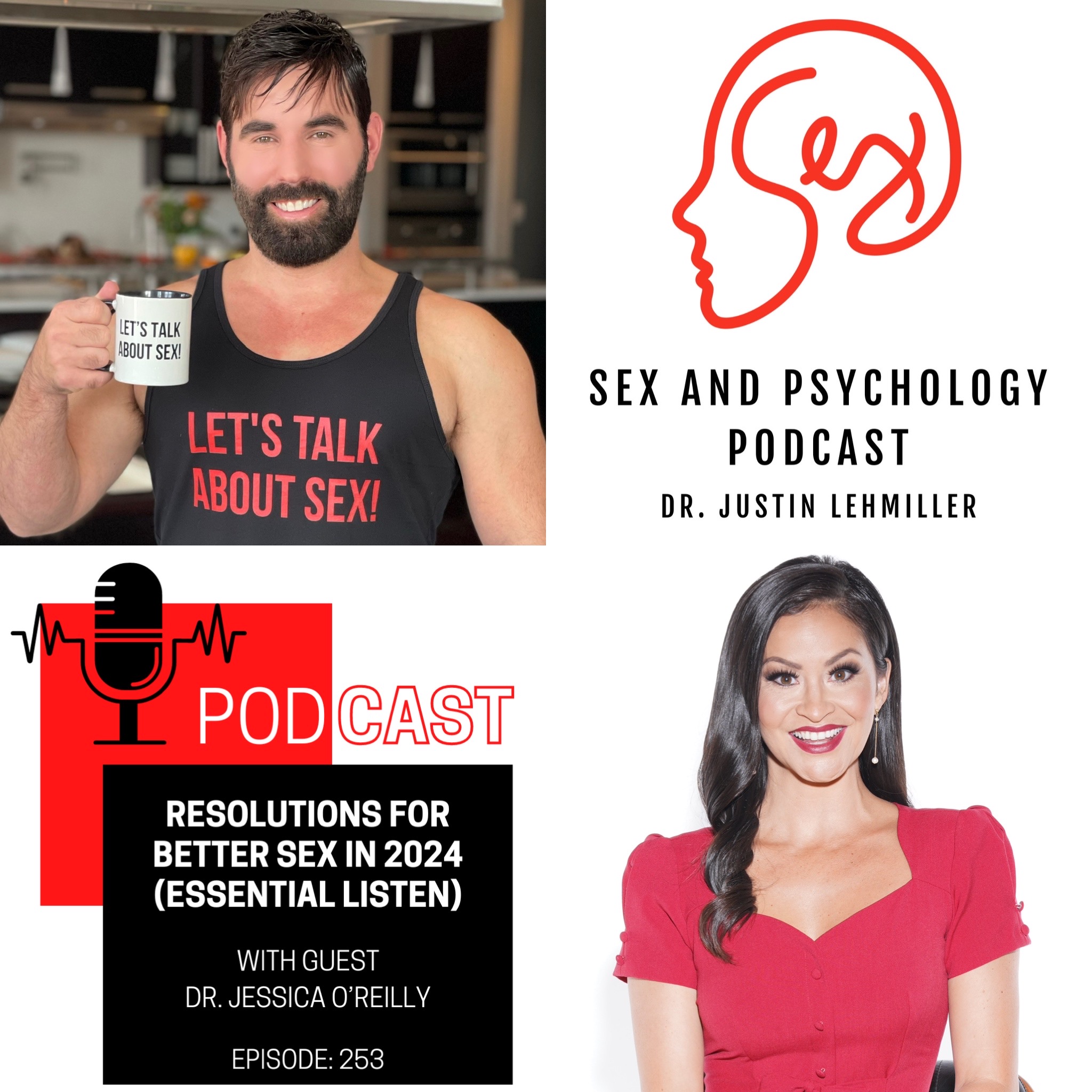
Ep 253Episode 253: Resolutions For Better Sex In 2024 (Essential Listen)
EEvery time a new year rolls around, people start making resolutions for self-improvement. As you start to think about your own resolutions, consider resolving to have better sex. With the right set of resolutions, you can address problem areas in the bedroom, rekindle the spark, and start to enjoy the best sex of your life! For today’s show, we’re going to revisit one of Sex and Psychology’s Essential Listens, my interview with Dr. Jessica O’Reilly, which appeared back in episode 67. Dr. Jess is a Toronto-based sexologist, author, speaker, and television personality. She is host of the Sex With Dr. Jess Podcast and is the resident sexologist at Astroglide. In our original conversation, Jess and I spoke about how to keep the sexual spark alive all year long. Some of the topics we discuss include: How can you get more comfortable being vocal in bed? How can you suggest trying something new with your partner? Why is it important to expand your definition of sex? How can you incorporate more touch into daily life? What should you think about resolving to do (or not do) in your sex life in the new year? To learn more, check out Jess’s website and follow her on Instagram at @sexwithdrjess. Got a sex question? Send me a podcast voicemail to have it answered on a future episode at speakpipe.com/sexandpsychology *** Thank you to our sponsors! Expand your sexual horizons with Beducated! Featuring more than 100 online courses taught by the experts, Beducated brings pleasure-based sex ed directly into your bedroom. Enjoy a free trial today and get 50% off their yearly pass by using my last name – LEHMILLER – as the coupon code. Sign up now at: https://beducate.me/pd2351-lehmiller Ever questioned, wondered, or fantasized about trying something different? Feeld is the place where you freely explore your desires. For a limited time, receive a free month of Majestic Membership when you download the app as a new member. Download the Feeld app at feeld.co/justin to access your free month of Majestic Membership. Please allow up to 24 hours for your free Majestic trial to activate. Passionate about building a career in sexuality? Check out the Sexual Health Alliance. With SHA, you’ll connect with world-class experts and join an engaged community of sexuality professionals from around the world. Visit SexualHealthAlliance.com and start building the sexuality career of your dreams today. *** Want to learn more about Sex and Psychology? Click here for previous articles or follow the blog on Facebook, Twitter, or Reddit to receive updates. You can also follow Dr. Lehmiller on YouTube and Instagram. Listen and stream all episodes on Apple, Spotify, Google, or Amazon. Subscribe to automatically receive new episodes and please rate and review the podcast! Credits: Precision Podcasting (Podcast editing) and Shutterstock/Florian (Music). Image created with Canva; photos used with permission of guest.

Ep 252Episode 252: OnlyFans and the Rise of Digital Sex Work
EDigital sex work is booming. Over the last two decades, sex work has increasingly moved online and it has become a multi-billion dollar industry. The transition to online sex work is changing a lot of things about how sex work works, so let’s talk about it. In today’s episode, we’re going to explore how digital sex work is changing the kinds of services that are bought and sold, how workers create authentic interactions with clients online, how technology is changing the stigma around sex work, and more. I am joined once again by Kurt Fowler, an Assistant Professor of Criminal Justice at Penn State Abington and the author of The Rise of Digital Sex Work. Drawing on in-depth interviews with dozens of sex workers from around the world, this book explores how technology has changed the nature of modern sex work. Some of the topics we explore include: What kind of things do sex workers need to consider when deciding where and how to sell their services online? How does digital sex work allow for more creativity and flexibility in the kinds of services offered? How do online sex workers craft authentic personas and interactions with clients? How has the internet helped sex workers form a sense of community and social support? How is the stigma around sex work changing in the Information Age? You can learn more about Kurt’s book here. Got a sex question? Send me a podcast voicemail to have it answered on a future episode at speakpipe.com/sexandpsychology *** Thank you to our sponsors! The Kinsey Institute at Indiana University has been a trusted source for scientific knowledge and research on critical issues in sexuality, gender, and reproduction for over 75 years. Learn about more research and upcoming events at kinseyinstitute.org or look for them on social media @kinseyinstitute. *** Want to learn more about Sex and Psychology? Click here for previous articles or follow the blog on Facebook, Twitter, or Reddit to receive updates. You can also follow Dr. Lehmiller on YouTube and Instagram. Listen and stream all episodes on Apple, Spotify, Google, or Amazon. Subscribe to automatically receive new episodes and please rate and review the podcast! Credits: Precision Podcasting (Podcast editing) and Shutterstock/Florian (Music). Image created with Canva; photos used with permission of guest.

Ep 251Episode 251: What It’s Like To Be A Sex Worker
EWhat is it like to be a sex worker? It depends who you ask, with different studies pointing to drastically different conclusions. The truth is that you can’t paint sex workers in overly broad strokes. “Sex work” can mean a lot of different things, and working conditions and local laws vary, which means that different workers are bound to have different experiences. In today’s episode, we’re going to take an inside look into the world of sex work. I am joined by Kurt Fowler, an Assistant Professor of Criminal Justice at Penn State Abington and the author of The Rise of Digital Sex Work. Drawing on in-depth interviews with dozens of sex workers from around the world, this book explores how technology has changed the nature of modern sex work. Some of the topics we explore include: What all is included under the term “sex work?” Two major paradigms dominate research on sex work: the oppression paradigm and the empowerment paradigm. What’s the difference between these views? What are some of the common motivations for entering sex work? How do digital sex workers mitigate some of the unique risks that come along with working in online spaces? How is the experience of sex work different for people of different racial backgrounds? You can learn more about Kurt’s book here. Got a sex question? Send me a podcast voicemail to have it answered on a future episode at speakpipe.com/sexandpsychology *** Thank you to our sponsors! Passionate about building a career in sexuality? Check out the Sexual Health Alliance. With SHA, you’ll connect with world-class experts and join an engaged community of sexuality professionals from around the world. Visit SexualHealthAlliance.com and start building the sexuality career of your dreams today. *** Want to learn more about Sex and Psychology? Click here for previous articles or follow the blog on Facebook, Twitter, or Reddit to receive updates. You can also follow Dr. Lehmiller on YouTube and Instagram. Listen and stream all episodes on Apple, Spotify, Google, or Amazon. Subscribe to automatically receive new episodes and please rate and review the podcast! Credits: Precision Podcasting (Podcast editing) and Shutterstock/Florian (Music). Image created with Canva; photos used with permission of guest.
Ep 250Episode 250: How to Have “The Talk” With Your Kids
EIn some ways, teens today seem to be more sexually cautious. They’re waiting longer to have sex and they’re having fewer partners. At the same time, however, they’re also engaging in riskier sexual practices, with condom use declining and rough sex increasing. Sex education is as vital as ever, and it needs to reflect the sexual realities of today’s youth. So in this episode, we’re going to dive into what parents need to know when it comes to talking to their kids about sex. I am joined once again by Dr. Debby Herbenick, an award-winning, internationally recognized sexuality researcher and AASECT-certified sexuality educator. She is a professor at the Indiana University School of Public Health and the author of five bestselling books about human sexuality. Her latest book is titled, Yes, Your Kid: What Parents Need to Know About Today’s Teens and Sex. Some of the topics we explore include: When is the “right” time to start discussing sex with your kids? What are some of the key topics parents should be covering? What can parents teach their kids about having healthy relationships? When and how should parents talk to their kids about porn? How is having “the talk” different if your kid is on the spectrum? You can visit Debby’s website to learn more about her work. Got a sex question? Send me a podcast voicemail to have it answered on a future episode at speakpipe.com/sexandpsychology *** Thank you to our sponsors! Expand your sexual horizons with Beducated! Featuring more than 100 online courses taught by the experts, Beducated brings pleasure-based sex ed directly into your bedroom. Enjoy a free trial today and get 60% off their yearly pass by using my last name – LEHMILLER – as the coupon code. Sign up now at: https://beducate.me/pd2350-lehmiller The Kinsey Institute at Indiana University has been a trusted source for scientific knowledge and research on critical issues in sexuality, gender, and reproduction for over 75 years. Learn about more research and upcoming events at kinseyinstitute.org or look for them on social media @kinseyinstitute. *** Want to learn more about Sex and Psychology? Click here for previous articles or follow the blog on Facebook, Twitter, or Reddit to receive updates. You can also follow Dr. Lehmiller on YouTube and Instagram. Listen and stream all episodes on Apple, Spotify, Google, or Amazon. Subscribe to automatically receive new episodes and please rate and review the podcast! Credits: Precision Podcasting (Podcast editing) and Shutterstock/Florian (Music). Image created with Canva; photos used with permission of guest.

Ep 249Episode 249: What Today’s Parents Need To Know About Teens And Sex
EThe sexual landscape for teens has shifted dramatically over the last two decades. Among the more notable changes we’ve seen are that rough sex is on the rise, and teens are increasingly exploring their sexuality online through sexting. In today’s show, we’re going to explore this evolving landscape and talk about what parents need to know, including how to become an “askable” parent, how to navigate uncomfortable questions, and what to do when you don’t have the answers. I am joined by Dr. Debby Herbenick, an award-winning, internationally recognized sexuality researcher and AASECT-certified sexuality educator. She is a professor at the Indiana University School of Public Health and the author of five bestselling books about human sexuality. Her latest book is titled, Yes, Your Kid: What Parents Need to Know About Today’s Teens and Sex. Some of the topics we explore include: How is the sexual landscape different for today’s teens? What are some practical things a parent can do so that their kids feel comfortable coming to them with sex questions? How can parents approach questions about sex without shame and judgement? What should you do if your kid asks something that feels too personal? What are some practical ways that parents can explain consent to their kids? You can visit Debby’s website to learn more about her work. Got a sex question? Send me a podcast voicemail to have it answered on a future episode at speakpipe.com/sexandpsychology *** Thank you to our sponsors! Passionate about building a career in sexuality? Check out the Sexual Health Alliance. With SHA, you’ll connect with world-class experts and join an engaged community of sexuality professionals from around the world. Visit SexualHealthAlliance.com and start building the sexuality career of your dreams today. *** Want to learn more about Sex and Psychology? Click here for previous articles or follow the blog on Facebook, Twitter, or Reddit to receive updates. You can also follow Dr. Lehmiller on YouTube and Instagram. Listen and stream all episodes on Apple, Spotify, Google, or Amazon. Subscribe to automatically receive new episodes and please rate and review the podcast! Credits: Precision Podcasting (Podcast editing) and Shutterstock/Florian (Music). Image created with Canva; photos used with permission of guest.
Ep 248Episode 248: Maintaining Sexual Privacy in the Information Age
EIn the Information Age, keeping our private lives private is becoming harder and harder to do. For example, our online searches and chats are leaving digital traces, while our phones (and even our cars) are collecting information on where we go. All of this data is vulnerable, and there’s growing concern about the risk of our most sensitive personal information being exploited. In today’s episode, we’re going to focus on ways we can mitigate the risks of data surveillance and keep our personal information more secure. I am joined once again by Albert Fox Cahn. He is founder and executive director of the Surveillance Technology Oversight Project (also known as STOP). He is also a Practitioner-in-Residence at N.Y.U Law School’s Information Law Institute and a fellow at the Harvard Kennedy School’s Carr Center For Human Rights Policy and Yale Law School’s Information Society Project. As a lawyer, technologist, and activist, Albert has become a leading voice on how to govern and build the technologies of the future. Some of the topics we explore include: What are some practical ways individuals can keep their online data more secure? How safe (or unsafe) is it to use apps that track our health data, sexually and otherwise? For individuals traveling out of state to access legally available care that might not be available in their home state, are there any steps they can take to mitigate data surveillance? What steps can providers take to protect patients and clients when it comes to data that might be subject to government surveillance? What responsibility do tech companies have to offer more protection over consumer data? You can connect with Albert online on Twitter and Bluesky. Got a sex question? Send me a podcast voicemail to have it answered on a future episode at speakpipe.com/sexandpsychology *** Thank you to our sponsors! The Kinsey Institute at Indiana University has been a trusted source for scientific knowledge and research on critical issues in sexuality, gender, and reproduction for over 75 years. Learn about more research and upcoming events at kinseyinstitute.org or look for them on social media @kinseyinstitute. Expand your sexual horizons with Beducated! Featuring more than 100 online courses taught by the experts, Beducated brings pleasure-based sex ed directly into your bedroom. Enjoy a free trial today and get 60% off their yearly pass by using my last name – LEHMILLER – as the coupon code. Sign up now at: https://beducate.me/pd2349-lehmiller *** Want to learn more about Sex and Psychology? Click here for previous articles or follow the blog on Facebook, Twitter, or Reddit to receive updates. You can also follow Dr. Lehmiller on YouTube and Instagram. Listen and stream all episodes on Apple, Spotify, Google, or Amazon. Subscribe to automatically receive new episodes and please rate and review the podcast! Credits: Precision Podcasting (Podcast editing) and Shutterstock/Florian (Music). Image created with Canva; photos used with permission of guest.
Ep 247Episode 247: Reproductive Surveillance in the Post-Roe World
EIn 2022, the United States Supreme Court reversed a half-century old ruling that had legalized abortion in this country. Since then, reproductive healthcare has become more difficult to access in certain areas, prompting concern about technology being leveraged as a form of abortion surveillance and tracking. Text messages, Google searches, emails, and period-tracking apps all have the potential to be used against people seeking abortions. In today’s show, we’re going to explore how online surveillance of abortion is increasing and the effects this is having, as well as the broader risks of living in a time when there’s unparalleled surveillance of our private lives. My guest is Albert Fox Cahn. He is founder and executive director of the Surveillance Technology Oversight Project (also known as STOP). He is also a Practitioner-in-Residence at N.Y.U Law School’s Information Law Institute and a fellow at the Harvard Kennedy School’s Carr Center For Human Rights Policy and Yale Law School’s Information Society Project. As a lawyer, technologist, and activist, Albert has become a leading voice on how to govern and build the technologies of the future. Some of the topics we explore include: How has the landscape for abortion care in the United States shifted since Roe v Wade was overturned? In what ways is abortion care subject to surveillance? Are new surveillance practices having an effect on pregnant women’s decision making and feelings of agency? What are the implications of surveillance for accessing gender-affirming care? Can you be tracked when you travel to another state to access healthcare? You can connect with Albert online on Twitter and Bluesky. Got a sex question? Send me a podcast voicemail to have it answered on a future episode at speakpipe.com/sexandpsychology *** Thank you to our sponsors! Passionate about building a career in sexuality? Check out the Sexual Health Alliance. With SHA, you’ll connect with world-class experts and join an engaged community of sexuality professionals from around the world. Visit SexualHealthAlliance.com and start building the sexuality career of your dreams today. Ever questioned, wondered, or fantasized about trying something different? Feeld is the place where you freely explore your desires. For a limited time, receive a free month of Majestic Membership when you download the app as a new member. Download the Feeld app at feeld.co/justin to access your free month of Majestic Membership. Please allow up to 24 hours for your free Majestic trial to activate. *** Want to learn more about Sex and Psychology? Click here for previous articles or follow the blog on Facebook, Twitter, or Reddit to receive updates. You can also follow Dr. Lehmiller on YouTube and Instagram. Listen and stream all episodes on Apple, Spotify, Google, or Amazon. Subscribe to automatically receive new episodes and please rate and review the podcast! Credits: Precision Podcasting (Podcast editing) and Shutterstock/Florian (Music). Image created with Canva; photos used with permission of guest.

Ep 246Episode 246: The Disappearance of Shere Hite
EIn the previous episode, we explored the life and times of Shere Hite, who published what is perhaps the bestselling non-fiction book about sex ever to hit the market. Despite selling 50 million copies, it has been largely forgotten in the half-century since its release. However, it’s back in the spotlight again with the release of the new documentary The Disappearance of Shere Hite. In today’s show, I’m going to continue my conversation with the director of this film to dive into the story behind it. We’re also going to talk about why Shere’s work is more relevant than ever. I am joined once again by Nicole Newnham, the Oscar-nominated, Emmy-winning documentary producer and director behind The Disappearance of Shere Hite. This film premiered at the 2023 Sundance Film Festival is now playing in select theaters. Nicole also co-directed and produced the 2021 Academy Award-nominated documentary Crip Camp. In this episode, we discuss: What compelled the making of a documentary about Shere’s work? Why did this extraordinary woman and her work seemingly disappear? How did the media try to craft “gotcha” moments to discredit Shere? What are some lessons from the film, and Shere’s story, that are important in modern times? Visit sherehitedoc.com to find out where The Disappearance of Shere Hite is playing near you. Got a sex question? Send me a podcast voicemail to have it answered on a future episode at speakpipe.com/sexandpsychology *** Thank you to our sponsors! The Kinsey Institute at Indiana University has been a trusted source for scientific knowledge and research on critical issues in sexuality, gender, and reproduction for over 75 years. Learn about more research and upcoming events at kinseyinstitute.org or look for them on social media @kinseyinstitute. Expand your sexual horizons with Beducated! Featuring more than 100 online courses taught by the experts, Beducated brings pleasure-based sex ed directly into your bedroom. Enjoy a free trial today and get 40% off their yearly pass by using my last name – LEHMILLER – as the coupon code. Sign up now at: https://beducate.me/pd2348-lehmiller *** Want to learn more about Sex and Psychology? Click here for previous articles or follow the blog on Facebook, Twitter, or Reddit to receive updates. You can also follow Dr. Lehmiller on YouTube and Instagram. Listen and stream all episodes on Apple, Spotify, Google, or Amazon. Subscribe to automatically receive new episodes and please rate and review the podcast! Credits: Precision Podcasting (Podcast editing) and Shutterstock/Florian (Music). Image created with Canva; photos used with permission of guest.

Ep 245Episode 245: The Pioneering Female Sex Researcher That Time Forgot
EThere are a lot of hidden figures in the history of sex research who made important contributions to the field, but who are frequently forgotten. One of them is Shere Hite, who authored the best-selling non-fiction book on women’s sexuality titled The Hite Report in 1976. This book sold 50 million copies, a figure that puts it among the 30 bestselling books of all times! However, there’s a good chance you’ve never heard about this book or the author behind it. Enter The Disappearance of Shere Hite, a new documentary about the life and times of an extraordinary woman who dared to study women’s sexuality and whose work remains as radical and revolutionary as ever. My guest today is Nicole Newnham, the Oscar-nominated, Emmy-winning documentary producer and director behind The Disappearance of Shere Hite. This film premiered at the 2023 Sundance Film Festival is now playing in select theaters. Nicole also co-directed and produced the 2021 Academy Award-nominated documentary Crip Camp. In this episode, we discuss: Who was Shere Hite and what was she most well-known for? What is The Hite Report about and how did Shere go about collecting her data? What are the major findings of The Hite Report? How (and why) did people try to discredit The Hite Report? After two decades in the media spotlight, why did Shere disappear? Visit sherehitedoc.com to find out where The Disappearance of Shere Hite is playing near you. Got a sex question? Send me a podcast voicemail to have it answered on a future episode at speakpipe.com/sexandpsychology *** Thank you to our sponsors! The Handy is a Scandinavian pleasure device like no other: it’s an adult toy for anyone with a penis that enables new sexual experiences through interactive technology. The Handy can be synched with online content from multiple adult websites to offer immersive experiences. Visit thehandy.com and get 10% off your purchase with discount code sexandpsych. Passionate about building a career in sexuality? Check out the Sexual Health Alliance. With SHA, you’ll connect with world-class experts and join an engaged community of sexuality professionals from around the world. Visit SexualHealthAlliance.com and start building the sexuality career of your dreams today. The Kinsey Institute at Indiana University has been a trusted source for scientific knowledge and research on critical issues in sexuality, gender, and reproduction for over 75 years. Learn about more research and upcoming events at kinseyinstitute.org or look for them on social media @kinseyinstitute. *** Want to learn more about Sex and Psychology? Click here for previous articles or follow the blog on Facebook, Twitter, or Reddit to receive updates. You can also follow Dr. Lehmiller on YouTube and Instagram. Listen and stream all episodes on Apple, Spotify, Google, or Amazon. Subscribe to automatically receive new episodes and please rate and review the podcast! Credits: Precision Podcasting (Podcast editing) and Shutterstock/Florian (Music). Image created with Canva; photos used with permission of guest.
Ep 244Episode 244: The Future of Sex Toys
EWhat does the future hold when it comes to sex toys? Artificial intelligence, virtual reality, and robotics are just a few of the many emerging technologies that are likely to become an increasingly big part of the way that we experience pleasure. In this episode, we’re going to explore the high-tech pleasure products of the future. I am joined one again by Sarah Tomchesson, who works as a sex educator, sex toy evangelist and podcast host. Sarah is Lovehoney’s Resident Sexual Wellness Advisor and hosts free monthly workshops through Lovehoney.com. Sarah’s podcast, F*ck Yeah, disrupts traditional ideas about sexuality and relationships, and her online education program, Pleasure Practices, supports cultivating personal power through pleasure exploration. Some of the topics we discuss include: How do app-connected sex toys open up new opportunities for pleasure? How might AI revolutionize sex toys? How does virtual reality have the potential to completely change the way we interact with and experience sex toys? How can technology make sex toys more accessible? How can sex toys help us to monitor our sexual health? For more to listen to, you can check out Sarah’s podcast here. Got a sex question? Send me a podcast voicemail to have it answered on a future episode at speakpipe.com/sexandpsychology *** Thank you to our sponsors! Earth and Salt offers a curated selection of sex toys, accessories, and gender expression gear to help you access your pleasure, your way. Visit Earth and Salt at earthandsaltshop.com, and use “Lehmiller” as the discount code for 15% off your next purchase. Expand your sexual horizons with Beducated! Featuring more than 100 online courses taught by the experts, Beducated brings pleasure-based sex ed directly into your bedroom. Enjoy a free trial today and get 60% off their yearly pass by using my last name – LEHMILLER – as the coupon code. Sign up now at: https://beducate.me/pd2347-lehmiller Ever questioned, wondered, or fantasized about trying something different? Feeld is the place where you freely explore your desires. For a limited time, receive a free month of Majestic Membership when you download the app as a new member. Download the Feeld app at feeld.co/justin to access your free month of Majestic Membership. Please allow up to 24 hours for your free Majestic trial to activate. *** Want to learn more about Sex and Psychology? Click here for previous articles or follow the blog on Facebook, Twitter, or Reddit to receive updates. You can also follow Dr. Lehmiller on YouTube and Instagram. Listen and stream all episodes on Apple, Spotify, Google, or Amazon. Subscribe to automatically receive new episodes and please rate and review the podcast! Credits: Precision Podcasting (Podcast editing) and Shutterstock/Florian (Music). Image created with Canva; photos used with permission of guest.

Ep 243Episode 243: 5 Ways Sex Toys Can Revolutionize Your Sex Life
EIf you’re looking to take your sex life to the next level, something you might want to think about it is trying more sex toys! Sex toys have the potential to make sex, both solo and partnered, even better. And if you’ve never used sex toys before, we have you covered. The sheer number of options out there can be overwhelming, so we’ll discuss some good places to start if you’ve new to the idea of bringing toys into the bedroom. I am joined by Sarah Tomchesson, who works as a sex educator, sex toy evangelist and podcast host. Sarah is Lovehoney’s Resident Sexual Wellness Advisor and hosts free monthly workshops through Lovehoney.com. Sarah’s podcast, F*ck Yeah, disrupts traditional ideas about sexuality and relationships, and her online education program, Pleasure Practices, supports cultivating personal power through pleasure exploration. In this episode, we discuss how sex toys can assist in: Understanding yourself as a sexual person and uncovering new pleasure sources Increasing/improving sexual communication Providing stress relief Building up sexual self-confidence Closing the orgasm gap For more to listen to, you can check out Sarah’s podcast here. Got a sex question? Send me a podcast voicemail to have it answered on a future episode at speakpipe.com/sexandpsychology *** Thank you to our sponsors! The Handy is a Scandinavian pleasure device like no other: it’s an adult toy for anyone with a penis that enables new sexual experiences through interactive technology. The Handy can be synched with online content from multiple adult websites to offer immersive experiences. Visit thehandy.com and get 10% off your purchase with discount code sexandpsych. Passionate about building a career in sexuality? Check out the Sexual Health Alliance. With SHA, you’ll connect with world-class experts and join an engaged community of sexuality professionals from around the world. Visit SexualHealthAlliance.com and start building the sexuality career of your dreams today. The Kinsey Institute at Indiana University has been a trusted source for scientific knowledge and research on critical issues in sexuality, gender, and reproduction for over 75 years. Learn about more research and upcoming events at kinseyinstitute.org or look for them on social media @kinseyinstitute. *** Want to learn more about Sex and Psychology? Click here for previous articles or follow the blog on Facebook, Twitter, or Reddit to receive updates. You can also follow Dr. Lehmiller on YouTube and Instagram. Listen and stream all episodes on Apple, Spotify, Google, or Amazon. Subscribe to automatically receive new episodes and please rate and review the podcast! Credits: Precision Podcasting (Podcast editing) and Shutterstock/Florian (Music). Image created with Canva; photos used with permission of guest.
Ep 242Episode 242: How To Have The Hottest Sex Ever
EHow can I have better, hotter sex? This is a super common question people have about their intimate lives, so that’s what we’re going to be talking about today. In this episode, we’re going to walk you through what you need to know about taking your sex life to the next level. I am joined once again by both Amy Baldwin and April Lampert. Amy is a sex and relationship coach, as well as a certified sex educator. April is Vice President and co-owner of Hot Octopuss, an innovative pleasure product company. Together, Amy and April combined forces to create the Shameless Sex Podcast, and the brand new book Shameless Sex: Choose Your Own Pleasure Path to Unlock the Sex Life You’ve Been Waiting For. Some of the topics we explore include: How can you figure out what it is that you really want from sex? How can you use your sexual fantasies as a source of inspiration? How can changing your sexual mindset open the door to greater pleasure? How can you make sex great again when the old ways stop working? What are some healthy ways to introduce new things in the bedroom? How can couples “keep the fire burning” in the bedroom for the long run? You can learn more about Amy and April on the Shameless Sex website. Got a sex question? Send me a podcast voicemail to have it answered on a future episode at speakpipe.com/sexandpsychology *** Thank you to our sponsors! Earth and Salt offers a curated selection of sex toys, accessories, and gender expression gear to help you access your pleasure, your way. Visit Earth and Salt at earthandsaltshop.com, and use “Lehmiller” as the discount code for 15% off your next purchase. Expand your sexual horizons with Beducated! Featuring more than 100 online courses taught by the experts, Beducated brings pleasure-based sex ed directly into your bedroom. Enjoy a free trial today and get 60% off their yearly pass by using my last name – LEHMILLER – as the coupon code. Sign up now at: https://beducate.me/pd2346-lehmiller *** Want to learn more about Sex and Psychology? Click here for previous articles or follow the blog on Facebook, Twitter, or Reddit to receive updates. You can also follow Dr. Lehmiller on YouTube and Instagram. Listen and stream all episodes on Apple, Spotify, Google, or Amazon. Subscribe to automatically receive new episodes and please rate and review the podcast! Credits: Precision Podcasting (Podcast editing) and Shutterstock/Florian (Music). Image created with Canva; photos used with permission of guest.

Ep 241Episode 241: How To Have Shameless Sex
EThis week on the show, I have a special treat for you: I’m speaking with the co-hosts of the Shameless Sex Podcast, which is one of the most-listened to sexuality podcasts in the world! They have just released a book that captures all of the wisdom they’ve accumulated on their podcast over the years. So we’re going to do a deep dive into it and teach you how to have shameless sex! My guests are Amy Baldwin and April Lampert. Amy is a sex and relationship coach, as well as a certified sex educator. April is Vice President and co-owner of Hot Octopuss, an innovative pleasure product company. Together, Amy and April combined forces to create the Shameless Sex Podcast, and the brand new book Shameless Sex: Choose Your Own Pleasure Path to Unlock the Sex Life You’ve Been Waiting For. Some of the topics we explore include: What does it mean to have “shameless sex”? Who is this book for, and what can readers hope to get out of it? If you’ve ever asked yourself “am I normal?” or “am I broken?” what do you need to know? What can you do when you and your partner feel like you’ve fallen out of synch in the bedroom? How can you communicate about sex with your partner in a healthy way? Learn more about Amy and April on the Shameless Sex website. Got a sex question? Send me a podcast voicemail to have it answered on a future episode at speakpipe.com/sexandpsychology *** Thank you to our sponsors! The Handy is a Scandinavian pleasure device like no other: it’s an adult toy for anyone with a penis that enables new sexual experiences through interactive technology. The Handy can be synched with online content from multiple adult websites to offer immersive experiences. Visit thehandy.com and get 10% off your purchase with discount code sexandpsych. Passionate about building a career in sexuality? Check out the Sexual Health Alliance. With SHA, you’ll connect with world-class experts and join an engaged community of sexuality professionals from around the world. Visit SexualHealthAlliance.com and start building the sexuality career of your dreams today. The Kinsey Institute at Indiana University has been a trusted source for scientific knowledge and research on critical issues in sexuality, gender, and reproduction for over 75 years. Learn about more research and upcoming events at kinseyinstitute.org or look for them on social media @kinseyinstitute. Ever questioned, wondered, or fantasized about trying something different? Feeld is the place where you freely explore your desires. For a limited time, receive a free month of Majestic Membership when you download the app as a new member. Download the Feeld app at feeld.co/justin to access your free month of Majestic Membership. Please allow up to 24 hours for your free Majestic trial to activate. *** Want to learn more about Sex and Psychology? Click here for previous articles or follow the blog on Facebook, Twitter, or Reddit to receive updates. You can also follow Dr. Lehmiller on YouTube and Instagram. Listen and stream all episodes on Apple, Spotify, Google, or Amazon. Subscribe to automatically receive new episodes and please rate and review the podcast! Credits: Precision Podcasting (Podcast editing) and Shutterstock/Florian (Music). Image created with Canva; photos used with permission of guest.
Ep 240Episode 240: The Truth About Masturbation (Essential Listen)
EIt’s November again, which means that the annual abstinence challenge known as “No Nut November” is back in full force. This challenge originated on Reddit several years back and it seems to spread and bring in new participants each year. The basic idea is that you’re not allow to masturbate or otherwise orgasm for the entire month, and it seems to be rooted in the idea that self-pleasure is inherently bad for you. But is that really the case? In today’s show, we’re going to revisit one of Sex and Psychology’s “Essential Listens,” my interview with Dr. Eric Sprankle back in episode 96. Eric is an Associate Professor of Clinical Psychology and the co-director of the Sexuality Studies program at Minnesota State University, Mankato. He’s also a licensed clinical psychologist and AASECT-certified sex therapist affiliated with the Minnesota Sexual Health Institute. His first book comes out next year and is titled DIY: The Wonderfully Weird History and Science of Masturbation. In our original conversation, Eric and I talked all about the history of masturbation and some of the myths surrounding masturbation today. Some of the topics we discussed include: What makes masturbation in humans unique compared to other species that do it? What kinds of masturbation “cures” were used in the past to discourage this behavior? What do we think about when we engage in self-pleasure? Does abstinence actually boost testosterone levels? How can we have a healthier relationship with porn and masturbation? To learn more, check out Eric’s website and check out my other conversation with Eric about navigating sexuality and religion in Episode 98. Thank you to our sponsors! Earth and Salt offers a curated selection of sex toys, accessories, and gender expression gear to help you access your pleasure, your way. Visit Earth and Salt at earthandsaltshop.com, and use “Lehmiller” as the discount code for 15% off your next purchase. Expand your sexual horizons with Beducated! Featuring more than 100 online courses taught by the experts, Beducated brings pleasure-based sex ed directly into your bedroom. Enjoy a free trial today and get 60% off their yearly pass by using my last name – LEHMILLER – as the coupon code. Sign up now at: https://beducate.me/pd2345-lehmiller *** Want to learn more about Sex and Psychology? Click here for previous articles or follow the blog on Facebook, Twitter, or Reddit to receive updates. You can also follow Dr. Lehmiller on YouTube and Instagram. Listen and stream all episodes on Apple, Spotify, Google, or Amazon. Subscribe to automatically receive new episodes and please rate and review the podcast! Credits: Precision Podcasting (Podcast editing) and Shutterstock/Florian (Music). Image created with Canva; photos used with permission of guest.

Ep 239Episode 239: Kinky In The Digital Age
EEver since people started having sex, they had kinky sex. While kink itself is not new, kink practices have certainly changed over time, as have people’s opportunities to explore and experiment with kink. This is especially true in the modern digital era. In today’s show, we’re going to talk about how technology has opened up new ways for people to explore their kinks, whether technology itself is making us kinkier, and where kinky interests come from in the first place. I am joined once again by Liam Wignall, a Senior Lecturer in Psychology at the University of Brighton. He specialises in research on kink/BDSM, looking at the impact of internet and community engagement on identity formation. His book, Kinky in the Digital Age, explores how kinky gay and bisexual men navigate kink in contemporary times with an in-depth analysis of the pup play subculture. Some of the topics we explore include: How is kink defined? How far can we trace back the kinky history of the queer community? How has the mainstreaming of kink (i.e., the Fifty Shades phenomenon) changed the research on kinky sex? Why at a time when heterosexuals are more openly embracing kink do we see a lot of LGBTQ+ people trying to hide it? Why has kink suddenly become controversial at LGBTQ+ pride events? Is technology making us kinkier? You can check out our article on Liam’s recent publication here, and connect with him on Twitter/X here. You can also get 30% of Liam’s book Kinky in the Digital Age through Oxford University Press with discount code: ASPROMP8 Thank you to our sponsors! The Handy is a Scandinavian pleasure device like no other: it’s an adult toy for anyone with a penis that enables new sexual experiences through interactive technology. The Handy can be synched with online content from multiple adult websites to offer immersive experiences, meaning that what you see is what you feel. To learn more visit thehandy.com and get 10% off your purchase with discount code sexandpsych. Are you passionate about building a career in sexuality? Check out the Sexual Health Alliance. With SHA, you’ll connect with world-class experts and join an engaged community of sexuality professionals from around the world. Visit SexualHealthAlliance.com and start building the sexuality career of your dreams today. The Kinsey Institute at Indiana University has been a trusted source for scientific knowledge and research on critical issues in sexuality, gender, and reproduction for over 75 years. Watch for presentations and papers from Kinsey Institute faculty and students at this month’s meeting of the Society for the Scientific Study of Sexuality, which will be held in New Orleans. Learn more research and upcoming events at kinseyinstitute.org or look for them on social media @kinseyinstitute. *** Want to learn more about Sex and Psychology? Click here for previous articles or follow the blog on Facebook, Twitter, or Reddit to receive updates. You can also follow Dr. Lehmiller on YouTube and Instagram. Listen and stream all episodes on Apple, Spotify, Google, or Amazon. Subscribe to automatically receive new episodes and please rate and review the podcast! Credits: Precision Podcasting (Podcast editing) and Shutterstock/Florian (Music). Image created with Canva; photos used with permission of guest.
Ep 238Episode 238: Are Neurodiverse People More Likely To Be Kinky?
ESome folks who frequent kink and BDSM spaces have observed that there seems to be a higher percentage of neurodiverse persons compared to other social settings. So is there actually a link between neurodiversity and kink? In today’s show, we’re going to dive into a recent study published in the Journal of Sex Research that looks at how neurodiversity, specifically in the form of autistic traits, is linked to engaging in the kink subculture of pup play. I am joined by Liam Wignall, a Senior Lecturer in Psychology at the University of Brighton. He specialises in research on kink/BDSM, looking at the impact of internet and community engagement on identity formation. His recent book, Kinky in the Digital Age, explores how kinky gay and bisexual men navigate kink in contemporary times. Some of the topics we explore include: What does it mean to be neurodivergent? How prevalent is neurodivergence in the general population? What does pup play look like and why are some people into it? Why might there be a link between autism and kink in general? What specifically about pup play might be appealing to neurodivergent individuals? Why is there so little research on neurodiversity and sexuality? You can check out our article on Liam’s recent publication here, and connect with him on Twitter/X here. You can also get 30% of Liam’s book Kinky in the Digital Age through Oxford University Press with discount code: ASPROMP8 Thank you to our sponsors! Earth and Salt offers a curated selection of sex toys, accessories, and gender expression gear to help you access your pleasure, your way. Visit Earth and Salt at earthandsaltshop.com, and use “Lehmiller” as the discount code for 15% off your next purchase. Expand your sexual horizons with Beducated! Featuring more than 100 online courses taught by the experts, Beducated brings pleasure-based sex ed directly into your bedroom. Enjoy a free trial today and get 60% off their yearly pass by using my last name – LEHMILLER – as the coupon code. Sign up now at: https://beducate.me/pd2344-lehmiller *** Want to learn more about Sex and Psychology? Click here for previous articles or follow the blog on Facebook, Twitter, or Reddit to receive updates. You can also follow Dr. Lehmiller on YouTube and Instagram. Listen and stream all episodes on Apple, Spotify, Google, or Amazon. Subscribe to automatically receive new episodes and please rate and review the podcast! Credits: Precision Podcasting (Podcast editing) and Shutterstock/Florian (Music). Image created with Canva; photos used with permission of guest.

Ep 237Episode 237: How Women Feel About Anal Sex
EThere’s a lot of research out there on the subject of anal sex; however, surprisingly little of it has focused on how women feel about this activity. Fortunately, a large nationally representative study of women’s experiences with anal touch recently came out that sheds important light on the subject. In today’s show, we’re going to dive into the results and discuss how many women have explored anal stimulation, their preferred forms of anal touch, tips for experiencing more anal pleasure, and more. I am joined once again by Dr. Devon Hensel, an Associate Professor of Research at Indiana University School of Medicine, who has led several national and international sexual health studies. Devon has expertise in sexuality across the life span, sexual pleasure, romantic/sexual relationships and solo and partnered sexual behavior. Some of the topics we explore include: How many women have engaged in some form of anal stimulation? Why is it important to explore different forms of anal touch beyond penile-anal penetration? What are anal surfacing, anal shallowing, and anal pairing? Which forms of anal touch do women find to be most pleasurable? What are some of the dos and don’ts of anal sex when it comes to pleasure and safety? You can learn more about Devon here and read her full study on anal touch here. Thank you to our sponsors! Support sex science by becoming a friend of the Kinsey Institute at Indiana University. Visit kinseyinstitute.org to make a donation to support ongoing research projects on critical topics. You can also show your support by following the Kinsey Institute on Facebook, Twitter, and Instagram. *** Want to learn more about Sex and Psychology? Click here for previous articles or follow the blog on Facebook, Twitter, or Reddit to receive updates. You can also follow Dr. Lehmiller on YouTube and Instagram. Listen and stream all episodes on Apple, Spotify, Google, or Amazon. Subscribe to automatically receive new episodes and please rate and review the podcast! Credits: Precision Podcasting (Podcast editing) and Shutterstock/Florian (Music). Image created with Canva; photos used with permission of guest.
Ep 236Episode 236: The Science of Squirting
ESome women experience a large expulsion of fluid during sexual arousal or orgasm, often referred to as squirting. Although this is by no means a new discovery, the nature of the fluid, what it’s called, and where it originates in the body have been subject to much debate. So let’s talk about it! In today’s show, we’re going to explore the science of squirting by looking at results from a nationally representative survey on the subject. We’re going to discuss how squirting is different from female ejaculation, what we know about how and why it happens, how common it is, the surprising diversity in squirting experiences, and more. I am joined by Dr. Devon Hensel, an Associate Professor of Research at Indiana University School of Medicine, who has led several national and international sexual health studies. Devon has expertise in sexuality across the life span, sexual pleasure, romantic/sexual relationships and solo and partnered sexual behavior. Some of the topics we explore include: How is “vaginal squirting” defined? Where does the fluid involved in vaginal squirting come from? How prevalent is squirting? How many women have experienced it before? What are some of the various ways that a woman might experience squirting? Is squirting something that every woman is potentially capable of? You can learn more about Devon here and read her full study on squirting here. Thank you to our sponsors! Expand your sexual horizons with Beducated! Featuring more than 100 online courses taught by the experts, Beducated brings pleasure-based sex ed directly into your bedroom. Enjoy a free trial today and get 60% off their yearly pass by using my last name – LEHMILLER – as the coupon code. Sign up now at: https://beducate.me/pd2343-lehmiller *** Want to learn more about Sex and Psychology? Click here for previous articles or follow the blog on Facebook, Twitter, or Reddit to receive updates. You can also follow Dr. Lehmiller on YouTube and Instagram. Listen and stream all episodes on Apple, Spotify, Google, or Amazon. Subscribe to automatically receive new episodes and please rate and review the podcast! Credits: Precision Podcasting (Podcast editing) and Shutterstock/Florian (Music). Image created with Canva; photos used with permission of guest.

Ep 235Episode 235: The Surprising Politics of Polyamory
EPolyamorists tend to be stereotyped and portrayed in the popular media as pretty liberal bunch. However, it turns out that they’re actually quite diverse in their political views. This isn’t surprising when you start to trace the history of the modern polyamory movement in America, because what we see is that it actually has strong libertarian roots. In today’s show, we’re going to explore the fascinating (and surprising) intersection between polyamory and politics, including how libertarian science fiction writers in the 1960s helped turbocharge interest in polyamory. I am joined once again by Christopher Gleason, who lectures at Kennesaw State University and is the Director of Academic Programs at the Georgia Coalition for Higher Education in Prisons. He lives in Atlanta and his latest book is titled American Poly: A History. Some of the topics we explore include: Who was Robert Heinlein, and what impact did his sci-fi book Stranger in a Strange Land have on American polyamory? Ayn Rand is an author known for shaping right-wing thought, but her work was influential to polyamorists during the sexual revolution. What’s the story there? How did a return to sexual conservatism in the 1980s lead to an organized polyamory movement? Why is there a heated debate in the poly community about whether polyamory is about sex versus connection and spirituality? Are individuals on the political left more likely to embrace polyamory as an identity than those with other political views? To stay connected, you can find Christopher on Instagram @christophermgleason Thank you to our sponsors! Are you passionate about building a career in sexuality? Check out the Sexual Health Alliance. With SHA, you’ll connect with world-class experts and join an engaged community of sexuality professionals from around the world. Visit SexualHealthAlliance.com and start building the sexuality career of your dreams today. Support sex science by becoming a friend of the Kinsey Institute at Indiana University. Visit kinseyinstitute.org to make a donation to support ongoing research projects on critical topics. You can also show your support by following the Kinsey Institute on Facebook, Twitter, and Instagram. *** Want to learn more about Sex and Psychology? Click here for previous articles or follow the blog on Facebook, Twitter, or Reddit to receive updates. You can also follow Dr. Lehmiller on YouTube and Instagram. Listen and stream all episodes on Apple, Spotify, Google, or Amazon. Subscribe to automatically receive new episodes and please rate and review the podcast! Credits: Precision Podcasting (Podcast editing) and Shutterstock/Florian (Music). Image created with Canva; photos used with permission of guest.

Ep 234Episode 234: The Evolution of Polyamory in America
EBelieve it or not, the term “polyamory” has only been around for a little over 30 years. However, while the name itself is still relatively new, the practice of it definitely isn’t. Although people were living polyamorous lives long before we ever had this name for it, the way people practice it has morphed and changed over time. So let’s dive into the long and fascinating history and evolution of polyamory in the United States. My guest today is Christopher Gleason, who lectures at Kennesaw State University and is the Director of Academic Programs at the Georgia Coalition for Higher Education in Prisons. He lives in Atlanta and his latest book is titled American Poly: A History. Some of the topics we explore include: When did the term polyamory first enter the mainstream, and what were people calling it before that? Who were the first people practicing something that looks like what we might call polyamory today? How did countercultural religious movements in the 1960s and 70s shape the practice of ethical non-monogamy? How did the advent of the internet impact the polyamory movement? How have portrayals of polyamory evolved in the media, and how does this shape people’s views and attitudes towards it? To stay connected, you can find Christopher on Instagram @christophermgleason Thank you to our sponsors! Expand your sexual horizons with Beducated! Featuring more than 100 online courses taught by the experts, Beducated brings pleasure-based sex ed directly into your bedroom. Enjoy a free trial today and get 40% off their yearly pass by using my last name – LEHMILLER – as the coupon code. Sign up now at: https://beducate.me/pd2342-lehmiller *** Want to learn more about Sex and Psychology? Click here for previous articles or follow the blog on Facebook, Twitter, or Reddit to receive updates. You can also follow Dr. Lehmiller on YouTube and Instagram. Listen and stream all episodes on Apple, Spotify, Google, or Amazon. Subscribe to automatically receive new episodes and please rate and review the podcast! Credits: Precision Podcasting (Podcast editing) and Shutterstock/Florian (Music). Image created with Canva; photos used with permission of guest.

Ep 233Episode 233: Your Brain On Sex (Essential Listen)
EAs I look back on all of the amazing guests and conversations we’ve had on this show, I’ve begun to curate a list of ”essential listens.” These are the shows that are often a sexual revelation because they get people to think about or understand their own sexuality in a new way. One of these essential listens is my “sex on the brain” interview with award-winning author Emily Nagoski from episode 48. Emily wrote the bestselling books Come As You Are and The Come As You Are Workbook. She is also coauthor of Burnout: The Secret to Unlocking the Stress Cycle. Emily’s new book, Come Together, is currently available for preorder. In our original conversation, we explored the brain mechanisms that underlie sexual response in a way that can help people to better understand their own sexuality—and why it might be really different from that of their partner. Some of the topics we discussed include: What is the Dual Control Model of Sexual Response and why is it crucial to understanding our own sexuality? Why do many people (but especially women) sometimes experience a disconnect between genital arousal and psychological arousal? What’s the difference between spontaneous desire and responsive desire? How can a better understanding of how our brains work unlock sexual pleasure? To learn more, listen to our full conversation in episode 48 and check out Emily’s website. Thank you to our sponsors! Are you passionate about building a career in sexuality? Check out the Sexual Health Alliance. With SHA, you’ll connect with world-class experts and join an engaged community of sexuality professionals from around the world. Visit SexualHealthAlliance.com and start building the sexuality career of your dreams today. *** Want to learn more about Sex and Psychology? Click here for previous articles or follow the blog on Facebook, Twitter, or Reddit to receive updates. You can also follow Dr. Lehmiller on YouTube and Instagram. Listen and stream all episodes on Apple, Spotify, Google, or Amazon. Subscribe to automatically receive new episodes and please rate and review the podcast! Credits: Precision Podcasting (Podcast editing) and Shutterstock/Florian (Music). Image created with Canva; photos used with permission of guest.
Ep 232Episode 232: What To Do When Your Partner Is Kinkier Than You
EI’ve received countless emails from people who have discovered that their partner has a kink they didn’t previously know about—and, now, they’re not sure what to do because they’re not into it. So what do you do when you’re a vanilla person and it turns out that your partner has a kinky streak? The fact that you both want different things from sex doesn’t have to mean the end of your relationship, so let’s talk about how to make it work. I am joined once again by Stefani Goerlich, award-winning author of The Leather Couch: Clinical Practice with Kinky Clients. Stefani is also a Certified Sex Therapist and organizer of the upcoming Securing Sexuality conference. Her latest book is titled With Sprinkles on Top: Everything Vanilla People and Their Kinky Partners Need to Know to Communicate, Explore, and Connect. Some of the topics we explore include: For people who are worried that they’re “too vanilla,” what do they need to know? How can people better navigate the strong feelings they might have when discovering a partner’s kink? When partners have different fantasies and desires, how do you find common ground? How can opening up a relationship help partners bridge a sexual desire discrepancy? Is it always possible to make things work when partners want very different things from sex? To learn more, check out Sefani’s website. Thank you to our sponsors! Expand your sexual horizons with Beducated! Featuring more than 100 online courses taught by the experts, Beducated brings pleasure-based sex ed directly into your bedroom. Enjoy a free trial today and get 40% off their yearly pass by using my last name – LEHMILLER – as the coupon code. Sign up now at: https://beducate.me/pd2341-lehmiller Support sex science by becoming a friend of the Kinsey Institute at Indiana University. Visit kinseyinstitute.org to make a donation to support ongoing research projects on critical topics. You can also show your support by following the Kinsey Institute on Facebook, Twitter, and Instagram. *** Want to learn more about Sex and Psychology? Click here for previous articles or follow the blog on Facebook, Twitter, or Reddit to receive updates. You can also follow Dr. Lehmiller on YouTube and Instagram. Listen and stream all episodes on Apple, Spotify, Google, or Amazon. Subscribe to automatically receive new episodes and please rate and review the podcast! Credits: Precision Podcasting (Podcast editing) and Shutterstock/Florian (Music). Image created with Canva; photos used with permission of guest.

Ep 231Episode 231: Safe Sex in the Digital Age
EFrom the rise of online dating, to internet porn, to sexting and cybersex, our intimate lives are increasingly digital. Although it’s undoubtedly great that we have these new ways to connect and explore our sexuality, we now need to content with a host of novel challenges, especially around issues of privacy and safety. Any time we explore our sexuality online, we’re leaving a digital trace. So who has access to this information? How do we keep it secure? Today, we’re going to talk about how to leverage technology to enhance our intimate lives while also staying safe. I am joined by Stefani Goerlich, award-winning author of The Leather Couch: Clinical Practice with Kinky Clients. Stefani is also a Certified Sex Therapist and organizer of the upcoming Securing Sexuality conference. Her latest book is titled With Sprinkles on Top: Everything Vanilla People and Their Kinky Partners Need to Know to Communicate, Explore, and Connect. Some of the topics we explore include: Why is cybersecurity such an important topic to discuss in relation to online sexuality? What are some ways that technology can give our sexual and intimate lives a boost? What can we be doing better to ensure our privacy and security in digital spaces? How can we minimize some of the risks around AI and sexuality? What kinds of challenges has the move to a digital economy created for sex workers, educators, and therapists? To learn more, you can check out Sefani’s website. Also, if you’re looking for a “USB condom” (i.e., data blocker) like Stefani recommends, see here. Thank you to our sponsors! Are you passionate about building a career in sexuality? Check out the Sexual Health Alliance. With SHA, you’ll connect with world-class experts and join an engaged community of sexuality professionals from around the world. Visit SexualHealthAlliance.com and start building the sexuality career of your dreams today. *** Want to learn more about Sex and Psychology? Click here for previous articles or follow the blog on Facebook, Twitter, or Reddit to receive updates. You can also follow Dr. Lehmiller on YouTube and Instagram. Listen and stream all episodes on Apple, Spotify, Google, or Amazon. Subscribe to automatically receive new episodes and please rate and review the podcast! Credits: Precision Podcasting (Podcast editing) and Shutterstock/Florian (Music). Image created with Canva; photos used with permission of guest.
Ep 230Episode 230: How To Make Consent Sexy
ESexual consent is not as simple and straightforward as it might sound. It’s actually a complex and highly nuanced concept that means different things to different people and is communicated differently across contexts and relationships. In today’s show, we’re going to talk about how we can do better when it comes to obtaining consent, how to make consent sexy, tips for better sexual communication, and more. I am joined once again by Dr. Eric FitzMedrud, a therapist specializing in relationship and sexual issues in the San Francisco Bay Area. His specialty is helping men improve their sex lives, and his latest book is titled The Better Man: A Guide to Consent, Stronger Relationships, and Hotter Sex. Some of the topics we explore include: How is consent usually depicted in the popular media, and how does this line up with reality? How can you go about obtaining consent without taking the excitement and spontaneity out of sex? How has the language around sexual consent evolved in recent years? Is it realistic to think that everyone will practice enthusiastic consent? What is the three-step consent process? What else should we be talking about when it comes to understanding and improving sexual communication? To learn more, you can check out Eric’s website. Thank you to our sponsors! Expand your sexual horizons with Beducated! Featuring more than 100 online courses taught by the experts, Beducated brings pleasure-based sex ed directly into your bedroom. Enjoy a free trial today and get 40% off their yearly pass by using my last name – LEHMILLER – as the coupon code. Sign up now at: https://beducate.me/pd2340-lehmiller *** Want to learn more about Sex and Psychology? Click here for previous articles or follow the blog on Facebook, Twitter, or Reddit to receive updates. You can also follow Dr. Lehmiller on YouTube and Instagram. Listen and stream all episodes on Apple, Spotify, Google, or Amazon. Subscribe to automatically receive new episodes and please rate and review the podcast! Credits: Precision Podcasting (Podcast editing) and Shutterstock/Florian (Music). Image created with Canva; photos used with permission of guest.

Ep 229Episode 229: Men, Masculinity, & Male Sexuality in the 21st Century
EThere’s a growing narrative out there in the popular media and on social media that “men are trash” and that they need to “do better.” The response of some men has been to push back, and this has led to the rise of the “manosphere,” an online network of men’s rights activists pushing back against feminism. Tensions are quickly rising, so let’s talk about it. In today’s show we’re going to explore how the issues facing men have changed, what it means to be a “better man,” and more. My guest is Dr. Eric FitzMedrud, a therapist specializing in relationship and sexual issues in the San Francisco Bay Area. His specialty is helping men improve their sex lives, and his latest book is titled The Better Man: A Guide to Consent, Stronger Relationships, and Hotter Sex. Some of the topics we explore include: What was the inspiration for writing The Better Man? What are some common things people get wrong about testosterone and what it means for male sexuality? As a society, how can we help men “do better” without pushing them into radical communities? How have the struggles that men are dealing with changed over the past 15 years? How can men go about unburdening themselves from sexual shame and reclaim their sexuality? To learn more, you can check out Eric’s website. Thank you to our sponsors! Are you passionate about building a career in sexuality? Check out the Sexual Health Alliance. With SHA, you’ll connect with world-class experts and join an engaged community of sexuality professionals from around the world. Visit SexualHealthAlliance.com and start building the sexuality career of your dreams today. Support sex science by becoming a friend of the Kinsey Institute at Indiana University. Visit kinseyinstitute.org to make a donation to support ongoing research projects on critical topics. You can also show your support by following the Kinsey Institute on Facebook, Twitter, and Instagram. *** Want to learn more about Sex and Psychology? Click here for previous articles or follow the blog on Facebook, Twitter, or Reddit to receive updates. You can also follow Dr. Lehmiller on YouTube and Instagram. Listen and stream all episodes on Apple, Spotify, Google, or Amazon. Subscribe to automatically receive new episodes and please rate and review the podcast! Credits: Precision Podcasting (Podcast editing) and Shutterstock/Florian (Music). Image created with Canva; photos used with permission of guest.
Ep 228Episode 228: The Rise of Pegging
EIn both porn and pop culture, we’re increasingly seeing women strapping on dildos and anally penetrating men, a sex act known as pegging. So what’s behind this growing trend? Let’s talk about it. In the last episode, we discussed the ins and outs of anal sex generally. Today, we’re going to dive further into the subject by exploring the popularity of pegging, the role of the prostate in sexual pleasure, tips for using sex toys during anal play, as well as what you need to know when it comes to douching and finding the right lube. I am joined once again by Dr. Thomas Gaither, a physician who is currently finishing up his urology residency at UCLA. In addition to conducting research on LGBT health and sexual medicine, he is an active TikTok creator teaching the masses about sexual health. You can find him on TikTok at that_prostate_doc. Some of the topics we explore include: Why is prostate stimulation such a big part of anal pleasure for men? What are some of the reasons why women might enjoy anal sex? What is the appeal of pegging to heterosexual men? How might someone introduce the idea of anal play to a relationship partner? If you’re worried about anal sex potentially being messy, what can you do about that? To learn more, you can check out Tom’s linktree and follow him on TikTok. Thank you to our sponsors! Expand your sexual horizons with Beducated! Featuring more than 100 online courses taught by the experts, Beducated brings pleasure-based sex ed directly into your bedroom. Enjoy a free trial today and get 40% off their yearly pass by using my last name – LEHMILLER – as the coupon code. Sign up now at: https://beducate.me/pd2338-lehmiller Explore the intersection of sex and technology at this year’s Security Sexuality Conference, which will be held October 19th and 20th in Detroit, MI. Securing Sexuality is the premier conference for people passionate about promoting sex positive, science-based, and secure interpersonal relationships. Continuing education credits are available for qualified professionals. Purchase your pass at securingsexuality.com *** Want to learn more about Sex and Psychology? Click here for previous articles or follow the blog on Facebook, Twitter, or Reddit to receive updates. You can also follow Dr. Lehmiller on YouTube and Instagram. Listen and stream all episodes on Apple, Spotify, Google, or Amazon. Subscribe to automatically receive new episodes and please rate and review the podcast! Credits: Precision Podcasting (Podcast editing) and Shutterstock/Florian (Music). Image created with Canva; photos used with permission of guest.

Ep 227Episode 227: The Ins and Outs of Anal Sex
EDespite the fact that anal sex has become an increasingly common sexual activity, it’s a subject that continues to be ignored in almost all sex education. As a result, people generally have to learn about it all on their own, and there can be a bit of a learning curve. In today’s show, we’re going to explore how to approach this activity in ways that are safe and pleasurable, as well as some common myths and misconceptions surrounding it. My guest is Dr. Thomas Gaither, a physician who is currently finishing up his urology residency at UCLA. In addition to conducting research on LGBT health and sexual medicine, he is an active TikTok creator teaching the masses about sexual health. You can find him on TikTok at that_prostate_doc. Some of the topics we explore include: How many people practice anal sex? Why do people engage in anal sex? What do they get out of it? Is there any truth to the idea that anal sex causes long-term damage to the body? What should someone do if they experience pain during this activity? If someone is interested in trying anal sex for the first time, what do they need to know? To learn more, you can check out Tom’s linktree and follow him on TikTok. Thank you to our sponsors! Are you passionate about building a career in sexuality? Check out the Sexual Health Alliance. With SHA, you’ll connect with world-class experts and join an engaged community of sexuality professionals from around the world. Visit SexualHealthAlliance.com and start building the sexuality career of your dreams today. Support sex science by becoming a friend of the Kinsey Institute at Indiana University. Visit kinseyinstitute.org to make a donation to support ongoing research projects on critical topics. You can also show your support by following the Kinsey Institute on Facebook, Twitter, and Instagram. *** Want to learn more about Sex and Psychology? Click here for previous articles or follow the blog on Facebook, Twitter, or Reddit to receive updates. You can also follow Dr. Lehmiller on YouTube and Instagram. Listen and stream all episodes on Apple, Spotify, Google, or Amazon. Subscribe to automatically receive new episodes and please rate and review the podcast! Credits: Precision Podcasting (Podcast editing) and Shutterstock/Florian (Music). Image created with Canva; photos used with permission of guest.

Ep 226Episode 226: What It’s Like To Work In A Sex Shop
EIt’s one thing to visit a sex shop, but it’s quite another to stand behind the counter! Working in one of these stores can be a very fulfilling and rewarding experience, but it can also be challenging due to the wide range of customers. A lot of the people walking through the door might be feeling embarrassed. Some might have a complicated relationship with their own sexuality. And others will be rude or immature. So what’s it actually like to work in a sex shop? In today’s show, we’re going to explore the good, bad, and ugly of it all. I am joined once again by Fancy Feast, a Brooklyn-based burlesque performer, writer, and sex educator whose work has been profiled on NPR, Refinery29, and The Huffington Post. Her new book, Naked: On Sex, Work, and Other Burlesques, was the focus of the previous episode. Some of the topics we explore include: How is working in a sex shop like being an amateur sex therapist? What kind of training and sex ed do these shops provide to employees? What are some of the most fun and rewarding aspects of working at a sex shop? How does a lack of sex ed contribute to poor customer behavior in these shops? How can selling sex toys be a liberating experience, both for the seller and customer? How did the arrival of 50 Shades of Grey change what it’s like to work in a sex shop? To learn more, you can check out Fancy Feast’s website, and stay connected on Instagram and Twitter. Thank you to our sponsors! Explore the intersection of sex and technology at this year’s Security Sexuality Conference, which will be held October 19th and 20th in Detroit, MI. Securing Sexuality is the premier conference for people passionate about promoting sex positive, science-based, and secure interpersonal relationships. Continuing education credits are available for qualified professionals. Purchase your pass at securingsexuality.com *** Want to learn more about Sex and Psychology? Click here for previous articles or follow the blog on Facebook, Twitter, or Reddit to receive updates. You can also follow Dr. Lehmiller on YouTube and Instagram. Listen and stream all episodes on Apple, Spotify, Google, or Amazon. Subscribe to automatically receive new episodes and please rate and review the podcast! Credits: Precision Podcasting (Podcast editing) and Shutterstock/Florian (Music). Image created with Canva; photos used with permission of guest.

Ep 225Episode 225: An Inside Look at the World of Burlesque
EAt the beginning of the 20th century, burlesque shows featuring stripteases took the United States by storm. They played on Broadway and were popular across the country. By the end of the century, though, they had all but disappeared. However, burlesque has since made a comeback and is arguably more popular than ever. So let’s dive into the world of modern burlesque! I spoke with a burlesque performer about how she got into the business, the role and meaning of nudity in her performances, how audiences react to her shows, and so much more. My guest is Fancy Feast, a Brooklyn-based burlesque performer, writer, and sex educator whose work has been profiled on NPR, Refinery29, and The Huffington Post. Her debut book, Naked: On Sex, Work, and Other Burlesques, is set for release next month. Some of the topics we explore include: At its core, what makes something a burlesque performance? What are some of the different meanings of nudity for burlesque performers, and how is this communicated to the audience? What does the process of preparing for a burlesque show look like? How do local laws limit what performers can do in their acts? How (and why) do people’s opinions about burlesque differ from other forms of sex work? To learn more, you can check out Fancy Feast’s website, and stay connected on Instagram and Twitter. Thank you to our sponsors! Are you passionate about building a career in sexuality? Check out the Sexual Health Alliance. With SHA, you’ll connect with world-class experts and join an engaged community of sexuality professionals from around the world. Visit SexualHealthAlliance.com and start building the sexuality career of your dreams today. Support sex science by becoming a friend of the Kinsey Institute at Indiana University. Visit kinseyinstitute.org to make a donation to support ongoing research projects on critical topics. You can also show your support by following the Kinsey Institute on Facebook, Twitter, and Instagram. *** Want to learn more about Sex and Psychology? Click here for previous articles or follow the blog on Facebook, Twitter, or Reddit to receive updates. You can also follow Dr. Lehmiller on YouTube and Instagram. Listen and stream all episodes on Apple, Spotify, Google, or Amazon. Subscribe to automatically receive new episodes and please rate and review the podcast! Credits: Precision Podcasting (Podcast editing) and Shutterstock/Florian (Music). Image created with Canva; photos used with permission of guest.
Ep 224Episode 224: The Appeal of the MILF
EMILF is one of the most searched for terms on popular porn sites year after year. So why are so many heterosexual guys drawn to hot, middle-aged mother figures? In the previous episode, we talked a bit about why older women are drawn to younger guys; so in this show, we’re going to explore the opposite perspective. We’re also going to dive a little further into the reality series MILF Manor and discuss why you can make a show about older women seeking younger guys, but you could never make a show about older men seeking younger women. I am joined once again by Ashley Weller, a Human Sexuality and Health Psychology Professor at Chapman University in Southern California. She also has a podcast called What’s Your Position which tackles issues surrounding sexuality, relationships, life, and love from a comedic yet educational point of view. Some of the topics we explore include: Why do so many young guys find MILFs to be so hot? What actually makes someone a “MILF” anyway? Is it about age? Confidence? Something else? Why are age-gap relationships becoming more acceptable when the older partner is a woman, but less acceptable when the older partner is a man? We also explore the wide range of reactions the male contestants had to being on MILF Manor, what this show tells us about sex ed and sexual communication, the sexual double standard, and more. You can find Ashley on Instagram and check out her Linktree to stay connected. Thank you to our sponsors! Expand your sexual horizons with Beducated! Featuring more than 100 online courses taught by the experts, Beducated brings pleasure-based sex ed directly into your bedroom. Enjoy a free trial today and get 40% off their yearly pass by using my last name – LEHMILLER – as the coupon code. Sign up now at: https://beducate.me/pd2337-lehmiller Explore the intersection of sex and technology at this year’s Security Sexuality Conference, which will be held October 19th and 20th in Detroit, MI. Securing Sexuality is the premier conference for people passionate about promoting sex positive, science-based, and secure interpersonal relationships. Continuing education credits are available for qualified professionals. Purchase your pass at securingsexuality.com *** Want to learn more about Sex and Psychology? Click here for previous articles or follow the blog on Facebook, Twitter, or Reddit to receive updates. You can also follow Dr. Lehmiller on YouTube and Instagram. Listen and stream all episodes on Apple, Spotify, Google, or Amazon. Subscribe to automatically receive new episodes and please rate and review the podcast! Credits: Precision Podcasting (Podcast editing) and Shutterstock/Florian (Music). Image created with Canva; photos used with permission of guest.

Ep 223Episode 223: Older Women Who Date Younger Men
EWhenever an older female celebrity dates a younger guy, it tends to make the news. These women, often referred to as “cougars” or “MILFS,” have long had their relationships subject to scrutiny and stigma. However, the narrative around them has shifted, and nowadays, they’re frequently celebrated in the media. Case in point: the recent arrival of the popular reality series MILF Manor, a show in which a group of middle-aged moms date each other’s sons. In today’s show, we’re going to dive into why so many older women are into younger guys, what their relationships are like, and do a little analysis of MILF Manor. My guest today is Ashley Weller, a Human Sexuality and Health Psychology Professor at Chapman University in Southern California. She hosts a podcast called What’s Your Position that tackles issues surrounding sexuality, relationships, life, and love from a comedic yet educational point of view. Some of the topics we explore include: How common are age-gap relationships? Why might an older heterosexual woman want to date a significantly younger guy? Is MILF Manor a sign of progress, or is it feeding stereotypes around women and aging? We also explore the dynamics between moms and their sons on the show, the unrealistic beauty standards older women are held to, and why a show that was designed to facilitate sexual and romantic connections struggled to produce matches. You can find Ashley on Instagram and check out her Linktree to stay connected. Thank you to our sponsors! Are you passionate about building a career in sexuality? Check out the Sexual Health Alliance. With SHA, you’ll connect with world-class experts and join an engaged community of sexuality professionals from around the world. Visit SexualHealthAlliance.com and start building the sexuality career of your dreams today. *** Want to learn more about Sex and Psychology? Click here for previous articles or follow the blog on Facebook, Twitter, or Reddit to receive updates. You can also follow Dr. Lehmiller on YouTube and Instagram. Listen and stream all episodes on Apple, Spotify, Google, or Amazon. Subscribe to automatically receive new episodes and please rate and review the podcast! Credits: Precision Podcasting (Podcast editing) and Shutterstock/Florian (Music). Image created with Canva; photos used with permission of guest.
Ep 222Episode 222: From KitKat to Berghain, Inside Berlin’s Sex Clubs
EWhat’s the first thing that comes to mind when you think about the city of Berlin, Germany? There’s a good chance that you pictured a kinky nightclub. It’s estimated that as many as 1 in 3 visitors to Berlin goes specifically for these clubs. In today’s show, we’re going to explore how Berlin became a hub for kinky nightlife and discuss what it’s actually like inside two of Berlin’s most famous spots, the KitKat Club and Berghain. We’ll also take a look at how consent works in a sex club and give you some pro-tips on getting into Berlin’s clubs because they’re known as being notoriously difficult to enter. I am joined once again by Jeff Mannes, a social scientist, speaker, tour guide, sex educator, and freelance writer living in Berlin. Since 2018, he has been running his critically acclaimed guided tour “Berlin’s History of Sex” in Augmented Reality. This year, he launched additional guided tours on “The Story of Berlin’s Clubs” and “Berlin’s Queer & Trans History.” Some of the topics we discuss in this episode include: What role did the Berlin wall play in leading the city to become a nightlife hotspot? What could someone expect to see or experience if they visited KitKat or Berghain? What is a dark room, and why are they so common in Berlin and across Europe? How does consent work in sex club and group sex environments? How do Berlin’s clubs deal with privacy when everyone has a smartphone? To learn more, check out Jeff’s Berlin Guide website for information on all of his tours. Thank you to our sponsors! Expand your sexual horizons with Beducated! Featuring more than 100 online courses taught by the experts, Beducated brings pleasure-based sex ed directly into your bedroom. Enjoy a free trial today and get 40% off their yearly pass by using my last name – LEHMILLER – as the coupon code. Sign up now at: https://beducate.me/pd2336-lehmiller Support sex science by becoming a friend of the Kinsey Institute at Indiana University. Visit kinseyinstitute.org to make a donation to support ongoing research projects on critical topics. You can also show your support by following the Kinsey Institute on Facebook, Twitter, and Instagram. *** Want to learn more about Sex and Psychology? Click here for previous articles or follow the blog on Facebook, Twitter, or Reddit to receive updates. You can also follow Dr. Lehmiller on YouTube and Instagram. Listen and stream all episodes on Apple, Spotify, Google, or Amazon. Subscribe to automatically receive new episodes and please rate and review the podcast! Credits: Precision Podcasting (Podcast editing) and Shutterstock/Florian (Music). Image created with Canva; photos used with permission of guest.

Ep 221Episode 221: Berlin’s Kinky Sexual History
EEarlier this year, I taught a study abroad course on sex and culture in Berlin. As part of that trip, we took a three-hour guided tour on Berlin’s sexual history, and it was fascinating! I wanted to share what we learned with you, so I invited our wonderful tour guide onto the show to give us the highlight reel. In this episode, we’re going to chat about the roots of Berlin’s sexual liberation, which trace back more than a century. We’ll also discuss the history of sex research and therapy in Germany, which is equally fascinating. My guest is Jeff Mannes, a social scientist, speaker, tour guide, sex educator, and freelance writer living in Berlin. Since 2018, he has been running his critically acclaimed guided tour “Berlin’s History of Sex” in Augmented Reality. This year, he launched additional guided tours on “The Story of Berlin’s Clubs” and “Berlin’s Queer & Trans History.” Some of the topics we explore include: How can Berlin’s modern reputation for sex-positivity be traced back to the Roaring 20s? Who was Magnus Hirshfeld, and why is he a pivotal figure in the history of sex? How did the Nazis’ rise to power alter the sexual landscape in Germany? How did the post-WWII era shift towards sex-positivity in Berlin? Are attitudes towards sex in Berlin becoming more conservative today? To learn more, check out Jeff’s Berlin Guide website for information on all of his tours. Thank you to our sponsors! Explore the intersection of sex and technology at this year’s Security Sexuality Conference, which will be held October 19th and 20th in Detroit, MI. Securing Sexuality is the premier conference for people passionate about promoting sex positive, science-based, and secure interpersonal relationships. Continuing education credits are available for qualified professionals. Purchase your pass at securingsexuality.com Are you passionate about building a career in sexuality? Check out the Sexual Health Alliance. With SHA, you’ll connect with world-class experts and join an engaged community of sexuality professionals from around the world. Visit SexualHealthAlliance.com and start building the sexuality career of your dreams today. *** Want to learn more about Sex and Psychology? Click here for previous articles or follow the blog on Facebook, Twitter, or Reddit to receive updates. You can also follow Dr. Lehmiller on YouTube and Instagram. Listen and stream all episodes on Apple, Spotify, Google, or Amazon. Subscribe to automatically receive new episodes and please rate and review the podcast! Credits: Precision Podcasting (Podcast editing) and Shutterstock/Florian (Music). Image created with Canva; photos used with permission of guest.
Ep 220Episode 220: The Medicalization of Sex
EWe live in an era where the preferred treatment for most health issues, including sexual problems, is increasingly a pill. However, this medicalized approach frequently overlooks the root cause. At their core, sex problems often stem from feelings of shame or guilt, inadequate sex ed, and mistaken ideas about what’s “normal” with regard to sex and the human body. In today’s show, we’re going to discuss the problem with overmedicalizing sex problems, as well as the tricky business of defining what constitutes a sexual “disorder” in the first place. I am joined once again by Dr. Cynthia Graham, a professor of gender studies at Indiana University and a senior scientist at the Kinsey Institute. She has been editor-in-chief of the Journal of Sex Research since 2009. Her current research focuses on male condom use, hormonal contraceptives, women’s sexuality, women’s sexual pleasure, sexual problems, and sexual health among older adults. Some of the questions we discuss in this episode include: What do we mean when we say the “medicalization of sex?” How can searching for a biomedical cure to all sexual difficulties be problematic? How has the conceptualization of sexual disorders changed over time? Is it even possible to create objective definitions of sexual disorders? How common are sexual difficulties, really? To stay connected, you can find Cynthia on Twitter. Thank you to our sponsors! Expand your sexual horizons with Beducated! Featuring more than 100 online courses taught by the experts, Beducated brings pleasure-based sex ed directly into your bedroom. Enjoy a free trial today and get 40% off their yearly pass by using my last name – LEHMILLER – as the coupon code. Sign up now at: https://beducate.me/pd2335-lehmiller Support sex science by becoming a friend of the Kinsey Institute at Indiana University. Visit kinseyinstitute.org to make a donation to support ongoing research projects on critical topics. You can also show your support by following the Kinsey Institute on Facebook, Twitter, and Instagram. *** Want to learn more about Sex and Psychology? Click here for previous articles or follow the blog on Facebook, Twitter, or Reddit to receive updates. You can also follow Dr. Lehmiller on YouTube and Instagram. Listen and stream all episodes on Apple, Spotify, Google, or Amazon. Subscribe to automatically receive new episodes and please rate and review the podcast! Credits: Precision Podcasting (Podcast editing) and Shutterstock/Florian (Music). Image created with Canva; photos used with permission of guest and by Mockup Graphics on Unsplash.

Ep 219Episode 219: It’s Time To Build A Better Condom
ECondoms are one of the best tools we have available for protecting our sexual health. However, modern condoms leave something to be desired. It is so easy to point to problems with condoms that make them difficult to use, that increase the odds of making mistakes, and that reduce sexual pleasure. Better education around condoms could reduce some of these problems, but we also need to start building better condoms! So in today’s show, we’re going to talk all about condoms, including why it seems harder than ever to get people to use them and how to best promote correct and consistent usage. My guest is Dr. Cynthia Graham, a professor of gender studies at Indiana University and a senior scientist at the Kinsey Institute. She has been editor-in-chief of the Journal of Sex Research since 2009. Her current research focuses on male condom use, hormonal contraceptives, women’s sexuality, women’s sexual pleasure, sexual problems, and sexual health among older adults. Some of the questions we discuss in this episode include: Why is it harder to get people to use condoms today than it was a few decades ago? What are the most common condom mistakes/errors people make? How can we make condom use more pleasurable? Why does it seem so hard to build better condoms? Which interventions are most effective at promoting correct and consistent condom use? To stay connected, you can find Cynthia on Twitter. Thank you to our sponsors! Explore the intersection of sex and technology at this year’s Security Sexuality Conference, which will be held October 19th and 20th in Detroit, MI. Securing Sexuality is the premier conference for people passionate about promoting sex positive, science-based, and secure interpersonal relationships. Continuing education credits are available for qualified professionals. Purchase your pass at securingsexuality.com Are you passionate about building a career in sexuality? Check out the Sexual Health Alliance. With SHA, you’ll connect with world-class experts and join an engaged community of sexuality professionals from around the world. Visit SexualHealthAlliance.com and start building the sexuality career of your dreams today. *** Want to learn more about Sex and Psychology? Click here for previous articles or follow the blog on Facebook, Twitter, or Reddit to receive updates. You can also follow Dr. Lehmiller on YouTube and Instagram. Listen and stream all episodes on Apple, Spotify, Google, or Amazon. Subscribe to automatically receive new episodes and please rate and review the podcast! Credits: Precision Podcasting (Podcast editing) and Shutterstock/Florian (Music). Image created with Canva; photos used with permission of guest and by Mockup Graphics on Unsplash.
Ep 218Episode 218: The Psychology of Dick Pics
EThere is undoubtedly a dark side to dick pics, such as when they’re sent without consent or used as a form of harassment. However, when shared consensually, there’s a positive side worth acknowledging. This is the second part in a 2-part series on the psychology of dick pics. In the last episode, we talked all about the dominant (and negative) narratives we hear in the popular media about these photos. So, today, we’re going to talk about the rarely discussed positive side of consensual dick pics, as well as what makes for a good dick pic in the first place (hint: put a little effort into it!). I am joined once again by Dr. Andrea Waling, a Senior Research Fellow at the Australian Research Centre in Sex, Health, and Society at La Trobe University. Her current research project, Men, Sex and Intimacy, explores how young, heterosexual men in Australia are navigating and negotiating intimacy, sex, sexual health and consent in wake of #MeToo politics. Her latest book is titled Exploring the Cultural Phenomenon of the Dick Pic. Some of the questions we discuss in this episode include: What does it mean to think about dick pics reparatively? How can dick pics be an avenue to intimacy? What do women say are the qualities of a good dick pic? How can dick pics help men construct a positive sense of self? If you’re thinking about sending a dick pic to someone, what do you need to know? To learn more, check out Andrea’s website and stay connected on Twitter and Linkedin. You can also read our review of her most recent book here. Thank you to our sponsors! Expand your sexual horizons with Beducated! Featuring more than 100 online courses taught by the experts, Beducated brings pleasure-based sex ed directly into your bedroom. Enjoy a free trial today and get 50% off their yearly pass by using my last name – LEHMILLER – as the coupon code. Sign up now at: https://beducate.me/pd2334-lehmiller Support sex science by becoming a friend of the Kinsey Institute at Indiana University. Visit kinseyinstitute.org to make a donation to support ongoing research projects on critical topics. You can also show your support by following the Kinsey Institute on Facebook, Twitter, and Instagram. *** Want to learn more about Sex and Psychology? Click here for previous articles or follow the blog on Facebook, Twitter, or Reddit to receive updates. You can also follow Dr. Lehmiller on YouTube and Instagram. Listen and stream all episodes on Apple, Spotify, Google, or Amazon. Subscribe to automatically receive new episodes and please rate and review the podcast! Credits: Precision Podcasting (Podcast editing) and Shutterstock/Florian (Music). Image created with Canva; photos used with permission of guest.

Ep 217Episode 217: A Cultural History of the Dick Pic
EOne of the most popular posts I’ve ever written on the Sex and Psychology blog was about why so many men send unsolicited dick pics to women. At the time, there wasn’t much research on the subject, but the data suggested that guys who do this are either clueless or narcissistic (or worse). This has fed a growing (and extreme) online narrative that all dick pics are bad, even when they’re sent consensually. So let’s take a closer look at the dick pic. I have a two-part series for you about the science of dick picks. In this show, we’re going to focus on the cultural history of the dick pic and the four most common narratives we hear about dick pics in the media. Next time, we’re going to talk about a new way of thinking about dick pics, as well as their positive side when shared consensually. My guest is Dr. Andrea Waling, a Senior Research Fellow at the Australian Research Centre in Sex, Health, and Society at La Trobe University. Her current research project, Men, Sex and Intimacy, explores how young, heterosexual men in Australia are navigating and negotiating intimacy, sex, sexual health and consent in wake of #MeToo politics. Her latest book is titled Exploring the Cultural Phenomenon of the Dick Pic. Some of the questions we discuss in this episode include: Why write a whole book all about dick pics? How do you secure government funding for research when you’re doing the “dirty work” of studying sex? How has the cultural history of the penis shaped modern attitudes towards it? What are the four themes about why men send dick pics that dominate academic work and public discourse? Are dick pics always a form of harassment? Are men who send dick pics narcissists? To learn more, check out Andrea’s website and stay connected on Twitter and Linkedin. You can also read our review of her most recent book here. Thank you to our sponsors! Explore the intersection of sex and technology at this year’s Security Sexuality Conference, which will be held October 19th and 20th in Detroit, MI. Securing Sexuality is the premier conference for people passionate about promoting sex positive, science-based, and secure interpersonal relationships. Continuing education credits are available for qualified professionals. Purchase your pass at securingsexuality.com Are you passionate about building a career in sexuality? Check out the Sexual Health Alliance. With SHA, you’ll connect with world-class experts and join an engaged community of sexuality professionals from around the world. Visit SexualHealthAlliance.com and start building the sexuality career of your dreams today. *** Want to learn more about Sex and Psychology? Click here for previous articles or follow the blog on Facebook, Twitter, or Reddit to receive updates. You can also follow Dr. Lehmiller on YouTube and Instagram. Listen and stream all episodes on Apple, Spotify, Google, or Amazon. Subscribe to automatically receive new episodes and please rate and review the podcast! Credits: Precision Podcasting (Podcast editing) and Shutterstock/Florian (Music). Image created with Canva; photos used with permission of guest and by Mockup Graphics on Unsplash.
Ep 216Episode 216: How Opening Up A Relationship Can Change You
EThere is an “awakening of self” that happens when people practice non-monogamy. This awakening has the potential to be exciting and exhilarating, but also frightening and destabilizing because you and your partner(s) may change in ways that you never anticipated. In today’s show, we’re going to explore a helpful model for understanding where each partner is during a relationship transition. This framework can serve as a useful practical guide when it comes to navigating the challenges that occur in the process of opening up or when exploring a new form of non-monogamy. I am joined once again by Jessica Fern and David Cooley, the co-authors of the new book, Polywise: A Deeper Dive Into Navigating Open Relationships. Jessica is a Psychotherapist, Coach, and Certified Clinical Trauma Professional. She is also author of the book Polysecure, which we spoke about previously on the show. David is a professional Restorative Justice facilitator, who created the Restorative Relationship Conversations Model, a process that transforms interpersonal conflict into deeper connection, intimacy and repair. Some of the specific questions we discuss in this episode include: What does an “awakening of self” look like? How can opening up a relationship change you? What are the 5 different stages in the process of self-awakening? Why do partners sometimes move in different directions during a self-awakening? In what ways is self-awakening a positive experience? In what ways is it painful? To learn more, you can visit Jessica and David’s websites, and preorder Polywise here. Thank you to our sponsors! Thinking about opening your relationship? Get help from Beducated! Featuring more than 100 online courses taught by the experts, Beducated brings pleasure-based sex and relationship education directly into your bedroom. Enjoy a free trial today and get 50% off their yearly pass by using my last name – LEHMILLER – as the coupon code. Sign up now at: https://beducate.me/pd2333-lehmiller *** Want to learn more about Sex and Psychology? Click here for previous articles or follow the blog on Facebook, Twitter, or Reddit to receive updates. You can also follow Dr. Lehmiller on YouTube and Instagram. Listen and stream all episodes on Apple, Spotify, Google, or Amazon. Subscribe to automatically receive new episodes and please rate and review the podcast! Credits: Precision Podcasting (Podcast editing) and Shutterstock/Florian (Music). Image created with Canva; photos used with permission of guest.

Ep 215Episode 215: Dealing With Differences In Relationships
EWe tend to be attracted to partners who are similar to us—and that makes sense. But no matter how similar you and your partner are, there are always going to be some areas where you differ. And while those differences have the potential to help a relationship thrive, they can also drive you apart. So let’s talk about navigating differences in relationships. In this episode, we’re going to focus on dealing with differences when you’re in a consensually non-monogamous relationship, but a lot of the information is applicable no matter what kind of relationship you’re in. My guests today are Jessica Fern and David Cooley, the co-authors of the new book, Polywise: A Deeper Dive Into Navigating Open Relationships. Jessica is a Psychotherapist, Coach, and Certified Clinical Trauma Professional. She is also author of the book Polysecure, which we spoke about previously on the show. David is a professional Restorative Justice facilitator, who created the Restorative Relationship Conversations Model, a process that transforms interpersonal conflict into deeper connection, intimacy and repair. Some of the specific questions we discuss in this episode include: How important is similarity in relationships? How can opening up a relationship amplify differences between partners? How do you navigate communication differences in relationships? Why is it important for partners to do an inventory of their similarities and differences? How can non-monogamy help relationships thrive when big differences exist between partners? To learn more, you can visit Jessica and David’s websites, and preorder Polywise here. Thank you to our sponsors! Explore the intersection of sex and technology at this year’s Security Sexuality Conference, which will be held October 19th and 20th in Detroit, MI. Securing Sexuality is the premier conference for people passionate about promoting sex positive, science-based, and secure interpersonal relationships. Continuing education credits are available for qualified professionals. Purchase your pass at securingsexuality.com Support sex science by becoming a friend of the Kinsey Institute at Indiana University. Visit kinseyinstitute.org to make a donation to support ongoing research projects on critical topics. You can also show your support by following the Kinsey Institute on Facebook, Twitter, and Instagram. *** Want to learn more about Sex and Psychology? Click here for previous articles or follow the blog on Facebook, Twitter, or Reddit to receive updates. You can also follow Dr. Lehmiller on YouTube and Instagram. Listen and stream all episodes on Apple, Spotify, Google, or Amazon. Subscribe to automatically receive new episodes and please rate and review the podcast! Credits: Precision Podcasting (Podcast editing) and Shutterstock/Florian (Music). Image created with Canva; photos used with permission of guest.
Ep 214Episode 214: Common Sex Questions, Answered
EIf you ask any sex educator, researcher, or therapist what the most common question they receive is, they’re probably going to have a very quick answer. People ask us a LOT of sex questions—and the same ones have a tendency of popping up over and over again. So let’s talk about some of the most common things that people ask us about! I am joined once again by Danielle Bezalel, also known as DB. She holds a degree in public health from Columbia University and is the creator, executive producer, and host of the Sex Ed with DB podcast. Some of the questions we answer in this episode include: Does penis size really matter? How much is “too much” when it comes to masturbation? What are some healthy ways to share your sexual interests with a partner? Does “body count” matter? Should we care about the number of people our partners have had sex with? If you’ve never had an orgasm before or are not sure if you’ve had one, what do you need to know? To stay connected, you can check out DB’s website, and find her on Twitter, Instagram, and TikTok. You can also sign up for DB’s workshop “Building a Profitable Online Sexual Health Brand” here. Thank you to our sponsors! Explore your kinky side with Beducated! Featuring more than 100 online courses taught by the experts, Beducated brings pleasure-based sex ed directly into your bedroom. Enjoy a free trial today and get 50% off their yearly pass by using my last name – LEHMILLER – as the coupon code. Sign up now at: https://beducate.me/pd2332-lehmiller Are you passionate about building a career in sexuality? Check out the Sexual Health Alliance. With SHA, you’ll connect with world-class experts and join an engaged community of sexuality professionals from around the world. Visit SexualHealthAlliance.com and start building the sexuality career of your dreams today. *** Want to learn more about Sex and Psychology? Click here for previous articles or follow the blog on Facebook, Twitter, or Reddit to receive updates. You can also follow Dr. Lehmiller on YouTube and Instagram. Listen and stream all episodes on Apple, Spotify, Google, or Amazon. Subscribe to automatically receive new episodes and please rate and review the podcast! Credits: Precision Podcasting (Podcast editing) and Shutterstock/Florian (Music). Image created with Canva; photos used with permission of guest.