Science Quickly
1,974 episodes — Page 5 of 40
This Podcast Was Recorded Inside a Particle Collider
We’re taking a field trip to the U.S.’s only particle collider, the Relativistic Heavy Ion Collider (RHIC), housed at Brookhaven National Laboratory. Staff scientist Alex Jentsch takes listeners through some basic terminology and interconnected technologies that help Brookhaven researchers probe questions about our unseen universe. The RHIC is winding down in preparation for the new Electron-Ion Collider, which could help us discover the secrets of the “glue” that holds visible matter together. Be sure to head over to our YouTube account to see the video version of this podcast, shot on-site at Brookhaven National Laboratory! Recommended reading: Who Will Build the Next Giant Particle Collider? https://www.scientificamerican.com/article/who-will-build-the-next-giant-particle-collider/ Supersymmetry Washes Out at the Large Hadron Collider https://www.scientificamerican.com/article/supersymmetrys-long-fall-from-grace/ Physicists Are Closer Than Ever to Solving the Puzzle of the Ghostly Neutrino’s Mass https://www.scientificamerican.com/article/neutrino-mass-mystery-shrinks-with-latest-katrin-results/ Tell us what you think! Take our survey for the chance to win some SciAm swag! http://sciencequickly.com/survey E-mail us at [email protected] if you have any questions, comments or ideas for stories we should cover! Discover something new every day: subscribe to Scientific American and sign up for Today in Science, our daily newsletter. Science Quickly is produced by Rachel Feltman, Fonda Mwangi, Kelso Harper, Naeem Amarsy and Jeff DelViscio. This episode was hosted by Rachel Feltman. Our show is edited by Alex Sugiura with fact-checking by Shayna Posses and Aaron Shattuck. The theme music was composed by Dominic Smith. Learn more about your ad choices. Visit megaphone.fm/adchoices
Rejecting Toxic Fitness Culture with Casey Johnston
Casey Johnston is not your typical health and fitness influencer. She joins host Rachel Feltman to discuss how finding joy in strength training changed her relationship to fitness, food and body image. Johnston’s new book, A Physical Education, reflects on engaging with exercise in a balanced way. Recommended reading: You can get Johnston’s book A Physical Education here You can also get Johnston’s training program book LIFTOFF: Couch to Barbell here Read her newsletter She’s a Beast Or follow her on Bluesky Tell us what you think! Take our survey for the chance to win some SciAm swag! http://sciencequickly.com/survey E-mail us at [email protected] if you have any questions, comments or ideas for stories we should cover! Discover something new every day: subscribe to Scientific American and sign up for Today in Science, our daily newsletter. Science Quickly is produced by Rachel Feltman, Fonda Mwangi, Kelso Harper, Naeem Amarsy and Jeff DelViscio. This episode was hosted by Rachel Feltman. Our show is edited by Alex Sugiura with fact-checking by Shayna Posses and Aaron Shattuck. The theme music was composed by Dominic Smith. Learn more about your ad choices. Visit megaphone.fm/adchoices
Jupiter’s Cyclones, Amazon’s Satellites and T. rex Collagen
The congressionally mandated National Climate Assessment grinds to a halt. Amazon launches its first round of Internet satellites. The European Space Agency launches a satellite to measure the biomass of Earth’s trees. New data from NASA’s Juno spacecraft offer insights into Jupiter and Io. Claims of Tyrannosaurus rex leather are, predictably, misleading. Recommended reading: Trump Dismisses Scientists Writing Key Climate Reporthttps://www.scientificamerican.com/article/trump-dismisses-scientists-writing-the-national-climate-assessment/ Jupiter’s Supervolcanic Moon Io Dazzles in Photos from NASA’s Close Flybyshttps://www.scientificamerican.com/article/jupiters-supervolcanic-moon-io-dazzles-in-photos-from-nasas-close-flybys/ Tell us what you think! Take our survey for the chance to win some SciAm swag! http://sciencequickly.com/survey E-mail us at [email protected] if you have any questions, comments or ideas for stories we should cover! Discover something new every day: subscribe to Scientific American and sign up for Today in Science, our daily newsletter. Science Quickly is produced by Rachel Feltman, Fonda Mwangi, Kelso Harper, Naeem Amarsy and Jeff DelViscio. This episode was hosted by Rachel Feltman. Our show is edited by Alex Sugiura with fact-checking by Shayna Posses and Aaron Shattuck. The theme music was composed by Dominic Smith. Learn more about your ad choices. Visit megaphone.fm/adchoices
The Fungi Facing Extinction and the Conservationists Working Hard to Protect Them
Conservationists are ringing the alarm about the fungi facing extinction. The International Union for Conservation of Nature (IUCN) Red List features vulnerable pandas and endangered tortoises, but it also highlights more than 400 fungi species that are under threat. Gregory Mueller, chief scientist emeritus at the Chicago Botanic Garden and coordinator of fungal conservation programs at the IUCN, and Anders Dahlberg, a professor of mycology at the Swedish University of Agricultural Sciences, explain the critical role fungi play in our environment and ways we can protect these threatened species. Recommended reading: Mysterious ‘Dark Fungi’ Are Lurking Everywhere For fans of The Last of Us, our 2023 podcast on real zombifying fungi E-mail us at [email protected] if you have any questions, comments or ideas for stories we should cover! Discover something new every day: subscribe to Scientific American and sign up for Today in Science, our daily newsletter. Science Quickly is produced by Rachel Feltman, Fonda Mwangi, Kelso Harper, Naeem Amarsy and Jeff DelViscio. This episode was hosted by Rachel Feltman. Our show is edited by Alex Sugiura with fact-checking by Shayna Posses and Aaron Shattuck. The theme music was composed by Dominic Smith. Learn more about your ad choices. Visit megaphone.fm/adchoices
Griefbots Offer AI Connections with Deceased Loved Ones
Griefbots, artificial intelligence chatbots that mimic deceased loved ones, are increasingly in popularity. Researcher Katarzyna Nowaczyk-Basińska reflects on what death, grief and immortality look like in the digital age. She shares insights from a project that she is leading as a AI2050 Early Career Fellow: Imaginaries of Immortality in the Age of AI: An Intercultural Analysis. Plus, we discuss the ethical and privacy concerns surrounding how the data of the deceased are used and what consumers should be on the lookout for if they want to use griefbots. Recommended reading: You can read a recent paper on griefbots co-authored by Nowaczyk-Basińska: https://link.springer.com/article/10.1007/s13347-024-00744-w And you can keep up with her research: https://katarzynanowaczykbasinska.pl/en/dr-katarzyna-nowaczyk-basinska/ Read our coverage of the tricky ethical debates around AI: https://www.scientificamerican.com/article/the-god-chatbots-changing-religious-inquiry/ E-mail us at [email protected] if you have any questions, comments or ideas for stories we should cover! Discover something new every day: subscribe to Scientific American and sign up for Today in Science, our daily newsletter. Science Quickly is produced by Rachel Feltman, Fonda Mwangi, Kelso Harper, Naeem Amarsy and Jeff DelViscio. This episode was hosted by Rachel Feltman. Our show is edited by Alex Sugiura with fact-checking by Shayna Posses and Aaron Shattuck. The theme music was composed by Dominic Smith. Learn more about your ad choices. Visit megaphone.fm/adchoices
Scientific American in 1925: Solar Eclipses, Seances and Some Strange Inventions
We’re taking a break from our usual weekly news roundup to do a little time travel. In 1925 Scientific American covered a total solar eclipse that featured some surprising solar shadow play and a prediction about today’s eclipses. Plus, we review some long-gone sections of the magazine that tried to verify mediums and show off zany inventions! Recommended reading: You can read more from our archives here: https://www.scientificamerican.com/archive/issues/ E-mail us at [email protected] if you have any questions, comments or ideas for stories we should cover! Discover something new every day: subscribe to Scientific American and sign up for Today in Science, our daily newsletter. Science Quickly is produced by Rachel Feltman, Fonda Mwangi, Kelso Harper, Naeem Amarsy and Jeff DelViscio. This episode was hosted by Rachel Feltman. Our show is edited by Alex Sugiura with fact-checking by Shayna Posses and Aaron Shattuck. The theme music was composed by Dominic Smith. Learn more about your ad choices. Visit megaphone.fm/adchoices
How to Become an Urban Naturalist
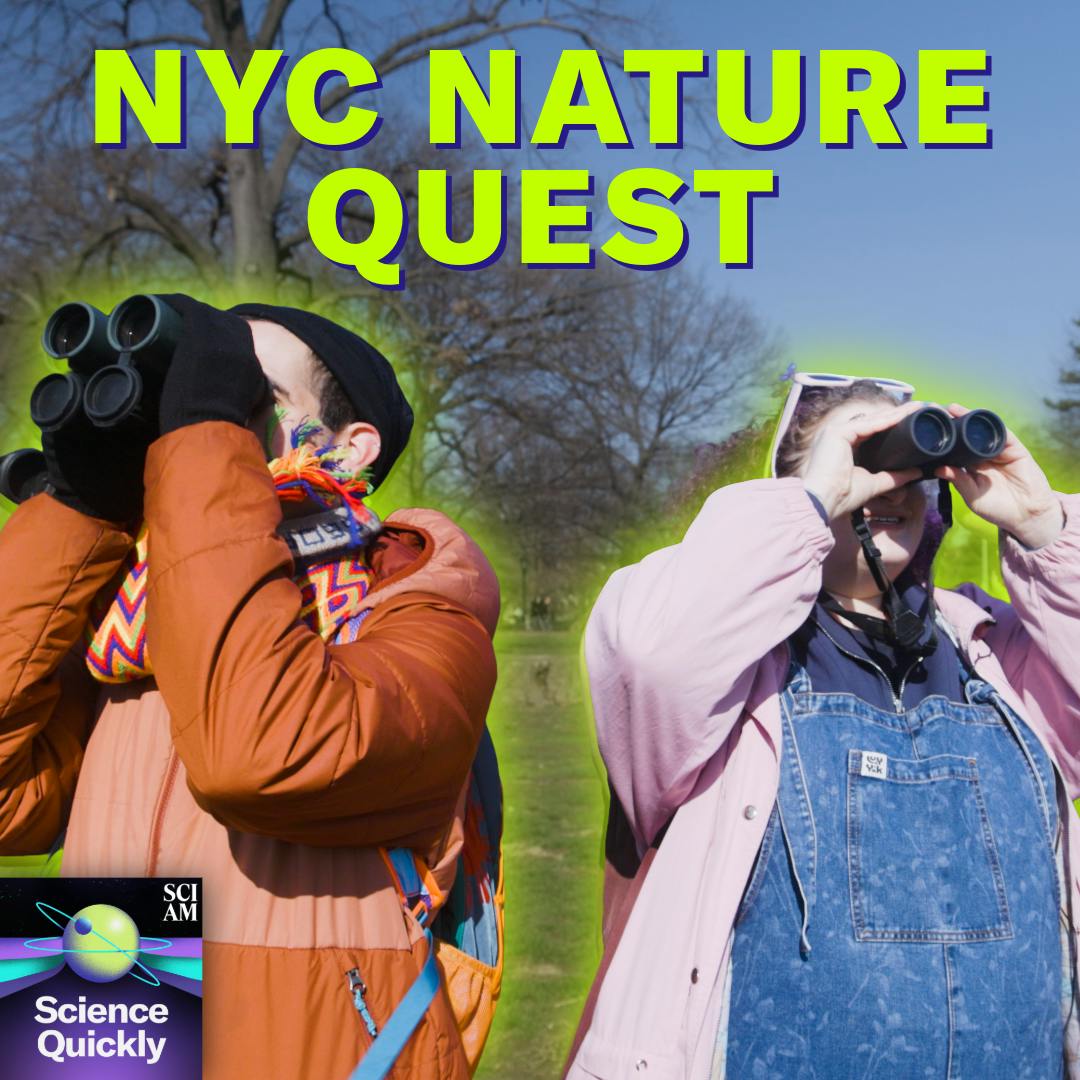
Wild NYC author Ryan Mandelbaum takes host Rachel Feltman through New York City’s Prospect Park to find urban wildlife. They explore the city’s many birds, surprising salamanders and unexpected urban oases. Plus, they discuss what the rules of engagement with wildlife are and how you can find wildlife in your own urban or suburban environment. Recommended reading: Read Wild NYC: Experience the Amazing Nature in and around New York City, which is out now. Listen to our episode on protecting wildlife wherever you are. E-mail us at [email protected] if you have any questions, comments or ideas for stories we should cover! Discover something new every day: subscribe to Scientific American and sign up for Today in Science, our daily newsletter. Science Quickly is produced by Rachel Feltman, Fonda Mwangi, Kelso Harper, Naeem Amarsy and Jeff DelViscio. This episode was hosted by Rachel Feltman. Our show is edited by Alex Sugiura with fact-checking by Shayna Posses and Aaron Shattuck. The theme music was composed by Dominic Smith. Learn more about your ad choices. Visit megaphone.fm/adchoices
Our Fear and Fascination around Snakes
When writer Stephen S. Hall was a child, he would capture snakes—much to his mother’s chagrin. Now the science journalist is returning to his early fascination In his latest book, Slither: How Nature’s Most Maligned Creatures Illuminate Our World. The book explores our long, complicated relationship with snakes. Plus, Hall chats about humans’ and other animals’ evolved reactivity to the presence of snakes and the adaptations that keep snakes alive in even the most extreme environments. Recommended reading: Slither is out now: https://www.hachettebookgroup.com/titles/stephen-s-hall/slither/9781538741337/ An Evolutionary ‘Big Bang’ Explains Why Snakes Come in So Many Strange Varieties https://www.scientificamerican.com/article/an-evolutionary-big-bang-explains-why-snakes-come-in-so-many-strange-varieties/ Venomous Snakes May Spread into Vulnerable Communities because of Climate Change https://www.scientificamerican.com/article/venomous-snakes-are-spreading-because-of-climate-change/ E-mail us at [email protected] if you have any questions, comments or ideas for stories we should cover! Discover something new every day: subscribe to Scientific American and sign up for Today in Science, our daily newsletter. Learn more about your ad choices. Visit megaphone.fm/adchoices
Childhood Illnesses Surge, Magnetic Poles Wandered, and a Colossal Squid Is Found
Measles cases are going up—and a federal scientist has warned that case counts have probably been underreported. Another vaccine-preventable illness, whooping cough, sees a troubling increase in cases. Ancient humans found sun-protection solutions when Earth’s magnetic poles wandered. A colossal squid has been captured on video in its natural habitat for the first time. Plus, we discuss evidence that Mars once had a carbon cycle and a planet that is orbiting a pair of brown dwarfs. Recommended reading: This Is the First Colossal Squid Filmed in the Deep Sea—And It’s a Baby! https://www.youtube.com/watch?v=6f8leNRUXdo&t=1s RFK, Jr., Is Wrong about Cause of Rising Autism Rates, Scientists Say https://www.scientificamerican.com/article/the-real-reason-autism-rates-are-rising/ How to Talk about Vaccines in an Era of Scientific Mistrust https://www.scientificamerican.com/article/why-does-vaccine-hesitancy-occur-and-how-can-people-combat-it/ E-mail us at [email protected] if you have any questions, comments or ideas for stories we should cover! Discover something new every day: subscribe to Scientific American and sign up for Today in Science, our daily newsletter. Science Quickly is produced by Rachel Feltman, Fonda Mwangi, Kelso Harper, Naeem Amarsy and Jeff DelViscio. This episode was hosted by Rachel Feltman. Our show is edited by Alex Sugiura with fact-checking by Shayna Posses and Aaron Shattuck. The theme music was composed by Dominic Smith. Learn more about your ad choices. Visit megaphone.fm/adchoices
From the Internet’s Beginnings to Our Understanding of Consciousness, This Editor Has Seen It All
Senior mind and brain editor Gary Stix has covered the breadth of science and technology over the past 35 years at Scientific American. He joins host Rachel Feltman to take us through the rise of the Internet and the acceleration of advancement in neuroscience that he’s covered throughout his time here. Stix retired earlier this month, and we’d like to thank him for his intellect, inquisitiveness and inspiring run at Scientific American! Read some of Gary Stix’s recent coverage of neuroscience and psychology: Even Four-Year-Olds Instinctively Fact-Check for Misinformation https://www.scientificamerican.com/article/even-four-year-olds-instinctively-fact-check-for-misinformation/ You Don’t Need Words to Think https://www.scientificamerican.com/article/you-dont-need-words-to-think/ Wikipedia Searches Reveal Differing Styles of Curiosity https://www.scientificamerican.com/article/wikipedia-searches-reveal-differing-styles-of-curiosity/ E-mail us at [email protected] if you have any questions, comments or ideas for stories we should cover! Discover something new every day: subscribe to Scientific American and sign up for Today in Science, our daily newsletter. Science Quickly is produced by Rachel Feltman, Fonda Mwangi, Kelso Harper, Naeem Amarsy and Jeff DelViscio. This episode was hosted by Rachel Feltman with guest (and now retired senior editor!) Gary Stix. Our show is edited by Alex Sugiura with fact-checking by Shayna Posses and Aaron Shattuck. The theme music was composed by Dominic Smith. Learn more about your ad choices. Visit megaphone.fm/adchoices
A Disinfectant That’s More Powerful Than Bleach—And Safe for Your Skin
Hypochlorous acid is a promising disinfectant that is difficult to commercialize because it is not very shelf-stable. Senior features editor Jen Schwartz takes us through what the science of this nontoxic disinfectant is and explains why its popularity in the beauty aisle is only the beginning. Recommended reading: The Nontoxic Cleaner That Kills Germs Better Than Bleach—And You Can Use It on Your Skin https://www.scientificamerican.com/article/hypochlorous-acid-is-trending-in-skin-care-and-cleaning-but-does-it-work/ E-mail us at [email protected] if you have any questions, comments or ideas for stories we should cover! Discover something new every day: subscribe to Scientific American and sign up for Today in Science, our daily newsletter. Science Quickly is produced by Rachel Feltman, Fonda Mwangi, Kelso Harper, Naeem Amarsy and Jeff DelViscio. This episode was hosted by Rachel Feltman with guest Jen Schwartz. Our show is edited by Alex Sugiura with fact-checking by Shayna Posses and Aaron Shattuck. The theme music was composed by Dominic Smith. Learn more about your ad choices. Visit megaphone.fm/adchoices
A Long Day on Uranus, a Better Method of Making Coffee and Dinos Fossils in Decline
Caffeine-motivated researchers find that pour height may be the key to a perfect cup of coffee. A new study of plastics finds that less than 10 percent of such products are made with recycled materials. And once the plastics are used, only 28 percent of them make it to the sorting stage—and only half of that plastic is actually recycled. Data from the Hubble Telescope show how a day on Uranus lasts longer than previously thought. Plus, we discuss how scientists thought dinosaurs were in decline even before their mass extinction—until now. Recommended reading: Challenging Big Oil’s Big Lie about Plastic Recycling A Day on Uranus Is Longer Than We Thought, Hubble Telescope Reveals The Horned and Armored Dinosaurs Were the Gladiators of the Mesozoic E-mail us at [email protected] if you have any questions, comments or ideas for stories we should cover! Discover something new every day: subscribe to Scientific American and sign up for Today in Science, our daily newsletter. Science Quickly is produced by Rachel Feltman, Fonda Mwangi, Kelso Harper, Naeem Amarsy and Jeff DelViscio. This episode was hosted by Rachel Feltman. Our show is edited by Alex Sugiura with fact-checking by Shayna Posses and Aaron Shattuck. The theme music was composed by Dominic Smith. Learn more about your ad choices. Visit megaphone.fm/adchoices
How Are Prenatal Blood Tests Detecting Cancer?
Noninvasive prenatal blood testing, or NIPT, is a routine screening that is offered during pregnancy and looks for placental DNA to diagnose chromosomal disorders in a fetus. But in some cases, these tests can also find cancer in the pregnant person. How do the tests work, and why are they uncovering cancer? Genetic counselor and writer Laura Herscher speaks with host Rachel Feltman about IDENTIFY (Incidental Detection of Maternal Neoplasia through Non-invasive Cell-Free DNA Analysis), a broader study that seeks to understand why usual results from NIPT can correlate with a cancer diagnosis in a pregnant patient. Plus, we discuss why treating pregnant patients for cancer can be complicated for obstetricians and oncologists. Recommended reading: A Prenatal Test of the Fetus Turns Up Cancers in Pregnant Mothers https://www.scientificamerican.com/article/a-prenatal-test-of-the-fetus-turns-up-cancers-in-pregnant-mothers/ E-mail us at [email protected] if you have any questions, comments or ideas for stories we should cover! Discover something new every day: subscribe to Scientific American and sign up for Today in Science, our daily newsletter. Science Quickly is produced by Rachel Feltman, Fonda Mwangi, Kelso Harper, Naeem Amarsy and Jeff DelViscio. This episode was hosted by Rachel Feltman. Our show is edited by Alex Sugiura with fact-checking by Shayna Posses and Aaron Shattuck. The theme music was composed by Dominic Smith. Learn more about your ad choices. Visit megaphone.fm/adchoices
Treating Bacterial Vaginosis as an STI Could Improve Outcomes
Bacterial vaginosis (BV), an overgrowth of pathogenic bacteria in the vagina, affects nearly one in three people with a vagina. While you can get BV without ever having sex, a new study has found that, in some cases, it could be functioning more like a sexually transmitted infection. That’s in part because of the increased risk of BV after sex with a new partner and a high recurrence of BV symptoms after treatment.The study examined women with BV who were in a monogamous relationship with a male partner and found that treating both people was significantly more effective than treating the woman alone. Host Rachel Feltman speaks with study co-authors Lenka Vodstrcil, a senior research fellow at Melbourne Sexual Health Center at Monash University in Australia, and Catriona Bradshaw, a professor of sexual health medicine at Monash University and Australia’s Alfred Hospital. Recommended reading: Read the study Resources for patients and health professionals E-mail us at [email protected] if you have any questions, comments or ideas for stories we should cover! Discover something new every day: subscribe to Scientific American and sign up for Today in Science, our daily newsletter. Science Quickly is produced by Rachel Feltman, Fonda Mwangi, Kelso Harper, Naeem Amarsy and Jeff DelViscio. This episode was hosted by Rachel Feltman. Our show is edited by Alex Sugiura with fact-checking by Shayna Posses and Aaron Shattuck. The theme music was composed by Dominic Smith. Learn more about your ad choices. Visit megaphone.fm/adchoices
How the Science of Safety Helps Tackle Global Risks [Sponsored]
We're surrounded by risks of all sizes, every day. Some people might be risk-takers, while others do whatever they can to avoid them. But how can we tackle the risks that impact society on a global scale, like those linked to sustainable energy, societal health and digital technology? Science journalist Izzie Clarke explores this question in the latest podcast from Scientific American Custom Media. She sat down with Chris Cramer, chief research officer and interim president for the leading safety science organization UL Research Institutes. This podcast was produced for UL Research Institutes by Scientific American Custom Media, a division separate from the magazine’s board of editors. Learn more about your ad choices. Visit megaphone.fm/adchoices
Yodeling Monkeys, Increasing Measles Cases and Stressed Out Americans
The Trump administration continues to make cuts to U.S. science and health agencies. Now some states are fighting back, suing the Department of Health and Human Services for slashing $11 billion in public health funds. A study finds that Americans live shorter lives than Europeans with the same income—stress and other systemic issues could be to blame. While much-hyped asteroid 2024 YR4 is no longer a risk to Earth, it could still hit the moon—a possibility that has some scientists excited. Plus, we give an update on the U.S.’s measles outbreak and the troubling hesitancy that the Centers for Disease Control and Prevention is showing toward communicating with the public. Recommended reading: As Measles Continues to Rise, CDC Muffles Vaccine Messaging JWST Delivers Best-Yet Look at That Worrisome Asteroid Americans Are Lonelier Than Europeans in Middle Age E-mail us at [email protected] if you have any questions, comments or ideas for stories we should cover! Discover something new every day: subscribe to Scientific American and sign up for Today in Science, our daily newsletter. Science Quickly is produced by Rachel Feltman, Fonda Mwangi, Kelso Harper, Naeem Amarsy and Jeff DelViscio. This episode was hosted by Rachel Feltman. Our show is edited by Alex Sugiura with fact-checking by Shayna Posses and Aaron Shattuck. The theme music was composed by Dominic Smith. Learn more about your ad choices. Visit megaphone.fm/adchoices
Cutting USAID Threatens Public Health around the World
The U.S. Department of State recently announced plans to dismantle the U.S. Agency for International Development, or USAID. While some of USAID’s functions will continue under the Department of State, there is real concern that the cuts will jeopardize public health efforts across the world, including immunization programs and other efforts that have saved the lives of millions of children. Senior health and medicine editor Tanya Lewis joins host Rachel Feltman to explore the agency’s lifesaving programs and to discuss the devastating effects that will occur when the U.S. divests from global public health efforts. Recommended reading: USAID Funding Saved Millions of Children’s Lives. Recent Cuts Put It in Jeopardy Watch now: John Green on How Tuberculosis Shaped Our Modern World E-mail us at [email protected] if you have any questions, comments or ideas for stories we should cover! Discover something new every day: subscribe to Scientific American and sign up for Today in Science, our daily newsletter. Science Quickly is produced by Rachel Feltman, Fonda Mwangi, Kelso Harper, Naeem Amarsy and Jeff DelViscio. This episode was hosted by Rachel Feltman with guest Tanya Lewis. Our show is edited by Alex Sugiura with fact-checking by Shayna Posses and Aaron Shattuck. The theme music was composed by Dominic Smith. Learn more about your ad choices. Visit megaphone.fm/adchoices
Understanding the Science of ‘Squirting’
The human body is capable of some truly incredible things. One of the most mysterious and debated phenomena is a release of fluid during sex that is often referred to as “squirting.” What’s actually happening, and why does it stir so much speculation? Wendy Zukerman, host of the hit podcast Science Vs, breaks down the science behind this fascinating topic, exploring what we know, what we don’t and what the controversy surrounding it is. Recommended reading: What a Survey On Anal Sex and Masturbation Reveals About Prostates and Pleasure E-mail us at [email protected] if you have any questions, comments or ideas for stories we should cover! Discover something new everyday: subscribe to Scientific American and sign up for our daily newsletter. Science Quickly is produced by Rachel Feltman, Fonda Mwangi, Kelso Harper, Naeem Amarsy and Jeff DelViscio. This episode was edited by Alex Sugiura. Shayna Posses and Aaron Shattuck fact-check our show. Our theme music was composed by Dominic Smith. Learn more about your ad choices. Visit megaphone.fm/adchoices
Shark Sounds, Molecules on Mars and Continued Federal Cuts
Long-chain alkanes discovered by NASA’s Curiosity rover point to the possibility that there may have been fatty acids on Mars—and that they could have come from past microbial life. Paleontologists have found a huge dinosaur claw that was probably made for foraging, not fighting. Researchers studying ocean life have recorded the sounds of sharks and the tricks of cuttlefish. Plus, cuts to jobs and funding for U.S. federal science and health agencies continued last week. Tens of thousands of federal workers are on the chopping block, as is funding for COVID testing, vaccinations and equity initiatives. Recommended reading: Scientists Record First Known Shark Sounds https://www.scientificamerican.com/article/scientists-record-first-known-shark-sounds/ HHS’s Long COVID Office Is Closing. What Will This Mean for Future Research and Treatments? https://www.scientificamerican.com/article/hhss-long-covid-office-is-closing-what-will-this-mean-for-future-research/ E-mail us at [email protected] if you have any questions, comments or ideas for stories we should cover! Discover something new every day: subscribe to Scientific American and sign up for Today in Science, our daily newsletter. Science Quickly is produced by Rachel Feltman, Fonda Mwangi, Kelso Harper, Naeem Amarsy and Jeff DelViscio.This episode was hosted by Rachel Feltman. Our show is edited by Alex Sugiura with fact-checking by Shayna Posses and Aaron Shattuck. The theme music was composed by Dominic Smith. Learn more about your ad choices. Visit megaphone.fm/adchoices

Go Inside M.I.T.'s 50,000 Square Foot Clean Room
The cutting edge of research is very small—and very clean. In this episode, host Rachel Feltman joins Vladimir Bulović, director of MIT.nano, on a tour of this facility’s nanoscale capabilities. Its tightly controlled clean room hosts research across several fields, from microelectronics to medical nanotechnology. You can see Bulović’s tour of the lab at: https://youtu.be/ucGFcLjX30Q E-mail us at [email protected] if you have any questions, comments or ideas for stories we should cover! Discover something new every day: subscribe to Scientific American and sign up for Today in Science, our daily newsletter. Science Quickly is produced by Rachel Feltman, Fonda Mwangi, Kelso Harper, Naeem Amarsy and Jeff DelViscio. This episode was hosted by Rachel Feltman. Our show is edited by Jeff DelViscio with fact-checking by Shayna Posses and Aaron Shattuck. The theme music was composed by Dominic Smith. Learn more about your ad choices. Visit megaphone.fm/adchoices
Are These Plants Out of Place? A New Look at Invasive Species
When you hear “invasive plant,” you might picture an aggressive species taking over and harming the environment. But what if the way we think about invasive plants is part of the problem? Host Rachel Feltman chats with Mason Heberling, associate curator of botany at the Carnegie Museum of Natural History, about why these plants are more complicated than we think. He’s one of the experts behind Uprooted: Plants Out of Place, a new exhibition that challenges the way we label and manage plant invasions. Recommended reading: Invasive Species Can Sometimes Help an Ecosystem “Lost in Translation: The Need for Updated Messaging Strategies in Invasion Biology Communication,” by Rachel A. Reeb and J. Mason Heberling, in Plants, People, Planet. Published online November 8, 2024 Email us at [email protected] if you have any questions, comments or ideas for stories we should cover! Discover something new everyday: subscribe to Scientific American and sign up for Today in Science, our daily newsletter. Science Quickly is produced by Rachel Feltman, Fonda Mwangi, Kelso Harper, Naeem Amarsy and Jeff DelViscio. This episode was edited by Alex Sugiura. Shayna Posses and Aaron Shattuck fact-check our show. Our theme music was composed by Dominic Smith. Learn more about your ad choices. Visit megaphone.fm/adchoices
NASA Astronauts Finally Return, Seals Hold Their Breath, and Penguin Poop Stresses Out Krill
Two NASA astronauts are finally back on Earth after an unexpected nine-month stay in space. What kept them up there so long? Meanwhile scientists have discovered that gray seals have a built-in oxygen gauge that helps them hold their breath for more than an hour. And in the Antarctic, researchers found that penguin poop seriously stresses out krill. Catch up on these stories and more in our Monday news roundup. Recommended reading: After 286 Days in Space, NASA Astronauts Return to Earth with a Splash E-mail us at [email protected] if you have any questions, comments or ideas for stories we should cover! Discover something new everyday: subscribe to Scientific American and sign up for Today in Science, our daily newsletter. Science Quickly is produced by Rachel Feltman, Fonda Mwangi, Kelso Harper, Naeem Amarsy and Jeff DelViscio. This episode was edited by Alex Sugiura. Shayna Posses and Aaron Shattuck fact-check our show. Our theme music was composed by Dominic Smith. Learn more about your ad choices. Visit megaphone.fm/adchoices
Severance’s Consulting Neurosurgeon Explains the Science behind the Show’s Brain Procedure
What if you could completely separate your work and personal life—with the help of a brain implant? That’s the unsettling premise of Severance, the hit Apple TV+ show that just wrapped its second season. To make the science fiction feel as real as possible, the creators brought in an actual neurosurgeon, Vijay Agarwal, chief of the Skull-Base Tumor Center at Montefiore Einstein, as a consultant for the show. Host Rachel Feltman met with Agarwal to break down the real neuroscience behind Severance—and whether a procedure like the one it depicts could ever exist. Mild spoilers ahead! We recommend you at least watch through episode seven of season two before you listen. Recommended reading: The Neuroscience of Severance: What’s Real? What’s Fake? What Severance Life Would Really Be Like, according to a Psychologist Email us at [email protected] if you have any questions, comments or ideas for stories we should cover! Discover something new everyday: subscribe to Scientific American and sign up for our daily newsletter. Science Quickly is produced by Rachel Feltman, Fonda Mwangi, Kelso Harper, Naeem Amarsy and Jeff DelViscio. This episode was edited by Alex Sugiura. Shayna Posses and Aaron Shattuck fact-check our show. Our theme music was composed by Dominic Smith. Learn more about your ad choices. Visit megaphone.fm/adchoices
What Everyone Gets Wrong about Colonoscopies
Colonoscopy gets a bad rap, but how much of what you’ve heard is actually true? In recognition of Colorectal Cancer Awareness Month, we’re tackling the biggest myths that keep people from getting this potentially lifesaving screening. John Nathanson, a gastroenterologist at Columbia University Irving Medical Center, joins host Rachel Feltman to clear up what the misconceptions are, explain what to expect and share why this test is so important. Recommended reading: The Colon Cancer Conundrum Colon Cancer Linked to Mouth Bacteria Email us at [email protected] if you have any questions, comments or ideas for stories we should cover! Discover something new everyday: subscribe to Scientific American and sign up for our daily newsletter. Science Quickly is produced by Rachel Feltman, Fonda Mwangi, Kelso Harper, Naeem Amarsy and Jeff DelViscio. This episode was edited by Alex Sugiura. Shayna Posses and Aaron Shattuck fact-check our show. Our theme music was composed by Dominic Smith. Learn more about your ad choices. Visit megaphone.fm/adchoices
NASA Launches New Missions, Saturn Gains Some Moons, and Whale Urine Balances Marine Ecosystems
The new Environmental Protection Agency administrator plans to get rid of or weaken critical environmental rules and policies, such as regulations around greenhouse gases and clean water protections. The deregulation effort follows the recent cancellation of hundreds of grants. NASA launched two missions last week. The first, SPHEREx, will make a three-dimensional map of the sky. The second, PUNCH, is a collection of satellites meant to study solar wind. Plus, Saturn gains some moons, and whale urine balances ecosystems. Recommended reading: Trump EPA Unveils Aggressive Plans to Dismantle Climate Regulation New NASA Space Telescope Will See the Universe in 102 Colors Heliophysics Is Set to Shine in 2025 E-mail us at [email protected] if you have any questions, comments or ideas for stories we should cover! Discover something new every day: subscribe to Scientific American and sign up for Today in Science, our daily newsletter. Science Quickly is produced by Rachel Feltman, Fonda Mwangi, Kelso Harper, Naeem Amarsy and Jeff DelViscio. This episode was hosted by Rachel Feltman. Our show is edited by Alex Sugiura with fact-checking by Shayna Posses and Aaron Shattuck. The theme music was composed by Dominic Smith. Learn more about your ad choices. Visit megaphone.fm/adchoices
Movie Magic Meets Practical Robotics for Netflix’s The Electric State
Dennis Hong, a mechanical and aerospace engineering professor at the University of California, Los Angeles, discovered a love of robots at an early age while watching the “droid” characters in Star Wars. As director of the Robotics and Mechanisms Laboratory at U.C.L.A., Hong has worked on functional humanoid robots for tasks such as firefighting and disaster relief. Then the Russo brothers came calling. To promote their new Netflix movie The Electric State, film directors Anthony and Joseph Russo wanted to move beyond CGI and create a version of the lead robot, Cosmo, for events. Hong joins host Rachel Feltman to discuss the challenges of blending practical robotics with a Hollywood vision. You can watch The Electric State on Netflix. Recommended reading: Scientists Are Putting ChatGPT Brains Inside Robot Bodies. What Could Possibly Go Wrong? Spiderlike Mars Robot Might One Day Crawl through Unexplored Volcanic Caves A Brief History of Automatons That Were Actually People E-mail us at [email protected] if you have any questions, comments or ideas for stories we should cover! Discover something new every day: subscribe to Scientific American and sign up for Today in Science, our daily newsletter. Science Quickly is produced by Rachel Feltman, Fonda Mwangi, Kelso Harper, Naeem Amarsy and Jeff DelViscio. This episode was hosted by Rachel Feltman. Our show is edited by Alex Sugiura with fact-checking by Shayna Posses, Emily Makowski and Aaron Shattuck. The theme music was composed by Dominic Smith. Learn more about your ad choices. Visit megaphone.fm/adchoices
A Tuberculosis Outbreak Exposes U.S. Postpandemic Vulnerabilities
It’s been five years since COVID was declared a global pandemic. Local, national and global public health agencies mobilized to contain the spread of COVID, but experts worry that backlash against measures like lockdowns have made today’s systems less capable of handling a disease of similar scale. Now the U.S. faces a tuberculosis outbreak in Kansas that underscores the importance of public health infrastructure. Recommended reading: On COVID’s Fifth Anniversary, Scientists Reflect on Mistakes and Successes https://www.scientificamerican.com/article/on-covids-fifth-anniversary-scientists-reflect-on-mistakes-and-successes/ Read Michelle Mello’s research on how public health legal powers have changed since the beginning of the COVID pandemic: https://www.bmj.com/content/384/bmj-2023-076269 And check out Bek Shackelford-Nwanganga’s ongoing health equity reporting: https://www.kcur.org/bek-shackelford E-mail us at [email protected] if you have any questions, comments or ideas for stories we should cover! Discover something new every day: subscribe to Scientific American and sign up for Today in Science, our daily newsletter. Science Quickly is produced by Rachel Feltman, Fonda Mwangi, Kelso Harper, Naeem Amarsy and Jeff DelViscio. This episode was hosted by Rachel Feltman with producer Fonda Mwangi. Our show is edited by Jeff DelViscio with fact-checking by Shayna Posses and Aaron Shattuck. The theme music was composed by Dominic Smith. Learn more about your ad choices. Visit megaphone.fm/adchoices
Measles Misinformation, Ozone Recovery and Woolly Mice
With measles cases on the rise, experts are pushing back against misleading claims about vitamin A as a substitute for vaccination. A Supreme Court ruling has reshaped the Environmental Protection Agency’s authority over water pollution, raising concerns about future environmental protections. And in the world of biotechnology, scientists have genetically engineered woolly mice—an experiment with implications for de-extinction efforts. Recommended reading: Company Seeking to Resurrect the Woolly Mammoth Creates a ‘Woolly Mouse’ https://www.scientificamerican.com/article/company-seeking-to-resurrect-the-woolly-mammoth-creates-a-woolly-mouse/ Trump Gives EPA One Week to Decide on Abandoning Climate Pollution Regulation https://www.scientificamerican.com/article/trump-gives-epa-one-week-to-decide-on-abandoning-climate-pollution/ Email us at [email protected] if you have any questions, comments or ideas for stories we should cover! Discover something new every day: subscribe to Scientific American and sign up for Today in Science, our daily newsletter. Science Quickly is produced by Rachel Feltman, Fonda Mwangi, Kelso Harper, Naeem Amarsy and Jeff DelViscio. This episode was hosted by Rachel Feltman. Our show is edited by Alex Sugiura with fact-checking by Shayna Posses and Aaron Shattuck. The theme music was composed by Dominic Smith. Learn more about your ad choices. Visit megaphone.fm/adchoices
Author John Green on How Tuberculosis Shaped Our Modern World
John Green is an author, advocate and one half of the Vlogbrothers. His latest book, Everything Is Tuberculosis, comes out on March 18. Green joins host Rachel Feltman to share how tuberculosis shaped history, geography and culture. He discusses how he came to understand the inequities of tuberculosis and the dire risk public health interruptions pose to patients today. Recommended reading: You can preorder Everything Is Tuberculosis: https://everythingistb.com/#book How Advocates Pushed Big Pharma to Cut Tuberculosis Drug Priceshttps://www.scientificamerican.com/article/how-advocates-pushed-big-pharma-to-cut-tuberculosis-drug-prices/ The Heroic Black Nurses Who Helped Cure Tuberculosishttps://www.scientificamerican.com/article/the-heroic-black-nurses-who-helped-cure-tuberculosis/ E-mail us at [email protected] if you have any questions, comments or ideas for stories we should cover! Discover something new every day: subscribe to Scientific American and sign up for Today in Science, our daily newsletter. Science Quickly is produced by Rachel Feltman, Fonda Mwangi, Kelso Harper, Naeem Amarsy and Jeff DelViscio. This episode was hosted by Rachel Feltman. Our show is edited by Alex Sugiura and Naeem Amarsy with fact-checking by Shayna Posses and Aaron Shattuck. The theme music was composed by Dominic Smith. Learn more about your ad choices. Visit megaphone.fm/adchoices
Must Be Microplastics on the Brain
Not much passes into our brain from the rest of our body, to the chagrin of drug makers everywhere. So it should be cause for concern when a study found that microplastics were somehow ending up in our brain, says chief opinion editor Megha Satyanarayana. She takes a step back and brings us into the wider world of plastics and the way petroleum chemicals can become pollutants far beyond the factories where they are made. Plus, Satyanarayana discusses the Scientific American opinion section and her column Cross Currents, which aims to decode the science from the headlines. Recommended reading: Why Aren’t We Losing Our Minds over the Plastic in Our Brains? Subscribe to receive weekly emails alerts for Satyanarayana’s column Cross Currents: E-mail us at [email protected] if you have any questions, comments or ideas for stories we should cover! Discover something new every day: subscribe to Scientific American and sign up for Today in Science, our daily newsletter. Science Quickly is produced by Rachel Feltman, Fonda Mwangi, Kelso Harper, Naeem Amarsy and Jeff DelViscio. This episode was hosted by Rachel Feltman with guest Megha Satyanarayana. Our show is edited by Alex Sugiura with fact-checking by Shayna Posses and Aaron Shattuck. The theme music was composed by Dominic Smith. Learn more about your ad choices. Visit megaphone.fm/adchoices
How Did a Volcano Turn a Brain to Glass? Plus, Measles, Mystery Illness and Microbes
Officials have confirmed the first measles death in an outbreak in West Texas. A meeting to discuss which strains to focus on for next year’s flu vaccines was canceled by the Food and Drug Administration. Public health officials are investigating two outbreaks of an unknown disease in the Democratic Republic of the Congo. Plus, new research discovers the importance of microbes in space for astronauts’ health and sheds light on the way the eruption of Mount Vesuvius in 79 C.E. turned a brain to glass. Recommended reading: The Measles Outbreak in Texas Is Why Vaccines Matter | Opinion https://www.scientificamerican.com/article/the-measles-outbreak-in-texas-is-why-vaccines-matter/ The International Space Station May Need More Microbes to Keep Astronauts Healthy https://www.scientificamerican.com/article/the-international-space-station-may-need-more-microbes-to-keep-astronauts/ E-mail us at [email protected] if you have any questions, comments or ideas for stories we should cover! Discover something new every day: subscribe to Scientific American and sign up for Today in Science, our daily newsletter. Science Quickly is produced by Rachel Feltman, Fonda Mwangi, Kelso Harper, Naeem Amarsy and Jeff DelViscio. This episode was hosted by Rachel Feltman. Our show is edited by Alex Sugiura with fact-checking by Shayna Posses and Aaron Shattuck. The theme music was composed by Dominic Smith. Learn more about your ad choices. Visit megaphone.fm/adchoices
Why Do Songs Get Stuck in Your Head?
Have you ever had a song continue to loop in your brain no matter how hard you tried to shake it? These “earworms” are more than just an annoyance—they’re a phenomenon scientists have studied for years. This episode dives into what makes certain melodies stick, why some tunes are more persistent than others and what our listeners shared as their most unforgettable earworms. Recommended reading: How Do You Solve a Problem Like an Earworm? Email us at [email protected] if you have any questions, comments or ideas for stories we should cover! Discover something new everyday: subscribe to Scientific American and sign up for our daily newsletter. Science Quickly is produced by Rachel Feltman, Fonda Mwangi, Kelso Harper, Naeem Amarsy, and Jeff DelViscio. This episode was reported and co-hosted by Josh Fischman. Emily Makowski, Shayna Posses, and Aaron Shattuck fact-check our show. Our theme music was composed by Dominic Smith. Learn more about your ad choices. Visit megaphone.fm/adchoices
Saying Farewell to the Spacecraft That Mapped the Milky Way
The Gaia spacecraft stopped collecting data this January after about 11 years and more than three trillion observations. Senior space and physics editor Lee Billings joins host Rachel Feltman to review Gaia’s Milky Way–mapping mission and the tidal streams, black holes and asteroids the spacecraft identified. Recommended reading: New Maps of Milky Way Are Biggest and Best Yet https://www.scientificamerican.com/article/gaias-multi-billion-star-map-of-the-milky-way-keeps-getting-better/ Astronomers Discover Milky Way’s ‘Sleeping Giant’ Black Hole Shockingly Close to Earth https://www.scientificamerican.com/article/milky-way-sleeping-giant-black-hole-shockingly-close-to-earth/ E-mail us at [email protected] if you have any questions, comments or ideas for stories we should cover! Discover something new every day: subscribe to Scientific American and sign up for Today in Science, our daily newsletter. Science Quickly is produced by Rachel Feltman, Fonda Mwangi, Kelso Harper, Madison Goldberg, Naeem Amarsy and Jeff DelViscio. This episode was hosted by Rachel Feltman with guest Lee Billings. Our show is edited by Madison Goldberg with fact-checking by Shayna Posses and Aaron Shattuck. The theme music was composed by Dominic Smith. Learn more about your ad choices. Visit megaphone.fm/adchoices
Measles Outbreaks, Asteroid Risks and Fish Friends
The black hole at the center of our galaxy is emitting near-constant, random light. The European Space Agency has approved astronaut candidate John McFall, making McFall the first physically disabled candidate to be cleared to fly. The risk of asteroid 2024 YR4 hitting Earth rose to more than 3 percent and then dipped down to 1.5 percent with new data—our February 12 episode explained why this risk has been changing. Recommended reading: Hear our February 12 episode about asteroid 2024 YR4: https://www.scientificamerican.com/podcast/episode/what-we-know-about-2024-yr4-the-asteroid-with-a-2-percent-chance-of-impact/ Read more of guest host Allison Parshall’s exceptional coverage: https://www.scientificamerican.com/author/allison-parshall/ E-mail us at [email protected] if you have any questions, comments or ideas for stories we should cover! Discover something new every day: subscribe to Scientific American and sign up for Today in Science, our daily newsletter. Science Quickly is produced by Allison Parshall, Rachel Feltman, Fonda Mwangi, Kelso Harper, Madison Goldberg, Naeem Amarsy and Jeff DelViscio. This episode was hosted by Allison Parshall. Our show is edited by Naeem Amarsy with fact-checking by Shayna Posses and Aaron Shattuck. The theme music was composed by Dominic Smith. Learn more about your ad choices. Visit megaphone.fm/adchoices
Where Did Curly Hair Come From? Biological Anthropology May Provide Insights
It’s fairly strange that humans, unlike many other mammals, don’t have hair all over. Our lack of body hair and wide geographic distribution led to the variation of sun-protective melanin in our skin. For the hair that remains, why did some groups develop curls while others did not? Biological anthropologist Tina Lasisi takes host Rachel Feltman through her work on understanding the roots of hair types. Plus, they discuss what we might learn from “chemo curls” and how developmental shifts change the extent and texture of hair during puberty. Recommended reading: Read more about Tina Lasisi at her website Read papers on hair and thermoregulation published by Lasisi and her colleagues in 2024 and 2023 E-mail us at [email protected] if you have any questions, comments or ideas for stories we should cover! Discover something new every day: subscribe to Scientific American and sign up for Today in Science, our daily newsletter. Science Quickly is produced by Rachel Feltman, Fonda Mwangi, Kelso Harper, Madison Goldberg, Naeem Amarsy and Jeff DelViscio. This episode was hosted by Rachel Feltman. Our show is edited by Jeff DelViscio with fact-checking by Shayna Posses and Aaron Shattuck. The theme music was composed by Dominic Smith. Learn more about your ad choices. Visit megaphone.fm/adchoices
Exploring the Hidden Life in the Air around Us with Carl Zimmer
Scientists now agree that COVID spreads via airborne transmission. But during the early days of the disease, public health officials suggested that it mainly did so via close contact. The subsequent back-and-forth over how COVID spread brought science journalist Carl Zimmer into the world of aerobiology. In his new book Air-Borne: The Hidden History of the Life We Breathe, Zimmer examines the unseen life in the air around us. He joins host Rachel Feltman to look back at the history of the field, from ancient Greek “miasmas” to Louis Pasteur’s unorthodox experiments to biological warfare. You can preorder Zimmer’s new book And stay up-to-date on his work at his website E-mail us at [email protected] if you have any questions, comments or ideas for stories we should cover! Discover something new every day: subscribe to Scientific American and sign up for Today in Science, our daily newsletter. Science Quickly is produced by Rachel Feltman, Fonda Mwangi, Kelso Harper, Madison Goldberg, Naeem Amarsy and Jeff DelViscio. This episode was hosted by Rachel Feltman. Our show is edited by Naeem Amarsy with fact-checking by Shayna Posses and Aaron Shattuck. The theme music was composed by Dominic Smith. Learn more about your ad choices. Visit megaphone.fm/adchoices
Valentine’s Day Isn’t Just for Romance—The Science of Deep Friendships
Love isn’t just about romance. This Valentine’s Day, we’re exploring the power of deep nonromantic bonds. Host Rachel Feltman sits down with Rhaina Cohen, a producer and editor for NPR’s podcast Embedded and author of The Other Significant Others, to discuss the history and psychology of friendship—and the reasons these connections deserve just as much celebration as romantic partnerships. Recommended reading: —The Evolutionary Origins of Friendship —How to Reconnect with Old Friends Who Have Become Strangers Subscribe to Rhaina Cohen’s newsletter. E-mail us at [email protected] if you have any questions, comments or ideas for stories we should cover! Discover something new every day: subscribe to Scientific American and sign up for Today in Science, our daily newsletter. Science Quickly is produced by Rachel Feltman, Fonda Mwangi, Kelso Harper, Madison Goldberg, Naeem Amarsy and Jeff DelViscio. This episode was hosted by Rachel Feltman. Our show is edited by Madison Goldberg with fact-checking by Shayna Posses and Aaron Shattuck. The theme music was composed by Dominic Smith. Learn more about your ad choices. Visit megaphone.fm/adchoices
An Asteroid May Hit Earth in 2032. What Can We Do about It?
The European Space Agency recently announced that the near-Earth asteroid 2024 YR4 has a 2 percent chance of hitting our planet in 2032. The probability of impact is difficult to predict exactly and will be clearer in 2028, when 2024 YR4 will whiz by us. But if the asteroid really is on a collision course with Earth, what can we do about it? Senior space and physics editor Lee Billings joins host Rachel Feltman to unpack this headline-making story. Recommended reading: Newfound Asteroid May Hit Earth in 2032, Scientists Say E-mail us at [email protected] if you have any questions, comments or ideas for stories we should cover! Discover something new every day: subscribe to Scientific American and sign up for Today in Science, our daily newsletter. Science Quickly is produced by Rachel Feltman, Fonda Mwangi, Kelso Harper, Madison Goldberg, Naeem Amarsy and Jeff DelViscio. This episode was hosted by Rachel Feltman with guest Lee Billings. Our show is edited by Jeff DelViscio with fact-checking by Shayna Posses and Aaron Shattuck. The theme music was composed by Dominic Smith. Learn more about your ad choices. Visit megaphone.fm/adchoices
Microplastics on the Mind, Superstrong Shrimp and Bird Flu Transmission
A subtype of H5N1 bird flu that has been found in cattle for the first time suggests that the virus jumped from birds to the animals twice. A headline-making study estimates that we have a spoon’s worth of microplastics in our brain. Streams of rock from a cosmic impact created the moon’s two deep canyons, Vallis Schrödinger and Vallis Planck. A large study shows that people feel their best in the morning and their worst at midnight. Bonobos can tell when humans don’t know something—and try to help us. Recommended reading: The U.S. Is Not Ready for Bird Flu in Humans Bonobos Can Tell When a Human Doesn’t Know Something Is Snoozing the Alarm Good or Bad for Your Health? E-mail us at [email protected] if you have any questions, comments or ideas for stories we should cover! Discover something new every day: subscribe to Scientific American and sign up for Today in Science, our daily newsletter. Science Quickly is produced by Rachel Feltman, Fonda Mwangi, Kelso Harper, Madison Goldberg, Naeem Amarsy and Jeff DelViscio. This episode was hosted by Rachel Feltman. Our show is edited by Naeem Amarsy with fact-checking by Shayna Posses and Aaron Shattuck. The theme music was composed by Dominic Smith. Learn more about your ad choices. Visit megaphone.fm/adchoices
Trump’s Executive Orders Create Confusion for Researchers
The first few weeks of the Trump administration have been marked by chaos and confusion for the nation’s health and science agencies. A funding freeze broadly targeting language around diversity, equity and inclusion has agencies evaluating research and initiatives. A hold on public communications from health agencies is affecting public health reporting to people in the U.S.—and to the World Health Organization. Entire websites have gone dark as agencies have tried to comply, though archivists are preventing critical datasets from disappearing. Max Kozlov, a Nature reporter who covers biomedical science, joins host Rachel Feltman to walk through what the next four years might hold for research and researchers in the U.S. Overall, the orders have caused uncertainty for scientists in the nation, and associate health editor Lauren Young discusses the frustration and fear she’s hearing from them. Read more of Max Kozlov’s reporting: –Trump Abruptly Cancels Crucial Science Reviews at NIH, World’s Largest Public Funder of Biomedical Research –Exclusive: How NSF Is Scouring Research Grants for Violations of Trump’s Orders –Chaos Erupts in US Science as Trump’s Team Declares Freeze on Federal Grants E-mail us at [email protected] if you have any questions, comments or ideas for stories we should cover! Discover something new every day: subscribe to Scientific American and sign up for Today in Science, our daily newsletter. Science Quickly is produced by Rachel Feltman, Fonda Mwangi, Kelso Harper, Madison Goldberg and Jeff DelViscio. This episode was hosted by Rachel Feltman with guest Lauren Young. Our show is edited by Madison Goldberg with fact-checking by Shayna Posses and Aaron Shattuck. The theme music was composed by Dominic Smith. Learn more about your ad choices. Visit megaphone.fm/adchoices
Avoiding Outrage Fatigue in Overwhelming Times
It’s almost impossible not to feel outraged these days. But overexposure to information that makes us angry can wear us down. Senior health and medicine editor Tanya Lewis joins host Rachel Feltman to discuss how to combat outrage fatigue. Plus, we discuss a surprising finding about outrage and the spread of misinformation. Recommended reading: –Read Tanya Lewis’s full story on outrage fatigue –Listen for tips on converting cynicism into hopeful skepticism E-mail us at [email protected] if you have any questions, comments or ideas for stories we should cover! Discover something new every day: subscribe to Scientific American and sign up for Today in Science, our daily newsletter. Science Quickly is produced by Rachel Feltman, Fonda Mwangi, Kelso Harper, Madison Goldberg and Jeff DelViscio. This episode was hosted by Rachel Feltman with guest Tanya Lewis. Our show is edited by Madison Goldberg with fact-checking by Shayna Posses and Aaron Shattuck. The theme music was composed by Dominic Smith. Learn more about your ad choices. Visit megaphone.fm/adchoices
Tuberculosis Outbreak, RFK, Jr.’s Confirmation Hearings and Polar Bear Hair
This week we’re recapping Robert F. Kennedy, Jr.’s confirmation hearings. Highly pathogenic H5N9, a strain of bird flu, was found in U.S. poultry. A tuberculosis outbreak in Kansas is making headlines—but how severe is the spread? Health equity reporter Bek Shackelford-Nwanganga of the Kansas News Service and KCUR joins host Rachel Feltman to unpack the situation. Plus, we discuss fossilized puke and ice-resistant polar bear hair. Recommended reading: –Shackelford-Nwanganga’s reporting on the tuberculosis outbreak in Kansas –The Latest on Bird Flu in Humans, Cats and Chickens –RFK, Jr., Confirmation Hearing Showed 5 Ways He Threatens Public Health E-mail us at [email protected] if you have any questions, comments or ideas for stories we should cover! Discover something new every day: subscribe to Scientific American and sign up for Today in Science, our daily newsletter. Science Quickly is produced by Rachel Feltman, Fonda Mwangi, Kelso Harper, Madison Goldberg and Jeff DelViscio. This episode was hosted by Rachel Feltman. Our show is edited by Madison Goldberg with fact-checking by Shayna Posses and Aaron Shattuck. The theme music was composed by Dominic Smith. Learn more about your ad choices. Visit megaphone.fm/adchoices
Are You Tired of Feeling Cynical? Hopeful Skepticism Could Be a Way Out
It’s easy to be cynical about the state of the world—even when you’re a researcher who studies empathy and kindness. Stanford University psychologist Jamil Zaki turned his own negativity into his new book Hope for Cynics: The Surprising Science of Human Goodness. The book busts common myths about cynicism and explores what it could be doing to our body and brain. Zaki reflects on the imperfections of cynicism and hope and presents a third option: hopeful skepticism. Recommended reading: Read Hope for Cynics: The Surprising Science of Human Goodness. Follow Jamil Zaki’s work at www.jamil-zaki.com and www.ssnl.stanford.edu E-mail us at [email protected] if you have any questions, comments or ideas for stories we should cover! Discover something new every day: subscribe to Scientific American and sign up for Today in Science, our daily newsletter. Science Quickly is produced by Rachel Feltman, Fonda Mwangi, Kelso Harper, Madison Goldberg and Jeff DelViscio. This episode was hosted by Rachel Feltman. Our show is edited by Fonda Mwangi with fact-checking by Shayna Posses and Aaron Shattuck. The theme music was composed by Dominic Smith. Learn more about your ad choices. Visit megaphone.fm/adchoices
Science Will Stare Directly Into the Sun--And Love It
The sun is in the middle of its solar maximum, the part of its 11-year solar cycle that was responsible for the stunning auroras seen across the globe last year. This year is looking equally exciting, with more incoming space weather and a handful of science missions to study the sun’s wide-reaching behavior. Senior reporter Meghan Bartels reviews the missions that are launching in 2025 and explains the reasons why you should be excited by heliophysics. Recommended reading: Heliophysics Is Set to Shine in 2025 Should You Really Worry about Solar Flares? E-mail us at [email protected] if you have any questions, comments or ideas for stories we should cover! Discover something new every day: subscribe to Scientific American and sign up for Today in Science, our daily newsletter. Science Quickly is produced by Rachel Feltman, Fonda Mwangi, Kelso Harper, Madison Goldberg and Jeff DelViscio. This episode was hosted by Rachel Feltman with guest Meghan Bartels. Our show is edited by Jeff DelViscio with fact-checking by Shayna Posses and Aaron Shattuck. The theme music was composed by Dominic Smith. Learn more about your ad choices. Visit megaphone.fm/adchoices
WHO Withdrawal, Bird Flu Updates and a Link between Fitness and Treatment Outcomes
Executive orders that impact science and health in the U.S. came quickly after the inauguration of President Donald Trump. Tanya Lewis, senior editor of health and medicine, explains how grievances over COVID and funding led Trump to order the U.S.’s withdrawal from the World Health Organization—and what that withdrawal would mean for global health. Plus, we present an update on the spread of bird flu in the U.S. and other news on topics from animal behavior to astronomy. –Listen to our episode about the mishandled response to the bird flu outbreak –Read more about Trump’s executive orders around science and health –Check out some lighthearted animal behavior research E-mail us at [email protected] if you have any questions, comments or ideas for stories we should cover! Discover something new every day: subscribe to Scientific American and sign up for Today in Science, our daily newsletter. Science Quickly is produced by Rachel Feltman, Fonda Mwangi, Kelso Harper, Madison Goldberg and Jeff DelViscio. This episode was hosted by Rachel Feltman with guest Tanya Lewis. Our show is edited by Madison Goldberg with fact-checking by Shayna Posses and Aaron Shattuck. The theme music was composed by Dominic Smith. Learn more about your ad choices. Visit megaphone.fm/adchoices
Combatting Climate Anxiety through Community Science
It’s easy to feel overwhelmed with the news these days and to fear for the future. What if you could interrupt doomscrolling and contribute to conservation at the same time? That’s the idea behind programs like Adventure Scientists, eBird and iNaturalist. Guest Gregg Treinish, founder and executive director of Adventure Scientists, joins host Rachel Feltman to talk about community science in the great outdoors. Learn more about Adventure Scientists Contribute to the California Biodiversity project Contribute to the Tracking Eastern Hemlock project Read Treinish’s opinion piece in the San Francisco Chronicle E-mail us at [email protected] if you have any questions, comments or ideas for stories we should cover! Discover something new every day: subscribe to Scientific American and sign up for Today in Science, our daily newsletter. Science Quickly is produced by Rachel Feltman, Fonda Mwangi, Kelso Harper, Madison Goldberg and Jeff DelViscio. This episode was hosted by Rachel Feltman. Our show is edited by Fonda Mwangi with fact-checking by Shayna Posses and Aaron Shattuck. The theme music was composed by Dominic Smith. Learn more about your ad choices. Visit megaphone.fm/adchoices
What the End of U.S. Net Neutrality Means For You
Net neutrality, the principle that all Internet traffic should be treated equally, was heralded by the Federal Communications Commission and open Internet advocates. A federal court struck down the FCC’s ability to enforce the policy earlier this month. What does that mean for the free and open Internet? Associate technology editor Ben Guarino joins host Rachel Feltman to review the state rules that could preserve net neutrality and ways that telecommunications giants could leverage the lack of federal regulation against their competitors. Recommended reading: What the End of U.S. Net Neutrality Means E-mail us at [email protected] if you have any questions, comments or ideas for stories we should cover! Discover something new every day: subscribe to Scientific American and sign up for Today in Science, our daily newsletter. Science Quickly is produced by Rachel Feltman, Fonda Mwangi, Kelso Harper, Madison Goldberg and Jeff DelViscio. This episode was hosted by Rachel Feltman with guest Ben Guarino. Our show is edited by Fonda Mwangi with fact-checking by Shayna Posses and Aaron Shattuck. The theme music was composed by Dominic Smith. Learn more about your ad choices. Visit megaphone.fm/adchoices
The Health Risks of Alcohol, a Red Dye Ban and Commercial Space Flights
A report that was recently released by the Department of Health and Human Services highlights the risks of drinking alcohol, even moderately. The Food and Drug Administration has banned the use of the dye Red No. 3 in food and other products. Experts argue that body mass index (BMI) is a flawed way to diagnose “obesity.” A SpaceX rocket successfully brought two lunar landers into orbit—but in another launch, part of a separate SpaceX vehicle exploded after takeoff. Plus, Australia has another scary spider. Recommended reading: – What to Know about the Ban on Red Dye in Foods and Drugs – Blue Ghost, a Private U.S. Lunar Lander, Launches to the Moon – People Who Are Fat and Healthy May Hold Keys to Understanding Obesity E-mail us at [email protected] if you have any questions, comments or ideas for stories we should cover! Discover something new every day: subscribe to Scientific American and sign up for Today in Science, our daily newsletter. Science Quickly is produced by Rachel Feltman, Fonda Mwangi, Kelso Harper, Madison Goldberg and Jeff DelViscio. This episode was hosted by Rachel Feltman. Our show is edited by Madison Goldberg with fact-checking by Shayna Posses and Aaron Shattuck. The theme music was composed by Dominic Smith. Learn more about your ad choices. Visit megaphone.fm/adchoices
Do Pain and Joy Have a Universal Language?
Ouch! Ah! Aïe! The words we use when we stub our toe or receive a pinch may point to a common way to express pain across languages. Associate news editor Allison Parshall explores what linguistic commonalities in expressions of pain and joy might mean for our shared biology. Plus, Parshall and host Rachel Feltman chat about onomatopoeias, the “bouba-kiki” effect and linguistic news you may have missed in 2024. Recommended reading: Ouch! Linguists Find Universal Language for Pain How Our Thoughts Shape the Way Spoken Words Evolve My Synesthesia Transforms Speech into Text I ‘See’ in My Head Eight, Ocho, Acht Most Fascinating Language Discoveries of 2024 E-mail us at [email protected] if you have any questions, comments or ideas for stories we should cover! Discover something new every day: subscribe to Scientific American and sign up for Today in Science, our daily newsletter. Science Quickly is produced by Rachel Feltman, Fonda Mwangi, Kelso Harper, Madison Goldberg and Jeff DelViscio. This episode was hosted by Rachel Feltman with guest Allison Parshall. Our show is edited by Fonda Mwangi with fact-checking by Emily Makowski, Shayna Posses and Aaron Shattuck. The theme music was composed by Dominic Smith. Learn more about your ad choices. Visit megaphone.fm/adchoices
How the U.S. Mishandled the Early Days of Bird Flu
H5N1 avian influenza has now reached almost 1,000 herds of dairy cattle in 16 states and has infected around 66 people, many of them agricultural workers, in the U.S. Host Rachel Feltman is joined by Amy Maxmen, a public health reporter at KFF Health News, to get the latest on bird flu. They explore how government and industry players lost control of the outbreak and what we can do to prevent a future pandemic of this evolving disease. Read the full story: https://www.scientificamerican.com/article/bird-flu-has-spread-out-of-control-after-mistakes-by-u-s-government-and/ Read more of Amy Maxmen’s work: https://kffhealthnews.org/news/author/amy-maxmen/ Sign up for Healthbeat’s newsletters here. E-mail us at [email protected] if you have any questions, comments or ideas for stories we should cover! Discover something new every day: subscribe to Scientific American and sign up for Today in Science, our daily newsletter. Science Quickly is produced by Rachel Feltman, Fonda Mwangi, Kelso Harper, Madison Goldberg and Jeff DelViscio. This episode was hosted by Rachel Feltman. Our show is edited by Fonda Mwangi with fact-checking by Shayna Posses and Aaron Shattuck. The theme music was composed by Dominic Smith. Learn more about your ad choices. Visit megaphone.fm/adchoices