
Renegade Marketers Unite
633 episodes — Page 11 of 13

Ep 132132: How SAP Hopes to Make the World Run Better
If you were constructing a bingo board based on the lingo in tech company discussions, you'd have "disrupt" right in the middle square, as it's basically a freebie. What's far less common, is seeing a company actually follow through on that disruption, but that's what SAP has managed to do. Alicia Tillman, CMO, has been hard at work trying to re-envision how SAP presents itself, largely driven by the CEO's ambitious goal to crack the top 10 most valuable brands in the world. So, Alicia took the reins, set about repositioning the company, and has since seen SAP move from 21st most valuable brand to 17th—their highest growth rate since 2009. Quite a few cylinders have been firing to make this happen: Their commitment to rallying behind a bold, company-wide purpose, their internal buy-in and alignment, their dedication to creativity and storytelling, and of course, good old fashioned hard work, have all played a major role in kicking SAP into the next gear. For more of Alicia's keys to effective marketing, and to get a closer look at how one of the most valuable companies maintains and builds on its success, check out the full interview.

Ep 131131: Turning Employees Into Brand Advocates
In the utopian holster of magical marketing bullets, employee advocacy is right up there with viral videos (think Ice Bucket Challenge) and real-time marketing (remember Oreo's 'dunking in the dark' social posts?) But, unlike the last two options, employee advocacy is actually something most companies can execute consistently, assuming they follow a few critical steps. First, you have to run a company that employees actually enjoy working at and feel comfortable advocating for. Second, you need to allow your employees the latitude to speak in their own voice not just the brand's. And third, it really helps if you have a tech platform that makes it easy for employees to advocate on the brand's behalf. On this episode, Drew chats with Glenn Gaudet, CEO and founder of GaggleAMP, an employee advocacy enablement tool. In their conversation, Drew and Glenn dive into the issues most marketers face when developing these programs, how to build a culture of eager sharers and the importance of segmenting potential advocates. They also discuss how employee advocacy programs need to align with broader marketing strategies, a few dos and don'ts, and more. Listen in and learn how to get employees caring about sharing.

Ep 130130: The Power of a Purpose-Driven Story Statement
What the heck is a purpose-driven story statement and why are they so critical to successful marketing? These are the question Drew answers on the first-ever installment of Drew's Takeaways, a special RTU episode where he distills and discusses key topics and themes of recent interviews. On this episode, Drew breaks down why and how a company can rally behind a powerful, purpose-driven story statement. Through the discussion of two such statements—one that worked, and one that fulfilled its promise—Drew helps shed some light on how a brand can craft a meaningful identity that engages employees, customers, and prospects, while helping drive the brand forward. To hear more about being purpose-driven, and to take a closer look at statements like Family Circle's Where Family Comes First and SurveyMonkey's We Power the Curious, tune in!

Ep 129129: How Purpose Drives Bank of the West
A true, purpose-driven brand doesn't happen overnight. What it really takes is a goal, specific actions, and at times, a bit of sacrifice. For Bank of the West, their mission meant, in the short-term, potentially leaving money on the table in the name of responsible investment of customers' money, and transparency as to what that money was doing. That initial cost was worth it, as the long-term benefits, like new customers, talent attraction, and differentiation, outweighed any money lost. Now, when high-profile job candidates ask, "Why should I join you? How are you helping the world?" Bank of the West has a great an answer—they're one of very few banks that has restrictive financing policies on things like coal, fracking, and arctic drilling. On this episode of RTU, learn how CMO Ben Stuart and his team helped shape this relatively small financial institution to become a competitive, purpose-driven company with marketing that doesn't feel like an uninvited guest. The discussion touches on crafting a tight strategy, gaining internal buy-in, data analytics, the keys to differentiation, and more on how to craft brilliant marketing.
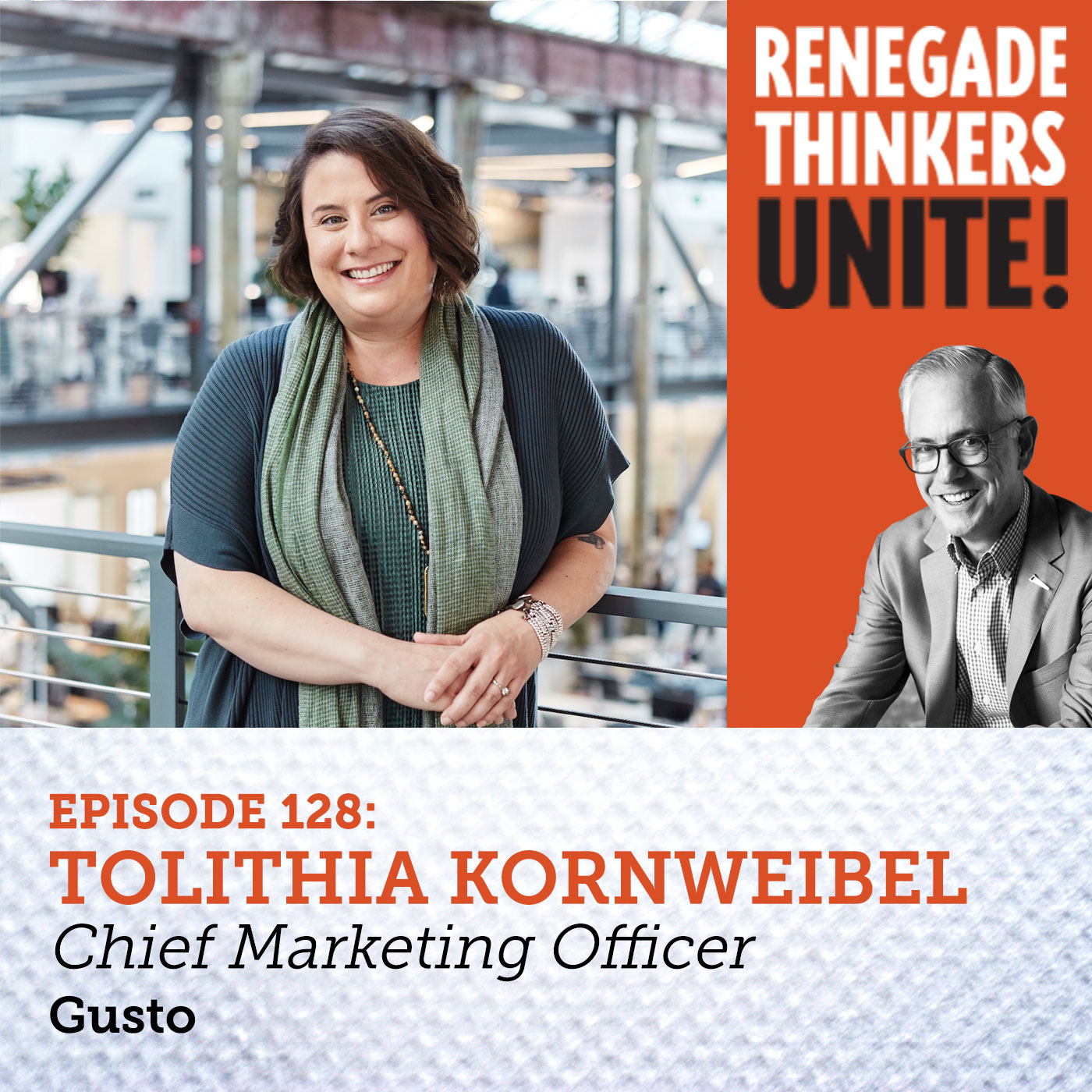
128: Brand Tracking and B2B Demand Gen with Gusto
Payroll tends to be a purely transactional moment between employer and employee, but Gusto is working to shift that to being a "life moment," potentially one of delight (as receiving a paycheck should be!). Effectively reaching their audience while balancing internal alignment, a hefty tech stack, and their mission statement—to create a world where work empowers a better life—can be something of a juggling act. Tolithia Kornweibel, head of marketing, and her team at Gusto, are up to the task. On today's RTU, Drew and Tolithia talk about how to effectively build a demand engine, how to demonstrate value internally to gain support, and how to keep track of your brand through a balance of qualitative and quantitative assessment, all while staying true to a brand mission. Tune in! Connect With Tolithia: On LinkedIn Via gusto.com Connect with Drew http://renegade.com/ On LinkedIn On Twitter On Facebook On Instagram

Ep 127127: How Outdoor Propelled a B2B Startup
Silicon Valley is home to thousands of B2B startups—and one of the the newest B2B unicorns. Brex offers a corporate credit card more built around the ever-changing needs of a startup, and they've been valued at over $1 billion. One of the secrets? Champagne and chocolate. Brex's overall success has tied heavily into their bold marketing, and on this episode of RTU, Chief Sales Officer Sam Blond, and CFO/CMO Michael Tannenbaum, discuss it in detail. From identifying your targets, to orchestrating outdoor campaigns, to in-depth attribution models, Brex has been firing on all cylinders. Listen in to learn more. Be sure to listen. Subscribe on Apple Podcasts - Stitcher - or Podsearch What You'll Learn How Brex found its current market Brex is located in Silicon Valley, where there are thousands of B2B startups. Brex's founders stumbled upon the painfulness of managing corporate credit cards when they could not get a credit card for one of their own new business. Their experience demonstrated a business opportunity and a marketplace in the niche of corporate cards for startups. Typically, founders of startups had to personally guarantee a corporate card. Even with millions of dollars in the bank, these businesses would have 20k-30k spending limits placed on them that were nowhere high enough to support the spending of a company. Brex instead uses businesses bank accounts and bank activity to determine the spending limits on corporate cards. Michael and Sam point out that startups move and grow too quickly to have spending limits determined on a yearly basis, so Brex is constantly evaluating what a business needs and what limits will be. Their business model has resonated especially with tech startups and B2B businesses in Silicon Valley. Why outdoor marketing works To launch its company, Brex turned to outdoor marketing. With already 100 clients prior to launch, Brex knew it had a good story to tell with a large impact for startups. They wanted to maximize the one time impact of the company's launch. With a highly targeted market of startups concentrated in the San Francisco area, they purchased as much outdoor inventory as they could. Brex flooded the market with billboards informing the public that they were the first corporate credit card for startups. Outdoor marketing allowed them to go broader and reach a larger number of people. Brex's unique email campaign Prior to working with Brex, Sam had lots of experiencing testing outbound email copy. For Brex's unique email campaign, they coupled creative email copy with Brazilian chocolates or champagne. Brex was able to research companies that seemed like a good fit for their corporate card. Then, they targeted specific CFO's in the Bay area to receive these gifts, and then an email from Brex shortly after. There was a combination of these emails and outdoor marketing to continue to get the word out there that there was an alternative to the current idea of a corporate credit card. Timeline [2:23] Who Sam and Michael are [10:35] How Brex found this viable market [15:28] Why Brex chose to use outdoor to launch its product [18:02] The "Brex It" message [22:45] Outdoor correlation to measurable results [25:09] How's Brex's email campaigns are different (and successful) [28:45] Viable CPA and the lifetime value per customer Connect With Michael Tannenbaum & Sam Blond: Connect with Michael Tannenbaum on LinkedIn Connect with Sam Blond on LinkedIn Resources & People Mentioned www.Brex.com Connect with Drew http://renegade.com/ On LinkedIn On Twitter On Facebook On Instagram

Ep 126126: How Emerson's Long-Time CMO Reduces Complexity
Perhaps Kathy Button Bell's title should change from "Chief Marketing Officer" to "Chief Complexity Reduction Officer"—after all, she's been simplifying things at Emerson Electric for over 20 years. Over that time, marketing has become complex due to the advent of new tools and the increased precision of targeting, among other things, but sometimes marketers need to shift their priorities towards making things easy to understand. On this episode of RTU, Kathy and Drew discuss unnecessary complexity, employee engagement, the importance of—and keys to—longevity in marketing, and perhaps most importantly, how to keep your marketing brave, human, and uncluttered. You won't want to miss Kathy's insights! Subscribe on Apple Podcasts - Stitcher - or Podsearch What You'll Learn How to stay fresh as a tenured CMO In a world where there is massive CMO turnover, Kathy Button Bell has not just survived for 20 years as CMO at Emerson, but she has thrived! She digs in and stays at one place by working on culture and driving it in a positive direction. She stays fresh in her job by being transparent. The world is pushing her to change every day, and she says to not be afraid of this change but to run with it! Marketing today has become overly complicated with all sorts of new channels, but it's not becoming more effective as a whole. Return to your main purpose. Instead of advertising your way to greatness, you have to earn your way to greatness. Emerson's "We See" Marketing Campaign Emerson launched its "We See" marketing campaign for its 125th anniversary. This campaign started internally with videos, banners, and information going first to employees. This campaign plays on Emerson's core brand idea: Consider It Solved. Focussed on video advertising, it highlights the warmth and care from Emerson by showing how they enable life-saving drugs to be made faster and allow quicker access to natural gas. Kathy explains that they chose to go broad with this campaign to drive the relevancy of their business and remind people who they are! With this campaign, she has set the table for other businesses and created an umbrella for the campaign to be stretched and applied locally. 2 dos and a don't for other CMOs Kathy Button Bell shares her biggest dos and don'ts for other CMOs. She says to be the Chief Complexity Reduction Officer. Meaning, a great CMO should reduce complexity in an organization and make others' jobs easier. A great CMO should also reduce complexity externally by creating messaging that is simple and understandable. Secondly, she shares that CMO's should always do the thing that is a little unexpected to keep people's attention. For example, when Emerson wanted to create a video on its core values, instead of filming its employees talking about values, the children of employees were filmed! A small change such as this keeps people interested. Kathy says that as a CMO, you should never be defensive. Defensiveness is the enemy and makes you inauthentic. Timeline [2:01] Who is Kathy Button Bell [3:47] How she dug in and stayed at one place as a CMO [11:24] Living out her moto: Be Brave and Have Fun! [18:48] How to stay fresh when you've been in the same job [22:12] Emerson Electric's new iteration of a campaign [28:21] Kathy Button Bell's guiding principles [31:30] Measuring the success of the "We See" campaign [34:16] Two dos and a don't for other CMOs Connect With Guest: Kathy Button Bell's Bioon Emerson's Website Connect with Kathy Button Bell on LinkedIn Follow Kathy Button Bell on Twitter Follow Kathy Button Bell on Facebook Resources & People Mentioned Video: Emerson Kids Website: Emerson.com Connect with Drew http://renegade.com/ On LinkedIn On Twitter On Facebook On Instagram

Ep 125125: Keep It Human with Your Bots!
Call an Uber, order from Amazon, book a hotel… You can do all of these things instantly—even at 4 AM. People today want commodities quickly and with round the clock access. Believe it or not, your B2B buyers are also people, and they probably want the same. Now, most businesses can't man their websites 24/7 (unless you're shelling out for night shift employees or lots of coffee)—this is where the chatbot comes in. But there's an art to the bot—they shouldn't replace humans, but should help facilitate conversations with customers. Proper use can result in tremendous boost to lead generation, and can radically speed up a company's growth. Dave Gerhardt, co-author of Conversational Marketing and VP of Marketing at Drift, joined RTU for a chatbot chat, and really digs into the value, and ideal usage, of these automated critters. Beyond that, Dave touches on a few broader subjects, including how marketing efforts need to be rooted in empathy and humanity. After all, you'll always be marketing to people. Listen in! You'll want to hear about why businesses big and small can benefit from chatbots! Subscribe on Apple Podcasts - Stitcher - or Podsearch What You'll Learn Conversational marketing: why you should nix your lead form When Drift nixed its own lead form, they did so to teach the market about conversational marketing! Drift needed to practice what it preached. Drift utilizes bots to capture leads. Instead of a form submission, there is a conversation with a potential customer. Dave shares that a form is binary while a chatbot allows a conversation to occur. Today's technology is so good that from a single email address, your company can get ample information. Because of this, companies should feel free to focus on the conversation. Why chatbots? Chatbots work 24/7. You can get leads while you are sleeping, and no matter when a customer is on your website, they can get help. Consumers do not want to wait for information, and bots allow access to it at any time. Humans are used to instant gratification, and it has been proven that if you can respond to a new lead in 5 minutes, the chances of getting into contact with them goes up 10x. Astonishingly, over 90% of B2B companies are not replying within 5 minutes. But, a bot service can help them do just that! Your company can look to chatbots to facilitate conversations as a helper of humans. The need for empathy in sales conversations Dave defines marketing as helping people to buy, and empathy as the ability to put yourself in others' shoes. He explains that it is necessary to have empathy in good sales conversations. It changes how you approach sales by trying to understand how to best help the customer by understanding their point of view. It is a give-to-get economy, so if you want to build trust, you must give! Bots can answer questions and get information to buyers. Chatbots are a great way to give customers back their time, and time is one of the most valuable commodities. Timeline [2:40] Get to know Dave, and why he was first attracted to Drift [6:15] Information from his book, ConversationalMarketing [11:11] Is there every information on a website worth gating? [14:03] Why chatbots [20:20] Embedding a calendar-like function to a chatbot [25:20] The point of moving from a chatbot to livechat [28:16] Why speed matters! [31:37] The importance of empathy in sales conversations [35:40] Using chatbots for customer service and post sales [39:35] CQL's and why they will save the world Connect With Dave Gerhardt: Connect with Dave Gerhardt on LinkedIn Follow Dave Gerhardt on Twitter Resources & People Mentioned Book: Dave Gerhardt's Conversational Marketing Connect with Drew http://renegade.com/ On LinkedIn On Twitter On Facebook On Instagram
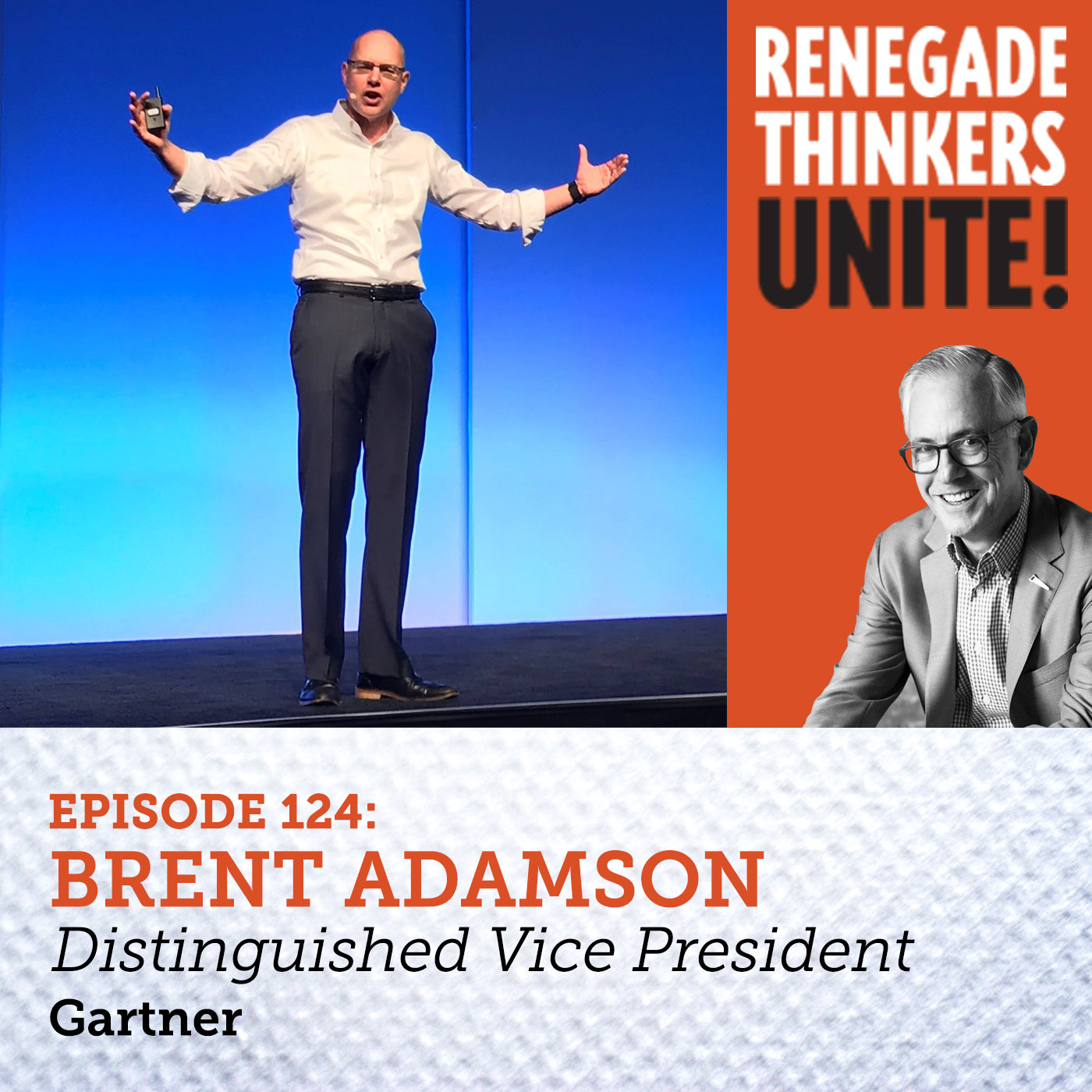
Ep 124124: Gartner's Expert on Making B2B Buying Easier
Nothing like a live audience to keep you on your toes! Third-time guest Brent Adamson, Distinguished Vice President, Gartner, joins Drew for a live conversation in front of an elite collection of B2B CMOs to chat about smarketing—and no, that's not a typo. Brent dives into why sales and marketing—"smarketing"— must work together and fully align to connect with customers. Beyond that, Brent explains why buying is broken, the pitfalls of working with a large buyer committee, and why companies need to make customers reevaluate themselves rather than products. Don't miss that and more on this week's Renegade Thinkers Unite.
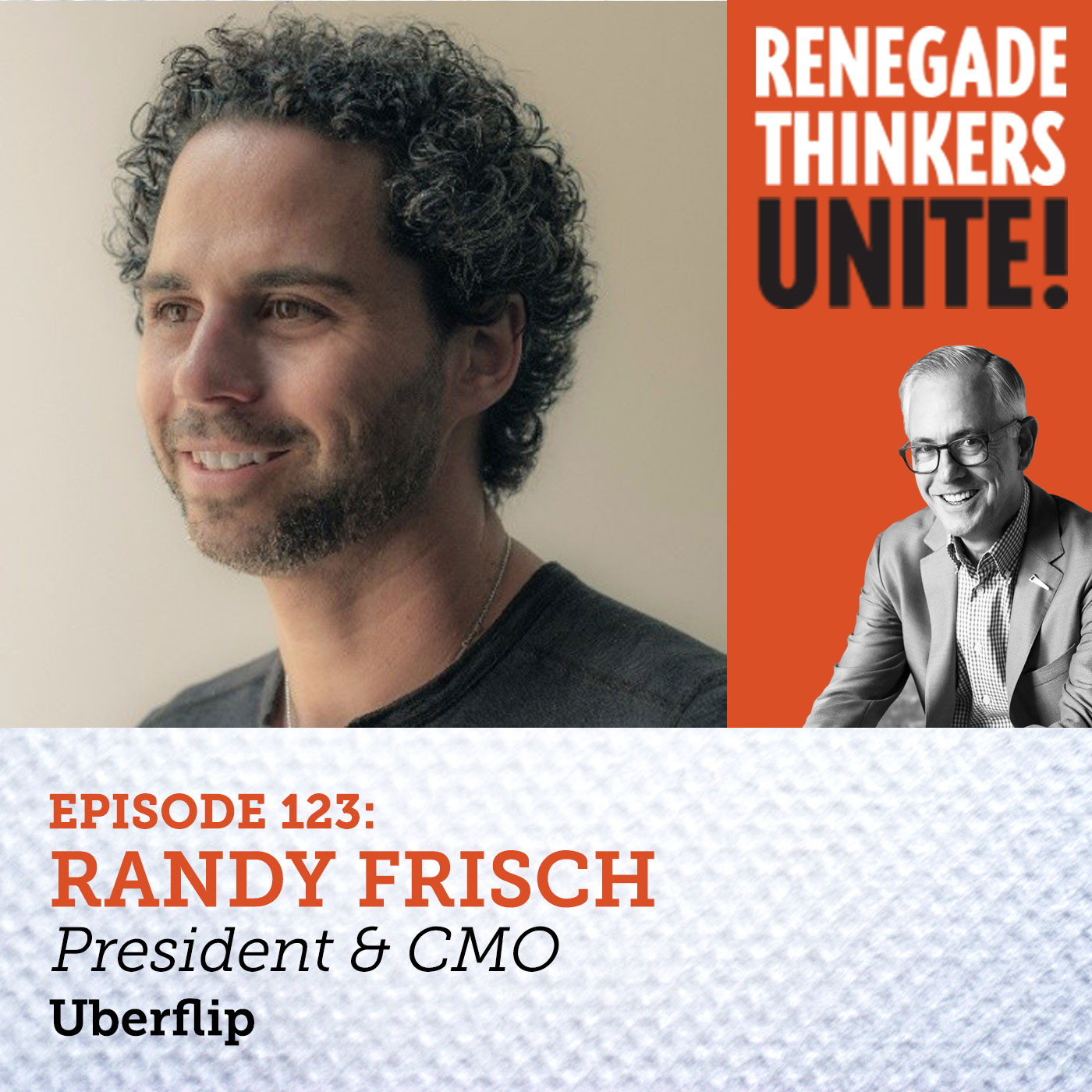
Ep 123123: Why Uberflip Says "F*** Content Marketing"
EIf a tree falls in the forest... You know the rest. But, if Randy Frisch doesn't attend a conference, did people there still talk about content marketing? It's quite possible—but perhaps not with the same enthusiasm, and likely not from the same angle. On this episode, Randy Frisch, the CMO & President of Uberflip, a content experience platform for marketers, talks about cutting through. Randy explains that you have to "Trojan Horse" your sales message inside a broader, topic of interest. The opportunity here is to create content that your target actually wants to consume, and then using that content as a path to your offering. Content marketing has to cut through and get attention. If not, in the words of Randy himself: F#ck content marketing. To learn more about properly leveraging marketing materials, creating provocative content, scaling personalization, and more, listen to today's episode. This episode is especially relevant for today's marketers. Listen in! Subscribe on Apple Podcasts - Stitcher - or Podsearch What You'll Learn Why Uberflip's marketing isn't all about Uberflip Randy shares that when he is booked to talk, no one wants him to talk about Uberflip's technology. Instead, he needs information and a story to drive people to his product. He tells people about the best framework for content creation and does not push his product. Instead, he shares the things that businesses must do to do content creation well such as centralizing and organizing all content so it can be leveraged. Be sure to listen in to hear more on what Randy says! Common mistakes content marketers are making Marketers are falling for the trap of not wanting to overwhelm consumers with information. They are following the "send 7-9 emails over the course of a few weeks ideology," but by doing this, they are creating dead ends for consumers who would like to know more. Randy says don't wait for the next email to share more information and most certainly do not create a dead end on information. Send people pieces of content and make sure there are several interesting paths forward from this content. Similar to Netflix series, consumers often want to binge information, and marketers are doing themselves a disservice by not providing a path for them to do so. Randy also notes that content marketing needs to be personalized. He says that Spotify does an excellent job of curating music to individuals' tastes. In the same way, content marketers must also create an experience for different individuals' tastes. By delivering more custom content via email or a website, marketers will be able to connect better with people! Five takeaways from Randy Frisch on content creation Have a strong point of view! Be the CMO that leads the way, disrupts the market, and evangelizes for his product. Make sure your content is personalized! Create content that the consumer can binge. Allow the consumer to choose his own adventure and follow a path of content as far as he would like. Keep everything focused on your brand! Focus on technology last, not first. Make sure you have your team and process in place before you implement technology. Timeline [2:40] Who is Randy Frisch [7:36] Top priorities as a CMO [18:01] President and CMO: how this affects marketing [25:37] More on Uberflip's marketing [29:32] Most common mistakes content marketers are making (and solutions!) [43:05] What happens when you scale [48:04] Episode overview Connect With Guest: Connect with Randy Frisch on LinkedIn Follow Randy Frisch on Twitter Resources & People Mentioned Randy Frisch's Book: F#ck Content Marketing Randy Frisch's Podcast: Conex Renegade Thinkers Unite Podcast: Docusign Episode Uberflip's 5 Steps to Build Content Experiences Connect with Drew http://renegade.com/ On LinkedIn On Twitter On Facebook On Instagram
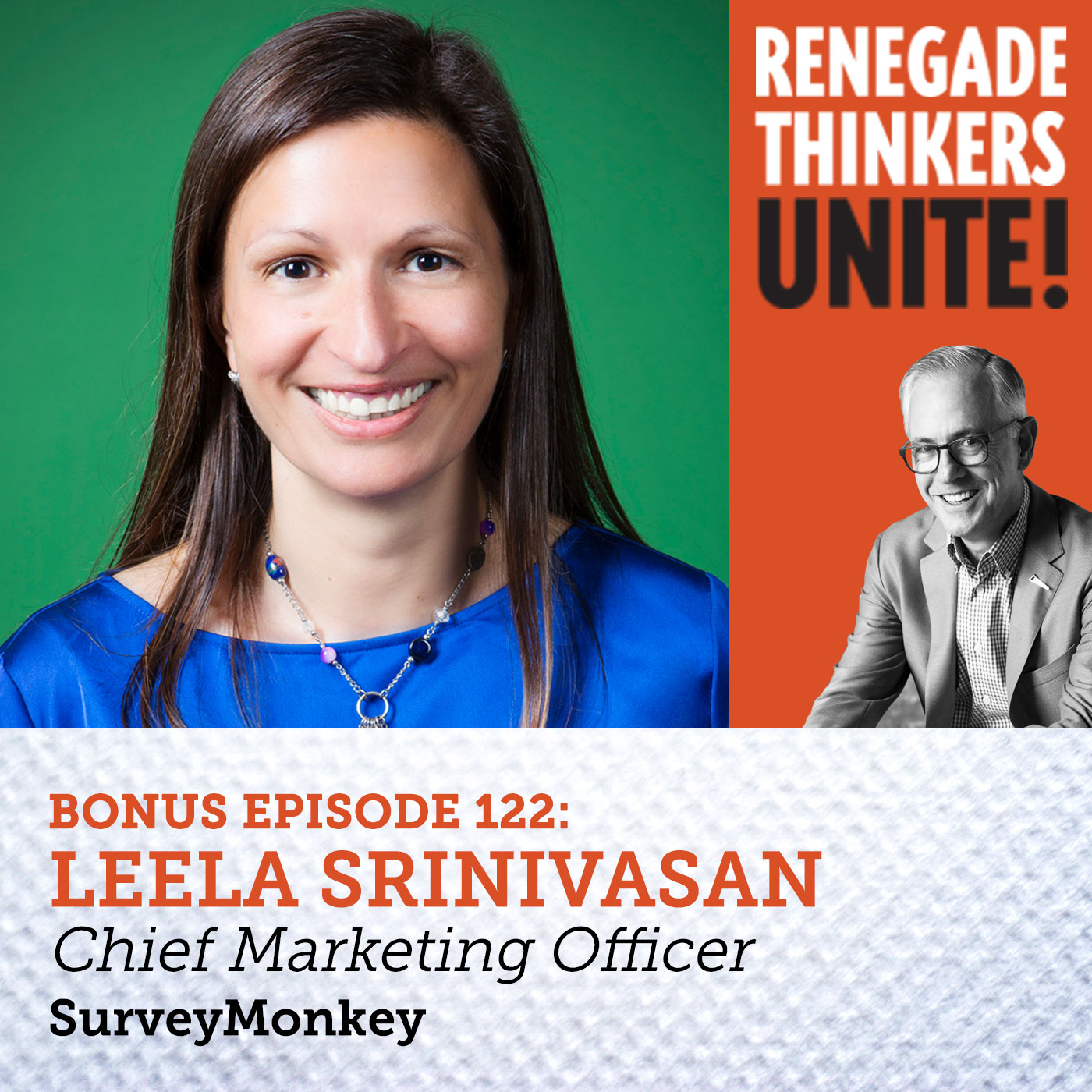
Ep 122122: The Art of the Survey (Special Episode)
bonusSurveys can provide a wealth of data on any sort of topic. But there is an art to crafting the perfect survey, one that invites honest and valuable feedback without steering the respondents, and doesn't damage the responses by overwhelming the survey takers. Leela Srinivasan, CMO of SurveyMonkey, took some time after recording her recent RTU episode to discuss survey creation with Drew. Well-constructed surveys are crucial for informing creative, effective marketing efforts. To learn more about artfully crafting questions, audience selection, getting people to take your survey, making sense of the information, and more, check out this brief, bonus episode!
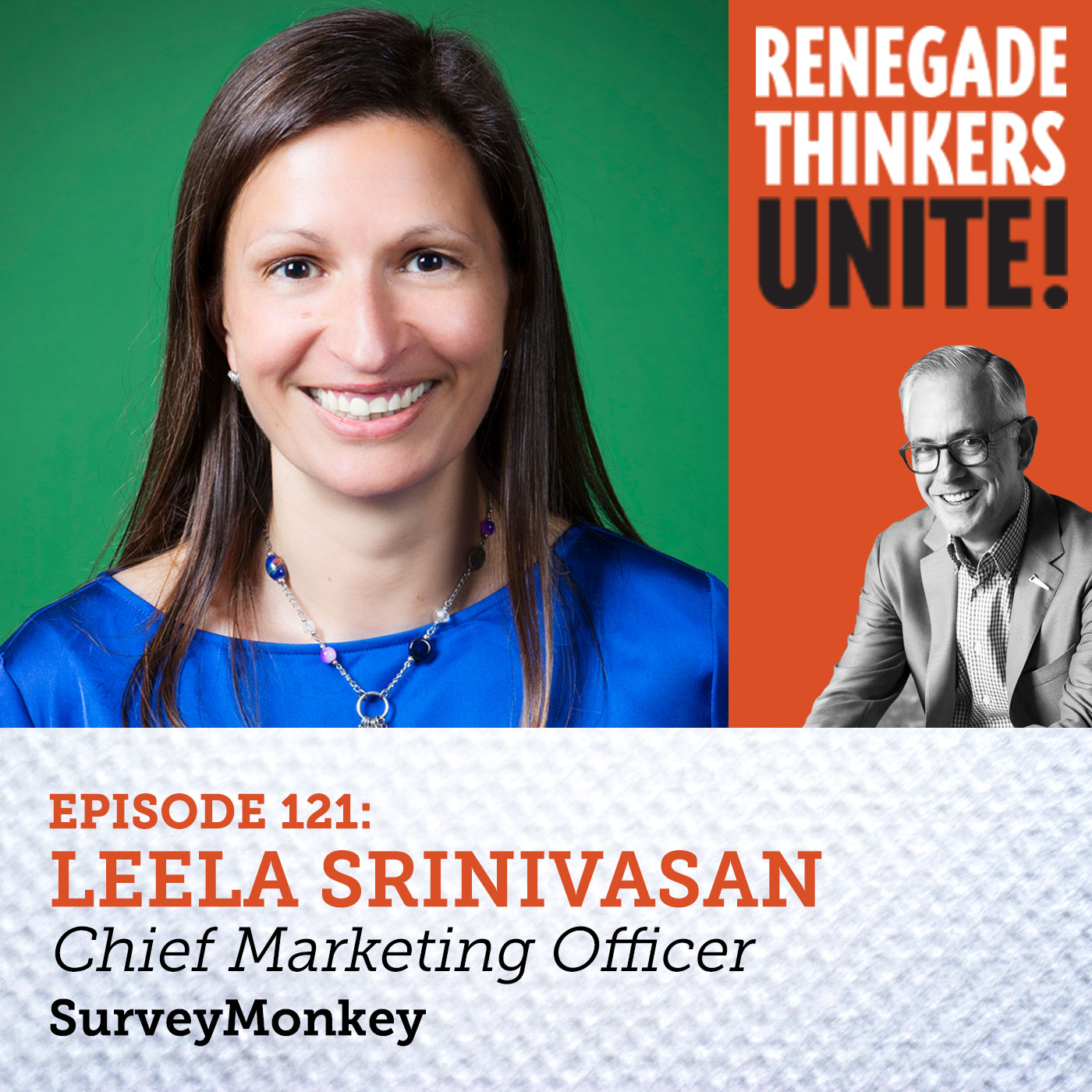
Ep 121121: How SurveyMonkey Powers The Curious Internally and Externally
"Eating your own dog food" didn't sound so appetizing, so folks started "drinking their own champagne." SurveyMonkey didn't want people thinking they were sipping too much bubbly on the job, so now they "eat at their own restaurant." Put simply, they lean heavily on their own offering to strengthen their marketing, grow their company and—as they like to say—power the curious! From finding out how much a person uses technology, to determining how a company's culture is developing, the options are endless on what info you can gather with SurveyMonkey, and the company's marketing efforts put that to test. Leela Srinivasan, SurveyMonkey's CMO, chats with Drew on how everything at SurveyMonkey—from campaign development to internal culture—is about creating and supporting a world of curious people. Don't miss what Leela has to share! Subscribe on Apple Podcasts - Stitcher - or Podsearch What You'll Learn Power the Curious campaign Prior to going public, SurveyMonkey did a brand refresh with its Power the Curious campaign in 2017. The company defined its mission as Powering the Curious. SurveyMonkey's products and solutions enable organizations everywhere to measure, benchmark, and act on feedback. If these organizations can listen to this feedback and have a curious attitude towards it, then the feedback can drive growth and innovation. Leela shares that she loves the notion of curiosity for two reasons. One, the notion of curiosity was one that their audience was leaning into. The smartest people display curiosity. Secondly, if you think about the idea more broadly, the value proposition for employees is massive. This campaign not only set SurveyMonkey up to market to the business realm but to employees and potential employees. SurveyMonkey could be the place where the curious come to grow, which is exactly what bright minds are looking for in a workplace. How to build a culture of curiosity internally SurveyMonkey uses its own tools to build a culture of curiosity. Leela shares that SurveyMonkey leverages its own platform to obtain living feedback from its employees. These surveys measure employee engagement and to find places that can be improved to make a company with more inclusion and belonging. All leaders in the company are given scores for their departments, and they are shown how their scores stack up against other departments in the company. All of this information pushes SurveyMonkey to be curious internally. They are given results and scorings that can drive its leaders to be curious and search for solutions on how to how a healthy organization. Big drivers to marketing SurveyMonkey SurveyMonkey partnered with 4 influencers to show that curiosity is self-defined. Serena Williams, Arianna Huffington, Draymond Green, and Jeff Weiner each created concise surveys to engage different audiences. These surveys were advertised on social media, billboards, and more to let the world engage with these influences. Curiosity was at the top of the whole thing. Success was measured by the volume of responses, and there was a lot of engagement. Throughout this campaign with these four influencers, a conversation was generated that said, "you can do this every day of the week by using SurveyMonkey. Find an idea you want to tap into. Bring these ideas to market and explore the things where you are involved in the world." Be sure to look below in the resources mentioned for the findings from the influencers surveys. Timeline [3:07] Who is Leela Srinivasan [9:07]] Launching the Power the Curious campaign prior to going public [15:42] How to build a culture of curiosity internally [21:00] How to teach curiosity [26:05] Big drivers for marketing at SurveyMonkey [29:50] The Curiosity Conference [32:35] Lessons learned from rolling this campaign out Connect With Leela Srinivasan: Leela's Bio on SurveyMonkey's Website Connect with Leela on LinkedIn Follow Leela on Twitter Resources & People Mentioned Tool: SurveyMonkey Audience Tool: SurveyMonkey Genius Tool: Inclusion and Belonging Survey Template SurveyMonkey's Curiosity Conference Partnership: Serena Williams' SurveyMonkey Results Partnership: Arianna Huffington's SurveyMonkey Results Partnership: Draymond Green's SurveyMonkey Results Partnership: Jeff Weiner's SurveyMonkey Results Connect with Drew http://renegade.com/ On LinkedIn On Twitter On Facebook On Instagram
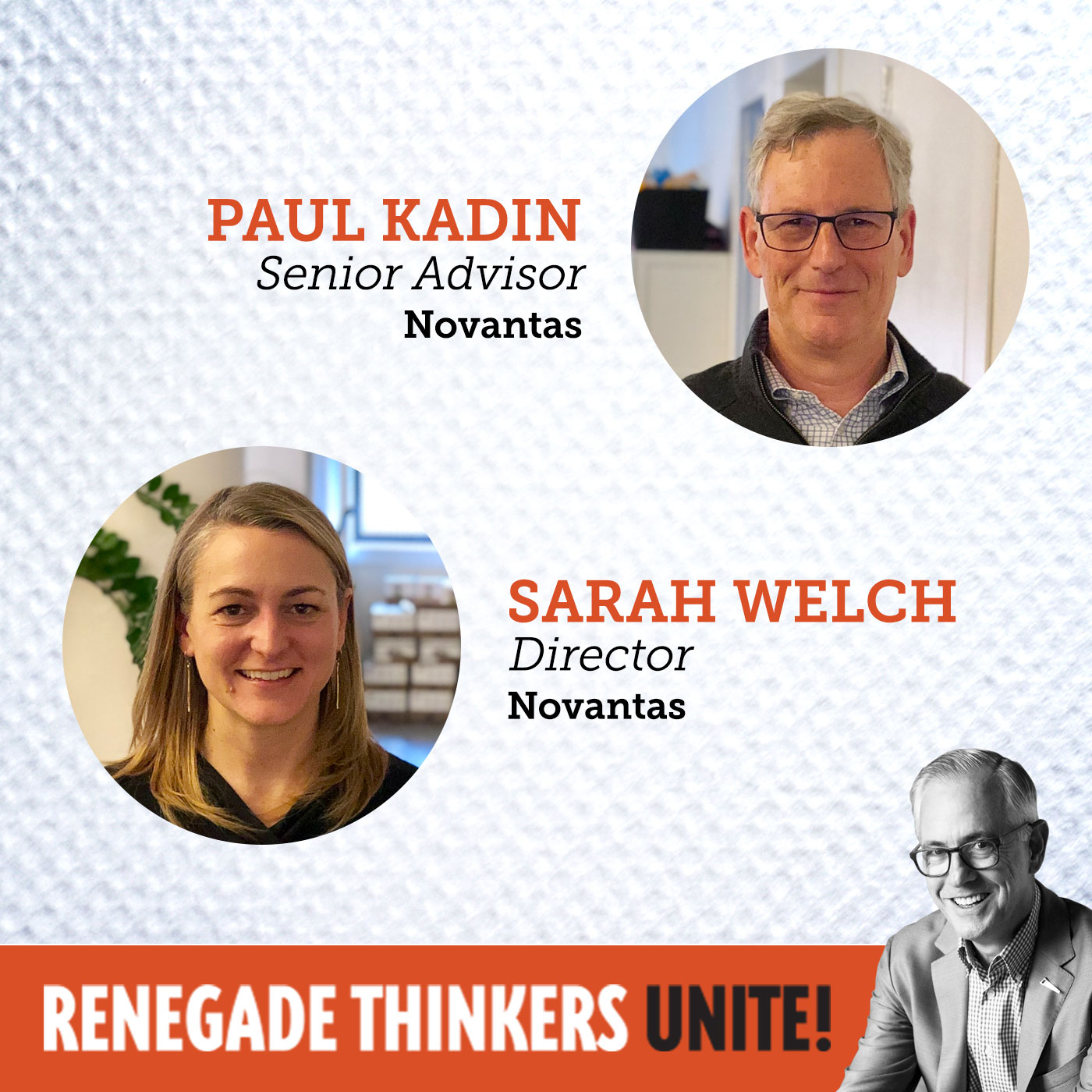
Ep 120120: What Modern Banking Can Teach Us About Marketing
Whether you're a small business catering to a consumer, or an enterprise tech company targeting fortune 500 giants—the changes in how banks are approaching branding and marketing can provide a great template for successful marketing in the modern era. When most people have a banking issue to resolve, they usually open up their mobile app, or visit a website—in-person banking is starting to take a back seat to digital mediums. That's the shift Paul Kadin and Sarah Welch, of analytics and advisory firm Novantas, are wrangling. In this episode, they discuss how banks are evolving, and how those banks are championing new, universal principles of successful B2B and B2C marketing. Listen in! You won't want to miss this episode. Subscribe on Apple Podcasts- Stitcher - or Podsearch What You'll Learn What banks need to do to succeed? Paul and Sarah share that successful banks have three things in common. They satisfy what people expect from them. A bank will not succeed if it does not offer basic customer service or features. Secondly, successful banks are distinct. They answer the question, "Why should I choose this bank over another bank?" Their products and service must set them apart. Lastly, successful banks make their voice heard in the marketplace. Banks can have all the right feature but must spend sufficiently enough to raise their voice enough to be heard. Banks that are distinctive and why Paul, Sarah, and Drew discuss multiple banks that are killing it on being distinctive. Huntington Bank markets itself as being on the side of the customer. They are living and breathing their value proposition on products, pricing, marketing messages, and customer experience. Banks are known for nickel and diming customers, but Huntington extends a 24-hour grace window, allowing customers 24 hours to write a check to cover an overdraft, before incurring a fee. First Republic is a bank that goes above and beyond, helping customers. This bank is very specific on what companies and individuals it takes on as customers, and focuses on the more affluent. Because it has a more niche customer base, First Republic is able to serve its customers how they would like to be served. USAA is a bank with extreme intimacy around one focus group - those who have served in the military and their families. If you are in this target group, their service is unbeatable. They also hire retired service people, so they hire from the target demographic they serve. TD Bank has branded itself as America's most convenient bank. Everything they had decided is based on convenience. For example, they are open on Saturdays and Sundays. Marketing banks: finding an emotional pitch andmaking it real Marketing banks is hard. Banks have thought about things in terms of creating new features and improving functionality, but there is a whole other dimension: emotion. Money creates emotion: anxiety or satisfaction. Banks have to appeal to the emotional side of the customer, but this must also be lived out in experience. As banking moves away from person to person and towards digital, banks must figure out how to be emotionally connected through a digital relationship. To make this happen, Sarah and Paul share that banks must have a clearly designed core target, and then drive experience around it. All experiences, whether in person or digital, need to be serving the bank's brand. Timeline [1:55] Introduction to Paul and Sarah [8:50] Bank branches are decreasing, but brand, marketing and digital are increasing [10:24] What banks need to do to succeed [14:19] Which banks are distinctive in today's market? [17:43] How focussing on a designed target can help banks [21:33] How banks (and other businesses) can distinguish themselves [24:30] The need to find an emotional pitch and make it real [31:07} How to make media spending cut through the noise [35:51] B2B vs. B2C marketing for banks [40:54] What is state of the art in attribution modeling Connect With Paul Kadin and Sarah Welch: Connect with Paul Kadin on LinkedIn Connect with Sarah Welch on LinkedIn Follow Paul Kadin on Twitter Resources & People Mentioned Book: 21 Lessons for the 21st Century Huntington Bank's "People Over Everything" Leader in Attribution Modeling: Visual IQ Leader in Attribution Modeling: Marketing Revolution Connect with Drew http://renegade.com/ On LinkedIn On Twitter On Facebook On Instagram
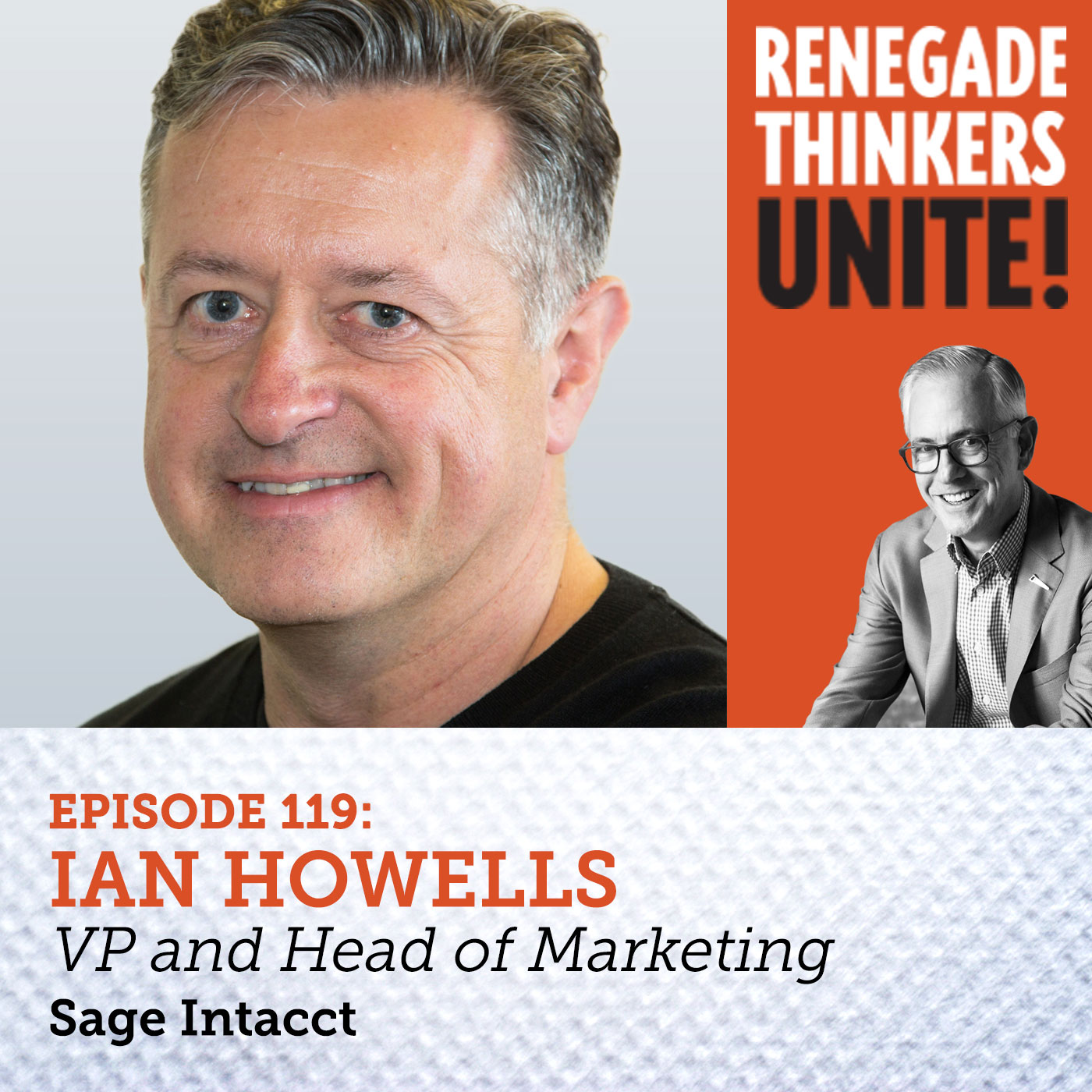
Ep 119119: Be the Big Fish in Many Small Ponds
You've heard it said, "be the big fish in a small pond." But have you ever considered being the big fish in many small ponds? Sage Intacct, a provider of cloud financial management, is doing just that. To pull this off, Sage Intacct first defines different "micro-verticals" by breaking down larger marketplaces, like manufacturing, into more granular categories, like toys, planes, and cars. Following that, they become experts in the field, and begin producing valuable, category-specific sales materials and insights. Vice President and Head of Marketing, Ian Howells, chats with Drew on this episode about how his employees get to know these different markets—or ponds if you will—and the rigorous process of becoming the biggest fish in each. Be sure to join in! Subscribe on Apple Podcasts- Stitcher - or Podsearch What You'll Learn 1% penetration to a desired goal - how to get started in micro-targeting Ian shares the process of penetrating a new market. Sage Intacct works hard to reach out to multiple companies to conduct interviews and research. It is Sage's job to understand this customer and understand what is going on. What are the pains of the customer? Are there similarities between this company and others Sage Intacct work with? Ian's interviewers must gain understanding and draw correlations between companies in the same micro-target. This interview process gives understanding into a micro-vertical. The more companies you interview, the more you know about this subset of the market: associations, key influences, key applications... All of this information affects positioning and messaging for that micro-vertical. How to know you have achieved success in a micro-vertical Oftentimes, companies believe they have achieved success in a micro-vertical too soon. Ian explains that you have achieved success in a current micro-vertical, and should approach another, when you have at least 20 clients with the same patterns and pains, and you can predict what the client will say. This shows you understand the current micro-vertical, and you are in a position to begin learning about a new one. The importance of website content and collecting data Sage Intacct's website overtly lists its competition. It compares what it offers to various companies. Ian explains that you must over communicate what your company does and why it is the best. By comparing Sage Intacct's products to others, clients can quickly see why Sage is different and the best for them. On several demo videos, Sage Intacct stops the video to collect viewer information. This is important for several different reasons. Collecting information allows Sage to know what industry this person is from. When the video resumes, the viewer gets personalized content. If you're from a nonprofit, you get specific messaging. By pausing the demo, Sage is also able to collect data from potential clients and know how interested the viewer really is. Timeline [2:04] What Sage Intacct does [4:30] Ian's Renegade Rapid Fire segment [13:16] How Ian got started in microtargeting [16:40] The process from 1% market penetration to your goal [19:45] How to get interviews, who conducts them, and where they're shared [25:49] When to add another micro-vertical [29:00] Telling customers stories [30:17] Over communication on website content [34:51] When to move on from a micro-target Connect With Ian Howells: Ian's Bio on Sage Intacct's Website Connect with Ian on LinkedIn Follow Ian on Twitter Resources & People Mentioned Sage Intacct's Website: Comparison to Competition Book: Geoffrey Moore's Crossing the Chasm Connect with Drew http://renegade.com/ On LinkedIn On Twitter On Facebook On Instagram

Ep 118118: Spotting Terrorist Plots and Rental Car Scratches - How This Startup Stays Flexible
UVeye is putting together technology that has an immense range of uses, is wildly innovative, and is—putting it plain and simple—cool! The company produces under vehicle inspection systems, that use deep learning—a sort of AI-derived machine intuition—to say "hey, something about this car doesn't seem right" and flag it for inspection. This can help stop dangerous contraband or weapons from being smuggled into secure areas, but the use cases don't stop there. Though in an ideal world these scanners wouldn't be needed, Ohad Hever and David Oren understand the importance of having this sort of capability. As COO and CSO, they've had to figure out how to market this product in a fairly private industry, while leveraging a bunch of partners, and all on a meager budget. Learn how they do it on this episode of RTU. Don't miss out on Ohad and David's experience. Tune in! Subscribe on Apple Podcasts- Stitcher - or Podsearch What You'll Learn Raising awareness of a challenge your company can solve Imagine this: it is 2019. Acts of terrorism are on the rise worldwide. Protection is a need, but how? Drew reminds everyone of the B2B marketing technique called the "FUD factor." Creating fear, uncertainty, and doubt is a way to raise awareness of a challenge your company can solve. UVeye does just that by reminding its audiences of this issue of safety. UVeye also positions itself as the company to solve this problem. Through demonstrations and videos, UVeye shares how it can detect abnormalities under cars, such as a car bomb or even an oil leak. This technology can be sold to government agencies or individuals. No longer do you need to rely on a security guard crawling beneath a car to see if it is safe to drive, this surveillance of a car's undercarriage is efficient and able to detect abnormalities as small as a USB. It can also protect the average person by detecting when car maintenance is needed. How to foster brand engagement As a brand, UVeye has several audiences. They must foster brand engagement with each. For governments, UVeye provides security. When approaching governments with its product, UVeye looks for a local partner. These partners are already in communication with government and are known companies in distribution or sales. Currently, UVeye is focussed on breaking into the market of car manufacturers. Its technology can help provide data and preventative maintenance on cars. To create brand engagement, the company is focused on implementing a brand that provides a competitive advantage. What can UVeye offer to the manufacturers to make their lives easier? David and Ohad explain that their goal is creating a brand around "certified by UVeye." Meaning "certified by UVeye" provides protection of having a vehicle inspected completely from the inside out. They want this term to be a stamp of approval, known by the average Joe. Marketing on a limited budget David and Ohad explain that as a startup technology company, the majority of their funding went to creating the product. 14 million was spent on developing the inspection system and distributing it to other countries. There was little money left for marketing. However, UVeye has found that its team can attend conferences even without having an exhibit. These conferences have been a lower budget marketing tool that can create lead generations and partnerships. UVeye has been a part of large security conferences, which are very niche and cost-effective. UVeye has also attended CES. CES has been so effective in the past - even with a tiny display - that David and Ohad used their small marketing budget to have a larger exhibit and demonstration. Prior to the conference, they generated a lot of buzz around the fact that UVeye would be at CES and what they would be sharing. This created engagement prior to the event. Timeline [2:03] UVeye's beginnings and how the product works [5:22] The process of development and going to market [7:52] Brand engagement: targeting governments [10:22] Running a successful pilot [14:55] Where UVeye chose to spend its money as a new company [20:47] Target audiences: who will buy the technology first? [24:45] Lessons for those wishing to start or run a company Connect With Ohad Hever and David Oren: Connect with Ohad on LinkedIn Connect with David on LinkedIn Follow Ohad on Facebook Resources & People Mentioned Video: Under Vehicle Inspection System UVeye Video: UVeye AI-based Automotive Technology CES Conference Connect with Drew http://renegade.com/ On LinkedIn On Twitter On Facebook On Instagram
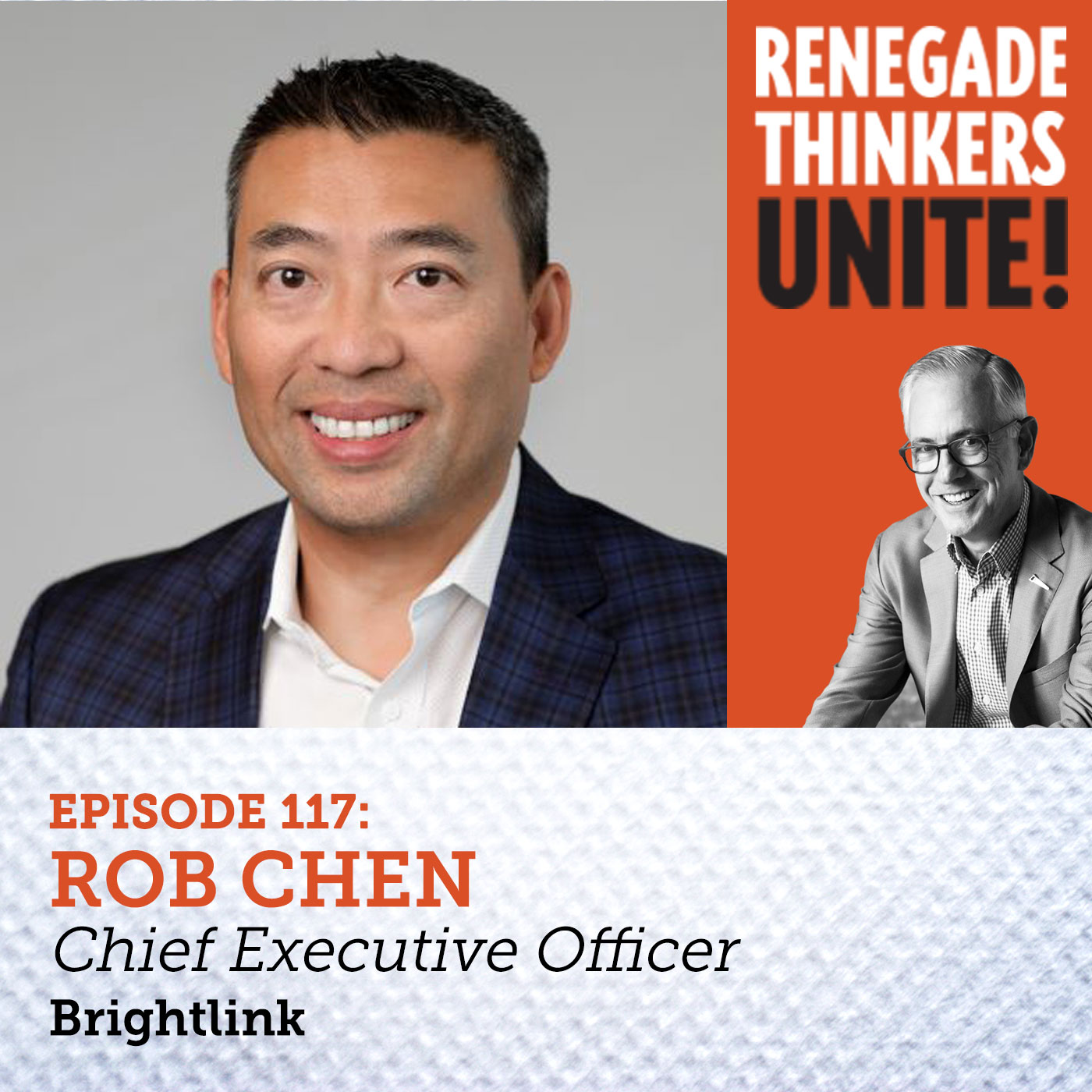
Ep 117117: A Former CMO, Turned CEO's Approach to Strategic Marketing
When you have to reach out to someone quickly, what do you usually do? Exactly! Send a text. So why aren't more businesses text-enabling their phone lines? That question is at the center of Brightlink's text-enabling solution, designed so that company phone lines—usually reserved for saying 'no' to pesky cold calls— can handle informative text conversations with prospective clients. Given the nature of their product, Brightlink has also been able to utilize it as their own marketing tool, a simultaneous demonstration and use case—a real situation of killing two birds with one phone! On this episode of RTU, Drew chats with Rob Chen, Brightlink's CEO, and a former CMO. They chat about how Rob's marketing background informs his current role, how to put their technology front-and-center in their marketing, and why a clear company culture is king. Be sure to listen in - this is a valuable conversation! Subscribe on Apple Podcasts- Stitcher - or Podsearch What You'll Learn Using your own technology as a marketing vehicle Rob is a believer in drinking your own champagne. To that end, Brightlink currently uses its own technology of text enabling any phone number as a marketing vehicle. The company is able to override and enable any phone number to receive text messages, which is an extremely beneficial feature for the millennial generation. Brightlink is currently taking a traditional email campaign and offering the customer the ability to respond back by phone, by email, or by text. Through its own technology, Brightlink text enables sales and corporate phone numbers. Using key-word prompts, the sales team at Brightlink is able to respond via text to answer questions, provide solutions, and much more. Not only does this connect the Brightlink team with customers, but it also highlights the technology they can provide. Listen in to hear more on how Brightlink uses its own product as a marketing vehicle! Your target audience affects your marketing Rob shares that Brightlink utilizes different strategies depending on whether the primary target is a small business or large enterprise. For a small businesses, Brightlink focuses on co-branding and a partner with the ability to add value. They rely on a partner who knows the needs of each small business because use cases tend to be more specific. This allows Brightlink to market to and speak to the individual needs of small business. For large enterprises, Brightlink takes their product directly to the company because their needs are broader and many times the entire product is used. 3 key lessons for CMOs Guest Rob Chen and host Drew elaborate on 3 important lessons for other CMOs. Have one key, very focussed story. Know what your company is about, and be able to say that succinctly. You have three target audiences: employees, customers, and prospects. Make sure to have your employees on board with core values and your product. They will be advocates for your brand and remain loyal. Create content that is valuable to your customers, and it will also be intriguing to prospects. Simplify your plan. It is hard to do everything. Brightlink's plan is integrated around its own product. It is a demonstration and a use case at the same time! Timeline [1:55] Rob Chen: Bridging the gap from CMO to CEO [5:40] What Brightlink is and does [10:47] How to use technology as a marketing demonstration [18:36] Who Brightlink targets in its marketing [22:55] Successful marketing examples [26:33] Key lessons from a CMO turned CEO Connect With Rob Chen: Rob's Bio on Brightlink's Website Connect with Rob on LinkedIn Resources & People Mentioned CES Conference Connect with Drew http://renegade.com/ On LinkedIn On Twitter On Facebook On Instagram
Ep 116116: The Need to Fail, Cars That See, and Defining Market Needs
CES never fails to be a revelatory experience, but this year marked a significant step closer to one of humanity's longest-held dreams (or at least, one of Drew's longest-held dreams): A Jetsons-style flying car! A key component of this tech-driven marvel is an astoundingly impressive "LiDAR" system—think radar detection, done with laser technology. In simpler terms, a new way for machines to see things. Granted, the implications are much broader than a flying car, but it provides an interesting way to demo this new system. On this episode of RTU, Drew speaks with Louay Eldada, CEO and co-founder of Quanergy, the company helping cars "see". They chat about the range of potential uses for such powerful tech, and the why to market it, they had to first understand the problems that people need solved. Don't miss this tech-heavy episode of Renegade Thinkers Unite, recorded at CES 2019. Louay shares various ways Quanergy can creatively solve problems! You won't want to miss this episode! Subscribe on Apple Podcasts- Stitcher - or Podsearch What You'll Learn A virtual wall - an effective way of protecting the border Quanergy is proposing the creation of a virtual wall on the border of the United States and Mexico. Currently, a physical wall is being proposed to the country. Louay points out that this kind of barrier could disturb the environment. Quanergy has targeted the United States government as its audience to market their technology to, speaking with politicians on both sides of the border protection debate. Using LiDAR, Quanergy creates a dome of protection by setting its giving computers eyes to monitor the border area. LiDAR uses its "eyes" to see anything coming to the border and can allow authorities to be dispatched to the area. A virtual wall addresses the issue of protecting the border but does not create more problems as a physical wall could. Quanergy is a leader in effective technology marketing Quanergy tells and shows customers what they need. They allow customers to observe the product, so they know they want it. Quanergy provides a vision of what customers can do, and how they can solve problems. This creates new markets for its technology. Quanergy's technology, LiDAR, is marketed to many different industries. Each market has its own experts, so Quanergy uses partners to improve solutions. For example, Quanergy partnered with 6-Watch to help create a virtual surveillance partner for Boston's police vehicles. 6-Watch was an effective partner because the company is well connected in the law enforcement space, helping Quanergy break into that market with its technology. Creating a culture where it is ok to fail Louay says if your company doesn't run into things that don't work, then you are not trying hard enough. Everything is not feasible until someone does it. If a problem is worth addressing, try until you find a solution. Louay creates a company culture where failure and bad news are okay. This gives his employees the ability to take risks and be creative. In order to lead a company where there is the courage to take risks, Louay says he must have an open door policy to hear about issues and ask what can be done solve problems, what have the employees learned and what can be changed. This culture of risk being okay has helped propel Quanergy to the frontline in LiDAR technology as well as marketing technology. Timeline [1:13] Louay's inspiration and Quanergy's technological core [2:23] Technology for a flying car [6:08] Reasons and opportunities for attending CES [8:08] A virtual wall - an effective way of protecting the border [11:30] A CEO's take on marketing [14:10] Quanergy's most effective marketing [17:58] The importance partnerships [19:24] Biggest lessons to share with other entrepreneurs [20:53] It is ok to fail! Connect With Louay Eldada: Louay's bioon Quanergy's website Connect with Louay on LinkedIn Follow Louay on Twitter Resources & People Mentioned Video: Virtual Wall Using LiDAR CES Conference Connect with Drew http://renegade.com/ On LinkedIn On Twitter On Facebook On Instagram
Ep 115115: How to Market and Succeed at Employee Communication
Have you ever read through healthcare plans in an effort to sign-up? They're generally pretty important, but given how jargonistic and dense they are, they can be a real snooze-fest. That's where Jellyvision comes in. This week's guest, Bob Armour, is CMO of a company that creates a software named Alex that helps people make sense of their healthcare benefits and select the best plan by communicating with them in plain english. The efficacy of Alex speaks to a few types of effective communication, but a big portion of it, ties to how Jellyvision helps companies communicate with their employees. Whether discussing a new campaign, product, or in this case, health benefits, effective internal communication is absolutely crucial. If done well—and in this episode, Bob shares some tips for success—employee communications can help make employees love their jobs, treat their customers well, and advocate for the company. Check out the full interview to learn more! This episode is extremely relevant in today's market. Be sure to listen in! Subscribe on Apple Podcasts- Stitcher - or Podsearch What You'll Learn What it takes to communicate effectively with employees Jellyvision's software, Alex, communicates with employees on healthcare. It talks to the users about demographics and needs. Alex creates the illusion that someone is truly listening behind the screen and reacting in human ways. In employee communication, you need to really listen and react in a human way - customized, with a personal response. Bob also says that to succeed in communicating with his customer's employees about benefits, his program must strip away the jargon associated with healthcare, insurance, and 401ks. Employees need to make the right decisions, but they have to understand what they are talking about to make a decision. By speaking in a simple way that employees can understand, they can make better informed decisions. Employee engagement: how to succeed and measure success Bob shares that Jellyvision helps its clients market Alex internally to their employees. Clients are provided with resources such as pre-written emails, collateral for signing up, and content to help them effectively communicate with employees. Jellyvision helps HR departments focus on what employees have to gain by using Alex, not just a message of "you should sign up for benefits." Jellyvision helps customers measure success with its software. It isn't important to Jellyvision to just sell Alex. They want to know how many of their customers' employees have been helped by the software. Bob encourages listeners to align their company's marketing efforts with the goals they are hoping to achieve. For example, Jellyvision chooses to measure how helpful they were as employees signed up for benefits. The Do's and Don'ts of employee communication Bob says to be straightforward and to use humor in employee communication. Put the details somewhere else where those who would like to read more can access them and dig in, but don't clutter the main message. Be helpful, and don't be boring or condescending. Avoid using jargon at all cost. Your own employees are also a meaningful tool in crafting a measure to communicate with others. They can offer feedback on whether wording is confusing or relatable. Timeline [2:19] All about Bob Armour [11:44] What it takes to communicate effectively with employees [17:14] How Jellyvision works with HR departments to make sure employees see Alex [26:38] How Bob advises customers to measure their employee engagement [31:07] Your own employees feedback in crafting your message is huge [34:36] What not to do when communicating with employees Connect With Guest: Bob's Bio on Jellyvision's Website Connect with Bob on LinkedIn Follow Bob on Twitter Resources & People Mentioned Alex Demo Video Connect with Drew http://renegade.com/ On LinkedIn On Twitter On Facebook On Instagram
Ep 114114: Copper, Blue + Pink: An Artful Name Change / Rebrand
If you took every tech company logo and stacked them by color, here's what you'd see: some red, some shades of black, grey, and white, some green. But all those stacks would be in the shadow of one color: blue. Samsung, Facebook, Lenovo, PayPal, hp, Dell—the list of blue logos goes on and on. So what did Morgan Norman, CMO of Copper (née ProsperWorks)? He went pink. With a dash of creative and a spritz of data analysis, Morgan went bold and rebranded in a major way. But—a rebrand isn't just a name and a color. The new mentality has to fill up every nook and cranny of the company, employees need to buy in, users need to be kept informed. On this episode of Renegade Thinkers Unite, Drew Neisser talks with Morgan Norman about the keys to a full rebrand, some common hurdles, and more about B2B marketing. Join in to hear lots of inspirational conversation and more on this company name change! Subscribe on Apple Podcasts- Stitcher - or Podsearch What You'll Learn Why a company name change? Before its company name change, Copper was a very successful business. It was not looking for a different name to boost sales or to pull itself out of a slump. However, there were still various reasons to change its name. ProsperWorks was a hard name for people to remember. It was even harder for people to say. Prior to its name change, it was in 110 countries, and the name ProsperWorks was hard to translate. Studies were also showing that customers were consistently misspelling its name. All of these reasons culminated in a desire to explore new company names. Just a coat of paint, or a complete overhaul? When ProsperWorks changed its company name to Copper, it did not just change its name - it changed its entire brand. Morgan explains that every bit of product was overhauled, from customer interactions and existing content, to its brand and the company's roadmap of where it wanted to go. He said that with the new name, the brand changed to revolve around relationships. How Copper used a relaunch to generate interest in its brand Copper used its relaunch to help generate interest in its brand in several different ways: They launched a new advertising campaign: CRM Minus the Bad Stuff. Their ads were enough to make the public curious enough to finish the story by finding out more information on the product. Copper utilized billboard ads. They ran 2 at a time in San Francisco near the airport. This captured the audience of people flying in. They also put a human face to CRM. They produced massive amounts of content about the company and its new name. The name change was surrounded by information on the company. Timeline [2:30] Who is Morgan Norman? [5:52] Why ProsperWorks changed its name to Copper [7:31] Which came first: the name change or the URL [12:24] Why the name Copper instead of Copper CRM [15:43] Why Copper chose pink in branding [17:46] A complete overhaul: from name to product [21:34] Internal involvement before a name change [27:25] The launch of Copper's new name [30:18] How to use a relaunch to generate interest in your brand [35:22] Top lessons from name changing [38:47] Key metrics that matter in marketing Connect With Guest: Morgan's Bio on Copper's Website Connect with Morgan on LinkedIn Follow Morgan on Twitter Resources & People Mentioned Book: Subscribed by Tien Tzuo Campaign: CRM, Minus the Bad Stuff Connect with Drew http://renegade.com/ On LinkedIn On Twitter On Facebook On Instagram
Ep 113113: Recession Proof Your B2B Marketing
Shakespeare once wrote, "To thine own self, be true." In that spirit, RTU host Drew Neisser did something a little out of the ordinary. Now, some people might consider talking to yourself for 30+ minutes to be a little crazy, but not Drew Neisser. In one of the most unusual Renegade Thinkers Unite episodes to date, Drew interviews none other than himself. On this episode, the dynamic duo of Drew and Drew continually push the conversation to exciting territories. The discussion touches on key insights Drew has learned over the course of his 300 CMO interviews, the challenges 2019 will bring for marketers, and more. Don't miss it! You don't want to miss all of Drew's insights on this idea! Subscribe on Apple Podcasts- Stitcher- or Podsearch What You'll Learn Employees are a key part of marketing You need to have dedicated employees on board with your brand and with your product. Employees purchasing what you're selling as a marketer is highly linked to the success of a product. If they are behind the product enough to purchase it, they are likely to understand and promote it. If the employees buy the brand story, they can be tremendous advocates. They can share their real experiences and use social proof to spread the word about your brand in a cost-effective way. Especially in a downturn, employees buying in with a brand and sharing content is key. It's free media, and you can't live without it. How to prepare your B2B marketing plan for the recession Drew shares that it is vital to prepare a B2B marketing plan for the recession. Great marketers will shine during the recession, but weaker marketers will not survive. A smart marketer will recognize a good strategy and will work on all communication channels, marketing to employees, customers, and prospects alike. Drew tells the audience to prepare for budget cuts in preparation for the recession. Figure out what part of the budget will drive demand generation, because those dollars spent will yield successful business results. These parts of the budget can be defended, but defending the portion of a budget focussed on building one's brand on will be at risk. Drew shares that a B2B organization needs to have a brand health tracking study in place beforea recession, so that if a budget cut arises, marketers can still know how their brand is performing." Why you should secure customers before the recession With a recession, all companies will likely experience budget cuts and potential losses. Drew explains that businesses should think about securing customers as the recession draws near. Focus should be put on keeping current customers happy. These current customers will also have problems linked to a recession, so Drew says to be prepared to answer how your specific product or service can help customers grow their business even in an economic downturn. Timeline [1:02] Renegade Rapidfire [12:19] Why talk about the recession now? [15:37] Why employees are vital in marketing [17:51] What smart marketers will prepare for with a recession in mind [24:28] What marketers can do in an economic downturn to make them different [28:42] Other CMO's opinions on what should be 2019's focus Resources & People Mentioned Book: Robert McKee's Storynomics Connect with Drew http://renegade.com/ On LinkedIn On Twitter On Facebook On Instagram
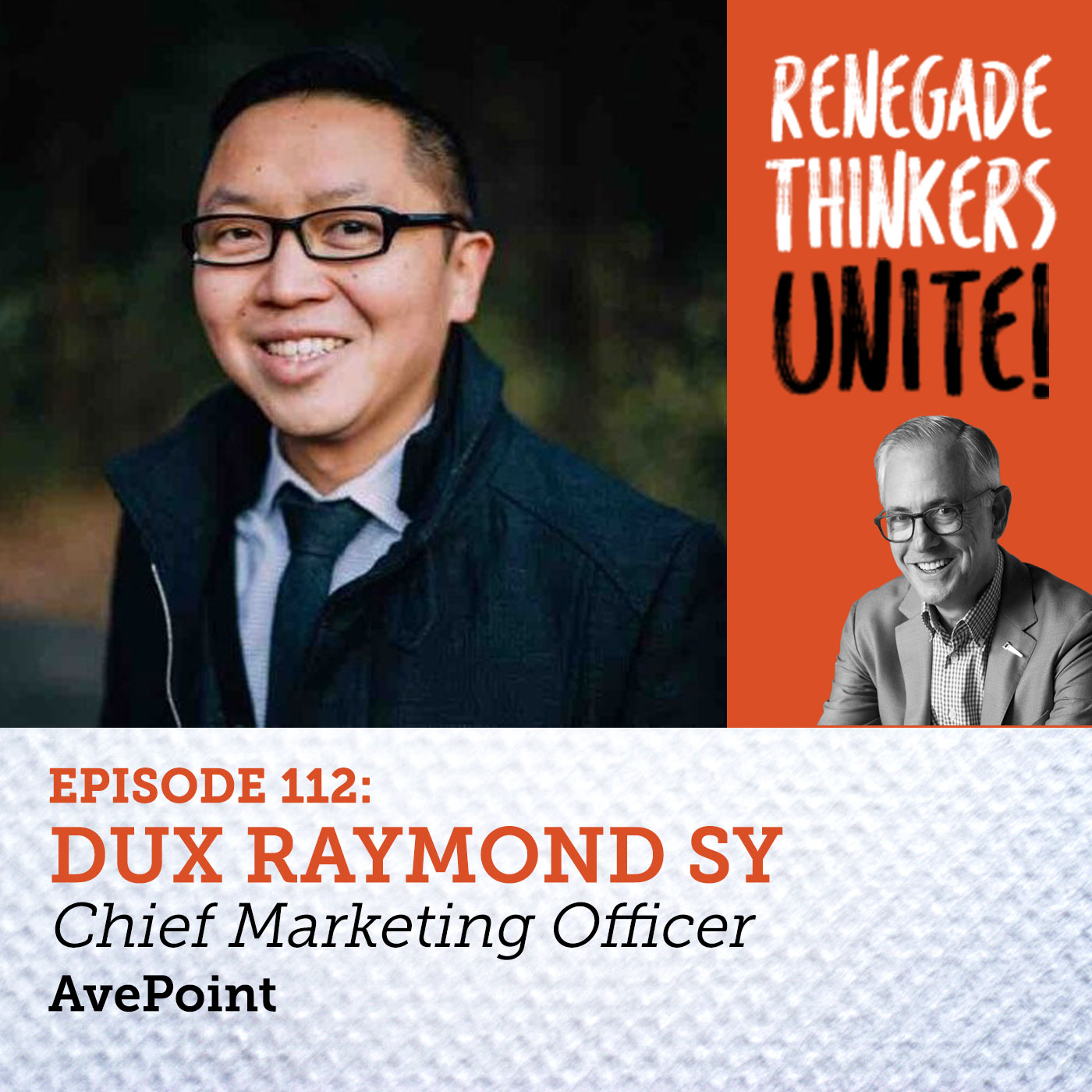
Ep 112112: Using Your Personal Brand to Help Build Your Company's Brand
What do we talk about when we talk about a CMO's to-do list? Usually, items are along the lines of "align sales and marketing" or "ensure proper metrics are being examined." And, yes, those are usually, in conjunction with other things, crucial to making your marketing machine fire on all cylinders. However, if you add tasks like "Dress as Korean mega star Psy and open for Bon Jovi" and "Set up online video series centered on food and marketing" to your list, it might start to look a little more like Dux Raymond Sy's. On this episode of Renegade Thinkers Unite, Drew talks with Dux, CMO of AvePoint, to better understand symbiosis between personal brands and company brands, how social selling and employee advocacy can be crucial, and much more. You won't want to miss this. Dux's information will keep you on the edge of your seat! Subscribe on Apple Podcasts- Stitcher- or Podsearch What You'll Learn Building complementary content helps AvePoint reach a broader market One thing AvePoint does to produce marketing leads is position their company as an industry advisor. As a company, AvePoint builds software based on Microsoft. To become an industry advisor and get leads, Dux shares that AvePoint produces content based around the Microsoft programs his company works with - they do not produce content that competes with Microsoft but instead complements it. All content produced is very use case driven and specific, and it helps AvePoint become a trusted advisor to the public. This also organically boosts SEO by putting content online tied to AvePoint, so AvePoint's content shows up when Googling "SharePoint" or "Office 365." Dux mentions that this content is also being published in every language his company services. They are not only reaching an American market but worldwide. How Dux's personal brand helps grow AvePoint's brand Dux has a great personal brand. He has opened for Bon Jovi, singing in Vegas at a Microsoft conference. He can also be found in many marketing videos online. Prior to working as the CMO, Dux was a Chief Technology Officer. He is not just a paid actor, but a real-life person who knows what he is talking about. He understands code and the technical side of the products. Dux currently is featured in multiple AvePoint video series that explain product features and uses. By appearing in these videos, he has humanized the content. However, he says that it must be substantial first, not just full of great video edits and snappy sound bites. Getting your employees on board with marketing Dux creates videos for AvePoint to explain products, offer tips, and much more. These videos are shared through social media and regular newsletters to clients. However, AvePoint also has an internal social selling program. It allows employees to join in and help build their own brand as professionals at AvePoint. Dux's company encourages employees to post AvePoint content on LinkedIn and awards employees whose Social Selling Index on LinkedIn score is the highest. AvePoint has seen that the conversions from employees' posts are much higher than that of paid ads, and employees do not mind posting these videos because they don't appear to just be selling a product. Timeline [4:24] Dux's Renegade Rapid Fire segment [9:53] The key indicator that shows Dux is on the right track [12:00] What to do to get marketing leads [15:33] How Dux got into marketing [18:54] Becoming a trusted industry advisor in a Microsoft ecosystem [22:18] Partnering with Microsoft [26:09] What helps AvePoint cut through the noise of the market [29:22] How Dux's personal brand helps grow AvePoint's brand [36:10] Two do's and one don't for new CMO's Connect With Dux Raymond Sy: Dux's Personal Website Connect with Dux on LinkedIn Follow Dux on Twitter Follow Dux on Facebook Resources & People Mentioned "reDux" series Another in the "reDux" series ChewNChat series Another in the ChewNChat series "Dux Quax" series Connect with Drew http://renegade.com/ On LinkedIn On Twitter On Facebook On Instagram
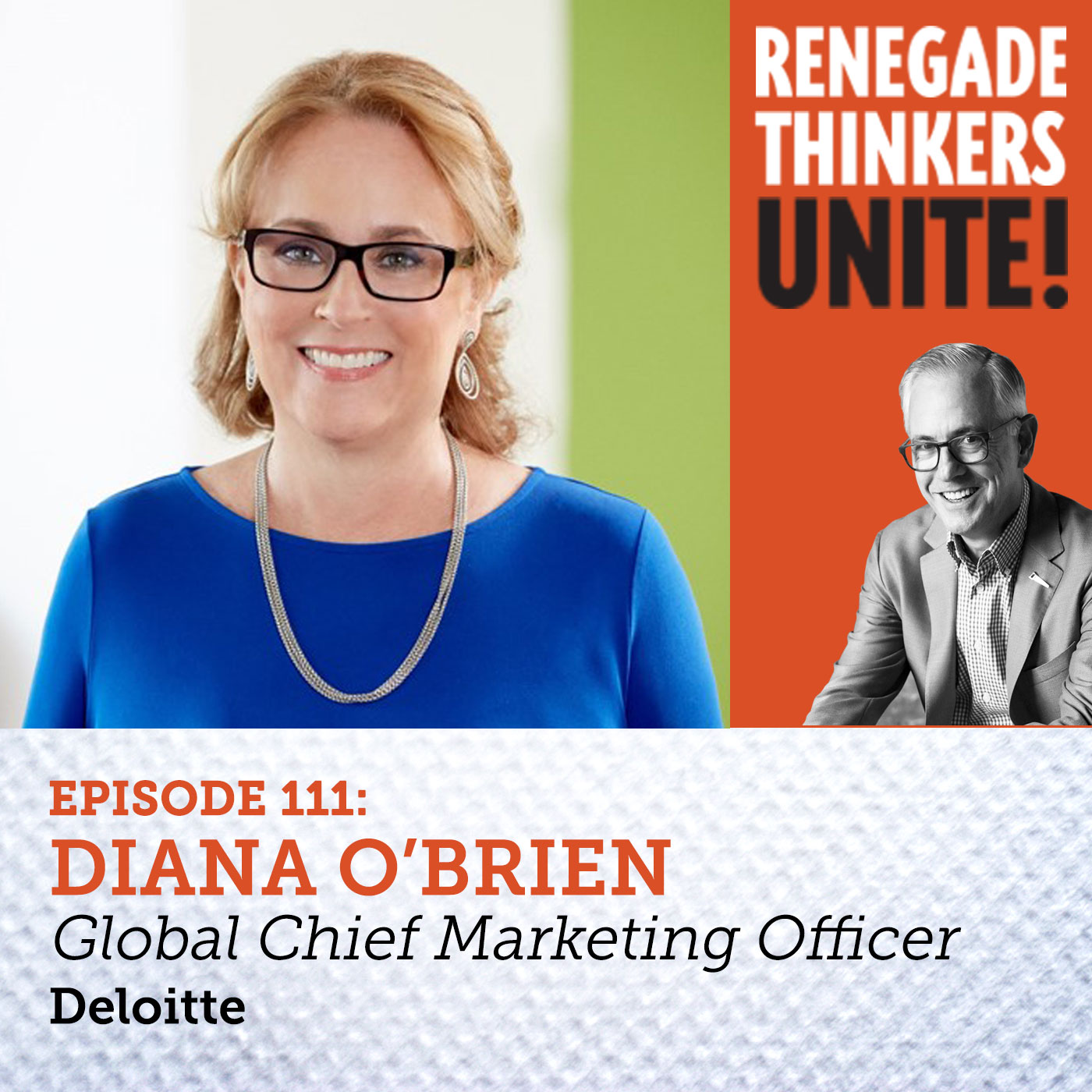
Ep 111111: Deloitte's Global CMO Shares Her 4 M's for B2B Marketers
Growing a community of leaders - an important goal for many companies, but not typically the designated task of a CMO. Diana O'Brien, CMO of Deloitte, however, is not your typical CMO. Diana spends 50% of her time prioritizing building workplace culture and, in turn, the firm's brand to provide better marketing services to clients. She spearheaded Deloitte University, which provides training to bring employees into the fold on brand alignment, culture, and continuing workplace education for every single Deloitte employee in the United States. Now, she is recognized as one of the World's Most Influential CMOs by Forbes and is one of Business Insider's Top 50 Most Innovative CMOs in the World. Diana has been on the cutting edge of marketing, working for Deloitte since the 1980s. From creating a place where leaders can grow and employees thrive, to being the first CMO at Deloitte, she has a lot to share. On this episode, she brings a wealth of knowledge on the importance of creating a workplace culture of leaders, how your business's brand and culture affects client relations, the necessity of being the voice of the customer at the leadership table, and so much more. Be sure to listen in - Diana has insights you don't want to miss! Subscribe on Apple Podcasts - Stitcher - or Podsearch What You'll Learn Key things Deloitte focuses on in developing workplace culture Diana shares that there are sequences followed at Deloitte University that are key to building employee culture. As a company, the art of empathy is massively important. This allows employees to understand differences and help people feel a sense of belonging. It teaches them how to communicate - to listen before you speak. Diana notes this is a foundational attribute as a consulting company. Empathy helps employees communicate better internally. It also vital when interacting with clients. The art of story is also important. Employees are taught how to connect their story or stories to a client as well as the company as a whole. Stories are meant to inspire and spark action. Stories allow employees to connect the personal to why they do what they do. Be sure to listen to this episode of Renegade Thinkers Unite to hear about other key items Deloitte focuses on in its employee culture. How to get from customer insight to real innovation Customer insight is defined as understanding who the customer is and where they are going. As a marketer, you are looking to co-create with the customer and join them in their journey. Typically the act of innovation comes out of Research and Development or a different business unit at Deloitte. Part of the CMO or marketer's job is to communicate with these units so that they know what to create or where to look. They feed them information on where to look and what to do. Currently, real innovation is hard to find with many firms following market trends. However, Diana says that real innovation comes from the activation of an organization's purpose. When an organization knows its purpose, it is able to innovate. Their change is based on their passion and purpose, which drives them to use their current skills to create innovation. Make an impact that matters - creating a brand inside and outside company walls Deloitte is committed to "make an impact that matters" - a phrase they have coined as their tagline. Diana mentions in this episode that she spends about 50% of her time on the internal activation of their brand idea. Deloitte chooses to heavily invest in its employees to make sure their brand is not just shown in the marketplace but also is pervasive within its own walls work. By creating a good workplace environment for its employees, it allows employees to focus on customer interactions. So, not only is Deloitte looking to make an impact that matters in the world, but also within its company. Hear more on how they do this in this episode of Renegade Thinkers Unite. Timeline [0:32] Who is Diana O'Brien? [3:01] Why Deloitte University is the soul of the firm [5:38] What Deloitte University taught Diana [8:25] Face to face still matters in the digital age [8:39] The three arts Deloitte focuses on [18:58] From customer insight to real innovation [25:43] The importance of organizationally elevated marketing [31:13] Why the internal activation of a brand is key [39:49] The 4 "M's" of marketing Connect With Diana O'Brien: Diana's bio on Deloitte Connect with Diana on LinkedIn Follow Diana on Twitter Resources & People Mentioned BOOK: Seth Godin's This is Marketing BOOK: Doris Kearns Goodwin's Leadership in Turbulent Times Deloitte University Connect with Drew http://renegade.com/ On LinkedIn On Twitter On Facebook On Instagram
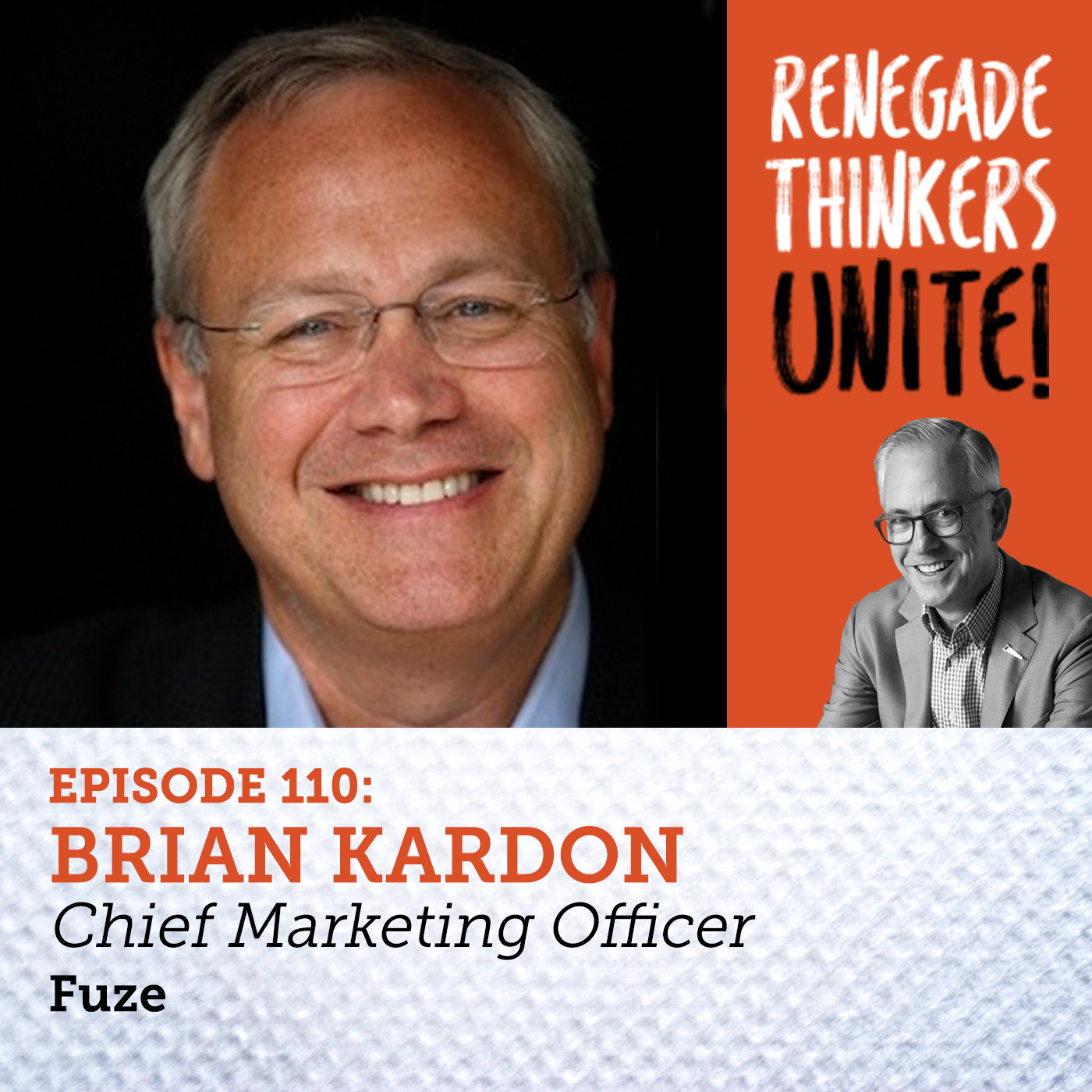
Ep 110110: Making Your Marketing Metrics Magical!
Top 10 Global CMO for companies worth over two hundred and fifty million, top 15 CMO on Twitter by Social Media Marketing Magazine, and top 50 most influential people in sales lead management - just some of the accolades that CMO Brian Kardon has earned over decades of cutting through in marketing. Now, as the CMO of Fuze, a cloud-based communications business, he is continuing to cut through by using his vast knowledge of sales and marketing metrics. On this episode of Renegade Thinkers Unite, you'll learn how to build a seamless demand gen engine, and how to focus on the metrics the matter. Brian and Drew also discuss how you can understand your clients' perceptions of your brand, and how AI is going to influence the way people create marketing initiatives. Brian's insights are ones not to be missed - you'll walk away with a deeper understanding of marketing metrics and so much more. Click here to listen to the full story. Subscribe on Apple Podcasts - Stitcher - or Podsearch What You'll Learn How do you know when your marketing is working? Understanding how your marketing is benefiting your business is often the top priority for both CMOs and CEOs. By using the best marketing metrics for your type of business, you can stay focused on those that matter - a avoid becoming distracted by those that don't. Brian explains the 3 main metrics he always looks for when evaluating the success of marketing efforts: Net new pipeline contributions Total marketing-influenced leads Total number of closed bookings These 3 metrics combine to give you data that's actually worth examining. Learning what marketing metrics work best for you and your company is a process, but it is 100% worth the investment of time and energy. Handling the micro-marketing metrics is just as important as the big-picture metrics Understanding the value of both micro and macro-marketing metrics will allow you close sales at both ends of your customer spectrum. Whether you're examining data on a $1 million contract or securing a $12,000 sale, your marketing metrics are invaluable. For example, a micro-metric will allow you to see how much time a visitor is spending on certain segments of your website, while a macro-metric goes into greater depth on what types of content a specific type of client is looking at and downloading. Brian encourages other CMOs to not forget about either one when creating a roadmap for future marketing efforts. Use these 2 metrics to help understand your clients' perception of your brand There are 2 main questions Brian uses to help him understand his clients' perceptions of his brand. They are: The net promoter score of the brand's product(s) The level of customer satisfaction with the sales and marketing process When conducted by third-party companies, these two marketing metrics shed new light on your entire pipeline process and buying experience. For the full explanation behind these metrics, don't miss this episode of Renegade Thinkers Unite. Timeline [0:30] Here's why you need to be paying attention to Brian and his team at Fuze [13:37] How do you know when your marketing is working? [27:14] Handling micro-measurements vs. measurements that help close a sale [36:19] Understanding your customer's perceptions of your brand [39:19] Use THESE metrics when presenting to the CEO and board [42:43] Lifetime value, customer acquisition costs, and customer retention [48:26] Using artificial intelligence in customer acquisition and marketing metrics Connect With Brian: Brian's bio on Fuze Connect with Brian on LinkedIn Follow Brian on Twitter Resources & People Mentioned ARTICLE: "5 Ways To Know Your Marketing Metrics Don't Suck" TOOL: Zoom Connect with Drew http://renegade.com/ On LinkedIn On Twitter On Facebook On Instagram
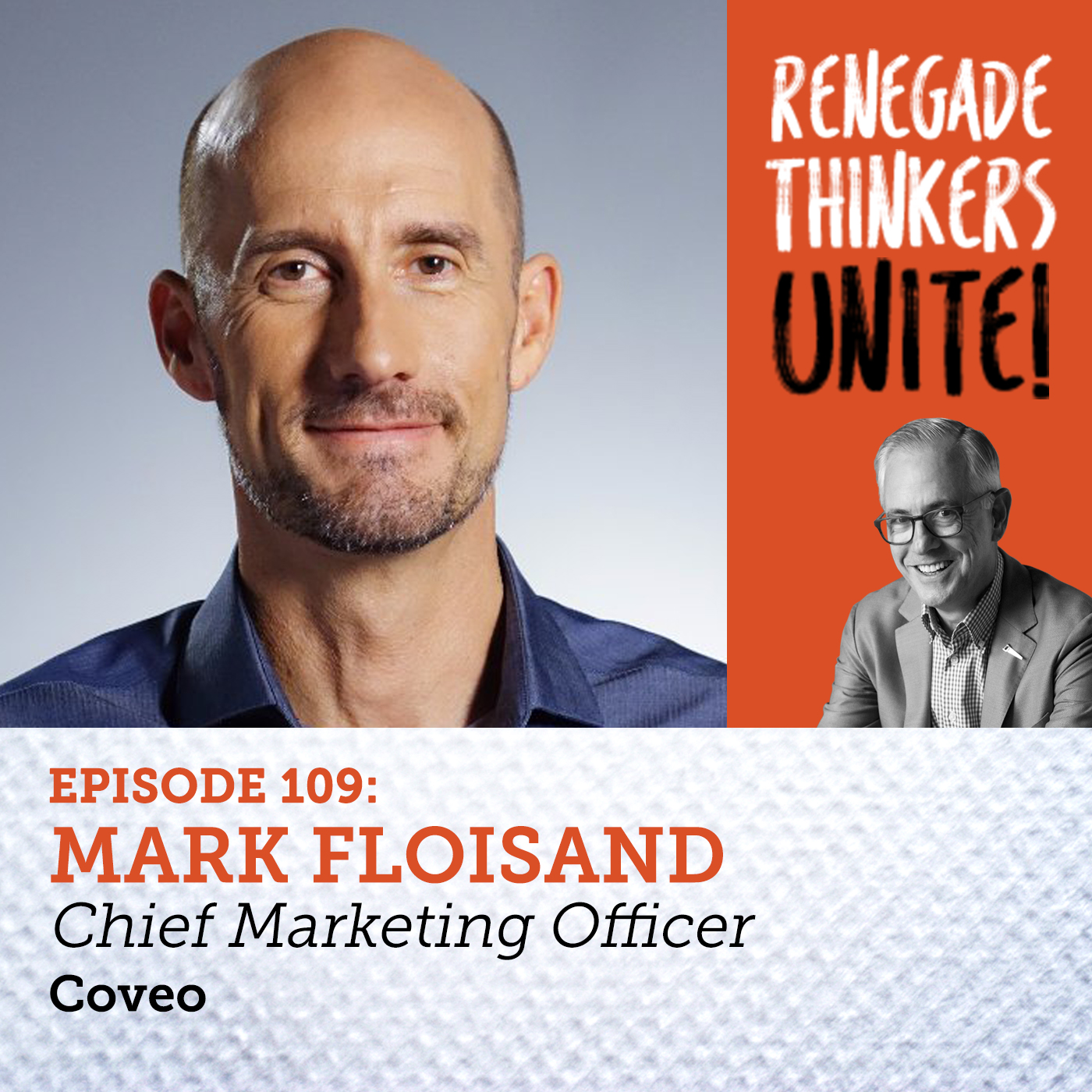
Ep 109109: How Coveo's CMO is 'Making Business Personal' with Account-Based Marketing
One of the most sought-after goals in current B2B marketing is being able to deliver personalized content to clients in a sales cycle. This elusive skill is one of the foundations of Coveo, a company using machine-based intelligence to help clients deliver personalized content to their markets. On this episode of Renegade Thinkers Unite, Drew talks with Coveo's CMO, Mark Floisand, about the latest account-based strategies that have allowed them to become experts at personalized marketing. As Mark explains, the company's tagline "Making Business Personal" serves as the base upon which the rest of their business operates. Mark and his team are proving that it is possible to scale the personalization of content, if you use the right data. While taking advantage of account-based marketing, Coveo's success has come from strategically utilizing the computing power that allows personalization at large. Mark also shares his insights on how to walk the thin line between helpful and harmful data usage when determining personalization. Learn how to deliver the right content at the right time. Subscribe on Apple Podcasts - Stitcher - or Podsearch What You'll Learn Coveo's account-based marketing strategy allows them to reach more markets than ever before When Mark joined the Coveo team in early 2016, he realized that not every account in Coveo's market needed (or wanted) an in-depth sales presentation. He began to ask the question, "How do we cost-effectively reach the target audience we know we can differentiate to?" He and his team segmented out which clients needed an individualized interaction, which could be a part of a one-to-few presentation, and which could handle a one-to-many approach. By getting specific in the way they approached clients, Coveo was able to land 1 in 5 meetings and raise over $100 million last year. The full story is on this episode, and it's one you don't want to miss. Delivering personalized content CAN happen at scale - here's how Coveo is delivering on that promise Nearly every B2B marketer understands the importance of delivering personalized content to clients; content that adds value to their purchase journey. But many are wondering if this can happen at scale, across dozens of platforms. Coveo's team is proving that yes, it is possible! Mark tells Drew that it's all about "Using as much information as you have access to, to make the best guess at what is going to be most statistically likely to be relevant to each individual." Coveo's machine-learning programs take data from website interactions, searches, clicked links, etc. and use it to create personalized content streams that can be delivered to clients when they need it most. They're taking advantage of the world's computing power and putting it to use. "Making Business Personal" is much more than a tagline, it's a way of running the entire company Coveo not only uses the tagline "Making Business Personal," they use it as a foundation upon which the rest of their business operates. Mark explains that "The more you can position an organization against the real goals that your target customer has, and the personal goals they are trying to solve, the more relevant you become." The B2B market is no longer satisfied with cookie cutter sales pitches. They expect - and deserve - quality personalized content because they experience it every day as a consumer. Why should their workplace experience be any different? Timeline [1:00] Coveo takes personalization of content in their stride [2:26] Mark's Renegade Rapid Fire segment [12:57] Coveo raised $100 million last year - here's how they did it [20:16] The logic behind "Making Business Personal" [22:55] Coveo can personalize content at scale because they leverage THIS technology [29:28] Lessons learned en route to becoming a purpose-driven company [31:44] Walking line between helpful and harmful data usage [36:00] Measuring what's important to a client over a long sales cycle Connect With Mark: Follow Mark on the Coveo blog Connect with Mark on LinkedIn Follow Mark on Twitter Resources & People Mentioned Ep 100, "Thoughts on Leadership, Accountability, and Building a Network That Spans a Lifetime" TOOL: Slack Connect with Drew http://renegade.com/ On LinkedIn On Twitter On Facebook On Instagram
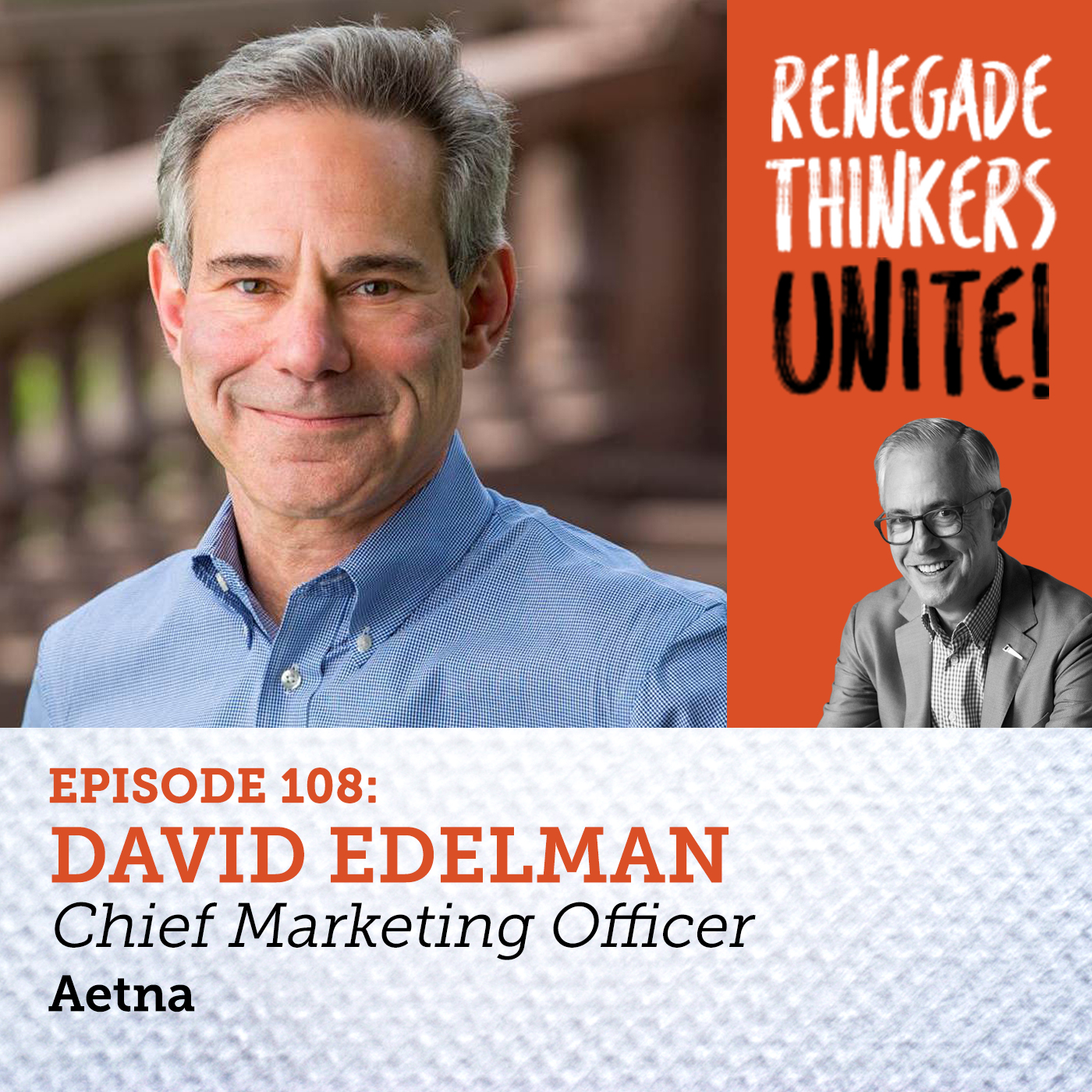
Ep 108108: How Aetna's Brand Transformation Teaches a Lesson in Storytelling Marketing
A company's brand transformation process should never be taken lightly, especially for a health insurance company that serves the lives of thousands of people across the country. When David Edelman joined Aetna's team as the CMO two years ago, he knew that a change was needed to reimagine the public perception of health insurance companies. On this episode of Renegade Thinkers Unite, you'll learn how he and his team successfully transformed the Aetna brand into one that puts the joy and wellness of its clients first and foremost.David shares why a rebranding transformation is not just a marketing thing — it must be an organization-wide effort that translates to tangible changes for customers. Drew and David also dive into how the Aetna marketing team achieved internal company buy-in, and how acting courageously in their market led to a completely reinvented brand rooted in sincere storytelling. Get inspired to let storytelling drive your next marketing move. Subscribe on Apple Podcasts - Stitcher- or Podsearch What You'll Learn David's first challenge was figuring out the space in which Aetna could relate with clients When asked about the healthcare industry, most people will associate the market with negative words and emotions. Overcoming this negative association was David's first challenge as Aetna's new CMO. He realized that Aetna had to become so much more than a health insurance company. He tells Drew that they needed to become "a partner in our clients' lives," while telling each client, "We're joining you! You lead, we'll follow." By opening up this line of honest communication with their clients, Aetna has been able to enter into new spaces of health, wellness, and preventative medicine. Achieving internal buy-in was critical to the success of Aetna's brand transformation Before Aetna could help their clients reach their wellness goals, David and his team first had to achieve internal buy-in. Previously, each of Aetna's departments had their own "feel" and culture. They combated this lack of unity by sharing the new brand promise, explaining priority initiatives, and continually asking for employee feedback and insights. They also used a variety of evaluation and measurement tools that allowed them to make the necessary course corrections throughout the brand transformation process. To hear the full story behind how all of this - and more - was achieved in just 6 months, be sure to listen. Reorienting the B2B and B2C sales teams to sell with storytelling in mind Drew and David talk at length in this episode about how Aetna successfully sells in both the B2B and B2C space. Not only does Aetna sell to individuals and families, but they also offer healthcare packages to small businesses and major corporations. David outlines a few major tools his marketing team was able to share with the sales team to make selling the new Aetna brand easier: Arm the sales team with great content Share the new customer experience Use storytelling techniques - don't just share lists and data Focus on the idea of "One Aetna" The reorienting process hasn't been simple, but David and his team have handled it beautifully so far. For the full story, don't miss this episode of Renegade Thinkers Unite. Timeline [0:28] David approached his marketing challenge at Aetna with courage [3:54] The first steps in rebranding the entire company [9:06] Taking action on the research David and his team collected [11:28] Overcoming pushback throughout the rebranding process [13:48] Engaging employees was critical in making the rebranding successful [21:00] The internal structure of the brand transformation at Aetna [26:05] Reorienting the B2B and B2C sales teams to sell with storytelling in mind [36:41] David's final thoughts on brand transformation and lessons learned during his 2 years at Aetna Connect With David: About Aetna Connect with David on LinkedIn Follow David on Twitter Resources & People Mentioned CMO Moves podcast, "David Edelman On Aetna's Agile Digital Transformation Of A Complex Ecosystem" Connect with Drew http://renegade.com/ On LinkedIn On Twitter On Facebook On Instagram
Ep 107107: The 2019 CES Preview - Everything B2B Businesses Need to Know
Every January, over 180,000 people converge on Las Vegas to place their bets on the coolest and potentially coveted gadgets the world has yet to see. The 2019 CES promises to be "the world's gathering place for all who thrive on the business of consumer technologies." It's a can't-miss conference for marketers and business professionals from all industries — even those in the B2B space.On this episode of Renegade Thinkers Unite, Drew talks with Shelly Palmer, CEO of The Palmer Group, about what attendees can expect and look for at the 2019 conference. You'll hear about why B2B professionals owe it to themselves and their clients to learn what is up-and-coming, as well as why attendance ROIs are so individualized. Be sure to listen to catch Shelly's expert insights on new sub-conferences at the 2019 CES and how you can make the most out of this major networking experience. Get up to speed on the upcoming 2019 CES - listen now. Subscribe on Apple Podcasts - Stitcher- or Podsearch What You'll Learn Here's what you can expect at the 2019 CES Shelly explains that CES has been a proving ground for new technologies for the past 50 years. Not only will attendees catch inside glimpses into brand-new technologies already on the market, but they'll be able to understand what's coming in 18, 24, and even 36 months. He says it's a "unique crystal ball into the future," and allows you and your team to begin building new technological opportunities into your own business plans. Networking opportunities and big-picture dreaming will be abundant in January Virtually all aspects of modern businesses are influenced by technology. Shelly tells Drew that even giant corporations have individuals on the receiving ends of B2B sales calls, and those individuals use everyday technologies that are featured at CES. That's why even B2B professionals have countless opportunities to add value to their companies and careers by attending the 2019 CES. Simply reading about CES after the fact won't give you the full scope. To truly understand the importance of this event, you have to experience it for yourself. No longer just an "electronics show," Shelly believes that the 2019 CES is truly a "business show." Drew, Shelly, and hundreds of other industry leaders will be at 2019 CES - will you? "Resiliency" will be a new focus at the 2019 CES, and it's an area of innovation that deserves your attention One business and marketing trend you need to be aware of is "resiliency," explained by the Consumer Technology Association (owner and producer of the CES) as the ability to "keep the world healthy, safe, warm, powered, fed and secure, even in the face of adversity." Innovations that will help restore power and cell service to disaster-riddles areas, for example, will be featured at this sub-conference event. "The Resilience Conference will deliver world-class conference programming, insights, and solutions," says a recent CTA press release. In order to be informed and responsible global citizens, marketers can't afford to miss this event. B2B and B2C marketers alike will have dozens of opportunities at the 2019 CES to expand their network, brainstorm with like-minded professionals, and plan for the future. For more information on 2019 CES and to register, visit the conference website. Timeline [0:28] This year's CES conference is not you can't afford to miss [7:27] B2B people need to attend the CES event too! [13:34] Here's what you need to look for specifically at this year's CES event - and what not to believe [21:44] "Retargeting is evil, but it works beautifully!" [26:14] Shelly transformed his family-owned consulting business into a global entity that does "engineering for engineers" [33:00] "Resilience" will be a new focus at the 2019 CES [32:28] The ROI on CES is very individualized, but 100% worth it Connect With Shelly: CES Conference website Shelly Palmer's biography Connect with Shelly on LinkedIn Follow Shelly on Twitter Follow Shelly on Facebook Resources & People Mentioned Ep 52, "Preparing for the 2018 CES" Urban Green Council Press release, "Resilience to be New Part of CES 2019" Connect with Drew http://renegade.com/ On LinkedIn On Twitter On Facebook On Instagram
Ep 106106: Creating the Category — Affectiva and Emotional AI
Gabi Zijderveld is no stranger to pioneering new tech industries. As the CMO of Affectiva, she has helped to create an entirely new category in the tech industry: #EmotionAI. While emotional intelligence is not always fully understood, Gabi and her team at Affectiva have found a way to craft a narrative around emotional AI that the tech world could not ignore. From educational summits to simple handwritten notes to supporters, Gabi has found the keys in paving a new frontier for smart technology. On this episode of Renegade Thinkers Unite, Gabi shares her nonlinear journey to the CMO seat at Affectiva. Her courageous drive to do something that had never been done before led to an innovative breakthrough for emotional intelligence. With the right strategies and priorities, Gabi proves that CMOs don't have to follow the leader — they can create whole new markets for their product. Subscribe on Apple Podcasts - Stitcher- or Podsearch #1 - Gabi developed terms and marketing language that was easily understood "Emotional AI" is an artificial intelligence that can detect human emotion in the form of non-verbal facial cues, body language, gestures, etc. While it is now a well-known category in the AI space, that hasn't always been the case. When Affectiva and Gabi were developing the technology, they had to overcome the challenge of not being recognized or understood. They combatted these issues by crafting their messages in common language that everyone could easily understand. Everything from expanding the company's vision to drafting press releases used language that was engaging, yet not too technical. #2 - The ecosystem of support for emotional AI was critical Developing the emotional AI industry wasn't done in a silo. The entire Affectiva team had a support system of brand ambassadors, technology advocates, and media contacts that supported the vision and the product. Gabi tells Drew on this episode that collecting creative, innovative, and loyal people was essential to the industry's developmental success. #3 - Measurement of the new industry's reach and impact continues to be a top priority Gabi also shares the importance of having concrete measurement and evaluation tools in place while working in a new company with new ideas. This measurement isn't solely about collecting more leads and sending them down the pipeline - it's about tracking the overall exposure and awareness of the company and technology. Gabi and her team accomplish this by measuring press activity and coverage, identifying key industry influencers, tracking diversity in live event attendees, and ensuring marketing dollars are allocated appropriately. These 3 keys have been critical to Affectiva's success, and you can implement these same ideas in your own company. For the full story, be sure to give this episode of Renegade Thinkers Unite your full attention. Timeline [0:28] All about Gabi and how she transitioned from art history to technology [4:14] Having a foundation in marketing isn't the end-all-be-all factor [7:35] Describing emotional AI in a way people understood was critical [13:57] The "Aha!" moment behind the term "emotion AI" [18:45] Implementing a new technology frontier isn't always easy [24:40] Here's how you can get over 40 speakers to come to speak at your event - for free! [28:40] Fostering and personalizing relationships through thoughtful gestures [31:34] Measuring the impact of emotional AI is a top priority at Affectiva [36:46] 2 do's and 1 don't for CMOs creating new markets Connect With Gabi: Read about Gabi on the Affectiva website Connect with Gabi on LinkedIn Follow Gabi on Twitter Follow Gabi on Facebook Resources & People Mentioned ARTICLE: "How We Created a New Technology Category—Emotion AI—in 4 Steps" Connect with Drew http://renegade.com/ On LinkedIn On Twitter On Facebook On Instagram
Ep 105105: "Fearless" Marketing and the Power of Storytelling
No matter how dramatic or controversial, truly great storytelling in marketing doesn't just boil down to publicity stunts. Rather, the most impactful storytelling is all about the message a company is trying to convey and how that message originates from its internal values. And in the case of the famous "Fearless Girl" statue that faces down Wall Street's charging bull, it was the message about fostering a greater diversity in the financial industry that has had a lasting impact. Stephen Tisdalle, CMO of State Street Global Advisors, was on the team that made the "Fearless Girl" statue. And although the installation made headlines all over the world, the campaign also prompted State Street Global Advisors to devote themselves to greater gender diversity in their own leadership and on their own boards. On this episode of Renegade Thinkers Unite, Stephen shares the internal challenges his team faced when developing the idea, the global reaction to the statue, and how this striking piece of storytelling marketing sparked a global-wide conversation about equality in the workforce. Click here to learn all about impactful storytelling in marketing. Subscribe on Apple Podcasts - Stitcher - or Podsearch earch What You'll Learn Why did a statue of a 'Fearless Girl' in front of the 'Charging Bull' leave such an impression? The "Charging Bull" statue that lives on Wall Street has been an iconic symbol for decades. On March 7, 2017, SSGA unveiled the "Fearless Girl" statue - a brave young girl that confidently faces the bull. She continues to serve as a symbol for greater diversity on C-suite level boards, and that's exactly what Stephen and his team were trying to convey. That's what makes Fearless Girl such a prime example of storytelling marketing - a piece that stands the test of time and represents values that span companies, states, and even nations. You have to back up your storytelling marketing with action Fearless Girl may have remained a simple statue with a brief amount of fanfare if it hadn't been for SSGA's actions that backed up the claims she made. SSGA has committed to increasing the level of diversity in their own boards, as well as encouraging their clients to do the same. Stephen explains to Drew that since her installation, SSGA has found that more than 300 companies added a female director, and to-date another 28 plan to follow suit. Fearless Girl also amassed over 6.5 billion social media impressions. However, if a company's storytelling marketing campaigns are to leave a persisting impact, they must be backed with action. Truly great marketing can flourish when its paired with important values The genius behind Fearless Girl lay in her ability to convey values that should be important to companies of all sizes in all industries. Stephen explains that "authenticity is attractive," and that people are drawn to marketing campaigns that are aligned with important values. He continues by explaining that companies and leaders need to "do well, do better, by doing good." Storytelling marketing can be the perfect way to convey those commitments. Timeline [0:30] Stephen explains why State Street wanted to put a fearless girl in front of a charging bull [9:50] Stephen and his team had to overcome internal concerns before moving forward with Fearless Girl [15:29] Great marketing comes when you align with important internal values [21:04] The true value behind Fearless Girl was in the actions taken across the world [26:24] Stephen explains the future of Fearless Girl [31:33] The storytelling process begins with a strong marketing focus [38:48] Fearless Girl and how she has impacted the brand awareness of State Street Global Advisors Connect With Stephen: Stephen's State Street bio Connect with Stephen on LinkedIn Resources & People Mentioned ARTICLE, "The 'Fearless Girl' statue turns 1 today. Here's what she's inspired." TED Talk, "Your body language may shape who you are" Crazy Enough 2 Work series Connect with Drew http://renegade.com/ On LinkedIn On Twitter On Facebook On Instagram
Ep 104104: How to Build Customer Loyalty By Understanding Your Company's Data
When it comes to building customer loyalty, Dani Cushion believes that the creativity is in the data. In her role as CMO of Cardlytics, she and her team work under the power of "purchase intelligence," or the ability to know where your customers are buying when they're not buying from you. As Dani has learned throughout her career as a marketer, it's all about defining who is loyal and figuring out why. On this episode of Renegade Thinkers Unite, Drew and Dani discuss why defining your existing loyal customers can help you understand where you're missing profits, as well as why using insights on aggregated data doesn't mean creative marketing is dead. As Dani admits, "it ain't sexy," but working to have a extraordinary customer experience will result in unmatched loyalty. Get to know your customers by following this advice - listen here. Subscribe on Apple Podcasts - Stitcher - or Podsearch What You'll Learn "Defining your loyals" is step one in the process of building repeat business Dani explains the importance of "defining your loyals" on this episode of Renegade Thinkers Unite. She shares that one of Cardlytics' clients earned an additional $6 million in sales, simply because they identified and retargeted a segment of their existing repeat customers. By knowing who your potential loyals are and the problem they're trying to solve, you can tap into a new area of business. Gathering insights from your data doesn't equal the death of creative marketing Cardlytics' success is built on their ability to combine purchase data and creative marketing. In order to build customer loyalty, marketing teams need to use both strategies. Just because you're aware of your customer's data does not mean you should stop reaching out to them with engaging and creative marketing stories. Drew and Dani both agree that "the creativity is in how you use the data." 2 do's and 1 don't for CMOs looking to build customer loyalty Dani's top 2 "do's" for CMOs seeking a greater ability to build brand loyalty are to always look at the broad picture of loyal customers and to listen to what they're saying. Without an accurate picture of what your customers want and their past buying habits, you won't make much progress. She also encourages CMOs to never be scared to try something new. The most innovative marketing strategies to build loyalty only began because someone was willing to take a risk - and that someone can be you! Timeline [0:30] Loyalty and customer acquisition are both essential topics on Renegade Thinkers Unite [1:51] Dani's Renegade Rapid Fire segment [15:54] The importance of building loyalty into your marketing plan [20:00] Digging into the purchase behaviors for your existing customers [25:35] Using analytical insights to understand customer loyalty [33:13] Dani explains Cardlytics' in-house loyalty program [37:30] 2 do's and 1 don't for CMOs looking to expand their customer loyalty knowledge Connect With Dani: Dani's CMO press release Connect with Dani on LinkedIn Follow Dani on Twitter Resources & People Mentioned BOOK: "Chesapeake: A Novel" BOOK: "How Brands Grow: What Marketers Don't Know" Connect with Drew http://renegade.com/ On LinkedIn On Twitter On Facebook On Instagram
Ep 103103: The Key to Achieving Sales and Marketing Alignment in B2B
As the marketer of a software service product, Meagen Eisenberg isn't just a CMO. She is also a salesperson, which is why her alignment with MongoDB's sales team proves critical to the company's rapid success. Through her influential roles at multiple B2C and B2B tech companies, Meagen can attest to the fact that any company, no matter its audience, can create a pattern of collaboration and success in creating a unified buying path. From insights about demand generation, to Martech, to work-life balance, Meagen's marketing insights apply to CMOs everywhere, whether you're B2B, B2C, or even B2D. When reflecting on her career, Meagen shares that the alignment of sales and marketing teams has transformed companies that she has worked for, including MongoDB. On this episode, you'll hear Meagen's top 5 ways to increase your company's internal collaboration, as well as discover the engaging marketing strategies MongoDB uses to attract developers. She also explains why the marketing and sales funnel strategy isn't dead, and how it can be used in innovative new ways. Learn why collaboration is the future of marketing by listening here. Subscribe on Apple Podcasts - Stitcher - or Podsearch What You'll Learn Meagen's top 5 ways to increase your company's sales and marketing alignment Just like countless other companies, MongoDB has struggled with sales and marketing alignment, as well as collaboration between teams. As a tech company that offers a database as a service, Meagen has learned to overcome the challenges of managing teams made up of employees with varied skill sets. Developers, salespeople, marketers, and more all want MongoDB to succeed, but approach it in different ways. From her years in both engineering and marketing, Meagen has learned how to create the ultimate environment of collaboration. Check out all the details behind her top 5 strategies for alignment on this episode. Understand your sales funnel and how it converts leads into customers Intentionally build all of your systems together Focus on authentic communication Identify the stopgaps in your sales system Invest in your tech stack (but don't add more tools until you're ready) MongoDB uses creative and engaging strategies to hook their audience After Meagen and her team built a solid team, together they were able to develop creative marketing strategies. They hook interested followers through live events, energetic brand advocates, and a speedy website that always delivers to their followers. They fill their robust website platform with content that educates and inspires. This content is found in many forms, such as white papers, blogs, thought leadership pieces, product demonstrations, and compelling customer stories. Marketing and sales are about putting the right information in front of the right people at the right time Alignment between your marketing and sales departments doesn't happen overnight. Meagen and Drew discuss how a business that sells directly to consumers as well as to other businesses can approach their content marketing strategies. For example, when a B2B prospect visits your website, they most likely need to be connected to an account manager and salesperson that can address their specific needs and questions. A B2C prospect, however, is much more likely to explore your website and fill out an inquiry form all on their own - without ever speaking to a salesperson. The key in content marketing and sales is to make it obvious to your followers who you are and what you do, that way you can address their questions before they even think of them. Timeline [0:30] MongoDB is a massive resource for CMOs [2:04] Meagen's Renegade Rapid Fire segment [12:16] Alignment between sales and marketing is critical - use these strategies to succeed [16:03] Connecting with developers is key [19:16] The sales funnel is not dead in today's marketing world [21:35] What's the difference between MongoDB and a datalink system? [23:11] MongoDB hooks their audience through a variety of creative marketing tactics [30:32] Balancing B2B and B2C audiences for your business [39:24] Meagen's problem-solving thoughts for the challenges facing marketing Connect With Meagen: Meagen's MongoDB profile Connect with Meagen on LinkedIn Follow Meagen on Twitter Resources & People Mentioned PagerDuty Women 2.0 BOOK: "The Conscious Parent: Transforming Ourselves, Empowering Our Children" Ep 64, "How Looker is Enhancing Marketing Data Analytics Through Organization and Face-to-Face Communication" Ep 91, "Why a Digital Brand Relies on Outdoor for Growth" Connect with Drew http://renegade.com/ On LinkedIn On Twitter On Facebook On Instagram
Ep 102102: Your Next Word of Mouth Marketing Strategy: the Talk Trigger
Far too many marketers believe that "competency creates conversation," thinking that a word of mouth marketing strategy will simply appear out of thin air. Jay Baer, entrepreneur and author of his new book "Talk Triggers," joins this episode of Renegade Thinkers Unite to convince you otherwise. Word of mouth marketing is essential to B2B businesses. After all, 91% of all B2B purchases are made because of its influence. Despite this overwhelming need, most B2B companies don't have a specific word of mouth marketing strategy in place. As Jay shares, it's all about doing something different in your company's operations that makes customers chatter -- a "talk trigger". On this episode, you'll hear about several successful talk trigger stories, like the ingenious DoubleTree cookies, along with the 4 main criteria any talk trigger needs to meet. Jay also shares his expert advice on following his book's 6-step process to creating a successful talk trigger. His message on word of mouth marketing says one thing loud and clear: "same is lame", so don't just follow what the other guys in the industry are doing. Learn how to get your customers talking in all the right ways. Subscribe on Apple Podcasts - Stitcher- or Podsearch What You'll Learn What are talk triggers and why do you need them in your word of mouth marketing strategy? Jay explains talk triggers as, "something that you choose to do differently that creates conversation." They're not marketing tactics, they're operational choices that are designed to specifically generate discussions about your business. It's the most important part of B2B that no one's talking about - until now. One of the best examples of a recent talk trigger is UberConference's "I'm On Hold" song that plays in their virtual waiting room for conference calls. Instead of going with predictable "elevator music," they had a unique song composed specifically for them that now generates conversations about their service every time users are on hold. Jay shares even more great examples all on this episode. "Same is lame" - follow these 4 criteria to create a great talk trigger Many marketers revert to mimicking successful strategies rather than create their own original ideas. But when your business starts down that path, you'll be resigned to being second-best, rather than an innovative industry leader. Jay explains that to break out of this pattern and start creating great talk triggers that enhance your word of mouth marketing strategy, your trigger needs to follow these 4 criteria: Remarkable - it needs to be worthy of remarks from people outside of your traditional audience Relevant - it cannot simply be about gathering attention Reasonable - different enough to be remarkable, but not so "out there" that people are wary of the offer Repeatable - a talk trigger isn't just a one-time stunt Jay's insider advice for entrepreneurs looking to avoid getting stuck when creating talk triggers On this episode, Jay warns marketers of 2 main "sticky points" to watch out for when developing talk triggers. As tempting as it may be to sit around coming up with fun marketing ideas, the best talk triggers don't come out of one or two brainstorming sessions. He encourages marketers to consider using a third-party company that can have an objective look at your business while researching what resonates with your audience. He also explains the importance of measuring you talk trigger's impact. By sending out a survey to your recent customers and followers, you can begin to understand what's been working and what didn't. For the full list of questions to consider asking, be sure to listen to this episode. Timeline [0:30] Word of mouth marketing expert, Jay Baer, is Drew's guest for this episode [7:02] What are talk triggers and why are they important? [8:25] Word of mouth marketing is 100% critical for B2B businesses [12:05] Marketing departments shouldn't be the only ones developing talk triggers [15:51] Same is lame - the 4 criteria to follow to create great talk triggers [26:19] The 5 types of talk triggers [30:48] Take a look at this example of talkable empathy in the B2B space [37:28] Learn from Jay's 6-step process and work through the "sticky" points by considering these 2 things [45:58] 2 do's and 1 don't to follow when creating talk trigger Connect With Jay: Jay's website Connect with Jay on LinkedIn Follow Jay on Twitter Follow Jay on Facebook Resources & People Mentioned BOOK: "Talk Triggers: The Complete Guide to Creating Customers with Word of Mouth" Uber Conference Call song Download the 6 step guide for creating talk triggers The Lost Kitchen in Maine Jay's BOOK: "Hug Your Haters" Blue Ocean Strategy Connect with Drew http://renegade.com/ On LinkedIn On Twitter On Facebook On Instagram
Ep 101101: Marketing for Non-profits: Telling the Story and Measuring Brand Awareness
Catherine Davis knows how marketing for non-profits differs from marketing in the for-profit sector — and she succeeds at both. From building her marketing foundation at Leo Burnett and Diageo to her current role as the CMO of Feeding America, Catherine has mastered the ability to distill powerful stories into tangible pieces that entire populations can connect with. Through strategic brand tracking strategies and working to solve an issue that she is passionate about, Catherine is proving that the role of a CMO as a storyteller has never been more important. As Renegade Thinkers Unite meets its 101st episode milestone, Catherine Davis and Drew sit down to discuss why a career in marketing does not have to be linear to be successful. Catherine also explains how to capture individual stories, overcome challenges in brand awareness, and manage a non-profit CEO's expectations. In this episode, Catherine will walk you through what it takes to communicate what your organization stands for and how to break down big issues into personal stories. You'll be inspired to make your marketing matter — catch the full story now. Subscribe on Apple Podcasts - Stitcher- or Podsearch What You'll Learn Catherine works to capture individual stories - a skill she learned early on in her marketing career Catherine picked up on 2 major lessons that have laid the foundation for her career in marketing for non-profits. The first is to identify and select a marketing strategy. Then, you have to break down that strategy into emotional and logical components that can be woven into stories, statistics, and campaigns. She explains that people find it much harder to dismiss individual stories from real people struggling with hunger. By encouraging people to have conversations about the bigger issues in America, even if they aren't necessarily "measurable," Catherine can begin to see how the tides are turning for the hunger problem. Measuring progress in marketing for non-profits - it doesn't come down to quarterly reports Both Drew and Catherine agree that you can't begin to measure your non-profit's success if you don't use a brand tracking study. Even Feeding America, the 3rd largest non-profit in the United States, couldn't measure their level of brand awareness without using a study - one that gave them valuable feedback into their brand and messaging. Catherine and her marketing team discovered that across a 2 year period, Feeding America's level of brand awareness and passion for solving hunger went up from 24% to 51%. Catherine explains that measuring the impact of a campaign often doesn't occur after just a few months - solving an issue like hunger can take a decade or more for progress to be made. She outlines how to maintain support from your CEO and more on this episode. Key pieces of advice for CMOs in non-profits There are a few key takeaways from this episode that every CMO should hear. Catherine explains that in order for marketing for non-profits to be effective, CMOs need to be 100% clear on who the organization is and what it stands for. Then, you must execute in a way that people understand - avoid academia-type language that isn't easily understood. Finally, you cannot assume that people believe in the same ideals as you do. By speaking with a single, focused, and passionate voice, you can find success in your marketing efforts. If you visit the Feeding America website and donate now (tag Renegade Thinkers Unite,) the Renegade Team will match up to $250 in gifts from listeners. What a Renegade way to make a difference today in the lives of fellow Americans. #SharingIsCaring Timeline [0:30] Having a foundation in classical marketing strategies allows Catherine to flourish [13:01] Feeding America and its place in the American non-profit industry [17:55] Catherine works to capture individual stories - because people can't ignore a person's story of hunger [20:47] Catherine's proudest marketing moment at Feeding America [24:45] The biggest differences being a CMO for a non-profit vs. for-profit organization [32:38] Bridging the gap between brand awareness and unawareness [35:43] 2 do's and 1 don't for CMOs of non-profit organizations Connect With Catherine: About Catherine on the Feeding America website Connect with Catherine on LinkedIn Follow Catherine on Twitter Resources & People Mentioned ARTICLE: "A 7-Step Recipe for Marketing Success" Ep 95, "How Monster's CMO is Revitalizing the Brand" ARTICLE: "Feeding America's Ice Cream Truck Roadtrip for Hunger Awareness" Connect with Drew http://renegade.com/ On LinkedIn On Twitter On Facebook On Instagram
Ep 100100: Thoughts on Leadership, Accountability, and Building a Network That Spans a Lifetime
Carl Neisser starts every new year with a list of learning goals. Last year, he aimed to master texting with his children and grandchildren. Throughout his lifetime of over 90 years, Drew's father Carl has collected important lessons about everything from teamwork, to leadership, to continually building a personal network. Above all, he never stops learning and never stops caring about his relationships. On this special 100th episode of the Renegade Thinkers Unite podcast, Drew and his Dad discuss the Neisser family legacy in marketing and business, and chat about why putting people first is the first idea that any Renegade marketer needs to understand. For Carl, listening is important, but retaining that information is even more crucial in becoming the player that your team can rely on. In an inspiring "like father, like son" fashion, Drew and his father will walk you through the steps to becoming a lifelong learner in marketing and beyond. Listen here to celebrate 100 episodes of Renegade thinking. Subscribe on Apple Podcasts - Stitcher- or Podsearch What You'll Learn Life lessons on how to build a network of relationships across the span of a lifetime Great relationships with people from all walks of life should be an aspiration for people across the world - not just in B2B marketing. How can you begin to build a network of close friends and colleagues? Drew and Carl explain that it starts with simply taking the initiative to connect with them on a regular basis. Carl meets with dozens of people every month and always takes an interest in their businesses, ideas, passions, and families. This deep knowledge people allows him to make meaningful connections among people in his network - adding value to the lives of nearly everyone he meets. Leadership, accountability, and the power of a great team Leadership, while often complex and detailed, really comes down to a few simple strategies. Carl outlines his best advice for leadership all on this episode. For example, Be honest, upfront, and supportive in your communication Hold your team accountable in order to help them grow Remember what people tell you, and make connecting with them a priority Encourage authentic teamwork within your organization Carl also learned how to keep a close eye on his competitors from the great Abraham Lincoln. By understanding the way they think, lead, and act, your organization can be better prepared to compete against them in your industry. You can't avoid failure, so learning from past mistakes is crucial Everyone has known deep and painful failure, both in their professional and personal lives. The difference lies in whether or not you learn from your mistakes and move past them, or continue to dwell in the past. By approaching every day with Carl's mindset of "every day is a learning day," you can start to view mistakes as simply opportunity for growth. He encourages all Renegade marketers to stay humble, stay curious, and never stop learning. Timeline [0:29] Drew's guest for this episode is his father, Carl Neisser [5:50] Key leadership and teamwork lessons from Abraham Lincoln [10:50] Teamwork is essential in many contexts, from sports to marketing [15:30] Learning how to build and maintain a lifetime's worth of connections [22:17] The way you connect with people is important [25:22] Treating failure as an opportunity for growth Resources & People Mentioned BOOK: "Traction: Get a Grip on Your Business" BOOK: "Team of Rivals: The Political Genius of Abraham Lincoln" BOOK: "Red Sparrow: A Novel (The Red Sparrow Trilogy)" Entrepreneurial Operating System Connect with Drew http://renegade.com/ On LinkedIn On Twitter On Facebook On Instagram

Ep 9999: The Role of a CMO in the Future of Marketing Leadership
Few professionals are as knowledgeable about marketing leadership and the CMO's role as Greg Welch. A senior partner at Spencer Stuart, one of the world's foremost leadership consulting firms, Greg helps to connect companies with the right fitting CMOs. He's witnessed firsthand how, when leadership is done right, a CMO can be his or her team's biggest cheerleader and source of inspiration. Greg has worked with the leadership of dozens of large corporations, including Walmart, Facebook, and Dunkin' Donuts. Greg believes that the intangibles of an extraordinary leader can transform a good CMO into a great one, but developing those skills takes work. On this episode of Renegade Thinkers Unite, Drew and Greg discuss what aspiring professionals need to know to be successful in marketing leadership, as well as concrete advice for CMOs striving for that CEO desk. Greg also shares why you should surround yourself with a group of supporters and mentors to develop your personal marketing leadership style. You'll be inspired by Greg's advice - be sure to listen here. Subscribe on Apple Podcasts - Stitcher- or Podsearch What You'll Learn Greg is seeing a new breed of CMOs emerge, and they have these qualities Throughout his 20 years of executive search experience, Greg has discovered that the best marketing leaders possess a few main qualities, including: The ability to understand both the brand and data sides of a business An intense sense of curiosity An ambition to be a great listener Capable of building and maintaining support with others CMOs need to be smart, aggressive individuals. Greg believes they need to have the ability to know the basics behind building quality, sustainable brands, as well as motivate and inspire others. Marketing leadership is all about building and maintaining relationships Greg says, "You can't manage your marketing team with the door closed." Meaning, a person in marketing leadership can't exist as a silo - every leader should rely on their team in order to achieve the greatest amount of success. That's why stellar leaders intensely focus on building and maintaining strong relationships with others. Mentors, peers, subordinates, and even your competition are all invaluable connections a great CMO needs to invest in. Being authentic, transparent, and honest will go a long way towards fostering strong relationships with those who will help you in life and work. The role of the CMO is always shifting - here's how to continually succeed Drew and Greg both believe that the role of the CMO in business is never stagnant. The best CMOs are seeking to learn and understand more about the business they're in - even if they have no desire to end up in the CEO spot. Greg explains that the top priority should be keeping your team satisfied and engaged, no matter what else you may be focusing on in your marketing leadership role. Looking towards the future, Greg predicts that a focus on eCommerce strategies will help you stay on the cutting edge of a career as a CMO. Timeline [0:29] Greg's Renegade Rapid Fire segment [6:50] It's a new day in marketing and marketing leadership [12:40] You can't manage the marketing team with the door closed [23:39] The ever-expanding role of the CMO [33:10] Greg's take on the ultimate CMO of the future Connect With Greg: About Greg Connect with Greg on LinkedIn Follow Greg on Twitter Resources & People Mentioned Antonio Lucio marketing guru The CMO Club BOOK: "The Old Rules of Marketing are Dead: 6 New Rules to Reinvent Your Brand and Reignite Your Business" BOOK: "Lincoln on Leadership: Executive Strategies for Tough Times" RESEARCH: "Chief Marketing Officer Average Tenure Increases to 44 Months" SPONSOR: Social Media Explorer Connect with Drew http://renegade.com/ On LinkedIn On Twitter On Facebook On Instagram
Ep 9898: Using Review Websites as Your New Lead Generation Strategy
As a CMO, sometimes nothing seems worse than your business receiving scrutiny on a review site. But don't review site pages with only stellar, positive reviews also seem suspicious? The reality is that even negative reviews serve an absolutely vital role in how authentic and genuine your business comes across to potential customers. Not only can they create a well-rounded story around your brand, but review sites can even be a major lead generation source. Now that sounds like a strategy that every marketer should take into account! From her experience as GM of Capterra, a leading online review platform, Claire Alexander shares her expertise in everything from lead generation to turning a bad review into a marketing win. Claire drives everything she does at Capterra with the motto, "Do the right thing and the right results will follow." Throughout this episode, you'll learn Claire's advice on how you can best engage with your audience on review sites and optimize every dollar of your marketing budget to get the best results. results. Listen here to catch the full story about this new form of word of mouth marketing. Subscribe on Apple Podcasts - Stitcher - or Podsearch What You'll Learn Why are review websites so important to your business? Everyone knows that word of mouth marketing is the best form of marketing. For modern businesses, this type of marketing can be found digitally through review sites. Buyers are starting their purchase journeys online, and resources such as Capterra allow them to evaluate their needs and compare software programs. Buyers take online reviews very seriously, and the way your company responds to reviews describes a lot about your company's leadership, culture, customer care, and products. Using review websites as a lead generation strategy can work wonders for your business One avenue for success that many CMOs aren't aware of is the ability to combine a lead generation strategy with review sites. For example, if a buyer can find a highly-searched for review site on Google, then find your business on the review site, you can use that site's organic traffic to drive leads to your site. Potential buyers that click through a review site onto your web pages can be captured as buyers with a higher level of buying interest than those who simply stumbled upon your site by accident. Claire's best advice for handling reviews left on your business, products, and services Review sites can not only serve as a great lead generation strategy, but they can also be a new avenue for connecting with your audience. Drew explains that there are 2 facts in modern marketing: reviews will be given and therefore, you must seek to provide the best customer experience you can. Claire outlines a few key steps to follow when monitoring reviews: Decide which review sites matter to you (consider the ones with the highest volume of traffic) Monitor review (just as you would comments on social platforms) Invite people into the conversation Incorporate review collection into your closing/follow up process Graciously embrace the negative reviews (but closely monitor for incorrect or bot-driven reviews) Claire's #1 key to success for using review sites as a lead generation tool is to allow and encourage both positive and negative reviews. Having a mix increases your buyer's trust with your company, and results in higher conversion rates for your products/services. Interacting with customer reviews isn't always simple and easy, but it is 100% worth it. Timeline [0:30] Claire shares how she became involved at Capterra [9:09] Claire's biggest challenges as she transitioned from marketing to GM [13:22] Your biggest outcomes come from having great processes [19:54] Why are review sites so important? [26:39] Claire's best advice for approaching reviews left on your services and products [32:30] Using review sites as a lead generation tool [35:53] The best way to optimize your marketing dollars spent on review sites [47:25] 2 do's and 1 don't for review site marketing strategies Connect With Claire: Capterra team webpage Connect with Claire on LinkedIn Follow Capterra on Twitter Like Capterra on Facebook Resources & People Mentioned Ep 91, "Why a Digital Brand Relies on Outdoor for Growth" BOOK: "How Brands Grow: What Marketers Don't Know" Glassdoor review tool Connect with Drew http://renegade.com/ On LinkedIn On Twitter On Facebook On Instagram
Ep 9797: Perfecting the Art of People Marketing
With growing demands from the C-Suite, (often) low budgets, and pressure to keep up with today's current trends, marketers constantly face the challenge of creating authentic content that builds brand awareness and inspires action. Every CMO knows how difficult it can be to recruit brand ambassadors to create compelling content that cuts through. But what if the answer could be found in the co-workers around you? A recent study showed that brand messages posted by employees achieved 561% more reach than posts made by the company itself—resulting in 8 times the engagement for those posts! You've probably heard of different employee advocacy programs, but Jeanniey Mullen's concept of "people marketing," through her role as CMO at Mercer, is a brilliant concept of building big brand awareness with no media budget at all. There is no formula and no equation to adhere to in order to get the best results. Jeanniey's philosophy is simple: trust in your people to tell their stories. Mullen has a deep background in advertising, start-ups, and entrepreneurship. Looking back at her career, she credits her renegade spirit to the Davos Squad initiative at Mercer—a content marketing success that created a one-of-a-kind buzz around hundreds of Mercer employees enthusiastically interacting with the brand on social media. On this episode of Renegade Thinkers Unite, Drew and Jeanniey dive into how brand ambassadors can be formed within your own company. Jeanniey also explains her top three takeaways from initiating a "people marketing" program and demonstrates how to overcome any obstacles in your way. Listen here to learn how to market engaging content in completely new ways. Subscribe on Apple Podcasts - Stitcher- or Podsearch What You'll Learn How can you use people marketing to create brand ambassadors? Simply put, Jeanniey explains that "People marketing is the process of leveraging your company's people in a way that's so powerful, it takes your brand to new heights." The first step in the people marketing strategy is to develop impactful content. Jeanniey created the AIR concept - content that is Authentic, Inspirational, and Relatable - in order to develop better material. Developing that content is only one part of the people marketing journey. You must then make your employees brand ambassadors. These ambassadors then share your content to reach new markets like never before. Overcome the challenge of staying "on voice" by following these guidelines With dozens or even hundreds of new employee brand ambassadors, how can a company stay "on voice" with the message? Jeanniey explains that the answer isn't found in strict guidelines. If you provide authentic content to people, let them choose what to share and when, and allow their individual personalities to shine through, your people marketing strategy will be effective. If you want a brand ambassador's post to be authentic, you can't script their social media. Jeanniey's 3 key takeaways from successful people marketing campaigns Throughout her time at Mercer, Jeanniey has learned 3 main lessons when handling people marketing campaigns. Here they are. Break the rules! Don't be afraid to pursue new options. Don't default to email (there are better, more creative options available) Nobody will pay attention to your content unless it's really cool People marketing has the power to forever change how you view marketing - be sure to learn from Jeanniey's career. Timeline [0:29] Jeanniey's Renegade Rapid Fire segment [13:01] What is people marketing? [21:18] Overcoming the challenge of staying "on voice" in people marketing [25:42] People marketing is not just a single moment in time [31:17] Tackling hurdles while pursuing this marketing strategy [34:04] 3 key takeaways from using people marketing strategies Connect With Jeanniey: Jeanniey's bio on the Mercer website Connect with Jeanniey on LinkedIn Follow Jeanniey on Twitter Resources & People Mentioned BOOK: "Storynomics: Story-Driven Marketing in the Post-Advertising World" VIDEO: "Peter Beshar Executive Vice President and General Counsel Marsh & McLennan Co. on Cyber Security" Connect with Drew http://renegade.com/ On LinkedIn On Twitter On Facebook On Instagram
Ep 9696: Interview Questions that Build Better Marketing Teams
The notion of a CMO building or rebuilding a marketing team is not an unfamiliar concept, especially on Renegade Thinkers Unite. Thinking back to the insights provided by Paige O'Neill, hiring a new team can be one of the first major tasks a CMO has to tackle in their first 100 days. When faced with this challenge, CMOs should always focus on designing a team that will align with the strategic goals of the company and that fills the current HR gaps. But one element of the process that is often overlooked is the interview—and more importantly, the interview questions. That's where Kipp Bodnar comes in. As a wine enthusiast, mechanical watch aficionado, and host of HubSpot's "The Growth Show," Kipp Bodnar, the CMO of HubSpot, loves learning from the people he interviews and encounters. Kipp's recent article, "The Ultimate Guide to Marketing Interview Questions From HubSpot's CMO," made waves in the marketing community, discussing the best questions to ask in a marketing interview. On this episode, Drew turns the tables by asking Kipp to respond to the questions he wrote. Drew and Kipp also explain the best ways to hire for senior-level leadership positions and share how new professionals can prepare for the hiring process. Click here to learn how to add these great insights to your own interviews. Subscribe on Apple Podcasts - Stitcher- or Podsearch What You'll Learn The best marketing interview questions achieve these goals Hiring top talent starts with asking the right questions. Kipp is an expert in sorting out expert applicants from the general pool, and he suggests CMOs use marketing interview questions that do the following: Encourage open-ended responses Identify if an applicant can problem solve Discover if an applicant can simplify a complex topic and notice great marketing in other brands The best applicants will demonstrate a high level of humility, motivation to learn, and an ability to listen. Getting great answers only comes from great questions. To hear the full list of marketing interview questions, be sure to listen. Follow this advice when considering a senior-level leadership applicant Hiring for a senior-level position is much different than hiring for marketing team members. Kipp shares his process for hiring leaders throughout his conversation with Drew. Kipp explains that during a 2-week hiring process, he will spend 20-30 hours with the applicant in a variety of settings (dinners, presentations, panel interviews, etc.) He says that if you're going to be working closely with this applicant for the next few years, you must understand the essence of what that person is all about. How can new marketing professionals prepare for an interview? Preparing for an interview doesn't have to be stressful. Kipp shares 5 main things an applicant can do to prepare for the interview process. Here they are. Become familiar with the company's products/services Seek out and talk with existing company employees Do content research Understand the culture Come with questions of your own The hiring process is a "unique mix of buying and selling," as Drew explains. These insights from Kipp on marketing interview questions can help make the process smoother and more effective. Timeline [0:29] Drew explains the format for this episode of Renegade Thinkers Unite [2:51] The fine art of interviewing and hiring for a marketing team [4:00] Use this question to know if your applicant can problem solve [8:28] Use this question to see if the applicant puts the opinion of the customer first [12:14] This question determines if an applicant can pull info from a set of data [17:09] Is this applicant able to understand what good marketing is all about? [21:04] Can this applicant seek out and absorb information on their own? [28:16] Follow this advice for hiring a senior level position [30:20] These traits help people make the senior-level cut [34:24] Follow these tips for preparing for an interview [36:46] The main relationship between marketing and sales [39:20] This one question is what Kipp hopes for in every interview Connect With Kipp: Kipp's bio on the HubSpot website Connect with Kipp on LinkedIn Follow Kipp on Twitter Resources & People Mentioned PODCAST: "The Growth Show/The Turnaround" PODCAST: "71: Drew Neisser: Marketing's renegade talks strategy, story, and courage" ARTICLE: "The Ultimate Guide to Marketing Interview Questions From HubSpot's CMO" BOOK: "Competing Against Luck: The Story of Innovation and Customer Choice" BOOK: "The Challenger Customer: Selling to the Hidden Influencer Who Can Multiply Your Results" BOOK: "White Fragility: Why It's So Hard for White People to Talk About Racism" BOOK: "Shoe Dog: A Memoir by the Creator of Nike" BRAND: Walker and Company Follow Tristan Walker on Instagram APP: Flipboard Connect with Drew http://renegade.com/ On LinkedIn On Twitter On Facebook On Instagram
Ep 9595: How Monster's CMO is Revitalizing the Brand
EOne of the more refreshing trends in marketing is the grand "mea culpa" in which a brand apologizes for past shortcomings and offers a renewed commitment to quality/integrity. Wells Fargo's recent "re-established in 2018" campaign is one striking example. Another comes from Domino's a few years back when they admitted their pizza was poor and relaunched with a better tasting product. This approach takes guts but really resonates especially when the pledge to be 'better" comes with demonstrable actions. Which brings us to this episode of Renegade Thinkers Unite in which Jonathan Beamer, CMO of Monster, admits that the online jobs site had "coasted" for a while and explains how they are renewing their commitment to job-seeker success. What is so interesting in this case is that though Monster had coasted after dominating the job search market for most of the dot-com era, the brand still enjoyed high awareness and what Beamer calls "latent favorability." Having this strong baseline to build from, Beamer expected that the combination of product improvements and increased advertising would help revitalize the brand. And though Beamer describes Monster's revitalization as "a work in progress," the brand is already seeing increases in site traffic and customer activity. Not coincidentally, Monster is back on TV providing further proof that this medium is far from dead as digital pundits declared 10 years ago! Listen here for inspiration on how you might revitalize your brand. Subscribe on Apple Podcasts - Stitcher - or Podsearch What You'll Learn There's great power behind a brand that people are familiar with and trust There's one core truth behind Monster that has allowed their brand to survive across decades, and that is that people are always searching for fulfilling work. Since 1999 Monster has connected people and job opportunities, and Jonathan explains that it's paying attention to small details that makes Monster stand out from the masses. He explains the powerful concept of "latent favorability," when people remember your brand fondly even after having not used the company's services for a period of time. Monster has values attached to the brand that goes beyond the product it provides, and that's where the company's power lies. These 4 tips will help you refresh a stagnant brand Jonathan's marketing team at Monster has been faced with the challenge of refreshing a company message that has existed for nearly 20 years. In his conversation with Drew, Jonathan explains 4 main tips that have helped guide his team through the process of refreshing a stagnant brand. Here they are. Be the voice of the customer (in Monster's case, understanding both an employee on the hunt for a new job and a recruiter looking for top talent) Have a close partnership with the product/service development team Understand the simple decisions made throughout a customer's purchase journey Be consistent with the tools you choose to use Learn how to track brand awareness for greater marketing success Having data on your brand, its level of awareness within your target market, and your digital followers is essential, but you have to know how to aggregate and analyze that data. Jonathan explains that you should not get hung up on the questions to ask when conducting brand awareness surveys or sending out evaluation tools. At the end of the day, the tools you use to track brand awareness matter less than the overall feedback it provides to you and your team. Jonathan also recommends that you also utilize your historical data and keep the big picture in mind when doing brand tracking. For even more insights on how to track brand awareness effectively, be sure to listen. Timeline [0:28] Drew introduces Jonathan to the Renegade Thinkers Unite show [3:38] Jonathan's Renegade Rapid Fire segment [17:06] The importance of factfullness in the world around you [19:50] What Jonathan's excited about as the CMO of Monster [24:07] This is what happened when Monster stopped investing in marketing [30:14] Fixing fundamental aspects of the Monster brand [35:37] Keep these ideas in mind when doing brand tracking [40:51] There's a strong bond between quality products and justifying marketing efforts [43:32] Content is huge in Monster's marketing strategy [48:15] Jonathan's top 3 pieces of advice for new CMOs Connect With Jonathan: Connect with Jonathan on LinkedIn Follow Jonathan on Twitter Resources & People Mentioned BOOK: "The Fountainhead" BOOK: "Factfulness: Ten Reasons We're Wrong About the World--and Why Things Are Better Than You Think" BOOK: "How Brands Grow: What Marketers Don't Know" Connect with Drew http://renegade.com/ On LinkedIn On Twitter On Facebook On Instagram
Ep 9494: Advice for CMOs in Their First 100 Days
Joining a company as the new chief marketing officer can be an intimidating affair. There are new team members to meet, historical strategies to digest, and an overwhelming pressure to make an impact early in your tenure. With the rest of the C-Suite reminding you of the needs to generate demand and to calculate ROI on every expenditure, it is easy to find yourself being pulled in multiple directions and forced into "ready, fire, aim" mode. Luckily, Paige O'Neill is here to help on this special episode of Renegade Thinkers Unite. As the new CMO of Sitecore, an integrated CMS, and e-commerce solution, Paige is an expert at handling new roles in marketing departments, having been through the process on multiple occasions. Dubbing herself as the chief marketing "synthesizer," Paige has a knack for synthesizing all the information that is thrown her way and gaining a quick understanding of the company's goals and priorities. Having worked as a CMO for large companies as well as start-ups she continues to add to her extensive toolkit, taking away something new from each experience. Listen carefully as Paige details the critical steps every new CMO should take to ensure they too get off to a successful start. Click here to listen and learn how to navigate your first 100 days. Subscribe on Apple Podcasts - Stitcher - or Podsearch What You'll Learn Don't be afraid to ask big questions during your first 30 days When Paige stepped into her new role as CMO, she understood the importance of asking the right questions within the first 30 days. Recognizing the key stakeholders within the company is one of the biggest objectives you should have as a new chief marketing officer. You also have to "become a synthesizer" of all of the information being thrown your way. Understanding the company's current priorities, current team roles, and workflow processes are all important to understand soon after joining the company. The sooner you ask these big questions and understand the answers, the faster you'll be able to start actually marketing and leading your team. Here's how to approach your new marketing team Being hired as a new CMO means being paired with a brand new team of marketing employees. Or, you'll be tasked with hiring your own new team. Paige outlines a few key questions that can help you navigate this complex process: What are the strategic goals of the company? How is the marketing team going to contribute to that growth? What's holding the company back from the current objectives? What vacancies and gaps are there in the current team? She encourages new CMOs to "be your own best case scenario" and to not let distractions get in the way of securing a great team. If you take the time to build solid relationships with your coworkers early on, the rest of your first 100 days will go much smoother. Consider Paige's best advice for your first 100 days as a new Chief Marketing Officer During your first 100 days as a new CMO, Paige explains that you will have to embrace and lean into the difficult conversations. On this episode, she shares a list of things that are important to work on during the first 3 months in a new role: Build key relationships Learn the business Shore up the team and prioritize hiring Figure out the quick wins that buy you time for longer-term projects Prioritization goal alignment Articulate a vision Be mindful of how you're spending your time - don't be afraid to say no By keeping these areas in mind as you work in a new company, your first 100 days as a new chief marketing officer are sure to be successful. Timeline [0:28] Paige is here to help CMOs understand steps to take in their first 100 days [2:54] Paige's Renegade Rapid Fire segment [13:33] Don't be afraid to ask big questions in your first 30 days [17:55] How do you ensure your observations are true? [19:40] How long should you take to make your first sets of decisions? [25:37] Here's how Paige approaches a new marketing team [34:09] This advice is key for the first 100 days in a new CMO role Connect With Paige: Press release on Paige's new role at Sitecore Connect with Paige on LinkedIn Follow Paige on Twitter Resources & People Mentioned BOOK: "A Good Time to be a Girl" Connect with Drew http://renegade.com/ On LinkedIn On Twitter On Facebook On Instagram

Ep 9393: Why ABM is a Must Have for B2B Marketers
Sometimes a marketer's most renegade moment comes from a change in their career path. As it turns out, moving across the country and making a career change is no easy feat and requires a healthy amount of courage. But that's exactly what Peter Isaacson did, and after a productive decade-plus working on the agency-side of advertising, he's now nested in Silicon Valley and leading a charge of marketing innovation as the CMO of Demandbase, a targeting and personalization platform and the global leader in account-based marketing. This podcast dives into the world of ABM and why it's no longer just optional for B2B marketers. As the CMO of Demandbase, the ABM market leader, Peter Isaacson offers an insider look at account-based marketing, serving up concrete advice on how to make the most of these programs. To achieve major results, Peter advises marketers that are new to ABM to take things slow and steady. It's not something that you can just rush into, but with the help of Peter and this podcast, crafting an ABM strategy will start to feel like a piece of cake. In this episode, Peter and Drew discuss the three main mistakes marketers make when trying to implement an account-based marketing strategy and how you can use intent signals to identify better targets. Peter describes how companies can begin to adopt an ABM strategy, the future of ABM, and why ABM is not the death of storytelling and creative marketing. Listen here for all the latest details on account-based marketing. Subscribe on Apple Podcasts - Stitcher- or Podsearch What You'll Learn These are the 3 biggest mistakes marketers make when considering an account-based marketing strategy Account-based marketing is not something that can be ignored in the B2B marketing space. However, Peter has found that many people new to ABM strategies make 3 main mistakes that prevent them from fully succeeding. They are: Not engaging the sales department teams in the new strategy Not aligning with the right target accounts Tackling too many areas of ABM all at once He proposes that all marketers engage with the sales teams from the start, to eliminate confusion down the road. He also explains that your former strategies for finding the right target accounts may no longer be effective and that starting small with ABM is the best way to approach the new strategy. How can marketers use intent signals in a new account-based marketing strategy? Implementing an account-based marketing strategy is all about identifying the right target accounts. Then, you must uncover the right buying committees and decision makers within that account. Using specific intent signals can help you accomplish those goals. When done correctly, intent signals can help you and your team understand which companies are already researching account-based marketing firms. Intent signals are no longer limited to simply noticing when a company fills out a form on your website. ABM is not the death of creative marketing - here's why Using an account-based marketing strategy does not mean you've given up on other creative marketing tactics. Creative marketing and genuine storytelling are still important, often overlooked, B2B marketing strategies. People are still looking for groundbreaking brand stories and engaging content. Peter explains how account-based marketing and creativity are uniquely paired, all on this episode. Timeline [1:09] Drew introduces Peter and why account-based marketing is so critical [3:00] Peter's Renegade Rapid Fire segment [13:46] These are the 3 biggest mistakes made in ABM [18:44] What does an ABM program look like? [22:00] Using intent signals in account-based marketing [24:54] The old way of demand generation is no longer functional [27:40] ABM is not the death of brand and creativity [30:48] Peter proposes the future of ABM Connect With Peter: Team webpage on Demandbase website Connect with Peter on LinkedIn Follow Peter on Twitter Resources & People Mentioned BOOK: "Educated: A Memoir" Demandbase's ABM Certification process Ep 73, "MRP CMO Explains Why Predictive Analytics in Marketing Will Revolutionize the B2B Industry" Ep 84, "Why an Account Based Marketing Strategy in B2B is Successful" Connect with Drew http://renegade.com/ On LinkedIn On Twitter On Facebook On Instagram

Ep 9292: Simplicity + Side Hustle = CMO Success
Let's face it – simple is hard, especially in B2B marketing. It's so easy to get caught up in flashy features, complicated jargon, and complex campaign strategies that we forget what marketing is all about – making buying easier. Faced with this challenge of persuading people, many CMOs are struggling to keep things simple. Margaret Molloy is not one of those CMOs. As the Global Chief Marketing Officer of Siegel+Gale, Margaret has mastered the art of persuading people with simple, but powerful messaging. She points her success to two key foundations: having permission to fail and the effectiveness of fact-based storytelling. The lessons she has to share are not only coming from her experience at Siegel+Gale, but also from what she learned by exploring her own passion project, the #WearingIrish initiative. In this episode, Drew and Margaret talk about how to keep things simple in B2B marketing and explain the four main traits of successful CMOs. Margaret describes her experience with her passion project, the #WearingIrish initiative, and how CMOs could be growing and learning from their own side hustle. Margaret is a bundle of B2B wisdom, click here to listen to her story. Subscribe on Apple Podcasts – Stitcher – or Podsearch What You'll Learn Keeping marketing simple is hard, but these 2 foundations make it easier B2B marketing is all about making a buying decision easier for a customer. Even though there are thousands of experts and opinions in the industry, Drew and Margaret both believe in the idea of simple marketing - a Renegade approach to marketing that makes everything approachable and easy to understand. Simple marketing focuses on encouraging and persuading people to act. But a CMO cannot pursue this path without these 2 foundations: internal company support and a solid fact base. Without these tools to lean on, a CMO is more likely to get distracted and lose sight of the true company goal. Artful, courageous simple marketing follows after these foundations have been laid. Successful CMOs exhibit these 5 behaviors that lead to better simple marketing campaigns Great CMOs are fundamentally simplifiers. They're always working towards boiling down ideas into easy-to-digest pieces of information. Margaret explains that throughout her career as a marketer and creator, the best CMOs consistently exhibit these 5 behaviors. They're purpose-driven They're fact-based, but they have an imagination They are bold and brave in prioritization (they say no often) They create and empower smaller teams They execute on company and brand promises These behaviors allow a CMO to focus on what truly matters in their marketing campaign. Margaret uses her passion project #WearingIrish to help her role as a CMO - and you can too Margaret's native country is Ireland and even while working as a top CMO she knew she wanted to bring global exposure to Irish creators. That's why she created the #WearingIrish initiative. She is telling the untold story of Irish fashion design and learning skills that are transferable to her CMO role as well. Margaret explains that this passion project has given her an opportunity to have an "experimentation lab" that is separate from the risks and responsibilities associated with Siegel+Gale. It also allowed her to develop a higher sense of empathy for other companies and her CMO clients. No matter where your personal interests may lie, the stories shared on this episode of Renegade Thinkers Unite show that they can always be used to benefit your company and your own professional work. Timeline [0:30] Margaret Molloy, CMO and creator, is featured on this episode of Renegade Thinkers Unite [2:07] Margaret's Renegade Rapid Fire segment [11:35] The story behind Margaret's #WearingIrish passion project [19:04] Tying together your personal brand with your company's brand and mission [22:20] These are the top 5 behaviors of successful CMOs [32:00] Actionable steps make simple marketing tangible Connect With Margaret: Margaret's profile on the Siegel+Gale website Connect with Margaret on LinkedIn Follow Margaret on Twitter Follow Margaret on Facebook Resources & People Mentioned Wearing Irish website BOOK: "The Innovator's Dilemma: When New Technologies Cause Great Firms to Fail" BOOK: "Eat Fat, Get Thin: Why the Fat We Eat Is the Key to Sustained Weight Loss and Vibrant Health" INTERVIEW: "Marketing Needs to Be More Than a Coat of Paint" Connect with Drew http://renegade.com/ On LinkedIn On Twitter On Facebook On Instagram
Ep 9191: Why a Digital Brand Relies on Outdoor for Growth
Fans of The Simpsons may remember the episode in which Homer is jubilant about "new billboard day." This 1995 episode happened long before digital marketing became an obsession that in some circles rendered outdoor obsolete. Well Homer Simpson has a new comrade in arms with Janine Pelosi, the CMO at Zoom, at least when comes to the appreciation of outdoor advertising. In past 18 months, Pelosi and Zoom put forward the simple but powerful message "Meet Happy" to build awareness of their online meeting platform. Then they shared it with the world, but not just through ads on Facebook, LinkedIn and Google. They invested heavily in billboards and transit ads across major US and European markets. The results? 100% year over year revenue growth. 135% year over year user base growth. 1600% growth in weekly web traffic. That Simpsons gag was released in 1995, but Janine's team is proving that billboards and outdoor advertising can still be powerful, as long as the message is right. In this episode, Drew and Janine talk about effective, honest messaging and how to broadcast it to the world. Janine talks through Zoom's success, its challenges, and her high-level thoughts on the role a CMO should play, especially in being an advocate for their team. Learn from Janine's journey at Zoom by listening to this episode. Subscribe on Apple Podcasts - Stitcher- or Podsearch What You'll Learn Zoom's latest brand awareness campaign is "Meet Happy," and it works wonders without digital marketing With over 700,000 businesses using Zoom to meet virtually, Janine and her team realized that meetings were a critical piece of modern business. They sought out to create a brand awareness campaign that would generate demand in a unique way. That's why they stayed away from typical digital marketing strategies such as Facebook ads. Instead, they put outdoor marketing pieces across the world on buses, billboards, taxis, etc. The "Meet Happy" campaign speaks to so many prospects because it encourages a positive emotion and interaction with a product. Delivering happiness and great meeting experiences are what Zoom does best, and it shows. Generating demand is one thing, delivering on a promise is another. Zoom succeeds at both! The "Meet Happy" campaign simply generates demand. It doesn't capture that demand and turn it into leads and sales. For capturing the demand, Janine still relies on digital tools. By using this form of promise-based marketing, Janine creates positive connections with prospects even before they visit Zoom's website. Their team follows through on that promise by always focusing on perfecting their product and having exceptional customer service. Internally, the Zoom team keeps "be happy" as a company culture pillar. It focuses everyone around a central mindset and has bonded the team together as they grew. Janine shares her main ideas for successful marketing, company culture, and innovation At Zoom, having a supportive CEO is one of the biggest ingredients in their "secret sauce" of success. Janine explains that without the support and encouragement of top company leaders, organizing successful campaigns is difficult. Are you interested in achieving the same amount of success as Zoom? Janine encourages all marketers to keep marketing practical, keep it simple, and stay focused. Don't chase after all the tools on the market and don't overthink your messaging. Simply know your brand, believe in your product, and trust your intuition. Timeline [1:15] How Janine's work has increased Zoom's marketing success in just 3 years [2:35] Janine's Renegade Rapid Fire segment [11:49] How Zoom's "Meet Happy" brand awareness campaign works wonders for capturing demand [20:07] The "secret sauce" behind Janine's marketing strategy at Zoom [23:34] Delivering on the promise of the "Meet Happy" campaign [26:45] Learn from the challenges Zoom's marketing team has faced Connect With Janine: Janine's profile on the Zoom website Connect with Janine on LinkedIn Follow Janine on Twitter Resources & People Mentioned Zoom website BOOK: "The SPEED of TRUST: The One Thing That Changes Everything" Gartner brand Connect with Drew http://renegade.com/ On LinkedIn On Twitter On Facebook On Instagram

Ep 9090: You Need to Blow Up Your Approach to B2B Marketing
Brent Adamson has a bone to pick with marketers: the way many of them define their industry is miles off the mark. In fact, Brent may want to abandon the term 'marketing' altogether, because too often the notion of separate marketing and sales departments breeds a lack of coordination. If your marketing and sales teams are not in perfect lockstep, you can count on your business suffering. If you disagree, maybe he can sway you in part 2 of his interview. In today's conclusion to the interview, Brent and Drew get at to the heart of how a marketing team needs to operate to be successful, and it involves a lot more than handing leads off to sales like a relay-race baton. Brent will talk the listener through seven tools that can help make speed up the process of connecting a customer with a product. Then, Drew and Brent talk through the buyer enablement journey, and why breaking down walls between sales and marketing will enable the teams make it as easy as possible for the customer to buy. In the end, that's goal number one. This episode is brimming with wisdom to help you shed some outdated notions of marketing, don't miss it! Subscribe on Apple Podcasts - Stitcher- or Podsearch What You'll Learn Marketing and sales collaboration is the wave of the future - here's why Brent wants every marketer to understand that the role of every B2B business is to make buying easier for the customer. This is achieved through a high level of marketing and sales collaboration. Gone are the days where marketers can simply hand off a prospect to the sales department and hope for the best. If a company knits together the two departments, they will have a competitive advantage over every other business in the industry. Where do buyers look for information validation? During the purchase journey, a buyer is always seeking for validation on the information they receive. After speaking with a sales representative, there are 3 main places where they will look for validation: The company's website SEO organic searches A third-party analyst/thought leader That's why it's so important for companies to be unified in the way they deliver information and lay out why their solution is the best available. If a buyer receives mixed information, they're less like to choose your solution. The 7 main tools that enhance buyer enablement A B2B company with linked marketing and sales departments can work together to create tools that help a customer make easier buying decisions. There are 7 main categories of tools that can be explored. Calculators Simulators Recommenders Benchmarks Connectors Advisors Diagnostics These tools ultimately allow the customer to choose the best solution to their problem. Brent explains that there is a "huge commercial benefit" to providing tools that make a customer's life easier, and companies can see increased loyalty from customers after they use these tools. Timeline [1:40] Marketing has a new role - make it easier for the customer to buy [4:24] Buyer enablement takes the form of these 7 tools [10:14] You can't fit these ideas into legacy structures for companies and brands [14:20] This is the #1 place customers look for information validation [23:34] Why you should be excited about the upcoming Gartner conference Connect With Brent: Brent's CEB/Gartner webpage Connect with Brent on LinkedIn Follow Brent on Twitter Follow CEB/Gartner on Facebook CEB/Gartner on YouTube Resources & People Mentioned Brent's book: "The Challenger Sale: Taking Control of the Customer Conversation" Gartner events and conferences Brent's blog on HubSpot Connect with Drew http://renegade.com/ On LinkedIn On Twitter On Facebook On Instagram

Ep 8989: Putting the B2B Buyer First and Understanding Their Purchase Journey, Part 1
A customer's purchase journey is never an easy process to document and collect data on. Thankfully, Brent Adamson is interviewed on this episode of Renegade Thinkers Unite. As Principle Executive Advisor at Gartner (formerly CEB), Brent works to help B2B companies explain to customers why their solution is the best available. Throughout part 1 of this conversation, Brent and Drew discuss why putting the customer first should be at the heart of any B2B organization. They explain the 6 non-linear steps in any purchase journey, and Brent shares his #1 tip for any B2B supplier. This conversation will shed new light on the purchase journey. Check it out. Subscribe on Apple Podcasts - Stitcher- or Podsearch What You'll Learn Putting the buyer first is the #1 step to create a better purchase journey B2B companies should be focusing on understanding how buying happens. Learning how your ideal customer views the buying process will give you direction when bridging the gap between marketing and sales departments. Brent explains that unfortunately, few brands in the B2B space are doing this well. To learn how to put the buyer first and reorganize your brand's purchase journey model, be sure to listen. The 6 main steps in any B2B purchase journey - they're not linear! Contrary to what many professionals believe, a purchase journey within B2B industries isn't linear. And closing a deal isn't about progression, it's about completion. Brent outlines the 6 main steps that must be completed before any buying decision is made. Problem identification Solution exploration Requirements building Supplier selection Consensus creation (always happening) Validation of information (always happening) These steps are far from being linear, especially when multiple decision-makers are involved. Of all the B2B buyers surveyed by Brent and his team at Gartner, 90% reported having to revisit one of the top 4 steps multiple times throughout their purchase journey. Marketers should be doing THIS, before anything else, to help buyers choose their solution Given these 6 steps, what is the ideal job of a B2B marketer? Brent believes it's simple: marketers need to make buying easier. The first step in doing so is ensuring that problem-solving information is available through multiple channels. The answers given to a buyer over the phone from a sales rep should be consistent with information available online and via social media. Actively solving a customer's problems, before they even recognize a problem, is the key to making B2B buying easier. By understanding a buyer's problems, offering them the best solution, and supporting them through their purchase journey, you're well on your way to closing more deals in your industry. Timeline [0:30] Brent's Renegade Rapid Fire segment, and his unique definition of marketing [7:30] The importance of putting the customer first [12:11] Brent explains the traditional customer purchase journey model [17:42] The 6 main steps to a buying process - they're NOT linear [25:40] B2B buying is incredibly complex, and it's through a multi-channel approach [33:27] Here are your need-to-know takeaways from part 1 of this conversation with Brent Connect With Brent: Brent's CEB/Gartner webpage Connect with Brent on LinkedIn Follow Brent on Twitter Follow CEB/Gartner on Facebook Resources & People Mentioned Brent's book: "The Challenger Sale: Taking Control of the Customer Conversation" BOOK: "Jobs to Be Done: A Roadmap for Customer-Centered Innovation" Connect with Drew http://renegade.com/ On LinkedIn On Twitter On Facebook On Instagram
Ep 8888: Build a Better Brand Narrative and Create Apps People Actually Want to Use
Becoming a great B2B company starts with one thing: creating a better brand narrative. The story you tell about your brand is the driving force behind every action your team takes. A great brand narrative inspires quality product design and links every team member to your common values and goals. Throughout this episode of Renegade Thinkers Unite, Drew and Barry also discuss why marketers need to go out and be the face of the company through making sales and speaking with customers. Finally, Barry shares his best tips for creating apps people ACTUALLY want to use. You can learn from his clear insights that break down app design into a few easy ideas. You'll enjoy and learn from this podcast - check it out! Subscribe on Apple Podcasts - Stitcher- or Podsearch What You'll Learn Professionals should do these 3 things in the B2B marketing industry B2B marketers do more than create content to be shared. The best professionals break out of the marketing mold regularly and become salespersons for the day. By going out and talking to prospects, understanding their problems, and making sales they are better equipped to create campaigns that target the heart of a prospect. Barry explains that marketing professionals should also do these 3 main tasks in order to best serve the company: Develop the "why change" and "why change now" stories Express and condense the brand narrative into 2-3 sentences that can be repeated by every team member Create authentic content that backs up the brand narrative Here's how to build a better brand narrative for your company Drafting a better brand narrative goes beyond restating the company's mission. A truly great narrative paints a picture to the customer that resonates deeply with their problems and need for solutions. Writing a better brand narrative becomes a process of deconstructing and reconstructing your company's mission, values, core principles, and positioning. Barry explains this process in full detail on this episode. It's not an easy road, but it's one that 100% worth it. Your app shouldn't be just a mobile website - give it a job to do and problem to solve Barry explains the 3 main types of apps: those used to waste time, those used to connect people together, and those used to save time. The entire idea behind productivity-based apps is to minimize the amount of time a user spends on the app itself. If you understand the fundamental reason behind WHY people need your app, you can use those insights to design a better, more efficient user experience. And remember, not everything should be about marketing within your app! To hear more about why user-first app design is so important, and even more details behind authentic brand narratives, be sure to give this episode your full attention. Timeline [1:20] Barry's Renegade Rapid Fire segment, and why marketers need to become salespeople [15:20] Could machines take over a creative marketer's job? [18:35] Constructing a great narrative for your company [25:57] Professionals do these 3 things in the B2B marketing industry [32:40] Barry's best advice for creating apps that people ACTUALLY want to use [38:42] Barry's #1 tip for designing great apps Connect With Barry: Swrve's company webpage Connect with Barry on LinkedIn Follow Barry on Twitter Resources & People Mentioned Swrve website Swrve on Facebook Swrve on Twitter Ep 67, "How DocuSign's CMO Discovered How to Develop a Marketing Vision through Orchestration" Connect with Drew http://renegade.com/ On LinkedIn On Twitter On Facebook On Instagram
Ep 8787: Marketing to Audiences 50+ and Future Marketing Trends, Live from PSFK Part 2
On part 2 of this episode of Renegade Thinkers Unite recorded live at the PSFK conference, Drew speaks with two guests about how marketers can relate to audiences over 50 and the future marketing trends to be looking for. David Stewart, CEO/founder of Ageist, explains the disconnect between 50+ audiences and younger marketing teams. He shares insights that will change the way you approach marketing to older generations. Dr. Devon Powers shares her knowledge on future marketing trends and how brands need to be thinking about their future interactions with guests. You'll appreciate this episode, it'll leave you thinking. Subscribe on Apple Podcasts - Stitcher- or Podsearch What You'll Learn [1:18] Part 2 of the podcast recorded live at the PSFK conference [1:55] Most marketers are missing the mark for consumers over 50 [8:10] How can you communicate effectively with the 50+ demographic? [16:26] Dr. Devon Powers, researcher and professor, on future marketing trends [23:57] Devon explains why challenging your marketing assumptions is key [28:19] Here are your main takeaways from this episode of Renegade Thinkers Unite Marketers are missing the mark for audiences 50+ -- here's the solution "Too many marketers are obsessed with the millennial generation," explains David on this episode. Few brands understand what older consumers are looking for and they're missing out on capturing their brand loyalty. He wants listeners to understand that people over 50 often feel invisible in the market, and if your company recognizes the value they add to society, you'll be well on your way to capturing their dollars. Focusing on values and aspirations is key for marketing to all ages Campaigns focused on values and aspirations are two marketing trends that are always successful. No matter the age of your audience, these types of campaigns speak to every consumer. If you appreciate a consumer's accomplishments and explain how your company can help them succeed even more, you'll earn customers for life. Here's how you can identify future marketing trends Devon explains that always evaluating your physical and online environments is key to understanding future marketing trends in your industry. Marketers need to be thinking about how their consumers identify themselves and interact with others. Those patterns and trends will dictate how they interact with your brand. If you're always challenging your assumptions, you'll be on your way to understanding where marketing trends are headed in the future. Connect With David Stewart: Ageist website Email David Connect with David on LinkedIn Follow Ageist on Twitter Follow Ageist on Facebook Connect With Devon Powers: Devon's website Devon's Temple University webpage Connect with Devon on LinkedIn Follow Devon on Twitter Resources & People Mentioned PSFK Conference Connect with Drew http://renegade.com/ On LinkedIn On Twitter On Facebook On Instagram
Ep 8686: 3 Strategies to Build a Quality Brand, Live from PSFK Part 1
Throughout this episode, recorded live at the PSFK conference, Drew speaks with two professionals that explain 3 strategies on how to build a quality brand. Both guests focus on how a brand can help people think about big ideas and create change in their own lives and in their communities. Jordan Schenck is the Head of Global Consumer Marketing at Impossible Foods, and she talks about how a brand can spark change across multiple business platforms. Amber Case is a Research Fellow at MIT and is an expert in "calm tech," an area of research that focuses on eliminating unnecessary tech systems. She wants to see every marketing professional avoid distracting systems, and get back to the heart of working for a quality brand. You don't want to miss these inspiring conversations. Subscribe on Apple Podcasts - Stitcher- or Podsearch What You'll Learn [0:01] Drew's overview for this episode of Renegade Thinkers Unite [1:38] Jordan Schenck from Impossible Foods is Drew's first guest [8:27] How Impossible Foods maintains brand integrity across multiple platforms [10:49] Impossible Foods is helping people make decisions they can feel good about [15:04] Jordan's key insight into marketing a product brand [17:14] Amber Case, MIT Research Fellow, is Drew's second guest [22:00] AI is not about replacing humans [25:29] You have to know what can and cannot be automated #1 - Creatively market your mission-led brand Jordan explains that in order to effectively market a mission-led brand, you have to go beyond spouting off your values. People are always willing to follow a quality brand, but you have to first get their attention. Your job as a marketer working for a quality brand is to get people into the headspace of getting behind a message they can support. #2 - Help people make beneficial decisions they can feel good about Quality brands push people towards decisions that are better for their communities, themselves, and the world we all live in. That the mindset Jordan and her team believe in at Impossible Foods. They are always trying to go beyond being a consumer brand and start bigger conversations about how the brands we follow can ultimately influence and change the world. #3 - Know when to use AI to make your life easier, not full of distractions Amber is a supporter of calm tech - a method of using technology that allows you to still be human and not become immersed in complicated technology systems. She explains that quality brands are well designed and built for optimal human use. Truly great products take more time, but they can help people do tasks in a more focused, efficient way. If you choose to use artificial intelligence (AI) in your company, understand that AI systems still require human insights. If not, your data will be flat and not useful. Connect With Jordan Schenck: Impossible Foods' company webpage Connect with Jordan on LinkedIn Follow Jordan on Twitter Follow Jordan on Facebook Follow Impossible Foods on Twitter Follow Impossible Foods on Facebook Connect With Amber Case: About Amber Amber's book: "Calm Technology: Principles and Patterns for Non-Intrusive Design" Connect with Amber on LinkedIn Follow Amber on Twitter Follow Amber on Facebook Resources & People Mentioned PSFK Conference Impossible Foods website Connect with Drew http://renegade.com/ On LinkedIn On Twitter On Facebook On Instagram
Ep 8585: Race Cars on a Cruise Ship? Surprises Abound in Travel Marketing
Norwegian Cruise Line is a leader in the travel industry and an expert in product launch marketing. Their CMO and Senior VP, Meg Lee, is Drew's guest for this episode of Renegade Thinkers Unite. Tune in as Meg and Drew talk marketing over a glass of champagne aboard Norwegian's Bliss ship in NYC. On this episode, Meg shares her tips on how to handle product launch marketing and the benefits of having diverse channels of marketing. She touches on how she sells fun, whether it's through the smoked Texas BBQ (prepared off-ship), or the electric race car track available to guests on the ship. Overall, she talks through how she completes her main job: filling 16 huge ships with excited travellers. Don't want to miss this entertaining and educational episode. Subscribe on Apple Podcasts - Stitcher- or Podsearch Use a variety of marketing strategies when launching a product Meg and her team at Norwegian Cruise Line recognize the importance of using many different marketing channels when preparing to launch a new ship. Using social, video, print, and word of mouth platforms allow the Norwegian brand to reach as many people as possible. It's always important to curate and organize the content you're developing so that the right message can be shared at the right time. Relationships can be your best marketing strategies In the travel industry, the best resource available for product launch marketing is travel agencies. The relationships Meg has built with travel agents are invaluable and offer an unparalleled level of expertise and knowledge to potential customers. Forming relationships in your own industry like these should be a top priority. The benefits of using creative product launch marketing strategies By using creative marketing for your B2B or B2C business, you can stand out from the competition. Creative ideas make your brand memorable and allow you to go deeper into storytelling mode. Without creative storytelling, you're just sharing data and facts. Meg also urges marketers to never let fear be a driver of their decisions. What You'll Learn [1:04] Meg's Renegade Rapid Fire segment [6:35] The customer journey for Norwegian Cruise Lines [9:52] Why differentiation matters for Norwegian Cruise Line [12:47] How the Norwegian brand leverages word of mouth marketing [14:15] The challenges of marketing and selling a brand new cruise ship [22:17] The role of B2B marketing in the travel industry [27:55] How Norwegian Cruise Line utilizes video marketing strategies [31:09] Meg's "two do's and a don't" for marketers Connect With Meg: Norwegian Cruise Line's Leadership webpage Connect with Meg on LinkedIn Follow Norwegian Cruise Line on Twitter Follow Norwegian Cruise Line on Facebook Resources & People Mentioned Target brand Feel Free video ad Norwegian Cruise Line 2018 video ad Connect with Drew http://renegade.com/ On LinkedIn On Twitter On Facebook On Instagram
Ep 8484: Why an Account Based Marketing Strategy in B2B is Successful
Jon Miller, founder and CEO of Engagio, has found success with an account based marketing strategy for his company. On this episode of Renegade Thinkers Unite, he explains what account-based marketing is and why it can change the way you approach prospective clients. He also shares practical ways you can authentically relate to company CEOs and why account-based marketing strategies are a business process, not a tech stack tool. This conversation is sure to educate and inspire, so be sure to listen! Subscribe on Apple Podcasts - Stitcher- or Podsearch What You'll Learn [1:14] Jon's Renegade Rapid Fire segment [10:39] What is ABM and why should you consider this strategy? [15:10] How Jon is using ABM in practical ways at Engagio [21:45] People respond to the human touch in account-based marketing strategy [27:32] ABM is a business process, not a tech stack tool [29:26] Jon's "two do's and one don't" for marketers interested in ABM Why choose an account-based marketing strategy? Jon describes account-based marketing (ABM) as fishing with a spear vs. fishing with a widely cast net. It's about identifying which accounts are most likely to work with your company, then putting more energy and resources into securing those accounts. B2B marketing environments are noisy and competitive, and ABM strategies allow you to stand out from the masses and attract the best clients with the highest ROI opportunities. People seek authentic connection - that's why they respond to the human touch in ABM True account-based marketing strategies are multidimensional and go deeper than superficial attraction. CEOs are open to ABM strategies because they're human and they want to work with people who truly understand them. Jon and his team at Engagio have a 26% meeting rate and a 60% human reply rate, simply because they're not afraid to personally reach out to every prospect. Practical ways to implement an account-based marketing strategy into your B2B company An account-based marketing strategy can be implemented within your company in 3 steps: identify a CEO/company target, assign a team member to interact with them, and personalize your tactics for that specific target. Using face-to-face meetings as much as possible, targeted direct mailings and engaging emails are all useful when starting an ABM approach. Connect With Jon: Jon's website Engagio's website Connect with Jon on LinkedIn Follow Jon on Twitter Follow Engagio on Twitter Follow Engagio on Facebook Resources & People Mentioned INTERVIEW: "Turning Marketing into Math" Salesforce brand 1-1-1 Approach Dreamforce conference BOOK: "The Advantage: Why Organizational Health Trumps Everything Else In Business" BOOK: "Getting Naked: A Business Fable About Shedding The Three Fears That Sabotage Client Loyalty" BOOK: "The Challenger Sale: Taking Control of the Customer Conversation" Lingo Live company Connect with Drew http://renegade.com/ On LinkedIn On Twitter On Facebook On Instagram
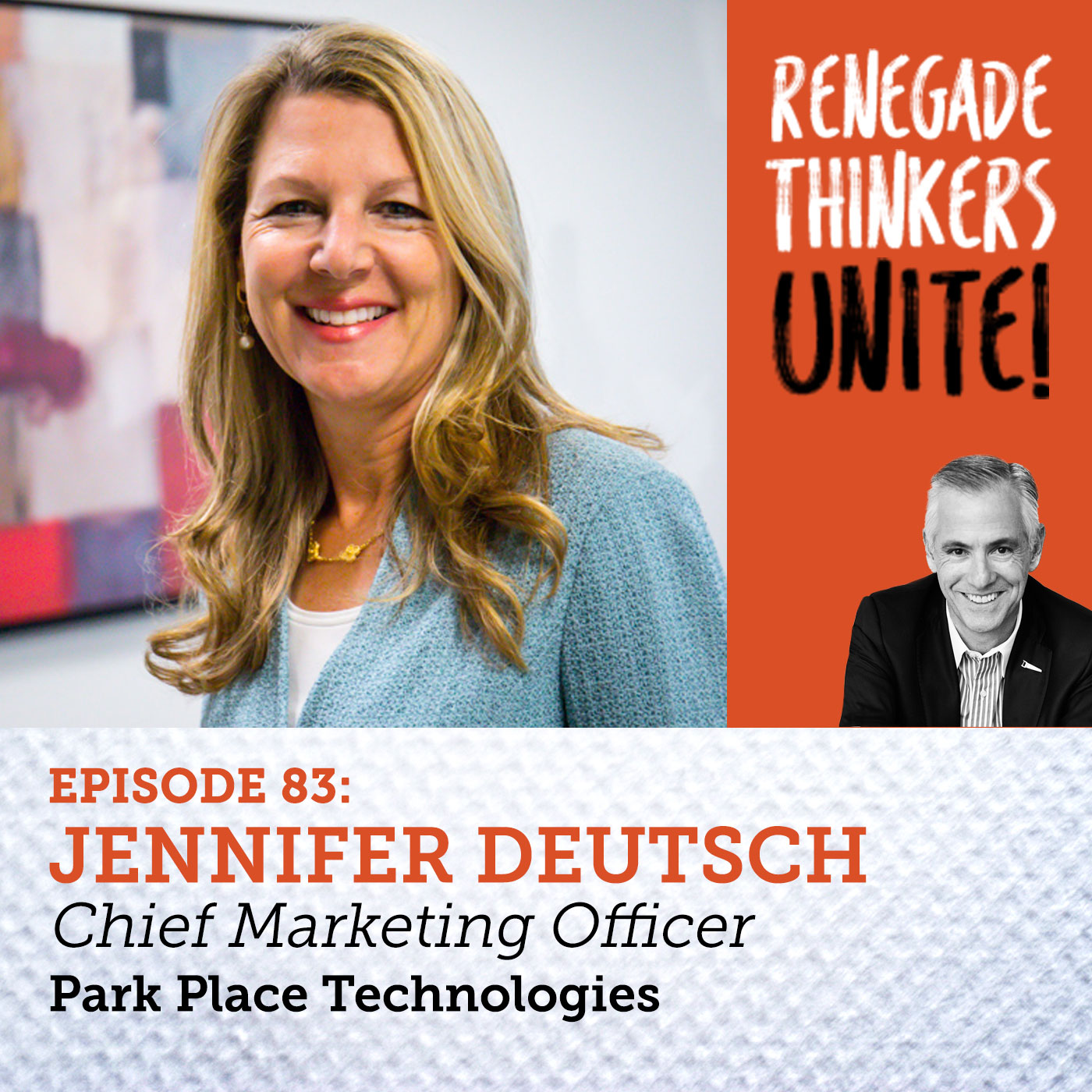
Ep 8383: Here's Why Your Brand Must Deliver on a Marketing Promise
Creating the perfect marketing promise is one of the biggest goals for CMOs. But a marketing promise without a product to back it up will not succeed. On this episode of Renegade Thinkers Unite, Drew interviews Jennifer Deutsch, CMO of Park Place Technologies - a company that specializes in third-party data center maintenance. She shares her experiences in pairing the perfect marketing message with a brand-changing product and it's an episode you don't want to miss. Jennifer shares her expert opinion on how your team can identify the "aha moment" for your brand. She and Drew also discuss how sales leads are directly connected to marketing and the importance of simple marketing. Learn from Jennifer's recent success with marketing promises by listening to this episode. Subscribe on Apple Podcasts - Stitcher- or Podsearch What You'll Learn [1:12] Jennifer's diverse experience brings a high level of expertise to this episode of Renegade Thinkers Unite [2:35] Jennifer's Renegade Rapid Fire [12:02] How did Jennifer and her team come up with the idea of anticipating customer needs? [17:46] What percentage of leads are driven by marketing? [19:43] A new product launch delivers on your marketing promise [23:53] How marketing & PR is directly tied to Park Place's global leads [26:24] Why simple is marketing is hard [28:07] The biggest lessons Jennifer learned while at Park Place Technologies A product MUST deliver on your marketing promise, or else it won't succeed If your CEO says "we don't have a new product, but we need a new campaign" - consider finding a new company. Marketing without a deliverable promise isn't really marketing, and it won't make an impact on your customers. It's the CMO's job to find a position that supports a new product and then deliver on that marketing promise. A stellar new product and a foolproof marketing plan create a 1-2 punch that will fundamentally change perceptions about your brand. Anticipating your customer's needs will allow you to crush your competition Jennifer and her team at Park Place Technologies have created the perfect tagline for their latest product and marketing releases, "Up-time is everything." They recognized that for data centers and technology companies, "downtime" (where servers and technology aren't functional because of repairs or unplanned incident) directly equates to lost profit. Jennifer and her team decided to passionately pursue the idea of "up-time" and make it a new cornerstone for Park Place Technologies. That was their "aha brand moment." On this episode of Renegade Thinkers Unite, Jennifer explains her process for internal and external rollout after identifying customer needs and creating a marketing campaign to support the product. They spent 1 month explaining the "why" and the inspiration behind the new campaign. This allowed internal audiences to buy into the new direction. Then, the global external rollout followed with digital and print marketing efforts. Combining these two rollout plans, just as Park Place Technologies did, will allow your company to see the greatest levels of success when delivering on a marketing promise. Simplicity in marketing key, but hard to master Effective marketing begins by simply understanding what makes your audience tick. Jennifer encourages CMOs to speak their customers' language and identify their needs. After you've identified those puzzle pieces you can begin to craft messages that speak to those needs. Drew and Jennifer discuss why simple marketing is as valuable as gold, but why it's so hard to perform in the right ways. Simplicity in the right places is genius, but simplicity in the wrong marketing places isn't strong enough to make an impression on your customers. For their solutions on how to simplify your marketing while have it be backed up by a product, don't miss this episode of Renegade Thinkers Unite. Connect With Jennifer: Jennifer's webpage at Park Place Technologies Connect with Jennifer on LinkedIn Follow Park Place Technologies on Twitter Follow Park Place Technologies on Facebook Resources & People Mentioned Gartner events Dragon 360 digital marketing Connect with Drew http://renegade.com/ On LinkedIn On Twitter On Facebook On Instagram