
Rebel Buddhist
292 episodes — Page 5 of 6
Ep 91Why We Hurry Towards Our Goals
This week is about why we hurry. Not the kind of hurrying when we are trying to make it on time to a party or a meeting, but when we hurry towards our goals. Why we rush. Why we feel pressured to achieve our goal – like yesterday. I speak from experience here when I say feeling that pressure to achieve our goals faster feels pretty crappy. So let’s jam about freeing ourselves from this sense of urgency.After giving birth to my daughter 7 years ago, I decided it was the perfect year to hit 6-figures in my biz. I know…probably not the best timing with a new baby and all. But anyway, I set out to do that. One of my coach certification programs offers an award every year for coaches who earn 6 figures or more, and I really really wanted to be on that stage accepting that award. Not so much for the money, but for how awesome I thought it would feel to walk across that stage and claim that shit - especially because while I’d earned good money in healthcare, I was really skeptical I could earn as much outside of being an employee working for someone else who earned a shitton of money. And of course, particularly when you grow up with very little, you are fucking proud when you create your own abundance. I hired an assistant for the first time ever since i knew I’d need to delegate some of the more tasky tasks since I had a newborn, and I got to work. And I mean I hustled. I didn’t get to take a true maternity leave and I had to go back to work sooner than I wanted because we needed the health insurance. I was working full time in clinic and then busting my butt after hours and before hours building my business. I justified overworking because I was awake anyway tending to my newborn so might as well multitask and earn money while I was at it. I have photos of me breastfeeding my kiddo and typing on a laptop at the same time. Ridonculous. I felt all this pressure. I set this goal and I just had to achieve it or I thought it would mean I failed…and I really didn’t want to fail. I had invested in learning to be a coach and in my business and I felt like this shizzle and has GOT to work. I also felt a huge sense of urgency because I really wanted to reach financial freedom so I could ultimately have more time with my new baby! I wanted to be able to have control of my own schedule and earn enough money on my own terms so that I could - in my mind - be a better mom and not have to hustle like my mom did. Maybe you can relate a lot to this as well - you’re desperate to hit your goals and feel this pressure to do in now. We get impatient. Stressed. We start to hustle. It really sort of sucks. And we wish we didn’t have all the pressure. But in the end, it is ourselves that create the pressure. Maybe you think you’re running out of time. Maybe you think it’s the only chance you’ll get. Maybe you think if it doesn’t happen now, it never will. Or perhaps you think you should be further along than you are now. It could be in your career, your love life, your meditation or yoga practice… anything! The pressure seems like it’s a good motivator, but it is not helpful energy, and it weighs you down. Why? Because underlying the pressure is the belief that there is something wrong with where we are now and that once we hit our goal, we’ll be happier, more free, more secure, more whatever. We think “over there” is way better than “over here.” We think we’ll feel way better about ourselves and our lives … over there. But what actually determines how we feel? Our minds! We could have everything we’ve ever wanted, and we can still feel crappy every day if our mind is hooked by unhelpful thoughts and beliefs. It’s important to remember that reaching our goal isn’t what will make us happy. Sure – we'll get a temporary dopamine hit once we achieve our goal...but then we will return to our baseline level of happiness and realize: we still have the same brain! The belief that if we get what we want, we will be happier is the nature of the human brain (more on the hedonic treadmill in the pod). However, we need to learn to rethink that logic so that we achieve our goals in a more joyful and successful way. When we talk about the stress we feel about “needing” to meet a certain goal, it is our minds that will ultimately set us free - not achieving our goal! Plus, when we achieve any goal from a place of desperation and hustle, we’re going to feel exhausted, because how we got to our goal matters! When I hit 6 figures that year, I was burned out and exhausted, and I almost closed down my business. I knew it wasn’t sustainable to do it that way. I took a step back and put the business in maintenance mode… until I found out about a more feminist way to make money without all the hustle and grind. (Check out some awesome coaches and influencers in the resources!) I’ve learned through them that how I get to my goal matters, because that is how I will live in my goal and in that achievement. If we get to our goal in a way that feels good to us, we
Ep 90The Antidote to Doubt
Doubt it a totally normal experience. It’s comes with the territory when you’re a human born with a brain. It functions to try and keep us safe...to assess potential danger and protect us. However, it keeps us from experiencing true inner – and outer – freedom. In Buddhism there is he concept of the Five Hindrances, which are mental states that impede progress in our meditation practice and our daily lives. They can also lead to unhelpful - or even harmful - actions. These hindrances are:Desire for sense pleasureAversion/hatred/anger/ill willApathy & lazinessRestlessness/anxiousnessDoubt Today’s we’ll jam about doubt and its antidotes - the medicine that can help address it when it arises. If doubt is part of the deal with being human, we might as well get good at it, right? One of the antidotes to doubt is seeking out examples of those that have gone before us. Yes, you can do it without examples. Yes,you might have to be the first example yourself. (Of course, there’s always the first, so later in the episode I’ll talk about what to do when you might likely be the first…) But if you’re not the first, it is hella awesome to hear about those that have already done it, right?! It doesn't mean you suck at managing your mind. It doesn’t mean you are messed up because you want social proof (I mean, that’s why we all put testimonials on our website of previous clients because…we know people like to see examples!). It’s totally normal to want to see if people have done it and to use that as inspiration. Especially when it’s hard to manage your mind on a given day. Examples aren't required to succeed, but they can help. And yeah, if there aren’t any testimonials available - no social proof - you can at least know what you’re getting into ;) Wanting proof doesn’t mean you suck at managing your mind or that you’re messed up. It’s totally normal to want to see if people have done it and to use that as your inspiration. Using inspiration as an antidote to doubt has been around for thousands of years. It works. Doubt can be one of the most difficult things to deal with because when we believe it and get hooked by it, it can stop us from taking effective action - from continuing our meditation practice, from promoting our biz, or from getting up off the couch and being active. We become paralyzed. When the doubting mind hooks us, we get stuck, and we often want to make it go away quickly and resist it. But that doesn’t work in the long-run. That’s why a second antidote to doubt is mindfulness and becoming present with it. Fully processing it. The full episode walks you through a great practice you can do to become more mindful of doubt, but a few things we can pay attention to when it surfaces are: Can we identify a trigger to the doubt (comparing ourselves to others on social media, looking at fashion magazines, hanging out with toxic people)? Is it arising in a “loud” way or with less intensity? What happens in our body? How long does it last? What mental state follows doubt? When we observe doubt in a more detached way, we can observe it with more loving awareness, and our whole mind becomes freer. Note this particular antidote is not about resisting doubt, but about letting the resistance that is there be, soften, and fade away. It’s about being with doubt and reminding ourselves we don’t have to believe it. This is where thought work comes into play. After processing the emotion fully by being present with it and releasing resistance to it, we can get curious about it. And when we take early steps to become mindful of doubt as a thought process, something awesome happens: the doubt itself becomes the source of understanding ourselves. (Check out more on how to coach yourself through this thought work with doubt in Episode 18). What about if you’re the first person to attempt something, so there are no examples to inspire us? Remember: there will likely be times you will be the first – especially if you’re going to be diving into a new market, creating a new process, or coming from a historically oppressed group breaking through the system, for example. In this case, we can use thoughts about how others have been the first to do things and that they still did it, even when they doubted themselves and had no examples to go before them. We really can let doubt become a window into a psychological adventure for us; to show us parts of our brain we weren’t even aware of. Adventure - being open to the unknown - is how we evolve, learn, and grow. When doubt arises, we can say, Thank you for trying to protect me, but I’ve got my own back. I’m OK with an element of adventure. I’d rather take the risk than have regrets. Learning to work with doubt is essential to freeing our minds and hearts and for deepening our meditation and other practice, and to keeping us open to the adventure of life. In this Episode you will learn:// The 5 Hindrances – mental states that impede our practice and daily lives// How not learning to manag
Ep 89How to Manage Criticism Anxiety
Correction: The original source for the quote about "The Man in the Arena" was incorrectly stated as Thomas Jefferson - opps! Didn't have my chai yet! The correct author is Theodore Roosevelt. One of the hardest parts of starting the Rebel Buddhist Podcast for me was anxiety around receiving possible criticism. If someone says something on a social media post or a blog post, I’m able to respond and maybe even point out where they misunderstood or something. But for a pod, someone can just say something and that’s it… it’s out there, without a chance for me to respond. That was really scary to me because I really want to feel understood...and I like other people to think I’m right (don’t we all?). I hear this fear of criticism a lot in my clients when they talk about why they’re resisting putting themselves out there. Then there are people who are writers, actors, or chefs, and in those professions there are people whose job it is to be critical of others’ work. I asked an artist friend how she learned to deal with that, and she said she had to develop a thick skin over time. So how do we manage criticism of our career or our creativity so that it doesn’t keep us from putting our unique gift out into the world? First is to understand where it comes from. Fear is a legitimate reaction. Our primal brain was trained to seek approval and validation for survival, because if we were ostracized, it could mean literal death – no help with food, water, shelter, or protection. So reacting fearfully makes sense from that perspective. One option to manage criticism is avoiding it, and trying to protect yourself from criticism by living a vanilla, safe, insulated life, hoping that if you don’t stand out, no one will notice. But humans are resilient AF. Sure, we can plan small and feelsafer, but that is not what we were built for! Plus, when you play small to please others, your inner critic gets loud about you not putting yourself out there more. You’ll be uncomfortable either way - feeling the risk of discomfort by putting yourself out there, or guaranteed discomfort by not putting yourself out there and wondering, “What if?” If I’m going to feel uncomfortable either way, I’d rather feel it going for my dreams and risking external criticism, instead of the discomfort of not even trying. So, while it IS a valid option to not take risks, if you’re like me and you’re willing to take the discomfort of taking the risk over the pain you’d feel for not even trying, I have some additional tips for you to handle the inevitable criticism that will arise. One option is to not even read, or listen to, the criticism you receive. You’ve probably heard about actors or writers and chefs that do this. They don’t read their own reviews. Thankfully, I had my artist friends to help me see this as an option early on. Because I have this podcast, write blogs, and contribute to a ton of journals, magazines, and articles, I receive criticism. For me it’s sometimes helpful to have my VA look into these and bring any to my attention if there is something worth giving time and energy to instead of just reading them all myself, even if it’s a lot of internet trolls who just want to get a reaction. It was much more productive for me and helped me to avoid a never-ending argument with some online troll. And since I may miss the “good” stuff when I stay away all together, I also ask my VA to show me the client love that I receive. Another tip is to remember the research in positive psychology out there about the 5:1 ratio, which is related to countering negativity bias. This concept suggests that for every negative comment, we want to gather ideally 5 positive comments to counter it/neutralize it. This takes practice and is easier said than done, because negativity bias is the natural response for us all – it is trying to find danger to keep us safe, and warm fuzzies are not a threat (to most of us;). We also have to pay attention to applying this technique to our own negative self-talk and inner critic too. Often we are our own worst critic. Another tip is to keep an open mind when hearing or reading criticism. I was taught to ask, “What’s the 2% truth in this?” It helps me open my mind to possiblity, and it feels safer than “What is 100% true about this?” (though there may be a time when 100% true is also important to look at). Asking this question helps take away the defensiveness and opens us to really seeing other options that might help us grow. It also helps us truly listen, and for the other person to feel heard. Once we hear that criticism and find any truth in it, we can decide what to do with it. Take it or leave it. Like, “I’m ok with that truth. I’m naturally imperfect and that’s totally fine.” Or, that’s good to know – I'm going to tweak a few things. We have to make sure that what we don’t do here is to decide that it’s part of our identity… that we’re not worthy or good enough, intelligent enough or lovable, for example. We can accept
Ep 88Overcoming Imposter Syndrome
I was reflecting a lot on my life when I grew up in the ‘hood with so little, and when I lived out of my car for 7 years as a climbing guide and how my life was so simple and I made hardly anything and bought hardly anything and I was so so so content. And while I was content, I admit that while I had confidence in many areas - guiding and my dreams and purpose and my power as a wild woman living in the mountains…I had a lot of doubt if I had what it took to create a different kind of abundance. I knew I was good at academics; I knew I was good at guiding; but…what IF…let’s just say what IF I could figure out how to earn enough money to (gasp!) have more than enough? My mama had taught me a mindset that I’d always have enough if I used my money for the right things. So I actually was good on “enough,” it seemed. I never went…hungry. But…I wanted - needed - more than enough. I wanted to be able to pay for emergencies if they happened, to take my mom and dad on well-earned vacations; live debt-free, hook up friends with abundant cheese and wine. Own land. I mean - we didn’t own anything ever - we always rented and got moved from place to place. I longed to own something, somewhere, that no one could make me leave. So after getting cancer twice, I think of this life coaching thing, right? I want people to be able to live a life of no regrets without having to get a cancer diagnosis. Not that many people were coaching then, and two people I really respected from my guiding world were doing it and it sounded right. And I was a confident woman…I thought, “I can do this.” And I did. I started to earn money. Started to get busy. Started to gain traction, be interviewed on podcasts before there were so many…and then…something I hadn’t felt in awhile showed up. Doubt. Self-doubt. Here I was. Successful. Finally. And doubt crept in. I started to tell myself, “Oh this was all a fluke. It’ll end soon.” Or, “One day someone will figure out I’m not that smart. They’ll realize all these degrees I have were somehow good luck.” One of the most common misconceptions about successful people is that once they get to where they want to be, the work is over and they don’t ever doubt themselves again. Like when WE doubt ourselves, that must be based in some kind of fact, because truly successful people don’t feel self-doubt. The reality is the opposite: successful people actually have to deal with even higher amounts of this sort of imposter syndrome. They’re just better at managing it.And THIS is why you’ve heard me say things like, “discomfort is the price of the life we were meant to live.” Or, you don’t deserve comfort – you deserve better. Because shit doesn’t just stop being uncomfortable or hard when you achieve success. When you meet your goal. Yet a lot of people fail ahead of time and quit because they feel this doubt and choose to believe it's based in some kind of truth. That’s really what separates successful people from those that choose to give up - the willingness to be uncomfortable and learn to manage it. To learn to suffer and not let it get in the way of you taking effective action. Like I said, I am no stranger to self-doubt and imposter syndrome. People may say, “Wow Ana, how are you so confident?” Look - one can feel confidence AND still have self-doubt. But when we learn to manage our self-doubt; the confidence can be the predominant feeling. Whenever we evolve, whenever we level up our lives, we are doing to experience self-doubt. It’s part of the deal. It’s not a sign that anything has gone wrong. The secret is: it’s a sign that we are in exactly the right spot. But this discomfort is why a lot of people don't even try to grow, to evolve. It’s not the cozy thing to do. So a lot of people don't want to stretch expand their comfort zones. We don’t put ourselves out there. Instead, we try and hide, an dimposter syndrome encourages us to do so.Imposter syndrome shows up as thoughts that don’t support us actualizing our capacity, our capabilities – both the ones we are still cultivating and the ones we have already actualized. This stalls our growth and evolution, because growth requires us to move beyond our own limiting beliefs about what we are capable of. If we want to become who we are meant to be in this world, and create the life we were meant to live - a healthier body, loving, more intimate relationships, abundance - then we need to commit to managing our minds when these doubts arise. A lot of people will set these amazing and totally achievable goals for themselves and when they hit a speed bump or see self-doubt arise, they think something has gone wrong – “Maybe I’m not cut out for this. Maybe it’s not meant to be...” But we need to remember that it often takes more than one try to learn something – AND that just because things aren’t easy or don’t feel great, it doesn’t mean anything is wrong. When we were babies and we were learning to walk, we fell. A LOT. But we kept trying, and now we can run
Ep 87The Problem With Being Right
If you haven’t realized, I have a bit of a stubborn streak. I like to be right. It’s a thing I do. Once, when I was arguing with someone because I knew I was right and I just couldn’t let it go, he said, “I can tell you really like to be right.” It was just an observation - not a judgment. He even said it kind of nicely. “You really like to be right.” And I was like, “YES, I like to be right? Why would I not? Do you go around letting people think things that are wrong?” And he looked at me like, yeah, that’s an option. Blew my mind. And I wasn’t sure I agreed. Years later, I looked back at this moment and realized that sometimes, it’s not all about being right - it’s also about being happy in this precious life we have. And we often thing being right will help us feel happy...but that’s not how it works. So I started to wonder… Why was I – and so many others - so driven to be right? One reason is that we are trying to protect ourselves. There are a lot of us out there who have a limiting belief that we are somehow damaged, broken, not safe, or not good enough (or all the above!). These ideas usually started from the messages we received when we were a lot younger from our primary caregivers and others who had a lot of influence in our lives. Most of the time, when we have this type of belief, we also try to keep it stuffed away because it feels pretty crappy. Maybe we start to see glimpses of these beliefs arise in meditation or in our disproportionate reactions to certain things – but usually, but we try to keep it all tucked away so it doesn’t interfere with how we’d like to see ourselves. One way we do that is through this psychological defense mechanism called reaction-formation. This means that when we have a really painful thought, we turn it into its opposite. Like the insecure guy who acts like a pompous ass acting better than everyone else. Or when we get judgy and put others down so that we can see ourselves as superior. Another way this appears, which I see a lot with my clients, is in the need to be right and to have others agree that they are right. It’s a way of compensating for feeling out of control. I definitely identify with this. I grew up in the ‘hood - a poor and violent neighborhood and I was told that my brain – academics – would get me out, and that it was my only way out. My intellect helped me make sense of the world, keep order, and plan and rely on the future and take care of myself and those I love. So when it’s challenged - when someone says I might be wrong - it feels vulnerable AF. In order to keep control of the world, and to feel safe, I try to control being right. Think of that one person you know who is always believing and acting like they know what’s best, no matter what’s going on. You notice in the words they use, their tone, and their body language. And those messages they’re sending can be hurtful to others… especially kids, who use those experiences to shape their belief about their worthiness and lovability. So when we are emotionally attached to the need to be right, any other idea, opinion, suggestion, or perspective must be “wrong.” That need to be right tells us that we’re OK. It addresses those limiting beliefs by trying to provide proof that they are wrong. So of course we fight hard to be right! It’s usually not even about the thing we’re arguing about. It’s about what we make it mean that we are being challenged. It’s about the tender, wounded human behind all that, who hurts when someone disagrees with them because it threatens our loveability, our worthiness, our safety. When we fight hard to be “right,” it actually creates so much suffering for everyone involved. We feel crappy about it after the glow of being proven “right” fades, and the people we argued with - colleagues, partners, family, kids, friends – often feel just as bad. Maybe they were just sharing. They probably didn’t mean to say anything about our worthiness or lovability. But it sure feels like that So how can we learn to let go of being right, and allow happiness in instead? As it often is, the first step is awareness, because this pattern occurs automatically. We can notice the need to be right and our attachment to it. Mindfulness is a great tool here. Learning the art of the pause, getting curious about that feeling, and not judging ourselves for having it. Next is we can offer ourselves self-compassion. We can’t go further without it, otherwise we’re just resisting uncomfortable emotions and trying to grow when we still don’t feel safe. One we’ve become aware we are hooked and can see our attachment to being right and offered ourselves some self-compassion...THEN we can ask ourselves: Would I rather be right, or happy? This is a powerful question. It helps us realize that trying to be right is a choice – a choice requiring vulnerability, but opening us to true happiness. Which is more important – being right, or being happy? Which is more in alignment with how you want to feel and s
Ep 86Sneaky Lies We Tell Ourselves
There’s a saying, “People will doubt but you say but they will believe what you do.” And this is because it is well-known that what we say isn’t always what we mean. What ultimately matters is what we DO. How we show up in the world.
Ep 85Greatest Hits Vol. 3 - Forgiveness
Here we are - at the end of the year, maybe looking back and wondering how it all happened the way it did. Maybe holding some grudges or deep resentments...or shame about how we showed up. The good news is, if we want to, we now have a chance to do things differently. Ultimately, we all get to choose how we want to show up every day, but there’s something significant about how we move into the next year and how it can set the tone for what is to come. You know we’re all about Freedom here at the Rebel Buddhist – inside and out. One of the things I’ve found that we can do to give us the most emotional freedom in the next year is to partake in the courageous act letting go of things that no longer serve us, and one of the most radical acts we can do to let go, one of the things we can do for ourselves that can truly help us feel more light and free…is forgiving. Forgiveness has been a huge practice for me - and I say practice because I’m still learning how to do it with things that have really cut me deep. It’s like each year I can get to a deeper layer of forgiveness - and I want to keep going, however hard it may be a lot of the time, because I believe that the lack of forgiveness and the need for forgiveness are some of the biggest challenges many of us face. One of the most powerful things I ever did was forgive my mom for abusing me as a child. You see, I had a lot of anger about my childhood for many years. I was uber-pissed, and for objectively good reasons. I won’t go into details, but you can imagine the myriad reasons people feel wounded and broken. Many of those things happened as I was growing up, but regarding my mother specifically, I was so angry that she hurt me physically and emotionally. I was resentful that I didn’t have a mom I felt safe with, and that I was this angry person walking around, blowing up at my boyfriends, feeling defensive, and easily losing my shit. “What a bitch for making me so angry!” I’d think to myself. And it was weighing me down. It was also impacting my relationship with her…with her as an older, gentler, less angry woman who wanted to be close to me. While I was angry and bitter, for a long time, in the end I knew that deep down, despite her mistakes, she was doing the best she could in the moment with what she had available to her. So, as an adult, I had a choice to make: 1) I could keep reminding myself and my mom that things really sucked growing up and about how much she hurt me, and that I was all sensitive and defensive because of her, and that she really screwed up royally with some things. Then she’d apologize and feel shitty about herself and I’d feel guilty and all upset after re-hashing all that crap. And we’d do this over and over, as I strived to get back at her for hurting me the way she did through guilt-trips and passive aggressive behavior and not-so-passive aggressive behavior… OR – I could stop thinking that I was deeply wounded and broken, wanting to make those feelings go away until I allowed myself to move forward…wanting to “understand” everything and have it make sense – and have everyone else understand and agree that I was wounded – before I allowed myself to be happy… I could stop all that and instead… 2) Say, “Well, that sucked. Royally. But now it’s time to create my new life.” Needless to say, after years of the first, victim-mindset option and hanging out in therapy wondering why I was still having panic attacks, I decided to try #2. And it changed everything. I can’t completely describe the shift that happened when I stopped thinking that in order to heal, I had to wallow in the past until some magical moment when things would feel right. I realized that insight and understanding don’t fix everything. They feel good, sure. They’re useful, sure. But what created a real shift for me was changing what I DID. How I thought, how I responded, the situations I created. How I FELT. It was ACTION that allowed me to grow and change…and ultimately, heal. It was me taking ACTION that allowed me to see myself as whole, and perfectly resourceful and creative. That I was indeed perfect as I was. Not broken. Not wounded to the core. Not in need of more therapy or days of crying to feel seen. And the most courageous action I took was to forgive. Of course, I found therapy helpful for some things, especially learning how to notice what I was feeling, and being able to share my story with someone who wasn’t going to try to explain it away or justify things. It helped me make sense of certain memories and I felt incredibly safe sharing deeply with someone that seemed “qualified” for me to lose my shit in front of. But in hindsight, which is always lovely, I realize that maybe I just needed one round of that. Then I needed to get off my ass and do things differently. I needed to create a different relationship with my mom, or walk away. The latter wasn’t an option for me, because I do love her deeply. So one day I said, “I’d like to talk.” And I asked he
Ep 84Word of the Year - Your Medicine
We’ve arrived at the final few days of the year, and how we participate in this transition will set the tone for the next one to come. If we want to be active creators of our own life instead of massive observers of our life (letting things happen TO us), it’s important to get clear and move, think, and feel with intention. One of the best ways we can do this is by trying to think of a phrase or word that encapsulates our intention. It may sound cliche or too woo-woo to pick a “word of the year,” but I’m telling you – it works! I use my word of the year to guide decisions, make plans, and to set goals. What the difference is between a goal and an intention? A GOAL focuses on the future, on externalaccomplishments. They have a specific outcome, describe what you want to do, and are future-focused, like to run a marathon. Go surfing in Hawai’i. Create better sleeping habits. An INTENTION focuses on a present, internal state of being that you want to cultivate. Intentions describe how you want to be or feel in the moment, how you want to move through life, and how you want to show up. Some of my clients have had the intention to live with more confidence, compassion, mindfulness, inspiration, joy, generosity. The word of the year focuses more on intention than a goal. It helps guide how you get to the goal, how you align your life with your values, and how you create the life you are meant to live. Some people think they should choose a goal and set intentions to support that, but aligning with our intentions first will keep us from wasting time, money, and energy on goals that won’t fulfill us. To set an intention, think about how you want to show up in the next year. Who do you want to be at the root of all your actions for the next 12 months? (Be sure to not stress on creating the perfect one because you aren’t sure what the next year will bring. It may change as you learn and grow and that’s totally okay!). Another way to think of this is to ask, “What would help me live more authentically in the next year?” Or, “What quality would help me show up the way I want to in the world?” Sure, joy, confidence, love...those sound great, right? But sometimes what we need isn’t so comfy. Surrender. Forgiveness. Vulnerability (that’s mine for the next year)...can make us want to squirm a bit. When we head into that territory, it’s more like we’re asking for something like a bitter medicine that heals. So sometimes, to find our word of the year, we can ask, “What medicine do I need for the next year?” or even, “What would crack me open and reveal my authentic nature?” Like I said, mine is vulnerability, and I am admittedly nervous about this one, but I know it will help me open my heart even more, and shed the armor I’ve had up for so long (more on that in the pod). As for goals, they’re the action part of your intention. They’re the things you will do so your vision becomes more tangible. Once you’ve set your intention, you can set your goals. Look at how each goal aligns with your intentions (and other goals) and ask yourself - do they support each other, or conflict? The trick can be in staying connected to your intention as the days go by – with all the distractions like emails, to-do lists, work obligations, daily chores and tasks and all the other crazy shizzle life throws our way. One thing I’ve found really helpful is to find a talisman for your word of the year. It can be as simple as a piece of jewelry, a special article of clothing, a rock or a shell, an epic song or playlist, or a picture. Some people even get tattoos (but don’t blame me for that idea later).Either way, having a physical reminder can help you stay connected to your word. Ok - so here we go, rebels. I'm on mission to be cracked open by vulnerability itself. What about you? What will help you live your most authentic life? May it be just the medicine you need. In this Episode you will learn:// The difference between goals and intentions – and why it matters// When an intention becomes medicine// How to pick your Word of the Year – and have it actually mean something// Strategies for saying connected to your intention when life gets in the way Resources:// Check out Episode 32 - How to Review Your Year // Check out Episode 33 - Living in Alignment // Download the A Year in Review worksheet here // Want to join us for 6 months of magic and adventures in the Adventure Mastermind? Of course! Head to www.AdventureMastermind.com to get on the waitlist now – applications open in January! // If you’re new to the squad, grab the starter kit I created at RebelBuddhist.com. It has all you need to start creating a life of more freedom, adventure, and purpose. You’ll get access to the private Facebook group where you can ask me questions! Once you join, there’s also a weekly FB live called Wake the F*ck Up Wednesday, where you can ask questions that come up as you do this work – in all parts of your life.
Ep 83Vulnerability & Lovingkindness
Lovingkindness is foundational to cultivating wisdom and compassion in our mindfulness practice. A lot of people feel like mindfulness is a peaceful and relatively sterile thing where we are aware of our surroundings, but I’ve found that at deeper levels of mindfulness, there is also an element of love. So yes, we can mindfully move through the world with love. But when you’ve had life challenges, that can be hard to do, right? It takes work. We long to love - to be vulnerable - without holding back! But when we’ve been hurt we want to protect. And we may have even been taught to hold back our love by our cuttural upbringing. I was doing some awesome introspection recently and I realized that despite all of the growth and breakthroughs I have experienced over my life - and especially recently - I still have this armor around my heart - even towards those I want to fully love without reservation. We think we’re protecting ourselves when we hold back, but it’s the opposite. The true protection, the true refuge, is to love fully. Think about it – if someone happened to someone you love, would you think, “Wow, I’m so glad I held back because now this hurts less?” No. The true refuge isn’t in protection – it is in vulnerability and in loving fully. If you lose someone you love, you will be glad you loved fully - no holds barred. And I think we really all want to experience that - being free to love fully, but it’s when we feel threatened that we stop being open and present. Like when we feel unsafe that someone might disappoint us, or hurt us or that we might lose them. And depending on our culture or our family, we have been conditioned toward different degrees of separation or belonging. So we begin to get to familiar with that threshold, and we try to control the story, and we armor up. Usually it’s a deep disconnect that leads to us armoring our heart. That severed sense of belonging separates us from our hearts, and we can feel more distance and less belonging when we are not part of the dominant culture. Lovingkindness practice (aka metta in Buddhism) is a way of being mindful and expressing care, which reconnects us to the direct visceral experience of belonging. In other words, we’re trying to undo that conditioning of separation that keeps us from experiencing lovingkindness. We’re de-conditioning so we can be liberated and freed. There are two steps for re-opening ourselves to lovingkindness. The first is, “Can we see the goodness in others?” It’s our habit to look for what’s wrong, so it takes intentionality to do this. The second step is taking action and expressing care. You can use the classic metta practice to help guide you, but there are so many ways for how we can express lovingkindness – telling people directly, hugging them, writing letters, and visualizing showing them care (more suggestions in the pod). Look, this is not a place to fail, so please don’t make it about doing lovingkindness perfectly. It’s more an invitation to really dedicate ourselves to loving the life that’s right here for us, right now. If you feel stuck in these steps, I talk about some great practices that you can do to overcome those walls and open yourself up to lovingkindness in the full podcast Episode. You may feel selfish practicing lovingkindness toward yourself, but remember that when we hold our inner life with love, it dissolves all sense of separation from others, and true lovingkindness has to start there. It’s the first step in being able to love others fully. And when it comes to seeing goodness in others and extending love to them, there’s this tendency to not speak out our love, to not show it, to not let others know. But the greatest expression of love in action is to let people know you care about them. Drop thearmor. Be vulnerable. See the goodness, feel the love, and express it in kindness. In this Episode you will learn:// Why vulnerability is the most powerful form of protection for our hearts.// How being willing to drop the armor is key to experiencing and giving lovingkindness// Why protecting our hearts can sever us from a sense of love and belonging// Two basic qualities we can train in to practice lovingkindness// What to do when we hit a wall seeing or expressing lovingkindness toward ourselves and others Resources:// This episode was inspired by teachings from Tara Brach that she gave during the 2-year Mindfulness Meditation Teacher Training Program. You can find her work at www.TaraBrach.com // Check out Rebel Buddhist Episode 51: Self-Compassion // If you’re loving what you’re learning in this podcast, you have got to come check out Freedom School. Freedom School is the community for ALL things related to freedom, inside and out. It's also where you can get individual help applying the concepts to your own life. It’s where you can learn new coaching tools not shared on the podcast that will blow your mind even more, and it’s where you can hang out and connect over all things thought work
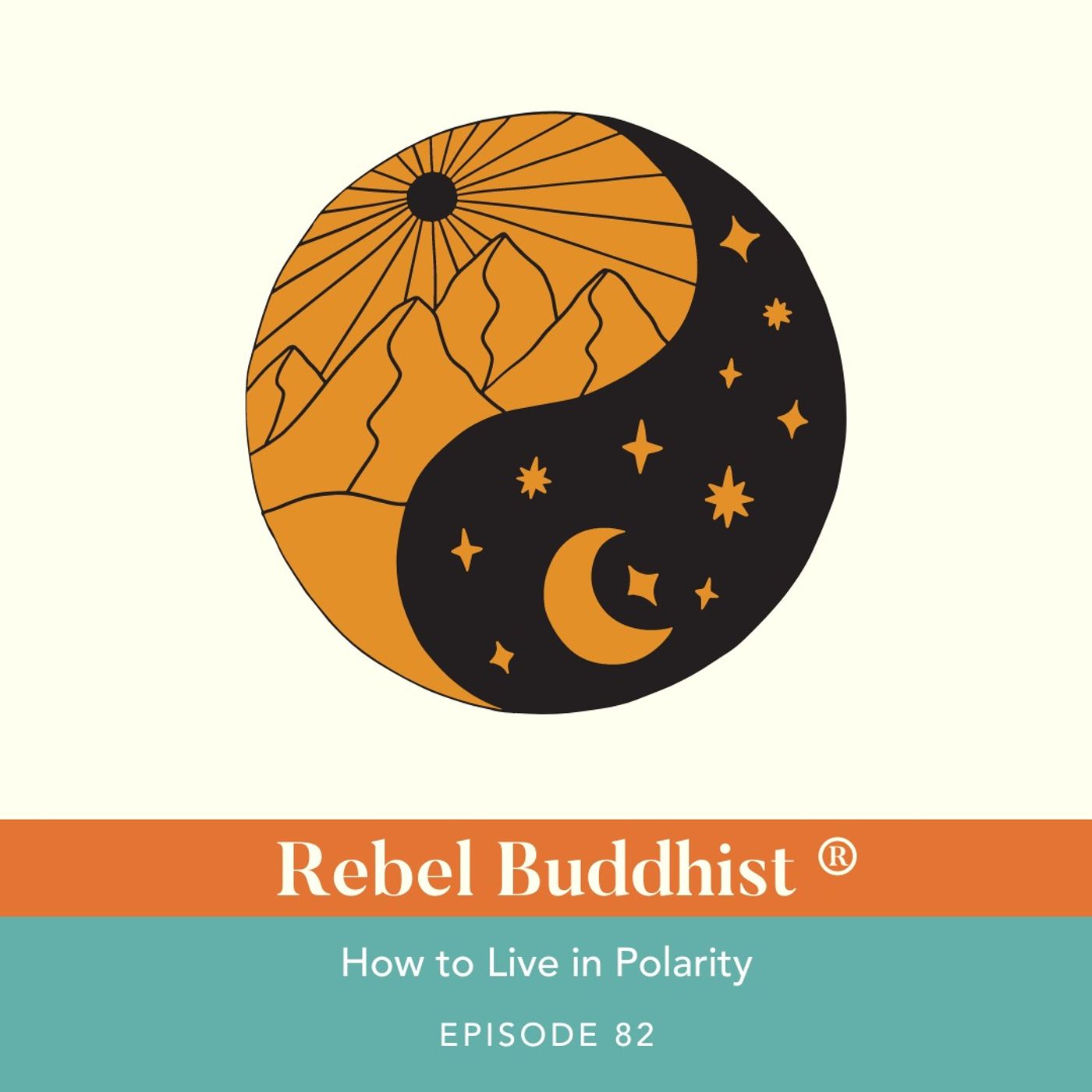
Ep 82How to Live in Polarity
We are all complex beings, made up of contrasts. Discipline and wildness. Security and freedom. Worldly and divine. There are dichotomies everywhere. It’s part of nature, and we are all a part of that. Yet often we are asked to choose only one aspect of ourselves and lose or leave the other. And for many of us, our culture believes it’s hypocritical to stand with one foot in each contrasting space. The place that deep work happens is often when we are recognizing and living in polarity. It’s where we change, evolve, and strengthen. It’s like the image of the Taoist tai chi or yin-yang. That dividing line isn’t just straight down the middle. It curves so that the two sides are cradling each other, and each side has a small circle of the opposite color embedded within it. You can’t have one without the other. Like light needs darkness, the polarizing parts of you need each other to exist. We all spend more time in this space than we realize. Maybe we are super healthy, but we can’t resist a greasy fast-food meal once every now and then. Or we post all these outdoor journeys on social media, but spend a full weekend binge-watching Netflix in our PJs and don’t tell a soul. Many people live in gender fluidity for this reason – acknowledging the limitations of choosing one polarity or another. So if it’s part of nature and part of life, why do we resist living in polarity so much? Some people may say that we feel hypocritical, or that our integrity in compromised when we want to live between polarities. I challenge that. Integrity is not about moral perfection. It’s about accepting the whole and not trying to divide who we are. We all have many parts to ourselves, and I want to invite us all to spend more time becoming whole instead of trying to pick which aspects of ourselves are valid or not. Allow yourself to have polarities, and integrate all the parts, instead of casting away parts of yourself. There is another image that embodies this: the mandorla. It’s used to demonstrate the concept that there is a space of overlap between two seemingly-opposed or contrasting realities, thoughts, or beliefs. It looks similar to a Venn diagram, with two overlapping circles and a small almond-shape in the middle where they overlap. When we stand in this center, in the mandorla (the term is Italian for “almond”), without seeing two seemingly dissonant concepts as mutually exclusive, we can start to be real. Whole. Authentic. Integrated. We all feel that tension between poles. It’s difficult to live between them instead of just choosing one when our culture or society doesn’t support that. So sometimes we can feel like we know who we are, yet we also feel like we must not really know ourselves. That tension can be so painful, and the reaction may be to escape that by fleeing to one pole or the other, or judging one aspect of ourselves and not accepting it. But if we run from that tension, we can’t do the deep work of becoming whole and living in true integrity. This isn’t about a resolution of the tension or a compromise between the opposites. Rather, it’s about going full-on into the tension so we can experience the true reality of them existing simultaneously in our being. So how can we explore this tension and experience that much-needed growth and wholeness? We can complete a mandorlapractice, which I learned from one of my own mentors! The full practice is outlined in the podcast, but below is an outline of the practice:Imagine (or draw) two large overlapping circles. Each circle represents one aspect of your life.Stand in one circle, face the other, and fully embody one pole of the opposing aspects. Make the best arguments for living/being THAT WAY.Step into the other circle and do the same with that opposing side.Keep going back and forth, switching when the tension is exhausting or unbearable.When you feel both sides have expressed themselves fully, sit in the middle (the mandorla) and feel the tension and pull from both sides. Be mindful of what happens in your mind, in your psyche, and to changes in energy or physical sensations. As Bill Plotkin says, the goal is not to learn something, but to be changed.” Keep doing the practice over and over. Eventually, you will realize that things are not as black-and-white as you thought. It’s important to note that this practice isn’t to help you decide between two incompatible choices or come to a solution. It’s to trigger a dissolution of your identity. So, what seemingly contradictory beliefs, thoughts, or aspects of your being do you have in your life that are difficult to reconcile? Try out the practice and explore how you can truly embrace all parts of you. And remember that you are human. Complex. And when we embrace the whole, that is when we are in full integrity. In this Episode you will learn:// Why we need to avoid putting ourselves into a box and casting out aspects of ourselves that seem contradictory// How living in polarity is not hypocritical – it's completel
Ep 81The Importance of a Daily Routine
Today is about one thing that could make a huge difference in your life - with relationships, health, creativity, and especially our mental health.
Ep 80How to Not Lose Yourself in a Relationship - Part 2
What we talked about in Part 1: // Attachment theory and mindfulness of emotions and thoughts// How patriarchal society predisposes us to certain thoughts + beliefs and filters our relationship experiences// How it makes sense that anxiety leads to crazy thoughts and actions// Why those actions could end up leading us to lose ourselves in a relationship// The FIRST step in healing: offering ourselves self-compassion This week, we’re going to dive deeper into more tools and concepts. The first is cognitive bias, which is a function of our brain that searches for evidence of what we already believe to be true instead of what is actually true. It’s like when you’re in a moment of anxiety and you completely forget those other times where you were anxious, and nothing was wrong. For me, I remember experiencing moments of complete panic in my relationships, and a partner would text me something super sweet like, “Hey, thinking of you and missing you,” and I would just think, yeah right. They’re just saying that to appease me, but they don’t mean it! Cognitive bias explains why it’s pointless to try to change how other people behave so that we can feel better. Because our brain will still have the same filters and thoughts. It will interpret it in a way that supports what we believe. The other reason trying to control others is a bad ideas is because they often actually don’t do it… and we also feel a bit ashamed about how needy and desperate we’re being. We’re just trying to control them to make ourselves feel better about what’s in our heads. Instead, imagine feeling Ziji – radiant inner confidence no matter how other people behaved. Feeling secure attachment, no matter what. This doesn’t mean we should say in a relationship with just anyone. What it DOES mean is we can have a sense of security no matter what. We are grounded in ourselves and know what we want, which allows genuine love and connection in our relationships. Even when we have disagreements and conflict, we don’t experience that anxiety or feel insecure as a result. The hard part is that most people aren’t born with these skills. We need to learn them. Another aspect that affects how we tend to lose ourselves in relationships is perfectionism, which contributes to anxious attachment styles in particular. If you think about it, perfectionism and anxiety go hand in hand. We think we need to be perfect in order to be worthy and to be loved. And what’s more of a place to run into that fear head-on than in a romantic relationship? Of course, it can be seen in any type of relationship – familial or friendship – but there’s something about intimate or romantic relationships that really brings this up for people. Intimacy involves being vulnerable and human and messy and not perfect. If you’re a perfectionist, you judge and reject yourself for being that messy human, and when you start getting intimate with someone, you project onto them your own constant self-evaluating and analyzing. If you catalogue your faults, then your partner is, too. If you compare yourself with others’ looks and personality, then your partner is, too. And then you want your partner to reassure you about something they can’t possibly fix because it’s your own thoughts about yourself. Perfectionists (and black and white thinkers) also don’t have much of a sense of healthy balance or limits or how to construct a relationship they want. They also may not know how to take it slow. They don’t know how to gradually develop a relationship and integrate it into their life.Something I briefly touched on in part 1 is that those with an anxious attachment style tend to subconsciously pick someone with avoidant attachment patterns. Part of it is because it activates their kind of anxiety and they get caught in a cycle, but it’s also because they don’t know how to moderate themselves as an all-or-nothing thinker. The funny balance of this type of relationship is that while you keep wanting more, they set all the limits. When you’re used to rejecting and judging yourself by what others think you should want and how they react to you, that pattern can feel totally comfortable. On the other hand, I also don’t think dating someone with a secure attachment style is the answer. It’s like encountering emotional sobriety. You can clearly and sometimes painfully see how much you create this drama in your own brain. So those with an anxious or avoidant style tend to reject the secure attachment people because they’re addicted to the drama of anxiety and relief. At the end of the day, though, all of this is about your relationship with yourself and your capacity to believe your inherent self-worth and lovability which has been 100% since DAY 1 of your existence. Here are just a few additional tips to help you not lose yourself in a relationship (I talk about so many more in the full podcast Episode!): Live an amazing life without a partner and realize that you can have a fulfilling life with just you.If s

Ep 79How to Not Lose Yourself in a Relationship - Part I
Does this sound like you:// You obsessively check your texts to see if so-and-so has replied yet// If they don’t, you start to spiral about if they still care about you, or what might be wrong.// When you receive an email, you have a sort of mini-panic because it could be bad news about someone being upset with you - even though you haven’t even opened it yet.// You overreact to minor feedback, or get overwhelmed by jealousy.// Or maybe you avoid conversations because you don’t want to upset someone. That type of anxiety and concern just keeps spinning and growing, right? And a large part of that comes from being socialized in a patriarchal society as well as our attachment styles that we’ve developed. People socialized as womxn are told they must marry, be nice, be smart but not outshine, make others happy (especially the men in our lives), be patient… and put everyone else first. We’re also taught to evaluate our self-worth based on what other people think of us. Anxiety in relationships is often rooted in worrying about what the other person thinks of us. First, let’s review attachment theory basics, because it plays a big role. Part of attachment theory is that our experiences as a child and how reliable our caregivers are at meeting our needs (plus some of whatever soul-wiring we’re born with) all impacts our attachment style. Those same patterns of influence can be seen in all of our relationships as adults, especially with our intimate partners. It may not be the exact time style as when we were an infant, and the style can change as we enter different relationships (more on that in the pod). To say it simply, there are 3 types of attachment: Secure attachment styles – these folx are comfortable with intimacy and they can also maintain independence. They’re not codependent or isolated. We are still going to be happy for them ;)Anxious attachment styles tend to worry about abandonment or rejections. This can manifest as jealousy or anxiety, and they may try to re-establish feelings of intimacy with graspy and clingy behavior.Avoidant attachment styles worry about losing autonomy and independence, and see relationships as a threat to that freedom. Some people can also have a subtype that’s an anxious-avoidant attachment style, where when we become anxious, we fix it by creating distance. And here’s the crazy part: anxious and avoidant attachment styles tend to be drawn towards each other! This can produce a kind of power dynamic that is very push-pull. I certainly experienced it myself in plenty of relationships. You may have noticed that there is a tendency for people who have been socialized as womxn to be anxiously attached and for those socialized as men to be avoidantly attached, and that this is assumed to be “normal.” A lot of this is because people socialized as womxn and men (whether they identify that way or not( are taught different things about intimacy, sexuality, and romance (especially in heteronormative societies). Knowing that womxn are told their value and worth and safety is dependent on whether they are in a committed relationship with a partner, it makes a lot of sense that we are anxious and constantly worried about losing a relationship or being rejected. People socialized as men are taught that womxn are just trying to trap them and that they should not expose vulnerable feelings. So, the avoidance there makes sense too, right? Add in any dysfunctional parenting dynamics and experiences and that just heightens the anxiety. So we try to appease that anxiety by engaging in activity that attempts to establish intimacy and connection...but we do it in a graspy way like obsessively texting, asking “Is anything wrong?” and asking “Can we talk again?” which usually does the opposite of what we intend. This anxiety also causes us to lose ourselves in relationships because we start to give up things we love to feel more secure and to protect ourselves from being abandoned – like giving up our yoga class so our partner doesn’t miss us; cancelling hikes with girlfriends because the partner is in town; not going on the retreat or attending the workshop so that we can make time for our partner; Skipping exercise or our hobbies so that our partner isn’t disappointed in us. The root of anxiety in relationships comes from worrying excessively about what the other person thinks of us...and about if we’ll be left or not. The good news is that we CAN start to notice that and change our patterns, and start to become mindful of our thoughts and emotions and the filters our life experiences pass through. We can become aware of the thoughts about our experiences in a way that better serves us and creates more of a sense of security and safety. We can see that though we may think scary thoughts about being alone, that it doesn’t mean they’re true. We can say, “Ah this makes sense - I have this style that causes me to think certain ways about things – and that makes sense because of my past expereinces.
Ep 78Grief and Loss
There are lots of forms of grief and loss. The most obvious is when someone has died, but we can also grieve in many other ways, like the end of a relationship, the diagnosis of a serious illness, not being able to have a baby, or the loss of a dream. We all will go through some form of loss at some point. It’s inevitable. I get emails regularly from people who are grieving or even holding themselves back from feeling that grief. We can sometimes steer away from talking about hard things because we think something bad might happen. Growing up, I was taught it was taboo to talk about loss and grief and what it might mean to lose someone. In the Philippines, people believed that talking about it would almost call it in, like a self-fulfilling prophecy or a jinx. But when we close off to grief and loss and turn away from it, we are missing out on a big opportunity – and a kind of spiritual gift.Grief is an emotion that seasons us, makes us more human and alive. It’s an emotion that I have come to welcome whenever it arrives in my own life. It cleanses me.When we let grief or loss have its way with us, we can be transformed into something more tender. I remember my own grief when I found out I had cancer… both times. I grieved the loss of my physical strength and prowess as a climbing guide of 10 years. I reached out to a friend who had also struggled with their cancer diagnosis and asked them, “how do you have faith in your body?” How did they not believe when the doctors told them they had 6 months to live (multiple times)? That they may not ever have children of their own? I was begging to be given faith in myself and my body, but I had to sit in the grief first. When I did, I saw my humanity, my impermanence, and my absolute need for other humans.It was that experience of waking up in my loss that inspired me to start my coaching business and help people live life to the fullest in alignment with their deepest values – without getting cancer first. If you’ve grieved deeply in any way, you know about surrender, because grief really is surrendering to reality over and over again. And in that reality, we can find refuge. However, a lot of people fear the surrender and choose to bury their grief. It’s an unpleasant and uncomfortable emotion, and our first inclination is to not go there. While it’s totally normal to want to avoid it – it’s not that helpful. What we don’t realize is that grief is a portal to loving awareness. Love and loss are inseparable. And it’s absolutely natural.Grief is a way to metabolize that loss and be able to keep on going. If we want to move through it in a way that it becomes soul work, we need to learn to stay and tolerate what’s really difficult. This definitely goes against the grain of our culture. We are taught that any little piece of discomfort should be slathered with a soothing cream, a medicine, or a distraction; that we should turn our eyes and ignore the problem all together. Death and loss are also seen as unnatural. Aging is “bad,” sickness is “bad,” death is “bad.”That belief of “bad” interferes with opening to reality, and closes us off to our most vulnerable and beautiful parts. So the key question here for us is, “Are we available to grieve the inevitable losses we’ll face as humans?” When we choose to ignore or close ourselves to grief, there’s a need to control everything. We have to make sure everything goes right, and we might even adapt that bargaining mindset (God, if you just do ____, I’ll do anything). Others choose to blame… blame the doctor who made a mistake (I know I did that when my mom died), blame the parent who acted cruelly. We can even blame and turn on ourselves. We shame ourselves or tell ourselves a fear-based story. We label the grief and the loss as “bad.” It’s important to note here that there is a time to surrender to the grief, and also sometimes we may need to step away to help us cope when we can’t handle the magnitude of the experience. Both can be skillful – so don’t get the idea that you need to re-traumatize yourself to process grief. We can do it on our own time, our own terms...but we do it. Now, grief is not a one-shot experience. It’s an ongoing relationship. It’s a continual surrender into reality, and when resistance arises, it’s opening to that with tenderness. For me, when I felt that resistance in past moments of grief and I would open to it, I found an enormous amount of fear - fear of loss. It was like, if I open myself up to it, I would die. So I had to remind myself to just be with it. Often, we get this sense that we have to grieve alone. But there are many cultures that have a deep understanding of how we need to do it together. We can carry one another in grief. We need to hold each other and cry and share stories. We can hold grief as a sacred time. An experience that tenderizes us, shapes us, and transforms us. So the next time you or a friend experiences a loss, don’t shut that grief down so quickly. Let grief have
Ep 77Change Is Inevitable
This Episode is all about change – and your ability to adapt to it. We all know that nothing is permanent, but we still like to hope that things won’t change too quickly. And while we know we’ve made it this far in life, we still often question our ability to be able to handle what life might send our way. The inevitability of change and your ziji – your inner radiant confidence that you will be able to handle what comes - are inextricably linked. Surely we’ve all experienced lots of change in the past two years thanks to the pandemic. But there has been – and continues to be – constant change beyond the pandemic. There are the fires, storms, and earthquakes. AND daily life offers lots of change as well with new jobs, relationship changes, or loss of a loved one. And let’s not forget the ways we try to fight change as it relates to aging, or our bodies changing. Life is constantly unfolding, and we look for stability in it. We hold on to wanting the things we like to not change (but are ready as hell for the hard things to change, right?). We can grasp at this and hold on so tight, but because it is inevitable, we get rope burn. This is why embracing change as an inevitable part of life that we can handle can be such a huge step in our practice that can help us in so many ways, because that rope burn? That is our emotional suffering that comes from resisting change. One skill that mindfulness helps us with is to increase our window of tolerance for the changes in life – all the joys and sorrows that come with it. To increase, our “window of tolerance” for the joys and the sorrows of life. And in our own direct experience of mindfulness of our body and mind, we have sensations and emotions that feel so freakin’ intense, and then they disappear. We feel anger and it rises and then at some point passes away. We become mindful of our thoughts and realize that they come and go too - and we recall how it felt so….REAL when we believed them. We get lost in our thoughts, a whole world of mental projections...and then it’s gone and next thing you know we’re thinking, “what’s the next yoga class I should go to?” or “what should I have for dinner?” That's how the mind works, and that means to be able to be present with change is a big part of the art of being human. People will talk about divorces, losing their jobs, or their kid getting a serious diagnosis, or their parents aging or dying or having to deal with their estate after they die and all the family conflict that arises... And what we can maybe offer our fellow humans is a kind of presence that can say, in the most compassionate way, "Yes, this is-- life is like this. And not only that - you're not alone.” I mean this first part, it’s part of self-compassion practice. It’s not meant to minimize someone’s suffering. It’s meant to create this sense of common humanity - how this is part of the deal of being human and, oh sister, oh brother, I feel you. I see you. When we suffer due to change, we can think ah, like this, someone else is also suffering. Not to make us buck up and get over it, but to soften our heart and recognize this wild dance of life we’re in as humans. This is part of the human journey. We can stay present for it. We can bear witness to it, for us and others...we can normalize it and say, "Yes, there is change." So yes, at first, it sounds obvious. News flash: things change. But you can illuminate it and point to a kind of wisdom or freedom or capacity in the midst of it all. Society, on the other hand, often tries to convince us that in fact, change isn’t going to happen and that we can even try to protect ourselves from it, right? We’re told we can protect everything – insure everything - and that way nothing will ever change. We can be safe. But true safety is in our thoughts. It is only found in ourselves. It cannot be found “out there.” The problem with holding on so tightly to those passing moments is that we get that rope burn because it will change! What would happen if instead we savored it and experienced it and let it permeate every cell of our being – and not hold on to it. This idea is sometimes called the “wisdom of insecurity.” It’s like Ajahn Chah’s phrase, “It’s uncertain, isn’t it?” Or Korean Zen master, Dae Seung Sahn Seon-sa-nim, who would use the “don’t know mind.” - What is love? Don’t know. What will happen tomorrow? Don’t know. What made the universe? Don’t know. That is the wisdom of openness, of seeing that this is all a mystery, and that not only should we see life in this way, but we should also appreciate and rest in it - in the wisdom of uncertainty and insecurity. The first thing to do when resting in this kind of wisdom might seem counterintuitive, but it is to relax. By relaxing and being present in change instead of resisting and constricting around it, you have increased capacity to hold it, to let it move through you, to be in the space within which life renews itself. This also requires trust. Trust in a ki
Ep 76Living in Breakthrough
I love sharing my daily adventures… especially when they involve a gorgeous, sunny day in Hawaii or an epic alpine lake in Alaska! But social media shows a filtered version of peoples’ lives - sometimes literally. No one has this super happy blissed-out life where it’s gorgeous views and amazing fulfilling adventures all the time. That’s only half the picture. And while we may not see the messy sides as often, those messy sides are just as important – and necessary – to live a life in breakthrough.The work we all do - meditation, yoga, thought work, etc - doesn't lead to a 100% blissed-out life for any of us because we’re humans in a body with a human brain. It's not supposed to be that way. Life is a contrast between suffering and joy, right? Yin and yang. And some types of suffering I have come to recognize and even welcome.One of those types of suffering is what I want to focus on today: the breakdown before the breakthrough.We’ve all experienced that moment when we’re on a path of growth, but we go through a tough time that spans between the way we think and live now and the way we think and live once we have achieved our goal or gotten to that next area of growth.We may feel like we’re never going to achieve our goals and everything seems to...suck. This is where lots of people give up – in the breakdown before the breakthrough.But what we don’t realize is that if we keep persevering, we will eventually have a breakthrough, that result we’ve been working for.This is why massive action is so essential – taking action until we get our result, no matter what. We never know how close we are, so we need to commit and keep going for it because too many of us stop right before our result is about to happen.And when that breakthrough happens, it’s MIND BLOWING! So it’s worth being in the discomfort.Also: that moment of breakdown is a cycle inherent in all of our lives, and we often think when we are in it that something is wrong… but it’s actually necessary.What is a breakthrough? We get to it by breaking old patterns. We break through our previous ways of thinking, our limiting beliefs, our habitual emotional and behavioral patterns that don’t serve us.And I really believe that in order for me to teach you to live in constant breakthrough, that I also need to be living in breakthrough. For me, it’s where the juice, the mojo, of my business comes from.How do we live in breakthrough?Ray Dalio said, “The quality of your life ultimately depends on quality of your decisions.”And I’d take that a step further and say it’s not just the quality of your decisions, but the efficacy with which you implement them and what you learn from the experience to inform the next decision.So if we’re talking about creating a life of more freedom, adventure, and purpose, that means your level of inner and outer freedom is determined by:The quality of the decisions you makeThe efficiency at which you implement them (this means taking action on them)What you learn from those decisions to inform the next decisionThat IS the path of living in breakthrough. And the more cycles of this we go through, the more likely we are to reach our breakthrough because we get better at making decisions, we stop being afraid of failure, and we are willing to keep going.Despite how necessary this process is in to live in breakthrough, we often stop at one of the points within the cycle:Decision: we don’t decide because we are afraid to fail and afraid of how we react. But we have to commit to massive action and remember that failure is part of living in breakthrough. We also need to make those decisions as if we had already achieved our goal… and keep practicing!Implementing: It’s natural human drive to want to grow, but it’s also a natural human fear to want to avoid failure. So, we end up procrastinating once we decide. But avoiding taking action (MASSIVE action) is actually super exhausting because we end up spinning our wheels on the same problem over and over.It’s important to not decide against something before you try it or stay stuck in indecision about something that you couldn’t possibly know about because you’ve never done it before. How would you know if you’ve made the right decision until you make it and try it?But we shouldn’t make haphazard decisions either. It’s important that we slow down enough to get into having clean energy around it. Rash decisions come from thinking with a scarcity mindset.Evaluation: Sometimes we don’t want to learn from our decision and actions because it felt so crappy that things didn’t go that way we wanted that we just want to forget about it and not think about it. But before we make our next decision, we are more likely to succeed if we evaluate what worked, what didn’t work, what we might have half-assed, and what we will do differently with the experience. The more specific we are, the more powerful our next decision will be. Sometimes we won’t change anything. We’ll just do it again with more experience
Ep 75Stop Apologizing
“I’m sorry I made you mad.” “I’m sorry I upset you.” “He hurt my feelings.” We hear these things and say these things throughout our lives and assume they are true. But they are not. In reality, believing that we can control how people think and feel actually keeps us from accessing genuine compassion and kindness. Over the past few months, I’ve talked a lot about how other people and external circumstances don’t cause our feelings, but rather it’s our thoughts about them and what they do that create our feelings. When we start to accept our role in our own suffering and get curious about how our perceptions, thoughts, and stories can add to our suffering, we grow into a level of emotional maturity (*please note this podcast is not meant to be applied to deep unprocessed/unhealed trauma without the support of a therapist who feels it is an appropriate time to explore these concepts). Today, we’re going to the next level: integrating that wisdom with the reality that in the same way, we don’t cause other people’s thoughts and feelings. Yes, this is true even when you might think you’re being extra rude, or when you’re feeling guilty about how you acted because you feel/know it was unskillful (breaking agreements, violating boundaries etc). But for some reason, this is even more challenging for many people to grock than the first concept. It definitely was for me. (Anyone else a Catholic-raised guilt expert?) Other people’s thoughts come from their brains. Their stories are running in their mind in the same way it happens in yours. We all have our own stories, narratives, biases, and thought patterns that determine how we think or feel. You’ve heard me mention that all circumstances are neutral – empty of inherent qualities. It’s when we add thoughts to them that take on qualities like “good” or “bad.” The same is true for us as individuals: we are a neutral circumstance that someone else is having a thought about, and we can’t control how they interpret what you say and do. We can see this more clearly when we do the exact same thing and two different people have very different reactions. This happens because they have two different brains and will interpret that action totally differently! Through their own filters. They have different reactions because their thoughts are different. Heck, sometimes even the same exact person can change how they react to the same thing day-to-day, right? Now, this isn’t a get-out-of-jail-free card or permission for you to be an asshole to anyone you want because you don’t “cause” their feelings. That would be some serious spiritual bypassing and gaslighting. Rather, this is about showing up in the world in the way you want to, and doing your best to do that with wisdom, integrity, and compassion, and then releasing responsibility for whatever others think or feel about you. Why are we so hell-bent on taking responsibility for other people’s feelings? And why are we always apologizing for how people feel - as if we control that? I think we apologize a lot for how someone feels because we think if we don’t take responsibility for other people’s feelings, then we are a “bad” person. We’re taught from a young age that if we love or care about someone then it means we make them have good feelings and help them to not have bad feelings. So often we believe that if we don’t act on that, then we’re being selfish. But what’s being missed here is that we don’t need to take responsibility for their feelings. If we break an agreement or violate a boundary, then we can take responsibility for what we DID. How someone feels about what we did is out of our area of control, and if we keep thinking we are responsible for that, we can spin in an endless cycle of trying to change how other people think about us so we can feel better about ourselves but since we can’t control what people think and feel we end up spinning. Remember: not taking responsibility for another person’s feelings doesn’t mean we’re selfish. It doesn’t mean we’re a “bad” daughter, manager, partner, mother, sister, friend. We are simply releasing that which we have no control over. In fact, believing that you cause other people’s feelings doesn’t actually make us a “better” anything. It’s not a kind action when we try to change how people feel because we want to feel better about ourselves, because it stops being about them and ends up being about us instead, and we have less access to genuine compassion and kindness. When we release responsibility for other people’s feelings, we can actually have more genuine compassion for their suffering. We don’t try to change them. We can love them and be more present and more in our hearts than in our heads. That’s authentic kindness! Now, we also can’t control whether someone else notices or appreciates your felt experience of compassion and kindness and acceptance. But you will feel more kindness, compassion, and unconditional love. Which is something you can control. In this Episo
Ep 74How to Set Healthy Boundaries
In my life, there is almost NO consistency. Which can be awesome for spontaneous journeys or trips and fun nights-in doing silly things with my daughter and husband. But it can also be an absolute pain in the butt when it comes to the simple things in my marriage like who is cooking dinner, or who is picking our kid up from school or even who is going to be home that weekend! To minimize the chaos (and keep us both semi-sane), my husband and I have LOTS of conversations about these things that most people would already know well in advance because their life is… well, consistent! This has been a learning journey for both of us and it’s gotten better as we’ve grown and found out more about ourselves and each other. This is especially true around us setting and honoring boundaries and being really clear about them. When our boundaries are clear, it’s a lot easier to manage the other stuff. This episode is really about how to set boundaries like a Buddha - saying no and making requests while standing in your power, being clear, compassionate, and full of love… and NOT trying to control people, which can be a really “sticky” part of this. One thing to understand when setting healthy boundaries is the concept of “The Manual.” This is all the expectations we have of how we want others to behave in order for us to avoid being uncomfortable. You may not know what’s in your manual until someone isn’t following it. Then suddenly you’re like “Oh, shit. You’re not who I thought you were.” Well, it would be more correct to say, “I had certain expectations and thoughts about you that are no longer valid.” Not sure what your manual looks like? You can start by asking yourself some of these questions whenever someone stops following yours: • How did you expect that person to behave and why? • How would you feel if they behaved in that way? • Do we want them to behave like that, even if they don’t want to? (Head to BoundariesTraining.com for a free training I did to explore The Manual more) What’s important to remember about the Manual is that trying to control people does not work. Trust me. I’ve tried it. We also need to remember that we are all completely 100% loveable as we are. And when we accept that, we can stop putting so much weight into how others behave because we don’t need that external validation to experience worthiness. What about healthy boundaries vs unhealthy boundaries? Healthy boundaries come from a place of accepting the other person gets to be who they are instead of trying to force them to act a certain way so you can control them. It’s really about what we do in a situation where we wish that someone else wouldn’t act how they are, and also accepting that we cannot control or change their actions ourselves. Not legally anyway. Healthy boundaries aren’t for the little things, like your partner not putting his dirty socks in the laundry basket or the way your friend tells annoying jokes that you find boring. The truth here is that they can do that and we can focus on managing our minds so we can get over it. For real. A healthy boundary protects your physical space, health, and safety and your emotional / mental space, health and safety. It’s for the bigger things. This is REALLY important to grock, because there’s a difference between protecting your emotional space and not wanting to be uncomfortable. We also see this come up with people who invade your space like coming over unannounced all the time, or who verbally abuse you when you talk to them. We are also seeing this come up a lot these days in how people with differing values have to navigate their friendships, family relationships and community with boundaries around their preferences for COVID mitigation, right? Here’s another super important point: healthy boundaries are focused on YOUR actions, not on making someone else behave a certain way. It’s about what YOU do if someone violates your physical or emotional space, health, and safety. It’s, “If you come over unannounced, I won’t answer the doorbell even if I’m home.” “If you yell at me, I‘m going to leave the room.” Let’s say you’re someone who does not want to hang out indoors without a mask on. You can tell a friend, “If you want to hang out inside without a mask on, I’ll have to decline, or I can suggest something outside for us to do.” Your boundary should also be something you will follow through on. Often, we create a situation by not enforcing our boundaries, and yet we blame the other person (BTW this is not applicable to situations like IPV where enforcing boundaries can literally be life-threatening – more on that in the pod). Think about the parent who constantly threatens a kid but never follows through. Adults respond the same way a kid does if they think a boundary won’t be enforced. They will push it and not take it seriously. Some people ask me if they have to actually tell someone about a boundary they have. This isn’t always necessary, but it can be helpful with clear
Ep 73How to Be Your Own Guru
I get asked a lot where the name for my podcast, “Rebel Buddhist”, came from. Often people will say, “Wow - I can’t imagine a rebel Buddhist with like guns, or weapons - isn’t that the opposite of Buddhism? Isn’t that a kind of...oxymoron?” And I’m thinking, “That’s not exactly the definition of ‘rebel’ that I had in mind.” Here’s where I’m coming from: My main motto is, “Free Your Mind, Free Your Life.” When you free your mind of the things that no longer serve you, the freedom you experience in life also follows. But freeing you mind requires a new, radical way of thinking. You really need to go against the way most of the world thinks. And against how the brain works when in its default mode. If you search for the definition of “rebel,” one says a rebel is, “a person who resists authority, control, or convention.” And that’s exactly what you have to do to create a life of freedom, adventure and purpose: go against convention. Conventional ways of thinking. Of definitions of success – and how to get there. Of what to prioritize. Now, I’ve often said that I’m a really good rule follower. But that’s really only true when the rule makes sense to me. I question all rules because in my own spiritual practice I’ve been trained to question all my perceptions and ask, “Is this true? Is this real?” I’ve been trained to question everything. And to consider that the way I may see things might be inaccurate. That I should not follow convention “just because." And I‘ll admit: I kinda like breaking the rules that don’t make sense. I think we should always question the rules, the status quo, conventional thinking. I believe in freedom, and I especially think it’s important to question those that try to control us or claim infallible authority over us. So yes, I see mindfulness practices, thought work, learning about how our minds work, and all this work as a revolutionary and rebellious act because it inherently requires you to question and resist doing things “just because.” One of the things that I find we need to question and resist is this idea that our happiness comes from outside of us, and that we aren’t inherently worthy and that we need more more more to become worthy, and that because we are flawed or imperfect, we need to look outside of us for wisdom and answers. Yeah – f*ck that. Today I’m calling B.S. on that rule. We don’t have to look outside of ourselves to find the answers to the very personal, intimate, deep questions that shape the trajectory of our inner and outer lives. Many of us are so used to looking outward for answers that we often only feel confident when someone gives us the recipe. We’ve forgotten the capacity for our inner wisdom. What I’m really saying here is that you don’t need no stinkin’ guru. You already are creative, resourceful, and whole. You already have Buddha-nature within you. Now, I’m not saying that you NEVER need a teacher or a mentor. I’ve had amazing teachers who really helped me and never abused their role and power in our relationship, and who helped me realize my own inner wisdom. I always work with a coach. I have my spiritual mentors I meet with regularly about my practice. But the difference is they don’t imply that I “need” them - I am working with the because I like it and like using their “recipes” and tweaking them to make them my own. I am learning more and more about the depth of our inner wisdom and inner healer in my fellowship in psychedelic-assisted therapy and studies with MAPS. This intelligence is the innate ability and wisdom to move towards a wholeness and wellbeing, and it is a natural and innate capacity to heal and grow that we all have. In this particular therapy it is essential that we understand and trust that it is that inner healer - not the therapist - that guides the healing process. It’s like healing a laceration. If you come to me in the Emergency Department, I can remove the dirt and debris and help create favorable conditions for healing, but I do not cause the healing. The body does. The body spontaneously attempts to move toward healing - and so does the psyche. The existence of that inner healer and your relationship with that internal source of wisdom and power will outlast any spiritual practice. And when you tap into your ziji - that radiant inner confidence - you will know in your bones that you can lead a fulfilled and healthy life and that you have the wisdom to get you there. I do want to mention that while trauma can impact how accessible the inner wisdom is, it does not damage it. The right guide can be very helpful as you learn how to access that inner wisdom, particularly with trauma. AND - having a guide who walks next to us and helps us access our inner wisdom is something we can all benefit from. So let’s not throw the baby out with the bathwater. Let’s keep in mind that if we feel having a coach or a mentor is an important piece in our life, remember that you do not “need” them to move forward. You have what it takes to
Ep 72Work as Love
“Work is love made visible.” Beautiful, right? But for a lot of us, it might also sound like a load of bullsh*t. After all, work environments can be super unhealthy, both in their culture and environment. And I know that a lot of you Freedom Junkies want to have freedom of time, money, energy, and location, but your work place may not offer that. You’re not alone. These days there are a lot of messages that tell us that the only way to be really happy and truly free is to quit your job and become an entrepreneur. Is this true? Well, it’s an option... BUT – and this is a big BUT - no matter what job we have or who we work for (even if it’s ourselves), there’s always one thing to follow us around. Our brain! And within our brains are our thoughts and beliefs and, therefore, a huge part of how we experience the world. Including our work. ALL of the hard things can be very real for us. But how we experience and interpret those things is largely dependent on our perceptions and thoughts and beliefs about it. And many of our beliefs are patterns – like our inherent worthiness (or lack there of), a scarcity or abundance mindset, an empowered or helpless locus of control – and are beliefs that we carry with us everywhere we go. So, if we leave our job and start our own business or find a new company, if we don’t do the thought work to address how we experience life and our beliefs that drive how we feel and act, then that negative view of the world will continue. This episode isn’t do much about if you should stay in your current work situation or leave- check out Episode 29 for that. Today’s episode is really focused on those who are working, no matter what type of job or who you’re working for. It’s also for parents, caregivers, and householders working for their loved ones. Today is for all of us, because work is a very intimate thing that we all do. This is why I want to explore: How can we take this huge part of our day (and our lives) and turn it into something … sacred? I’ve found one of the best motivators for work and for having meaningful work is whew we can start to see work as an expression of love. David Whyte says, “work is intimacy and discovery.” He says it is a part of ourselves, and with the right work and the right relationship to that work, we can be at home in what we do – and offer our gifts to others, which is a natural human longing. Surprisingly enough, we don’t have to have a “perfect” job for this type of mentality to be true. Sure, doing work that aligns with your values helps a lot (there’s a lot less thought work that has to be done;), but you don’t have to wait for it to be perfect before you feel good about it. I remember my uncle, who was a janitor. You might think that no one loves being a janitor, and that may be true in a way. But I know he loved his family and providing for them. He loved the students at the school he worked at. He made jokes and laughed while working. He infused his work with love, and his life was a lot more meaningful for him as a result. Now I want to be clear: this is NOT about settling. This is not about being OK with a toxic situation or an unhealthy environment. It goes back to Shantideva’s quote that I love: “If you can change something, why be unhappy? If you cannot change something, why be unhappy?” So by all means, let’s work on helping our external world align with our values. AND, in the meantime, let’s have less suffering a lot more meaning in our lives. Again, you don’t have to wait to get started on this. Let’s take a vulnerable look at our work and what motivates us. “Work is love made visible.” If this was true for you, what would that look and feel like? For me, I feel less burnout. I don’t see my work as a burden. Instead, I can see how everything I do helps me express this love I have for my fellow humans. This has been true for me in all kinds of jobs. From coaching or refugee work to being a New York Times paper girl or working in a beauty supply shop. No matter what you do, no matter how far-reaching or however small, how can you make it so your work is “love made visible?” It can be how we create something at work, how we interact with others, or how we impact the physical place that we’re in. Life is too short to be feeling bitter or resentful or bored most of our day, just waiting for it to end. That’s not how we were meant to live. So of course, continue to align your inner and outer life. That’s that we do in Freedom School. AND - whatever work you’re doing in this moment, find a way to help it be love made visible! In this episode you will learn:// How we can bring more meaning into our work – whether you already love it or not!// How you can love and not settle at the same time// What a better motivation is than fear of failure Resources: // Check out Episode 29, Should I Stay or Should I Go? // If you’re new to the squad, grab the starter kit I created at RebelBuddhist.com. It has all you need to start creating a life of more fre
Ep 71How to Find Your Purpose
I have a lot of Freedom School students who come to me stressed out and anxious because they have no idea what their life purpose – and they’ve been waiting a long time to figure it out. They have a longing – as we all do – to know what and who and how they are “supposed to be” in this world. I know it’s totally cliché to for a life coach to be talking about life purpose - but it actually makes a lot of sense because it creates a lot of suffering for people when they don’t know. It’s also why I’ve always focused on helping people get clear about this. After all, is there anyone who hasn’t wondered what their purpose was? There’s a lot of talk about people being born with a purpose and that all we have to do is discover it… like some mystical quest or vision. Then, suddenly, everything will become so clear, the burden will be lifted, and you can start to DO. Well, I hate to break it to you, but that’s not quite how it works. I’ve tried everything before: fasting alone in the wilderness for days… taking various psychedelics… doing coaching, journaling, programs… Sure, I’ve gained insight into my purpose, but I didn’t just wake up one day with an AH HA! I ahd to also get clear through experimenting. I’ve also learned that when my clients discover their purpose, they often realize it was right in front of them the whole time. Why? Because we already live our purpose in our everyday lives. We just don’t see it because we have this expectation of what it should look like, feel like, or what it will be like to discover it. Instead, all we “discover” is distress because we have a deep longing to live our purpose and still don’t know what it is. Years ago, as a full-time midwife, I was also growing my coaching practice. I knew that part of my purpose was to help people live fully and with meaning. To live intentionally, in alignment with their values. And I loved doing it. But I loved catching babies too! I thought these two were totally disconnected, but a psychic told me (yeah – I tried that too;), “you catch babies, you are the FIRST person they see - you are the first to look into the baby’s eyes. You can help them know their purpose at that moment.” And how true was that? Turns out: very (more on that in the pod). The more I’ve studied how humans discover their purpose, the more I believe we are born with the ability to see our purpose clearly. We are all here for a reason. And so we are all important. You are needed in this world, and if you do not fulfill your purpose, something would be irrevocably and missing from the world. A lot of people feel this kind of inquiry into our unique purpose is very ego-driven and “wordly” and has nothing to do with spiritual growth. I beg to differ. So, what does finding purpose have to do with Buddhism or the dharma… or any spiritual practice? Most of us are not enlightened yet. We live in a relative reality that uses sensory perceptions and our brain to drive how we feel and act, moving around in this goddess pod of a body doing this human experience thing with a perception that we are separate from all that surrounds us. It is said that enlightened beings, on the other hand, don’t “escape” that relative reality. Rather, they have one foot in relative reality, and another foot in the ultimate reality of emptiness and oneness. Those of us who are living mostly in relative reality long for fulfillment because we are humans, we have a body and a brain that work a certain way, and there are parts of our psyche that we need to attend to while having this human experience, and not abandon them. When we don’t attend to this very human longing for purpose and meaning and instead try to transcend it altogether, , we feel distraught, anxious, unsettled, maybe even hollow or angry or...unworthy. I believe that if we dissociate from any part of our wholeness as a human, we will experience suffering, imbalance, and division within us. We aren’t supposed to be attached, to what our purpose is “supposed” to look like and what life is “supposed” to be like - but we can enjoy life and the fulfillment of living our purpose! It’s not purpose-finding that’s the problem. It’s when we get attached to what it’s supposed to be/look like. Now, the trick to discovering your purpose will requiring not so much learning new things, but rather the unlearning of many societal a nd cultural norms you’ve been taught to believe are unquestionable. Unlearning how things are “supposed to” look like. Unlearning the boxes we’re put into. The rules we’re “supposed to” follow. Our purpose can be expressed in many different ways. For me, it has been expressed in being a midwife, a life coach, a climbing guide, and more. There was no “right way” for me to bring my purpose to the world. So we need to unlearn what we think it is supposed to look like. We need to remember that our purpose is not the same as the delivery system. How do you know if what you’re doing is your purpose or if it’s just what you’ve been taug
Ep 70Maximizing vs Satisficing
I’m currently caught in the middle of a fairly common decision: what fun thing do I want to do this weekend? If you have FOMO, you know you can spend some serious energy debating all the options: outdoor music, road trip, camping with friends, and outside of a pandemic, which party/band/event to go to. Lots of times, when we have a decision to make, we sit and debate because we want to make the “best” choice. But really, sometimes we never know what the “best” choice is until we’ve made the decision and start living it. And lots of times, making that decision is straight-up exhausting because we really really really want to get it right. Then there are moments where you’re less caught between options and given fewer choices. And these – interestingly - are usually easier. Barry Schwartz, psychologist and author of The Paradox of Choice, talked about living in a culture that assumes more choices is better. What his research shows is that having lots of choices is actually a sort of curse on our happiness! He divides people into 2 categories: those who, when faced with many choices, try to maximize their gain, and those who satisfice (satisfy + suffice) by accepting the first available option to meet their criteria. Now, satisficing isn’t a new idea… but it basically means that when presented with a decision to make, someone will first consider what they want to gain/preserve, then evaluate their options to find the solution that meets those needs. Between the two, maximizing is a form of perfection… and we all know how stressful that can be. There’s even a Maximization Scale that assesses the degree to which people engage in behaviors to try to get the BEST result with the BEST possible option. Research with this scale shows that there are also positive correlations between maximization and depression and regret, too. Then, after all that stressful work of trying to make the “best” decisions, maximizers are usually less satisfied with purchasing decisions AND are more likely to engage in social comparison. The root of this seems to lie in experiencing regret. This is true whether maximizers have to make everyday decisions or big decision. Maximizers may be able to narrow down options, but if there are multiple choices that could be great, they freeze and can’t make a decision because... what if it’s wrong? Enter: Analysis paralysis. The problem with wanting to know it was the “right” decision in advance is that in addition to the fact that we don’t know until we DO the thing, most of us can’t predict the future. So we will never know. After the fact, we still don’t know what all the other options could have brought – even though we like to think our imagination is always right ;) In contrast to maximizers, we find the satisficers. They aren’t “settling” for less than what they want. They also don’t just pull a choice out of a hat and say LET’S GO! They just approach the decision-making differently. Why bother with finding out if you maximize or satisfice? Because they relate to your happiness – and happy people tend to satisfice! Us perfectionists may find this hard to believe, because we think our high-standard obsession will make better decisions, which SHOULD equal happiness. But really, we may miss out on a good opportunity when we keep waiting for a better one. And we usually are not ultimately happier… we just end up more stressd and regretful. The thing is, regret is a decision! WE get to decide whether we made the right choice. WE get to decide to stop comparing options and wondering, “What if?” So what’s a maximizer to do? I got into lots of things in the podcast, but some starting points are: // Outline your key criteria for success FIRST. What is it you want? Get really clear about this and make sure your criteria are objective so you know if something meets it or not.// Choose the first option that satisfies that criteria. (gasp! I know, right?!)// Then once you've decided, don’t look back. Don’t waffle. Focus on the positive aspects of the choice, not what “might” have been. Remember that we all have a limited capacity for decision making on any given day. Don’t overdraw on that decision-making account baalnce, because that diminishes the quality of the decisions you make too. The bottom line is this: it's important to change our thinking that when we don’t explore all the options, we will end up settling. Choosing something that meets your key criteria and the key things you want is not settling. When you practice satisficing, you can be happier in the long run. You will have more energy and clarity for those big decision-making moments too. And if you need to, practice satisficing this week with little things then work your way up to bigger decisions. Remember - regret is a choice. Don’t let it rule your life. Get out there and satisfice! In this episode you’ll learn:// The key differences between maximizing and satisficing// Why too many choices can be a bad thing// How to make decisions and
Ep 69Having Enough - Finding Your Balance
As a life coach, I dislike - maybe even loathe - seeing business coaches talk about “making six figures off your first launch.” Or when they use cheesy marketing ploys that promise six-figures... but only if you study their blueprint, map, or 6-week program. Why? Well, who came up with 6-figure earnings being THE GOAL anyway? I recently took a good look at my own finances with the goal of finding out what my true minimum income would be for me to not just pay my bills, but to be happy and feel fulfilled with all the things I want to do in life! What was truly enough for me? All these 6-figure gurus have pushed this idea that once you make 6-figures, you will be happier and healthier and, let’s face it, some even give the vibe you’ll even be sexier. And of course if we look at this from a literal perspective, that money won’t really make you happy in the deepest sense of the word… But studies have shown that, contrary to earlier findings, happiness does grow the more money you make. Previous studies suggested a plateu of the relationship between happiness and money – somewhere around $75k a year. But more recent research shows income is “robustly associated” with positive feelings in day-to-day moments and overall life satisfaction. So can money buy happiness? Not exactly. I admit that I got sucked into this idea of 6-figure success and used this in my early days of coaching to measure my own success. What sucked was that using that goal negated all of the amazing work my clients and I were doing BEFORE that 6-figure mark. Nothing was good enough to me until I reached that goal, even though I used to live an amazing, fulfilling life, traveling the world and only making $14,000 a year as a climbing guide. Clearly I needed to take a look at that 6-figure goal and find out if that was truly my “enough.” I was aiming for that for all the wrong reasons. After I explored what I truly needed and wanted – not to avoid being destitute but what I needed to create simple abundance – it turns out I was much closer than I thought. I’m guessing the same is true for you too. How did I go about discovering that sweet-spot number for myself? How did I discover the minimum I needed to create simple abundance, to be happy and thriving - paying my bills, having fun, and offering my gifts to the world? I dive into that in this podcast. First, we need to make sure our ambition is rooted in what is truly important to us. We often think that we are not enough. We need to do more, have more, because of patriarchal consumerism and capitalism… this idea that more more more equals more worthiness. Instead, we can shift to find abundance in what is fun and sustainable and where our growth is motivated by first knowing our inherent worthiness and NOT basing our goals from a sense of lack and scarcity and fear (which is what I used to do when I had my 6-figure goal when I first started). If you are looking at your “must have” list and you aren’t sure, remember this: When you know what “enough” truly is for you, abundance flows even more freely. So don’t be scared to go to enough. More will flow. In other words, when you simplify your life, you will find abundance flows in more freely. I believe this partly because once you know your minimum, anything above that is easy to see as a blessing. As more than enough. Second, don’t stop striving for that 6-figure goal if you want to! It’s not the number in and of itself. We need to not define our self-worth and happiness by that number. Third, remember that your “enough” isn’t the bare minimum you need to live on in order to not become homeless or destitute. It’s the minimum you need to create your version of simple abundance, to be happy and thrive! We need to also remember that we may need to revisit this number as we –and our lives – change. It can be pretty tricky to figure out, and the mind can certainly mess with us in regards to what we “need” vs what we want, but it’s absolutely worth doing. And while you strive to create abundance, may you also remember to put in the thoughtwork, the active mindfulness, to remind yourself of your true power within to live a life of integrity and joy. In this episode you will learn: // Can money really buy happiness?// Why do we correlate money with emotional wellbeing?// How patriarchy has skewed our version of “enough”// How “enough” can naturally lead to abundance// How to find our own version of “enough” - or simple abundance - using my handy spreadsheet I created for you! Resources:// Check out Episode 41 on Money and Right Livelihood // Download the Simple Abundance Budget Sheet I refer to here: Excel Version & Numbers Version // Want to join us for 6 months of magic and adventures in the Adventure Mastermind? Of course! Head to www.AdventureMastermind.com - applications are open and we are filling up! // If you’re new to the squad, grab the starter kit I created at RebelBuddhist.com. It has all you need to start creating a life of more freedom, ad
Ep 68Integrity - Living Your Truth
For me, when I’m not in alignment with my truth and my values, I feel hollow inside. I feel that sinking feeling and my heart feels restless. I can’t sleep as well, I am quick to lash out or exaggerate truth, and my body tenses up.
Ep 67Greatest Hits Vol 2 - Why adventure is essential to our evolution
Today, we talk about adventure and being devoted to it.Adventure is essential to our evolution.When I was a child, I would get soooo bored. I was an only child in a poor neighborhood that had so much gun violence I wasn’t even allowed to play in the front of the house because of all the drive-by shootings…let alone walk to a friend’s house.I made a promise to myself that when I grew up, I would never—ever—feel bored again.While this promise ended up creating a full-blown addiction to adventure, what I didn’t expect was that adventure also helped me along my spiritual path in surprising ways.Adventure is a very personal word, and my definition of adventure doesn’t have to be yoursYou can feel adventure when climbing a mountain; you can feel it overcoming a physical challenge like a marathon, or experiencing an illness like cancer; you can feel it when you risk your heart to be with your soul mate. I even feel adventure when I go to a new city, check out a new restaurant, try a new yoga pose, or learn a new skill. Or, more recently, move to a new state.Good ol’ Merriam Webster defines adventure as:1: an undertaking usually involving danger and unknown risks2: an exciting or remarkable experienceAdventure often involves risk – but not necessarily danger. It can be very self-limiting to confuse the two.The main take-home is that adventure includes an element of something out of the ordinary.Definitely not routine.Definitely not boring.So why exactly is adventure – and the risks we take with adventures – important to our evolution?When things get too familiar or routine, our minds grow dull, and the negative thought patterns and limiting beliefs that we all have are harder to break.Things feel more permanent and real. We think we have “proof” that they are permanent and real because nothing seems to be changing.But this isn’t true.They only appear to not be changing because to be efficient, our brains prefer to travel down the same neural pathways and do things the same way they’ve always been done.Therefore, we do the same thing, and we get the same results.Nothing changes.Then we say, “See! That’s how things really are!”When we think things are static, that’s when we think we don’t have a choice. That’s when we suffer and get stuck. That’s when we give up.It becomes the Same. Old. Sh*t. Every day.Adventure helps us get unstuck. And it is essential to your evolution.In This Episode You’ll Learn:// What being DEVOTED to adventure looks like// How adventure changes our brain// How to live an adventurous life on your own terms// Things you can do to bring adventure into your life every dayResources:// For the geeks, you can check out the 2011 study by Ben Fletcher here.// Want to join us for 6 months of magic and adventures in the Adventure Mastermind? Of course! Head to www.AdventureMastermind.com – applications are open now// Learn more about Kahea and what they do to protect Hawaiian land - and please consider donating to this important indigenous cause. Check it out here.// If you’re new to the squad, grab the starter kit I created at RebelBuddhist.com. It has all you need to start creating a life of more freedom, adventure, and purpose. You’ll get access to the private Facebook group where you can ask me questions! Once you join, there’s also a weekly FB live called Wake the F*ck Up Wednesday, where you can ask questions that come up as you do this work – in all parts of your life.// If you’re interested in finding out more about how to free your mind and free your life, join Freedom School. Enrollment is open, and we are diving DEEP into ways to cultivate clarity and courage so you can create your best life. There are also some sweet bonus courses for you there. It will set you up to live the best version of you in the year to come. Learn more at JoinFreedomSchool.com.
Ep 66How to Fail Perfectly
This week’s pod is all about how to fail – and do it well… and fair warning, it’s got some tough love in it! Now, many of us give up too easily and we complain about our perceived failures way too much, right? And we both know that what I teach is all about freedom - to free your mind and free your life. The thing is: avoiding failure – having low failure resilience - is costing you your dreams, success, growth, learning, and expansion! When I see someone who is afraid to fail and not willing to take action (because a main reason why people don’t take action is fear of failure), I see something amazing that is being put off, or that might never manifest. When I see someone indulging in excuses, blaming or pointing the finger I see no benefit – just that we are staying stuck. So today is about how you can increase your failure resilience. One of my superpowers is seeing what’s possible for people, especially when they can’t see it for themselves. And I really see a lot of people quit too early on their dreams. Many of us want to get out of debt… want to get healthy...want to have a more meaningful career… want better mental health... But we also often want it to be easy! We want the result, but don’t want to do the work. Or at least not do it when it ends up being more than we expected. We're afraid of the journey because it’s probably going to be painful. But we ALL have been there. AND… we were born ready to fail! It’s like babies falling over and over when they learn to walk. They HAVE to fall – its part of the learning. And think of where we’d all be if we gave up whenever we failed a bunch of times in a row. None of us would walk or eat. For realz. So even though the grit is innate in us, somehow it gets deconditioned. We start to worry about what people think. We think failure is a permanent part of who we fundamentally are, and that it somehow defines our worth. And we’re even taught to avoid it, like in school when we’re taught that a failing grade somehow means you aren’t good enough. Learning how to fail starts with changing what failure means. Instead of it meaning something about who we are, about our worth, it can be just an example of the thoughts we have about a result we create. “I failed” is a thought. Not a fact, no matter how much we think it’s a fact. I don’t care if you got divorced. Didn’t get the job. Weren’t accepted to the grad school of your choice. It’s not failure unless – until - we think of it that way. The next step is to figure out how to get it done. And how do we do that? By taking action. Sure, there are places in life where it might be helpful for an expert to tell you what to do or give you the answers. But you can’t wait for someone to tell you when it comes to the really important decisions in your life. That’s all you. And we have to do things to get clear. To get unstuck. Otherwise, if we’re just “deciding” about something, we are just avoiding the possibility of failure. And you can’t have a major life shift without doing. Clarity through action. Learning through action. And yes… that means lots of failure. Remember: failure is not factual. Failure is a result we created with action or inaction, and “feeling like a failure” is the result of a thought we had about a result we created, which is totally optional. So saying, “I failed” is actually a thought. It feels like a fact - we didn’t get the job. We weren’t accepted into the program. We didn’t get pregnant. We filed for divorce. Those are facts. Failure is a thought. So, are you all in on your dreams? It’s one thing to be asked, “What would you do if you could not fail?” But it’s a whole new level when you’re asked, “What are you willing to do even if you know you’ll fail?” That’s what I want to talk with you about today. “What are you willing to do even if you know you’ll fail?” Then do that. Go for it. Try. Don’t be confused. Pick something. DO it. Then if it doesn’t work out, do something else or do it differently. Tweak it. Go out there, rebels, and find out what’s possible for you. In this episode you will learn:// What failure actually IS and why we’re so afraid of it (hint: it’s not what you think!)// Why we must fail in order to succeed, and what happens when we avoid it// How to increase your failure resilience Resources:This week’s pod is all about how to fail – and do it well… and fair warning, it’s got some tough love in it! Now, many of us give up too easily and we complain about our perceived failures way too much, right? And we both know that what I teach is all about freedom - to free your mind and free your life. The thing is: avoiding failure – having low failure resilience - is costing you your dreams, success, growth, learning, and expansion! When I see someone who is afraid to fail and not willing to take action (because a main reason why people don’t take action is fear of failure), I see something amazing that is being put off, or that might never manifest. When I see someone indulging in ex
Ep 65The Art of Doing Nothing
This past weekend was my BIRTHDAY! Normally, when it comes to celebrating a big day in our lives, my family goes exploring or takes a wild trip somewhere. So when my husband asked me what I wanted to do and I just said I wanted to go to our yurt and relax, he was more than just surprised. He didn’t even quite understand the concept. To him, doing nothing meant doing something mellow. After settling into the yurt, I decided I’d love to drive out to one of my fave restaurants in a small town nearby, since I love having other people cook for me and not having to do the dishes But when we walked to listen to some live outdoor music, I felt it... THE WALL. I hit the wall and suddenly felt so tired. I left my husband and friends to dance the night away and went back to the yurt and let myself have some downtime. It felt like such a luxury - to sit around and not have to do anything - not have to write or do laundry or study or read scientific journals. I just sat there and listened to the rain - which started right when we pulled back up to the yurt. I remembered the need for this started well before I was exhausted too – like week back. Oops. I had put it off for too long. Ideally you don’t want to wait until you’re exhausted to do nothing because it’s actually a great technique to keep you from getting exhausted and to keep your mind, body, and creative juices flowing. Now for those of us who have serious FOMO (fear of missing out), it can be hard to reign that sh*t in. We say, “Yes!” even when we’re already exhausted because we want to live life to the fullest. We don’t always understand how people could sit around and do nothing. But a business coach of mine offered this alternative way to see it: when we do nothing, we create the space needed so our brains have a chance to download new concepts and we can later get really creative and come up with some of our best ideas. I was ALL ABOUT it (because I was doing something while doing nothing;). But as I started to practice it, I realized just how much I needed it for so many other reasons. Y’all, this recharge time is essential. Not just because your brain will be able to come up with amazing new ideas, but because we also notice some things in the quiet still moments that we might not have ever noticed otherwise. True – it isn’t always pleasant. Sometimes we notice our anxiety. Our fear. Our anger. The tension. Perhaps that’s why a lot of us don’t want to be still. But those are things that tell us our life is out of alignment and we need to change things up. This is good to notice. But we also notice the trees. The rain. Our hands. Our body. Our place. The birds. We are present with our life as it truly is. Doing nothing CAN totally be a waste of time (this tends to be what boredom really is), but it can also be an art form. Italian culture has a phrase, “l’arte de non fare niente.” This means, “The art of doing nothing.” Leave it to the Italians to have that phrase! We may think we know how to do nothing, but when I started trying this, I had no freaking clue what to do when there was... nothing to do, so I want to give you some tips that might help you become a master at this, and I dive into them in the pod...including how to incorporate sensuality. The Real Test: How do we incorporate this into daily life? It’s one thing to do nothing when you’ve intentionally set aside time, but being able to do nothing on the daily is a lot trickier! Practice doing nothing when you’re waiting. That’s right – no book. No phone. Practice when you’re in line at the doctor’s office or when you’re at the airport. You can also practice while driving because how many of us get in the car and immediately turn on the radio or call a friend or listen to a podcast (thank you for listening though!)? Answer: a lot. Try...just driving. At first you might feel like you’ll spontaneously combust. But you won’t. Remember, l’arte de non fare niente takes practice. It’s the art of doing nothing, and like all types of art, we get better at it by practicing. I give you all sorts of tools to use to get better at this in the pod. In this episode we cover: // Why we need to do nothing in order to do really cool sh*t// The difference between doing nothing and being bored// 7 tips to master doing nothing// Ideas for sensual ways to make doing nothing more enticing (no batteries needed;)// Jedi-level nothingness Resources:// Want to join us for 6 months of magic and adventures in the Adventure Mastermind? Of course! Head to www.AdventureMastermind.com - applications are open for the next cohort! Retreat spot? Hawai’i!// If you’re new to the squad, grab the starter kit I created at RebelBuddhist.com. It has all you need to start creating a life of more freedom, adventure, and purpose. You’ll get access to the private Facebook group where you can ask me questions! Once you join, there’s also a weekly FB live called Wake the F*ck Up Wednesday, where you can ask questions that come up as you do this
Ep 64Cultivating Radiant Inner Confidence - Ziji
If you’ve been around me for any time at all, you’ve definitely heard me talk about Ziji. Ziji is all about confidence. But not just any confidence. Ziji is a Tibetan word that means radiant inner confidence. What makes it so...essential to a full, meaningful life of freedom, adventure and purpose? Let’s start by imagining what life was like before anything “bad” ever happened to us. As we grow and learn, we see the outside world as a place with both good and bad experiences. Over time, as we experience the bad ones, we want to protect ourselves from the hurt we feel. So we lock ourselves down. We shut the windows and doors - and the opportunities that go with them. Here are a few examples of things that cause us to close off to the world and shut those windows and doors of opportunity:Being told it isn’t realistic to live our passions (dreaming shuts down!).A partner leaving you for someone else (trust shuts down!).Hearing your parents argue day and night about money (being comfortable with money and abundance shuts down!).Putting on your first art show and nothing sells (believing you can be successful living your passion shuts down!). We lock ourselves down in these moments because we want to be safe. We think we’ve managed to protect ourselves from those bad experiences ever happening again, but we’ve also closed ourselves off to any possible opportunities, joy, and light. We don’t take risks where there is even the remote possibility of failing. But the result of not taking any real risks is you never know what might actually be possible should you live life full-out. And you’re scared as hell that you don’t have all your bases covered and something is going to sneak in and knock you around again. And it probably will. Why do we protect ourselves with such fervor? Usually, it is because we don’t think we’ll be able to take what comes next, that we’ll be able to handle it again, or because we imagine the worst case scenario and we know we just don’t LIKE being uncomfortable (and its myriad manifestations of intensity)! We are lacking...ziji. In her book Unconditional Confidence, Pema Chodron describes life as standing at the ocean’s edge. There will always come a wave that will knock us down. When the huge scary ones in life arrive, we try to protect ourselves by running or grounding ourselves against them. The thing is, the ocean is powerful. The waves we’re talking about here always knock us down. It’s just part of being human. Like in last week’s episode about how Being Human is Hard. You can try with all your might to be “strong,” plant your feet, and not get taken out… but it’s exhausting, and once you’re knocked down, you’re just more tired at the end of it all. But what we seem to fail to notice is: we ALWAYS get back up! So our fear in the end isn’t in the waves themselves… it is the fear that we might not get back up. So instead of trying to protect yourself, remind yourself of all the times you have gotten up in your life. THAT is where true radiant inner confidence – Ziji – comes from. And you can’t develop Ziji without having been knocked down and getting back up again. If you start to embrace the waves, and if you cultivate your Ziji, your inner confidence, when these waves take you down, you will get up faster and faster each time. And the waves will feel smaller and smaller each time. And somewhere deep inside, you will know that wondering “what if” is a hell of a lot worse than getting knocked down and getting back up. ZIji is inside you. In all of us. The waves in life WILL happen, whether you accept them or not (they have!). You WILL get knocked down (it’s happened!). And you WILL get back up (you DID!). So keep those windows and doors open, let in the light and the opportunities. The rewards are priceless: joy, fulfillment, passion, unshakeable confidence, contentment, peace of mind, growing beyond your wildest dreams, doing what you never thought possible, inspiring others around you to do the same. So do it. Ziji Up! The perfect antidote to fear is action…even small action. Bring it: make a list of the times you’ve been taken down by a wave and stood up again. See this as proof of what you already know: you have all you need inside of you. What have you been putting off doing, or saying? Do it! What grudge have you been holding? Let it GO! Most importantly, who have you been putting off BEING? Be it now! In this Episode, you will learn:// Why we shut down from opportunity, and why it will always fail// The REAL reason we’re afraid to take risks// How to cultivate Ziji - your inner confidence// How to believe new things// Why we NEED to adventure Resources:// Listen to the episode about Why We Need to Adventure// Check out this episode about Cognitive Dissonance and How to Believe New Things// Want to join us for 6 months of magic and adventures in the Adventure Mastermind? Of course! Head to www.AdventureMastermind.com - applications open soon// If you’re new to the squad, grab the
Ep 63Being Human is Hard - the First Noble Truth
How many of you think life can often be a little...difficult? Yeah, me too. But what I’ve found is that when I stop resisting that life can be hard sometimes, and when I stop thinking something has gone terribly wrong just because things aren’t easy or I’m not happy, then I can start embracing life more fully and savor the good times even more. Today I want to talk about how while being a human is hard, accepting that truth can be to our advantage. When the Buddha first taught, he could have taught anything, right? He had just woken up completely and his mind was free. The interesting thing is that at first, out of all the options he could have mentioned first - buddha nature, clarity, nirvana, bliss, and more (all those things many of us aim for in meditation or yoga practice) - he chose to talk about suffering.The way I have learned to see this is that he chose to talk about how being a human is hard. This concept is important to grasp because while it may initially seem like a bummer to focus on, if we are to free our minds - and therefore our lives - we can’t keep resisting reality. And we need to recognize the pain in our lives so we can acknowledge that this too, is a part of life.Dukkha is a Pali word often translated as “suffering.” Our lives are entwined and characterized by dukkha, meaning our mental experiences of discomfort, pain, stress, instability, inadequacy, failure, and disappointment - each of which is felt as suffering in our mind. This teaching is also often referred to as the “Truth of Suffering,” and in it there are three kinds of suffering: The first is the obvious suffering caused by physical discomfort (from minor pains to injuries and chronic disease) and emotional suffering, like being frustrated that things don’t go your way, or being worried about meeting others’ expectations or about what they think about you. The second suffering is caused by the fact that life is constantly changing. The impermanent nature of things. An example is when something awesome happens, eventually something challenging happens and that joy ends...albeit temporarily. And we have a lot of suffering when things change – when our happiness fades, when we lose people we love, when we have to move on before we’re ready.We can’t escape from this. It is an impersonal, universal truth of life. It’s not just happening to you. None of us gets to be an exception. We all feel pain, we all lose loved ones, we all get sick, and we all die.The third type of suffering the Buddha identified is a sort of existential angst due to life's intrinsic instability. This is a type of suffering we’re most likely not to recognize, yet the one we can learn the most from when we do. It’s the general background of anxiety and insecurity that hangs in the background of even our happiest moments. Deep down, we fear that life doesn’t offer us solid ground and that our very existence is questionable. A good example of this is how often in your adult life have you experienced the queasiness and unease that come from a sense of meaninglessness in your life? Or that you aren’t living your purpose? That. Some people think that if we acknowledge suffering is part of life then we call more of it in. They think that we will manifest more of it because we will acknowledge it and it will be in our mind. But I’ve found the opposite is true. When we deny that being human is hard and hard shit does happen, we spend all this time wondering, “Why me? Why now?” and we spend a lot of time feeling guilty or ashamed or confused or wishing it weren’t so and fighting reality. And all that does is manifest more suffering. The take-home here is that while being a human is hard and that pain is inescapable, suffering is an experience of the mind. This teaching isn’t offering us complete relief from pain, unlike the false promises of advertisements or our consumerist society. Rather, it’s offering us relief from the mental reactivity that causes our mental suffering, our emotional suffering. And I don’t know about you, but I want me somma that! It’s important to remember there is a difference between the pain of life and our reaction to it. And when we can embrace the reality that being human is hard, we can then stop resisting it and we can start to live more fully. In this episode, you’ll learn:// How we are wasting time, money and energy trying to avoid suffering at all costs// Why there is nothing wrong when things go bad// What possibly behind those days when you’re in a funk and don’t know why// 3 tools you can use to make peace with the challenge of being a human in a body// How to live life more fully by embracing reality instead of fighting it Resources:// Check out Episode 60 on avoiding unnecessary suffering and the “second arrow”// If you’re new to the squad, grab the starter kit I created at RebelBuddhist.com. It has all you need to start creating a life of more freedom, adventure, and purpose. You’ll get access to the private Facebook group whe
Ep 62Commitment and How to Take Massive Action
I’m sitting here looking at Blackburn Mountain and the Staircase ice falls - one of the biggest ice falls in the world - and I was reminded of all the hard things I’ve experienced on mountaineering trips and how amazing it felt to achieve our goals...or sometimes, to even have just survived. And that inspired me to talk about massive action vs passive action and how that all relates to commitment. First, a few brief definitions - massive action is keeping on taking action until you achieve your goal. No matter what. And massive action also produces a result - it’s not just thinking about something, for example. With passive action, you’re doing something but not creating a result. So, you might be reading or learning or studying - which feels really good. It’s like you’re doing something, but not in a massive action sense because you haven’t created a result. So another way to compare the two is massive action is creating and passive action is consuming...taking IN information, or consuming your own thoughts about something (aka “thinking” about it). As some of you know, I used to be an international climbing guide, taking people up mountains in the Himalayas and all over the world - actually climbing not just hiking. When you’re going up a mountain, massive action is relatively easy to take, because the circumstances sort of force you to do it. For example, you have to get to the top, because the descent starts there and to retreat from where you are would be totally unsafe or take four times as long. So even though you’re scared, or your knees are bleeding and bruised, or you can’t feel your hands, feet, or your face because it’s so cold, you keep going. But even in that scenario, our mindset plays a huge role. You know what my climbing partners would say about me? I love climbing with you because you know how to suffer. Translation: when it comes to climbing, I know how to do hard things. Without whining or wondering why it’s happening the whole time. With climbing, I don’t get lost in how hard things are. I know these things are a PART of climbing, a part of achieving the goal. I just see what has to happen and I do it. I know the suffering is usually worth it (well, those are the thoughts I have about it). On a climb, I’m committed, and the end being in sight - or the consequences of not making it being clear - make committing and taking massive action easier for me. Many of you have likely had this experience too. Like having a baby (I used to be a midwife, so I know the courage it takes no matter how that baby comes out). You’re committed to the end result Or on a more day-to-day level you can see it when you work for someone and you show up for work even if you don’t want to. You are committed to the work. But in our lives, especially as we create more freedom and do things like become our own boss or starting making our OWN plans and not just let others decide our lives for us, we are the ones who have to create that sense of commitment to the goal. It’s not as in-your-face as a mountain, and the end is not always in sight. If we don’t show up for ourselves, often it’s not as consequential as...getting fired, But notice: isn’t it interesting that we are willing to work so hard for other people’s dreams and be committed to working every day for them...but for our own dreams we can be so...wishy washy? How many of you want to have more freedom in your life - financial freedom, freedom from our emotions that hook us, to be location independent, to create your own schedule?That would be awesome, right? Here’s an important thing to remember: Wanting is a form passive action. The definition of wanting is: “to desire something, to wish for something” NO ACTION REQUIRED. This makes it easier, familiar, comfortable - and more preferred by our reptilian brain motivated by that motivational triad of seeking pleasure, avoiding pain and doing what’s easier. But all wanting does is create more DESIRE to create what you want - not the actual result of what you want. So just wanting creates a bigger and bigger gap between what you want and what you have. More DESIRE for something that you’re not willing to GO GET. Conversely, the definition of commitment is, “to follow through on a course of ACTION.” This is very different from wanting and other passive action. With commitment, “action” is in the definition. COMMITMENT is where you go from WANTING it (passive) to GETTING it via ACTIONS that produce RESULTS (masive action). Let’s say you want to earn $100K this year, or to go on a round the world trip, or do a 3-month meditation retreat or a yoga teacher training - no matter how much we lament about how hard we’re already working or how desperately we want it, if we’re not taking ACTION that produces RESULTS, it’s passive action. So I want to ask you again, a bit differently: When it comes to creating freedom, are you just wanting it? Or are you taking action, every day, to get it? And are you committed to the end?
Ep 61Perfectionist Procrastination
I’ve always loved learning. In high school, I would even leave my friends while we were partying to do homework as they shouted out “stoner nerd!” In college, I’d bring my books with me to the beach and spend most of the day reading with occasional dips in the ocean. I went on to go to graduate school (not just once!), including getting my doctorate. As a mom, I don’t dig playing with dolls with my kid, but I’ll spend a whole day exploring nature and taking field notes with her - easily. You could say I’m a bit of a nerd. My obsession with learning was also accompanied by a desperate need to be perfect. To get all A’s. To be the best. And while I enjoy learning (can you say FOUR graduate degrees?), it can be seriously exhausting to feel the need to be perfect about it at the same time. My nerdiness, along with a dollop of perfectionism, was actually the perfect recipe that kept me from learning and experiencing everything I had to do in my life to the fullest. I didn’t do anything unless I was virtually guaranteed not to fail, whether it was adventure sports, academics, careers, or which lover I pursued. And just some hard truth here - perfectionism is for people who are scared. And I was scared. Of failing. This contributes to classic perfectionist procrastination. When we think we have to hold back until something is perfect, we get an (often) unconscious bonus: If we “have” to wait for it to be perfect, to guarantee success, we never “have” to take action. And therefore, we don’t have to risk failing. But living like this is ultimately exhausting and unsustainable. And it keeps us from growth and learning which - for us nerdy rebels, at least - is a major part of what makes life fun and meaningful. So what are our options, rebels? Well, if we don’t want to let go of perfectionism, in my opinion, then we need to change our definition of perfection. When we can see the imperfection as just part of the deal of being human - an inevitable part of the deal - then we can continue. We can keep moving towards our goals. It’s also important to remember that when we are creating in the world, what is important is that we are putting our gifts out there - not that it is perfect or that we were gloriously busy doing it. So, rebel, this week, what is that thing you’ve been putting off? Pick a timeframe to create a result. Then, be ok with it being perfectly imperfect. It ALL is anyway. If shit isn’t perfect (spoiler alert: it won’t be), ask, “What did I learn? What will I do differently next time?” Then move on to the next thing. In this episode, you’ll learn: // Accepting our perfectly imperfect nature // Shifting from temporary external motivation, (instant results/praise from others) to internal motivation and inspiration (kind of like what my mom was saying about the $20 for an A) // Seeing failure as a chance to learn - and not a signal to give up (like J.K. Rowling and my friend who couldn’t get into medical school...the first four times) // Realizing that imperfection and failure are part of the deal of being human // Waking up to the fact that nobody cares how hard you worked or how long or how much you stressed over it...they just care that what you’ve done is out there!// Tips for being productive while being ok with the B work Resources: // Check out my blogpost on How to Get Shit Done // If you’re new to the squad, grab the starter kit I created at RebelBuddhist.com. It has all you need to start creating a life of more freedom, adventure, and purpose. You’ll get access to the private Facebook group and my free weekly live class called Wake the F*ck Up Wednesday, where you can ask questions that come up as you do this work – in all parts of your life.// If you’re interested in finding out more about how to free your mind and free your life, join Freedom School. Enrollment is open, and we are diving DEEP into ways to cultivate clarity and courage so you can create your best life. There are also some sweet bonus courses for you there. It will set you up to live the best version of you in the year to come. Learn more at JoinFreedomSchool.com
Ep 60How to Avoid Unnecessary Suffering
I’m all about living life to the fullest. From mountain climbing to hiking to enjoying a week at the yurt to jamming to some seriously amazing music at a local festival… But one thing that I see getting in the way of that is that we, silly humans, turn on ourselves a lot. Like when someone says something shitty to us and when we are reacting in anger or whatever emotion, we’re also ultimately disconnected from our inner life. And when we do that, we aren’t living life to the fullest. We aren’t enjoying the pure miracle, the preciousness, of what this life is. So what is UP with this turning on ourselves? In Buddhist teachings, the Buddha described two arrows. The first part of understanding this story has to do with the First Noble Truth: the truth of suffering. Being born a human in a body will have some inherent suffering. And there’s no way we can avoid it, right? We try. But when we do that we end up reacting with even more force. And no matter how perfect someone’s life may seem, everyone - everyone - faces loss, grief, sickness and death at some point. This is a part of the deal of being born a human, in a body, on this particular part of the planet, at this particular time. The first arrow is that initial event itself, the painful experience. Once it happens, we can’t undo it, right? It’s happened and we can’t avoid it. The snarky remark. The frustrating event. The breakup. But the second arrow is the one we shoot into ourselves. And the good news is, this arrow is optional. It is what we do with the inevitable suffering that we will face. Yes, we can react from a stress response of anger, fear, contracting... Or we can learn how to experience the same painful event with less identification and aversion, and with a more relaxed and compassionate heart. For ourselves and others. It is what we do with the - in this case - unpleasant feeling. We have the option to feel it and notice it and not have an aversion to it, or get attached to something more pleasant to distract ourselves. When we learn to release the aversion to unpleasant feelings... when we can release the judgment and self-blame in response to the first arrow, the second arrow becomes completely avoidable. So what can we do to avoid the second arrow? It’s critical to let yourself be with and feel the pain and natural responses to the first arrow - that moment of suffering. Don’t repress it! You also need to learn to be uncomfortable, too. To be with discomfort. And of course, there's the key to mastering anything: practice! Then we can live with integrity, aligned with our values. We can create change in the world. We can live a life of no regrets.So let’s be aware of when we’re shooting ourselves with the second arrow and cut that shit out, ok? In this episode, you’ll learn:// How to release the aversion to unpleasant feelings or the attachment to something more pleasant as a distraction...as well as the judgment and self-blame that join the party.// To bring compassion and kindness to the first arrow by understanding that what’s happening inside of us is totally human, from an evolutionary perspective.// Not to be controlled by our emotions, so we can experience a sensation, say an unpleasant experience, and then decide what we want to do with it. Resources:// If you’re new to the squad, grab the starter kit I created at RebelBuddhist.com. It has all you need to start creating a life of more freedom, adventure, and purpose. You’ll get access to the private Facebook group where you can ask me questions! Once you join, there’s also a weekly FB live called Wake the F*ck Up Wednesday, where you can ask questions that come up as you do this work – in all parts of your life.// If you’re interested in finding out more about how to free your mind and free your life, join Freedom School. Enrollment is open, and we are diving DEEP into ways to cultivate clarity and courage so you can create your best life. There are also some sweet bonus courses for you there. It will set you up to live the best version of you in the year to come. Learn more at JoinFreedomSchool.com
Ep 59The Mother / Father Wound
We got the parent wound from whomever took care of us the most during our formative years. Despite their best intentions, they messed us up. Or at least that's how we often think of it. In reality, it also has a lot to do with how we relate to our experience with them. The mother/father/parent wound comes in all shapes and sizes:They can involve one parent or both.They can also be caused by a parent who was absent.They can occur if a parent is overbearing, neglectful, abusive, hyper-critical or engaging in other inappropriate behavior.They could also be to do with how your parents interacted together.From narcissistic mothers who always made everything about themselves and totally ignored the needs of their children to parents who had substance abuse disorders and neglected us… No matter what the details, this is what most of my clients want to know: Will it always be like this with my parent/s? Is there any possibility of healing? What can I do to not get hooked so easily? The good news? Yes, we can make progress towards healing and not getting hooked. The bad news? It does not mean you’ll start feeling great about your relationship during the process and that your parent(s) will be farting rainbows. How? Well, to start off, we can accept the relationship as it is, and understand that it (and they) won’t just magically change. There is great peace and healing in that, alone. It’s also important to know that no matter what our perceptions (or misperceptions) about our childhood experiences are, some amount of wounding is inevitable and, in a certain sense, necessary. In the end, Only the individual who experienced the trauma can decide on the way forward. There are many paths.In this episode, you’ll learn:// How to change our relationship to our traumatic experiences// The misperceptions (or thought errors) we all have around our childhood// Why not accepting the past keeps us stuck in our suffering and prevents healing// How our unhealed parent wounds disconnect us from one another in society// What “spiritual reparenting” is and how it helps heal more than just ourselves// The slow but true path back to deep connection, with ourselves and each other// How freeing ourselves from the “hook” of the parent wound also frees our parentsResources:// If you’re new to the squad, grab the starter kit I created at RebelBuddhist.com. It has all you need to start creating a life of more freedom, adventure, and purpose. You’ll get access to the private Facebook group where you can ask me questions! Once you join, there’s also a weekly FB live called Wake the F*ck Up Wednesday, where you can ask questions that come up as you do this work – in all parts of your life.// If you’re interested in finding out more about how to free your mind and free your life, join Freedom School. Enrollment is open, and we are diving DEEP into ways to cultivate clarity and courage so you can create your best life. There are also some sweet bonus courses for you there. It will set you up to live the best version of you in the year to come. Learn more at JoinFreedomSchool.com// Check out Episode 24 on being with difficult emotions
Ep 58How to Manage Anxiety
Anxiety and I go wayyyy back...I can remember these mild OCD tendencies and weird tics I had as a kid, like blinking all the time or not wanting to step on cracks in the sidewalk or needing things to be symmetrical. And I freakin’ loved counting things!Over time, I learned how to manage my anxiety, but I still get waves of it.A lot of us (nearly 1 in 5 adults in the United States) are living with anxiety disorders, and women are more than twice as likely to develop anxiety than men. So, let’s talk about it…In the latest Rebel Buddhist podcast episode, I share some tools that have helped me over the years—not to get rid of anxiety, but to deal with it. Newsflash: getting rid of anxiety altogether would actually be a bad move. Why? Because our anxiety has something to tell us. Just like all emotions, anxiety is something we humans need to give us information. For me, it gives me information that things are out of alignment in my life. That I need to pay attention to something.That—or that I drank wayyy too much caffeine.Anxiety has served us well in our evolution, helping us react quickly, assess the safety of a situation, and heighten our senses so we could pay more attention to what was going on. But, these days, it’s not something we necessarily need as much for safety. It’s often triggered by things like overflowing inboxes and traffic jams: far from an actual threat to our lives. But we’re still having the same response to it. So, let’s make like the marvels of evolution that we are and...adapt!The good news? Anxiety in and of itself is harmless. It’s our reaction and our resistance to it that causes problems. And that’s within our power to change.In this episode, you’ll learn:what anxiety actually is & how to recognize its symptoms in your own body & mindthe game changing mindset shift to move from resisting & reacting to your anxiety to allowing, observing...even welcoming it some of my favorite tools and reminders to manage anxiety, mindfullyhow to turn arrows into flowers (not literally, obvs...better than that: a Buddhist story to help us understand how we add fuel to the fire of anxiety & how we can stop) resist, react, avoid: our 3 favorite ways to respond to emotions & why they ain’t helpingour biggest misunderstanding about acceptancea step-by-step technique to gain perspective on your anxiety so you can get a gripLook, I know how scary anxiety can be. I’ve had panic attacks before, where I thought I was dying. And there’s a bunch of stuff, even just on the natural side, that can really help: breathing techniques, supplements, exercise, getting enough sleep...but it was only once I changed my thinking about anxiety that I could change my response to it. Changing your life always begins with changing your mind. So commit to your mental health. Life is so precious, so fleeting, really. We are all going to die, right? And we don’t know when. Being a human is not easy.Instead of letting that send you into another spiral of anxiety, train your mind so that you can make the most of this one wild and precious life. Happy human-ing, rebels!RESOURCES:// If you’re new to the squad, grab the starter kit I created at RebelBuddhist.com. It has all you need to start creating a life of more freedom, adventure, and purpose. You’ll get access to the private Facebook group where you can ask me questions! Once you join, there’s also a weekly FB live called Wake the F*ck Up Wednesday, where you can ask questions that come up as you do this work – in all parts of your life.// If you’re interested in finding out more about how to free your mind and free your life, join Freedom School. Enrollment is open, and we are diving DEEP into ways to cultivate clarity and courage so you can create your best life. There are also some sweet bonus courses for you there. It will set you up to live the best version of you in the year to come. Learn more at JoinFreedomSchool.com// Check out Episode 51 on self compassion
Ep 57Upper Limit Problems
I'm a type-O blood type and am usually good with biological challenges - viruses, bacterial infections, street food in foreign countries. I almost never get sick. So when all of a sudden I had laryngitis and no other symptoms...I was confused.And BUMMED. I was about to launch my podcast and had blocked out a complete week to record, my Freedom School launch was going so well, and I was spending some mommy-daughter time with Maia while Thai was in Utah. But after some reflection and some friends calling me out, I realized I was having an upper limit problem. So in case you’ve never heard of an “upper limit problem,” Gay Hendricks coined the term in his 2009 book The Big Leap - which, BTW, it required reading for my adventure mastermind students.Here’s the basic idea:We all have a set limit - almost like a barometer - for how much joy and abundance we let into our lives. Kind of like the happiness “set point” you may have heard about.When we exceed that upper limit because life is going so well, we unconsciously do things to sabotage ourselves so we can drop back into the place we feel in control.How do these upper limit problems manifest? Well, it might look like when you've had a really good streak of luck, or life seems to be going soooo well - better than it has been in a long time - and then you wonder why it all went to shit because:> You picked a fight over nothing> Got in an accident> Started to over drink/eat/spend> All of a sudden find yourself sick...So what happened for me is that I was so psyched about the recent successful launch of Freedom School and pumped about the excitement everyone had for my new podcast, that I had to run interference (I go more into how to do this in the pod).Everyone has varying degrees of “upper limit problems.” Thankfully, you can overcome them with the right tools and an open heart: Step one is to accept that ULPs are a completely normal - and necessary - part of our evolution - the journey to uncovering our true nature, our buddha nature, our highest potential. We’ll meet this challenge, whether on a path to start our own business, grow spiritually, take how we show up in relationships to the next level...Start expanding your beliefs about what is possible for you in or life, and start practicing seeing it, feeling it as if it is happening RIGHT NOW, and believing it. Kind of like building a tolerance for how amazing your life can beStart to anticipate it happening as your success grows, and keep an eye out for it.A good practice to check in with this is also to ask yourself, “ How much abundance, success and love am I really willing to have?”Is it a shitton?Then keep track and make sure your thoughts, feelings and actions align with that, because when they don’t, that tends to be where the self-sabotage starts -when our thoughts and feelings aren't aligned with what we want.Now, this is not to say there aren't actual limits like glass ceilings, racist institutions and patriarchal structures and the like. Those are not upper limit problems. But we often let our ULPs sabotage WAY before any of these systems would. Remember that because all of this is uncomfortable - as expanding past our comfort zone always is - you may want to shrink back.Don’t. Remember that this is a good sign. It means you're on the edge, on an adventure. So take a moment and think about where you might be having an upper limit problem right now - and go through the steps I just mentioned, because it’s totally normal, especially as you take your life to the next level. Life is going to send you challenges - that’s just how it is. So let’s make damn sure that YOU are not going to get in your own way, ok? In this episode:// What’s an upper limit problem?// How I almost sabotaged the Rebel Buddhist podcast// How can an upper limit problem manifest? (it can be sneaky!)// 3 steps you can take to overcome your upper limit problem Resources:// These teachings were heavily influenced by Gay Hendricks as well as stories / teaching shared from Marie Forleo - an Upper Limit Blasting Queen!.// If you’re new to the squad, grab the starter kit I created at RebelBuddhist.com. It has all you need to start creating a life of more freedom, adventure, and purpose. You’ll get access to the private Facebook group where you can ask me questions! Once you join, there’s also a weekly FB live called Wake the F*ck Up Wednesday, where you can ask questions that come up as you do this work – in all parts of your life.// If you’re interested in finding out more about how to free your mind and free your life, join Freedom School. Enrollment is open, and we are diving DEEP into ways to cultivate clarity and courage so you can create your best life. There are also some sweet bonus courses for you there. It will set you up to live the best version of you in the year to come. Learn more at JoinFreedomSchool.com

Ep 56Spiritual Bypassing
In college I had a friend who, whenever I was relaying something challenging in my life, she would say, “Don’t worry. It’s all good!” And then she’d glide away on her rollerblades with a big smile on her face. I loved that damned girl, and I know she had good intentions, but when she said that it would totally piss me off and I’d want to shake her and be like, “It is NOT ALL GOOD!”Spiritual bypassing is a tendency to use spiritual ideas, explanations, and practices to sidestep or avoid complex psychological experiences. Spirituality can be a force that helps enhance our well-being, but engaging in spiritual bypassing as a way to avoid complicated feelings or issues can ultimately stifle our growth.Some people argue that applied mindfulness, mindset work, thoughtwork and the tools I teach are a type of spiritual bypassing. But actually, to me that interpretation tells me there’s likely a misunderstanding of this work. I think this happens when people think it’s all about always changing a thought so you can be happy all the time. Or that there is nothing “real” outside of our thoughts that can influence our experience of life.The point of this work is NOT to be happy all the time. That’s not even the point of LIFE.We’re not supposed to be in any emotional or physical state all the time. They don’t last forever and are impermanentWe have this idea that we’d love to be happy all the time, but then we realize if we were happy all the time we wouldn't appreciate it. The contrast - the opposite - of happiness is what makes happiness a thing we even desire. We need negative emotion to understand and appreciate positive emotion. Being present with challenging emotions help prevent them from having control over us and us simply reacting to them instead of responding to them intentionally.Thoughtwork is not spiritual bypassing when used correctly. It is not to be used to avoid feeling difficult emotions, to avoid facing difficult experiences about the world we live in, or to avoid taking courageous action, for example.How can we recognize if something is spiritual bypassing? It can be tricky because it is subtle.Remember that spiritual bypassing is a way for someone to hide behind spirituality or spiritual practices instead of acknowledging what they are feeling and what is happening. Ultimately this creates separation from others, tooSome examples that might help you identify it are:Believing that all traumatic events must serve as “learning experiences”Feeling that “truly spiritual” people rise above the suffering of the worldThinking that you must “rise above” your emotions without first processing them“Good vibes only!” “Positive thinking only!”After a loved one dies, people tell you that it was “part of a bigger plan.”When someone shares their feelings of anger or upset from a person’s actions, their friends tell them to stop being so negative or defensive.Rather than addressing the behavior of someone who regularly crosses boundaries, you remain overly tolerant, feeling that’s what a spiritual person “should” do.Spiritual bypassing is also often used to dismiss the very real experiences of people who are faced with injustice and discrimination. This implies that people can rely on just their positive thinking to overcome complex social issues.When you aren’t sure if your reaction to someone else is spiritually bypassing, see if your statement is coming from a clean place and check in with your motivation.Is this for the other person or is it to help you dismiss an uncomfortable situation so you can feel better?At this point it’s natural to start wondering, “Where does spiritual bypassing come from anyway?” Like most actions that don’t serve us, it is a form of a defense mechanism. It protects us from uncomfortable emotions. “Wellness culture” has also often created an environment where we have yet another thing we are supposed to do perfectly. This culture may teach people that a fulfilling life is only possible if we can “rise above” negative thoughts, emotions and experiences.The other thing that contributes to this is the belief that it is JUST our thoughts that create our reality - and it ignores very real institutional systems of oppression, racism, patriarchy, heterosexism, and more. It blames the individual.Like most things, spiritual bypassing isn’t always something to avoid. It can actually be a helpful way to temporarily deal with a challenging situation. It becomes a problem when it is used as a long-term way to deal with our deeper issues and complex societal problems. This can lead to shame, anxiety, spiritual narcissism, and blindly following spiritual teachers, mentors and guides – and yes, coaches.It’s also important to remember that if we want to truly connect to other humans, it's not beneficial or compassionate to dismiss what others are feeling.But we do this because it is uncomfortable to hold space for that, right?Spiritual bypassing ultimately falls into a form of avoiding being present w
Ep 55Letting Go to Grow
So many of us - myself included - have had the wrong idea of what will truly set us free.On some level we know it’s not things like paying off the debt, finding your soul mate, being location independent, losing the weight, finding the perfect job...(ask me how I know).But we forget this and we think, well sh*t, maybe it IS all that stuff. Or maybe it IS about that once you have kids. Or get older. We think maybe it IS what’s going on “out there” that we need to fix.So we waste tons of time, money, and energy on things that are just a temporary fix. A false sense of freedom. A fleeting sense of happiness.You’ve heard me say it before and I’ll say it again: freedom, rebels, is a feeling.It’s the inside job that shifts things. And it ain’t easy. In fact, it’s scary as f*ck.Waaaay scarier than anything fixing the “outside” would require.But would you rather never be afraid again anyway? I doubt it. Because all good stuff in life gets scary at some point. Love, Mountains, travels to new remote places...And if you said yes, you don’t ever want to be afraid again, remember: ships are safe in harbor but that is not what ships are built for. And your the mother effin SS Freedom Ship!We think feeling anxiety and fear (or disappointment or failure or any of the hard feelings) is something to run from. But they are just emotions. And being afraid to feel them keeps us from so many epic things in life - adventures, deep love, authentic living, discovering our power and living our truth.True Freedom.The surprise that most people don’t anticipate is that once you clean up your limiting thoughts and beliefs, all the other stuff tends to follow - the love, the travel, the ideal job, the abundance.These shifts will require the scary (and exciting) work of completely letting go of who you currently are in order to grow and evolve into our next level - into what’s possible in this one precious life of yours.Enter: another butterfly analogy. Bear with me!Many people think caterpillars go into their chrysalis, grow wings, and come out.What many people don’t know is that the caterpillar actually dissolves.The caterpillar digests itself by releasing enzymes to dissolve all of its tissues.If you were to cut open a cocoon or chrysalis at just the right time, caterpillar soup would ooze out. But the contents of the pupa are not just a messy blob. There are actually highly organized groups of cells called -get this – imaginal discs - that survive digestion.Similarly, you need to completely dissolve to become closer to your truth. This is not easy - but that’s doesn't mean anything is wrong.However, we get so attached to our current story of who we are, our old thoughts, the same track that keeps playing over and over in our minds. We get attached to our old habits and knowledge base - the facts we know the things we understand, the things we have mastered, the confidence we feel in what we’re doing.I went through this shedding process so many times in my life: after I was a climbing guide for over a decade and went back to nursing school at 30 years old, and again when I wanted to get my doctoral degree and learn a whole new set of skills. And again when I became a mom; when I went back to get a post-doc in psychiatry and mental health nursing; when I then went to study psychedelic-assisted therapy.We need to open up to feeling like we don’t know what the hell is going on and being ok with learning a whole new way of thinking and new ways of being in the world.So it’s important that we not identify too strongly with thoughts and our old ways of being.I want to point out that sometimes this even means being ok with our values changing, because as we grow and change, we may find those shift as well.We need to consider it’s ok for our beliefs to change too, because remember, our beliefs are just thoughts we’ve had over and over again.Your thoughts create your results. And whatever thoughts you have now are what created the results you have right now, the life you have right now.So, if you want to create a different result, you will need new thoughts, new beliefs, because by definition, the thoughts that got you here won't work to get you there. Like Einstein said, “We cannot solve our problems with the same thinking we used when we created them.”You, me, WE are MADE to let go of our old ways of thinking and being to evolve into our next iteration. We need to shed our thoughts and beliefs that no longer serve us.And it takes a helluva lot of energy and courage…and you feel really really vulnerable for a period of time…and you want to move through it faster and wish it wasn't taking so damn longand you feel like you don’t know SHIT.All over again.But it’s absolutely essential to growing and learning and evolving while simultaneously peeling off the outside layers until we arrive at our essence, our core truths, our gift, the reason each one of us was born and the gift we alone are to bring to our people.The gift only YOU can bring.Topics
Ep 54How to Make a Scene Like a Buddha
One time, years ago at a super fancy dinner, I made an entire room of rich people UNBELIEVABLY uncomfortable. The beginning of the dinner was great. Until…I’m entertaining those around me with a story about an avalanche in the Himalayas when I hear someone saying, “What are black people complaining about anyway? Slavery ended over 200 years ago. It’s not our fault anymore. It’s time to get over it.”What the whaaa????I stop mid-sentence with the person I’m chatting with. I turn around and say, “I’m sorry - what was that?”“Oh, I was just saying I didn’t know why black people are still blaming slavery for all their issues when it ended 200 years ago, you know?” He was smiling. He was expecting me to smile back and agree.There’s an uncomfortable silence… I turn my chair to face him fully. I pick up my glass of wine and take a large swig.“Actually, segregation only ended in 1964… legally. That’s less than 40 years ago.” (at the time)I take another sip of my wine along with a deep breath, smile, and wait for a response. Nothing - except for his smile disappearing and an awkward silence from the entire table, punctuated by a few uncomfortable laughs.I continue, “Also, institutionalized racism and de facto segregation is still happening. Like in hiring practices, school segregation, and residential segregation due to things like ‘white flight’ among other issues. You see, it’s all very real and it’s totally happening right now.So why people are still ‘upset’ makes sense to me. But I can get how that might feel uncomfortable to think about.”I try not to seem angry. But I’m confident, knowledgeable, and carry myself in such a way that it’s clear I can take on any kind of argument with grace. I’m actively trying to be welcoming, hoping he will engage and maybe even evolve his thinking.I’ve learned many people don’t open up their minds when they feel attacked.I’m not saying there isn’t a place for outright flame throwing (sometimes it can make a difference). But many people are more willing to listen when they aren’t feeling under fire. When we open by giving them the benefit of the doubt instead. So I always try to educate before throwing flames.He takes a deep breath… “Well, Ana… Thank you for letting me know. I didn’t think about that part. It’s always nice to learn something new. I’m sorry if that offended you.”How polite. How… uneventful. How… lacking in curiosity about how to evolve. How...patronizing.I say, “I understand. It can be hard to remember that it’s the ‘land of the free’ for only a select few, especially when you are the one with all the freedom. But hopefully it’ll be easier to remember now. I know you’re a good guy and will do the right thing.”I don’t know if he shifted his actual beliefs as a result of what I said - or if he even meant what he said - but I acted with integrity. At least I could sleep better. I also gave another human the benefit of the doubt. I was in alignment with my values, inside and out.No regrets! It’s a pretty shitty emotion, but it’s also one of the reasons I do what I do!What does it take to live a life without regrets?Confidence, courage, vulnerability and compassion (toward ourselves AND those we disagree with).Being able to hold our ground when challenged, undermined, or harassed.Overcoming our culturally-conditioned default to freeze - to go silent, to shut down.Being willing to disappoint others if it means not disappointing yourself.Which brings me back to that story. In this, one of my most über-uncomfortable (but proud) moments, I could tell my boyfriend at the time wished I hadn’t said that. Even though he knew it was the right thing, he mostly was hoping I wouldn’t do it again. And it was then that I knew he wasn’t my person.Alignment. Inside and out.Who are you willing to disappoint so you can honor your truth? Suggestion: anyone.Honestly, all of this, especially for women, does not come easily. We’re conditioned to “behave,” and “good girls” don’t upset the status quo, create a scene, or speak their minds. They keep the peace instead, even if that means losing their own.I’m not here to make you feel bad about the times when you didn’t speak up when you really wanted to. Shutting down is not a weakness - it’s a stress response caused by generations of cultural conditioning in a patriarchal society.Living a life without regret takes practice, skills, and commitment. And especially for women, it also takes retraining our brain.I also want to encourage us all - when we find ourselves triggered and just want the other person to believe different things or to go away or just be quiet - to ask ourselves:“Why is this causing so much suffering? Why do we want them to just be silent?”It’s really important that we answer those questions. Because taking back our power, reclaiming our voice, and standing up for what’s right is about learning to hold space and cultivate curiosity. It’s about learning to let people be wrong without silencing ourselves in the process. It’s abou
Ep 53How to Forgive Yourself
Guilt sucks. I was raised in a devoted Catholic family, and while there were some things I really appreciated about it, it also came with a healthy dose of guilt. I was constantly wondering if I was a bad person because of having to go to confession on a regular basis. I remember making stuff up during confession because we had to go so often, and I didn’t always think there was anything I did “wrong.” Over time, I learned to feel really guilty - not just about the big things, but about every little way I might have messed up.Even if you weren’t raised that way in your family, in Western culture we are in a context of the human being seen as being born imperfect and with a concept of “original sin,” something inherently wrong.For so many people that I've worked with, at the root of whatever is going on in terms of suffering, there is also this sense of not being forgivable or unlovable. That something is just intrinsically not OK with them.Yet the ability to forgive - others and ourselves - that’s where the freedom to really begin to love and live fully begins.Today I want to talk about what makes it so hard to forgive ourselves, and how to DO that (I spoke about how to forgive others in Episode 34, so be sure to check that out too).The process of forgiveness is really one of releasing the stories of guilt, shame and blame, and opening to and contacting vulnerability. It's a challenging process. Not for the faint of heartWhy do we get stuck in guilt and shame?In Western culture, people were told for thousands of years that we were born imperfect. It gets amplified if we grow up in a family where there's a lot of judgment or criticism, or if in some deep way, our needs aren't met. To try to survive or meet our needs, we behave in ways that can cause harm.Because of this, many people believe that they are unforgivable. When we're caught in this our reality is narrowed and fixated. We only focus on the hurt we caused and the self-blame.We're forgetting what might have caused us to cause suffering. We forget that deep down, our deepest longing is for connection, love, and feeling peace.What makes it so hard to let go? Why is it that we resist forgiving ourselves?A lot of us have this fear that if we don’t live in guilt and shame, our shadow side will take over and that we will just run amok and mess other people upmake mistakes with all our free time.We think that self-criticism is the motivating factor to drive us to grow (but it really keeps us small and holds us back).We think that we deserve punishment.These beliefs can be deeply entrenched. It's not until we can bring them into awareness that we can begin to move towards self-forgiveness.When we let go of the narrative of badness and blame, there's something raw and vulnerable in there. Maybe it’s anger, emptiness, fear, horror, grief, or even being unlovable. But what’s under that, after forgiveness, is the possibility of joy.We can sometimes get addicted to the blame. It’s way easier or safer to keep on not forgiving ourselves than to open to what's underneath it.When we engage in the process of self-forgiveness, we're really engaging in recognizing the storyline of blame, contacting the deeper feelings that are under there, and to do so with kindness.We also have to remember that in offering ourselves forgiveness and compassion, we do not take away our responsibility. What I have found is it's actually the beginning of being able to be responsive, because the self-blame is actually very self-focused and doensn’t allow us to wholeheartedly address our responsbility.If we're to make peace with ourselves and really let love in and love without holding back, we need the courage to let go of the story of self-blame.THE FOUR FORCES: REGRET, RELIANCE, REMEDY, AND RESOLUTION Regret is a loaded word, and I am all about no regrets. BUT it starts with an “R” and fits with the other steps. Really, what it means here that we acknowledge what we did and the consequences of our actions. The intention of this step is to remove any defense or justification of the action in our mind - not to feel shame or self-blame.Reliance means that we renew our connection with our integrity and values, and perhaps our spiritual practice if you have one - whether it be through compassion, awareness, or presence or devotion. Most of what we do that is negative happens when we fall out of attention and mindfulness. Reliance means that we deliberately reestablish our practice so that we are no longer hooked by the conditions that keeps us from presence and mindfulness.Remedy means that we act in a way that disrupts the default pattern behind the action. If we can, we correct the negative action—apologize, make amends, provide restitution. We can make a donation to charity, do community service, help a friend. It doesn’t “fix” the problem in and of itself – rather, it disrupts a pattern and that can help keep us from falling into that unintentional pattern again.Resolution means to form t
Ep 52Gossip and Mindful Speech
Today we’re talking about gossip and mindful speech. Gossip may at first seem to be something others do - but not “us.” However, it’s more prevalent than you might think. Tibetan Buddhist teacher, Pabongka Rinpoche, says, “Idle gossip is the best way to waste our human lives.” Kind of a serious stateent, right? So I thought it might be worth spending some time on.First, what is “gossip?”One definition is “casual or unconstrained conversation or reports about other people, typically involving details, that are not confirmed as being true.” And that mostly works, but gossip is more than just talking about people. It can be about politics, or a scientific theory not backed by data that we pretend is truth, or unverified news (aka fake news.)What differentiates gossip from boring but benign chit chat? We can ask ourselves:What is our motivation when we speak?When we’re trying to figure out what we should or shouldn’t say, we can always ask ourselves: “What is my INTENT?”If it’s motivated by thoughts of jealousy, of us wanting to be or look better than them, of attachment, or even of us wanting them to hurt in some way, then the conversation can easily turn to gossip. Some of these thoughts might be subconscious, but if we pay close attention, we can begin to catch ourselves in (or before) we open our mouths.There’s definitely some self-compassion required here, because we have to summon the courage to take a look inward at our motivation. Without that, we may not see when we have less-than-ideal motives. Just remember: what we DO is not who we ARE.WHY DO WE GOSSIP?There’s definitely something about gossip and a lack of mindful speech that keeps us from cultivating a peaceful, compassionate, wise, loving mind. It’s exhausting to dish out, and frankly, it’s just as exhausting to receive it or be around it.So why do we do it?In a way, it’s totally natural.People want to connect and feel like they belong. We are social beings! And often, we’re trained to connect with others through drama or discussion about someone or something else.Examples of other reasons we convince ourselves to gossip:To improve our self esteemTo right a wrong that’s been done to usTo connect when we feel left outTo feel better when we are jealous of someoneTo create a sense of safety when we are feeling anxious or scaredYou can learn more about these in the pod, but what’s ironic is that gossiping does the exact opposite of all the above. It disconnects, creates less safety, and has us feeling shittier about ourselves and to us losing our self-respect.So, what should we do instead? First, start with self-compassion. Recognize the suffering and that we tried to push it away with gossip. What are we avoiding by looking outward instead of inward? Why are we holding up the magnifying glass instead of the mirror?We also need to become aware of the root cause: We don’t believe in our inherent lovability and worthiness… which is our BIRTHRIGHT.Once we get honest with ourselves, then the true work can begin. When we do all this, we will begin to notice that our self-respect improves too. Our behavior toward others naturally changes. And their responses to us will transform along with that.You can also always remember the mnemonic, THINK, which is great as a guide for mindful speech:Is it True?Is it Helpful?Is it Inspiring?Is it Necessary?Is it Kind?Imagine how many things wouldn’t get said or put out into the world if we followed these guidelines! And how much less suffering there would be.Topics in this week’s podcast:// The true definition of gossip// How gossip affects us// 5 of the main reasons we gossip even when we know it’s bad for us (and those we love)// 5 tips for gossiping less// How to THINK before we speak// a challenge for you to take on this week – you might surprise yourself!Resources:// Check out last week’s blog on self-compassion// Check out this episode on generating sympathetic joy (mudita) for others when you might otherwise feel jealous// Here the free Unshakeable Confidence training I mention// If you’re new to the squad, grab the starter kit I created at RebelBuddhist.com. It has all you need to start creating a life of more freedom, adventure, and purpose. You’ll get access to the private Facebook group where you can ask me questions! Once you join, there’s also a weekly FB live called Wake the F*ck Up Wednesday, where you can ask questions that come up as you do this work – in all parts of your life.// If you’re interested in finding out more about how to free your mind and free your life, join Freedom School. Enrollment is open, and we are diving DEEP into ways to cultivate clarity and courage so you can create your best life. There are also some sweet bonuses courses for you I there. It will set you up to live the best version of you in the year to come. Learn more at JoinFreedomSchool.com
Ep 51Self-Compassion
As a first-generation Filipinx-American, I was raised to believe that when things get hard, you push through, pull yourself up by your bootstraps, get tough and work harder. So when I first heard of self-compassion, I thought it was just for people that didn't know what “real” suffering was like. I thought self-compassion was for wimps. As I’ve worked with many clients over the years, I’ve found that I’m not the only one who finds self-compassion to be a foreign (no pun intended) concept. Thankfully, one of my first teachers, Geshe Tsultrim Gyelsten, introduced me to Tonglen practice, and this compassion practice became one of my main transformative experiences. So there was a piece of me that knew if I could take the powerful energy of compassion and turn it towards myself, it could change a lot. After having a regular practice since 2019, I realize now that self-compassion is a secret weapon! It’s what makes us resilient, helps us move on from difficult situations, and keeps us on the healthy path of growth. In fact, research shows higher levels of self-compassion in military service people is associated with lower risks of PTSD, and veterans who learn self-compassion have less risk for suicide and way fewer PTSD symptoms. Self-compassion is not for wimps. It is for soul warriors - like you and me. Compassion can be easily defined as “being moved by the suffering of others, and being motivated to reduce that suffering.” Self-compassion is the same, but directed toward ourselves. If you still can't picture what self-compassion as a practice would look like, try imagining that a dear friend or loved one is having a difficult problem. What would you say to them? What simple message would you deliver, heart to heart? Now, see if you can offer that same message to yourself. That’s the start of self-compassion – making friends with ourselves. It sounds corny. But it’s powerful. And just like compassion toward others, it’s vital to have compassion for ourselves, too. It doesn’t make us weaker or softer or more vulnerable. In fact, research shows that those who practice it regularly can handle difficult life circumstances and trauma more effectively. How does self-compassion do this? On an emotional level, when we come up against a difficult emotion or situation, our natural stress response of fight/flight/freeze kicks in. These three can only bring on some seriously unhelpful reactions:• We fight ourselves (self-criticism)• We flee from others (isolation)• We freeze (rumination and being stuck in our thoughts) In contrast, when we learn self-compassion, we can use self-kindness, common humanity, and mindfulness to counteract these responses. But the stress response is also physical. When we criticize ourselves, we tap into our threat-defense system (sometimes called our reptilian brain). It’s the quickest response we naturally give when there is a perceived danger. This releases a host of hormones that tells us to fight/flight/freeze. It’s highly emotional, and a brain stuck in emotion is not an intelligent or wise mind. Thankfully we’ve got more capacity than reptiles. As mammals, our young are born vulnerable. To keep them safe until they can grow and adapt to their environment, the mammalian care system was evolved. When this activates, important positive hormones are released, which reduce stress and increase feelings of safety and security. Self-compassion is linked to that care system. When we are compassionate toward ourselves, we begin to feel safe and cared for again. This helps us step into a place of wisdom and readiness. When we practice these components of self-compassion, we are DEactivating the threat-defense system and activating the CARE system. And once that care system is activated… once we are taking time to care for ourselves, nourish ourselves, and love ourselves… we can show up to do the same for the world! Doing this is sometimes hard as hell, and there are some of us who find this more difficult than others. Those with a strong inner critic are set up to gain the most from this practice (you know, the ones who tend to stuff it down, buck up, and move on?). However they are also more resistant to self-compassion. Ask me how I know;) In this pod, I’ll also teach you one of my favorite ways to practice self-compassion: the Self-Compassion Break. That alone is worth the listen! Topics in this week’s podcast:// The three core components of self-compassion// How to use self-compassion to combat our inner critic, isolation, and being stuck in negative thoughts// How self-compassion combats our stress responses// Why is self-compassion so hard for some and easy for others?// How to take a self-compassion break Resources:// If you’re new to the squad, grab the starter kit I created at RebelBuddhist.com. It has all you need to start creating a life of more freedom, adventure, and purpose. You’ll get access to the private Facebook group where you can ask me questions! Once you join, there’s also a
Greatest hits Vol 1 - Define Your Freedom
bonusWhat is true success? What is a truly “rich life”? What is a life of true FREEDOM?We all may have our own preconceived notions of what the answers to these questions look like – notions that are subliminally based on societal norms, familial or cultural expectations and the systems of power that order our world…Today, we’re digging into what “living a life of freedom” means to you – and how to move from just imagining this, to making it happen in the here and now.For me and for many of my clients, ‘freedom’ is also about being able to choose the lifestyle you want.What does that look like for you?Is a life of freedom::: Being able to get up at 8am and have two hours to go for a hike or a run on the beach…and then a yoga class?:: Always waking up with the sun, not when someone else thinks you should set your alarm?:: Traveling for four weeks at a time?:: Not wasting three hours fare-shopping when trying to save $50 on a flight?It may be all or none of these. Truth is, freedom doesn’t always mean being a dirtbag (in my case, climbing guide) or a millionaire.And it’s important to acknowledge that it’s a huge privilege to be able to think about what “our path” even is. To have the mental space to think about what we “want” to do in life. To not just be focused on survival, safety, and putting the minimum amount of food on the table.I understand from personal experience that it’s not possible for everyone to be this selective.But I also know that most people assume it isn’t an option for them to be picky when – and I’m living proof – it actually is. Here’s the thing: not everyone prioritizes freedom, per se. If this is you, no problem! All the principles and tools in this episode are still applicable. Instead of “What would a life of freedom look like for me?” ask yourself, “What would a RICH life look like for me?”:: Would you only work while your kids were in school?:: Would you earn enough to give freely to organizations you care about? Or only work for organizations aligned with your big values?:: Would you travel the world and learn about other cultures?This is all up to you. There is no right or wrong way to design a life of freedom.But first you need to decide. And then you need to start creating it. Because rebels, we never know when our last breath will be – and that means the time is now. I want you to die knowing you lived this life fully. I have my own definition of freedom. I challenge you to cultivate yours.In This Episode You’ll Learn:// How to figure out what ‘freedom’ means to you – and how to design a truly rich life, right now// What the many different levels of freedom can look like – and how to choose where you want to be// Why my parents realized that giving me options – the freedom of choice – was the best gift they could have ever given me// How my time as a climbing guide helped me understand why there is “a leisure class at both ends of the social spectrum” – and how to make the most of the time you have// Why learning to define your freedom is 100% crucial to creating the life you want and deserveResources:// Go to DefineYourFreedom.com and get my Clarity + Courage course now – FREE for a limited time only!// Check out some of my past blog posts for more of this Jedi juice: Living in AlignmentTrue Freedom is a FeelingThe Truth about Freedom: 3 Common Mistakes People Make// If you’re new here, grab the starter kit I created at RebelBuddhist.com. It has all you need to start creating a life of more freedom, adventure, and purpose. You’ll get access to the private Facebook group where you can ask me questions! Once you join, there’s also a weekly FB live called Wake the F*ck Up Wednesday, where you can ask questions that come up as you do this work – in all parts of your life.
Ep 50When Someone You Love Has a Mental Illness
I grew up with parents who both had mental health diagnoses: PTSD, depression, schizoaffective disorder… and it was FAR from easy. I remember how scared and embarrassed I'd be when my dad would be found walking around the block of the 'hood naked. Or the time he slipped a knife under my mattress telling me I had to be protected "just in case."I remember how unloved I felt and how scared I was when my mom would hit me.I also remember the inner struggles of wanting to love them so much but finding it so difficult at times. I'd scream and yell and pull back ... and sometimes, I'm embarrassed to say, I'd shame my father for the things he did. I was too afraid of my mom to do the same to her.I was not proud of how I showed up. This week is about cultivating practices that help us come to these challenges with more love, compassion + wisdom.Because everyone deserves that. And I believe we all want to show up for the people we love from a place of integrity. Having this type of relationship with BOTH parents was exhausting, among many other feelings, and I know I’m not alone here. In the U.S. an estimated 1 in 5 adults has had a mental illness at some point in their lives. Worldwide that prevalence is estimated to be 1 in 4 people. So the odds are that every person reading this will know someone who has a mental illness or may even be diagnosed with one themselves. I myself have had really hard times with depression and anxiety and have seen this from both sides. So this is an important topic, and one that I'm sure to just touch the tip of the iceberg since there is so much more to it.This pod is about some of the things we can do to help us show up as our best selves when there is someone in our life who has a mental illness. Maybe you have a parent who struggles with anxiety or OCD and their habits are wearing you out. Or your partner suffers from depression and you just can’t relate to their mindset or the days when they can’t even get out of bed for food. You know you want to help them and continue to love and support them, but how can you do it without compromising your integrity?First, it’s important to remember self-compassion. I want to remind you of its basic components - there are THREE:Mindfulness of our sufferingCommon Humanity Self-kindness Without this it is hard to move from a stress response onto the next steps of how to show up in a way that we are proud of in the relationship. Once self-compassion has helped us move to a place of centeredness and calm, THEN, from this place, we’ve come out of the stress response and can open up to a more wise way of being, a more compassionate place. We can next start to investigate our expectations for those we love - we all have a way that we expect people to behave if they love us and respect us. And in general, it doesn't help when we make our happiness dependent on everyone following our rules. And when someone is acutely struggling with a mental illness, you bet your ass they are not likely going to be following your manual as much as you’d like. In fact, most people - with or without a mental illness diagnosis - will let you down in this department if you hang out with them long enough. With more awareness of our expectations, we can then practice letting go of them and of the idea that things will miraculously change. Then we can see what is available to us when we can accept our loved one as they are. Loving them unconditionally. It’s important to remember that this is not condoning hurtful behavior, but rather accepting that our emotional wellness does not have to rely on whether someone meets our expectations or not, and that we can still love someone even if we don’t like their behaviors. Understanding this will allow us to be more likely to respond with compassion. When we have someone we love that does something that feels hurtful because of their mental illness, we also need to remember that it is not personal. Again, this is NOT condoning hurtful behavior. Just understanding where they are coming from. Ultimately, one of the simplest things we can do is to love them. Because love will always feel better than anything else. In this episode I’ll also give some practical things to do like creating better boundaries and creating a self care practice that works for you. The biggest gem though: you’ll learn how to see this relationship as a spiritual practice. And that, my friends, is a game-changer. Topics in this week’s podcast: // 3 ways to practice self-compassion // The importance of creating boundaries // How to change your outlook on your relationships // Relationship as spiritual practice // ONE thing you can do to help you show up as your best self Resources: // Blog post: Does self compassion make you a wimp https://www.anaverzone.com/does-self-compassion-make-you-a-wuss/ // Episode 16 - Here I discuss our expectations for people and how it leads to suffering - and how to let go of those expectations https://www.anaverzone.com/16-how-to-improv
Ep 49When Fear is a Good Thing
In 2012, my husband and I took a cargo boat, which was way overloaded and inches from taking on water, for 3 days on the Niger river to Timbuktu. It was the most amazing adventure. If you look at the photo for this podcast (taken in the Sahara), we look so in love - but what’s not apparent is that we are fleeing a Touareg takeover in Timbuktu and driving across the Sahara to escape. We stopped once to pee (and took this photo). And we weren’t even supposed to do that! Ultimately, we live thinking we have control, but we do not. “Safety” to most people means “nothing bad will happen to me.” Or “I will not feel afraid.” But true safety lies within. Within our own psyche. That’s because fear - that emotion we want to avoid that makes us seek safety - is about a perceived danger. Sure, on the rare occasion, there is real danger out there. But usually, what we are afraid of is an emotion. And fear is the #1 reason we don’t do things we want to do to create the life we want to live. And that doesn't serve us. Trying to protect ourselves from all kinds of perceived danger doesn’t help us feel safer, even though our brains think it does. Action that is skillful comes from a place of calm and wisdom and groundedness - that will keep us safe. We can cultivate our ability to do this by walking towards the fear. In doing so over and over and over, that is how we build confidence. Not by “protecting” ourselves, but by intentionally going out there and building resilience and cultivating confidence - ziji, that radiant inner confidence - by doing shit even though we are scared. Having a true sense of safety is about cultivating ziji - knowing you can handle what life sends your way. And remember - emotions perceived as threats? It may feel like you’ll die of humiliation or fear or rejection... but you won’t. Those things we can practice every day. Doing things that scare us. That’s how you build your resiliency muscle, how you build confidence. Sometimes - through things out of our control - crazy shit happens. No matter what. And we can never prepare for those event sother than ensuring we build our resilience and know that life doesn’t send us anything we can't handle. Fear is NOT a reason to avoid adventure. To avoid taking action towards our dreams. What’s a perceived threat you have that isn’t really a threat or a danger to your physical safety? How can you walk closer to that today? How can you walk towards it, even if just one step? Share it with me in the RB FB group. We have one precious life, rebels. Go for it. Topics in this week’s podcast: // What true safety is – and how to cultivate true refuge in yourself// How fear keeps us from living our best life// How (and when) to walk toward fear// Why it is essential that you learn to work with fear Resources:// If you’re new to the squad, grab the starter kit I created at RebelBuddhist.com. It has all you need to start creating a life of more freedom, adventure, and purpose. You’ll get access to the private Facebook group where you can ask me questions! Once you join, there’s also a weekly FB live called Wake the F*ck Up Wednesday, where you can ask questions that come up as you do this work – in all parts of your life. // If you’re interested in a really awesome way to make the next year your best one yet, join Freedom School. Enrollment is open! And there are some sweet bonuses for you. It will set you up to live the best version of you in the year to come. This is an amazing group of rebel women committed to creating lives of freedom, adventure and purpose. You can even gift a Freedom School membership to someone that you know could use the boost and come together! You’ll dive into getting clear about: what you want, how to clear your life of the things you don’t, skills for living an authentic life so you are out there being YOU and not what other people want you to be, and more. Learn more at JoinFreedomSchool.com
Ep 48How to Let Go of Regret
You may or may not know that my jam is helping people live a life of no regrets. Literally, it’s the first thing you see on my website. It says, “live a life of no regrets” because I’ve learned that it’s one of the things I do NOT want to feel after I’ve lived my life. And people will often say, “How can you...even say that’s possible?” Do you really believe we can not have regrets? Hell yes. Let’s look at the definition of regret: Regret from the perspective of psychology is a negative cognitive or emotional state that involves blaming ourselves for a bad outcome, feeling a sense of loss or sorrow at what might have been, or wishing we could undo a previous choice that we made. In the context of our mind and its role in our daily experience of life, regret is a feeling caused by our thoughts, just like other feelings And most of the time, regret is more deeply felt when it has to do with our OWN behavior. When it comes to relationships, studies on gender differences in regret show that 44% of women surveyed in one study had romantic regrets, versus just 19% of men. Studies have also found that regret is much more commonly experienced by young people in individualist cultures. People in more collectivist cultures, which deemphasize individual choice, have less of a basis for blaming themselves for negative outcomes. Last week I talked about how emotions are information, and regret is no exception. Regret was rated #1 in a list of negative emotions in fulfilling five functions: making sense of the worldavoiding future negative behaviorsgaining insightachieving social harmonyimproving ability to approach desired opportunities (presumably because we regret past passivity)As you can see, it can be super helpful! So why is this experience of regret so painful? Why do we feel it so strongly? Basically, our brains can't really tell the difference between a well-imagined past, present and future. They all feel equally real in the moment we are thinking about them because they ARE happening to us in our minds when we think about it. Regret can also stem from what we call counterfactual thinking. In other words, the easier it is to visualize a different outcome, the more likely we are to regret the lost opportunity. We think we would feel better now if it went down differently, and we imagine “what could have been.” The main reason regret is painful because we have thoughts that create an entire storyline that it should not have gone down the way it did. And it includes all the dramatic cast of characters like it would have been different if we didn't screw up, and that we’d be so much happier now if we have showed up in a different way. And we replay this story over and over and eventually we see this story – our version of what happened - as the truth. And this leads us to thinking that the past should have been different that it was. We want to try to change the past, which, last I checked, isn’t possible without a time machine. Look: If we want to move past regret, we need to create NEW thoughts about the past When we can have different thoughts TODAY about what happened in the past, we will feel better TODAY. The past does not have to change at all. Let’s talk a bit about the most common “thought errors” that lead to regret: 1) The first is that we take too much responsibility for the result that occurred after our actions. We think it is “all our fault,” when in reality, many factors came into play for that results to happen. 2) The second is that we let our actions or inactions define who we are as a person. We judge ourselves. We think we ARE our actions. And we think if we had acted differently, we would feel better about ourselves. The underlying theme here is that we are thinking we’d be happier if the result was different, but that’s not true. It isn’t our circumstances that create how we feel about ourselves. It’s how we perceive them. The thoughts we have about them. The story we tell about what went down. The good news is, we can intentionally reshape our brains through our thoughts and experiences. So, we can also turn regret around. We need to change the story we tell about our past. When we assign new meaning to it, it changes our emotional response to it, and therefore creates different results in our lives. From an evolutionary perspective, those memories are there to keep us “safe.” To remind us of what to watch for or avoid the danger we experienced. But that mechanism works better for things like saber-toothed tigers. Not for a bad breakup. They don’t really keep us safe. The only true safety is in ourselves - knowing we have our own back, that we will do what it takes to ensure we are nurturing our highest selves. If we look at the thought errors I went over earlier, I think the antidotes to both are best described as surrender and moving from judgment to curiosity with self-compassion. It’s so important to remember that we are not our thoughts and we are not our actions. And you were doing th
Ep 47Spiritual Parenthood
One time I was complaining to one of my teachers that it was so much harder for me to progress spiritually since I became a mama. I wasn’t willing to leave my daughter for months to go on a retreat, and I barely found time to sleep, let alone meditate daily. I asked the teacher, whom I deeply trusted, “What should I do?” My teacher asked me if I had heard of Dipa Ma. Of course, I hadn’t. She explained that Dipa Ma’s specialty was helping householders cultivate their practice and helping them see that spiritual attainments were possible – even as a stay-at-home parent. Dipa Ma had some pretty big tragedies happen in her life – losing her mom at just 18 and taking in her bother to raise as a result, having two children die, and then her husband suddenly dying in 1957. She also developed chronic physical pains. Despite all that, she kept with her a love and passion for studying Buddhism and spirituality and is a very respected Vipassana teacher. The gift I received from reading about Dipa Ma was how she turned her everyday life into spiritual practice, and how she also made sure she made time for it each day. You see, one of the things I see a lot in the students I coach in Freedom School is this idea of “either/or thinking.” As if things are either one ORthe other, with no middle ground. But in these scenarios, we often CAN find a middle way, right? Dipa Ma talked about committing to your practice, waking up in the dark and getting in 1-2 hours of meditation before her children woke up. She would teach other mothers in Calcutta the importance of prioritizing spiritual practice and doing what it takes (she was no trust-funder!). She found a balance between family life and spiritual life - alternating between being home and going on retreats. Once I decided to commit to prioritizing my spiritual practice as part of putting family first - that the idea of family first included ME as part of that family and my spiritual growth - I started to find more ways that a spiritual family life was possible that worked for me. This changed everything. Being a dedicated practitioner and a mother are inextricably linked. One impacts the other. Honestly, I can’t imagine being a parent without the framework of my practice to meet the challenges and demands of parenting. Being a parent also provides a ton of opportunities for spiritual growth if you can be creative and use the experiences - just like, mother or not, we are encouraged to take challenges and obstacles and use them for our spiritual growth, to learn how our mind works. Ultimately, being a parent is one long practice of letting go and helps us cultivate a more flexible approach to life, and to practice letting go, as we have to do with each stage of development our kids go through - letting go of the baby feet, of them wanting to cuddle with you, of them wanting to be near you all the time... Parenthood can also give you opportunities to deepen and expand the parental love you feel into genuine metta by expanding that love to include others. Metta has many similarities with mama bear love. Both are intense, nurturing, and selfless, so as a mother you can work to extend your love, so it is no longer self-referential, and it becomes limitless. So, what are we to do then? What’s the best path a spiritual mama (or papa) can take? I think it is important to find ways to bring the aspects of your practice into ordinary daily activities like doing the laundry, cooking, ironing, etc. It’s also important to have a regular time when you can more deeply engage with your practice. It’s also KEY to cultivate connections. It’s hard as a lone rebel wolf. I want to encourage you to also consider starting a kalyana mitta group. In the end, the world is more front-and-center when you bring up kids, and you will need confidence, that Ziji, that inner radiant confidence…and self-reliance. We also can’t gloss over the fact that Buddha wandered homeless. It’s hard to understand that level of letting go as a householder. But Dipa Ma also showed us it is possible. That's why it's so important to study teachers that have also been mothers. Mamahood can be a rich and fertile soil for spiritual growth. It can provide a ton of valuable opportunities for practice. It is a path of loving and letting go. And so is the rest of life. So, spiritual mamapapa, the take home here is that you must prioritize it. Family first? YOU are a part of that family too and YOUR spiritual growth benefits the entire family. It takes some fierce mama bear energy to protect your own opportunities for spiritual growth: // drawing the boundaries at home so you have time to meditate // carving out time to go on longer retreats // getting over your own shizzle about how everything will fall apart if you leave for a little bit // having the discipline not to buffer at night with things that don’t truly help you relax so that you have the energy and time to wake up early so you can go deeper into your practice. // using t
Ep 46Letting Emotions Be Your Guide
A few weeks ago, I was speaking with a friend who thinks the whole thoughts-feelings-actions thing is too cerebral, and she said, “emotions are intelligent and show us deep truths!”And I thought, totally! They show us our thoughts which show us our most deeply held beliefs -some of which we may not be conscious of. Deep truths.Emotions and thoughts: They aren’t mutually exclusive.But I ALSO added that I believe they tell us truths about how we are living in alignment with our truth or not.There are four foundations of mindfulness. Today I want to talk about the second foundation of mindfulness, which is that of feelings/emotions. More specifically, how being mindful of our emotions can help us gain wisdom into our truth.First, it’s important to remember that emotions aren’t bad in and of themselves. It’s what we DO when we feel them that often cause the suffering. Not the emotion itself.Practicing mindfulness of emotions helps us to learn about ourselves and our mind and not get hooked by the emotions themselves.So, the first benefit of mindfulness of emotions is… being less reactive.Researcher Benjamin Libet discovered that the part of the brain responsible for movement activates a quarter-second before we become aware of our intention to move. There is then another quarter-second before the movement begins. Tara Bennett-Goleman called this, “the magic quarter-second.”Within that ¼ second of time lies the chance to do things differently instead of just doing what our default mode would have us do.We also have a stream of physical sensations and sense experiences AND a stream of feelings. We often don’t notice the feelings until they are strong and overwhelming us, but emotions are wanting to tell us what's going on internally all the time.So first, emotions will often tell you what your thoughts are.Emotions can also tell us when we are out of alignment with our truth.How often have I seen a client’s panic attacks stop when they leave a toxic work environment? How many clients have I seen whose depression lifts when they release a heavy burden, or finally start to build the life they were meant to live?So, what are your emotions telling you?Emotions also occupy a lot of our energy and mind space. We have this capacity to feel, and it's really rich.Mindfulness - loving awareness - invites us to begin to attend to and learn how to live in a more conscious relation to feelings. This is where we awaken, right?Emotions are where the juicy things happen.But they’re not the end of the story. That's the beautiful thing. No feeling is final. They're leading us to some greater understanding.Mindfulness, it's like this. Anger, grief, longing, joy, bliss… It’s all like this.Bow to each of them, rebel.One more thing I want to say about emotions:You’ve heard me say so many times that freedom comes when we are willing to feel anything. So, what are you unwilling to feel? That unwillingness is what’s blocking us, holding us back.Because in most moments when we’re unconscious and operating in default mode, it's because, in some way, we're pushing away something that's just part of the nature of being.Alright rebel: this week I want you to notice your myriad emotions throughout the day... and at least once a day - if not throughout the day - ask yourself, “What is this emotion trying to tell me about my truth and my life right now?” Start to appreciate the wisdom your emotions have, and what you can learn when, instead of trying to push them away or escape them, you pay attention to them and inquire about how they can help you live your truth.- Topics in this week’s podcast: // The benefits if being mindful of emotions// The magic quarter-second // 2 things your emotions can tell you – // If you’re new to the squad, grab the starter kit I created at RebelBuddhist.com. It has all you need to start creating a life of more freedom, adventure, and purpose. You’ll get access to the private Facebook group where you can ask me questions! Once you join, there’s also a weekly FB live called Wake the F*ck Up Wednesday, where you can ask questions that come up as you do this work – in all parts of your life.// If you’re interested in a really awesome way to make the next year your best one yet, join Freedom School. Enrollment is open! And there are some sweet bonuses for you. It will set you up to live the best version of you in the year to come. This is an amazing group of rebel women committed to creating lives of freedom, adventure, and purpose. You can even gift a Freedom School membership to someone that you know could use the boost and come together! You’ll dive into getting clear about: what you want, how to clear your life of the things you don’t, skills for living an authentic life so you are out there being YOU and not what other people want you to be, and more.
Ep 45Karma's a Bitch - Or Is it?
Karma... it's not necessarily a concept that many of us think of every day. More than likely, that word pops into our heads when we've caught ourselves acting like a bitch to someone who definitely didn't observe it. "Just wait till karma catches up with you...!"Others, myself included, have had some serious introspective moments when faced with our own mortality... or the death of someone close to us. I remember taking a long hard look at the afterlife and karma when I was first diagnosed with cancer, then again when my mother died. Media and popular culture may only point to karma when something bad happens, but at it's original core, what IS it?At its base, karma can be simply defined as cause and effect. But that doesn't mean that it is a simple concept. When my mom died, I remember feeling super guilty about all of the negative interactions and unkind attitudes I threw at her, especially when I was an adult. I harbored a lot of resentment because I had been abused growing up, and I certainly wasn't proud of the way I treated her. After the way I acted toward my mom... would anything bad happen to me? What happened to all that negative energy that existed between us for so long? Needless to say, karma definitely came up as a recurring thought. So then... What is karma? It isn't every single action and reaction that exists or happens in the Universe. It is the result of how we act. and it all starts with our MIND. If we investigate our minds and look at the patterns in our own consciousness, we begin to see that those patterns determine how the world responds to us. Think of karma as planting seeds. If you plant the seed of a maple tree, you are going to grow a maple. You won't end up with a pine or oak. So what seeds are WE planting? And even further down the link... which ones are we watering? Another key part of understanding karma is intention. Skidding on wet or icy roads and hitting another car is quite different than plowing into another car because you hate them and INTEND to hurt them, right? And the way the victim acts will definitely change depending on those intentions! And there are long and short-term intentions. Jack Kornfield described long-term intention as characterized, in some way, by the direction that we set our heart. While we may not see the fruits or results of that intention, it will guide us in a certain direction. Short-term intention can be related to the Power of the Pause, which I talked about in episode 44. Go back to that situation you imagined last week. That moment you remembered where you were triggered, and you were moments away from a very reactionary response. To set a short-term intention, ask yourself these three questions: >> What does my best intention want to respond? >> What would honor my deepest values? >> How do I want to show up in the world? Now, through your pause, and with those best intentions in mind, you can respond more creatively. And you can see that immediate impact of karma. Cause and effect. Intentions are the way our lives come to be - they energize us to be what we can be. To manifest everything that is possible for us. But this doesn't come naturally. It’s actually a totally rebellious act to do this. So today, I want to invite you to do what I ask of my Freedom School students: set an intention (or intentions) for your day – one that you say regularly as your long-term heart intention. Ask, “What is the most important thing I can do today, or one thing I can do today, or the most important way I can BE today, that will help me move towards my highest intention?” Whatever that thing is, karma or no karma… afterlives or not… What matters is how we show up here and now. That, more than anything, shapes how we experience this life. Topics in this week’s podcast: // What IS karma? And how does it affect our lives? // Short-term vs long-term intention // 3 days to check in with the authenticity of an intention // One thing you can do every day to move you toward your highest intention Resources: // Check out this related episode: Episode 44: The Power of the Pause // If you’re new to the squad, grab the starter kit I created at RebelBuddhist.com. It has all you need to start creating a life of more freedom, adventure, and purpose. You’ll get access to the private Facebook group where you can ask me questions! Once you join, there’s also a weekly FB live called Wake the F*ck Up Wednesday, where you can ask questions that come up as you do this work – in all parts of your life. // If you’re interested in a really awesome way to make the next year your best one yet, join Freedom School. Enrollment is open! And there are some sweet bonuses for you. It will set you up to live the best version of you in the year to come. This is an amazing group of rebel women committed to creating lives of freedom, adventure and purpose. You can even gift a Freedom School membership to someone that you know could use the boost and come together! You’ll dive into getti
Ep 44The Power of the Pause
When I was first diagnosed with cancer, I was in graduate school, living in a friend’s basement. Suddenly, I was overcome with nausea, and I felt...awful. Instead of being with that, my brain went into planning mode. I started researching the web for answers and networking about creating an action plan. There was no pause, just diving into control mode. Thankfully, my years meditation practice kicked in and reminded me to pause. I noticed a big void. Then big emotion. I started crying. I went to talk to my friends upstairs. I curled up in their bed and told them I had cancer. They hugged me as I cried. I’ll never forget that. The intensity of letting myself pause, the tidal wave of emotions, the relief of finally BEING with what was happening at the moment... being with it fully and authentically. Later in my life, I was a new nurse in a Level 1 Trauma Center at a busy urban hospital in California. I remember so clearly seeing my first death – an older man who had a heart attack at home came in by ambulance, and whose wife was still en route. After I completed my assigned duties, I went to the head of the bed while the busy resuscitation attempts were going on, and held his head in my hands, “It’s OK. I’m here. Everyone is doing everything they can. I am here for you. You are in the best hands possible. You just do what you need to do.” I told him he was loved, and it would be OK. The time of death was called. I did a fast debrief with the team, then stayed behind for a moment as others left to deal with pressing cases. I paused. I prayed. And then I left the room. This pause allowed me to feel in my body and my soul that he was a being, a fellow human being. Just like me. I also recall pausing during joyful events, like when I gave the blessing of food at a friend’s wedding. I felt what was needed was a pause for reflection on the reason for the event: a sacred union, a commitment, a community bearing witness, and an honoring... and a coming together on a beautiful day with an abundance of food made by everyone in attendance. We all sense these moments and the need to pause when we encounter them. We really touch into kind of a natural lightness, presence, intelligence, creativity… Today I wanted to talk about pausing and learning to pause, especially in times of stress, because that’s when we most need to pause. There are two large reasons it’s hard to pause: We are part of a culture of DOING. Staying busy is a habit —human doing vs. human being.Doing is driven by the primitive brain. “Something is wrong… something is missing.” “I need to DO something to get ready/get it.” These thoughts permeate our daysIf you’re like me and enjoy trips out into nature, you know that piling logs onto a fire doesn’t make it bigger. It instead becomes too much; there is no room for oxygen to get in. The fire may never catch, even with an abundance of wood. Instead, we should pay attention to the spaces in between. Give fire this space, and it will grow. The limbic brain controls our primitive instincts. It is hard to pause before those “doings.” We need to control and manage threats. Of course, there ARE threats that we should act on/avoid. But we get hooked on that action. We think there is ALWAYS SOMETHING - locked into incessant doing. Just the way the fire needs air and space to burn brightly, for our lives to burn brightly, we also need some space, right? We sleep as a physical pause. We also need to pause mentally. The challenge is that when stopping goal-oriented activity, we feel the vulnerability there. It doesn’t always feel good. I’ve noticed that as I pause more and open to what IS - to the vulnerability of caring so damn much and seeing the suffering of all beings and having heartache... and to the light dancing on the water, the softness of my kid’s skin, and the sweetness of her voice... I cry a lot more. It can be achingly beautiful. We should be willing to sit and be present in the discomfort of the pause. __ It’s part of American culture that being busy often equals importance. Or constantly doing equals adventure. And being stressed/busy triggers feeling threatened, which leads to aggression. This is a hijacking of the limbic system. It can create distance between loved ones and us. The same goes for addictive behaviors. We give in to cravings and bad habits. We also see it in spiritual life. We want to find a specific feeling or meditative state instead of just feeling now. Or in today’s “busyness,” texting, checking emails, always being “on.” We fear the void that the pause brings. What if people judge me? It creates more distance. So, when we don’t pause - to see what REALLY is happening either inside us or outside of us and in others - we don’t show up in a way we are proud of. Viktor Frankl said, “Between stimulus and response there is a space. In that space is our power to choose our response. In our response lies our growth and our freedom.” That freedom includes love and wisdom. So then… HOW do w
Ep 43Jealousy and Sympathetic Joy
Today we talk about those times when it’s hard to feel good about other people’s good luck and abundance, and maybe feeling a little - or a lot - jealous. Sometimes we don’t feel good about when a friend gets a new car, or the book deal we’ve been waiting years for, or the soulmate that we still haven’t met. But today you’ll learn that it’s totally normal, and that feeling “sympathetic joy,” or mudita, is one of the hardest qualities for most people to cultivate. I noticed that I would feel a lot of shame when I didn’t naturally feel sympathetic joy for others. I explored what might be contributing to this, and I realized this likely was influenced by my upbringing in a very poor family. Like on Thanksgiving every year, St. Vincent de Paul would give out turkeys to people in our neighborhood. But you had to sort of know someone or get in line really early to get one. And if you didn’t, they’d run out, and you wouldn’t have a turkey for Thanksgiving. There literally wasn’t enough. Or government food, like those orange cheese blocks that had a texture like soft plastic. They ran out of that stuff. While there was indeed some level of scarcity in my life growing up, especially as a child in that context with little control or power, I was forgetting that I was no longer in that circumstance, and I was no longer that little powerless kid. I had forgotten that the world wasn’t like it was when I was a kid anymore. I knew this on an intellectual level, and could easily apply it as it related to things that I did not have any desire for...but when I wanted something and someone else got it, I would still feel a pang of me losing out. I'd feel sad, instead of happy for them. Sure, I’d say, “Congratulations!” I was going through the motions of what I intellectually knew was true...but I didn’t believe it or feel it in my heart right away. While I could self-coach in the moment and remind myself of abundance and how there’s enough for everyone and eventually get there... I was so embarrassed that being happy for others with good fortune did not come naturally. I felt, wow, am I super messed up or something that I am not happy for my friends and for others when wonderful things happen for them - that I sort of wished were happening to me? This was particularly embarrassing considering I have spent many years meditating and cultivating loving kindness and compassion and equanimity. There was some spiritual shame around that. Like wow - this seems like the easiest thing, why is it so hard for me despite my years of practice? But what I had to remind myself of was that sympathetic joy - stood as a quality on its own, in addition to compassion, living kindness and equanimity. The idea of limitless abundance, that someone else’s joy and good fortune wasn’t taking a bit from mine...that’s the opposite of the environment in which I grew up. My parents were generous with what we did have, but I definitely remember being VERY anxious about if we’d get our fair share. As I explored mudita more, I was somewhat comforted by the fact that Buddha apparently said sympathetic joy was the hardest heart quality to practice because it so easily falls into the near-neighbor heart quality, which I was taught as being comparison, or hypocrisy, or insincerity - a sort of fake exuberance, or even a joy for others that was tinged with identification (my team, my child). I also learned that you could practice mudita and get better at it and it would become more nature. If one is able to be joyful for success and happiness even in others, it would present one with much more opportunities to feel happy. So you see - more happiness is available to us! When sympathetic joy is cultivated, at its best it removes the separation between oneself and others so that anyone else’s happiness naturally becomes our happiness too. Topics in this episode:// Why it’s natural for sympathetic joy to not flow easily – and to not be ashamed about it// The steps of cultivating mudita// The one phrase to practice if you want to move past envy and jealousy// What gratitude has got to do with it all// The bennies of being really good at muditaResources:// If you’re new to the squad, grab the starter kit I created at RebelBuddhist.com. It has all you need to start creating a life of more freedom, adventure, and purpose. You’ll get access to the private Facebook group where you can ask me questions! Once you join, there’s also a weekly FB live called Wake the F*ck Up Wednesday, where you can ask questions that come up as you do this work – in all parts of your life.// If you’re interested in a really awesome way to make the next year your best one yet, join Freedom School. Enrollment is open for a limited time. It will set you up to live the best version of you in the year to come. This is an amazing group of rebel women committed to creating lives of freedom, adventure and purpose. You can even gift a Freedom School membership to someone that you know could use the boos