
Rebel Buddhist
292 episodes — Page 4 of 6
Ep 141Greatest Hits Vol. 10 - The Gift of Paradox
This week’s episode is all about the gift of paradox and the problems that can arise with black-and-white thinking. We’ll chat about how living in polarity IS living in wholeness and integrity, plus I’ll give you one practice to explore how we can embrace all parts of us.Resources:// If you’re new to the squad, grab the Rebel Buddhist Toolkit I created at RebelBuddhist.com. It has all you need to start creating a life of more freedom, adventure, and purpose. You’ll also get access to the Rebel Buddhist private group, and tune in every Wednesday as I go live with new inspiration and topics.// Want something more self-paced with access to weekly group support? Check out Freedom School – the community for ALL things related to freedom, inside and out. Learn more at JoinFreedomSchool.com. I can’t wait to see you there!
Ep 140So What?
In this episode, we talk about the super helpful self-coaching question, “So what?” and how we can use it to see how our mind works and free ourselves from unnecessary suffering, rewriting our stories to ones that better serve us. Resources:// Episode 2: How to Not Care What People Think About You// Episode 14: Cognitive Dissonance + How to Create New Beliefs// Episode 60: How to Avoid Unnecessary Suffering// If you’re new to the squad, grab the Rebel Buddhist Toolkit I created at RebelBuddhist.com. It has all you need to start creating a life of more freedom, adventure, and purpose. You’ll also get access to the Rebel Buddhist private group, and tune in every Wednesday as I go live with new inspiration and topics. // Want something more self-paced with access to weekly group support? Check out Freedom School – the community for ALL things related to freedom, inside and out. Learn more at JoinFreedomSchool.com. I can’t wait to see you there!
Ep 139Nature and Reconnecting
In this episode, we talk about how nature helps us reconnect to our WHOLE selves, our Soul purpose, and to our communities. Plus, we discuss where modern industrialized society often falls short, or even intentionally blocks us, from connecting with our purpose and Soul.Resources:// Episode 71: How to Find Your Purpose// Episode 96: Unplugging in an Uncertain World// Episode 105: Soul vs Spirit// Episode 134: What You’re Meant to BE// Wild Mind, a book by Bill Plotkin about exploring nature and the human psyche// If you’re new to the squad, grab the Rebel Buddhist Toolkit I created at RebelBuddhist.com. It has all you need to start creating a life of more freedom, adventure, and purpose. You’ll also get access to the Rebel Buddhist private group, and tune in every Wednesday as I go live with new inspiration and topics.// Cultivating our connection to nature and therefore our true selves is a key part of the Adventure Mastermind. If you want to dive into this work in this container, learn more and apply at AdventureMastermind.com. Our next cohort starts at the end of February!// Want something more self-paced with access to weekly group support? Check out Freedom School – the community for ALL things related to freedom, inside and out. Learn more at JoinFreedomSchool.com. I can’t wait to see you there!
Ep 138Greatest Hits Vol. 9 - How to Stop Hustling Towards Our Goals
This week is all about how to not hurry towards our goals… because especially when it comes to the new year, we get so much BS pressure to “be better versions of ourselves” and we forget that beautiful truth that hey, actually, you’re perfect just as you already are.Goals that we intentionally set are not supposed to take the joy out of life.They are to invigorate us and keep us inspired......But not in the way a corporation wants to make more and more and more profits each year.Rather, in the way a gardener tends their plots to produce more because the plants are happier and healthier.Deep down we know that none of that sh*t really matters, and you are actually whole and worthy right here right now, even if you didn’t accomplish one single f*cking thing more. What’s crazy – and delightful - is as we detach our worthiness from our goals, we have more freedom and creativity available to us…and often more success as a result.This is why decreasing attachment to our goals is the best way to enter into the new year. WTF?? Yes, it’s true! A lot of clients ask me, “Isn't the point of goals to be attached to the outcome, so getting there sooner is better than later?”Nope. Listen to this week’s Greatest Hits episode to learn how to apply this concept and ENJOY your dreams and aspirations (+ goals)!Resources:Follow these influencers for not hustling as you hit your goals: Business coaches:// Rachel Rodgers // Susan Hyatt// Melanie ChildersInstagram account:// The Nap MinistryBooks:// Rest by Alex Soojung-Kim Pang// Burnout by Amelia & Emily Nagoski// If you want to deeply dive into this work immersed in nature on retreats and with a small group of like-minded seekers connecting regularly throughout your journey, apply for the next cohort of the Adventure Mastermind at AdventureMastermind.com It’s unlike any program you will ever do in your life. Ever.// Want something more self-paced with access to weekly group support? Check out Freedom School – the community for ALL things related to freedom, inside and out.It’s where you can get individual help applying the concepts to your own life, and where you can learn new coaching tools not shared on the podcast that will blow your mind even more. It’s also where you can connect over all things freedom with other wanderers, just like you and me. It’s my favorite place to hang on the interweb, and it will change your life, I guarantee it. Come join us at JoinFreedomSchool.com. I can’t wait to see you there.// If you’re new to the squad, grab the Rebel Buddhist Toolkit I created at RebelBuddhist.com. It has all you need to start creating a life of more freedom, adventure, and purpose. You’ll also get access to the Rebel Buddhist private group, and tune in every Wednesday as I go live with new inspiration and topics.
Ep 137Review Reflect and Align - Word of the Year
We’ve arrived at the final few days of the year, and how we participate in this transition will set the tone for the next one to come. If we want to be active creators of our own life instead of passive observers of our life (letting things happen TO us), it’s important to get clear and move, think, and feel with intention.Resources:// Check out Episode 32 – How to Review Your Year// Check out Episode 33 – Living in Alignment// Download the A Year in Review worksheet here// If you want to deeply dive into this work immersed in nature on retreats and with a small group of like-minded seekers connecting regularly throughout your journey, apply for the next cohort of the Adventure Mastermind at AdventureMastermind.com It’s unlike any program you will ever do in your life. Ever.// Want something more self-paced with access to weekly group support? Check out Freedom School – the community for ALL things related to freedom, inside and out.It’s where you can get individual help applying the concepts to your own life, and where you can learn new coaching tools not shared on the podcast that will blow your mind even more. It’s also where you can connect over all things freedom with other wanderers, just like you and me. It’s my favorite place to hang on the interweb, and it will change your life, I guarantee it. Come join us at JoinFreedomSchool.com. I can’t wait to see you there.// If you’re new to the squad, grab the Rebel Buddhist Toolkit I created at RebelBuddhist.com. It has all you need to start creating a life of more freedom, adventure, and purpose. You’ll also get access to the Rebel Buddhist private group, and tune in every Wednesday as I go live with new inspiration and topics.
Ep 136Freedom to Change Your Mind
This week we talk about why we feel obligated to finish everything we start - even if we’re miserable in it. Careers, relationships, even small things like movies and a bad meal. Often it;s becasue we think changing our minds equals failure or some sort, but there are many others I’ll cover in this episode. I also share how we can make every choice worth it… even when that means walking away from something we’ve put a lot of time, money, and energy into. Resources:// Episode 8: How to Get Clear About What You Want// Episode 66: How to Fail Perfectly// Episode 121: Clarity Is a Decision// If you want to deeply dive into this work immersed in nature on retreats and with a small group of like-minded seekers connecting regularly throughout your journey, apply for the next cohort of the Adventure Mastermind at AdventureMastermind.com It’s unlike any program you will ever do in your life. Ever.// Want something more self-paced with access to weekly group support? Check out Freedom School – the community for ALL things related to freedom, inside and out. It’s where you can get individual help applying the concepts to your own life, and where you can learn new coaching tools not shared on the podcast that will blow your mind even more. It’s also where you can connect over all things freedom with other wanderers, just like you and me. It’s my favorite place to hang on the interweb, and it will change your life, I guarantee it. Come join us at JoinFreedomSchool.com. I can’t wait to see you there.// If you’re new to the squad, grab the Rebel Buddhist Toolkit I created at RebelBuddhist.com. It has all you need to start creating a life of more freedom, adventure, and purpose. You’ll also get access to the Rebel Buddhist private group, and tune in every Wednesday at 10:30am PST as I go live with new inspiration and topics.
Ep 135Reclaiming Parts of Ourselves
In this episode, I talk about what happens when someone’s passion is dampened or shamed, and how as a result, we can lose our connection to our true selves - to the beautifully complex being we all are. We also dive into what we can do to reclaim that piece of our soul.Resources:// Episode 134: What You’re Meant to Be// If you want to deeply dive into this work immersed in nature on retreats and with a small group of like-minded seekers connecting regularly throughout your journey, apply for the next cohort of the Adventure Mastermind at AdventureMastermind.com It’s unlike any program you will ever do in your life. Ever.// Want something more self-paced with access to weekly group support? Check out Freedom School – the community for ALL things related to freedom, inside and out.It’s where you can get individual help applying the concepts to your own life, and where you can learn new coaching tools not shared on the podcast that will blow your mind even more. It’s also where you can connect over all things freedom with other wanderers, just like you and me. It’s my favorite place to hang on the interweb, and it will change your life, I guarantee it. Come join us at JoinFreedomSchool.com. I can’t wait to see you there.// If you’re new to the squad, grab the Rebel Buddhist Toolkit I created at RebelBuddhist.com. It has all you need to start creating a life of more freedom, adventure, and purpose. You’ll also get access to the Rebel Buddhist private group, and tune in every Wednesday at 11:30am PST as I go live with new inspiration and topics.
Ep 134What You're Meant to BE
In this episode, we talk about what you’re really meant to BE (not DO). Your Soul Purpose is beyond any confines of a career, or a type of work. It is woven into your being in a way unique to your life. You’ll also learn some helpful questions and reflections that can help if you’re not sure what gifts you’re meant to bring to the world. Resources:// Want to take things to the next level in a 6-month immersion program? Apply at AdventureMastermind.com. Enter into the adventure of your life in a container where you’ll feel safe enough to explore your true self with altered states and adventures during this one precious life we have. We only take a small group of people every cohort, so apply now! There will only be ONE cohort in 2023 – the time is now.// Episode 71: How to Find Your Purpose// Episode 99: Rebel Purpose// Want to dive into this work on a deeper level? To study it and practice it together? Check out Freedom School – the community for ALL things related to freedom, inside and out.It’s also where you can get individual help applying the concepts to your own life. It’s where you can learn new coaching tools not shared on the podcast that will blow your mind even more, and it’s where you can connect over all things freedom with other freedom junkies just like you and me. It’s my favorite place on earth and it will change your life, I guarantee it. Come join us at JoinFreedomSchool.com. I can’t wait to see you there.// If you’re new to the squad, grab the Rebel Buddhist Toolkit I created at RebelBuddhist.com. It has all you need to start creating a life of more freedom, adventure, and purpose. You’ll also get access to the Rebel Buddhist private group, and tune in every Wednesday at 11:30am PST as I go live with new inspiration and topics.
Ep 133Relationship Alchemy - How to Break Unhealthy Patterns
This week we’re diving into how radical responsibility can help us get unstuck in a relationship with an unhealthy dynamic. Plus, we jam on how to handle those moments of activation and whether it's ever really too late to try and fix things.Resources:// Episode 14: Cognitive Dissonance + How to Create New Beliefs// Episode 132: Red Flags in Relationships// Grab my free training on how to set boundaries that actually work – and how to do this from a place of kindness and compassion. www.BoundariesTraining.com// Want to do a deep dive into this work on your own time? To study it and practice it together with a group of people with the same goals of freedom, adventure and purpose? Check out Freedom School – the community for ALL things related to freedom, inside and out.// Want to take things to the next level in a 6-month immersion program? Apply at AdventureMastermind.com Enter into the adventure of your life in a container where you’ll feel safe enough to explore your true self with altered states and adventures during this one precious life we have. We only take a small group of people every cohort, so apply now! There will only be ONE cohort in 2023 – the time is now.// If you’re new to the squad, grab the Rebel Buddhist Toolkit I created at RebelBuddhist.com. It has all you need to start creating a life of more freedom, adventure, and purpose. You’ll also get access to the Rebel Buddhist FB group, and tune in weekly when I go live on new topics.
Ep 132Red Flags in Relationships
This week’s episode is all about “red flags” in our relationships. We’ll jam on what to do when we notice a red flag, what happens when we choose to ignore a red flag… and why we even choose to ignore them in the first place.Resources:// How to Not Lose Yourself in a Relationship:Part 1 - Episode 79Part 2 - Episode 80// Episode 74: How to Set Healthy Boundaries like a Buddha// Grab my free training on how to set boundaries that actually work – and how to do this from a place of kindness and compassion. www.BoundariesTraining.com// Want to do a deep dive into this work on your own time? To study it and practice it together with a group of people with the same goals of freedom, adventure and purpose? Check out Freedom School – the community for ALL things related to freedom, inside and out.// Want to take things to the next level in a 6-month immersion program? Apply at AdventureMastermind.com Enter into the adventure of your life in a container where you’ll feel safe enough to explore your true self with altered states and adventures during this one precious life we have. We only take a small group of people every cohort, so apply now!// If you’re new to the squad, grab the Rebel Buddhist Toolkit I created at RebelBuddhist.com. It has all you need to start creating a life of more freedom, adventure, and purpose. You’ll also get access to the Rebel Buddhist FB group, and tune in weekly when I go live on new topics.
Ep 131Gratitude - Pillars of Happiness, Part 2
This week’s episode is about a second pillar of happiness, gratitude. We frame it in a different way than you may have heard before - within the fundamentals of the foundation of mindfulness and impermanence, even in the context of grief or conflict.Resources:// Episode 34: How to Forgive// Episode 51: Self-Compassion// Episode 83: Vulnerability & Lovingkindness// Episode 107: Equanimity in Everyday Life// Episode 114: Renunciation & The Joy of Simplicity// Episode 130: Generosity - Pillars of Happiness, Part 1// Want to do a deep dive into this work on your own time? To study it and practice it together with a group of people with the same goals of freedom, adventure and purpose? Check out Freedom School – the community for ALL things related to freedom, inside and out. // Want to take things to the next level in a 6-month immersion program? Apply at AdventureMastermind.com Enter into the adventure of your life in a container where you’ll feel safe enough to explore your true self with altered states and adventures during this one precious life we have. We only take a small group of people every cohort, so apply now! // If you’re new to the squad, grab the Rebel Buddhist Toolkit I created at RebelBuddhist.com. It has all you need to start creating a life of more freedom, adventure, and purpose. You’ll also get access to the Rebel Buddhist FB group, and tune in weekly when I go live on new topics.
Ep 130The Importance of Generosity
Welcome to the first of a two-part conversation about essential pillars of happiness that are often glossed over as sort of “spiritual practice 101.” This week we’re going to talk about generosity, and why it’s so important to us feeling content, and even joy. Plus, we’ll look at some ways we can practice generosity in our everyday lives. Resources:// Want to do a deep dive into this work on your own time? To study it and practice it together with a group of people with the same goals of freedom, adventure and purpose? Check out Freedom School – the community for ALL things related to freedom, inside and out. // Want to take things to the next level in a 6-month immersion program? Apply at AdventureMastermind.com Enter into the adventure of your life in a container where you’ll feel safe enough to explore your true self with altered states and adventures during this one precious life we have. We only take a small group of people every cohort, so apply now! // If you’re new to the squad, grab the Rebel Buddhist Toolkit I created at RebelBuddhist.com. It has all you need to start creating a life of more freedom, adventure, and purpose. You’ll also get access to the Rebel Buddhist FB group, and tune in weekly when I go live on new topics.
Ep 129How to Reparent Ourselves
This week’s podcast episode is about how we can address the needs that weren’t met by our caretakers when we were children so that we stop trying to get other people - like our partners/friends/family – to meet them for us. We chat about how we can create a reality where those needs are met by ourselves through reparenting, without resentment. Plus, I explain why it’s important for us to rely on ourselves to meet those needs instead of other people (even though it would be oh-so-sweet if that happened;). Resources:// Checkout my linktree for free trainings about some skills that may not have been modeled or taught to us// Episode 62: Commitment and How to Take Massive Action// Want to dive into this work on a deeper level on your own time? To study it and practice it together with a group of people with the same goals of freedom, adventure and purpose? Check out Freedom School – the community for ALL things related to freedom, inside and out.// Want to take things to the next level in a 6-month immersion program? Apply at AdventureMastermind.com Enter into the adventure of your life in a container where you’ll feel safe enough to explore your true self with altered states and adventures during this one precious life we have. The early bird bonuses end in less than a week, so apply now! // If you’re new to the squad, grab the Rebel Buddhist Toolkit I created at RebelBuddhist.com. It has all you need to start creating a life of more freedom, adventure, and purpose. You’ll also get access to the Rebel Buddhist FB group, and tune in weekly when I go live on new topics.
Ep 128Bearing Witness - Who Did You Tell?
Peter Levine said, “Trauma is not what happens to us, but what we hold inside in the absence of an empathetic witness.” Bearing witness and being witnessed is what we talk about today. We’ll explore why it matters who acknowledged our suffering and/or who we told - and why the answer is usually, “No one.” We also dive into the importance of having (and being) an empathetic witness when healing from trauma - and healing our communities. Resources:// Early registration is open for the next cohort of the Adventure Mastermind at AdventureMastermind.com ! Enter into the adventure of your life in a container where you’ll feel safe enough to explore your true self with entheogens and adventures during this one precious life we have. The early bird bonuses end in less than a week, so apply now!// If you’re new to the squad, grab the Rebel Buddhist Toolkit I created at RebelBuddhist.com. It has all you need to start creating a life of more freedom, adventure, and purpose. You’ll also get access to the Rebel Buddhist FB group, and tune in weekly when I go live on new topics.// Want to dive into this work on a deeper level on your own time? To study it and practice it together with a group of people with the same goals of freedom, adventure and purpose? Check out Freedom School – the community for ALL things related to freedom, inside and out.
Ep 127Creating Keystone Habits
In this week’s episode, we talk about what a keystone habit is and how we all can benefit from one. Keystone habits can lead to improving other habits in completely different areas of our life, which also leads to big changes in our self-concept and identity as we become the person we want to be, fully and authentically. We go over 4 steps to creating healthy keystone habits and why finding peer support can help us manifest the best version of themselves (as long as they don’t stick us in the same old box!). Resources:// The Power of Habit by Charles Duhigg// Simon Sinek Ted Talk, Discover Your Why// Episode 15: How to Drink Less// Early registration is open for the next cohort of the Adventure Mastermind at AdventureMastermind.com . Enter into the adventure of your life in a container where you’ll feel safe enough to explore your true self with entheogens and adventures during this one precious life we have// If you’re new to the squad, grab the Rebel Buddhist Toolkit I created at RebelBuddhist.com. It has all you need to start creating a life of more freedom, adventure, and purpose. You’ll also get access to the Rebel Buddhist FB group, and tune in weekly when I go live on new topics.// Want to dive into this work on a deeper level on your own time? To study it and practice it together with a group of people with the same goals of freedom, adventure and purpose? Check out Freedom School – the community for ALL things related to freedom, inside and out.
Ep 126How to Know if You're Making Spiritual Progress
We often focus too much on our imperfections instead of the progress we are making. This happens for a lot of reasons that I go into on the pod, but also has to do with the fact that we often ignore the more subtle - yet important- parts of our progress. Listen to learn over 10 ways we can see our own growth in our physical, emotional, and spiritual lives. Plus find out why discernment is such a key part in continuing our path and learn how our progress can help us face future suffering and leave what no longer serves us behind.Resources:// Check out Episode 100 : This discussed how we can watch for the frequency, intentity and duration or our reactive mind// Listen to Episode 106: Empathy vs Compassion// Early registration is open for the next cohort of the Adventure Mastermind at AdventureMastermind.com . Enter into the adventure of your life in a container where you’ll feel safe enough to explore your true self with entheogens and adventures during this one precious life we have.// If you’re new to the squad, grab the Rebel Buddhist Toolkit I created at RebelBuddhist.com. It has all you need to start creating a life of more freedom, adventure, and purpose. You’ll also get access to the Rebel Buddhist FB group, and tune in weekly when I go live on new topics.// Want to dive into this work on a deeper level on your own time? To study it and practice it together with a group of people with the same goals of freedom, adventure and purpose? Check out Freedom School – the community for ALL things related to freedom, inside and out.
Ep 125Authenticity, Courage, and Relationships
This week we talk about the importance of showing up authentically in relationships… even when we are afraid the other person won’t accept us for who we are. I’ll share my own story about how my husband and I could have ended it… and how my choice to speak and act wisely changed the course of our relationship and our parenting forever (and for good)! P.S. Be sure to grab the Rebel Buddhist Toolkit I created at RebelBuddhist.com. It has all you need to start creating a life of more freedom, adventure, and purpose. You’ll also get access to the Rebel Buddhist FB group, and tune in weekly when I go live on new topics. Resources:// Early registration is open for the next cohort of the Adventure Mastermind at AdventureMastermind.com . Enter into the adventure of your life in a container where you’ll feel safe enough to explore your true self during this one precious life we have.// If you’re new to the squad, grab the Rebel Buddhist Toolkit I created at RebelBuddhist.com. It has all you need to start creating a life of more freedom, adventure, and purpose. You’ll also get access to the Rebel Buddhist FB group, and tune in weekly when I go live on new topics. // Want to dive into this work on a deeper level on your own time? To study it and practice it together with a group of people with the same goals of freedom, adventure and purpose? Check out Freedom School – the community for ALL things related to freedom, inside and out.
Ep 124"Who Am I?" Loneliness and Our Self-Concept
This week, we explore the question of “Who Am I?” and how that relates to being a medicine of sorts for the epidemic of loneliness we are experiencing in society. I’ll talk about how the exploration of awareness can help us define our own identity and how to find a balance between ourselves and the bigger picture of existence… plus I give you some practices you can take to help you step back when we get hooked by a story that our “small sense of self” creates.. P.S. Be sure to grab the Rebel Buddhist Toolkit I created at RebelBuddhist.com. It has all you need to start creating a life of more freedom, adventure, and purpose. You’ll also get access to the Rebel Buddhist FB group, and can tune in weekly when I go live on new topics. Resources:// Check out dharmaseed.org for more meditations and practices like the Big Sky meditation// Early registration is open for the next cohort of the Adventure Mastermind at AdventureMastermind.com . Enter into the adventure of your life in a container where you’ll feel safe enough to explore your true self during this one precious life we have.// If you’re new to the squad, grab the Rebel Buddhist Toolkit I created at RebelBuddhist.com. It has all you need to start creating a life of more freedom, adventure, and purpose. You’ll also get access to the Rebel Buddhist FB group, and tune in weekly when I go live on new topics.// Want to dive into this work on a deeper level on your own time? To study it and practice it together with a group of people with the same goals of freedom, adventure and purpose? Check out Freedom School – the community for ALL things related to freedom, inside and out.
Ep 123Creating emotional safety
This week, I share some thoughts on creating emotional safety, which is essential for our growth and healing. Tune in to learn why truth is important for our healing and why an internal environment of safety is just as crucial as an external one. Plus, I’ll give you the two main ingredients for optimal healing, and discuss what happens when either or both is not properly aligned.P.S. Be sure to grab the Rebel Buddhist Toolkit I created at RebelBuddhist.com. It has all you need to start creating a life of more freedom, adventure, and purpose. You’ll also get access to the Rebel Buddhist FB group, and tune in weekly when I go live on new topics.Resources:// Episode 18: How to Coach Yourself// Episode 51: Self-Compassion// Episode 73: How to Be Your Own Guru// Self-compassion.org by Kristen Neff // Early registration is open for the next cohort of the Adventure Mastermind at AdventureMastermind.com . Enter into the adventure of your life in a container where you’ll feel safe enough to explore during this one precious life we have.// If you’re new to the squad, grab the Rebel Buddhist Toolkit I created at RebelBuddhist.com. It has all you need to start creating a life of more freedom, adventure, and purpose. You’ll also get access to the Rebel Buddhist FB group, and tune in weekly when I go live on new topics.// Want to dive into this work on a deeper level on your own time? To study it and practice it together with a group of people with the same goals of freedom, adventure and purpose? Check out Freedom School – the community for ALL things related to freedom, inside and out.
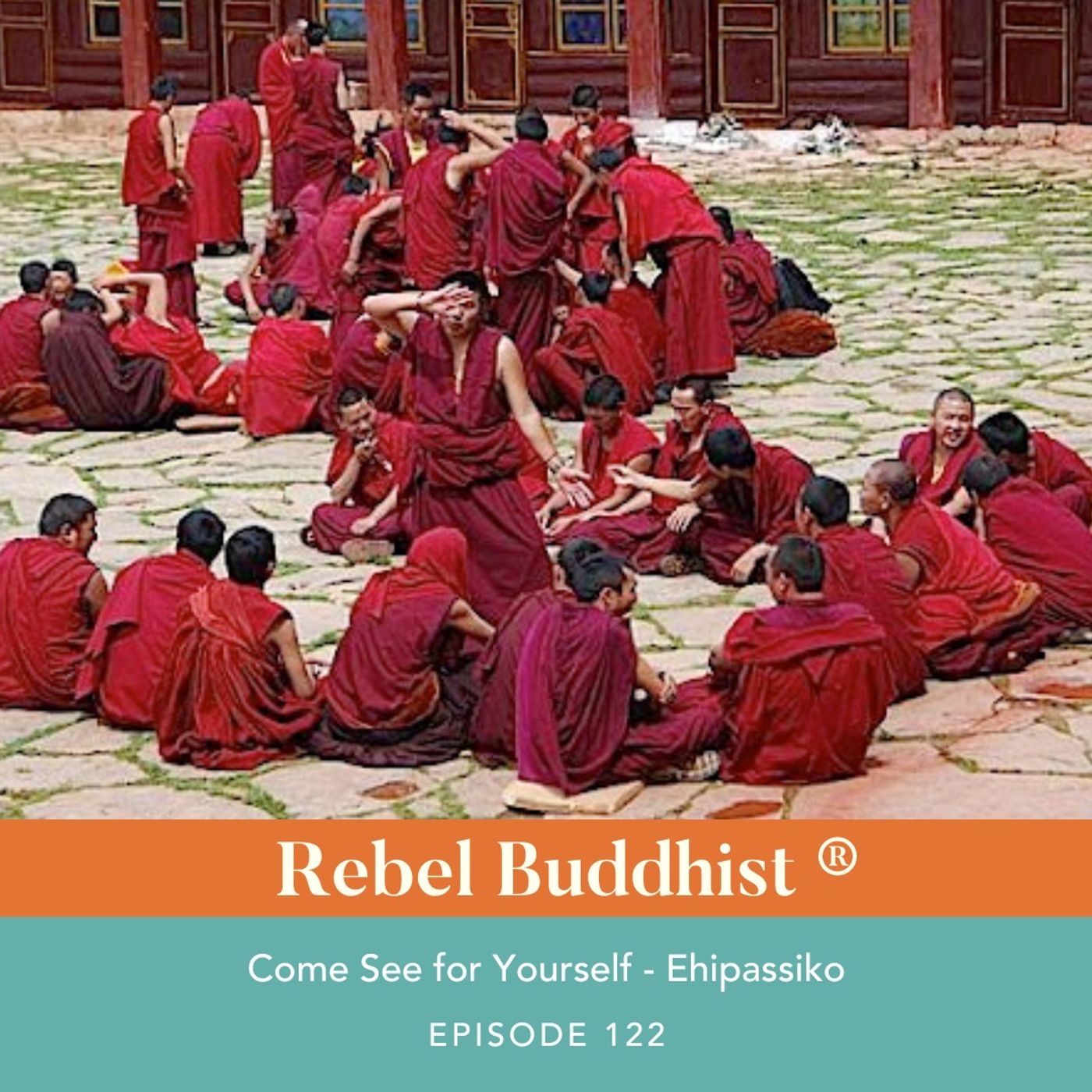
Ep 122Come See for Yourself - Ehipassiko
The reason I called this podcast Rebel Buddhist is because it’s meant to encourage one’s own inquiry into the teachings and to not just accept things on blind faith or without deep inquiry into the teachings; to encourage questioning and for people to have different experiences of that exploration and that it is OK. In this Episode we talk about:// WTF it means to “live the question”// Why “seeing for ourselves” is key to prevent, and protecting against, oppression (and gaslighting)// How to balance investigative inquiry and healthy doubt with faith// When doubt isn’t useful and unproductive - and essential// How we can use “seeing for ourselves” to not judge others
Ep 121Clarity is a Decision
In this episode, I talk about the idea that clarity is some passive “aha” moment that just falls into our lap, when in reality, clarity is an active decision that we must all make. Listen to find out why we all need clarity, and what you can do when you think you’ve found clarity, but suddenly, good ol’ doubt starts to creep back in.P.S. Be sure to grab the Rebel Buddhist Toolkit I created at RebelBuddhist.com. It has all you need to start creating a life of more freedom, adventure, and purpose. You’ll also get access to the Rebel Buddhist FB group, and tune in weekly when I go live on new topics.
Ep 120Greatest Hits Vol. 8 - Tomorrow Isn't Guaranteed
I was thinking how maybe like 5 years ago, I would have done the damn episode, thinking I had more of an obligation to crank one out that spend time with my kid, or to try and sleep, because it was “work” and I was the primary breadwinner, so no excuses in order to provide.I’m really grateful that now I have so much more clarity about how to prioritize my life, but whew…being raised by an immigrant Filipinx mama who sacrificed so much for me makes choosing self care and small precious moments hard to choose over work sometimesIn This Episode You’ll Learn:// How to stop avoiding thinking about death – and how to instead acknowledge what facing it can teach you about living now// A few ways to shift your mindset about impermanence + use it to mentally reframe your own narrative // About one of my biggest regrets in life and some life-altering decisions I made along the way – how they pushed me to create the life I wanted and live in integrity// Why your fear of death is actually your deeper fear that you have not lived your truest life (Steve Chandler)// How to stop putting off the things that make us happy for ‘another time’ and start living fully now// Why we must recognize the preciousness of human life in order to take real action toward making the most of the time we haveResources// Join the waitlist for the Adventure Mastermind at AdventureMastermind.com and save the dates for the first retreat of the next round, sometime the week of March 25th in Baja, Mexico. Get clear about your unique Soul purpose and how to create a life that supports it during this one precious life we have.// If you’re new to the squad, grab the Rebel Buddhist Toolkit I created at RebelBuddhist.com. It has all you need to start creating a life of more freedom, adventure, and purpose. You’ll also get access to the Rebel Buddhist FB group, and tune in weekly when I go live on new topics.// Want to dive into this work on a deeper level on your own time? To study it and practice it together with a group of people with the same goals of freedom, adventure and purpose?Check out Freedom School – the community for ALL things related to freedom, inside and out
Ep 119How to Write Your Personal Manifesto
Today we talk about how to write your personal manifesto and why it’s worth doing.In this episode you’ll learn:// Why you should bother writing a manifesto// How to use a manifesto when you’re not motivated to do what you need to do// Three questions that make writing one easy// Something you can do today, right now, to get startedResources:// Grab a copy fof the Rebel Buddhist Manifesto here// Ep. 7: Know Your Values - The Rebel Buddhist Manifesto// We recommend you use Canva for templates to use to make yours beautiful!
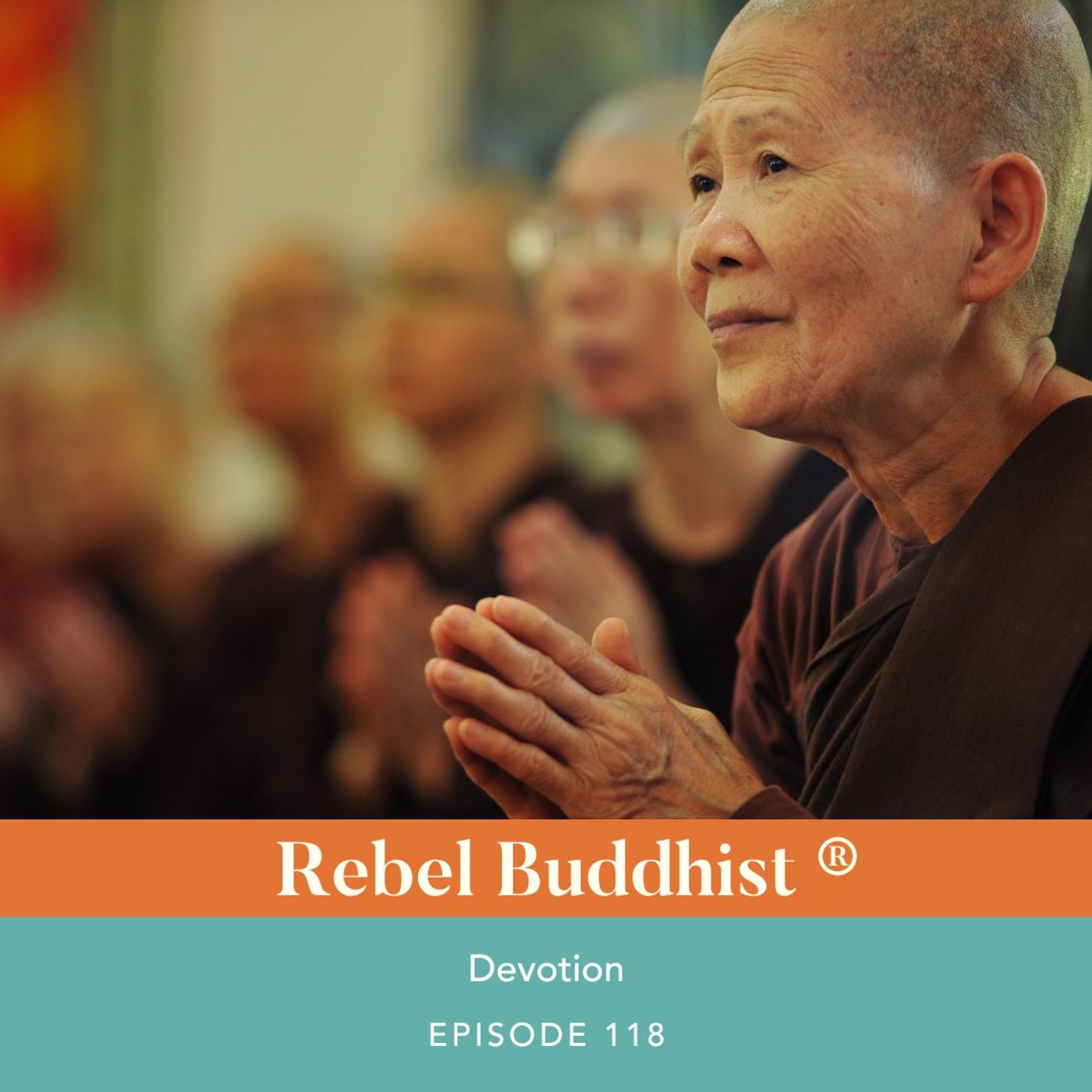
Ep 118Devotion
I’ve noticed that when I am aligned and mindful, I show up more often as the person I want to be. So that’s why I meditate when I don't feel like it, or when it feels like the last thing I have time for is to sit on my ass on my cushion.What is devotion and where does it come from? And how can we use it when we aren’t religious?Devotion can be a really loaded word for a lot of people and isn’t used a lot in the West. For me, devotion used to have a very heavy weight to it for me. Like it was a forced thing. A required thing. A burden.We can look at it like a deep commitment, but even deeper than that, it’s a commitment to what we really love. // Join the waitlist for the Adventure Mastermind at AdventureMastermind.com and save the dates for the first retreat of the next round, sometime the week of March 25th in Baja, Mexico. Get clear about your unique Soul purpose and how to create a life that supports it during this one precious life we have.// If you’re new to the squad, grab the Rebel Buddhist Toolkit I created at RebelBuddhist.com. It has all you need to start creating a life of more freedom, adventure, and purpose. You’ll also get access to the Rebel Buddhist FB group, and tune in weekly when I go live on new topics. // Want to dive into this work on a deeper level on your own time? To study it and practice it together with a group of people with the same goals of freedom, adventure and purpose? Check out Freedom School – the community for ALL things related to freedom, inside and out
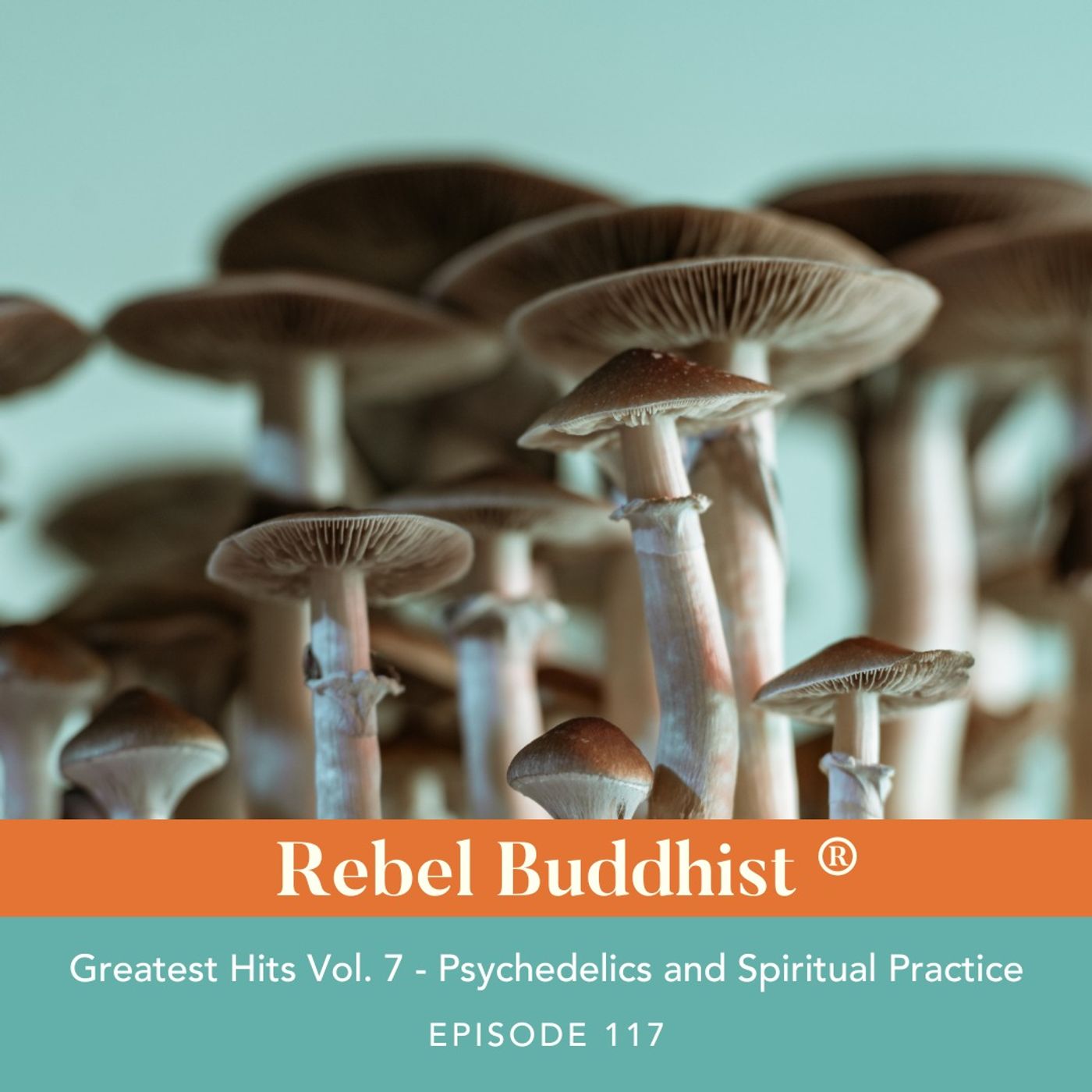
Ep 117Greatest Hits Vol. 7 - Psychedelics and Spiritual Practice
This week, I’m revisiting one of my favorite topics: Psychedelics & Spiritual Practice. I’ve used psychedelics in clinical settings and have found them to have a unique place in the treatment of mental health disorders. But I’m personally very interested in their use for spiritual purposes. Especially because, in my own clinical experience, many mental health issues have a strong root in spiritual and existential challenges. When we really look at the intention for spiritual practice or use of psychedelics, Buddhism and psychedelics share something in common: finding that which frees the mind. And there are endless studies that prove that this may just be possible! Listen to the full episode to learn how psychedelics can be used to benefit spiritual practice without relying on them for an escape or a temporary high. Plus learn the key to locking in those positive effects long-term. * Be sure to grab the Rebel Buddhist Toolkit I created at RebelBuddhist.com. It has all you need to start creating a life of more freedom, adventure, and purpose. You’ll also get access to the Rebel Buddhist FB group, and tune in weekly when I go live on new topics.
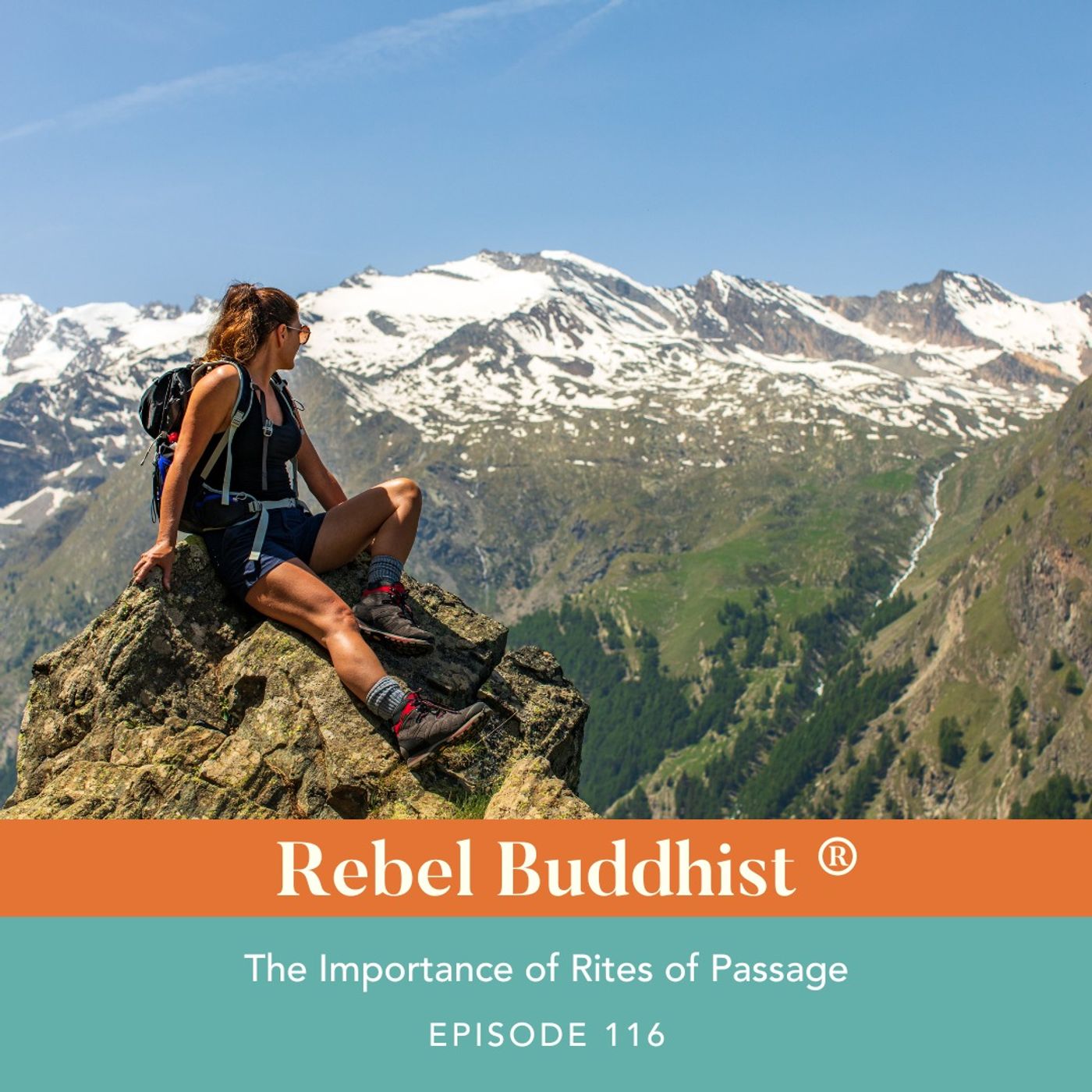
Ep 116The Importance of Rites of Passage
In this episode, we talk about rites of passage: not just how we can celebrate external and internal moments of growth and maturation, but also how to overcome society’s biggest challenges we face as we grow towards our Soul Purpose. Contrary to popular belief, psychological adolescence isn’t just confined to our teen years, and soul development isn‘t about age, or even external accomplishments. True psychological adulthood can’t be meaningfully defined as what happens in our 20s or what degrees we have or our jobs or our pay. It's about ziji, authenticity - knowing who we really are — to know where we stand, what we value, what we desire, what we tolerate and what we don’t — and to be able and willing to act accordingly, most of the time, despite the social risks. This takes a minute. Listen to learn: The 3 phases in a rite of passage; how to overcome society’s challenges to discovering our Soul Purpose; how to step into true adulthood, and more. * Be sure to grab the Rebel Buddhist Toolkit I created at RebelBuddhist.com. It has all you need to start creating a life of more freedom, adventure, and purpose. You’ll also get access to the Rebel Buddhist FB group, and tune in weekly when I go live on new topics.
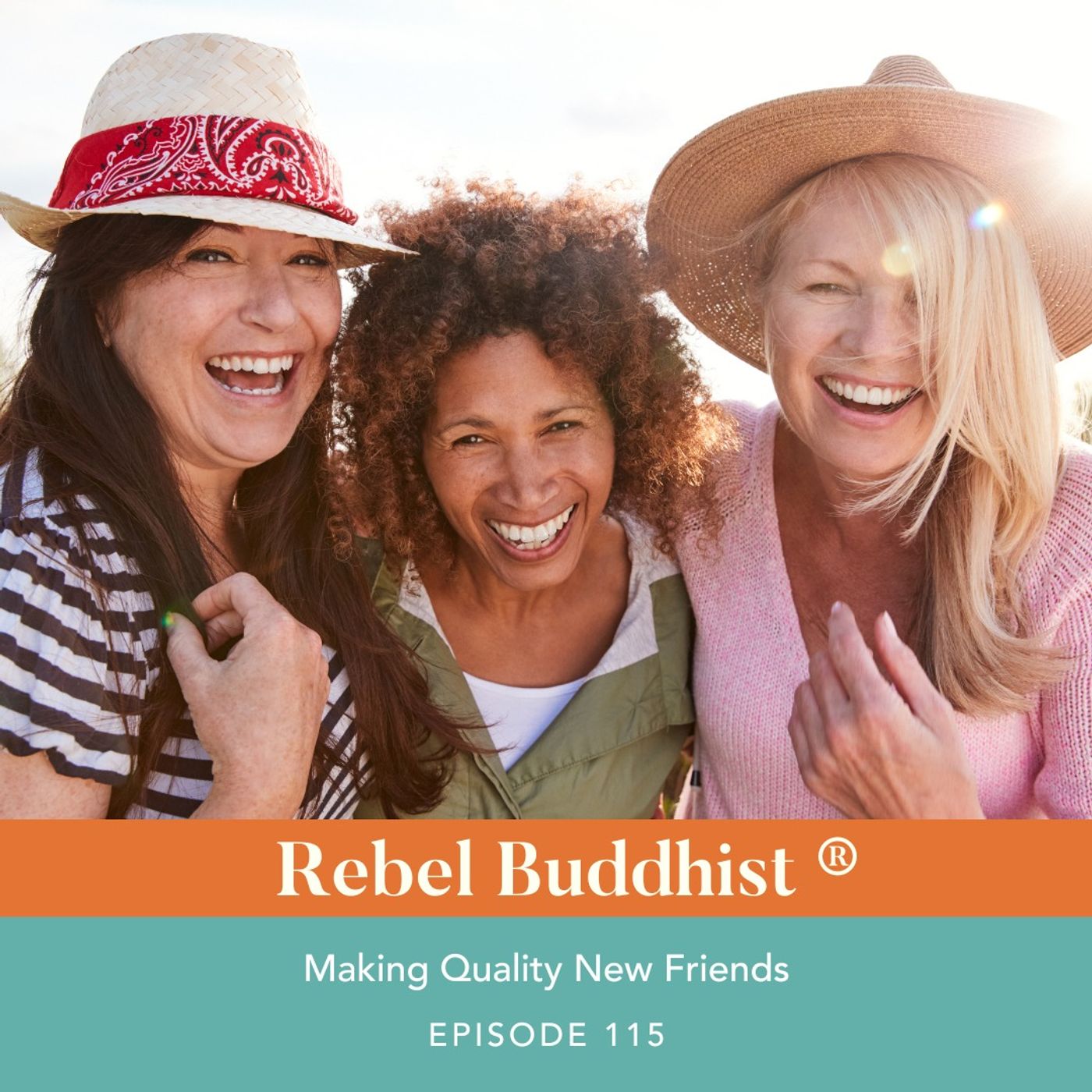
Ep 115Making Quality New Friends
If you’re like me, after you finished college, you found moments in your life when your friendships with others changed. Maybe you wanted to grow and evolve spiritually, and they did too. But you’ve also probably walked away from friendships that, for one reason or another, no longer served you.Some could see moments like this as a positive change, but for many of us, it can be really lonely… even before the isolation of the pandemic. And we’re like, “How the heck do we do that, again?”I hate to break it to those of you who want shiz to happen spontaneously, but the key is to take some initiative. And maybe even (gasp) plan! Another reason why people have a hard time making friends later in life is because of the stigma attached to putting yourself out there after a certain age. It’s also key to get over our initial shyness and actually ask for new people’s contact info.Making new friends requires the same thing that most worthwhile things in life do - taking risks, being uncomfortable, letting go of what other people think of us, and cultivating the belief that we’re 100% worthy and lovable as we are - perfectly imperfect.
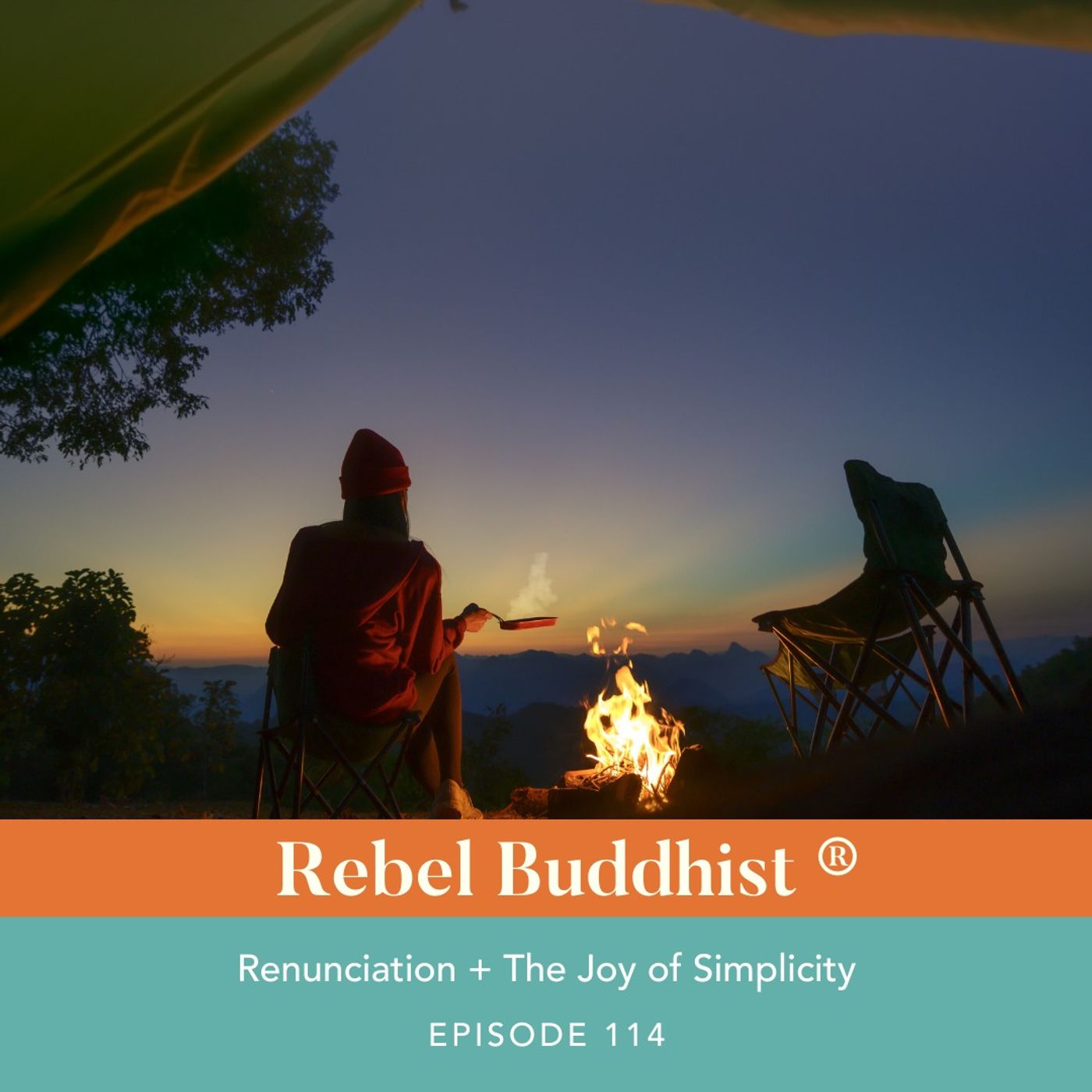
Ep 114Renunciation + The Joy of Simplicity
The assumption that accumulating things (homes, land, power, cars, the “right” body) leads to more happiness causes a lot of resistance to living simply in Western culture.Ajahn Succito said, “wise renunciation goes against the current of gain.” So, if we really want freedom from the suffering that the mind creates, we have to be prepared to challenge the assumptions of gain and loss. We do that in this episode.Renunciation about cultivating the intention to loosen our attachment and grasping, not just to material things and sensory pleasures, but also to self-obsession and unhelpful emotions, too. It’s about realizing that holding onto anything that’s impermanent only brings us suffering.There’s nothing wrong with wealth itself. It’s the grasping at it that causes suffering - and the feeling that there is something missing when we don’t have it that creates suffering.To genuinely develop renunciation, we need to go into the mind and heart. Meditation is a key tool for this because it is where an authentic, sustainable happiness can be found. To have a resource like this within us already is an important inner source of wealth and abundance.Another part of renunciation is being able to discern our wants from our needs. If we investigate this, we’ll often find that our needs are actually quite simple. On the other hand, our list of wants is never ending.The deep question we can ask ourselves is, “Does this possess me?” Letting go of that - of feeling we are lacking - IS central to our liberation.What’s one thing you can commit to renouncing today? A grudge? A partner or colleague’s annoying habit? What possesses you? No judgment… just awareness, and a gentle invitation to let go.P.S. If you’re new to the squad, grab the Rebel Buddhist Toolkit I created at RebelBuddhist.com. It has all you need to start creating a life of more freedom, adventure, and purpose. You’ll also get access to the Rebel Buddhist FB group, and tune in weekly when I go live on new topics.
Ep 113The One Thing
One of the common themes I see with my coaching clients is a need/want to get so much done, but not knowing where to start. The to-do list and project ideas are endless and it all seems really important. And the really annoying part is that when we look at the lists and get overwhelmed, we end up doing nothing instead. The secret is that it’s NOT all as important as it might seem. So how do we narrow down that list and figure out what ACTUALLY needs to get done?First, identify your big goals. Next, take a look at your to-do list and ask yourself, “What’s the ONE thing I have to do today to keep moving me toward my goals?” The same can be applied for any part of your life. What’s the ONE thing that really matters to you today?P.S. If you’re new to the squad, grab the Rebel Buddhist Toolkit I created at RebelBuddhist.com. It has all you need to start creating a life of more freedom, adventure, and purpose. You’ll also get access to the Rebel Buddhist FB group, and tune in weekly when I go live on new topics.
Ep 112Greatest Hits Vol. 6 - Commitment & Massive Action
This week, I’m hard at work studying for my post-doctorate certification from my amazing condo in Hawaii. But trust me… even though I feel like I’m livin’ the life on a tiny piece of paradise, the current events in the world and here in the U.S. are fresh in my mind. Especially since the beginning of the week was July 4th… a day that is supposed to represent freedom and equality.Anyway, all of this has inspired me to bring back one of my Greatest Hits about massive action vs passive action and how that all relates to commitment… because if you’re like me, you’re definitely wondering how the heck you can take rebellious action to help those who are being oppressed and yourself.First, a few brief definitions – massive action is keeping on taking action until you achieve your goal. No matter what. And massive action also produces a result – it’s not just thinking about something, for example. With passive action, you’re doing something but not creating a result. So, you might be reading or learning or studying – which feels really good. It’s like you’re doing something, but not in a massive action sense because you haven’t created a result.So another way to compare the two is massive action is creating and passive action is consuming…taking IN information, or consuming your own thoughts about something (aka “thinking” about it).As some of you know, I used to be an international climbing guide, taking people up mountains in the Himalayas and all over the world – actually climbing not just hiking.When you’re going up a mountain, massive action is relatively easy to take, because the circumstances sort of force you to do it. For example, you have to get to the top, because the descent starts there and to retreat from where you are would be totally unsafe or take four times as long. So even though you’re scared, or your knees are bleeding and bruised, or you can’t feel your hands, feet, or your face because it’s so cold, you keep going.But even in that scenario, our mindset plays a huge role.You know what my climbing partners would say about me? I love climbing with you because you know how to suffer. Translation: when it comes to climbing, I know how to do hard things. Without whining or wondering why it’s happening the whole time. With climbing, I don’t get lost in how hard things are. I know these things are a PART of climbing, a part of achieving the goal. I just see what has to happen and I do it. I know the suffering is usually worth it (well, those are the thoughts I have about it).On a climb, I’m committed, and the end being in sight – or the consequences of not making it being clear – make committing and taking massive action easier for me.Many of you have likely had this experience too. Like having a baby (I used to be a midwife, so I know the courage it takes no matter how that baby comes out). You’re committed to the end resultOr on a more day-to-day level you can see it when you work for someone and you show up for work even if you don’t want to. You are committed to the work.But in our lives, especially as we create more freedom and do things like become our own boss or start making our OWN plans and not just let others decide our lives for us, we are the ones who have to create that sense of commitment to the goal. It’s not as in-your-face as a mountain, and the end is not always in sight.If we don’t show up for ourselves, often it’s not as consequential as…getting fired,But notice: isn’t it interesting that we are willing to work so hard for other people’s dreams and be committed to working every day for them…but for our own dreams we can be so…wishy washy?How many of you want to have more freedom in your life – financial freedom, freedom from our emotions that hook us, to be location independent, to create your own schedule?That would be awesome, right? Here’s an important thing to remember: Wanting is a form of passive action. The definition of wanting is: “to desire something, to wish for something” NO ACTION REQUIRED.This makes it easier, familiar, comfortable – and more preferred by our reptilian brain motivated by that motivational triad of seeking pleasure, avoiding pain and doing what’s easier.But all wanting does is create more DESIRE to create what you want – not the actual result of what you want. So just wanting creates a bigger and bigger gap between what you want and what you have. More DESIRE for something that you’re not willing to GO GET.Conversely, the definition of commitment is, “to follow through on a course of ACTION.” This is very different from wanting and other passive actions. With commitment, “action” is in the definition.COMMITMENT is where you go from WANTING it (passive) to GETTING it via ACTIONS that produce RESULTS (massive action).Let’s say you want to earn $100K this year, or to go on a round the world trip, or do a 3-month meditation retreat or a yoga teacher training – no matter how much we lament about how hard we’re already working or how desperately we want it
Ep 111Judgment and Blame
This episode is all about releasing one of the most common toxic patterns many of us have (and that easily that hooks me, personally): judgment and blame. Judgment and blame are really pervasive in our workplaces, our personal relationships, and in society at large. As we’ve experiences, it causes a lot of suffering when we label others as “wrong” or “bad” in some way. We can also get hooked by blame, and when it becomes habitual, it also keeps us stuck. These reactions can arise with little things, like when someone forgets to do a simple favor you asked of them. And it can happen in moments of anger and unforgiveness from a deep wound or betrayal. When resentment is chronic, it can really weaken and damage our relationships as well. When we’re blaming or judging, it makes it hard for us to be compassionate or to soften around the wall we’ve built up around our hearts to protect us. We can end up putting people in a box, seeing them as an “unreal other,” and closing off to the idea of an interaction. It’s important to know this is totally human, totally expected when born in a body with a brain that evolved the way it did, so we need to be compassionate towards ourselves too. AND when it happens on a bigger scale, when we look at this as a baseline of so many people on the planet, we can also see the suffering it creates. If we want to genuinely move toward healing, peace, and helping the Earth heal, it will be helpful for us to practice letting go of blaming and “othering.” So how do we explore this without offending someone else or turning into the “blame police”? And without making ourselves “wrong” for getting hooked by judgment and blame? You’ve probably heard me talk about the evolutionary aspects of our brain and development before. Well, it applies here, too, with the stress response cycle of fight/flight/freeze/fawn. Blame is an expression of “fight.” It’s part of the human condition and it’s a universal response to when we feel threatened. Then, due to our negativity bias, we’re consistently scanning for what’s wrong, or assuming there is something wrong, because evolutionarily, that kept us safer. It literally kept us alive! On a societal level, we see this pattern a lot, and unfortunately, we perceive the most threat, and therefore blame, toward those that we perceive are different from us - religion, morals, politics, race/culture/ethnicity... We have a default response of “others” being more likely to be perceived as threats to our safety and most likely to be the target of our blame. Since this is the default of our brain, the first way we can examine this is to just be aware of it happening.While we know the possible negative effects of judgment and blame, there is a sneakier reason for their bad reputation: Many people have a common belief that we shouldn’t be angry. But as weknow, anger is intelligent. It let’s us know we need to take action, that something is wrong, that we aren’t getting our needs met. So anger itself isn’t the problem – getting stuck in it is (via judgment and blame). We’ve all been wounded by others. As we’ve seen recently in the U.S. with women’s rights, and with BIPOC and LGBTQIA+ and Gender non-conforming friends, entire populations have been devalued and systematically oppressed. This should make us angry. So we use anger to awaken and mobilize. But not to hang out in. Make no mistake, we need anger. . If we suppress anger and, say, prematurely forgive, we’re not going to fully attend to our wounds and therefore won’t be able to effectively protect ourselves from more harm. But when we are in a trance of blame all the stories that feed the blame replay over and over. When this happens, we have less access to our wise mind, so we get reactive and lash out or withdraw. When we get stuck in that trance of blame, our perception of the other person also narrows. They become “unreal” or less human to us. Someone we can’t relate to easily. And if we look closely, not only are we creating an unreal other, we’re also creating an unreal self. We’re not connected to our own wholeness. We are in some limited story of a victimized self. We can start to wake up to how blame is impacting our perceptions of both the other person (or people) and of ourselves. Ask ourselves - what’s the role I'm in? And most important, do I like myself this way? Is it who I really am? We also have to acknowledge that undoing the toxic habits of judgment and blame is hard. And it’s usually hard because we are protecting ourselves from suffering. One question we must ask ourselves is, what makes us hold so tightly to blame? What parts of us are we protecting? We can ask ourselves, “If I let go of thinking this way, what unpleasant feelings would I have to feel?” Because there’s really a whole constellation of vulnerable feelings that can show up under the armor we’ve put up. Sometimes we hold onto blame because of misunderstandings about forgiveness. We may worry that forgiving someone will remove ac
Ep 110The Miracle of Being Alive
This past week when I was on a silent retreat, as the days went by and we all got deeper into our meditation practice, I could see that people were walking really slowly...taking long pauses to enjoy the nature around us; stopping and touching the leaves of a bush and even petting it in appreciation; gazing at a wild turkey and laughing at all its sounds and attempts at impressing us with displays of their feathers, or perma-grinning up at the full moon. If any of us had been wearing tie-dyed clothing, someone would have thought everyone was on psychedelics of some sort. And it kind of makes sense, because meditation does to our brains many similar things that psychedelics do – but that’s another podcast. However, i’s interesting to me that we often find it unusual to be in awe of life on a regular basis. Why isn’t that our baseline instead? When did we fall from this state of awe? As you may know, dying is a sexy topic in Buddhism, with a lot of teachings centering around impermanence. There’s a Tibetan saying, ““Since death is certain and the hour of death is uncertain, what is most important?” That’s really the question, right? What is most important to us? When we deeply practice and pause to ask ourselves this, we often realize that the most important thing is to be in full, loving awareness, loving presence. After all, the only thing that’s certain is impermanence, and accepting this allows us to let go of attachment and on a deeper level, our fear of death, which actually helps us live a more engaged life. As we stay present with and accept the transient moment, we begin to identify less with what changes, and more with presence itself. And we can begin to realize that this awareness is actually made of love. But don’t just take my word for it. Dive into it and check it out for yourself. I remember saying goodbye to my dad on what I knew might be the last day I might see him. There was a deep sorrow in knowing that could be the last time. I didn’t want to leave. I kissed him on his head. I ached inside. But there was also a tender awareness of this eternal, fleeting moment. The importance of being so present as my lips touched his skin. Feeling his warmth at this goodbye. When we let go of attachment to what’s changing, passing - we then open ourselves to infinite possibilities and miracles in the moment. Buddha said there are different types of miracles - yogis who can stop the beating of their hearts or walk through walls and stuff - but then he says the real miracle is the miracle of awakening, of seeing the miracle that's already here. Do we need miracles and epiphanies to see the truth about reality? No. The very act of living and dropping into your body and having a felt sense of being alive IS a miracle. We’ve all been given the give of LIFE, which in and of itself is amazing. So let’s ask ourselves: what helps me to see this all as a miracle again? Is it hiking through alpine mountains, walking along the beach in silence, sitting in meditation, or maybe just taking time for stillness in our culture of busyness? What helps your senses open to the experience of being alive? Practicing this isn’t necessarily easy. To get there we often first pass through mindfulness of stress, or mindfulness of anxiety. Or something way worse. But then, the reward is to once again have access to the awareness of the wonder of life. Take a moment now to just look at your hands or your face. We have this body which has done all these things for us. We have a head and eyes and a tongue. Fingers or arms or legs that stretch and are covered with skin and have...made so much of our lives possible. It’s WILD! So it’s not about needing an epic experience. It’s about a beginner's mind, the awe that comes with seeing things fresh. It’s a lot simpler than we think. It’s being present with what we’ve got. A lot of teachings in Buddhism were about how to live in the natural world and its mysteries. Nature helps us appreciate vastness, and there is so much beauty in its cycles and changes, so spending time in nature can helps us access this more easily. We can remember that we’re part of a larger…Universe. Not an insignificant piece of it. A part of it. Come back to the natural, mysterious existence of being alive. Ask yourself - what really matters right now? If I only had today, or this moment, what would I think of my life so far, and what would I do with this precious, precious moment? In this Episode you will learn:// How accepting impermanence and death can open us up to a more engaged life.// How to open ourselves to the miracle and experience of being alive.// Why nature is so important in our practice.// How to make awe and wonder a part of everyday life. Resources:// Did you know I lead silent mindfulness adventure retreats? Our next one is in Baja, Mexico in the week of March 26th, 2023. Save the dates. You will want to be on the early notification list! // If you want to start integrating all of you into this one
Ep 109The Gift of Silence
This past week I went to Maui with my good friend, Angela on a bit of an informal retreat. We had an absolute blast together - not just because we share so much in common and can laugh until we almost pee ourselves, but also because we both realized what we could change and what we couldn’t.We chose happy. A lot. Over and over.On one of our last days, we hiked up to a small peak at Haleakala for a super early sunrise and perched ourselves on a rocky outcrop between two boulders with only a handful of other people nearby.I asked Angela if we could sit and watch the sunrise in silence. I love sunrise meditations and this would be an epic session. She agreed and we cozied up together in a bundle of layers in silence.Now, sitting in silence on a silent retreat is one thing, and it’s a very unique experience. But when you sit in silence and others aren’t doing the same, you can really notice other things, specifically, what other people talk about. And let me tell y’all something:Most of what I heard didn’t need to be said.It didn’t build a sense of connection to help anyone contribute to intimacy. It wasn’t funny, entertaining, or informating. It was a lot of :“This rock is hard.”“I wish I had worn my blue shirt instead.”“My spit feels gross.”And it was all so disjointed. No one actually responded to the comments, they just said something else unrelated. People just telling each other their thoughts.But not in a way that was sincerely relating or deeping or growing closer.I know a lot of people think this small talk helps people connect, but today, I’d love to invite you to question that.The next time you’re out at a store or standing in line to purchase something, listen to people’s day-to-day conversations. What do you hear? Are they really deepening connections, or just filling a space?This is important because we need this space often to simply be in, to become aware of what’s actually going on.Angela and I sat in silence. We share a look during certain parts of the sunrise or when we got really cold and needed to warm up a bit, and we still felt seen and understood by each other.When people hear about my silent retreats, their immediate response is, “I could never do that!” Or they’re shocked I can do it because I do like to talk a lot.But one of the things I really love about silent retreats is that it becomes really obvious how much we can communicate without talking, and how much we actually DON’T need to day.I’ve also noticed there’s a lot less drama and suffering when humans aren’t constantly sharing what’s going on in their heads. Go figure!So, this week, while I’m on another one of my awesome silent retreats, I want to invite you all to join me in your own way.Try to notice when you want or attempt to make the silence go away.When you’re with someone and there’s silence, do you become uncomfortable and want to say something to fill the space? Or maybe you turn on the radio as soon as you get in the car or turn the TV on when you arrive home, even though you’re not actually listening to it.Now, try to play with trying NOT to fill that space. Because when we ask ourselves why we do anything, we can usually get the answer by not doing it… and noticing what arises.Whatever that feeling is - anxiety, restlessness - just notice it for now. Maybe you can see what happens when you don’t react to those feelings.When you’re ready, you can try not talking for a half-day or even a whole day. Or don’t turn on the music or TV for a day.Trust me: you’ll survive and learn a thing or two about your own inner landscape!In this Episode, you will learn:// Things you can experiment with to get more comfortable with silence// How to know if something is really worth saying// What's possible when we open up to silenceResources:// Right speech// Gossip// If you want to start integrating all of you into this one precious life we have, apply for the Adventure Mastermind. It’s Soul Work. Deep work. Important, necessary, and essential to what the world needs right now. Be a part of it.If you’re remotely curious, apply. It will help you get clear, and then we can chat to see if it’s actually a good fit. Trust me – it’s an intense 6 months so I am just as invested as you are in making sure it’s an amazing match. Head over to AdventureMastermind.com and apply for the Summer cohort. We have 2 altered states retreats, weekly coaching, virtual retreats, and more. I’ve got you!// If you’re new to the squad, grab the Rebel Buddhist Toolkit I created at RebelBuddhist.com. It has all you need to start creating a life of more freedom, adventure, and purpose. You’ll also get access to the Rebel Buddhist FB group, and tune in weekly when I go live on new topics.// Want to dive into this work on a deeper level on your own time? To study it and practice it together with a group of people with the same goals of freedom, adventure and purpose? Check out Freedom School – the community for ALL things related to freedom, inside and out.
Ep 108Existential Anxiety and Crisis
In 1991, my life seemed perfect. I had just started at UCSC, my first choice for schools, not just because of the amazing reputation of the rebel professors, but also because of the ancient redwood forests and proximity to the beach - nature was important to me, and this place had it ALL. I had a blast doing new things like skinny dipping, drum circles, and mushroom journeys with friends, majoring in clinical psychology (which I couldn’t get enough of), loving my classes… I had a great boyfriend and I was working at the Outdoor Recreation program as an assistant rock climbing guide as part of my work-study program. I felt super blessed. People told me all the time how lucky I was. So then why was I having panic attacks? I was afraid to leave my room. I was scared to drive through the mountain roads to visit my boyfriend. I was afraid to make friends. I was unsettled and restless. And I felt like something was very, verywrong. On the outside it seemed perfect, and I couldn’t figure out what was going on. And that made me scared. I thought I was having mini-strokes. I was partying too much to escape. I thoguht I was going to have a psychotic break like my father. One day, desperate for an answer, I was wandering around a bookstore with a particularly large collection of spiritual books. The spine of one book caught my eye: Spiritual Emergency: When Personal Transformation Becomes a Crisis, by the Czech psychiatrists Stanislav and Christina Gorf. I read the book sleeve and the first few pages and realized: Holy shit. I think I’m having a spiritual emergency. Looking back, I realize it was more of a spiritual awakening that was going to turn into a spiritual emergency if I didn’t get support. But those first few pages helped me realize that I wasn’t going crazy. It was a spiritual experience. It was that period of intense suffering and fear that led me to seek out meditation - I felt a strong calling to learn how to meditate. A lot of the places I reached out to charged too much, so I kept searching until I found a rebellious Tibetan Buddhist nun from Australia named Robina Courtin. She was my kind of nun, teaching me to meditate and talking shout sex, cigarettes and chocolate;) It was in my sessions with her that my love affair with meditation, Buddhism, rebel nuns, and Tibetan culture began. I started to emerge from my existential crisis (although it would take years before the anxiety took more of a back seat). I see others in existential crisis often, especially in people interested in the Adventure Mastermind. For some, it might look like wanting to discover their Soul Purpose, or help clarify the meaning of their life, or how to deliver and manifest their purpose to the world. Missing this can really be a cause of deep pain, and a source of deep longing in humans. Maybe you can relate to this - maybe you’ve had an experience that has completely changed you, but you also notice that you don’t feel so great about it. You might even feel burdened. A spiritual emergency occurs when a spiritual awakening process goes too fast - too much too soon. This leads to a person feeling really destabilized and can even be frightening. We start to open to our spirituality in the awakening and then it overwhelms us, Things are at a higher risk of transforming from spiritual awakening to emergency when there’s also a shock that triggers the experience, like death of a loved one or a life-threatening illness. It can also happen when there’s a lack of support or skilled intervention. An existential crisis is different - it can be a result of a spiritual awakening or emergency - even lead to an emergency if unsupported. The most common thing I see with clients in an existential crisis is a loss of meaning, or at least an acute awareness of the lack of meaning. The way I see it, a spiritual awakening is the beginning of the path, and the existential crisis is a specific part of the path that’s challenging. Here are just a few of the signs that we might be in an existential crisis (check out the full Episode for more):You might be searching for purpose and meaning. It’s a deep longing, not just “ wouldn’t it be nice if I knew…”There may be a sense of loneliness, isolation, depression, emptiness, and disconnection from others.Like me, you may feel like you’re about to lose your mind or that something has gone very very wrong.You feel like you’re walking in a dream and you’re not sure who you are anymore. Or you look at your achievements and start to wonder if you’ve wasted your time. (spoiler alert: you probably didn’t!)You begin to feel a sense of anxiety about death… especially about dying with regrets or dying without having reached our full potential. Why do we experience an existential crisis? Sometimes it comes from a shock to the system, or a more chronic exposure to stressors, or a “dark night of the soul.” It can also be from a life transition/new stage of life, questioning our religious beliefs, psychedelic experiences
Ep 107Equanimity in Everyday Life
When it comes to the practices of lovingkindness & compassion in Buddhist psychology, it’s pretty well understood that if we only practice these things, we can end up getting attached to the way we think things are supposed to be. … And want to run off into the mountains when things don’t go as we want them to. We want to check out. Withdraw. … Or we may grasp and struggle with the world rather than serving it. We resist and we fight. This is why equanimity if often taught along with compassion and lovingkindness. Equanimity does not mean indifference or callousness. Indifference is based on fear. True equanimity is not a withdrawal from life. It is a balanced engagement with all aspects of life. It embraces the loved and unloved. The things that being us pleasure and the things that don’t. Knowing that all things are of the nature to change – ourselves, others, the world - with equanimity, we’re able to be fully present and in harmony with it. When we don’t have equanimity, we get hooked by things, like we’re in a trance. But if we’re present in it, we’re less likely to react to things that activate us, and instead are more free to respond. We’re more likely to be able to access our wise mind and respond to life with compassion and lovingkindness (metta), forgiveness, and we’re more open to joy, too. We open ourselves up to joy and pain. Because we really connect with ourselves and others in both of these states, right? Now, the reality of suffering as part of the human condition is talked about in the First Noble Truth. It’s really hard to embrace this, right? And sure, it could be seen as a bummer. But it’s so essential to understand the reality of suffering, because that also helps us understand how to end it. After all, pain is not the same as suffering. Pain is inevitable, and suffering is optional. The whole purpose of Buddhist psychology, its ethics (or sila), philosophy, practices, and ways of living in community, is the discovery that freedom and straight up joy are possible, even in the face of the suffering we experience as humans. Now, while pain is inevitable, suffering is not. Pain happens just y being born a human. If nothing else, we all experience sickness, old age, and death. But we also experience abundance and scarcity, love and hate, pain and joy... Suffering, however, is caused by our reaction to the hard parts of life, to the pain. It arises from grasping, from attachment to what we want and how we want the world to be. Our personal suffering can include anxiety, depression, fear, confusion, grief, anger, addiction… but it’s not just personal. Our collective suffering grows from human greed, hatred, and ignorance, creating things we see all around us: warfare and racism, unnecessary hunger, sickness, and abandonment of humans all over the world. That First Noble Truth is what we are working on understanding and transforming. The Second Noble Truth helps us understand the grasping, or attachment – the cause of the suffering. Attachment to things needing to be a certain way leads us to also having an aversion towards some things, and even incorrect views of what’s going on, of the nature of existence. Then we get all messed up and start to experience that unnecessary suffering that looks like anger, hatred, anxiety, buffering and addiction, jealousy… Freedom from suffering is possible when we let go of our need for things to be different than they are. So nirvana, my friends, is not some place with clouds and rainbows or cosmic stars and supernovas. This is nirvana. I think of it as a letting go of the need for things to be different than what they are and therefore letting go of our suffering, our fear and grasping. And I’m not saying I hang out here or know this space well, even. What I am saying is the more I learn and the more I talk with my teachers who have a much more intimate knowledge of nirvana themselves, I realize it is not a place of escape or transcendence of this world, but rather a very intimate knowing of the true nature of this world, and a letting go of how we need it to be. This is true freedom. Equanimity is part of the middle way, which helps us, amidst the pain of the world and of ourselves and others, to experience peace wherever we are, here and now. When we’re present in equanimity, it’s not that we don’t have a response at all. It’s that we’re less likely to react to things that activate us in an unconscious way, and instead are more free to respond with access our wise mind and respond to life with compassion. This is really different from an attitude of indifference. Some people think equanimity is experiencing the world and not having any response to it. Like…meh. Like my patients that had low testosterone. They didn’t feel awful, but they also didn’t feel stoked about anything. Or upset or angry about anything. Just…meh. That’s not equanimity. When we don’t grasp at or resist life as it is – in a state of equanimity - we can live wide awake and experience
Ep 106Empathy vs Compassion
During a ceremony on my last meditation retreat, I looked this woman in the eyes and she was sobbing (with joy) and BAM! I started sobbing - also with joy - for how beautiful and precious the moment was. I didn’t stop, the entire ceremony. I had an immediate response to her tears of joy. And I could not reign that shizzle in. For the life of me. On the other end of tears, as a nurse, a midwife, and also a death doula, I’ve witnessed a lot of suffering - I’ve delivered stillborn babies and sat with their mothers as they held them and sobbed. I held their babies myself, kissed them on the forehead and cried. I’ve seen elders come into the ED after watching their life partner die of a heart attack and holding them in their sadness, now feeling very alone. I’ve sat bedside with grieving families as a beloved family member was taking their last breath. I’ve heard horrifying war stories working in refugee camps and working at community clinics serving the underserved, often living in horrible conditions in violent and fear-ridden environments. I found that what drew me to this kind of work was a natural inclination towards compassion… yet it seemed that’s the very thing that made the work so hard. I think I had a misunderstanding of the difference between empathy and compassion, as well as not having the skills for true self-care. It felt like, “I care too much.” But really, it was because I was overidentifying with the suffering I was witnessing. It wasn't compassion that was overwhelming me at the time. It was unprotected empathy. Unchecked empathy. I’m not alone. It turns out a lot of people mistake empathy for compassion. So that’s what I want to clear up today. Empathy is understanding how someone feels, and trying to imagine how that might feel for you — it’s a mode of relating. It can even involve feeling that same feeling within ourselves. Compassion is witnessing suffering and wanting to do something about it. Compassion, in the classical teachings of the Buddhist tradition, is often described as “the heart that trembles in the face of suffering.” And then wanting to do something about it. It comes out of one’s need or feeling to help someone else. So empathy sparks compassion and compassion builds empathy. Empathy is a gateway to compassion. We identify with another person’s feelings - that’s empathy. Then, we’re motivated to take action, maybe even massive action, and do something, which is compassion. With empathy, while we may experience and highly relate to the suffering of others, we might not actually do something to help. With compassion, we take a step away from the emotion we’re feeling with empathy and want to take action. We ask ourselves, “‘How can I help?” Another way we can look at it is empathy is more of an automatic feeling and compassion is manifested in intentional action. They are different and complementary. When one is absent from the other, it can cause imbalance. Empathy without compassion becomes something that can incapacitate us and also cause more problems than it helps with. So recognizing the differences between compassion and empathy is important as we try to cultivate more compassion and mindfulness - staying fully present with the suffering we might bear witness to. When we can’t stay present with the suffering because it becomes too much to bear, we can numb out. Burn out. Check out. Here are some ways we can cultivate more compassion and compassionate action vs empathy, which can be overwhelming. // Be aware of the differences between empathy and compassion, which I discussed above, and knowing which one we are in. When we have felt the empathy, we check in to how it sparks compassion and then reflect on how we can take effective action to help - and then we do it. // Intentionally have a deliberate response instead of going with what feels like a more impulsive emotional response. Empathy is more reactive. Compassion is more… deliberate. Empathy originates in the emotion centers of the brain, so empathetic feelings, thoughts, actions (including the decisions we make) are generated from this less conscious level, so we are less aware and therefore less intentional about those decisions. Compassion is considered to be more deliberate because it originates in the cognitive centers of our brain. Compassionate feelings, thoughts, and actions (including decisions) pass through filters in a more conscious, mindful way. We are more likely to reflect on the situation, deliberate our options, and maybe even improve on any decisions we arrive at. We are able to be more present with suffering from a place of compassion, so we won’t tune it out or try to escape. // Cultivate equanimity. Something I didn’t know before was that while empathy strongly relates to the brain’s tendency to identify with others’ emotions, it’s particularly cued to do so with those who are close to us. This may seem benign (“well.. of course it’s easier to identify with those closer to me”) but the issue w
Ep 105Soul vs Spirit
Today is about the question, “Who am I?” We talk about why it matters and how we hold it in a context where we debate if we even exist on certain levels. Specifically - I want to talk about the concept of non-self and and Ultimate Oneness as well as how - and if - this can exist simultaneously alongside the concept of the individual soul. I’m going to do this while reminding you that I’m no philosophy or theology expert, and that I’m sharing my own experience of this debate along the path - and it’s not a straight line! A friend recently asked me if Buddhism teaches that “nothing exists outside of the mind,” including self. Of course, Buddhism isn’t easy to give short answers about. Its teachings include over 2600 years of monastic debate, and of all the world religions, its doctrines are particularly diverse and contradictory, which I dig, but it can frustrate others. Especially if you want black and white answers. The “mind only” school of Buddhism can be interpreted as one that suggests “nothing exists outside the mind.” And you could say that Yogachara taught that while consciousness is ultimately real and perceptions arise in consciousness, perceptions are provisional, without essence, and are dependent. No existence in and of themselves. Now, it’s my own personal experience that we see a lot of spiritual bypassing when people ignore the suffering of individuals or groups of oppressed people, for example, and say they believe ultimately that we are One and that the individual self doesn’t exist, so therefore we shouldn’t focus on peoples’ differences and how their experiences in life might be different. They’ll shun the idea of the individual and try to transcend that and aim for the Oneness. This seems like a noble cause - to not live out of selfishness or ego-driven desires. But when I think about it, I always end up noticing, “Wait, but I DO exist.” I have a body, a mind, and ideas. I help people and I’m helped by others. That’s all real, in some way, right? But then, if I also believe in the oneness of it all, and you and I not being separate, then what is this? Well, as someone who is on both journeys simultaneously - of exploring myself and my not-self - I’ve found that, as usual, it’s not just one or the other. We are both. There are a couple problems with the “mind is real, things are not” view: One is that earlier Buddhist texts discouarge us from taking any firm opinion about whether things do or don’t exist. So we can’t fixate on either decision like, “The mountain is real.” or “The mountain only exists in my mind.” Each view is sometimes useful, but neither is ultimately true. The second problem with “everything is the mind” is it pretty much naturally leads to moral nihilism, which is definitely not what Buddha taught. For this Rebel Buddhist, the Middle Way - the idea that both can be true - is what I believe. Now, if we’re going to go down that Middle Way path, what terms can we use to differentiate between the individual and the emptiness of the individual (the Oneness)? Bill Plotkin’s definitions of the soul and spirit are really helpful here: The Soul is the wild core of our individual selves. It is unique to each person, and is much deeper than our personalities.The Spirit is that single, great, eternal mystery that permeates and animates everything in the universe and transcends all. So, for me, soul-work is on an individual level, and spirit-work is what is touched upon in the more transcendent (beyond the self) practices. And each soul is seen to exist as an agent for spirit. The idea is that your soul is what makes you unique. You are here on this plant and in this body for a reason. All things are fulfilling their unique individual purpose, and humans are not exempt from that. This is also a piece of why I use nature so deeply in my personal work and in my retreats with the Adventure Mastermind and Freedom School. When I was a climbing guide, living and working in the mountains, I was immersed in that connection naturally. When I started graduate school, I cried because my room only had a mall triangle of a window for me to glimpse a bit of sky.. Spirit, on the other hand, is the dimension of our experience in which we sense something larger than ourselves. Many of us have had that experience at one point or another. I think about how many of my clients describe themselves as “spiritual but not religious.” In other words, at a minimum there is an awareness of being a part of something bigger than themselves. It’s not like we live in that experience all the time. It could just be glimpses of that intermittently. But in general, nearly everyone has experiences of awe and wonder at some point. Watching a sunset. Giving birth. After an epic orgasm… So for me, working with spirit to access these transpersonal levels are my meditation and yogic practices, my personal retreats, and my daily practices. And working with soul is when I’m fully embodied and connected with nature and everyo
Ep 104Ethics and Freedom
I just got back from a semi-silent retreat at what I consider to be my current home meditation center, Spirit Rock in California. I say semi-silent because between our silent periods, we would meet for about 4 hours a day to discuss topics we were studying together in a 2-year program. This particular retreat was all about sīla (in Pali), or ethics. We’ll go into more detail in a bit, but the idea is that when you speak and act in alignment with your integrity (or ethics), you’re naturally happier. And it’s actually a form of love and what’s possible for the human heart and for our freedom, more than it is restrictive. If you’re like me, and you may have had a less stellar feeling about “ethics” or “morals” in the past because they were presented in a more judgmental way (and perhaps viewed them more as a constraint or a sense of deprivation). I invite you to indulge me in this episode, because the way I talk about it here is totally different. Also, I want us to enter into this topic with a lot of self-compassion and not use this as a way to beat ourselves up or shame ourselves. That is not the purpose of reflecting on our integrity – or that of others. I’ve found that the topic of sīla can be lost in the West because it’s become a very relativistic kind of culture, and the thought of, “How come we’re not living from a place of compassion?” isn’t so … foundational. Instead, the focus is more on being able to do what we want, get what’s ours, and live the way we want to. The way many of us have had ethics presented to us is different, too. Ethical guidelines are often presented like a list of things you must do without question, and you better not screw up or you’ll go to hell. The idea is you HAVE to do them...or else. And if you follow them, you’ll eventually be happy...waaaaay later, like when you die. And they tend to be paired with guilt and shame – which this is not the intention, IMO. On the other hand, in the understanding of mindfulness and compassion and the tradition from which the practice of sīla comes, ethics are simply the laws of human happiness, and they’re pretty universal, and are directly paired with our ultimate freedom. So it’s less “you shouldn’t do harm” and more that if you want to live a life of freedom, with a free heart and mind, a life of happiness, then this becomes critical as part of your practice, your mindfulness practice. This can feel uncomfortable, particularly for folks that come to mindfulness practice and want to keep it purely secular. But even in that context, it still matters, because you’re a human with an inherent desire to not cause others suffering. More on that in the pod. We can mindfully look at our actions or past situations and sense, intuitively and directly, “Is this harmful to myself or others?” or “Is what I’m doing beneficial or harmful to myself or others?” If we’re interested in this freedom and happiness – liberation - but we don’t have the foundation of ethics, we might find that at some point, we’re not going to move much further because we find that our insight and mindfulness practice can only take us so far if it’s not integrated into the rest of our lives, particularly in the relational aspect. How we interact with the world around us.These powerful ethics are also deep in our DNA. No matter where you are in the world or what society you are a part of, our essential ethical concepts are very similar. Another way to think of ethics is to call them our conscience. For the most part, all of us have an innate compass for this. That’s not to say a child won’t lie steal a cookie every now and then. But the reality is that when we’re stealing a cooking, we also look around and worry about getting caught and don’t feel all that great when we’re stealing or lying. There’s something in us that knows what’s right and wrong from the beginning in some way. And to acknowledge it and bring it into the field of mindfulness brings a kind of ease in times of potential confusion. It brings clarity and courage to life, as well. In the free Unshakeable Confidence course I teach (see below to access it), I talk about how living in integrity gives us more confidence since we walk through the world with nothing to hide. Life will always bring dilemmas and issues to us, and cookie cutter solutions won’t suffice. But with a common agreement of acting in our integrity, ethics, conscience - whatever you want to call it - we don’t have to try to control the world around us as much. There are 5 mindfulness trainings we can all undertake to really inhabit care for this world, sometimes known as precepts. And we know how important caring is at this time, right? For ourselves, and for others. Often they’re presented as things to NOT do. But Thích Nhất Hạnh presented these in ways of active action. The first is “to cultivate compassion and learn the ways of protecting the lives of people, animals, and plants. It’s non-harming, or reverence for life.” The second is “to cultiva
Ep 103Greatest Hits Vol. 5 - How to Live With Contrasting Beliefs
Hey hey, Rebels! This week will bring to you another Rebel Buddhist Greatest Hits Episode about how to live with contrasting beliefs… while I go on my long-awaited semi-silent meditation retreat. (I had almost canceled due to COVID, but I’m officially out of the risk window and tested negative! I’ll be back with a new episode next week._ We are all complex beings, made up of contrasts. Discipline and wildness. Security and freedom. Worldly and divine. There are dichotomies everywhere. It’s part of nature, and we are all a part of that. Yet often we are asked to choose only one aspect of ourselves and lose or leave the other. And for many of us, our culture believes it’s hypocritical to stand with one foot in each contrasting space. The place that deep work happens is often when we are recognizing and living in polarity. It’s where we change, evolve, and strengthen. It’s like the image of the Taoist tai chi or yin-yang. That dividing line isn’t just straight down the middle. It curves so that the two sides are cradling each other, and each side has a small circle of the opposite color embedded within it. You can’t have one without the other. Like light needs darkness, the polarizing parts of you need each other to exist. We all spend more time in this space than we realize. Maybe we are super healthy, but we can’t resist a greasy fast-food meal once every now and then. Or we post all these outdoor journeys on social media, but spend a full weekend binge-watching Netflix in our PJs and don’t tell a soul. Many people live in gender fluidity for this reason – acknowledging the limitations of choosing one polarity or another. So if it’s part of nature and part of life, why do we resist living in polarity so much? Some people may say that we feel hypocritical, or that our integrity is compromised when we want to live between polarities. I challenge that. Integrity is not about moral perfection. It’s about accepting the whole and not trying to divide who we are. We all have many parts to ourselves, and I want to invite us all to spend more time becoming whole instead of trying to pick which aspects of ourselves are valid or not. Allow yourself to have polarities, and integrate all the parts, instead of casting away parts of yourself. There is another image that embodies this: the mandorla. It’s used to demonstrate the concept that there is a space of overlap between two seemingly-opposed or contrasting realities, thoughts, or beliefs. It looks similar to a Venn diagram, with two overlapping circles and a small almond-shape in the middle where they overlap. When we stand in this center, in the mandorla (the term is Italian for “almond”), without seeing two seemingly dissonant concepts as mutually exclusive, we can start to be real. Whole. Authentic. Integrated. We all feel that tension between poles. It’s difficult to live between them instead of just choosing one when our culture or society doesn’t support that. So sometimes we can feel like we know who we are, yet we also feel like we must not really know ourselves. That tension can be so painful, and the reaction may be to escape that by fleeing to one pole or the other, or judging one aspect of ourselves and not accepting it. But if we run from that tension, we can’t do the deep work of becoming whole and living in true integrity. This isn’t about a resolution of the tension or a compromise between the opposites. Rather, it’s about going full-on into the tension so we can experience the true reality of them existing simultaneously in our being. So how can we explore this tension and experience that much-needed growth and wholeness? We can complete a mandorla practice, which I learned from one of my own mentors! The full practice is outlined in the podcast, but below is an outline of the practice: Imagine (or draw) two large overlapping circles. Each circle represents one aspect of your life. Stand in one circle, face the other, and fully embody one pole of the opposing aspects. Make the best arguments for living/being THAT WAY. Step into the other circle and do the same with that opposing side. Keep going back and forth, switching when the tension is exhausting or unbearable. When you feel both sides have expressed themselves fully, sit in the middle (the mandorla) and feel the tension and pull from both sides. Be mindful of what happens in your mind, in your psyche, and to changes in energy or physical sensations. As Bill Plotkin says, the goal is not to learn something, but to be changed.” Keep doing the practice over and over. Eventually, you will realize that things are not as black-and-white as you thought. It’s important to note that this practice isn’t to help you decide between two incompatible choices or come to a solution. It’s to trigger a dissolution of your identity. So, what seemingly contradictory beliefs, thoughts, or aspects of your being do you have in your life that are difficult to reconcile? Try out the practice and explore how you can trul
Ep 102Start Close In
I had a recent client who had a really tough time with letting go of the “how” before allowing herself to be happy, relaxed, and free. Everyday she felt anxious and even downright panicked because she didn’t have “The Plan” for how to create the life she wanted. I feel like all of us can relate to this, right? We often want focus on how to create the amazing things we want. We decide what we want to create, then we spend a lot of time wondering about how it will work. The logistics of it all. I can get really excited and even start dreaming about the steps I’ll take after I’ve created that thing. Like all of the programs and retreats I want to lead a few years from now. Kind of like wondering what you’re going to wear to the grammys… before writing the song! We can also come from fear and start to focus on all the obstacles and dangers we need to avoid so that The Plan works out. We desperately feel that it needs to work, because we have put our happiness into the hands of The Plan working out. This can be dangerous, becasue when things don’t go as planned, we panic again, because we believed the whole reason we were feeling okay before was because the plan was working. We thought that all was OK because it was a “good plan.” When things don’t go as planned, we feel vulnerable and at risk again. The main thought error here is the belief that we need to figure out the external elements (the items in The Plan) and change those in order to create what we want to create and feel how we want to feel. But can we really even control what goes on in the world around us? In those external elements? Nope. Otherwise… we’d probably be doing that. So it’s a common mistake to believe that shifting the external is THE solution to ending our suffering. But because our minds haven’t changed, our beliefs haven’t changed, and therefore our feelings haven’t changed. So our actions don’t change and lo-and-behold, the results we create in life don’t change. So, while changing the external world may result in a temporary reprieve from our old patterns of suffering, if we haven’t changed the internal world, we will inevitably create them again. I’m not saying we don’t ever have to have a plan. But that plan should come from a place where we’ve done the internal work. From already having that ziji - that radiant inner confidence. When we have that ziji, the choices we make and the plans we create will be far more likely to sustain freedom. Maybe someone leaves a relationship since they feel unappreciated, but when they enter the next relationship, they still expect that feeling to come from the other person’s actions, and when the other person doesn’t return text messages or constantly flatter them, they feel…unappreciated. Still. Because the internal hasn’t shifted - only the external. Again, this is not to say you should leave an unfulfilling job/move to a different country/drop the toxic relationship. DO the thing. Plan for the future and think things through that amazing brain of yours. The thing I want to invite you to avoid is thinking that will be the main reason you feel better. If we don’t shift our thinking and beliefs to know how to feel that way now, before the thing we want to create happens, we will inevitably be disappointed and possibly set ourselves up for creating the same problem again. And in that, we create our own suffering. But when we free our minds TO free our lives, that is true freedom. So yes, we need to start close in. Inside. David Whyte’s poem, Start Close In (check out the full episode to hear it!) talks about the need to with inside work by encouraging us to do 4 things: Listen to our intuitionDon’t seek answers outside of ourselvesBe willing to DO the hard workDon’t get distracted by dreaming about the future or worrying about obstacles So do the inner work. Do the thoughtwork, the coaching, the therapy… face your demons and reshape your beliefs about who you ARE and how you show up in the world. Start there, and from there, you can create the plan. From there you can figure out the “how.” One way to know what this is for you is to ask yourself, “How do I think I’ll feel when I achieve that goal/dream/lifestyle?” That is how we want to feel. And how we want to feel drives most of our action in life, and how we feel in the moment drives the choices we make. That is how sustainable, life-changing shifts happen. And this is why practices that help you first shift your mind ultimately lead to more success in helping you actually DO the things that will create meaningful changes in your life: Meditation. Mindful Movement. Retreats with integration. Plant medicine journeys. Thoughtwork… So find those things and stick with those. Free your mind, free your life. That is what will be worth your precious time, money, and life energy. In this Episode you will learn:// Why we spiral when we obsess over the “how” when creating our best lives// How changing the external world can only result in temporary relief/
Ep 101Own Your Accomplishments
In the past, I’ve talked a bit about imposter syndrome and why it totally makes sense that it arises because of the societal structure we live in (hello consumer-based, patriarchal society). Today, I want to share an amazing tool that I started to use to overcome my own imposter syndrome. Because yes… it still pops up.And whether or not you have a business like me, imposter syndrome and self-doubt will arise in your life, too: in relationships, at work, or even when we plan a solo trip or try to learn a new skill… or go back to school after a long time. Really, it shows up everywhere. Especially when we aren’t getting enough sleep and we’re tired, or we aren’t eating well or not exercising enough.But the sneakiest way that imposter syndrome can show up is when we downplay our own accomplishments.We can easily lose sight of what we have accomplished and created… and how far we have come. When that happens, we just think that anything good has happened out of pure luck. That all of our success and accomplishment this far has been a fluke.Or we attribute them to someone else: “They’re only dating me because they’re lonely.” Or “My resume looks good, but they’ll realize that in real life, I’m not all that great.”But Ana, aren’t we supposed to be humble in our accomplishments? Well, yeah. Spiritually, we’re taught to not brag or be egocentric. But the difference here is intention.Is your imposter syndrome keeping you from bringing your gifts to the world? Because, trust me, it really really needs them. Is it keeping you from loving yourself and seeing your true Buddha nature? Then that’s something to get on top of!Doubt is part of the path.If we look at the mindfulness model, then when we experience imposter syndrome, our accomplishment is in the C “circumstance” line. Our thought is, “it’s a fluke.” Our feeling is dismissive. Our action is to ignore our success and to downplay things or credit others.And the result isn’t a surprise: We keep the shitty story about ourselves and our capabilities. That doubt spirals! Then what happens? We struggle to take effective action and commit to our practice and goals.Then there are the systemic barriers I talked about in Episode 88 (link in the resources below): racism, misogyny, homophobia, classism… With these, we can become afraid to play BIG. To dream BIG. To aspire towards enlightenment. Because it’s dangerous.What’s important at this point is to use mindfulness of thoughts so we can catch what’s going on in our brains when we feel these doubts. Then we can recognize that those thoughts are creating feelings like, “It was a fluke.” “It’s not a big deal.” I don’t belong here.”Can you see how these thoughts can be sneaky? Maybe they look like modesty, but they’re actually invalidating our accomplishments and gifts.So what do we do with this?We can move our accomplishments from the C line (circumstance) to the R line (results). In other words, we acknowledge the results we’ve created and move UP the model. We can look at those results and ask ourselves, “What actions did I take to create this result?”That question has been life-changing for me. It allows me to own that I actually created it.Not owning what we’ve created isn’t a good thing. We need to own our accomplishments so we can see that we make a difference in the world.So, seeing our accomplishments as results instead of circumstances (due to life happening to us), it builds a body of evidence that we created it.And that result would have never happened without YOU.So, if your find you’re doing a lot of self-coaching and meditating on your thoughts and it’s not getting your anywhere, try this exercise:Identify an accomplishment that you aren’t taking ownership of. Then make a list of all the actions you took to create that result. In this Episode you will learn:// The sneakiest way imposter syndrome can show up in our lives.// How imposter syndrome can hinder your spiritual practice and personal growth// How to use the mindfulness model to change our thinking// Why owning our accomplishments can make a difference in the world.// One exercise you can do now to start owning your accomplishmentsResources:// Episode 18: How to Coach Yourself - Applied Mindfulness// Episode 88: Overcoming Imposter Syndrome// If you’re new to the squad, grab the Rebel Buddhist Toolkit I created at RebelBuddhist.com. It has all you need to start creating a life of more freedom, adventure, and purpose. You’ll also get access to the Rebel Buddhist FB group, and tune in every Wednesday at 11:30am PST as I go live. // Want to dive into this work on a deeper level? To study it and practice it together? Check out Freedom School – the community for ALL things related to freedom, inside and out. It’s also where you can get individual help applying the concepts to your own life. It’s where you can learn new coaching tools not shared on the podcast that will blow your mind even more, and it’s where you can connect over all things freedom with othe
Ep 100How to Know You're Making Progress
This week is Episode 100 of the Rebel Buddhist Podcast! If you’re new to the pod, then welcome! If you’ve been around for a while - welcome BACK! Today, I want to talk about how to know if you’re making progress on your spiritual path. Often, we think we’re not, but it’s usually because we are attached to our expectations… how we think progress is supposed to look. By now, I’m sure you’ve heard that being attached to expectations can really screw us in the end and make us pretty unhappy. Our personal growth path is no exception. Spiritual stages are often depicted as this linear, simple, progressive route. You get from point A to B in the most efficient way. And that’s not fully wrong… but in the end, our path isn’t linear. At least, that’s been my own experience and observation. In fact, if we look at practitioners of any tradition, it’s challenging to find one which has a simple, linear path. Still, we have this image that if we meditate enough, we’ll have this moment of bliss and feel connection with all and be forever changed. Just. Like. That. And wouldn’t it be so convenient if the path to enlightenment was orderly and predictable and linear? But like any proper adventure, it’s filled with detours, landslides, or even avalanches that can block the road or send us on a detour for a good amount of time. I’ve found that our path - when accompanied by practice - often looks more like an upward spiral. We don’t just transcend over an issue then never see it again, nor do revisit it over and over in the same way like a looping circle. Rather, we revisit the same teachings and lessons, but as we progress along that upward spiral, we have a different perspective, new skills, and a slightly different way of approaching it. Sometimes, when I revisit a lesson in life, it’s like, “Really? I’m here again?” And it can be frustrating. But then I look closer and see that things are in fact different and I have made progress. So we have to remember that revisiting challenges doesn’t always mean there is a lack of progress, because each time, we can reframe and respond to that situation differently. And we often do, which is apparent to us when we look closely. We can’t capture freedom and just place it at a moment in time. Freedom is the journey itself. Like peeling back the layers of an onion or switchbacks on a mountain. How can we know that we’ve made progress, even as we’re revisiting these old lessons and challenges over and over? Phillip Moffitt once said to me, “You know you’re making spiritual progress if your suffering is of less intensity, less frequency, or shorter duration. Notice he didn’t say that all 3 have to be present at once. The “or” in there is key. Sometimes, we just let go of something slightly faster, or we have a less intense emotional outburst, or we didn’t hold a grudge as long as last time. These are celebrations that we often dismiss. Instead, we feel disappointed because we wish we hadn’t experienced that challenge ever again. This past weekend at a business conference, one of the coaches told us “Massive Action won’t save you from the human experience.” That’s what I think the Buddha was teaching in the Four Noble Truths about suffering. Here, it shows up here as your spiritual path won’t save you from the human experience. After all, part of the human experience is suffering. It’s part of the deal of being born in a body with this brain between our ears and being thrown into a world with a bunch of other humans who are doing this for the first time. Another thing that I’ve noticed is that we tend to forget that progress is going to require practice in everyday life, not just in grand gestures. It’s a lifelong practice for a lifelong lesson. The lessons we revisit are really more like life lessons vs one-time challenges. We’re meant to get better at them over our lifetime (that spiral). So yes, it’s also a long-haul deal. We have to do more than just read “shelf-help” books or attend workshops or retreats. We need to apply the work in our daily lives. In how we wake up, what thoughts we choose to bookend our day with. How we treat ourselves and others. Finally, I want to remind you that the path is often not very pretty. Often, a successful meditation practice is the fact that you recognize that your mind is all over the place. That you get bored or distracted or start to doubt. Remember that it takes a minute to calm the mind! It takes practice. And there will be good days and bad days and all kinds of days in between. Maybe this isn’t just something you deal with in your spiritual practice. Maybe you’re harsh with yourself and your progress in other aspects of your life, like your business goals, your relationships, or your art. No matter where it appears in your life, if you’re judging your progress, then you’re going to miss the progress you are making. So let yourself celebrate the incremental progress you are making. Remember that it’s a gradual process and that small changes can h
Ep 99Rebel Purpose
Are you confused about what your purpose is – your soul purpose? If so, this Episode is for you, because confusion about one’s purpose is often a sign of something more insidious going on.I noticed a pattern in my Adventure Mastermind groups when people are confused about their purpose. It seems so...legit to say we are confused.We can think, “I am so confused about what I’m supposed to be doing! I want to be clear first so that I don’t waste time, money and energy on the wrong thing. If only I was clear, I’d be able to take action and have the courage to take those risks you talk about.”“If only I was clear.”And it seems innocent enough. Of course we don’t want to waste time, money and energy on the wrong things.People agree with us wholeheartedly: don’t quit the job, leave the relationship, start the biz, go back to school until you are absolutely clear.But the sneaky truth is that when you get clear, then yeah – you will then need to start taking action and taking risks and – very likely – making people uncomfortable, disappointing some people, fail a few times, risk embarrassment or humiliation.Hard things.Remember: our brain evolved with the motivational triad of seeking pleasure, avoiding pain, and doing what’s easy. And living one’s soul purpose is often none of the above.So being confused actually helps us stay comfortable and seemingly safe – even when we are also regretting we are not living our true purpose and authentic life.Usually, my clients DO know what their purpose is. They just can’t believe that it’s worthy or that it is a viable way to live life.Or they are very afraid of what would happen if they actually claimed their purpose because it is too...rebel of them.You may know that I called this podcast Rebel Buddhist because learning how to free our minds so we can free our lives – instead of seeking freedom through something outside of us – is inherently a rebellious act. Siddhartha Guatama was a rebel of his time – going against what culture was encouraging, what his family was encouraging.It is completely counter culture. Completely NOT what advertising and marketing and the consumer-based culture wants us to do and believe.And when you look at most people who are living their purpose – which I totally get off on, BTW – it is often not something society is giving out any awards for in a widespread way.The artists whose parents are always encouraging them to have a backup plan or maybe major in something else. The dirtbag climbers. The dancers. The documentary filmmakers. The writers.Sure, at the highest echelons people give awards for these things. But in general, it’s not like culture at large jumps for joy when the announcement is first made of I am going to be a dirtbag climber or ski bum or tightrope walker (you have to watch Man on Wire).Alex Honnold in the documentary The Alpinist, about the soul-driven alpinist Marc-Andre Leclerc, said something to the effect of people think free soloing is crazy. They think you’re a daredevil and dumb and an extreme risk taker but when it goes really well, you’re a hero.Exactly.So we often resist being clear about our purpose because what I’ve seen is that we realize we have a Rebel Purpose.We have a kind of knowing about what it means we’ll need to do if we get clear about it. The risks we will have to take. The possible rejection. The likely failures along the way. The people we will disappoint and the difficult conversations we will need to have.It's scary AF.And this is why confusion about purpose is often an indulgent emotion. It keeps us safe in harbor, but as John Shedd said, that is not what ships are built for.That is not what you were built for.Confusion keeps us from committing and taking action and doing scary shit.Have you been confused about your purpose for a long time? I’m willing to bet you DO know your purpose but it's a bit more rebellious than your brain is comfortable with – and what your family or society is comfortable with.I know this was true for me. Graduating college – which my immigrant mother and disabled father had hoped would bring me a life of ease and abundance – to then work as a climbing guide starting at $55 a day and live out of my car. Not popular at first. But I was blessed that they didn’t argue with me to stop. (Thank you oodles, mom and dad!)Later, leaving a full-time position at a lucrative healthcare practice to be a... life coach and altered states guide??!!!!!But listen – culture is meant to evolve, and we are each are a key part of that.I believe that this is why we each have our own soul purpose – to contribute in whatever way we are meant to to the evolution of culture expansion, of culture being more kind, compassionate, loving, creative, inclusive, diverse, exciting! For new ways of being in the world. Paradigm shifts. Radically new ways of being.So if you’re finding your confused about your purpose – you're not alone. I’ve been there. Many of my clients (maybe all?) have been there.Ask yoursel
Ep 98How to Stop Hustling
You may have heard me say that being an entrepreneur can be filled with spiritual growth. I still believe this 100%. I have never expanded my comfort zone, dug deep with my limiting beliefs, learned to cultivate deep compassion for myself, and committed to serving others so much that I was willing to do scary shit as I have when being an entrepreneur. Sure, my work in refugee camps in war zones and other challenging humanitarian environments helped me to act on compassion for others - but it was almost like that was part of my nature. The growth I’ve had to undergo to run a business? Super NOT my natural state of being. Podcasts and social media and webinars…totally not my default way of being. The things I have to do for entrepreneurship make me super uncomfortable all the time. More uncomfortable than climbing a peak on a 30 -day expedition without a shower. For realz. One of the most important lessons I learned in business over the past year was how to stop hustling toward my goals. You know - the frantic scrambling and staying up all night during a launch and working on weekend and evenings to meet that quarterly goal and…ALL of that craziness. For years I was taught that was how it was supposed to be. You had to buck up and deal. And I did. I’m good at powering through hard shit. But it almost led to me giving up. Even though I wanted to share my gifts with people so badly, I didn’t want to do it at a cost to my family and my health. I started making this shift when I was working with Susan Hyatt, who I totally did not believe when she said the more fun you have the more money you make. But she was right. In this episode, I want to share a model for how to stop the hustle cycle - which one of my other business coaches - Melanie Childers - taught me. It helped me make a lot of sense about why this actually works. But for you, I want to apply it outside of entrepreneurship and to show you how this can work for personal growth and your spiritual practice. Now I know the phrase “hustle cycle” may be associated a lot with business and entrepreneurship or career, but trust me, we can hustle towards personal growth goals: a certain meditative state, or to have more patience, or less of a temper, or more self-compassion. Or to attain enlightenment in this lifetime! (No pressure;) I see attachment to the outcomes a lot with my clients. And it makes sense, right? Like, if you want to achieve your goal, being super attached seems like it will help motivate you. But the ironic thing is the more attached we are, the less likely we are to take effective action towards our goals. This is because when we feel that pressure, we enter into a stress cycle (fight, flight, freeze, or fawn) whenever we hit a speed bump… and then we spiral, and we enter the Hustle Cycle. This is especially true when we set a big goal because your brain sees the goal is possible once you’ve set it, and its job is to try to stop you and keep you safe…so it tries to stop you. After all, we evolved to be motivated to avoid pain, seek please, and do what’s easy. And big goals are none of the above! Even spiritual or personal growth ones. So, what happens during those stress responses? Folks who tend to freeze overthink everything (looping thoughts in the brain, or trying to consume more info instead ot take action). Those of us who flee feel the pressure and look for ways to avoid it (overdrinking, over-Netflixing, get distracted by social media, eat, spend money…buffering.) Those who tend to fight find ways to rebel against what needs to be done or take on all the burden and overwork. This is one of my defaults. Lots of rebellion. Those who tend to fawn lean towards people-pleasing.to avoid disappointing anyone or in attempts to avoid criticism or prove worthiness or enoughness. No matter your stress response, we circle back around to self-doubts. We tell stories to ourselves that we aren’t enough, THEN we get hella tired and burned out because this is so exhausting and we feel overwhelmed by it all, which feeds our self doubt. The cycle repeats itself. So how can you break the Hustle Cycle? Here’s where Melanie helped me see why having more fun works: it helps us get out of the stress cycle. But there are a few steps to go through first. One of the first things to do is to notice you’re in the hustle cycle. Hello mindfulness! Awareness. Mindfuless of thoughts, feelings, body. How are you feeling? How are you acting/What are you doing? Can you identify where are you in the cycle? Just like we talked about identifying your early signs for when you’re not aligned (irritability, impatience, more tearful, more critical) - we want to identify our Hustle red flag warning signs. Hustling behaviors - and when you’re hustling you’re not aligned - might look like consuming instead of creating (I need more courses, more podcasts, more degrees, more dharma talks! More advice!). Maybe we take reactive action instead of intentional action. We might have eithe
Ep 97Psychedelics and Spiritual Practice
To a lot of people, the words psychedelic and spiritual are paradoxical. But the use of psychoactive substances in shamanic, religious, and spiritual practices is found throughout history, with evidence from thousands of years ago. In this episiode, we will be talking about psychedelics and spiritual practice and if there is a helpful role for them…or the potential harm. Let’s start with some definitions: Psychedelics are a class of psychoactive substances that produce changes in perception, mood and cognitive processes. They affect all the senses, altering a person's thinking, sense of time and emotions. There are also entheogens, which are typically of plant origin, that are ingested to produce a non-ordinary state of consciousness for religious or spiritual purposes. Some examples of both are psilocybin mushrooms, ayahuasca, ketamine, 5-MeO-DMT, cannabis,, LSD, MDMA… and many more. I’ve used psychedelics in clinical settings and have found them to have a unique place in the treatment of mental health disorders. But I’m personally very interested in their use for spiritual purposes. Especially because, in my own clinical experience, many mental health issues have a strong root in spiritual and existential challenges. So when we really look at the intention for spiritual practice or use of psychedelics, Buddhism and psychedelics share something in common: finding that which frees the mind. There are probably a good amount of Buddhists who would say it’s a gateway to a spiritual path, which I certainly agree with (and there’s also many who would disagree). At my alma mater, Johns Hopkins University, there has been decades of research in the use of psychedelics for a variety of purposes, showing promising results in many areas. They’ve done studies with long-time meditators as well as those who didn’t have a previous spiritual practice. One study by Rolland Griffit’s et al. in 2018 wanted to see if the changes noted after receiving psilocybin in personality and other traits were enduring for people without a previous spiritual practice…and not just the short-term result of a great trip. The results were impressive. I got into more details about the study in the pod, but after 6 months, the groups who received high-dose psilocybin and support for spiritual practice showed large significant positive changes long-term when compared to a placebo group (low dose psilocybin) that also received spiritual practice support. The areas of improvement include interpersonal closeness, life meaning/purpose, forgiveness, daily spiritual experiences, and community observer ratings (how others rated them, not just how they saw themselves…to make sure the changes weren’t just perceived by the participant but that others could tell there was a shift as well). So this - and other studies - show that psilocybin can influence long-lasting /enduring increases in positive spcial attitudes/behaviors and in healthy psychological functioning. Isn’t that so fascinating? I want to mention here that there’s a big difference between recreational use of psychedelics and intentional use of psychedelics. I had my own first experience with LSD when I was 15 years old and experimented with it a lot over the course of a few years. That first experience forever changed the way I saw the world - it helped me see that my beliefs and the way I perceived the world was through many filters and that the ideas I had about separation of myself and others were false, and there was a mystical unity to our existence. I also had - at a later experience - a mystical near-death experience that changed the way I perceived death (and was a lot less fearful of it). And my difficult experiences (aka “bad trips”) gave me insight into the way my brain could loop and perseverate on things…and how important my mindset was in how I experienced the world. I had done so many psychedelics by my late teens that I went another 20 years before using them again (I spent that time integrating my insights with many life-changing experiences). When I decided to bring them back into my life again, it was with much more intention, and for entheogenic purposes. So, while there were some enduring effects for me with recreational use, in my own experience and in my subsequent guiding of altered states experiences, intentional use is a very different experience. There are several factors we take into account and implement when we intentionally use psychedelics. The mindset of the participant and the guide, the setting, which substance to use and the dosing, the skillset of the guide itself.. and post-experience situation/support as well. When we skillfully put these things together, I do believe there can be a great benefit. It’s not just about having a great experience, but also support in integrating what arose during the experience and integrating that into our day-to-day lives. There’s a high risk of using psychedelics as a way to escape the challenges of life. We can see this wi
Ep 96Unplugging in an Uncertain World
So many humans are on edge right now. A lot of this uncertainty has been going on since before the pandemic and this recent war… and there will be unrest and epidemics all over the world at any given time.I say this not to diminish what is going on, but to remind you that this week’s topic can be of benefit at all times, because there is never any predictability or guaranteed security. Impermanence is a law of nature. But we can still find a way for us to best navigate and stay human amidst it all. To stay connected to our humanity.I’ll be sharing some evidence-based tips to help you still your mind and build the resilience to be present with the world in these uncertain times - and take care of yourself as well.One of the first things I want to recommend is a news cleanse.As humans, our brains didn’t evolve over millennia incorporating knowledge of the entire world and its issues. People have discussed the burden of being overwhelmed with day-to-day life since long before the rise of television and mass media.Knowing that we weren’t really wired for all this doesn’t mean we should ignore the suffering or tune it out. It means we can allow it in intentionally and practice self-care to manage it. We can titrate how we receive it.I personally remember not learning about 9-11 until three days later. And to me it seems ok that I learned about it not at the EXACT moment it occurred.When you’re on a news cleanse, try to limit how much time and where you spend scrolling about news. I like to choose one or two reliable sources that do fact-checking and have a good reputation worldwide to be less biased than other sources.Try not to check the news every day, or at least just check in once a day, and definitely not first thing in the morning. Or maybe only check it a couple times a week. Or avoid news completely for a few weeks altogether! The world will still keep happening and you will be able to catch up.Another thing we can regularly practice is a social media detox.I know it’s been mentioned before, but it’s hard to actually do. Don’t worry - you can totally start small. You can avoid all social media - or even delete or hide the apps - for as long as you want: a week, half a day, whatever! Anything will make a difference.Imagine spending an entire day present with who you’re with, what you’re doing, the beauty around you… all without constantly checking your phone.And when you do this for longer amounts of time, you’re able to move past the initial phase of FOMO. And you’ll get to drop in more.I also highly recommend not checking email first thing in the morning.This has made a huge difference in my day. When we check our email early in the AM, it can throw us out of alignment for the rest of the day. For me, I get so much email anxiety reading an ambiguous subject line from someone I’m working with or seeing the first few lines of an email on my phone. I even found out about my mom’s death via facebook messenger.Before we allow outside news and communication to enter our mental space, we should first practice self-care. Then, whatever arises, we will be more able to respond with clarity, wisdom, and compassion - than had we not first gotten into alignment.One thing we can do instead of checking our phone or email is to start off the day with 3 gratitudes, which really helps set a great tone for our mindset of the day. Check out Episode 81 on the importance of a daily routine for some great tips on ways to start your day off in alignment (linked below in the resources).Also, when it’s time to check your messages, remember that no emergencies are sent by email. Sure, people will freak out and want stuff handled ASAP, but that does not make it an emergency. They can wait. Or they can call.There are other tips I share in the pod, but The last suggestion I want to share here is to spend time in nature.This is my most fave thing to do from this list. Time in nature really healed me from the super messed up week I talked about in the last episode. I went camping with a friend and once we arrived and got set up, I was able to just chillax. I watched the waves and the kids playing. I listened to the birds, the wind, the ocean… And I didn’t listen to any music.Nature allows me to quiet my mind, heal, and pray. It helps my busy and noisy brain to slow down and quiet down.I did a course with Alex Franzen called Marketing Without Social Media and she talked about the 3-day effect. Basically, this guy who used to be a river rafting guide would notice that on day 3 of his trips, there would be a shift in energy of the group. He called it “third day magic.” He believed this occurred because it took 3 days to drop into a new reality. That it took 2 full days to “shed” civilization and allow a new perspective to set in.Neuroscientist David Strayer agreed with this phenomenon when he noticed that he had some of his own best ideas arising after 3 days of camping in nature. He even did a study to test the 3-day effect and what he
Ep 95Staying Aligned in Everyday Life
Last week, after DAYS of countdowns and chaos, my daughter and I packed up, grabbed the dog, and got on a flight to Hawaii. We were already over the Pacific ocean when the pilot announced they would have to turn around because of issues with their communication system. So we fly back, get in line for another plane, and then I get called up to the gate agent, who told me I couldn’t be on the next flight because my dog had to be on a flight that landed before 11:30pm. Uh oh… I’m already exhausted and sleep deprived. Now someone is telling me that my backup plans won’t work either (and, by the way, what they were telling me didn’t even make sense because I had all the paperwork AND a message from my vet confirming the midnight arrival time was good to go). And this person is asking me to process this and make a decision… all while out of alignment. When the agent told me my next flight option was four days later and my daughter started crying, I lost it. I started freaking out - my head felt like it would explode, my breath got short and shallow, a threw in some f*cks and sh*ts…and now I’m the a-hole who is raising her voice at airline staff. And the piece of me that meditates was reminding me to calm down, so I’m throwing out phrases like, “I’m not made at you…just the situation but…f******ck!” I was SO upset. To make a long story short, the woman finds us a non-direct flight, which makes our 6-hour journey into a 36-hour one… and we get there in once piece and the vet checks off the boxes so my dog is good to go. And BTW the vet also said she asked aroun and never heard that rule (you know me…I like to be right;). After all that, what I noticed was a lot of shame. Shame for how I responded, for having people see me that upset. For being a poor role model for my kid. It’s so important for us to realize when we’re out of alignment and to know how to get back into alignment… and what to avoid until we’re good to go again. Let’s start by looking at the signs of us being in or out of alignment. Think of it like a scale of -5 to +5. Being in +1 or +2 feels calm, confident, and centered. +5 is positive, confident, grounded, energetic. SUPER in alignment. For me, the -1 and -2 have me being more impatient and irritable, and -5 is like full on raging. When we’re in the negative, it may sometimes feel desperate - like I have to figure it out NOW and solve this problem now. But it will be way more effective if we take time to get aligned again. Once we can notice those small indications of being out of alignment, we might also notice thoughts, behaviors, emotions and sensations that show up: critical self-talk, pessimistic thinking, and buffering behaviors (like reaching for another glass of wine or eating junk food for that dopamine hit). Mindfulness of those thoughts is helpful because it’s often the thoughts we have about that stressful thing that throws us way out of alignment. It’s also a reciprocal relationship because the thoughts that come up are often impacted by how aligned we are too. Once we have the mindfulness of thoughts, then before we process a situation or make decisions, or give OR receive advice, we ideally try to get back into alignment. The key here is to change your physiology as soon as you notice, because hitting that -5 puts us in that fight/flight/freeze/fawn mode - a trauma response for many of us - and it is hard to recover when we are way down on the scale. Resetting ourselves helps us to gain a wider perspective, a more creative and compassionate perspective. There are a lot of ways you can calm that nervous system. Relaxation breathing, splashing cold water on your face, taking a walk outside… and definitely using a self-compassion practice! In addition to learning how you get out of alignment, it’s also helpful to notice when someone else is out of alignment. They are not in the place or process to have a conversation with you or make decisions or give you feedback when out of alignment. If we could all see that and empathize with them and have compassion for them, that would be a game-changer, right? And isn’t that what we all want for ourselves? To be given the benefit of the doubt? And of course, we will all mess up. But we can learn from it. We can continue to practice and try to do better next time. Having compassion for ourselves won’t absolve us of responsibility, but it will help us see our humanity. So listen: next time someone is lashing out, don’t listen to the words or the drama. See what happens when you listen to the suffering. I’d love it if the world gave me the benefit of the doubt. Wouldn’t you? If you trusted that they’d be like, “Wow she must be tired, or have had a hard day.” And because we know that we’d love it if the world gave us the benefit of the doubt, maybe we can do it more for others. We can say, “I choose alignment. I choose to give them the benefit of the doubt. I choose to give myself the benefit of the doubt.” As Ram Dass said, we are all walking each
Ep 94Greatest Hits Vol. 4 - The Power of the Pause
Hey, my wild and whacky humans! Well, life rarely goes as we expect, right? This week, it was my travel plans that were affected… on my way to my home in Hawai’i, no less!So in solidarity of the absolute chaos I’ve been attempting to weather this week, I wanted to bring you a new Rebel Buddhist Greatest Hit: The Power of the Pause. Because we could all use a moment to stop, take a breath, and re-align these days!I’ll be back next week with a new episode where I dive even deeper into why we need to realign before we react to anything - and how I was so, so, so naughty on this recent misadventure. I think #AdultTantrum would be a good hashtag. More next week. Enjoy!_When I was first diagnosed with cancer, I was in graduate school, living in a friend’s basement. Suddenly, I was overcome with nausea, and I felt…awful. Instead of being with that, my brain went into planning mode. I started researching the web for answers and networking about creating an action plan. There was no pause, just diving into control mode.Thankfully, my years of meditation practice kicked in and reminded me to pause. I noticed a big void. Then, big emotion. I started crying. I went to talk to my friends upstairs. I curled up in their bed and told them I had cancer. They hugged me as I cried.I’ll never forget that. The intensity of letting myself pause, the tidal wave of emotions, the relief of finally BEING with what was happening at the moment… being with it fully and authentically.Later in my life, I was a new nurse in a Level 1 Trauma Center at a busy urban hospital in California. I remember so clearly seeing my first death – an older man who had a heart attack at home came in by ambulance, and whose wife was still en route. After I completed my assigned duties, I went to the head of the bed while the busy resuscitation attempts were going on, and held his head in my hands, “It’s OK. I’m here. Everyone is doing everything they can. I am here for you. You are in the best hands possible. You just do what you need to do.” I told him he was loved, and it would be OK.The time of death was called. I did a fast debrief with the team, then stayed behind for a moment as others left to deal with pressing cases.I paused. I prayed. And then I left the room. This pause allowed me to feel in my body and my soul that he was a being, a fellow human being. Just like me.I also recall pausing during joyful events, like when I gave the blessing of food at a friend’s wedding. I felt what was needed was a pause for reflection on the reason for the event: a sacred union, a commitment, a community bearing witness, and an honoring… and a coming together on a beautiful day with an abundance of food made by everyone in attendance.We all sense these moments and the need to pause when we encounter them. We really touch into kind of a natural lightness, presence, intelligence, creativity…Today I wanted to talk about pausing and learning to pause, especially in times of stress, because that’s when we most need to pause.There are two large reasons it’s hard to pause:We are part of a culture of DOING. Staying busy is a habit —human doing vs. human being. Doing is driven by the primitive brain. “Something is wrong… something is missing.” “I need to DO something to get ready/get it.” These thoughts permeate our days If you’re like me and enjoy trips out into nature, you know that piling logs onto a fire doesn’t make it bigger. It instead becomes too much; there is no room for oxygen to get in. The fire may never catch, even with an abundance of wood. Instead, we should pay attention to the spaces in between. Give fire this space, and it will grow.The limbic brain controls our primitive instincts. It is hard to pause before those “doings.” We need to control and manage threats. Of course, there ARE threats that we should act on/avoid. But we get hooked on that action. We think there is ALWAYS SOMETHING – locked into incessant doing. Just the way the fire needs air and space to burn brightly, for our lives to burn brightly, we also need some space, right?We sleep as a physical pause. We also need to pause mentally.The challenge is that when stopping goal-oriented activity, we feel the vulnerability there. It doesn’t always feel good.I’ve noticed that as I pause more and open to what IS – to the vulnerability of caring so damn much and seeing the suffering of all beings and having heartache… and to the light dancing on the water, the softness of my kid’s skin, and the sweetness of her voice… I cry a lot more. It can be achingly beautiful. We should be willing to sit and be present in the discomfort of the pause.__ It’s part of American culture that being busy often equals importance. Or constantly doing equals adventure. And being stressed/busy triggers feeling threatened, which leads to aggression. This is a hijacking of the limbic system. It can create distance between loved ones and us.The same goes for addictive behaviors. We give in to cravings and bad habits. We a
Ep 93Wake the F*ck Up
If you’re new to the squad, you may not have heard about my weekly live streams every week in the Rebel Buddhist Facebook group. They’re called “Wake the F*ck Up Wednesday,” and since they’re in the morning for most of us in the U.S., a lot of people think the name is because I’m a morning person and I really love to wake everyone else up with explicatives like, “Hey! Wake the F*ck Up!” While I often start the live stream that way, it isn’t why I named it that. That story starts over a decade ago. I was at the peak of a lot of areas of my life. I had been accepted to the #1 school for my program, I had been offered a contract as a climbing guide in Alaska. I was married to my first husband who was a great guy. My relationship with my mom was on the mend, and my dad was relatively stable… Life was good. Until one night when I met up with my then-husband to go climbing and grab dinner. I drank one beer and had some fish and chips, and that evening I was in the fetal position on the bathroom floor and in an insane amount of pain. I took some meds, and they helped a little, but the pain was still there, so when I got back to San Francisco, I immediately went to UCSF and was scheduled for an abdominal ultrasound. The next day I had my ultrasound, and when the tech said, “I’m going to get the doctor who will be right in,” I knew that it wasn’t good. There was no smiling. No, you’ll hear back from your primary care doc in a day or two. The doctor explained that I had a cyst on my kidney, and the chances of it being cancerous was low, but I should get a CT scan. A few weeks later I got the scan and… it’s clearly cancer. And everyone is shocked. So of course, I do a big search engine deep dive about my cancer, and it says that only 5% of people with my type of cancer live past 5 years. There’s a lot more story to this, but we will skip ahead a bit and say the stars aligned and I managed to advocate for a new surgery (I was even written up as a case study), which truly saved my life. So when I had my surgery and was told I was in for a long recovery time of chill and rest, and when I was in fear about the cancer returning, I realized that I didn’t have a true realization of the teachings from my long-term Buddhist practice and meditation on death and impermanence. I had a fierce attachment to my life as it was, and I was worried I would become seriously depressed if I couldn’t climb or adventure again or if my brain and intellect was permanently altered. Ultimately, my cancer became a path for me to discover how to source happiness from within me. It sounds cliché, but only if you haven’t had it happen to you. This was sourcing a type of happiness that no illness or IQ drop could take away from me. Fast forward a bit: I was cancer free for several years, working a dream job catching babies, learning to be a life coach, and getting regular scans each year. After one of my regular scans, I get a voicemail from my oncologist, asking me to call him back - which I immediately do. They told me I had to wait until Tuesday to speak with him, which seriously stressed me out… I had to wait a whole weekend for my results! During that weekend, I did a coaching class where I volunteered to be coached in front of the group. I opened up about my fear of dying and immediately started crying. I wasn’t ready yet. Then the coach, Sabina Wyss, who was like a freaking Jedi that day, put on a timer for 2 minutes and told me that I had until that timer went off to tell everyone in the room what I wanted to say, eye-to-eye. And at the end of that time, I would be dead. All my barriers fell down, and I surprised myself by yelling out, “Wake the f*ck up! You’re going to die, and you don’t know when! Don’t live a life with regrets. If you want to tell someone you love them, tell them!Forgive them. Hug them. Make love to them. Stop pushing away those who want to love you. Let go of the anger and the resentment and the hate and the fear. Stop thinking you can do it later or some other day. Wake the f*ck up. You’re going to die and you don’t know when.” At the end, I was spent, exhausted, and crying, with snot all over… but I said what I felt was the most important thing I could say to that group. And you know what, rebel? That hasn’t changed to this day. That’s why today, over a decade later, I have the “Wake the F*ck Up Wednesday” live stream every week. It’s why I designed the Adventure Mastermind around becoming intimate with this truth. It’s why I coach and have this podcast and created Freedom School. In my opinion, if you live a life of adventure and do cool shit without the tender preciousness that comes with knowing this life is fleeting and temporary… you’re missing out on a whole new level of presence and joy and connection. It’s a bit ironic or paradoxical that in thinking about our death, our life becomes more infused with life. With presence and love and kindness. But it is true. I don’t want YOU to have to wait for a Universal two-
Ep 92Be the Change
This episode is all about being a leader in this world and our own lives every day. It’s about entering the room and turning the vibe into what you see would be the most skillful at the time - instead of automatically letting that vibe affect and change you, which is more reactionary. Sort of like the difference between a thermostat – which regulates the environment – vs a thermometer, which reacts to the environment. Here’s an example many of us have experienced: you’re on a plane and all of a sudden the plane drops into an air pocket and gets a little wobbly. And a few people gasp and the bell dings and they ask everyone to fasten their seatbelts… After fastening up, what do you do? Personally, I look to the flight attendant. Are they freaking out? If so, you bet I would be too! If they are calmly flipping through a magazine, I start to let go of my anxiety and try to relax. A good flight attendant is not the thermometer, letting the scene’s temperature and vibe lead to some reactionary behavior. A good flight attendant is acting like a thermostat - with the ability to impact the people around them. Just like them, you can be the emotional thermostat in a given scenario, able to impact the entire room. When I worked in the ER and a new trauma case came in, or when I would come into a birth full of tension and anxiety, or even when I was guiding and there was a rock fall or an avalanche was set off, it was literally my job to keep cool. I discovered it was one of my superpowers – to remain calm when shit was hitting the fan. In those situations, I often heard, “When you walked into the room, I felt a shift.” Which is good, because that it what I intended to do – and the thing is, you do it, too. You impact a room when you walk in - but the degree to which you do it is up to you. Sure, sometimes I had to fake that calm and control because I knew that if I lost it, then everyone else would, too. But it began to come naturally to me, more and more. You can do this too. Our capacity for having an impact on others is well-known in Buddhism (and Western psychology) and it’s one of the reasons we practice, right? It’s why we meditate or do yoga or listen to podcasts. We’re learning to free our minds from getting hooked by emotions that are more like thermometers… more reactionary. In addition to lessening our own suffering, it’s so we can be a touch of calm in the center of this storm of life. Or be the touch of positivity, hope, humor, or love. We all have that capacity to influence those around us in this way. Not just in emergencies, but in day-to-day life. At the end of my yoga practice, I like to dedicate, “May this practice not just benefit me, but all I come into contact with.” When we can make a dedication like this, we own that we impact the energy of the space we are in. So as you move about your day today, try to notice how you’re showing up. Are you entering into challenging situations and allowing them to impact you such that you react to them? Are you just wishing it didn’t make you feel that way… wishing for that change? Or do you intentionally set the tone and be the change you want to experience? As we cultivate our wisdom, compassion, and ability to create more time in that pause between perceiving a situation and responding to it, we will become more and more skillful at it. And if you’re faltering with that practice these days, hang in there! That’s why we practice. We are all connected. How we show up has an impact in the world. It matters. You matter. A LOT. In this Episode you will learn:// The difference between being a “thermometer” vs a “thermostat”// Why we need to shift from reacting to a situation to creating it intentionally.// How this shows up in how we take a leadership role in our own lives// One dedication you can practice to start owning your energy + impact Resources:// Episode 44: The Power of the Pause // If you’re new to the squad, grab the starter kit I created at RebelBuddhist.com. It has all you need to start creating a life of more freedom, adventure, and purpose. You’ll get access to the private Facebook group where you can ask me questions! Once you join, there’s also a weekly FB live called Wake the F*ck Up Wednesday, where you can get coached on things that come up as you do this work – in all parts of your life. // If you’re ready to *truly* know yourself – all of you – and to start actively transforming old broken habits into new healthy mindsets, check out the upcoming Adventure Mastermind. It’s a no-BS group of 6 womxn ready to slay the next year – YOUR way. Six months of transformation and adventures (inner and outer!) that will have you blowing your own mind, and you can learn more at www.AdventureMastermind.com Check it out – application is open, with an amazing bonus of 1:1 coaching with me (expires soon!), and you won’t want to miss the chance to hang out with me and a small group of rebel womxn in adventurous places to get unstuck and create the next chapt