
Radio Lento podcast
304 episodes — Page 3 of 7

Ep 204200 Windswept night in the belfry of Rye Church
Three o'clock has struck. Up steep ladders, on the top platform of the belfry inside Rye Church, the ancient clock counts through this small night hour. Its regular sound blends with long and undulating gusts of fresh sea air. Air that's travelled, over miles of sand, shingle and marshland, from out on the open sea. An ever changing pressure of moving air sighs between the shuttered rafters. Rattles the steel flagpole outside on the castellated parapet wall. Resonates down inside the tower to the ringing chamber below, as a soft, dark, velvety rumble. And though without any form, not least arms and hands, somehow lifts and knocks the dead weight of a loose slab of exposed stonework. When the wind slackens, am amazing thing happens. Not only does the presence of moving air seem to disappear from this aural view, but much of the structure of the belfry too. A kind of transparency comes about, and a panoramic image appears. Of the surrounding landscape beyond. Subtle. More like the presence that a hanging silk curtain creates than any nameable sound. Fabric like, and thin. but definitely there. And you know when you're hearing it because instead of the tower, you feel all that there is around you, are the panoramic murmurings of the land that is Rye and Romney Marsh. * Our grateful thanks again go to Revd Paul White of St Mary's church at Rye for enabling the Lento boxes to be left to capture the quiet inside.

Ep 203199 Moorland forest mid winter gales
(Hello if you are new here! We're a different type of podcast. Here's a few tips about how to get the most out of listening to Radio Lento.) Twilight's coming. And a storm. To be half way up a lonely Peak District moor, off the puddled track, looking down, into a mixed plantation of tall murmuring trees. Scots pine and spruce. Tall, hushing conifers. Veteran stunted oak. And ancient holly bushes. Each tree catches the wind. Transposes its undulating energy into different, and distinctive shapes. Sound signatures. Between the trees, a paddock. And two sheep, grazing on wet winter grass. And their small wooden hut. For when it rains. Partly obscured. Partly filled with hay. Partly forgotten. But not by the robin. Or the song thrush. Or the watchful rooks. This forest knows a storm is coming. Like the sheep, busy with their grass, but patiently waiting. Like the robin red breast, busy too, defending his territory. Like the song thrush, perched up on a favoured branch. Though way up the moor, this place is not entirely out of touch. Planes do pass in that weatherless zone, high above the cloudbase. And Land Rovers do too, engines labouring, up steep lanes, distantly. But to the eye, there really is nothing, for miles. Just an open sky. And steep plunging fields. And green sodden ground, that in the summer months will spring into luscious meadow. And over the waterlogged ground, a trail of empty boot prints, that we left behind as we walked away. Away from the holly tree, and the microphone box that we carefully tied and angled, so it could be an ear witness of this forest, in winter gales, before the storm.

Ep 202198 Fishing village harbour at night (part 3 - wide open peacefulness)
(Hello! We're a different type of podcast. Before you listen, here's a few tips about how to get the most out of listening to Radio Lento.) From here, steep up a winding path above the harbour, the ocean waves crash onto the ancient seawalls of St Abbs on the east coast of Scotland, in full spatial detail. Swirling currents of bouncing swell, softened by less than a hundred yards, into a rich textured white noise emulsion. Clean, simple, washing waves. Nocturnal seagulls in dark night air. Come and go. Circle and call. Here here here, I am, says one. There there there, you are, says another. Here here here. There there there there, they cry. Lillting cries. Reflecting across the sky. High above the waves. Soon, from somewhere out along the jetty, a dark shadow begins to hum. Begins to send warm vibrations out into the empty ocean air. A marine engine, started. Thrumms harmonious, like two organ pipes. A muffled thud here. A muffled thud there. Echoes of those at work, preparing the vessel to sail. Hauling heavy oiled ropes off squat steel capstans. Needing to be coiled. Needing to be stowed. What are we to make of this quiet and empty place? Is it here to be explored, or is it here just to be heard? Heard, just as it is. And just as it was, on that still August night. Under that perfect quiet sky. One boat. One sea. One, fishing harbour at night. Remote, on the east coast of Scotland.

Ep 201197 December rain light to moderate (sleep safe)
The rain came down, in the early hours of this morning, as I write. Lovely rain. Light to moderate. Temperature 7. Dew point 4. Wind EastNorthEast, gusting 8 knots. Enough to drift the ice cold raindrops. And ruffle the leading edge of the wide tarpaulin, that we've stretched over our back yard for shelter. And to make the rain sound better. More detailed. More spatial. Nobody was there though. To witness. To feel the emptiness of the night, or hear how the rain drops fell. Nobody apart from a couple of distant birds. Night birds, that we've noticed on many nocturnal winter recordings do seem to sing. Dreamily, at this time of year. As the solstice approaches. Now. With headphones on. With time set aside, we can be witnesses to how time passed in this place. Invisible witnesses, physically sitting, here, but mentally conscious of being there. Alive and aware of being present in the captured quiet of somewhere else. an empty and uncluttered place, where the winter rain fell. * this quiet was captured at 4am on Saturday 9th December 2023, in north east London. We pointed the Lento box out over a long line of little back gardens. It's an area that hums like a city, but that also murmurs, especially at night, under the influence of the ever changing weather, and the wide open sky.

Ep 200196 Estuary bleak passing ship
Warm inside an all-weather coat. Facing out across the water. Sat, boots wedged against the top ridge of the slanted seawall. There's rain in the air. Thirty minutes to take in this wild estuary place, you tell yourself. Right of scene the small Essex town of Burnham-on-Crouch. Directly ahead across the water Wallasea Island. Low lying. A vegetated slip of green land and an RSPB nature reserve. Left of scene wild swirling water stretches seven miles to the North Sea. Sit tight, here on the seawall. This is empty time, to listen to the landscape. Wind from the east flattens the inflowing tide. Presses down the surface into shallow shifting wavelets. Translucent wavelets, that wash briskly along the concrete footings of the seawall. As time passes, and so very slowly, a warm hum slides into view. Harmonious. Reassuring. It's a ship. A ship approaching. Gradually, it draws level. Gradually, it crosses your line of view. Then, with clear water ahead it increases power. On a heading out to sea. This landscape is sparse. Beautiful. Bleak. Ektachrome bleak. * This is the very last segment of an amazing overnight recording the Lento box captured several years ago from the seawall just east of Burnham-on-Crouch. When we came back to collect the box it was waterlogged and we feared the whole recording was lost. Somehow it survived which makes all the episodes captured from this incredibly exposed location extra special. Listen to all the other segments in episodes 86, 90, 96, 111 and 126 - all listed in our post on episodes from Dengie.

Ep 199195 Tranquility found on England’s highest railway station
Dent station lies on the historic Settle to Carlisle railway between Blea Moor Tunnel and Rise Hill Tunnel. It's the highest operational railway station on the National Rail network in England. The highest and we feel the best because it is so extremely wide open. So extremely exposed. Set in the North Yorkshire Dales National Park, Dent station serves at 1,150 feet above sea level, in stalwart public service. Up here is real wilderness. Rugged upland wilderness. A place that's persistently buffeted by fresh, cuffing wind. Air, that like the trains, travel free and at speed over marathon spans of mostly uninhabited land. But there is a tree, by the old wooden gate that leads onto the station platform. The tree has grown squat. Leans from the prevailing wind. Has countless myriad leaves. Waxy well weathered leaves, that the Lento mics tied to its gnarled trunk captured rustling, and jostling, in the brisk undulating breeze. And beyond these spacious rustlings, grazing sheep can sometimes be heard. And high circling buzzards. And other little birds too, through time. You can if you want choose to stand beside this tree, whilst waiting for your train. Don't worry the platform is only just there. And beside the tree you can so witness what to an urban dweller is rare. A tranquil environment woven not from silence but from affirmative sound, that inside our minds spells peace. Mental peace. A wild landscape that flows in through your ears. How everything sways. Sways this way and that. Never against. Only with you. And the ever undulating wind. * We left the Lento mics alone on the tree outside the station gate last August. It was a cool and brisk summer day. The next train back to Settle was in an hour so we walked up the fell to see what we could find. We found a remote fir forest, which sounded so good we had to go back the next day to record it. You can go to this fir forest in episode 183.

Ep 198194 Inside a bird hide
The atmosphere inside a bird hide is quite unusual, as interior spaces go. Low wind moaning in the drooping wires between telegraph poles. Whispering rushes and siffing seed heads of marsh grasses. Indistinguishable shifting murmurings, of the surrounding landscape, blown in through low letterbox windows. To the ear there is a lot of outside to be heard inside a bird hide. A fleeting curlew. A humming propeller plane. A distant pair of passing footsteps on the gravel towpath. But there are other sounds from inside to feel too. Interior sounds. Flurried sounds, made by internal things under external forces. Rattling shutters. Knocking slats. Timber panels grumbling. All set moving by wayward gusts of estuary air. And inbetween. When outside has less to say. Perfect, hidden, tranquility. As you sit quietly, on the wooden bench. And peer out through the narrow viewing slots to see what you can see, face brushed by fresh gusts of air, maybe just for a moment you realise what a bird hide is. A building trying not to be a building. A place trying not to be a place. A shelter that wants to hide you, but not be in your way. Spoil your view. Of the low tide water. The wide exposed mud flats. The silent birds, picking light footedly over the mud.

Ep 197193 Slow waves in the night quiet (sleep safe)
It's always strange when we leave the Lento box behind to record overnight. The feeling is strong, but also hard to pin down. The Lento box feels like a trusted friend, even a family member now. It has taken us years to build and refine, and lives on the shelf in our kitchen when its not out on a job which makes it more than just an object. It's travelled far and wide with us too, and made almost every episode published on Radio Lento. Will the box be there when we come back, is of course the one thought we've had to learn not to worry about, because otherwise Radio Lento and all the places that have been captured in panoramic binaural sound would not exist. As we walk away from the box, tied to a remote tree or sturdy post, we always stop, turn around and check for one last time whether things are right. Will it be safe where it is? Have we located and angled it to capture the best panoramic "sound photograph" as possible even though we can't know what is going to happen. Is the spot really the best we can find? These thoughts are often whispered, because being out in remote locations at night never does feel comfortable. The night we set up the Lento box in Weymouth to capture this episode ran very much the same as every other night record. The tree we found in a quiet secluded shoreline spot felt mysterious in the inky dark under a full moon. Like it somehow knew we were there. The sea, only yards away, also lapped knowingly against the jumbled rocks, and the air seemed unusually still. So still in fact we could hear even the tiniest details of the shifting waves. Climbing the tree so the panoramic width and sharp detail of the sound-view could best be captured wasn't as risky as it might seem in total darkness, but positioning the box on a tree that felt like it was aware of us did somewhat heighten our own sense of self. Of course we needn't have worried about any of this. After we left, the tree and the sea, weren't worried. They accepted the Lento box for what it was. A non-human aural witness. And so were content to carry on as they always have. For all of time. A tree just being a tree. The ocean waves just being ocean waves. Lapping with patience and grace, against the rocky shore. Such slow waves, alone, in the night quiet.
Ep 196192 Remembering summer on the Hoo Peninsula
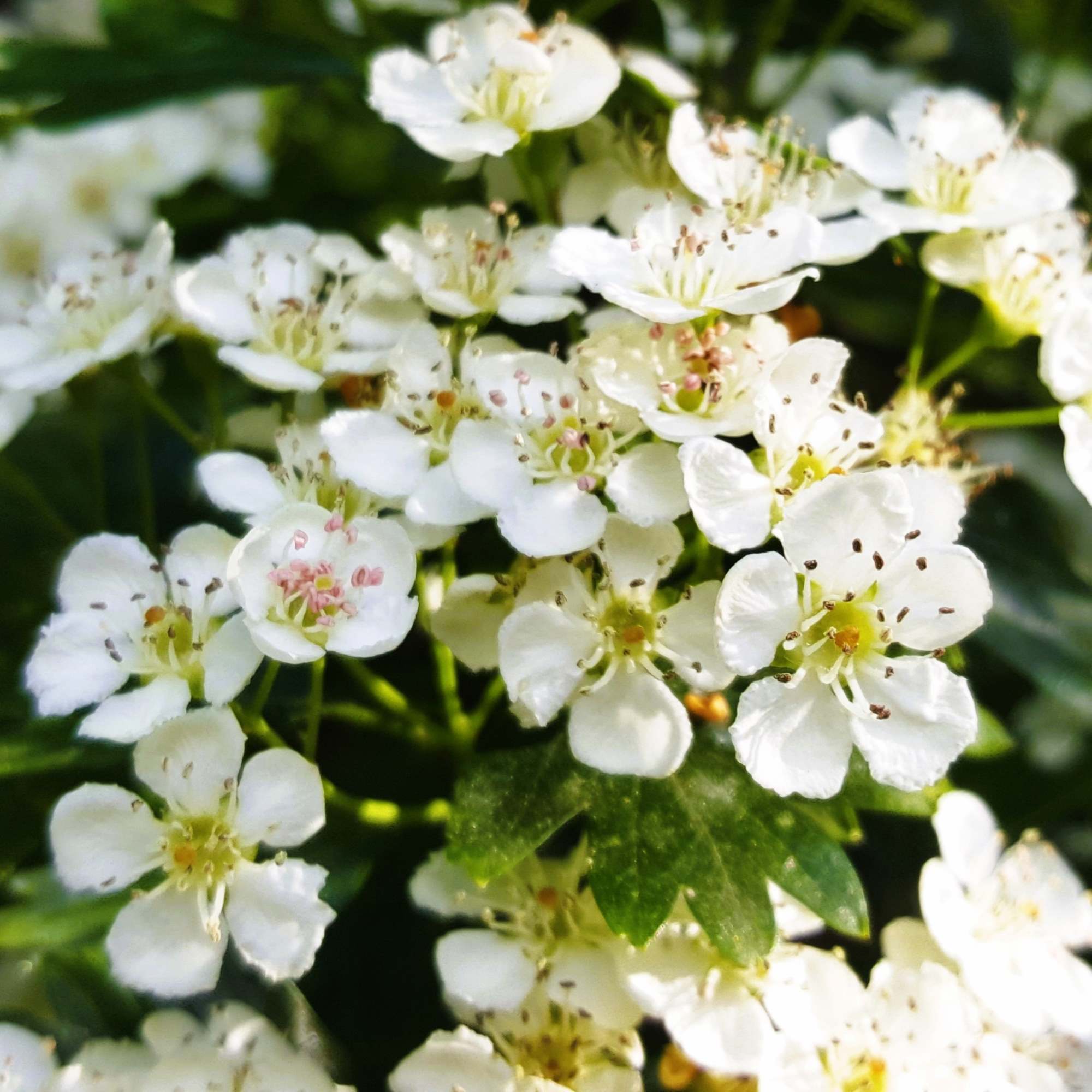
The experience of being out in the wide open on Higham Marshes in Kent on a warm May afternoon is nothing short of glorious. It's a perfect location for the Lento mics too. Earlier this year we walked through the nature reserve en-route to the old fort on the Thames and left the Lento box to capture the sound scene of the Higham Marshes nature reserve from a little hawthorn tree in full scented blossom. We shared part of this sound-view in episode 169. Here's the other part of that same recording, kept back until now, for a time we really need to travel back. The Hoo Peninsula is today an edgeland and a place of environmental dichotomies. A vast area, where giant operating container ports rumble on the same horizon as silent half buried war relics of the past. Where fields of managed land abuts wild margins of natural unmanaged land. It's a world navigated via long winding and sometimes contradictory footpaths. Paths that one minute are rubbish strewn smelly boot thieving bogs exposed to the aural effluent of distant industry, and the next, grassy and dry under foot, tranquil, shielded from all human noise. Wandering ways, lined with verdant vegetation. Filled with exotic sounding birds. For some reason the body seems to adapt to this dichotomous terrain before the mind does. Though the contrasts are not as stark as they may seem when written down. In fact it's these edgeland contradictions that really make the Hoo Peninsula, particularly the area between the old fort and Higham Marshes, so sensorially fascinating. Of course eventually the mind does catch up with the body. And the feelings are good. Of sensory bathing. Bathing in meadow scents. In exotic bird calls. In happily humming insects foraging from plant to plant. In the timeless sound of baaing sheep and grazing cattle tearing up fresh meadow grass beside lapwings, cetti's warblers, skylarks, geese, ducks and red shank. The sheer density and diversity of creatures audible from this little tree hidden on the marsh, is really something to behold. And the way they exist between the human made anthropogenic noise, is something to behold too.

Ep 195191 Moorland waterfall (sleep safe natural white noise)
An hour of pure falling water in a natural wide open landscape. Captured in the early hours of yesterday morning in the hills of Derbyshire. A place off the beaten track. Up in the hills. Rugged. Reached by a steep up climb holding for balance on arm-thick sapling trunks, whilst stepping between winding deer tracks. An old holly tree stands amongst many other trees, facing the waterfall. We hang the Lento mics off one of its outstretched limbs. Angle them out so they can hear across and beyond the waterfall. A profusion of hard ferns growing up from the rocky pool softens the intensity. Down stream hart's-tongue ferns line the banks, and rustyback ferns cover time-toppled dry stone walls. This unmanaged upland environment is filled with vegetation and clean refreshing sound. When embarking on a long listen like this, the sound view may at first seem, well, just white noise. Pure white water noise. Not much else. But time does something. The auditory brain gradually tunes in. To tune in, headphones are needed as they are designed specifically to project binaural sound directly onto the left and right eardrums (with no room-gap). The left and right inner ear then carries the soundwaves layered with complex spatial cues (here the waterfall and surrounding environment) into the auditory brain where a mental picture is formed. These soundwaves, having been authentically captured using ear-like microphones at a real location, can trigger a similar aural and perhaps even physical response to the experience of actually being there yourself. It's why we say "surround yourself with somewhere else". This sound-view is of the waterfall, to the left. Partly hidden behind trees and beds of hard ferns. The stream flows in front of you left to right down the moor, to the valley that opens out to the far right. Ahead and below the holly tree holding the mics is the drop pool where water faintly gloops and gurgles. And sometimes very tiny clicks can be heard from left and from right. Probably the branches of the trees 'resting' down as they do in the cool night hours. This process where the boughs of a tree rest down by around fifteen degrees makes subtle noises, and is when dead wood most often drops down into the leaf litter. The auditory brain is our constant 360 degree survival sense that's evolved over a million years giving us a powerful non-light dependent way to alternatively 'see' the world around us. Spatial hearing has evolved in tandem with sight and our brains construct our perceived reality from both senses together when out in the natural world. Even though modern ways of thinking are heavily anchored to sight, by investing just a little quality time in natural binaural listening you can tell it taps into something subliminal and evolutionary. A calm threat-free natural environment like this one beside a remote waterfall, just does feel good. There's no need to wait for scientists to tell us why.

Ep 194190 St Mary’s Church in Rye
We're hugely grateful to Revd Paul White of St Mary's church at Rye for enabling this special recording to be made. An aural presence of St Mary's church. Captured through the night of the 3rd of October. This passage of time is as it happened, from midnight to 1am. Experience being in the nave, then perched high in the belfry looking down from the top ledge upon the bells, including the 'quarter boys' that strike the quarters. There's a wonderful old timber beam to rest against, so don't worry about the drop. This sound-scene of St Mary's unfurls over an hour and between two slow alternating perspectives, each lasting about six minutes. It starts in the nave where the congregation gather for services and prayer. Then glides up to the belfry. Due to the extreme intensity of sound in the belfry (the sound of the main bell carries for miles) the sound scene during striking is from the perspective of the nave. On the very last strike, the perspective blends back up into the belfry, letting you witness the singing of the main bell as it fades away. (Note The clapper can be heard knocking slightly against the bell, as it settles back to rest after striking one.) The church's clock marks each second passing with a crisp resonant clunk, as it has done for many centuries. Indeed it is one of the oldest church turret clocks in working order, first installed in 1561-2. The pendulum visible above the nave was added later. (Read more about St Mary's fascinating history.) The belfry is at the top of the church tower, and is a narrow space very much exposed to the elements. The clock's mechanism can be clearly heard from up here, together with the pressure of moving air as it presses through old rafters, and rocks heavy roof panels. To the right the flagpole outside vibrates against its sturdy mooring. The melodious strike of the quarter boys is close and clearly defined from up here inside the belfry. In contrast the nave is a large spacious and sonically reflective space. High ceilings and wide stone floors. It's where the congregation gather for service. From here the main body of the church can be heard, shouldering the weather in soft, hushing reverberances. A peaceful place, for people, time and prayer. Please note that this is NOT a sleep safe episode due to the bell chimes and clock mechanism. It is a rare chance to hear such an ancient space at night with the sound of the clock inside and the wind raging outside.

Ep 193189 Night rain falls on a drystone wall (quiet and sleep safe)
There, thought the old drystone wall. I knew it. A tawny owl. Flying silent, up top the field. It'll only be a shadow, if ever you do get to see it. Better get to where you're going my feathered friend. The rain's coming. Not long, I'd give it, what, five minutes before the first shower. A flurry. That's all. At least to start with. Night minutes mind. No! Night minutes aren't slower if that's what you're thinking. Nothing like that. No they're just, different. They don't run in a day-straight line. Night minutes spiral. Like the way currents on a slack stretch of river move. You know, in slow drifting circles. Sends your mind round in circles too if you let them. They pass alright despite them going round in circles. Not sure how that works, it just does. All you have to do, to go along with them, is concentrate. Not concentrate on counting them. You do it by listening. All around wide about listening. Listening, without expecting or waiting for anything particular to happen. Do it by keeping your mind free of expectations and instead let whatever the world has for you, come to you, just when it does. Now call me an old drystone wall, which is what I am, but even I know half the problem these days is that when you set your mind on something you want to happen, you miss the simple pleasures the world has for you while you're waiting. No, it's not patience I'm meaning here. Why be patient. I'm not and I've stood sturdy here for centuries. It's diligence. An active process, of careful, and persistent listening to what is there. In the place you want to be. * This sound view was recorded from the top of a drystone wall overlooking fields of nocturnal sheep, in the North Yorkshire market town of Settle last August. Rain comes and goes. It's a very ordinary field in many ways, and not far from a very ordinary sounding B road with some occasional night traffic on it. Combined with the odd soft arching plane, the sound view exudes a pleasantly harmonius aural fabric that is soporific and sleep safe.

Ep 192188 Rock seat on Rye Harbour beach
Near a limpet covered wall, beaten into shape by high tide waves and squally weather, are some rocks submerged in shingle. Rye Harbour shingle. Sun warmed, they've got just enough flat on top, for two to sit. And enough yards from the water too. For you not to get wet. And yet, from time to time, you do. But only a speck, thrown by an exuberant wave. Advancing waves keep rolling in. Splashing and breaking, as much onto each other as they do onto the smart grey contoured shingle. Splashing and breaking waves whose sound is as bright as the light of the midday sun. From your smooth rock seat, you can hear the tide's not far now, from the turn. A tiny bead's landed upon the back of your knee-rested hand. One speck of cool ocean. You dab it away. Its translucent shadow feels like a winter penny in the brisk sea breeze. * We made this recording a few days ago on a warm October day at Rye Harbour beach in East Sussex. The sun was crisp and strong, as was the onshore breeze. One of the most wonderful feelings is scrunching over the different bands of shingle, as you head down to the shore, because of how the sound changes. ** Thank you to everyone who supports us on Ko-fi.

Ep 191187 Steam train stops at country station
You strode up to this field, through lush meadow, for a better view over Arley station. And now you're here. It's a perfect Shropshire August day. Blue sky. Light breezes. Hot sun on your back. Nearly time you think looking up into the sky, far right, for any sign of smoke. The whole station's in view from up here. Here beneath the tall whispering trees, and basking grass crickets. There's the empty waiting tracks, lined by high overgrown hedgerows. And a man down there. Hammer. Nails. Fence beside the gravelled track, being sporadically mended. Such a country scene. With such balmy country sounds. Benevolent. Timeless. There, watched by the circling buzzard. Chased away by rooks. And when it first came from over the horizon, it announced its imminent arrival with a blast on the whistle. Mile wide, its sound waves travelled. Through the cutting it then proceeded. To emerge like a resplendent surprise from under the old stone bridge. A heavily rolling, clanking, iron mass of hissing pressure, that gently squealed to a halt in the waiting station. As it waited for its passengers to board, it pressed against its wood block brakes, radiating heat. And a slowly building, smouldering hiss. And the whole valley seemed to brace itself for what it knew was about to come. The bridge and the sloping fields. The trees. The road. The buildings and even the sky. All braced themselves, to be turned inside out. Turned into a steam train dream. A steam locomotive, to give it it's proper title, does not so much depart a station, as leave it in its wake. Its iron furnace contains such pressure, that when its valves expose its pistons to pump the girders that turn the giant wheels, it's not just the air that's kneaded like a dough, but the whole world around it. It's a palpable sense of power that so surpasses anything you can have imagined, that all you can do is grin. Whilst fixed to the spot. In enchanted admiration. * We took this sound photograph of a steam train passing through Arley station last month. We recorded in high definition sound. After the train left, we left the box recording alone, to take in the soft rural wind in the trees, the crickets in the grass, the man mending the trackside fence, and all the other sounds of ordinary everyday life going on in this Shropshire valley.

Ep 190186 Slow forest Wyre valley
What happens, inside slow forest, is not much. Just the odd snap and crack, of a dry twig dropping, every now and then. I know sometimes there is a rook. And I know a raven too, if you've managed not to fall asleep. And echoes. Of passing people on the trail. And of seagulls and roosting wood pigeons too. Every now and then. No, not much happens, in slow forest. Apart from the wind in the trees. And the buzzing insects. And the distant farm. And the plaintive cries of what we might imagine is a lonely juvenile bird. But slow forest, is the place to go, if you want to hear a forest just being a forest. It's so huge. And so empty (not counting the trees) that most of what you hear is just, forest. Trees being trees. Leaves being leaves, in the changing wind. And the changing wind, just being a changing wind. * We captured this hour of forest time by leaving the Lento mics alone on an old tree last month deep in the Wyre Forest in Worcestershire. Two planes doing a loop-the-loop can be heard steeply descending around the middle section of the recording, and the echoing whistles of a passing steam train as it travels along the Severn Valley Railway can be heard towards the end.

Ep 189185 Onshore breeze on Chesil beach (sleep safe and in hi-def sound)
This onshore breeze. A pleasant one, will not cuff too much against your ears. It'll flutter. Like a dark brown feather quivers, on a current of moving air. It'll be steady too. As a pleasant onshore breeze is. As the horizon is, from whence it came. Rising, at its centre. And falling away, almost imperceptibly either side of its farthest edges. A constant. And a consistent presence that lets your skin know just how endless the space is. Out there. A strange thing though. Worth noting. Worth remembering, for next time. How an onshore breeze is unchanging. While it comes from out there, from the wide open endless sea, and while it lands upon the shore just as the incoming waves do, it does no advancing or receding, like the waves do. No hauling back of the shingle. No pulling away making you feel your love is about to be lost only, seconds later, to be found again. No. Because with the onshore breeze, you always know where you are. It's constant. Cool yet convivial. Makes the time spent on the beach feel real. Right. Restorative. * We took this 30 minute sound photograph on Chesil Beach by Portland last April. Its the second take of the beach from a different location to episode 163 but taken shortly afterwards on the same day. Placing the Lento sound camera pointing directly out to sea, about fifteen yards from the breaking waves, the scene captures not only the steady on-shore breeze, but the deep visceral and spatial sound of the receding waves as they haul back huge quantities of the smooth, very heavy kind of shingle, that this section of Chesil Beach is made of.

Ep 188184 River rilling through Miller’s Dale (sleep safe, hour-long)
Miller's Dale. Steep sided. A valley in the Derbyshire Dales with magnificent contours. High rocky outcrops. Sheer faced cliffs. Green fields plunging down to a quiet, winding river. It's a place where geologists go, to see the evidence of lava flows from millions of years ago. Where historians go, to marvel at Victorian viaducts and tunnels cut by hand in the 1800s. And where weekend people go to trek or cycle through open country along the disused railway lines that used to carry the trains between Manchester and London. Miller's Dale feels cut off from the world. Alive in the moment, but somehow separated. As you wonder its winding and overgrown footpaths, you sense the valley is a place not only of restorative solitude, but a place where you are free to imagine yourself conscious in another time. Another era. Hearing the echoes of a rumbling steam train, chuffing northwards with Victorian haste. The meek baas of sheep, grazing on wet Iron Age pastures. Or the tide of the bygone sea, that the composition of the rocks shows this landscape almost unimaginably used to be. Now the sound of water flowing is from the river. the River Wye. How steadily it runs, along the valley bottom. Open country water, that along the shallow stretches rills, pleasantly, over tumbled stones. Cool. Refreshing. Consistent. Rilling in watery melodies, if you let yourself listen for long enough. * We left the Lento mics alone, hanging from a steeply leaning tree, to capture the spatial sound of the River Wye flowing through the night. Some planes are audible in the sky, possibly more than usual for 2am, due to a major air traffic control breakdown the night before.

Ep 187183 Upland fir forest (sleep safe and ideal for headphones)
High, in the remoteness of the Cumbrian hills above Dentdale, with buzzards circling overhead, we found a fir forest. Tall, elegant trees, reaching up to the sky. All leaning, slightly, against a mild August breeze. The mild, long distance, cross country breeze. The hill was steep, so we stopped to take in the view behind. It was then we heard the forest. Its dense trees loomed above us. Only twenty yards away. Giant sails, in moving air. Tall. Dense. Each tree hushing not in white noise, but in noise of other shades Light browns. Dark browns. Dry stone greys. Twilight greens. Dark purples. Each undulating. And dissolving into the other. Nearby, we found a path. It led into the forest. Led into its quiet heart. Surrounded by hushing trees, we listened. Stock still. In total silence. A remote fir forest. High, in the Cumbrian hills. * We left the Lento mics alone to capture the undulating sound within the heart of this forest. At 29 mins a freight train can be very distantly heard as it rolls through Dent railway station farther down the moor. Or the fell, as the locals say. From ten mins in a buzzard can be heard circling directly overhead. Dentdale is at the western end of the Yorkshire Dales National Park.

Ep 186182 Night scapes special - August intermission 4 (sleep safe)
For this last August intermission episode we've made you a montage of *sleep safe* sound-scenes selected from four overnight recordings. From the sea wall at Burnham-on-Crouch, looking out over panoramic tidal estuary waters by Wallasea Island. An oak tree deep within the Forest of Dean where woodcock make their roding flights. A remote fishing village harbour under empty skies in South East Scotland. To a rural wood in Suffolk where we made our first ever overnight recording. Here are some short descriptions plus links to the episodes so you can hear them in full. 126 The seawall and the night patrolling curlews To be a remote seawall, on a stretch of tidal estuary. To see the days and nights not as periods of time, but as slowly undulating waves. To feel the weight of water, twice rising, twice falling. To hear, the lone patrolling curlews. This is Burnham-on-Crouch around 4am, looking out across the tidal waters towards Wallasea Island 129 Pristine quiet to early dawn A clearing, deep within an expansive forest, where the night air carries so little sound that only the trickling stream can be heard. The stream's sound reflects narrowly off the trunk of the tree, like the flickering light of a campfire. But when a woodcock flies by, on its roding flight, the sense of space is temporarily revealed. This segment of overnight recording we made in the Forest of Dean. It begins at around 4am when the space around the oak tree holding the microphones is still pitch dark. 140 Fishing village harbour at night Real quiet from the middle of the night, captured from a point above the harbour of St Abbs on the East Coast of Scotland. Car-free. Plane-free. Just the sparse and spacious cries of circling gulls over harbour waves, and the faintest hum of a fishing vessel anchored somewhere out at sea. This remote, thousand-year-old fishing village is to us a place defined by its quiet horizons and empty, plane-less skies. 74 Night shallowing in a Suffolk Wood It's 3am in our first ever twelve hour overnight sound landscape recording. A Wood in Dedham Vale, Suffolk. Balmy August night. the Lento mics left alone to capture the sound landscape from deep within the uninhabited woodland. they revealed dark bush crickets, chirruping the passing of time. Wind moving softly over the tree tops. the distant bell of St Mary's church, floating through the space beneath the trees, striking three. Nocturnal animals treading lightly over dry leaves. This 2017 recording opened up a whole new world to us, and inspired us to make more recordings and share them through Radio Lento.

Ep 185181 Woodland scapes special - August intermission 3
For this penultimate intermission episode, we've made you a montage of sound-scenes selected from four enchanting woodland episodes. A forest ravine high in the Derbyshire hills. Under a tree above the town of Wooler, in Northumberland. A waterfall gorge on Dartmoor. And finally, the mysterious murmurings from deep within the Forest of Dean. Here are the descriptions and full episode links so you can enjoy them in full. 160 Forest ravine This precipitous place, high in the Derbyshire hills, flows with birdsong and fresh moorland water. It's aural presence is made almost entirely of natural things. Non-human, natural phenomena. Having this piece of time uninterrupted , and from this elevation, you can watch the geese through the trees as they fly through the ravine's luscious and airy reverberations. 141 Soft land murmuring - Wooler, Northumberland An exposed tree, looking down upon the town of Wooler, high in the Northumberland hills. It stands amidst wide open fields, by an empty bench and an overgrown footpath. The soundview of this wide panoramic landscape changes with the wind. Tawny treetop owls. Sheep. Cawing rooks. Flocks of chattering jackdaws. Wood pigeons, cooing comfortably from their lofty roosts. Then as the wind gathers strength, the soundview shifts to the interior space within the tree holding the microphones. 162 Waterfall gorge on Dartmoor you've made it up, to the Dartmoor gorge. Thick untouched forest, and a rushing torrent, cascading down a rocky, precipitous gorge. Getting here, up and up, along a rocky path through endless trees, feels like a pilgrimage. A pilgrimage to a rarified place, that's lit through day and through night, by brilliant, refreshing, acoustic sunshine. (Since we took this sound photograph we've learned that regions of Woodland on Dartmoor have been designated as temperate rain forest.) 122 Forest bathing in the cathedral of trees A passage of early evening time, captured by the Lento mics recording alone, from deep in the Forest of Dean. They hear wide spatial echoes. Woodland birds singing free of interference. Rich, layered murmurings. And air, moving gently through the high tree tops, of this ancient forest. We think of our sound recordings as sound photographs. Spatial sound scenes taken from one fixed position, over time. Our goal is to share the aural view of a place, in a spatial high detail way that lets you experience the true authentic feel of what it is really like to be there. An aural reality of being somewhere else.

Ep 184180 Coastal scapes special - August intermission 2
We're taking an intermission during August. Rather than disappearing, we're made you a montage of sound-feels selected from previous episodes. This week's theme is coastal. Listen to four lovely clips of coastal scapes we've captured. Take a tour from Tenby in South Wales, Coldingham Sands in South East Scotland, and Nothe Fort on the Jurassic coast of England. Here are the descriptions and full episode links so you can enjoy them in full. 174 Where cool woodland meets the summer sea At the far end of the long sandy beach at Tenby there's an area of cool, shady woodland. From the distance and under hot summer sunshine, it looks idyllic. Inviting. Under the trees the hot sunshine air is cooler. Laden with sweet musty smells and sappy perfumes. The birds are singing. Their sound reflecting between the trees. Melding with the washing waves. This place is like a temperate greenhouse. A naturally reverberant space. Perfect, to set down, forget about doing anything, and just listen for a while. 178 Waves of the intertidal zone It's late and you're out. in solitude, For an evening walk, on a wide open beach. Tenby beach in South Wales. Here, is white noise solitude. You scrunch over flat corrugated sand towards the shallowing waves. Then wade in. Immersed. Ankle deep and paddling. White noise is everywhere. Waves, are everywhere. Racing. Washing over each other. Left to right. Right to left. Face on. And under. Rushing away, behind you. Tiny bubbles. Sparkling. Shallowing. And dissolving, into fizz. 150 Looking down on Coldingham Sands A bench. Perfectly perched, by the sandy steps that lead steeply down onto Coldingham Sands. Perfectly perched with a sound-view so wide, and angle just right, to hear the incoming waves as they break over outcrops of craggy, elephant-sized rocks. It's a bright August day, and the sun is mistily lighting up the sea, the rocky cliffs, and the plunging, richly vegetated slopes. This place, on the East Coast of Scotland, is special. It's a landscape under a genuinely quiet sky. A sky free of human-made noise, where the detail and quality of natural sound can reach the ear drums intact. 176 Early morning below Nothe Fort A smooth, sunrise sea, heard from a tree, growing up out of a bundle of boulders close to the water's edge. It's early April, and just after daybreak. The Lento kit is in the tree, capturing the wide spatial quiet of this place with nobody about, right beside Nothe Fort in Weymouth on the south coast of England. Ahead, looking south, the sea. West is Portland. East is Weymouth, then Durdle Door, near to Lulworth Cove. In this little settled spot, and from far left of scene, the sea seems to be breathing, softly, as it sweeps the shingle at the foot of the fort's huge parapet wall. Perhaps it's still asleep. Has it not heard the blackbird? Has it not heard the wren? Or the garden warbler? Maybe it hears them, from within a dream.

Ep 183179 Rain scapes special - August intermission 1 (sleep safe)
We're taking an intermission during August. Rather than disappearing, we're sharing a different type of episode, each with a theme, using some of the best bits from previous episodes. This week's theme is rain. Here are four glorious rain scapes. Travel with the rain as it falls, on a wide open coastal landscape, a walled garden in London, and on high moorland woods in Derbyshire. Here are the descriptions and episode links so you can listen to them in full. 146 Fresh air along the Creel Path The Creel Path has been trodden by fisherman on their way to work from Coldingham to the harbour at St Abbs in Scotland, for a thousand years. It's a landscape whose geography leaves it exposed to everything that the sky can bring. By locating our mics within the natural shelter of a tree, and letting them record alone for twelve hours, we were able to capture the full width, depth and range of this place and its unique soundscape. 128 Persistent rain Heavily, this winter rain falls. Persistent. Cold. Wet. Refreshing. In waves. In sprinkling flurries. Over time. Onto the huge tarpaulin stretched across the yard. Each drop's long downward journey is both completed, and revealed, in one tiny moment. Is this just plain old rain? Listen in, especially through a pair of headphones, and layer upon layer of spatially detailed rich textured sound will to you become revealed. 167 An hour under moorland trees There is nothing and no one about. You. Here. Hidden. Up in the Derbyshire hills. Sat, on dry leaf litter, lent against a gently slanted tree trunk. Listening. Just an hour. Under moorland trees. An hour to listen, to the weather, the flurries of rain And the steady ever-changing wind. 156 Sheltered under night rain The city sleeps, under a dark impenetrable sky. In one garden, sheltered under a wide tarpaulin, microphones are recording. Alone. On top of a tripod, and standing, as high as a person. Listening. The tarpaulin, is to them a canvas. It lets them see the rain. In all its spatial detail. A transcriber. A taught thin surface, that catches each raindrop, and changes its collided imprint into crisp edged, spatial sound.

Ep 182178 Waves of the intertidal zone (Don’t forget Lento’s built for headphones!)
A shadow grey rock, the size of a stranded ship. Radiating heat, remembered from the midday sun. Around it, rock pools, and smooth curving shapes. Like sleeping seals. You're out. Alone. For a late evening walk. Overhead, and behind, the sky is a deep, deepening blue. An end-of-day blue. But to your right, on the low west horizon, it's still blazing bright. This place, this wide open beach, is white noise solitude. All around, empty space. Empty space and sea air breezes. Sea air breezes, and some people. Happy cries, and beach ball thumps. You walk. Scrunch sand between your toes. You swing your legs towards the sea. Head towards the intertidal zone. Stepping on hard ruttled sand. Over furrows of stranded water. For as far as the eye can see. Corrugated land. Low tide land. Shaped into longitudinal lines by the withdrawing waves. Right ahead, bright white noise. And gulls. Just landed on the wetted sand. Rapidly stamping their little webbed feet, to bring up the morsels. A rush. Of cold fizzing sparkling rippling water. Breaks suddenly over your feet. Breaks, and splashes up your ankles. Stops you in your tracks. Swirls and foams and flattens and shallows, all around you. Fills the air with watery sound. Like shimmering blue, shoreline silk. Now you're in, and immersed. Ankle deep and paddling. White noise is everywhere. Waves, are everywhere. Racing. Washing over each other. Left to right. Right to left. Face on. And under. Rushing away, behind you. Tiny bubbles. Sparkling. Shallowing. And dissolving, into fizz. Each one, each wave, adding one more corrugation, on the wide intertidal sand. * This sound photograph of Tenby beach is first try of something new for Lento. We recorded it dynamically, as we walked, in one unbroken 30 minute take. Angling and panning the Lento kit, holding still on wide panoramic views, then panning down almost to touch the water for close-up views of the sparkling bubbles, then gently sliding sideways to chase waves as they race to the shore, as with a film camera. We wanted it to be a kind of sound film. If you can't make it to the beach this month we hope you can enjoy this intertidal sound walk, until you can.

Ep 181177 Summer meadow woodland edge
You find yourself, suddenly out. On the other side of the wood. The edge, of a wide open empty field. A meadow. Tall elegant trees, given way to a high, bright sky. Standing silently. You can feel the heart of the forest behind you. Hear its echoes. Its leaves near and far, rustling. How one tree creaks. How banks of soft summer air move spatially across the treetops. How trains, passing distantly through the forest, make sound like silver wind. In front, is open grassland. Fragrant. Home to large populations of butterflies. And that sings, with the sound of stridulating crickets. Hundreds. Thousands. All cricketing, under this warm noon day sun. This meadow. These slowly swaying trees. This breeze, in the leaves and grasses. This feeling, of being so near to the cool green heart of this forest. And up, at the sky. And up, at the sun. And the shifting clouds. And the planes, flying from time to time. Flying, from cloud to cloud. * We travelled into Hertfordshire (by train and on foot of course) to take this sound photograph from as near as possible to the Clinton Baker Pinetum one lunchtime last week. It's a fascinating place, rich for forest bathing, first planted in 1767. We want to take some more sound photographs that capture the range of tree species inside the pinetum if and when we can get permission.

Ep 180176 Early morning below Nothe Fort
The sound-scene is of a smooth, sunrise sea, heard from a tree, growing up out of a bundle of boulders, close to the water's edge. It's early April, and just after daybreak. The Lento kit is in the tree, capturing the wide spatial quiet of this place with nobody about, right beside Nothe Fort in Weymouth on the south coast of England. Ahead, looking south, the sea. West is Portland. East is Weymouth, then Durdle Door, near to Lulworth Cove. Here, in this little settled spot, and from far left of scene, the sea seems to be breathing, softly, as it sweeps the shingle at the foot of the fort's huge parapet wall. Perhaps it's still asleep. Has it not heard the blackbird? Has it not heard the wren? Or the garden warbler? Maybe. In a dream. From right of scene, where the swell's near and breaking over the boulders, the sea's very much awake. Awake, and moving. Rising, falling. Gently washing the sunlit sharp rocks, in slow, circling motions. High above, in wide circles, are the seagulls. Calling brightly to each other in the first light air. And some stray crows. And ducks. And something else. Something deep. Something that hums. It is, almost musical. Not animal. Or geomorphological. Too powerful, too omnipotent, for that. It's the kind of sound that isn't in the air. But is the air. A ship. And its low humming engine. Moving. Very gradually. Across the horizon. Like a far drifting cloud.

Ep 179175 Night train sleeper (sleep safe)
The cabin, is compact, in every way. Every inch, accounted for. Every component, slotted in, perfectly. And, with full rucksack and boots and spare boots and string bag, a bit of a squash to get in too. Once you're in though, once you've sorted, and stowed, and made things neat, any claustrophobic feelings will just, well, have magically evaporated. In some curious way, these cabins can somehow, surreptitiously, expand. As the train pulls out of Penzance station, you begin to hear the rumble. A sturdy, rounded edges sort of rumble, a cacophony, of gently juddering low frequency vibrations, that'll sway about beneath you and your bunk as the miles pass, and gradually become your friend. The sound is, dark, and velvety, and when combined with the physical sensation of being horizontal on a cotton soft pillow, deliciously soporific. And there are the other swaying sounds. The tiny creaky movements of all the cabin's fittings. The muffled clunks and clicks, as someone sleepily feels for the night light switch. And The carriage's squeaky suspension, that in your dreams can be a swinging sign, outside some windswept Out West saloon. Howdy friend, welcome to the Old Railroad. Care to come in? But best of all, to us, perhaps to all who slumber their nocturnal way cross country aboard the Night Riviera, is the ever-present, ever fluctuating, omnipotent hum of the locomotive. The giant sized engine, the dynamo, the journey's conductor, that valiantly leads the way into the night, and makes the whole thing happen. And keeps it happening, warmly, and reassuringly, over hundreds and hundreds of dark, dark miles. * This spatial sound photograph, an unbroken sixty minute segment of the journey from Penzance to London Paddington, was taken from within the cabin beside the bunk. It will to those trigger deep and we hope blissful memories of travelling through the night on a sleeper train. If you haven't done this yet, we hope this recording conveys at least some of the unique and soporific sound experience of a night train sleeper.

Ep 178174 Where cool woodland meets the summer sea (an afternoon snooze)
At the far end of the long sandy beach at Tenby there's an area of cool, shady woodland. From the distance and under hot summer sunshine, it looks idyllic. Inviting. A shady promontory on the horizon that curves and blurs down into the sea. The best way to get there we think, is by shanks pony. Walk, as slow as you like. Go the full length of the beach. Pass the kids playing and the running dogs who couldn't be happier. The picnicing families, and the lone beach ball, waiting patiently to be collected. Steer yourself between the scattered seaweeds of the strandline, and the breaking waves of the shore. Just keep going, but don't forget to stop too. There'll be plenty of bits of flotsam and jetsam that need to be checked along the way. And the odd motorboat, to watch, far out on the water, steadily bouncing over the swell. As you approach the headland, the trees loom. They are towering things. High, with broad boughs that stretch like green sails overhead. Some will be swaying in the onshore breeze. The beach ends here, so step off the soft sand and up and over the ridge of craggy rocks, to the wooden steps leading to the woodland path. A sandy adventure, that leads steep up, under the trees. Climb. Feel how the air cools. Becomes laden with sweet musty smells and sappy perfumes. Hear how the sound changes. How the birds are singing. How their sound reflects between the trees, and combines with the washing waves. The sea enters the lowest footings of the forest along natural inlets that are lined with gnarled and exposed roots. This place is like a temperate greenhouse. A naturally reverberant space, shaped, regulated, and defined, by the sea and the trees. Such a perfect place, to set down, forget about doing anything, and just listen for a while. * Tree canopies can divert over 60% of the sun's heat and so make you cool through a process called evapotranspiration. Source: bbc.co.uk

Ep 177173 Deep forest time (long & sleep safe)
This is a blend of intimate and wide spatial quiet, captured as it happened from beside an old oak tree, in a remote spot in the Forest of Dean. The time is 3:30am and the microphones are recording alone. It's 90 minutes to dawn. What we hear in the foreground are the intimate textures of a trickling stream, that's completely hidden from view under thickly tangled vines. A hedgehog is foraging through the dense leaf litter, making delicate scratchy sounds like a moving pin cushion. The space immediately around the oak tree holding the microphones is sloping, and partly cleared of trees but only for about ten yards or so. The forest stretches all around for miles. As time passes, high planes overfly the woodland, in soft rumbly arcs. A car, speeding along the country road that bisects this area of woodland, makes white noise like a breeze in the trees. At 36 minutes, sliding from far left to far right of scene, a male woodcock flies through the clearing, making a strange qwacking type call that ends in a bright squeak. This call is known as a roding flight and it returns quite a few times. As dawn approaches, the echoing hoots of tawny owls reverberates sonorously across the huge expanse of the forest. Dogs distantly bark, and farm animals can sometimes be heard. Towards the end, a song thrush begins to sing, short melodious notes in repeated phrases. Dawn is near.

Ep 176172 Heatwave thunderstorm that washes and cools (panoramic, made for headphones)
Have the back streets faded to silent? Have the dogs begun to bark? Quick, get in, there's a storm coming. The front room chair with the cushion that isn't supposed to be outside in the yard but is, because it's been so hot of late, is that in? And the pile of winter boots left out to air next to it? And those newly potted plants that can't cope with heavy rain yet? Get them all in, the air's gone electric. Thick thunder rolls, across a strange coloured sky. Brings rain that's in such a hurry to get down it all comes down at once. Rivulets of sparkling water, flowing off the tarpaulin. Pouring onto the parched concrete yard. Wafting smells of petrichor. Heatwave storms plough a deep furrow through the sky as they pass, that take a while for the atmosphere to settle. It's the dramatically changing sound scenes such storms create that make them so rewarding to listen to. The sheer intensity of an unbridled deluge. The panoramic spatial thunder created as the lightning bolts explode vast volumes of air. And the relief, after the storm has passed, expressed through the countless dripping drops of fallen water, from all the surfaces on which it fell. Three movements. Three acts. Of a heatwave storm. A powerful storm is like a piece of theatre. It bends and redefines the meaning of time. It suspends your belief in what is normal and your perspective on reality. And when it's over, it leaves you feeling physically different to how you were before. Different, and better. * The Lento mics captured this storm as it passed over Hackney in North East London in early afternoon last week, after a long period of exceptionally hot and dry weather. The location is the back garden of a small terrace house. Temperature prior to the storm was 30 degrees. Humidity was 39%. A few months ago the humidity was typically between 80% and 90%.

Ep 175171 Sunrise birds in sea washed air
Sunrise over Tenby. Blue sky. Scudding clouds. 5am, and nobody about, except for the birds in the murmuring air of a seaside town. This sound photograph, captured from behind the descending houses on St Johns Hill in Tenby, is spatial, and composed by chance with balanced foreground and background layers. A blackbird right of centre. Another blackbird, mid-distance and left of centre. Far distance, ranging 90 degree left to 90 degree right, wrens and other birds. The white noise of the beach can be heard reflecting slightly to right of centre, off the high wall of a large sided building beyond. Circling seagulls often pass over too, and light up through sound the empty airspace above. This episode follows on from last week's 'Night murmuring in Tenby'. The daylight has come, but still rocking slightly in the breeze, is next door's rusted garden gate. * Tenby is another location we've found that has quiet horizons. There was almost no aircraft noise in the four days we spent there. Quiet horizons we think promote a deeper sense of wellbeing and allow the natural world to be perceived properly. There is some wind noise in this episode due to coastal conditions, but because of the minimal human-made noise, the murmuration of the sea reflected off the nearby buildings is clearly audible even though it is on the other side of the hill.

Ep 174170 Night murmuring in Tenby (sleep safe)
Tenby. A seaside town on the South coast of Wales. End of May into early June. Late sunsets, followed by warm, springtime nights. It's 1am and the mics are recording alone. Capturing the atmosphere of Tenby, in the dead of night. Behind where we're staying are dim shapes of buildings. A tall tree with whisping leaves. Empty sun loungers and nextdoor's gate, loosely fastened, being moved atmospherically by the gusts. Echoes of distant windchimes. And there above, the deep, dark, quiet sky. And all around, the breezes. How this place sounds. How it rests, in this smallest hour. And murmurates, under its so peaceful sky. So much silky air blowing in from the Atlantic that it's barely any effort to breathe. Soft flowing currents, that billow, cuff, and clean. Listen. Listen. To the trees. Can you hear them? They're breathing for you.

Ep 173169 Ear witness report from the Hoo Peninsula May 2023
The Hoo Peninsula is a vast open landscape on the Thames Estuary. Huge uninhabited swathes of ground. The mics (recording alone) were lodged in a hawthorn tree on Higham Marshes nature reserve and pointed out over a watery marsh. Close to the mics lapwings, redshank and cetti's warblers call, as well as geese and ducks that are familiar sounds to us urban dwellers. Skylarks circle above the farmland straight ahead on the other side of the marsh. Several pastures, with sheep and lambs in one, grazing cattle in the other. During the quieter periods when planes aren't going over, cattle can clearly be heard tearing up the long grass. We took this 47 minute 'sound photograph' as an ear witness report of everything hearable on Higham Marshes on 14th May 2023 (map reference - 51.450474, 0.464734). Wildlife. Human life. The weather conditions were good - warm, around 20 degrees with a light breeze gusting 3-5 knots. The air was rich with scent of hawthorn blossom, cow parsley, meadow grasses and pollen. The sound photograph is taken from the same tree as episode 73 Slow rhythms of the Hoo Peninsula, that we captured in June 2021. Due to the frequency of aircraft, subsonic throbbing of passing ships, and a strange long lasting clank from the distant Tilbury Container Port, we normally wouldn't have released this as an episode, but we've decided the recording is important as an ear-witness report for two main reasons. First, it clearly shows the step change in human made noise now, compared to June 2021, when the pandemic was heavily impacting aviation and industry. Second, it documents the insect life, wildlife and farmed animals present on and surrounding the nature reserve at roughly the same time of year. Hearing how the birds communicate when planes are passing over, compared to how they are during the periods of quiet, has peeked our curiosity.

Ep 172168 At the mouth of a sea cave (Lento’s best with headphones)
On Portland Bill. Dorset. We climb down jagged rocks. Naturally formed steps, waist deep, towards the water. Evenly uneven. Like narrow walkways. Some puddles along. Sea spray or resting rain? Now crouched down, she's peering silently into one of the puddles. Look, she says, tiny creatures. They're just speckles, swimming. Rumbling waves roll in from open sea. Break against the sheer rock. Fifteen feet beneath us, deep gurgles. An underwater space, I say, can you hear it? Exposed, then sunk, then exposed again. Can you hear, the way the water seems to bend the air? We listen. Like plucking the opening of a wine bottle, with a wet thumb. Sort of, she says. Is this a good place? She already knows it is. It's where she wanted us to come. Perfect, I say, swinging round the rucksack to unpack the kit. Away up the rock like a mountain goat and she's gone, semi vertically, back up to the path. Now, sitting alone, with the mics, hardly breathing, still as a statue. Almost at the precipitous edge of the cave mouth. Me and the mics, listening. Cave below to the right. Wild sea to the left, it's main power a few hundred yards out. Such still listening, makes me daydream. Eyes shut. Imagining I'm inside the sea cave. The waves rolling towards me. Breaking. Fizzing. Slooshing into craggy pools. Making reflections. In light, and in sound.

Ep 171167 An hour under moorland trees (rainy and sleep safe)
Just an hour. Under moorland trees. An hour to listen, to the weather, the flurries of rain. How they come and go. And the steady currents of wind. Force rising. Easing. Settling. Rising, rising again. Holding. Then easing. Blowing and sprinkling the falling raindrops over wide, waxy, sheltering leaves. In time. Slowly becoming aware, in the quietness, of how many different layers of sound are not just audible, but readable, in a tucked away place like this. Readable to us, like words scratched into smooth bark. You. Are. Safe. Here. Because you have inherited the understanding of what the trees are saying, passed down by a million years of human evolution amongst trees. And you are immersed. And you are safe. Everything you are hearing is telling your vigilant brain there is nothing and no one about. You. Here. Hidden. Up in the Derbyshire hills. Sat, on dry leaf litter, lent against a gently slanted tree trunk. Listening. Indistinguishable. ------------------------- A thank you to the Lento Supporters Club.

Ep 170166 Midnight waves at the foot of the sea fort (sleep safe)
Here, in this quiet and empty spot, only the waves can be heard, as they break sedately, upon the rocks. The waves and the velvety silence that seems to press in between them as their gentle energy is dispersed. The tree, to which the microphones are attached, and all the boulders from up which it grows, and the 18th century fort behind and to the left of the scene, remain entirely invisible to the listening ear. Or do they? Witnessing this piece of time, where nobody came, and nobody was. Hearing it, because it is a real place, the spot beneath the tree. In full spatial detail. The way the waves move, the way the silence is always there, like the backdrop of the night sky. Clouding over, with swirls of pale white noise, then clean black, and clear again. Everything, that when heard binaurally, forms a spatial image, shaped and contoured in our auditory brains by the reflective properties of the tree, the boulders and the huge stone parapet walls of the fort. Without these contouring influences, the waves would not make the sound they do By finding a quiet spot to listen, and putting a pair of headphones on, we can, without our physical bodies having interfered in any way at all, put ourselves into the real sound feel of this place. This place, that place, as it was, and is still there, now. * We went back to Nothe Fort in Weymouth at the start of April and made another overnight recording. The landscape around the tree emits a strong sense of quiet, and has become an enchanted spot for us. This section is from midnight. There was a clear sky and a full moon. The waves and the rocks sound different to when we recorded in 2022. Aural evidence of the world, subtly changing.

Ep 169165 Up in the hills of mid Wales
This episode includes lively birdsong, a trickling stream, foraging bees, a creaky pheasant flapping, a few softly passing vehicles along a country road and a gently droning propeller plane. Sat on a fallen branch, beside a flowing stream. Hidden from sight. An empty hillside road, where only the odd thing goes. This remote, yet sheltered spot, lies quietly and unobtrusively in the hills, a few miles above the village of Ceri. An ancient, wide open landscape. A handful of isolated farms. Sheep graze on the high fields, and the tiny speeding dot of a sheep dog, barks, in broad circles. It's morning, and the activity on the nearby farm can sometimes be distantly heard, between the rilling stream, and the spring birdsong. On the lane just above the secluded dell where the microphones are recording, a rattly lorry trundles by. And in a while, rolls back again, down the winding lane towards Ceri, in the valley. Natural life, and human life, as it really sounds, up in the hills of mid Wales. * This is another section from the twelve hour non-stop recording we made at this location back in 2019. We completely love the sound feel of being up in the Welsh hills, and of being somewhere far, far away. When we returned to the dell to collect the microphones, we couldn't help noticing how perfect the spot was, and how fortunate we were to find it. Listen to all previous episodes from this special location.

Ep 168164 Garden rain as winter turns to spring (daydream and sleep safe)
After last episode's tumultuous waves upon a dramatic shingle shoreline, this week we retire behind the secluded walls of a little garden, at the back of a small suburban terraced house, for an altogether different sound feel. The sound feel of gentle rain, falling on an empty garden, in the quiet hours, when almost everyone is asleep. We love it this time of year as winter turns to spring. And when the weather forecast is for rain. Loads of rain, in bands, throughout the night. If we can, we may leave the back door open just before midnight for a while, to let the sound in, but the thing about rain is it does not fall to order. You have to wait for it to come, and that can mean hours. Witnessing the falling of the rain is something that can be done by setting up spatial mics to record, all night, and then listen back, to experience the passages of time when the rain did finally come. At the edge of our yard, beside a patch of old raspberry canes, there's a perfect spot where the aural presence of the garden can be heard evenly balanced. The acoustic 'presence' that arises from its physical shape and reflective surfaces, clear. All the upturned half propped up things, evenly spread. Some overhead shelter, centrally positioned. Its where we post the mics, on a tripod, so they can hear everything, evenly. Hear, for us and everyone who couldn't be there to witness it, the delicate sound and changing ambiences, of rain, falling. And when we did listen back, we heard not only the rain, but a nocturnal robin, somewhere far off in another garden, singing, as they do this time of year, in glorious solitude, in the dead of night. ------------------ Love listening to Radio Lento? You can support us here.

Ep 167163 Chesil Beach (sleep safe and in high-definition sound)
Last week, we walked on Chesil Beach. We felt its steepness. Its shingle. Its sound. We heard its heavy waves. The way the stones are heaved back, in long, ground rumbling sweeps. A wild, brazen place. A bird, wheeling high above, must see Chesil Beach as an endless grey white line spanning from one end of the visible horizon, to the other. From the coast road it looks like a white raging line. The Jurassic south coast of England. Unmoveable land meets unstoppable sea. But as a person sat, hunkered down on a bed of golfball-sized smoothly rounded stones. Coat pulled up against the cuffing onshore breeze just a few yards from the fizzing shoreline. You feel that between the to and fro of the crashing waves, there is a kind of softness to Chesil Beach. A kind of hidden tenderness. A feeling made from time, and the way the frothing water delicately stills, and settles. Stills, and settles. Forms, and dissolves. Endlessly. Breaking waves, upon meek wetted stones.

Ep 166162 Waterfall gorge on Dartmoor (high definition spatial sound)
When a rushing torrent cascades, down a precipitous rocky gorge. When the intensity of the white noise is so brilliant on your ears, that it feels like acoustic sunshine. You know you're here. When the waterfall's rumble is almost completely absorbed by ground knee deep in the softest, deepest foliage. When all around it echoes throughout a vast cathedral of untouched woodland, that grows up the steep sided gorge, and up, and up again. And it's intense sound blends and sheens back to you, filtered and reflected from the countless leaves and branches above your head. You know that by being here, you've made it. Made it up, to the Dartmoor gorge. Whether it's the journey, and sometimes hazardous climb. Or the gradually growing sensation of remoteness, as you pick your way along the path, up, and up. Or the air, that becomes increasingly filled with a mix of rushing water, and songful woodland birds, and cool negative ions. Coming here, feels like a pilgrimage. A pilgrimage to a rarified place, that's lit through day and through night, by brilliant, refreshing, acoustic sunshine. * We made this recording in April 2022 and released most of it in episode 117. The timeline in this episode partly overlaps with that episode, but we haven't been able to travel back and we feel so drawn to the place that we decided to re-issue part of that section of time with the remaining unreleased material, this time in high definition spatial sound.

Ep 165161 Fishing village harbour at night - part 2 (sleep safe)
St Abbs. A small fishing village and harbour in bygone times, perched on the coastal edge of South East Scotland. A wonderful place to experience what the world must have sounded like, before machines were invented. It is, for this reason, quite a rare place, where people can go to bathe their ears, uninterrupted, with naturally spatial oceanic noise. To the eye, St Abbs rests along a dramatic coastal landscape, with high jagged cliffs and plummeting rock faces festooned in the daylight hours with noisy kittiwakes. To the ear though, the landscape tells a different story. A story that's about wide openness. About how sound and water waves must travel over long distances. About lofty seagulls, who seem to live in never-ending circles in the astronomically dark sky. Here, looking out over the harbour from an elevated position, the microphones are alone and recording. Capturing the rarified vibrations that waft about like acoustic mists in the salt tinged air. Layers upon layers of soft white, reverberating noise. Sound waves made by water waves. Countless waves, breaking against and revealing to the ear through the total darkness, the harbour walls and the rocky promentaries, that form the seaward edge of St Abbs at night. Want more? Listen to episode 140 - Fishing village harbour at night (part one). ------------------------ It was Radio Lento's third birthday this week. Thank you for all the lovely messages.

Ep 164160 Forest ravine
This precipitous place, high in the Derbyshire hills, flows with birdsong and fresh moorland water. It's aural presence is made almost entirely of natural things. Non-human, natural phenomena. The sound-feel when immersed in it, has a depth, a width, and such rich spatial detail, that with headphones on and eyes closed, the sensation of actually being there, in the ravine, can be so strong as to trigger your visual brain to daydream you into it. Daydream you into a place of green, restorative quiet. The ravine is a wilderness. Having picked your way through and up into it's central point, and with your back against the trunk of a sturdy tree, feet wedged against the 45 degree slope on a jutting rock, you feel safe, and hidden. Safe enough to listen, to time passing. Far below, the barely wide enough to walk on path, criss-crossed with exposed tree roots and used mainly by sheep. Below that, the fresh flowing water of Todd Brook, babbling its way shallowly, filling the air with delicate soft white noise. Extreme right of scene, the reservoir itself, and beyond that a hillside road. Having this piece of time uninterrupted , and from this elevation, you can watch the geese through the trees as they fly up and through the airspace of the ravine, right to left. Hear the valley's luscious reverberations. The water timelessly rilling, over the uneven bedrock. The sheep calling, as they graze the steep farmland above. The blackcaps, the wrens , the robins, and all the singing birds, pouring out their perfect mellifluous songs, into this wilderness forest ravine.

Ep 163159 Pure Northumbrian air (don’t forget Lento’s best with headphones)
A wide open landscape, resting, between gusts of rain-speckled Northumbrian air. This place, on the edge of the Northumberland National Park, is endlessly rural. Mostly farmland. Dotted with far apart sheep, grazing under a silent plane-free sky. It's nearly midday. Hearing the spatial sound of time passing and looking down, from a hill above, on the town clock of Wooler. How might its chimes carry? Through the speckling rain. Between the brisk gusts of scurrying air that cuff around the ears but then, are gone. Green fields sloping steeply down towards the town, framed on either side by tall, well established trees. Trees that transcribe the invisibly moving air into varying blends of white noise. Trees that are home to cooing wood pigeons. Trees seen from afar, as just patches of dark shadow on a green, far away horizon. * This is NOT a *sleep safe* episode as there is a loud bell chime halfway through! ** This is another section from the mics we left out and alone for 14 hours last summer in the hills above Wooler in Northumberland. Listen to the 5am sounds from this special place in episode 141 - Soft land murmuring. *** Every Lento episode is unique and represents an authentic passage of recorded time. We think of them as sound photographs inspired by the French impressionists. Each is an exposure from our own hand-built sound-camera, set up to collect spatial audio depicting the auditory impression of the moment, especially the spatial shiftings of audible textures.

Ep 162158 That edgeland feel along the Thames near Tilbury Docks (sleep safe)
Bright hazy sunshine. Behind, and up the bank, a winding footpath, littered with discarded sunbleached things. Here, sat still and amongst it all, dense bankside vegetation. Everything dried up, and whisping in a warm late summer breeze. Ripe blackberries growing on renegade edgeland canes. Hints of sunbathing crickets. Slishing shoreside water. Wafts of cludgy strandline clay. The Thames flows from left to right of this sound scene. Far to the right, almost inaudible, Tilbury Docks. Gantry cranes lifting containers light as lego bricks from giant ships. One after the other. Bleeps thinly carried by the cuffing wind. Straight ahead the overgrown slope of the riverbank opposite. Far to the left a ship, approaching. Mid-channel. Steaming east, just twenty miles more to go to pass Leigh-on-Sea, then out onto the open sea. Its huge engine kneads the air with deep, muscle massaging vibrations. Reminds this forgotten piece of wilderness, that it's an edgeland. Taking in the vastness of the river. And listening into its detailed shoreline. And letting the time pass. Such a wide river at this point. Such choppy water. Washing and rewashing the lumpy clay bank, in brisk rocking rhythms. Shifting something small, and tinny. Perhaps it's a fragment of paper-thin slate. Or a slither of metal. The water's revealing an empty thing down there too. Hollow. Maybe a semi-submerged plastic container being slowly unburied from the mud. A little way to the right, along the bank is a rusting wreck. A stranded pontoon bridge, left to rot. Nature will find it something to do, one day, when it's ready. All we need to to, is wait.

Ep 161157 Immersed in Bayford Woods (an ear-witness account)
Sometimes we feel it's right to share an ear-witness account from a place where natural quiet and human-made noise co-exist. Our last was from the Forest of Dean (episode 135 which documented the aural reality common to so many 'natural' places today. Human-made noise has quite varied effects and meanings, not always bad. This latest ear-witness account contains sounds familiar to urban dwellers, but that are also found here in a countryside setting in January. This episode contains intense periods of forest peacefulness as well as huge flocks of jackdaws and a woodpecker. One quite distant gunshot is heard plus a heavy passing freight train, more planes than we're perhaps used to, and a tractor that caused the hundreds of jackdaws to take flight. The gunshot happens just before 11 minutes. We did (for listen-ability reasons) cut out over a hundred similar often much louder shots but kept this single one in for the ear-witness report of pheasant shooting season. Surrounded by open farmland in the Hertfordshire countryside, Bayford Pinetum has become a fascinating place to us. Fascinating because each time we visit it seems to have fundamentally changed in some material way, but still somehow maintains its same, curiously mysterious, sound-feel. It's a very picturesque environment. Easy to take photos and feel visually immersed in nature surrounded by ancient trees and a rich carpet of lichen, moss and fungus. It's also not that difficult to imagine why people believe witches and fairies inhabit places like this. To the ear, and during periods of quiet, when no trains or planes are passing, there's a delicate white noise sheen in one part of the forest. It hangs like a fabric, very spatially in the airspace immediately above, as you move along the path. It has a strong enlivening and relaxing effect and is audible on headphones in this sound landscape recording. We think it's the sound of a small babbling stream, about fifty yards from the microphones and down a gully, being reflected off the extensive lattices of winter bare branches and boughs high overhead. Listen to other episodes from this special place.

Ep 160156 Sheltered under night rain (sleep safe and high definition sound)
The city sleeps, under a dark impenetrable sky. Streets, almost empty. Beneath invisible rainclouds, countless back gardens hold up their hands. Up, as high as they can reach, to catch the falling water. In one garden, sheltered under a wide tarpaulin, microphones are recording. Alone. On top of a tripod, and standing, as high as a person. Listening. The tarpaulin, is to them a canvas. It lets them see the rain. In all its spatial detail. A transcriber. A taught thin surface, that catches each raindrop, and changes its collided imprint into crisp edged, spatial sound. Drizzly white noise sheens. Sharp flurries of scattering pinpricks. Steady mesmerising rhythms. And the shadows, in time, of the slow passing rain clouds.

Ep 159155 Out on Cooden Beach at night - part 1 (sleep safe)
A mid-February night and you're out on an empty beach, for the cold sea air, and that feeling of wild emptiness. There's nobody about. Past the silent hulk of a huge parked digger on caterpillar tracks, you reach a shoulder high timber groyne (a long, narrow structure built out into the water from a beach in order to prevent erosion.) You pull yourself up and peer over, down into the gloom. The drop onto the beach beyond is too deep. But you don't turn back. Instead, you get yourself up onto the top timber beam, and sit, in a balanced position, and look out to sea. With this bit of extra height you can really hear the width of the beach. The sea, and all the detail of its rolling waves. Their muffled thuds. their frothing crashes. The parnoramic rushing breakers that travel spatially, all the way from the far right to the far left of scene. Aural evidence of longshore drift. Ten minutes later. Settled into the moment. Sense of time regulated not from within, but by the external passage of panoramic sound, you are still as a heron. Listening. Level and straight. Tuned deep, into the dynamic foaming of the intertidal zone. *We captured this sound landscape photograph a few days ago whilst visiting Cooden Beach between Hastings and Eastbourne on the south coast of England. Only one aeroplane and one car are audible throughout this whole section of time, so we might be able to add Cooden Beach to Lento places with genuinely quiet horizons.

Ep 158154 An Exeter garden awakes
We captured this passage of time on a visit to some friends in Exeter last year in April during a spell of fine weather. It turned out to be a silky soft recording of a spring garden at dawn. It's about 5am and the garden birds are just starting to sing against a backdrop of high circling seagulls. From here, the still sleeping city of Exeter exudes a panoramic aural presence. A wide, steadily murmurating vail of grey brown noise, that's reflecting, and reflecting again off the many parapet walls of the neighbourhood's buildings. We left the mics, as usual, to record alone overnight. Positioned on grass, a few metres from a wooden slatted fence and a pink cherry blossom, they witness the comings and goings of the resident birds. Tuneful robins, who by chance perch on the edges of their territories and sing at each other, like operatic performers, to the left and the right of scene. How charmingly familiar is their song. How liquid. Often shimmery, like sunlight tilted through sliding raindrops.

Ep 157153 Freezing January rain under Britain’s highest pylon (sleep safe)
At over 600 feet high, and visible for miles, this giant mass of steel pylon on Swanscombe Marsh on the Thames Estuary has a sister. They stand together, like monoliths either side of the sprawling Thames, holding up cables, and silently serving society's insatiable thirst for power. After a shortish walk over the marsh from Swanscombe station, we arrived at the pylon on the Kent side bank. The ground directly beneath the pylon, in between its concrete footings, is flat. Barren, and crackling, under sharp pelting winter rain. Cold and already soaked, we unpack the audio equipment from our dripping rucksack and set up to record. As we pulled out its foldable legs, the mic stand oddly mirrored, on an atomic level, the skyscraper above. We walked on along the new extension of the Thames Path and England Coast Path, and left the mics to record. Their job to capture, uninterrupted, this brutal sound landscape, and to whatever noises the pylon made. The sharp winter rain. The spatial murmurations of this panoramic edgeland world. The rushing sometimes humming noise the wind fleetingly made, as it surged through the loftiest sections of the pylon (centre of scene). The deep pulsating rumble, that we later found (when speeded up) seem to be the long span powerlines, singing subsonically in the wind. A brutally beautiful day under Britain's highest pylon. *The last time we recorded on Swanscombe Marsh (summer 2021) we heard a cuckoo. Amazing! This still surviving natural land is so much more than meets the eye. Listen to episode 77.
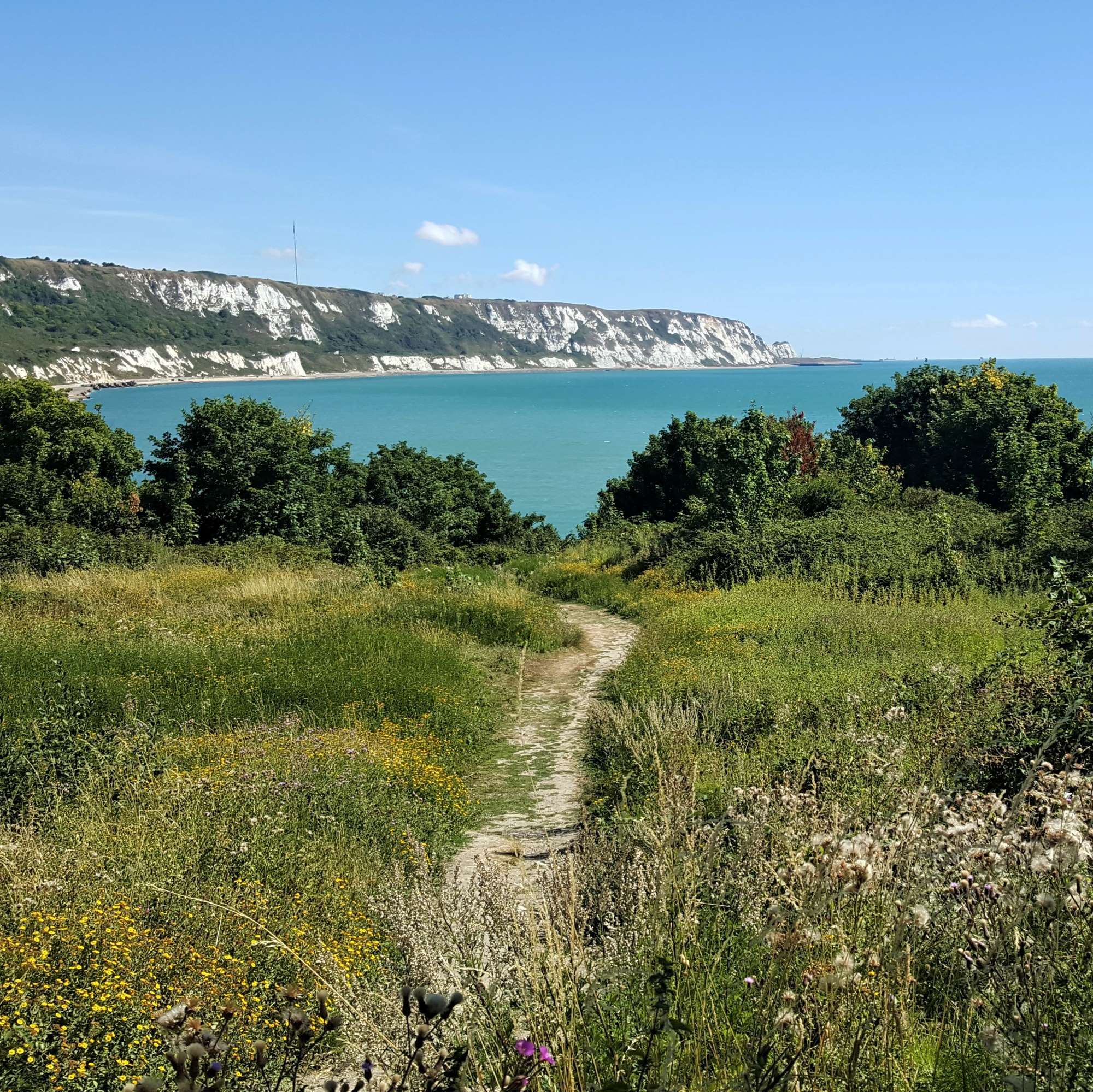
Ep 156152 High above Folkestone beach
Time aside. And at rest. A quiet, leafy space. Folkestone, on the Kent coast. An area called the Warren, where forested steeps slope and tumble into the sandy wash of the sea. It's early August 2022. A month of heat, like the south of Spain. The sun is up. The air's got that scent of another sweltering day to come. The hedgerow and the hawthorn tree holding the microphones are already hot. Turning the sun's energy into green variegated shades. And into warm leafy thermals. As time passes, and late summer birds distantly call, a little party of beach-bound people scrunch by, scattering loose stones as they go. Straight ahead the white noise hush of the sea slightly rises, and slightly falls. So many crashing waves, smoothed to an average, by distance. From here, within this ordinary looking breeze blown hedgerow, the whole width of Folkestone beach can be heard. Witnessed. From a place called The Warren. England's edge. So close to France you can see it.

Ep 155151 Dusky echoes in the Forest of Dean
Dusk has come, and the Forest of Dean is, very gradually, darkening. Silence, like dew, is beginning to settle in the voids and hollows between the trees. Shadows, and echoes, are everywhere. In the gathering dim, melodic song thrush, blackbirds, and some roosting wood pigeons are singing the last notes of the day. Sounding, from across this huge space, like they are already in a dream. Time passes. The hidden stream beside the oak holding the microphones trickles, and flows, beneath tangled vines. High planes lazily traverse the velvet sky. Occasionally, cars distantly glide along the fast forest road, to the far right of scene. Filtered by so many trees they make a curved and wind-like hush. Then, in the distance, a dog's barking. And a lamb. Or did you just imagine it? A lamb deep in the forest? And the dog, was that really a dog? Perhaps it's just the dusk, casting dreams upon your senses. But there's a woodcock! No mistake. It's the strangest of birds, making soft quack like calls as it speeds effortlessly between the treetops On its May-time roding flight. And an owl. Two owls. Hooting hollowly, in dusky echoes, from somewhere much deeper in the forest. * This is a late evening segment from the 72 hour non-stop recording that we made last May, in the Forest of Dean. We found and recorded from the same oak tree that we tied our mics to back in 2019! You can hear that recording in episode 17, and compare how over those three years the sound-feel of the forest has changed.