
Radio Lento podcast
304 episodes — Page 2 of 7
Ep 254250 Moorland trees in mid-winter gales (sleep safe after owl)
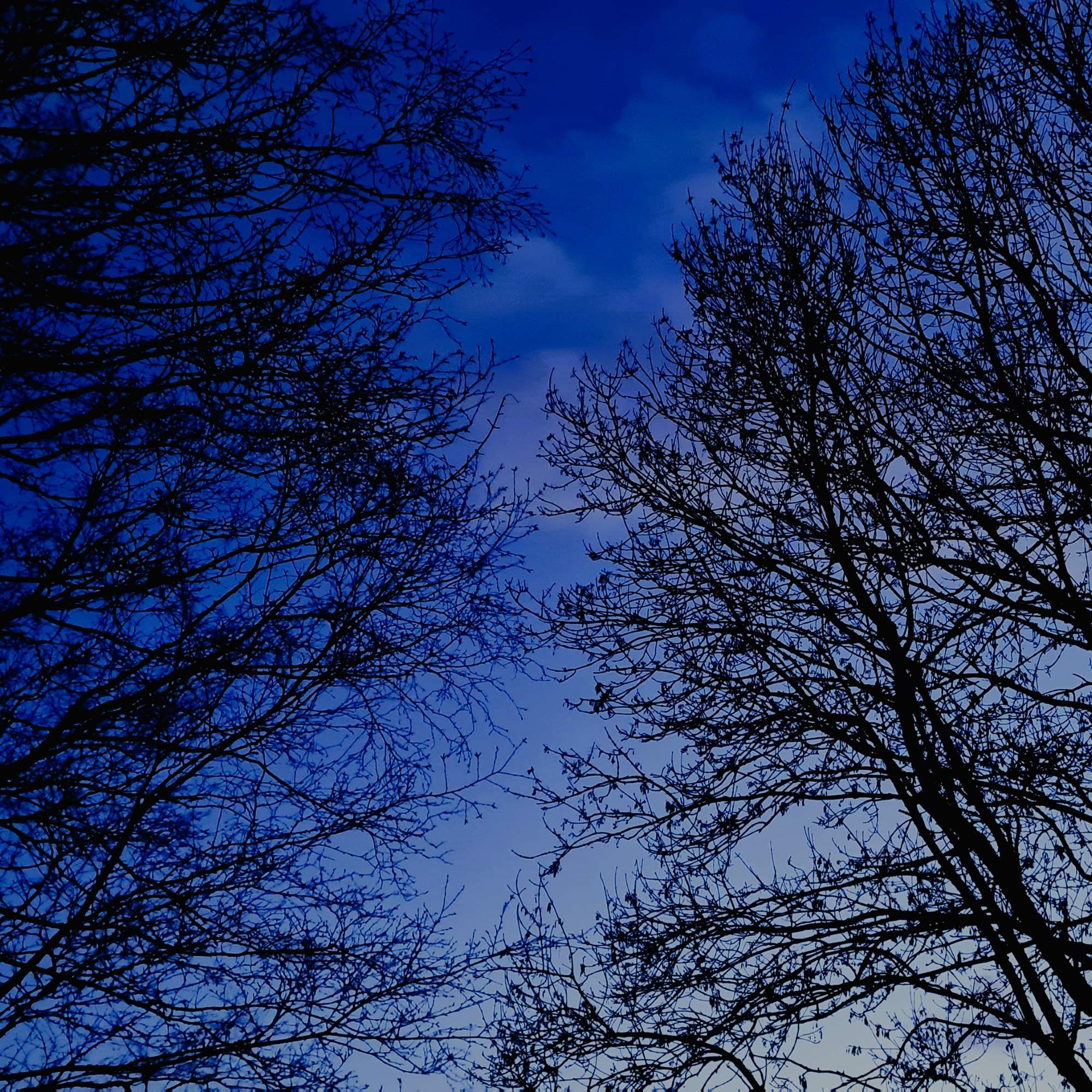
For Christmas Eve we're sharing this nocturnal hour of sound landscape time captured by the Lento box in the high peaks of Derbyshire. Bare leafless trees, sighing together, in strong undulating mid-winter wind. We feel this is one of our most atmospheric overnight recordings of landscape trees. To far left of scene across a field there's a strip of woodland made mainly of tall established conifers. To centre of scene, stretching along a shallow ridge to the far right, trees of varying heights, beech, sycamore, elderberry, conifers. The exposed contours of this section of moorland tend to channel banks of moving air along and over the ridge, creating wonderfully spatial surges of energy that the trees convert into deep brown sound. For listeners using headphones or Airpods, the wind in the trees is sometimes so deep it is almost a sensation more felt than heard, as it gracefully moves across the aural landscape. * We made this recording high in the Derbyshire hills over Christmas 2023 during a period of unusually strong winter gales. There is only one overflight of the area as well that you may not even notice due to the wind. Such a quiet sky is also very unusual so near to Manchester's ringway airport. **This is our 250th episode! Happy Christmas and thanks for listening to Radio Lento.
Ep 253249 Night stream at West Quantoxhead (sleep safe after 17 mins)
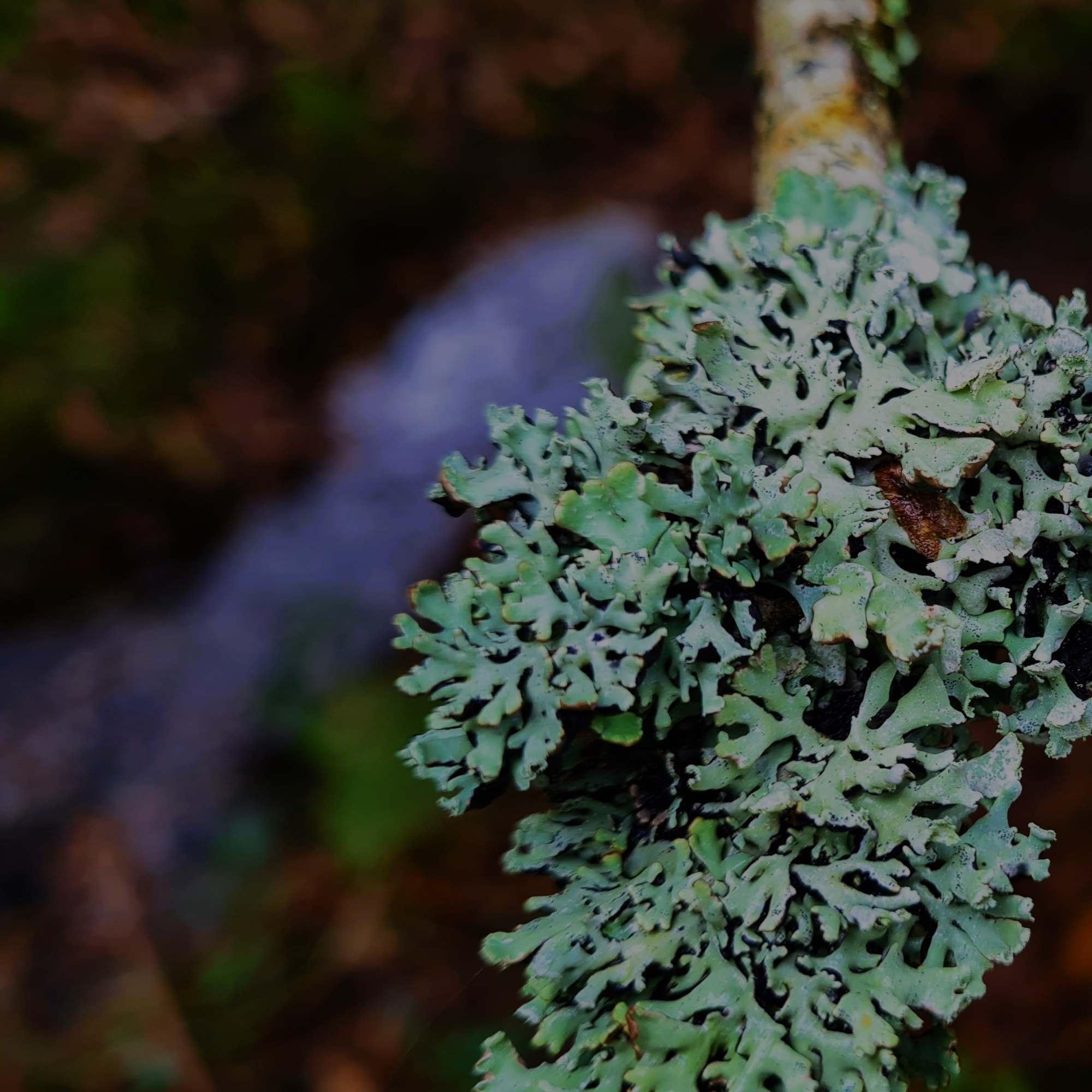
With the stream to our right, we headed down from the exposed uplands of West Quantoxhead and into a shallow valley. Sky whitish grey. Air still. It smelled of rich late Autumn undergrowth, and faintly of mushrooms. As we descended, the landscape changed. Became tucked in. Shapes of sheep shifted against dark thickets below. The grass got thicker too, and taller. And the stream got fuller, and more sonorous, with every hundred yards. Eventually we found ourselves in a completely different landscape. A watery, secluded dell. The sheep magically disappeared. Dissolved into the thickets and behind the trees. Running down over shallow stones, the stream flowed through the dell without urgency. Its sonorous wrillings reflecting perfectly off the leafy surroundings. Bright, but not too bright. With a fresh spatialness, audibly illuminating the contours of the natural space. Here, set below high steep banks of dense undergrowth, far away in the Quantocks of West Somerset, sound and time melded. Unified, into one well tempered flow. * The Lento box captured this scene tied to a tree during an unaccompanied overnight record in late October. We spent a long time in near total darkness testing out how different angles onto the stream sounded from various trees. We chose one set back from the stream, preferring this well balanced aural composition rather than a closer angle where the noise of the stream would drown out the subtle acoustic reflections of the space itself. The ambient sound levels were incredibly low. Listening back, we can sometimes hear the sheep, quietly moving about. After 17 minutes into the segment they wonder off, leaving only the stream to be heard, and the passing of time, in this natural secluded place.
Ep 252248 Late morning air on Kilve beach
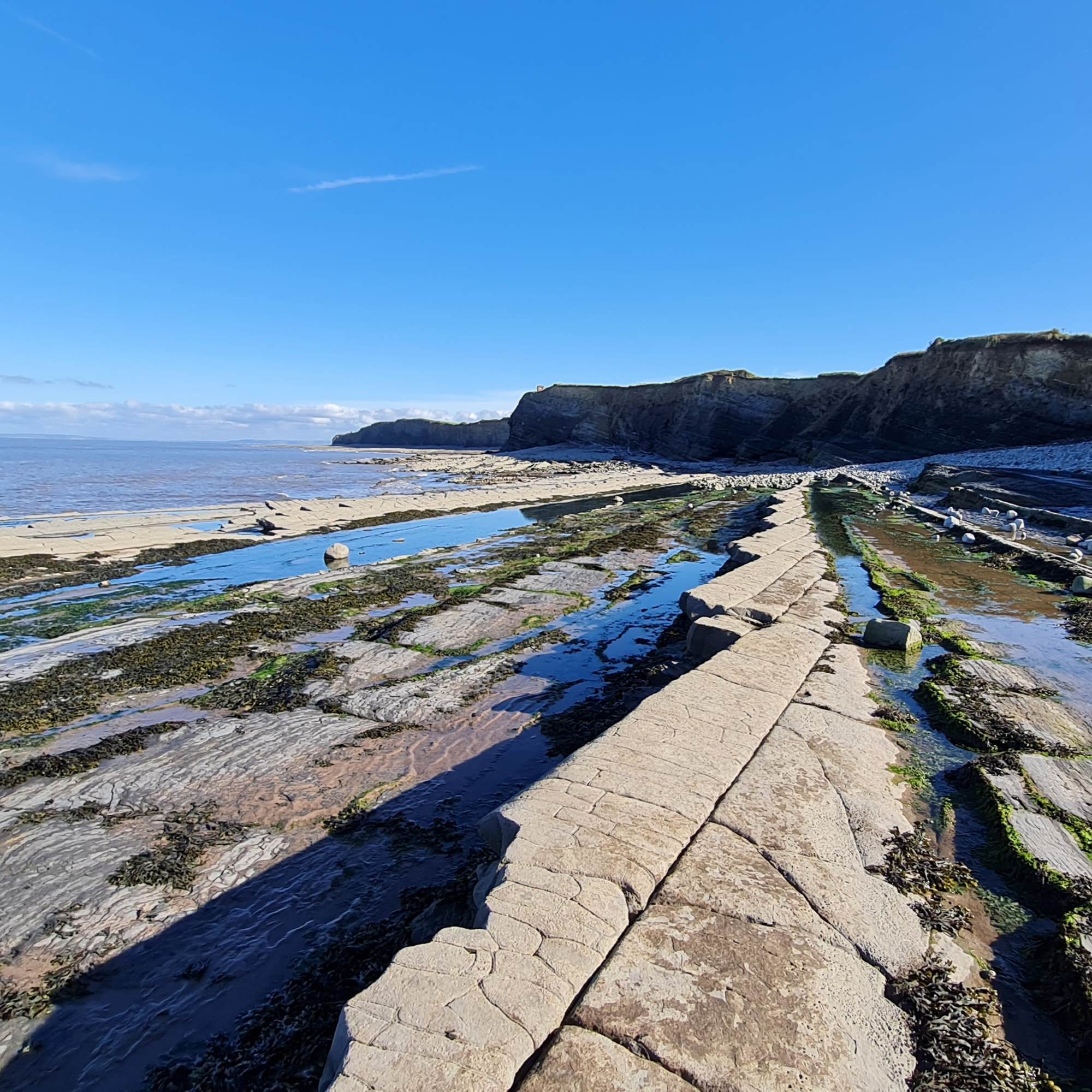
Kilve beach is edged by sheer cliffs and is made of rocks. Mostly small ones the size of oranges, up to medium sized ones the size of sofa cushions. To cross over them is unstable and you have to move like a penguin, which must be fun to watch if you aren't the one trying to stay upright. Jutting up between the smaller rocks are huge mattress sized boulders that are either massive flat topped rocks of unimaginable weight, or maybe if you could look below have no underside at all because they are the exposed surface of the Earth's crust. They make excellent resting points where you can temporarily stop from awkward walking and admire the amazing view. Having progressed some way along the beach we reached a smooth ridge of rock that ran for a long stretch perpendicular to the sea. It afforded us a path to walk on for a while. Either side of the ridge pools of stranded seawater had gathered beside piles of tangled seaweed. The atmosphere at this point had softened considerably, and there was in addition to being able to hear the sea a kind of silence too, immediately around us, so pure you could hear tiny bubbles popping in the rock pools. It had something to do with the rock cliffs of Kilve. They were doing something interesting. Cupping and reflecting sound, acting like the back wall of a theatre. Ahead the shoreline, though only about fifty yards away, was below the sound horizon owing to a very steep rake on the beach. This has the effect of mellowing the breaking waves, emphasising the weight of the waves rather than the brightness of the turbulent water. Occasionally a seventh wave breaks over a rocky outcrop directly centre of scene sending a plume of foaming suds high into the air and for a few moments above the sound horizon. * Far left of scene you can sometimes hear children playing on the beach with their dad, maybe looking for fossils. Some hardy birds that make a peeping call swoop around too. As the episode opens a tiny microlight aeroplane crosses the sky from left to right, going almost directly overhead. For some reason we love this sound, it seems to reflect that free feeling you get on a wide open beach. You may notice the tide is very gradually coming in over the episode, yielding more splashes and watery details from the breaking waves as time progresses.

Ep 251247 Natural white noise from the firs of Kielder Forest
This is segment II from a 6-hour sound capture we took earlier this year at Kielder Forest in Northumberland. Recorded in spring, the environment is rich with birdsong, mainly willow warblers whose song is a short and very cheerful descending scale. We'd been walking along one of the rough paths that thread through the forest below the Kielder Observatory and had found exactly what we'd travelled up to this specific area to record. The hushing sound of wind in tall fir trees. Of course these are no ordinary trees. They are Grandis Firs. Vertically vast. Each the size of a 15 storey tower block, with huge drooping boughs draped in billions of tiny pine needles. Every needle catches in the wind and converts the energy into audible sound. Individually it's hard to imagine one could hear anything produced from one needle at all, but heard altogether, the sound is powerful. Deeply moving. Akin even to a spiritual experience. After finding a suitable tree to rest the Lento box against, we left it behind in the forest to record the scene alone, hoping the wind would not die down. The wind continued to blow in slow undulating waves. And the willow warblers continued to sing their lovely droopy songs, no doubt perched on the droopy boughs of the giant firs. But the trees and the birds were not the only aural presences in this part of the forest. There's a rushing stream, flowing from left to right of scene. It issues its own fresh bright sound to the interior space of the forest, as it rushes down into the valley to join the city-sized reservoir below. * At 18 minutes into this segment a plane flies over, but don't worry, it's relatively soft and gentle, flying high up above the clouds. It may initially be hard to tell whether the white noise is from the stream or wind in the firs in this recording. Over time, and as your ears adjust to the aural environment, the distinct qualities of the stream and the wind in the firs may resolve out. Both are highly spatial and texturally different. They often blend into one another, then part, like vails woven from different fabrics, billowing together in currents of air. ** Follow us on Bluesky or Ko-fi to keep up with Lento news. We recently celebrated a big Lento milestone!

Ep 250246 Edgeland time by the Hythe Sound Mirror (sleep safe)
Turn right off the towpath beside the Military Canal, cross the footbridge, locate the stile that leads onto the hill, then follow the rough footpath up into some impressive edgeland. It's rough. Grassy. Very thistly. And as you ascend it feels hard. Increasingly wild. It's somewhere up here, we say, striding firm against the gradient. But the thing's not marked on the map. The Sound Mirror of Hythe is a large concrete parabolic dish. A giant ear, pointed out to sea, designed a hundred years ago, pre-RADAR for the early detection of incoming aircraft. Surely, we puff, a structure like this must stand out like a sore thumb? Well no. The steep ground has twists and folds. Ridges and bends that have to be walked. And no military installation worth its salt, however obsolete, is or should ever be easy to find. We eventually see huddled low in the grass a squat blockhouse. A derelict radio receiving station, according to one historical website. Then we see the dish itself. A concrete shape, nestled against a steep bank, sadly now in a terrible state, trees growing up through its collapsing sections. Up close the dish is behind substantial chainwire fencing and surrounded by what amounts to a moat of evil shoulder high stinging nettles. Whatever evidence there may be of the 'listening chamber' said to reside at the foot of the structure, is not possible to see. It may indeed be buried under broken concrete. We stood for a long time. Taking it all in. Despite its state, this dish is still active. Still reflecting and to some extent shaping the aural soundscape around it. Of course only from the listening chamber could one be an ear witness to what this structure was properly designed to do, but knowing that on some level it is still working, still channeling the soundscape from the sky above the sea, is, in a quiet way, thrilling. We found some shelter for the Lento box behind the radio receiving station, angling its view up the hill to capture both the near and far soundscapes. Near, wild wind whips through the edgeland grasses, a few crickets are cricketing. Mid-distance left, the sound mirror, about 40 yards. You can hear the wind when it catches in the trees growing in and around the dish and sometimes a yellowhammer. Right of scene is the hill rolling down into the valley. At the bottom the military canal. What filters in from behind the Lento box is from the coast and the ocean view. Toot toot of the steam railway that runs from Hythe, Dymchurch, Romney and Dungeness. Occasional distant echoes from circling seagulls and a construction site. Listening back we think some of these sounds at least are being reflected off the dish itself. Here's an account of our time at the Hythe Sound Mirror with lots of photos.

Ep 249245 Night rain on the edge of the Quantock hills (sleep safe)
It was late. Everybody had gone to bed. The remote cottage where we were staying in the Quantock Hills still felt warm, even though the oil burner had knocked itself off a while ago. Despite this, the place had started to feel, well, a bit strange and I wasn't quite sure what the feeling was. I put the kettle on and the strange feeling went away. I made the tea, set the kettle back on its stand, stirred the pot, replaced the lid, forgot about the feeling. But then it was back. Intriguing. I stepped up out of the kitchen into the back porch where the burner room emitted a faint electrical hum and a rich smell of heating oil. Was it coming from in here? No. The snug lounge then. No. It was coming from behind where I'd just been, the back porch. I stood, stock still. Listening. The feeling was real. It was the presence of something. Not a thing or a spirit or anything like that. It was space. The feeling was of the hint of a space beyond the confines of the cottage. My hand went to the latch of the little back door. One bolt. Another. A chain too, all needing undoing. I lent back my weight and the door eased. With a woody squeak it jerked free from its jam. Swinging the door gently open, I stepped out. And there it was. The raw source of the feeling. The space that I had somehow sensed was enveloping the cosy and near silent cottage. A whole landscape. Audible by its near trees and far contours. Aural presences, stretching from the back door over miles up into the Quantocks. A night world shrouded in almost complete darkness, brushed by rain, and autumnal wind. This was the moment. This is what I heard.
Ep 248244 Rocky West Somerset beach (high-definition sound)
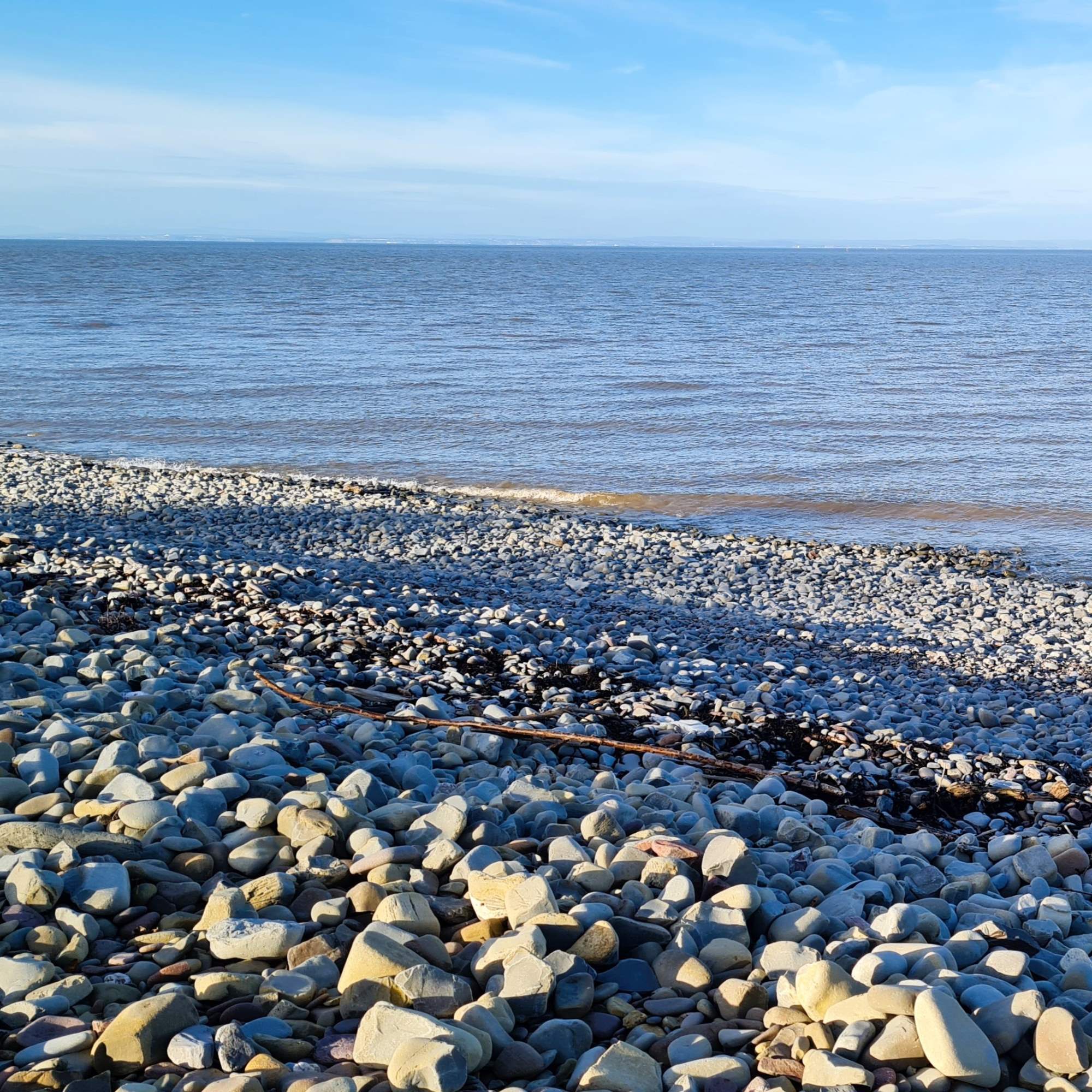
We found this quiet place in West Somerset. Afternoon waves softly breaking along a rocky beach under October sunshine. The low landscape of Wales visible across the water. Lilstock. A port in bygone times, according to someone we met coming the other way. Now disused. A landscape of stony footpaths. Dense patches of shrubbery around outcrops of trees. Endless meadows and dry ditches. Fresh water streams and in the far distance on the clifftops, the boxy structures and cranes of Hinkley Point. Human made sound was present but what really drew our ears were the long periods of near pristine quiet. Quiet lets the aural detail of natural landscapes be truly seen. Here, a beach not of sand or shingle, but of piles of rocks and small boulders. We tied the Lento box to a tree off the footpath about thirty yards from the shoreline, and left it to record the breaking waves alone. A little cricket was cricketing in the grass to the left of the mics. For late October we were surprised. As we walked away we saw a large plastic blue barrel, captured by high tide rocks, roll its way loose and into the water. Then we watched it for a while set sail in the onshore breeze whilst exploring the rocks and boulders in the fresh afternoon air. When we returned an hour or so later to collect the Lento box we could still see the barrel. It'd floated up the coast past the mics. Listening back to the recording we could picture it, moving with the waves, from left to right of scene. One empty barrel that'd taken itself to sea, for a slow, silent voyage. * Let us know if you think this episode is sleep safe. We know there are sounds of people (mainly us) playing distantly on the beach and for some this sense of the presence of people may feel sleep safe, but others perhaps not.

Ep 247243 Night callings in the Forest of Dean - interleaved worlds
It isn't often we hear strange calls coming out of our long overnight captures, but this was one. The dead of night deep in the Forest of Dean, and a call that from the quiet emptiness begins to echo. Human? Dog? Muntjac deer? All three, or none? Muntjac deer are commonly heard repeating a single harsh bark across rural landscapes at night though this sound doesn't quite match the sound signature of muntjac, nor indeed dog, or human. The calling persists over ten minutes, seemingly human, then changing into something very much not human. What it is we can't know. The sound comes from mid-left of scene. Whatever is making it is some distance from the microphones, which are tethered to the trunk of a huge oak tree growing beside a trickling brook hidden beneath dense undergrowth. To mid-right of scene is a country road that bisects the forest. Nocturnal cars occasionally speed through. The effect is curious, like a sudden wind is gathering in the trees, only to just as suddenly disappear. As the calling continues a tawny owl joins in. It hoots in that nervous kind of way they do sometimes, but then changes. Becomes a wavering quivering bleat, something like a new born lamb. It is fleeting. Then it is gone. Building ideas of what is in the world around us from this kind of highly spatial binaural soundscape, especially from times and locations few of us are used to being within, can lead our imaginations into strange places. Notions of the supernatural. Happenings and occurrences beyond the normal boundaries. However to the eye, and if it weren't pitch dark, the scene would bear no comparison to what the mind perceives of this forest through hearing. There'd be no overwhelming sense of wide open space, no possibility of reverberances or echoes or happenings going on far away. Indeed no concept of distance at all. This is because what surrounds the oak tree is of course more trees. Lovely huge trees, draped in broad waxy leaves so green and so numerous the eye simply accepts the image as one vast surface of textured colour. A vail. The green vails make this huge forest place, from an eye-s perspective, just what is close. A walled garden. Safe, because it is completely hidden from view. These very different perspectives of the same place reveal how hearing and sight fulfill substantially different roles when we are immersed in natural places. The hearing and sight we have was evolved in forest environments over millions of years. Within a world of green vails and visually obstructed views, sound travels freely, passes through leaves and around the solid structures of trees. Sound is spatial as sight is, has depth, width, and many other spatially sensitive qualities. It affords us with detailed information we need to gain a three dimensional spatial image of the world beyond what we can see. These complex interleaved vibrations land on our eardrums and are modelled spatially to alert us to the presence of things, what they are doing, and their location in space. But what sound also does, and what we as Lento are most intrigued to capture, is to convey and confirm to a vigilant mind that nothing is also happening. Not nothing as in silence. Instead, it is that sweet, soft, murmurating texture of half meaningful sound, like billowing fabrics, that simply say yes, the world is all there. * This segment is from a 72 hour non-stop recording we made in May 2022 in the Forest of Dean. After the callings and the owls are gone, a little creature can be heard scuffling and making tiny quivering tweeting sounds as it goes. Soft planes pass over this area, helping to dispel any notions that this strange sounding place is anything other than the familiar world we all live in.
Ep 246242 Kentish landscape time
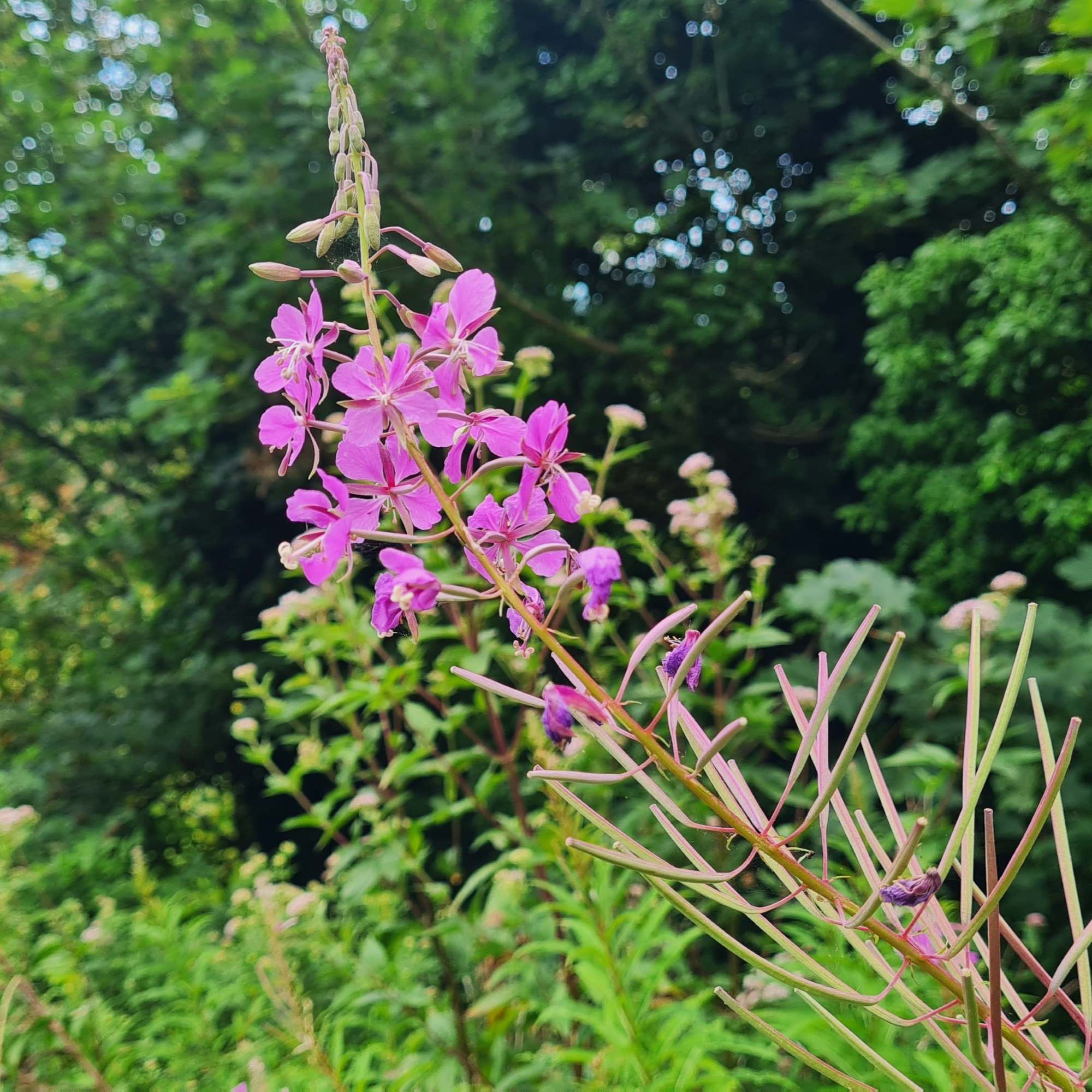
Daytime contentedness can be found here. Between the rustling leaves and trees of Folkestone Warren that rolls greenly down towards the sea. We couldn't have known when we set up the Lento box under hot early August sunshine that the next day of recording would bring such strong breezes. This strip of natural Kentish land is made of green plunging wilderness. It has a campsite next to a rocky and sandy beach. There's a cliff top cafe too, from where you can see France on a clear day. After stopping for a cup of tea, follow one of the steep paths, down into a sea of green. Find a gap between the trees. Try listening for the actual sea. For echoes of children, distantly playing on the beach. For a passing train on the hidden railway. The buzzard. Slowly circling. Wind that waves in the branches, shakes and rustles the leaves, may not to the eye look particularly calm. And yet to the ear, these movements sound calm. We definitely feel a physical response to strong undulating breezes as they press and sigh through banks of trees. This daytime section capturing the sound-feel of this place reveals how time passes here, an ordinary weekday in early August.

Ep 245241 Natural white noise from Folkestone Warren beach at night (sleep safe)
An hour of uninterrupted white noise. Naturally occurring and fully spatial. Captured by the Lento box last weekend from a tree overlooking the beach under Folkestone Warren. Low soft rumbling of the crashing waves. Mid-range curtains of dark grey-blue backwash, that seem to billow and shimmer like hanging fabrics. Fine layers of crisper whiter noise, formed from the frothing and fizzing sea water as it is churned and blown by the night wind. The subtle hiss as countless leaves catch in the undulating wind. The scene is of the wide open beach. And of the tide, very gradually going out. A breeze, quite firm at around 18 knotts, is whisking up the waves. The place is entirely deserted. It's around 4:30 am. Several hours until dawn breaks. Being a raw location recording there are a few planes that traverse the sky, though their sound easily dissolves between the waves. Something, perhaps a small mammal, pads up to the tree holding the mics, then carries on to wherever it's going. A dark bush cricket occasionally starts up as well. It's quite late in the season for them. The ground underneath the tree holding the mics is layered in dry leaves left over from the summer. Just ahead, down a steep drop, the ground transitions into large jumbled boulders. This strip of loose rock is in range of the high tide, and probably is semi-submerged when the spring tide coincides with a North Sea surge. During the day people pick their way over these rocks in search of fossils. Folkestone is so we're told a fossil rich area. Our objective for travelling back to this beach location in Folkestone was to capture the reflected sounds the high tide makes as it laps around the boulders under the trees. We witnessed these sounds earlier in August, but ran out of time to properly record them. Returning last weekend to try again we found there was an 18 knott wind whipping everything up, and a different and wilder seascape. What we have managed to capture though is how the receding tide in this particular location produces a rich and very stable source of uninterrupted natural white noise. Naturally occurring white noise sounds so simple and yet is infinitely complex. These seemingly contradictory qualities may be why natural white noise from real places like this promote both wakeful concentration and vigilant restfulness, that unconscious conscious state of mind where you seem to be able to perceive everything around you as one fulfilling thought. A thought so in and of itself complete, it frees you from the need to think of anything else.

Ep 244240 Wide time in the Kielder Forest (sleep safe with distant geese)
Last week we shared wide time captured from a North Norfolk beach as night fell. This week it's wide time from the vast interior of the Kielder Forest. Human-free night vastness is an experience so out of reach to us, and indeed to most people, that travelling with the Lento box to bring it back in the raw is always top of our list. Kielder is a mostly uninhabited landscape made of hills, trees and water. It is England's largest fir plantation on the north east border with Scotland. You may remember we travelled there in May to find and capture new episodes. This section of time is from around 3am. The Lento box is recording alone laid against the trunk of a fir tree on the east side of the 9 mile long reservoir. The sound landscape of Kielder at night is extremely spatial and delicate. Made up of subtle changing movements of air over miles of fir trees. Of occasional nocturnal flying geese. Of echoes, layered upon echoes. Of tiny twigs and branches shifting as the trees gradually droop their boughs in response to the night cool. But these sounds though precious are not of themselves what makes the experience of being immersed within the Kielder Forest so special. And they are not the main aural presence we left the Lento box out alone to witness. What we wanted to capture from within Kielder above anything else, was the phenomenon of wide time. Wide time is not of itself audible. It's made of nothing. Or more accurately, emptiness. To gain a sense of wide time you have to allow yourself to mentally tune into it. And that takes time. And a quiet place to listen. And decent headphones or equivalent. And a long form spatial audio recording that comes directly from the natural emptiness of Kielder Forest at night. A place where wide time happens.
Ep 243239 Intertidal zone - night approaching
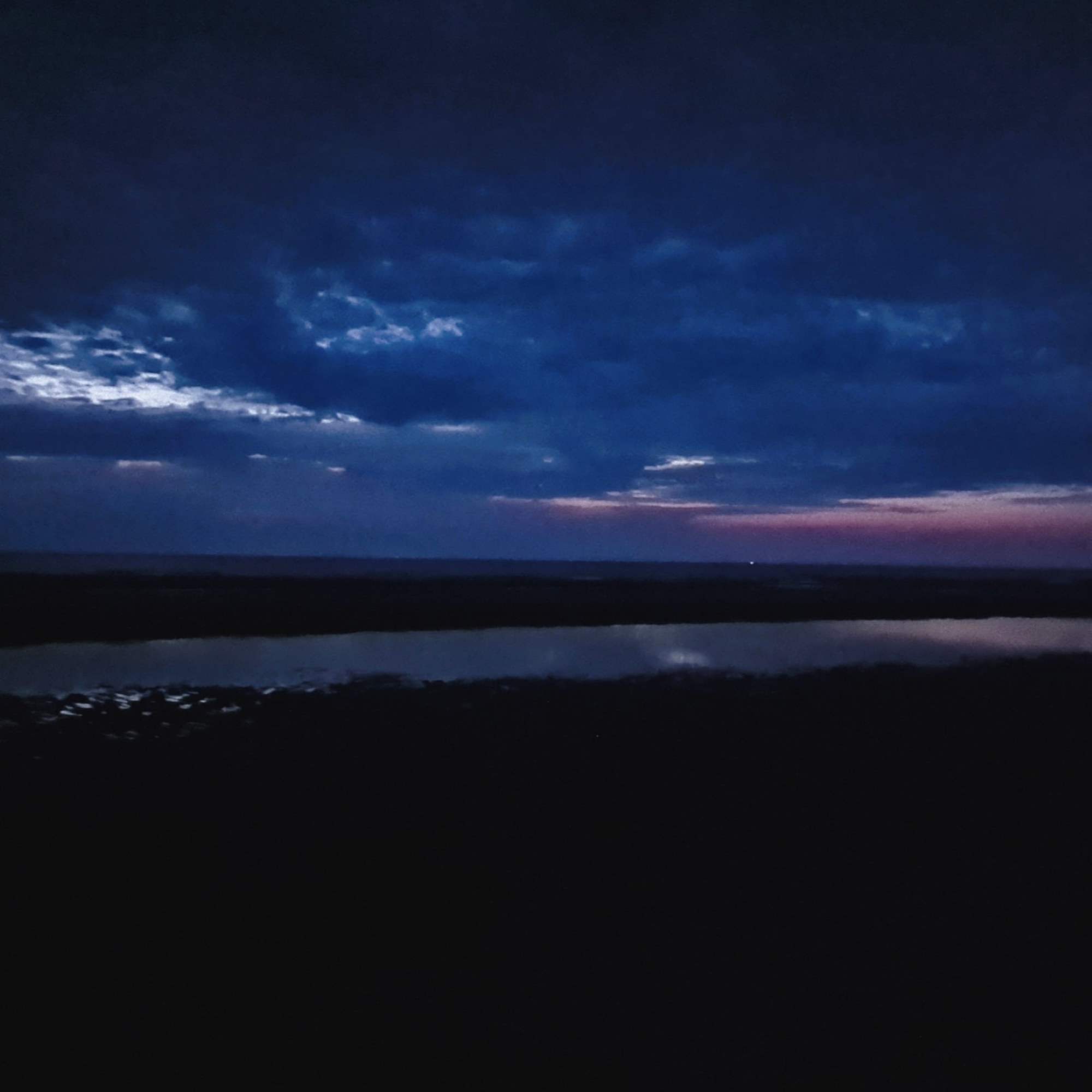
Holme Dunes, Norfolk. At low tide, and with night approaching, we finally managed to set up the Lento box on a tripod on the sand, mics facing out to sea. It was the curlews at dusk, framed within the vastness of the empty beach, that we wanted to capture as a photograph in sound. It felt good to have reached a spot to record, after a lot of walking. It was though still only the mid-point of the intertidal zone. A very low tide. The mid-point proved interesting. Such a low tide leaves exposed an enormous area of flat hard sand. The landscape seems to guide the sound of the sea into your ears over long distances, and from very wide angles. It's what we love the most. That feeling of being very very small in a vast open and entirely naturally formed space. Naturally formed, naturally murmurating, and with magical fleeting calls of curlew. We explored the area around the box for a while, then realised we had a problem. Light. The levels had been dropping while we'd been walking. Ten minutes into the record we turned round from the end of the sunset and realised the land behind us had gone almost completely black. Getting up the beach would be ok but finding the narrow and indistinct footpaths where we'd come through the dunes was definitely not going to be ok. There were no street lights or navigation points. But the atmosphere was so exhilarating, so precious, we let the box record for just a few more minutes. We then scooped it up and hastily began the next mission, to find our way back. This is why episode 239 is shorter than usual. Shorter but we feel important to share because it conveys some of the sound-feel of being out in a vast intertidal zone, empty other than the curlew, with night fast approaching.

Ep 242238 Harvest fields aside The Peddars Way (100th location)
On the breeze, rich scents of hot Norfolk farmland. In the air, tiny wippling birds. Some swallows? Across the field, and across the next, a combine harvester large as a house. And quick as a car. It sails low over the far meadow, like a paddle steamer on a bright green sea. Standing on the Peddars Way, Lento box in hand, we've stopped to take in the heat, and to listen. Wide carpets of crickets are cricketing all around the meadow grass. They're happy. Baking like us, under a hot midday sun. We search for a tree. For a natural tripod. We scan the thickets that line this ancient route. It is quite a silent process, and the box swings gently. It's waiting for us to find it a good spot. The spot it needs is specific. An aural point in the landscape where everything meaningful can not just be heard but heard in a spatially balanced way. An aural meeting point where the box will "see" the whole landscape as a sound photograph. Eventually we find a very old oak tree completely covered in hairlike moss. It's amazing. Very carefully we rest the box between two intersecting boughs and check how the sound photograph is going to "look" through a pair of stereo headphones. Good we quietly say, providing this breeze doesn't ruffle the surrounding leaves too much. The weather seems fair and stable, so we leave the box to record alone. * We captured this sound-scene (our 100th unique location and 25th county) on Norfolk farmland on a hot July day. The old oak tree stands on the Peddars Way, a 49-mile National Trail which follows the route of a Roman Road. Tiny birds flit and flutter amongst the thickets under the wide sky where rumbles of distant military jets can sometimes be heard. A combine harvester is at work far right of scene. If you're able to hear high pitched crickets, their sound sometimes wafts in an out too from the meadow. Red kites overhead too. Thanks for listening, and to Lento supporters who've helped us to bring 100 UK landscape locations in high definition spatial sound to this free podcast service.

Ep 241237 Sighing sea beyond the Warren
It is first light. Birds are waking. Beginning to fill the air with sonorous sounds of life. A few dark bush crickets are still cricketing, just, though soon they'll go quiet for the day. The view is of green. More green. And yet more green. A whole valley of thickly growing thickets, trees, and dense shrubs, slowly emerging into visual reality under an increasingly luminous dawn sky. Another form of energy that illuminates this steep verdant valley, is from the sea about a third of a mile down from the recording location. It's acoustic presence perfuses the air, just as light does from the sky. The aural daylight if we can call it that, is brightest at high tide, and darkest at low. Sea light does not flow evenly as light from the sky does. It flows in slow undulating breaths. Follows every contour of the ground. Brushes through every tree, branch, leaf and shrub. Reminds us that like the sky, a huge mass of something unimaginably huge, is there, and moving, beyond our view. * This is the third segment from the new series of sound landscape recordings we made last month at The Warren in Folkestone. Episode 235 was from the dead of night, and this segment is how dawn sounded at the same location. ** NOT sleep safe due to noisy gulls and wood pigeons!
Ep 240236 Sunlit beach below the Warren
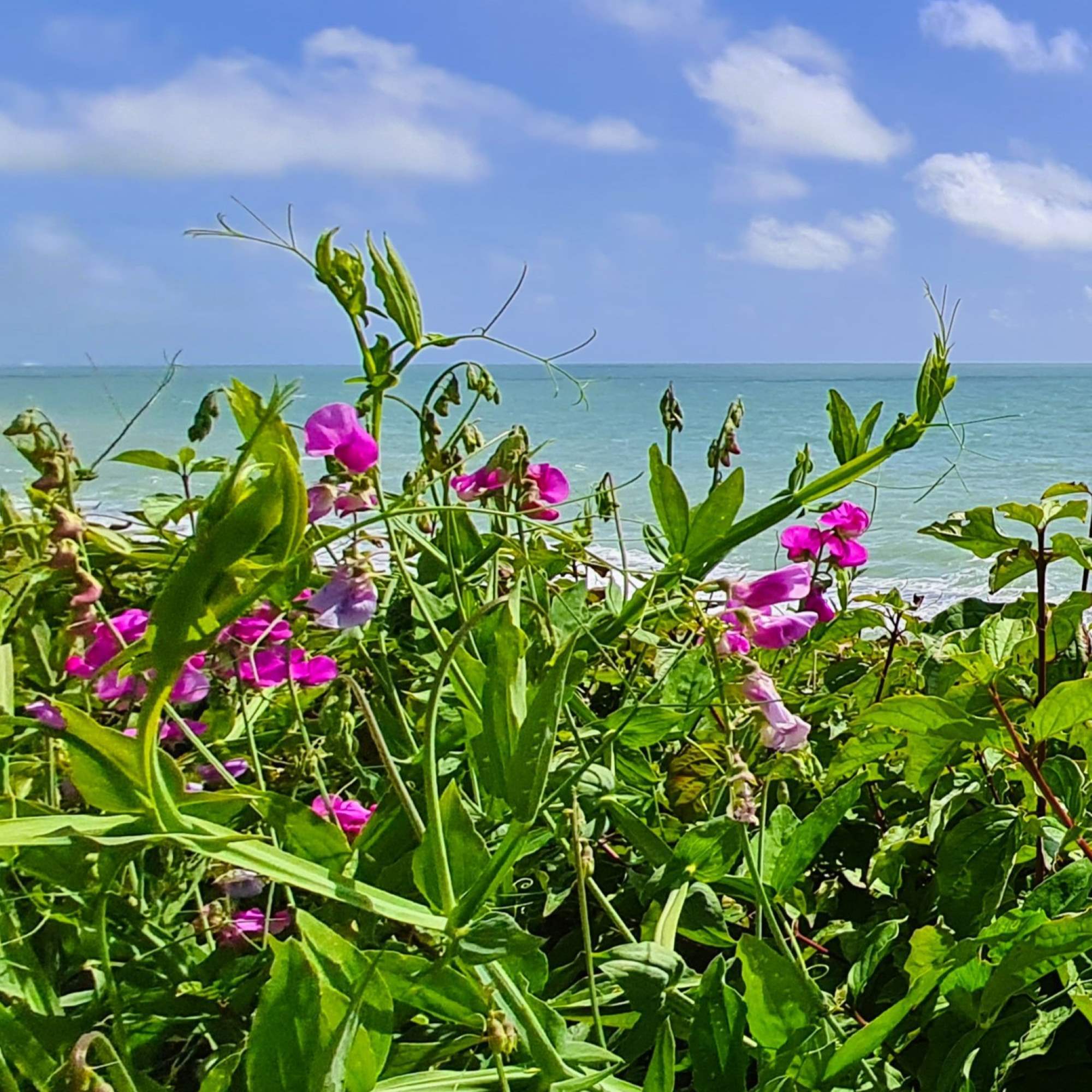
Capturing the experience and 'sound-feel' of crashing waves is always a challenge. Strong on-shore breezes and the unbridled energy of thousand ton waves breaking over unyielding rock can simply be too much for sensitive microphones. Yet as we sit on the concrete sea defences, bathed in hot afternoon August sun, waiting for the first tingles of cold sea spray to land on our legs, the experience is as serene as it is thrilling. How can this be? Something huge, heavy and aurally overwhelming is also serenely calming and relaxing? Our ears hear the landscape around us and let us feel its space and physicality. Hearing, in a way, is a kind of touching. Given the power and tumult of these waves as they break over the rocks, it isn't possible to be bodily touching them, but we can touch their weight and mass through our ears. Layers of white noise produced by crashing waves, rising and falling, folding over each other, straddling us with their weight, reveals how mere vibrations in the air that land on our eardrums are instantly sensed and translated into physical responses. Responses that are felt as a result of being heard. This is what we mean by 'sound feel'. We might say the thrill is the head's response, the excitement that comes with loudness and chaos. The serenity is the bodily response. Nerves, bones and muscles, relaxing, as they do when massaged. So sitting on the sea wall facing crashing waves, hot in the sunshine and still in earshot of the odd cricket hiding in the seagrass, is a bath and a massage. Wild sweet peas dancing in the breeze on an empty path. Buzzards circling overhead. We feel drawn to this ragged edge of land and to capture it as an audio experience that can be re-experienced when we cannot physically be there. * This piece of time we captured in early August from a nearby location to last week's episode (235) from Folkestone in Kent. This stretch of exposed beach at the foot of The Warren. Two perspectives on the same stretch of coast called the Strait of Dover. Without the sea, The Warren would not exist in the aurally rich way it does.

Ep 239235 Night crickets above distant crashing waves (sleep safe)
Welcome back to a new Lento season of captured quiet. Sound landscapes from real places. This segment of spatial audio, best through headphones, was captured on the Kent coast in early August from beside a winding path in a steeply wooded area of Folkestone called the Warren. France is visible from this elevated spot. Around half a mile below, is the beach and the crashing waves. It is midnight. The ground here is sandy and dry. The only way through is the path which winds down and around and down again, almost endlessly, between trees huddled behind thick shrubs and blackberry bushes. Eventually you come out by a railway line. It seems out of place so close to the sea. Before you reach the beach, there's a cluster of tall trees with long rope swings. The environment is so green and steep and tangled that it has a uniquely soft sound feel. Here, on this August night, dark bush crickets form the main sound-scene against a back drop of distant crashing waves. One stridulates close to the Lento box. Another type of cricket, lower in tone, is audible over to the left. We have not heard this type of night cricket in England before. A few trains pass in the valley below, and a few planes too, though Folkestone has generally quite a quiet sky. To get the true aural essence from this audio, which is from an exceptionally soft and quiet location where you'd need to strain your ears to hear everything that is there, try to listen with headphone volume set so you can just hear the murmurings of the sea below. Find somewhere quiet to listen to this episode and you'll get more from it.

Ep 238234 Wild and exposed places - Intermission 4
Welcome to this final intermission of August 2024, a specially blended episode of soundscapes from wild and exposed places taken from the last year of Lento. The first three sound-scenes reveal aural views of the outside world seen from within interior places. A coastal hotel room, the belfry of an ancient church, and inside a bird hide. The final sound-scene is of an exposed estuary by Burnham-on-Crouch in Essex, and a slow passing ship. Each portrays the essences of wild places. 214 Storm over hotel peninsula A birds ear view over Plymouth in the far south west of England. This is how Storm Kathleen sounded from behind the huge plate glass window of a comfortable cushioned room on the fourth floor of a hotel. The hotel overlooks a district called The Hoe, where one of the original Eddystone Lighthouses now stands. the wind was fierce, whistling almost singing through the window seals. A blended soundscape, formed from the interior acoustic of the hotel room and the wide open windswept night beyond. 200 Windswept night in the belfry of Rye Church Up steep ladders on the top platform of the belfry inside Rye Church, the ancient clock counts through this small night hour. Its regular sound blends with long and undulating gusts of fresh sea air. Air that's travelled, over miles of sand, shingle and marshland, from out on the open sea. Moving air sighs between the shuttered rafters and rattles the steel flagpole outside on the castellated parapet wall. Knocks the dead weight of a loose slab of stonework out on the belfry roof. 194 Inside a bird hide The atmosphere inside a bird hide is quite unusual, as interior spaces go. Low wind moaning in the drooping wires between telegraph poles. Whispering rushes and siffing seed heads of marsh grasses. Indistinguishable shifting murmurings, of the surrounding landscape, blown in through low letterbox windows. To the ear there is a lot of outside to be heard inside a bird hide. A fleeting curlew. A humming propeller plane. A distant pair of passing footsteps on the gravel towpath. 196 Estuary bleak passing ship Warm inside an all-weather coat and facing out across the water. Sat, boots wedged against the top ridge of the slanted seawall. There's rain in the air. Time to take in this wild estuary place. Right of scene the small Essex town of Burnham-on-Crouch. Directly ahead across the water Wallasea Island. Left of scene wild swirling water stretches seven miles to the North Sea. Sit tight, here on the seawall. This is empty time, to listen to the landscape and a slow passing ship.
Ep 237233 Rain - Intermission 3
Welcome to intermission 3 of 4 and another specially blended soundscape taken from the last year of Lento. The theme is rain. Gorgeous, refreshing, soothing rain. Four sound-scenes that reveal the way falling rain varies in texture and feel across four different locations. 204 Rain falls on steep craggy woodland (*sleep safe) Fresh rain. Fresh woodland rain, from Miller's Dale in Derbyshire. From a hedgehog's perspective. Low on the forest floor, amidst the leaf litter, and the tangled ivy. As the new day began to dawn, the Lento box listened, Faithfully capturing the aural experience of the falling rain on dense woodland in the Derbyshire Dales. This rain can be heard falling onto wide waxy leaves against many layers of more diffused rain falling onto hundreds of tall trees, and a white noise vail rising up from the river flowing over rocks in the valley below. 228 Summer rain under the wisteria (*sleep safe) Nocturnal rain falling over many little back gardens, in waves of varying intensities. we wanted to hear what rain sounded like when the city had fallen completely quiet, and the Lento box was exposed, sheltered only under plants. We waited for a night where persistent rain was forecast and left the Lento box out, beneath a large wisteria plant, close to an old Victorian brick wall. This sound-view of rain is shaped by the way each drop lands on the wisteria leaves immediately above and around the microphones, the intimate reflections caused by the garden wall, against a backdrop of more diffused rain landing over shrubs, a yard to the left, and many gardens beyond. 197 December rain light to moderate (*sleep safe) Captured from only a matter of about ten yards from the previous segment, this rain sounds entirely different. Different because the gardens are in deep winter and the air Temperature was only around 7 degrees. Enough to drift the ice cold raindrops and ruffle the leading edge of the wide tarpaulin that we'd stretched over our back yard for shelter. You can really feel how each falling drop heightens the spatialness and emptiness of this calm city night scape. 189 Night rain falls on a drystone wall (*sleep safe) This rainy sound view was recorded from the top of a drystone wall overlooking fields of nocturnal sheep, in the North Yorkshire market town of Settle. Rain comes and goes. It's a very ordinary field in many ways, and not far from a very ordinary sounding B road with some occasional night traffic on it. Combined with the odd soft arching plane, the sound view exudes a pleasantly harmonious aural fabric that is soporific and sleep safe. This segment last about fifteen minutes and in contrast to the previous segment is centred in a huge and dramatic landscape of plunging moors and lushous green meadows.

Ep 236232 Waves and shorelines - Intermission 2
Welcome to intermission 2, the second specially blended soundscape from the past year of Lento. This week's theme is waves and shorelines. There are four sections that blend effortlessly into each other. The sound-view into each watery place lasts around eleven minutes and enables you to compare and contrast the wide variations in aural detail from place to place, beach to beach, and at different times of the day and night. 185 Onshore breeze on Chesil beach Chesil beach has an astonishingly powerful aural presence. The Lento sound camera is pointing directly out too sea, about fifteen yards from the breaking waves, capturing the deep visceral sound feel of this steep and stark Beach. The heft of the receding waves, as they haul back huge quantities of heavy spherical shingle. The advancing waves, curling and then breaking into white sound walls of spray. And the ever flowing on-shore breeze. Through listening you can feel the weight, shape, and rhythm of this 18 mile long beach on the Jurassic coast of Southern England. 216 Sat on the sand of East Looe beach A perfect spot for an uninterrupted cinematic sound-view of crashing waves on East Looe beach in Cornwall. Waves in all their crisp textural detail. Can you hear which way the longshore drift goes? It can take a few minutes. The waves feel powerful in this spot on the sand. Sometimes thunderous. Thunderous, and yet calming at the same time. the presence of the seawall (behind) and pier (to right of scene) gives this beach an unusually enclosed sound feel. 188 Rock seat on Rye Harbour beach Near a limpet covered wall, beaten into shape by high tide waves and squally weather, are some rocks submerged in shingle. Rye Harbour shingle. Advancing waves keep rolling in. Splashing and breaking, as much onto each other as they do onto the smart grey contoured shingle. Rye Harbour feels as wild as it is panoramically empty. So enjoy some empty time, just listening to the crashing waves as the tide slowly goes out. 211 Nothe Fort at night - quiet swirling waves These are lazy waves. Rolling and slooping over half submerged rocks. Being the dead of night the quiet in this place is Pristine. The Lento box is recording from a tree looking out over the water beside Nothe Fort in Weymouth. The sound view of these waves, against such a perfect backdrop of solid nocturnal silence, is highly spatial and aurally clear. It's why we've travelled back to this precise location twice to capture their sound.

Ep 235231 Streams and rivers - Intermission 1
Welcome to our first intermission episode. August is an especially busy recording month for us so while we are away, we want to share with you some specially blended soundscapes from the past year of Lento. This week's theme is streams and rivers. There are four sections that blend effortlessly into each other. The sound-view into each watery place lasts around eleven minutes. 209 Downstream of the old mill Steep meadows all about, sloping down into a water meadow in the Derbyshire hills. The water's running fast. So much rain. The woodland birds are singing across the valley in their full spring song. This is dawn, on a wonderfully bright spring morning. 184 River rilling through Millers Dale Here's the night sound of the river Wye flowing through Miller's Dale in the Derbyshire Dales. Open country water. Cool. Refreshing. Consistent. 226 Perhaps a perfect upland stream This stream follows a country road high in the empty hills above the small town of Ceri in the Welsh county of Powys. We've shared many sections from this 2019 recording over the four years of Lento. The area feels magical, being very near to the Ceri Ridgeway (Kerry in English) an ancient route used for trading between Wales and England. This section of time is from the dead of night where no wildlife is audible, the entire focus is of the stream, and the acoustical properties of the hidden dell ankle deep in dry leaves. 203 Dartmoor stream Below a stone circle high on Dartmoor called the Nine Maidens there is this racing stream. It threads down through steep sloping pastures, enters an area of dense forest, and Becomes enmeshed with the sound signatures of tall, reflective, overhanging trees.

Ep 234230 Murmuring firs of Kielder Forest
Fir trees don't have what you might call normal leaves. Their leaves are needles. Each tree possesses many needles, too many to count. Especially when the height of these trees ranges from 12 to 23 stories high. Concentrated in these myriad tiny needles, is a wonderful and special power. Position yourself deep within a fir forest, with even the slightest of breezes blowing high above, and you'll feel it. You'll notice it first as a sound in your ears, but that is only where it starts. The softest, the most velvety, the most spatially rich sound imaginable. Without realising it, the sound passes from your ears to become a sigh In your chest and lungs. Further it flows, permeating through your whole body. The more you tune yourself into the sound of the fir trees, the more you still your own motion, the more you detach from the need to think of anything else, the more the waves of relief flow. The sensation is real, a palpable response to the aural awe diffusing down into the spaces beneath the firs. Fir trees we feel create such powerful and yet enchantingly delicate sounds, that since experiencing them high in the hills of Dentdale last summer we knew we had to try to capture more. More fir trees in more different contexts, across more ground. That meant we had ultimately to go to the Kielder Forest, the largest fir plantation in England. This sound capture is from a location in the Kielder Forest called Forest Drive. After reaching the area and then following rough tracks cut through the forest over several miles, we reached a place where a huge section of plantation was visible processing down the valley. Row, after row, after row of tall fir trees. The effect was enchanting, and fixed us to the spot. As we stood looking the wind began to rise in the treetops. The sound came. Velvet brown waves, of physically rejuvenating sound. It took our breaths away. If you are able to find a quiet and still spot to listen to this episode with a pair of good headphones or Airpods with noise cancellation, the Lento microphones have managed to faithfully capture quite a lot of the aural perfection that existed inside this huge forest, on that warm and blowy spring day earlier this year.
Ep 233229 Dusk dissolves to night in the cathedral of trees
On a warm May evening deep in the Forest of Dean, the sound of dusk is alive with birdsong from many different species. The air literally fizzes with the energy produced by avian communications. Their calls and songs echo over long distances, they reflect and bounce from tree trunk to tree trunk, reverberate and dissipate. It's the sheer quantity of solid surfaces that give this aural environment the quality of being inside a cathedral. A cathedral of trees. As dusk advances the light levels drop. The soundscape thins, and simplifies. Many species stop singing, leaving aural space for the wood pigeons and song thrush. The lower overall sound levels mean the humming of countless bees and other insects can be heard. Noise from human activity seep and filter into the inner forest space too. It's a sound environment that's now leaning, to one side, and starting to reveal the tawny owls. Night nearing, the strange call of the woodcock on its roding flight enters into your sound view. Half way between a quack and a call and ending with a squeak. Now the forest is wavering on the edge of reality. Rumbles from passing planes are captured within the cathedral like voids, and continue to reverberate as if the trees are purposefully holding onto the sound. Perhaps these old and ancient trees aren't sure what these sounds are? Maybe the trees are rolling the rumbles around within their leaves and branches, as we do with our hands and fingers to better understand a strange textured stone we pick up on a beach. After darkness falls, reality falls too. Nothing makes sense anymore. The forest has become a hall of sound mirrors. The rumbles, the echoes, the distant hoots of owls, the shapeless calls of animals, billow thinly like floating vails of grey. There are the crisp trickles of a stream, hidden under tangled vines. And the heavy movement of several ground hugging creatures, perhaps badger, perhaps wild bore, grubbing about and snuffling for bits and pieces to eat. But what seems to be there, throughout, or perhaps issuing from underneath the land itself, is a deep, cavernous smouldering. Could this be the sound of the Earth itself?
Ep 232228 Summer rain under the wisteria (sleep safe)
Earlier this week we left the Lento box out to record overnight. Persistent rain was forecast from midnight onwards after a spell of dry weather. We never lose interest in the sound of falling rain. Being outside during a shower invokes strong feelings that must have evolved over millions of years. To make these local rain recordings we normally set the Lento box on a tripod underneath a tarpaulin that's stretched out over the back yard. The tarpaulin acts like a horizontal cinema screen, catching the drops on an X Y axis and producing the type of rainscape sound that we've shared in many other episodes. This time though we wanted to hear what the rain sounded like when the Lento box was exposed, sheltered only under plants. We set the Lento box beyond the yard, close to an old Victorian brick wall. The space immediately around the box was dense with leafy foliage from a wisteria plant growing along the top of the wall. It provided good shelter, or so we thought. The recording worked. The Lento box, while completely soaked, did reliably capture the wide and shifting soundscapes throughout the night, perfectly. Falling rain, as it came down over many little back gardens in waves of varying intensities and droplet sizes, determined by atmospheric conditions high above. But being so exposed to the elements, and sensitive to all kinds of sound, large heavy rain drops hit the box that fell between the wisteria's abundant leaves. Each drop landed on the box with a sharp tap. Hundreds of taps, maybe more than a thousand. Each drawing the ear's attention to the microphone box itself, which as with a camera should never be in shot. Our choice was to scrap the recording, make a better overhead rain absorption solution and try again another night. Or listen through every second with a keen ear and a micro editing tool to unpick each drop that struck the box. Of course we did the latter and it took six hours. Crazy perhaps, but as we cleaned off ten seconds, and then half a minute, and then two minutes, then five, the process developed a momentum of its own. Like restoring a damaged painting bit by bit, gradually restoring to clarity the spacious and detailed sound image of the night. The countless raindrops as they fell onto the wisteria and the leafy shrubs. A meditation on one unique night, of falling rain.

Ep 231227 Light rain on the headland (sleep safe)
Being out on a headland is an experience as fresh as it is freeing. Fresh because these steep craggy places resound continuously, without end, with the effects of ocean and wild weather. Freeing, because they let you feel with all your senses, the reality of the world. A world seven tenths covered in water. Like bathing in forest sound created by the micro-turbulances of air moving through countless leaves and branches, a headland soundscape is also formed from panoramic layers of natural white noise, created by the movement of water over countless rocks. Or should we call it white sound? Noise is usually associated with what is unwanted. These noises are wanted. So good, so therapeutic, that we feel it's worth travelling long distances with the Lento box to find them, and record them. The tricky bit is capturing the layers of white sounds from the landscape when we get to it. Headlands are windy locations, and the noise of wind cuffing in the microphones is what we work to avoid. The sound has to be from the landscape itself, and not from the microphone baffles. Here is another passage of time we recorded earlier this year at the headland in West Looe, Cornwall. Light rain falling delicately, and spatially, onto new green leaves, against a wide panoramic backdrop of well dispersed ocean breakers. It is a night landscape entirely free of human made noise. Between the slow undulating washes, a passing seabird can be heard mid-way through the capture. * You can hear daybreak from this same location in episode 221. ** Our last four episodes have been *sleep safe*. If we have helped you rest this month, could you buy us a coffee?

Ep 230226 Perhaps a perfect upland stream (sleep safe)
Perhaps it is, though you may know of one even more perfect. This stream follows a country road high in the empty hills above the small town of Ceri in the Welsh county of Powys. We've shared many sections from this 2019 recording over the four years of Lento. The area feels magical, being very near to the Ceri Ridgeway (Kerry in English) an ancient route used for trading between Wales and England. This section of time is from the dead of night where no wildlife is audible, the entire focus is of the stream, and the acoustical properties of the hidden dell ankle deep in dry leaves. We often think about what it is that makes the sound of a perfect stream. The particular combinations of musical tones maybe, as the water flows down over uneven rocks. The spatial details that make it one coherent sound-scene, panoramic, from far left to far right. The unique blending of white noise properties, acoustic reflections and other phenomenon created by the complexity of the physical space itself. Every one of these audible aspects are seen by our listening mind to form the sound image we hear. Every detail matters in the composition of the audible image, and aural phenomenon of a perfect stream. if you've not yet tried listening to Lento through headphones or Airpods how about giving it a go. Phone and room speakers can't convey the spatial content central to Lento recordings and that are key to the sound-feel that we call 'captured quiet'. The quiet is what hangs between the voids in a long-form spatial soundscape. It is only perceivaable with headphones or Airpods and it can take ten minutes or more to begin to sense its presence.

Ep 229225 Night suburban garden - quiet sound brutalism (sleep safe)
Night rain, as it falls onto a quiet suburban garden, has a cool and spacious sound-feel. It seems to help focus the mind's eye onto the presence of objects and surfaces that without the rain would simply not exist, to the ear. Even to the eye, in such murky darkness, these objects and surfaces are not things that make sense in and of themselves. This nocturnal suburban soundscape, stippled with falling droplets, reverberates with the ever-present ever wide city rumble. City rumble is not a warm nor a cold sound, and has no shape other than always to be the same shape. It's always there. Always present. Permeates every inch of outdoor space with a steady unchanging and strangely indeterminate aural glow. It has something to do with all the buildings. Something to do with all the distant machines that whirr and whine as we travel about, keep warm, keep cool, keep moving. Something to do with urban life. A little back garden in North East London is such an ordinary place from a soundscape perspective. There is nothing here to peek the interest in conventional terms. You'd probably never hear a place like this through any normal broadcast audio channel. And so the idea of a quiet soundscape, a quiet brutalist soundscape, made of layers of indeterminate aural glows, echoes of indeterminate activity, reverberances of empty spaces under a wide an empty sky, must make its indeterminate way to the edgeland of the audio world. And that is here. On Lento. A quiet brutalist soundscape from one rainy night in March.

Ep 228224 Shallow river under an open sky (sleep safe)
Back we go again to Miller's Dale in the Derbyshire hills. To this quiet spot, beside a shallow river wrilling. There's a country lane, and a steep grassy bank down to the river where an old tree grows. The tree, so gnarled, and with an unusually stout trunk, must have grown here for decades. Maybe even a century, or more. At about five feet from the ground it split into two almost equally thick boughs from which winding branches reached out over the river. Covered in moss. Dense with summer leaves. Something had drawn us to this place. We climbed down because we wanted to hear how the river sounded from underneath the tree. It wasn't easy. We had to hold on to the trunk to stop us rolling down into the water. From underneath we found the leaves worked like a walled garden, cradling and reflecting the aural qualities of the swiftly moving water. It felt like a perfect place to sit and listen, so We felt around the moss and hung the Lento mics beneath one of the thick boughs and left it to record through the night. This section is from the dead of night. The river is flowing steadily. Steadily over the time worn rocks. Above the tree the open sky must have been thick with cloud. Almost all the wildlife is asleep, or making noise that is hidden by the sound of the water. Aeroplanes over fly from time to time, ploughing their nocturnal ways above the clouds from one civilisation to another. The English landscape, however rural looking, is very often aurally speaking not wilderness but edgeland. This is a real sound landscape that represents the world as it is. Whilst listening back to prepare this episode we heard tawny owls calling to each other, from far across the fields.

Ep 227223 Birdsong in deep forest ambience
Whilst walking up towards the observatory in the Kielder forest, we passed large areas of cleared woodland. "Fallen in the great storm of 2021" a passing forester explained in the afternoon sunshine. In some sections, the trees had been cut and stacked. Rows of tree trunks that smelled deliciously rich with the resin-y smell of Christmas trees. We found the smell instantly relaxing, as if it reduced blood pressure just by inhaling it. We stopped on a steep rough path by a rushing burn, to take in the pristine quiet ambience. Banks of wind were brushing across the high tree tops. Grand firs, whose countless fine needles instantly convert wind energy into rich brown sound. The rushing water permeated the surrounding space with what we feel is the cleanest white noise mist we've come across this year. Capturing this sound scene was something we just had to do. Finding a suitable tree for the Lento box by the path wasn't too difficult. Bathed in the white noise mist and the brown sound of the tall fir trees, we left the microphones alone to capture this passage of time. Slightly to the left of scene is the rushing burn. Fresh water speeding shallowly over steep flinty stones. High above and undulating from right to left of scene, wind brushes the upper tree tops, filling the air with waves of softly hushing sound. Various songbirds are singing, wrens and blackbirds but willow warblers seem to be very common in the Kielder Forest. Their song while quite fleeting is a lovely droopy descent down a simple scale of notes. It's very similar to the chaffinch song, only purer, and without the musical somersault that the chaffinsh seems to finish on.

Ep 226222 The trees of Kielder Forest before dawn
In our quest to capture the pure sound of trees in true spatial quiet, we have without realising it, been following a long and winding path that has ultimately led us here. The Kielder Forest. It's a remote place for England. A place where the sound of trees can properly be felt and heard. A place where millions upon millions of trees grow together, across an area of 250 square miles (400 square kilometres). Planning this recording trip involved OS Explorer map OL42. We also checked flight paths and road maps to try to guess what extent human made noise might filter into the forest. From the sparse few roads and giant area of uninhabited nothingness, the location looked on-paper like a very quiet place indeed. Ideal we hoped for capturing the real sound of trees, in high definition audio. When we say the 'real sound of trees', we mean the spatial sound of trees in an ever undulating wind. Wind that shifts in strength between soft to medium. Ideally with most variations around the 10 to 20 knot range and that peaks every now and then with slowly rising and slowly falling currents in the 25 to 30 knot range. For the spatial aspect, the trees need to be over a very wide area, and very tall. To be spruce and fir, because these make the sound-feel that we are most interested in. Evocative deep brown hushing. Somewhat optimistic for these very particular conditions, we travelled up country and ventured deep into the forest. We found a location near the dam of Kielder Water, and in driving rain left the Lento box tied to a tree. Then returned to the village some way outside the forest to stay the night. It always feels strange to leave the box behind, alone in such a vast place. Now we are home and listening back, what it captured is magical to us. Here is the period of time from 3am to just before 4am when the majority of spring birds begin to sing in first light. The wind strengths aren't strong, but there is an undulating wind that can be clearly heard in the tall spruce and fir trees as the banks of wind move across this region of the forest. Echoes of owls can be heard too, distant geese and a strange barking which we can't quite identify. Delicate layers of bird song gradually begin to build as the time approaches 4am. * As always with Lento listen with headphones or Airpods to properly hear the full range of aural qualities we strive to capture and share.

Ep 225221 An hour on the headland
Time to take in a view. A panorama that changes with the wind and the tide. It's about six o'clock in the morning, and the Lento box has been recording through the night, tied to a windswept tree facing directly out towards Looe Island and the English channel. The scene has an aural horizon formed of disapated ocean breakers, crashing against rocks far below. Blended layers of panoramic undulating natural white, grey and brown noise. Close by, newly sprouted leaves flutter around the microphone box in fast currents of blustery air. As the gusts subside, a softer, calmer view of the headland is revealed. There's a fresh bracing feel to this place. Spring birds sing and call. Land birds such as chaffinches, wrens, robins, chiffchaffs and wood pigeons. Some sea birds too, herring gulls and possibly some oyster catchers. It's an exposed location. Unsheltered from the elements blowing in from the vast and empty sea. Unsheltered, and so thoroughly enlivening.

Ep 224220 Empty night Cornish air (sleep safe and best with headphones / Airpods)
West Looe at night. A Cornish town on the edge of the English Channel. An edge where human things end and emptiness begins. We've shared a few captured sound scenes from here over the last month. This is the one if you're searching for the sound-feel of long, true night quiet. What is true night quiet? Capturing rich and detailed audible quiet, in contrast to dead meaningless silence, is what we're always trying to do with Lento. By rich and detailed we mean those aural essences, those often very delicate sound signatures, that give a place its own sound feel, and that aren't actually created by anyone. The sound feel of a place is formed and shaped by what's in it, its geography and its weather. On this part of the Cornish coast we found very little human made noise during the night. No aircraft overflying. Next to nothing on the roads. Just long stretches of time where the softness of the place's sound-feel can be experienced with clarity. This episode is a section of time from around 3am in early April. A blustery weather front was blowing in from the sea, billowing along the narrow lanes of West Looe, cuffing in the roof gaps, whistling somewhere in a distant chimney pot. Fresh. Very spatial. A true and uncluttered piece of time. Here are our top tips about how to re-experience this captured quiet. Find a relatively peaceful spot and listen through headphones or airpods. If you have Apple Airpod Pros set the volume just over half way at about 60%. This closely matches the sound levels that would have been landing on your eardrums by actually being at the location. Volume levels do vary between headphones so we can't give reference levels for other types of ear phones. Having now tested decent noise cancellation we can say when it works it can be like turning the lights off to watch a film. Clean listening, largely free of extraneous noise. Nothing beats a quiet room with a comfortable couch though, if you have one, and a pair of velvet headphones.

Ep 223219 Country meadow summer breeze
The time has come for hot sun. Hot sun and basking. Hot sun and basking, and listening to crickets. And just sitting, amongst the crickets taking it all in. This sound scene is of the landscape around Arley station in Shropshire. Under high trees in full leaf. Golden fields as far as the eye can see, glowing in the afternoon sun. Farmland gold. And farmland birds. Bobbing crows. Wood pigeons. And a buzzard. Distant farm machinery working the land. Distant children playing beyond the station. Distant echoes, that roll across the horizon from a departed steam train that can be heard in episode 187. Down the field there's a man working. Hammer and nails. Knock knock knock. From post to post he goes. Slowly repairing the fence that runs between the hedgerow and the railway line. Knock knock knock. And a rest. And a glance up, at the circling buzzard. No rush. It's hot. There's all the time in the world for this.
Ep 222218 Sing dawn - the songbirds of Abney Park nature reserve
It is hard to believe this is North East London at dawn. And yet it is. 5am, last Wednesday. Day break, on the 1st of May. Misted air, barely a breeze. Verdantly breathable air, filtered and cleaned by the dense surrounding woodland. When at 8am the park gates are unlocked, the people will come to walk the winding paths. Bathe in the atmosphere created by the trees. And breathe the restorative, country clean air. This is what a nature reserve within a city does. It purifies the air, not just for the lungs but for the ears. Layers upon layers of veteran trees soften the city rumble whilst providing a myriad of roosting spots for the songbirds to sing. And as they sing, their mellifluous sounds echo and reflect off all the boughs, branches, and countless leaves, to form an aural brilliance that is wonderful to behold. But behold the brilliance we rarely do. Rarely can do. 5am is not when most of us are around or want to be around. And perhaps, for the sake of the birds and their own sense of freedom in the trees that are their home, that's not such a bad thing. 5am is, shall we all agree, their time of day. Their chance to be on their own amongst their own kind. Be themselves, and be in the world, in their own particular way. Capturing an hour of this world, as it happened, and on a day when the sky was relatively free of planes and the nearby roads relatively free of traffic and sirens, is what the Lento box was there to do. Here is that hour of time, heard from behind the gates of the newly restored chapel at the heart of Abney Park nature reserve. Our special thanks to Abney Park for allowing us to capture the dawn chorus from the chapel. We recorded this episode exactly three years after our last recording just before the major restoration project started in the chapel. Listen to the dawn chorus from inside the chapel in 2021, in episode 68. And more episodes from around Abney Park here.

Ep 221217 Upland woods in winter gales (part 2 - sleep safe)
In winter gales amongst moorland trees at night. Dark sky. Empty of everything, except for the invisible moving wind. A moor slopes steep up to the right. And half a mile of grassland slopes gently away down the valley, to the left. At the bottom, is a reservoir, hidden behind more trees. This grassy spot along a high gritstone wall, near an old iron gate, looks from the lane like any overgrown corner of a Peak District field. But it isn't. It isn't just any spot. It is a seat in an amphitheatre of specially arranged wind catching trees. Of course nobody actually set out to specially arrange these outcrops of trees like this so they'd create such a perfectly balanced and spatially panoramic scene in winter gales. They only catch the wind and turn its energy into deep and richly undulating sound because that's what trees do. But having left the Lento box in this spot to capture this long passage of time, it feels wonderful to have discovered that this exists. Here it is. And the performance? An hour of fresh moorland air.

Ep 220216 Sat on the sand of East Looe beach
You're not alone here, in this seaside town. A place of hot pasties, hot cups of tea, and families on a day out. A place of rolling Atlantic waves. This is East Looe on the coast of Cornwall. Thick grey sky. April cold. A sprinkling of rain, But shut your eyes, and it could be summer. Find a good spot on the sand. You may need to move once or twice. Be guided by your ears. Then chuck your rucksack down, lean against it with your umbrella angled so its just behind, and you'll have the perfect spot for an uninterrupted cinematic sound-view of the crashing waves. In all their crisp textural detail. And spatial glory. Can you hear which way the longshore drift goes? Maybe not yet. It can take a few minutes. While you wait notice how there's an interesting mix of garden birds and sea birds here. A mistle thrush far left, or is it a blackbird? A wren too, far right. Beyond where the little children are playing. The waves feel powerful in this spot on the sand. Powerful, Sometimes thunderous. Coming, and going, in long swaying rhythms. Coming, and going, with wide spacious calm inbetween.

Ep 219215 Calm within Kilminorth Woods
A fresh Cornish spring day last week, along the West Looe River valley. Hear an area of ancient woodland. Described as the lungs of Looe. It's Cornish rainforest. Trees, that go back in time, farther than we can imagine. Walk inland, with the river to your right. Soon it'll be endless oaks, trunks covered with moss, all around you. As far as the eye can see. Ahead, where the muddy footpath goes. And behind, from where you've come. From left high up the steep sided valley. All the way down to touch the clean span of tidal water, that glints peacefully between the line of smaller trees. From high in the treetops above your head, the calls of rooks echo for half a mile or more. Birds sing crisp, and less harshly in these parts. They have no human noise to compete with. You can hear woodland birds, estuary birds, and sea birds all together here. Against a backdrop of beautiful, deep brown, undulating noise. Oak forest noise. The subtle harmonious sound that steady sea air makes when it moves over oak does seem to us to have a deep and richly brown sound-feel. It's a sound that's so spatial. So invigorating to the senses. We believe it is one of the most valuable and important sensory ingredients, of what some call a forest bathing experience. We loved every moment of it, and of being within the true precious quiet of Kilminorth Woods.

Ep 218214 Storm over hotel peninsula
A birds ear view over Plymouth in the far south west of England. Plymouth in a fast gusting storm. Storm Kathleen. This is how it sounded from behind the huge plate glass window of a comfortable cushioned room on the fourth floor of a hotel the night before last. The hotel overlooks a district called The Hoe, where one of the original Eddystone Lighthouses now stands. We climbed Seaton's Tower just before making this recording. Inside the narrow corkscrew stairways, the rounded structure was rumbling loudly, like being inside a giant organ pipe. A few hours later, the wind was still fierce. Taken with the microphones on a tripod facing out a few inches away from the rain stippled glass (not at all how a sound recording is conventionally made) the air pressure was pressing so hard that whispering gusts were whistling and almost singing through the window seals, left and right. Somehow, though captured entirely from within the hotel room, the soundscape is wide and open. A blended scape, formed both from the interior cushioned acoustic of the hotel room and the wide open windswept city beyond. Far right of scene, cars can be heard passing along a rain soaked road. Left of scene air whistles through the window seal. The calls of seagulls light up the spacious sky, flying despite the extreme conditions. The building rumbles subsonically. The sound of Plymouth, an exposed coastal city, in Storm Kathleen. It's a sound photograph that without the protection of the window, would not have been possible to make.
Ep 217213 Sound-scenes we love from four years of Lento
Today marks four years of Radio Lento! We launched on 29 March 2020. Since then, a hundred and forty hours of material shared. Hundreds of thousands of ad-free and cost-free downloads. Long-form audio recordings. Of natural and empty places. In high precision spacious sound. Real aural essences of what it is to be present and immersed in a real place. We've not missed a week since March 2020. Rural and country places. Coastal and tidal places. Edgelands. Brutal landscapes. Sonorous interior spaces. In wind and rain. Under the forces of nature. Broad daylight and the dead of night. We're interested not in any particular thing, but in the sound of every thing. In soundscapes that are most often not experienced. Because they seem empty. Places where nothing seems to be happening. Places filled with the delicate and the subtle. The soft, and the fragile. Aural environments that only through focusing over time, form in the mind's eye of the listener. Four years of producing Lento and we do still struggle to explain to people what Lento is. Is it mindfulness? Well, it could be, but we aren't really thinking of that when we make the recordings. Is it nature? Not specifically. Is it an experimental podcast? We are definitely not experimenting. Perhaps the ordinary, the everyday, the subtle, the long-form, is just too off the beaten track. We add that Lento is slow growing, but that we do get quite a lot of good feedback. They often say why don't you do a marketing plan? We say we can't really make one because the value of the material is in the the listeners heads not ours. They say you could combine it with someone doing guided meditation. We explain that any talking at all would ruin Lento. And they ask how do people know how to listen to it? And we say they just have to work it out for themselves. And they don't say anything. And we stare at each other. And after a few moments of thought they say your pod sounds amazing. And we ask if they have listened to it? And they say they will. And we explain it's harder than it seems to capture real authentic quiet, properly, because the places we can get to are almost always scattered with human made noise but when we do practice patience, quiet does eventually come, and that really makes each recording. And they seem to be thinking about it, but not know what to say next. And then we talk about something else. And we hope they might try listening, in a quiet place of course, with a pair of headphones or ear pods, so they can hear the captured quiet properly. In this special edition to mark four years we retrace our steps through six 10 minute segments from these episodes: 17 Dusk in the Forest of Dean 26 Delicate sifting waves at Felixstowe Ferry 139 A passing storm from the attic of an old house 128 Persistent rain at night in an urban garden 192 Spring wildlife on the Hoo Peninsula, Kent 136 Ocean breakers near St Abbs on the east coast of Scotland Listen to each episode in full via our blog. Our grateful thanks to everyone who listens and supports Lento.

Ep 216212 Ear witness: innercity woodland peace
In late December 2020 we were given permission to make a long form landscape recording of Abney Park nature reserve in north east London. Abney Park is an area of long established woodland, surrounded by busy streets and major roads carrying traffic in and out of central London. It's an oasis of tranquility used by locals to escape from urban living, that very convincingly does look like deep rural woodland. Muddy paths between tall trees, with the advantage if you take the right routes, to never see the city beyond. To the ear though, the city is usually very much there and present. All around. And from above. Planes heading to London's airports pass almost directly overhead, often separated by only a minute or so. Sirens circling. Helicopters hovering too. Wondering along the muddy paths and admiring the specimen trees can require some considerable zoning out of the aural experience, depending on the action of the day and weather conditions. What we've found though, by going back through our archive, is this recording. It is one we made on Christmas Day, in between lockdowns and when air travel was substantially reduced. The sounds of the city are of course still present, but greatly softened. The wind can be heard murmurating through the trees. The birds form the primary sound sources. Their crisp songs echo, and reverberate through the empty woodland. It's a unique soundscape, that is unlikely to happen again. You can of course still witness periods of tranquility within Abney Park. We do every time we go. And there are times in this recording when the presence of human activity approaches that which is normal now. What is we think different, and demonstrated in this piece of captured quiet, is just how long the peace lasts. And just how delicate the wide panoramic sound of the city rumble is, compared to today. We'd like to think this recording might serve as a benchmark for future city designers. and for everyone to listen to, as an example of what north east London can, and did sound like, with human made noise re-balanced with the natural world.

Ep 215211 Nothe Fort at night - quiet swirling waves
Nothe Fort in Weymouth, on the Dorset coast. An old sea fort that celebrated its 150th birthday in 2022. For most of these years, it has been able to stand, looking out to the sea around Portland, amidst pristine clear night silence. Against the velvety quiet, tidal water ebbs and flows, rises and falls, swells and recedes, softly, around semi-submerged rocks. It's water that has a slow motion, sleepy sound. It's a soundscape that will have been heard by many a night watchman. And perhaps also the odd soul, curious enough to be awake at this time. But did the sea sound the same here 150 years ago as it does now? It isn't possible to say. We can't ask the people who knew. The sea, the rocks, the currents do change over long spans of time. So perhaps they did hear something slightly different, back then. Or maybe not. What we can hear in this recording, that we made by leaving the Lento box overnight in a tree beside Nothe Fort, capturing and witnessing the night hours, is from April 2023. We hope to get back to Nothe Fort before too long, to explore the museum again, and make another overnight recording that future generations will be able to listen to, and compare, with how it sounds to them, in 150 years time.

Ep 214210 Watery dell amidst trees at night (sleep safe)
Everything sounds different in the night. Close things sound sharper. More precise. That which is farther away, sounds larger, though it is still farther away. The sound image of the night, is curiously paradoxical. And yet in an evolutionary way, it is the night context where our hearing may have fundamentally developed to fulfill its primary role. Here we're back for a second time, amidst the upland trees that surround this hidden dell, to take in this captured quiet from the night. To really listen to the sense of atmosphere that exists when nobody is about. The rilling water, however subtle and unnoticeable during the day, fills the scene. Amplified by the heightened reflectivity of the leaves above. It's about two o'clock in the morning. Almost all the sheep on the surrounding pastures are silent. Floating, like tiny clouds, just above the pitch dark ground. From time to time, the sky opens up with the sound of a passing plane. Nocturnal flights that for us make this place edgeland. The effect is to light up the full width of the landscape. Reveal, temporarily the vastness of the land. Its plunging contours. Its luscious fields. Its gritstone walls. Ancient barns. Sleeping farmhouses. All at rest, under an empty, windless sky. For a daytime listen from this place, go to episode 207.

Ep 213209 Downstream of the old mill
Here, take a seat on the bank. There's nobody about. Just you and the stream. And the birds of course. Cast your eyes around. Take it all in, before you get comfortable. Steep meadows all about, sloping down into this water meadow. With just you in it and a hazel tree, laden with catkins. No wonder this water's running so fast. There's been so much rain. In one month, more than anyone can remember. Met Office says its a record. You can tell it's got pace because the surface over the larger boulders has a look like blown glass. It looks sculptural. And sounds sculptural too. Melodic, rather than white noise. With neat crisp, edges, as the outer surface of the water briskly curls and surges over the unevenness of the rocky stream bed. It's truly mesmerising, if you let yourself properly listen. The woodland birds are singing across this valley in full spring song now. The one that sounds rich like a blackbird, repeating a phrase three or four times over, is a song thrush. Quite a few have made their home here in this secluded valley over the last couple of years. Something about them. Their clear, tuneful song. Their confidence in repetition, that brings an enchanted form of happiness. Happiness to be alive. Alive in this peaceful valley. Listening, to the rilling water as it flows through the water meadow. * We are continuing to explore this valley in the Derbyshire hills from many different angles and locations. This recording is one segment from a twelve hour overnight capture we made a couple of weeks ago, from a new location. A few hundred yards upstream of the water meadow is an old mill. It's lain empty and as far as we know disused for longer than the thirty years we've been exploring the area. Being able to hear this stream, and the water that only a few minutes earlier had flown past that old deserted mill, somehow feels good. We hope you feel the same. And enjoy the photos too, taken as we collected the kit, in the fresh late morning light. * Thanks for listening to Radio Lento. We'll be celebrating our 4th birthday in a few week's time. If you'd like to support us, you can do it here.

Ep 212208 Lone tree under windswept telegraph wires
You can imagine them. The telegraph poles. The long line of them that stand along the Creel Path, on the east coast of Scotland. The thousand year old, empty Creel Path, that provides an ancient way between Coldingham and St Abbs. Imagine them now it's night. The deserted path. Jutting up into the deep dark sky. Charcoal black. Standing firm against the wind. Holding the mile long cable from Coldingham to St Abbs. Standing. And feeling the cable's weight. Feeling in the wind, its low, moaning vibrations. The tree, weather stunted and probably overlooked by almost all who stumble by on the rough stone track, holds and shelters the Lento microphones. Keeps them safe, as they listen out across the wild meadow before the sea. Waves, and ruffles its leaves, in the rising gusts of sea air. Waves, and braces, when it gets too strong. Braces, and relaxes again, as the air settles and stills. When the air is still, the presence of the sea can clearly be heard. Mid-left of scene. A wild sea, with waves crashing against the rocky cliffs of St Abbs. Seagulls can be heard too. Calling to each other. Their cries light up the spacious night sky. Sheep too, sometimes. And distantly, a marine vessel. Passing as a soft, gentle hum. * Listen with headphones or ear pods to experience the full binaural width and depth of this often quite subtle sound photograph. Listen through time to gain a fuller picture of the aural landscape. Other Lento recordings captured on the Creel Path are episode 131 and episode 146.

Ep 211207 Bucolic dell in upland meadows (subtle, slow, best with headphones)
Steep grassy meadows. Grazing sheep. Overgrown hedgerows. Thickets. Narrow stony streams, sometimes with sandy banks. Grit stone walls, with tumbled stones where weather and animals have made a way through. Thistles. Clumps of dense nettles. Patches of tall, well established woodland. A muddy farm beyond. And another behind. And hours, if you want, if you allow yourself, to lean elbows upon damp timbered gates, Put aside what's to do, and focus every part of your conscious mind on taking the landscape in. Here, in the presence of trees, nestled half way up a Derbyshire moorland by a babbling stream, is a good place to practice taking in the landscape. Where the non-human and the human worlds blend. It may look and often sound bucolic. but this is not in a strict sense wilderness. It's an edgeland. Farm machinery, A-roads, the flight paths to Manchester's ringway airport, though quite feint, are in range of hearing. But not distractingly so. Far off. Worlds, in a kind of pleasantly acceptable balance. This hour, is daytime. A bright morning in August. Clean. Sharp. In a country sort of way. Looking out onto the steep meadow in front, with sheep grazing, and under these tall well established trees, each fresh eddy of the clean flowing stream, reflects off the broad leaves above. Reflects, as soft shifting shadows do. And creates a sense of intimate, tree shaped, space.

Ep 210206 Dawn birdsong in the leafy ravine
Meteorological spring is approaching. Mornings are getting lighter. Song birds have found their voices and although it's still early in the mating season, they're already decorating the hour around daybreak with mellifluous sound. In a few short months, it will peak. Fast-forward to a June day. Far below the microphones, moorland water flows in a white noise sheen along the bottom of the precipitously steep wooded valley. Up here, tied to the stout trunk of a tree, growing out of the 45 degree slope, everything within the valley is audible. Every bird. From every tree. Singing, out across the empty space. Audible, spatial, and richly resonating. And almost completely free of anything made by people. * In celebration of the beauty song birds give to the soundtrack of our outdoor lives, from now until the end of June, we're sharing this after daybreak segment of an overnight recording we made in June 2021, in a steeply wooded ravine above Todbrook reservoir, on the Cheshire-Derbyshire border. The time was around 5am. We're hoping to travel back to this exact location soon to re-capture this same magical soundscene. Want more? Listen to episode 89 and episode 160 from this same overnight recording.

Ep 209205 Soundscenes of a changing tide (sleep safe)
Slide 1: Its the middle of the night. The Lento box is recording alone, tied to a cold, stark railing, that descends down the seawall into the water. Its an ear-witness to the nocturnal sound of this estuary place. East of Burnham-on-Crouch, facing due south, across the river, to Wallasea Island on the other side. There's a bare wind, and the tide is out. Out, but on the turn. On the turn, and rising. Slide 2: An hour later. Still the bare wind buffeting. The water's come up fast. Is within fifteen yards of the box. Estuary birds pass at distance. Halyards of nearby yachts tink, as they sway on their moorings. All there. All subtle. Slide 3: Two hours later. The water's still rising. Up and up the seawall. Now up the steepest stretch. Within a few yards of the box. Waves. Heard at close quarters. Heard bobbling, over the many ridged joins that make up the seawall. Slide 4: Another hour. And no more rising. This is the high tide. Water within an arms length of the microphone box. The wind has softened. The waves are full of themselves. Full, and falling over each other. Slide 5: Half an hour more. This high water seems always to have been. But the waves have changed. Changed into wavelets. Now chopping at the boundary of the seawall. Chopping and moving from right to left. To the left is west. It indicates the tide has turned. Mid-stream the water will be bobbly. Bouncy water that water people know means everything is not about to change, but has changed already. Slide 6: Just ten minutes later and this world is a very different place. Different because beyond all the chopping and bobbling wavelets, is a vast body of water that has, in its entirity, changed direction. It's silently moving not from left to right of scene, but from right back to left. Slide 7: The water, receding. The high tide, passed. Wavelets, shrunk, to the size of fingertips. Rippling fingertips, playing along the ridged surface of the seawall. And fine, tiny, sharp sounds too. Of vegetation. Popping and drying in this new air. What's opened up again is the wide soundscape of this place. this panoramic tidal place. So vast and empty. Under an ink black sky. With the warm glow of a ship's engine. Docked, far right of scene, at the terminal in Burnham-on-Crouch. Sometimes heard to the keen ear, at this distance only ever fleetingly, are the night patrolling curlews. * We made this recording several years ago in August. A night when heavy rain and squally weather fronts were moving inland from the North Sea. This audio has waited on a hard drive to have its day. We hope you enjoy listening to these scenes of the changing tide. The scenes are taken from a four hour segment which are presented in sequence, to portray the dramatic changes in the soundscape heard from the same point on the seawall.

Ep 208204 Rain falls on steep craggy woodland (sleep safe)
Fresh rain. Fresh woodland rain, from Miller's Dale in Derbyshire. From a hedgehog's perspective. Low on the forest floor, amidst the leaf litter, and the tangled ivy. A hidden hedgehog's place where only raindrops that have missed every leaf, twig and branch above, lands. In total darkness the night before, we'd tied the Lento box to the broad base of a tree to capture the sound-scene of this place. On the very edge of a precipitous ravine. Far below, beyond a procession of trees whose vertical trunks grew up from ground too steep to climb, rilled the River Wye. It shined through the night as a vail of clean, wide white noise, and rose up as an aural mist, from the shallow fast rushing water below. As the new day began to dawn, the Lento box listened alone. Faithfully capturing the aural experience of the falling rain, a hedgehog roused its prickly self around the foot of the tree. Time passes. Fresh banks of rain come, and go. Distant birds call from the high tree tops. Wood pigeons coo, from their sheltered perches. It's a world of tall leafy trees, and falling water. And flowing water. And steep sided valleys. And plunging green meadows. And craggy, exposed rock formations. * Nearby this wooded location, with lofty views over Miller's Dale, is Ravenstor YHA. A gloriously echoey retreat, whose grand columned entrance also shows the building's austere past. Now it welcomes the gladly fatigued, bearing rucksacks on worn shoulders, with an appetite for a bunk bed slumber, preceded by a hearty self-cooked meal prepared in a friendly communal kitchen. This is where we stayed overnight while both Lento boxes recorded. Hear what the other box captured on episode 184.

Ep 207203 Dartmoor stream above waterfall gorge (part 2)
Below a stone circle high on Dartmoor called the Nine Maidens, there's a stream. It threads its way down through steep sloping pastures. In the distance, just a fine, silvery, crooked line. It enters an area of dense forest. Becomes enmeshed with the sound signatures of tall, reflective, overhanging trees. Of sparse woodland birds. And disappears over a waterfall, into a deep wooded gorge. There's a little wooden footbridge, above the waterfall. Here we left the Lento box alone to capture the scene, upstream of the bridge. Upstream of the waterfall. Tied to an interesting tree. Such swift, exquisite water, spatially twinkling, over shallow rounded rocks. We felt mesmerised by the way the rushing water made us feel, flowing so close, from left to right. The stream produced a gravity, of its own, that made this tiny corner of the world, the three or so yards between the tree and the water's edge, seem like a whole world in itself. * This is part 2 of the long exposure we took of this scene, back in summer 2022. You can hear part 1 in episode 130. With time and headphones the exquisitely rich mesmerising detail of the spatially flowing water is revealed.

Ep 206202 Upland woods in winter gales (breathe easy and *sleep safe*)
There are spacious places in the world, where outcrops of woodland can be heard singing together in strong winter gales. Upland places. Uninhabited places. Naturally exposed, where the upper reaches of the land meet with the sky. Singing, to trees, does not involve what we have as vocal chords, or hitting the right note, or picking the right moment to come in. The wind is the conductor. The choir are the trees. The voices are the trunks, branches, twigs, and leaves. Basses. Tenors. Altos. Sopranos. The physical form of each tree is complex and varied, in thickness, texture, shape, and give. The more slender the form, such as a twig, the more it gives. Each shapes the flow of the wind, in particular ways. Each creates vectors. Lattice patterned chords, invisible, made of nothing but turbulent, vibrating air. Take just one tree. One form, that sings with ten thousand different voices. In a wide open landscape, where three audibly separate outcrops of trees can be heard all at once, all catching and turning the wind into sound, a sense of three dimensional space can be heard, and felt. Heard, as vast banks of air move over wide expanses of ground. Felt, as deep dark rumbles. As rich brown surges. As delicate, detailed whisping textures. Rising. Falling. Rising. Blending, from one aural shape, into another. * We made this recording at the end of December, leaving the Lento box alone and overnight, whilst up in the Peak District. We're really happy the Lento box was able to capture this sound scene so perfectly in the strong winds.

Ep 205201 Out on Cooden Beach at night (part 2 - night breakers on shingle) *sleep safe*
The night we captured this soundscene of Cooden Beach in East Sussex, there was a brisk onshore breeze blowing in from the west. West is to the right of scene, where the incoming waves can sometimes be heard making first landfall. It's February. It's coming up to 11pm. The sky is a deep dark velvet, and the clean sea air, is hovering around 6 degrees centigrade. Nobody is about. Centre of scene is due south. The open sea. Behind, the whole of England. Just over a mile and a half to the west is Normans Bay. Two miles to the east is Bexhill. It's a coastline defined by shingle. Vast sloping fields of clean rounded stones, stretching from horizon to horizon. On such an overcast night as this. Moonless. The landscape can no longer be defined by its horizon. To our sense of spatial hearing, and being within thirty yards of the crashing waves, the world is transformed into a wide textured canvas. Heavy greys and shadowed browns across the lower half. Brighter, crisper, scattering greys, just above the mid-line. Every breaker there, as it makes landfall. And there, as its form collapses into spray. Still there, as it rattles and hauls the loose shingle back with it. There, and there again, always in different places. From left to right. Endlessly overlapping. Endlessly renewing. Night breakers, on a shingle beach. * This is the latter half of a one hour recording we captured on Cooden Beach last February. Hear the first section in episode 155. In 2021 we captured the shingle of Normans Bay in episode 63 and the essence of Bexhill in episode 66.