People Who Read People: A Behavior and Psychology Podcast
266 episodes — Page 2 of 6
A Fox News fraud: How CIA/intel "expert" Wayne Simmons was exposed by Kent Clizbe
A Fox News fraud: How CIA/intel "expert" Wayne Simmons was exposed by Kent Clizbe
A talk with former CIA officer Kent Clizbe about his exposure of Wayne Simmons, a man who spent more than a decade on Fox News posing as a CIA counterterrorism expert—but who was a fraud and serial liar. And we talk about how that case mirrors the case of Chase Hughes, who claims to know advanced, top-secret techniques and intelligence, and who has gained many fans, but who is a clear fraud. Topics discussed: how Kent met Wayne Simmons; why he suspected rather quickly he was a fake; how Kent’s intuition about Wayne relates to Kent’s system of holistic contextual analysis, which Kent has a book about; and the negative impacts on Kent’s life from questioning Wayne Simmons. We dig into the psychology of belief, the social and career incentives that keep scams alive, and why fans and followers resist evidence even after it’s laid out clearly. Learn more about your ad choices. Visit megaphone.fm/adchoices

The psychology of narcissistic abuse—and how it can continue after separation
A talk with Jackie Miller, host of the podcast “Out of Crazy Town: Your Guide to Divorcing a Narcissist.” Jackie shares her personal story of escaping a coercively controlling, psychologically abusive marriage—and how that led her to try to help others navigating similar nightmarish situations. We talk about how these relationships evolve from subtle manipulation into abusive domination and control; and we talk about the mind-bending psychology of narcissistic abuse—projection, gaslighting, smear campaigns, and the delusional self-justifications that can make these people nearly impossible to understand. We also talk about why victims often seem “crazy” to outsiders, how abusers weaponize children and the legal system, and why staying calm in the face of harassment can be the most powerful defense. Learn more about your ad choices. Visit megaphone.fm/adchoices
The psychology of narcissistic abuse—and how it can continue after separation
Body language lies: The pseudoscience and silliness spread by alleged behavior "experts"
Body language lies: The pseudoscience and silliness spread by alleged behavior "experts"
Can you really tell who’s lying just by watching their body language? Are there any practical takeaways you can reliably and regularly get from studying nonverbal behavior in interrogation/interview settings? In this episode, I, Zach Elwood (author of some popular books on poker tells) talk to Chris Shelton, host of Speaking of Cults (speakingofcults.com). We take a hard look at the booming industry of alleged “body language experts,” behavior-based deception detection, and viral interrogation analysis (popular on YouTube and video platforms). We unpack why confident claims about blinks, posture, eye direction, and micro-movements are often misleading, how pseudoscience sneaks into true crime media and even law enforcement, and why innocent people can easily be anxious and seem suspicious under pressure. We discuss if there are realistic uses of body language in interrogation and other real-world settings, and what that might look like. If you’ve ever been persuaded by a YouTube body language "expert," this conversation might change how you think about behavior. Learn more about your ad choices. Visit megaphone.fm/adchoices
How a news site uses social network mapping to reduce polarization
How a news site uses social network mapping to reduce polarization
Aemula is a new kind of news media platform that’s trying to tackle a big problem: the fact that the structure of our news media leads to various outcomes that amplify toxic polarization. Instead of the usual “engagement = more exposure” logic, Aemula flips the incentives. You read an article, then you tap a simple Support or Disagree button — and those signals build a living map of Aemula’s community: a 3D social network graph showing how readers, writers, and articles relate (without slapping on ill-defined partisan labels like 'left' and 'right' - labels that often unintentionally amplify us-vs-them, team-based thinking). Aemula creator Don Templeman and I discuss: Why left/right-type labels can be a misleading way to understand beliefs or categorize content; How Aemula uses social network analysis to map out relationships and ideological groupings in an objective, data-driven way; How Aemula’s social network can help define a sort of ideological center, and how promoting content from the widely supported regions of the network can help reduce polarization; How the blockchain aspect of Aemula makes it self-governing and therefore infinitely scalable ; How Aemula’s approach could matter even more in an AI world, where chatbots and LLMs need better sources than “Reddit + Wikipedia”. If you’ve ever felt like the incentives of the media ecosystem seem destined to drive us further apart — I think you’ll appreciate learning about Aemula's paradigm-shifting approach to the news. Learn more about your ad choices. Visit megaphone.fm/adchoices

Does contempt for Trump voters help Trump? Are we in a feedback loop?
For many people, Trump represents a uniquely dangerous figure in American history. But what if the contemptuous, maximally pessimistic ways many people talk about Trump and Republicans help put more "wind in the sails" of polarized, polarizing leaders like Trump? Are we in a self-reinforcing feedback loop of contempt and anger? In this talk for Richard Davies' series How Do We Fix it? (www.howdowefixit.me) Zachary Elwood argues that excessive contempt for each other is the problem underlying all other political discord and democracy-erosion problems. He and Richard discuss how liberal contempt for conservatives can create a feedback loop that empowers highly antagonistic and us-vs-them leaders, why our worst-case caricatures of the other side are so tempting and yet so wrong, and why changing how we talk about the "other side" can make us more persuasive and effective, not weaker. Learn more at www.american-anger.com. Learn more about your ad choices. Visit megaphone.fm/adchoices
Does contempt for Trump voters help Trump? Are we in a feedback loop?
The Orgasmic Meditation story: Origins and psychology of OneTaste and Nicole Daedone

The Orgasmic Meditation story: Origins and psychology of OneTaste and Nicole Daedone
I talk with journalist Ellen Huet, whose new book Empire of Orgasm digs into the strange origins and evolution of Nicole Daedone and OneTaste, and goes into more detail than the Netflix doc titled Orgasm Inc. We talk about where OneTaste’s orgasmic meditation practices actually came from, how Daedone built a movement around it, and how that movement shifted into something far more high-control and ultimately criminal. Topics discussed include: What counts as coercion when adults voluntarily join a group they can technically leave at any time? Where’s the line between unconventional lifestyle experimentation and exploitation? We talk about Nicole’s appeal, why people found her so compelling, and why charisma often has more to do with the listener than the speaker. And we discuss the paradox that makes groups like this so powerful: people can experience genuine benefits and connection at the very same time that harmful dynamics are unfolding. Learn more about your ad choices. Visit megaphone.fm/adchoices
Can behavior clusters help determine a lie? Tim Levine on deception detection science

Can behavior clusters help determine a lie? Tim Levine on deception detection science
Many people think there are telltale signs of lying — shifty eyes, nervous fidgeting, maybe a quick smile — that can give someone away to trained observers. But according to decades of research, that’s a myth. Still, some scientists push back on that consensus. A recent paper by well-known researcher David Matsumoto (of the company Humintell) argues that combinations of nonverbal cues might be highly useful for revealing deception. In this episode, I talk with deception researcher Tim Levine, author of Duped and creator of truth-default theory, about whether that claim holds up — and what the science says about our ability to read lies using body language. Learn more about your ad choices. Visit megaphone.fm/adchoices
Tracking people over terrain: What's real, what's fiction?

Tracking people over terrain: What's real, what's fiction?
Have you ever wondered how tracking people actually works? You’ve probably seen a lot of Hollywood depictions of how law enforcement track people over external terrain, and maybe you’ve wondered what’s real and what’s exaggerated. I talk with Rob Speiden, an instructor in what’s called “sign cutting." Rob breaks down real search-and-rescue, law-enforcement, and military use-cases; why “broken twigs” and deep foot prints are actually weak evidence; how pros actually determine the age of sign using weather history and side-by-side comparisons; and why disciplined interviewing at the start of a mission can save hours later. He’s blunt about the limits of tracking, too—like why you can’t easily deduce someone’s weight from track depth alone. Learn more about your ad choices. Visit megaphone.fm/adchoices
NLP pseudoscience and its use by Chase Hughes and other con artists and deceptive faux-gurus
NLP pseudoscience and its use by Chase Hughes and other con artists and deceptive faux-gurus
You’ve probably heard of neuro-linguistic programming (NLP). It’s a popular thing. It’s the foundation for the work of popular life/business coach Tony Robbins, and there are many other popular trainers and “gurus” who have used NLP ideas as the basis for their work. The con artist Chase Hughes, whose lies and unethical behaviors I’ve examined on this podcast, is one such false guru whose origins are in NLP. This is a reshare of an episode from Chris Shelton’s “Speaking of Cults” podcast, which you can find on YouTube. We talk about: the history and origins of NLP and the ideas it contains; the good and the bad in NLP; my own experiences working for 6 months in the NLP industry; how people like Chase Hughes and other obvious charlatans succeed at gaining popularity (e.g., Chase Hughes being promoted by Joe Rogan and Dr. Phil); how Joe Rogan's and Chase Hughes' popularity relate to political polarization; and more. Learn more about your ad choices. Visit megaphone.fm/adchoices
Is the internet a methamphetamine of the masses?
Is it possible that internet communication, by speeding up and distorting our interactions, is agitating us and deranging us? Is it possible that by putting human interactions “on speed,” the internet amplifies some of the darker aspects of our social psychology? Are we being driven crazy by this technology? If the internet is deranging and dividing us, what are the psychological processes by which it does that? Learn more about your ad choices. Visit megaphone.fm/adchoices
Is the internet a methamphetamine of the masses?
"They're the violent, crazy ones!": How polarization warps our views of our political opponents
"They're the violent, crazy ones!": How polarization warps our views of our political opponents
A major barrier to reducing toxic polarization is that so many of us—especially those who are highly politically involved—see our current toxic conflict as clearly the other side’s fault. People in both groups focus on the grievances that alarm them most but often struggle to understand what bothers their adversaries. From the outside, our opponents’ complaints can look minor, silly, or misinformed compared to our concerns, which we (naturally) see as legitimate and based in reality. The more we subscribe to these narratives, the more we risk becoming arrogant, convinced that “you’d have to be an idiot” not to see which group is worse and more at fault for our conflict and division. All this serves to fan the flames of toxic polarization. This episode looks at how both political groups build their polarized, angry narratives where "it's all the other side's fault." This is a reading of a piece published on The Liberal Patriot: https://www.liberalpatriot.com/p/its-all-the-other-sides-fault Learn more about your ad choices. Visit megaphone.fm/adchoices
Are you and I (and everyone) the same person? A talk on Open Individualism with Joe Kern

Are you and I (and everyone) the same person? A talk on Open Individualism with Joe Kern
What if your sense of existence, your self-awareness, isn’t unique at all—but the very same “I” that exists in everyone, everywhere? What if you and I—and everyone—are essentially the same person? In this episode, I talk with Joe Kern, author of “The Odds of You Existing,” about Open Individualism: the radical view that there is only a single subject of consciousness, which is shared by all aware beings. Put another way: instead of seeing your odds of existing—your odds of being self-aware at this moment—as being extremely low, it’s a view of your existence as inevitable, because wherever there is a conscious being, your awareness must be present. Joe and I explore the logic of this idea, how it challenges our assumptions about identity and existence, and what it implies about death. Other topics discussed: religion, the idea of souls, free will, and the multiverse. Joe’s site is at applebutterdreams.wordpress.com. Learn more about your ad choices. Visit megaphone.fm/adchoices
The psychology of Bad Vegan: Sarma Melngailis on narcissistic abuse and life after
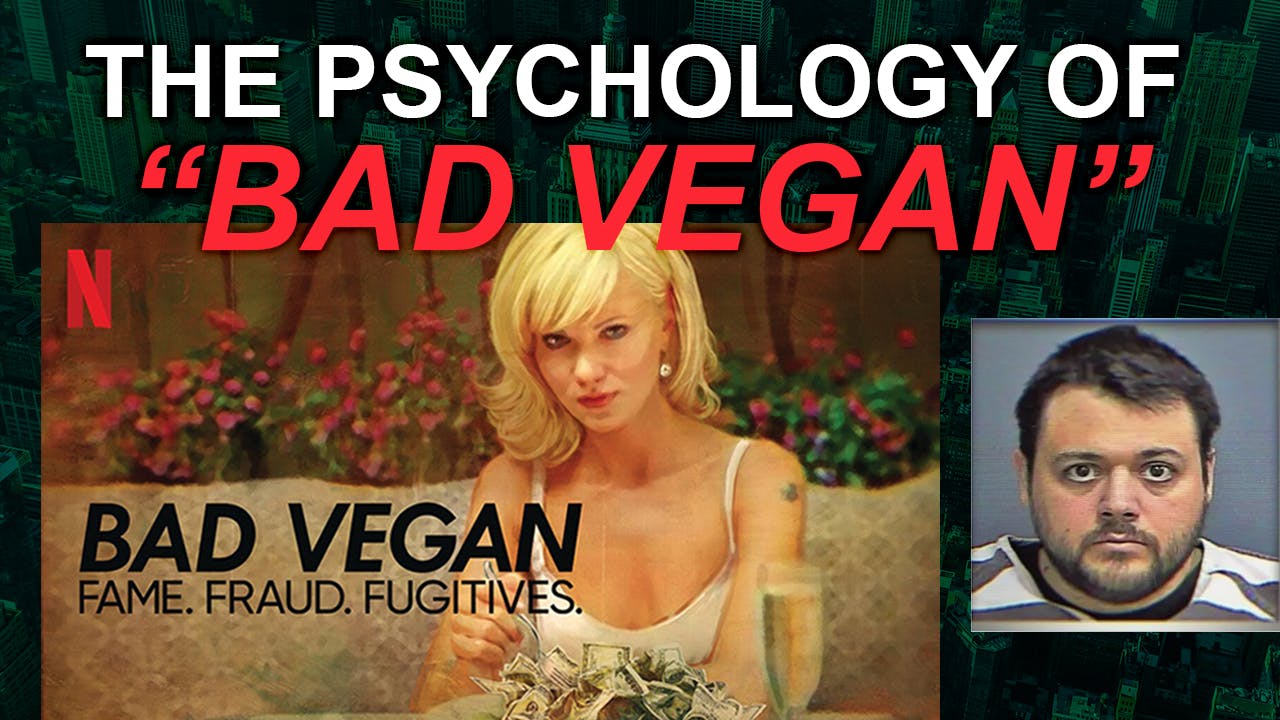
The documentary "Bad Vegan" was about Sarma Melngailis’s nightmarish journey from successful New York City restaurant owner to Rikers inmate jailed for stealing millions. How did this happen? Sarma was the victim of a narcissistic con man named Anthony Strangis, who manipulated her into believing (or semi-believing) a number of wild, delusional ideas (like that he might be a non-human being with immense, other-worldly powers). He used this strange hold over her to persuade her to give him large amounts of money (much of which he blew at casinos). I talk to Sarma about her experiences. We talk about: what led to her being so emotionally vulnerable that someone like Strangis could manipulate her; the factors that can lead someone to believe things that most people see as clearly ridiculous lies; why she dislikes the “Bad Vegan” documentary maker for his editing choices; the huge emotional challenge of trying to rebuild and stay positive after such nightmarish, debilitating events; her new book "The Girl With the Duck Tattoo." Learn more about your ad choices. Visit megaphone.fm/adchoices
The psychology of Bad Vegan: Sarma Melngailis on narcissistic abuse and life after
The surprising power of nostalgia — and how it can be used on you
What does nostalgia do to our minds — and our wallets? In this talk with Jannine Lasaleta, we talk about her research into the surprising psychological and emotional effects of nostalgia. Why do people become more generous and loose with money when they’re feeling nostalgic? How are companies — and even political campaigns — harnessing nostalgia to influence us? What’s the link between our craving for “authentic” experiences, like sourdough baking or retro products, and our longing for meaning? Learn more about your ad choices. Visit megaphone.fm/adchoices
The surprising power of nostalgia — and how it can be used on you
My life-changing experience with meditation
My life-changing experience with meditation
In the summer of 2024, I went on a five-day solo retreat in the mountains of New Mexico. It was the first time I’d ever really committed to meditation, and to my surprise it turned out to be a deeply meaningful and lasting experience. In this episode, I talk about what led me to try it, what those days of fasting, solitude, and meditation were actually like, and the unexpected effects I noticed afterward in my everyday life. I also share some of the doubts and anxieties I carried into the experience, why meditation had always felt out of reach for me, and why this retreat nevertheless managed to shift something fundamental in how I relate to myself and to stress. Learn more about your ad choices. Visit megaphone.fm/adchoices
Are you a psychopath? Debunking myths and looking for nuance in "dark" traits
What does the word “psychopath” really mean—and how often are we getting it wrong? Can someone have some psychopathic traits and still be empathetic? How often are we embracing simplistic ideas of what the terms psychopath and sociopath mean? Are those online “Are you a psychopath?” quizzes harmless fun, or could they actually shape how we see ourselves? And what about all the CEOs, politicians, and anti-heroes people quickly label as psychopaths—are there really so many psychopaths around us, or are people often just seeing what they want to see? Can having a highly competitive job (like a lawyer) make you act in more psychopath-associated ways? I talk with Dr. Nadja Heym, a researcher who specializes in psychopathy and other so-called “dark” personality traits. We explore the myths, the science, and the nuance: from the difference between traits and full-blown disorders, to the surprising ways environment and upbringing can shape these behaviors, to what her research says about the so-called “dark empath.” Learn more about your ad choices. Visit megaphone.fm/adchoices
Are you a psychopath? Debunking myths and looking for nuance in "dark" traits
Penalty kick mind games: Reading and using body language in sports
I talk with sports psychology and behavior researcher Philip Furley about how athletes' body language communicates far more than we realize — and how it can affect teammates, opponents, judges, and even the outcome of the game itself. Other topics discussed: celebratory behaviors and how that can influence perceptions of people, including judges; behaviors and strategies of penalty kickers and goalkeepers in soccer; some specific behaviors from recent World Cup games; challenges in finding general behavioral patterns in sports; athletes' anxiety; and ways people might make practical use of his research findings. Learn more about your ad choices. Visit megaphone.fm/adchoices
Penalty kick mind games: Reading and using body language in sports
Madness explained: How trauma and stress can break the mind
Madness explained: How trauma and stress can break the mind
I talk to psychologist Richard Bentall about psychosis, schizophrenia, and the psychological roots of mental illness. Bentall is the author of the well known book "Madness Explained." We explore how symptoms like hallucinations and delusions can often be traced to trauma, stress, and isolation—and how the label of “schizophrenia” may obscure more than it explains. We also discuss the fine line between delusions and widely shared beliefs, how social connections help shape our sense of reality, and why understanding madness as a human response—not just a brain disease—can reduce stigma. I also share some of my own struggles with mental health. Learn more about your ad choices. Visit megaphone.fm/adchoices
Our memory and sense of self are full of illusions | with Anne Wilson
Our memory and sense of self are full of illusions | with Anne Wilson
Psychologist Anne Wilson studies how we construct our identities over time—how we remember the past, imagine the future, and tell ourselves stories that shape who we believe we are. In this episode, we explore why our memories are often less reliable than we think, and how that inaccuracy might actually be a feature, not a bug. Anne shares insights from her work on temporal self-appraisal theory, including surprising research showing how people often rewrite their pasts to make it seem like they're always improving. We also talk about how memory malleability impacts mental health, relationships, and political polarization. Why do people remember the same childhood in radically different ways? Why do people recall their past selves as worse than they actually were? Learn more about your ad choices. Visit megaphone.fm/adchoices
Are you a narcissist? The psychology and spectrum of narcissism
Are you a narcissist? The psychology and spectrum of narcissism
What if we’ve been thinking about narcissism all wrong — and some forms of it are not only normal, but healthy? Why do we so often confuse genuine confidence or ambition with something pathological? Could your most “humble” or “selfless” friend actually be showing a hidden form of narcissism? And how might political polarization be pushing all of us to act a little more narcissistic than we’d like to admit? I talk with Craig Malkin, author of the book "Rethinking Narcissism: The Secret to Recognizing and Coping with Narcissists," in which he explains that narcissism is a spectrum. It’s healthy and normal to have some positive and grandiose illusions about your place in the world, as long as those illusions don’t become pathologically unhealthy and toxic. Topics discussed: the spectrum of narcissism, ranging from more normal forms of narcissism to pathological, malignant, dangerous forms; common misconceptions about narcissism; existential and psychological factors that can lead to more malignantly narcissistic traits and behaviors; the phenomenon of people overzealously labeling others narcissists; the Narcissistic Personality Inventory (the basis of many people’s understanding of narcissism) and how it works. Learn more about your ad choices. Visit megaphone.fm/adchoices
Ep 178The "deep whys" behind autistic behaviors | with Barry Prizant
I talk to Barry Prizant, author of the popular book "Uniquely Human: A Different Way of Seeing Autism," about the often misunderstood world of autism. We explore the idea that many so-called “autistic behaviors” are actually meaningful responses to stress, overwhelm, or attempts to communicate—and that looking for the “deep why” behind people's behavior is essential. We talk about sensory sensitivity and the complexities of the autism label. Barry shares stories from his decades of work, including surprising examples of how kids can use quotes from TV/movies to express their needs and fears. We also discuss empathy, the concept of autism as a different cultural style of communication, and how society’s need for people to “act normal” can cause harm. Even if you don’t know much about autism, you'll like this episode if you're interested in behavior, psychology, or communication. Learn more about the show and get transcripts at behavior-podcast.com. Learn more about your ad choices. Visit megaphone.fm/adchoices
Ep 177The psychology of how we react when our sense of meaning is threatened
Why do we feel so unsettled and agitated when the world doesn’t make sense? In this episode, I talk with psychologist Steven Heine about his Meaning Maintenance Model — a theory that explains how we react when our sense of meaning is threatened. We explore how disruptions to our mental frameworks can lead us to double down on our beliefs, seek comfort in nostalgia, or shift our focus to other sources of meaning. We discuss what this tells us about political polarization, existential crises, and even how psychedelics and surreal art can shake up (and sometimes heal) our sense of reality. If you’ve ever wondered why ambiguity and uncertainty can feel so deeply uncomfortable—and what we might do to avoid it—this episode is for you. Learn more about the show and get transcripts at behavior-podcast.com. Learn more about your ad choices. Visit megaphone.fm/adchoices
Ep 176A Bitcoin for news? Could Aemula.com revolutionize journalism and reduce polarization?
Can blockchain tech reinvent journalism—and reduce toxic political polarization in the process? Zach Elwood talks with Don Templeman, founder of Aemula (Aemula.com), a radically new kind of news platform. Inspired by the decentralization and transparency of cryptocurrency and other blockchain-based technologies, Aemula aims to create a bias-resistant newsroom of the future—one where algorithms are public, incentives reward nuance, and toxic polarization is nudged downward by design. Whether you're a blockchain skeptic or a media reform enthusiast, this is a conversation about what's broken in journalism—and one bold idea for fixing it. Learn more at aemula.com. Learn more about the show and get transcripts at behavior-podcast.com. Learn more about your ad choices. Visit megaphone.fm/adchoices
Ep 175Can eye direction reveal a lie? Or is that psychology bullshit? | with Tim Levine
Maybe you’ve heard that you can get clues about whether someone is lying by what direction they look when they talk. The most common form of this idea is that if someone is looking up and to their left, they’re more likely to be accessing real visual memories (associated with truth), and if they’re looking up and to their right, they’re more likely to be constructing visual images (associated with lies). But there is no basis for this; in fact, many studies have found evidence against that claim. This idea and other more broad ideas about eye movement clues were popularized by NLP (Neuro-Linguistic Programming), a school of thought whose core ideas have been debunked time and time again. In this episode, I talk to Tim Levine, a respected deception detection researcher. We talk about: the eye direction idea; the huge amount of bullshit in the pop behavior analysis space (e.g., shows like the Behavior Panel); reasons why the spreaders of this bullshit are so popular and successful; what the science says about using behavior to detect deception; why it’s so difficult to use behavior to detect deception; the idea that you need to establish “baselines” for people to aid you in reading them; how behavioral patterns in games/sports can differ from more real-world non-game scenarios; confirmation bias in the behavior analysis space, and how even smart researchers can be unreasonably biased in favor of their own ideas; Paul Ekman’s work; and more. Learn more about the show and get transcripts at behavior-podcast.com. Learn more about your ad choices. Visit megaphone.fm/adchoices
Ep 174Why some see liberals as the undemocratic ones: A talk about democracy and polarization with Elizabeth Doll
Many Americans think Trump is harming democracy; they see him as acting undemocratically in various ways. At the same time, Republicans and Trump supporters can view Democrats/liberals as themselves acting in highly undemocratic ways: as embracing various beliefs and actions that violate the spirit of democracy. I talk to Elizabeth Doll, who has worked in the political depolarization/bridge-building space for several years; she is currently the Director of Braver Politics for the organization Braver Angels. She is also someone who has been frustrated with various stances of liberal “defenders of democracy” that she sees as undemocratic and hypocritical. Topics discussed include: why anti-Trump people should want to understand these criticisms; various Republican-side views that liberals have behaved “undemocratically,” the debate over the electoral college; the debate over adding Supreme Court justices (stacking the court); the ambiguity in the word “democracy” and how that ambiguity leads to many things being called “undemocratic,"; why trying to understand each others' concerns is important for reducing toxicity, and more. Learn more about the show and get transcripts at behavior-podcast.com. Learn more about your ad choices. Visit megaphone.fm/adchoices
Ep 173On hypnosis and mind control: separating psychology fact from fiction | with Martin S. Taylor
A talk about hypnosis and mind control with Martin S. Taylor, a well known British hypnotist (hypnotism.co.uk). Martin is known for his stage hypnosis act but also for educating people about hypnosis and removing the illusions and mystique surrounding it. There are some people who make astounding claims that they can control and manipulate people using hypnosis. Some even claim they can get people to do things against their will and their ethics. Some of these people claim they can do this quickly, within minutes, and that they can teach you to do the same. There are clearly some impressive things you can do with hypnosis (as Martin will attest) — but there are also clearly many unethical and deceptive people in the NLP/hypnosis/influence space who exaggerate what you can do with it. In this talk, Martin and I try to separate fact from fiction — reality from bullshit. Topics discussed include: How did Martin get into hypnosis? What’s going on in a stage hypnosis act? What psychological factors lead to people acting in unusual and extreme ways in those settings? Is there such a thing as a hypnotic “trance”? Is it a special state? Martin’s thoughts on hypnosis used for therapy and self-help. MK Ultra and other government programs related to mind control and brainwashing. The importance of being skeptical about grand claims about hypnosis and mind control. Learn more about the show and get transcripts at behavior-podcast.com. Learn more about your ad choices. Visit megaphone.fm/adchoices
Ep 172What happened to Keith Olbermann? A look at his descent.
In March of 2024, the newsman and sports commentator Keith Olbermann tweeted that the “Supreme Court had betrayed democracy” and called for it to be “dissolved.” This was the second time he’d called for the Supreme Court to be dissolved: he did that also in 2022. This is a review of some of Olbermann’s more unreasonable and incendiary behavior over the last twenty years, with a focus on his political rage and how that relates to America’s toxic polarization problem. Because clearly there are many people around us, like Olbermann, with extreme contempt toward their political opponents, and a lot of biased, unreasonably certain takes about all sorts of events and happenings. What might we learn from Olbermann's behavior? Learn more about the show and get transcripts at behavior-podcast.com. Learn more about your ad choices. Visit megaphone.fm/adchoices
Ep 171Mirror selfies, duck faces, and party pics: The psychology of dating app communication
I talk to Dr. Jess Snitko, who has researched online dating and other online communication, about the signals and messages we send, intentionally and unintentionally, with dating app profiles and pictures. Jess earned her Ph.D. in Media, Technology, and Society from Purdue University in 2020. Topics discussed: Factors in pictures and profiles that cause people to swipe right or swipe left; the so-called “duck-face” expression some girls make in photos; men’s shirtless photos; men who post pictures of holding a fish or posing with dead animals; bathroom mirror selfies; pictures of partying and drinking; group photos and problems with those; cropped photos where an ex is being removed from the picture; how first impressions can be prone to errors; and more. Learn more about the show and get transcripts at behavior-podcast.com. Learn more about your ad choices. Visit megaphone.fm/adchoices
Ep 170Is the left-right political spectrum concept a false illusion? A talk with Hyrum Lewis
What if I told you the left-right political spectrum was an illusion? What if I told you there is no “left” or “right”? My guest is Hyrum Lewis, co-author of The Myth of Left and Right: How the Political Spectrum Misleads and Harms America. They argue that we’ve embraced a simplistic, faulty idea of an essential “left/liberalism” and an essential “right/conservatism.” And that, similar to embracing a faulty medical idea (like the old theory of the four humors), embracing a faulty political theory has hurt us in major ways. For one thing, it creates a perception that instead of there being many different issues, there is just a single issue (left versus right) and that choosing the right “team” gains you access to all the right ideas. Embracing that concept in turn amplifies conflict and anger, by making our divides seem like a war between two set and essential ideologies. It makes it easier to embrace a good-versus-bad way of seeing our political divides. Topics include: why Hyrum believes the left-right spectrum is an illusion; common objections to their idea; how persuasive political thinkers have found their idea; the ways in which language and foundational concepts can amplify divides; the horseshoe theory; ways we might speak and write in better ways about our political disagreements, and more. Learn more about the show and get transcripts at behavior-podcast.com. Learn more about your ad choices. Visit megaphone.fm/adchoices
Ep 169Does Trader Joe's pressure its employees to talk to customers?
Every time I go in Trader Joe's, the checkout person asks me a question of some sort. I used to think everyone there was just happy and friendly, but then I heard reports that it was more of a rule or strong encouragement that employees talk to customers. I read conflicting reports about this online and wanted to talk to someone who'd worked at Trader Joe's, to see if she could shed some light on this. I talk to Twiggy, who has a YouTube channel (youtube.com/@TwiggysDollHospital) and who makes custom dolls (twiggysdollhospital.com). Learn more about the show and get transcripts at behavior-podcast.com. Learn more about your ad choices. Visit megaphone.fm/adchoices