
People of the Pod
409 episodes — Page 1 of 9
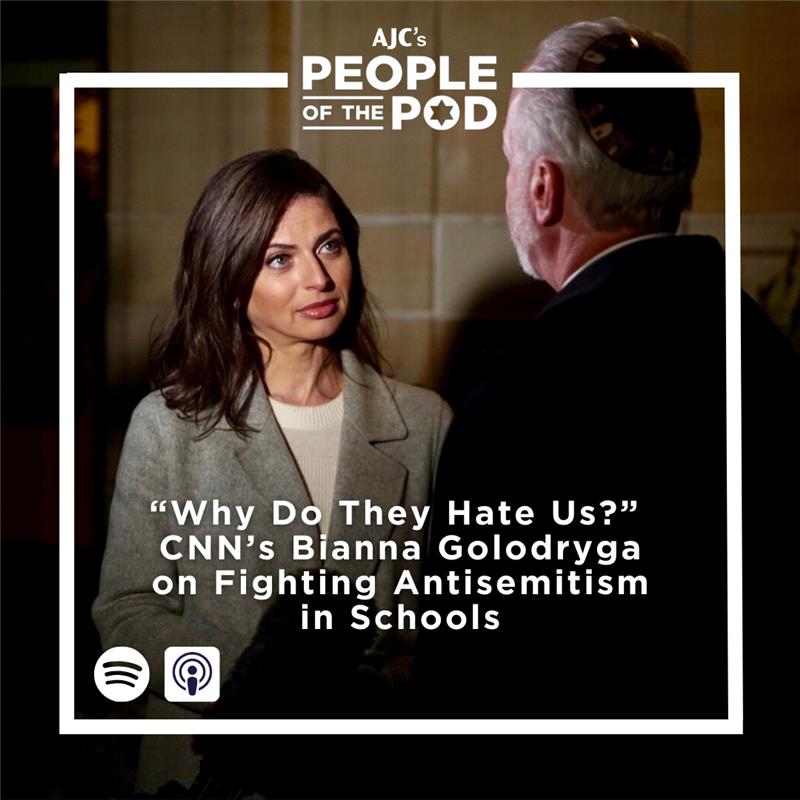
"Why Do They Hate Us?" CNN's Bianna Golodryga on Fighting Antisemitism in Schools
In this special episode, host Manya Brachear Pashman welcomes a co-host: her 11-year-old son, Max. Together, they sit down with Emmy-winning CNN anchor Bianna Golodryga to discuss her new novel, Don't Feed the Lion. Co-written with Yonit Levy, the book tackles the viral contagion of antisemitism in schools. From the pressure of being the only Jewish kid in class to the stress of Bar Mitzvah prep, this multi-generational conversation explores the void in modern education and the power of empathy. A rare, heartwarming, and urgent bridge between the newsroom and the classroom, this discussion is a must-listen for parents, educators, and anyone looking to understand the next generation's fight against hate. A Note to Our Listeners: As we head into 2026, People of the Pod will be taking a pause. After eight years of sharing your stories, we are contemplating our next chapter. Thank you for being part of this journey. *The views and opinions expressed by guests do not necessarily reflect the views or position of AJC. Key Resources: AJC's Center for Education Advocacy Confronting Antisemitism In Our Schools: A Toolkit for Parents of Jewish K-12 Students FAQs for Parents of K-12 Jewish Students Listen – AJC Podcasts: Architects of Peace The Forgotten Exodus People of the Pod Follow People of the Pod on your favorite podcast app, and learn more at AJC.org/PeopleofthePod You can reach us at: [email protected] If you've appreciated this episode, please be sure to tell your friends, and rate and review us on Apple Podcasts or Spotify. Transcript of the Interview: Manya Brachear Pashman: Bianna Golodryga is an Emmy award winning news anchor for CNN, who has reported extensively on the October 7 Hamas terror attack on Israel and Russia's invasion of Ukraine. She is a mother and she is now a published novelist. Co-written with leading Israeli news anchor Yonit Levy, Don't Feed the Lion is about how the rise of antisemitism affects Theo, his sister Annie, and their friends Gabe and Connor, all students in a Chicago middle school, and it was written with middle schoolers in mind. Bianna is with us now to discuss the book, along with my co-anchor this week, my son Max, a middle schooler who read the book as well and has a few questions of his own. I will let Max do the honors. Max Pashman: Bianna, welcome to People of the Pod. Bianna Golodryga: Well, it is a joy to be with you Manya, and especially you, Max. We wrote the book for you, for you and your peers especially. So really excited to hear your thoughts on the book. Manya Brachear Pashman: Well, I want to know, Bianna, what prompted you to write this book? Was it the mother in you or the journalist or a little bit of both? Bianna Golodryga: It was definitely a little bit of both. It was the mother in me, initially, where the idea was first launched and the seed planted even before October 7. You know, sadly, antisemitism has been with us for millennia, but I never thought that I would be having these conversations with my own kids in the city, with the largest Jewish community and population outside of Israel. But you'll recall that there were a few high profile antisemitic social media posts and controversies surrounding Kanye West and then Kyrie Irving, who's a famous NBA player at the time, and my son, who was 10 at the time, a huge sports fan, and was very upset about the fact that not only were these comments made and these posts made, but there was really no accountability for them. There was no consequence. Ultimately, Kyrie Irving was suspended for a few games, but there was just a deluge of news surrounding this. People apologizing for him, but not him apologizing for himself. So my son asked as we were on our way to a basketball game to watch Kyrie play. Asked, why do they hate us? Can I not even go to the game? Does he not want me there? And I really was dumbfounded. I didn't know how to respond. And I said, you know, I don't have the answer for that, but I'm going to reach out to your school, because I'm sure this is something that they're addressing and dealing with and have the resources for. This was after the murder of George Floyd, and so we had already witnessed all of the investments, thankfully, into resources for our kids, and conversations, both at schools and the workforce, about racism, how to deal with racism, how to spot and identify it, other forms of hate. And I just assumed that that would include antisemitism. But when I reached out to the school and asked, you know, what are they doing on antisemitism, the response stunned me. I mean, it's basically nothing. And so as I said, the seed was planted that we really need to do something about this. There's a real void here. And then, of course, when the attacks of October 7 happened, you know, Yonit and I were on the phone and messaging every single day right after. And it was pretty quick, maybe two weeks later, when, you know, we'd already started seeing an uptick in antisemitism around
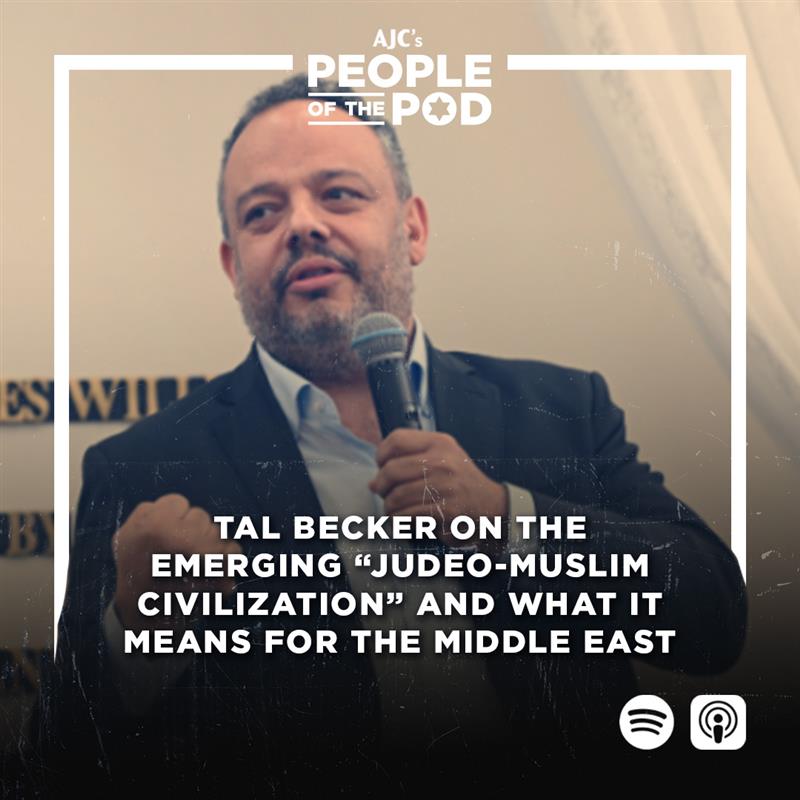
Tal Becker on The Emerging "Judeo-Muslim Civilization" and What It Means for the Middle East
Are we in a 'plastic moment,' an inflection point where the future of the Middle East can finally be reshaped? Veteran peace negotiator Dr. Tal Becker joins the podcast to analyze the shifting tides of regional diplomacy. Reflecting on his recent discussions in Abu Dhabi, Becker describes the Abraham Accords as an emerging "Judeo-Muslim civilization" where the focus isn't on "who the land belongs to," but the realization that "we all belong to the land." Beyond geopolitics, Becker addresses the trauma of rising Western antisemitism—which he likens to a "zombie apocalypse"—and calls for a resurgence of liberal nationalism. This episode is a masterclass in navigating a zero-sum world to build a future of prosperity, courage, and shared belonging. Key Resources: The Abraham Accords, Explained AJC CEO Ted Deutch Op-Ed: 5 Years On, the Abraham Accords Are the Middle East's Best Hope AJC's Center for a New Middle East Listen – AJC Podcasts: Architects of Peace The Forgotten Exodus People of the Pod Follow People of the Pod on your favorite podcast app, and learn more at AJC.org/PeopleofthePod You can reach us at: [email protected] If you've appreciated this episode, please be sure to tell your friends, and rate and review us on Apple Podcasts or Spotify. Transcript of the Interview: Manya Brachear Pashman: As the international community looks to phase two of the cease fire between Israel and the Hamas terror group in Gaza, the American Jewish Committee office in Abu Dhabi invited Dr Tal Becker to participate in discussions about what's next for the region. Dr Becker is one of Israel's leading experts on international humanitarian law and a veteran peace negotiator with Palestinians, Lebanese and Syrians. He is currently vice president of the Shalom Hartman Institute, and he joins us now right after the conference in Abu Dhabi to share some of the insights he contributed there. Tal, welcome to People of the Pod. Tal Becker: Thank you very much, Manya. Manya Brachear Pashman: So Tal, you have just returned from a conference in Abu Dhabi where you really took a deep dive, kind of exploring the nature of Arab-Israeli relations, as we are now entering the second phase of the ceasefire between Israel and Gaza. So I'm just curious, you've been steeped in this for so long, for decades, do you sense, or did you sense a significant shift in the region when it comes to Arab-Israeli relations and the future? Tal Becker: So I think Manya, we're at a very kind of interesting moment, and it's hard to say exactly which direction it's going, because, on the one hand, we have had very significant military successes. I think a lot of the spoilers in the region have been significantly set back, though they're still there, but Israel really has had to focus on the military side of things a lot. And it, I think, has strained to some extent, the view of what's possible because we're being so focused on the military side. And I think it is a moment for imagining what's possible. And how do we pivot out of the tragedy and suffering of this war, make the most of the military successes we've had, and really begin to imagine what this region could look like if we're going to continue to succeed in pushing back the spoilers in this way. Israel is a regional power, and I think it for all our vulnerability that requires, to some extent, for Israel to really articulate a vision that it has for the region. And it's going to take a little bit of time, I think, for everybody to really internalize what's just happened over these last two years and what it means for the potential for good and how we navigate that. So I really think it's kind of like what they call a plastic moment right now. Manya Brachear Pashman: A plastic moment, can you define that, what do you mean by plastic? Tal Becker: So what I mean by a plastic moment, meaning it's that moment. It's an inflection point right where, where things could go in one direction or another, and you have to be smart enough to take advantage of the fluidity of the moment, to really emphasize how do we maximize prosperity, stability, coexistence? How do we take away not just the capabilities of the enemies of peace, but also the appeal of their agenda, the language that they use, the way they try to present Muslim Jewish relations, as if they're a kind of zero sum game. So how do we operate both on the economic side, on the security side, but also on the imagining what's possible side, on the peace side. As difficult as that is, and I don't want to suggest that, you know, there aren't serious obstacles, there are, but there's also really serious opportunities. Manya Brachear Pashman: So what did you sense when you were there, in terms of the perception of Israel? I mean, were people optimistic, for lack of a better term? Tal Becker: So first of all, it was, you know, a great opportunity to be there. And having been involved, personally, very intensively in the Abraham Accords, I always feel a bit
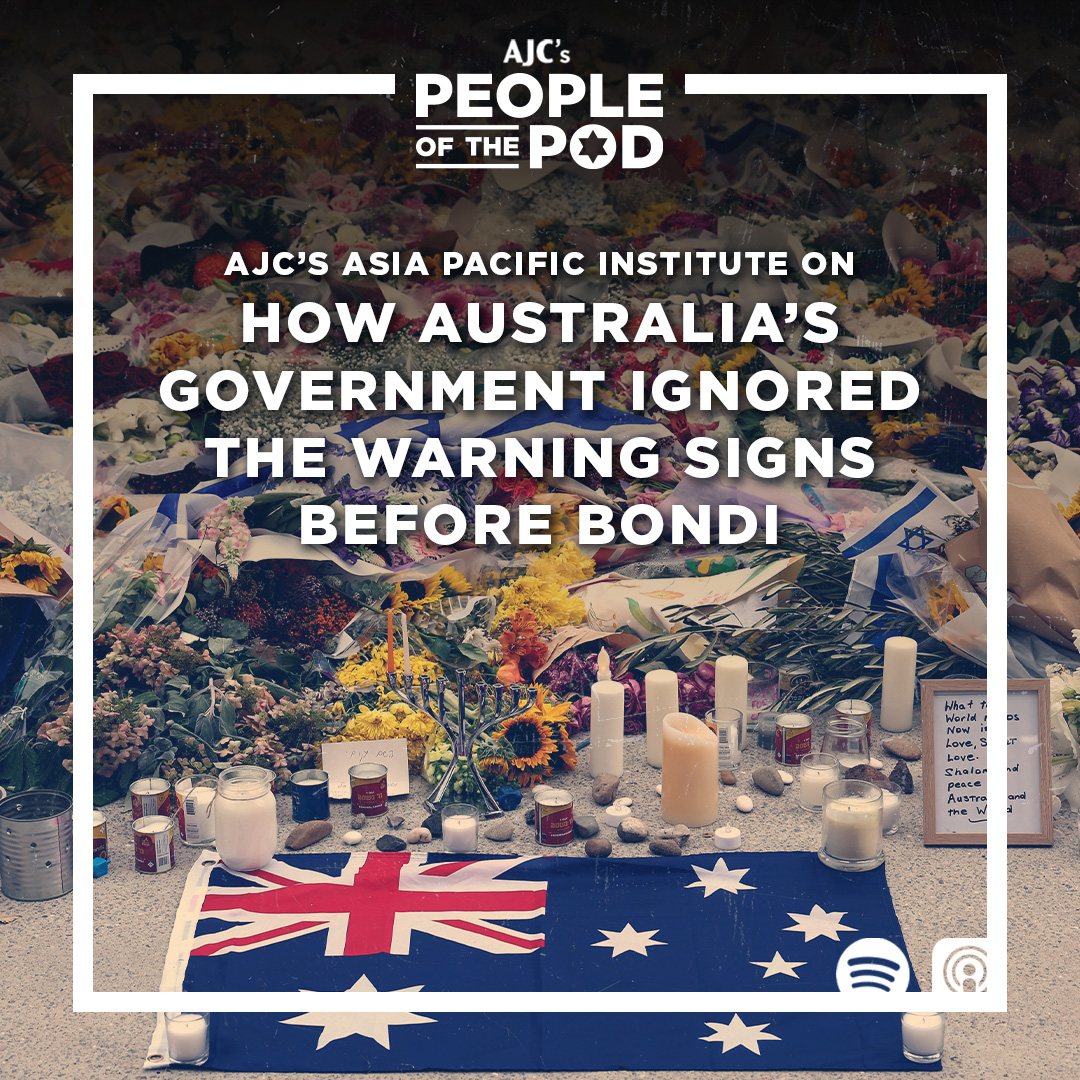
AJC's Asia Pacific Institute on How Australia's Government Ignored the Warning Signs Before Bondi
Once considered a haven for Jews, Australia is reeling after a deadly Hanukkah terror attack at Bondi Beach left 15 dead—the tragic outcome of skyrocketing hate. AJC Asia Pacific Institute Associate Director Hana Rudolph joins the podcast to unpack the crisis, revealing that despite over 2,000 antisemitic incidents in the year following October 7, the government dropped the ball. Hana details how political inaction and a fear that "supporting Jews is not politically popular" have allowed extremism to fester. She criticizes the delay in implementing the recommendations set forth by Australia's Special Envoy to Combat Antisemitism, noting the government's failure to move beyond basic security measures. Listen as she explains why global pressure is now urgent to ensure Australia takes this massive gap seriously before more lives are lost. Read the Full Transcript: https://www.ajc.org/news/podcast/ajcs-asia-pacific-institute-on-how-australias-government-ignored-the-warning-signs-before Resources: -What To Know About the Antisemitic Terror Attack in Sydney -Take action: Urgent: Confirm U.S. Special Envoy to Monitor and Combat Antisemitism Listen – AJC Podcasts: -Architects of Peace -The Forgotten Exodus -People of the Pod Follow People of the Pod on your favorite podcast app, and learn more at AJC.org/PeopleofthePod You can reach us at: [email protected] If you've appreciated this episode, please be sure to tell your friends, and rate and review us on Apple Podcasts or Spotify. Transcript of the Interview: Manya Brachear Pashman: For more than 30 years, American Jewish Committee's Asia Pacific Institute has found Australia to be a nation that has stood shoulder to shoulder with the Jewish people and Israel. But that sense of steadfast support has started to fray as antisemitism has risen exponentially. The massacre at Bondi Beach on the first night of Hanukkah was only the latest and deadliest in a string of antisemitic incidents over the past two years. Here to discuss how we got here is Hana Rudolph, associate director of AJC's Asia Pacific Institute. Hana, welcome to People of the Pod. Hana Rudolph: Thank you so much for having me. Manya Brachear Pashman: Well, I want to ask you first, can you kind of introduce our listeners to the Australian Jewish community? How many people are we talking about? What is their history in Australia? Hana Rudolph: The Australian Jewish community is one of the most historic, long standing communities in the Asia Pacific. It dates back to 1788. So we're talking 18th century over 100,000 Jews. They're a diverse community. They reside primarily in the cities of Melbourne and Sydney, but they range in terms of practice, in terms of political views, similar to as we see in Europe or the US. There's some level of debate in terms of what, what percentage of the population it comprises, but somewhere between .5- 1% of the population. Manya Brachear Pashman: And has Australia been a friendly country for the Jewish community for all of that time, and at least until recently? Hana Rudolph: Yeah, absolutely. It has been a deep, close friend of Israel. Israeli diplomats have described Australia as an even closer partner to Israel at the UN and in other global forums than even the US. Jews have been living there for centuries, and have oftentimes described Australia as being like a haven. No matter the antisemitism that increases in Europe or in the US, Australia has been safe. It is the one place besides Israel, where they feel they can live in security. So the surge in antisemitism we've seen, especially since October 7, has just been so much more alarming and frightening and shocking for the community, because they just haven't seen incidents at this level anytime prior. Manya Brachear Pashman: What is it about Australia's community? I mean, I know that there's been a lot of emphasis on a kind of, give everyone a fair go, right? There's a lot of emphasis on equality. Is that what guides this kind of welcoming atmosphere? Or why are they such good friends with Israel? Is there something about the culture? Hana Rudolph: Yeah, Australia takes a lot of pride in its multiculturalism, the harmony and diversity, social cohesion, so they've placed a lot of emphasis on that in terms of, like, the national culture, and I think that's part of what's led to such a safe, thriving space for the Jewish community for so long until now. Manya Brachear Pashman: So what changed? Hana Rudolph: Million dollar question, right? October 7. It's really important to note that, you know, there have been threads of antisemitism from well before October 7, right? Things don't just happen overnight. And in the Hamas attack took place on October 7, before Israel had even begun its defensive war to recover the hostages and to complete its aims, on October 9, there was a massive protest in front of the Sydney Opera House, and people were yelling, were holding signs, yelling slogans of, where is the Jews, F the Jews.
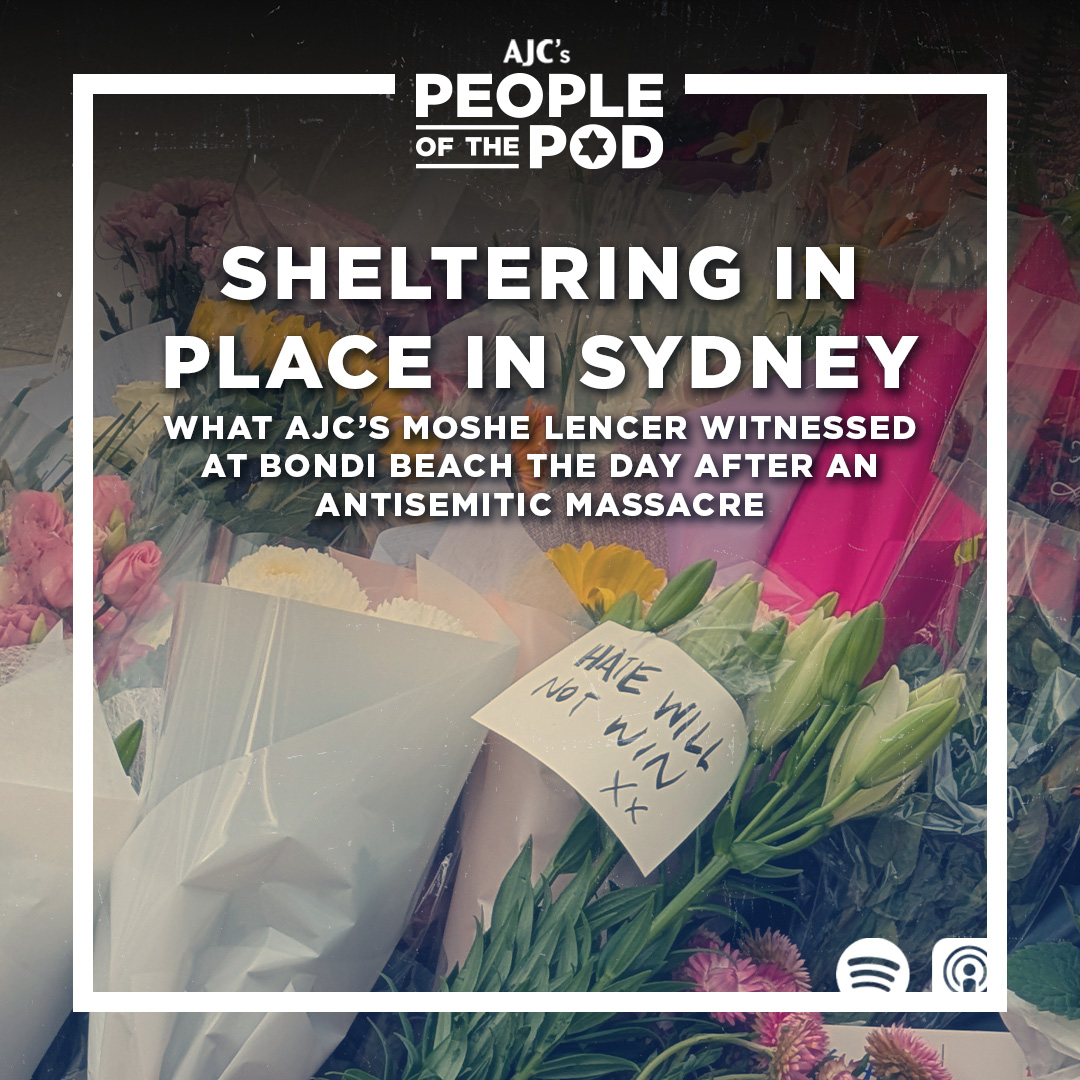
Sheltering in Place in Sydney: What AJC's Moshe Lencer Witnessed at Bondi Beach the Day After an Antisemitic Massacre
AJC Director of Campus Affairs Moshe Lencer was on his first visit to Australia when the unimaginable happened. Hours after he enjoyed the sun at Sydney's Bondi Beach, it became the site of an antisemitic terrorist attack, leaving 15 people, including a child and a Holocaust survivor, dead. Moshe recounts attending a student leadership shabbaton, in partnership with Australia's Union for Jewish Students (AUJS), and the immediate aftermath on the ground—a mix of helplessness and resolve—and the powerful scene at Bondi Beach the following day, as Jews and non-Jews gathered to mourn and show solidarity. Reflecting on the rise of antisemitism in Australia, Moshe—speaking as an outsider to the community—underscores the guiding principle of Australian Jews at this moment: "If we stop celebrating Jewish identity, it means they won." Read Full Transcript: https://www.ajc.org/news/podcast/ajcs-asia-pacific-institute-on-how-australias-government-ignored-the-warning-signs-before Resources: -What To Know About the Antisemitic Terror Attack in Sydney -Take action: Urgent: Confirm U.S. Special Envoy to Monitor and Combat Antisemitism Listen – AJC Podcasts: -Architects of Peace -The Forgotten Exodus -People of the Pod Follow People of the Pod on your favorite podcast app, and learn more at AJC.org/PeopleofthePod You can reach us at: [email protected] If you've appreciated this episode, please be sure to tell your friends, and rate and review us on Apple Podcasts or Spotify. Transcript of the Interview: Manya Brachear Pashman: As the sun began to set in Australia on Sunday, more than 1000 gathered on Bondi Beach in Sydney to celebrate the first night of Hanukkah by the Sea, but at about 6p m, terrorists fired into the crowd, killing at least 15 and wounding dozens more. Students with the Australasian union of Jewish students had just wrapped up a Shaba tone before they headed to Bondi Beach and our own AJC, Director of Campus affairs, Moshe Lencer, whom we affectionately call Moosh, was there with him shortly before the attack, and he's with us now. Moosh, welcome to people of the pod. Moshe Lencer: Thank you for having me. Manya Brachear Pashman: Well, I wish it were under very different circumstances. How are you doing and how are the students doing that you are spending time with there? Moshe Lencer: It's a wonderful question, and the more I think about it, the less I have a clear answer. It's a combination of helplessness, and in the same time, desire towards hope and trying to figure how to move through this very dark time. The last 24 hours, a little bit more than that have been very interesting is this has been my first time ever in Australia. I landed here Friday morning. Right now, for context, it's Monday night, and until about 6pm on Sunday, it was a very pleasant, positive experience, filled with moments of Jewish pride and joy. The reason I'm in Australia, even in this moment, is time, is AJC has a partnership with the Austra Asian union of Jewish students known as AJUS. Which is the student organization that focuses on Leadership for Jewish students in Australia and New Zealand. And I was invited to take part in a shabaton that was held just outside of Sydney with student leaders from both Australia and New Zealand. The weekend was filled with laughter and joy and happiness, and we were making edible chanukias before the holiday, we were talking about ways to advocate for what students needs and for what they need. We even finished the day with kayaking, and there was a lot of happiness and a lot of desire, because, as I learned recently, and I should have understood before by being in the southern hemisphere. This is the beginning of summer. This is the first few weeks when people finish the school year and they're enjoying it. They're celebrating. And that's why the dates were chosen. So it's like beautiful and it's sunny, and we were expelled and everything. And as we were about to start celebrating a holiday that's all about our community and resilience, our resilience was tested again, and now as just over a day into it, we're still trying to see what we can do and how to move forward and support the community right now as it's hurting. Manya Brachear Pashman: You were actually at Bondi Beach shortly before the attack. Can you kind of describe the environment and why you were there in the first place? Moshe Lencer: Yeah, of course, as mentioned, we were doing the shabbaton, and the programming ended around 3pm and it's summer. It's the first few days of summer. If you Google, what can you do, or what should you do and see in Sydney, the first few things people will see will be the Opera House, which is, I think, the most iconic place in the city. And then the second thing is go. It says, Go to Bondi Beach. It's such a big piece of the community here and where people go. It's also super close to where most of the Jewish community lives. So we were saying, okay, the shabbaton is done. A lot of the peo

The Producer of Pulp Fiction on His New 10/7 Docu-series Red Alert on Paramount+
Join host Manya Brachear Pashman for a powerful conversation about Red Alert, the Critics Choice Award-nominated Paramount+ docu-series that confronts the October 7 Hamas massacre with unflinching honesty. Producer Lawrence Bender (Pulp Fiction, Good Will Hunting) shares why this project couldn't wait—launched in real time to push back against denial, disinformation, and a world struggling to absorb the scale of the tragedy. Bender reflects on the courage and trauma of the ordinary Israelis whose stories anchor the series, including survivors like Batsheva Olami, whose resilience changed the production team forever. Hear how filming during an active war shaped the storytelling, the emotional toll on everyone involved, and why capturing these true accounts is essential to ensuring October 7 is neither minimized nor forgotten. Key Resources: AJC.org/Donate: Please consider supporting AJC's work with a year-end gift today. Right now, your gift will be matched, dollar-for-dollar, making double the impact. Every gift matters. Every dollar makes a difference in the fight for a strong and secure Jewish future. Listen – AJC Podcasts: Architects of Peace The Forgotten Exodus People of the Pod Follow People of the Pod on your favorite podcast app, and learn more at AJC.org/PeopleofthePod You can reach us at: [email protected] If you've appreciated this episode, please be sure to tell your friends, and rate and review us on Apple Podcasts or Spotify. Transcript of the Interview: [Clip from Red Alert] Manya Brachear Pashman: Academy Award nominated film producer Lawrence Bender has quite a repertoire for both feature films and documentaries: Pulp Fiction, Inglorious Bastards, Good Will Hunting and Inconvenient Truth. In fact, his works have earned 36 Academy Award nominations. His most recent TV miniseries is a more personal project on the second anniversary of the October 7 Hamas terror attacks on Israel, Paramount Plus began streaming a four episode series called red alert about the attack on festival goers, innocent passers by and families waking up to terrorists inside their Israeli homes that day, a tragedy that many of us, either on this podcast or listening have watched with overwhelming grief for the last two years. Lawrence is with us now to talk about how he grappled with this attack on Israel and the rise of antisemitism that followed. Lawrence, welcome to People of the Pod. Lawrence Bender: Thank you, Manya, it's good to be here. Manya Brachear Pashman: So that clip that we played at the top of this episode, it's one of the few clips in English. Most of the dialog in this show is in Hebrew with subtitles. But that scene is a woman, Bathsheba and her two daughters. They're walking across a field trying to return home, and her son has been taken. Her husband is gone. This series weaves together her story and three or four other ordinary civilians fighting for their lives on October 7, 2023. You know, as someone personally who's been immersed in this subject matter for two years, to be honest, I had to muster the energy to watch this, and I'm so glad that I did. But why are, I mean, as we're still waiting for the last hostage to be returned, why was it important for this show to air now? Lawrence Bender: Well, thank you so much for doing this with me, and thank you for playing that clip. I have to tell you first, I love that clip. I love that scene because one of the things about the show and the stories that we portrayed is that even with the horrific things that happened on that day, people still were able to fight back. People were still able to be strong. A mother with her daughter and her infant stood in the face of a terrorist and stood him down in real life, this happened. Now, not everybody was so fortunate, and her husband Ohad was not fortunate, and her son was taken hostage, as you mentioned, but it does show her personal power in this horrific situation. And I just thought, you know, this woman is a real hero. I've spent a lot of time with her, Batsheva Olami, she's really an extraordinary human in all ways. So thank you for playing that clip. So in terms of the show, I felt on October 8, it's just amazing how quickly, before Israel did anything, the entire world quickly turned against the very people who were the victims and having spent subsequently, a lot of time with people on the set, because, as you mentioned, this show was about real people, and those real people spent a lot of time on the set with us. And the very people that were traumatized, felt isolated, they felt alone, and they're the very ones that need to be loved, that need to be hugged, they need to be supported. Anyway, I just felt like I needed to do something fast to try to show the world what really happened. AndRed Alert is the result of that. Manya Brachear Pashman: Do you fear that the world has already moved on? Lawrence Bender: Oh, that's a good question. It feels like we've passed a tipping point, actually, in terms

Erasing Jewish History: Why What Happened in Ireland Should Alarm All Jews
When Dublin officials moved to strip the name of Chaim Herzog—Israel's Irish-born sixth president—from a community park, it wasn't just a local dispute. It was an act of erasure. In this emotional episode, Dr. Alexandra Herzog, AJC's Director of the William Petschek Global Jewish Communities Department, explains why this attempt to rewrite history should alarm not only Jews, but all citizens of goodwill. As anti-Zionist fervor increasingly targets Jewish identity across the West, the push to remove a Jewish name from a park beside Ireland's only Jewish school sends a chilling message: Jewish heritage has now become a political battleground. Alexandra shares personal memories of her grandfather and illustrates why this fight isn't about a plaque in Ireland—it's about halting the slide from criticism of Israel into the deletion of Jewish memory. Tune in to understand why defending this history is essential to protecting Jewish dignity everywhere. Key Resources: AJC Welcomes Dublin City Council's Decision to Shelve Renaming of Herzog Park Letter in the Irish Times: Renaming Herzog Park in Dublin Would Be An Act of Erasure Against Ireland's Jews Listen: Will Ireland Finally Stop Paying Lip Service When it Comes to Combating Antisemitism? AJC Directly Addresses Antisemitism and Vilification of Israel in Ireland with the Prime Minister Listen – AJC Podcasts: Architects of Peace The Forgotten Exodus People of the Pod Follow People of the Pod on your favorite podcast app, and learn more at AJC.org/PeopleofthePod You can reach us at: [email protected] If you've appreciated this episode, please be sure to tell your friends, and rate and review us on Apple Podcasts or Spotify. Read the full transcript: https://www.ajc.org/news/podcast/erasing-jewish-history-why-what-happened-in-ireland-should-alarm-all-jews Transcript of the Interview: Manya Brachear Pashman: Members of the City Council of Dublin, Ireland have withdrawn a proposal to rename a park that since 1995 has honored former Israeli President Chaim Herzog. The park, located near Dublin's only Jewish school, is named after Herzog, Israel's sixth president, who was born in Belfast. Here to talk about the now withdrawn proposal is Alexandra Herzog, AJC's Director of the William Petschek Global Jewish Communities Department, and Chaim Herzog's granddaughter. Alexandra, welcome to People of the Pod. Alexandra Herzog: Thank you so much for having me, Manya. Manya Brachear Pashman: So you have joined us before, but on a different podcast, The Forgotten Exodus, which is our narrative series about Jews from the Middle East and North Africa. You were joining us to talk about your maternal grandfather, Nessim Gaon, the longtime president of the World Sephardi Federation. He came to Israel from Sudan. But this time, we're talking about your paternal grandfather, Chaim Herzog. How did someone born in Ireland later become President of Israel? Alexandra Herzog: Yes, that's a great question. Manya, so my grandfather, Chaim Herzog, was, as you said, born in Belfast. He grew up in Dublin in a very proudly Jewish home. His father actually was a Rabbi Isaac Halevi Herzog, and he served as the Rabbi of Belfast before becoming the chief rabbi of Ireland. So he moved from Belfast to Dublin in 1919. He was affectionately known as the Sinn Féin rabbi, and he was highly respected and close to many of the leaders of the Irish independence movement. So my grandfather really grew up in a house that was deeply steeped in Jewish learning, in Irish patriotism, and he had a very strong sense of moral responsibility. And as a young man, he had to leave Ireland to study, and he later enlisted in the British Army during World War Two, he fought the Nazis as an intelligence officer. He was one of the first soldiers actually to enter the concentration camp of Bergen Belsen, and he interrogated senior Nazi officials. Now, after the war, he moved to what would become the State of Israel, and he helped build the very young country, almost from its founding, in different positions. And you know, then later, he became Israel's ambassador to the UN and a member of the Israeli parliament, the Knesset. And by the time he was elected as Israel's sixth president in 1983 he was widely seen really, as a statesman who combined Irish warmth and some storytelling with a very deep sense of Jewish history and Jewish responsibility. He never stopped describing himself, actually, as an Irish born man. and he often spoke about how Ireland really shaped his worldview, and his commitment to freedom and to democracy. Manya Brachear Pashman: And you mentioned that he was the ambassador to the United Nations. He was, in fact, Ambassador when the resolution Zionism is Racism was, was part of the conversation. Alexandra Herzog: That's right. Yes, one of the two UN resolutions ever to be withdrawn and canceled, very important one. That's right. Manya Brachear Pashman: In fact, if I'm not mistaken, he tore it in half. Ale
Architects of Peace: Episode 6 - Building What's Next
Five years after the signing of the Abraham Accords, the Middle East looks very different—defined by both extraordinary cooperation and unprecedented challenges. In this episode, we unpack how Israel's defensive war on seven fronts affected regional partnerships, why Abraham Accords nations have stood by the Jewish state, and what expanded normalization could look like as countries like Saudi Arabia and others weigh making such monumental decisions. We also explore the growing importance of humanitarian coordination, people-to-people diplomacy, and the critical role AJC is playing in supporting deeper regional collaboration. From shifting narratives to new economic and security opportunities, we chart what the next five years could mean for peace, stability, and integration across the region. *The views and opinions expressed by guests do not necessarily reflect the views or position of AJC. This episode is up-to-date as of November 25, 2025. Read the transcript: Building What's Next | Architects of Peace - Episode 6 | AJC Resources: AJC.org/ArchitectsofPeace - Tune in weekly for new episodes. The Abraham Accords, Explained AJC.org/CNME - Find more from AJC's Center for a New Middle East Listen – AJC Podcasts: The Forgotten Exodus People of the Pod Follow Architects of Peace on your favorite podcast app, and learn more at AJC.org/ArchitectsofPeace You can reach us at: [email protected] If you've appreciated this episode, please be sure to tell your friends, and rate and review us on Apple Podcasts or Spotify. Transcript: ANNE DREAZEN: One thing that I have learned from my many years at the Department of Defense is that military instruments of power are not sufficient to really build longlasting peace and stability. The importance of trade, of economic development, of people-to-people ties, is so essential to what we think of as an enduring or a lasting peace. MANYA BRACHEAR PASHMAN: In September 2020, the world saw what had been years–decades–in the making. Landmark peace agreements dubbed the Abraham Accords, normalizing relations between Israel and two Arabian Gulf States, the United Arab Emirates and the Kingdom of Bahrain. Later, in December, they were joined by the Kingdom of Morocco. Five years later, AJC is pulling back the curtain to meet key individuals who built the trust that led to these breakthroughs and build bonds that would last. Introducing: the Architects of Peace. MANYA BRACHEAR PASHMAN: It has been five years since Israel, the United Arab Emirates, and Bahrain signed the Abraham Accords on the South Lawn of the White House. In those five years, Russia invaded Ukraine, sparking a massive refugee crisis. The U.S. elected one president then re-elected his predecessor who had ushered in the Abraham Accords in the first place. And amid news that Saudi Arabia might be next to join the Accords, the Hamas terror group breached the border between Israel and Gaza, murdered more than 1,200 people and kidnapped 251 more. Israel suddenly found itself fighting an existential war against Iran and its terror proxies on multiple fronts – Gaza, Lebanon, the West Bank, Yemen, Syria, Iraq, and Iran itself. At the same time, Israel also fought a worldwide war of public opinion – as Hamas elevated the death toll in Gaza by using Palestinian civilians as human shields and activists waged a war of disinformation on social media that turned international public perception against the Jewish state. Through it all, the Abraham Accords held. ALI RASHID AL NUAIMI: There are those who work hard to undermine what we are doing. And this is where many question: 'How come the UAE is still part of the Abraham Accords?' MANYA BRACHEAR PASHMAN: Dr. Ali Rashid Al Nuaimi is a leading parliamentarian and educator in the United Arab Emirates. He has served as the Chancellor of the United Arab Emirates University and the Chairman of the Abu Dhabi Department of Education and Knowledge. He currently serves as the Chairman of the International Steering Board of Hedayah, The International Center of Excellence for Countering Extremism and Violent Extremism. The center is based in Abu Dhabi. He was one of the first to go on Israeli and Arab media to talk to the general public about the Abraham Accords and was known for correcting news anchors and other interview subjects, that the UAE had not simply agreed to live in peace with the Jewish state. It had agreed to actively engage with the Israeli people. ALI RASHID AL NUAIMI: We saw the importance of engaging with both sides. We saw the importance of talking to the Israeli general public. We saw the importance of dialogue with the government in Israel, the Knesset, the NGO, the academician, businessman. MANYA BRACHEAR PASHMAN: That engagement started almost immediately with flights back and forth, musical collaborations, culinary exchanges, academic partnerships, business arrangements–much of which came to a halt on October 7, 2023. But that simply meant the nature of the engagement chan

Zohran Mamdani and the 2025 Elections: What It Means for Jewish Communities
From New York to California, the 2025 elections carry important implications for the Jewish community. AJC New York Director Josh Kramer addresses concerns over New York City mayor-elect Zohran Mamdani, who has questioned Israel's right to exist as a Jewish state and accused it of genocide. Kramer highlights fears over rising antisemitism in New York and outlines AJC's plan to engage the Mayor-elect on combating hate crimes while remaining vigilant against policies that could target Israel. Looking beyond New York, AJC's Director of National Political Outreach, Rebecca Klein, provides an overview of broader election results, including the victories of Democratic governors in New Jersey and Virginia, as well as the political impact of California's Proposition 50 on redistricting. She explains what these outcomes could mean for Jewish communities and national advocacy efforts. Key Resources: A Letter to Mayor-Elect Zohran Mamdani AJC's Efforts to Support the Hostages Listen – AJC Podcasts: Architects of Peace The Forgotten Exodus People of the Pod Follow People of the Pod on your favorite podcast app, and learn more at AJC.org/PeopleofthePod You can reach us at: [email protected] If you've appreciated this episode, please be sure to tell your friends, and rate and review us on Apple Podcasts or Spotify. Transcript of the Interview: Manya Brachear Pashman: The first election season since last year's presidential elections is behind us, giving New York City a new mayor, New Jersey and Virginia new governors and California a green light to redraw its map of congressional districts. We asked Rebecca Klein, AJC's Director of National Political Outreach, to explain what the 2025 election results mean for the American Jewish community. But first we wanted to hear from Josh Kramer, regional director of AJC New York, about the election of Zohran Mamdani as the 111th mayor of New York City, the largest Jewish community outside the state of Israel. Josh, if you could please tell us why that matters, why it matters that the largest Jewish community outside Israel is in New York City, and why the prospect of Mr. Mamdani at the helm of City Hall is a concern. Josh Kramer: So as you noted, New York has the largest Jewish population in the country and outside of Israel as well. Jews in New York City are scratching their heads today. They're asking themselves, how could it have come to be that a candidate has been elected to the highest office in the land who espouses views that are contrary to so much of the bulk of the mainstream Jewish population in New York City. Views that isolate and demonize and hold Israel to a double standard. This is a challenging day for many in the Jewish community. Manya Brachear Pashman: If you could rewind, for listeners who have not been following the mayoral election in New York City, because it's sometimes hard for us here in the New York metropolitan area to remember we are not the center of the world. People are more concerned with issues in their own backyard. But if you could please just kind of fill those listeners in on why Mr. Mamdani was a concern and how he expressed those views that you just spoke of being contradictory to the mainstream Jewish community. Josh Kramer: Absolutely, but I will take issue with New York not being the center of the Jewish world, of course, as the director for the AJC New York Regional Office. So I'll say that we know a lot about mayor-elect Mamdani's views on Israel from his long track record, from his statements that he's made along the campaign trail, from bills that he had proposed as a member of the state legislature. And mayor-elect Mamdani has espoused strong views in support of the BDS movement to isolate and dismantle Israel. He's called into question the Jewish nature of the world's only Jewish state, and he has had a very difficult time consistently calling out and labeling Hamas as a terrorist organization, condemning their actions of holding hostages and otherwise. So it has been a concern that these issues have been at issue during this election. But of course, we know that this election wasn't about the issues that AJC cares most about. Most people who went to the polls were voting about affordability issues or about bread and butter issues or filling potholes. Some were voting in alignment with their views on Israel. Many in the Jewish community, many who supported the mayor elect were misaligned with the candidates views on Israel. But I think most people were going to the polls based on those affordability issues. Manya Brachear Pashman: You answered my next question, which was, why did he win? And it sounds like you do not believe that it was necessarily a referendum on Israel. Josh Kramer: I think that there's been a lot of writing and a lot of discussion along the campaign trail about these issues. He has been, and other candidates have been asked about their support for the Jewish community and about what they would do to combat
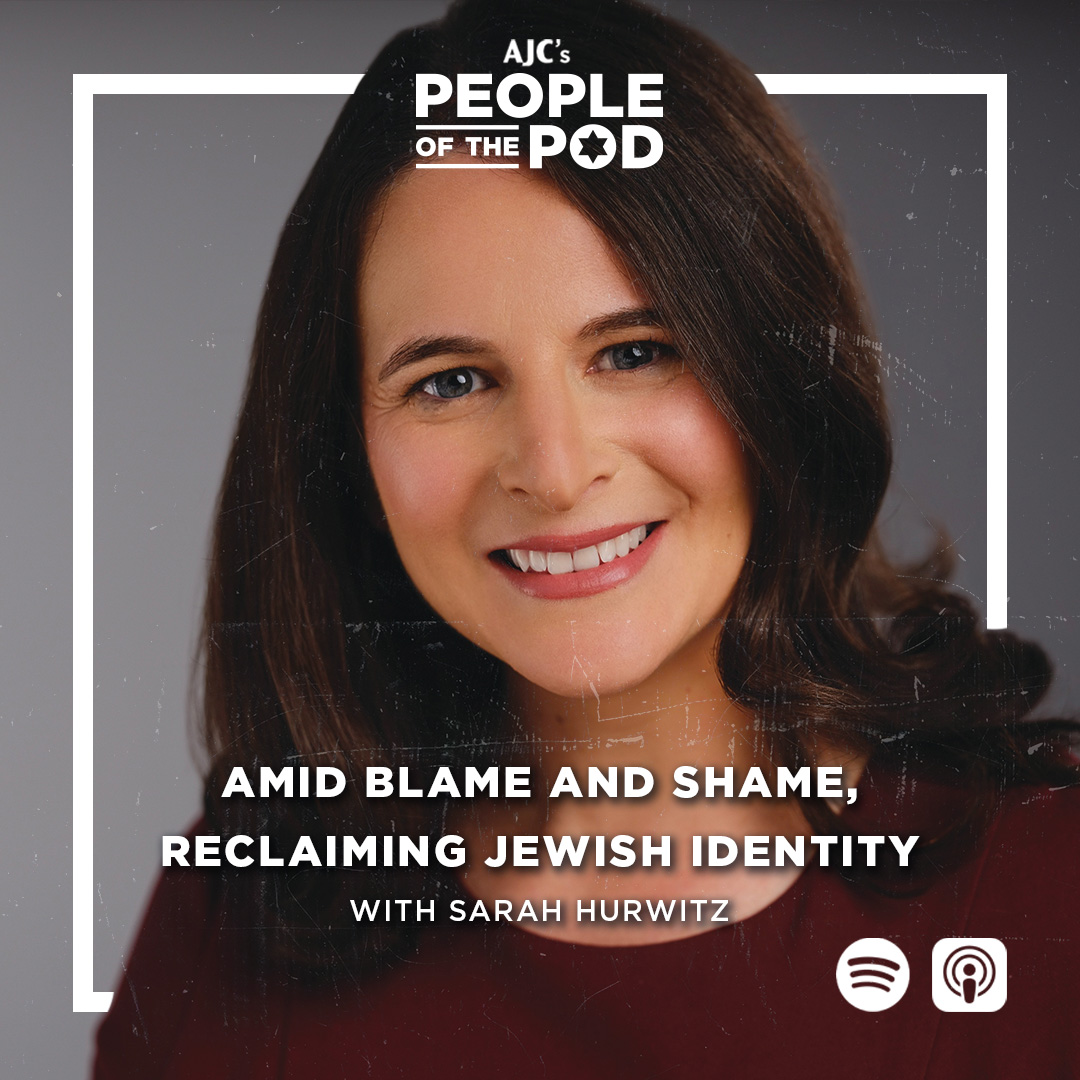
Amid Blame and Shame, Reclaiming Jewish Identity with Sarah Hurwitz
"To me, that ark is: engaging deeply with our traditions. It's reclaiming some of what we lost when we were assimilating and trying to fit in. We have thousands of years of text that have such wisdom about the human condition, about how to be a good person, and lead a worthy life . . . What we can really do is, we can be Jews. And to be a Jew has always been to be different." Sarah Hurwitz—former White House speechwriter and New York Times bestselling author of Here All Along—returns to People of the Pod to discuss her new book, As a Jew: Reclaiming Our Story from Those Who Blame, Shame, and Try to Erase Us. Hurwitz reflects on why antisemitism remains, in her words, "the least mysterious phenomenon," and how Jews can reclaim pride, wisdom, and purpose through Jewish text, practice, and community. Drawing from her work as a hospital chaplain and her conversations with Jewish students on campus, she makes a powerful case for reconnecting with the depth and resilience of Jewish tradition. Key Resources: AJC's Translate Hate Glossary AJC's Efforts to Support the Hostages Listen – AJC Podcasts: Architects of Peace The Forgotten Exodus People of the Pod Follow People of the Pod on your favorite podcast app, and learn more at AJC.org/PeopleofthePod You can reach us at: [email protected] If you've appreciated this episode, please be sure to tell your friends, and rate and review us on Apple Podcasts or Spotify. Transcript of the Interview: Manya Brachear Pashman: During the Obama administration, Sarah Hurwitz served as senior speech writer for President Barack Obama and chief speech writer for First Lady Michelle Obama. But after she left the White House, she did a little bit of soul searching, and in her mid 30s, reconnected with her Judaism. She wrote about it in a book titled Here All Along, and joined us at the time to talk about it. Sarah has returned with us this week to talk about the book that followed, titled As a Jew: Reclaiming Our Story from Those Who Blame, Shame, and Try to Erase Us. Sarah, welcome back to People of the Pod. Sarah Hurwitz: Thank you so much. I'm thrilled to be here. Manya Brachear Pashman: So your title has a very powerful accusation. So tell us who is blaming, shaming and trying to erase us? Sarah Hurwitz: Yeah. So, you know, it's funny. My first book, as you know, was this love letter toJudaism. This, this journey of discovery of Jewish tradition, and I loved it so much, and I wanted to share it. You know, as I was writing it, I was thinking, Oh, where has this been all my life. Kind of a lovely, almost rhetorical question. But after it came out, a few things kind of happened that made me actually ask that question more seriously. Like, Wait, why did I not see any of the 4000 years of Jewish wisdom growing up? The first thing was, I trained to be a volunteer hospital chaplain, and you know, chaplaincy is multifaith, open to chaplains of all backgrounds. But you know, the training was kind of weirdly Christian. You know, we would talk about our ministry and our theology. And I was told that prayer is God, please heal so and so who's right here in front of me, and I'm just making this prayer up spontaneously, and they can hear me, and that's prayer. And everyone prays that way, I was told. I said, You know that that's not really a common form of Jewish prayer. But I was told, No, no, as long as you don't say Jesus, it is universal. That's interesting. And then something else that happened is I visited a college campus probably a year before October 7, and I was talking to students there at the Hillel, talking to a bunch of Jewish students. And one of them asked me, What did you do to respond to antisemitism when you were in college? And I was so stunned, I didn't even understand the question at first. And then I said, I didn't, not once, never. Not a single time did I deal with antisemitism. And the kids just looked kind of shocked, like they didn't believe me. And they started sharing stories of the antisemitism they were facing on campus. And I thought, uh oh, something's going on here. And then I really began kind of taking a deep dive into my identity. Of like, wait, so why did I spend my whole life being like, oh, I'm just a cultural Jew. I knew nothing about Jewish culture. Which is a beautiful way to be Jewish, being a cultural Jew, but I knew nothing about history, language, anything like that. When I said I'm an ethnic Jew, but Jews are of every ethnicity, so that's nonsense. Or I'd say social justice is my Judaism, but I didn't know anything about what Judaism said about social justice. Unlike these wonderful Jews who do know about social justice and spend their lives acting out Jewish social justice. And so I took a deep dive into history, and what I discovered was 2000 years of antisemitism and anti-Judaism and 200 years of Jews in Western Europe in a very understandable attempt to escape that persecution, kind of erasing many of our traditions. And I think that was
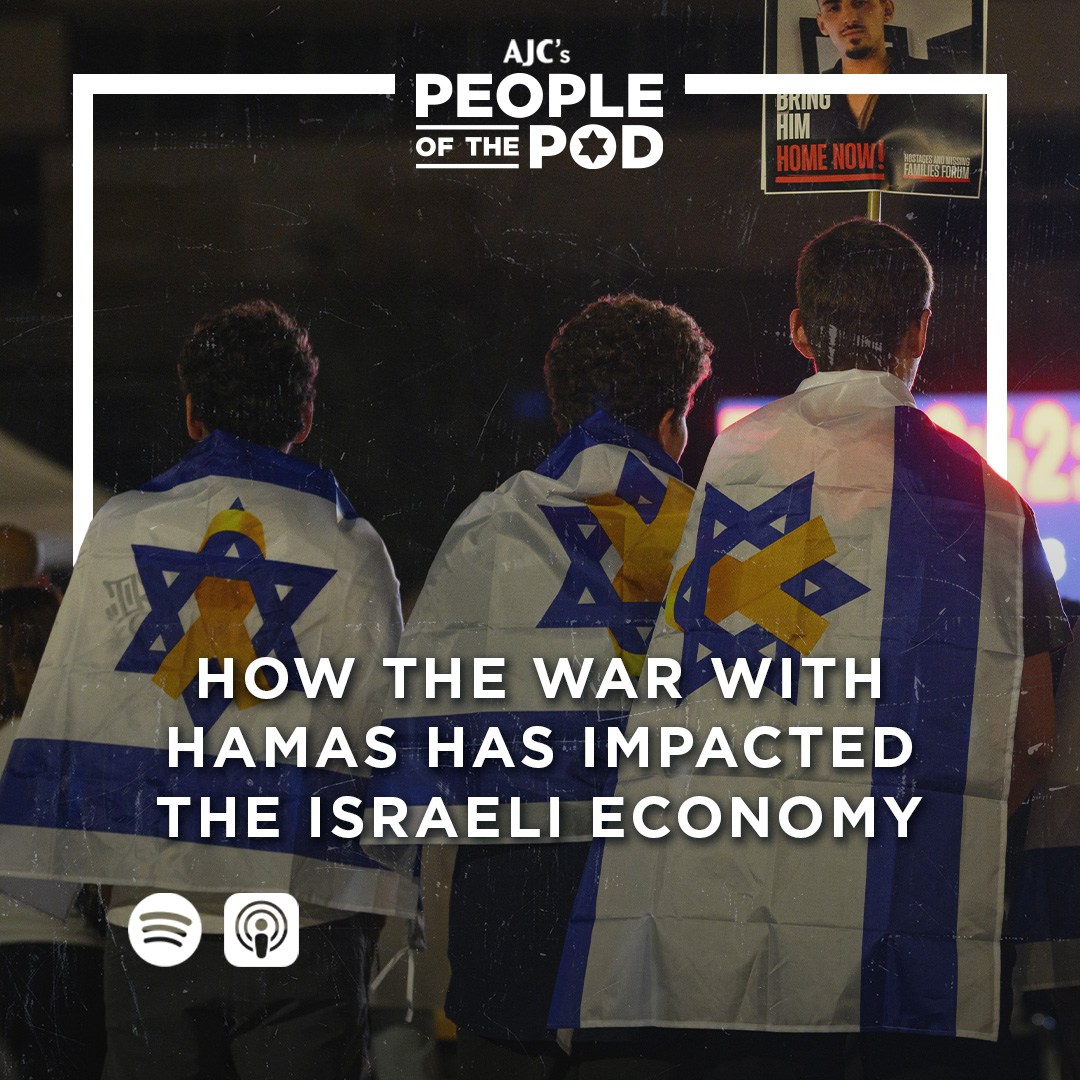
How the War with Hamas Has Impacted the Israeli Economy
How did the Israeli economy react to the war against Hamas? Hear from a major player on the ground – Dr. Eugene Kandel, former economic adviser and Chairman of the Tel Aviv Stock Exchange, discusses Israel's financial resilience after the war against Hamas. Having made aliyah from the Soviet Union in 1977 with his family, Dr. Kandel covers the stock market rebound, missed economic opportunities with Jordan and Egypt, and the success of the Abraham Accords. *The views and opinions expressed by guests do not necessarily reflect the views or position of AJC. Take Action: Elected Leaders: Demand Hamas Release the Hostages Key Resources: AJC's Efforts to Support the Hostages Listen – AJC Podcasts: Architects of Peace The Forgotten Exodus People of the Pod Follow People of the Pod on your favorite podcast app, and learn more at AJC.org/PeopleofthePod You can reach us at: [email protected] If you've appreciated this episode, please be sure to tell your friends, and rate and review us on Apple Podcasts or Spotify. Transcript of the Interview: Manya Brachear Pashman: Professor Eugene Kandel served as economic adviser to the Prime Minister of Israel from 2009 to 2015, and with Ron Sor is a co-founder of Israel's Strategic Futures Institute. He is also chairman of the Tel Aviv stock exchange, the only public stock exchange in Israel, known locally as the Bursa. He is with us now to talk about the impact of Israel's war against Hamas in Gaza on Israel's economy, the potential and impact so far of the Abraham Accords, and how history could one day view October 7 as a turning point for Israel's democracy. Dr. Kandel, welcome to People of the Pod. Eugene Kandel: Thank you. Thank you for having me. Manya Brachear Pashman: Before we begin, your family came to Israel in 1977. Can you share your family's Aliyah story? Eugene Kandel: Yeah, when I was 14, my family was living very comfortably in the Soviet Union. My father was a quite known writer, playwright, a script writer. And around him was a group of Jewish people of culture that were quite known in their domains, mostly Jewish. And so at some point in 67 he sort of had this vision and started studying Hebrew. But 1970 and then by '73 when I was 14 years old, he came to me and said, Look, your mom and I decided to immigrate to Israel. What do you think about it, and I said, I don't know what I think about it. Okay, you know, if we want to immigrate, let's immigrate. I never felt too much belonging there. So unfortunately, Soviet authorities had other ideas about that. So we spent four years as refuseniks. My father, together with Benjamin Fine, were the editors of the underground publication called Tarbut. And for people who did not live there, they put their names on it. So this was, these were typewritten copies of Jewish culture monthly. And there were two names on it. You could go to jail for this. My father was always pretty brave man for his petite size, because during the Second World War, he was very, very hungry, to say the least. So he didn't really grow very much. But he's very big inside. And so the following four years were pretty tough on them, because he couldn't work anywhere. Just like in McCarty years in this country, people would give work to their friends and then publish it under their own name. That's what he did for his friends, and they would share the money with him, or give him most of the money. There were very, very brave people. And then, you know, there was an incident where they wanted to send a message to my father to be a little less publicly outspoken. And so two KGB agents beat me up. And that started a whole interesting set of events, because there was an organization in Chicago called Chicago Action for Soviet Jewry. Pamela Cohen. And I actually met Pamela when I was studying at the University of Chicago. And thanked her. So they took upon themselves to harass Soviet cinema and theater and culture officials. And so they were so successful that at some point, the writers league from Hollywood said that nobody will go to Moscow Film Festival unless they release us because they do not want to associate with people who beat up children. I wasn't a child, I was 17 years old, but still. And that sort of helped. At least, that's how we think about it. So it's worthwhile being beaten up once in a while, because if it lets you out, I would take it another time. And then we came to Israel in a very interesting time. We came to Israel four hours after Anwar Sadat left. So we came to a different Israel. On the brink of a peace agreement with Egypt. And so that was it. We came to Mevaseret Zion, which was an absorption center. A small absorption center. Today I actually live probably 500 yards from where we stayed. Sort of full circle. And today, it's a significant, it's about 25,000 people town. And that's the story, you know, in the middle, in between then and now, I served in the military, did two degrees at Hebrew University, did two degre
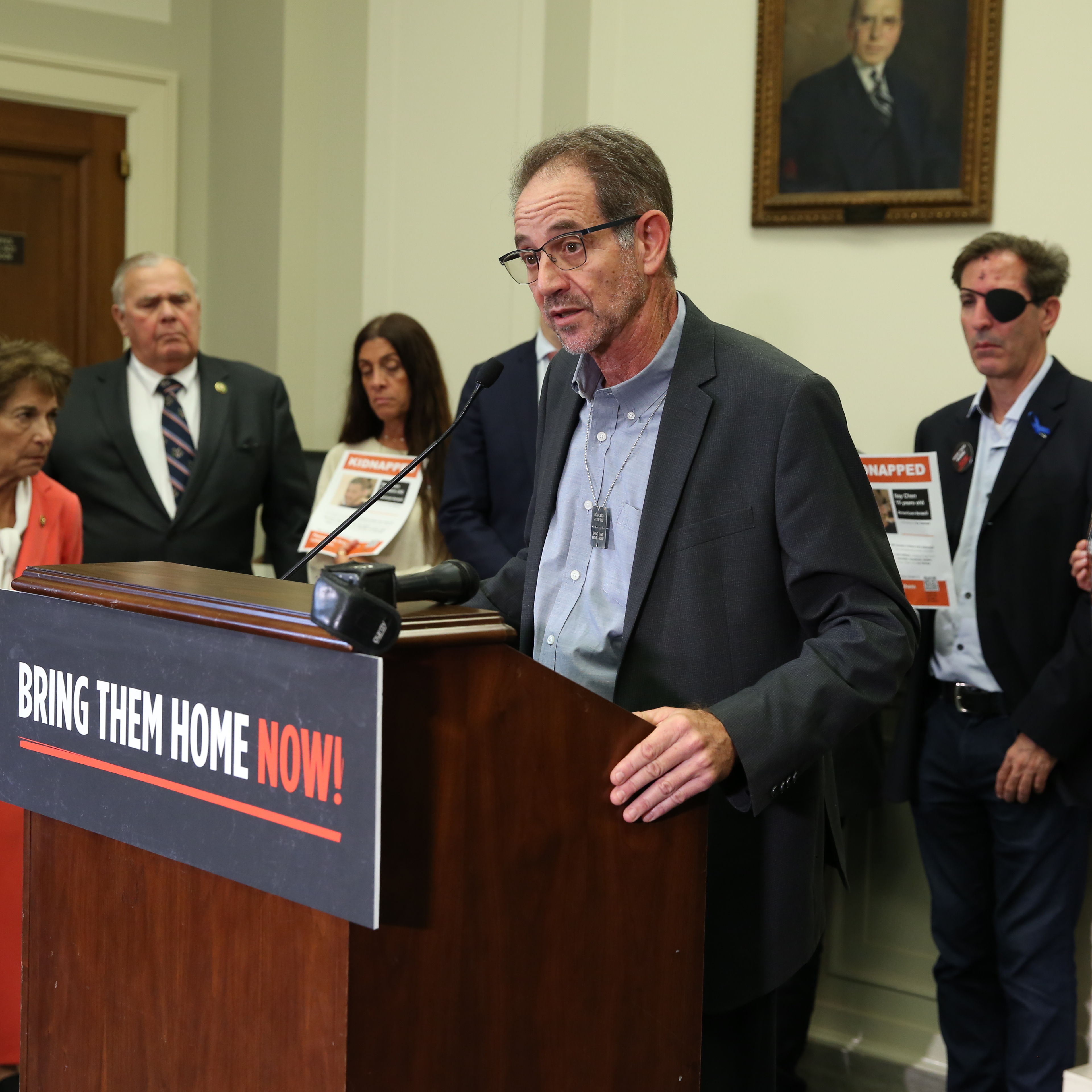
Inside the Advocacy Effort to Bring the Hostages Home
"Since before he was President, he [Trump] has made it clear that this is a priority, and he has instructed his team to work on this issue day in and day out . . . " More than two years after the October 7 massacre, Hamas has agreed to return the 48 hostages still in Gaza under the U.S.-brokered peace deal. Jessica Bernton, AJC's Director of Congressional Affairs, shares details of AJC's joint advocacy with the hostage families of returned hostages—how personal stories, bipartisan meetings with Congress and the White House, and coordinated delegations kept the issue at the forefront. She reflects on the emotional weight of this work, its impact on the U.S. administration, and the ongoing need to press policymakers to ensure that all hostages are safely returned. *The views and opinions expressed by guests do not necessarily reflect the views or position of AJC. Take Action: Elected Leaders: Demand Hamas Release the Hostages Key Resources: AJC's Efforts to Support the Hostages Listen – AJC Podcasts: Architects of Peace The Forgotten Exodus People of the Pod Follow People of the Pod on your favorite podcast app, and learn more at AJC.org/PeopleofthePod You can reach us at: [email protected] If you've appreciated this episode, please be sure to tell your friends, and rate and review us on Apple Podcasts or Spotify. Transcript of the Interview: Manya Brachear Pashman: More than two years after the October 7 massacre, the Hamas terror group has reportedly agreed at long last, to return the 48 hostages that remain in Gaza. With us now is Jessica Bernton, AJC's director of Congressional Affairs, who has been working with the families of hostages since day one to bring them all home. Jessica, welcome to People of the Pod. Jessica Bernton: Thanks so much, Manya, it's a pleasure to be here. Manya Brachear Pashman: So you must be so relieved. I know you've been so immersed in all of this. When can we celebrate though? Is now too soon? Jessica Bernton: Oh, what a great question. I would say, I have this cautious optimism at the moment. There have been many ups and downs. There have been starts and stops throughout these long months and now two years, but this one does feel different. I would say, you know, this is the most progress we've seen since the spring, and we have to continue to have hope. We also cannot afford to let up the pressure until every single hostage is returned home. And so I would say we cannot exhale until everyone is returned. And once everybody is walking across the border, or the deceased are returned home for burial, that is when we can truly celebrate. Once every single person is returned. Manya Brachear Pashman: You said it feels different? How? How does it feel different? Jessica Bernton: You know, there's been a lot of pressure exerted in recent weeks. I'd say the US administration has stepped up their efforts as well, working with other countries, including partners across the world here. And a deal was signed. And so I think a lot can happen, though, between this announcement and actually, again, when hostages are returned, or when the first phase begins, and both sides need to continue to adhere to each side of the agreement. But this really is the most progress that there has been in some time. Manya Brachear Pashman: As I said in the introduction, you've been working since day one, bringing delegations to Washington to meet with members of Congress, meet with White House staff, including both President Biden and President Trump. What has happened most recently that might have made a difference here? Jessica Bernton: I think the most important thing here is that the families as well as the returned hostages, because we've been so far down in this process that we were advocating for the release of certain hostages, and now those individuals have come to DC and have been traveling across the world to make sure that their voice is heard. And they're speaking up for those that they were held in captivity with, who don't have a voice at the moment. And so it's been really incredible and emotional to have advocated, let's say, for somebody like the return of Keith Siegel or Doron Steinbrecher. And now we have joined them in going to the Hill, into these meetings, advocating for the return of every single hostage, and that's been really incredible. But I think the most important thing here is that these conversations have continued. And keeping this issue at the forefront of everybody's minds. The American public, government officials, foreign officials, community leaders, ensuring that the hostages have not been forgotten has been our top priority here, and ensuring that this remains a foreign policy priority for the US government in particular. And clearly it has paid off, because these hostages have been able to continue to tell their story, and we are where we are today, and hopefully this progress will continue. But it's been really incredible to see this, especially in the past coup
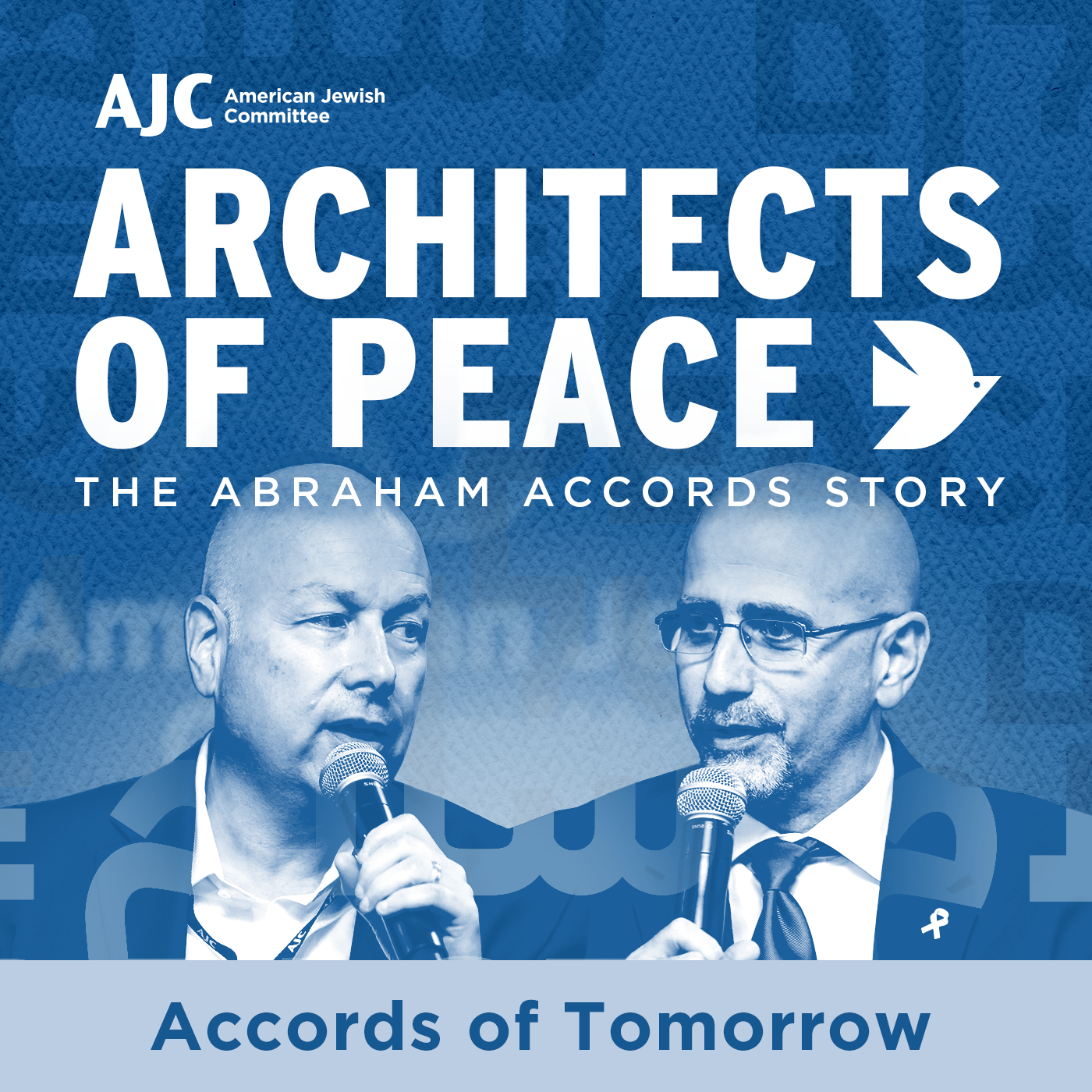
Architects of Peace: Episode 5 - Accords of Tomorrow
On the sidelines of the UN General Assembly, AJC hosted a conversation with Jason Greenblatt, a key architect of the Abraham Accords, and former U.S. Ambassador to Israel Dan Shapiro. They discussed the challenges threatening regional stability, from unilateral moves on Palestinian statehood to political pressures within Israel, and underscored what's at stake—and what it will take—to expand the Abraham Accords and advance peace. *The views and opinions expressed by guests do not necessarily reflect the views or position of AJC. Episode lineup: Dan Shapiro (1:00) Jason Greenblatt (18:05) Full transcript: https://www.ajc.org/news/podcast/accords-of-tomorrow-architects-of-peace-episode-5 Resources: AJC.org/ArchitectsofPeace - Tune in weekly for new episodes. AJC.org/AbrahamAccords - The Abraham Accords, Explained AJC.org/CNME - Find more on AJC's Center for a New Middle East Listen – AJC Podcasts: AJC.org/ForgottenExodus AJC.org/PeopleofthePod Follow Architects of Peace on your favorite podcast app, and learn more at AJC.org/ArchitectsofPeace You can reach us at: [email protected] If you've appreciated this episode, please be sure to tell your friends, and rate and review us on Apple Podcasts or Spotify. Transcript: Manya Brachear Pashman: In September 2020, the world saw what had been years – decades – in the making: landmark peace agreements dubbed the Abraham Accords – normalizing relations between Israel and two Arabian Gulf states, the United Arab Emirates and the Kingdom of Bahrain. Later, in December, they were joined by the Kingdom of Morocco. Five years later, AJC is pulling back the curtain to meet key individuals who built the trust that led to these breakthroughs and turning the spotlight on some of the results. Introducing the Architects of Peace. On the sidelines of the United Nations General Assembly in September, American Jewish Committee hosted conversations with former Middle East envoy Jason Greenblatt, a key architect of the Abraham Accords, and former U.S. Ambassador to Israel Dan Shapiro:. Both diplomats discussed the dangers threatening peace in the region, including some countries' unilateral calls for Palestinian statehood. They shared what's at stake and what it will take to expand the Abraham Accords and make progress toward peace in the region. We're including those conversations as part of our series. AJC's Chief Strategy and Communications Officer Belle Yoeli starts us off with Ambassador Shapiro. Belle Yoeli: Ambassador Shapiro, thank you so much for being with us. We're going to speak primarily about unilateral recognition of Palestinian statehood, but I, of course, want to ask you a couple of questions, because you have so much to share with us before we dive in. First and foremost, as we've said, It's been almost two years, and at AJC, we're all about optimism and playing the long game, as you know, but it does feel like the challenges for the Jewish community and the state of Israel continue to build. And of course, the war looms very large. What is your analysis of the geopolitical horizon for the war in Gaza. Dan Shapiro: First, thanks for having me. Thank you to American Jewish Committee and to Ted and everybody for all you do. Thank you, Ruby [Chen], and the families, for the fellowship that we can share with you in this goal. I'll just say it very simply, this war needs to end. The hostages need to come home. Hamas needs to be removed from power. And aid needs to surge into Gaza and move forward with a reconstruction of Gaza for Palestinians who prepare to live in peace with Israel. This is something that is overdue and needs to happen. I think there have been a number of missed opportunities along the way. I don't say this in a partisan way. I think President Trump has missed opportunities at the end of the first ceasefire, when the first ceasefire was allowed to expire after the Iran strike, something I strongly supported and felt was exactly the right thing to do. There was an opening to create a narrative to end the war. I think there have been other missed opportunities. And I don't say in a partisan way, because the administration I served in, the Biden administration, we made mistakes and we missed opportunities. So it can be shared. that responsibility. But what I do think is that there is a new opportunity right now, and we saw it in President Trump's meeting with Arab leaders. It's going to take very significant, deft, and sustained diplomatic effort. He's got a good team, and they need to do the follow through now to hold the Arabs to their commitments on ensuring Hamas is removed from power, on ensuring that there's a security arrangement in Gaza that does not leave Israel vulnerable to any possibility of a renewal of hostilities against it. And of course, to get the hostages released. That's pressure on the Arabs. And of course, he's got a meeting coming up with Prime Minister Netanyahu, and I do think he's going to need to lean on Prime Minister Netanyahu t
S1 Ep 4Architects of Peace: Episode 4 - Partners of Peace
Tune into the fourth installment of AJC's latest limited podcast series, Architects of Peace. Go behind the scenes of the decades-long diplomacy and quiet negotiations that made the Abraham Accords possible, bringing Israel, the United Arab Emirates, Bahrain, and later Morocco, together in historic peace agreements. From cockpits to kitchens to concert halls, the Abraham Accords are inspiring unexpected partnerships. In the fourth episode of AJC's limited series, four "partners of peace" share how these historic agreements are reshaping their lives and work. Hear from El Mehdi Boudra of the Mimouna Association on building people-to-people ties; producer Gili Masami on creating a groundbreaking Israeli–Emirati song; pilot Karim Taissir on flying between Casablanca and Tel Aviv while leading Symphionette, a Moroccan orchestra celebrating Andalusian music; and chef Gal Ben Moshe, the first Israeli chef to ever cook in Dubai on his dream of opening a restaurant in the UAE. *The views and opinions expressed by guests do not necessarily reflect the views or position of AJC. Episode lineup: El Mehdi Boudra (4:00) Gili Masami (11:10) Karim Taissir (16:14) Gal Ben Moshe (21:59) Read the transcript: https://www.ajc.org/news/podcast/partners-of-peace-architects-of-peace-episode-4 Resources: AJC.org/ArchitectsofPeace - Tune in weekly for new episodes. The Abraham Accords, Explained AJC.org/CNME - Find more on AJC's Center for a New Middle East Listen – AJC Podcasts: The Forgotten Exodus People of the Pod Follow Architects of Peace on your favorite podcast app, and learn more at AJC.org/ArchitectsofPeace You can reach us at: [email protected] If you've appreciated this episode, please be sure to tell your friends, and rate and review us on Apple Podcasts or Spotify. Transcript: El Mehdi Boudra: All the stereotypes started like getting out and people want to meet with the other. They wanted to discover the beauty of the diversity of Israel. And this is unique in the region, where you have Arabs Muslims, Arab Christians, Druze, Beta Yisrael, Ashkenazi, Sephardic Jews, Jews from India, from all over the world. This beauty of diversity in Israel is very unique for our region. Manya Brachear Pashman: In September 2020, the world saw what had been years – decades – in the making: landmark peace agreements dubbed the Abraham Accords – normalizing relations between Israel and two Arabian Gulf states, the United Arab Emirates and the Kingdom of Bahrain. Later, in December, they were joined by the Kingdom of Morocco. Five years later, AJC is pulling back the curtain to meet key individuals who built the trust that led to these breakthroughs and turning the spotlight on some of the results. Introducing: the Architects of Peace. ILTV correspondent: Well, hello, shalom, salaam. For the first time since the historic normalization deal between Israel and the UAE, an Israeli and an Emirati have teamed up to make music. [Ahlan Bik plays] The signs have been everywhere. On stages in Jerusalem and in recording studios in Abu Dhabi. [Camera sounds]. On a catwalk in Tel Aviv during Fashion Week and on the covers of Israeli and Arab magazines. [Kitchen sounds]. In the kitchens of gourmet restaurants where Israeli and Emirati chefs exchanged recipes. Just days after the announcement of the Abraham Accords, Emirati ruler Sheikh Khalifa bin Zayed Al Nahyan formally ended the UAE's nearly 50-year boycott of Israel. Though commerce and cooperation had taken place between the countries under the radar for years, the boycott's official end transformed the fields of water, renewable energy, health, cybersecurity, and tourism. In 2023, Israel and the UAE signed a Comprehensive Economic Partnership Agreement (CEPA) to advance economic cooperation, and by 2024, commerce between the UAE and Israel grew to $3.2 billion. Trade between Bahrain and Israel surged 740% in one year. As one of the world's most water-stressed countries, Bahrain's Electrical and Water Authority signed an agreement to acquire water desalination technology from Israel's national water company [Mekorot]. Signs of collaboration between Israeli and Arab artists also began to emerge. It was as if a creative energy had been unlocked and a longing to collaborate finally had the freedom to fly. [Airplane take off sounds]. And by the way, people had the freedom to fly too, as commercial airlines sent jets back and forth between Tel Aviv, Casablanca, Abu Dhabi, and Manama. A gigantic step forward for countries that once did not allow long distance calls to Israel, let alone vacations to the Jewish state. At long last, Israelis, Moroccans, Emiratis, and Bahrainis could finally satisfy their curiosity about one another. This episode features excerpts from four conversations. Not with diplomats or high-level senior officials, but ordinary citizens from the region who have seized opportunities made possible by the Abraham Accords to pursue unprecedented partnerships. For El Medhi Boudra, the Abr
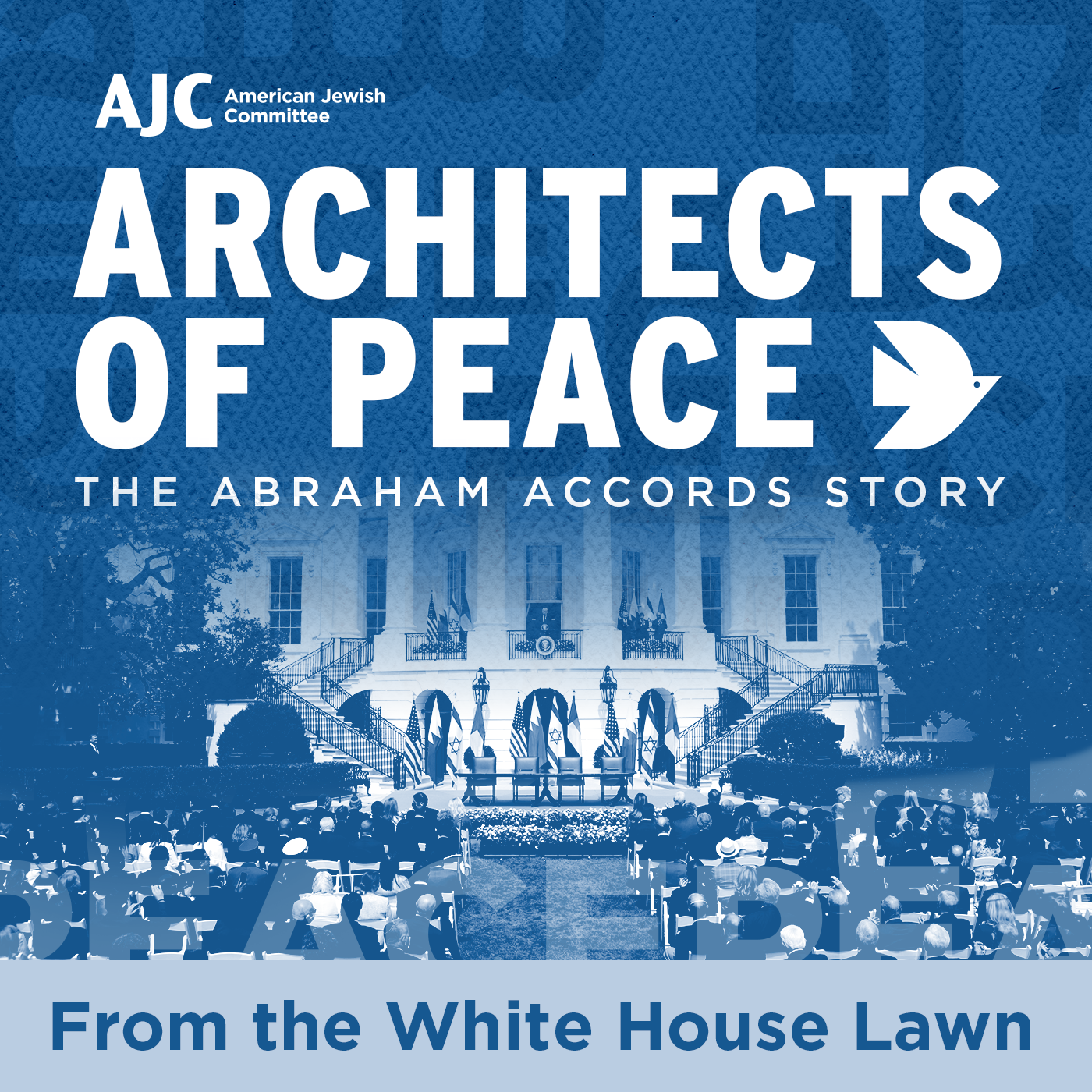
S1 Ep 3Architects of Peace: Episode 3 - From the White House Lawn
Dive into the third episode of AJC's latest limited podcast series, Architects of Peace. Go behind the scenes of the decades-long diplomacy and quiet negotiations that made the Abraham Accords possible, bringing Israel, the United Arab Emirates, Bahrain, and later Morocco, together in historic peace agreements. On September 15, 2020, the Abraham Accords were signed at the White House by President Trump, Prime Minister Netanyahu, and the foreign ministers of the UAE and Bahrain. In this third installment of AJC's limited series, AJC CEO Ted Deutch and Chief Policy and Political Affairs Officer Jason Isaacson—who stood on the South Lawn that day—share their memories and insights five years later. Together, they reflect on how the Accords proved that peace is achievable when nations share strategic interests, build genuine relationships, and pursue the greater good. *The views and opinions expressed by guests do not necessarily reflect the views or position of AJC. Read the transcript: https://www.ajc.org/news/podcast/from-the-white-house-lawn-architects-of-peace-episode-3 Resources: AJC.org/ArchitectsofPeace - Tune in weekly for new episodes. The Abraham Accords, Explained AJC.org/CNME - Find more on AJC's Center for a New Middle East Listen – AJC Podcasts: The Forgotten Exodus People of the Pod Follow Architects of Peace on your favorite podcast app, and learn more at AJC.org/ArchitectsofPeace You can reach us at: [email protected] If you've appreciated this episode, please be sure to tell your friends, and rate and review us on Apple Podcasts or Spotify. Transcript: Ted Deutch: It was a beautiful day and there was this coming together, this recognition that this was such an historic moment. It's the kind of thing, frankly, that I remember having watched previously, when there were peace agreements signed and thinking that's something that I want to be a part of. And there I was looking around right in the middle of all of this, and so excited about where this could lead. Manya Brachear Pashman: In September 2020, the world saw what had been years, decades in the making, landmark peace agreements dubbed the Abraham Accords, normalizing relations between Israel and two Arabian Gulf States, the United Arab Emirates and the Kingdom of Bahrain. Later, in December, they were joined by the Kingdom of Morocco. Five years later, AJC is pulling back the curtain to meet key individuals who built the trust that led to these breakthroughs. Introducing: the Architects of Peace. Announcer: Ladies and gentlemen, the President of the United States. Accompanied by the Prime Minister of the State of Israel; His Highness the Minister of Foreign Affairs and International cooperation of the United Arab Emirates, and the Minister of the Foreign Affairs of the Kingdom of Bahrain. Manya Brachear Pashman: The guests of honor framed by the South Portico of the White House were an unlikely threesome. Two Arab foreign ministers and the Prime Minister of Israel, there to sign a pair of peace agreements that would transform the Middle East. Donald Trump: Thanks to the great courage of the leaders of these three countries, we take a major stride toward a future in which people of all faiths and backgrounds live together in peace and prosperity. There will be other countries very, very soon that will follow these great leaders. Manya Brachear Pashman: President Trump's team had achieved what was long thought impossible. After decades of pretending Israel did not exist until it solved its conflict with the Palestinians, Trump's team discovered that attitudes across the Arab region had shifted and after months of tense negotiations, an agreement had been brokered by a small circle of Washington insiders. On August 13, 2020, the United Arab Emirates agreed to become the first Arab state in a quarter century to normalize relations with Israel. Not since 1994 had Israel established diplomatic relations with an Arab country, when King Hussein of Jordan and Israeli Prime Minister Yitzhak Rabin signed a treaty, ending the state of war that had existed between them since Israel's rebirth. A ceremony to celebrate and sign the historic deal was planned for the South Lawn of the White House on September 15, 2020. Before the signing ceremony took place, another nation agreed to sign as well: not too surprisingly the Kingdom of Bahrain. After all, in June 2019, Bahrain had hosted the Peace to Prosperity summit, a two-day workshop where the Trump administration unveiled the economic portion of its peace plan – a 38-page prospectus that proposed ways for Palestinians and Arab countries to expand economic opportunities in cooperation with Israel. In addition to Bahrain, Egypt, Jordan, Morocco, Qatar, Saudi Arabia, and the UAE all participated in the summit. The Palestinians boycotted it, even as Trump's senior advisor Jared Kushner presented plans to help them. Jared Kushner: A lot of these investments people are unwilling to make because people don't want
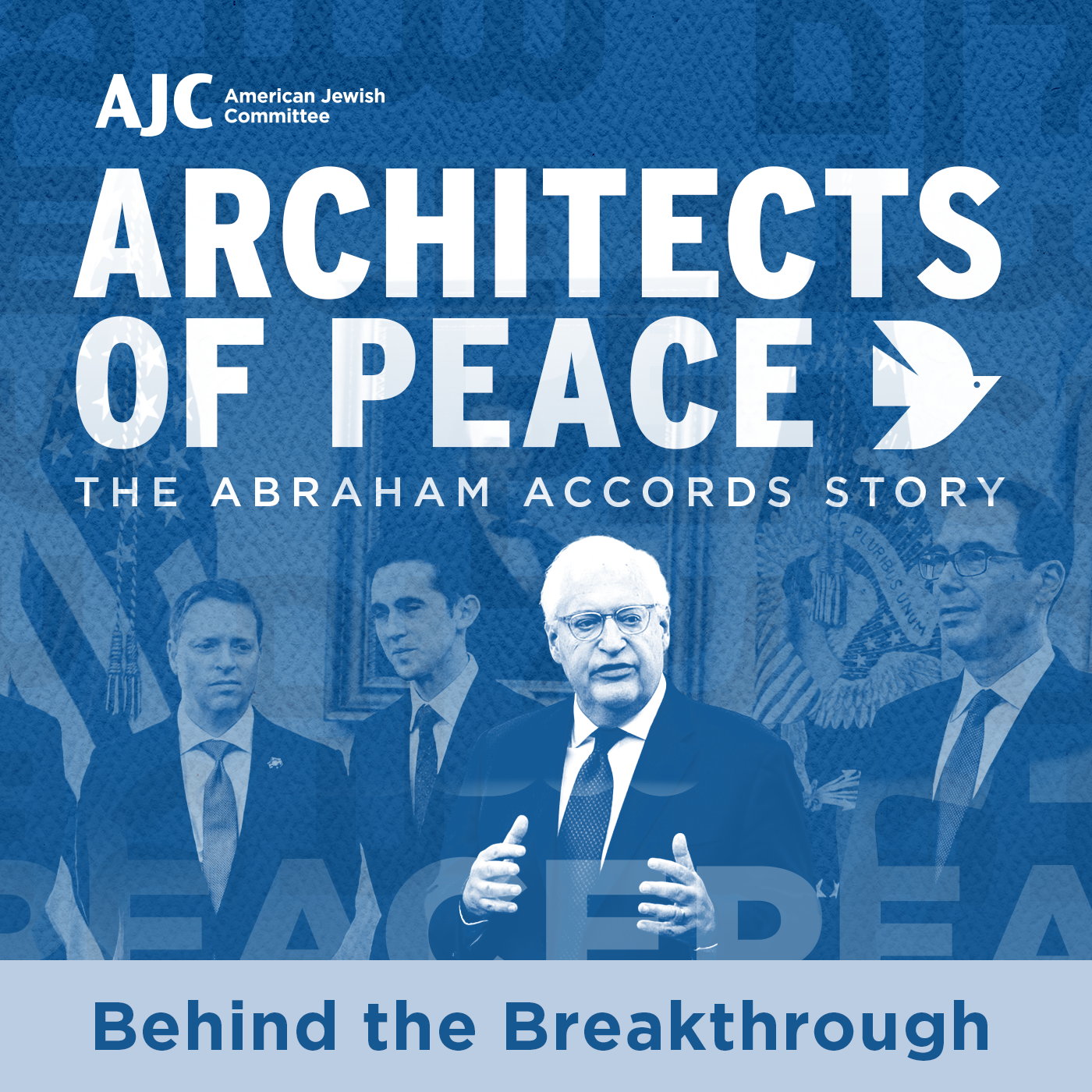
S1 Ep 2Architects of Peace: Episode 2 - Behind the Breakthrough
Tune into the second episode of AJC's newest limited podcast series, Architects of Peace. Go behind the scenes of the decades-long diplomacy and quiet negotiations that made the Abraham Accords possible, bringing Israel, the United Arab Emirates, Bahrain, and later Morocco, together in historic peace agreements. Former U.S. Ambassador to Israel David Friedman, U.S. Army General Miguel Correa, and AJC Chief Policy and Political Affairs Officer Jason Isaacson unpack the first Trump administration's Middle East strategy, share behind-the-scenes efforts to engage key regional players, and reveal what unfolded inside the White House in the crucial weeks before the Abraham Accords signing. Full transcript: https://www.ajc.org/news/podcast/behind-the-breakthrough-architects-of-peace-episode-2 Resources: AJC.org/ArchitectsofPeace - Tune in weekly for new episodes. AJC.org/AbrahamAccords - The Abraham Accords, Explained AJC.org/CNME - Find more on AJC's Center for a New Middle East Listen – AJC Podcasts: AJC.org/ForgottenExodus AJC.org/PeopleofthePod Follow Architects of Peace on your favorite podcast app, and learn more at AJC.org/ArchitectsofPeace You can reach us at: [email protected] If you've appreciated this episode, please be sure to tell your friends, and rate and review us on Apple Podcasts or Spotify. Transcript: Donald Trump: I think we're going to make a deal. It might be a bigger and better deal than people in this room even understand. Manya Brachear Pashman: In September 2020, the world saw what had been years – decades – in the making: landmark peace agreements dubbed the Abraham Accords -- normalizing relations between Israel and two Arabian Gulf states, the United Arab Emirates and the Kingdom of Bahrain. Later, in December, they were joined by the Kingdom of Morocco. Five years later, AJC is pulling back the curtain to meet key individuals who built the trust that led to these breakthroughs. Introducing: the Architects of Peace. Shortly after he was elected in 2016 and before he took office, President Donald Trump nominated his company's former bankruptcy attorney David Friedman to serve as U.S. Ambassador to Israel. He gave Friedman two simple tasks. Task No. 1? Build peace across the Middle East by normalizing relations between Israel and its Arab neighbors. Task No. 2? Solve the Israeli Palestinian conflict that a half dozen previous White House residents had failed to fix. After all, according to conventional wisdom, the first task could not happen before the second. The future of cooperation between Israel and 20-plus other Arab countries hinged on peace between the Israelis and Palestinians. Here's former Secretary of State John Kerry. John Kerry: There will be no advance and separate peace with the Arab world without the Palestinian process and Palestinian peace. Everybody needs to understand that. Manya Brachear Pashman: Ambassador Friedman disagreed with this conventional wisdom. David Friedman: We were told initially by most countries that the road to peace began with the Palestinians. This was a hypothesis that I rejected internally, but I thought: 'OK, well, let's just play this out and see where this can go. And so, we spent a couple of years really working on what could be a plan that would work for Israel and the Palestinians. The Palestinians, you know, rejected discussions early on, but we had a lot of discussions with the Israelis. Manya Brachear Pashman: The son of a rabbi who grew up in Long Island, Ambassador Friedman had been active in pro-Israel organizations for decades, He had advised Trump on the importance of the U.S.-Israel bond during the 2016 presidential election and recommended nothing less than a radical overhaul of White House policy in the region. Not long after his Senate confirmation as ambassador, that overhaul commenced. In February 2017, President Trump invited Israeli Prime Minister Benjamin Netanyahu to the White House – his first invitation to a foreign leader — and a symbolic one. After their meeting, they held a joint press conference. Donald Trump: With this visit, the United States again reaffirms our unbreakable bond with our cherished ally Israel. The partnership between our two countries, built on our shared values. I think we're going to make a deal. It might be a bigger and better deal than people in this room even understand. That's a possibility. So, let's see what we do. He doesn't sound too optimistic. But he's a good negotiator. Benjamin Netanyahu: That's the art of the deal. Manya Brachear Pashman: Nine months later, President Trump made another symbolic gesture -- recognizing Jerusalem as Israel's capital city and moving the American embassy from Tel Aviv to Jerusalem. Though such a move had been approved by Congress in 1995, no president had ever acted upon it. When Trump's son-in-law, businessman, and senior White House advisor Jared Kushner opened conversations about that 'bigger and better deal,' Palestinians refused to participate, usi
S1 Ep 1Architects of Peace: Episode 1 - The Road to the Deal
Listen to the first episode of AJC's new limited podcast series, Architects of Peace. Go behind the scenes of the decades-long diplomacy and quiet negotiations that made the Abraham Accords possible, bringing Israel, the United Arab Emirates, Bahrain, and later Morocco, together in historic peace agreements. Jason Isaacson, AJC Chief of Policy and Political Affairs, explains the complex Middle East landscape before the Accords and how behind-the-scenes efforts helped foster the dialogue that continues to shape the region today. Resources: Episode Transcript AJC.org/ArchitectsofPeace - Tune in weekly for new episodes. The Abraham Accords, Explained AJC.org/CNME - Find more on AJC's Center for a New Middle East Listen – AJC Podcasts: The Forgotten Exodus People of the Pod Follow Architects of Peace on your favorite podcast app, and learn more at AJC.org/ArchitectsofPeace You can reach us at: [email protected] If you've appreciated this episode, please be sure to tell your friends, and rate and review us on Apple Podcasts or Spotify. Transcript: Jason Isaacson: It has become clear to me in my travels in the region over the decades that more and more people across the Arab world understood the game, and they knew that this false narrative – that Jews are not legitimately there, and that somehow we have to focus all of our energy in the Arab world on combating this evil interloper – it's nonsense. And it's becoming increasingly clear that, in fact, Israel can be a partner. Manya Brachear Pashman: In September 2020, the world saw what had been years – decades – in the making: landmark peace agreements dubbed the Abraham Accords -- normalizing relations between Israel and two Arabian Gulf states, the United Arab Emirates and the Kingdom of Bahrain. Later in December, they were joined by the Kingdom of Morocco. Five years later, AJC is pulling back the curtain to meet key individuals who built the trust that led to these breakthroughs. Introducing: the Architects of Peace. Manya Brachear Pashman: On the eve of the signing of the Abraham Accords, AJC Chief Policy and Political Affairs Officer Jason Isaacson found himself traveling to the end of a tree filled winding road in McLean, Virginia, to sip tea on the back terrace with Bahraini Ambassador Shaikh Abdulla bin Rashid Al Khalifa and Bahrain's Minister of Foreign Affairs Dr. Abdullatif bin Rashid Al Zayani. Jason Isaacson: Sitting in the backyard of the Bahraini ambassador's house with Dr. Al Zayani, the Foreign Minister of Bahrain and with Shaikh Abdulla, the ambassador, and hearing what was about to happen the next day on the South Lawn of the White House was a thrilling moment. And really, in many ways, just a validation of the work that AJC has been doing for many years–before I came to the organization, and the time that I've spent with AJC since the early 90s. This possibility of Israel's true integration in the region, Israel's cooperation and peace with its neighbors, with all of its neighbors – this was clearly the threshold that we were standing on. Manya Brachear Pashman: If you're wondering how Jason ended up sipping tea in such esteemed company the night before his hosts made history, wonder no more. Here's the story. Yitzchak Shamir: The people of Israel look to this palace with great anticipation and expectation. We pray that this meeting will mark the beginning of a new chapter in the history of the Middle East; that it will signal the end of hostility, violence, terror, and war; that it will bring dialogue, accommodation, co-existence, and above all, peace. Manya Brachear Pashman: That was Israel's Prime Minister Yitzhak Shamir speaking in October 1991 at the historic Madrid Peace Conference -- the first time Israel and Arab delegations engaged in direct talks toward peace. It had taken 43 years to reach this point – 43 years since the historic United Nations Resolution that created separate Jewish and Arab states – a resolution Jewish leaders accepted, but Arab states scorned. Not even 24 hours after Israel declared its independence on May 14, 1948, the armies of Egypt, Iraq, Jordan, Lebanon, and Syria attacked the new Jewish state, which fought back mightily and expanded its territory. The result? A deep-seated distrust among Israel, its neighboring nations, and some of the Arab residents living within Israel's newly formed borders. Though many Palestinian Arabs stayed, comprising over 20 percent of Israel's population today, hundreds of thousands of others left or were displaced. Meanwhile, in reaction to the rebirth of the Jewish state, and over the following two decades, Jewish communities long established in Arab states faced hardship and attacks, forcing Jews by the hundreds of thousands to flee. Israel's War of Independence set off a series of wars with neighboring nations, terrorist attacks, and massacres. Peace in the region saw more than a few false starts, with one rare exception. In 1979, after the historic visit to Israel by Egyptian
3 Ways Jewish College Students are Building Strength Amid Hate
"Our duty as Jewish youth is paving the way for ourselves. Sometimes we may feel alone . . . But the most important thing is for us as youth to pave the way for ourselves, to take action, to speak out. Even if it's hard or difficult." As American Jewish college students head back to their campuses this fall, we talk to three leaders on AJC's Campus Global Board about how antisemitism before and after the October 7 Hamas terror attacks revealed their resilience and ignited the activist inside each of them. Jonathan Iadarola shares how a traumatic anti-Israel incident at University of Adelaide in Australia led him to secure a safe space on campus for Jewish students to convene. Ivan Stern recalls launching the Argentinian Union of Jewish Students after October 7, and Lauren Eckstein shares how instead of withdrawing from her California college and returning home to Arizona, she transferred to Washington University in St. Louis where she found opportunities she never dreamed existed and a supportive Jewish community miles from home. *The views and opinions expressed by guests do not necessarily reflect the views or position of AJC. Key Resources: AJC Campus Global Board Trusted Back to School Resources from AJC AJC's 10-Step Guide for Parents Supporting Jewish K-12 Students AJC's Center for Education Advocacy Listen – AJC Podcasts: The Forgotten Exodus: Untold stories of Jews who left or were driven from Arab nations and Iran People of the Pod: Latest Episodes: War and Poetry: Owen Lewis on Being a Jewish Poet in a Time of Crisis An Orange Tie and A Grieving Crowd: Comedian Yohay Sponder on Jewish Resilience From Broadway to Jewish Advocacy: Jonah Platt on Identity, Antisemitism, and Israel Follow People of the Pod on your favorite podcast app, and learn more at AJC.org/PeopleofthePod You can reach us at: [email protected] If you've appreciated this episode, please be sure to tell your friends, and rate and review us on Apple Podcasts or Spotify. Transcript of the Interview: MANYA: As American Jewish college students head back to their campuses this fall, it's hard to know what to expect. Since the Hamas terror attacks of October 7, maintaining a GPA has been the least of their worries. For some who attend universities that allowed anti-Israel protesters to vandalize hostage signs or set up encampments, fears still linger. We wanted to hear from college students how they're feeling about this school year. But instead of limiting ourselves to American campuses, we asked three students from AJC's Campus Global Board – from America, Argentina, and Australia – that's right, we still aim for straight A's here. We asked them to share their experiences so far and what they anticipate this year. We'll start on the other side of the world in Australia. With us now is Jonathan Iadarola, a third-year student at the University of Adelaide in Adelaide, Australia, the land down under, where everything is flipped, and they are getting ready to wrap up their school year in November. Jonathan serves as president of the South Australia branch of the Australian Union of Jewish students and on AJC's Campus Global Board. Jonathan, welcome to People of the Pod. JONATHAN: Thank you for having me. MANYA: So tell us what your experience has been as a Jewish college student in Australia, both before October 7 and after. JONATHAN: So at my university, we have a student magazine, and there was a really awful article in the magazine that a student editor wrote, very critical of Israel, obviously not very nice words. And it sort of ended with like it ended with Death to Israel, glory to the Intifada. Inshallah, it will be merciless. So it was very, very traumatic, obviously, like, just the side note, my great aunt actually died in the Second Intifada in a bus bombing. So it was just like for me, a very personal like, whoa. This is like crazy that someone on my campus wrote this and genuinely believes what they wrote. So yeah, through that experience, I obviously, I obviously spoke up. That's kind of how my activism on campus started. I spoke up against this incident, and I brought it to the university. I brought it to the student editing team, and they stood their ground. They tried to say that this is free speech. This is totally okay. It's completely like normal, normal dialog, which I completely disagreed with. And yeah, they really pushed back on it for a really long time. And it just got more traumatic with myself and many other students having to go to meetings in person with this student editor at like a student representative council, which is like the students that are actually voted in. Like student government in the United States, like a student body that's voted in by the students to represent us to the university administration. And though that student government actually laughed in our faces in the meeting while we were telling them that this sort of incident makes us as Jewish students feel unsafe on campus. And we comp
From the Amazon to Academia: Antisemitism, Zionism, and Indigenous Identity
As the school year kicks off, Adam Louis-Klein shares his unexpected journey from researching the Desano tribe in the Amazon to confronting rising antisemitism in academic circles after October 7. He discusses his academic work, which explores the parallels between indigenous identity and Jewish peoplehood, and unpacks the politics of historical narrative. *The views and opinions expressed by guests do not necessarily reflect the views or position of AJC. Listen – AJC Podcasts: The Forgotten Exodus: Untold stories of Jews who left or were driven from Arab nations and Iran People of the Pod: Latest Episodes: War and Poetry: Owen Lewis on Being a Jewish Poet in a Time of Crisis An Orange Tie and A Grieving Crowd: Comedian Yohay Sponder on Jewish Resilience From Broadway to Jewish Advocacy: Jonah Platt on Identity, Antisemitism, and Israel Follow People of the Pod on your favorite podcast app, and learn more at AJC.org/PeopleofthePod You can reach us at: [email protected] If you've appreciated this episode, please be sure to tell your friends, and rate and review us on Apple Podcasts or Spotify. Transcript of the Interview: Manya Brachear Pashman: Adam Louis-Klein is a PhD candidate in anthropology at McGill University, where he researches antisemitism, Zionism, Jewish peoplehood, and broader questions of indigeneity and historical narrative. His work bridges academic scholarship and public commentary, drawing on field work with indigenous communities in the Amazon and studies in philosophy at Yale, The New School and the University of Chicago. He writes on translation and the politics of peoplehood across traditions, and is committed to developing a Jewish intellectual voice grounded in historical depth and moral clarity. He blogs for The Times of Israel, and he's with us today to talk about his experience emerging from the Amazon, where he was doing research after October 7, 2023, and discovering what had happened in Israel. Adam, welcome to People of the Pod. Adam Louis-Klein: Thank you so much for having me. It's a real pleasure to be here on this podcast with the American Jewish community. Manya Brachear Pashman: So tell us about the research that you are doing that took you into the depths of the Amazon rainforest. Adam Louis-Klein: So I work with a group called the Desano people who live in the Vaupés region, which is a tributary of the upper Rio Negro. Part of it's in Brazil, part of it's in Colombia today. I went there because I was really interested in trying to understand how people were often seen at the margins of the world, the periphery of the global economy. See themselves and their own sort of role in the cosmos and in the world in general. And what I found actually is that these people see themselves at the center of it all, as a unique people, as a chosen people. And that was something that really inspired me, and later led me to rethink my own relationship to Jewish peoplehood and chosenness, and what it means to be a kind of indigenous people struggling for survival and recognition. Manya Brachear Pashman: So were you raised Jewish? Did you have a Jewish upbringing? Adam Louis-Klein: Yeah, I was raised as kind of a cultural and reform Jew. I wouldn't say that Israel was super present in our lives, but we did travel there for my younger brother's Bar Mitzvah at the Kotel, and that did have an impression on me. And then later on, I wear a wristband of Brothers for Life, which is a charity for injured Israeli soldiers. But as time went on, I got involved in these radical academic scenes. And you know, my own field, anthropology, has fundamentally turned against Jewish peoplehood and Israel, unfortunately. But it was really in the Amazon, actually, that my journey of Teshuvah and rediscovering my Jewishness and the importance of Jewish peoplehood was really re-awoken for me. Manya Brachear Pashman: You were involved in these radical circles. Did you ascribe to some of the beliefs that a lot of your academic colleagues were ascribing to? Did you start to question the legitimacy of Israel or the actions of the Israeli government? Adam Louis-Klein: I think I started to ascribe to them in a kind of background and passive way. In the way that I think that many people in these communities do. So I had actually learned about Israel. I did know something. But as I wanted to kind of ascribe to a broader social justice narrative, I sort of immediately assumed when people told me, that Israelis were the ones doing the oppression and the injustice, that that had to be true. And I didn't question it so much. So it's ironic that those spaces, I think, that are built around critical thought, have become spaces, in my opinion, that are not so critical today. And I think we really need a critical discourse around this kind of criticism, sort of to develop our own critical discourse of what anti-Zionism is today. Manya Brachear Pashman: So what inspired the research? In other words, so you're involved in t
War and Poetry: Owen Lewis on Being a Jewish Poet in a Time of Crisis
"The Jewish voice must be heard, not because it's more right or less right, but it's there. The suffering is there, the grief is there, and human grief is human grief." As Jews around the world mark Tisha B'Av, we're joined by Columbia University professor and award-winning poet Owen Lewis, whose new collection, "A Prayer of Six Wings," offers a powerful reflection on grief in the aftermath of October 7th. In this conversation, Lewis explores the healing power of poetry in the face of trauma, what it means to be a Jewish professor in today's campus climate, and how poetry can foster empathy, encourage dialogue, and resist the pull of division. *The views and opinions expressed by guests do not necessarily reflect the views or position of AJC. Listen – AJC Podcasts: The Forgotten Exodus: Untold stories of Jews who left or were driven from Arab nations and Iran People of the Pod: Latest Episodes: An Orange Tie and A Grieving Crowd: Comedian Yohay Sponder on Jewish Resilience From Broadway to Jewish Advocacy: Jonah Platt on Identity, Antisemitism, and Israel Sexual Violence as a Weapon of War: The Dinah Project's Quest to Hold Hamas Accountable Follow People of the Pod on your favorite podcast app, and learn more at AJC.org/PeopleofthePod You can reach us at: [email protected] If you've appreciated this episode, please be sure to tell your friends, and rate and review us on Apple Podcasts or Spotify. Transcript of the Interview: Owen Lewis: Overheard in a New York Restaurant. I can't talk about Israel tonight. I know. I can't not talk about Israel tonight. I know. Can we talk about . . . Here? Sure. Let's try to talk about here. Manya Brachear Pashman: On Saturday night, Jews around the world will commemorate Tisha B'av. Known as the saddest day on the Jewish calendar, the culmination of a three week period of mourning to commemorate several tragedies throughout early Jewish history. As a list of tragedies throughout modern Jewish history has continued to grow, many people spend this day fasting, listening to the book of Lamentations in synagogue, or visiting the graves of loved ones. Some might spend the day reading poetry. Owen Lewis is a Professor of Psychiatry in the Department of Medical Humanities and Ethics at Columbia University. But he's also the award-winning author of four poetry collections which have won accolades, including the EE Cummings Prize and the Rumi Prize for Poetry. His most recent collection, A Prayer of Six Wings documents in verse his grief since the October 7 terror attacks. Owen is with us now to talk about the role of poetry in times of violence and war, what it's been like to be a Jewish professor on the Columbia campus, and a Jewish father with children and grandchildren in Israel. And also, how to keep writing amid a climate of rising antisemitism. Owen, welcome to People of the Pod. Owen Lewis: Thank you so much, Manya. Manya Brachear Pashman: So you opened with that short poem titled overheard in a New York restaurant. I asked you to read that because I wanted to ask whether it reflected how you felt about poetry after October 7. Did you find yourself in a place where you couldn't write about Israel, but yet you couldn't not write about Israel? Owen Lewis: Among the many difficult things of that First Year, not only the war, not only the flagrant attacks on the posters of the hostages one block from where I live, 79th and Broadway, every day, taken down every day, put back up again, defaced. It was as if the war were being fought right here on 79th and Broadway. Another aspect that made this all so painful was watching the artistic and literary world turn against Israel. This past spring, 2000 writers and artists signed a petition, it was published, there was an oped about it in The Times, boycotting Israeli cultural institutions. And I thought: artists don't have a right to shut their ears. We all need to listen to each other's grief, and if we poets and artists can't listen to one another, what do we expect of statesmen? Statesmen, yeah, they can create a ceasefire. That's not the same as creating peace. And peace can only come when we really listen to each other. To feel ostracized by the poetry community and the intellectual community was very painful. Fortunately, last summer, as well as this past summer, I was a fellow at the Yetzirah conference. Yetzirah is an organization of Jewish American poets, although we're starting to branch out. And this kind of in-gathering of like-minded people gave me so much strength. So this dilemma, I can't talk about it, because we just can't take the trauma. We can't take hearing one more thing about it, but not talk about it…it's a compulsion to talk about it, and that's a way to process trauma. And that was the same with this poetry, this particular book. I feel in many ways, it just kind of blew through me, and it was at the same time it blew through me, created this container in which I could express myself, and it actually hel
An Orange Tie and A Grieving Crowd: Comedian Yohay Sponder on Jewish Resilience
What do you do when you're an Israeli comedian set to perform in Paris on the very day the world learns the fate of the Bibas family? Yohay Sponder faced that moment in February 2025—and chose to take the stage. Wearing an orange tie in their honor, he brought laughter to a grieving crowd. Since October 7th, he has used comedy to carry pain, affirm his identity, and connect through resilience. Hear how his Jewish identity shapes his work, how his comedy has evolved since the Hamas attacks, and what he says to those who try to silence him. Recorded live at AJC Global Forum 2025. *The views and opinions expressed by guests do not necessarily reflect the views or position of AJC. Listen – AJC Podcasts: The Forgotten Exodus: Untold stories of Jews who left or were driven from Arab nations and Iran People of the Pod: Latest Episodes: From Broadway to Jewish Advocacy: Jonah Platt on Identity, Antisemitism, and Israel Sexual Violence as a Weapon of War: The Dinah Project's Quest to Hold Hamas Accountable Journalist Matti Friedman Exposes Media Bias Against Israel Follow People of the Pod on your favorite podcast app, and learn more at AJC.org/PeopleofthePod You can reach us at: [email protected] If you've appreciated this episode, please be sure to tell your friends, and rate and review us on Apple Podcasts or Spotify. Transcript of the Interview: Manya Brachear Pashman: Israeli stand up comedian Yohay Sponder: first gained popularity for his funny Monday shows in Tel Aviv, which attracted a following on YouTube. A few years ago, Sponder made the decision to perform Israeli comedy in English to reach a wider audience and a wider audience it has reached. He has hundreds of thousands of followers on social media, and in May, launched the North American leg of his international tour in Baltimore. Sponder is with us now on the sidelines of AJC Global Forum 2025. Sponder, welcome to People of the Pod. Yohay Sponder: Thank you so much for this eulogy. Manya Brachear Pashman: I'm curious how you found your way to stand up comedy and tell us a little bit about your upbringing in general. Yohay Sponder: Doing comedy, I always been fascinated about the laughing reaction of humans. You know, it's fascinating, if you think about it, if you have the ability to improve the frequency in the room. As a kid, I was really intrigued by that. So you saying few things, and people go, haha. It's like designing a vibe. So as a kid, I was attracted to that. So as a kid, you watch video cassettes, back in the day, I would watch all of the comedy stuff. I had all of them cassettes. I was very, very affected by it, impersonations, imitating them, doing jokes of my own, and always around that. And in my show, I'm talking about comedy. I have a bit about comedy in my show that I'm saying that I was, I wasn't just the class clown in my school. I was the jokes technician. If you had a broken joke or a joke that didn't work, you would come to me. I would fix it for you, bring it back. Not using it as my own resume. I would bring it back, when it's fixed. Manya Brachear Pashman: That's great. So you helped others clown around as well. Yohay Sponder: Yeah, I was a clown teacher. Manya Brachear Pashman: Were you raised in a secular home, a particularly Jewish home? Yohay Sponder: I was raised in a, let's say secular but Jewish, celebrated holidays, family Friday night family dinners. But we weren't like super Shabbat keepers. I think I became closer now, when, after my father passed away, I for the Kaddish and I put tefillin a little bit. And the war, you know, this war, activated a lot of Jews to the to this kind of level. Manya Brachear Pashman: Right. You're sitting across from me, and you're wearing a gigantic Star of David. On your chest. Yohay Sponder: Yeah, you see what she did, you see what she did? You're sitting across and you're wearing a gigantic Star of David. Manya Brachear Pashman: Have you always worn that or did you put it on after October 7? Yohay Sponder: No, it's after the war kicked in. I don't know. I had a vision that that's what we should do right now. We need to be out there and show other Jews that we're there. That's what I felt. And I imagine that, I need a big star of David. And the day I thought about it, I saw that. So there was a sign for me, like I had this vision, that I need a big star of David here. And less than 24 hours, that one find me. I didn't look for it. It came across my eyes. Manya Brachear Pashman: Which I imagine you'll be wearing your Magen David on tour. The tour itself is called Self Loving Jew. What is the meaning of that title? Yohay Sponder: So, basically, you know, this is so awesome, because before October 7, you could argue of other opinion. You could hear some people saying, Yeah, but maybe we should this. After October 7 that we know so all these monsters that came and attack us, the self hating Jews that they're doing now, super horrific, disgusting job of mocking us. And I find it re
From Broadway to Jewish Advocacy: Jonah Platt on Identity, Antisemitism, and Israel
Being Jewish podcast host Jonah Platt—best known for playing Fiyero in Broadway's Wicked—joins People of the Pod to discuss his journey into Jewish advocacy after October 7. He reflects on his Jewish upbringing, challenges media misrepresentations of Israel, and shares how his podcast fosters inclusive and honest conversations about Jewish identity. Platt also previews The Mensch, an upcoming film he's producing to tell Jewish stories with heart and nuance. Recorded live at AJC Global Forum 2025. *The views and opinions expressed by guests do not necessarily reflect the views or position of AJC. Listen – AJC Podcasts: The Forgotten Exodus: Untold stories of Jews who left or were driven from Arab nations and Iran People of the Pod: Latest Episodes: Sexual Violence as a Weapon of War: The Dinah Project's Quest to Hold Hamas Accountable Journalist Matti Friedman Exposes Media Bias Against Israel John Spencer's Key Takeaways After the 12-Day War: Air Supremacy, Intelligence, and Deterrence Follow People of the Pod on your favorite podcast app, and learn more at AJC.org/PeopleofthePod You can reach us at: [email protected] If you've appreciated this episode, please be sure to tell your friends, and rate and review us on Apple Podcasts or Spotify. Transcript of the Interview: Manya Brachear Pashman: Jonah Platt: is an award winning director of theater and improv comedy, an accomplished musician, singer and award winning vocal arranger. He has been on the Broadway stage, including one year as the heartthrob Fiyero in Wicked and he's producing his first feature film, a comedy called The Mensch. He also hosts his own podcast, Being Jewish with Jonah Platt:, a series of candid conversations and reflections that explore the many facets of Jewish identity. Jonah is with us now on the sidelines of AJC Global Forum 2025. Jonah, welcome to People of the Pod. Jonah Platt: Thank you so much for having me, happy to be here. Manya Brachear Pashman: So tell us about your podcast. How is being Jewish with Jonah Platt: different from Jewish with anyone else? Jonah Platt: That's a great question. I think it's different for a number of ways. I think one key difference is that I'm really trying to appeal to everybody, not just Jews and not just one type of Jews. I really wanted it to be a very inclusive show and, thank God, the feedback I've gotten, my audience is very diverse. It appeals to, you know, I hear from the ultra orthodox. I hear from people who found out they were Jewish a month ago. I hear from Republicans, I hear from Democrats. I hear from non Jews, Muslims, Christians, people all over the world. So I think that's special and different, especially in these echo-chambery, polarized times online, I'm trying to really reach out of that and create a space where the one thing we all have in common, everybody who listens, is that we're all well-meaning, good-hearted, curious people who want to understand more about our fellow man and each other. I also try to really call balls and strikes as I see them, regardless of where they're coming from. So if I see, let's call it bad behavior, on the left, I'll call it out. If I see bad behavior on the right, I'll call it out. If I see bad behavior from Israel, I'll call it out. In the same breath that I'll say, I love Israel, it's the greatest place. I think that's really unfortunately rare. I think people have a very hard time remembering that we are very capable of holding two truths at once, and it doesn't diminish your position by acknowledging fault where you see it. In fact, I feel it strengthens your position, because it makes you more trustworthy. And it's sort of like an iron sharpens iron thing, where, because I'm considering things from all angles, either I'm going to change my mind because I found something I didn't consider. That's going to be better for me and put me on firmer ground. Or it's going to reinforce what I thought, because now I have another thing I can even speak to about it and say, Well, I was right, because even this I checked out, and that was wrong. So either way, you're in a stronger position. And I feel that that level of sort of, you know, equanimity is sorely lacking online, for sure. Manya Brachear Pashman: Our podcasts have had some guests in common. We've had Dara Horn, Sarah Hurwitz, you said you're getting ready to have Bruce Pearl. We've had Coach Pearl on our show. You've also had conversations with Stuart Weitzman, a legendary shoe designer, in an episode titled Jews and Shoes. I love that. Can you share some other memorable nuggets from the conversations you've had over the last six months? Jonah Platt: I had my dad on the show, and I learned things about him that I had never heard about his childhood, growing up, the way his parents raised him. The way that social justice and understanding the conflict and sort of brokenness in the world was something that my grandparents really tried to teach them very actively, and some of it I h

Sexual Violence as a Weapon of War: The Dinah Project's Quest to Hold Hamas Accountable
"In so many cases, as is the case of October 7, there are no direct victims who are able to speak – for the very grim reason that Hamas made sure to kill almost each and every one of them. The very few that did survive are too traumatized to speak . . . " Shortly after the October 7 Hamas terror attacks on Israel, witness accounts emerged of women brutally raped and mutilated before they were murdered and silenced forever. For Ruth Halperin-Kaddari, Professor of Law at Bar-Ilan University, that silence was deafening. And the silence of the international community unwilling to hold Hamas accountable, disturbing. "Does that mean that [Hamas] can walk away without being prosecuted, without being charged, and without being pointed to as those who perpetrate sexual violence and use it as a weapon of war?" she asks. In this episode, Halperin-Kaddari explains how she and her colleagues have erased any doubt to make sure Hamas is held accountable. Their initiative The Dinah Project, named for one of Jacob's daughters, a victim of rape, just published A Quest for Justice, the most comprehensive assessment to date of the widespread and systematic sexual violence that occurred during and after the October 7, 2023 attack on Israel by Hamas terrorists and their allies. The report demonstrates that sexual violence was widespread and systematic during the October 7 attack, that there are clear patterns in the methods of sexual violence across geographic locations, and that sexual violence continued against hostages in captivity. It concludes that Hamas used sexual violence as a tactical weapon of war during and after the October 7 attack. Resources: Read: The Dinah Project's groundbreaking new report, A Quest for Justice Read: Hamas' Most Horrific Weapon of War: 5 Takeaways from UN Report on Sexual Violence Against Israelis Listen – AJC Podcasts: The Forgotten Exodus: Untold stories of Jews who left or were driven from Arab nations and Iran People of the Pod: Latest Episodes: Journalist Matti Friedman Exposes Media Bias Against Israel John Spencer's Key Takeaways After the 12-Day War: Air Supremacy, Intelligence, and Deterrence Iran's Secret Nuclear Program and What Comes Next in the Iranian Regime vs. Israel War Follow People of the Pod on your favorite podcast app, and learn more at AJC.org/PeopleofthePod You can reach us at: [email protected] If you've appreciated this episode, please be sure to tell your friends, and rate and review us on Apple Podcasts or Spotify. Transcript of the Interview: Manya Brachear Pashman: Shortly after the October 7 Hamas terror attacks on Israel, witness accounts emerged of women brutally raped and mutilated before they were murdered and silenced forever. For Ruth Halperin-Kaddari, Professor of Law at Bar Ilan University, that silence was deafening. And the silence of the international community unwilling to hold Hamas accountable, disturbing. In response, Ruth and colleagues, former military prosecutor Sharon Zagagi-Pinhas and retired judge Nava Ben-Or founded The Dinah Project, an effort to seek justice for the victims of sexual violence during conflicts, particularly in Israel, on October 7, 2023. This week, together with visual editor Nurit Jacobs-Yinon and linguistics editor Eetta Prince-Gibson, they released A Quest for Justice, the most comprehensive report yet on the sexual violence committed on October 7 and against hostages afterward. Ruth is with us now. Ruth, welcome to People of the Pod. Ruth Halperin-Kaddari: Thank you very much for having me on your podcast. Manya Brachear Pashman: Well, it's really an honor to have you. I should note for our listeners that you are also the founding Academic Director of the Rackman Center for the Advancement of the Status of Women, and you've served on the UN Committee on the Elimination of Discrimination Against Women. So you're no newcomer to this subject matter. You know, we've talked a lot about how Hamas sexually assaulted women and men during the October 7 terror attacks on Israel. Without getting too graphic, or at least getting graphic enough to make your point clear and not sanitize these crimes, what new information and evidence does this report offer? Ruth Halperin-Kaddari: The specific new finding in the report is to actually take all the already published and existing information and put it together and come down with the numbers that prove that sexual violence on October 7 was not sporadic. Was not isolated. It was systematic. It happened in at least six different locations, at the same time, with the same manner, the same patterns. And the, I think, most significant finding is that there are at least 17 survivors who witnessed the sexual violence, and they reported on at least 15 different cases. So there were 17 people who either saw or heard, in real time, the rapes and the gang rapes, some of them involving mutilation, some ending, and the witnesses saw, the execution at the end of the assaults. And this is the first
Journalist Matti Friedman Exposes Media Bias Against Israel
How has the media distorted Israel's response to the October 7 Hamas attacks? In this powerful conversation from AJC Global Forum 2025, award-winning journalist and former AP correspondent Matti Friedman breaks down the media bias, misinformation, and double standards shaping global coverage of Israel. Moderated by AJC Chief Communications and Strategy Officer Belle Etra Yoeli, this episode explores how skewed narratives have taken hold in the media, in a climate of activist journalism. A must-listen for anyone concerned with truth in journalism, Israel advocacy, and combating disinformation in today's media landscape. Take Action: Take 15 seconds and urge your elected leaders to send a clear, united message: We stand with Israel. Take action now. Resources: Global Forum 2025 session with Matti Friedman:: Watch the full video. Listen – AJC Podcasts: The Forgotten Exodus: Untold stories of Jews who left or were driven from Arab nations and Iran People of the Pod: Latest Episodes: John Spencer's Key Takeaways After the 12-Day War: Air Supremacy, Intelligence, and Deterrence Iran's Secret Nuclear Program and What Comes Next in the Iranian Regime vs. Israel War Why Israel Had No Choice: Inside the Defensive Strike That Shook Iran's Nuclear Program Follow People of the Pod on your favorite podcast app, and learn more at AJC.org/PeopleofthePod You can reach us at: [email protected] If you've appreciated this episode, please be sure to tell your friends, and rate and review us on Apple Podcasts or Spotify. Transcript of the Interview: Manya Brachear Pashman: I've had the privilege of interviewing journalism colleague Matti Friedman: twice on this podcast. In 2022, Matti took listeners behind the scenes of Jerusalem's AP bureau where he had worked between 2006 and 2011 and shared some insight on what happens when news outlets try to oversimplify the Israeli-Palestinian conflict. Then in 2023, I got to sit down with Matti in Jerusalem to talk about his latest book on Leonard Cohen and how the 1973 Yom Kippur War was a turning point both for the singer and for Israel. Earlier this year, Matti came to New York for AJC Global Forum 2025, and sat down with Belle Yoeli, AJC Chief Strategy and Communications Officer. They rehashed some of what we discussed before, but against an entirely different backdrop: post-October 7. For this week's episode, we bring you a portion of that conversation. Belle Yoeli: Hi, everyone. Great to see all of you. Thank you so much for being here. Matti, thank you for being here. Matti Friedman: Thanks for having me. Belle Yoeli: As you can tell by zero empty seats in this room, you have a lot of fans, and unless you want to open with anything, I'm going to jump right in. Okay, great. So for those of you who don't know, in September 2024 Matti wrote a piece in The Free Press that is a really great foundation for today's discussion. In When We Started to Lie, Matti, you reflect on two pieces that you had written in 2015 about issues of media coverage of Israel during Operation Protective Edge in 2014. And this piece basically talked about the conclusions you drew and how they've evolved since October 7. We're gonna get to those conclusions, but first, I'm hoping you can describe for everyone what were the issues of media coverage of Israel that you first identified based on the experience in 2014? Matti Friedman: First of all, thanks so much for having me here, and thanks for all of the amazing work that you guys are doing. So it's a real honor for me. I was a reporter for the AP, between 2006 and the very end of 2011, in Jerusalem. I was a reporter and editor. The AP, of course, as you know, is the American news agency. It's the world's largest news organization, according to the AP, according to Reuters, it's Reuters. One of them is probably right, but it's a big deal in the news world. And I had an inside view inside one of the biggest AP bureaus. In fact, the AP's biggest International Bureau, which was in Jerusalem. So I can try to sketch the problems that I saw as a reporter there. It would take me seven or eight hours, and apparently we only have four or five hours for this lunch, so I have to keep it short. But I would say there are two main problems. We often get very involved. When we talk about problems with coverage of Israel. We get involved with very micro issues like, you call it a settlement. I call it a neighborhood. Rockets, you know, the Nakba, issues of terminology. But in fact, there are two major problems that are much bigger, and because they're bigger, they're often harder to see. One of the things that I noticed at the Bureau was the scale of coverage of Israel. So at the time that I was at the AP, again, between 2006 and the very end of 2011 we had about 40 full time staffers covering Israel. That's print reporters like me, stills photographers, TV crews. Israel, as most of you probably know, is a very small country. As a percentage of the world's surface, Israel
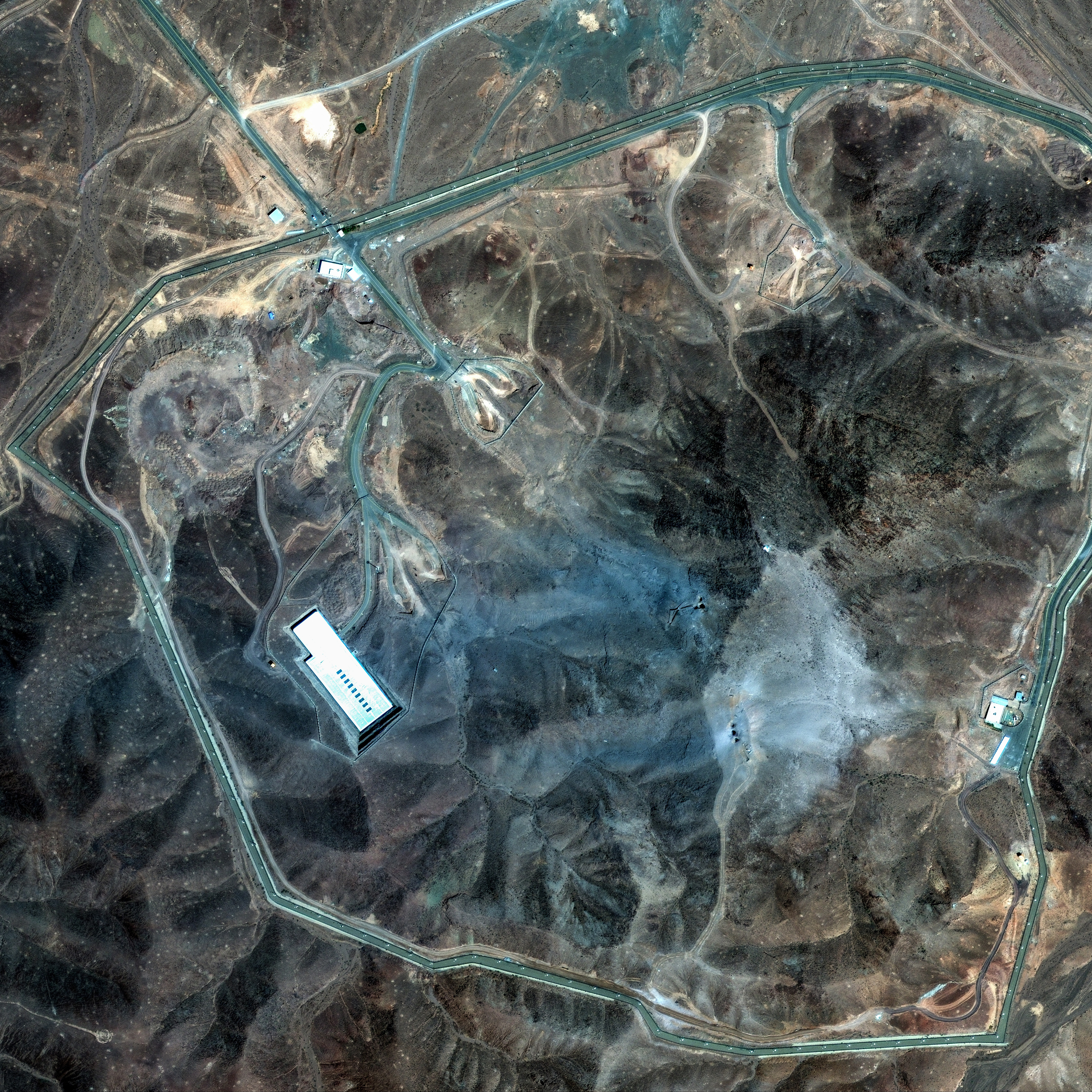
John Spencer's Key Takeaways After the 12-Day War: Air Supremacy, Intelligence, and Deterrence
John Spencer, Chair of Urban Warfare Studies at West Point, joins guest host Casey Kustin, AJC's Chief Impact and Operations Officer, to break down Israel's high-stakes strike on Iran's nuclear infrastructure and the U.S. decision to enter the fight. With Iran's terror proxy network reportedly dismantled and its nuclear program set back by years, Spencer explains how Israel achieved total air superiority, why a wider regional war never materialized, and whether the fragile ceasefire will hold. He also critiques the international media's coverage and warns of the global consequences if Iran's ambitions are left unchecked. Take Action: Take 15 seconds and urge your elected leaders to send a clear, united message: We stand with Israel. Take action now. Resources and Analysis: Israel, Iran, and a Reshaped Middle East: AJC Global Experts on What Comes Next AJC Advocacy Anywhere - U.S. Strikes in Iran and What Comes Next Iranian Regime's War on America: Four Decades of Targeting U.S. Forces and Citizens AJC Global Forum 2025: John Spencer Breaks Down Israel's War and Media Misinformation Listen – AJC Podcasts: The Forgotten Exodus: Untold stories of Jews who left or were driven from Arab nations and Iran People of the Pod: Latest Episodes: Iran's Secret Nuclear Program and What Comes Next in the Iranian Regime vs. Israel War Why Israel Had No Choice: Inside the Defensive Strike That Shook Iran's Nuclear Program Follow People of the Pod on your favorite podcast app, and learn more at AJC.org/PeopleofthePod You can reach us at: [email protected] If you've appreciated this episode, please be sure to tell your friends, and rate and review us on Apple Podcasts or Spotify. Transcript of the Interview: Casey Kustin: Hi, I'm Casey Kustin, AJC's Chief Impact and Operations Officer, and I have the pleasure of guest hosting this week's episode. As of the start of this recording on Wednesday, June 25, it's been 13 days since Israel launched precision airstrikes aimed at dismantling the Iranian regime's nuclear infrastructure and degrading its ballistic missile capabilities to help us understand what transpired and where we are now, I'm here with John Spencer, Chair of Urban Warfare Studies at the Modern War Institute at West Point, co-director of the Urban Warfare Project and Executive Director of the Urban Warfare Institute. John, welcome to People of the Pod. John Spencer: Hey, Casey, it's good to see you again. Casey Kustin: Thanks so much for joining us. John, you described Israel's campaign as one of the most sophisticated preemptive strike campaigns in modern history, and certainly the scope and precision was impressive. What specific operational capabilities enabled Israel to dominate the Iranian airspace so completely? John Spencer: Yeah, that's a great question, and I do believe it basically rewrote the book, much like after the 1973 Yom Kippur War, where Israel did the unthinkable, the United States military conducted 27 different studies, and it fundamentally changed the way we fight warfare. It's called Air-Land Battle. I think similarly with Operation Rising Lion, just the opening campaign rewrote what we would call, you know, Shock and Awe, Joint Forcible Entry, things like that. And the capabilities that enabled it, of course, were years of planning and preparation. Just the deep intelligence infiltration that Israel did before the first round was dropped. The Mossad agents texting the high command of the IRGC to have a meeting, all of them believing the texts. And it was a meeting about Israel. They all coming together. And then Israel blew up that meeting and killed, you know, in the opening 72 hours, killed over 25 senior commanders, nine nuclear scientists, all of that before the first bomb was dropped. But even in the opening campaign, Israel put up over 200 aircrafts, almost the entire Israeli air force in the sky over Iran, dominating and immediately achieving what we call air supremacy. Again, through years of work, almost like a science fiction story, infiltrating drone parts and short range missiles into Iran, then having agents put those next to air defense radars and ballistic air defense missile systems. So that as soon as this was about to begin, those drones lost low cost drones and short range missiles attacked Iranian air defense capabilities to give the window for all of the Israeli F-35 Eyes that they've improved for the US military since October 7 and other aircraft. Doing one of the longest operations, seconded only to one other mission that Israel has done in their history, to do this just paralyzing operation in the opening moment, and then they didn't stop. So it was a combination of the infiltration intelligence, the low-tech, like the drones, high-tech, advanced radar, missiles, things like that. And it was all put together and synchronized, right? So this is the really important thing that people kind of miss in military operations, is how hard it is to synchronize every bit of

Iran's Secret Nuclear Program and What Comes Next in the Iranian Regime vs. Israel War
Since Israel launched Operation Rising Lion—a precise and defensive military campaign aimed at preventing the Iranian regime from acquiring nuclear weapons—Iran has responded with a barrage of ballistic missiles and drones, indiscriminately targeting Israeli civilians. Dr. Matthew Levitt, director of the Reinhard Program on Counterterrorism and Intelligence at the Washington Institute for Near East Policy, and a leading expert on Iran's global terror network, explains what's at stake—and what could come next. Take Action: We must stop a regime that vows to murder millions of Israelis from gaining the weapons to do it. Urge your elected leaders to assure that Israel has all the necessary support to end Iran's nuclear threat. Resources and Analysis: Iranian Regime vs. Israel War Explained: What You Should Know AJC Advocacy Anywhere: Israel and Iran: Latest Updates, Global Responses, and the Path Ahead 5 Key Reasons Behind Israel's Defensive Strike on Iran's Imminent Nuclear Threat Listen – AJC Podcasts: The Forgotten Exodus: Untold stories of Jews who left or were driven from Arab nations and Iran People of the Pod: Latest Episodes: Why Israel Had No Choice: Inside the Defensive Strike That Shook Iran's Nuclear Program What Rabbi Lord Jonathan Sacks' State of the Jewish World Teaches Us Today Follow People of the Pod on your favorite podcast app, and learn more at AJC.org/PeopleofthePod You can reach us at: [email protected] If you've appreciated this episode, please be sure to tell your friends, and rate and review us on Apple Podcasts or Spotify. Transcript of the Interview: Israel's shadow war with the Iranian regime, the world's leading state sponsor of terrorism, erupted into open conflict last week following a stunning report from the International Atomic Energy Agency that confirmed Iran was much closer to obtaining nuclear weapons than previously known. Since Israel launched a wave of attacks on nuclear sites and facilities, Iran has fired missiles toward Israel's most populated cities. Joining us to discuss what this all means is one of the foremost experts on Iran and its global threats, and a regular guest when trouble arises with Iran. Dr. Matthew Levitt, director of the Reinhard Counterterrorism Program at the Washington Institute for Near East Policy. Matt, welcome back to People of the Pod. Matthew Levitt: It's a pleasure to be back, but I need to come sometime when the world's okay. Manya Brachear Pashman: That would be nice. That'd be nice. But what will we talk about? Matthew Levitt: Yeah, just call me one of the Horsemen of the Apocalypse. Manya Brachear Pashman: Well, you are one of the foremost experts on the dangers posed by Iran, especially its terror proxies. And you've written the definitive book on Hezbollah, titled Hezbollah: the Global Footprint of Lebanon's Party of God. And I say that whole title, I want to get in there, because we are talking about global threats here. Can you explain the scale of Iran's global threat and the critical role that its terror proxies, like Hezbollah, Hamas, the Houthis, play in advancing that strategy? Matthew Levitt: So I really appreciate the question, because it's really important to remind listeners that the Israel Iran war did not start Thursday night US time, Friday morning, Israel time. In fact, it's just the latest salvo where the Israelis, after years and years and years of Iranian we call it malign activity, but that's too soft a term. We're talking about Iran sending weapons and funds to proxies like Hamas to carry out October 7, like Hezbollah to fire rockets at Israel almost daily for almost a year. Like the Houthis, who were much more than a thorn in the Saudi backside until the Iranians came and gave them more sophisticated capabilities. We're talking about an Iran that a few years ago decided that instead of making sure that every gun that it sent to the West Bank had to go to Hamas or Islamic Jihad. They decided to just flood the West Bank with guns. Who cares who's shooting at the Israelis so long as somebody is. And an Iran that not only carries out human rights abuses of all kinds at home, but that threatens Israel and its neighbors with drones, low altitude cruise missiles, short range ballistic missiles, and medium and long range ballistic missiles. And so the totality of this, much like the totality of Hezbollah's striking Israel for almost a year, ultimately led Israel to do what most people thought couldn't be done, and just tear Hezbollah apart, that the Israel war on Hezbollah is the prequel to what we've been seeing over the past few days in Iran. Similarly, for the Israelis, it got to be too much. It wasn't even really that President Trump's 60 days expired and Israel attacked on day 61. It wasn't only that the IAEA came out with a report saying that the Iranians have refused to explain certain activities that can only be explained as nuclear weaponization activities. It was that the Israelis had information that tw
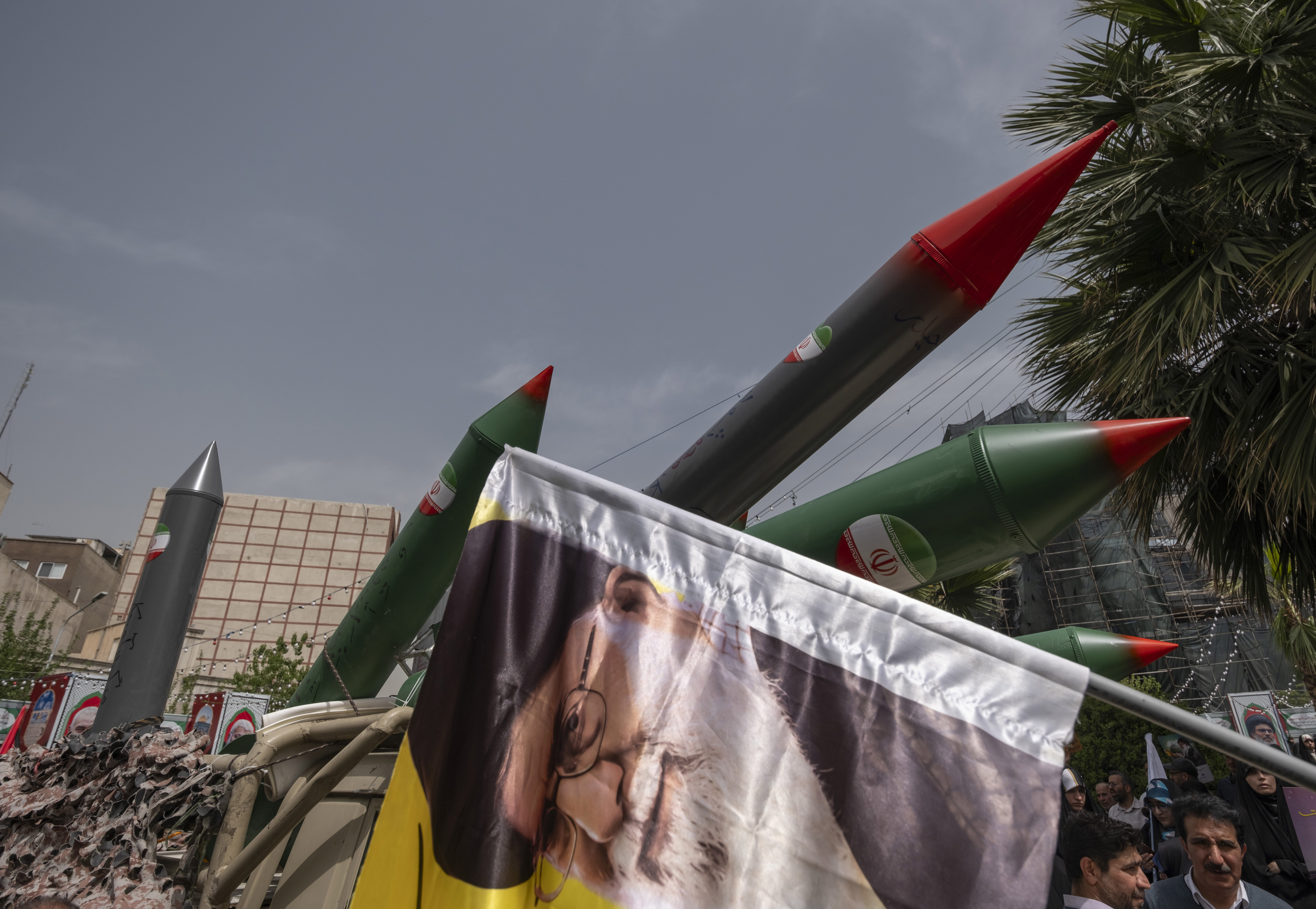
Why Israel Had No Choice: Inside the Defensive Strike That Shook Iran's Nuclear Program
Why did Israel launch defensive strikes against Iran's nuclear sites — and what does this mean for regional security? AJC Jerusalem Director Lt. Col. (res.) Avital Leibovich joins from IDF reserve duty to explain Operation Rising Lion — Israel's precision military strikes aimed at dismantling Iran's nuclear and missile capabilities. Find out why Israel saw this defensive action as vital to protect millions of lives and prevent Iran's nuclear breakout. Resources: 5 Key Reasons Behind Israel's Defensive Strike on Iran's Imminent Nuclear Threat Listen – AJC Podcasts: The Forgotten Exodus: Untold stories of Jews who left or were driven from Arab nations and Iran People of the Pod: Latest Episodes: What Rabbi Lord Jonathan Sacks' State of the Jewish World Teaches Us Today AJC's CEO Ted Deutch: Messages That Moved Me After the D.C. Tragedy Follow People of the Pod on your favorite podcast app, and learn more at AJC.org/PeopleofthePod You can reach us at: [email protected] If you've appreciated this episode, please be sure to tell your friends, and rate and review us on Apple Podcasts or Spotify. Transcript of the Interview: Manya Brachear Pashman Late Thursday night, Israel launched a series of preemptive strikes against Iran in a military offensive dubbed Operation Rising Lion. The wave of strikes comes after the International Atomic Energy Agency censured Iran for obstructing its inspections after the revelation of a secretive nuclear site. What is happening on the ground, what's next, and what are the implications for Israel, Iran, and the broader Middle East? AJC Jerusalem director, Avital Leibovich, who also serves as Lieutenant Colonel in the IDF reserves, joins us now from reserve duty as counterattacks from Iran have begun. Avital, thank you for joining us with pleasure. Avital, negotiations for a new nuclear deal with Iran have been underway since April. There have been five rounds, maybe six, and another was going to begin on Sunday. President Trump also asked Israel to hold off on this preemptive operation. So why did Israel choose to launch these strikes? At this particular time, Avital Leibovich Israel took a decision already to prepare for a preemptive attack on Iran. Since November, what happened in November? In November, Hezbollah lost the majority of its capabilities, of its military capabilities, and also of its leadership. Actually, a lot of his leaders, military leaders, have been eliminated, starting with Nasrallah, Hassan, Nasrallah, and going on to all the major generals of the organization. And basically the Shiite axis, as we call it here in Israel, was broken. Add to this, what happened a month later in December, when Assad's regime crashed, collapsed and was replaced by an anti Iranian man, jihadist, which jihadist background, by the name of Ahmed al Shara. So Iran was actually by on its own, really, because instead of circling Israel from the north, both from Syria and from Lebanon. Now it was circling in a very one dimension way, only from the east. So in order to do that, Iran figured out it needed to really upscale its nuclear capabilities, and for that, they sped up a few processes, for example, uranium enrichment, but not only that, also the weaponization of a potential nuclear bomb. And all of these steps actually brought us to a point that we are today, the point of no return. Iran will not be able to return to 20 years ago, 30 years ago, when it did not have those capabilities as it has today. For us in Israel, this is an issue of existence, either we exist or we don't, and that is the sole reason why the preemptive strike actually began today. This is according to Israeli intelligence, we have all the indications and data showing us this really major leap. And look the IAEA, you know, they issue reports every couple of months. It's their kind of responsibility for us. It's a matter of life and death. We cannot, you know, comply only with reports. And the reports sit on some shelf somewhere and and there's a lot of dust which is piling up on these reports for us, we needed action. So based on this very accurate intelligence, and some of this intelligence that has been accumulated for many, many years, you can see in the attack in Iran, you can see the very accurate attacks, the pinpointed strikes, which actually are directed at specific terrorists and not causing damage to uninvolved civilians, just To the locals. Yeah, Manya Brachear Pashman And how do you evaluate the Trump administration's response so far, given the diplomatic efforts underway? Well, Avital Leibovich I think that he is using the attacks to leverage and put pressure on Iran to resume the negotiation table in a few days. And as you know, there were six rounds of talks, and the best of my knowledge, there were huge gaps between the two sides, the American side and the Iranian side. I'm not sure these gaps can be bridged. We heard over and over again, President Trump say that Iran will never be able to enri
What Rabbi Lord Jonathan Sacks' State of the Jewish World Teaches Us Today
In 2014, the late Rabbi Lord Jonathan Sacks stood on the AJC Global Forum stage and delivered a powerful call to action: "We have to celebrate our Judaism. We have to have less oy and more joy… We never defined ourselves as victims. We never lost our sense of humor. Our ancestors were sometimes hated by gentiles, but they defined themselves as the people loved by God." Over a decade later, at AJC Global Forum 2025, AJC's Director of Jewish Communal Partnerships, Meggie Wyschogrod Fredman, revisits that message in a special crossover episode between People of the Pod and Books and Beyond, the podcast of the Rabbi Sacks Legacy. She speaks with Dr. Tanya White, one of the inaugural Sacks Scholars and host of Books and Beyond, and Joanna Benarroch, Global Chief Executive of the Legacy, about Rabbi Sacks's enduring wisdom and what it means for the Jewish future. Resources: The State of the Jewish World Address: Rabbi Lord Jonathan Sacks The Inaugural Sacks Conversation with Tony Blair Listen – AJC Podcasts: The Forgotten Exodus: Untold stories of Jews who left or were driven from Arab nations and Iran People of the Pod: Latest Episodes: "They Were Bridge Builders": Remembering Sarah Milgrim and Yaron Lischinsky AJC's CEO Ted Deutch: Messages That Moved Me After the D.C. Tragedy Follow People of the Pod on your favorite podcast app, and learn more at AJC.org/PeopleofthePod You can reach us at: [email protected] If you've appreciated this episode, please be sure to tell your friends, and rate and review us on Apple Podcasts or Spotify. Transcript of the Interview: Manya Brachear Pashman: On this week 16 years ago, the late Rabbi Lord Jonathan Sacks published Future Tense, a powerful vision of the future of Judaism, Jewish life, and the state of Israel in the 21st Century. Five years later, he delivered a progress report on that future to AJC Global Forum. On the sidelines of this year's Global Forum, my colleague Meggie Wyschogrod Fredman spoke with two guests from the Rabbi Sacks Legacy, which was established after his death in 2020 to preserve and teach his timeless and universal wisdom. Meggie Wyschogrod Fredman: In 2014, Rabbi Lord Jonathan Sacks addressed our Global Forum stage to offer the state of the Jewish world. Modeled after the US President's State of the Union speech given every year before Congress and the American people, this address was intended to offer an overview of what the Jewish people were experiencing, and to look towards our future. The full video is available on AJC's website as well as the Sacks Legacy website. For today's episode, we are holding a crossover between AJC's People of the Pod podcast and Books and Beyond, the Rabbi Sacks podcast. On Books and Beyond, each episode features experts reflecting on particular works from Rabbi Sacks. Channeling that model, we'll be reflecting on Rabbi Sacks' State of the Jewish World here at AJC's 2025 Global Forum in New York. AJC has long taken inspiration from Rabbi Lord Jonathan Sacks and today, AJC and the Rabbi Sacks legacy have developed a close partnership. To help us understand his insights, I am joined by two esteemed guests. Dr. Tanya White is one of the inaugural Sacks Scholars and the founder and host of the podcast Books and Beyond, the Rabbi Sacks podcast. Joanna Benarroch is the Global Chief Executive of the Rabbi Sacks legacy. And prior to that, worked closely with Rabbi Sacks for over two decades in the Office of the Chief Rabbi. Joanna, Tanya, thank you for being with us here at AJC's Global Forum. Tanya White: It's wonderful to be with you, Meggie. Joanna Benarroch: Thank you so much, Meggie. Meggie Wyschogrod Fredman: I want to get to the State of the Jewish World. I vividly remember that address. I was with thousands of people in the room, Jews from different walks of life, Jews from around the globe, as well as a number of non-Jewish leaders and dignitaries. And what was so special is that each of them held onto every single word. He identifies these three areas of concern: a resurgence of antisemitism in Europe, delegitimization of Israel on the global stage, and the Iranian regime's use of terror and terror proxies towards Israel. This was 2014, so with exception of, I would say today, needing to broaden, unfortunately, antisemitism far beyond Europe, to the skyrocketing rates we're living through today, it's really remarkable the foresight and the relevance that these areas he identified hold. What do you think allowed Rabbi Sacks to see and understand these challenges so early, before many in the mainstream did? And how is his framing of antisemitism and its associated threats different from others? And I'll let Tanya jump in and start. Tanya White: So firstly, I think there was something very unique about Rabbi Sacks. You know, very often, since he passed, we keep asking the question, how was it that he managed to reach such a broad and diverse audience, from non Jews and even in the Jewish world, you will find R
"They Were Bridge Builders": Remembering Sarah Milgrim and Yaron Lischinsky
We remember Sarah Milgrim and Yaron Lischinsky through the voices of those who knew them. Hear about Sarah's peacebuilding in Morocco and Yaron's diplomatic efforts to forge stronger ties between Israel and its neighbors. Both were members of the Israeli diplomatic corps and AJC's extended family. They were tragically murdered after leaving an AJC event in Washington, D.C. Dr. Dana Walker, the director of AJC ACCESS, the young professional program that hosted the reception, shares memories of traveling with Sarah to Morocco last fall as part of the Michael Sachs Fellowship for Emerging Leaders, organized by AJC and the Mimouna Association. Then, Benjamin Rogers, AJC's Director for Middle East and North Africa Initiatives, reflects on his conversations with Yaron, who held a parallel diplomatic portfolio at the Israeli Embassy. Benjy and Yaron spoke quite often about their diplomatic work and the importance of Israel's relationship with its neighbors. Benjy recalls their last exchange, just moments before Yaron was gunned down. Resources: What To Know About The Murder of Sarah Milgrim z"l and Yaron Lischinsky z"l in Washington, D.C. Listen – AJC Podcasts: The Forgotten Exodus: Untold stories of Jews who left or were driven from Arab nations and Iran People of the Pod: Latest Episode: AJC's CEO Ted Deutch: Messages That Moved Me After the D.C. Tragedy Follow People of the Pod on your favorite podcast app, and learn more at AJC.org/PeopleofthePod You can reach us at: [email protected] If you've appreciated this episode, please be sure to tell your friends, and rate and review us on Apple Podcasts or Spotify. Transcript of the Interview: Manya Brachear Pashman: American Jewish Committee and Jews around the world have been left completely shaken by the devastating events in Washington, D.C., where two members of the Israeli diplomatic community and AJC's community—Sarah Milgrim and Yaron Lishinsky were brutally murdered after leaving an AJC reception. Last week, AJC CEO Ted Deutch returned from Sarah's funeral in Kansas City to share what he's learned about Sarah and Yaron. He also shared how graciously people have reached out to express their support, including families of Israeli hostages. This week, to remember Sarah and Yaron, we invited two AJC colleagues who knew them personally to help us remember. Dana Levinson Walker is the director of AJC ACCESS, the program for young Jewish professionals. In that role, she traveled to Morocco with Sarah and two dozen other young bridge builders as part of the Michael Sachs Fellowship for Emerging Leaders organized by AJC and the Mimouna Association. Dana is with us now to share her memories. Dana, thank you for being here. Can you please tell us about that trip last fall? Dana Walker: I had the privilege of traveling with Sarah and 25 other young professionals and staff from the US, Israel, Morocco and France. And it was an extraordinary seven days. We traveled to six different cities in seven days. Normally, we backend an Israel trip as a part of this delegation. But due to some geopolitical issues happening in the region, we made a decision to just go to Morocco at that time, and then we were going to go to Israel later. And we are indeed scheduled to go to Israel in September of 2025. It was an extraordinary experience for all different kinds of reasons. I think that the environment that we were walking into in Morocco was not only an embracing one, but it was also a challenging one. The day that we arrived in Morocco was the day we found out that the six hostages had been murdered in Gaza, and it was an incredibly painful moment for the Jewish participants, many of whom had a connection to the hostages or their families. And especially for someone like Sarah, who worked at the embassy, it felt really personal, because she had been advocating, of course, for their release, but also had just been a voice for many of them. And it was deeply devastating. But the trip could have taken a really depressing and sad turn, and in reality, it actually took an incredible turn where I've often told people that it wasn't necessarily the trip we planned for, but it was the trip we needed. In that it really fostered and created a family that is bound together now for life. They wept together, they laughed together. And I think what was so powerful is that it was Sarah's first time in Morocco, and she really just had this look of awe most of the time we were there. It was a look of deep reflection, a look of kind of taking it all in. We have really amazing photos of her, where she's just kind of looking very ethereal and like looking up in awe walking around the kind of old city of Marrakesh and things like that. And she was an incredible addition to our trip. She was a calming figure, a grounding figure. She spent a lot of late nights with the folks, just talking on the bus, talking by the pool. I know that on the last night of our trip in Marrakech, she and a couple of othe
AJC's CEO Ted Deutch: Messages That Moved Me After the D.C. Tragedy
In this episode about the week following the antisemitic murders of Israeli embassy employees Yaron Lischinsky and Sarah Milgrim, AJC CEO Ted Deutch shares how leaders and allies around the globe, as well as hostage families, despite their own state of grief, have reached out to offer comfort and condolences, and what we all must do to shape a new future for the Jewish people. Resources: What To Know About The Murder of Sarah Milgrim z"l and Yaron Lischinsky z"l in Washington, D.C. Listen – AJC Podcasts: The Forgotten Exodus: Untold stories of Jews who left or were driven from Arab nations and Iran People of the Pod: Latest Episodes: Why TikTok is the Place to Talk about Antisemitism: With Holocaust Survivor Tova Friedman Related Episodes: Higher Education in Turmoil: Balancing Academic Freedom and the Fight Against Antisemitism Follow People of the Pod on your favorite podcast app, and learn more at AJC.org/PeopleofthePod You can reach us at: [email protected] If you've appreciated this episode, please be sure to tell your friends, and rate and review us on Apple Podcasts or Spotify. Transcript of the Interview: Manya Brachear Pashman: On May 21, Sarah Milgrim and Yaron Lischinsky were murdered outside the Capital Jewish Museum in Washington, D.C., following the Young Diplomats Reception hosted annually by American Jewish Committee. Yaron returned to his home in Israel to be buried on Sunday. Sarah's funeral in Kansas City took place on Tuesday. AJC CEO Ted Deutch was there and is with us now to talk about this incredibly sad and significant loss for the Jewish community – really for the world. Ted, thank you so much for joining us. Ted Deutch: Thanks, Manya. Manya Brachear Pashman: So Ted, I have to ask, Where were you when you heard the news of what happened? Ted Deutch: Well, I had been in Washington with the team there. I had done meetings in the capital. I've had some meetings in Atlanta. I flew to Atlanta, and there were some questions as I was flying. But it wasn't until I landed that it was clear what had happened. And the rest of the night on into the morning, obviously, we're all completely tied up trying to address the crisis and make sure that everything was being addressed for our people. For those who were there with law enforcement, with the administration, was a really, really horrible, horrible night. Manya Brachear Pashman: This was an annual reception for Young Diplomats. What was the theme of the event this year, though, was it different from years past? Ted Deutch: The theme was humanitarian diplomacy, which is the cruel irony here. This brutal, violent terror attack came immediately after a big group of young leaders from across Washington came together. AJC leaders, Jewish leaders, young diplomats, literally Young Diplomats from across the diplomatic corps all came together to focus on how to bring people together to provide humanitarian assistance, ultimately, to make life better for everyone. For Jews and Muslims and Christians, for Israelis and Arabs, Palestinians. Everyone coming together with this sense of hope, and then that was, of course, followed with the despair that we felt immediately after, as a result of this tragedy. Manya Brachear Pashman: Given the climate since October 7, given the rise in antiSemitism and the virulence of a lot of the protests, was this predictable, sadly, or was it really unimaginable? Ted Deutch: Strangely, I think both of those things can be true. It was, on the one hand, absolutely predictable. We've been saying since before October 7, but certainly since we've seen these horrific protests and people chanting to globalize the Intifada and Palestine from the river to the sea and calling for the destruction of Israel, and the attacks against Jews on the streets. We've been saying that words can lead to violence. We've seen this happen. We've seen it happen throughout our history. We've seen it happen across Europe, and we've seen the kind of deadly violence here in the United States. At Tree of Life and Poway and elsewhere. And so, on the one hand, completely predictable, at the same time, unimaginable. How is it that a group of dedicated young Jewish leaders and their allies from around the world could come together in a Jewish museum, to focus on the hope for a better future for everyone and be a target for a brutal, vicious antisemitic killer? And that's the point we've been trying to make since. Is that sure, that incitement, that words aren't just words because they can lead to violence, but also that we shouldn't live in a place where we just expect that the Jewish community is always going to be under threat. That's not normal. It's not normal in the United States. It shouldn't be normal anywhere. Manya Brachear Pashman: What have you learned about Yaron and Sarah, since last Wednesday? Ted Deutch I have…Yaron was a partner of AJC on a lot of work, but among the many messages that I received since last Wednesday, there was a really to
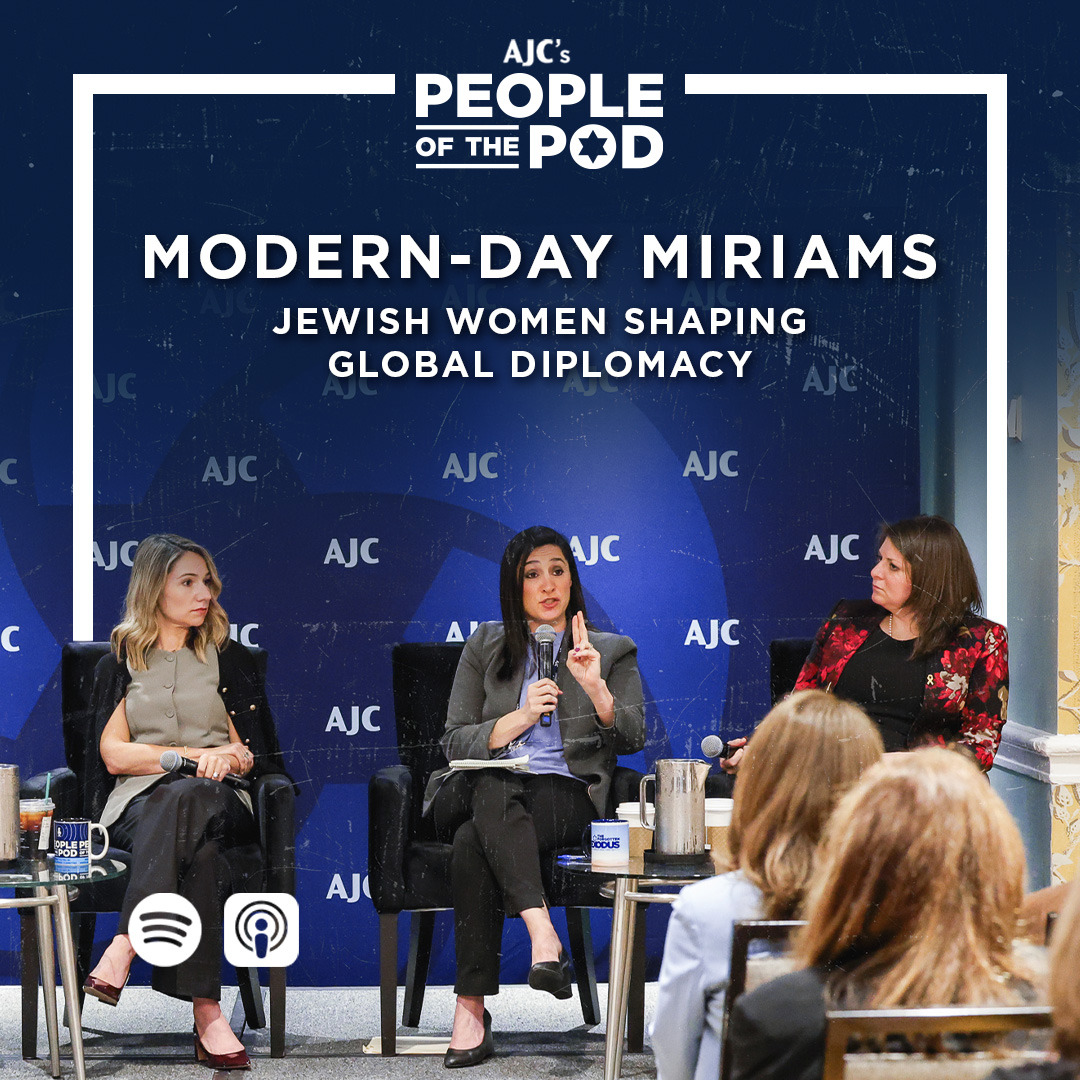
Modern-Day Miriams: Jewish Women Shaping Global Diplomacy
"This has been my favorite session of the three days. Thank you," said one attendee following a powerful live conversation at AJC Global Forum 2025. This exclusive episode of AJC's People of the Pod, presented by AJC's Women's Global Leadership Network, features a candid discussion on the critical impact of Jewish women leaders in global diplomacy and conflict resolution. Casey Kustin, AJC's Chief Impact and Operations Officer, joins former U.S. Deputy Assistant Secretary of State Mira Resnick and Dana Stroul, Research Director and Kassen Family Senior Fellow at The Washington Institute for Near East Policy, to share how they've navigated the corridors of power, shaped international policy from the Middle East to Europe and beyond, and opened doors for the next generation of women in foreign affairs. ___ Resources– AJC Global Forum 2025 News and Video AJC Global Forum 2026 returns to Washington, D.C. Will you be in the room? Listen – AJC Podcasts: Most Recent Episodes: A United Front: U.S. Colleges and AJC Commit to Fighting Campus Antisemitism What is Pope Francis' Legacy with the Jewish People? Why TikTok is the Place to Talk about Antisemitism: With Holocaust Survivor Tova Friedman The Forgotten Exodus: Untold stories of Jews who left or were driven from Arab nations and Iran People of the PodFollow People of the Pod on your favorite podcast app, and learn more at AJC.org/PeopleofthePod You can reach us at: [email protected] If you've appreciated this episode, please be sure to tell your friends, and rate and review us on Apple Podcasts or Spotify. Interview Transcript: Manya Brachear Pashman: Live from AJC Global Forum 2025, welcome to People of the Pod. For audience members who are not in this room, you are listening to a show that was recorded in front of a live studio audience on April 29 at AJC Global Forum 2025 in New York. I'm your host, Manya Brachear Pashman. Thank you all for being here. In countries around the world, women are working more than ever before. But compared to men, they are not earning as much or being afforded an equal voice – at work, at home, or in the community. In no country in the world do women have an equal role. Let me repeat that. In no country in the world, do women have an equal role–when it comes to setting policy agendas, allocating resources, or leading companies. With us today are three modern-day Miriams who have raised their voices and earned unprecedented roles that recognize the intellect and compassion they bring to international diplomacy. To my left is AJC Chief Impact and Operations Officer, Casey Kustin. Casey served as the staff director of the Middle East, North Africa, and Global Counterterrorism Subcommittee on the House Foreign Affairs Committee for 10 years. She has worked on political campaigns at the state and national level, including on Jewish outreach for Barack Obama's presidential campaign. Welcome, Casey. To Casey's left is Dana Strohl. She is the Director of Research for the Washington Institute for Near East Policy. She was the Deputy Assistant Secretary of Defense for the Middle East. In this role, she led the development of U.S. Department of Defense policy and strategy for Bahrain, Egypt, Israel, Iran, Iraq–I'm not done–Jordan, Kuwait, Lebanon, Oman, Palestinian Authority, Qatar, Saudi Arabia, Syria, United Arab Emirates, and Yemen. Prior to that, she also served on Capitol Hill as the senior professional staff member for the Middle East on the Senate Foreign Relations Committee. Welcome, Dana. And last but not least, Mira Resnick. Mira was the former Deputy Assistant Secretary of State for Israeli and Palestinian Affairs and Arabian Peninsula Affairs, in which she handled two crucial Middle East portfolios, usually helmed by two separate people. Previously, she oversaw the Department's Office of regional security and arms transfers, where she managed foreign arms sales and shepherded the Biden administration's military assistance to Ukraine and Israel after Russia's invasion and after the October 7 Hamas attacks. Like Casey, Mira has also served as a senior professional staff member with the House Committee on Foreign Affairs, focusing on the Middle East and North Africa. Thank you for being here, Mira. Welcome to all of you, to People of the Pod. I think it's safe to say, this panel right here, and all the knowledge and experience it represents could solve the Middle East conflict in one day, if given the chance. Casey, you served for a decade as staff director for the Middle East, North Africa and Global Counterterrorism Subcommittee. A decade, wow. You witnessed a lot of transition, but what were the constants when it came to regional cooperation and security needs? Casey Kustin: What's the saying? The enemy of my enemy is my friend. And that's the world that we're all trying to build. So, you know, from an American perspective, which we all came from in our government work, it was trying to find those shared interests, and tryi
A United Front: U.S. Colleges and AJC Commit to Fighting Campus Antisemitism
This week, groups representing more than 1,600 colleges and universities pledged reforms to fight campus antisemitism—a major breakthrough in the effort to end anti-Jewish hatred and create campuses where Jewish students feel safe. In collaboration with American Jewish Committee (AJC), the groups urged the Trump administration to continue making the eradication of antisemitism a priority, but without endangering the research grants, academic freedom and institutional autonomy of America's colleges and universities. Here to discuss this collaboration are Sara Coodin, Director of Academic Affairs for AJC, and Ted Mitchell, president of the American Council on Education. *The views and opinions expressed by guests do not necessarily reflect the views or position of AJC. Resources: Watch – Creating Safe Spaces for Jewish Students: Education Leaders Speak at AJC Global Forum 2025 Listen – AJC Podcasts: Most Recent Episodes: What is Pope Francis' Legacy with the Jewish People? Why TikTok is the Place to Talk about Antisemitism: With Holocaust Survivor Tova Friedman Related Episodes: Higher Education in Turmoil: Balancing Academic Freedom and the Fight Against Antisemitism Meet the MIT Scientists Fighting Academic Boycotts of Israel Spat On and Silenced: 2 Jewish Students on Fighting Campus Hate University of Michigan Regent Jordan Acker: When Antisemitism Hits Home The Forgotten Exodus: Untold stories of Jews who left or were driven from Arab nations and Iran People of the Pod Follow People of the Pod on your favorite podcast app, and learn more at AJC.org/PeopleofthePod You can reach us at: [email protected] If you've appreciated this episode, please be sure to tell your friends, and rate and review us on Apple Podcasts or Spotify. Transcript of Conversation with Ted Mitchell and Sara Coodin: Manya Brachear Pashman: This week, groups representing more than 1,600 colleges and universities pledged reforms to fight campus antisemitism -- a major breakthrough in the effort to end anti-Jewish hatred and create campuses where Jewish students feel safe. In collaboration with American Jewish Committee, the groups urged the Trump administration to continue making the eradication of antisemitism a priority, but without endangering the research grants, academic freedom and institutional autonomy of America's colleges and universities. Here to discuss this collaboration is Sara Coodin, Director of Academic Affairs for AJC and Ted Mitchell, president of the American Council on Education. Ted, Sara, welcome to People of the Pod. Ted Mitchell: Thanks, Manya, good to be here. Manya Brachear Pashman: So Ted, if you could please give our listeners an overview of who signed on to this. Who are the six organizations, and do they encompass all of the higher ed institutions in the country? Ted Mitchell: We represent everybody. And so it's everybody, from the Community College Association to the land grant universities, to AAU, the big research universities, the state colleges and universities, and then ACE is an umbrella organization for everybody. So we've got built in suspenders, and we've got every institution in America on the side of eliminating antisemitism. Manya Brachear Pashman: And then, I guess, the next question is, why? I mean, why was it necessary for American Council on Education and these other associations to join this effort? Ted Mitchell: Well, a couple, a couple of things. I mean, first of all, we have partnered. AJC and Ace have partnered for a number of years to identify and try to address issues of antisemitism. So feel like we've been in partnership for some time on these issues. And unfortunately, the need has continued to grow. I think that last spring was a real wake up call to a lot of our institutions, that they might have been comfortable believing that there was no antisemitism on their campus, but boy, they got up. They got a notice in the mail. So I think that we have, as a group, all six of us, we have worked with our institutions since last spring to create opportunities for institutions to do better. And so we had long conversations over the spring and summer about changes in disciplinary policy, everything from masks to how to make sure that every group that was seeking to have a voice make a protest was operating under the same rules, make sure that everybody understood those rules. And frankly, I think we've made great progress over the course of the summer. There are still things that we can do better. There are always things we can do better. But I think the call for this letter was the conflation by the Trump administration of antisemitism and efforts to eradicate antisemitism with all of the other activities that go on on a university campus that are not really related to antisemitism. And case in point is the administration's willingness to hold research funds hostage to institutional changes and behaviors that have never been stipulated. So we're in this interesting spot where we want

Why TikTok is the Place to Talk about Antisemitism: With Holocaust Survivor Tova Friedman
Tova Friedman was just six years old when she walked out of Auschwitz. Now, 80 years later, Tova is devoted to speaking about her experiences as a child survivor of the Holocaust and being vocal about the threat of antisemitism. She knows how easily a society can transition from burning books to burning people, and she is determined to ensure that never happens again. Tova speaks to audiences worldwide–in person and on the social media platform TikTok, where she has amassed over half a million followers. Listen to Tova's harrowing, miraculous testimony of survival, as part of a live recording at the Weizmann National Museum of American Jewish History in Philadelphia, in partnership with AJC Philadelphia/Southern New Jersey. Lisa Marlowe, director of the Holocaust Awareness Museum and Education Center (HAMEC), joined us to discuss the museum's mission to bring Holocaust survivors to schools, the importance of teaching history through eyewitness accounts, and the significance of preserving stories of righteous individuals like her Danish great-grandmother, who saved thousands of Jews during WWII. *The views and opinions expressed by guests do not necessarily reflect the views or position of AJC. Photo credit: Christopher Brown Resources: -About Tova Friedman and TovaTok -Holocaust Awareness Museum and Education Center (HAMEC) -AJC Philadelphia/Southern New Jersey Listen – AJC Podcasts: -The Forgotten Exodus: Untold stories of Jews who left or were driven from Arab nations and Iran -People of the Pod Follow People of the Pod on your favorite podcast app, and learn more at AJC.org/PeopleofthePod You can reach us at: [email protected] If you've appreciated this episode, please be sure to tell your friends, and rate and review us on Apple Podcasts or Spotify. Transcript of Interview with Tova Friedman and Lise Marlowe: Manya Brachear Pashman: Yom HaShoah, Israel's Holocaust Remembrance Day, begins on the evening of April 23. To mark this remembrance, our broadcast this week features our recent live event at the Weitzman National Museum of American Jewish History in Philadelphia. There I had a conversation with Lise Marlowe, of the Holocaust Awareness Museum and Education Center in suburban Philadelphia and author and Holocaust survivor Tova Friedman. __ Thank you to all of you for being here today to participate in a live recording of People of the Pod, American Jewish Committee's weekly podcast about global affairs through a Jewish lens. I'm your host, Manya Brachear Pashman. Down here on this end is Lise Marlowe, our partner and organizer of this wonderful event. She is the program and Outreach Director of the Holocaust awareness Museum and Education Center, otherwise known as HAMC in Elkins Park, Pennsylvania, which is just outside here in Philadelphia. She is also a long time teacher who has come up with some quite innovative ways to teach Holocaust history to middle school students. But before we begin and get to all of that, I do want to turn to Lisa for a few minutes. If you could just tell us a little bit about HAMC. What is it? Because we are in a different museum venue now. Lise Marlowe: Thank you Manya, and thank you everyone for being here today. So HAMC is America's first Holocaust Museum, which started in 1961 by Holocaust survivor named Jacob Riz, who lost 83 family members to the Nazis. Our Museum's mission is to bring Holocaust survivors to schools and organizations. We believe it's important to give students the opportunity to learn history through an eyewitness. When we host a school program, we tell students that they are the last generation to meet a survivor, and once they hear a survivor's story, it becomes their story to tell. It also becomes their responsibility to speak up and stand up to the Holocaust deniers of the world and to say, I know you're lying because I met a survivor. It's not easy for our survivors to tell their story, but they want to honor the family they lost. And to make sure students know what happened so history hopefully doesn't repeat itself. Hearing about the rise of antisemitism, seeing hate towards other groups, can bring trauma to our survivors, but our survivors teach students that there are things we can do to stand up to hate. We can remember that words matter, kindness matters, that we can support and help each other when bad things happen. The Holocaust did not begin with concentration camps. It began with words. Our museum brings hundreds of programs all over the world, so please reach out to us at HAMC.org. Because we believe education is stronger than hate. We find that students are inspired by the messages our survivors tell them, which is to not hate others. Even though they lost everything. Their families, their property, their identity, their childhood, they teach students that hate can only destroy yourself. Manya Brachear Pashman: Thank you so much, Lise. I met some of Lise's former students who are here in the audience today. You have some rea
What Is Pope Francis' Legacy With the Jewish Community?
Rabbi Noam Marans, AJC's Director of Interreligious Affairs, reflects on Pope Francis' legacy—from his deep ties with Argentina's Jewish community to his historic visit to Israel and strong stance against antisemitism. He also addresses recent tensions over the Pope's comments on the Israel-Hamas War and highlights the ongoing collaboration between AJC and the U.S. Conference of Catholic Bishops in combating hate and building interfaith understanding. ___ Resources: The Francis I Knew: A Warrior Against Antisemitism, a Sometimes Impolitic Critic of Israel Listen – AJC Podcasts: The Forgotten Exodus: Untold stories of Jews who left or were driven from Arab nations and Iran People of the Pod: Latest Episodes: Inside the New U.S.-Iran Nuclear Talks: What's at Stake? This Often Forgotten 1929 Massacre is Key to Understanding the Current Israel-Palestinian Conflict Related Episodes: The Next Chapter in Catholic-Jewish Relations What We Can All Learn from Rabbi Heschel on Confronting Injustice Follow People of the Pod on your favorite podcast app, and learn more at AJC.org/PeopleofthePod You can reach us at: [email protected] If you've appreciated this episode, please be sure to tell your friends, and rate and review us on Apple Podcasts or Spotify.

Inside the New U.S.-Iran Nuclear Talks: What's at Stake?
As new negotiations begin to tackle Iran's nuclear program, missile development, and support for terror proxies, tensions are escalating. Jason Isaacson, AJC Chief Policy and Political Affairs Officer, joins us to unpack the legacy of the 2015 Iran nuclear deal (JCPOA) and withdrawal in 2018, and Iran's dangerous stockpiling of uranium, getting them closer to nuclear weapons capabilities. With U.S. Special Envoy Steve Witkoff leading talks and key UN sanctions expiring soon, the stakes are higher than ever. Don't miss Jason's insights on what the U.S. is demanding, the potential for successful diplomacy, and the global risks posed by Iran. ___ Listen – AJC Podcasts: The Forgotten Exodus: Untold stories of Jews who left or were driven from Arab nations and Iran Social media influencer Hen Mazzig on leaving Tunisia Chef Einat Admony on leaving Iran Playwright Oren Safdie on leaving Syria Cartoonist Carol Isaacs on leaving Iraq Novelist Andre Aciman on leaving Egypt People of the Pod: Latest Episode: This Often Forgotten 1929 Massacre is Key to Understanding the Current Israel-Palestinian Conflict Higher Education in Turmoil: Balancing Academic Freedom and the Fight Against Antisemitism Held Hostage in Gaza: A Mother's Fight for Freedom and Justice Follow People of the Pod on your favorite podcast app, and learn more at AJC.org/PeopleofthePod You can reach us at: [email protected] If you've appreciated this episode, please be sure to tell your friends, and rate and review us on Apple Podcasts or Spotify. Transcript of Interview with Jason Isaacson: Manya Brachear Pashman: Negotiations begin on Saturday to curtail Iran's nuclear fuel enrichment, infrastructure, missile program and support of Hezbollah Hamas and other terror proxies around the world. US Special envoy to the Middle East, Steve Witkoff, will shepherd the talks. At the same time he's handling discussions around Gaza and Ukraine with us to discuss the potential of these negotiations and their impact is AJC Chief Policy and Political Affairs Officer, Jason Isaacson. Jason, welcome back to People of the Pod. Jason Isaacson: Thanks, Manya. It's good to be back. Manya Brachear Pashman: So Jason, the Obama administration sealed the deal in 2015 to curtail Iran's nuclear program, which President Trump then withdrew from in 2018. What did that original deal look like? Jason Isaacson: Of course, the United States pulled out of the deal in 2018 as you said, whereupon, after a period of reflection and some uncertainty, the Iranians started violating the agreement. The original agreement that was called the Joint Comprehensive Plan of Action allowed the Iranians to enrich their uranium up to 3.67% purity of uranium. You need something like 90% in order to make a bomb. They were allowed to keep just 300 kilograms of that enriched uranium. The rest of their stockpile of uranium had to be shipped out of the country, which it was. There were other restrictions that were imposed on Iran. They had to disable a plutonium facility that also was a possible avenue toward a nuclear device. They had to allow intrusive inspections, not as intrusive as some had hoped, and they had to limit the degree of sophistication of their centrifuges. They had a very robust centrifuge production capacity, which had to be limited. They had to disable certain centrifuges that they already had, and they couldn't advance them further. There were a number of these other restrictions that were imposed in the return for which the Iranians were going to have sanctions removed, sanctions that had held back their economic growth, limited the degree to which they could ship their oil and gas to vendors, to customers around the world. It was a good trade for the Iranians, but from our perspective, it lacked certain things. It certainly lacked objectives that the administration, at that time, the Obama administration, we thought, had been pursuing, which was not only to limit the ability of the Iranians to produce a nuclear weapon, but to affect other aspects of Iranian behavior, their missile program, their advanced ballistic missile program, their support for proxies that endangered stability and security across the region and beyond. Those issues ended up getting dropped in the nuclear negotiations. They were just focused on nuclear program, which was a reason why AJC opposed the deal when it was announced in 2015 and why Donald Trump campaigning for president and then after he became president, after giving it a run to try to find a way to perhaps induce European partners to go back to the negotiating table and impose additional restrictions on the Iranians, including covering the missile program, lengthening the amount of time that would be held in check the nuclear program of Iran for maybe not just 15 years, but 20 or 30 or 40 or 50 years. Those efforts were ultimately abandoned. Was impossible to reach an agreement between the United States and the European allies, and so in 2018 the p
This Often Forgotten 1929 Massacre is Key to Understanding the Current Israel-Palestinian Conflict
On October 7, 2023, Hamas launched the deadliest attack on Jews since the Holocaust, calling it Operation Al Aqsa. For journalist Yardena Schwartz, the massacre was a chilling echo of the 1929 Hebron Massacre—the brutal slaughter of nearly 70 Jews, incited by propaganda that Jews sought to seize the Al Aqsa Mosque. At the time, she was deep into writing her first book, Ghosts of a Holy War: The 1929 Massacre in Palestine That Ignited the Arab-Israeli Conflict. In this episode, Yardena shares how history repeated itself, how the October 7 attack reshaped her book, and why understanding the past is essential to making sense of the present. ___ Read: Ghosts of a Holy War: The 1929 Massacre in Palestine That Ignited the Arab Israeli Conflict Listen – AJC Podcasts: The Forgotten Exodus: Untold stories of Jews who left or were driven from Arab nations and Iran Social media influencer Hen Mazzig on leaving Tunisia Chef Einat Admony on leaving Iran Playwright Oren Safdie on leaving Syria Cartoonist Carol Isaacs on leaving Iraq Novelist Andre Aciman on leaving Egypt People of the Pod: Latest Episode: Higher Education in Turmoil: Balancing Academic Freedom and the Fight Against Antisemitism Held Hostage in Gaza: A Mother's Fight for Freedom and Justice Yossi Klein Halevi on the Convergence of Politics and Religion at Jerusalem's Temple Mount Follow People of the Pod on your favorite podcast app, and learn more at AJC.org/PeopleofthePod You can reach us at: [email protected] If you've appreciated this episode, please be sure to tell your friends, and rate and review us on Apple Podcasts or Spotify. __ Transcript of Interview with Yardena Schwartz: Manya Brachear Pashman: Hello, and welcome to People of the Pod, brought to you by American Jewish Committee. Each week, we take you beyond the headlines to help you understand what they all mean for America, Israel and the Jewish people. I'm your host Manya Brachear Pashman:. In October 2023 journalist Yardena Schwartz was in the middle of writing her first book exploring the rarely talked about 1929 Hebron massacre, in which nearly 70 Jews were murdered, dozens more injured by their Muslim neighbors during riots incited by the Grand Mufti of Jerusalem, who spread lies that Jews wanted to take over the Al Aqsa Mosque. When she heard reports of the October 7 terror attacks by Hamas dubbed Operation Al Aqsa, she realized just how relevant and prescient her book would be, and began drafting some new chapters. Yardena is with us now to discuss that book titled Ghosts of a Holy War: The 1929 Massacre in Palestine that ignited the Arab Israeli conflict. Yardena, welcome to People of the Pod. Yardena Schwartz: Great to be here, Manya. Manya Brachear Pashman: So full disclosure to you and our audience. You attended Columbia Journalism School 10 years after I did, and you took Professor Ari Goldman's class on covering religions 10 years after I did that, class had always traveled to Israel, and I had hoped it would be my ticket to go to Israel for the first time, but the Second Intifada prevented that, and we went to Russia and Ukraine. Instead, your class did go to Israel, and that was your first visit to Hebron, correct? Yardena Schwartz: So it was in 2011 and we went to Hebron for one day out of our 10 day trip to Israel, and it was my first time there. I was the only Jewish student in our class. It was about 15 of us, and I was the only one who had been to Israel. I had been all over Israel, but I had never been to Chevron. And our tour was with Breaking the Silence, an organization of former Israeli soldiers who had served in Hebron or in other parts of the West Bank and wanted Israelis to know what was happening in Hebron and how Palestinians were living there, and the various restrictions that were put in place as a result of terrorist attacks. But nevertheless, you know, those restrictions were extremely disturbing, and that brief visit in 2011 made me really never want to go back to Hebron. And when I moved to Israel two years later to become a freelance journalist there, and, you know, to move to Israel because I loved Israel, and still obviously love Israel, I didn't really go back to Chevron because I, you know, was really troubled by what I saw there. But this book took me, of course, back to Chevron hundreds of times, spending hundreds of hours there. And it came to be, you know, my expertise in this conflict, in my reporting. And you know, of course, Heron is kind of the main character in this book, Manya Brachear Pashman: Tell us how you came to find out about this massacre. Was it mentioned during that class visit in 2011 or was it later that you learned about it? Yardena Schwartz: So that was one of the most interesting things about my early adventure into writing this book, was that I had of course been to have Ron, and yet, during that day that we spent there learning so much about the history of this place, this deeply holy place to so many people, there wa
Higher Education in Turmoil: Balancing Academic Freedom and the Fight Against Antisemitism
Following the Trump administration's decision to revoke $400 million in federal funding over Columbia University's failure to protect Jewish students, the university announced sweeping policy changes. Meanwhile, the U.S. moved to deport former Columbia student and pro-Palestinian activist Mahmoud Khalil, accusing him of concealing his ties to UNRWA and participating in antisemitic campus protests. Dr. Laura Shaw Frank, Director of AJC's Center for Education Advocacy, joins People of the Pod to discuss the delicate balance between combating antisemitism, safeguarding free speech, and ensuring campuses remain safe for all students. ___ Resources: Leaders for Tomorrow: AJC's Flagship Leadership Development Initiative for High School Students AJC Supports Action on Antisemitism, Warns Against Overly Broad Funding Cuts Guidance and Programs for Higher Education Spaces The State of Antisemitism in America 2024 Report AJC Statement on ICE Proceeding Against Mahmoud Khalil Listen – AJC Podcasts: -The Forgotten Exodus: with Hen Mazzig, Einat Admony, and more. -People of the Pod: Spat On and Silenced: 2 Jewish Students on Fighting Campus Hate Meet the MIT Scientists Fighting Academic Boycotts of Israel Will Ireland Finally Stop Paying Lip Service When it Comes to Combating Antisemitism? Held Hostage in Gaza: A Mother's Fight for Freedom and Justice Follow People of the Pod on your favorite podcast app, and learn more at AJC.org/PeopleofthePod You can reach us at: [email protected] If you've appreciated this episode, please be sure to tell your friends, and rate and review us on Apple Podcasts or Spotify. __ Transcript of Conversation with Laura Shaw Frank: Aaron Bregman: Hi, this is Aaron Bregman, AJC's Director of High School Affairs. If you're the parent of a Jewish high school student, you've probably asked yourself, "How can I help my teen feel proud and prepared to lead in today's world?" Well, that's exactly what AJC's Leaders for Tomorrow program, or LFT, is all about. LFT gives Jewish teens the tools to navigate challenging conversations and advocAte about antisemitism and Israel—whether in the classroom, online, or in their community spaces. Our monthly deep-dive sessions into the issues faced by Jews - both historically and today - become the place where LFT students find community, build confidence, and strengthen their Jewish identity. If your teen is ready to expand their understanding of what it means to be a Jewish leader — have them visit AJC.org/LFT to learn more. Let's give them the tools they need to step up, speak out, and lead with pride. Again, that's AJC.org/LFT. Manya Brachear Pashman: Three federal agencies said this week that they welcomed the policy changes that Columbia University announced Friday, following the Trump administration's revocation of $400 million in federal funding. The government recalled the funding in response to the university's failure to enforce its own rules to protect Jewish students after the terror attacks of October 7, 2023. Masked protesters of the Israel Hamas War spewed antisemitic rhetoric, built encampments that blocked students from attending classes and, in some cases, took over classes. Also this week, the government announced new charges against Mahmoud Khalil, an Algerian citizen and green card holder here in the United States, and a former Columbia University graduate student who was detained due to his activism on campus. International students on other campuses also have been detained in the weeks since. As a community that values academic freedom, as well as freedom of expression, and democracy, how do we balance those values with the importance of fighting antisemitism and making sure our campuses are safe for Jewish students? With me to discuss this balancing act is Laura Shaw Frank, director of the AJC Center for Education Advocacy and director of AJC's Department of Contemporary Jewish Life. Laura, welcome to People of the Pod. Laura Shaw Frank: Thanks, Manya. Good to be with you. Manya Brachear Pashman: So let's start with the issue of Mahmoud Khalil, a former Columbia University graduate student. He was detained due to his activism on campus. And we're learning from government this week that he reportedly did not disclose that he was a member of the United Nations Relief and Works Agency for Palestinian Refugees (UNWRA) as a political officer. And he was also part of Colombia's Apartheid Divest movement when he applied to become a permanent resident in 2024. He was taken into custody, though, in a very troubling way. And frankly, he was one of the few who didn't conceal his identity during the protests and encampments. He negotiated with the University. What is AJC's stance on this? Laura Shaw Frank: Great question Manya, and it deserves a very, very careful and nuanced answer. So I want to start by saying that AJC, as it has always done, is striving enormously to remain the very nuanced and careful voice that we always have about every is

Will Ireland Finally Stop Paying Lip Service When it Comes to Combating Antisemitism?
In late 2024, Israel closed its embassy in Dublin, accusing the Irish government of extreme anti-Israel policies, antisemitic rhetoric, and double standards. Meanwhile, the small Jewish community in Ireland, numbering nearly 3,000, has faced antisemitism in the streets. AJC's Director of International Jewish Affairs, Rabbi Andrew Baker, joins us to discuss his recent meeting with Irish Prime Minister Micheál Martin, examples of antisemitic activity in Ireland, including Holocaust inversion and the chilling impact of widespread anti-Israel sentiment on Irish Jews. He also shares insights on Ireland's adoption of the IHRA working definition of antisemitism and the future of Holocaust remembrance in the country. ___ Resources: AJC Directly Addresses Antisemitism and Vilification of Israel in Ireland with the Prime Minister Listen – AJC Podcasts: -The Forgotten Exodus: with Hen Mazzig, Einat Admony, and more. -People of the Pod: U.S. Special Envoy Steve Witkoff on Gaza Reconstruction, Israeli Security, and the Future of Middle East Diplomacy Why Germany's Antisemitic Far-Right Party is Thriving Instead of Disappearing Follow People of the Pod on your favorite podcast app, and learn more at AJC.org/PeopleofthePod You can reach us at: [email protected] If you've appreciated this episode, please be sure to tell your friends, and rate and review us on Apple Podcasts or Spotify. __ Transcript of Conversation with Andrew Baker: Manya Brachear Pashman: In December, Israel closed its embassy in Dublin, accusing the Irish government of extreme anti-Israel policies, antisemitic rhetoric, and double standards. Meanwhile, the small Jewish community in Ireland, numbering nearly 3000 has faced antisemitism in the streets. With us now to discuss the situation in Ireland, and his meeting with the Irish Prime Minister last week, is AJC's Director of International Jewish Affairs, Rabbi Andrew Baker, who also serves as the personal representative on combating antisemitism in the Organization for Security and Cooperation in Europe. Andy, welcome to People of the Pod. Andrew Baker: Great to be here, Manya. Manya Brachear Pashman: This situation did not develop overnight. Can you take our listeners back to the first clues that the relationship between Israel and Ireland was deteriorating? Andrew Baker: Ireland has a small Jewish community, perhaps about 3000 people. And a significant number of them, maybe upwards toward 1000, also people with Israeli citizenship who moved to Ireland to work there with a number of the social media tech companies based in Ireland. Over the years, and certainly even predating October 7, in Ireland there's been a fairly high degree of anti-Israel animus. It's not dissimilar to what we may find in a number of other northern European countries. They view the political scene in the Middle East through a certain prism that creates and maybe amplifies this form of animus. But that said, there have also been, I think, issues between this community and government policy, even as it's reflected in ceremonies marking Holocaust remembrance in Ireland. In many cases, the particular focus in that history of what happened to the Jewish people in Europe during World War II, the genocide of the Holocaust. While there may be commemoration events, in principle to market, they've really, in many ways, washed out the Jewish nature of that. In 2016 I was an invited speaker to the official Holocaust Commemoration Day in Ireland. Almost the entire focus was on the refugees, at the time coming in from North Africa and the Middle East. I was actually the only person who spoke the word antisemitism at that event. You also had an effort through legislation to really separate out Israel, the occupied territories, as they understood it, and the name of this bill that was passed by the legislature was called the Occupied Territories Bill. Which sought to separate Israel, at least the territories commercially from Ireland, but it would have a very onerous impact, frankly, on any anyone, certainly members of the Jewish community, who would choose to visit Israel. If they purchased a kippa in The Old City of Jerusalem, brought it back with them to Ireland, under this law, if it were enacted, they could literally be arrested for that action. So I think also at the time I made a visit there in 2019 in my OSC role, Israel was preparing to host the Eurovision Song Contest in Tel Aviv, and there was a very public campaign in Ireland to boycott the Eurovision contest. Advertisements calling for this on the side of buses, people in the state media already indicating that they were going to refuse to attend. So you had this sort of environment in Ireland, again, a good number of years before what happened on October 7, which really changed everything throughout Europe. Manya Brachear Pashman: And now there has been a more moderate government recently elected in Ireland. Prime Minister Micheál Martin was in the United States last week in
Held Hostage in Gaza: A Mother's Fight for Freedom and Justice
"He told me: 'We are the same. We are the same.' Meaning, me and the terrorists who penetrated the kibbutz are the same. They received the mission to murder and to burn, and I received the mission to hold you as bargaining chips for the release of the Palestinian prisoners. And this was a very cruel sentence, because while we were in captivity . . . they could do anything to us." Former Israeli hostage Shoshan Haran, abducted during the Hamas terror attack on October 7, 2023, shares her harrowing story of survival and resilience. Shoshan was abducted from her home in Kibbutz Be'eri alongside her family, including her son-in-law Tal Shoham, her daughter, and her young grandchildren. While she and the other women and children were released after 50 days in November 2023, Tal remained in Gaza for 505 days and was released in February 2025. Now, as she welcomes Tal home, Shoshan opens up about the unbearable anguish of captivity, the emotional toll of waiting, and the devastating losses her family has endured. She sheds light on the humanity that persisted even in the darkest moments and issues a powerful call for continued global action to free the 59 hostages who are still being held. Resources: Listen – AJC Podcasts: The Forgotten Exodus: with Hen Mazzig, Einat Admony, and more. People of the Pod: U.S. Special Envoy Steve Witkoff on Gaza Reconstruction, Israeli Security, and the Future of Middle East Diplomacy Why Germany's Antisemitic Far-Right Party is Thriving Instead of Disappearing Follow People of the Pod on your favorite podcast app, and learn more at AJC.org/PeopleofthePod You can reach us at: [email protected] If you've appreciated this episode, please be sure to tell your friends, and rate and review us on Apple Podcasts or Spotify. __ Transcript of Conversation with Shoshan Haran: Manya Brachear Pashman: After 505 days as a hostage in Gaza, Tal Shoham returned to Israel to his wife and two young children and to an extended family whose lives have been on hold since the Hamas terror attacks on October 7, 2023. Tal had been taken hostage from his home in Kibbutz Be'eri with his wife, his children, his wife's aunt, his 12-year-old niece, and his mother in law, Shoshan Haran. Shoshan returned home with the other women and children on November 26, 2023. She is with us now to talk about welcoming Tal home, the tremendous loss she and her family have suffered, and the endless fight to get the rest of the hostages home. Shoshan, welcome to People of the Pod. Shoshan Haran: Thank you. Nice being here. Manya Brachear Pashman: Well, I'm glad that you are here to at least partially celebrate the return of your loved ones. It has been more than 500 days since that awful day in October. Can you take our listeners back a few days before the 7th, to October 4th: what were you doing that day? Shoshan Haran: On October 4, we had a very big event of Women Making Peace in the Dead Sea, together with a sister movement, Women of the Sun. It's a Palestinian movement. Both women-led movements working for peace on both sides. And I went there with my sister Lilach and with the founder of this movement, Vivian Silver, who was my neighbor in Kibbutz Be'eri. And it was such an optimistic event, and heartwarming, we were there with thousands of women, some men also, and we were talking about the power of women to bring peace and how we should stop the bloodshed and how we should find a new way to live together in peace. That was on October 4. Two days later, on October 6, we are getting ready for Simchat Torah, to celebrate with our family. We had the sukkah already since a week ago, and we invited my daughter, Adi, and her husband Tal and the little kids, Naveh, who was then eight years old, and Yahel (Yula), three years old, to join us for Simchat Torah. So we were cooking, getting ready for the holidays. It was a shabbat dinner, so cooking. And then we got a call from Avshal, Avshalom, he's my husband, his nickname is Avshal, and we got a call from his sister, Sharon, that wanted to join us for that evening with her daughter, Noam who was then 12 years old. And we celebrated together in the sukkah, having fun. The kids were playing all over. And then we went to sleep. We had kind of a loft above our house for hosting our guests, and that's where Tal and Adi and the kids stayed overnight. Sharon and her daughter stayed with us on the ground level, and we went to sleep. And then at 6:29am, we heard the red . . . color red is the code for attack. And we thought it is, I shouldn't say it, but the usual missile attack on us. So we went to the safe room. And then after a few minutes, we went out. My husband went up to the second floor to get Adi, Tal, and the kids down to be with us, and I started making hot chocolate for the grandkids. And then we got the warning on our–we have a community WhatsApp for alarms. And they told us that they suspect that some terrorists penetrated the kibbutz, and then we should go into the saf

Meet the MIT Scientists Fighting Academic Boycotts of Israel
The American Studies Association has boycotted Israeli academic institutions since 2013. The Association for the Advancement of Anthropology has refrained from formal collaborations with Israeli academic institutions. And just this past summer, the American Association of University Professors opened the door to academic boycotts against Israel. Enter: two scientists at MIT who see firsthand the consequences of academic boycotts and the damage it can cause to scholarship and scientific progress. To ensure Israeli scholars and their American colleagues can collaborate freely, and foster research and innovation that benefits all of humanity, they formed The Kalaniyot Foundation (pronounced Ka-la-nee-yought), named after Israel's national flower. Hear from Drs. Or Hen and Ernest Fraenkel, co-founders of this initiative, on the impact of anti-Israel boycotts on academic collaboration with Israeli scholars, and what they're doing to rehabilitate the reputation of Israeli researchers in the eyes of the world. Listen – AJC Podcasts: The Forgotten Exodus: with Hen Mazzig, Einat Admony, and more. People of the Pod: U.S. Special Envoy Steve Witkoff on Gaza Reconstruction, Israeli Security, and the Future of Middle East Diplomacy Why Germany's Antisemitic Far-Right Party is Thriving Instead of Disappearing Follow People of the Pod on your favorite podcast app, and learn more at AJC.org/PeopleofthePod You can reach us at: [email protected] If you've appreciated this episode, please be sure to tell your friends, and rate and review us on Apple Podcasts or Spotify. __ Transcript of Conversation with Drs. Or Hen and Ernest Fraenkel: Manya Brachear Pashman: Since the Hamas terror attacks of October 7, 2023 many university campuses have been riven by anti-Israel protests, demonstrations, often unfortunately fueled by disinformation and rife with rhetoric that too often crosses the line into antisemitism. But even before October 7, Israeli scholarship had become a target of the boycott divestment sanctions movement. The American Studies Association has boycotted Israeli academic institutions since 2013. The Association for the Advancement of Anthropology has refrained from formal collaborations with Israeli academic institutions. Even study abroad programs that give students an opportunity to live and study in Israel have come under scrutiny. Enter: two scientists at MIT who see firsthand the consequences of academic boycotts and the damage it can cause to scholarship and scientific progress. To ensure Israeli scholars and their American colleagues can collaborate freely, foster research and innovation that benefits all of humanity, they formed The Kalaniyot Foundation, named after Israel's national flower. Dr. Or Hen and Ernest Fraenkel are with us now to discuss this initiative. Dr. Hen, Dr. Fraenkel, welcome to People of the Pod. Ernest Fraenkel: Thank you very much. Manya Brachear Pashman: So I want to work backward here a bit with a purpose. I want to start by sharing with our audience a little about your research. Dr Fraenkel, you work in health science, technology. What is the goal of your research and scholarship? Are there particular diseases you're trying to cure or treat? Ernest Fraenkel: We are interested in the diseases that are the hardest to treat, ones like Alzheimer's, ALS, Parkinson's, where we don't really know the root cause, and we believe that by gathering many different kinds of data about genes and molecules, about RNA and also about people's lived experience of these diseases, and using computational models, we can identify new targets for drugs and hopefully better therapies. Manya Brachear Pashman: Have you collaborated with Israeli scientists on this? Ernest Fraenkel: Yes, we collaborate with quite a few scientists all over the world, including top researchers in Israel. Manya Brachear Pashman: And Dr. Hen, you are a nuclear physicist, and you study the strongest force in nature, right? What is the goal of your research? Or Hen: So my research is very much on the fundamental curiosity driven science side of things, I am trying to understand how the fundamental building blocks of matter come about. We're building a new particle collider in the US called the electron hand collider. It's a $3 billion project funded by the Department of Energy, where we will try to understand why the proton and from that nucleus and all of us have mass. Trying to understand how we get the proton to a specific spin, which is the reason that we can go into an MRI machine and image ourselves. And I also try to understand things like, how do protons and neutrons interact with each other at extremely short distances, which tell us about exotic phenomena in the universe, like neutron stars. So trying to understand, really, the fundamental building blocks of matter and how they come about. Manya Brachear Pashman: Wow. And is there promising scholarship in this realm in Israel? Or Hen: Yes, there's quite a few groups wor

U.S. Special Envoy Steve Witkoff on Gaza Reconstruction, Israeli Security, and the Future of Middle East Diplomacy
AJC Chief Policy and Political Affairs Officer Jason Isaacson sits down with U.S. Special Envoy to the Middle East, Steve Witkoff, for a live discussion in Washington, D.C., to introduce AJC's Center for a New Middle East. They cover plans for rebuilding Gaza, the future of Israeli-Arab relations, and the evolving geopolitical landscape, including the impact of the Abraham Accords and shifting regional alliances. Tune in for insights on diplomacy, security, and what's next for the Middle East. The views and opinions expressed by guests do not necessarily reflect the views or position of AJC. Resources: AJC Center for a New Middle East Initiatives and Policy Recommendations Listen – AJC Podcasts: The Forgotten Exodus: with Hen Mazzig, Einat Admony, and more. People of the Pod: Why Germany's Antisemitic Far-Right Party is Thriving Instead of Disappearing Spat On and Silenced: 2 Jewish Students on Fighting Campus Hate University of Michigan Regent Jordan Acker: When Antisemitism Hits Home Follow People of the Pod on your favorite podcast app, and learn more at AJC.org/PeopleofthePod You can reach us at: [email protected] If you've appreciated this episode, please be sure to tell your friends, and rate and review us on Apple Podcasts or Spotify. __ Transcript of Conversation with Jason Isaacson and Steve Witkoff: Manya Brachear Pashman: This week, AJC's Chief Policy and Political Affairs Officer, Jason Isaacson, sat down for a live conversation with Steve Witkoff, the US Special Envoy to the Middle East. They discussed plans to rebuild Gaza, political upheaval in Syria and Lebanon and expansion of the Abraham Accords. For this week's episode, we bring you that live conversation to you. Jason Isaacson: Good evening, everyone. Thank you for being here, and thank you Special Envoy Witkoff for participating in this evening's program, introducing AJC Center for New Middle East, and extension and refocusing of the work that we've been doing for decades to advance Arab Israeli understanding, cooperation and peace. Your presence here means a great deal to us. As you've heard from my colleagues, AJC looks forward to working with you and your team in any way that we can to help ensure the success of a secure Israel, fully integrated in the Middle East. Now let me begin by thanking you again, renewing our thanks and thanking President Trump for your relentless efforts, which began even before the President took office, to assure the liberation of the hostages still held by Hamas and Gaza now for 508 days, we know how dedicated you are and the President is, to gaining the release of Edan Alexander, the last living American hostage, and the remains of the four other Americans, Itai Chen, Gadi and Judy Weinstein-Haggai, and Omer Neutra, and all of the hostages living and dead, still held captive by the terrorists. So I want to point out that leaders of the Hostage Families Forum are with us here this evening. As is Emmet Tsurkov, whose sister Elizabeth Tsurkov was kidnapped by terrorists in Iraq two years ago. We are all counting on your and your colleagues' continued efforts to free them all. Thank you again, Steve. Now my first question to you, how does a successful real estate developer make the transition to Middle East diplomacy, as you certainly have. Clearly, there are profound territorial issues at play here, but there are also powerful and tangible factors, perhaps less easily negotiated, factors of historical narrative, of religion, of nationalism. How do you cut through all that? How do you achieve success given the very different career that you've pursued up to this point? Steve Witkoff: Well, first of all, Jason, thank you for having me, and welcome everybody and to the hostage families, I just want to welcome you here. Some of the people I probably have talked to already, and just know that my heart is always with you. You know, President, I'm a very close friend of President Trump's, and I think he felt that, hopefully, that I could do a good job here. And so I think the job had a lot to do with miscommunication and correcting that. It had a lot to do with getting over to the region and understand what was happening, and maybe most importantly, it had a lot to do with his election and peace through strength and the perception that he was not he was going to take a different path, that the old policy prescriptions that that had not worked in the Middle East were not going to be tolerated by him anymore. And I think that's in large part what allowed us to get a positive result. Adding to that, of course, was all of the good work that Prime Minister Netanyahu in his administration had achieved with Nasrallah Hezbollah in Lebanon, he had basically gutted Hamas. So many good things that happened. And you know, on top of that, the raids in Iran, and it created this perception that a lot of the a lot of what emanated out of October 7 was never going to be tolerated again. And that began the, you know, that bega

Why Germany's Antisemitic Far-Right Party is Thriving Instead of Disappearing
"In Germany after 1945 . . . it was always sort of an unwritten rule or law that the more radical these [right wing populist] parties become, the less votes they get, and at some point they just disappear. And what is troubling with the AfD is that the more radical they become, the more votes they get." Following Germany's recent election results, the far-right party AfD, or Alternative for Germany, is now a more prominent force than ever, doubling its support. Director of AJC Berlin Lawrence and Lee Ramer Institute for German-Jewish Relations Remko Leemhuis breaks down the rise of AfD, the role of Christian Democrat's Friedrich Merz—widely expected to be Germany's next chancellor—and the challenges ahead for Germany's relationship with Israel and the United States. Leemhuis also discusses the dangers of political polarization and its consequences for the Jewish community in Germany. As the Christian Democrats form a coalition and Merz takes the lead, how will Germany navigate the rise of populism while strengthening its alliances on the global stage? Resources: -What is the Alternative for Germany or AfD Party? Listen – AJC Podcasts: -The Forgotten Exodus: with Hen Mazzig, Einat Admony, and more. -People of the Pod: Unpacking Trump's Gaza Plan The Oldest Holocaust Survivor Siblings: A Tale of Family, Survival, and Hope Israeli Hostages Freed: Inside the Emotional Reunions, High-Stakes Negotiations, and What's Next Follow People of the Pod on your favorite podcast app, and learn more at AJC.org/PeopleofthePod You can reach us at: [email protected] If you've appreciated this episode, please be sure to tell your friends, and rate and review us on Apple Podcasts or Spotify. __ Transcript of Conversation with Remko Leemhuis: Manya Brachear Pashman: German citizens went to the polls on Sunday for the fourth snap election in that nation's postwar history. Public opinion surveys indicated that the far right party, AFD Alternative for Germany, was poised to play a larger political role than ever before. The party also has attracted significant attention from US political leaders of late, including US Vice President JD Vance, who, in addition to visiting a Holocaust concentration camp during a recent trip to Europe, also met with Alice Weidel, the head of Germany's AFD party. Here to discuss the outcome of the election, its impact on Germany's relationship with Israel, and the German Jewish community is AJC Berlin director Remko Leemhuis. Remko, welcome to People of the Pod. Remko Leemhuis: Hello, and thanks for having me. Manya Brachear Pashman: So if you could just brief our audience on who exactly AfD is- what their history is and their ideology? Remko Leemhuis: So the party started out in 2013 and started out as a – I don't want to make it a joke, but they started out as a sort of party of professors who were in opposition to the European austerity policy during the financial crisis. Meaning, especially keeping Greece, who was in a deep financial crisis, and they advocated for expelling Greece, for example, from the European Union, because they were afraid that their debt will be then sort of distributed among all member states of the Europeans. So that was their starting point. But that was also their only issue. And I remember that in 2015 they were around 3-4%. But then the party changed. We had, as many of your listeners know, the influx of over a million refugees from mostly Syria, and the party sort of reinvented itself. And from then on, migration policy, illegal migration, all of the issues connected to these issues were at the center. And from there, they rose, and again, radicalized ever since. And right now, the migration issue is their central issue on which they are campaigning. And it doesn't matter what you ask. I've seen a lot of these debates that we have before elections with all the heads of the parties, and it is really astonishing how the party is always able to tie every single issue to migration, be it taxes, be it–you can come up with every issue. At the end, it's always about migration, illegal migration, and migrants. And that is something that is their central platform. Manya Brachear Pashman: Well the Trump administration also made illegal immigration central to its platform, but I think what AJC here in America found so alarming about Vance's meeting with Weidel, perhaps there was alarm there in Germany too, was the party's clear record of antisemitism and hostility to America. Weidel herself has called Germany a "slave state" to America and Germany's Holocaust remembrance culture a "guilt cult". AJC pointed these things out after the vice president's meeting. So did AfD do as well as expected, Remko? What are the election results so far? Remko Leemhuis: So we had the highest voter turnout since 1990. We were above 80%. 83-84% which is the highest turnout since 1990, so the elections after reunification. The AfD was able to double their result. In the last general election that
Spat On and Silenced: 2 Jewish Students on Fighting Campus Hate
Imagine being spat on as you walk across your college campus simply because you're Jewish or being asked whether you're a "good Jew" or a "bad Jew." As part of AJC's State of Antisemitism in America 2024 Report, AJC and Hillel International partnered to document the experiences of Jewish students on campus over the past year. The findings are deeply troubling: nearly a third of Jewish students in the U.S. reported feeling uncomfortable or unsafe at a campus event because of their Jewish identity, and 43% avoided expressing their views on Israel due to fears of antisemitism. In the second installment of this two-part series, meet two students whose experiences reflect these alarming statistics: Evan Cohen, a senior computer science major at the University of Michigan and Vice Chair of Hillel International's Israel Leadership Network, and Daniel Solomon, a junior studying political science and urban studies at Brown University who serves on AJC's Campus Global Board. Resources: -AJC's Center for Education Advocacy -5 Takeaways from AJC's State of Antisemitism in America 2024 Report -Go Behind the Numbers: Hear directly from American Jews about what it's like to be Jewish in America Test Your Knowledge: -How much do you really know about how antisemitism affects Americans? Take this one-minute quiz and put your knowledge to the test. Start now. Listen – AJC Podcasts: -The Forgotten Exodus: with Hen Mazzig, Einat Admony, and more. -People of the Pod: Unpacking Trump's Gaza Plan The Oldest Holocaust Survivor Siblings: A Tale of Family, Survival, and Hope Israeli Hostages Freed: Inside the Emotional Reunions, High-Stakes Negotiations, and What's Next Follow People of the Pod on your favorite podcast app, and learn more at AJC.org/PeopleofthePod You can reach us at: [email protected] If you've appreciated this episode, please be sure to tell your friends, and rate and review us on Apple Podcasts or Spotify. __ Transcript of Conversation with Evan Cohen and Daniel Solomon: Manya Brachear Pashman: As part of AJC's State of Antisemitism in America 2024 report, AJC and Hillel International partnered to document Jewish students' experiences during their time on campus. Last year, the report found that 43% of Jewish college students avoided expressing their views about Israel on campus or to classmates because of fears of antisemitism. 22% of Jewish students report feeling or being excluded from a group or an event on campus because they're Jewish, and 32% of American Jewish students said they have felt uncomfortable or unsafe at a campus event because of their Jewish identity. Here to share their perspective on the ground are two students who have become advocates for their Jewish peers. Evan Cohen, a senior computer science major at the University of Michigan, is the vice chair of Hillel International's Israel Leadership Network. And Daniel Solomon, a junior political science and urban studies major at Brown University who serves on AJC's Campus Global Board. Evan, Daniel, welcome to People of the Pod. Evan Cohen: I wish it was under better circumstances, but, you know, it's a pleasure to be here. Daniel Solomon: Thank you so much for having me. Manya Brachear Pashman: So gentlemen, I just read a bunch of findings from the most recent report. Do they seem too high or too low based on your national vantage points? Evan? Evan Cohen: So I think these findings are, sadly, not that surprising. We've seen and experienced an unprecedented amount of antisemitism over the past year and a half, give or take. Clearly, it's rising. Clearly students are experiencing this on their campuses, myself included. I definitely think that, you know, there's probably some cases where students are experiencing it more. In some cases it's less, but I think, you know, in general, it's way too high, like we should not be seeing as much antisemism on campuses. Manya Brachear Pashman: And Daniel, what do you think? Daniel Solomon: You know, the numbers seem about right. I have the opportunity of helping lead AJC's Campus Global Board, which really has a very wide perspective across the world and also across the United State. And we recently just met as a board in Lisbon where we discussed at length new trends over the past year in college antisemitism and around the world. And this really holds. We really found that this data is reflective of what we find in our qualitative experiences. Manya Brachear Pashman: One finding I did not just share at the beginning is that roughly 35% of American Jewish college students or recent graduates report having personally experienced antisemitism at least once during their time on campus. Did either of you have a personal encounter of your own over the past year? Evan Cohen: So a number of months ago, I was walking through the center of campus with a rabbi and a friend of mine, and we were spat at. And the unfortunate reality is, not only were we spat at, but when I tried to report this, I was basically t
University of Michigan Regent Jordan Acker: When Antisemitism Hits Home
What would you do if jars of urine were thrown through the windows of your house in the middle of the night? How would you feel if antisemitic messages were spray painted on your cars? How would you respond if you were targeted simply because you're Jewish? In the first installment of a 2-part series, meet a face behind the alarming findings of AJC's State of Antisemitism in America 2024 Report, the first analysis of the impact of antisemitism on American Jews and the U.S. general public for the full-year following Hamas' October 7, 2023 massacre of Israelis. In this week's episode, Jordan Acker, a lawyer and member of the University of Michigan's Board of Regents, shares what happened to him and his family in late 2024 when they were personally targeted by anti-Israel and antisemitic protesters. He criticizes the broader campus climate and faculty's response, while emphasizing the need for productive dialogue and understanding as a way forward, all the while stressing the importance of standing up to antisemitism. Resources: -AJC's Center for Education Advocacy -5 Takeaways from AJC's State of Antisemitism in America 2024 Report -Go Behind the Numbers: Hear directly from American Jews about what it's like to be Jewish in America Test Your Knowledge: -How much do you really know about how antisemitism affects Americans? Take this one-minute quiz and put your knowledge to the test. Start now. Listen – AJC Podcasts: -The Forgotten Exodus: with Hen Mazzig, Einat Admony, and more. -People of the Pod: Unpacking Trump's Gaza Plan The Oldest Holocaust Survivor Siblings: A Tale of Family, Survival, and Hope Israeli Hostages Freed: Inside the Emotional Reunions, High-Stakes Negotiations, and What's Next Follow People of the Pod on your favorite podcast app, and learn more at AJC.org/PeopleofthePod You can reach us at: [email protected] If you've appreciated this episode, please be sure to tell your friends, and rate and review us on Apple Podcasts or Spotify. __ Transcript of Conversation with Jordan Acker: Manya Brachear Pashman: For six years now, AJC has published the State of Antisemitism in America Report, and each year the findings become more alarming and sad. This year's report found that 77% of American Jews say they feel less safe as a Jewish person in the United States because of the Hamas terrorist attacks on October 7, 2023. A majority of American Jews, 56%, said they changed their behavior out of fear of antisemitism, opting not to wear a Star of David, or put up a mezuzah. And a third of American Jews say they have been the personal target of antisemitism, in person or virtually, at least once over the last year. While the numbers alone are telling, the encounters with antisemitism behind those numbers are even more powerful. Here to discuss these findings, and sadly, his own family's experience with antisemitism in 2024 is Jordan Acker, a member of the University of Michigan's Board of Regents. Mr. Acker, welcome to People of the Pod. Jordan Acker: Thank you so much for having me. On such an unpleasant topic, but . . . Manya Brachear Pashman: Despite the circumstances, it's a pleasure to speak with you as well. So I want to tell our audience a little bit about what you experienced in the last year. Last May, the doorbell camera at your home showed a stranger, with their face covered, walking up to the front door, laying a list of demands, signed by the University of Michigan Gaza Solidarity Encampment. Laid those demands on your front porch. And then a month later, your law office in suburban Detroit was vandalized with anti-Israel phrases, profanity, directed at you personally. And then in December, you and your family awoke one morning to a pretty horrifying sight. So could you kind of walk through what you encountered last year? Jordan Acker: Yeah, absolutely. So you know, what's interesting about this is that as much as I oppose BDS, I was not the person on the board who was speaking about it, the people that were speaking about it were actually my non-Jewish colleagues. We're an elected body, six Democrats, two Republicans, and universally, we oppose the idea of boycotts, divestment and sanctions, and we said so. We've affirmed this in 2018, we affirmed this in 2023. And at some point, while we had an encampment on our campus, it remained relatively peaceful to what other campuses have dealt with, until they started showing up at our homes. We had this happen, a list of demands. Ironically, including, defunding the police was one of the demands. And then, you know, it went to a different level, when it went from all of my colleagues to just me getting the treatment. My office is an Orthodox Jewish neighborhood. They went to my office in the middle of the night and spray painted messages all over it, including profanities. But they caused over $100,000 worth of damage. And I don't think that location was unintentional. I think that as people were waking up in the neighborhood, going to synag

Unpacking Trump's Gaza Plan
During a White House press conference with Israeli Prime Minister Benjamin Netanyahu, U.S. President Donald Trump made a stunning proposal: that the United States take control of Gaza. His remark sparked intense global debate. This week, we break down the implications with Jason Isaacson, AJC's Chief Policy and Political Affairs Officer. Jason examines the proposal and shares AJC's perspective on what it means for the future of the region. Resources: AJC Welcomes Trump Affirmation of U.S.-Israel Alliance; Expresses Concern over Proposal for Gaza Listen – AJC Podcasts: The Forgotten Exodus: with Hen Mazzig, Einat Admony, and more. People of the Pod: The Oldest Holocaust Survivor Siblings: A Tale of Family, Survival, and Hope Israeli Hostages Freed: Inside the Emotional Reunions, High-Stakes Negotiations, and What's Next Bring Them Home: Understanding the Israel-Hamas Hostage Deal and Its Impact Follow People of the Pod on your favorite podcast app, and learn more at AJC.org/PeopleofthePod You can reach us at: [email protected] If you've appreciated this episode, please be sure to tell your friends, and rate and review us on Apple Podcasts or Spotify. __ Transcript of Conversation with Jason Isaacson: Manya Brachear Pashman: During a press conference with Israeli Prime Minister Benjamin Netanyahu at the White House this week, US President Donald Trump proposed that the United States "take over and own the Gaza Strip", suggesting long term control and suggesting the Israel Hamas war would soon come to an end. Whether one considers the proposal innovative or absurd, the surprising declaration underscored the need for a new approach to Gaza's future. With us now to discuss the impact of the President's words is Jason Isaacson, AJC's Chief Policy and Political Affairs Officer. Jason, thank you for joining us. Jason Isaacson: Thank you, Manya. It's good to be back. Manya Brachear Pashman: So Jason, I'll just ask you straight up, is this proposal innovative or absurd? Jason Isaacson: Well, of course, there are people who will say it's both. From my sense of the conversations I've been having in the Middle East over the last several days, last couple of days. First of all, it caught everybody by surprise. It does seem to be a little bit half baked, because there are many questions that arise when one starts digging into some of the details, which have been lacking. And it's also very important to point out that the day after the President presented this very surprising, innovative, out of the box proposal, there were comments from various White House officials that suggested, you know, don't take it quite so literally as the way it was laid out by the President. Even Mike Waltz, the National Security Advisor, suggested that it really, in many ways, is an attempt to kind of change everyone's thinking in the region, and force, urge, somehow move the Arab states to put forward their own innovative proposals. Because clearly, we're stuck, and we've been in a rut for decades, certainly since the Hamas takeover of the Gaza Strip almost two decades ago. And over the last year and a half of terrible conflict, the last 16 months of war, it's clear that no reasonable plan has been put forward that will really nail down not only the release of the hostages right away–which is insane that you've had hostages held for 16 months–but not even achieving the objectives that had been laid out at the very beginning of this conflict by the Israeli government, which was the necessity of Hamas no longer ruling Gaza. Because with Hamas ruling Gaza, you will never have a two state solution. You'll never have Palestinian rights. You'll never have peace in that region. You won't have 10s of 1000s of Israelis moving back to their homes in southern Israel, you will not be able to make the kind of progress toward regional peace that is necessary. Hamas is an extremist terrorist organization that wants to kill Jews. Wants to destroy the State of Israel. They don't want a 2-state solution. They want the end of Israel. So they can no longer be in charge. They can no longer threaten the Palestinian people with their aspirations for political change, and they can no longer threaten the people of Israel. They can no longer govern Gaza. And no one has come up yet with the definitive path forward to eliminate that continued Hamas threat. So there is a ceasefire agreement, ceasefire hostage release deal, that is in progress right now. Ultimately, the third stage of all of that, after we get through the second stage, which is yet to dawn, would be a new governing structure, but that is still in the future, and it's still not clear that we're going to get there anytime soon. So the idea of putting forward something bold and new and totally different has a certain logic to it, even if elements of what the President was saying the other night seem to be wanting certain degrees of logic. But we're still trying to figure out whether it was a genuine prop

Empathy Is Who We Are: Rabbi Elliot Cosgrove on Being Jewish Today
"To be a Jew is to know that because of who we are, because of our historical experience, we care for the other. This is really one of the great tensions of our moment. Of how to be eyes wide open to Israel's need for self-defense, and at the same time recognize the real suffering that's going on in Gaza and to know that we need to find a way to hold both of those together." Rabbi Elliot Cosgrove, spiritual leader of Park Avenue Synagogue in New York, explores the complexities of Jewish identity in a post-October 7th world in his new book, For Such a Time As This: On Being Jewish Today. In this conversation, he unpacks the tension between Israel's need for self-defense and the suffering experienced by Gazans and Israelis and the challenge of balancing empathy with vigilance. He also shares his personal journey to the rabbinate and what it means to live as a Jew in this pivotal moment. *The views and opinions expressed by guests do not necessarily reflect the views or position of AJC. Sign up for AJC Global Forum: Register at AJC.org/GlobalForum2025 for the premier global Jewish advocacy conference of the year, in New York City, April 27-29 2025 Listen – AJC Podcasts: The Forgotten Exodus: with Hen Mazzig, Einat Admony, and more. People of the Pod: The Oldest Holocaust Survivor Siblings: A Tale of Family, Survival, and Hope Israeli Hostages Freed: Inside the Emotional Reunions, High-Stakes Negotiations, and What's Next Bring Them Home: Understanding the Israel-Hamas Hostage Deal and Its Impact Pack One Bag: Stanley Tucci and David Modigliani Uncover His Jewish Family's Escape from Fascism and Antisemitism in 1930s Italy Follow People of the Pod on your favorite podcast app, and learn more at AJC.org/PeopleofthePod You can reach us at: [email protected] If you've appreciated this episode, please be sure to tell your friends, and rate and review us on Apple Podcasts or Spotify. __ Transcript of Conversation with Rabbi Elliot Cosgrove: Josh Kramer: AJC Global Forum is returning to New York City, April 27 to 29th 2025. I'm Josh Kramer. AJC New York Regional Director, and I hope to see you there. You won't want to miss this opportunity to join with more than 2000 other activists and engage in thought provoking discussions on the future of the Jewish people, Israel, America, and the world. Our program will feature large plenary sessions with headline speakers, smaller breakout sessions designed to explore the key political, strategic and social concerns affecting the global Jewish community, and exclusive opportunities to engage with diplomats, decision makers, interfaith partners, community leaders and more. Will you be in the room? Register today at AJC.org/GlobalForum2025 to take part in the premier global Jewish advocacy conference of the year. Now is the time to join AJC in shaping a new future. Head to AJC.org/GlobalForum2025. Manya Brachear Pashman: I've done quite a bit of soul searching in the 15 months since October 7. How do I grapple with the tragedy in Israel and Gaza and the hatred Jews face on American soil without scaring my children away from Judaism? Then came our Temple's Purim spiel last spring. That story of Queen Esther's bravery, in some ways, helped. It was about that same time that Rabbi Elliot Cosgrove, the spiritual leader at Park Avenue Synagogue in New York, picked up his pen and began to write his latest book, named for a line in Queen Esther's tale – For Such a Time As This: On Being Jewish Today. Rabbi Cosgrove is with us now. Rabbi, welcome to People of the Pod. Elliot Cosgrove: Thank you. It's great to be here. Manya Brachear Pashman: So I have to tell you, rehearsals began for this year's Purim spiel as I was reading this book, which made it all the more powerful. What inspired you to write this? Elliot Cosgrove: Well, for me, I draw wisdom from text, and I was trying to think of what would be an analogous moment for what we were going through as American Jews from the ancient text. And for me, as you say, this is now on the cusp of Purim 2025, it was the story of Esther that we read. And in many of our synagogues, we have Purim spiels, where we act out the story, which is basically the story of a Jewish community of ancient Shushan who believed themselves to have it good, that they were comfortable in the diaspora. And the wicked decree of Haman came down and Esther, whose name actually means to hide, she hid herself, her Jewish identity in the king's palace, and believed that she was comfortable there. When the decree came down, Mordechai, her uncle, by way of an emissary, sent a message to her. "Don't think yourself to be safe from Haman's decree. Who knows, if it was not for such a time as this that you've arrived at your station." And I saw this as really the calling card of our moment that we all felt ourselves in the wake of October 7, Esther-like called to action. The trauma of October 7, but also the call to action, to step up to the moment, the needs of our people.
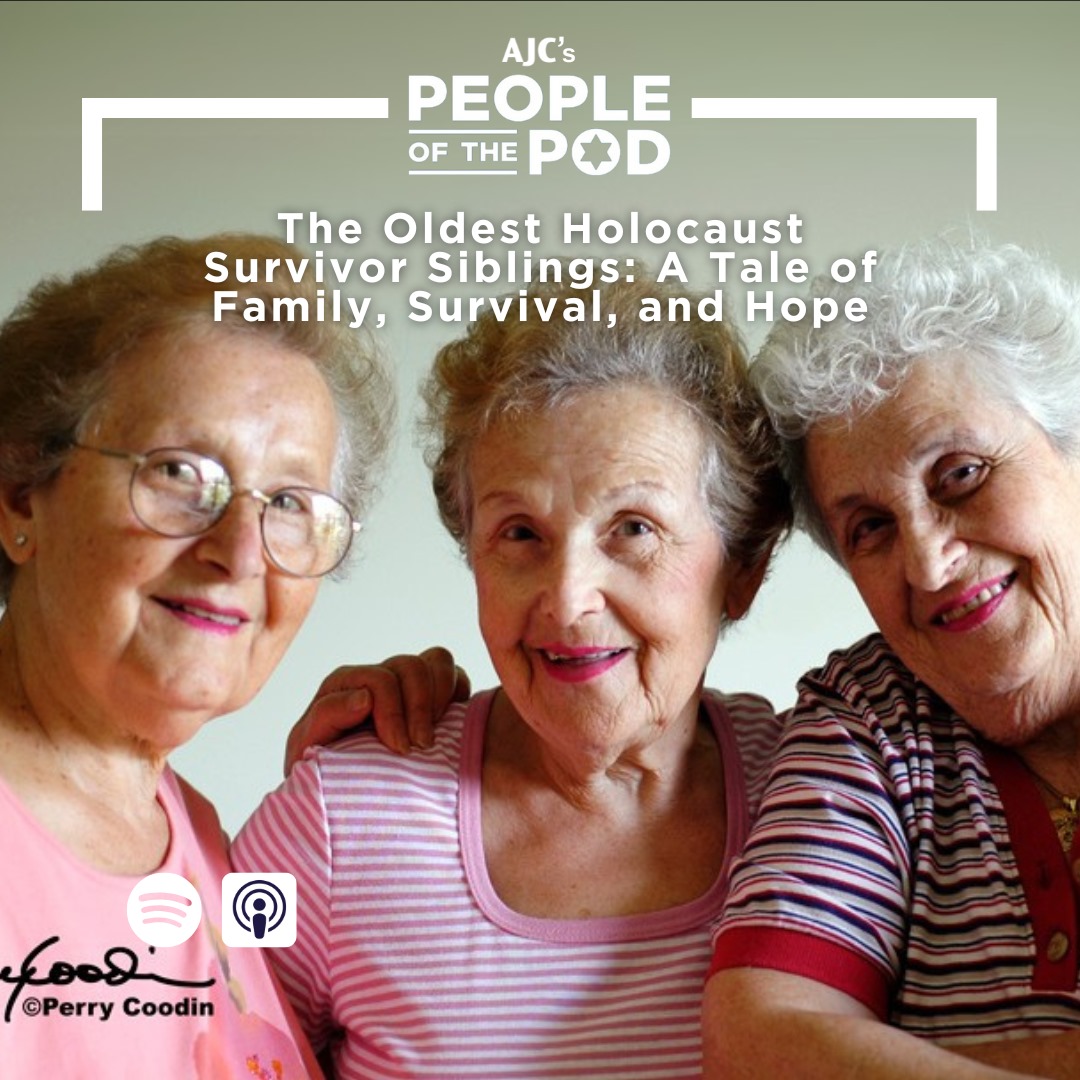
The Oldest Holocaust Survivor Siblings: A Tale of Family, Survival, and Hope
When the USC Shoah Foundation named three sisters and their brother from Sanok, Poland the oldest surviving siblings of the Holocaust, Canadian Jewish filmmaker Allan Novak, the son of one of those shvesters (sisters in Yiddish), realized it was time to use the footage he'd been collecting for years to tell their story. The result? Crossing the River: From Poland to Paradise – a heartwarming short documentary about how members of one family miraculously survived the Holocaust by staying together with each other and their parents. Listen to this conversation with Novak on his family's dream of moving to Israel, unwavering resilience, and positive outlook, despite losing 80 family members to the horrors of Nazism. *The views and opinions expressed by guests do not necessarily reflect the views or position of AJC. Resources: Watch the film: Crossing the River Artist Zoya Cherkassky print created in the spirit of the film: 250 signed and numbered prints will be sold with 100% of proceeds going towards Holocaust education through a series of initiatives developed and implemented in collaboration with AJC. The cost of the prints is $250. They can be purchased by credit card by calling 212-891-1454 or by emailing [email protected]. Or, you can send a check made out to AJC to the address below. In all instances, please be sure to mention that this is for a Zoya print. American Jewish Committee - 165 E. 56th St., New York, NY 10022 Listen – AJC Podcasts: The Forgotten Exodus: with Hen Mazzig, Einat Admony, and more. People of the Pod: Israeli Hostages Freed: Inside the Emotional Reunions, High-Stakes Negotiations, and What's Next Bring Them Home: Understanding the Israel-Hamas Hostage Deal and Its Impact Pack One Bag: Stanley Tucci and David Modigliani Uncover His Jewish Family's Escape from Fascism and Antisemitism in 1930s Italy Gov. Josh Shapiro and AJC CEO Ted Deutch on Combating Antisemitism Follow People of the Pod on your favorite podcast app, and learn more at AJC.org/PeopleofthePod You can reach us at: [email protected] If you've appreciated this episode, please be sure to tell your friends, and rate and review us on Apple Podcasts or Spotify. __ Transcript of Conversation with Allan Novak: Trailer: Ruth Zimmer: That's a camera. Allan Novak: No, this records sound. Sally Singer: [in Yiddish: It's so small.] Ruth Zimmer: Ok, Sally. Allan Novak: Meet the shvesters: Auntie Ruthie, Auntie Sally, and my mum, Anne. Anne Novak: I'm the quiet one. Ruth Zimmer: And I'm the pisk (loudmouth). Allan Novak: Along with my uncle Saul, they've been together since the 1920s. As they began to hit 100 the media started to take notice, and when the USC Shoah Foundation named them the oldest Holocaust survivor siblings in the world, I knew I needed to tell their story now. Ruth Zimmer: What do you want us to . . you want to ask questions? Okay, that's easier. Allan Novak: I want to talk about the war. ____ Manya Brachear Pashman: When the Shoah Foundation named three sisters and their brother from Sanok, Poland the oldest surviving siblings of the Holocaust, filmmaker Allan Novak, the son of one of those sisters, realized it was time to use the footage he'd been collecting for years to tell their story. The result? Crossing the River: From Poland to Paradise – a heartwarming short documentary about how members of one family miraculously survived the Holocaust by staying together with each other and their parents. Allan is with us now to talk about his extraordinary aunts, uncle and mom and this equally extraordinary Holocaust story. Allan, welcome to People of the Pod. Allan Novak: Thank you, Manya, great to be here. Manya Brachear Pashman: So you had been recording interviews and kind of a life with your family for decades, right, while kind of working on various other projects. But what finally moved you to make this a project? Allan Novak: Sure, well, I've been filming them since I got my Bar Mitzvah Super Eight camera a while ago, in the 70s, actually. And, yeah, I've been collecting footage, you know, at different times. Was inspired to interview, to capture their story, but really, more is just kind of a personal archivist kind of project. But then when the Shoah Foundation identified them as the oldest Holocaust survivor siblings in the world, as you mentioned, I kind of posted that in my social media. And then there was a huge reaction. People just loved this idea that these people survived all this, and we're still together and survived, and we're thriving, in fact. And actually had a producer friend of mine inquire about where the rights available to their story. So I had to laugh, because, you know, I'm a filmmaker, so I immediately realized that somehow, you know, my little family story had kind of broken in a way, and it didn't deserve to be told and shared with the world. Manya Brachear Pashman: So without giving too much away, can you tell our listeners a little bit about these extraordinary family members

Israeli Hostages Freed: Inside the Emotional Reunions, High-Stakes Negotiations, and What's Next
After 471 harrowing days in Gaza, Israeli hostages Emily Damari, Romi Gonen, and Doron Steinbrecher are finally reunited with their families. Julie Fishman Rayman, AJC's Managing Director of Policy and Political Affairs, discusses the emotional impact of these reunions, the high-stakes prisoner exchange deal, and the collaboration between the outgoing Biden administration and newly inaugurated President Donald Trump. This breakthrough highlights the broader societal trauma in Israel, the complexities of negotiating with Hamas, and the ongoing efforts to bring all hostages home. Learn how this pivotal moment could reshape U.S.-Israel relations and Middle East policy moving forward. Listen – AJC Podcasts: The Forgotten Exodus: with Hen Mazzig, Einat Admony, and more. People of the Pod: Bring Them Home: Understanding the Israel-Hamas Hostage Deal and Its Impact Pack One Bag: Stanley Tucci and David Modigliani Uncover His Jewish Family's Escape from Fascism and Antisemitism in 1930s Italy Gov. Josh Shapiro and AJC CEO Ted Deutch on Combating Antisemitism Mijal Bitton on What It Means to Be a Jew Today The Next Chapter in Catholic-Jewish Relations Follow People of the Pod on your favorite podcast app, and learn more at AJC.org/PeopleofthePod You can reach us at: [email protected] If you've appreciated this episode, please be sure to tell your friends, and rate and review us on Apple Podcasts or Spotify. __ Transcript of Conversation with Julie Fishman Rayman: Manya Brachear Pashman: The world watched Sunday as three women held hostage in Gaza for 471 days reunited with their families. The moving footage was juxtaposed against the frightening prospect of more than 1000 Palestinian prisoners, many of them convicted murderers and terrorists, would eventually return to freedom as well in exchange for the hostages. There was also the strange irony of a hostage crisis nearing an end amid a transition in the White House, just a week after President Carter, who departed the White House as the Iran hostage crisis neared the end, was laid to rest. Here to discuss the painful and painstaking process of bringing the hostages home is Julie Fishman Rayman, AJC's Managing Director of Policy and Political Affairs. Julie, welcome. Julie Fishman Rayman: Thank you so much, Manya, for having me. I appreciate the opportunity to tell this amazing story. Manya Brachear Pashman: It has been a long 470 days now for you and your team as you have worked so closely with hostages' families. What was it like for you to watch those reunion videos? Julie Fishman Rayman: Pure, pure joy. One of the things that I talk about with my team a lot is that we missed an opportunity during the last agreement, during the last releases, to really celebrate. You know, we sort of thought, oh, okay, this, this is it. Now we're going to soon be able to celebrate everyone coming home. But what we missed in that moment was that that was just the end of the sprint and the start of the marathon that we've been in now for so long. So being able to see these three released, all I could think was dayenu, this would be enough. You know, after all of this, after all the work, after all the agony, and certainly, you know, the families don't feel that way, and our work must continue. There's no question, we have to keep going until they're all home. But even, even if it were just Emily, just Romi, just Doron, this, to me, personally, feels enough. Manya Brachear Pashman: There was also talk of the very high price that was paid for these, for these hostages to return. It was so wonderful to see Gilad Shalit return home, but at the cost of more than 1000 prisoners, including Yawah Sinwar, who was the architect of the October 7 attack. And so I know there is this huge fear among Israelis now and that there are efforts underway to prevent this kind of deal, specifically, this kind of deal, from happening again. But where do you stand on this? Where does AJC stand on this? And where do the families stand on this? Julie Fishman Rayman: Well, I'll start by answering your question with regards to the families, because they are not a monolith. They're not unanimous in their opinions on this, and a lot of them, you know, even within families, feel very ambivalent, and don't even necessarily feel the same way in the morning that they do in the evening, because there's just so so so much emotion around this. Any deal to get hostages, to get political prisoners, to get anyone unjustly held, released, is ugly. If you peel back the onion layers or or look behind the curtain, you see all of the really yucky things that we don't want to acknowledge about, you know, negotiating with terrorists, about allowing people who have committed the most heinous crimes to be free. But that's the only way it works, right? That's the only way you get to an agreement. So unless you are fully confident, as you know, a government or a power that has citizens held unjustly, that you are going to be a

Bring Them Home: Understanding the Israel-Hamas Hostage Deal and Its Impact
After 467 days of anguish, Israel and Hamas have reached a pivotal agreement to begin releasing hostages. AJC Jerusalem Director Lt. Col. (res.) Avital Leibovich breaks down the deal's details, the phased approach to releases, and the emotional toll on families and the nation. Hear about the complexities of the negotiations, the potential political fallout, and the profound resilience of those waiting for their loved ones to come home. Listen – AJC Podcasts: The Forgotten Exodus: with Hen Mazzig, Einat Admony, and more. People of the Pod: Pack One Bag: Stanley Tucci and David Modigliani Uncover His Jewish Family's Escape from Fascism and Antisemitism in 1930s Italy Gov. Josh Shapiro and AJC CEO Ted Deutch on Combating Antisemitism Mijal Bitton on What It Means to Be a Jew Today The Next Chapter in Catholic-Jewish Relations Follow People of the Pod on your favorite podcast app, and learn more at AJC.org/PeopleofthePod You can reach us at: [email protected] If you've appreciated this episode, please be sure to tell your friends, and rate and review us on Apple Podcasts or Spotify. __ Transcript of Conversation with Avital Leibovich: Manya Brachear Pashman: On Wednesday, the Israeli government and Hamas terror group, at long last, 467 days, to be exact, announced a deal to bring the hostages home. The deal, which will unfold in phases, calls for Hamas to ultimately release the 98 remaining hostages in exchange for Palestinian prisoners convicted of terrorism and serving life sentences. The first exchange could happen as early as Sunday. Here, on day 468, to explain the deal and the mood on the ground in Israel, where families wait to see whether the Israeli cabinet will sign the agreement, is AJC Jerusalem director Avital Leibovich. Avital, thank you so much for joining us. Wow. 468 days, and this seems like such a breakthrough, at least on this end. Can you walk us through the details of what has been agreed upon? Avital Leibovich: So currently, the Israeli delegation is still in Doha in Qatar, and have not returned to Israel. When they will turn to Israel, after the agreement will be finalized, then the Cabinet will meet, the government will gather, and they will approve the agreement. So according to the draft that has been leaked to the Palestinian media, the agreement has a few stages. The first one has to do with releasing 33 hostages. That's the first stage. The 33 hostages, as we know, most of them, are alive, but unfortunately, there will be around 10 hostages that either have been murdered on October 7 by Hamas, and their bodies hijacked to Gaza, or those that have been murdered in captivity by Hamas. Now we know that the first ones to be released, hopefully on Sunday, we are praying for that, are women, children, female soldiers, and also men over the age of 50 with some illnesses or some health issues or humanitarian condition. Which, I think everybody is in a humanitarian condition after such a long time. So that is the first stage. The first stage will last 42 days. 42 days is a long time, and as we've seen and based on our past experience, Hamas can actually turn away, decide to change things last minute, halt the agreement and so on. In the course of those 42 days, Israel will release Palestinian prisoners. I have to say that the price is extremely high, because I'm talking about around 1000 Palestinian prisoners. When I look at the scale of how many prisoners will be released, versus a hostage, it's unbelievable. The price, quote, unquote, of an Israeli soldier, a female soldier, is very high compared to just an ordinary civilian. So around 1000 prisoners will be released in this duration. In addition to this, the IDF will gradually leave some areas, and then on day 16, there will be discussions regarding the second phase. Israel would like to see, on the second phase, the remaining hostages released. That's 65 additional hostages. And then we're talking about the third phase, which will be the reconstructing of Gaza. So these are the three phases. This is what we know for now. There are other components, like humanitarian aid, increasing significantly the number of trucks filled with aid going into Gaza, and we can talk about the implications of these prices, which Israel will be paying. Manya Brachear Pashman: Now a lot of American media are reporting this as a cease fire. Is that accurate? Avital Leibovich: No, the Israeli policy is very clear. Only after the last hostage we leave Gaza, this means 98 hostages will be out of Gaza. Only then Israel will be willing to cease fire. That's the reason why it's called a hostage agreement, and not a ceasefire agreement. Now we know Hamas. Hamas is a vicious enemy. It's a cruel enemy. You know, I just watched Palestinian media, and you'll be amazed to see how many civilians in Gaza, not Hamas related or Hamas oriented Palestinians, are saying that they wish that October 7 will return every year. They're supporting the repetition of October 7 yea

Pack One Bag: Stanley Tucci and David Modigliani Uncover His Jewish Family's Escape from Fascism and Antisemitism in 1930s Italy
As Stanley Tucci reflects, "Given the circumstances in today's world, the parallels between then and now are impossible to ignore. It's an incredible story, but it's also happening today, to millions of people . . . It's a story about people in a certain place and time, and what happened to them, and what happened to them has happened before, and has happened since, and will continue to happen. Unless we as the human race begin to understand that we are all the same." What would you do if fascism and antisemitism seized your homeland? In his award-winning podcast, Pack One Bag, documentarian David Modigliani takes listeners on a gripping journey through his family's escape from Italy in 1938. The podcast series features actor Stanley Tucci as Modigliani's great-grandfather, who was known as Italy's "King of the Books," and once advised Mussolini but later turned against him. As Modigliani retraces his family's steps across Italy, he uncovers hidden Fascist spy documents, personal family diaries, and the poignant Jewish love story of his grandparents that echoes through time. *The views and opinions expressed by guests do not necessarily reflect the views or position of AJC. Listen – AJC Podcasts: The Forgotten Exodus: with Hen Mazzig, Einat Admony, and more. People of the Pod: Gov. Josh Shapiro and AJC CEO Ted Deutch on Combating Antisemitism Mijal Bitton on What It Means to Be a Jew Today The Next Chapter in Catholic-Jewish Relations What's Next for the Abraham Accords Under President Trump? You can reach us at: [email protected] If you've appreciated this episode, please be sure to tell your friends, and rate and review us on Apple Podcasts or Spotify. __ Transcript of Conversation with David Mogdiliani and Stanley Tucci: Manya Brachear Pashman: As a documentary filmmaker, David Modigliani has created a variety of works on politics in America, improv comedy, and the improv comedy of politics in America. But during the pandemic, he discovered the love letters of his grandparents, written moments before they fled fascist Italy. Those letters led him to produce a more personal project – an award-winning podcast series starring Stanley Tucci, titled Pack One Bag. David is with us now to talk about that journey. David, welcome to People of the Pod. David Mogdiliani: Thank you so much for having me. I'm so glad to be here. Manya Brachear Pashman: So, at the core of your podcast, Pack One Bag, is the story of your grandfather, a Nobel Prize winner who fled Italy in 1938 and this was a story that you heard as a young man, as a teenager, right? But if you could share with our listeners what that story was, when you originally heard it. David Mogdiliani: Yeah, so my grandfather, I was just a five year old kid when he won the Nobel Prize for Economics in 1985. But as I became a teenager and started to grow up, I became sort of fascinated by their love story, the story of escape. Which was basically that my grandfather, Franco Modigliani, had been a 19 year old kid in Rome when Mussolini passed the racial laws against Jews like him, and he didn't know quite what to do, and he was so fortunate that he had fallen in love with this girl from Bologna named Serena Calabi, whose family had really been planning for this moment for many years, had had the foresight and the privilege to move resources outside of the country, put together an exit strategy, and when they fled Italy for Paris in the fall of 1938 they invited him to join them. They invited their daughter's boyfriend to join them. And the family was in Paris for about nine months and then made it onto the Normandie, a French ocean liner that left the coast of France in August of 1939 and turned out to be the last boat out of mainland Europe before Hitler invaded Poland and World War II began. So that kind of fairy tale escape, a whirlwind romance, that getting married, you know, in Paris on the run, and arriving in the US, kind of just in the nick of time, was the kind of origin story that I grew up with as a kid. Manya Brachear Pashman: And how did your grandmother's family know how to read those tea leaves? David Mogdiliani: My grandmother's father had been known as ile de libri, the king of the books in Italian because he had founded and run along with his wife, something called La messaggerie italiane, which was the biggest book distribution business in all of Italy. It gave him resources and an understanding of where things might be going in Europe in the 1930s so I had known all of that. But when I sort of became more interested in this project and wanted to learn more, and dug into some boxes that my dad had, 19 boxes of my family's documents, we found inside them, a couple of letters from Benito Mussolini to my great grandfather, the king of the books, and that kind of was a staggering moment to see the signature of the future dictator of Italy there at the bottom of the page. Mussolini had been a lefty socialist newspaper editor in 1914, 1915, and wh

Gov. Josh Shapiro and AJC CEO Ted Deutch on Combating Antisemitism
Last week, AJC CEO Ted Deutch traveled to Philadelphia to meet with Pennsylvania Governor Josh Shapiro for an in-depth discussion on combating antisemitism, ensuring the future vitality of Jewish communities in Pennsylvania and beyond, and addressing the challenges posed by rising political polarization both locally and nationally. "When it comes to antisemitism . . . there is no nuance. Antisemitism, bigotry, and hatred in all forms is not okay. Everyone in a position of public trust . . . has a responsibility to speak and act with moral clarity and speak out against it," said Governor Shapiro. AJC is a 501(c)3 not-for-profit organization. AJC neither supports nor opposes candidates for elective office. Watch: AJC CEO Ted Deutch, Gov. Josh Shapiro Say Fight Against Antisemitism Must Be Bipartisan Listen – AJC Podcasts: The Forgotten Exodus: with Hen Mazzig, Einat Admony, and more. People of the Pod: Mijal Bitton on What It Means to Be a Jew Today The Next Chapter in Catholic-Jewish Relations What's Next for the Abraham Accords Under President Trump? Honoring Israel's Lone Soldiers This Thanksgiving: Celebrating Service and Sacrifice Away from Home The ICC Issues Arrest Warrants: What You Need to Know Follow People of the Pod on your favorite podcast app, and learn more at AJC.org/PeopleofthePod You can reach us at: [email protected] If you've appreciated this episode, please be sure to tell your friends, and rate and review us on Apple Podcasts or Spotify. __ Transcript of Conversation with Ted Detuch and Josh Shapiro: Manya Brachear Pashman: Last week, AJC CEO Ted Deutch traveled to Philadelphia and sat down with Pennsylvania Governor Josh Shapiro for a conversation about antisemitism, the future of Jewish communities in Pennsylvania and across the nation, and growing political polarization not only in Philadelphia but throughout the country. The conversation was so powerful, we wanted to share it with a wider audience. So, I turn it over to Ted and Governor Shapiro. Ted Deutch: I'm going to start just by fessing up to something that I tried to do, that I fortunately failed at. I don't often tout my failure, but there was a time some number of years ago, Governor, where I thought that your future should take you to the United States House of Representatives. I tried to convince you to run for Congress, and you had other plans. Fast forward many years, thank God I was wrong, and thank you for the remarkable job you've done as governor of Pennsylvania. Josh Shapiro: Thank you. It's so good to be with you. Ted Deutch: Obviously, it's a really great to be with you. But I had, I wanted to break the ice just a little bit, if I may, with just some quick questions, just to lose, just to loosen you up a little, if that's alright. Josh Shapiro: Do I not seem loose? I feel pretty loose. Ted Deutch: Alright, very quickly. Favorite eagle of all time? Josh Shapiro: You know what I was on Eagles pregame live just yesterday, before the Birds played the Steelers. Birds beat the Steelers, by the way. And I got to sit next to Jaws. Ron Jaworski, and like, it was just a normal day. I was a little bit starstruck. So I guess I'd go with Jaws. Yeah. Ted Deutch: Alright. Better play-by-play announcer– Merrill Reese, Gene Hart? Josh Shapiro: Oh my God, come on. All right. That's like asking me to pick between my kids. Ted Deutch: Alright, I'll move on. Moving on, moving on, moving on. Some people here who don't, the handful who don't really get this at all, and my staff, who's saying, why are you doing this. Josh Shapiro: Merrill Reese by the way is about to get inducted into the Hall of Fame for, they do once a year, they do an announcer, and Merrill just won that award this year. Pretty amazing. Ted Deutch: He is amazing. Best Philly movie ever made? Josh Shapiro: Rocky. Ted Deutch: Easy. Thank you. Inappropriate question, perhaps at an AJC dinner, provolone or swiss? Josh Shapiro: I do enjoy provolone, but I'm not a cheesesteak guy, so. We have a kosher governor's residence. I can't be out eating cheesesteaks. Ted Deutch: It was a bit of a trick question, I'll admit. And then we'll just finish this off. Favorite Israeli food? Josh Shapiro: Falafel, but not from some fancy restaurant, though I do love Goldies and I love Michael, but on some like stand in the middle of nowhere in Israel, it's always delicious. Ted Deutch: This also gives me an opportunity to acknowledge Tsach Saar, who is the Consul General of Israel. Thank you very much for being here. All right, I tried. Thanks for playing along. Josh Shapiro: Did I not do well? You did try. Ted Deutch: You did great. You did great. Thank you. Josh Shapiro: No more lightning round? Ted Deutch: I have more. Josh Shapiro: Now we got to do this serious stuff? Ted Deutch: We do. And frankly, look, your answer to the silly question about cheesesteaks is the perfect lead in to my first question for you. The first governor, I grew up in Bethlehem, the first governor I remember w