
People of the Pod
409 episodes — Page 2 of 9

Mijal Bitton on What It Means to Be a Jew Today
As many Jews deepen their sense of Jewish identity, Dr. Mijal Bitton joins the podcast to explore the significance of our Jewish heritage, texts, and peoplehood and what it means as we enter the Hanukkah season. Bitton is a sociologist, storyteller, podcast host, and Jewish advocate who also serves as the spiritual leader of the Downtown Minyan in Manhattan. As one of the first Sacks Scholars, she helps young people reclaim and reimagine Jewish traditions. In this week's episode, Dr. Bitton discusses Sephardic Jewry, Jewish peoplehood, academia, the needs of young Jews, and the realities of intergroup and interfaith after October 7. Resources: The Morality and Ethics of Global Jewish Advocacy: Lessons from Rabbi Lord Jonathan Sacks - AJC Advocacy Anywhere Jewish Unpacked - Wondering Jews podcast, with guest AJC CEO Ted Deutch Listen – AJC Podcasts: The Forgotten Exodus: with Hen Mazzig, Einat Admony, and more. People of the Pod: The Next Chapter in Catholic-Jewish Relations What's Next for the Abraham Accords Under President Trump? Honoring Israel's Lone Soldiers This Thanksgiving: Celebrating Service and Sacrifice Away from Home The ICC Issues Arrest Warrants: What You Need to Know Follow People of the Pod on your favorite podcast app, and learn more at AJC.org/PeopleofthePod You can reach us at: [email protected] If you've appreciated this episode, please be sure to tell your friends, and rate and review us on Apple Podcasts or Spotify. __ Transcript of Conversation with Mijal Bitton: Manya Brachear Pashman: Dr. Mijal Bitton is a sociologist, storyteller and Jewish advocate. As the spiritual leader of the Downtown Minyan in Manhattan and one of the first Sacks Scholars, she helps young people reclaim and reimagine Jewish traditions. Michal is no stranger to our AJC audiences. Earlier this month, she delivered a powerful Advocacy Anywhere to commemorate Rabbi Lord Jonathan Sacks, for which the Sacks Scholars are, of course named. And as co-host of Jewish Unpacked's podcast Wondering Jews, she and Jewish educator Noah Weisman explore questions we all ask about the Jewish experience, from the mundane to the miraculous. In fact, just recently, they interviewed AJC CEO Ted Deutch. The podcast has covered topics spanning from how summer camp shapes Jewish lives, how to constantly juggle joy and pain, the impact of the Jewish vote in the most recent election, and in turn, the impact of Trump's resulting victory on Jewish America. Mijal is with us now in our Midtown Manhattan studio to rehash a little of that, but also to discuss what led her to take on her many roles, including her newest project. Mijal, welcome to People of the Pod. Mijal Bitton: Thank you, thank you for having me. Manya Brachear Pashman: If you could please share with our listeners about your heritage, about your upbringing. You were born in Argentina, correct? Mijal Bitton: I was born in Argentina. My father's family moved to Argentina from Morocco and Syria. My mother is from Spain. And part of what shaped my interest in Jews from the Middle East and North Africa, is that when we moved to America, we moved to a Persian Jewish community. So that was like my introduction to American Jews, this very tight knit Persian community in Long Island. Eventually, I met my husband, who is a Syrian Jew, with Egyptian and Iraqi background, and I wrote my PhD on the Syrian Jewish community in Brooklyn, which all just shows you a little bit my fascination. It's not just an identity, it's a tradition that I draw from and that I believe can actually give us very powerful tools right now. Manya Brachear Pashman: Now, is this a Syrian Jewish community from Aleppo or Damascus? Mijal Bitton: Historically, there is a big difference. I would say that a lot of these communities, you can think of them as pre-immigration and then new settlement in America. Right now in America, it's one community. The differences between Aleppo and Damascus are not that pronounced, maybe like when you cook a little bit the recipe that you use, or slightly different songs that you might have, depending where your family is from. Manya Brachear Pashman: You are, in fact, a visiting researcher at NYU, and you are the director of the National Study of the Sephardic and Mizrahi in the United States. What is that study all about? Mijal Bitton: Yeah. So when I wanted to do a PhD at NYU, which I did, on Syrian Jews, and I wanted to study Sephardic Jews, what I realized very quickly, and you might have seen this from your other podcast, is that there is very little good scholarship, good literature to explain to us who these Jews are. This is a problem, both in terms of historical research, and for me, I'm really interested in contemporary Jewish life. There was a huge gap of not having resources to understand Sephardic Jews in the United States. So I had to do my PhD, kind of trying to reconstruct, you know, even, like the categories of study, how do we think about Jewish observance and

The Next Chapter in Catholic-Jewish Relations
Bishop Joseph Bambera marks the launch of a groundbreaking Catholic-Jewish initiative - Translate Hate: The Catholic Edition - with a wide-ranging interview with AJC's People of the Pod. At a time when recent events have challenged Catholic-Jewish relations, Bambera, the Chairman of the U.S. Conference of Catholic Bishops Committee (USCCB) on Ecumenical and Interreligious Affairs, details why the church has made combating antisemitism a priority. Translate Hate: The Catholic Edition, a joint project of AJC and the USCCB, features Catholic commentary on various entries of AJC's renowned Translate Hate glossary of antisemitic terms, themes, and memes. It comes as Catholic and Jewish communities prepare to mark six decades of trust-building and mutual learning beginning when the Catholic Church reached out to the Jewish people and the world with Nostra Aetate, the historic Second Vatican Council document disseminated on October 28, 1965, which dramatically and publicly decried antisemitism and transformed the Church's approach to the Jewish people for the better.Resources: New Glossary Breaks Ground in Tackling Antisemitism Through a Catholic Lens Listen – AJC Podcasts: The Forgotten Exodus: with Hen Mazzig, Einat Admony, and more. People of the Pod: Bernard-Henri Lévy and AJC CEO Ted Deutch on How to Build a Resilient Jewish Future Post-October 7 What's Next for the Abraham Accords Under President Trump? The ICC Issues Arrest Warrants: What You Need to Know Follow People of the Pod on your favorite podcast app, and learn more at AJC.org/PeopleofthePod You can reach us at: [email protected] If you've appreciated this episode, please be sure to tell your friends, and rate and review us on Apple Podcasts or Spotify. __ Transcript of Conversation with Bishop Bambera: Manya Brachear Pashman: Nearly 60 years ago, the Roman Catholic Church issued a declaration called Nostra Aetate, a groundbreaking document that, among other things, aimed to heal the Church's strained relationship with the Jewish community at large. But over the past year, since the start of the Israel-Hamas war, there have been some tense moments: a call from Pope Francis to investigate whether Israel is committing genocide, a photograph of the Pope before a Nativity scene–featuring a keffiyeh. Now AJC and the US Conference of Catholic Bishops have unveiled Translate Hate: the Catholic edition, the glossary of antisemitic terms, tropes and memes, originally published in 2019, also features Catholic commentaries to explain why the church has made combating antisemitism a priority. Here to talk about this partnership is Bishop Joseph Bambera, Chairman of the US Conference of Catholic Bishops Committee on Ecumenical and interreligious affairs. Bishop, welcome. Most Reverend Joseph C. Bambera: Thank you for the honor of being with you today. Manya Brachear Pashman: Bishop Bambera, please walk us through the Catholic edition of Translate Hate and how the Catholic Church became involved in this initiative together with the Jewish community. Most Reverend Joseph C. Bambera: I think the best way to walk us through the Translate Hate Catholic edition is to first take us back to 1965 and the Second Vatican Council and the declaration on the church's relationship with non-Christian religions, and particularly with the Jewish community. There was this really milestone declaration Nostra Aetate that I think many of us would be familiar with, and that really speaks about our relationship as it stands today. A relationship that I would say. tragically prior to the Second Vatican Council was not what it should have been. And on the heels of the Council, for almost 60 years, an anniversary that we'll celebrate next year, we have grown together in mutual respect and understanding. That particular declaration Nostra aetate speaks very, very clearly about the fact that Catholics and Jews really share a common patrimony. We Catholics, our roots are in Judaism. Jesus was Jewish. His family was. And so many members of the early church were as well. And we recognize and affirm in that document the fact that the Jewish people were the first to hear the Word of God and are a part of a covenant relationship that certainly has not been in any way broken, but has been maintained. And something that we affirm and that we teach in that document. A very important thing, from my perspective. And as well, the document reminds all those who would be familiar with it, and certainly who should be, if they are not, of the importance of us coming to a deeper sense of mutual respect and understanding. Of decrying any sense of hatred, persecution, or antisemitic efforts on the part of individuals that really have been such a burden to the Jewish people. So that particular document really laid the groundwork, for the very simple fact that I am here today and a part of this initiative. But to fast forward a bit, the reality of antisemitism, as you know better than I, it has hardly dimi
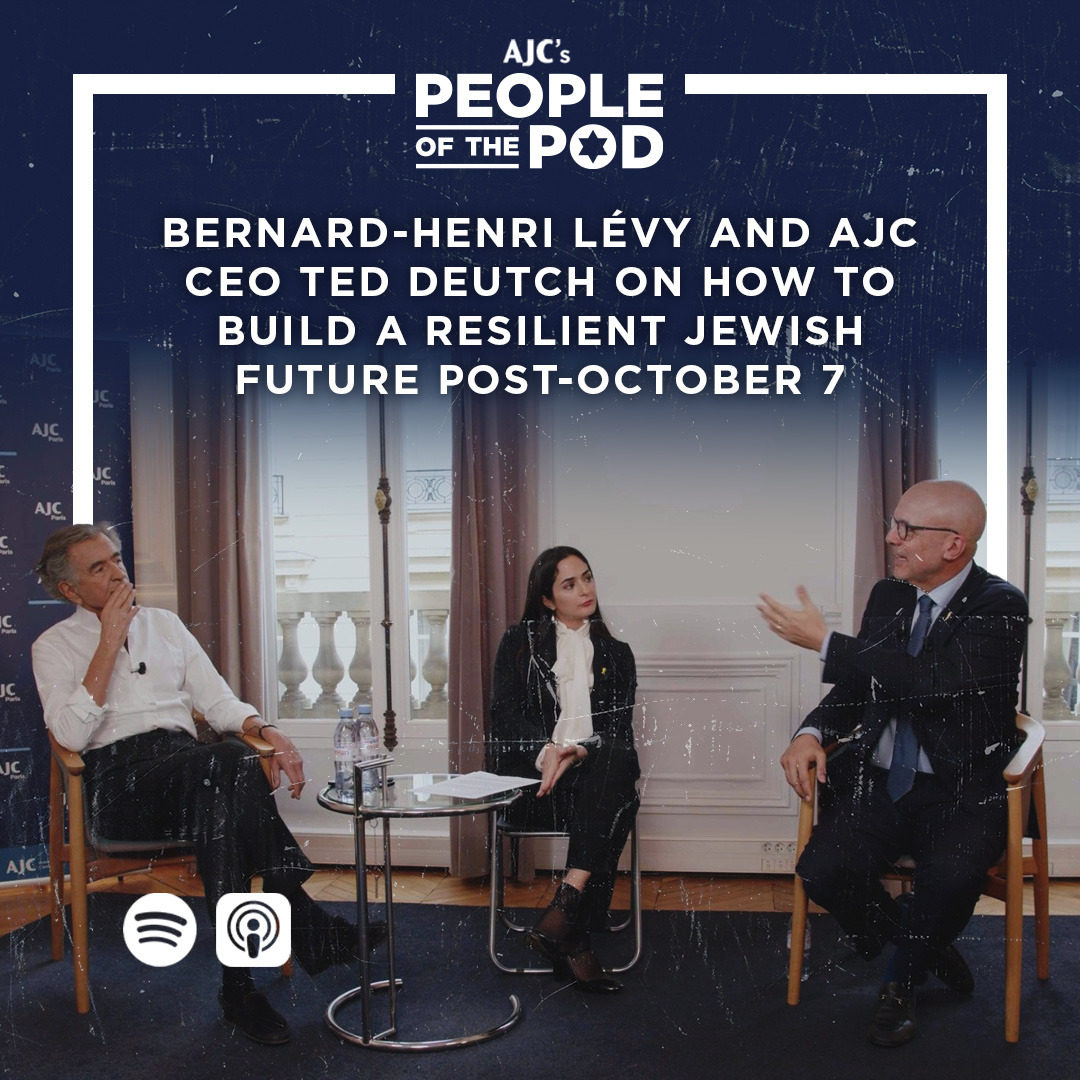
Bernard-Henri Lévy and AJC CEO Ted Deutch on How to Build a Resilient Jewish Future Post-October 7
What lessons can be drawn from the post-October 7 era? Amid growing isolation and antisemitism, where do opportunities for hope and resilience lie for the Jewish people? In a compelling discussion, AJC CEO Ted Deutch and Bernard-Henri Lévy—renowned French philosopher, public intellectual, and author of Israel Alone—explore these critical questions. Guest-hosted by AJC Paris Director Anne-Sophie Sebban-Bécache, this conversation offers insight into the challenges Jewish communities face and the possibilities for a brighter future. Listen – AJC Podcasts: The Forgotten Exodus: with Hen Mazzig, Einat Admony, and more. People of the Pod: What's Next for the Abraham Accords Under President Trump? Honoring Israel's Lone Soldiers This Thanksgiving: Celebrating Service and Sacrifice Away from Home The ICC Issues Arrest Warrants: What You Need to Know Follow People of the Pod on your favorite podcast app, and learn more at AJC.org/PeopleofthePod You can reach us at: [email protected] If you've appreciated this episode, please be sure to tell your friends, and rate and review us on Apple Podcasts or Spotify. __ Transcript of Conversation with Bernard-Henri Lévy and Ted Deutch: Manya Brachear Pashman: What lessons can be drawn from the post-October 7 era? Amid growing isolation and antisemitism, where do opportunities for hope and resilience lie for the Jewish people? I'm throwing it off to AJC Paris Director Anne-Sophie Sebban-Bécache to explore these critical questions. Anne-Sophie? Anne-Sophie Sebban-Bécache: Thank you, Manya. Welcome everyone to today's special episode of People of the Pod. I'm sitting here in our office near the Eiffel Tower for a special and unique conversation between Ted Deutch AJC CEO and Bernard-Henri Lévy, one of the most, if not the most prominent French philosopher and public intellectuals. Bonjour. Bernard-Henri Lévy: Bonjour. Hello. Anne-Sophie Sebban-Bécache: Today, we will speak about loneliness, the loneliness of the Jewish people in Israel, the explosion of antisemitism in Europe and the United States, the attacks on Israel from multiple fronts since October 7. We will also speak about the loneliness of Western democracies, more broadly, the consequences of the US elections and the future for Ukraine and the European continent. Bernard-Henri Lévy:, you've recently come back from a tour in the United States where you presented your latest book titled Israel Alone. Ted, you've just arrived in Europe to sound again the alarm on the situation of Jewish communities on this continent after the shocking assault on Israeli soccer fans in Amsterdam. Israel alone, the diaspora alone, actually the Jewish people, or Am Yisrael alone. As if Israel and Jews all over the world have merged this year over a common sense of loneliness. So I ask the question to both of you, are we alone? Bernard, let's start with you. Bernard-Henri Lévy: I am back from a campus tour in the United States of America. I went in USC, in UCLA, in Columbia, in Ohio, University in Michigan. I was in many places, and in these places, in the campuses, it's not even a question. The loneliness is terrible. You have Jewish students, brave, resilient, who have to face every day humiliation, provocations, attacks, sometimes physical attacks. And who feel that, for the first time, the country in the world, America, which was supposed to be immune to antisemitism. You know, we knew about antisemitism in Europe. We knew about antisemitism in the rest of the world. But in America, they discovered that when they are attacked, of course there is support. But not always from their teachers, not always from the boards of the universities, and not always from the public opinion. And what they are discovering today in America is that, they are protected, of course, but not as it was before unconditionally. Jews in America and in Europe are supposed to be protected unconditionally. This is minimum. Minimum in France, since French Revolution, in America, since the Mayflower. For the first time, there are conditions. If you are a right wing guy, you say, I protect you if you vote for me. If you don't vote, you will be guilty of my loss, and you will be, and the state will disappear in a few years. So you will be no longer protected. You are protected under the condition that you endorse me. On the left. You have people on the left wing side, people who say you are protected under condition that you don't support Israel, under condition that you take your distance with Zionism, under condition that you pay tribute to the new dark side who say that Netanyahu is a genocide criminal and so on. So what I feel, and not only my feeling, is the feeling of most of the students and sometimes teachers whom I met in this new situation of conditional security and support, and this is what loneliness means in America. Anne-Sophie Sebban-Bécache: Thank you, Bernard. How about you, Ted? Ted Deutch: Well, it's interesting. First of all, thank you Anne-Sophi

What's Next for the Abraham Accords Under President Trump?
The Abraham Accords marked a significant foreign policy achievement for President Donald Trump at the end of his first term in 2020. What's next for the Abraham Accords under a new Trump administration? Joining us is Rob Greenway, Director of the Allison Center for National Security at the Heritage Foundation and former senior director for Middle Eastern and North African Affairs on the National Security Council, to discuss the opportunities and challenges President Trump will face in the Middle East. Guest hosted by Benjy Rogers, AJC's Director for Middle East and North Africa Initiatives, Greenway draws on his firsthand experience with the Abraham Accords to explore how these agreements can be expanded and how security and economic cooperation between Israel and its neighbors can be strengthened. Resources: AJC Experts Assess the Global Impact of Trump's Election What President-Elect Trump's Nominees Mean for Israel, Antisemitism, and More The Abraham Accords, Explained Listen – AJC Podcasts: The Forgotten Exodus: with Hen Mazzig, Einat Admony, and more. People of the Pod: Honoring Israel's Lone Soldiers This Thanksgiving: Celebrating Service and Sacrifice Away from Home The ICC Issues Arrest Warrants: What You Need to Know What President-Elect Trump's Nominees Mean for Israel, Antisemitism, and More Follow People of the Pod on your favorite podcast app, and learn more at AJC.org/PeopleofthePod You can reach us at: [email protected] If you've appreciated this episode, please be sure to tell your friends, and rate and review us on Apple Podcasts or Spotify. __ Transcript of Conversation with Rob Greenway: Manya Brachear Pashman: The landmark achievement of the first Trump Administration was President Trump's ability to successfully broker peace treaties between Israel and the Arab countries of the UAE, Bahrain, and Morocco. While much has changed since the September 2020 signing of the Abraham Accords, there are high hopes that a second Trump Administration will once again focus on brokering Arab-Israeli peace. This week, my colleague Benjy Rogers, AJC's Director for Middle East and North Africa Initiatives, invited an expert from the first Trump administration to share his insights on what to expect. Benjy, the mic is yours. Benjamin Rogers: What can we expect from the incoming Trump administration, particularly when it comes to the committee's policy and the future of the Abraham Accords and regional integration? To help us break it all down, we're joined by someone who's been at the center of these historic developments, Rob Greenway. Rob is the director of the Allison Center for National Security at the Heritage Foundation, where he formulates policy to defend American freedom and prosperity. Rob has first hand experience with the Abraham Accords, having served as Deputy Assistant to the President and senior director of the National Security Council's Middle Eastern and North African Affairs Directorate during the first Trump administration. Rob has more than 30 years in public service, including as President and Executive Director of the Abraham Accords Peace Institute, advocating for the expansion of the agreements he helped craft. Rob has also served as Senior Intelligence Officer at the Defense Intelligence Agency, and is a decorated combat veteran within the US Army Special Forces. Rob, welcome to People of the Pod. We are honored to have you here. Rob Greenway: It's my great pleasure. Thanks for having me. Benjamin Rogers: Let's jump right into it. Much has changed in the Middle East since the last Trump administration, while the hope of the Abraham Accords continued into the Biden administration, the horrors of October 7 in its aftermath have transformed the region. How do you think the next Trump administration will address the ongoing conflicts in the Middle East, and do you see renewed hope for continuing to deepen and expand the Abraham Accords? Rob Greenway: It's a great question. I'll start in reverse order, because that's the optimistic part, right? The hope in all of the relatively dark circumstances and the escalation of the conflict that's really accelerated, but didn't begin in October the seventh, but it certainly accelerated dramatically. I certainly judge that there is hope. And there's hope because the shared interest between Israel and its neighboring countries is, in fact, very strong. And that the US fundamentally, and certainly under a Trump administration, I think, will reprioritize efforts to normalize Israel's relations with its neighbors, to confront shared adversaries, which obviously is Iran, its surrogates and proxies, including Hamas and Hezbollah. But also because the economic potential has to be unlocked through integration of Israel and its neighbors and the countries within the region. They all know this, and they all recognize the intrinsic importance of it, so both for security purposes and for economic reasons, the normalization process will be resumed, cer

Honoring Israel's Lone Soldiers This Thanksgiving: Celebrating Service and Sacrifice Away from Home
Supporting lone soldiers in the Israel Defense Forces (IDF)—those serving without immediate family in Israel—has never been more crucial. These soldiers face challenges such as language barriers, adjusting to a new culture, and coping with the emotional and physical demands of service, all while navigating feelings of loneliness, especially during holidays. This Thanksgiving, hear from lone soldiers Kerren Seidner and Nate LeRoy about their experiences and how they support fellow soldiers through Ach Gadol (Big Brother), an organization dedicated to helping those serving without family support. Resources: Ach Gadol: Big Brother Organization for Lone Soldiers Be Kind As Omer Balva Instagram page Listen – AJC Podcasts: The Forgotten Exodus: with Hen Mazzig, Einat Admony, and more. People of the Pod: The ICC Issues Arrest Warrants: What You Need to Know What President-Elect Trump's Nominees Mean for Israel, Antisemitism, and More What the Election Results Mean for Israel and the Jewish People The Jewish Vote in Pennsylvania: What You Need to Know Follow People of the Pod on your favorite podcast app, and learn more at AJC.org/PeopleofthePod You can reach us at: [email protected] If you've appreciated this episode, please be sure to tell your friends, and rate and review us on Apple Podcasts or Spotify. __ Transcript of Conversation with Nate LeRoy and Kerren Seidner: Manya Brachear Pashman: Lone soldiers are members of the Israel Defense Forces (IDF) who don't have immediate family to support them while they're serving. They face many challenges, including learning Hebrew, adapting to a new culture, and the physical and emotional demands of IDF service. And it may come as no surprise that lone soldiers also experience loneliness, especially on holidays celebrated back home. For two decades, AJC Jerusalem has held a special Thanksgiving dinner for lone soldiers. But after the Hamas terror attacks on October 7, 2023 as many lone soldiers were dispatched across the country, AJC sent boxes of sweets and other Thanksgiving delicacies to 48 lone soldiers deployed at different bases. Here to talk about why they served as lone soldiers, and the unique way they have volunteered their services since October 7, are two former lone soldiers, Kerren Seidner and Nate LeRoy. Kerren, Nate, welcome to People of the Pod. Nate LeRoy: Hi, thank you for having me. Manya Brachear Pashman: Kerren, I'll start with you, if you wouldn't mind sharing with listeners your back story. You were born in China, and then an Israeli couple living in the United States adopted you. Kerren Seidner: Correct. So I was adopted around 11 months old, both my parents, my Israeli Jewish family, my parents, they were living in Los Angeles, California at the time. They adopted me. They went to China to come adopt me, and I have an older brother who is biological to my parents. And then I grew up, my entire family, in a Jewish Israeli home. Manya Brachear Pashman: And so had you ever been to Israel? What inspired you to go to Israel for the first time and then later to serve? Kerren Seidner: For me, I always grew up in Israeli household. Growing up with the Israeli culture. I heard Hebrew every single day in my life. Although I did not learn Hebrew, my parents did not teach me. I think the first time I went to Israel was for my brother's Bar Mitzvah when I was six years old, and so ever since then, we would always go to Israel for the summer vacation. So I always grew up going to Israel. I've always been in touch with all my family and cousins, aunts and uncles that I have here in Israel. But I never thought I would ever come to Israel to serve until the age 18, where you grew up in American house, like in the American lifestyle, where at age 18, you need to decide if you want to go to college or university, or figure out what you want to do in life. So then I started thinking, You know what, maybe studying in Israel might be an option. But then my older brother, decided that he had just decided to draft to the army. So I thought maybe that might be a possibility for myself. And then overnight, it just kind of happened that I wanted to make Aliyah and draft to the army. My mom said, you know, you should be a combat soldier. It was very new at that time for girls to be in combat. Manya Brachear Pashman: So why did she encourage you to do combat? Kerren Seidner: Growing up, I've always done sports. I played soccer for 11 years. So I was always active. And I think my mom knew, coming from my dad, because most of the time I would spend with my dad, my mom in our household was different, where my mom was out working and my dad was a stay at home dad mostly. So I was always with him, and I always heard the stories of him being an officer in combat, and then right at age 16, my brother had just drafted to Said Golani. So hearing all these stories, my mom just knew it was very fitting for me to go to combat as well. Manya Brachear Pashman: Nate, you grew up in

The ICC Issues Arrest Warrants: What You Need to Know
The International Criminal Court (ICC) announced arrest warrants for Israeli Prime Minister Benjamin Netanyahu and former Defense Minister Yoav Gallant, accusing them of crimes tied to Israel's defense operations in Gaza. Why should supporters of Israel—regardless of political views—reject these accusations? Belle Yoeli, AJC's Chief Advocacy Officer, explains why the ICC's charges are not only baseless but also undermine justice, distort international law, and fuel harmful narratives following the deadliest antisemitic attack since the Holocaust. Listen – AJC Podcasts: The Forgotten Exodus: with Hen Mazzig, Einat Admony, and more. People of the Pod: What President-Elect Trump's Nominees Mean for Israel, Antisemitism, and More What the Election Results Mean for Israel and the Jewish People The Jewish Vote in Pennsylvania: What You Need to Know Go Deeper – AJC Analysis: Statement: American Jewish Committee Appalled by ICC's Issuance of Arrest Warrants Against Israelis Explainer: What You Need to Know About the ICC and the Israel-Hamas War Follow People of the Pod on your favorite podcast app, and learn more at AJC.org/PeopleofthePod You can reach us at: [email protected] If you've appreciated this episode, please be sure to tell your friends, and rate and review us on Apple Podcasts or Spotify. __ Transcript of Conversation with Belle Yoeli: Manya Brachear Pashman: The International Criminal Court announced on Thursday that it issued arrest warrants for Israeli Prime Minister Benjamin Netanyahu and former defense minister. You have Galant as well as Hamas terrorist Mohammed, if the Court said it had found reasonable grounds to believe that Netanyahu and Galant quote, each bear criminal responsibility for starvation as a method of warfare and crimes against humanity, end quote. All tied to Israel's military operations in Gaza focused on defeating Hamas terrorists, securing the return of the 101 remaining hostages and preventing more attacks. Here to talk about why the court is prosecuting Israel's leaders for its defense operation after the country suffered the deadliest antisemitic attack since the Holocaust, and why that's dangerous, is Belle Yoeli, AJC's Chief advocacy officer. Belle, welcome to People of the Pod. Belle Yoeli: Thanks so much, Manya. Manya Brachear Pashman: Do Belle, why have warrants been issued for Netanyahu and Gallant. Belle Yoeli: Right. So first and foremost, I just want to make it abundantly clear, and it really needs to be said, that this decision is absolutely outrageous. It's a gross distortion of international law and so many other things. It undermines the credibility of the court, and it fuels a lot of malicious lies about the state of Israel and its self defensive activities in Gaza since October 7. I will share the Court's reasoning for the warrants, and you alluded to it, quote, crimes against humanity and war crimes committed from at least the eighth of October, until at least the 20th of May 2024. The court claims they found reasonable grounds that Netanyahu and Gallant, again, quote, bear criminal responsibility for the following crimes as co-perpetrators for committing the acts jointly with others. The war crime of starvation as a method of warfare, and the crimes against humanity of murder, persecution and other inhumane acts. That's the direct quote, obviously very hard to read. And of course, AJC fundamentally rejects these claims, as do the United States and many, many leading international law and warfare experts. This is just a total and complete failure of justice. Manya Brachear Pashman: So why should supporters of Israel stand firmly against this accusation, no matter what their political views are? In other words, if they're not fans of Netanyahu, but they are ardent supporters of Israel, why should they stand firm against this? Belle Yoeli: Yeah, it's an important question, and we have to be clear. I mean, the court has politicized this by sort of taking this unprecedented action. But this is not about political issues, it's not about Netanyahu or Gallant. This is about the truth. This is about right and wrong, and the claims that are being made here are so outrageous and malicious. I mean, Israel is not intentionally starving Palestinian civilians or committing crimes. It just doesn't make sense. If it were, it would not be facilitating tons and tons of aid into the Gaza Strip every day, not to mention polio vaccines. I mean, the list goes on and on. Israel, like any other country, is defending itself, and not just in Gaza against Hamas, but on seven fronts, including Hezbollah and Lebanon, against Iranian proxies. And look, we've said it from the beginning, since Israel responded in this self defensive way, and we'll say it again: civilians die in war, and that is a terrible, horrible thing. But Israel is fighting its war in Gaza in response to Hamas' actions on October 7. It's about bringing the hostages home and preventing the ability of Hamas to attac
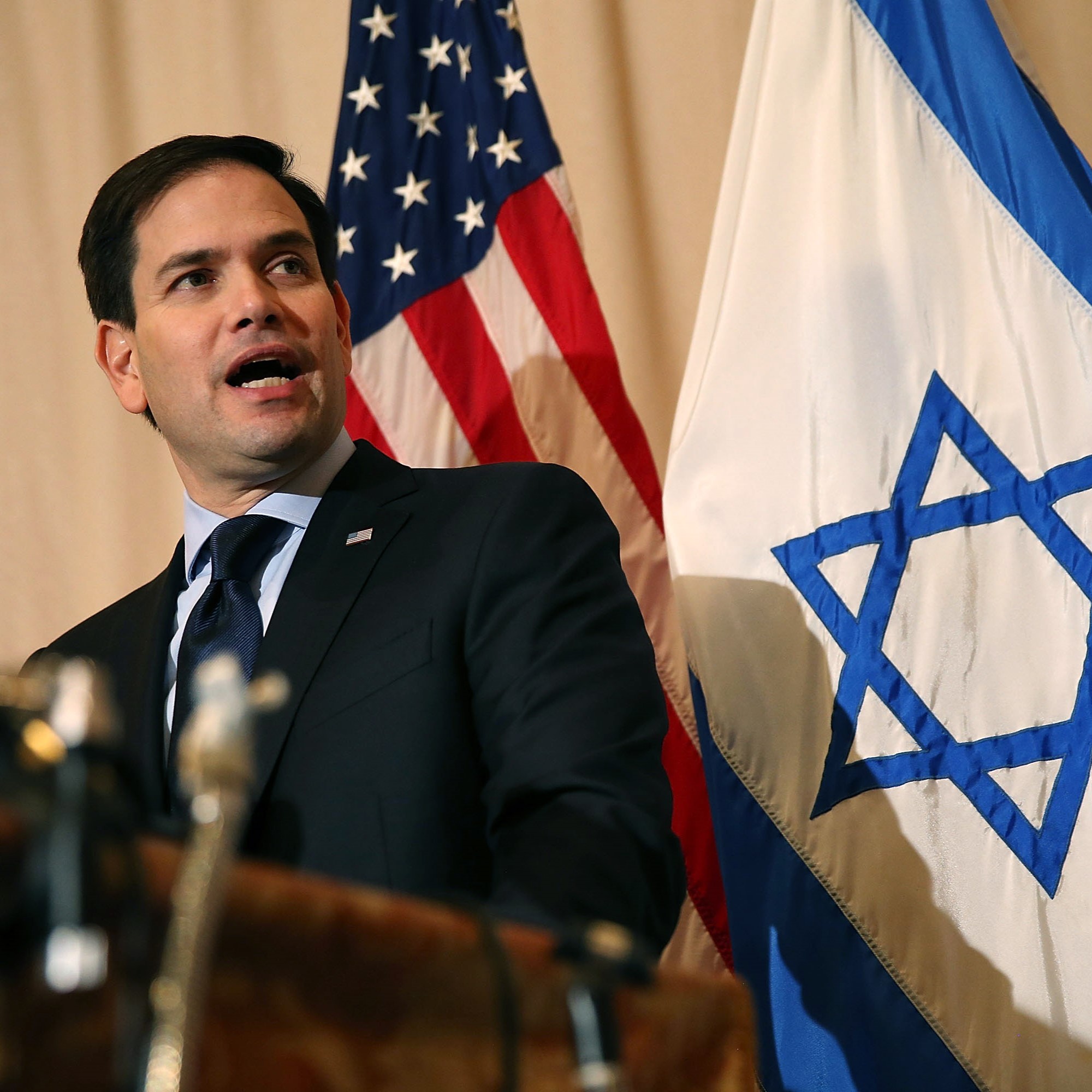
What President-Elect Trump's Nominees Mean for Israel, Antisemitism, and More
From Marco Rubio to Elise Stefanik: who are the nominations that President-elect Trump has announced, and what does their selection say about how the administration may take shape? Julie Fishman Rayman, AJC Managing Director of Policy and Political Affairs reviews the names announced thus far, how, if confirmed, they could impact efforts to counter antisemitism, support Israel, and uphold democratic values, and how AJC is advocating to advance these critical issues. Listen – AJC Podcasts: The Forgotten Exodus: with Hen Mazzig, Einat Admony, and more. People of the Pod: What the Election Results Mean for Israel and the Jewish People The Jewish Vote in Pennsylvania: What You Need to Know Sinwar Eliminated: What Does This Mean for the 101 Hostages Still Held by Hamas? Go Deeper – AJC Analysis: Explainer: What to Know About President-elect Trump on Antisemitism, Israel, and Iran Policy AJC Briefing — Post-Election Analysis: What to Expect Under the New U.S. Administration | Tuesday, November 19 | 1:30 p.m. Eastern | Register Here Follow People of the Pod on your favorite podcast app, and learn more at AJC.org/PeopleofthePod You can reach us at: [email protected] If you've appreciated this episode, please be sure to tell your friends, and rate and review us on Apple Podcasts or Spotify. Transcript of Conversation with Julie Fishman Rayman: Manya Brachear Pashman: President Elect Donald Trump has named and nominated eight of the 24 officials, including his chief of staff, most of whom would make up his cabinet. Returning to discuss the nominees so far and where they stand on AJC missions of fighting antisemitism, defending Israel and safeguarding democracy, is AJC Managing Director of Policy and Political Affairs, Julie Fishman Rayman. Julie, welcome back to People of the Pod. Julie Fishman Rayman: Thanks for having me, Manya, glad to be here. Manya Brachear Pashman: So you have worked with some of these nominees, and you know their track record on these issues. First of all, from a 30,000-40,000 foot view, what is your overall take on the slate so far? Julie Fishman Rayman: I feel like if you had asked me that yesterday, I would have had a totally different answer. And so I imagine even by the time People of the {od airs, my answer maybe would have even changed, so I will answer, but I want everyone, including our listeners, to take it with a grain of salt that I am speaking from a very specific moment in tim while the clock is rapidly changing and the situation is rapidly changing. So I think the initial slate of potential nominees that were announced gave a lot of folks, especially in sort of the foreign policy world, a good deal of comfort, right? So people like Representative Mike Waltz, people like Senator Marco Rubio, those types of folks. Even Governor Huckabee, are sort of these, these names of traditional conservatives who we say, Oh, they have a record. They have governed. They have a voting record. We know exactly where they stand and what they believe, and that it's not vastly dissimilar from any other previous Republican administration. Then, of course, there was the news about the potential coming in of Matt Gaetz, representative, Matt Gaetz, a Republican from Florida and Tulsi Gabbard. And I think those names and what they represent put everyone in a bit of a tailspin. Not simply because of who they are, although they come with a lot of really interesting backstory that we can unpack, if you want to, but not just because of who they are, but because they represent a really different part of the Republican Party. A really different part of the right wing world view that had not theretofore been represented in Trump's cabinet picks, definitely less of the traditional conservative mindset and much more in line with a, dare I say, like populist kind of perspective. And so there's tension now that people are trying to sort of understand and unravel. Manya Brachear Pashman: So let's talk about each individual. And you mentioned Marco Rubio, who is Trump's nominee for Secretary of State, the Florida Senator. He currently serves on the Foreign Relations Committee. He's the top Republican on the Intelligence Committee. And I mean, he and the President Elect seem to agree on America's approach to Iran and Ukraine, but not NATO, right? I mean, where do he and Mr. Trump agree and disagree? Julie Fishman Rayman: You're asking a question as though we have a full sense of what incoming president, former President Trump believes, which I think is a bit of an assumption. They're certainly deeply aligned on sort of big picture principles as they relate to support for Israel, no question. A tough, tough approach to whether it's an actor like Iran or China, you know, sort of these nefarious global players that seek to disrupt our world order, they're aligned there. There is a potential disconnect on Ukraine. Right? We've heard statements from Senator Rubio recently where you almost see him trying to channel the

Honoring Felice Gaer: A Lifelong Champion for Human Rights
Felice Gaer, esteemed Director of AJC's Jacob Blaustein Institute for the Advancement of Human Rights, was an internationally respected human rights advocate who dedicated more than four decades to championing the Universal Declaration of Human Rights and enforcing international commitments to prevent severe human rights violations globally. On November 9, Felice passed away after a prolonged battle with metastatic breast cancer. In honor of her legacy, we revisit her insightful conversation on People of the Pod, recorded last year during Women's History Month and on International Women's Day. As we remember and celebrate Felice's profound contributions, we share this interview once more. May her memory continue to be a blessing. __ Music credits: Drops of Melting Snow (after Holst, Abroad as I was walking) by Axletree is licensed under a Attribution 4.0 International License. Learn more about Felice Gaer: Felice Gaer, Legendary Human Rights Champion Who Inspired Generations of Global Advocates, Dies at 78 Listen – AJC Podcasts: The Forgotten Exodus: with Hen Mazzig, Einat Admony, and more. People of the Pod: What the Election Results Mean for Israel and the Jewish People The Jewish Vote in Pennsylvania: What You Need to Know Sinwar Eliminated: What Does This Mean for the 101 Hostages Still Held by Hamas? Follow People of the Pod on your favorite podcast app, and learn more at AJC.org/PeopleofthePod You can reach us at: [email protected] If you've appreciated this episode, please be sure to tell your friends, and rate and review us on Apple Podcasts or Spotify. __ Transcript of Conversation with Felice Gaer: Manya Brachear Pashman: This past weekend, AJC lost a phenomenal colleague. Felice Gaer, the director of American Jewish Committee's Jacob Blaustein Institute for the Advancement of Human Rights, was an internationally renowned human rights expert who, for more than four decades, brought life and practical significance to the Universal Declaration of Human Rights and international commitments, to prevent grave human rights abuses around the world. She died on November 9, following a lengthy battle with metastatic breast cancer. I had the honor of interviewing Felice last year during Women's History Month and on International Women's Day. We bring you that interview now, as we remember Felice. May her memory be for a blessing. _ Felice is with us now to discuss today's human rights challenges and the challenges she has faced as a woman in the Human Rights world. Felice, welcome to People of the Pod. Felice Gaer: Thank you, Manya. Manya Brachear Pashman: So let's start with the beginning. Can you share with our listeners a little about your upbringing, and how Jewish values shaped what you do today? Felice Gaer: Well, I had a fairly ordinary upbringing in a suburb of New York City that had a fairly high percentage of Jews living in it–Teaneck, New Jersey. I was shaped by all the usual things in a Jewish home. First of all, the holidays. Secondly, the values, Jewish values, and awareness, a profound awareness of Jewish history, the history of annihilation, expulsion, discrimination, violence. But also the Jewish values of universality, respect for all human life, equality before the law, sense of realism, sense that you can change your life by what you do, and the choices that you make. These are all core Jewish values. And I guess I always have found the three part expression by Rabbi Hillel to sum up the approach I've always taken to human rights and most other things in life. He said, If I'm not for myself, who will be, and if I'm only for myself, what am I? And if not now, when? So that's a sense of Jewish particularism, Jewish universalism, and realism, as well. Manya Brachear Pashman: You went to Wellesley, class of 1968, it's an all-women's college. Was there a strong Jewish presence on campus there at a time? And did that part of your identity even play a role in your college experience? Felice Gaer : Well, I left, as I said, a town that had a fairly sizable Jewish population. And I went to Wellesley and I felt like I was in another world. And so even as long ago as 1964-65, that era, I actually reached out to Hillel and participated in very minor activities that took place, usually a Friday night dinner, or something like that. But it really didn't play a role except by making me recognize that I was a member of a very small minority. Manya Brachear Pashman: Here on this podcast, we've talked a lot about the movement to free Soviet Jewry. As you pursued graduate work at Columbia, and also during your undergrad days at Wellesley, were you involved in that movement at all? Felice Gaer: Well, I had great interest in Russian studies, and in my years at Wellesley, the Soviet Union movement was at a very nascent stage. And I remember arguments with the Soviet Ambassador coming to the campus and our specialist on Russian history, arguing about whether this concern about the treatment of Soviet Jews
What the Election Results Mean for Israel and the Jewish People
What do the results of the 2024 U.S. presidential election, a sweeping victory for President-elect Donald Trump and Vice President-elect J.D. Vance, mean for the U.S. Jewish community and Israel? How did the Jewish community vote? What are the top takeaways from the Senate and the House elections? Get caught up on all the latest election data points and analysis in this week's episode, featuring Ron Kampeas, JTA's Washington Bureau Chief and guest hosted by Julie Fishman Rayman, AJC's Managing Director of Policy and Political Affairs. AJC is a 501(c)3 not-for-profit organization. AJC neither supports nor opposes candidates for elective office. The views and opinions expressed by guests do not necessarily reflect the views or position of AJC. AJC's Policy Priorities: AJC Congratulates President-Elect Donald J. Trump Listen – AJC Podcasts: The Forgotten Exodus: with Hen Mazzig, Einat Admony, and more. People of the Pod: The Jewish Vote in Pennsylvania: What You Need to Know Sinwar Eliminated: What Does This Mean for the 101 Hostages Still Held by Hamas? From Doña Gracia to Deborah Lipstadt: What Iconic Jewish Women Can Teach Us Today Follow People of the Pod on your favorite podcast app, and learn more at AJC.org/PeopleofthePod You can reach us at: [email protected] If you've appreciated this episode, please be sure to tell your friends, and rate and review us on Apple Podcasts or Spotify. Transcript: Julie Fishman Rayman: Hello, I'm Julie Fishman Rayman, AJC's Managing Director of Policy and Political Affairs. Today, I have the pleasure of guest hosting People of the Pod and speaking with Ron Kampeas, JTA's Washington Bureau Chief, to discuss the results and the implications of the 2024 U.S. presidential election. As the nonpartisan global advocacy organization for the Jewish people, AJC congratulates Donald J. Trump on his election as the 47th President of the United States, and Senator JD Vance as Vice President. AJC looks forward to working with the President-elect and his administration on the domestic and foreign policy concerns that are AJC advocacy priorities to learn more about our policy priorities for the incoming administration. Head to the link in our show notes. As a reminder, AJC is a 501(c)3 non-partisan, not for profit organization. AJC neither supports nor opposes candidates for elected office. Ron, welcome to People of the Pod. Thank you for being here. Ron Kampeas: Of course. Julie Fishman Rayman: Well, I'd like to start asking you if you have a sense about the Jewish vote, because there have been a number of different exit polls, which, I guess, not surprisingly, because exit polls are what they are, say vastly different things. There are some that say it's the biggest Jewish vote in support for a Democratic candidate ever, and then also the highest percentage ever for a Republican candidate. What do we know to be true? And what would you sort of be looking at in terms of, you know, as we're examining this moving forward, what are we looking for? Ron Kampeas: So first of all, I know I've seen those very extreme assessments as well, and I know what they're based on, and even based on what they're based on, and we, I'll talk about that too, that's just not correct. So they're talking about a 79% turnout, according to a poll, the consortium of a number of organizations like CNN and the New York Times. And that poll is not reliable yet. It does show 79% and think 21%, in other words, an even split. Nobody seemed to have voted for, at least among the Jews, for third party candidates. And I'm not sure what number of Jews who were included in that poll were. I mean, it's a vast, vast poll. They do talk to a lot of people, but even they will say, and I think they put it on their things, that it's just preliminary. The more reliable analysis is considered to be the one that came out of the Fox-AP analysis that showed 66%-67% for Harris, 32%-31% for Trump. And I think that's what the Trump people are talking about in terms of the highest for Republicans. It's just not the highest for a Republican. I think if you count in the margin of error, that's not even like recently the highest for a Republican. Nothing's changed in the last four years. I think what it is showing is that whereas Republicans, when I started at JTA in 2004 they were happy to get 25%. They've gone up from 19% with George W. Bush in 2020 to 25% with John Kerry a few years later. Now they can comfortably say they're getting about 30% of the Jewish community. People love to attach everything that happens to the very current politics of the day. So however you count it, nothing seems to have changed. Julie Fishman Rayman: So interesting, because for I think a lot of Jews around America, we feel as though so much has changed. But when you go to the voting booth, Jews consistently aren't necessarily thinking just about either Israel or antisemitism. AJC does a survey looking at American Jewish opinion, not every year, but almost e

The Jewish Vote in Pennsylvania: What You Need to Know
As election day nears, Republican nominee and former President Donald Trump and Democratic nominee, Vice President Kamala Harris, are zeroing in on Pennsylvania, which has the largest Jewish community among the battleground states. Aaron Troodler, editor of the Philadelphia Jewish Exponent, breaks down what's influencing Jewish voter sentiment in Pennsylvania, from economic and social issues to the U.S.-Israel relationship amid rising antisemitism and Israel's defensive war against Iran-backed Hamas and Hezbollah. AJC is a 501(c)3 not-for-profit organization. AJC neither supports nor opposes candidates for elective office. The views and opinions expressed by guests do not necessarily reflect the views or position of AJC. Listen – AJC Podcasts: The Forgotten Exodus: with Hen Mazzig, Einat Admony, and more. People of the Pod: Sinwar Eliminated: What Does This Mean for the 101 Hostages Still Held by Hamas? From Doña Gracia to Deborah Lipstadt: What Iconic Jewish Women Can Teach Us Today The Nova Music Festival Survivor Saved by an 88-Year-Old Holocaust Survivor Follow People of the Pod on your favorite podcast app, and learn more at AJC.org/PeopleofthePod You can reach us at: [email protected] If you've appreciated this episode, please be sure to tell your friends, and rate and review us on Apple Podcasts or Spotify. __ Transcript of Conversation with Aaron Troodler: Manya Brachear Pashman: It's the home stretch leading up to election day for the presidential campaigns of Republican nominee and former President Donald Trump and Democratic nominee, Vice President Kamala Harris. And both campaigns see Jewish voters in seven swing states as key to a potential victory. These seven swing states are swarming with canvassers, knocking on doors, handing out literature and engaging undecided voters in critical conversations. Joining us for a critical conversation about the Jewish vote in one of those swing states is Aaron Troodler, editor of The Philadelphia Exponent and The Washington Jewish Week. Aaron, welcome to People of the Pod. Aaron Troodler: Thank you, Manya, it's a pleasure to be here. Manya Brachear Pashman: Aaron, you live in the Philadelphia area and have your finger on the political pulse there. Everyone's talking about the impact of Pennsylvania's voters. What makes Pennsylvania so key? Aaron Troodler: So I think they're going to have a very significant influence. There are a lot of people saying these days that the path to the presidency runs through Pennsylvania, and I do think that there's a degree of truth to that. But in fact, I believe that the path to the presidency may very well run through the Jewish community, not just in Pennsylvania, but more specifically, in the greater Philadelphia area. Manya Brachear Pashman: How much of an influence are they going to have in this election? Aaron Troodler: Ballpark, the Jewish population in Pennsylvania is estimated somewhere between 400,000, a little bit north of that figure. Of that 400,000 and change, it's estimated that approximately 300,000 or so are of voting age. And when you take into account that in 2020, Joe Biden beat then-President Donald Trump only by about 80,000 votes cast in Pennsylvania. And then, if you look back to 2016, Donald Trump won by only about 44,000 votes. We're talking about very slim margins here, and the outsized influence of the greater Jewish community is really going to shine through in this election. Manya Brachear Pashman: Now, are you talking about Philadelphia city proper, or suburban Philadelphia? Is there a difference in how the two vote? Aaron Troodler: Great question, Manya, focusing primarily on suburban Pennsylvania. You have, for example, in 2019, the Jewish Federation of Greater Philadelphia–and I know this goes back five years, but it's the most recent data we have–did a population study, a community profile. And they looked at basically five counties, give or take, including Philadelphia County, which includes the city, but also 4 suburban counties: Bucks, Chester, Delaware, and Montgomery. And approximately at that point– again, dating back five years–but there are approximately 195,000 Jewish households at the time. And that number has grown over the past several years. I won't be able to really quantify it, because we don't have the actual data, but it's a significant number. And you know, when you take into account that Pennsylvania's Fourth Congressional District, which is represented by Madeleine Dean, it's mostly Montgomery County, which is suburban Philadelphia County. It's got the largest Jewish population in the state, in terms of congressional districts. It's very significant. And then the second largest is Pennsylvania's first congressional district, which is represented by Brian Fitzpatrick. And again, there are about 40,000 Jewish adults in that district. 54,000 or so, give or take, in the Montgomery County area. We're talking about big numbers. And I think what's happening now is just by

Sinwar Eliminated: What Does This Mean for the 101 Hostages Still Held by Hamas?
How will the killing of Hamas leader Yahya Sinwar affect Israel's security and regional stability? What are the implications for the 101 hostages still held by Hamas? Join us as AJC Jerusalem Director Lt. Col. (res.) Avital Leibovich and AJC Chief Policy and Political Affairs Officer Jason Isaacson discuss the Israeli Defense Forces' recent elimination of the terror leader responsible for orchestrating the October 7 attacks and thousands of deaths. They'll break down the impact of the unfolding situation and what comes next. Watch – Israel Update: Analyzing the Impact of Yahya Sinwar's Death - AJC Advocacy Anywhere Listen – AJC Podcasts: The Forgotten Exodus: with Hen Mazzig, Einat Admony, and more. People of the Pod: From Doña Gracia to Deborah Lipstadt: What Iconic Jewish Women Can Teach Us Today The Nova Music Festival Survivor Saved by an 88-Year-Old Holocaust Survivor Follow People of the Pod on your favorite podcast app, and learn more at AJC.org/PeopleofthePod You can reach us at: [email protected] If you've appreciated this episode, please be sure to tell your friends, and rate and review us on Apple Podcasts or Spotify. __ Transcript of Conversation with Jason Isaacson and Avital Leibovich: Manya Brachear Pashman: Last week, Israeli Defense Forces killed Hamas leader Yahya Sinwar, the architect of the October 7 terror attacks. His death comes two months after the murder of six hostages who he had been using as his human shields. What comes next? How will Sinwar's death impact the dynamics within Hamas and the broader conflict between Israel and other Iran-backed proxies? What are the potential implications for Israel's security and regional stability? And what does this mean for the 101 hostages still being held by Hamas? For answers to those pressing questions, AJC welcomed its Jerusalem director, Lt. Colonel Avital Leibovich and Chief Policy and Political Affairs Officer Jason Isaacson, for an in-depth analysis of the unfolding situation. Here's a portion of that conversation. Jason Isaacson: Thanks very much. Before we begin our discussion, Avital, please allow me to again express to you, my and all our AJC colleagues and supporters' gratitude for your consistent availability throughout this difficult, dangerous period, to brief the AJC family on the challenges that Israel faces, the trauma that Israel suffered on October 7, on and onward, and the remarkable resilience of the people of Israel in the face of terrorism. Allow me also to wish you and your family and our AJC colleagues in Jerusalem a healthy and, let's hope, a more peaceful New Year. We are meeting now one week after a major development, perhaps even a turning point in Israel's necessary war against Hamas, the killing of the terrorist organization's leader, the murderous mastermind of October 7, Yahya Sinwar by the IDF in Rafah in southern Gaza. I want to hear your thoughts on the ramifications of that successful operation, which has been praised by the US and other world leaders. But first, let me ask you two questions. First, how was the IDF able to finally track down this most-wanted war criminal. And second, how did Sinwar's elimination figure in Israel's set of priority objectives for the self defensive campaign that it has been conducting in Gaza? Avital Leibovich: Thank you, Jason, for your kind opening words, and it's always good to be with you here on another what I think will be an interesting session for our listeners. So it was the day of October 16, few days ago, IDF troops, actually reserve units, were working in a neighborhood in Rafah called El Sultan neighborhood. This is approximately one kilometer from Israel, so it's a relatively short distance, they have identified. These soldiers have identified three suspicious figures, between moving from one area to another, between buildings. And they fired towards the suspects, and then the group split into two. Two of them stayed in one area and another one stayed in another building. And in order to make sure that buildings are not booby trapped, so the forces are not endangered, what the IDF often does, it sends a drone with a camera inside the building, searching and checking out to see who is exactly there, and then they saw on a couch in the corner of a living room. This was, by the way, a very fancy villa in this neighborhood. They saw a figure sitting there, with his head covered, with his face covered, and armed with a weapon, with grenades, and they fired. They understood that this is a terrorist, and they fired towards that person. Because, again, there was danger of the amount of explosives that were placed in this specific house, it took only 24 hours until the forces return and then search the house. When they got to this terrorist sitting on the arm chair, they suddenly realized that it looked very similar to Sinwar. But in order to check, you know whether it was Sinwar or not, they had to take a DNA sample from one of his fingers. And Sinwar has been i

From Doña Gracia to Deborah Lipstadt: What Iconic Jewish Women Can Teach Us Today
What do Doña Gracia, Glückel of Hameln, and Deborah Lipstadt have in common? They are all celebrated as iconic Jewish women in Dr. Aliza Lavie's incisive book, "Iconic Jewish Women". Dr. Lavie's book features 59 remarkable role models, highlighting the significance of women's voices and leadership in the Jewish community. In a compelling conversation guest-hosted by Dr. Alexandra Herzog, the national deputy director of AJC's Contemporary Jewish Life department, Lavie reflects on her grandmother's strength and her own experiences serving in the Israeli army and parliament. By showcasing the resilience and leadership of Jewish women throughout history—some stories well-known, others less recognized—Dr. Lavie emphasizes the need to confront the pervasive silence surrounding antisemitism. She urges us to learn from those who have paved the way, advocating for greater awareness and action against this global issue. *The views and opinions expressed by guests do not necessarily reflect the views or position of AJC. Listen – AJC Podcasts: The Forgotten Exodus: with Hen Mazzig, Einat Admony, and more. People of the Pod: The Nova Music Festival Survivor Saved by an 88-Year-Old Holocaust Survivor Is Nasrallah's Death a Game-Changer? Matthew Levitt Breaks What's at Stake for Israel, Iran, and Hezbollah At the UN General Assembly: Jason Isaacson Highlights Israel's Challenges and the Fight Against Antisemitism Follow People of the Pod on your favorite podcast app, and learn more at AJC.org/PeopleofthePod You can reach us at: [email protected] If you've appreciated this episode, please be sure to tell your friends, and rate and review us on Apple Podcasts or Spotify. __ Transcript of Interview with Aliza Lavie: Manya Brachear Pashman: Former Israeli Knesset member, Aliza Lavie is the author of six books, including the award winning "A Jewish Women's Prayer Book". Her latest, "Iconic Jewish Women"–59 inspiring, courageous, revolutionary role models for young girls, introduces readers to amazing women from Queen Esther to Justice Ruth Bader Ginsburg and others in between, many of whom have been overlooked, but offer inspiring tales. My colleague, Alexandra Herzog, is the national deputy director of AJC's Contemporary Jewish life department, and another amazing woman. She is our guest host this week, and she had the honor of speaking with Dr. Lavie. Alexandra, the mic is yours. Alexandra Herzog: It's an honor and great pleasure to welcome Dr. Aliza Lavie to People of the Pod today. She's the author of six books. I want to especially highlight the two latest ones, "A Jewish Women's Prayer Book," which won a National Jewish Book Award in 2008. And the latest one that we will be talking about today, "Iconic Jewish Women". In many ways, Aliza gives voice to women who have been forgotten from Jewish history, and for that, I and so many women are so very grateful. Since this book is about women, I want to make sure we don't forget all the women who are still held hostage by Hamas in Gaza. Not just our women, but also the children and the men. May we bring them all back. Okay, let's dive into the conversation. Aliza, welcome to People of the Pod. Aliza Lavie: Thank you so much, Alexandra. Alexandra Herzog: It's very interesting that you have focused much of your writing about and for women. Let's also remind our listeners that your academic and professional background show your very long standing interest in women's issues. During your time in the Knesset, you served as the chair of the Committee on the Status of Women and Gender Equality, and the chair of the Committee to Combat Women Trafficking and Prostitution. So let me ask you this. Why this interest? Where does it stem from? Aliza Lavie: I believe in equality, and we need to work for it. We need men and women together to build a society. My grandmother came from Afghanistan, together with her husband. It was 1920, many, many years ago. They came to Jerusalem as a Zionist before Israel was established and became part of Jerusalem. They built and established a Bukharian neighborhood in Jerusalem, very, very old neighborhood. But my granny, she lost her husband years after, two, three years after. Suddenly, she found herself without a voice, without a language, and she raised nine children. At that time, it was the big war just before Israel was established. And my granny, my granny, knew all the halachic code and all the Torah by heart. And always I asked myself, who told her? Who gave her the information? And more, I became, you know, part of the Israeli society, as an officer in the army, in the Israeli army, and later as a lecturer at the University, and later became a parliament member and activist in Israel. So I found myself asking questions without finding answers. And I say to myself, come on, be part of the tikkun, be part of changing the mood. Not because it's women's issue or problems, it's because the society needs men and women together, otherwise the socie
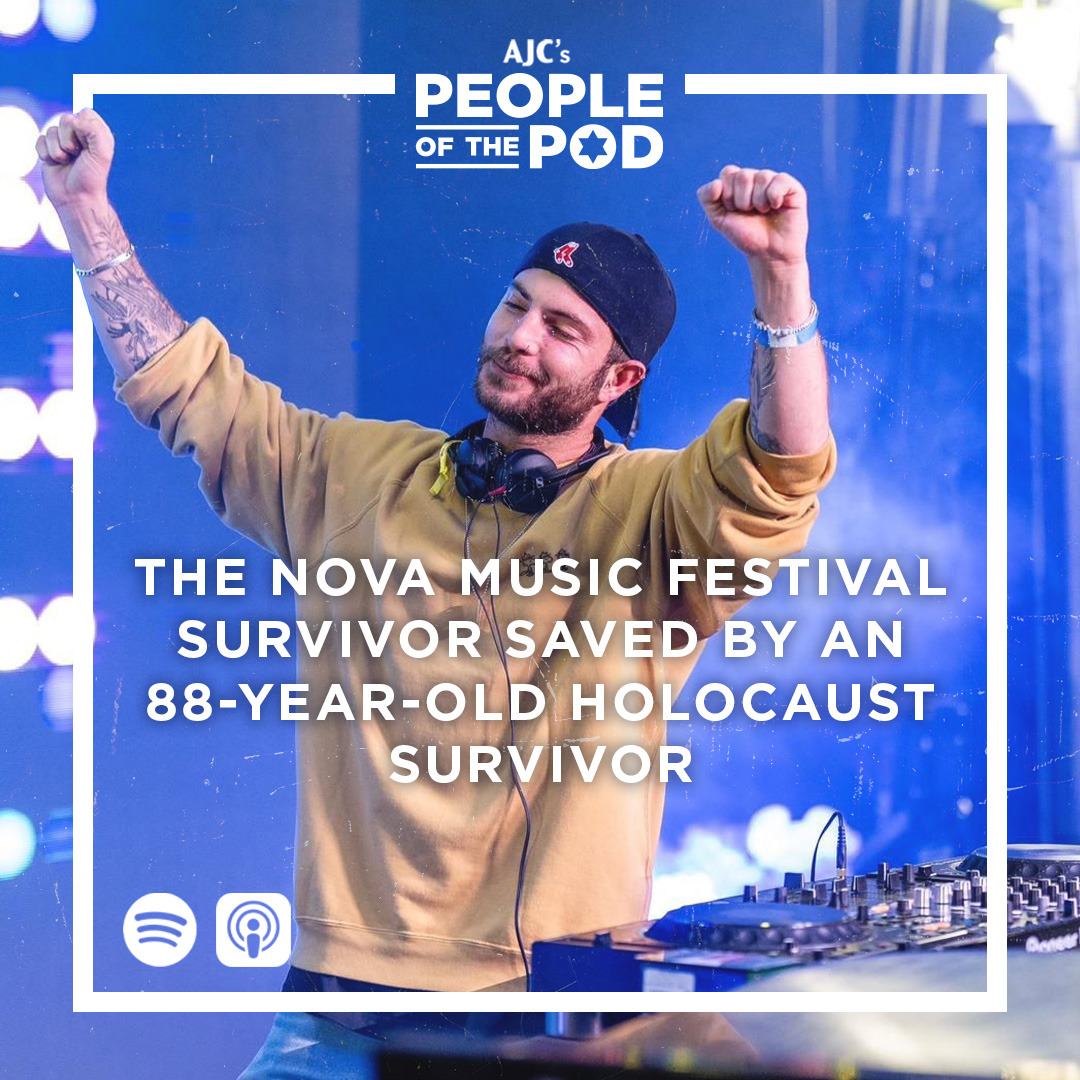
The Nova Music Festival Survivor Saved by an 88-Year-Old Holocaust Survivor
"I want to show the word that you can choose light . . . no matter how much dark you saw, or what's going on in Israel now, or what's going on in the world, there's still a choice." As we mark one year since Hamas' massacre of Israelis, Israeli DJ Daniel Vaknin, 30, shares his harrowing experience from the Nova Music Festival, where 340 attendees were brutally murdered in the deadliest event in music history. Vaknin recounts the chaos as rockets from Gaza struck, triggering a desperate evacuation and his narrow escape while being shot at, taking refuge in nearby Kibbutz Sa'ad at the home of an 88-year-old Holocaust survivor. Vaknin highlights the incredible resilience of the Israeli people and the pressing need for global support to bring the hostages home. *The views and opinions expressed by guests do not necessarily reflect the views or position of AJC. Listen – AJC Podcasts: The Forgotten Exodus: with Hen Mazzig, Einat Admony, and more. People of the Pod: Is Nasrallah's Death a Game-Changer? Matthew Levitt Breaks What's at Stake for Israel, Iran, and Hezbollah At the UN General Assembly: Jason Isaacson Highlights Israel's Challenges and the Fight Against Antisemitism From Rocket Attacks to Exploding Pagers: Michael Oren on Escalating Tensions Between Israel and Hezbollah Paris 2024: 2 Proud Jewish Paralympians on How Sports Unites Athletes Amid Antisemitism Follow People of the Pod on your favorite podcast app, and learn more at AJC.org/PeopleofthePod You can reach us at: [email protected] If you've appreciated this episode, please be sure to tell your friends, and rate and review us on Apple Podcasts or Spotify. __ Transcript of Interview with Daniel Vaknin: Manya Brachear Pashman Daniel Vaknin is a 30-year old Israeli DJ and music event producer. He was not one of the DJs responsible for the soundtrack of the Nova Festival on October 7. He was there as a fan seeking a fun weekend. He arrived less than half an hour before Hamas terrorists stormed the border between Israel and Gaza, killing more than 1,200 people, including more than 300 at the music festival. Vaknin managed to survive, but since that day, he has dedicated his time to advocating for the hostages still in captivity. As we marked one year this week since the Hamas terror attacks, Daniel is with us now to share the story of his harrowing escape. Daniel, welcome to People of the Pod. Daniel Vaknin: Thank you for having me. Manya Brachear Pashman I can't imagine, I don't want to imagine being at a music festival like Lollapalooza for example and it all coming to a sudden and terrifying end. But I think it's important for us to put ourselves in your shoes. Can you take us back to the Nova Festival that morning? Daniel Vaknin: So for me, the Nova festival, it's not only the Nova. It's the festival of the trance (with a c) music festivals. It symbolizes and it represents love. It's supposed to represent the connection to the nature it's supposed to represent our connection, no judgment, happiness, joyful, of course, at the end of the day, it's an amazing community of fans of specific genre of music that looking for more and more festivals and more and more events to enjoy, to celebrate, to dance, to express yourself in so many ways. So people think that the festivals or the trance (with a c) music, supposed to be about music, but it's not. When you go to this kind of festival, to this kind of event, you can walk around and people open up their tents and camps, and they're like way before they plan everything, and they bring their most colorful clothes, and they bring so much food and drinks. And you can really go through the sta;ls and see art and paints and clothes that you can buy and bags that people sell or made by themselves and want to express themselves. People are dancing, it's a festival. I think that's exactly the description that you're supposed to have when you ask Google, what is a festival? So it's not only about music. There's so many things in it, and that's what it represents for us, and that's what it represents for me, because not all the time I'm going only to dance. Sometimes I just want to hang out. Sometimes I just want to see new stuff, buy some stuff, and express myself with different people, to meet new people. Manya Brachear Pashman: Why did it take place on the Gaza envelope? Was it always in that field? Daniel Vaknin: So for the people that don't live in Israel, and I'm not saying it in a bad way. I'm just saying in general. I want you to know. I want you to understand. I work in the music industry, in the music production for almost 12 years. To make an event in Israel, unfortunately, Israel is a small country. Where it's a blessing and a curse, because it's a small country and everyone is together, but unfortunately, we don't have a lot of space. And we have a lot of borders, and that's okay. So 70% of Israel's open space, open fields, are military training. You cannot enter or make any kind of events in almo

Is Nasrallah's Death a Game-Changer? Matthew Levitt Breaks Down What's at Stake for Israel, Iran, and Hezbollah
Could Israel's elimination of Hezbollah's leaders reshape the landscape of power in the Middle East? Matthew Levitt, Director of the Washington Institute's Program on Counterterrorism and Intelligence, answers that pressing question, discusses the impact of Israel's recent offensive against Hezbollah, following the death of its leader, Hassan Nasrallah, and analyzes the ongoing military operations on the Israel-Lebanon border. The conversation also delves into Iran's strategic calculations, the potential consequences for Lebanon's sovereignty, and the broader regional stability in light of Hezbollah's diminished military capabilities. *The views and opinions expressed by guests do not necessarily reflect the views or position of AJC. Listen – AJC Podcasts: The Forgotten Exodus, Season 2 – out now: Explore the untold stories of Jews from Tunisia, Syria, Yemen, Morocco, and more. People of the Pod: At the UN General Assembly: Jason Isaacson Highlights Israel's Challenges and the Fight Against Antisemitism From Rocket Attacks to Exploding Pagers: Michael Oren on Escalating Tensions Between Israel and Hezbollah Paris 2024: 2 Proud Jewish Paralympians on How Sports Unites Athletes Amid Antisemitism Follow People of the Pod on your favorite podcast app, and learn more at AJC.org/PeopleofthePod You can reach us at: [email protected] If you've appreciated this episode, please be sure to tell your friends, and rate and review us on Apple Podcasts or Spotify. __ Transcript of Interview with Matthew Levitt: Manya Brachear Pashman: Since October 8, Iran's terror proxy Hezbollah has escalated its attacks on Israel, launching rockets, drones, mortar shells toward Israeli civilians on a near daily basis, more than 10,000 to date, pushing 1000s of residents from their homes in Israel's North more than 11 months later, on September 27 Israel Defense Forces launched a massive retaliatory airstrike targeting Hezbollah's headquarters in Lebanon, killing the group's founder and leader, Hassan Nasrallah and other senior officials. Here to talk about how significant this development might be for Israel and its neighbors, is Dr. Matthew Levitt, director of the Reinhard Program on Counterterrorism and Intelligence at the Washington Institute. Matt, welcome to People of the Pod. I'm going to launch right into questions. Has Hezbollah been significantly disabled by Israel's attack, or is Nasrallah's death just a setback for the terrorist group? Matthew Levitt: This is extremely consequential, and it's not just this one attack. So we're talking about two weeks of activities that come straight out of Hollywood. Hollywood would have rejected the script for being too fanciful. First the pagers exploding 24 hours, then walkie talkies exploding. This, already coming on the heels of almost 500 Hezbollah operatives, some of them quite senior, being eliminated. So you already had the beginning of the kind of hierarchy of Hezbollah leadership being taken out, and now what you have is Fuad Shukr. Ibrahim Akil, members of the jihad Council, the Ohio Military Council for Hezbollah, being taken and then, of course, on Friday, taking out the Hezbollah Operational Command Center, which itself is extremely important. And in that operation, killing both Hassan Nasrallah and another member of the jihad council, Ali Karaki and a senior Quds Force General. It's so it's not one thing, it's the totality of all these things. And they haven't stopped. Seen over the weekend into Monday, more Israeli air strikes, where they are clearly taking out as much of the Hezbollah medium and long range rocket systems as possible, those are the systems that present the greatest threat to Israel. And there are even reports coming out today that Israeli special forces units have been sneaking across the border to take out tunnels and other things, all of which is to say, the Hezbollah that existed just a few days ago no longer exists. Hezbollah is there, but it will take a very long time and a whole lot of support for it to reconstitute itself. And when this part of the war is done and it's not done yet, clearly the next phase is going to be preventing Iran from resupplying them. So already, an Iranian plane tried to land in Beirut. The Israelis told the Lebanese Government, it lands. We shoot it. It didn't land. The Israelis targeted some type of smuggling operation all the way out on this Syrian Iraqi border over the weekend. Clearly the Hezbollah that exists today is nowhere near as capable of fighting a prolonged, full scale war as Hezbollah was, say, 10 days ago. Manya Brachear Pashman: And what does that mean for Iran in the region? Matthew Levitt: Look, Hezbollah was first among equals within Iran's proxy network, what it likes to call its access of resistance. And so it's not just effectively having lost Hamas as a fighting force in Gaza, and it's not even just losing another proxy. It's the pearl in Iran's proxy network. You know, we just published a new vers

At the UN General Assembly: Jason Isaacson Highlights Israel's Challenges and the Fight Against Antisemitism
Jason Isaacson, AJC Chief Policy and Political Affairs Officer, joins us to share insights on the key priorities from the sidelines of this year's UN General Assembly. Each year, AJC experts spearhead diplomatic outreach to world leaders on crucial issues, from addressing anti-Israel bias and combating antisemitism to rallying global efforts against the Iranian threat. This year's discussions unfold against the backdrop of Israel's multi-front defensive war against Iran and its terror proxies, as well as a significant rise in antisemitism following Hamas' attacks on October 7. Listen – AJC Podcasts: The Forgotten Exodus, Season 2 – out now: Explore the untold stories of Jews from Tunisia, Syria, Yemen, Morocco, and more. People of the Pod: From Rocket Attacks to Exploding Pagers: Michael Oren on Escalating Tensions Between Israel and Hezbollah Paris 2024: 2 Proud Jewish Paralympians on How Sports Unites Athletes Amid Antisemitism Follow People of the Pod on your favorite podcast app, and learn more at AJC.org/PeopleofthePod You can reach us at: [email protected] If you've appreciated this episode, please be sure to tell your friends, and rate and review us on Apple Podcasts or Spotify. __ Transcript of Interview with Jason Isaacson: Manya Brachear Pashman: World Leaders convened at the United Nations this week to open the 79th session of the General Assembly every year, AJC experts lead the Jewish community's diplomatic outreach on issues ranging from confronting anti Israel bias and anti semitism to uniting the world against the Iranian threat. This year's meetings come amid a backdrop of Israel's seven-front defensive war against Iran and its terror proxies and the surge of antisemitism since Hamas' October 7 attacks on Israel. Here to discuss the priorities on the sidelines of this year's UN General Assembly is Jason Isaacson, AJC's Chief Policy and Political Affairs officer. Jason, welcome to People of the Pod. Jason Isaacson: Thank you, Manya. It's good to be here. Manya Brachear Pashman: So I want to turn first to Israel's defense of military operations in Lebanon targeting Hezbollah. For years, AJC has been pushing the UN to designate all of Hezbollah a terrorist organization. How does Hezbollah's near daily attacks on Israel and this military operation change that plea. Jason Isaacson: I mean, it changes it only in that it emphasizes, once again, its demonstration of the danger posed by Hezbollah, which, of course, is a threat to the security, the safety of the people of Israel, to peace across the region. But also Hezbollah has arms tentacles that reach elsewhere, reach into Europe for fundraising purposes, for narcotics trafficking, for money laundering posing a real threat to security, not just for the people of Israel, but for people elsewhere in the world. But what's been happening since October 8, when Hezbollah started firing rockets, missiles, anti tank weapons into northern Israel, killing Israelis, civilians and soldiers, destroying property, inflaming the region, unprovoked, but they did it in response to or as an ally of Hamas, another Iranian backed terror organization has just destabilized the region, made it impossible for 10s of 1000s of Israelis to live in their homes. They've had to evacuate the north, disrupting the personal lives of so many And now, of course, over the last week or two weeks, we've seen repeated huge barrages of rockets, missiles that have been fired into Israel, killing and destroying property. And it's intolerable. Israel cannot live with that kind of a threat on its border, and no country would tolerate this. Israel will not tolerate it. And so we're seeing decisive action in various ways that Israel has responded to these multiple threats. In the case of Lebanon, we've seen missile attacks on rocket launchers and command centers and commanders, very precise, targeted. Of course, it is war, and there has been collateral damage, and that is terrible, but Israel has been attacked relentlessly, ruthlessly by Hezbollah. It must respond. We've also seen very interesting, really quite clever, use of technologies that Israel has mastered in other ways to attack Hezbollah commanders and fighters. We are hopeful that this will send a very clear message to Hezbollah leadership and to their backers in Tehran that they really have to pull this back. There does not have to be a wider war in the region. It is really Hezbollah's decision, Iran's decision, whether to return to some state of calm where we can have the people of Israel return to their homes, the people of Southern Lebanon return to their homes and get back to, kind of normal life. Manya Brachear Pashman: Do the diplomats you are encountering on the sidelines of the UN understand that? Do they acknowledge what you just said? Jason Isaacson: The word on the lips of most diplomats is deescalate, avoid a wider war. And of course, we can all appreciate that no one wants a wider war. But what is a country to do

From Rocket Attacks to Exploding Pagers: Michael Oren on Escalating Tensions Between Israel and Hezbollah
In this episode of People of the Pod, Ambassador Michael Oren dives into Israel's escalating conflict with Hezbollah, which has turned Israel's northern border into a war zone and caused 60,000 to remain displaced from their homes. Oren emphasizes Israel's need to defend itself on multiple fronts, including threats from Hamas, the Houthis, and Iran, warning of the risk of all-out war. He also discusses the formation of the Israel Advocacy Group (IAG) to bolster Israel's media and diplomatic efforts and shares how his vision for Israel's future, as outlined in 2048: The Rejuvenated State, remains critical post-conflict. Listen – AJC Podcasts: The Forgotten Exodus: Explore the untold stories of Jews from Tunisia, Syria, Yemen, and more. People of the Pod: Paris 2024: 2 Proud Jewish Paralympians on How Sports Unites Athletes Amid Antisemitism The DNC with AJC: What You Need to Know about the Democratic Party's Israel Platform Follow People of the Pod on your favorite podcast app, and learn more at AJC.org/PeopleofthePod You can reach us at: [email protected] If you've appreciated this episode, please be sure to tell your friends, and rate and review us on Apple Podcasts or Spotify. __ Transcript of Interview with Michael Oren: Manya Brachear Pashman: Michael Oren served as Israel's ambassador to the United States between 2009 and 2013. As ambassador, he was instrumental in securing US support for Israel's defense and upholding Israel's right to security. His current role isn't all that much different. After October 7, he launched the Israel Advocacy Group (IAG), which has worked to strengthen diplomatic relations for the Jewish state and support Israelis during wartime. Ambassador Oren is with us now to explain the challenge Israelis are now facing. Ambassador Oren, welcome to People of the Pod. Michael Oren: Good to be with you, Manya. Manya Brachear Pashman: Ambassador, you are touring the US with residents of Northern Israel who've been displaced by near daily attacks from Hezbollah terrorists across the border with Lebanon. As we speak, Israel is conducting a military operation in Beirut. Can you tell us what is happening and why? Michael Oren: Okay, let me begin by saying that Israel has not taken credit from the pager and walkie talkie attacks Has not. And so we want to avoid that type of symmetry, because on one hand, Hezbollah is very proud of the fact that they're firing hundreds of rockets and hundreds of explosive drones at civilians in Israel. Literally. Israel's not taking that credit. Okay. So let's begin with this. October 8, a day after the horrendous Hamas assault on southern Israel. Hezbollah, out of a vowed desire to show solidarity with Hamas, opened fire on Northern Israel. To date, about 10,000 rockets, explosive domes, have been fired at Galilee. It began along the immediate border, some 18 communities along the immediate border, but it creeped downward. Creeped downward now where rockets are falling along the Sea of Galilee, which is in southern Galilee, and moving its way toward Haifa, nd the suburbs of Haifa, moving westward. 100,000 Israelis have been rendered homeless. 10s of 1000s of acres of farmland, forest land have been incinerated. 1000s of houses have been destroyed, and dozens of people have been wounded and killed, as well. Civilians, as well as military. The entire North has been transformed into a war zone. Cities that you know, like Kiryat Shmona, Metula, are ghost towns today. One of the members of our delegation, Her home was rocketed in Metula yesterday. Is the 215th home destroyed by Hezbollah in that once beautiful, beautiful town of Metula. So that's the objective situation. Is it an utterly, utterly unprovoked attack on the land and the people of Israel. And Israel, of course, has to defend itself. The great complaint among the people of the north, it is that the state has not done enough to defend the people of the north. And so any actions now taken, including last night, where Israeli warplanes were attacking Hezbollah emplacements and targets, not just in southern Lebanon, but throughout Lebanon, is very much welcomed by the people of the north. So they have yet to see how the state intends to return them and store them to their homes. I'll just add one more point that is widely misunderstood in this country. There's a notion that somehow, if a ceasefire is attained with Hamas in Gaza, which is highly, highly unlikely, but if it is attained, then Hassan Nasrallah, the head of Hezbollah, said, he too will accept a ceasefire, but a ceasefire will restore the status quo of October 6. And Israelis simply won't go back to their homes if the situation that obtained on October 6 where Hezbollah was exactly on the opposite side of the fence, no one's going back to communities that are opposite side of the fence, because now we know what terrorists can do to Israelis on the other side of that fence, our side of the fence. So there is really no alternative but to d

Paris 2024: 2 Proud Jewish Paralympians on How Sports Unites Athletes Amid Antisemitism
Following Hamas' October 7 massacre of Israelis, antisemitism has infiltrated nearly every part of society – including the world of sports. At the 2024 Paris Olympic Games, Israeli athletes faced death threats and "Heil Hitler" salutes. U.S. Paralympian Tahl Leibovitz, an Israeli-American, knows this hatred firsthand, having been targeted both on and off the court simply for being Jewish. Together with fellow Paralympian Ian Seidenfeld, the Para Table Tennis champions reflect on how they've seen sports serve as a powerful unifying force, despite the challenges. ___ Listen – AJC Podcasts: The Forgotten Exodus: Season 2 out now exploring the untold stories of Jews from Tunisia, Syria, Yemen, and more. People of the Pod: The DNC with AJC: What You Need to Know about the Democratic Party's Israel Platform Follow People of the Pod on your favorite podcast app, and learn more at AJC.org/PeopleofthePod You can reach us at: [email protected] If you've appreciated this episode, please be sure to tell your friends, and rate and review us on Apple Podcasts or Spotify. __ Transcript of Interview with Ian Seidenfeld and Tahl Leibovitz: Manya Brachear Pashman: It is always a joy to watch the Olympic Games with my children. I must confess, not until I had children, did I watch the Paralympics. If you want to see strength, grit, and resilience on a heroic level, behold British cyclist Sarah Story claim her 18th gold. My son's favorite sports are wheelchair tennis and table tennis. So he was particularly excited when I told him that I had the opportunity to sit down with two proud Jewish athletes who competed in this year's Paralympic games in Paris. Twenty-three year old Ian Seidenfeld and 49-year-old Tahl Leibovitz are members of the USA 2024 Para Table Tennis team. They are here to talk about their approach to the sport and what it means to be a Jewish athlete. Ian, Tahl: welcome to People of the Pod. Ian Seidenfeld: Thank you. I'm happy to be here. Tahl Leibovitz: It is really good to be here. I'm very excited about this. Manya Brachear Pashman: So what drew you to this sport, to table tennis? Ian, how about you start us off? Ian Seidenfeld: Yeah, I don't know if I was ever interested in table tennis, but my dad was the table tennis coach, runs the table tennis in Minnesota with the Minnesota Table Tennis Federation, so it was always kind of just a part of life in that when I was four or five years old I'd want to go with my dad to work and kind of be around him and play. And it just happened to be table tennis that he was coaching. So I didn't even know what was going on, but it was something that I enjoyed to do to kind of hang out with my dad a little bit. Tahl Leibovitz: I was in the South Beach Boys and Girls Club that was kind of in Queens, South Richmond Hill. And I had a lot of different things. I was doing martial arts there, which I really liked a lot. And my trainer was saying, if you do table tennis it can help you with your reflexes. You're gonna be faster. And I started doing table tennis, and I kind of got drawn into it, and I really like the challenge of it. It's very similar to chess – it's like chess and running at the same time. I do a lot of jiu-jitsu now, it's similar to that. You're trying to solve things. So it's very interesting. Manya Brachear Pashman: Tahl, you were born with a physical disability that makes it difficult to kind of move on your feet and to straighten your arms or flex your wrists. So I'm curious how you've balanced that. How have you overcome that? Tahl Leibovitz: Another good question, and most people don't even ask that, and that's probably somebody that had been playing table tennis probably for like, 10 or 20 years would kind of notice I have osteochondromas, so I have limited supination and pronation. You can't really see if I'm walking, can't see any disability, but I have bone tumors all over my body. They're benign, so it restricts movement. So to answer that, I had to find a way to adapt. So when I hold the racket, I change the grip a lot. And I would say the two things that I never thought I would become this great player. You know, you never really know. But when I was watching the best athletes in the country in the world, I started competing against them eventually. And I started trying to think, 'Okay, what, you know, what would be difficult? How could I make their match difficult?' Not trying to beat them, but how can I make these matches very difficult for them? I started doing that a lot, and then I built the style. And then, of course, you know, really believing that you can compete against anyone. I say those two things, and then I don't know, I started, I don't know what happened after. It took about eight years, and I just started doing really well, both in the able-bodied and the para competition. Manya Brachear Pashman: Ian, can you talk a little bit about the preparation and training process for the Paralympics and other competitions as well? Ian Se

The Forgotten Exodus: Tunisia – Listen to the Season 2 Premiere
Listen to the premiere episode of the second season of The Forgotten Exodus, the multi-award-winning, chart-topping, and first-ever narrative podcast series to focus exclusively on Mizrahi and Sephardic Jews. This week's episode focuses on Jews from Tunisia. If you like what you hear, subscribe before the next episode drops on September 3. "In the Israeli DNA and the Jewish DNA, we have to fight to be who we are. In every generation, empires and big forces tried to erase us . . . I know what it is to be rejected for several parts of my identity... I'm fighting for my ancestors, but I'm also fighting for our future generation." Hen Mazzig, a writer, digital creator, and founder of the Tel Aviv Institute, shares his powerful journey as a proud Israeli, LGBTQ+, and Mizrahi Jew, in the premiere episode of the second season of the award-winning podcast, The Forgotten Exodus. Hen delves into his family's deep roots in Tunisia, their harrowing experiences during the Nazi occupation, and their eventual escape to Israel. Discover the rich history of Tunisia's ancient Amazigh Jewish community, the impact of French colonial and Arab nationalist movements on Jews in North Africa, and the cultural identity that Hen passionately preserves today. Joining the conversation is historian Lucette Valensi, an expert on Tunisian Jewish culture, who provides scholarly insights into the longstanding presence of Jews in Tunisia, from antiquity to their exodus in the mid-20th century. ___ Show notes: Sign up to receive podcast updates here. Learn more about the series here. Song credits: "Penceresi Yola Karsi" -- by Turku, Nomads of the Silk Road Pond5: "Desert Caravans": Publisher: Pond5 Publishing Beta (BMI), Composer: Tiemur Zarobov (BMI), IPI#1098108837 "Sentimental Oud Middle Eastern": Publisher: Pond5 Publishing Beta (BMI), Composer: Sotirios Bakas (BMI), IPI#797324989. "Meditative Middle Eastern Flute": Publisher: Pond5 Publishing Beta (BMI), Composer: Danielyan Ashot Makichevich (BMI), IPI Name #00855552512, United States BMI "Tunisia Eastern": Publisher: Edi Surya Nurrohim, Composer: Edi Surya Nurrohim, Item ID#155836469. "At The Rabbi's Table": Publisher: Pond5 Publishing Beta (BMI), Composer: Fazio Giulio (IPI/CAE# 00198377019). "Fields Of Elysium"; Publisher: Mysterylab Music; Composer: Mott Jordan; ID#79549862 "Frontiers": Publisher: Pond5 Publishing Beta (BMI); Composer: Pete Checkley (BMI), IPI#380407375 "Hatikvah (National Anthem Of Israel)"; Composer: Eli Sibony; ID#122561081 "Tunisian Pot Dance (Short)": Publisher: Pond5 Publishing Beta (BMI); Composer: kesokid, ID #97451515 "Middle East Ident"; Publisher: Pond5 Publishing Alpha (ASCAP); Composer: Alon Marcus (ACUM), IPI#776550702 "Adventures in the East": Publisher: Pond5 Publishing Beta (BMI) Composer: Petar Milinkovic (BMI), IPI#00738313833. ___ Episode Transcript: HEN MAZZIG: They took whatever they had left and they got on a boat. And my grandmother told me this story before she passed away on how they were on this boat coming to Israel. And they were so happy, and they were crying because they felt that finally after generations upon generations of oppression they are going to come to a place where they are going to be protected, and that she was coming home. MANYA BRACHEAR PASHMAN: The world has overlooked an important episode in modern history: the 800,000 Jews who left or were driven from their homes in the Middle East and North Africa in the mid-20th century. Welcome to the second season of The Forgotten Exodus, brought to you by American Jewish Committee. This series explores that pivotal moment in history and the little-known Jewish heritage of Iran and Arab nations. As Jews around the world confront violent antisemitism and Israelis face daily attacks by terrorists on multiple fronts, our second season explores how Jews have lived throughout the region for generations–despite hardship, hostility, and hatred–then sought safety and new possibilities in their ancestral homeland. I'm your host, Manya Brachear Pashman. Join us as we explore untold family histories and personal stories of courage, perseverance, and resilience from this transformative and tumultuous period of history for the Jewish people and the Middle East. The world has ignored these voices. We will not. This is The Forgotten Exodus. Today's episode: leaving Tunisia. __ [Tel Aviv Pride video] MANYA BRACHEAR PASHMAN: Every June, Hen Mazzig, who splits his time between London and Tel Aviv, heads to Israel to show his Pride. His Israeli pride. His LGBTQ+ pride. And his Mizrahi Jewish pride. For that one week, all of those identities coalesce. And while other cities around the world have transformed Pride into a June version of the Macy's Thanksgiving Day Parade, Israel is home to one of the few vibrant LGBTQ communities in the Middle East. Tel Aviv keeps it real. HEN: For me, Pride in Israel, in Tel Aviv, it still has this element of fighting for something. And that it's important for all of

The DNC with AJC: What You Need to Know about the Democratic Party's Israel Platform
This week, on the sidelines of the Democratic National Convention, AJC hosted a program on Israel and the path to peace. Ambassador Thomas R. Nides, former U.S. Ambassador to Israel, Halie Soifer, CEO of the Jewish Democratic Council of America, and Illinois Congressman Brad Schneider (D-IL) joined us for the conversation. AJC's chief policy officer, Jason Isaacson, who is also the head of AJC's recently launched Center for a New Middle East, was moderating the program. AJC hosted a similar program on the sidelines of the Republican National Convention last month in Milwaukee. *The views and opinions expressed by guests do not necessarily reflect the views or position of AJC. AJC is a nonpartisan, 501(c)3 nonprofit organization. AJC does not endorse or oppose political parties or candidates. Episode Lineup: (0:40) Jason Isaacson, Halie Soifer, Brad Schneider, Tom Nides Show Notes: Watch: Israel and the Path to Peace - AJC at the Democratic National Convention Listen – People of the Pod: Is Centrism the Antidote to Political Polarization and Extremism? A Conversation with Yair Zivan Follow People of the Pod on your favorite podcast app, and learn more at AJC.org/PeopleofthePod You can reach us at: [email protected] If you've appreciated this episode, please be sure to tell your friends, and rate and review us on Apple Podcasts. Transcript of Panel with Jason Isaacson, Halie Soifer, Brad Schneider, Tom Nides: Manya Brachear Pashman: This week, on the sidelines of the Democratic National Convention, AJC hosted a program on Israel and the path to peace. Joining us for the conversation was Ambassador Tom Nides, former US ambassador to Israel, Halie Soifer, CEO of the Jewish Democratic Council of America, and Illinois Congressman Brad Schneider. Moderating the program was AJC's chief policy officer Jason Isaacson, who is also the head of AJC's recently launched Center for a New Middle East. Just a reminder, AJC is a 501(c)3 nonpartisan organization, and AJC neither supports nor opposes candidates for elective office. Jason Isaacson: I really wanted to begin by citing some passages from the Democratic platform and some passages from the Republican platform relating to the Middle East. I'll just mention very briefly that the Republican platform's Middle East language is short and to the point. It says, We will stand with Israel and seek peace in the Middle East. We will rebuild our alliance network in the region to ensure a future of stability, peace, stability and prosperity. And it also promises, very quickly, to restore peace in Europe and the Middle East. The Democratic platform is much more extensive. It's an 80 page document, a long section on the Middle East. But it says that the administration opposes settlement expansion and West Bank West Bank annexation. Also opposes the Boycott Divestment and Sanctions Movement against Israel. But it's very clear that the administration believes a strong, secure and democratic Israel is vital to the interests of the United States. It's also quite specific about the necessity of defeating Hamas. I want to start my questioning with Halie Soifer. The question that's been on the minds of political reporters and many of us in the community, Haley, as you very well know, over the last 10 months of the war in Gaza, and has taken on new meaning in light of the change at the top of the Democratic ticket. How can a Democratic candidate for president in the current highly charged environment maintain the support of the party's pro Israel mainstream while also keeping or winning back the loyalty of the increasingly active pro Palestinian segment of its constituency. What have we heard from Vice President Harris, for whom you worked in the Senate, that suggests that she can balance these competing policy claims? Halie Soifer: Well, thank you, Jason, thanks to everyone. I was told to project. And for those of you who are at the Global Forum, you know I know how to project, so I will try my best. But thanks for having me. I did have the honor of working for then-Senator Harris, starting her first month in the Senate for two years as her national security advisor. And what I can tell you is, not only does she share the views of President Biden, we know that based on the past three and a half years, and their records standing with Israel in the lead up to and of course, in the aftermath of the horrific attacks of October 7. Giving an unprecedented amount of military assistance to Israel, standing with Israel, not only in the aftermath of these attacks, but demanding the release of all of the hostages, and continuing to stand with Israel as it faces this threat from Iran, pre positioning military assets in the region, not once, but twice in the lead up to The attacks of April 13. But also, I can tell you from personal experience, her views on Israel didn't start from day one in the White House. I saw it from day one when she was in the Senate. She came to this role with over a decad

Is Centrism the Antidote to Political Polarization and Extremism? A Conversation with Yair Zivan
"We live in a complicated world . . . We have to balance those tensions, and the way that we do that is not by running away from them and looking for simplistic answers, but actually by embracing that complexity." In his new book of essays, "The Center Must Hold," Yair Zivan, Foreign Policy Advisor to Israel's Opposition Leader Yair Lapid, who heads Israel's largest centrist political party, argues for a return to centrist politics as an antidote to the extremism and polarized politics proliferating around the globe today. The essays, by authors including Israel's former Prime Minister Yair Lapid, American political commentator Jennifer Rubin, former New York Mayor Michael Bloomberg, and philanthropist Catherine Murdoch, call populism fatally flawed and prescribe centrism as the solution to political ire around the globe. *The views and opinions expressed by guests do not necessarily reflect the views or position of AJC. Episode Lineup: (0:40) Yair Zivan Show Notes: Listen – People of the Pod: What the Unprecedented Assassinations of Terror Leaders Means for Israel and the Middle East Aviva Klompas is Fighting the Normalization of Antisemitism on Social Media On the Ground at the Republican National Convention: What's at Stake for Israel and the Middle East? Follow People of the Pod on your favorite podcast app, and learn more at AJC.org/PeopleofthePod You can reach us at: [email protected] If you've appreciated this episode, please be sure to tell your friends, and rate and review us on Apple Podcasts. Transcript of Interview with Yair Zivan: Manya Brachear Pashman: Yair Zivan has served as an advisor to Israel's Foreign Minister, Prime Minister and President. Most recently, he has edited a series of essays that argue for a return to centrist politics as an antidote to the extremism and polarized politics we see proliferating around the globe today. The title of that book: "The Center Must Hold". The essays by authors including Israel's former Prime Minister Yair Lapid, American political commentator Jennifer Rubin, former New York Mayor Michael Bloomberg and philanthropist Catherine Murdoch, call out populism as fatally flawed and prescribe centrism as the solution to political ire around the globe. Yair, welcome to People of the Pod. Yair Zivan: Thank you very much. Thank you for having me. Manya Brachear Pashman: So let's start with the title of this essay collection, which is a spin, your spin on the line from the Yates poem The Second Coming. And that poem was written more than a century ago, also during a time of worldwide angst after World War One and the flu pandemic and the poem's opening line is, things fall apart, the center cannot hold. Why do you argue the center must hold? Yair Zivan: So I think that the play on words there is about a kind of a fatalism that says it can't and saying, Well, we don't really have that luxury if we believe, as I do, that the center is the answer to the polarization and the populism and the extremism that's tearing us apart, then it simply has to hold. Now that's not to say that it will automatically or by default. It means we have to go out and fight for it, and that's what I've been trying to do with the book and with the events around it, is to make the case that the center can hold if we go out and make that happen. Manya Brachear Pashman: So what is centrism anyway? Yair Zivan: It's a good place to start. I'll start with what centrism isn't. Centrism is not the middle. It's not a search for some point on a map between where the left and the right happen to be at any given time. That just leaves you getting dragged around from place to place by whatever the political winds are. It's not useful as a political idea. It's also not successful as a political idea. Centrism says, here are a set of core values that we believe should be at the center of politics. They should be the things that are at the heart of our democratic political tradition, our political instinct. And you can trace it back to the early '90s, to Clinton and to Blair and the third way movement. You can trace it back much further, Oliver Wendell Holmes is often cited as a good example of a centrist political philosophy. But at its core, what centrism says is we live in a complicated world, and we have to manage that complexity. We have to balance those tensions, and the way that we do that is not by running away from them and looking for simplistic answers, but actually by embracing that complexity. And by saying when we find the best balance between these competing tensions, and that's not to say split the difference and find the middle. There are times when we go more one way and more another, it's to say that is the way that we can best hold within us the complexities of running a country today. And there are some very core values at the heart of that liberal patriotism, this idea that it's good to love your country. It's good to be a patriot without being a nationalist, without hating ot

VP Picks, Media Bias, and Antisemitism: The 2024 U.S. Election and Its Impact on Israel and the Jewish People
Listen to an in-depth conversation on all the latest in the 2024 U.S. presidential election, from the vice presidential picks –Tim Walz and JD Vance – to Israel and antisemitism. Julie Fishman Rayman, AJC's Managing Director of Policy and Political Affairs, speaks with Ron Kampeas, the Washington, D.C. Bureau Chief at the Jewish Telegraphic Agency. Kampeas also discussed the importance of accuracy and empathy in reporting on the Israeli-Palestinian conflict, highlighting the need for journalists to avoid biases and misrepresentations. *The views and opinions expressed by guests do not necessarily reflect the views or position of AJC. Episode Lineup: (0:40) Ron Kampeas Learn: AJC's Call to Action Against Antisemitism U.S. Party Platforms Must Take a Stand Against Antisemitism Here are 5 Jewish Issues Republicans and Democrats Must Address at their Conventions Listen: What the Unprecedented Assassinations of Terror Leaders Means for Israel and the Middle East Aviva Klompas is Fighting the Normalization of Antisemitism on Social Media On the Ground at the Republican National Convention: What's at Stake for Israel and the Middle East? Follow People of the Pod on your favorite podcast app, and learn more at AJC.org/PeopleofthePod You can reach us at: [email protected] If you've appreciated this episode, please be sure to tell your friends, and rate and review us on Apple Podcasts. Transcript of Interview with Ron Kampeas: Manya Brachear Pashman: This week, my colleague Julie Fishman Rayman, AJC Managing Director of Policy and Political Affairs, spoke to Ron Kampeas, the Washington DC Bureau Chief of JTA, the Jewish Telegraphic Agency. They broke down the latest in the 2024 US presidential election. Julie, the mic is yours. Julie Fishman Rayman: Ron, thank you so much for joining us. I'm so pleased to have this conversation with you, because we get to flip the tables and someone who's really a beloved and renowned journalist in the Jewish space, and finally, I get to ask you questions. So thank you for making this opportunity available to us. Ron Kampeas: Thank you. Julie Fishman Rayman: I want to start by talking a little bit about the conventions. You were in Milwaukee covering AJC's event, alongside a number of other things. Thank you for being there with us. What were your biggest takeaways from the Republican Convention, particularly as they related to the issues of Israel and antisemitism? Ron Kampeas: I think Israel was front and center, and they made it front and center because it's an obvious advantage that they have over the Democrats right now. So, you know, I think the representative moment was, in a way, when Matt Brooks, the CEO of the Republican Jewish Coalition, he was invited for the first time to address the Republican Convention, and the first thing he said was, let's hear it for Israel, or something like that, or let's hear it for the hostages. And there were cheers, and then he says that couldn't happen in a month at the Democratic Convention. He might be right. And so that was a big plus for them. On antisemitism it's a little more opaque, but it's problematic, I think, because after Matt spoke, he called us Jewish media reporters together for a little gaggle, and we asked him, naturally, about the isolationism that the vice presidential or the running mate pick JD Vance represents. And it's interesting, the way that Matt put it. He said, yeah, it is a problem. He was candid. He said, it's a problem in the party, and we plan to fight it. And, you know, nobody prompted him, but he said, we plan to take on the Tucker Carlson wing of the party. The interesting thing about that is that he said, prevent Tucker Carlson wing from getting a foothold. And Tucker Carlson had very much a foothold at the convention. He spoke on the last night, setting up Donald Trump's speech. He was up in the balcony with Donald Trump. And of course, you know, Matt's point is that Tucker Carlson is very much an isolationist, particularly as far as Ukraine goes, but he's given hints as far as Israel goes. But it's more than that. He's platformed antisemites, and he's kind of ventured into that territory himself – antisemites like Candace Owens, Kanye West – and I think that that is something that Jewish Republicans are going to have to grapple with. Julie Fishman Rayman: One of the things that was discussed at AJC's event alongside the Republican National Convention was the policy positions of not just JD Vance, but others who sort of align with that faction of the Republican Party – I guess, the Tucker Carlson faction – and sort of reading the tea leaves on Ukraine and saying, you know, at what point does the hesitancy around support for Ukraine translate into hesitancy for support for Israel? And does it? What would you say to that question? Ron Kampeas: You know, it's interesting that at least as far as I could track, that played out an explicit sense only at your event, at the AJC event. There were people who w

What the Unprecedented Assassinations of Terror Leaders Means for Israel and the Middle East
This week, two major terrorist leaders were assassinated in the Middle East. Hamas' Ismail Haniyeh was killed in an explosion in Tehran, just a day after top Hezbollah leader Fuad Shukr was killed in an Israeli airstrike on Beirut in retaliation for the horrific rocket attack that killed 12 children on a soccer field in northern Israel. What does this mean for Israel and the wider region? Is this a major setback for Iran and its terror proxies? Tune in to hear what AJC Jerusalem Director Lt. Col. (res.) Avital Leibovich, who visited the site of the terror attack in Majdal Shams, has to say. Episode Lineup: (0:40) Avital Leibovich Learn: What to Know About Hamas Terror Leader Ismail Haniyeh What to Know About Hezbollah's Escalation Against Israel Listen: Aviva Klompas is Fighting the Normalization of Antisemitism on Social Media On the Ground at the Republican National Convention: What's at Stake for Israel and the Middle East? Follow People of the Pod on your favorite podcast app, and learn more at AJC.org/PeopleofthePod You can reach us at: [email protected] If you've appreciated this episode, please be sure to tell your friends, and rate and review us on Apple Podcasts. Transcript of Interview with Avital Leibovich: Manya Brachear Pashman: This week marked 300 days of captivity for the 115 remaining hostages kidnapped by Hamas terrorists on October 7. There was also a major development: confirmation that an operation in July led to the death of Hamas' military leader Muhammad Deif. But there were two more assassinations this week, the leaders of two terror groups targeting Israel. On Wednesday, we learned that Hamas terror leader Ismail Haniyeh was killed in an explosion in Tehran shortly after meeting with Iran Supreme Leader Ayatollah Ali Khamenei. Haniyeh had been in Tehran for the inauguration of its new president. This just a day after top Hezbollah leader Fuad Shukr was killed in an Israeli airstrike on Beirut in retaliation for the horrific rocket attack that killed 12 children on a soccer field in Golan Heights. AJC Jerusalem director Avital Leibovich is with us now to discuss these developments. Avital, welcome back to People of the Pod. Avital Leibovich: Thank you. Manya. Good to be here. Manya Brachear Pashman: So, Avital, my first question is, are we safer now than we were at the start of the week? Do two fewer terror leaders lead to less terror? Avital Leibovich: Well, I would say the world in general is a safer place with the absence of Shukr and Haniyeh. However, the neighborhood here is not changing. And unfortunately, we are still surrounded by vicious enemies, who still are seeking to see our erosion and eradication. So while I'm very happy with your outcome in the last 24 hours, I also know there's still a lot of reason for concern. Manya Brachear Pashman: So tell us about these terror leaders. Who was Ismail Haniyeh? And what was his role with Hamas? Avital Leibovich: Sure. So Ismail Haniyeh, who's also, by the way, has another name, which is Abu al-Abed, he actually served as the number one political leader of Hamas since May 2017. He actually substituted in this role, Khaled Mashal and other terrorists, and before that, he actually served as the prime minister of the Palestinian Authority just for a very brief, short time between 2006 and 2007. And he actually became very close to a Hamas leader called Ahmed Yassin. And basically, he really grew into the very radical agenda of Hamas. Interesting enough, his background was totally different. I mean, even worked in Israel in the city closest to Gaza called Ashkelon. So he knows the country. He knows the mentality. So in addition to this, he also began to do some terror activity after the three years of working in Ashkelon in Israel. And then he initiated different kinds of activities. Among them was the kidnapping of Gilad Shalit, a soldier who we'll remember. And after being involved in the terror realm and the political realm, he decided to focus more on Hamas' agenda, on Hamas' charter. And basically, what we have seen in the last couple of years are a few things. Number one, Hania got very rich, because he received millions and millions of dollars from the Qataris. Number two, he left Gaza and he spent the last years of his life in Qatar, in lavish hotels and apartments, enjoying great life. And this is also an indication of how much does he care about the people of Gaza. And I want to connect to the current war and give you a quote of who Haniyeh was because I see that some of the media outlets have the nerve to call him a moderate negotiator. Therefore, I'd like to help them and share with you the following quote, which was said on October 27 — that was the first day where the IDF entered Gaza following the October 7 massacre. So he said, "We need the blood of women, children, and the elderly of Gaza, so it awakens our revolutionary spirit." This is the moderate guy that international media is referring to in their reports.

Aviva Klompas is Fighting the Normalization of Antisemitism on Social Media
Aviva Klompas has long been a fierce advocate for Israel and is no stranger to the forces that try to delegitimize the Jewish state. Klompas, cofounder of Boundless Israel, a think tank dedicated to strengthening education about Israel while also keeping an eye on the surge of antisemitism in the U.S., joins us to discuss how she's working to combat antisemitism and shape the conversation, both online and off. Listen to this candid conversation, recorded on the sidelines of AJC Global Forum 2024 in Washington, D.C. Episode Lineup: (0:40) Jason Isaacson, Ken Weinstein, Kirsten Fontenrose, Rich Goldberg Show Notes: Watch: Voices of Truth: Advocating for Israel on Social Media with Aviva Klompas and Michael Rapaport Listen – People of the Pod: On the Ground at the Republican National Convention: What's at Stake for Israel and the Middle East? Follow People of the Pod on your favorite podcast app, and learn more at AJC.org/PeopleofthePod You can reach us at: [email protected] If you've appreciated this episode, please be sure to tell your friends, and rate and review us on Apple Podcasts. Transcript of Interview with Aviva Klompas: Manya Brachear Pashman: Aviva Klompas has long been a fierce advocate for Israel and is no stranger to the forces that try to delegitimize the Jewish state. After leading Birthright trips, she became the speechwriter for Israel's Mission at the United Nations where she was always looking for ways to give voice to Israel's side of the story, amid a cacophony of anti-Israel sentiments. After working for Combined Jewish Philanthropies, she co-founded Boundless Israel, a think tank dedicated to strengthening education about Israel while also keeping an eye on the surge of antisemitism in the U.S. Aviva might still write the occasional speech, but on Instagram and X, that's where she's really shaping the conversation and confronting haters. We sat down with Aviva on the sidelines of AJC Global Forum 2024 in Washington D.C in early June. Aviva, welcome to People of the Pod's pop-up studio here in Washington. Aviva Klompas: Absolutely. Manya Brachear Pashman: Together with Rachel Fish, you co-founded a nonprofit called Boundless. can you tell us the purpose of boundless and the origins of its name? Aviva Klompas: The idea is to look at the larger issues that are plaguing the ecosystem in Israel in North America and to function both both as a think tank that does research to understand what's happening under the surface, but then to not just investigate and study for curiosity sake, but then to turn to action, and really to extract recommendations, and to pull together partners in order to take meaningful action in order to address some of the larger challenges. So the two areas in which we primarily focus are one, education. How do we reimagine Israel education in North America, for both Jews and for non-Jews? And the area where I spend most of my time has to do with the narrative war? Understanding how did we get here? What's happening below the surface, both in traditional and on social media? Manya Brachear Pashman: You previously served as the director of speech reading at the Israeli Mission to the United Nations. And at that time, did you find yourself not just talking to a traditional institution but actually trying to persuade or convince, maybe even combat the sentiments of that audience? Aviva Klompas: Working as a speechwriter for Israel at the United Nations is certainly an experience and an education unto itself. And my former boss, Ambassador Ron Prosor always used to say to us, it's not so much politics and diplomacy as it is theater and a game of chess. And so to some extent, it's about who you can convince in these speeches and in these conversations in the halls, in the corridors of the United Nations, but the meaningful action, the real relationship building, tends to happen behind the scenes where there's no camera, and when there's no public audience. What people tend to see, the speeches that are broadcast, statements that make headlines around the world, that's really theater. Manya Brachear Pashman: And you mentioned, when you were onstage with Michael Rapaport, at Global Forum yesterday, you mentioned how that job is very limiting compared to your job now and your representation on social media. Can you talk a little bit about why it's important to be on social media to use that as a platform. Aviva Klompas: Yeah, so I worked both for the Israeli delegation. So that was working for the Israeli government. I also worked as a policy advisor for the Canadian government. And certainly when you're working for a government, there are limitations on what you can say, and what you can do. And one of the great blessings of having co-founded Boundless and working in this nonprofit is that at this moment in time, there's a lot of flexibility and latitude for Rachel and I to really hone in on what we think needs to be done and spend our time and our energy there. The great

On the Ground at the Republican National Convention: What's at Stake for Israel and the Middle East?
Israel's right to self-defense and security, governance in Gaza, the Iranian regime and its network of terror, the Jewish state's relationship with Arab countries in the Gulf, and much more were among the topics of discussion at an AJC-convened panel discussion at the 2024 Republican National Convention in Milwaukee. Listen to an excerpt of the panel, moderated by AJC's Chief Policy Officer and the head of AJC's Center for a New Middle East, Jason Isaacson, along with policy experts Dr. Ken Weinstein, Kirsten Fontenrose, and Rich Goldberg. *The views and opinions expressed by guests do not necessarily reflect the views or position of AJC. AJC is a nonpartisan, 501(c)3 nonprofit organization. AJC does not endorse or oppose political parties or candidates. Episode Lineup: (0:40) Jason Isaacson, Ken Weinstein, Kirsten Fontenrose, Rich Goldberg Show Notes: Watch: Israel and the Path to Peace - AJC at the Republican National Convention Listen – People of the Pod: Europe at the Ballot Box: Insights and Impact on Jewish Communities and Beyond Follow People of the Pod on your favorite podcast app, and learn more at AJC.org/PeopleofthePod You can reach us at: [email protected] If you've appreciated this episode, please be sure to tell your friends, and rate and review us on Apple Podcasts. Transcript of Panel with Jason Isaacson, Ken Weinstein, Kirsten Fontenrose, and Rich Goldberg: Manya Brachear Pashman: America's political parties are kicking off the 2024 convention season, starting this week with the Republican National Convention in Milwaukee. AJC was on the sidelines of the RNC, with a live program titled Israel and the Path to Peace, moderated by AJC's chief policy officer, Jason Isaacson. Jason is also the head of AJC's recently launched Center for A New Middle East. Joining Jason was Dr. Ken Weinstein, former longtime CEO of the Hudson Institute and the Walter P. Stern Distinguished Fellow at Hudson; Kirsten Fontenrose, the President of Red Six Solutions and Senior Director of Gulf Affairs in the National Security Council under President Trump; and Rich Goldberg, Senior Adviser at the Foundation for Defense of Democracies and Director of Countering Iranian Weapons of Mass Destruction for the National Security Council, under President Trump. Just a reminder: AJC is a 501(c)3 nonpartisan organization and neither supports nor opposes candidates for elective office. A similar program will be offered at the Democratic National Convention in Chicago later this summer. Now onto today's episode: an excerpt from AJC's convention program. Jason Isaacson: Let me begin by reading to you a couple of passages from the Republican platform, which was adopted yesterday at the Republican National Convention. This is what it said about Israel. Quote, We will stand with Israel and seek peace in the Middle East, we will rebuild our alliance network in the region to ensure a future of peace, stability and prosperity. And then there was, as you may recall, for the Republican platform, his list of 20 promises. And it's described as 20 promises that we will accomplish very quickly when we win the White House and Republican majorities in the House and Senate. And number eight, on that list of 20 promises is the following, quote: restore peace in Europe and in the Middle East. So let's drill down with our panelists on those two statements in January 2025. That's more than six months away. It may be that the Israel Hamas war will be won over by them, and perhaps whatever conflict is so close to boiling over between Israel and Hezbollah, that that might not any longer be the case, might have boiled over, might be a thing of the past. But let's say for the sake of argument, that hostilities are in fact, continuing, and let's assume that the Republican Party is victorious this fall. What are you expecting the Trump administration to do to, quote restore peace in the Middle East and to accomplish that, quote, very quickly. And let me begin Kirsten, with you. Kirsten Fontenrose: Great, thanks so much for having us. All of us like to nerd out about these kinds of topics all the time when we're just grateful that there are other people who are as interested. What I expect to see in America is a revived peace plan. So you all remember the deal of the century, the vision for peace, we will see that come back. If there's a second Trump administration. Not in isolation, it will be part of a larger context. That will also include assurances about Israel security and governance for Gaza and the like. Why have we not seen this yet? Because no one's asked the Trump team. But that will come back and you will see that. There's an expectation, whether it's naive or not, which we'll see, that there will be a greater receptiveness among the Palestinian population for an economic plan that offers improvements in livelihood after this conflict. If there is a marginalized Hamas, there'll be more movement in this space for reviving these kinds of ideas.

Europe at the Ballot Box: Insights and Impact on Jewish Communities and Beyond
Election season in Europe is in full force, including recent elections in France, the United Kingdom, and the European Parliament. American Jewish Committee's offices across Europe have closely followed the results, which have had dramatic outcomes across the continent. Listen to an excerpt of this live podcast recording with AJC Europe Managing Director Simone Rodan-Benzaquen for expert analysis on what these developments mean for the future of Europe, European Jewry, Israel and the region, and more. *The views and opinions expressed by guests do not necessarily reflect the views or position of AJC. Episode Lineup: (0:40) Simone Rodan Benzaquen Show Notes: Resources: European Elections: June-July 2024; Results and AJC Expert Analysis Listen – People of the Pod: Rebuilding Israel's Devastated Negev Region Post 10/7 The 2024 U.S. Presidential Election: What Does it Mean For Israel? Follow People of the Pod on your favorite podcast app, and learn more at AJC.org/PeopleofthePod You can reach us at: [email protected] If you've appreciated this episode, please be sure to tell your friends, and rate and review us on Apple Podcasts. Transcript of Interview with Simone Rodan-Benzaquen: Manya Brachear Pashman: Welcome to this live recording. Election season in Europe is in full force, including recent elections in France, the United Kingdom and the European Parliament. American Jewish Committee's offices across Europe have closely followed the dramatic results across the continent. Joining us to share what these developments mean for Israel and the Jewish people is someone who has become a fairly regular guest, thanks to her expertise, AJC Europe Managing Director Simone Rodan-Benzaquen. Simone, welcome back to People of the Pod. Simone Rodan Benzaquen: Thank you very much Manya. It's very good to be with you. Manya Brachear Pashman: So let's start with the most recent election in France, which is home to the second largest diaspora Jewish community behind the United States. So President Emmanuel Macron surprised a lot of people by calling for a snap election after his party was pummeled by the far right in European Parliament elections. Why was a snap election his solution? And what was the outcome? Simone Rodan Benzaquen: So the President has said that after the European Parliamentary elections, which indeed have been a huge failure for his party, he only gained 17% of the French vote while the far right gained 33% – that he wanted to use this occasion to give back the voice to the people and use it basically as a means to clarify the situation. Now, there has been a little bit of clarification. The one clarification, I'd say, is the fact that after the first round, where it became very clear that the far right is gaining more and more weight within the French public opinion and therefore, possibly also in Parliament, where it was expected that the far right would become the first party and possibly be able to have a government–the clarification was nevertheless that the majority of the country doesn't want the National Rally, meaning the far right to rule the country. It has also been a clarification because it has also showed that to some extent, the National Front is probably not yet ready to rule apart from the fact that majority of the people don't believe it should be, because nearly 100 candidates were as, one could say, problematic. Some of them had a criminal past. Some of them had made antisemitic, racist statements in the past. Some of them were truly not very competent, broke down in all of the interviews or the confrontations, not being able to respond to any of the questions. So that was, I'd say, one part of the clarification. The other part of the clarification, which is to some extent, problematic, and brings us to the situation we're in today is the fact that France is now clearly split into I'd say, three blocks: the far right, which is strong, the center and the left. And so just to give you a little bit of an understanding of what the results look like after the second round of the of the elections, so it gave what we call the NFP basically an alliance of all of the left parties – the far left, the Socialist Party, the Greens and the Communists – 182 seats in the 577-seat National Assembly. A majority is needed of 289 seats, so they only have, as the largest bloc, 182 seats. Marine Le Pen's national rally party has, again, despite the fact that they were expecting to win only 143 seats, nevertheless gaining 50 seats compared to the previous election. And for President Macron's party, the results come as something probably of a relief, because they have 168 seats, down from the 250 seats it held in the outgoing parliament, but still far more than what people were expecting. So we now have basically three scenarios. We have, in theory, a left bloc that doesn't have an absolute majority, that could be the ones, nevertheless, to try and find a coalition to rule the country. You could have som
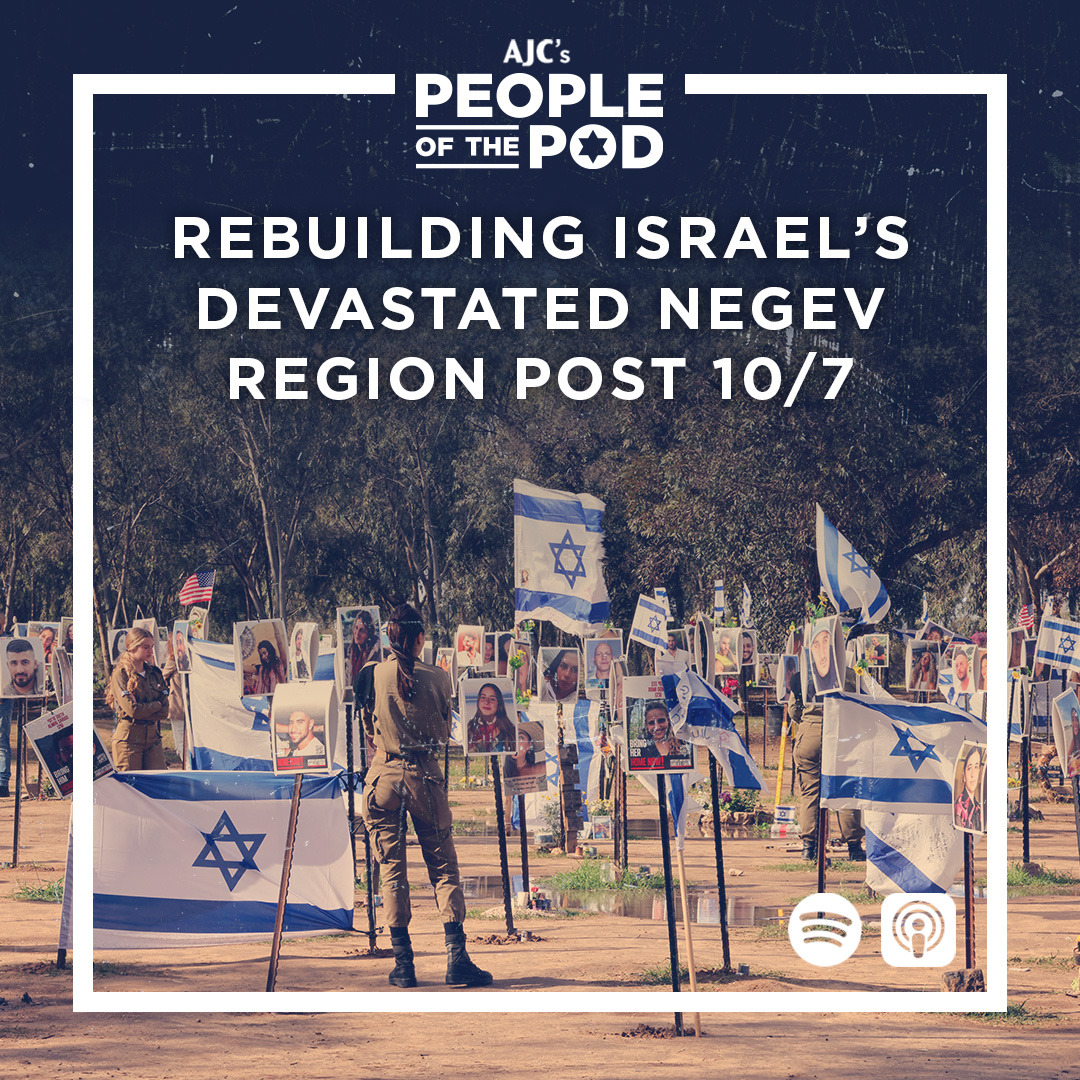
Rebuilding Israel's Devastated Negev Region Post 10/7
The October 7 Hamas attack severely affected Israel's Ben-Gurion University (BGU) and its surrounding community. The university lost over 110 people, several students were taken hostage, including Noa Argamani, and thousands of students were called up for reserve duty. Doug Seserman, CEO of Americans for Ben-Gurion University, joins us to discuss the impact of the October 7 Hamas massacre on BGU and Israel's Negev region. Hear about the university's emergency response and volunteer efforts, highlighting the region's resilience and the university's innovation in sustainability, water conservation, and energy solutions. *The views and opinions expressed by guests do not necessarily reflect the views or position of AJC. Episode Lineup: (0:40) Doug Seserman Show Notes: Listen – People of the Pod: The 2024 U.S. Presidential Election: What Does it Mean For Israel? Seven Months In: What Israelis Think About the War Against Hamas, Campus Antisemitism in America, and More What Does it Mean to be a Jewish American Hero? A Jewish American Heritage Month Conversation with AJC CEO Ted Deutch Follow People of the Pod on your favorite podcast app, and learn more at AJC.org/PeopleofthePod You can reach us at: [email protected] If you've appreciated this episode, please be sure to tell your friends, and rate and review us on Apple Podcasts. Transcript of Interview with Doug Seserman: Manya Brachear Pashman: The Negev, the vast desert region that covers 60% of Israel's territory is home to only 10% of its population. It's also home to Ben-Gurion University and many of the communities attacked by Hamas terrorists on October 7. Doug Seserman is the CEO of Americans for Ben-Gurion University. In that role, he has worked to highlight the innovations and technology know-how that Israel can offer America and the world when it comes to sustainability, water conservation, energy solutions and ecology. But since October 7 BGU's efforts have shifted from sustaining lives across Israel's south to rebuilding them. Doug Seserman is with us now to discuss those efforts. Doug, welcome to People of the Pod. Doug Seserman: Thank you so much for inviting me. Manya Brachear Pashman: So compared to other Israeli universities, the BGU community was disproportionately impacted by the October 7 massacre, correct? Can you give our listeners some perspective on the scope of loss? Doug Seserman: Sure. So as the crow flies our main campus in Beer-Sheva is only about 22 miles from Gaza. We had a number of students at the Nova music festival site, and a number of our employees and their families live in the western Negev or Gaza Envelope area. So as a university today, we have 111 dead. That includes those murdered on October 7, as well as fallen soldiers. We've had close to 6,600 of our students, faculty, employees, administration, called up to milu'im, reserve duty, and not all of them have come back. Some 2000 are still fighting. So that was a direct and disproportional impact. Now everybody in Israel has experienced this war. Every family knows somebody, but for us, it's definitely disproportional. Literally every colleague's kids are fighting. Every younger woman who's a colleague in her 30s, their husbands are fighting. People are on their WhatsApp just trying to hear what's going to happen next. It's a very surreal situation. Manya Brachear Pashman: Four hostages were rescued by the IDF earlier this month. Were there any faculty, staff, or students from Ben-Gurion taken hostage? Doug Seserman: Noa Argamani, you may recall her name. She was at the music festival and forcibly separated from her boyfriend Avinatan Or, who's a BGU alum. But Noa is a 26-year-old information systems student of ours. Manya Brachear Pashman: Yes, thank you. Of course, Noa was one of those hostages recently rescued. We are so thankful that Noa is now home. 124 hostages are still being held in Gaza. We are praying and advocating for the safe return home of all hostages, and will highlight those that are part of the BGU family: Sasha (Alexander) Trufanov, Avinatan Or, Alex Dancyg, and Segev Kalfon And Doug, how many at BGU were called up for reserve duty? Doug Seserman: That's about a third of the student body. Classes, obviously, they were supposed to start on October 15, and they didn't resume until December 31. The president of the University, Professor Daniel Chamovitz, did his best to have no student be left behind. But at some point, we had to resume classes. And so today, when you go to the campus, it's, I don't want to say it's thriving, but it's functioning. There's a normalcy about life in Israel and also on campus. But there's nothing normal about this new normal. Many of our reservists are back and they're in the classroom, but even going from being in Gaza, in conflict, to then studying for a test, you know, writing papers and things. People are traumatized, and the university has done an amazing job providing psychological support and counseling for the s
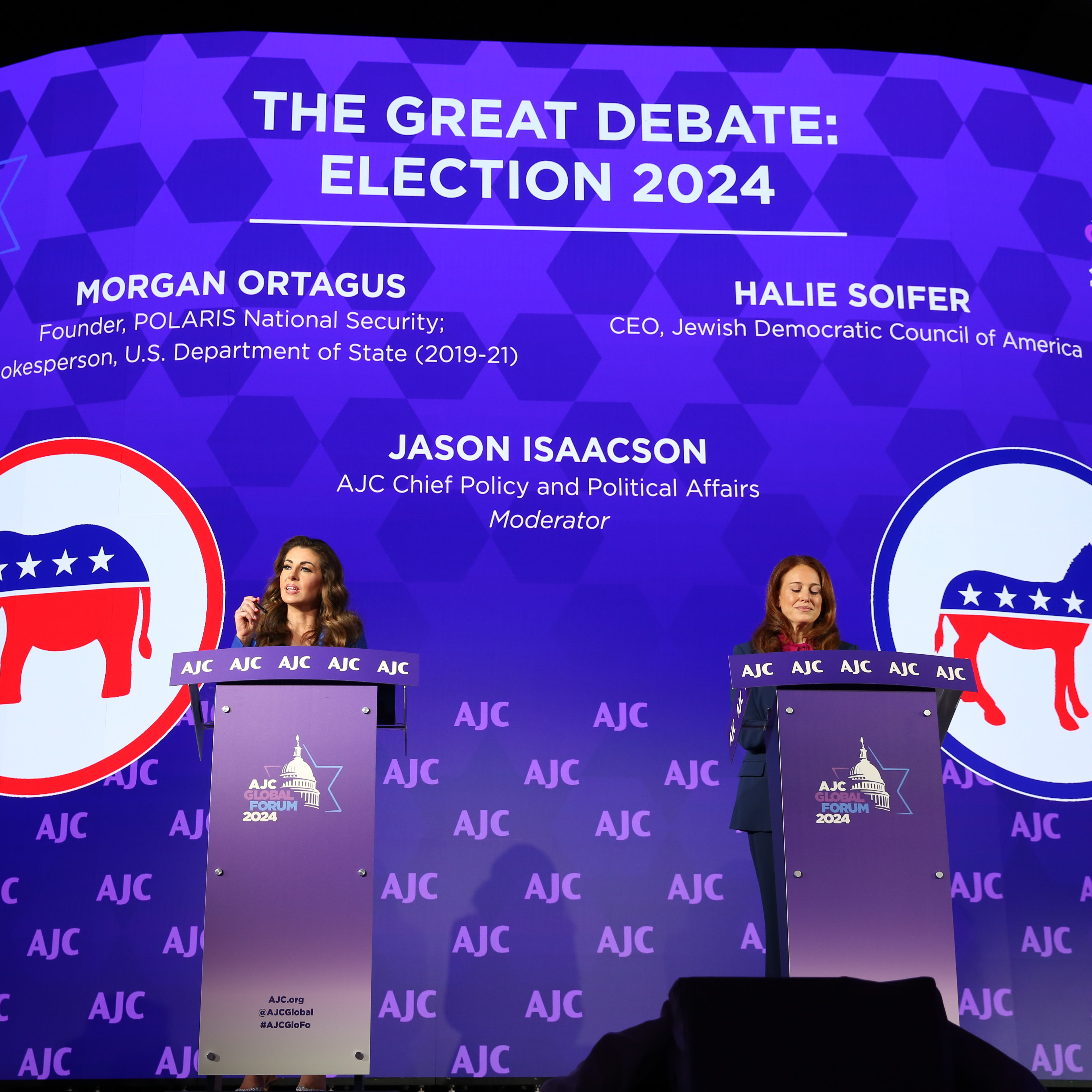
The 2024 U.S. Presidential Election: What Does it Mean For Israel?
In AJC's signature AJC Global Forum session, the Great Debate, Halie Soifer, CEO of the Jewish Democratic Council of America, and Morgan Ortagus, former Spokeswoman for the Department of State under the Trump administration, engaged in a debate on the 2024 presidential election and its impact on the global Jewish community, Israel, and the future of democracy. Listen to this session, moderated by AJC's Chief Policy and Political Affairs Officer Jason Isaacson, recorded live on the AJC Global Forum 2024 stage in Washington, D.C. *The views and opinions expressed by guests do not necessarily reflect the views or position of AJC. AJC is a 501(c)3 not for profit organization and does not endorse political candidates for elective office. Episode Lineup: (0:40) Jason Isaacson, Morgan Ortagus, Halie Soifer Show Notes: Listen – People of the Pod: Seven Months In: What Israelis Think About the War Against Hamas, Campus Antisemitism in America, and More What Does it Mean to be a Jewish American Hero? A Jewish American Heritage Month Conversation with AJC CEO Ted Deutch Follow People of the Pod on your favorite podcast app, and learn more at AJC.org/PeopleofthePod You can reach us at: [email protected] If you've appreciated this episode, please be sure to tell your friends, and rate and review us on Apple Podcasts. Transcript of Debate with Morgan Ortagus and Halie Soifer: Manya Brachear Pashman: In AJC's signature AJC Global Forum session, the Great Debate, Halie Soifer, CEO of the Jewish Democratic Council of America, and Morgan Ortagus, former Spokeswoman for the Department of State under the Trump administration, engaged in a debate on the 2024 presidential election and its impact on the global Jewish community, Israel, and the future of democracy. Moderating the debate was AJC's Chief Policy and Political Affairs Officer Jason Isaacson. Here's Jason now to explain the format. Jason Isaacson: We had a coin toss, and Morgan won the coin toss, and will go first. Each of them will have two minutes to provide opening statements. There will be the opportunity for a minute of rebuttal afterwards, then we'll plunge into a series of questions that I'll be posing to each of them. Morgan, you're up. Morgan Ortagus: Thank you so much for having me. I want to start this discussion today really telling a few stories from my time in the Trump administration, but also talking about this from a policy perspective. For those of you who don't know me, I've actually served in multiple administrations, including in the Obama administration, as well. And I say that to provide the context that I think the State of Israel cannot have a relationship with just one political party in the United States, just as we pray for the success of Israel. I pray for the success of our leaders, whomever wins in November. And I think no matter what happens today, in this debate in November, we must stand with our ally, we must stand with the State of Israel. You know, what's amazing is, I think about four years ago, I was standing in the Oval Office after many, many months of having worked with Secretary Pompeo, Jared Kushner, and the entire team on something that you all came to learn about called the Abraham Accords. And in that moment, I was pregnant with my daughter Adina Ann, this beautiful Jewish baby. And I thought to myself, the Middle East has entirely changed for her. This is going to be so radically different. Fast forward three and a half years later, to see October 7th and what happened that day, the worst killing of the Jewish people in any single day since the Holocaust. It felt like everything I had worked on in Abraham Accords had been shattered. But I am here to say that there is hope, with the right president, with the right policies. And that's what I really want to talk about today. With the right policies, we can get back to an era, not only have a strong America, a strong Israel, and a much stronger Middle East, happy to debate the policies. I'm not a campaign person. But I do believe that under the Trump administration, under Mike Pompeo, we had the right policies that were best for Israel, and best for the Middle East. So I guess as the famous song goes, all I'm here to say is give Trump a chance. Jason Isaacson: Morgan, thank you. Halie Soifer. Halie Soifer: Jason, Morgan, AJC, thank you for having me. And thank you for your efforts advocating for the Jewish people for Israel and defending democratic values. I'm grateful for your work, which has made a difference, and particularly grateful for the leadership of your CEO, my friend, Ted Deutch. This is the third time I've joined AJC's Great Debate in advance of an election with Joe Biden and Donald Trump on the ballot. The first was in 2019. The second was 2020. But 2024 is different for three reasons. First, the stakes of this election are higher. Second, the positions of the two candidates have never been more clear or divergent. And third, both candidates have been pres

Jews in the U.S. Military: Veterans' Stories in Honor of Jewish American Heritage Month
Explore the unique experiences of Jewish U.S. military veterans with Dave Warnock, U.S. Army Veteran, and Andrea Goldstein, U.S. Navy Veteran and Reservist. If you missed this conversation when it first aired for Veterans Day, here's your chance to honor Jewish American Heritage Month and pay tribute to those who serve our country. Our guests share what inspired them to join the military, how their Jewish heritage played a significant role in shaping their service, and what advice they have for IDF soldiers fighting now against Hamas in the Gaza Strip. Warnock and Goldstein are members of AJC's ACCESS Jewish Military Veterans Affinity Group, a space to convene young Jewish professionals who have served in the American military. *The views and opinions expressed by guests do not necessarily reflect the views or position of AJC. Episode Lineup: (0:40) Dave Warnock, Andrea Goldstein Show Notes: Learn more: What You Need to Know About the ICC and the Israel-Hamas War Listen to AJC's People of the Pod: Seven Months In: What Israelis Think About the War Against Hamas, Campus Antisemitism in America, and More What Does it Mean to be a Jewish American Hero? A Jewish American Heritage Month Conversation with AJC CEO Ted Deutch Follow People of the Pod on your favorite podcast app, and learn more at AJC.org/PeopleofthePod You can reach us at: [email protected] If you've appreciated this episode, please be sure to tell your friends, and rate and review us on Apple Podcasts. Episode Transcript: Manya Brachear Pashman: Earlier this month, during my conversation with AJC CEO Ted Deutch about Jewish American heroes and Jewish American Heritage Month, we paid tribute to those who serve our country in a multitude of ways – teachers, doctors, nurses. As we approach Memorial Day and the end of Jewish American Heritage Month, we thought it would be appropriate to re-broadcast an episode that aired last fall. Guest hosting is my colleague Dr. Dana Levinson Steiner, Director of ACCESS Global at AJC, where she oversees an international program to engage young professionals, including a number of Jewish military veterans. Dana, the mic is yours. Dana Levinson Steiner: Thanks, Manya. I'm so happy that we're here today. It was just over two years ago that we formed the ACCESS Jewish Military Veterans Affinity Group, which is a space for us to convene young Jewish professionals who had served in the American military. And here we are now recording our first People of the Pod podcast episode in honor of and commemorating Veterans Day. With us today are: Dave Warnock, U.S. Army Veteran, joining us from his home in Seattle, Washington, and Andrea Goldstein, U.S. Navy Veteran and Reservist, who is based in Washington, D.C. Dave, Andrea, thanks for joining us today. Dave Warnock: Happy to be here, Dana. Andrea Goldstein: Yeah, I'm glad to be here. Dana Levinson Steiner: To kick off the conversation, please tell us a little bit about your journey as an American Jewish military veteran. What inspired you to join the United States Armed Forces? Dave, let's start with you. Dave Warnock: For me, there are two kind of main things when I look back on what propelled me to join the US Army. The first one was my great grandfather, Saul Fink. The family legend is like he emigrated over from the shtetl. His family settled in Harlem. And when he heard about what was going on in Texas at the time, and 1916 and 1914 with the Pancho Villa incursions, he felt so propelled by patriotism and love of America that he had to run away from home and enlist at 16 years old. Which he did. Joined the Horse Calvary, a proper Jewish cowboy chasing after Pancho Villa in New Mexico, in a forgotten war. And he made sort of a career out of the army. So that's the legend that he was propelled by patriotism, maybe hated the tenement, maybe just wanted to get out of Harlem, get some fresh air, see the American West, I don't know. But his service propelled him forward in American society, through the US Army in a way that I think would have been unavailable to a lot of Jews at the time. It's not to say that it was an easy journey. He was certainly discriminated against; he shortened his name from Finkelstein to Fink for reasons that are not kind of lost to history. One joke is that it couldn't fit on the nametag. But through this service, he was elevated in society, he became an officer in World War I. He served through World War II and in the army of occupation in Germany. And his stature, sort of the patriarch of my family, loomed large. My middle name is Solomon, I'm named after him. So that kind of tradition was part of it. Another part was, I enlisted in 2004. So three years after 91/1 when I was a freshman in high school, and that terrorist attack really did propelled, cemented my decision to serve you know, if that didn't happen, I don't know what I would have done differently. But those are the two main reasons that propelled me to join. And I joined the Army an

Seven Months In: What Israelis Think About the War Against Hamas, Campus Antisemitism in America, and More
Jacob Magid, U.S. Bureau Chief for the Times of Israel, provides his take on Israel's efforts to destroy Hamas in Gaza, the U.S-Israel relations, the anti-Israel campus protests, the Israeli public's reaction to rising antisemitism abroad, and the challenges he has faced as a journalist since October 7. Episode Lineup: (0:40) Jacob Magid Show Notes: Learn more: Everything You Need to Know About Rafah, Its Importance to Hamas, and Protecting Its Civilian Population Listen to AJC's People of the Pod: What Does it Mean to be a Jewish American Hero? A Jewish American Heritage Month Conversation with AJC CEO Ted Deutch The Chaos at Columbia: What It's Like to be Jewish on Campus Right Now Follow People of the Pod on your favorite podcast app, and learn more at AJC.org/PeopleofthePod You can reach us at: [email protected] If you've appreciated this episode, please be sure to tell your friends, and rate and review us on Apple Podcasts. Episode Transcript: Manya Brachear Pashman: How important is American support for Israel? What message is the protest movement on American college campuses sending to Israel? Jacob Magid: is the U.S. Bureau Chief for The Times of Israel. Our colleagues in Washington D.C. hosted him this week in front of a live audience of about 200 guests. But we had some questions of our own and he joins us now. Jacob, welcome to People of the Pod. Jacob Magid: Hey there, thanks for having me. Manya Brachear Pashman: So there have been a lot of reports in the media lately about a strain in US-Israel relations, especially after Biden's announcement of a delay in the transfer of heavy munitions and concerns over Israel's plans in Rafah. Yet this week, Biden announced that it green-lit the transfer of over $1 billion in new arms for Israel, seemingly quelling any concerns about this rift. But what is your take on the situation? Is there a rift between President Biden and Prime Minister Netanyahu? Jacob Magid: It's interesting, because I think in the weeks and months immediately after October 7, support for President Joe Biden was at record highs. As at the same time, support for Donald Trump was plummeting, given the comments that he was making, shortly after October 7, kind of mocking Israel for not being able to foresee what what occurred on the seventh, as opposed to Biden who made this trip right after October 7, sent those aircrafts to the eastern Mediterranean, and warned Israel's adversaries not to get involved in the attack. I think there was real appreciation for what Joe Biden was doing. And I think it's amazing how much seven months can do because we've seen that support for President Biden completely, I'd say, plummet. There was a recent poll taken before this threat. But you can only imagine that it's only going to go down further, showing that now. Whereas earlier in the war, a plurality of Israelis supported President Biden over Trump in another election. Now those numbers have switched back, I think Israelis still do remember the steps Donald Trump took to re-open the Embassy in Jerusalem, to the Abraham Accords, the Golan Heights, all these different steps that he took when he was president. And I think that's more on their minds. And then they compare it to President Biden, they couldn't imagine President Trump taking those kinds of steps that he has taken, a public threat to withhold weapons that's a little bit harder for them to picture. And it's just more fresh on the minds of many Israelis when they're thinking about this current president. But I would note that it's not really clear what President Trump would do in this kind of scenario. I think there are a lot of US officials and Israeli officials I've spoken with who say that at least Prime Minister Netanyahu might prefer President Biden to President Trump because he's seen as someone who's more predictable, in regards with his ties with Israel, that while things have gotten bad, Netanyahu can also always frame himself as trying to stand up to the Americans. Whereas you'd have a much harder time doing that to Trump because I think he's a lot more beholden to him, will have a lot harder time saying no to Trump, I think Donald Trump, imagining a presidency where he's returning to the White House, I can't imagine he would be prepared to allow a war to continue for seven months, given his specific foreign policy agenda items, be it with Saudi Arabia or other places. But right now Israelis, for right or wrong, I think are very much shocked by the step that the President took. I don't think they saw a lot of the lead up that maybe the Biden administration was feeling, that there was a lot of warning given. And I think there's a degree of betrayal that I think a lot of Israelis feel right now. But again, things change so rapidly in this war. So that could switch again. And the Biden administration lately has been making a point to say this is just one shipment that we're holding. The vast majority of aid is still going to Israel

What Does it Mean to be a Jewish American Hero? A Jewish American Heritage Month Conversation with AJC CEO Ted Deutch
AJC CEO Ted Deutch reflects on Jewish American Heritage Month, highlighting the historical contributions of Jewish Americans and discussing the concept of heroism in the face of rising antisemitism. Ted also shares what it means to be a hero today, especially in the wake of 10/7, and who he considers to be among his own heroes. Episode Lineup: (0:40) Ted Deutch Show Notes: Learn more: Join AJC in Celebrating Jewish American Heritage Month Quiz: Test your knowledge of the rich culture and heritage of the Jewish people and their many contributions to our nation Listen to AJC's People of the Pod: The Chaos at Columbia: What It's Like to be Jewish on Campus Right Now Follow People of the Pod on your favorite podcast app, and learn more at AJC.org/PeopleofthePod You can reach us at: [email protected] If you've appreciated this episode, please be sure to tell your friends, and rate and review us on Apple Podcasts. Episode Transcript: Manya Brachear Pashman: Amid the recent rise of antisemitism and the unease that brings, we are marking the month of May as Jewish American Heritage Month. This is a time when so many of us in the Jewish community are feeling misunderstood, unwelcome, and confronting hatred. But the American Jewish experience is so much more than standing up to hatred and bigotry. Over the past 370 years, Jewish Americans have served in government, the military, they've won Nobel Prizes, headed universities and corporations, advanced medicine, the arts and justice. Here to celebrate Jewish American Heritage is AJC's CEO Ted Deutch. Ted, welcome back to People of the Pod. Ted Deutch: Thank you very much. Manya Brachear Pashman: Ted, you began serving in Congress in 2010 A few years after a Jewish American Heritage Month was first proclaimed in 2006 Can you tell us a little bit of the history behind Jewish American Heritage or what we like to call JAHM. Ted Deutch: Well, Jewish American Heritage Month has been around for almost 20 years. Congress passed a resolution that was led by my former colleague Debbie Wasserman Schultz to acknowledge the important contributions that Jewish Americans have made throughout our history. And in 2006, President George W. Bush designated the month of May to be Jewish American Heritage Month, and there have been presidential proclamations every year since. This year, President Biden proclaimed May to be Jewish American Heritage Month and outlined the history of the American Jewish community and the fact that Jewish American culture is so inextricably woven into the fabric of our country. He talked about the importance of Jewish American suffragettes and activists and leaders marching for civil rights and women's rights and voting rights. He talked about the contributions of, of Jewish men and women in uniform and on the Supreme Court. And throughout multiple administrations. It's an acknowledgement that we are really forming an important part of the fabric of this country. And we have to spend time thinking about that, particularly in a moment when so many are really taking positions and saying things that challenge our contributions that are made, and that really put so many of us in the Jewish community on edge, make us feel at risk. This is an important opportunity to really stand proudly as Jewish Americans. Manya Brachear Pashman: You know, during the month of March, Women's History Month, I always discover a new role model, a particularly amazing woman that I never knew existed. And the same is often true during Jewish American Heritage Month. But in reverse, I discovered that people whom I always thought to be amazing, and heroes in my book are Jewish. Do you have heroes growing up who you discovered were, or maybe you already knew, were Jewish? Ted Deutch: It's interesting. Our community is, I think, always looking to elevate those from our community who make a meaningful impact in society. I remember when I learned about Eddie Jacobson, that was one of those moments for me. Eddie Jacobson was a friend, business partner of Harry Truman. And, he played such a really interesting role during the war when, when he was focused on the plight of the Jews in Europe. His friendship led him to go advocate with then-Senator Truman to urge the us to do more for the Jews who are being discriminated against, harassed. Ultimately those who were being sent to concentration camps. That was a relationship that he had, and was able to use to help strengthen his own community. And what he did that I think was even more important than that, was following the war when he understood that there was this opportunity for the rebirth of the modern state of Israel. He went to urge his, again, his friend, then-President Truman, to to meet with Haim Weitzman, the leader of the Zionist movement, and President Truman was reluctant, but because of that relationship, that that personal relationship, Eddie Jacobson was able to convince the President to take that meeting, which then ultimatel

The Chaos at Columbia: What It's Like to be Jewish on Campus Right Now
Noa Fay is a Jewish student leader at Columbia University, the epicenter of the anti-Israel protest movement that has unfolded on American college campuses in recent weeks. Pro-Hamas, antisemitic, and anti-Israel demonstrators have occupied academic buildings, set up overnight tent encampments, and staged demonstrations, while Jewish students have faced increasing threats, antisemitism, and violence. Noa shares her first-hand perspective on what it's like to be Jewish on campus right now. *The views and opinions expressed by guests do not necessarily reflect the views or position of AJC. Episode Lineup: (0:40) Noa Fay Show Notes: Learn more: WATCH: Press Conference at Columbia/Barnard to Urge Action from University LeadershipAJC – along with our partners at Hillel International, Columbia/Barnard Hillel, UJA-Federation of New York, and Jewish students – called on universities and their leaders to keep Jewish students safe on their campuses during a press conference last week. Watch the press conference. AJC Campus LibraryResources to help Jewish students feel safe on campus and become well-informed and effective advocates for Israel and the Jewish people Listen to AJC's People of the Pod: What It's Like to Be Jewish at Harvard Among Antisemites and Hamas Supporters The Good, the Bad, and the Death Threats: What It's Like to Be a Jewish College Student Right Now Jewish College Student Leaders Share Their Blueprint for Combating Antisemitism Follow People of the Pod on your favorite podcast app, and learn more at AJC.org/PeopleofthePod You can reach us at: [email protected] If you've appreciated this episode, please be sure to tell your friends, and rate and review us on Apple Podcasts. Episode Transcript: Manya Brachear Pashman: Nearly seven months since the Hamas-led massacre on Israel that ignited Israel's current war with Hamas, chaos has unfolded on the campuses of Columbia University, Barnard College and other universities across the nation. Most recently, student demonstrators have built tent encampments on university quads and occupied academic buildings. They also have targeted Jewish students with antisemitic signs, slogans and in some cases, physical assaults to protest the war. But that's not all they're protesting. With us to discuss her perspective as a Jewish student leader on campus is Barnard College senior Noa Fay. Noa, welcome to People of the Pod. Noa Fay: Hi, thanks so much for having me. Manya Brachear Pashman: Well, thank you for joining us. And I'm sorry that you have been experiencing this on campus in recent weeks. We've seen plenty of images from the chaos there. But can you describe it from your vantage point, kind of walking through the crowds and seeing it up close? What do you see? What do you hear? Noa Fay: It's important to understand not only the amount of antisemitism, and that sort of violence that we're seeing–which has been incredibly painful, really, for every Jewish student at this point, I really believe I mean, it's just been absolutely horrifying. You know, I mean, it's pogrom style stuff that we're seeing. It has felt like now that everybody is affected, people are taking this seriously. But in reality, the Jewish students, we've been dealing with this literally since October 7, and it's taken up until now to even seem to get somebody's attention. So I think it's important to understand that, when I talk about this chaos, what I'm really thinking of is– there is, first of all, just so much press everywhere, which is just a bunch of people that are really swarming everyone and, you know, up and down Broadway, it's very disorienting. But more importantly, on top of that, we have a very significant police presence. I mean, it really is a police state. I can't even get to certain dining halls. I can't study in certain libraries. I can't get to my own gym. I mean, it's a really, really chaotic situation. Manya Brachear Pashman: Are they protesting the war? Is that the message that you're that you're hearing? Or are they protesting something else? Noa Fay: No. No, no, no. They sprinkle in a few things, I think, dedicated to the war. But by and large, these are anti-Israel demonstrations. And at this point, anti-Jewish demonstrations. So they are using the war to, I think, gain credibility. And the war is definitely fueling their ire, I guess you could say, but this is not about the war. And it's never been about the war. There was a very strong anti-Israel community on campus. And that was way before October 7, this was during ceasefires that were already taking place between Hamas and Israel. And still, we had this exact same rhetoric. The only difference now is that it's gained a lot of traction. So, no, it's not about the war at all. Manya Brachear Pashman: I was going to ask you, you headed to Barnard three years ago, you're a senior now. Did you get warnings? Did people prepare you for Jewish life on campus? And was it helpful advice? Noa Fay: Yeah, so people did

Her Mother-In-Law Was Murdered at Tree of Life: Now Marnie Fienberg is Countering Antisemitism One Seder at a Time
Ancient texts, traditional foods, and friends and family: the markers of many Passover tables across America. But what if you added something new–or rather, someone new? Marnie Fienberg founded 2ForSeder, a program to combat antisemitism and honor her mother-in-law, Joyce Feinberg, who was one of the 11 victims murdered inside Tree of Life. The initiative is simple: extend a Seder invite to two people of another faith, who have never been to a Seder before, to build bridges and spread Jewish joy. Episode Lineup: (0:40) Marnie Fienberg Show Notes: Learn more: 2ForSeder.org Listen to AJC's People of the Pod: What the Iranian Regime's Massive Attack Means for Israel and the Region Meet Modi Rosenfeld – the Comedian Helping the Jewish Community Laugh Again A Look Back: AJC's Award-Winning "Remembering Pittsburgh" Series Jewish College Student Leaders Share Their Blueprint for Combating Antisemitism Follow People of the Pod on your favorite podcast app, and learn more at AJC.org/PeopleofthePod You can reach us at: [email protected] If you've appreciated this episode, please be sure to tell your friends, and rate and review us on Apple Podcasts. Episode Transcript: Manya Brachear Pashman: A few weeks ago, we re-aired excerpts from our award winning series Remembering Pittsburgh, which marked five years since the 2018 shooting at the Tree of Life synagogue. One of our guests in that series has returned today. Marnie Feinberg founded 2ForSeder, an initiative to honor her mother in law, Joyce Feinberg, who was one of the 11 victims murdered inside Tree of Life. As we approach Passover, Marnie is with us now to share why there's no time like the present to invite first timers to the Seder table, a superb way to introduce people to the beauty of Judaism, like Joyce often did. Marnie, thank you for joining us again. Marnie Fienberg: Thank you so much for having me. Manya Brachear Pashman: So we spoke a little about this project, when you joined us last fall. We have a little more time now to unpack why this initiative is such a meaningful way to preserve Joyce's legacy. Can you tell us about her Seders? Marnie Fienberg: My mother in law as most mothers and mother in laws, she trained me on how to actually hold the Seder. So as you know, holding the Seder is almost like your second bat mitzvah, it's a rite of passage. And it's also a very important thing that, you know, not only are you trained to do it, but you have to incorporate things from, if you have a partner or from their family, you incorporate things from your own life to your family traditions. And all that kind of comes together in this wonderful magical night that is really grounded in the Haggadah. But Joyce was of course instrumental and teaching me my mother lives kind of far away. And Joyce and I actually did Seders together for more than a decade. And they started at her house and gradually kind of came over to my house. But she really she helped me every single step of the way, to the point where when she wasn't there anymore, I almost didn't know how to do it. And I'm every time I'm thinking about the Seder and making a Seder. It's it's with her in my head as it has to be. But I still, you know, all of the traditions that she taught me we still utilize those once again, combined with the ones that I learned from my own family and she is a vise still a vibrant part of our personal Seder. Manya Brachear Pashman: So was Joyce in your head still when you found 2ForSeder? Marnie Fienberg: Oh, absolutely. Well, I am a Jewish woman. And I can't sit still. I need to do something. We have tikkun olam kind of almost in our DNA. Yes. So I really wanted to not only bring her back, which I think is a natural sort of a feeling. But I also wanted to push back on all of the antisemitism that had removed her from my life. And people were constantly coming up to me, I mean, the community in Pittsburgh and the community where I live in Northern Virginia, everybody was very supportive. But they were constantly asking me, What can we do? And it took me a little while to realize they didn't, they did mean, what can I do to help you? Of course, they did mean that. But what they really meant was, what can we do to stop this from ever happening again? I don't have the answer for that. But I thought that the seder kind of came into my mind because I was really inspired by what Joyce always did that she brought students or faculty, you know, because she was a campus researcher, and my father in law was actually at Carnegie Mellon. He was a professor there. And they always had people who weren't Jewish at our at the table. And the discussions were always not only very interesting, but you always saw a very different perspective, when they participated in something in a ritual that you knew so well. And it really created bonds of friendship, even with people who I didn't know. Which was wonderful. So that's what I really wanted to encourage, you know, this was 2018 when she

What the Iranian Regime's Massive Attack Means for Israel and the Region
AJC Jerusalem director Lt. Col. (res.) Avital Leibovich shares how the IDF — and its neighbors and allies — defended Israel with remarkable success. In the early hours of April 14, sirens and explosions were heard across the Jewish state. In an unprecedented, first-ever direct attack on the Israeli people, the Iranian regime launched a wave of more than 300 drones and missiles. Episode Lineup: (0:40) Avital Leibovich Show Notes: Take Action: Join AJC in urging Congress to call on the EU to designate all of Hezbollah and the IRGC as terror organizations. Read AJC's Explainers on Iran: Get the Facts About Iran's Unprecedented Attack on Israel 'Crimes Against Humanity:' Another UN Report Finds Sexual Violence by IRGC and Other Authorities in Iran; Similar to Crimes by Hamas What is Iran's Islamic Revolutionary Guard Corps and Why is it Designated a Terror Group by the United States? Listen to AJC's People of the Pod on the Israel-Hamas War: Meet Modi Rosenfeld – the Comedian Helping the Jewish Community Laugh Again A Look Back: AJC's Award-Winning "Remembering Pittsburgh" Series Jewish College Student Leaders Share Their Blueprint for Combating Antisemitism Matisyahu's Message to His Fellow Jews and to the Israel Haters Trying to Cancel Him Follow People of the Pod on your favorite podcast app, and learn more at AJC.org/PeopleofthePod You can reach us at: [email protected] If you've appreciated this episode, please be sure to tell your friends, and rate and review us on Apple Podcasts. Episode Transcript: Manya Brachear Pashman: Few of us slept well on Saturday night into Sunday knowing that Iran had launched a wave of more than 300 drones and missiles in its first ever direct attack on Israel. In the early hours of Sunday, sirens and explosions were heard across the Jewish state. Here to talk about how Israel definit itself from what many feared was inevitable, Director of AJC Jerusalem Avital Leibovich, who also serves in the Israel Defence Force Reserves. Avital Leibovich: Thank you. Manya Brachear Pashman: So can you share with our listeners what it was like to hear that Iran had launched this wave of missiles and drones? Did Israelis immediately pack up and head for shelters? Avital Leibovich: I think that was one of the most dramatic nights in Israel's history. You know, we're living in an era in which everything is televised and broadcasted. And when those drones have been launched from Iran, that has been broadcasted. So you can imagine millions of Israelis sitting at home, counting the hours until those drones will hit the Israeli airspace. In addition to that there was a lot of uncertainty of which type of drones we're talking about, what kind of explosives will they carry? Will they make it or not? And also, will these drones be accompanied by other weapons? So yes, there was huge concern. It was a sleepless night, sometimes between 2am until seven in the morning, Israel has been paralyzed with this unprecedented attack. Now 200 drones that have been fired at the same time to Israel. This is something that the world have never, ever experienced, there was never a country in the world that has been attacked simultaneously by 200 drones. Manya Brachear Pashman: Well, we also know that there were in addition to drones, there were ballistic missiles, there were cruise missiles. And we know that some of those ballistic missiles could have been fitted with nuclear warheads. And certainly, we know Iran's nuclear capability has been developing rapidly for more than a decade. Was that a concern? Avital Leibovich: Look,unlike terror groups, you know, they rely on funding of different countries, proxies and so on. Iran is a country with its own budget with its own economic means, and has been investing in technologies and procurement and development of weapons of different kinds for decades. So we saw some of the outcome of the Iranian weapons in Ukraine. When Iran sold some types of drones to Russia to hit Ukrainian civilians. We understood the capacity, the capability. And of course, Israeli intelligence followed closely the Iranian capabilities. Now, when you have so many options, the warheads of ballistic missiles can vary. And therefore there was also uncertainty with regard to what would those ballistic missiles carry? Will they carry conventional weapons? Will they carry non conventional weapons? In addition to that, the attack came after more than six months of the war in Israel. So the level of stress and the level of uncertainty was high to begin with. We're talking about six months in which Israel paid the heavy price of more than 600 soldiers and officers who were killed, and more than 1200 civilians. So it wasn't an isolated evening. It really came in the course of a very long war. And now, Israel is facing the big question of retaliation, yes or no, when and how? Manya Brachear Pashman: You know, we have long talked about Israel and Iran being in a proxy war, Hamas and Hezbollah being two of

Meet Modi Rosenfeld – the Comedian Helping the Jewish Community Laugh Again
Israeli-American Comedian Modi Rosenfeld, who took part in the inaugural AJC's Voices Against Antisemitism Campaign, just-released a stand-up comedy special, Know Your Audience, which reflects a principle he has always subscribed to. But what happens when you know your audience is suffering a trauma like no other? Listen to this conversation with Modi, who was in Israel on October 7, on how he jokes about antisemitism and what he sees as his mission in this difficult moment: helping the Jewish community laugh again. Episode Lineup: (0:40) Modi Rosenfeld Show Notes: Learn more: AJC's Voices Against Antisemitism: Meet the Celebrities Standing Up for the Jewish People and Israel modilive.com Photo Credits: John Cafaro Credits – Standup Clips: On Antisemitism Jewish Boyfriend Listen – People of the Pod on the Israel-Hamas War: A Look Back: AJC's Award-Winning "Remembering Pittsburgh" Series Jewish College Student Leaders Share Their Blueprint for Combating Antisemitism Matisyahu's Message to His Fellow Jews and to the Israel Haters Trying to Cancel Him Unheard, Until Now: How Israeli Women Are Powering Israel's Resilience Follow People of the Pod on your favorite podcast app, and learn more at AJC.org/PeopleofthePod You can reach us at: [email protected] If you've appreciated this episode, please be sure to tell your friends, and rate and review us on Apple Podcasts. Transcript of Episode with Modi: Manya Brachear Pashman: Comedian Modi Rosenfeld, known by his fans as simply Modi, is nearing the end of a live national tour, co-hosts his own podcast, and he recently released his first televised stand-up comedy special titled Know Your Audience. It's a principle the Israeli-American comedian has always subscribed to. But what happens when you know your audience is suffering a trauma like no other. Here with us to talk about how we can and why we should laugh again is Modi Rosenfeld. Modi, welcome to People of the Pod. Modi: Hi, People of the Pod. Manya Brachear Pashman: You were born in Tel Aviv and grew up on Long Island. Tell us how you found your way to comedy. Modi: I was actually just doing investment banking. And I used to imitate the secretaries. And my friends said this is really funny, you should do it on stage. And they set up an open mic night. And that was about 30 something years ago. And that's how the comedy began. Manya Brachear Pashman: The special that I mentioned was filmed nearly a year ago. It was filmed before the Hamas terrorist attack and the war. You talk about COVID, you talk about marrying your millennial husband, you talk about Shabbat elevators. I'm curious if you do feel like the material still resonates in the current climate? Modi: Ever since October 7, I've been doing my shows and not mentioning the war itself. Until the very end where I sing Hatikva with the audience. I feel like the audience needs a moment to just laugh and not think about the war. And not think about what's happening in Israel and just have a laugh about being Jewish, being Jewish, about non-Jewish people. Sometimes I tell the story about how I was October 7, while I was in Israel. And then sing Hatikva with the audience, people seem to, they're very touched and moved by it. And it reminds them, now, let's just remember where our hearts and where our prayers and where our thoughts are. Manya Brachear Pashman: So let's talk about where you were on October 7. Modi: The war began at the end of the holiday of Sukkot and I was in Israel. I had six shows, sold out shows in Israel that were absolutely amazing. One of the highlights of my career. Thursday was the last show. Friday we were there for Shabbat and Saturday we were scheduled to fly out to Paris to do four shows there. And obviously Saturday morning, the alarms went off and the bombs went off. We were staying at the Setai Hotel, which is in Yafo, the Arab part of Tel Aviv. Bruno Mars was also staying at the hotel. He had three concerts in Israel and at 12 in the afternoon we saw them whisk him away to a private airplane to be taken out of Israel. And I said to Leo, my husband, I said Thank God they got put on Mars out of the hotel. He said why? I said because if a bomb hits this hotel and me and Bruno Mars die, I would get zero press coverage. And so that was you know, something light in the day, but it was a very, very stressful, scary day for everybody. We were on a scheduled flight to go to Paris. And it had a four hour delay. And we finally took off and got to Paris. And then we had to make a decision. Do we do these shows? Because the war was so fresh, people were just learning about what's happening and watching it on their phones. But the sold out shows were full. And that's when I began to do Hatikvah at the end of the shows, and I've been doing it ever since. You know, we just had an hour and 20 minutes of laughter, they just had the best time. We were all laughing. And then you just focus again, you know, yeah, we're laughing. But in Israel, t
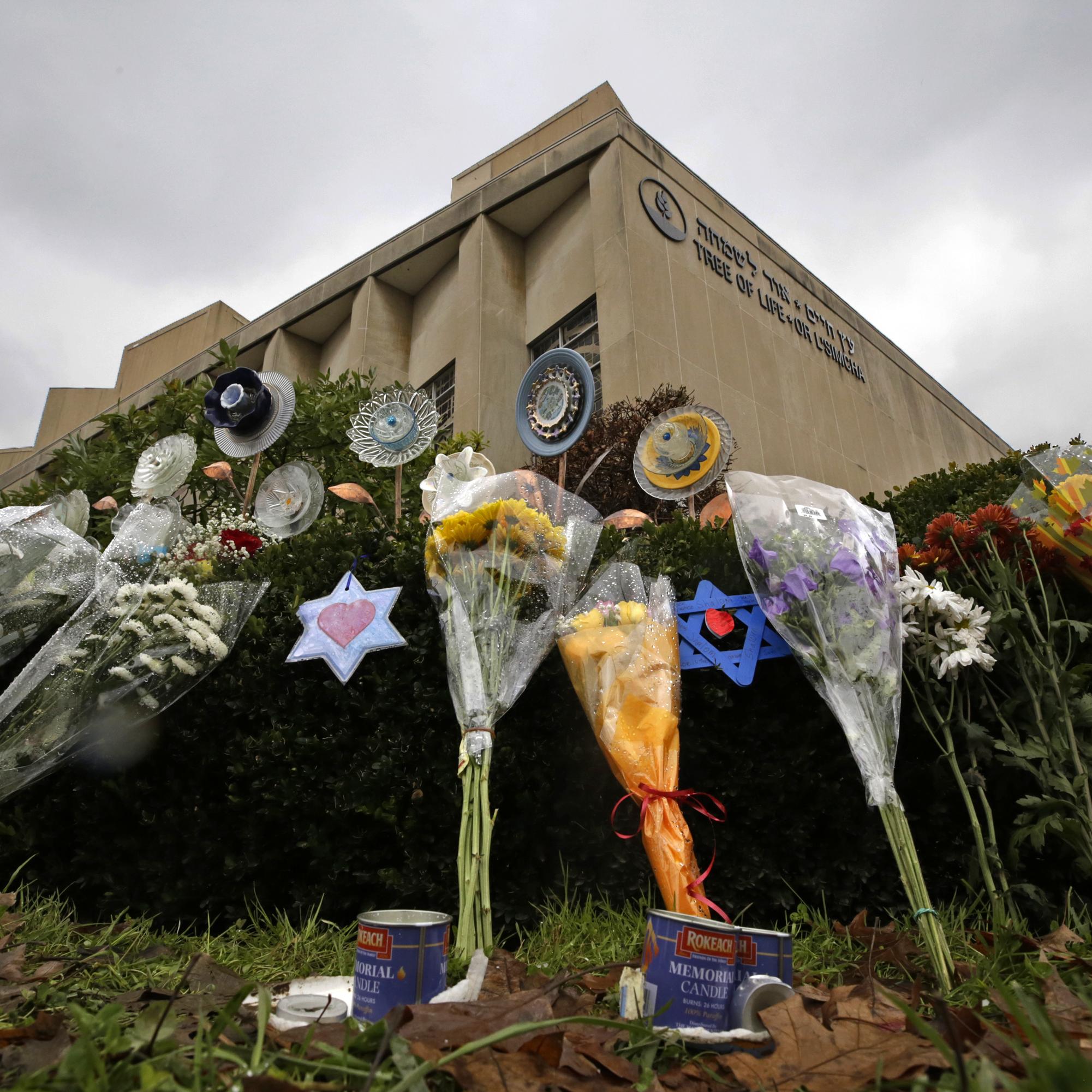
A Look Back: AJC's Award-Winning "Remembering Pittsburgh" Series
Listen to this compilation of our award-winning series Remembering Pittsburgh, exploring how the horrific shooting at the Tree of Life synagogue affected the Jewish community in Pittsburgh, the U.S., and around the world. In the four-part series, we take listeners behind the scenes of how the Pittsburgh Jewish community continues to rebuild and honor the lives lost on October 27, 2018. The anniversary came during the same month as the most lethal attack on Jews since the Holocaust: Hamas' October 7 massacre of Israelis. Rising antisemitism has led to the murder of Jews around the world, from Pittsburgh, to Paris, to Israel. All forms of antisemitism must be countered to ensure a safe and secure Jewish future. Listen to the entire series at AJC.org/TreeofLife. Episode Lineup: (0:40) Eric Lidji, Carole Zawatsky, Howard Fienberg, Marnie Fienberg, Belle Yoeli, Anne Jolly, Ted Deutch Show Notes: Music Credits: Relent by Kevin MacLeod (incompetech.com), Licensed under Creative Commons: By Attribution 3.0 Virtual Violin Virtuoso by techtheist is licensed under a Attribution 4.0 International License Tree of Life by Nefesh Mountain Shloime Balsam - Lo Lefached Hevenu Shalom - Violin Heart Listen – People of the Pod on the Israel-Hamas War: Jewish College Student Leaders Share Their Blueprint for Combating Antisemitism Matisyahu's Message to His Fellow Jews and to the Israel Haters Trying to Cancel Him Unheard, Until Now: How Israeli Women Are Powering Israel's Resilience 152 Days Later: What the Mother of Hostage Edan Alexander Wants the World to Know Follow People of the Pod on your favorite podcast app, and learn more at AJC.org/PeopleofthePod You can reach us at: [email protected] If you've appreciated this episode, please be sure to tell your friends, and rate and review us on Apple Podcasts. Episode Transcript: Manya Brachear Pashman: Last month, the Senate earmarked $1 million in federal funding to create a curriculum for students about antisemitism and other forms of discrimination and bigotry. The recipient of that money? An organization that knows the consequences of that hatred all too well: the newly imagined Tree of Life, an education center dedicated to ending antisemitism that emerged after 11 worshipers inside Tree of Life synagogue were murdered by a white supremacist on October 27, 2018. This week, we are presenting a compilation of our award-winning series Remembering Pittsburgh, which launched on October 5, 2023 -- right before the October 7th terrorist attacks in Israel. Listen to the series at AJC.org/TreeofLife. __ Episode 1, which originally aired on October 5, takes you inside the Tree of Life building before it was demolished to make way for a new complex dedicated to Jewish life and combating antisemitism. Eric Lidji: Pittsburgh definitely is not forgetting. It's ever-present here. There are people who are healing and doing so in ways that, at least from the outside, are remarkable and very inspiring. And there are people who I'm sure have not fully reckoned with it yet. Carole Zawatsky: It's all too easy to walk away from what's ugly. And we have to remember. We can't walk away. Manya Brachear Pashman: Five years have gone by since the horrific Shabbat morning at Pittsburgh's Tree of Life Synagogue, when eleven congregants were gunned down during prayer – volunteers, scholars, neighbors, doing what they always did: joining their Jewish community at shul. Today, we take you to the Tree of Life building that stands on the corner of Shady and Wilkins Avenues in Pittsburgh's Squirrel Hill neighborhood to hear from two people in charge of preserving the artifacts and memories of the vibrant Jewish life that unfolded inside those walls until October 27, 2018. Manya Brachear Pashman: In early September, our producer Atara Lakritz and I visited the Tree of Life synagogue in Pittsburgh's Squirrel Hill neighborhood. Squirrel Hill, where Jews have settled since the 1920s, is quite literally Mister Rogers' neighborhood. We were there to interview those touched by the events of October 27. But it didn't take us long to figure out that everyone there had been affected in some way. All along Murray Avenue, in 61C Cafe, at Pinsker's Judaica Shoppe, at the Giant Eagle supermarket, when we told people why we were there, they all had a story, an acquaintance, a connection. Later, walking through the glass doors of the synagogue felt like we were stepping through a portal, traveling back five years, when life stopped, and the reality of the hatred and terror that unfolded there began to haunt every step. Atara and I were invited to accompany a final group tour of the building before it closed in order for preparations to begin for the building's demolition. The tour was painful, but we felt it necessary to share with our listeners. As we left the lobby, we were told to take the stairs to the left. The stairs to the right were off limits. Someone had been shot there. We were led to a small, dark storage

Jewish College Student Leaders Share Their Blueprint for Combating Antisemitism
Hear from two Jewish student leaders at Binghamton University, Seth Schlank and Eytan Saenger, on their experiences amidst rising antisemitism on college campuses in the aftermath of the October 7 massacre in Israel by Hamas. They discuss the strong sense of community among Jewish students on campus, the value of a supportive university administration, and the power of Jewish student-led movements to counter antisemitism. The students also touch on the Binghamton community's show of solidarity with hostage Omer Neutra, a friend of many, who deferred acceptance to Binghamton before spending a gap year in Israel and enlisting in the IDF. *The views and opinions expressed by guests do not necessarily reflect the views or position of AJC. Episode Lineup: (0:40) Seth Schlank, Eytan Saenger Show Notes: Listen – People of the Pod on the Israel-Hamas War: Matisyahu's Message to His Fellow Jews and to the Israel Haters Trying to Cancel Him Unheard, Until Now: How Israeli Women Are Powering Israel's Resilience 152 Days Later: What the Mother of Hostage Edan Alexander Wants the World to Know What It's Like to Be Jewish at Harvard Among Antisemites and Hamas Supporters Follow People of the Pod on your favorite podcast app, and learn more at AJC.org/PeopleofthePod You can reach us at: [email protected] If you've appreciated this episode, please be sure to tell your friends, and rate and review us on Apple Podcasts. Transcript of Interview with Seth Schlank and Eytan Saenger: Manya Brachear Pashman: According to a recent survey by Hillel, a majority of Jewish college students (56%) say their lives have been directly touched by antisemitism on campus since October 7. Likewise, AJC's State of Antisemitism in America 2023 Report found that 20% of current and recent students reported feeling or being excluded from a group or event because they're Jewish. That figure was only 12% in 2022. That's one of the reasons AJC and HIllel expanded a partnership this week to improve that climate on college campuses and make sure university administrators know how to support their Jewish students. We wanted to know what a supportive campus environment looks like. Here to give a student perspective are Eytan Saenger and Seth Schlank, two Jewish student leaders at Binghamton University, the flagship State University of New York. Seth, Eytan: welcome to People of the Pod. Seth Schlank: Thank you. Eytan Saenger: Thanks for having us. Manya Brachear Pashman: I'm hoping you can share with our listeners what it's been like to be Jewish on campus there in Binghamton. Can you kind of give us a picture of Jewish life on campus both before and after the October 7 attacks on Israel by Hamas? Eytan Saenger: So the Jewish community at Binghamton is known to be one which is very strong. There's roughly over 4000 Jewish students overall. Many students are active in Jewish life. On Friday night, you can find over 500 students having dinner at Chabad, you can find hundreds of students involved in prayers, either on a daily basis or over Shabbat or different holidays and things like that. Events that you see on campus with the Jewish community are packed and bustling all the time. You walk to class, you see people with kippot, Israeli flags. Really, you know that you're a part of a college that is a place that is welcome for Jewish students. And certainly on October 7, was something that was needed for us as a community to know that we have people to turn to and, obviously, we're in the middle, we were in the midst of celebrating a holiday, which is supposed to be a joyous holiday, celebrating the beginning anew of the reading of the Torah, we were supposed to be dancing, singing, having food, having a good time. But instead that very quickly turned into a realization of the facts and things going on in Israel. Acknowledging that there was the most Jews killed in a single day since the Holocaust, which of course dampened the mood of, especially for people like myself, who had just spent a year in Israel, the previous year. And felt such a deep connection to the people of Israel, to the land, to the whole fabric of the society there, and have family there, and things like that, where it's like, really, there was a worry of everything that was going on and trouble and processing everything that was happening. Manya Brachear Pashman: What was the response on campus in the aftermath? Eytan Saenger: We saw the whole community come together. Within the first 24 hours after the holiday ended, we held a vigil in main campus with over 700 students gathered from the community, people from outside the community as well, who were there to stand united, together. Our Rabbi actually where Seth and I, where we go to a lot of the prayers on Shabbat and the community we're part of, the OU-JLIC community, he actually went back to reserves to fight in Israel within 24 hours and was fighting there and was actually away from Binghamton, away from the students in the commu

Matisyahu's Message to His Fellow Jews and to the Israel Haters Trying to Cancel Him
"The Jewish people don't really give up. They're fighters. … a vision of peace, and a vision of hope, and of empathy. I really, truly believe that that is at the core of who we are. And that is what we are actually fighting for." Matisyahu's recent show in Chicago was canceled due to the threat of anti-Israel protests. The Jewish American singer's music has evolved alongside his Jewish identity. But one thing has always been clear: He believes in Israel's right to exist. Because of that, he has faced protests at almost every show on his current national tour, and some have even been canceled. Hear from Matisyahu on his musical and religious journey, especially since October 7, and what makes him Jewish and proud. *The views and opinions expressed by guests do not necessarily reflect the views or position of AJC. Episode Lineup: (0:40) Matisyahu Show Notes: Song Credits, all by Matisyahu: One Day Jerusalem Fireproof Listen – People of the Pod on the Israel-Hamas War: Unheard, Until Now: How Israeli Women Are Powering Israel's Resilience 152 Days Later: What the Mother of Hostage Edan Alexander Wants the World to Know What It's Like to Be Jewish at Harvard Among Antisemites and Hamas Supporters When Antisemites Target Local Businesses: How Communities Are Uniting in Response Follow People of the Pod on your favorite podcast app, and learn more at AJC.org/PeopleofthePod You can reach us at: [email protected] If you've appreciated this episode, please be sure to tell your friends, and rate and review us on Apple Podcasts. Transcript of Interview with Matisyahu: Manya Brachear Pashman: Matisyahu is a Jewish American reggae singer, rapper and beatboxer, whose musical style and genre have evolved alongside how he practices and expresses his Jewish identity. But one thing has always been clear. He believes in Israel's right to exist, and he has expressed that repeatedly since the October 7 Hamas terror attack on Israel. Since then, he has performed in Jerusalem and Tel Aviv. He has performed for the families of hostages and for students at Columbia University as a show of solidarity for those who have faced a torrent of antisemitism there. But there are places where he has not performed, including Santa Fe, New Mexico, Tucson, Arizona and Chicago, but not for lack of trying. Those shows were canceled by the venue's because of the threat of protests. Matisyahu is with us now to discuss these cancellations and what's behind them. Matis, welcome to People of the Pod. Matisyahu: Hello, People of the Pod. Manya Brachear Pashman: So first of all, I want to introduce you to those in our audience who might not be familiar with your music. And we'll start with the anthem that I associate most with you. And that is One Day. Can you tell us a little bit about how that song came about–when and why? Matisyahu: Well, that song was written in around 2010, I want to say or nine, maybe 2008 or nine. And I was working on my second studio album. It's called Light. And we had turned in the album and the new record executives didn't feel like we had any hits on the album. The album had been based on this story of Reb Nachman of Breslov called The Seven Beggars. And it was a bit of a concept album. So I went to LA and I worked with a couple of writers and tried to write a hit song. And that's what we came up with was One Day, and that song got used in the Olympics in 2010, Winter Olympics on the NBC commercials. So that's kind of what propelled that song into popularity. Manya Brachear Pashman: Popular, yes. But what does One Day mean to you? Matisyahu: A lot of my music is very positive and very much connected to this vision of a Messianic future of peace. You know, at the time, I was very religious. And in my particular group, Chabad Hasidism, the idea of a Messiah was very prevalent in the philosophy. I was living in a space of a vision of a future where the wolf lies down with the lamb and people turn their weapons into plowshares. And that was the thing that I was praying for and trying to envision daily. And so that was the main message of that song at the time. Manya Brachear Pashman: It is certainly something we've always needed, especially now. You grew up in White Plains, NY, in the Reconstructionist tradition, I believe. You found your way to Chabad. Can you talk a little bit about where you are in your spiritual journey now, these days. Matisyahu: I went through a very, very intense relationship with Orthodox Judaism, Chassidus. I started from a home, from a Reconstructionist background, so not Chassidus, for anyone who doesn't know these terms. More of a reform kind of background. And I went to Israel when I was 16, on a Conservative trip where I spent three months there, which had a profound effect on me. And then when I was in college, about 21, 20 years old or so, is when I started really exploring the more Orthodox side of Judaism, and started out with the Carlebach shul, on the Upper West Side, and his music and r

Unheard, Until Now: How Israeli Women Are Powering Israel's Resilience
In the days following October 7, Israeli filmmaker Shifra Soloveichik felt hopeless and hated, but not helpless. Inspired by women around her, she launched a digital initiative called Women of Valor: Women of War, to spotlight unheralded women with extraordinary stories during one of the most difficult moments in modern Jewish history. To mark Women's History Month, hear from Shifra about how she is giving a voice to Israeli women whose stories have gone unheard. *The views and opinions expressed by guests do not necessarily reflect the views or position of AJC. Episode Lineup: (0:40) Shifra Soloveichik Show Notes: Learn more: Women of Valor on Instagram Senai Geudalia's Story on YouTube Sarah Lopez's Story on Instagram Listen – People of the Pod on the Israel-Hamas War: 152 Days Later: What the Mother of Hostage Edan Alexander Wants the World to Know What It's Like to Be Jewish at Harvard Among Antisemites and Hamas Supporters When Antisemites Target Local Businesses: How Communities Are Uniting in Response How A 10/7 Survivor is Confronting Anti-Israel Activists on College Campuses Follow People of the Pod on your favorite podcast app, and learn more at AJC.org/PeopleofthePod You can reach us at: [email protected] If you've appreciated this episode, please be sure to tell your friends, and rate and review us on Apple Podcasts. Transcript of Interview with Shifra Soloveichick: Senai Geudalia: So I'll start from the day before. It was Friday, October 6. That night was really fun. We were dancing in the street from place to place, like you know hakafot here, hakafot there. And he was like being so like himself, times 100. Hugging me and dancing with me and just, at the sea of Yosef, like that was Yosef in a bottle, like celebrating his people, celebrating the Torah and being with his family, like that was the peak of Yosef. You know, they say the neshamah [soul] knows 40 days before. So that to me, like he was like getting all of it in. Manya Brachear Pashman: That's Senai Geudalia, whose husband Yosef was killed on Oct 7.In the uncertain days following the outbreak of the war between Israel and Hamas, Israeli filmmaker Shifra Soloveichik felt hopeless and hated, but not helpless. She used her craft to launch a digital initiative called Women of Valor: Women of War, an opportunity to lift up the Jewish women of Israel and share their stories of courage and perseverance. To mark Women's History Month, Shifra is with us now to discuss Women of Valor: Women of War. Shifra, Welcome to People of the Pod. Shifra Soloveichik: Hi, thanks for having me. Manya Brachear Pashman: You have shared a little bit about the genesis of this project on your social media. You felt self conscious, scared, like a lot of us did after October 7. Can you share how you channeled that fear? Shifra Soloveichik: So on October 7, myself, and like many Israelis, we woke up to sirens. My husband was immediately call for reserve duty that morning. And it was a very scary feeling. Because I had never experienced anything like that before. I grew up in the States. I moved to Israel when I was a young teenager, so my entire relationship, my husband, he was never in the army, so I never had that sort of experience within my relationship. The only word I can describe I could use to describe how I felt was scared. It was a very scary day. I remember being scared to walk to my in-laws house that they live very close by because there were sirens every other minute. And we lived in an area in Israel where there aren't usually a lot of sirens. So we knew things were going on. We also are observant Jews. So if we couldn't check our phones, we were keeping Sabbath. So we weren't able to understand what was going on. We were just hearing from people talking on the streets. We heard that maybe there was a terrorist infiltration, but we didn't quite understand the scope of what was going on. And my husband left. I didn't know what to do. I didn't realize that from that day, he would be in reserves for four months, and our entire lives completely changed. And just the first few days of the war was incredibly terrifying, because only after Shabbat did we realize what was going on. And over the next few days, did we realize what was going on. And there were two aspects that were very fearful. One was that physically what my entire life changed within a few minutes. And I was living, I wasn't living at home, I was scared to be myself. My husband wasn't at home. There was a physical war going on. I didn't know where he was going. On October 7, we didn't know anything. So it was just a very logistic reason to be afraid. And then on top of that, I would go on social media and I would scroll through Tiktok and Instagram and see, at the beginning level of support. But even then, there were a lot of people who were saying very hateful things calling what happened on October 7 a resistance. So there was just that aspect of fear. But there was also this very genu

152 Days Later: What the Mother of Hostage Edan Alexander Wants the World to Know
"Listen to me, Edan. I'm here. I'm with you. I love you. Just protect yourself. Just be safe." These were the last words Yael Alexander spoke to her then-19 year old son, Edan, on the morning of October 7, 2023. Edan, an IDF soldier stationed on the Gaza border, was later taken hostage by Hamas terrorists. Yael joins us from her New Jersey home to tell her story of pain, uncertainty, and anguish over the past 152 days. This week, as President Joe Biden delivers his State of the Union address, she will be among the 17 American families of hostages taken by Hamas into Gaza on October 7 that will be in attendance at the U.S. Capitol. Visit AJC.org/BringThemHome to urge Congress to keep pressing for the release of the hostages. *The views and opinions expressed by guests do not necessarily reflect the views or position of AJC. Episode Lineup: (0:40) Yael Alexander Show Notes: Music Credits: Dramatic Piano and Strings by UNIVERSFIELD is licensed under a Attribution-ShareAlike 4.0 International License. More Analysis and Resources: Hostage Families Will Attend the State of the Union. Here's What to Know. Listen – People of the Pod on the Israel-Hamas War: What It's Like to Be Jewish at Harvard Among Antisemites and Hamas Supporters When Antisemites Target Local Businesses: How Communities Are Uniting in Response How A 10/7 Survivor is Confronting Anti-Israel Activists on College Campuses Tal Shimony Survived the Hamas Attack on the Nova Music Festival: Hear Her Story of Courage, Resilience, and Remembrance Follow People of the Pod on your favorite podcast app, and learn more at AJC.org/PeopleofthePod You can reach us at: [email protected] If you've appreciated this episode, please be sure to tell your friends, and rate and review us on Apple Podcasts. Transcript of Interview with Yael Alexander: Yael Alexander: I told him at the end of the call: 'Listen to me, Edan. I'm here. I'm with you. I love you. Just protect yourself. Just be safe.' And that's it, we hang up. I didn't know I'm not gonna hear from him again. Manya Brachear Pashman: That's Yael Alexander, the mother of Edan Alexander, one of eight Americans still held hostage by Hamas inside Gaza. I recently visited the family's home in Tenafly, New Jersey, a small suburban town often dubbed Little Tel Aviv for its relatively large Israeli population. Throughout the town, there are reminders of the deep connection between its residents, the Jewish state, and its ongoing war with Hamas. A billboard downtown featuring Edan's picture. A weekly walk for the hostages not yet home. A moment of silence at the start of every school day. Signs of support staked in front lawns. As of this recording on March 7, 2024, it has been 152 days since Yael spoke with her son Edan. Those days have been a constant whirlwind of meetings, trips, tours—all in an effort to bring him home. Most recently, the family went to Israel for a painful look at where Edan was at the time of that last call. At the State of the Union address in Washington D.C., Yael and her husband Adi will join 15 other relatives of Americans murdered or kidnapped by Hamas, as guests of a bipartisan group of members of Congress. Yael Alexander: They told us it's gonna' be a long process, but I didn't imagine you know, I thought after four weeks max, they're gonna bring everyone out. And now we're four months, it's, I don't have words. Manya Brachear Pashman: Edan Alexander, a 2022 graduate of Tenafly High School, was one of two graduates that year who instead of going straight to college moved to a kibbutz in Israel and volunteered to serve two years defending the nation where his mother and father had been raised and his grandparents still live. Yael Alexander: August 2023, Edan came to the U.S. for four weeks. He came to visit us, to spend time with his friends from college. Everyone was here in Tenafly. So, it was like the best opportunity for him and for them, like after their graduation to be again. And it was the best vacation ever. And when I drove him to JFK. I told him: Listen, Edan, I really want to come and visit you during the holidays. And I told him: I'm gonna' come by myself, Sukkot. So please ask your commander and tell him that mommy's coming and give you some free time to spend time with me. So, October 1, I came to Israel. He came to pick me up from the airport. And we spent the two days together. Manya Brachear Pashman: After two days with his mom, 19-year-old Edan asked if he could return to the kibbutz a little early to squeeze in time with his girlfriend before returning to base. He texted with his mother throughout the rest of the week and Facetimed with her and his grandparents on Friday night, October 6th. He was stationed on the Gaza border. Yael Alexander: Friday night after the kiddush, in our house. He called me and I told him: 'Listen Edan, let's do a FaceTime. And he's like, OK, so I'm like, looking at him and he just looking so happy and great, telling me that he ate some ch

What It's Like to Be Jewish at Harvard Among Antisemites and Hamas Supporters
What's it like being a Jewish student at Harvard today? With us to tell their firsthand accounts are Nitsan Machlis, Co-Chair of the Harvard Kennedy School Jewish Caucus, and Shabbos Kestenbaum, a Harvard Divinity school student who is part of a group that sued the university–alleging that they failed to address "severe and pervasive" campus antisemitism. AJC's State of Antisemitism in America 2023 Report found that 24% of current or recent college students say they felt uncomfortable or unsafe at a campus event because they're Jewish. Listen in to hear from Machlis and Kestenbaum on how Harvard's administration has made Jewish students feel unwelcome and unsupported – and what they're doing to fix it. *The views and opinions expressed by guests do not necessarily reflect the views or position of AJC. Episode Lineup: (0:40) Nitsan Machlis, Shabbos Kestenbaum Show Notes: Listen – People of the Pod on the Israel-Hamas War: The Fallout from the University Presidents Congressional Hearing: What Does it Mean for Jewish Students? When Antisemites Target Local Businesses: How Communities Are Uniting in Response How A 10/7 Survivor is Confronting Anti-Israel Activists on College Campuses Tal Shimony Survived the Hamas Attack on the Nova Music Festival: Hear Her Story of Courage, Resilience, and Remembrance More Analysis and Resources: What is Students for Justice in Palestine, the Hamas-supporting Anti-Israel Group Being Banned on College Campuses? Confronting Campus Antisemitism: An Action Plan for University Students AJC Campus Library Follow People of the Pod on your favorite podcast app, and learn more at AJC.org/PeopleofthePod You can reach us at: [email protected] If you've appreciated this episode, please be sure to tell your friends, and rate and review us on Apple Podcasts. Transcript of Interview with Nitsan Machlis and Shabbos Kestenbaum: Manya Brachear Pashman: Since the October 7 terror attack on Israel by Hamas, it has become increasingly difficult for Jewish students to feel safe on American college campuses. AJC's state of antisemitism and America 2023 report found that 24% of current or recent college students say they felt uncomfortable or unsafe at a campus event because they're Jewish. This is even true at one of the world's top Ivy League schools. Some might even say, especially true at Harvard University. This week, the co-chair of a task force set up by Harvard to combat anti semitism resigned. The second such departure after Rabbi David Wolpe resigned from an anti semitism Advisory Committee. He cited former Harvard President Claudine Gay's congressional testimony and events on campus, which reinforced the idea that he could not make the sort of difference he had hoped. The latest event on campus: a blatantly antisemitic cartoon circulated on Instagram by pro Palestinian student groups. Here to give us some perspective on the ground are Harvard Divinity student Shabbos Kestenbaum and head of the Harvard Kennedy School Jewish Caucus, Nitsan Machlis. Shabbos, Nitsan, welcome to People of the Pod. Nitsan Machlis: Thank you. Shabbos Kestenbaum: Thank you. Good to be here. Manya Brachear Pashman: So as I mentioned on Sunday, Professor Raphaela Sadoon resigned from her role on the University Task Force to Combat Antisemitism. Any idea why? Shabbos Kestenbaum: Sure. So when President Garber put out that announcement, it was definitely a surprise to many of us. The official reason was she wanted to focus on her administrative and academic responsibilities as a professor at the business school. But we know that that's not true. The very next day, The Harvard Crimson wrote an article detailing from members on the antisemitism Task Force, that she was incredibly frustrated with the slow pace, with the bureaucracy. And more fundamentally, she had asked Harvard to commit themselves to actually applying the recommendations that the taskforce would issue. And Harvard was not willing to do that. And I think that speaks volumes, again, about their priorities and how serious they are about combating antisemitism, that they wouldn't even commit themselves to listening to the advice of people that they themselves appointed. Manya Brachear Pashman: So what are some of those basic obvious objectives that you think the task force–what are your expectations for this task force? Shabbos Kestenbaum: Well, my expectations for the task force is nothing. I mean, the first one was so remarkably useless. It was disbanded after, what 40 days. And this one, I'll give it, let's say 100 days tops. But in terms of what I would want to see, and what Jewish students have been asking for for years, is I'll give you an example. When all incoming students come into Harvard, they take mandatory Title Nine training, and it tells them that things like fat phobia, like sizeism, like the wrong gender pronouns are forms of abuse, and they can be disciplinary, if someone were to engage in them. Why is antisemitism not included in tha

Believe Israeli Women: How to Advocate for Victims of Hamas' Sexual Violence
During their murderous rampage across Southern Israel on October 7th, Hamas weaponized sexual violence. Over 138 days later, denial of these crimes runs rampant despite verified evidence and testimony from survivors of the NOVA festival, the attacked kibbutzim, and freed hostages. Hear from Julie Fishman Rayman, AJC's Managing Director of Policy and Political Affairs, on the efforts in Congress to stand in solidarity with Israeli victims of Hamas' sexual violence, and what you can do to make sure the plight of Israeli women is heard. *The views and opinions expressed by guests do not necessarily reflect the views or position of AJC. Episode Lineup: (0:40) Julie Fishman Rayman Show Notes: Act: Urge Congress: Condemn Rape and Sexual Violence by Hamas Terrorists Listen – People of the Pod on the Israel-Hamas War: When Antisemites Target Local Businesses: How Communities Are Uniting in Response How A 10/7 Survivor is Confronting Anti-Israel Activists on College Campuses Tal Shimony Survived the Hamas Attack on the Nova Music Festival: Hear Her Story of Courage, Resilience, and Remembrance How to Mark International Holocaust Remembrance Day in a Post-October 7th World Follow People of the Pod on your favorite podcast app, and learn more at AJC.org/PeopleofthePod You can reach us at: [email protected] If you've appreciated this episode, please be sure to tell your friends, and rate and review us on Apple Podcasts. Transcript of Interview with Julie Fishman Rayman: Manya Brachear Pashman: This week, the Association of Rape Crisis Centers in Israel delivered a report to the United Nations detailing the systemic sexual violence committed by the Hamas terror group during and after the October 7 attack on Israel. The horrific report follows a bipartisan resolution adopted by the US House of Representatives last week, condemning the use of rape and sexual violence. Here to discuss that resolution is AJC's Managing Director of Policy and Political Affairs Julie Fishman Rayman. Julie, welcome. Julie Fishman Rayman: Thank you so much, Manya. Manya Brachear Pashman: So anything bipartisan on Capitol Hill is rare and worth discussing. Can you walk our listeners through the details of the resolution and explain why there was such unity around it? Julie Fishman Rayman: Absolutely. So the resolution was introduced in January. And it really came out of a concerted effort on the part of mostly female members of Congress, who were hearing about what had gone on on October 7, and what was continuing to go on in Israel as it related to gender based violence and sexual assault. And they read the tea leaves of the deafening silence on behalf of the global community and said, if people aren't believing Israeli women, we are going to show that Congress, the American Congress, is united in believing Israeli women. So there are two resolutions, in the House and in the Senate, the resolution in the House passed. And they're pretty straightforward, expressing this sense, both of outrage and outlining some next steps. So in addition to condemning rape, and all forms of sexual violence as a weapon of war by Hamas, calling on nations to criminalize rape and sexual assault and hold perpetrators accountable, including by armed groups, which is somewhat of a different take on this. Calling on international bodies to really condemn these atrocities in a way that we have seen too many of them pause or hesitate or simply remain silent. Reaffirming the US government support for an independent, impartial investigation —this is very important— into what happened on October 7th and afterwards, and reaffirming this commitment to supporting survivors, which is, I think, so critical in this moment. It's one of those things you could say, Oh, of course, we support the survivors. But recognizing the reality of what's going on in Israel today, and how this trauma continues to play for those victims, is really critical, right. In this moment, Israel is not focused on supporting the survivors of rape and sexual assault, not because it's not important, but because they're still fighting a war and focusing on you know, rebuilding and what to do with the hundreds of thousands of people who have been displaced from their homes, to elsewhere. So in the hierarchy of need, addressing all sorts of trauma, is it has to be sort of lower on the totem pole and hopefully will be addressed. But that's a piece of what the international community can do and what Congress is trying to do. Just express that support and solidarity. Manya Brachear Pashman: Calling on international bodies to condemn sexual violence, international bodies such as the UN, correct? Julie Fishman Rayman: Yes. Manya Brachear Pashman: All right. Can you tell us a little bit about the report that the Association of Rape Crisis Centers released this week? Julie Fishman Rayman: It's a really important report. Not least of which because in some ways it's the first sort of fully fleshed out credible repo

When Antisemites Target Local Businesses: How Communities Are Uniting in Response
One in five U.S. Jews reported that local businesses where they live have been the target of antisemitism in the past five years, revealed AJC's State of Antisemitism in America 2023 Report, published this week. To dive deeper into this concerning trend, we spoke with Adam Deutsch who, since October 8, has displayed a "We Stand With Israel Sign" in the window of his Scarsdale, NY ice cream shop. In January, his storefront was spray painted with the words "genocide supporters." Hear from Deutsch on how his local community rallied against this hateful action and why he's been even more vocal about his support for the Jewish state and prouder to be Jewish. *The views and opinions expressed by guests do not necessarily reflect the views or position of AJC. Episode Lineup: (0:40) Adam Deutsch Show Notes: Listen – People of the Pod on the Israel-Hamas War: How A 10/7 Survivor is Confronting Anti-Israel Activists on College Campuses Tal Shimony Survived the Hamas Attack on the Nova Music Festival: Hear Her Story of Courage, Resilience, and Remembrance How to Mark International Holocaust Remembrance Day in a Post-October 7th World Follow People of the Pod on your favorite podcast app, and learn more at AJC.org/PeopleofthePod You can reach us at: [email protected] If you've appreciated this episode, please be sure to tell your friends, and rate and review us on Apple Podcasts. Transcript of Interview with Adam Deutsch: Manya Brachear Pashman: The contrast was stark. The words "genocide supporters" scrawled in black spray paint across the windows. On the other side of the glass, giant stuffed animals and pillows embroidered with the abbreviation for I love you so much. This was the scene one morning in January at The Scoop Shop, an ice cream and gift store at a shopping plaza in Scarsdale, New York. The vandals also left their mark on a nearby boutique. Both stores had one thing in common: Jewish owners. This week, AJC released The State of Antisemitism in America 2023 Report, which for the first time found that one in five American Jews reported local businesses where they live had been the target of antisemitism in the past five years. With us to talk about the incident in January is the owner of the Scoop Shop, Adam Deutsch. Adam, welcome to People of the Pod. Adam Deutsch: Thank you for having me. Manya Brachear Pashman: Adam, if you wouldn't mind walking us through that morning when you discovered the graffiti on your storefront. Adam Deutsch: Sure. So my brother actually got a call, we're partners, got a call around 7am rrom the people who do the maintenance in the shopping center. They were with the police who actually noticed the graffiti. So we got a call from them saying that something was written on the store window. My brother was in the middle of getting ready to drop his kids off at school so he was planning on coming right after that. He called me. And we met over there and they were already starting to clean it off. But at first I couldn't really read what it said. The handwriting was very mishy mashy. But once we actually saw it, we realized that it was not good. Not like it would have been good anyway, graffiti on the store. But we realized it had something to do with the fact that we supported Israel or that we were Jewish or something along those lines. We weren't positive at first. Manya Brachear Pashman: So how did the vandals know to target your business? Adam Deutsch: So we have a sign that says We Support Israel with the Israeli flag in our storefront window. I think it was October 8, someone came to the shopping center and asked if we would put it up. We said absolutely. So we've had it up for a few months. A few shops in the shopping center do as well, the other store that was vandalized did also. So I don't think it had anything to do with the fact that I'm Jewish, necessarily. Because how would they know that? However, the fact of what they wrote, that they believe what's going on in Israel is genocide made them write what they wrote. Manya Brachear Pashman: So how did law enforcement respond? And I'm also curious if the shopping plaza's staff contacted law enforcement when they contacted you and your brother? Adam Deutsch: The police were actually, they do rounds in the shopping center. They do like a drive by all the time. So the police actually are the ones that saw what happened, the New Rochelle police department. They, the guys who do the maintenance of the shopping center were changing the garbages at the time. So it was like they told them, they called us. But there was a lot of police presence. And you know, the district attorney's office and there was FBI. I thought it was handled very well. Manya Brachear Pashman: So it sounds like they did report it as a hate crime. Adam Deutsch: Yeah, so it was originally being reported as a possible hate crime. So I know that they have not caught the person. But I was also told that since it was written on glass, as opposed to brick, wh

How A 10/7 Survivor is Confronting Anti-Israel Activists on College Campuses
Yoni Diller, a 28-year-old Israeli filmmaker, arrived at the Supernova Music Festival just hours before Hamas terrorists launched their unprecedented attack on Israel that killed 1200 people, including 401 at the music festival alone. Yoni escaped the festival on foot, walking for hours through southern Israel's desert to safety. Having survived this harrowing experience, Yoni is now traveling the world to share his story with political leaders, college students, and others, providing firsthand testimony of the horrors he and his fellow festival attendees witnessed on that fateful morning of October 7th. *The views and opinions expressed by guests do not necessarily reflect the views or position of AJC. Episode Lineup: (0:40) Yoni Diller Show Notes: Listen – People of the Pod on the Israel-Hamas War: Tal Shimony Survived the Hamas Attack on the Nova Music Festival: Hear Her Story of Courage, Resilience, and Remembrance How to Mark International Holocaust Remembrance Day in a Post-October 7th World A Spider Web of Terror: How Iran's Axis of Houthis, Hezbollah, and Hamas Threaten Israel and America Follow People of the Pod on your favorite podcast app, and learn more at AJC.org/PeopleofthePod You can reach us at: [email protected] If you've appreciated this episode, please be sure to tell your friends, and rate and review us on Apple Podcasts. Transcript of Interview with Yoni Diller: Manya Brachear Pashman: During the Grammys this past Sunday, Recording Academy CEO Harvey Mason Jr. remembered the 401 people murdered and 40 kidnapped by Hamas terrorists during the October 7 attack on the Nova Music Festival. Yoni Diller is a 28-year-old filmmaker from Ra'anana, a town outside Tel Aviv. Yoni and his friend Nadav arrived at the Supernova Music Festival just a few hours before rockets began flying overhead. At daybreak, he had expected to send up a drone camera to capture the scene of unadulterated song and dance in the desert. But he never got the chance to get his camera ready. Yoni is with us now to describe that harrowing day that started at dawn. Yoni, welcome to People of the Pod. Yoni Diller: Thank you for having me. Manya Brachear Pashman: Could you please walk us through what you saw that morning? Yoni Diller: So, when the sirens went on at 6:30, we saw hundreds of missiles heading our way. So we rushed back to our campsite. We packed up our stuff, we tried to leave, the parking lot was chaotic. And I suggested going a different way. This decision to head south towards Re'im, which is another village. I didn't think it would change or it will change everything, but it did. On the road, people originally told us to turn around, to do a u-turn. Manya Brachear Pashman: You told me earlier that was when a car riddled with bullet holes approached you and you found yourself helping a wounded women. That was 25 year old Shani Gabay whose remains were identified seven weeks later. At that time, when you were helping her, you heard gunfire in the distance and you tried to take cover in a nearby valley. Yoni Diller: Yes. I saw terrorists from a distance and continued to hide. A short moment later, mass shooting started in the Be'eri area, north of us. I checked my phone to assess our surroundings and our current location. At the same time, my friend's sister called him to check on him to check everything's okay. He promised everything's gonna be alright. And about that time about a dozen others had joined us and we start walking. But the best thing I could do at that moment is to scream for everyone to get down because bullets are flying up on top of our head. So when the gunshots stop for a second, we decided to head towards Patish, it was more than 24 kilometers away. My intuition told me that this will be safer there. Manya Brachear Pashman: Did you just say 24 kilometers away? How did you make it through an almost 15-mile walk? You're walking in fields, the open fields in the desert, without food or water for over four and a half hours. It's really really tough. The fear and uncertainty made it even harder. At some point, Nadav found a single grapefruit that gave us enough energy to finish the long walk to Patish. Throughout this journey we continued to hear automatic gunfire. Finally after 4 ½ hours we arrived at Patish. Emotions were mixed because we began to learn the enormity of what happened. Friends were missing and there were rumors of many people hurt and worse from the festival. Later on around 2 in the afternoon, a bus came to take us away, bringing us to Be'er Sheva and then to Tel Aviv. Then I arrived to Ra'anana finally. Safe and sound in one piece. I hugged my family and I understood just how lucky I had been. Manya Brachear Pashman: So can you kind of explain to our audience what is so wonderful about this festival, this trance culture and this music, this experience? Yoni Diller: So trance, psy-trance, electronic music, personally for me it's not a genre. It's like you said, it's a cultur

Tal Shimony Survived the Hamas Attack on the Nova Music Festival: Hear Her Story of Courage, Resilience, and Remembrance
Dancing. Costumes. Music. Rockets. Running. Chaos. At 6:29 am on the morning of October 7, Tal Shimony went from dancing in a field outside the Southern Israeli kibbutz of Re'im at the Supernova Music Festival to running for her life as the site was attacked by Hamas terrorists. Tal guides us through the horrors she witnessed that morning, and the exhibit 'Nova 6.29,' where the community aims to tell their story and honor those killed and taken hostage, in the deadliest attack on a music event in history. *The views and opinions expressed by guests do not necessarily reflect the views or position of AJC. Episode Lineup: (0:40) Tal Shimony Show Notes: Song credits: Clear Test Signal Artifex Remix - Nova Tribute Learn more: Tribe of Nova Listen – People of the Pod on the Israel-Hamas War: How to Mark International Holocaust Remembrance Day in a Post-October 7th World A Spider Web of Terror: How Iran's Axis of Houthis, Hezbollah, and Hamas Threaten Israel and America Unpacking South Africa's Baseless Genocide Charge Against Israel Countering the Denial and Distortion of the 10/7 Hamas Attack Follow People of the Pod on your favorite podcast app, and learn more at AJC.org/PeopleofthePod You can reach us at: [email protected] If you've appreciated this episode, please be sure to tell your friends, and rate and review us on Apple Podcasts. Transcript of Interview with Tal Shimony: Manya Brachear Pashman: More than 3000 people were at the Supernova Music Festival that began on Friday night October 6, and was meant to last through the next day. But at 6:29 am on October 7, it came to an end. In the horrific hours that followed, more than 400 people were killed and more than 40 kidnapped by Hamas terrorists. Survivors organized an exhibit at the Tel Aviv Expo to tell their story. 'Nova 6.29' is named for the moment when rockets began falling on the tribe of Nova desert rave. During an AJC Project Interchange Fact Finding Delegation to Israel in December 2023, my colleagues met survivor and organizer Tal Shimony. After hearing her story, we wanted you to meet her too. Tal, welcome to People of the Pod. Tal Shimony: Thank you so much for inviting me, it means a lot for me and also for my tribe. Manya Brachear Pashman: So before we begin, I'm hoping you can kind of help our audience understand your tribe and understand just what the tribe of Nova or trance culture is, and what were people celebrating that morning? Tal Shimony: Yeah, of course, I will explain to the audience about trance culture and who we are. It's named after music, electronic music. What's very interesting about this music, it came to Israel around the 80s from the area of India, and very soon became a very popular culture here and a very big scene here in Israel. Every weekend, we have around 20 parties that are happening in nature, that are celebrating this culture. The trance culture is connected in a way to the more liberal and free culture, connected to the yoga world. Which means it's a very global and international thing. We're speaking about love and peace. In all of the international trance festivals, it's not very much allowed to bring national flags. You're not allowed to bring flags of your own country. You can bring flags that are stating a peace of love or stuff that are representing your group of friends, but nothing that is representing anything national. The aim is to do a community that has no judgment. That everyone can join it. If you're a good person, and you love nature, and you love humankind, and you love the music, you can join. And that's the Nova tribe's main values. These are the things that we are standing for. And the gap between what happened to us at 6:29 that morning, and of course, the whole day after, because it's not just that moment that was horrible. It was the whole day after it and of course, until now it's still going on. And from that moment on, the gap between this and who we are and what we are and what we came to celebrate is so big. For me, this is the unbelievable thing. A lot of time I ask myself, What am I doing here? What happened? Why did it happen to us? Manya Brachear Pashman: How many festivals have you been to personally, and what took you to that one in October? Tal Shimony: I've been going to trance festivals and nature parties in Israel since I'm really young. I live in a really small village in the north that is quite hippy. So these things are a part of who I am and what I do since I'm around 15. My first International Festival was in Hungary when I was 19. So I traveled to festivals around the world when I was very young. Today, I'm 25. So this thing has been a part of my world for a while now. And Nova festival came into my world around two years ago. I went to the same festival as I went to the first time. And I didn't want to go alone. And some of my friends connected me to one of the Nova producers, Nimrod Arnin, or the way I call him, Nimi. He's a good friend. And became sort of a

How to Mark International Holocaust Remembrance Day in a Post-October 7th World
This week, Mark Weitzman from the World Jewish Restitution Organization, joins us to discuss the links between the October 7 Hamas attack on Israel and the Holocaust, and how Holocaust museums worldwide and in Israel are grappling with the aftermath. As International Holocaust Remembrance Day approaches, we also delve into the direct connection between Holocaust denial and distortion to the denial and distortion of October 7 events, and how both are rooted in antisemitism. *The views and opinions expressed by guests do not necessarily reflect the views or position of AJC. Episode Lineup: (0:40) Mark Weitzman Show Notes: Learn: AJC's Translate Hate Glossary: See why Holocaust denial / distortion is antisemitic. Listen – People of the Pod on the Israel-Hamas War: A Spider Web of Terror: How Iran's Axis of Houthis, Hezbollah, and Hamas Threaten Israel and America Unpacking South Africa's Baseless Genocide Charge Against Israel Countering the Denial and Distortion of the 10/7 Hamas Attack 4-Year-Old Hostage Abigail Idan is Free–Her Family is On a Mission to #BringThemAllHome Follow People of the Pod on your favorite podcast app, and learn more at AJC.org/PeopleofthePod You can reach us at: [email protected] If you've appreciated this episode, please be sure to tell your friends, and rate and review us on Apple Podcasts. Transcript of Interview with Mark Weitzman: Manya Brachear Pashman: One could easily say the October 7 Hamas invasion and massacre in Israel is one of the most well-documented terrorist attacks in history. Dozens of smartphone cameras and GoPros filmed Hamas terrorists crossing the border between Gaza and southern Israel murdered more than 1000 soldiers and civilians and kidnapped more than 200 others, the deadliest antisemitic attack since the Holocaust. But just like the scourge of Holocaust denial, October 7th denial is growing. Mark Weitzman is the chief operating officer of the World Jewish Restitution Organization, a nonprofit that pursues claims for the recovery of Jewish properties lost during World War Two. He's also the lead author of the working definition of Holocaust denial and distortion for the International Holocaust Remembrance Alliance known as IHRA, and chairs the IHRA Working Group on museums and memorials. As we approach International Holocaust Remembrance Day, Mark has joined us to discuss how we can make sure the world does not forget or deny any atrocities committed against Jews. Mark, welcome to People of the Pod. Mark Weitzman: Thank you very much for the invitation to be here. Manya Brachear Pashman: Mark, you are an expert on Holocaust denial and distortion. What does it have in common with the denial we're seeing around October 7? Mark Weitzman: I think there are clear connections between people who are downplaying or distorting the events of October 7, and those that engage in Holocaust distortion or hardcore Holocaust denial, because both are linked by an attempt to try to explain what is for them an uncomfortable historical reality that targeted Jews, whether the Holocaust or the events of October seventh, to justify their preconceived political agenda, which often includes an antisemitic conspiracy theory, either as its base or as its method to achieve their goals. One of the root causes of Holocaust denial distortion, from the antisemitic perspective, is the attempt to say that since the Holocaust, there is a certain sympathy for Jews as victims, and sometimes that turns into political sympathy or support for the State of Israel. Sometimes it turns into actions that are pro-democracy or anti-racist in terms of society and saying that we've seen what happened in Auschwitz, we don't want our society to go in that direction. So we're going to take certain positive steps. Those people who want to turn the clock back to a world where people could still be judged by their religion, their race or whatever signifier, often have to grasp with the Holocaust. It's the paradigm of what can happen when society turns evil. The same thing in the sense is at the root of October 7 denial. It's the attempt to say that, Oh, no, we don't want to allow any sympathy to Jews or Israelis, we have to justify it or explain it away in a way that allows us to accept the reality of what it happened, because denying it puts you in a really sort of cuckoo cage of denying what's obvious to everyone what happened there. So in this sense, in a particular sense, it can be by saying that, Oh, yeah, it happened there. The Israelis were killed, but they were killed by the Government of Israel. The hostages were not really taking the Gaza, they're actually hidden in Israeli buildings or holdings. That, you know, this is all part of a plot by Israel and the US government, aimed at undermining the Palestinian narrative and drive for freedom. But the goal there is similar, it's to grapple with a reality that most people would find repugnant. An anti semitic reality. The latest poll in the US shows

A Spider Web of Terror: How Iran's Axis of Houthis, Hezbollah, and Hamas Threaten Israel and America
This week President Biden re-designated Yemen's Houthis as a global terrorist group amid its increasing attacks on international shipping in the Red Sea. Meanwhile, in Lebanon, the Hezbollah terror group continues to threaten Israel's northern border, and the Israel-Hamas war continues as Hamas still holds more than 100 Israeli hostages taken on 10/7. Matthew Levitt, Fromer-Wexler Fellow & Director of the Reinhard Program on Counterterrorism and Intelligence at the Washington Institute, joins us to help make sense of the renewed terror threat, how these terror groups are coordinating their strategy and attacks, and what the U.S., Israel, and its allies are doing to fight back against Iran and its terror proxies. *The views and opinions expressed by guests do not necessarily reflect the views or position of AJC. Episode Lineup: (0:40) Matthew Levitt Show Notes: Learn: 5 Things to Know About the Houthis, Their Attacks on Israel and the U.S., and Their Treatment of Yemen's Jews Listen – People of the Pod on the Israel-Hamas War: Unpacking South Africa's Baseless Genocide Charge Against Israel Countering the Denial and Distortion of the 10/7 Hamas Attack 4-Year-Old Hostage Abigail Idan is Free–Her Family is On a Mission to #BringThemAllHome What Would You Do If Your Son Was Kidnapped by Hamas? Follow People of the Pod on your favorite podcast app, and learn more at AJC.org/PeopleofthePod You can reach us at: [email protected] If you've appreciated this episode, please be sure to tell your friends, and rate and review us on Apple Podcasts. Transcript of Interview with Matthew Levitt: Manya Brachear Pashman: This week the US military struck a Houthi arsenal in Yemen that had threatened US Navy vessels in the Red Sea. It was America's fourth strike on Houthi turf since November 19. Meanwhile, the Hezbollah terror group continues to violate a UN Security Resolution and threaten Israel's border, and Hamas still holds more than 100 Israeli hostages taken during the October 7th invasion and massacre. What do all these terror groups have in common? Returning here to discuss is Matthew Levitt, the Fromer-Wexler Fellow & Director of the Reinhard Program on Counterterrorism and Intelligence at the Washington Institute. Matt, welcome back to People of the Pod. Matthew Levitt: Thank you so much for having me. Manya Brachear Pashman: So let's start with the terror group making the latest headlines. The Houthis? Who are they and why has the Biden administration just re-designated them a terrorist organization? Matthew Levitt: So the Houthis are a separatist group in Yemen, based in the north of the country. They are Shia, and they get support from Iran. But they're not exactly the same kind of Shia as Iran. And they aren't exactly the kind of proxy that says jump when Iran says how high. This is a relationship of convenience and my enemy's enemy. And they both hate the United States and the west and hate Israel. And the Houthis have been for years an ineffective, and for the Iranians an inexpensive and risk free way to complicate things for the Saudis. So for years, the Houthis were shooting at the Saudis when the Saudis were involved in the Yemeni war, after the Houthis had taken over. And that's one of the reasons why things are a little sensitive right now, because there have been efforts to try and negotiate a ceasefire between the Houthis and the Saudis. The Saudis aren't happy with what the Houthis are doing right now in the Red Sea. But they also don't want to rock the boat. The Houthis have as part of their mantra printed on their flag, Death to Israel, Death to America, Death to Jews, all three, they're not particularly, you know, unclear. And so they have flown drones towards Israel that have been shot down, they have fired ballistic missiles at Israel, some of which have been shut down by US Navy vessels, at least one was shut down by the Saudis. Just pause to think about that for a minute. The Saudis weren't thinking this was aimed at them, the Saudis shut down a Houthi missile aimed at Israel, which suggests that the Israel-Saudi reconciliation track, while very much on pause, is not over. And the Israelis have shot down some including for the first time ever using the arrow anti-missile system, which shot down a ballistic missile in lower outer space. Now, the Houthis have tried to leverage their position geographically by targeting ships in the Red Sea. They claim that they are targeting only those ships that are owned in whole or in part by Israel or have serviced Israeli ports. They've hit some American ships as well. They're clearly getting intelligence from the Iranians on this. And it has disruptive international freedom of navigation. And you have now a new problem in terms of getting things where we need them to be to stock our shelves, because boats that would normally go up the Red Sea and through the canal are now going around South Africa. Manya Brachear Pashman: And this volatility on the part

Unpacking South Africa's Baseless Genocide Charge Against Israel
The International Court of Justice is currently hearing South Africa's case accusing Israel of genocide in Gaza. Professor Geoffrey Corn from Texas Tech University joins us to explain how we got here, the case's significance, and why the claims of genocide are baseless. *The views and opinions expressed by guests do not necessarily reflect the views or position of AJC. Episode Lineup: (0:40) Geoffrey Corn Show Notes: Explainer: What You Need to Know about South Africa's Baseless Genocide Accusation Against Israel Go Deeper: 5 Reasons Why the Events in Gaza Are Not "Genocide" Listen – People of the Pod on the Israel-Hamas War: Countering the Denial and Distortion of the 10/7 Hamas Attack 4-Year-Old Hostage Abigail Idan is Free–Her Family is On a Mission to #BringThemAllHome What Happens Next: AJC's Avital Leibovich on the Hostage Deal and Challenges Ahead What Would You Do If Your Son Was Kidnapped by Hamas? Follow People of the Pod on your favorite podcast app, and learn more at AJC.org/PeopleofthePod You can reach us at: [email protected] If you've appreciated this episode, please be sure to tell your friends, and rate and review us on Apple Podcasts. Transcript of Interview with Geoffrey Corn: Manya Brachear Pashman: The International Court of Justice is holding its first hearings in a case filed by South Africa, accusing Israel of committing genocide against Palestinians in Gaza. While it could take years for the panel of judges to rule on the genocide accusation, South Africa has asked the judges to issue a restraining order of sorts in the coming weeks that could among other things, call on Israel to halt its effort to root out Hamas and bring home the remaining hostages, at least until a verdict is reached. Here to explain what's at stake and the questions that the court will need to weigh is Professor Geoffrey Corn, Director of the Center for Military Law and Policy at Texas Tech University. Professor Corn. Welcome to People of the Pod. Geoffrey Corn: Thank you for having me. Manya Brachear Pashman: So you are an expert in international humanitarian law and the law of war, which to some those terms might seem contradictory, or are the? Are they actually one in the same? Geoffrey Corn: No, they refer to the identical branch of international law, historically, we call this branch of law, the laws and customs of war. Before the end of World War II, it was referred to as the law of war. And then, of course, with the advent of the United Nations Charter, technically war was prohibited. And states engaged in armed conflicts. And so the name evolved for many years to be referred to as the law of armed conflict, the Loack, that's still what it's called. And in official US circles, we have the Department of Defense law of war manual, and the army law of armed conflict manual, most of the world today refers to it as international humanitarian law. And that, as you know, it can be misleading because it suggests that it's really focused on human rights. In fact, IHL, or international humanitarian law is a synonym for the law of armed conflict. It's the law that regulates the conduct of hostilities, during conflicts between states or between states and non-state groups, and protects victims of war. Manya Brachear Pashman: So let's cover another basic distinction or definition that will help listeners decipher all of this, the charges that I spoke of in the introduction, they had been brought in the International Court of Justice. And now that's the 15 judge panel of the United Nations. Not the International Criminal Court, which is also in The Hague, but charges individuals with war crimes. So can you explain for our audience the purpose of the International Court of Justice? Geoffrey Corn: Sure, the International Court of Justice is part of the mosaic of the Charter of the United Nations, a treaty that was created in the aftermath of World War II, to manifest the international community's determination that wars not be the mechanism by which states resolve their disputes. So there are a variety of mechanisms built into the Charter of the United Nations, the one people are most familiar with is the Security Council, which is vested by the treaty with enforcement power. So the Security Council has the authority to authorize measures for the restoration of international peace and security. So for example, in 1991, when the coalition conducted military action against Iraq to force it out of Kuwait, that was done under the authority of the Charter of the United Nations and the Security Council resolution to restore international peace and security. One of the four components of the United Nations is the International Court of Justice. It is a successor to a prior international court that sat in the Hague, and its singular jurisdiction is over disputes between states, or to give advisory opinions on international law as requested by the Security Council or the General Assembly. But the primary function of the Int

Countering the Denial and Distortion of the 10/7 Hamas Attack
Since October 7, the USC Shoah Foundation has added a new component to its mission: collecting the testimonies of those who survived the worst antisemitic attack since the Holocaust to counter those who deny it took place. Dr. Robert Williams, Executive Director of the USC Shoah Foundation, joins us to discuss the history and tendency to deny atrocities committed against Jews, the importance of collecting testimonies, and how they help in understanding antisemitism in all its forms. *The views and opinions expressed by guests do not necessarily reflect the views or position of AJC. Episode Lineup: (0:40) Belle Yoeli (1:44) Robert Williams Show Notes: Take action to bring all hostages home now. To support our work today, you can visit AJC.org/donate. Or text AJC DONATE to 52886. Learn more: USC Shoah Foundation: Survivors of the October 2023 Hamas Terrorist Attacks Testimony of Shaylee Atary Winner Testimony of Maor Moravia The Testimonies Archive The Testimonies Archive Listen – People of the Pod on the Israel-Hamas War: 4-Year-Old Hostage Abigail Idan is Free–Her Family is On a Mission to #BringThemAllHome What Happens Next: AJC's Avital Leibovich on the Hostage Deal and Challenges Ahead What Would You Do If Your Son Was Kidnapped by Hamas? Follow People of the Pod on your favorite podcast app, and learn more at AJC.org/PeopleofthePod You can reach us at: [email protected] If you've appreciated this episode, please be sure to tell your friends, and rate and review us on Apple Podcasts. Transcript of Interview with Robert Williams: Manya Brachear Pashman: Since the Hamas terror attacks on Israel on October 7, the Shoah Foundation has added a new component to its mission: collecting the testimonies of those who survived the worst antisemitic attack since the Holocaust to counter those who have dare to deny it took place. Dr. Robert Williams is the Advisor to the International Holocaust Remembrance Alliance, where he served for four years as chair of the Committee on Antisemitism and Holocaust Denial. In October 2022, he became the Executive Director of the USC Shoah Foundation. Dr Williams is with us now to discuss the history and tendency to deny atrocities, in this case, those committed against Jews. Thank you for joining us. Dr. Williams, if you could begin by explaining to listeners what Holocaust denial is, and how it's similar or different from Holocaust trivialization and distortion. Robert Williams: Holocaust denial is a little easier for us to wrap our heads around, for better or worse. Holocaust deniers are essentially trying to tell people that the Holocaust didn't happen for one of two reasons. The most obvious reason is because they're antisemitic, they want to tell people that the Jewish Diaspora writ large has come together to invent this grand conspiracy to pull the wool over the eyes of non-Jews for all manner of dastardly purposes. So that's the first reason. The second reason is also antisemitic, although in a slightly different way. That is to rehabilitate national socialism as an acceptable ideology. No matter which way you slice that cake, it still ends up being antisemitism. That's why, to echo the words of people like Deborah Lipstadt, and others: Holocaust denial is antisemitism. Full stop. And it's a problem. It's something we need to deal with. But in our parts of the world, roughly speaking, the northern hemisphere, the West, it's become fortunately a bit of a microphenomenon over the last couple of decades. The bigger problem is the second part of your question: Holocaust distortion, and I use the terms trivialization and distortion interchangeably. I prefer to use distortion. But Holocaust distortion is in essence, rhetoric that minimizes, confuses, or otherwise misrepresents the Holocaust, both as something factual, and something that has relevance today. And that can take on a variety of forms, it can be something obvious like minimizing the number of victims, to something that's a little less obvious like figure skaters dressing up like concentration camp victims for their routines. Now distortion also brings with it a challenge: is somebody distorting because they're cynical antisemites? Sometimes the answer is yes. Other times, distortion of the Holocaust happens because people don't know the facts, or they think they know the facts and they don't, and they end up saying the wrong thing. But again, the end result, no matter the motivation, becomes problematic. Because if you are misrepresenting the Holocaust, you are effectively doing two things. On an ethical plane, you are disrespecting the memories of the victims and the survivors, and that's wrong. And on a practical plane, you are opening the door. I like to say Holocaust distortion kind of acts like a gateway drug to outright denial, to conspiracy thinking, and to more dangerous forms of antisemitism. So you have to tackle distortion, but you tackle distortion often in ways different from that of denial. Manya Br

4-Year-Old Hostage Abigail Idan is Free–Her Family is On a Mission to #BringThemAllHome
Four-year-old Abigail Mor Idan, the youngest U.S. citizen who was kidnapped and held by Hamas, returned home during a pause in fighting in November. But the whereabouts and well-being of 129 hostages are still unknown. Abigail's great-aunt, Liz Hirsh Naftali, joins us to recount her family's harrowing story – including the murder of Abigail's parents – and her relentless effort to bring the remaining captives home to their loved ones. *The views and opinions expressed by guests do not necessarily reflect the views or position of AJC. Episode Lineup: (0:40) Shay Avshalom Zavdi (1:32) Liz Hirsh Naftali Show Notes: Take action to bring all hostages home now. To support our work today, you can visit AJC.org/donate. Or text AJC DONATE to 52886. Listen – People of the Pod on the Israel-Hamas War: What Happens Next: AJC's Avital Leibovich on the Hostage Deal and Challenges Ahead What Would You Do If Your Son Was Kidnapped by Hamas? The Good, the Bad, and the Death Threats: What It's Like to Be a Jewish College Student Right Now Follow People of the Pod on your favorite podcast app, and learn more at AJC.org/PeopleofthePod You can reach us at: [email protected] If you've appreciated this episode, please be sure to tell your friends, and rate and review us on Apple Podcasts. Transcript of Interview with Liz Hirsh Naftali: Manya Brachear Pashman: One hundred twenty-nine hostages taken from Israel by Hamas during the October 7 attack are still unaccounted for. Israeli Prime Minister Benjamin Netanyahu has said the effort to root out Hamas from Gaza will continue until every hostage returns home. With us to discuss how her family is carrying both tremendous loss and tremendous gratitude for the return of one of their youngest family members, is Liz Hirsh Naftali. Naftali's great niece 4-year-old Abigail Mor Idan returned to her siblings on November 26. Hamas terrorists killed Abigail's parents. Liz, who lives in New York, joins us from Israel where she has been spending time with her family and advocating for the release of the remaining hostages. Liz, welcome to People of the Pod. Liz Hirsh Naftali: Hi, thank you for having me. Manya Brachear Pashman: Your family members were living on a kibbutz a half mile from Gaza. How did you hear about their fate? Liz Hirsh Naftali: First, I have two nieces with families that lived on the kibbutz, and my sister in law and her husband. My sister Mara has lived on this kibbutz Kfar Aza for over 50 years. And they raised four children and two of the children stayed, my two nieces. So on October 7, I happened to arrive on October 6 to Israel because my daughter lives in Tel Aviv. And I was coming to spend a week with her. And I was in my hotel early on the seventh when the sirens started, and we ran to the stairwell for shelter. And after like the second or third time very early in the morning, around 9, I started to hear there was something happening at the Gaza-Israel border. And so I called my sister in law who didn't answer and then I called another sister that lived on this kibbutz. And then I called another sister in law in Tel Aviv. And she said, the first thing she said was that my niece and her husband and their baby Abigail had been killed by Hamas terrorists. That was what I first learned. And basically, that's the news we had all day. And it came from the 6 and the 10 year old sister and brother, who were in the house when Hamas terrorists came in and murdered my niece. Then they went outside, and they're with their father and he was holding Abigail, their three year old, and they went to run for safety. And Hamas terrorists shot and killed her husband, my nephew. The six and 10 year old thought that their little sister and the father both were killed. So they went back to their house, they locked themselves in a closet for 14 hours. And really, the news that we got that day was from a six and a 10 year old, who basically were locked in until they were rescued by soldiers and then brought to other family members that were on this same kibbutz. And so our news that day was incredibly terrible, which was that my niece, her husband, and their three year old, were all dead. Manya Brachear Pashman: So how did you hear about what happened to Abigail, what actually happened to Abigail? Liz Hirsh Naftali: A few days later, we learned that actually, Abigail, as you refer to in the intro, had crawled out from underneath her father's body. She was covered in his blood. And she went to a neighbor that she knew. Most of the kibbutz at this time was locked down. Everybody was in their safety rooms, but they let in Abigail, they heard her voice. And they took her with their three children. And what happened is the husband decided to go out to try to defend the kibbutz. The mother and her three children and Abigail stayed hidden in the safe room, and he was injured, so he did not come back. So what we learned a few days later was that an eyewitness on the kibbutz had actually seen t

The Fallout from the University Presidents Congressional Hearing: What Does it Mean for Jewish Students?
As American colleges and universities struggle to foster discussions about the war between Israel and Hamas that don't veer into antisemitism and misinformation, three university presidents testified on Capitol Hill about the current state of Jew-hatred on college campuses. However, their testimony drew widespread outrage over their refusal to condemn calls for genocide against Jewish students. AJC Director of Academic Affairs Dr. Sara Coodin, and AJC Director of Contemporary Jewish Life, Dr. Laura Shaw Frank join us to break down the fallout and give us a broader view of how university leaders are handling this situation. *The views and opinions expressed by guests do not necessarily reflect the views or position of AJC. Episode Lineup: (0:40) Avital Leibovich (1:44) Sara Coodin, Laura Shaw Frank Show Notes: Take action to bring all hostages home now. AJC has been working nonstop to support Israel, combat antisemitism, and safeguard Jewish communities worldwide. To support our work today, you can visit AJC.org/donate. Or text AJC DONATE to 52886. Listen – People of the Pod on the Israel-Hamas War: Global Antisemitism Report Part 2: The Impact of the Hamas-Israel War in Germany, Asia, and the Arab Gulf Global Antisemitism Report Part 1: What It's Like to Be Jewish in Europe, Latin America, and South Africa Right Now What Happens Next: AJC's Avital Leibovich on the Hostage Deal and Challenges Ahead What Would You Do If Your Son Was Kidnapped by Hamas? The Good, the Bad, and the Death Threats: What It's Like to Be a Jewish College Student Right Now Learn: AJC Campus Library: Resources for Becoming a Strong Jewish Student Advocate Follow People of the Pod on your favorite podcast app, and learn more at AJC.org/PeopleofthePod You can reach us at: [email protected] If you've appreciated this episode, please be sure to tell your friends, and rate and review us on Apple Podcasts. Transcript of Interview with Sara Coodin and Laura Shaw Frank: Manya Brachear Pashman: Since the horrific October 7 terrorist attack on Israel by Hamas and the start of Israel's counter offensive, American colleges and universities have been struggling to encourage fact based debates and demonstrations that don't veer into antisemitism and misinformation. University presidents have issued and reissued statements that originally missed the mark, and presidents from three of the nation's top universities appeared on Capitol Hill for congressional inquiry that led one to resign and put another in jeopardy. Here to discuss that inquiry and give us a broader view of how university leaders are handling this crisis is Dr. Sara Coodin, AJC's Director of Academic Affairs, and Dr. Laura Shaw Frank, AJC's Director of Contemporary Jewish Life. Laura, Sara, welcome to People of the Pod. Sara Coodin: Thank you. Manya Brachear Pashman: I want to start with the testimonies by three university presidents last week: Claudine Gay at Harvard, Elizabeth McGill at the University of Pennsylvania and Sally Kornbluth at MIT. Since that, since their appearance on Capitol Hill, President McGill has resigned. And President Gay has survived a debate over whether to oust her from Harvard. For those listeners who didn't follow those hearings, Sara, you were there, right? Can you summarize for us what happened? Sara Coodin: I was there, and I have to say I was really quite surprised that it went on for as long as it did. There were close to six hours from start to finish. And the kind of publicity that followed over their inability, all three of them to respond to those very pointed and basic questions by Representative [Elise] Stefanik, really happened in the 11th hour. And there was a lot that happened before. There were a lot of important questions and points that were raised before that kind of pivotal moment in the hearings. So I just want to say that, because for those of us who were sitting in the room and listening and watching, there was a lot to sit through. And there were a fair number of questions that emerged that were very onpoint. And I think as direct as Representative Stefanik's questions were, there were questions about the ability of these universities to access considerable resources. Harvard sits on a $50 billion+ endowment, 350+ years of history, and tens of thousands of faculty. So one of the questions that emerged was, why haven't they been able to address this up until now? What's new in the present commitment? And I think for me, that was a really central question. Because these are some of the most recognized elite and well endowed universities, in a country that prides itself on excellence in higher education. These are the most excellent of the excellent. So what gives? When they've suddenly decided that this is a huge problem, they're devoting their considerable resources to addressing it. But you know, to do that, convincingly, I think they have to respond to the fact that this is not something that emerged overnight. This is not some