
People of the Pod
409 episodes — Page 3 of 9

Global Antisemitism Report Part 2: The Impact of the Hamas-Israel War in Germany, Asia, and the Arab Gulf
"I cannot recall a moment where we have seen this kind of openly expressed antisemitism." Dr. Remko Leemhuis, AJC Berlin Director, sums up the state of antisemitism in Germany post-October 7 with this chilling statement. Hear from Leemhuis, along with Asia Pacific Institute (API) Assistant Director Hana Rudolph, and AJC Abu Dhabi Director Marc Sievers, on how the October 7 Hamas massacre of Israelis has impacted Jews in Germany, Asia, the Pacific Islands, and the United Arab Emirates. *The views and opinions expressed by guests do not necessarily reflect the views or position of AJC. Episode Lineup: (0:40) Hana Rudolph (7:18) Remko Leemhuis (15:20) Marc Sievers Show Notes: Take action to bring all hostages home now. Listen – People of the Pod on the Israel-Hamas War: Global Antisemitism Report Part 1: What It's Like to Be Jewish in Europe, Latin America, and South Africa Right Now What Happens Next: AJC's Avital Leibovich on the Hostage Deal and Challenges Ahead What Would You Do If Your Son Was Kidnapped by Hamas? The Good, the Bad, and the Death Threats: What It's Like to Be a Jewish College Student Right Now Mai Gutman Was Supposed to Be at the Music Festival: IDF Lone Soldier Recounts Harrowing Week Responding to Hamas Terror: IsraAID CEO on How You Can Help Israelis Right Now Learn: Debunking the False Equivalency Between Israeli Hostages and Palestinian Prisoners How much do you know about Hamas? Try to ace our quiz and expose the truth about the terror group today. Follow People of the Pod on your favorite podcast app, and learn more at AJC.org/PeopleofthePod You can reach us at: [email protected] If you've appreciated this episode, please be sure to tell your friends, and rate and review us on Apple Podcasts. Transcript of Interview with Hana Rudolph, Remko Leemhuis, and Marc Sievers: Manya Brachear Pashman: American Jewish Committee has 14 international offices around the world. This week, we checked in with some of those offices to learn what they're seeing and hearing on the ground since the October 7 Hamas terrorist attack on Israel. In an earlier installment, we took you to Europe, Africa, and Latin America. Our journey continues today in Asia, Berlin, and Abu Dhabi. We started in South and East Asia, and the Pacific Islands. Since the director of the Asia Pacific Institute (API) [Shira Loewenberg] was en route to Indonesia, we caught up with Assistant Director Hana Rudolph. Hana, let's start with Indonesia, a predominantly Muslim country, the country with the world's largest Muslim population. In fact, where AJC has made tremendous inroads in recent years engaging with faith and political leaders. What has the response to the October 7 attacks been there? Hana Rudolph: The Indonesian government doesn't have ties with Israel, though it does support a two state solution. So we don't expect there to be a vocal kind of support for Israel. But the anti semitism and the conspiracy theories, the false narratives happen incredibly alarming. There was a rally on November 5, a pro Palestinian rally, and rally organizers think that there were 2 million people who turned out for that. So we're talking huge numbers. The prevailing narrative there is really that Israel is the indiscriminate aggressor, they are just killing women and children for no reason in Gaza. There's very little mention of Hamas' massacre on October 7, and that's the narrative. AJC has taken several delegations of Indonesians to Israel for our Project Interchange. A lot of our alumni had been receiving death threats. And we're not talking about death threats for posts that they're actively making right now in support of Israel. We're talking about death threats because, you know, some long time ago, when they were on this delegation, they posted something that was seen as something pro-Israel, and now they're receiving this kind of pushback and hate and condemnation for it. Manya Brachear Pashman: You mentioned the dominant narrative. Are there other narratives developing? Hana Rudolph: One of the most, I think, notable and disappointing reactions across our region has been China. China refused to condemn Hamas' terrorist attack on October 7. And there has been a notable uptick in antisemitic rhetoric across Chinese social media platforms, which, as you know, are heavily censored when the government chooses to do so. So here the government is choosing not to censor. And in fact, several state-run institutions are actively promoting radically antisemitic content. So I'll give you a few examples. CCCB describes Jews as accounting for 3% of the US population and manipulating and controlling, in their words, 70% of the country's wealth. The China Internet Information Center compared Israel to the Nazis. And these are, of course, narratives that, you know, once they're once they're put out there, they're being actively promoted and popularized by other social media influencers. So the content that's being generated, you know, as a resu

Global Antisemitism Report Part 1: What It's Like to Be Jewish in Europe, Latin America, and South Africa Right Now
Following Hamas' October 7 massacre of Israelis Jews around the world have experienced a surge of antisemitism. We checked in with some of AJC's global experts to learn what they've been seeing and hearing on the ground and to understand what efforts are underway to protect Jews and counter this hate. In the first of two installments, we hear from AJC Europe Managing Director Simone Rodan Benzaquen, AJC Africa Director Wayne Sussman, and Dina Siegel Vann, Director of AJC's Belfer Institute on Latin American Affairs. Take action to bring all hostages home now. *The views and opinions expressed by guests do not necessarily reflect the views or position of AJC. Episode Lineup: (0:40) Simone Rodan Benzaquen (7:09) Wayne Sussman (14:54) Dina Siegel Vann Show Notes: Listen – People of the Pod on the Israel-Hamas War: What Happens Next: AJC's Avital Leibovich on the Hostage Deal and Challenges Ahead What Would You Do If Your Son Was Kidnapped by Hamas? The Good, the Bad, and the Death Threats: What It's Like to Be a Jewish College Student Right Now Mai Gutman Was Supposed to Be at the Music Festival: IDF Lone Soldier Recounts Harrowing Week Responding to Hamas Terror: IsraAID CEO on How You Can Help Israelis Right Now Learn: Debunking the False Equivalency Between Israeli Hostages and Palestinian Prisoners How much do you know about Hamas? Try to ace our quiz and expose the truth about the terror group today. Follow People of the Pod on your favorite podcast app, and learn more at AJC.org/PeopleofthePod You can reach us at: [email protected] If you've appreciated this episode, please be sure to tell your friends, and rate and review us on Apple Podcasts. Transcript of Interview with Simone Rodan Benzaquen, Wayne Sussman, and Dina Siegel Vann: Manya Brachear Pashman: American Jewish Committee has 14 international offices around the world. For today's episode, we checked in with some of those offices to learn what they're seeing and hearing on the ground since the October 7 Hamas terrorist attack on Israel. Today, we take you to Europe, Africa and Latin America. We start in Paris, where years of work to combat rising antisemitism has seen a serious setback. For more than two decades, since the Second Intifada, antisemitism has been on the rise on the European continent. In fact, it was that ripple effect that prompted AJC to ramp up its advocacy there. AJC Managing Director of Europe Simone Rodan Benzaquen joined us from Paris. Simone Rodan Benzaquen: What we have seen, I think, in Europe is more or less what we've seen, everywhere, what can only be described as an explosion of antisemitism across the European continent, I would say, mostly in Western Europe, here in France in particular, but also in the United Kingdom, we have seen the same. In Germany, we have seen similar things going on in Sweden and Denmark. But of course, here in France, where antisemitism has existed for at least two decades, or at least this contemporary form of antisemitism, for the past two decades with high numbers of antisemitic hate crimes. The situation is very, very serious. We've had basically three times the number of antisemitic hate crimes, since October 7 of what we had during the entire year, last year. We have desecration of cemeteries, we have antisemitic tags. We have intimidation, we have spitting on people. It is as if the sheer horror, the violence that happened on October 7, unleashed an antisemitic passion, an antisemitic violence across the world. As if the horrible images that were filmed by the Hamas terrorists on October 7 sort of was a legitimization. Manya Brachear Pashman: So what does that mean for the Jewish community and daily life? Simone Rodan Benzaquen: We've reached a point where people are hiding every single aspect of their Jewish identity. People are changing their names on their delivery apps, people are changing their names on their doorbells, if they believe that they sound Jewish. People are hiding every single aspect of their Jewish identity. On Uber apps, on taxi apps, myself, you know, I go on TV and do interviews quite a bit and so I give a different name to the taxi, and I give a different address a few blocks down the street is to be sure that you know, just in case, the taxi driver doesn't know where I actually live. So everybody takes precautions. It's gotten to a point where we just don't live the same life as everybody else. Manya Brachear Pashman: Has the work you've done over the past two decades made a difference? For example, since the Second Intifada, there have been a number of conflicts between Israel and terrorist groups in Gaza. Do you see progress? Simone Rodan Benzaquen: We in Europe have felt like we've been doing a little bit of the work of Sisyphus over the past two decades, where we have moments of hope and things are getting better. And we say to ourselves, oh, maybe this is a wakeup call. And sort of, then we go back to, you know, before. And I hope that this this time

What Happens Next: AJC's Avital Leibovich on the Hostage Deal and Challenges Ahead
From the frontlines of the Israel-Hamas War, Lt. Col. (res.) Avital Leibovich, director of AJC Jerusalem, joins us to discuss the current pause in fighting between Israel and the terror group Hamas, the release of hostages, the significance of international support for Israel, and the challenges the Jewish state faces in the West Bank. Leibovich also provides insights into the humanitarian conditions of the hostages and the broader implications of the conflict. Take action to bring all hostages home now. *The views and opinions expressed by guests do not necessarily reflect the views or position of AJC. Episode Lineup: (0:40) Lt. Col. (res.) Avital Leibovich Show Notes: Listen – People of the Pod on the Israel-Hamas War: What Would You Do If Your Son Was Kidnapped by Hamas? The Good, the Bad, and the Death Threats: What It's Like to Be a Jewish College Student Right Now Mai Gutman Was Supposed to Be at the Music Festival: IDF Lone Soldier Recounts Harrowing Week Responding to Hamas Terror: IsraAID CEO on How You Can Help Israelis Right Now Watch – Lt. Col. (res.) Avital Leibovich's War Diary How All Israelis are Affected by the Israel-Hamas War How October 7 "Changed the DNA" of Israelis Forever How Volunteers are Stepping up to Support the IDF Learn: Debunking the False Equivalency Between Israeli Hostages and Palestinian Prisoners What is Known About Israeli Hostages Taken by Hamas How much do you know about Hamas? Try to ace our quiz and expose the truth about the terror group today. Follow People of the Pod on your favorite podcast app, and learn more at AJC.org/PeopleofthePod You can reach us at: [email protected] If you've appreciated this episode, please be sure to tell your friends, and rate and review us on Apple Podcasts. Transcript of Interview with Avital Leibovich: Manya Brachear Pashman: As the pause in fighting between Israel and Hamas terrorists nears its expiration on Thursday, Hamas continues to hold hostage 160 people. 80, including 61 women and children have been released during the pause. In exchange, Israel has freed 180 Palestinian prisoners. Lieutenant Colonel Avital Leibovich, Director of AJC Jerusalem joins us from Israel now for an update. Avital, welcome to People of the Pod and how are you? Avital Leibovich: Thank you for having me. I am doing well, considering the fact that we are in a war here in Israel. My biggest concern at this time is the well being of my family. My son is in the army, my daughter is on reserve duty. So that's my number one concern. And of course, the well being of Israel, the safety and security of Israel. Manya Brachear Pashman: So Avital, what does this pause mean? What is being accomplished during this time? Avital Leibovich: So the pause is something that Hamas pressured Israel. It pressured Israel because the military pressure was quite significant. The pause allows a few things to happen. Number one, we, Israel will receive hostages, and in return, Israel will free from prison, women and youth that were involved in different planning of terror attacks or executed themselves terror attacks. And that's one thing. The second thing I would say, is time for Hamas to regroup. That's for their benefit. This pause allows them to regroup, rearm, reposition themselves. The third thing and I'm going back to Israel also allows Israeli army to better prepare to rearm to place itself in the right positioning and then be ready for the next stage, which is resumption of the fighting. Manya Brachear Pashman: And do you expect that fighting to resume right away? Or do you think that Israel would like to extend the pause as long as possible in order to get as many hostages back as possible? Avital Leibovich: Yesterday, there were meetings between, actually was a very interesting meeting in Qatar. In the meeting, we had the head of the Egyptian intelligence, the head of the Israeli Mossad, and the Qatari representative, and the American head of the CIA, the American CIA. And in this meeting, the discussion evolved on a few more days of pause, and in return, Hamas will release a few more hostages. So right now Israel has said that it agrees to a few more days of a pause. But we're only talking about a few more days. The ultimate goal of this war is to eliminate Hamas government in Gaza. And in order to change that government, in order to bring some sort of a new future to this region, to Israel, to Gaza, to the Palestinians living in Gaza, this takes time. So the fighting I assume will take a long time. It's going to be a long time because Gaza has been built underground and above the ground in such a way that requires inch by inch, very careful work a lot of the time other facilities are booby trapped. There is a huge array of tunnels underground, which are very long. With junctions. Some of the tunnels can even have cars inside. So this has to be a very, very careful job. We have a lot of soldiers inside Gaza right now. And so this pause I would say is temporary.

The Good, the Bad, and the Death Threats: What It's Like to Be a Jewish College Student Right Now
Delve into the unsettling rise of antisemitism on American college campuses, focusing on alarming incidents at Cornell University and Columbia University. Our guests, Molly Goldstein and Elliot Sadoff, both members of AJC's Campus Global Board, share their experiences of Jewish students being targeted in the classroom, physically attacked while raising awareness about kidnapped babies in Gaza, and facing death threats for merely speaking Hebrew. Join us as Molly and Elliott share their perspectives on this surge of antisemitism following the October 7th Hamas attacks, and the solidarity and Jewish pride they are seeing on campus. *The views and opinions expressed by guests do not necessarily reflect the views or position of AJC. Episode Lineup: (0:40) Molly Goldstein and Elliot Sadoff Show Notes: Listen – People of the Pod on the Israel-Hamas War: Jewish U.S. Military Veterans' Message to IDF Soldiers Fighting Hamas: "We're With You" What Would You Do If Your Son Was Kidnapped by Hamas? Renana Gomeh's Sons Were Taken Hostage by Hamas: What She Needs You to Do to Bring Them Home Now What Biden's Wartime Visit to Israel Signals to Hamas, Iran, Hezbollah Mai Gutman Was Supposed to Be at the Music Festival: IDF Lone Soldier Recounts Harrowing Week Responding to Hamas Terror: IsraAID CEO on How You Can Help Israelis Right Now Learn: What is Known About Israeli Hostages Taken by Hamas 7 Ways Hamas Exploits Palestinian Civilians in Gaza How much do you know about Hamas? Try to ace our quiz and expose the truth about the terror group today. AJC Campus Library AJC Campus Global Board Donate: AJC.org/SupportIsrael Follow People of the Pod on your favorite podcast app, and learn more at AJC.org/PeopleofthePod You can reach us at: [email protected] If you've appreciated this episode, please be sure to tell your friends, and rate and review us on Apple Podcasts. Transcript of Interview with Molly Goldstein and Elliot Sadoff: Manya Brachear Pashman: Throughout her studies at Cornell University, junior Molly Goldstein has become passionate about the intersection of international relations, human rights and conflict resolution. She joined AJC's Campus global board last year to develop her Jewish advocacy skills on and off campus. But nothing could have prepared her for what has unfolded this year on Cornell's campus, where nearly a fourth of the students are Jewish. An arrest has been made after a number of posts on an online discussion board threatened extreme violence and death to Jews on campus, specifically identifying the address of Cornell's kosher dining hall. Likewise, Elliot Sadoff also joined AJC's Campus global board last year. He is a dual degree student at Tel Aviv University and Columbia University, where an Israeli student was physically attacked while hanging posters of kidnapped babies trapped in Gaza. And Jewish students have received death threats and been spat upon for speaking Hebrew. Molly and Elliot are with us now to discuss what they've witnessed as antisemitism related to the Israel Hamas war has emerged at an alarming rate on a number of American college campuses across the country. Elliot, Molly, welcome to People of the Pod. Molly Goldstein: Thank you for having us. Elliot Sadoff: Yeah, thank you. Manya Brachear Pashman: So I first have to ask, how are you both doing? And how are you coping with the intensity of all of this? Elliot Sadoff: I mean, I think you can ask anyone how they're doing these days, and it's hard to answer. But definitely holding in there. I've been very lucky the past few weeks because of the program I'm in where I have a lot of students with me who are studying at Tel Aviv University. So we've really formed a tight knit community that's able to support each other throughout these times. With everything going on on campus and around the world. It's a very good support system to have that I don't think a lot of students do. It's not easy to go to class and be looking around you thinking what's going to happen, what are people going to say, what does this professor think? But to have a support system like that is very helpful. Manya Brachear Pashman: Molly, how about you? Molly Goldstein: Over the past month, it's definitely progressed to feeling more and more afraid to be a Jew on campus. But something that doesn't make it to the media, I believe the media likes to portray, you know, all the horrible things that are happening on campus, but the Jewish community at Cornell has really come together, in one of the most beautiful ways I have ever seen during my time at Cornell. We've had the Shabbat dinners with filling capacity of the kosher dining hall. We've had, you know, Jews from Monsey coming and bringing us food for a barbecue for 200 people. We had never met them before in our entire lives. And they just decided to come up and do this wonderful, wonderful, good deed for us. And there's nothing more I could have asked to be proud of as a Jew. And I hope that Jews o

Jewish U.S. Military Veterans' Message to IDF Soldiers Fighting Hamas: "We're With You"
In honor of Veterans Day, explore the unique experiences of Jewish U.S. military veterans with Dave Warnock, U.S. Army Veteran, and Andrea Goldstein, U.S. Navy Veteran and Reservist. Our guests share what inspired them to join the military, how their Jewish heritage played a significant role in shaping their service, and what advice they have for the Israel Defense Forces soldiers fighting now against Hamas in the Gaza Strip. Warnock and Goldstein are members of AJC's ACCESS Jewish Military Veterans Affinity Group, a space to convene young Jewish professionals who have served in the American military. *The views and opinions expressed by guests do not necessarily reflect the views or position of AJC. Episode Lineup: (0:40) Dave Warnock, Andrea Goldstein Show Notes: Listen – People of the Pod on the Israel-Hamas War: What Would You Do If Your Son Was Kidnapped by Hamas? Renana Gomeh's Sons Were Taken Hostage by Hamas: What She Needs You to Do to Bring Them Home Now What Biden's Wartime Visit to Israel Signals to Hamas, Iran, Hezbollah Mai Gutman Was Supposed to Be at the Music Festival: IDF Lone Soldier Recounts Harrowing Week Responding to Hamas Terror: IsraAID CEO on How You Can Help Israelis Right Now Learn: What is Known About Israeli Hostages Taken by Hamas 7 Ways Hamas Exploits Palestinian Civilians in Gaza How much do you know about Hamas? Try to ace our quiz and expose the truth about the terror group today. Donate: AJC.org/SupportIsrael Follow People of the Pod on your favorite podcast app, and learn more at AJC.org/PeopleofthePod You can reach us at: [email protected] If you've appreciated this episode, please be sure to tell your friends, and rate and review us on Apple Podcasts. Transcript of Interview with Dave Warnock and Andrea Goldstein: Manya Brachear Pashman: This episode pays tribute to our nation's veterans. Guest hosting is my colleague Dr. Dana Levinson Steiner, Director of ACCESS Global at AJC, where she oversees an international program to engage young professionals. In that group are a number of Jewish military veterans who have served in the American Armed Forces. Dana, the mic is yours. Dana Levinson Steiner: Thanks, Manya. I'm so happy that we're here today. It was just over two years ago that we formed the ACCESS Jewish Military Veterans Affinity Group, which is a space for us to convene young Jewish professionals who had served in the American military. And here we are now recording our first People of the Pod podcast episode in honor of and commemorating Veterans Day. With us today are: Dave Warnock, U.S. Army Veteran, joining us from his home in Seattle, Washington, and Andrea Goldstein, U.S. Navy Veteran and Reservist, who is based in Washington, D.C. Dave, Andrea, thanks for joining us today. Dave Warnock: Happy to be here, Dana. Andrea Goldstein: Yeah, I'm glad to be here. Dana Levinson Steiner: To kick off the conversation, please tell us a little bit about your journey as an American Jewish military veteran. What inspired you to join the United States Armed Forces? Dave, let's start with you. Dave Warnock: For me, there are two kind of main things when I look back on what propelled me to join the US Army. The first one was my great grandfather, Saul Fink. The family legend is like he emigrated over from the shtetl. His family settled in Harlem. And when he heard about what was going on in Texas at the time, and 1916 and 1914 with the Pancho Villa incursions, he felt so propelled by patriotism and love of America that he had to run away from home and enlist at 16 years old. Which he did. Joined the Horse Calvary, a proper Jewish cowboy chasing after Pancho Villa in New Mexico, in a forgotten war. And he made sort of a career out of the army. So that's the legend that he was propelled by patriotism, maybe hated the tenement, maybe just wanted to get out of Harlem, get some fresh air, see the American West, I don't know. But his service propelled him forward in American society, through the US Army in a way that I think would have been unavailable to a lot of Jews at the time. It's not to say that it was an easy journey. He was certainly discriminated against; he shortened his name from Finkelstein to Fink for reasons that are not kind of lost to history. One joke is that it couldn't fit on the nametag. But through this service, he was elevated in society, he became an officer in World War I. He served through World War II and in the army of occupation in Germany. And his stature, sort of the patriarch of my family, loomed large. My middle name is Solomon, I'm named after him. So that kind of tradition was part of it. Another part was, I enlisted in 2004. So three years after 91/1 when I was a freshman in high school, and that terrorist attack really did propelled, cemented my decision to serve you know, if that didn't happen, I don't know what I would have done differently. But those are the two main reasons that propelled me to join. And I joined the Army and I volunt
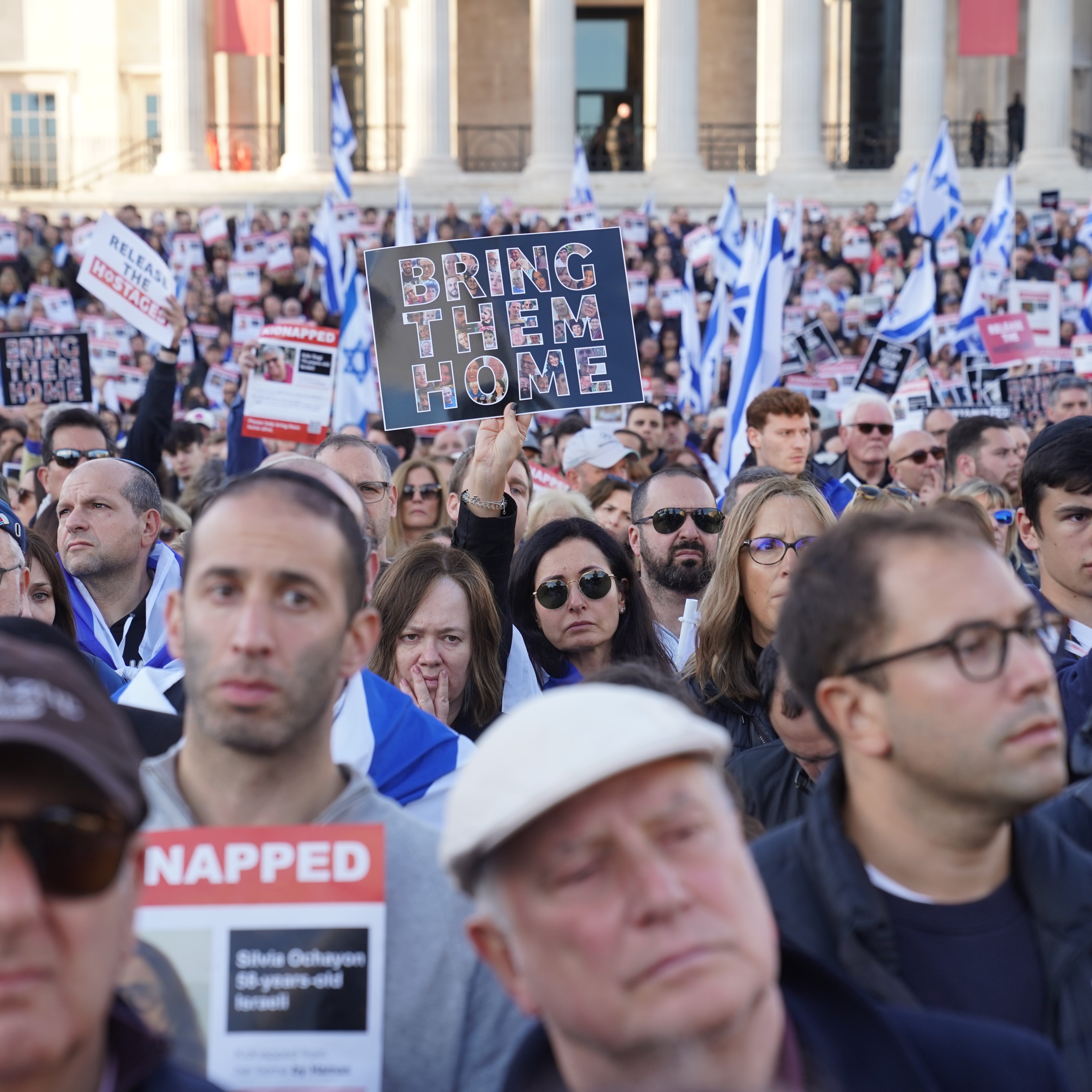
What Would You Do If Your Son Was Kidnapped by Hamas?
In this heartfelt conversation with Jon Polin and Rachel Goldberg, the parents of 23-year-old Hersh, who is among the over 240 hostages held by Hamas terrorists, they detail what they know about their son's abduction from the Supernova music festival on October 7th and the challenges they face in trying to secure his rescue. They also describe their dismay that world leaders are not doing enough to bring the hostages home and share ways to keep their son and all the hostages' stories alive. Take action to bring all hostages home now. *The views and opinions expressed by guests do not necessarily reflect the views or position of AJC. Episode Lineup: (0:40) Jon Polin, Rachel Goldberg Show Notes: Listen – People of the Pod on the Israel-Hamas War: Renana Gomeh's Sons Were Taken Hostage by Hamas: What She Needs You to Do to Bring Them Home Now What Biden's Wartime Visit to Israel Signals to Hamas, Iran, Hezbollah Mai Gutman Was Supposed to Be at the Music Festival: IDF Lone Soldier Recounts Harrowing Week Responding to Hamas Terror: IsraAID CEO on How You Can Help Israelis Right Now Learn: What is Known About Israeli Hostages Taken by Hamas 7 Ways Hamas Exploits Palestinian Civilians in Gaza How much do you know about Hamas? Try to ace our quiz and expose the truth about the terror group today. Donate: AJC.org/SupportIsrael Follow People of the Pod on your favorite podcast app, and learn more at AJC.org/PeopleofthePod You can reach us at: [email protected] If you've appreciated this episode, please be sure to tell your friends, and rate and review us on Apple Podcasts. Transcript of Interview with Jon Polin and Rachel Goldberg: Jon Polin: This is a global humanitarian issue. And every day, I wonder why is the world not speaking in that way? Why is the world shoving this into a simple black and white box of Israeli-Gaza, Israeli-Palestinian? Why are 33 foreign ministers around the world not holding hands and screaming about the magnitude of this humanitarian crisis? Manya Brachear Pashman: On October 7, Hamas terrorists broke into homes and raided a music festival, murdering more than 1400 civilians and soldiers and kidnapping at least 245 from more than 30 different countries. Almost four weeks later, only five hostages have returned home. Jon Polin and Rachel Goldberg say it doesn't matter where this happened. It is an international atrocity carried out against innocent lives and families around the world, including their own. But no one is talking about the hostage situation in Gaza in those terms. Why not? Jon and Rachel are with us now to talk about their quest to bring home their 23-year-old son Hersh and the other hostages. Jon, Rachel: Welcome. Thank you for joining us. Jon Polin: Thank you. Manya Brachear Pashman: Can you tell our listeners what you know about your son's abduction and the circumstances? It is a widely known story I think by now but just for those few that have not heard. Rachel Goldberg: So, I'll give you a sort of quick version because as you said, I think a lot of people already are familiar with Hersh's story. But he and his best friend who were at the music festival when the massacre started, they escaped in a car with two other friends and started to try to head north to get out of harm's way. But the road was blocked by Hamas gunmen who were just shooting at point blank range anyone who even got near them. So Hersh and his friends, and many other of the young people who were also in cars trying to escape, just stopped the cars, flung the doors open, and went running to these outside, roadside bomb shelters. Hersh and his friend Amer ended up with 29, a total of what we believe to be 29 of them smushed into this cinder block reinforced windowless small bomb shelter, which Hamas started to descend upon and threw in initially, hand grenades, which Hersh's friend Amer was standing by the doorway and manage to actually retrieve, pickup before detonating and throw back out at least seven of them. Three did detonate inside causing a lot of carnage. And then Hamas brought in an RPG which they fired directly into this small room of young people. And then they sprayed the room with machine gun bullets. After a couple of minutes of the dust settling, most of those young people were dead. Many of them were severely wounded, some were trapped under the dead bodies and the dying bodies and it is from those witnesses that we heard what happened to Hersh. Which is, he was slumped with three other boys against one of the walls and they were all somewhat injured but they still appeared alive. And Hamas walked in and said, everybody you know you four stand up and come outside. And when they stood up, the eyewitnesses told us that Hersh's left arm from around the elbow down had been blown off. He had somehow managed to fashion some sort of bandage or tourniquet, and he walked out. They all walked out calmly. I'm sure they were in deep shock and dazed and traumatized by what they had just seen ta

Remembering Pittsburgh Part 4: AJC CEO Ted Deutch On the Jewish Community's Resilience After Pittsburgh and Hamas Attacks
AJC CEO Ted Deutch joins us to discuss the significance of the Pittsburgh synagogue shooting at the Tree of Life and its aftermath, the anniversary, and what it means to Jews around the world after the October 7 attack on Israel, when once again Jews were murdered just for being Jewish. In the final episode of the Remembering Pittsburgh series, Ted reflects on what being Jewish in the United States feels like at this moment, and how the Jewish community is uniting to overcome yet another challenge. *The views and opinions expressed by guests do not necessarily reflect the views or position of AJC. Episode Lineup: (0:40) Ted Deutch Show Notes: Listen: Remembering Pittsburgh Part 1: Behind the Scenes at the Reimagined Tree of Life Remembering Pittsburgh Part 2: What the Family of Tree of Life Victim Joyce Fienberg Wants You to Know About Her Legacy Remembering Pittsburgh Part 3: How the #ShowUpForShabbat Campaign Drew Global Solidarity Amid Tragedy Take Action: Urge Congress to Stand Against Rising Antisemitism Music credits: Hevenu Shalom - Violin Heart Fire Tree (Violin Version) - Axletree Follow People of the Pod on your favorite podcast app, and learn more at AJC.org/PeopleofthePod You can reach us at: [email protected] If you've appreciated this episode, please be sure to tell your friends, and review us on Apple Podcasts. Episode Transcript: Manya Brachear Pashman: This month, AJC set out to mark the five-year anniversary of the Pittsburgh Synagogue Shooting at the Tree of Life with a series of episodes exploring this turning point for the American Jewish community. Our first installment aired October 5. Two days later, the Jewish people faced another unprecedented deadly antisemitic attack, this time in Israel. Synagogues stepped up security and families tamped down their fears to take their children to Hebrew school or attend Shabbat services. In the second episode of our series, we sat down with Howard and Marnie Fienberg, who paid tribute to their mother Joyce. In the third installment, we looked back at how the horror drew people to solidarity. For this closing episode of the series, I sat down with AJC CEO Ted Deutch, who served as a congressman at the time of the Tree of Life massacre. We discussed this anniversary and its parallels to the October 7 attack on Israel, when once again Jews were murdered just for being Jewish. Manya Brachear Pashman: Ted, where were you on the morning of October 27, 2018 when you heard about the Tree of Life? Ted Deutch: I was a congressman who represented Parkland, where the mass shooting at Marjory Stoneman Douglas took place. And the morning of Tree of Life, I spoke to a group of high school students from all around South Florida, who participated in a program about how they can become leaders in the community. I spoke with them about what had happened a few months before in Parkland, and what I had seen from high school students in Parkland and how they responded and how you stand up to violence and try to stop it and how you respond to evil and how important it is to use the power that you have as young people. That was literally what I was doing right before I walked out of the Florida Atlantic University auditorium and saw my phone start to buzz with news of Tree of Life. Everything that I had said to the students in the discussion, that really difficult conversation we had with these students who shared with me their fears of violence, their fears of going to school–those fears hit home really hard for me and for the Jewish community. Manya Brachear Pashman: Did you view this as a significant turning point for the Jewish community in America or worldwide? Ted Deutch: This was something that we dealt with in Europe, we feared, we stood AJC's stood with the Jewish community across Europe as they, as they were attacked over years. I was a member of Congress when we had vigils with the ambassadors from European countries, in memory of lives lost, Jewish lives lost as a result of antisemitic attacks. And here, that morning is a turning point for all of us in the Jewish community, and how we respond, how we view the threat of antisemitism now as a deadly threat to the Jewish community in America, and for the rest of America to see another example of what happens when antisemitism, hatred are running rampant and where it can lead and how dangerous it is. Manya Brachear Pashman: From your vantage point as a congressman, what shifted on Capitol Hill, if anything, after October 27? Ted Deutch: Well, I was a member of Congress, but I focused so much of my work on the Jewish community. And we had started a Bipartisan Task Force to Combat Antisemitism in response to what happened in Europe. We never could have imagined something like that happening in our own country, especially in this place. I mean, this is the most idyllic, suburban, lovely neighborhood. I mean, it is, as everyone knows, it is literally Mr. Rogers Neighborhood, right? He lives just a stone's thro

Remembering Pittsburgh Part 3: How the #ShowUpForShabbat Campaign Drew Global Solidarity Amid Tragedy
In the aftermath of the slaughter of 11 Jews inside the Tree of Life Synagogue in Pittsburgh, the deadliest antisemitic attack in U.S. history, American Jewish Committee (AJC) drew up a plan to galvanize Jewish communities and their allies across the world in an expression of unity and defiance: #ShowUpForShabbat. The campaign, which reached hundreds of millions of people, urged those of all faiths to attend synagogue services during the Shabbat following the attack to show solidarity with the Jewish community. In this third episode of our Remembering Pittsburgh series, hear from some of those who showed up to that Shabbat five years ago on what the experience meant to them and how the events of that week altered their perspective on antisemitism in America. *The views and opinions expressed by guests do not necessarily reflect the views or position of AJC. Episode Lineup: (0:40) Belle Yoeli, Anne Jolly, Rachel Ain, Sharif Street, Jennifer Mendelsohn Show Notes: Listen: Remembering Pittsburgh Part 1: Behind the Scenes at the Reimagined Tree of Life Remembering Pittsburgh Part 2: What the Family of Tree of Life Victim Joyce Fienberg Wants You to Know About Her Legacy Take Action: Urge Congress to Stand Against Rising Antisemitism Music credits: Shloime Balsam - Lo Lefached Follow People of the Pod on your favorite podcast app, and learn more at AJC.org/PeopleofthePod You can reach us at: [email protected] If you've appreciated this episode, please be sure to tell your friends, and review us on Apple Podcasts. Episode Transcript: Manya Brachear Pashman: This month, AJC set out to mark the five-year anniversary of the Pittsburgh Synagogue Shooting at the Tree of Life with a series of episodes exploring this turning point for the American Jewish community. Our first installment aired October 5. Two days later, the Jewish people faced another unprecedented deadly antisemitic attack, this time in Israel. Synagogues stepped up security and families tamped down their fears to take their children to Hebrew school or attend Shabbat services. In the second episode of our series, we sat down with Howard and Marnie Fienberg, who paid tribute to their mother Joyce. In this third installment, we look back at how horror drew people to solidarity. May we see that same solidarity today. Belle Yoeli: We saw hundreds of thousands of people show up. And we saw pictures later, after the fact, and videos, and people making speeches, and just so much solidarity. This was captured on the news. I think it really stands out as one of the most amazing responses to antisemitism that we've seen in modern history. Manya Brachear Pashman: On October 27, 2018, Americans witnessed the deadliest antisemitic attack in this nation's history. Eleven worshipers inside the Tree of Life Synagogue in Pittsburgh were murdered just for being Jewish. The senseless slaughter inside a house of worship devastated and shocked American senses because it was simply unAmerican. But the aftermath of the atrocity became an American moment when so many people showed up – showed up with hugs, showed up with flowers, showed up with prayers for their Jewish neighbors. The most visible expression of this came a week after the massacre with the unprecedented turnout of people of all faiths at synagogues across the nation as part of AJC's #ShowUpForShabbat campaign. Together, Americans sent a message that hate will not prevail. Belle Yoeli: Everyone wanted to do something, and the entire Jewish community mobilized to make this happen with the understanding that as AJC has always said that antisemitism is not just about the Jewish community. It starts with the Jewish community, but it's a threat to democracy, and the murder of Jews in their religious institution is such a breaking, a fracturing of everything that the United States stands for, everything that democratic society stands for. Manya Brachear Pashman: Today, Belle Yoeli is the chief advocacy officer for AJC. In 2018, she worked as the chief of staff for then AJC CEO David Harris. David had spent nearly 20 years counseling European leaders on the rise of antisemitism in their midst, calling their attention to violent crimes against Jews when conflict erupted between Israel and their Arab neighbors. Belle was on her way to a nephew's birthday party when she got the call on October 27 about what had happened in Pittsburgh. She remembers sobbing in the car on the phone with colleagues as they all grappled with the reality that whether they were regular shul-goers or had just happened to go to synagogue to celebrate a friend's bar mitzvah that day – it just as easily could've been them. For many, what they needed now was to go to shul and not be afraid, and to see others, not just their own community, but others of all faiths in the pews alongside them. What they needed most now was to know they were not alone. So they drew up a plan. Belle Yoeli: A couple members of our staff actually kind of simultaneousl

Remembering Pittsburgh Part 2: What the Family of Tree of Life Victim Joyce Fienberg Wants You to Know About Her Legacy
Join us in a tribute to the memory of Joyce Fienberg, one of the 11 victims of the 2018 shooting at the Tree of Life synagogue in Pittsburgh. In this touching second installment of our series on the events of 10/27 , we sit down with Joyce's son, Howard Fienberg, and his wife, Marnie, as they share their journey of mourning and resilience. Joyce was not only a dedicated member of the Tree of Life synagogue but also a retired university researcher, a devoted mother, and grandmother. Howard and Marnie open up about their extended period of mourning due to trial delays, offering a glimpse into the emotional toll of such a traumatic event. Marnie details how she turned her grief into 2 for Seder, an initiative to honor Joyce and push back against the hate that creates antisemitism. *The views and opinions expressed by guests do not necessarily reflect the views or position of AJC. Episode Lineup: (0:40) Howard Fienberg, Marnie Fienberg Show Notes: Listen: Remembering Pittsburgh Part 1: Behind the Scenes at the Reimagined Tree of Life Take Action: Urge Congress to Stand Against Rising Antisemitism Music credits: Tree of Life by Nefesh Mountain Follow People of the Pod on your favorite podcast app, and learn more at AJC.org/PeopleofthePod You can reach us at: [email protected] If you've appreciated this episode, please be sure to tell your friends, and review us on Apple Podcasts. Episode Transcript: Manya Brachear Pashman: After her husband and mother died in 2016, Joyce Fienberg started each day at Tree of Life synagogue in Pittsburgh, to recite Kaddish, the mourner's prayer. Even when she was no longer officially considered a mourner as Jewish tradition prescribes, 11 months, she continued to attend services each morning at the synagogue. That's why Howard Feinberg knew his mother Joyce was at Tree of Life when he heard there had been a shooting there on the morning of October 27, 2018. It would be more than 12 hours before he learned she was among the 11 killed that day. Howard and his wife Marnie are with us now from their home in Northern Virginia to talk about their prolonged mourning period and how they have held onto and channeled that grief. Howard, Marnie, thank you so much for joining us. Howard Fienberg: Thanks for having us. Manya Brachear Pashman: Howard, you followed your mother's example and recited kaddish for 11 months. Can you tell us a little bit about that experience? That experience of saying Kaddish and mourning for your mother, and also can you share with our listeners why it felt like the mourning period was extended? Howard Fienberg: I felt a huge amount of support everywhere I went, in order to be able to say Kaddish every day. Which for someone who was not the most observant of Jews, it was a big lift to be able to do that every day. In fact, even when traveling in disparate places, that I could always find, somehow, be able to pull together 10 people to be able to say Kaddish was a big deal. And I wanted to make sure that no one would struggle in similar circumstances as well. Obviously, initially, in Pittsburgh putting together 10 people was not a particularly big lift. Because the community support in that first week of Shiva was phenomenal. But it's not an easy thing in many congregations, and I think we are fortunate in mine that we always seem to pull it out every day. But I want to make sure that it happens. So in practice wise, that's one of the biggest things, my involvement with the synagogue, and prayer. The broader extension of the mourning period, in a way, was a result of the constant delay of the trial for the monster that committed the massacre. And that was a result of both just the general usual procedural delays that you would expect, combined with COVID excuses that dragged things out during the trial. And once a new judge took over responsibility for this case, things suddenly snapped into gear and it moved forward. And we're particularly grateful for the judge in this case, just for his very no-nonsense approach moving forward. Manya Brachear Pashman: Can you talk about whether the guilty verdict once it did take place, and a verdict was delivered, how that verdict changed anything for you and your family? Howard Fienberg: It was a matter of relief, to a great extent. I sat through almost the entirety of the trial, heard and saw all of the evidence. A lot more than I expected to and ever wanted to, but I felt duty to do so. From an outside perspective, looking at it all, you would say this is a slam dunk case, lined up for all the federal hate crimes that were involved. And at the same time, I was in doubt until the jury came back and said, all said guilty. It's just the nature of things. I was on pins and needles. Massive relief afterwards and the same thing with the final verdict and sentencing. Massive relief for us and our families. And that did allow…nothing's ever closed. You don't finish feeling the loss of somebody, especially when they're taken in,

Renana Gomeh's Sons Were Taken Hostage by Hamas: What She Needs You to Do to Bring Them Home Now
At 6:30 a.m on October 7, 2023, Renana Gomeh's life changed forever when Iran-backed Hamas terrorists stormed her home in Kibbutz Nir Oz and took her two sons, Yagil and Or Yaakov, ages 12 and 16, hostage. She has not heard from them since, knows nothing about the conditions they're held in, or whether they're still alive. Listen to Renana's painful account, how she is coping, and her mission to bring them home. American Jewish Committee (AJC) and more than 110 Jewish organizations have urged the United Nations and all governments to secure the immediate and unconditional release of the hostages. Update: This conversation was recorded on October 19. On November 27, Yagil and Or Yaakov were released as part of a temporary pause in fighting. Take action to bring their father, Yair Yaakov, and all remaining hostages home now. *The views and opinions expressed by guests do not necessarily reflect the views or position of AJC. Episode Lineup: (0:40) Show Notes: Listen – People of the Pod on the Israel-Hamas War: What Biden's Wartime Visit to Israel Signals to Hamas, Iran, Hezbollah Mai Gutman Was Supposed to Be at the Music Festival: IDF Lone Soldier Recounts Harrowing Week Responding to Hamas Terror: IsraAID CEO on How You Can Help Israelis Right Now Learn: What is Known About Israeli Hostages Taken by Hamas AJC.org/AttackonIsrael Donate: AJC.org/SupportIsrael Follow People of the Pod on your favorite podcast app, and learn more at AJC.org/PeopleofthePod You can reach us at: [email protected] If you've appreciated this episode, please be sure to tell your friends, and rate and review us on Apple Podcasts. ___ Transcript of Interview with Renana Gomeh: Manya Brachear Pashman: Over 200 hostages are being held by the Iran backed terror group Hamas after its terrorist attack against Israel and the massacre of over 1400 Israelis on October 7. American Jewish Committee and more than 110 Jewish organizations from more than 40 countries have urged the United Nations and all governments to secure the immediate and unconditional release of the hostages. The condition of many of the hostages remains unknown, yet we know some are in dire need of urgent medical care. With me to discuss her efforts to bring back her 12 year old and 16 year old sons is Renana Gomeh. Renana, thank you for joining us. Renana Gomeh: Thank you so much for having me. Manya Brachear Pashman: Now, your two sons were kidnapped from Kibbutz Nir Oz by Hamas terrorists on October 7. You were on the phone with your sons, as Hamas terrorists were breaking into your home. I cannot imagine what you've been going through over the past 2 weeks. Could you please tell listeners what happened that morning at 6:30am? Renana Gomeh: Yes, I was on another kibbutz that Saturday morning, with my spouse. I have a partner living on another kibbutz in another community near the Gaza border, which is 15 minutes drive away. And I'm divorced, and my ex-husband lives 400 meters away from me. He's also a member of my kibbutz, of my community. And the boys just usually sleep at my place. You know, this is how they prefer it. And since they're not very young children anymore, we let them choose. So they were alone at home. And he was at his place with his girlfriend, with his partner, who I love to bits. And about 6:30 in the morning, we all woke up to the red alert, which is unfortunately something which became a routine and we're used to. Since I was also on our kibbutz on the Gaza border, all communities at the Gaza border had red alerts and rockets flying over, hundreds of rockets flying over on a completely surprise attack. We just didn't see it coming whatsoever. I called my boys as I was running to the safe room at the place I was in to make sure that they're in the safe room at my place. And as the safe room is the eldest son's bedroom, he was there but he made sure that his little brother was also there. So they were in the safe room. And every couple of minutes I spoke to them to see that they were okay. At a certain point they said they're starting hearing gunshots outside the house and I could hear gunshots outside the house I was in. Again, it was a completely well-planned and well-executed attack on all communities at the same time. So no one could go outside. And I told them it was probably the army defending them. You know, they're keeping us safe. 30 minutes later or so I can't remember. I've lost track of time to be honest, of that morning. We started getting text messages from other members of the community saying terrorists are walking outside freely, breaking into houses, trying to get people out. I was begging neighbors and people from the community to go and see, to go and see them, go and be with them. You know, try and help them. But no one could go outside. And there were probably over 100 terrorists walking around, getting into houses. So there was not a chance that anyone could help. At a certain point I asked my elder brother, who's also a memb

What Biden's Wartime Visit to Israel Signals to Hamas, Iran, Hezbollah
Jason Isaacson, AJC's Chief Policy and Political Affairs Officer, joins us to break down U.S. President Joe Biden's historic wartime visit to Israel and his message to Iran and its terror proxies Hamas and Hezbollah. Jason also shares his take on the fast-moving situation, including the fallout from the explosion at the Gaza hospital, the announcement of humanitarian aid to Gaza, and the growing antisemitic attacks in the Middle East and Europe. *The views and opinions expressed by guests do not necessarily reflect the views or position of AJC. Episode Lineup: (0:40) Jason Isaacson Show Notes: Listen – People of the Pod on the Israel-Hamas War: Mai Gutman Was Supposed to Be at the Music Festival: IDF Lone Soldier Recounts Harrowing Week Responding to Hamas Terror: IsraAID CEO on How You Can Help Israelis Right Now Learn: What Everyone Needs to Know About Hamas' Lie About a Rocket Strike on a Gaza Hospital AJC.org/AttackonIsrael Donate: AJC.org/SupportIsrael Follow People of the Pod on your favorite podcast app, and learn more at AJC.org/PeopleofthePod You can reach us at: [email protected] If you've appreciated this episode, please be sure to tell your friends, and rate and review us on Apple Podcasts. Transcript of Interview with Jason Isaacson: President Joe Biden: October 7th, which was a sacred Jewish holiday, became the deadliest day for the Jewish people since the Holocaust. It has brought to the surface painful memories and scars left by a millennia of antisemitism and the genocide of the Jewish people. The world watched then, it knew, and the world did nothing. We will not stand by and do nothing again. Not today, not tomorrow, not ever. To those who are living in limbo waiting desperately to learn the fate of a loved one, especially to families of the hostages: You're not alone. Manya Brachear Pashman: On October 18th, 2023, President Joe Biden became the first American President to visit Israel during wartime, demonstrating his unequivocal support for the Israeli government. Here to talk about President Biden's visit is Jason Isaacson, AJC's chief policy and political affairs officer, joining us from Berlin where he's witnessed some of the European response to the crisis. Jason, welcome back to People of the Pod. Jason Isaacson: Thank you, Manya. Manya Brachear Pashman: I am always shocked when the President goes to a war zone like he did go to Ukraine in February, or in this case, Israel. What did President Biden's visit signal about his support for Israel during this time? Jason Isaacson: This is a president who has long identified himself as a strong supporter of Israel, who has spoken again and again, throughout his political career, from the time that he was a young man serving in the US Senate, of his support for, his identification with Israel. But to hear him speak, as he spoke on Wednesday, in Tel Aviv, after meeting with the Israeli war cabinet that Prime Minister Netanyahu assembled, after other meetings that took place as well, to hear him speak with such passion, such conviction about the priority for the United States, of standing by Israel, of identifying with the struggle that Israel now faces against Hamas terror. To hear him talk about "the nations of conscience," as he referred to the US and Israel together. The struggle that the Jewish people have had over the centuries, the fight against antisemitism, his references to the Holocaust. All of that, and to say that the United States was standing by Israel, in the fullest possible way, the deployment of an aircraft carrier battle group to the eastern Mediterranean. Another aircraft carrier battle group, steaming to the eastern Mediterranean as well to provide additional support. The package of additional military assistance. He described it as an unprecedented package of military assistance that he is asking Congress to approve, to help Israel through this difficult time. All of these statements and his just physical presence in Israel, in the midst of war, spoke volumes of the support that the United States has for Israel. And he also spoke frankly, about the tragedy that occurred the night before he arrived, at a hospital in Gaza. And the fact that all the indications are that this was caused by the fire of Palestinian Islamic Jihad, the rocket that misfired. It wasn't, as so much of the media and so much of the region, frankly, has alleged that it was somehow the work of Israel. Very clearly from the evidence that has been accumulated by U.S. surveillance and other means of data collection. This was something that was a misfire from the Palestinian side. All of that, packaged into a single presentation by the president at the old American Embassy in Tel Aviv, just spoke volumes of the support that the United States has for Israel, that the US is standing by Israel in this very difficult time. Manya Brachear Pashman: Let's talk about people who immediately assumed that it was an Israeli airstrike that caused that explosion

Mai Gutman Was Supposed to Be at the Music Festival: IDF Lone Soldier Recounts Harrowing Week
Mai Gutman, 28, a graduate student and member of AJC's Campus Global Board, had planned to join her friends at the Supernova music festival near Israel's border with Gaza on Saturday, October 7. But when relatives came to visit, she decided to celebrate Shabbat and Simchat Torah in Jerusalem instead—a change of plans that saved her life. At least 260 young Israelis and people from all over the world were brutally murdered by Hamas terrorists at the festival. Mai, an IDF reservist who was just recently called up, joins us from her base to talk about waking up in Jerusalem the morning of October 7, the harrowing messages that she received from friends, and the four days since. *The views and opinions expressed by guests do not necessarily reflect the views or position of AJC. Episode Lineup: (0:40) Mai Gutman Show Notes: Donate: AJC.org/SupportIsrael Learn: AJC.org/AttackonIsrael AJC.org/CampusBoard AJC.org/CampusLibrary Song credits: Pond5: "Hatikvah (National Anthem Of Israel, Electric Guitar)"; Composer: Composer: Eli Sibony; ID#122561081 Follow People of the Pod on your favorite podcast app, and learn more at AJC.org/PeopleofthePod You can reach us at: [email protected] If you've appreciated this episode, please be sure to tell your friends, and rate and review us on Apple Podcasts. ___ Transcript of Interview with Mai Gutman: Manya Brachear Pashman: The techno music festival near Israel's border with Gaza was billed as the essence of unity and love in a breathtaking location. At least 260 people were brutally killed by Hamas terrorists there on Saturday morning, October 7th. 28-year-old Mai Gutman was supposed to be there and had already joined the WhatsApp groups of friends and fellow concert goers to keep in touch. But she did not go. Mai, a member of AJC's Campus Global Board and a reservist who was just recently called up, joins us from her IDF base to talk about waking up in Jerusalem the morning of October 7th and the four days since. Mai, welcome. Where are you now? Mai Gutman: I live in Herzeliya. Currently, located in a place that I can't exactly disclose, but I am in the north of Israel. Manya Brachear Pashman: Are you able to share what you're seeing and hearing all around you? Mai Gutman: Currently where I am I mean, we can hear the news, we can hear what's going on around us in the South as well. Even though we are stationed in the north. Today [October 11, 2023] was a pretty hectic day in terms of developments on the northern border. We had a day pretty much full of running to the bomb shelters and staying there, which indicated some sort of an escalation. I can't go into too many details, obviously. But we can feel the escalation coming and we're prepared for it. Manya Brachear Pashman: So you were born in Israel but grew up mostly in Melbourne, Australia. How did you end up back in Israel? Mai Gutman: I moved to Australia with my parents when I was only 18 months old, and I had grown up in Australia. But I had always felt a very strong connection to Israel. Something that really I couldn't put into words, I couldn't explain, it was just an inherent feeling. And when I was 18, I just decided that I'm going to go to Israel, I'm going to make Aliya and I'm going to draft into the army just because I think, you know, for me, it was important, if I'm going to live there, then I definitely need to carry the burden and be a part of society in that way and contribute. Because I find it difficult to comprehend living here, and not being a part of that very fundamental part of people's lives. It's a very crucial part of people's lives around here. And I feel like I wouldn't really be able to fit in and understand, you know, Israeli society, and also the Israeli mentality without having that experience. And I also just think that it's important, all in all, just to contribute. And that's I guess, how I got into the army. And I served for almost three years in a combat unit in search and rescue. For me, at the time, when I first drafted it was really the first years of women going into combat units. So it was a very kind of still a new idea. And I was really eager to jump on that and see how I go. Manya Brachear Pashman: So with no immediate family there, does that qualify you as a lone soldier? Mai Gutman: Yes, absolutely. So I enlisted with Garin Tzabar, which is a program that brings young adults from all around the world who want to make Aliyah and specifically to draft into the IDF, but don't have any immediate family with them. So Garin Tzabar provides that network of family and support, I guess, to deal with, first of all, all the bureaucracy that comes with moving to another country and drafting into the military. But also, you know, you get put on a kibbutz and you get given a host family, which is really nice. And it's just nice to have that initial support network because it might feel a little bit lonely when we first arrive. But now we're really like a one big family and we still ke

Responding to Hamas Terror: IsraAID CEO on How You Can Help Israelis Right Now
We're joined by Yotam Politzer, CEO of IsraAID, to discuss how Israel's leading international humanitarian organization is responding to the immediate and long-term needs on the ground in the wake of Iran-backed Hamas's barbaric terrorist attack in Israel. Politzer shares how American Jews can step up to support Israelis through this incredibly difficult time. American Jewish Committee (AJC) has launched an Israel Emergency Campaign to support Israeli relief organizations. Their first grantee will be IsraAID, AJC's longtime partner, which has responded to emergencies worldwide, but never before in Israel. Until now. *The views and opinions expressed by guests do not necessarily reflect the views or position of AJC. Episode Lineup: (0:40) Yotam Politzer Show Notes: Donate: AJC.org/SupportIsrael Learn: AJC.org/AttackonIsrael Follow People of the Pod on your favorite podcast app, and learn more at AJC.org/PeopleofthePod You can reach us at: [email protected] If you've appreciated this episode, please be sure to tell your friends, and rate and review us on Apple Podcasts. ___ Transcript of Interview with Yotam Politzer: Manya Brachear Pashman: On the morning of October 7th, Hamas, the terror group governing Gaza and backed by Iran's regime, launched a brutal assault against Israel, invading towns and cities across the southern border aiming to kill as many people as possible and taking more than 100 captives to Gaza. By the time of this recording, the death toll had reached 900. Thousands more are wounded. In response to this atrocity, American Jewish Committee has launched an Israel Emergency Campaign to support Israeli relief organizations. The first recipient money raised will be AJC's longtime partner IsraAID, which has responded to emergencies in more than 50 countries around the world, but never before in Israel– until now. Yotam Polizer, CEO Of IsraAID, joined us in Tel Aviv earlier this summer. He is joining us again now from New York, where he was visiting when the war broke out. While Yotam is unable to return home at the moment due to lack of flights to Israel, he is working hard to coordinate emergency response from here and is with us to discuss the efforts underway. Yotam, welcome back to People of the Pod. Yotam Politzer: Thanks for having me. Manya Brachear Pashman: It must be so difficult not to be there with your team. Yotam Politzer: Thankfully, our headquarters and our emergency response team is already in full speed. So I think it's also important for me to be here for two reasons, one, to coordinate the support, and not less importantly, to communicate to people here, both in the Jewish community and in the general community, what we're seeing and hearing in terms of the humanitarian needs on the ground. Manya Brachear Pashman: So what are you hearing from your people on the ground there? What are they reporting? Yotam Politzer: I don't think I need to elaborate on the horrors because I think we've all been following the news and saw all the horrific images. But for us, as Israel's leading international humanitarian organization, we have never had a full-scale humanitarian response in Israel. This is the first time we're actually doing it. And we're doing it because the situation is indeed dire and extreme. The biggest need that we identify right now is related to mental health. And because, of course, we are not a humanitarian organization, we're not involved in the security and the military operation. And of course, there are many needs related to the operation that's going on. From a humanitarian perspective, the whole country is traumatized. I don't know of a single person who doesn't know anyone who either was murdered or kidnapped or both. And the number of people who have an immediate family member, or neighbor, who was murdered, or unaccounted for and probably kidnapped by Hamas is so high, talking about hundreds of 1000s of people. Specifically, what we consider the most vulnerable are obviously the people who lived on the frontline, the villages, the moshavim, and the kibbutzim surrounding Gaza. They have lost on average 10-20% of their population in each of these villages. In Kibbutz Be'eri, just an hour ago, it was published that they found 108 bodies– that's probably much more than 10% of the population there. And many more again, are kidnapped. So these communities who suffered the worst atrocities a person could think of are now in different shelters around the country. So supporting them in these shelters in any shape or form is the most important humanitarian mission of our time. Many of them have been evacuated specifically from this kibbutz to the Dead Sea, to the Dead Sea hotels, because it's one of the safest places in Israel. If God forbid, we will have another frontline on the north border, that's still safe enough for these people. And these hotels are now operating as shelters and evacuation centers. And the government and the local regional council and the ho

Remembering Pittsburgh Part 1: Behind the Scenes at the Reimagined Tree of Life
This month, we mark the five-year anniversary of the Pittsburgh Synagogue Shooting at the Tree of Life. On October 27, 2018, 11 worshipers were murdered solely for being Jewish, in the deadliest antisemitic attack in U.S. history. As the first installment in a four-part series, we take you inside the Tree of Life building before it is demolished in the coming months to make way for a new complex dedicated to Jewish life and combating antisemitism. Hear from Carole Zawatsky, the CEO behind the reimagined Tree of Life, and Eric Lidji, director of the Rauh Jewish Archive, as they explain their mission: to preserve artifacts and memories so that the story is preserved forever. Carole shares her commitment to honoring the victims, and Eric discusses the challenges of documenting an ongoing tragedy. Together, they emphasize the power of bearing witness to history and the healing strength of remembrance. *The views and opinions expressed by guests do not necessarily reflect the views or position of AJC. Episode Lineup: (0:40) Eric Lidji, Carole Zawatsky Show Notes: Music credits: Relent by Kevin MacLeod (incompetech.com), Licensed under Creative Commons: By Attribution 3.0 Virtual Violin Virtuoso by techtheist is licensed under a Attribution 4.0 International License Fire Tree (Violin Version) by Axletree is licensed under a Attribution 4.0 International License. Al Kol Eleh (backing track), with Yisrael Lutnick Follow People of the Pod on your favorite podcast app, and learn more at AJC.org/PeopleofthePod You can reach us at: [email protected] If you've appreciated this episode, please be sure to tell your friends, and rate and review us on Apple Podcasts. Episode Transcript: Eric Lidji: Pittsburgh definitely is not forgetting. It's ever present here. There are people who are healing and doing so in ways that, at least from the outside, are remarkable and very inspiring. And there are people who I'm sure have not fully reckoned with it yet. Carole Zawatsky: It's all too easy to walk away from what's ugly. And we have to remember. We can't walk away. Manya Brachear Pashman: Five years have gone by since the horrific Shabbat morning at Pittsburgh's Tree of Life Synagogue, when eleven congregants were gunned down during prayer – volunteers, scholars, neighbors, doing what they always did: joining their Jewish community at shul. This is the first installment of a series of episodes throughout the month of October devoted to remembering and honoring the lives lost that day and reflecting on how the deadliest antisemitic attack in American history changed those families, changed us, and changed our country. Today, we take you to the Tree of Life building that stands on the corner of Shady and Wilkins Avenues in Pittsburgh's Squirrel Hill neighborhood to hear from two people in charge of preserving the artifacts and memories of the vibrant Jewish life that unfolded inside those walls until October 27, 2018. In early September, our producer Atara Lakritz and I visited the Tree of Life synagogue in Pittsburgh's Squirrel Hill neighborhood. Squirrel Hill, where Jews have settled since the 1920s, is quite literally Mister Rogers' neighborhood. We were there to interview those touched by the events of October 27. But it didn't take us long to figure out that everyone there had been affected in some way. All along Murray Avenue, in 61C Cafe, at Pinsker's Judaica Shoppe, at the Giant Eagle supermarket, when we told people why we were there, they all had a story, an acquaintance, a connection. Later, walking through the glass doors of the synagogue felt like we were stepping through a portal, traveling back five years, when life stopped, and the reality of the hatred and terror that unfolded there began to haunt every step. Atara and I were invited to accompany a final group tour of the building before it closed in order for preparations to begin for the building's demolition. The tour was painful, but we felt it necessary to share with our listeners. As we left the lobby, we were told to take the stairs to the left. The stairs to the right were off limits. Someone had been shot there. We were led to a small, dark storage room where chairs had been stacked for guests. A handful of people had hidden there as the shooter continued his rampage, but one man walked out too soon, thinking it was safe. When first responders later came to get the others, they had to step over his body. In the kitchen, there were still marks on the wall where the bullets ricocheted when he shot two women hiding underneath a metal cabinet. The calendar on the wall there was still turned to October 2018 with a list of activities that were happening that week posted alongside it. And in the Pervin Chapel where seven people died, pews punctured with bullet holes and carpet squares stained with blood were no longer there. No ark either. But remarkably, the stained glass windows remained with images and symbols of Jewish contributions to America, the land

What Jewish Students at Penn Want You to Know About Antisemitism and the Palestine Writes Event
All eyes have been on the University of Pennsylvania and the Palestine Writes event, a gathering meant to give voice to Palestinian art, poetry, and literature on campus. However, a number of the speakers, including Roger Waters and Marc Lamont Hill, have well-documented histories of antisemitic statements. Maya Harpaz, Vice President of Israel Engagement at Penn Hillel, and Jonah Miller, a reporter for The Daily Pennsylvanian, take you through what unfolded, growing campus antisemitism, defining free speech on campus, and the responsibility of university administrators to protect Jewish students. *The views and opinions expressed by guests do not necessarily reflect the views or position of AJC. Episode Lineup: (0:40) Maya Harpaz, Jonah Miller Show Notes: Watch: Live from Penn: Maya Harpaz of Penn Hillel on Palestine Writes Read: Everything you need to know about the Palestine Writes event at Penn and antisemitism. AJC Campus Library: Resources for Becoming a Strong Jewish Student Advocate Listen: What the UN Needs To Do To Stop Iranian and Russian Aggression Follow People of the Pod on your favorite podcast app, and learn more at AJC.org/PeopleofthePod You can reach us at: [email protected] If you've enjoyed this episode, please be sure to tell your friends, tag us on social media with #PeopleofthePod, and hop onto Apple Podcasts to rate us and write a review, to help more listeners find us. __ Transcript of Interview with Maya Harpaz and Jonah Miller: Manya Brachear Pashman: Meggie Wyschogrod Fredman, AJC's Senior Director of the Alexander Young Leadership Department, guest hosts this week's conversation with two Jewish college students about a situation on their campus and how they responded. Meggie, take it away. Meggie Wyschogrod Fredman: Thanks, Manya. This past week, it seemed like all eyes were on the University of Pennsylvania in the lead up to the Palestine Writes event. The event was meant to give voice to Palestinian art, poetry, and literature- all of which are quite appropriate and indeed valuable to have on a university campus. However, a number of the announced speakers strayed from the event's purpose and instead have well-documented histories of antisemitic statements. These include Roger Waters, who was recently described by the U.S. State Department as having a long track record of using antisemitic tropes, after he desecrated the memory of Holocaust victim Anne Frank, compared Israel to the Third Reich, and recently paraded around a stage wearing an SS Nazi uniform during a concert in Berlin. It also included Marc Lamont Hill, whose public remarks as a CNN commentator called for Israel's eradication. At play were questions around growing campus antisemitism, free speech on campus, and the role of university administrators in preventing such bigotry–particularly with the release in May of the U.S. National Strategy to Counter Antisemitism, and its outsized focus on how antisemitism affects Jewish students on campus. To help us break down these events and what unfolded are two Jewish students who experienced this all firsthand and helped drive the course of events. Joining me are Maya Harpaz, a junior at Penn, and Vice President of Israel Engagement at Penn Hillel, and Jonah Miller, a junior at Penn, and a reporter for The Daily Pennsylvanian, Penn's student newspaper. Maya and Jonah, thanks for joining us on People of the Pod. Jonah Miller: Thank you so much for having me. I'm really looking forward to our discussion. Maya Harpaz: Yeah, thank you for having us. Meggie Wyschogrod Fredman: Great. So with that, let's jump in. So there are many chapters to what happened at Penn, and I think a great deal of misinformation. So let's go back to the beginning. When did Jewish students first hear about the Palestine Writes event, and particularly its speaker lineup? And upon initially learning about it, what were the specific concerns that Jewish students had? Jonah Miller: I think that when I learned about the Palestine Writes event, I learned about it simultaneously with who some of these speakers are. Penn is a large university and institution that has countless events each day, hosted and co-sponsored by numerous different departments and facets of the university. If I had learned about this festival, solely, just about the festival, I would say, you know, great, it's great that this culture, and these literary items are being amplified on campus. Everyone and every culture should have a space on this campus. But to learn about at the same time as concerns of antisemitic speakers, that's when I as a Jewish student, started to get a little nervous. Nervous, because how could Penn allow antisemitic speakers to come speak on a campus that is close to 20% Jewish? And even without that high percentage, how could they be invited to speak at all? Maya Harpaz: Yeah, I can touch on that as well. In my role as VP Israel, a big part of that is seeing what events are going on, whether it be related

What the UN Needs To Do To Stop Iranian and Russian Aggression
This week, Simone Rodan Benzaquen, Managing Director of AJC Europe, joins us to discuss AJC's leading role in the Jewish community's diplomatic efforts at the United Nations General Assembly. Simone highlights key areas of advocacy, including countering the Iranian threat, addressing antisemitism and anti-Israel bias, advancing the Abraham Accords, and supporting Ukraine against Russian aggression. We also explore the impact of addresses from Palestinian Authority President Mahmoud Abbas and Iran's President Ebrahim Raisi, who have used the UN platform to spread antisemitic and anti-Israel narratives. Simone sheds light on the challenges and progress in shaping international policies on these critical issues. *The views and opinions expressed by guests do not necessarily reflect the views or position of AJC. Episode Lineup: (0:40) Simone Rodan Benzaquen Show Notes: Test your knowledge: About the UN, Israel, fighting antisemitism, and AJC's role Read: AJC Advocacy at UN General Assembly 2023 Top 5 Things AJC is Tracking at the United Nations General Assembly Five Things to Know About President Raisi and Human Rights in Iran and Beyond Key Takeaways From President Biden's Address to the UN General Assembly Mahsa Amini Protests One Year Later: What is the Current Human Rights Situation in Iran? Listen: Deborah Lipstadt on the Abraham Accords' Impact and the U.S. National Strategy to Counter Antisemitism Follow People of the Pod on your favorite podcast app, and learn more at AJC.org/PeopleofthePod You can reach us at: [email protected] If you've enjoyed this episode, please be sure to tell your friends, tag us on social media with #PeopleofthePod, and hop onto Apple Podcasts to rate us and write a review, to help more listeners find us. __ Transcript of Interview with Simone Rodan Benzaquen: Manya Brachear Pashman: All this week, leaders from 193 nations have gathered in New York, addressing the United Nations General Assembly. But there's a lot of action on the sidelines as well. That's where policy experts from the American Jewish Committee do their diplomatic outreach, urging leaders to expand and strengthen ties with Israel, and counter rising antisemitism and extremism. With us to discuss what's been happening on those sidelines is Simone Rodan Benzaquen, Managing Director of AJC Europe. Simone, welcome to People of the Pod. Simone Rodan Benzaquen: Thank you. Thank you very much for having me. Manya Brachear Pashman: So I'll start with Iran. How are we pushing leaders to address the threat from Iran this week? Simone Rodan Benzaquen: So Iran, as you rightly point out, is a really priority issue for us in all of the meetings we've had in particular with on my end with the European leaders, and it's, and our objective is really to make sure that we are countering Iran on all fronts. Of course, there's the nuclear file. And so our objective is to push leaders to be aware and really understand that, if that was to happen, we are entering an entirely new world. If we think that the war that Russia has been waging on Ukraine was a game changer for the stability of the world, we have not seen anything yet. So our objective is to really push European and international leaders to really address the issue. The second issue is, of course, human rights. We are now a year after the murder of Mahsa Amini, and really the horrible repression that the Iranian regime has committed against its own people. And there has been a time when European international leaders were very, very clear in their support for the Iranian people, and in condemning the Iranian regime and the Islamic Republic. But these past months, we've heard a little bit less of that. So our objective is really, has really been to reengage them on that commitment. And then third of all, and this is really a very specific issue, particularly in Europe, is the Iran Revolutionary Guard. And so the Iranian Revolutionary Guard Council, the IRGC, is not listed as a terrorist organization in the EU. And that is obviously not normal. First of all, because they have been committing horrible crimes in their own country, because they have been committing terrorist acts across the world. Because they are obviously a key sponsor of terrorism across the world, because of their role also in Ukraine. They have armed Russia with Iranian drones, they have trained people on the ground. And lastly, and this is for us, very important as the Jewish advocacy organization, they have been threatening Jewish communities across Europe. There are a number of cases that are now very clear, which include in Germany, in the United Kingdom, but also in Greece and in Cyprus, where it's very clear that Iran is threatening Jewish communities and Israelis on European soil. Now, Europe for the past years, has made it very clear that it's a key priority for itself to combat antisemitism on the ground and in Europe. And that's a very important commitment. Now, if they're very, very serious a

Deborah Lipstadt on the Abraham Accords' Impact and the U.S. National Strategy to Counter Antisemitism
Ambassador Deborah Lipstadt, the U.S. Special Envoy to Monitor and Combat Antisemitism, joins us to discuss how she's settled into her new role and shares insights on the development of the new U.S. National Strategy to Counter Antisemitism, for which AJC has long advocated. Lipstadt, a renowned Holocaust historian and one of Time Magazine's Most Influential People of 2023, also delves into the ways in which the Abraham Accords have contributed to the fight against antisemitism in the Middle East. Additionally, she provides an insider's look into the challenges and progress associated with addressing antisemitism and how the National Strategy factors in. *The views and opinions expressed by guests do not necessarily reflect the views or position of AJC. Episode Lineup: (0:40) Deborah Lipstadt Show Notes: Go Deeper: Test your knowledge of the National Strategy to Counter Antisemitism Read: Everything You Need To Know About The U.S. National Strategy To Counter Antisemitism And AJC's Task Force Honoring International Antisemitism Envoys AJC David Harris Award Listen: People of the Pod: Hear from America's New Antisemitism Envoy Deborah Lipstadt Follow People of the Pod on your favorite podcast app, and learn more at AJC.org/PeopleofthePod You can reach us at: [email protected] If you've enjoyed this episode, please be sure to tell your friends, tag us on social media with #PeopleofthePod, and hop onto Apple Podcasts to rate us and write a review, to help more listeners find us. __ Transcript of Interview with Deborah Lipstadt: Manya Brachear Pashman: Deborah Lipstadt, US Special Envoy to Monitor and Combat Antisemitism is a renowned Holocaust historian, recognized earlier this year as one of Time Magazine's Most Influential People of 2023. She has written eight books, and four years ago, advised the United Nations on its unprecedented report on global antisemitism. In fact, she joined us on this podcast shortly after the report's release. Since then, she has joined the US State Department in a role that for the first time carries the rank of Ambassador. She joins us again this time in our popup Tel Aviv studio. Ambassador, welcome to People of the Pod. Deborah Lipstadt: Thank you. Manya Brachear Pashman: America's National Strategy to Counter Antisemitism was adopted in May. Your job primarily deals with US Foreign policy to combat antisemitism. But how does this new domestic strategy affect your work? Deborah Lipstadt: Well, it affects our work and that certainly I was consulted and worked closely with the White House in the shaping of it, my team played a part in helping to shape it people to reach out to and things like that. And there are over 24 agencies involved including the State Department, we're now looking at all the other national strategies to see best practices, what America could possibly adopt. And of course, informally, I'm the administration's most knowledgeable person on antisemitism. So they turned to me quite often for advice, for ideas, etc. Manya Brachear Pashman: Okay. All right. Well, so as I said, your role is more international. Do you need a domestic counterpart? Does the United States need a domestic antisemitism czar? Deborah Lipstadt: I'm not sure. It's a lot on–the strategy is really run out of the Domestic Policy Council, which until about a week ago, was headed by Ambassador Susan Rice, who was greatly responsible for seeing this thing come to fruition. And we'll see how it works. It's up to them to decide how they want to do it. But I think it's also good that each agency from the usual suspects, as I like to say, homeland security, education, FBI, law enforcement, are involved, but so are so many others. Small Business Administration, Veterans Affairs, Smithsonian, all looking at ways to counter antisemitism, make sure there aren't barriers that are there, whether because of antisemitism or just ignorance. Manya Brachear Pashman: And second gentleman Doug Emhoff has been certainly-- Deborah Lipstadt: Even before I was sworn in, after I was confirmed, I was in Washington and he asked me if I would come in and visit with him. We had a wonderful visit. We're in touch all the time. And he really feels this very deeply. And I give him great credit because he could easily have said, Look, I'm the first Jew in this position. First second gentleman. We put up a mezuzah for the residence. We have a Hanukkah party. We have a Seder. We do other things. Don't ask me to take the lead on this. But he's taken the lead. He's traveled all over, he traveled with me to Poland and Germany, where I coordinated a meeting for him with other special envoys, just to give him a sense of what other countries were doing. And I think when he and his staff and other people in the White House who were with us saw that, it sort of energized them to say, my God, other countries have taken this really seriously. They're way ahead of us. We have to do something serious as well. Manya Brachear Pashman: Y

Sen. Joni Ernst Reflects on the Abraham Accords and the Future of Arab-Israeli Engagement
As we mark the third anniversary of the Abraham Accords, significant progress has been made in deepening Arab-Israeli engagement. With us this week is Sen. Joni Ernst (R-IA), a founding member of the Senate Abraham Accords Caucus. Ernst joins guest host Benjamin Rogers, AJC's Director for Middle East and North Africa Initiatives, to reflect on the achievements of the landmark deal, its importance to the United States, speculation over Saudi Arabia, and the crucial role of the Senate in advancing peace between Israel and its Arab neighbors. *The views and opinions expressed by guests do not necessarily reflect the views or position of AJC. Episode Lineup: (0:40) Joni Ernst Show Notes: Engage: How much do you know about Abraham Accords? Take our quiz and put your knowledge to the test! Read: The Abraham Accords, Explained Listen: Meet 3 Women Who are Driving Change in the Middle East 'Golda': Behind the Scenes with Israeli Director Guy Nattiv on the 1973 Yom Kippur War Noa Tishby on the Abraham Accords: The Middle East Realizes Israel is Not the Enemy Follow People of the Pod on your favorite podcast app, and learn more at AJC.org/PeopleofthePod You can reach us at: [email protected] If you've enjoyed this episode, please be sure to tell your friends, tag us on social media with #PeopleofthePod, and hop onto Apple Podcasts to rate us and write a review, to help more listeners find us. __ Transcript of Interview with Joni Ernst Manya Brachear Pashman: As an organization, AJC has been engaged in the Middle East for more than 70 years. In fact, a senior AJC delegation first traveled to Morocco in March 1950. Since then, there have been several more milestones. AJC's own Jason Isaacson participated in the Madrid Conference in 1991, a historic effort by the international community to revive the Israeli-Palestinian peace process; and AJC opened its first Arab world office in Abu Dhabi in 2021. This week, Benjamin Rogers, AJC's Director for Middle East and North Africa Initiatives, explores one of the most significant developments in the decades-long Arab-Israeli conflict – The Abraham Accords. The conversation marks the Accords third anniversary on September 15. Benjy, the mic is yours. Benjamin Rogers: Thank you so much, Manya. And I remember the day well, I had been in the Gulf just a few months prior December 2019, talking about these issues, talking about normalization, talking about cooperation. But to see the President of the United States, the Prime Minister of Israel, the foreign ministers of the UAE and Bahrain, on the White House lawn, signing an agreement of friendship, an agreement of cooperation. It was an electrifying moment. As we prepare to celebrate the third anniversary of what is possible,when Israelis and Arabs come together and set aside their differences. I can think of no better person to help us reflect on this moment than our guests today. It is my honor to welcome Senator Joni Ernst of Iowa, founding member of the Abraham Accords Caucus to our program today. Senator, thank you so much for being here. Joni Ernst: Of course, it is an honor, a privilege and a pleasure to be with you today. I'm celebrating as well, I think it's a phenomenal achievement for the United States and for our friends in Israel and those Arab nations. Benjamin Rogers: And I think that's a great starting place for our conversation. Share with us a little bit about your story. What was your reaction when you learned of these agreements? How did that translate to saying, Hey, I'm going to work with my colleagues. I'm going to sit down with Senator Lankford, Senator Rosen, Senator Booker, and we're going to be the founding members of the Senate Abraham Accords caucus? Joni Ernst: And it goes back quite a ways. My own personal journey, I had served in the Iowa Army National Guard and had deployed to the Middle East for Operation Iraqi Freedom and, and having that experience serving in our United States Armed Forces, we have the great privilege and honor of serving with many members from other countries as well. And we have an understanding of those nations and what they're trying to achieve and how we can promote stability in certain regions. So from that basis, then I served in the Iowa State Senate, and when you think of Iowa and Israel as maybe not a natural connection, but we have a huge Christian community across the state of Iowa that is very supportive of our Jewish brothers and sisters in Israel. And so from that platform of the Senate, I was able to move into the United States Senate with a broad basis, not only the military perspective, but then also how Iowa and Israel can come together collaborate on things like agriculture, cultural exchanges, and with that basis, then finding other members of the Senate that had similar goals and objectives. And that came together really, with the incredible, really the incredible advent of the Abraham accords. And so we were able to start the caucus, those of us that ha

'Golda': Behind the Scenes with Israeli Director Guy Nattiv on the 1973 Yom Kippur War
This week, Academy Award-winning director Guy Nattiv discusses his new film 'Golda,' which follows the journey of Israeli Prime Minister Golda Meir as she navigates the tense 19 days of the 1973 Yom Kippur War. Nattiv delves into how Helen Mirren, who portrays Golda Meir, expertly embodied the role. He also shares why, being a child of '73, he felt so compelled to tell this story. Tune in to hear the poignant anecdotes from the set and learn about the involvement of war veterans in the filmmaking process. *The views and opinions expressed by guests do not necessarily reflect the views or position of AJC. Episode Lineup: (0:40) Guy Nattiv Show Notes: Watch: 'Golda' opens in US theaters starting August 25th from Bleecker Street / ShivHans pictures–find theater and ticket information at www.goldafilm.com Read: Tough Questions on Israel Answered Listen: Matti Friedman on How the 1973 Yom Kippur War Impacted Leonard Cohen and What It Means Today The Rise of Germany's Far-Right Party and What It Means for German Jews AJC Archives Follow People of the Pod on your favorite podcast app, and learn more at AJC.org/PeopleofthePod You can reach us at: [email protected] If you've enjoyed this episode, please be sure to tell your friends, tag us on social media with #PeopleofthePod, and hop onto Apple Podcasts to rate us and write a review, to help more listeners find us. __ Transcript of Interview with Guy Nattiv: Golda Meir [from AJC Archives]: We've suffered because of our stance, which is not just obstinacy, not just because we liked it this way. But I think it has been accepted more and more that we have something at stake, and that's our very existence. Whether the borders are such that we can defend them or not, is a question of to be or not to be. Manya Brachear Pashman: That's the late Prime Minister of Israel Golda Meir speaking with AJC about fighting wars to defend Israel's existence. The movie Golda premiering in American theaters this week tells the story of one such battle: the Yom Kippur War of 1973 when Egypt and Syria launched a surprise attack against the Jewish state. Here to talk about the movie and why it's an important story to share with the world, especially through Golda Meir's eyes is its Academy Award winning Director Guy Nattiv. Guy, welcome to People of the Pod. Guy Nattiv: Hi, Manya. Manya Brachear Pashman: So Guy, as we just heard from Golda Meir herself, Israel has been defending its very existence since its creation, in war after war after war. Why did you want to direct a film about this particular war, which turned out to be quite a turbulent moment in the life of the Jewish state? Guy Nattiv: Well, I was born into this world, in a way. I'm a child of '73. My mom ran to the shelter with me as a baby, my father went to the war. And I grew up on those stories, of Golda, of the war, and I really wanted to know more, but there wasn't any way of knowing more. And I think that 10 years ago, protocols came out and gave a sense of what really happened, protocols from the Agranat Committee, from the war rooms, from the government. All those declassified documents. And that shed a different light on what really happened there, and on Golda. And doing the research on Golda and talking to people who really knew her, gave me a sense of why we needed to tell the story. It's for my generation and for the generation of my fathers' and mothers'. Manya Brachear Pashman: So who made the decision to cast Helen Mirren as Golda Meir? Guy Nattiv: I wasn't the one who casted Helen. When I came on board, Helen was already attached. I think that Gideon Meir, the grandson [of Golda], he was the one who thought about Helen first, he said, I see my grandmother in her. And when I came she already read the script, and it was only meeting me to close the circle. Manya Brachear Pashman: And what did she bring to the role? Guy Nattiv: Humor, humanity, wisdom, charm. It's all there. But she brings a lot of human depth to the character. Manya Brachear Pashman: Were there conversations off camera during the making of the film about Israel, about its history, about the lessons learned in this moment in its history, with Helen Mirren, or other cast members? Guy Nattiv: Yeah, but the problem is that we don't really learn, right, because look what happened now in Israel. It's the Yom Kippur of democracy. So I don't think we learned enough. Where we are basically in the same situation, as '73, with a leader that is so disattached. At least Golda believed in the judicial system, she believed in High Courts, she was a humanist. She believed in democracy, full democracy. And I think the situation now is so dire. And when I went to protest in Israel, I went to protest with a lot of veterans from the war, who had the t-shirt 'This is the Yom Kippur of democracy.' We're fighting, they're almost fighting again, but this time not because of our enemies, because of ourselves. We're eating ourselves from within. Manya Brachear Pashm

The Rise of Germany's Far-Right Party and What It Means for German Jews
Polls in Germany suggest the far-right political party Alternative for Germany, or AfD—with its antisemitic, anti-Muslim, anti-EU, and other extreme views—has support from a fifth of German voters. Hear from Felix Klein, the Federal Government Commissioner for Jewish Life in Germany and the Fight Against Antisemitism, and an AJC Project Interchange Alum, on what has contributed to the rise of AfD, why the party threatens German Jews, and the danger it presents to Germany's democracy. *The views and opinions expressed by guests do not necessarily reflect the views or position of AJC. Episode Lineup: (0:40) Felix Klein Show Notes: Read: A Roadmap for America: AJC's Experience in Europe Is Helping the U.S. Fight Antisemitism German Antisemitism Czar Says Calling Israel 'Apartheid' Is Antisemitic Listen: What the U.S. National Strategy to Counter Antisemitism Means for Jewish College Students Follow People of the Pod on your favorite podcast app, and learn more at AJC.org/PeopleofthePod You can reach us at: [email protected] If you've enjoyed this episode, please be sure to tell your friends, tag us on social media with #PeopleofthePod, and hop onto Apple Podcasts to rate us and write a review, to help more listeners find us. __ Transcript of Interview with Felix Klein: Manya Brachear Pashman: Polls in Germany suggest the far right political party Alternative for Germany has support from a fifth of German voters. In some states, such as Thuringia, the AfD has the support of more than a third. This past weekend, the party met to select its candidates for the European parliament, where it has joined a far right bloc that will boost EU funding for the party. Here to discuss how that affects Germany's Jewish community is Felix Klein, Germany's first Federal Government Commissioner for Jewish Life in Germany and the Fight against Antisemitism. Felix, welcome back to People of the Pod. Felix Klein: Hello, it's a great pleasure to be here again with you. Manya Brachear Pashman: So tell us a little bit about Alternative for Germany or AfD, as it's often referred to, and explain for our audience why it was founded 10 years ago? Felix Klein: Well, AfD was founded in light of the big financial crisis. It was at the time, about 10 years ago, it was questionable at all whether the euro, as one of the most prestigious and most important European projects, could continue as a currency, as a common European currency, because countries like Greece were heavily indebted. And there was a big discussion whether to, to kick Greece out of the Euro system, or, and it was differently decided. O r to keep it in the EU, of course, and in the Euro system. And the then-Chancellor Angela Merkel said there is no alternative to that. No alternative for the solution suggested by the government. And there were many people in Germany that were not happy with that, saying, Oh, yes, there is an Alternative for Germany. And that was also the title of this new party, the Alternative for Germany. So it started really, with people who were not happy with the policy towards the European Union and the European solidarity. It didn't start so radical as it is now. Manya Brachear Pashman: So how did it become as radical as it is now? And why are we seeing a bit of a resurgence? Felix Klein: Well, in times of crisis and uncertainty people are unfortunately, I think that happens when many democracies are more open to populist ideas and parties. And that happens, many countries, including Germany, and AfD, was successful in getting support of those who were not happy with the decisions of the government in Corona, pandemic, from 2020. And now, last year, with the War of Russia, attacking Ukraine, again, we had a strike of uncertainty, energy prices went up in Germany, people are uncertain of what to do, many are not satisfied with the way the government deals with all these issues. And this is another explanation why AFD was able and successful to catch support, particularly in Eastern Germany. Manya Brachear Pashman: But it sounds like it also has values that go beyond fiscal responsibility or the economy. Felix Klein: Yes, it's beyond the economy. So as I told you, AFD started off with economic issues, but unfortunately, it was attracted by people who have very, very problematic views. And to people who would deny or distort the Holocaust. People will say it was for a long time anyway, Germany was dominated by foreign powers by the EU, and you hear what they're saying this is antisemitic thoughts and narratives. And those people became more influential by the party over time. And what we've seen now, where this party really now chose candidates for the European elections who actually are in against the European Union. Many of them want Germany to leave the EU. There you see how radical it has come, they're also anti-Muslim. This is maybe the most important narrative, anti-migration, anti-Muslim, anti-EU. And of course, with all of that comes also anti

What the U.S. National Strategy to Counter Antisemitism Means for Jewish College Students
In May, the White House released its U.S. National Strategy for Countering Antisemitism. As students return to campus, hear from two student leaders who are working to share and implement the strategy's recommendations at their colleges and beyond: Sabrina Soffer, a rising junior at George Washington University and the head of the school's Presidential Task Force to Combat Antisemitism, and Abe Baker-Butler, a rising junior at Yale University and the president of the AJC Campus Global Board. *The views and opinions expressed by guests do not necessarily reflect the views or position of AJC. Episode Lineup: (0:40) Abe Baker-Butler and Sabrina Soffer Show Notes: Learn: AJC Campus Library: Resources for Becoming a Strong Jewish Student Advocate Listen: IsraAID CEO on Sharing Israel's Expertise With the World's Most Vulnerable Follow People of the Pod on your favorite podcast app, and learn more at AJC.org/PeopleofthePod You can reach us at: [email protected] If you've enjoyed this episode, please be sure to tell your friends, tag us on social media with #PeopleofthePod, and hop onto Apple Podcasts to rate us and write a review, to help more listeners find us. __ Transcript of Interview with Abe Baker-Butler and Sabrina Soffer: Manya Brachear Pashman: At the end of May, weeks after most college students headed home, abroad, or to summer internships, the White House released its US National Strategy for Countering Antisemitism. But given the timing, it's unclear how many students know it exists. With me are two student leaders who not only know, they've shared it with other students with the intention of helping to implement its recommendations for college campuses, when in a few weeks they go back to school. Sabrina Soffer, a rising junior at George Washington University is the Commissioner of the Presidential Task Force to Combat Antisemitism at GW, and Abe Baker-Butler, a rising junior at Yale University is the president of the AJC Campus Global Board. Abe, Sabrina, welcome to People of the Pod. Abe Baker-Butler: Thank you for having us, Manya. Manya Brachear Pashman: So I will ask you both, when did you hear about the US national strategy? Abe Baker-Butler: So I heard about the national strategy when it was in the headlines initially. But with school ending and finals, I didn't have the time to actually sit down and read it in full until we got to AJC Global Forum. And what really stuck with me was how there are real action items in there for students, and not only Jewish students, but all students to take action to combat antisemitism. And I was very excited that as the campus global board, we had the opportunity to spend some real quality time brainstorming how we could play a meaningful role in implementing this National Strategy to Combat Antisemitism. Sabrina Soffer: So yeah, that's really interesting, I took very similar tidbits away from the strategy. But the first time that I heard about it was actually the same day that I was giving a talk to a group of women in San Diego, which is my hometown, in California. And it gave a lot of hope to the women who were listening to what I was saying, especially because the talk was about my experience on campus, which I think I'll get into a little bit later. But similar to Abe, the time I read it on the plane, actually on the way to Israel. So I had quite a bit of time to do that. And the thing that really stuck with me was exactly what Abe said, how all students, not just Jewish students, can take action and also the interfaith component. I think that having other students stand up for the Jewish community is essential and spreading awareness that way can really help in the fight to combat antisemitism. Manya Brachear Pashman: So yes, Sabrina, I do want to talk to you a little bit more about the Taskforce. But first, Abe, can you tell us about the AJC Campus Global Board? It was formed last year, but who makes up its membership? And why? Why are they on this board? Abe Baker-Butler: We're a group of 30 students, I believe, there are 20 of us from the United States, 10 of us from the rest of the world. And when I say the rest of the world, truly the whole rest of the world, Australia, to South Africa, to Europe, you name it. And our mission that we're working to pursue, is to support AJC's work on campus, and also to really ensure that AJC's work is informed from a student leader and young person's perspective. I think it's a real testament to AJC that they are taking this tangible step to prioritize us as young people and to say, you know, we want to hear you, and we want your perspectives to inform our advocacy. Manya Brachear Pashman: So what schools do students hail from? Are they all East Coast schools? Or is there geographic diversity? Abe Baker-Butler: Certainly not all East Coast schools, we have people from all over ranging from the University of Florida University of Southern California, University of Tennessee, Northwestern, and that's just in t

IsraAID CEO on Sharing Israel's Expertise With the World's Most Vulnerable
Tune in for a conversation with Yotam Politzer, CEO of IsraAID, a leading Israeli humanitarian aid organization and longtime partner of AJC, about the group's mission and the impact of sharing Israel's expertise and technology to help millions worldwide after crises hit. Yotam also shares his personal journey and how he found his passion for humanitarian work. Additionally, hear what our podcast community at AJC Global Forum 2023 in Tel Aviv had to say when we asked: why do you love Israel? *The views and opinions expressed by guests do not necessarily reflect the views or position of AJC. Episode Lineup: (0:40) Podcast Listeners (2:47) Yotam Politzer Show Notes: Learn: Crossing the Red Sea: Israel and Africa in 2023 Listen: Israel's Reasonableness Law: What it Means for Israel's Democracy and Security Follow People of the Pod on your favorite podcast app, and learn more at AJC.org/PeopleofthePod You can reach us at: [email protected] If you've enjoyed this episode, please be sure to tell your friends, tag us on social media with #PeopleofthePod, and hop onto Apple Podcasts to rate us and write a review, to help more listeners find us. __ Episode Transcript: Transcript of Podcast Listener Segment: Manya Brachear Pashman: This week, we bring you voices from Tel Aviv. I spoke with Yotam Politzer, the CEO of IsraAID, about the importance of sharing Israel's expertise and technology with the world's most vulnerable. But first, hear from some podcast listeners who stopped by our podcast booth at AJC Global Forum 2023 to tell us why they love Israel. Listeners, the mic is yours. Corey Sarcu: My name's Corey Sarcu, I'm from Chicago. Hannah Geller: My name is Hannah Geller, and I'm from Philadelphia, Pennsylvania. Irvin Ungar: My name is Irvin Ungar. I'm from Burlingame, California, which is near San Francisco. Corey Sarcu: As for why I love Israel, there are so many reasons. I think, culturally, Israel is kind of a crazy place. Everyone is very welcoming. They're almost aggressively welcoming in a way, like one of the first things, they meet you for five minutes, and they're already calling you achi, which means my brother, it goes along with the whole theme that really the Jewish people, we're all one big family, and Israel is just the natural manifestation of that in the state. Hannah Geller: I love how in Israel, I can walk on the street, I can be on the bus with someone, and a stranger will invite me to Shabbat dinner. I love how the woman at the pool will just hand her baby over to me if she has something else to be tending to–and I've never seen her in my life. Irvin Ungar: The reason I love Israel is probably-I've been here several dozen times. And the first time I arrived, I do remember feeling like I was coming home, and I'm still coming home. The question is why I left if I'm still coming home, and I've been here that many times, but nonetheless, that's the way I feel. I'm with my people. I'm with my people when I'm not in Israel. These are like my brothers. So I'm here. That's why I'm here. ___ Transcript of Interview with Yotam Politzer: Manya Brachear Pashman: Yotam Politzer joined IsraAID, Israel's preeminent humanitarian aid organization, in 2011. In fact, he was the NGO's second employee. Since then, he has flown on dozens of aid missions personally helping more than a quarter million people after some of the world's worst disasters. In 2017, he took over IsraAID as its chief executive officer and has since expanded the reach of Israeli disaster aid around the world. Earlier this year, he received the Charles Bronfman Prize, a $100,000 award given to a Jewish humanitarian under 50. Yotam is with us now, in Tel Aviv. Yotam, welcome to People of the Pod. Yotam Politzer: Thank you. Thanks for having me. Manya Brachear Pashman: So first, thank you for all that you are doing to quite literally repair the world. Tell us about your upbringing and what led you up that particular Jewish professional path. Yotam Politzer: So, I wasn't thinking that I would end up chasing disasters around the world in places like the tsunami in Japan, or the Ebola outbreak, or most recently, Afghanistan, where we had a very dramatic operation. I grew up in a small village, in a small Moshav in the north part of Israel. My father is a social worker, my mom was a school counselor, and had a beautiful childhood. And before my military service in the IDF, I did something-it's kind of a gap, we call it in Hebrew Shnat Sherut, which translates to service year. And it's kind of a volunteering year before the military service. And I did that with youth at risk, many of them are from Ethiopia, Ethiopian Jews. It was an incredible year, probably one of the most meaningful years of my life and I kind of developed my passion not just for service, but also for working with people from other cultures, essentially, using humanitarian work not only to save lives, but also to build bridges. And I learned so much from the Ethiopians that

From the Black-Jewish Caucus to Shabbat and Sunday Dinners: Connecting Through Food and Allyship
Candace Bazemore and Gabby Leon Spatt, authors of the award-winning children's book Shabbat and Sunday Dinner, are traveling to Washington, D.C., this week to help AJC, the National Urban League, and ADL relaunch the bipartisan Congressional Caucus on Black-Jewish Relations. Together with Dov Wilker, AJC's Director of Black-Jewish Relations, they discuss what can be accomplished through building stronger bridges between the Black and Jewish communities and how our diversity is a source of connection, not division. More on the authors: Bazemore and Leon Spatt are members of AJC Atlanta's Black/Jewish Coalition. They are also participants of AJC's Project Understanding, which is a signature achievement of the coalition. *The views and opinions expressed by guests do not necessarily reflect the views or position of AJC. Episode Lineup: (0:40) Candace Bazemore and Gabby Leon Spatt Show Notes: Listen: Meet 3 Women Who are Driving Change in the Middle East Watch: Learn more about the Congressional Black-Jewish Caucus relaunch Learn: Launch of Congressional Black-Jewish Caucus (2019) Project Understanding Shabbat and Sunday Dinner by Candace Bazemore and Gabby Leon Spatt Follow People of the Pod on your favorite podcast app, and learn more at AJC.org/PeopleofthePod You can reach us at: [email protected] If you've enjoyed this episode, please be sure to tell your friends, tag us on social media with #PeopleofthePod, and hop onto Apple Podcasts to rate us and write a review, to help more listeners find us. __ Transcript of Interview with Candace Bazemore and Gabby Leon Spatt: Manya Brachear Pashman: This week, American Jewish Committee is helping to relaunch the bipartisan Congressional Caucus on Black-Jewish Relations. Congresswoman Debbie Wasserman Schultz of Florida will join some new House leaders including Congressman Wesley Hunt of Texas and Congresswoman Nikema Williams of Georgia. The caucus aims to raise awareness of sensitivities in both the Black and Jewish communities, combat stereotypes, and showcase commonalities. And with us this week to talk about their efforts to do the same are Candace Bazemore and Gabby Leon Spatt, co-authors of the children's book Shabbat and Sunday Dinner, which was honored with the Award of Excellence from the Religion Communicators Council. Both are members of the Black/Jewish Coalition and participants in AJC's Project Understanding, a biannual weekend of dialogue to develop understanding and friendships between leaders of the Black and Jewish communities. Our guest host this week is Dov Wilker, AJC's Director of Black Jewish Relations. Dov, the mic is yours. Dov Wilker: Thank you, Manya. Candace and Gabby, welcome to People of the Pod. Candace Bazemore: Thank you. We're excited to be here. Gabby Leon Spatt: It's a great opportunity. We're really excited to chat with you. Dov Wilker: Well, wonderful, we're just gonna jump right on in. And so I'm curious, Gabby, Candace, how did y'all meet? And how did you go from being friends to co-authors? Gabby Leon Spatt: Candace and I are both transplants to Atlanta, growing up in Florida, Virginia, both moving here for college or after college. And our original meeting actually was through the Junior League of Atlanta. We served on a committee together and launched a leadership program that was trading opportunities for Junior League members. But when we really met and realized how much we really adore each other, love each other, learn from each other, was from our shared experience of both attending Project Understanding, which is a program of Atlanta's AJC office, the Black-Jewish Coalition. And once we realized we both had that experience, our conversations changed, our friendship deepened, we really had the opportunity to share to learn to have meaningful conversations. And one day, we were planning an alumni event for Project Understanding participants, and we kind of talked about writing a book. And I'll let Candace share a little bit more about that. Candace Bazemore: Yeah, well, first of all, knowing how we met is like a very cool thing, because it just showcases some of the great ways that Atlanta already has great systems and organizations in place to help people look for ways to build across different community lines. I probably would have never met Gabby otherwise, which means that the book that we wrote together would have never happened. And the way the book came about was actually really cool. During the pandemic, we got tapped to help be on a planning committee for the Project Understanding's alumni New Year's Day brunch, which was going to be virtual, since no one could go anywhere, because of COVID. In the middle of one of the planning sessions, actually, at the start of one of the planning sessions, we were waiting for the two guys to join, of course, all the ladies got on first. And... Dov Wilker: I take offense to that. Candace Bazemore: It's fine. It's okay. It's true, though. And so we were discussing what w

Israel's Reasonableness Law: What it Means for Israel's Democracy and Security
AJC Chief Policy and Political Affairs Officer Jason Isaacson breaks down what Israel's recently-enacted judicial reform means for the future of the only democracy in the Middle East. The Reasonableness Standard Law will limit the Israeli Supreme Court's ability to review the "reasonableness" of government decisions. Isaacson also provides listeners AJC's perspective on the contentious bill and takes us beyond the headlines to show AJC's support for President Herzog's efforts to reach a compromise and what's next for Israel. *The views and opinions expressed by guests do not necessarily reflect the views or position of AJC. Episode Lineup: (0:40) Jason Isaacson Show Notes: Learn: What You Need to Know About Israel's Judicial Reforms Listen: Matti Friedman on How the 1973 Yom Kippur War Impacted Leonard Cohen and What It Means Today Follow People of the Pod on your favorite podcast app, and learn more at AJC.org/PeopleofthePod You can reach us at: [email protected] If you've enjoyed this episode, please be sure to tell your friends, tag us on social media with #PeopleofthePod, and hop onto Apple Podcasts to rate us and write a review, to help more listeners find us. __ Transcript of Interview with Jason Isaacson: Manya Brachear Pashman: This week in Israel, a majority of Israeli lawmakers, those in the governing coalition, passed the contentious and divisive reasonableness standard law, which will limit the high court of Israel's role to limit and overturn government decisions that seem unreasonable. The new law, the first of several proposed reforms to Israel's judiciary, follows 29 weeks of protests by hundreds of thousands of Israelis, and has sparked threats by labor unions to strike, by businesses to shift investments, by military reservists to decline to serve. Joining us today to explain what the passage of this law might mean for Israel's democracy is AJC chief policy and political affairs officer Jason Isaacson. Jason, welcome to People of the Pod. Jason Isaacson: Thank you, Manya. Good to be back. Manya Brachear Pashman: So Jason, for those listeners who don't quite understand the judicial reforms process in Israel, I want to steer them to our show notes to help them get up to speed. Here, I'd like to devote this time to what it means. But first I do have a fairly basic question. Would you please share AJC's perspective on the package of proposals? Jason Isaacson: Thank you for asking, Manya, when the package was put forward by the new governing coalition, the beginning of this year, we we met with senior officials of the government, including Prime Minister Netanyahu, and expressed concern that such an ambitious package should only advance with the broadest possible support in Israel if you're going to change fundamentally, the rules of the game and how Israel is governed, the balance of power, the checks and balances that exist between the legislative branch and the judicial branch. And you have to point out that in Israel, the legislative branch and the executive are virtually the same. They're in the same party. So it's the balance of power between the judiciary and the rest of the government. If you're going to make that kind of a fundamental change, you really need to strike a national consensus, the broadest possible consensus. So we encouraged the prime minister, and we also met with opposition leaders early in the year, and an urge that they get together and try to work out some kind of a compromise. It's not as though altering the system of government is a crazy thing. The Supreme Court, the High Court of Justice in Israel is an unusually empowered court. It has extraordinary power to strike down government actions. So it's not crazy. And then in the past, over the years, there have been other efforts to adjust it and adjustments have been made in this balance of power, the way the judiciary operates. That passed, there's a multistage process and passing legislation in the Israeli Knesset. If you're going to make these kinds of big changes, you really need to add, look, by the way, look, what's happened in Israeli society over the last 29 weeks, there have been protests every week, sometimes more than once a week, hundreds of 1000s of people have been out in the streets of massive display. Democracy has been on full display in Israel over this period. And it was very clear from public opinion polls, that many of these really public were not happy with this proposal and with the whole package, if it was going to be rammed through unilaterally, so unfortunately, it was pushed through unilaterally this one piece of the package. And now the question is, what happens next? Will we have other pieces move forward unilaterally? Will negotiations be reconvened? We have called for a reconvening of these talks under President Herzog, have met repeatedly with President Herzog and supported his efforts. And we're hopeful that will be where we end up. Manya Brachear Pashman: You mentioned that dem

Matti Friedman on How the 1973 Yom Kippur War Impacted Leonard Cohen and What It Means Today
Last month, we sat down with journalist and author Matti Friedman in a Jerusalem studio to talk about Leonard Cohen, the Israel-Diaspora relationship, and the turning point that was the 1973 Yom Kippur War. Selected by Vanity Fair as one of the best books of 2022, Friedman's "Who by Fire: Leonard Cohen in the Sinai," explores the late poet and singer's concert tour on the front lines of the Yom Kippur War – a historic moment of introspection for the Jewish State that continues to reverberate through events we witness today. *The views and opinions expressed by guests do not necessarily reflect the views or position of AJC. __ Episode Lineup: (0:40) Matti Friedman __ Show Notes: Listen: From the Black-Jewish Caucus to Shabbat and Sunday Dinners: Connecting Through Food and Allyship How to Tell Fact from Fiction About the Israeli-Palestinian Conflict Live from Jerusalem: Exploring Israel and the Media with Matti Friedman Watch: Should Diaspora Jews Have a Say in Israeli Affairs? Learn: Four Common Tough Questions on Israel 75 Years of Israel: How much do you know about the Jewish state? Follow People of the Pod on your favorite podcast app, and learn more at AJC.org/PeopleofthePod You can reach us at: [email protected] If you've enjoyed this episode, please be sure to tell your friends, tag us on social media with #PeopleofthePod, and hop onto Apple Podcasts to rate us and write a review, to help more listeners find us. __ Transcript of Interview with Matti Friedman: Manya Brachear Pashman: Matti Friedman has joined us on this podcast multiple times. Last year, he gave us an essential lesson on how to tell fact from fiction about Israel, and when AJC held its global forum in Jerusalem in 2018, he joined us for our first live recording, so I could not pass through Jerusalem without looking him up, Especially after learning that the writer behind Shtisel is adapting Matti's latest book, "Who By Fire" about the late great Leonard Cohen's time on the front lines of the Yom Kippur War. He joins us now in a studio in the Talpiot neighborhood of Jerusalem. Matti, welcome to People of the Pod. Matti Friedman: Thank you for having me. Manya Brachear Pashman: So I take it you're a fan of Leonard Cohen, or just as a journalist you find him fascinating? Matti Friedman: No, of course, I'm a fan of Leonard Cohen. First of all, I'm Canadian. So if you are Canadian, you really have no choice. You have to be a Leonard Cohen fan, and certainly if you're a Canadian Jew. We grew up listening to Leonard Cohen. So absolutely, I'm a big admirer of the man and his music. Manya Brachear Pashman: What are your favorite songs? Matti Friedman: Probably my favorite Leonard Cohen song is called "If it Be Your Will." Just a prayer that came out on a Cohen album in the 80s. But I love all the Cohen you know top 10- Suzanne and So Long Marianne, Famous Blue Raincoat and Chelsea Hotel. It's a very long list. Manya Brachear Pashman: So I should clarify that your book is not a biography of Leonard Cohen. It's about just a few weeks of his life when he came in 1973, during the Yom Kippur War, and these few weeks were a real turning point in his life, also for Israel, but we can talk about that later. But I want to know, why is it important? Why do you think it's important for Leonard Cohen fans, for Jews, particularly Israelis, to know this story about him? Matti Friedman: I think that those few weeks in the fall of 1973, when Cohen finds himself at the front of the Yom Kippur War, those weeks are really an incredible meeting of Israel and the diaspora, maybe one of the ultimate diaspora figures, Leonard Cohen, this kind of universal poet and creature of the village, and this product of a very specific moment in North American Jewish life, when Jews are really kind of bursting out of the ghetto and entering the mainstream. And we can think of names like Paul Simon and Bob Dylan, even Phil Ochs, and people like that. And Cohen is very much part of that. And he comes to Israel and meets, I guess the other main trend in Jewish history, in the second half of the 20th century, which is the State of Israel, and Israelis, who are not bursting into, you know, a universal culture in the United States, they're trying to create a very specific Jewish culture–in Hebrew, in this very kind of tortured scrap of the Middle East. And the meeting of those two sides, who have a very powerful connection to each other, but don't really understand each other. It's a very interesting meeting. And the fact that it happens at this moment of acute crisis, one of the darkest moments in Israel's history, which is the Yom Kippur War, that makes it even more powerful. So I think if we take that snapshot, from October 1973, we get something very interesting about Israel, and about the Jewish world and about this artist. And in some ways, I think those weeks really encapsulate much of Leonard Cohen's story. So it's not a biography, it doesn't trace his life from birth to

Meet 3 Women Who are Driving Change in the Middle East
Join us for an exclusive conversation featuring three women leading transformation in the Middle East. Ayelet Nahmias-Verbin, Chairperson of the Israeli Export Institute, speaks to promoting Israeli exports and fostering economic growth; Gadeer Kamal-Mreeh, a Senior Envoy at The Jewish Agency for Israel, discusses fostering connections and supporting Jewish communities in the region; and Aviva Steinberger, Director of Innovation Diplomacy at Start-Up Nation Central, touches on harnessing innovation and technology for positive change. Led by AJC Abu Dhabi Program Director Reva Gorelick onstage at AJC Global Forum 2023 in Tel Aviv, this conversation offers valuable insights into the transformative efforts shaping the Middle East today. *The views and opinions expressed by guests do not necessarily reflect the views or position of AJC. ___ Episode Lineup: (0:40) Reva Gorelick, Ayelet Nahmias-Verbin, Gadeer Kamal-Mreeh, Aviva Steinberger ___ Show Notes: Listen: People of the Pod: 'Signed, Sealed, Delivered?': Exploring Israel's Declaration of Independence with People of the Pod and Israel Story Watch: AJC Global Forum: Women Driving Change in the Middle East - video of the full session, as heard on this week's episode. More sessions from AJC Global Forum 2023 Follow People of the Pod on your favorite podcast app, and learn more at AJC.org/PeopleofthePod You can reach us at: [email protected] If you've enjoyed this episode, please be sure to tell your friends, tag us on social media with #PeopleofthePod, and hop onto Apple Podcasts to rate us and write a review, to help more listeners find us. __ Transcript of Interview with Ayelet Nahmias-Verbin, Gadeer Kamal-Mreeh, Aviva Steinberger: Manya Brachear Pashman: The role women play in pursuing peace and progress in the Middle East is too often overlooked. But my colleague AJC Abu Dhabi Program Director Reva Gorelick is not one to leave such an important stone unturned. At AJC Global Forum 2023 in Tel Aviv she led a fascinating conversation on "Women Driving Change in the Middle East." This week's podcast brings you a portion of that conversation with Ayelet Nahmias-Verbin, Chairperson of the Israeli Export Institute, Gadeer Kamal-Mreeh, a Senior Envoy at The Jewish Agency for Israel, and Aviva Steinberger, the Director of Innovation Diplomacy at Start-Up Nation Central. We open with Reva posing a question to Gadeer. Reva Gorelick: Gadeer, in your career, you have broken barriers in many ways. And I'm going to read because there's so many ways that I want to make sure that I get them right, as the first non Jewish broadcast anchorwoman here, both in Hebrew and Arabic, and then as the first Druze woman to serve as a member of Knesset, what have you learned about the appetite for change and for representation of historically marginalized communities in this part of the world specifically? And how did these trends track with what you're now seeing as an emissary for the Jewish Agency in America? Gadeer Kamal-Mreeh: Good morning. So long story short, so much, I learned so much. I'm still learning, I'm still growing, I'm still listening. And I'm still amazed to see the social impact of simply our existence, simply of being or living or achieving or talking to each other. And look at us today, this morning. The first of us, each one of us, based in different countries, speaking different language, different religion, different fields, but we are social agents. And this is what my father told me, always, as a child, you are a social agent. You are not privileged to live your life in a way that you are consuming reality, you have to shape reality. And I did social activism even without knowing that I'm doing social activism. I broadcasted my first TV show when I was 12 years old. I believe in people, I believe that we have the ability to change reality. And then being in those positions as first, as firs, as first, when you are how I always introduce myself by saying hello, my name is Gadeer. I am an Israeli but not a Jew, I am an Arab but not a Muslim, I am a minority within the Arab minority, my mother tongue is Arabic, married religion is Druze. I'm a proud Israeli citizen..good luck. So having such a unique identity, and being the first in those positions is something that a stranger would not understand the complexity and the beauty that you have. And so I started to write my book because I'm afraid that we cannot have, we don't have enough time to talk about it. But I learned so much the most important thing that I learned is engage, engage, engage. It doesn't matter where it doesn't matter how it doesn't matter with whom. Engage as a social agent and activate your role in shaping public opinion. I had so many stories in my life, Reva, in which I was amazed and telling myself, Yes, we can. Yes, we can. Being the only woman in so many rooms, I'm sure that Ayelet and Aviva also understand what does that mean to be the only woman. Nobody asked you if you want to rep

'Signed, Sealed, Delivered?': Exploring Israel's Declaration of Independence with People of the Pod and Israel Story
Two of the Jewish world's leading podcasts, People of the Pod and Israel Story, are teaming up to bring you inside the making of 'Signed, Sealed, Delivered?' – the latest series from Israel Story that explores the lives of the signatories of Israel's Declaration of Independence and their descendants. Recorded live at AJC Global Forum 2023 in Tel Aviv, the episode features Mishy Harman, host of Israel Story, and Eran Peleg, the grandson of signatory Moshe Kol (born Moshe Kolodny). Tune in to hear Eran's lasting memories of his grandfather, the strong Zionist values he instilled in his family, and why the Declaration of Independence matters 75 years later. *The views and opinions expressed by guests do not necessarily reflect the views or position of AJC. ___ Episode Lineup: (0:40) Mishy Harman and Eran Peleg (42:35) Yehudit Kol Inbar and Mishy Harman ___ Show Notes: Listen: People of the Pod: Israeli President Isaac Herzog in Conversation with AJC CEO Ted Deutch People of the Pod: Two Ukrainian Refugees Reflect on Escaping War, and Life in Israel– Live from AJC Global Forum 2023 Israel Story: Episode 89 - Moshe Kol Follow People of the Pod on your favorite podcast app, and learn more at AJC.org/PeopleofthePod You can reach us at: [email protected] If you've enjoyed this episode, please be sure to tell your friends, tag us on social media with #PeopleofthePod, and hop onto Apple Podcasts to rate us and write a review, to help more listeners find us. __ Transcript of Interview with Mishy Harman and Eran Peleg: Manya Brachear Pashman: As many of our listeners know, People of the Pod recorded not just one but two episodes in front of a live audience at AJC Global Forum 2023 in Tel Aviv. We also took the show on the road and did a few more interviews in Tel Aviv and in Jerusalem. You'll hear those episodes in the months to come. This week, we bring you our second live show in partnership with one of Israel's most popular podcasts: Israel Story. Welcome to the second live podcast recording here at AJC Global Forum 2023 in Tel Aviv. So on Monday, you heard two very different perspectives from two women who fled war torn Ukraine and landed here in Israel, their new home. Today, you will hear the story of Israeli Moshe Kol, born Moshe Kolodny, in 1911, in what is now Belarus. He was one of the 37 founders of the State of Israel, who signed Israel's Declaration of Independence. We're bringing you this live show together with another podcast that you might enjoy, Israel Story. Think This American Life except it's This Israeli Life. Broadcasting in English since 2014, each episode introduces us to the wide array of characters who make up this diverse and dynamic democratic nation. In honor of Israel's 75th year of independence, the team at Israel Story set out to find the closest living relative of all 37, who signed Megilat Ha'atzmaut. In March, they began rolling out what I would call audio portraits of those 37 people. Portraits about who they met, what they could tell us about the 37 people who signed that founding document. They call the series, 'Signed, Sealed, Delivered?' And since March, we have met eight of Israel's founding mothers and fathers. Over the next several months we will meet the other 29 including Moshe Kol, through the lens of his daughter. Today, you get a special preview through the lens of his grandson. With me to talk about 'Signed, Sealed, Delivered?' is the host of Israel Story, Mishy Harman, and the grandson of Moshe Kol, Eran Peleg. Mishy, Eran, welcome to People of the Pod, live in Tel Aviv. So Mishy, I will start with you. The title is not 'Signed, Sealed, Delivered,' it's 'Signed, Sealed, Delivered?' What's with the question mark? Mishy Harman: Well, first of all, that's a good question. I mean, it's always difficult to adjust with your intonation to indicate a question mark. But I think that this is a real question. When we began this series, it was actually before the last elections which took place in November, and before this unprecedented wave of democratic, cry for democratic values in this country in light of the government's judicial reform. And we set out to ask, there is this founding document, its status, its legal status is unclear. It's the best way I think, to think of it is, it's some sort of moral compass for our country. And, you know, interestingly, the only action item that actually exists within the Declaration of Independence is to formalize the Constitution, which of course, never happened. So we want to say, to ask the question of what this document actually is in Israeli society, whether we live up to the promise of the words and the ideas that were described within it, whether we haven't. In which ways we have or we haven't, and we wanted to do this through the prism. I'm sure every citizen of Israel has something to say about this and we wanted to do it through the prism of the descendants of the people who signed this document who you know with, with strik
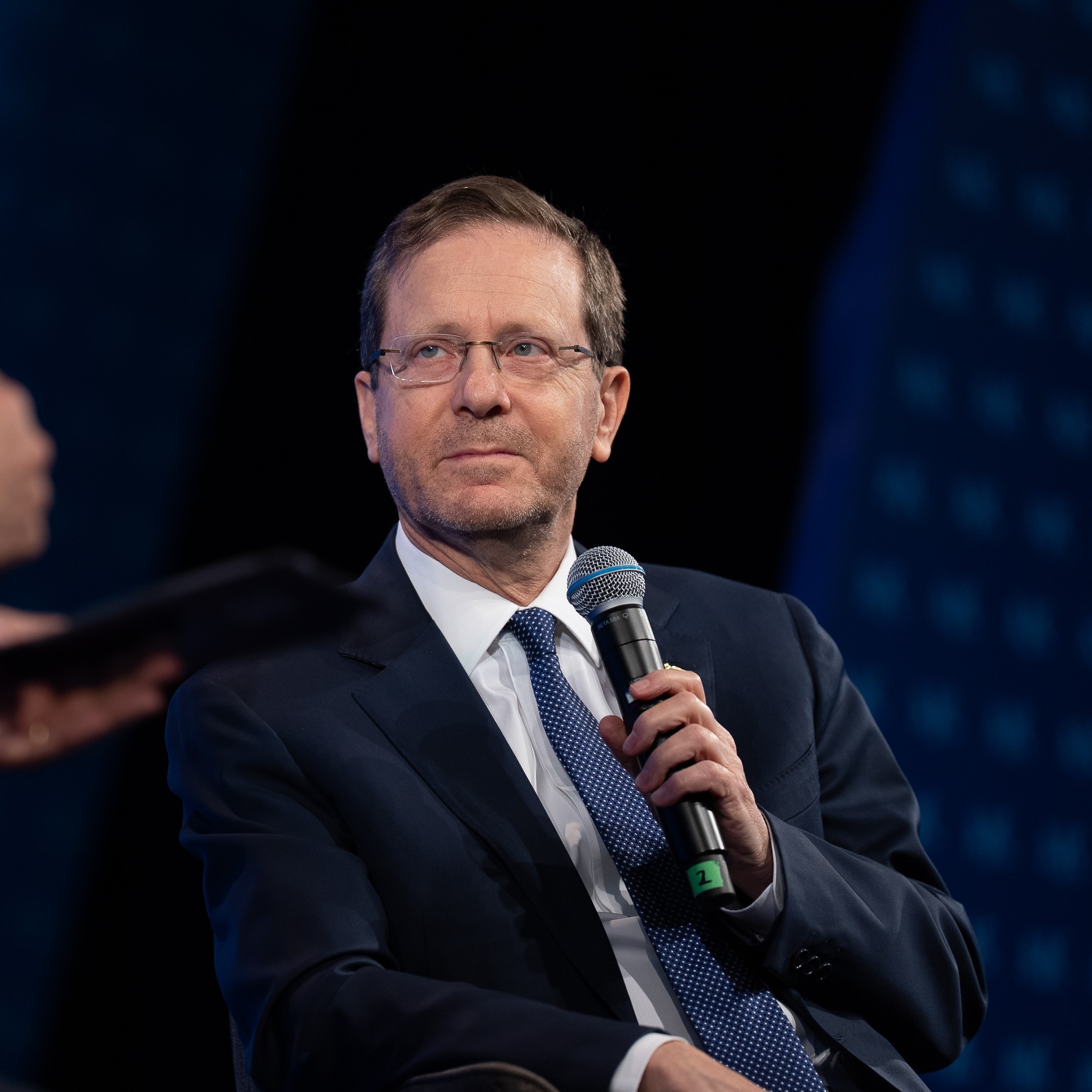
Israeli President Isaac Herzog in Conversation with AJC CEO Ted Deutch
Since his election by the Knesset in 2021, Israeli President Isaac Herzog has used his position as a platform to try to mend the social fabric of the Jewish state. At AJC Global Forum 2023 in Tel Aviv, Herzog sat down with AJC CEO Ted Deutch to discuss key issues, including judicial reform, Israel-Diaspora relations, and the importance of the Abraham Accords. Herzog ends his discussion with an important message for today's youth. *The views and opinions expressed by guests do not necessarily reflect the views or position of AJC. ____ Episode Lineup: (0:40) Isaac Herzog ____ Show Notes: Watch: Israeli President Isaac Herzog and AJC CEO Ted Deutch's Conversation at AJC Global Forum 2023 To watch more videos from AJC Global Forum 2023, go to http://www.ajc.org/GlobalForumNews2023 Read: 3 Key Takeaways From Israeli President Isaac Herzog's Conversation with AJC CEO Ted Deutch What to Know About Israel's Judicial Reforms Listen: Two Ukrainian Refugees Reflect on Escaping War, and Life in Israel– Live from AJC Global Forum 2023 Join us next year: Attend Global Forum 2024 in Washington D.C. Register today to secure $350 off your ticket Follow People of the Pod on your favorite podcast app, and learn more at AJC.org/PeopleofthePod You can reach us at: [email protected] If you've enjoyed this episode, please be sure to tell your friends, tag us on social media with #PeopleofthePod, and hop onto Apple Podcasts to rate us and write a review, to help more listeners find us. __ Transcript of interview with Isaac Herzog: Manya Brachear Pashman: Last week at AJC Global Forum 2023 in Tel Aviv, AJC CEO Ted Deutch sat down with Israeli President Isaac Herzog for a conversation about a range of issues, including the controversial judicial reforms, the connection between Israel and the diaspora, and the vital relationship between the US and Israel. For listeners who didn't have a chance to see it live, we are replaying that conversation this week. Ted Deutch: As an organization that is committed to advocating for the Jewish people in its entirety, all around the world, your advocacy, your commitment to diaspora Jewry to recognizing the importance of every Jew around the world, is an inspiration to us. And for us to have this opportunity. It, I'd like to start by asking the question in all of your efforts to engage the broadest cross-section of the Jewish world, from left to right, from secular to Orthodox, you've gone out of your way to be the President of Israel, who is really representing the people of Israel. Where does that come from? Is it just part of the role you see yourself playing? It's personal to you clearly, if you could just share with us. Isaac Herzog: It is a passion. And, and I think it's also part and parcel of the role of the President, meaning the president is the head of state of the only Jewish nation, the nation-state of the Jewish people in the world. And as such, it's only natural that he will have such a role, but it also comes out of a deep passion of mine. As you know, my late father Chaim Herzog was also Israel's president was the sixth president. And I come from a family that serves the Jewish people for generations. Some of you have known my uncle Abba Eban, who was Israel's legendary foreign minister. Some of you have known My other uncle Jacob Herzog, who was a huge diplomat, some of you have known my grandfather, Rabbi Isaac Halevi Herzog, who was Israel's chief rabbi and a huge Jewish leader, you know, my brother, Mike, who's the ambassador in Washington, I can go on and on if you want to. But truly, we believe in the Jewish people. We believe that the story of the Jewish people, I believe in the story of the Jewish people, my previous role, was chairman of the world's biggest Jewish organization, The Jewish Agency. And I'm adamantly passionate me and my family, but the story of the Jewish people and we are a small nation, of about 15 million plus Jews around the globe, in a sea of 8 billion human beings, we have a role to play, we have a role, we have a story, we have a role. And therefore we should protect and preserve the unity of our people amidst all of its differences. And that's why I've launched my initiative of Voice of the People - Kol Ha'am. Well, now right now, as of this week, we are holding labs all over the Jewish world to have discussions about how do we move on? How do we care for each other? And how do we identify the future leadership of the Jewish people? Ted Deutch: Thank you, thank you for launching that effort. I just want to pause to marvel at the way that your family's history is just inextricably woven. Isaac Herzog: I haven't even told you half of it, but doesn't matter. I had one of my father's uncles was the head of the AFL CIO. He was Sidney Hillman, really and FDR would say clear it with said so now you have to understand what Shabbat dinners means in our family. There's no way you can escape this stuff. Ted Deutch: As you're sitting, you're sitting here in

Two Ukrainian Refugees Reflect on Escaping War, and Life in Israel– Live from AJC Global Forum 2023
Margo Vdovichenko and Diana Buchman, both refugees of the Russian invasion of Ukraine, have found new lives in Israel. Margo, a student from Kyiv, now plans to attend medical school, while Diana, a single mother, bravely shielded her sons during their escape from Odessa. Recorded live at AJC Global Forum 2023, this moving conversation captures their journey and adjustment to life in Israel. *The views and opinions expressed by guests do not necessarily reflect the views or position of AJC. ____ Episode Lineup: (0:40) Margo Vdovichenko and Diana Buchman ____ Show Notes: Watch: This conversation from AJC Global Forum 2023 Listen: Hakeem Jeffries on Israel, Ghana, and Representing Brooklyn Follow People of the Pod on your favorite podcast app, and learn more at AJC.org/PeopleofthePod You can reach us at: [email protected] If you've enjoyed this episode, please be sure to tell your friends, tag us on social media with #PeopleofthePod, and hop onto Apple Podcasts to rate us and write a review, to help more listeners find us.
Hakeem Jeffries on Israel, Ghana, and Representing Brooklyn
This week, guest host Julie Fishman Rayman, AJC's Senior Director of Policy and Political Affairs, had the honor of connecting with Hakeem Jeffries, the leader of the House Democratic Caucus, after he led a congressional delegation to Israel and Ghana. As we approach the AJC Global Forum 2023 in Tel Aviv, we have the opportunity to listen to the Democratic leader's insights on the trip, the crucial nature of the U.S.-Israel relationship, and the historical and contemporary significance of Black-Jewish relations. *The views and opinions expressed by guests do not necessarily reflect the views or position of AJC. ____ Episode Lineup: (0:40) Hakeem Jeffries ____ Show Notes: Learn more about AJC Global Forum 2023 in Tel Aviv: AJC.org/GlobalForum Listen: 8 of the Best Jewish Podcasts Right Now From Roots to Harmony: Nefesh Mountain's Fusion of Jewish American Culture and Bluegrass Follow People of the Pod on your favorite podcast app, and learn more at AJC.org/PeopleofthePod You can reach us at: [email protected] If you've enjoyed this episode, please be sure to tell your friends, tag us on social media with #PeopleofthePod, and hop onto Apple Podcasts to rate us and write a review, to help more listeners find us. __ Transcript of interview with Hakeem Jeffries: Manya Brachear Pashman: This week, Julie Fishman Rayman, AJC's Senior Director of Policy and Political Affairs, had the honor of connecting with leader of the House Democratic Caucus, Hakeem Jeffries, after he led a group of lawmakers on a recent trip to Israel. Julie, the mic is yours. Julie Fishman Rayman: Thanks, Manya. It's my pleasure to introduce Rep. Hakeem Jeffries, who represents the very diverse 8th congressional district of New York, in Brooklyn, and also serves as the Democratic Leader. He was unanimously elected to that position in November 2022, and in that capacity he is the highest ranking democrat in the US house. He is also the former chair of the democratic caucus, the whip of the congressional black caucus, and previously co-chaired the Democratic Policy and Communications committee. Also, a great friend of AJC and the Jewish community. Leader Jeffries, welcome to People of the Pod. Hakeem Jeffries: Wonderful to be on. Thanks so much for having me. Julie Fishman Rayman: I want to get started by asking you about Jewish American Heritage Month, which as you know, we celebrate in May. Many listeners may not realize that members in congressional leadership cosponsor very few bills – meaning cosign or add their name to endorse them . In this Congress–correct me if I'm wrong–you've cosponsored fewer than a dozen bills and only one resolution–the resolution commemorating Jewish American Heritage Month. Can you speak about this effort and why it was important to you to help lead it? Hakeem Jeffries: Well, thank you so much. And that is absolutely correct. The tradition has been that members and leadership sponsor very few bills and even fewer resolutions, just because the enormity of the request is large. And you want to make sure that you're being very discerning in terms of what you want to elevate as a priority. And for me, it was incredibly important to make sure that I co sponsored the resolution that commemorated Jewish American Heritage Month for a variety of reasons, including the fact that I'm privileged to represent a district that has one of the largest Jewish communities in the country. In fact, I represent the ninth most African American district in the country, and the 16th most Jewish. And so I represent. As a good friend of mine, Leon Goldenberg, once and I quote, you've got the best of both worlds. It's an honor, though, to represent the reformed Jewish community, the conservative Jewish community, the Orthodox Jewish community, the modern Orthodox Jewish community, the ultra orthodox Jewish community, and more Russian speaking Jewish immigrants from the former Soviet Union than any other member of Congress in the country. I mean, Hakeem Jeffries, who knew only in America, but that's Brooklyn, that's New York City and the Jewish community has meant so much to the country, which is why we honor and celebrate and elevate Jewish American Heritage month but particularly has meant so much to the district that I'm privileged to represent to Brooklyn and to the great city of New York. Julie Fishman Rayman: The United States has many heritage months that celebrate the various communities that form the mosaic of our country, including Black History Month, Women's History Month, Hispanic Heritage Month, and more. By celebrating heritage months, we learn about one another, we honor the richness of our diverse nation, and we strengthen the fabric of American society. Some have described JAHM as going on the offensive against rising antisemitism, do you think that's an appropriate description? Amidst rising antisemitism and hate of all forms, does this change how we think about commemorative months? Hakeem Jeffries: Yes, it's a great

From Roots to Harmony: Nefesh Mountain's Fusion of Jewish American Culture and Bluegrass
Driven by their message of "radical love," hear how Doni Zasloff and Eric Lindberg, the husband and wife duo behind the renowned bluegrass band Nefesh Mountain, combat antisemitism within the music industry and beyond. Join us as we delve into their remarkable journey of representing Jewish-American culture, tradition, values, and spirituality through bluegrass and Americana music. The band also treats us to intimate performances from their latest album, "Songs for the Sparrows." *The views and opinions expressed by guests do not necessarily reflect the views or position of AJC. ___ Episode Lineup: (0:40) Doni Zasloff and Eric Lindberg ___ Show Notes: Learn more about: Nefesh Mountain Take our quiz: Jewish American Heritage Month Quiz Test your knowledge of the rich culture and heritage of the Jewish people and their many contributions to our nation! Start now. Read: What is Jewish American Heritage Month? Jewish American Heritage Month Resources Faces of American Jewry Amazing Jewish Americans Listen: 8 of the Best Jewish Podcasts Right Now Sen. Jon Ossoff on Jewish Resilience Follow People of the Pod on your favorite podcast app, and learn more at AJC.org/PeopleofthePod You can reach us at: [email protected] If you've enjoyed this episode, please be sure to tell your friends, tag us on social media with #PeopleofthePod, and hop onto Apple Podcasts to rate us and write a review, to help more listeners find us. __ Transcript of Interview with Doni Zasloff and Eric Lindberg: Manya Brachear Pashman: Nefesh Mountain arrived on the bluegrass and American music scene in 2014. The husband and wife duo of Eric Lindbergh and Doni Zasloff have since performed in hundreds of synagogues in the United States and around the world, representing Jewish American culture, tradition, values and spirituality in the world of bluegrass. Bluegrass Today magazine has described the duo as what happens when bluegrass and Jewish traditions meet and fall madly in love. In honor of Jewish American Heritage Month, Doni and Eric are with us now. Or I should say–we are with Doni and Eric now in their home in northern New Jersey, Doni, Eric, thank you for welcoming "People of the Pod." Doni Zasloff: Thank you for coming. We're so excited to have you. Eric Lindberg: What a treat. Manya Brachear Pashman: So please share with our listeners how the two of you got together. Did you have individual musical pursuits? Or did you not really find your groove until you were together as a duo. Eric Lindberg: We're both pointing at each other. You tell it. Doni Zasloff: You tell it. Eric Lindberg: Well, we both had individual pursuits. We met playing music in the New York kind of North Jersey area. Years ago, we met back in 2010. And we were playing music in various fashions. And the quick story is that our band is a love story. And we fell in love a few years later, and it became apparent to each of us that we were head over heels crazy about each other. And that we also had all of this stuff that needed to come out that we kind of needed the other person to help kind of embolden our feelings of Americana music and of Jewish life and of culture and all this stuff. So I grew up in Brooklyn. And so much of my life as a kid was part of the synagogue, my after school program, and my camp, and of course, synagogue and I had a Bar Mitzvah and I grew up with this big Jewish life in Brooklyn. But at a certain point, I became kind of just a musician, I didn't know where to put this Jewish side of myself. I went to study jazz in college and all this stuff. So when I met Doni, she kind of brought me back to this feeling of, well, you can be proud of this and you can be excited about it. And you can live a fully Jewish life, you don't have to do it, any which way. You don't have to be a quote unquote, good or bad Jew, which, we hate those terms, but people tend to use them. Even Jewish people, of course, to show how religious or observant they're being at a certain time. So she had this completely unbridled kind of cowgirl way of looking at being wild and Jewish and proud and being yourself. And ultimately, I think that is pretty much the core of our message as a band. But I guess we'll get to that a little bit later. But she brought me back to this place of really just being proud of who I was. And that was the little germ that started this band. And then I brought kind of this musical sensibility in Americana music, with the banjo, and fiddle, and all this stuff. Manya Brachear Pashman: And Doni, how about you? What was your journey? Doni Zasloff: I've always loved all different kinds of music. And I've always been very, as Eric was describing, just having a very strong Jewish spirit. And I think what Eric you know, it's exactly right. When Eric and I fell in love and started to really kind of get real with ourselves and we wanted to kind of express ourselves in the most authentic way. And I think my Jewish spirit and his massive knowledge of all kinds of

Sen. Jon Ossoff on Jewish Resilience
Senator Jon Ossoff (D-GA), the first millennial Senator and the first Jewish member of the Senate from Georgia, joins us to honor Jewish American Heritage Month. He shares his family's survival against antisemitism and his efforts to combat it today through his work on the Senate Bipartisan Task Force for Combating Antisemitism. He also discusses his connection to Israel and feeling Jewish and proud at a recent Yom HaShoah event in his home state. *The views and opinions expressed by guests do not necessarily reflect the views or position of AJC. ___ Episode Lineup: (0:40) Jon Ossoff ____ Show Notes: Take our quiz: Jewish American Heritage Month Quiz: Test your knowledge of the rich culture and heritage of the Jewish people and their many contributions to our nation! Start now. Read: What is Jewish American Heritage Month? Jewish American Heritage Month Resources Faces of American Jewry Amazing Jewish Americans Listen: 8 of the Best Jewish Podcasts Right Now "Busy in Brooklyn" Food Blogger Chanie Apfelbaum Talks Kosher Cuisine and Jewish Heritage Follow People of the Pod on your favorite podcast app, and learn more at AJC.org/PeopleofthePod You can reach us at: [email protected] If you've enjoyed this episode, please be sure to tell your friends, tag us on social media with #PeopleofthePod, and hop onto Apple Podcasts to rate us and write a review, to help more listeners find us. __ Transcript of Interview with Jon Ossoff: Manya Brachear Pashman: Jon Ossoff was a documentary filmmaker and investigative journalist before he became a United States senator representing Georgia. He is the youngest member of the Senate elected since 1980. The first millennial in fact. He's also the first Jewish member of the Senate from Georgia. In fact, the first Jewish Senator from the deep south since 1878. Senator Ossoff joins us now in honor of Jewish American Heritage Month. Senator, welcome to People of the Pod. Jon Ossoff: Manya, thank you so much for the invitation. It's an honor to be here. Manya Brachear Pashman: So, Israel just celebrated its 75th birthday. It's a young country, but it's twice as old as you. You are 36, I believe. How do you relate to that historic milestone, as someone who's Jewish, who's a father, as a Senator who knows Israel's strategic importance to the United States? How do you relate to Israel? Jon Ossoff: Well, I think I should begin with a reflection on how my family's story has influenced me and influenced how I think about US-Israel relations. I was sworn in to the Senate, and in my jacket pocket at that moment, had the ship's manifests, documenting the arrival of my great grandparents, Annie and Israel, at Ellis Island, from Eastern Europe, in 1911 and 1913. And they left Eastern Europe in the early 20th century, as so many European Jews did, fleeing antisemitism. And while many members of my family and ancestors managed to escape, as in so many Jewish families, there were many who did not. And of those who did not, to my knowledge, all but one perished in the Holocaust. And I remember as a very young child, spending time with my uncle Nate, I called him uncle Nate. He had escaped, and hidden in the forests around the camp and the worksite, until he was liberated. And I remember as a young child sitting with him and tracing with my finger, the numbers tattooed into his arm. And I think so many American Jews have experiences like that one, having grown up among Holocaust survivors. And growing up among survivors, and being keenly aware of the genocide of Jews, the attempt with industrial-scale brutality to extinguish the Jewish people forever, has a profound impact on all Jews, all Jews in the United States, all Jews around the world. And of course, it has a profound impact on how I view the State of Israel, recognizing that the State of Israel was established 75 years ago as Jews rebuilt in the ashes of the Holocaust, and sought to establish a secure homeland for the Jewish people. I am now, as many American Jews are, deeply concerned about Israel's future, deeply concerned about the trends and dynamics and risks in the broader Middle East. And as an American policymaker, of course, particularly focused on US national security interests and other interests in the region. So I have worked for the last couple of years, to build strong working relationships, on a foundation of trust with regional leaders in Israel, in neighboring and surrounding countries, and in the Palestinian Authority, so that I can play a constructive role advancing US interests, and working to ensure that Israel can survive as a democracy and a secure homeland for the Jewish people. And also that all people in this region can one day flourish in peace and security and freedom. Manya Brachear Pashman: Do you believe that your colleagues share that understanding of the importance of Israel, the importance of Israel to the Jewish people. And as a follow up to that, you know, we deal a lot with combating and fighting

"Busy in Brooklyn" Food Blogger Chanie Apfelbaum Talks Kosher Cuisine and Jewish Heritage
To continue our Jewish American Heritage Month celebrations, guest host Laura Shaw Frank, AJC's director of William Petschek Contemporary Jewish Life, speaks with Chanie Apfelbaum, author of the popular food blog Busy in Brooklyn. Chanie joins us to discuss her new cookbook, "Totally Kosher," the intersection of Jewish culture and food, and the future of kosher cuisine. She also shares how the murder of her brother, Ari Halberstam, who was killed in a 1994 terrorist attack on the Brooklyn Bridge, has inspired her career. *The views and opinions expressed by guests do not necessarily reflect the views or position of AJC. ____ Episode Lineup: (0:40) Chanie Apfelbaum ____ Show Notes: Take our quiz: Jewish American Heritage Month Quiz: Test your knowledge of the rich culture and heritage of the Jewish people and their many contributions to our nation! Start now. Read: What is Jewish American Heritage Month? Jewish American Heritage Month Resources Faces of American Jewry Amazing Jewish Americans Listen: 8 of the Best Jewish Podcasts Right Now AJC CEO Ted Deutch on the Importance of Jewish American Heritage Month From Israel: AJC's Avital Leibovich Breaks Down Latest Gaza Escalation Follow People of the Pod on your favorite podcast app, and learn more at AJC.org/PeopleofthePod You can reach us at: [email protected] If you've enjoyed this episode, please be sure to tell your friends, tag us on social media with #PeopleofthePod, and hop onto Apple Podcasts to rate us and write a review, to help more listeners find us. __ Transcript of Interview with Chanie Apfelbaum Manya Brachear Pashman: People of the Pod is celebrating Jewish American Heritage Month by devoting all our May episodes to what makes us Jewish and proud -- food, music, and our mission to repair the world. Last week you heard from AJC CEO Ted Deutch about why we should set aside a month to celebrate. This week nods to our obsession with food. And for that, I'll turn it over to my guest co-host, Laura Shaw Frank, AJC's Director of Contemporary Jewish Life. Laura, the mic is yours. Laura Shaw Frank: Thanks, Manya. Happy Jewish American Heritage Month! As we celebrate Jewish American culture and history this month, it feels like we would be quite remiss if we didn't spend some time talking about Jewish food. Food plays an enormous role in Jewish tradition and culture. Jews have foods linked to particular Jewish holidays and of course Shabbat, ethnic foods linked to particular places where Jews lived, and of course, lots of Jews, myself included, keep kosher, follow the laws of Kashrut, which deeply influences the way we cook and eat. I think I'd be pretty safe in saying that Jewish food is really important in Jewish life. Not surprisingly, statistics bear this out. In the Pew Survey of Jewish Americans in 2020 over 70% of American Jews, young and old alike, reported cooking or eating traditional Jewish foods. Which is why I'm so excited to be joined by today's guest, Chanie Apfelbaum. Chanie is a food writer and photographer whose blog "Busy in Brooklyn" is chock full of delectable recipes and beautiful pictures of amazing Jewish foods. Her newest cookbook, Totally Kosher, hit bookstores in March 2023. Chanie, welcome to People of the Pod. Chanie Apfelbaum: Thanks so much for having me. Laura Shaw Frank: I'm thrilled to have you and really thrilled to talk to you about your new cookbook. So before we get into that, though, let's take a step backward. How did you get into kosher cooking? Chanie Apfelbaum: Well, I was born Jewish. That's the first step, always. I always say– learning your way around the kitchen is just a rite of passage when you get married. And being a Jewish housewife, obviously, we have, you know, Shabbat dinner every week, and so many holidays, and Jews are always just celebrating around food. I actually never stepped foot in the kitchen before I got married, never really helped my mom, my older sister used to help with cooking. It just looked like a chore to me. I am a very creative soul, very artistic. And it just seemed like a whole lot of rules. And I just wasn't interested. And then I got married. And I would call my mother every Friday and like, how do I make gefilte fish and potato kugel, and chicken soup. And I started hosting a lot. And people started asking me for my recipes. And I realized that I kind of had a knack for presentation. Because I've always been artistic. And you know, like composition and things like that. And my food always was presented nicely and looked beautiful. So it kind of got me you know, a little bit interested, piqued my interest. And I realized that it could be a way for me to explore my creative side. So I I started watching The Food Network a lot. And I subscribed to Bon Appetit Magazine, and started looking at cookbooks. And then when I had my third child, I didn't want to really work outside the house anymore. So I was like, What should I do with myself, I'm not the type of person that cou

From Israel: AJC's Avital Leibovich Breaks Down Latest Gaza Escalation
In a special breaking news edition, Lt. Col. (res.) Avital Leibovich, director of AJC Jerusalem, joins us to break down Israel's Operation Shield and Arrow and the threat posed by the Iranian-backed terror group Palestinian Islamic Jihad, which has fired over 500 rockets towards Israel since Tuesday. Leibovich also provides an update on how Israelis are coping with the latest escalation and efforts being made towards a ceasefire. *The views and opinions expressed by guests do not necessarily reflect the views or position of AJC. ___ Episode Lineup: (0:40) Avital Leibovich ___ Show Notes: Take action: Urge Congress to Stand with Israel Against Terrorism Read: What to Know About the Gaza Strip, Terrorist Rocket Attacks, and More 5 Things You Need to Know About Israel's Iron Dome Defense System and Those Who Voted Against It Listen: Israel at 75: 7 Things You Should Know About Israel: Listen to these seven episodes of AJC's People of the Pod featuring leading Israeli and American scholars, experts, and influencers that will help you learn more about the complexities, triumphs, and challenges facing Israel today. AJC CEO Ted Deutch on the Importance of Jewish American Heritage Month: This May, AJC is proud to celebrate Jewish American Heritage Month and the countless contributions that Jewish Americans have made as patriotic citizens, creative artists, brilliant scientists, and star athletes. To kick things off, we're joined by AJC CEO Ted Deutch to hear his reflections on his first several months at AJC, what he's looking forward to at AJC Global Forum 2023 in Tel Aviv, and how he's marking Jewish American Heritage Month. Follow People of the Pod on your favorite podcast app, and learn more at AJC.org/PeopleofthePod You can reach us at: [email protected] If you've enjoyed this episode, please be sure to tell your friends, tag us on social media with #PeopleofthePod, and hop onto Apple Podcasts to rate us and write a review, to help more listeners find us. __ Transcript of Interview with Avital Leibovich Manya Brachear Pashman: Welcome to a special breaking news edition of People of the Pod to bring our listeners up to date on what's going on in Israel. Joining me is Lieutenant Colonel Avital Leibovich, Director of AJC Jerusalem. Avital, welcome, and I hope you are safe. But how are you doing? Tell me. Avital Leibovich: Thank you. It's an opportunity for me to be here with you today and to share from the ground our experiences here in Israel. This is already the third day of the operation. There's tension in the air, but I think that our resilience as Israelis is quite strong. And I'm sure we will overcome this situation as we have in the past. Manya Brachear Pashman: So what is going on there–who is firing the rockets that are now falling on Israel? Avital Leibovich: So the operation is directed towards the Islamic Jihad in Gaza. Islamic Jihad in Gaza is the smaller of two terror groups in Gaza. It's backed and funded and directed by Iran. And its charter is pretty clear, I would say. Basically, the organization believes that Israel has no right to exist. And in order to make sure that we will not exist, Iran is funding its military capabilities. They have managed to build an arsenal of rockets, of mortars, of drones. They have managed to train soldiers, militants in order to conduct anti-Israeli operations. And Israel decided to initiate an operation, following two events. The first event was a week ago, where over 100 rockets were fired by this organization, the Islamic Jihad, within 24 hours, towards Israel. And the second event actually took place on Pesach, on Passover, in which 34 rockets were fired from Lebanon within 10 minutes by factions of the Palestinian Islamic Jihad in Lebanon. So this was an opportunity to make sure that Israel is preventing further escalation and basically defending its people. Manya Brachear Pashman: So where's Hamas in all of this? Avital Leibovich: So Hamas has in the past, decided to actually sit quietly and not intervene. And this is common. We've seen this in the operation last year, we've seen this in the operation two years ago. And you may want to ask what the reason for Hamas sitting back and the reason is that Hamas has a lot to lose. Currently, Israel declared that it's only looking to target Islamic Jihad targets, namely not Hamas targets. And Hamas understands that if it will join the celebration of Islamic Jihad, then the price Hamas will pay will be very, very high, for one. There are 18,000 Palestinian workers entering Israel from Gaza on a daily basis. These kinds of workers bringing salaries back home, actually move some sort of an economic cycle inside the Gaza Strip, and the shopping power is stronger and stronger by these workers. If Hamas will join the operation, then obviously, Israel will close the border and will not allow these workers to enter. And additionally, I'll remind our listeners that Hamas is still renovating Gaza from previous operatio

AJC CEO Ted Deutch on the Importance of Jewish American Heritage Month
This May, AJC is proud to celebrate Jewish American Heritage Month and the countless contributions that Jewish Americans have made as patriotic citizens, creative artists, brilliant scientists, and star athletes. To kick things off, we're joined by AJC CEO Ted Deutch to hear his reflections on his first several months at AJC, what he's looking forward to at AJC Global Forum 2023 in Tel Aviv, and how he's marking Jewish American Heritage Month. *The views and opinions expressed by guests do not necessarily reflect the views or position of AJC. ___ Episode Lineup: (0:40) Ted Deutch ___ Show Notes: Learn more at: AJC.org/JewishAmericanHeritageMonth Join us in Tel Aviv at AJC Global Forum 2023: AJC.org/GlobalForum Sign up for AJC CEO Ted Deutch's Video Newsletter: Receive "Ten from Ted," the biweekly video newsletter from AJC CEO Ted Deutch where he'll share ten major highlights in the work he and American Jewish Committee (AJC) are doing to make this world safer for the Jewish people and Israel. Take our quiz: Jewish American Heritage Month Quiz: Test your knowledge of the rich culture and heritage of the Jewish people and their many contributions to our nation! Start now. Listen: Israel at 75: 7 Things You Should Know About Israel: Listen to these seven episodes of AJC's People of the Pod featuring leading Israeli and American scholars, experts, and influencers that will help you learn more about the complexities, triumphs, and challenges facing Israel today. How Playing Baseball With Team Israel Transformed Ryan Lavarnway's Life: In celebration of Israel's 75th birthday, guest host Dov Wilker, AJC's Atlanta director, sits down with retired Major League Baseball catcher Ryan Lavarnway, who played for Team Israel in the World Baseball Classic and the Olympics. Lavarnway reflected on the Jewish pride he felt representing Israel on the international stage, how he has dealt with the antisemitism in his career, and the importance of building connections between the Jewish state and the Diaspora. Follow People of the Pod on your favorite podcast app, and learn more at AJC.org/PeopleofthePod You can reach us at: [email protected] If you've enjoyed this episode, please be sure to tell your friends, tag us on social media with #PeopleofthePod, and hop onto Apple Podcasts to rate us and write a review, to help more listeners find us. __ Transcript of Interview with Ted Deutch: Manya Brachear Pashman: This May, AJC is proud to celebrate Jewish American Heritage Month and the countless contributions that Jewish Americans have made as patriotic citizens, creative artists, brilliant scientists, lightning fast athletes, one of whom we heard from last week. Returning to the studio to help us kick off the celebration is AJC's CEO, Ted Deutch. Ted, welcome back to People of the Pod. Ted Deutch: It's great to be back. Thanks, Manya. Manya Brachear Pashman: So I want to start with a progress report. You have been CEO now for I'm going to count on my fingers here October, November, December -seven months, now? Ted Deutch: Now, you've got to get onto your second hand. Manya Brachear Pashman: Which means this time last year, you were still a congressman. So what's remarkably different about your life now, your mission and your day to day approach to that mission? Ted Deutch: Well, the day to day work is very different. And I'd start with the most obvious: I came from a place that was, by definition, political, everything about it was driven by politics. I worked really hard to focus on the issues that mattered to me and my community. But there were always political considerations. Now, as the CEO of American Jewish Committee, I have the incredible honor of spending everyday working with a supremely talented team here at AJC, remarkable volunteers and lay leaders with one mission, and that's to think about how we can do more to enhance the well being of the Jewish people and Israel and advance democratic values. And every issue I work on, I'm passionate about, and it matters to me, it matters to my core. It affects who I am, and my family and my community. And that's a big difference. And it's just a big privilege to be able to spend my days this way now. Manya Brachear Pashman: So what have some of the milestones been so far? Ted Deutch: AJC as the global advocacy organization for the Jewish people has been doing incredible work in the United States and all around the world for more than a century. But to bring those two things together, as we did in our advocacy, with the Biden administration, to urge them to create a national action plan to combat antisemitism, seeing them move forward, and announce that plan and then bringing to the White House special envoys to combat antisemitism from around the world that we had helped create. And as we worked in other countries, as they prepared their own action plans to confront anti semitism and foster Jewish life, this was an opportunity to bring their experiences together so that th

How Playing Baseball With Team Israel Transformed Ryan Lavarnway's Life
In celebration of Israel's 75th birthday, guest host Dov Wilker, AJC's Atlanta director, sits down with retired Major League Baseball catcher Ryan Lavarnway, who played for Team Israel in the World Baseball Classic and the Olympics. Lavarnway reflected on the Jewish pride he felt representing Israel on the international stage, how he has dealt with the antisemitism in his career, and the importance of building connections between the Jewish state and the Diaspora. *The views and opinions expressed by guests do not necessarily reflect the views or position of AJC. __ Episode Lineup: (0:40) Ryan Lavarnway ___ Show Notes: Watch: Catch the full video conversation with Ryan Lavarnway, recorded live on Yom Ha'atzmaut as part of AJC's Advocacy Anywhere Test your knowledge: Quiz: How much do you really know about Israel? When was Israel founded? Who was the first Israeli to win a Nobel Prize? Which country was the first to recognize the State of Israel? Start the quiz! Listen: Israel at 75: 7 Things You Should Know About Israel: Listen to these seven episodes of AJC's People of the Pod featuring leading Israeli and American scholars, experts, and influencers that will help you learn more about the complexities, triumphs, and challenges facing Israel today. Julianna Margulies on Holocaust Education and Fighting Antisemitism: Emmy Award-winning actress Julianna Margulies recently partnered with the New York's Museum of Jewish Heritage: A Living Memorial to the Holocaust, to help create the Holocaust Educator School Partnership. To date, the partnership has trained two university fellows to teach the history of the Holocaust to 1,700 middle and high school students in New York City Public Schools. In a poignant interview, Margulies shares her motivations for expanding the program, personal experiences of how antisemitism has affected her family, and reflections on her first visit to Israel and Yad Vashem. Follow People of the Pod on your favorite podcast app, and learn more at AJC.org/PeopleofthePod You can reach us at: [email protected] If you've enjoyed this episode, please be sure to tell your friends, tag us on social media with #PeopleofthePod, and hop onto Apple Podcasts to rate us and write a review, to help more listeners find us. __ Transcript of Interview with Ryan Lavarnway: Manya Brachear Pashman: Sometimes it just makes more sense for my AJC colleagues to guest host. When it comes to sports, I always try to hand the mic to AJC Atlanta Director Dov Wilker. This week, in honor of Israel's 75th birthday, Dov sat down for a live conversation in front of a virtual audience with Major League Baseball Catcher Ryan Lavarnway, who played for Team Israel in the World Baseball Classic and the Olympics. Ryan talked to Dov about the pride he felt representing Israel on the international stage and the importance of building connections between the Jewish state and the Diaspora. I might not know a lot about baseball, but as someone about to visit Israel for the first time, Ryan's recollections and reflections brought tears to my eyes. Here's an instant replay. Dov Wilker: Let's get it started in the beginning, Ryan, how did you get into baseball? And does your Judaism intertwine with that, or is that a separate story? Ryan Lavarnway: So, I started playing baseball when I was five years old. And my dad always played baseball, he was always doing pickup games on the weekends playing high-pitch softball, but the story of why I got started was my kindergarten teacher told my parents that I was not good at sharing, and that I should get involved in a team sport. So they signed me up about as early as I could sign up, when I was five years old. And I took to it really quick and the rest is history. Dov Wilker: You know, that's good advice for my seven year old who is also not very good at sharing. So I appreciate that. And what about the role of Judaism in your life? Was Judaism something that was important to you from an early age? Or has that sort of become more important to you as you got older? Ryan Lavarnway: No, it really wasn't. My mom is Jewish, and she always loved Christmas. They had a white Christmas tree in her house with blue ornaments. And my dad would describe himself as a disenchanted Catholic. So growing up, we celebrated holidays from all religions. But there was no religion involved. We celebrated just to have a nice meal together, to have a reason to give presents and celebrate or light the candles. We went through the motions. Sometimes I joke that we celebrated Hallmark holidays. And it wasn't until really until high school that I started to grow into my own as an adult and start to search for more. And in high school, I ended up going to temple for the first time with a high school teammate's mother who had MS and couldn't drive herself. So we kind of needed each other because I needed someone to go with, and she needed someone to drive her. And that was really my first experience. As an adult, whe

Julianna Margulies on Holocaust Education and Fighting Antisemitism
Emmy Award-winning actress Julianna Margulies recently partnered with the New York's Museum of Jewish Heritage: A Living Memorial to the Holocaust, to help create the Holocaust Educator School Partnership. To date, the partnership has trained two university fellows to teach the history of the Holocaust to 1,700 middle and high school students in New York City Public Schools. In a poignant interview, Margulies shares her motivations for expanding the program, personal experiences of how antisemitism has affected her family, and reflections on her first visit to Israel and Yad Vashem. *The views and opinions expressed by guests do not necessarily reflect the views or position of AJC. ___ Episode Lineup: (0:40) Julianna Margulies ___ Show Notes: Learn more about: The Museum of Jewish Heritage's exhibit The Holocaust: What Hate Can Do The Holocaust Educator School Partnership Vote: Vote for The Forgotten Exodus at The Webby Awards: AJC.org/Webby Test your knowledge: Test your knowledge of antisemitism in America: Stopping antisemitism starts with understanding how dangerous it is. Take our quiz and learn how antisemitism impacts American Jewish life. Read: Breaking Down and Fighting Holocaust Trivialization: Holocaust trivialization is not always obvious; a casual observer might miss it without an understanding of the terms, symbols, and relevant history. Here is what you need to know. Listen: Surviving the Unimaginable: A Child's Story of the Holocaust: In this powerful episode, we sit down with Sam Harris, who is one of the youngest survivors of the Holocaust. As a young child, Sam watched in horror as his family was taken to Treblinka and murdered, but he and his two older sisters were able to beat the odds. Listen as Sam recounts the unimaginable struggles he faced during one of the darkest periods in human history and how his experience motivated him to play a central role in the founding of the Illinois Holocaust Museum. What to Know About Israel's Judicial Reform Effort and Protests: Last month, Israeli Prime Minister Benjamin Netanyahu pressed pause on a series of contentious judicial reforms that have triggered mass protests, condemnation from wide swaths of Israeli society, and expressions of concern from American leaders and Jewish organizations. Guest host Belle Yoeli, AJC's Chief Advocacy Officer, sits down with AJC's Chief Policy and Political Affairs Officer Jason Isaacson to discuss what this means for the future of the Middle East's only democracy. Follow People of the Pod on your favorite podcast app, and learn more at AJC.org/PeopleofthePod You can reach us at: [email protected] If you've enjoyed this episode, please be sure to tell your friends, tag us on social media with #PeopleofthePod, and hop onto Apple Podcasts to rate us and write a review, to help more listeners find us. __ Interview Transcript - Julianna Marguiles: Manya Brachear Pashman: Last year, Emmy Award winning actress Julianna Margulies hosted a Holocaust memorial special called "The Hate We Can't Forget", which featured the stories of four Holocaust survivors. In that documentary, Julianna sounded the alarm that Holocaust education across the country was severely lacking. After filming, Julianna partnered with the Museum of Jewish Heritage: a Living Memorial to the Holocaust here in New York, to help create the Holocaust Educator School Partnership, or HESP. Julianna is with us now to explain what that is and what she hopes it will accomplish. Julianna, welcome to People of the Pod. Julianna Margulies: Thank you so much for having me. Manya Brachear Pashman: So please tell our audience: what is the Holocaust Educator School Partnership or HESP? Julianna Margulies: HESP's an easier way to say it, actually Jack Kliger, who is the CEO of the Museum of Jewish Heritage, he calls he calls them the Hespians. So HESP is a program that I started with the Museum of Jewish Heritage after I hosted that CBS documentary on the Holocaust, when I realized how little education there was in our country. And with the rise of antisemitism and Holocaust deniers, I just felt, I felt despair, to be honest with you. I just thought it's ignorance, because people are not educated. And when you do not learn history, history repeats itself. And so after I hosted it I thought to myself, what can I do? I'm just one little person. I'm not a humongous star, but I have a bit of a platform. And I thought well, let me try and use my voice and the small platform that I have to make change. So luckily, I knew Jack Kliger. And I said, I hosted this Holocaust Remembrance documentary for CBS and MTV, and they paid me. I didn't even think I was gonna get paid to be honest with you, because it was, of course, a labor of love to do it. And I felt weird taking money for it. And so I took the hefty check that they gave me, and I said, let's figure out how to educate our children. Because these are seeds that you have to plant early. So that when these people beco

Vote for The Forgotten Exodus at the Webby Awards
The Forgotten Exodus has been nominated for a Webby Award, also known as "the Internet's highest honor" — but we need your help to win! Click here to vote for The Forgotten Exodus for "Best Limited Podcast Series." It takes less than a minute. Voting ends at 11:59 p.m. PDT on April 20, 2023. The Forgotten Exodus is the first-ever narrative podcast series devoted exclusively to the fascinating and often-overlooked history of Mizrahi and Sephardic Jewry from Arab countries and Iran. Created by American Jewish Committee (AJC), the series debuted as the top-ranked Jewish podcast in America last August. Please make sure that these fascinating and impactful stories reach an even wider audience. Vote for the series now. ____ Show notes: Pond5: "Arabic (Middle Eastern Music)"; Composer: Andrei Skliarov; Item ID # 152407112 Vote now: AJC.org/Webby Listen to "The Forgotten Exodus": AJC.org/ForgottenExodus

What to Know About Israel's Judicial Reforms Effort and Protests
This week, Israeli Prime Minister Benjamin Netanyahu pressed pause on a series of contentious judicial reforms that have triggered mass protests, condemnation from wide swaths of Israeli society, and expressions of concern from American leaders and Jewish organizations. Guest host Belle Yoeli, AJC's Chief Advocacy Officer, sits down with AJC's Chief Policy and Political Affairs Officer Jason Isaacson to discuss what this means for the future of the Middle East's only democracy. *The views and opinions expressed by guests do not necessarily reflect the views or position of AJC. ___ Episode Lineup: (0:40) Jason Isaacson ____ Show Notes: Join us in Israel June 11-14 for AJC's Global Forum 2023: AJC.org/GlobalForum Read: What to Know About Israel's Judicial Reforms American Jewish Committee, Other Jewish Organizations Welcome Suspension of Israeli Judicial Overhaul Legislation Listen: How Jewish Teens Take on Antisemitism in America Follow People of the Pod on your favorite podcast app, and learn more at AJC.org/PeopleofthePod You can reach us at: [email protected] If you've enjoyed this episode, please be sure to tell your friends, tag us on social media with #PeopleofthePod, and hop onto Apple Podcasts to rate us and write a review, to help more listeners find us. ____ Transcript of Interview with Jason Isaacson: Manya Brachear Pashman: This week, Israel's Prime Minister Benjamin Netanyahu pressed pause on a series of contentious judicial reforms that have brought scores of Israelis to the streets in protest. My guest host, Belle Yoeli, AJC's Chief Advocacy Officer, sat down with Jason Isaacson, AJC's Chief Policy and Political Affairs Officer to discuss what this means for the only democracy in the Middle East. Belle, the mic is yours. Belle Yoeli: Thank you Manya, and hello, People of the Pod listeners. It's great to be with you. Jason, thanks for joining us. Jason Isaacson: Of course. Good to be with you, Belle. Belle Yoeli: I think it's fair to say that it's been anything but a dull time when it comes to Israel. And I think that applies to the past year, the past few months, and especially the past few days. I'm sure our listeners have a lot of questions and very privileged that we're going to be joined by Jason to help us to understand and analyze recent events. And I'm going to jump right in. Jason, I want to begin by reviewing the sequence of events that led to the developments this week. The Israeli government has been pursuing legislation that would fundamentally change the way the judiciary operates, which has garnered a lot of attention. What has played out since Sunday that has led to the latest state of affairs? Jason Isaacson: Well, you'd have to go back a few days before Sunday, to the meeting that took place last Thursday, I believe it was, between the defense minister Yoav Gallant, and the Prime Minister, before the Prime Minister left on his most recent European trip. And in the course of that meeting, it was widely understood that Gallant was going to present to the Prime Minister what he has found in talking to senior officers of the military, hearing about the concerns that reservists were planning not to show up or were not showing up for duty. And that there was just a severe security threat that was being posed by the protests that have been sweeping the country for the last 12 and a half, 13 weeks. And that something had to be done. And what that something was, was that we really had to slow the train and pause this process of judicial reform. He presented that argument to the Prime Minister, the Prime Minister discussed this with him. Apparently, won some kind of understanding that would not lead to Gallant leaving or making a speech that night. And then the Prime Minister took off for London. After that, two days go by and on Saturday night, the defense minister makes a speech, basically the speech that we all expected him to make last Thursday, saying just what I said about the effect that the judicial reform process, the rush to judicial reform, is having within the ranks of the military and the reserve of the military. And because of that, he is calling on the Prime Minister to halt the process, to pause the process of judicial reform. Within 24 hours, the Prime Minister fires the defense minister, much to the shock of the entire Israeli military establishment and much of the political establishment. And there were then massive protests. So of course, we've seen in Israel for the last 13 weeks, hundreds of 1000s of Israelis out in the streets, people across the political spectrum, rising up and saying this judicial reform package does not serve the interests of Israeli democracy, it actually undermines Israeli democracy. It changes the whole process of checks and balances in Israel. But it was the firing of Gallant, who is widely popular, even though a figure with a deep, honorable military background, on the right in Israeli politics, but respected across the board, which I

How Jewish Teens Take on Antisemitism in America
Jewish teenagers in middle and high schools throughout the United States are experiencing antisemitism in various forms, including in their school premises, in the classroom, and on social media. Abi Streger, a Jewish student from suburban Atlanta, is one of the many teenagers who have faced such hatred. Joining the conversation is Aaron Bregman, Director of High School Affairs for AJC's Alexander Young Leadership Department, who speaks about how AJC empowers students and their families to stand up to antisemitism. *The views and opinions expressed by guests do not necessarily reflect the views or position of AJC. ____ Episode Lineup: (0:40) Aaron Bregman, Abi Streger _____ Show Notes: Test your knowledge: Test your knowledge of antisemitism in America: Stopping antisemitism starts with understanding how dangerous it is. Take our quiz and learn how antisemitism impacts American Jewish life. Read: In Washington, D.C., Jewish High School Students from AJC's Leaders for Tomorrow Gain Valuable Advocacy Skills: More than 130 of American Jewish Committee's (AJC) Leaders for Tomorrow (LFT) students – Jewish high school students from across the U.S. – gathered in Washington, D.C. this week to speak up for Israel and the Jewish people during the Susan and Bart Lewis Family Leaders for Tomorrow Advocacy Day. Listen: How Rising Antisemitism Impacts Jews on College Campuses: Unpack the findings from AJC's State of Antisemitism in America 2022 report on young U.S. Jews, including those on college campuses, with the Senior Director of AJC's Alexander Young Leadership Department, Meggie Wyschogrod Fredman. We also hear from Northwestern University student Lily Cohen. A White House Meeting with Antisemitism Envoys from Around the World: Two weeks ago at the White House, a group of antisemitism envoys from around the world attended an AJC-convened gathering as part of the efforts of an interagency group created by President Biden to build a national strategy to combat antisemitism. Two of those envoys join us to discuss that meeting. Follow People of the Pod on your favorite podcast app, and learn more at AJC.org/PeopleofthePod You can reach us at: [email protected] If you've enjoyed this episode, please be sure to tell your friends, tag us on social media with #PeopleofthePod, and hop onto Apple Podcasts to rate us and write a review, to help more listeners find us.

A White House Meeting with Antisemitism Envoys from Around the World
Two weeks ago at the White House, a group of antisemitism envoys from around the world attended an AJC-convened gathering as part of the efforts of an interagency group created by President Biden to build a national strategy to combat antisemitism. This week, two of those envoys, senior European antisemitism officials from the EU and Germany join us to discuss that meeting and share how their governments have addressed rising antisemitism. Katharina von Schnurbein, European Commission Coordinator on Combating Antisemitism and Fostering Jewish Life, and Felix Klein, Federal Government Commissioner for Jewish Life in Germany and the Fight Against Antisemitism, also discuss their experiences fighting Jew-hatred in Europe and their impressions of the state of antisemitism in the United States. Klein is also an alumnus of Project Interchange, an AJC institute that brings global decision-makers to Israel to learn about its reality and complexity for themselves. *The views and opinions expressed by guests do not necessarily reflect the views or position of AJC. ____ Episode Lineup: (0:40) Katharina von Schnurbein, Felix Klein _____ Show Notes: Read: International Antisemitism Envoys Join AJC-Convened Meeting at White House- American Jewish Committee (AJC) convened a meeting at the White House of antisemitism envoys from around the world as part of the efforts of an interagency group created by President Biden to build a national strategy to combat antisemitism. American Jews Shouldn't Be Afraid to Be Jewish- In this Newsweek column, AJC CEO Ted Deutch writes that urgently creating and implementing the first-ever national action plan to effectively combat antisemitism in the U.S. is essential. The safety of Jews and the health of our society are at stake. Be Part of the Society-Wide Effort- AJC's Call to Action Against Antisemitism in America is a dynamic tool to mobilize and unite all Americans in the fight against antisemitism. Read the Call to Action. Watch: How Can Governments Win the Fight Against Antisemitism?- At AJC Global Forum 2022, Katharina von Schnurbein joined U.S. Special Envoy to Monitor and Combat Antisemitism Deborah Lipstadt to share how American and European governments are responding to the frightening resurgence of antisemitism. Listen: 87 Ways to Fight Antisemitism: Inside the EU's New Plan to Combat Hate- When the EU unveiled its first Strategy on Combating Antisemitism and Fostering Jewish Life, a multi-faceted plan that incorporated many recommendations from AJC, Katharina von Schnurbein shared how that strategy is being implemented and what it means for European Jews and the entire Jewish diaspora. Women's History Month: Meet Felice Gaer, Human Rights Champion- She's one of the world's most effective champions of women's rights, human rights, and democratic values. For Women's History Month, we speak with Felice Gaer, director of American Jewish Committee's Jacob Blaustein Institute for the Advancement of Human Rights. Follow People of the Pod on your favorite podcast app, and learn more at AJC.org/PeopleofthePod You can reach us at: [email protected] If you've enjoyed this episode, please be sure to tell your friends, tag us on social media with #PeopleofthePod, and hop onto Apple Podcasts to rate us and write a review, to help more listeners find us.

Women's History Month: Meet Felice Gaer, Human Rights Champion
She's one of the world's most effective champions of women's rights, human rights, and democratic values. For Women's History Month, we speak with Felice Gaer, director of American Jewish Committee's Jacob Blaustein Institute for the Advancement of Human Rights. Gaer, who fights for religious freedom, the rights of women, and against antisemitism, highlights the importance of women's voices in an often-male dominated field. She has been appointed to the US Commission on International Religious Freedom, serving five terms (three as chair and two as vice chair), and was the first American elected to serve on the UN's Committee Against Torture. *The views and opinions expressed by guests do not necessarily reflect the views or position of AJC. _____ Episode Lineup: (0:40) Felice Gaer _____ Show Notes: Read: JBI Appeal on the One-Year Anniversary of the Russian Invasion of Ukraine Listen: 10 Trailblazing Jewish Women on AJC's People of the Pod Dr. Ahmed Shaheed on first UN human rights report wholly dedicated to antisemitism Follow People of the Pod on your favorite podcast app, and learn more at AJC.org/PeopleofthePod You can reach us at: [email protected] If you've enjoyed this episode, please be sure to tell your friends, tag us on social media with #PeopleofthePod, and hop onto Apple Podcasts to rate us and write a review, to help more listeners find us. _____ Transcript of Interview with Felice Gaer Manya Brachear Pashman: Felice Gaer has served as the director of AJC's Jacob Blaustein Institute for the Advancement of human rights, affectionately known here as JBI since 1993. During that time, she has specifically focused on the rights of religious freedom, the rights of women, the prohibition of torture and the struggle against antisemitism globally. She has been appointed a public member of at least nine US delegations to United Nations Human Rights negotiations, including the Vienna World Conference on human rights in 1993. And the Beijing World Conference on Women in 1995. She was the first American elected to serve on the UN's Committee Against Torture. In fact, she served five terms, and she was appointed to the US Commission on International Religious Freedom, where she served as chair and advised the President and Congress on US human rights policy. And even though she's not a lawyer or a court justice, on March 30, she receives the Honorary Member award of the American Society of International Law, the preeminent international society in this field, as we mark International Women's Day this week and women's history this month, Felice is with us now to discuss today's human rights challenges and the challenges she has faced as a woman in the Human Rights world. Felice, welcome to People of the Pod. Felice Gaer: Thank you, Manya. Manya Brachear Pashman: So let's start with the beginning. Can you share with our listeners a little about your upbringing, and how Jewish values shaped what you do today? Felice Gaer: Well, I had a fairly ordinary upbringing in a suburb of New York City that had a fairly high percentage of Jews living in it–Teaneck, New Jersey. I was shaped by all the usual things in a Jewish home. First of all, the holidays. Secondly, the values, Jewish values, and awareness, a profound awareness of Jewish history, the history of annihilation, expulsion, discrimination, violence. But also the Jewish values of universality, respect for all human life, equality before the law, sense of realism, sense that you can change your life by what you do, and the choices that you make. These are all core Jewish values. And I guess I always have found the three part expression by Rabbi Hillel to sum up the approach I've always taken to human rights and most other things in life. He said, If I'm not for myself, who will be, and if I'm only for myself, what am I? And if not now, when? So that's a sense of Jewish particularism, Jewish universalism, and realism, as well. Manya Brachear Pashman: You went to Wellesley, class of 1968, it's an all-women's college. Was there a strong Jewish presence on campus there at a time? And did that part of your identity even play a role in your college experience? Felice Gaer : Well, I left, as I said, a town that had a fairly sizable Jewish population. And I went to Wellesley and I felt like I was in another world. And so even as long ago as 1964-65, that era, I actually reached out to Hillel and participated in very minor activities that took place, usually a Friday night dinner, or something like that. But it really didn't play a role except by making me recognize that I was a member of a very small minority. Manya Brachear Pashman: Here on this podcast, we've talked a lot about the movement to free Soviet Jewry. As you pursued graduate work at Columbia, and also during your undergrad days at Wellesley, were you involved in that movement at all? Felice Gaer: Well, I had great interest in Russian studies, and in my years at Wellesley, the Soviet Union movement wa

How to Support Jews of Color
Rabbi Sandra Lawson, Reconstructing Judaism's first director of racial diversity, equity and inclusion, joins us to talk about how you can support Jews of color. The social media influencer uses her platform both online and off as a queer Jew of color to drive hard conversations around racism, homophobia, and antisemitism. Rabbi Lawson, who feels a deep responsibility to serve American Jews, is full of Jewish pride amid a rise in anti-Jewish hate. *The views and opinions expressed by guests do not necessarily reflect the views or position of AJC. ____ Episode Lineup: (0:40) Rabbi Sandra Lawson ____ Show Notes: Check out: AJC's State of Antisemtism in America Report 2022 Take this quiz to test your knowledge of how antisemitism impacts America and its Jewish population The Power of Joy: Reflections on the Jewish Month of Adar by Rabbi Sandra Lawson Listen: Our most recent podcast episode: The Jewish Experience in Ukraine Amidst Russia's Invasion Follow People of the Pod on your favorite podcast app, and learn more at AJC.org/PeopleofthePod You can reach us at: [email protected] If you've enjoyed this episode, please be sure to tell your friends, tag us on social media with #PeopleofthePod, and hop onto Apple Podcasts to rate us and write a review, to help more listeners find us.

The Jewish Experience in Ukraine Amidst Russia's Invasion
One year after Russia's illegal invasion of Ukraine, Vladislav Davidzon, European culture correspondent for Tablet Magazine, shares what he's witnessed as a war correspondent on the frontlines, and predicts the future for his beloved country and the Jewish community he's proud to call home. We last spoke to Davidzon hours before the Russia-Ukraine war began, when he was on the ground in Kyiv – listen now to his dispatch a year on, as he joins us live from our New York studio. *The views and opinions expressed by guests do not necessarily reflect the views or position of AJC. ___ Episode Lineup: (0:40) Vladislav Davidzon ____ Show Notes: Read: What You Need to Know About the Wagner Group's Role in Russia's War Against Ukraine Preorder: Jewish-Ukrainian Relations and the Birth of a Political Nation Watch: Kiyv Jewish Forum: Ted Deutch, AJC CEO, Addresses Kyiv Jewish Forum 2023 Panel: Ukraine as the Israel of Europe with Simone Rodan-Benzaquen, Managing Director of AJC Europe, Bernard Henry Levi, philosopher, and Josef Joffe, Stanford University Listen: Podcast episode with Vladislav Davidzon, recorded February 23, 2022: Live from Kyiv: The Future of Ukraine and its Large Jewish Community Our most recent podcast episode: How Rising Antisemitism Impacts Jews on College Campuses Follow People of the Pod on your favorite podcast app, and learn more at AJC.org/PeopleofthePod You can reach us at: [email protected] If you've enjoyed this episode, please be sure to tell your friends, tag us on social media with #PeopleofthePod, and hop onto Apple Podcasts to rate us and write a review, to help more listeners find us. ______ Transcript of Interview with Vladislav Davidzon: Manya: On February 24th, 2022, just hours before the Russian invasion of Ukraine began, Vladislav Davidzon, founding editor of The Odessa Review and contributor to Tablet Magazine, joined us live from Kiyv to share the mood on the ground as Russian forces were closing in. Now, one year later, Vladislav joins us again, this time in person, in our studio to share what he has seen, heard, and experienced this past year since the Russian invasion of his home. Vladislav, it is so good to see you alive and well and in person. Vladislav: Thank you so much. This is so surreal. I'm so grateful, first of all, for your interest, for your affection, for your graciousness, for your respect. But I'm grateful to be here exactly one year later. It was the last thing that I did in the workday before the war began, before the old world ended. And I went off to dinner with my friend, now of blessed memory, Dan Rappaport, who was an American Latvian born Jewish financier. It was also the last time I saw him. He died under very suspicious circumstances. He died falling out of a window in Washington, DC, or of a roof, on the seventh floor, three months later. I just have extremely intense emotions about that six hour period because…I was talking to my wife, my wife's French Ukrainian, she was back in Paris. I said, if anything happens tonight, I'll call you in the morning. Things are gonna go down tonight. And then I did this podcast with you. And so, it's really amazing to be back with you a year later. Manya: Yes. I mean, I am so grateful to see you because I really was very worried. I worried that that was going to be our last conversation, and that I would not get a chance to meet you in person after that. And in addition to everything, you've been working on a book, The Birth of a Political Nation, which we'll talk a little bit more about shortly. But, first tell me, tell our listeners how you have managed to survive and tell the stories that need to be told. Vladislav: It's not pretty. I mean, it's just, it's not elegant. I'm a Ukrainian Russian Jew, so I kind of went into primordial, bestial mode, like Russian Ukrainian, Jewish survival mode, like my grandfathers and great-grandfathers during World War II. I just, you know, something clicked and your your training and your skillset and your deep cultural characteristics click in and you just go full on Hemingway, Lord Byron, and then you just go to war. Like a lot of other people, I went to war. I burned out after about six months and I needed some months off. I was just rnning around like a madman, reporting, getting my own relatives out, helping whatever way I could, helping my family close down their businesses, helping run guns, going on t radio, you know, just collecting money, going to the front, just, going off on an adrenaline rush. And it's admixture of rage, testosterone. Adrenaline, survival, rage, all the cocktail of horrific, let's say toxic masculine character [laughs]. I know you can't, I I know. I'm ironic about that. I live in Eastern Europe, so you can, you can still make fun of all that stuff in Eastern Europe. I don't know if you can here, but, you know, jokes aside. I just went into this deeply primordial state of Ukrainian Russian civilizational structures of brutal survival and fighting

How Rising Antisemitism Impacts Jews on College Campuses
Unpack the findings from AJC's State of Antisemitism in America 2022 report on young U.S. Jews, including those on college campuses, with the Senior Director of AJC's Alexander Young Leadership Department, Meggie Wyschogrod Fredman. We also hear from Northwestern University student Lily Cohen, whose efforts to encourage constructive dialogue following a disturbing antisemitic encounter on her college campus has sparked hostility, friendship, and above all, a renewed sense of Jewish pride. *The views and opinions expressed by guests do not necessarily reflect the views or position of AJC. ___ Episode Lineup: (0:40) Meggie Wyschogrod Fredman and Lily Cohen ___ Show Notes: Read: AJC's State of Antisemtism in America Report 2022 Take this quiz to test your knowledge of how antisemitism impacts America and its Jewish population Cohen: I am more proud of my Jewish identity than anyone can ever hate me for it Listen: Our most recent podcast episode: Breaking Down the Headlines from Israel: From Secretary Blinken's Visit, to Terror Attacks, Protests, and More Follow People of the Pod on your favorite podcast app, and learn more at AJC.org/PeopleofthePod You can reach us at: [email protected] If you've enjoyed this episode, please be sure to tell your friends, tag us on social media with #PeopleofthePod, and hop onto Apple Podcasts to rate us and write a review, to help more listeners find us. ____ Transcript of Interview with Meggie Wyschogrod Fredman and Lily Cohen Manya Brachear Pashman: This week, AJC released its State of Antisemitism in America 2022 report, its fourth annual look at the perceptions of antisemitism among American Jews and the American public. So much has happened since AJC launched the annual survey in 2019, one year after the mass shooting at the Tree of Life synagogue in Pittsburgh, and so much has been learned, given the rise of antisemitism and anti-Zionism on college campuses. This year survey included new questions directed toward current and recent college students and their parents. Here to discuss the findings of those questions and more is an occasional guest host of this podcast, Meggie Wyschogrod Fredman. AJC 's Senior Director of the Alexander Young Leadership department. Meggie, thank you for bringing your expertise to that side of the mic. Meggie Wyschogrod Fredman: Thanks for having me. Manya. Manya Brachear Pashman: And with Meggie to share her own personal experience with antisemitism on campus. This school here is Lily Cohen, a junior at Northwestern University, whose efforts to encourage constructive dialogue on her college campus has sparked both hostility and friendship. Lily, welcome to People of the Pod. Lily Cohen: Thanks, Manya. Happy to be here. Manya Brachear Pashman: So, Meggie, I want to start with you. If you could please share with our listeners why this annual report is important, and what some of the more significant findings were? Meggie Wyschogrod Fredman: Thanks, Manya. So part of what makes our survey really unique is we're both looking at how antisemitism affects the lives, of the actions of American Jews, but we also compare that to how the American general public perceives that threat. And over the last year, it really feels like we're experiencing a surge in antisemitism that's particularly affecting young Jews within the campus space. But to actually gain a better understanding, we specifically surveyed those who are current students, or recent graduates, or parents of current students. And what we found supports those feelings, it really provides data, and in certain areas, unfortunately, a more dire picture. Some of our topline findings are: more than a third of current or recent Jewish college students encountered challenges on campus related to their Jewish identity. And what we found is that growing antisemitism is affecting the behaviors and decisions of young Jews today, both in person and online. One out of every five Jewish college students reported feeling unsafe on their university campus because of their Jewish identity. A staggering 85% of U.S. Jews between the ages of 18 to 29 have seen or were themselves targets of antisemitism online. Manya Brachear Pashman: 85%, wow, that is staggering. How much of that had to do with students' support for the existence of Israel? Or was that a separate finding? Meggie Wyschogrod Fredman: I would say this is intrinsically linked to what we will hear from Lily, is that there's pushback students experienced when publicly supporting Israel, 14% say they have felt or have been excluded from a campus event or group because of assumed or actual connection to Israel. So these findings really speak to that level of fear and intimidation that we can't allow to become normalized on the college campus. Manya Brachear Pashman: Of course, AJC has been doing this report for four years, the questions for college students, about the college experience were new this year. But what are some of the constants that ke

The New Ways France is Combating Antisemitism
France just released its latest national plan for combating antisemitism. AJC Paris Director Anne-Sophie Sebban-Bécache joins us to break down this new initiative, share how French Jews are impacted by rising antisemitism, and give us a behind-the-scenes look at the role AJC played in helping craft the plan. In April 2015, AJC praised the French government for launching its first comprehensive plan to fight antisemitism and racism, and a year earlier for establishing the position of Inter-ministerial Delegate to Fight Racism and Antisemitism, reporting directly to the prime minister. *The views and opinions expressed by guests do not necessarily reflect the views or position of AJC. ___ Episode Lineup: (0:40) Anne-Sophie Sebban-Bécache ___ Show Notes: Read: AJC Paris Welcomes Updated National Action Plan to Combat Racism, Antisemitism, and Discrimination in France Listen: Our most recent podcast episode: Breaking Down the Headlines from Israel: From Secretary Blinken's Visit, to Terror Attacks, Protests, and More Follow People of the Pod on your favorite podcast app, and learn more at AJC.org/PeopleofthePod You can reach us at: [email protected] If you've enjoyed this episode, please be sure to tell your friends, tag us on social media with #PeopleofthePod, and hop onto Apple Podcasts to rate us and write a review, to help more listeners find us.

Breaking Down the Headlines from Israel: From Secretary Blinken's Visit, to Terror Attacks, Protests, and More
The Jerusalem Post's Lahav Harkov joins us this week to help us understand all of the big news from Israel, from U.S. Secretary of State Antony Blinken's visit, to rocket attacks from Gaza, terror attacks in Jerusalem, ultimatums from Russia, massive protests, and proposed changes to Israel's Law of Return. Harkov is the senior contributing editor and diplomatic correspondent for The Jerusalem Post. *The views and opinions expressed by guests do not necessarily reflect the views or position of AJC. Episode Lineup: (0:40) Lahav Harkov ___ Show Notes: Read: What You Need to Know About the Palestinian Terror Attacks in Jerusalem Listen: Our most recent podcast episode: Surviving the Unimaginable: A Child's Story of the Holocaust Follow People of the Pod on your favorite podcast app, and learn more at AJC.org/PeopleofthePod You can reach us at: [email protected] If you've enjoyed this episode, please be sure to tell your friends, tag us on social media with #PeopleofthePod, and hop onto Apple Podcasts to rate us and write a review, to help more listeners find us. __ Transcript: Manya Brachear Pashman: This week, US Secretary of State Antony Blinken arrived in Jerusalem as Prime Minister Benjamin Netanyahu dealt with more rocket fire from terrorists in Gaza, ultimatums from Moscow, and protests to propose judicial reforms and changes to Israel's Law of Return. Here to share what she sees and hears on the ground is Lahav Harkov, senior contributing editor and diplomatic correspondent for The Jerusalem Post. Lahav, welcome back to People of the Pod. Lahav Harkov: Hi. Manya Brachear Pashman: So let's begin with the visit by Blinken. His jaunt to Jerusalem was on the calendar for a while. But given the escalation of violence in recent days, and the Cabinet support for legalizing more settlements, did Blinken's agenda change? Lahav Harkov: Yeah, I mean, I'm sure that you know, it's updated according to whatever is going on at the time, he has to be, you know, have his finger on the pulse. And so the issue of terrorism did come up. And he did make some really important remarks, just about how horrific it is and how just completely unacceptable it is to attack a place of worship, as a Palestinian terrorist did on Friday night. But of course, that was followed by another terrorist attack the next morning, in which two people were killed. Manya Brachear Pashman: So his original agenda included a strategy of how to deal with the nuclear situation in Iran. Can you kind of update us on where Israel stands on that situation right now and how it's dealing with hostilities from Iran? Lahav Harkov: Yeah, you know, it's not so different from what it was in the previous government, right. There's some nuances that are different, but overall, Netanyahu opposes the Iran deal. But that deal is not so much on the table anymore anyway. Netanyahu openly says that Israel has done things to stop Iran from developing certain weapons, which seems to be a hint at an attack in Isfahan, which is a city in Iran, in what apparently was a drone manufacturing site. But of course, Netanyahu would not get into that level of detail. But there's been reports, it was first reported in The Wall Street Journal, that it was Israel that did it, sort of in coordination with the US. Manya Brachear Pashman: In other words, taking matters into Israel's own hands and taking care of the situation within Iran. Lahav Harkov: All the reports say generally that it is in coordination with the US. So you know, Israel is doing it. But I guess you could say Israel is taking matters into its own hands, but it's not acting, like at cross-purposes with the US. Manya Brachear Pashman: So was there progress made in the conversations between Netanyahu and Blinken? I mean, are the United States and Israel still on the same page when it comes to Iran or were there sticking points? Lahav Harkov: Overall, I think that Netanyahu would like a more aggressive approach to Iran. You know, more sanctions, more willingness to strike, but I think that they're still in a good place. Overall, they're sort of, again, working towards similar purposes, working in the same direction. It's not a point, you know, if Netanyahu was Prime Minister, I don't know, a year ago, and the Biden administration was really actively pursuing the Iran deal something Netanyahu thinks is a great danger to Israel and in the world. That's not where we are, right. The Biden administration has all but dropped the deal. And with the massive protests and the violent suppression by the regime, you know, the Biden administration is not in a place where it's looking to cut Tehran any slack. So, the differences, I guess, are, maybe they're not small, but they're not as big as they could have been, even just six months ago. Manya Brachear Pashman: So another topic that Blinken had hoped to discuss this week was diplomatic relations between Israel and Saudi Arabia. I don't know what that did end up on the agenda as si

Surviving the Unimaginable: A Child's Story of the Holocaust
In this powerful episode, we sit down with Sam Harris, who is one of the youngest survivors of the Holocaust. As a young child, Sam watched in horror as his family was taken to Treblinka and murdered, but he and his two older sisters were able to beat the odds. Listen as Sam recounts the unimaginable struggles he faced during one of the darkest periods in human history and how his experience motivated him to play a central role in the founding of the Illinois Holocaust Museum. *The views and opinions expressed by guests do not necessarily reflect the views or position of AJC. __ Episode Lineup: (0:40) Sam Harris __ Show Notes: Read: Sammy - Child Survivor of the Holocaust by Sam Harris Watch: Full live recording of this episode Listen: Interview with Howard Reich, as mentioned in this week's episode: The Art of Inventing Hope: Elie Wiesel's Masterclass for Humanity Our most recent podcast episode: 'Leopoldstadt' Actor David Krumholtz Sees Tom Stoppard's Holocaust Play as the Role of a Lifetime Follow People of the Pod on your favorite podcast app, and learn more at AJC.org/PeopleofthePod You can reach us at: [email protected] If you've enjoyed this episode, please be sure to tell your friends, tag us on social media with #PeopleofthePod, and hop onto Apple Podcasts to rate us and write a review, to help more listeners find us.

'Leopoldstadt' Actor David Krumholtz Sees Tom Stoppard's Holocaust Play as the Role of a Lifetime
Since its Broadway opening last fall, Tom Stoppard's "Leopoldstadt," a play about a multigenerational Jewish family in Vienna, based on Stoppard's own family history, has been met with critical acclaim. Hear from celebrated actor David Krumholtz, who plays the patriarch of the family, on how his Jewish identity has been transformed by the role, why he speaks to his young children about antisemitism, and the importance of Holocaust education today. _ Episode Lineup: (0:40) David Krumholtz __ Show Notes: Leopoldstadt: Tickets and more information Photo credit: Joan Marcus Listen to: Our most recent podcast episode: Shabbat Shalom No More? One Year Later, Colleyville Synagogue Wrestles with Impact of Hostage Crisis Follow People of the Pod on your favorite podcast app, and learn more at AJC.org/PeopleofthePod You can reach us at: [email protected] If you've enjoyed this episode, please be sure to tell your friends, tag us on social media with #PeopleofthePod, and hop onto Apple Podcasts to rate us and write a review, to help more listeners find us. __ Transcript of Interview with David Krumholtz: Manya Brachear Pashman: Since its official Broadway opening on October 2 2022, Tom Stoppard's latest play Leopoldstadt has received widespread acclaim. One of the hottest tickets in town, it has been extended through July 2023. The drama follows multiple generations of a Viennese Jewish family over half a century, beginning in 1899. Through the Holocaust and beyond, the fictional family and the story is based on Stoppard's own. When he was in his 50s, the playwright learned that he was Jewish and had lost his grandparents and many other family members in the Shoah. With us now to discuss his role in the play is actor David Krumholtz, who plays Hermann Merz, the tragic patriarch of this fictional family who has converted to Catholicism for purposes of social and professional mobility, but discovers in the end it is to no avail. David, welcome to People of the Pod. David Krumholtz: Thank you so much. Thanks for having me. Manya Brachear Pashman: So I described your character as tragic, but it is a play about the Holocaust. So would you say all of the characters in this play are tragic? Would you agree? Walk our audience through Hermann Merz's approach to life, to his Judaism. David Krumholtz: I don't see the character as tragic at all, which is sort of a conversation I needed to have with Patrick Marber, our director before I even auditioned for the role. I think he's heroic in many ways. He's doing the very best he can for his family, and for the future generations of his family, and in doing so, he has had to shed his Judaism. You get the sense, though, that he was kind of raised in the religion of business. The most important thing he inherited, this textile factory from his father, and his father did very well. And it seems to me that he was groomed to take over and bring it to great success, build it farther than his father could have ever imagined. And for the sake of his family, and for the sake of future generations. So, certainly converting to Catholicism in late 19th century Austria, was one of the ways to do that, you know, he wasn't labeled anymore, it opened up channels that he probably would have had a harder time getting in on. He did all that he possibly could do to benefit from the choice. And it's a choice, ultimately, that he must have known broke his mother's heart, and alienated him from his family, from the more religious members of his family. And yet, he did it anyway. And he does suffer for it. And it seems to me he's willing to suffer for it. But when we learn about him, is that at the very core of who he is, he is Jewish. At the first instance, of someone challenging his Judaism or, you know, mocking his Catholicism, he's ready to kill the guy, literally. So we get the sense that this is a very, very deep seated issue that comes from, as he explains through a story about his grandfather being bullied for being Jewish. It's true. There's a trauma there that he is doing this from, it's not all just business-minded and flippant. This is something that he has been tortured by his whole life by the time we meet him. Which is why he has so many strong opinions on Israel and the future of Jews, and assimilation in Austria. Vienna, being at the time, the cultural center of the world with an emperor king who emancipated Jews from all wrongdoing. And was a sort of Jewish sympathizer who gave Jews quite a lot of leeway that they didn't have prior to his reign. So things are looking up when we meet Hermann Merz, looking up not only for his business and his family, but for Jews in Vienna. I think he has every right to feel positively about the future, think positively about the future, and not want to move his entire family to the middle of the desert. He's righteous in that indignation. And sadly, time tells a different story. The next, you know, 40 years of his life, teach him that his ideals and hi

Shabbat Shalom No More? One Year Later, Colleyville Synagogue Wrestles with Impact of Hostage Crisis
One year ago, Jeff Cohen was taken hostage during Shabbat services by an antisemitic attacker. Hear from Cohen, who is now the president of Congregation Beth Israel synagogue in Colleyville, about all that has transpired since that traumatic day and how the attack has impacted him and the Colleyville Jewish community. Bradley Orsini, the Secure Community Network's senior national security advisor, also joined the conversation to share what steps American Jews can take to protect and empower their communities amid increasing antisemitism. ____ Episode Lineup: (0:40) Jeff Cohen, Bradley Orsini ____ Show Notes: Register here for: Surviving Hostage Situations - SCN event on January 19, 2023 Sunday marks one year since attack on Colleyville synagogue TranslateHate.com: Stopping antisemitism starts with understanding it Listen to: Our 2022 podcast episode, right after the Coleyville situation: Inside the Colleyville, Texas Synagogue Hostage Crisis: Hear from 3 Local Jewish and Muslim Leaders on What It Was Like on the Ground Our most recent podcast episode: How Hanukkah's Americanization Became a Show of Jewish Pride Follow People of the Pod on your favorite podcast app, and learn more at AJC.org/PeopleofthePod You can reach us at: [email protected] If you've enjoyed this episode, please be sure to tell your friends, tag us on social media with #PeopleofthePod, and hop onto Apple Podcasts to rate us and write a review, to help more listeners find us.