
Overcoming Distractions-Thriving with ADHD, ADD
374 episodes — Page 5 of 8
How to Communicate Your Needs at Work Without Mentioning ADHD
Communicating your needs in the workplace when you have ADHD can be a challenge. Especially if you are hesitant to disclose your ADHD. However, to thrive in a career and a specific workplace may require you to express your needs to help you do a better job and enjoy your work. Back on the podcast is therapist turn coach Diann Wingert. Diann will discuss with Dave the reasons we hesitate to communicate our needs as well as the reasons why we must. And she will give listeners specific ways to communicate more comfortably in the workplace with ADHD. If you don't feel like you're getting your needs met at work, feel like you are getting walked on, or feel burned out, you'll need to listen to this advice. Maybe you need a change of pace at work or would like specific accommodations to be more effective at work, Diann has some great tips for moving forward. You may also be an entrepreneur and need to have difficult conversations with clients. Diann and Dave go over the following topics in this podcast: Why confidence and clarity are mission critical. The difference between wants and needs. Why you must advocate for yourself. How to communicate what you do want instead of what you do not want. How to reframe conversations in the positive. How to test your needs with smaller asks. And much more… Find Diann here, including her awesome podcast! WEBSITE: https://www.diannwingertcoaching.com/ PODCAST: https://www.diannwingertcoaching.com/podcast
Minimize the chaos when you have ADHD
Today Dave talks about how to minimize the chaos in your life when you have ADHD. While getting rid of all chaos and turmoil in your life maybe unrealistic, there are ways where we can reduce the chaotic events that many of us with ADHD experience on a regular basis. You do not have to live in chaos every day of your life. Dave talks about how you can simply pause, breathe and understand the moment you are in. He talks about how to simply analyze your chaotic situation such as being late for a client project and how to understand what needs to be done to end that short chaotic event. Dave also talks about how planning certain aspects of your life can reduce the overall chaos that you may be experiencing all the time. Systems such as planning out your week, planning your mornings as well as understanding your weekly commitments can help you greatly reduce the turmoil in your life when you have ADHD. Learn more as well as understand how you may work with Dave on the website. www.OvercomingDistractions.com
This fall is a great time to build structure and new routines
Is it time for you to get back on track? This may be the best time of the year to do that. The fall season is a great opportunity to hit the reset button on both personal and professional goals. And by doing so, it's the perfect time of year to rebuild structure in your life and recommit to routines that help you meet certain goals. You do not need to be an adult with ADHD to get some tremendous value out of this discussion with Sarah Reiff-Hekking of True Focus Coaching. Sarah and Dave discuss the many reasons why this may be a great time to get back on track. Everything from the seasonal flow of business, kids back to school, and the end of vacation season for many makes this a good time to develop new routines and "get stuff done." The right stuff…! Key points in this podcast discussion include: The ability to create more structure More uninterrupted time because school has started. Putting personal goals above career goals What time horizons are and why they matter. Committing once again to regular self-care Sarah gives listeners a road map to get back on track. Those tips include: First, take a 10,000-foot view of everything you have committed to. If you must, use visuals such as a wall chart. Incorporate what Sarah calls a flexible template for work each week. Establish when you are working and when you are not working. Set up an environment that is conducive to productivity. And she shares so much more in this podcast. Do you want to book a strategy session with Sarah? Check out the link below to connect with her. https://www.truefocuscoaching.com/apply/
Why should I work with an ADHD coach? Some reasons you may not have thought of
If you are an adult with ADHD and are struggling in a number of areas of your life, one of the ways that you can minimize crisis mode is to work with an ADHD coach. An ADHD coach can help you in so many areas, including clarity on tasks and projects, developing strategies to minimize the causes of burnout, and quite simply, just helping you get more done and get the right things accomplished. Sitting down with an ADHD coach regularly can also minimize your stress and be fun. You'll look forward to your ADHD coaching sessions. Do you want to work with Dave? Find out more at Overcoming Distractions; https://overcomingdistractions.com/
How executive functions play a role in planning, organization, priorities and more
How do we prioritize when we have adult ADHD? How do we plan both our personal and professional lives and how do we create organization and build time management systems? All these are related when it comes to adult ADHD and that is the discussion for this podcast. ADHD, at its most basic level is a challenge with executive functions. And many with ADHD have difficulty with planning and executing important tasks. We will discuss the basics of how many aspects of our lives affect "getting stuff done!" Back on the podcast is ADHD coach Jeff Copper with DIG Coaching. Jeff uses a phrase called task Darwinism to explain how executive functions play a role in all parts of our lives and he begins the podcast by explaining what he means. Dave and Jeff discuss how many people with ADHD make planning and organization too complicated. They also discuss why clarity is one of the most important things a person with ADHD needs to have in all aspects of life. For example, being clear on directions from clients or your boss at work. Not having clarity is a recipe for procrastination and unnecessary stress. Jeff also discusses the difference between the word 'should' and 'will' and how these affect planning and organizing tasks. Jeff also gives tips towards the end of the podcast about staying away from panic mode when it's challenging to get stuff done. You can connect with Jeff Copper below. www.digcoaching.com www.attentiontalkradio.com
My ADHD New Year-September plan
Have you had difficulty getting anything done over the past couple of months? While it's awesome to have the kids at home during the summer as well as take the time to enjoy the summer months, often it's difficult to keep any type of routine and make any headway on important projects and tasks. In this short episode, Dave talks about why for him, post-Labor Day is his new year. Dave talks about why this is a great time to tear apart your schedule and routines and find better methods for getting things done for the next few months. It's a great time to analyze all your commitments and get better at time and energy management, taking care of yourself, setting personal goals that will be supported by your career, and more. Want to work with Dave? Find out more here: www.OvercomingDistractions.com
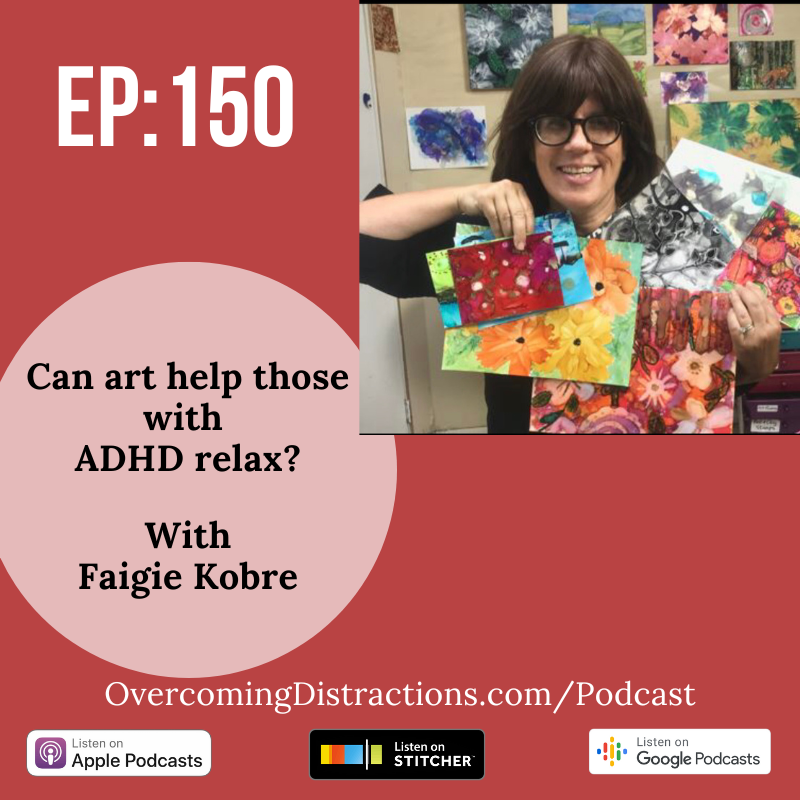
Can art help those with ADHD relax?
We can incorporate mindfulness into our busy ADHD lives in several ways. Mindfulness doesn't always mean meditation. It means that you can give something your full attention without being distracted. And it should help reduce your stress. Can art help people with ADHD relax and increase their creativity? This week we have Faigie Kobre on the podcast, founder of Creativity Reunited. She spends much of her time helping people create art through alcohol inks which she explains in the podcast. She has some great tips in this podcast if you are an adult with ADHD and looking for something different to help reduce your stress. Faigie talks about being diagnosed with adult ADHD later on in life and how seeking a diagnosis came about. She talks about being a high end professional photographer and how after an ADHD diagnosis, she made the career change to educate people about art. She discusses how alcohol inks can help people relax and feel at ease, even those with ADHD and how this fits into the mixed media art community. Faigie discusses how everyone can get started with art, even if you feel you're not good at being creative through art. She says alcohol inks are a great way to express your creativity initially. Find out more at: https://creativityreignited.com/

The best foods to choose for adults with ADHD
While there are many ways to manage and thrive with adult ADHD, one of the areas to focus on is choosing the right foods. By eliminating certain types of foods, we can begin to feel better and even develop more focus On this episode of Dvercoming Distractions Dave sits down with Dana Kay, Founder of the ADHD Thrive Institute and the author of the book, THRIVING WITH ADHD –A Guide to Naturally Reducing ADHD Symptoms in Your Child. While dana's book is geared more towards children with ADHD, the same advice for which foods to choose also helps adults with ADHD. Dana feels that choosing the right foods and discussing nutrition for people with ADHD do not get enough attention. It is a powerful way to manage your ADHD, and she feels more and more people should be aware of the benefits of choosing the right foods. Dana also says that the worst foods for people with ADHD to consume are those that contain gluten, dairy, and soy. She says that if you had to choose one to start with, it would be removing gluten from your diet because it has many benefits. Dave and Dana also talk about how there is a connection between the brain and the gut. I think there is no better evidence of this than when you get butterflies in your stomach when you are nervous. Dana discusses how to get on the right track, including starting with whole foods, that consist of fruit vegetables grass-fed proteins, and healthy fats. She also advises you to drink spring water. There is a whole lot more nutritional advice when it comes to ADHD in this podcast, and Dana gives her tips for getting started. Find Dana Kay at her website as well as her book. https://adhdthriveinstitute.com/
Routines and Adult ADHD-A Few Quick Thoughts
Dave spends a few minutes talking about the power of routines regarding adult ADHD. Having routines, especially in the morning, as well as those that guide us in the workplace can reduce our stress, promote increased productivity and efficiency, and ultimately reduce the contribution to burnout. Dave talks about two areas that those with ADHD need to focus on when it comes to routines. We must have a morning routine that gets us out of the house and into the office without stress. And when we get to work, we need to build routines that allow us to work effectively and enjoy our career or job. Dave also talks about how it is important for us to be flexible because life changes, and we need to respond appropriately.
Working conditions that can lead to burnout and how to move forward
Burnout can happen to everyone, including those with ADHD. Adults with ADHD can burn out much faster when faced with an unhealthy work environment. Burnout also occurs when those of us with ADHD are not in the right job. ADHD career coach Shell Mendelson is on the podcast this week talking about what causes employees with ADHD to lose interest and even burnout. And Shell talks about the warning signs of being in the wrong job, how to correct that and how to lay the groundwork for finding a new career or job. Some important points to the discussion include: Why performance improvement programs at a job can backfire on people with ADHD. Why confidence is important when trying to navigate your career. What contributes to burnout in the workplace including poor communication, lack of flexibility, and not enough physical space or open spaces such as cubicles. And, of course the amount of house someone works. Shell discusses how to start the process of finding a new job or career. She walks everyone through an exercise for identifying what they like and what might cause them to experience any level of burnout in the workplace. She also has suggestions for a successful job interview to ensure you ask good questions before accepting any position. Find out more about Shell here: www.passiontocareer.com www.shellmendelson.com
People with ADHD are Great at Making Assumptions
One trait that many with adults with ADHD are good at is making assumptions. However in most cases, those assumptions are about negative outcomes of various situations. We assume that when our boss or client calls a meeting or calls us, it's to discuss a negative situation or to speak with us about a job that was not done properly. We also assume that some people do not like us or do not understand us. And many of us assume that the car next to us is going to cut us off on the highway. Dave talks about why making assumptions only adds stress to our lives and he discusses a couple very simple strategies to implement in your life to start the process of not assuming everything is bad. Sometimes it's as simple as rewriting the conversation in your head. If you have a habit of assuming the worst in all kinds of situations, join Dave for this short podcast about ADHD and assumptions. Learn more about working with Dave at: www.OvercomingDistractions.com
When adult ADHD and time management collide
Time management especially when you have ADHD can never be about "Set it and forget it." Your systems will only last for so long before you need to adjust to personal and professional circumstances. This week, Dave talks about how you can go back to the basics and hit the reset button on your time management. If you feel like you are running out of time and energy each day, and you feel like your schedule is taking over your life, check with Dave on this short episode. Sometimes we don't see it coming and we find ourselves running in all directions and heading towards burnout. Dave talks about hitting the pause button and doing a hard reset on how you manage your time, commitments and your schedule. With a few basic tips on how to blow your schedule up and start over.
Your brain is not broken-Understanding your ADHD brain
The topic of this podcast is about the feelings many with ADHD feel about having a different brain. Many with ADHD go as far as to feel that their brain is broken. That's what many say to themselves. Tamara Rosier, Ph.D., is the founder of the ADHD Center of West Michigan and the author of the book, Your Brain's Not Broken. The book has received much praise from many in the ADHD community. Tamara wants people to understand that ADHD is just a part of you and does not define you. Dave asks Tamara why many people with ADHD feel their brain is broken. They ask questions such as "Why am I like this? Or why do have this brain?" "Why can't I be normal?" These are common messages we feed ourselves as individuals with ADHD. It's not uncommon and the frustration that comes with having ADHD can feed this. By the same token, Dave asks Tamara why many with ADHD have a default negative type of thinking? For example, "I have ADHD so I can't do that." she discusses what those of us can do to begin to change our negative way of thinking. Tamara also spends an entire chapter in her new book on setting boundaries. It's an essential part of managing your life whether you have ADHD or not. But even more important if you're an adult with ADHD. She explains why. In chapter 12 of her book, Tamara lays out practical ways to manage and thrive with ADHD. She discusses these briefly and tells people why it's important to be practical. Building a solid foundation for managing your ADHD is one of the most important things you can do. You can find Tamara's new book here: https://www.tamararosier.com/

Myths About ADHD and Productivity
Jeff Gibbard and Sara Ohanesian are back on the podcast to discuss ADHD and the myths surrounding productivity and focus. Many people with ADHD have let Tick Tock, Twitter, and Instagram influence how they think about their behaviors and habits. Especially when it comes to strategies and tactics for being productive and focused. To be direct, we let others on social media tell us what works and doesn't. When in fact, those with ADHD need to try a variety of these tactics to find out what works for us and our personal circumstances. We discuss the following in this podcast about productivity and ADHD. First, why do we let outside influences dictate our abilities? And have some of us just made up our minds? We discuss why we need to be curious and not dismissive of productivity tactics. One tried, and true way is to break projects down into small chunks and learn about the different systems that allow us to complete these projects. We talk about paying attention to what is working for you as a person with ADHD as well as what it feels like. We talk about paying attention to your reactions and when you try a certain productivity technique, try to understand if you like it or do not like it. The podcast covers so much more regarding myths about ADHD and productivity. Stay with it until the end because this podcast offers many great tips. If you have your mind made up about the productivity techniques that are working or not working for you, this podcast will change your mind. Find Jeff and Sarah here: https://getsuperproductive.com/
How those with ADHD can return to the office successfully-Part 2
Grant Crowell is back to continue the conversation about how to return to the office successfully. Grant is the Author of Grantasms Creative twisted words for cool people! and a self-professed social wordsmith. Grant has extensive experience in corporate training and support. Grant discusses several of the challenges some of us face when asked to return to an office setting. These include having a new work set up such as a desk or workspace as well as adjusting to a possible hybrid scenario. He also discusses maybe not having an ideal office setup. Grant also talks about how your routine could change because of a different schedule, and the need for different types of communication and real-time interaction. Grand and Dave discuss the benefits of going back to the office. Those of us with ADHD are social animals so that face to face time for many of us is a benefit. Not only in the office but our ability to go out to lunch or other social activities. It also helps build new routines and work discipline. And of course, it gets us out of the house. Grant talks about what we can do to analyze our best work and conditions. That includes an audit of what is working and what is not and what you may be challenged within the workplace. He also discusses how to advocate for ourselves including having discussions and conversations with coworkers and your supervisor about how you prefer to work and how you can be most productive for your organization. Find Grant's book here: https://www.amazon.com/GRANTASMS-Creative-twisted-words-people-ebook/dp/B07ZY9JDPP Connect with him on YouTube: https://www.youtube.com/c/GrantCrowell Do you want to work with Dave? https://overcomingdistractions.com/workwithme/
How to make the most of going back to the office when you have ADHD
This week we have back Grant Crowell, Author of Grantasms Creative twisted words for cool people! and a self-professed social wordsmith. Grant and Dave discuss how to go back to the office full time, survive in a continuing remote work environment or how maximize hybrid working. As we are all too familiar with, the pandemic challenged our way of working for just about everyone. Especially if you work in an office environment. Now, after two plus years, many companies are refocusing their efforts on what their workforce will look like and how they will work. Grant is a seasoned corporate trainer in many different environments and industries and shares his tips in part one of this series on how to maximize your work environment, regardless of where you work. Grant discusses what he saw that were some major challenges to remote work including the basic needs of having an office, inadequate Internet connections, and getting used to sporadic communication with coworkers and supervisors. Create also talks about the challenges that come with remote work and a hybrid work model whether you have ADHD or not. Dave and Grant discussed the importance of taking control of various aspects of your work in conditions. These include getting ahead of time management, speaking up when certain communication styles are not working for you as well as not being afraid to ask for the accommodations that will help you do your job better. Keep your eye out for Part 2 of this podcast. Find Grant's book here: https://www.amazon.com/GRANTASMS-Creative-twisted-words-people-ebook/dp/B07ZY9JDPP Connect with him on YouTube: https://www.youtube.com/c/GrantCrowell Do you want to work with Dave? https://overcomingdistractions.com/workwithme/
You can do far more than you think when you have ADHD
In this short podcast with Dave, he talks about some of the ways in which you can improve your mindset to believe in yourself and understand that your brain is capable of much more than you think. Yes, those of us with ADHD have strengths and weaknesses like everyone else but it's important not to focus on the weaknesses that can bring us down into negativity daily. For example, racking up even the smallest of wins can help us create a positive way of thinking. Continuing to engage in negativity including the negativity that happens often on social media platforms only limits possibilities. Want to work with Dave? https://overcomingdistractions.com/workwithme/
Entrepreneurs with ADHD do these 3 things very well
Many of us with ADHD take the self-employment route. Sometimes we have great ideas and want to run the show, other times maybe it's our only route because the corporate world isn't a great place for us to be. And…Maybe we got fired… Working for yourself is incredibly rewarding but it takes discipline, vision, and an obsession with minimizing distractions. Even if you don't actually own a business but maybe you're in sales, a freelancer, or another career where growth and revenue are directly related to your effort, listen up. Dave talks about three habits that entrepreneurs with ADHD do very well in this short podcast. There are many more critical habits that a self-employed person with ADHD needs to have but Dave talks about some of the top ones here. Staying focused on these three things will allow you to have less stress, manage ADHD much better as well as thrive in business and in life. Are you a self-employed person with ADHD and want to work with Dave? https://overcomingdistractions.com/workwithme/
Becoming an entrepreneur when you have ADHD
If you are an adult with ADHD and you are thinking of becoming an entrepreneur or opening your own business, you'll want to listen to this brief podcast to hear Dave's must-haves before starting your own business. Many people with ADHD end up opening their own businesses. Maybe full-time, maybe side hustle. It's important to have a number of things in place to avoid a disaster both financially and mentally. Dave has owned a restaurant, karate school, and thriving public relations firm and he has advice if you are thinking of going out on your own. Many with ADHD want to go out on their own because they feel they can do it better than in the corporate world, can't seem to find the right job that is a good fit for their brains or they just feel they can shape their future much better as an entrepreneur. Here Dave's tips and must-haves for becoming an entrepreneur with ADHD. If you are thinking of becoming an entrepreneur, you can work with Dave to put the systems in place and build a proper foundation for a thriving business. https://overcomingdistractions.com/workwithme/

ADHD and the power of routines and systems
One of the best ways to thrive with adult ADHD is through effective routines and proper systems. It's also great if the important things in your life have a place where you can find them. Effective routines that are tailored to our lives and our careers help guide us throughout the day and provide tremendous benefits for reducing the stress of having ADHD. This week we have Skye Rapson on the podcast who is the founder of the Unconventional Organisation based in Auckland New Zealand. Skye and her team offer ADHD coaching and other services and everything are offered by those with ADHD. Many people with ADHD feel they are stuck but Skye is a doctoral candidate. She is living proof that people with ADHD can thrive and achieve the goals they want. She discusses briefly how she has been able to navigate school and other life commitments to get to this point in her life. Skye and her team focus a lot on routines with their clients including how they work closely to identify overwhelmed and create strategies to reduce overwhelming behavior with ADHD. She discusses how they do that. Skye and Dave also have a discussion about the importance of developing systems because they do support our weaknesses. Skye walks us through a process for creating routines in your life when you have ADHD. She also says that we need to consistently revisit our routines because circumstances in life and our careers are changing all the time. It's important to adjust where needed. Dave and Skye also talk about how creating proper systems and routines can reduce the effects of burnout. Running around scattered all day only creates stress and anxiety and will ultimately lead to burnout. Find out more about Skye Rapson and her team here: https://www.unconventionalorganisation.com/ And don't forget Dave's new book Overcoming Burnout. https://www.amazon.com/dp/B09WQ17T22
How to reduce your ADHD stress with better communication skills
In this ADHD Minute version of the podcast, Dave talks about some basic tips for improving our communication with others. Especially when we have ADHD. Dave talks about some of the reasons why communication may break down and how to gain better awareness of where we need to improve communication. If we are going to thrive in our careers as an adult with ADHD, one of the most basic ways to do that is to get good at communicating with others. We need to take charge of our communication. He talks about how better communication can help us do our jobs better, reduce procrastination, solve problems, make fewer mistakes and reduce our overall stress. And he gives tips for how we can improve our communication with others. Check out Dave's new book here Overcoming Burnout. https://www.amazon.com/dp/B09WQ17T22 Do you want to work with Dave for your ADHD support system or burnout coaching? Check out your options here. https://overcomingdistractions.com/workwithme/
How do we "own" our ADHD?
What is the difference between knowing about ADHD and owning our ADHD? Jeff Copper from DIG Coaching comes back on Overcoming Distractions to discuss this topic. Don't forget to check out Dave's new book-Overcoming Burnout. https://www.amazon.com/dp/B09WQ17T22 If adults with ADHD are going to thrive in life and in professional settings, we are going to have to understand how to own our ADHD. It's important for us to understand our individual ADHD as well as how our brain operates but it is also equally important for those with ADHD to be able to take charge. Jeff copper and Dave talk about what it takes to actually be in charge of your ADHD and take ownership of it. First, Jeff gives us a refresher course on executive functions and includes information about how important self-awareness is as well as emotional self-regulation. He discusses exactly what self-awareness is and if those with ADHD can truly be aware of themselves and their surroundings. Jeff and Dave also discussed the relationship our emotions and self-awareness have and how tuning into these can help us thrive in all areas of our life. Another big question that Jeff answers is the difference between knowing about ADHD and owning ADHD. And as always on overcoming distractions, there are many tips that you can walk away with to implement in your life. Jeff gives us a number of basic tips to get started on the process of owning your ADHD. Learn more about DIG Coaching and Jeff Copper here as well as links to Attention Talk Video. www.digcoaching.com
Doing what works for you when you have adult ADHD
There is one thing we absolutely know about adult ADHD. We have to try different strategies and tactics to be able to thrive in life and in business. As we mentioned in a previous podcast, we need to constantly be trying differently to find what works for our personal situations. Sadly, many on social media discount many strategies and flat out tell their audiences that these do not work for people with ADHD. The bottom line is you need to find what works for you whether it's traditional advice or ADHD tactics that fit into your own personal situations. In this ADHD minute, Dave briefly discusses how those of us with ADHD can continue to analyze our personal situations and develop strategies that will help us thrive. That includes advice from people who are not in the ADHD community. Don't forget to check out Dave's new book Overcoming Burnout. https://www.amazon.com/dp/B09WQ17T22

How different brains become an advantage in the business world
Every organization needs different viewpoints, regardless of its size. To solve problems and move forward, different types of brains and thinking styles can be a tremendous advantage in any size business. Sarah Ohanesian and Jeff Gibbard join the podcast this week to discuss how they work together with different types of brains. Working together, they provide companies with productivity training. And because they each have a different type of brain, they can be far more effective than other consultants. Jeff has ADHD, and Sarah does not. Because of this, they feel they have an advantage when working with clients. Dave, Sarah, and Jeff have a wide-ranging discussion about how different brains can work well together. One of the major advantages Jeff and Sarah see is that they have the ability to work with other different brains as well as identify people who may need different approaches to productivity. They also discuss why clarity is the backbone of any business and any individual. If you are an adult with ADHD in the business world and you are not seeking clarity, you will find yourself having all types of challenges with productivity, procrastination, time management, and task initiation. What can leaders of companies take away from having different types of brains in their workforce? Sarah and Jeff answered this question. But it all comes down to different ways of solving problems. Because Sarah and Jeff teach productivity, Dave asks them for a few tips to maximize productivity in business and in life. First, recognize different people have different strengths and weaknesses. Next is to be very open about clarity. You should seek it in every aspect of your life. Honest conversations bring about that clarity and make productivity easier and teamwork much better. Also, Sarah and Jeff talk about the need to have systems in place especially when you need to manage adult ADHD. And for many, visual processing is huge for being productive so look at techniques such as mind mapping and Kanban boards. Find Jeff and Sarah here: https://getsuperproductive.com/
Burnout-3 symptoms to look out for
What are some of the common symptoms of burnout? Dave discusses three of the more common symptoms of burnout. While there are many more, and burnout is a complex and sometimes misunderstood issue, Dave discusses some of the early signs to look out for. Dave also discusses that burnout can be very dangerous if it is not addressed. But there is hope and you can overcome burnout by recognizing some of the signs. By understanding that you are heading towards burnout, you can take care of health issues that may be bothering you, stress around your career and workplace, and get your life back in order without overidentifying with your career. A reminder that Dave is the author of the book Overcoming Burnout and you can find it here. https://www.amazon.com/dp/B09WQ17T22
Managing adult ADHD by going back to the basics
This week, Dave talks about managing your adult ADHD by returning to the basics. All too often we see on social media the complexities of managing ADHD. And while everyone with ADHD is different and responds to all types of strategies and methods to thrive, sometimes what is most effective is going right back to basic core strategies of good ADHD management. In this shorter episode of Overcoming Distractions, Dave talks about how to go right back to the basics of ADHD. He talks about the power of self-awareness and understanding your strengths and weaknesses. He talks about how to stay away from negative forces and groups and think for yourself when it comes to developing strategies around ADHD. Dave also discusses some mind and body such as making time to just get out and move in the power of being obsessed with your own time management. Dave also shares a couple of non-traditional ADHD tips that go right back to the basics. Looking for Dave's new book Overcoming Burnout? Check it out below. https://www.amazon.com/dp/B09WQ17T22
ADHD and time blindness-how we can get better at understanding time
In this podcast, Dave talks about some of the causes of time blindness in adults with ADHD. Everything from the way our brain is wired, hyperfocus and flow, squeezing more things into our schedule, and other reasons. Here are a few basic ways you can keep track of time: Try your best to put everything in your schedule-professional and personal. Invite each other such as spouses to certain events Try hard not to squeeze things in when you have a free few minutes. Alarm the shit out of your life. If you're using an iPhone, take a few minutes and preset important alarms for your week. Use the sleep app on your iPhone or another device Apple Watch has its pros and cons for those of us with ADHD Parkinson's law-work expands to the time allotted so set deadlines and timeframes. Good brain health-executive functions such as understanding time get better when our brain is healthier Overcoming Burnout can be found here: https://overcomingburnout.net/ Overcoming Distractions can be found here: https://overcomingdistractions.com/
ADHD- trying harder OR trying differently?
One of the phrases that bother people who have ADHD the most is when people tell you to "try harder." many of us with ADHD heard this phrase growing up, and even sort written on our report cards. But those with ADHD know better. "Trying harder" is far from a solution to improving our lives. Burnout can come from trying harder so it's important to understand how our brains operate. Laura MacNiven from the Springboard Clinic in Toronto is back on Overcoming Distractions the podcast to discuss this very topic and to offer a different viewpoint. She is the co-author of May We have Your Attention please? With Dr. Anne Bailey. People with ADHD need to try differently rather than focus on trying harder. Laura takes time to explain the core differences between trying harder and trying differently and Dave and Laura even pull the phrase apart "try harder" to understand what it actually means. Laura says that a lot can be accomplished by understanding the stories we tell ourselves. If we can reshape those stories, we have a better chance of finding different ways to accomplish the things we want. Dave and Laura also discuss what can happen if people with ADHD continue to just try harder including the effects of burnout. Laura and Dave chat about why understanding our brains as adults with ADHD and some self-awareness can go a long way and understanding how to create different ways of getting things accomplished. Laura gives some tips for understanding your ADHD brain as well as creating some personal awareness. That includes taking time to check in with yourself and to check the stories you are telling yourself. Take time to pause repeatedly to look inward. Understand what's important in life and your career and what wakes your brain up. And finally, take some time to understand when you are at your best. That can be the time of day or the part of the week where you can operate smoothly and focus on what needs to be done. Fine the Springboard Clinic here: https://www.springboardclinic.com/ Learn more about the book "May We Have Your Attention Please?" here: https://www.springboardclinic.com/the-book
ADHD Minute-ADHD and flexible time management tips
In this ADHD minute edition of Overcoming Distractions, we talk about how to be a little more flexible when it comes to time management and ADHD brains. The two years of going through COVID-19 have taught us, even those of us with ADHD that we need to be a little more flexible when it comes to managing our time and our commitments. Dave takes just a few minutes to go through a few things that have worked for him and for others when it comes to trying to manage your time in an ever-changing environment. In short, doing a thorough review of your professional and personal commitments on a regular basis will help you manage time better, feel less stress and ultimately stay away from burnout. Find Dave's new book Overcoming Burnout here. https://www.amazon.com/dp/B09WQ17T22
How high achievers with ADHD can minimize distractions
Are you a high achiever? And are you one of those go-getters that just happens to have adult ADHD? Even professional businesspeople and entrepreneurs can experience a whole host of distractions in their professional lives. And that's what we are talking about in this podcast episode. This week we have back Casey Dixon from Dixon Life Coaching. Casey coaches high achievers with ADHD including attorneys, professors, and many more in high-profile and demanding careers. Casey talks about what she classifies as a high achiever including some specific careers as well as some specific traits when it comes to those that are driven to succeed. Casey and Dave also discuss whether those of us in high-demand careers suffer the same distractions as other people in different industries and careers. Casey suggests that many of us need to find the tasks and projects we are good at and try hard to delegate the tasks we do not like to do. She says working on things we are not good at reduces our focus. Casey offers a number of suggestions to help high achievers with ADHD reduce distractions and gain more focus. She says even making small changes can produce high payoffs in productivity. She highly recommends that those of us who are high achievers with ADHD take a step back and think about how we are working. This is where coaching can come in where you can work with a professional to pull apart the different aspects of your professional life and create solutions. Casey and Dave also talk about reducing commitments to increase productivity. Some of us call it energy management and others call it obligation management. But analyzing your commitments can have big payoffs as well. Casey also states that we are all human and we need to pay close attention to self-care. That includes proper sleep habits, exercise and taking time to be mindful. Paying attention to these will only improve our executive functions. More about Casey Dixon: Casey is intensely focused on building top-tier training, coaching, consulting, and advising experiences for high achievers with ADHD. She created Dixon Life Coaching in response to the grievous lack of understanding and quality services for an often-overlooked population… exceptionally smart, highly-educated, wickedly-talented, overstressed, overworked, overwhelmed, successful-on-the-outside adults with ADHD. https://www.dixonlifecoaching.com/ Casey's online courses: The Mysterious Paradox of Being a High Achiever with ADHD https://register.dixonlifecoaching.com/high-achiever Live Well ADHD https://register.dixonlifecoaching.com/live-well-adhd
Overcoming Burnout-My New Book Announcement
Are you burned out or feel like you're heading down the path of burnout? Dave announces his new book has just been published. Overcoming Burnout-Real life Strategies and Solutions for Burnout Recovery and Prevention. https://overcomingdistractions.com/overcomingburnout/ Dave wrote this book to shed new light on the topic of burnout and just how complicated the issue can be for people. He specifically covers career burnout. Dave talks about how many of us are the Co-founders of our burnout in that we brought a lot of this on our own. That may be a tough thing for us to hear but many of our habits have contributed to our burnout. Dave talks about understanding our capacity, setting boundaries, people-pleasing, and of course time management. Listen to Dave as he discusses why he wrote the book and what you can learn from the people he has interviewed. To purchase the book, go to Amazon: https://www.amazon.com/dp/B09WQ17T22
Adult ADHD and coping with addictions
Research has shown that adults with ADHD are more prone to addictions than others. That includes alcohol abuse and other substances. In this podcast, we will discuss why those with ADHD are more prone to these behaviors and we will also discuss how to mitigate our reliance on alcohol and other addictive substances. We have back Lara Honos-Webb, author of Brain Hacks and Six Super Skills for Executive Functioning: Tools to Help Teens Improve Focus, Stay Organized, and Reach Their Goals as well as many other books. Dr. Lara Has been on Overcoming Distractions many times and it's a wealth of knowledge in the area of ADHD. Dr. Lara Talks about how addictions such as those with alcohol and other substances not only affect those with ADHD to a greater percentage but how they have increased during the past two years of the pandemic. Lara talks about how prevalent addiction is in the ADHD community as well as why we've seen the increases recently. She also answers the question about why those of us with ADHD have more challenges with addictive behaviors. Hint, it's our impulsivity. She also discusses that those of us with ADHD are typically addicted to other types of uses such as digital addictions, our phones as well as social media. Laura discusses how addictions can affect the executive functions of anyone but in particular adults with ADHD. She discusses how our executive functions decrease but overall if we protect our executive functions as a regular habit in our lives, we can help stave off addictions. She says we must do our best to build self-confidence and self-efficacy as we try to limit our addictive behaviors. And by doing so focus on self-love versus shame to recover. Lara says that there are all different types of support groups including those that work in moderation as well as those that demand abstinence. And she describes what she calls urge surfing which is your ability to catch yourself and understand how you may be able to delay your actions. Yes those of us with ADHD are already good at delay but there is a case for making it be used in our favor when it comes to addictions. Find Dr. Lara Honos-Webb at: www.addisagift.com
ADHD Minute-Have you established values for yourself?
This time on the ADHD Minute version of Overcoming Distractions, Dave talks about creating values statements for your life and your career. Many of us may think we have values but when we sit right down and try to list those, we may struggle. Many of us complain about situations we are in such as a bad job, a bad boss, or unrealistic clients if you're a small business owner, and we're getting stressed out, resentful and even burned out. Dave talks about how you can turn negative aspects of your life into positive statements. You can define the type of people you want to work with, the type of workplace and culture you want to spend your time at, and the type of people you want in your life. Spend 8 minutes with Dave to learn more about how to create value statements for your life.
ADHD Minute-4 Things that made me better the past 2 years
Now that COVID-19 is becoming much more manageable in our lives, it's time to ask ourselves what we have learned over the past two years that can help us in the future. That's what Dave talks about in this ADHD Minute addition of Overcoming Distractions. Dave talks about some of the things that he has learned that can help him manage his business and life much better. Dave talks about how he has gotten obsessive with time management including blocking off days, not responding to every notification that pops up, and getting very creative with his calendar. He talks about personal goals before professional goals and that your personal goals should drive your career goals. Dave also talks about how it's important to have routines but to always self-assess and be flexible when necessary. And most of us should have learned this by now but making sure you set time aside to clear your head Several times a week or whenever needed. Dave talks about the importance of this.
How adults with ADHD can improve communication in the workplace
Improving communication in the workplace is something everyone should strive for but for those of us with adult ADHD, it needs to be an ongoing process of identifying what can be effective. Some of us receive communications differently, some of us put out communications in the workplace that can be misunderstood, and the bottom line is not every communication style is a match. This week we have back Grant Crowell, Author of Grantasms Creative twisted words for cool people! and a self-professed social wordsmith. Grant and Dave discuss how to improve strategic communications in the workplace as well as being an entrepreneur with ADHD. As you'll find Grant's book also injects a little fun and humor into the process. What exactly is strategic communications and why do we need to practice it? How do we have fun and reduce stress while improving communication styles? How do we find the right patterns of communication as well as capture the attention of our coworkers and others? How can we connect appropriately as well as implement some humor in meetings and other settings? How can we be mindful of the social context of things we say as well as read the room. Why do we ADHD'ers need to focus on being strategic in our communications? Why is clarity in communication so important for those of us with ADHD? Grant and Dave discuss the topic of co-workers or clients not giving clarity on projects or assignments. Vague directions, etc…which leads many with ADHD to procrastinate. They also talk about how some co-workers, a boss, or clients can abuse our people-pleasing nature. Many of those with ADHD are people pleasers and it leads to exhaustion, frustration, overwork, and burnout. How do we communicate properly and train others on how to treat us? And Grant gives a fast lesson and roadmap to being more strategic in our communications. Find Grant's book here: https://www.amazon.com/GRANTASMS-Creative-twisted-words-people-ebook/dp/B07ZY9JDPP Connect with him on YouTube: https://www.youtube.com/c/GrantCrowell
ADHD Minute- Are you ready to burn the boats?
In this short episode of Overcoming Distractions Dave talks about the concept of burning the boats. If you're ready for a new job or career change, Dave has a little bit of advice for how to hit the reset button. Some of the things Dave brings up that may trigger your need for a new career are being bored, tired, feeling disconnected, stressed out, exhausted or all of the above which equals burnout. Dave offers some quick tips from his personal experiences over the years managing his careers as well as his entrepreneurial journeys. If you're stressed out and need a change, spend the next 10 minutes getting some quick advice from Dave about hitting the reset button on your life and career.
Planning strategies for adults with ADHD
Planning seems to be another challenge that many with adult ADHD must deal with. While the topic of planning could be a much larger conversation, on this podcast episode, we discuss what it takes to plan out tasks and projects in our professional lives. If you need to get better at planning your professional or personal life out, this is a great discussion with a ton of valuable tips. Nikki Kinzer and Pete Wright from Taking Control…The ADHD Podcast joins Dave to discuss ways those of us with ADHD can get better at planning as well as executing on those plans. First, Nikki, Pete, and Dave discuss why people with ADHD have challenges with planning at many levels. They discuss how certain executive functions can get in the way of planning projects and tasks as well as more extensive items such as an entire workweek. But they also make it clear that those with ADHD are not the only ones who have challenges with planning. People without ADHD also could use a lesson in planning as well as entire companies Nikki, Pete, and Dave discuss how just planning your day the night before can be a game-changer. We hear this all the time but many of us do not practice it and end up sitting at our desk the next day with no plan. The discussion evolves into planning on a much greater scale including how being meticulous with your weekly calendar can help you plan projects, execute much better as well as manage your time and distractions. When you have a system in place for managing your entire week with proper planning, it is much easier to make progress. Something as simple as color-coding your calendar can make a huge difference in your professional life. They also discuss how a lack of planning creates a domino effect in an organization, affecting others around you. Nikki, Dave, and Pete discuss whether planning hinders the creative process or can it help the creative process blossom? Some people feel that too much planning gets in the way of creativity and idea generation. What are some of the ways we can plan and be organized as an entrepreneur or business professional and have plenty of time for creativity? The gang talks about ways to be a planner and be creative. And as always, the guests leave us with great tips we can implement in our own lives. Check out Nikki and Pete's ADHD podcast here: https://takecontroladhd.com/the-adhd-podcast

Relearning Motivation as an Entrepreneur with ADHD
So many of us with ADHD have real challenges with motivation. That comes in many forms and we see it in all areas of our lives. Motivation challenges us from simple tasks at work, getting up enough energy to go to the gym or complete large projects. And motivation even challenges us when we need to do basic things such as clean the house. Jandra Sutton is back on the podcast, founder of the Wildest Company a full-service creative agency. Jandra also offers various coaching services and has been featured in many major publications. She was officially diagnosed with ADHD right before the pandemic and has some perspective on what it takes to create meaningful and effective motivation. **Please support the podcast at: https://www.buymeacoffee.com/overcomingd One of the top ways that Jandra has looked at motivation is the focus on the process rather than getting excited about an entire project. Sometimes it takes just a little bit to get us off the mark. Jandra talks about what prompted her to write an article for the Metro UK about motivation. She has learned about what it takes to get motivated as a person with ADHD running a business and she shared some of her advice in that article. Dave and Jandra also talk about whether many with ADHD take a look at motivation incorrectly and whether we look at the mountain we cannot climb or whether we are better at picking away at small parts of a larger project. Dave and Jandra also talked about how the ADHD brain responds to motivation differently as we may require different types of prompts to get started. Jandra talks about what works for her and she has her tips for motivating herself as an entrepreneur with ADHD running a business. As you'll find out, some may surprise you but they work for her. And the bottom line of this conversation is that you need to find what works for you because every person is different when it comes to motivating factors. Connect with Jandra on her website: https://jandralee.com/ Find Jandra's article for Metro UK here: https://metro.co.uk/2021/12/05/why-waiting-for-motivation-to-strike-doesnt-work-15675469/
Who do you want to be? Aligning personal and professional goals
Don't be afraid of this goal-setting discussion because we are going to discuss setting goals in a way that supports both our professional and personal desires. Ask yourself this question when setting goals. Who do I want to be? If you're like many people, you set some New Year's resolutions, and then by February, you fell off track pretty quickly with meeting your goals or even getting started on them. On this episode of Overcoming Distractions, we are going to discuss how to stay consistent on the progress needed to achieve our goals. We have back on the podcast, Sarah Reiff-Hekking, Ph.D. of True Focus Coaching. First, we discuss whether setting New Year's resolutions is a bad idea or if there might be a better time of the year to set them as well as implementing goal setting on a more frequent schedule. Sarah says that we have to understand who we want to be in order to set and achieve goals. This means finding a way to align both professional and personal goals so they are harmonious. Your professional goals should help support your personal and family goals and the way you want to live. Sarah also says that setting and achieving goals helps us with our self-esteem and gives us purpose as well as meaning in life. It also facilitates engaging with others which can help with the process. Dave and Sarah also discuss why good habits and routines are some of the keys to making progress with our goals. With behavior change, small moments can help you in the long term. And as always Sarah gives us some quick tips to get back on track. She says always keep restarting and a good rule of thumb is to revisit your goals every three months. She also says if you're struggling, just focus on today. You can work up to revisiting your goals weekly, make sure you're taking your whole life into consideration, and renew your goals when needed. If you want to connect with Sarah Reiff-Hekking, Ph.D at True Focus Coaching, you can reach out to her here: https://www.truefocuscoaching.com/apply/
ADHD Minute-Do you feel like you're burning out?
Welcome to the ADHD minute version of Overcoming Distractions. In this mid-week check-in, Dave talks about some of the initial signs that you may be burning out in your career or your job. And it gets a little tricky when it comes to adults with ADHD because some of the signs of burnout are some of the things many of us experience in our daily lives. Dave goes through a few questions to ask yourself to see if you may be burning out. Those include continuous exhaustion, your passion or excitement for your job or career, and whether that may be drifting off, physical symptoms that medical professionals can't give you an answer for as well as a loss of focus over and above what you already experience with your ADHD. Join Dave for this really quick ADHD minute.

When you have ADHD-Should you work with a therapist or coach?
This week we tackle a common question that many adults with ADHD have. Should I use a therapist or an ADHD coach? Back on the podcast is Diann Wingert, former therapist and now mindset coach working with adults that have ADHD. Diann is uniquely qualified to answer this question and talk about when you would want to work with a therapist and when an ADHD coach might be able to provide you with the tools you need. Diann first discusses the differences between a therapist and an ADHD coach. She talks about what each can provide and the skills that each discipline might possess. She says sometimes it comes down to a therapist looking at past experiences you have. An ADHD coach would work with you to build a thriving future with tools, skills, and accountability. However, she cautions you that that is not always the case when working with both. Diann also cautions listeners to recognize that most of these working relationships, especially with a therapist should not be long-term. For example, if you're seeing a therapist for 10 years, you have to ask yourself why. And do you really need it at this point? When choosing a therapist or an ADHD coach, the first and most important factor is to make sure it is a good fit. Does this professional get you and do they respect you? And of course, very important, do you feel they can help you and are they confident they can help you as well? Diann also cautions listeners to understand that there are many therapists that have not been formally trained in ADHD. You don't want to be in a position where you're teaching your therapist about ADHD so ask them for some examples of how they have assisted other clients with ADHD. And Diann wraps up her conversation with Dave about choosing an ADHD coach and some of the things to look out for. You can learn more about Diann Wingert and the Driven Woman Podcast on her website. https://www.diannwingertcoaching.com/
ADHD Minute-3 things to do this week to make your life easier
Welcome to the ADHD minute version of Overcoming Distractions. In this mid-week check-in, Dave offers a quick little snippet of advice for thriving with adult ADHD. This week, Dave talks about three things that you can do this week to make your life easier. We're talking about how to manage your time, claim your time off, have fewer commitments that stress you out, and more. Take Dave's advice, hit the pause button for a few minutes this week, and do these three things. They just may make your ADHD life a little simpler.
Activating your plans and getting "stuff" done with ADHD
To kick off the year 2022, we have ADHD coach Jeff Copper back. Jeff is with DIG Coaching and always has a wealth of information and tools for adults with ADHD. This week we are talking about goals but, activating the necessary steps to achieve your goals and even specific tasks. Most of us have goals we want to achieve or projects we want to embark on but for those of us with adult ADHD, we need an activation plan. Sometimes it's as simple as getting the house clean or more involved such as embarking on a project for work. But for most of us who tend to be distracted, a plan is necessary. How do we activate a plan when we have ADHD? First as Coach Jeff Copper explains we need to understand how our executive functions work as well as possibly get in the way when it comes to getting things done. That involves some substantial self-awareness in understanding the way our brain works. Also as Jeff explains, we need to own our ADHD. We need to understand what distractions do when it comes to being challenged with activating plans of all types and we need to get a firm grip on how uncertainty and lack of clarity delay tasks and projects. Jeff talks about some simple steps to get better at activating plans, projects, and other tasks. He suggests asking yourself what is hard about getting started on a particular project or simple task and to bring that further, acknowledge what is difficult about getting started. He also recommends understanding what is easy about getting started and analyzing both. Learn more about working with ADHD coach Jeff Copper here: www.digcoaching.com www.attentiontalkradio.com www.attentiontalkvideo.com www.attentiontalknews.com
ADHD and entrepreneurship-managing your time effectively
ADHD and entrepreneurship do go together quite well, most of the time. Many people with adult ADHD end up working for themselves for a whole host of reasons. And while this might be a great option, there comes an immense amount of time management strategy involved in any entrepreneurial journey. In this episode, we talk with Roxanne Jarrett from Swellhead Coaching and Support Services about entrepreneurship, ADHD, and managing your time effectively. Roxanne loves to work side by side with entrepreneurs that just happen to have ADHD and she offers a number of great tips for maximizing your time and staying focused. You don't have to be an entrepreneur to get a ton of value from Roxanne's tips. Roxanne talks about some of the advantages that an entrepreneur with ADHD has. And she also discusses as a result of the COVID-19 pandemic, whether entrepreneurship is still a great path for people with ADHD. She talks about many of the common time management challenges that adults with ADHD encounter when it comes to entrepreneurship, and she offers her advice for tackling those issues. Roxanne says that as entrepreneurs with ADHD, we need to cut ourselves some slack sometimes, give ourselves the validation that we deserve as well as the credit needed to stay focused on our entrepreneurial journey. Some days we will accomplish much and others not so much. And Roxanne talks about the must-haves for managing time and staying focused as an entrepreneur with ADHD. Those include having a passion for the work you do, having a road map to grow and continue to thrive, and putting the systems in place that work for your brain. Freebie Link, Roxanne talked about: https://www.swellhead.com/freeroadmap Find Roxanne Jarrett, MA, CPC from Swellhead Coaching & Support Services on her websites. www.swellhead.com www.roxannejarrett.com
Improving your sleep habits when you have adult ADHD
There are a number of important ways to manage your adult ADHD. One critical factor and thriving with adult ADHD is to ensure you have proper sleep habits. Not only getting enough sleep but getting quality sleep is just as important. In this episode we speak with Kelly Myerson is an author and a sleep expert as well as an occupational therapist. Kelly walks us through strategies for proper sleep, tackling mindset the environments as well as healthy habits for sleep. Kelly first discusses is what happens during sleep that can help us perform better the next day. She talks about how sleep restores certain cells in the brain and how getting enough sleep helps us with both our physical and mental health. She also talks about what happens when we don't get the adequate sleep that the ADHD brain needs. That includes a decrease in executive functions at the overall lack of focus. She also discusses why the ADHD brain actually requires healthy sleep habits. Kelly gives us strategies for creating the best sleep environment how to create better sleep habits. She gives us tips for how to slow our brain down before sleep time and she also provides advice for people with ADHD who historically do not sleep well. She says you need to develop good habits as well as a devotion to getting a good night's sleep. And if all else fails, it's time to call a sleep specialist or your doctor. Find Sleep Expert and Occupational Therapist Kelly Myerson here at her website. https://www.beingwellwithkelly.com
How and when to choose an ADHD coach
There comes a time where everyone regardless of ADHD needs a great mentor or coach. How do you find the right ADHD coach and when is it time to get ADHD coaching? Those are some of the topics discussed in this podcast. Dave's guest is Evan Kirstein of Progressive Growth Coaching. Evan coaches entrepreneurs, executives, and adults with ADHD. Evan talks about the types of things an ADHD coach can help you with. Those include prioritizing tasks, projects, and other commitments you have in your personal and professional life. He says that a major emphasis can be placed on executive functions and how to improve those for better performance. Evan says a great ADHD coach can help you be honest with yourself and take ownership of responsibilities and can give you a foundation for transformation. He says working with an ADHD coach can help you with work habits, meeting deadlines, and overall effectiveness in your professional life. And one important thing. An ADHD coach can help you pick yourself back up. Evan covers other items in the podcast including when the appropriate time to consider working with the coaches. He covers what you should be looking for when partnering with a coach and trying to find the right fit. He talks about whether you need an ADHD coach or just a professional coach that is a good fit and matches your values. And he discusses is what you should do if you are resisting the idea of partnering with the coach. Learn more about working with Evan here: www.ProgressiveGrowthCoaching.com
Engineering success with your adult ADHD
How do you go from being broke, getting a divorce, and then creating a thriving successful life with adult ADHD? The answer is in this podcast episode. If you want to engineer a successful life and consistent habits, make sure you listen to this conversation. This week Dave has a conversation with Aron Croft. Aron has turned his past experiences into a successful coaching and consulting practice. While we joke about crashing and burning on this segment, there are some valuable lessons to be had. Aron discusses his story of been diagnosed with ADD, earning minimum wage, being broke, getting a divorce as well as how he got through Harvard. While he always achieved good grades in school, he went through numerous job changes and other struggles until he realized that he should try to get an official diagnosis. Aron has implemented many systems in his life to achieve success and he coaches others to do the same. He discusses ways to manage and thrive with adult ADHD, and the ways we can implement motivation in our lives. He talks about engineering progress as well as engineering consistency to get the things we want in life. He also discusses how the brain processes information when we have ADHD and the strategies to get things done. And he discusses must-haves to thrive with adult ADHD. Those include celebrating quick wins, stopping the self-blame, finding meaningful goals that are self-generated as well as self-education on adult ADHD. He thinks it is very important to find the support you need and most importantly, never give yourself problems you do not need. You can find Aron Croft at his website here. https://hiddenadhd.com/
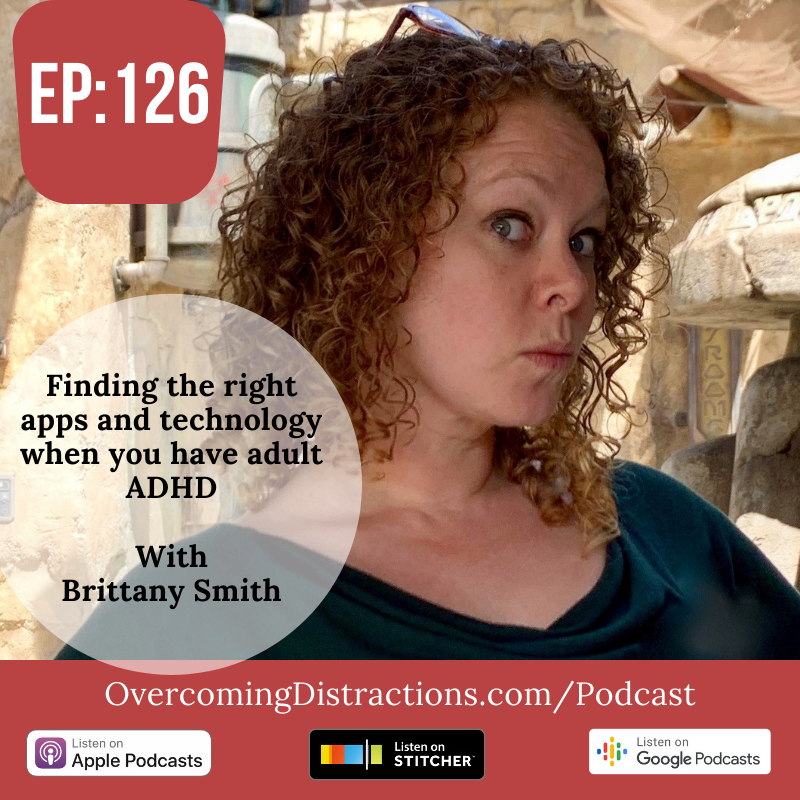
Finding the right apps and technology when you have adult ADHD
For many with adult ADHD, the right technology can be a game-changer. Whether that is applications that help us run our business or something as simple as maintaining and sharing a grocery shopping list. We can't escape technology anymore in our lives and we must embrace what helps us thrive. Helping us navigate the many apps that are available to us is Brittany Smith, from Devise & Conquer Coaching. Brittany offers exclusive coaching when it comes to helping adults with ADHD find just the right apps and technology for their lives. Britney discusses whether ADHD responds better to apps and technology or whether we prefer pen and paper. Or does ADHD respond to both methods? Britney discusses how entrepreneurs and business professionals with ADHD can consider the several types of apps including time management, mindfulness and nother crucial pieces of technology to help us with our professional lives And she walks us through the process of finding the right apps that work for us as individuals with ADHD. Britney has a number of recommendations for apps to help us organize our lives and she shares a few of her favorites. Brittany also recommends a series of automation tools to help us write our lives in our business. And she recommends monitoring what we use for technology and using it to better our lives, not complicate it. Brittany also recommends when you're starting the use of a new app to make sure you utilize it for a few weeks to see if it works for you. You must give it time in order to effectively evaluate whether it's a good fit for your life or business. Find Brittany Smith here: https://conquer.consulting/
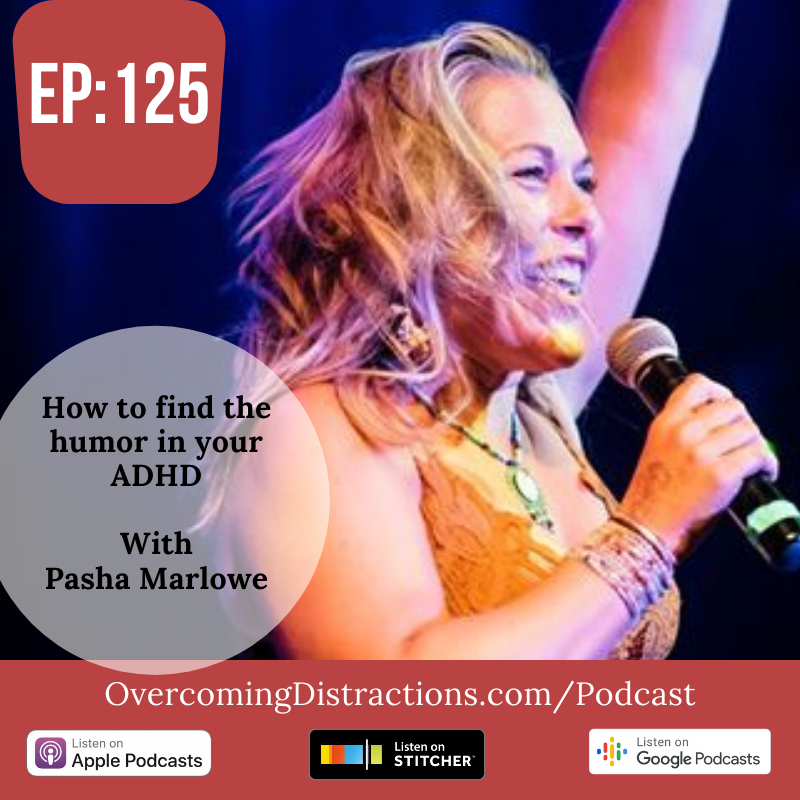
How to find the humor in your ADHD
In this podcast, we are going to laugh at, and about our ADHD. And we're going to learn how to find the humor with our adult ADHD. On Overcoming Distractions this week is Pasha Marlowe, a therapeutic comedy coach. Pasha is going to walk us through how to find humor in our day-to-day activities in the ADHD world and how to use laughter as a tool to manage and thrive with adult ADHD. Pasha and Dave talk about not only humorous things that have happened during the pandemic but what they have learned through this era of COVID-19. And Pasha discusses her own challenges. Pasha discusses why many people find it difficult to laugh about their challenges and struggles including ADHD and she also discusses why it is important for the mind and body to be able to find humor in everyday situations. Dave and Pasha have a discussion about how we can begin to find more humor and other things to laugh at in our daily lives and why it is so critical for our mental health to be able to lighten up throughout the day. And Pasha talks about her therapeutic comedy coaching sessions and programs. Make sure you check out her comedy coaching. Learn more about Pasha Marlowe and her coaching programs on her website. https://pashamarlowe.com/
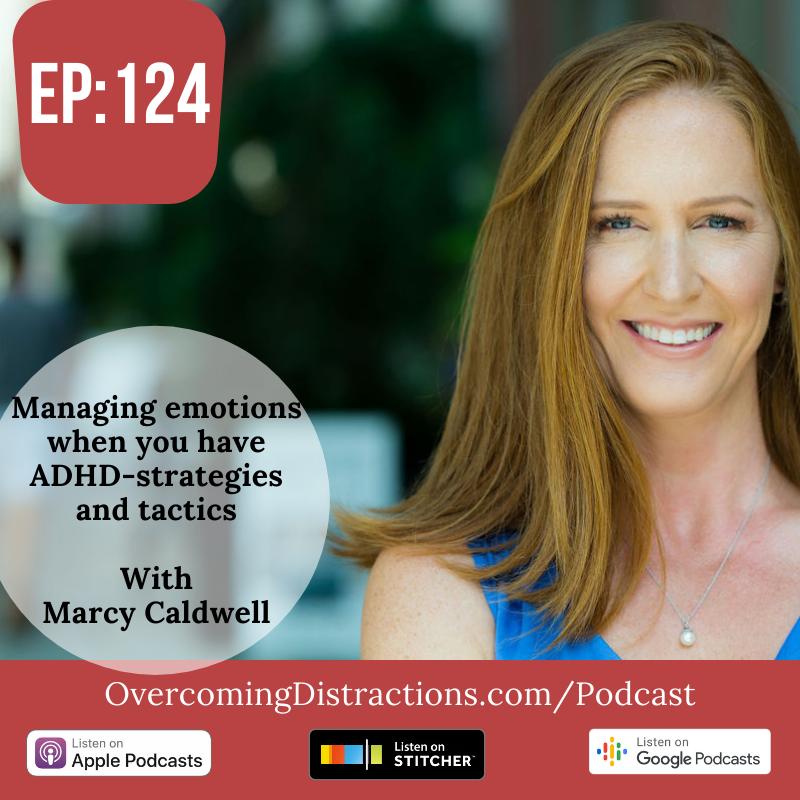
Managing emotions when you have ADHD-strategies and tactics
How can I manage my emotions better when I have ADHD? This is a common question as well as a struggle in individuals with ADHD. Our emotions can get the best of us in both challenging times and times of excitement. In this episode of Overcoming Distractions, Dave has a conversation with Marcy Caldwell. She is the supervising psychologist at Rittenhouse Psychological Assessments, and she has an upcoming program called Meltdown to Mastery. Marcy first discusses why those with ADHD have challenges in managing emotions of all kinds. She talked about how the ADHD brain can have a flood of emotions and get overstimulated and in many cases irritable. Marcy spent some time discussing her green, yellow, orange, and red indicators for recognizing and managing your emotions. It is a great method to identify when your emotions could be getting the best of you. Dave and Marcy also discussed how to control emotions through breathing and how that can help you process feelings and reduce anxiety. And something as simple as taking a walk to process your emotions can help soothe your anxiety. Marcy gives us a road map and walks us through the basics of getting a handle on our emotions both good and bad. And Marcy also walks us through her Meltdown to Mastery program which provides a framework to develop the necessary skills to manage the emotions that come with ADHD. Connect with Marcy and her practice here: https://rittenhousepsychologicalassessments.com/