Manufacturing Greatness | Productivity | Retention | Profits | Continuous Improvement | Safety | Workforce Development | Labor Challenges | Skills Gaps | Industry 4.0
196 episodes — Page 1 of 4
Nobody Quits Over Onboarding | Manufacturing Employee Retention | Ep. 196
Your Best People Are Burning Out on Work They're Good At | Frontline Leadership | Ep. 195
Your Veterans Want Clarity More Than Your New Hires Do | Frontline Leadership | Ep. 194
Silence Is Not Agreement | Psychological Safety and Manufacturing Team Leadership with Dr. Sunita Sah | Ep. 193
It Was Due Thursday and It's Still Sitting There | Manufacturing Accountability | Ep. 192
Be Curious Rather Than Furious | Manufacturing Team Leadership and Culture with Karin Lindner | Ep. 191
You Cannot Recruit Your Way Out of This │ Manufacturing Recruiting │ Ep. 190
Why Nobody Pulls the Cord with Dr. Michael Gillespie │ Leadership Decision Making │ Ep. 189
Nobody Inspects the Culture │ Safety Culture │ Ep. 188
Your Best Worker Is Already Halfway Out the Door with Darcy Eikenberg │ Employee Retention │ Ep. 187
Why Your Best Technician Fails as a Supervisor | New Leader Onboarding | Ep. 186
Why Your Plant Manager Can't Solve Complex Problems | Time Management for Manufacturing Leaders | Ep. 185
The Week-One Blind Spot Costing You New Hires | New Hire Onboarding | Ep. 184
A Reporter Calls Me Every Week Asking Who's Laying Off with Jason Bates │ Manufacturing Community │ Ep. 183
Every Time You Say Yes, You're Saying No to Something │ Manufacturing Team Leadership │ Ep. 182
The Team Member You've Quietly Given Up On with Nir Eyal │ Talent Development │ Ep. 181
It's Thursday and the Report Isn't Done. Where Did It Break? │ Manufacturing Team Leadership │ Ep. 180
The Most Important Leader Has No Title with Jason Hopper │ Manufacturing Team Leadership From the Floor │ Ep. 179
Three Questions That Turn "We Told Them" Into "We Got It Done" | Manufacturing Team Leadership | Ep. 178
The Unwritten Rule That Quietly Ran His Whole Plant with Ryan Forte │ Manufacturing Team Leadership │ Ep. 177
Why Write-Ups Break Trust and What to Do Instead | The Accountability Gap | Ep. 176
Culture of Ownership in Manufacturing: How Owners Stop Being the Bottleneck with Josh McKain | Ep. 175
When "You Should Just Know" Stops Working: Communication Skills That Close the Expectation Gap #174
Frontline Leadership Development for Manufacturing Supervisors: Silencing Self-Doubt and Leading with Confidence with Jenn Donahue #173
Workforce Development and Leadership Development: The Showing Up Gap That Is Undermining Your Manufacturing Productivity #172
Lean Manufacturing Leadership for Plant Managers: Why Kaizen Fails Without Curiosity with Dr. Debra Clary #171

S1 Ep 170Manufacturing Leadership Development: The 3 Conversations That Fix Accountability, Alignment, and Results #170
Welcome to Manufacturing Greatness with Trevor Blondeel, where we work with organizations to manufacture greatness by leveraging resources you already have to achieve greater retention, productivity, and profits. To learn more, visit www.manufacturinggreatness.com and click here to subscribe to Trevor's monthly newsletter. Now, let's jump in! If you've ever thought "I already explained this" but still are not getting the results you expect, the problem may not be effort, it may be alignment. In this episode, Trevor Blondeel explores how gaps in communication skills and unclear expectations impact production efficiency, manufacturing productivity, safety culture, and employee satisfaction across plant leadership and operations management. Drawing on Manufacturing Greatness, lean manufacturing, six sigma, and continuous improvement practices like kaizen, value stream mapping, and 5S methodology, Trevor introduces a simple framework built on three key conversations. This approach supports process optimization, quality management, and stronger performance management while helping shift supervisors and frontline supervisors improve coaching skills, problem solving, and conflict resolution. It is a practical model for driving change management, workforce development, talent retention, and sustainable results in today's Industry 4.0 and smart manufacturing environments. 01:05 — Introduction to the Manufacturing Greatness model as a practical approach within operations management to improve manufacturing productivity through clearer alignment and more effective communication 01:45 — The three critical gaps are introduced as key drivers of performance management, highlighting how they affect workforce development and execution across plant leadership and the shop floor 02:45 — Simple, repeatable conversations are positioned as a universal tool similar to lean manufacturing and kaizen, helping teams drive continuous improvement and strengthen process optimization 03:15 — The showing up gap explains how leadership behavior, tone, and intent shape perception, directly influencing engagement, safety culture, and the effectiveness of coaching skills 05:00 — The expectation gap focuses on clearly defining what success looks like, aligning on outcomes to improve quality management, production planning, and reduce errors and rework 07:00 — The accountability gap emphasizes setting clear commitments, timelines, and consequences to strengthen KPI management, build trust, and support talent retention and burnout prevention 08:30 — Consistent behaviors and strong communication skills help build a culture that supports change management, diversity and inclusion, and long-term workforce development 09:30 — A preview of upcoming insights into applying the model within smart manufacturing and Industry 4.0, along with broader connections to supply chain management challenges
S1 Ep 169Manufacturing Leadership Development: Why Connection Drives Productivity and Retention with Morag Barrett #169
Welcome to Manufacturing Greatness with Trevor Blondeel, where we work with organizations to manufacture greatness by leveraging resources you already have to achieve greater retention, productivity, and profits. To learn more, visit www.manufacturinggreatness.com and click here to subscribe to Trevor's monthly newsletter. Now, let's jump in! In today's manufacturing environment, the biggest barrier to productivity, talent retention, and employee satisfaction isn't equipment or process, it's connection. Organizations may invest in lean manufacturing, Six Sigma, and process optimization, yet engagement, safety culture, and performance management often still fall short. The difference comes down to leadership. Strong communication, effective coaching, and intentional leadership development are what enable shift supervisors and frontline supervisors to lead teams successfully in Industry 4.0 and smart manufacturing environments. On this episode of Manufacturing Greatness, we're joined by Morag Barrett, a leadership development expert, executive coach, and keynote speaker dedicated to solving the growing disconnect in the workplace. She's also the author of Cultivate: The Power of Winning Relationships. Morag helps leaders strengthen relationships, improve change management, and build high-performing teams. If you want to boost production efficiency, enhance workforce development, and lead with greater impact, this conversation offers practical tools to elevate both results and relationships. 00:30 — When trust erodes between managers and frontline supervisors, performance management weakens, talent retention declines, and manufacturing productivity suffers. 01:00 — Success in manufacturing is driven by connection, not just competence, especially when leading change management, workforce development, and process optimization initiatives. 03:00 — A common leadership gap occurs when organizations promote for results but fail to provide management training, coaching skills, and clarity on new expectations in production management roles. 05:30 — Relationship breakdowns create silos across production, quality management, and supply chain management, reducing collaboration, problem solving, and overall production efficiency. 07:00 — The "relationship ecosystem" highlights how workplace dynamics shift between allies, supporters, rivals, and adversaries, directly impacting communication, conflict resolution, and team performance. 09:00 — Transitioning from peer to leader requires intentional leadership development, clear expectations, and ongoing communication to maintain trust and employee satisfaction. 15:00 — The "relationship pulse check" introduces simple but powerful questions that strengthen engagement, support diversity and inclusion, and improve team alignment. 20:00 — Consistent communication and follow-up build psychological safety, strengthen safety leadership, and reinforce a strong safety culture across the shop floor. 25:30 — Sustainable manufacturing greatness comes from daily leadership habits like slowing down, building connection, and investing in people to support burnout prevention, work-life balance, and long-term manufacturing productivity. Connect with Morag Barrett Learn more about SkyeTeam and complete your Ally Mindet Profile here Connect on LinkedIn Buy her book

S1 Ep 168Why Productivity Problems Start at the Top: Manufacturing Leadership and Employee Retention: #168
Welcome to Manufacturing Greatness with Trevor Blondeel, where we work with organizations to manufacture greatness by leveraging resources you already have to achieve greater retention, productivity, and profits. To learn more, visit www.manufacturinggreatness.com and click here to subscribe to Trevor's monthly newsletter. In this episode of Manufacturing Greatness, we break down why manufacturing leaders plant owners, operations managers, and production managers continue to struggle with employee retention, manufacturing productivity, workforce engagement, and frontline performance on the shop floor. Even after hiring and onboarding new employees, many manufacturing organizations still face turnover, inconsistency, and performance gaps because leadership focuses on fixing team members instead of developing supervisors and strengthening frontline leadership. This episode introduces the Chocolate Fountain Effect, a practical manufacturing leadership model that shows how leadership behaviors at the top directly impact safety, quality, productivity, and employee engagement across the entire operation. 00:30 — The real cost shows up in declining production efficiency, gaps in safety culture, quality management issues, and burnout risk when frontline supervisors lack coaching skills, communication skills, and performance management capability. 01:00 — The "chocolate fountain effect" explains how leadership behaviors flow from the top through every level of the organization, shaping workplace culture, workforce development, and results in lean manufacturing, six sigma, and process optimization efforts. 02:00 — Engagement and manufacturing productivity are driven by how leaders show up, communicate, and lead change management, influencing employee satisfaction, diversity and inclusion, and retention across Gen Z manufacturing and the millennial workforce. 03:30 — Case study in plant leadership: when leaders bypass supervisors to solve production planning or supply chain management issues, it weakens accountability, disrupts operations management systems, and reduces effectiveness in KPI management. 04:30 — The turning point comes through leadership development and management training, where leaders step back, strengthen coaching skills, and empower shift supervisors and frontline supervisors to lead problem solving, conflict resolution, and team performance. 08:30 — Sustainable results in smart manufacturing and Industry 4.0 require investing in people as much as tools like kaizen, value stream mapping, and 5S methodology, focusing on burnout prevention, safety leadership, and building strong systems for long-term manufacturing productivity.

S1 Ep 167Leadership Resilience in Manufacturing: Leading Under Pressure with Dr. Marie-Helene Pelletier #167
Welcome to Manufacturing Greatness with Trevor Blondeel, where we work with organizations to manufacture greatness by leveraging resources you already have to achieve greater retention, productivity, and profits. To learn more, visit www.manufacturinggreatness.com and click here to subscribe to Trevor's monthly newsletter. Now, let's jump in! In today's demanding manufacturing environment, frontline supervisors and plant leaders are expected to deliver higher production efficiency, stronger quality management, and better manufacturing productivity often while navigating workforce pressures and constant operational change. How does leadership resilience influence effective operations management, support burnout prevention, and drive sustainable performance on the manufacturing plant floor? Learn more with guest Dr. Marie-Helene Pelletier, an internationally recognized leadership psychologist, executive coach, and author of the award-winning book The Resilience Plan: A Strategic Approach to Optimizing Your Work Performance and Mental Health. With more than 20 years of experience across corporate leadership, psychology, and governance, she brings a powerful perspective on how leaders can strengthen both work performance and mental health. In this conversation, MH explore how manufacturing leaders can recognize the warning signs of burnout, build resilience strategies that support stronger leadership development, and create environments where teams can improve safety culture, employee engagement, and operational performance. The discussion also highlights practical insights that help plant leaders lead effectively under pressure while supporting both team performance and long-term workforce development. 00:54 — Plant managers to frontline supervisors face constant pressure to improve KPI management, production efficiency, and operational results. 01:38 — Resilience defined as the ability to navigate adversity and grow stronger, an essential capability for burnout prevention and sustainable leadership in manufacturing operations. 02:33 — Why the "just push through it" mindset often fails as leadership responsibilities evolve and operational demands grow more complex. 05:40 — Reframing performance reviews as coaching conversations that strengthen employee satisfaction, career growth, and engagement within manufacturing teams. 06:56 — Chronic stress reduces cognitive performance, problem solving ability, and communication skills—key capabilities for effective plant leadership and operations management. 08:59 — Burnout prevention should be treated as seriously as safety culture, quality management, and process optimization in manufacturing organizations. 10:50 — Teams that feel psychologically safe are more engaged, contribute ideas for process optimization, and help reduce burnout risk. 13:08 — Workplace culture and climate directly influence workforce development, talent retention, and employee satisfaction. 16:38 — Sustainable leadership requires recognizing that intense production periods should remain temporary rather than becoming permanent habits. 21:24 — Leaders become vulnerable when depleted, communication breaks down, and planning discipline disappears—similar to failures in operations management systems. Learn More with Dr. Marie-Helene Pelletier Visit her website Connect on LinkedIn Find her on Instagram

S1 Ep 166Why People Leave Manufacturing Jobs — A New North American Research Study #166
Welcome to Manufacturing Greatness with Trevor Blondeel, where we work with organizations to manufacture greatness by leveraging resources you already have to achieve greater retention, productivity, and profits. To learn more, visit www.manufacturinggreatness.com and click here to subscribe to Trevor's monthly newsletter. If you have questions regarding workforce development in manufacturing operations in North America, email me at [email protected] and we will propose it in the project scope of research. Why are manufacturing organizations struggling to recruit and retain great people? Let's find out together! Manufacturing Greatness is launching a major research project on the state of manufacturing in North America. We're partnering with Crossover Solutions and the Center for Generational Kinetics to survey 1,250 people across Canada and the United States. This survey will focus on people who currently work in manufacturing or a similar industry, like logistics, industry, or construction. Through this project, our goal is get real data about what's really happening in manufacturing and adjacent industries. As we finalize the survey, I'd love your input. What's one question you'd like to see included in the survey? What questions do you have about how to improve retention and engagement in manufacturing and similar industries? To share your thoughts, email me at [email protected].

S1 Ep 165Resilience for Frontline Supervisors: Building High Agency to Navigate Adversity and Improve Team Performance with Vickie Lanthier #165
Welcome to Manufacturing Greatness with Trevor Blondeel, where we work with organizations to manufacture greatness by leveraging resources you already have to achieve greater retention, productivity, and profits. To learn more, visit www.manufacturinggreatness.com and click here to subscribe to Trevor's monthly newsletter. Now, let's jump in! In this episode, Vickie Lanthier author of High Agency Human: Navigate Adversity and Live Big and former military leader with four deployments shares practical strategies for building personal agency in high-pressure environments like manufacturing. Drawing from her 14-year military career and entrepreneurial experience, she connects resilience and intentional decision-making directly to the realities of operations management, production management, and modern plant leadership. You'll learn why running at constant surge capacity undermines production efficiency and long-term manufacturing productivity, and how building operational "buffers" strengthens performance management, process optimization, and sustainable KPI management. This conversation is especially relevant for frontline supervisors and shift supervisors navigating daily disruptions while trying to maintain results without burning out their teams. Vickie breaks down how proactive leadership development, intentional management training, and practical coaching skills improve workforce development, talent retention, and employee satisfaction particularly as the millennial workforce and Gen Z manufacturing professionals step into larger roles. She also highlights the connection between personal wellbeing, safety leadership, and a strong safety culture, reinforcing that operational excellence starts with healthy, prepared leaders. This discussion bridges the gap between human performance and operational excellence, showing manufacturing leaders how to move from reactive firefighting to intentional change management, stronger problem solving, and more resilient plant leadership. 2:00 – In operations management and production management, adversity is daily, making strong plant leadership essential to move from reactive firefighting to intentional execution. 04:30 – High agency thinking equips shift supervisors and frontline supervisors to lead proactive change management instead of blaming systems or circumstances. 06:12 – Building buffers during stable periods strengthens operations management, improves production efficiency, and supports long-term manufacturing productivity. 07:19 – Financial discipline at work reinforces responsible production management, smarter resource allocation, and stronger KPI management across departments. 09:44 – When leaders model financial clarity and career pathways, they support workforce development, talent retention, and engagement across the millennial workforce and Gen Z manufacturing employees. 14:00 – Promoting for readiness rather than desperation strengthens leadership development, improves performance management, and builds a sustainable bench for plant leadership. 16:27 – Prioritizing health, boundaries, and burnout prevention improves employee satisfaction, supports work-life balance, and protects overall manufacturing productivity. 18:33 – Investing in mental health awareness and proactive check-ins strengthens safety leadership, reinforces a positive safety culture, and improves team-level conflict resolution. 22:30 – Pulling the "emergency brake" during overload enables smarter change management, clearer problem solving, and better long-term process optimization. 25:09 – Running at 110% capacity without systems thinking undermines production efficiency, weakens quality management, and signals gaps in sustainable operations management. 27:00 – Clear contingency planning enhances production management, stabilizes KPI management, and improves responsiveness in high-pressure environments. 30:30 – Practicing skills during calm periods strengthens management training, sharpens coaching skills, and drives measurable gains in manufacturing productivity. 33:49 – Distributing responsibility beyond supervisors accelerates leadership development, strengthens communication skills, and supports long-term workforce development. 35:00 – Empowering junior team members to lead drills reinforces safety leadership, improves problem solving, and embeds resilience into everyday plant leadership. 36:30 – Sustainable high performance comes from disciplined operations management, intentional performance management, and continuous process optimization, not relentless pressure. 38:00 – Leaders who model high agency behaviors improve employee satisfaction, strengthen talent retention, and elevate overall production efficiency and manufacturing productivity. Connect with Vickie Lanthier: Find her online at https://www.vickiemlanthier.com/ and https://www.vickiemlanthier.com/high-agency-human Connect on LinkedIn Find her on Instagram: @highagencyhuman

S1 Ep 164Defining Manufacturing Greatness: Help Me Choose the Subtitle #164
Welcome to Manufacturing Greatness with Trevor Blondeel, where we work with organizations to manufacture greatness by leveraging resources you already have to achieve greater retention, productivity, and profits. To learn more, visit www.manufacturinggreatness.com and click here to subscribe to Trevor's monthly newsletter. Now, let's jump in! In manufacturing, most leaders don't struggle because they lack technical knowledge. They struggle because they're not connecting with their teams. When skill gaps widen, labor shortages grow, and hiring challenges persist, it's rarely an operations problem. It's a leadership and communication problem. That's exactly why I wrote Manufacturing Greatness, releasing May 11, 2027 with Page Two. This book is for Operations Managers, Production Managers, Manufacturing Managers, and Shift Supervisors who want high performing teams that stick around and consistently deliver results. Leaders who are ready to move beyond telling people what to do and start leading through curiosity, communication skills, and deeper conversations. Inside, you'll find practical tools to strengthen safety culture, improve employee engagement, support workforce retention, and build a workplace where teams work together, get results, and stay. Now I need your help. We've narrowed the subtitle down to five options, and I want the manufacturing community to weigh in. 1) How to Be More Productive with the People You Already Have 2) How Curious Leaders Strengthen Relationships to Improve Safety, Quality, and Productivity 3) How to Show Up, Clarify Expectations, and Instill Accountability to Streamline Your Operation 4) Three Conversations to Build High-Performing Teams that Work Together, Get Results, and Stick Around 5) Three Conversations to Build High-Performing Teams that Connect, Deliver, and Stick Around Email me at [email protected] and let you know about favorite subtitle option!
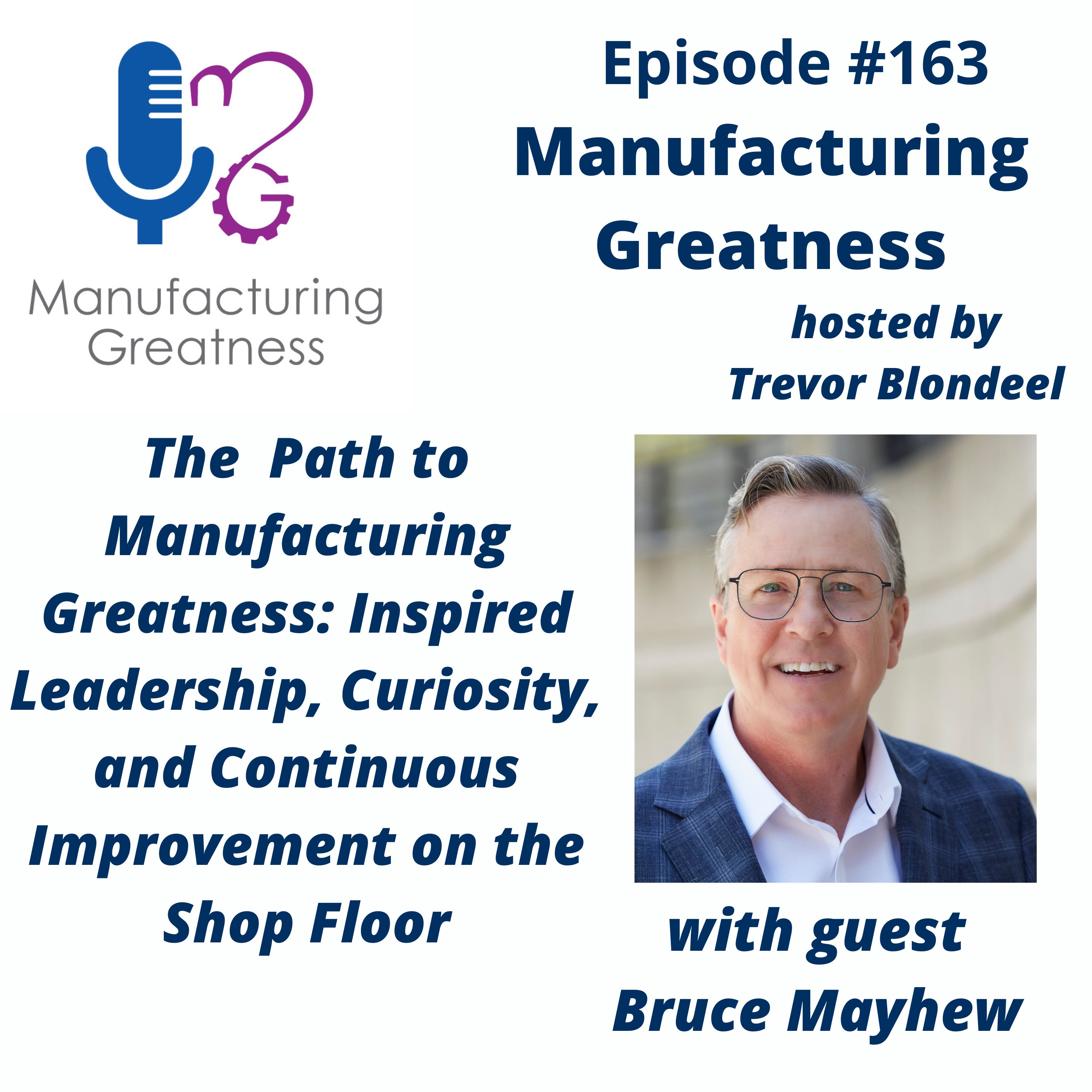
S1 Ep 163Manufacturing Leadership Development for Plant Managers: Driving Continuous Improvement Through Curiosity on the Shop Floor with Bruce Mayhew #163
Welcome to Manufacturing Greatness with Trevor Blondeel, where we work with organizations to manufacture greatness by leveraging resources you already have to achieve greater retention, productivity, and profits. To learn more, visit www.manufacturinggreatness.com and click here to subscribe to Trevor's monthly newsletter. Now, let's jump in! In this episode, Bruce Mayhew, corporate trainer, keynote speaker, executive coach, and author, shares insights on manufacturing leadership, communication skills, and trust building for Operations Managers, Production Managers, Manufacturing Managers, and Shift Supervisors. You'll learn why traditional command and control leadership no longer works in today's plants and how curiosity-driven leadership, authentic communication, and continuous improvement help manufacturing leaders close the skills gap, strengthen employee engagement, and drive real team performance. Bruce breaks down how everyday leadership behaviors directly impact culture, safety, accountability, and results especially as manufacturing organizations face labor shortages, workforce challenges, and generational shifts on the shop floor. This conversation connects soft skills with operational excellence, showing leaders how to move from reaction to intention, from blame to curiosity, and from siloed management to connected leadership. 01:30 – As generational shifts place millennials in leadership roles, it can create tension between siloed leadership and collaborative, flatter manufacturing cultures. 03:49–Purpose and meaning drive effective leadership, stronger relationships, and healthier workplace culture. 06:12–Disconnects between executives and the shop floor weaken teamwork and long-term manufacturing performance. 07:19–Self-awareness and emotional intelligence enable leaders to adapt communication styles across manufacturing teams. 08:58–Respect on the shop floor comes from meeting people where they are, not talking down to them. 09:44–High performance in manufacturing is unlocked through meaningful conversations rather than top-down directives. 16:27–Transparency grows when leaders listen first and elevate frontline voices. 18:33- Shared pride in quality and reputation strengthens team identity and manufacturing excellence. 20:15–Curiosity-driven leadership replaces blame-focused problem solving with appreciative inquiry. 23:31–Positive exploration increases engagement by empowering teams instead of punishing them. 25:09 - Accountability works best when leaders replace interrogation with curiosity based performance conversations. Connect with Bruce Mayhew Visit his website Buy his book Find him on LinkedIn Following him on Instagram @bruce.mayhew
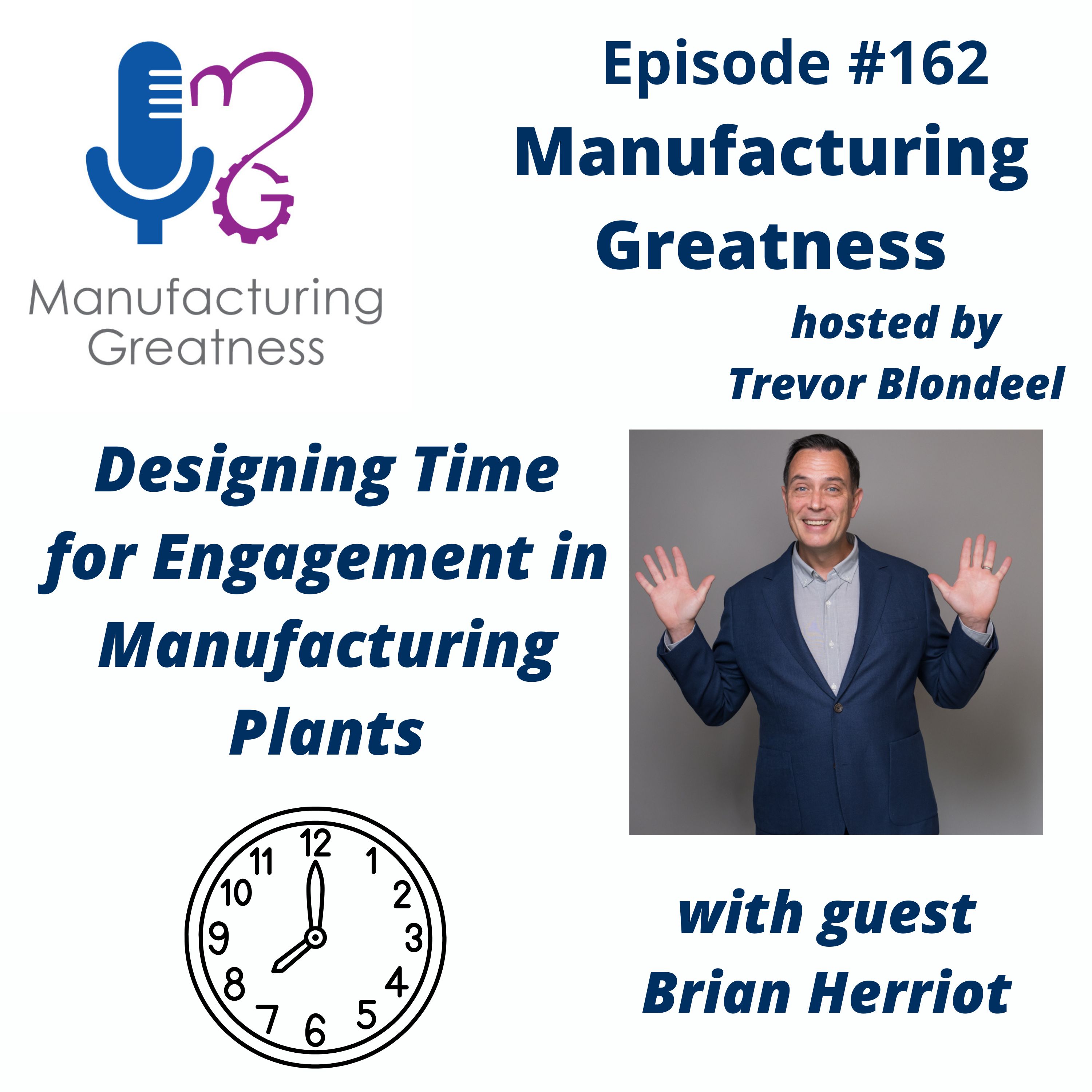
S1 Ep 162Employee Engagement in Manufacturing for Plant Managers: Designing Time for Frontline Connection with Brian Herriot #162
Welcome to Manufacturing Greatness with Trevor Blondeel, where we work with organizations to manufacture greatness by leveraging resources you already have to achieve greater retention, productivity, and profits. To learn more, visit www.manufacturinggreatness.com and click here to subscribe to Trevor's monthly newsletter. Now, let's jump in! In this episode, Brian Herriot shares insights on manufacturing leadership, productivity, and employee engagement for Operations Managers, Production Managers, Manufacturing Managers, and Shift Supervisors. Brian brings a practical, human-centered approach to help manufacturing leaders rethink work, leadership, and scheduling so they can build stronger teams without burning people out or lowering standards. You'll hear why traditional shift models are breaking down, how "time freedom" shows up on the shop floor, and what leaders can do right now to improve engagement, retention, and ownership amid labor shortages and skills gaps. This conversation connects soft skills with operational results, showing how curiosity, authentic leadership, and better communication skills directly impact manufacturing culture, workforce retention, and daily productivity. 02:10 – Frontline leadership must acknowledge that traditional manufacturing management models no longer align with modern workplace culture or employee engagement in manufacturing. 03:30 – Gen Z expects leadership in manufacturing plants to adapt to their lives, not the other way around 06:55 – Great manufacturing culture comes from seeing teams as humans first, not just labor inputs on the production line 09:10 –Employee ownership models and open-book management strengthen trust in leadership, manufacturing relationships, and accountability in manufacturing 11:25 – Manufacturing retention improves when leaders focus on team engagement in manufacturing rather than just output and efficiency 12:45 –Frontline leaders must recognize that many employees juggle multiple jobs and need coaching in manufacturing that supports life beyond the plant 14:10 – Flexible schedules, job sharing, and project-based roles can close the showing up gap while improving manufacturing innovation and retention 15:35 – Time Freedom as a Leadership Strategy Leadership transformation happens when manufacturing leaders design roles that allow experienced workers to scale back without fully exiting 18:55 –Helping employees understand their financial future reduces anxiety and strengthens employee engagement in manufacturing 22:35 –Deeper conversations about money, time, and work build emotional intelligence, vulnerability in leadership, and a stronger coaching culture Connect with Brian Herriot Learn more about Time Freedom Pre-order Time Freedom and use the code Trevor to get free access to the audiobook
S1 Ep 160Employee Retention in Manufacturing for Frontline Supervisors: How Structure, Curiosity, and Accountability Build Strong Teams with Ken Handsaeme #161
Welcome to Manufacturing Greatness with Trevor Blondeel, where we work with organizations to manufacture greatness by leveraging resources you already have to achieve greater retention, productivity, and profits. To learn more, visit www.manufacturinggreatness.com and click here to subscribe to Trevor's monthly newsletter. Now, let's jump in! How do you turn a one-machine operation into a thriving business? Find out in this episode with Ken Handsaeme, founder of On Time Precision. Ken's unique journey started as a machinist, but when he decided he wanted a better retirement plan, he started his own business, initially operating out of a barn with a single machine. It eventually grew into a thriving manufacturing company serving military, aerospace, and medical customers and helped Ken fulfill his retirement dreams. In this episode, Ken shares the lessons he learned throughout his career, ranging from the importance of intentional leadership and the root causes of common operational problems to how curiosity-driven conversations and trust-building behaviors drive retention, accountability, and long-term performance. He also shares stories from his own career, giving a practical look at what it really takes to build a manufacturing business that can grow, endure, and succeed beyond the owner. 02:00 – Operational challenges on the shop floor often signal leadership and communication gaps rather than process problems alone 04:15 – Shifting from working in the business to working on the business enables leaders to focus on production leadership and long-term operational excellence. 05:30 - Protected time for quoting is essential to production flow, customer trust, and employee stability 06:45 – Connecting the top to the shop creates shared accountability 08:55 – To accelerate growth, leaders must balance hiring, retention, and capacity planning in manufacturing plants. 10:10 - Structured one-on-one conversations are a powerful tool for supervisor development and deeper team engagement in manufacturing. 11:30 - Curiosity-driven leadership conversations outperform traditional performance reviews in building trust and accountability. 14:00 – To reinforce trust, respect, and leadership credibility, prioritize employee conversations like customer meetings 16:40 –Involving operators in problem-solving and process improvement builds ownership and continuous improvement culture. 17:55 – Have transparent discussions on transparency in manufacturing management, including sharing expectations without overwhelming teams with financial complexity. 20:30 – Self-awareness, vulnerability, and trust in leadership are foundational skills in modern manufacturing environments. 21:50 - Consistent leadership behaviors create workplace culture that supports retention and manufacturing excellence. 23:10 – To prepare for succession, you need to build systems, people, and leadership beyond the owner. Connect with Ken Handsaeme Connect on Instagram: @kenhandsaeme

S1 Ep 160Employee Retention in Manufacturing for Plant Leaders: Reducing Uncertainty to Build Engaged Teams with Falisha Karpati #160
Welcome to Manufacturing Greatness with Trevor Blondeel, where we work with organizations to manufacture greatness by leveraging resources you already have to achieve greater retention, productivity, and profits. To learn more, visit www.manufacturinggreatness.com and click here to subscribe to Trevor's monthly newsletter. Now, let's jump in! In manufacturing plants, the same leadership action can motivate one employee and overwhelm another. Why? It comes down to brain science, communication skills, and how leaders show up under pressure. In this episode, guest Falisha Karpati shares insights on manufacturing leadership, employee engagement, and inclusive leadership for Operations Managers, Production Managers, Manufacturing Managers, and Shift Supervisors. Falisha is a Brain-Based Inclusion Consultant based in Montreal, Canada. She holds a PhD in neuroscience and brings more than a decade of experience studying how the brain works. Through her UNITING BRAINS framework, she helps organizations build human-centered cultures using practical, brain-based strategies. In this conversation, Falisha explains how differences in brain wiring directly impact frontline leadership, communication skills, trust building, and team engagement on the shop floor. She breaks down the neuroscience behind introversion and extroversion, why uncertainty increases stress in manufacturing environments, and how leaders can improve manufacturing culture by asking better questions, minimizing ambiguity, and running more inclusive meetings 01:05 –Recognition can backfire when manufacturing communication ignores individual brain differences 02:12 – Neuroscience explains how self-awareness in leadership shapes perception, behavior, and relationships in manufacturing plants 04:54 –Manufacturing teamwork and employee engagement manufacturing improve when leaders understand natural brain diversity 9:53 – Brain science brings data—not opinions—into manufacturing management and leadership in industrial operations 11:20 – A powerful reminder that perceptions matter more than intentions in building trust in leadership and strong manufacturing relationships 13:39 – Curiosity-driven leadership starts by asking instead of assuming to close the showing up gap 15:32 – High-stimulus environments explain why leaders take shortcuts that undermine manufacturing culture and clarity on the shop floor 17:11 – Autonomy looks different for everyone, redefining supervisor development, coaching in manufacturing, and performance conversations. 19:55 – Minimizing uncertainty strengthens manufacturing safety culture, emotional intelligence, and consistent leadership behaviors 20:21 – Transparent expectations help close the expectation gap and improve accountability in manufacturing plants 22:40 – Inclusive meetings unlock manufacturing innovation by improving manufacturing communication and psychological safety 24:30 – Simple meeting practices support continuous improvement culture and better team engagement in manufacturing 28:53 – Inclusive discussions fuel operational excellence and authentic leadership across manufacturing organizations Connect with Falisha Karpati Visit her website Connect on LinkedIn and Instagram Read her newsletter Full Transcript [00:00:00] We have some changes today. We've changed the name of the podcast since 2019. It's been mindfulness manufacturing our company name changed a few years ago to manufacturing greatness. So we're just aligning that 'cause we're gonna be here manufacturing greatness today, and we're gonna be talking about building some bridges and, and you know, how we continue to manufacture and, how we deal with changes people's moods and what's going on. And it remind me of a time when we were, had a great manufacturing line at the kickoff meeting in the morning, we recognized one of the team members showed appreciation, [00:00:30] put this person's name and picture up and gave them a little gift. they were upset with us and we're kind of like, well, hold on a minute. we did all this and this person's not very appreciative and getting to learn them a little bit more is that they didn't. They don't like that type of attention. people's brains are different. And in manufacturing it just complicates it for us 'cause we don't understand it. So fortunately I have a great guest on and friend today, Falisha Caridi. Welcome to the show. Thank you so much. [00:01:00] It's a pleasure to be here. Thanks for having me. you are an inclusive consultant. You harness brain science to build inclusive human-centered workplaces. You create space where all brains thrive. And you studied the neuroscience, having a PhD in neuroscience, which for those who don't know what it takes to get a PhD, it's a mountain. So congratulations on that. Thank you. excited to get your knowledge and expertise to talk about this on the show what did we miss Falisha when we upset that team member? how are [00:01:30] people's brains working here? a key point is
S1 Ep 159Leadership Effectiveness in Manufacturing for Plant Managers: Closing the Showing Up Gap to Increase Influence with Susan M. Barber #159
Welcome to Manufacturing Greatness with Trevor Blondeel, where we work with organizations to manufacture greatness by leveraging resources you already have to achieve greater retention, productivity, and profits. To learn more, visit www.manufacturinggreatness.com and click here to subscribe to Trevor's monthly newsletter. Now, let's jump in! In manufacturing, it often feels like nothing matters more than performance. Leaders are told to hit their targets, keep the line running, and solve problems as quickly as possible. But performance alone rarely drives real career growth. If you want to advance in manufacturing leadership, it's time to place more emphasis on visibility, curiosity, communication skills, and building stronger relationships. In this episode, Susan M. Barber, a former Fortune 500 leader with more than 25 years of experience at Kraft Heinz, shares insights on manufacturing leadership, authentic leadership, and career development for Operations Managers, Production Managers, Manufacturing Managers, and Shift Supervisors. Susan is also the author of The Visibility Factor: Break Through Your Fears, Stand in Your Own Power, and Become the Authentic Leader You Were Meant To Be. She helps leaders build authentic visibility, overcome imposter syndrome, and close the gap between performance and recognition. In this conversation, Susan offers a behind-the-scenes look at key lessons from The Visibility Factor, along with practical stories and strategies manufacturing leaders can use to strengthen communication skills, improve trust building, and increase employee engagement on the shop floor. You'll learn how curiosity-driven conversations, authentic leadership, and relationship-building directly impact career growth, workforce retention, and long-term performance in manufacturing environments facing labor shortages and skills gaps. 1:40 – Performance matters in manufacturing, but career growth depends on more than just shop floor results 5:15 – Voice matters in leadership meetings 7:10 – Thoughtful questions are a powerful way for manufacturing leaders to build credibility and influence 10:45 – Louder voices often gain exposure over quiet high performers 12:55 - Leaders must go beyond their job descriptions to demonstrate readiness for the next level in manufacturing 15:05 - Trust, relationships, and visibility all play a role in how promotion decisions are made 16:55 - Ask for what you want and "do the job to get the job" before the title arrives 19:05 - The 10–30–60 framework highlights how performance, image, and exposure drive career success 22:45 – Psychological safety, authenticity, and confidence are key factors in leadership visibility 25:40 – By reflecting on past visibility successes and missed opportunities, leaders can understand what holds them back Connect with Susan M. Barber Visit her website Connect on LinkedIn Find her on Instagram and YouTube

S1 Ep 158Employee Retention in Manufacturing for Plant Leaders: Building Purpose, Optimism, and Stronger Relationships with Kathy Miller #158
Welcome to Manufacturing Greatness with Trevor Blondeel, where we work with organizations to manufacture greatness by leveraging resources you already have to achieve greater retention, productivity, and profits. To learn more, visit www.manufacturinggreatness.com and click here to subscribe to Trevor's monthly newsletter. Now, let's jump in! Welcome back to Kathy Miller, Women in Manufacturing Hall of Fame member and former leader at General Motors, Delphi, and Rolls-Royce. She is the author of MORE Is Better, which provides practical frameworks for frontline plant leaders. In this episode, Kathy shares insights on manufacturing leadership, employee engagement, and operational excellence for Operations Managers, Production Managers, Manufacturing Managers, and Shift Supervisors. Drawing on her background in applied positive psychology and real-world plant leadership, she explains how leaders can strengthen manufacturing culture, improve trust, and boost productivity without adding complexity. You'll walk away with practical tools to improve accountability, reduce burnout, and build stronger teams on the shop floor. 1:22 – Representation and diversity strengthens manufacturing culture 3:02 – Positive psychology research is a valuable tool for frontline supervisors, plant managers, and shop floor leadership teams 5:03 – Strengthen manufacturing relationships through creative safety leadership and by supporting accountability without blame 7:22 – Authenticity improves team engagement and manufacturing retention, especially in high-stress environments 08:20 - Transitioning teams from command-and-control to inclusive lean leadership is essential for creating a continuous improvement culture 12:36 - Helping employees find meaning boosts employee engagement and manufacturing retention. 15:56 – Putting curiosity over compliances helps leaders avoid punitive approaches and improves performance conversations on the floor 21:15 – Creating psychological safety encourages employees to speak up early, which fuels continuous improvement culture and operational excellence 22:56 - Finding a balance between realistic optimism and toxic positivity is essential for credible manufacturing communication and decision-making 24:41 – Relationships are the core foundation of manufacturing teamwork 26:22 – Your mindset shapes manufacturing relationships and every interaction on the plant floor 28:37 – Active listening is one of the most effective tools for better coaching in manufacturing. Connect with Kathy Miller Visit her website and check out the MORE Mentor resources Connect on LinkedIn Buy MORE Is Better Listen to her previous podcast episode
S1 Ep 157Manufacturing Team Performance for Operation Managers: Driving Better Outcomes Through Deeper Conversations with Reggie Davis #157
Welcome to Manufacturing Greatness with Trevor Blondeel, where we work with organizations to manufacture greatness by leveraging resources you already have to achieve greater retention, productivity, and profits. To learn more, visit www.manufacturinggreatness.com and click here to subscribe to Trevor's monthly newsletter. Now, let's jump in! Strong manufacturing leadership isn't just about process improvement or hitting production targets. It's about how we show up for people on the shop floor. And real leadership growth often starts with leaning into discomfort. In this episode, Reggie Davis, founder of UpLift Coaching and Consulting and author of Better Together: Embracing the Discomfort of Difference, shares insights on manufacturing leadership, communication skills, and team engagement for Operations Managers, Production Managers, Manufacturing Managers, and Shift Supervisors. Reggie explains how tough conversations strengthen manufacturing culture, improve employee retention, and build trust on the shop floor. You'll learn practical strategies for coaching in manufacturing, creating psychological safety, and developing frontline leadership habits that drive both accountability and performance. From plant managers to supervisors, anyone responsible for production leadership or safety culture will walk away with new tools to improve communication, foster ownership, and build stronger teams. 1:15 – Inclusive leadership and authentic communication improves teamwork, safety, and innovation 3:21 – Discomfort can be a valuable tool for growth 4:33 – Better people create better parts 5:19 – Great leaders focus on results and relationships 6:22 – When you welcome diverse perspectives, you drive teamwork and improve your processes 8:09 – For better conversations, replace "why" with "tell me more." 13:50 – Be aware of how everyday language impacts morale and inclusion on the plant floor 17:30 – Invest in your people through coaching, frontline leadership, and communication training 19:31 – Stay focused on growth, even when the path is uncomfortable 20:40 – Conversations and self-awareness are key to sustainable manufacturing innovation 22:06 – To drive continuous improvement culture, lead with humility and openness 26:39 – Always remember the human side of manufacturing excellence to build trust, reduce turnover, and create a stronger sense of belonging across teams Connect with Reggie Davis More about UpLift Coaching and Consulting Buy his book
S1 Ep 156Accountability and Teamwork in Manufacturing for Plant Leaders: Leading with the Thermostat Mindset with Sheri Holt #156
Welcome to Manufacturing Greatness with Trevor Blondeel, where we work with organizations to manufacture greatness by leveraging resources you already have to achieve greater retention, productivity, and profits. To learn more, visit www.manufacturinggreatness.com and click here to subscribe to Trevor's monthly newsletter. Now, let's jump in! Are you leading like a thermometer or a thermostat? If you find yourself reacting to problems instead of setting the tone for your team, you may be acting like a thermometer. With the right mindset, you can become a thermostatic leader who creates stability, clarity, and accountability on the shop floor. In this episode, Sheri Miller Holt, author of Thermostatic Leadership: The Quiet Power of Creating Balance and Influence, shares insights on manufacturing leadership, communication skills, and employee engagement for Operations Managers, Production Managers, Manufacturing Managers, and Shift Supervisors. Sheri explains how thermostatic leadership helps manufacturing leaders balance firmness with compassion, strengthen trust, and build shared accountability. You'll learn practical strategies to improve manufacturing culture, develop frontline leadership habits, and create workplaces where people feel supported, engaged, and motivated to perform. 2:20 - Leaders must decide whether they simply react like a thermometer or adjust and influence like a thermostat. 4:00 - Thermostatic leaders empathize, mobilize, and shift the energy in a room toward positive outcomes 6:50 - Real organizational change begins when leaders change their own behaviors and mindsets 8:30 - Leaders should remove barriers that prevent people from performing at their best 10:50 - The biggest obstacle to better leadership is simplicity — people think it has to be more complex than it really is 11:30 - Knowing your team personally builds trust and motivation 12:40 – Sheri's Dr. GRAK framework focuses on shared results, resources, accountability, and agreed-upon consequences 14:20 - Both leaders and their teams should share outcomes, both good and bad 16:30 - When people understand shared consequences, they self-manage and become more invested in team success 22:40 – Shift your "you" statements to "I" statements to avoid accusations and foster empathy 24:50 - Compassionate leadership doesn't weaken accountability — it deepens it. When people feel cared for, they perform better and take ownership Connect with Sheri Holt Find her on LinkedIn and Facebook Buy her book
S1 Ep 155Manufacturing Culture Improvement for Plant Leaders: Building Self-Aware Leadership That Drives Results with Anne Bonney #155
Welcome to Manufacturing Greatness with Trevor Blondeel, where we work with organizations to manufacture greatness by leveraging resources you already have to achieve greater retention, productivity, and profits. To learn more, visit www.manufacturinggreatness.com and click here to subscribe to Trevor's monthly newsletter. Now, let's jump in! Welcome to Manufacturing Greatness with Trevor Blondeel, where we work with organizations to manufacture greatness by leveraging resources you already have to achieve greater retention, productivity, and profits. To learn more, visit www.manufacturinggreatness.com and click here to subscribe to Trevor's monthly newsletter. Now, let's jump in! Change can be uncomfortable — but learning how to navigate uncertainty is essential for manufacturing leaders who want to grow their mindset, lead with intention, and show up stronger for their teams. In this episode, Anne Bonney, certified speaking professional, leadership expert, and TEDx speaker, shares insights on manufacturing leadership, resilience, and communication skills for Operations Managers, Production Managers, Manufacturing Managers, and Shift Supervisors. Anne breaks down the psychology of change and explains how leaders can shift from panic to curiosity, manage fear of the unknown, and better understand how the brain reacts to disruption. You'll learn practical strategies to improve employee engagement, strengthen trust, and lead more effectively through uncertainty on the shop floor. 2:10 – Our brains react to uncertainty by triggering fear in the amygdala, but we can contradict this by shifting our thinking into the prefrontal cortex 5:35 – To cultivate curiosity and self-awareness, leaders need to embrace discomfort and aversion 7:30 – Practice getting out of your comfort zone with small, low-risk actions 10:00 – In moments of stress or uncertainty, take a pause 12:45 – With trust-based leadership, you can attract and retain Gen Z talent 16:20 – Gen Z thinks differently than other generations, so you may need to shift your thinking to meet their needs 19:15 – In times of changes, leaders need to be self-aware 21:30 – You must model the behavior you want to see in your team Connect with Anne Bonney Visit her website Listen to her podcast Listen to her Tedx Talk Connect on LinkedIn
S1 Ep 154Problem-Solving Leadership in Manufacturing for Plant Leaders: Breaking the Blame Cycle to Drive Better Outcomes with Maggie Harlow #154
Welcome to Manufacturing Greatness with Trevor Blondeel, where we work with organizations to manufacture greatness by leveraging resources you already have to achieve greater retention, productivity, and profits. To learn more, visit www.manufacturinggreatness.com and click here to subscribe to Trevor's monthly newsletter. Now, let's jump in! If you want to change your results, you need to change your approach. In this episode, Maggie Harlow, co-owner of Signarama Downtown in Louisville, Kentucky, shares insights on manufacturing leadership, problem-solving, and employee engagement for Operations Managers, Production Managers, Manufacturing Managers, and Shift Supervisors. Drawing from her experience in custom sign manufacturing, Maggie explains what it really takes to balance quality, speed, and culture in a high-mix, low-volume environment. You'll hear practical strategies for improving communication skills, building trust, and leading with curiosity — while maintaining accountability and performance on the shop floor. 3:06 – In high-stress environments, creativity and craftsmanship keep people engaged 6:08 – It is important to have communications between all departments 7:00 – When systemic issues occur, remember that it may be a focus issue, not a people problem 8:14 – Quality is the most important thing 9:17 – As a leader, if you want something to improve or change, you need to bring it to your team's attention 10:28 – When leadership is present on the shop floor, it shifts perception 11:41 – To get sales and production to truly collaborate, you may need a cultural shift 13:09 – To find healthy balances between departments, have honest conversations 14:35 – Focus on ownership, not blame 15:26 – When breakdowns occur, it's often because team members don't understand each other's realities 17:44 – Give your team space to try, fail, and grow within safe boundaries 20:00 – For honest problem-solving, assume everyone is doing their best Connect with Maggie Harlow Find her on LinkedIn Visit her speaking website Learn more about Signarama Downtown
S1 Ep 153Generational Leadership in Manufacturing for Plant Leaders: Closing the Generational Gap to Strengthen Engagement with Michelle McCullough #153
Welcome to Manufacturing Greatness with Trevor Blondeel, where we work with organizations to manufacture greatness by leveraging resources you already have to achieve greater retention, productivity, and profits. To learn more, visit www.manufacturinggreatness.com and click here to subscribe to Trevor's monthly newsletter. Now, let's jump in! anaging a multigenerational workforce baby boomers, Gen X, millennials, and Gen Z,can feel challenging, but building trust and engagement across all generations is possible. In this episode, Michelle McCullough, nationally recognized speaker and workplace culture expert, shares insights on manufacturing leadership, employee engagement, and retention for Operations Managers, Production Managers, Manufacturing Managers, and Shift Supervisors. Michelle offers key research on how trust, support, and human connection transform retention and performance on the shop floor. You'll learn practical tools to improve communication, foster a resilient culture, and lead teams that feel valued and motivated regardless of generation. 2:50 – Emotional intelligence is especially important in a high-pressure industry like manufacturing 4:10 – Gen Z crave connection, purpose, and mental well-being in the workplace 6:30 – Older generations tend to prioritize stability, while younger generations want social connection 8:00 – When employees understand the impact of their work, they feel more connected and motivated 9:50 – Show an interest in your team member's lives outside of work 11:00 – Understand that different generations have different motivations 21:00 – Team building exercises can improve cohesion and morale 23:10 – Happiness and resilience training can improve mental health and team connection 24:15 – You should also understanding gender gaps in the workplace 27:50 - When trust is broken, it can be rebuilt through intentional actions like growth, vulnerability, and transparent communication. 29:00 - Employees are more likely to stay and be engaged when they feel supported and understood by their leaders. Connect with Michelle McCullough Visit her website Follow @SpeakMichelle on social media

S1 Ep 152Employee Motivation in Manufacturing for Plant Leaders: Why Teams Disengage and How to Reignite Performance with Jim Pancero #152
Welcome to Manufacturing Greatness with Trevor Blondeel, where we work with organizations to manufacture greatness by leveraging resources you already have to achieve greater retention, productivity, and profits. To learn more, visit www.manufacturinggreatness.com and click here to subscribe to Trevor's monthly newsletter. Now, let's jump in! When you're dealing with disengagement or low morale on the manufacturing floor, a motivated team can feel like a myth. But with the right leadership mindset and workplace culture, you can improve engagement, productivity, and performance. In this episode, Jim Pancero,sales and leadership coach with over 40 years of experience working with manufacturing, warehouse, and distribution teams shares insights on manufacturing leadership, communication skills, and employee engagement for Operations Managers, Production Managers, Manufacturing Managers, and Shift Supervisors. Jim explains what truly motivates teams and how positive communication, trust building, and clear expectations drive retention and accountability. You'll learn practical strategies to reduce negativity, strengthen culture, and create a manufacturing environment where people want to show up and perform at their best. 1:43 – You can't always motivate people, but you can create an environment for self-motivation 3:30 – Build self-worth, recognize contributions, and create a culture where people are comfortable to engage 6:23 – Offering meaningful benefits can drive retention and a sense of belonging 8:15 – The balance between positive and negative feedback directly influences motivation 12:27 – When you focus on problems rather than solutions, it hurts motivation 14:48 – Through positive affirmations, you shift the tone and drive a positive environment 18:03 – Immersive onboarding helps new team members foster connection and builds empathy across teams 19:32 – Be curious and separate system issues from personal blame in your daily plant operations Connect with Jim Pancero Connect on LinkedIn Visit his websites at https://pancero.com/ or https://www.advancedsalesuniversity.com/ Find his videos on YouTube
S1 Ep 151Manufacturing Workforce Engagement for Plant Leaders: Asking Better Questions to Attract and Retain Talent with Chad Littlefield #151
Welcome to Manufacturing Greatness with Trevor Blondeel, where we work with organizations to manufacture greatness by leveraging resources you already have to achieve greater retention, productivity, and profits. To learn more, visit www.manufacturinggreatness.com and click here to subscribe to Trevor's monthly newsletter. Now, let's jump in! Do you want drive results, retain your team, and create a culture where people show up and stick around? Then it's time to embrace the art of powerful questions! Through curious questions and intentional conversations, you can change the way people think and work. Learn more in this episode of Mindfulness Manufacturing with guest Chad Littlefield, a TEDx speaker, bestselling author, and the creator of We! Connect cards, which help leaders ask powerful questions and cultivate deeper conversations. Chad shares stories that highlight the power of questions, unpacks the struggles many leaders face when it comes to genuine dialogue, and offers actionable tips for using curiosity and intention to engage your team. If you're ready to learn how to drive better results, ask stronger questions, and build a workplace where people want to stay and grow, you won't want to miss this conversation. 1:02 – In manufacturing, we often struggle with creating genuine conversations 2:18 – Intentional plays a critical role in building safe conversations 4:17 – When initiative is met with gratitude, it can lead to long-term loyalty and promotion 8:14 – Expressing intentions directly creates clarity and stronger connections 14:40 – People want to work, they just don't want to work for someone who doesn't care about them 16:35 – Leadership at the top influencers your entire organization 17:59 – Ask the second question to take a conversation to a deeper level 21:20 – Use open-ended questions to deepen reflection and learning Connect with Chad Littlefield Watch his videos on YouTube Visit his website and find free resources

Leadership Resilience in Manufacturing for Plant Leaders: Commanding Chaos and Driving Results with Angela Billings #150
Welcome to Manufacturing Greatness with Trevor Blondeel, where we work with organizations to manufacture greatness by leveraging resources you already have to achieve greater retention, productivity, and profits. To learn more, visit www.manufacturinggreatness.com and click here to subscribe to Trevor's monthly newsletter. Now, let's jump in! Are you ready to handle a crisis at your manufacturing plant? This episode focuses on crisis communication and how leaders can stay calm, clear, and effective under pressure. In this episode, Angela Billings, a strategic communication professional with more than 20 years of experience in the Air Force, including during September 11 while stationed at the Pentagon, shares insights on manufacturing leadership, communication skills, and resilience for Operations Managers, Production Managers, Manufacturing Managers, and Shift Supervisors. Angela explains how strong crisis communication improves employee engagement, trust building, and team performance. She shares real world lessons on proactive planning, clear messaging, and empowering frontline teams so leaders can reduce uncertainty, strengthen accountability, and protect manufacturing culture during high stress situations. You will walk away with practical strategies to improve leadership presence, support your people, and confidently guide your plant through disruption. 1:00 – In any field, you need to anticipate crisis and be prepared to manage and own them 6:46 – Having a chain of command and clear communication channels are crucial for effective crisis management 9:12 –The proactive connection of supervisory teams is essential to crisis management 10:14 – To prepare, do tabletop exercises to act out likely and worst-case scenarios 12:04 – All employees should act as ambassadors for their organization 15:05 – Media training can be a strong tool for employees at all levels, not just executives 16:03 – To safeguard your brand, own your stories 17:32 – Even everyday issues need transparent communications 19:30 – Consider the role of public communications channels 21:21 – Apply the same urgency to communications that you do to everyday production challenges on the floor Connect with Angela Billings Visit her website Learn more about Command the Crisis Find her on LinkedIn

S1 Ep 49Employee Loyalty in Manufacturing for Plant Leaders: Building Trust and Retention Through Story-Driven Leadership with David Semersheim #149
Welcome to Manufacturing Greatness with Trevor Blondeel, where we work with organizations to manufacture greatness by leveraging resources you already have to achieve greater retention, productivity, and profits. To learn more, visit www.manufacturinggreatness.com and click here to subscribe to Trevor's monthly newsletter. Now, let's jump in! In modern manufacturing, employees want more than just a paycheck. To feel engaged and perform at their best, they need to believe they are part of something bigger. If you want to improve employee retention, productivity, and team performance, you must transform the way you communicate and connect with your people. In this episode, David Sermersheim, team leader, public speaker, and founder of Celebrate Audio, shares insights on manufacturing leadership, communication skills, and employee engagement for Operations Managers, Production Managers, Manufacturing Managers, and Shift Supervisors. David explains how storytelling and curiosity strengthen trust building, improve culture, and increase accountability on the shop floor. You will learn practical strategies to use stories as a leadership tool, build stronger relationships, and create a manufacturing environment where people feel valued, motivated, and committed to shared results. 1:33 – Through personal and professional commitment, you can transfer customer-focused strategies to employee-focused leadership 2:51 – Autonomy plays a key role in employee retention rates 6:22 – There are many creative ways to connect with remote team members, like starting a podcast 7:35 – During new hire orientations, embed core company values and the "why" behind your organization 10:35 – Employees need to connect with something beyond just your mission statement 11:51 – Make sure your job postings reflect your organization's value and purposes 13:18 – Connect orientation, behaviors, and metrics to your organization's core values 13:53 – Quarterly reviews and structured feedback sessions can improve job satisfaction 18:20 360-degree feedback is important for self-awareness and leadership 22:02 – Be genuinely interested in the people you lead and take the time to understand everyone's unique story Connect with David Semersheim Learn more about Celebrate Audio Email David at [email protected]

S1 Ep 148Employee Retention in Manufacturing for Plant Leaders: Reducing Risk Through Transparent Accountability with Christopher Santomassimo #148
Welcome to Manufacturing Greatness with Trevor Blondeel, where we work with organizations to manufacture greatness by leveraging resources you already have to achieve greater retention, productivity, and profits. To learn more, visit www.manufacturinggreatness.com and click here to subscribe to Trevor's monthly newsletter. Now, let's jump in! Are you tapping into your team's full potential? As manufacturing continues to evolve, many leaders are searching for better ways to improve employee engagement, drive productivity, and build a culture where people feel motivated to perform. In this episode, Christopher Santomassimo, lawyer and founding partner of Outside General Counsel Solutions, shares insights on manufacturing leadership, accountability, and workforce engagement for Operations Managers, Production Managers, Manufacturing Managers, and Shift Supervisors. Drawing on more than 30 years of legal experience, Chris explains how transparent accountability strengthens trust building, supports retention, and helps leaders address personnel challenges. You will learn practical strategies for improving communication skills, fostering ownership, and unlocking the potential of your current workforce even as labor shortages and skills gaps continue to impact manufacturing. 2:30 – When companies hold people accountable in a transparent and uplifting way, they tend to see higher engagement and productivity 2:58 – Accountability is about building trust and team spirit through setting clear goals and expectations 7:10 – By listening to employees and celebrating their contributions, you can boost morale and retention 11:52 – Transparency fosters ownership and reduces negative incidents, like HR issues 14:47 – When employees feel like they're part of a team, it drives productivity and lessens workplace conflicts 16:37 – Accountability is about coaching and support, not penalization 19:40 – For long-term improvement, you need consistent practices at all levels of your organization Connect with Christopher Santomassimo Listen to his Podcast Connect on LinkedIn Learn More About OGC Solutions
S1 Ep 147Sustainable Leadership in Manufacturing for Plant Leaders: Building Energy That Lasts and Preventing Burnout with Kathy Oneto #147
Welcome to Manufacturing Greatness with Trevor Blondeel, where we work with organizations to manufacture greatness by leveraging resources you already have to achieve greater retention, productivity, and profits. To learn more, visit www.manufacturinggreatness.com and click here to subscribe to Trevor's monthly newsletter. Now, let's jump in! In manufacturing, leaders are constantly balancing productivity, performance, and rapidly changing technology. For many, it can feel impossible to meet goals while also setting boundaries, managing energy, and avoiding burnout. In this episode, Kathy Oneto, consultant, executive coach, and author of Sustainable Ambition: How to Prioritize What Matters to Thrive in Life and Work, shares insights on manufacturing leadership, resilience, and employee engagement for Operations Managers, Production Managers, Manufacturing Managers, and Shift Supervisors. Kathy offers practical strategies for managing pressure, aligning ambition with purpose, and building sustainable leadership habits. You will learn how growth mindset, authentic leadership, and communication skills help leaders reduce burnout, strengthen manufacturing culture, and maintain productivity while creating healthier workplaces. 2:43 – With the rise of modern technology, we often feel like we have to be "on" all the time, which leads to overload 4:08 – Humans can't operate like machines 7:52 – In manufacturing, pressures like hitting targets and dealing with setbacks can quickly became unsustainable 8:36 – To find sustainability and align your ambitions, you need to make the right choices for yourself 10:00 – Just like machines, manufacturing leaders also need regular, preventative maintenance 16:06 – Language plays a key role in helping people clarify what really matters to them 17:09 Practice micro-reflections and intentional focus 19:49 – Learn to move beyond the stigma of taking breaks and allowing time for recovery Connect with Kathy Oneto Connect on LinkedIn Visit her website and sign up for Kathy's newsletter Tune in to her podcast