
Macro N Cheese
327 episodes — Page 6 of 7
Ep 151Ep 151 - Can Blockchain Help the Left? with The Blockchain Socialist
The Blockchain Socialist wants to dispel the notion that blockchain technology can only serve a right-wing libertarian agenda. In this week’s episode, he tells Steve the left loses out when new trends or innovations are introduced into the economy. Blockchain is a neutral tool on which we can build different types of organizations and institutions. He speaks of the risks taken when groups use Google Docs for organizing their information. Google’s removal of access to Palestinian activists should be seen as a threat to the left.The Blockchain Socialist – let's call him TBS – created his blog and podcast to provide a space for learning about blockchain and digital currency free of right=wing propaganda. He talks with Steve about a wide range of uses in both the near and distant future. For countries under economic sanctions, cryptocurrency can make it possible to engage in international financial activity. For the myriad groups on the left who seem unable to unite because of, often, some pretty obscure differences, TBS sees other benefits......using this shared economic platform to do that -- to keep track of political goals and to move forward on them. Then in some utopian socialist future in which the workers finally own the means of production, we can collectively decide to or decide not to use blockchain as an important decentralized institution for keeping track of other things that we may want to do.TBS lays out the difference between smart contracts and legal contracts and goes over their potential uses. He also explains the concept of Central Bank Digital Currency (CBDC) and how it could change the banking system, for better or worse. He and Steve discuss imposing expiration dates on cryptocurrency to encourage spending and disallow hoarding.It is hard for MMTers to understand why libertarians would want to impose artificial scarcity on cryptocurrency, as if Bitcoin were digital gold.It's really heavily based on this commodity theory of money, and especially the libertarian view that the best type of money can be abstracted away because it's backed by a commodity which has objective value -- as if gold is really objectively valuable. So I think part of the issue is that a lot of these first cryptocurrencies, especially Bitcoin, were designed intentionally with this hard money view in mind. They encoded hard money into Bitcoin. It does not have to be hard money.Ultimately both the right and left have objections to the way the government handles money. Whether you think it is spending too much or too little, the whole process is undemocratic. Bitcoin is not the solution, but there is a lot more to digital currency than Bitcoin, not all of it a rightwing tool. This episode provides just a taste – we recommend following the Blockchain Socialist for a real education.The Blockchain Socialist is a blogger and podcaster whose work can be found on his website, theblockchainsocialist.com.Support his work at patreon.com/theblockchainsocialist.@TBSocialist on Twitter
Ep 150Unanswered 9-11 Questions with Ray McGinnis
It's one thing to understand the US government will not protect us from certain types of abuse by corporations. We see it in the weakness of labor laws as well as environmental and consumer protection regulations. We know the government has no problem sending poor and working-class men and women into harm's way to protect corporate interests overseas. But how much farther will the state go to protect the interests of global capitalism?Ray McGinnis doesn’t claim to have all the answers, but he’s here to remind us of the questions that need to be asked. The title of his book says it all: Unanswered Questions: What the September Eleventh Families Asked and the 9/11 Commission Ignored.It took a year for George Bush to decide on forming a commission to investigate 9/11. He appointed Henry Kissinger as chair. This was ironic (and outrageous), given Kissinger’s connection to that other 9/11 -- the September 11, 1973, coup in Chile to overthrow the democratically elected president, Salvador Allende. Henry Kissinger was responsible for atrocities as far back as the carpet-bombing of Cambodia and was known for keeping secrets from Congress and the people.A group of women from the 9/11 Family Steering Committee visited Kissinger to voice their concerns. As Kissinger served them coffee, one woman got straight to the point:“Dr. Kissinger, we just want to make sure you don't have any conflicts of interest. You don't have any business clients by the name of Bin Laden.” At that point, Doctor Kissinger pours the coffee all over the table, partway falls off the couch, blames it on a fake eye, and resigns the next day.It was clear from the start that Congress had no will for this investigation. McGinnis reminds us that up to $80 million was spent investigating the Clintons in the ‘90s; the 9/11 Commission was given $3 million. Chairman Thomas Kean was on the board of a corporation with interests in building a pipeline across Afghanistan. George W. Bush had begun his presidency with plans for regime change in Iraq. The outline of the eventual Commission report was written before any evidence was examined.For 20 years, thousands of the 9/11 families have been pressing for an investigation into Saudi complicity in the attacks but have been stonewalled by the Bush, Obama, and Trump administrations. In April of 2020, Attorney General Barr and a representative of the NSA appeared before a judge to argue against releasing documents regarding a lawsuit against Saudi Arabia, claiming it would harm American state secrets and national security.The families are scratching their heads: how is our lawsuit to find out if there was Saudi Arabian complicity in the attacks on September 11th possibly going to harm American national security and state secrets? What state secrets would those be?What secrets indeed? It’s been 20 years since the events of 9/11. For those of us fortunate enough not to have lost a friend or family member, some of our questions may have faded. Ray McGinnis brings the inconsistencies back into focus and adds some new ones.Ray McGinnis was educated in political science, religious studies, and history, and graduated with a B.A. from the University of Toronto. He also earned a Diploma in Christian Education from the Centre for Christian Studies. He was an educator with the United Church of Canada, working at their national office for 9 years. He subsequently worked at the Naramata Centre in rural British Columbia. From 1999 to 2020 he taught writing workshops. He is the author of Writing the Sacred: A Psalm-inspired Path to Appreciating and Writing Sacred Poetry. McGinnis is interested in the stories we tell, the ones we ignore, and how this shapes our worldview.https://unansweredquestions.ca/@RayMcGinnis7 on Twitter
Ep 149Storming the Ivory Tower with Davarian Baldwin
Do you think of colleges and universities as protected islands of intellectual activity, ivory towers where the world’s problems are contemplated and debated? Steve Grumbine’s guest is here to tell us otherwise. Davarian Baldwin, of Trinity College, is an urban historian and social theorist, whose work examines the landscape of global cities through the lens of the African Diasporic experience. His most recent book is In the Shadow of the Ivory Tower: How Universities are Plundering Our Cities.Baldwin describes how institutions of higher education are the largest employers, healthcare providers, and landlords in cities and towns across the US. They leverage their massive financial and real estate holdings to displace the most vulnerable communities across the US. Their tax-exempt status does not result in savings for the local citizens, but puts a greater burden on everyone else’s property taxes.The conservative and mainstream media still maintain the pretense that campuses are a hotbed of radicalism, but that couldn’t be farther from the truth. Corporate partners sit on universities’ boards of trustees and shape the curriculum to reflect the interests of capital. The Koch brothers and other corporate entities are funding “innovation centers” and entrepreneurial institutes to fit their own needs.The powerful thing about higher education is the myth of the schoolhouse -- that it's just a place where we conduct classes and conduct pure research. Teaching classes has become a side business in higher education. There's so much more here that goes on in ways that either generate or manage capital that have nothing to do with teaching classes.Most colleges and universities maintain a substantial policing apparatus. According to Baldwin, “75% of public and private schools have police departments. Not public safety units -- police departments. Nine of ten are armed, and about 85% of these police departments have jurisdiction beyond the main campus. They police regular residents.”And so the irony of this phenomenon is that the biggest crimes on campus, sexual violence and substance abuse, are not policed. They do a horrible job. While some people might say capacity. I say intent, because schools -- predominantly white schools, I'm going to be clear -- are not going to want to say that they have a campus full of white criminals. This undermines their brand. So the policing is all outward facing into the poor, black and brown neighborhoods around the campuses, to say to investors, to say to students, to say to families, and to say to everyone else that we are open for business and we are safe. These police units, their job is to protect the brand.Baldwin gives numerous examples of different schools around the country and their outsized effect on the communities they reside in, their poorly paid employees, and, of course, students. He suggests specific reforms and asks that our listeners follow New Deal for Higher Education, Scholars for Social Justice, Cops Off Campus, and other organizations that are working toward change.Davarian L. Baldwin is the Paul E. Raether Distinguished Professor of American Studies at Trinity College, and is a historian, cultural critic, and social theorist of urban America. His work largely examines the landscape of global cities through the lens of the African Diasporic experience.Author of In the Shadow of the Ivory Tower: How Universities are Plundering Our Cities Co-editor with Minkah Makalani, Escape from New York: The New Negro Renaissance beyond Harlem Author of Chicago's New Negroes: Modernity, the Great Migration, and Black Urban Life Series Co-Editor, Urban Life, Landscape, and Policy @DavarianBaldwin on Twitter
Ep 148Participatory Economics with Michael Albert
Michael Albert is one of the creators of participatory economics (parecon) and has developed a vision for a post-capitalist world that includes participatory governance. His new book, No Bosses, A New Economy for a Better World, goes into detail. From Noam Chomsky’s endorsement:*No Bosses* describes and advocates a natural and built Commons, workers’ and consumers’ self-managing councils, a division of labor that balances empowering tasks among all workers, a norm that apportions income for duration, intensity, and onerousness of socially valued labor, and finally not markets or central planning, but instead participatory planning by workers and consumers of what is produced, by what means, to what ends. It makes a compelling case that these features can be brought together in a spirit of solidarity to establish a self-managing, equitable, sustainable, participatory, new economy, with a rich artistic and intellectual culture as well.Albert recently spoke with Steve Grumbine about these concepts. His critique of what he calls “20th century socialism” is a rejection of centralized management. He and Grumbine discuss the MMT proposal of a Federal Job Guarantee which, though centrally funded, is locally managed, allowing communities to determine their specific needs and values. While Albert might be opposed to central funding (and all currency?), local management is consistent with his beliefs. He is concerned, however, with replacing the 1% with the 20% - the “coordinator class.”He also differentiates between reform and non-reformist reform, a concept we value at Macro N Cheese. Albert says, “What makes something more than just a desirable reform is partly how we would fight for it, and to an extent, what it is proposing.” He uses several examples, like the fight for a livable minimum wage and for replacing the use of fossil fuels with clean, green energy. Winning any of these things would be great, but then what? We're back to the system that we have. Or you can do it in a way which is constantly raising the need for innovation, the need for new social relations, the need for a new system, but recognizes the need to get these things done now. So one approach is reformist, the other approach is, I think, revolutionary.Albert’s post-capitalist vision includes self-management, diversity, equity, solidarity, and sustainability. Whether or not you agree with him on all fronts, you’ll find plenty to think about in this episode.** Each episode of Macro N Cheese has transcripts and an Extras page with links to additional information and resources. Go to realprogressives.com/macro-n-cheese-podcastMichael Albert is a veteran writer and activist of the left. He co-founded South End Press, Z Magazine, ZNet, and the Z Media Institute. He has written over 20 books and hundreds of articles. Along with Robin Hahnel, Michael is the co-developer of the post-capitalist economic vision called participatory economics (parecon). Michael runs a popular podcast called RevolutionZ and founded the School for Social and Cultural Change.@michaelalbertz on Twitternobossesbook.com

Ep 147Mapping the Future of Humanity with Parag Khanna
**Reminder** Each episode of Macro N Cheese is accompanied by a transcript and an “Extras” page with links to related material and resources. To access, go to realprogressives.org/macro-n-cheese-podcast.In one sentence: the winners and losers of the 21st century are the countries that attract young people.Parag Khanna is a leading global strategy advisor and best-selling author of numerous books on globalization, migration, the info-state, and the future of the world order. In this episode, he speaks with Steve about his newest book, Move: The Forces Uprooting Us.Most people who pretend to understand globalization reduce it to the rate of world trade growth. Khanna says we need a broader and more nuanced view, even though there are aspects that cannot be quantified. In his work he takes a multi-dimensional and systemic approach.An earlier book, Connectography: Mapping the Future of Global Civilization, was about the functional geography of infrastructure and supply chains. Its “punchline” is that connectivity is destiny. The recent book, Move, looks at how these ever-greater volumes of infrastructure affect the evolving distribution of population across the world.Human geography, Khanna explains, answers the questions: Who are we? Where are we? What are we? It is not simply a matter of the number of people inhabiting the planet, but what is our demographic composition - the distribution of age and race?Most people agree both climate change and economics are global in nature. They know the price of goods in one country can be affected by various phenomena in other parts of the world. Likewise, the impact of climate change is dramatically different from region to region.Because climate change is so much more extreme and occurring at a much faster pace than we previously acknowledged, it means that adaptation is as important as mitigation. This is a huge theme in the book and, quite frankly, an open door, a big hole that I'm trying to drive a truck through because I'm beside myself with rage.For all our concern about climate change, the focus is skewed. According to Khanna, only 6% of climate-related funding goes to adaptation.Meanwhile, people are dying every single day. You got your rising sea levels in Bangladesh and people dying in floods and heat waves, droughts and cyclones -- all these climate related phenomena. Every single day hundreds, if not thousands, of people are dying. The number of climate refugees in the world is greater than any other category of refugees. Climate migration will soon exceed all other drivers of migration, and yet we don't have a collective discourse on adaptation.Khanna describes the US as “second world,” by which he means it is both first and third world at the same time. He finds lessons in the history of the rise and fall of past civilizations. Societies collapse when their brittleness is exposed by their vulnerability to complex supply chains and structures they haven't fully grasped or untangled.Parag Khanna is a leading global strategy advisor, world traveler, and best-selling author. He is Founder & Managing Partner of FutureMap, a data and scenario based strategic advisory firm. Parag's newest book is MOVE: The Forces Uprooting Us (2021), which was preceded by The Future is Asian: Commerce, Conflict & Culture in the 21st Century (2019). He is author of a trilogy of books on the future of world order beginning with The Second World: Empires and Influence in the New Global Order (2008), followed by How to Run the World: Charting a Course to the Next Renaissance (2011), and concluding with Connectography: Mapping the Future of Global Civilization (2016). He is also the author of Technocracy in America: Rise of the Info-State (2017) and co-author of Hybrid Reality: Thriving in the Emerging Human-Technology Civilization (2012).Paragkhanna.com@paragkhanna on Twitter@drparagkhanna on Instagram

Ep 146MMT Europe with Dirk Ehnts
Dirk Ehnts, an economist from Berlin, joins us to talk about his book, Modern Monetary Theory and European Macroeconomics. In addition to discussing the current situation in the Eurozone, he helps us understand the similarities and differences between the Eurozone and the US, especially regarding the relationship between the individual states and the central bank.So in the US, whatever happens in your state ... you always have government spending coming from the federal level. So that's going to pay for the military installation, that's going to pay for the pensions. It's going to pay for some of the public federal infrastructure. And that means that whatever happens in your state, the federal government is always there. And you also have these institutional mechanisms to ensure that states which do not have a lot of employment can somehow make bargains in the political process and basically trade votes for jobs. And that's the main difference.The Eurozone has both the European Central Bank (ECB) and national central banks for each EU nation.We have this problem, that there's going to be a lack of government spending when it really matters. And there's no institution to address this kind of shortcoming. So the Euro was always incomplete, and it was kind of the idea that once it is in place, it can be completed by having a Euro Treasury. But we've been in this kind of mess now since the global financial crisis, and it's not clear where we are going.Ehnts also addresses the question of how countries within the EU make fiscal policy and get programs funded. He talks about causes of the disparity between northern and southern European nations and Steve brings up the race to the bottom we see among US states. Not only are there differences in the political economic strengths of individual EU countries, but within each there are states or provinces with their own strengths and weaknesses.The episode covers austerity policies, the changes from pre- to post-GFC eras, and economic effects of the COVID-19 pandemic. There’s enough about money creation, interest rates, and bond sales to satisfy the wonkiest among us.Don’t forget to check out the episode transcript and Extras pages! If you’re listening on a podcast platform, you’ll have to head over to realprogressives.org/macro-n-cheese-podcast to find them.Dirk Ehnts is an Adjunct Lecturer at Magdeburg-Stendal University of Applied Sciences, the Speaker of the Board of the Pufendorf Society for Political Economy and author of Modern Monetary Theory and European Macroeconomics.@DEhnts on TwitterWebsite (in German or English): dirk-ehnts.de

Ep 145The Fall of Evergrande with Robert Hockett
Somber headlines recall the 2008 financial crisis: “Global financial markets have been on high alert,” warns the BBC. “Chinese property giant Evergrande is on the brink of collapse, and analysts warn the potential fallout could have far-reaching implications that spill outside China’s borders,” says CNBC. From the New York Times: “Every once in a while a company grows so big and messy that governments fear what would happen to the broader economy if it were to fail.”To navigate this story, we needed someone immune to hysteria, so Steve invited the infinitely sensible Robert Hockett to guide us through the Evergrande saga.Hockett begins the episode with a brief history of China’s strategy for economic development. Unsurprisingly, it looks a lot like that of the US, Germany, and Japan, in different eras. The so-called export-led growth strategy involves developing industries that can achieve a sizable share of the global market for manufactured goods, starting at the low end and proceeding up the ladder to higher end products. Current account surpluses are plowed back into domestic investment, creating a virtuous circle and growing productive capacity.Throughout the history of capitalism, developed nations have been willing to tolerate current account deficits of developing economies for a number of reasons. During the post-WWII cold war years, the US was in competition with the Soviet Union for influence with Germany and Japan, for example. Sometimes, it’s simply to help create good trading partners. The US was pleased to see China join the WTO in 2000.And even before that, the US was willing to endure or experience sustained current account deficits vis a vis China on the theory that China developing more rapidly in consequence of that strategy would ultimately give it a stake in the global neoliberal order that it would become a team player…But as tends to happen over time, after a while, the countries that are footing the bill as it were, or in this case, the US, which was footing the bill in the form of rapidly hollowing out industrial base and even more rapidly eroding labor standards and workplace standards all in the name of global competition or competitiveness. Eventually the US began to object.When the pressure mounted, the Chinese government turned toward investment in domestically generated demand. They looked at the commercial and residential real estate bonanzas that drove American growth during the Reagan and Clinton years, respectively. These investments are substantially debt fueled. Ergo, Evergrande.As for predictions of imminent financial meltdown, Hockett remains sanguine. If a bailout is required, the Chinese government has the capacity to do so without the kind of constraints, real or fictional, that prevent the US government from acting in the interests of the majority. China is not afraid to attach strings to bailouts, including, if necessary, seizing control of a private company.Grumbine takes a detour to ask about infrastructure. Given the deteriorating state of infrastructure in the US, it’s remarkable to see the massive amount of government spending in China, some of which may appear baffling to people in the West. They have literally built bridges to nowhere and uninhabited ghost cities, but there is logic behind it. It is a way to both spend money into the economy as well as prepare for the eventual migration of people from the countryside. Rather than tent cities and Hoovervilles, they will have housing, roads and utilities.One conclusion we might draw from this episode is that sovereign states’ differing approaches to spending their fiat currency can have vastly different outcomes.Robert Hockett is the Edward Cornell Professor of Law at Cornell Law School, Adjunct Professor of Finance at Georgetown University’s McDonough School of Business, and Senior Counsel at Westwood Capital, LLC.@rch371 on Twitter

Ep 144The Battle for America's Schools with Rana Odeh
This week Steve investigates the cutthroat world of local school board elections. So, get ready to get down and dirty... Just kidding! His guest, Rana Odeh, is the genuine article: thoughtful, straight forward, and unafraid to bring up uncomfortable topics. At a time when the country’s political polarization seeps into every crevice of civic and social life, our school boards have become battlegrounds. Rana is willing to armor up and fight for our youth and their education. Rana is running for a seat on the school board in Granville, OH, where she lives with her three kids and her husband, Fadhel Kaboub – a dear friend of this podcast. Anyone who follows Fadhel on Facebook has seen their beautiful family of fledgling artists, musicians, and young campaigners. Steve and Rana talk about the lack of a federal right to education in the US and the need for proper (federal) funding, decoupled from the local tax base. They talk about the mask mandate wars now being waged in schools across the country, serving as proxy for the deeper political divide. They talk about Islamophobia. The recent hysteria over Critical Race Theory is absurd because, as Rana points out, CRT isn’t even taught in K through 12. It’s a law school term. Racism itself, however, is alive and well in every part of our society. Instead of helping students understand the history of racism in this country, the focus is on No Child Left Behind with its emphasis on testing and memorization. Students are memorizing things, but not learning how to write very well. And other life skills. I'm thinking about how to get along in society, and the discussion on racism is a big part of that. How can you go out into the workforce in 2021 or later and not have a basic understanding of racism and current affairs... Rana’s emphasis is on the whole child, preparing them for problem solving in the real world. In a recent candidate forum, she said: It's about learning for life and equipping students with the skills they need to be collaborative, critical thinkers - empathetic, adaptable, responsible, and resilient. If any of our listeners are in Rana’s district, we urge you to support her campaign and vote. For everyone else, perhaps listening to her will spark your imagination for ways to engage in your own community. Rana Odeh is a mother of three boys, a potter, and a public speaker. She and her husband Fadhel have enjoyed being active members of the Granville community for the past 12 years. Rana currently serves on the Granville Township Land Management Committee and has served on the board of the Granville Parent Cooperative Preschool. She has previously worked as a freelance writer and editor, and was a debate forum columnist for the Dayton City Paper. Rana has a Bachelor's degree in English, and a Master's degree in International and Comparative Politics. ranaforgranvilleschools.com Follow her on Facebook: Rana Odeh for Granville School Board
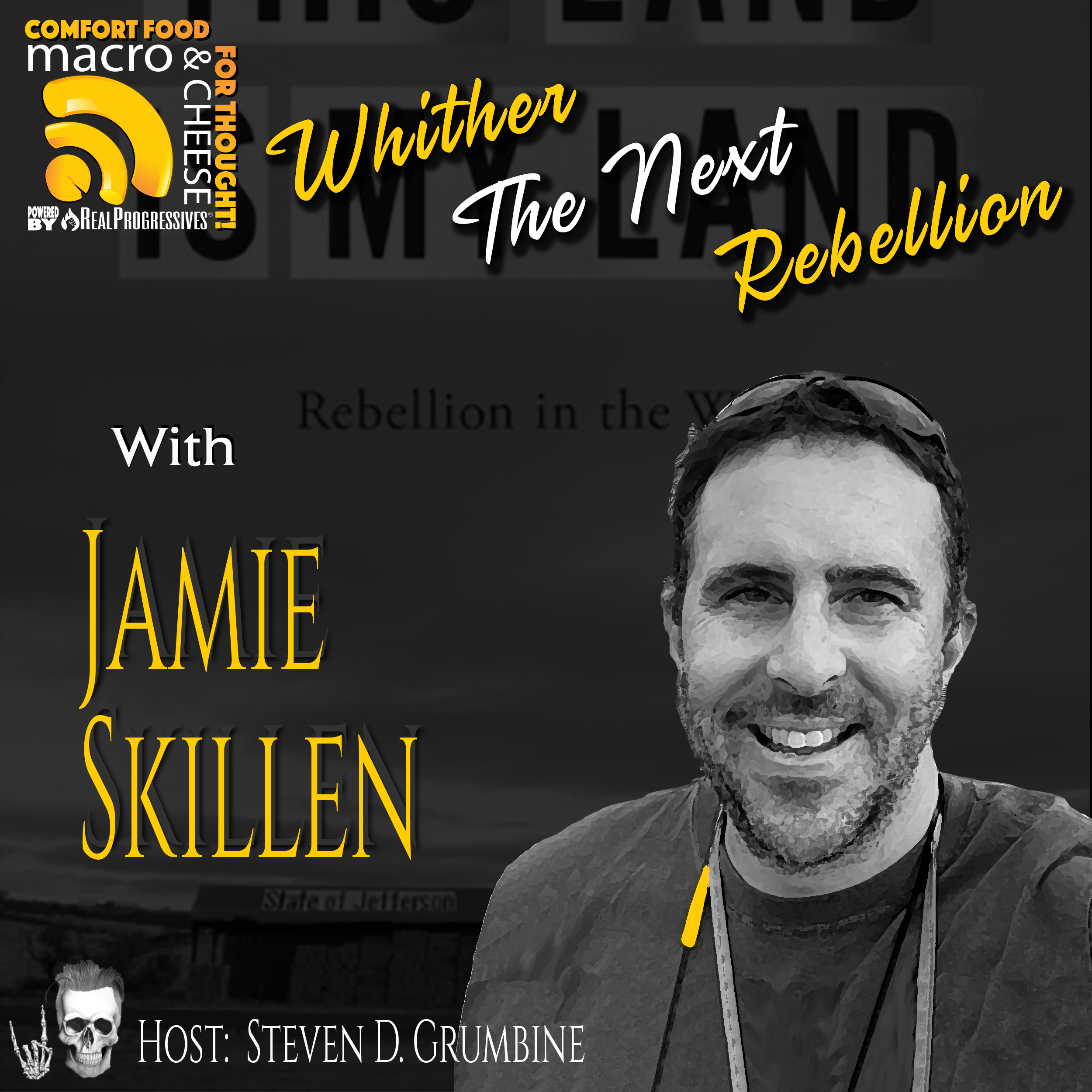
Ep 143Ep 143 - Whither the Next Rebellion with Jamie Skillen
In 2014, Nevada cattle rancher Cliven Bundy and his supporters engaged in armed confrontation with law enforcement. Bundy had been embroiled in a 21-year legal dispute with the US Bureau of Land Management. The “Bundy Standoff” was splashed across the news, allowing the public to watch as Cliven Bundy became a hero – a symbol of conservative America under attack by the federal government.This week, Jamie Skillen talks with Steve Grumbine about the history and politics of federal lands. Skillen’s book, This Land is My Land, traces three periods of rebellion against federal land authority over the past forty years. The issue wasn’t originally defined by the so-called left/right divide. Prior to the Sagebrush Rebellion (1979-1982) these were regional actions waged by people who shared a common material interest in federal lands, regardless of political identification. Since 1979, however, federal land issues have become flashpoints in conservative politics.In a nation that prizes private ownership and individualism, isn’t it ironic that the federal government owns 28% of the surface land? Conservatives demand these lands be ceded to the states, but were that to happen, the states would have to bear the cost of maintaining them. Politicians rail against public lands, pledging to eliminate them, while fully aware of their constituents’ love of national forests and parks.When the federal government encouraged expansion beyond the original thirteen colonies, European Americans settled wherever there was arable land, across the Midwest and Great Plains and, eventually, on the West coast. The topography of the intermountain region was less hospitable to agriculture. When, in the late 19th century, the US government began creating national forests and parks, the lands available to it were largely those that nobody wanted at the time.Historically, the federal government manages the development of oil, gas, coal, and timber, as well as ranges for livestock grazing. Generally, about half of the revenues from these ventures are given to the counties where they’re located. Any new federal regulations, restricting timber harvesting, for example, directly affect jobs and slice into funding mechanisms for those counties. (As MMTers, we know that states and counties are currency users, not currency issuers.)Skillen sees the public lands issue as a microcosm of our national politics, replete with all the contradictions and hypocrisy therein. While Western states and conservative political leaders have become increasingly radical and vitriolic about federal ownership …... I never hear a parallel complaint against the market economy, against corporations. There is built into our culture this idea that what government does is a choice, and we can question those choices. We can make different choices. Whereas what the markets do is like nature; it’s like evolution.Note to the Macro N Cheese audience: on our website, realprogressives.org, you’ll find past podcast episodes with transcripts and extras. Please consider supporting Real Progressives by becoming a monthly donor at patreon.com/realprogressives.James R Skillen is an Associate Professor of Environmental Studies at Calvin University and director of the Calvin University Ecosystem Preserve and Native Gardens. He is an expert on public land management and politics, including the impacts of anti-government extremism in public land politics and author of This Land is My Land: Rebellion in the West.https://www.jamesrskillen.com/@JamesskillenR on Twitter

Ep 142Things That Should Not Be with Scott Fullwiler
This week Steve welcomes Scott Fullwiler for the first time in two years. Scott is a research scholar at the Global Institute for Sustainable Prosperity and associate professor of economics at UMKC, where he teaches the macroeconomics PhD program. As listeners of this podcast know, UMKC is one of the two academic birthplaces of MMT.The episode begins with a look at social security and FICA taxes. Originally, the idea behind FICA was for people to feel like they’re paying into their own retirement. The expectation is that SS will be politically protected as a result. Scott points out that this is an unnecessary narrative and compares it to national defense. “It's not as if the reason why we continue to get national defense spending is because somebody feels like they've paid into it and they’re owed it.”There are three different separate things we need to remember when it comes to Social Security and Medicare, and unfortunately, all three of them get blended together in our public discourse … And those three narratives are the financial ability to pay for Social Security, the legal authority to pay for Social Security, and the productive capacity to have a future in which both retirees and workers can sustain the standard of living that's improving.Scott says FICA reduces production capacity. Not only does it pull money out of the economy, it’s a regressive tax, with a vast amount not coming from the “one percent” but from the majority of workers between 16 to 67, who are far from wealthy.The episode covers the debt ceiling in terms of both political and operational realities. Scott calls it “one of those tragically hilarious things that we do,” enabling a “savvy minority party to take a pound of flesh out of the majority party.”He also describes the workings of both the Federal Reserve and the Treasury Department as well as the possibility of minting trillion dollar coins.Scott Fullwiler is a Research Scholar at the Global Institute for Sustainable Prosperity and Associate Professor of economics at the University of Missouri – Kansas City.www.global-isp.org/scott-fullwiler/

Ep 141The New Liberals with Steve Keen & Victor Kline
This week we’re checking in with a couple of candidates from The New Liberals (TNL) of Australia. We’ll be learning about the traditional Australian political parties and getting an overview of how their electoral system works.Steve Keen is an old friend of this podcast. In the past he’s joined us to talk about everything from climate change to Marx to the breakdown of supply chains during the COVID pandemic. Now we’re meeting him as a political candidate; soon Professor Keen will be Senator Keen. Victor Kline, the leader and one of the founders of TNL, is running for a seat in the House of Representatives.TNL is only two years old but has already gained wide support. Unlike the US, where third parties have been almost entirely shut out of national elections, Australia’s preferential voting system and parliamentary style of government have made it possible for TNL to gain traction.Voting is mandatory in Australia, which Keen explains is far superior to the farce called democracy in the US:I see it as a way of making sure the politicians can't ignore you because they can't just hope to suppress different groups and stop them registering because it's against the law not to register and not to vote. So therefore the politicians can't ignore you. And I say this is a law controlling the politicians rather than the voters.With an existential climate crisis bearing down on us and Australia just as eager to adopt the neoliberal agenda as western Europe and the US, Steve Grumbine asks how they’re breaking through the narrative of false scarcity. It’s not so difficult, says Kline:Well, funny thing is that most people intuitively understand MMT or Keynesianism. If you say to them, look, we've got 3 million people below the poverty line in Australia. We want to put them back to work, and every dollar we spend putting somebody back to work gets spent and re-spent across the economy and stimulates small and large business alike … Now, most people get that, they don't see that as strange. You tell them that a sovereign government can invest in what it wants to invest in. They get that. Like the US, Australian politics are presided over by a duopoly of neoclassical parties - an “alternative autocracy.” The Liberal Party of Australia and the Australian Labor Party are almost indistinguishable in their fealty to the neoliberal agenda, both “reporting to Rupert Murdoch and the fossil fuel industry.” However, unlike the performative opposition of American Democrats and Republicans, the two Australian parties tend to vote the same way. Imagine what kind of policy gets 100% “yes” votes.Whether or not it’s possible to fix the mess we’re in through electoral politics, political campaigns allow for a dialog with the public, as Bernie Sanders demonstrated in the US. We’ll be watching and cheering on our friends down under.Victor Kline is a Sydney barrister specializing in refugee law. He is the Founder and Director of the Refugee Law Project which offers pro bono legal advice and representation to asylum seekers and refugees. He is the Leader of TNL (The New Liberals) and one of its founders. TNL will be contesting the next Australian federal elections running candidates in both the House of Representatives and the Senate. Victor will be contesting the House of Representatives seat of North Sydney in New South Wales.Steve Keen is a Distinguished Research Fellow at UCL and the author of “Debunking Economics,” “Can We Avoid Another Financial Crisis?” and his latest “The New Economics: A Manifesto.” He is one of the few economists to anticipate the Global Financial Crisis of 2008, for which he received a Revere Award from the Real World Economics Review. His main research interests are developing the complex systems approach to macroeconomics, and the economics of climate change. Professor Keen is the lead Senate candidate under The New Liberals.On Twitter:@victorklineTNL@ProfSteveKeen

Ep 140What If We Lose Faith in the Dollar? with John Harvey
Our friend John Harvey is back to answer a question that’s usually accompanied by much wailing and gnashing of teeth: “what happens if people lose faith in the dollar?” The question contains all sorts of assumptions and intentions, which the Cowboy Economist proceeds to dismember, dispelling all sorts of myths – from inflation to the Fed. (He even tells us why China will continue holding US dollars, in case you’re worried.)One approach taken by the “faith in the dollar” Cassandras is that government is bad, therefore non-governmental currency (Bitcoin!) is better... because the free market is more efficient. However, to say efficiency is good means accepting all sorts of negative social conditions and behaviors, including racism.John talks about economic models and their need to mirror real world behavior....you go back to Milton Friedman's philosophy of positivism. And this is how you do economic research. The idea was that it doesn't matter how unrealistic the assumptions of a model are, as long as they predict well. "Indeed," Friedman goes on to say, "often the most significant models are those with the most unrealistic assumptions."Try telling a physicist that the most significant theories we put forward in physics have the most unrealistic assumptions.If it's no longer necessary for me to justify my model assumptions based on real world phenomena, then what is this really allowing me to do? Well, it's allowing me to preconceive my conclusion. I hate the government. So I've got my conclusion already and now I make up premises that will allow me to get there.John not only dispels the notion that creating currency causes inflation, he also maintains that all inflation is not created equal. Are rising prices a bad thing if wages are increasing even more? If more people are employed?Steve and John discuss the difference between the financial markets gambling on currencies and the real economy, where people buy and sell and pay taxes.It all boils down to there not being a clear understanding. Okay, what creates the ultimate value for the dollar? The fact that on April 15, that's the only thing the US government accepts. And faith is irrelevant in that case.The episode revisits some of the basic insights of MMT. Around here, we can never get too much of that. Money isn’t just dropped into the economy; it’s created when the government spends it into existence. It’s spent on labor, production, real resources, commodities, war... it isn’t dropped from helicopters.John Harvey speaks in a language anyone can understand, which makes this interview so valuable to us non-economists. It’s packed with answers to the questions and arguments we constantly encounter. Be sure to bookmark it, because you’ll want to refer to it again. And don’t forget – each episode of Macro N Cheese is accompanied by a transcript, making it easily accessible.John T. Harvey is a Professor of Economics at Texas Christian University in Fort Worth, Texas, where he has been on the faculty for over thirty years. His main areas of research interest are exchange rates and business cycles and his teaching responsibilities include Intermediate Macroeconomics, International Monetary Economics, and Contending Perspectives in Economics. He has published over forty refereed articles, two edited volumes, and two books. John has a YouTube series called The Cowboy Economist and a blog at Forbes.com.@John_T_Harvey on Twittercowboyeconomist.com
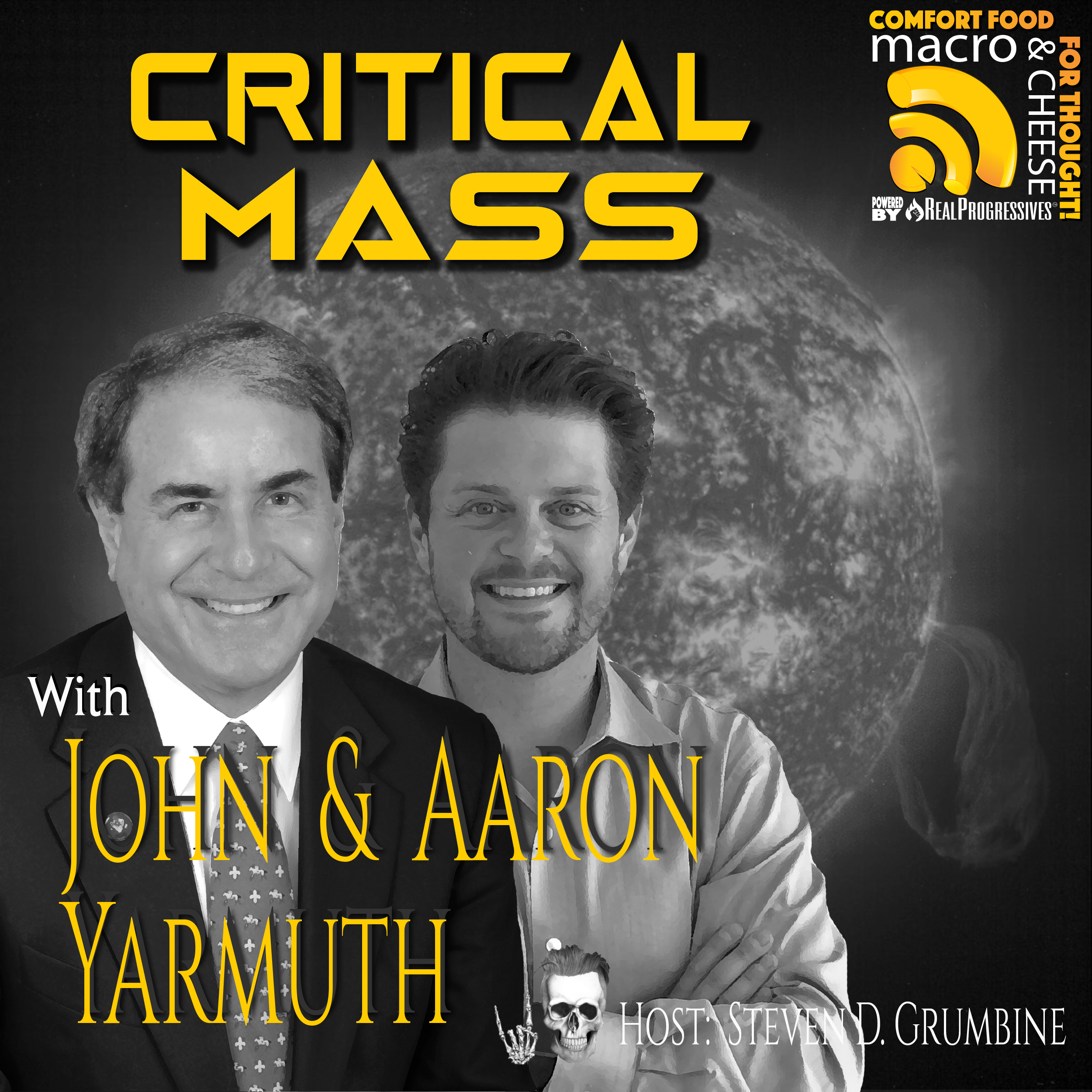
Ep 139Ep 139 - Critical Mass with John & Aaron Yarmuth
Modern Monetary Theory Has a New Friend in Congress said the headline of a New York Times op-ed earlier this month. That friend is House Budget Committee chair John Yarmuth, the 8th term congressman from KY.Isn’t it ironic that it’s newsworthy when the chair of the House Budget Committee understands the basic truth about the workings of the US dollar? That it was a bold move for Yarmuth to appear on C-Span and explain how federal financing differs from our household budgets? This is the world we live in, so we take our MMT victories where we can get them.This week, John and his journalist son, Aaron, talk with Steve about Stephanie Kelton’s The Deficit Myth and how it opened their eyes to the contradictions and absurdities of conventional thinking about our government’s economic policies and the national debt. Instead of asking themselves what the US can afford to do, Congress can now ask what the American people need them to do.John describes his second term on the budget committee, when the chairman, Paul Ryan, warned of financial Armageddon if they didn’t rein in the growing national debt. As we know, the debt kept increasing and Ryan’s dire predictions weren’t borne out. That’s when John figured we should start thinking about it differently. Thanks to Aaron, he heard about MMT and began learning about it.Abraham Lincoln said the legitimate role of government is to do for the people what they need but cannot do so well for themselves.And that certainly relates to spending probably more directly than anything else we do because we are the ultimate banker. We are the ultimate provider and creator of resources. And anybody who's looked at state and local government knows they're not in that same position. And certainly households and businesses aren't.As grandpa and dad to 2-year old JD, both John and Aaron recognize the true responsibility we all carry. In budget committee hearings, John listens to politicians wail about the burden we’re placing on future generations. He does not fall for it:Wait a minute. We've been accumulating debt in this country for 230 years. Has anybody ever been asked to pay it back? Of course not ... I'm sure when the national debt reached a billion dollars under Abraham Lincoln, people were saying the same thing: that all future generations are going to have this burden.Right now, future generations are going to have a burden of an uninhabitable world because of climate change. Our students are going to be studying in 100 year old schools, and we'll have a workforce to be inadequately educated and trained for the jobs of the future. That's the big burden we're putting potentially on future generations if we don't act now and do what we need to do and can do.Steve talks with the Yarmuths about the MMT “layer cake” concept, which ties the Green New Deal to a federal job guarantee and Medicare for all. While the logic is irrefutable, political reality can get in the way. In John’s experience, the Green New Deal is a lot for the American public to grasp. “If you have to explain everything the way you just did, you've already kind of lost…” This just tells us at Macro N Cheese that we have to keep spreading the word. Knowing that there are people at the highest level of government who have caught on to - and are enthusiastic about - MMT, might give us cause for optimism.Congressman John Yarmuth represents Kentucky's Third Congressional District in the U.S. House of Representatives. Now in his eighth term, he has served as Chairman of the House Budget Committee since 2019, and also serves on the Committee on Education and Labor.Aaron Yarmuth is a journalist. Until recently he was the executive editor of LEO Weekly in Louisville. He is currently serving on the board of directors of the Snowy Owl Foundation and the Kentucky Golf Association.Follow John @RepJohnYarmuthFollow Aaron @yarmuthnytimes.com/2021/09/01/opinion/mmt-john-yarmuth.html

Ep 138The Lightbulb Moment with Malcolm Reavell
MMT, at its most fundamental, shows us the difference between a currency user and the currency issuer. This reality affects policy decisions in ways it would be foolish to ignore. As Fadhel Kaboub and Bill Black explained here recently, even if it were possible to create some inadequate public programs at the state level, they will stall the progressive agenda.Malcolm Reavell of Modern Money Scotland talks to Steve about the parallel situation he and his compatriots are facing. Scotland’s annual budget is determined and controlled by Westminster, the Parliament of the UK.Every year they get a block grant from Westminster according to certain calculations, and that block grant is supposed to provide enough money for the Scottish government to do whatever it has to do. It's a totally artificial constraint, and it is used to prove that Scotland can't manage its own finances and it's too poor.The Scottish government is criticized for not taking sufficient action to combat climate change, for not properly supporting the health service, and for the schools being underfunded. Of course, just like in the states, any money spent on one of these programs reduces the available funds for the others.Malcolm and Steve share their histories as MMT activists trying to contribute to a new movement. They both relied heavily on familiar experts like Mitchell, Mosler, Hail, and many, many others. Some, like Steve Keen and Mark Blyth, they see as adjacent or “broad MMT.”Modern Money Scotland and Real Progressives have a common origin story as Facebook groups. We often hear the charge that MMT is US-centric, so it’s a pleasure to have guests from other parts of the world to compare and contrast our mutual journeys as well as differing political and social conditions. For example, Brexit disrupted the trucking industry in Scotland well before COVID disrupted supply chains for the rest of us.Whether you call it football or soccer, our listeners will recognize Malcolm’s approach to talking MMT to the uninitiated.Well, just imagine this. If all the goals ever scored had to be paid back, who would you pay them back to? ... Supposing they had a ledger. Every time a football team had a goal scored against them, there was a debit marked against them.Then if you ended up with a net balance, you had more goals scored against you than you've scored, how would you settle that account?For more information about Modern Money Scotland and the Scottish National Party, listen to our episode 105, The Case for Scottish Independence with Karin Van Sweeden.Malcolm Reavell is a co-founder of Modern Money Scotland. According to his Twitter bio, he is an “Ex-Aircraft engineer, retired IT guy, internationally renowned composer, now decomposing, still #MMT though.”modernmoney.scot@malcolm_reavell@ModernMoneyScot

Ep 137When Less is More with Jason Hickel
Steve’s guest, Dr. Jason Hickel, is an economic anthropologist whose research focuses on global inequality, political economy, post-development and ecological economics. After listening to this episode, “degrowth” will become part of your vocabulary. For MMTers, it is a natural fit.Before unpacking the implications of degrowth, we need to understand how the language of growth has served to justify the exploitative ravages of capitalism and, to paraphrase Lenin, its highest stage – imperialism.Jason tracks inequality between the global South and North from the industrial revolution and the colonial era to the present day. You don’t need to be an economic historian to see that growth in the north relied on forms of appropriation from the south. As Marx pointed out in the 19th century, price inequalities are not natural; they are induced through geopolitical and commercial power.So in the colonial era, of course, you drove down wages by enclosing Commons and dispossessing people and destroying subsistence economies to create massive unemployed people. Today it is through a variety of different mechanisms, the structural adjustment programs that were imposed across the global south by the World Bank and the IMF, which are controlled by the US government primarily.G-7 countries made massive cuts in public sector employment as well as labor and environmental standards. Neoliberal structural adjustment programs of the 1970s and 80s further induced price inequalities. Today countries of the global South are heavily dependent on foreign currency and are forced to compete to attract foreign investment. They are in a global race to the bottom to deliver cheap labor and resources to multinational companies effectively as tribute.This is why I come to degrowth from the perspective of anti-imperialism, recognizing that we live in an imperialist world economy. Degrowth is a demand for ending those patterns of net appropriation that sustains such high levels of access consumption in rich nations ... Rich countries should reduce the resources to get back within sustainable levels, while poor countries should reclaim their resources, mobilizing them around meeting human needs with throughput converging globally at a level that's consistent with universal welfare and ecological stability. That is the world we should be imagining and calling for.Jason and Steve discuss the gross inadequacies of the GDP as an indicator of growth and the need to break from the ideology that defines growth as a positive, desirable goal or outcome. GDP only counts commodities regardless of their social value or harm. It doesn’t distinguish between $100 of books or bullets. It says nothing about whether people’s needs are met. As an alternative to GDP, Jason leans toward a dashboard approach instead of the Genuine Prosperity Index.Understanding MMT shows the way to meet the main objectives of degrowth. Jason adds that the MMT proposal for thinking about taxation - i.e., not as a way of funding public activity but as a way of pulling demand out of the economy - can be applied to ecological economics as a tool for reducing excess resource and energy use. Dr. Jason Hickel is an economic anthropologist, author and a Fellow of the Royal Society of Arts. He is a Visiting Senior Fellow at the International Inequalities Institute at the London School of Economics and Professor at the Institute for Environmental Science and Technology at the Autonomous University of Barcelona. He is Associate Editor of the journal World Development and serves on the Statistical Advisory Panel for the UN Human Development Report and the advisory board of the Green New Deal for Europe.Jason's research focuses on global inequality, political economy, post-development and ecological economics, which are the subjects of his two most recent books: The Divide: A Brief Guide to Global Inequality and its Solutions and Less is More: How Degrowth Will Save the World.@jasonhickel on TwitterJasonhickel.org
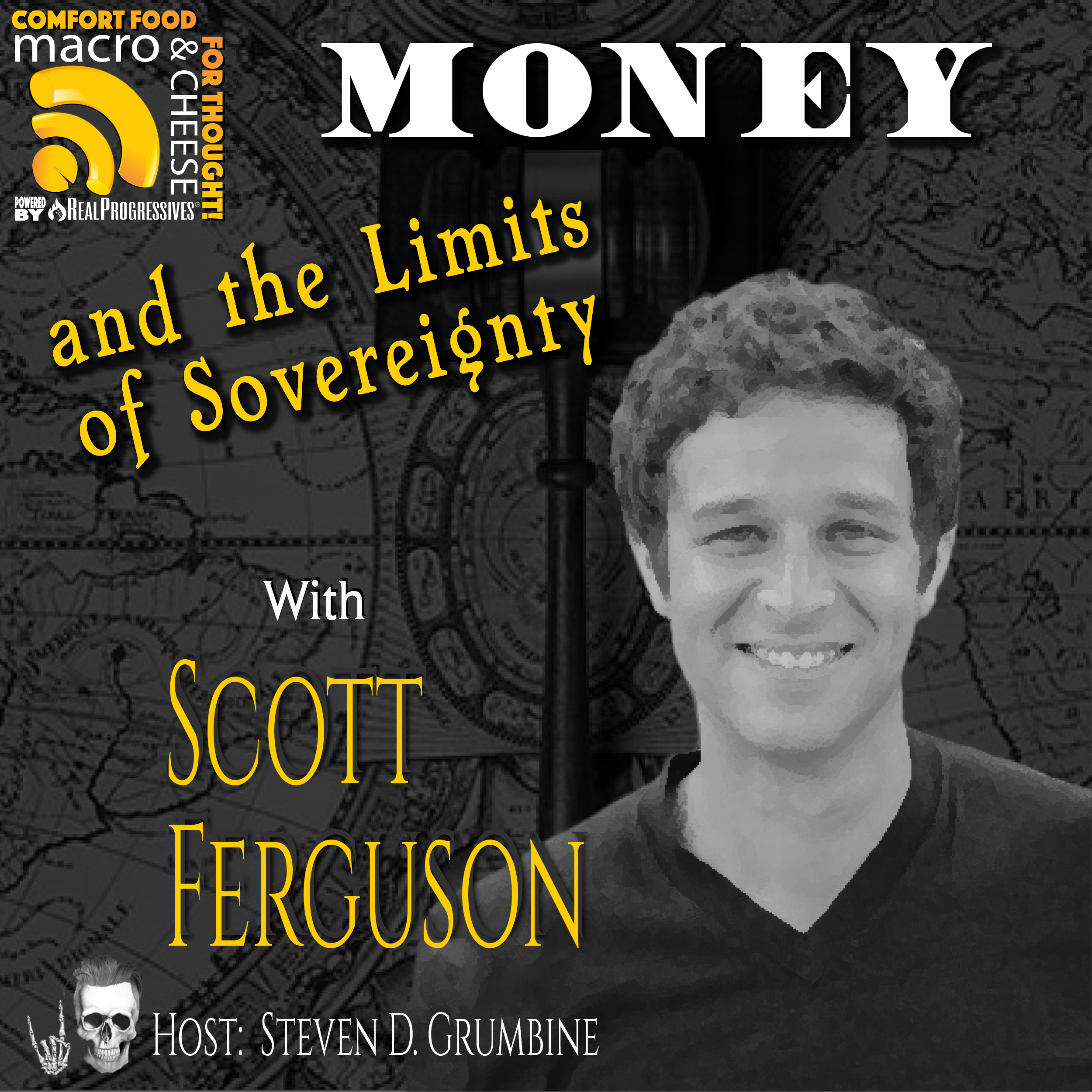
Ep 136Money and the Limits of Sovereignty with Scott Ferguson
Scott Ferguson serves as editor of the Money on the Left (MotL) Editorial Collective and co-host of the Money on the Left podcast. In July, he was guest speaker at Real Progressives’ event, RP Live. This week, Macro N Cheese is presenting his talk, Money and the Limits of Sovereignty, in its entirety, along with most of the Q&A discussion.Trying to summarize the presentation would be doing it a disservice. The idea of sovereignty is one that has been a point of discussion – and a certain amount of controversy – among the MMT community for some time. The work of MotL has contributed enormously to expanding our understanding and considering it in a new, multi-faceted light.Scott begins with the semantic history of the term “sovereignty” and its use in 14th or 15th century Europe to introduce a new conception of political rule, though not always with consistency. It has been used to justify political philosophy on both the left and right.Yet fundamentally, for us, the logic of sovereignty is violent because it denies that everything in this world is interdependent—which is to say, meaningfully and necessarily intertwined--in both social and ecological senses.Meanwhile, we contend that sovereignty as a concept is false because everything, in our interpretation actually is interdependent, no matter how much the logics or institutions of sovereignty pretend they are not.Interdependence opens opportunities for participation and cooperation as well as competition. We could replace “sovereignty” with the language of monetary “capacity,” “power,” and “agency” as well as “sustainability” and “resilience.”We tend to equate money with private exchange, revenue-driven relations, and the profit motive. We operate under the specter of privation. MMT teaches us money is not a zero-sum game; scarcity is a social construct. Scott suggests we extend the vision to political and social relations more generally.The second half of the episode contains Q&A discussion that followed Scott’s presentation. After listening to the episode, we suggest you read the transcript. The complete text of Scott’s presentation is available on our transcript page and elsewhere on RealProgressives.org.Scott Ferguson serves as editor for The Money on the Left Editorial Collective. He is a research scholar at the Global Institute for Sustainability Prosperity and co-host of Money on the Left podcast. Scott holds a Ph.D. in Rhetoric and Film Studies.moneyontheleft.org@videotroph
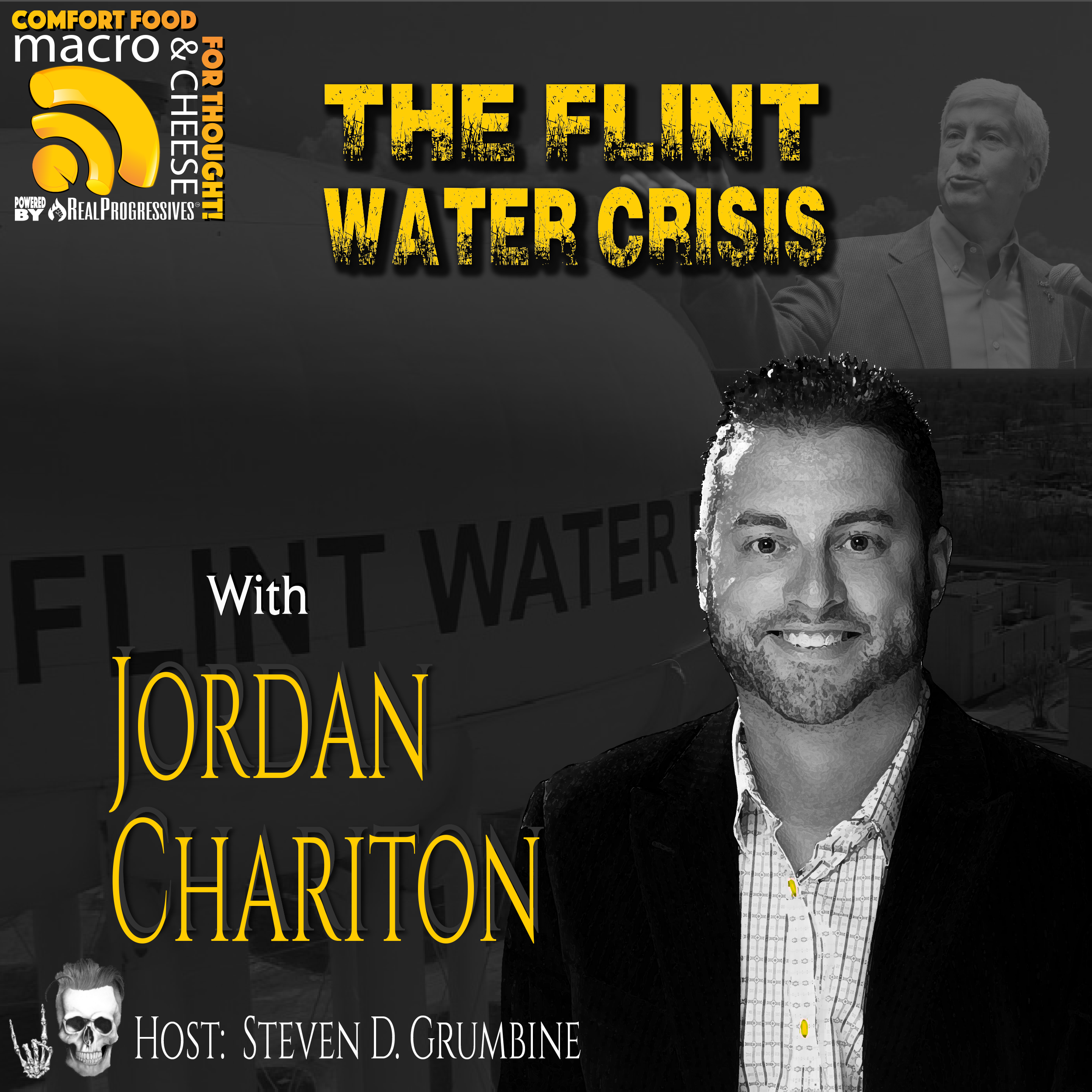
Ep 135The Flint Water Crisis with Jordan Chariton
Status Coup Media's co-founder and CEO Jordan Chariton joins Real Progressives’ founder and CEO Steve Grumbine for a discussion of our crumbling infrastructure, our inept and complicit corporate media monolith, and they share some ideas about our options going forward.This conversation seems like a perfectly segued culmination of Jordan’s recent RP Live presentation on the corporate media cover-up of issues like Flint’s notorious water crisis and climate change related issues as well as last week’s Macro N Cheese episode on infrastructure with Bob Hockett. As Jordan has repeatedly asserted, the infrastructure issues plaguing Flint, MI are prevalent in hundreds of other cities across the US right now. Flint is the story of America: deindustrialization, the offshoring of jobs, privatization, and the controlled demolition of the working class. In this case, it was the water supply.The financial constraints of a state budget, the corruption of politicians, and an inept media apparatus came together to poison an entire city through apathy and greed.And again, seven and a half years later, the pipes have still not been replaced. So, from a federal perspective, as we always talk about, of course, they had the money to do all of this. They could have sent the Army Corps of Engineers in the next day. Each Flint resident could be getting a monthly stipend or Medicare for All.Steve calls it a textbook case of environmental racism as well as a model for neglect of the public good while extracting profit from the very things people cannot live without. While the situation in Flint is extreme, it’s not entirely unique. There are contaminated water supplies across the US. The hashtag “water is life” was born at the time of struggle over the Dakota Access Pipeline. Nestlé is trying to take California’s water while the state is literally on fire.Status Coup has uncovered the many levels of corruption that led to the poisoning of the citizens of Flint as well as the careful cover-up of these crimes. Meanwhile, local and mainstream media have willfully ignored the evidence.Steve and Jordan talk about the state of electoral politics and the need for divergent groups of activists and workers to unite and assert the kind of power that will be felt at the top.Jordan Chariton, Status Coup CEO, is an independent progressive journalist who’s worked inside and outside the belly of the corporate media beast for over a decade. He has worked at Fox, MSNBC, and The Young Turks, before starting Status Coup. His team’s investigative work is attracting attention and expanding their reach.@JordanChariton@StatusCoup
Ep 134Infrastructure with Robert Hockett
This week Steve brings back Robert Hockett to help us understand the big “I” word - infrastructure.Our focus on particular infrastructure depends on the social or public goals we have in mind. If we are a society that values mobility, we will concern ourselves with transportation infrastructure. If this were the 19th or early 20th centuries, we would be prioritizing infrastructure that facilitates industrial productivity. There’s also such a thing as “soft infrastructure.”It's probably worth noting that a lot of public policy discussion these days seems to be about social productivity. Right? To what extent are we adding to the material wealth of our society? To what extent are we improving our material well-being, society-wise, and we can think of productivity along those lines, right? To what extent are we producing better material lives for ourselves?Robert and Steve dive into global supply chains, discussing how the Biden regime may be realizing the old methods of outsourcing our domestic supply of critical inputs to producers abroad isn’t working anymore. The pandemic’s disruption of the supply of semi-conductors, which predominantly come from China, caused a US shortage. On the one hand there’s some awareness of the value of nationalizing production, but the Biden administration seems unwilling to spend the money required to invest in the necessary infrastructure.Bringing production back to the US would create jobs and reduce our reliance on imports, but the question remains: what about the inevitable environmental impact of increased domestic manufacturing? The need to radically evolve our energy production and resource extraction methods is more detrimental than ever as we face economic, and more importantly, ecological, catastrophe. Robert and Steve discuss the need for a more egalitarian distribution of technology to maximize our ability to be more productive while becoming more efficient and reducing our collective footprint. It’s important to be reminded that any given policy has social implications, productive economic implications, environmental implications, and even mental health implications.This episode is dense with useful information including, but not limited to, Senate procedures, political posturing, and America’s role in the world for better or worse.Robert Hockett is the Edward Cornell Professor of Law at Cornell Law School, Visiting Professor of Finance at Georgetown University’s McDonough School of Business, and Senior Counsel at Westwood Capital, LLC. He specializes in the law, economics, and philosophy of money, finance, and enterprise organization in their theoretical and practical, their positive and normative, and their local, national, and transnational dimensions.Follow Robert on Twitter @rch371

Ep 133Organizing For Power with Marianne Garneau
Marianne Garneau is a labor educator and organizer with the historic IWW, Industrial Workers of the World. She’s the publisher of the website Organizing.Work.According to Marianne, real-life examples of workers taking successful action anywhere, inspires, empowers and emboldens workers everywhere. The crucial tactic our labor movement currently lacks is the ability to exercise the muscle of collective action, acting in an organized, harmonious fashion, building coordinated disruption that defies authority, while spreading trust, preparedness and the very habit of defiance.Labor has undergone enormous changes from the days of worker-powered assembly lines and shop floors, when workers could engage in day-to-day refusals. One tactic was “whistle bargaining.” The shop steward would blow a whistle, bringing production to a halt. The workers formed a circle around the foreman and voiced their grievances. Another blow of the whistle could send everyone back to work.Steve recounts the “work to rule” he engaged in as a member of CWA. By fastidiously following every regulation, every safety procedure, the workforce was able to slow things down to a crawl.Today labor has been reorganized and decentralized, so strategy must adapt to modern conditions. It all comes down to workers understanding the workflow and the ways the employer depends on them.The need for workers to communicate is as essential as ever. The means of communication are corporate-owned and can be heavily monitored and censored, again requiring creative adaptation. Marianne describes a tactic used by workers for a food delivery service in Canada. They couldn’t contact each other through the app, so they organized the old-fashioned way, person-to-person, identifying each other by company logo and approaching the vehicles.Marianne and Steve talk about the history of organized labor and the significance of the National Labor Relations Act of 1935....a lot of people in the left and in the labor movement still look back on that as a triumph for labor, which in some ways it was. But it was also meant to really regulate and tame the labor movement.For a movement to build capacity, it must come from the bottom up. To survive, it needs to grow roots, so it is never dependent on individual leaders. Real power comes from mass collective action. Marianne Garneau is an organizer with the Industrial Workers of the World, a labor educator, and the publisher of Organizing Work (organizing.work) @OrganizingWork on Twitter
Ep 132The New Untouchables with Patrick Lovell and Eric Vaughan
When Bill Black introduced us to Patrick Lovell and Eric Vaughan, they were just wrapping up production of their documentary series, The Con, about the 2008 great financial crisis. More than a year has passed and we’ve become partners on a podcast and video series, The New Untouchables: The Pecora Files. Both series have a second season; TNU’s is five episodes in, and season 2 of The Con is not yet scheduled for release. Stay tuned.The episode opens with Steve telling Patrick and Eric about the responses to both series. Everyone was affected by the GFC, but many are still struggling to understand it. Eric jumps in to warn we must stop thinking of it as a past event. Just look out your window. We can expect an epidemic of homelessness with the coming spate of evictions and foreclosures.Patrick and Eric originally came at The Con from opposite directions as each sought to unravel the process. Patrick had been looking for the culprits at the top of the food chain – the CEOs and their ilk. Eric was interested in the victims, who, as we have learned, meet very specific criteria and are just as necessary to the process as the corrupt executives and absentee regulators.Recent news reports are full of stories about upcoming evictions as the COVID-era moratoriums are coming to an end. Congress has provided $47 billion in rental relief assistance, of which only about $3 billion has reached the people who need it. Patrick compares this to the ‘08 mortgage crisis when, after the trillions spent to prop up the banks, $50 billion was provided by the federal government to prevent foreclosures, to allow homeowners to modify their loans, to prevent foreclosures. Similar to rental relief, most of the money never reached those who needed it, due to a tricky process involving insurance and middlemen. The end result is the same, a corporate entity comes in and vacuums up all the foreclosed properties on the cheap.Regulators are cops. Fraud and predation are crimes -- some on the books, some not. When it’s legal, it’s a result of the revolving door between the financial industry and politics. Changing the laws to ease up on corruption is itself corruption.This episode lays out the fraud recipe step by step, from the top of the chain to the bottom, as fees generate fees. It’s not a narrow path. To make it work, they need assessors and underwriters who are willing to sell their souls. Patrick and Eric explain the whys and hows of liars’ loans and documentation fraud, among other practices.When you see how strategic and cunning the predators had to be to entrap entire poor and minority communities, you must question why anyone would call the victims irresponsible. Yet we continue to hear it. Eric talks about our culture of victim-blaming, which allows us to point the finger at Addie Polk instead of Angelo Mozilo. What regulation we have is aimed in the wrong direction.And so, we have regulators whose only criminal referrals are coming from the banks against private citizens. And we're not getting criminal referrals from those same regulators because they're looking at the banks, I would term that systemic victim-blaming.As cynical as many of us have become, whenever we hear stories about the extent of the elite control fraud and predation it still makes the blood boil. THE CON will be available September 21st on Amazon, Apple TV, and XBoxPatrick S. Lovell is a 30-year veteran of media production. He is co-creator of Real Progressives’ series, “The New Untouchables: The Pecora Files.” Patrick is producer and protagonist of the documentary limited series: THE CON.Eric S. Vaughan is an award-winning commercial director/producer with extensive experience in leading-edge media production from narrative films to VR/immersive experiences. THE CON is his long-form documentary series directorial debut. Eric is co-creator of Real Progressives’ series, “The New Untouchables: The Pecora Files.”@PatrickLovell1@TheConSeries@UntouchablesNew

Ep 131The Geopolitics of the Russian Revolution with Esha Krishnaswamy
Esha’s last visit to Macro N Cheese inspired Steve to read Lenin’s What Is to Be Done and John Reed’s Ten Days That Shook the World, igniting a new interest in political theory and revolutions. This, in turn, lit a fire under others on the Real Progressives’ team. In the past half year, we’ve been learning about the Russian, French and Haitian Revolutions. (If you haven’t yet heard last week’s episode on Haiti with Pascal Robert, what are you waiting for?)Esha’s Historic.ly podcast aims to decolonize history and debunk myths and misinformation taught in school and on corporate media. She has now added “Late Nights with Lenin” and “Soviet Summers” to her programming line-up.This week Esha is back to lead us through 1917. The Russian Revolution often focuses on individual players: Tsar Nicholai, Kerensky, Lenin. In fact, Russia’s fate was inextricably entwined with and affected by massive geopolitical shifts as the 19th century division of the world amongst the imperial powers of France and Britain was threatened by a late-bloomer, Germany, and unrest in Russia.In reality, the object of the struggle of the British and French bourgeoisie is to seize the German colonies and to ruin a competing nation which has displayed a more rapid rate of economic development. And, in pursuit of this noble aim, the “advanced” democratic nations are helping the savage tsarist regime to strangle Poland, Ukraine, and so on, and to throttle revolution in Russia more thoroughly. - Lenin, “War and Russian Social Democracy”Esha compares the players to those on the global stage today and constantly reminds us to question the old narratives. After World War I ended, 14 nations conspired to attack Russia, yet it’s called a “civil war.” Why? American and British newspapers published puff pieces about the Tsar Nicholas, while portraying the Bolsheviks as brutes and tyrants. Why? Whose interests were served by perpetuating such myths?Esha’s enthusiasm and delight are infectious. She describes events as if she had been there and people as if she knew them. It is hard to avoid finding heroes and villains in history. We learn to discern propaganda so we can study history and theory and consider how to shape the world we want to build.Esha Krishnaswamy is a writer and media critic whose focus is on history, foreign policy, and Modern Monetary Theory. She is host of Late Nights with Lenin and Soviet Summers. Find her work at historicly.substack.com@eshaLegal@historic_ly
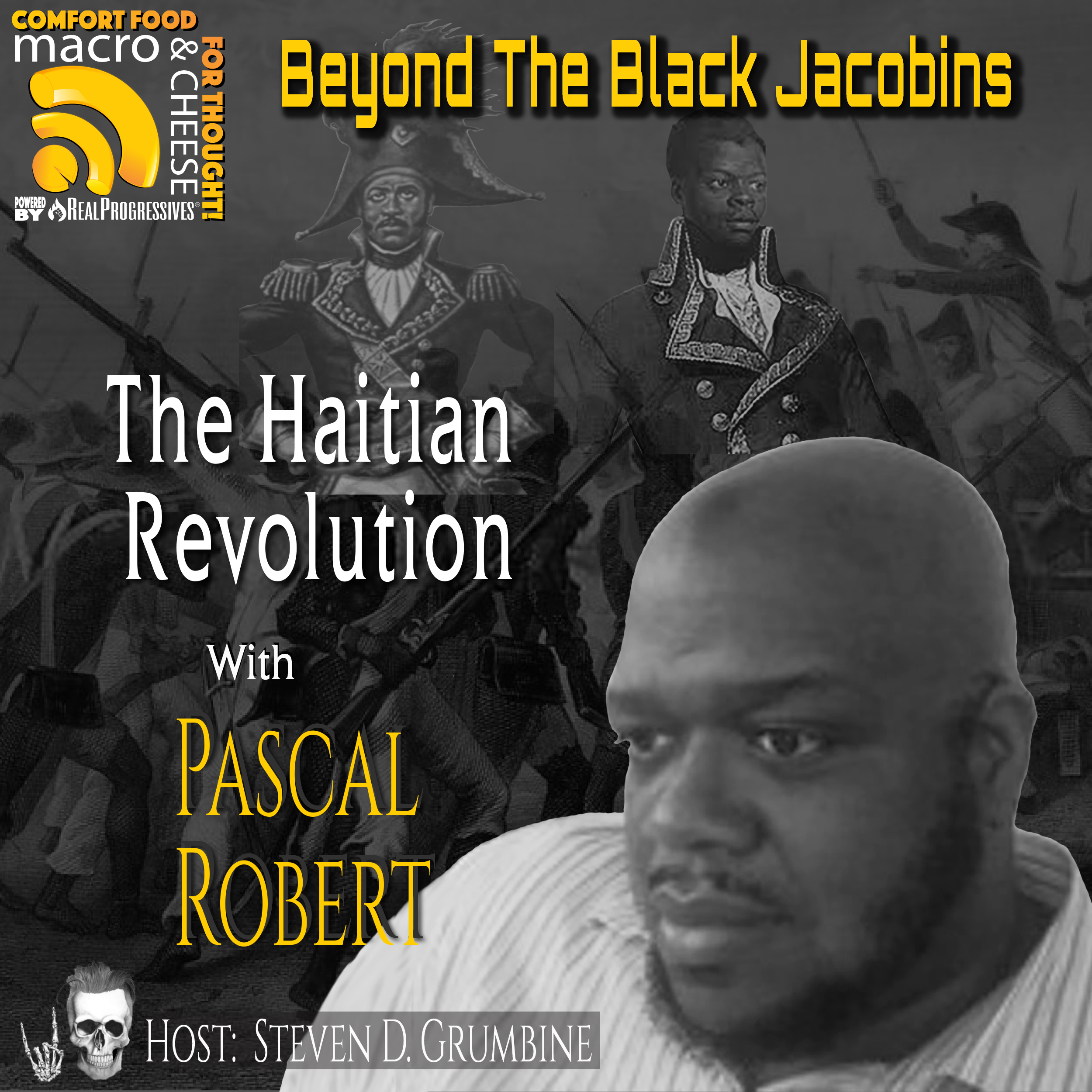
Ep 130Ep 130 - Beyond The Black Jacobins: The Haitian Revolution with Pascal Robert
In the US we are taught history from the point of view of the colonizers. The heroes are the victors, and the victors are the ruling class - the oppressors and exploiters - reconfigured to appear dashing and noble. When truth falls outside of this heroic narrative, it’s distorted or buried.Our guest this week, Pascal Robert, pulls back the curtain to reveal the story behind the myths of the Haitian Revolution. His work appears in Black Agenda Report and many other publications, and he’s co-host of the “This is Revolution” podcast.The Haitian Revolution was an earth-shaking event that changed the course of history. It was the first successful slave revolt, resulting in the first Black republic. The stakes were enormous: the 13 colonies of the British empire combined brought less value than Haiti brought to France. Because of its sugar, rum, coffee and tobacco, pre-revolutionary Haiti, called Saint Domingue, was possibly the most valuable colony in the western hemisphere, giving a clue as to why the plantation system was so brutal.American exceptionalism extends to believing slavery in the US was the most brutal and vast in the world, but Robert’s evocative descriptions of the brutality of the plantation system are beyond imagination. When the revolution arrived, the liberation fighters were well-prepared and motivated.Robert is a riveting storyteller with a potent message. His take on “white supremacy,” provides a taste:A large part of how I view the history of slavery, race, and racism comes from the fact that I am Haitian … I come from a country where slaves destroyed the three greatest European empires at the peak of their power. I don’t see white people as supreme at all. I'm not mystified by white power in any way.The history of Saint Domingue is riddled with class and racial strife that carries forward to modern day Haiti. Robert explains the roots of those divisions, the material conditions that created them. He tells us why he considers Mackandal’s Rebellion - three decades earlier - the opening salvo in the revolution. He debunks the glory of Toussaint L’Ouverture and shows Jean-Jacques Dessalines to be the true hero. Robert brings us vivid tales of military strategy, geopolitical missteps, and voodoo.However much you think you know about the Haitian Revolution, this episode will excite and enlighten you.Pascal Robert is an essayist and political commentator whose work covers Black politics, global affairs, and Haitian politics. His work has appeared in the Washington Spectator, Black Commentator, Alternet, AllHipHop.com, and The Huffington Post. He is a regular contributor to the online publication Black Agenda Report and is the current co-host of the THIS IS REVOLUTION PODCAST, which is live streamed via YouTube and relevant social media on Tuesdays and Thursdays at 9 pm eastern standard time and Saturdays at Noon. Pascal Robert is a graduate of Hofstra University and Boston University School of Law.@[email protected]/c/thisisrevolutionpodcast

Ep 129Through the Eyes of Garry Davis: The World is My Country with Arthur Kanegis
On Macro N Cheese, we often focus on economics - how society organizes real resources, and human life in general. We always seek ways to get our message out, to capture people’s imagination and motivate them. This week Steve talks to the director/producer of The World is My Country, a documentary about Garry Davis, who inspired and motivated millions of people as founder of the World Government of World Citizens.Garry Davis was a song and dance man on his way to becoming a success in show business until the US entered World War II and he was drafted. He served as a fighter pilot, dropping bombs on Hitler’s armament facilities with enthusiasm. When he was ordered to bomb a city of civilians, the realization hit: "Oh, my God. Why am I killing people in their homes and schools and factories for no other reason than they're on the wrong side of an invisible line? I look from my airplane. I can't see this line. It's imaginary. There's an imaginary line. I'm killing people for being on the wrong side of an imaginary line."Davis created a Universal Declaration of Human Rights and set up the World Service Authority to issue world passports, world IDs, and world birth certificates. More than four million of these documents have been issued and over the years they've helped numerous stateless refugees escape from terrible situations.As Arthur recounts Garry’s story, sometimes it’s hard to separate his own beliefs from Garry’s. No matter. Truths are truths. Nowadays any war - even a small, tactical war - means ecocide.And now we have just a semblance of democracy. But it's not a real democracy. It's not what anybody wants. All the things that are happening in the world, nobody wants. Nobody wants us to be heading toward nuclear war. Nobody wants climate disaster. Nobody wants rising waters, floods, storms, tornadoes. Those are ecocide. Those are crimes, folks. This isn't happening because of some accident of nature or something.Garry found it ridiculous that our political system is stuck within the electoral tools and traditions of the past - before telephones, computers, internet - when the way to run a government was to send representatives by horse and buggy to represent the citizenry. Now we can all be in a room, virtually, via synergistic Zoom meetings, and could be more directly involved and represented. It was part of Garry’s design for a “People Powered Planet.” Arthur Kanegis is President of Future WAVE, Inc., a nonprofit organization dedicated to shifting our culture of violence to a culture of peace. He is the Director/Producer of "The World Is My Country" and has written and produced numerous other works. Arthur has also been a radio host, journalist and visionary writer -- on a lifelong mission to use the power of film to help inspire the world toward a peaceful and positive future.Check out his work at theworldismycountry.com
Ep 128How We Fund Policy Matters with L. Randall Wray
L. Randall Wray is a founding father of Modern Monetary Theory and is always a welcome guest on this podcast. This is his SIXTH episode of Macro N Cheese. Our community recently celebrated Congressman Yarmuth’s statement in support of MMT and his shout-out to The Deficit Myth. Randy tells Steve he was invited to speak to Yarmuth and his staff in 2019. He had planned to make a presentation on the data to show deficit fears have never come true. And so I sent them a bunch of slides and they said, "Yeah, this is good, but we really want you to talk about MMT. This is what Yarmuth wants. And he said that we're all talking about this and the Democratic side is pretty much on board, they really do want to hear the explanation." Sounds promising, but we’re far from out of the woods. We’re facing multiple pandemics in addition to Covid - the pandemics of racism, inequality, climate catastrophe are but a few, each linked to each other. The climate crisis has caused a pandemic of fires, of heat, of oceans rising, all of which lead to a pandemic of refugees. They must be tackled simultaneously. The private sector has proven inept at solving these problems, partly because addressing such massive issues requires a carefully coordinated and centrally planned effort. In the case of the climate, only a global effort will do. Major economic powerhouse countries like the US, China, and Russia need to take proactive roles in addressing our environmental crises, as they have the fiscal ability to mobilize resources on a mass scale, AND they’re the nations most responsible for the climate emergency. Steve asks Randy to talk about and look at the current push for universal single payer health care in the US, and explain why a state by state approach cannot work. On the state level there are a series of interrelated problems that cannot be avoided. Certain programs - like healthcare, unemployment compensation, or a job guarantee - require open-ended spending. If someone meets the requirements, the service must be provided. During an economic downturn, a state’s tax revenue is shrinking while the demand for services is expanding. Necessary programs providing jobs and healthcare, must be federally funded; there’s no way around it. Randy reminds us that careful analysis shows how Medicare for All is going to significantly reduce the number of resources needed to devote to health care. So it’s not just that the federal government can afford it, there’s really no credible argument against it. The episode looks at the problems causing migration from rural areas to urban centers, while neglect of infrastructure causes flight from the cities into the suburbs. As always, Randy brings clarity to these complex questions. Be sure to check out the Transcript and Extras pages in the Macro N Cheese section of our website. L. Randall Wray is a Professor of Economics at Bard College and Senior Scholar at the Levy Economics Institute. www.levyinstitute.org/scholars/l-randall-wray
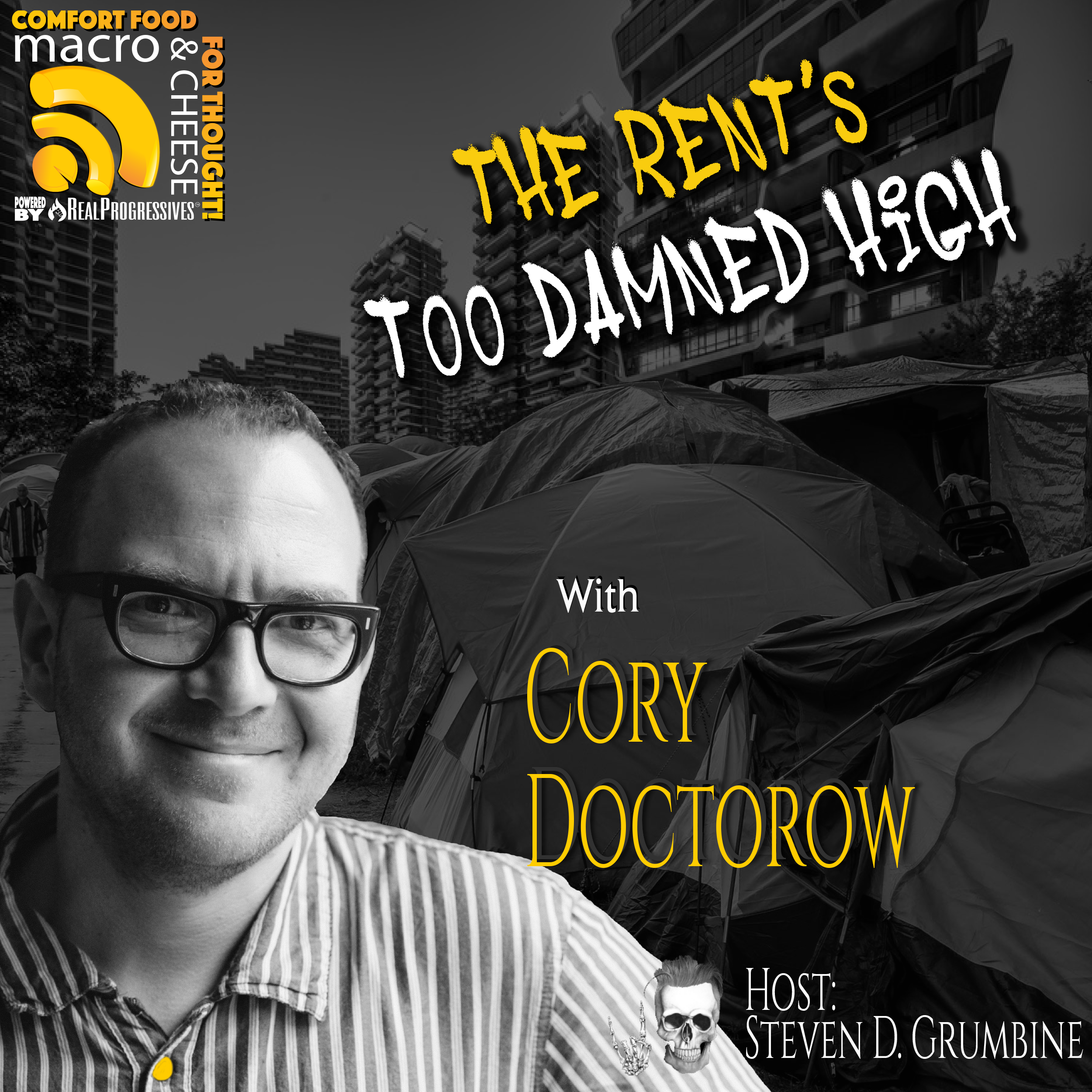
Ep 127The Rent's Too Damned High with Cory Doctorow
Cory Doctorow’s bio says he is a science fiction author, activist and journalist. He’s also a podcaster, blogger, Tweeter, and that rarest of birds, an MMTer. We invited him on to Macro N Cheese because of his article The Rent's Too Damn High: A Human Right, Commodified and Rendered Zero Sum. Steve talks to him about the multiple and complex causes of the pandemic housing bubble. Perhaps because he’s a novelist, Cory communicates in a compelling way, describing not just the causes, but the social implication of the housing situation.The US made homeownership one of its two primary means for class mobility and intergenerational wealth transfer and intergenerational mobility. So the US historically had a labor pathway to social mobility where if you got a better job than your parents, you could live a better life than them. And then it had an asset pathway where an asset that you or your parents bought might appreciate so much that as generations went by, if you were able to hand it down, that each generation would be more affluent than the last.The employment path to a rising standard of living vanished by getting rid of unionized employment, and with it a check against the concentrated power of capital when negotiating with the diffuse power of labor. The imbalance has also resulted in a loss of defined pension benefits.And so now if you want to survive into your dotage without forcing your children to give up their most productive labor years to take care of you, you have to either get unbelievably lucky with your 401k - and again, empirically, American 401ks are not and will not be sufficient to carry them through a dignified retirement - or you have to liquidate your family assets.Cory talks about the effect of reduced incomes on the rental market and the paradoxical effect on housing values, the dissolution of tenants rights, and the way all of these elements are connected to zoning, transportation, and the quality of public schools.The personal responsibility doctrine made popular by Reagan and Thatcher conveniently replaces our identities as workers and citizens with that of consumers. It also requires that we no longer conceive of problems as being systemic and think of them as being individual. Steve and Cory discuss the gigification and Uberization of the economy, and the possible path forward. Cory reminds us, “with so many technological questions or policy questions, we can ask what something does, and that's important. But it's also really important to ask who it does it for and who it does it to.”A science fiction novelist’s métier involves imagining different scenarios for the future. Some of Cory’s might give us a bit of hope.Cory Doctorow is a science fiction novelist, journalist and technology activist. He is a contributor to many magazines, websites and newspapers. He is a special consultant to the Electronic Frontier Foundation (eff.org), a non-profit civil liberties group that defends freedom in technology law, policy, standards and treaties.@DoctorowFind his blog, podcast, newsletter, books and more atpluralistic.netcraphound.com
Ep 126Ep 126 - An MMT Perspective: Interest Rates and Inflation with Warren Mosler
Real Progressives is on a mission to bring Modern Monetary Theory to the layperson. We don’t assume you’ve studied economics, only that you’re open-minded and curious. Once the MMT light bulb goes on, it reveals a myriad of implications, making it a powerful tool for political activists and organizers. It’s almost impossible to think of a political agenda unaffected.Some Macro N Cheese episodes can be difficult for newcomers, but it’s worth sticking with us. All will be revealed!Steve’s guest this week is Warren Mosler, the man who created (discovered?) MMT. Many of our listeners first learned the basics from him and whenever he comes on the show, he and Steve spend at least part of the interview going over the money story. This episode is no different. They discuss the dollar as a tax credit and what it means to say the government is the price setter. Warren explains why “every MMT proponent starts off any inflation discussion by pointing out the reminder that the currency is a public monopoly.”Looking at the current situation in the US, Warren notes that early in the pandemic we saw the reduction of harmful emissions by around 50% as a result of eliminating non-essentials.Now, after a year or so, as the economy has come back, now we're starting to perform these non-essentials again. Emissions are back to where they were, and we're talking about massive new programs with real resources, funding multiple tens of trillions to stop emissions going up and maybe bring them down to where we got to the first week of the crisis by eliminating non-essentials. Does that tell you something?Warren goes through the economic results of the pandemic, discussing what has been going on with personal consumption and private debt accumulation and whether we’re facing the threat of inflation, as well as potential actions of the administration and the Fed. Warren gives us his take on banking regulation - rather, deregulation - and the mortgage crisis. They even touch on one of Steve’s favorite paper tigers, the petrodollar.We mustn’t neglect to mention Representative Yarmuth, Democratic Chairman of the House Budget Committee. He recently appeared on C-Span where he explained, “The federal government is not like any other user of currency, not like any household, any business, any state or local government. We issue our own currency, and we can spend enough to meet the needs of the American people. The only constraint being that we do have to worry about inflation.” He proceeded to give a shout-out to The Deficit Myth. That sounds like a victory for MMT.Warren Mosler is an American economist and theorist, and one of the leading voices in the field of Modern Monetary Theory (MMT). Presently, Warren resides on St. Croix, US Virgin Islands, where he owns and operates Valance Co., Inc. He is the author of “The Seven Deadly Innocent Frauds of Economic Policy” and “Soft Currency Economics,” which are available on his website.moslereconomics.com@wbmosler on Twitter
Ep 125Ep 125 - Degrowth with Lorenz Keyszer
It’s customary to think of growth as something to aspire to and celebrate. It’s one of those words with positive connotations, like progress. Growth represents our progress as a society. The MMT community has called this into question by exposing the underbelly of the most celebrated measure of economic growth, the GDP. The costs of clean-up after a man-made or natural disaster, like an oil spill or hurricane, represent an increase to the GDP. How twisted is that?Steve’s guest this week is Lorenz Keyszer, a master’s student of environmental systems and policy in Zurich. His paper, 1.5° C Degrowth Scenarios Suggests the Need for New Mitigation Pathways, co-authored with Manfred Lenzen, attempts to subvert the positive meanings associated with traditional concepts of growth.In the face of ongoing climate catastrophe, Lorenz sees the need to dig deeper and ask which things we really want to see increase and which things which we want to decrease. In other words, we must ask ourselves which sectors, which areas of life should we prioritize and which areas could be reduced.I usually use the ecological-economic definition, which sees degrowth as a process of an equitable downscaling of energy resource use in an economy which is coupled to GDP. gross domestic product. So GDP is likely to decline or stagnate in such a transition, but societal well-being should be maintained or secured in such a transition. So this is sort of a prosperous descent scenario which really tries to decouple well-being from GDP growth and focus on the things that matter directly, no matter what this means for GDP growth.Referring to the 2017 IPCC report and its 12-year timeline, Lorenz warns of the dangers in discussing this in terms of deadlines. We’re already seeing climate change causing real harm to people’s lives as numerous catastrophes are being substantially worsened.Lorenz talks of the need for the state to take an active role, directing massive investment programs into renewable energy. as well as regulating the fossil fuel industry. A ‘just transition’ is possible if we provide universal basic services and a federal job guarantee. Such policies would minimize the fear of losing livelihoods as we dismantle the exploitative and extractive entities that currently provide us our means to access necessities like food, housing, medicine and, of course, energy. A key point of the degrowth agenda is that we can secure livelihoods and access to the goods and services people need, regardless of GDP, if we change how our economy functions and choose different things to prioritize.Steve and Lorenz discuss GPI (Genuine Progress Indicator) as an alternative to GDP for measuring economic health and stability. Unsurprisingly, the ‘richer’ countries with high GDP seem to lag behind in GPI numbers.Lorenz also touches on the Decent Living Energy Scenario, which estimates the minimum amount of energy required to provide decent standards of health care, transportation, housing, and our other needs. It’s a massive reduction compared to today, and will take a pluralistic approach through technological revolution and waste reduction.This episode takes a deep dive into a subject we cannot afford to ignore.Lorenz Keyßer is a master student of environmental systems and policy at ETH Zürich, Switzerland. His research focuses on climate mitigation scenarios, post- and degrowth approaches to socio-ecological problems as well as strategies to address them, such as the green new deal.@LorenzClimate on TwitterAround the World Without a Plane, by Giulia Fontana & Lorenz KeyszerGrounded from Zurich to Sydney, by Giulia Fontana & Lorenz Keyszer

Ep 124The Race to the Bottom with Fadhel Kaboub and Bill Black
To unpack the confusion around the push for state-based vs federal programs, it’s necessary to understand the race to the bottom. So this is where Steve Grumbine begins his interview with Bill Black and Fadhel Kaboub. The inequities among the Eurozone nations have their parallel in the US. At both the global and national levels, the race to the bottom affects labor standards, environmental regulations, tax rates, and basic services. To understand this, we always turn to the MMT explanation of the difference between a currency issuer and a currency user.The federal government can afford to provide healthcare, infrastructure, environmental protection, childcare, and other necessary services. When it abdicates its responsibilities, it shifts the burdens to individuals who can't afford them as well as to states and municipalities who, by definition, don't have the resources and must compete with each other to attract businesses like fracking companies, pipelines, Amazon headquarters, or whatever they can get. When a state needs more revenue, as it inevitably will, raising corporate taxes will drive these businesses to a “friendlier” location. Ultimately the end result is neglect of community needs and full-bore pain for its citizens. Lost opportunities and negative consequences have been compounding over decades of the neoliberal project.Virtually every state has a constitutional or statutory requirement either limiting or prohibiting running a deficit. However, even without these restrictions, states can’t run substantial deficits without experiencing a sharp increase in the interest rates on their debt and, of course, cannot issue currency to pay those interest rates.Because of vastly different tax bases and competition between the states, the guests make clear that the progressive agenda will be hobbled if we try to apply it piecemeal. Funding major programs like health care at the state level is not only impossible for the majority of US states, but counterproductive to the national Medicare for All movement. The federal government can “wait and see” as state-based initiatives inevitably fail, all of which gives ammo to the “we can’t afford it” argument, and ultimately hurts everyone.Some American progressives have become beaten down with despair, losing hope that such comprehensive plans can ever be achieved. In desperation, they are mobilizing for state-based healthcare programs. Even if these are achievable in a few states, it is not the solution for most and is dissipating the energy that should be focused on a comprehensive agenda.The episode closes by honoring their work while offering specific suggestions for effectively mobilizing targeted action at the local level capable of uniting rather than fracturing the movement. By organizing, educating and empowering people to fight for the right policies, we can consolidate the efforts of the state-based groups across the country into a unified voice for universal health care and other massive programs, funded at the federal level, in lieu of 50 groups fighting separate battles.Bill Black is a professor of Economics and Law at the University of Missouri – Kansas City (UMKC) and the Distinguished Scholar in Residence for Financial Regulation at the University of Minnesota Law School. He is a serial whistleblower and authored The Best Way to Rob a Bank is to Own One.Dr. Fadhel Kaboub is an Associate Professor of Economics at Denison University and President of the Global Institute for Sustainable Prosperity.global-isp.org@FadhelKaboub@WilliamKBlack
Ep 123Ep 123 - Defining the World of Crypto and the Digital Commons with Rohan Grey
If you’re a crypto-phobe, or simply bored by fintech and all those “coins,” don’t let it stop you from listening to this episode. Rohan Grey places these topics within the context of our history, political economy, the law, MMT, policy, and today’s progressive movement. The fact that technology changes the world is nothing new. It affects everything.You can look across history and say, look, it mattered when we created the written word and stopped building societies around oral communities where they passed things down through word of mouth. It matters when we had the printing press and created a system by which information could be developed, stored, mass-transmitted to large numbers of people. It mattered when we built the telegraph in the 19th century and started to connect the Atlantic to the new world and to be able to send wires across the world in a matter of minutes that used to take months to send through ship messages … So if you start from that point of view and look at that long history of different kinds of technology, obviously law and money play a big role in. It matters who funds these things.Once again, technology is changing the landscape. Railroad and oil barons are being replaced by the Elon Musks of the world. There’s a blockchain consortium in Congress, ensuring that their needs are met. The conversation around defining money and establishing the boundaries of public digital financial infrastructure reflects the ideologies and the interests of all kinds of people. Who will protect our privacy?When seeking a force powerful enough to transform society, we turn to the working class. It, like everything else, is undergoing a transformation.They said in an industrial age it was the common identity of being a factory worker that really built the industrial proletariat consciousness. You're sitting there doing the same thing as people next to you. And you're like, hey, we're pretty similar. Nowadays, 70 percent of Americans are in debt for one of three or four creditors. And that kind of relationship creates a different kind of class identity. But so does the fact that everybody has a damn cell phone.While there’s plenty of discussion about bitcoin and financial technology, Steve and Rohan constantly bring it back to MMT and the progressive movement. The questions we face as leftists are far-reaching and consequential. It’s not too soon to begin asking them.Rohan Grey is an Assistant Professor of Law at Willamette University in Salem, Oregon, the founder and president of the Modern Money Network, and a research scholar at the Global Institute for Sustainable Prosperity.https://modernmoneynetwork.org/@rohangrey on Twitter

Ep 122The Case Against a Universal Basic Income with Bill Mitchell
Professor Bill Mitchell was our very first guest on Macro N Cheese, and now here he is, 122 weeks later. Episode #1 was Putting the T in MMT. This week Steve asks him to discuss the single policy prescription at the core of MMT - the Federal Job Guarantee. The discussion goes into the parameters and nuance of the FJG and the pitfalls of a Universal Basic Income as a competing possibility.Bill asserts that implementing a UBI to deal with unemployment and poverty would be capitulating to the neoliberal claim that government is helpless in the face of unemployment - as if it’s a natural phenomenon. MMT shows us the federal government can buy and utilize the excess unemployed labor force the same way it guarantees a stable price floor to agricultural surpluses. In each case these are resources the private market didn’t need.Steve and Bill delve into some details of the FJG advocated by leading MMT experts. This is not some ‘dig a hole, fill a hole’ make-work charade, but a federally funded, locally administered program that aims to fill in crucial resource gaps in communities the private sector neglects for a reason. These jobs don’t generate profit, but they are some of the most valuable services, such as the arts and education, or care for children, the elderly, and the environment. The job guarantee directly addresses unemployment and poverty, unlike the UBI.Steve brings up the automation bogeyman. “The robots are coming for our jobs!” Bill reminds us we are still in charge.Well, this comes down to this sort of myth that has evolved in this neoliberal era, that the market is supreme. And somehow the economy is beyond us now. And that we have to serve the economy, not the economy serve us, and that we have to pull our belts in and sacrifice and whatever in the name of advancing the economy and the market. Now, I mean, it's an absurd proposition when you think about it. All of these constructs are our constructs, our legal and conceptual constructs. The economy is our concept. And the idea that we've just got to lie down and be whipped by the market is just nonsensical.Bill further elaborates the FJG is multi-dimensional. In the short run it solves poverty and income insecurity, but in the long term, it will help evolve the concept of 'meaningful work.' Jobs don’t need to be soul-crushing, but can actually be personally fulfilling and beneficial to society at the same time. We are only limited by our imagination.Professor Bill Mitchell holds the Chair in Economics and is the Director of the Centre of Full Employment and Equity (CofFEE), an official research centre at the University of Newcastle. He also is a Visiting Professor at Maastricht University, The Netherlands, and is on the management board of CofFEE-Europe, a sister centre located at that university.Enroll, support and donate to MMTed at mmted.org@billy_blog on Twitterhttp://www.billmitchell.org/“Macroeconomics” ordering information on bilbo.economicoutlook.net/
Ep 121What Marx Got Wrong with Steve Keen
Steve Keen can be counted on to bring a unique and controversial perspective. This time he turns his critical gaze toward what some feel is sacred in Marx’s legacy. The interview takes a dive into complex theory, which we won’t even attempt to summarize here.Keen says Marx’s philosophical thinking ultimately transcended his own labor theory of value which asserts that all surplus value derives solely from labor. In the Grundrisse, he acknowledges the role of machinery in the production process showing that, with its input into production, machinery can be a source of surplus value.Keen believes this disproves the tendency of the rate of profit to fall. Therefore, socialist revolution is not inevitable. According to Keen, however, after contradicting his own basis for scientific socialism, Marx refused to give it up.Let's get one thing clear... I regard Marx as one of the greatest intellects in economics, probably the greatest. So I put him above Keynes, comparable to Schumpeter. I regard Schumpeter as an incredibly original thinker. And if I want to see my pantheon of great economists, it starts with Richard Cantillon, leaps to François Quesnay, jumps over Ricardo and Smith, and lands on Marx.At one point in the interview, Grumbine brings up the necessity of a future built around green energy. Keen goes into the laws of thermodynamics, the transition from high frequency energy to low frequency energy, and the law of entropy.Grumbine reminds Keen of his last visit to Macro N Cheese, when he called attention to the breakdown in the global supply chain during the pandemic. This gets them talking about the need for, in Keen’s words, “a symbiosis between central control and distributed control.”There’s so much more to this episode. We said we wouldn’t attempt to summarize it, but we’re providing plenty of resource material in the “Extras” page. If you’re not listening on the Real Progressives website, be sure to check it out. There’s a transcript of the interview as well. You may need it.Professor Keen is a Distinguished Research Fellow at UCL and the author of “Debunking Economics,” “Can We Avoid Another Financial Crisis?” and his latest “The New Economics: A Manifesto.” He is one of the few economists to anticipate the Global Financial Crisis of 2008, for which he received a Revere Award from the Real World Economics Review. His main research interests are developing the complex systems approach to macroeconomics, and the economics of climate change.@ProfSteveKeen on TwitterHe has plenty of free content on Patreon. Subscribe: patreon.com/ProfSteveKeenbookshop.org/books/the-new-economics-a-manifesto/9781509545285bookshop.org/books/can-we-avoid-another-financial-crisis/9781509513734

Ep 120Ep 120 - Chain Reactions with Mike Figueredo
Mike Figueredo and Steve Grumbine have a lot in common. Both are on a journey toward radicalization. Both recognize the importance of MMT in this process. Steve was recently Mike’s guest on The Humanist Report in an episode that was part MMT primer and part discussion of their mutual anti-capitalist awakening. This week, Mike comes to us.When we activists and non-economists first learn MMT, we experience a chain reaction as one shibboleth after another is toppled. The insights strike us as both profound and profoundly obvious. Of course it can also be both exciting and depressing at the same time. Mike tries to ward off despair as he acknowledges the stark implications:We're staring down the barrel of a gun right now. Climate change. What is it the IPCC says? By now we have 10 years to act to avoid catastrophic climate change? Tweaking around the edges, it's not just insufficient, it's literally deadly at this point. And nobody is willing to say that in DC. Nobody is willing to frame it with the urgency that's needed.It’s no longer about mitigating climate change. It’s about adapting to its reality. By the time we decide to build a seawall it will be too late. Besides, as Mike says, “when we talk about a seawall in 15 years, then it's ‘well, you know, the deficit is really getting high.’”Steve points to recent comments by Janet Yellen about the need for fiscal responsibility. It would make sense for Biden to actively encourage this deficit fear porn; with these bogeymen as well-planted distractions the administration has plausible deniability. We need not bother to expect success.Returning to the gun metaphor, they speak of austerity. Steve says:People associate the gun with murder. They don't associate the policy with murder. And so when I see this play out, I'm not seeing it like some benign thing. I see this as a legitimate gun to the head of anyone that is not flush with cash. So many died unnecessarily in this pandemic. And I don't see any path forward. You said the people have to be angry. They can't just vote. They've got to organize. The problem is they don't know that there is a legitimate war going on right now against them with this austerity narrative. That's like a sanction against the American people.Steve and Mike delve into the #MedicareForAll conversation, specifically, the currently trending, but fatally flawed idea of state-based single payer. As MMT shows us, US states are currency users and need to generate the revenue through taxation or borrowing, unlike the currency-issuing federal government. The state-funded health care system is not only doomed to fail because of an impossible revenue deficit, but as Mike notes, the failure could be used by the political elite as a false representation of the failure of #M4A.Like many on the left nowadays, these two independent media hosts are finding the more they study capitalism, the harder it is to imagine a future for it.Mike Figueredo is the founder and host of the Humanist Report. Support and follow them:Website humanistreport.comPatreon patreon.com/humanistreportTwitter @HumanistReportYouTube goo.gl/E5D8gG

Ep 119Point Counterpoint: The Biden First 100 Days with Robert Hockett
Robert Hockett is back to share his irrepressible optimism as he and Steve review Biden’s first 100 days. They both admit the administration has done more than they expected, but then again, they weren’t expecting much. When Pramila Jayapal awarded the president an A, she must have been grading on a curve.Bob isn’t confident predicting what the coming months will bring, but he expresses both his hopes and fears around a number of issues. How will Biden navigate the shoals of very shallow Democratic support in the Senate? What are his choices and what are their potential consequences? With two more big spending bills in the wings, there’s a lot riding on Congress. To some extent, Bob sees Biden’s fortunes aligned with our own: successful and popular domestic policies would translate into votes expanding the Democratic majority in the midterm elections.Perhaps it’s unfair to judge an administration on the achievements of the first 100 days. Just consider FDR:So one of the things that we tend to forget about the New Deal is that it wasn't really just one big enactment and it wasn't even like three or four big enactments. It was literally scores of distinct pieces of legislation rolled out sequentially over about a 13-year period . . . and the way it was sequenced, it was done in such a way as to ensure that FDR kept winning reelection and each time he won reelection, he could do even more.On the international front, we’re witnessing a revival of America as agonist. This administration has no qualms about amping up a new cold war against Russia and China. The US uses tariffs and sanctions as a means of wielding power over other countries. Steve asks about the use of the payment system to lock them out.Bob thinks China is playing a very smart game. As long as they remain an export-led growth economy, they benefit from the dollar's dominant position in the global monetary system. But China is moving towards a domestically generated demand-focused economy, at which point the dollar’s position as reserve currency will no longer serve their interests. In Bob’s view, they’re taking advantage of the current arrangements while wisely getting their ducks in a row. Meanwhile, they’re making advances towards becoming one of the most important global players in digital currency and finance.There’s much more to this episode, from elite control fraud in the financial industry to the effect of the pandemic on the powerless. Agree or disagree, an hour with Bob Hockett is sure to engage, inform, and probably amuse you.Robert Hockett is the Edward Cornell Professor of Law at Cornell Law School, Visiting Professor of Finance at Georgetown University’s McDonough School of Business, and Senior Counsel at Westwood Capital, LLC. He specializes in the law, economics, and philosophy of money, finance, and enterprise organization in their theoretical and practical, their positive and normative, and their local, national, and transnational dimensions.@rch371 on Twitterhttps://bookshop.org/books/financing-the-green-new-deal-a-plan-of-action-and-renewal/9783030484491https://realprogressives.org/books/money-from-nothing-or-why-we-should-stop-worrying-about-debt-and-learn-to-love-the-federal-reserve/https://www.forbes.com/sites/rhockett/?sh=d551a2fe54a0

Ep 118The Web of Progress with Jen Perelman
This week our guest is the fearless Jen Perelman, host of JENerational Change and recent challenger to establishment sweetheart Debbie Wasserman-Schultz. Jen and Steve have a genial conversation about electoral politics, revolutionary action, and the path forward.Jen talks about her campaign against the notorious DWS, and how inherently flawed and exclusionary our current political framework is. We will never vote our way to revolution. Significant change will only be born of a huge labor movement willing to engage in a general strike.She refers to the Chris Hedges statement about fighting fascists not because we can win, but because they’re fascists.I don't know another way to do anything and I'm not going to just do nothing. Right? So this is the menu right now. How do you sleep better at night? Do you sleep better knowing that you're working on the side of justice, or do you want to just say we can't win, so forget it?They discuss some of the roadblocks to building a movement, especially when we live in an echo chamber. With electoral politics, we have people who are bought and paid for, standing in the way. Tribalism appeals to our need to be on a team, with an identifiable enemy. Jen feels this society is lacking some serious critical reasoning skills.Many talk of building bridges. Jen builds spiderwebs, each thread connecting people to herself and to each other, by taking on the issues that touch their lives. Her organization JENCorps, is one way she continues to serve her community. Check them out on the website jenerationalchange.com.Jen Perelman ran for election to the U.S. House to represent Florida's 23rd Congressional District, but lost to Debbie Wasserman Schultz in the 2020 Democratic primary. Her show, JENerational Change, is available on YouTube, Spotify, and iTunes.@JENFL23 on Twitter
Ep 117Reparations with Sandy Darity and Kirsten Mullen
This week, Kirsten Mullen and Sandy Darity join Steve to talk about their book From Here to Equality: Reparations for Black Americans in the Twenty-First Century.In recent years the debate on reparations has gained some momentum, though not for the first time, as Mullen and Darity point out. “40 acres and a mule” was among the first promises made (and broken) to black Americans since the end of the Civil War. While white families benefited from the homestead act and have continued to receive aid and preferential treatment at every level, assistance to African Americans has always been portrayed as undeserved government handouts. The abolition of slavery created new opportunities for exploitation. Our listeners are well aware that private companies utilize prison labor for pennies on the dollar.Mullen and Darity provide examples of the racist discrimination and disenfranchisement that have poisoned the US since its founding. At every crossroad, every opportunity to do the right thing, this country has made the wrong choice, sometimes subtle, often brutal and vile.In making the case for reparations, they focus on the staggering wealth gap. At the top of that chasm sits the wealth of corporations built on the backs of slave labor. Mullen:You have Lehman Brothers, which began as a cotton brokerage in Alabama, for example. These were a family of brothers who initially were involved in retail trade, but they quickly realized that the real money was in buying and selling cotton. This leads to the cotton exchange in New York City. Tiffany, the iconic jeweler in New York City, was a slave owner. Most college and universities, the early ones, the elite ones, all of them benefited from donations of money from individuals who own and traded slaves or who donated land that they were able to acquire because of the slave trade.While some reparations proposals are systemic and encompass a broader demographic, Mullen and Darity target African Americans whose ancestors were enslaved in this country. They have calculated a dollar amount to rectify the loss of inter-generational wealth that could have been created had the early promise been kept.After you listen to this episode, we urge you to buy the book. From Here to Equality: Reparations for Black Americans in the 21st Century is the recipient of the inaugural 2021 Book Prize from the Association of African American Life and History and the 2020 Ragan Old North State Award for Non-fiction from the North Carolina Literary and Historical Association.A. Kirsten Mullen is a folklorist and the founder of Artefactual, an arts-consulting practice, and Carolina Circuit Writers, a literary consortium that brings expressive writers of color to the Carolinas.William A. (“Sandy”) Darity Jr. is the Samuel DuBois Cook Professor of Public Policy, African and African American Studies, and Economics and the director of the Samuel DuBois Cook Center on Social Equity at Duke University. Follow him on Twitter @SandyDarity
Ep 116Ep 116 - Beyond the Deficit Myth with Brian Romanchuk
This week, Steve catches up with Brian Romanchuk to talk about his latest book, Modern Monetary Theory and the Recovery. Brian was last on in episode 16, two years ago. A lot has happened since then.From his blog, Bond Economics:This book discusses the causes of slow growth in the developed world after the early 1990s from a Modern Monetary Theory perspective. Policy proposals from MMT proponents that aim to rejuvenate the labor market without causing a resurgence of inflation will be examined.Brian says the book goes through the basics of MMT before addressing the sluggish recoveries since the Reagan-Thatcher years. Why were previous recoveries after recessions slow and how can we change it going forward? How do we prevent a long period of underemployment like we’ve seen in previous decades?The modern era has been a constant move away from state control in favor of letting market forces guide the economy. Throughout this interview the discussion frequently returns to labor. As Brian says, it’s really a labor market story.The present spending bill, while larger than expected, is still inadequate. Basically, the money is all flowing into rent, groceries, and settling debts, because it’s replacing a broken income flow resulting from the pandemic.Well, governments around the world threw a huge slug of spending as big deficits. And to be honest, not that much of a bounce. And the reason is all it did was allow people to continue their existing patterns, which is great, but it's also keeping landlords afloat. So that's one reason why it was relatively popular because it was basically the landlord bailout.Brian tells us his next book will be about inflation and takes some time to describe and compare various theories. Finally, he takes criticisms of MMT, finding very few to be in good faith.Brian Romanchuk was a fixed income quantitative analyst in Quebec. He is the author of a number of books, including Modern Monetary Theory and the Recovery, published in March of this year.His writings can be found on his blog: www.BondEconomics.com@RomanchukBrian on Twitter
Ep 115Fiscal Money and the European Union with Marco Cattaneo
Even a very dysfunctional system is beneficial to somebody. And that's the reason why changing course is difficult.Economist Marco Cattaneo joins us this week to talk about “fiscal currency” and how it could provide a partial solution to the economies that haven’t fared so well from the adoption of the euro, the currency being used by 19 of the 27 countries of the European Union.The shared single currency has proven to be too strong for some and too weak for others, making it difficult to set up interest rates and trade relationships that work well for all of them. But more consequential are the restrictions placed on fiscal policy, forbidding EU nations to generate deficits beyond established thresholds. Thus, they are deprived of a valuable governing tool. Each country has been forced to reduce public investments, including public health expenditures, causing a deterioration in the quality of health systems throughout the European Union. This has been reflected in the handling of the COVID crisis.Fiscal money is basically a financial instrument or security, which can be used by citizens to offset their tax obligations. In explaining it, Marco reminds us of one of the basic principles of Modern Monetary Theory -- that money is a tax credit. An EU nation, like a US state, is a currency user. Italy cannot issue euros....but nothing prevents us from issuing tax credit certificates, which can be used in order to support income, to support expenditures, to fund public investments, and to basically recover the amount of economic policy flexibility which will be needed not just in order to recover the political impact of COVID, but to recover all the damages that neoliberal policies taken under the euro created in the countries such as Italy.While Marco believes it was a mistake to create a single currency for the EU, he recognizes that discarding it is a political improbability. It will be easier to garner support for fiscal money.For a deeper dive, we recommend the articles linked below. Both are in English. You’ll find another example of a parallel currency in our episode Unis for All with Scott Ferguson and Ben WilsonMarco Cattaneo is an Italian economist and co-author of La Soluzione per L'Euro. His blog is Basta con L’Eurocrisi.Follow his blog http://bastaconleurocrisi.blogspot.com/@CCFCattaneo on Twitter

Ep 114Ep 114 - When the Whistle Blows with Richard Bowen
Steve Grumbine welcomes the uncompromising and incorruptible Richard Bowen to the studio to discuss the intricate web of deception and fraud more commonly known as our private banking system. Having been at Citigroup during the mortgage crisis, he had an insider’s eye view of the stranglehold the large banks have on our country. The financial services industry is one of the largest contributors to political campaigns and there’s a revolving door between the regulatory agencies and the institutions they’re supposed to be regulating. He can only conclude that the banking lobby controls the government.In early 2006, when Citigroup consolidated its diverse mortgage operations, Richard was given a huge promotion to the position of chief underwriter. Citigroup was purchasing $90 billion worth of mortgages a year - mortgages they did not originate but purchased from other banks and mortgage companies. He was responsible for making sure these mortgages met Citi’s policy guidelines.And that basically was the overall job. Now Citigroup, when they purchased these mortgages, immediately turned around and sold most of them. And when they sold them, they gave their representations and warranties. They basically gave their guarantees that these met our policy guidelines ... And, yet I was finding that 60 percent were defective. They did not meet our guidelines. So, silly me, I started issuing warnings. I thought it was my job.Being a whistleblower is neither a glamorous nor rewarding position to be in, and as Richard tells his students at the University of Texas, one will pay a dear price for “blowing the whistle.” It takes a real toll professionally, personally, and physically. The most heroic acts are often thankless, and as demonstrated by our recent history regarding the treatment of whistleblowers, no good deed goes unpunished. But it must be done.Citigroup’s handling of Richard Bowen was a story in itself. He came under surveillance and was frankly terrified, afraid to start his car without looking under the hood first. You’ll have to listen to the episode for the story. He was led a merry dance by the SEC enforcement division, who feigned interest in his reports, and the Financial Crisis Inquiry Commission, charged by Congress to investigate the financial crisis. If they find evidence of criminal wrongdoing, they are to send a criminal prosecution to the US Attorney General. This sounds like a slam dunk, given the treasure trove of documents he had submitted to the SEC.But if you go down that list of all the witnesses, Steve, you won't find the name Bowen. That is because the congressional commission decided that all of my testimony, everything I told them behind closed doors, everything I gave them, everything they got from the SEC, everything including my original written testimony, it all needed to stay confidential. So it was sent to the National Archives with instructions that it could not be read for five years.Why five years? Funny you should ask. Could it have anything to do with the fact that the statute of limitations for fraud is five years?Richard Bowen was a senior vice president at Citigroup who blew the whistle on the mortgage fraud that helped trigger the subprime mortgage crisis. He is currently a professor of accounting at the University of Texas at Dallas. His story has been featured in the docuseries, The Con, the podcast, The New Untouchables: The Pecora Files, and the 60 Minutes story, “Prosecuting Wall Street.”www.richardmbowen.comOn Twitter: @RichardMBowen

Ep 113Financial Fragility with Eric Tymoigne
Real Progressives recently created a series on fraud and the great financial crisis. To further understand the economic underpinnings of 2008 and other financial crises, Steve turned to Eric Tymoigne, inviting him on to talk about the book he co-authored with Randall Wray, The Rise and Fall of Money Manager Capitalism: Minsky's Half-Century from World War Two to the Great Recession.Alan Greenspan called the financial crisis a “once in a century tsunami,” a huge shock that occurred to the system that had been very unlikely, but, Oops, it happened! And we were not prepared. The Minsky narrative is the opposite. It's a very tiny shock that blew up the entire system. And why? Because over time, the system becomes more fragile, weaker, less able to buffer against even small adverse shocks on the system.Minsky's theoretical framework is really not about the crisis, it's about the process that leads to the crisis. That's where financial fragility comes into play. As Tymoigne explains, the financial crisis wasn’t caused by irrational behaviors, but by the very mechanics of capitalism itself. Milton Friedman said, basically, if you want to understand capitalism, you don't need to understand money. You don't need to understand corporations. You can simply visualize a small peasant economy based on barter in order to grasp the mechanics of exchange within the economic system. You’ll have a decent understanding of capitalism. Not so, according to Minsky. You have to put finance immediately in the analysis and recognize that capitalism is a monetary economy that has long-lived capital equipment. And so that means that you have to have views about the future regarding the ability of this capital equipment to perform over time and to generate high enough monetary return.Tymoigne talks of the different degrees of financial fragility: hedge finance, speculative finance, and Ponzi finance. These different states relate to expectations of future monetary outcomes. According to Minsky we must consider the role of money, linking it to the future to see how a capitalist economy moves progressively from periods of relative stability with hedge finance, when people are able to pay their debts, to periods of Ponzi finance, with no expectation for the debts to be serviced without forcing a sale of the assets. This brings us back to the mortgage crisis.After listening to this episode, be sure to check out The New Untouchables: The Pecora Files. It’s like a case study of what you’ve heard here.Eric Tymoigne is an Associate Professor of Economics at Lewis & Clark College, Portland, Oregon; and Research Associate at the Levy Economics Institute of Bard College. His areas of teaching and research include macroeconomics, money and banking, and monetary economics.On Twitter: @tymoignee
Ep 112Neoliberalism: The Denouement with Thomas Fazi
At the start of the pandemic, Thomas Fazi wrote an article entitled “Could COVID-19 Vanquish Neoliberalism?” It was in response to the optimistic analysis, especially coming from the left who saw in the state’s reaction a deep crisis of neoliberalism.In fact, some were predicting the death of neoliberalism and the rise of a new regime, one characterized by greater state intervention and greater state regulation of markets, more active fiscal policies and greater attention to the needs of societies, mostly brought on by the emergency, not due to sudden change of heart on behalf of elites...In this episode, Fazi explains that neoliberalism is often misconstrued as a political strategy of curtailing the state and empowering the market, but in reality, neoliberalism has been and continues to be characterized by an extremely active state intervention in the economy. He asserts that neoliberalism isn't about getting rid of the state, it’s about elites - and especially big capital - taking control and using the state to favor its own interests, where the needs of society are subordinated to the functioning of the market. The most obvious examples are the privatized energy and water systems.Part of the facade of neoliberalism is convincing the people that the state doesn't have any power, because what better way to stop people from demanding their basic necessities - like healthcare, jobs, and housing - than convincing them that these aren't things that aren’t technically achievable.The pandemic has proven, among other things, that the argument in favor of the euro, and the European Union in general, is without merit. There was supposed to be strength in numbers when in practice we’ve seen smaller countries like the UK handle the pandemic much more efficiently than the hulking bureaucracy of the EU.After loosening the purse strings, most countries are now reverting to type.Our leaders continue to say, yeah, well, but we can't spend too much to save people's lives because Italy has a very big public debt. So the European Union has told us that we have to go easy on spending. And so that's really the situation we're in. And again, this crisis has really proven to an even greater degree, just how tragic it is for a country, especially an advanced country such as Italy - that would have huge scope for maneuver if it had its own currency - just how tragic it is for a country to renounce its monetary sovereignty.Steve asks Fazi to speak about the so-called “great reset,” the latest boogeyman lurking under our beds. Rather than entertain the more outrageous predictions, he talks about crisis capitalism. Anyone who has read “The Shock Doctrine” by Naomi Klein, knows it is not a paranoid fantasy. In Italy, the vast number of small restaurants that suffered from the pandemic and are now in danger of being gobbled up by huge corporate firms. Neoliberalism, business as usual.Thomas Fazi is a journalist, writer, and translator. He’s co-director of Standing Army, an award-winning feature-length documentary on US military bases featuring Gore Vidal and Noam Chomsky, and author of The Battle for Europe: How an Elite Hijacked a Continent – and How We Can Take It Back. His latest book, Reclaiming the State: A Progressive Vision of Sovereignty for a Post-Neoliberal World, is co-authored with Bill Mitchell.@battleforeuropehttps://thomasfazi.net/https://unherd.com/2020/04/could-covid-19-vanquish-neoliberalism/

Ep 111Ep 111 - Cancel This Podcast with Dan Kovalik
This week Steve talks with Dan Kovalik, a labor and human rights lawyer, who recently wrote a book aptly titled Cancel This Book. The episode is more conversation than interview; Dan and Steve both have a lot to say about cancel culture.Dan tells the story of Molly Rush, an 85-year-old peace activist who once served time in jail for participating in a protest at a nuclear bombsite with the Berrigan brothers. Molly went on to help found the Thomas Merton Center in Pittsburgh, one of the oldest peace and justice centers in America. During the BLM protests last summer, Molly reposted a meme of MLK, expressing the effectiveness of his nonviolence. The board of the Thomas Merton Center circulated a letter severing the 50-year relationship with her for posting a “racist meme.”Dan and Steve share their journeys from solid conservative Republicans and describe their radicalization. They talk about the perils of organizing without class-consciousness and the importance of reaching out to people who don’t necessarily agree with you. They recount the attacks against Jimmy Dore for agitating for Medicare for All and Stephanie Kelton for meeting with conservatives in Japan. They discuss the hawkishness of liberals who once were reliably antiwar. Dan introduces the term “the narcissism of small differences,” wherein people with much in common become polarized over the slightest areas of disagreement.This isn’t an episode about macroeconomics. It takes another path and looks at how we communicate with each other, and how we must do a better job of it.Dan Kovalik is a labor and human rights lawyer who served as in-house counsel for the United Steelworkers Union near Pittsburgh for 26 years. He teaches International Human Rights at the University of Pittsburgh School of Law. He has contributed articles to CounterPunch, Huffington Post, and TeleSUR, and is the author of several books, including Cancel This Book: The Progressive Case Against Cancel Culture.@danielmkovalik on Twitterbookshop.org/books/cancel-this-book-the-progressive-case-against-cancel-culture/9781510764989

Ep 110Taming the Megabanks with Art Wilmarth
This week Steve talks with Arthur Wilmarth, fresh off his appearance in our current series, The New Untouchables: The Pecora Files, which dovetails neatly into the subject of Art’s latest book, Taming the Megabanks: Why We Need a New Glass-Steagall Act.Art takes us through the original Glass-Steagall, adopted at the start of the Roosevelt administration as an early part of the New Deal when it became clear that allowing banks to get into the securities business and sell high-risk securities to investors around the world played a very large role in creating the conditions for the Great Depression. Congress saw that banks won’t be objective lenders or impartial investment advisers if they're taking loans and packaging them up into securities and selling them. They become biased and inclined to take lots of risks, which is not what banks should be doing. The act also prevented non-banks or “shadow banks” from engaging in the banking business.And so there was a very strict wall of separation created between banks and the capital markets, which operated very effectively, and helped maintain a very stable financial system from 1933 at least into the 1980s. There were no major systemic financial crises during that period. There were problems, but the crises that happened tended to occur within particular sectors and they could be contained because you didn't have banks exposed to what was going on in the capital markets.Art points out that the stock market crash of 1987 didn't affect the banks because Glass-Steagall was in effect, preventing the banks from being involved in the stock market. After a series of liberalization from the late 1980s through ‘90s, Glass-Steagall was repealed in 1999, removing the firewall between banks and the capital markets. When the next boom and bust cycle brought global financial crisis, it started in the shadow banking area in the capital markets and spread very quickly to the banks.From the global financial crisis through the pandemic crisis, there’s been a continued expansion and explosion of all types of debt. We had a record amount of corporate debt by 2020, including an unprecedented amount of high-risk corporate debt. Much of that debt involved companies borrowing trillions of dollars to finance stock buybacks, serving only the interest of insiders by driving up their stock price. Meanwhile, we’ve had a continuing run-up of consumer debt, particularly in things like car loans, student debt, and credit card debt, all exacerbated by the pandemic.Art reminds us we’re doing the same thing over and over and expecting a different result - the very definition of insanity. We're continuing the system that churns out debt, protects Wall Street and then bails out Wall Street when the crisis comes. We keep giving them incentives to take on more risk. They think they won't fail.Art says they will fail. Eventually, they'll get to the point where the government can't bail them out.But I think the pandemic crisis, in my opinion, confirms everything that I argued in my book: that we're in this global doom loop, I say, where the central banks and the governments are backing up the universal banks and the shadow banks on Wall Street, and everybody is churning out more and more debt without any understanding of how we could make that sustainable over the long term.Art’s prescription is a new Glass-Steagall, ending bailouts for every hiccup in the capital markets. “Markets are supposed to be where you take risks - and if you lose, you lose. If you win, you win. If we keep bailing them out, they're not markets anymore. They're just one-way gambles on the federal government and as I say, they're crony capitalism.”Arthur E. Wilmarth, Jr. is Professor Emeritus of Law at the George Washington University Law School and author of Taming the Megabanks: Why We Need a New Glass-Steagall Act. He has testified before committees of the U.S. Congress and the California legislature on financial regulatory issues.
Ep 109Ep 109.5 - Austin Needs Water with Romteen Farasat
In this extra edition of Macro N Cheese, Steve talks with Romteen Farasat, Incident Commander of Austin Needs Water.We all saw the news photos of Texas under a blanket of snow and ice. The freeze occurred the night of February 14th, yet two weeks later, people are still living without water. Public water has returned but private water lines are still off. They serve apartment buildings and housing complexes, so tens of thousands of residents are still going without.When government fails to step up, the people step up. But the people have very limited resources. Romteen tells Steve the enormity of their needs and reminds us this is happening under a Biden presidency. Those who celebrated the ousting of the orange monster must now concede that candidate Biden was truthful in his campaign pledge that nothing will fundamentally change. Crises continue to engulf us, inaction remains the same.The city of Austin doesn’t have the infrastructure to handle this disaster, but as MMTers we know that the US government has the money. Sending dollars is the easiest thing in the world, yet the residents haven‘t seen a single dime. Where is it?Without a functioning government, it falls to us to care for our neighbors. Water, food, and monetary donations are needed, as well as volunteers on the ground.Austin Needs Water is led by volunteers from BASTA, WDP, UPO, Austin Urban League, AFA, DSA Austin, Foundation Communities, Austin Mutual Aid, Street Medics Austin, and many more local organizations.To donate: AustinNeedsWater.com@RomteenF on Twitter
Ep 109Institutions with Linwood Tauheed
This week Steve talks with Linwood Tauheed, someone we’ve heard about from several of our recent guests. Dr. Tauheed is an institutionalist economist; he looks at the economy not as a macroeconomy or a microeconomy, but as an economy that's founded on institutions. Beyond the economy, or perhaps intertwined with it, institutional frameworks enable and constrain all parts of social life. They are sometimes the unconscious or conscious ideas that structure the way ordinary people live their lives.Such an expansive, dialectical look at society inspires Steve to take this interview down a number of paths, visiting both recent and distant history. They talk about the stark differences between the French and American revolutions. Slavery was outlawed during the French revolution, which was fought by the poor against the rich:It was a class-based revolution, whereas the American Revolution was a revolution of the very well-off in this country against the monarchy, the very well-off in Britain. And so it wasn't a revolution that was based on freeing the poor. It was a revolution based on freeing the rich.The US Constitution is just one representation of the institutions that undergird the divisions of race and sex in the service to capitalism. According to institutionalist Thorstein Veblen, capitalists organize systems enabling them to “make a living without earning a living.” There are micro-institutions and “habits of thought” that continue to divide people whose common oppression should unite them.This episode includes discussion of A Tribe Called Quest, the life of Malcolm X, and, of course, Modern Monetary Theory. A transcript of the interview is available on our website. For additional, related content, check out the Extras page.Linwood Tauheed is an Associate Professor of Economics at the University of Missouri Kansas City, and teaches introductory and advanced courses in Institutional Economics, Political Economy of Race, Class, and Gender, Economic Development, and a doctoral seminar in Interdisciplinary Research Methodology. His primary research interests are in Economic Methodology, Community Economic Development and Analysis of Education. A major research project involves the development of ‘Critical Institutionalism,’ an interdisciplinary metatheoretical framework for developing models for evolutionary institutional change in social systems through social action.He is the immediate past president of the National Economic Association (NEA), which was founded in 1969 as the Caucus of Black Economists and recently celebrated its 50th anniversary.

Ep 108Knowledge is Power with Rev. Delman Coates
The last time Delman Coates was a guest on Macro N Cheese, the Our Money campaign was still fairly new, this podcast was on its 20th episode, and none of us had heard of COVID-19. Now, almost two years and 100 episodes later, it was long overdue for him and Steve to get together again.Delman believes the federal response to the pandemic has been an eye-opener. People saw the government use the public purse to provide economic stimulus. New money was created through deficit spending without the need for new taxes to pay for it. It’s out in the open: whether deficit spending is being done to bail out corporations or whether it’s spent on emergency relief, everyone can see it happening.And so that's why I think that there is so much power in MMT. Paulo Freire talked about the pedagogy of the oppressed. MMT is a pedagogy of the people. And as people see their government working and functioning, they understand that the concepts that we've been espousing are true. And because of that, I think it's unassailable.Delman says it’s our charge to educate all across the political spectrum. When the people understand how our economy actually works, they’ll realize we’ve been asking for far too little. Believing the public purse is funded through tax revenue, “we've been asking for crumbs when we could get the loaf.”Our Money’s Repair and Restore agenda is centered around a federal job guarantee, free health care, and federal funding of public education, pre-K through college. Delman describes these three central policies as the biggest, broadest, and most robust form of automatic stabilizers to benefit the American people and black folks in particular. He emphasizes the use of stabilizers as opposed to stimulus. Stimulus is temporary.When we provide FDIC insurance for banks to go out here and treat the commercial lending market like it's a casino, we are providing public supports to the financial sector. So I want to be clear that when we talk about the power of the public purse, we're not talking about giving people something that they don't deserve.Delman goes into the job guarantee’s history in the civil rights movement. From Sadie Alexander, the first black American economist, to Dr. Martin Luther King, Jr, and A. Philip Randolph, through today’s leaders, many have understood what guaranteed jobs could do in the battle against racism and the struggle for a secure decent life for all. The results would be profound.You won’t want to miss this episode. Delman’s eloquence and clarity are inspirational.Reverend Delman Coates is the Senior Pastor of Mt. Ennon Baptist Church in Clinton, MD. He’s the Founder of Our Money, an economic justice campaign that seeks to solve some of our nation’s greatest social and economic challenges. Dr. Coates also founded the Black Church Center for Justice and Equality to address the social and spiritual challenges of the African American faith community.ourmoneyus.orgOn Twitter:@iamdelmancoates@ourmoneyus

Ep 107We Are Losing The Media War with Jordan Chariton
From his days at TYT to his ground-breaking investigative work at Status Coup, Jordan Chariton has been on the front lines of journalism for years. The stories he covers should be plastered all over cable news and the national publications… but they aren’t. While the mainstream is obsessed with impeachment and a newly-elected Republican who follows QAnon, Jordan has been reporting on the tragedies and travesties being visited upon American communities far from Washington, DC.From Flint’s poisoned water supply to Iowa’s fraudulent Democratic caucus, what’s notable is the absence of the national press corps. Jordan travels to trailer parks and tent cities where he educates himself and his followers about the day-to-day misery perpetrated on the people.I'd be seeing what's actually happening in the country, which was just an economic Hunger Games mixed with environmental genocide. And I'd get back to the hotel or wherever I was staying, and the media's main focus would be on whatever Trump tweeted.Jordan and Steve delve into our current political reality, agreeing it’s increasingly unlikely substantive change will come from the halls of Congress. Steve suggests the progressive movement will need to engage in direct action while organizing legal and mutual aid. In Jordan’s view, targeted public pressure is important. He thinks we should focus on pressuring and dismantling the current corporate media monolith. We need to quell the mass public brainwashing, as well as disseminate the real news to a confused population.Jordan Chariton, Status Coup CEO, is an independent progressive journalist who’s worked inside and outside the belly of the corporate media beast for over a decade. He has worked at Fox, MSNBC, and The Young Turks, before starting Status Coup. His team’s investigative work is attracting attention and expanding their reach.@JordanChariton @StatusCoupstatuscoup.comCheck out Jordan’s article on DNC tamperinghttps://theintercept.com/2020/12/23/dnc-iowa-caucus-app-shadow/and on Snyder’s prior knowledge of Flint https://theintercept.com/2021/01/13/flint-michigan-rick-snyder-legionnaires/
Ep 106Reform or Revolution with Danny Haiphong
We at Macro N Cheese are big fans of Black Agenda Report because of their clear, no-bullshit analysis and their global perspective. This week’s guest does not disappoint. Danny Haiphong is a contributing editor of BAR, co-host of The Left Lens, and co-author of American Exceptionalism and American Innocence: A People's History of Fake News―From the Revolutionary War to the War on Terror.Danny describes austerity as the assault on the rights and well-being of working people. It has been normalized and disconnected from the issues of xenophobia and white supremacy being peddled by both parties in a kind of faux competition between the elite over who is going to lead the charge for the empire at this given moment.Steve and Danny spend much of the episode addressing the distinction between reform and revolution and the dangers inherent when the lines are blurred. While it’s becoming clear that electoral politics are inadequate for bringing the kind of revolutionary change we need, we can’t entirely dismiss them. Unfortunately much of the American left lacks a historical materialist analysis and holds the mistaken belief that time can be reversed.And sometimes a disservice is really done, I think, when folks in the Sanders camp, for example, talk about the New Deal and FDR being the model, when at that time there were forces in that camp who were purging and attacking the left, socialists, communists in order to purify them from those ideological elements and in fact, save capitalism.We ignore, at our peril, the massive struggles it took to achieve even minor reforms, We neglect the historical context of the New Deal or the civil rights era and don’t consider the economic base of society. Many in the progressive movement believe we can repeat the New Deal in the 21st century without asking what was the development stage of capitalism then... and what is it now?This episode goes into censorship, the media, and monopoly ownership. Is censorship ever warranted? Steve and Danny take a deep dive into political theory and practical possibilities given the reality of the American empire, global and domestic.Danny Haiphong is a contributing editor to Black Agenda Report and co-host of The Left Lens. His work has been published widely elsewhere and maintains a blog at patreon.com/dannyhaiphong.@SpiritofHo on TwitterAmerican Exceptionalism and American Innocence: A People's History of Fake News―From the Revolutionary War to the War on Terrorhttps://www.goodreads.com/book/show/41953443-american-exceptionalism-and-american-innocence

Ep 105The Case for Scottish Independence with Kairin Van Sweeden
We’ve had several episodes on Brexit, but this is the first time we’re talking about it with a Scottish nationalist. Kairin Van Sweeden is the executive director of Modern Money Scotland and works with the SNP, the Scottish National Party.Joining the union was forced upon the Scottish people in 1707 against the wishes of the majority. With the seat of government and economic power concentrated in London, the needs of Scotland are not a priority in the UK. Despite the continual growth of the independence movement, they couldn’t get it passed in the 2014 referendum. By the time of the Brexit vote in 2016, many realized their mistake as the majority in Scotland voted to stay in the European Union.Scotland has an abundance of resources, with a huge farming sector and an excess of renewable energy potential in the form of tidal and wind energy. They have 60% of the UK’s ocean water but only 8% of the population. Enter a problem. Scotland has an aging (shrinking) population and needs to attract young people. The result of the Brexit vote led to an immigrant exodus.Kairin’s anti-Brexit sentiment isn’t a signal of approval of the European Union. As an MMTer she understands the powerlessness coming from the lack of monetary sovereignty. Scotland is at the mercy of the Bank of London in a situation not so different from the EU nations’ impotence at the hands of the troika.We can see that neoliberalism is built into the EU. You cannot have more than a three percent deficit just across the board for all countries, you know, and that's complete nonsense. Of course, that can't possibly apply to all different countries. And different countries have different requirements as well. Greece is never going to be anything like Germany, so you can't expect it to be an industrial powerhouse in the way that Germany is.Kairin and Steve talk about the neoliberal mindset which is recognizable regardless of nationality. We’ve all heard of the Northern Europeans who blame Greece for its economic problems, but Kairin tells us of a former editor of The Sun newspaper who was recently online saying, "Yeah, that would be good if Scotland got their independence because I'm sick of paying for them out of my taxes."The COVID pandemic is opening many eyes. In recent years the UK’s national health care system has been eroded by privatization. Consumer choice is portrayed as a human right. But the public health crisis demonstrated that money can be created when politicians choose to do so. People must now ask why we’ve had decades of austerity.Kairin Van Sweeden is Executive Director of Modern Money Scotland, Convener @Yes Edinburgh North and Leith, and North East Coordinator of Scottish National Party Common Weal Group.@[email protected]

Ep 104Focus on the Family with June Carbone
Recently our friend Bill Black introduced us to June Carbone. He suggested she could tell us how the job guarantee fits into cutting edge research on the family. June holds the Robina Chair in Law, Science and Technology at the University of Minnesota Law School and writes about the intersection of family, the economy, and politics. In this episode, June takes Steve through the evolution of the American family as it transitioned to meet the economic needs of modern society. She says what excites her is not so much what things are, but why they change. When the US was founded, it was an agricultural society. The foundation of the colonial era family was the farm, owned and controlled by men and primarily a self-contained unit. Industrialization and urbanization disrupted the system. The entire economy became dramatically more insecure, with boom-bust economic cycles. Women are no longer helping in the fields.They are the moral centers of the family. What's their job? Well, we think of it as sparkling kitchen floors from the 50s. But the real job of the women in the separate spheres is the creation of a new upper-middle class. It is to have the girls prevent the boys from getting them pregnant. Why? Because if the girls get pregnant too early, the boys have to marry them and that derails the whole enterprise. You’ve got to keep the boys in school. They've got to get the job. They've got to get through the first couple of years when they're working their way up, and then they can afford a wife.June talks to Steve about the changing economic conditions through the 19th and 20th centuries, and their effect on demographics and family behavioral trends. Race and class distinctions were sharp. Patterns of migration during WW II and the postwar period have had long-term effects, especially on African Americans. She explains how trends like divorce rates and single parenting reflect economic precarity. The Reagan years saw massive increases in both instability and inequality.By today’s unrealistic model of the urban middle class family, young people have cycled through the first three or four jobs, and have settled on a career. They’re able to marry and have children with the financial security to weather a downturn or allow the spouse to go back to school. As June points out, the majority of the population cannot get there. Well, start thinking of what it would mean to empower workers the way we empower employers. The corporate world wants flexibility, the ability to move plants abroad, to a different state, to automate, to sell one unit and buy another unit, to reinvent the iPhone. They have the iPhone replace the PC. We build in disruption in the corporate model. What would it mean to provide stability and security for people?Steve and June go through much of the interview without mentioning the job guarantee, yet there’s no doubt June is constructing the case for it. Our listeners may never have heard it approached from these angles. It will give you a whole new perspective.June Carbone holds the Robina Chair of Law, Science and Technology at the University of Minnesota School of Law. She is coauthor of RED FAMILIES V. BLUE FAMILIES: Legal Polarization and the Creation of Culture (Oxford, 2010) and MARRIAGE MARKETS: How Inequality is Remaking the American Family (Oxford 2014)http://papers.ssrn.com/sol3/cf_dev/AbsByAuth.cfm?per_id=165168@carbonej on Twitter
Ep 103Ep 103 - Anatomy of a Job Guarantee with Fadhel Kaboub
What can we say about the job guarantee that hasn’t already been said? Quite a bit, actually, as you’ll see in this and upcoming episodes.This week Fadhel Kaboub is talking to a mellower Steve, fresh from the hospital and still on the mend from Covid19. Fadhel begins with the reality that capitalism is a brutal system that constantly leaves people behind. It’s driven by technological change, and as this develops, we require some workers with new skill sets, while others are rendered virtually obsolete. We don’t have an existing system bringing them into the new technology.We count on individual workers to do this on their own, to somehow anticipate technological change, take time and money from their own budget, so to speak, to invest in learning new skills that will be useful for this new industry that doesn't exist yet and somehow be ready to go to transition to those new jobs. And those jobs sometimes are in a different location. Sometimes they're completely in a different country, a different part of the world. So that is the absurdity of the system that we leave this up to individuals to struggle.A job guarantee will treat training and education as part of the job. Advancing technology tends to be more capital intensive, requiring a smaller workforce. What do we do with all the surplus labor? Fadhel explains why it’s not enough to provide a basic safety net, such as healthcare and social services, though they are desperately required as well. Work is more than an income, with well-proven benefits to individuals and families beyond the paycheck. JG advocates like Pavlina Tcherneva and Fadhel speak of a “care economy” of the most valuable work from a broader human and social perspective. Fadhel says it’s “a social, economic and political consensus, a social contract that doesn't throw people under the bus as the economy changes over time.”Steve asks Fadhel about the job guarantee in a mixed economy and command economy. They discuss workers’ co-ops and the aversion, from some on the left, to state control. Fadhel reminds us the JG talks about federal funding. Everything else, from job creation to implementation and management, is done at the local level through a participatory democracy model.Some tricky questions arise. Who defines local? Is it state, municipal, county?How many grassroots voices do we have in the decision-making process? Is all the money going to go to the same city council officials who will hand out these contracts to the same developers who exclude minority groups from access to jobs, who always invest in the wealthier part of town? So those are important details so that we don't end up feeding the system and recreating the same problem. So grassroots participation, community participation is important. It can't be just symbolic.Fadhel talks about the role of nonprofit organizations, which are important not only because they are existing organizations we don’t need to invent or create from scratch. They’re also in touch with the people who need the most services, so are in the best position to speak to what will benefit them.The interview covers the UBI, with enough information to handle any debate. Fadhel explains the meaning of “buffer stock,” with examples of how economists normally use the term. He reveals the real reason UBI is being heavily promoted by Silicon Valley.Steve and Fadhel look at the need for independent media like Real Progressives. Democracy without a fourth estate is not a democracy. The privatization and monopolization of the media over the past 40 years has served to destroy local journalism, meaning we don’t have full-time reporters covering local news, city councils, how the money is spent.This episode covers much more than can be described here. You’ll just have to listen for yourself.Dr. Fadhel Kaboub is an Associate Professor of Economics at Denison University and President of the Global Institute for Sustainable Prosperity.global-isp.org@FadhelKaboub & @GISP_Tweets