
Macro N Cheese
327 episodes — Page 5 of 7

Ep 201System Dynamics and the Minsky Model with Tyrone Keynes
E** Check out the transcript for this and every episode of Macro N Cheese on the Real Progressives website. This week’s episode looks at using a recently developed economic model application developed by frequent Macro N Cheese guest, Steve Keen. The software is aptly named “Minsky” and Steve Grumbine’s guest, Tyrone Keynes, is an experienced user of the Minsky software modelling tool. Tyrone is a consultant whose specialties are economics, health, and ecological modelling systems. Steve and Tyrone walk through the steps to develop processes that they both similarly follow to build a model. Tyrone then talks about his latest work using Minsky to build an unnamed U.S. State a model that will describe how to manage the state’s retirement system to improve the disparities between low and high wage state workers. They discuss the prep work before running the model and validating results. Additionally, Tyrone describes examples of how Minsky has been used to validate MMT (Modern Monetary Theory) thinking and how the tool can be used in the future to help bring about consensus within the MMT community and acceptance in the economic community. Most Macro N Cheese episodes are unique, this one reveals how to focus the MMT lens with some tips on why other tools fail. Tyrone Keynes is a System Dynamicist, independent researcher, and professional consultant at BD Consulting, (https://www.bdconsulting.ca) showing how systems thinking can be applied to economics. He specializes in modeling economic, health, and ecological systems. He is also the main beta tester for the Minsky software and does most of the social media for it. @TyKeynes on Twitter

Ep 200Ep 200 - Africa's Place in the Multi-Polar Order with Fadhel Kaboub
**Thank you to our listeners! Can you believe this is our 200th episode? Crazy, right? Well, it wouldn’t have been possible without the efforts of a dedicated team. Our sound editor and engineer, Andy Kennedy, has spent thousands of hours (literally) producing these weekly gems. Then there’s the diligent band of copy editors—Brad Sandler, Jonathan Kadmon, Jay Spencer, and yours truly, Virginia Cotts, (plus, in earlier days, Rose Ann Rabiola Miele and Rob Baxter)—who pore over every AI-generated transcript, correcting mistakes and fixing punctuation for clarity. Julie Alberding, the RP website’s reigning eminence, created the layout. Each week she meticulously formats and posts the transcript, show notes, and extras. And let’s not forget our inimitable host, Steve Grumbine, who invites us along on his personal quest for knowledge. The journey has resulted in some unforgettable interviews, invaluable content, and a few “aha!” moments.**It’s fitting that our 200th episode is also Fadhel Kaboub’s 10th. Fadhel is the non-economist's economist. You don’t need a new language to learn from him. In this episode he revisits some familiar themes, expands upon them and draws conclusions that... well, they just make so much sense.He looks at global changes, post-2008, post-Covid, and post-Russia/Ukraine. To avoid future disruptions to the supply chain, the three major power blocs—the US and North America, the EU and western Europe, and China, with Russia and central Asia in the hub—are looking to repatriate strategic industries. They are consolidating their sovereignty in terms of food, energy, high-tech manufacturing, strategic industries, and geopolitical, geostrategic sovereignty within each region. That leaves the global South as the place all three blocs perceive as the source of cheap raw materials, the dumping-ground for surplus output, and the site for low-cost assembly line manufacturing.“So that's the world that is emerging. The question for me and for the global South in general, and for Africa as a continent in particular, how do we position ourselves on this new map? And I think I said it before to you on the show, Steve. If you don't have a long-term strategic vision for yourself, you're going to be part of somebody else's strategic vision.”Fadhel proceeds to describe the structural deficiencies that neocolonial nations must overcome and then lays out his vision for the solution.“And that's been one of the most important things that I'm trying to convey to global South activists, academics, public intellectuals, and people who have influence in government policy on the African continent, is formulating that coherent pan-African vision for economic sovereignty, food sovereignty, energy sovereignty, technological sovereignty, and then leveraging that coherent vision—on African terms—to partner with anybody, including China.”He talks about the IMF and its debt traps. He talks about the built-in roadblocks on the path to energy independence. He talks of the need for truth and reconciliation commissions and looks at what post-colonial reparations must include. If you made a diagram of this discussion, there would be arrows connecting each piece to all the others. Sounds dialectical, doesn’t it?Dr. Fadhel Kaboub is an Associate Professor of Economics at Denison University and President of the Global Institute for Sustainable Prosperity.@FadhelKaboub on Twitter
Ep 199The Breaking of the World with Thomas Fazi
Steve talks with Thomas Fazi, journalist/writer/translator/socialist. Many of us know him as co-author, with Bill Mitchell, of Reclaiming the State: A Progressive Vision of Sovereignty for a Post-Neoliberal World.A few weeks ago, we had an episode entitled Trussonomics. It was recorded a few weeks after Liz became Prime Minister, and mere days before she got the boot, making her the shortest-serving PM in UK history. Fazi has a different take on the events leading up to Truss’s removal, and spends much of the first half of this interview breaking it down. Truss is a libertarian free market conservative, so why was she such a threat? The mainstream narrative—left, center, and right—had it that her budgetary package spooked the markets so they forced her out.Truss’s real crime? She understood government finance. As listeners to this podcast know, deficit spending did not cause the current inflation. Fazi talks about the actual causes and makes the case that the markets didn’t oust Truss; the Bank of England did.“...In currency issuing countries, you don't usually see such overt tensions between central banks and government. Even though most central banks are formally independent, they tend to support whatever budgetary or fiscal policy the government decides to pursue. So, what transpired in the UK context was actually quite extraordinary because it was, I think, a rare instance of the central bank of a currency issuing country deliberately acting to sabotage a government.”Fazi lays out the ways in which austerity can now be justified in the UK, warding off the threat of a potentially strengthened working class. There are many layers to this story.The second half of the episode shifts the focus to global geopolitics and the US stance against China and Russia.“This isn't just US versus Russia and a few proxy countries. This new Cold War is a completely different one than the old one. It's one-way. The US is a declining power with declining influence over the rest of the world, where most of the world isn't following the US, for example, with regards to its policies against Russia and China. The US sphere of influence now is pretty much limited to Europe and Australia and New Zealand.”The US ruling class is the most powerful and dangerous in all of human history. The structural changes of the global economy have brought us into a multi-polar world. It's just a reality that the US elites don't seem ready to accept.Thomas Fazi is a “journalist/writer/translator/socialist.” who lives in Italy. He is the co-director of Standing Army (2010), an award-winning feature-length documentary on US military bases featuring Gore Vidal and Noam Chomsky; and the author of The Battle for Europe: How an Elite Hijacked a Continent – and How We Can Take It Back (2014) and Reclaiming the State: A Progressive Vision of Sovereignty for a Post-Neoliberal World (co-authored with Bill Mitchell, 2017). His articles have appeared in numerous online and printed publications. Find links to his articles on his Substack.@battleforeurope on Twitter
Ep 198The Trinity of Austerity with Clara Mattei
“Austerity is the best weapon they have to try to convince. And if they can't convince, they can't coerce. So in my book, I say austerity plays with a double strategy: coercion and consensus.”Clara Mattei is the author of The Capital Order: How Economists Invented Austerity & Paved the Way to Fascism, published this month. Steve Grumbine, who uses the Twitter display name “Austerity is murder,” was drawn to her position that austerity is not just bad economic theory prescribing bad economic policy. That is a simplistic framing that ultimately depoliticizes austerity.Many on the left tie the birth of austerity to the birth of neoliberalism – which some identify with Reagan/Thatcherism, while others say it goes back to Jimmy Carter and the 70s. Clara traces it back a full century, to the years immediately following the First World War, when capitalism was in crisis. It’s no coincidence that WW1, the Bolshevik revolution and the dawn of fascism all occurred during this period. The post-war period was full of socialist stirrings in Europe and the US. Squashing them required a brutal economic response.US and British capitalists openly celebrated the defeat of labor at home and expressed admiration for Mussolini. The head of the Bank of England wrote to Jack Morgan (son of Pierpont), "Fascism has surely brought order out of chaos over the last few years. Something of the kind was no doubt needed if the pendulum was not to swing too far in quite the other direction.” The alliance of liberalism and fascism in its diverse forms should not be a surprise; they are achieving the same ends. To understand austerity, don’t look to the form of government. Look to capitalism itself.We are reminded there are class antagonisms between countries as well as within. When the US exploits and plunders other nations, it is acting on behalf of the ruling class – the same ruling class that is exploiting American citizens and plundering our communities.Clara says, “If you look at austerity just as a tool to manage the economy, which is a typical stance that most Keynesians take, then you cannot really understand why austerity is so persistent and present and structural to our societies.” Austerity is required to enforce society's organization by class divisions, based on wage labor and exploitation. Destabilizing the economy in terms of economic growth is necessary to preserve the capital order.Clara E. Mattei is an Assistant Professor in the Economics Department of The New School for Social Research and was a 2018-2019 member of the School of Social Sciences at the Institute for Advanced Studies. Her research contributes to the history of capitalism, exploring the critical relation between economic ideas and technocratic policy making.@claraemattei on Twitter

Ep 197Gentrification and Culture with Davarian Baldwin
**Full transcripts of all our episodes are available on the website, where you will also find an “Extras” page with additional resources. realprogressives.org/macro-n-cheese-podcast/Steve’s guest, Davarian Baldwin, calls himself an urbanist. This affects his prescriptions for reparations in the US, which extend beyond ADOS and beyond individual payments. His bio says he is a historian, cultural critic, and social theorist of urban America – and this episode touches on all those strands. The legacy of slavery and history of racism reverberates through any analysis of, or approach to resolving, this country’s social and economic problems. The New Deal itself helped increase disparity between the races.The interview includes a discussion of “wokeness”—a term which continues to stir up trouble among leftists and pseudo-progressives.“I'm glad you brought up the term identity politics, because what's happened now is that in any discussion of race or racism, identity politics is seen as black and brown, or women, or queer, or LGBTQ, as if straight or white or elite aren't identities. As if those aren't the identities that have guided and driven our society since its founding. So, identity politics is not discriminatory. Everyone has an identity politics.”In the second half of the episode, Davarian explains the concept of racial capitalism, then goes on to tie it to gentrification. He gives a detailed description of the effects on the white working class as well as communities of color. He makes the case that any solution must be both race and class based and must be systemic.Davarian L. Baldwin is the Paul E. Raether Distinguished Professor of American Studies at Trinity College, and is a historian, cultural critic, and social theorist of urban America. His work largely examines the landscape of global cities through the lens of the African Diasporic experience. He is author of “In the Shadow of the Ivory Tower: How Universities are Plundering Our Cities,” “Chicago’s New Negroes: Modernity, the Great Migration, and Black Urban Life,” as well as numerous essays and scholarly articles. He wrote the historical text for The World of the Harlem Renaissance: A Jigsaw Puzzle.@DavarianBaldwin on Twitter

Ep 196The New Cold War with Ben Norton
“We have to understand neoliberalism as a particular phase of capitalism dominated by US imperialism. So let's start with the last point I mentioned: regime change operation. Any country around the world, any government that tries to have state oversight over the economy opposing neoliberalism was overthrown through regime change.”Ben Norton’s journalism, according to his bio, focuses primarily on US foreign policy and geopolitics, but that description doesn’t do him justice. If any of our listeners are under the illusion the US government serves a purpose other than making the world safe for neoliberal monopoly capitalism, this episode is for you. If you believe neoliberalism is driven by bad ideas, this episode is for you.Ben and Steve discuss Lenin’s prescience in ‘Imperialism, the Highest Stage of Capitalism,’ writing about the predatory nature of finance capital a full century ago. But finance capital in 1916 was a far cry from that of today:“No one in 1916 could have imagined the level of financialization of the economy, especially the US economy – and also deindustrialization. Let's not forget that deindustrialization is something quite new in the history of capitalism. This is something that really emerges with the rise of neoliberalism, especially starting in the '70s, going into the '80s forward and this neoliberal phase of globalization.”As the mainstream media is getting our minds prepped for war, we would do well to revisit some of the other ‘enemies’ in our recent past. They all had one thing in common. It had nothing to do with some crazy evil dictator threatening US national security.Ben Norton is a journalist, writer, and filmmaker. His journalism focuses primarily on US foreign policy and geopolitics. He is based in Latin America and speaks English and Spanish.@BenjaminNorton and @Multipolarista on Twitter

Ep 195Trussonomics with Neil Wilson
** Check out the transcript for this and every episode of Macro N Cheese at the Real Progressives website.Grumbine: I follow a lot of Brits on Twitter, and not just regular rank and file activists, but a lot of the actual economists. And the folks that are considered left, very strongly remind me of neoliberals.Wilson: Because they are. [laughter] What we have, you see, is this wonderful thing called the Oxford degree in philosophy, politics and economics [PPE]. And what happens is, when they graduate from that, there's a Sorting Hat, and it just puts them in either the Labor Party or the Tory Party, depending upon what the Sorting Hat thinks. They're all exactly the same. They're all the same graduates, they're all the same set of people. The economists are like that, too. They just get a Sorting Hat when they get the degree, I swear to God.Here in the US, we’ve been watching the administration scramble to deal with inflation. That chaos is nothing compared to what’s going on in the UK. They are soon to be on their fifth prime minister in six years. (As a point of reference, Maggie Thatcher was PM for 13 years; they don’t have term limits.)When Steve asked Neil Wilson to come on the podcast to talk about Liz Truss, he must have assumed she would last longer than six weeks! Oh well. It’s still an informative episode. As we well know, the MMT lens is useful regardless of economic conditions.Neil talks to Steve about the political lessons he has learned from the Tory’s attempt at handling of the economy. He and Steve talk about the EU and Brexit, and how the war in Ukraine is affecting the energy situation in the UK and Europe.Neil Wilson is an associate member of the Gower Initiative for Modern Money Studies in London, a co-author of "An accounting model of the UK Exchequer" and a co-editor and contributor to the forthcoming book "Modern Monetary Theory: Key Insights, Leading Thinkers"

Ep 194Pakistan in Crisis with Aqdas Afzal
** To donate to the flood relief effort in Pakistan, please visit the Prime Minister’s Flood Relief Fund 2022How do we unpack a problem like this year’s floods in Pakistan? Where do we place the blame? Steve invited our friend Aqdas Afzal back on the podcast to discuss his recent article, “Collapse of Civilizations.”The article’s title is a cheeky play on Samuel Huntington’s “Clash of Civilizations,” which predicted massive conflict between the world’s non-white, non-Christian peoples and the global North. Coincidentally, the countries of the global North have profited quite well from their destruction of the environment, whereas those in the global South bear the brunt – like floods of biblical proportions.Pakistan’s contribution to carbon emissions is less than 1% yet, when hit by climate catastrophe, the devastation is not only physical, it is economic, it is political. With an economy choked by foreign debt obligations, Pakistan, in the best of times, struggles to meet basic needs.“Steve, to give you an example, about 40% of Pakistan's federal budget - remember that figure - 40% is now spent on paying interest on external loans that Pakistan has taken over the last 75 years. And this situation not only eats up all the fiscal space that this country has, we cannot spend on health, we cannot spend on education, we don't have enough money to spend on climate mitigation adaptation, on clean drinking water. And the situation is becoming worse by the day. It's a completely unsustainable situation.”Aqdas and Steve talk about debt jubilee and reparations to address the immediate situation, but the overlapping crises are a direct result of capitalism’s failure to deliver on its promises – not just to Pakistan, but to most of the world – causing strife and division.Are we proving Samuel Huntington right?Aqdas Afzal finished his undergraduate and first master’s degree in Political Science from Ohio State University, then returned to his native Pakistan. After working there for five years he won the Fulbright scholarship for his second master’s and PhD in Economics from UMKC. He teaches at Habib University in Karachi and writes a monthly op-ed in Dawn, a leading English language newspaper there.@AqdasAfzal on Twitter
Ep 193The Rise of Giorgia Meloni with Ivan Invernizzi
Ivan Invernizzi, of Rete MMT Italia and MMT France, returns to Macro N Cheese to bring us up to speed on the Italian political landscape. He and Steve met at the 2nd International MMT conference in NYC in 2018, and he was an early guest on this podcast.The US mainstream media tends to catastrophize the election of right-wing leaders around the world by lumping them all into a single sensational fascist identity. Ivan brings nuance to the issue. Italy has real historical experience with actual fascism. It originated there. Ivan suggests that a politician can have an abhorrent rightwing agenda without necessarily being fascist. There are gradients. Like in everything else.Unlike the US, Italy is a parliamentary republic. Italians elect the parliament, and the parliament elects the prime minister. In the US, it’s possible to have a president from one party and a congressional majority from the other. Not so in Italy; its government cannot exist without the support of parliament. What has emerged, at present, is a coalition of right-wing parties, with Fratelli d’Italia having the most votes right now.Ivan suggests that external forces, rather than internal elections, may have a greater impact in determining Italy’s future. He talks with Steve about the US proxy war in Ukraine, and its effect on the European Union. He talks about the EU’s power over the economies of its individual member countries, especially the imposition of the 3% deficit limit.Ivan Invernizzi has been an MMT activist since 2012 and is co-founder of Rete MMT Italia and MMT France: two activist groups and web sites spreading MMT respectively in Italy and in French speaking countries. He has a master’s degree in Economics and Global Markets.@invernizziivan on Twitter

Ep 192MMT For M4A with Fadhel Kaboub
The movement for free universal healthcare is under attack. Groups like March for Medicare for All, National Single Payer, and others, have been criticized for not buying into the Democratic Party’s agenda promoting individual state healthcare initiatives. The party wants us to stop pressuring Congress. They tell us to go home. They say there’s more likelihood of success in our statehouses.Well, MMT-informed activists can see through the party’s obfuscation. The single-state solution is no solution at all. The US federal government is the currency issuer; it creates US dollars by spending them into existence. States and cities are currency users. Before they can spend, they must somehow earn or borrow that money, ultimately placing the burden onto the citizens, whether through taxes or cuts to other programs. It doesn’t matter how fat their tax base is, even the state of California and the city of New York must balance their budgets. The difference between currency issuer and currency user is at the heart of the matter.Since its founding, Real Progressives’ stated mission has been to help arm activists with a useful understanding of Modern Monetary Theory.“We're not going to move the needle unless we mobilize and organize. And as I say, sometimes it's not enough to be angry and it's not enough to raise the pitchforks. We want not just organized pitchforks but well-informed pitchforks. And I think MMT provides the right framing to mobilize this movement.”This week’s episode comes from the webinar we hosted as part of our RP Live series for our friends at M4M4ALL. It gave them the opportunity to talk with one of our favorite economists, Fadhel Kaboub, who spent the hour answering their questions and arming them against the “taxpayer dollars” bamboozlement of those in power. In the Macro N Cheese clubhouse, we like to say we’re weaponizing knowledge.*****Be sure to check out our website, realprogressives.org, where you will find additional resource material. Use the Media drop-down menu and select Macro N Cheese to access past episodes of this podcast (192 so far!), each accompanied by a transcript and an “Extras” page of useful links.Visit m4m4all.org to learn how you can help their efforts.Dr. Fadhel Kaboub is an Associate Professor of Economics at Denison University and President of the Global Institute for Sustainable Prosperity.@FadhelKaboub on Twitter

Ep 191Ep 191 - Can We Make Money Work For Us? with L. Randall Wray
Grumbine: Can we have too much money? Wray: Yes, we surely can. Usually, our problem is that there's too much bank money, and the usual consequence is a financial crisis. Obviously, Steve and his guest are talking about the nation, not their own wallets. In this episode, he welcomes L. Randall Wray to Macro N Cheese for the eighth time to talk about Randy’s new book, "Making Money Work for Us: How MMT Can Save America," which will be released in America in November. Our listeners know they can count on Randy to explain MMT principles clearly without drowning us in a sea of wonkiness, but, also, without oversimplifying the subject. Consider the above exchange... and then this: Wray: Money cannot cause inflation. I can state that unequivocally. MMT understands that those two statements are not contradictory. Randy talks about the banks financing too much speculative activity that goes bad, usually resulting in a financial crisis. Extensive government spending – when it’s targeted, as in a job guarantee – does not cause a crisis, does not cause inflation. He contrasts this to the wrong kind of government spending, and describes how it is inflationary (cough, UBI). Steve and Randy go through the other questions that MMT is uniquely able to answer in a way that isn’t disconnected from our real-world observations. What is money and how is it created? What does it mean when you say “taxes drive money”? They discuss deficits and debt – and why it is that the few times the US repaid part of the national debt, it led to a depression, except under Bill Clinton, when it led to the great financial crisis. You’ll want to listen to this episode just for the discussion of the Fed and the banks. The CEO’s should all be locked up. L. Randall Wray is a Professor of Economics at Bard College and Senior Scholar at the Levy Economics Institute. www.levyinstitute.org
Ep 190Ep 190 - Billionaires As Policy Failure Factories with Cory Doctorow
ECory Doctorow writes when he’s anxious. He has eight books coming out soon. Yep, it’s been a tough couple of years.The number of upcoming books gives us a sense of the wide range of subjects Doctorow concerns himself with. His upcoming Chokepoint Capitalism, co-authored with Rebecca Giblin, is about monopoly, monopsony, and fairness in the creative arts labor market.Cory and Steve return to several themes throughout this episode, including the crushing effects of concentrated power. The past 40 years have seen an expansion of copyright laws, but the share of income creators receive from their labor has been in free fall and shows no sign of slowing. We know how Amazon treats its employees, so we shouldn’t be surprised that it abuses writers. Amazon’s audio book platform, Audible, controls about 90% of the market, making it able to steal from artists in multiple ways. (After listening to this podcast, go check out #audiblegate on social media.)Excessive corporate power and monopoly concentration have captured and neutered regulatory bodies and strong-armed the unions. Cory’s book focuses on the labor of artists and creators, but workers in every industry are fighting to stay afloat. Monopolies also have a choke hold on us as consumers – and as citizens facing social and environmental catastrophe.Neoliberalism relies upon our isolation – our belief that each of us is facing the world alone and powerless. By effectively starving the machinery of the state, it too is rendered impotent. At the end of the road, there is only capital. Margaret Thatcher said, “there is no alternative.” As a science fiction author, Cory Doctorow has a problem with that. His job is to imagine alternatives.Cory Doctorow (craphound.com) is a science fiction author, activist and journalist. He is the author of many books, most recently RADICALIZED and WALKAWAY, science fiction for adults; HOW TO DESTROY SURVEILLANCE CAPITALISM, nonfiction about monopoly and conspiracy; IN REAL LIFE, a graphic novel; and the picture book POESY THE MONSTER SLAYER. His latest book is ATTACK SURFACE, a standalone adult sequel to LITTLE BROTHER; his next nonfiction book is CHOKEPOINT CAPITALISM, with Rebecca Giblin, about monopoly, monopsony and fairness in the creative arts labor market, (Beacon Press, 2022). In 2020, he was inducted into the Canadian Science Fiction and Fantasy Hall of Fame.@craphound on Twitter
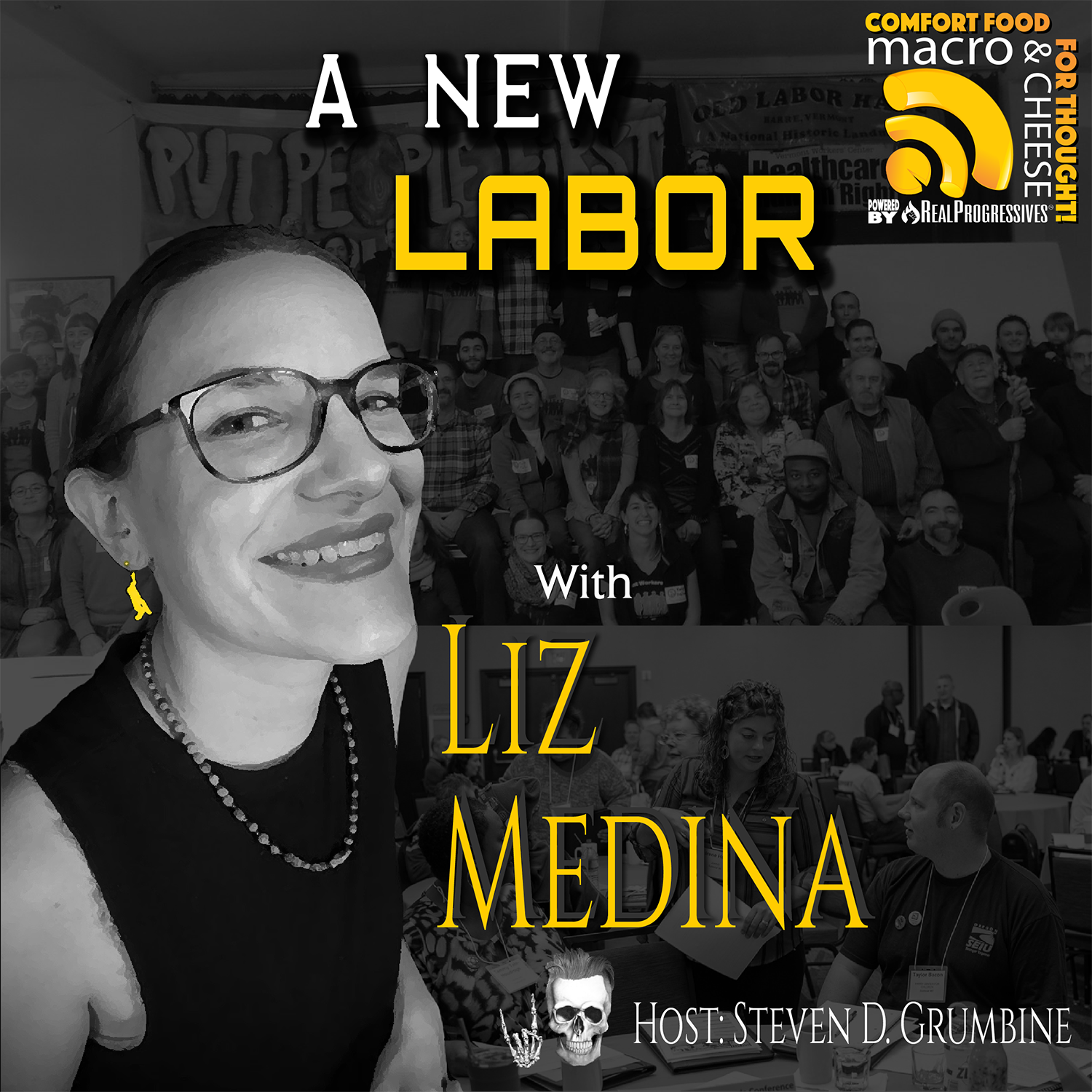
Ep 189Ep 189 - A New Labor with Liz Medina
Some of the more, um, senior members of the Macro N Cheese team can remember a time when the Democratic Party supported labor and the union movement. Then we came to realize we had it backwards – it's really the Party expecting support from the unions, who made donations, helped with campaigning, and got out the vote. Followers of this podcast are regularly introduced to guests who bring word of a newly invigorated labor movement – one that is no longer tied to the Democrats’ apron strings.Steve’s guest is Liz Medina, the Executive Director of the Vermont State Labor Council, AFL-CIO. Her job title does a poor job of telling you what makes her so interesting. She is an artist (check out her Manifesto for Common Art) as well as a podcaster working to build an oral working-class history and culture. She’s a labor organizer with an expansive vision of the need for class struggle unionism and the understanding that unions don’t exist in isolation; they must be connected to community and independent political groups. She speaks of the need to rebuild the relationship between the left and the labor movement, which has been decoupled since the days of the New Left in the 1970s.“I really do believe that the politics will follow what we do on the ground in our workplaces and in our communities … It is very hard work, but it's easier when we feel like we are part of a community in doing that. There's a real interest of our bosses and of capital more broadly in us staying isolated and alone and disconnected and out of community and not having a society at all, frankly. “There is no society,” as Margaret Thatcher would say. We really need that. We need those connections to continue to have strength to keep on going...”Liz talks about the labor movement in general, past and present, and the Vermont AFL-CIO. She describes the need to turn the movement around and adopt class struggle unionism. “We believe in the rank and file strategy,” she says. “We believe in prioritizing organizing and not being afraid of being militant.” Activists should follow suit.Liz Medina is the Executive Director of the Vermont State Labor Council, AFL-CIO. Previously, she served as the Goddard College Staff Union Co-Chair, UAW 2322. She received her MFA from Goddard College and an MA in Cultural Studies from Goldsmiths, University of London. She hosts an oral history podcast called En Masse to build working-class history and culture in her spare time. En Masse is part of the Labor Radio Network. Find her art and other content at atlizmedina.com@LizMedinArt on Twitter
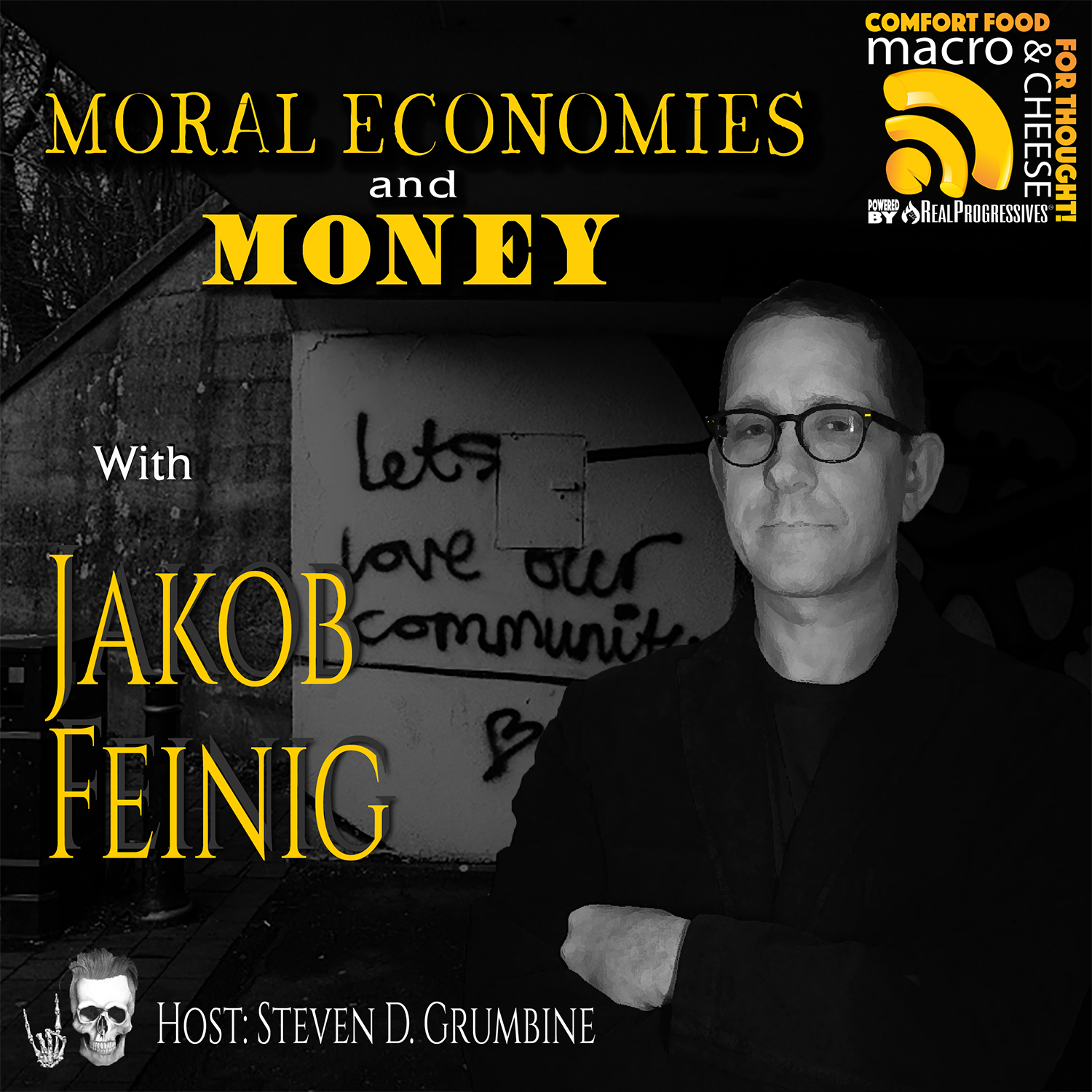
Ep 188Moral Economies And Money with Jakob Feinig
When Jakob Feinig speaks of moral economies, he’s talking about we, the people – the currency users – and how we relate to the institutions that issue money, as well as our monetary knowledge and its ability to inform direct action. Needless to say, Modern Monetary Theory is an essential component of this.This week he and Steve discuss both moral economies and “monetary silencing,” a concept that gives shape to the frustration MMTers experience on a daily basis. Feinig has said he derived the term “silencing” from Paolo Freire, the Brazilian educator and philosopher who wrote about the dehumanizing nature of political silencing, denying people the right to participate in their own history.“There are moral economies that enable people to connect their lives and their needs to monetary design. And there is another process, and that's what I call monetary silencing, that disconnects people, that makes it seem like, oh, those are forces that are beyond your reach. This is something you should not be thinking about ... You have to try to work as hard as you can as an individual. And if you don't make it, or if you don't have enough for a decent life, that is your own fault. But please do not think about where it comes from.”Feinig gives historical examples of both moral economies and monetary silencing – though rather fewer of the former than the latter in recent times. During the US Civil War, the federal government issued the greenback, a brand new currency. Not only did it enable them to win the war, it also made visible the fact that the government has the power to spend money into existence. (Haven’t we said the same about Covid stimulus checks?)The gold standard and bitcoin are among the notable monetary silencers, but some may be surprised to find FDR in this category. Feinig makes the case that he was one of the most successful. We cannot disagree.Jakob Feinig is a historical sociologist who writes about the connection between justice, democracy, and monetary design. He teaches at the State University of New York (Binghamton). His book, Moral Economies of Money: Politics and the Monetary Constitution of Society, will be published in October, 2022.@FeinigJakob on Twitter
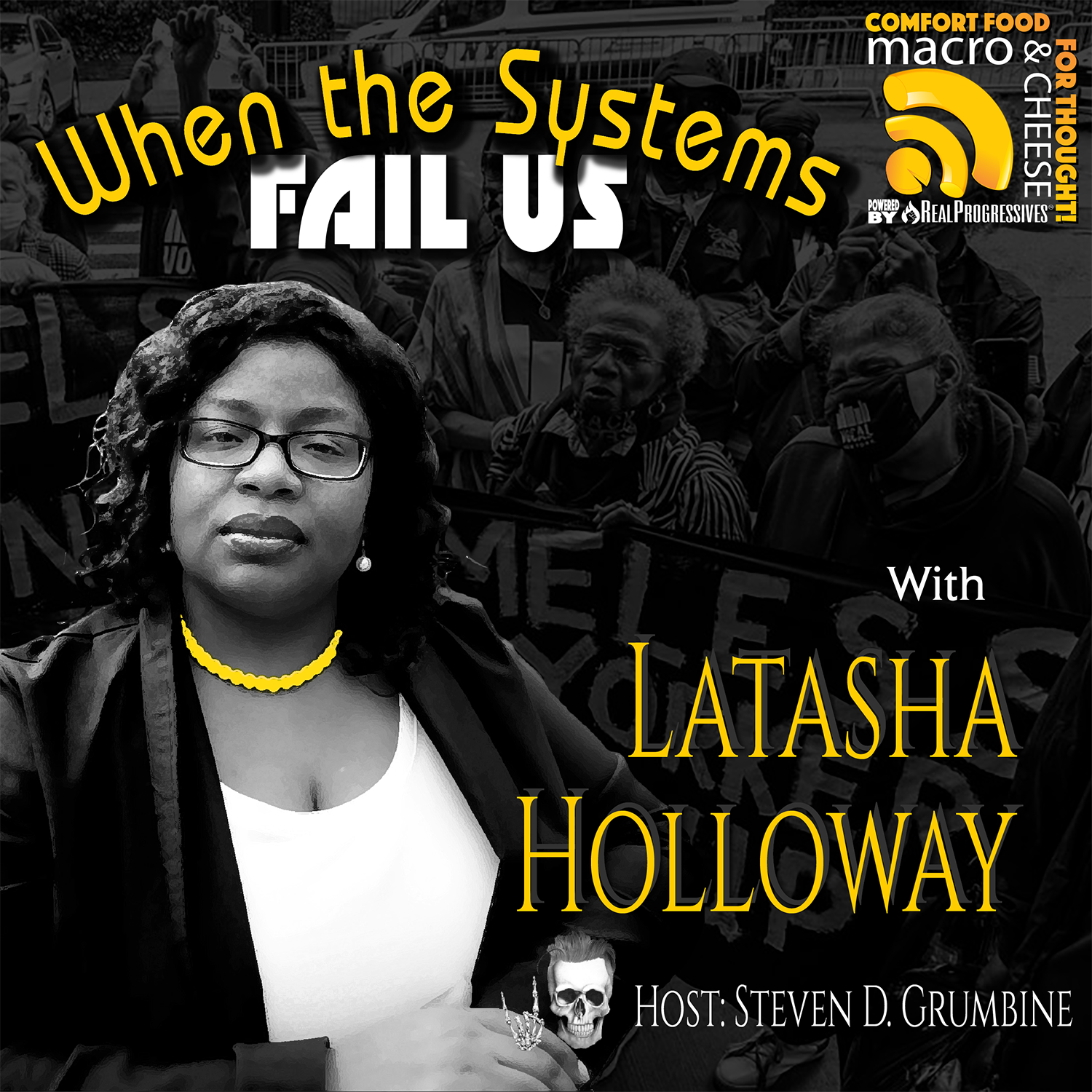
Ep 187When the Systems Fail Us with Latasha Holloway
**Every episode of Macro N Cheese is accompanied by a full transcript and an “Extras” page of additional resources. Find them at realprogressives.org/macro-n-cheese-podcast/ This week Steve interviews Latasha Holloway, who is running for Congress in Virginia’s Third District. What makes the episode unusual is the fact that there’s very little campaign talk, except in connection with her legal battle against the Commonwealth. Listening to her story, it's easy to see why she’s running for office. The circumstances of her life left her little choice. Latasha’s family history is one of multi-generational poverty with the collateral trauma connected to it (but often overlooked) and the failure of systems that could - and should – have provided assistance. Although she was ultimately able to break the cycle of poverty, the systemic failure continued to plague her and her children, two of whom were adopted and have special needs. Navigating the educational system, the health department, the foster care system, and the Veterans Administration, among others, led to her determination to run for office – at which point she learned about Virginia’s twisted electoral laws. To follow Latasha Holloway’s campaign, visit her website, latashahollowayforamerica.com/ @latasha_4equity on Twitter
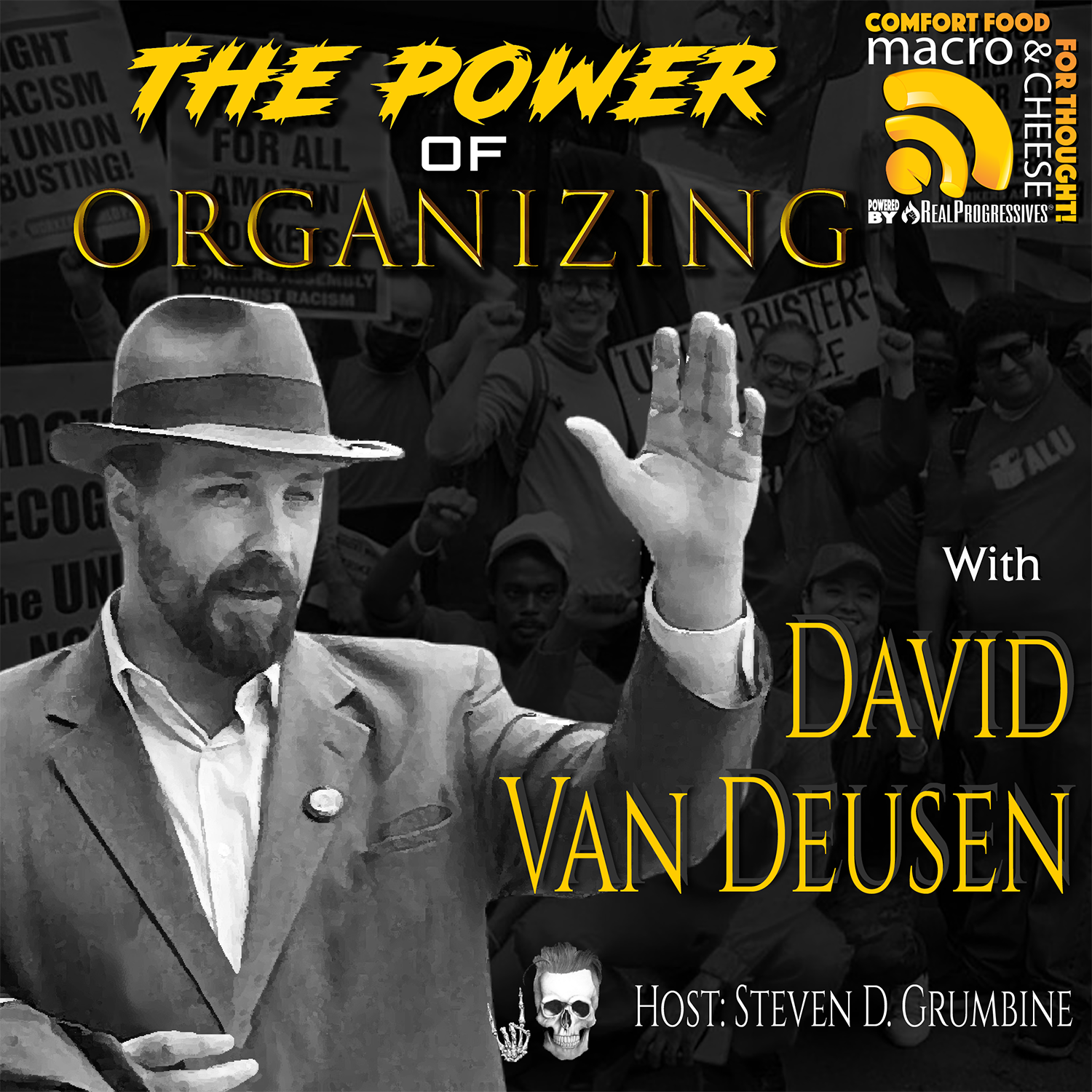
Ep 186The Power of Organizing with David Van Deusen
EDavid Van Deusen, president of the Vermont State Labor Council, AFL-CIO, talks to Steve about their radical ten-point program, adopted in 2019. In the interview, he explains why they were spurred to develop the plan and breaks down what it means in practice as they move away from lobbying and expand their focus on the rank-and-file. This includes training workshops for non-union workers – How to Organize 101.David describes their approach to building a social justice-oriented labor movement. They work with groups like Migrant Justice to support efforts to ensure safe and fair working conditions for undocumented farm workers. They seek to build bridges to non-labor organizations, “be they farmer or environmental groups, (who) are ready and able to embrace our core working class values.”The fifth item of the ten-point plan calls for a Green New Deal. This is followed by item number six, “Electoral Politics,” which begins: “The time of the VT AFL-CIO endorsing candidates simply because they are a Democrat is over.”Below are excerpts from the preamble to the Vermont AFL-CIO Ten Point Program:A NEW PATH TOWARDS PROGRESSIVE CHANGE FOR LABOROrganized Labor has been the most powerful force for change in the History of the United States of America. From the 8 hour day/40 hour work week, the establishment of the weekend, livable wages (in Union shops), to workplace safety standards; Labor has won these foundational victories through collective action and solidarity. However, for some decades Labor, nationally, has been on the decline.…This wilting of Labor does not have to be. We can (and must) be a social and political power once again; one capable not only of defending against the attacks we now face from DC, but also of going on the offensive and delivering positive life altering changes for working people. But we will not achieve our potential if we stay on the road more traveled. We cannot continue to do what we have always done and expect a different result. Nor can we be satisfied with candidates that run for Union office who support all the good things, but who neglect to tell us how we will get there. Instead we must be bold, we must experiment, and we must forge a way forward which not only transforms the Vermont AFL-CIO, but also delivers a powerful Labor Movement with the muscle needed to transform Vermont as a whole. And here, the Vermont we intend to deliver is one wherein working class people not only possess the means to live a secure and dignified life, but one where we, as the great majority, wield the democratic power required to give social and political expression to the many. Such a transformative potential presupposes first a unity around an effective program, and second the development of our immediate political power.To learn more about Vermont AFL-CIO and see the ten-point plan in its entirety, go to https://vt.aflcio.org/news/vermont-afl-cio-ten-point-programDavid Van Deusen, President of the Vermont State Labor Council, AFL-CIO, was elected to office in 2019 as part of the progressive United! Slate. He is a member of AFSCME Local 2413 (Northeast Kingdom), serves on the Labor for Single Payer national Advisory Board, and is a member of Labor Against Racism & War's national Representatives Assembly. Van Deusen is also a member of Democratic Socialists of America and a past member of Anti-Racist Action.@VT_AFLCIO

Ep 185Please Look Up with Jason Hickel
Near the start of this episode, Jason Hickel raises Noam Chomsky’s position that the urgency of the climate crisis is so dire it will have to be dealt with under capitalism. There isn’t time to transition to socialism. Hickel disagrees. Capitalism is incapable of handling the problem.Hickel, an economic anthropologist, begins the interview pointing out the mistaken notion that we have no climate policy, no action, when in fact this is exactly what climate policy action under capitalism looks like: systematic denial and nonstop investment in fossil fuel expansion. It is not due to ignorance. We have the knowledge. We have the science. It boils down to class; the interests of the ruling class are anti-environmental and anti-poor. Capitalism is anti-democratic.“The status quo is not just a failure, it's a death march. Our governments are failing us and failing all of life on Earth. We have to face up to that.”In less than an hour, Hickel lays out the political and economic history of the ecological effects of neocolonialism. He explains why mainstream solutions (if you can call them solutions) to the climate crisis cannot work, despite UN climate resolutions, annual COP conferences, and IPCC reports.As an MMT-informed ecosocialist, Hickel has powerful suggestions for radical systemic change, including a job guarantee and universal public services. The single most important step would be to nationalize the fossil fuel industry. We talk about capping and shrinking emissions, which are caused by burning fossil fuels, so why are we not targeting the industry itself? The environmental movement constantly faces fossil capital, with its grip on politicians and the media (and unethical scientists). Fossil fuel companies are a dangerous foe. They must be treated as such.In addition to policy, Hickel also addresses strategy. He urges us to look to the civil rights movement and the anti-colonial national liberation movements of the mid-20th century. A crisis on the scale we are facing requires all hands on deck. We need a working class as well as a global perspective.“We have a global economy where growth and accumulation in the global North depends on a net appropriation and drain from the global South through unequal exchange, which is an effect basically, of the out-sized geopolitical and commercial power of northern firms ... An ecosocialist transition that is not also anti-imperialist, not also organized around global justice, is not an ecosocialism worth having.”We’ll let you in on a little secret: Jason Hickel is one of our favorite interview guests of all time. This little description is woefully inadequate. Listen to it and tell us what you think. There is a transcript and “Extras” page for this and every episode at realprogressives.org/macro-n-cheese-podcast/Jason Hickel is an economic anthropologist. His research focuses on global inequality, political economy, post-development, and ecological economics, which are the subjects of his two most recent books: "The Divide: A Brief Guide to Global Inequality and Its Solutions" and "Less Is More: How De-Growth Will Save the World".Find his work at jasonhickel.org@jasonhickel on Twitter
Ep 184Is Geoengineering the Answer to Climate Crisis? with David Keith
We often talk about climate change on this podcast. The IPCC deadline is hanging over our heads like the sword of Damocles. This week Steve talks to David Keith, a professor of both Applied Physics and Applied Policy at Harvard, and author of A Case for Climate Engineering.Climate engineering, a term for solar geoengineering or solar radiation modification, would enable us to alter the Earth's reflectivity and reduce some of the climate risks that come from accumulated carbon dioxide. Keith is quick to point out that this is not a silver bullet but should be considered as part of a multi-pronged strategy.Managing climate risk involves four basic actions:Cut emissions by decarbonizing the energy systemRemove carbon dioxide from the atmosphereSolar radiation modification, or solar geoengineeringAdaption to reduce the harms of climate change on crops, people, and ecosystemsWhile there’s no way to address climate change without replacing our energy system, it’s not the entire solution. If we stop all CO2 emissions today, the climate problem won’t improve, it will merely stop getting worse. We won’t have reduced the amount of carbon in the atmosphere. Thus the case for climate engineering.The discussion includes the different roles for scientists and activists. They look at limitations, or flaws, in the IPCC report, and consider the importance of separating science from strategy.David Keith has worked near the interface between climate science, energy, technology, and public policy for 25 years. He took first prize in Canada's National Physics Prize exam, won MIT's Prize for Excellence in Experimental Physics, and is one of Time Magazine's heroes of the environment. He's a professor of Applied Physics at the Harvard School of Engineering and Applied Sciences, and professor of Public Policy at the Harvard Kennedy School and founder of Carbon Engineering, a company developing technology to capture CO2 from the ambient air to make carbon neutral hydrocarbon fuels. He is author of “A Case for Climate Engineering.”@DKeithClimate on Twitter
Ep 183Imports, Exports and Empire with Bill Mitchell
In a recent episode of Macro N Cheese, Steve spoke with a guest about the MMT view of exports as a benefit and imports as a cost. There ensued some disagreement on social media (where else?) This week Steve invited Bill Mitchell to weigh in on the topic. As their discussion develops, this becomes an episode we’d recommend to anyone who is still unclear on the meaning and consequences of foreign trade deficits.“Exports have to be a cost because you're foregoing real resources that you could use yourself. And imports have to be a benefit because you're getting real resources from other countries that you didn't previously have which allow you to expand your consumption possibilities. The question then is: does that mean that exports are bad and imports are good? Well, not really. That's where people get tripped up.” (Mitchell)MMT isn’t a theory of everything. It doesn’t pass judgment or recommend policy.“To me, it's an interesting intersection... MMT allows us to understand what we can and can't do and our theory of politics and the commons will inform what we do with that knowledge.” (Grumbine)They discuss national debt, both before and after Bretton Woods. As a bonus, Bill dispels fears of Big Bad China holding too many US dollars. “They're not funding the US government. They've got US dollars because they sold more stuff to you than you sold to them.” The government can always restrict or regulate foreign direct investment. Who should be able to own a country’s natural resources?Bill and Steve talk about imperialism, globalization, the pandemic, and climate disaster. Bill suggests we start thinking in terms of poly crises. If every crisis is connected to multiple others, does it make sense to take them on one by one?Bill’s visits usually review some core MMT principles and provide answers to some of the critics. This episode is no exception. Every topic of discussion loops back to the fact that money is not the issue – real resources are. Understanding MMT flushes out political motivation. There’s nowhere left to hide.From http://bilbo.economicoutlook.net/blog/Bill Mitchell is a Professor in Economics and Director of the Centre of Full Employment and Equity (CofFEE), at the University of Newcastle, NSW, Australia.He is also a professional musician and plays guitar with the Melbourne Reggae-Dub band, Pressure Drop. The band was popular around the live music scene in Melbourne in the late 1970s and early 1980s. The band re-formed in late 2010.@billy_blog on Twitter
Ep 182The Citizens' Ledger with Robert Hockett
Robert Hockett joins Steve to talk about his latest book, The Citizens’ Ledger: Digitizing Our Money, Democratizing Our Future. The episode is right at home in our archive of interviews around the topics of fintech, digital wallets, cryptocurrency, CBDCs, and privacy. We urge our listeners to look up past episodes featuring Brett Scott and Rohan Grey.Just about everyone acknowledges that digital payment systems offer enormous convenience, but we’re equally aware they come with a cost – we lose all claim to privacy. Bob presents sound arguments for halting the private takeover of the public commons.“If we think in terms of the commons ... you might say that what the private sector fintech industry is trying to do, and what the private sector crypto industry seems to be trying to do, is to displace actual physical cash; in effect to take away that commons and replace it with a bunch of proprietary fiefdoms.”Cryptopians, as Bob calls them, are touting Bitcoin and other cryptocurrencies as creating some kind of democratic new world of sovereign selfhood. This is patently absurd. Bob makes the case that we could develop a digital system – a digital wallet – with all the attractive attributes of cash, including privacy and universal accessibility.Bob describes a way for individuals to pay, receive, and save, while completely bypassing private banks and financial institutions. He says it could be run by the Fed, the Treasury, or both. The Fed would have new monetary tools that directly benefit people instead of banks.Steve and Bob discuss concerns about government overreach and consider the kinds of regulatory laws that would need to be in place.As for privacy, well, do you have a smartphone with GPS? Are you making purchases online? Or with a credit card? It’s already too easy to peer into our lives. Unlike private entities, neither the Fed nor the Treasury are profiting from our transactions.“Obviously it's like a never-ending quest to get our data protected and to prevent overreach by federal agencies ... But all I mean to say is that I don't think that introducing the system introduces new vulnerabilities that aren't already there.”Bob usually has a rosier view than we do at Macro N Cheese, but he always gives us something to chew on. This episode will have you thinking about history, policy, and possibilities.Robert C. Hockett is an American lawyer, law professor, and policy advocate. He holds two positions at Cornell University and is senior counsel at investment firm Westwood Capital, LLC. His latest book is The Citizens’ Ledger: Digitizing Our Money, Democratizing Our Future.@rch371 on Twitter
Ep 181Ep 181 - Cloudmoney with Brett Scott
At first glance, HBO’s new documentary series The Anarchists looks like fun. It’s got the sexy circle-A symbol in the title and… Well, at second glance, that’s all it has going for it. The title. If you’re hoping to find the intellectual heirs of Emma Goldman and Bakunin, you’ll be disappointed. These aren’t even the scrappy anarchists of punk rock or the raucous groups waving black banners at demonstrations. HBO’s Anarchists are the one percent. They are tech billionaires and cryptocurrency hucksters. This is the 21st century, where left-wing rhetoric is gobbled up and regurgitated, having been scrubbed clean of its urgency.Brett Scott is the perfect guest for someone confused by The Anarchists. He doesn’t refer to that show but, in a way, he’s been preparing us for it since his first appearance on this podcast in 2019. He has taken us through the history of fintech, explained the uses of blockchain, and dispelled the myths about cryptocurrency. He makes the case that the war on cash is a war on class.This week, Brett talks about his new book, Cloudmoney: Cash, Cards, Crypto, and the War for Our Wallets. Just like the so-called anarchists of HBO’s series, in the unholy marriage of big finance and big tech the state is the enemy.Digital financial transactions are being sold to us as liberating and convenient. Steve and Brett question the assumption that high speed “frictionlessness” is a virtue. They ask whose interests are served through these and other mainstream narratives.“We'll see these news stories that say something like, cashless society is an inevitability. We will all be moving towards this ever more digital future, and so on. Whenever I see that, all I see is the commercial interests of large corporations being presented as the general interest of all people.”Brett brings his background in anthropology to look at some of the less obvious consequences of replacing state money - a public utility - with a massive global system that is almost impossible to track or understand. What happens when we have no interaction with the people we depend upon?Brett Scott is an author, journalist, and activist, who explores the intersections between money systems, finance, and digital technology. He's the author of The Heretics Guide to Global Finance: Hacking the Future of Money. His latest book is Cloudmoney: Cash, Cards, Crypto, and the War for Our Wallets. Find more of his work on brettscott.substack.com@suitpossum on Twitter
Ep 180The End of Dollar Diplomacy? with Steve Keen and Michael Hudson
E**A transcript is available for this and every episode of the podcast at realprogressives.org/macro-n-cheese-podcast/ where you will also find an Extras page with links to resources related to the episode.**In one of the most exciting pairings we’ve had on this podcast, Michael Hudson and Steve Keen join Steve Grumbine to talk about geopolitics, international production and trade, the climate crisis, and a bit of MMT.Grumbine begins by asking them to address Warren Mosler’s position that imports are a benefit and exports are a cost. Keen and Hudson have a different take on this question, and we’ll be interested to hear how our listeners respond.“Well, America is going to make a killing on oil exports because the United States controls the world oil trade. The US is also a major agricultural exporter, and it'll make a killing because NATO has imposed sanctions on Russia, preventing Russia from exporting oil and food. It's the largest grain exporter into the economy. So you're going to have South America, Africa, and the global South countries all of a sudden running big deficits.” (Hudson)In a previous interview, Steve Keen spoke of broken supply chains resulting from the COVID pandemic. Spreading production across the globe results in a fragile system, easily disrupted by war, famine, or other catastrophic events. From another angle, around 20% of our carbon production comes from the mechanics of shipping goods around the world. He also asks if imports are a benefit for nations without monetary sovereignty.Hudson is deft at painting a vivid picture of the current international political economy. US attempts to isolate Russia have backfired, evidenced by BRICS and the strengthening alliances among non-NATO nations. He describes a world being split into two different economic zones.“China doesn't have a financial oligarchy because it treats money and credit as a public utility through the Bank of China. And so the Bank of China, as we said, makes loans to actually develop the economy. And that's what Russia says it's going to begin doing, not to create a financial class to make money at the expense of the 99%. So we're dealing with a civilizational problem. And the question is, which form of civilization? Can you rescue Western civilization from the wrong track? Well, only by creating an alternative on the right track and leaving Western civilization and say, well, you're missing out on the development. Do you want to continue in poverty or are you going to have a revolution?”Keen and Hudson are two old friends, each with their own distinct but overlapping focus. Between them they bring colorful insights and information to the conversation. In this episode they touch on the American Constitution, the stranglehold of the FIRE sector, and the history of debt jubilees. They talk about the European Green Parties (spoiler alert: they are cheerleaders for neoliberalism). They contrast and compare the World Bank to the Bank of China, and their respective roles vis-à-vis humanity. They discuss de-development and possibilities for the future of the planet.Steve Keen is a Distinguished Research Fellow at UCL and the author of “Debunking Economics,” “Can We Avoid Another Financial Crisis?” and his latest “The New Economics: A Manifesto.” His main research interests are developing the complex systems approach to macroeconomics, and the economics of climate change. @ProfSteveKeen on TwitterMichael Hudson is President of The Institute for the Study of Long-Term Economic Trends (ISLET), a Wall Street Financial Analyst, Distinguished Research Professor of Economics at the University of Missouri, Kansas City. He recently published “The Destiny of Civilization – Finance Capitalism, Industrial Capitalism or Socialism.” For access to his many books, articles, and interviews, go to michael-hudson.com
Ep 179Ep 179 - Class Struggle Unionism with Joe Burns
EListeners who came of age in the US since 2008 don’t remember a time when “class” was a term only used by politicians - and always with the modifier “middle.” Candidates of both parties assured us of their deep affection for and connection to the middle class. They left it up to us to define what exactly that meant. Unless you associated with leftists, you were more likely to hear “capitalism” spoken of by conservatives again with a modifier: “free market.” For many, the global financial crisis was an undeniable wakeup call and Occupy Wall Street drew attention away from Washington, DC, and pointed it toward the financial industry. At last.Steve’s guest, Joe Burns, is a union negotiator and labor lawyer. In the year and a half since he was last on this podcast, he completed and published his third book, Class Struggle Unionism. As we saw in his previous episode, Joe is a student of labor history, and he talks us through the historical division in the movement. Unsurprisingly, it coincides with the spread of neoliberalism.Joe contrasts class struggle unionism to business unionism – or pragmatic unionism - that developed after the relatively strong labor movement that lasted into the 1970s. Business unionism by its nature is extremely conservative. It is pragmatic and bureaucratic.But the problem is, as they say, capital is a relentless force, right? So society and the economy is constantly changing and employers, as I've noted, used their influence to change the rules of the game over the decades and the stable bargaining that might have existed 40, 50 years ago is gone now. Throughout the episode, Joe and Steve return to the question of power. Joe defines the real powers in society as the big institutional investors and multi-billionaires who have used their resources and influence for the past century to shape the laws and transform the entire economy.The US workplace is no longer one of industrial production. Gone are the days when half a million striking steel workers can shut down the economy. Today’s labor movement must face a different kind of employment, increasingly repressive labor laws, and a ruling class that is trying to drive us into a recession, which causes workers to lose their bargaining power.“That's a fundamental intervention to change the rules of the game. Workers finally have the ability to go on strike and the billionaire class and their representatives are changing monetary policy to try and drive us into a recession.” The rules of the game are rigged against working people, so class struggle unionism is acknowledging a reality that already exists.Joe Burns is a veteran union negotiator and labor lawyer and the author of Strike Back and Reviving the Strike. His latest book recently published by Haymarket Books, is Class Struggle Unionism.
Ep 178Ep 178 - A 21st Century Bill of Rights with Harvey J. Kaye and Alan Minsky
EThis week, Harvey J. Kaye and Alan Minsky stop by the Macro N Cheese clubhouse to talk to Steve about the 21st Century Economic Bill of Rights. Kaye, a historian, brings stories of FDR’s four freedoms and the impetus for what he called the 2nd Bill of Rights – an Economic Bill of Rights. Minsky brings his experience in progressive politics, both as a journalist and with Progressive Democrats of America. Of course, the Minsky name holds a special place in our MMT hearts – our own Randy Wray studied under Alan’s dad, Hyman. When listening to Alan, one might suspect he’s also related to friend-of-the-podcast Robert Hockett, who coined the term “metabolic optimism.”Whether or not we share Alan’s optimism, we agree with his insistence that “our winning political hand is our economic message.” The economy is central to everyone’s life and should be central to our agenda. He believes the 21st Century Economic Bill of Rights is the avenue to achieve that centrality in the left progressive program.As Harvey takes us through it, he adds historical details; many of these points can be traced back to FDR.1. The right to a useful job that pays a living wage.2. The right to a voice in the workplace through a union and collective bargaining.3. The right to comprehensive quality health care.4. The right to a complete, cost-free public education and access to broadband Internet.5. The right to decent, safe, affordable housing.6. The right to a clean environment and a healthy planet.7. The right to a meaningful endowment of resources at birth and a secure retirement.8. The right to sound banking and financial services.9. The right to an equitable and economically fair justice system.10. The right to recreation and participation in civic and democratic life.Roosevelt believed the American promise of “the pursuit of happiness” is not possible without economic security. FDR’s agenda lived on after his presidency – though without much success. Harvey names Jimmy Carter as the president who dealt the death blow to the New Deal:“Let me make it clear, ever since the 1970's the Democratic Party has not simply turned its back on the FDR legacy – the Jimmy Carter presidency was the launching pad of neoliberalism in the United States. People like to talk about Reagan. They like to talk about Clinton in the 1990s. Jimmy Carter was the first neoliberal president. The deregulation of finance, the deregulation of transportation, it all stems from Carter's determination ... It's Carter who first used the term austerity to promote the neoliberal agenda.”Alan adds: “the truth is, as every listener to Macro N Cheese certainly knows, that one party has been willing to run up deficits, the other party generally has not.” Democrats have wrapped themselves in a mantle of fiscal austerity and would sooner lose elections than change.This episode gives you history, it gives you economics, it gives you policy, and it engages in ever-popular political speculation. Did we mention Bernie? Yeah, his name comes up a few times.Harvey J. Kaye is Professor Emeritus of Democracy and Justice Studies at the University of Wisconsin-Green Bay and the author of the newly published "The Fight for the Four Freedoms: What Made FDR and the Greatest Generation Truly Great," "Take Hold of Our History: Make America Radical Again," and "FDR on Democracy."Alan Minsky is the Executive Director of Progressive Democrats of America. Alan worked as a progressive journalist for the fifteen years before joining PDA. He was the Program Director at KPFK Radio in Los Angeles, and the coordinator of Pacifica Radio's national broadcasts. He was the creator and original producer for the Ralph Nader Radio Hour, as well as the political podcasts for The Nation and Jacobin Magazine. His many articles can be found at Common Dreams, The Nation, Truthdig and other platforms. Alan is the son of the late economist Hyman Minsky.@AlanMinsky & @harveyjkaye on Twitter

Ep 177Ep 177 - Economic Superorganism with Carey King
This episode of Macro N Cheese introduces us to Dr. Carey King of the University of Texas at Austin where he performs research and modeling of energy systems interaction with the economy past, present and future. He has published a book, The Economic Superorganism describing his research extrapolating the results into policy suggestions.Steve opens the episode describing the term “real resources” and asks Dr. King to explain the approach he took in his book. The explanation reaches back into history to the 14th century all the way to the present. Through that time span, he discovered that energy costs can reliably correlate to GDP (gross domestic product). This formed the basis for his research work and, subsequently, his book.Much of the discussion, then, centered around two significant points; the efficiency of energy consumption or output in terms of cost and an examination of the first point in terms of the book’s title that connects economics to an organism.The input or output of energy discussion details how a supply chain functions and how energy is consumed at every link in the chain. The result shows that actual efficiency of production has diminished since the onset of the 1970’s.Examining energy and the economy as an organism requires a view that details the multiple connections that any organism has to survive. Steve draws the parallel to a “system” of any sort, and current events. Dr. King builds on Steve’s points with further emphasis on the choices made and their impact on current economic issues.Other topics discussed were Dr. King’s next steps in adding environmental variables into his models that could possibly expose some options for coping with climate change. Also talked about was the post production variable of energy costs of handling production waste which builds further on the environmental variables.Lastly, both Dr. King and Steve exchanged views on the expansion of China’s economy, macroeconomic issues, and even how Dr. King’s work intersects with evolution itself.Dr. Carey W. King is Assistant Director of the Energy Institute at University of Texas at Austin, where he has been a Research Scientist since 2016. He is author of The Economic Superorganism: Beyond the Competing Narratives on Energy, Growth, and Policy (2021).Find his work at careyking.com@CoreyWKing on Twitter

Ep 176Ep 176 - Brazil: From Hope to Fascism with Daniel Conceição
Dr. Daniel Negreiros Conceição developed an interest in economics at a young age, having experienced the consequences of inflationary crises during his formative years. After being entranced by the writings of MMT economists as an undergrad studying economics at the Federal University of Rio de Janeiro, he came to the US to do his graduate studies at UMKC where he became a friend and colleague of so many of our favorite guests on this podcast. He left determined to use what he learned to help his own country achieve its potential.He spoke with us about the recent political and historical context for background into the broader political economic situation and the stances of the major political actors towards it. He pointed out the closely matching parallel track with our own political developments in the US and the economic underpinnings. He also discussed many similarities in the state of the discourse and misinformation in discussions of finance and government budgets.He then explained the mechanics of the Brazilian currency, the real, and discussed how the central bank manages it. He discussed balance of payment and foreign exchange situations, and explained why the issue of “monetary sovereignty” is part of the story, but not the end of it. He spoke of a country with monetary sovereignty and abundant natural resources. A country whose government accidentally proved with a massive pandemic economic bailout of the financial sector that the government can indeed do big things and better the lives of its people, if it really wants to.Daniel Negreiros Conceição is an associate professor at the Unicamp Institute of Economics. A professor at the Institute of Research and Urban and Regional Planning (IPPUR) at the Federal University of Rio de Janeiro (UFRJ). He is one of the authors of the book “Modern Monetary Theory: The Key to an Economy at the Service of People”. He is president of the executive board of Institute of Functional Finance for Development Brasil.https://iffdbrasil.orgFollow Prof. Daniel Conceição on twitter @stopthelunacy
Ep 175Neocolonialism and the Unholy Trinity with Fadhel Kaboub
Our listeners know that Steve is a perpetual student -- his YouTube show is called The Rogue Scholar. He makes no apologies for past incomplete or erroneous thinking; he just soldiers on, deepening his understanding of the issues and course-correcting his analysis. He is a voracious reader and we can identify at least three books that led to this week’s episode: The Divide, by Jason Hickel, Blackshirts and Reds, by Michael Parenti, and Imperialism, the Highest Stage of Capitalism, by Vladimir Lenin.* They have all fed into his obsession with neocolonialism and the unholy trinity of the IMF, World Bank, and WTO. The problem predates the modern neoliberal era:“Lenin talks extensively about taking out these loans. Now, mind you, the IMF wasn't around ... But this whole concept of global finance capital was already being talked about at the turn of the century. And what he showed was that these countries that took on these big loans, they would be fine for a year. And then by the next year, they were already losing money, deeply in debt, and by the third year, they had to take out another loan.”Steve summoned our old friend Fadhel Kaboub to take us through the history of the unholy trinity, connect it to monetary sovereignty, and untangle the cat’s cradle of international power and oppression. Who better than Fadhel, whose superpower is his ability to explain complicated systems in words anyone can understand?Fadhel begins with the currency wars in the period between the first and second World Wars. After WWII the allies gathered to establish a means of preventing currency wars in the future. You’ve heard of Bretton Woods? Well, did you know two competing plans were presented? Keynesian and... not Keynesian. Keynes’s plan was designed to promote full employment globally. The universe ended up with the non-Keynesian International Monetary Fund, or IMF, and the World Bank.“The World Bank was initially designed to be the bank for the reconstruction of Europe, essentially. And eventually after Europe was rebuilt, it was reinvented as an economic development bank for the global south, because in 1945, when the World Bank was designed, there were no developing countries, there were just colonies. So by the mid 1960s, all of those colonies are now developing countries, and the world needed a World Bank for economic development ... it's designed for long-term infrastructure, major projects, as opposed to the IMF, which was designed as the emergency room for financial crises.”The third leg of the unholy trinity is the World Trade Organization. Fadhel guides us through its origins and evolution. It turns out the entity committed to free trade limits itself to “free trade in everything but arms and farms.” Once the former colonies became independent, the former colonizers looked around and said, “Uh-oh, where are we getting our food?" With food now an issue of national security, powerful nations are subsidizing agricultural staples; farmers in the developing world cannot compete.Throughout the episode, Fadhel illustrates how these three institutions are able to ham-string the global south. He talks about the three main structural traps – food, energy, and low-tech manufacturing. The further the developing world is pushed into desperation, the greater the benefits to the global elite.Can the post-colonial nations cast off the chains of economic oppression and poverty? Fadhel provides answers, showing how the MMT analysis not only brings the problems into focus, but provides solutions. The final twenty minutes of this episode are perhaps the most important.*When you purchase these books through RP Bookshelf on our website, we make a small percentage on the sale. We are an affiliate of bookshop.org, not that online megamonster whose name shall not be spoken.Dr. Fadhel Kaboub is an Associate Professor of Economics at Denison University and President of the Global Institute for Sustainable Prosperity.@FadhelKaboub on Twitter
Ep 174Taming Inflation with Robert Hockett
E** Be sure to check out the transcript for each episode of this podcast on our website, where you will also find an “Extras” page with links to related resources. realprogressives.org/macro-n-cheese-podcast **Robert Hockett drops into the Macro N Cheese clubhouse to talk to Steve about the usual stuff: inflation, monopoly capitalism, the massive scale of global inequality, and the climate crisis barreling down on us at an ever-faster speed. It is our ninth episode with Bob, this one spurred by his recent article, the alliterative “Prices, Preclusive Purchases, and Production: Some Forgotten Solutions to Forgotten Inflation Problems” (Forbes, 13 May 2022), which diagnoses the current inflation as three supply side dysfunctions – short, medium, and long term.Folks like Larry Summers focus on labor costs, in hopes of encouraging a further clampdown on labor, while executives are boasting record profits and chortling about marking up prices under cover of inflation.Isn’t this just the reality of capitalism? Can it be tamed – and if so, what would that look like? If we can’t yet get rid of capitalism, are there workarounds? Bob suggests identifying those products and services that are essential to leading decent, peaceful lives and removing them from the profit-maximizing system altogether. He goes into the history of public involvement in healthcare and home finance. Another area is food:“Here's a case where we allow the private sector beneficiaries of that socialization, namely big agriculture, to profit enormously … The agricultural sector is subject, of course, to the vagaries of weather, meteorological conditions, and so forth. Furthermore, it's subject to the potential for overproduction of exactly the kind that Marx and some other political economists in the 19th century predicted. And the only way, it turned out, to keep them in business and keep them producing was for the federal government to promise to buy any of the surplus.”There has been a lot of talk about supply chains, which Bob welcomes, ironically, for including the word “supply,” because it has been missing from American economic discourse for quite some time.“But one problem with that phrase is, it lumps together two distinct things, right? On the one hand, you have to have the production of that which is to be supplied, and then on the other hand, you have to have the delivery of the supplies. And the phrase ‘supply chain’ seems to lump those two things together.”Steve brings up the fact that exporting production means exporting pollution. In addition to exploiting cheap labor abroad, outsourcing production has allowed companies to evade US environmental regulations. The discussion leads to the need for a Green New Deal and the possibilities therein. They also talk about the IMF and World Bank and ask if the US is held to different standards. (It is.)A Bob Hockett episode is as much a conversation as an interview. These two old friends don’t just look at problems, they peer down the path to solutions – some possible, some not. Whether you agree with either of them, it’s worth a listen. Tell us what you think.Robert Hockett is the Edward Cornell Professor of Law at Cornell Law School, Adjunct Professor of Finance at Georgetown University’s McDonough School of Business, and Senior Counsel at Westwood Capital, LLC.@rch371
Ep 173Inflation: The Fed's Crash Landing with L. Randall Wray
Real Progressives and Macro N Cheese are committed to bringing MMT to activists and folks with no background in economics. Many of us were only interested in learning how MMT disrupts the concept of taxes funding federal programs, but the more we know, the more we want to understand. MMT is funny that way.If you’re new to MMT, this week’s interview with L. Randall Wray might appear to be wonky and intimidating. But we urge you to listen and promise it will be worth it. We’ve had a few episodes dealing with inflation in recent weeks because that’s where we are at this particular time in history. We believe it can’t be talked about often enough because we’re surrounded by misinformation in the mainstream media and lies from the mouths of so-called experts.Steve invited Randy to talk about the recent paper he co-authored with Yeva Nersisyan, another friend of this podcast. The title speaks volumes: Is It Time for Rate Hikes? The Fed Cannot Engineer a Soft Landing but Risks Stagflation by Trying. To put it bluntly, confronting inflation by raising interest rates is dangerous. Randy describes the catastrophic chain reaction – causing bankruptcies at home and tanking the economies of developing nations. He explains in detail how this happens, both to individuals and nations.The ‘experts’ love to blame government spending for today’s inflation – especially the paltry stimulus checks disbursed during the pandemic. Wages are another favorite culprit. Listeners to this podcast know these are not the causes. (How long ago were those damn checks?) However, both the pandemic and the current war have brought us supply chain disruptions. We can also look to corporate manipulation of prices and markups:“And they're very open about this. When they have their meetings with shareholders and others, they say, look, our customers are not going to blame us if we hike up the markups and take more profits, because they realize that inflation is creeping up. So, they're not going to blame us. So, let's do it. And they are.”Randy defines stagflation and its causes. He compares today’s inflation to that of the 1970s along with the actions of the infamous Paul Volcker. He explains why the Fed’s “tools” for fighting inflation are no tools at all. He suggests a legitimate role for a central bank includes protecting the public from banking fraud. He replies to Steve’s question about eliminating the interest rate altogether:“This was actually Keynes's proposal to have a zero overnight interest rate. His proposal was to euthanize the entire rentier class. You all know what euthanize means. Mercy killing of the rentier. That is the class of people that live off collective interest. He saw them as functionless in the economy. They don't serve any useful function. So, let's euthanize them now. Keynes didn't really mean kill.”Steve talks of people’s desperation as they look for solutions to the real-life problems that are not on the Fed’s radar. Inflation could be addressed with targeted spending on behalf of the public using the fiscal power of Congress. Expecting the Federal Reserve to fix it with interest rate adjustments is like giving a child a fake steering wheel in the back seat and expecting them to drive the car.L. Randall Wray is a Professor of Economics at Bard College and Senior Scholar at the Levy Economics Institute.www.levyinstitute.org/scholars/l-randall-wray

Ep 172Pakistan's False Dawn and the Beginning of History with Aqdas Afzal
A false dawn is a promising situation which comes to nothing. This is how Aqdas Afzal describes the situation in his native Pakistan and India at the end of the Raj.“The point to remember here, Steve, is that the British were in India not to govern. They were in India to extract surplus and to maintain what they called law and order. And so the British left without giving the local people any taste or mechanism for bringing about accountability or democracy. But they did leave behind these two very, almost draconian institutions for keeping law and order. And because of these two institutions - these two state institutions that the British left behind - in the case of Pakistan, the first 25 years of Pakistan's history was complete chaos.”Aqdas talks to Steve about the chaos of partition – a humanitarian crisis. Remember, Pakistan was not only separated from India, but it was also cleaved from its own Eastern wing, now known as Bangladesh. The generation that sacrificed and struggled to gain independence was hoping for a bright future. That was the false dawn.Pakistan fell into the lap of neoliberal thinking because of the Cold War, as Aqdas explains it. When the Soviets entered Afghanistan, the military government took over in Pakistan, cozying up with the US defense establishment. Pakistani policy makers began to sound like the godparents of the neoliberal project, Thatcher and Reagan.The interview covers the destructive role of the IMF, World Bank, and WTO – what Steve refers to as the evil trinity. No matter how many of our guests talk about them, there is always more outrage to be uncovered in their manipulation of the economies of the global South.Steve and Aqdas discuss Francis Fukuyama’s concept of “the end of history.” With the collapse of the USSR, liberal democracy and capitalism were expected to be the final stage of human evolution, leaving no other pathway for developing nations. Aqdas counters with the notion that history is not linear.“Russia is a country that went through shock therapy, that was undertaken by experts coming from the World Bank and the IMF. These experts are basically telling Russia how to open its economy, how to change over from socialism to a market-based economy. The same Russia today is challenging the might of capitalist countries like Britain, United States, Germany.”He calls this the beginning of history.Aqdas Afzal finished his undergraduate and first master's degree in Political Science from Ohio State University, then returned to his native Pakistan. After working there for five years he won the Fulbright scholarship for his second master’s and PhD in Economics from UMKC. He teaches at Habib University in Karachi and writes a monthly op-ed in Dawn, a leading English language newspaper there.@AqdasAfzal on Twitter

Ep 171Ep 171 - A Macro View of Iceland with Ólafur Margeirsson
**Transcripts and extras for this episode can be found at realprogressives.org/macro-n-cheese-podcast.** Iceland’s economy is an example of MMT working the way MMT economists say it works. It is the second smallest free-floating currency in the world. However, despite its size, conditions are dramatically different than in a country like Greece, shackled to a currency outside its control. For better or worse, Iceland has a bit of monetary sovereignty.“When you have your own currency, you can develop your economy by very smart economic decisions, domestic investments that build up the production capacity of the economy. Or you can use that currency to basically create a credit bubble, which then runs the economy to the ground.”Steve’s guest, Ólafur Margeirsson, has written more than 250 articles on the Icelandic economy over the past decade and, until recently, had a unique vantage point as an alternate member of the Central Bank of Iceland’s Supervisory Board. Despite Icelandic society’s Nordic influences, in this episode you’ll hear echoes of our past interviews with Fadhel Kaboub on the global South. With those countries it shares obstacles that arise from not producing all that they need. Its currency isn’t internationally accepted, so exports must generate income in foreign currencies to pay for imported goods.Iceland relies on three main exports - aluminum, fishing, and tourism – each about a third of the gross exports. These are vulnerable to all the problems of modern economies. The aluminum smelters are owned by foreign companies, so the profits do not benefit Iceland. Poorly managing their resources resulted in over-fishing, a blight on both the environment and the livelihoods of a sector of the population. Tourism, which helped Iceland recover from the 2008 global financial crisis, is dependent on the economic health of other countries.Like the US, shadow banking has been a huge problem, but unlike the US, it’s not a problem anymore. Not since 2008. There are other differences. Unlike the US, Iceland has a strong social welfare system. By saying no to austerity, it recovered from the GFC more rapidly. Instead of a standing military, Iceland has a SWAT team (of maybe 20 people?) which is the only weaponized force in Iceland. Imagine that.One more thing - shortly after the 2008 crisis they had a Debt Jubilee.“...proving the point that an economy that has its own currency can finance whatever it wants to. If it wants to finance a Debt Jubilee for the people, it can finance a Debt Jubilee for the people. Will it have economic consequences? Obviously.”…“So it goes back to the point that MMT always hammers on. If the problem is money, it's not a problem. If the problem is inflation, it is a problem. and that's something that actually I think Iceland has proven as well. Repeatedly.”Iceland is not a socialist paradise, but its story is instructive. With the clarity of his MMT perspective, Ólafur is an ideal tour guide.Ólafur Margeirsson writes about the Icelandic economy and specializes in financial instability, foreign direct investment, MMT, and real estate. Until recently he sat on the Supervisory Board of the Central Bank of Iceland as an alternate member. Currently, he is head of Global Real Estate Research at Credit Suisse.https://www.patreon.com/icelandicecon@icelandicecon on Twitter
Ep 170Mao: The Cultural Revolution with Carl Zha
EWelcome to the third and final chapter in our series with Carl Zha on Mao and the Chinese Revolution. This one covers the sticky wicket of the Cultural Revolution, and the most controversial part of Mao’s legacy. It exposes the danger of a leader being out of touch with the base.The episode also looks at the complex political history of Tibet, an issue of concern to a few American celebrity Buddhists. (Spoiler alert: the story was rife with class conflict. Isn’t that always the case? What history books and media present as religious persecution turns out to be about money and power.) Tibetan monasteries wanted to maintain their serfs while the communists were into abolishing feudal relations of production. (Second spoiler alert: if you put your money on CIA involvement, you made a wise wager.)Carl brings the series to life with anecdotes from his own family. This episode is jam-packed with stories of his parents who grew up in the thick of these events. Some of their experiences were specific to their class and status, but they are a colorful illustration of this dramatic and significant period.Ultimately judgment of Mao’s legacy is mixed. It can be seen as both inspiring and concerning. According to Carl, the official assessment is that “he did 70% good, 30% bad.” He embodies the contradictions of China at the time. Mao should be given credit for massive improvements in the lives of the Chinese people - increasing life expectancy, abolishing illiteracy, raising the status of women, and lifting millions out of poverty.Carl Zha hosts Silk and Steel, a weekly podcast discussing history, culture, and current events of China and the Silk Road. Support him at patreon.com/silknsteel@CarlZha and @SteelSilkn on Twitter
Ep 169Mao: The Civil War and The Great Leap Forward with Carl Zha
E**Every episode of Macro N Cheese has a full transcript at realprogressives.org/macro-n-cheese-podcast. While you’re there, check out the extras page, with links to further information related to the week’s topic.The first part of this three-part series talked about China from Mao’s birth in 1893 through the Sino-Japanese war to the eve of the Chinese Civil War in 1945. This week, Carl discusses the civil war and the ultimate success of the Chinese Communist forces, despite being vastly outnumbered – 1.2 million against the KMT’s 4.5 million.The US looked to China to be its junior partner in East Asia, much like Japan is today. They backed Chiang Kai-shek with military training, weapons, and other resources. A government led by the KMT would preclude a strong China-Soviet alliance.Most leftists are familiar with the historic revolutionary form of warfare developed by Mao and the People’s Liberation Army. Lacking the numbers and equipment for a traditional, positional war, the Communists applied the tactics of what would come to be called guerrilla warfare, which has since been used successfully in wars of liberation around the world, including Vietnam, Angola, and Cuba.The episode takes a detour to look at the history of Chinese paper money. Carl also describes how Mao won the support of local populations through land redistribution, then looks at some of the mistakes in the Great Leap Forward. Carl brings history to life with anecdotes from his own family.Come back next week for the conclusion of this three-part series.Carl Zha hosts Silk and Steel, a weekly podcast discussing history, culture and current events of China and Silk Road. Support him at patreon.com/silknsteel@CarlZha and @SteelSilkn on Twitter
Ep 168Mao: The Sino-Japanese War with Carl Zha
In the first of a three-part series about Mao Zedong and the Chinese revolution, Carl Zha sets the stage with its pre-revolutionary history. Carl, host of the Silk and Steel podcast, was born in China in 1976, one month after the death of Mao, placing him squarely in the first post-cultural, post-Mao generation.The episode opens with Japan’s imperial expansion into China. After its defeat by Japan, there was a scramble to carve up China among the major world powers – France, Britain, Russia, Japan, and Germany. The US was a latecomer to the imperialist game. Fearing there would be nothing left...“The US actually proposed a so-called open-door policy, which means all the imperialist powers should enjoy equal access to the Chinese market. And in the US textbooks, that is presented as some kind of heroic effort on the US side to save China's territorial integrity.”This is the China Mao Zedong was born into, around 50 years after the first opium war, when Britain forced China to legalize opium in order to create a market for the product from British India.Carl tells the story of a nation teeming with predictable conflicts, odd alliances, and new conflicts. In the 1700s China had a quarter of the world’s GDP. By the time of the Chinese revolution, the country was desperately poor. From the Qing Dynasty to international imperialism, from the KMT/Guomindang to the Soviet Union and Chinese Communist Party, Carl paints a picture of China in conflict.Carl Zha hosts Silk and Steel, a weekly podcast discussing history, culture and current events of China and Silk Road. Support him at patreon.com/silknsteel@CarlZha and @SteelSilkn on Twitter

Ep 167The E-Cash Act with Rohan Grey
E“In one sense, it's a state initiative, but in the other sense it's actually preserving rights of individuals against the state.”Rohan Grey is back with us for the seventh time. In this episode, he talks to Steve about the ECASH Act, which he helped craft as a step toward creating public digital dollars with the privacy and anonymity of physical cash.To explain the features this future currency requires, and the problems to be solved, Rohan takes us on a tour of the history of money, early record-keeping devices for the tax collector, and the development of banking. Tally sticks, which were broken in half (to be matched later) were primitive encryption keys. Further noteworthy events include the invention of the telegraph in the mid-1800s, the codebreaking and Navajo language speakers during World War II, and the cyberpunks of the 1980s.Rohan is an evocative storyteller, piquing our imagination with vivid references. By the end of the episode, he has mentioned five movies, plus Scrooge McDuck, Seinfeld, Henry VIII and Ann Boleyn. Oh, and Emma Goldman.Steve and Rohan sort through objections to the privacy we should demand of public digital currency. Arguments come from right, left, and libertarian factions, each believing their bogeymen will be free to do nefarious things under cover of anonymity. They put their faith in private entities.Digital public money would address the needs of populations who cannot or will not use banks. It can be accessed without an internet connection, and it is easy to see the benefits assured privacy provides to political dissidents, sex workers... and everyone else living under the gaze of surveillance capitalism. We have learned about the war on cash from our friend Bret Scott. It is time to fight back.Rohan Grey is an Assistant Professor of Law at Willamette Professor of Law at Willamette University in Salem, Oregon, and the founder and president of the Modern Money Network.@rohangrey on Twitter
Ep 166Investing in Sustainability with Paul Herman
** If you haven’t checked out the transcripts and extra resources for all 166 episodes of Macro N Cheese, what are you waiting for? Go to realprogressives.org/macro-n-cheese-podcast **Steve opens this episode with the MMT observation of the government’s ability to purchase anything for sale in US dollars if the real sources are available – and if we have the political will. When it comes to getting things done, this is of fundamental importance. Steve's guest, Paul Herman, agrees and looks beyond the government:“...because we have five crises of our time, and those crises are going to require a multi-sector approach. So, the five crises include a health crisis: COVID and its lingering effects ... and the impacts on our existing health care system and healthcare workers. We have a wealth crisis with inequality among many different geographies and income levels. We have an Earth crisis requiring climate action as fast as possible. That also requires equitable climate action because we have gaps in equality and inequality by race, by gender, by age. And then we have a trust crisis.”We met Paul Herman through the Global Institute for Sustainable Prosperity, where he is a Research Fellow. He is also the founder and CEO of HIP Investors. In this episode you will hear areas of agreement between Steve, an unabashed anti-capitalist, and Paul, a portfolio manager and Chief Investment Officer: “Government's job is to ensure a better quality of life, a higher well-being, access to health, wealth, earth, equality, and trust.”As an activist and independent media content producer, Steve’s message sometimes leans toward the aspirational. Paul delves into complex problems in the here and now. Throughout the interview, he takes us through examples of consulting with private corporations or municipalities and using a multi-sector approach – primarily government, NGO, and private capital – to address complex issues of sustainability, environmental action, fair pay, or other social and governance factors.These are new waters for some of our listeners to navigate. There is always something to learn on Macro N Cheese, don’t you agree?R. Paul Herman is a Research Fellow at the Global Institute for Sustainable Prosperity, and founder and CEO of HIP (Human Impact + Profit) Investor. He is a globally recognized leader and author in sustainable finance, impact, ESG, and SDG measurement — and investing to pursue positive impact and profit. HIP manages diversified, fossil-fuel-free portfolios for investors. Herman is the author of The HIP Investor book (Wiley, 2010) and co-editor and co-author of the Global Handbook of Impact Investing (Wiley, 2021).@HIPinvestor on Twitter

Ep 165Finding Mosler with Philip Armstrong
What a pleasure hearing Phil Armstrong tell us how MMT makes him feel supremely confident. He’s not afraid of going toe-to-toe with “experts” despite their credentials, because he has the right model. He has MMT.Phil was teaching high school economics in Iowa before going back to the UK to get his Masters and, much later, his PhD. An interest in post-Keynesianism eventually led him to Mosler and the world of MMT. He has recently published his first book, Can Heterodox Economics Make a Difference? Conversations with Key Thinkers. He tells Steve that when he started working on the interviews, in 2018, most of the mainstream hadn't heard of MMT. By 2020, when it was published, the profile of MMT had increased. Now everyone knows of it.The episode revisits the many criticisms of MMT – we've heard them all – and demolishes them. As for Weimar, Germany:“If you think about it, plausibly, if you imagine intelligent German bankers in the Weimar Republic -- and these are bankers, they don't like inflation. You tell me a banker who likes inflation. Never met one. So the idea that they came in one day into the Reichsbank when Havenstein gets the other guys, the chairman says, ‘Right, lads, crank up the presses. I just fancy causing a bit of hyperinflation.’ The idea is ludicrous.”Phil talks about the failings of mainstream economics. After the 2008 financial crisis, with all its models having failed, one might ask why those models are still around. Phil has some ideas about that. Mainstream economics consists of mathematical modeling which has almost no relevance in the real world. Phil compares it to being an expert on the unicorn. You understand its biology. “When its horns are the wrong color, you know what to do; when its hooves hurt, you know what to do. Fantastic. The only problem is the unicorn doesn't exist.”He and Steve talk about theory - The T in MMT (which is the subject of our very first episode). They talk about the traps built into neoliberalism, and philosophy. Phil calls himself a realist social ontologist, or a critical realist. If you want to know what that means, listen to the episode!From Phil Armstrong’s bio at Gower Initiative for Modern Money Studies (GIMMS)As an Association for Heterodox Economics (AHE) member, Phil is a strong advocate of the need for pluralism in economics. He has spent the last 38 years teaching – in the main economics and business and lately, engineering. Phil is Post-Keynesian and a strong advocate of Modern Monetary Theory (MMT) and believes MMT provides both powerful insights into the way the economy works and how progressive economic policy can be put into practice.@PhilArmstrong58 on Twitter
Ep 164Ep 164 - Bullshit Jobs? with Erik Dean
EIt's hard to imagine ever having been unaware of the concept of bullshit jobs, but David Graeber made it official and helped us understand their role in our economy. Bullshit jobs are not necessarily shit jobs, nor are they low wage jobs, or dirty jobs. Bullshit jobs are those that are meaningless. The person doing the bullshit job doesn’t believe the work actually needs to get done.This week’s guest, Erik Dean, has studied the nature of modern jobs within money manager capitalism. He points out that bullshit jobs aren’t just a product of neoliberalism:“Speculative business and these labor hierarchies of the people with secure jobs versus the precariat … those things have been around. and it's not even necessarily part of capitalism. This is one reason it's good to read Thorstein Veblen, because in an anthropological sense, he takes it back to prior to capitalism. It's not like we didn't have hierarchies before capitalism. It's not like we didn't have power and it's not like we didn't have bullshit jobs. What the hell is a court jester? It's a bullshit job to entertain the king or whatever.”Dean talks with Steve about financialized capitalism – money market capitalism – and his disagreements with many on its basic characteristics. Just as bullshit jobs existed prior to our contemporary world, so did some of its other qualities, including its speculative nature and “short termism.”It was once thought that technology would relieve us of onerous jobs, allowing a shorter, lighter workweek, exchanging bullshit jobs for socially useful work. Steve confesses skepticism about the possibility of such a revolution. Dean responds:“If we were capable individually and collectively to reimagine what work is, what your time is best spent doing, and to break free of that encroaching neoliberal finance capitalist ideology that is, again, just gradually soaking into how we think about everything. To some extent, that is a revolution. If you can change the way you think and break free of the wider education of this neoliberalist ideology, that itself is a revolution.”**Don’t forget to check out the transcript for this and every episode of Macro N Cheese as well as the Extras page with additional resources. Find them at realprogressives.org/macro-n-cheese-podcast/Erik Dean is an Instructor of Economics at Portland Community College and researcher at the Global Institute for Sustainable Prosperity. His core expertise is in heterodox production theory, institutionalist methodology, and pedagogy in economics. His recent research covers a range of topics, including the nature of the modern occupational structure and the place of the corporation in money manager capitalism and the ramifications thereof.

Ep 163The Intersection of Marx and MMT with 1Dime
Here’s an episode for those Marxists curious about MMT and MMTers curious about Marxism. Steve’s guest is comfortable identifying as both. Tony, better known as 1Dime on social media, believes MMT is not a threat to Marxism because it’s like comparing apples to oranges. They are designed to explain two different things. “Modern Monetary Theory is about understanding monetary operations in a fiat currency world – how things are financed. It's a narrow theory.”He’s careful about labeling himself, but in the marketplace of ideas, Tony says:“I find myself leaning the closest to Marxism in terms of its method because it sees things through the lens of class struggle and puts forth a first and foremost materialist view of history. I think that's very important because typically a lot of people will look at history as an evolution of ideas and will look at the individual as isolated from society. Marxism looks at things as an interconnected reality filled with contradictions.“The ontology of Marxism is only part of the picture.“I think the word dialectical is often thrown around by Marxists. A lot of people don't know what it means … put simply, dialectics is looking at contradictions between things. You can't explain the world through one dimensional narratives. There are contradictions. For example, people often talk about the elites versus the people. You hear that a lot with both right and left populist pundits. Marxists wouldn't see it as so simple.”Class struggle is not always vertical. Covid revealed the contradictions within the ruling elite: some capitalists benefited from the pandemic, while others were hurt by it.MMT’s explanation of the role of taxes gets pushback from some who call themselves socialists. If we don’t need their tax dollars to pay for federal programs, are we letting the rich off the hook? Tony says taxing the rich can be used to reduce inequality, but it doesn’t touch the root of the problem. We’re not going to solve capitalism through taxation.The interview covers a range of topics, from cryptocurrency to Chris Hedges – all through the double lens of Marxism and MMT.(If you liked this episode, check out Steve’s interview with Nathan Tankus. It’s from 2017 and still relevant.)Bio: Tony runs the YouTube channel 1Dime, where he makes leftist video essays and short documentaries that use ideas from Critical Theory, philosophy, and political economy to deconstruct hot socio-political topics. Notable 1Dime videos include "The Deficit Myth: The Biggest Lie in Politics", "The Burnout Society", "Planet of the Robots: Four Futures of Automation", and "The Socialism of Warren Buffett: How the Stock Market Works." He also runs a podcast called 1Dime Radio with similar content in audio form.@TheRapNerd7 on Twitter

Ep 162War and Peace: Ukraine and the Neoliberal Project with Alexander Valchyshen
**There’s a transcript accompanying every episode of Macro N Cheese. You'll also find links to other resources on the Extras page. Go to realprogressives.org.org/macro-n-cheese-podcast/ **Alexander Valchyshen brings special knowledge of both economics and conditions in Ukraine. He’s a PhD student under Scott Fullwiler and has more than twenty years of experience in Ukraine’s banking and financial markets, so he has a point of view that the US public rarely hears. Given the current geopolitical conflict, Steve wanted to fill the gaps in his knowledge of Alexander’s homeland. It’s no surprise that social media and the major news organizations are unreliable.“As I said, it's a pretty difficult time. But at the same moment, this is a very crucial moment not only for Ukraine itself, for its existence, because we have to understand Ukraine as a sovereign country in every possible sense of that word, not only in the political terms, but also in the economic terms.”Some of what Alexander describes is very familiar, including the discrepancy between what Ukrainian policy makers understand and their public stance as fiscal conservatives. Alexander goes into some detail about the handling of budget deficits by turning to foreign markets.“I tend to differentiate between currency and money units of account ... What makes Ukraine vulnerable and weak is that historically, as many other countries, there has been instability, there has been a period of hyperinflation and people developed this habit to find a rescue in foreign money. And there is widespread usage of foreign money of account in this economy.”The episode looks at both the history and current conditions of Russia and Ukraine. At a time when most of the news from that part of the world is weighted with emotion and skewed by complex, often obscured interests, we're bringing you a perspective you may not be accustomed to.Alexander Valchyshen is a Research Fellow at the Global Institute for Sustainable Prosperity and an interdisciplinary Ph.D. student in the Economics department of UMKC, under the supervision of Dr. Scott Fullwiler. He holds an M.S. in Economic Theory and Policy (2019) from the Levy Economics Institute at Bard College. He completed his Master’s thesis under the supervision of Dr. L. Randall Wray and Dr. Jan Kregel. He has more than 20 years of experience in Ukraine’s banking and financial markets, including with some of Ukraine’s major banks and financial firms.During 2016-17, Alexander supervised a team of Ukrainian translators, who translated two books by Dr. Wray―Modern Money Theory and Why Minsky Matters―into Ukrainian. In the Fall of 2018, he held the position of visiting instructor of Finance at Bard College, and taught its Financial Management course to undergraduate students, supervised by Dr. Pavlina Tcherneva.@AlexValchyshen on Twitter

Ep 161Ep 161 - Challenging Critiques of MMT with Yeva Nersisyan
**Every episode of Macro N Cheese has a full transcript and an “extras” page with links to additional resources. Find them at realprogressives.org/macro-n-cheese-podcast/Fadhel Kaboub introduces us to the best people, including Yeva Nersisyan, a Research Scholar at the Global Institute for Sustainable Prosperity who joined Steve to talk about a paper she recently co-authored with Randall Wray, "Are We All MMTers Now? Not So Fast."The COVID pandemic has put MMT in the news, with plenty of critics mistaking stimulus spending with “MMT policy.” This absurdity creates a convenient narrative for detractors: MMT is a failure!Our argument was that MMT-inspired fiscal policy is targeted fiscal spending and in particular spending on jobs. Job creation, the job guarantee that Pavlina Tcherneva has been talking a lot about... a jobs policy rather than just indiscriminate stimulus kind of policy.MMT economists were not at the table when COVID stimulus policy was being decided, nor were they at the table when Larry Summers and Jason Furman were crafting the inadequate response to the global financial crisis – another missed opportunity for fiscal policy to serve the public good.Yeva describes the different government responses to World Wars One and Two, compares Keynesian and MMT-prescribed policies, and lays out the consequences to the states – AKA the race to the bottom – when the federal government shirks its responsibilities.In the second half of the episode Steve brings up the roles of the Fed, Treasury, and private banks and asks Yeva to take us through their processes and explain reserve accounting. If you’re at all confused about this, you’ll want to hear what she says.Yeva Nersisyan is a Research Scholar at the Global Institute for Sustainable Prosperity and an Associate Professor of economics at Franklin and Marshall College. She received her B.A. in economics from Yerevan State University in Armenia, and her M.A. and Ph.D. in economics and mathematics from the University of Missouri-Kansas City. Her research interests include monetary theory, financial instability and regulation and macroeconomic policy. Yeva has published a number of papers on the topics of shadow banking, fiscal policy, government deficits and debt, financial fragility and instability, financial reform and retirement policy.

Ep 160Ep 160 - Agitating Out of Poverty with Ruchira Sen
Steve’s guest is Dr. Ruchira Sen who got her PhD at UMKC where she studied with a number of friends of this podcast. Herresearch areas are in feminist economics, informed by institutional economics, MMT, and Marxian economics. She describes an economy built on the backs of women, that exists outside the normal parameters of capitalism while making it possible for capitalism to thrive.We've had neoliberal reforms since the 1990s, which has meant a gradual withdrawal of the state from almost everything. And that has specifically impacted the lives of women. Because when the state withdraws from providing you basic services like water, electricity, then it's usually the women who become additionally burdened...The participation of women in the (paid) labor force is declining, their contribution to unpaid work is phenomenal.In a country as massive as India, with a population of around a billion, any change in government policy can have far-reaching and unexpected consequences. Ruchira describes the effects of the 2016 demonetization action, in which two currency notes – of the most widely used denominations – were taken out of circulation. Among a population where the majority of individual financial transactions are conducted in cash and many don’t have bank accounts, this “decashification” caused widespread suffering for the poor and working class.Steve asks Ruchira what drives poverty in India and she talks about British colonial policy and the deindustrialization of the Ganges plain. Poverty is essentially a result of the pushing of capitalist relations onto our population. Not to say that there was no hunger before but the colonial power imposed selective tariff policies on Indian textiles...They pretty much decimated the artisan population in the Gangetic Plains and destroyed much of local industry. That resulted in large bodies of people who were dispossessed. They had nothing but their labor and they became the proletariat. I think it's pretty fundamental to how colonialism works because you need general labor-ready bodies to do the work, to produce the exports that your home country needs, to produce the wealth that your home country will drain away.Ruchira talks about the pervasive threat of violence against women in India, and what she calls a watershed moment – the Nirbhaya Incident and anti-rape agitation. She talks about the left, including some active communist parties that have had successes but have also made questionable choices on occasion. And she talks about India’s lack of energy and food independence.Dr. Ruchira Sen is an Assistant Professor of Economics at Jindal School of Journalism and Communication at O.P. Jindal Global University in India. She teaches macroeconomics, data analysis for storytelling, and data journalism. Her PhD in economics is from the University of Missouri-Kansas City. Ruchira is primarily concerned with low paid and unpaid labor in various fields from housework and marriage to the media. She has written on dowry as a gift system in South Asia and how it relates to violence, and on international networks of care and how they impact the USA. Her recent research is on mediated activism in India. Ruchira is primarily informed by an international post-colonial feminist view of the world by MMT and Marxism.@RuchiraSen67 on Twitter

Ep 159Ep 159 - Examining China with an MMT Lens with Yan Liang
This week’s episode is another chapter in our mission to educate ourselves about modern China. Yan Liang specializes in Modern Money Theory, international trade and finance, and economic development, with a special regional focus on China. She is also the wife of friend-of-the-podcast Eric Tymoigne.Steve and Yan discuss the truth and misconceptions about the ongoing competition between the US and China. It has created winners and losers, with the working class in both countries affected by globalization. Trade war is class war.The explanation for China’s growth is sometimes attributed to market reform and opening itself to trade, but Yan points to the role of the state in financing development, formulating industrial policies, and building infrastructure, both hard and soft. Policymakers are beginning to tighten the grip on private enterprise as they plan to grow China in a more sustainable way, unlike in the past, where extensive growth was a major driving force.US officials pay lip service to job creation while ceding power to private corporations. Steve compares the role of government:It seems like in China it's a little bit more egalitarian. The wealth gap is not as severe, and there is more universal opportunity at some level for leading a life without the precarity. Everything seems to be taken care of with a mindset of empowering and improving the lives of Chinese citizens.Market reform brought about widening inequality in China, between urban and rural, and between east and west. But public healthcare and pensions guarantee certain protections and the Ji Xinping administration’s “common prosperity” policies are further addressing inequality.There is a crackdown in the tech sector; they are trying to solve the so called three mountains on people's back: education, housing, and healthcare. So, this idea of common prosperity is really trying to elevate even more that egalitarianism that I think gradually eroded in China because of market reform and opening up.This interview looks at China’s use of capital controls, its shift to sustainability, and the role of Taiwan as a focal point for US economic interests and propaganda (and its strategic position in the semiconductor industry.) They talk about the meaning of human rights, which is seen by the Chinese as the right to a livelihood and freedom from poverty.Finally, Yan talks about the possibility of the Chinese accepting MMT and how it would affect the respective roles of central and regional governments.Yan Liang is Peter C. and Bonnie S. Kremer Chair, Professor of Economics and Chair of International Studies at Willamette University. She is also a Research Scholar at the Global Institute of Sustainable Prosperity. Yan specializes in Modern Money Theory, International Trade and Finance, Economic Development, with a special regional focus on China.@YanLian31677392 on Twitter
Ep 158Everything You Heard About China is Wrong with Vincent Huang
What do you know about modern China? Is it capitalist? Socialist? What do those terms mean in today’s global economies? According to Steve’s guest Vincent Huang, China considers itself “a socialist market economy with Chinese characteristics.” In this episode, Vincent tells Steve how this socialist market economy plays out in Chinese society, and how it compares to the world we know in the US – and just about everywhere else. There’s a stark difference in the power wielded by corporations, for example. In China...The state is the representative, it's the agent that mediates the conflicts between the corporations and the working class. So that actually is quite important because for China's socialist market economy, the goal is to elevate the well-being of people. And the means could be marketization, could be liberalization, could be market-oriented reforms, but it doesn't have to be.American listeners may be surprised by the people’s faith in government. When comparing public versus private, whether in schools or housing construction, Chinese citizens tend to trust the public, because there’s no profit motive involved.Vincent, who got his PhD at University of Missouri - Kansas City, is an MMTer. He and Steve discuss the attitude towards deficits, the role of endogenous money, and China’s infrastructure policies. They talk about what it means for China to be the world’s manufacturer. Steve asks about the possibility of a job guarantee.In a sense, the obstacle for China to implement a job guarantee also depends on how successful its already established projects are in absorbing excess labor ... And frankly, if they do a good job already and there is no need for a job guarantee anymore, then that's perfectly fine.This episode looks at China’s treatment of ethnic minorities, its commitment to transitioning to green energy, and the agility with which the government shifts between regulation and leniency with private corporations. The latter appears to be based on social and economic outcomes. Vincent explains that the attitude toward the public good is tied to the relationship between individual rights and collective order.“In fact, your individual freedom can only be viable and real when a collective order is in place.”Vincent (Yijiang) Huang is a Research Scholar at the Global Institute for Sustainable Prosperity and a Teaching Assistant Professor of Economics at the University of Denver. He received his Ph.D. in Economics and Social Sciences at the University of Missouri – Kansas City. His research and teaching interests include Money & Banking, Green Job Guarantee, Political Economy of China, Comparative Economic Systems, and Trade Wars & Agreements.

Ep 157Foundations with Warren Mosler
**Have you seen the Rogue Scholar, Steve Grumbine’s new brown bag lunch show on Mondays, Wednesdays, and Fridays at noon EST? For interviews, commentary, and, of course, MMT, go to Real Progress in Action on YouTube.Newcomers to MMT tend to draw a blank when they are told that taxes drive the currency or taxes created the first unemployed person. After all, none of that seems to track with the way they personally experience taxes. Warren Mosler makes sense of it by starting with the money story, using the example of colonial currency. The British wanted workers on African coffee plantations, but people were not clamoring to be hired. So, they created a coin or scrip and levied a hut tax payable in the new currency.The public purpose behind what the British were doing was to grow coffee. They levied a tax. They put a tax liability on everyone's house. That caused lots of people to be looking for work or look for some way to earn scrip so they could pay the tax so their house wouldn't be burned down ... It's just a tax liability. Nobody has any yet. Those are called unemployed. And so, the hut tax created unemployment.Some of the scrip was used to pay taxes and the rest became the money supply in the local economy. The British did not collect taxes to accrue currency for payroll, just as the US did not need to collect taxes (or borrow dollars from China) in order to distribute COVID stimulus checks.By getting the sequence all wrong, mainstream economic models cannot arrive at correct solutions. It leads to hyperbolic predictions of the US becoming like Greece (Venezuela? Zimbabwe? The Weimar Republic?), appealing to the IMF on bended knee.This week’s Macro N Cheese is the recording of Warren Mosler’s January 5th presentation to members of the US Green Party, hosted by Real Progressives. The episode includes excerpts from the Q&A following his talk. He explains why a sovereign currency is a public monopoly, discusses the policy implications of the money sequence, debunks misconceptions about the Federal Reserve, and defines the “national debt.”The full two-hour session is available at Real Progress in Action on YouTube.Warren Mosler is an American economist and theorist, and one of the leading voices in the field of Modern Monetary Theory (MMT). Presently, Warren resides on St. Croix, US Virgin Islands, where he owns and operates Valance Co., Inc. He is the author of “The Seven Deadly Innocent Frauds of Economic Policy” and “Soft Currency Economics,” which are available on his website.moslereconomics.com@wbmosleron Twitter# MMT #inflation #Fed #debt #deficit #Treasury #China #trade #currency #money

Ep 156Ep 156 - Doughnuts with Steven Hail
Macro N Cheese devotes considerable attention to ecological economics and environmental justice. We’re always working to expand our understanding of both. Dr. Hail connects the dots between environmental sustainability and the broader public purpose. It’s a focus of his new podcast, “Modern Money Doughnut”.But that's done best of all in Kate's book, when she talks about the doughnut, when she talks about moving away from growthism, from pursuing the growth of GDP as though that is an end in itself, and towards identifying those things which ought to be true of a successful society that provides everybody with the best possible chance of living a secure and safe and rewarding, engaged, empowered life while living within those planetary boundaries.By expanding our scope, the problems appear more complex and vast but, paradoxically, everything starts to make more sense. The goal cannot be just to clean up the planet. If we want to sustain and prolong life on this planet, shouldn’t it be a life worth living, free of exploitation and inequality? Isn’t it kind of like trying to solve healthcare without addressing health?Steven Hail, along with others such as our recent guest Phil Lawn, has been working to bring MMT to ecological economists. At one point there was a danger of people seeing MMT as just a more efficient way of growing the economy faster.Steve Grumbine first heard the term “degrowth” from Steven Hail at the 2018 MMT conference in New York City. Hail says at the time he wasn’t necessarily talking about decreasing the GDP, but about living within our planetary boundaries.Or to put it another way, to a situation in the future where we are obeying Herman Daly's three principles of sustainability, not emitting waste like carbon dioxide more rapidly than the environment can safely absorb it, not using up renewables like fish in the sea faster than our environment can renew those resources. And not using non renewables like lithium that you're digging out from under the ground at a rate which is faster than you can develop renewable alternatives for them.When it comes to the need to reduce the GDP, Hail says he’s agnostic. Clearly, only a tiny minority benefit from its growth. Grumbine brings up the inadequacies of the GDP as a measure of those things or activities we value. Cleaning up an oil spill increases the GDP. Hail says “We don’t value a forest in GDP until we cut it down” and goes on to talk about the history of the GDP and our worship of it. They also discuss alternative measures like the Genuine Progress Indicator and the dashboard approach Jason Hickel spoke of in a recent Macro N Cheese episode.We saw a decrease in carbon emissions in 2020 (thanks, COVID!) but now we’re approaching the global peak again – about seven times as high as in 1950. Hail says we’ve been talking about carbon emissions for 30 years and at this point it’s not enough to get them to fall, we need to get them down to zero.We're not cutting them at all at the moment. And the message of lots of people, the Mark Diesendorfs of this world, even the Kate Raworths of this world, is that we have the technology so that we could do this. Can we do it within capitalism? Jason Hickel would say no. I think probably Bill Mitchell would say no.Hail is known to be optimistic. His message of hope is that we have the science and resources to live within biophysical boundaries while meeting the needs of the people. How will we make that happen? He admits he may soon find himself in the streets with Extinction Rebellion.Steven Hail is an Adjunct Associate Professor at Torrens University, having previously been a Lecturer in the School of Economics at the University of Adelaide. He is the author of Economics for Sustainable Prosperity. Find the Modern Money Doughnut podcast and Dr. Hail’s other work at Modern Money Lab.@StevenHailAus on Twitter#biophysical #ecological #MMT #Kelton #Raworth #Mazzacuto #Hickel #environment #IPCC
Ep 155Ep 155 - Duality with Bill Mitchell
EWe call this episode “Duality” because it covers what Bill Mitchell describes as separate realities experienced by the elites and the masses. We do not occupy the same universe. The results of this duality are reflected in the manufactured divisions within the working class itself and in the unequal economic power relations between countries. There is a conflict between the public’s need for services and capital’s need for profit and privatization.The point is, we live in 2 worlds – and the disparities are extreme.Bill lays out some of the ways our lives are organized around serving capital. Most of us understand how the education system serves to condition us to passively obey authority, but even our leisure time has been transformed. Bill refers to the book, Labor and Monopoly Capital, by Harry Braverman:What Braverman spoke about was more than a spatial spread of capital and capitalism of the type you’ve just been talking about, but also more and more activities that we typically never thought were part of our working lives, our productive lives. In the past, we would go to work for 8 hours a day ... and then we'd come home and have leisure. We would have non-work time. We'd go and play sports or we'd go dancing or whatever. But increasingly, those non-work activities have become surplus producing profit-making activities. So, you can't go to the football match in Australia now without being completely confronted with surplus creating processes, sport has become a corporate machine. Music has become a corporate machine. And so, more and more of our lives become subsumed within this process of surplus production and profit realization.The pressure of mass solidarity and citizens’ uprisings – from events like the Paris Commune of 1871 and the labor movement of the first half of the 20thcentury – forced certain concessions by the ruling class. The neoliberal era brought a retrenchment, a rollback of many of those gains. Now, instead of paying a living wage...The financial engineers could trap us in increasing debt, which allowed us to maintain our consumption, which allowed the participants in this other reality to realize profits through surplus value creation. And that's my worldview. And that's how I see the struggle of MMT. It's a transverse between the first reality and the elite reality, and it threatens the propositions because the elite reality reinforces itself and secures itself by miseducation. And it controls media. It pumps out lies … and it keeps us under control in a state of ignorance.Bill’s commitment to teaching Modern Monetary Theory stems from his belief that, for the first time in economic history, MMT directly challenges the miseducation program used by the elites to suppress us. His free course, MMT Ed (URL below), is available to all. We urge you to register.Professor Bill Mitchell holds the Chair in Economics and is the Director of the Centre of Full Employment and Equity (CofFEE), an official research centre at the University of Newcastle. He is also a Visiting Professor at Maastricht University, The Netherlands, and is on the management board of CofFEE-Europe, a sister centre located at that university. He is co-author of the MMT textbook, Macroeconomics.Enroll, support and donate to MMTed at mmted.org@billy_blog on Twitterhttp://www.billmitchell.org/“Macroeconomics” ordering information on bilbo.economicoutlook.net/#MMT #capital #capitalism #scarcity #austerity #labor #neoliberalism #taxpayer #Australia
Ep 154Sustainability: The New Economics with Stephen Williams and Phil Lawn
Stephen Williams and Philip Lawn join Steve to discuss the forthcoming book, Sustainability and the New Economics: Synthesising Ecological Economics and Modern Monetary Theory, which Williams co-edited. The book brings together sustainability, ecological economics, and MMT.As you learn more and more about this thing called sustainability, you realize that it's really the economic system that is at the heart of the problem. It's the economic system you have to change. So when you start studying what we usually call heterodox economics, you soon start to learn about something called ecological economics, which Phil is an expert in. And then you start to hear about this other thing called Modern Monetary Theory. And it turns out these two things are completely complementary, and you need both of them.The volume is a collection of work by 15 authors or so, all with expertise in different areas, including the relationship between climate change and health impacts, planetary boundaries, sustainable development goals, and law. The book contains chapters by friends of this podcast -- Professor Steve Keen, who looks at the way mainstream economics has perverted the IPCC process, Steven Hail who wrote the chapter on MMT, and Phil Lawn, whose work ties the whole thing together by connecting ecological economics and MMT. In fact, according to Williams, he was the inspiration for the entire project. There is no other book with a focus on this connection.They explain the extent of the current mess, the post WWII Anthropocene, and examine how we got here, including the birth of neoliberalism, the fossil fuel industry, the publication of the “Limits to Growth” report, (which Steve Keen has talked about in a previous episode of this podcast), and more. Once they’ve laid out the past and the present, they look to the future: where do we go from here?How do we design a safe and prosperous future? That essentially means what new economic system could we bring in to replace the current failed economic system? Hey, there's nothing more dangerous than a bad idea. And mainstream economics is a terrible idea.**For a full transcript and “extras” page of this and every episode, go to realprogressives.org/macro-n-cheese-podcast/**Stephen Williams, from Australia, has a long background in newspaper journalism and a short background in law. His lifelong obsession is the issue of designing societies for maximum well-being and sustainability. This has led him to the study of heterodox economics as an essential suite of tools. He is the co-editor of the forthcoming collected volume, Sustainability and the New Economics: Synthesising Ecological Economics and Modern Monetary Theory(Springer International, 2022).Based in Adelaide, Philip Lawn is an evidence-based economist and Adjunct Professor at Torrens University, Philip is also research fellow with the Global Institute for Sustainable Prosperity and a member of the Wakefield Futures Group (South Australia). He is the author and editor of eight books on sustainable development, climate change, and the steady-state economy, and has 55 journal articles and more than 40 book chapters to his name. Philip makes speaking appearances at public events/debates and is regularly invited to deliver keynote and plenary presentations at academic conferences. #IPCC #MMT #ecological #climate #economics #sustainability #Anthropocene #GISP #Kelton #StevenHail #SteveKeen
Ep 153Red MMT España with Stuart Medina Miltimore
Stuart Medina is a founder and current president of Red MMT Spain. He joins Steve this week to talk about conditions in Spain after two years of the pandemic, more than two decades as a member of the eurozone, and nearly half a century since the death of General Franco, dictator from 1939 to 1975, when Spain became a parliamentary monarchy.In the 1960s and 70s Spain had a fairly successful state-led industrialization policy. Franco’s death coincides with the ideological victory of neoliberalism. The elites turned to deregulation (“let the market decide”) and shut down all the public banks.When asked to summarize the situation in Spain today, Medina brings up the astounding unemployment figure of 15%, which doesn’t begin to reflect the reality. In 2011 it was as high as 27%, a rate which the US hasn’t seen since the Great Depression.But we are suffering those unemployment rates currently, as we speak. And when you look at the details, when you look at the youth unemployment rate there, we're talking of close to 40% unemployment. It's a tragedy because it's just such a waste of potential, of human dignity, I think, is the right word. It's just lives that are cut short. In some cases, people not being able to develop a career, a project, a life, getting married, having children, buying homes. It's a tragedy that is basically what is going on.Greece’s treatment at the hands of the notorious “Troika” is well known, as are the results of the harmful fiscal choices they were forced to make. Stuart tells us how Spain, too, was virtually blackmailed in 2011, pressured by the European Central Bank, Germany, and the Obama administration to amend the Spanish constitution and adopt impossible austerity measures.Stuart provides a thoughtful critique of the EU and discusses the kind of flexibility required to put a population back to work. He and Steve talk about Mosler’s assertion that imports are a net benefit and exports are a net loss, and how an export-led growth model has affected other economies.It can be difficult for a foreign audience to understand why countries like Spain and Italy joined the EU. Stuart suggests the European Union can be considered a surrogate imperial project to replace the old one.There's also the fact that the elites of Italy and Spain somehow needed or wanted some tool to control the restless trade unions, the industrial unrest of the 1970s and early 1980s. And let's face it, these elites are not doing badly.Those in the section of the ruling class with an export-led growth model are doing extremely well. They are, of course, interested in keeping their access to the European markets, among other benefits.They're interested in repressing wage growth. They're interested in fiscal rectitude because it helps to discipline the workforce and either consciously or unconsciously, they know it's in their best interest to enter into the arrangements of the European Union. The European Union is a neoliberal project. It is the project of the European elites, and they control the media. And they have convinced most of the population, I would say, (to be) in agreement that the European Union has been good for Spain.**Don’t forget to check out the transcript and “extras” page accompanying every episode of Macro N Cheese. Find them at realprogressives.org/macro-n-cheese-podcast**Stuart Medina is an economist and a founding member of Red MMT Spain, of which he is currently the president. He is an advisor to Parliamentarians of the Progressive political movement Elkarrekin Podemos in the Basque Country. He has developed his professional career in the biotechnology sector where he has held management positions such as controller and director of business development. He also founded the consulting firm Metas Biotech and the biopharmaceutical company ProRetina Therapeutics. He is the author of two books on modern currency theory: El Leviatán Desencadenado and La Moneda del Pueblo.@SMiltim on Twitter@RedMMT
Ep 152Understanding Inflation with Fadhel Kaboub
This week’s episode is the audio portion of a presentation by our friend Professor Fadhel Kaboub when he spoke with the Hanon Project's Yousra Magouri in September about the causes and effects of inflation during the pandemic. It’s a beautiful illustration that you don’t need an education in MMT to make sense of the economy. With Fadhel’s characteristic cogency, complex subjects are made accessible without sacrificing depth.He opens with basic definitions of inflation and how it is measured. He describes the two main types – demand pull and supply push -- then contrasts the mainstream and MMT explanations of inflation and the connection of our current circumstances to the pandemic.For the last several decades since the 70s, the mainstream economist will tell you too much government spending will cause inflation, right? Whether it's government subsidies or government contracts, you're just flooding the system with cash, giving people dollars to go out and shop and increase demand way beyond the capacity of the economy to keep up with it.Needless to say, different explanations of the causes lead to very different prescriptions for the solutions, as evidenced by political opposition to further pandemic relief measures and spending on social programs and infrastructure.Fadhel maintains the risk of inflation is triggered by the lack of productive capacity, including the supply chain disruptions during the pandemic. These problems exist on a global scale.The second source of inflation, which is the most important, I think, and most neglected by the economics profession is what I call the abusive market power and price setting behavior of key players in the economy. Think of big pharma, think of the energy companies, think of companies that have high degrees of market concentration that allows them actually to set prices simply because they can, because there isn't enough competition, because consumers don't have a choice...…Now, that type of inflation is not going to go away by spending less on the unemployed, on the pandemic, on education or infrastructure. It's got nothing to do with it.The episode goes into creative solutions for the global South, the danger of deflation, the limits of quantitative easing, the effect of climate change on the economy, and much more.Full transcripts of this and every episode of Macro N Cheese can be found at realprogressives.org/macro-n-cheese-podcastDr. Fadhel Kaboub is an Associate Professor of Economics at Denison University and President of the Global Institute for Sustainable Prosperity. He holds a Ph.D. in Economics & Social Science Consortium, 2006, University of Missouri - Kansas City; M.A. in Economics, May 2001, University of Missouri - Kansas City; B.S. in Economics, June 1999, with Distinction. Emphasis: Money & Banking.@FadhelKaboub on Twitter