
Jewish History Soundbites
508 episodes — Page 5 of 11

Ep 31010th Yahrtzeit Special: Memories of Rav Nosson Tzvi Finkel
To commemorate the 10th yahrtzeit of the Mir Rosh Yeshiva Rav Nosson Tzvi Finkel (1943-2011), here is another installment of impressions and recollections of this great man and his impact on the larger Torah world. Viewing his great accomplishments over the course of his 22 year tenure at the helm of Mir Yeshiva, one is tempted to see them in the greater context of the rebirth of the Torah world in the postwar era. His projects can be seen as launching an era of expansion, following decades of modest rebuilding. From his modest beginnings as a youth in Chicago, the young Rav Nosson Tzvi travelled after high school to his great uncle, Rav Leizer Yudel Finkel in Mir Yeshiva in Jerusalem. During his years as Rosh Yeshiva, he was beloved for his love which he exuded to his talmidim, and awed by all for his dedication despite the effects of his debilitating illness. Listen to our previous episodes about the life of the Rosh Yeshiva Rav Nosson Tzvi Finkel: https://jsoundbites.podbean.com/e/the-kid-from-chicago-the-life-of-rav-nosson-tzvi-finkel-part-i/ https://jsoundbites.podbean.com/e/to-live-a-life-of-torah-the-life-of-rav-nosson-tzvi-finkel-part-ii/ For sponsorship opportunities about your favorite topics of Jewish history contact Yehuda at: [email protected] Subscribe To Our Podcast on: PodBean: https://jsoundbites.podbean.com/ Follow us on Twitter or Instagram at @Jsoundbites You can email Yehuda at [email protected]

Ep 309Great American Jewish Cities #23: Houston Part II
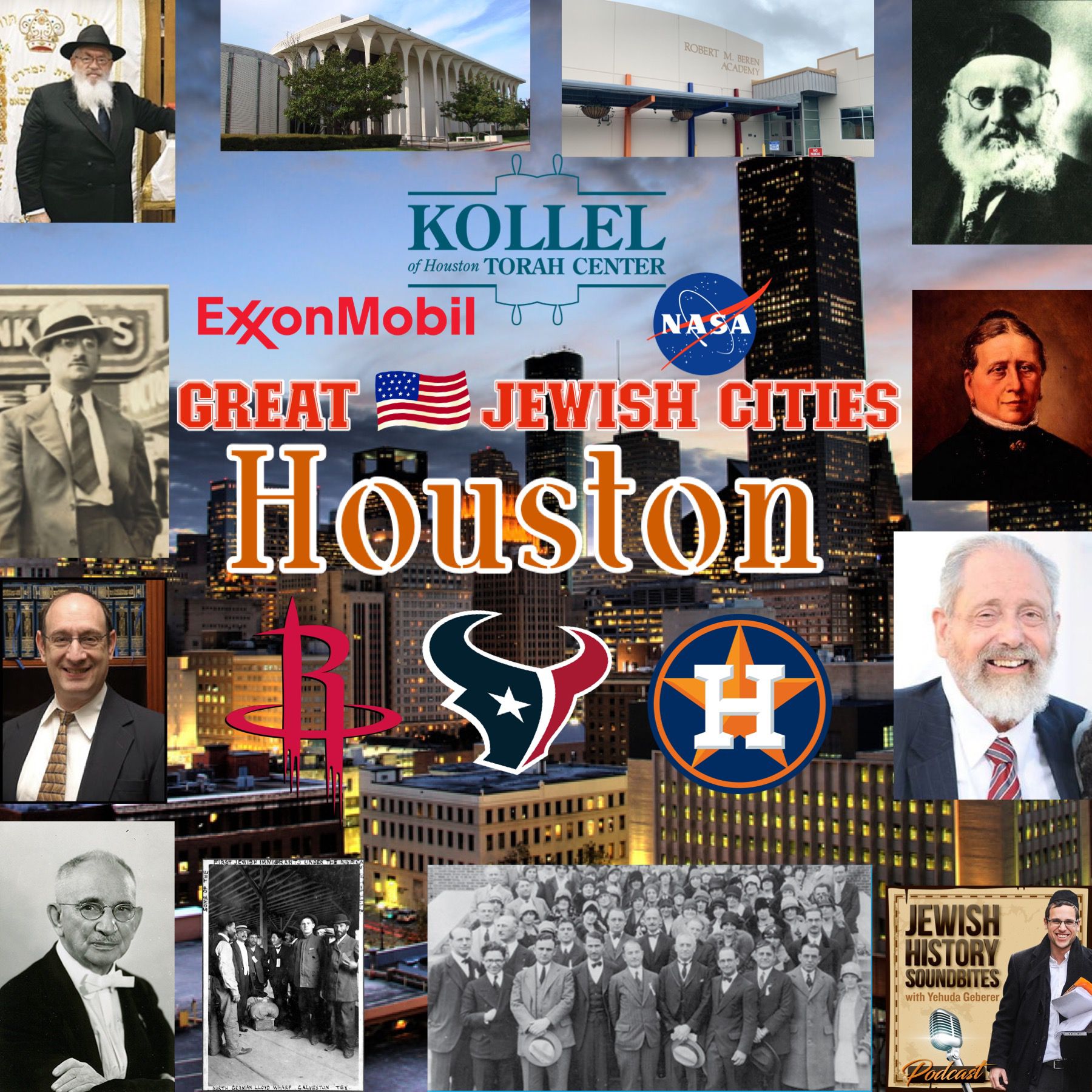
In this second installment on the Jewish history of Houston and South Texas, the renaissance of Orthodox through the pioneering efforts of Rabbi Joseph Radinsky of the United Orthodox Synagogue, Rabbi Shimon Lazaroff of Chabad and Rabbi Yehoshua Wender of the Young Israel of Houston. The development of air conditioning led to a population explosion in Houston in 1960’s, and the S&L scandal led to its reduction in the late 80’s. Nevertheless, institutions were built, schools grew and a Kollel was founded in recent times as well. 40 miles to the west lies the town of Hempstead. Its rise and decline as a Jewish community is through the story of the Schwartz family and its patriarch Rabbi Chaim Schwartz. The port of Galveston was home to a prestigious community, as well as the oldest established Jewish community in Texas. With Rabbi Henry Cohen’s arrival in 1888, he’d leave his imprint on Texas and American Jewish history through his activities over the ensuing more than six decades. The most prominent role played by Galveston was with the ‘Galveston Plan’, an attempt to reroute Eastern European Jewish immigrants to Galveston due to the overcrowding of New York. With a direct Bremen-Galveston route in place, over 10,000 Jews arrived in the port between the years 1907-1914. For sponsorship opportunities about your favorite topics of Jewish history contact Yehuda at: [email protected] Subscribe To Our Podcast on: PodBean: https://jsoundbites.podbean.com/ Follow us on Twitter or Instagram at @Jsoundbites You can email Yehuda at [email protected]
Ep 308Great American Jewish Cities #23: Houston Part I
Jewish roots in southern Texas precede the Civil War. Jewish communities emerged in Houston, Galveston and other cities and towns across the Texan frontier. As commerce developed in the second half of the 19th century, the Jewish population grew and established synagogues. From the Reform Beth Israel - which started out as Orthodox - to the Orthodox Adath Israel, the immigrants from Germany and later Eastern Europe left an imprint on Jewish and general Houston society. Rabbi Yaakov Geller was a rabbi from Galicia, and Max Goodman was a shochet from Lithuania. Pioneers in recent history include the United Orthodox Synagogue of Rabbi Joseph Radinsky, Rabbi Shimon Lazaroff with Chabad and Rabbi Yehoshua Wender of the Young Israel of Houston. As South Texas’s Jewish history is explored, Houston, Galveston and other towns play their part in the unfolding Jewish story. For sponsorship opportunities about your favorite topics of Jewish history contact Yehuda at: [email protected] Subscribe To Our Podcast on: PodBean: https://jsoundbites.podbean.com/ Follow us on Twitter or Instagram at @Jsoundbites You can email Yehuda at [email protected]
Ep 307Romanian Revival: Interwar Romanian Rabbinical Leadership
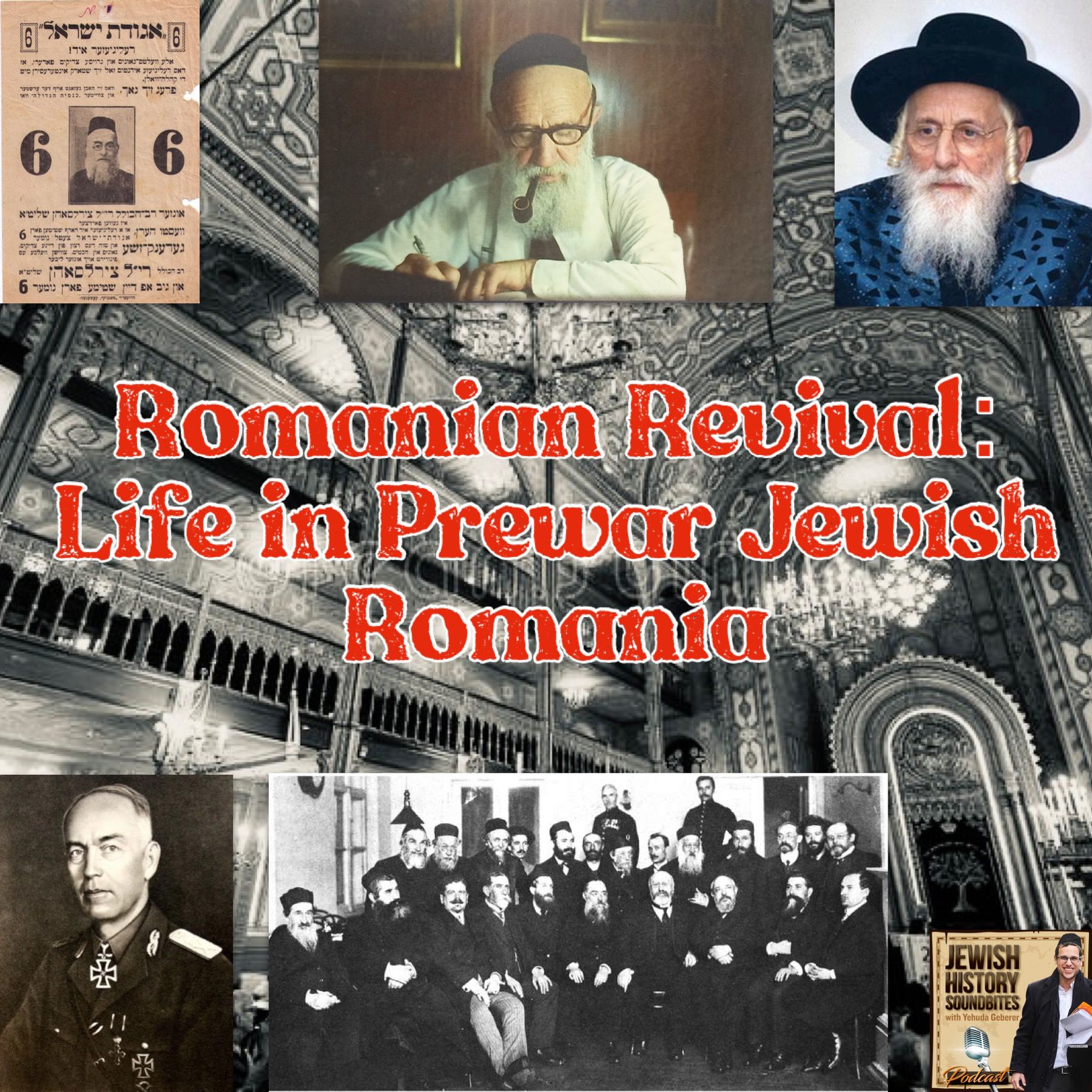
Rav Yehuda Leib Tzirelson (1859-1941) and his younger compatriot Rabbi Moshe Yosef Rubin (1895-1980), were but two examples of the unique rabbinical leadership enjoyed by the Romanian Jewish community during the tumultuous first half of the 20th century. With the outer districts of Bukovina and Bessarabia being absorbed into the new nationalistic and increasingly anti Semitic Romania, it took courageous leadership to provide an anchor of tradition during that time period. What made the story even more unique was their leadership in the Romanian Agudas Yisroel organization, while maintaining Zionistic positions on settlement of the Land of Israel and the future founding of a State. Rabbi Rubin was able to escape to Bucharest following the war's outbreak and continued his rescue activities and Agudah leadership from the capital. Following the war, he immigrated to the United States, where he later founded the Geder Avos organization to protect and maintain Jewish cemeteries in Europe. For sponsorship opportunities about your favorite topics of Jewish history contact Yehuda at: [email protected] Subscribe To Our Podcast on: PodBean: https://jsoundbites.podbean.com/ Follow us on Twitter or Instagram at @Jsoundbites You can email Yehuda at [email protected]

Ep 306Sale or No Sale? Shemitah in Modern Times Part II
With the passing of Rav Yitzchak Elchanan Spektor in 1896, his true opinion of the 'Heter Mechira' which he had authored became a matter of everlasting dispute. In the ensuing shmittah years, other rabbis weighed in on the issue, with some supporting the heter mechira, while others remained opposed. With the rise of settlements during the Second Aliyah in the early 1900's, as well as the more secular nature of the colonists, the shmittah issue came to the fore again with the upcoming shmittah year of 1910. Rav Yaakov Dovid Wilovsky - the Ridbaz - was the most vocal opponent of the heter mechira, and he disputed the then rabbi of Yaffo, Rav Avraham Yitzchak Kook. This sharp dispute defined the heter mechira issue during that year, though the two maintained a close personal friendship. For sponsorship opportunities about your favorite topics of Jewish history contact Yehuda at: [email protected] Subscribe To Our Podcast on: PodBean: https://jsoundbites.podbean.com/ Follow us on Twitter or Instagram at @Jsoundbites You can email Yehuda at [email protected]

Ep 305Land on Sabbatical: Shemitah in Modern Times Part I
With the onset of the First Aliyah in the 1880's, and the beginnings of Jewish agricultural settlements as a result, the issue of how to observe Shmita came to the fore. Most of the original colonies were funded and managed by Baron Edmund De Rothschild, and he and his managers weren't too keen on having the farmers disengage from agricultural activities for an entire year. The leaders of the Chovevei Zion movement sought a way to resolve the issue and the original 'Heter Mechira' was formulated. With the tacit support of Rav Yitzchak Elchanan Spektor, the land was sold to a non-Jew for the duration of the shmita year. Most of the colonies availed themselves of the Heter Mechira. The Ekron-Mazkeret Batya settlement decided to follow the ruling of the Jerusalem rabbinate and observe shmita in its ideal form. The Baron and his managers saw this as a revolt, and accused them of being lazy, but they held steadfast. The ensuing tension and struggle would set the stage for both shmita observance as well as the overall religious-secular tensions of the Yishuv for decades to come. For sponsorship opportunities about your favorite topics of Jewish history contact Yehuda at: [email protected] Subscribe To Our Podcast on: PodBean: https://jsoundbites.podbean.com/ Follow us on Twitter or Instagram at @Jsoundbites You can email Yehuda at [email protected]

Ep 304The Chant of Torah: The Life of Rav Naftali Trop
Having gained fame as the Radin Yeshiva, as well as immortality through his Torah which is still studied worldwide, Rav Naftali Trop (1871-1928) was an important Torah leader who left an impact on the pre war yeshiva world of Eastern Europe. A product of Slabodka and Kelm, he brought Talmudic scholarship as well as the mussar movement to his students. Imparting life lessons by personal example, Rav Naftali was a caring individual who took responsibility for others beyond the walls of the yeshiva as well. Though his untimely passing in his 50's brought an end to a life of teaching Torah, his family and students continued his legacy for years to come. For sponsorship opportunities about your favorite topics of Jewish history contact Yehuda at: [email protected] Subscribe To Our Podcast on: PodBean: https://jsoundbites.podbean.com/ Follow us on Twitter or Instagram at @Jsoundbites You can email Yehuda at [email protected]
Ep 303Crisis Management: The Great Crisis of the Chassidic Movement
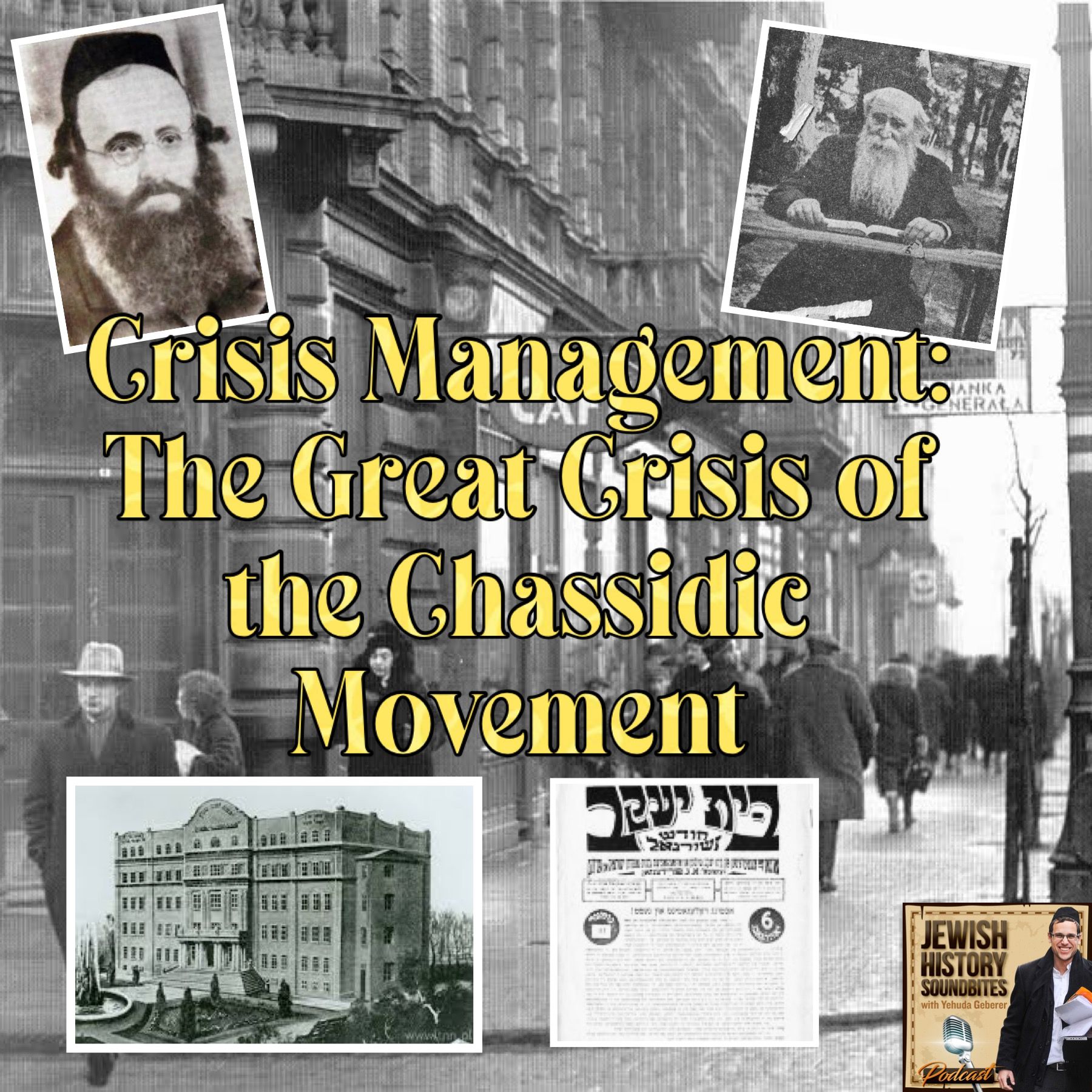
Modern times brought a host of challenges to the Chassidic movement in the closing decades of the 19th century and intensified in the 20th. World War One and the havoc that it wreaked led to a full blown crisis. Demographically the chassidic movement began to decline in numbers for the first time in its history. Urbanization transformed the chassidic experience and the interaction between the Rebbe and his followers. The Russian Revolution left the chassidic heartland and birthplace of the movement behind the Iron Curtain. Immigration to the west and United States loosened the affiliation of the immigrants to the courts. This crisis was met courageously by chassidic leaders in a variety of creative ways. A renewed focus on education led to the establishment of yeshivos, and even girls' education was encouraged for the first time. Spiritual renewal was seen in courts such as the Piacezna Rebbe Rav Klonymous Kalman Shapira. Involvement in politics and using the media became more common. And a stronger shift towards traditionalism became the most recognizable and long lasting effect on the movement across the entire chassidic society. Emphasis on a uniform form of dress to promote a collective identity, became perhaps the most recognizable manifestation of this new way of closing the ranks in a changing, increasingly urban society. This episode is sponsored by Alephbeta.org . Filled with stunningly animated videos and audios on the parsha, holidays, prayers, and more. Their goal is to help people discover the beauty of Torah and add to its meaning and relevance. Their programs on the yomim tovim will leave you moved, inspired and with a new understanding of the significance of these holy days. Listeners of Jewish History Soundbites for a limited time will receive the gift of Koren’s brand new, flexcover Tanach. To get your free gift today, go to Alephbeta.org and enter coupon code freetanach when you subscribe to an annual premium membership. Hurry, offer ends September 30th! For sponsorship opportunities about your favorite topics of Jewish history contact Yehuda at: [email protected] Subscribe To Our Podcast on: PodBean: https://jsoundbites.podbean.com/ Follow us on Twitter or Instagram at @Jsoundbites You can email Yehuda at [email protected]

Ep 302The Chofetz Chaim & His Attempts to Move to the Holy Land
Rav Yisrael Meir of Radin, better known as the Chofetz Chaim (1838-1933), is one of the most beloved historical figures in recent memory. His storied life convers many aspects, and in this episode the focus is on the saga of his attempts at immigrating to the Land of Israel. While yearning to move there for many years, he laid practical plans to carry it out as well. Over the course of a half a century, several attempts were made but none brought to fruition. In 1925 his bags were packed and a home was even purchased for him in Petach Tikvah, but again it didn't work out. Check out additional Jewish History Soundbites Chofetz Chaim related episodes: 1. https://jsoundbites.podbean.com/e/simplicity-complexity-enormity-the-family-of-the-chofetz-chaim/ 2. https://jsoundbites.podbean.com/e/the-chofetz-chaim-myths-abound/ 3. https://jsoundbites.podbean.com/e/a-historic-campaign-the-chofetz-chaim-sefer-torah/ This episode is sponsored by 20+ minute daf with Shaul Greenwald. Maseches Beitzah begins on Thursday, so join in to a clear, concise and geshmak Daf Yomi Shiur. https://www.20minutedaf.com/ https://www.torahanytime.com/#/speaker?l=619 For sponsorship opportunities about your favorite topics of Jewish history contact Yehuda at: [email protected] Subscribe To Our Podcast on: PodBean: https://jsoundbites.podbean.com/ Follow us on Twitter or Instagram at @Jsoundbites You can email Yehuda at [email protected]

Ep 301On the Way to Canaan's Land: The Five Aliyot to Palestine
Known to history as the five waves of 'Aliyah', immigration to the Land of Israel, the late 19th and early 20th century saw a slow but steady stream of Jewish immigration which laid the foundations of what later become the State of Israel. These waves of immigration were part of a larger trend of general and specifically Jewish immigration to the west during this time. The first aliyah was a product of the Chovevei Zion movement and established the first agricultural colonies. The second aliyah was a result of the nascent Zionist movement and beginning of the socialist and nationalistic nature of the immigration. On the heels of World War I and the Balfour Declaration came the third aliyah, a very idealistic and nationalistic wave of immigrants who established many of the early kibbutzim. The fourth aliyah was primarily from Poland and was more urban in nature, while the fifth was largely a result of the Nazi rise to power in Germany and included many German Jewish refugees. This episode is sponsored by Beis Medrash Mevakshei Emes of the Mishkafayim neighborhood in Bet Shemesh in honor of their current fundraising campaign. Join at cmatch.me/Bmme For sponsorship opportunities about your favorite topics of Jewish history contact Yehuda at: [email protected] Subscribe To Our Podcast on: PodBean: https://jsoundbites.podbean.com/ Follow us on Twitter or Instagram at @Jsoundbites You can email Yehuda at [email protected]
Ep 300Architect of American Orthodoxy: The Life & Times of Mike Tress Part II
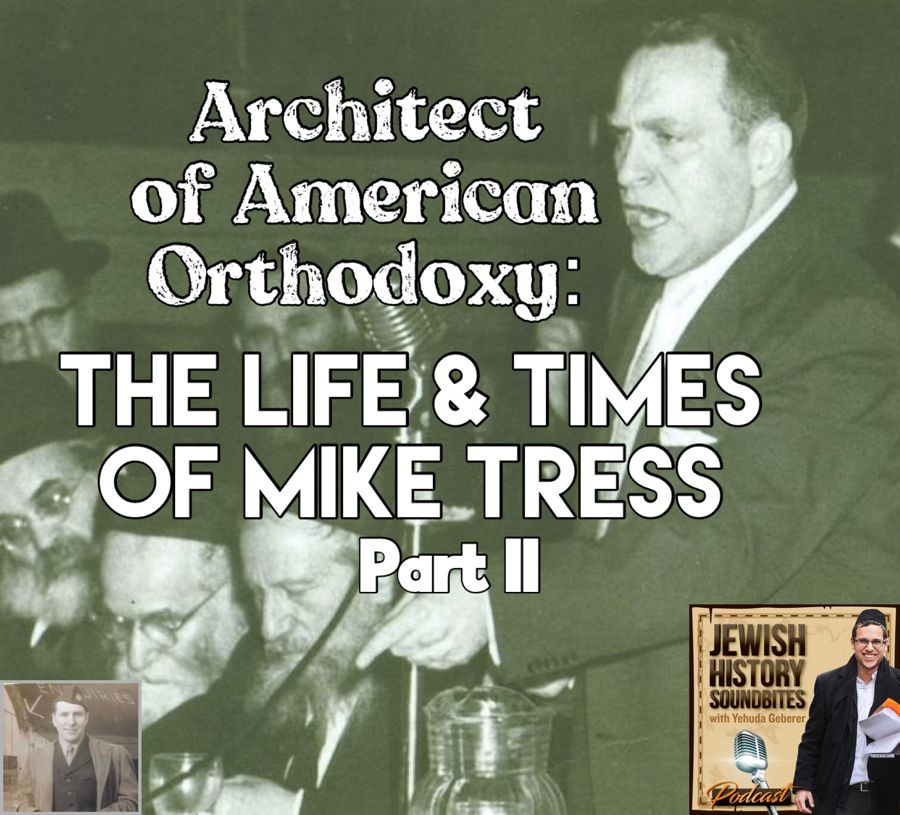
He was a clean shaven, American born, public school educated, successful businessman. And he was also the architect of American Orthodoxy and a leading rescue activist during the dark years of the Holocaust. Mike Tress (1909-1967) grew up as an orphan in Williamsburg. Joining the nascent Zeirei Agudas Yisroel organization, he soon emerged as its leader, giving it a sense of mission and purpose. Spearheading shabbos campaigns, activating Pirchei and Bnos chapters, and founding Camp Agudah in the midst of a world war and rescue work, are just some of the projects which he initiated to promote Orthodoxy in the United States. His encounter with Rav Elchonon Wasserman during the latter's trip to the country in 1938 defined his life mission, and reverence for Torah leaders became part of his essence which he then imparted to his young charges. Perhaps the most fateful chapter of his storied career was his endless attempts at rescue work in the years preceding, during and following the war. Obtaining visas for refugees, raising funds for rescue and complete devotion to rebuilding both physically and spiritually following liberation, while personally commiserating with every individual and feeling their pain. Having sold his business and used all of his assets for communal work, he was truly an individual who lived his life to help others. For sponsorship opportunities about your favorite topics of Jewish history contact Yehuda at: [email protected] Subscribe To Our Podcast on: PodBean: https://jsoundbites.podbean.com/ Follow us on Twitter or Instagram at @Jsoundbites You can email Yehuda at [email protected]

Ep 299Architect of American Orthodoxy: The Life & Times of Mike Tress Part I
He was a clean shaven, American born, public school educated, successful businessman. And he was also the architect of American Orthodoxy and a leading rescue activist during the dark years of the Holocaust. Mike Tress (1909-1967) grew up as an orphan in Williamsburg. Joining the nascent Zeirei Agudas Yisroel organization, he soon emerged as its leader, giving it a sense of mission and purpose. Spearheading shabbos campaigns, activating Pirchei and Bnos chapters, and founding Camp Agudah in the midst of a world war and rescue work, are just some of the projects which he initiated to promote Orthodoxy in the United States. His encounter with Rav Elchonon Wasserman during the latter's trip to the country in 1938 defined his life mission, and reverence for Torah leaders became part of his essence which he then imparted to his young charges. Perhaps the most fateful chapter of his storied career was his endless attempts at rescue work in the years preceding, during and following the war. Obtaining visas for refugees, raising funds for rescue and complete devotion to rebuilding both physically and spiritually following liberation, while personally commiserating with every individual and feeling their pain. Having sold his business and used all of his assets for communal work, he was truly an individual who lived his life to help others. For sponsorship opportunities about your favorite topics of Jewish history contact Yehuda at: [email protected] Subscribe To Our Podcast on: PodBean: https://jsoundbites.podbean.com/ Follow us on Twitter or Instagram at @Jsoundbites You can email Yehuda at [email protected]

Ep 298A Guiding Light: The Life of the Chazon Ish Part II
Rav Avraham Yeshaya Karelitz (1878-1953) known by his magnum opus the Chazon Ish, was indisputably one of the greatest Torah leaders of the 20th century. In this second installment about his life, achievements and influence, the period of his residence in Vilna is examined. During his thirteen years in the 'Jerusalem of Lithuania', he formed a close relationship with Rav Chaim Ozer Grodzinski, who often sought his advice on a myriad of issues. The Chazon Ish also studied with young students, and developed some interesting relationships, most notably with the future noted Yiddish writer Chaim Grade. In 1933 the Chazon Ish moved to Palestine, where he settled in the new yishuv of Bnei Brak. It was at this stage that he began to take on a more public leadership role, initiating local projects in the area. For sponsorship opportunities about your favorite topics of Jewish history contact Yehuda at: [email protected] Subscribe To Our Podcast on: PodBean: https://jsoundbites.podbean.com/ Follow us on Twitter or Instagram at @Jsoundbites You can email Yehuda at [email protected]

Ep 297Mussar Makes a Mir Debut
The Mussar Movement was promulgated by Rav Yisrael Salanter in the mid 19th century, as an attempt to bring ethical standards of conduct to the forefront of national consciousness. In the closing decades of the century, Rav Nosson Tzvi Finkel, the Alter of Slabodka, incorporated the ideas of mussar into an educational philosophy which would become part of the curriculum of the great Lithuanian style yeshivos. In 1907, the Mir Yeshiva decided to associate with the mussar movement and hired its first Mashgiach, Rav Zalman Dolinsky. In the years leading up to World War One, Rav Yerucham Levovitz served a first stint in the position as well. Following the Yeshiva's return from its imposed exile, it continued to be associated with the ideals of the mussar movement and hired mashgichim to oversee the ethical growth of its student body. A loose association developed into the essence of the Yeshiva's identity with the return of Rav Yerucham in 1924. It was then that the yeshiva entered its 'Golden Age', and Rav Yerucham's charismatic personality and unique mussar philosophy made the yeshiva central to the mussar ideals in the years preceding the Holocaust. For sponsorship opportunities about your favorite topics of Jewish history contact Yehuda at: [email protected] Subscribe To Our Podcast on: PodBean: https://jsoundbites.podbean.com/ Follow us on Twitter or Instagram at @Jsoundbites You can email Yehuda at [email protected]

Ep 296From Cromwell to Montefiore: The Jews of London Part II
Following the Edict of Expulsion in 1290, no organized Jewish life existed in England for centuries. Following the Spanish Expulsion in 1492, a few Conversos secretly settled in England under a Christian identity. The official resettlement of Jews in England commenced with the negotiations held between Menashe ben Israel and Oliver Cromwell in the 1650's. Though allowed to unofficially resettle in England, full emancipation wasn't achieved until 1858. Prominent Jews of the 19th century included the Rothschild family, Moses Montefiore and Benjamin Disreali, who though born Jewish, was baptized at the age of 12. The Sephardic community of London achieved prominence and influence with the founding of the Bevis Marks Synagogue, the longest continuously in use synagogue in Europe. An early prominent rabbi was Hacham David Nieto. The Ashkenazi community built the Great Synagogue of London. Listen to Part I here: https://jsoundbites.podbean.com/e/british-royals-baalei-tosfos-blood-libels-the-story-of-london-part-i/ For sponsorship opportunities about your favorite topics of Jewish history contact Yehuda at: [email protected] Subscribe To Our Podcast on: PodBean: https://jsoundbites.podbean.com/ Follow us on Twitter or Instagram at @Jsoundbites You can email Yehuda at [email protected]

Ep 295A Moroccan Legacy: Rav Yitzchak Ibn Walid
One of the greatest leaders of the Moroccan Jewish community in the 19th century was Rav Yitzchak Ibn Walid (1777-1870). The Jewish community of Tetuan was founded by Spanish exiles and saw commercial success over the coming centuries. Despite his reluctance to assume a rabbinical position, Rav Ibn Walid was appointed rabbi of Tetuan in 1830 and led the community until his passing four decades later. As a noted halachic posek he corresponded with rabbis across the Sephardic world, much of it published in his magnum opus Vayomer Yitzchak. As a leader of his community, he cared especially for the poor, the downtrodden and orphans. For more on the customs and traditions of Moroccan Jewry check out the newly published book Magen Avot Daily Halachah published by Mosaica Press. You can check it out on Amazon: https://www.amazon.com/dp/1639723064?ref=myi_title_dp or on the publisher's website: https://mosaicapress.com/product/magen-avot-daily-halachah/ You can also check out more seforim on Moroccan Halacha and minhagim on moroccanhalacha.com For sponsorship opportunities about your favorite topics of Jewish history contact Yehuda at: [email protected] Subscribe To Our Podcast on: PodBean: https://jsoundbites.podbean.com/ Follow us on Twitter or Instagram at @Jsoundbites You can email Yehuda at [email protected]
Ep 294From Poland to Petach Tikva: The Lomza Yeshiva Part II
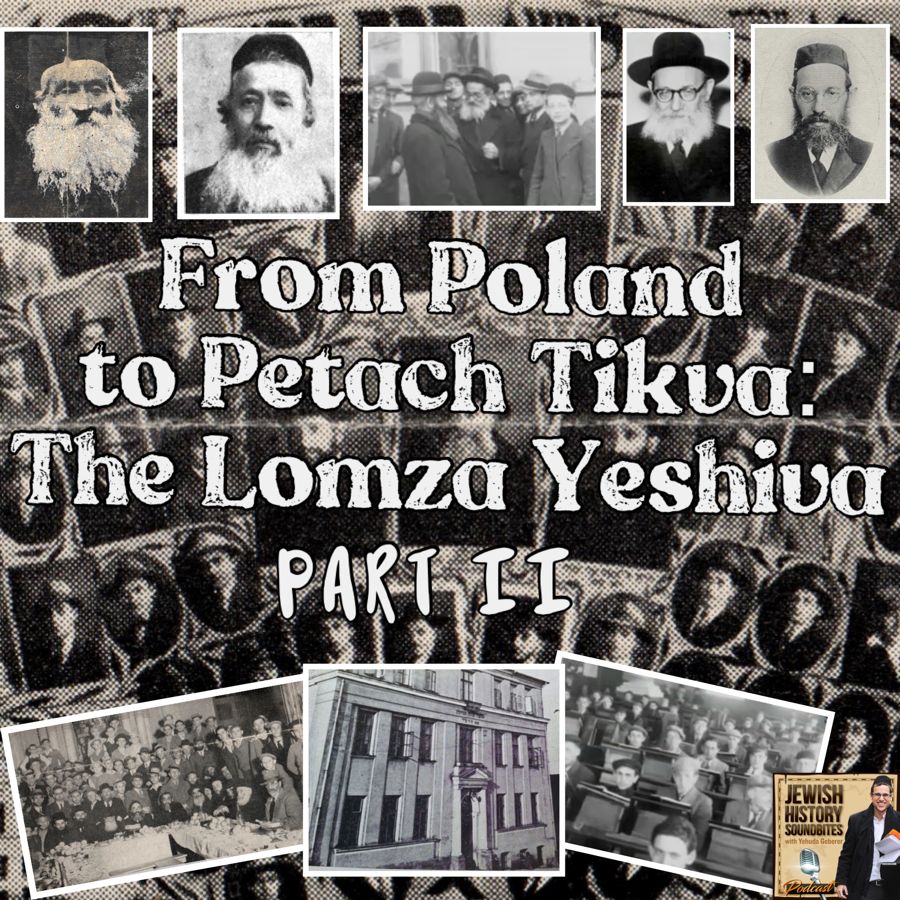
The Lomza Yeshiva in Poland and later in Petach Tikva, Israel, was unique in many respects. Founded in 1883 by a student of Rav Yisrael Salanter named Rav Eliezer Shulevitz, it was the first Lithuanian style yeshiva in the area of chassidic Poland. In its heyday, the majority of its students would come from chassidic backgrounds. With its expansion, his capable sons in law took over - Rav Yechiel Mordechai Gordon, Rav Yehoshua Zelig Roch and Rav Moshe Leib Ozer. The latter's son Rav Eliezer Ozer, ran the Kollel in Lomza Petach Tikva until his recent passing. The famed mashgiach Rav Moshe Rosenstein left a big impact on the yeshiva's growth and education during the interwar period. Rav Yechiel Mordechai Gordon led the yeshiva, and spent much time in the United States fundraising on its behalf, before eventually settling in Petach Tikva in 1950. In 1926, Lomza took the pioneering step in opening a branch of the yeshiva in Palestine, and the building on Rechov Herzl in Petach Tikva was dedicated in 1930. This would be the premier institution of Torah learning in the Land of Israel in the coming decades. For sponsorship opportunities about your favorite topics of Jewish history contact Yehuda at: [email protected] Subscribe To Our Podcast on: PodBean: https://jsoundbites.podbean.com/ Follow us on Twitter or Instagram at @Jsoundbites You can email Yehuda at [email protected]

Ep 293From Poland to Petach Tikva: The Lomza Yeshiva Part I
The Lomza Yeshiva in Poland and later in Petach Tikva, Israel, was unique in many respects. Founded in 1883 by a student of Rav Yisrael Salanter named Rav Eliezer Shulevitz, it was the first Lithuanian style yeshiva in the area of chassidic Poland. In its heyday, the majority of its students would come from chassidic backgrounds. With its expansion, his capable sons in law took over - Rav Yechiel Mordechai Gordon, Rav Yehoshua Zelig Roch and Rav Moshe Leib Ozer. The latter's son Rav Eliezer Ozer, ran the Kollel in Lomza Petach Tikva until his recent passing. The famed mashgiach Rav Moshe Rosenstein left a big impact on the yeshiva's growth and education during the interwar period. Rav Yechiel Mordechai Gordon led the yeshiva, and spent much time in the United States fundraising on its behalf, before eventually settling in Petach Tikva in 1950. In 1926, Lomza took the pioneering step in opening a branch of the yeshiva in Palestine, and the building on Rechov Herzl in Petach Tikva was dedicated in 1930. This would be the premier institution of Torah learning in the Land of Israel in the coming decades. For sponsorship opportunities about your favorite topics of Jewish history contact Yehuda at: [email protected] Subscribe To Our Podcast on: PodBean: https://jsoundbites.podbean.com/ Follow us on Twitter or Instagram at @Jsoundbites You can email Yehuda at [email protected]

Ep 292Leader Among Peers: Rav Chaim Ozer Grodzinski at Rabbinical Conferences
Rav Chaim Ozer Grodzinski (1863-1940) was one of the greatest rabbinic leaders of the 20th century. A recent book by Rabbi Dovid Kamenetsky profiles some of the aspects of his leadership of Russian and world Jewry through the first decade of the century. One of the highlighted facets of his activities is his dominant role in various rabbinical conferences between the years 1907-1910. There was the attempt to establish the Knesses Yisrael organization, which was the first ever attempt at the organization of traditional Jewry in Russia. Then there was the Vilna conference of 1909, which was a preliminary meeting to the rabbinical commission in St. Petersburg which was to be called by the Czarist government the following year. Also in 1909 was the Bad Homburg conference, which laid the foundation for the founding of Agudas Yisroel. Finally there was the famous rabbinical conference in St. Petersburg in 1910. In all of these gatherings, Rav Chaim Ozer's organizational ability, leadership and practical approach led him to be one of the central figures at each subsequent meeting. This firmly established him as one of the primary leaders of Russian Jewry. Related Episodes: https://jsoundbites.podbean.com/e/a-father-to-his-people-r-chaim-ozers-leadership-in-turbulent-times/ https://jsoundbites.podbean.com/e/scholar-statesman-rav-meir-simcha-and-the-1910-conference-in-st-petersburg/ This episode has been sponsored by Genazym Auction House. Join the auction this coming Wednesday, July 28, 2021. Check out the catalogue at www.genazym.com , for fascinating artifacts of Jewish history. Questions or details contact Genazym - https://bit.ly/Genazym10full [email protected] Or at: +1-845-826-1645 , 845-501-9990 For sponsorship opportunities about your favorite topics of Jewish history contact Yehuda at: [email protected] Subscribe To Our Podcast on: PodBean: https://jsoundbites.podbean.com/ Follow us on Twitter or Instagram at @Jsoundbites You can email Yehuda at [email protected]

Ep 291In the City of Death: The 1903 Kishinev Pogrom
Special Tisha Ba'av Episode The 1903 Kishinev Pogrom was a tragic massacre, with reverberations within the wider Jewish world remaining until this very day. Goaded on by anti-Semitic newspapers with cries of 'Death to the Jews', a blood libel was fabricated and a mob was unleashed on Easter Sunday, April 19, 1903. Leaving 49 killed, hundreds maimed and injured in its wake, Jewish property was destroyed and looted as well. Claims of complicity of the police and government were voiced in many quarters. But it was primarily the after effects of this pogrom which had a long term transformative effect on Jewish society in Russia and worldwide. The great immigration to the United States was already long underway, but it significantly intensified in the years following Kishinev and the subsequent 1905 revolution. American Jewry was galvanized to assist the victims, and this cemented the relationship US Jewry was to have with their brethren back in Eastern Europe. Within Russia, many of the Jewish youth became radicalized as a result of the massacre, joining clandestine revolutionary organizations with the goal of overthrowing the Czar. The most profound impact was felt within the nascent Zionist movement. Chaim Nachman Bialik was dispatched by the historian Shimon Dubnow to gather testimonies from survivors. Following his five week stay in Kishinev, Bialik penned 'Be'ir Hahareiga' - In the City of Death, a poem about the pogrom. Powerfully written, it also included strongly worded accusations in regards to the perceived passivity of the victims. The poem and its message was to have an immense impact, as it was published and translated and became immensely popular. Vladimir Jabotinsky's conclusion was to organize Jewish self defense, and Theodore Herzl's conclusion was the Uganda proposal at the Sixth Zionist Congress. The shadow of the Kishinev tragedy was to hover over the many subsequent, and ever greater tragedies of the bloody 20th century. For sponsorship opportunities about your favorite topics of Jewish history contact Yehuda at: [email protected] Subscribe To Our Podcast on: PodBean: https://jsoundbites.podbean.com/ Follow us on Twitter or Instagram at @Jsoundbites You can email Yehuda at [email protected]

Ep 290From Brisk to Beitar: The Life of Menachem Begin Part I
One of the most influential leaders in the history of the State of Israel, Menachem Begin (1913-1992) led a very colorful life and career. Though known for his public persona, he was a very complex character who faced many setbacks at every stage. Growing up in a somewhat traditional home in Brisk, he later joined the Beitar movement of Revisionist Zionism led by Vladimir (Zev) Jabotinsky. Arrested by the Soviets in the early part of the war, he was sentenced to slave labor in Siberia. In the interim, the Holocaust arrived in Brisk, and most of his family became its victims. The long shadow of anti-Semitism and the Holocaust would accompany him throughout his decades of public service, and would impact his decisions as a leader of both the underground and later as a politician. He emerged as the leader of the underground organization Etzel (Irgun), with the stated goal of forcing the British out of Palestine. With the founding of the State of Israel, he spent three decades in the opposition, leading campaigns against the reparations agreement with West Germany and the like, until finally winning the elections in 1977. Though he accomplished much as prime minister, including a historic peace treaty with Egypt, the unfolding disaster of the Lebanon War led to his retirement and ultimate seclusion during his later years. For sponsorship opportunities about your favorite topics of Jewish history contact Yehuda at: [email protected] Subscribe To Our Podcast on: PodBean: https://jsoundbites.podbean.com/ Follow us on Twitter or Instagram at @Jsoundbites You can email Yehuda at [email protected]
Ep 289Gone, but not Forgotten: Obscure Chassidic Dynasties of Yesteryear
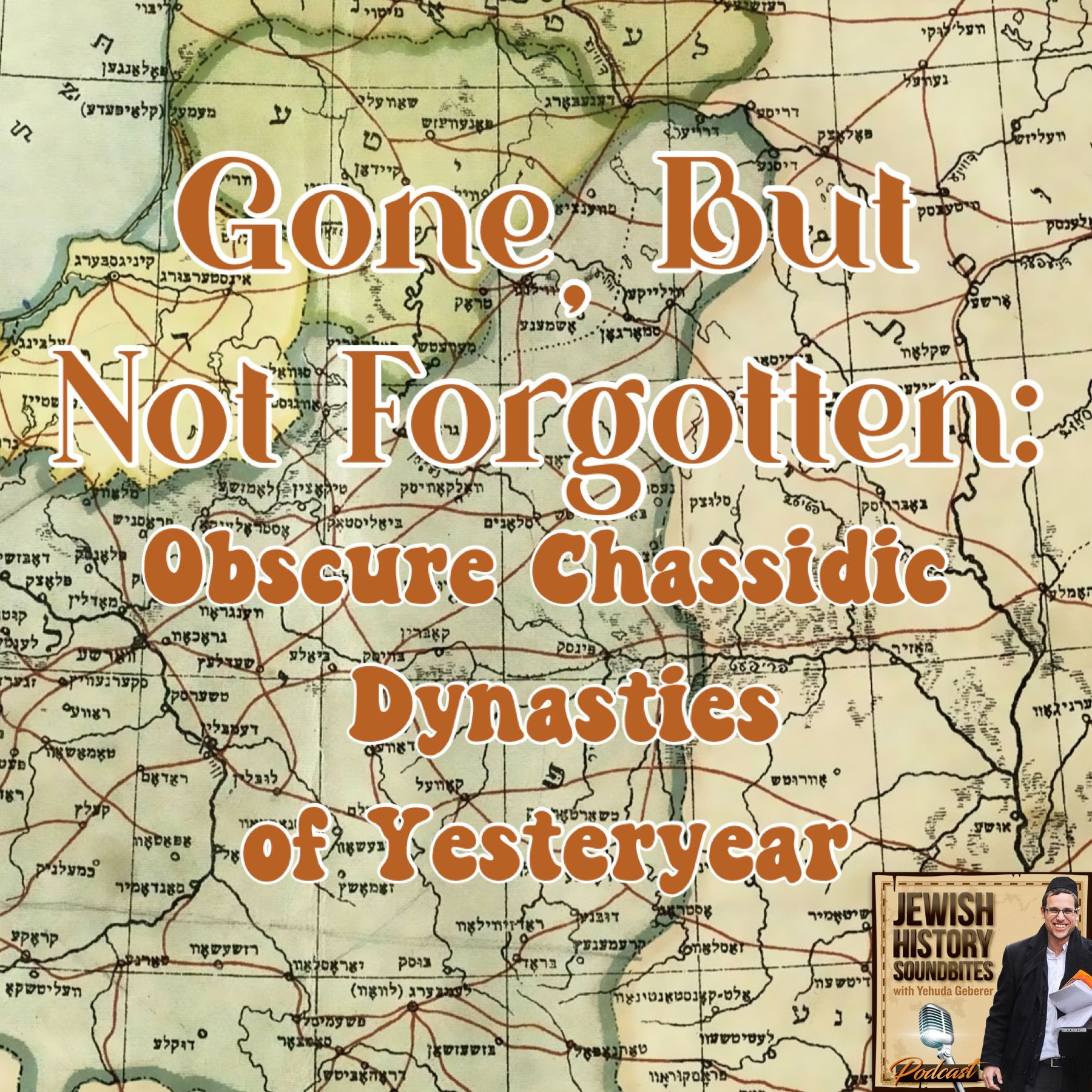
Smaller and lesser known Chassidic dynasties are almost entirely forgotten, as a result of their being almost entirely wiped out during the Holocaust. Each one had a following with a demographic and geographical reach and impact during centuries of their existence. And each one is a story. The Ungar family of the Dombrova dynasty, Shpikov was a branch of Skver, large ones like Melitz, Alexander and Radomsk are more obscure today as well. Some were large, some very small, some influential, while others made less of an impact. But each and every one formed a component of eastern European Chassidic life until the war. One of those was the Zabeltov dynasty, which was a branch of the Kossov dynasty, most famous through its Vizhnitz branch. Rav Dovid Hager (1797-1848) was a son of the founder of the Kossov dynasty Rav Menachem Mendel Hager. Having moved to the town of Zabeltov, he emerged as a charismatic leader of the region. His descendants continued in the town until the Holocaust. Almost the entire extended family along with their followers were tragically murdered by the Nazis during the Holocaust. For sponsorship opportunities about your favorite topics of Jewish history contact Yehuda at: [email protected] Subscribe To Our Podcast on: PodBean: https://jsoundbites.podbean.com/ Follow us on Twitter or Instagram at @Jsoundbites You can email Yehuda at [email protected]
Ep 288Great American Jewish Cities #22: Detroit Part I
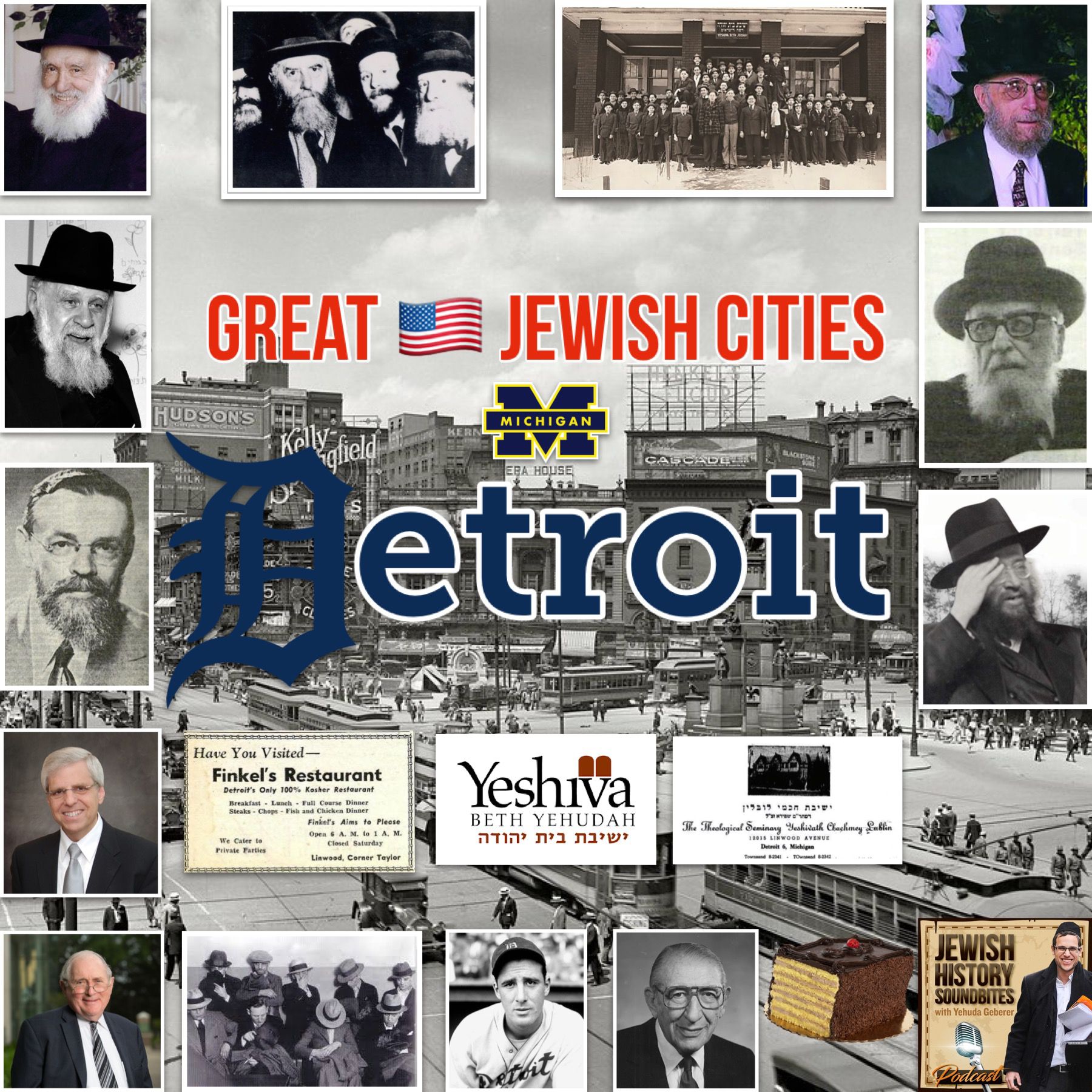
The rich Jewish history of the Motor City includes many fascinating institutions and individuals. From the early farming settlements in Michigan, to the immigrant communities of Detroit proper, this part one of a series on Detroit Jewish history will examine some of the personalities and their impact on the developing community. There was the interesting experiment of Yeshivas Chachmei Lublin of Detroit, which hosted one of the first Siyum Hashas celebrations in the United States. Rav Yehuda Leib Levin was an early rabbi who founded what was to become the Beth Yehuda school, eventually named for him. With the arrival of Rav Avraham Abba Friedman and later Rav Shalom Goldstein, Jewish education was transformed. With Rav Simcha Wasserman, later Rav Joseph Elias, Rav Shmuel Yerachmiel Kaufman and other legendary Detroit educators, the original Beth Yehuda spawned a Jewish education revolution which formed the basis of the community's growth in the coming decades. Following the war, Rav Leib Bakst of the Mir Yeshiva would arrive and stand at the helm of the yeshiva for the next 55 years. A student of Radin & Kelm, Rav Eliezer Levin later served as the rabbinical leader and architect of the city's Jewish infrastructure for decades as well. For sponsorship opportunities about your favorite topics of Jewish history contact Yehuda at: [email protected] Subscribe To Our Podcast on: PodBean: https://jsoundbites.podbean.com/ Follow us on Twitter or Instagram at @Jsoundbites You can email Yehuda at [email protected]

Ep 287Justice for All: The Incredible Story of Jacob Robinson
A relatively unknown, yet one of the most influential Jews of the 20th century, Jacob Robinson's (1889-1977) list of accomplishments are seemingly endless. After receiving his doctorate in law, he was drafted into the Czarist military with the outbreak of World War One. After spending three years in a German POW camp, he returned to the newly created independent Lithuania, where he emerged as a leading Zionist, politician, jurist, educator, writer and much more. First representing Jewish interests in the Lithuanian parliament, he soon reached the international stage, arguing for minorities rights in international platforms such as the League of Nations, and entering into an ill fated partnership with Weimar Germany to promote minorities rights. In his efforts to protect Jewish minority rights around the world, he was one of the founders of what would eventually become the World Jewish Congress in 1927. Escaping to the United States in 1940, he soon went to work formulating the legal basis for prosecution of Nazi war criminals post war, eventually serving as a special adviser to the prosecution at the Nuremberg trials. Seeing the failure of the tragic minorities rights saga of interwar Europe, he drafted the new principle of Human Rights, which led to the UN commission on Human Rights. He also assisted the nascent State of Israel with legal counsel at the UN and drafted the reparations agreement with West Germany, later overseeing the Claims Conference. In later years he was a pioneering Holocaust researcher, and was one of the founders of Yad Vashem. Finally, he served as the special legal counsel at the Eichmann trial in 1960, writing the legal basis for the prosecution. For sponsorship opportunities about your favorite topics of Jewish history contact Yehuda at: [email protected] Subscribe To Our Podcast on: PodBean: https://jsoundbites.podbean.com/ Follow us on Twitter or Instagram at @Jsoundbites You can email Yehuda at [email protected]
Ep 286Hail to the Chief: The Life & Leadership of Rav Eliezer Silver Part II
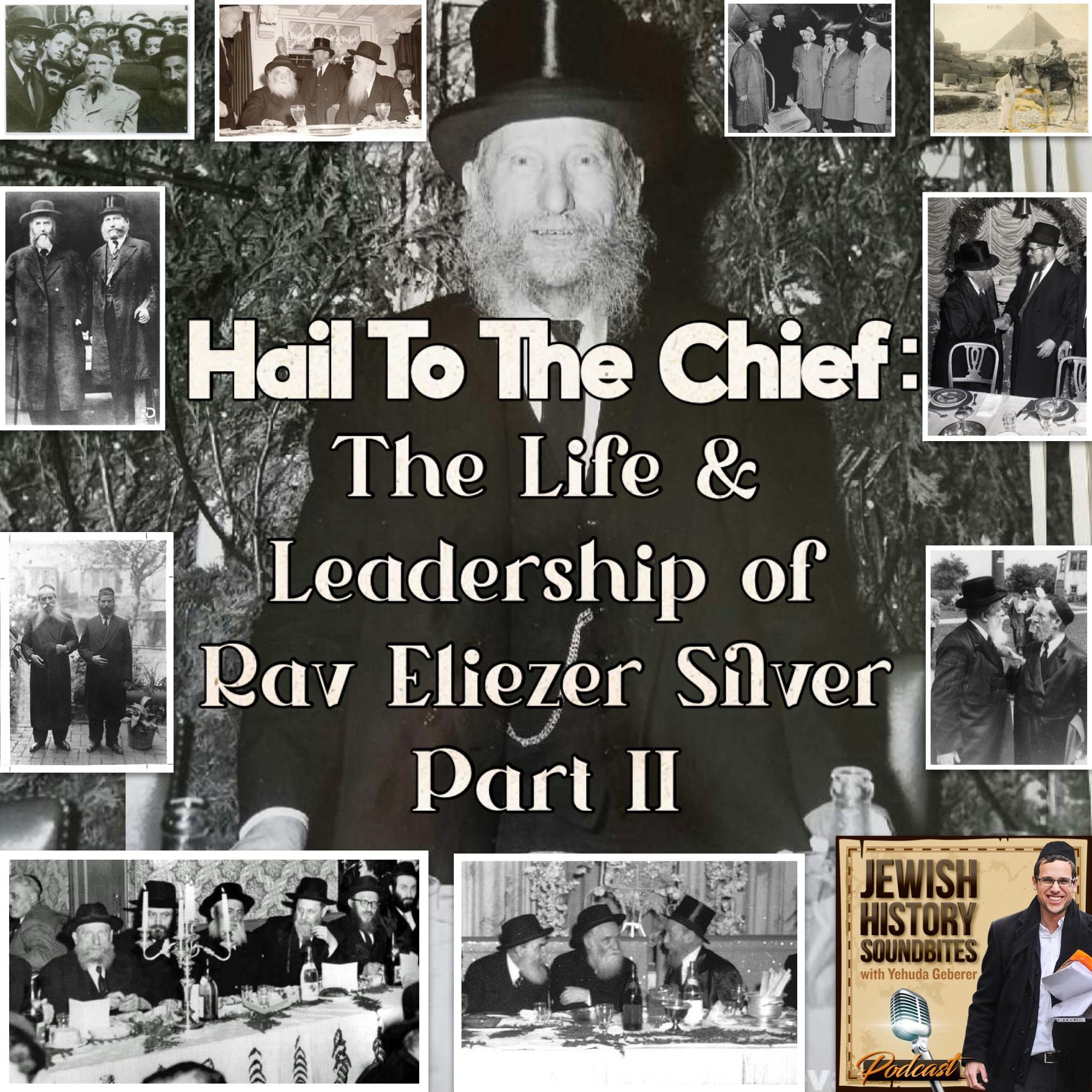
In this second installment on the incredible life and accomplishments of Rav Eliezer Silver (1886-1968), his rise in the rabbinic leadership in the United States is traced from his meeting with President Taft to his being in stranded in Europe during World War One, which led to the founding of Ezras Torah. One of the most active chapters of his activism was his founding of the Vaad Hatzalah and his myriad rescue efforts during the years of World War Two and the Holocaust. Rav Leizer Silver founded this rescue organization in November 1939 as a means of supporting refugee students in independent Lithuania. With the Soviet takeover of the Baltic States in the summer of 1940, he assisted the rabbis and yeshiva students in their attempts to obtain visas to escape from the hostile environment of the communist Soviet Union. Later the Vaad Hatzalah would support these students in exile in Siberia and Shanghai. With the Final Solution becoming clear to American Jewry in 1943, the Vaad Hatzalah expanded its efforts to become an all encompassing rescue organization. It was in the capacity of post war rehabilitation efforts that Rav Silver made his three month grueling visit to assist the survivors in the summer of 1946. This episode has been sponsored by Teach Coalition. To continue to be part of this movement - encouraging the community to vote or meeting with your elected officials visit teachcoalition.org today and join the movement. For sponsorship opportunities about your favorite topics of Jewish history contact Yehuda at: [email protected] Subscribe To Our Podcast on: PodBean: https://jsoundbites.podbean.com/ Follow us on Twitter or Instagram at @Jsoundbites You can email Yehuda at [email protected]
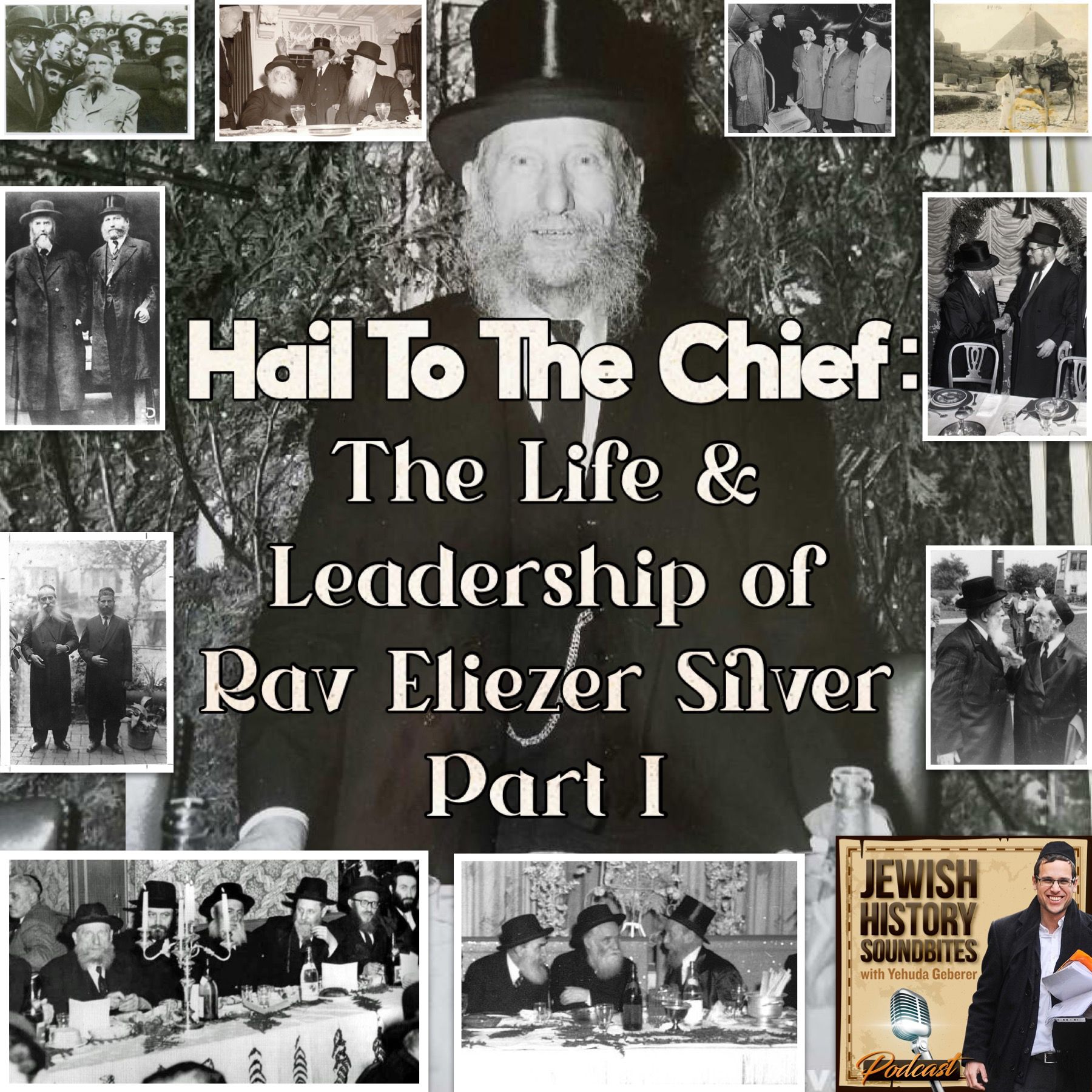
Ep 285Hail to the Chief: The Life & Leadership of Rav Eliezer Silver Part I
One of the architects or American Orthodoxy and perhaps the greatest Orthodox rabbinical leader in that country of the 20th century, Rav Eliezer Silver (1886-1968) had a decisive impact on Jewish life. Through his communal rabbinical leadership, his national leadership on the American scene, through the organizations which he spearheaded and ran for decades, and of course his myriad efforts on behalf of Eastern European Jewry. Having studied under Rav Chaim Ozer Grodzinski in Vilna, Rav Yosef Rosen the Rogatchover in Dvinsk and Rav Chaim Brisker in Brisk, he then immigrated to the United States at the peak of the great immigration in 1907. He'd later be president of the Agudas Harabbonim, founder of Ezras Torah, founder of Agudath Israel of America, founder and president of Vaad Hatzalah and a constant man of action for almost every Jewish, educational and rescue undertaking during his long career. Sponsored by: With the New York City election day today June 22, 2021, it’s time to drop the excuses and VOTE. When it comes to funding for our schools and communities, elected officials pay attention to the people who vote. It’s simple: If you're not voting, you don't have a voice. Make sure you vote on June 22! Have questions or need help with your voter plan? Call or email the Orthodox Union’s Teach NYS at (646) 459-5162 or email [email protected]. When you vote, elected officials take note. For sponsorship opportunities about your favorite topics of Jewish history contact Yehuda at: [email protected] Subscribe To Our Podcast on: PodBean: https://jsoundbites.podbean.com/ Follow us on Twitter or Instagram at @Jsoundbites You can email Yehuda at [email protected]
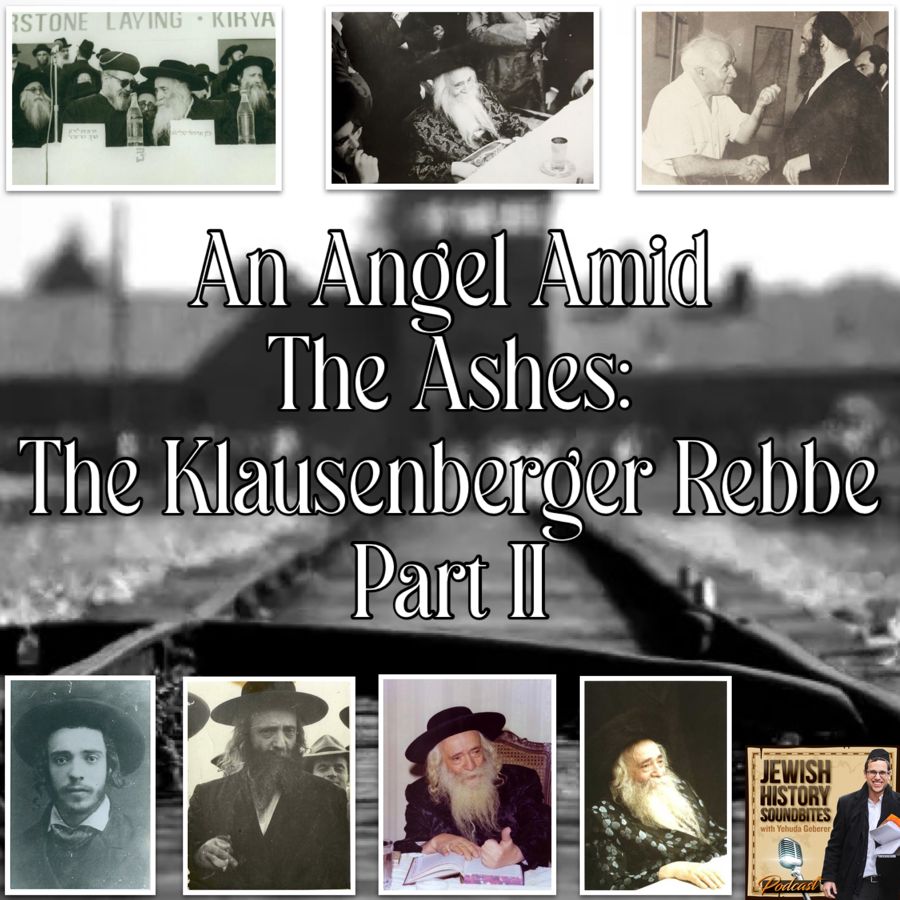
Ep 284An Angel Amid the Ashes: The Klausenberger Rebbe Part II
In honor of the yahrtzeit of Rav Yekusiel Yehuda Halberstam, the Sanz-Klausenburg Rebbe (1905-1994), another chapter in his storied life is presented, as his charismatic leadership and Torah greatness is examined in greater detail. Having emerged from the horrors of the Holocaust while losing his entire family and community, he set out to rebuild while strongly maintaining the independence of his own community. Building institutions and teaching Torah, he assumed roles which were atypical of a standard chassidic leader. His leading an independent stance ons many issues brought him occasionally into dispute with other Torah leaders, but he maintained his position. With perseverance, leadership and Torah scholarship, he successfully recreated a Galician Sanz community on the beach of the Mediterranean in the city of Netanya. Part 1: https://jsoundbites.podbean.com/e/an-angel-amid-the-ashes-the-klausenberger-rebbe-part-i/ Sponsored in part by: With the New York City election day around the corner, it’s time to drop the excuses and VOTE. When it comes to funding for our schools and communities, elected officials pay attention to the people who vote. It’s simple: If you're not voting, you don't have a voice. Make sure you vote early, by mail, or on June 22! Have questions or need help with your voter plan? Call or email the Orthodox Union’s Teach NYS at (646) 459-5162 or email [email protected]. When you vote, elected officials take note. For sponsorship opportunities about your favorite topics of Jewish history contact Yehuda at: [email protected] Subscribe To Our Podcast on: PodBean: https://jsoundbites.podbean.com/ Follow us on Twitter or Instagram at @Jsoundbites You can email Yehuda at [email protected]
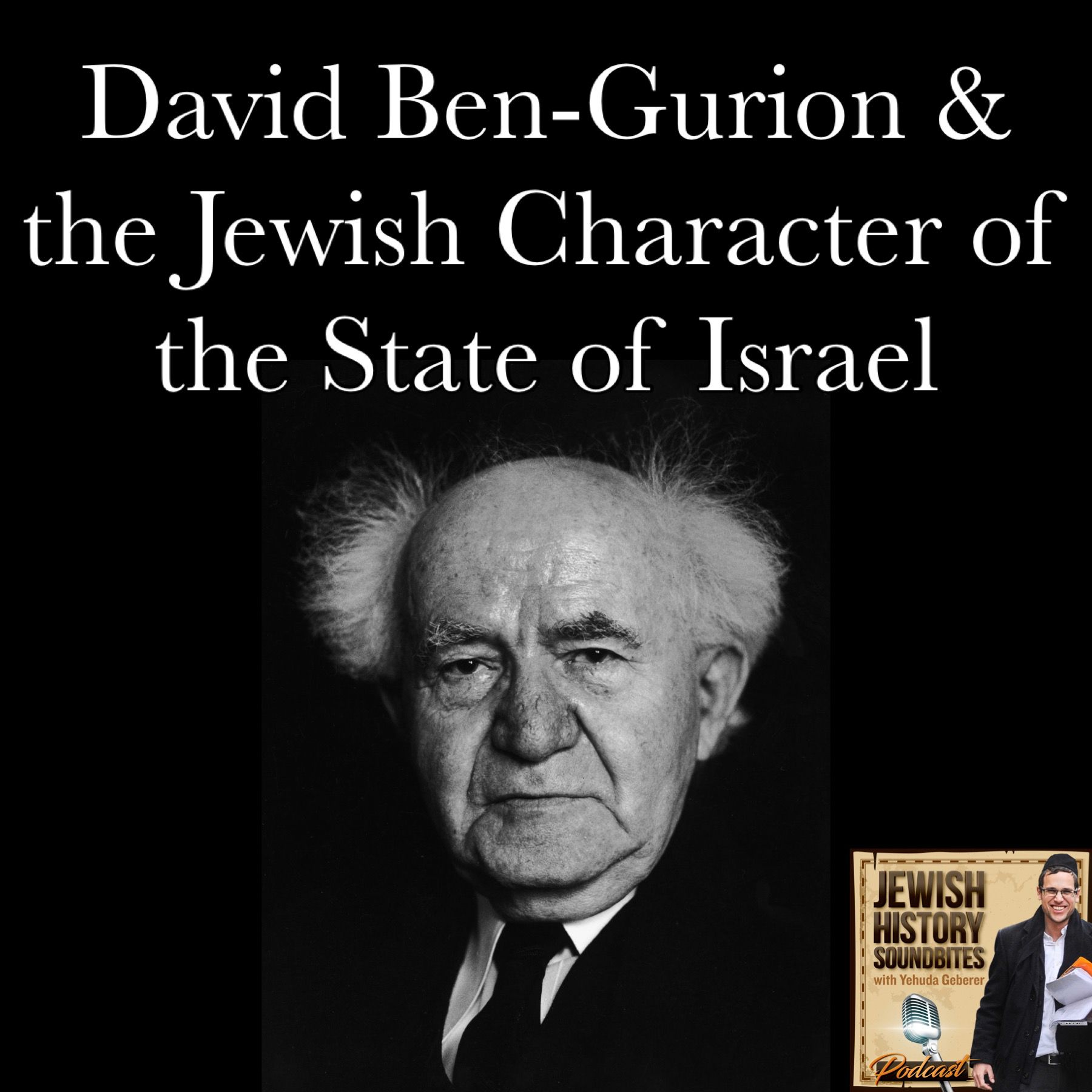
Ep 283David Ben-Gurion & the Jewish Character of the State of Israel
Considered by many as the founding father of the State of Israel, David Ben-Gurion (1886-1973) had a unique vision of the Jewish character of the Jewish state. With an antagonism towards religious practice and his negative view of the 'diaspora Jew', he also had a sense of realpolitik and understood the practical gains of reaching a status quo agreement. On October 20, 1952 he paid a visit to Israel's most venerable sage, Rav Avraham Yeshaya Karelitz, the Chazon Ish. Though thoroughly secular himself, he had a strong love for Tanach. And though he wouldn't set foot into a synagogue in Israel, in the Diaspora he viewed it as a place where Jews got together and expressed their common identity and community. Zionism in his view had achieved the twin goals of creating a Jewish state in the historic Land of Israel and - for those residing there - the ingathering of exiles. It had thus served its purpose, and he declared that, 'I'm an Israeli, not a Zionist'. With a myriad of accomplishments and a controversial legacy, the story of Ben Gurion and the Jewish character of the state he had done so much to found, is a chapter of Jewish history with reverberations down to this very day. Sponsored by: With the New York City election day around the corner, it’s time to drop the excuses and VOTE. When it comes to funding for our schools and communities, elected officials pay attention to the people who vote. It’s simple: If you're not voting, you don't have a voice. Make sure you vote early, by mail, or on June 22! Have questions or need help with your voter plan? Call or email the Orthodox Union’s Teach NYS at (646) 459-5162 or email [email protected]. When you vote, elected officials take note. For sponsorship opportunities about your favorite topics of Jewish history contact Yehuda at: [email protected] Subscribe To Our Podcast on: PodBean: https://jsoundbites.podbean.com/ Follow us on Twitter or Instagram at @Jsoundbites You can email Yehuda at [email protected]
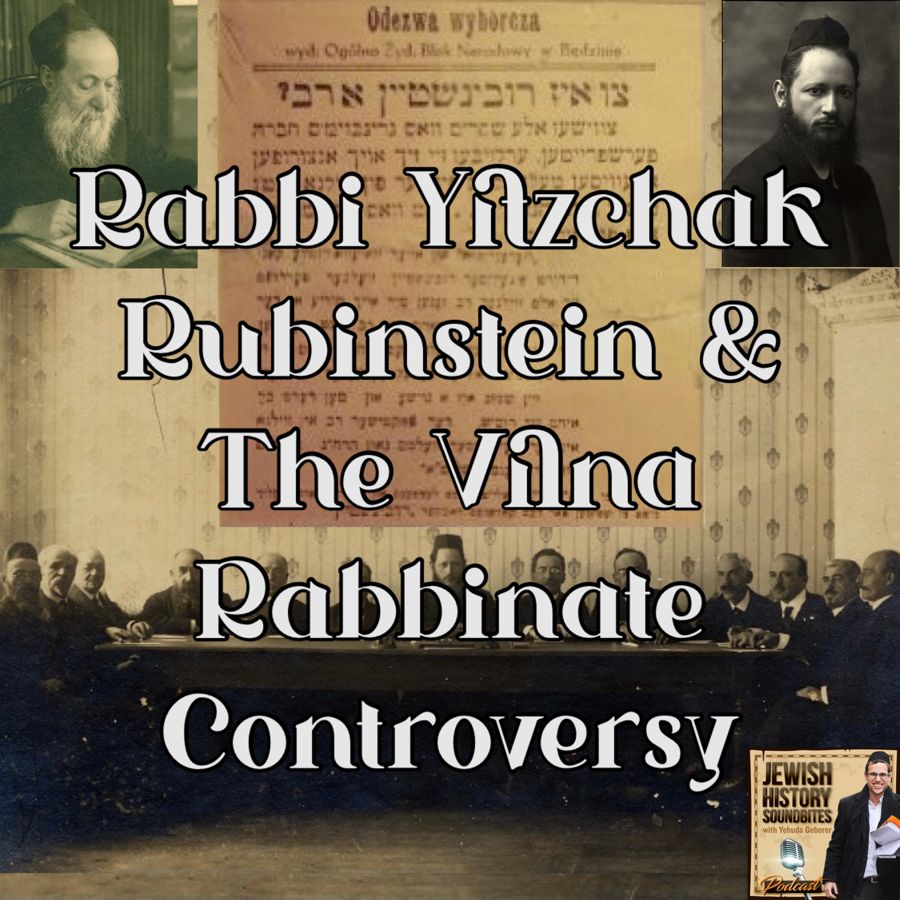
Ep 282Rabbi Yitzchak Rubinstein & The Vilna Rabbinate Controversy
Though Vilna was known as the Jerusalem of Lithuania, it hadn't had an official chief rabbi since a dispute about the position ended in 1791. As a result of the Polish government requiring the hiring of chief rabbi in the 1920's, the Vilna Jewish community council hired Rav Yitzchak Rubinstein (1880-1945) as the official chief rabbi of the city. He had served as the official 'Rav Mitaam' government rabbi since 1910, and was beloved by the community to his leadership and activism during the First World War. This appointment was made despite the fact that Rav Chaim Ozer Grodzinski was the undisputed Torah leader in Vilna and across the Jewish world, as well as serving as the unofficial chief rabbi for decades. This led to a bitter dispute which was to have a lasting effect on the community, as well as the wider scope of inter Jewish politics. The Chofetz Chaim protested on behalf of the honor of Rav Chaim Ozer, and other protests followed. Though the dispute eventually calmed down, resentment remained. Rabbi Rubinstein himself ultimately escaped to New York at the beginning of the Second World War and passed away there in 1945. Sponsored by: With the New York City election day around the corner, it’s time to drop the excuses and VOTE. When it comes to funding for our schools and communities, elected officials pay attention to the people who vote. It’s simple: If you're not voting, you don't have a voice. Make sure you vote early, by mail, or on June 22! Have questions or need help with your voter plan? Call or email the Orthodox Union’s Teach NYS at (646) 459-5162 or email [email protected]. When you vote, elected officials take note. For sponsorship opportunities about your favorite topics of Jewish history contact Yehuda at: [email protected] Subscribe To Our Podcast on: PodBean: https://jsoundbites.podbean.com/ Follow us on Twitter or Instagram at @Jsoundbites You can email Yehuda at [email protected]

Ep 281The Great Defender of Israel: Rav Levi Yitzchak of Berditchev
One of the most legendary leaders the Chassidic movement has ever produced Rav Levi Yitzchak of Berditchev (1740-1809) is a universally beloved figure as well. Following his conversion to the nascent movement in the court of the Maggid of Mezritch, he spread the ideas of chassidus while simultaneously leading a lucrative rabbinic career in Zelichov, Pinsk and Berditchev. Known to posterity as the Great Defender of the Jewish People, he devoted his life to seeking out the good in every individual as well as the Jewish People as a collective. For sponsorship opportunities about your favorite topics of Jewish history contact Yehuda at: [email protected] Subscribe To Our Podcast on: PodBean: https://jsoundbites.podbean.com/ Follow us on Twitter or Instagram at @Jsoundbites You can email Yehuda at [email protected]
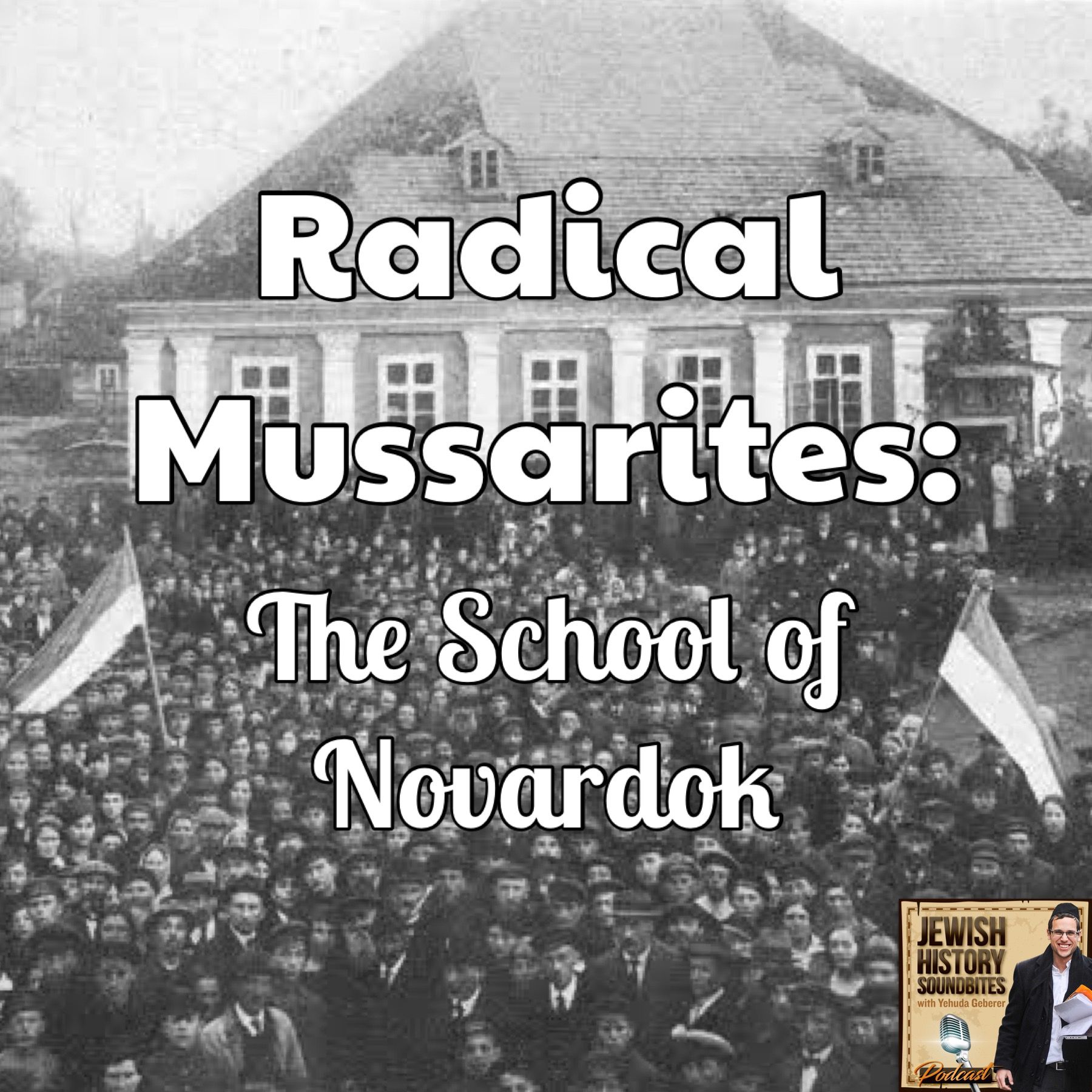
Ep 280Radical Mussarites: The School of Novardok
The Novardok Yeshiva was both a mussar philosophy as well as a movement. Founded by Rav Yosef Yoizel Horowitz (1850-1919), the Alter of Novardok, in 1896, it soon grew into tens of branches across Russia. Known for its rather radical approach to mussar, educational philosophy and growth, it was seemingly influenced by the general revolutionary zeitgeist in the Russian Empire at the turn of the century. Exiled during World War One, the entire movement would eventually make a daring border crossing into Poland in order to escape from Soviet Russia. The flagship yeshiva was established in Bialystok under the leadership of the Alter's son in law Rav Avraham Joffen. Several other primary branches were established in other cities, with tens of smaller branches across the country. Often it was chassidic students who were recruited to join its ranks. Decimated during the war, attempts were made at rebuilding in Israel through several pre war branches that had been established there, as well as the United States, with limited success. In France however, Rav Gershon Leibman succeeded in reestablishing the Novardok network with his Ohr Yosef schools, which primarily served Moroccan students. For sponsorship opportunities about your favorite topics of Jewish history contact Yehuda at: [email protected] Subscribe To Our Podcast on: PodBean: https://jsoundbites.podbean.com/ Follow us on Twitter or Instagram at @Jsoundbites You can email Yehuda at [email protected]
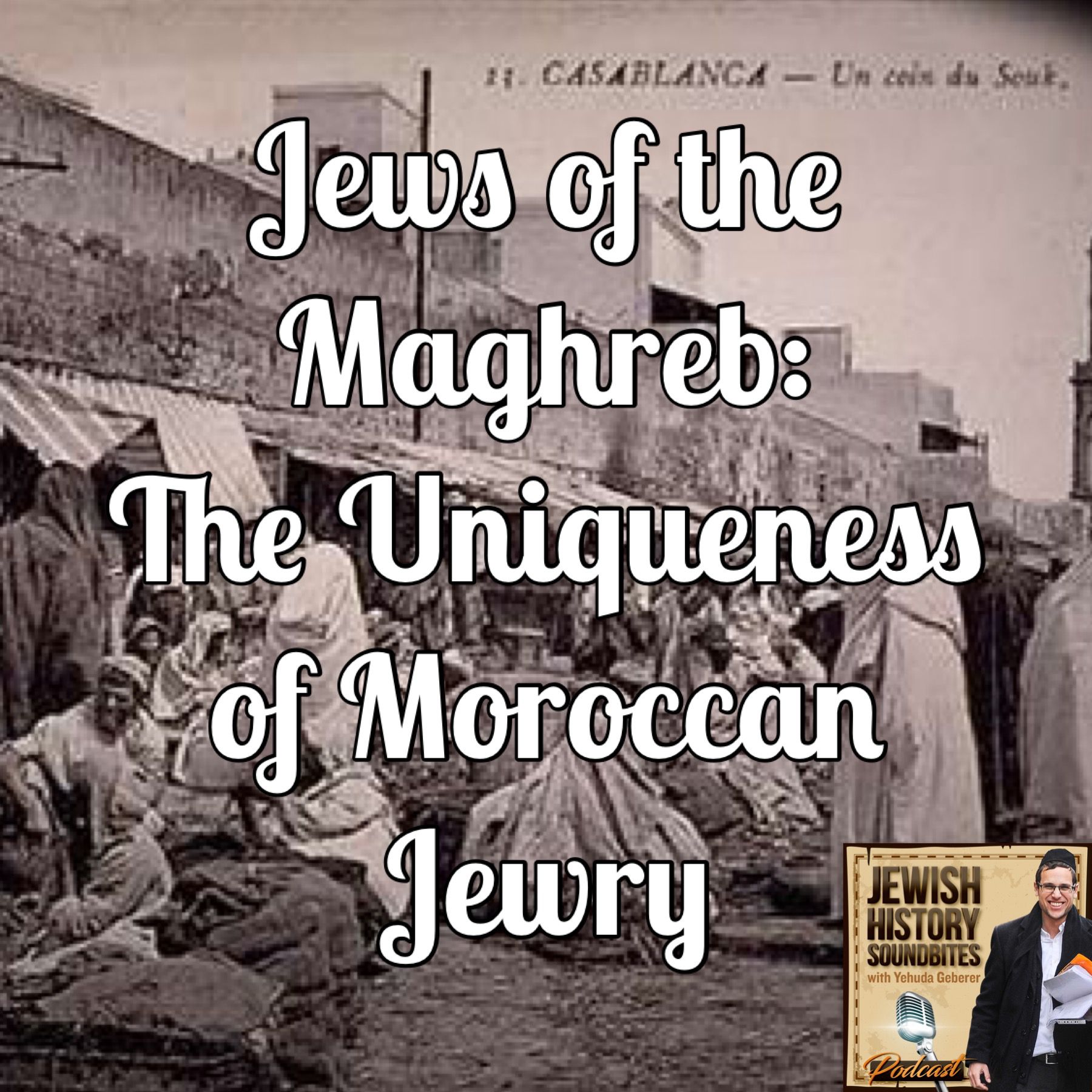
Ep 279Jews of the Maghreb: The Uniqueness of Moroccan Jewry
There is a certain uniqueness to the storied and ancient Jewish community of Morocco. At least 2,000 years old, it became the numerically largest Sephardic community in the world by the mid 20th century. On the other hand, for several centuries the community and many of its Torah leaders were relatively unknown beyond the confines of Moroccan Jewry. This was primarily due to its relative isolation. Nestled on the western edge of the African continent, it remained distant from both Europe as well as the vast Ottoman Empire. This isolation assisted in preserving and enriching the heritage and culture unique to Moroccan Jewry, as well as limiting the scope of its influence within the wider Jewish world. Medieval Morocco was host to luminaries such as the Rambam for several years while he was on the run from the Almohads, as well as the tzadik Rabi David UMoshe who arrived initially to fundraise for the Jewish community of Jerusalem and stayed on to lead the Berber Jewish community of the Atlas Mountains. This episode has been sponsored by Legacy Judaica. Join the upcoming auction on Sunday, May 30, for a chance to bid on some fascinating treasures of Jewish history: http://legacyjudaica.bidspirit.com/ For sponsorship opportunities about your favorite topics of Jewish history contact Yehuda at: [email protected] Subscribe To Our Podcast on: PodBean: https://jsoundbites.podbean.com/ Follow us on Twitter or Instagram at @Jsoundbites You can email Yehuda at [email protected]
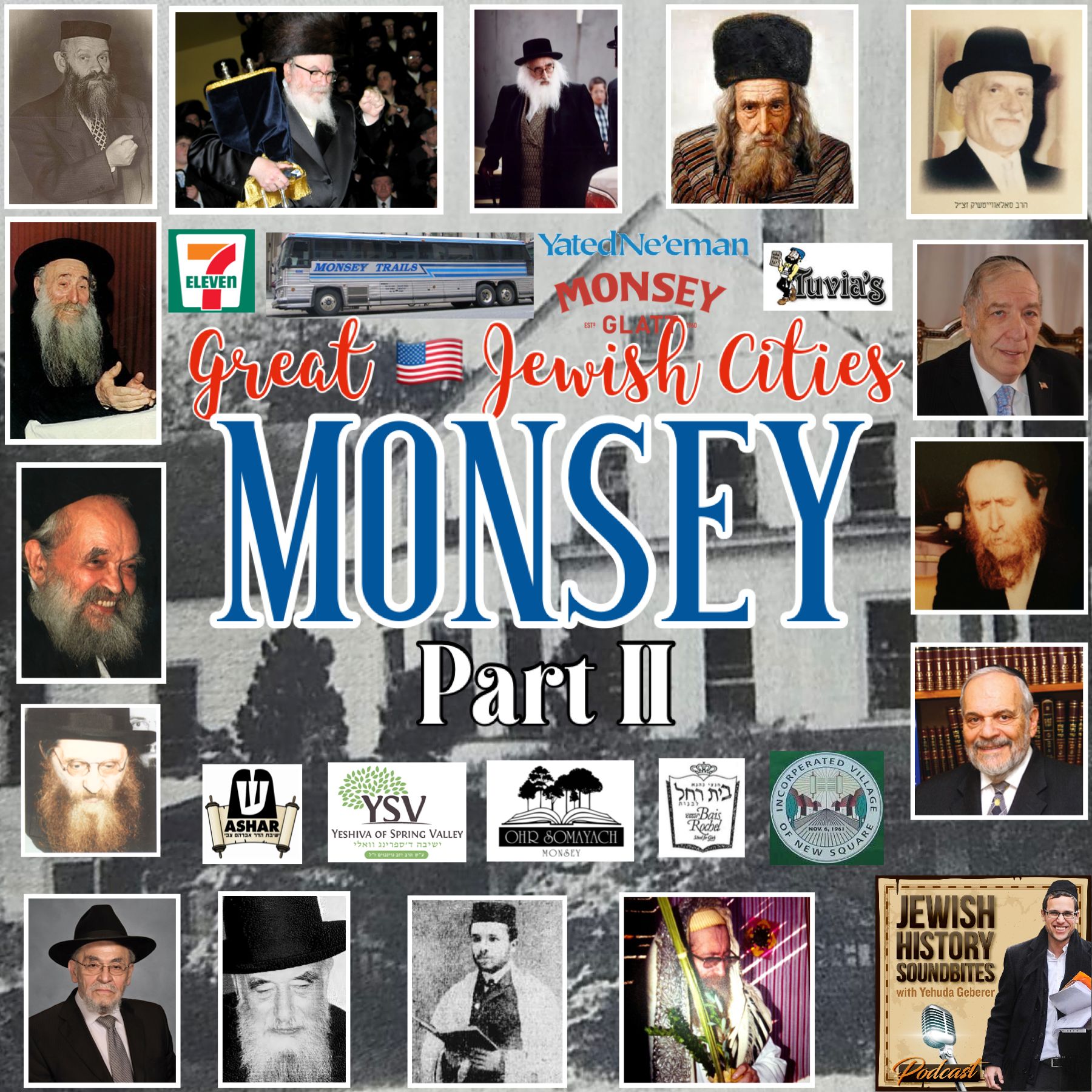
Ep 278Great American Jewish Cities #21: Monsey Part II
From the early days of Bais Medrash Elyon and its prominent alumni, Monsey continued to develop both up and down "the hill". Rav Yaakov Lipschutz, Rav Chaim Flohr and others were prominent rabbis, as Rav Yaakov Kamenetsky still had a large impact on the town overall. Diverse schools opened up from ASHAR to Bais Dovid for boys and Bais Yaakov to Bais Rochel for girls. Soon Satmar arrived on the scene and first joining the Chareidim Shul, they then opened up an entire empire of their own institutions. Even Neturei Karta US headquarters were in Monsey led by Moshe Ber Beck and Yisroel Dovid Weiss. With its diversity and all kinds, Monsey developed into a unique suburban Jewish community. This has been generously sponsored in honor of Reb Shayala's Kitchen. An organization which helps middle class families going through temporary hardship to get back on their feet through a great Grocery Assistance program; Financial Coaching Business coaching; Any assistance to help a hardworking family get back on their feet. https://rsk.org/ For sponsorship opportunities about your favorite topics of Jewish history contact Yehuda at: [email protected] Subscribe To Our Podcast on: PodBean: https://jsoundbites.podbean.com/ Follow us on Twitter or Instagram at @Jsoundbites You can email Yehuda at [email protected]
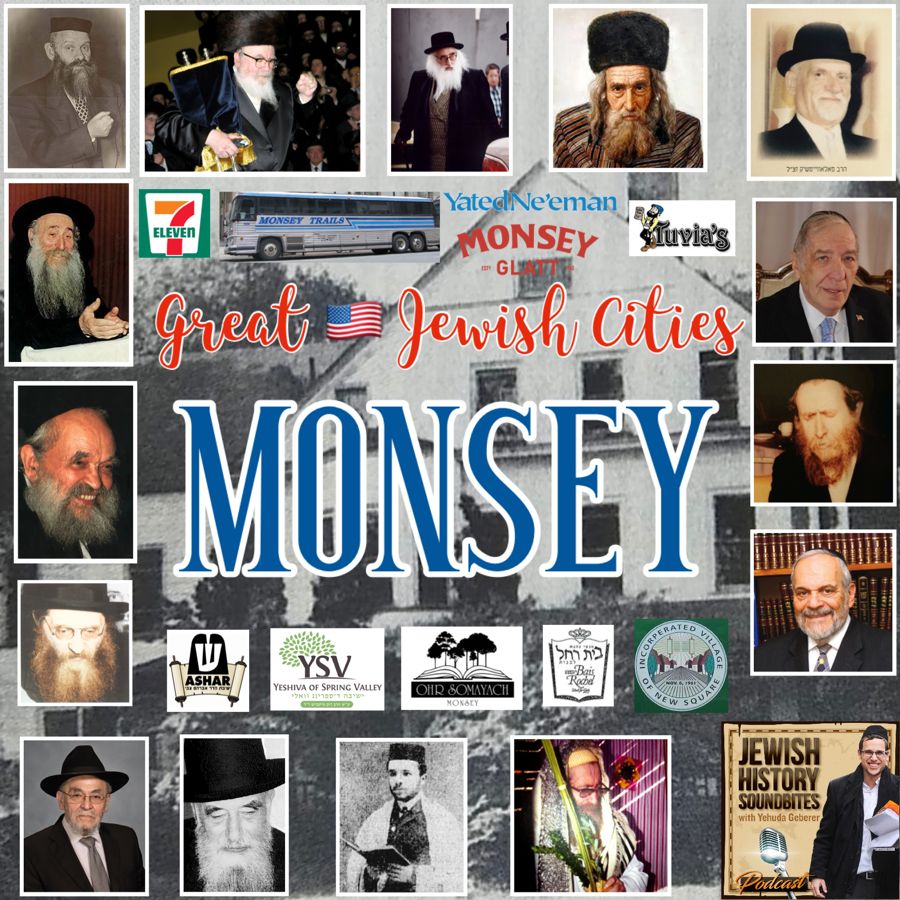
Ep 277Great American Jewish Cities #21: Monsey Part I
Monsey. Rockland County. The Hudson River Valley. The image of suburbia. This small town across the Tappan Zee Bridge somehow developed into one of the largest Jewish Orthodox enclaves worldwide. Though the area had some minor Jewish beginnings from the end of the 19th century, it was with the vision of Rav Shraga Feivel Mendlowitz that Monsey began to develop as a Jewish community. Rav Shraga Feivel built Bais Medrash Elyon and his family and students laid the foundations of many Torah institutions including Yeshiva of Spring Valley and Bais Shraga. Rabbi Yosef Dov Soloveitchik was an early rabbi in Spring Valley, while his wife Rebbetzin Shoshana was a pioneer in girls education, standing at the helm of the Monsey Bais Yaakov for decades. Great personalities who resided in the town and contributed to its development included Rav Yaakov Kamenetsky, Rav Mordechai Schwab, Rav Nosson Horowitz, Ronnie Greenwald, the Vizhnitz Rebbe Rav Mottele Hager, Rav Moshe Neuschloss in nearby New Square and many others. For sponsorship opportunities about your favorite topics of Jewish history contact Yehuda at: [email protected] Subscribe To Our Podcast on: PodBean: https://jsoundbites.podbean.com/ Follow us on Twitter or Instagram at @Jsoundbites You can email Yehuda at [email protected]
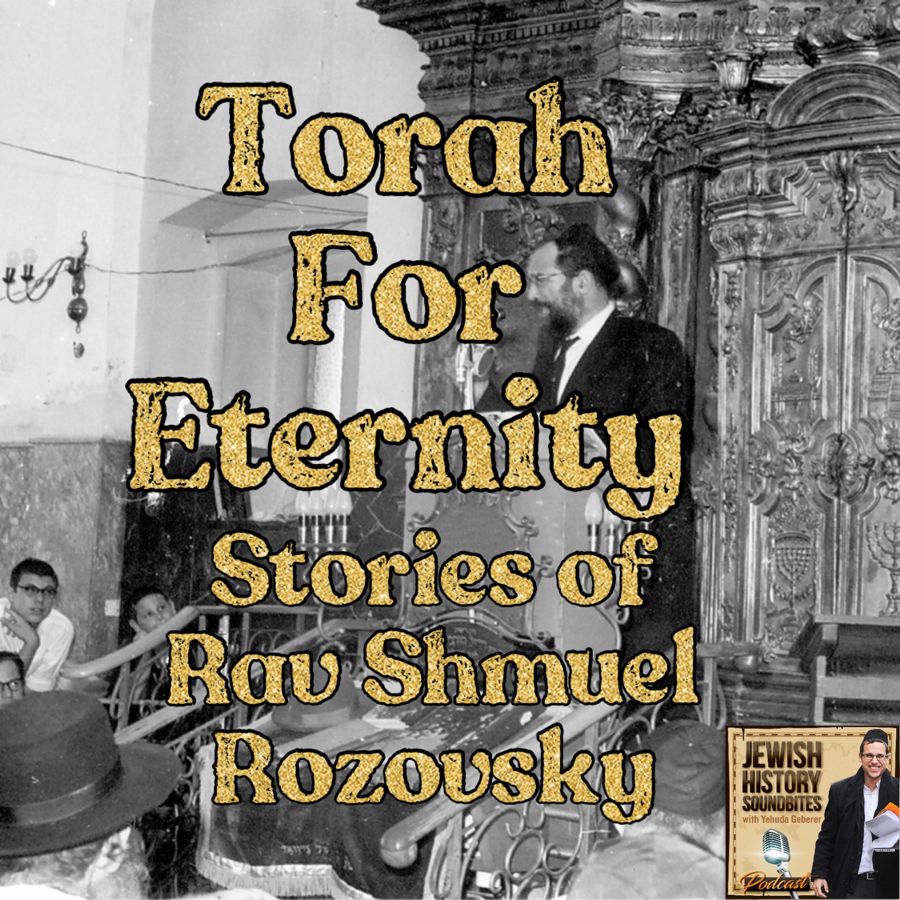
Ep 276Torah for Eternity: Stories of Rav Shmuel Rozovsky
Rav Shmuel Rozovsky (1913-1979) was perhaps the most influential teacher of Torah in the rebuilding of the post war Yeshiva world. Born into a rabbinic family in Grodno, he eventually moved to Palestine to escape the Polish army draft. There he joined the Lomza Yeshiva in Petach Tikva, later becoming the first rosh yeshiva in Ponovezh in Bnei Brak. When he was diagnosed with cancer, he sought out treatment in the United States, spending several months in Boston. Through the many challenges he faced in life, he continued to see his primary focus as a teacher of Torah. For sponsorship opportunities about your favorite topics of Jewish history contact Yehuda at: [email protected] Subscribe To Our Podcast on: PodBean: https://jsoundbites.podbean.com/ Follow us on Twitter or Instagram at @Jsoundbites You can email Yehuda at [email protected]

Ep 275The Kabbalists of Komarno: Part II
In keeping with the mystical leanings of the Komarno dynasty, it is interesting to note the frequency in which the leaders of the dynasty passed away during the time of Sefiras Haomer, a fact which has mystical significance as well. Their involvement in Kabbalistic practice made the Zhiditchov-Komarno courts a prime target of Yosef Perl and other Galicia maskilim in the 19th century. Undeterred, the Komarno Rebbes continued to teach what they saw as the authentic mysticism of the Baal Shem Tov, refusing to adapt to the downplay of mysticism becoming so common throughout the chassidic movement of the 19th century. For sponsorship opportunities about your favorite topics of Jewish history contact Yehuda at: [email protected] Subscribe To Our Podcast on: PodBean: https://jsoundbites.podbean.com/ Follow us on Twitter or Instagram at @Jsoundbites You can email Yehuda at [email protected]
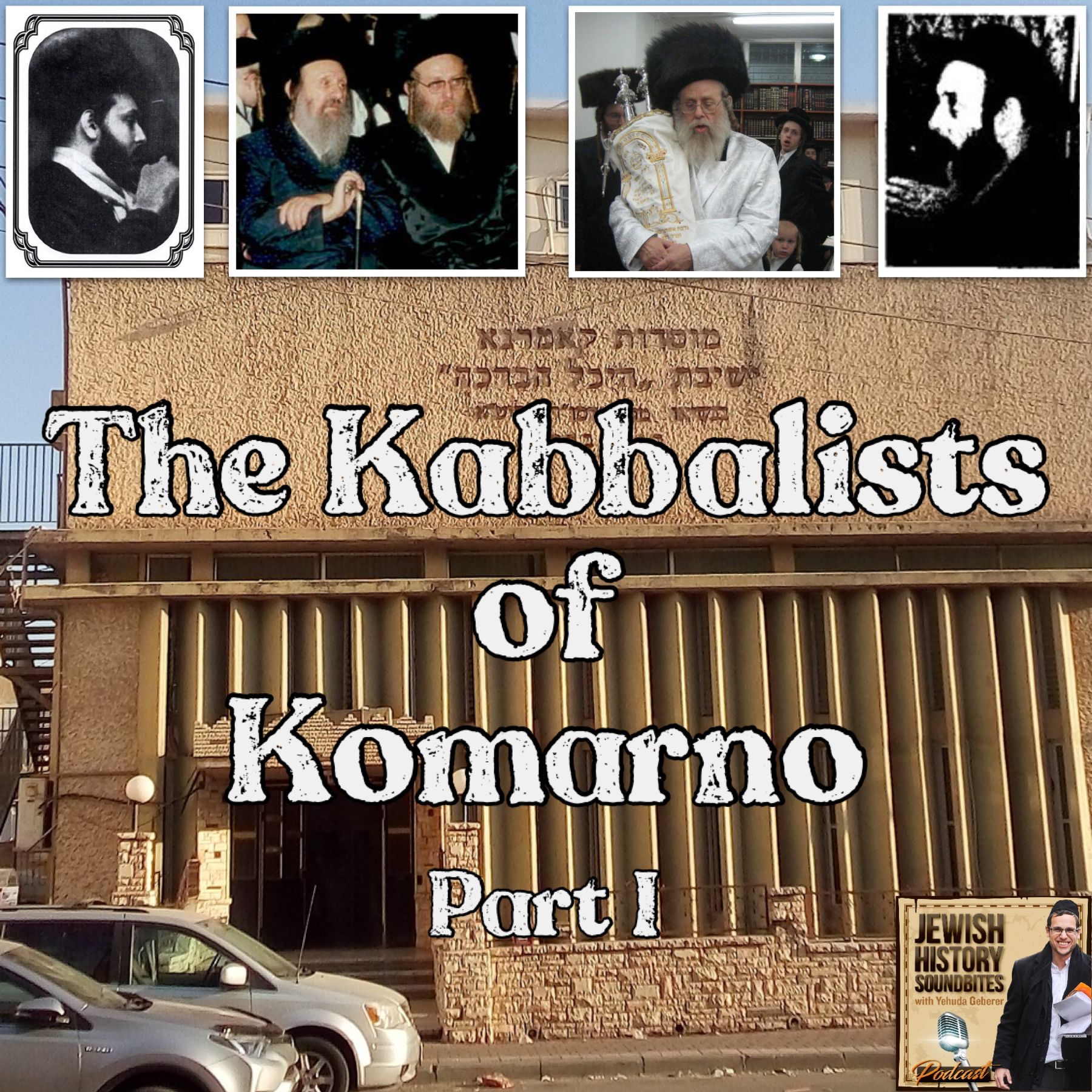
Ep 274The Kabbalists of Komarno: The Komarno Dynasty Part I
One of the most unusual dynasties in the annals of the Chassidic movement is the Komarno dynasty. Closely related to the Zhiditchov dynasty, it carved out its own niche in Galicia and beyond, with its emphasis on the study of Kabbalah and deep mysticism. The primary personality of the movement was Rav Yitzchak Eizek Safrin of Komarno (1806-1874), who was a prolific writer. Among his works are the acclaimed Heichal Habracha and the Shulchan Hatohar. He was in turn succeeded by his son Rav Eliezer Tzvi Safrin (1830-1898), known by his famous work the Damesek Eliezer. Though much of the dynasty was tragically wiped out during the Holocaust, one grandson of the Damesek Eliezer had immigrated to the United States prior to the war's outbreak. Rav Chaim Yaakov Safrin set out to reestablish the Komarno court, and his son Rav Shalom ultimately rebuilt it in Jerusalem. For sponsorship opportunities about your favorite topics of Jewish history contact Yehuda at: [email protected] Subscribe To Our Podcast on: PodBean: https://jsoundbites.podbean.com/ Follow us on Twitter or Instagram at @Jsoundbites You can email Yehuda at [email protected]

Ep 273Stories Of Ner Israel Part III
Another installment of stories of the Ner Israel Yeshiva in Baltimore throughout its history. Led by its legendary Rosh Yeshiva Rav Yaakov Yitzchak Ruderman, the Yeshiva grew and was to have a lasting impact on the American Torah landscape. Listen to the two previous installments on the history of Yeshivas Ner Israel here: https://jsoundbites.podbean.com/e/stories-of-ner-israel-part-i/ https://jsoundbites.podbean.com/e/stories-of-ner-israel-part-ii/ For sponsorship opportunities about your favorite topics of Jewish history contact Yehuda at: [email protected] Subscribe To Our Podcast on: PodBean: https://jsoundbites.podbean.com/ Follow us on Twitter or Instagram at @Jsoundbites You can email Yehuda at [email protected]
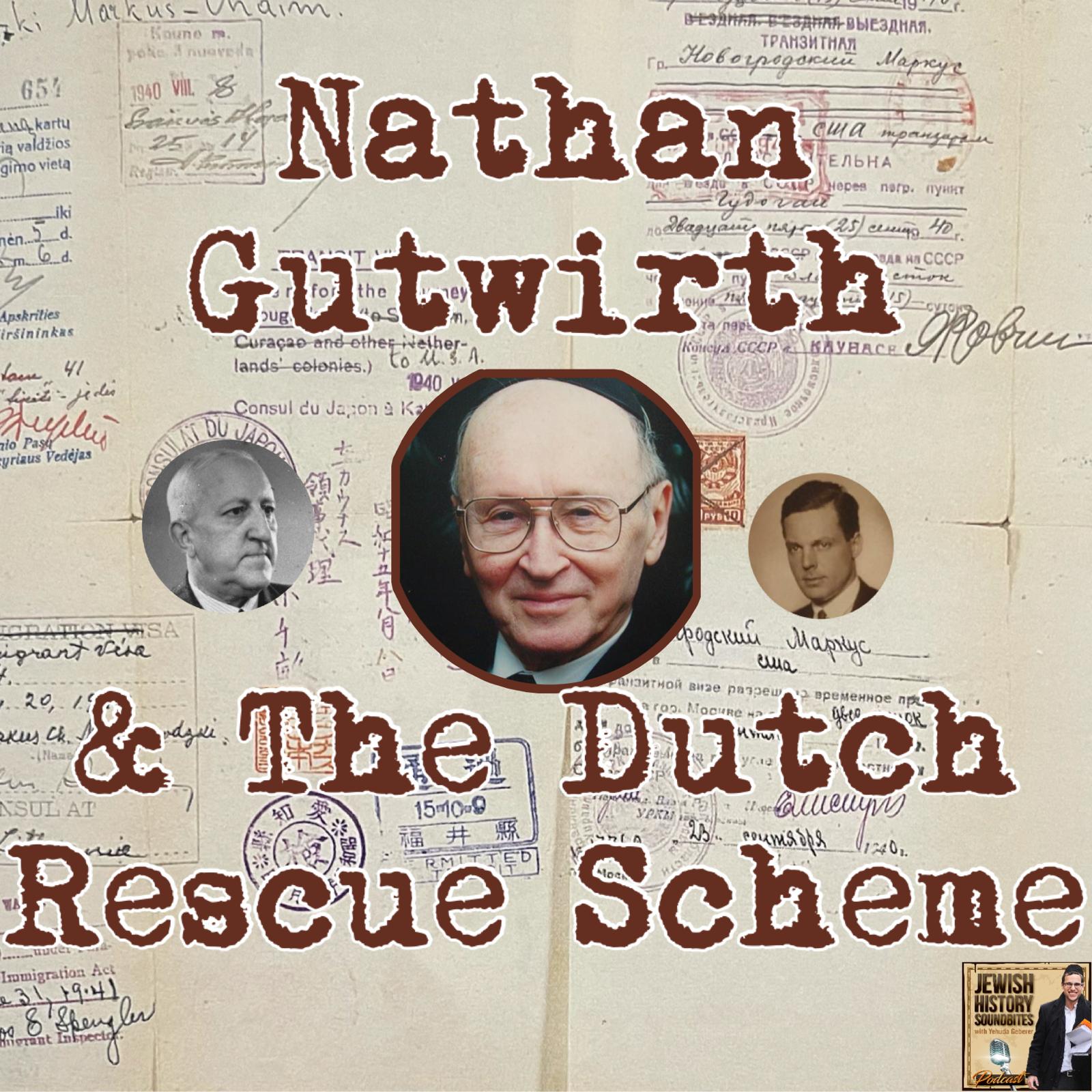
Ep 272Nathan Gutwirth & the Dutch Rescue Scheme
Nathan Gutwirth was a Dutch yeshiva student at the Telz Yeshiva in Lithuania when he was thrust onto the stage of history. He was someone at the right place, at the right time, who did the right thing. When the Second World War broke out, he sought a way for he and his fiancée to escape to one of the Dutch overseas possessions and away from the developing inferno. Corresponding with the local Dutch consul Jan Zwartendijk and the Dutch ambassador in Riga LPJ De Decker, the island of Curacao became a possible destination. Ultimately, this would seem to be a possible destination for non-Dutch citizens as well, and many were saved as a result. He himself ended up in Indonesia, and was later interned by the Japanese. Following the war he immigrated to the United States before returning to Antwerp, where he lived out his remaining years. For sponsorship opportunities about your favorite topics of Jewish history contact Yehuda at: [email protected] Subscribe To Our Podcast on: PodBean: https://jsoundbites.podbean.com/ Follow us on Twitter or Instagram at @Jsoundbites You can email Yehuda at [email protected]
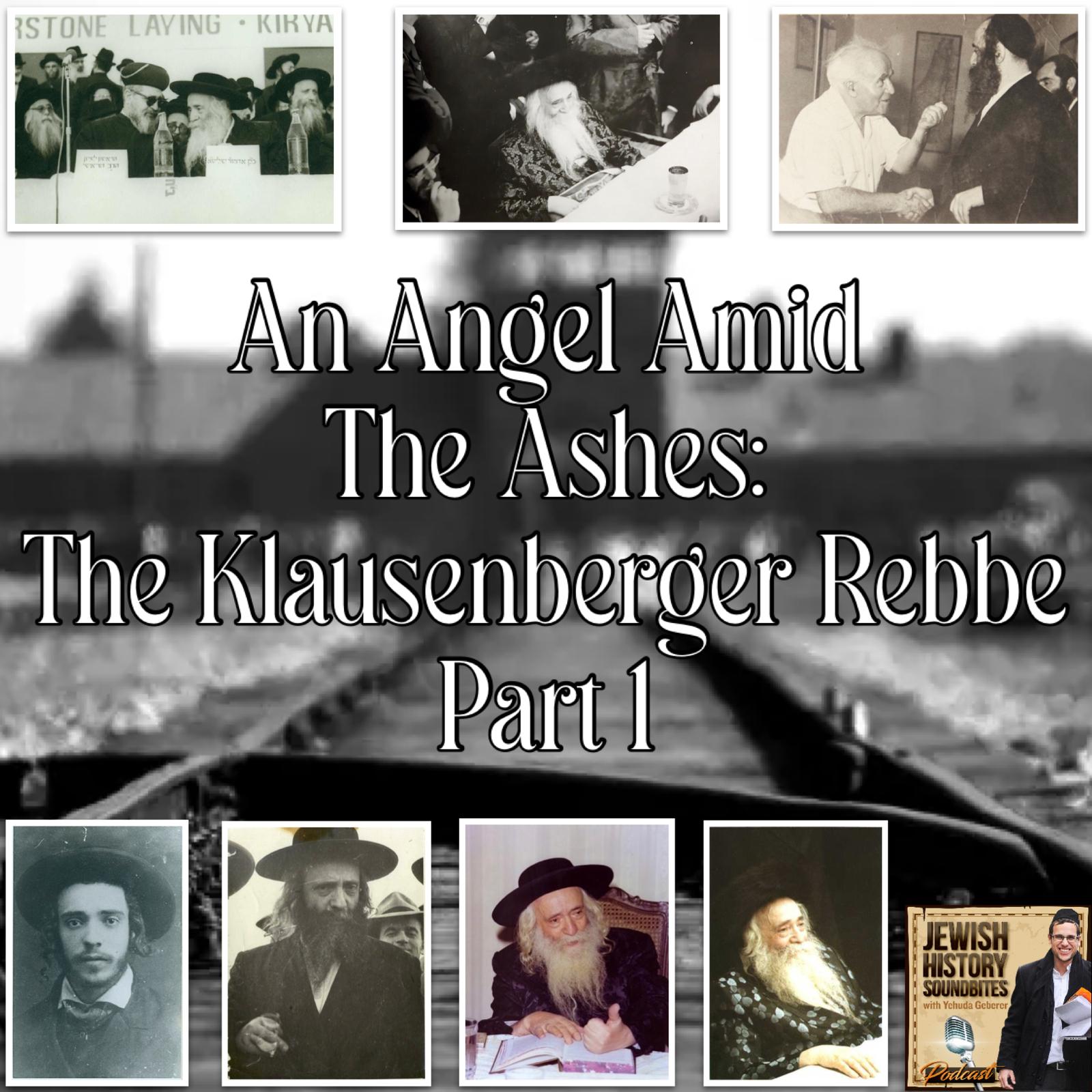
Ep 271An Angel Amid the Ashes: The Klausenberger Rebbe Part I
Rav Yekusiel Yehuda Halberstam (1905-1994), known as the Sanz-Klausenberger Rebbe was a scion of the Sanz dynasty & rabbi in prewar Klausenburg (Kluj), but achieved renown for his heroic experiences during the horrors of the Holocaust and rebuilding efforts in its aftermath. After losing his wife and all his children, he survived Auschwitz, a labor camp in Warsaw, Dachau and Mühldorf, all the while refraining from consuming non-kosher food. Following liberation, he threw himself into rebuilding Jewish life in the Displaced Persons camps of Feldafing and Foehrenwald. Upon immigrating to the United States he remarried and attempted to carry out his vision of rehabilitation and rebuilding, all while being a father to the many survivors who had become attached to him. In the shadow of the destruction of the Holocaust, he modified his stance on the State of Israel, for which he entered into a dispute with his uncle the Satmar Rov and his followers, and even met with the Prime Minister David Ben-Gurion. In 1956 he laid the cornerstone of the Kiryat Sanz community in Netanya, and he later had the unique distinction of being a chassidic rebbe who built a hospital. The Laniado Hospital was dedicated in 1975 and fulfilled his vision as a place which would preserve life on Jewish principles, as an answer to the destruction of life which had been sustained in the Holocaust. For sponsorship opportunities about your favorite topics of Jewish history contact Yehuda at: [email protected] Subscribe To Our Podcast on: PodBean: https://jsoundbites.podbean.com/ Follow us on Twitter or Instagram at @Jsoundbites You can email Yehuda at [email protected]
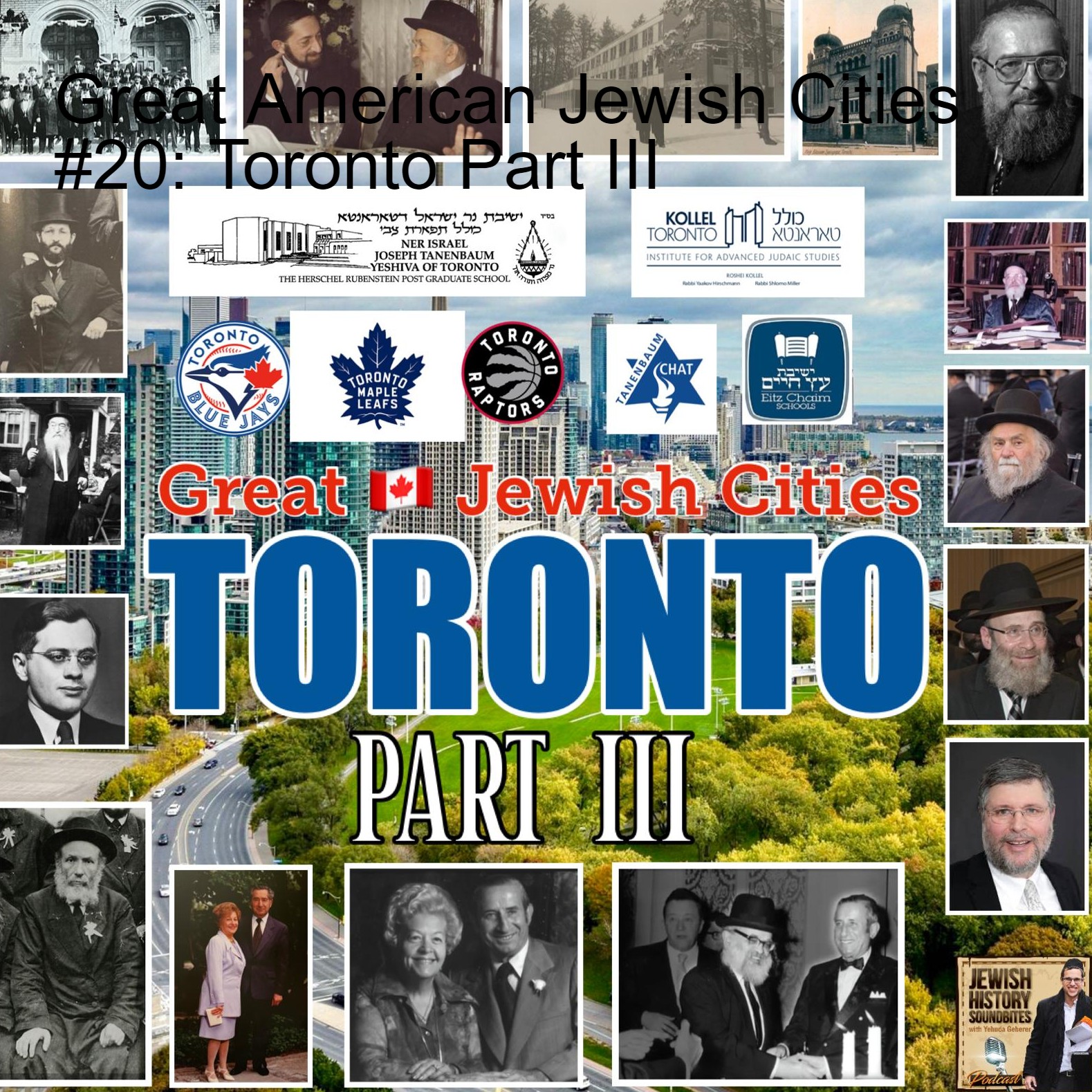
Ep 270Great American Jewish Cities #20: Toronto Part III
The founding of the Toronto Kollel in 1970 was a turning point in the development of the Toronto Jewish community, and was just one of the many institutions built and supported by the Reichmann family. A Bais Yaakov for girls opened as well, which was headed by Rabbi Akiva Stefansky. Postwar Toronto contained a large contingent of Holocaust survivors, and one of the close knit communities was the Clanton Park community, headed by Rabbi Nachum Rabinovitch and later Rabbi Yitzchak Kerzner. Going back to prewar Jewish culture, Yiddish culture and education flourished, and Jewish politics covered the full gamut from socialists to Zionists. On August 16, 1933, the Toronto Jewish community experienced the infamous Christie Pits riot, bringing the issue of anti-Semitism to the forefront. Postwar immigration brought a large influx of Sephardic Jews from Spanish Morocco, which has become a burgeoning community as well. For sponsorship opportunities about your favorite topics of Jewish history contact Yehuda at: [email protected] Subscribe To Our Podcast on: PodBean: https://jsoundbites.podbean.com/ Follow us on Twitter or Instagram at @Jsoundbites You can email Yehuda at [email protected]

Ep 269Great American Jewish Cities #20: Toronto Part II
Jewish Toronto in the post war saw a development of the community in its leadership and institutions. Rav Dovid Ochs replaced Rav Yaakov Kamenetsky at the helm of the Toras Emes community, and Chabad began to have a presence in town as well. A rising rabbinic leader at this time was Rav Gedalya Felder, while at the same time there started to arrive a large influx of Holocaust survivors, with Rav Meir Grunwald, the Teitcher Rov as a leader in the community as well. The Holy Blossom Synagogue started off as Orthodox and gradually shifted towards Reform in the early decades of the 20th century. As shuls and shtiebels increased with the arrival of Eastern European Jews, educational institutions were built. The Eitz Chaim schools became the premier mechanism of educational development for the Jewish youth of Toronto. Some of the greatest philanthropists of 20th century Jewish life resided there as well. The Reichman and Tannenbaum families are just two examples of this, as Joe Tannenbaum emerged as a patron of Jewish institutions both locally and worldwide. For sponsorship opportunities about your favorite topics of Jewish history contact Yehuda at: [email protected] Subscribe To Our Podcast on: PodBean: https://jsoundbites.podbean.com/ Follow us on Twitter or Instagram at @Jsoundbites You can email Yehuda at [email protected]

Ep 268Great American Jewish Cities #20: Toronto Part I
Jewish immigrants in the late 19th century populated 'The Ward', an immigrant neighborhood in Toronto, Canada, formulating the nucleus of the fast growing Toronto Jewish community. Eventually the Jewish population shifted to Kensington Market. Rabbinic leadership in the early years was provided by Rav Yosef Weinreb, Rav Yaakov Gordon, and later Rav Yehuda Leib Graubart. The latter headed the Polish faction of the community and clashed with the former two in their efforts to organize the chaotic kashrus situation and in the organization of the Toronto Kehilla. Rav Yaakov Kamenetsky served as a rabbi in Toronto for several years during the 1940's. One of the most influential rabbis in post war Toronto, was Rabbi Avraham Aharon Price, who led the Toronto Jewish community for over a half century, and was also the Rosh Yeshiva of the Toras Chaim Yeshiva. For sponsorship opportunities about your favorite topics of Jewish history contact Yehuda at: [email protected] Subscribe To Our Podcast on: PodBean: https://jsoundbites.podbean.com/ Follow us on Twitter or Instagram at @Jsoundbites You can email Yehuda at [email protected]
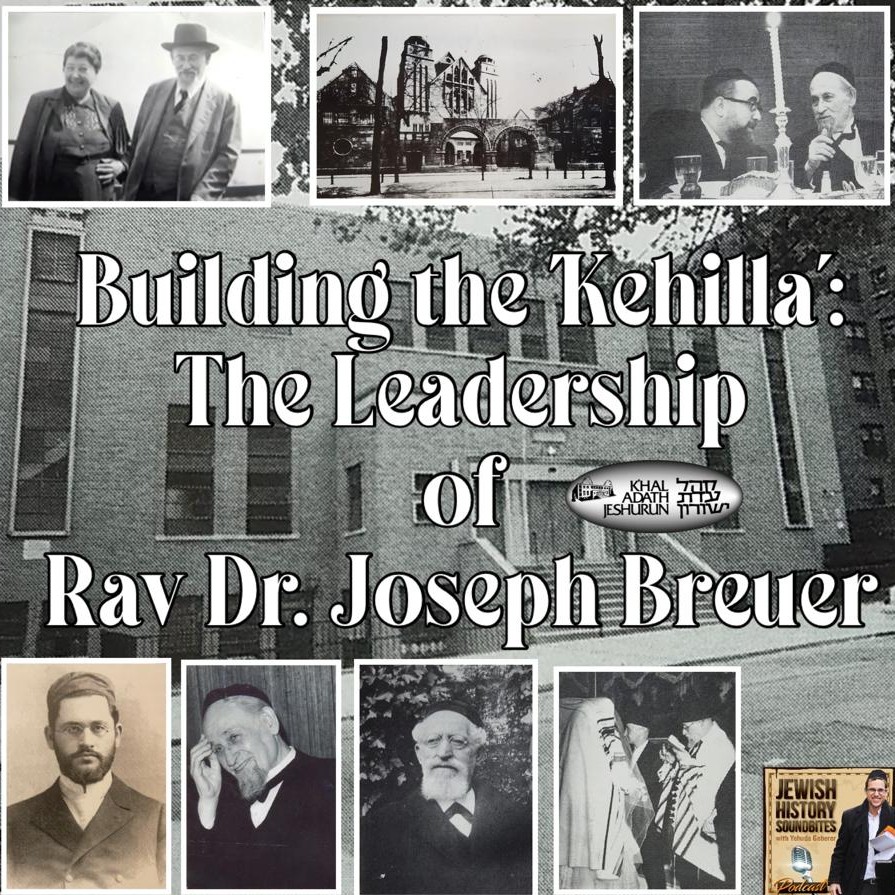
Ep 267Building the 'Kehilla': The Leadership of Rav Dr. Joseph Breuer
Rav Dr. Joseph Breuer (1882-1980) was a visionary leader who successfully rebuilt the Kheilla of Frankfurt of Kahal Adas Jeshurun on American shores. Born to his parents Rav Dr. Solomon Breuer and Sophie Hirsch, daughter of Rav Samson Raphael Hirsch, he moved from Hungary to Frankfurt as a child. He later became the Rosh Yeshiva of the Frankfurt Yeshiva. Following Kristallnacht in November 1938, he managed to escape with his family, arriving in the United States in February 1939. He immediately set out to establish a fully structured kehilla, not limiting his position to congregational rabbi. With a goal of establishing institutional completeness, offering the full gamut of religious, educational and social services within the kehilla infrastructure, while maintaining its total independence. The twin goals of Austritt (separation from communities who didn't share Torah values), along with Torah Im Derech Eretz (integration into surrounding society without compromising on Torah values) were to be the guiding lights of the kehilla, and would permeate its myriad of institutions. Incredibly, with the assistance of a dedicated cadre of members of the community, within a few years he built a mikva, schools, shul, kashrus supervision, Bais Din, secondary schools, a publication society and much more, while the membership grew to over 800 families. He passed away at the ripe old age of 98. For sponsorship opportunities about your favorite topics of Jewish history contact Yehuda at: [email protected] Subscribe To Our Podcast on: PodBean: https://jsoundbites.podbean.com/ Follow us on Twitter or Instagram at @Jsoundbites You can email Yehuda at [email protected]

Ep 266Great American Jewish Cities #19: Worcester & Boston
Jewish History Soundbites is back to launch season two of our popular series "Great American Jewish Cities"! We commence with Worcester, Massachusetts which has a prominent Jewish history. Boasting 13 active shuls in the early decades of the 20th century, it also was home to one of the first Lubavitch Yeshivas in the United States. Visionaries such as Rav Zorach Hurwitz and Rav Hershel Fogelman invested in Jewish education at a time when in out of town America it didn't seem possible. Other notables of Jewish Worcester includes the leader of the counterculture movement Abbie Hoffman, while Clark University is the home of the first Holocaust studies in the United States, as well as being the host of Sigmund Freud's lectures on his only visit to the United States. Boston Jewish History personalities included rabbis such as Ramaz (Rav Moshe Zevulun Margolis), Rav Zalman Yaakov Friderman, Rav Gavriel Zev Margolis, Rav Yosef Dov Soloveitchik, Rav Mordechai Savitsky, and the chassidic dynasties of Boston and Tolna. For sponsorship opportunities about your favorite topics of Jewish history contact Yehuda at: [email protected] Subscribe To Our Podcast on: PodBean: https://jsoundbites.podbean.com/ Follow us on Twitter or Instagram at @Jsoundbites You can email Yehuda at [email protected]

Ep 265Rav Hakollel: The Tragic Story of Rabbi Jacob Joseph Part I
The Rav Hakolel or Chief Rabbi of New York City, was the title held by Rabbi Jacob Joseph (1841-1902). A student of the Volozhin Yeshiva and later of Rav Yisrael Salanter, he enjoyed a successful rabbinic career in Lithuania which culminated with his appointment to be the Maggid of Vilna. In 1888 he was invited to become the chief rabbi of a federation of synagogues in Manhattan's Lower East Side. Although it wasn't a very successful venture, behind it lies the story of a great rabbinical leader. For sponsorship opportunities about your favorite topics of Jewish history contact Yehuda at: [email protected] Subscribe To Our Podcast on: PodBean: https://jsoundbites.podbean.com/ Follow us on Twitter or Instagram at @Jsoundbites You can email Yehuda at [email protected]

Ep 264From Oberland to Boro Park: The Arugas Habosem & His Descendants
Chust, Tzeilem, Pupa, Satmar. All towns associated with Hungarian Jewry. All were towns where one of the most prominent rabbinical families had representatives who served in its rabbinate. Rav Moshe Greenwald (1853-1910), known by his work the 'Arugas Habosem' was the patriarch of the Greenwald family dynasty. As the family made the transition from the world of Oberland/Chasam Sofer to Hungarian Chasidism, they made their mark as rabbis in Chust, Tzeilem, Pupa and as Roshei Yeshiva as well. This continued through the Holocaust, where several of them narrowly escaped after losing their families and communities. They ultimately were successful in rebuilding in Brooklyn, New York after the war. For sponsorship opportunities about your favorite topics of Jewish history contact Yehuda at: [email protected] Subscribe To Our Podcast on: PodBean: https://jsoundbites.podbean.com/ Follow us on Twitter or Instagram at @Jsoundbites You can email Yehuda at [email protected]

Ep 263Back to his Roots: The Novominsker Rebbe & His Predecessors
In honor of the first yahrtzeit of the late Novominsk Rebbe Rav Yaakov Perlow (1930-2020), we'll explore a bit more about his illustrious and diverse career and leadership. His first stint was in the Skokie Yeshiva was in the 1960's, forging close relationships with his talmidim whom he taught and inspired there. This was followed by more than a decade as Rosh Yeshiva in Yeshivas Rav Samson Raphael Hirsch (Breuer's) in Washington Heights, where he developed a close relationship with Rav Joseph Breuer. Later in life he was known as a leader in Agudas Yisroel and for Jews worldwide. His illustrious roots included the great tzadikim of the Novominsk dynasty, including some of the lesser known ones. In addition, his maternal grandfather was the Sokolov Rebbe, Rav Yitzchak Zelig Morgenstern, scion of the Kotzk dynasty. The Novominsker Rebbe was also connected to the Zidichov dynasty through his wife, who was hailed from the prestigious Eichenstein family. Enjoy last year's tribute episode to the Novominsk Rebbe and the Novominsk dynasty here: https://jsoundbites.podbean.com/e/the-heritage-of-a-leader-the-story-of-novominsk-in-america/ Sponsored in honor of the first yahrtzeit of the Novominsker Rebbe Rav Yaakov Perlow by Duvi Silberstein. For all back office needs and nursing home Billing, contact - Care Network Health: phone/text 908-305-0595 For sponsorship opportunities about your favorite topics of Jewish history contact Yehuda at: [email protected] Subscribe To Our Podcast on: PodBean: https://jsoundbites.podbean.com/ Follow us on Twitter or Instagram at @Jsoundbites You can email Yehuda at [email protected]

Ep 262The History of the Kiruv Movement Part I
The Kiruv movement, or the Baal Teshuva movement, or the movement of Jewish Outreach, is a curious postwar historical phenomenon. In the counter culture environment of the 1960's, many youth began searching for their Jewish identity and roots, and pioneers and eventually institutions began to fill the role of providing them. The Lubavitcher Rebbe, the Bostoner Rebbe, Reb Shlomo Carlebach, Rabbi Shlomo Freifeld, Rebbetzin Esther Jungreis, Rabbi Pinchos Stolper with NCSY, are just some of the many pioneers in the United States. In Israel the movement gained more steam following the Yom Kippur War. Rav Reuven Elbaz, Rav Shlomo Wolbe and many others pioneered it there. Eventually American kiruv institutions were established in Israel such as Ohr Samayach and Rav Nota Schiller, Aish Hatorah and Rav Noach Weinberg, Diaspora Yeshiva and Rav Mordechai Goldstein and Dvar Yerushalayim with Rav Boruch Horowitz to name a few. Sponsored by Ohr Somayach who is proud to announce a new series on the Ohr Somayach Podcast Network: “The History of the Baal Teshuva Movement” by Rabbi Nota Schiller, Founder and Rosh HaYeshiva of Ohr Somayach. Join the journey at podcasts.ohr.edu https://plnk.to/ospodcast For more information email: [email protected] For sponsorship opportunities about your favorite topics of Jewish history contact Yehuda at: [email protected] Subscribe To Our Podcast on: PodBean: https://jsoundbites.podbean.com/ Follow us on Twitter or Instagram at @Jsoundbites You can email Yehuda at [email protected]

Ep 261British Royals, Baalei Tosfos & Blood Libels: The Story of London Part I
Medieval Jewish London commences with the Norman conquest in 1066 by William the Conqueror. Jews were brought over from France to engage in moneylending. Officially the property of the kings, this gave them privileges and protection, while at the same time put them in a very precarious situation. The first blood libel in history was at Norwich in 1144. The Ri of Orleans was killed in the London Massacre in 1189, in the events surrounding the coronation of Richard the Lionhearted. On shabbos hagadol, March 16, 1190 the York Massacre took place at Clifford's Tower. As the situation for English Jewry got worse, it finally came to a tragic end in 1290 when King Edward I promulgated the edict of expulsion. Leaving from the Tower of London, there ceased to be a Jewish public presence until their reacceptance under Oliver Cromwell in 1655. For sponsorship opportunities about your favorite topics of Jewish history contact Yehuda at: [email protected] Subscribe To Our Podcast on: PodBean: https://jsoundbites.podbean.com/ Follow us on Twitter or Instagram at @Jsoundbites You can email Yehuda at [email protected]