
Jewish History Soundbites
508 episodes — Page 4 of 11

Ep 360United We Split: The Leadership of Rav Yosef Tzvi Dushinsky
Rav Yosef Tzvi Dushinsky (1867-1948) was the rabbi of the Eidah Chareidis community in Yerushalayim & headed the branch of Agudas Yisrael in that country for 15 crucial and tumultuous years. Having grown up in Hungary, he had previously served as rabbi of Galanta and Chust (Slovakia) for four decades. In Yerushalayim he oversaw the sweeping changes which were taking place in the Yishuv with immigration, the Great Arab Revolt, the policies of the British Mandatory government, World War II, the Holocaust, the UN Partition Resolution and the founding of the State of Israel. As a responsible and outspoken leader, Rav Dushinsky courageously led his community through this unique era, and aside from his rabbinical duties - along with his position as rosh yeshiva in the yeshiva which he founded - he took an active political role as well. Ultimately the changing demographics due to the immigration of more moderate Agudists from Poland in Germany led to a split between the Eidah Chareidis and Agudas Yisrael, which was overseen by Rav Dushinsky and remains to this very day. Following his passing in 1948 he was succeeded by his only son Rav Yisroel Moshe Dushinsky (1921-2003), who built the Dushinsky community around the yeshiva and transformed it from an Ashkenaz Oberland community into a full Chassidic court. For sponsorship opportunities about your favorite topics of Jewish history contact Yehuda at: [email protected] Subscribe To Our Podcast on: PodBean: https://jsoundbites.podbean.com/ Follow us on Twitter or Instagram at @Jsoundbites You can email Yehuda at [email protected]

Ep 359The Royals & The Jews
The Jewish People have had a long relationship with British royalty. From the expulsion of the Jews from England by King Edward I in 1290 to the resettlement which continued despite King Charles II returning to the throne in 1660. From Queen Victoria’s knighting Sir Moses Montefiore, to King George VI and his overseeing the end of the British Mandate on Palestine. From Princess Alice risking her life to saving Jews in Greece during the Holocaust to Queen Elizabeth II receiving Holocaust survivors on the 60th anniversary of the liberation of Auschwitz. Though Queen Elizabeth II never visited the State of Israel, the Jewish community of Britain enjoyed a warm relationship with the royal family in recent history. Check out these related episodes: Jews of London Part I: https://jsoundbites.podbean.com/e/british-royals-baalei-tosfos-blood-libels-the-story-of-london-part-i/ Jews of London Part II: https://jsoundbites.podbean.com/e/from-cromwell-to-montefiore-the-jews-of-london-part-ii/ For sponsorship opportunities about your favorite topics of Jewish history contact Yehuda at: [email protected] Subscribe To Our Podcast on: PodBean: https://jsoundbites.podbean.com/ Follow us on Twitter or Instagram at @Jsoundbites You can email Yehuda at [email protected]

Ep 358On the Cusp of Modernity: The Noda B’yehuda
The Jewish world of the 18th century was at the nexus of internal and external transformative events which would lead into the modern era. Political changes included the effects of the Seven Years War in central Europe and the partitions of Poland to the east. Internal Jewish disputes such as the Get of Kleves and the Rav Emden Rav Eybeschutz controversy, were accompanied by the challenges presented by the remnants of the Sabbatean movement, the spread of the nascent Chassidic movement and the early Haskala. With a leadership career spanning the majority of this tempestuous century, Rav Yechezkal Landau (1713-1793), the Noda B’yehuda, rose to the occasion navigating through the turbulent waters which the Jewish community faced throughout. World renowned as a posek, he also ran a yeshiva and exhibited prodigious leadership skills both internally as well as with the government of Austria. For sponsorship opportunities about your favorite topics of Jewish history contact Yehuda at: [email protected] Subscribe To Our Podcast on: PodBean: https://jsoundbites.podbean.com/ Follow us on Twitter or Instagram at @Jsoundbites You can email Yehuda at [email protected]

Ep 357A Light in the Darkness: Rav Levi Yitzchak Schneerson
Rav Levi Yitzchak Schneerson (1878-1944), father of the Lubavitcher Rebbe Rav Menachem Mendel Schneerson, served as rabbi in Yekaterinoslav in the Soviet Union. As he valiantly attempted to maintain traditional Jewish life under increasingly challenging conditions under the communist regime, he succeeded in opening a mikva, baking matzos, answered halachic queries, collected charity and distributed it to the needy, kept the shul open for services and celebrated the Jewish holidays with his community. These illegal and anti Soviet activities eventually led to his arrest and interrogation at the hands of the NKVD in 1939. They didn’t succeed in breaking him during lengthy interrogations, and the transcripts of the NKVD on his file serve as an invaluable resource to understanding the narrative of his arrest and eventual exile. Sentenced to five years of exile in far away Chili, Kazakhstan, he was soon joined by his wife Rebbetzin Chana, who cared for him as his health deteriorated and they often faced starvation during their long years of isolation. Her memoirs provide another invaluable window into the tribulations which they sustained during this challenging time. He passed away on 20 Av, 1944 in Almaty, Kazakhstan. For sponsorship opportunities about your favorite topics of Jewish history contact Yehuda at: [email protected] Subscribe To Our Podcast on: PodBean: https://jsoundbites.podbean.com/ Follow us on Twitter or Instagram at @Jsoundbites You can email Yehuda at [email protected]

Ep 3561897: A Year of Transition
Though change is generally a gradual process through history, it’s worth noting how several momentous events which were indicators of a dynamic Jewish community all occurred during the year 1897. The first Zionist Congress in Basel, Switzerland, the founding of the socialist Bund political party in Vilna, the Pulmoss Hamussar in Lithuania and the founding of the Tomchei Temimim Yeshiva of Chabad in Lubavitch. Are these seemingly unrelated events which differ so much in ideology, goals and constituency at all connected? Or do all four separate events indicate some unifying trends taking place in the volatile situation the Jewish People found themselves within as the 19th century came to a close? Check out some great art: Twitter @ilanblock ; Insta@ silanblock Whatsapp 908-239-9161 ; Email [email protected] For sponsorship opportunities about your favorite topics of Jewish history contact Yehuda at: [email protected] Subscribe To Our Podcast on: PodBean: https://jsoundbites.podbean.com/ Follow us on Twitter or Instagram at @Jsoundbites You can email Yehuda at [email protected]

Ep 355The Working Group & its Desperate Rescue Attempts
The Slovakian Working Group was likely the most heroic attempt at Jewish rescue during the Holocaust. Dealing directly with the SS and their Slovak collaborators, members of the Working Group bribed the perpetrators, smuggled goods and Jews across borders and disseminated information regarding the development of the Final Solution to Switzerland and Hungary. Representing the full gamut of Slovakian Jewry, the Working Group included Gisi Fleischmann of the Zionist movement who was also a representative of the Joint Distribution Committee, Rav Michoel Ber Weissmandel who represented the Orthodox community, the Zionist leader Dr. Oskar Neumann, the Neolog rabbi Armin Freider, and the assimilationists Dr. Tibor Kovac and Andrej Steiner. Together they formulated ever daring plans to save Jews. Though most of their plans didn’t come to fruition, their heroism stands as the most daring attempt to save Jewish lives during the Holocaust. To dedicate an episode in the Jewish History Soundbites ‘Jewish Saviors of the Holocaust’ series, please contact Yehuda at [email protected] With Tisha B'Av approaching, check out Aleph Beta's collection of inspiring Tisha B'Av videos. Rabbi David Fohrman, founder of Aleph Beta, explores some of the most beloved Tisha B'Av texts to discover the deeper meaning and relevance of the day. And for a limited time only, our listeners get $18 off an annual Aleph Beta membership, which will give you access to all the Tisha b’av videos plus hundreds more on parsha and the other holidays. Go to Aleph Beta and enter coupon code Soundbites22 for $18 off an annual premium membership. For sponsorship opportunities about your favorite topics of Jewish history contact Yehuda at: [email protected] Subscribe To Our Podcast on: PodBean: https://jsoundbites.podbean.com/ Follow us on Twitter or Instagram at @Jsoundbites You can email Yehuda at [email protected]

Ep 354From Young Rosh Yeshiva to Senior Sage: Rav Isser Zalman Meltzer Part II
Rav Isser Zalman Meltzer (1870-1953) was a great Torah leader of the 20th century, whose life story spanned eras and continents. As a young teenager he studied in the vaunted Volozhin Yeshiva, then married into the prestigious Frank family of Kovno, where he subsequently was appointed rosh yeshiva of Slabodka. This was followed by his departure for Slutzk where he remained as rosh yeshiva and later as communal rabbi for decades. Following the formation of the Soviet Union and the challenges of maintaining religious life therein, he immigrated to Palestine in 1925. There he assumed the leadership of the Eitz Chaim yeshiva and served in several leadership positions in both the yishuv and later in Israel, where he oversaw the growth of the emerging Torah community. To dedicate an episode in the Jewish History Soundbites ‘Jewish Saviors of the Holocaust’ series, please contact Yehuda at [email protected] Jewish History Soundbites is coming to NY! Register here for the upcoming tour of the Mt. Judah cemetery with Yehuda Geberer on July 29, 9:30 am For sponsorship opportunities about your favorite topics of Jewish history contact Yehuda at: [email protected] Subscribe To Our Podcast on: PodBean: https://jsoundbites.podbean.com/ Follow us on Twitter or Instagram at @Jsoundbites You can email Yehuda at [email protected]
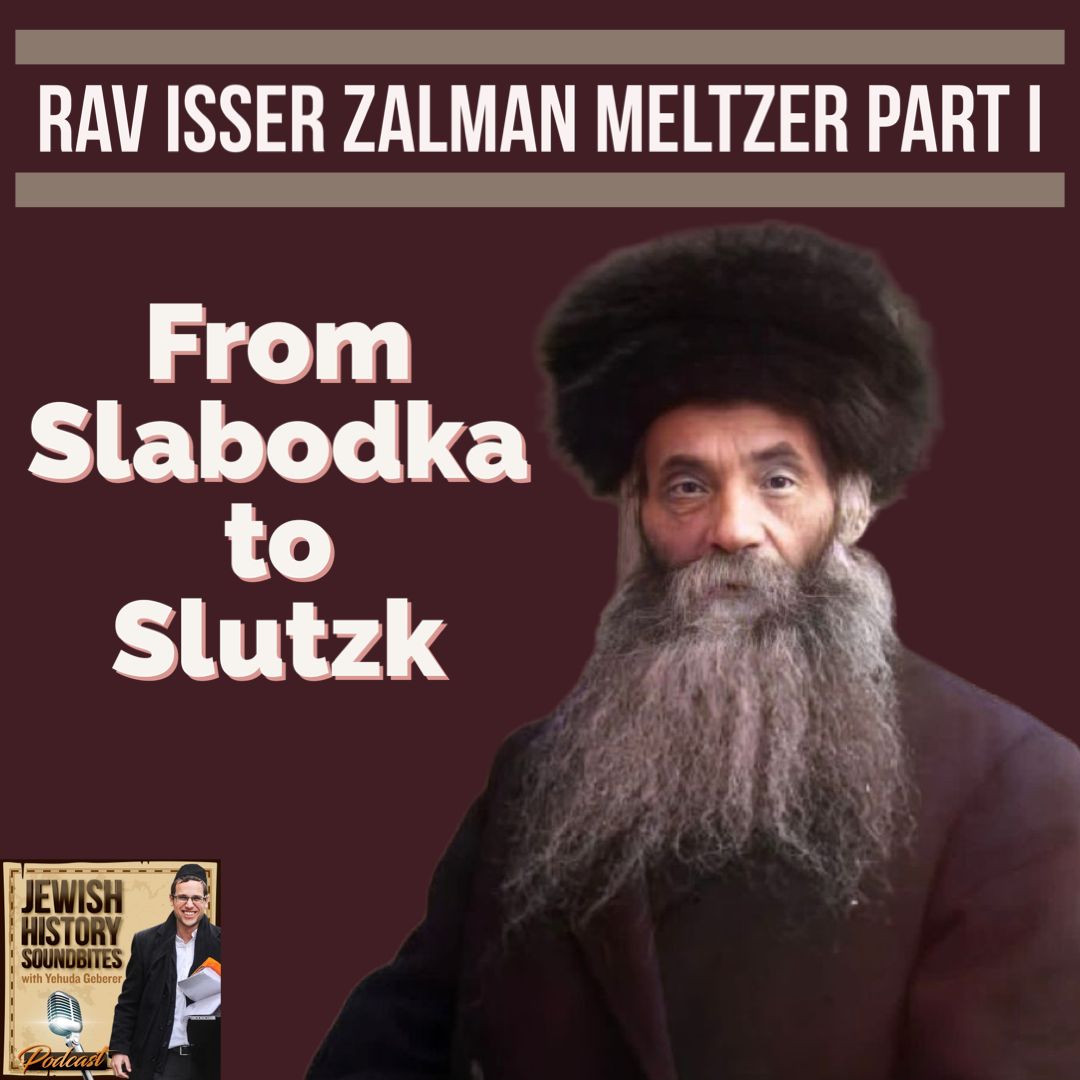
Ep 353From Slabodka to Slutzk: Rav Isser Zalman Meltzer Part I
Rav Isser Zalman Meltzer (1870-1953) was a great Torah leader of the 20th century, whose life story spanned eras and continents. As a young teenager he studied in the vaunted Volozhin Yeshiva, then married into the prestigious Frank family of Kovno, where he subsequently was appointed rosh yeshiva of Slabodka. This was followed by his departure for Slutzk where he remained as rosh yeshiva and later as communal rabbi for decades. Following the formation of the Soviet Union and the challenges of maintaining religious life therein, he immigrated to Palestine in 1925. There he assumed the leadership of the Eitz Chaim yeshiva and served in several leadership positions in both the yishuv and later in Israel, where he oversaw the growth of the emerging Torah community. To dedicate an episode in the Jewish History Soundbites ‘Jewish Saviors of the Holocaust’ series, please contact Yehuda at [email protected] Jewish History Soundbites is coming to NY! Register here for the upcoming tour of the Mt. Judah cemetery with Yehuda Geberer on July 29, 9:30 am For sponsorship opportunities about your favorite topics of Jewish history contact Yehuda at: [email protected] Subscribe To Our Podcast on: PodBean: https://jsoundbites.podbean.com/ Follow us on Twitter or Instagram at @Jsoundbites You can email Yehuda at [email protected]

Ep 352Jewish Saviors of the Holocaust Part III: The Sobibor Revolt
Within the framework of Operation Reinhard, the Nazi extermination of Polish Jewry, the SS built three death camps in Eastern Poland - Belzec, Treblinka & Sobibor. The latter was the smallest of the three, and a quarter of a million primarily Polish and Dutch Jews were killed in its gas chambers during its year and a half of existence. It was at Sobibor that on October 14, 1943 a great prisoner escape took place. Led by the son of a Polish rabbi named Leon Feldhendler & a Soviet Jewish Red Army officer named Sasha Pechersky, these two unlikely leaders joined together to formulate a plan to save not just themselves but to give all of the 600 inmates at Sobibor an equal chance to escape. The revolt killed several SS officers, 300 Jewish prisoners made it to the forest and nearly 50 survived the war. As they broke for the fences, Pechersky demanded that anyone who survive should tell the world what went on in Sobibor. To dedicate an episode in the Jewish History Soundbites ‘Jewish Saviors of the Holocaust’ series, please contact Yehuda at [email protected] Jewish History Soundbites is coming to NY! Register here for the upcoming tour of the Mt. Judah cemetery with Yehuda Geberer on July 29, 9:30 am For sponsorship opportunities about your favorite topics of Jewish history contact Yehuda at: [email protected] Subscribe To Our Podcast on: PodBean: https://jsoundbites.podbean.com/ Follow us on Twitter or Instagram at @Jsoundbites You can email Yehuda at [email protected]
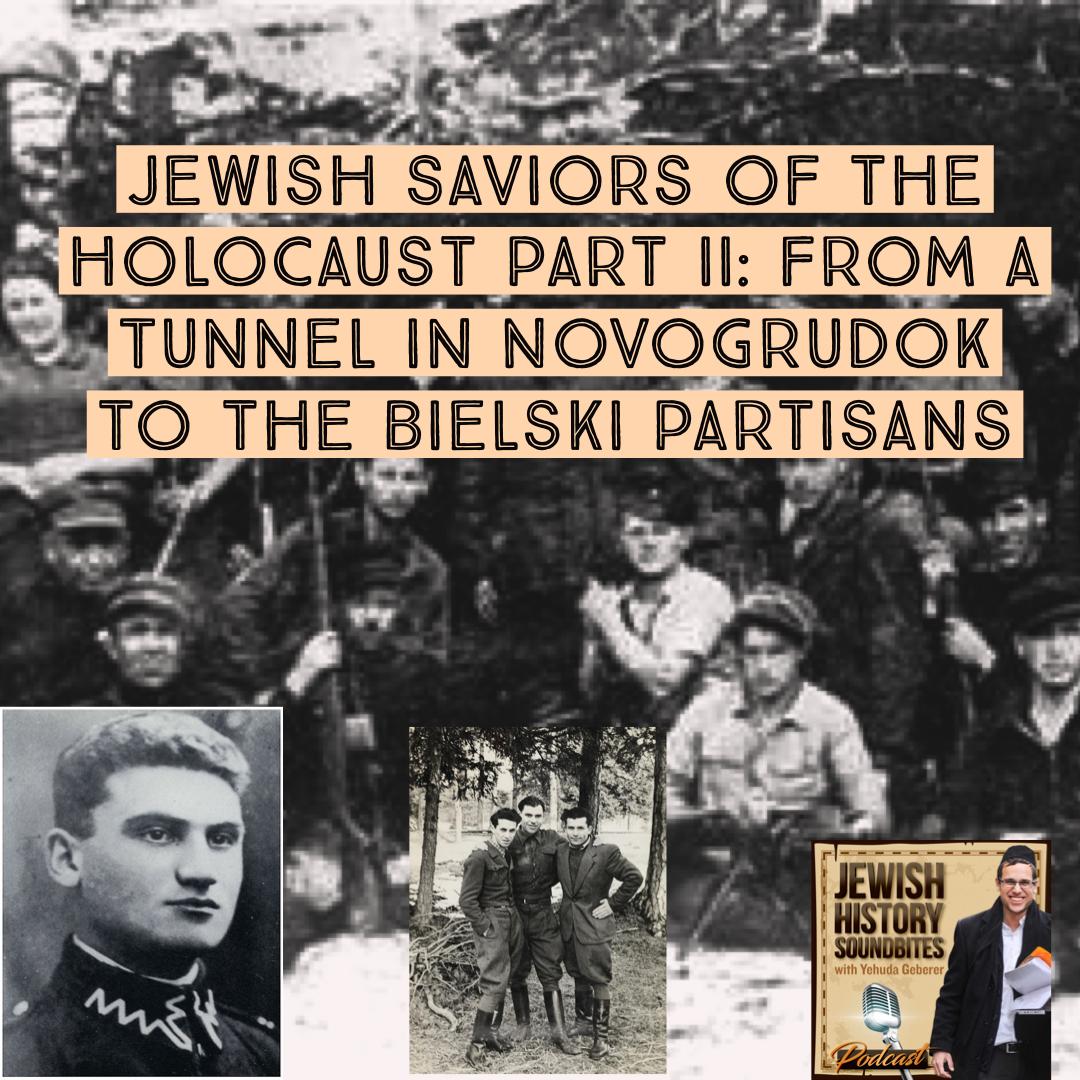
Ep 351Jewish Saviors of the Holocaust Part II: From a Tunnel in Novogrudok to the Bielski Partisans
On the night of September 26, 1943 232 Jews escaped through a tunnel from the Novogrudok Ghetto. Nearly 170 survived, primarily by joining the Bielski partisans who operated nearby in the Naliboki forest. This was likely the greatest escape in Nazi occupied Europe throughout the entire war and Holocaust. The tenacity and courage of the last Jews of the Novogrudok ghetto to dig a 250 meter tunnel leading to the forest, combined with the capability of joining Tuvia Bielski and his partisans, facilitated one of the most astounding stories of Jewish survival during the Holocaust. Tuvia Bielski famously said that he prioritizes saving lives over killing Germans. The result was that his partisan unit was a family camp which saved over 1,200 Jews, among them the escapees of the Novogrudok tunnel. To dedicate an episode in the Jewish History Soundbites ‘Jewish Saviors of the Holocaust’ series, please contact Yehuda at [email protected] Jewish History Soundbites is coming to NY! Register here for the upcoming tour of the Mt. Judah cemetery with Yehuda Geberer on July 29, 9:30 am For sponsorship opportunities about your favorite topics of Jewish history contact Yehuda at: [email protected] Subscribe To Our Podcast on: PodBean: https://jsoundbites.podbean.com/ Follow us on Twitter or Instagram at @Jsoundbites You can email Yehuda at [email protected]
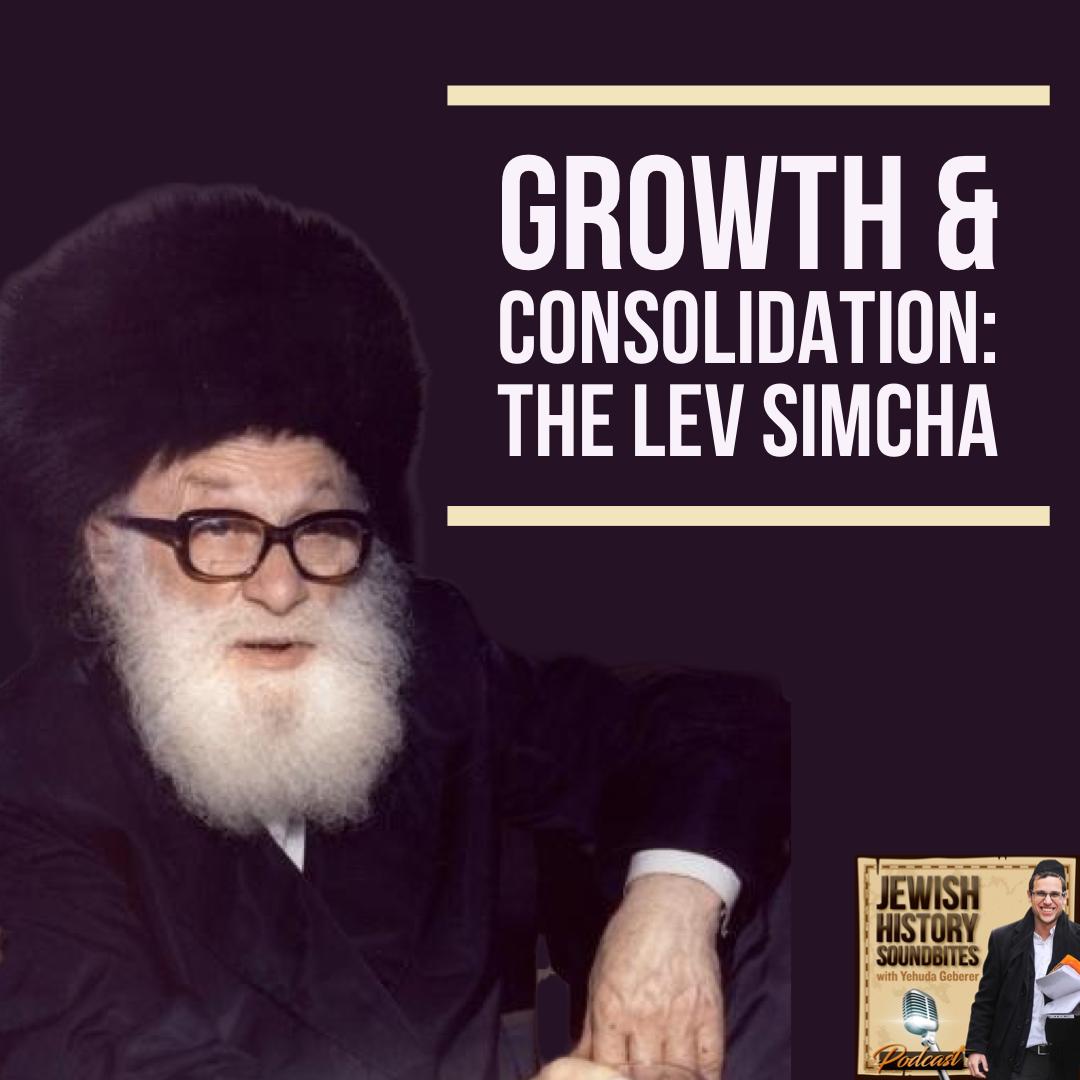
Ep 350Growth & Consolidation: The Lev Simcha
Rav Simcha Bunim Alter (1898-1992), the Lev Simcha of Ger, was a leader during a time period of growth and consolidation. Having grown up in Poland and emerged as a great Torah scholar, he moved to Palestine in 1934, and then returned to Poland shortly before the war and was a crucial player in facilitating his father’s escape from the Nazi inferno. Upon his older brother the Bais Yisrael’s assuming the mantle of leadership in 1948, the Lev Simcha sojourned in Paris and Antwerp for several years before returning to Israel. In 1977, at the age of 79, he became the leader of the Ger Chassidic community, and immediately embarked on a series of innovative measures to enhance the lives of his chassidim whom he cared for in a fatherly way. He pioneered the establishment of Chassidic communities on the periphery for cheaper housing, and encouraged his followers to look after their health and quit smoking. In many ways he expressed his practical understanding and ability to creatively confront the changing demographics his era had been presented with. On the world scene, he continued the legacy of his forebears as the leader of Agudas Yisrael in the political realm, and presented the idea of the Daf Yomi of Yerushalmy at the Knessiah Gedolah in 1980. For sponsorship opportunities about your favorite topics of Jewish history contact Yehuda at: [email protected] Subscribe To Our Podcast on: PodBean: https://jsoundbites.podbean.com/ Follow us on Twitter or Instagram at @Jsoundbites You can email Yehuda at [email protected]
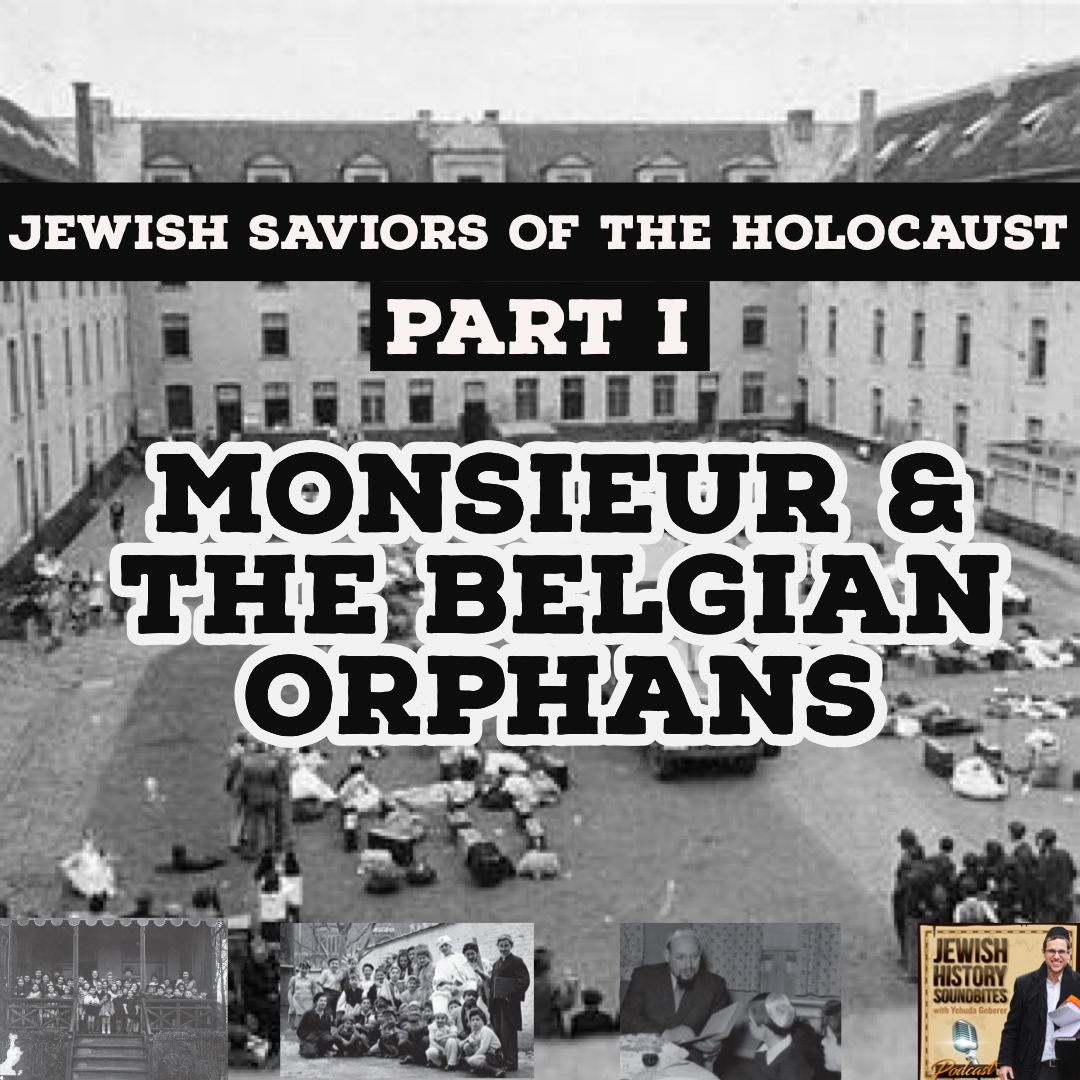
Ep 349Jewish Saviors of the Holocaust Part I: Monsieur & the Belgian Orphans
Jewish History Soundbites is proud to launch a special series entitled ‘Jewish Saviors of the Holocaust’. It will explore the narratives of Jews under Nazi occupation risking their lives to save others during the Holocaust. Each unique profile will explore another story, angle and individual (or group of individuals) who though their own lives were at risk still did everything in their power to save others. The series opens with the story of Yona Tiefenbrunner, known to the orphans he saves as ‘Monsieur’. Born in Germany, he arrived as a refugee in Belgium shortly before the war’s outbreak. He initially opened an orphanage at his own expense in order to assist German Jewish refugee children. With the Nazi occupation of Belgium and the subsequent deportations in 1942, his Brussels orphanage emerged as an island of rescue, as the Nazis miraculously allowed the orphanage to operate and spare the children from deportation to the east. Maintaining a semblance of normalcy under increasingly challenging conditions, Yona managed to care for the orphans' physical and religious welfare until liberation. Following the war, the orphanage relocated to Antwerp and cared for children survivors until its closing in 1960. To dedicate an episode in the Jewish History Soundbites ‘Jewish Saviors of the Holocaust’ series, please contact Yehuda at [email protected] For sponsorship opportunities about your favorite topics of Jewish history contact Yehuda at: [email protected] Subscribe To Our Podcast on: PodBean: https://jsoundbites.podbean.com/ Follow us on Twitter or Instagram at @Jsoundbites You can email Yehuda at [email protected]

Ep 348An Enlightened Song: The Story of Shir
Prague has had its fair share of characters throughout its storied history, yet Shlomo Yehuda Rapoport (1790-1867) or Shir as he was known was definitely one of the more interesting ones. Born into a rabbinic family in Lvov, Shir married the daughter of Rav Aryeh Leib Heller, the author of the Ketzos Hachoshen. Though he remained a scholarly, observant and rabbinic Jew for the remainder of his life, he also associated with the emerging Galician Haskalah (Jewish Enlightenment) of his era. His intellectual pursuits included the study of medieval Jewish philosophy, languages, general science, history and literature, while his social circles included the famous maskilim of Galicia. In an attempt to alleviate his financial struggles his friend Yosef Perl arranged for his appointment to the rabbinate of Tarnopol. Traditionalist opposition made the position unsustainable, and in 1840 he was appointed rabbi of Prague where he remained until his passing. For sponsorship opportunities about your favorite topics of Jewish history contact Yehuda at: [email protected] Subscribe To Our Podcast on: PodBean: https://jsoundbites.podbean.com/ Follow us on Twitter or Instagram at @Jsoundbites You can email Yehuda at [email protected]
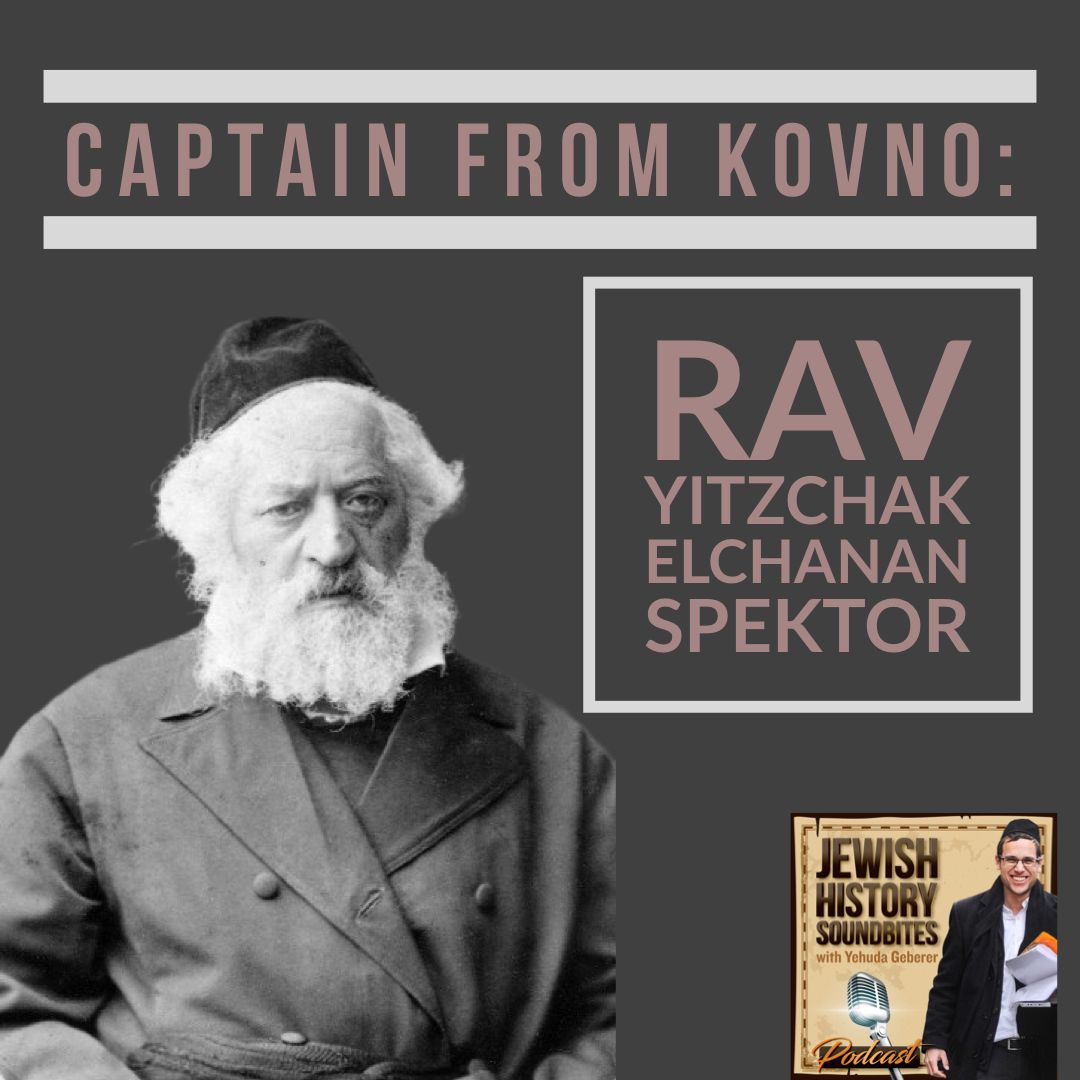
Ep 347Captain from Kovno: Rav Yitzchak Elchanan Spektor
Perhaps the most acclaimed leader of Russian Jewry of the 19th century was Rav Yitzchak Elchanan Spektor (1817-1896). A long-time Rabbi of Kovno, his impact reached the far reaches of the Russian Empire and beyond. He served as the leading posek in all halachic matters, the arbiter of many disputes and lent his name to diverse causes such as the Kovno Persushim Kollel and Chovevei Zion. Exhibiting leadership on the burning issues of the day, he forged a relationship with the financial elite in St. Petersburg and with Czarist government officials lobbying on behalf of the general community. For sponsorship opportunities about your favorite topics of Jewish history contact Yehuda at: [email protected] Subscribe To Our Podcast on: PodBean: https://jsoundbites.podbean.com/ Follow us on Twitter or Instagram at @Jsoundbites You can email Yehuda at [email protected]

Ep 346Frum Politics: Rav Yehoshua of Belz, Rav Shimon Sofer & Machzikei Hadas
Founded in 1879 the Rav Yehoshua of Belz and Rav Shimon Sofer, the Machzikei Hadas political party was the first Orthodox political party in Jewish history. The unique status of Galician Jewry of the 19th century, as a heavily traditional, demographically large community who had already received emancipation from the Habsburg monarchy in 1867, led the leaders of Orthodox Jewry there to utilize the benefits of emancipation to further the cause of traditional Jewry. Rav Shimon Sofer even got elected to the Austrian parliament. The mouthpiece of the organization was a newspaper of the same name, and emerged as another modern tool to preserve tradition. Though its influence waned after an initial decade of success, this pioneering endeavor left a lasting impact on the developing environment of Orthodox politics. For sponsorship opportunities about your favorite topics of Jewish history contact Yehuda at: [email protected] Subscribe To Our Podcast on: PodBean: https://jsoundbites.podbean.com/ Follow us on Twitter or Instagram at @Jsoundbites You can email Yehuda at [email protected]

Ep 345Shavuos Musings & Uri Zohar Tribute
The recent passing of Uri Zohar is an opportunity to pay tribute to this unique individual who made the journey from the apex of the Israeli entertainment world to embracing religious observance. With Shavuos approaching, it’s an opportunity to reflect on some of the historical events which are associated with this season throughout history. From the deportations of Hungarian Jewry in 1944, to liberation a year later, to the events of the First Crusade and the Khmelnytsky massacres of 1648-49, many tragic events somehow occurred around this time. The yahrzeits of both the the Baal Shem Tov and the Ger Rebbe the Imrei Emes are on Shavuos as well. These and several other curious events, are analyzed in these musings on Shavuos and Jewish History. For sponsorship opportunities about your favorite topics of Jewish history contact Yehuda at: [email protected] Subscribe To Our Podcast on: PodBean: https://jsoundbites.podbean.com/ Follow us on Twitter or Instagram at @Jsoundbites You can email Yehuda at [email protected]

Ep 344A Chassid in Krakow: The Maor Veshemesh
Rav Klonymous Kalman Halevi Epstein (1751-1823) is known by his posthumously published work the Maor Veshemesh. Born into a poor family, he spent the bulk of his childhood selling bagels in the streets of Krakow to support his family. He eventually emerged as a budding Torah scholar, and later joined the nascent Chassidic movement, becoming a close follower of the Noam Elimelech of Lizhensk. He later attempted to establish a chassidic presence in Krakow, but faced much opposition from the establishment. Eventually returning to his home town of Neustadt, he gained a following, while he himself continued to travel to the great tzadikim of his day. His burial site in Krakow is much visited until this very day, while his primary legacy in the form of his sefer Maor Veshemesh is sometimes referred to as ‘the Shulchan Aruch of Chassidus’. For sponsorship opportunities about your favorite topics of Jewish history contact Yehuda at: [email protected] Subscribe To Our Podcast on: PodBean: https://jsoundbites.podbean.com/ Follow us on Twitter or Instagram at @Jsoundbites You can email Yehuda at [email protected]
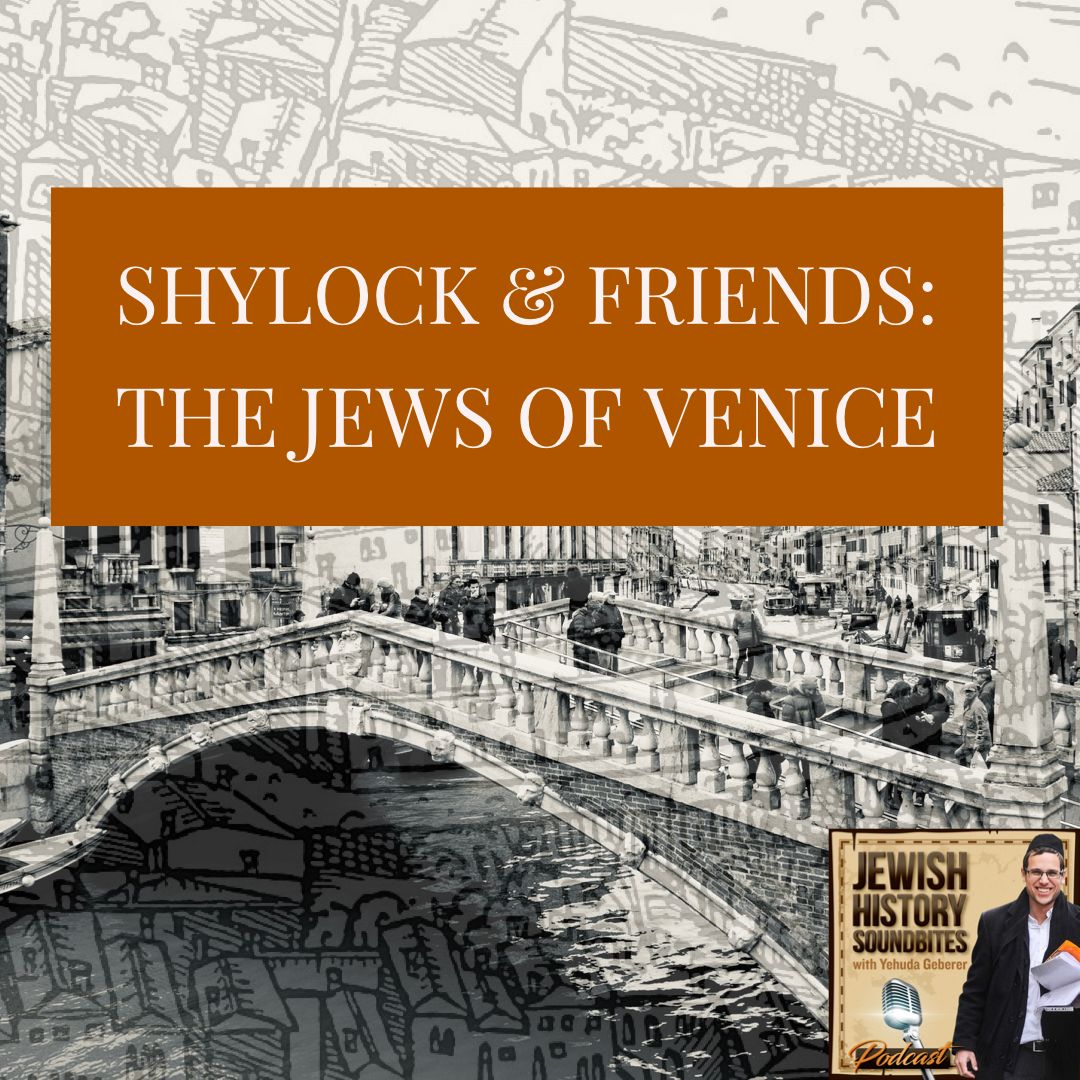
Ep 343Shylock & Friends: The Jews of Venice
Jews have lived in Venice for more than a millennium. In 1516 the Jewish community of Venice was restricted to one area of the city, and this came to be known as the Ghetto, the first of its kind in Europe. Jewish life flourished, and it became a pioneering center of the printing of Hebrew books, most famously in the printing press of the Christian Daniel Bomberg. Though there were many famous Jewish personalities of Venice, including Don Yitzchak Abarbanel who lived out his last years in the city, the most famous Venetian Jew never even existed at all. Shylock is a fictional character and the primary antagonist in Shakespeare’s play The Merchant of Venice. While Shakespeare used - and to a certain extent created - anti-Semitic tropes which unfortunately were perpetuated by subsequent anti-Semites over the ensuing centuries, in many ways the character reflects the restricted reality of Venice’s Jews at the time. For sponsorship opportunities about your favorite topics of Jewish history contact Yehuda at: [email protected] Subscribe To Our Podcast on: PodBean: https://jsoundbites.podbean.com/ Follow us on Twitter or Instagram at @Jsoundbites You can email Yehuda at [email protected]
Ep 342Hungarian Royalty: The Chasam Sofer & His Family
One of the most influential Torah leaders in the modern era was Rav Moshe Sofer, the Chasam Sofer (1762-1839). Rabbi, rosh yeshiva, posek, prolific author, and most of all, a charismatic leader who confronted the challenges of modernity, and led the forming of a traditional response in changing times. A component of the legacy of the Chasam Sofer was his illustrious family, who emerged as something of a rabbinic dynasty in the ensuing generations. His son the Ksav Sofer succeeded him in Pressburg, while another son Rav Shimon Sofer was the rabbi of Krakow. Many of his descendants were rabbis all over the Austro-Hungarian Empire. Many either escaped or survived the war and continued his legacy in the rebuilding during the post war until this very day. For sponsorship opportunities about your favorite topics of Jewish history contact Yehuda at: [email protected] Subscribe To Our Podcast on: PodBean: https://jsoundbites.podbean.com/ Follow us on Twitter or Instagram at @Jsoundbites You can email Yehuda at [email protected]
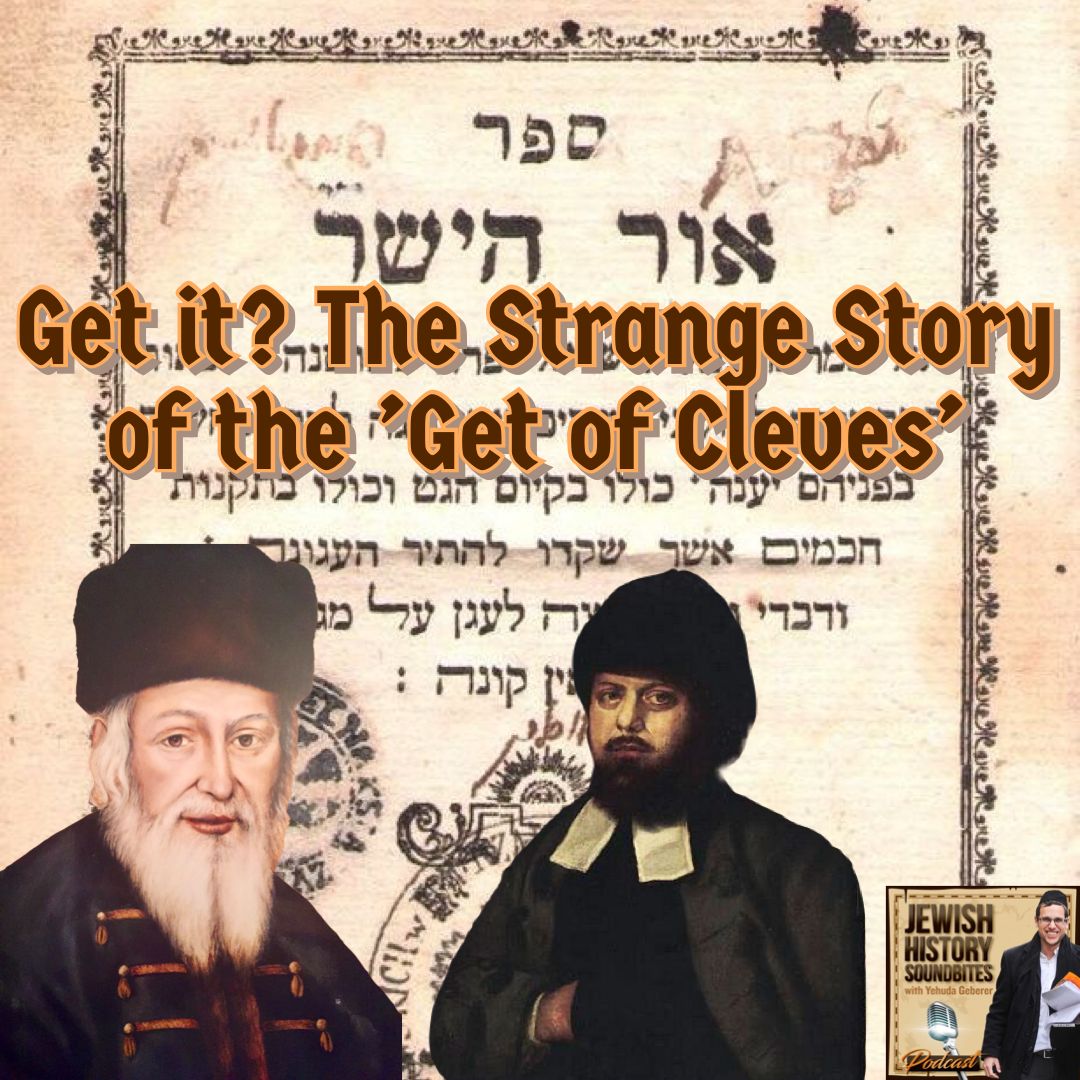
Ep 341Get it? The Strange Story of the ’Get of Cleves’
The strange story of the Get of Kleve (or Cleves) rocked the rabbinical world of the 1760’s. What commenced as an innocuous question regarding a young man’s mental faculties, and his resulting capability of participating in a divorce ceremony, soon exploded into a general dispute about a rabbinical courts sole jurisdiction over a halachic dispute and the imposing of majority opinion among rabbis. While the Frankfurt rabbinical court maintained that the groom in question was insane and therefore the get which he delivered was invalid, an increasing number of rabbis across Europe agreed with Rav Yisrael Lifshitz regarding the validity of the get. Eventually Rav Yechezkel Landau of Prague, the Noda B'yehuda, entered the fray, insisting that the divorce document was valid. The dispute can be viewed within the larger context of events of Jewish society of the 18th century, with loosening control of the kahal and early signs of modernity causing instability within the circles of established authority. This episode is sponsored by Legacy Judaica in honor of their upcoming auction, Sunday, May 8, 2022, 1:00 PM EST. The catalog is available here: https://bidspirit.com/r/3axy For a unique opportunity to purchase historical artifacts, books, letters of historical personalities and more, check out the Legacy Judaica auction. For sponsorship opportunities about your favorite topics of Jewish history contact Yehuda at: [email protected] Subscribe To Our Podcast on: PodBean: https://jsoundbites.podbean.com/ Follow us on Twitter or Instagram at @Jsoundbites You can email Yehuda at [email protected]

Ep 340More than a Miracle Worker: Rav Eliyahu Guttmacher
Rav Eliyahu Guttmacher (1796-1874) was a German rabbi who gained renown as a miracle worker during his tenure in the rabbinate of Gratz (Greiditz). Thousands from Poland and all over Europe would petition him asking for his blessings and prayers on every conceivable issue. A student of Rav Akiva Eiger, he was also a Kabbalist, and later a proto Zionist and supporter of the ideas of his colleague Rav Tzvi Hirsh Kalisher. In 1932 a large cache of kvittelech sent to Rav Guttmacher was discovered. An analysis of this rare collection yields much information on the social, economic and religious life of Polish Jewry during the 19th century. For sponsorship opportunities about your favorite topics of Jewish history contact Yehuda at: [email protected] Subscribe To Our Podcast on: PodBean: https://jsoundbites.podbean.com/ Follow us on Twitter or Instagram at @Jsoundbites You can email Yehuda at [email protected]

Ep 339From Rugby to the World Stage: Rav Avigdor Miller Part III
With his appointment as congregational rabbi of the Young Israel of Rugby in East Flatbush in 1947, Rav Avigdor Miller embarked on the most famous aspect of his storied career. He saw his role as rabbi primarily as a teacher of Torah, and he envisioned a community committed to Jewish observance and Torah study. To that end he focused on teaching Torah, engaging in the delivery of classes for beginners in Gemara and a myriad of other topics. With the demographics changing in East Flatbush in the early 1970’s, Rav Miller took the unprecedented step of moving his entire congregation to Flatbush. In his later years his impact and influence exponentially increased beyond the confines of his congregation through the publication of his books, the increased attendance of his lectures - especially his Thursday night lecture - and the dissemination of his recorded lectures on cassette tapes. For sponsorship opportunities about your favorite topics of Jewish history contact Yehuda at: [email protected] Subscribe To Our Podcast on: PodBean: https://jsoundbites.podbean.com/ Follow us on Twitter or Instagram at @Jsoundbites You can email Yehuda at [email protected]

Ep 338Rabbi & Educator: Rav Avigdor Miller Part II
Rav Avigdor Miller assumed the rabbinate of Walnut Street Shul in Chelsea, Massachusetts in 1939, and would remain there for six years. Seeking better educational opportunity for his children, he moved to East Flatbush, Brooklyn in 1945 and would remain there for the next three decades. He assumed a position as mashgiach in Yeshiva Chaim Berlin in Brownsville, and began educating his young charges with the values he had brought from Slabodka. At around the same time he was hired as congregational rabbi at the Young Israel of Rugby, where he would have a decisive impact on generations of congregants. Following his departure from Chaim Berlin in 1965, he expanded the scope of his activities with his involvement in other Brooklyn Yeshivos such as Netzach Yisroel, Mir and Eastern Parkway. In addition, he gave classes to the girls of Bais Yaakov in Williamsburg and Boro Park. For sponsorship opportunities about your favorite topics of Jewish history contact Yehuda at: [email protected] Subscribe To Our Podcast on: PodBean: https://jsoundbites.podbean.com/ Follow us on Twitter or Instagram at @Jsoundbites You can email Yehuda at [email protected]

Ep 337The Maharal of Prague
The Maharal of Prague (c.1512-1609) was more legend than reality. His teachings and diverse scholarship seem to grow more popular with time, but who was he and what was the world that he lived and operated in? The Maharal was a communal rabbi in his hometown of Poznan (Poland), Nikolsburg (Moravia) and Prague (Bohemia). He was a posek and kabbalist, a communal leader and a prolific author. He stood at a crossroads of Jewish history and made a decisive impact in his own time and through his legacy. Emperor Rudolf II of the Holy Roman Empire moved the seat of the royal court to the Prague Castle in 1583, and his religious tolerance coupled with his eccentric obsession with the occult sciences added to Prague’s mystical reputation. And it was in Prague where the Maharal would lead the community, teach his students and publish many of his acclaimed works. This episode of Jewish History Soundbites on the Maharal is sponsored by “Short Machshava on the Daf”, a project of Machsheves Yechezkel. The Short Machshava Shiur aims to give an understanding of the Agadita/Machshava of every Daf in shas, following the Daf Yomi schedule, adding a new Depth to the Daf, and is given by Rabbi Yechezkel Hartman, a Talmid of Rabbi Moshe Shapiro zt"l, Maggid Shiur in Lawrence NY and son of Rav Yehoshua Hartman, the publisher and editor of many works of the Maharal. Available on machshevesyechezkel.com Whatsapp- https://bit.ly/shortmwa4 All Major Podcast Platforms - https://bit.ly/shortmpodcast TorahAnytime- https://www.torahanytime.com/#/speaker?l=882 All Daf- https://alldaf.org/series/4102/ For sponsorship opportunities about your favorite topics of Jewish history contact Yehuda at: [email protected] Subscribe To Our Podcast on: PodBean: https://jsoundbites.podbean.com/ Follow us on Twitter or Instagram at @Jsoundbites You can email Yehuda at [email protected]

Ep 336Baltimore meets Slabodka: Rav Avigdor Miller Part I
Rav Avigdor Miller (1908-2001) was a unique and influential rabbinical leader on the American scene of the 20th century. With his life spanning most of the tumultuous 20th century, his life story is somewhat a microcosm of Jewish life during historic times. Born in Baltimore into a home of immigrants, he went to study in RIETS in New York and eventually made the courageous decision to cross the ocean to study in the Slabodka Yeshiva in Lithuania. It was there under the tutelage of his rebbi Rav Isaac Sher and other great mussar personalities that would come to define him and his teachings for the rest of his life. It was also there that he married his wife Chana Etel Lesin, the daughter of Rav Yaakov Moshe Lesin the rabbi of Neishtat-Sugind. After spending six years in Slabodka, he returned home in late 1938, at the cusp of a long career where he would transmit the legacy of the past to generations of students and congregants. For sponsorship opportunities about your favorite topics of Jewish history contact Yehuda at: [email protected] Subscribe To Our Podcast on: PodBean: https://jsoundbites.podbean.com/ Follow us on Twitter or Instagram at @Jsoundbites You can email Yehuda at [email protected]

Ep 335The History of Soviet Jewry Part III: Refuseniks & Immigrants
Soviet Jewry in the 1970’s and 80’s was a large community which was struggling to define its Jewish identity. Following the Six Day War in Israel, the Refusenik movement gained traction, with many young Soviet Jews applying for exit visas, and willing to sustain the consequences when their applications were denied. Anatoly Sharansky, Ida Nudel, Eliyahu Essas, Yosef Mendelevich, Yuli Edelstein, and many others were exiled or went to prison for the crime of desiring to exit the Soviet Union. For some there was a resurgence of Jewish observance. In the 1980’s emigration increased, and the last great emigration from Russia began. Many arrived in Israel, while others went to the United States or Germany. In Israel they integrated while maintaining elements of their own culture. Rav Avraham Yaakov Pam thought it imperative to create a school system where children of immigrant families from the Soviet Union would be accommodated, and where they would be introduced to religious education. This series on the history of Soviet Jewry is sponsored by Shuvu - Chazon Avraham, a network of schools in Israel whose student body is primarily composed of children of immigrants from the former Soviet Union. Support Shuvu’s educational projects here: https://www.shuvuusa.org/donate For sponsorship opportunities about your favorite topics of Jewish history contact Yehuda at: [email protected] Subscribe To Our Podcast on: PodBean: https://jsoundbites.podbean.com/ Follow us on Twitter or Instagram at @Jsoundbites You can email Yehuda at [email protected]

Ep 334The History of Soviet Jewry Part II: Destruction & Memory
The Molotov-Von Ribbentrop non-aggression pact ultimately led to the annexation of large swaths of territory into the Soviet Union. The Jews of eastern Poland and the Baltic States now had to acclimate to the realities of Soviet Jewish life. With the Nazi invasion of the Soviet Union - Operation Barbarossa - on June 22, 1941, the mass shootings of Soviet Jewry began. The Holocaust in the Soviet Union was unique in many respects. The Einsatzgruppen SS killing squads, along with local collaborators, murdered the Jews of the Soviet Union through mass shootings outside of the towns. Survival under Nazi occupation was rare, and was only possible by escape to the unoccupied areas of the Soviet Union or by serving in the Red Army. The Soviet government appointed the Jewish Anti-Fascist Committee, headed by leading Soviet Jewish writers and intellectuals. They generated publicity regarding the Holocaust, and gathered data which was eventually published as the Black Book. The postwar Stalinist repression of Jewish life was one of the darkest periods of Jewish history in the Soviet Union. Sustaining Jewish life became nearly impossible, and those who struggled to do so did it heroically and against all odds. This series on the history of Soviet Jewry is sponsored by Shuvu - Chazon Avraham, a network of schools in Israel whose student body is primarily composed of children of immigrants from the former Soviet Union. Support Shuvu’s educational projects here: https://www.shuvuusa.org/donate For sponsorship opportunities about your favorite topics of Jewish history contact Yehuda at: [email protected] Subscribe To Our Podcast on: PodBean: https://jsoundbites.podbean.com/ Follow us on Twitter or Instagram at @Jsoundbites You can email Yehuda at [email protected]
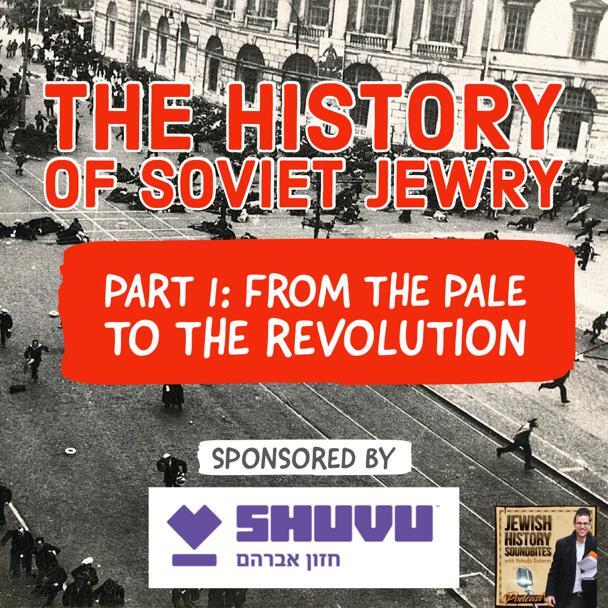
Ep 333The History of Soviet Jewry Part I: From the Pale to the Revolution
The Russian Revolutions of 1917 drastically transformed the lives of the largest Jewish community in the world. Emancipation was finally achieved, the hated Czar was finally deposed and they could finally reside outside the Pale of Settlement. With the founding of the Soviet Union in 1922, new challenges arrived on the scene. The new found freedom led to widespread assimilation. Couple with the mass internal migration to urban centers, this brought a great breakdown of traditional Jewish life. The Soviet communist government was openly hostile to organized religious life, and its rabbis were hounded and exiled. This series on the history of Soviet Jewry is sponsored by Shuvu - Chazon Avraham, a unique network of schools in Israel whose student body is primarily composed of children of immigrants from the former Soviet Union. The students represent a closing chapter of Jewish history, a bookend effect as it were as descendants of the Soviet Jews who experienced the Revolution and its results. Support Shuvu’s educational projects here: https://www.shuvuusa.org/donate For sponsorship opportunities about your favorite topics of Jewish history contact Yehuda at: [email protected] Subscribe To Our Podcast on: PodBean: https://jsoundbites.podbean.com/ Follow us on Twitter or Instagram at @Jsoundbites You can email Yehuda at [email protected]

Ep 332Brisk Management: Another Look at Rav Chaim Brisker
Rav Chaim Soloveitchik, known as Rav Chaim Brisker (1853-1918), has enjoyed an outsized influence on the methodology of Talmudic study and the development of the modern Torah world. As a historical figure he was not only influential but beloved as well, with countless stories of his kindness, care and leadership initiative as rabbi in Brisk as well as in wider rabbinic circles across the Pale of Settlement. From his adopting abandoned children on his doorstep to his attempts at implementing pension plans for deceased rabbis widows and orphans, his care and attention to detail bespoke the responsibility he felt towards the less fortunate of society. His Torah teaching career commenced at age 27 in the Volozhin yeshiva, and he later had informal interactions with students while in Brisk. From these oral teachings, together with a limited textual legacy in the form of his published works, his imprint on the development of the Torah world is felt until this very day. See previous episode about Rav Chaim Brisker: https://jsoundbites.podbean.com/e/voice-of-clarity-a-tribute-to-rav-chaim-brisker/ For sponsorship opportunities about your favorite topics of Jewish history contact Yehuda at: [email protected] Subscribe To Our Podcast on: PodBean: https://jsoundbites.podbean.com/ Follow us on Twitter or Instagram at @Jsoundbites You can email Yehuda at [email protected]

Ep 331From Slonim to Tverya: The Nesivos Shalom Part II
Rav Shalom Noach Berezovsky was appointed Slonim Rebbe shortly prior to his father in law’s passing in 1981. As he had served as the rosh yeshiva of Slonim for decades, this enabled him to enjoy a close relationship with his followers who were for the most part his own students. The background of the Slonim dynasty has its roots in White Russia, with antecedents in the court of Rav Mordechai of Lechovitz and Rav Moshe of Kobrin. Rav Avraham Weinberg, the Yesod Ha’avodah, founded the Slonim dynasty. He was succeeded by his grandson Rav Shmuel Weinberg, who passed away in exile in Warsaw. Following World War I, his son Rav Avraham Weinberg, the Bais Avraham, reestablished the Slonim court in Baranovich. For sponsorship opportunities about your favorite topics of Jewish history contact Yehuda at: [email protected] Subscribe To Our Podcast on: PodBean: https://jsoundbites.podbean.com/ Follow us on Twitter or Instagram at @Jsoundbites You can email Yehuda at [email protected]

Ep 330A Teacher from Slonim: The Nesivos Shalom Part I
The Slonim Rebbe, Rav Shalom Noach Berezovsky (1911-2000) was known by his popular work the Nesivos Shalom. Having grown up in Baranovich in the center of the Slonim chassidic dynasty, he was appointed by the rebbe the Bais Avraham to record his weekly discourses. Following his marriage and move to Tverya in 1935, he first found employment as a rosh yeshiva in Achei Temimim-Lubavitch in Tel Aviv. Having heard of the decimation of the Slonim community in Europe during the Holocaust, he embarked on ambitious mission: to found a Slonim yeshiva in Yerushalayim with the goal of rebuilding the chassidus. With his father in law election as the Slonim Rebbe, he was now the rosh yeshiva of a fledgling chassidic community. He then succeeded his father in law the Birkas Avraham as rebbe in 1981. For sponsorship opportunities about your favorite topics of Jewish history contact Yehuda at: [email protected] Subscribe To Our Podcast on: PodBean: https://jsoundbites.podbean.com/ Follow us on Twitter or Instagram at @Jsoundbites You can email Yehuda at [email protected]

Ep 329From World War to Revolution: Iranian Jewry Part II
Iranian Jewry in the 20th century saw much upheaval. The rise of the Pahlavi dynasty brought much hope to the Persian Jewish community. Iran served as a center of some important events of World War II with the Anglo-Soviet invasion of the country, as host of the Teheran Conference, the exit of the Polish Anders Army through Iran and many Jewish refugees arriving there including the famous ‘Yaldei Teheran’. Another period of relative stability was interrupted towards the end of the 1970’s with the Revolution and the subsequent Iran-Iraq war. Much emigration occurred around this time. Rabbi Herman Neuberger and other activists engaged in the rescue of many Iranian Jews, and this sparked a renaissance of Iranian Jewish life in the United States. Many immigrated to Israel as well. Rabbi Neuberger arranged their attendance of Ner Israel - tuition free - and many emerged as leaders of the Iranian Jewish community. For sponsorship opportunities about your favorite topics of Jewish history contact Yehuda at: [email protected] Subscribe To Our Podcast on: PodBean: https://jsoundbites.podbean.com/ Follow us on Twitter or Instagram at @Jsoundbites You can email Yehuda at [email protected]

Ep 328Princes of Persia: Iranian Jewry Part I
The ancient Jewish community of Persia/Iran is one of the oldest Jewish communities in the world. The site of the Purim story and many Biblical and Talmudic era luminaries, it continued to flourish through times of stability and persecution. One of the great rabbinical leaders in the city of Hamedan, Iran in modern times was Chacham Mola David Sasson Rabban (1879-1974). As rabbi of the community he oversaw its growth and later decline in mid 20th century to widespread emigration, while corresponding with rabbis across Iran and in neighboring Iraq. He also ran the local Otzar Hatorah school, which was part of network of traditional Jewish education which facilitated the renaissance of Jewish life in Iran and later in Iranian diaspora Jewish communities. This podcast is sponsored in honor of the release of the first sefer of its kind! The writings of the Av Bet Din of the city of Hamadan, Iran, Rabbi David Sasson Rabban, including a whole section on the minhagim of the Jews of Iran. Published by Machon Magen Avot publishing house, and is available on their website moroccanhalacha.com, along with all other sefarim by Machon Magen Avot. In Israel it can be obtained in the Sifria Hasefaradit Rechov Bucharim 4. https://magen-avot.myshopify.com/products/the-writings-of-chacham-rabbi-david-sasson-rabban-of-hamedan-iran For sponsorship opportunities about your favorite topics of Jewish history contact Yehuda at: [email protected] Subscribe To Our Podcast on: PodBean: https://jsoundbites.podbean.com/ Follow us on Twitter or Instagram at @Jsoundbites You can email Yehuda at [email protected]

Ep 327Chabad & Zionism Part II
With the passing of the fifth rebbe of Chabad the Rashab in 1920, his son Rav Yosef Yitzchak Schneerson (1880-1950), the Rayatz, or the Freidiker (previous) Rebbe, took over the Chabad-Lubavitch movement at a time of crisis. Through the decades of his leadership he expressed a commitment to the ideals of his father in regards to Zionism, while dealing with the practical upheavals of Jewish life including the Holocaust and the founding of the State of Israel. This was continued by his son in law and successor Rav Menachem Mendel Schneerson. While in theory, the opposition to ideas such as ‘aschalta digeula’ remained, practical considerations of caring for the needs of the Jewish People and furthering Jewish observance took precedence. Of special note was the relationship enjoyed between both Rebbe’s and the third president of the State of Israel, Zalman Shazar. For sponsorship opportunities about your favorite topics of Jewish history contact Yehuda at: [email protected] Subscribe To Our Podcast on: PodBean: https://jsoundbites.podbean.com/ Follow us on Twitter or Instagram at @Jsoundbites You can email Yehuda at [email protected]

Ep 326Wise Man of Hungary: Rav Yehuda Aszod
Rav Yehuda Aszod (1796-1866) was one of the architects of the emerging Hungarian Orthodoxy of the 19th century. A student of the Maharam Banet, he went to serve in the rabbinate and as a rosh yeshiva in several towns, the most prominent of which was in Dunaszerdahely in the Austrian Empire. Ideologically positioned between neo Orthodoxy as represented by Rav Ezriel Hildesheimer and Hungarian Ultra-Orthodoxy as represented by Rav Hillel Lichtenstein, Rav Yehuda Aszod emerged as a leader of mainstream orthodoxy along with his colleague the Ksav Sofer. For decades he confronted modernist trends, any assault on tradition, and engaged in polemics with assimilationists and reformists alike. In 1864 he headed a delegation which met with Emperor Franz Jozef I in an unsuccessful attempt to block the opening of a reformist rabbinical seminary. For sponsorship opportunities about your favorite topics of Jewish history contact Yehuda at: [email protected] Subscribe To Our Podcast on: PodBean: https://jsoundbites.podbean.com/ Follow us on Twitter or Instagram at @Jsoundbites You can email Yehuda at [email protected]

Ep 325A Dazzling Light: The Life & Impact of Rabbi Aryeh Kaplan
Rabbi Aryeh Kaplan (1934-1983) was a dazzling light on the Jewish history scene of the 20th century. With family origins in Thessaloniki, Greece, he was born in the Bronx, and eventually studied at Yeshiva Torah Vodaath and Mir Yeshiva in Jerusalem. Returning to the US he became a physicist and then a pulpit rabbi, before entering the world of Jewish outreach. In his later years he maintained a prodigious literary output, authoring a large amount of works across the gamut of Jewish thought, mysticism, chassidic thought and practical Jewish observance. Much of this was commissioned by NCSY, which is where he did much of his kiruv activities. His tragic passing at the young age of 48 cut short his life work and accomplishments, but his impact continues until today through his many published works. This episode has been sponsored by NCSY in honor of the republication of Rabbi Aryeh Kaplan’s books. Connect more to Mitzvos and Yiddishkeit with Rabbi Aryeh Kaplan Zt”l’s republished and enhanced books. The library of 10 books covers the deeper meaning of some of the most important mitzvos. A project of NCSY in conjunction with Artscroll. For More Information and to Buy the Books: https://go.ncsy.org/rVOC For sponsorship opportunities about your favorite topics of Jewish history contact Yehuda at: [email protected] Subscribe To Our Podcast on: PodBean: https://jsoundbites.podbean.com/ Follow us on Twitter or Instagram at @Jsoundbites You can email Yehuda at [email protected]

Ep 324The Czars & The Jews Part I
Following the partitions of Poland in the last quarter of the 18th century, the largest Jewish community in the world found themselves under the rule of the Romanov dynasty in the Russian Empire. Each Czar formulated a distinct policy in regards to the Jewish population, and many of these policies, along with the Jewish community’s reaction, often has ramifications until this very day. Catherine the Great was czarina during the years of the partition itself, and she commenced her Jewish policy influenced by the ideas of enlightened absolutism. Jews were granted partial emancipation but the beginnings of their confinement to what would become known as the Pale of Settlement began as well. At the turn of the 18th-19th centuries, Alexander I assumed power, and he initially was viewed as a somewhat enlightened ruler, primarily due to the opportunities afforded through his ‘Jew constitution’ promulgated in 1804. He was succeeded by Czar Nicholas I, who went down in history as a sworn enemy of the Jews and an evil ruler. It was under his watch that the infamous cantonist decrees took place. He also attempted to meddle with internal Jewish affairs by reforming the educational institutions and by the annulment of the kahal communal structure. For sponsorship opportunities about your favorite topics of Jewish history contact Yehuda at: [email protected] Subscribe To Our Podcast on: PodBean: https://jsoundbites.podbean.com/ Follow us on Twitter or Instagram at @Jsoundbites You can email Yehuda at [email protected]

Ep 323The Roar of the Lion: The Life of Rav Leib Malin Part I
Prewar student of Rav Yerucham Levovitz and the Brisker Rov, leader during the Mir Yeshiva’s wartime escape to Shanghai, and postwar builder of Bais Hatalmud in Brooklyn, Rav Leib Malin (1906-1962) was the ‘Lion of the Mir’. In part 1 of examining his life and accomplishments, we examine his family background, leadership role in the escape to Shanghai, and his replanting Torah through his Bais Hatalmud yeshiva in the postwar United States. The unique circumstances of this rebuilding attempt, made his all encompassing vision of what a yeshiva is a historic landmark in the role that the yeshiva institution was to play in revitalizing traditional society. No longer to be limited to an educational role, a yeshiva was to be a lifelong communal affiliation, a revolutionary role which has arguably bore fruit through the contemporary yeshiva community worldwide. This episode has been sponsored by 20 Minute Daf. A daf yomi shiur led by Reb Shaul Greenwald, 20 minute daf is where you feel the geshmak of Daf Yomi. In just a little over 20 minutes, you'll get a clear and thorough explanation of the sugya. Listen to 20 Minute Daf on all podcast platforms, WhatsApp, and at 20minutedaf.com For sponsorship opportunities about your favorite topics of Jewish history contact Yehuda at: [email protected] Subscribe To Our Podcast on: PodBean: https://jsoundbites.podbean.com/ Follow us on Twitter or Instagram at @Jsoundbites You can email Yehuda at [email protected]
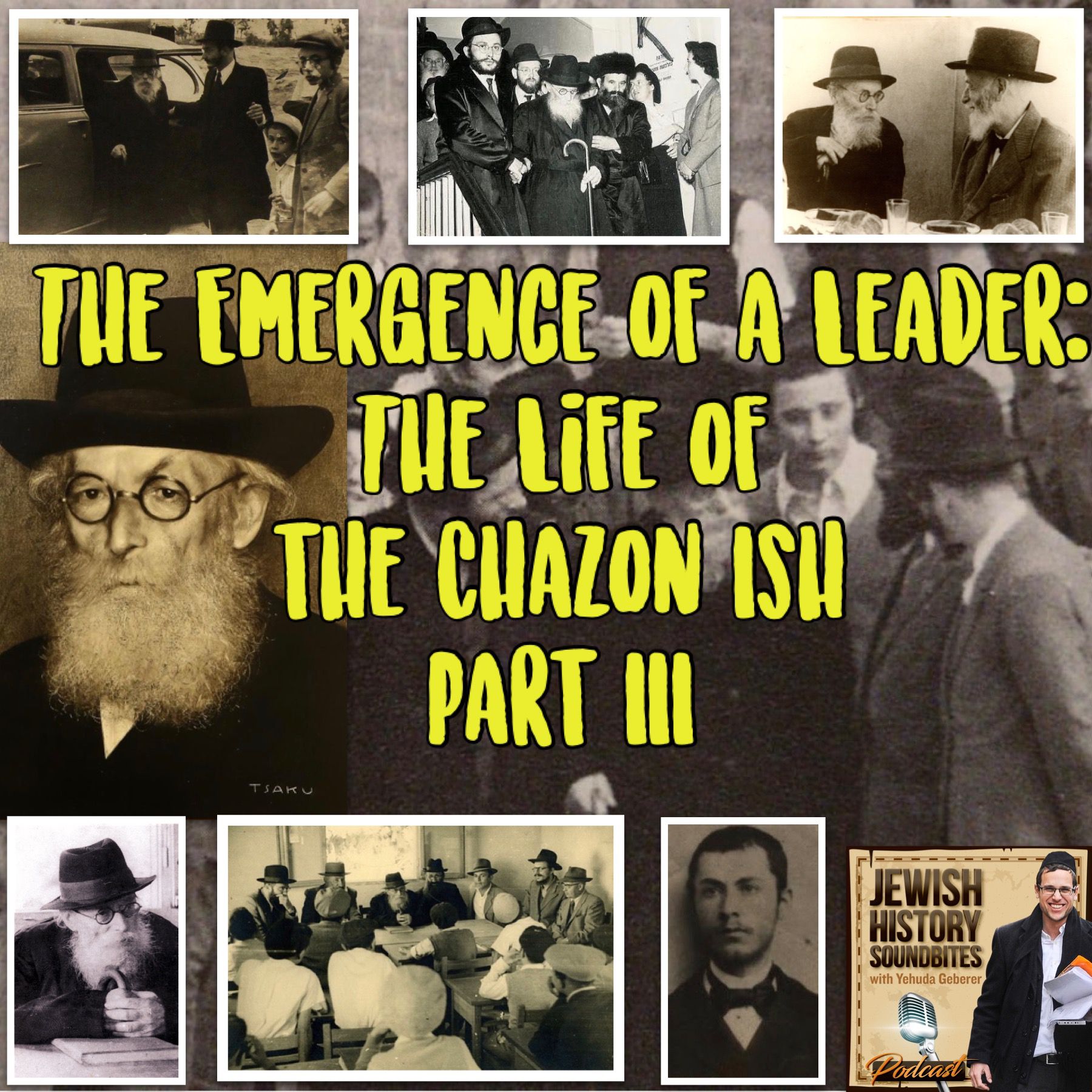
Ep 322The Emergence of a Leader: The Life of the Chazon Ish Part III
In part 3 of the story of Rav Avraham Yeshaya Karelitz (1878-1953), the Chazon Ish, his path is traced from his relative obscurity to his emergence as a leader. From expressing halachic positions for the Poalei Agudas Yisrael agricultural settlements, to building yeshivos across the new yishuv, the Chazon Ish soon emerged as a well known posek with the psak he issued regarding the International Dateline. While losing much of his family during the Holocaust and suffering other personal challenges during the 1940’s, the decade saw him become an address for many seeking his advice and blessing as his fame began to spread. With the founding of the State of Israel in 1948, the Chazon Ish was at the cusp of his final position in the Jewish world - an undisputed leader. Check out the earlier episodes about the Chazon Ish here: Part 1: https://jsoundbites.podbean.com/e/a-guiding-light-the-life-of-the-chazon-ish-part-i/ Part 2: https://jsoundbites.podbean.com/e/a-guiding-light-the-life-of-the-chazon-ish-part-ii/ For sponsorship opportunities about your favorite topics of Jewish history contact Yehuda at: [email protected] Subscribe To Our Podcast on: PodBean: https://jsoundbites.podbean.com/ Follow us on Twitter or Instagram at @Jsoundbites You can email Yehuda at [email protected]

Ep 321Iron Yid: The Story of Zishe Breitbart
Zishe or Siegmund Breitbart (1893-1925) was a circus strongman, and a Jewish folk hero of his day. Having grown up in an observant home in Strykov in Poland, his remarkable strength eventually led him to the Busch circus in Germany, where he toured the world, bending iron, and holding incredible weights on his chest, among other feats of strength. To the Jewish masses of Eastern Europe, he was a superhero. He was proud of his Jewish identity and never shied away even in the face of anti-Semitism. His generosity to Jewish causes knew no bounds, and he continued to affiliate with his community. At age 32, at the height of his fame, a work accident led to an infection and he passed away in Berlin in 1925. This episode is sponsored by Genazym Auction House in honor of its upcoming auction on Tuesday, December 28, 2021, 12:00 PM EST. Check out the catalog for the opportunity to own a piece of Jewish history. A tangible piece of our heritage is just a bid away: https://bit.ly/3Fd4T12 For sponsorship opportunities about your favorite topics of Jewish history contact Yehuda at: [email protected] Subscribe To Our Podcast on: PodBean: https://jsoundbites.podbean.com/ Follow us on Twitter or Instagram at @Jsoundbites You can email Yehuda at [email protected]
Ep 320The Haflaah: The Life & Legacy of Rav Pinchas Horowitz
Rav Pinchas Horowitz (1731-1805), known by his most enduring literary work ‘the Hafla’ah’, was unique in the respect that the varied aspects of his legacy enjoyed a broad consensus across the Jewish world. He served for 33 years at the helm of the Frankfurt rabbinate. His works Hafla’ah, Makneh and others on Shas have become classics in the yeshiva world, while his Torah commentary Panim Yafos enjoys enduring popularity as well. His relationship with the Maggid of Mezritch and the level of Rav Pinchas’s identity as a chassid has been a matter of dispute, and has also come to define his legacy. For sponsorship opportunities about your favorite topics of Jewish history contact Yehuda at: [email protected] Subscribe To Our Podcast on: PodBean: https://jsoundbites.podbean.com/ Follow us on Twitter or Instagram at @Jsoundbites You can email Yehuda at [email protected]
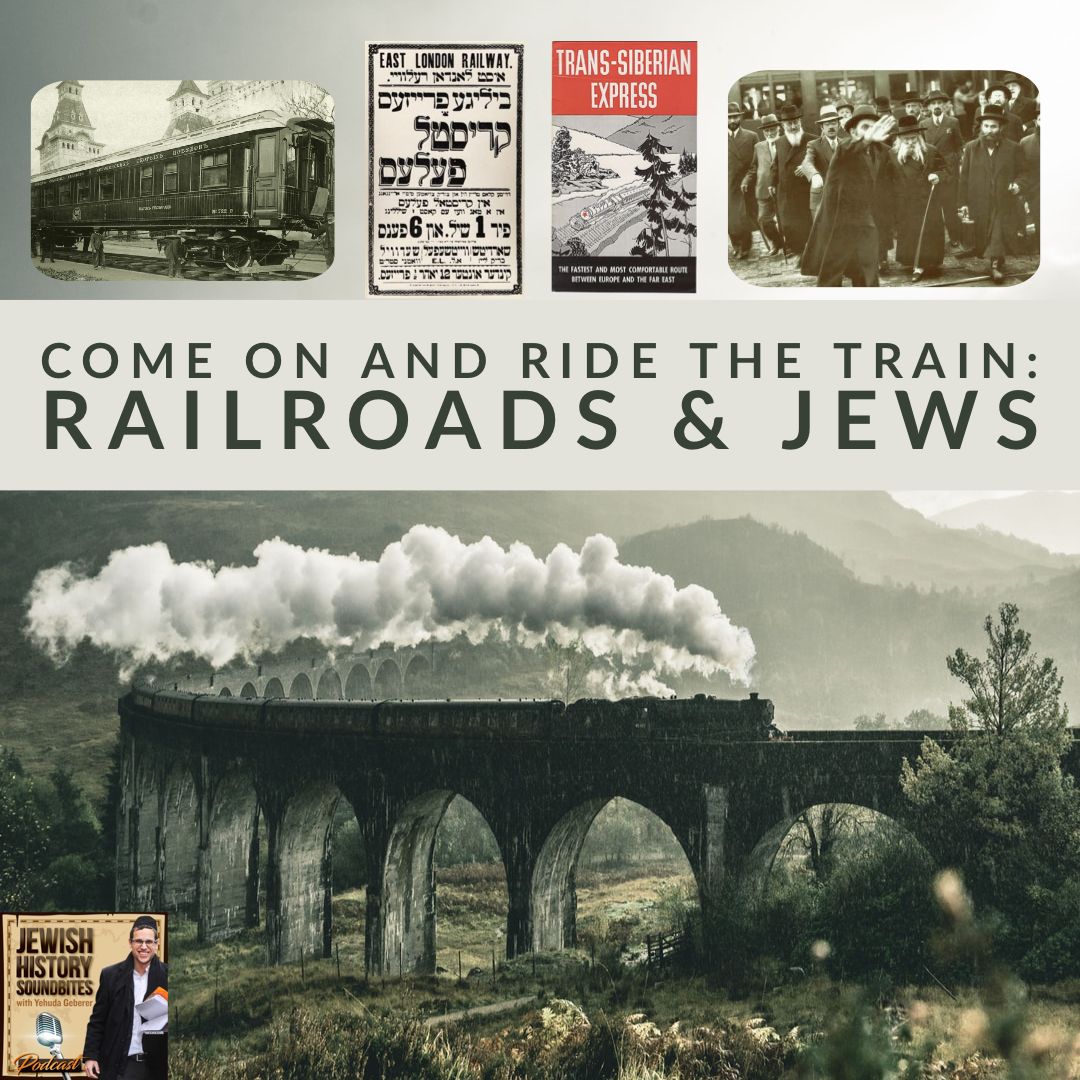
Ep 319Come on and Ride the Train: Railroads & Jews
The development of the railroad and the laying of rail track across the Russian Empire in the late 19th century, had a tremendous impact on traditional Jewish life in the Pale of Settlement. The railroad brought economic changes, implosion of communal structures and challenges to traditional norms. It enabled information to travel and for the spread of ideas, and for isolated shtetl’s to have access to wider society. Among other things, the development of the railroad in Russia enabled the spread of anti-Semitism and pogroms. It also played a crucial role in facilitating the Great Immigration. Without the railroad, emigrating would be relegated to an unachievable dream for most. With the railroad, the cost and time for travel was significantly reduced. For sponsorship opportunities about your favorite topics of Jewish history contact Yehuda at: [email protected] Subscribe To Our Podcast on: PodBean: https://jsoundbites.podbean.com/ Follow us on Twitter or Instagram at @Jsoundbites You can email Yehuda at [email protected]

Ep 318Chabad & Zionism Part I: The Rashab
Rav Sholom Dovber Schneerson (1860-1920), better known as the Rashab, as the fifth Rebbe of Chabad-Lubavitch, was one of the leaders of Russian Jewry at a time when it confronted many challenges of modernity. One of those challenges was the new Jewish nationalism as expressed in the nascent Zionist movement in the late 1890’s. The Rashab decided to confront what he understood to be a danger to traditional Judaism, by initiating a project which would present a united Orthodox front in opposition to Zionism. To that end he partnered with Yaakov Lifshitz and the ‘Lishka Hashechora’ in Kovno. In January 1900, a pamphlet entitled Ohr Layesharim was published, which included a letter of the Rashab clarifying his opposition to Zionism. He expressed theological opposition - evoking for the first time the violation of the ‘three oaths’ by attempting to force the redemption prior to Moshiach’s arrival. He also expressed concern regarding the secular nature of the Zionist leadership, and even raised practical challenges the movement would confront which he believed would prevent its goals from being realized. For sponsorship opportunities about your favorite topics of Jewish history contact Yehuda at: [email protected] Subscribe To Our Podcast on: PodBean: https://jsoundbites.podbean.com/ Follow us on Twitter or Instagram at @Jsoundbites You can email Yehuda at [email protected]

Ep 317The Legacy of the Vilna Gaon
The Vilna Gaon, or the Gra, or Hagaon Hachassid, were just several of the titles by which Rav Eliyahu ben Shlomo Zalman (1720-1797) was known during his lifetime and to posterity. It would be difficult to find many others who had the influence and impact on Jewish life which the Gaon had and continues to have on Jewish society. This episode will examine some of the aspects of the Vilna Gaon’s legacy, both during his own lifetime and through the more than two centuries since his passing. For sponsorship opportunities about your favorite topics of Jewish history contact Yehuda at: [email protected] Subscribe To Our Podcast on: PodBean: https://jsoundbites.podbean.com/ Follow us on Twitter or Instagram at @Jsoundbites You can email Yehuda at [email protected]
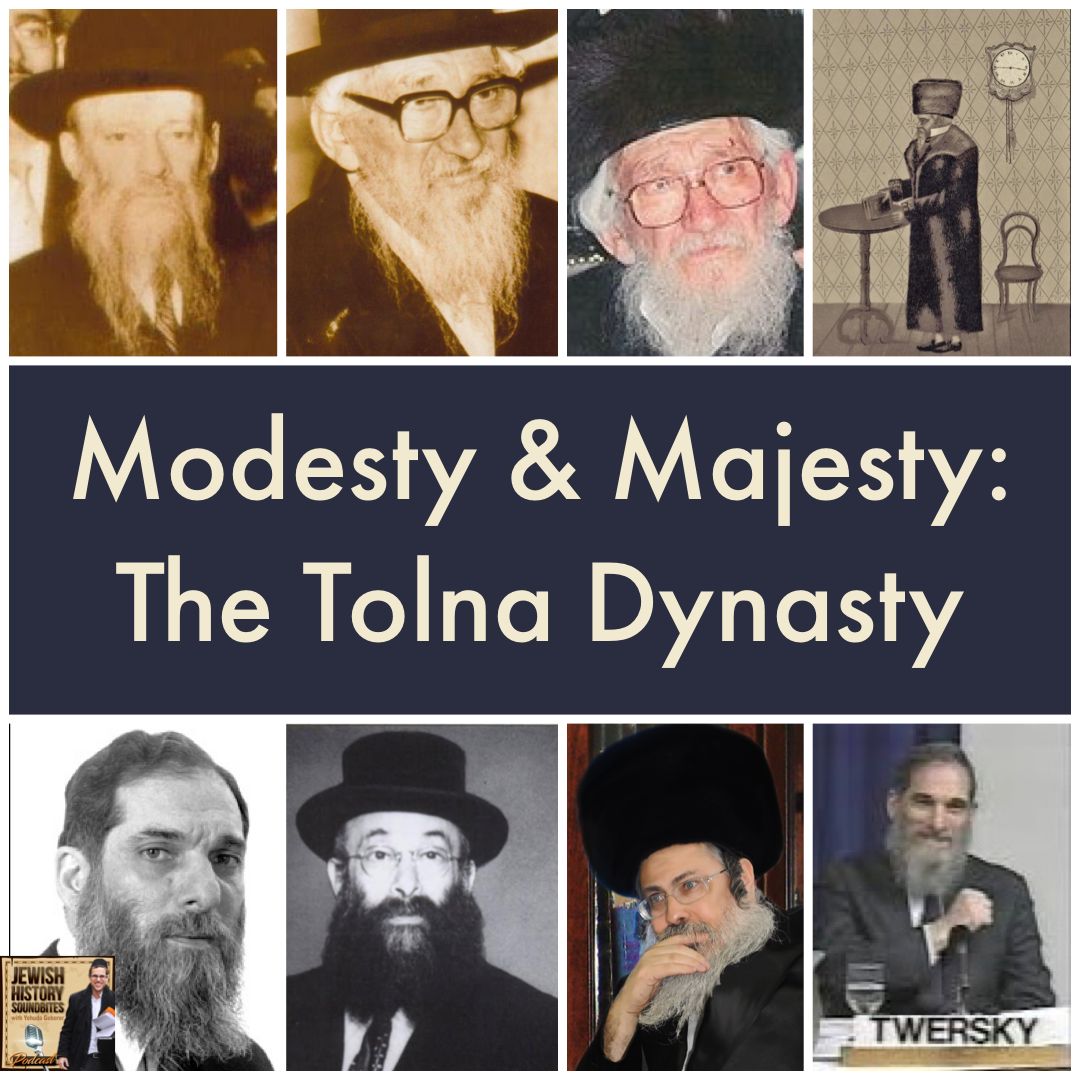
Ep 316Modesty & Majesty: The Tolna Dynasty
The Tolna chassidic dynasty is a branch of the Chernobyl dynasty founded in Ukraine in the 19th century. Rav Dovid Twersky of Tolna (1808-1882) was one of the most influential leaders of chassidic Ukraine in the mid 19th century, spreading his influence throughout the Kiev area. He was succeeded by his grandson Rav Menachem Nochum, who in turn was succeeded by his three sons, all of whom immigrated to the United States. The prominent Tolna Rebbe of modern times was Rav Yochanan Twersky (1906-1999). Presumably the first active Rebbe in Montreal, he had an impact on Canadian Jewry until his move to Israel in the 1950’s. It was there that he modestly acted as a chassid of the Ger Rebbes, while attempting to stay out of the limelight. Despite his attempts, he gained a significant following, and was a beloved leader to his chassidim. He was succeeded by his grandson Rav Yitzchak Menachem Weinberg, the current Tolna Rebbe and by other descendants. For sponsorship opportunities about your favorite topics of Jewish history contact Yehuda at: [email protected] Subscribe To Our Podcast on: PodBean: https://jsoundbites.podbean.com/ Follow us on Twitter or Instagram at @Jsoundbites You can email Yehuda at [email protected]

Ep 315Rosh Yeshiva & Rebbe: The Pnei Menachem of Ger
Rav Pinchas Menachem Alter (1926-1996), known as the Pnei Menachem of Ger, led an interesting career in public leadership. Born into prewar Polish chassidic aristocracy, he escaped with his father the Ger Rebbe following the outbreak of the war. He eventually became the rosh yeshiva of the flagship Sfas Emes Yeshiva, and later the head of Agudas Yisroel in Israel. In his last years, he served as the Rebbe of Ger for just over three years before his passing in 1996. Renowned for his Torah scholarship, warmth, modesty and accessibility, he was beloved well beyond the confines of the Ger court. For sponsorship opportunities about your favorite topics of Jewish history contact Yehuda at: [email protected] Subscribe To Our Podcast on: PodBean: https://jsoundbites.podbean.com/ Follow us on Twitter or Instagram at @Jsoundbites You can email Yehuda at [email protected]

Ep 314A House Divided: The Partitions of Poland & the Jews
The three partitions of Poland in 1772, 1793 & 1795 ended the Polish Kingdom (or the Polish-Lithuanian Commonwealth), and divided it between Austria, Russia and Prussia. This had far reaching consequences for the largest Jewish community in the world which had resided within the borders of the kingdom. Their new rulers desired a more central authority, and much of the Jewish autonomy was curtailed as a result. The Jewish communities of each empire found themselves under new political entities, new laws, new language and culture, and they now were on a different trajectory than their brethren who were on the other side of an international border. In the last years of the Polish Kingdom the Four Year Sejm took place between 1788-1792. The reforms which were raised in regards to Jews economic opportunity and political status, would echo through the Jewish communities of partitioned Poland throughout the upcoming 19th century. For sponsorship opportunities about your favorite topics of Jewish history contact Yehuda at: [email protected] Subscribe To Our Podcast on: PodBean: https://jsoundbites.podbean.com/ Follow us on Twitter or Instagram at @Jsoundbites You can email Yehuda at [email protected]

Ep 313According to Rav Tikochinsky.... The Live of Rav Yechiel Michel Tikochinsky
One of the leaders and influential poskim of the Old Yishuv in Jerusalem, Rav Yechiel Michel Tikochinsky (1871-1955) had an outsized impact on the world of halacha, especially in regards to zmanim- halachic time. As the long-time administrator of the Eitz Chaim Yeshiva and accompanying institutions, he oversaw its move to the new city in Yerushalayim, where it entered an era of expansion and growth. He pioneered many areas of halacha, including the laws of mourning, shmittah, the halachic international dateline, laws of Jerusalem and the Bais Hamikdash. Having cultivated both a love as well as a keen understanding of astronomy from a young age, he arrived at formulas for calculating the various zmanim in halacha. In 1905 he initiated the publication of what was to became an incredibly influential calendar where he presented his views on zmanim and customs of Jewish life. For sponsorship opportunities about your favorite topics of Jewish history contact Yehuda at: [email protected] Subscribe To Our Podcast on: PodBean: https://jsoundbites.podbean.com/ Follow us on Twitter or Instagram at @Jsoundbites You can email Yehuda at [email protected]

Ep 312The Chief Rabbi: Rabbi Lord Jonathan Sacks
Rabbi Lord Jonathan Sacks (1948-2020) was one of the great figures of recent Jewish history. As Chief Rabbi of the United Hebrew Congregations of the Commonwealth from 1991-2013, he was the great spokesman for both British Jewry as well as on the larger Jewish stage. Sponsored in tribute to one of the generation's inspiring Torah luminaries - join a special evening of learning and conversation in memory of Rabbi Lord Jonathan Sacks ztz"l upon the occasion of his first yahrzeit - register to watch on Tuesday, October 26 at 7:00 pm EST at ou.org/rabbisacks For sponsorship opportunities about your favorite topics of Jewish history contact Yehuda at: [email protected] Subscribe To Our Podcast on: PodBean: https://jsoundbites.podbean.com/ Follow us on Twitter or Instagram at @Jsoundbites You can email Yehuda at [email protected]

Ep 311Great American Jewish Cities #19: Boston Part II
Boston part II is here, with another foray into the history of the Boston Jewish community. As the Jewish community migrated from the West End to Roxbury, Dorchester and eventually Brookline, new institutions were built to accommodate the needs of the growing community. Rav Joseph B. and Tonya Soloveitchik established the Maimonides Hebrew Day School, and hired Rabbi Moses Cohen as the principal. Other early rabbis included Rabbi Rephoel Landau, the Tolna Rebbe Rav Meshulam Zusha Twersky, the Boston Rebbe Rav Levi Yitzchak Horowitz, Rav Shlomo Margolis and out in Chelsea was Rabbi Kalman Lichtenstein. Generations of the Feuerstein supported these institutions with their philanthropy as well being leaders in the hospitality that the Jewish community of Boston became renowned for. Rav Soloveitchik maintained a yeshiva in town for several years called Heichal Rabbeinu Chaim Halevi, and in the 1950’s Rav Shlomo Margolis assisted with the establishment of a Lakewood yeshiva headed by Rav Leib Heyman which also lasted for several years. Listen to part I of Jewish Boston here: https://jsoundbites.podbean.com/e/great-american-jewish-cities-season-2-1-worcester-boston/ This episode has been generously sponsored by https://www.myjewishlineage.com/ Mention Jewish History Soundbites and get 10% off your first research project of two hours or more. For sponsorship opportunities about your favorite topics of Jewish history contact Yehuda at: [email protected] Subscribe To Our Podcast on: PodBean: https://jsoundbites.podbean.com/ Follow us on Twitter or Instagram at @Jsoundbites You can email Yehuda at [email protected]