
Show overview
Interpreting India has been publishing since 2019, and across the 7 years since has built a catalogue of 154 episodes, alongside 5 trailers or bonus episodes. That works out to roughly 110 hours of audio in total. Releases follow a fortnightly cadence, with the show now in its 5th season.
Episodes typically run thirty-five to sixty minutes — most land between 37 min and 50 min — and the run-time is fairly consistent across the catalogue. None of the episodes are flagged explicit by the publisher. It is catalogued as a EN-language Government show.
The show is actively publishing — the most recent episode landed 1 months ago, with 17 episodes already out so far this year. The busiest year was 2020, with 28 episodes published. Published by Carnegie India.
From the publisher
In Season 5 of Interpreting India, we continue our exploration of the dynamic forces that will shape India's global standing. At Carnegie India, our diverse lineup of experts will host critical discussions at the intersection of technology, the economy, and international security. Join us as we navigate the complexities of geopolitical shifts and rapid technological advancements. This season promises insightful conversations and fresh perspectives on the challenges and opportunities that lie ahead.
Latest Episodes
View all 154 episodesSubsea Cables, AI Infrastructure, and Africa's Connectivity Gap
India, Australia, and the Critical Minerals Opportunity
Chokepoints, Economic Warfare and India's Strategic Options
India's AI Ambitions and the Road to Viksit Bharat | AI Summit Special
Did India's AI Summit Get Safety Right?
Subsea Cables, Trusted Networks, and India's Strategic Opportunity
AI Literacy and the Future of Work in India
Can AI Resources Be Democratized? AI Summit Special
Space Security in the Age of AI
An African Perspective for Building AI for Global South | AI Summit Special
The India-EU Trade Deal: What It Delivers and What It Doesn't
From Bletchley Park to Delhi and What Comes Next | AI Summit Special
S5 Ep 38Data, AI, and the Laws Trying to Keep Up
The conversation begins with a close look at India’s data protection regime, particularly the DPDP Act and its emphasis on consent. Nikhil challenges the perception that the law is overly consent-driven, pointing to a range of exemptions and alternative legal bases for processing data. At the same time, he highlights gaps in enforcement and deterrence, arguing that the current framework may struggle to address large-scale misuse of data or systemic harms. On AI governance, Nikhil makes a case that India does not need a sweeping, EU-style AI law, at least not yet. Given India's legislative pace, enforcement gaps, and how fast AI is evolving, he thinks strengthening existing laws and making targeted amendments is a far more practical path. He does, however, flag artificial intimacy as something that deserves serious attention soon. AI-powered companionship is supercharging the loneliness economy, building emotional dependency at scale, and raising risks that no existing framework is really built to handle. Closer to home, Nikhil offers a window into how AI is changing legal practice at Trilegal, where 75% of lawyers now use AI in their daily workflows. The firm is simultaneously building AI products, using them internally, and advising clients on AI risk, a position Nikhil sees as an advantage rather than a conflict. For him, the era of lawyers who write code and speak directly with engineers is not something to fear but a long overdue shift in what it means to practice technology law. Episode ContributorsNidhi Singh is an associate fellow at Carnegie India. Her current research interests include data governance, artificial intelligence and emerging technologies. Her work focuses on the implications of information technology law and policy from a Global Majority and Asian perspective. She has previously contributed to the Indian Express, The Secretariat, Medianama and HinduBusiness Line.Nikhil Narendran is a Partner in Trilegal’s Bengaluru office and part of the TMT practice of the firm. He is a subject matter expert in the technology, media, and telecom communication space. Nikhil focuses on the interplay of technology, human lives, and commerce. He has substantial experience in advising companies on telecom, media and technology laws in relation to their entry into India, operations, strategy, policy, regulatory issues, disputes, and business models. Every two weeks, Interpreting India brings you diverse voices from India and around the world to explore the critical questions shaping the nation's future. We delve into how technology, the economy, and foreign policy intertwine to influence India's relationship with the global stage.As a Carnegie India production, hosted by Carnegie scholars, Interpreting India, a Carnegie India production, provides insightful perspectives and cutting-edge by tackling the defining questions that chart India's course through the next decade.Stay tuned for thought-provoking discussions, expert insights, and a deeper understanding of India's place in the world.Don't forget to subscribe, share, and leave a review to join the conversation and be part of Interpreting India's journey.
S5 Ep 37Inside the Iran Conflict: Power, Strategy, and India’s Balancing Act
The conversation begins with a look at where the conflict stands today and how Iran has managed to absorb significant military pressure while still responding in a measured way. Dharmendra explains how the conflict has expanded beyond immediate borders, affecting energy flows and drawing in multiple countries, while also reinforcing a sense of internal unity despite economic strain. It then turns to Iran’s internal system, where different power centres, from the political leadership to the security establishment, continue to function together even under pressure. The episode also reflects on the role of nationalism, suggesting that even in a deeply ideological state, a shared national identity plays a strong role in shaping public response during moments of crisis. In the final part, the focus shifts to India. The discussion looks at how India manages its relationships across the region, from Iran to the Gulf, and the constraints created by sanctions and global politics. It also touches on long-term projects like Chabahar and what their future might look like. The episode closes with a broader reflection on where the region may be headed and what space there is for stability after the conflict. Episode Contributors Srinath Raghavan is a nonresident senior fellow at Carnegie India. He is also a professor of International Relations and History at Ashoka University. His primary research focus is on the contemporary and historical aspects of India’s foreign and security policies. Gaddam Dharmendra is a nonresident senior fellow at Carnegie India. He joined the Indian Foreign Service in 1990 and served in various capacities in Indian Missions across the world and at the Ministry of External Affairs, South Block. His overseas assignments include stints at Indian Missions in Tehran, Dushanbe, Washington D.C., and Dhaka. Every two weeks, Interpreting India brings you diverse voices from India and around the world to explore the critical questions shaping the nation's future. We delve into how technology, the economy, and foreign policy intertwine to influence India's relationship with the global stage.As a Carnegie India production, hosted by Carnegie scholars, Interpreting India, a Carnegie India production, provides insightful perspectives and cutting-edge by tackling the defining questions that chart India's course through the next decade.Stay tuned for thought-provoking discussions, expert insights, and a deeper understanding of India's place in the world.Don't forget to subscribe, share, and leave a review to join the conversation and be part of Interpreting India's journey.
S5 Ep 36Recalibrating BRICS: India’s Moment in a Fragmented World
The episode begins with a reflection on Brazil’s 2025 BRICS presidency, which emphasized continuity with the bloc’s original reformist agenda—particularly the push for reform of global financial institutions and greater representation for emerging economies. While Brazil focused on trade facilitation, climate finance, and taxation cooperation, progress on deeper monetary coordination and mechanisms such as the Contingent Reserve Arrangement remained limited. Ana Garcia also notes the gap between expectations and reality within BRICS. Despite its growing geopolitical visibility, the bloc has struggled to develop unified responses to global crises and remains economically imbalanced, with intra-BRICS trade heavily centered on China. The New Development Bank continues to expand its project financing and local currency lending but operates within global financial constraints and plays a more limited role than often perceived. Looking ahead, India’s presidency will focus on consolidating the expanded BRICS grouping while cautiously advancing financial cooperation, climate adaptation financing, and South-South collaboration in health. The discussion concludes that India’s success will depend on pragmatic institutional progress rather than ambitious rhetoric, as BRICS navigates a complex and polarized global environment. Episode Contributors Vrinda Sahai is a research analyst in the Security Studies Program at Carnegie India. Her work focuses on Indian foreign and security policy, particularly, India’s strategic engagement with major powers. Ana Elisa Saggioro Garcia is a Professor at the Institute of International Relations at PUC-Rio. Professor of the Postgraduate Program in Social Sciences at the Federal Rural University of Rio de Janeiro. PhD in International Relations from IRI/PUC-Rio and Master in Political Science from the Free University of Berlin (Germany). Every two weeks, Interpreting India brings you diverse voices from India and around the world to explore the critical questions shaping the nation's future. We delve into how technology, the economy, and foreign policy intertwine to influence India's relationship with the global stage.As a Carnegie India production, hosted by Carnegie scholars, Interpreting India, a Carnegie India production, provides insightful perspectives and cutting-edge by tackling the defining questions that chart India's course through the next decade.Stay tuned for thought-provoking discussions, expert insights, and a deeper understanding of India's place in the world.Don't forget to subscribe, share, and leave a review to join the conversation and be part of Interpreting India's journey.

S5 Ep 35Deciphering the “Mother of All Trade Deals”: The India–EU FTA
Kumar frames the India–EU FTA as a deal India needed, not one it merely chose, arguing that with the multilateral trade system weakened, FTAs have become the practical route to secure market access and signal openness to investment. He places the EU among India’s “$100 billion club” trading partners and explains why this agreement fills a gap India cannot realistically close with China, and cannot replicate with the United States in the form of a full FTA.On timing, he calls the early 2010s a missed opportunity but notes that current geopolitical conditions have raised India’s value for Europe, including Europe’s push to de-risk from China and the absence of an EU–U.S. FTA. A major thread is regulation: Kumar acknowledges the EU’s regulatory intensity, but argues India must adapt to global technical and sanitary standards, using the agreement’s timelines and technical assistance to reduce friction and help industry upgrade over time.He clarifies the trade-offs that made the deal viable: core agriculture and dairy are left out due to political sensitivities on both sides; government procurement is excluded due to India’s constraints and federal realities; and investment protection and geographical indications are kept on separate tracks to avoid a more complex EU-wide ratification path. He also describes how negotiations manage domestic sensitivities through consultation with industry, transition periods, tariff-rate quotas, and product thresholds, particularly in sectors like autos, aiming to expose firms gradually to competition while pushing manufacturing to become more competitive.In closing, Kumar argues the hard work starts after signing. He stresses that Indian industry must actually use the agreement’s tariff concessions, pointing to historically low utilization of FTAs—and that domestic reforms cannot be postponed if India wants the deal to deliver results. He highlights reforms in agriculture, labor implementation, power, and land acquisition, and ties this to a broader shift he sees globally: trade policy and security policy are increasingly moving into alignment, especially in a world of dual-use technology and tighter strategic partnerships.Episode ContributorsDinakar Peri is a fellow in the Security Studies program at Carnegie India.Ambassador Mohan Kumar has an outstanding career in the Indian Foreign Service lasting 36 years which culminated in his being India’s Ambassador to France based in Paris. Under his watch, the Indo-French strategic partnership was strengthened and consolidated further in spheres such as defense, space, nuclear & solar energy, smart cities and investment. Earlier, Mohan Kumar was India’s Ambassador to the Kingdom of Bahrain where he witnessed and dealt with a strategically complex region characterized by events such as the “Arab Spring”. Every two weeks, Interpreting India brings you diverse voices from India and around the world to explore the critical questions shaping the nation's future. We delve into how technology, the economy, and foreign policy intertwine to influence India's relationship with the global stage.As a Carnegie India production, hosted by Carnegie scholars, Interpreting India, a Carnegie India production, provides insightful perspectives and cutting-edge by tackling the defining questions that chart India's course through the next decade.Stay tuned for thought-provoking discussions, expert insights, and a deeper understanding of India's place in the world.Don't forget to subscribe, share, and leave a review to join the conversation and be part of Interpreting India's journey.
S5 Ep 34AI Adoption Journey for Population Scale: The UCAF Framework
AI progress is often measured by the number of pilots launched, but this episode argues the real unit of progress should be how many AI use cases are reliably in production and embedded into everyday systems. Shalini Kapoor distinguishes AI innovation (models, chips, and breakthroughs) from AI adoption, emphasizing that adoption is frequently harder because it demands institutional integration, behavior change, and clear accountability—especially when AI advice affects livelihoods, health outcomes, or legal decisions.Tanvi Lall explains “pilot purgatory” as the frustrating middle state where use cases never move beyond controlled deployments. She shares how recurring barriers—compute constraints within real institutions (not just cloud credits), fragmented workflows, late-stage safety design, lack of sustained funding, and weak organizational readiness—prevent diffusion. The conversation highlights the UCAF approach to defining a use case as a commitment to improve a specific outcome for a specific persona in a specific context, and why trust and accountability are as central as the technology layer.The episode also explores “horizontal enablers” that make scale possible—data readiness, multilingual language support, voice interfaces for last-mile access, workforce integration, and guardrails. A detailed example (Mahavistar in Maharashtra) illustrates what scaling can look like when government partnership, data pipelines, voice infrastructure, safeguards, and long-term funding align. Finally, the guests look ahead to what AI adoption in India could look like over the next five years, arguing that the most impactful AI will feel “ordinary”—quietly embedded into routine decisions—supported by shared adoption infrastructure rather than one-off pilots.Episode ContributorsNidhi Singh is a Senior Research Analyst at Carnegie India.Shalini Kapoor is the Chief Strategist for Data and AI at the EkStep Foundation. Her work focuses on building practical pathways for AI adoption, with emphasis on institutional integration, accountable systems, and population-scale impact.Tanvi Lall is the Director for Strategy at People Plus AI. Her work focuses on AI use cases, adoption barriers, and developing frameworks that help move AI from pilots to sustained deployment and real-world outcomes. 00:00 Introduction to AI Adoption Challenges01:37 Understanding AI Adoption vs. Innovation04:55 Pilot Purgatory: The Stagnation of AI Projects08:48 Fragmented Adoption: Real-World Examples12:13 Barriers to AI Adoption: Mindset and Behavior Change16:01 Defining Good AI Use Cases20:00 Horizontal Enablers for AI Success26:26 Case Study: Mahavistar's Impact on Farmers34:34 Future of AI Adoption in India40:29 Optimism for AI Diffusion and AdoptionReadingsAI Adoption Journey for Population Scale by Shalini Kapoor and Tanvi Lall Every two weeks, Interpreting India brings you diverse voices from India and around the world to explore the critical questions shaping the nation's future. We delve into how technology, the economy, and foreign policy intertwine to influence India's relationship with the global stage.As a Carnegie India production, hosted by Carnegie scholars, Interpreting India, a Carnegie India production, provides insightful perspectives and cutting-edge by tackling the defining questions that chart India's course through the next decade.Stay tuned for thought-provoking discussions, expert insights, and a deeper understanding of India's place in the world.Don't forget to subscribe, share, and leave a review to join the conversation and be part of Interpreting India's journey.
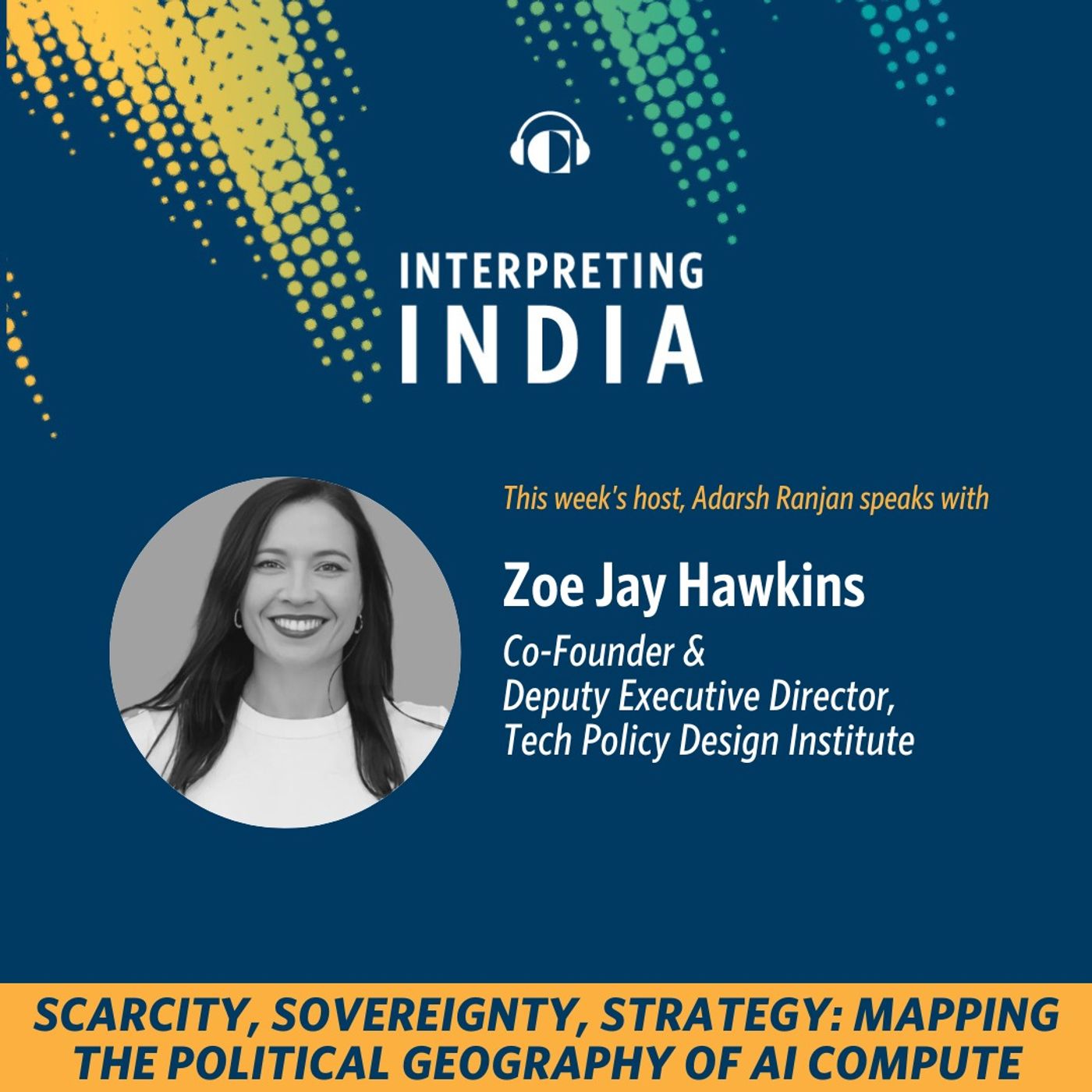
S4 Ep 33Scarcity, Sovereignty, Strategy: Mapping the Political Geography of AI Compute
As AI systems grow more powerful, the computational infrastructure behind them has become a strategic resource, one that is unevenly distributed across the world. This episode takes a deep look at the three layers of compute sovereignty: where data centers are located, who owns them, and who manufactures the chips that power them. Zoe explains how access to compute has quickly shifted from a technical issue to a core question of economic resilience and sovereignty.The conversation unpacks new research showing how few countries actually host advanced AI-relevant data centers, and how global dependencies on companies like Nvidia shape strategic decisions. Adarsh and Zoe discuss the implications for countries that are “compute deserts,” the growing push toward sovereign capabilities, and why a binary view of sovereignty is misleading. They also explore how countries are attempting to secure compute, through public investment, regional collaborations, and new transnational initiatives.Finally, the episode examines the emerging tension between the pursuit of compute sovereignty and the environmental and socioeconomic costs of data centers. As global investments flow into AI infrastructure, Zoe argues for a more grounded, people-centric approach to AI strategy, one that balances access, sustainability, and long-term national priorities amid evolving questions about the future of the AI industry.Episode ContributorsAdarsh Ranjan is a research analyst at Carnegie India where his research focuses on AI and emerging technologies, digital transformation, and technology partnerships. His current research explores India’s evolving policy on AI compute and digital transformation in Global South countries.Zoe Jay Hawkins is the co-founder and deputy executive director of the Tech Policy Design Institute. Zoe brings extensive experience designing tech policy from government, big tech, academic and think tank perspectives. Zoe worked for the Australian government across communications, innovation, and foreign policy portfolios, as a ministerial adviser and in the public service. She is a Research Associate at the University of Oxford and an expert researcher for the OECD, having started her career at the Australian Strategic Policy Institute. Every two weeks, Interpreting India brings you diverse voices from India and around the world to explore the critical questions shaping the nation's future. We delve into how technology, the economy, and foreign policy intertwine to influence India's relationship with the global stage.As a Carnegie India production, hosted by Carnegie scholars, Interpreting India, a Carnegie India production, provides insightful perspectives and cutting-edge by tackling the defining questions that chart India's course through the next decade.Stay tuned for thought-provoking discussions, expert insights, and a deeper understanding of India's place in the world.Don't forget to subscribe, share, and leave a review to join the conversation and be part of Interpreting India's journey.
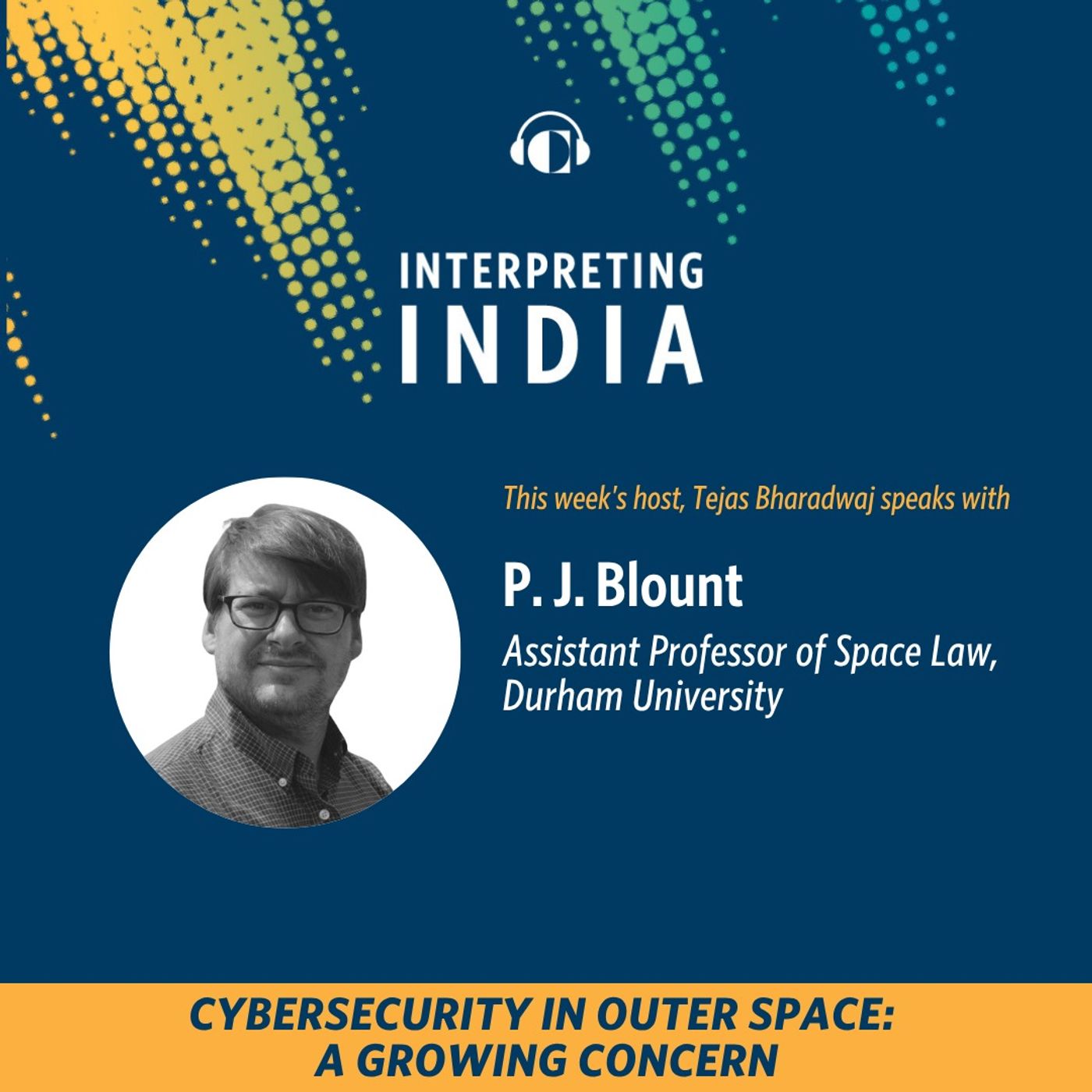
S4 Ep 32Cybersecurity in Outer Space: A Growing Concern
The conversation explores how cybersecurity is integral to space operations, drawing parallels with traditional air defense strategies. Blount discusses the historical context of cybersecurity in space, the role of international law, and the challenges posed by non-state actors. He emphasizes the need for a holistic approach to cybersecurity that includes both space-based and terrestrial components, and the importance of international cooperation in addressing these challenges.Blount warns of the increasing threats from cyber-attacks on space assets and the need for robust legal frameworks to ensure accountability and security. He calls for the development of comprehensive cybersecurity strategies that integrate space and cyberspace, ensuring resilience against a wide range of threats.How can nations protect their space assets from cyber threats? What role does international law play in governing space cybersecurity? How should countries collaborate to enhance global space security?Episode ContributorsP. J. Blount is assistant professor of space law at Durham University. He is also a visiting scholar at Mae Fah Luang University in Chiang Rai, Thailand. Previously, he served as a Lecturer in Law at Cardiff University, an adjunct professor for the LL.M. in the Air and Space Law at the University of Mississippi School of Law, a Postdoctoral Researcher at the University of Luxembourg, an adjunct professor at Montclair State University, and a Visiting Scholar at the Beijing Institute of Technology School of Law. Tejas Bharadwaj is a senior research analyst with the Technology and Society Program at Carnegie India. He focuses on space law and policies and also works on areas related to AI in military domain, Defence tech and Cybersecurity. Every two weeks, Interpreting India brings you diverse voices from India and around the world to explore the critical questions shaping the nation's future. We delve into how technology, the economy, and foreign policy intertwine to influence India's relationship with the global stage.As a Carnegie India production, hosted by Carnegie scholars, Interpreting India, a Carnegie India production, provides insightful perspectives and cutting-edge by tackling the defining questions that chart India's course through the next decade.Stay tuned for thought-provoking discussions, expert insights, and a deeper understanding of India's place in the world.Don't forget to subscribe, share, and leave a review to join the conversation and be part of Interpreting India's journey.
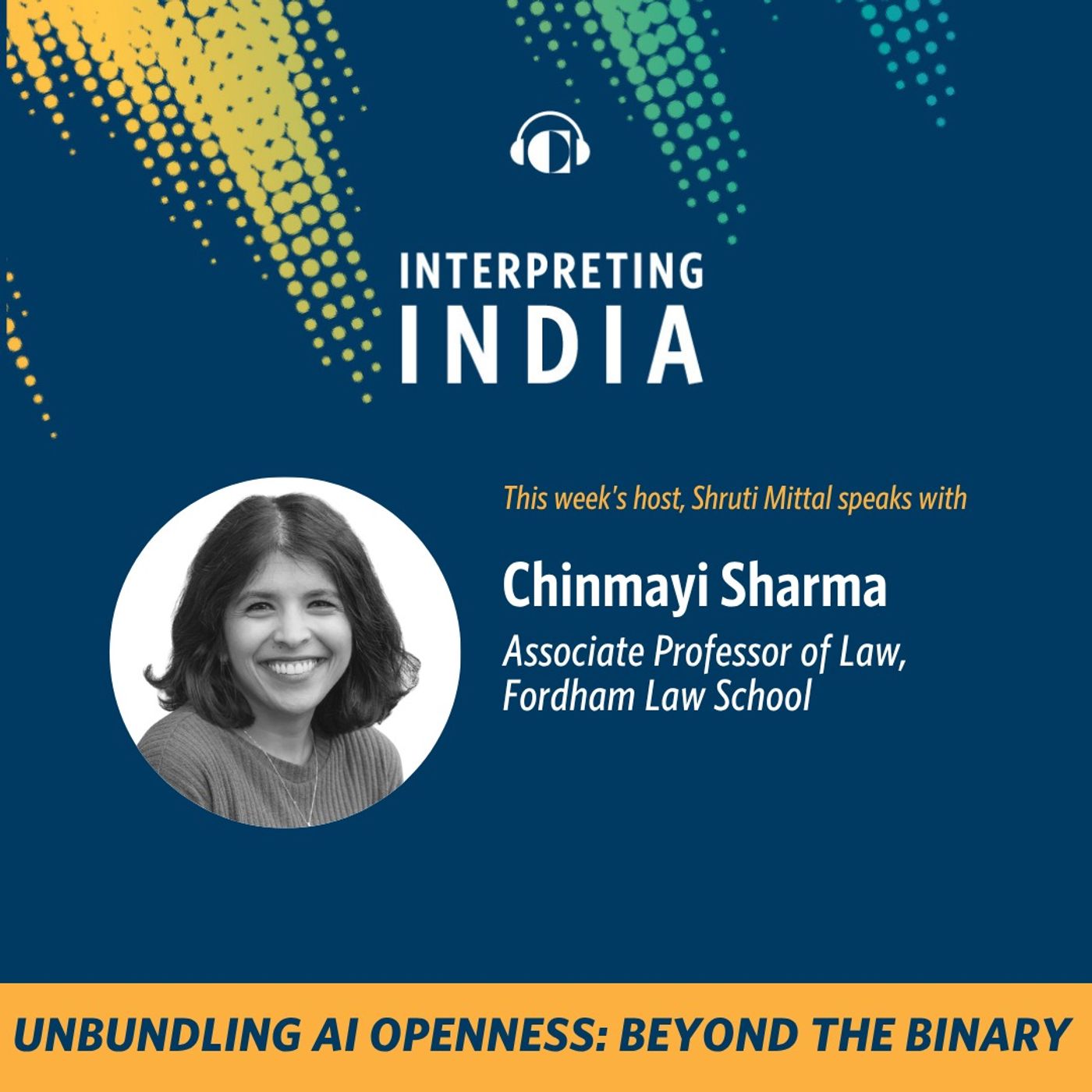
S4 Ep 31Unbundling AI Openness: Beyond the Binary
The episode challenges the familiar “open versus closed” framing of AI systems. Sharma argues that openness is not inherently good or bad—it is an instrumental choice that should align with specific policy goals. She introduces a seven-part taxonomy of AI—compute, data, source code, model weights, system prompts, operational records and controls, and labor—to show how each component interacts differently with innovation, safety, and governance. Her central idea, differential openness, suggests that each component can exist along a spectrum rather than being entirely open or closed. For instance, a company might keep its training data private while making its system prompts partially accessible, allowing transparency without compromising competitive or national interests. Using the example of companion bots, Sharma highlights how tailored openness across components can enhance safety and oversight while protecting user privacy. She urges policymakers to adopt this nuanced approach, applying varying levels of openness based on context—whether in public services, healthcare, or defense. The episode concludes by emphasizing that understanding these layers is vital for shaping balanced AI governance that safeguards public interest while supporting innovation.How can regulators determine optimal openness levels for different components of AI systems? Can greater transparency coexist with innovation and competitive advantage? What governance structures can ensure that openness strengthens democratic accountability without undermining safety or national security?Episode ContributorsChinmayi Sharma is an associate professor of law at Fordham Law School in New York. She is a nonresident fellow at the Stoss Center, the Center for Democracy and Technology, and the Atlantic Council. She serves on Microsoft’s Responsible AI Committee and the program committees for the ACM Symposium on Computer Science and Law and the ACM Conference on Fairness, Accountability, and Transparency.Shruti Mittal is a research analyst at Carnegie India. Her current research interests include artificial intelligence, semiconductors, compute, and data governance. She is also interested in studying the potential socio-economic value that open development and diffusion of technologies can create in the Global South.Suggested Readings Unbundling AI Openness by Parth Nobel, Alan Z. Rozenshtein, and Chinmayi Sharma. Tragedy of the Digital Commons by Chinmayi Sharma. India’s AI Strategy: Balancing Risk and Opportunity by Amlan Mohanty and Shatakratu Sahu. Every two weeks, Interpreting India brings you diverse voices from India and around the world to explore the critical questions shaping the nation's future. We delve into how technology, the economy, and foreign policy intertwine to influence India's relationship with the global stage.As a Carnegie India production, hosted by Carnegie scholars, Interpreting India, a Carnegie India production, provides insightful perspectives and cutting-edge by tackling the defining questions that chart India's course through the next decade.Stay tuned for thought-provoking discussions, expert insights, and a deeper understanding of India's place in the world.Don't forget to subscribe, share, and leave a review to join the conversation and be part of Interpreting India's journey.