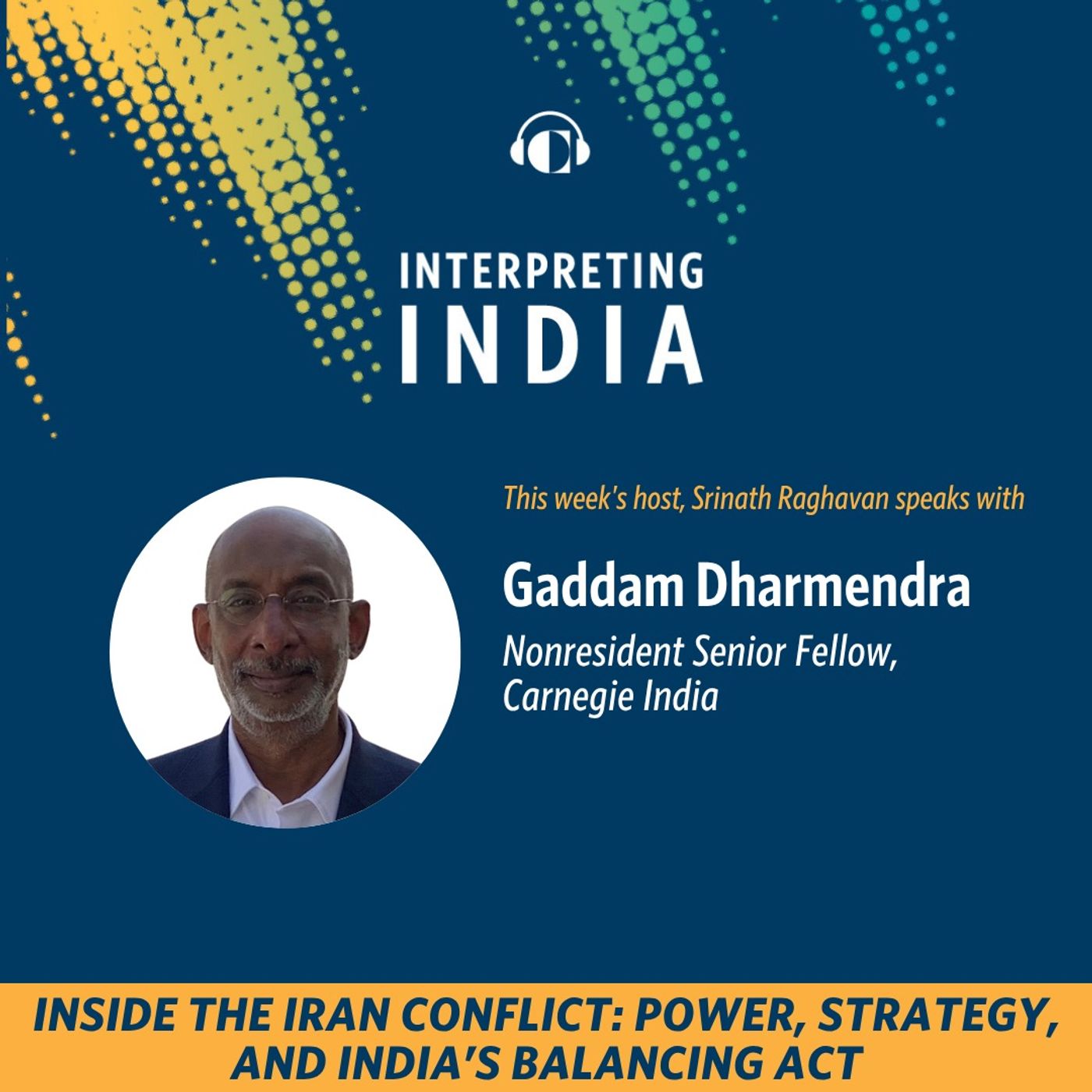
Inside the Iran Conflict: Power, Strategy, and India’s Balancing Act
In this episode of Interpreting India, Srinath Raghavan speaks with Gaddam Dharmendra, Nonresident Senior Fellow, Carnegie India and India’s former Ambassador to Iran about the ongoing U.S.-Israel conflict with Iran and what it means for the region. The conversation looks at Iran’s response to sustained attacks, the wider impact on energy markets and regional stability, and the changing relationships between Iran, the Gulf countries, and global powers. It also reflects on India’s position as it balances its ties across West Asia while navigating strategic and economic pressures, and what lies ahead as the conflict continues to shape the region. How is Iran seeing and handling the current conflict? Why has the Iranian system held together despite sustained attacks? How are regional relationships in West Asia shifting because of this conflict? What does all of this mean for India’s interests and decisions in the region?
Interpreting India · Srinath Raghavan, Gaddam Dharmendra
Audio is streamed directly from the publisher (chrt.fm) as published in their RSS feed. Play Podcasts does not host this file. Rights-holders can request removal through the copyright & takedown page.
Show Notes
The conversation begins with a look at where the conflict stands today and how Iran has managed to absorb significant military pressure while still responding in a measured way. Dharmendra explains how the conflict has expanded beyond immediate borders, affecting energy flows and drawing in multiple countries, while also reinforcing a sense of internal unity despite economic strain.
It then turns to Iran’s internal system, where different power centres, from the political leadership to the security establishment, continue to function together even under pressure. The episode also reflects on the role of nationalism, suggesting that even in a deeply ideological state, a shared national identity plays a strong role in shaping public response during moments of crisis.
In the final part, the focus shifts to India. The discussion looks at how India manages its relationships across the region, from Iran to the Gulf, and the constraints created by sanctions and global politics. It also touches on long-term projects like Chabahar and what their future might look like. The episode closes with a broader reflection on where the region may be headed and what space there is for stability after the conflict.
Episode Contributors
Srinath Raghavan is a nonresident senior fellow at Carnegie India. He is also a professor of International Relations and History at Ashoka University. His primary research focus is on the contemporary and historical aspects of India’s foreign and security policies.
Gaddam Dharmendra is a nonresident senior fellow at Carnegie India. He joined the Indian Foreign Service in 1990 and served in various capacities in Indian Missions across the world and at the Ministry of External Affairs, South Block. His overseas assignments include stints at Indian Missions in Tehran, Dushanbe, Washington D.C., and Dhaka.
Every two weeks, Interpreting India brings you diverse voices from India and around the world to explore the critical questions shaping the nation's future. We delve into how technology, the economy, and foreign policy intertwine to influence India's relationship with the global stage.
As a Carnegie India production, hosted by Carnegie scholars, Interpreting India, a Carnegie India production, provides insightful perspectives and cutting-edge by tackling the defining questions that chart India's course through the next decade.
Stay tuned for thought-provoking discussions, expert insights, and a deeper understanding of India's place in the world.
Don't forget to subscribe, share, and leave a review to join the conversation and be part of Interpreting India's journey.