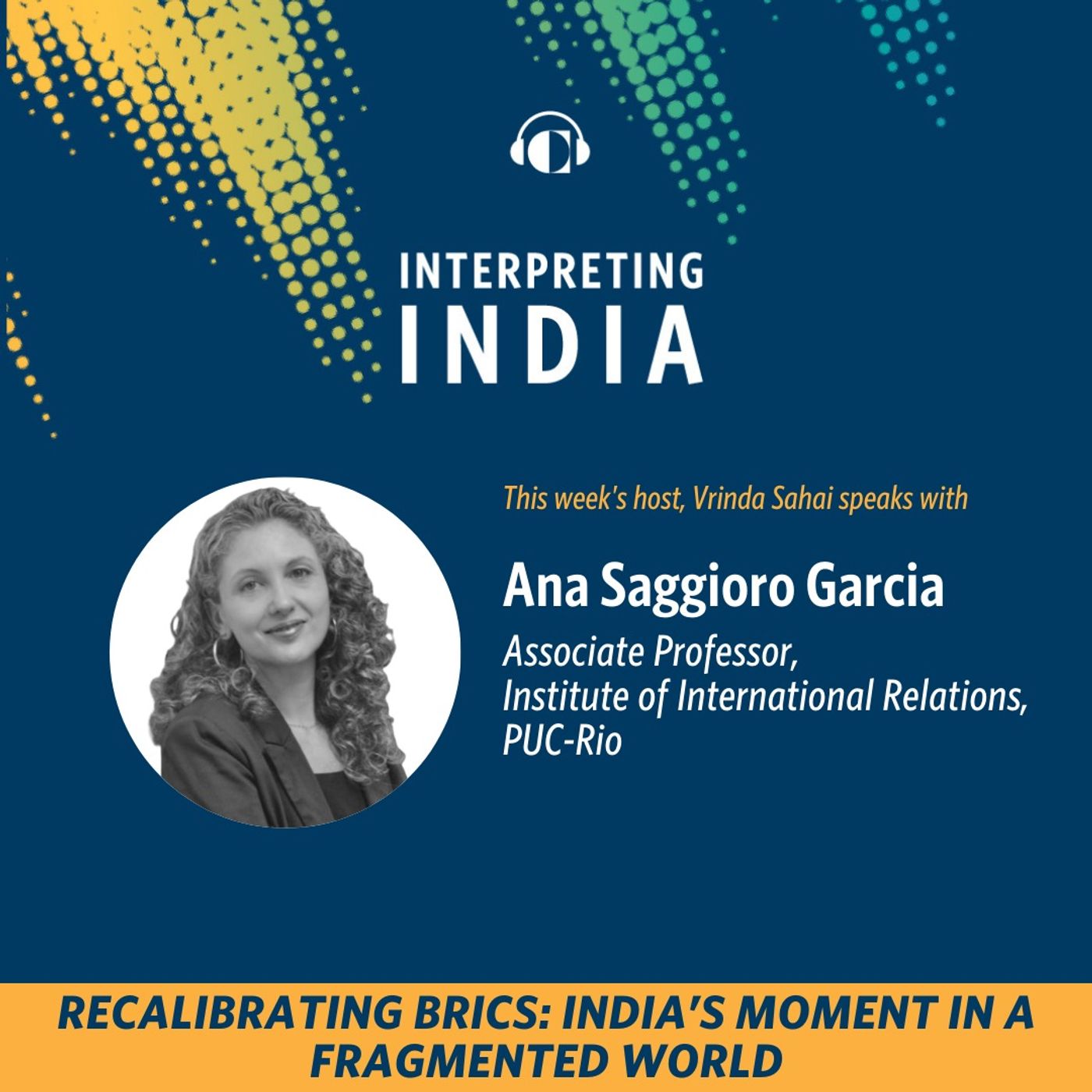
Recalibrating BRICS: India’s Moment in a Fragmented World
In this episode of Interpreting India, Vrinda Sahai is joined by Ana Garcia, Associate Professor at PUC-Rio and Coordinator at the BRICS Policy Center, to discuss the evolving direction of BRICS as India assumes the 2026 presidency. The conversation reflects on Brazil’s 2025 chairship, the bloc’s continued focus on reforming global financial governance, and the cautious progress on issues such as local currency trade, financial coordination, and institutional reform. Ana Garcia also highlights the limits of BRICS as a unified geopolitical actor and outlines key priorities for India, including strengthening financial mechanisms, advancing climate and health cooperation, and consolidating the expanded BRICS membership. Can India advance BRICS’ financial and monetary coordination while managing geopolitical pressures and US tariff tensions? How should BRICS balance its ambitions as a voice for the Global South with its internal divisions and constraints? What priorities should shape India’s presidency as the bloc consolidates its expanded membership?
Audio is streamed directly from the publisher (chrt.fm) as published in their RSS feed. Play Podcasts does not host this file. Rights-holders can request removal through the copyright & takedown page.
Show Notes
The episode begins with a reflection on Brazil’s 2025 BRICS presidency, which emphasized continuity with the bloc’s original reformist agenda—particularly the push for reform of global financial institutions and greater representation for emerging economies. While Brazil focused on trade facilitation, climate finance, and taxation cooperation, progress on deeper monetary coordination and mechanisms such as the Contingent Reserve Arrangement remained limited.
Ana Garcia also notes the gap between expectations and reality within BRICS. Despite its growing geopolitical visibility, the bloc has struggled to develop unified responses to global crises and remains economically imbalanced, with intra-BRICS trade heavily centered on China. The New Development Bank continues to expand its project financing and local currency lending but operates within global financial constraints and plays a more limited role than often perceived.
Looking ahead, India’s presidency will focus on consolidating the expanded BRICS grouping while cautiously advancing financial cooperation, climate adaptation financing, and South-South collaboration in health. The discussion concludes that India’s success will depend on pragmatic institutional progress rather than ambitious rhetoric, as BRICS navigates a complex and polarized global environment.
Episode Contributors
Vrinda Sahai is a research analyst in the Security Studies Program at Carnegie India. Her work focuses on Indian foreign and security policy, particularly, India’s strategic engagement with major powers.
Ana Elisa Saggioro Garcia is a Professor at the Institute of International Relations at PUC-Rio. Professor of the Postgraduate Program in Social Sciences at the Federal Rural University of Rio de Janeiro. PhD in International Relations from IRI/PUC-Rio and Master in Political Science from the Free University of Berlin (Germany).
Every two weeks, Interpreting India brings you diverse voices from India and around the world to explore the critical questions shaping the nation's future. We delve into how technology, the economy, and foreign policy intertwine to influence India's relationship with the global stage.
As a Carnegie India production, hosted by Carnegie scholars, Interpreting India, a Carnegie India production, provides insightful perspectives and cutting-edge by tackling the defining questions that chart India's course through the next decade.
Stay tuned for thought-provoking discussions, expert insights, and a deeper understanding of India's place in the world.
Don't forget to subscribe, share, and leave a review to join the conversation and be part of Interpreting India's journey.