
Interplace
171 episodes — Page 2 of 4
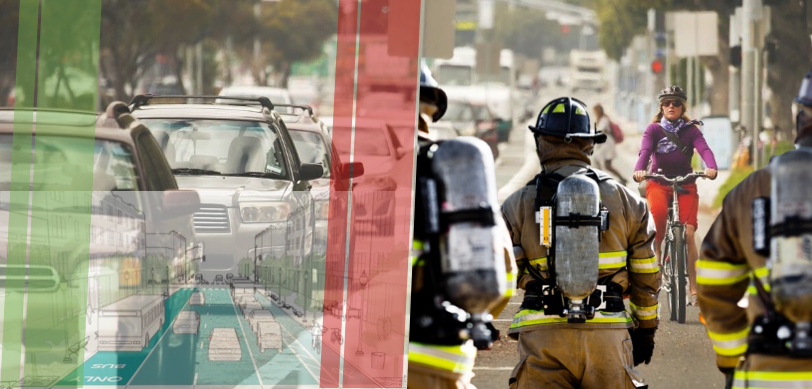
Pedals, Pedestrians, and Prejudices: L.A. Firefighters Pick a Street Fight
Hello Interactors,We are fully into spring and that means a shift toward cartography. I’ll be exploring how abstract symbols, lines, and colors can both represent and misrepresent people, politics, and the physical environment. Maps are tools of power and persuasion, which can shape perceptions of space and reality, influence behavior, and maintain or challenge social norms and power structures.Today’s post bridges Winter’s focus on human behavior with the maps, plans, and politics of cities. In this case, Los Angeles and their attempts at curbing rising traffic related fatalities through safer forms of transportation infrastructure…but not without a fight from some unlikely foes.Let’s go…CURBSIDE CASUALTIES LEAD TO ASPHALT ACTIVISMAngelinos recently passed a controversial measure intended to save lives. It won 63 percent in favor to 37 percent opposed. Maybe it wasn’t so controversial after all. Why should helping save children from being violently killed be controversial in the first place? And why were firefighters leading the charge to kill a measure that saves lives.Car collisions were the leading cause of death for children in Los Angeles County in 2022. Drug overdose and homicide have been in competition with ‘motor vehicle collisions’ for the top kid-killer spot over the last few years. Drowning, another preventable killer my wife is focused on eradicating, was the number three killer in 2021.In January, the hyperlocal newsletter Crosstown reported data from the Los Angeles Police Department that 2023 was the “deadliest year on the roads in at least a decade, with 337 fatalities.”More than half of these were pedestrians. In 2022, 160 pedestrians died from being struck by a motor vehicle. It’s been getting worse for some time.If you’re not already depressed, this might push you over the edge. Hit and runs are also climbing.In October of 2022, the County of Los Angeles Public Health Department published the “Leading Causes of Death and Mortality Rates (per 100,000) by Age Group” in Los Angeles County from January to June for 2019 to 2022. During these years, of those aged 0-17, 73 have been killed by motor vehicles. In 2022, it was the number one killer.Alarmed by the trend, former Mayor Eric Garcetti formulated a “Mobility Plan 2035” in 2015 that “incorporates ‘complete streets’ principles and lays the policy foundation for how future generations of Angelenos interact with their streets.” This follows California state’s 2008 Complete Streets Act (AB 1358), which requires local jurisdictions to “plan for a balanced, multimodal transportation network that meets the needs of all users of streets, roads, and highways, defined to include motorists, pedestrians, bicyclists, children, persons with disabilities, seniors, movers of commercial goods, and users of public transportation, in a manner that is suitable to the rural, suburban or urban context.”The rise in traffic deaths reveals that the aspirational goals set in various levels of government often represent legal fictions—idealized plans that simplify complex issues, but don’t always lead to action. These legal frameworks, while not intentionally misleading, can result in a disconnect between policy intentions and outcomes, promoting a status quo bias due to the complexities of change, systemic inertia, and established interests — including those of firefighters.But a group of citizen activists organized to bring action to the fiction and gain traction amidst the friction. They drew attention to the fact that although L.A. had laid out a progressive ‘complete streets’ plan, they had only executed 5% since its inception nearly a decade ago. At that rate they calculated it would take 160 years to build a minimum network of safe streets. All the while hundreds upon thousands would die while the legal fiction would continued to paint a different picture.So, they devised Measure HLA, the Healthy Streets L.A. initiative, inspired by other cities to bring action to ‘complete streets’ fiction. The measure states every time a street is resurfaced, any corresponding Network Mobility Plan improvements must be implemented. For example, if a street has been designated as a segment of a bike network and is due to be resurfaced, the city must install the protected bike lane (or other complete street infrastructure) needed to fulfill the city’s Mobility Plan 2050. Common sense exceptions are included to ensure public works could still fix things like potholes, utility cuts, or emergency repairs.But installing 560 miles of pedestrian paths, 300 miles of enhanced transit lanes, 520 miles of bike lanes safe enough for an eight-year-old, 830 miles of neighborhood enhancements, and 800 miles of bike networks for all levels of cycling requires some sacrifices. Motorists will have to sacrifice space on roadways to accommodate these changes. In doing so many roads will be narrowed and speeds lowered thus sacrificing speed of vehicles.And this is where the firefighters come
The Sole of the Matter
Hello Interactors, Continuing on the theme of the brain being embedded in the world in which ‘we’ interact, I explore how the brain is also embodied in a biological system with which ‘it’ interacts. The brain conjures this sense of itself inside this thing called ‘me’. How do these illusions come to be inside a tangible body?Let’s find out…Thank you for reading Interplace. This post is public so please do something for my brain… Share it’s thoughts with people you trust.CONSTRUCTING BRADI read a passage in a book a few years ago that fundamentally changed how I think about myself. We were fully into the pandemic, and I had started walking…a lot. I would pick a green patch on Google Maps, put my earplugs in, launch a book, and walk to my little green polygon. Some journeys stretched to 15 miles roundtrip.So, when I was browsing one of my favorite little independent bookstores, you can imagine my attraction to a book positioned to get my attention called, “In Praise of Walking”. It’s a book on the neuroscience behind walking by the experimental brain researcher at Trinity College, Shane O’Mara. I also recommend his Brain Pizza Substack.Walking, for me (and him), is a treat. For anyone able to walk, it should be considered a treat.I learn a lot by walking. But walking is no longer something I need to learn. I already learned how to walk. We are not born knowing how to walk, we must be taught. We are not born knowing much at all. That includes who we are.I was born Brad. Had I popped out with internal plumbing, I learned I would be named Becky. Here is something else I learned: I was born with a body that had already learned how to pee. That’s what I apparently did in the face of the doctor who pulled me out of the womb.I am half constructed out of the same DNA that built that womb. Though every cell that constructed that baby Brad are long gone. The body I have today is made of different cells — a result of continuous cell division and renewal processes. Something cells have they already learned to do. I was born a unique self only in that those cells remembered how to recombine genetically out of DNA passed down for generations. My uniqueness over my life arises out of mutations — random events in the sequencing of my own DNA. Other outside events, like what was in my Mom and Dad’s blood stream just prior to conception, can also randomly cause one gene to turn on and another to turn off. Those random mutations, some stemming from other random events, continued as I went from being enveloped in a warm viscous fluid shielded from light to my blinding, cold, stark reality. I was so happy or angry I peed on a human urinal. Every planned or random event that happened after that continued to shape my biological makeup — including the arranging, refining, and pruning of the 86 billion neurons in my little brain.I can’t remember any of this. I can’t even remember learning to walk. But I apparently did. Once out of the womb, the world around us continues to shape us. Like those early moments of DNA expression, some genetic expression is baked into our physical genes. But the constructions of those genes are influenced through biochemical reactions which are influenced by our environment. This can lead cells to communicate and conspire to create unique and differentiating genetic expressions. Even genetically identical twins evolve to have differentiated biology — including physical skills, health outcomes, and the development of ‘self.’Early brain development is a particularly sensitive period to environmental influences. The brain undergoes development, with processes that move neurons from their place of origin to their final position in the brain, guided by molecular signals. The formation of synapses between neurons allows for the transmission of electrical and chemical signals across the brain, enabling learning and memory.Our neurons are then wrapped in long slender microscopic tubes made of a fatty substance that helps neurons communicate with other neurons, muscles, and glands. They can be an inch long or several feet with tiny junctions that branch off laying the groundwork for cognitive and socioemotional functions…and how to walk.As we grow and engage with our environment, our brains evolve the ability to control our body's movements accurately and adaptively well into our adolescence. Learning to walk, we’re not just building muscle strength and balance, but creating and reinforcing the neural pathways that make walking a fluid, automatic process. These processes also underlie the brain's ability to adapt and learn from experience. Each successful step taken strengthens the neural pathways associated with walking.As adults, the neural pathways we associate with walking become so well-trodden that they are almost automatic, requiring minimal conscious thought for each step we take. This allows the brain to shift its focus from the mechanics of walking to the navigation of the path ahead. What concerns us m
AI and Neuro-Narratives: Moving Beyond Mechanistic Minds
Hello Interactors,All the talk and evidence of AI, chips in the brain, and robotic overlords has created emotions ranging from hysteria to malaise to clinical depression. How much of this is caused or influenced by narratives spun by favored voices telling tall tales of proximal parables and are there other ways to think about our brain than just a processor? Let’s find out…THE MENTAL MYTHS OF SILICON AND SYNAPSESOur brain is an energy intense organ. It consumes 20% of our energy but accounts for just 2% of our body weight. To manage this high demand for energy, the brain employs various strategies to simplify tasks and processes. One of those is to simplify how the world works. Like dividing it into discernable individual component parts.In a world increasingly seduced by these crisp edges of in groups and out groups, there exists a tribe of techno-optimists, guardians of an old tale, who look to the brain as humanity's ultimate processor and a promise and desire for digital immortality. This romanticized notion of the “mind as computer” is facing competition as feats of AI reveal a seemingly superior capability to their own self-assuming super-intelligence. So, they want their outdated hardware upgraded. It's all positioned as cutting edge and futuristic but harks back to the clockwork dualistic and mechanistic universe of the Enlightenment.We’ve been preached a digital gospel that suggests the warm wetware within our skulls operates like baked silicon chips, crunching data of daily existence with the cold precision of a CPU. Yet, simmering in the biochemistry that hosts these digital dreams are ripples of evidence captured and crunched by computers and displayed in the form of MRI’s, fMRI’s, PET scans, SPECT scans, NIRS, and MEG’s. These images lead some cognitive scientists, with the help of various forms of AI, to slowly dismantle the mechanistic metaphor of ‘the brain as CPU’, piece by intricate piece.The metaphor of the brain functioning as a processor is as old as Alan Turing and the mid-20th century computational theories that birthed computer science. These ideas and experiments propagated as mass media proliferated and now serve as common conceptions of how the mind works. Other historical and cultural factors contribute to the persistence of this metaphor and perpetuated among teachers, scientists, and attention seeking tech moguls.But it was centuries before, during the Enlightenment and the scientific revolution, that a significant shift towards rationalist, determinist, and mechanistic views of nature were put forth by figures like René Descartes and Isaac Newton. The world and its phenomena, including human beings and human thought, began to be understood in terms of mechanical laws and principles, laying the groundwork for comparing the brain to a machine.The advancements in machinery and technology during the Industrial Revolution further reinforced the mechanistic view of life processes, including human cognition, making it easier to draw parallels between the operations of machines and the functions of the human brain. I recently wrote about Mary Shelley’s Frankenstein as a prime example from that period.Fast forwarding a century later, to the 1970s, I remember watching the “Six Million Dollar Man” on TV as a kid. This show was based on a Martin Caidin novel called Cyborg depicting an astronaut who survives a plane crash and is brought to life by replacing body parts with robotics. The “Six Million Dollar Man” was soon joined by “The Bionic Woman” and episodes that featured the faces of human robots being ripped off to reveal a computer inside. Naturally, these two computer-powered bionic superpowers worked as secret agents in U.S. Office of…wait for it…“Scientific Intelligence.”Source: YouTubeThis was all occurring alongside emerging discoveries in artificial intelligence and cognitive science, further cementing the brain-CPU analogy. Like science fiction writers and directors, early AI researchers and scientists aimed to replicate human cognitive processes in computers, leading to conceptual overlaps between how brains and computers function in science and society.The CPU metaphor provides a simplified way to understand the complex workings of the brain, making it accessible to people without specialized knowledge in neuroscience or cognitive science. This metaphor continues to be used in educational contexts to teach basic concepts about brain functions, reinforcing its prevalence.The tendency toward reductionism — to reduce complex phenomena to their simplest components — is present in many scientific and engineering disciplines and has long contributed to the organ-as-part metaphor. Viewing the brain as akin to a computer's CPU aligns with reductionist approaches reminiscent of those early Enlightenment thinkers seeking to understand biological systems by dissecting their individual parts and drawing useful, but also isolated and simplified conclusions.While the brain-CPU metaphor h
Frankenstein Reimagined: Bioelectricity and the Quest for Life Beyond Mechanism
Hello Interactors,A Frankenstein announcement from Musk this week punctuated my recent fascination with the author of that popular novel, Mary Shelley. Her isolated lived experience in a time of intense technological discovery, social and geo-political unrest, AND a climate crisis rings true today more than ever.But she also was subtlety representing a scientific movement that is largely ignored today, but just may be experiencing a bit of a resurgence in areas like biology and neuroscience.Let’s dig in…FRANKEN-MUSK“It was already one in the morning; the rain pattered dismally against the panes, and my candle was nearly burnt out, when, by the glimmer of the half-extinguished light, I saw the dull yellow eye of the creature open; it breathed hard, and a convulsive motion agitated its limbs.”Mary Shelley was intrigued, and maybe a little scared, by the idea of electrifying organs. She admits as much in her 1831 forward of her famous novel, “Frankenstein”, first published January 1, 1818. She wrote,"Perhaps a corpse would be re-animated; galvanism had given token of such things: perhaps the component parts of a creature might be manufactured, brought together, and endued with vital warmth."Bioelectrical experimentation had been happening for nearly 40 years by the time Shelley wrote this book. Luigi Galvani, an Italian physician, physicist, and philosopher demonstrated the existence of electricity in living tissue in the late 1780s. He called it ‘animal electricity’. Many repeated his experiments over the years and ‘galvanism’ remained hotly debated well into the 1800s.I’ve been thinking a lot about Shelley and her “Frankenstein” lately. The hype and hysteria surrounding AI, human-like robots, and biocomputing make it easy to imagine. Just last week Elon Musk tweeted that his company, Neuralink, implanted its brain chip in a human for the first time. He wants to make ‘The Matrix’ a reality. Here we are some 200 years later, wanting to believe ‘perhaps the component parts of a creature might be manufactured, brought together, and endued with vital warmth.’‘Vital warmth’ seems a borrowed phrase from another scientific movement of the time, ‘vitalism’. Vitalism is the belief that living organisms are fundamentally different from non-living entities, like computer chips, because they are governed by a unique, non-physical force or "vital spark" that animates life. A kind of teleology for which some contemporary biologists now have empirical evidence.One prominent vitalist of the 18th and 19th century, the German physician, physiologist, and anthropologist, Johann Friedrich Blumenbach, is best known for his contributions to the study of human biology. He developed the concept of the "Bildungstrieb" or "formative drive," which he proposed as an inherent force guiding the growth and development of organisms. Contemporary science explains these processes through a combination of genetic, biochemical, and physical principles like encoded DNA, gene expression networks, and morphogenesis — the interactions between cells and their responses to various chemical and mechanical forces.THE INDUSTRIALIST’S VITAL SPARK‘Formative drive’ was a vitalist response to the mechanistic explanations of life that were prevalent in the Enlightenment period. The same mechanistic fervor that endues so many technologists today, like Musk, with vital warmth. Blumenbach argued that physical and chemical processes alone could not account for the organization and complexity of living beings. Instead, he suggested that some other vital force was responsible for the development and function of organic forms.Vitalists had their skeptics. Chiefly among them was Alessandro Volta. He was critical of Galvani’s ‘vital spark’. In Galvani’s frog leg experiments, he discovered that when two different metals (e.g., copper and zinc) were connected and then touched to a frog's nerve and muscle, the muscle would contract even without any external electrical source. Galvani concluded that this was due to an electrical force inherent in the nerves of the frog, a concept that challenged the prevailing views of the time and eventually laid the groundwork for the field of electrophysiology.Volta, however, believed the electrical effects were due to the metals used in Galvani's experiments. Volta’s work eventually led to the development of the Voltaic Pile, an early form of a battery. Hence the term ‘volt’. The Voltaic Pile enabled a more systematic and controlled study of electricity, which was a relatively little-understood phenomenon at the time. It provided scientists and inventors with a consistent and reliable source of electrical energy for experiments, leading to a deeper understanding of electrical principles and the discovery of new technologies.One such technology was the invention of the telegraph in the 1830s. The availability of electric batteries as power sources is what made it possible for Samuel Morse to revolutionize long-distance communication,
Neurons, Jellyfish, and Ants: Tales of Evolutionary Intelligence
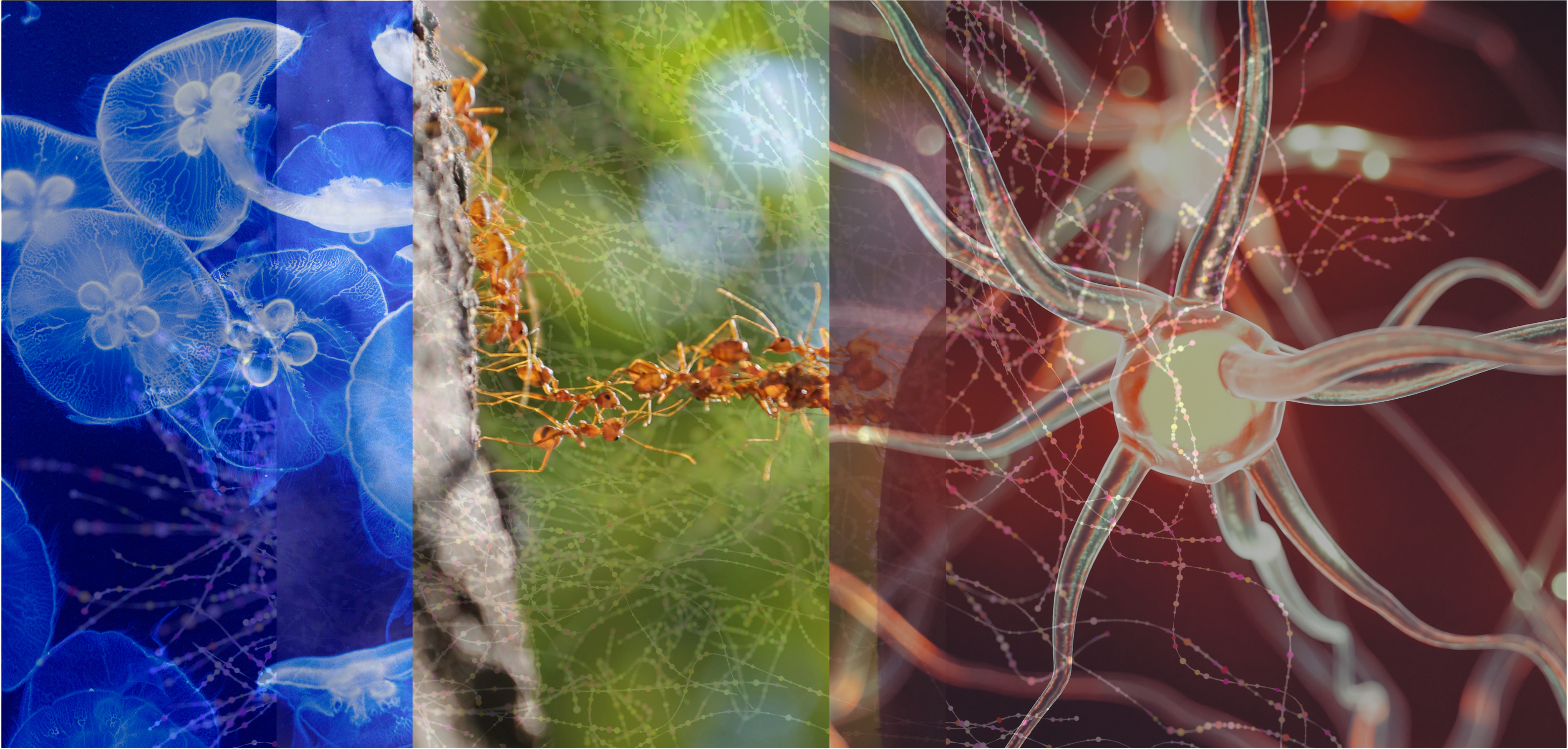
Hello Interactors,It’s been a while since we’ve been together. I took some time over the holiday break. We often think of parents spoiling kids upon their return from college, but I’m the one who feels spoiled.We’re squarely in the winter season up north and that means I’ll be exploring human behavior. With all the talk of AI, I thought I’d start with its root inspiration — the neuron. How did these come to be?Let’s find out.As I stand here today, the earth’s declination angle is slowly inching toward zero as its orbital tilt brings us closer to spring. This will trigger a host of biological and biochemical chain reactions. Plants awake, buds break, birds migrate, insects propagate, amphibians’ mate, seeds germinate, furs abate, and soils emanate. Algae plumes bloom, and our own metabolism’s resume.This shared sensing of environmental change makes common sense because we can sense it with our own senses. Less common is making sense of what we can’t sense. That’s what I’m trying to make sense of. Let’s start with cells.Cells can also make sense of their environment, and of each other. Consensus belief says cellular life emerged nearly 3.7 billion years ago on a rotating and orbiting earth that had already been oscillating in a predictable pattern for 750 million years. Early cellular organisms learned to predict these patterns, as the theory goes, getting an evolutionary leg up on the competition. This knowledge was then stored in the cell. I was surprised to learn a cell can store information.Ricard Solé is a prominent researcher who applies complex systems concepts to biology. He explained in a recent podcast how cells perform associative learning through reactions to different external stimuli — a process fundamental to the evolution of cognition. This learning involves associating a specific signal with a stressor in a cell’s environment. Over time, they learn to respond to the signal, even in the absence of the original stressor. A bit like a Pavlovian response.This information is then stored within the cell. Cells have complex signaling networks that gather information from the cell membrane and transmit it internally from the membrane to the genome or nucleus. These signals act as boolean "genetic switches." The switch involves pairs of genes that negatively regulate each other, creating a kind of memory storage system. As one gene tries to regulate the other, that gene is trying to do the same. Like two magnets competing to repel or attract. This leads to a binary outcome — the conflict produces a specific protein, or it does not. This process is akin to the binary electronic circuitry found in signaling networks used to process and store information on a computer. (more on that in future posts on this topic)Cells that can respond to the environment, or conditions within itself, can secrete something into their environment. But if there are no other cells to receive them as signals or with the intention to propagate their stored information, this operation serves no function. Over evolutionary time, however, cells began to form functionalities. For example, through expressions formed from their genetic circuitry, the cells that make up your liver and kidney evolved to conduct basic metabolic functions. Meanwhile, the cells that make up neurons in your brain evolved to send and receive information — to communicate with each other. A major step in evolution.Another major evolutionary step, according to Solé, came with interneurons. These are neurons that form connections between sensory neurons to process information between them. Many neurons connected by many interneurons form arrays of neural circuits capable of more complex information processing. Organisms that don’t have interneurons, like plants, pose a real biological and evolutionary disadvantage among energy competing biological organisms. Though, they created their own biological functions that are so wondrous they induce jealousy, like photosynthesis. Imagine getting fed by lying in the sun with your feet in the sand. Did I mention it’s winter in the gloomy northwest?Solé believes the invention of interneurons provided the critical step toward a key component in the evolution of complex organisms like us, but also organisms that came before us like jellyfish. Jellyfish are made of a distributed ‘nerve net’ composed of sensory neurons, motor neurons, and interneurons similar to ours. This network conducts basic processing for various sensory and motor functions. For example, it can sense elements of its environment, like water currents and temperatures, which then trigger responses like swimming or eating.Directed locomotion in response to sensory information processing serves as another critical step on the path of evolution — predation. Not only is the jellyfish sensing the water around them, but they’re also sensing the presence of predators and their nervous system conspires to act accordingly. As remarkable and complex a jellyfish is at

2023 Year End Summary
Hello Interactors,It’s been a great year hear at Interplace with subscriptions hitting (and hovering) around 1000 subscribers! Thank you! And thanks to Substack’s recommendation engine, the vast majority of those came from Steven Sinofsky’s Hardcore Software newsletter. Thank you!Sadly, the utility of this recommendation engine also means those Nazi newsletters Substack chooses to sponsor will also spread. It’s their choice of free speech as a publisher and seller. Just like this 1930s Aryan bookstore who was fine attracting Nazi customers because, like Substack, they believed select, uncensored ‘truth brings liberation’.I’m not thrilled to be sorted alongside such publications, but I’m also not thrilled to be embedded among local and national right wing extremists in a country that has yet to fully come to terms with it’s own racial ideology. An ideology that intermingles jingoism and militarism propped up with related economic policies. Yes, I have the choice (and privilege) to move, but finding places void of right-wing extremism and zombie neoliberalism is getting harder and harder these days.2024 is a big election year in the U.S. One that will surely influence this course and our nation’s discourse. Abusive forms of AI is sure to play a role in it. So, I was curious what would happen if I took my top five most viewed posts of 2023 and ask ChatGPT to provide connections between them and summarize a conclusion. I’m impressed. Not only with the how Large Language Models (LLMs) emulate perceived human intelligence, but with the consistency with which my own convictions and intentions emerge throughout these five posts. ChatGPT, like a good LLM, is providing an illusion of consistency and coherency in my writing! It’s a reflection of external linguistic patterns arranged in a literary image of my internal goals for Interplace — an emulation of perceived intelligence! Be careful out there.I hope everyone has a healthy and happy 2024. Please remember this interpretation of my own intention as you set your new year’s resolutions: “our collective actions contribute to the fabric of our environments, and through awareness and choice, we have the power to reshape them for the better.”And now, ChatGPT’s Interplace summary of 2023.The five blocks of text you provided seem to be excerpts from different discussions or articles that, although varied in focus, share common themes about the intersection of human behavior, spatial cognition, and the environment, whether it be through the lens of a television show, research in geography, urban planning, psychological studies, or societal needs.* Clarkson’s Farm: The Grand Tour of the Rural-Urban Divide: This text illustrates how a TV show can provide a microcosm of the broader societal issues, including the divide between rural and urban life, environmental impact, and social stratification. It suggests that the antics of the show's host, Jeremy Clarkson, inadvertently reveal the interconnectedness of society and the environment.* A Geography Revolution: Complexity and Connection in Successor Evolution: This section discusses the advancement in cognitive geography, moving away from traditional, rigid spatial models to those that account for the complex, iterative interactions between people and their environments. It challenges conventional Euclidean views and advocates for a more dynamic, holistic approach to spatial cognition.* The Universal Uniformity of Urban Mobility: Here, the focus is on urban mobility and how patterns of movement within cities are universally similar, as demonstrated by visitation power laws. The text raises concerns about equity and inclusivity in urban planning, suggesting that current models serve those with resources while potentially neglecting others. It also touches on how legislative changes can influence urban structure and the potential for creating more walkable neighborhoods.* Will Work for Food. A Quirk or Accrued?: This text compares human behavior with that of rats in a study about driving and satisfaction. It draws parallels between the cognitive benefits of novel experiences and the laborious nature of maintaining a car, suggesting that there may be more rewarding alternatives to driving, such as walking, which provide more cognitive stimulation and a sense of agency.* Hierarchy of Needs or Just More Greed?: The final text reflects on the individual's power to enact change within large-scale systems, as evidenced by shifts in behavior during the pandemic. It questions whether adherence to traditional socio-economic constructs serves our needs and posits that conscious, alternative choices could lead to significant societal transformations.Summary:The amalgamation of these texts presents a nuanced examination of human-environment interactions. At the core is an understanding that our spaces, whether physical like farms and cities or conceptual like cognitive maps, are not static but are shaped by our interactions, decisions, and m
'T'was the Night Before Christmas': A Poor Home Invader Who Leaves Gifts for Wealthy Kids
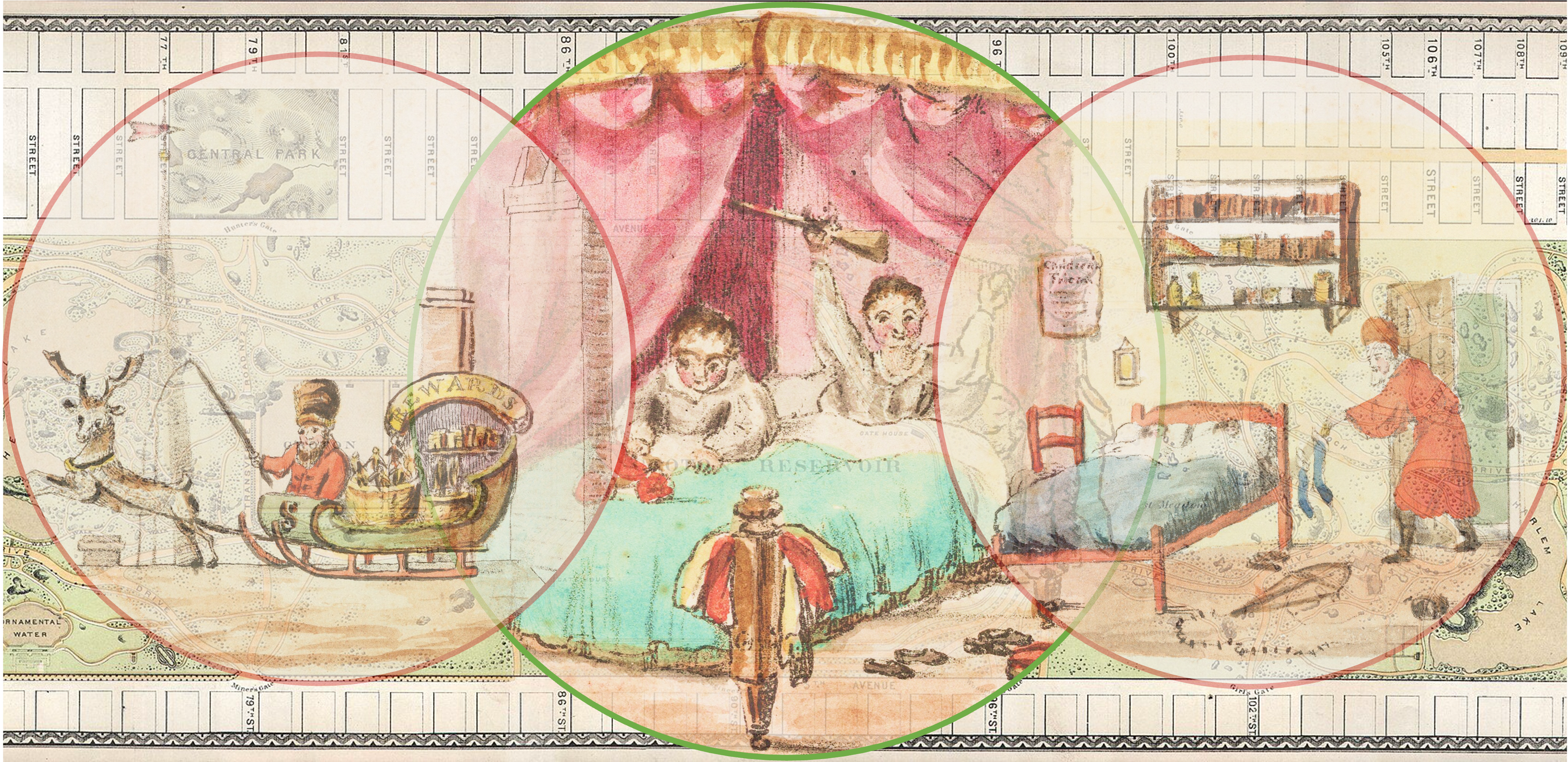
Hello Interactors,On the day before many around the world pull out ‘T’was the Night Before Christmas’ to read to their kids, maybe drop a little context to the origins of this tale. This is an excerpt from a longer post I did in 2021 on Black Friday. It touches on how the rising wealth in New York leading up to 1900 brought about shifts in attitudes around how the powerful elite should deal with ‘the masses’ of poor, and increasingly urban, immigrants. Included are themes emerging today like immigration, laws outlawing voting to non-property owners, and even calls for an end to democracy.‘T’was the Night Before Christmas’ was intended for the elite literate ruling class. It can be interpreted as a nostalgic romantic tale about how Christmas should be less about sharing with ‘the unruly masses’ — communally seeking good tidings — and more about barricading private homes from potential invasion and keeping your wealth to yourself. It’s a fantasy about letting a poor, kind peddler in a red tattered coat labor to bring gifts to affluent kids, quietly and calmly through the chimney of a fancy New York apartment.Merry Christmas!CLOTHES WERE ALL TARNISHED WITH ASHES AND SOOTBut the dawn of a new century, and the industrial age, brought a shift in attitudes around Christmas. The elite, like in centuries past, distanced themselves from the occasion. As urban cities grew and jobs shifted from the farm to the factory, winter brought new dynamics to the onset of the season. Some factories closed in the cold months as did shipyards along frozen waters.This brought unemployment and idle time to laborers. Whereas historically wealthy farm owners were willing to amuse the working class in a societal roll reversal – through transient and theatrical wassailing – the urban elite power structures were unwilling to participate. But it didn’t stop the working class from venting.The once faint mockery of their employers – imbued with subtle hints of revenge should they not offer them gifts, food, or alcohol – turned fierce and riotous in the 1800s. Papers in both England and the United States barely mention Christmas at all between 1800 and 1820. But that was about to change.In the first decade of 1800, one of New York’s most influential men, John Pintard, became particularly peeved by the seasonal banditti. He reminisced on ‘better days’ when the rich and the poor got drunk together. And while he wished his wealthy friends reveled more among themselves, he grew concerned that “the beastly vice of drunkenness among the lower laboring classes is growing to a frightful excess…”And in a familiar tone, echoed to this day by many, he feared “thefts, incendiaries, and murders—which prevail—all arise from this source.” Which is why he helped create the Society for the Prevention of Pauperism. This was an organization that sought to curb money directed at care for the poor, but to also stop them from begging and drinking. The white elite ruling class of the 1820s –- as well as many in the 2020s – complained of what one New York paper described as, “[t]he assembling of Negroes, servants, boys and other disorderly persons, in noisy companies in the streets, where they spend the time in gaming, drunkenness, quarreling, swearing, etc., to the great disturbance of the neighborhood.”Pintard was also hopelessly nostalgic. He founded the New York Historical Society in 1804 and was instrumental in establishing Washington’s Birthday, the Fourth of July, and Columbus Day as national holidays. Pintard also introduced America’s icon of nostalgia, Santa Claus. Seeking a patron saint for the New York Historical Society, and for all of New York City, he commissioned an illustration to be painted of St. Nicholas giving presents to children. While the icon was not intended to be seasonal, it was nonetheless printed on December 6th, St. Nicholas Day, in 1810.He pined for the days when the rich and powerful could rule over what was becoming a burgeoning working class. In 1822, as New York had just passed a law allowing non-property owners to vote, Pintard wrote to his daughter,“All power is to be given, by the right of universal suffrage, to a mass of people, especially in this city, which has no stake in society. It is easier to raise a mob than to quell it, and we shall hereafter be governed by rank democracy.… Alas that the proud state of New York should be engulfed in the abyss of ruin.”WHAT TO MY WONDERING EYES SHOULD APPEAR1822 was also the year his friend, and wealthy land owner, Clement Clark Moore, wrote what was to become the most influential Christmas poem ever: “A Visit from St. Nicholas” or as it is known today, “T’was The Night Before Christmas.”This single poem, written for the elite upper class, encapsulates the nostalgia of wassailing Pintard and his friends pined for, while self-indulgently feeling good about themselves for ‘giving to the needy.’ Moore did this by substituting the unruly lower working class, begging for gifts from their ma
The Neocolonial Invasion of Techno-Libertarians
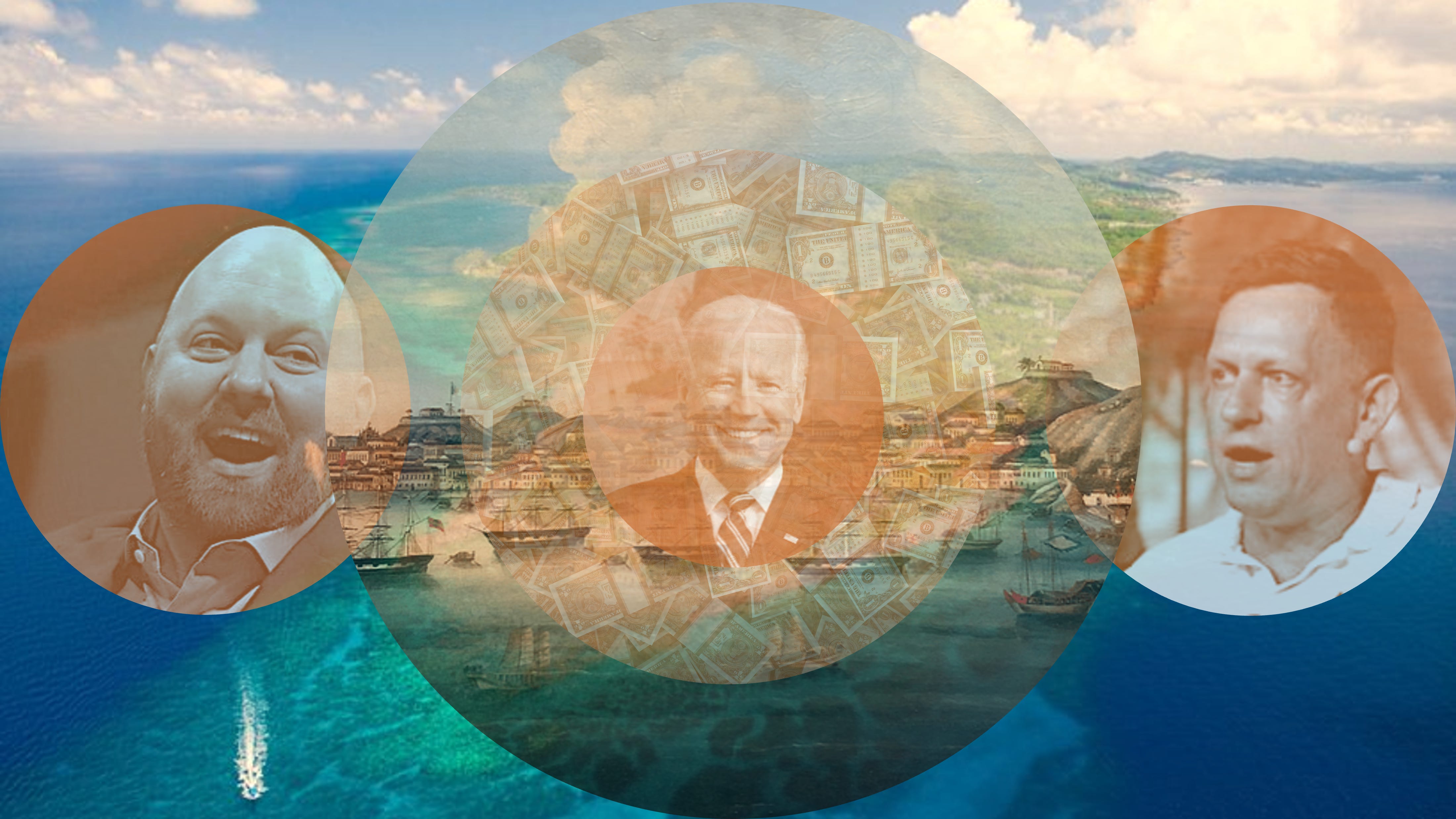
Hello Interactors,This is the last post on economics for 2023. Next up for winter is human behavior. This post bridges where we left off with traditional colonial nation-states by talking about how similar philosophies are motivating the formation of neocolonial micro-states. What causes people to seek freedom in new places by limiting the freedom of those found in such places?Let’s dig in…THE PURSUIT OF HAPPINESSIn 2009 the venture capitalist, techno-optimist, and libertarian political activist Peter Thiel ‘reasoned’. “[he] no longer believes freedom and democracy are compatible.” He said, “The great task for libertarians is to find an escape from politics in all its forms.” Back then Thiel was introducing his ‘seasteading’ project — building or repurposing platforms in ocean waters not covered by international law as micro-nations. He continues to lead his friends and followers, like tech mogul Marc Andreessen, toward these promised lands. They seek sophisticated legal spaces opportunistically drawn inside pre-existing territories with curious jurisdictions, legal structures, and rights. They take on names like ‘innovation hubs’ or ‘high-tech parks’ — techno-libertarian utopian ‘enclaves’ and ‘havens’ for those willing to adopt and adhere to their techno-optimist religion.My last two posts talked about the creation of nation-states by powerful governments over the centuries and how they contributed to the current wars in Ukraine and Palestine. But there are also battles in the courtroom between these neocolonial libertarian venture capitalists and the people resisting colonization. This is why, as The Economist says, these libertarian colonies “will have their own government, write their own laws, manage their own currency and, eventually, hold their own elections.” And they have the backing of powerful European and U.S. governments. Sound familiar? The original European colonial nation-states were qausi-governmental entities conceived by rich and powerful private entities to further enrich themselves — often at the expense of local people and land. It’s a concept that emerged out the European Enlightenment boosted by new scientific discoveries, technologies, and philosophies.Thinkers like John Locke advocated for the concept of natural rights, including life, liberty, and property, which belonged inherently to individuals. These ideas inspired people to seek places where they could express personal autonomy and the freedom to pursue one's own goals and desires free of rule. This contrasted with long held beliefs that placed collective or communal goals above individual aspirations.The Enlightenment is also often associated with the Age of Reason. Influential philosophers like René Descartes and Immanuel Kant emphasized the role of reason in understanding the world and making decisions. They argued that individuals should use their capacity for rational thought to question traditional authorities and beliefs, thus promoting a more individualistic approach to knowledge and truth. Reason is the hallmark of libertarian political philosophy today.But they’re not alone. Rationalism has long been a cornerstone of human understanding, though faces many challenges today. Advances in neuroscience, cognitive psychology, and philosophy reveal that rationality is not a neutral tool but is often influenced by power structures, cultural biases, and subjective experiences. What is considered 'rational' can vary across different cultural and social contexts.For example, the ‘rational actor’ theory on which mainstream economics rests doesn’t factor in confirmation bias — favoring information that confirms preexisting beliefs. A growing number of neuroscientists are revealing confirmation bias triggers activity in brain regions involved in reward processing, suggesting some biases may be rooted in fundamental neural mechanisms.One of the preexisting beliefs of early Enlightenment thinkers, theologians, and colonial settlers is the idea that morality and ethics are not solely dictated by external authorities (like the church or state) but can be discerned through personal reasoning and rational introspection. This led to a more personal and individualistic approach to moral decisions. This may a form of confirmation bias suggesting moral principles should be followed out of a sense of personal duty over a duty to the community.This shift played a crucial role in shaping modern Western societies, influencing everything from political theory to personal identity.These ideas are intermingled in European colonialism and state-making. European powers, perceiving themselves as more 'civilized' and 'rational', used these beliefs to legitimize the domination of other peoples, whom they considered less enlightened or rational. This paternalistic view was used to rationalize the spread of European control and influence across the globe, often disregarding the autonomy and cultural values of colonized peoples.While Enlightenment think
The Shaky State of States (Part 2 of 2)
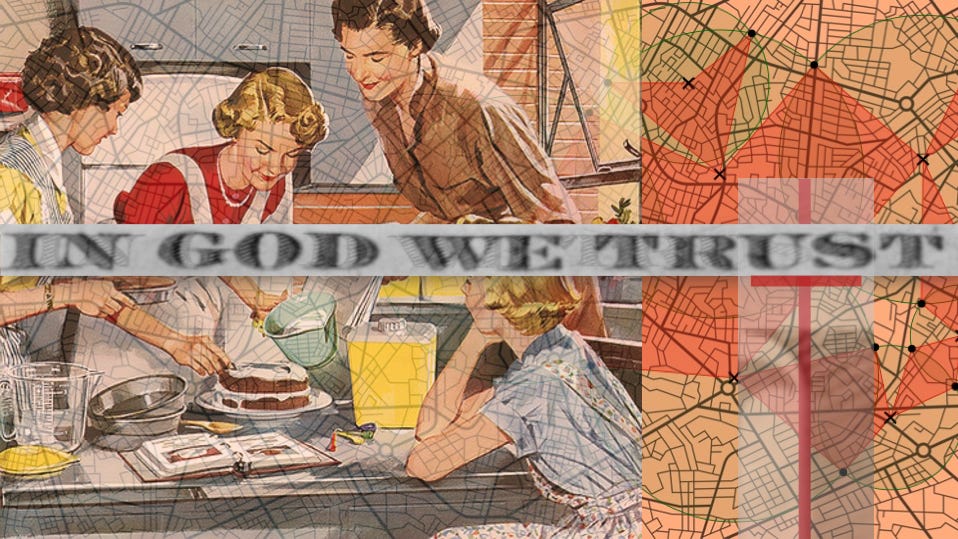
Hello Interactors,Part 2 talks about the failures of borders, some recent alarming and revealing data about America’s ‘shared identity’, and some potential paths toward embracing the shaky state of states.Let’s get into it…NEWLY PROMISED LANDSPart 1 left us at the Paris Peace Conference and Western-style cartographic geo-political mandates. Amidst these mandates was an admission by one leader that these arrangements would need subsequent alterations. Take this quote, for example:“There are many complicated questions connected with the present settlements which perhaps can not be successfully worked out to an ultimate issue by the decisions we shall arrive at here. I can easily conceive that many of these settlements will need subsequent reconsideration, that many of the decisions we make shall need subsequent alteration in some degree; for, if I may judge by my own study of some of these questions, they are not susceptible of confident judgments at present.”These are the words of U.S. President Woodrow Wilson in January of 1919 at the Paris Peace Conference. Sadly, ‘subsequent alterations’ over the last century have proven a tougher challenge than Wilson may have fully appreciated. Whether his intentions were noble or not, rigidly draw borders on maps are obviously failing to truly encapsulate and represent the diverse and multifaceted spectrum of human communities — especially in a world where the negative effects of climate change know no such borders. Could it be that identities and experiences resist being neatly delineated by Cartesian maps inherently based on political philosophies steeped in Cartesian dualities? Is it conceivable that nations and nation-states should not be confined to a singular, homogeneous identity? Perhaps they are incapable of such definition. It may be these concepts have reached their limits. A suggestion that can compound feelings of uncertainty about what lies ahead in tumultuous times. This discomfort drives many to search for past eras that seemed more safe and certain — a time when there appeared to be a common shared national identity. The Public Religion Research Institute (PRRI) seeks such shared identities among those living in the United States in their annual ‘American Values Survey.’ It’s one of the more respected surveys offering a pulse on American views of religion, culture, and politics. They recently released their 2023 results which can serve as one pulse on national identity. They project, based on their statistically valid sample, that“Three in ten Americans (31%) agree that ‘God intended America to be a new promised land where European Christians could create a society that could be an example to the rest of the world. Just less than half of Republicans (49%) agree with this, compared with 26% of independents and only 18% of Democrats.”PRRI data also reveals,“Those who most trust conservative media (66%) and Fox News (54%) among television news sources are much more likely than those who choose no television source (29%) or mainstream media sources (24%) to agree that God intended America to be a new promised land.” “Two-thirds of Republicans (66%) believe things have changed for the worse since the 1950s, compared with half of independents (50%) and only 30% of Democrats.”The 1950s are often remembered as a time of economic prosperity, cultural growth, and the rise of the middle class in America. This era is seen as the embodiment of the 'American Dream,' with a booming post-World War II economy, expanding consumer culture, and significant advancements in technology and suburban living. The period is characterized by strong family values, community cohesion, and distinct gender roles, often contrasted with the rapid social changes and complexities of modern life. Television, automobiles, and household appliances symbolize this era's progress and American ingenuity, reflecting a sense of unity and optimism about the United States' role in the world.However, this romanticized view of the 1950s overlooks many critical social and political issues of the time, including racial segregation, gender inequality, and the fear and paranoia of McCarthyism. The decade, while remembered for its strong leadership and perceived lack of political division, also faced significant challenges. The popular nostalgia for this era often represents a simplified and selective interpretation, failing to fully recognize the complexities and struggles that defined the 1950s, and inadvertently promoting a cartoonish, oversimplified version of history.This difference in opinion is increasingly leading more Americans to embrace violence as a means of establishing a ‘shared identity.’“Americans who believe that the country has changed for the worse since the 1950s are more than twice as likely as those who say that it has changed for the better to agree that true American patriots may have to resort to violence to save the country (30% vs. 14%).”MAPPING THE AMORPHOUSThe idea “that God i
The Shaky State of States (Part 1 of 2)
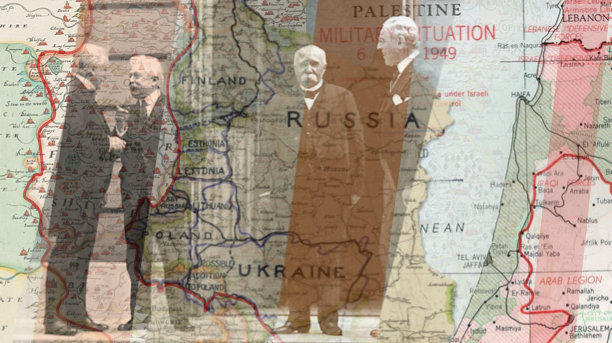
Hello Interactors,There’s a lot of talk of states these days. Palestine and Israel, one state or two? Ukraine and Russia. One state or two? The United States. E pluribus unum. Out of many, one…right? What about that one D.C. federal district, or those five territories, and a bunch of ‘minor’ islands? And don’t forget the many tribal nations within the nation-state of the United States which can often spread across many state borders! I started writing about all this and it got long, so I’m broke it two. Ex uno plures, from one, many. I suppose there’s a lesson in all this. No matter how fixed a given state of affairs may appear, we have to be prepared for bifurcations and reconfigurations.Let’s dig in!THE RISE OF STATESI easily confuse states with nations. Nations are loosely defined as a group of people with a shared identity. A nation-state is a political structure represented by a territorial boundary claiming to contain a common identity. I used the words ‘loosely’ and ‘claim’ because so many territorially bounded areas or nations contain a multitude of identities. The United States, a notoriously diverse country, is a great example.Nations and nation-states seem to have chicken-and-egg origin story. I believe those who claim the nation-state rose out of folks like those early European colonizers. Fueled by the thought of amassing wealth, land, and power once only believed to be wrangled by feudal lords and monarchs, influential and enterprising European intellectually ‘entlightened’ elites pooled their resources and got to work.The idea of a nation-state, and their bordered geographic territories, began to take shape through 14th-17th century Europe. The late Middle Ages and the rising Renaissance witnessed a gradual decline of feudalism and the rise of centralized monarchies who were incented to consolidate power within defined territorial boundaries. The Peace of Westphalia in 1648, which ended the Thirty Years' War in Europe, is often cited as a key moment in the history of nations as it established the principles of sovereignty and territorial integrity fundamental to the nation-state concept.The 18th and 19th centuries saw the rise of nationalism, a significant driving force behind the nation-state concept. Nationalism emphasized a shared identity based on language, culture, and ethnicity, often aligned with a specific geographic territory. The French Revolution (1789–1799) and the subsequent Napoleonic Wars accelerated the spread of these ideas across Europe.Language invention and reconstitution burgeoned across Europe. One example is from 1820 Finland. Born out of an interest in Finnish tradition and culture a groundswell of nationalism by Finnish writers, teachers, pastors, and attorneys took hold. They stitched together their collective past stories and dialects and published dictionaries and grammar guides that differentiated them from the Swedes. This forged a more confident and self-determined government and national identity defined by their borders and their language.In 1819 the first publication of Ukrainian grammar was printed. Russian grammar was defined just 17 years prior. By 1830 more Ukrainian writers were published in their native language. This is the date that established the language as a bonding element of Ukrainian nationalism. In 1846 the first Ukrainian nationalist organization was founded. And not by a politician with a sovereign agenda, but by a historian.The 19th century also saw the unification of various nation-states. Notable examples include the unification of Italy in the 1860s and Germany in the 1870s. These unifications were driven by shared cultural, linguistic, and ethnic identities, as well as by political and economic interests.It took Germany just 40 years to rise as a dominant and powerful nation-state in Europe. This led to tensions around Europe, especially with France and Britain. But it was a Serbian nationalist group and their assassination of Archduke Franz Ferdinand of Austria-Hungary in 1914 that triggered war. Austria-Hungary declared war on Serbia and Europe erupted into World War I. The United States entered the war in 1917, in part fearing a potential alliance between neighboring Mexico and Germany. This was also the same year they began preparing for peace agreements and the redistricting of territories of nation-states.In 1918 U.S. President Woodrow Wilson boarded a ship for Paris bringing with him a team of cartographers to create materials for the Paris Peace Conference. This included chief cartographer Mark Sylvester William Jefferson who had invented a form of thematic mapping based on ethnography, demography, and population distribution called anthropography.Comfortable with nearly thirteen languages, he and a team of ethnographers, linguists, and anthropologists set up offices in a Paris hotel. They drew convincing maps used by Wilson and his allies to sell other world leaders on the formation of nation-states that would best serve their
Is America's Manufacturing Boom Doomed?
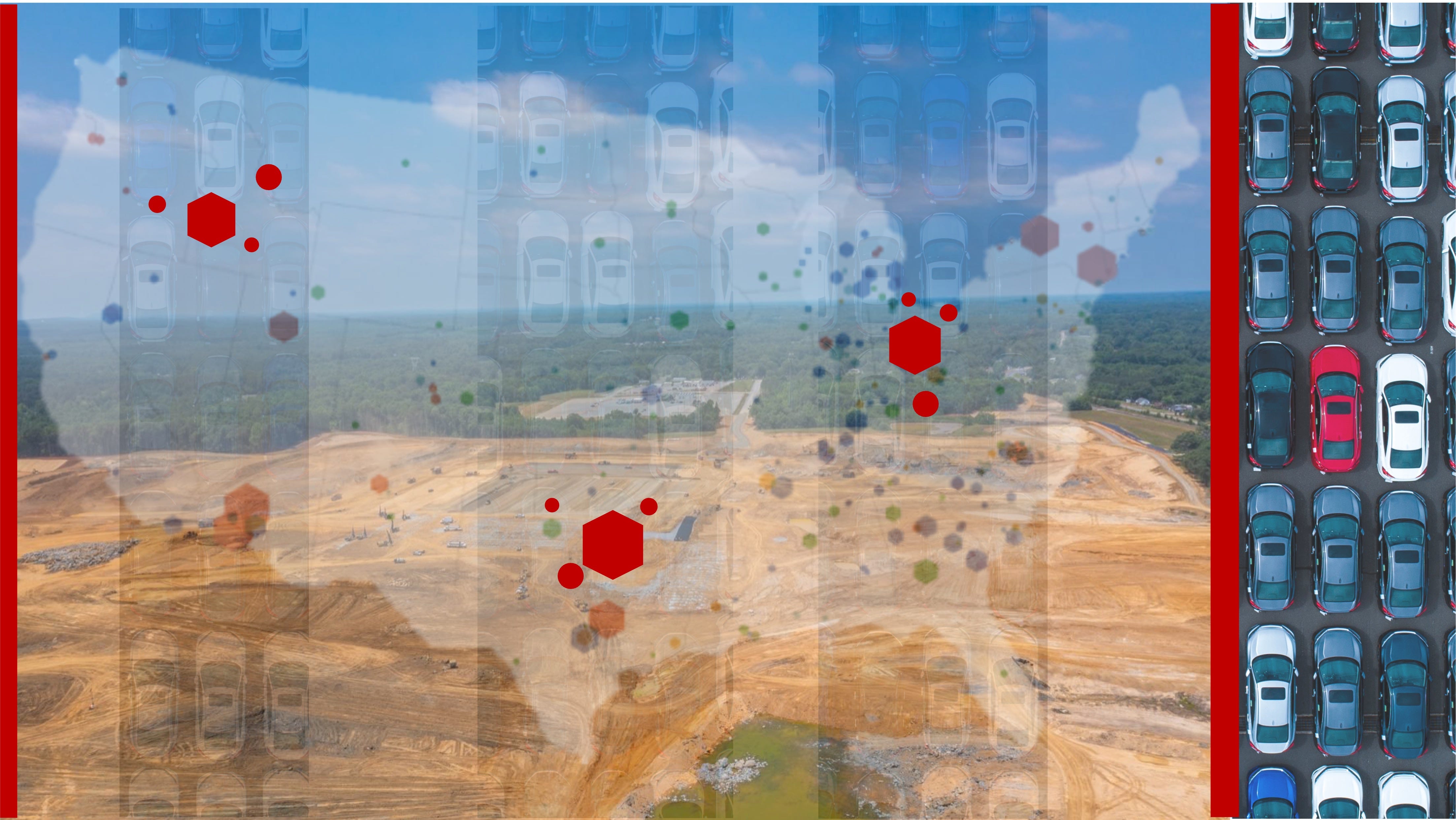
Hello Interactors,A series of U.S. federal legislation under the Biden administration has spawned a manufacturing boom at a scale not seen in decades. Unfortunately, the country is repeating the same socio-economic, land use, and transportation policy mistakes that have lead to many of the ills we’re seeking to remedy. Are we missing an opportunity to build back better?A MANUFACTURING RENAISSANCEClearcut a forest and build a factory. Now build an even bigger parking lot around the factory for workers and make them drive from miles around to work. Parts and supplies? Yeah, those will have to be trucked in too. Now, stand here in front of the camera and wave this earth flag alongside a U.S. flag and brag about job growth and how EV’s are going to re-green the earth.This scene captures what’s currently unfolding across the United States. Legislation such as the Infrastructure Investment and Jobs Act, CHIPS and Science Act, and the Inflation Reduction Act, alongside increased Department of Defense spending, is catalyzing a 'manufacturing renaissance' in the United States with a supposed emphasis on infrastructure improvement, clean energy, and national security.Paradoxically, this familiar pattern in economic geography is partially responsible for the historical socio-economic inequities and environmental destruction the U.S. is struggling to remedy. Research by Drexel University’s Nowak Metro Finance Lab, in cooperation with the Aspen Institute’s Latinos and Society Program, is investigating the spatial dimensions of this shift, seeking to enhance opportunities for minority-owned businesses within this new economic landscape.They’ve uncovered how the burgeoning manufacturing boom in the United States is showcasing a remarkable geographic distribution of investment and industry specialization significantly benefiting a diverse array of states and metropolitan areas. A substantial portion of funding aimed at bolstering the semiconductor supply chain is pouring into states like Arizona, Texas, New York, Ohio, and Indiana.Additionally, to streamline supply chain efficiencies, battery plants are emerging alongside automotive factories in a vertical alignment from Michigan to Georgia. On the energy front, the Eastern seaboard is focusing on offshore wind power, while states such as California, Arizona, and Texas lead in solar panel production. This broad dispersion of high-tech manufacturing indicates a shift towards a more equitable distribution of economic growth across the nation.This industrial transformation is not only geographically dispersed across many states and regions, but also spread to the outskirts of metropolitan areas. This raises challenges in harnessing this growth for the benefit of all, particularly Black- and Latino-owned firms and workers. It’s shaping into another form of ‘white flight’ where firms seek the cheapest land away from populated areas, which typically are exurban and rural farmland and forests, toward smaller cities and towns which are predominantly white. And mostly poor, offering a needed economic boost.However, these regions, cities, and towns have also historically deprioritized public transit alongside decades of car dependent land use policies. So whatever jobs and growth these new manufacturing facilities bring, they’re destined to also bring more cars, which means more traffic, more pollution, and more time alone in cars isolated from interactions with community members. Meanwhile, the decades of neglect and decay of our rail network also means more truck traffic.I’m reminded of geographer David Harvey's concept of the 'spatial fix'. It suggests capital movement, including the re-shoring of manufacturing, seeks new low-cost geographical frontiers to overcome drains on profit and expansion. This exploitation of geographical ‘space’ through industrial policy and investment reflects a 'fix' for capital investments and investors. By now, however, the meaning of the word 'fix' has less to do with a correction and more to do with an addiction.There’s an addiction to a dynamic complex interplay of local and global economic geographies — a form of economic development and spatial restructuring that has shown to bring about both positive and negative outcomes. Parking lots and roads may have paved the way for many to cruise to a better quality of life, but the quality of the paradise we call home — our communities, cities, health, and environments — are suffering, if not lost, from decades of addiction.This boom, while creating opportunities for some, may continue to be a bust for many. They may also spawn new forms of social stratification. The concentration of certain industries in specific regions, for example, could lead to a polarization of skill sets and economic opportunities. This, in turn, may result in localized booms benefiting a segment of society while leaving others behind, thereby reinforcing regional disparities rather than truly leveling the playing field and remed
Hallowed Be Thy Harvest: The Genuine Gist of Halloween's Past
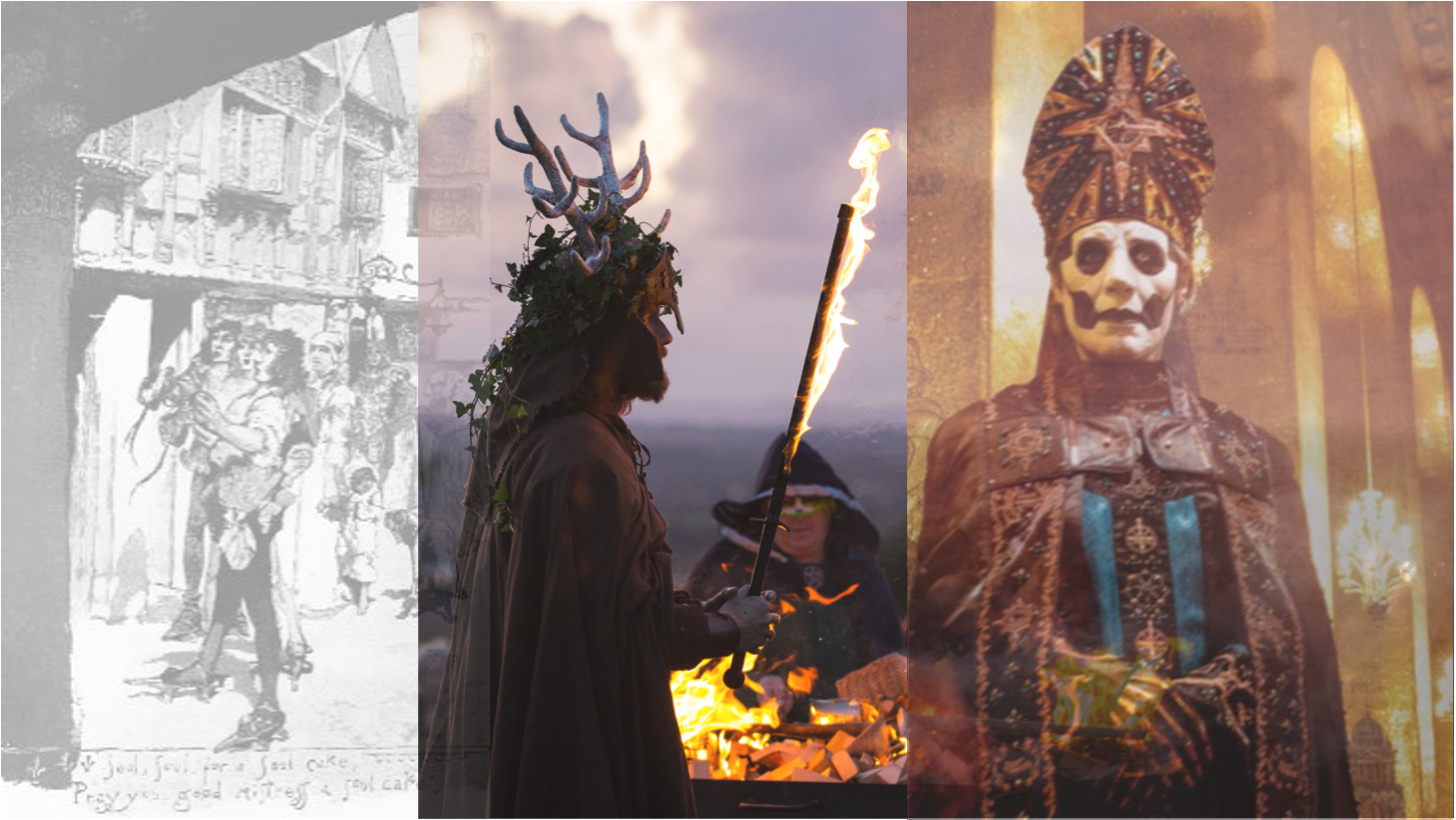
Hello Interactors,Trick-or-treat! It’s that time of year for Americans, and a growing population worldwide, to dawn a favorite costume and consume copious amounts of candy. It’s also a time for kids to parade for treats and for adults to decorate with ghoulish goblins, ghosts, and other frightful festoons. And excuse to cosplay without criticism.Americans will spend an ungodly amount of money on this conspicuous occasion. Like most holidays in America, it’s a chance to fire up the capitalist contraption and watch money burn like a Halloween bonfire. But why? How did this holiday emerge and what does it all really mean?Let’s find out.CANDY, COSTUMES, AND CONTESTATIONSI once handed out toothpaste to trick-or-treaters at Halloween. Trick your teeth. My wife’s dad was a dentist and we ended up with a box of toothpaste samples. Realizing we forgot to buy candy to hand out at Halloween, we poured the box of samples into a bowl. Kids loved it, and so did their teeth.Some parents giggled, many groaned, and some thought it was downright mean. Realizing kids will happily take just about anything from the bowl, some years we’ve even opted for pencils, erasers, and stickers. We’re so mean.But let’s face it, Halloween, in its modern form, is mostly about candy and costumes. The National Retail Federation (NRF) estimates 68% of Americans will spend a total of $3.6 billion on candy handouts this Halloween. That’s up from $3.1 billion last year. Burp.Nearly three quarters of the country are expected to buy decorations to the tune of $3.9 billion dollars. The percentage of folks intent on buying costumes have hit an all-time NRF high of 69%, up from 67% last year, amounting to $4.1 billion dollars. All told, they project the average American Halloweener will spend around $108 this year. It’s all been climbing since Covid. Either we need sugar to sooth each other, or costumes to excuse each other. Or both.Their data suggests those aged 25–44 are the most eager to spend, claiming social media inspires early costume and decoration ideas and decisions. Adult spending on themselves and their pets dwarfs spending on kid costumes accounting for nearly three of the four billion dollars in total spend…and climbing. Adult spending increased a whopping 18% from a year ago.The NRF says to expect a lot of Spiderman and princess costumes on kids, pets as pumpkins, and a variety of adult witches, ghosts, and vampires. And Barbie. Lots of Barbie. It seems trendy pop culture is challenging the traditional spooky gothic culture Hallows Eve is known for. Though there are some interpretations of history that suggest Halloween really was more of a moment of merriment among the masses than some pagan spiritual spook fest.A quick search on the history of Halloween and you’ll quickly learn it comes from Ireland via a Celtic festival called Samhein (pronounced “sow-win”). Irish immigrants then brought it to America in the 1800s and here we are. Searching on Samhein will reveal text that says it stems from a spiritual festival by pagans — a religious celebration with imagery of mysticism and the occult where people on earth attempt connections with the dead through fire and rituals. It was believed to be the interaction of pagan people and place seeking interactions with people of another time and place. But a more truthful approximation of historical fact reveals the story of Samhein may be a victim of what one historian calls a combination of “fakelore and folklore”. Professor Robert Davis studies religious and cultural education at the University of Glasgow as it relates to people, place, and social change. He writes that much of Irish history stems from the work of a seventeen-century historian named Geoffrey Keating. Davis joins a chorus of critics who argue Keating's work, while beautifully written, is mostly a form of exaggerated romantic nationalism.Keating wrote during a time when Irish history and culture were under threat from English influence and rule. Critics believe his narratives therefore assert a particularly noble Irish identity and history, which led him to possibly embellish or reinterpret certain historical events or figures. Keating was also a Catholic priest, which influenced his historical interpretations. Including the notion that these ancient Irish clans and respective nobility were Catholic.His intertwining of religious and secular perspectives is seen as a reflection of Keating's worldview. But it doesn’t always live up to academic scrutiny expected from histography. But because Keating was also a poet and had a compelling command of the Irish language, his writing was accessible and enjoyable. This further endeared him to readers while also allowing his work to endure. His influence is present today despite his critics, as evidence by the dominant narrative surrounding Sanhein found in history books and online.Keating’s recalling of this autumnal event is unique in its reference to mythological religiosity by pagans of
Migration's Blend and the Capitalist Brew
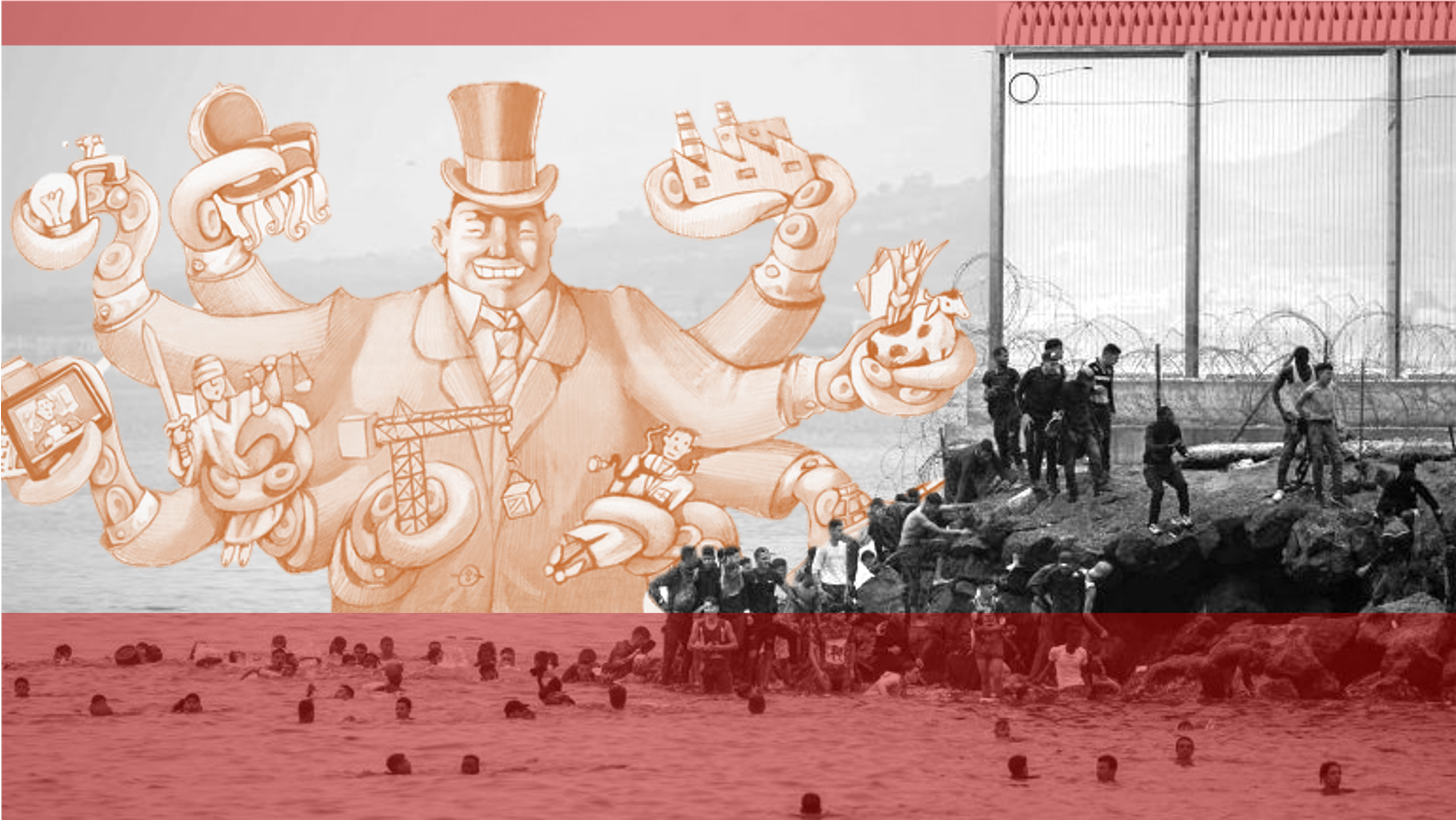
Hello Interactors,This post brings new meaning to the phrase ‘reading the tea leaves’. Watching my tea diffuse recently, I got to thinking about how humans diffuse around the globe like tea particulates in a teacup. Some migrate intentionally, others are forced, and some are lured across borders — as if by osmosis, like tea through a strainer.It’s tea time somewhere in the world, so grab a cup and let’s go… DRINKING DYNAMICS AND HUMAN DIFFUSIONI’m a tea drinker. I relish the ritual of tea-making, watching the clear water transform in hue, be it the gentle embrace of green tea or the profound depths of black. Hydrogen and its oxygen friends, in a fervent state, eagerly extract molecules from the tea elements, diffusing them throughout the cup until a balance or 'teaquilibrium' is reached.However, this seemingly simple diffusion reflects deeper laws of thermodynamics; it's not merely turning twigs into tea. This transformation is part of a grander system — from the tea leaf's growth in specific conditions, its journey through processing, to ultimately gracing my cup. The tea species' continued evolutionary existence and popularity can be attributed to its taste, aroma, and color. So much so that the fragile leaf bears historical weight — wars have been waged for such traits.Whether in a teacup, an ecosystem, or an economy, these processes reveal a system's tendency towards certain outcomes, showcasing nature's ceaseless drive for equilibrium and long-term persistence.This parallels the evolution of humans and how they interact with people and place. Over millennia, humans have been driven to seek better environments, whether they offer more food, safety, or other resources. This behavior, while not consciously directed toward the grand "purpose" of the species, has clear benefits in terms of survival and reproductive success.Kinetic agitation in the physical and social world is what lead humans to diffuse around the globe — to pass through permeable boundaries intent on achieving equilibrium and long-term persistence. And these days, the world is very agitated and humans are diffusing in record numbers.Wars and political conflicts, combined with economic hardships, are driving global migrations, including South and Central Americans north to the U.S. border. Political repression and discrimination are pushing individuals to search for more tolerant societies. Environmental challenges, from droughts to rising sea levels, are displacing both intra and intercontinental populations, including inhabitants watching their Pacific Islands become submerged. By the end of 2022 108 million people were forcibly displaced — and growing. That’s up from 40 million in 2010.But it’s not all crises driven. With some of the largest populations in the world rising out of poverty more and more migrate in search of better educational opportunities and the prospect of a brighter future.When I was hiring at Microsoft in the early 1990s, the U.S. government was issuing many more work visas than today. The increasing interconnectedness of the world, through technology and transportation, allowed me to hire skilled professionals from other nations. Today people are on massive waitlists hoping to migrate to tech hubs in the U.S., Canada, and Europe. Which can be cruel. Some are heavily recruited, offered jobs, and then forced to live in precarity; putting their lives on hold, they wait as the visa lottery unfolds.But many of those making their way to the U.S. border aren’t being recruited. Not directly anyway. They’re being drawn, through a semi-permeable legal membrane called a border, from areas of low job concentration to high. Agitated by a variety of circumstances, they seek goals and equilibrium in their lives in a quest to persist.CAPITALISM, MIGRATION, AND THE OSMOSIS OF LABORCompanies and corporations are also goal seeking. They seek to maximize profits. Just as cells have evolved mechanisms for osmotic balance, capitalism has evolved to maximize capital accumulation. And low-wage migrant workers have evolved as a mechanism to achieve this goal.Daniel Costa is the Director of Immigration Law and Policy Research at the Economic Policy Institute. In September of 2023 he testified in front of the U.S. House Subcommittee on Health, Employment, Labor and Pensions on the ‘The Impact of Biden’s Open Border on the American Workforce’.He said, “Without immigrant workers, many sectors of the economy would cease to function adequately—whether it be the construction of buildings, crop production, or information technology services.”And according to the Immigration Research Initiative, the range of jobs is wide: “the majority of immigrants are in middle- or upper-wage jobs—with 48% employed in middle-wage jobs, earning more than 2/3 of median earnings for fulltime workers (or $35,000 per year) and 17% are in upper-wage jobs, earning more than double the median.” However, “immigrants are ‘disproportionately likely to be in low-wage jobs. In
"People are a lot dumber and nicer than economists think"
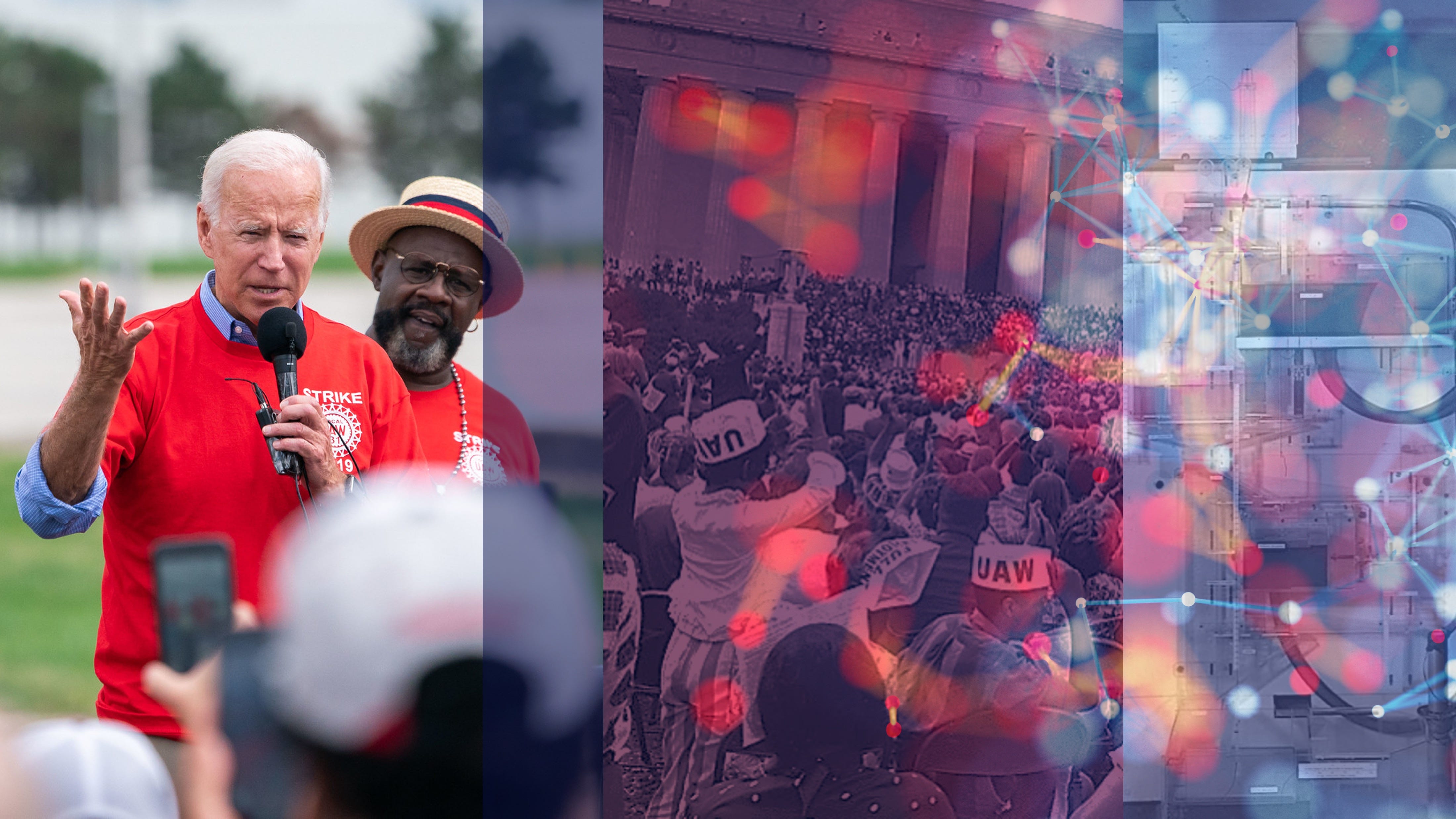
Hello Interactors,Cued by shifting hues comes a call for the leaves to fall. Which means Interplace, like the weather, turns to the tumultuous territory of economics. Economics, like fall weather, is not all that predictable — both systems morph in response to layers of interconnected webs of complex systems that adapt, respond, and influence social, environmental, and political interactions.I recently heard Sean Carroll, an influential theoretical physicist known for his work in quantum mechanics, interview Samuel Bowles, an influential economist specializing in economic inequality. They covered an array of topics including the history and future of economics, and physics, in response to growing attention to complexity science.They harkened back to the industrial age and a time when physicists, mathematicians, philosophers, and newly emerging economists were collaborating — building theories, models, steam engines, looms, and calculation machines. It was a complicated time, rich with invention, but also relatively simple by today’s standards.Hearing this history in the context of the current U.S. United Auto Workers strike made me wonder if perhaps Biden’s fascination with ‘building back better’ America’s industrial past is rooted in a nostalgic yearning for a simpler past.This labor action arouses a sense of nationalism and nostalgia for the 'good old days' that Trump ignited but Biden just may have usurped. But the industrial sector, however romanticized, now represents a small fraction of jobs in America.Humans have a penchant for simplifying complex narratives, yearning for an era where gears of industry moved in predictable cycles much like the changing seasons. But these two scientists highlight how the economy in which we exist has advanced in complexity and is ripe for evolution.Now let’s go.FROM CLASSIC TO COMPLEX: THE ECONOMIC SHIFTIn the interview, Bowles talks of the history of economic thought, beginning with Adam Smith, an intellectual pillar of the Industrial Revolution and an acclaimed father of economics. Adam Smith's notion of the 'invisible hand,' lauded for its portrayal of self-regulating markets, is heavily scrutinized today.This famous metaphor has long been the cornerstone of classical economics and conservative politics, purporting that individual self-interest inadvertently contributes to the overall good of society in ‘invisible’ ways. Bowles explains how Smith could observe, amidst the new factory economy in Scotland — complete with newly built cotton mills and shirt factories — how the shirt buyer and seller both acted according to their self-interest. And then, almost as if by magic, an efficient allocation of resources emerged and along with it a social contract.In simple transactions, like buying a shirt, Bowles illustrates how Smith's model functions well. The seller sets a price based on the costs of production and a desire for profit; the buyer accepts this price based on their valuation of the shirt. The transaction is smooth, the contract 'complete,' and market forces work to adjust supply, demand, and pricing in a seemingly natural order.He offers another historical example that perpetuated the illusion of simple economic models of physics in economics. One of the early influential neoclassical economists, Irving Fisher, built a physical hydraulic model in the early 1900s as part of his dissertation. He used interconnected tanks and pipes to simulate supply and demand. It provided a visceral example of a 'complete contract' where the variables are manageable and the outcomes somewhat foreseeable.Reflecting on this, Bowles offers,“Now, there are all kinds of models like that in economics in which the metaphor really is transportation, things moving from here to there.”However, this 'invisible hand' stumbles when confronted with the complex market forces of the labor required to manufacture a good like a shirt. Bowles believes it wasn’t until 1972, when the Nobel prize winner in economics, Kenneth Arrow, complicate the image of the ‘invisible hand’ as it relates to the labor market.His work, particularly his Impossibility Theorem, mathematically demonstrated the challenges inherent in collective decision-making and the limits of market efficiency. Whereas the transaction of buying a shirt can be fully described and agreed upon by both parties, making it a 'complete contract,' labor contracts often can't offer this level of specificity and predictability.Contracts in labor markets become fuzzy. They’re incomplete abstractions that only offer one guarantee — that an employee be present on the job. Their performance is harder to guarantee. Without constant observation of performance, the employer has no guarantees a worker is working hard or hardly working.But the employer, capable of paying more than the minimum wage to ensure good performance, holds sway over the employee’s behavior. So, if an employee wants to keep their job, they’d better work as hard as possible — unti
Awed by a Flawed Cape Cod
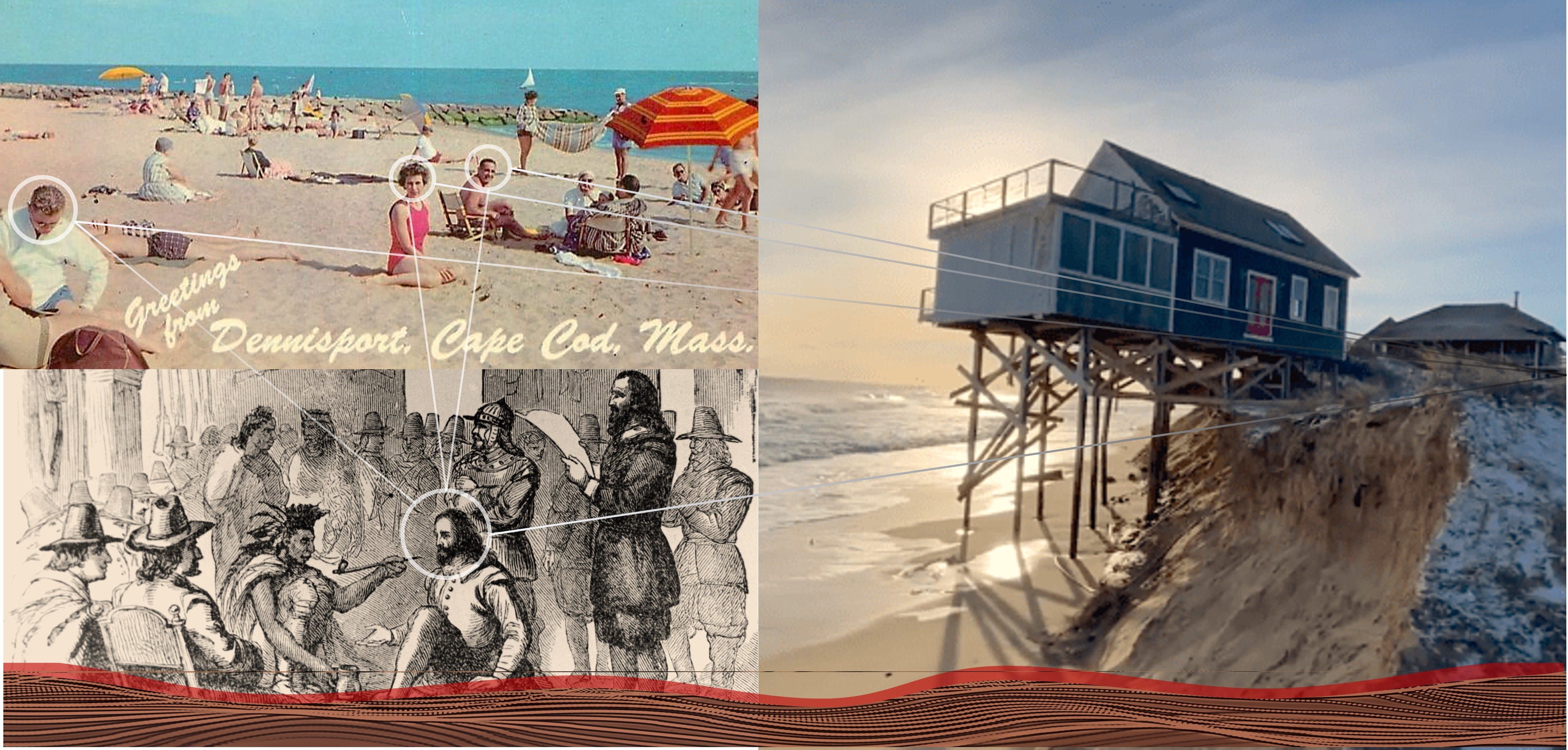
Hello Interactors,After dropping our kids at college, my wife and I spent some time on Cape Cod. She had gone here as a kid for summer family vacations to enjoy the sand and salty air, and she wasn’t alone. Now people come from all over the world to visit this soggy, sandy, stretch of land surrounded by sea. But it’s capacity is being tested, cresting waves are gobbling the coast, as warming water turns sea life into ghosts. It’s survived this long, but how long can it carry on?ON SCARGO PONDSituated beneath Scargo Hill, the highest point on Cape Cod, is a pond most people call Scargo Lake. With permission from a lakeside homeowner, my wife and I recently descended its bank through the brush and bramble to swim in the calm, warm water. The stairs are supported by partially submerged glacial rocks deposited around 14,000 years ago. The pond itself is one of hundreds of kettle ponds, giant divots formed by the glacier. After coming to its final resting spot at the edge of what was to be called the Atlantic Ocean, the mountain of ice melted leaving a sandy, spongey cape dimpled with ponds of melted glacier water. The runoff from Scargo Hill now feeds this pond as it makes its eventual journey back into the sky or salty sea. One of the rocks deposited near the stairs is the size of a Volkswagon Beetle. Its permanence stands in stark contrast to the drifting fine sand of the famed Cape Cod beaches. No amount of rainfall will budge this boulder, but recent ravenous runoff has reshaped this ravine of late. Another reminder, along with the shifting sands, that despite illusions of permanence earth’s natural forces are unyielding.Cape Cod is dripping with illusions of permanence. The man who built these stairs was a friend and colleague of my father-in-law. His name was Rudy. He was an esoteric retired dentist, who in retirement, took his proclivity for tinkering with teeth – a profession hellbent on slowing inevitable decay – to nurture nostalgia’s permanence. His basement was like a touristy roadside attraction with a replica of a small 1950s diner booth, walls adorned with posters and pictures of the past, coin operated amusement park gadgets from the early 20th century, and a favorite of mine – a player piano.Rudy liked to spool up his appropriately favorite song, the 1957 pop hit song Old Cape Cod. Rudy would sing along with these opening lyrics:If you're fond of sand dunes and salty airQuaint little villages here and thereYou're sure to fall in love with Old Cape CodThe song was written by a Boston-area housewife who, like Rudy, was so fond of vacationing on the cape. New England tourism, including Cape Cod, was just getting underway in the 1950s. A 1953 article in the publication Economic Geography reports, “To many New England communities, the past few decades have been a time of economic readjustment and expansion…This current reversal of trend is largely the result of New England’s growing tourist industry, the income from which in 1951 amounted to $957,000,000.” That would be over ten billion dollars today.Recent analysis from the National Park Service reports over 300 million visitors streamed through Cape in 2022 resulting in $23 billion dollars of direct spending. Clearly a lot of people are fond of sand dunes and salty air, quaint little villages here and there, as more and more people fall in love with old Cape Cod.Not everyone thought Cape Cod would be a tourist destination. One hundred years before the cape’s 1950s popularity, Henry Thoreau wrote in his book, Cape Cod, “The time must come when this coast will be a place of resort for those New-Englanders who really wish to visit the sea-side. At present it is wholly unknown to the fashionable world, and probably it will never be agreeable to them…Such beaches as are fashionable are here made and unmade in a day, I may almost say, by the sea shifting its sands.”Thoreau was visiting the Cape at a time when the allusivity of shifting sands posed a real threat to Cape Cod tourists and residents. After chatting with the lighthouse keeper of The Highland Light, the eastern most U.S. lighthouse and the first to greet sailors venturing from Europe to Boston, Thoreau believed even this beacon of permeance was threatened. He writes,“According to the light-house keeper, the Cape is wasting here on both sides, though most on the eastern. In some places it had lost many rods within the last year, and, erelong, the light-house must be moved. We calculated, from his data, how soon the Cape would be quite worn away at this point, ‘for,’ said he, ‘I can remember sixty years back.’”Thoreau surmised the lighthouse keeper would likely outlive the lighthouse. While it indeed was moved a short distance and rebuilt, it remains today as one of many Cape Cod tourist attractions. It’s not just the lighthouse that’s been preserved all these years, but the very grounds that surround it.SAND DOOMSOne hundred years before Thoreau’s visit, the harbor just north of the Highland L
Clarkson’s Farm: The Grand Tour of the Rural-Urban Divide
Hello Interactors,Our family got sucked into watching the Amazon Prime show, Clarkson’s Farm. As a suburban Iowa boy who knew just enough farmers to know how hard it is, I found this show relatable. Apart from the entertaining allure of many staged reality shows, I realized it also highlights topics I investigate here on Interplace. Especially the interaction of the ‘rural’ and ‘urban’…or lack thereof.Let me know in the comments if you’ve watched this show and what you think!I’ll be taking a little break from writing in the coming weeks and will return in September.Until then, let’s go!THE RURAL-URBAN DIVIDEMy son is a car guy. As such, he turned our family onto the pied piper of car guys, the British journalist turned media celebrity, Jeremy Clarkson. Clarkson is most known for his part in the shows ‘Top Gear’ and ‘The Grand Tour’ but has turned his attention to farming in recent years complete with his own show called "Clarkson's Farm." It’s a simple yet complicated narrative that unfurls like the intricate English countryside hedgerows he commissioned for his farm in an episode we watched recently.The show chronicles Jeremy, a controversial climate change denying fossil fuel lover who expresses glee at polluting the natural environment, fulfilling a fantasy of becoming a farmer. A city boy naively embarking on a journey to become a farm boy. “How hard can this be?”, he insinuates, as his hired companion, Kaleb, a true farm boy, continually saves him from one disaster after another. Kaleb left the show earlier this year to help the Royal Agricultural University teach young people how to farm. A move that appears to be motivated by what Jeremy’s farm manager called his ‘stupidest idea yet’ – to raise pigs.Clarkson is comfortable with stupid ideas leading to disasters having been sued, fired, and defamed on countless occasions for making racist, misogynistic, and other statements in bad taste while joyfully wallowing in the attention, fame, and revenue that comes in the aftermath. An enigmatic media magnet with sociopathic tendencies.But I’m finding Clarkson’s Farm oddly intriguing as a snapshot of the interaction of people and place. It weaves threads of common human endeavors, the natural environment, and the evolving rhythms of modern society. He, and the show’s producers, intertwine personal, social, political, and environment struggles like meandering streams of the show’s British rural landscape. Clarkson is a bit like the menacing disease spreading badger featured in another episode – a curious creature exploring and exploiting the winding lanes and hidden corners of a quiet countryside. Both a bane and a boon. A nuisance and a neighbor.His show also echoes intriguing themes explored among urban and rural geographers alike. They, like Clarkson, are playing with what it means to blend the rural with the urban. Jeremy's personal, social, and political journey within the pastoral tapestry of the Cotswold’s north of Oxford is interwoven with the ecosystems found in the mosaic of fields, woodlands, and waterways that define its countryside. A strand of a larger tapestry that challenges, like Jeremy has, the notion of rural and urban in the growing urbanization of our planet.Planetary urbanization, as a thesis, has drawn scrutiny among some critical human geographers who call for a profound shift in the approach to understanding 'urban' and 'rural' spaces on a global scale. The origins of planetary urbanization can be traced back to Henri Lefebvre's pioneering hypothesis, first introduced in his 1970 work "The Urban Revolution" suggesting society has undergone complete urbanization. He subsequently furthered the notion that globalization has created a complete integration and interdependence of urban and non-urban spaces each with their own boundaries and borders.Jeremy's agricultural odyssey unfolds in this realm where these distinctions of ‘rural’ and ‘urban’ become pronounced as Jeremy’s lack of comfort and knowledge of the ‘rural’ is set against the younger Caleb’s lack of experience and familiarity of the ‘urban’. The show attempts to script a blurring and harmonizing of the ‘urban’ and the ‘rural’ only to be foiled by the unrelenting rhythm of uncertainty and emergent behavior of human and non-human nature – including a global pandemic, local politics, and global and local economics.Clarkson’s Farm, and the concept of planetary urbanization, is challenged by the spatial boundary urbanization has artificially created. It legitimizes Lefebvre's proposition that urbanization extends far beyond traditional urban centers, suggesting that rural spaces, as well as elements such as wilderness areas, oceans, the atmosphere, and even the planetary sub-surface, contribute to a global urban fabric. After all, anyone in the world can go to Jeremy’s website to buy his food products and swag.But the show also raises questions about the specificity and boundaries of the 'urban' and underscores the need for a renewed

Spawn, Spore, Store, and Restore or Bloom, Consume to Our Glume and Doom
Hello Interactors,Summer is waning and nature’s energy is draining. Meanwhile, record heat and fires in the northern hemisphere remind us the sun has yet to relent. But plants know what to do to prepare.They slow down and repair. They store and restore through the winter snore for when the sun comes back for more. Why can’t we humans, and our societies, learn this rhythm of life? Maybe we’re just not as smart as plants. Yet.Hey, Interplace hit 1,000 subscribers! 🙌🏼Thanks, Interactors, for your energy and care. While I do this mostly for my own education, it’s nice to see people join the journey. Please give me a like and a hello so Interplace can continue to grow!Now let’s go…IS A FALL UPON US?I can sense summer ending. And so can plants. They’re in the waning days of the growing season as they deftly adapt their metabolism – triggered by subtle shifts in the environment. As the sunlight fades and temperatures dip, the once vibrant act of photosynthesis slows – a signal from a rotating earth to take a pause. The production of glucose, their lifeblood, drops, but the tireless rhythm of respiration continues its steady beat.Plants astutely sense the inevitable chill embarking on a strategic storage mission, hoarding precious energy and nutrients in their vaulted roots and stems. Stiffening to embrace the chilling challenge, they undergo a metamorphosis augmenting their resilience to freezing temperatures. Some species, like many of my sedums, channel their remaining vigor into blossoms and seeds before a winter's nap.A plants' photochemical metabolic efficiency and prowess not only evokes wonder and admiration, but a bit of jealousy. Imagine being able to generate energy just by lying in the sun.Metabolism is a biological process that determines how fast energy is exchanged between an organism and its surroundings. It transforms what's around us into fuel for maintenance, growth, and reproductive abundance.This concept isn't just limited to individual organisms, but collections of organisms. Like groups of social humans. 'Sociometabolism' expands the idea of biological metabolism to human societies – how energy flows between a society and its environment, and how it's used within that society.The sources of energy are different for each context. Biological metabolism relies mostly on light captured by plants which is then consumed by other living beings. A continuous metabolic flow through the entire food chain.Sociometabolism can be more versatile. Sure, it involves consuming biomass for food or fuel, but it also encompasses energy generated from other sources – like fossil fuels, nuclear, solar, and wind power.Both biological metabolism and a big chunk of sociometabolism depend heavily on consuming biological materials, whether it's plants or animals. This connects them closely to the flow of essential elements, like carbon, nitrogen, and phosphorus. Metabolism on earth is interconnected in a massive web of resource exchange.Geographer Yadvinder Malhi wondered how much metabolic energy flows through the biosphere. He took a stab at estimating in a 2014 paper on “The Metabolism of a Human-Dominated Planet.” With the sun as the primary source of energy for the biosphere, he calculates about 174 petawatts (PW) of solar energy reaches the planet's upper atmosphere.To put that in perspective, an old-fashioned 100-watt (W) lightbulb requires .1 kilowatts (KW) of energy. A 1000-watt drill requires 1 KW of energy. If one kilowatt is 103 W, then one petawatt is a whopping 1015 W. The sun is giving the planet 1 followed by 15 zeroes times 174 watts worth of energy! Plants and bacteria capable of photosynthesizing capture a portion of this solar energy through photosynthesis and store it as carbon-based chemical bonds.This captured energy is quantified as Gross Primary Productivity (GPP), and the biosphere's GPP is approximately 210 petagrams of carbon per year. Converting GPP to energy units, the global photosynthetic metabolism is estimated at 265 terawatts (TW) or 1012 W. Sixty percent of that productivity comes from the land biosphere and 40% from the marine biosphere, representing only 0.2% of total surface solar energy.Of that 0.2%, around 50-70% is used by plants and phytoplankton to metabolize and 30-50% is directed towards growing biomass. This biomass, in turn, is gobbled up by plant eaters, bacteria, and fungi. Fueling the ecosystem then requires about 75 TW of energy on land and 57 TW in the oceans to generate all the biomass energy available for other organisms to consume. Including humans. Given these numbers, how does our human metabolism stack up?Imagine an 11x17 (A3) piece of paper sitting atop a leafy tree in a tropical forest in South America with the sun directly above. The amount of solar energy hitting that paper equals the energy required for an average sized active adult to metabolize one of our primary fuel sources – sugar. The equivalent of a 120 W light bulb. Cut the paper in half and that
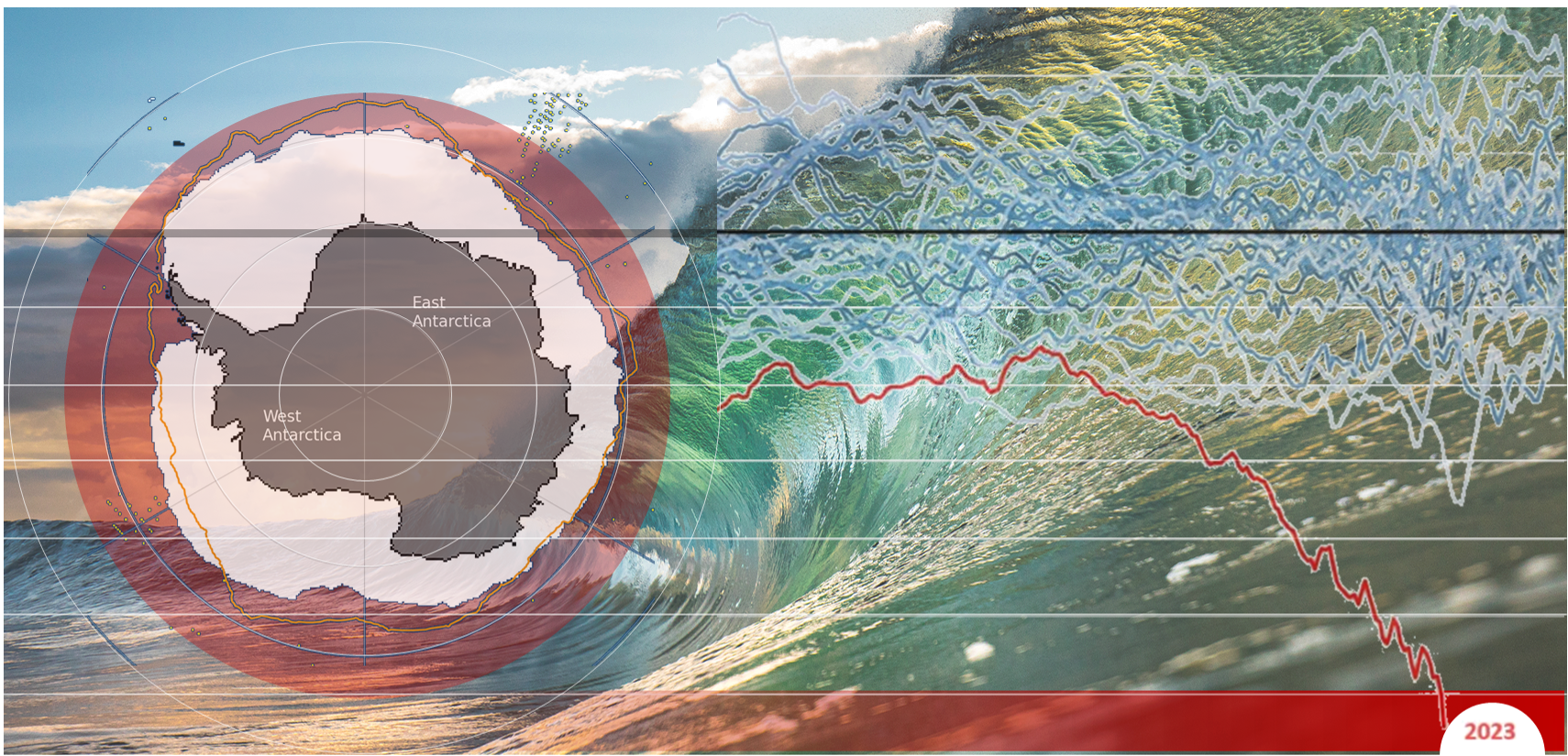
Boogie, Wipe Out, and Freak Out
Hello Interactors,Our family took a trip to San Diego to visit friends. We got to spend some time in the warm Southern California water at a time when the news was filled with stories about sensational oceanic anomalies. Was the warm water we felt an anomaly? How certain could I be and how certain can anyone be about climatic statistical anomalies? Let’s unpack it.BOOGIE WOOGIE FREAK OUTI felt the current sucking my legs out to sea as a wave formed behind me. I struggled to hurl myself, and my boogie board, toward the beach to meet the momentum of the rising wave. “KICK, KICK, KICK”, I yelled to my son who was next to me. Then came the welling and humbling sensation born out of the magnitude of a swelling ocean wave. As it crested a smile crossed my face and the force propelled me down the wave’s sloping curve. I looked over and realized not only had my son caught the wave, but my daughter and wife had too. The whole family was giggling and kicking amidst the seafoam of an exhausted but rewarding wave.I’d forgotten how exhilarating boogie boarding is. I was first introduced to it when I lived in Hermosa Beach, California in the mid-eighties. I’m kicking myself for not learning to surf that year. I didn’t even try until a few years later at the very beach we found ourselves boogie boarding – Moonlight Beach in Encinitas, California. I spent a summer working at a newspaper there in 1987 laying out ads on their newly purchased Mac SE alongside the art director and one full-time designer. They were both surfers and decided to take me out one day. I remember my shoulders being sore for a week from paddling. Let’s just say I paddled more than I surfed.The water is relatively warm in San Diego which makes it a nice place to surf and boogie board. Not only is it the southern most major city in California and thus the warmest, it can also be the recipient of warm water flowing up the coast from Mexico. It was cloudy, cool, and a little rainy the day we were boogie boarding with friends making the water feel particularly warm. I wondered how much warmer the water there might be compared to when I was feebly attempting to stand on a surfboard for the first time. I wondered if climate change had demonstrably warmed the surface water after all these years.Ocean flow and temperatures have been all over the news in the last week or so. Take, for example, this ABC news story that was amplified by a post from John Gibbons, aka @thinkorswim, on that site we’ll all continue to call Twitter. According to John’s profile he likes to ‘freak out and speak out’ on the ‘climate emergency’ but warned he didn’t want to sound ‘alarmist’ when he shared a graph one scientist called ‘gobsmacking’.It’s a chart of a set of standard deviations — the number of points a number falls above or below an average number. How much it deviates from an average. In this case the number represents the average extent ice has covered a particular area in the Antarctic Sea from 1989 to 2023 as compared to the average between the years 1991-2020.From 1989 to 2022 the number didn’t deviate from the average much more than 3 or -3 standard deviations, but by June of 2023 it deviated well below -6, or ~6.4 standard deviations.It makes 2023 look like an exceptionally bad year thus far for a really important element of our climate system: sea ice. These sheets of ice play a significant role in how the Earth's climate behaves. For example, we know it affects how much sunlight is reflected into space (planetary albedo), how the atmosphere moves (atmospheric circulation), the productivity of ocean life, and how heat and salt circulate in the ocean (thermohaline circulation).Which gets us to another big piece of oceanic news this week; the fate of AMOC (pronounced “AY-mock). The Atlantic Meridional Overturning Circulation is a large-scale ocean current system in the Atlantic Ocean and Danish scientists predicted it’s flow will slow or even stall before the end of the century.Like polar ice sheets, AMOC is also a critical component of the Earth's climate system. It’s responsible for transporting warm, salty water from the tropics to the northern latitudes and then returning cold, less salty water southward through currents deep in the ocean. This circulation pattern helps regulate the climate by redistributing heat while also influencing weather patterns across the North Atlantic region and beyond.One of the authors of the study, Susanne Ditlevsen, is a professor of statistics at the University of Copenhagen. She told the New York Times that “climate scientists generally agree that the Atlantic circulation will decline this century, but there’s no consensus on whether it will stall out before 2100.” Given this, she was surprised they could predict the timing of a collapse.NUMBING NUMBERSShould we be shocked by statistics yielding whacky numbers or suspicious of the models that produce them? Some scientists are calling for scrutiny of climatic models, encouraging more
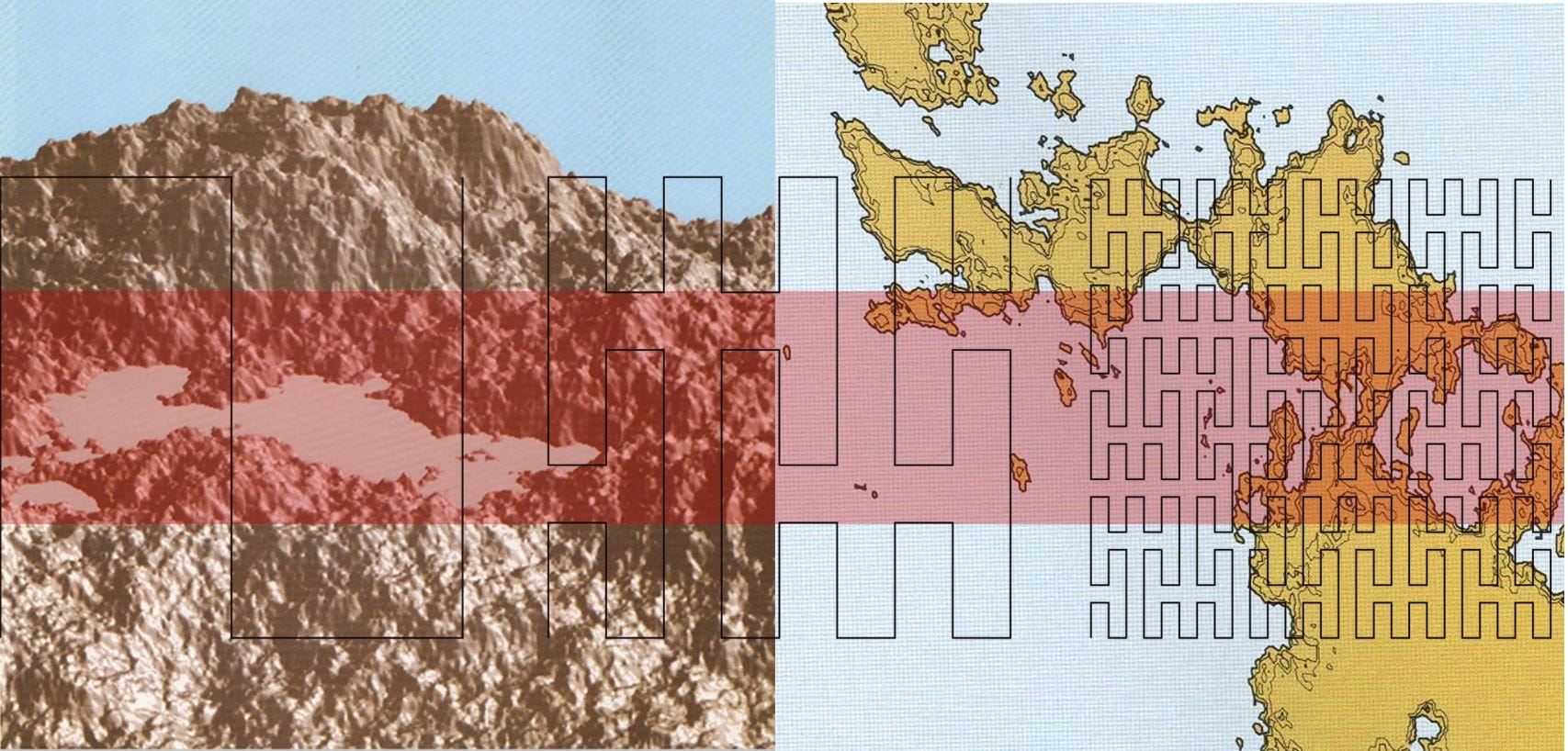
Crayons, Touchdowns, and a Gallery of Monsters
Hello Interactors,My last post on fractals led me to refamiliarized myself with the man who coined the term, Benoit Mandelbrot, and his influential work on the fractal-like wonders of nature. I didn’t realize he was following in the footsteps of 19th century mathematicians critical of the absolutist purity of Euclidean geometry – themes I recently explored here and here. My journey led me to a memory of a plane landing on a plane and the complexities that surface on the surface.Please don’t be shy. Leave a comment or a like. Or just hit reply with a smiley face and a hello!Now let’s go…I have a childhood memory, fueled by a crayon drawing, of watching a plane land at the Des Moines airport. My dad was returning home after a business trip. Over time, this memory transformed into a riddle most likely inspired by high school calculus. The riddle posed a question: as the distance between the plane and the runway progressively decreases, when does it equal zero? My pondering was rooted in the observation that, at a microscopic level, the rubber of the tire and the rough surface of the concrete never truly merge into zero. The presence of black streaks on the tarmac from rubber left behind served as evidence. According to classical physics, at an atomic level, the distance between a landing plane and the runway approaches zero but never truly reaches it.This is because the outermost electron clouds of the atoms in both the tires and the runway surface repel each other due to electromagnetic forces, creating a minute gap between them, measured in angstroms (10 to the power of -10 meters). However, from a practical standpoint, classical mechanics tells us that at a macroscopic level, the plane does make contact with the runway and eventually comes to a stop. Classical mechanics focuses on the behavior of objects on a larger scale, which outweighs the effects observed at the microscopic level. The mechanics of "touchdown" do not rely on atomic physics to achieve zero distance for the safe arrival of our loved ones.In my childhood crayon drawings, I depicted the runway as a straight line and the plane's wheels as a circle. Yet, this representation itself is a macroscopic interpretation of reality. If we were to examine my marks with a magnifying glass, we would see fragmented wax resting on the textured paper's peaks and valleys rather than perfectly straight lines or round circles. Similarly, we would find fragments of rubber deposited on the peaks and valleys of the concrete runway.In the realm of high school calculus, the line representing the runway and the circle representing the wheel would be precisely drawn on rigid gridded paper using a plastic flowchart template, akin to the tools my dad used to pseudocode his COBOL programs he no doubt was debugging with his colleagues in Toronto.Mathematically, I would have described the landing as the height of the plane decreasing as a function of time, incorporating concepts like velocity and acceleration. This interplay between decreasing height and time signifies the plane's motion until it decelerates and reaches a minimum altitude, indicating touchdown. I would have positioned the circle of my plastic template precisely on the flat line, accompanied by an equation describing the moment of touchdown.However, in 1982, two years before I was in calculus and the year I was learning geometry, mathematician Benoit B. Mandelbrot published "The Fractal Geometry of Nature," a highly influential book. Mandelbrot's work highlighted the importance of mathematics that deviated from the traditional Euclidean curves and shapes. Introduced by ‘modern’ mathematicians like Georg Cantor and Giuseppe Peano a century earlier, the days of regarding mathematics as absolutely pure and unquestioning were being questioned.Mandelbrot offers why we were set on this smooth, well-worn trajectory of Euclidian mathematical purity,“The fact that mathematics, viewed by its own creators as ‘absolutely pure,’ should respond so well to the needs of science is striking and surprising but follows a well-worn pattern. That pattern was first set when Johannes Kepler concluded that, to model the path of Mars around the Sun, one must resort to an intellectual plaything of the Greeks–the ellipse. Soon after, Galileo concluded that, to model the fall of bodies toward the Earth, one needs a different curve–a parabola. And he proclaimed that ‘the greatest book [of nature]...is written in mathematical language and the characters are triangles, circles and other geometric figures…without which one wanders in vain through a dark labyrinth.’ In the pithy words of Scottish biologist D’Arcy Thompson: ‘God always geometrizes.’”Of the work of Cantor’s set theory and Peano’s space-filling curves, the theoretical physicist and mathematician Freeman J Dyson wrote,“These new structures were regarded by contemporary mathematicians as ‘pathological.’ They were described as a ‘gallery of monsters,’ kin to the cubist painting
Van Gogh's Starry Night Unveils Earth's Fractal Delight
Hello Interactors,We’re officially in the summer season here in the northern hemisphere, and that means we transition to physical geography. Much attention has been given to the staggering heat in the U.S. lately, so I thought I’d start there.Please give me like, if you like. And share if you dare!Now let’s go…On June 19, 1889, Vincent van Gogh wrote in a letter to his brother, "Finally, I have a landscape with olive trees and also a new study of a starry sky." It is largely believed van Gogh was referring to his now famous painting, ‘The Starry Night.’ The date of this painting closely corresponds to the month and day of the recent heatwave across much of the United States. It serves as a poignant reminder of the passage of time and the centuries of human-induced climatic change that separate us. Astronomers have confirmed the date of that painting by noting Venus would have been visible in the night sky, which appears as the brightest moon in the painting. On June 20th, 2023, meteorologist Jeff Beradelli out of Tampa Florida tweeted:“When I look at this jet stream the word insane comes to mind. It's even more astonishing when you consider it's mid June! This configuration, likely enhanced by climate heating, is fueling a record heat dome so extreme that even experts are astonished!”Which prompted Pennsylvania State University's climate scientist, Michael Mann, to respond.“I'm honestly at a loss to even characterize the current large-scale planetary wave pattern. Frankly, it looks like a Van Gogh”Mann poetically likened the image of jet stream configurations to the vivid brushstrokes of van Gogh's masterpiece. This analogy underscores the significance climate scientists attach to understanding atmospheric intricacies. The behavior of the jet stream, a sinuous belt of air encircling the Northern Hemisphere, has become enigmatic, eluding conventional expectations, and impacting extreme weather events.The jet stream's undulating pattern exerts considerable control over climatic conditions in North America. However, recent deviations from its usual behavior have led to enduring heatwaves and other extreme weather events, affecting millions of people. Scientists attribute these phenomena to the influence of climate change, which distorts the flow of the jet stream, trapping regions in prolonged periods of extreme heat. This raises concerns about the frequency and intensity of future extreme climatic episodes.Amidst the exploration of the jet stream and its effects, questions arise about our representation and understanding of the Earth. Satellites have revolutionized data capture and analysis, offering invaluable tools for various applications. However, feminist geographers and critical remote sensing scholars argue that these technologies should go beyond mere data capture and prediction. They propose using satellite imagery and data to explore different perspectives and imagine alternative worlds, challenging traditional views of representation.Researchers Sophie Dyer and Sasha Engelmann call for a polyperspectival image of Earth, characterized by a single Earth depicted from multiple perspectives. This notion, linked to fractals, emphasizes the complexity and interconnectedness of the Earth's systems.They echo environmental humanities scholar Thomas Lekan, who offers a visual grammar of "fractal topographies" that accounts for the complexity unfolding at different scales of analysis. This view challenges the desire to homogenize by merging local data, complete with climatic and meteorological effects, into a more detached, abstracted, and aggregated image resulting from global satellite feeds. Conventional imagery thinks globally but does little to cause us to act locally. New approaches call for inter-mediations between Earth sensing processes, massive digital datasets, and the visual products and perceptions they can produce.These researchers also recall the work of Wilson Harris, a Guyanese writer known for unconventionally using multiple narrators and intermingling points of view. He further emphasizes the importance of fractals in acknowledging repetition, connection, and specificity without erasing diversity. He wrote,"Fractal scaling is used here precisely because of its specificity: it highlights dynamic, shifting relationships, but at the same time insists on a measurable self-similarity... this allows one to insist on the partiality of self-similarity, that is, to see repetition and connection over time and space without a complete identification that would remove diversity and specificity."Van Gogh's "Starry Night" exemplifies both the polyperspectival and fractal-like qualities in its composition and representation. The painting incorporates multiple viewpoints, offering a sense of depth and dimension. Its swirling brushstrokes and vibrant colors create a rhythmic pattern resembling fractal geometries found in nature. Like the Earth's systems, the painting invites viewers to engage with it on mul
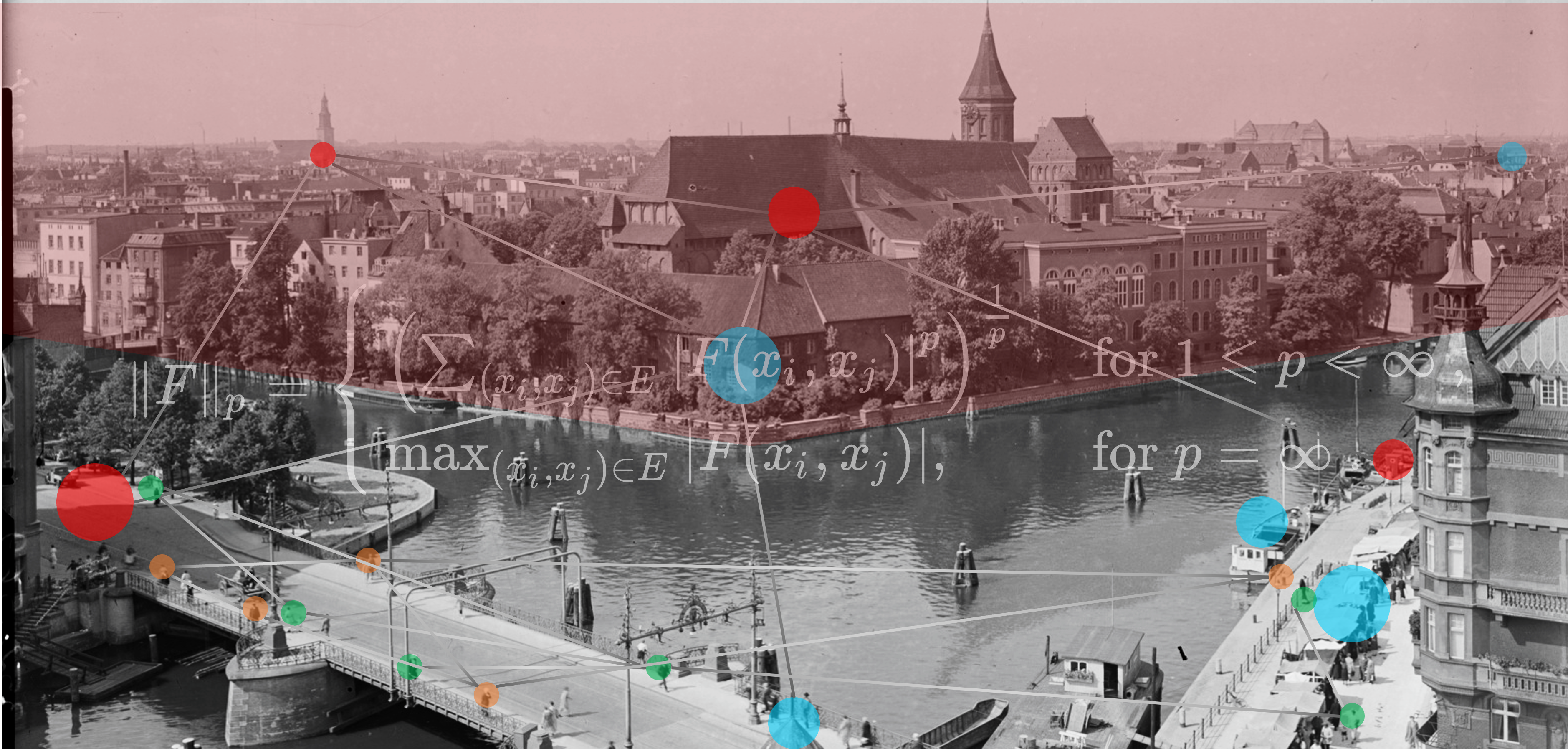
The Interwoven Splatial Dimensions of Space and Place
Hello Interactors,We’re now into summer, but I wanted to sneak in one last cartography post. It’s a leap from last week’s post into the field of human dynamics. If you don’t want to read the whole thing (shame on you 😉), I asked ChatGPT to make a poem out it.In the realm of spatial analysis, behold the shift, From mere location's grasp to a deeper rift. No longer bound by cartographic tradition's way, We delve into place's essence, where dynamics hold sway. In the web of relational space, where connections thrive, Topological ties and precise locations come alive. Place identity emerges within this network's embrace, As photos shared online from cherished spots find their place. Technology, a symphony woven in our lives' thread, Enmeshed in our cities, transportation's spread. This integrated framework, a beacon to guide, Distinguishing each entity, its role in the network's stride. Geography, propelled by innovation's flame, Unveils spatial relationships, humanity's vibrant game. From Tobler's law, a profound truth first unfurled, To Shaw and Sui's framework, where dimensions swirl. Absolute space, relative space, and relational bonds, A tapestry of interplay, where connection responds. With each advance, our understanding deepens, The dance of human interactions, geography reopens.As interactors, you’re special individuals self-selected to be a part of an evolutionary journey. You’re also members of an attentive community so I welcome your participation.Please leave your comments below or email me directly.Now let’s go…BRIDGING LAWS"Everything is related to everything else, but near things are more related than distant things." This principle, known as the "first law of geography," was first articulated by my former cartography professor, Waldo Tobler, when I was just four years old in 1969. While initially presented as an idiom, it eventually gained recognition as a law. Some speculate that this classification arose during a period when geography was becoming increasingly quantitative and mathematical. Essentially, the law suggests that the further apart two locations are on Earth, the less likely they are to physically interact. However, when we attempt to determine and measure what is considered "near" and "distant" on a 2D aerial map—an abstract representation of mathematical space—we may unintentionally detach ourselves from the physical reality of these places and the spaces between them.Consider the route you might take by car to a destination that is 500 miles or kilometers away. It would likely involve twists and turns, ascents, and descents, and passing through various towns, villages, or natural landscapes. On a topographic map, you would observe squiggly lines that traverse a multitude of elevations. Now, envision flying to the same destination. After takeoff, the plane banks left or right and then follows a more or less straight path. On a map, it would appear as a direct line between two points. If you were to draw lines connecting all the places you have visited on a map in a year, you would likely observe Tobler's law in action. Those locations closest to you—where you live, work, shop, eat, and play—are all more closely related than those that are farther away.These drawings of points and lines can be understood as network diagrams, representing measurable and mathematically describable relationships between objects. By examining the properties, connectivity, and patterns within these graphs, we can analyze various phenomena and solve problems across disciplines ranging from computer science to social science. Network analysis is integral to mapping software, guiding us with routes and directions on our phones or in our cars. It serves as a fundamental component of Geographical Information Systems and Geographical Information Science. Moreover, this approach is employed by software algorithms to recommend friends in online social networks or deliver advertisements that align with our distant yet related interests.As critical as these spatial mathematical methods are to our modern everyday lives, they fall short when it comes to considering the surrounding factors that influence outcomes. For instance, while Google Maps may account for the time required to climb a hill when determining the most efficient route by foot, bike, bus, or car, it fails to consider factors such as circuitous routes, neighborhood safety and quality, or the presence of dedicated bus and bike lanes or sidewalks.Furthermore, wouldn't a city with multiple direct flights to a particular destination challenge Tobler's law? If a city offers ten direct flights a day to a faraway location, wouldn't it be considered more related than a city that only provides one daily flight? The same holds true for direct flights themselves. I can fly directly from Seattle to Dublin in nine hours, while the cheapest ticket to my hometown in the middle of America would take twelve hours with one stop. However, the trip to Ireland would co
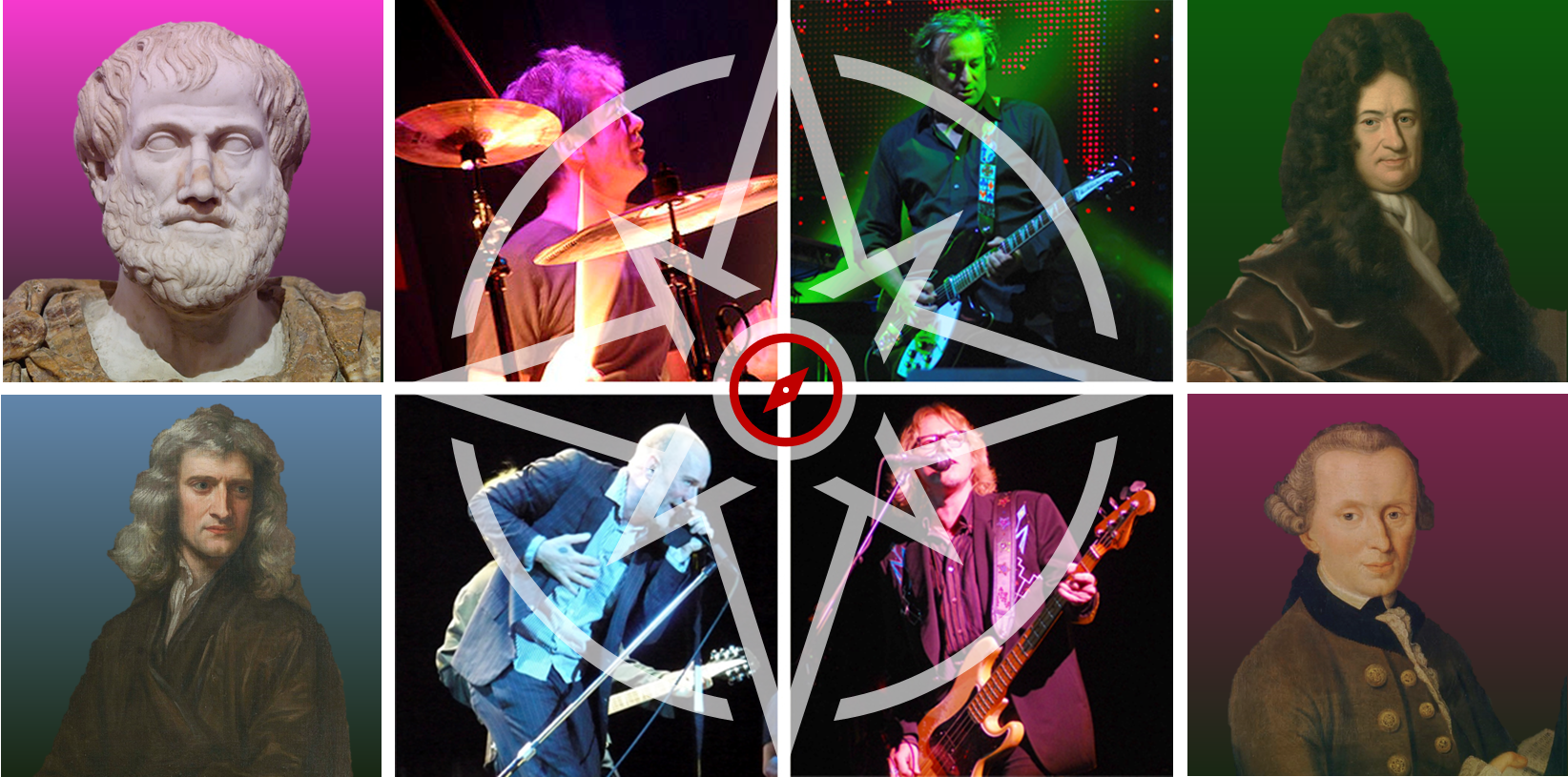
R.E.M. Takes a Stand on Space
Hello Interactors,Who would've thought that R.E.M.'s hit tune "Stand" held the secrets to Western spatial thinking? This week I break it down for you. From Aristotle's "Stand in the place where you live" to Newton's "Carry a compass to help you along," it's like they were dropping knowledge bombs all along! So next time you get this '80s hit stuck in your head, remember, you're getting a crash course in geographic philosophy. Rock on!As interactors, you’re special individuals self-selected to be a part of an evolutionary journey. You’re also members of an attentive community so I welcome your participation.Please leave your comments below or email me directly.Now let’s go…IT’S FIXEDR.E.M.’s 1988 hit single, Stand, starts with this chorus:Stand in the place where you liveNow face northThink about directionWonder why you haven't beforeNow stand in the place where you wereNow face westThink about the place where you liveWonder why you haven't beforeFollowed by this verse:If you are confused, check with the sunCarry a compass to help you alongYour feet are going to be on the groundYour head is there to move you aroundWithout knowing it, they outlined what one researcher regards as the complete set of Western thought on space and place. In 1996, history and philosophy of geography professor Michael Curry identified just four distinct, but relational, notions of space that emerged two thousand years ago but continue to shape Western thought today.Curry's four main categories of space provide a framework for understanding different conceptualizations of space. These notions have influenced philosophical and scientific perspectives on space throughout history. Here they are:1. Static, Hierarchical, and Concrete Space (Aristotle 384-322 BC):This notion of space was influenced by Aristotle. It suggests objects and events have their natural places within the world. Aristotle associated the elements of earth, air, fire, and water with their respective natural places – a rock falls back to earth, water finds its way back to water, air flows to air, and fire moves upwards.This perspective views space as fixed and objects, and their elements, as being in specific positions within it. Curry reminds us that despite what modern science may say about the atomic structures and behavior of the world, we can see – as Aristotle did – that a bubble rises through water to find air like a frightened toddler running to their mother. And even with the best throw, there’s no separating a rock from its mother earth. Aristotle embraced a qualitative notion of science, informed by what he perceived to be true. Even when we may know we’re deceived. For example, we have to remind ourselves that the earth is not fixed and the sun does not set, even though it appears to be true.Aristotle’s notion of space remained in Europe throughout the Middle Ages and guided all thought and action. But even though this Aristotelian common-sense view of the world can be seen even today, Curry notes that in 1277 the Church did its part to stamp it out. The Catholic church’s passing of Condemnation of 1277 aimed at eradicating Aristotelian teachings. The Church also embraced mathematics in the Middle Ages, though later challenged advances in math that conflicted with religious doctrine, recognizing its truth, contribution to education, and sensing the economic and intellectual power it wielded.As the Enlightenment awoke, and with it the rise of Church-backed European geopolitical power, a more exacting view of space emerged. Surveying was ripped from the Roman ages and with it the gridding of land for political, economical, and military organizing and domination.Then, in the mid to late 1600s, Descartes further quantified space by marrying elements of algebra to geometry imbued with Christian religiosity. He, and the Church, preached – like Plato did – that this model of mathematical certainty is the bases of all knowledge. So, while the common sense, observational, and qualitative views of Aristotle are still with us today, they don’t have nearly the influence over science Cartesian approaches do. Which leads us to Curry’s second big influence on our notion of space.2. Absolute Grid Space (Newton 1642-1727):The second notion of space is most often associated with Isaac Newton. This conceptualization of space is influenced by Descartes and views space as an absolute grid. In this view, space is considered an infinite and independent entity within which objects exist and events occur. It is a framework where positions, distances, and directions can be precisely defined, a fixed reference frame allows for the measurement and calculation of an object’s position and movement. Curry reminds us that Newton is largely regarded as a secular contributor to science, but like Descartes his work is riddled with religious overtones.His Christian view of space as infinite and eternal, where objects and motion are the work of an omnipresent God, are found in his 1686 Fundam
A Geography Revolution: Complexity and Connection in Successor Evolution
Hello Interactors,I’ll admit it, the early summer weather here in Seattle has been a distraction. So, I turned to a writing companion this week to help. I took my notes from a talk I saw at the AAG conference in March, and you know what comes next…I pasted it in ChatGPT. I then took some papers referenced in the talk, grabbed their abstracts, and pasted those in ChatGPT. After a few iterations of ‘expand on this’, ‘merge these…’ and ‘shrink this to three sentences’ I had all the working components needed to form an essay roughly 1000 words long.I pasted that into Word and began editing in my own voice and adding bits of my own thoughts. When I’d get stuck on a concept or blending of concepts, I’d ask ChatGPT to blend them for me. When I was unsure or dubious of its confidence, I’d turn to Google Scholar and Wikipedia for further reference or content to be rewritten more evidentially.I find ChatGPT a valuable writing companion. Some facts are often way off and downright fictional at times, but it is good at taking a jumble of ideas, lists of points, or disparate topics and putting them into cohesive starting points. Especially when the sun is shining and it’s 72 degrees outside.Let me know what you think and what your thoughts are on using ChatGPT for this kind of thing. Here’s what ChatGPT says are three takeaways from this post.Key Takeaways:* Grid and Place Cells: Researchers have discovered specific patterns of neuron firing in the brains of rats, mice, bats, and humans, known as place cells and grid cells. Place cells are found in the hippocampus and respond to specific locations in the environment, while grid cells in the entorhinal cortex form grid-like patterns representing the overall layout of space.* Non-Euclidean Geometries: The discovery of grid cells and cognitive maps challenges the dominance of Euclidean geometry in understanding spatial cognition. Grid cells exhibit a hexagonal grid pattern, highlighting the non-Euclidean nature of cognitive maps in the brain.* Computational Models: The integration of computational models such as reinforcement learning and successor representations, inspired by the research on place cells and grid cells, offers a deeper understanding of spatial cognition. These models capture the complex interactions between cognition, decision-making, and the environment, reflecting the non-Euclidean nature of grid cells and challenging traditional geometric frameworks. By incorporating these computational approaches, researchers can develop more comprehensive and inclusive models of spatial cognition that consider the interconnectedness and dynamic nature of cognitive processes and the environments we navigate.As interactors, you’re special individuals self-selected to be a part of an evolutionary journey. You’re also members of an attentive community so I welcome your participation.Please leave your comments below or email me directly.Now let’s go…TELLTALE CELLS OF RAT TRACESIn my last post, I talked about how Platonic and Euclidian geometric purity and gridded Cartesian planes may have overly influenced Western thought, beliefs, and actions. Scientific thinking may have been errantly seduced by the certainty and accuracy of rational proofs to describe not only the physical world but how our minds and body interact with it and each other. We now know it’s likely the world is constructed of layers of indeterminant, interrelated complex interactions occurring at atomic, chemical, biological, psychological, sociological, astronomical, and cosmological levels.And yet theoretical and observable patterns emerge amidst this chaos that can and are described and understood through both Euclidean and non-Euclidean patterns. For example, patterns found in the brain. Cognitive scientists studying rats in the 1970s discovered a collection of neurons fired when a rat entered a particular place in a maze. They called these neuron firing locations place cells.This video shows a rat running around in a circular environment (black line) and any time a particular cell is active (red dots). The red dots cluster around one location, which is the place field of the cell. (Source: Jankowski M, O’Mara S (2015) via Wikipedia)Place cell patterns are found primarily in the hippocampus region of the brain. They’re derived from a collection of firing neurons that selectively respond to specific locations or places in an environment. Place cells are influenced by environmental cues and play a crucial role in spatial memory formation, allowing for the association of specific memories or experiences with particular places. They are instrumental in the formation of cognitive maps, which are inherently non-Euclidean because they can include unpredictable shortcuts, deviations, and distortions.As research continued in the 1990s, the arrangement of these patterns began showing signs of grid-like regularity. Some speculated the brain was forming a kind of rectangular grid. And then in 2005, scientists discov
United We Stand or Divide and Conquer?
Hello Interactors,As I was preparing for my talk at Harvard last month, I was finishing a book called The Patterning Instinct by Jeremy Lent. He explores how culture shapes values, and those values shape history. Hat tip to Kasey Klimes over at rhizome r&d for the recommendation. Lent uncovers the history and evolution of dominant Western culture through the lens of evolutionary biology and neuroscience and the role patterns play in cognitive and cultural development. He then compares it the lesser examined evolution of Eastern, mostly Chinese, culture, philosophy, and scientific history.He found discrepancies in dominant Western thought, and how it sometimes is incongruent with select examples of more recent advances in science. Especially the degree to which the world is increasingly understood as a nested array of interdependent and indeterminate complex systems. Quantum physics, complexity Science, and other various branches of the physical and social sciences, are revealing evidence of a pervasive interconnectedness that can often get lost or overlooked in some more traditional methods and beliefs of dominant Western science and culture.“Divide and conquer” is one such example of how we routinely attempt to simplify to resolve problems. And yet, it seems divisions are what may be contributing to our global problems. Lent’s book made me wonder how much Western thinking and culture may be keeping us from solving our most perplexing problems. What happened to ‘united we stand, divided we fall?’As interactors, you’re special individuals self-selected to be a part of an evolutionary journey. You’re also members of an attentive community so I welcome your participation.Please leave your comments below or email me directly.Now let’s go…FRANKENSTEIN V.2Descartes once said, "Divide each difficulty into as many parts as is feasible and necessary to resolve it." The breaking down of problems does simplify challenges. At the same time, I wonder if divisions can also introduce challenges. Consider the division of today’s global crises into economic, social, and environmental problems. It’s feasible to divide these even further but is it necessary to resolve them? What if instead of resolution division and partitioning is contributing to our ruin?We’re good at division. Economic inequality divides the wealthy from the poor, political polarization has unraveled civil discourse, increased hostility, and a growing distrust of democratic institutions. Climate change exposes these divisions and imbalances as those more vulnerable to its effects suffer more than those most responsible for its existence. This is all amidst an age group divide. Rising housing costs, stagnant wages, and reduced opportunities make it harder for younger people to avoid financial precarity let alone secure family wealth. The gulf between the ‘haves’ and ‘have nots’ is widening.Cultural polarization also divides communities along cultural and religious lines leading to a rise in hate crimes and extremist movements. Age can reveal differing attitudes towards social issues further solidifying divisions leading to more hostility and distrust. Divisions regarding the role of technology in society can also divide along age lines, but also wealth.Digital divides can exacerbate social and economic inequalities, as the pandemic quickly revealed. We also witnessed how those without access to technology disproportionately struggled to access education, healthcare, jobs, and other essential services.Fear and distrust in technology is currently directed at AI. As with seemingly every fast-approaching technological innovation in human history, many fear it while many revere it. Jeremy Lent notes that advances in artificial intelligence are particularly encouraging for futurists who see AI as furthering the quest to disembodied intelligence. Transhumanists imagine a fusing of machines with physiology – the brain supplanted by a connected web of universal artificial intelligence. In the words of a leading advocate and enthusiast, Ray Kurzweil, this transformation would upgrade “the frailties of these Version 1.0 bodies we have.” Sounds like a modern-day Frankenstein to me.Lent also reminds us that futurist visions can also look more like the science fiction classic, The Matrix. Human bodies are relegated to biological livestock consumed for energy so a global matrix of software can run a simulated existence – a virtual world, a meta-universe, or metaverse. Sound familiar? Most of today’s technology CEOs from Musk to Zuck subscribe to various forms of these visions of the future and they’re not alone.A crude modern-day demonstration of this separation exists with remote work. While physically present in one place, people interact virtually with 2D representations of other humans to perform collaborative cognitive operations – information work. I spent my career helping to develop software tools to enable this mode of working. Now imagine instead of looking at a

On PCs We Work, From Within Cars We Lurk
Hello Interactors,I recently returned from an extended trip back east for a talk at Harvard University’s Graduate School of Design (GSD). I also threw in quick visits to Boston and New York to visit my kids, and then stopped over in Kansas City to visit family on the way back to Seattle.I was invited to keynote a two-day symposium hosted by the Laboratory for Design Technologies on the role of technology in micro-mobility in urban environments. My friend and colleague, Allen Sayegh, has been tracking my work on Interplace and thought my perspective was worth sharing. I was joined by two other speakers:Carole Turley Voulgaris, Assistant Professor of Urban Planning at the GSD. Carole focuses on explaining what influences decisions on travel through cities. She considers how transportation planning institutions utilize travel decision making to inform their plans, policies, and infrastructure design.Bryan Boyer, cofounder of the architecture and strategic design studio Dash Marshall. Brian is also an Assistant Professor of Practice in Architecture and Director of the new Bachelor of Science in Urban Technology degree at Taubman College of Architecture and Urban Planning at the University of Michigan. He is a graduate of the GSD.The title of my talk was a riff on one of my first essays about my time at Microsoft: A Computer on Every Desk and a Car in Every Garage: How Bill Gates and Herbert Hoover Altered How We Interact with People and Place.It was the PC revolution that enabled virtual interaction with others around the world – all while seated behind a glass screen. Meanwhile, automobile proliferation further isolated others from their neighbors and immediate surroundings enabling a virtual interaction – all while seated behind a glass screen. Given these trends, what are the implications for land use, the built environment, and collective mental, physical, and societal health? How did we get here, and where do we want to go…today?As interactors, you’re special individuals self-selected to be a part of an evolutionary journey. You’re also members of an attentive community so I welcome your participation.Please leave your comments below or email me directly.Now let’s go…Thank you for reading Interplace. Please share!GSD, LDT, AND THE LCGSA“Technology is accelerating profound changes throughout society, affecting everything we do — how we live, work, produce, build, and think.”These are the words that frame Harvard University’s Graduate School of Design’s (GSD) Laboratory for Design Technologies. The GSD has a long-storied history. It was the first in the country to offer a landscape architecture class in 1893 and the first in the world to offer landscape architecture degree in 1900. The program was founded by Fredrick Law Olmsted, Jr., the son of the more famous Frederick Law Olmsted. That same year Harvard offered the country’s first urban planning courses and by 1929 expanded to become the first urban planning degree in North America.In 1936 the official Harvard Graduate School of Design was launched housing schools of architecture, urban planning, and landscape architecture. A year later, the famous modern architect Walter Gropius became faculty chair in architecture and the GSD’s reputation as a modernist powerhouse was established. In 1972 that reputation was solidified in the iconic concrete brutalist architecture of the GSD’s new home, Gund Hall.But in the shadows of the looming starchitects climbing the stairs to the tiered terraces of sundrenched cubicles teaming with design students, was a computer lab. It was here technology minded design professors and students were incubating the foundations of software we repeatedly use everyday to find our way around the world – computer generated maps.In 1965, the Harvard Laboratory for Computer Graphics and Spatial Analysis (LCGSA) was formed by a Harvard trained architect, Howard Fisher. He was enamored by the work of a University of Washington urban planning professor, Edgar Horwood. The University of Washington geography department had already established itself as a center of excellence in quantitative geography and computer cartography as part of geography’s quantitative revolution. Horwood’s use of computer cartography spread to Harvard, the LCGSA, and throughout the GSD for years to come.Fisher’s program attracted grant money that helped it grow to forty researchers. In the 1970s, the Harvard administration encouraged the commercialization and licensing of research across the university. The LCGSA continued to innovate licensing software and graduating entrepreneurs that fed the infancy of Geographical Information Systems (GIS) industry and discipline of Geographical Information Science (GIScience). In 1969, one GSD landscape architecture graduate went on to create what is now the world leader in GIS software, Environmental Systems Research Institute (ESRI).As more staff left for industry, funding also subsided. By the 1980s Harvard cooled on the comme
Bringing Light to Geography
Hello Interactors,I’ve been absent the last few weeks. First our kids were back for spring break and then I was off to the American Association of Geographers (AAG) national conference in Denver, Colorado. Both were fun, exhilarating, and inspiring and I’m bursting with things to write about!We’re officially in spring here in the northern hemisphere. I now turn to cartography and the role mapmaking plays in shaping how we interact with people and place. There will be themes of cartography in this initial spring post, but first I’m offering my impressions of the conference.As interactors, you’re special individuals self-selected to be a part of an evolutionary journey. You’re also members of an attentive community so I welcome your participation.Please leave your comments below or email me directly.Now let’s go…BURRITO BOYS“It’s got a nice kick to it”, he said, as I sat down to join him for breakfast. He introduced himself as Mark. He lifted his attendee badge that hung around his neck. It read, Mark Schwartz. We broke the awkwardness by talking men’s basketball. The Kansas Jayhawks, my mom’s beloved team, had recently been eliminated from the NCAA tournament. He informed me he got his PhD from Kansas in 1985 and is now teaching and researching at the University of Wisconsin, Milwaukee in the geography department.Mark is a climatologist. More specifically, he’s one of the foremost experts in phenoclimatology which looks at the effects of climate change on seasonal variability. We humans look to the calendar to tell us when spring arrives, but what if you’re an ant or a plant? They already know, so phenologists look for the biological responses to seasonal changes. Phenology comes from two Greek words that roughly combine to mean ‘the study of bringing to light’.Mark co-founded the National Phenology Network (NPN). This is where the world turns to see when spring is officially arriving across the United States. Including journalists. Here’s a story in the Washington Post on this spring’s arrival and the NPN website. It features quotes from Mark.“‘What I like to tell folks is that you still need to be prepared for considerable variation from year to year. You won’t simply be able to start planting your garden earlier each year…”Before long, another gray-haired man joined us. I observed older attendees at this conference naturally congregated. Gerontology...from geron and logia (the study of old men). Our new guest introduced himself as Ron. I could tell he was older than Mark and myself and I was right. When I was three years old, in 1968, Ron Abler was getting his PhD in Geography from the University of Minnesota. Soon after, in 1971, he was the lead author on an influential geography textbook on spatial organization. He went on to teach and conduct research at Pennsylvania State University and was the President of the AAG from 1985-86. There’s an AAG award named after Ron, the Ronald F. Abler Distinguished Service Honors. Mark was a recipient in 2005.We were soon joined by another older gentleman, but closer to my age. He introduced himself as Joseph and I read his badge as Joseph Oppong. He was the recipient of the Abler award in 2021 and studies medical geography at North Texas State University. He received his masters in 1986 and PhD in 1992 from the University of Alberta in Canada and his bachelor’s at the University of Ghana in 1982. Joseph was one of a few at the conference of African descent, but like the rest of America the geographic, cultural, and biological diversity of this academic community is increasing. This was apparent in my first session of the first day of the conference.JUST GEOGRAPHYThe morning before my breakfast with the burrito boys, I attended a panel consisting of four young academic women of Indigenous, Hispanic, Black, and mixed heritage. It included Fantasia Painter, an Assistant Professor of Global and International Studies at UC Irvine, Elyse Hatch-Rivera, a student seeking a law degree at Macalester in Minnesota, Gabriella Subia Smith, a PhD candidate in geography at the University of Colorado, and Dr. Danielle Purifoy, a geography professor at the University of North Carolina with a law degree from Harvard.Fantasia’s paper: Our Lands, Your Lines: How Inter and Intra National Borders Try and Fail to Contain Indigenous Land. She argues “that inherent in the idea of “the desert” is the undoing of the settler colonial bordering project. This is not a desert. This is O’odham land.” Elyse’s paper: The Right to Secure: The 100 Mile Border and the Making of a Carceral Geography. She “explores the emergence of the 100-mile border zone (HMBZ) in order to argue that the U.S. has expanded its borders inward and redefined notions of national security and our modern understanding of human rights.”Gabriella’s paper: The Evolution of Colorado's Third District. She argues “Looking at the evolution of congressional districts can help us to better understand both the possibilities for equitabl
The Universal Uniformity of Urban Mobility
Hello Interactors,I’ve been delayed getting this one out after being hit with a stomach bug. But I’m back in business and back to looking at urban behavior. This time, I dig into a power law that proves a Geographer right (again) while making the dizzying array of diversity in human urban mobility look shockingly similar.As interactors, you’re special individuals self-selected to be a part of an evolutionary journey. You’re also members of an attentive community so I welcome your participation.Please leave your comments below or email me directly.Now let’s go…A THEORY CENTRALLY PLACEDA few days after meeting with a group concerned with rapid urban development, I found myself in another meeting, in the same room, with a group who thinks it’s not rapid enough! Meanwhile, Washington state legislators are proposing and passing legislation aimed at addressing the impacts of increased population growth, housing shortages, and transportation.We were meeting to discuss what kind of housing density and transportation infrastructure is necessary to get people walking, biking, or rolling within 10-15 minutes of their nearest store or transit stop. As I wrote last month, getting people to drop their car is easier said than done. For starters, people need jobs and businesses to walk to in the first place. However, businesses only thrive when there are enough customers to keep them alive. More potential customers walking, biking, or rolling only comes when there is more dense housing.Like that found in downtown Paris. Over the last three years Mayor Anne Hidalgo has been made famous championing the 15-minute city concept. She’s restricted car use to certain areas and has built hundreds of miles of bike lanes. Her efforts made the Paris core so desirable property value increases started to squeeze poorer people out of the area. In response she built affordable housing. However, just outside this urban core Paris continues to remain car dependent. The same can be said for Olso. In fact, despite 75% of Europeans living in dense cities, while also declining in population, their major cities continue to sprawl.There are many variations of land use and transportation configurations around the world, but they all emerge toward, or are influenced by, by central place theory. This concept was developed in 1933 by the German geographer, Walter Christaller and became influential in how cities were planned around economic activities. To illustrate the concept, he drew an array of hexagons each with their own center around a center hexagon representing a core city center. Imagine a hexagonal flower. He used this diagram to then describe these three principals governing behavior within and between geographic regions:Consumer choice. Each of us have a choice to make around much time and money we’re willing to spend to arrive at a particular destination. Like any forager, we can choose the cheapest path at a risk of reducing our choices of goods or we can invest in a longer journey in exchange for more or better choices. Firm agglomeration. A company offering goods to these consumers must decide whether to operate further away from their competition or cluster nearby. They’d be sharing more customers while also saving in delivery costs other economies of scale.Functional hierarchy. As with natural systems, complex hierarchies emerge from these actions that are self supporting and become embedded in the environment. When governmental and commercial power is concentrated, functional hierarchies are strong. When power is diffuse and distributed individual agency weakens the hierarchy.Christaller theorized that if a person within a hexagonal cell sought a good or service, they would first seek one within their boundaries if available. He added that if this cell happened to be the center cell, home to the densest population and services, the resident would rarely leave their own cell for routine activities. We’ll call ‘shopping within my own cell’ level-one.If the service is not available within their hexagonal cell, they’d decide to go to next nearest cell with the available service. Let’s call that level-two. Those in level two most likely would go to the center cell, the city center, given it has the most consumer choice due to agglomeration. It is also relatively nearby.Those living in level-three hexagons likely travel to the center cell for some activities and the level-two cells for others. Should they choose level-two instead of the center, more than one level-two cell may contain the same service within the same or similar distance. It’s assumed some of the people will choose one location some of the time and others the other location another time.This model fits with my experience recently when our roof started leaking amidst a torrential downpour. Living in a tier-two area, I had two Home Depot stores equidistant from my home from which to purchase a pump. Each within their own tier-two areas featuring agglomerated retail.I needed
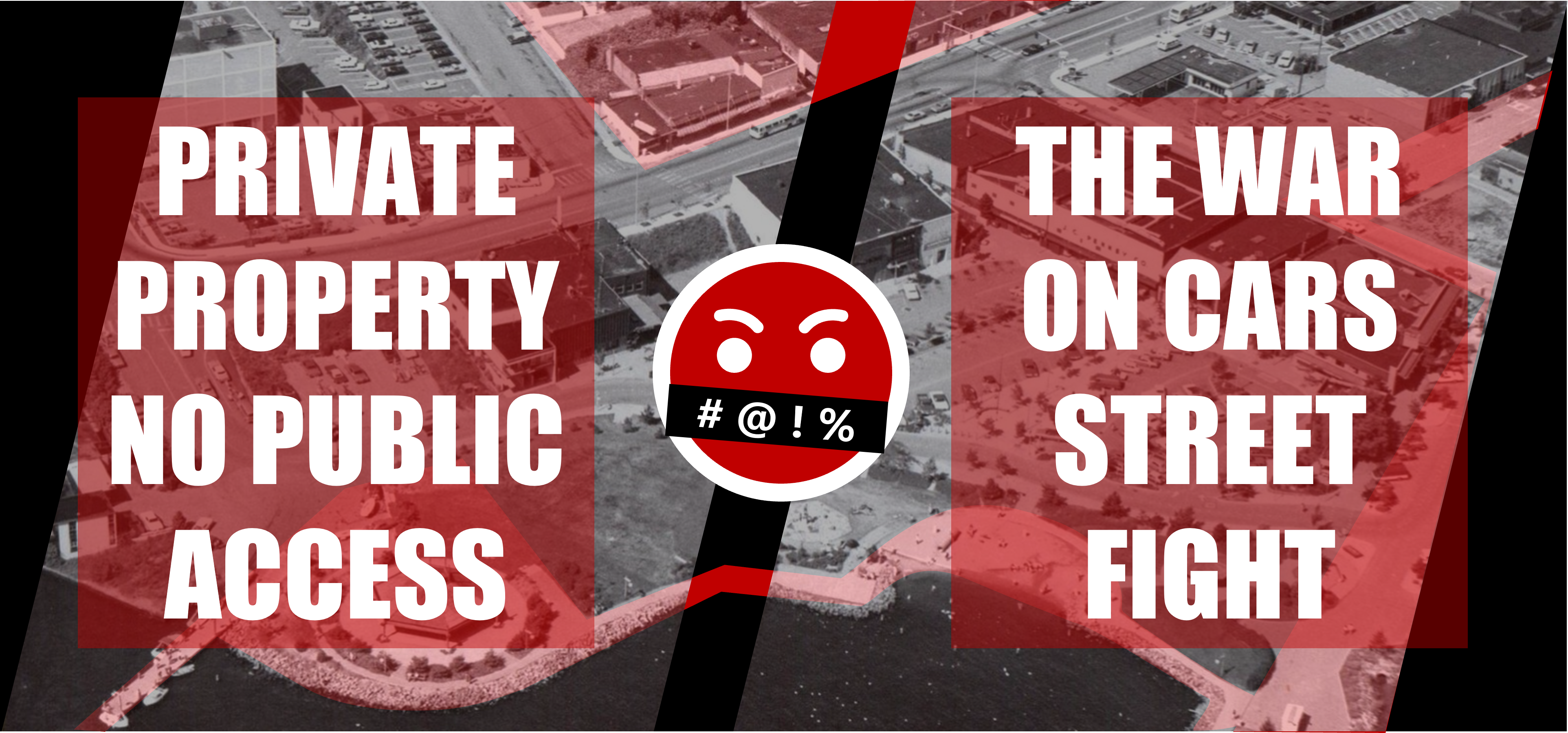
The Psychology of Neighborhood Defenders
Hello Interactors,I’ve recently been sucked into a conflict over the fate of a cherished section of our small downtown area. Emotions ran hot, but I think they ought not. Everyone has reasons for why they react they way they do, but I wondered what they are. I don’t like seeing distress, so into the rabbit hole I went. As interactors, you’re special individuals self-selected to be a part of an evolutionary journey. You’re also members of an attentive community so I welcome your participation.Please leave your comments below or email me directly.Now let’s go…IS IT A PARK OR A LANE?I walked into the room hearing the end of this tirade, “WHAT DOES SHE KNOW? I’VE LIVED HERE FIFTEEN YEARS AND SHE’S BEEN HERE SIX MONTHS? HOW DARE SHE THINK HER OPINION MATTERS AS MUCH AS MINE!” The room was tense, people were nervous, and this was the first hour of the first day of two weeks of daylong 15-minute stakeholder ‘listening sessions.’Our city government hired a consultant to determine the fate of less than one block, about 200 feet, of our quaint little downtown business district. It’s a stretch of road was once called Commercial Street. This offers a clue as to what the original city organizers had in mind for this strip of concrete just steps from Lake Washington. A ferry once docked there bringing affluent Seattle folks to shop at the local J. C. Penny’s and buy fresh produce. Now they drive over a floating bridge to buy multi-million-dollar lakefront homes.The 1970s brought a rebuilding of this area. Local entrepreneurs refurbished dilapidated downtown stores, paved over of marshlands to make parking lots, and renamed Commercial Street to Park Lane. Select members of the organizing committee envisioned a pedestrian-oriented, tree-lined boulevard. Instead of a road, there was talk of regreening the creek that once fed the marshland at the shore’s edge but had since been channeled in a culvert underground. In the end, the road was preserved and made to be one-way with angled on-street parking on each side. More of a lane than a park.But nature has a way of protesting. For decades the subterranean slough cracked and buckled the streets, the trees became waterlogged and diseased, and maintenance was troublesome and routine. In 2015 the city beefed up a water pump, remodeled Park Lane in the image of a Dutch ‘Living Street’ – a road that puts cars and pedestrians at the same level so the space may be shared. The roadway is curved or has obstacles to slow cars to the pace of the people. In the Netherlands, you’ll sometimes find two or four spots for parking or deliveries on a stretch this long. Park Lane has seventeen. The Dutch would have a hard time calling this a true ‘Living Street’. It’s more like a small parking lot with a meandering lane down the middle.But it is far better than a conventional road. It features bioswales to absorb floods of runoff and restaurants have just enough space for limited outdoor seating. Like so many other restaurants around the world, that seating was expanded when COVID hit. In a controversial move, the city allowed restaurants to spill into the parking spaces during select times, blocked cars from entering the lane, and gave the entire space over to pedestrians.Now that emergency COVID measures have lifted and people – and cities – are attempting a nostalgic return to a so-called ‘normal’, a decision needs to be made on the future of Park Lane. It seems many residents, if not most, would like to see Park Lane as some did in the 1970s – a more natural, people-oriented place. Not a parking space. But not everyone agrees.The business owners have mixed opinions. Some restaurants enjoyed the increased revenue, some had trouble scaling staff, and others are indifferent. Retailers and service providers care less about what happens after hours. They support whatever restaurants want in the evenings, but are adamant parking remain during business hours.Like so many places around the world, Park Lane has become a contested public space. It’s an area zoned for commercial use, so business and property owners believe their opinions should be given priority. But this area is also contained within a much larger neighborhood filled with a growing number of residents who believe their opinions matter most. The neighborhood sits within a city, surrounded by a county, encompassed by a federally mandated regional metropolitan planning organization (MPO), which coordinates between the federal, state, and many local governments on how best to grow. All of which are in a state united with others under the power of a federal government.The citizen run, and city government ordained, neighborhood association has a neighborhood plan with multiple policies calling for fewer cars, less parking, and more – and safer – transit, biking, and walking. And so does the city’s master plan.Meanwhile, the city competes with neighboring cities to attract more businesses which bring more revenue. This city has also applied to
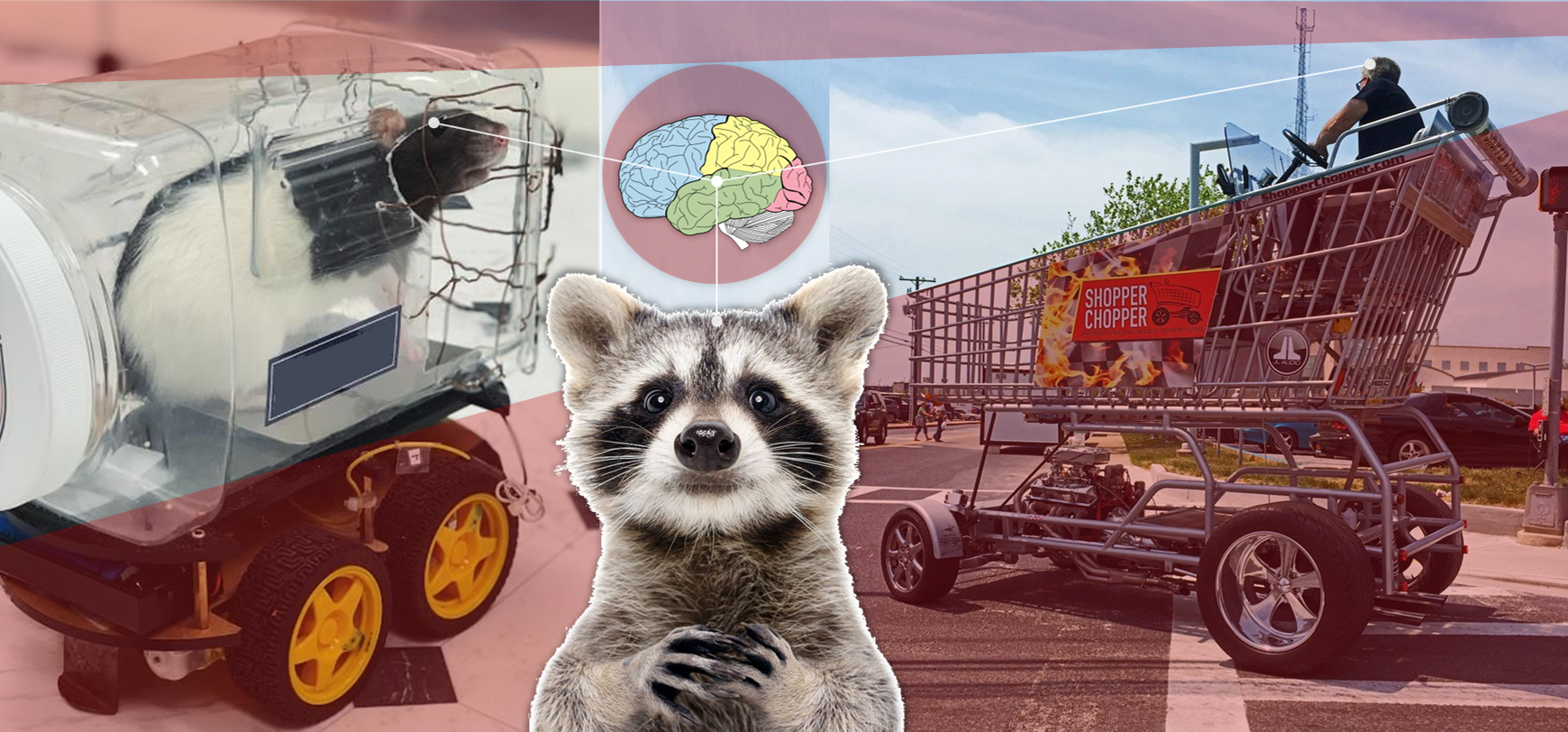
Will Work for Food. A Quirk or Accrued?
Hello Interactors,I asked you last week how you get your groceries. It led to some good discussions! Thanks to all who contributed to the poll and left comments. This question was prompted by recent local events in my town around why more people don’t walk to shop when they can. But it raised bigger questions in my mind about how other animals seek food and how we’re different. It turns out our brains have evolved to work nearly 99% like rats and raccoons. And those living in a city may have an edge over country folk. As interactors, you’re special individuals self-selected to be a part of an evolutionary journey. You’re also members of an attentive community so I welcome your participation.Please leave your comments below or email me directly.Now let’s go…CITY SLICKERS AND COUNTRY BUMPKINSWe have an outdoor camera that sometimes captures nighttime activity of our animal neighbors. A mouse here, a rat there, here a rabbit, there a rabbit, everywhere a rabbit, rabbit. Recently the camera caught our racoon friends sniffing around. Cute little things, and crafty too.I mentioned my encounter with raccoons in week one of Interplace two years ago. They were politely rolling back the turf on our lawn in search of grubs…which were happily feasting on the roots underground. I would roll the turf back in place and a few days later those little rascals would pull it back again. I installed a sprinkler with a motion detector to scare them away. That worked for a while.Until one evening I heard the sprinkler go off. I ran to see if I could spot them. There one of them sat perched on their haunches, arms to their sides staring at me in the doorway. Water was dripping from their perked ears, un-phased by the staccato rat-a-tat-tat beat of the oscillating sprinkler. A nice moisturizer for their furry frocks. Spa day in the lawn. Made complete with earthly scented, protein-packed pupae. I removed the lawn, and with it the grubs, but the raccoons still come sniffing for a snack.Raccoons are notoriously smart critters. And these raccoon visitors, and their family and friends, are getting smarter the more my sleepy suburban town of Kirkland, Washington becomes increasingly urbanized. Comparative psychologist Suzanne MacDonald at York University in Toronto studies the behavior of raccoons. She hopes to uncover ways for us to coexist. She conducted a multiyear project tracking raccoons with GPS-collars in urban and rural settings. One location was in an area that had overlapping travel boundaries for both rural and urban raccoons.She baited two different containers. One was a container familiar to both city and country coons – a trash can with a bungie cord securing the lid. The other was a novel container to both – a bucket suspended 30 cm above ground by ropes tied to nearby trees. What she found surprised her. Both the rural and urban raccoons were able to deplete the weird hanging bucket with ease. The situation may have been novel, but once they got to the bucket it was relatively easy to extract the food. But the trashcan, while more familiar, proved to be a problem for rural racoons.She recorded 17 of the 22 urban raccoons successfully consumed the contents of trashcan, but not one rural racoon could successfully rid the familiar trashcan of its bungie cord despite multiple attempts. The urban raccoons demonstrated they were better at experimenting, iterating, and manipulating the can. This was as true for males as females, old and young – as young as five or six months old. She speculates that “Persistence, neophilia [the love of new things], and high levels of exploratory behavior may result in increased survival and reproduction in the urban setting, and thus we may be observing cognitive evolution in action in this species.” Cities, it seems, have made them, and their offspring, smarter. Which could explain why they continue to flourish in the face of increasing human induced urbanization and climate change while extinctions of other species grow by the day.Ok, fine, we’re talking about racoons. What about humans? Yep, similar evidence has been found for humans. Educational psychologists recently conducted a study in Brazil between rural and urban children comparing cognitive abilities. They found both wealthy and poor kids from urban areas scored better on two separate intelligence measures than poorer kids from rural areas. They didn’t have sufficient data to make claims about heritability and admit the small sample size doesn’t make the findings conclusive, but they did confirm what is already known about the brain. The more novel experiences it encounters, the more capable it becomes at dealing with them. City raccoons, like human city dwellers, are exposed to more novel situations and volatile environments. It seems they’re cognitively, and possibly evolutionarily, rewarded for it.My sprinkler was no match for those silly, city raccoons.A CAT IS A CAT IS A CATOur senses are feeding our brain an incomprehensible a
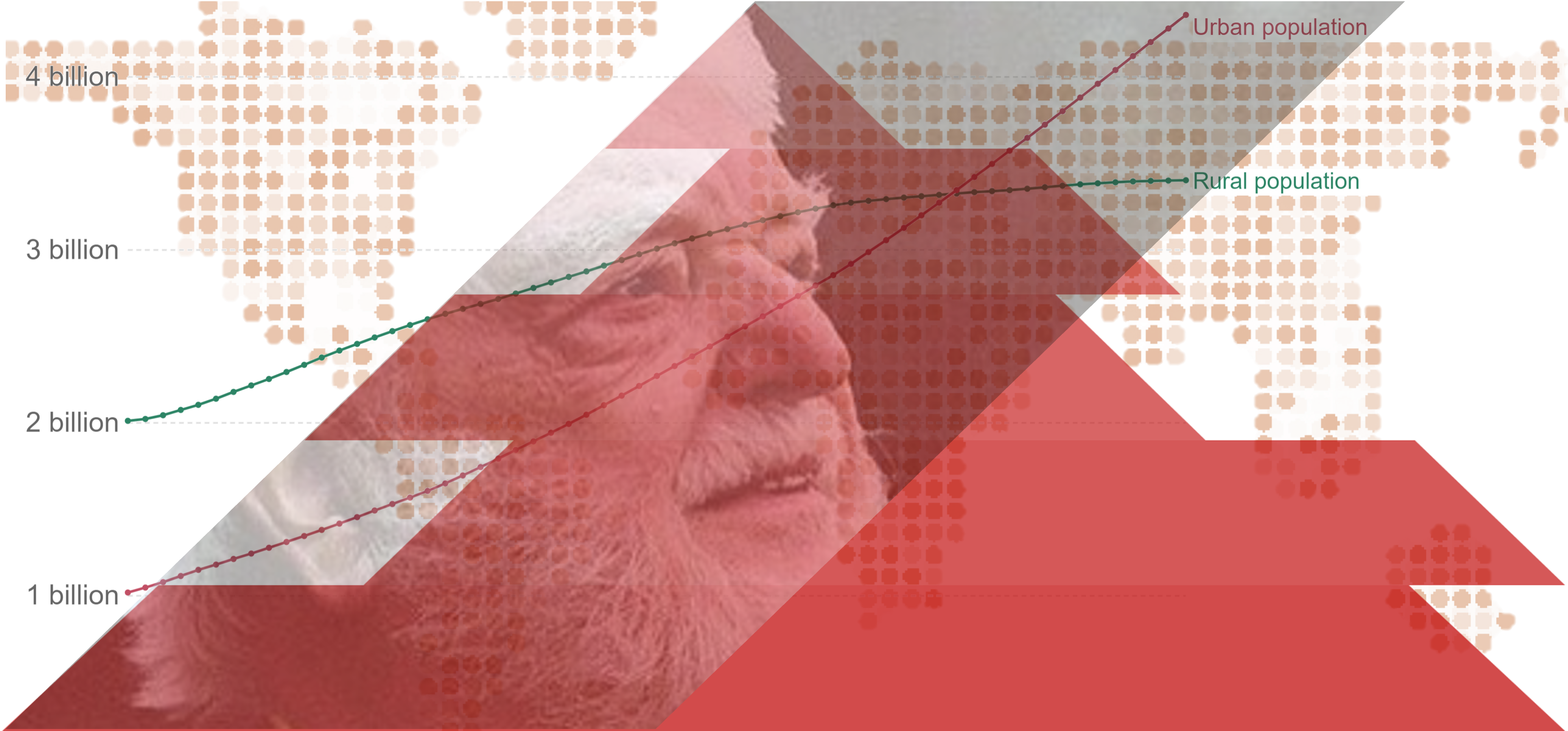
Hierarchy of Needs or Just More Greed?
Hello Interactors,Winter break is drawing to a close for my two kids who just wrapped up their first semester at college on the east coast. We’ve had a lot of conversations about what it’s like living in a new city. My daughter is particularly impacted having moved to New York City from a relatively small town near Seattle. But she’s not alone. More and more people are moving to urban areas, but does it necessarily make them happier?As interactors, you’re special individuals self-selected to be a part of an evolutionary journey. You’re also members of an attentive community so I welcome your participation.Please leave your comments below or email me directly.Now let’s go…BIG CITY, LITTLE PRETTYStepping out our front door with my daughter who was just home from New York she proclaimed, “It’s nice just walking out the door and seeing trees. No twenty-story elevator trip, no concrete, no noise, no high rises, no pollution…just easy, calm, and quiet nature. It’s beautiful.”She loves the city; she hates the city. I asked her what New York could do to make it more pleasing, she recommends more green spaces. More Central Parks. Humans do need nature; some more than others.I’m reminded of my philosophy professor at UC Santa Barbara for an aesthetics class. It was his first-year teaching and first-time outside of New York. There he was on one of the most beautiful coastline campuses in the world buttressed by green foothill mountains. He was shocked to learn his student’s thought nature was ‘beautiful’. He didn’t get it. Or so he claimed. He kept quoting Woody Allen who complained about not being able to sleep in the country because it was too quiet. Allen once quipped, “I am two with nature.”Some proclaim “cities; can’t live with them, can’t live without them” while others groan, “Nature; can’t live with it, can’t live without it.” More and more people are choosing to live with cities, not nature. The United Nations estimates 55% of the world’s population live in urban areas. It’s estimated that number will grow to 75% by 2050.The rate of growth varies by country or region as does the share of the total population. Japan is the most urbanized, United States is number two, followed by Europe. But number four has the fastest urbanization growth rate – China.But what constitutes an urban area? Don’t ask me. I screwed up my poll last week by providing widely inconsistent ranges of population size. It turns out I’m not the only one confused about quantifying urban areas. Despite the U.N. making claims and predictions about urbanization, there is no agreed upon definition of an urban area. Japan says it’s 50,000 people or more while Sweden says it’s 200. Singapore’s entire population is considered urban while Uruguay leaves it up to the city to decide whether it’s ‘urban’.Either way, the trend is clear. More people are moving to urban areas than ever before. Even my ill-formed poll of Interactors shows most live in bigger and the biggest metropolitan areas. And I just dropped my daughter off at the airport where she’ll soon be back in the city and away from nature.Why are so many people choosing to live in large cities? Are they happier? Most of the 36 Interactors responding to my poll report being happy. And most have moved to seek happiness. About half of the 36 responders still live in the country in which they were born (47% or about 17 people), a few live in the same state or similar (17% or about six people), and even fewer live in the same city (11% or about four people). Another 25%, or about nine people, have moved to a different country all together.People move. It’s a defining characteristic of our species. We move to satisfy our basic human needs. However, there’s also disagreement over what constitutes ‘human needs.’ What explanations do exist are largely defined and propagated from a Western perspective from the study of WEIRD people (Western (mostly White) Educated, Industrialized, Rich, and Democratic).One of the most popular and enduring needs models comes from a simple pyramid drawn by the American psychologist, Abraham Maslow. His ‘hierarchy of needs’ posits that human needs are built on top of one another going from ‘physiological’ needs like breathing, food, and water to ‘safety’ then ‘love and belonging’ to ‘esteem’ and finally ‘self-actualization.’ But is this an oversimplification? Is it just an easy-to-understand graphic that puts the lofty concepts of ‘morality’, ‘creativity’, ‘spontaneity’, ‘problem solving’, and ‘acceptance of facts’ at the top of a mountain of over-achievers? Is the hierarchical path to happiness achieved only by those with ‘confidence’, ‘respect of others’, and high ‘self-esteem’?Does one really need ‘security’, ‘employment’, and ‘property’ to have a happy life filled with loving ‘friendship’ and ‘family’. Some families moving to cities risk physical and psychological security, induce precarity by change jobs, and pay rent on the most affordable apartment they can find – all
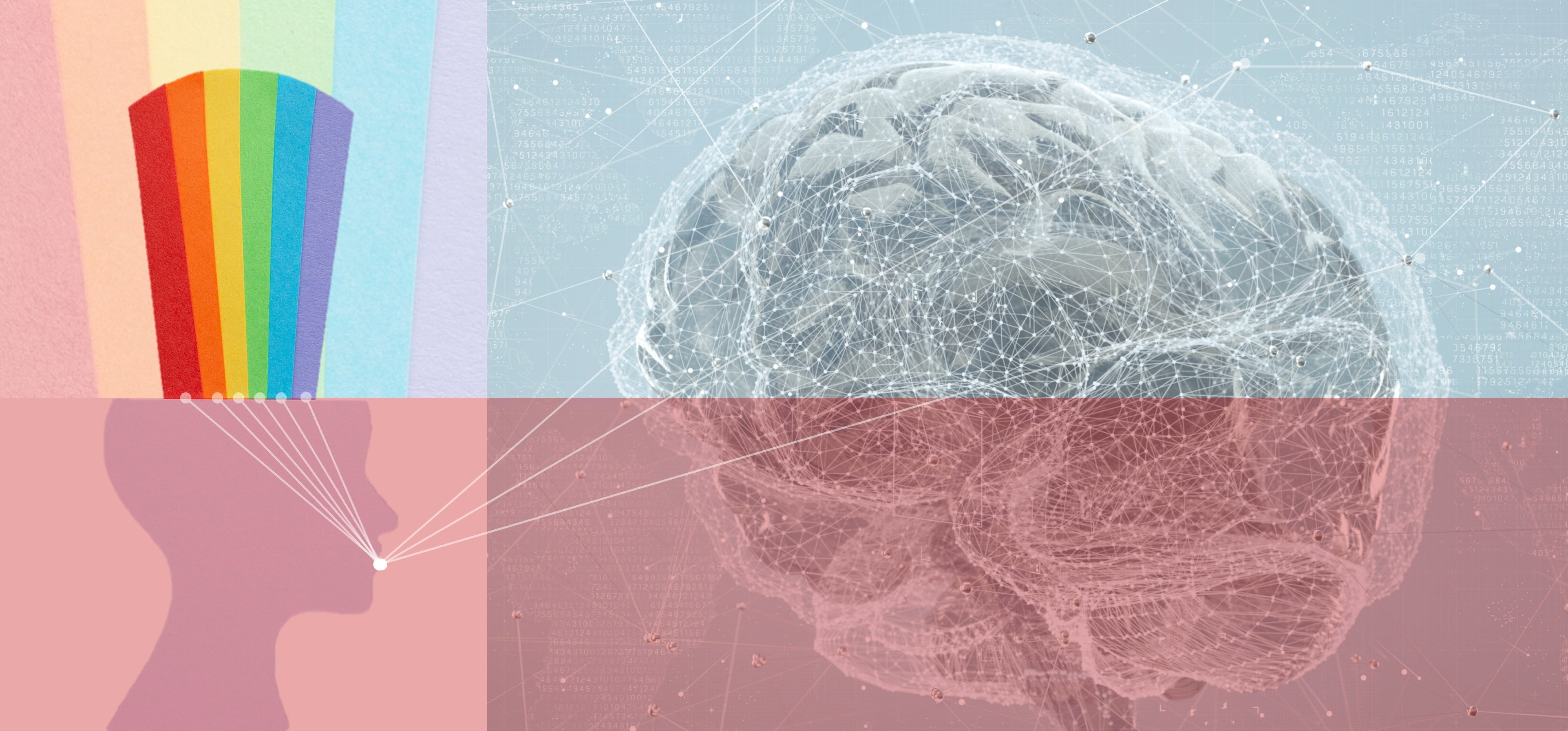
This is Your Brain on English
Hello Interactors,Happy 2023! Today we launch into a season on topics related to human behavior. So much of how we interact with people and place comes down to language. It shapes how we communicate with one another, but how much does language shape our behavior? And if one language dominates, how much does that domination shape our global society? As interactors, you’re special individuals self-selected to be a part of an evolutionary journey. You’re also members of an attentive community so I welcome your participation.Please leave your comments below or email me directly.Now let’s go…DO YOU SPEAK ENGLISH?Last week I caught up with a friend of mine who left Microsoft soon after I did. He was a technology executive and is now pursuing a degree at Cambridge on ethics in artificial intelligence (AI). His coursework is very different from his engineering past and Taiwanese education. Fewer numbers, more words. He is reading multiple philosophy papers a week, sometimes 30 pages long. He must then write his own analytical essays. Predictably, these papers he is reading are written in English – his second language.It can be challenging enough to read philosophy in a native language. When he encounters a word, he doesn’t understand, he often consults his Chinese dictionary to better understand the concept. But then when he compares that definition to the English dictionary definition, the meaning is sometimes different. The philosopher Ludwig Wittgenstein once wrote, “Philosophy is a battle against the bewitchment of our intelligence by means of language.”For my bi-lingual friend for whom English is his second language, it seems the language is the battle against intelligence by means of the bewitchment of philosophy.This is an increasingly common phenomenon around the world as English is the dominant language of higher education. An estimated one in six people on this planet speak some form of English. While seemingly small, it is the largest population to speak a common language in the history of our species. Still, with over 7000 different languages spoken around the world language diversity dominates.In the United States 80% of households speak English only at home. Those homes are likely to remain monolinguistic. But as immigrant populations in America grow and Indigenous languages resurface the number of bilingual or multilingual households is expected to increase. When the first wave of immigrants came to America in the late 1800s, many children were encouraged to drop their native language in favor of English. My American born Italian father-in-law was discouraged to speak Italian and thus never learned it. Meanwhile, the cost of learning English was too great for his mother, so she was discouraged to learn English. They never shared a richly common language.Even though the United States has never declared English the official language, it is often assumed. As a result, there exists not only a monolingual bias, but an English bias. Given the last two global trotting colonizing superpowers have English as the dominant language, it follows the English language dominates. As a result, schools, including higher education replete with international bilingual diversity, is also dominated by the English language and all that comes with it. That includes the branches of the field of cognitive science intent on understanding how language affects how the brain works.It was my father-in-law’s strict dad that insisted he speak English only. His attitude was ‘you’re an American, so you’re speaking English.’ It was common for immigrant parents during these times to attempt to erase their past in hopes of appearing more ‘American’. But this attitude may have been buoyed by a long-held belief there exists a cognitive cost of switching between two or more languages. A belief that was surely substantiated by the high cost of learning a second language proficiently. It seems advantageous to just pick one and stick with it. And for many of those early immigrant children in America, that choice would have been English.But I’m reminded of another friend who grew up in Malaysia learning English and Malay while speaking her native cultural language and English at home. Malaysia’s population is a blend of Malay, Chinese, and Indian descendants, and the informal language, Manglish, blends words from English, Chinese, and Tamil. She is so comfortable jumping between these languages that when she and her sister talk, they sometimes use words from multiple languages in a single sentence. For her, there is no cognitive cost in switching. In fact, she may even benefit from using many languages at once.YES, UH-HA, I AGREESome research in cognitive science points to a ‘bilingual advantage’. Multi-lingual speakers showed a greater “ability to plan, focus, and execute a wide array of tasks’ compared to single language speakers and the effect was pronounced among older adults. As a result, replicated studies show performance varies greatly
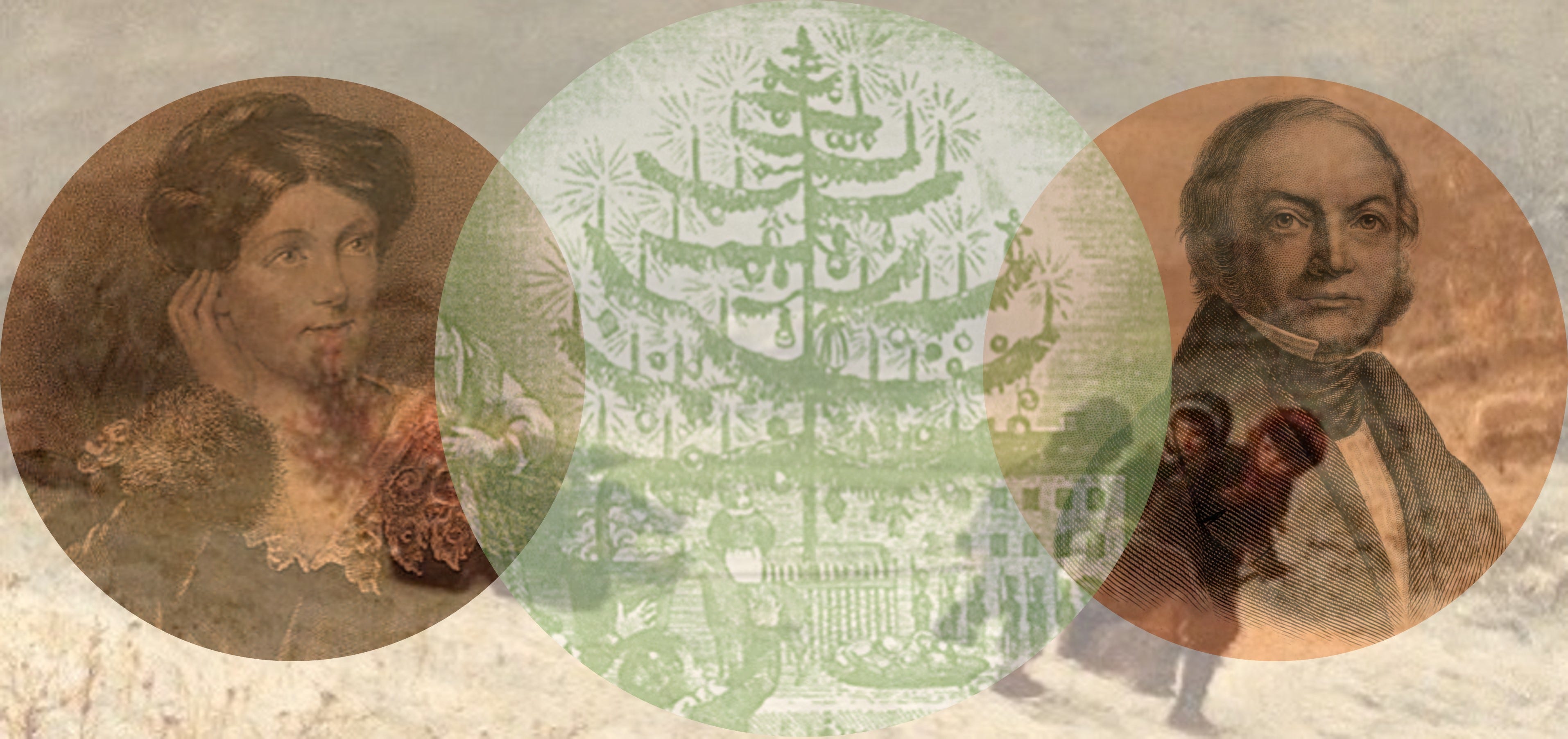
Oh Christmas Tree, Oh Christmas Tree, Your Story Has Many Branches
Hello Interactors,[This is a repost from last Christmas eve. It’s a great story worthy of another share!]For all you Christmas celebrators out there, happy Christmas Eve. Since many will be gathering ‘round a Christmas tree, I thought I’d tell the story of its origin. And like so much of American history, it has ties to immigrants and slavery; but in this case — anti-slavery.As interactors, you’re special individuals self-selected to be a part of an evolutionary journey. You’re also members of an attentive community so I welcome your participation.Please leave your comments below or email me directly.Now let’s go…A TREE SO YEE MAY BE FREE“If the morning drives are extended beyond the city, there is much to delight the eye. The trees are eased in ice; and when the sun shines out suddenly, the whole scene looks like one diffused rainbow,—dressed in a brilliancy which can hardly be conceived of in England. On days less bright, the blue harbour spreads in strong contrast with the sheeted snow which extends to its very brink.”These are the words of Harriet Martineau. She was a English writer, journalist, and social theorist who pioneered observational methods that came to influence the field of sociology. One of her more popular books came at the end of her travels through the United States in the 1830s titled, Retrospect of Western Travel. The passage above describes what she saw as she left the Boston city limits in the snow the winter of 1835.You may have images of her bundled up in a one horse open sleigh, over the hills she went, dashing all the way. But according to Martineau, you can let go of any such romantic inclinations. Here’s her take on sleighing.“As for the sleighing, I heard much more than I experienced of its charms. No doubt early association has something to do with the American fondness for this mode of locomotion; and much of the affection which is borne to music, dancing, supping, and all kinds of frolic, is transferred to the vehicle in which the frolicking parties are transported. It must be so, I think, or no one would be found to prefer a carriage on runners to a carriage on wheels,—except on an untrodden expanse of snow. On a perfectly level and crisp surface I can fancy the smooth rapid motion to be exceedingly pleasant; but such surfaces are rare in the neighbourhood of populous cities. The uncertain, rough motion in streets hillocky with snow, or on roads consisting for the season of a ridge of snow with holes in it, is disagreeable, and provocative of headache. I am no rule for others as to liking the bells; but to me their incessant jangle was a great annoyance.”And if that’s not enough to convince you, she offers up a quote from unknown source that puts a finer touch on the realities of sleighing.“Do you want to know what sleighing is like? You can soon try. Set your chair on a spring board out in the porch on Christmas-day: put your feet in a pail full of powdered ice: have somebody to jingle a bell in one ear, and somebody else to blow into the other with the bellows,—and you will have an exact idea of sleighing.”Martineau was on her way to a Christmas evening celebration at the home of a former Harvard German language professor, Charles Follen. Although, due to scheduling conflicts the event was actually on New Years Eve and not Christmas Eve. The cozy holiday scene that Martineau proceeds to unfold came to be the most, though not the first, read articulation of what came to be the center piece of American Christmas celebration – the Christmas tree.Follen was a German immigrant so perhaps it’s not that surprising that a Christmas tree would feature prominently in her story. It’s been a long held belief that German immigrants brought their time-honored Christmas tree tradition with them. Though, as we’ll soon see, the evolution of the Christmas tree tradition in America paralleled that of Germany.Martineau’s account of that evening, while factual, leaves out important historical details as to why she was celebrating Christmas with Follen and his family that night. These were two radical Unitarian abolitionists who bonded over their insistence that slavery be eradicated totally and immediately. Northerner’s, and New England Unitarians, were split on the matter of abolition. Follen’s convictions are what got him fired from Harvard a year prior.As for Martineau, she was a well known and respected journalist but not yet a public activist. But after attending a women’s abolitionist meeting that November, she was convinced she needed to act. She was asked at that meeting to write publicly avowing her beliefs. Being one of the only women writers of her time to sustain herself through writing and still requiring access to America’s mainstream elite for her book, she faced an ethical dilemma.Later she wrote, “I foresaw that almost every house in Boston, except those of the abolitionists, would be shut against me; that my relation to the country would be completely changed, as I should s
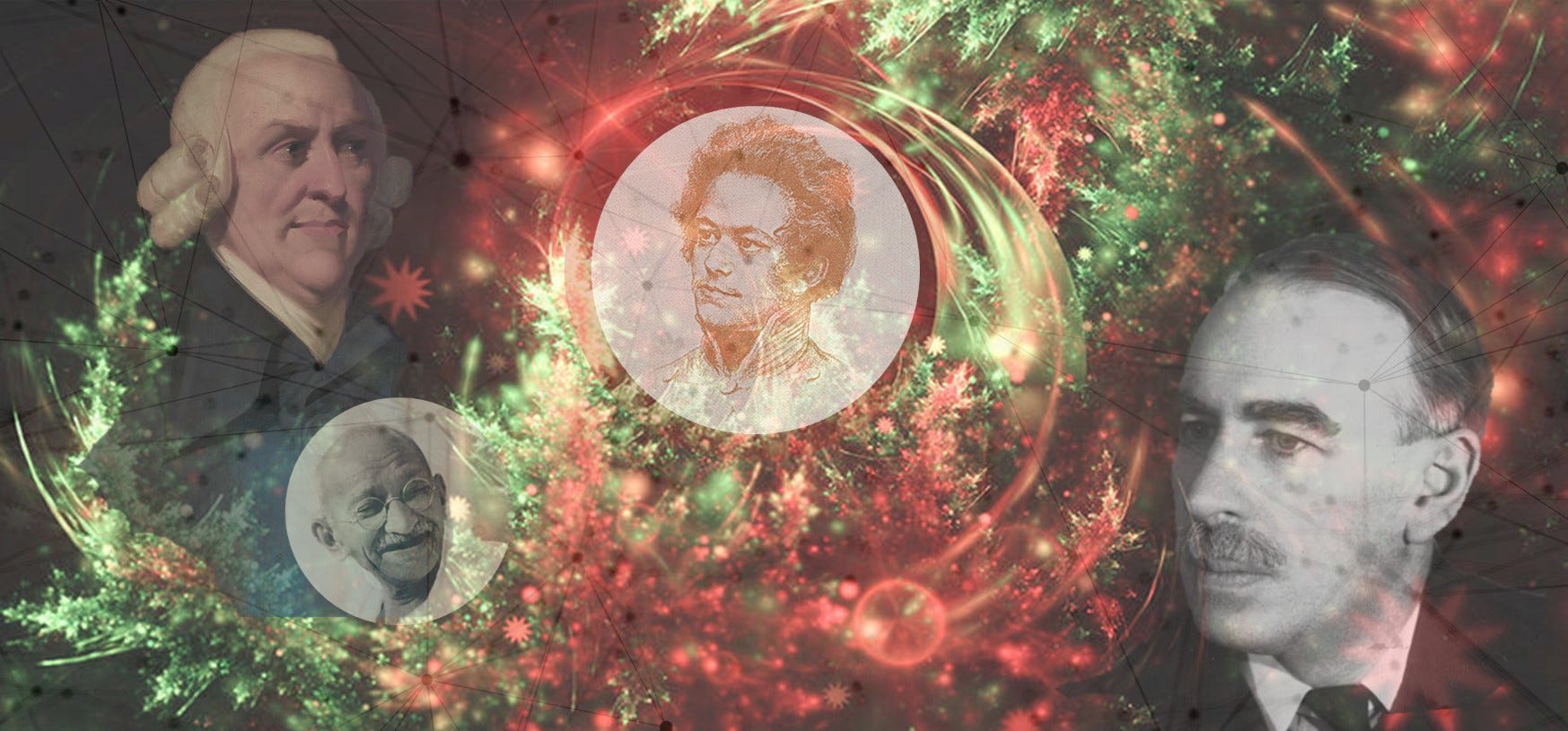
Oh Christmas Tree, Oh Christmas Tree, The Complexity of Uncertainty
Hello Interactors,As winter solstice nears in the northern hemisphere, this week brings a close to my explorations of economics. Next up is human behavior. I decided to stitch together this season’s economics posts into a single composite narrative. Upon reflection, I see a path my posts tend to take though it’s never premeditated. At least to my knowledge! In keeping with the theme of this post, it seems the uncertain path my essays take is a form of emergence.As interactors, you’re special individuals self-selected to be a part of an evolutionary journey. You’re also members of an attentive community so I welcome your participation.Please leave your comments below or email me directly.Now let’s go…THE TREE OF MORAL SYMPATHY‘Tis the season to be jolly, and with it comes this decision to volley. Real tree or fake tree? Or no tree at all. Such is the dilemma many find themselves in, at least in those places dominated by Christian tradition or influenced by Christian culture. The ‘real or fake’ Christmas tree analysis is how I was first introduced to ideas related to a circular economy.It came through a class called “Sustainable Transportation from a Systems Perspective” as part of my master’s degree program. We were introduced to a 2009 study titled, “Comparative Life Cycle Assessment (LCA) of Artificial vs Natural Christmas Tree”. It came from a sustainable development consultancy in Montreal. Life Cycle Analysis looks at the environmental impact of the full lifecycle of a product or service from ‘cradle to grave.’While the United Nations’ International Standardization Organization has determined a standard for how to conduct an LCA (ISO 14040), the interpretation of results can often include creative interpretations and conclusions.This is particularly true if the LCA is conducted by a corporation or industry that may benefit from favorable LCA results. And you probably won’t be surprised to learn most LCAs are conducted or funded by private companies. LCA’s started popping up in the 1960s, but now they’re commonplace as companies jostle to present themselves as being environmentally sustainable and socially just through responsible and ethical governance – ESG. But measurements, evaluations, and analysis to determine an ESG score, like LCA’s, are also open to interpretation and manipulation. Consequently, ESG has lost its luster.Sadly, the concept of a ‘circular economy’ is following a similar path. Circular economies take limited raw materials used to make goods and loops them back into the economy instead of throwing them away. The idea is to reduce, reuse, and recycle the inputs of an LCA and then repair the outputs to extend their lifecycle. But the term and practice of ‘circular economy’, like ESG, has also become diffuse and trendy.A group of Industrial Ecologists, people who track the physical resource flows of industrial and consumer systems at different spatial scales, wrote in 2021,“In seeking to maintain a growth-based economy, critics argue, the circular economy ‘tinkers with the current modus operandi’ of “consumerism, extractivism and (liberal) capitalism, while bearing the unrealistic expectation that the individual consumer will be able to mobilize largescale change. The circular economy is considered to encourage a reboot for capitalism that requires no radical change to institutions, infrastructures, and markets.”Calls for radical change concerning capitalism are strewn throughout history. The naturalist and scientist Alexander von Humboldt warned in 1800 of human induced climate change. He observed widespread systemic negative ecological impacts originated with infectious colonialism fueled by European and American profit seeking capitalists and imperialists. Between the abduction and trade of human slaves from Africa and local Indigenous populations to the overworking of soils to grow monocultural crops, Humboldt would not have been handing out top ESG scores to those very institutions who funded his explorations around the world.Humboldt remained critical of colonialism and the brand of capitalism that came with it until the day he died. Ten years after Humboldt died another future critic of capitalistic colonialism was born, Mahatma Gandhi. By the time he was 76, in 1945, he called on his economist friend, Joseph Kumarappa, better known as J. C. Kumarappa, to further his ideas on Gandhian economics – a kind of circular economy.Like Humboldt and other naturalists, Kumarappa observed the cyclical patterns in nature and sought economic practices that echoed them. He advocated for maintaining an economy of continuity and circularity with nature. Using the bee as a metaphor, he wrote,“The bees etc. while gathering the nectar and pollen from these plants for their own good, fertilize the flowers and the grains, that are formed in consequence, again become the source of life of the next generation of plants.”Kumarappa studied at Columbia University under the progressive economist Edwin Seli
The Frenetic, Kinetic Cybernetics of Economics
Hello Interactors,The social sciences sometimes unfairly get a bad wrap for being a ‘soft science’. But are they? In pursuit of a better understanding the role uncertainty plays in economic analysis, I stumbled across some research that ties John Maynard Keynes’s embrace of uncertainty with a resolute defense of the ‘soft sciences’ by one of the heroes of the ‘hard sciences.’ And you thought physics was hard.As interactors, you’re special individuals self-selected to be a part of an evolutionary journey. You’re also members of an attentive community so I welcome your participation.Please leave your comments below or email me directly.Now let’s go…CYBERSAIL“The hard sciences are successful because they deal with the soft problems; the soft sciences are struggling because they deal with the hard problems.” This quote is by the groundbreaking Austrian American polymath, Heinz von Foerster from his essays on information processing and cognition. He went on to state: “If a system is too complex to be understood it is broken up into smaller pieces. If they, in turn, are still too complex, they are broken up into even smaller pieces, and so on, until the pieces are so small that at least one piece can be understood.” This strategy, he’s observed, has proven successful in the “hard sciences” like mathematics, physics, and computer science but poses challenges to those in the “soft sciences” like economics, sociology, psychology, linguistics, anthropology, and others.He continues, “If [social scientists] reduce the complexity of the system of their interest, i.e., society, psyche, culture, language, etc., by breaking it up into smaller parts for further inspection they would soon no longer be able to claim that they are dealing with the original system of their choice. This is so, because these scientists are dealing with essentially nonlinear systems whose salient features are represented by the interactions between whatever one may call their “parts” whose properties in isolation add little, if anything, to the understanding of the workings of these systems when each is taken as a whole. Consequently, if he wishes to remain in the field of his choice, the scientist who works in the soft sciences is faced with a formidable problem: he cannot afford to lose sight of the full complexity of his system, on the other hand it becomes more and more urgent that his problems be solved.”Von Foerster studied physics in Austria and Poland and moved to the United States in 1949. He started his career in 1951 as a professor of electrical engineering at the University of Illinois. In 1958 he received grant funding from various federal government agencies to start a Biological Computer Laboratory.Von Foerster understood the cognitive process humans use to break down large complex problems into smaller discrete linear steps. With the advent of computers, they then typed those instructions into punch cards and fed them into the computer to process. A linear process of which humans and computers can both do. He and his lab then devised a way for a computer to do something humans cannot – conduct multiple calculations at the same time by breaking them into smaller and smaller pieces “until the pieces are so small that at least one piece can be understood.” With that they invented the world’s first parallel processor.While von Foerster helped to bring about a machine that could do what a human could not, they also discovered what a human can do that a machine cannot. Indeed, a parallel computer can break down and execute calculations across a network of instructions, but it can’t take in additional input from its environment and decide to adjust course depending on the nature of the results. It operates in a closed system with the information it has been given and with limited input. I like the metaphor of sailing to better understand this. When I’m at the tiller of a sailboat steering with a course in mind, I must continually monitor the environment (i.e. wind speed, direction, tides, currents, ripples, waves), the sails (angles, pressures, sail shape, obstructions), the crew (safety, comfort, skill, attitude, joy, fear, anxiety) and the course and speed of the boat (too fast, too slow, tack, jibe, steer). I am using all my senses which continually input information as conditions change. My brain is making calculations and judgements resulting in decisions that in turn impact the conditions. For example, a sudden turn and the sails will fail, the water under the boat will be redirected, air and water pressure gradients will shift, and a crew member may fall or go overboard. All these shifts in conditions in turn impact my subsequent calculations and decisions instant by instant. It’s a persistent feedback loop of information created by human interactions with the boat, the crew, and with nature. A computer cannot yet steer as a human would in such conditions. They lack the necessary level of sensory input from changing environmental c
An Uncertain Alternative to a Certain Thatcher
Hello Interactors,Last week we explored the role naturalists brought to a more open, flexible, and pragmatic approach to the Enlightenment. Today we expand on how our dominant economic ideology remains beholden to dogmatic, sterile, and abstract mathematical models the naturalists were trying to shake. One of the more popular figures in popularizing and perpetuating this pernicious economic perspective was Britain’s Prime Minister, Margaret Thatcher. As interactors, you’re special individuals self-selected to be a part of an evolutionary journey. You’re also members of an attentive community so I welcome your participation.Please leave your comments below or email me directly.Now let’s go…Thank you for reading Interplace. This post is public so feel free to share it.THE TINA SCHEMAAs British Prime Minister Margaret Thatcher was gaining traction with her hardline policies many of her conservative colleagues thought she was too harsh. In response she began calling them ‘wets’ which in Britain meant ‘inept, ineffectual, and effete’. She was famously proud of her resolute, often binary, moral convictions. In response to the economic disarray Britain was facing as she came to power, she said these words in a speech at a conservative women’s conference in 1980,“There's no easy popularity in what we are proposing but it is fundamentally sound. Yet I believe people accept there's no real alternative…What's the alternative? To go on as we were before? All that leads to is higher spending. And that means more taxes, more borrowing, higher interest rates more inflation, more unemployment."The phrase “there is no alternative” became a refrain for Thatcher. It was used so often it prompted one the ‘wets’, Norman St John-Stevas, to abbreviate it forming a retaliatory derogatory name for Thatcher – TINA. He, and other ‘wets’, took to calling her ‘Tina’. He later wrote in a book that Thatcher saw "everything in black and white [but] the universe I inhabit is made up of many shades of grey".I suspect Thatcher was confident in her resoluteness because the neoclassical economists she relied on, both in the UK and the US, were themselves certain there was no alternative. Their confidence was, and still is, buoyed by the certainty that can come with the mathematics behind their economic models. But that certainty can be an illusion that can lead to delusion.Education researcher, Don Ambrose, says it can start early in math education and over time this “dogmatic thinking can trap professionals, policymakers, and others into perceiving only the sterile certainty of the surface of mathematics while remaining oblivious to its messy, creative inner workings.”He continues, “While mathematics provides us with a considerable amount of analytic precision it still is at least somewhat susceptible to the vagaries of the human mind and open to impressive creativity.” He quotes the prominent economist Thomas Piketty who in his 2014 book, Capital in the Twenty-First Century, saying,“For far too long economists have sought to define themselves in terms of their supposedly scientific methods. In fact, those methods rely on an immoderate use of mathematical models, which are frequently no more than an excuse for occupying the terrain and masking the vacuity of the content.”He says it can create a ‘scientific illusion’ that ignores the messy realities that, again, Adam Smith viewed as essential to a healthy economy; a shared cultural understanding, a socially just labor market, and a trustworthy government.But even some mathematicians agree mathematics can lead one astray. The mathematician William Byers, who researches dynamical systems and the philosophy of mathematics, writes,“What we usually call mathematics—results, proofs, and structure—is the unambiguous face of the subject…[But] looking at mathematics as a human activity, as mind-dependent, forces one to confront the ambiguous dimension of math.”These are the very ‘shades of grey’ the ‘wet’ set Tory’s unsuccessfully settled with Margaret ‘Tina’ Thatcher. And the man Thatcher liked to blame for the economic mess she inherited was someone who would have agreed with the uncertainty these ‘wets’ were pointing to – Britain’s most famous 20th century economist, John Maynard Keynes.Keynes made a name for himself in the 1930s devising economic policies that proved to ease the effects of the depression that had wracked the world. His ideas were counter to neoclassical ideas, and those later championed by Thatcher. He believed, like Adam Smith, that markets should include some governmental intervention to minimize the adverse effects of recessions and depressions.Every capitalistic government in the world had instituted his policies until the 1950s, soon after he passed away. From that point until now, the neoclassical ideology of America’s most famous 20th century economist, Milton Friedman, reigns supreme. A philosophy that promotes free-wheeling, free-trade, and free markets that are free of go
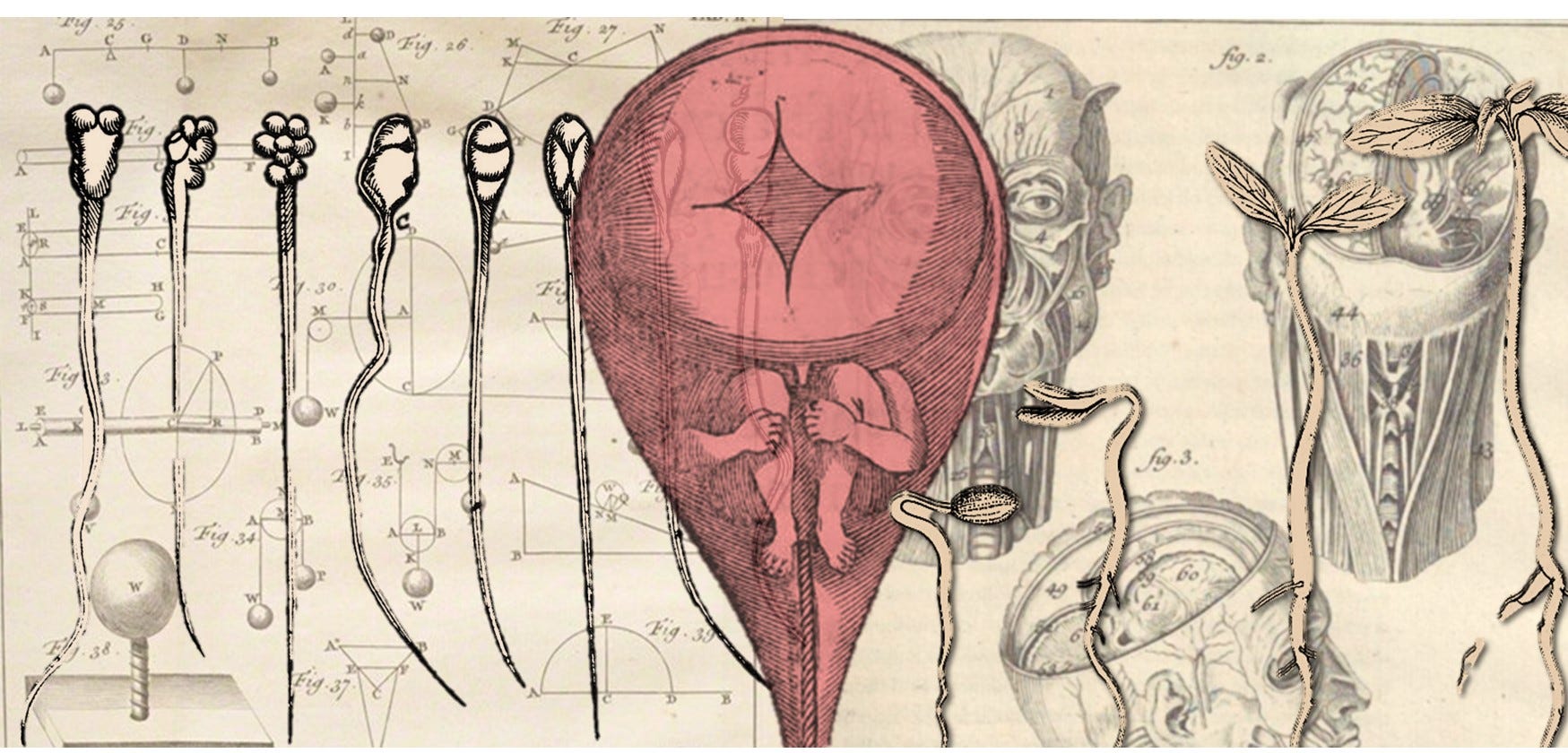
Maybe it was Isaac Newton Who Needed Enlightened
Hello Interactors,Today is part one of a two-part exploration. I was curious as to why conventional economics continues to rely so heavily on deterministic mathematical models that assume perfect conditions even though they know such inert situations don’t exist in nature. It may tie back to the Enlightenment and the popular beliefs of Newton and Descartes who merged Christian beliefs with mathematic certainty – despite viable alternative theories they helped squelch. As interactors, you’re special individuals self-selected to be a part of an evolutionary journey. You’re also members of an attentive community so I welcome your participation.Please leave your comments below or email me directly.Now let’s go…THE SPERMISTSIsaac Newton and René Descartes were spermists. They believed they entered this world through preformation. This theory states every future organism is wrapped up in a seed or sperm as a preformed miniature version of itself. This was the dominant belief among Europe’s most respected Enlightenment thinkers. They believed not only did a Christian god create all the plants and animals, including humans, but all the future ones too. Intercourse, they surmised, is a magical act that initiates the growth of microscopic animacules which then grow until they are fully formed. It’s easy to brush this off as a point in time lack of knowledge and excuse these brilliant minds. We might say, “They just didn’t know any better.” But it turns out there were other brilliant minds at the time who thought they were crazy.But powerful people are not easily persuaded. They, along with the church, continued to push the idea that preformation is as elementary to evolution as mathematical axioms are to theorems. A mathematical certainty that one day seduced many scientists, and later economists, into similar deterministic expressions.One of the early preformation influencers was the Dutch philosopher, mathematician, and theologian, Bernard Nieuwentyt (1654-1718). Three years before his death, he published a soon to be popular book, The Religious Philosopher: Or, The Right Use of Contemplating the Works of the Creator. In it he writes,“This however is sure enough…that all living Creatures whatever proceed from a Stamin or Principle, in which the Limbs and Members of the Body are folded and wound as it were in a Ball of Thread; which by the Operation of adventitious Matter and Humours are filled up and unfolded, till the Structure of all the Parts have the Magnitude of a full grown Body.”His book was translated into English in 1724 and its influence spread. In 1802, the English clergyman and philosopher, William Paley (1743-1805), expanded on the ‘Ball of Thread’ analogy with his infamous watchmaker analogy. Using examples of mechanistic functions of the human body like joints and muscles, he expanded the popular notion that this is the work of a supreme designer – their Christian god. He writes, “Contemplating an animal body in its collective capacity, we cannot forget to notice, what a number of instruments are brought together, and often within how small a compass. It is a cluster of contrivances.”But Paley wasn’t alone, nor was he the first. Both Descartes and Newton had already remarked as much. Newton once wrote, “like a watchmaker, God was forced to intervene in the universe and tinker with the mechanism from time to time to ensure that it continued operating in good working order."The confidence of spermists was buoyed when spermatozoa was discovered by the Dutch microscopist Antoine van Leeuwenhoek in 1677. But the seed of the idea dates all the way back to Pythagoras. He believed male semen is fluid that collects and stores different elements from the body like the bone and brain. He said, “semen is a drop of the brain.” The woman provided a host and nourishment so the male semen could unfold inside her body.Another Greek philosopher, Empedocles, refuted the Pythagorean claim 100 years later noting offspring often inherit characteristics of the mother. He proposed there was a blending of male and female root reproductive elements in plants and animals that has the potential to produce blended varieties as their offspring. Empedocles was on to something, but his theory was overshadowed by a more popular theory and powerful name, Aristotle.THE OVISTSAristotle believed both men and women provided different forms of reproductive purified blood in the form of semen and menstrual fluids. Because semen appeared more pure than menstrual fluids, he surmised it must have the advantage. Therefore, the male provided the instructions, design, or blueprint for formation and the woman provided the material. The ‘blood’ metaphor is alive today despite our knowledge of genetics. J.K Rowling did her part in her Harry Potter series to perpetuate and popularize the blood metaphor with ‘pure-bloods’ and ‘half-bloods’ or the derogatory ‘mud-bloods’.Aristotle’s ideas were brought to life in the 17th and 18th century by the spermi
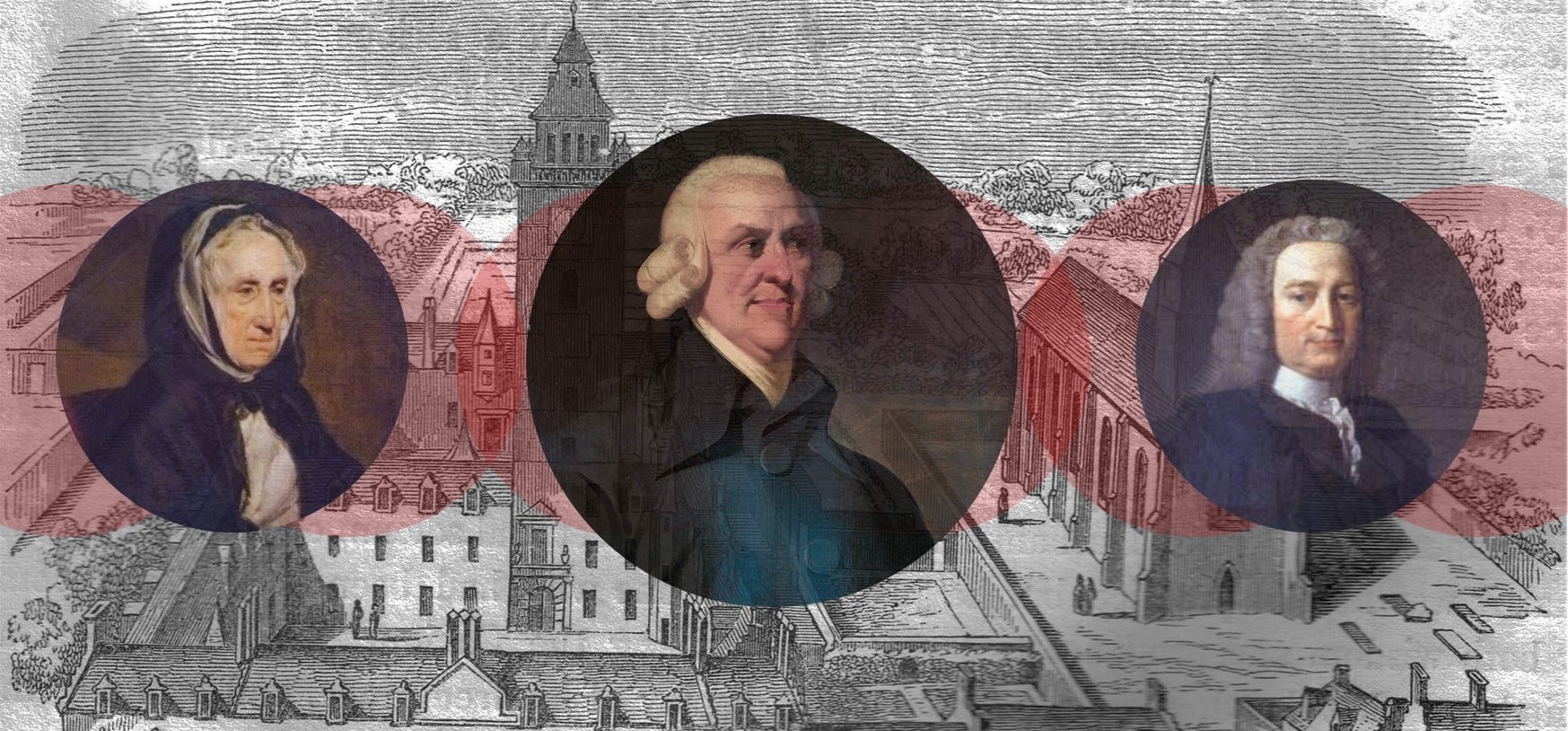
Is the 'Invisible Hand' Pushing a Smith Myth?
Hello Interactors,Last week’s post on Karl Marx introduced issues he had with the Scottish philosopher and so-called father of economics, Adam Smith. I found myself digging into Smith’s life and work before his contributions to economics. Which, as history shows, was barely recognized until 1942. His name is now more popular than ever. As interactors, you’re special individuals self-selected to be a part of an evolutionary journey. You’re also members of an attentive community so I welcome your participation.Please leave your comments below or email me directly.Now let’s go…MAKING SENSE OF THE SENSESVisiting his grandfather in Strathenry, the four-year boy wandered to the banks of the River Leven. He was a weak boy, shy, and prone to talking to himself. He’d lost his father three months before he was born and was being raised by his mother, whom he adored, alone.When the boy did not return to his grandfather’s home, he and his mother went looking. Surely in a panic assuming the worst, they soon encountered a man who had just witnessed something suspicious. He had come across a group of nomadic people heading toward a nearby town that included a woman struggling to hold onto a screaming child.A search crew was dispatched immediately. And there, in the town of Leslie, nearly a mile from Strathenry, the woman was spotted with the boy. As the crew approached the woman, she dropped the screaming child who ran to his saviors. The crew then returned the boy to his mother. He never left her side again. He did, however, like keeping to himself until the day he died. And he never stopped talking to himself either. It’s hard to know if he was traumatized by that event, but it didn’t stop him from becoming one of Scotland’s most famous academics. Had that group of nomads managed to kidnap that young boy, the founding father of economics would not have been Adam Smith.Smith was born in 1723, entered school in at age six, and began learning Latin as early as 1733, age ten. He was sent to one of the best secondary schools in Scotland, the Burgh School in Kirkcaldy. Kirkcaldy was a port town with a population of 1500 people. Though Smith was shy and kept to himself, he was nonetheless engaged and observant. He kept track of the town’s activities and was familiar with some of its local characters. The town was home to shippers and traders and thus full of tall tales from journey men and smugglers.It also had multiple nail manufacturers that young Adam liked to visit. It was there and then he was first exposed to division of labor and how the value of labor was compensated. Nailers, he observed, were paid in nails which they would then exchange for other goods at local stores. Perhaps these observations, and his high marks in mathematics and classics, were the first seeds to grow as he entered the University of Glasgow in 1737 at the ripe age of 14.Smith continued his studies in mathematics and Latin but added Greek and Moral Philosophy. This was the glimmering beginnings of the enlightenment and he himself was about to be enlightened. His math professor was Robert Simson, an eccentric man made famous through Europe as the “Restorer of Grecian Geometry”, as his tombstone reads. The Simson line in geometry is named after him and he also noted a curious relationship among Fibonacci numbers. As the values increase, the ratio of adjacent numbers approaches the golden ratio of 1.6180... But his most influential professor was Thomas Hutcheson, his Moral Philosophy instructor – a discipline Smith went on to become famous for himself.But when Smith was in school, Hutcheson was the popular one in Britain. He was one of Britain’s premiere moralists and key figure in a long line of Scottish Enlightenment thinkers, including his professor, Thomas Locke. He was also the first professor in Glasgow to lecture in the native tongue of his students and not in Latin. This alone made him an easy target among conservative faculty, but it was what he was teaching that really rattled them.Hutcheson believed, contrary to the established and prevailing belief, human action does not descend from the will of God, but from one’s own mind. And even then, we have little to no control over our own actions but are instead influenced by our complex interactions with people and place.He believed we form images and beliefs in our mind by sensing the environment around us through our five physical senses. We then formulate ideas which lead to feelings either pleasure or pain. This, in turn, leads to the creation of other senses internal to our mind – though still interrelated and interdependent on our five external senses. He believed there are many mental senses generated, but three emerged as particularly notable – especially as we learn more of Adam Smith’s own philosophies.The first is a public sense for the happiness of others and the pleasure it brings, but also the sadness that comes with observing misery in others. The second is the moral sense upon re
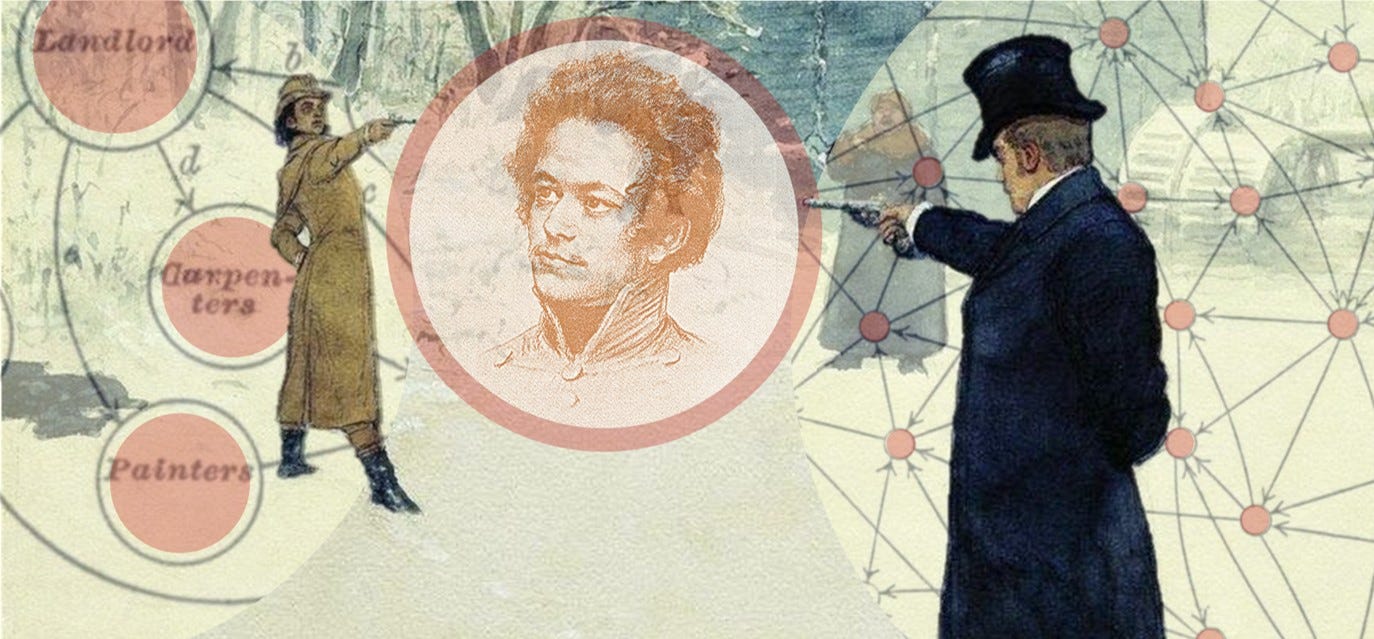
That Bullet in Germany Nearly Altered the Economy
Hello Interactors,I stumbled across a book that picks ten influential economists and teases out elements from each that contribute to ideas circling the circular economy. It turns out bits and pieces of what many consider a ‘new’ idea have existed among notable economists, left and right, for centuries.The first is a name known to most worldwide, even if they only get their history from Fox News. But had a gun been aimed more accurately, his name nor his global influence would have been a part of history at all.As interactors, you’re special individuals self-selected to be a part of an evolutionary journey. You’re also members of an attentive community so I welcome your participation.Please leave your comments below or email me directly.Now let’s go…THE DUEL AT SCHOOLClass boundaries come into focus in college towns as diverse clusters of first-year students descend, mingle, and sort. Such was the case for one young man in Germany. It’s not that he was poor, but to the über he was. Having been born to Jewish parents, he was used to being bullied. Though he thought violence was an absurd remedy for injustice – after all, he went to college to study philosophy and belonged to a poetry club – but he also believed that sometimes one must stand their ground by whatever means.And so there he stood, 18 years old, with his back to his adversary, about to engage in a duel. As he breathed in, I imagine he could feel the cold pull from the barrel of the pistol pointed to the sky inches from his chin. With each step his pulse must have quickened. He must have felt the gun handle twist in his sweaty palms as he gingerly rested his tremoring finger on the trigger. He knew at any second, he must turn quickly. He must not flinch. And he must not die.In his final steps I imagine his world must have slowed down. And then, in a blur, he whirled around and fired at his challenger. The blast must have lit his face, punctuated by the sound of a whirring bullet. He felt the skin just above his eyebrow burn. I can see him lifting his shaking hand to his forehead expecting blood. But it was just an abrasion. The bullet had grazed his skull. That bullet was millimeters from ending Marxism before it even started. Had it landed, Karl Marx would have been dead at 18.My sense is that when most people read the word Marxism, they think Communism. He’s best known for two massive publications, The Communist Manifesto, and Das Kapital – or often simplified and anglified to just Capital. But he eventually distanced himself from the direction Communism and even Marxism had taken. As we shall see, he was a professional journalist for most of his adult life and thus a staunch free press and free speech advocate – two freedoms communist authoritarianism eradicated.The word, ‘Marxism’, today is often used by some to discredit progressive pro-social political and economic ideas given its connotations to communism. A holdover from American Cold War McCarthyism. It turns the disparaging came long before the 1940s and 50s. It was used the same way in France and other parts of Europe in the late 1800s. So much so that Marx’s collaborator on The Communist Manifesto, Fredrich Engels, once wrote, “What is called ‘Marxism’ in France is certainly a very special article, to the point that Marx once said to Lafargue [Marx’s son-in-law]: "What is certain is that I am not a Marxist."Marx’s economic work is less well-known and Das Kapital remains the most accurate and lucid critique of the negative effects of capitalism. Marx was first and foremost a philosopher and his arguments take aim at the moral and ethical implications of capitalistic systems. Which is why circular economic advocates often turn to Marx for their own philosophical underpinnings.Coincidently, the man credited with capitalism, and whom Marx often took aim, Adam Smith, was also a philosopher. In fact, he mostly wrote about liberal philosophy and relatively little about economics. I wonder if today these two philosophers, who many see representing the left and the right of political economics, would be unsuspecting allies or dueling advisories?Karl Marx’s first year at university in Bonn, Germany was like many freshmen. He partied a lot. But Bonn was also home to radical politics at the time. Students were heavily surveilled by the police due to semi-organized radical attempts by student organizations to overthrow the local government. It turns out the poetry club he had joined was not about poetry, it was a front for a resurgent radical political movement. Though, having already spent a night in jail for drunken disorderly behavior, Marx may have mostly been interested in the social side of the club.Paralleling political turmoil was class conflict between the so-called ‘true Prussians and aristocrats’ and ‘plebeians’ like Marx. The near fatal event came about when an aristocrat challenged Marx to a duel. Marx indeed thought dueling was absurd, but evidently, he, like many men in those days, t
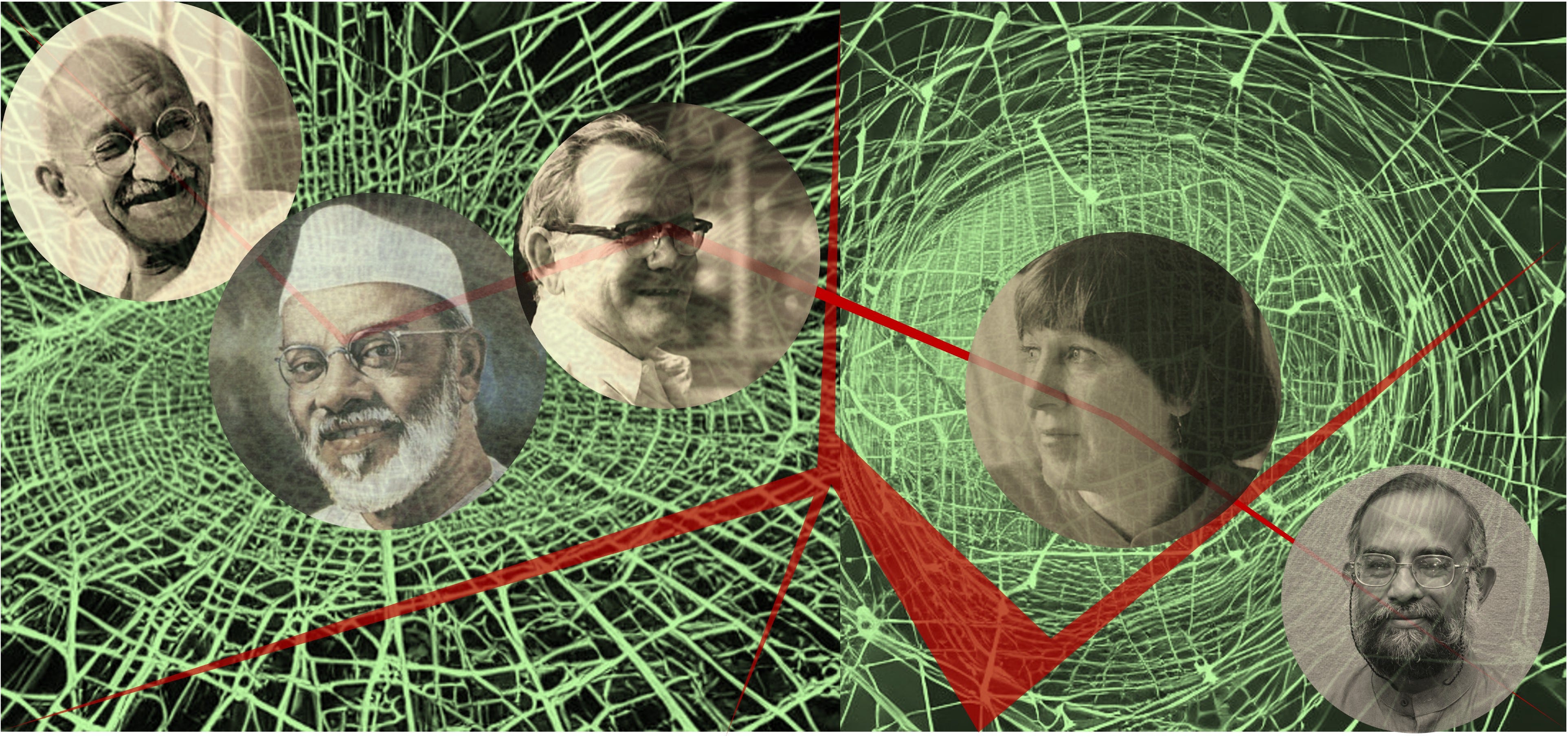
Gandhi and the Circular Economy
Hello Interactors,I took a break traveling to the Midwest and East Coast of the United States visiting family and friends the last few weeks, but am back now. Today I continue my inquiry into the ‘circular economy’ by exploring its history. While it is often portrayed as a recent phenomenon, the origins date back to 1945. And since then, it’s traversed a vast landscape of economic and political ideas and philosophies that are as seemingly polarizing as today’s politics and economies!As interactors, you’re special individuals self-selected to be a part of an evolutionary journey. You’re also members of an attentive community so I welcome your participation.Please leave your comments below or email me directly.Now let’s go…THE ECONOMY OF PERMANANCEThe guest room was void of furniture and the pungent stench of the squatting toilets punctured the hot humid air. Joseph’s appointment wasn’t until 2:00PM, so he waited outside along the cool banks of the Sabarmati. This significantly religious Indian river would have been free of garbage and toxins in 1929.When it was time for his meeting, he climbed the riverbank. His steps were aided by a long walking stick. As he crested to flat ground he looked up and saw an old man under a tree spinning in circles. He stood there leaning on his stick watching the man twirl for what felt like five minutes or more. Suddenly he stopped and looked at Joseph with a toothless grin and said, “You must be Joseph.” It was then Joseph realized his 2:00 meeting was to be outside. For standing before him was the man he was to meet – Mahatma Gandhi. Gandhi sat on the ground, legs crossed, as his white robe draped over his knees. Joseph felt compelled to join him. As he sat, he felt the dirt skid under his pressed trousers as he loosened his starched white shirt and black tie. Joseph Kumarappa, better known as J. C. Kumarappa, was there at Gandhi’s request. Gandhi had read a paper he had written on the role public finance played in poverty-stricken India and wanted him to write a column in Gandhi’s weekly magazine called Young India. By the time of this meeting, Gandhi’s revolutionary movement left him fearful he’d be imprisoned at any moment. He wanted his magazine to continue carrying his message with Kumarappa as a contributing writer. After years of publishing successful articles, Gandhi asked Kumarappa to turn his work into a small pamphlet for further dissemination. He agreed and asked Gandhi to write the forward. Soon there after, Gandhi was imprisoned. As was Kumarappa.Gandhi wrote the forward on a train to Bombay in August of 1945. It began, “Dr. Kumarappa's on ‘The Economy of Permanence’ is a jail production.” He continued that it is through “Plain Living and High Thinking” that “we shall arrive at the economy of permanence in the place of that of the fleeting nature we see around us at present.”J. C. Kumarappa was one of Gandhi’s closest collaborators and chief economist. Kumarappa observed, “There are certain things found in Nature which apparently have no life and do not grow or increase, and so get exhausted or consumed by being used. The world possesses a certain stock or reservoir of such materials as coal, petroleum, ores or minerals like iron, copper, gold etc. These being available in fixed quantities, may be said to be 'transient' while the current of overflowing water in a river or the constantly growing timber of a forest may be considered 'permanent' as their stock is inexhaustible in the service of man when only the flow or increase is taken advantage of.”He advocated for maintaining an economy of continuity and circularity with nature. Using the bee as a metaphor, he wrote, “The bees etc. while gathering the nectar and pollen from these plants for their own good, fertilize the flowers and the grains, that are formed in consequence, again become the source of life of the next generation of plants.”While Kumarappa was trained as an economist in the West at Columbia University, he was critical of its exploitive orthodoxy. He said, “The Western plans are material centred. That is to say, they want to exploit all resources.” He was encouraged to pursue his economic philosophies by his professor and progressive economist, Edwin Seligman. Kumarappa’s book, The Economy of Permanence forms the foundation for Gandhian Economics and is one of the first known precursors to what we now call Circular Economy.SPACE COWBOYS OF THE COMMONSThe critique of over exploitive economies returned in 1966 when the economist and cofounder of Systems Theory, Kenneth Boulding, described it as a “cowboy economy”. He chose the image of a cowboy because, “the cowboy [is] symbolic of the illimitable plains and also associated with reckless, exploitative, romantic, and violent behavior...” He offered that “systems may be open or closed in respect to a number of classes of inputs and outputs” and that the ‘cowboy’ mentality assumes earth to be an open system filled with limitless natural resources as

ESG and the Circular Economy
Hello Interactors,This is the first of a series of posts where I wrangle, disentangle, and find an angle on an alternative sustainable economy. My starting point is circular economy. It’s a seemingly straight forward concept — reduce, reuse, recycle, and repair. If only it was that easy. As interactors, you’re special individuals self-selected to be a part of an evolutionary journey. You’re also members of an attentive community so I welcome your participation.Please leave your comments below or email me directly.Now let’s go…ESG DISHARMONYIt’s been a confusing week for the green economy. The world’s largest asset manager, BlackRock, was the source of some of the biggest news. BlackRock has made strides in recent years to be a world leader in environmental, social, and corporate governance, or as it’s commonly called – ESG. ESG is a framework of metrics companies pledge to follow intended to identify, assess, and manage environmentally and socially sustainable, but still profitable, risks and opportunities through investments, corporate culture, and practices. This can typically, or ultimately, lead to divestments in the fossil fuel industry as more and more investors, customers, and employees desire and demand reductions in CO2 emissions.But the state of Louisiana isn’t having it. They announced this week they’re pulling $749 million from BlackRock funds. Their state treasurer said BlackRock has “blatantly anti-fossil fuel policies” that damage the state’s energy industry and thus state revenue. It’s not just fossil-fuel fans who are unhappy with ESG. Elon Musk famously quipped that ESG’s are “an outrageous sham.” Tesla was initially praised for their leadership on the environment, “E”, but were removed from the S&P500 ESG index because of their lackluster reputation for “S” and “G”. Last April a judge and jury found Tesla to be liable for promoting a racially hostile environment at Tesla's factory in Fremont, California.Dust ups like these have caused many companies, investors, and independent ESG rating firms to soften their language, add or subtract certain metrics, change the parameters, or rebrand their rating schemes. As a result, ESG, a segment of worldwide investment accounting for 1/3 of total assets worth around $35 trillion, has become extremely murky. In July, The Economist wrote, “As it is, measurement of the size of the ESG market is confusing, the ratings are too subjective, and the industry over-promises and under-delivers.” They went on to cite research that found “ESG rating agencies are the veritable acme of inconsistency. A study of six of them found that they used 709 different metrics across 64 categories. Only ten categories were common to all—and they do not include such basics as greenhouse-gas emissions.”In September, Dilbert predictably joined in the chorus of criticism.Sadly, the concept of a ‘circular economy’ is following a similar path. Circular economies take limited raw materials used to make goods and loops them back into the economy instead of throwing them away – reduce, reuse, recycle, and repair. But the term ‘circular economy’, like ESG, has also become diffuse and trendy. The occurrence of these two words together, ‘circular economy’, doesn’t show up in the books Google has scanned until around 1990. It grew steadily until a dip leading up to the financial crisis in 2008. But since 2014, it has skyrocketed.Even Wall Street now has funds popping up branded ‘Circular Economy’. In 2019 BlackRock launched a fund called “BlackRock Global Funds Circular Economy”. Its top holdings include two waste management companies, a Coca-Cola subsidiary, a water filtration company, and…wait for it…Microsoft? I guess that’s because of their public commitment to negative CO2 emissions. Not sure. If so, I’m suspicious of their noble, and needed, effort. Having watched the over-produced press announcement in person, I left feeling it was one part a greenwashing PR stunt and one part Microsoft seeing dollars signs selling cloud services to companies running toward their own vague, but earnest, ESG goals. For example, running complicated AI models in the cloud to determine emission reductions, simulating breakthrough renewable energy technologies, or simply using Microsoft Teams so companies can cut their travel budgets while reducing CO2 emissions. In other words, to hit ESG goals – or attempt a circular economy – requires new technology; new technologies need software; and increasingly that software is run on Microsoft servers in the cloud…or in local data centers. Going green yields greenbacks.Two other companies on that BlackRock list also give me pause. Both Republic Services and Waste Management profit from collecting, processing, and recycling industrial and consumer waste. More waste equals more money. One of the basic principles of sustainable and environmentally conscious business practices is reducing consumption and thus waste. Are these companies ok with their customers cutting

A Flight From Hell
Hello Interactors,Fall is upon us and so Interplace transitions to economics. I’ll be writing about how location, distribution, and the spatial organization of economic activities interacts with and affects humanity. The current dominant economic model insists on persistent and endless growth despite acknowledgement of its role in climate change, income inequality, and disappearing limited stocks of natural resources. There’s got to be a better way, and I’m on the hunt to find alternatives. As interactors, you’re special individuals self-selected to be a part of an evolutionary journey. You’re also members of an attentive community so I welcome your participation.Please leave your comments below or email me directly.Now let’s go…FLIGHTS OF NASTYI attended a panel discussion last Friday on environmental justice. One panel member represented a nearby Seattle community called Beacon Hill. It’s a 6.5 mile long stretch just north of the SeaTac airport putting it on a flight path. Roughly 65% of flights land over Beacon Hill when the wind is out of the south. During busy times, a plane descends over their homes nearly every 90 seconds to two minutes. And because it’s on a hill, they’re 300 feet closer to the noise and pollution.FAA guidelines require a 65-decibel limit, and Sea-Tac claims they comply, but Beacon Hill is beyond the boundary for which they monitor. Even the U.S. Bureau of Transportation and Statistics reported in 2017 levels in this area were between 40-75 decibels. When residents organized and measured noise themselves, they never recorded any plane below 50 decibels and some hit 80. That’s about as loud as a kitchen blender and too loud to hear the person next to you.But what this panel member shared, sometimes through tears, is it’s not just the noise but the repetition. With each passing plane the stress mounts in anticipation of the next one. It’s hard to concentrate or hold a conversation. She worries about her son. How much does this environmental stress contribute to his ADHD? His trouble at school. Her husband, who rides his bike most places, suffered from esophageal cancer. How much did the air pollution contribute to his condition?In the time between planes, the ultrafine particles (UFPs) from the last plane have already mixed with the air they breathe. Jet engines uniquely expel plumes of ultrafine particle pollution. A recent University of Washington (UW) study confirms similar studies in Los Angeles, Atlanta, Boston, New York, and Amsterdam. Flight paths are home to high concentrations of ultrafine particles raining down over unsuspecting victims. In Los Angeles, 90% of school children in the flight path are exposed to these particulates one hour out of every school day.These particulates are smaller than the PM2.5 typically found from fossil fuel combustion and tire and brake dust. They’re also not as widely studied. Nobody really knows what kind of long-term effects they may have on the human body. However, there is animal evidence showing long-term exposure to ultrafine particles leads to adverse health effects, including neurological. A 2019 study published by the Washington State Department of Health reports,“UFPs have many unique qualities that make them possibly more harmful to human health than larger particles. UFPs are able to travel deeper into the lung than larger particles. They are also small enough to avoid the body’s attempts to clear particles from the lungs, allowing them to stay in the body longer, to build up, and to cause damage. They can also move from the lungs to the bloodstream and to other organs.”Evidence of short-term effects on human health are conclusive. The study warns,“Certain groups of people are more sensitive to UFP exposure. These groups include people with pre-existing heart and lung disease, infants, older adults, people with diabetes, communities with a lower socio-economic status, and pregnant women.” Beacon Hill is a place where 70% of residents identify as Black, Indigenous, multiracial, or persons of color. More than half speak a language other than English. They’re also flanked by two major interstates and have another smaller airport, King County International Airport (KCIA) (aka Boeing Field), between them and Sea-Tac. The UW study showed anyone living within 150 meters of the freeway would also be exposed to ultrafine particles from passing vehicles, especially semi-trucks on their way to and from Sea-Tac.In 2021, the Puget Sound Regional Council published a Regional Aviation Baseline Study. There are 27 public-use airports in Western Washington’s Puget Sound region, and the three biggest are Sea-Tac, King County International Airport, and Paine Field just north of Seattle. Scheduled passenger service is only available at Sea-Tac and Paine Field. In 2018 these two airports served 24 million enplanements. One enplanement is a single passenger per airplane. By 2027 they project this number will grow to 29 million. By 2050 it will double, 4

King Kong Lives Among Us
Hello Interactors,Last week my daughter showed us a glimpse of the Empire State Building from her friend’s dorm room. Every time I see that building, I think of the original black and white movie, King Kong. The image of that poor animal atop what was then world’s tallest structure getting pummeled by machine gun fire sticks with me for some reason. Maybe it’s because it was unfair. That creature was captured from his homeland and brought to America only to be gunned down? What kind of society does this?As interactors, you’re special individuals self-selected to be a part of an evolutionary journey. You’re also members of an attentive community so I welcome your participation.Please leave your comments below or email me directly.Now let’s go…FAREWELL TO THE KINGMerian C. Cooper got the idea of King Kong from the French-American explorer and anthropologist, Paul Du Chaillu. He was the first of European origin to confirm the existence of Central African gorillas in 1860. This made him a much sought-after speaker in the late 1800s, and his books were immensely popular. Cooper’s uncle gifted the then six-year-old nephew with one, Explorations and Adventures in Equatorial Africa. It tells of one gorilla locals noted for its “extraordinary size”:“They believe, in all this country, that there is a kind of gorilla — known to the initiated by certain mysterious signs, but chiefly by being of extraordinary size — which is the residence of certain spirits of departed natives. Such gorillas, the natives believe, can never be caught or killed.”And then, while Du Chaillu was out hunting with locals, an encounter occurred. As Du Chaillu recalls,“When he saw our party he erected himself and looked us boldly in the face . . . with immense body, huge chest, and great muscular arms, with fiercely-glaring large deep gray eyes, and a hellish expression of face, which seemed to me like some nightmare vision: thus stood before us this king of the African forest.”And so, they did what they believed to be impossible but predictable. Du Chaillu continues,“[The gorilla] advanced a few steps— then stopped to utter that hideous roar again- advanced again, and finally stopped when at a distance of about six yards from us. And here, just as he began another of his roars, beating his breast in rage, we fired, and killed him.”Cooper went on to call this creature King Kong and made a movie about him. He wanted King Kong to be portrayed as being 50-60 feet tall. After all, he was kidnapped from a fictional small island that was also home to dinosaurs.It turns out a gorilla that size is biologically impossible. For every doubling of height comes a tripling of weight. The joints and bones of a creature of this size simply could not bear his weight. King Kong was also impossible to portray on the big screen. Animators and cinematographers had difficulties portraying an animal of that size in the 1930s. Consequently, King Kong ends up appearing much smaller. Instead of weighing a couple hundred tons, let’s assume this mythical beast was shorter and weighed something more like 15 tons.Still huge, that would be about two times the mass of an elephant requiring about 12,000 watts of metabolism to survive. And that is just the energy required to keep the organs running and nothing else. Around the time the original King Kong was being released, a biologist named Max Kleiber was plotting various animals’ metabolic rate and mass on a graph. To his surprise, the dots on the graph loosely aligned along a straight line sloping upwards with a mouse near the origin and an elephant to the upper right.Kleiber had discovered a scaling law in nature known now as Kleiber’s law. For most animals, their metabolic rate scales to the 3⁄4 power of the animal's mass. Put another way, for every doubling of size the energy needed to survive decreases by ¼. Theoretical physicist and former President of the Santa Fe Institute, Geoffrey West, and his colleagues, believe ¾ scaling occurs due to the nutrient distribution through the efficiency seeking fractal-like structures of the circulatory system. The ‘3’ in ¾ comes about, it is believed, because the particles needed to arrange these mechanisms exists in a three-dimensional geometric universe. Animals observed in the wild maximize their energy to survive. Every bit of energy spent above and beyond what is required for their body to function only pushes their caloric needs into debt. GPS tracked tigers, for example, reveal highly optimized search strategies over space and time in their hunt for prey. A lounging cat may appear lazy to us, but their maximizing their energy.Early human hunter-gatherers were seemingly not that different. For similar reasons, they had to be deliberate about the energy they used. However, as their cultures evolved, along with their brain, they became increasingly effective at harnessing that energy. They used some of their energy to fashion spears, arrows, and hooks out of wood, bones, and roc
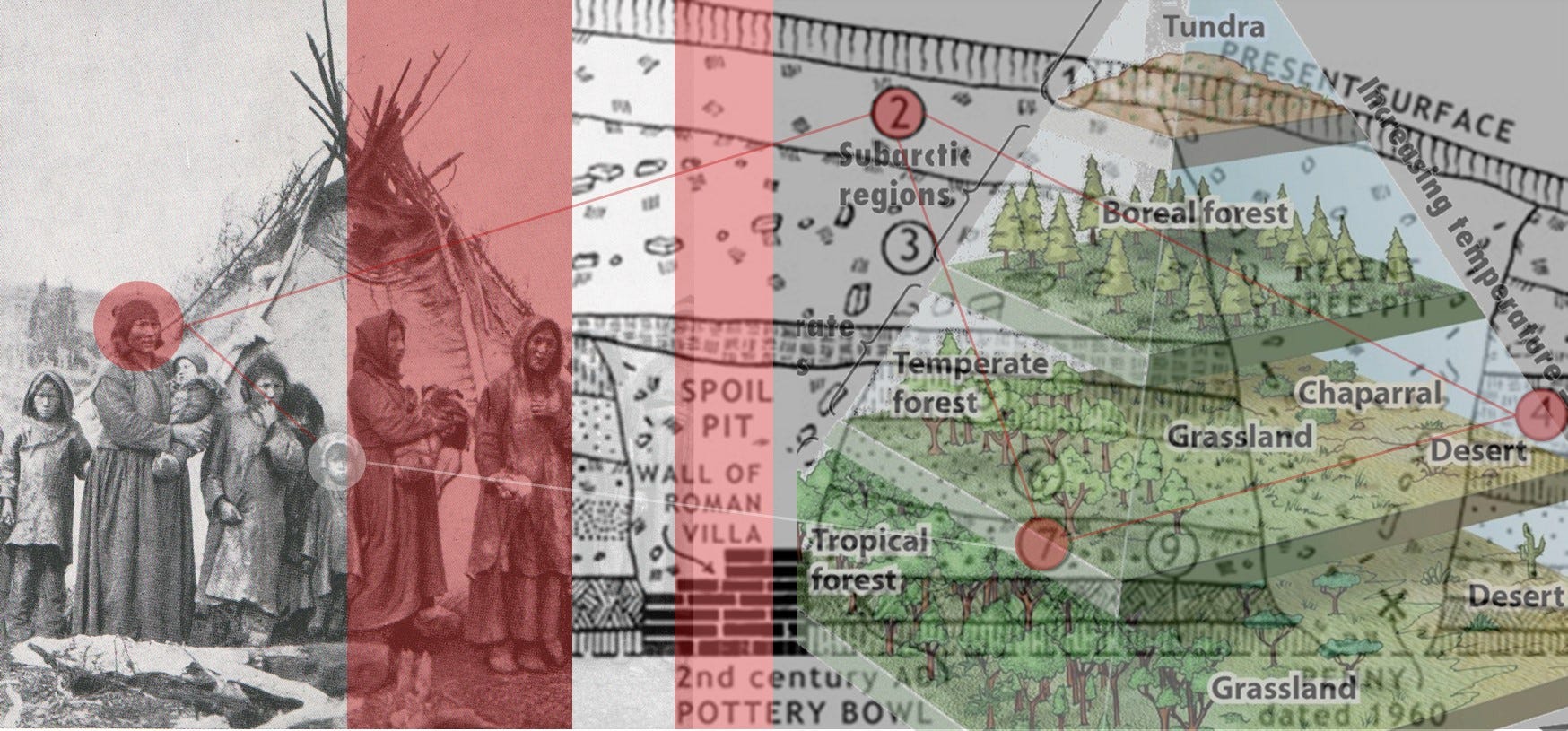
A Playful Past Allows Us To Last: Part II of II
Hello Interactors,I was interviewed!Big thanks to my friend and former Wavefront colleague, Mark Sylvester, who is now the Curator, Host, and Executive Producer at TEDx Santa Barbara.Check it out!https://tedxsantabarbara.com/.../brad-weed-we-need.../The unedited version that was streamed live is here on FB:https://fb.watch/fz9nyudo5r/Last week I left off Part I introducing a new science proposed by two scientists affiliated with my favorite multidisciplinary institution, and leader in studying complexity adaptive systems, The Santa Fe Institute. Today I draw from their paper published in August that includes links to a recent book that has shook the scientific academy. Science is adapting to a new world, a new climate, and new future. This proposed new scientific field aims to accelerate that adaptation. As interactors, you’re special individuals self-selected to be a part of an evolutionary journey. You’re also members of an attentive community so I welcome your participation.Please leave your comments below or email me directly.Now let’s go…EVOLVING FAST AND SLOW“What until now has passed for ‘civilization’ might in fact be nothing more than a gendered appropriation – by men, etching their claims in stone – of some earlier system of knowledge that had women at its centre.”These are the words of David Graeber and David Wengrow from their recent epic myth-busting book, The Dawn of Everything: a New History of Humanity. They paint a picture of human history that debunks many assumptions underlying the contributions of theoretical ‘great men’ that dominate recollections of history, scientific discovery, and human evolution. But two great women stepped forward in August to offer a new center for systems of knowledge that complements Graeber and Wengrow’s theories.Recent technological and collaborative advances in anthropology, archeology, ecology, geography, and related disciplines are sketching new patterns of interactions of people and place. Complex webs of far-flung and slow growing networks of social interactions, spanning large swaths of the globe over millennia, are coming into focus.Graeber and Wengrow claim “the world of hunter-gatherers as it existed before the coming of agriculture was one of bold social experiments, resembling a carnival parade of political forms.” This interpretation offers a radical counter to existing “drab abstractions of evolutionary theory.” Contrary to popular belief, they offer that“Agriculture, in turn, did not mean the inception of private property, nor did it mark an irreversible step towards inequality. In fact, many of the first farming communities were relatively free of ranks and hierarchies. And far from setting class differences in stone, a surprising number of the world’s earliest cities were organized on robustly egalitarian lines, with no need for authoritarian rulers, ambitious warrior-politicians, or even bossy administrators.”Graeber and Wengrow’s analysis offer an alternative understanding of the nearly 300,000 years of homo sapiens’ existence. And Stefani Crabtree and Jennifer Dunne, both affiliated with the Santa Fe Institute, wrote a recent opinion piece that builds on their position. “Towards a science of archeaoecology”, published in the journal, Trends in Ecology & Evolution, calls for integrating elements of archeology and ecology under the term archeaoecology to further understand these pasts.By sharing approaches and data of related fields they hope to form a more complete picture of the unfolding of humanity and ecosystems so that both may continue to unfold into the future. They hope to intertwine two interrelated trends that emerged over the last 60,000 years of humanity. Some findings of which, were also highlighted by Graeber and Wengrow. These two trends are:* The slow evident far-flung dispersal of homo sapiens across regions and around the globe.* The increasingly rapid development of tools and technologies that enabled it.Together these contributed to the gradual and pervasive spread of complex social networks fueled by the interaction of people and place – and other animal species. However, as Crabtree and Dunne remind us, “As humans spread to new places and their populations grew…their impacts on ecosystems grew commensurately.”ARTIFACTS, ECOFACTS, AND SCALING MATHThe subfield of archeology that studies these impacts is environmental archeology. While much of this research focuses on a reconstruction of past climates, it doesn’t always consider the larger ecological context. But the combined fields of paleontology (the study of fossilized plants and animals) and ecology does, under the name of paleoecology. However, it misses human elements of archeology just as environmental archeology sometimes ignores aspects of ecology.But new sensing technologies, increased computing power, advances in ecological modelling, and a growing corpus of digitized archeological records is providing bridges between these disciplines. Now scientists can const
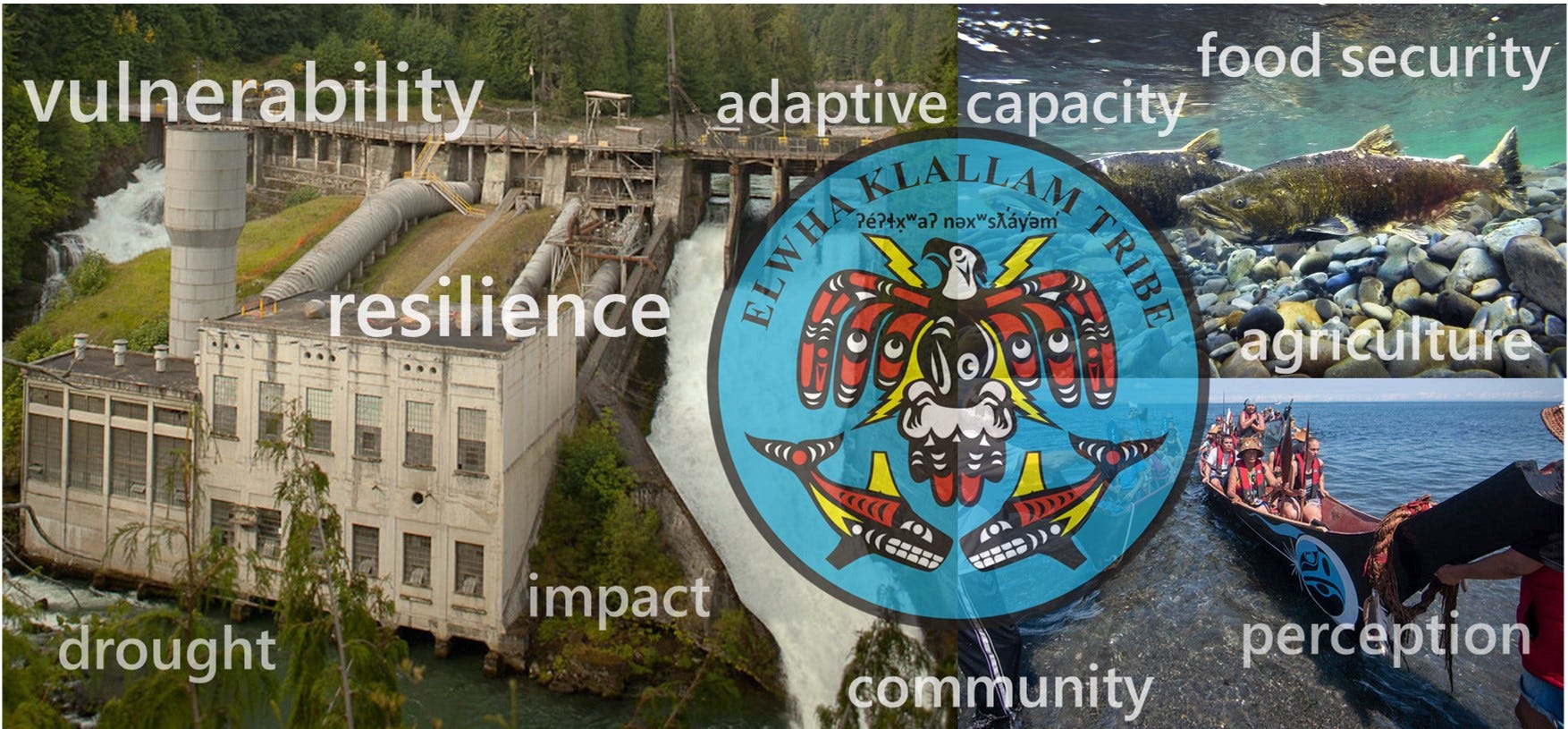
Tributaries of Intellect in a River of Circumspect: Part I of II
Hello Interactors,I’m back from planting our kids at college. Now we watch our not-so-little Weed’s grow from a distance. I had a recent visit from a plant scientist friend last week that inspired me to dig into the blending of traditional Western science and Indigenous knowledge. Each have a lot to offer human adaptation strategies to the effects of climate change, but to do so will require new approaches and increased sensitivities to generations of abuse, neglect, and disrespect. This is part one of a two-part series that starts with a grounding in what integration exists today and why it’s important. As interactors, you’re special individuals self-selected to be a part of an evolutionary journey. You’re also members of an attentive community so I welcome your participation.Please leave your comments below or email me directly.Now let’s go…TEARS OF JOY AND SORROWIt was cause for celebration, but hers were not tears of joy. It was the ten-year anniversary of the largest dam removal in United States history. The Elwha Dam was completed in 1921 to dam the 45-mile-long Elwha River for electricity generation under the settler colonial banner of “Power and Progress.” A second larger dam was built in 1927. The Elwha is the fourth largest river on the Olympic Peninsula that sits on the western most Pacific coast of Washington State. It was once home to the country’s second largest salmon run behind Alaska. After the dams were built, they robbed these fish of 40 miles of habitat. They also robbed the Lower Elwha Klallam Tribe - ʔéʔɬx̣ʷaʔ nəxʷsƛ̕áy̕əm̕ – “The Strong People” of their food source and economy while submerging their spiritual land and identity in 21 million cubic yards of sediment. That’s over one million dumpsters full of rocks and sand. If you stacked them, they’d reach over 700 miles into the air. Placed end to end they’d stretch over 3000 miles across America coast to coast.And now, ten years later, the salmon are running again, habitat is getting restored, and the sediment is redistributing. So why the tears? For scientists to accurately measure the successes of dam removal – and further justify the removal of more dams worldwide – the federal, state, and tribal governments agreed to a moratorium on fishing the returning salmon. It seemed a worthwhile compromise to the tribal community, but after over one hundred years of suffering their losses – and seeing the fish run as their elders had once seen – their yearning for a return to their cultural heritage has intensified over the last decade. Recent years of healthy salmon runs have tested their patience with colonial powers continuing to dictate their way of life – even as they simultaneously celebrate their joint successes.It was the U.S. Congress who passed the Elwha River Ecosystem and Fisheries Restoration Act in 1992 to restore dwindling salmon populations, but it was the Lower Elwha Klallam Tribe who had fought to have those dams removed even as they were being built. They also helped fund the research necessary for successful removal. And now they want to live as they once did – in a self-determined and self-sustaining autonomous but integrated coexistence with their neighbors.A friend of mine is a plant scientist for the project who attended the celebration event in Port Angeles, Washington last week. The early economic growth of this city depended on the electricity generated by those dams. He told me the words and subsequent tears by the woman representing the tribe was the most gripping and poignant moment of the event. It left many scientists conflicted about the proper path forward. Continued research will help with planning of future dam removal projects, including what would displace the Elwha project as the largest dam removal effort in history on the Klamath River. This project involves the removal of four dams that stretch across the Oregon and California border.But what is more important? More data collection and academic papers supporting future dam removals or resuming the human rights of an abused and afflicted Klallam community? The answer won’t come from the scientists, but from deliberations between multiple levels of governments, agencies, and departments strewn across many jurisdictions.BRIDGING BARRIERSThe Elwha dams are representative of countless ecological discontinuities brought on by colonial expansion and attempted erasure and conversion of Indigenous cultures and populations around the world. The Elwha dam removal indeed created a precedent that inspired ecological restoration projects worldwide. And while the collaboration between members of the Klallam people and U.S. government officials, volunteers, and scientists has largely been healthy, the tension that spawned the removal in the first place still remains – competition for fishing rights.These dams posed an immediate threat to the Klallam people and their way of living, as they still do for the Klamath people and others like them. But a greater compoundi
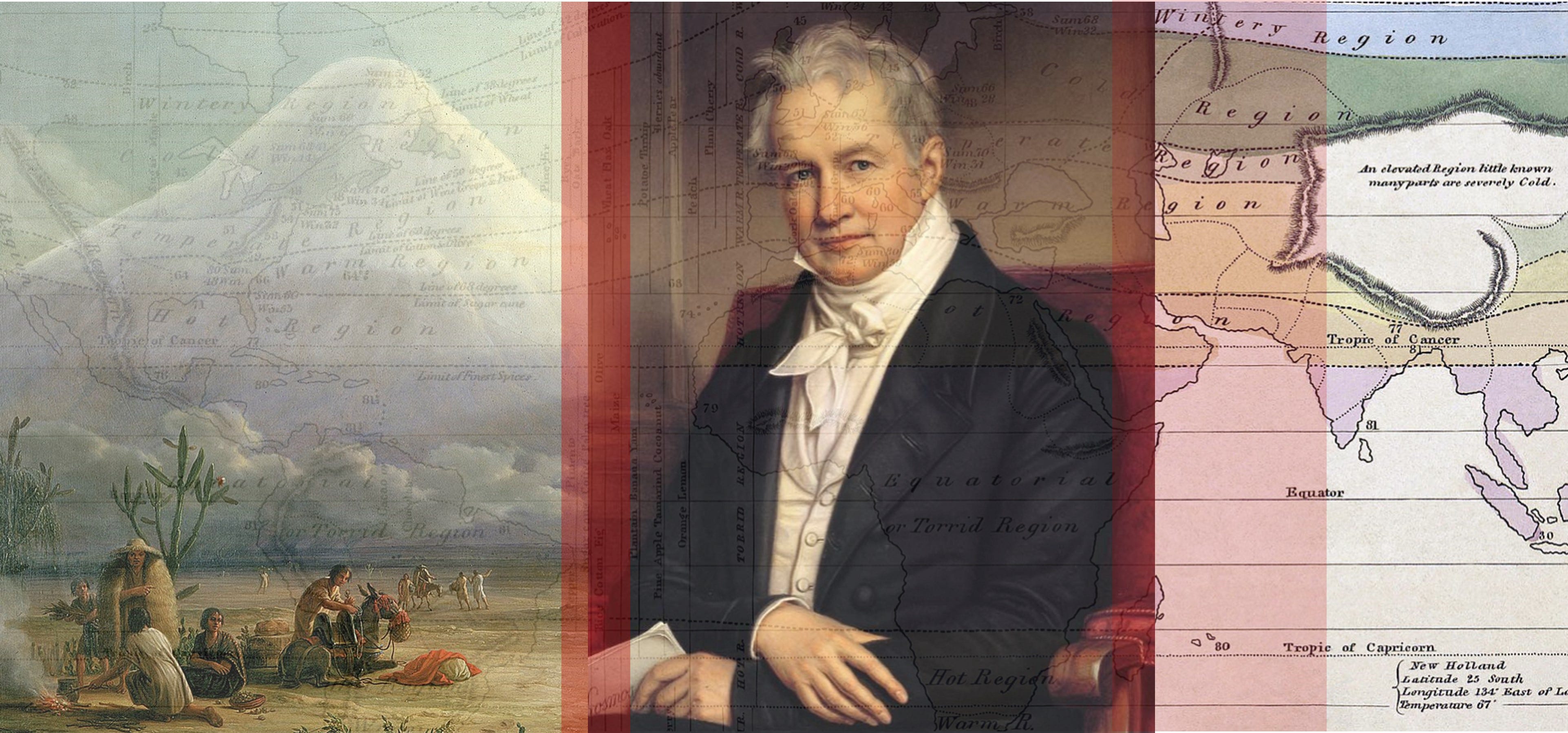
Humboldt and the Young Explorers
Hello Interactors,The next couple episodes will be a little off beat as I’m coming to you from the east coast of the United States. It’s time to deliver our little birdies from the nest so they may build their own. Dorm room nesting is a common sight this time of year among many young human adults seeking knowledge and independence. It can be observed in the towering cities of New York City and the smallest lowland wooded enclaves of Waltham, Massachusetts.For this momentous trip I’m listening to a book about a young man who launched to places further away than this. It’s a book I wish I had consumed long before now – The Invention of Nature by historian Andrea Wulf. It tells the tale of a man few have heard of but have most likely have heard the name – Humboldt. Alexander von Humboldt. His name graces more geographic places, plants, and animals around the world than any other. That’s because he was the first person to travel the world scientifically articulating what traditional Indigenous knowledge keepers have known for millennia – that all of nature is connected by an intricate web we now call an ecosystem.Born in Germany in 1769, he was the most celebrated scientist of his time. Upon his most famous and influential trip to South America, in his twenties, he observed how Spanish colonialism had ravaged the land. Acres of native vegetation had been cut and burned to make way for monoculture cash crops like sugar cane, wheat, and corn where all profits were then sent to the Spanish monarchy. Streams and rivers had been diverted to water these thirsty crops leaving lakes, ponds, and subterranean reservoirs dry. Local plants and animals, including Indigenous populations, were suffering as a result.The local Spaniards and Creoles believed there must be a leak in the earth causing these conditions, but it was Humboldt, through meticulous geographic, geological, and meteorological observation, who determined it was the crops that had caused the devastation. He surmised that between the increased temperatures caused by the loss of trees and vegetation (that naturally cool and release moisture into the air) and the drying up and hardening of the soil (thus depleting the earth of groundwater) that significant damage was being done to the area.He posited that such destruction at larger scales around the world may alter climatic patterns. He introduced the idea of human induced climate change in 1800. He further observed that these negative effects originated with infective colonialism of European and American profit seeking imperialist machines that relied heavily on the abduction and trade of human slaves from Africa and local Indigenous populations to work the fields of these monocultural crops.Governments and corporations didn’t just ignore Humboldt’s warnings, they accelerated the pace of production and destruction. That insistence continues to this day as countries and corporations fight for access to natural resources and cheap labor – far out of the reaches of complicit eyes and ears – to feed the beast of rampant worldwide consumerism. As Humboldt warned, over 200 years ago, at the peril of earth’s resources and their interconnected web of life. You can’t say we weren’t warned.Alexander von Humboldt remained a harsh critic of colonialism, capitalism, and slavery until the day he died. He witnessed firsthand the early devastating impact greed was having on the planet and its inhabitants – most especially Black and Indigenous people. Humboldt was a heartfelt man, but his true love was science. He abhorred politics and politicians though remained popular among them all, except Napoleon. Thomas Jefferson was particularly enamored with Humboldt. They shared a common affinity and thirst for botanical, astronomical, and geographical knowledge. Humboldt shared with Jefferson all he knew of South America and Mexico who was starved by the Spanish of any information at all. While he shared in the spirit of two science loving naturalist friends, that knowledge turned out to be instrumental in helping Jefferson, and the United States, increase their imperial standing in the world and its widespread ecologically damaging capitalistic dominance. Humboldt endeared himself to Jefferson mostly because he was impressed with Jefferson’s commitment to liberty. Though he disapproved of Jefferson’s adherence to slavery, he was wary of criticizing Jefferson directly for fear of disenfranchising their friendship. However, his diary, and the diary of others, reveals he did so in private to Jefferson’s friends and colleagues. Some history scholars criticize Humboldt for not using these opportunities to sway the opinions of these powerful men, but Humboldt believed science should rise above politics and the best way to share science was to share it with everyone who would listen regardless of their political or governmental affiliation.Humboldt worked tirelessly, day and night, wherever he happened to be living. Scientific luminaries
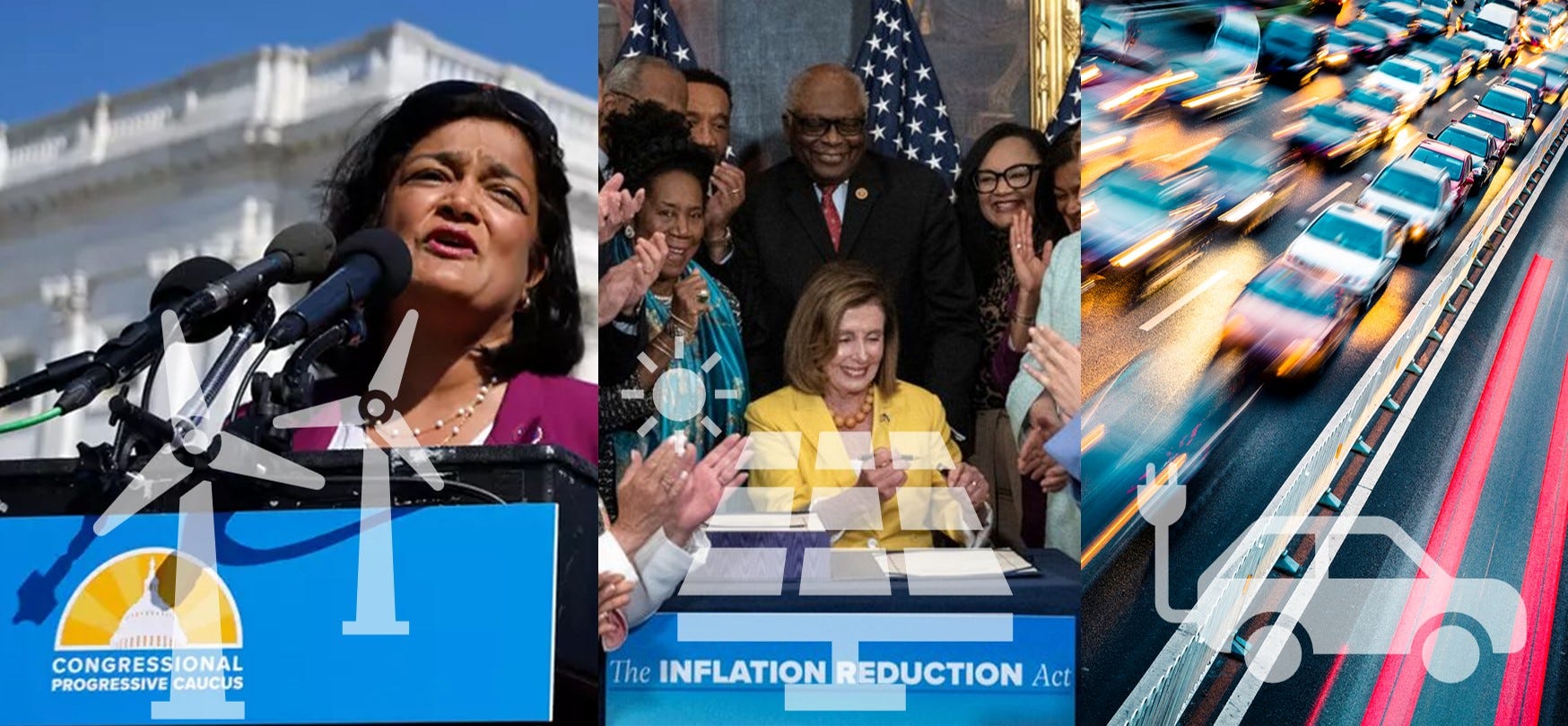
A Few Green Deals and More Automobiles
Hello Interactors,Quite a week in political news. The United States, the second biggest CO2 emitter behind China and 12th per capita, is finally making progress on climate change legislation. It’s not perfect, but it’s cause for celebration if you care about healthy air and water, the survival of life on this planet…or getting a rebate on a brand new car! Don’t get me wrong, these laws are important and necessary achievements AND they will likely fill American roads with even more cars. Yippee!As interactors, you’re special individuals self-selected to be a part of an evolutionary journey. You’re also members of an attentive community so I welcome your participation.Please leave your comments below or email me directly.Now let’s go…LET’S MAKE A DEAL“We on the Left are very good at criticizing people”, Washington Senator Pramila Jayapal once said, “but we need to build the base to pull people to the Left.” As the leader of the Congressional Progressive Caucus, and chief drafter of the Inflation Reduction Act, she did just that. President Biden is set to sign it into law. It’s the country’s largest climate legislation ever. Jayapal worked with a cadre of climate experts who have been waiting for this moment for decades. The law is expected to drive down inflation while dropping U.S. CO2 emissions 40% by 2030. It’s more modest than hoped, but is a HUGE first step. No surprise, not a single Republican voted for itHowever, 41 Republicans did vote to fight climate change, they just won’t admit it. The bi-partisan CHIPS and Science Act (CHIPS) was signed it into law last week. It includes a $280 billion investment in American semiconductor research and development, but nearly one quarter ($67 billion) is for zero-carbon industries and climate change research. Between last year’s Infrastructure Investment and Jobs Law, CHIPS, and the Inflation Reduction Act, the United States has made serious strides to fight climate change. It’s not enough, but it’s more than ever before achieved. By investing in clean energy and renewables they not only become increasingly affordable, but they also reduce demand for fossil fuels.Republicans also continue to vote for clean energy in their home states. Between 2010 and 2019, six of the top ten states with the largest increase in wind electricity generation were red states. Including Texas. Nearly one quarter of their energy comes from wind. This saves Texans $20 million dollars a year in energy costs. Reducing carbon, saves money. Including cars. Charging an electric vehicle (EV) today costs the equivalent of filling a gas tank with $1 per gallon gas. EVs, like traditional cars, also need safe and reliable roads.The Infrastructure Investment and Jobs Act passed into law last November includes $110 billion in new spending for highways, roads, and bridges, compared to $39 billion on public transit. This is a HUGE investment in public transit and our roads and bridges need repaired, but the ratio of spending on roads relative to transit is roughly the same as it’s always been. Policy makers continue to believe adding more roads will ease congestion. Adding road capacity to ease traffic is like loosening your belt so you can eat more. But Americans do tend to overeat and most like their cars.One of the big drivers of the CHIPs law were automakers. There are still hurting from supply chain snafus strangling their supply of semi-conductor chips needed to make cars. Automotive News reported, since the start of 2021, 13.5 million vehicles were cut from factory schedules due to chip shortages. Nearly 4.3 million of those were to be assembled in North America. Increasingly more chips are needed in cars as they strive for advances in autonomous driving. Bosch, a German supplier of car technology, says chips account for about $200 of value in a car sold today, but by 2030 it’s expected to grow to $800 per vehicle. Carmakers need more chips, and they need onshore guarantees they can get them. Hence the CHIPS law.Electric vehicles are like giant phones on wheels. And like phone makers, automakers hope to one day make money on software subscriptions and services. Until then, the only way to make money is to sell large volumes of cars. Increased volumes drive prices down. Lower EV prices mean even more people can afford a car. Electric vehicles are also more affordable to own due to low energy rates and fewer repairs. But they’re still expensive. Norway, one of the wealthiest countries in the world, has the highest EV per capita of any country. But owners admit that is largely due to government incentives. Hence the U.S. focus on EV rebates and automaker deals found in the Inflation Reduction Act.CARS CAN BE EXHAUSTINGEVs charged with clean energy not only reduce CO2 emissions, they also reduce Nitrogen Oxides (NOx). These are gases produced when fossil fuels explode. They then float into the air and become smog and acid rain. Floating in the ambient air they can trigger or compound asthma, lung d

God's Wrath Meets The Cherokee Path
Hello Interactors,Unexpected extreme meteorological events on Biblical scales are happening all around the globe. Their intensity and frequency is only going to increase. Who will survive and who will die may come down to who chooses the right path. As interactors, you’re special individuals self-selected to be a part of an evolutionary journey. You’re also members of an attentive community so I welcome your participation.Please leave your comments below or email me directly.Now let’s go…ONE IN A THOUSAND“As it was in the days of Noah, so it will be at the coming of the Son of Man.For in the days before the flood, people were eating and drinking, marrying and giving in marriage, up to the day Noah entered the ark; and they knew nothing about what would happen until the flood came and took them all away. That is how it will be at the coming of the Son of Man.Two men will be in the field; one will be taken and the other left.Two women will be grinding with a hand mill; one will be taken and the other left.Therefore keep watch, because you do not know on what day your Lord will come.”Matthew 24:37-42At 2 a.m. their Lord came. And then the flood. A woman, Amber, and a man, Riley, rushed to wake two boys and two girls: Madison, Riley Jr., Nevaeh, and Chance. Ages eight, six, four, and two. The water was filling their trailer home like a bathtub. But this was not just any flood.Civil engineers plan for floods like this. Flash floods. They mold networks of linear concrete channels directing water to rush into cavernous catchments…sometimes at blistering speeds. Civil engineers take great pride in trying to control nature. The British civil engineer credited with birthing the discipline, Thomas Tredgold, once said, “Engineering is the art of directing the great sources of power in nature for the use and convenience of man.” The power of these floods could not be directed. The cleverly engineered network of pipes, culverts, and catchments were eviscerated. Useless. Inconvenient to man.Seeing the water rise around them, gushing from all directions, the family of four headed for higher ground – their roof. But it wasn’t high enough, so onto a dangling limb they climbed. The water followed. Chunks of their home ripped from its frame as they clung to the tree. They watched as their home rose from its footings and swirled in the torrent.Have you ever submerged a rubber ball to the bottom of a pool, released it, and watch as it rushes to the surface with a pop? That’s the work of buoyancy force. It’s the same force that works against you swimming to the bottom to release it. It takes just two feet of flood water to exert 1500 pounds of buoyancy force. Imagine the force of 20 feet of rushing water? This flood was tossing SUVs like pool toys. Those four kids didn’t stand a chance. Only mom and dad survived.The U.S. Southeastern state of Kentucky was hit with a series of sudden thunderstorms last week. The death toll has climbed to 37. The town of Jackson, just west of Lexington, saw their entire average August rainfall of four inches pour down in just 12 hours. The National Weather Service estimated a storm like this may occur just once in 1000 years.They said that in 2015 about a rainstorm in South Carolina. Two regions there saw 10 and 26 inches of rain fall over four days. Twenty people died. Another “once in 1000 year” event happened in Baton Rouge, Louisiana in 2016. Thirteen people died. Over ten times more houses in that area had major flooding (18 inches or more) than the last storm of this magnitude in 1983. That’s 33 years ago, not 1000. Suffice it say, the Southeast United States will have ‘once in 1000 year’ flood events at least once every five years, if not every year. What are the odds experts will stop calling them ‘once in 1000 year’ weather events? One in 1000?In 2015 Pope Francis sent a letter to all Catholic churches titled, Laudato si' (Praise Be to You). The subtitle read, “on care for our common home”. It was a seething critique on consumerism, globalism, addiction to continual economic growth, and the social and environmental degradation it has caused. He doesn’t mince words when he writes that it is,“easy to accept the idea of infinite or unlimited growth, which proves so attractive to economists, financiers and experts in technology. It is based on the lie that there is an infinite supply of the earth’s goods, and this leads to the planet being squeezed dry beyond every limit.”He observes it’s resulted in a form of “reductionism which affects every aspect of human and social life.” Especially those who are poor. He says, “the poor and the earth are crying out.” Imagine the sound of cacophonous rushing floodwaters, the clap of angry water-logged thunder clouds, punctuated with screams of terror from a family of four left with two. They clung to an equally terrified tree as their sole possessions rushed away in a gushing deluge. Deranged droplets running scared from the canyons, crevices, and creeks
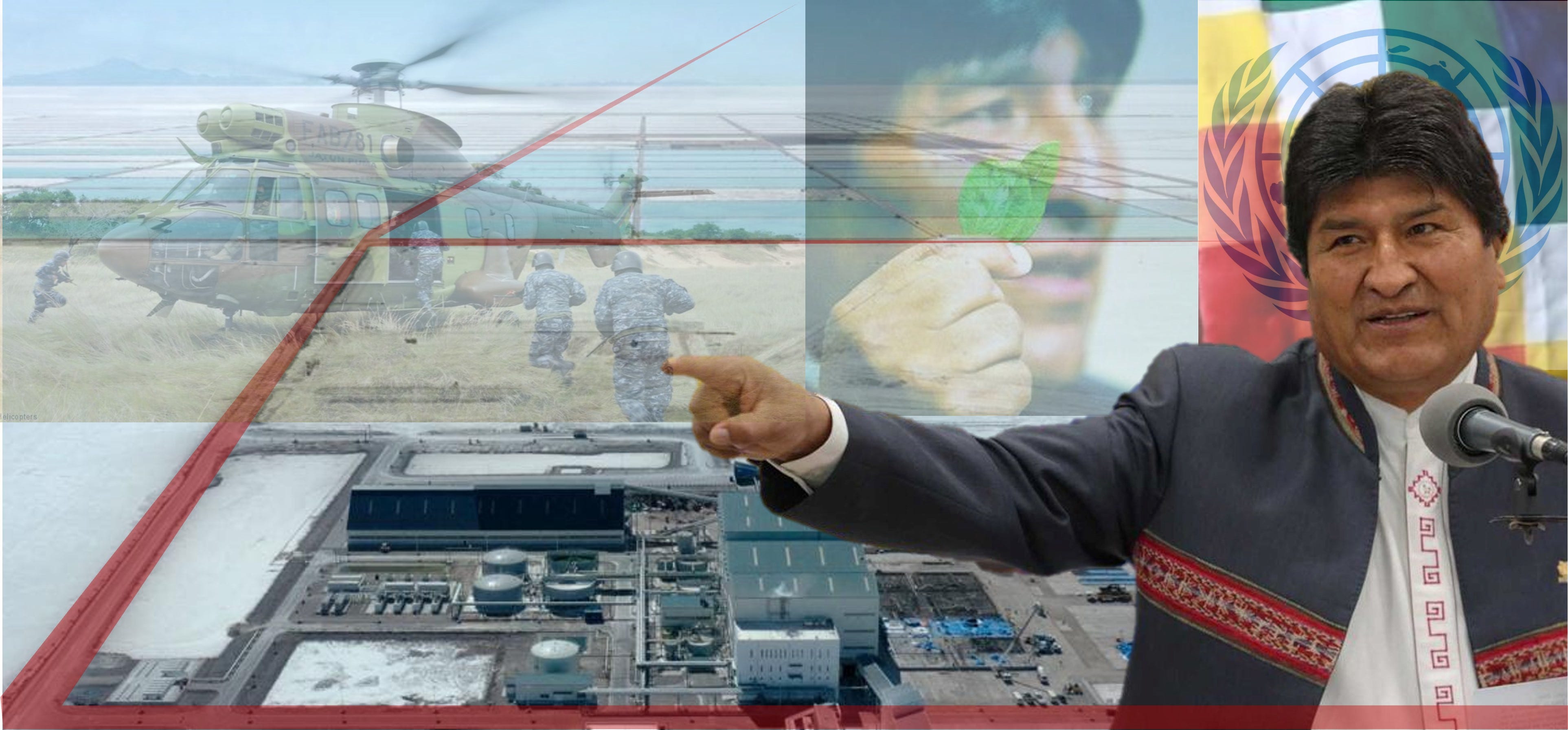
Bolivian Lithium and Planetary Equilibrium
Hello Interactors,EVs made headlines this week as members of the U.S. Congress continue to chase their tail in search of remnants of the Green New Deal. I talked about cobalt last week as a key ingredient for lithium-ion batteries, but a new bill offered by congress this week has implications for another, more obvious, mineral — lithium. The biggest source is in an environmentally sensitive area of Bolivia, and U.S.-Bolivian relations are equally sensitive.As interactors, you’re special individuals self-selected to be a part of an evolutionary journey. You’re also members of an attentive community so I welcome your participation.Please leave your comments below or email me directly.Now let’s go…THE PARADOX OF NATURAL STOCKSToday is the tomorrow you worried about yesterday. These words appeared on a ceramic plaque in the shape of a tea kettle that hung in the kitchen of my grandma’s house. Why do we worry about tomorrow? Is it because we don’t know what it brings? No way to control it? We wake up every day in a past tomorrow living in a future yesterday. Today’s tomorrows are becoming increasingly worrisome on a warming planet that needed help yesterday.Democrats in Washington DC worried about tomorrow focused their action, in part, on Electric Vehicles (EV) this week. As part of the Inflation Reduction Act of 2022, they hope to expand EV tax credits and invent $10 billion in investment tax credits to build clean-technology manufacturing facilities.There’s a provision on the EV tax credit regarding the sourcing and processing of the minerals needed to make the lithium-ion batteries found in EVs. It says, “with respect to the battery from which the electric motor of such vehicle draws electricity,” a certain percentage of the “critical minerals contained in such battery” must be ‘‘(i) extracted or processed in any country with which the United States has a free trade agreement in effect, or (ii) recycled in North America.”This might explain why Treasury Secretary Janet Yellen called for more ‘friend-shoring’ while in Seoul South Korea earlier this week. That’s a term she uses to woo countries into trade practices agreeable to the U.S. She chose South Korea because we need their lithium-ion battery production. In April, LG announced plans for a $1.4 billion battery plant in Queen Creek, Arizona. They are the number two battery producer in the world behind China.The provision isn’t just about the source of the battery, but the source of the materials in the battery. Their key ingredient – lithium – will most likely come from one or more of three countries in Latin America. They’ll need to be ‘Friend-shored’ if America wants to dominate the EV market. The country with the largest and most accessible source, Bolivia, has no shore and recently have not been friendly with the United States.The world’s largest lithium reserves sit in the Atacama Desert which forms a triangulated region known as the “Lithium Triangle”. It sits within the geopolitical boundaries of Argentina, Bolivia, and Chile which were drawn in the 19th century. Bolivia, now home to the largest population of Indigenous people, became land locked when Chile crushed them in the War of the Pacific from 1879-1884. They took away land that gained Bolivia access to the Pacific Ocean. Bolivia lost even more land in the Gran Chaco region to Paraguay after the Chaco War from 1932–35Much of the international law that governs these disputes were written to advantage American and European colonist expansion. They were part of a neoliberal agenda by the global North to ensure the rights of these borders and those legally living within them, but also to exploit their natural and human resources. Latin American countries rich with natural resources were eager to participate in the global economy. Many in these Latin American countries viewed their natural resources as an economic blessing – a way to secure and grow their new nation’s economic prosperity amidst a burgeoning global economy. But for most, it was a curse that invited environmental degradation and poverty at the hands of outsiders. This paradox was observed as early as 1711 in a British publication, The Spectator, "It is generally observed, that in countries of the greatest plenty there is the poorest living." In 1995 economist Richard Auty saw this geographical pattern occurring in East Asia, Africa, and Latin America and gave it a name: ‘Resource Curse’.Auty observes the curse is often explained away by neoliberals as a factor of work ethic; they are simply too lazy to keep up with ‘advanced’ economies or lack the necessary resources. But he says politics are blamed as well. The U.S. has spent centuries of time, energy, and money backing Latin American neoliberal regimes and schemes toward their globalist agenda. Both overtly and covertly and always rhetorically. Authoritatively from the right, ‘Peace through Strength’, or diplomatically from the left, ‘Friend-shoring.’The United States has long env
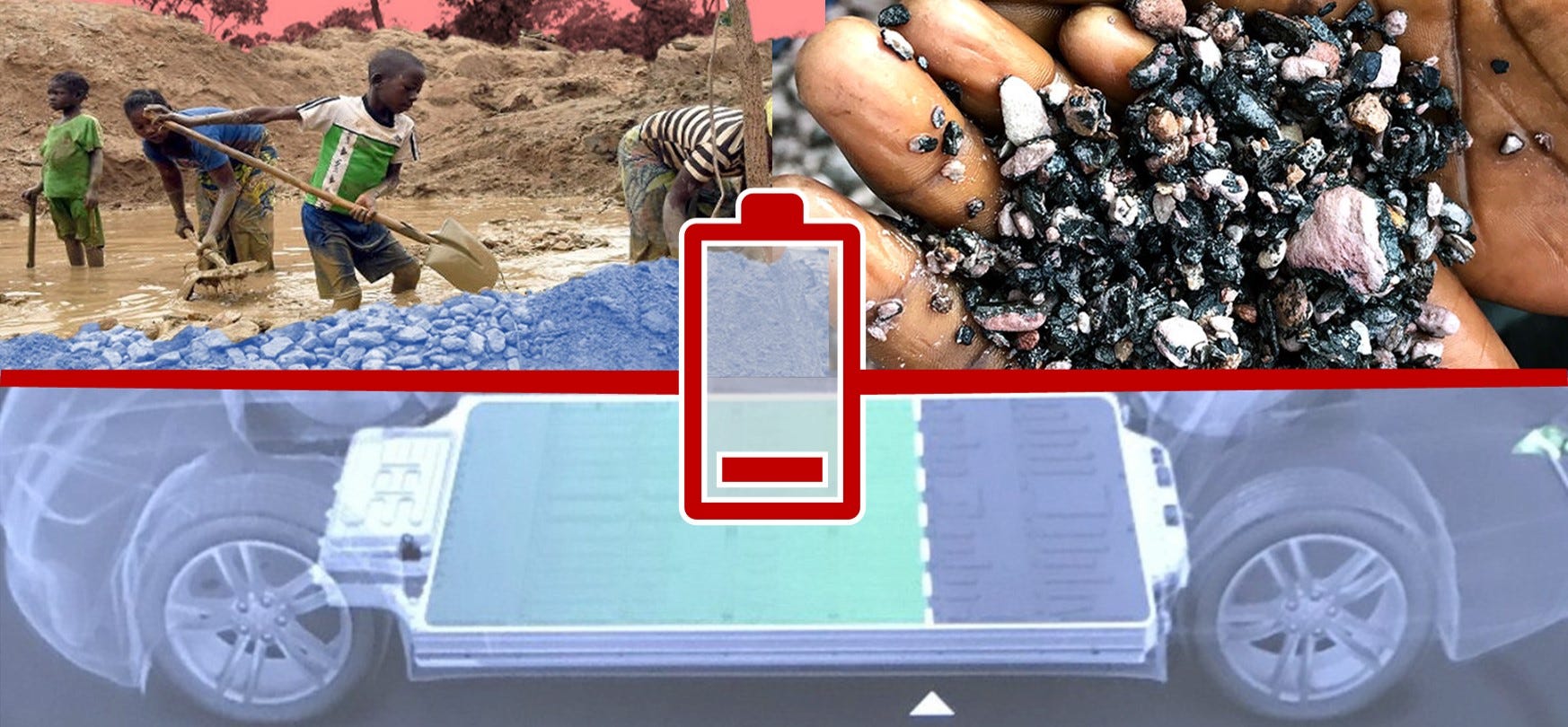
The EV Fairytale Turns to Dust
Hello Interactors,It’s easy to be seduced by the rise of the electric vehicle. I admit I’m a fan. But amidst the glimmer and sheen ugly truths go unseen. Most people pat themselves on the back for switching to an EV, and they should. But don’t pat too hard, there are some evil goblins lurking in those battery cells.As interactors, you’re special individuals self-selected to be a part of an evolutionary journey. You’re also members of an attentive community so I welcome your participation.Please leave your comments below or email me directly.Now let’s go…BLUE FAIRY DUSTIt was 91℉ degrees (32℃), the asphalt 140℉ (60℃), and body temperatures were hitting 104℉ (40℃). The wind was blowing toxic hot smoke in their face. As if a grueling three weeklong Tour de France isn’t hard enough, riders had to contend with record heat and a nearby forest fire this week. The fire had been blazing for two weeks in a southwestern region of France. It had destroyed an area the size of 35 football fields and displaced 34,000 people. And like football fields, these forests are man-made.These pine plantations, nearly one million hectares in all, the largest on the continent, are used to make paper, lumber, and other wood products and chemical biproducts. But they are also carbon stores. Stores so big that when they’re ignited, they become what experts call a ‘carbon bomb’. Because these trees are the same variety, fires spread faster. This makes them not just carbon bombs, but carbon carpet bombs.Carbon stored in these trees are also used to make a liquid bomb, biodiesel. The production of biofuels in Europe, of which Germany and France are the biggest producers, is more commonly derived from used cooking oil and animal fats than plant material. France was already at capacity for growing plants for biofuels. The EU limits the percentage of available land to grow biofuels to protect land for food production and preserve natural habitats. Besides, most believe electric vehicles will be the most and practical way to reduce greenhouse gas emissions while displacing internal combustion engines. Biofuel is likely to make contributions to renewable energy, but it will be small relative to batteries. Of course, batteries have their own issues. And they’re not just environmental.One of the necessary ingredients in lithium-ion batteries that power our devices and cars is cobalt. Cobalt takes its name from Germanic fairytales. A kobald, also a goblin or hobgoblin, are little mythical fairies or sprites. German miners believed they lived in the earth and formed a blue streak when they flew away. Others wore blue striped shirts and some a blue hat. These were called blue caps. When German miners came across blue minerals, they would call them goblin ore or kobald. Today we call it cobalt.This metal is mostly produced through the process of copper and nickel mining. The largest quantities in the world are found in central Africa on the border of Zambia and the Democratic Republic of Congo (DRC) in a string of copper mines called the Copperbelt. An estimated 50-70% of the world’s cobalt comes from the DRC. Over the last ten years global demand has tripled and is expected to double again in the next decade. It’s currently the safest, best performing, and efficient ingredient for powering electric vehicles (EV). But extracting this metal is no fairytale.There are two ways to extract cobalt from the earth’s crust. One is through industrial mining and the other by hand. Artisanal or Small-scale Mining accounts for 20-30% of total DRC cobalt extractions. Cobalt is so close to the earth’s surface it can be easily discovered. In 2014, one man was said to have discovered cobalt digging a hole for his water cistern. Once discovered, it’s not long before others are digging for this blue gold.But handling this mineral is dangerous. And its high market value and availability can lead to human exploitation. In 2015, Amnesty International and Afrewatch conducted interviews with artisanal miners in southern DRC. What they found should give anyone pause reading this on a device with a lithium-ion battery or is a proud of their ‘sustainable’ EV. One woman talked of dragging 110-pound bags (50kg) of cobalt ore up rickety stairs of makeshift mines 32 feet (10m) deep or more – all prone to collapse. Between 2014 and 2015 the UN reported 80 artisanal mining fatalities in the former province of Katanga. They wore no helmets, gloves, or masks – no protective equipment at all. The woman said, “We all have problems with our lungs and pain all over our bodies.”Paul, aged 14, said in 2015 that he started working in the mines at age 12. He said he’d “spend 24 hours down in the tunnels. I arrived in the morning and would leave the following morning.” Some children reported working 12-hour days. If kids did go to school, many would work before and after school and then 12-hours on Saturday and Sunday. One 15-year-old, Dany, said “There is lots of dust, it is very easy to catc
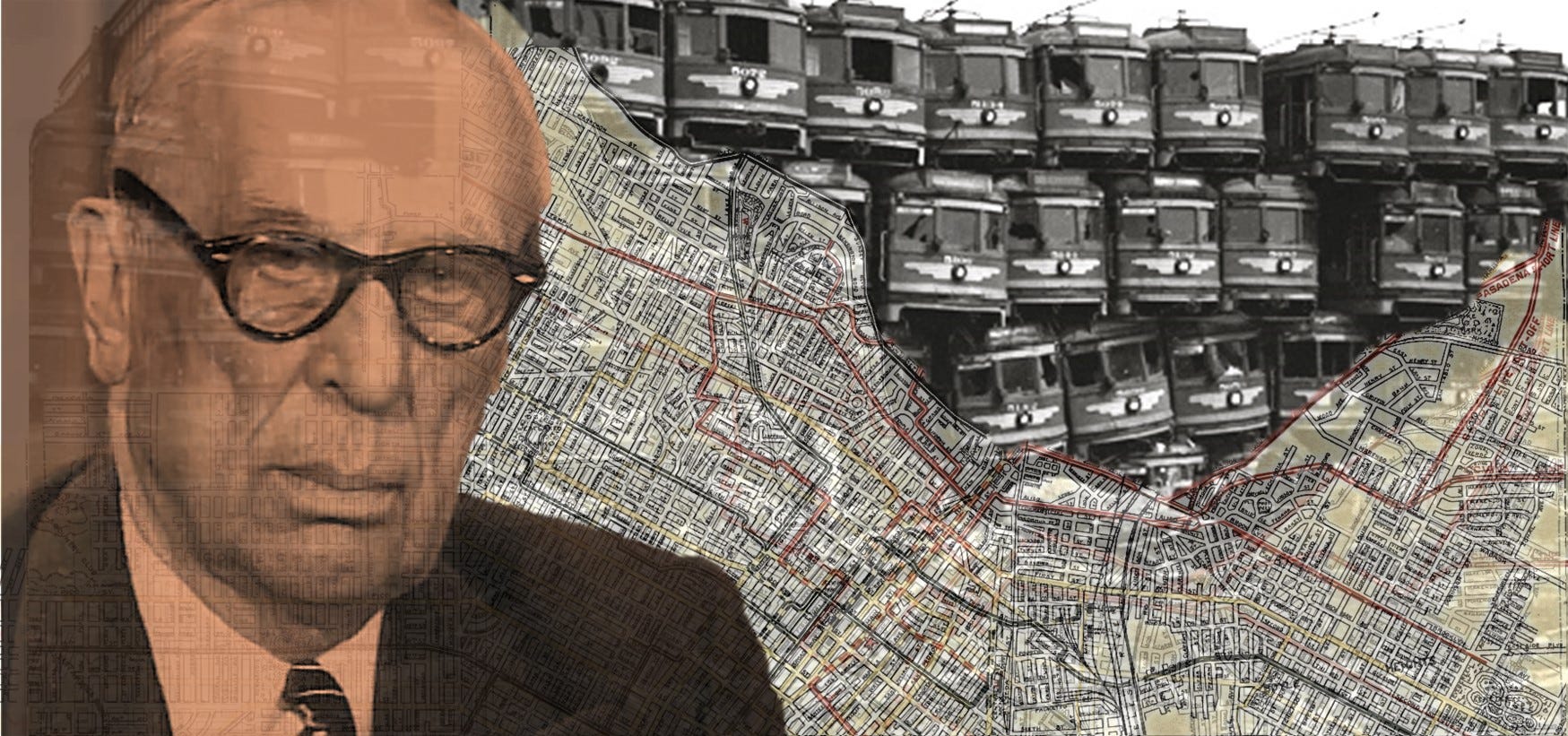
The Genesis of Car Dependency
Hello Interactors,This has been a wild week in our neighborhood. It was a car enthusiasts dream. Too bad our family’s biggest car enthusiast, my son, was busy working his summer job. It was guys like him that got America hooked on cars. And now our planet is cooked. Is it a lost cause? As interactors, you’re special individuals self-selected to be a part of an evolutionary journey. You’re also members of an attentive community so I welcome your participation.Please leave your comments below or email me directly.Now let’s go…GET A HORSEFlying down the freeway I see a woman climb out of the sunroof of her car. She’s alone. A semi-truck pulls alongside as she leaps from the car onto the bed of the trailer. Pulling alongside the car in front of her, I see the driver put on a black blindfold. He crosses his arms across his chest like he’s preparing for a collision. Just then, the truck in front of him slams on their brakes. His car comes to a screeching halt as does the woman’s empty car behind him. The man lifts his blindfold, stares into a camera mounted on his dashboard, and gruffly states, “I guess it works.”This isn’t a stunt I watched on Tik Tok, but a Hyundai Genesis ad from 2015. It starts with a voiceover from the sacrificial stuntman in the lead car, “The challenge is to show the driver assist features in an exciting way. But you guys, it seems, are a little hard to excite. Maybe the only way is to put our own lives on the line. Proof, through jeopardy.”Our neighborhood was blocked off this week to film a Genesis car commercial. Nothing this dramatic, they just drove their luxury cars around the block. They descended a hill that features an unobstructed distant view of the Seattle skyline beyond a glistening blue Lake Washington. Fancy cars in a fancy suburb. A suburb whose name features prominently on the Costco toilet paper most of you wipe your fanny biscuits with – Kirkland. Maybe we’re not so fancy after all, but our neighborhood does have nice views.We didn’t see stunt doubles hurling themselves from the sunroofs of luxury cars that day. In fact, we barely saw a single human being. The windows were tinted black, and the streets were empty, except for the police and production assistants. I stepped on the sidewalk to walk down the street and got yelled at by a Kirkland cop. “SIR! PLEASE BACK OFF THE SIDEWALK!” They, like the drivers, were being instructed by the commercial’s director on a walkie-talkie from inside a customized SUV. It had a massive camera boom stretching from the roof over the front end – like a carrot dangling in front of a mule.The truth is, it’s not just car commercials that wish there were no pedestrians on the street. Anytime any of us get behind the wheel of a car we wish the streets were free of people. And bikes. And, yes, other cars and busses too. It’s no wonder most every car commercial features a single driver on a smooth open road…void of people and cars. What bliss. No worries, no conflicts, no delays, just me on my street going between my house and my Costco to hoard my toilet paper.But believe it or not, people needed to be convinced automobiles were useful – let alone desirable. It wasn’t a car commercial that convinced them of this. It was their neighborhood car enthusiasts. People needed to be convinced of the promise of new machines. Innovation doesn’t just sell itself. Sociologists who study social movements say innovations that shape society are framed by “ideological activists who exploit political opportunities to mobilize resources.” They participate in what sociologists call ‘meaning-work’ which demonstrates their ideology as being meaningful, valid, and appropriate.New industries become broadly legitimized only after these industry activists are successful in converting radical concepts into something useful. Elements of a larger belief system must be framed in the context of daily life. So, automobile clubs organized events that demonstrated the benefits of the automobile. This idea was taken from bicycle clubs of the 1800s who used bicycle races to demonstrate the utility, reliability, and health benefits of cycling. Most automobile clubs were born out of bicycle clubs. Both were elite modes of transport using the latest industrial technology. The first automobiles were simply motorized quadricycles. Those motors were especially useful for getting up a hill.Biking up hills is hard. Biking for long distances requires endurance. And what happens if your bike breaks down? Reliability of both bikes and horse carriages was a big deal. These challenges of everyday life were just what automobile industry activists (i.e. automobile clubs) needed to demonstrate the benefits of an automobile. So, they organized demonstration events that included hill climbs and races pitting one car maker against another to see which was the fastest and most reliable.The first was on Thanksgiving of 1895 financed by the Times-Herald. Eleven cars were invited, five showed up and