Humans + AI
211 episodes — Page 5 of 5
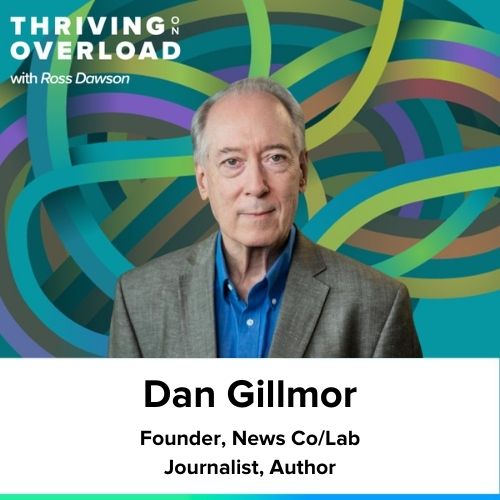
S1 Ep 10Dan Gillmor on going from macro to micro, useful aggregators, and the best tactics and tools (Ep10)
“We need to go outside of our personal comfort zones in all kinds of ways politically, socially, culturally, to have a better understanding of the information ecosystem that we’re engaged in. “ – Dan Gillmor About Dan Gillmor Dan Gillmor has been a media pioneer for decades. He is currently a professor at Walter Cronkite School of Journalism and Mass Communication at Arizona State University. His latest project is News Co/Lab an experimental lab aimed at collaboration to improve the information ecosystem. He is the author of several excellent books including the highly influential We The Media. He has an online course hosted by edX called Overcoming Information Overload. Website: dangillmor.com Blog: Dan Gillmor LinkedIn: Dan Gillmor Twitter: @dangillmor Facebook: Dan Gillmor Book Series We The People Mediactive What you will learn Why getting better information starts with upgrading yourself (03:09) Why we should look for sources of information outside our comfort zone (05:27) How deploying the best current tactics and tools help to deal with the overflow (08:02) What repetition tells you about a story (10:35) Why you should not depend on a single technology (14:09) How to use categories of worth (17:03) Why pay attention to articles that elicit a response from you (20:30) Why information overload is still more pros than cons (23:14) Retain healthy scepticism, not cynicism (27:19) Help the people you care about understand things that are difficult (30:31) Episode Resources Overcoming Information Overload edX Course News Co/Lab Walter Cronkite School of Journalism and Mass Communication Kabul, Afghanistan BBC The New York Times The Guardian The Wall Street Journal The Washington Post Pinboard QAnon Transcript Ross Dawson: Dan, it’s a delight to have you on the show. Dan Gillmor: Thanks for having me. Ross: So information overload is a special topic of yours, as you’ve taught it amongst other things. Dan: Yeah it’s something I’ve been looking at for quite a long time. It stems from recognizing that media is democratized, the technology is democratized, so that it’s in everyone’s hands, that everyone can participate in public conversations, as well as private ones, and one result of that is a massive amount of information, and we have to sort it out. Ross: Absolutely. We can look at it as a systemic problem, as in, there are certain things which we could, and maybe should, do to address it in terms of a systemic problem, but ultimately it comes down to us as individuals, we have to deal with the reality of this profusion of information, correct, incorrect, spurious and relevant. Dan: Yes, we do. We need to get the help of players in the ecosystem that are powerful, and that could help us a great deal. Ross: Just for a moment on that, who are the players? And what can we do? Dan: My philosophy on all this is that we need better information, no doubt about that. When I think of that, I think, in part, in the journalistic sphere, that we need a lot better journalism than we have, and trustworthy sources of information. That’s a supply-side question. While we do need to upgrade supply, what you’re getting at is that we need to upgrade demand. I believe, and my work has been focused on upgrading demand at scale, which is to say, we need to improve us, we need to upgrade ourselves. Scale requires help from major institutions in our societies, starting with the education that is at all levels, continuing on to media, which brings scale to information; journalism, entertainment should be playing a role, advertising, public relations, and others should be part of the bringing upgraded demand scale. Then finally, the institutions that pretty much define scale in the modern world, the technology, media companies, which need to do a lot more than they have been doing to help us be better ourselves as individuals and in our communities. Ross: Absolutely agreed. I do want to get to what you do, personally, as an exemplar of this. You mentioned education. I think education is, of course, lifelong. This is not just throughout our formal schooling, and it has always befuddled me why they never teach us to deal with information since that’s basically most of what we do through our lives. What would you say, at any level of education are the things that we need to be learning to be better at using the information that we have. Dan: I think it falls in two areas. One is principles, which really don’t change much, things of basic common sense, but which we need to restate periodically, so we’re clear. One is that we need to be skeptical of everything, but not equally skeptical. Use judgment to find things that we have reason to trust more than not. I think it’s a mistake to trust anything 100%, but there are many things I trust implicitly, and I trust them, even more, when they make mistakes, because they correct them, and tell me they made mistakes. Then we need to ask questions, which people don’t do very often, which the
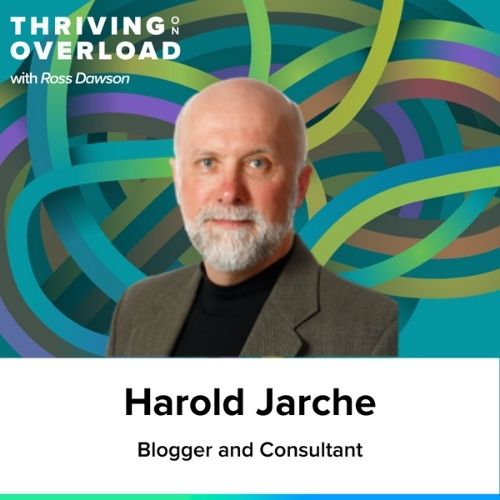
S1 Ep 9Harold Jarche on personal knowledge mastery, the Seek, Sense, and Share framework; networked learning, and finding different perspectives (Ep9)
“Choose the sources that are going to disconfirm what you think. You need to have the people who are going to challenge your thinking so you don’t go down a single rabbit hole. That’s the trick. That’s the art in doing this. “ – Harold Jarche About Harold Jarche Harold Jarche has been an independent consultant for the past 20 years working with individuals, organisations, and governments to improve collaboration, knowledge sharing and sense-making. He is the author the Seeking Perpetual Beta e-book series and runs the very popular Personal Knowledge Mastery online workshops. In this episode, Harold shares his Seek, Sense, and Share framework; insights on network learning, finding different perspectives, and far more. Website: jarche.com Blog: Harold Jarche LinkedIn: Harold Jarche Twitter: @hjarche YouTube: Harold Jarche Book Series Seeking Perpetual Beta What you will learn What is Personal Knowledge Mastery (01:33) How is Personal Knowledge Mastery different from Personal Knowledge Management (04:26) What is Networked Learning (07:26) What is the Seek, Sense, and Share Framework and its practice (10:35) How the Seek process helped Harold make sense of Covid (22:22) Why he chooses sources that contradict what he thinks (26:02) How to make sense of complex issues with many diverse opinions (28:56) What is Harold’s daily routine (32:35) How to synthesize and add value to information (38:20) What is the difference between networks and communities (43:33) Episode Resources Lilia Efimova Denham Grey IBM Dave Pollard Ernst & Young Domino’s Pizza Citibank Valdis Krebs Dr Trisha Greenhalgh Perpetual Beta Coffee Club Feedly Pinboard Bloglines Jony Ive Sturgeon’s Law Transcript Ross Dawson: Harold, it’s awesome to have you on the show. Harold Jarche: It’s great to be here, Ross. Ross: We’ve known each other for a long time. One of our common interests has been what you have framed as personal knowledge management, or in your case, personal knowledge mastery. Can you explain what personal knowledge management is and how you came to that? Harold: It started when I started freelancing, which was in 2003. One of the challenges I had is that I live in the middle of nowhere; I’m about 1000 kilometers from Boston no or Montreal and major cities, I live out in the Atlantic, Canada. One of the challenges I had was, how do I stay current in my profession? How do I stay connected to people? And how do I not spend a whole bunch of money? I came across the work of several people, particularly Lilia Efimova, who was doing her doctorate about knowledge sharing through blogging at the University of Twente, Netherlands. There are a few other people who were talking about that, at that time, Denham Grey, who was working for IBM, Dave Pollard, who was working for Ernst and Young as the Chief Knowledge Officer. I was reading their stuff. I saw, particularly with blogs, because that was the technology of the time, that it was possible to connect with people without actually having to see them, without having to travel or anything like that. My budget was pretty well close to zero for travel. I started writing about PKM, just on my blog and sharing it mostly for myself, because I really didn’t have much of a readership. What transpired over time, was that I started taking a look at the discipline of how do we make sense of our knowledge, of our experiences? How do we build knowledge networks? How do we have others help us make decisions? How do we understand the constant flux of, which is increasingly more so today, of information, and particularly disinformation over time? I basically was writing for myself. I was putting it on the blog and basically just talking out loud to nobody. But several years later, probably, I’ve been writing about it for at least five years, I was contacted by the fellow who’s in charge of leadership development at Domino’s Pizza. He said this is really interesting stuff you’ve been writing about. Do you think that we could incorporate what you’re doing, and use it in our leadership training? I went to Domino’s head office, and we worked on this for a period of time. It was when the light went on that this is a thing that could help a lot of people. I kept working on the model and putting stuff out there. I had a whole bunch of half-baked ideas, which really was the process of PKM. I came up with a higher framework, using the alliterative terms of Seek, Sense, and Share, and then shifted from personal knowledge management to personal knowledge mastery, because I did not want to be directly linked to the knowledge management world, which was still very much about codifying information and pumping it out to people, whereas PKM is the opposite, it is people making sense, and then floating it up, sharing it with others, and what emerges from those conversations and relationships, then, is that shared knowledge base. It’s been 14 years or so that I’ve been working on that. It’s a work in progress. But now
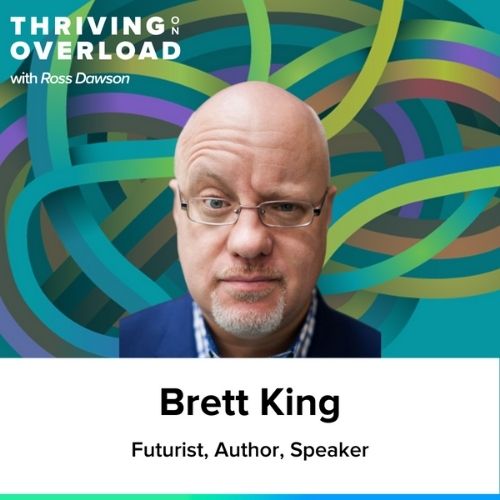
S1 Ep 8Brett King on understanding fintech, writing for sense-making, thought leadership streams of consciousness, and changing how people think (Ep8)
“What is the technology that can solve homelessness? That can make high quality health care accessible to all? I believe that is the world we should be creating.” – Brett King About Brett King Brett King is a world-renowned futurist and speaker, an international bestselling author, and a media personality who covers the future of business, technology, and society. Brett hosts the world’s #1 ranked radio show on FinTech, “Breaking Banks” with 7 million listeners, and is the Founder and Executive Chairman of Moven, a successful mobile start-up, which has raised over US$47 million. His books have achieved bestseller status in 20 countries, with his latest book on how to shape the post-Coronavirus world The Rise of Technosocialism, just out. LinkedIn: Brett King Twitter: @BrettKing Facebook: Brett King YouTube: Brett King Medium: Brett King Books The Rise of Technosocialism Augmented: Life in The Smart Lane Bank 4.0 Bank 3.0 Bank 2.0 Breaking Banks Branch Today, Gone Tomorrow What you will learn He gets as much as 1,300 emails daily (03:08) Relationships and paying it forward is important to him (04:03) But you learn to say no in a nice way (07:35) Making sense of rapidly changing FinTech starts at 30,000-foot view (09:08) He keeps an eye on application technology and user experience (15:25) He predicted the move to mobile wallets but not QR codes (18:31) It all started with a blog… (21:50) …having a thesis… (25:15) …and a strong purpose (27:40) Join the conversation and find the value in yourself (33:08) Episode Resources Moven Breaking Bad Wise Aristotle Sibos Innotribe Vitalik Buterin Ethereum Jehovah’s Witness Transcript Ross Dawson: It’s awesome to have you on the show, Brett. Brett King: Anytime we get together and talk, it’s always interesting. Ross: Absolutely. Brett: Thanks, Ross. Ross: You keep across amongst many other things, the edge of FinTech, and far more actually, which we’ll probably get to, and that’s a pretty fast-moving field. How do you keep across change and make sense of it, and understand what’s going on in this rapidly changing space? Brett: The sheer volume of what’s happening in FinTech now means that I can’t keep across everything, but I can keep across stuff thematically that has emerged over the last 13 years or so since FinTech was a thing. I’ve been running a podcast for eight years, and that’s in the FinTech space. We’re always interviewing startups and players in that space, so that’s a good way to keep you on top of the news, actually interviewing people. Then I have a close group of friends who back in the 2008, 2009, 2010 timeframe, were the early content creators and curators of FinTech related content. Now, they have big followings, so keeping track of what those guys are talking about also helps from a macro perspective. Where I sort of fail is on the email side. I’ve now got to the point where emails are almost totally useless for me because the volume of emails I’m getting is unmanageabple. I do tend to rely on people messaging me through LinkedIn or Messenger or WhatsApp or text or Twitter direct message, rather than emailing me, just because the volume of content I get through there is now too much to manage. 1200, 1300 emails a day at peak; you just can’t go through that many emails every day. There’s some stuff that I do better than others, but the curated Twitter feed, and the lists I’ve got within Twitter help me hone in on the core news that’s affecting the industry. Ross: Starting off with talking about the relationships; Relationships are the people you know from way back, and you cannot just follow them on Twitter but have conversations with them, and reaching out to people who want to be interviewed on your show, and building the relationships there. I think part of this is around the quality of the relationships as well as who it is you know? Brett: Yes, absolutely. That’s true; having people that trust you to deal with their message properly, when you’re in the public space, like I am, as someone that has been a foundational podcast on the FinTech side. The podcast called Breaking Banks came out, not long after the Breaking Bad TV series, you can see why we named it the way we did, but being sort of a vehicle for these people to talk about their startups, express their opinions, and so forth, early in the space gave me some credibility there as a team player. I’ve also been very serious about paying it forward. I’ve been successful in this space, because of a lot of people who’ve got behind my message and amplified it and so forth. I’m also very aware of my responsibility to do the same for them, so I try and make sure that I’m a good social media partner for these people as well, and can help them get their message across when required or needed, so then when I go and ask them to help me out on occasion or ask them for some input, they’re quite open to it. I think it is very much that when you’ve got a network like that, you have to keep that network nour
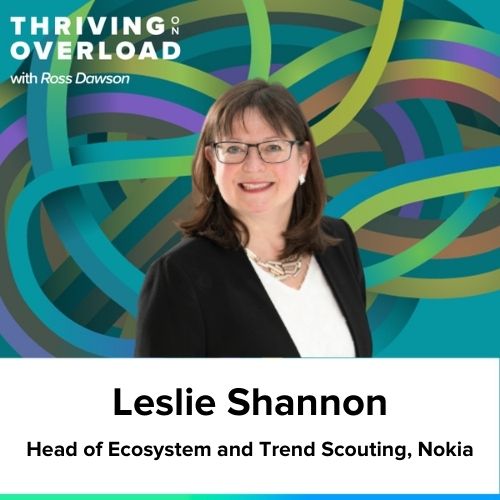
S1 Ep 7Leslie Shannon on finding nuggets, storytelling for synthesis, the five Fs of sensemaking, and visual filing (Ep7)
“Information can pass through your head all day long, but unless you can capture it and put it on a shelf somewhere, it didn’t mean anything. It’s the capturing and putting on a shelf so you can find it again, that’s the important part.” – Leslie Shannon About Leslie Shannon On this episode, we learn from Leslie Shannon, Head of Ecosystem and Trend Scouting for Nokia based in Silicon Valley. Her work involves examining new technologies and how they will converge through this decade. She is a five-time undefeated winner on the US game show Jeopardy and racked up many successes on Who Wants To Be A Millionaire. LinkedIn: Leslie Shannon Twitter: @lshannon45 Facebook: Leslie Shannon What you will learn What Leslie Shannon’s typical day looks like at Nokia… (01:49) …and as a collector of trivia (02:50) She uses flashcards and PowerPoint to remember stuff (03:59) Her PowerPoint presentations can go as large as 400 slides (7:45) Sometimes it doesn’t happen the way she expected and that’s ok (11:07) Every new solution is the kernel of the next problem (12:29) You always have to ask new questions (13:24) A lot of technology is looking for a problem to solve (14:02) Find, Filter, File, Familiarize and Formulate (15:56) Leslie’s routine that involves a lot of unsubscribing (20:43) It’s an exercise in imagination…(23:44) …and connections (27:34) Find the system that works for you (31:30) Episode Resources Unsubscribe-A-Mole Connections (BBC Documentary) Transcript Ross Dawson: Leslie, it’s awesome to have you on the show. Leslie Shannon: Ross, it’s lovely to be here. Thank you much for asking me. Ross: You are definitely on top of lots of new information, both as in your job, as a professional trend scouter for a global organization, and also as a very successful competitive trivia person. How do you do it? Leslie: It does take a lot of mental discipline. Just to explain a little bit about both the job and the trivia side of things, in my role as a trend scout, I’m physically located in Silicon Valley, and my role is to look for new technology. I’m in the telecommunication space, so new technology that will come at some point in the future requires some kind of telecommunication support. I find all these little nuggets of things that small companies are doing, big companies are doing, then I think of them as building blocks, and then I weave them together to build these imaginary castles of what’s going to be possible in the future. If this company is doing that, and that company is doing that, and this other company is doing that, we can imagine a future in which this amalgamation of all of these different new things is possible. Then I tell that to the people within my company, so they can plan what’s coming. I tell that to our customers as well, so they can plan how to design their networks for what the future is going to bring. Then on the trivia side, constantly, every single day, my antennas are up. What is the fact that I didn’t know? Then I note it, and again, in order, to remember it, I have to weave it into something. If it’s historical, some narrative that my brain has for the history of the world, or I have to have some mnemonic, I have to hang some kind of tag on it, so I can retrieve that information later. Weaving it into the stuff that’s already there is the easiest way. Both of these methods require finding information, filing it in a way that I can retrieve it, and then using storytelling or some kind of synthesis to make sense of it, and then communicate that sense to others. Ross: Wow, it sounds like a fun life. Leslie: It actually is. The thing with trivia is that you need to review it constantly to keep things fresh. There’s an app on the smartphone, it’s a flashcard app that a lot of people in competitive trivia use. Every time I see something new, I make a flashcard about it. I’ve got over 20,000 flashcards now. The key is actually to keep revealing them and to keep reviewing them. Similarly, when I find a new innovation, that I think, oh, okay, that’s really interesting, I make a PowerPoint slide out of it, because my means of communication is PowerPoint presentations, either internally or, to others. A picture is worth 1000 words. If I’m talking about new technologies and if I’m just talking, people will go, yeah, whatever; but if I’m showing a picture of the thing that I’m talking about, oh, that’s concrete, maybe that really is going to happen. To keep reviewing the actual slides that I have, in both cases, I have a file, I’m continually reviewing what I have, continually refreshing the narrative in my head, and refreshing my understanding, so that it doesn’t get old, it continues to stay fresh, and the new information is continually assimilated, and incorporated, which also means continually questioning my own assumptions, which is actually very important as well. Ross: That is beautiful. Let’s look at the PowerPoint slides. I have two questions. Is there a particular format for the slides?
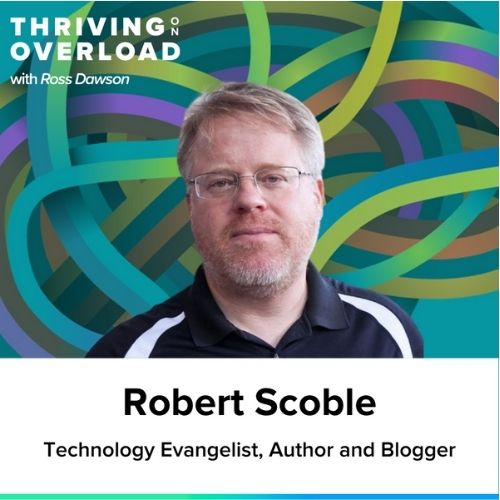
S1 Ep 6Robert Scoble on how to find the latest news, how to use Twitter for insight, finding the 20 people you need to follow, and the value of conversations (Ep6)
“If you’re an executive at a company, and Bill Gates is calling you going, What the hell’s going on? And you have the answer, you’re going to get called more.” – Robert Scoble About Robert Scoble On this episode we learn from technology evangelist and author Robert Scoble whose work as a blogger and communicator for Microsoft, Fast Company, Rackspace, and others has truly shaped the evolution of social media. He is the author of 4 books about technology including ones dedicated to AI and spatial computing. Find out how Robert is always the first to know about what’s coming in consumer technology. Blog: scobleizer.blog Facebook: Robert Scoble LinkedIn: Robert Scoble Twitter: @scobleizer Instagram: @scobleizer YouTube: Robert Scoble Books The Infinite Retina The Fourth Transformation Age of Context Naked Converstations What you will learn How Robert keeps up to date on the latest technologies (01:33) A lot of information also means a lot of noise (03:29) So be selective on whose Tweets you listen to… (06:22) …because Twitter is still the best place to get information (07:16) Why you should get off social media as fast as you can (12:13) Watch your blog’s comments section for interesting people (14:12) Speed matters (16:30) Where Robert got his start (21:36) His routines and structures (25:27) He keeps his focus and says no to everything else (28:56) You need to think of what’s going to happen in 5 years (31:51) AI is changing everything (35:30) Episode resources Robert Scoble’s Twitter Lists TweetDeck Gary Shapiro Consumer Electronics Show (CES) Consumer Technology Association (CTA) Andrej Karpathy Lynda Weinman Pottery Sebastian Thrun Transcript Ross Dawson: Robert, it’s fantastic to talk to you. Thank you so much for joining us. Robert Scoble: Hey, thank you much for having me on the show. Ross: Since I’ve heard about you a very long time ago, you’ve always been on the very, very edge of new technologies and what’s going on. How do you do it? Robert: 40 years of community building online, that’s part of it. For people who don’t know what I’ve done, if you go over to Twitter, you can see my TweetDeck. I have about 70 different lists, all raining down like the matrix. This is something that every listening team at a corporation uses. They watch a wide variety of people online, and new sources and things in real-time, and they can respond to that in real-time. I was part of the listening team at Rackspace for seven years and helped them quite a bit with figuring out who to listen to, and how to deal with the information flows. Ross: Let’s dig into that. How do you build your lists? And how do you keep scanning? Robert: Thousands of hours of OCD. There are different ways to look at this. If somebody needs to learn something from scratch, I’ll have one set of advice. If you told me I have two years to learn everything there is about artificial intelligence, I’d take you down one path. If you’re already up to date on artificial intelligence, and you’re already working at a tech company, you’re already working at Tesla or Apple, building AI systems, then I’ll have what I’ve built, which is a system to keep you up to date and refreshed. We could probably come out in both areas. Ross: I’m interested; since we’ve got probably people of both groups listening, let’s look at both parts. In a way, we’re really looking at those who already know the basics and saying, Okay, what’s new? What’s changed? Robert: That’s getting a little easier now; particularly on Twitter, there is a search engine. Now you can type artificial intelligence into the search engine, and you’ll see anybody who says artificial intelligence on a tweet, it’d show up on that stream, on that feed. That’ll lead you somewhat to the right place. But the problem is, now you’ll get a lot of noise, a lot of trolls, a lot of advertising, a lot of things that have nothing to do with artificial intelligence. Or if they do, they’re from people that you probably don’t care about, and probably on topics you don’t care about because you’re already fairly advanced on artificial intelligence; you’re not just trying to learn about the space and build your own list; you’re trying to stay up to date on the advanced stuff. For me, that’s when you start really building your own lists, and you have to get to know people who you’re listening to. That takes time, or you can steal my list. Ross: You can very generously share. Robert: I built a list on artificial intelligence, one on computer vision, and another one on autonomous cars for this reason. But if you don’t know who you’re listening to, you’re still going to get a lot of noise and a lot of fluff. Filtering out that is really tough. Ross: You share all your lists, so everyone can benefit from all of your work in building them. Robert: Yes. Ross: Of course, the people might prioritize different people in the list or have other people they think of or different ways of framing it. Robert: What I would recommend is you s

S1 Ep 5Jerry Michalski on collecting, connecting, and curating two decades worth of information (Ep5)
“I have this wish that more people will come forward to collaborate in building up some infrastructure for what we know, that we might use together to make better sense of the world.” – Jerry Michalski About Jerry Michalski On this episode we learn from the incredible connector Jerry Michalski. His fascinating career is hard to summarise, playing a central role in the emerging digital economy as long time managing editor of Esther Dyson’s Release 1.0 newsletter. He is now leader at the Relation Economy Expedition (REX) as well as an advisor facilitator and speaker at the Institute For The Future with a deep focus on trust and relationships Website: jerrymichalski.com Medium: Jerry Michalski LinkedIn: Jerry Michalski Twitter: Jerry Michalski YouTube: Jerry Michalski What you will learn How the word consumer started his journey to collaboration (02:21) He still uses a 23 year old software called TheBrain (05:45) Why he is sharing his brain… (17:47) …and it’s the only asset he will pass on. (20:01) How and why he’s building a more collaborative brain (21:26) Delicious still has no successor (23:54) What information sources does Jerry use (27:18) In spite of all his information, he feels less overwhelm (31:36) On connections and serendipity (33:51) His routines and structures (36:01) He has a collection of mental models and thinking frameworks (38:54) OODA loops and virtous circles (42:12) Being a pattern hound (44:04) Using dialogue to enhance his and collective models (47:56) Episode resources TheBrain Open Global Mind Kumu Miro Nassim Taleb Henry Molaison Nicklas Luhmann Delicious David Allen GTD Connections TV series Farnam Street John Boyd OODA Loop Episode images The images below are referenced during the conversation with Jerry. Contrarians Who Make (or Made) Sense https://bra.in/4jrdQp David Bohm (1917-1992) https://bra.in/9jrB85 Virtuous Circles and Vicious Circles https://bra.in/5vB5Ja OODA Loop (Observe, Orient, Decide and Act) https://bra.in/7pDkZn Useful Thinking Frameworks and Mental Models https://bra.in/8vPM9p Design from Trust (DfT) https://bra.in/9jYPAq Types of Accident https://bra.in/8vm7QZ Transcript Ross Dawson: Jerry, it’s a great pleasure to have you on the show, Thriving on Overload. Jerry Michalski: It is a great pleasure to be here, and it’s nice to have a chance to talk with you as well. Ross: Yes, it’s been too long. I’ve got to say you’re certainly one of the very first people that sprung to mind when I thought about people who are excellent at thriving on overload. Jerry: I love that. Thank you. Ross: We’ll try to go through in a little bit of the frame we have around Thriving on Overload; firstly around purpose. In a world of information, how have you developed the clarity of filtering information, or how do you find what’s relevant to you? Where does that come from for you? Jerry: I can point to two things. One of them is an insight, and the other one is an accident. A long time ago, both of the events happened within a couple of years in the mid-90s, when I was a tech industry trends analyst; not a Wall Street analyst, I don’t care what next quarter’s earnings are going to be, but is AI going to kill us or save us? Or where should we apply neural networks? Those were the things I was looking into back then. The thing that was an insight was one day, there were a couple of briefings I can point to when I suddenly realized that I didn’t like the word consumer. At the time, I was working for Esther Dyson, who was the doyen of the tech industry. I said, Hey, this word bothers me, and she said it’s just a term of art in the ad business. My little inner voice, which I’ve learned to listen to a lot, said, Hey, no, there’s something much more profound going on here. Word consumer is a symptom of a much deeper problem. This is my advice to young people, pay attention to that little inner voice, because really often it’s giving you a very good clue. For me, it gave me the clue that we’ve consumerized our world that involved the whole series of breaches of trust, and that whole mission took me deep into the notion of trust. I have a whole bunch of things I’ve thought about, which are weirdly about institutional design around trust. If you wanted to create a high-performance, high-trust team, I can point you to other people; that’s not my issue, but really, why did we design our whole world around mistrust, is the question. That was the insight that led to a quest, to a path of inquiry for me that is rich and live to this day. Then the accident, the serendipity was that back then I was writing Esther’s newsletter, and I decided to write about bookmark management & mind mapping. I’m not sure why I picked those two things. This was back in the early days of the web, and browsers, and all that. Even back then everybody knew that the bookmark feature in your browser sucks, and nobody uses it, so what else might we
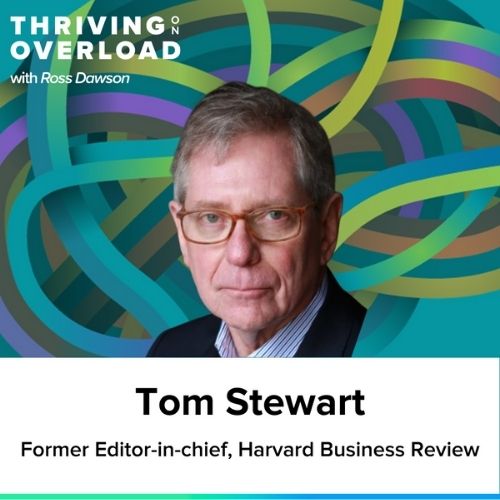
S1 Ep 4Tom Stewart on the excitement of ideas, building overarching theories, abductive reasoning, applying Marie Kondo to information, and getting off the hamster wheel (Ep4)
“When you have a framework, you can plug things in, and the things that you plug in matter less than the framework.” – Tom Stewart About Tom Stewart On this episode we learn from Tom Stewart who’s had a far-ranging career immersed in information and ideas. After his early career in publishing, he became a journalist for Forbes magazine leading to his breakthrough book Intellectual Capital in 1997. He went on to become editor of Harvard Business Review for six years, and chief marketing officer of Booz & Company. He is now the Chief Knowledge Officer of AchieveNEXT. His most recent book is Woo, Wow, Win: Service Design, Strategy, and the Art of Customer Delight. LinkedIn: Tom Stewart Twitter: @thomasastewart Books Woo, Wow, Win: Service Design, Strategy, and the Art of Customer Delight Intellectual Capital: The New Wealth Of Organizations The Wealth Of Knowledge: Intellectual Capital and the Twenty-first Century Organization What you will learn How successful people stay on message (02:31) Why Tom is in love with big ideas (05:46) How he pioneered a new trend in book publishing. (08:37) How Tom got started writing about a new idea called intellectual capital (09:30) Why the value of information is in doing a Marie Kondo (10:41) The Michelin guide as an example on how big ideas frame smaller ones (12:16) The 3 kinds of thinking and why abductive thought leads to ideas (19:41) Speaking and debating is a way of processing information (24:09) Peter Drucker learned by listening to himself (25:26) Routines and blocking time on the calendar (28:41) Writing isn’t always with a pen or keyboard (30:01) Filtering information is about going to the right person (32:42) How to thrive in a world drowning in information (36:15) Episode resources The Harvard Business Review The 8 Step Process For Leading Change – John Kotter Abductive Reasoning Fortune Magazine Marie Kondo The Michelin Guide Peter Drucker The Evelyn Wood Seven-Day Speed Reading and Learning Program by Stanley Frank Transcript Ross: Dawson: Tom, it’s an absolute delight to have you on the Thriving on Overload podcast. Tom Stewart: Ross, it has been far too long since we’ve seen each other face to face, although we’re not seeing each other face to face. So, pixel to pixel, I guess. But it’s wonderful to be here with you. I guess the last time you and I were together was in Manhattan, I think, somewhere in the West 20s. But I remember a lunch with you in Sydney Harbor a few years ago, that was one of the most perfect days and a perfect lunch. It’s good to see you again. Ross: Absolutely. Tom, you have thrived on information throughout your entire life. I first knew you as a journalist. Obviously, you’ve taken that far beyond that, editor at Harvard Business Review and many other roles. As a starting point, what is it that helps you frame what information is useful to you, is relevant to you, as something you should be paying attention to? What is the bigger frame or the purpose or the objectives or the expertise you’re trying to develop which helps you frame that? Tom: I remember seeing once the then CEO—I can’t remember which Houghton it was—who was the CEO of Corning, I was interviewing him at Fortune. It was one of the first CEO interviews I had at Fortune. I remember him sitting down at the interview and he had a piece of paper at his right hand. He wrote down three or four words on that piece of paper. Those were, I realized later, the three or four messages he wanted to work into whatever answers he was giving to my questions. I had a bunch of questions to ask; he had a bunch of themes he wanted to make sure were woven into that answer. I realized this was good media training on his part. I also realized later, when I read the work of John Kotter—now Emeritus as Harvard professor—who wrote a wonderful book called The General Managers, he shadowed a bunch of general managers and found what they did. He found that each of those successful general managers had three or four load stars, three or four issues, three or four things—like the things that Jamie Houghton had written down—that they attach their actions to. “I’m trying to drive the organization forward on these three areas. So, whatever you bring to me or whatever I read in the newspaper or whatever my customer says to me, whatever it is, I try to hang these things like baubles on a Christmas tree around these themes.” Now, I don’t know that I’m that way. Personally, when I got into the business of business, before I went to Fortune, I had been nearly 20 years in the book publishing business. I was an editor. I was commissioning books. If you asked me what kind of books I was the best editor for, I’m not sure I would have understood the question. I was a magpie. I like this, I like this, I like the other thing. A little, nagging voice kept telling me, “You really ought to focus.” Even though a good publisher’s list is eclectic and has many different books and different types on it, there wou

S1 Ep 3Nir Eyal on using your values to filter, when to consume information, the best apps for content, and using audio for reading (Ep3)
‘’Determining what information is important to you starts with your values.’’ – Nir Eyal About Nir Eyal On this episode we learn from Nir Eyal, who writes, consults, and teaches about the intersection of psychology, technology, and business. He is the author of two bestselling books, Hooked: has sold over a quarter of a million copies and heavily influenced the tech industry and Indistractable which has been named best business book of the year, among other accolades. Website: nirandfar.com Facebook: Nir Eyal LinkedIn: Nir Eyal Twitter: @nireyal Instagram: @neyal99 Books Indistractable: How To Control Your Attention And Choose Your Life Hooked: How To Build Habit-Forming Products What you will learn How to turn your values into time (04:47) You absolutely can multitask as long as you multi-channel multitask (09:22) A process to make sense of all the information that you consume using Pocket, emailing yourself, and Evernote (09:57) Use tags to efficiently file ideas (15:22) Any endeavour is hard work, and you can’t wait for inspiration to strike (17:44) Once your schedule is set, follow it (20:11) The opposite of distraction is traction (21:05) Being Indistractable means understanding why you got distracted and doing something so it doesn’t distract you in the future (23:30) Call yourself Indistractible because doing so actually empowers you (24:29) The 4 steps to becoming Indistractable (25:55) Episode resources SaneBox Pocket Evernote Transcript Ross Dawson: Nir, it is an absolute pleasure to have you on the show. Nir Eyal: My pleasure. Thank you so much. Ross: I think you are a wonderful exemplar of thriving on overload. You are able to create wonderful books to gain deep insights into what’s happening in the world. How do you do it? Nir: It’s not easy. I don’t know anyone who says it’s easy, but I will say that I wouldn’t have it any other way. I think we should start, first of all, by reframing this idea that sounds pejorative, information overload as in incredible blessing. Ross: Absolutely. Nir: We have the luxury to have information overload. I would much rather live in an age today where the world’s information is at my fingertips than in past generations, where the seat of power and influence was how much information you had access to. Now, we are drowning in information, we have so much information. Now, the scarce commodity is our ability to make sense of all that information, and make sure that it doesn’t divert us and distract us into things that are not congruent with our goals and our values. But starting off, it’s a wonderful thing; that past generations, spent a lot of their time very bored, and we don’t have that problem. Ross: You’ve got to the entire thesis of what I’m doing. Nir: Is that right? Ross: Yes. This is an opportunity. Nir: Exactly, it is a huge opportunity, but opportunities also present challenges. It’s really the people who are able to rise to this occasion, people who can make the most of all this information are really the people who will succeed in the century to come. This ability to make sure that we harness our time and attention properly is a super skill. A lot of my research is around distraction, and my book “Indistractable” is all about how to control your attention and choose your life. This is definitely something that’s near and dear to my heart. Ross: I want to dig into what you do. Obviously, we’ve learned what you do quite a bit from your book, and we wanted to hear, and learn from that. But in terms of just information, I think, part of it is scope. What is the purpose? What information is going to be useful and relevant to you? How do you start off by framing that as to what information is going to be relevant to you, and how you seek it and find it, or make it come to you? Nir: Determining what information is important to you starts with your values. What are values? I define values as attributes of the person you want to become. You have to ask yourself, how would the person I want to become spend their time? That’s how you define your values. Now values, by the way, are very different from things you value. Money is not a value. Why? Because money can be taken away from you. Money is a thing you value, it is not your value. However, the idea of being a dependable person, being honest, being someone who lives with integrity, are the things that can’t be taken away from you; those are values.We have to start by turning our values into time. When we ask ourselves, how would the person I want to become spend their time, I like to use these three life domains starting out with you. You are at the center of these three life domains. If you can’t take care of yourself, you can’t take care of others, you can’t make the world a better place, so you have to start with you.What I recommend is that we start by asking ourselves, how would the person you want to become spend their time tomorrow? Starting with the very next day, how would a person who lives at your va
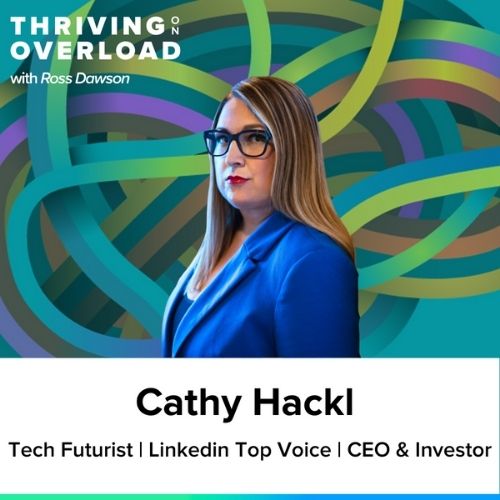
S1 Ep 2Cathy Hackl on finding the key players to listen to, building mental maps, how to see connections, and becoming a voice in your industry (Ep2)
“Jump in there really be an active participant in the industry, because it’s also about that. How are you becoming a voice, an active participant in the idea sharing and everything that’s being built?“ – Cathy Hackl About Cathy Hackl On this episode we learn from Cathy Hackl, a leading tech futurist and globally recognized business leader specializing in augmented reality (AR), virtual reality (VR), & spatial computing. She is the CEO of Futures Intelligence Group, a futures research & consulting firm that works with clients in tech, fashion, media, government, and defense. BigThink named Cathy “one of the top 10 most influential women in tech in 2020”. Business Website: Futures Intelligence Group Personal Website: www.cathyhackl.com LinkedIn: Cathy Hackl Facebook: Cathy Hackl Instagram: Cathy Hackl Twitter: @CathyHackl Books The Augmented Workforce: How AI, AR and 5G Will Impact Every Dollar You Make Marketing New Realities: An Introduction to Virtual Reality & Augmented Reality Marketing, Branding & Communications What you will learn Cathy is a voracious consumer of information and loves conversations (03:13) But all that information is constantly refined (06:43) It starts with keywords (08:59) And being selective (10:09) Tagging is it, especially high level topics (10:58) She has developed her thought process over time (13:10) Asking the right questions… (16:16) …then hypnagoia (19:08) Blocking time on her calendar and turning off distractions (21:48) How Cathy became the metaverse expert (24:25) When is the right time to share an idea (32:59) Episode resources Feedly Leo Medium Diigo Google Docs Transcript Ross Dawson: Cathy, it is awesome to have you on the Thriving on Overload show. Cathy Hackl: Awesome. Happy to be here. Ross: Cathy, you keep across the edge of emerging technologies. There’s a lot of information to keep across, a lot of new things. How do you do it? Cathy: It’s interesting because when I was looking at some of the questions that you sent over for this, I started to really try to think about, “How do I organize this? How am I doing this?” I’m a voracious consumer of information like a lot of folks are in our industry. How do you organize everything? How do you make sense of all of it? How do I do it? I would say I wake up, I read a huge amount of news—mostly focused on technology, because that is kind of where I spend most of my time. I consider myself a tech futurist. I’m very much focused on the technology, having been working in this space inside these companies for several years now. Definitely, start reading a lot of different information. If there’s something really interesting, I’ll flag it with different services that I use. Sometimes I’ll forward it to one of my assistants and ask them to put it in different programs. We have Google Docs right now—to be honest, as simple as that—on metaverse things. I’m very focused on the metaverse. Back in January, you didn’t have that many metaverse headlines. Now, it’s like every single headline in tech is a metaverse headline or something like that. We used to have a Google Doc where we used to keep those a little bit. Now, it’s getting a little bit more complicated. We use tools like Diigo, for example, to keep things organized. I have a very well-organized Feedly to also keep tabs of things and keep organized, kind of know what are the sources I want to get information from. I mean, lots of scanning, lots of reading lots. I will say a lot of information that I do get, I also get from conversations, especially right now with the metaverse becoming such a hot topic and lots of people wanting to talk to me about it. Sometimes it might be as simple as like, “I’m launching the X project.” Before, I might have been like, “I don’t have time.” But now, I want to hear what they’re doing. What is it that they’re doing in the space? Sometimes those conversations, not always, they don’t lead to anything. But sometimes I’ll find out something I didn’t know, or I’ll know this is interesting. This brand’s thinking of doing this. That’s gonna be happening, what does that mean? What is that a signal of? It’s a bit of a process. Especially in my field because it’s evolving so fast, it’s hard to keep up. What was new yesterday might be old by today in the technology space, because it’s moving so fast. Another thing I do is I publish a weekly column in Forbes called Metaverse Weekly. That forces me as well to always keep on top and try to make sure that I have the freshest news and the most relevant news and those sorts of things. Sometimes I do get that information via a PR pitch; it’s not my preferred way. So, it’s a combination of all these different sources of information. I don’t have one place I go, it’s a multitude of places and sources. Ross: You say in the morning you scan and you look around. You mentioned you use Feedly. Essentially, you’re choosing feeds to go into your Feedly, and that’s been curated over some time I gues
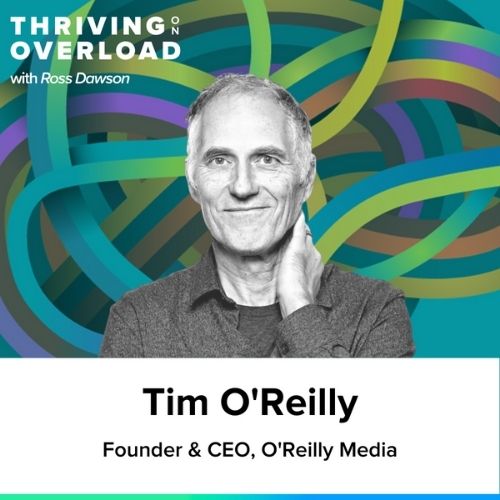
S1 Ep 1Tim O’Reilly on noticing things other people don’t notice, the value of soft focus, framing open source and Web 2.0, and patience in building narratives (Ep1)
‘’We shape reality by what we notice and choose to pay attention to.’’ – Tim O’Reilly About Tim O’Reilly On this episode we learn from Tim O’Reilly, definitely one of the most influential people in the development of the Internet as we know it. He is the founder and CEO of technology publishing giant O’Reilly Media, and has played a seminal role in movements including open source software, Web 2.0, maker culture, and government 2.0, and is author of the excellent book WTF: What’s the Future and Why It’s Up to Us. Website: www.oreilly.com Facebook: Tim O’Reilly LinkedIn: Tim O’Reilly Twitter: @timoreilly Slideshares: Tim O’Reilly Books WTF? What’s The Future and Why It’s Up To Us Welcome to the 21st Century What you will learn If information comes by, it must be important (01:51) Vectors and Bayesian probability in mental models (04:29) Creativity is noticing what other people don’t (06:48) If your dog could talk, it would show you a whole new world (08:56) Only when you have all the pieces can you put the puzzle together… (09:35) …what is the art behind it… (16:47) …and does framework help you find the pieces (19:56) Selfish individuals versus altruistic groups (20:36) Crypto is not decentralized (22:28) Tim finds out somebody else built his idea (27:48) Tim compares himself to Cookie Monster! (28:57) You will succeed when receptivity and striving are in balance (31:03) It’s all about tackling the hard things (33:03) Episode resources Lao Tzu The Way of Life According to Lao Tzu Wallace Stevens Eric Raymond Christine Peterson John Maynard Keynes The Man Watching by Rainer Maria Rilke Transcript Ross Dawson: Tim, it is a great delight to have you on the show. Tim O’Reilly: Thanks for having me. Ross: You have lived a life immersed in information and helped others in many ways to point them to, and digest that information. How do you think about that idea? How do you approach unlimited information and being able to make that into something valuable? Tim: Well, to understand how I think about it, it helps probably to say that I don’t have an approach where I really try to keep track of information, or gather information. It means certainly some ways I do, but my working principle was expressed very well by Tevye, in Fiddler on the Roof, when he said, “Good news will stay, and bad news will refuse to leave”. In a certain way, my approach is that things come by, and if they keep coming by, they’re probably important, and if they don’t, then maybe they weren’t. But there’s a bigger piece of it, and this is maybe explainable by reference to something like Google Maps, where people follow the map, and they stop noticing where they turn, versus people, who, in the old days, had to learn and observe the world around them to the level of where you think about the South Sea Islanders, who could navigate by watching the ocean currents, and the stars. They were their own GPS, and they were continually taking in information, and noticing how it was different from what they expected or the same as they expected. I work a lot like that. I have a mental model that I try to build of the world, and that model is inductive. Basically, I’m taking things in and I go, Oh, this is different, this doesn’t fit. A lot of the work that I’ve done over the years has simply been trying to construct a map by looking around. You pay attention to things and the things that start… with a soft focus. This is an idea, I think from hunting and things like that, you watch with a soft focus. Of course, I’m not a hunter, but I once read a book called “The Tracker”, and I took a workshop with one of the founders of this tracking movement. You’re just receptive and you’re open, and then certain things just pop out at you as anomalies. That’s what’s interesting. Ross: That is the same as my thesis around how it is that we build these models of the world. I think, when people talk about mental models, they often talk about discrete heuristics, in a sense, whereas, a mental model is really, I think, more holistic. It is a mental model of the entire world or the entire world of business, and how that works. How do you frame this mental model that you have built in, are building? Tim: Well, first of all, I do have a set of frames for it. One, I wrote a little bit about this in a recent piece. I also wrote about it in my book “WTF”, all thinking in vectors. This idea, that there are forces that are moving things along, and a vector has both a direction and a quantity, so what you’re looking for in a certain way is acceleration in a particular direction. You’re looking for how those directions collide with other vectors, and what the resulting outcomes might be. In this piece, “Welcome to the 21st century”, I wrote about one of the big impacts of the pandemic might well be that we never go back to the office and sure enough, that’s turning out to be a possible future. That’s the other thing, I have a mental model that comes from scenario planning about imag
Trailer: Thriving on Overload
We live in a world of exponentially increasing information, every day becoming more intense. All success in our incredibly fast-paced world is based on our ability to make sense of infinite information. On the Thriving on Overload podcast we speak to the world’s very best at dealing with a deluge of information – investors and venture capitalists, entrepreneurs, authors and more – to learn precisely how they are able to thrive in a world of overload. We’ll learn their techniques, their frameworks, their routines that let them transform the ocean of information we swim in to insight, value, and the ability to create a better future. Join futurist Ross Dawson and his guests to discover how to be your very best in a world of unlimited information. Subscribe to the Thriving on Overload podcast on your favorite platform. The post Trailer: Thriving on Overload appeared first on Humans + AI.