Humans + AI
211 episodes — Page 3 of 5
Tim Stock on culture mapping, the culture of generative AI, intelligence as a social function, and learning from subcultures (AC Ep44)
“True intelligence is a social function. It’s about social cohesion. Intelligence happens in groups, it does not happen in individuals.” – Tim Stock About Tim Stock Tim Stock is an expert in analyzing how cultural trends and artificial intelligence intersect. He is co-founder of scenarioDNA and the co-inventor of a patented Culture Mapping methodology that analyzes patterns in culture using computational linguistics. He teaches at the Parsons School of Design in New York. Website: www.scenariodna.com LinkedIn: Ufuk Tarhan Faculty Page: Tim Stock What you will learn Exploring the concept of culture mapping Understanding the subtle signals in cultural trends Discussing the impact of generative AI on creativity and work Differentiating between human and machine intelligence Examining the role of subcultures in societal change Analyzing the future of work and the merging of physical and virtual spaces Emphasizing the importance of structured analysis and collective intelligence Episode Resources Culture mapping Generative AI Artificial intelligence (AI) Douglas Engelbart Intelligence augmentation ChatGPT Cyberpunk Subcultures 15-minute cities ESG (Environmental, Social, and Governance) Nihilism Transcript Ross Dawson: Tim, it’s awesome to have you on the show. Tim Stock: Great to be here. Ross: So I think people need a bit of context for our conversation in understanding the work you do. A lot of its trends are around culture mapping. So, Tim, tell us what is culture mapping. Tim: It’s a culture mapping, really has its roots in understanding what is going on underneath the surface that people aren’t paying attention to. So I searched essentially when we speak to whoever I need to explain cultural mapping to, it’s to help companies understand how and why culture is changing, and how to use that information to make better design and business decisions. And so a lot of those kinds of real changes in culture are not obvious. They’re not things that we can ask people about. So they’re the weaker signals. And so culture mapping allows us to be able to map the relationship between what is the broader culture and subcultures and understand the relationship between those and how they develop narratives within society and cultural change. Ross: So where’s the state of today? So what are some of the signals you’re seeing in the Euro cultural mapping work? Tim: Well, I think that , we’re in a particular moment where we’re shifting from one kind of age to another in terms of, especially in terms of how people do work, how we understand our relationship to identity, there’s a growing nihilism, I would argue that’s going on. And I think that , when people say a lot of when we’re talking about things that are happening, the negativity that people would say, is coming out of the pandemic. But again, if you see, from a cultural mapping standpoint, those signals were there already, but those externalities of the pandemic just really exacerbated them. So things like, sort of issues around how we see work, and how we understand our relationship to work, has a lot to do with how technology is changing, it has a lot to do with the kind of work that needs to that is the kinds of skills, all of these kinds of affordances that go along with that. And essentially, culture is always trying to catch up to that particular change. And so at this particular moment, I say, we’re kind of stuck. There’s a moment where we haven’t found our voice yet. And so it’s the reason why we see a lot of this kind of there’s political dysfunction. There’s, there’s issues in terms of I mean, we’re, we’re at a moment where there’s a lot of unrest, and there’s a lot of language around that. And so essentially, I see us trying to as a society, trying to find that trying to find that voice. Ross: So, yeah, there’s a couple of directions for this, we’re looking at the role of generative AI, one is from a cultural response. Another is, I suppose a deeper level is to our understanding of what is our relationship with generative AI. Tim: Yeah, I mean, it comes down to what do we do? And I think that that’s that , that nihilism is emerging from well, what am I supposed to do? What is what caught the, we, we’ve almost coped, we’ve co-opted a lot of these words like intelligence. So what is left for humans to do? And the state of AI, I would say, is that you would see that there’s a lot of replacing, and mimicking human actions. As sort of, we get sort of things that look like they’re created, the word creativity, for example, has been co-opted, and sort of like so. But, we’re at a point where we need to be asking what is creative. I mean, creativity is a human action, human intelligence emerges differently, the machine intelligence, machine and child, that, machi
Ufuk Tarhan on the T-Human model, being an autodidact, oxymoronic technologies, and teaming with humans and AI (AC Ep43)
“I cannot imagine any other way to be successful or to find satisfaction in knowing that you are doing something useful for humanity or any society. Therefore, I believe it is mandatory to take responsibility for our choices.” – Ufuk Tarhan About Ufuk Tarhan Ufuk Tarhan is a prominent futurist, economist, keynote speaker, author, and CEO of digital agency M-GEN. She has worked as a senior executive and board member in a number of prominent technology companies. She is author of two successful books on the future and has received numerous awards including Most Successful Innovative Business Book Award, Most Successful Businesswoman In IT, and various lists of top social media influencers, and was the first female president of the Turkish Futurists Association. Website: www.ufuktarhan.com LinkedIn: Ufuk Tarhan What you will learn Introducing the ‘T-human’ concept: a new framework for personal and professional development The importance of adaptability in the workplace and beyond Autodidactic learning as a necessity for future success Balancing current roles with future aspirations through hybrid learning The role of technology in enhancing team dynamics and individual capabilities Exploring the intersections of human skills and artificial intelligence Strategies for building a sustainable career in an evolving technological landscape Episode Resources T-human IBM Autodidact learning Blockchain Web3 Synthetic biology Gene editing Qubits ATCG alphabet (referring to the nucleobases adenine, thymine, cytosine, and guanine in DNA) Artificial intelligence (AI) Virtual reality Books As the Future Catches You: How Genomics & Other Forces Are Changing Your Life, Work, Health & Wealth by Juan Enriquez T-İnsan: Geleceğin Başarılı İnsan Modeli by Ufuk Tarhan Yarının İşini Yarına Bırakma by Ufuk Tarhan Yarõnõn __ini Yarõna Bõrakma by Ufuk Tarhan Düşlediğin Gelecek by Ufuk Tarhan Transcript Ross Dawson: Ufuk, it’s a delight to have you on the show. Ufuk Tarhan: Thank you. It’s my pleasure to see you again and to hear you again. Ross: I think the concept of amplifying cognition is central to your work. You’ve described to me this concept of T-human, and love to hear this concept and how you’ve shaped that and applied that in your work. Ufuk: Yeah, thank you. And you were one of the very first ones who picked it up. I’m so happy to explain it. T indeed, I was aware of T-shaped skills. At one of IBM’s conferences, I heard that for the first time, many years ago, more than maybe 20 years ago. Afterward, in years, I transform it into a model, a personal transformational model, to adapt ourselves to the needs of the future. And the first application is, of course, made on me. Because I’ve worked in the IT industry for more than 20 years, as a top manager or CEO. After 20 years, more than 20 years, I decided to change myself, and I decided to reshape my career, my life, and everything. While doing that, at the core, there were future, futuristic studies and thinking about the future more and more, and the technology. I decided to give consultancy services to people and corporations, to teach them or to let them be aware and apply future planning effectively. But at that time, I was a single mother, I was working in a very high-level company, and I needed to earn the money I needed. I couldn’t leave the job immediately. So I needed resources. Then I tried to find a way to develop my knowledge about future studies so that I could form my own consultancy company and give consultancy services. I remember during University times, I was waking up at 3 am to study for exams. I said that I could do it again, maybe and I could do it. I started to wake up at 3 am three years ago. And then I worked on my today’s knowledge or future studies to increase my knowledge in that area. I was going to work, my daily work and I was a CEO at that time. I was working very seriously Of course, and I was coming back and at 3 pm I was working as a futurist, etc. So I realized that it was a hybrid mood indeed. I had to run to life altogether, the future life, I was preparing my future version. At the same time, I was working on my actual work. I just decided that there should be hybrid moods for everybody. Because we cannot quit our ongoing responsibilities and jobs, we need to earn money or we have other responsibilities. So we have to find a way to run them together. And while I was doing that, I realized that I have to learn so many new things, so many so many new things. I discovered this autodidact learning technique. And, I saw that I’m learning everything almost by myself. I’m digging into every source to get more information, knowledge, etc. So, I said that this is an autodidact, learning it is mandatory for everyone in the world right now because we all of us have to transform ourselves. And we have to create a new version of ourselves. So that
Shikoh Gitau on amplifying humanity, Africa’s AI leadership, technology sovereignty, and the power of community (AC Ep42)
“Sovereignty means that I need to be in charge of my destiny and able to control my future. This involves understanding the context in which you’re operating and not allowing others to define that context for you.” – Shikoh Gitau About Shikoh Gitau Shikoh Gitau is CEO of Qhala, a digital innovation company with clients across Africa. She was previously head of Safaricom Alpha, the first corporate innovation hub in Africa and worked for African Development Bank helping governments adopt information technologies. Her numerous awards include being the first African to win the Google Anita Borg Memorial Scholarship, and Africa’s Most Influential Women in Business and Government, Technology. She sits on numerous boards and holds a Ph.D. in computer science. Website: Shikoh Gitau LinkedIn: Shikoh Gitau Twitter: @DrShikoh What you will learn Exploring technology as an amplifier of human intent The transformative impact of mobile technology in Africa How mobile money revolutionized financial inclusion in Africa The urgent role of AI in addressing critical health issues in Africa Discussing technology sovereignty and the power of defining one’s future The unique communal approach to technology implementation in Africa Future visions: AI’s potential to amplify community and human connection in Africa Episode Resources AI (Artificial Intelligence) M-PESA Mobile Money Wall Street Journal The Economist The New York Stock Exchange The Pathology Network (TPN) Gemini Transcript Ross Dawson: Shikoh, it’s wonderful to have you on the show. Shikoh Gitau: It is wonderful to be here after going through every other challenge, but we are here now. Ross: So you have spent all of your career amplifying people with technology. I would love to just hear your perspectives on how it is we can amplify humanity, and amplify ourselves. Shikoh: I love the word ‘amplify’ because it sets a very good tone for this conversation. So one of my mentors Kentaro Toyama wrote a book at the very beginning of my career. And I remember him giving the talk before he did the book. And he kept saying that technology is an amplifier of human intent. At that time, he was a Senior Director at Microsoft Research in India. And his goal for going to India was to help Microsoft build these technologies to enable human flourishing. I think after years of doing this, he realized that technology builds technology so much, so much to do something, but eventually amplifies a human act, a human intent, a human habit. And that’s what I love. I love this conversation because it set me on my career path. And my career path is you have to. I started looking inside how technology amplifies my intent. I want to be able to change the world. I want to be able to increase thriving and economic emancipation in Africa, how’s technology going to ‘Hey, help me achieve those goals.’ But more importantly, how is technology going to help other people around me and on the African continent to be more specific, be able to achieve their own goals? And that is how I got my career started in technology. So it was very interesting when I saw this. I’m thinking oh, amplifying cognition is part of human humanity and humaneness. For me, that is how I’m jumping into this looking at it from like, not just like an AI perspective, because AI is just another technology. And when I say that some people take it personally, I’ve been working in technology. I’ve gone through so many fats and buzzwords and hypes of technology. So I know AI. Well, it is a significant technology, it is one of the other technologies. For me, I feel like one of the technologies in Africa is a mobile, mobile phone. The mobile phone did change our lives. Yeah, to be totally honest. It changed how Africa works. And if I was to choose between, like, we are back to whatever Dark Ages and I was to choose between AI and mobile devices, I’ll always choose mobile devices. So I’ve seen this hype, I’ve seen it happen. And I’ve seen the amplification part of it. So I am, I am riding the hype, but I am very conscious that it is just amplifying what we as human beings want to achieve. Ross: Yeah, hello, I love what you’re saying, typically around this idea of intent. That’s the first thing that really struck me about generative AI is that what it doesn’t have is intent. That’s what humans have intent on. And I think this point around you saying that the mobile phones, essentially Africa leapfrogged. So it led to mobile payments because it had the mobiles. And that’s what people had. And so it did lead the world and these technologies. I’m interested in thinking about other things with any other technologies now, where Africa could leapfrog in the same way that it did with the applications of mobile phones. Shikoh: So specifically taking Mobile Money, right? We always say it’s like a nice cliche that always says t
Tom Hope on AI to augment scientific discovery, useful inspirations, analogical reasoning, and structural problem similarity (AC Ep41)
“The unique ability of AI and LLMs recently to reason over complex texts and complex data suggests that there is a future where the systems can help us humans find those pieces of information that help us be more creative, that help us make decisions, and that help us discover new perspectives.” – Tom Hope About Tom Hope Tom Hope is Assistant Professor and Head of the AI Research Lab at Hebrew University of Jerusalem and a Research Scientist at Allen Institute for AI. His focus is developing artificial intelligence methods that augment and scale scientific knowledge discovery. His work has received four best paper awards and been covered in Nature and Science. Google Scholar: Tom Hope LinkedIn: Tom Hope What you will learn Exploring the intersection of AI and scientific discovery The role of large language models in navigating and utilizing vast scientific corpora Current capabilities and limitations of LLMs like GPT-4 in generating scientific hypotheses Innovative strategies for enhancing LLM effectiveness in scientific research Designing multi-agent systems for more insightful scientific paper reviews Future projections on AI’s evolving role in scientific processes Complementarity of human and AI cognition in scientific discovery Episode Resources AI (Artificial Intelligence) LLM (Large Language Models) GPT-4 Claude PubMed Simulated annealing Swarm optimization AlphaFold Semantic Scholar Google Scholar People Nicholas Carlini (DeepMind researcher) Nicky Kittur (from CMU) Joel Chan Daphna Shahaf Transcript Ross Dawon: Tom, it’s awesome to have you on the show. Tom Hope: Thank you, thank you for having me. Ross: I love the work which you are doing. And I suppose the big frame around this is how we can use computation to accelerate and augment scientific discovery. So, just love to sort of start off well, what are some of the ways in which computation including large language models can assist us in the scientific discovery process? Tom: One of the main ways I currently look at this is using large language models and more generally, AI to tap into huge bodies of humanity’s collective knowledge, scientific corpora, as a great example, millions of papers, over 1 million papers coming out in PubMed, every single year. Of course, you have patterns, you have many other sources of technical knowledge. And these sources of knowledge, potentially our treasure trove of many millions, if not billions, of findings, methods, approaches, perspectives, insights; but our human cognition, while extremely powerful, and its ability to extrapolate and be creative, pull together all kinds of diverse perspectives, it’s still very limited in its ability to explore this vast potential space of ideas, this combinatorial space of all the different things you can combine and the different things you can look into. As our knowledge continues exploding, so obviously, there are going to be more and more directions to explore as a result. So this problem keeps accelerating, with our knowledge accelerating. So the unique ability of AI and LLM recently to reason over complex texts, and complex data suggests that there is a future where the systems can help us humans, find those pieces of information that help us be more creative, that help us make decisions that help us discover new perspectives. By taking out problem contexts, the current thing we are interested in and working on a decision we want to make. And then somehow representing that in a way that enables retrieving these different nuggets or pieces of knowledge from these massive corpora, synthesizing whatever was retrieved into some sort of actionable inspiration or insight that helps us make the decision. And potentially, even automating some of these decisions and some of these hypotheses that we make as part of our process, there’s still a long way to go there.I guess we’ll talk about that right now. Ross: Yep. Well, in one way, I’d also love to dig into some of the specifics and the details of the strategies for that. And also, just to start off, just actually pulling back to the big picture. I mean, how do you envisage the complementary roles of human cognition? And let’s call it AI cognition in this process of scientific discovery? Where might that go in terms of those complementary roles? Tom: So, we are living in quite revolutionary times in this area, right? I mean, things keep changing very rapidly. So to prophesize on what the ability of AI is going to be in a year from now, or even in a week from now, is a risky business, right? We can talk about what things are currently look like – currently the ability of MLMs and this new like as the representative of state of the art, AI, the ability to extrapolate from what it’s seeing, it’s massive training, like the entire web or the entire corpus of archive papers, let’s say. The ability is quite limited. In our experiments and experiments b
Céline Schillinger on network activation, curious conversations, podcasting for connection, and creative freedom (AC Ep40)
“Criticizing and blaming people, organizational culture, or the company for problems doesn’t lead you to a better place. What may lead you to a better place is to actually roll up your sleeves, connect with each other, and do something about it.” – Céline Schillinger About Céline Schillinger Céline Schillinger is Founder and CEO of We Need Social, which works with organizations globally on engagement leadership. She is the author of Dare to Un-Lead, which was Porchlight Leadership & Strategy Book of the Year and on the Thinkers50 Best Management Booklist. Previously she worked in senior roles in the pharmaceutical industry across many countries and continents. Her extensive awards include Knight of the French National Order of Merit. Website: www.weneedsocial.com LinkedIn: Céline Schillinger What you will learn Exploring the journey from entrepreneurial beginnings to corporate transformation The shock of transitioning to a large pharmaceutical company’s culture The power of forming an employee network to instigate positive change Challenging traditional hierarchies with network activation Leveraging digital tools and volunteer networks for organizational innovation Embracing agency, networking, and community for future-ready organizations Personal practices for amplifying individual capabilities and fostering connections Episode Resources Sanofi Network Activation Employee resource groups Community Studio Book Dare to Un-Lead: The Art of Relational Leadership in a Fragmented World by Céline Schillinger Transcript Ross Dawson: Celine, it’s a delight to have you on the show. Céline Schillinger: Thank you so much, Ross. Thanks for having me. Ross: So you work a lot with organizations and amplify their capabilities. And I think the really interesting starting point was, how is it that you think of what organizations are and how they function? What are the underlying principles that guide you? Céline: Yeah, you know, this question came to me quite late in life. And actually, I started my career in small organizations in a very entrepreneurial kind of setting. I was working in Asia at the time. I moved to Asia, quite young, on my own to look for a job, look for adventure. And I started to build my career there, and I spent years in Vietnam, and then in China, and then I joined a large pharmaceutical company returning to Europe after about 10 years. And that was a shock for me to discover this whole new world of large enterprise. It had a different language that I did not understand. I thought I was already sort of a seasoned professional with 10 years experience behind me, but I did not understand this new language. It was talking about frameworks and metrics processes, and I wondered. I did not even understand the job description, I was off the job I was responding to the job offer is so funny, I asked someone to help me decipher this, I think, but that’s part of organizational culture, to have this their own language and references and acronyms and all those things and ways of doing of course, so I discovered the large enterprise. And for a while, I did not question or did not even wonder how it worked. Because I was all in on the pleasure of discovery. It was all about experimenting and meeting new people, and it was great. And then progressively I started to realize that, yeah, there’s there are…how can I say principles ways of working, which do not necessarily emerge from which are kind of a religion kind of in a way – they do not emerge from the field or from common sense or the ways of working are prescribed and determined by habits, beliefs, and not necessarily by what would be needed, by customers by efficiency and so on. And I thought of, I had, maybe this kind of ethnological view coming from outside coming from a very different world. I started to question this, and question my role in perpetuating role models, behaviors that made no real sense. What was my role in maintaining that? Could I contribute to changing them a little bit instead? But what could I do on my own? So probably nothing. But then, about 15 years ago, I joined forces with other colleagues. And we formed a network of people wanting to bring about positive change, not wanting to protest. No, so I didn’t join any union. For example, I joined a network. I co created a network. And that was when I remember the surprise, the puzzled look on the face of HR, HR did not understand what this thing was about. ‘An employee network. Well, what is it?’ It was before employee resource groups became popular? And then it was really weird for them, some of them. I remember somebody asking me who’s the boss of your network, I would say, we have no boss, it’s a network. But they felt like it was impossible to imagine another way of organizing than the one they were accustomed to. In the organization. A pyramid with a boss with a senior leader or the top, people reporting to him or her –
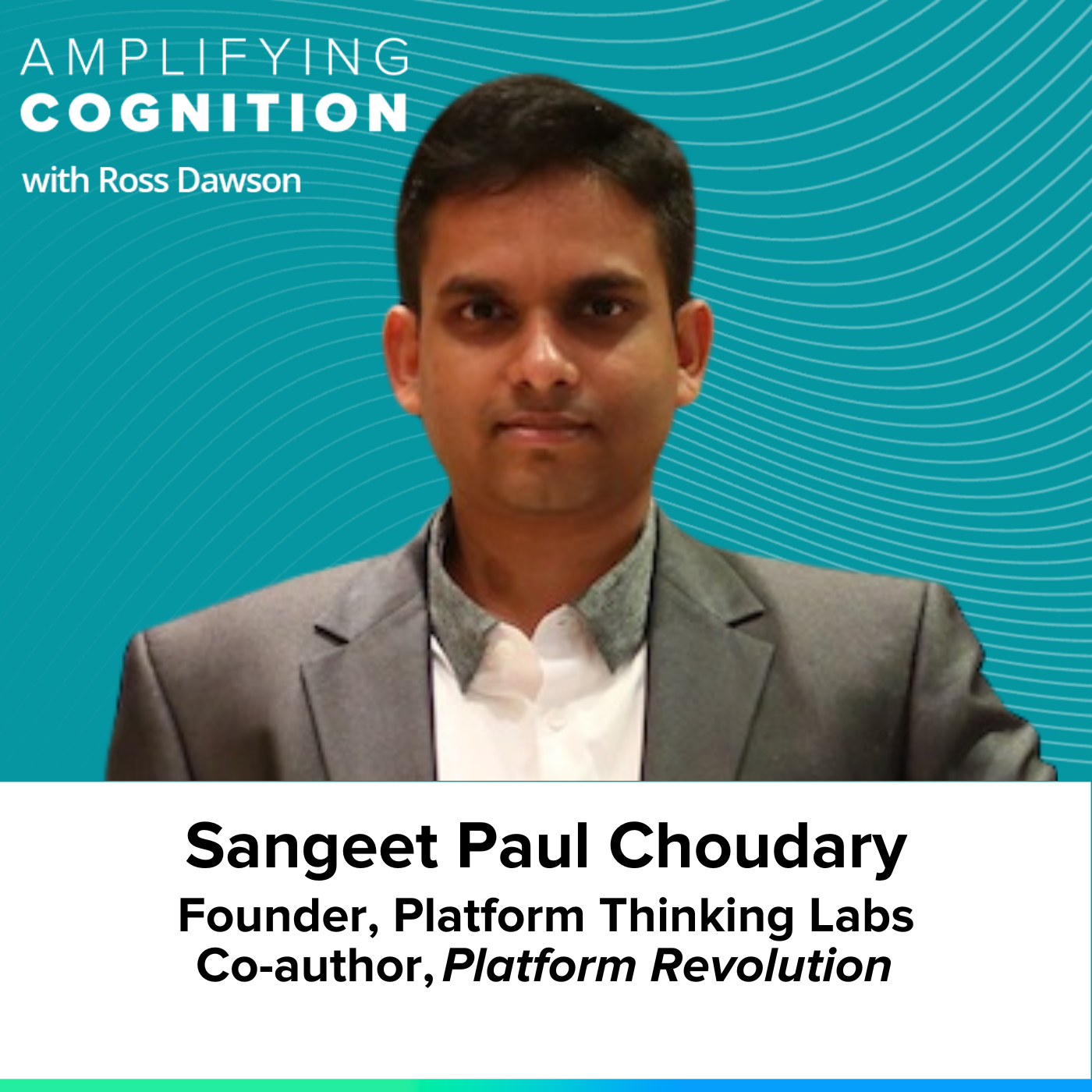
S2 Ep 39Sangeet Paul Choudary and Ross Dawson debate AI in the future of work (AC Ep39)
“It’s less about human versus machine and what’s important, what are humans skills versus not, there are a lot of human skills, where you will not be able to retain a higher pricing power just because you are highly substitutable despite your specific human skill.” – Sangeet Paul Choudary About Sangeet Paul Choudary Sangeet Paul Choudary is the Founder of Platform Thinking Labs and co-author of Platform Revolution, which has sold over 300,000 copies, and author of two other leading books on platform strategy. He is a keynote speaker and advisor to major organizations worldwide, and is a World Economic Forum Young Global Leader. Sangeet’s work has been featured on four occasions in the HBR Top 10 Must Reads collections. Substack: www.platforms.substack.com Website: www.platformthinkinglabs.com LinkedIn: Sangeet Paul Choudary What you will learn Exploring the impact of AI on skill premium and the future of work The rise of platforms and the commoditization of skills in the gig economy The dynamics between labor, talent, and capital in a technology-driven market How technology reshapes the value and distribution of work The role of AI in augmenting versus substituting human roles The significance of adaptability and learning in navigating technological change Strategies for individuals and organizations to harness AI for a prosperous future Episode Resources AI (Artificial Intelligence) Gig economy Uber ILO (International Labour Organization) GPS (Global Positioning System) Google Maps Centralized market making Fungibility Mechanical Turk BCG (Boston Consulting Group) Talent vs. Labor spectrum Reaganomics AI agents Analytic AI Generative AI Network economy Long tail distributions McKinsey Andreessen Horowitz People George Clooney Books Platform Revolution: How Networked Markets Are Transforming the Economy–and How to Make Them Work for You by Geoffrey G. Parker (Author), Marshall W. Van Alstyne (Author), Sangeet Paul Choudary Platform Scale: How an emerging business model helps startups build large empires with minimum investment by Sangeet Paul Choudary Platform Scale for a Post-Pandemic World by Sangeet Paul Choudary Transcript Ross Dawson: Sangeet, it’s wonderful to have you on the show. Sangeet Paul Choudary: Thank you, Ross. It’s such a pleasure to be here. Ross: We’ve got to talk about a number of things. But you’ve been writing recently about the future of work, I suppose specifically, the impact of AI on skill premium. And I have some, probably somewhat different views here. So perhaps we can frame this a little bit as maybe not a debate, but a discussion. So that’s first of all, you can sort of lay out at a high level, your case, and I can sort of perhaps bring some other perspectives to bear as we go. Sangeet: Sure, absolutely. My interest in, you know, the role of or the impact of technology on the future of work sort of started with the rise of platforms. So the first thing that we saw with the rise of platforms was that we saw new ways to organize work in markets. And Uber. And the gig economy is a great example of this when work gets extremely commodified. Right, when you think of a driver, whose natural advantage, apart from the license that they had for the taxi, was the ability to navigate the city and just the knowledge of the city and Google Maps GPS comes in, and that commoditization is that particular knowledge. Now suddenly, anybody without that level of depth about navigating the city can become a driver. That essentially shows how centralized market making of a commoditized skill, the more skill gets commoditized, the more it lends itself to a centralized market making with the right resource can be allocated to the right problem. That’s essentially what happens in gig economy platforms. And Uber being an extreme example, where you don’t really care who’s coming to take you from point A to point B, it’s just a resource being allocated to a problem. Now, so the idea that kind of came out of that work, which I conducted with the ILO Future of Work Commission, was that the more skills get commoditized, the more they lend themselves to centralized market making, and the more the skill set commoditized, the more agency and power, especially in terms of setting your price, and a premium on your skill moves away from you to the platform that’s kind of making that allocation. And, broadly speaking, you know, markets exist everywhere. It’s not just Uber, but even if you’re working in an organization, you’re constantly being matched to opportunities, there’s an internal market, if you’re a freelancer, you’re obviously in an external market. But markets exist everywhere. That’s just the nature of the networked world we live in. So the essential idea would have to start with that markets are everywhere centralized market making is a thing. And secondly, the more skill is commoditi
Charles Hampden-Turner on Mobius leadership, reconciling paradoxes, dilemma strategies, and conscious capitalism (AC Ep38)
“Conscious Capitalism suggests that if you do good by accident, why not do good deliberately? Look at the accidents and start doing them on purpose.” – Charles Hampden-Turner About Charles Hampden-Turner Dr. Charles Hampden-Turner is a British management philosopher, business consultant, and co-founder of consulting firm Trompenaars Hampden-Turner. He is the creator of dilemma theory and the author or co-author of numerous influential books, including Maps of the Mind, The Seven Cultures of Capitalism, and Mastering the Infinite Game. He is received many awards, including Guggenheim, Rockefeller and Ford Foundation Fellowships. Website: www.thtconsulting.com LinkedIn: Charles Hampden-Turner Fons Trompenaars at TROMPENAARS HAMPDEN-TURNER Facebook: Trompenaars Hampden-Turner X (Twitter): @FTrompenaars YouTube: Trompenaars Hampden-Turner What you will learn Exploring the genesis of “Maps of the Mind” The power of paradox in understanding the human mind Reflecting on a career; tying together themes of management and leadership The Mobius strip as a metaphor for solving complex problems Addressing societal polarizations through integrated thinking The role of conscious capitalism in today’s business world Visualizing paradoxes; the use of imagery in comprehending complex ideas Episode Resources Freud’s ID and Superego Jung’s Collective Unconscious Mobius Strip Yin and Yang Conscious Capitalism People Mitchell Beasley (Publisher) Gregory Bateson R.D. Laing W. Edwards Deming Ray Anderson Paul Polman Books Natural Capitalism by Paul Hawken, Amory Lovins, L. Hunter Lovins Maps of the Mind: Charts and Concepts of the Mind and its Labyrinths by Charles Hampden-Turner The Seven Cultures of Capitalism: Value Systems for Creating Wealth in Britain, the United States, Germany, France, Japan, Sweden and the Netherlands by Charles Hampden-Turner and Altons Trompenaars Mastering the Infinite Game: How East Asian Values are Transforming Business Practices by Charles Hampden-Turner and Fons Trompenaars Transcript Ross Dawson: Charles, it’s an honor and delight to have you on the show. Charles Hampden-Turner: Well, good to meet you. And if I can help you let me know. Ross: Thank you. So I first came across your work when I was in a bookshop in Geneva, Switzerland 1981 or 1982, it must have been, and I saw on the table, this book, which had maps of the mind, and it was immediately resonated with me, because what is, you know, the basic exploring all of these different models, what the mind is, and how we think and be able to not just explain those, but also to have a visual representation to show us what they were, and I’ve still got it, I still refer to it. And it really influences my thinking. It is so useful to have these maps of the mind to help us understand the way we think to bring that to life. So I’d love to just hear the genesis of maps of the mind and just some reflections back from quite a few years later on, on those wonderful projects you did. Charles: Well, I knew Mitchell from Mitchell Beasley, and he was always producing encyclopedias, including the joy of sex and other things. And he said he wanted to do something on the mind. So I approached him and said, I could create 60 visions of the mind, all of which I, I loved and asking myself, why did I love them? It’s because they were consistent because they had something in common. I hadn’t in those days worked out what they had in common. But once I finished, I began to see what they have in common. What they have in common is that all paradoxes starting with Freud’s ID and superego are about as different as you can get and Jung’s collective unconscious and libido etc. And if you go all the way through the book, you’ll find every map has a duality. And every map has a reconciliation of that duality. But I only realized that in retrospect, and I longed to add a chapter, explaining that the whole book is often a piece is part of an overall pattern. Ross: I think your selection of the models in the book actually reflects that as in many of them are quite explicitly about paradoxes, such as Gregory Bateson or artie Lang or others that you chose. So I think that framing and the choices you made already, implicitly suggested that you had the pattern in your mind already. Charles: Yes, I did. But you don’t know what your subconscious is doing. Ross: So you’ve written many books on management, cross cultural leadership, around the you know, essentially what it is that drives the value in organizations. And more recently, you are working on a book which ties you’ve said to me all of your life’s work together. And so how, what is what is how, how could you tie together or pull together all of your threads of this marvelous work through your life? Charles: I was thinking about the German mathematician and Mobius. And he created the well known Mobius stri
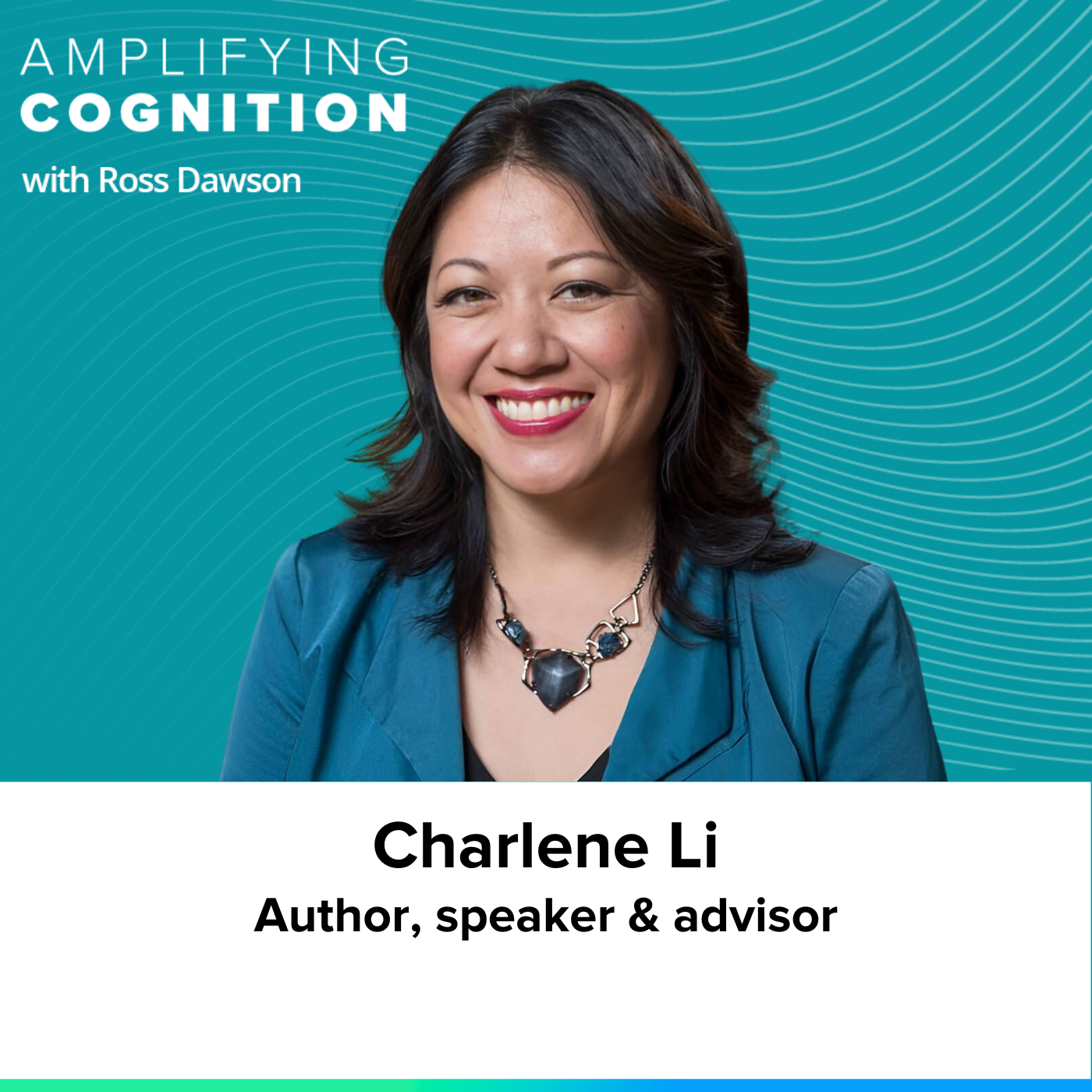
S2 Ep 37Charlene Li on generative AI strategy, AI book editors, prompt libraries, and wisdom hacking (AC Ep37)
“My hope is that in the future, we are so focused on acquiring knowledge in our schools and our educational system, my hope is that we will also be focused on acquiring wisdom, if we know how to measure it and how to develop it.” – Charlene Li About Charlene Li Charlene Li is an author, speaker, advisor and coach. For the last three decades she has worked at the edge of disruption, working with hundreds of major organizations, and founding the prominent analyst firm Altimeter Group. She is the New York Times bestselling author of six books, including Open Leadership and Groundswell. Her latest book, Winning with Generative AI: The 90-Day Blueprint for Success, lays out a master plan for generative AI strategy. Website: CharleneLi.com LinkedIn: Charlene Li Facebook: Charlene Li X (Twitter): @CharleneLi Instagram: @ChareneLi YouTube: @CharleneLi What you will learn Exploring the edge of disruption with Charlene Li Amplifying cognition through generative AI The transformative role of AI in research and writing Developing the AI-powered development editor Customizing generative AI for personalized guidance Generative AI in email communication and productivity enhancement Crafting strategic business proposals with AI insights The importance of sharing and learning AI prompt libraries within organizations The strategic impact of generative AI on competitive advantage Harnessing generative AI for customer experience and operational efficiency Wisdom hacking: Enhancing decision-making and leadership Episode Resources Generative AI Large Language Models (LLM) Custom GPT models AI prompt libraries Blaze.Today Books Winning with Generative AI: The 90-Day Blueprint for Success by Charlene Li The Disruption Mindset by Charlene Li The Engaged Leader by Charlene Li The Seven Success Factors of Social Business Strategy by Charlene Li Open Leadership by Charlene Li Marketing in the Groundswell by Charlene Li Groundswell by Charlene Li Transcript Ross Dawson: Charlene, it’s awesome to have you on the show. Charlene Li: Thank you for having me. Ross: So, how do you amplify your cognition? Which is pretty Apple to start with? Charlene: A good question. Well, I do research and write my books. And I, basically it, especially with AI coming along, I looked at all the things that I do. And I realized that AI can address 70% of it and just, it just makes it so much easier. So a couple things. First of all, just researching, it’s so much faster now, with general AI, I use it constantly. Whenever I have a question, I’ll use one version of an LLM, probably perplexity and being also as well, to just get me the information and get into it a lot faster. I may find all those reports, bundle them all together and ask them to summarize it. And then a specific point, am I going to dig down deeper, it’s almost like having a research assistant. So it’s all the things I used to have a research assistant do for me, now I just have generated AI to do it for me. And it’s much faster and better and an expert on every subject that I could ever imagine. And then I also use it when I’m writing. And so I’ll write a first draft, like a fat outline, and I’ll give it to an AI and say you’re my development editor. Tell me, what am I missing? Ask me questions. So it’s literally a thought partner to make my thinking better. Because it can look at things from a different perspective. And I can give it different roles, different perspectives, you’re an expert, you’re brand new manager, look at this topic from many different directions and ask me questions on how I can make it better. So those are things and then I can use it to actually help me piece together some of the writing later on in the process. Ross: Just to dig into each of those a little bit in terms of first of all out on that development editor. So, is this a to and fro process, so its development manager comes up with this list of suggestions, which you then ask for or you manually used to refine the text? So what is so drilled into that sequencing if you’ve done a draft? Okay, that’s what I think that’s one interesting point, you do the first draft first yourself before you give it to the AI? So what is the detailed process? Do you just simply say, take the role of development editor? And then take all leave it suggestions? Is that iterative? How do you get there? Charlene: I actually have my own private GPT. It has all of my writings in it, it has my book outline and has all the previous chapters that I’ve worked on, because I am working on this book about how to use gendered AI, as a business. And I say, you know, put all that into context has all of that has general instructions on how to be a great editor. So I don’t have to repeat that over and over again. So it’s customized, I call it the book wise editor. And then I just started asking her questions, here’s my lat
Philipp Schoenegger on AI-augmented predictions, improving human decisions, LLM wisdom of crowds, and how to be a superforecaster (AC Ep36)
“One of the main strengths of the current generation of large language models is the ability of their interactive nature to provide a highly competent model that people can interact with and query whatever they want.” – Philipp Schoenegger About Philipp Schoenegger Philipp Schoenegger is a researcher at London School of Economics working at the intersection of judgement, decision-making, and applied artificial intelligence. He is also a professional forecaster, working as a forecasting consultant for the Swift Centre as well as a ‘Pro Forecaster’ for Metaculus, providing probabilistic forecasts and detailed rationales for a variety of major organizations. Website: Dr. Philipp Schoenegger LinkedIn: Philipp Schoenegger, PhD X (Twitter): @SchoeneggerPhil What you will learn Exploring the intersection of AI and human decision-making The catalytic effect of ChatGPT on modern research The fundamentals of AI-augmented forecasting Unpacking the wisdom of AI crowds The journey to becoming a superforecaster Navigating the blend of human intuition and AI computation Insights into the future of AI-enhanced judgment Episode Resources Artificial Intelligence (AI)Large Language Models (LLMs)ChatGPTJudgment and Decision MakingSuperforecastingPhilip TetlockAI AugmentationThe 10 Commandments of ForecastingAlibabaClaude (Language Model)Palm (Language Model)External vs. Internal View in ForecastingInternational Energy Agency (IEA)Metaculus Platform (Forecasting Platform) Papers AI-Augmented Predictions: LLM Assistants Improve Human Forecasting Accuracy Wisdom of the Silicon Crowd: LLM Ensemble Prediction Capabilities Rival Human Crowd Accuracy Transcript Ross Dawson: Philip, it’s wonderful to have you on the show. Philipp Schoenegger: Thank you so much. Thanks for the invitation. It’s great to be here. Ross: So on your website, you have this very interesting diagram, which shows that your current research is around the intersection of judgment and decision making, and applied artificial intelligence. So what is that space? And how have you come there? What’s, what is that that pulled you to this particular space? Philipp: So I think what, what really motivated me to work in this area is what motivated many other people to jump into AI. And this was just the release of ChatGPT, in late 2022. So I hadn’t been working in artificial intelligence before, I have a social science and humanities background, having worked on charitable giving, and political philosophy before. But having seen ChatGPT, I think it took 10 days. Until I had my first research project, we’ve caught up slowly. And our first idea was, how can we? How can we kind of mimic social science participants with artificial intelligence? And so what we did is we ran a bunch of studies that had been replicated in humans with the text DaVinci, free to see the early ChatGPT model. And ever since I’ve never looked back, and I’ve pretty much only wanted to do more AI stuff. It’s way too interesting. At this point, pretty much almost all the work. Ross: I think we’re pretty aligned on that. And it’s just like this intersection of human intelligence, artificial intelligence is so deep, so promising, so much potential. And so now it’s wonderful to see the work that you’re doing. So speaking of which, we recently, you were a lead author of a paper. AI Augmented Predictions, LLM assistants improve human forecasting accuracy. So first of all, let’s just describe the paper at a high level, and then we can dig into some of the specifics. Philipp: So the basic idea of this paper is, how can we improve human forecasting. Human judgmental forecasting is basically the idea that you can query a bunch of various interests and sometimes lay people off about future events, and then aggregate their predictions and arrive at surprisingly accurate estimations of future outcomes. So this goes back to the work on Super forecasting, the Philip Tetlock. There’s a lot of different approaches on how one might go about improving human prediction capabilities, absolute maximum training, as it was called the 10 commandments of forecasting, how you can better forecast out or there might be some, some, some conversations where different forecasters talk to each other and exchange their views. And we wanted to look at how we could think about improving human forecasting with AI? And I think one of the main strengths of the current generation of large language models is the ability of the interactive nature of the back and forth to have a highly competent model that people can interact with and query whatever they want. Really, they might ask the model, ‘Please help me with this question. What’s the answer?’ They might also just say, ‘Here’s what I think please critique it.’ And so this opens up for human focus, like a whole host of different interactions. And we wanted to see what the
Bryan Cassady on AI innovation, Humans + AI idea evaluation, increasing diversity with AI, and evidence-based innovation (AC Ep35)
“AI has an amazing amount of limitations, horrible in a lot of things. But when you use it smartly, it becomes an important part of your team. And as an important team member, your team gets better.” – Bryan Cassady About Bryan Cassady Bryan is the founder and director of the Global Entrepreneurship Alliance, a foundation with a mission to coach or train 1 million entrepreneurs by 2027. He has built 8 successful companies in 6 countries. Bryan has taught innovation and entrepreneurship at numerous leading universities around the world, and is author of the book CYCLES. Website: www.bryancassady.com LinkedIn: Bryan Cassady X (Twitter): @bryancassady What you will learn The impact of AI on innovation; enhancing efficiency and creativity Bridging knowledge in AI and innovation for systematic success Transforming idea generation; the synergy of AI and human creativity AI’s role in identifying and defining the right problems for innovation Leveraging AI for more effective team alignment and idea evaluation Exploring AI’s capability in improving communication and idea pitching The importance of diversity in teams, augmented by AI for better outcomes Episode Resources AI (Artificial Intelligence) Idea Generation (Ideation) Idea Evaluation Market Scoping Jobs to Be Done (JTBD) Framework Brainwriting Technique Book CYCLES: The simplest, proven method to innovate faster while reducing risks by Bryan Cassady Transcript Ross Dawson: Bryan, it’s awesome to have you on the show. Bryan Cassady: Thank you for having me. I’m glad to be here. Ross: So you dig deep into AI innovation? So what’s the premise of AI innovation? What’s it mean? And how do people start on that journey? Bryan: Innovation is really, really important. It’s what makes the world turnaround. And the question that comes up for me time and time, again, is how can you be more effective in innovation? How can you be better, faster, do it easier. And I came across AI about a year and a half ago. And I’m just amazed at how much better things can become. And my personal take is trying to find the facts that back it up where it works, and where it doesn’t work. Ross: So let’s say as a starting point, go to an executive team, they say no, right? Innovation is important to us. We’ve got some processes now, what would be the first steps in being able to introduce AI into their innovation process? Bryan: I think, you know, for me, the challenge is to have two bits of knowledge, one knowledge around innovation, what is innovation? What are you trying to do? What are the facts? And then secondly, its domain expertise in terms of AI, and you have to bring the two of them together. And the first and foremost, most important bit of knowledge around innovation is AI works when the system works. It’s a system driven process, we tend to look and say, no, no, it’s those people. They’re not being creative. They’re not doing what they want. But if innovation is not working in your company, it’s what you as management is doing. It’s not what your people are doing wrong. And the second thing is to look at innovation as a process. I mean, it’s, you have to do a lot of things, right. It’s not enough to do one thing, right? And everybody seems to focus on idea building. But idea building is actually the easiest part of the innovation process. And I think what I would look at is ways that you can use AI to get aligned better, that you can communicate better, that you can pitch better, that you can evaluate ideas better. And there’s lots of cool stuff that can be done there. And I hope we get a chance to share some of the cool stuff we’ve been doing around this and in the next few minutes. Ross: Absolutely. Well, I want to dig deeper on a lot of levels. But I mean, to ground this, can you give a specific example of how AI has been introduced in being valuable in the innovation process of an organization? Bryan: Well, you know, everybody looks at ideation as the core of innovation. So I’ll start there. That’s because that’s what people are interested in. And there’s a lot of research showing that if you take a typical person, you give them AI to use to become more creative and more effective. And the impact is biggest on the lowest or lowest performing people in your organization. And sort of it’s an evening out factor. But what people forget in the process is you have to use it effectively. And we just completed some research, we evaluated 5400 ideas generated by humans and AI. And we found a few things that came out. One is AI, on average it doesn’t build better ideas, AI builds a lot more ideas. But when you take AI and humans intelligently together, your hit rate goes up, and your hit rate goes up amazingly. And hit rate I mean is what is the percentage of really good ideas. So if I look at an average human,
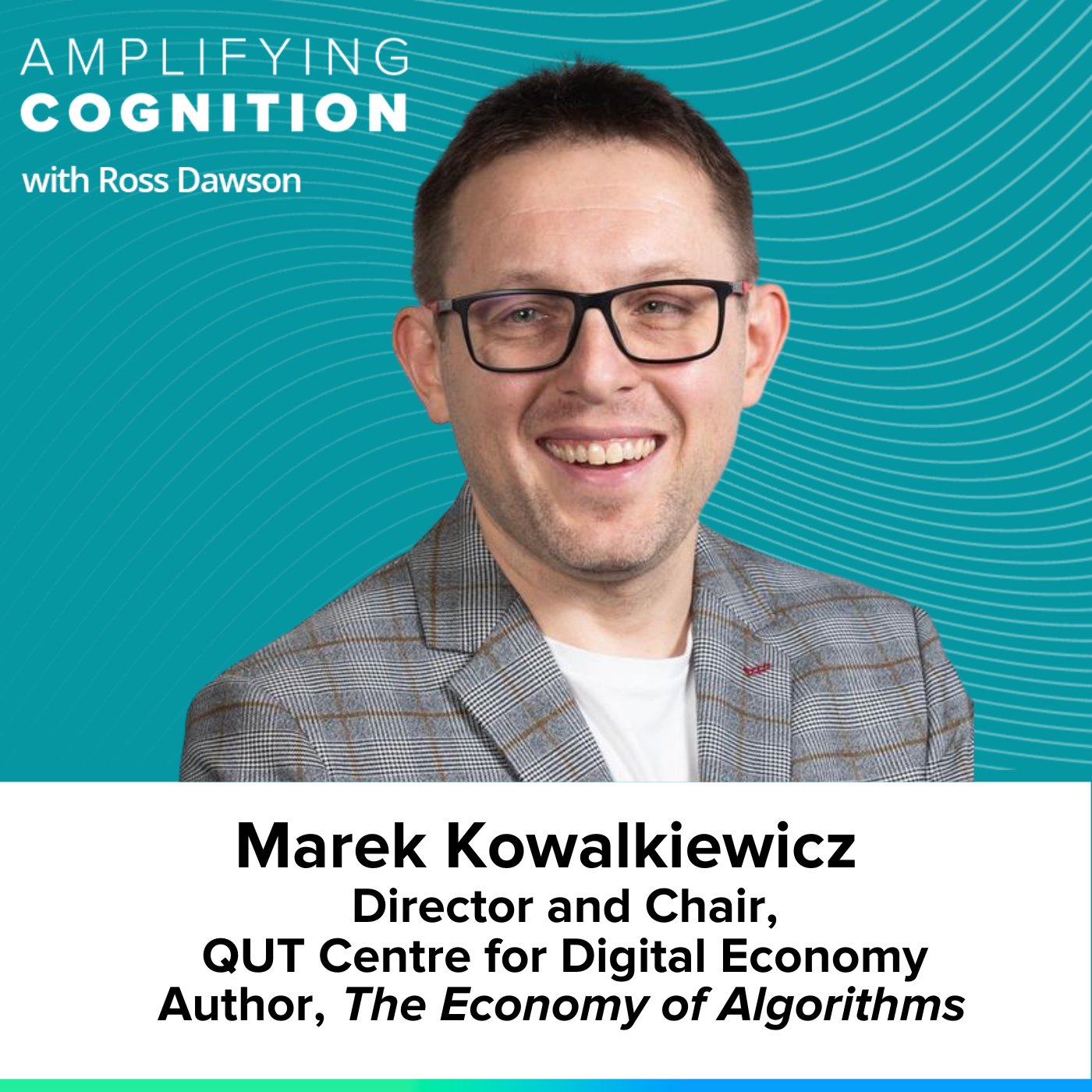
S2 Ep 34Marek Kowalkiewicz on the economy of algorithms, armies of chatbots, LLMs for scenarios, and becoming minion masters (AC Ep34)
“We humans need to be the ones who work with algorithms to make sure that they don’t take the wrong path, don’t deteriorate, don’t misunderstand our intentions, and don’t create outcomes that we don’t want.” – Marek Kowalkiewicz About Marek Kowalkiewicz Professor Marek Kowalkiewicz is founding director of the Centre for the Digital Economy at Queensland University of Technology, where he leads a portfolio of research projects into AI and the digital economy. He was recently named in the Top 100 Global Thought Leaders in AI by thinkers360. Marek’s new book, The Economy of Algorithms is out today as we launch this episode. Substack: www.marekkowal.substack.com LinkedIn: Prof. Marek Kowalkiewicz What you will learn Exploring the economy of algorithms The role of software and people in shaping digital futures Navigating the balance between automation and human oversight The metaphor of digital minions in the algorithmic world Engaging with generative AI and chatbots for practical tasks Implementing AI responsibly in academic and commercial research The importance of human agency in the age of automated decision-making Episode Resources ChatGPT prompt engineering Google Bard (Gemini) generative AI Lama AI shadow automation shadow generative AI large language model Books The Economy of Algorithms: AI and the Rise of the Digital Minions by Marek Kowalkiewicz Transcript Ross Dawson: Marek, it’s awesome to have you on the show. Marek Kowalkiewicz: Thanks so much for having me, Ross. Ross: So I love the work that you do and I think it’s a very interesting frame. You just got a new book coming out called the Economy of Algorithms, which we want to hear more about. Marek: Very proud of this, I spent a couple of years working on this book. So it’s a labor of love. It’s very much a book about this new world that’s emerging. That, strangely, it’s called the Economy of Algorithms. But it’s not just algorithms, it’s software, it’s people, it’s corporations. I wanted to write about this world where increasingly, we’re giving more and more agency to software agents, right, or algorithms. We’ll let them buy things, we’ll let them sell things, and we’ll let them deliver services on our behalf or to us. And so in a way, they’re starting to behave a bit like humans, or like other organizations in the economy. So I thought, you know, we need to capture it somehow. And that, that was a spin in the Economy of Algorithms. Ross: There are some things that I’d like to dig into. One is about the architecture. You have these smart people with PhDs working in big tech and AI algorithms who are designing the architecture of these algorithms. And I think there is also an element in the every day where all of us are interacting with AI — plays a role in shaping that human-AI relationship. How much of this happens at the level of the macro design of the AI architecture; and how much of this is shaped by each of us that uses it? Marek: So there is this, I think it’s an interesting trajectory or a process of learning about what’s happening in the world. The more I thought about automation and giving autonomy to technologies, the more I realized how important the role of humans is in the entire process. So, while I will not question the fact that algorithms are taking over individual tasks, and that algorithms are performing entire jobs that used to be done by humans, I realized, through seeing a lot of examples of how it played out in reality, that, in fact, we need to. We humans need to be the ones that work with algorithms to make sure that they don’t take the wrong path. They don’t deteriorate, they don’t misunderstand our intentions. And create outcomes that we don’t want to create. In fact, when you look at the subtitle of the book, it’s AI and the rise of digital minions. So I specifically wanted to refer to those minions that some of your listeners might know from the movie the minions, right. So, lots of, you know, there’s those yellow creatures that want to be helpful. But if you let them do whatever they want, they will create all sorts of disasters. And I thought, that’s a perfect metaphor for a lot of algorithms in our economy. They’re a bit like digital minions. They want to be helpful. They want to work all the time for us. But sometimes they’re not very smart ,and you know, even though they think they’re being helpful, they’re creating a lot of disasters. Ross: So, I want to get to some of the broader points around the skills that we can develop, which you addressed in the later sections of your book, but just wanted to start down by one of the some of the specific things that people can do. So there’s many tactics and approaches, and people describe some of these things as prompt engineering, but what are some of the thi
S2 Ep 33Louis Rosenberg on conversational swarm intelligence, group solution convergence, and future advances in collective intelligence (AC Ep33)
“When you can maximize the collective conviction of the group rather than just aggregating their gut reaction with no sense of conviction, you get significantly more accurate answers.” – Louis Rosenberg About Louis Rosenberg Louis Rosenberg is CEO and Chief Scientist of Unanimous A.I., which amplifies the intelligence of networked human groups. He earned his PhD from Stanford and has been awarded over 300 patents for virtual reality, augmented reality, and artificial intelligence technologies. He has founded a number of successful companies including Unanimous AI, Immersion Corporation, Microscribe, and Outland Research. His new book Our Next Reality on the AI-powered Metaverse is out in March 2024. Websites: louisrosenberg/bio www.unanimous.ai LinkedIn: Louis Rosenberg Unanimous AI Discord: @SwarmDao Facebook: @UnanimousAI X (Twitter): @UnanimousAI What you will learn Exploring collective intelligence lessons from nature Understanding real-time adaptation in natural systems and individual convictions Deciphering conviction signals from bee waggle dances Unveiling conviction dynamics in collective decision-making Exploring the limits of group conversations Enhancing group conversations with AI insights Envisioning the future of large-scale group conversations Episode Resources swarm intelligence collective intelligence statistical aggregation Cocktail Party Problem Sir Francis Galton MIT Stanford University Books Our Next Reality (2024) One of US (2021) Arrival Mind (2020) Monkey Room (2014) EONS (2013) UPGRADE (2012) Transcript Ross Dawson: Louis, it’s wonderful to have you on the show. Louis Rosenberg: Yeah, thanks for having me. Ross: So, swarm intelligence is something that is, seems to be the move to the center of your life. So tell me, what is swarm intelligence? And also why has it captured your imagination? Louis: Yeah, yeah. So, I spent my whole career looking at technologies that can be used to amplify human abilities. It started out looking at researching technologies like virtual reality, augmented reality, mixed reality back 30 years ago. And about two decades ago, I started kind of transitioning my interest from how do you amplify the abilities of single individuals to how do you amplify abilities of groups. And can you use technology to make groups of people smarter? Now, there’s an existing research that has been around for 100 years in a field called collective intelligence, where it’s pretty well known that you can take a group of people, ask them a question. The most famous example was about 100 years ago. An experiment by Sir Francis Galton, where he asked 100 people or actually 800 people to estimate the weight of an ox. He took all their individual estimates. I created an aggregation, by statistical aggregation, and the group was smarter. And that birthed this field of collective intelligence. Sometimes people call that the wisdom of crowds. And about a decade ago, it really struck me that the techniques that most people are using in modern times, really haven’t changed that much from 100 years ago. Most collective intelligence methods are about collecting information from individuals, aggregating and seeing an increase in intelligence, but not a massive increase, but a real increase. And so I did what a lot of people do in a lot of different technology areas, look to nature, and how does nature solve this problem? And it turns out that nature and evolution has been wrestling with this issue of group intelligence for hundreds of millions of years. And evolved methods in a lot of different species that are independently that solve this problem. It’s the reason why birds flock and fish school and bees swarm. They can make better decisions together in groups, than they can as individuals. And it turns out that nature does not do it the way people do. We don’t survey a bunch of individuals, take the statistical average, and use that as the solution. What nature does is it forms systems, real time systems. And biologists really call those systems swarms. So whether it’s a swarm of bees, or a school of fish, it’s referred to as swarm intelligence, because it’s a real time system. And these natural systems are pretty remarkable. And they are a really good inspiration for how we can make human groups smart. But if you think of a school of fish, for example, 1000s of members, nobody’s in charge, and yet they can make decisions as a unified system. Decisions so quickly that a predator could approach and the whole swarm of fish can evade that predator as a single unit, and yet, there’s nobody in charge. But it’s not just an evasion of predators. A school of fish makes decisions as a group as a collective, to navigate the ocean and find food and seek waters that are more amenable to their survival. And these species have been around for hundreds of millions of years making decisions like this. And their decisions
Paul Smith on the future of boards, collective decision-making, deep democracy, and AI in the boardroom (AC Ep32)
“Technology-augmented boards—let’s assume that for the next 20-30 years, they will still be human boards. We’re not going to see super-intelligent AI taking over. Boards are still relevant in that respect; the level of decision-making they’ll be doing will be elevated. They’ll certainly be using technology to support their decision-making.” – Paul Smith About Paul Smith Paul Smith is Founder of Future Directors, which focuses on the future of boards and corporate governance. He speaks regularly around the world on the themes of board performance, inclusive decision-making, governance technology and the concepts of the ‘Future Director’ and ‘Future Boardroom’. Website: www.futuredirectors.com www.janegoodall.org LinkedIn: Paul Smith Future Directors Instagram: @futuredirectorsinstitute Facebook: @futuredirectorsinstitute What you will learn Understanding the role and dynamics of boards in decision-making Leveraging sub-committees and deep democracy in board decision-making Exploring generative AI as a creative tool in boardroom decision-making Using generative AI to introduce counter-views and support critical thinking Introducing AI into the boardroom and addressing the challenges of adoption Enhancing board member performance and accountability with technology and self-improvement techniques Episode Resources Deep Democracy Iceberg Analogy Generative AI ChatGPT Transcript Ross Dawson: Well, it’s wonderful to have you on the show. Paul Smith: Thanks, Ross. Thanks for having me. Ross: So, you help boards amplify their collective cognition? I gather that’s part of what you do. Paul: That’s a part of what I do. Yes. So there’s working with boards directly, to help them make better decisions on behalf of all stakeholders. But also, my business Future Directors is developing and has gone into the market as a SAS platform to help boards, manage their board business, create more data insights, and to educate and build capacity along the way, as well. And that’s all about accessibility. So it’s taking the human need for the human to be part of that journey, that consultant or the train to be part of that journey. Ross: Let’s frame that as cognition. So we have individual cognition, so taking information, making sense of it, hopefully making some decisions. A board is a particular set of individuals, yes, whatever it is eight, 10, 12, more whatever it is, and, and I think it’s very useful to frame the cognition of a board in terms of the alignment again, how it is they find relevant information, make sense of that, and to make decisions. So what are some of the approaches which can help a set of individuals that end up around a table, to make better sense of the world and move towards better decisions? Paul: Yeah, like such a great question. And, you know, to think of the board as a collective unit is so important as a collective decision making unit – that’s what they’re there to do. They’re there to guide and steward a company, organization or institution forward. Most boards range from a few people through to, as you said, much larger numbers, some boards are 20 plus. The optimum sweet spot is in those high single figures to make sure you’ve got enough cognitive variance. I think the other thing to say to give context to people listening to this around the boardroom is that most boards are not together all the time, they meet periodically, that’s the nature of board, they might meet once a month, or once a quarter, or whatever it happens to be in and they are charged with making decisions at the higher end of a business. So the governance end of the business strategic side of things, the risk management, long-term decision making, as opposed to the operational day to day. So really, there’s two parts to this, which are really important. One is the information they receive. Most boards are responsive to the information they receive from management, or executive, depending what you call it, and the conduit for that is the CEO. Their responsibility is to ensure that they’re getting the right level of information in order for them to make those decisions. But most or more tend to delegate that responsibility outwards, at the best board seek out their own information as well, both individually and collectively to supplement not only the information they’re receiving from the internal teams, but also their own arguments and opinions when it comes to debating and discussing a particular decision. The second part of that is the culture of the board itself. What is the decision-making culture? Many boards are quite autocratic, or what maybe hippo which is the you know, the the highest paid, loudest person type of thing, right. But the most effective boards, understand the balance for ensuring that you hear as many voices as possible, but make sure they’re rel
Sasha Wallinger on the intersection of fashion and technology, hidden connections, nature and culture, and nurturing minds (AC Ep31)
“It’s really exciting, truly. We have so much information at our fingertips and so much connectivity at this point in time, to go about pursuing your passion and to go about really finding that authentic truth within who you are, and how you can come out into the world.” – Sasha Wallinger About Sasha Wallinger Sasha Wallinger is founder of Blockchain Style Lab, a team of strategists, researchers, and world builders that provides Web3 Advisory services, and acts as Chief Marketing Officer for major brands. She has lead global teams for brands such as H&M and Nike, and recently launched the Gucci Superplastic NFT collectibles. Her passion for translating art and science, nature and culture, and design and data is evident in this conversation. Website: www.sashawallinger.com LinkedIn: Sasha Wallinger Instagram: @blockchainstylelab Twitter (X): @SashaWallinger What you will learn Weaving nature, culture, and innovation Bridging virtual and physical realms in the fashion and sustainability nexus Pioneering the digital-physical hybrid in community building Reflecting on technology’s evolution from the Industrial Revolution to AI integration Innovations in everyday technology transforming personal and fashion experiences Exploring the frontier of bio-scientific materials in fashion and wellness mphasizing digital detox and mindfulness for grounding and future-thinking Episode Resources Zoom Superplastic SuperGucci, Superplastic Roblox Meta Google OpenAI Dall-e ChatGPT Microsoft CuteCircuits Iroquois precept People Gary Snyder Wayne Thiebaud Pharrell Williams Book Mind and Nature – a Necessary Unity by Gregory Bateson Transcript Ross Dawson: Sasha, it’s a delight to have you on the show. Sasha Wallinger : Thank you, I’m thrilled to be with you. Ross: So, you talk about creativity, community, and collaboration is central to your work and interests. Tell me more. Sasha: Sure, I mean, I think they’re huge topics, and that’s why they’re potentially suitable for all that I’m attempting to achieve. They come from the desire to connect both nature and culture, the desire to weave together fashion, sustainability, and technology, and truly just to enjoy that which I do with a bunch of people. So, for creativity, I really take a lot of inspiration from design, art, music, and all areas of creativity. That also has been a natural scientist immersed in bioscientific material, and biomimicry, and areas in those different ways that we look outside of the expected into places that can be a little bit unique and unexpected. So, I think that creativity allows me to have a dialogue with artisans, both accomplished artists, and up and coming artists, but also look to nature for inspiration when having those discussions. And then to develop a community. I mean, I really do enjoy bringing people together, I enjoy having conversations. And certainly, as a journalist, I really love listening to people’s stories. So that’s how I find communities, really woven the thread of what I’m up to both as a marketer and a communicator. But also as a curious individual who’s constantly learning and learning and community, I don’t think it’s great to only learn in silos, so trying to blend more of the learnings with groups that I’m able to be a part of. And collaboration is, I think, increasingly just the name of the game holistically across whatever space, industry reality, you’re choosing to be a part of, either, you know, I won’t go into this a little bit more, but I traverse both the physical and virtual worlds, where I do feel like collaboration is critical and helps us as a society, and I guess, a world to move forward. So that’s just the tip of the iceberg. Ross: Well, there’s so much to dig into there. But maybe let’s start with that intersection of the virtual and the physical. I suppose, across those domains, so just collaboration, people will be able to work together to do more. So I would have liked to hear specifics around, the work you do and what you’ve been doing around how it is we can collaborate or be more creative or foster communities in intersections of virtual and physical worlds. Sasha: Sure, I think that’s a very pertinent and important question to unpackage. I became interested in the connection between virtual and physical worlds before the pandemic, but certainly understood the potential for that type of ecosystem to be fostered in fast track speed during the time at which we were so siloed and so on our own, let’s say, in our own different worlds, and almost forced into a sense of a Metaverse or an ecosystem that was virtual and physical, toeing the line at the same time. So, on Zoom calls, even meeting up with friends in gaming ecosystems. And having had a fashion sustainability background, I saw how difficult it was to actually connect with brands, museums, even entertain
Kes Sampanthar on centaurians, augmented intelligence, diagetic prototyping, and unique human thinking (AC Ep30)
“Read broadly because your uniqueness will come from the corpus of information your brain has trained on.” – Kes Sampanthar About Kes Sampanthar Kes Sampanthar is Managing Director at BCG BrightHouse, leading Innovation + Purpose. He is an award-winning innovator, technologist, game designer, and consultant to some of the world’s largest organizations. He speaks extensively on technology, design thinking, innovation strategy, and behavioral change, and is the author of the Substack, The Centaurian. LinkedIn: Kes Sampanathar Substack: @thecentaurian Twitter: @KesSampanthar What you will learn Navigating the confluence of artificial intelligence and human empathy Augmenting human potential in the age of Generative AI Exploring the paradox of generative AI in creativity and competition Shaping the future with diegetic prototyping Reframing competition and innovation in the AI era Unlocking the synergy between human creativity and AI Decoding the architecture of thought, from cognitive blueprints to AI applications Episode Resources ChatGPTDeep BlueChessBaseStockfishBCG Harvard ResearchLLMNetflixYouTubeRobloxGitHub copilotAmazonAlibaba People Marvin Minsky John McCarthy Usain Bolt Garry Kasparov Magnus Carlsen Stanislas Dehaene Jeff Hawkins Charlie Munger Andy Clark Book Thriving on Overload: The 5 Powers for Success in a World of Exponential Information by Ross Dawson Transcript Ross Dawson: Kes, it’s wonderful to have you on the show. Kes Sampanthar: It’s great to be here. Ross. Thank you for inviting me. Ross: So tell me Kes, what is a Centurion? Kes: A centurion is somebody who uses AI to augment their ability to think, their ability to work, their ability to engage with the AI, to, what I call ‘augmented intelligence’, and in a way that we have sort of been slowly evolving our brains. Now, as we hit that next sort of stage of what I see is the next stage of evolution. Ross: I very much agree. So, how did you come to get here? You know, just in a nutshell, how did you come to be focusing on this very important topic? Kes: Long journey, like many of us. So I actually started AI research 30 years ago. So, I was doing neural networks, genetic algorithms, parallel computation, as part of sort of academic research, and then I lost funding, and ended up going to a think tank, and consulting, starting a number of startups that dove into neuroscience over the last 20 years. I really liked the fact that the 90s, that led to the decade of the brain, ended up developing a behavioral design methodology called motivational design. And then, over the last sort of decades, slowly, actually getting back into AI, and starting to use it, obviously, as machine learning started evolving, data science started exploding. And then, most recently, what I really loved when ChatGPT finally got to that stage was, I realized that we were as close to what I’ve been envisioning for a long time, at the same time, the idea of AI, which I’ve been looking at for a decade now. And then with hands-on access, hands-on sort of experimentation with vision Pro, and I realized that they’ve solved a lot of the problems I’d been identifying. So this idea of augmented reality meets augmented intelligence was where I thought, I’ve been waiting for a long time. Ross: A lot of people, when they watch, are really focused on what people are searching for in AI, and seem to be saying, ‘Well, how do you make the AI better?’ There’s a relatively small number of people who ask, ‘Well, how does the AI make humans better?’ So, what is it about you that makes you focus on that? Kes: At some level, it’s like, it really is like, computing went off in two directions very early on. So when I first started, you had Marvin Minsky, John McCarthy going on AI. And honestly, when I was younger, that’s where I thought, I wanted to be like AI research. And I was very excited about neural networks. But I slowly started realizing, to understand how to create AI, I started studying neuroscience and human behavior. And as I sort of started growing up, I realized that it was very important to focus on humans. So, I’ve spent the last 20 years really on human centered design, behavioral design, how do you ensure the prosperity of humans going forward. We’re very unique species in a lot of ways. And I realized that we’re the first species in evolution, who not only can, have that intellect, which allows us to understand things. We’re the first most empathetic organism which cares not only ourselves; but, other living systems and the universe at large. So at some level, it’s like, I wanted to make sure as we move forward, that, we augmented humans and brought them along, because, keeping this arc of progression going, so I felt like too, as much as it’s, it’s like, there’s a lot of people who will come to math and science of AI, which I love. Bu
Jerry Kaplan on the new Renaissance, AI’s impact on work, prompt engineering, and the next phase of AI (AC Ep29)
“It’s not a mind. When you ask it a question, you’re not asking someone or something. It’s a compendium, an amalgamation, a mixing pot of everything ever written. So, asking these systems a question is asking everyone, drawing a response from mankind’s combined experience.” – Jerry Kaplan About Jerry Kaplan Jerry Kaplan is a serial innovator, Silicon Valley entrepreneur, bestselling author, and keynote speaker. He has founded four Silicon Valley companies, two of which became publicly traded, including the AI firm Teknowledge Inc, which he co-founded in 1981, and GO Corporation, which created the technologies at the heart of smartphones and tablet computing. He is the author of a range of successful books on AI and entrepreneurship, including Humans Need Not Apply, which in 2015 examined the coming impact of AI, and the just-launched Generative Artificial Intelligence: What Everyone Needs to Know. Website: www.jerrykaplan.com LinkedIn: Jerry Kaplan Twitter: @Jerry_Kaplan What you will learn Parsing the misunderstandings and realities of AI Impact of AI across professions – enhancing productivity and transforming work Emerging professions in AI A strategic approach for managers and institutions in adopting AI The irreplaceable value of personal skills and emotional intelligence in the world of A The probable evolution of Prompt Engineering Developing law for machine responsibility and liability Episode Resources ChatGPT Prompt Engineering Generative AI Database Administrators Sam Altman Books Generative Artificial Intelligence: What Everyone Needs to Know by Jerry Kaplan Artificial intelligence: What Everyone Needs To Know by Jerry Kaplan Humans Need Not Apply: A Guide to Wealth and Work in the Age of Artificial Intelligence by Jerry Kaplan Startup: A Silicon Valley Adventure by Jerry Kaplan Transcript Ross Dawson: Jerry, it’s awesome to have you on the show. Jerry Kaplan: Thanks, Ross. It’s delightful to be here. Ross: So you’ve been for a very long time, pioneer in AI, and developing early capabilities and pushing that forward. And now with the release of your book, generative AI, so laying out the landscape of where we are today. And of course, at Amplifying Cognition, we’re interested in how it is we can amplify humans with AI make us better and more capable. Take us further. So, where should we start to be able to understand those possibilities? Jerry: Well, the first thing to understand is that artificial intelligence in general, and generative AI in particular, I think, is broadly misunderstood. There’s this science fiction driven idea that somehow we’re summoning the Devil or the demon, and that we’re creating this new form of life that’s going to rise up, you know, appraise us and possibly decide that we’re no longer necessary, and wipe us out and take off. But the thing that’s wrong with that, which goes to the core of your question, is that there is no ‘they’. So if there is no ‘they’, they are not coming for us. All we’re doing when we build artificial intelligence tools, is building tools. These are tools that we can use. Now, we can build lots of dangerous tools like nuclear weapons, we can build tools that get out of control, we can build tools that don’t behave or operate, I should say, not behave but operate in the way in which we want them to, or that we expect them to, because they’re extremely complex. But that doesn’t mean that it’s us against them, it means that we’ve done a bad job, be in controlling our tools, and in building things that assist us in ways that are truly valuable without having highly negative side effects. And that’s the struggle that I see people going through today as they talk about regulating AI. And you know, what is it going to do is we got to get an assessment on it, we have to figure out what what it’s good for, what it’s not good for, what the risks are, and then decide how we’re going to make use of it. Ross: So in terms of looking at it as tools, particularly as cognitive tools, what, where’s the great potential? Where can we start to apply that in amplifying ourselves? Jerry: Well, the thing to understand particularly about generative AI, which I’m assuming that the audience is at least a little bit familiar with, most people have seen or tried things like ChatGPT, or other other things like that. The thing to understand is that it’s not a mind. And when you ask it a question, you’re not asking someone or something a question. It’s really a compendium, and kind of amalgamation a giant mixing pot of everything that everybody has ever written. And so when you ask one of these systems a question, you’re not asking something, you’re asking everyone, you’re getting a response that is drawn out of the sort of the combined experience of mankind. A
The potential of Humans plus AI (AC Ep28)
About this episode We return with another compilation episode, this time looking at the potential of Humans plus AI. You will hear insights in brief excerpts from the current season of the podcast from Jerry Michalski – Episode 2, Toby Walsh – Episode 14, Anne-Laure LeCunff – Episode 5, Jeremiah Owyang – Episode 9, and Dave Snowden – Episode 24. To tap the potential of AI we need to take a deeply human approach. These leading thinkers share how we should be thinking about the relationship between humans and AI and how we can put that into practice. What you will learn Becoming better cyborgs, navigating AI, creativity, collaboration, and ethics Navigating the controversy of AI-generated patents and the synergistic relationship between human inventors and AI assistants Unleashing AI as a thinking partner for enhanced creative endeavors Amplifying humanity, navigating the collaboration of humans and AI Navigating the intersection of human cognition and AI, dangers, opportunities, and abductive reasoning Full Episodes Jerry Michalski on ethical cyborgs, amplifying uniqueness, peak knowledge, and fractal conversations (AC Ep2) Toby Walsh on the differences between human and artificial intelligence, our relationship to machines, amplifying capabilities, and making the right choices (AC Ep14) Anne-Laure on metacognitive strategies, mind gardening, bi-directional linking, and AI as thinking partner (AC Ep5) Jeremiah Owyang on amplifying humanity, enterprise excellence, autonomous agents, and AI-business alignment (AC Ep9) Dave Snowden on abductive reasoning, estuarine mapping, AI and human capability, and weak signal detection (AC Ep24) Transcript Jerry Michalski Ross: How, Jerry, could we become better cyborgs? Jerry: Part of it is understanding how the tools work and what the limitations are, and not becoming the lawyer who submitted a brief that they fact-checked using the tool that generated the hallucinations and therefore got themselves really embarrassed in public a month or two ago. You don’t want to be that guy. There are a lot of ways to avoid those errors. Understanding how the tools work and what their limitations are, lets you then use them well to generate creative first drafts of things. One of the enemies of mankind is the blank sheet of paper. So many people are given an assignment, and they’re like sitting down, and it’s just like, No, and you ball up two words, and you throw it in the trash. And here, all of a sudden, you can have six variants of something put in front of you. We need to become better editors of generated texts. Then the other piece of being a better cyborg is not about being a lonely cyborg. But what does it mean to be in a collective of cyborgs? What does it mean to be in a cyborg space? What does it mean to co-inhabit cyborg intelligence with other people and other intelligences that are just going to get faster and better at this thing? I think it’s really urgent that we figure out the collaboration side of this so we don’t think of it only as, Well, they gave everybody a better spreadsheet and now everybody’s making a lot of spreadsheets, this is different; this is different in type. The third thing I would bring in is the ethics of it, which is boy, it’s easy to misuse these tools in so many ways. Unless we understand A – how they work and what they’re doing, but B – have some better notion ourselves of what is right and what is wrong to do, and some relatively strong idea of what is right and what is wrong to do, then this is going to evolve. There’s one school of thought. Bill Joyce said this years ago: There is no more privacy; forget about it; privacy is overrated. And the other realm is like what the EU is doing right now, with new privacy regulations. They’re really working hard to try to figure out how to protect us from having our data just sucked out of our lives and used by other people to manipulate us in our lives, which is what capitalism wants to do. It’s not as easy as I’m going to get good at Photoshop, Final Cut, or whatever, and become an ace with some software. I point to those kinds of people as the early cyborgs. I’m like if there’s any piece of software where you no longer think of the commands, maybe you’re a spreadsheet ace and you do these massive, incredible models with pivot tables and who knows what, and the software you’ve internalized so well that it doesn’t even come to consciousness, you’re down this road of cyborgness. But this is more complicated than that because the issues are so important and because we can now collaborate and communicate better all of those issues. Toby Walsh Ross: One of the very interesting examples you used was an AI patent generator called DABUS. The person who created it said that it essentially was an AI inventor and tried to patent it in the name of the AI. You pointed out that, in fact, of course, the person invented the system and it was really just an assistant to him. There was
Gianni Giacomelli on augmented collective intelligence, semantic spaces, network incentives, and designing superminds (AC Ep27)
About Gianni Giacomelli Gianni Giacomelli is the Founder of Supermind.Design and Head of Design Innovation at MIT’s Center for Collective Intelligence. He previously held a range of leadership roles in major organizations, most recently as Chief Innovation Officer at global professional services firm Genpact. He has written extensively for media and in scientific journals and is a frequent conference speaker. Episode Resources Karl Friston’s Free-energy PrincipleGenerative AIAGIPerplexity.aiChatGPT4JeopardyAppleMIT IdeatorGates FoundationChristensen’s disruptive innovation‘Ikigai’ People Thomas MaloneMarshall Kirkpatrick Transcript Ross Dawson: Gianni, it’s a delight to have you on the show. Gianni Giacomelli: It is fantastic to be here. Thanks for having me. Ross: So we have a shared passion for how AI can enhance our thinking. And, yeah, there’s many approaches Eureka mindset, you can have practices, you can have tools and techniques. So just the big frame, how should we go about thinking? Well, we have this wonderful, generative AI? How do we start by making it helping us to think better? Gianni: I mean, it’s a big question. And it’s probably one of the defining questions as we start recording this at the beginning of 24. I’m gonna provide one view, which may be one of the many views but that mine is a little bit in depth to the work that I’ve done over the years with Thomas Malone at MIT at the Center for Collective Intelligence. And it’s the view of augmentation of collective intelligence; augmentation, meaning, not considering humans, just as a crowdsourcing exercise for machines as a set of technologies, but really the design the organizational design of the combination and the synergy between the two. And that sounds obvious to a bunch of people being exposed to many tools in the recent past, etc. But when you start peeling the onion and looking into how you really make it happen, both at an individual level, but even more importantly, at an organizational level, when you do processes that string together, people, that is actually a lot less obvious. And I think the first maybe the first answer to your question is we should actually try to step away and, and try to look at the forest, instead of just looking at the tree. And I think we got an obviously 2023. Everybody got engrossed with artificial intelligence, which in itself, the generative AI kind, is an exercise in collective intelligence. I mean, those machines were trained on us, right, we were trained on the things that the humans have been accumulating for many years. But if you look at them in isolation, I think we don’t get to where we want to get to. And obviously, a bunch of people talk about artificial general intelligence AGI, I really like to talk about ACI, which is augmented collective intelligence, which is a state in which we will design practices, processes, tools, that enable that synergy between large groups of humans, and large groups of machines. There’s a lot of design space there. And I think we’re gonna get to a place where we really can amplify our collective cognition, by doing that job right there, doing that job, almost a process and organizational design, using the technologies that we have now. And the practices that, by the way, by MIT colleagues and others in the world, we’re not being the ones, you’re the only ones. So we have a lot of those, and I think we can bring them to bear. Ross: Absolutely. In an organization, hopefully, is collective intelligence is a bunch of people, you’ve got processes and communication to together, hopefully be somewhat collectively intelligent. But now we have these tools, which any of us within your organization can use, we can find ways to scale them and build them in processes. But to get to that collective intelligence, I think, you know, it’s very significant starting point is the individual, how can an individual augment themselves in a particular role? So I’d love to come back to two, I suppose, in a way end up how do we create that collective intelligence. But starting with an individual who’s working well, maybe entrepreneur and maybe working in an organization, they have, of course, access to generative AI in various guises. So what should they be doing, to start to think better, act better, and make better decisions? Gianni: I think it’s a bunch of practical things. And we can get into the tools and the practices. And you know, we’ll get to that in a second. But I think the first thing that needs to be done is, is to change a little bit our frame of reference. I think most of us, especially in the West, but I think even in the East, in the recent times have been almost trained imprinted with this notion of, we need to be smart. Our brain is to be better. And obviously, we learn and we push ourselves and we apply a bunch of techniques and all that kind of stuff.
Seeing opportunities and expanding possibilities (AC Ep26)
About this episode For something a bit different, and very suitably at the beginning of the year, this episode is a compilation of recent guests on the Amplifying Cognition podcast talking about expanding possibilities and opportunities. You will hear powerful excerpts from Nora Bateson – Episode 20, Dave Gray – Episode 17, John Hagel – Episode 13, and April Rinne – Episode 8. A massive part of amplifying ourselves is in seeing opportunity and actively creating and seizing possibilities. Soak in the insights from these fabulous thinkers, they are all both inspiring and practical. What you will learn Exploring systemic complexity, the power of warm data and nth order relationships by Nora Bateson (02:38) Revolutionizing perception, warm data, and trans contextual information in complex systems by Nora Bateson (04:02) The power of visual thinking and overcoming fear for creative growth by Dave Gray (09:08) The role of narrative in shaping individual and collective paths by John Hagel (15:09) Navigating the flux, embracing the complexity of change in our unpredictable world by April Rinne (21:36)Thriving in a world of unending change and opportunity by April Rinne (25:05) Full Episodes Nora Bateson on ecology, increasing possibility, warm data, and intergenerational learning (AC Ep20) Dave Gray on visual thinking, gamestorming, the art of the possible, and going towards the fear (AC Ep17) John Hagel on moving from threat to opportunity, the passion of the explorer, learning platforms, and scalable learning in practice (AC Ep13) April Rinne on superpowers for thriving, seeing opportunities, prioritizing humanity, and calendar brain (AC Ep8) Transcript Nora Bateson Ross: One of the beautiful phrases in your book is “I shall always act to increase possibility.” You’re describing some of the ways in which we are constrained in who we are and who we could be in our relationships. A very pointed question is, what are the things that we can do to increase possibilities? Nora: I’m so glad you asked. When you’re trying to approach these processes that are taking place, not necessarily at the first order, at the first level, where you might point to a symptom and say, “Okay, there’s the issue, we have to solve that issue” but in the way we’re looking at nth order, so the relationships that make relationships that make relationships, the communication that makes communication that makes communication. As I was just saying, a lot of this stuff is tacit, it’s implied, it’s meta-communication, it’s living in a realm that’s very real, but very slippery, it’s gaseous, it’s hard to grab hold of it, and it’s not like changing the distributor cap in your pickup truck. Changing the possibility of communication means another thing. This, for me, is where warm data has been really exciting because after many years of working with various sorts of systems change, various kinds of modeling, and this-es and thats, and also coming from my history, which I guess we’ll get to in a minute. Ross: Could you explain warm data as a concept? Nora: Yes, Warm data as a concept, there are two ways of looking at it. Warm data as a thing is information. But it’s a way of recognizing information that’s taking place between multiple contexts, so it’s trans-contextual information. In that example of who is Ross, who is Ross in relationship to your microbiome, in relationship to the tax agency, in relationship to your lover, in relationship to children if you have any, or your dogs, or your childhood friends, or your professional relationships, or your parents, your ancestors, the grandchildren that are not here yet, the great-great-grandchildren to be—who are you? And in each one of those contexts, you are not the same, so who are you? There’s this way of recognizing that information moves in different contexts, and this is a necessary practice for perceiving complex systems. Another way to describe warm data is that it’s information that’s alive. I could put you in a box and I could say, “Oh, Ross, he’s got a podcast.” But that would be a huge reductionism of who you are. It’s not that it’s untrue that you have a podcast, and I could study all your podcasts, but I would still know very little about you. I could deduct and I could make correlations, and I could do this and that, but I will not have a sense of your vitality from that. My suspicion is that because there’s basically so much information missing, that many of the responses that are attempted are responses to reductionist information, information that’s been decontextualized from its living processes and re-contextualized into a mechanistic, more industrialized set of understandings. How do we respond to a living world if our information is not itself alive? And that’s at the core of what warm data as an idea is about. The Warm Data Lab is a process that I work with groups of people in practicing this perception. It’s a practice and a practice in which the tra
S2 Ep 25Natasha Vita-More on transhumanism, brain health, increasing neuroplasticity, and beneficial AGI (AC Ep25)
“We can see AI as a tool that will benefit us and give us warmth, insight, and light. If we use the metaphor that fire gave us light and warmth and helped guide us, AI can do the same, and we don’t have to be so afraid of it and halt it.” – Natasha Vita-More About Natasha Vita-More Natasha Vita-More is a professor, author, scientist, innovator, and Executive Director of Humanity+. She is recognized as a pioneer of the transhumanist movement, publishing a manifesto in 1983, with her scientific work including advances in cryobiology and innovations in body-brain engineering. She holds a Ph.D and two Masters and has lectured at universities including Harvard, Yale, Stanford, and Cambridge. Natasha has appeared in over 24 televised films and documentarities about humanity’s future and is a frequent keynote speaker on topics including longevity and human enhancement. Websites: www.natashavita-more.com Center for Transhuman Studies LinkedIn: Dr. Natasha Vita-More What you will learn Transhumanism, using technology for human betterment (03:08) Advancing humanity beyond innovation to emotional and psychological growth (06:07) Addressing cognitive biases through neuroplasticity for societal and self-awareness (08:22) Acknowledging resistance to change in evolving thought and social adaptation (11:30) Fostering brain health by creating new habits and pathways for better well-being (12:19) Boosting brain health through varied, challenging mental activities (15:39) Adult Neurogenesis: New neuron growth in adults, shaped by lifestyle and social factors (16:32) Influencing personal development through mindful self-talk, choosing the right social circle (18:10) Advancing depression treatment with neuroscience and brain stimulation techniques (21:27) Investigating novel dementia therapies and the early stages of brain uploading and AI memory integration (23:18) Prioritizing brain health and stress management (26:04) Utilizing Beneficial AGI and overcoming fear to embrace AI as a positive tool in human progress (29:34) Using AI and AGI to improve fairness, with a cautious approach in technological development (33:17) Episode Resources Transhumanism Adult Neurogenesis Transcranial Magnetic Stimulation Neuralink Beneficial AGI Future of Life Institute The Brain (TV Show) People John Lennon Dr. David Eagleman Elon Musk Max More Books TRANSHUMANISM: What is it? by Natasha Vita-More The Transhumanist Reader: Classical and Contemporary Essays on the Science, Technology, and Philosophy of the Human Future by Natasha Vita-More Google It: Total Information Awareness by Natasha Vita-More Transcript Ross Dawson: Natasha, it’s a delight to have you on the show. Natasha Vita-More: Thank you, I’m very pleased to be here. Ross: You evolved amongst many, many other things in transhumanism, and this is something that people probably have some idea of but perhaps not an accurate idea. I’d love to hear how you frame transhumanism. Natasha: I frame transhumanism as a philosophy which developed and grew into a world movement, and it sets the pace for the potential of emerging technologies and evidence-based science to help improve the human condition, which for the largest part is often sequestered in disease, discomfort, inequalities, and conflict. A lot of that conflict is due largely to emotions, let’s say the reptilian brain, the fight or flight, religious wars, political determinations, and social unrest. That’s a very big part of why the human condition is something to talk about, and why transhumanism offers a different or a new approach to these things, and that we can be better people, we can do better in the world. The aim is to help with that through, for example, artificial intelligence, nanotechnology, and biomedical therapies to help with disease, to be better informed about information that’s not biased or prejudiced, and to be more analytical, better thinkers about the world around us, more conscious and aware, and so on and so forth. That’s the real goal behind transhumanism. The benefits of that are certainly large, and of course, there are consequences to any particular technological group or a psychological group…tools or methodologies that might alter or change who we are, and that’s where the rub is. Oftentimes, Transhumanism is misunderstood as wanting to control humanity or to have an elitist stance, etc., which is untrue. There’s no sign of that within the transhumanist philosophy itself or in the movement. Of course, individuals will practice what they want as they do, which has affected transhumanism. The aim is to correct that as best we can. Ross: The “trans” suggests beyond what it has been to be human, pointing to essentially evolution or transcendence of what we have been before into some new life form, potentially. Natasha: Yes, and we could look at it that way more metaphorically. If we look at all the wars, strife, and suffer
Dave Snowden on abductive reasoning, estuarine mapping, AI and human capability, and weak signal detection (AC Ep24)
“Human beings learn more from anomalies than they do from anything else.” – Dave Snowden About Dave Snowden Dave Snowden is Founder of The Cynefin Centre and Founder and Chief Scientific Officer of The Cynefin Company. He is the creator of the extremely influential Cynefin Framework as well as SenseMaker®, the world’s first distributed ethnography tool. He has held roles as Extraordinary Professor and Visiting Professor at eight universities globally, and is the author of numerous influential articles, including as lead author of Managing complexity (and chaos) in times of crisis, created with the European Commission, an article featured on the cover of Harvard Business Review, and winning the Academy of Management award for best paper. Website: www.thecynefin.co LinkedIn: Dave Snowden Twitter: @snowded What you will learn Exploring abduction, beyond traditional logic and its impact on innovation and education (03:43) Understanding human cognition and contrasting AI energy demands (06:44) Harnessing collective intelligence for decision-making (10:08) Optimism in collective decision-making and technology’s role (11:58) Rethinking research through natural sciences and energy studies (14:53) Innovative approaches in physics and strategy (16:33) Estuary metaphor in complexity and situational assessment (22:03) Integrating theory and practice in social sciences and humanities (24:37) Navigating AI’s challenges and leveraging complexity principles (27:51) Exploring AI’s impact and control in organizational contexts (32:01) Episode Resources DARPA Estuarine mapping Cynefin framework HowTheLightGetsIn Bayesian Deleuzian SenseMaker People Caravaggio Wagner Andy Clark David Deutsch Nora Bateson Warren Bennis Books Cynefin – Weaving Sense-Making into the Fabric of Our World by Dave Snowden Blink: The Power of Thinking Without Thinking by Malcolm Gladwell Fall; or, Dodge in Hell: A Novel by Neal Stephenson Helgoland: Making Sense of the Quantum Revolution by Carlo Rovelli Transcript Ross Dawson: Dave, it’s a great pleasure to have you on Amplifying Cognition. Dave Snowden: Pleasure to be with you again. Ross: The frame here is to amplify cognition. One of the best things we can do probably is to unpack some of your cognitive processes, and how those apply in a highly complex world. But as a starting point, you point to abductive reasoning as something which, amongst other things, humans are good at or can be good at, and AI is not good at but perhaps for a broader audience, it would be a lovely frame, what is abductive reasoning and where are we potentially hitting any limits with that today? Dave: The interesting thing about abduction is it probably isn’t limited, whereas induction is, but let’s do a high-level summary. You normally would talk about three types of logic: deductive – if A then B, inductive – all the cases of A have B so there’s some association between them, although the danger of false correlation is very high there, and then abduction, which is sometimes known as a logic of hunches. Another definition would be what’s the shortest distance between apparently unconnected things. You can look at roughly three approaches to abduction, all of which, by the way, are completely compatible with each other. These are three lenses. One is if you go back to the original American pragmatists, which is where the idea comes from, it’s about hypothesis generation, suspension of belief, seeing things, and finding hypotheses. In Batesons’ work, both Gregory and his daughter, Nora, and we’ve done a lot of podcasts on this one, it’s about metaphor and the use of metaphor to see things from a different perspective. For example, I’m currently working on some of the ways in which animals and indigenous people optimize the food search where they don’t know where the food is. That gives you a whole new insight. In fact, I’m writing a paper about it at the moment. So the use of metaphor to throw ideas across. The third one, which is the one we’re focused on, also recognizes the fact that music and drawing can be for any real substantial development of language in humans. Although you can see the original utility, the reason it develops up to the heights of, and I’ll reveal my prejudices here, Caravaggio and Wagner, is not because we enjoy it, it is because abstraction allows us to see things from different perspectives. It breaks us away from the material, and we make sudden, unexpected connections. Now, in evolutionary terms, that has major advantages. It has a downside; in it, it makes us prone to conspiracy theories. But it means we don’t need training datasets. Because actually, and that’s important, we’re not making probability forecasts based on what’s happened before, we’re gaining genuinely new insights and ways of looking at things. But it is why we have signif
Byron Reese on the human superorganism, collective intelligence, saving humanity, and being kinder (AC Ep23)
“It isn’t that two, three, twelve, or a hundred powerful people, whose names we all know, do the heavy lifting while the rest of us just get dragged along. No, it is every bee going out and doing their small part that makes the hive function.” – Byron Reese About Byron Reese Byron Reese is a serial entrepreneur, having sold 3 companies and 2 going to IPO, and earned 5 patents. He is also an award-winning author of 5 books with 400,000 book sales so far, and keynote speaker to hundreds of audiences across 6 continents. His latest book is ‘We Are Agora’, examining whether humans are part of a superorganism. Website: www.ByronReese.com LinkedIn: Byron Reese Facebook: Byron Reese Instagram: @byronreese Twitter: @byronreese What you will learn Exploring bees as superorganisms and society as a collective entity (03:05) Traits of human society as a superorganism (08:07) Questioning the traditional boundaries of the term “superorganism” (09:54) Perspectives on life, from the cellular level to the concept of superorganisms and beyond (13:52) Deep contemplation of AI’s role and limitations (16:32) How societies, from ancient to modern, display superorganism traits (20:37) Blending scientific theories with speculative concepts on human purpose (22:26) Collective action, kindness, and cooperation for survival and progress (25:56) Episode Resources Stanford University Humans plus AI Gaia hypothesis People David Deutsch Doug Engelbart James Lovelock Carl Sagan Aldous Huxley Books Living Networks: Leading Your Company, Customers, and Partners in the Hyper-Connected Economy by Ross Dawson Unpublished Introduction to Living Networks by Ross Dawson We Are Agora by Byron Reese Stories, Dice, & Rocks That Think by Byron Reese Wasted by Byron Reese The Fourth Age by Byron Reese Infinite Progress by Byron Reese The Beginning of Infinity by David Deutsch Article The 4 Billion-Year History of AI’s Large Language Models by Byron Rees and Brett A. Hurt Transcript Ross Dawson: Byron, it’s fantastic to be talking to you. Byron Reese: Thank you so much for having me. Ross: You’ve got a new book, Agora. What’s the heart of the idea? Byron: It started at Boy Scout camp. I was a nerd but I was a Boy Scout. When you go to Boy Scouts, you sign up for merit badges. The merit badges are all about woodcraft. One summer I went to Boy Scout camp and there was a nerdy merit badge. It was bookkeeping. I said that’s what I want to do at summer camp is to learn accounting, so I signed up for it. I showed up and this old grizzled man came out and said, there was no such thing as a bookkeeping merit badge, it was a typo and I had signed up for beekeeping. Ross: Oh my God. Byron: That’s a true story about how I became a beekeeper. What I learned about bees is something you know that they’re superorganisms. Just like a bunch of cells come together and make a bee, and that bee has different attributes in those cells. Bee is a different organism and yet it isn’t. It’s not the sum of those cells. It’s something emergent beyond them. But then I learned that the bees themselves come together and make another organism: a beehive. Now, it would be tempting to think of that metaphorically, like, Oh, that’s like an organism. But what I came to learn is no, that’s an animal. A beehive is an animal. It’s actually a warm-blooded animal. It regulates its body temperature to 97 degrees. Bees are cold-blooded. It has a long lifespan, maybe 50 or 100 years, whereas bee doesn’t. That’s an actual animal. There’s even a tradition that when a beekeeper dies, you go tell the hive, because the hive, at least at some level, needs to understand that. I asked a simple question which is if a bunch of cells comes together to form a bee, and a bunch of bees comes together to form a hive, a superorganism, was that true for humans? A bunch of cells come together to make a human but do a bunch of humans together become another creature, not a metaphor, not touchy-feely, but in a purely biological scientific sense, does it become an animal, and therefore it has emergent abilities, it thinks on its own, it has its own goals, and it’s conscious and all of that? I write in my books not knowing the answer to the question. That’s why I write them. They would bore me if I didn’t. I asked a question, and I wrote a book. My answer changed as I wrote it, and I concluded that there is an animal. I believe it. It’s not a religion, it’s a scientific fact. I gave it a name, and I call it Agora. Agora was the marketplace in ancient Greece, where all the people came together. That was the heart, energy, and soul. I thought it was a fitting name for the creature. That is what I wrote an entire book about. What statements can I make that are falsifiable that would potentially prove that? I came up with a series of those that I worked through in the
S2 Ep 22Heidi Lorenzen on encoding humanity in AI, regulation and possibility, amplifying creativity, and collective vision (AC Ep22)
“Those who are so afraid that they don’t want to touch anything related to AI are the ones who, A, are probably going to lose their jobs, or, B, worse, could create some unintended damage.” – Heidi Lorenzen About Heidi Lorenzen Heidi Lorenzen is Executive Producer and Director of The Humanity Code. She comes from an extensive background as a go-to-market leader for sector leaders such as Accela, Singularity University, CloudWords, and GlobalEnglish, working in a number of countries across three continents, as well as an executive advisor to fast-growth startups. Heidi has been named one of the Top 50 Most Powerful Women in Technology. Website: www.thehumanitycode.ai LinkedIn: Heidi Lorenzen Twitter: @hlorenzen What you will learn Generative AI: introduction and impact (02:58) Introduction of “The Humanity Code” – a documentary on AI and its human impact (04:46) The essence and goals of “The Humanity Code” (07:05) The need for a collective vision for humanity (10:05) Integrating vision, governance, and long-term thinking in AI development (11:59) Exploring key pillars for AI development and corporate strategy (18:14) Reflecting on diverse perspectives and governance challenges in AI development (22:39) Exploring AI’s role in enhancing humanity and work (27:00) Role and responsibility in the age of AI (32:43) Episode Resources BusinessWeek MagazineSingularity UniversityGenerative AIAthena AllianceOpen AIDall-EMidjourneyThe Humanity Code PeopleEthan ShaotranJoe DispenzaSam AltmanIlya Sutskever Transcript Ross Dawson: Heidi, it’s a delight to have you on the show. Heidi Lorenzen: Thank you so much for having me, Ross. I know we have a vision match on a lot of topics here, so looking forward to digging in. Ross: You’ve had an illustrious corporate and related career making things happen in organizations and recently felt the need to go beyond that. Tell us why. Heidi: Yes, that’s exactly right. That’s how we first met. I’ve had a 20-year career in tech as a go-to-market executive, CMO – Chief Marketing Officer, and the like. Before that, I was in media, in BusinessWeek Magazine for several years. One of the stops on my career tour, recently, about eight or so years ago, was at Singularity University which is renowned for educating entrepreneurs and executives on the crazy pace of technological change, that we are experiencing right now. Since then, I have been doing a lot of reflecting on what technology means for humanity’s future. As I’ve reached, it’s called a later stage in my career, with lots of experience, I’ve been thinking about the impact that I can create. Ever since the introduction of Generative AI just a year ago, I’ve been thinking a lot about Okay, AI is in everybody’s hands right now, at this point in time. What we had been teaching people about at Singularity is basically here. There’s so much unknown, so much risk and so much potential. I just want to ensure that we’re focused on the potential and make the best happen. Ross: One of your initiatives is a documentary. Tell us about that Heidi: Yes. I didn’t just wake up and say, I want to make a documentary, it was more around this concept, this issue, that people must understand that, A, AI matters, they need to be thinking about it, and B, we have a window of time. There’s variance among researchers in how much time, whether it’s two years or 10 years. Some other friends say it’s too late, but not many believe that. There’s a limited amount of time for us to be intentional about how we’re shaping AI. I wanted to make sure that people understood that, also wanted to raise the awareness that AI, it’s not artificial, it’s actually very human because it has learned and is learning from us as humans. We haven’t necessarily done the best job in creating the optimal outcomes for all of us. How can we be more intentional about taking the best of humanity and encoding it within AI? I’m currently calling this project The Humanity Code. Within it, I’m producing a documentary. I felt that was one of the ways to get the broadest and most visceral, invisible reach. I’m also just curating conversations around it, because literally, no one has the answers and the best thing to do is get all the brains on deck to work this through. Ross: Let’s dig into that name. Words are really important sometimes. It took me months and months to land on Amplifying Cognition as the name for the podcast and my theme. The Humanity Code, I think a lot has gone into that as a frame. I’d love to hear what The Humanity Code means to you. Heidi: It’s a bit of a double entendre, obviously with the word Code, referring to the fact that AI is coded. However, The Humanity Code speaks to what is the essence of humanity. What is our code that we want to encode into AI?
S2 Ep 21Eliot Peper on writing science fiction, information feeds, inhabiting the edge, and habits for better cognition (AC Ep21)
“Doing less allows you to increase the cognitive space you have for what’s actually important.” – Eliot Peper About Eliot Peper Eliot Peper is a novelist, author of 11 successful books including Bandwidth, Reap3r, and most recently Foundry, with praise from New York Times Book Review, Seth Godin, Kim Stanley Robinson and many others. He also works on special projects for startup founders, and has worked as Entrepreneur-in-Residence at a venture capital fund. Website: www.eliotpeper.com LinkedIn: Eliot Peper Facebook: Eliot Peper Instagram: @eliotpeper What you will learn Insights on the interplay between technology, literature, and society (03:26) Future of digital services and the integration of programming ideas in writing (11:40) Exploring the feed as a meta-system that encompasses the entire internet (13:50) Emphasizing the importance of simplicity (17:20) How ‘caring’ can be a differentiator in business and personal life (20:56) Exploring fiction through detailed observation (24:22) Drawing inspiration from personal anomalies (27:00) The importance of good sleep (30:28) Boosting mental capacity by spending less than you earn (31:37) The role of having a community in enhancing mental health and cognitive function (33:05) Enhancing life’s journey with consistent habits and patience (34:43) Episode Resources Resources Google+ChatGPT+AppleAmazon Book Foundry by Eliot Peper Reap3r by Eliot Peper Bandwidth (An Analog Novel Book 1) by Eliot Peper Borderless (An Analog Novel Book 2) by Eliot Peper Breach (An Analog Novel Book 3) by Eliot Peper Uncommon Stock: Version 1.0 (The Uncommon Series) by Eliot Peper Uncommon Stock: Power Play (The Uncommon Series Book 2) by Eliot Peper Uncommon Stock: Exit Strategy (The Uncommon Series Book 3) by Eliot Peper Cumulus by Eliot Peper Veil by Eliot Peper Neon Fever Dream by Eliot Peper Short Stories True Blue by Eliot Peper Victory Condition by Eliot Peper Human Capital by Eliot Peper Transcript Ross Dawson: Eliot, it’s awesome to have you on the show. Eliot Peper: It’s wonderful to be here. Thanks for having me. Ross: I’ve very much enjoyed your science fiction novels. They’re both very engaging and also have compelling views of possible futures and are very much information-focused. It verily evokes a lot of ideas which I’ve explored around how we make sense of a world when there’s an unlimited amount of information. One of the ideas in several of your books is “the feed”, so tell us, what is “the feed”? Eliot: You can imagine the feed like Google Plus, ChatGPT+, Apple, Amazon, and all your favorite big internet names stitched together times a thousand. There is a ubiquitous digital membrane right there with you, alongside your experience of the physical world, acting as a piece of almost invisible infrastructure to modern life. One of the interesting things about writing science fiction is that when you imagine a new technology or a new thing that is very normal to the characters in the future the story takes place in, you have to figure out, how do I reveal this to a reader in my own time in a way that makes sense? There’s a set piece in the Analog trilogy, and it’s a social club called “Analog”; it’s actually where the trilogy gets its name. At this social club, everything is immediately off-grid. It’s basically as if you walk through the door, and the feed entirely drops away. It’s fun to write scenes there but it also provides me, as a science fiction writer, with a useful tool, which is that sometimes technology is most visible when it breaks. In this case, when you have people living their lives, and their work, I feel like everything is permeated by this digital layer to your physical existence, and having that torn away from you is a very new and strange experience. A reader in today’s world can read that character’s experience of having that digital veil held back, and only then do you realize the extent to which the feed has influence in everyone’s lives, not just in the plot-specific moments in the story, but in their day-to-day lives; everyone living in that future’s lives. That was one thing I thought about a lot while writing those books. In some ways, it’s funny; one of the most common questions I get asked from fans of those books is, what does the feed actually look like? What’s the physical instantiation of it? I, very intentionally, never gave a very granular description of, for example, the human-computer interface that people are using in the books. I did that on purpose, and the reason is twofold. One is that most of the technologies that are most important to us or that provide a basis for the lives we live, most people don’t think about at all. I don’t think about plumbing very often, but I use it every day, and boy, would life be different in a modern city without modern plu
S2 Ep 20Nora Bateson on ecology, increasing possibility, warm data, and intergenerational learning (AC Ep20)
“Everything you do takes place at the nth order. You cannot simply draw your line of responsibility at the edge of first-order action. It goes far beyond that.” – Nora Bateson About Nora Bateson Nora Bateson is an award-winning filmmaker, writer and educator, and President of the International Bateson Institute. She wrote, directed, and produced the documentary, An Ecology of Mind, on her father, Gregory Bateson, which won awards at the Spokane and Santa Cruz film festivals. Following her 2016 book Small Arcs of Larger Circles, her new book, Combining, will be released shortly. Website: www.anecologyofmind.com LinkedIn: Nora Bateson What you will learn The dynamic interplay and shared learning among diverse species in a complex ecosystem (03:00) Rethinking human communication and relationships (05:50) Exploring the fluidity of identity in different social contexts (08:22) Understanding warm data and its role in perceiving complex systems (12:24) Exploring warm data through describable experiences and creative expression (17:27) Intergenerational learning and systemic thinking (21:27) Nurturing intergenerational relationships (30:12) Integrate intergenerational and indigenous wisdom into our common sense-making processes (32:21) Episode Resources Resources International Bateson Institute Warm Data Lab Gregory Bateson Book Combining by Nora Bateson Small Arcs of Larger Circles: Framing through other patterns by Nora Bateson Transcript Ross Dawson: Nora, it’s a pleasure and privilege to have you on the show. Nora Bateson: Thanks. It’s really good to be here. Ross: One word that has been a very common one through you and your family’s work is ecology. I think people come with this idea of ecology which only captures a fragment of the way in which you mean it. It’d be a lovely starting point for you to frame this idea of ecology, the ecology of mind or ecology of mind and nature. Nora: Yes, thank you because this new book that I have just published called “Combining“. It is called “Combining” because of exactly what you’re saying. One of the things that happens in a world that is looking for the code, the hack, the model, is that this idea of ecology becomes somehow static, and it isn’t. The trick to thinking in ecological ways is to recognize that there is an ongoing movement, and ongoing responsiveness between all of the organisms in an ecology and that those organisms are in fact, mutually learning to be together, which means that there is the continuation of whatever it is, the species, the meadow, the forest, the oceans, and that continuation means that some of the relationships need to be in continuing patterns. But in order to do that, there must be discontinuing because of all the other change, and responsiveness that’s taking place. Very often, one of the things that happens in the nonverbal assumption of the noun ecology is that there is this set of relationships that create a functional vitality. I would say, let’s get rid of that word functional and even be careful with vitality, that we keep it into vitalizing, that it’s’ ongoing. It’s this ongoingness that is tricky because it’s so nth order. It’s never just one organism. It’s all the organisms in a context and beyond. Our habit is to identify a tree as a tree and say that tree is treeing. But that tree is only possible because of millions of organisms, trillions maybe, that are in ongoing, shifting, responding relational communication. Ross: Life is not something that stands alone, it is always in relationship to others; and so the relationship is the heart of what that ecology is, is that right? Nora: But what makes relationships? This is where I find the field of biosemiotics interesting because they don’t refer to the biosphere, they refer to the semiosphere, which is recognizing that relationships are made in communication. It’s in the communication between all the organisms, and you may think that communication is just a signal in response, but communication is also there in the way that the nutrients for trees are moving through mycelial processes or the way bacteria poop, and make it possible for trees to grow. These are all communicative processes. What’s possible in the communication? What’s being communicated? What’s possible in the communication? Working with human systems, the tendency then would be to say, “Okay, we’ve got to fix the communication. What we have is a failure to communicate, right?” But that tends to push the attention then to what’s on the transcript, and what’s on the transcript is not what happened in the communication. Ross: Yes. Nora: This is a good way of pointing to those areas where systems change is most needed and most elusive because you can’t actually point to it. What I’m getting at is that there are ways in which we a
S2 Ep 19Graham Winter and Martin Bean on vulnerability as a strength, collaborative learning loops, high performance cultures, and amplifying team capabilities (AC Ep19)
“Our persistence guided us when we shifted from being defensive to adaptive. We recognized that in all that swirl, being courageously persistent would ultimately lead us to where we needed to be.” – Graham Winter “Many think of taking a pause as an indulgent use of time. It’s probably one of the best investments in time you can make as an executive leader.” – Martin Bean About Graham Winter and Martin Bean Graham Winter is founder of the Think One Team consultancy. He was Chief Psychologist for three Australian Olympic campaigns, and is the bestselling author of six books including Think One Team . Martin Bean is a highly experienced chief executive who was leader of the major Australian university RMIT 2015-2021 and the Open University 2009-2015. He is currently CEO of the Bean Centre. He was named Commander of the British Empire in the 2015 UK Honours awards. Graham Winter and Martin Bean are co-authors of the new book Toolkit for Turbulence: The Mindset and Methods That Leaders Need to Turn Adversity to Advantage. Graham Winter Website: www.grahamwinterpsychology.com LinkedIn: Graham Winter Twitter: @graham_winter Amazon: Graham Winter Martin Bean Website: www.thebeancentre.com Wikipedia Page: Martin Bean Amazon: Martin Bean What you will learn Adapting leadership strategies in response to unprecedented challenges (03:31) Importance of understanding and managing emotional reactions in leadership (07:54) Persisting through adversities as key strategies for success and personal growth (10:22) Confronting fear, aligning individual values with team objectives, and instilling a disciplined operational rhythm (12:10) Emphasizing a feedback culture and reflection in team dynamics (17:02) Revamping team operating rhythms for agility in a turbulent world (18:00) Challenging of feedback vs. seeking of insights (20:40) Creating a culture of learning and discipline in teams (22:15) ‘Decompression stops’ for realignment and reassessment (24:44) Importance of teams clarifying their unique roles beyond just executing strategy (28:37) Development of partnering relationships and creating synergy in decision-making (29:38) Importance of team leaders transitioning to a coaching approach while prioritizing their own self-care (30:46) Align, collaborate, and learn team canvas (33:39) Shifting away from traditional, linear industrial models of performance (34:40) Episode Resources Toolkit for Turbulent times Paul Doughty Books Toolkit for Turbulence: The Mindset and Methods That Leaders Need to Turn Adversity to Advantage by Graham Winter and Martin Bean Mindful Cricket.: How to create the mindset you need to be the best cricketer you can be by Graham Winter First Be Nimble: A Story About How to Adapt, Innovate and Perform in a Volatile Business World by Graham Winter The Man Who Cured the Performance Review: A Practical and Engaging Guide to Perfecting the Art of Performance Conversation by Graham Winter Think One Team: : An Inspiring Fable and Practical Guide for Managers, Employees and Jelly Bean Lovers (Jossey-Bass Leadership Series – Australia) (16pt Large Print Edition) by Graham Winter Think One Team: The Revolutionary 90 Day Plan that Engages Employees, Connects Silos and Transforms Organisations by Graham Winter (2015-12-21) by Graham Winter Think One Team: The Essential Guide to Building and Connecting Teams by Graham Winter High-Performance Leadership: Creating, Leading and Living in a High Performance World by Graham Winter Mindful Cricket: How to create the mindset you need to be the best cricketer you can be. by Graham Winter Peak: Secrets from the New Science of Expertise by Anders Ericsson Transcript Ross Dawson: You have a marvelous book just out by the time this podcast is released on Toolkits for Turbulent times. Part of the Genesis story began in March 2020. Martin, you have been a leader for some time at RMIT, a very large university with 11,000 employees and 80,000 students. In March 2020, the world changed. What was that experience like in terms of your readiness or how you changed through that? Martin Bean: Yes, it was quite the time, and I’m sure many of your listeners remember what they had to do to respond. But if everybody remembers, it was particularly difficult for universities. We weren’t allowed to receive any of the job keeper funding, and our students and our international students were cut off because of the border closures. In my context, Ross, it meant that to survive, we needed to reduce the expenditure of the university by well over $200 million, almost overnight. Luckily for me, Ross, I had already been doing a lot of work with my team for the prior couple of years with Graham as our coach, really putting in some performance psychology techniques to make sure that we could be a great team. But when those borders closed, Ross, I remember sitting there, having a moment of pause, gathering myself
S2 Ep 18Dr. Bayo Akomolafe on who we can become, building new relationships with the world, post-activism, and strange solidarities (AC Ep18)
“Notice how it has become difficult to be oneself. Observe the spaces where things do not align and share those challenges. Find others and share those difficulties, those failures, with them.” – Dr. Bayo Akomolafe About Dr. Bayo Akomolafe Dr. Bayo Akomolafe is a philosopher, psychologist, poet, and the Executive Director and Chief Curator for The Emergence Network. He has been a professor and lecturer at numerous universities around world, and is author of two books, These Wilds Beyond our Fences, and We Will Tell our Own Story. Website: BayoAkomolafe.net LinkedIn: Bayo Akomolafe Facebook: Bayo Akomolafe Twitter: @bayoakomolafe What you will learn Embracing vulnerability to weave a new, interconnected narrative of human identity (04:23) Imminence over transcendence (08:52) Post-activism, redefining issues through the lens of deterritorialization (14:05) The transformative potential of societal disruptions (15:30) Encouraging errancy—embracing mistakes and detours (18:22) Africa’s potential to transcend conventional progress narratives (23:05) Emphasizing the complexity of individual agency (29:33) Episode Resources Resources Emergence Network People Baruch Spinoza Auguste Comte Gilbert Simondon Books These Wilds Beyond Our Fences: Letters to My Daughter on Humanity’s Search for Home by Bayo Akomolafe We Will Tell Our Own Story: The Lions of Africa Speak! by Bayo Akomolafe Transcript Ross Dawson: It is a true delight to have you on the show, Bayo. Bayo Akomolafe: Good to be here, brother Ross. Ross: You’re one of the best-qualified people to answer the question who can we become? Humanity has come so far, and this is a fairly critical juncture in human history, but who could we become as humanity? Or maybe we shouldn’t even limit it to humanity? Bayo: I’m hearing a bit of Spinoza in that question. Baruch Spinoza, when he asks What can the body do? What can our bodies become? Exploring capacity, identity, and the very idea of a body. But I’m hearing even more emphatically, something aspirational. You’re not just asking in some generic term what can the body do? Or in some generalized way, you’re seeking, especially now in such a moment of deep trouble, to explore what it is that we can rise to. What else is possible? What else can we become other than the warring, excavating, ecology-denying species we are, or we’ve tended to be? Of course, that is a bit generalistic to say that we are a warring species. First, there isn’t a singular, monolithic species that is the human. We are diffracted. We are territorial. We are more than just an edifice; there’s a plurality there. But I’m trying to feel the dimensions. If you notice, I’m often closing my eyes to feel the dimensions of the question, to let it land on my fingertips. What feels like a response here is that it depends. I know that doesn’t really say much, but there is a tendency to read the human as independent, magisterial, imperial, removed, isolated, and dissociated from what the world is exploring and doing. Because we’ve performed this myth, this story of independence, of privacy, of gilded selves and interiorities, we have performed presence as this toxic, poisonous thing that some scientists call the Anthropocene. And that’s in a sense who we are. It’s not totalizing; it’s partial, but in a sense, that has become the dominant narrative about who we are. It’s also the dominant narrative of who we are becoming. It’s a statement about the future that by this time, we would have this, it’s future tense, we would have damaged the planet to this extent that if an alien, extraterrestrial species should come, they would find our bones sedimented with plastics, chemicals, and discarded material. But I feel that we could be different. But that will depend; as I said, it depends, it will depend on a different kind of arrangement, different kinds of constraints, different kinds of alliances with the more than human world, different kinds of solidarities, and stranger kinds of solidarities. It would mean we would have to find new ways of telling stories, and we’d have to find new ways of meeting the world around us: microbes, viruses, bacteria, fungi, furniture, texture, and intensity, all of those things are the things that contribute to the human. Those things will need to be reformulated for us to find new identities. I don’t know what we’re becoming. I don’t think in terms of destinations or utopias, but I feel that for us to become different, we would need to find new ways of building new relationships with the world. We would need to lose our way. Ross: That sounds to me like this form of transcendence as in we transcend who we have been to something beyond. Part of what you were saying evokes the ideas of duality, as in the scientific method and the Cartesian approach is that we are separ
S2 Ep 17Dave Gray on visual thinking, gamestorming, the art of the possible, and going towards the fear (AC Ep17)
“If you can draw a picture of the problem, you’re halfway to a solution. If it can’t be drawn, it can’t be done. If you can start to visualize or draw a picture, then you start to have a plan.” – Dave Gray About Dave Gray Since the 1980s Dave Gray has focused on developing visual maps and stories that make complex information more actionable and easier to understand. He is founder of visual thinking company XPLANE and the experimental learning community The School of the Possible, and the author of books including Gamestorming, The Connected Company, and Liminal Thinking. Website: xplaner LinkedIn: Dave Gray Twitter: @davegray Pinterest: davidwgray What you will learn Opportunities and potential for visual thinkers in both physical and virtual spaces (07:05) Highlighting the importance of collective intelligence in group settings (08:40) Collaborative sketching in generating innovative and integrated ideas (09:36) The concept of infographics and visual explanations for business thinking and communication (10:35) The vital role of visual storytelling in strategic thinking and communication (13:47) Embracing visual metaphors and tools as catalysts for creative thinking (16:40) Clear problem descriptions in uncovering self-evident solutions (19:57) Turning ideas into action; becoming a Possibilitarian (24:43) A new perspective on education through the School of the Possible (30:01) Exploring visual thinking techniques and confronting one’s fears (32:07) Episode Resources Resources School of the Possible Visual Thinking (Free Online Class) Book Thriving on Overload: The 5 Powers for Success in a World of Exponential Information by Ross Dawson Edriggsby by Dave Gray Business Studies Teacher’s Guide: Fourth edition by Dave Gray Gamestorming: A Playbook for Innovators, Rulebreakers, and Changemakers by Dave Gray The Connected Company by Dave Gray Liminal Thinking: Create the Change You Want by Changing the Way You Think by Dave Gray Transcript Ross Dawson: Dave, it is awesome to have you on the show. Dave Gray: Great to be here. Thanks for having me. Ross: You are a visual thinking master. I’ve believed in visual thinking all the way along and your work has been a reference point along the way. How did you get there? Did you start thinking visually? Or did you discover it? Dave: For me, it was a path of growing up. It was a learning process. I was always drawing, somehow trying to process information by making pictures of it. I didn’t fit easily or simply into the education system at the time; maybe we could talk more about that when I was growing up, but I found my way to art school; and graduating art school, as you can imagine, was the beginning of the problem to solve, which was to figure out how I was going to find my place in society. It’s been a long process of an artist figuring out what makes art or the arts relevant and meaningful and how it can be of service to the rest of the world because I’ve never thought of art as something that artists do purely for themselves. For me, creating value and understanding how that works is a really important part of it as well. Ross: Many artists delve into emotions of various kinds, but yours very much, what I’ve seen, is around thinking. How do we think and how do we lay that out visually? Dave: I’ve always been a very curious person. I grew up in a family where my dad was an engineer, and my brother is an engineer, in different zones or areas so I was focused on problem-solving from an early age, and figuring things out. Picture-making simply was a superior way for me. Turns out, it’s a fantastic way to explore a lot of complex concepts and ideas. I wouldn’t say that it’s not emotional, because emotion is tied closely to thinking, but in the same way that some people will say writing is thinking, it’s a way of clarifying your thoughts. There’s a difference between having a thought and being able to articulate it clearly. Drawing is a different kind of thinking and is a way of clarifying your thoughts in the same way that writing is or can be. Ross: In my book “Thriving on Overload” I describe how Jeff Bezos says that if you write six pages on something, you’ve got to think clearly. I say, “Well, actually, if you’ve got some diagrams as well, that’s clear thinking”. You can write things that are very fuzzy, murky, and messy. But if you put things in a diagram, you’ve got to be thinking clearly. Dave: Jeff Bezos is a brilliant thinker in many ways, someone I have a lot of admiration for. People may have different schools of thought or points of view on him, but I think he’s a brilliant man. He has found a way with Amazon to turn complexity from a disadvantage in organizations into an advantage. I think that he really is a pioneer in organization design in that way. Ross: Yes, and also a systems thinker impl
S2 Ep 16Minter Dial on organizational empathy, augmenting with AI, empathic curiosity, and connecting to reality (AC Ep16)
“The beauty of life is dealing with challenges, not pretending that it’s perfect.” – Minter Dial About Minter Dial Minter Dial is a professional speaker on leadership and transformation and the award-winning author of four books, most recently Heartificial Empathy, recently released in its second edition. He hosts the Minter Dialogue podcast and is author of the featured Substack Dialogos, Fostering More Meaningful Conversations. He previously held senior executive roles including as CEO of Redken Worldwide. Website: www.minterdial.com White Paper: Making Empathy Count Books: https://www.minterdial.com/books/ LinkedIn: Minter Dial Facebook: Minter Dial YouTube: @MinterDial Twitter: @mdial What you will learn Developing empathy and emotional intelligence in leadership (03:16) Distinguishing between sympathy and genuine affective empathy (04:21) Understanding and practicing compassionate communication (06:44) Addressing empathy burnout in the modern workplace (08:38) Challenges in fostering organizational empathy (12:00) Role of curiosity, humility, and self-awareness in empathy (13:37) The impact of reading fiction on empathy development (14:20) Emphasizing the influence of one’s perspective on AI utilization (20:27) Exploring empathic AI solutions while maintaining authenticity and consistency in customer service (23:47) Clarifying intentions and ambitions before implementing AI solutions (29:33) Exploring the connection between societal disconnection and AI development and perception (32:26) Episode Resources Resources Digital Genius Replika Character.ai Book Heartificial Empathy, 2nd Edition: Putting Heart into Business and Artificial Intelligence by Minter Dial We by Yevgeny Zamyatin Transcript Ross Dawson: Minter, it’s a delight to be talking to you. Minter Dial: Ross, it’s always fun to chat with you. I’ve enjoyed following your work, reading about it, and having you on my podcast. Thanks for having me on. Ross: You have worked with leaders in all guises for many years now. Leadership encompasses cognition, its array of making sense of the world to be able to act effectively in it. It’s a very big topic but what are some of the ways in which we can, as leaders, enhance our cognition or to help leaders to enhance their cognition, breadth, and scope of their ability to think and act? Minter: Ross, it’s an interesting way to go into this topic by referencing empathy, which is a strong or very important skill that leaders of today and tomorrow need to have. Typically, we divide empathy into two different types. One is cognitive and the other is affective or emotional. To be a little bit out of left field, one of the things that leaders could do to improve their cognition would be to have better self-awareness and a higher emotional quotient. In other words, better understanding of their emotions, better acceptance of them, and eventually, a better showing of them. That’s where I’d like to start. Ross: Let’s dig into the theme of empathy. How do you define that? Let’s bring this idea of empathy to life. Minter: Essentially, there are many different schools of thought as to what empathy is, but broadly speaking, it’s about being in someone else’s shoes. More specifically, it’s about understanding someone else’s feelings, thoughts, and experiences. If you break that down, that means that I can understand what you’re thinking, I can understand what you’re feeling, I can understand your context experiences. There’s a second piece of it, which is affective empathy, which is actually I feel your feelings, which takes it to another level. If you’re sad, I feel sad, I don’t feel sad for you, which is sympathy, I feel your sadness. In the way I approach empathy, I believe, it’s much more reasonable to think that you can learn cognitive empathy, but much harder to imagine learning or improving your affective empathy because if you don’t feel stuff, I can’t make you do it. On the other hand, in the case of cognitive understanding, open questions, thoughtfulness, observation, and taking time, are things that you can control, if you wish. Ross: A lot of this happens in the creation of a prosperous workplace, but just to push to an edge case, if you have to lay off a bunch of people, does that mean you have to cut off your empathy? Because if you’re feeling the pain of many people, that’s a massive burden. Maybe you should be feeling that burden, but how does one manage in this kind of an example, when there’s no other path for an organization to survive, to be able to cause that kind of pain? Minter: Whether or not it’s the only thing, it is the thing you’ve decided. The reality is that empathy isn’t about being nice, which is one of the big misconceptions people have. Empathy is about understanding someone else’s tho
S2 Ep 15Regan Robinson on spending time in the future, using imagination, things that make you go hmmm, and hyper-awareness (AC Ep15)
“Imagination has a trigger event. It begins with a mental spark that acts as a catalyst, throwing everything into question. It ignites your curiosity and starts shifting your perception.” – Regan Robinson About Regan Robinson Regan Robinson is a futurist, business strategist, advisor, and investor working with founders and C-suite executives to help make them future fit. She is currently Chief Futurist and Executive-in-Residence at Happy Ventures, with extensive experience working in startups, high-growth companies, and global firms including VICE Media and Edelman. Website: www.reganrobinson.comLinkedIn: Regan RobinsonInstagram: @socialgal What you will learn Embracing proactivity, shaping the future with strategic foresight (02:50) A holistic approach to futurism (04:35) A deep dive into futuristic brainstorming (10:13) Cultivating well-being and mental agility (13:50) Reiteration of the transformative power of imagination (19:02) Exploring people’s own paths to rest and digest creativity (26:40) Cultivating intuition and overcoming cognitive biases (30:47) Episode Resources Resources C&C Music Factory Book Thriving on Overload by Ross Dawson Transcript Ross Dawson: Regan, it’s awesome to have you on the show. Regen Robinson: Thanks for having me. I’m super excited for our conversation today. I love talking with people who share a love of the brain like I do. Ross: You are a futurist and strategist and you help leaders to amplify their cognition, we could say, to see the future and to create it better. How do you do that? Regan: In a world that is constantly changing and evolving, which is our current / forever reality, at least I believe, I help people and companies spend time in the future so that they can be active agents in creating it. This is about being proactive versus reactive. I do it in a lot of different ways. But essentially, I do this through insights, tools, and experiences that empower visionary people and companies to see and think differently, so that they can gain the confidence that they need to strategize for the future more effortlessly. I like to say sometimes that I’m a Michelin-starred chef, where I’m constantly experimenting with inventive recipes, I’m trying out new ingredients, and I’m trying to push the boundaries of our profession as futurists, as much as I can. It’s in response to the biggest mistake that I see which I’m sure you come across or encounter a lot as well, Ross, is waiting until it is too late to think about the long term. Short-termism is the greatest threat to your company or your career. I think it’s the biggest reason why it or you might not be around in five years, I think it’s a major contributing factor to why nine out of ten companies fail. That’s why I just think it’s so important. It doesn’t matter if it’s your business, you’re working in someone else’s business, so a lot of what I do and talk about is applicable in your own career as well. Ross: You use the phrase spend time in the future. How do you take somebody to spend some time in the future? Regan: I know, it’s funny, as I have been on this journey the last few years, especially focused on being a futurist. The language is always interesting. People are like, what! Spend time in the future? What the heck does that mean? Again, there are a lot of different ways that I do that, whether it’s workshops, whether it’s programming, whether it’s a multi-month journey, sometimes I actually go in-house and do things for a longer term. But, what all this is about is foresight, as you know. A lot of what I do is around my approach to foresight. It is complimentary to some of the traditional methods, it’s actually a little different in three ways, and I’ll share the top line, and then we can kind of dig in. First of all, it’s holistic. I am a generalist futurist and I use a unique blend of hindsight, insight, and foresight across a litany of topical areas. I don’t go super deep in AI. If I need that expertise, I bring that in. I have my fingers in a lot of different areas. That enables me to bring a big picture, divergent thinking, and possible futures together that my clients and those that I work with aren’t even considering. It’s more than just connecting dots, it’s like no, actually, here are dots that you’re not even seeing. One of the biggest problems I see is when people are narrowcasting, they’re focusing on the familiar, they’re in their own echo chamber of their industry or who they’re talking to. My approach tries to kind of break people free of being stuck, where they are currently. The second thing that’s a bit different is it harnesses imagination and intuition. These capacities drive the process to enable a more continuous dynamic way of being, as I like to say. It fosters iterative learning and discovery. While there is some data
S2 Ep 14Toby Walsh on the differences between human and artificial intelligence, our relationship to machines, amplifying capabilities, and making the right choices (AC Ep14)
“There’s no point trying to teach ourselves to be better calculators because machines are much better calculators. We should be playing to our strengths and handing over those tasks, many of which we never actually like doing, to machines that they’re better at.” – Toby Walsh About Toby Walsh Toby Walsh is Chief Scientist at UNSW.ai, the University of NSW’s new AI Institute. He is Laureate Fellow and Scientia Professor of Artificial Intelligence at UNSW Sydney. His many honors include winning the prestigious Humboldt Prize, the NSW Premier’s Prize for Excellence in Engineering and ICT, and the ACP Research Excellence award. He appears regularly in global media including ABC, BBC, CNN, NPR, New Scientist, and many others, with a profile piece in New York Times featuring his prominent work on the Campaign to Stop Killer Robots. He is author of four books on AI, with his most recent, Faking It: Artificial Intelligence in a Human World, just out. LinkedIn: Toby Walsh Twitter: @TobyWalsh What you will learn Human Intelligence vs. Artificial Intelligence (03:36) Alien nature of AI Intelligence (08:06) The complexity of defining intelligence (09:38) ChatGPT and its deceptive design choices (12:27) Symbiotic relationship between human creativity and AI capabilities (15:40) Role of Probabilities in Large Language Models (19:27) Growing sophistication and personalization in Large Language Models (21:26) Outsourcing human tasks with AI’s evolving roles (23:43) Human advantages over AI (25:40) Amplifying human strengths and recognizing AI distinctions (29:37) Preference for human judgment over machine precision (33:07) Episode Resources Resources Turing Test Occam’s Razor ChatGPT DABUS Book Faking It: Artificial Intelligence in a Human World by Toby Walsh Machines Behaving Badly: The Morality of AI by Toby Walsh 2062: The World that AI Made by Toby Walsh It’s Alive!: Artificial Intelligence from the Logic Piano to Killer Robots by Toby Walsh Transcript Ross Dawson: Toby, it is absolutely awesome to have you on the show. Toby Walsh: It’s good to see you again, Ross. Ross: Toby, you have just come out with a new book Faking It, which gives some really powerful insights for people into understanding where AI is today. One of the interesting things is that you started the story by questioning whether artificial intelligence was the right term, and then you concluded that it is a good description of what we’re dealing with. How did you come to evolve your thoughts about that? Toby: Ross, it mainly comes with a lot of baggage. It was invented by John McCarthy in 1956. It was a pleasure, indeed, to know John McCarthy, and he came up with a name, as far as I can tell, because it was just different from anything else that was in use at the time. It was not cybernetics, that might have been the name chosen. It’s problematic, and it comes with quite a bit of baggage. It is an invitation for people to make jokes about natural stupidity and other such things. I must admit, I remember in the early days of AI, when I told people I was doing AI, they could always think artificial insemination and said, confusion as… Intelligence is not a very well defined concept itself so naming something…is problematic in that sense. But over time, indeed, just in the last couple of years, I’ve come to increase…actually fortuitous, it was quite a fortuitous, quite a good choice. Because it is about trying to build intelligent machines that replicate the sorts of things that humans do that require intelligence. But that other word that’s there, that doesn’t get as much attention, for most people, the artificial world actually has a really important role to play. Artificial intelligence is going to be artificial, quite different from human intelligence. One of the arguments in my book Faking It: AI in a Human World is that we’re going to be increasingly fooled and deceived into thinking it’s like our human intelligence. That is a natural conceit because our experience in intelligence is the one that we get when we open our eyes in the morning and start thinking. It is natural for us to suppose that artificial intelligence might be similar to human intelligence. But certainly, the early indications that we’ve got from the limited AI that we’ve been able to build so far is that it has a very different flavor. There are many reasons to suppose it is going to be very different; a bunch of really important characteristics are going to be different. AI works in a different fashion, it’s not evolved in the way that human intelligence works. It has several natural advantages to offer. It’s going to work at electronic speeds, not biological speeds. Circuits work in billions of billions of instructions per second, and the brain works in the 10s or hundreds of instructions per second. Our brain is limited by the size of our skull, we can’t have any larger brains and be bor
S2 Ep 13John Hagel on moving from threat to opportunity, the passion of the explorer, learning platforms, and scalable learning in practice (AC Ep13)
“I believe that if we’re focused on the opportunity of scalable learning, the excitement should be whether I can free up all the people who are currently engaged in these mindless, routine tasks, tightly specified. I can then redirect these individuals towards a different form of work, which I describe as addressing unseen problems and opportunities to create more value.” – John Hagel About John Hagel John Hagel has been a leading Silicon Valley based entrepreneur, management consultant, author, and speaker for over 40 years. After working in senior positions at McKinsey, Boston Consulting Group and Atari, he founded Deloitte’s Center for the Edge which he led for many years. John is on the board of trustees of the Santa Fe Institute, is faculty for Singularity University, and has won multiple Harvard Business Review awards for best articles. He is the author of 7 books, most recently The Journey Beyond Fear. Website: Johnhagel.com LinkedIn: John Hagel Facebook: John Hagel Twitter: @jhagel What you will learn The importance of acknowledging and overcoming fear through cultivating positive emotions (02:58) Introduction of the “Passion of the Explorer” as a distinct type of passion characterized by excitement and impact (04:33) The concept of finding excitement in the face of unexpected challenges (05:42) The profound impact of collaboration, trust, and shared excitement in problem-solving and personal development (06:00) The importance of learning through the creation of new knowledge (08:34) How challenges lead to groundbreaking discoveries and transformative technologies (11:22) The intricate nature of narratives (16:01) The geographic narrative that fuels Silicon Valley’s continuous growth (18:12) Balancing threat-based narratives with inspiring opportunities (20:07) The nature of unlimited opportunity (21:36) Transformative concept of scalable learning, highlighting its potential to redefine work and drive organizational evolution (24:29) Summarizing the essence of balance in organizational dynamics: empowering individual initiative through collaborative workgroups and inspiring leadership (28:55) True transformation through scalable learning (33:05) Embracing the “Explorer Mindset,” shifting from expertise to impact (34:56) Episode Resources Udemy Apple Topcoder WIGO Morningstar Book The Journey Beyond Fear: Leverage the Three Pillars of Positivity to Build Your Success by John Hagel III Transcript Ross Dawson: John, it’s an honor and delight to have you on the show. John Hagel: A pleasure to be here. Absolutely. Ross: I’ve been a big fan of your work since the 90s. You’ve always been ahead of change since that time. I’d love to ask you that question. In a world where we need to amplify our cognition, how do we do that? Where should we start? John: There are many different areas to explore in that context, but one of the key themes in my recent work at least has been the notion that to really amplify cognition, we need to expand our horizons and focus on our emotions, not just on mental models and frameworks and approaches that we can use in our minds, but looking into our hearts and saying, what are the emotions that are driving us. My most recent book is The Journey Beyond Fear. I started writing it because I was traveling around the world and everywhere I went, the dominant emotion that I was encountering was fear, at the highest levels of organizations, lowest levels out in the communities. While I think fear is an understandable emotion, if you’re focused on cognition, it is a limiting emotion. What we need to do is, first of all, acknowledge the fear, because many of us don’t even want to admit that we have fear. But then find ways to cultivate emotions that will help us to move beyond fear, learn faster, and expand our horizons much more rapidly. Ross: I’d love to dig into that journey. First, perhaps looking at that, fear is limiting our ability to think effectively, not surprisingly. What is the opposite of that? What is the emotional frame of mind which enables us to think at our best? John: Based on the research, I was looking at environments where I saw sustained extreme performance improvement over time, and said, what can we learn from those environments? There were very diverse environments, everything from the world of business to extreme sports, to online war games. A common element in all of those environments that I found, when there was extreme performance improvement, was a very specific form of passion. I use the word somewhat reluctantly because everybody has a different definition of passion. But we all use the same word. I’m talking about a specific form of passion that I call the passion of the Explorer. Again, it’s based on the research and looking at what these participants were feeling. The passion of the Explorer starts with excitement about having more and more impact in a specific domain
S2 Ep 12David Berkowitz on AI in marketing, gaining superpowers, amplifying marketers, and the future of agencies (AC Ep12)
“There’s no substitute for trying everything. The great thing about AI is how immediately usable it is. As soon as you hear something mentioned in the news, a friend’s LinkedIn post, or elsewhere, just go and try it.” – David Berkowitz About David Berkowitz David Berkowitz is a veteran marketing agency and technology leader and Founder of Serial Marketing and the AI Marketers Guild. Previous roles have included SVP at Mediaocean, CMO of Publicis agency MRY, and co-founder of the emerging market division of Dentsu agency 360i, advising clients such as Apple, Coca-Cola, Johnson & Johnson, Porsche and Visa. He has written more than 600 columns for leading publications including Advertising Age, MediaPost, VentureBeat, and Adweek, and has spoken at 350 events globally. LinkedIn: David Berkowitz Twitter: @dberkowitz Websites: AI Marketers Guild (AIMG) Foaf Serial Marketers What you will learn Leveraging AI as a marketing superpower (04:18) Streamlining speaking proposals with AI (07:21) Utilizing AI to streamline repetitive tasks and iterations (10:45) Discussing the evolving landscape of AI at the organizational level (13:46) Balancing AI and human expertise (15:20) Exploring the changing landscape of entry-level work in marketing (21:12) Highlighting major agencies’ ability to adapt and restructure in response to industry changes and internal challenges (25:08) Emphasizing the immediate usability and versatility of AI in various applications (28:57) Establishing confidence in the value of AI-augmented work for clients and stakeholders (34:12) Recognizing AI tool limitations is crucial for addressing and improving them (35:59) Episode Resources ChatGPT Claude Marcel Midjourney Google Meta Microsoft Adobe Transcript Ross Dawson: David, it’s awesome to have you on the show. David Berkowitz: Great to see you, Ross. Ross: David, you’ve worked for a very long time in marketing. All the time I’ve known you guys, you have been at the edge of new emerging developments in making marketing and marketers better and stronger. Today, what’s most exciting about how we can amplify the capabilities of marketers? David: Well, I’ve never seen anything like this wave of AI. A big part of it too is I’ve always gravitated toward experiential learning and just that act of learning by doing. In part, because I fell into the marketing world, I didn’t have the experience, I didn’t have some MBA, let alone from a fancy school or anything, there was just so much I lacked, but I was very eager to try anything I could. Now in this wave of generative AI and other recent developments, there has never been so much that one could actually try. Ross: You’ve been trying and sharing some of your and your colleagues’ learnings around that. This idea of amplifying cognition, the marketers are amazing thinkers, and very creative, that’s a lot of what their work is, so what are some of the ways that AI is amplifying marketers? David: For marketers, AI can be this added superpower for basically anything and everything you’re doing. This is where if marketing is 10% of your job, then it can give you ways to do things that you just couldn’t possibly put together before. I’m working on some very scrappy products and projects right now. If you spend some time getting an idea on paper, then once you have that core of the idea and that core of the message that expresses what you want to express, then there are so many ways that you can take that right now in terms of creative content, building a website, generating imagery that’s appropriate for it, generating presentations around it, and things that you would have needed a whole team to bring to life or tons of resources. Now it’s possible for someone to do so much of that, at least, MVP version, a minimum viable product. You might not create the best deck ever, and you might not get the best analysis of all this as you would from a well-trained person who has been doing this for a long time. But there’s so much that you can actually do, and some of that is behind the scenes, like coming up with a plan, coming up with personas, trying to understand a bit more about some data you’re sitting on, and making some sense of it. Then some of it can be public-facing, consumer-facing materials, especially once you get the hang of the kinds of flows you’re working with and can spend some time on that editorial phase of it, and editorial meaning for whatever work you do. It could be data-related, it could be image and video-related, and obviously text-related. But as long as you have that sense of the questions you need to be asking for it, like the Toyota Five Whys, and how do you just keep making it work better for what you want it to do? Ross: I may be misrepresenting but a bit of a character of what you’re saying is a person has an idea or objective, they have
S2 Ep 11Anuraj Gambhir on wise mirror, technology for spirituality, the state of neurotech, and bliss mode (AC Ep11)
“We are truly learning as technologies enable us to amplify and help us become better, more productive, and more efficient in many ways, while at the same time being mindful of the need to take regular detox breaks and pauses.” – Anuraj Gambhir About Anuraj Gambhir Anuraj is a futurist, speaker, consultant and educator, advising startups and corporates on He has worked in senior executive roles across the mobile ecosystem spanning five continents for major companies including Siemens, Ericsson, and GSM Association. He is founder of Wise Mirror and Expert Faculty for Singularity University. Website: Wise Mirror Anuraj Gambhir LinkedIn: Wise Mirror Anuraj Gambhir Twitter: @whitemirrorlive Facebook: Wise Mirror Instagram: @whitemirrorlive What you will learn Introduction to Wise Mirror as a catalyst for transformation (03:48) Embracing the complex interplay of nature, spirituality, and technology (05:36) The fusion of innovation, intelligence, and technology (07:43) Exploring neurotech and Brain-Computer Interfaces (10:19) The integration of neurotech into daily life for improved health and performance (15:19) Emerging trends in near-infrared and infrared scanning technologies (18:31) The intersection of data, mind-body connection, and epigenetics (20:13) The critical transition from information to wisdom (23:00) The importance of ethical considerations in AI (25:00) Lessons from the Blue Zones for a balanced and purposeful life (26:28) Embracing Bliss Mode as a bridge between technology and spirituality (30:04) Episode Resources NeuroSky NeuraLink Harvard Innovation Labs Life by Smart Cap Sleep Shepherd by Blue Shepherd FlowTime Muse Health Map by Wodify TV Series Black Mirror Transcript Ross Dawson: Anuraj, it’s wonderful to have you on the show. Anuraj Gambhir: Thank you so much, Ross. Ross: One of your many initiatives is Wise Mirror, and I’d love to hear a little more about what that is. Anuraj: Sure. Ross, Wise Mirror came about from the term White Mirror, which I’d say is a sub-format. It’s where we flipped, initially, the Black Mirror, which is the Netflix series, I’m sure you’ve seen, that is very powerful, but unfortunately too dystopian for the layman. It’s where you’ve got the technology being utilized in many different formats, but unfortunately, in a negative way in most cases, but it does open your mind up in many ways. We flipped it to a more hyper-positive orientation and called it White Mirror, where we wanted to manifest through interactive multimedia, storytelling to story showing, really trying to see how could we use science fiction and align ourselves with the United Nations Sustainable Development Goals, the 17 of them, and then we’ve been working on one called 18, around coheritability, which is where humanity and spirituality intersect. Wise Mirror is a broad manifestation, it’s a philosophy, one could say, a mindset. We are a community of global conscious leaders who have come together to ponder on many big areas like AI, that we’ve been talking about, which we flipped to something called Intelligence Augmented. Now we’ve been working on a broad vision of AWI, which is Augmented Wise Intelligence. With Wise Mirror, it’s about that flip from scarcity to abundance, from B2B, from darkness to light, or hatred to love, from isolation to connection, and from being a watcher to a participant. It’s about an interactive, immersive element of how one person can help change the world. Ross: Yes, indeed. We can be amplified in so many ways today, with technology, crowds, and many other things. One person can change the world far more than ever before. Technology is giving us power. I would love to hear, perhaps in context for this, digging a little bit more into how we can make that reflect ourselves in a Wise Mirror. As part of your journey, you come from a land of spirituality, where there are some deeper perspectives of consciousness. We’d love to hear how that is interwoven with your path as a technologist because you work a lot with wearables in particular, and how we directly interface with technology, but also more spiritual traditions. I’d love to hear a little bit of the background of how that’s developed. Anuraj: I grew up in the foothills of the Himalayas, amongst beautiful nature, up to the age of 15. Then I moved to Australia and did my HSC here. It was really my upbringing. My mother has been very spiritual and she brought us up in a wide, broad aspect of spirituality which impacts us as human beings with all the key traits of empathy, gratitude, unconditional love, and all those things that we imbibe in Wise Mirror. From my dad’s side, he’s been a deep technologist. He ran a big electronics industry in India. For me, it was really those two walls coming and intersecting together, then immersing myself and living that in my own career. My career grew in t
S2 Ep 10Genevieve Bell on the history and relevance of Cybernetics, frameworks for the past, present and future, and decolonizing AI (AC Ep10)
E“AI was never a technology; it was always a research agenda and more than a research agenda it’s a thought exercise, or conjecture that says you can automate thinking if you can describe it in smaller pieces.” – Genevieve Bell About Genevieve Bell Genevieve is Distinguished Professor at Australian National University, and Director of the School of Cybernetics and the 3Ai Autonomy Agency and Assurance Institute at the university. Her many roles and honors include Senior Fellow at Intel, SRI International Engelbart Distinguished Fellow, Non-Executive Director of the Commonwealth Bank of Australia Board, and an Officer of the Order of Australia. Website: ANU School of Cybernetics Profile: Genevieve Bell LinkedIn: ANU School of Cybernetics Genevieve Bell Instagram: @anucybernetics Facebook: ANU School of Cybernetics YouTube: ANU School of Cybernetics What you will learn Exploring the essence of cybernetics (03:27) Tracing the influence of cybernetics on diverse fields (11:53) Approach of the School of Cybernetics at the Australian National University (16:03) Decolonizing AI and understanding its historical roots (22:32) The intricate power dynamics and interests at play in the establishment of AI (28:06) A more inclusive view of AI (29:25) Embracing plural futures (32:28) Episode Resources Macy conferences Dartmouth workshop BookCybernetics by Norbert Wiener Transcript Ross Dawson: Genevieve, it’s a delight to have you on the show. Genevieve Bell: It’s great to be here Ross and I’ve brought my coffee. Ross: Oh! Very important to start in the morning. Genevieve: Absolutely. Ross: You are the director of a new school of cybernetics at the Australian National University. Please tell us, what is cybernetics? Genevieve: It’s like you’re doing a thing – Discuss! I’m the Inaugural Director of the School of Cybernetics here at the Australian National University. The first new school the University started in about 40 years, and I have to say the upside/downside of that is, upside, it’s been so long that no one remembers how to do it, downside is it’s been too long, no one remembers how to do it. There’s something about starting something new that’s always incredibly appealing to me. The school is new, but the idea isn’t. What is cybernetics and why should you care? Cybernetics has lots of history but the one that’s important starts in the United States in the 1940s. It starts with a whole collection of conversations that were bubbling along in the World War II period and the immediate aftermath of World War II. In that period, in addition to all the complexities and horror that was World War II, there were also conversations going on about what is the role of technology and all of that. What does it mean to think about increasingly complex technological objects? Part of what was happening in World War II was the rise of computing, an ancestor to the computing we know now. We were in this transition where computers are stopping being people who do maths and starting to become machines that do maths and machines do it much faster, but in ways that are more energy intensive, more human labor intensive, that are quite large, and where people are desperately trying to find the right language to describe what these computational objects would be. What are they going to be? We’re not talking about the slick machines that you and I are talking by, we’re talking about things that were the size of multiple shipping containers, and that they were loud and smelly. I love the idea that computers smelled. They were really mechanical, and there was quite a lot of labor. People were trying to find a way to talk about all of that because talking about them as calculators didn’t get it done. It certainly didn’t encapsulate the possibility. You have all kinds of people in the UK, the US, and a little bit in Europe who start talking about these things as brains; giant brains, electronic brains, brains, brains, basically. As a result of that, there’s this really interesting intersection of conversations about cognition, about sanctions, about intelligence, about learning, about thinking, and about these thinking, computing, brain machines and all those conversations start to come together. It’s probably because of the people who were having them right. They all knew each other. They’re all moving in similar kinds of circles around universities, around various government agencies, and there are conferences going on because that hasn’t changed in the last 50 years. It’s always good going to those old conferences. There were a couple of epic conferences happening on the East Coast of the United States from about 1943-44 to 1950. Those bring together people out of philosophy, what we would now think of as neurobiology, physiology, people in maths, philosophy, and linguistics, in my field anthr
S2 Ep 9Jeremiah Owyang on amplifying humanity, enterprise excellence, autonomous agents, and AI-business alignment (AC Ep9)
E“The goodness of what humans desire, AI will do that; the bad players, these tools will also amplify that. It’s for us to determine the course of how these technologies will be used.” – Jeremiah Owyang About Jeremiah Owyang Jeremiah is an industry analyst based in Silicon Valley, and advisor to Fortune 500 companies on Digital Business, as well as an entrepreneur, investor, andthe host of tech events including some of the current major AI events in the San Francisco Bay Area. He has a strong global profiles and has appeared in publications including The Wall Street Journal, The New York Times, USA Today and Fast Company. Websites: web-strategist.com LinkedIn: Jeremiah Owyang Facebook: Jeremiah Owyang Instagram: @jowyangTwitter: @jowyang What you will learn How the local AI scene is thriving and offers valuable opportunities for enthusiasts (02:53) AI’s potential to amplify humanity and reshape society (04:40) Recognizing the fear of AI replacing humans and its underlying causes (06:36) The potential for a mutually beneficial division of labor between AI and humans (08:20) The Centaur concept, as a fusion of human and AI capabilities (08:44) Critical role of organizational infrastructure in AI adoption (10:02) Highlighting the current fervor and interest in AI across corporations (13:30) The challenge of AI Integration in go-to-market (16:19) The importance of embracing curiosity and staying informed about AI tools and concepts (18:08) Real-world examples of AI utility (21:37) Introducing the concept of foundational models and their evolving role in AI technology (22:37) Addressing the potential future of AI that involves extensive data access (25:10) The centralization of AI and the race for data (28:37) The importance of business models in AI ethics (29:07) The critical considerations for enterprises embarking on AI projects (31:23) Episode Resources OpenAI, ChatGPT4MidjourneyHugging FaceSalesforceAdobeAgent GPT BookImpromptu: Amplifying Our Humanity Through AI by Reid Hoffman MovieThe Matrix Transcript Ross Dawson: Jeremiah, fantastic to have you on the show. Jeremiah Owyang: Ross, I’m delighted to be here. Thank you. Ross: You’re deep-deep into AI. I’d love to just get the big-picture perspective on what you’re seeing happening and what the potential is, this year, next year, and beyond. Jeremiah: Sure. I’ve been living in Silicon Valley since the .com era so I’ve seen approximately five tech trends. I haven’t seen a movement this big, perhaps since the .com era. There’s notable excitement and energy all across Silicon Valley and San Francisco, you can touch it, you can feel it. I attend a minimum of three AI events per week so I can stay abreast of the rapid changes that are happening. Most of the AI startups’ foundational models are in the Bay Area, so it’s happening here, plus the big tech giants who are all moving into AI. I also host an event series for AI startups called the Llama Lounge. It’s a clever name, and hundreds signed up in over ten different startups’ demos. Also, I have been an investor in AI startups since 2017 and I’m working with a VC firm. I’m doing other things for corporate executives as well. I’m definitely entrenched. Ross, in June, there were 84 AI events. In July, the “Slow Month”, there were 69 AI events. Those are just the public events that we know about. There are private events, and co-working mansions, and events with the tech CEOs. There is so much happening, and I’m excited to come to share that knowledge with you today. Ross: Fantastic. We’re particularly interested in Humans plus AI. Humans are wonderful, AI has extraordinary capabilities. For the big picture frame, how should we be thinking about Humans plus AI, and how humans can amplify their capabilities with AI? Jeremiah: I think that the verb “Amplify” is correct. There is a book written by Reed Hoffman, co-written with a friend of mine called Impromptu that talks about AI amplifying humanity. That is the right lens for this. All tools that we’ve built technologies throughout the course of human history have done that, from fire to splitting the atom to technology to AI. I do believe AI is at that level, it is quite significantly going to change society in many ways. The goodness of what humans desire, this tool will do that; the bad players, these tools will also amplify that. It’s for us to determine the course of how these technologies will be used. But there’s something different here, where the experts I know believe that we will see AGI (Artificial General Intelligence) equal to human intelligence within the decade. This is the first time, Ross, that we’ve actually created a new species in a way. I think that’s something quite amazing and shocking. These are tools that will amplify what we desire as humans, what we already do. Ross: If we t
S2 Ep 8April Rinne on superpowers for thriving, seeing opportunities, prioritizing humanity, and calendar brain (AC Ep8)
E“In a world where the pace of change is increasing externally, all the forces that are hitting us, we need to learn how to internally regulate our pace, slow down our pace. This way, we can not only minimize burnout, anxiety, fatigue, and all the rest, but also make better decisions, reduce the number of foolish mistakes we make, and see the full picture and what really matters.” – April Rinne About April Rinne April is a futurist, speaker, microfinance lawyer, investor, and advisor to well-known companies, financial institutions, and nonprofits around the world. She is the author of Flux: 8 Superpowers for Thriving In Constant Change,which has been translated into 7 languages with more coming soon. Her work has been featured in major publications worldwide, including Harvard Business Review, Wired, Fast Company and CNBC. Websites: fluxmindset.comAprilRinne.com LinkedIn: April RinneFacebook: April RinneInstagram: @aprilrinneTwitter: @aprilrinne What you will learn Embracing relentless change and uncertainty (03:15) Understanding mental scripts and navigating change (05:01) Complexities of change and the emotional responses it elicits (09:04) Optimism amidst uncertainty (12:38) Highlighting the need to internally regulate amidst rapid change (15:20) The interplay between exponential change and human capacity (17:26) Generative AI and shifting perspectives on progress (18:33) Harnessing a calendar mind to balance planning and spontaneity (20:59) Finding a harmonious balance between structure and creative exploration.(26:59) Importance of developing mental muscles for both individualistic and collectivist thinking (29:15) Importance of awareness and introspection when facing uncertainty (31:05) Episode Resources OpenAI, ChatGPT4 Book“Flux: 8 Superpowers for Thriving in Constant Change” by April Rinne Transcript Ross Dawson: April, it’s a true delight to have you on the show. April Rinne: Thank you, Ross. I’m glad to be here. Ross: There are many parallels between our work. For example, take the title of your best-selling book, Flux: 8 Superpowers for Thriving in Constant Change. That’s a pretty strong echo of my work. As I understand it, the core of your work is helping leaders through rapid change and deep uncertainty. How do you do that? How do you work with people to make sense of a world that is very hard to make sense of? April: Sure, in terms of how I do it, I do a lot of speaking and workshops. But zooming out to the crux, the essence of my work, it is very much in a world of ongoing, relentless change, which is different than one change, this sense of change after change after change, that challenge us a lot of what many people have been taught about how the world works, and our metrics, norms, expectations, and what we do or don’t control and all these types of things. A lot of my work involves helping people, leaders, and organizations see where the world is heading and how we fit into it but unlearning and relearning a lot of these norms, what I call scripts, these mental models, feedback loops in our mind that aren’t helping us very much today but to get to be fit for the future but fit for a future in flux, where we need to be. We can dive into how that happens, what these superpowers are, and so forth. But the crux of it is this notion that so much of what we were taught, and I say ‘we’ collectively, I don’t mean to generalize and don’t wish to speak for anyone else, but on the whole, humans are having a rough time with change and, in particular, uncertainty and the change we don’t control. This idea of how we’ve been taught about how the world works doesn’t align with the world as it is, and certainly not with the future as it’s unfolding. Ross: You use very a interesting word there: scripts. I’m very familiar with mental models. I’m intrigued by the phrase scripts, what that means and how do we use scripts, or how we can change those scripts? April: I think of scripts as narratives, the narratives that are running in your mind, conscious or unconscious and many of them are unconscious or subconscious. We all have them. Often, we absorb them without realizing it. These are the things we’re taught about how the world works and what our role is in it. You have a script, I have a script, everyone has a script, and there’s not one that’s better or worse, they’re just different. That’s based on where we’re born, in what family, in what culture, at what time, all these different things. Your script is beautiful, and mine is too. Everyone’s script has taught them some things that are not particularly helpful when it comes to change and uncertainty. I shouldn’t necessarily say unhelpful; we can also think of this as every one of us, we’re trying to react and respond to change, to uncertainty, to unknowns and when change hits, each and every one of us
Mark Schaefer on book writing processes, the right questions, community value, and the courage to experiment (AC Ep7)
“You can’t be an expert. But you need to know enough to survive, to lead, and you need to have the courage to keep experimenting.” – Mark Schaefer About Mark Schaefer Mark is a globally recognized keynote speaker, educator, business consultant, and bestselling author of 10 books, most recently “Belonging to the Brand”. His blog {grow} is one of the top marketing blogs in the world. Mark has advanced degrees in marketing and organizational development, holds seven patents, and is faculty for the graduate studies program at Rutgers University. Website: businessesgrow.comLinkedIn: Mark SchaeferTwitter: @markwschaeferFacebook: Mark SchaeferInstagram: @markwschaeferYouTube: @MarkSchaefer What you will learn Writing a book by anchoring it to a pivotal question. (03:41) Assessing the potential benefits and challenges of integrating AI in writing (06:31) The enduring importance of questioning in leadership, decision-making, and adaptation (10:38) Acknowledging the superiority of collaborative insights over individual content consumption (13:50) Distinguishing audience from community (18:06) Engaging in experimental learning, pushing boundaries, and driving progress (19:35) The community’s role in guiding individuals through new technologies (22:57) Emphasizing the importance of staying relevant in the face of technological advancements (24:19) Amplifying your unique voice in this modern world (29:14) Embracing trend curatorship for forward-thinking insights(30:06) Introduction of the dog barking analogy of Drucker (33:40) Episode Resources OpenAI, ChatGPT4 Evernote Midjourney Books “Belonging to the Brand: Why Community is the Last Great Marketing Strategy”, by Mark Schaefer “Thriving on Overload”, by Ross Dawson Transcript Mark Schaefer: Ross, I can’t believe I’m actually seeing you in real life. I’ve been stalking you for 10 years, my friend. Ross Dawson: You have authored 10 books that are well ahead of most models. I’d love to hear, how is it that you distill all of the insights you get and package that into these books, this wisdom that other people are able to use and apply. Mark: I have a quite unique and very efficient process. What I’ll do is once I have the concept for the book, it takes some time to process that, to really have it click in and say, “Yes, this is it!”. Because for me, writing a book is a big and personal risk. It’s a lot of sacrifice so I need to know I’m right. Ross: I’d like to find out how you know you’re right because that’s in a way that ultimately leads you to synthesis. Mark: Here’s how I know I’m right. Because I look around the world for a problem I can’t solve. I keep hearing the same thing from CMOs or business executives, and then all of a sudden, someone will say, I just can’t sleep at night, this is driving me crazy. Okay, that’s it. I’m on target. This is the question I need to answer in this book. It always starts with a question, a problem that other people can’t figure out. Then I do an outline. Here’s what I think 10 or 12 chapters might look like. Then I create an Evernote file for each of those chapter topics. Then for nine months, I let the book come to me. I watch the world, hear interviews, and listen to people like you. I’ll say, oh my gosh, this is a great quote from Ross, that goes in chapter three, zip into the Evernote file. It might be research, statistics, quotes, or people I need to talk to. It’s like this, Ross, if you buy a new car, and you’re driving down the road, all of a sudden you see that new car everywhere. It’s the same with this. If you have this idea for this book, then all of a sudden, the book just comes to you, and you fill-up the chapter. Now, when it’s time to write the book, you’re not facing a blank page, you open up each chapter in the Evernote file, and you weave the stories together. Sometimes it doesn’t fit. Maybe this story belongs better in chapter three than in chapter seven. But now I can write a book in three to four weeks, a first draft, rather than years and years. Because I’m ready, I have everything I need in front of me, the stories, the research, the quotes, the statistics, and I weave the chapters together in a beautiful, bold way and that becomes the first draft of the book. Ross: Essentially, you’re saying, you’re starting with a question. Mark: Absolutely, right. I do research to make sure that that question isn’t already satisfied someplace else, that this is really going to have a place in the universe, that it’s going to be different, and that I’m not stepping on somebody else’s toes. That first step is really important. Ross: That’s wonderful in a way, it’s exactly as you say, our consciousness filters the information depending on the guidelines we give it. If we ask a

S2 Ep 6Peter Xing on transhumanism, brain-computer interfaces, cognitive offloading, and AI agents (AC Ep6)
“As we move on and accelerate technology, we’re going to have superhuman abilities, because it’ll go from helping you become able to begin to giving you super abilities.” – Peter Xing About Peter Xing Peter is a keynote speaker and writer on transhumanism, and co-founder of Transhumanism Australia and Transhuman Coin. He is on the Singularity University Expert Faculty on transhumanism and emerging technologies, and previously worked on global emerging technology initiatives at KPMG and Deloitte including generative AI, web3 and extended reality. Website: Transhumanism.com.au LinkedIn: Peter Xing Twitter: @peterxing Calendly: peterxing What you will learn What Transhumanism is (02:40) The evolution of human-machine integration (03:53) Amplifying human potential with AI-enhanced intelligence (06:48) Ethical considerations in amplifying human potential (10:50) Leveraging AI tools for enhanced productivity (13:01) AI-powered automation (17:05) Rapid productization of AutoGPT and future possibilities (18:21) Accessibility of brain-computer interfaces (21:08) Dream learning and its cumulative benefits (24:01) Advancements in brain stimulation (25:24) How to think better with technology (31:35) Episode Resources OpenAI, ChatGPT4Deforum Stable DiffusionAutoGPTHyperWriteChromeBaby AGILangChainMidjourney Transcript Ross Dawson: Peter, amazing to have you on the show. Peter Xing: Hi Ross, good to see you. How have you been? Ross: Wonderful. Thanks. You’re into transhumanism. What does that mean? Peter: I know it’s an ism so it’s scary, but Transhumanism is global — millions of people that want to use science and technology to transcend human limitations. Whether it’s enhancing their intelligence, we’re already using ChatGPT to get a bit smarter out there, in spending healthy human lifespans. The narrative is you’re just meant to grow up and have some kids and then just die off and pass away. We’re starting to challenge that with science today to see how we can reverse the aging process itself. And finally, it’s about super well-being. How do we just not live long and be smart but also be fulfilled in Maslow’s hierarchy of needs, and make sure that technology is available for everyone? Ross: When we go beyond ourselves, we don’t want to dig down into the body-mind divide, which doesn’t really exist, but part of it is around augmentation of the body, part of it is around augmentation of the mind, so what are some of the major domains where we currently are working on transcending the mind as of known and up to now? Peter: The mainstream appeal of it is that we’re saying that you’re already transhuman. Ever since we invented technology, we started to augment our abilities, whether it’s fire as an invention, clothing, and with electronics; we’re seeing people walking around almost like zombies with their smartphones, rolling their necks, which is great for physiotherapists, especially mine. But as we evolve, that technology is going to get closer and closer and integrated with our bodies. The wearable devices that we have, like the air pods, are starting to augment our ability to interact with technology and with each other. Smart devices like AR glasses, that’s going to enhance our intelligence by bringing up information that’s not readily available in our visual cortex. Eventually, whether it’s through these smart contact lenses to eventually brain-computer interfaces, this is really the next paradigm of how intelligence will start to evolve with us. For us, this whole scaremongering about the AI doom is saying as we approach this concept of technological singularity, artificial general intelligence is going to be an intelligence that’s going to be surpassing human intelligence in every single form. How do we as humans stay relevant in that era? Brain-Computer interface is like what Elon Musk is doing with Neurolink, and what Syncron is doing with Tom Moxley here in Australia, is making sure we can bridge that gap necessarily helping people that have disabilities, that might need that to bridge, say, as a neural shunt from their brains to their various body parts. It has actually helped quadriplegics walk again. We’ve seen recently in the Netherlands, that someone that’s had a bike accident 20 years ago, was able to walk again, through these brain-computer interfaces. This technology is here, and now helping hundreds and thousands of people every day. Yet, as we move on and accelerate this technology, we’re going to have superhuman abilities, because it’ll go from helping you become able to begin to giving you super abilities. Imagine having access to infinite computing in terms of memory, the power of the cloud, but also access to an AI agent that helps with your cognition as well. Ross: One of the ideas you touched on there is essentially extended mind as i
S2 Ep 5Anne-Laure on metacognitive strategies, mind gardening, bi-directional linking, and AI as thinking partner (AC Ep5)
“It’s very important to take ideas that you had and then confront them to the world, share them with the world, and in this way, even enhance them and augment them with the feedback that you’re going to get from other people.“ – Anne-Laure LeCunff About Anne-Laure LeCunff Anne-Laure is a writer, researcher, and educator, and the founder of Ness Labs, a mindful productivity community. She formerly worked for Google in UK and Silicon Valley and is currently undertaking a PhD in cognitive neuroscience at Kings College London. Her Ness Labs newsletter on mindful productivity has over 75,000 subscribers, and has recently sold her forthcoming book Liminal Minds,Predictable Success in an Unpredictable World: A Field Guide to Transitions. Website: Ness Labs LinkedIn: Anne-Laure Le Cunff Twitter: @neuranne What you will learn Journey from tech to neuroscience (03:00) Transition from a student’s hobby to a professional endeavor (05:52) Understanding what Metacognition is and its parts (06:44) Mind gardening as a metaphor for nurturing and cultivating ideas (11:02) Transitioning from passive note-taking to active, intentional note-making (15:53) Introducing the concept of bidirectional linking to connect ideas effectively (17:54) Sharing your mind garden’s bounty/diverse avenues for expression (20:54) The value of utilizing AI as a thinking partner (22:52) The capabilities and limitations of AI in the field of writing (25:50) Episode Resources OpenAI, ChatGPT4 Obsidian Roam Logseq Notion Wikipedia Google Scholar StackOverflow Transcript Ross Dawson: Anne-Laure, it’s a delight to have you on the show. Anne-Laure Le Cunff: Thank you so much for having me. Ross: You were in tech, and I suppose you still are in some ways, but you discovered this passion for neuroscience. We’d love to hear about that journey. Anne: Yes, I started my career working at Google, first in London and then in San Francisco. In my last job there, I was working on the digital health team. I absolutely loved my job, loved my team, loved the mission, but somehow felt like knowing the exact steps that I had to take to be successful in that career journey made it a lot less interesting for me. It was a very linear career in front of me. It felt like a ladder to climb, not something very fun, and where I could express myself creatively. So I left and I decided to do what everyone who left a big tech company at the time would do in Silicon Valley, which was to start a startup. I did that, followed the playbooks and it didn’t work out for all sorts of reasons. I did a second startup and it also didn’t work out. But this time I’m very glad I did it because we stayed really good friends with my co-founder at the time. I met so many people. That was a really good experience. I’m really glad I went through building those two companies. But I realized that building a startup was not really what I wanted to do, except that for the very first time in my career, I didn’t have a next step. I didn’t know what I should do next. I went back to the drawing board and asked myself what was something that I wanted to explore and learn about, regardless of status or success, or money. If I removed all of that, if that was not part of the equation, what was something I was interested in? For me, that was the brain. I have always been interested in how the brain works. Ross: Isn’t it a marvelous thing? Anne: Exactly. It’s just incredible. The fact that we’re able to feel things, imagine things, connect with people, learn different languages, to create is just absolutely fascinating. I went back to school and that’s how I shifted from being in tech to being more in the psychology and neuroscience space by just going back to school. When I was 28, I went back and studied for a master’s degree and I’m currently doing a Ph.D. That’s the journey. Ross: Fabulous. I always say the brain is the most extraordinary thing in the known universe. It’s worth learning about it and how to use it. Anne: Exactly. I don’t think I’ll ever be done learning about it. It’s one of those fields where it’s really fun to know that your teachers are still learning themselves. Something I’m learning right now may become obsolete very quickly in a few years. There are some parallels between tech as an industry and neuroscience as a field of research. Ross: Now you share with tens of thousands of people your insights on how to think better. Anne: Yes, I started writing a little newsletter when I went back to school to write about what I was learning and specifically turning the science that I was studying into practical advice and insights that people could apply to work better and think smarter and be more creative. That was originally a little bit of a side project as a student, but that grew pretty quickly and that became my current business,
S2 Ep 4Kais Dukes on the AI CEO, architectures for humans in the loop, and hive minds of AIs and humans (AC Ep4)
“A lot of people think an algorithm has to be done in code, it has to be something that is found in a computer but it can also be a process that you’re doing, maybe even semi-manually, that’s still an algorithm.“ – Kais Dukes About Kais Dukes Kais is a leading AI scientist and the CTO and Chief Scientist of Hunna, which combines AI and medical experts for large-scale preventive screening. Kais and his co-founders are currently in the news for having appointed an AI as CEO of the company, which we will discuss in depth in this episode. He is a PhD in AI and a strong background financial tech leadership, is also well known for applying AI to the Quran, developing the Quranic Arabic Corpus. Website: Hunna LinkedIn: Dr. Kais Dukes What you will learn Practical application of the “Hive Mind” concept (04:11) Leveraging AI CEO’s strengths while compensating for its limitations (06:58) Using algorithms to let executives focus on their strengths and passions (08:39) Overview of the multifaceted role of the AI CEO in decision-making (09:48) Illustration of the algorithm’s scoring functions with a practical example (12:54) Introduction of several simple decision-making systems (14:55) Unveiling the benefits of AI-Human partnerships in decision-making (17:11) Summarizing the intricacies of the “hive mind” decision-making approach (18:36) Harnessing collective intelligence with quantitative and qualitative models (22:13) Comparing the evaluation of an AI CEO to a human CEO from a business standpoint (25:10) Addressing concerns such as hallucinations and biases in AI systems (29:44) Episode Resources First AI CEO Zoom OpenAI, ChatGPT4 Google Bard Anthropic Claude2 Paper IndigoVX: Where Human Intelligence Meets AI for Optimal Decision Making Transcript Ross Dawson: Kais, it’s awesome to have you on the show. Kais Dukes: Hey Ross! It is a true pleasure to be here. Thank you so much for inviting me here. Ross: There’s been a lot of discussion about the AI CEO that you have created and deployed. We’d love to learn more about it. Can you give me a bit of the backstory of how it is that you came to work on this project and develop it? Kais: It’s in the news right now. If you Google “First AI CEO Europe”, we do indeed come up. It’s been quite interesting. We’ve had a large number of interesting responses. I actually thought something quite different was going to happen, that there was going to be a lot of skepticism, people are going to be saying really? You guys got an AI CEO. But the way we did the press release, we actually also announced it in combination with a science research paper that we published on Archive. We’ve been very transparent about the algorithm and the process. We’ve also been quite honest about what we’re doing. When we say an AI CEO, a lot of people who watch Hollywood might be imagining a robot that’s sitting in a boardroom, telling a bunch of executives what to do. But it’s actually not like that at all. It’s an algorithm, it’s a process. We can go into more detail about how it works in a minute, but briefly, it’s an algorithm and a process that involves humans as well as machine learning systems to come to a joint decision. We have a nickname for this, we call it a “Hive Mind”. But from a scientific perspective, this is more coming from collective intelligence. The idea is can we get a group of smart people together, a group of smart AIs, and a group of machine learning systems together? Can they come together to make a joint decision? Just to let you know where we got the inspiration for this, I’ve always been a big fan of Steve Jobs. Though I don’t agree with everything Steve Jobs has said, there’s one specific quote he said which is always stuck in my mind. He said ‘We don’t hire smart people and tell them what to do, we hire smart people so they can tell us what to do.’ That always really stuck in my mind. Because right now, we’ve got a mindset, which is that AI is a tool, it’s going to be humans calling the shots, and we’re going to use AI to help us out. I think that’s great. I think that’s always going to be there. But as AI systems get smarter, could the tables be turned? Could it also be that maybe, we’re also listening to what they have to say? Using that quote as inspiration, we really ran with that and we thought, can we try to implement this? Ross: AI CEO. A CEO does quite a lot of different things. They talk to the media and investors, make decisions, and inspire people. Is there any subset? Is this specifically around decisions? Or are there other aspects of this? Kais: That’s a really good question. This is not a robot. This is a software system, an algorithm. If you’re going to put an AI in that executive position, let’s get real, it’s p
S2 Ep 3Howard Rheingold on human cooperation and the origins of technology-enabled mind and consciousness amplification (AC Ep3)
“Just having a smartphone and an internet account does not mean that you’re going to do good for yourself or anybody else; you have to know how to use them.“ – Howard Rheingold About Howard Rheingold Howard Rheingold is a writer, author, visionary, and seminal figure in the use of technology in amplifying minds and cognition. His explorations range from human cognition to virtual reality. His influential and highly prescient books include Tools for Thought (1985) ,The Virtual Community (1993), Smart Mobs: The Next Social Revolution (2002), Mind Amplifer (2012) and Net Smart (2014). He currently focuses on his work as an artist. Patreon: Howard Rheingold Website: Howard Rheingold What you will learn Howard’s early experiences that influenced his endeavors in cognition and consciousness research (03:50) How personal computers and technological advancements sparked their curiosity even more (05:34) The evolution of personal computing and augmented cognition (07:38) The hidden history of personal computing (15:15) The coevolution of humans, culture, and tools (18:31) The importance of language and collective action in the realm of technology and human progress (20:45) The intersection of sociological perspectives and cognitive evolution (22:40) Challenges of online misinformation and the need for digital literacy education (25:42) Integrating massive human data and employing mathematical techniques to create advanced AI systems (28:52) Challenges and opportunities in the age of Large Language Models (29:47) Two remarkable note-taking tools, DEVONthink, and Scrivener (34:21) Transformative capabilities and ethical implications of AIs (36:12) Episode Resources ChatGPT DEVONthink Scrivener Photoshop Articles The Magical Number Seven, Plus or Minus Two by George Miller Books Tools for Thought by Howard Rheingold Mind Amplifier: Can Our Digital Tools Make Us Smarter? by Howard Rheingold Net Smart by Howard Rheingold Smart Mobs by Howard Rheingold Thriving on Overload by Ross Dawson Transcript Ross Dawson: Howard, it is wonderful to have you on the show. Howard Rheingold: I’m happy to be here. Ross: You are perhaps the best person on the planet to be talking about amplifying cognition in terms of your history, this being so seminal to all of your work over the years. Perhaps you can describe the starting point of cognitive technologies or amplifying cognition. What was the starting point when you started believing that this was possible? Howard: I think cognition came in a little bit later, but I was very influenced by taking psychedelics when I was a teenager, very early, 1962-1963. That convinced me that consciousness was important. As a high school student, long before the Internet, what little research I could do indicated that there wasn’t much research in terms of science on consciousness. I became interested in physiological psychology. It seemed to me that that was a way to approach consciousness. I was very impressed by a paper by a psychiatrist by the name of Joe Camilla in San Francisco, who had hooked up some Buddhist monks to a brainwave machine, an EEG – electroencephalography, and noticed that they had a larger percentage of the Alpha frequency, around 8 to 12 cycles per seconds, in their ambient brainwaves than most people do. Then he had the genius idea of getting some nonmeditators and toning the tone whenever their brain hit the Alpha frequency. Turns out that you can learn. That was very interesting to me in terms of how much can you learn in terms of mastering those processes that were previously inaccessible to consciousness. I was also interested in an idea called converging indicators, because the problem with consciousness, of course, is I got mine, and you’ve got yours but there’s no objective way of comparing them or measuring my experience or your experience, it seemed to me that if we could take introspection, and marry that to some electronic monitoring, and training, that would be a good path to understanding consciousness. I went to a year of graduate school and understood that I didn’t want to spend the rest of my life in windowless rooms, putting rat brains in blenders. In the 1970s, living in San Francisco, I got wind of the Institute of Noetic Sciences, which was started by a former Apollo astronaut to explore consciousness. We tried to get interdisciplinary studies of consciousness going and there wasn’t a lot of action there. Behaviorism was really in charge. Then fast forward to when personal computers became available. I became very interested in them as a writer. My tools in the 1970s were a typewriter, a library card, and a telephone. The idea that you could get information through your telephone, that was very interesting to me. There was something called the New York Times information bank that opened in San Francisco in the 1970s. I went to visit it, and they let me play with it. It was one of those connect
S2 Ep 2Jerry Michalski on ethical cyborgs, amplifying uniqueness, peak knowledge, and fractal conversations (AC Ep2)
“I believe that more people would be eager to jump in and think together if the thinking were fun and led to something truly productive and useful. For me, that’s a significant aspect of amplifying cognition.“ – Jerry Michalski About Jerry Michalski On this episode we learn from the incredible connector Jerry Michalski. His fascinating career is hard to summarise, playing a central role in the emerging digital economy as long time managing editor of Esther Dyson’s Release 1.0 newsletter. He is now leader at the Relation Economy Expedition (REX) as well as an advisor facilitator and speaker at the Institute For The Future with a deep focus on trust and relationships. Websites: jerrymichalski.com jerrysbrain.com Openglobalmind.com LinkedIn: Jerry Michalski Twitter: @jerrymichalski What you will learn The potential of generative AI and other advanced models in enhancing human capabilities (03:12 Difference between Cyborg and Centaur (04:25) Exploring boundaries and augmentation in the age of ChatGPT (05:33) Balancing individuality and AI in knowledge management (07:10) Using AI to explore diverse perspectives (09:14) The danger of the loss of distinction between fact and fiction (10:37) The significance of collective intelligence among cyborgs and the urgency to address ethical considerations (11:44) Embracing contagious and viral ideas while avoiding oversimplification (18:20) Dealing with an ethical cyborg vs. an ethical person (20:26) Ethical concerns related to AI research and the potential misuse of open-source models (21:52) Navigating arguments and perspectives with ChatGPT (25:46) Amplifying cognition as the by-product of collective thinking and knowledge sharing (33:20) Episode Resources ChatGPT Photoshop Final Cut Wikipedia Obsidian Roam Research Tiago Forte’s Build the Second Brain course Transcript Ross Dawson: Jerry, it’s amazing to have you back on the show. Jerry Michalski: It’s very exciting to have another conversation with you. Thanks for the invite. Ross: It’s almost two years since you were one of the first guests on the show, a very obvious guest, and you are very obvious to relaunch Amplifying Cognition. What are you thinking about? What are you doing? What are you delving into these days? Jerry: It’s funny; we were just comparing notes a little bit and it seems like my path is converging with your path as we speak even. It’s very fun because I realized not that long ago that I’m more of a cyborg than anybody I know because I externalize more of what I think into this Brain software that I use. I find it incredibly useful and usable. Even though it’s called the Brain, it has no AI in it. That has not been an experience for me of using generative AI or any of the models that we’re talking about here. But, oh my gosh, those things are all completely complimentary. My general notion is that the future of work is cyborg; we’re going to have to learn how to meld well with technology. That means we’re probably going to have to figure out how the tools work and how to incorporate them into our lives. But also, the ethics of this stuff is really important. The other piece of what I’m working on is standing up a community of cyborgs who are trying to work together to figure out, Hey, what does this next generation of work look like? And how do we do it in some ethical way so that maybe our efforts are making the world a better place instead of destroying it? Ross: How would you define cyborg? Jerry: I was torn between cyborg and centaur. Centaur does not roll off the tongue. People don’t know what centaurs are. But, oh my gosh, cyborg immediately brings to mind Arnold Schwarzenegger in Terminator 2, which is totally the wrong image. But that’s funny, and I like that that’s the first thing because I’m like… and I don’t mean the robots from Skynet that are going to come to kill us all, I just mean extensions to human capacity. I’m not even talking about biological extensions. At this point, I’m mostly talking about software. But that biological stuff is just on the horizon. It’s not that far off. The man-brain-machine interface stuff isn’t that far off. I don’t know where it’s going to go. A lot of it is going to be for making up deficits; when somebody loses capacity, that’s where prosthetics go a lot. I think we’re a longer way from I think something and it’s manifested in the world. But that’s not that far off. But for now, it’s like, we need to integrate better with software. Ross: We talked about cyborgs and work context; I’d want to delve into that. But perhaps let’s pull back as well because what happens when we become cyborgs? Jerry: It’s funny because when this whole ChatGPT thing got exciting and heated up, I was having a conversation with my friend, Pete Kaminski. I sai
S2 Ep 1Launch of Amplifying Cognition podcast: next-level thinking, Humans + AI, and better decisions
“Amplifying Cognition is about recognizing that the human mind is the most extraordinary thing in the known universe. Yet it is capable of far more. “ – Ross Dawson About Ross Dawson Ross Dawson works globally as a futurist, keynote speaker, entrepreneur, and strategy advisor. He is Founding Chairman of the Advanced Human Technologies Group of companies, and is the bestselling author of five books, most recently Thriving on Overload. Website: Ross Dawson LinkedIn: Ross Dawson Twitter: @rossdawson Facebook: Ross Dawson YouTube: Ross Dawson Books Thriving on Overload Other books What you will learn The metamorphosis from Thriving on Overload to Amplifying Cognition (00:31) How and why Amplifying Cognition became the name of the podcast (02:23) A glimpse of what AI is and how it can amplify humans (06:41) Cognitive evolution (epigenetics) through leveraging collective intelligence (10:11) The nature of interviews and features on this podcast (12:53) Episode Resources ChatGPT Obsidian Roam Tana Notion Transcript Welcome to the launch episode of The Amplifying Cognition podcast, which is an evolution and rebirth of the Thriving on Overload podcast. I’m Ross Dawson. I’m a futurist and entrepreneur fascinated by how we can tap the incredible potential of the human mind. In this brief episode, I will share why the metamorphosis from Thriving on Overload to Amplifying Cognition, what I mean by Amplifying Cognition and where the podcast will go, the sorts of people will speak to, and the sorts of topics we’ll cover. Thriving on Overload podcast was originally the interviews for the book. I thought I was going to be speaking to these incredible people, and rather than just having me in that conversation, capturing all of their insights for other people to listen to, and it was far more from those amazing conversations than I could fit into the book, of course. We kept on going with conversations with fascinating people that could help us to thrive in a world of unlimited information. That’s a year and a half now that the podcast has been running. A few months ago, on the podcast, I published an episode where I had a conversation talking about my thoughts about the future of the podcast. And at the time, I said, I was considering renaming the podcast Amplifying Cognition, along with a few other possibilities, and asking for some thoughts and feedback. I spent a long time thinking about the many options to reframe the podcast. But in the end, I went with Amplifying Cognition. It’s a big decision because I expect it will be years where I will be continuing to dig into this theme. Now that I’ve made the decision, I’m very happy because it brings together so many of the themes that I’ve been fascinated by, and worked on throughout my life really, really from when I was a child. It’s interesting now that I’m finding that the vast scope of my interest can somehow be related to this idea of Amplifying Cognition. In this episode, once again, I’m sharing with you where the podcast is going. I’d love to get any thoughts you have to help make this podcast as interesting and useful to you as it possibly can be. Please get in touch with me directly on the contact form on my website, or any of my social media profiles. The background to this rebranding is, first of all, I had this concept of Thriving on Overload, which was this issue that we all face; we are immersed in the world of unlimited information and our brains are not built for that so we have to build practices and how it is we engage, enhance our attention, pull together all of that information, find what’s useful, find what’s relevant, and pull that together into the frameworks that enable us to synthesize that, see opportunities better, and make better decisions. These are really fundamental skills in the world of very, very fast change. At the end of last year, at the birth of ChatGPT and now a whole array of other generative AI tools, I found that this was just drawing me in. I’ve really been engaging with AI and how it can complement humans and how we can use that for a couple of decades in various guises. This was something where I just felt I have to dive in fully. For the last six months, the majority of my work has been around Humans plus AI, and that’s the framing. Humans plus AI and together what they can do that they cannot do individually. The Thriving on Overload theme is still very important to me and I was looking for how do I combine these two ideas of Thriving on Overload, and Humans plus AI and that’s where Amplifying Cognition comes as this umbrella concept, which includes Thriving on Overload, which is about our individual thinking and how we can improve that and Humans plus AI, which is around how it is we can use technologies to enhance our capabilities and what we can do. Broadly, this idea of Amplifying Cognition is recognizing that th
S1 Ep 67Harold Jarche on personal knowledge mastery, the Seek, Sense, and Share framework; networked learning, and finding different perspectives [REPOST] (Ep67)
“Choose the sources that are going to disconfirm what you think. You need to have the people who are going to challenge your thinking so you don’t go down a single rabbit hole. That’s the trick. That’s the art in doing this. “ – Harold Jarche About Harold Jarche Harold Jarche has been an independent consultant for the past 20 years working with individuals, organisations, and governments to improve collaboration, knowledge sharing and sense-making. He is the author the Seeking Perpetual Beta e-book series and runs the very popular Personal Knowledge Mastery online workshops. In this episode, Harold shares his Seek, Sense, and Share framework; insights on network learning, finding different perspectives, and far more. Website: jarche.com Blog: Harold Jarche LinkedIn: Harold Jarche Twitter: @hjarche YouTube: Harold Jarche Book Series Seeking Perpetual Beta What you will learn What is Personal Knowledge Mastery (02:07) How is Personal Knowledge Mastery different from Personal Knowledge Management (05:00) What is Networked Learning (08:00) What is the Seek, Sense, and Share Framework and its practice (11:09) How the Seek process helped Harold make sense of Covid (22:56) Why he chooses sources that contradict what he thinks (26:36) How to make sense of complex issues with many diverse opinions (29:30) What is Harold’s daily routine (33:09) How to synthesize and add value to information (38:54) What is the difference between networks and communities (44:07) Episode Resources Lilia Efimova Denham Grey IBM Dave Pollard Ernst & Young Domino’s Pizza Citibank Valdis Krebs Dr Trisha Greenhalgh Perpetual Beta Coffee Club Feedly Pinboard Bloglines Jony Ive Sturgeon’s Law Transcript Ross Dawson: Harold, it’s awesome to have you on the show. Harold Jarche: It’s great to be here, Ross. Ross: We’ve known each other for a long time. One of our common interests has been what you have framed as personal knowledge management, or in your case, personal knowledge mastery. Can you explain what personal knowledge management is and how you came to that? Harold: It started when I started freelancing, which was in 2003. One of the challenges I had is that I live in the middle of nowhere; I’m about 1000 kilometers from Boston no or Montreal and major cities, I live out in the Atlantic, Canada. One of the challenges I had was, how do I stay current in my profession? How do I stay connected to people? And how do I not spend a whole bunch of money? I came across the work of several people, particularly Lilia Efimova, who was doing her doctorate about knowledge sharing through blogging at the University of Twente, Netherlands. There are a few other people who were talking about that, at that time, Denham Grey, who was working for IBM, Dave Pollard, who was working for Ernst and Young as the Chief Knowledge Officer. I was reading their stuff. I saw, particularly with blogs, because that was the technology of the time, that it was possible to connect with people without actually having to see them, without having to travel or anything like that. My budget was pretty well close to zero for travel. I started writing about PKM, just on my blog and sharing it mostly for myself, because I really didn’t have much of a readership. What transpired over time, was that I started taking a look at the discipline of how do we make sense of our knowledge, of our experiences? How do we build knowledge networks? How do we have others help us make decisions? How do we understand the constant flux of, which is increasingly more so today, of information, and particularly disinformation over time? I basically was writing for myself. I was putting it on the blog and basically just talking out loud to nobody. But several years later, probably, I’ve been writing about it for at least five years, I was contacted by the fellow who’s in charge of leadership development at Domino’s Pizza. He said this is really interesting stuff you’ve been writing about. Do you think that we could incorporate what you’re doing, and use it in our leadership training? I went to Domino’s head office, and we worked on this for a period of time. It was when the light went on that this is a thing that could help a lot of people. I kept working on the model and putting stuff out there. I had a whole bunch of half-baked ideas, which really was the process of PKM. I came up with a higher framework, using the alliterative terms of Seek, Sense, and Share, and then shifted from personal knowledge management to personal knowledge mastery, because I did not want to be directly linked to the knowledge management world, which was still very much about codifying information and pumping it out to people, whereas PKM is the opposite, it is people making sense, and then floating it up, sharing it with others, and what emerges from those conversations and relationships, then, is that shared knowledge
S1 Ep 66Leslie Shannon on finding nuggets, storytelling for synthesis, the five Fs of sensemaking, and visual filing [REPOST] (Ep66)
“Information can pass through your head all day long, but unless you can capture it and put it on a shelf somewhere, it didn’t mean anything. It’s the capturing and putting on a shelf so you can find it again, that’s the important part.” – Leslie Shannon About Leslie Shannon On this episode, we learn from Leslie Shannon, Head of Ecosystem and Trend Scouting for Nokia based in Silicon Valley. Her work involves examining new technologies and how they will converge through this decade. She is a five-time undefeated winner on the US game show Jeopardy and racked up many successes on Who Wants To Be A Millionaire. LinkedIn: Leslie Shannon Twitter: @lshannon45 Facebook: Leslie Shannon What you will learn What Leslie Shannon’s typical day looks like at Nokia… (02:03) …and as a collector of trivia (03:04) She uses flashcards and PowerPoint to remember stuff (04:13) Her PowerPoint presentations can go as large as 400 slides (07:59) Sometimes it doesn’t happen the way she expected and that’s ok (11:21) Every new solution is the kernel of the next problem (12:43) You always have to ask new questions (13:38) A lot of technology is looking for a problem to solve (14:16) Find, Filter, File, Familiarize and Formulate (16:10) Leslie’s routine that involves a lot of unsubscribing (20:57) It’s an exercise in imagination…(23:58) …and connections (27:48) Find the system that works for you (31:44) Episode Resources Unsubscribe-A-Mole Connections (BBC Documentary) Transcript Ross Dawson: Leslie, it’s awesome to have you on the show. Leslie Shannon: Ross, it’s lovely to be here. Thank you much for asking me. Ross: You are definitely on top of lots of new information, both as in your job, as a professional trend scouter for a global organization, and also as a very successful competitive trivia person. How do you do it? Leslie: It does take a lot of mental discipline. Just to explain a little bit about both the job and the trivia side of things, in my role as a trend scout, I’m physically located in Silicon Valley, and my role is to look for new technology. I’m in the telecommunication space, so new technology that will come at some point in the future requires some kind of telecommunication support. I find all these little nuggets of things that small companies are doing, big companies are doing, then I think of them as building blocks, and then I weave them together to build these imaginary castles of what’s going to be possible in the future. If this company is doing that, and that company is doing that, and this other company is doing that, we can imagine a future in which this amalgamation of all of these different new things is possible. Then I tell that to the people within my company, so they can plan what’s coming. I tell that to our customers as well, so they can plan how to design their networks for what the future is going to bring. Then on the trivia side, constantly, every single day, my antennas are up. What is the fact that I didn’t know? Then I note it, and again, in order, to remember it, I have to weave it into something. If it’s historical, some narrative that my brain has for the history of the world, or I have to have some mnemonic, I have to hang some kind of tag on it, so I can retrieve that information later. Weaving it into the stuff that’s already there is the easiest way. Both of these methods require finding information, filing it in a way that I can retrieve it, and then using storytelling or some kind of synthesis to make sense of it, and then communicate that sense to others. Ross: Wow, it sounds like a fun life. Leslie: It actually is. The thing with trivia is that you need to review it constantly to keep things fresh. There’s an app on the smartphone, it’s a flashcard app that a lot of people in competitive trivia use. Every time I see something new, I make a flashcard about it. I’ve got over 20,000 flashcards now. The key is actually to keep revealing them and to keep reviewing them. Similarly, when I find a new innovation, that I think, oh, okay, that’s really interesting, I make a PowerPoint slide out of it, because my means of communication is PowerPoint presentations, either internally or, to others. A picture is worth 1000 words. If I’m talking about new technologies and if I’m just talking, people will go, yeah, whatever; but if I’m showing a picture of the thing that I’m talking about, oh, that’s concrete, maybe that really is going to happen. To keep reviewing the actual slides that I have, in both cases, I have a file, I’m continually reviewing what I have, continually refreshing the narrative in my head, and refreshing my understanding, so that it doesn’t get old, it continues to stay fresh, and the new information is continually assimilated, and incorporated, which also means continual
S1 Ep 65Jerry Michalski on collecting, connecting, and curating two decades worth of information [REPOST] (Ep65)
“I have this wish that more people will come forward to collaborate in building up some infrastructure for what we know, that we might use together to make better sense of the world.” – Jerry Michalski About Jerry Michalski On this episode we learn from the incredible connector Jerry Michalski. His fascinating career is hard to summarise, playing a central role in the emerging digital economy as long time managing editor of Esther Dyson’s Release 1.0 newsletter. He is now leader at the Relation Economy Expedition (REX) as well as an advisor facilitator and speaker at the Institute For The Future with a deep focus on trust and relationships Website: jerrymichalski.com Medium: Jerry Michalski LinkedIn: Jerry Michalski Twitter: Jerry Michalski YouTube: Jerry Michalski What you will learn How the word consumer started his journey to collaboration (03:52) He still uses a 23 year old software called TheBrain (07:16) Why he is sharing his brain… (19:18) …and it’s the only asset he will pass on. (21:32) How and why he’s building a more collaborative brain (22:57) Delicious still has no successor (25:25) What information sources does Jerry use (28:49) In spite of all his information, he feels less overwhelm (33:07) On connections and serendipity (35:22) His routines and structures (37:32) He has a collection of mental models and thinking frameworks (40:25) OODA loops and virtous circles (43:43) Being a pattern hound (45:35) Using dialogue to enhance his and collective models (49:27) Episode resources TheBrain Open Global Mind Kumu Miro Nassim Taleb Henry Molaison Nicklas Luhmann Delicious David Allen GTD Connections TV series Farnam Street John Boyd OODA Loop Episode images The images below are referenced during the conversation with Jerry. Contrarians Who Make (or Made) Sense https://bra.in/4jrdQp David Bohm (1917-1992) https://bra.in/9jrB85 Virtuous Circles and Vicious Circles https://bra.in/5vB5Ja OODA Loop (Observe, Orient, Decide and Act) https://bra.in/7pDkZn Useful Thinking Frameworks and Mental Models https://bra.in/8vPM9p Design from Trust (DfT) https://bra.in/9jYPAq Types of Accident https://bra.in/8vm7QZ Transcript Ross Dawson: Jerry, it’s a great pleasure to have you on the show, Thriving on Overload. Jerry Michalski: It is a great pleasure to be here, and it’s nice to have a chance to talk with you as well. Ross: Yes, it’s been too long. I’ve got to say you’re certainly one of the very first people that sprung to mind when I thought about people who are excellent at thriving on overload. Jerry: I love that. Thank you. Ross: We’ll try to go through in a little bit of the frame we have around Thriving on Overload; firstly around purpose. In a world of information, how have you developed the clarity of filtering information, or how do you find what’s relevant to you? Where does that come from for you? Jerry: I can point to two things. One of them is an insight, and the other one is an accident. A long time ago, both of the events happened within a couple of years in the mid-90s, when I was a tech industry trends analyst; not a Wall Street analyst, I don’t care what next quarter’s earnings are going to be, but is AI going to kill us or save us? Or where should we apply neural networks? Those were the things I was looking into back then. The thing that was an insight was one day, there were a couple of briefings I can point to when I suddenly realized that I didn’t like the word consumer. At the time, I was working for Esther Dyson, who was the doyen of the tech industry. I said, Hey, this word bothers me, and she said it’s just a term of art in the ad business. My little inner voice, which I’ve learned to listen to a lot, said, Hey, no, there’s something much more profound going on here. Word consumer is a symptom of a much deeper problem. This is my advice to young people, pay attention to that little inner voice, because really often it’s giving you a very good clue. For me, it gave me the clue that we’ve consumerized our world that involved the whole series of breaches of trust, and that whole mission took me deep into the notion of trust. I have a whole bunch of things I’ve thought about, which are weirdly about institutional design around trust. If you wanted to create a high-performance, high-trust team, I can point you to other people; that’s not my issue, but really, why did we design our whole world around mistrust, is the question. That was the insight that led to a quest, to a path of inquiry for me that is rich and live to this day. Then the accident, the serendipity was that back then I was writing Esther’s newsletter, and I decided to write about bookmark management & mind mapping. I’m not sure why I picked those two things. This was back in the early days of the web, and browsers, and all that. Even back then everybody knew that the bookmark feature in your browser sucks, and nobody uses it, so what else might we do to save the breadcrumbs of where we’ve been. I’m halfway done writing the
S1 Ep 64Elizabeth Gould on feeling forwards, finding your golden thread, aims to behaviors, and your Inner justification (Ep64)
“If you don’t want something in your head, don’t take it in to start with. You become what you think about and you create what you feel is your focus.” – Elizabeth Gould About Elizabeth Gould Elizabeth is a high performance coach and the bestselling author of three books including most recently Feeling Forwards, which has been endorsed by the likes of Tony Robbins. She is a founding member of the Randi Zuckerberg’s leadership school at the Zuckerberg Institute, and host of the Feeling Forwards podcast. Elizabeth appears frequently in the media, including on NBC, Fox and Office Hours Live. Website: Elizabeth Gould LinkedIn: Elizabeth Gould Instagram: Elizabeth Gould Facebook: Elizabeth Gould What you will learn How the reward circuit of the brain plays a crucial role in consuming words and information (03:43) Choosing the right information for better memory retention (05:23) Having a clear purpose and goal in writing books (07:54) How the book, Writing for Impact goes beyond just writing (09:03) The first S’s for amplifying cognition and making information easier to absorb and comprehend (12:49) Using metaphors to make a subject more engaging (14:03) Using surprising data and story to make a subject more engaging (14:33) How using specifics aids comprehension and drives the reward circuit (16:27) Importance of using emotion in writing (20:23) Keeping the writing seductive, smart, and insightful to make the piece more effective and engaging (22:30) How powerful finding an “aha” moment on your own is (25:07) Nurturing the unconscious or subconscious mind to initiate insights (26:01) How the brain brings about dim and distant ideas (27:50) Keeping the writing social and story-driven to make the piece more effective and engaging (29:46) How people process the meaning of words across languages, across mediums (31:18) Episode resources Books Feeling Forwards: How to become the person who has the life you want by Elizabeth Gould The Art of Acting by Stella Adler Transcript Ross Dawson: Elizabeth, it’s a true delight to have you on the show. Elizabeth Gould: Thank you, Ross. We had a blast when we recorded the interview earlier in the week on my podcast, and I was so intrigued by your ideas. I’m very honored that you’ve had me on your show. Ross: The premise is that we live in a world of accelerating change, and it’s challenging. I’d love to get your insights on how it is that we can cope, we can manage, we can thrive, we can succeed, and act better in a world of just moving faster and faster and faster? Elizabeth: I love that concept of overload. Just to share with you, an overload of information to me is like conscious thoughts whereas overwhelm is like emotional overload. I loved the tweak to that which I heard once which is actually overwhelm is an abundance of what you asked for. If you’re an entrepreneur, and you want customers or orders or your widget or your app to be downloaded, you get overwhelmed when it actually all starts to happen. I love that tweak on your language and the work that you do. But I think the most important thing in a world of overload and sometimes overwhelm is to be able to find your path forwards because that’s getting increasingly difficult. The amount of information, as you will know that we have available to us, particularly in the high-performance and self-development space is incredible. There’s a new best-selling book telling you how to think, feel, work, and start your business, coming out every day, every week, at least, if you look at even just the New York Times bestselling list. What I like to do with my work, which is contained in my latest book, Feeling Forwards, but really take a step back. Because I think personal development and how you cope and succeed in life has been a little bit hijacked in terms of it’s all about thinking. It’s positive thinking, it’s our thinking patterns; But if you strip that back, you can’t think of hope and confidence. That’s an emotional reaction. It’s almost a physical gut reaction as well. What I do with my work Feeling Forwards and also the Success Maximizer method is take it back and like, Okay, let’s start with the fundamentals. What is your aim? Then we build on that to what’s your inner justification for that? Then what are the behaviors? The example I love to use is elite athletes understand that success is backward and also success is very emotional. An elite athlete will train, sleep, eat, think, and believe like a champion, probably five or six years before they’ve won a major race. But at the moment, we have an avalanche of information, I see that particularly with entrepreneurs that they get 55 ways to scale their business plan and everything else. They say, Okay, I have to do all this stuff, and once I’ve achieved a level of success, then I will get a finance guy to sort out my finances, then I will lose the 20 kilos, then I will get eight hours of sleep. It doesn’t work that way, success is actually backward. For me Feeling Fo
S1 Ep 63Bill Birchard on 8 lessons on writing for impact, clarifying thinking, better comprehension, and the power of surprise (Ep63)
“Whether people are listening or reading, they process the meaning of the words in the same part of the brain. It doesn’t make any difference.” – Bill Birchard About Bill Birchard Bill is a writing coach to leading thinkers and the author of many books, most recently the just-released Writing for Impact: 8 Secrets from Science That Will Fire Up Your Readers’ Brains, published by Harper Collins. Website: Bill Birchard LinkedIn: Bill Birchard Twitter: @billbirchard What you will learn How the reward circuit of the brain plays a crucial role in consuming words and information (03:43) Choosing the right information for better memory retention (05:23) Having a clear purpose and goal in writing books (07:54) How the book, Writing for Impact goes beyond just writing (09:03) The first S’s for amplifying cognition and making information easier to absorb and comprehend (12:49) Using metaphors to make a subject more engaging (14:03) Using surprising data and story to make a subject more engaging (14:33) How using specifics aids comprehension and drives the reward circuit (16:27) Importance of using emotion in writing (20:23) Keeping the writing seductive, smart, and insightful to make the piece more effective and engaging (22:30) How powerful finding an “aha” moment on your own is (25:07) Nurturing the unconscious or subconscious mind to initiate insights (26:01) How the brain brings about dim and distant ideas (27:50) Keeping the writing social and story-driven to make the piece more effective and engaging (29:46) How people process the meaning of words across languages, across mediums (31:18) Episode resources Books Writing for Impact: 8 Secrets from Science That Will Fire Up Your Readers’ Brains by Bill Birchard The Perfect Storm: A True Story of Men Against the Sea by Sebastian Junger The Black Swan: The Impact of the Highly Improbable by Nassim Nicholas Taleb The Tipping Point: How Little Things Can Make a Big Difference by Malcolm Gladwell Transcript Ross Dawson: Bill, it’s awesome to have you on the show. Bill Birchard: Yeah, my pleasure. Thanks for having me. Ross: Your recent book, Writing for Impact, tells us about how we can write so that it actually registers. Bill: That’s right! Ross: The corollary of that is if you can write well then people can read better. It’s interesting, just how much of the useful information we get comes in through words. We’d love to hear the backstory. How did you come to write this book? Bill: I’ve been writing my whole life. I started though, with a biology degree and never used it. It was a phonological circling back toward the latter part of my career to say, what does science say about writing; I poked around a little bit and one thing led to another. It turned out there’s this mountain of research that looks at how the mind reacts to language. How does it react to a metaphor? Does it react to simple versus complex sentences? Does it react to a story? And quickly, I started to see that from that you could infer how to write better. Ross: Fantastic! You’ve been digging into neuroscience, how our brains function, and at a higher level, probably one of your early realizations was this is around motivation. Bill: Right. Ross: When you are writing, what are you trying to achieve in the mind of your reader? Bill: In my formulation, as I’ve explained in the book, I’m trying to help readers move from being informed and educated to moving up a level to be engaged. And that is as it ends up being defined, being motivated. It turns out that everything that we respond to, every stimulus in our life, whether it’s food or drink, or it’s sex, new friends or shelter, it’s all evaluated in this part of the brain called The Reward Circuit, and that circuit sees a stimulus, it assesses it for value, it decides whether it wants to pursue it, if it consumes it and it’s pleased, then you get a little shot of natural opioids from that, and that encourages you to do it again. It turns out that principle is applicable not just to the motivation of people to get them to do the right things when it comes to eating, drinking, and so on but it applies as well to getting them to consume words. So, consuming words and information is very similar to consuming food. Ross: Throughout I’d like to take both sides, the reader’s perspective and the writer’s perspective. What’s the lesson for a reader from that insight around the reward mechanism of reading? If you’re reading, is there a way for example, if things are not written well then you can make it more rewarding, or there are ways in which you can approach your reading so that it is more stimulating to you? Bill: Yes, absolutely. The lesson here is choose your reading carefully. If you want to remember, if you want to have information have an impact on you, you have to choose information that’s surprising, that simplifies something, the author gets at the gist, so it has a story to it. All the techniques that are important in writing to engage are also i
S1 Ep 62Jens Monsees on automotive decision-making, starting with goals, strategic listening, and openness to challenges (Ep62)
“It is important that you are bold and visionary enough, not just to formulate to-dos for the next six weeks or so, but to really identify the transformational visionary goal that we want to achieve.” – Jens Monsees About Jens Monsees Jens is Chief Executive Officer of Infomedia, a leading global provider of data and software for the automotive ecosystem used by over 250,000 industry professionals. He was previously CEO of WPP A/NZ and Chief Digital Officer of BMW Group. LinkedIn: Jens Monsees Website: Infomedia Twitter: @jens_monsees What you will learn Leveraging data for personalized and relevant customer conversations (03:26) Importance of collecting and processing relevant data for making informed decisions (5:07) Role of emotions in the car buying decision process (06:52) Three dimensions that a CEO needs to consider when developing organizational strategies (09:52) Strategies to consolidate information and prevent silos (17:49) Qualities of a an effective and efficient leader (19:01) Emotional quotient’s as a factor in decision making (20:12) Importance of reflecting and remaining open to new perspectives (23:01) Comparing generations about purpose and focus (24:00) Importance of breaking out of peer groups and gaining different perspectives (26:12) Book recommendations for practical perspectives (31:15) Episode resources ChatGPT Books Search Inside Yourself by Chade-Meng Tan A Brief History of Humankind by Yuval Noah Harari Transcript Ross Dawson: Jens, it’s wonderful to have you on the show. Jens Monsees: Yes, Ross, good to see you. Ross: Infomedia is a company that deals with information in automotive, and there’s a lot of information, and there’s a lot of interesting decisions. Two of the ones which stand out to me are the car buying decision, and it’s one of the big decisions in people’s lives, they’ve got lots of information, lots of people giving them data, and they’ve got to make a decision from all that information; and one of the other really interesting rising ones is the connected car, where it looks like we’re going to get more and more information inside the car. I’d love to hear what your insights are on how we can better serve individuals in buying cars or inside cars, or in the automotive experience, and maybe even what, as consumers, can we do to be able to better interface with the information. Jens: Yes, it’s a very good question, Ross. I think we have to understand, nowadays, we are not into one-to-many communication anymore like we were 20 years ago in mass communications. Everything is now individualized. Everything, every communication is data-informed. That’s why Infomedia is so strong, because we know, from 1 billion cars on the road, when were they serviced, what parts are in there, what are the owners doing, when do they need a new car, when they have to come to service, and now with the connected car, as you mentioned, we would also then know what is wrong with the car, are the brake pads down, do they have a flat tire, what is the battery status, and all of these information we can use to have a meaningful and relevant conversation. Not just saying, oh it’s wintertime, come on and change to winter tires. That’s one-to-many. But we could say, look, your brake pads are down, and you need to come in the next two months; actually, we see with your connected car, you’re driving every morning to work on this route. Our next dealership is 10 minutes away. We already have the new parts here, so you don’t have to wait. We also see that Julie’s contract is almost over so we don’t order you an Uber this time, we order you a test drive for the test car, our newest hottest model, and then you can drive to work with that car, and then in the evening, you come back and all your service is done. This is what I think we can leverage data for. I’m really a numbers and data-driven person. And then the decision process of the car owners, the decision process in the dealerships, what is the next one that I put on the hoist, is my queue in order, do I have the right technicians at the right resources, and then from an OEM perspective, also, from an analytics point of view, how are my dealerships performing, do they have a high loyalty degree or a low one, do we have customer satisfaction, do we have a high convenience so we have a good customer experience, all together is basically based on collecting, processing relevant, and that’s the point, relevant data, don’t do like big data, boil the ocean, and you are more confused on a higher level, relevant information and then relevant communication to your customers, and that is what Infomedia is providing globally to the dealerships and to the OEs. Ross: Let’s think about it from an individual perspective, I have a car, and I might be considering buying a new car because I have a connected car, the manufacturer is able to provide me with information that supports me staying with the same manufacturer, but then I can look at advertisements, I can