Humans + AI
211 episodes — Page 2 of 5

S3 Ep 8Matt Lewis on augmenting brain capital, AI for mental health, neurotechnology, and dealing in hope (AC Ep8)
“The big picture is that every human on Earth deserves to live a life worth living… free of mental strife, physical strife, and the strife of war.” – Matt Lewis About Matt Lewis Matt is CEO, Founder and Chief Augmented Intelligence Officer of LLMental, a Public Benefit Limited Liability Corporation Venture Studio focused on augmenting brain capital. He was previously Chief AI Officer at Inizio Health, and contributes in many roles including as a member of OpenAI’s Executive Forum, Gartner’s Peer Select AI Community and faculty at the World Economic Forum’ New Champions’ initiative. Website: Matt Lewis LinkedIn Profile: Matt Lewis What you will learn Using AI to support brain health and mental well-being Redefining mental health with lived experience leadership The promise and danger of generative AI in loneliness Bridging neuroscience and precision medicine Citizen data science and the future of care Unlocking human potential through brain capital Shifting from scarcity mindset to abundance thinking Episode Resources Transcript Ross Dawson: Matt, it’s awesome to have you on the show. Matt Lewis: Thank you so much for having me. Ross, it’s a real pleasure and honor. And thank you to everyone that’s watching, listening, learning. I’m so happy to be here with all of you. Ross: So you are focusing on using AI amongst other technologies to increase brain capital. So what does that mean? Matt: Yeah. I mean, it’s a great question, and it’s, I think, the challenge of our time, perhaps our generation, if you will. I’ve been in artificial intelligence for 18 years, which is like an eon in the current environment, if you will. I built my first machine learning model about 18 years ago for Parkinson’s disease, under a degenerative condition where people lose the ability to control their body as they wish they would. I was working at Boehringer Ingelheim at the time, and we had a drug, a dopamine agonist, to help people regain function, if you will. But some small number of people developed this weird side effect, this adverse event that didn’t appear in clinical trials, where they became addicted to all sorts of compulsive behaviors that made their actual lives miserable. Like they became shopping addicts, or they became compulsive gamblers. They developed proclivities to sexual behaviors that they didn’t have before they were on our drug, and no one could quite figure out why they had these weird things happening to them. And even though they were seeing the top academic neurologists in this country, United States, or other countries, no one can say why Ross would get this adverse event and Matt wouldn’t. It didn’t appear in the studies, and there’s no way to kind of figure it out. The only thing that kind of really sussed out what was an adverse event versus what wasn’t was advanced statistical regression and later machine learning. But back in the days, almost 20 years ago, you needed massive compute, massive servers—like on trucks—to be able to ship these types of considerations to actually improve clinical outcomes. Now, thankfully, the ability to provide practical innovation in the form of AI to help improve people’s actual lives through brain health is much more accessible, democratisable, almost in a way that wasn’t available then. And if it first appeared for motor symptoms, for neurodegenerative disease, some time ago, now we can use AI to help not just the neurodegenerative side of the spectrum but also neuropsychiatric illness, mental illness, to help identify people that are at risk for cognition challenges. Here in Manhattan, it’s like 97 degrees today. People don’t think the way they normally do when it’s 75. They make decisions that they perhaps wish they hadn’t, and a lot of the globe is facing similar challenges. So if we can kind of partner with AI to make better decisions, everyone’s better off. That construct—where we think differently, we make better decisions, we are mentally well, and we use our brains the way that was intended—all those things together are brain capital. And by doing that broadly, consistently, we’re better off as a society. Ross: Fantastic. So that case, you’re looking at machine learning—so essentially being able to pull out patterns. Patterns between environmental factors, drugs used, background, other genetic data, and so on. So this means that you can—is this, then, alluding, I suppose, to precision medicine and being able to identify for individuals what the right pharmaceutical regimes are, and so on? Matt: Yeah. I mean, I think the idea of precision medicine, personalized medicine, is very appealing. I think it’s very early, maybe even embryonic, kind of consideration in the neuroscience space. I worked for a long time for companies like Roche and Genentech, others in that ecosystem, doing personalized medicine with
S3 Ep 7Amir Barsoum on AI transforming services, pricing innovation, improving healthcare workflows, and accelerating prosperity (AC Ep7)
“Successful AI ventures are those that truly understand the technology but also place real human impact at the center — it’s about creating solutions that improve lives and drive meaningful change.” – Amir Barsoum About Amir Barsoum Amir Barsoum is Founder & CEO of InVitro Capital, a venture studio that builds and funds companies at the intersection of AI and human-intensive industries, with four companies and over 150 professionals. He was previously founder of leading digital health platform Vezeeta and held senior roles at McKinsey and AstraZeneca. Website: InVitro Capital LinkedIn Profile: Amir Barsoum X profile: Amir Barsoum What you will learn Understanding the future of AI investment Exploring the human impact of technology Insights from a leading AI venture capitalist Balancing risk and opportunity in startups The evolving relationship between humans and machines Strategies for successful AI entrepreneurship Unlocking innovation through visionary thinking Episode Resources Transcript Ross Dawson: I’m here. It’s wonderful to have you on the show. Amir Barsoum: Same here, Ross. Thank you for the invite. Ross: So you are an investor in fast-moving and growing companies. And AI has come along and changed the landscape. So, from a very big picture, what do you see? And how is this changing the opportunity landscape? Amir: So, actually, we’re InVitro Capital. We actually started because we have seen the opportunity of AI. We actually started with the sort of the move. And a big part of the reason of what we started is we think that the service industry—think about healthcare and home repair, even some service providers today—they’re going to be hugely disrupted by AI. Whether there will be automation, replacement as a bucket, or augmentation as a bucket, or at least facilitation. And we’ve seen a huge opportunity that we can build. We can build AI technology that could do the service. Instead of being a software-as-a-service provider, we basically build the service provider itself. So that’s what excites us about what we’re trying to do and what we’re building. Ross: So what’s the origin of the word InVitro Capital? Does this mean test tubes? Amir: So, I think it originates from there. I think the idea is we’re building companies under controlled conditions. And it’s kind of the in vitro—in vitro fertilization, like the IVF. We keep on building more companies under these controlled conditions. That’s the idea, and because we come from a healthcare background, so it kind of resonated. Ross: All right, that makes sense. So, there’s a lot of talk going around—SaaS is dead. So this kind of idea, you talk about services and the way services are changing. And so that’s—yeah, absolutely—service delivery, whether that’s service by humans, whether it’s service by computers, whatever the nature of that, is changing. So does this mean that we are fundamentally restructuring the nature of what a service is and how it is delivered? Amir: I think, yes. I think between the service industry and the software industry, both of them are seeing a categorical change in how they’re going to be provided to the users. And, I mean, the change is massive. I’m not sure about the word “dead,” but we’re definitely seeing a huge, huge change. Think about it from a service perspective, from a software perspective. In software, I used to sell software to a company. The company needs people to be smart enough, educated enough, trained enough to use the software and give you value out of it. They used to be called the system of records with some tasks, but really it’s a system of record that has a lot of records, and then somebody—some employee—who sits there and does the job. In the service, it’s kind of, you think this is going to be very difficult, and they’re going to do somebody as an outsource to do the service for me. Think about, I’m going to go and hire someone who’s going to help us do marketing content, or someone who would do even legal—and I’m going to the extreme. And I think both are seeing categorical change. The software and the employee, both together, could become one, or at least 80% of the job could be done now by AI technologies. And the service—the same thing. So we’re definitely seeing a massive change in these aspects. And talk legal, talk content marketing—all of them. Ross: I’d like to dig into that a little bit more. But actually, just one question is around pricing. Are you looking at or exploring ways in which fee structures or pricing of services change? I mean, that’s classically where services involved humans—there was some kind of correlation to the cost of the human plus the margin. Now there is AI, which has taken often an increasing proportion of the way the service is delivered. So—and different perceptions where clients
S3 Ep 6Minyang Jiang on AI augmentation, transcending constraints, fostering creativity, and the levers of AI strategy (AC Ep6)
What are the goals I really want to attain professionally and personally? I’m going to really keep my eye on that. And how do I make sure that I use AI in a way that’s going to help me get there—and also not use it in a way that doesn’t help me get there? – Minyang Jiang (MJ) About Minyang Jiang (MJ) Minyang Jiang (MJ) is Chief Strategy Officer at business lending firm Credibly, leading and implementing the company’s growth strategy. Previously she held a range of leadership positions at Ford Motor Company, most recently as founder and CEO of GoRide Health, a mobility startup within Ford. Website: Minyang “MJ” Jiang Minyang “MJ” Jiang LinkedIn Profile: Minyang “MJ” Jiang What you will learn Using ai to overcome human constraints Redefining productivity through augmentation Nurturing curiosity in the modern workplace Building trust in an ai-first strategy The role of imagination in future planning Why leaders must engage with ai hands-on Separating the product from the person Episode Resources Transcript Ross Dawson: MJ, it’s a delight to have you on the show. Minyang “MJ” Jiang: I’m so excited to be here, Ross. Ross: So I gather that you believe that we can be more than we are. So how do we do that? MJ: Absolutely I’m an eternal optimist, so I’m always—I’m a big believer in technology’s ability to help enable humans to be more if we’re thoughtful with it. Ross: So where do we start? MJ: Well, we can start maybe by thinking through some of the use cases that I think AI, and in particular, generative AI, can help humans, right? I come from a business alternative financing perspective, but my background is in business, and I think there’s been a lot of sort of fear and maybe trepidation around what it’s going to do in this space. But my personal understanding is, I don’t know of a single business that is not constrained, right? Employees always have too much to do. There are things they don’t like to do. There’s capacity issues. So for me, already, there’s three very clear use cases where I think AI and generative AI can help humans augment what they do. So number one is, if you have any capacity constraints, that is a great place to be deploying AI because already we’re not delivering a good experience. And so any ability for you to free up constraints, whether it’s volume or being able to reach more people—especially if you’re already resource-constrained (I argue every business is resource-constrained)—that’s a great use case, right? The second thing is working on a use case where you are already really good at something, and you’re repeating this task over and over, so there’s no originality. You’re not really learning from it anymore, but you’re expected to do it because it’s an expected part of your work, and it delivers value, but it’s not something that you, as a human, you’re learning or gaining from it. So if you can use AI to free up that part, then I think it’s wonderful, right? So that you can actually then free up your bandwidth to do more interesting things and to actually problem-solve and deploy critical thinking. And then I think the third case is just, there are types of work out there that are just incredibly monotonous and also require you to spend a lot of time thinking through things that are of little value, but again, need to be done, right? So that’s also a great place where you can displace some of the drudgery and the monotony associated with certain tasks. So those are three things already that I’m using in my professional life, and I would encourage others to use in order to augment what they do. Ross: So that’s fantastic. I think the focus on constraints is particularly important because people don’t actually recognize it, but we’ve got constraints on all sides, and there’s so much which we can free up. MJ: Yes, I mean, I think everybody knows, right? You’re constrained in terms of energy, you’re constrained in terms of time and budget and bandwidth, and we’re constrained all the time. So using AI in a way that helps you free up your own constraints so that it allows you to ask bigger and better questions—it doesn’t displace curiosity. And I think a curious mind is one of the best assets that humans have. So being able to explore bigger things, and think about new problems and more complicated problems. And I see that at work all the time, where people are then creating new use cases, right? And it just sort of compounds. I think there’s new kinds of growth and opportunities that come with that, as well as freeing up constraints. Ross: I think that’s critically important. Everyone says when you go to a motivational keynote, they say, “Curiosity, be curious,” and so on. But I think we, in a way, we’ve been sort of shunned. The way work works is:
S3 Ep 5Sam Arbesman on the magic of code, tools for thought, interdisciplinary ideas, and latent spaces (AC Ep5)
Code, ultimately, is this weird material that’s somewhere between the physical and the informational… it connects to all these different domains—science, the humanities, social sciences—really every aspect of our lives. – Sam Arbesman About Sam Arbesman Sam Arbesman is Scientist in Residence at leading venture capital firm Lux Capital. He works at the boundaries of areas such as open science, tools for thought, managing complexity, network science, artificial intelligence, and infusing computation into everything. His writing has appeared in The New York Times, The Wall Street Journal, and The Atlantic. He is the award-winning author of books including Overcomplicated, The Half Life of Facts, and The Magic of Code, which will be released shortly. Website: Sam Arbesman Sam Arbesman LinkedIn Profile: Sam Arbesman Books The Magic of Code The Half-Life of Facts Overcomplicated What you will learn Rekindling wonder through computing Code as a universal solvent of ideas Tools for thought and cognitive augmentation The human side of programming and AI Connecting art, science, and technology Uncovering latent knowledge with AI Choosing technologies that enrich humanity Episode Resources Books The Magic of Code As We May Think Undiscovered Public Knowledge People Richard Powers Larry Lessig Vannevar Bush Don Swanson Steve Jobs Jonathan Haidt Concepts and Technical Terms universal solvent latent spaces semantic networks AI (Artificial Intelligence) hypertext associative thinking network science big tech machine-readable law Transcript Ross Dawson: Sam, it is wonderful to have you on the show. Sam Arbesman: Thank you so much. Great to be talking with you. Ross: So you have a book coming out. When’s it coming out? Sam: It comes out June 10. So, yeah, so it comes out June 10. The name of the book is The Magic of Code, and it’s about, basically, the wonders and weirdness of computing—kind of viewing computation and code and all the things around computers less as a branch of engineering and more as almost this humanistic liberal art. When you think of it, it should not just talk about computer science, but should also connect to language and philosophy and biology and how we think, and all these different areas. Ross: Yeah, and I think these things are often not seen in the biggest picture. Not just, all right, this is something that draws my phone or whatever, but it is an intrinsic part of thought, of the universe, of everything. So I think you—indeed, code, in as many manifestations—does have magic, as you have revealed. And one of the things I love, love very much—just the title Magic—but also you talk about wonder. I think when I look at the change, I see that humans are so quick to take things for granted, and that takes away from the wonder of what it is we have created. I mean, what do you see in that? How do we nurture that wonder, which nurtures us in turn? Sam: Yeah. I mean, I completely agree that we are—I guess the positive way to think about it is—we adapt really quickly. But as a result, we kind of forget that there are these aspects of wonder and delight. When I think about how we talk about technology more broadly, or certain aspects of computing, computation, it feels like we kind of have this sort of a broken conversation there, where we focus on it as an adversary, or we are worried about these technologies, or sometimes we’re just plain ignorant about them. But when I think about my own experiences with computing growing up, it wasn’t just that. It was also—it was full of wonder and delight. I had, like, my early experiences—like my family’s first computer was the Commodore VIC-20—and kind of seeing that. And then there was my first experience using a computer mouse with the early Mac and some of the early Macintoshes or earlier ones. And then my first programming experiences, and thinking about fractals and screensavers and SimCity and all these things. These things were just really, really delightful and interesting. And in thinking about them, they drew together all these different domains. And my goal is to kind of try to rekindle that wonder. I actually am reminded—I don’t think I mentioned this story in the book—but I’m reminded of a story related to my grandfather. So my grandfather, he lived to the age of 99. He was a lifelong fan of science fiction, and he read—he basically read science fiction since, like, the modern dawn of the genre. Basically, I think he read Dune when it was serialized in a magazine. And I remember when the iPhone first came out, I went with my grandfather and my father. We went to the Apple Store, and we went to check it out. We were playing with the phone. And my grandfather at one point says, “This is it. Like, this is the object I’ve been reading about all these years in science fiction.” And we’ve gone from that moment to basically complaining about battery life or camera resolution. And it’s f
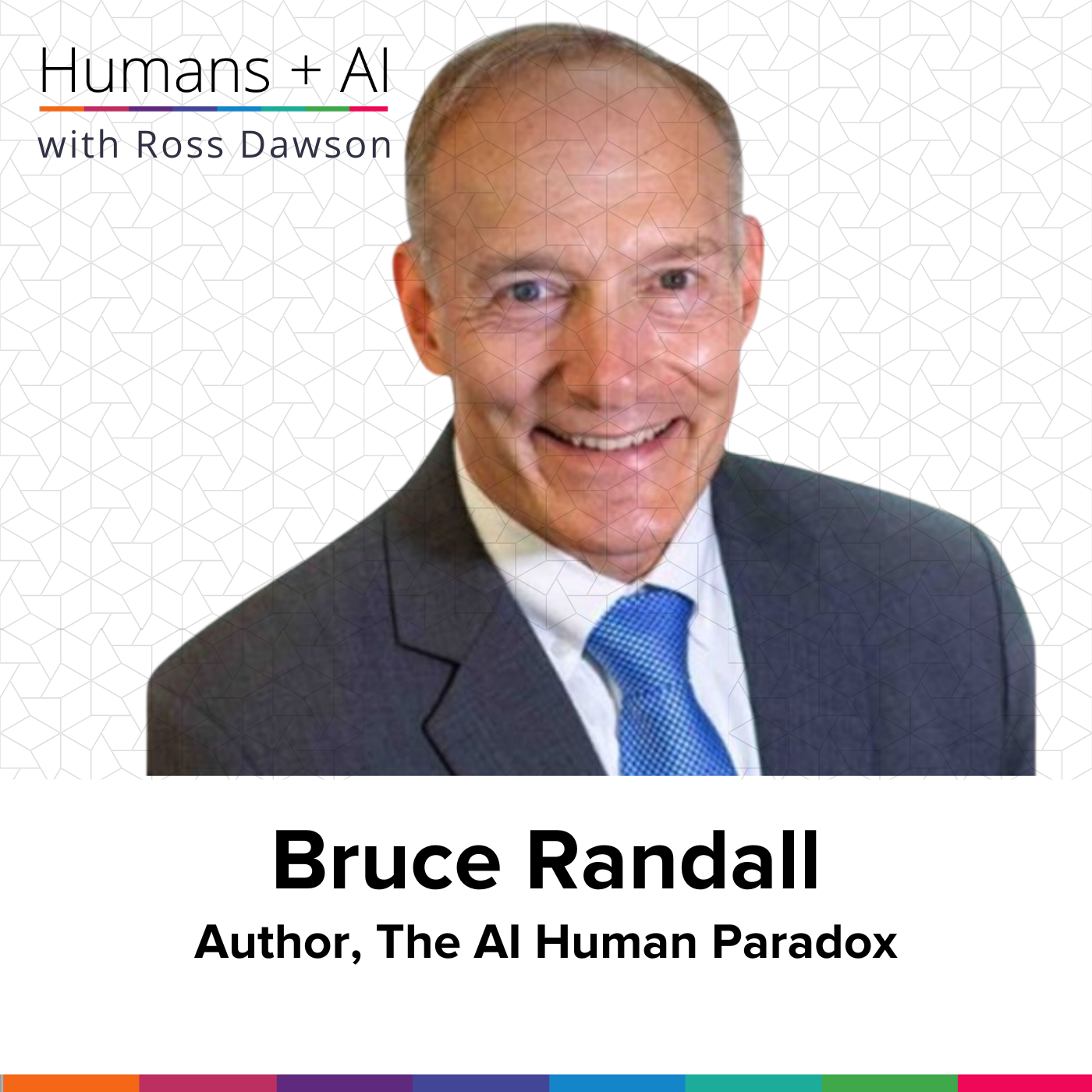
S3 Ep 4Bruce Randall on energy healing and AI, embedding AI in humans, and the implications of brain-computer interfaces (AC Ep4)
I feel that the frequency I have, and the frequency AI has, we’re going to be able to communicate based on frequency. But if we can understand what each is saying, that’s really where the magic happens. – Bruce Randall About Bruce Randall Bruce Randall describes himself as a tech visionary and Reiki Master who explores the intersection of technology, human consciousness, and the future of work. He has over 25 years of technology industry experience and is a longtime practitioner of energy healing and meditation. Website: Bruce Randall LinkedIn Profile: Bruce Randall What you will learn Exploring brain-computer interfaces and human potential Connecting reiki and AI through frequency and energy Understanding the limits and possibilities of neural implants Balancing intuition, emotion, and algorithmic decision-making Using meditation to sharpen awareness in a tech-driven world Navigating trust and critical thinking in the age of AI Imagining a future where technology and consciousness merge Episode Resources Companies & Organizations Neuralink Synchron MIT Technologies & Technical Terms Brain-computer interfaces AI (Artificial Intelligence) Agentic AI Neural implants Hallucinations (in AI context) Algorithmic trading Embedded devices Practices & Concepts Reiki Meditation Sentience Consciousness Critical thinking Transcript Ross Dawson: Bruce, it’s a delight to have you on the show. Bruce Randall: Well, Ross, thank you. I’m pleased to be on the show with you. Ross: So you have some interesting perspectives on, I suppose, humanity and technology. And just like to, in brief, hear how you got to your current perspectives. Bruce: Sure. Well, when I saw Neuralink put a chip in Nolan’s head and he could work the computer mouse with his thoughts, and he said, sometimes it goes where it moves on its own, but it always goes where I want it to go. So that, to me, was fascinating on how with the chip, we can do things like sentience and telecommunications and so forth that most humans can’t do. But with the chip, all of a sudden, all these doors are open now, and we’re still human. That’s fascinating to me. Ross: It certainly extends, extending our capabilities. It’s done in smaller ways in the past and now in far bigger ways. So you do have a deep technology background, but also some other aspects to your worldview. Bruce: I do. I’ve sold cloud, I’ve been educated in AI at MIT, and I built my first AI application. So I understand it from, I believe, from all sides, because I’ve actually done the work instead of read the books. And for me, this is fascinating because AI is moving faster than anything that we’ve had in recent memory, and it directly affects every person, because we’re working with it, or we can incorporate it in our body to make us better at what we do. And those possibilities are absolutely fascinating. Ross: So you describe yourself as a Reiki Master. So what is Reiki and how does that work? What’s its role been in your life? Bruce: Well, Reiki Master is you can connect with the universal energy that’s all around us, and it means I have a bigger pipe to put it through me, so I can direct it to people or things. And I’ve had a lot of good experiences where I’ve helped people in many different ways. The Reiki and the meditation came after that, and that brought me inside to find who I truly am and to connect with everything that has a vibration that I can connect with. That perspective, with the AI and where that’s going—AI is a hardware, but it produces software-type abilities, and so does the energy work that I do. They’re similar, but they’re very different. And I believe that everything is a vibration. We vibrate and so forth. So that vibration should be able to come together at some point. We should be able to communicate with it at some level. Ross: So if we look at the current state of research, scientific research into Reiki, there seems to be some potential low-level and small-population results. So it doesn’t seem to be a big tick. It doesn’t—there’s—there does appear to be something, but I think it’s fair to say there’s widespread skepticism in mainstream science about Reiki. So what’s your, I suppose, justification for this as a useful perspectival tool? Bruce: Well, I mean, I’ve had an intervention where I actually saved a life, which I won’t go into here. But my body moved, and I did that, and I said, I don’t know why I’m doing this, but I went with the body movement and ended up saving a life. To me, that proved to me, beyond a shadow of a doubt, that there’s something there other than just what humans can see and feel. And that convinced me. Now, it’s hard to convince anybody else. It’s experiential, so I really can’t defend it, other than saying that I have enough experiences where I
Carl Wocke on cloning human expertise, the ethics of digital twins, AI employment agencies, and communities of AI experts (AC Ep3)
We’re not trying to replace expertise—we’re trying to amplify and scale it. AI wants to create the expertise; we want to make yours omnipresent. – Carl Wocke About Carl Wocke Carl Wocke is the Managing Director of Merlynn Intelligence Technologies, which focuses on human to machine knowledge transmission using machine learning and AI. Carl consults with leading organizations globally in areas spanning risk management, banking, insurance, cyber crime and intelligent robotic process automation. Website: Emory Business Merlynn-AI LinkedIn Profile: Carl Wocke What you will learn Cloning human expertise through AI How digital twins scale decision-making Using simulations to extract tacit knowledge Redefining employee value with digital models Ethical dilemmas in ownership and bias Why collaboration beats data sharing Keeping humans relevant in an AI-first world Episode Resources Companies / Groups Merlynn Emory Tech and Tools Tom (Tacit Object Modeler) LLMs Concepts / Technical Terms Digital twin Tacit knowledge Human-in-the-loop Knowledge engineering Claims adjudication Financial crime Risk management Ensemble approach Federated data Agentic AI Transcript Ross Dawson: Carl, it’s wonderful to have you on the show. Carl Wocke: Thanks, Ross. Ross: So tell me about what Merlynn, your company, does. It’s very interesting, so I’d like to learn more. Carl: Yeah. So I think the most important thing when understanding what Merlynn is about is that we’re different from traditional AI in that we’re sort of obsessed with the cloning of human expertise. So where your traditional AI looks at data sources generating data, we are passionate about cloning our human experts. Ross: So part of the process, I gather, is to take human expertise and to embed that in models. So can you tell me a bit about that process? How does that happen? What is that process of—what I think in the past has been called knowledge engineering? Carl: Yeah. So we’ve built a series of technologies. The sort of primary technology is a technology called Tom. And Tom stands for Tacit Object Modeler. And Tom is a piece of AI that has been designed to simulate a decision environment. You are placed as an expert into the simulation environment, and through an interaction or discussion with Tom, Tom works out what the heuristic is, or what that subconscious judgment rule is that you use as an expert. And the way the technology works is you describe your decision environment to Tom. Tom then builds a simulator. It populates the simulator with data which is derived from the AI engine, and based on the way you respond, the data evolves. So what’s happening in the background is the AI engine is predicting your decision, and based on your response, it will evolve the sampling landscape or start to close up on the model. So it’s an interaction with a piece of AI. Ross: So you’re putting somebody in a simulation and seeing how they behave, and using their behaviors in that simulation to extract, I suppose, implicit models of how it is they think and make decisions. Carl: Absolutely so absolutely. And I think there’s sort of two main things to consider. The one is Tom will model a discrete decision. And a discrete decision is, what would Ross do when presented with the following environment? And that discrete decision can be modeled within an hour, typically. And the second thing is that there’s no data needed in the process. Validation is done through historical data, if you like. But yeah, it’s an exclusive sort of discussion between you and the AI, if that makes sense. Ross: So when people essentially get themselves modeled through these frameworks, what is their response when they see how the model that’s being created from their thinking responds to decision situations? Do they say, “These are the decisions I would have made?” I suppose there’s a feedback loop there in any case. But how do people feel about what’s been created? Carl: So there is a feedback loop. Through the process, you’re able to validate and test your digital twin. We refer to the models that are created as your digital twin. You can validate the model through the process. But what also happens—and this is sort of in the early days—is the expert might feel threatened. “You don’t need me anymore. You’ve got my decision.” But nothing could be further from the truth, because that digital twin that you’ve modeled is sort of tied to you. It evolves. Your decisions as an expert evolve over time. In certain industries, that happens quicker. But that digital twin actually amplifies your value to the organization. Because essentially what we’re doing with a digital twin is we’re making you omnipresent in an organization—and outside of the organization—in terms of your decisions. So the first reaction is, “I’m scared, am I going to have a job?” But after that, as
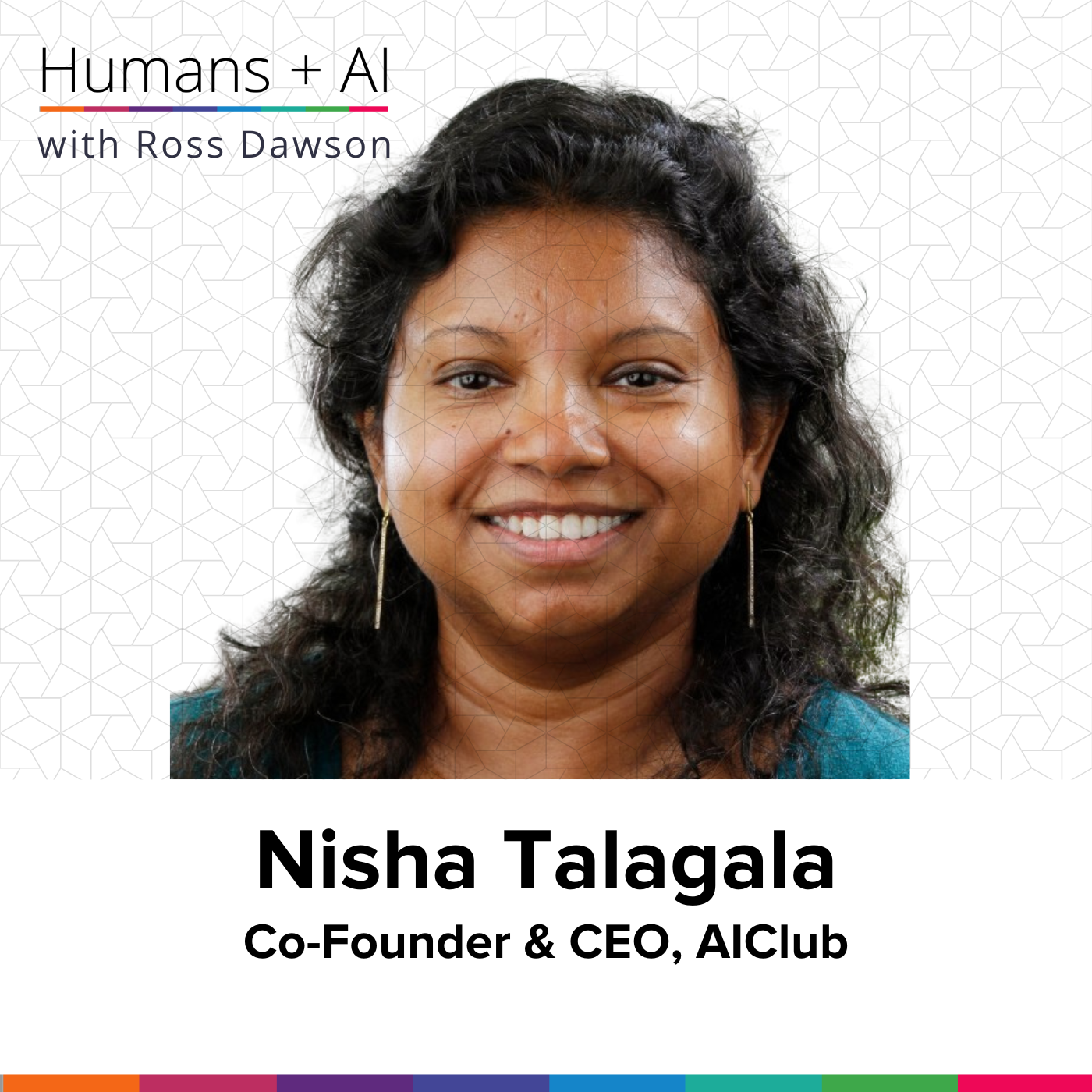
S3 Ep 2Nisha Talagala on the four Cs of AI literacy, vibe coding, critical thinking about AI, and teaching AI fundamentals (AC Ep2)
“The floor is rising really fast. So if you’re not ready to raise the ceiling, you’re going to have a problem.” – Nisha Talagala About Nisha Talagala Nisha Talagala is the CEO and Co-Founder of AIClub, which drives AI literacy for people of all ages. Previously, she co-founded ParallelM where she shaped the field of MLOps, with other roles including Lead Architect at Fusio-io and CTO at Gear6. She is the co-author of Fundamentals of Artificial Intelligence – the first AI textbook for Middle School and High School students. Website: Nisha Talagala Nisha Talagala LinkedIn Profile: Nisha Talagala What you will learn Understanding the four C’s of AI literacy How AI moved from winter to wildfire Teaching kids to build their own AI from scratch Why professionals must raise their ceiling The role of curiosity in using generative tools Navigating context and motivation behind AI models Embracing creativity as a key to future readiness Episode Resources People Andrej Karpathy Organizations & Companies AIClub AIClubPro Technical Terms AI Artificial General Intelligence ChatGPT GPT-1 GPT-2 GPT Neural network Loss function Foundation models AI life cycle Crowdsourced data Training data Iteration Chatbot Dark patterns Transcript Ross Dawson: Nisha, it’s a delight to have you on the show. Nisha Talagala: Thank you. Happy to be here. Thanks for having me. Ross: So you’ve been delving deep, deep, deep into AI for a very long time now, and I would love to hear, just to start, your reflections on where AI is today, and particularly in relation to humans. Nisha: Okay, absolutely. So I think that AI has been around for a very long time. And there was a long time which was actually called AI winter, which is effectively that very few people working on AI—only the true believers, really. And then a few things kind of happened. One of them was that the power of computers became so much greater, which was really needed for AI. And then the data also, with the internet and our ability to store and track all of this stuff, the data also became really plentiful. So when the compute met the data, and then people started developing software and sharing it, that created kind of like a perfect storm, if you will. That enabled people to really see that AI could do things. Previously, AI experiments were very small, and now suddenly companies like Google could run really big AI experiments. And often what happened is that they saw that it worked before they truly knew why it worked. So this entire field of AI kind of evolved, which is, “Hey, it works. We don’t actually know why. Let’s try it again and see if it works some more,” kind of thing. So that has been going on now for about a decade. And so, AI has been all around you for quite a long time. And then came ChatGPT. And not everyone knows, but ChatGPT is actually not the first version of GPT. GPT-1 and GPT-2 were pretty good. They were just very hard to use for someone who wasn’t very technical. And so, for those who are technical—one thing is, you had to—actually, it was a little bit like Jeopardy. You had to ask your question in the form of an incomplete sentence, which is kind of fun in the Jeopardy sort of way. But normally, we don’t talk to people with incomplete sentences hoping that they’ll finish that sentence and give us something we want to know. So ChatGPT just made it so much easier to use, and then suddenly, I think it just kind of burst on the mainstream. And that, again, fed on itself: more data, more compute, more excitement—going to the point that the last few years have really seen a level of advancement that is truly unprecedented, even in the past history of AI, which is almost already pretty unprecedented. So where is it going? I mean, I think that the level—so it’s kind of like—so people talk a lot about AGI and generalized intelligence and surpassing humans and stuff like that. I think that’s a difficult question, and I’m not sure if we’ll ever know whether it’s been reached. Or I don’t know that we would agree on what the definition is there, to therefore agree whether it’s been reached or not reached. There are other milestones, though. For example, standardized testing has already been taken over by AI. AI’s outperform on just about every level of standardized test, whether it’s a college test or a professional test, like the US medical licensing exam. It’s already outperforming most US doctors in those fields. And it’s scoring well on tests of knowledge as well. And also making headway in areas that are traditionally considerably challenged—areas like mathematics and reasoning have become issues. So I think you’re dealing with a place where, what I can tell you is that the AIs that I see right now in the public sphere rival the ability of PhD students I’ve worked with. So it’s serious. And I think it
HAI Launch episode
“This is about how we need to grow and develop our individual cognition as a complement to AI.” – Ross Dawson About Ross Dawson Ross Dawson is a futurist, keynote speaker, strategy advisor, author, and host of Amplifying Cognition podcast. He is Chairman of the Advanced Human Technologies group of companies and Founder of Humans + AI startup Informivity. He has delivered keynote speeches and strategy workshops in 33 countries and is the bestselling author of 5 books, most recently Thriving on Overload. Website: Ross Dawson Advanced Human Technologies LinkedIn Profile: Ross Dawson Books Thriving on Overload Living Networks 20th Anniversary Edition Living Networks Implementing Enterprise 2.0 Developing Knowledge-Based Client Relationships: Leadership in Professional Services Developing Knowledge-Based Client Relationships, The Future of Professional Services Developing Knowledge-Based Client Relationships What you will learn Tracing the evolution of the podcast name and vision How chatgpt shifted the AI conversation overnight Why humans plus AI is more than just a rebrand The mission to amplify human cognition through AI Exploring collective intelligence and team dynamics Rethinking work, strategy, and value creation with AI Envisioning a co-evolved future for humans and machines Episode Resources Books Thriving on Overload Technologies & Technical Terms AI agents Artificial intelligence Intelligence amplification Cognitive evolution Collective intelligence Strategic thinking Strategic decision-making Value creation Organizational structures Transhumanism AI governance Existential risk Critical thinking Attention Awareness Skill development Transcript Ross Dawson: This is the launch episode of the Humans Plus AI podcast, formerly the Amplifying Cognition podcast, and before that, the Thriving on Overload podcast. So in this brief episode, I will cover a bit of the backstory and a bit of where we got to where we are today, and calling this Humans Plus AI now—why I think it is so important, what it is we are going to cover, and framing a little bit this idea of Humans Plus AI. So the backstory is that the podcast started off as Thriving on Overload. It was the interviews I did for my book Thriving on Overload. The book came out in September 2022. By then, I was still continuing with the Thriving on Overload podcast, continuing to explore this idea of how we can amplify our thinking in a world of unlimited information. Essentially, our brains are finite, but in a world of infinite information, we need to learn the skills and the capabilities to be as effective as possible. And COVID—we’ll come back to that—but that is a fundamental issue today, which is the reason I wrote the book. Just three months after the book came out was what I call the ChatGPT moment, when there’s crystallizing progress in AI where I think just about every single researcher and person who’d been in the AI space was surprised or even amazed by the leap in capabilities that we achieved with that model—and of course, so much more since then. So I quickly wanted to consolidate my thinking, and immediately came on this phrase Humans Plus AI, which reflects a lot of my work over the years. I have been literally writing about AI, the role of AI agents, and particularly AI and work—for, well, in some ways, a couple of decades. But this was a moment where I felt I had to bring all of my work together. So fairly soon, I decided I needed to rebrand the podcast to be not just Thriving on Overload. But I still was tied to that theme. So I decided, let’s make this Amplifying Cognition, trying to get that middle ground with integrating the ideas of Humans Plus AI. How could humans and AI together be as wonderful as possible, but also this idea of Thriving on Overload—this individual cognition—how do we amplify our possibilities? There was a long list of different names that I was playing with, and one of the other front runners was, in fact, Amplifying Humanity. And in a way, that’s really what my mission is all about. And what all of these podcasts—the podcast and its various names—is about: how do we amplify who we are, our capabilities, our potential? Of course, the name Amplifying Humanity sounds a bit diffused. It’s not very clear. So it wasn’t the right name. Or not—there was certainly no right title at the time. But now, when I take this and say, well, we’re going to call this Humans Plus AI, in a way, I think that the Thriving on Overload piece of that is still as relevant—or even more relevant. That is part of the picture as we bring humans and AI together. This is about how we need to grow and develop our individual cognition as a complement to AI. So in fact, when I talk Humans Plus AI, Thriving on Overload, and Amplifying Cognition are really baked into that idea. So the broad frame of Humans Plus AI is simply: we have humans. We are inventors. We have created extraordinary technologies for
Kunal Gupta on the impact of AI on everything and its potential for overcoming barriers, health, learning, and far more (AC Ep86)
“Maybe the goal isn’t to eliminate the task or the human—but to reduce the frustration, the cognitive load, the overhead. That’s where AI shines.” – Kunal Gupta About Kunal Gupta Kunal Gupta is an entrepreneur, investor, and author. He founded and scaled global digital advertising AI company Nova as Chief Everything Officer for 15 years, with teams and clients across 30+ countries. He is author of four books, most recently 2034: How AI Changed the World Forever. Website: Kunal Gupta Kunal Gupta LinkedIn Profile: Kunal Gupta Book: 2034: How AI Changed Humanity Forever What you will learn Hosting secret AI dinners to spark human insight Using personal data to take control of health Why cognitive load is the real bottleneck When AI becomes a verb, not just a tool Reducing frustration through everyday AI The widening gap between AI capabilities and adoption Empowering curiosity in an AI-shaped world Episode Resources Books 2034: How AI Changed Humanity Forever Technical Terms & Concepts AI AI literacy Agentic AI Cognitive load LLMs (Large Language Models) Reference ranges Automation Browser agents Voice agents Data normalization Longevity-based testing Health data Cloud computing Social media adoption Generative AI Transcript Ross Dawson: Kunal, it is awesome to have you on the show. Kunal Gupta: Thanks, Ross. Nice to see you. Ross: So you came out with a book called 2034: How AI Changed Humanity Forever. So love to hear the backstory. Yes, that’s the book. So what’s the backstory? How did this book come about? Kunal: Yeah, I’ve written a few books, but this is definitely the most fun to write and to read and reread, and at some points, to rewrite. So back in November 2022, ChatGPT launches. There’s this view—okay, this is going to change our world, not sure how. So in the ensuing months, I had a number of conversations with friends and colleagues asking, “Hey, like, how does this change everything?” I asked people very open-ended questions, and the responses were all over the place. To me, what I realized was we actually just don’t know, and that’s the best place to be—when we don’t know but are curious. So I started to host dinners, six to ten people at a time in my apartment. I was in Portugal at the time, and London as well. Over the course of 2023, I hosted over 250 people over a couple dozen dinners. The setup was really unique in that nobody knew who else was coming. Nobody was allowed to talk about work, nobody was allowed to share what they did, and no phones were allowed either. So that meant really everybody was present. They didn’t need to be anybody, they didn’t need to be anywhere, and they could really open up. All of the conversations were recorded. All the questions were very open-ended along the lines of—really the subtitle of the book—like, how does AI change humanity? And we got into all sorts of different places. So over the course of the dinners in the year, recorded everything, had to transcribe it, and working with an editor, we manually went through the transcripts and identified about 100 individual ideas that came out of a human. And it’s usually some idea, inspiration, or some fear or insecurity. And we turned that into a book which has 100 different ideas, ten years into the future, of how AI might take how we live, how we work, how we date, how we eat, how we walk, how we learn, how we earn—and absolutely everything about humanity. Ross: So, I mean, there’s obviously far more in the book than we can cover in a short podcast, but what are some of the high-level perspectives? It’s been a bit of time since it’s come out, and people have had a chance to read it and give feedback, and you’ve reflected further on it. So what are some of the emergent thinking from you since the book has come out? Kunal: Yeah, I probably hear from a reader or two daily now, sharing lots of feedback. But the most common feedback I hear is that the book has helped change the way they think about AI, and that it’s helped them just think more openly about it and more openly about the possibilities. And that’s where introducing over 100 ideas across different aspects of society and humanity and industries and age groups and demographics is really meant to help open up the mind. I think in the face of AI, a lot of parts of society were closed or resistant to its potential impacts, or even fearful. And the book is really designed to open up the mind and drop some of the fear and really to be curious about what might happen. Ross: So taking this—taking sort of my perennial “humans plus AI” frame—what are some of the things that come to mind for you in terms of the potential of humans plus AI? What springs to mind first? Kunal: Those that say yes and are open and curious about it—I really think it’s an accelerant in so many different parts of life. I’ll give an example
Lee Rainie on being human in 2035, expert predictions, the impact of AI on cognition and social skills, and insights from generalists (AC Ep85)
“We could become obsolete by our own will—at least a portion of humanity just sort of giving up… But humans want to be valuable, want to be seen, want to be understood, want to be heard, want to think that their life matters. And this raises all sorts of questions about that.” – Lee Rainie About Lee Rainie Lee Rainie is Director of Imagining the Digital Future Center at Elon University. He joined in 2023 after 24 years of directing Pew Research Center’s Pew Internet Project, where his team produced more than 850 reports about the impact of major technology revolutions. Lee is co-author of five books about the future of the internet including “Networked: The New Social Operating System”. Website: Lee Rainie Lee Rainie Being Human in 2035 University Profile: Lee Rainie LinkedIn Profile: Lee Rainie What you will learn Imagining the digital future through expert insights Reflecting on past predictions about technology and society Understanding the human traits most at risk from AI Exploring the impact of AI on jobs and identity Identifying creativity and curiosity as human advantages Confronting the danger of overreliance on machines Redefining leadership in a tech-driven world Episode Resources People Marshall McLuhan Isaiah Berlin Erik Brynjolfsson Paul Saffo Vint Cerf Institutions & Organizations Imagining the Digital Future Center Elon University Pew Research Center Reports & Projects Being Human in 2035 AI, Robotics and the Future of Jobs Concepts & Technical Terms Artificial General Intelligence Superintelligence Metacognition Cognitive revolution Genomics revolution Nanotechnology revolution Information revolutions Large language models Digital twins Critical thinking Soft skills Transcript Ross Dawson: Lee, it’s a delight to have you on the show. Lee Rainie: Thanks so much, Ross. I’m looking forward to it. Ross: So you are director of the Imagining the Digital Future Center at Elon University. So that sounds like a wonderful initiative. Can you please tell us about it? Lee: It is a wonderful initiative, and I feel very fortunate to be here studying this subject at this moment. It’s a center at Elon University of North Carolina that grew out of a partnership that I had with Elon in my previous job, when I worked for the Pew Research Center. There were some interesting, enthusiastic, ambitious professors here who were interested in the digital future, and they basically rolled out the red carpet to me and offered a lot of labor, a lot of brainpower, and a lot of assistance in interviewing experts about the future. One of the things that happened when I went to Pew in the first place, just at the turn of the millennium, was we were measuring adoption of technology—first the internet, then home broadband, and then a bunch of other things. But whenever I went out to speak about our findings, the first question from the audience was, “Well, that’s all well and good. You’re looking at the here and now, and fine, dandy, but what’s the next big thing?” Because that’s always the urgent question when you’re thinking about digital technologies. So I began to work with the professors at Elon to see if experts really had a decent track record in looking at the future. The first project we did was looking at predictions about the rise of the internet and what it would do, both in social, political, and economic terms. We found 4,400 predictions that were made between 1990 and 1995 about the internet. And experts were largely on the mark, partly because it wasn’t really so much future questions that they were looking at. They just knew what was coming out of the labs. They knew what they were working on. They knew what competitors were working on. And so it wasn’t hard to really anticipate the future if you talk to the right people. So we built a database of experts, and it’s a convenience database. There’s no—this is not a representative sample of all expertise about digital technology. It’s pioneers of the technology, it’s builders of the technology, it’s analysts. A lot of academics are in our database. And we just started asking in the year 2020, 2004, about things over the horizon. And it was a wonderful methodology, just to give us insight into the things that were around the corner. We’re not pretending that it’s quantitatively, scientifically accurate. We marry the methodologies of quantitative and qualitative work. And so it’s basically smart people riffing on the future. Ross: So wanted to get to that. So I actually tend, whenever I use the word expert, I always use quotation marks, because who’s an expert. I love what Marshall McLuhan said. Certainly the effect of the expert is the person who stays put, as the avatar is the one who continues to explore. But having said that, of course, yeah, some people know more about particular topics, and if we’
Kieran Gilmurray on agentic AI, software labor, restructuring roles, and AI native intelligence businesses (AC Ep84)
“Let technology do the bits that technology is really good at. Offload to it. Then over-index and over-amplify the human skills we should have developed over the last 10, 15, or 20 years.” – Kieran Gilmurray About Kieran Gilmurray Kieran Gilmurray is CEO of Kieran Gilmurray and Company and Chief AI Innovator of Technology Transformation Group. He works as a keynote speaker, fractional CTO and delivering transformation programs for global businesses. He is author of three books, most recently Agentic AI. He has been named as a top thought leader on generative AI, agentic AI, and many other domains. Website: Kieran Gilmurray X Profile: Kieran Gilmurray LinkedIn Profile: Kieran Gilmurray BOOK: Free chapters from Agentic AI by Kieran Gilmurray Chapter 1 The Rise of Self-Driving AI Chapter 2: The Third Wave of AI Chapter 3 – Agentic AI Mapping the Road to Autonomy Chapter 4- Effective AI Agents What you will learn Understanding the leap from generative to agentic AI Redefining work with autonomous digital labor The disappearing need for traditional junior roles Augmenting human cognition, not replacing it Building emotionally intelligent, tech-savvy teams Rethinking leadership in AI-powered organizations Designing adaptive, intelligent businesses for the future Episode Resources People John Hagel Peter Senge Ethan Mollick Technical & Industry Terms Agentic AI Generative AI Artificial intelligence Digital labor Robotic process automation (RPA) Large language models (LLMs) Autonomous systems Cognitive offload Human-in-the-loop Cognitive augmentation Digital transformation Emotional intelligence Recommendation engine AI-native Exponential technology Intelligent workflows Transcript Ross Dawson: Hey, it’s fantastic to have you on the show. Kieran Gilmurray: Absolutely delighted, Ross. Brilliant to be here. And thank you so much for the invitation, by the way. Ross: So agentic AI is hot, hot, hot, and it’s now sort of these new levels of how it is we — these are autonomous or semi-autonomous aspects of AI. So I want to really dig into — you’ve got a new book out on agentic AI, and particularly looking at the future of work. And particularly want to look at work, so amplifying cognition. So I want to start off just by thinking about, first of all, what is different about agentic AI from generative AI, which we’ve had for the last two or three years, in terms of our ability to think better, to perform our work better, to make better decisions? So what is distinctive about this layer of agentic AI? Kieran: I was going to say, Ross, comically, nothing if we don’t actually use it. Because it’s like all the technologies that have come over the last 10–15 years. We’ve had every technology we have ever needed to make more work, more efficient work, more creative work, more innovative, to get teams working together a lot more effectively. But let’s be honest, technology’s dirty little secret is that we as humans very often resist. So I’m hoping that we don’t resist this technology like the others we have slowly resisted in the past, but they’ve all come around to make us work with them. But this one is subtly different. So when you say, look, agentic AI is another artificial intelligence system. The difference in this one — if you take some of the recent, what I describe as digital workforce or digital labor, go back eight years to look at robotic process automation — which was very much about helping people perform what was meant to be end-to-end tasks. So in other words, the robots took the bulky work, the horrible work, the repetitive work, the mundane work and so on — all vital stuff to do, but not where you really want to put your teams, not where you really want to spend your time. And usually, all of that mundaneness sucked creativity out of the room. You ended up doing it most of the day, got bored, and then never did the innovative, interesting stuff. Agentic is still digital labor sitting on top of large language models. And the difference here is, as described, is that this is meant to be able to act autonomously. In other words, you give it a goal and off it goes with minimal or no human intervention. You can design it as such, or both. And the systems are meant to be more proactive than reactive. They plan, they adapt, they operate in more dynamic environments. They don’t really need human input. You give them a goal, they try and make some of the decisions. And the interesting bit is, there is — or should be — human in the loop in this. A little bit of intervention. But the piece here, unlike RPA — that was RPA 1, I should say, not the later versions because it’s changed — is its ability to adapt and to reshape itself and to relearn with every interaction. Or if you take it at the most basic level — you look at a robot under the sea trying to navigate, to build pipelines. In the past, it would get stuck. A h
Jennifer Haase on human-AI co-creativity, uncommon ideas, creative synergy, and humans outperforming (AC Ep83)
“We humans often tend to be very restricted—even when we are world champions in a game. And I’m very optimistic that AI will surprise us, with very different ways of solving complex problems—and we can make use of that.” – Jennifer Haase About Jennifer Haase Dr. Jennifer Haase is a researcher at the Weizenbaum Institute, and lecturer at Humboldt University and University of the Arts Berlin. Her work focuses on the intersection of creativity, Artificial Intelligence, and automation, including AI for enhancing creative processes. She was named as one the 100 most important minds in Berlin science. Website: Jennifer Haase Jennifer Haase LinkedIn Profile: Jennifer Haase What you will learn Stumbling into creativity through psychology and tech Redefining creativity in the age of AI The rise of co-creation between humans and machines How divergent and reverse thinking fuel innovation Designing AI tools that adapt to human thought Balancing human motivation with machine efficiency Challenging assumptions with AI’s unconventional solutions Episode Resources Websites & Platforms jenniferhaase.com ChatGPT Concepts & Technical Terms Artificial Intelligence (AI) Human-AI Co-Creativity Generative AI Large Language Models (LLMs) ChatGPT GPT-4 GPT-3.5 GPT-4.5 Business Informatics Psychology Creativity Divergent Thinking Convergent Thinking Mental Flexibility Iterative Process Everyday Creativity Alternative Uses Test Creativity Measures Creative Performance Transcript Ross Dawson: Jennifer, it’s a delight to have you on the show. Jennifer Haase: Thanks for inviting me. Ross: So you are diving deep, deep, deep into AI and human co-creativity. So just to hear—just back a little bit—sort of how you’ve embarked on this journey. I mean, love to—we can fill in more about what you’re doing now. But how did you come to be on this journey? Jennifer: I would say overall, it was me stumbling into tech more and more and more. So I started with creativity. My background is in psychology, and I learned about the concept of creativity in my Bachelor studies, and I got so confused, because what I was taught was nothing like what I thought creativity was—or how it felt to me. It took me years to understand that there are a bunch of different theories, and it was just one that we were taught. But that was the spark of the curiosity for me to try to understand this concept of creativity. And I did it for years. Then, by pure luck, I started a PhD in Business Informatics, which is somewhat technical. The lens of how I looked at creativity shifted from the psychological perspective more into the technical realm, and I looked at business processes and how they are advanced by general technology—basic software, basically. Then I morphed—also, by sheer luck—I morphed into computer science from a research perspective. And that coincided with ChatGPT coming around, and this huge LLM boom happened two, three years ago. And since then, I’m deeply in there. I just fell, fell in this rabbit hole. Ross: Yeah, well, it’s one of the most marvelous things. So the very first use case for most people, when they first use ChatGPT, is: write a poem in the style of whatever, or essentially creative tasks. And pretty decently does those to start off—until you sort of started to see the limitations at the time. Jennifer: Yeah, and I think it did so much. It’s so many different perspectives. I think we—as I said, I studied creativity for quite a while—but it was never as big of a deal, let’s say. It was just one concept of many. But since AI came around, I think it really threatened, to some part, what we understood about creativity, because it was always thought of as this pinnacle of humanness—right next to ethics. And I think intelligence had its bumps two or three decades ago, but for creativity, it was rather new. So the debate started of what it really means to be creative. I think a lot of people also try to make it even bigger than it is. But I think it is as simple as—a lot about creativity is, for example, in terms of poets—poetry is language understanding, right? And so LLMs are really good at it. And it’s just the case. It’s fine. I think we can still live happy lives as humans, although technology takes a lot over. Ross: Yes. So humans are creative in all sorts of dimensions. AI has complementary—let’s say, also different—capabilities in creativity. And in some of your research, you have pointed to different levels of how AI is supporting us in various guises—through being a tool and assistant, through to what you described as the co-creation. So what does that look like? What are some of the manifestations of human-AI co-creativity, which implies peers with different, complementary capabilities? Jennifer: Yeah, I think the easiest way to look at it is if you imagine working creatively with another person who is really competent—but the person is a technical
Pat Pataranutaporn on human flourishing with AI, augmenting reasoning, enhancing motivation, and benchmarking human-AI interaction (AC Ep82)
“We should not make technology so that we can be stupid. We should make technology so we can be even smarter… not just make the machine more intelligent, but enhance the overall intelligence—especially human intelligence.” –Pat Pataranutaporn About Pat Pataranutaporn Pat Pataranutaporn is Co-Director of MIT Media Lab’s new Advancing Humans with AI (AHA) research program, alongside Pattie Maes. In addition to extensive academic publications, his research has been featured in Scientific American, MIT Tech Review, Washington Post, Wall Street Journal, and other leading publications. His work has been named in TIME’s “Best Inventions” lists and Fast Company’s “World Changing Ideas.” Websites: MIT Media Lab AI (AHA) LinkedIn Profile: Pat Pataranutaporn What you will learn Reimagining ai as a tool for human flourishing Exploring the future you project and long-term thinking Boosting motivation through personalized ai learning Enhancing critical thinking with question-based ai prompts Designing agents that collaborate, not dominate Preventing collective intelligence from becoming uniform Launching aha to measure ai’s real impact on people Episode Resources People Hal Herschfeld Pattie Maes Elon Musk Organizations & Institutions MIT Media Lab KBTG ACM SIGCHI Center for Collective Intelligence Technical Terms & Concepts Human flourishing Human-AI interaction Digital twin Augmented reasoning Multi-agent systems Collective intelligence AI bias Socratic questioning Cognitive load Human general intelligence (HGI) Artificial general intelligence (AGI) Transcript Ross Dawson: Pat, it is wonderful to have you on the show. Pat Pataranutaporn: Thank you so much. It’s awesome to be here. Thanks for having me. Ross: There’s so much to dive into, but as a starting point: you focus on human flourishing with AI, exactly. So what does that mean? Paint the big picture of AI and how it can help us to flourish as who we are and our humanity. Pat: Yeah, that’s a great question. So I’m a researcher at MIT Media Lab. I’ve been working on human-AI interaction before it was cool—before ChatGPT took off, right? So we have been asking this question for a long time: when we focus on artificial intelligence, what does it mean for people? What does it mean for humanity? I think today, a lot of conversation is about how we can make models better, how we can make technology smarter and smarter. But does that mean that we can be stupid? Does it mean that we can just let the machine be the smart one and let it take over? That is not the vision that we have at MIT. We believe that technology should make humans better. So I think the idea of human flourishing is an umbrella term that we use to describe different areas where we think AI could enhance the human experience. For me in particular, I focus on three areas: how AI can enhance human wisdom, enhancing wonder, and well-being. So: 3 W’s—wisdom, wonder, and well-being. We work on many projects to look into these areas. For example, how AI could allow a person to talk to their future self, so that they can think in the longer term, to see that future more vividly. That’s about enhancing wonder and wisdom. We think a lot about how AI can help people think more critically and analyze information that they encounter on a daily basis in a more comprehensive way. And you know well-being, we have many projects that look at how AI can improve human mental health, positive thinking, and things like that. But at the end, we also focus on AI that doesn’t lead to human flourishing, to balance it out. We study in what contexts human-AI interaction leads to negative outcomes—like people becoming lonelier or experiencing negative outcomes such as false memories, misinformation, and things like that. As scientists, we’re not overly optimistic or pessimistic. We’re trying to understand what’s going on and how we can design a better future for everyone. That’s what we’re trying to focus on. Yeah? Ros: Fabulous. And as you say, there are many, many different projects and domains of research which you’re delving into. So I’d like to start to dive into some of those. One that you mentioned was the Future You project. So I’d love to hear about what that is, how you created it, and what the impact was on people being able to interact with their future selves. Pat: Totally. So, I mean, as I said, right, the idea of human flourishing is really exciting for us. And in order to flourish, like, you cannot think short term. You need to think long term and be able to sort of imagine: how would you get there, right? So as a kid, I was interested in sort of a time machine. Like, I loved dinosaurs. I wanted to go back into the past and also go into the future, see what would happen in the future, like the exciting future we might have. So I really love this idea of, like, having a time machine. And of course, we cannot do a real time machine yet, but we c
Amplifying Foresight Compilation (AC Ep81)
“We wanted to see what the effect of AI might be on forecasting accuracy… to our surprise, we find that even when the model gives biased or noisy advice, human forecasters still improve—something we didn’t expect.” – Philipp Schoenegger “I kind of call these Gen AI systems a mirror. Pose it a question, play with scenarios, and see what comes out. It’s like an accelerant for thinking—pushing the boundaries of what’s possible.” – Nikolas Badminton “Future thinking is an everyday practice. It’s about becoming more aware of what’s happening around us, sensing signals, and collectively imagining what’s next.” – Sylvia Gallusser “The question of the future isn’t ‘How creative are you?’ but ‘How are you creative?’ Because what we can imagine, we can create—and we have a responsibility to build a better future.” – Jack Uldrich About Philipp Schoenegger, Nikolas Badminton, Sylvia Gallusser, & Jack Uldrich Philipp Schoenegger is a researcher at London School of Economics working at the intersection of judgement, decision-making, and applied artificial intelligence. He is also a professional forecaster, working as a forecasting consultant for the Swift Centre as well as a ‘Pro Forecaster’ for Metaculus, providing probabilistic forecasts and detailed rationales for a variety of major organizations. Nikolas Badminton is the Chief Futurist of the Futurist Think Tank. He is a world-renowned futurist speaker, award-winning author, and executive advisor, with clients including Disney, Google, J.P. Morgan, Microsoft, NASA, and many other leading companies. He is author of Facing Our Futures and host of the Exponential Minds podcast. Sylvia Gallusser is Founder and CEO of Silicon Humanism, a futures thinking and strategic foresight consultancy. Previous roles include a variety of strategic roles at Accenture, Head of Technology at Business France North America, General Manager at French Tech Hub, and Co-founder at big bang factory. She is also a frequent keynote speaker and author of speculative fiction. Jack Uldrich is a leading futurist, author, and speaker who helps organizations gain the critical foresight they need to create a successful future. His work is based on the principles of unlearning as a strategy to survive and thrive in an era of unparalleled change. He is the author of 9 books including Business As Unusual. Websites: Nikolas Badminton Nikolas Badminton Sylvia Gallusser Jack Uldrich University Profile: Philipp Schoenegger LinkedIn Profile: Philipp Schoenegger Nikolas Badminton Sylvia Gallusser Jack Uldrich What you will learn How AI-augmented predictions enhance human forecasting The surprising impact of biased AI advice on accuracy Why generative AI acts as a mirror for future thinking The role of signal scanning in spotting emerging trends How creativity and imagination shape the future The evolving nature of community in an AI-driven world Why unlearning is key to adapting in a changing era Episode Resources People Philip Tetlock Jonas Salk Books & Publications Superforecasting Facing Our Futures Technical Terms & Concepts AI-augmented predictions Large language models (LLMs) The Ten Commandments of Forecasting The Ten Commandments of Superforecasting Forecasting accuracy Signal scanning Scenario planning Foresight strategy Generative AI Base rate Bias in AI Cognitive augmentation Transcript Ross Dawson: Now, it’s wonderful to see the work which you’re doing. Speaking of which, recently, you were the lead author of a paper, AI-Augmented Predictions: LLM Assistants Improve Human Forecasting Accuracy. So first of all, perhaps just describe the paper at a high level, and then we can dig into some of the specifics. Philipp Schoenegger: Yeah. So the basic idea of this paper is: how can we improve human forecasting? Human judgmental forecasting is basically the idea that you can query a bunch of very interested and sometimes laypeople about future events and then aggregate their predictions to arrive at surprisingly accurate estimations of future outcomes. This goes back to work on Superforecasting by Philip Tetlock, and there are a lot of different approaches on how one might go about improving human prediction capabilities. There might be some training—it was called The Ten Commandments of Forecasting—on how you can be a better forecaster. Or there might be some conversations where different forecasters talk to each other and exchange their views. And we want to look at how we can—how we could—think about improving human forecasting with AI. I think one of the main strengths of the current generation of large language models is the interactive nature of the back and forth, having a highly competent model that people can interact with and query whenever they want really. They might ask the model, “Please help me on this question. What’s the answer?” They might also just say, “Here’s what I think. P
AI for Strategy Compilation (AC Ep80)
“AI can make the process of sensing for signals much faster and much more efficient. You can think of it as a supplement to our brain. It can sort through massive amounts of data, track the latest developments, and flash alerts when something important emerges.” – Rita McGrath “What I found surprising in our exercises was how disruptive AI was. At first, I thought they would hate it, but they actually liked it. It made them stop and think because it forced them to break out of their usual patterns and consider ideas they wouldn’t have consciously introduced into the discussion.” – Christian Stadler “AI can accelerate the foresight process. It can help generate diverse perspectives, identify second-degree impacts, and uncover biases we might not notice. Of course, human critical thinking is still essential—we shouldn’t accept AI outputs as absolute truth, but rather use them as a starting point.” – Valentina Contini “One key area where AI excels is handling cognitive complexity. Humans struggle to hold thousands of variables in their heads, but AI can process vast amounts of interconnected data. The challenge is designing interfaces that allow humans to interact with this complexity in an intuitive way.” – Anthea Roberts About Rita McGrath, Christian Stadler, Valentina Contini, & Anthea Roberts Rita McGrath is one of the world’s top experts on strategy and innovation. She is consistently ranked among the top 10 management thinkers globally and has earned the #1 award for strategy by Thinkers 50. She is Professor of Strategy at Columbia Business School, and Founder of the Rita McGrath Group and Valize LLC. Her books include The End of Competitive Advantage and Seeing Around Corners. Christian Stadler is a professor of strategic management at Warwick Business School. He is author of Open Strategy, which was named as a Best Business Book by Financial Times and Strategy + Business and has been translated into 11 languages. His work has been featured in Harvard Business Review, New York Times, Wall Street Journal, CNN, BBC, and Al Jazeera, among others. Valentina Contini is an innovation strategist for a global IT services firm, a technofuturist, and speaker. She has a background in engineering, innovation design, AI-powered foresight, and biohacking. Her previous work includes founding the Innovation Lab at Porsche. Anthea Roberts is Professor at the School of Regulation and Global Governance at the Australian National University (ANU) and a Visiting Professor at Harvard Law School. She is also the Founder, Director and CEO of Dragonfly Thinking. Her latest book, Six Faces of Globalization, was selected as one of the Best Books of 2021 by The Financial Times and Fortune Magazine. She has won numerous presitigious awards and has been named “the world’s leading international law scholar” by the League of Scholars. Websites: Rita McGrath Rita McGrath Christian Stadler Valentina Contini Anthea Roberts Anthea Roberts University Profile: Rita McGrath Christian Stadler Anthea Roberts LinkedIn Profile: Rita McGrath Christian Stadler Valentina Contini Anthea Robert What you will learn Bridging human cognition and AI for better decision-making How AI disrupts traditional boardroom dynamics Enhancing foresight with AI-driven scenario planning The role of AI in sense-making and strategic insights Why AI-generated variety outperforms human creativity Managing cognitive complexity with AI augmentation The evolving partnership between humans and AI in strategy Episode Resources Companies & Organizations Wrigley ChatGPT OpenAI Technical Terms & AI-Related Artificial Intelligence (AI) Large Language Models (LLMs) Generative AI Cognitive Complexity Metacognition Strategic Foresight Decision-Making Frameworks Transcript Ross Dawson: One of the key themes is strategy. How do we do strategy in a world that is accelerating, with all these overlay themes? There are, as you say, 10x shifts in many dimensions of work. This brings us to human capabilities. Humans have limited, finite cognition, even though we have extraordinary capabilities far transcending anything else. Now, we have AI to augment, support, or complement us. I’d like to dive in deep, but just to start—what is your framing around human capabilities in strategic thinking today, and how they are complemented by AI? Rita McGrath: Sure. Well, as I mentioned, human brains think in linear terms. We think immediately in terms of getting from here to there to avoid a predator. Back in the day when we were evolving, that worked pretty well. But we don’t do very well with exponential systems because they look small, and they look small, and they go small—until suddenly they don’t. It’s the whole “gradually, then suddenly” idea. What I argue is that you need to supplement what your brain can manage on its own. This is where I think AI comes in. What I’ve set up with companies is a series of what I call
Collective Intelligence Compilation (AC Ep79)
“Collective intelligence is the ability of a group to solve a wide range of problems, and it’s something that also seems to be a stable collective ability.” – Anita Williams Woolley “When you get a response from a language model, it’s a bit like a response from a crowd of people. It’s shaped by the collective judgments of countless individuals.” – Jason Burton “Rather than just artificial general intelligence (AGI), I prefer the term augmented collective intelligence (ACI), where we design processes that maximize the synergy between humans and AI.” – Gianni Giacomelli “We developed Conversational Swarm Intelligence to scale deliberative processes while maintaining the benefits of small group discussions.” – Louis Rosenberg About Anita Williams Woolley, Jason Burton, Gianni Giacomelli, & Louis Rosenberg Anita Williams Woolley is the Associate Dean of Research and Professor of Organizational Behavior at Carnegie Mellon University’s Tepper School of Business. She received her doctorate from Harvard University, with subsequent research including seminal work on collective intelligence in teams, first published in Science. Her current work focuses on collective intelligence in human-computer collaboration, with projects funded by DARPA and the NSF, focusing on how AI enhances synchronous and asynchronous collaboration in distributed teams. Jason Burton is an assistant professor at Copenhagen Business School and an Alexander von Humboldt Research fellow at the Max Planck Institute for Human Development. His research applies computational methods to studying human behavior in a digital society, including reasoning in online information environments and collective intelligence. Gianni Giacomelli is the Founder of Supermind.Design and Head of Design Innovation at MIT’s Center for Collective Intelligence. He previously held a range of leadership roles in major organizations, most recently as Chief Innovation Officer at global professional services firm Genpact. He has written extensively for media and in scientific journals and is a frequent conference speaker. Louis Rosenberg is CEO and Chief Scientist of Unanimous A.I., which amplifies the intelligence of networked human groups. He earned his PhD from Stanford and has been awarded over 300 patents for virtual reality, augmented reality, and artificial intelligence technologies. He has founded a number of successful companies including Unanimous AI, Immersion Corporation, Microscribe, and Outland Research. His new book Our Next Reality on the AI-powered Metaverse is out in March 2024. Websites: Gianni Giacomelli Louis Rosenberg University Profile: Anita Williams Woolley Jason Burton LinkedIn Profile: Anita Williams Woolley Jason Burton Gianni Giacomelli Louis Rosenberg What you will learn Understanding the power of collective intelligence How teams think smarter than individuals The role of ai in amplifying human collaboration Memory, attention, and reasoning in group decision-making Why large language models reflect collective intelligence Designing synergy between humans and ai Scaling conversations with conversational swarm intelligence Episode Resources People Thomas Malone Steve Jobs Concepts & Frameworks Transactive Memory Systems Reinforcement Learning from Human Feedback (RLHF) Conversational Swarm Intelligence Augmented Collective Intelligence (ACI) Artificial General Intelligence (AGI) Technology & AI Terms Large Language Models (LLMs) Machine Learning Collective Intelligence Artificial Intelligence (AI) Cognitive Systems Transcript Anita Williams Woolley: Individual intelligence is a concept most people are familiar with. When we’re talking about general human intelligence, it refers to a general underlying ability for people to perform across many domains. Empirically, it has been shown that measures of individual intelligence predict a person’s performance over time. It is a relatively stable attribute. For a long time, when we thought about intelligence in teams, we considered it in terms of the total intelligence of the individual members combined—the aggregate intelligence. However, in our work, we challenged that notion by conducting studies that showed some attributes of the collective—the way individuals coordinated their inputs, worked together, and amplified each other’s contributions—were not directly predictable from simply knowing the intelligence of the individual members. Collective intelligence is the ability of a group to solve a wide range of problems. It also appears to be a stable collective ability. Of course, in teams and groups, you can change individual members, and other factors may alter collective intelligence more readily than individual intelligence. However, we have observed that it remains fairly stable over time, enabling greater capability. In some cases, collective intelligence can be high or low. When a group has high collective intelligence, it is more ca
Helen Lee Kupp on redesigning work, enabling expression, creative constraints, and women defining AI (AC Ep78)
“I’m cautiously optimistic because never before has technology been as accessible as it is now—being able to interact with machines in a way that feels so natural to us, rather than in ones and zeros or more technical ways. AI shouldn’t replace what exists but augment and enhance our creativity, helping us tap into what makes us uniquely human.” – Helen Lee Kupp About Helen Lee Kupp Helen Lee Kupp is co-founder and CEO of Women Defining AI, a community of female leaders applying and driving AI. She was previously leader of strategy and analytics at Slack and co-founder of its Future Forum. She is co-author of the best-selling book “How the Future Works: Leading Flexible Teams to do the Best Work of Their Lives”. Website: Women Defining AI LinkedIn Profile: Helen Lee Kupp What you will learn Redefining collaboration in the AI era Unlocking human potential through technology Why flexible work matters more than ever The power of diverse perspectives in AI Balancing optimism and caution in AI adoption How leaders can foster innovation from the ground up Women defining AI and shaping the future Episode Resources People Gregory Bateson Nichole Sterling (co-founder of Women Defining AI) Companies & Organizations Women Defining AI Technical Terms & Concepts AI (Artificial Intelligence) Generative AI Large Language Model (LLM) Non-deterministic AI policy AI adoption Machine learning (ML) Human-in-the-loop Transcript Ross Dawson: Helen, it is a delight to have you on the show. Helen Lee Kupp: It’s good to be here. I love how we first started talking over an AI research paper. It was very random but awesome. Ross: Well, that’s pushing the edges, trying to find what’s out there and see what comes on the other side. AI is emerging, and we’re sitting alongside each other. How are you feeling about today and how humans and AI are coming together? Helen: I feel cautiously optimistic, and part of that is because I’ve been in tech for so long. Prior to getting much deeper into AI, I was working on flexible work and research around how to rethink and redesign how we, as humans, collaborate in a way that is more personalized, more customized, and helps more people bring their best selves to work and do their best work. It was serendipitous that around the same time, there was an increase in AI innovation. Now, we had technology to pair with the equation of redesigning work. COVID forced us to rethink work, not just from a people and process perspective but alongside rapid technological change. I’m cautiously optimistic because never before has technology been as accessible as it is now. We can interact with machines in a way that feels so natural rather than in ones and zeros or technical ways. Ross: I’m very aligned with that. One of the things you said was “bring your best self to work.” I think of it as human potential. If we’re creating a future of work, we have potential futures that are not so great and others that are very positive, where people express more of who they are and their capabilities. How can we create organizations like that? Helen: It starts with recognizing that everyone has different preferences and work styles. Organizations, teams, and leaders need to meet people where they are rather than force them into rigid structures that worked in the past. I often share this story—I’m deeply introverted. Despite jumping onto this podcast with you, I have always been an introvert. Navigating an extroverted world takes extra energy. In traditional office and meeting environments, I had to work harder to show up. However, when I had more diverse formats to interact with my team and leadership, it unlocked something for me. Instead of pretending to be the loudest in the room, I could find my own ways of expressing ideas—through text, written formats, or chat. It made work easier for me. When you think about how that manifests across a team, leaders and organizations must avoid putting rigid boxes around collaboration—whether it’s the hours we work or the place where we work. Increasing flexibility enables people to express themselves and bring forward ideas that might otherwise remain hidden. Ross: That’s a compelling vision. How do you bring that to reality? What do you do inside an organization to foster and enable that? Helen: One of the tools that helped in our research on the future of work and redesigning organizations is something simple—creating a team operating manual. The act of explicitly writing down the different ways we interact as a team opens up discussions. It allows for feedback: “Does this work for you? Should we try something different?” When these conversations don’t happen, implied assumptions remain—such as the norm of working in an office from nine to five. Explicitly stating and questioning these assumptions is step one. Then, organizations should give teams and managers the flexibility to define how they work within
Human AI Symbiosis Compilation (AC Ep77)
“Generative AI is the first technology with an almost natural propensity to build a symbiotic relationship with us. But symbiosis isn’t always mutualistic—it can be parasitic, where AI benefits at the detriment of humans. How we deploy AI will determine which path we take.” – Alexandra Diening “AI provides dual affordances—it can automate our work or augment our abilities. The key challenge is deciding where to draw the line. In low-stakes tasks, automation makes sense. But in high-stakes decision-making, human intuition is irreplaceable.” – Mohammad Hossein Jarrahi “We talk a lot about lifelong learning, but we also need to embrace lifelong forgetting. If we keep piling new knowledge on top of outdated thinking, we won’t evolve. The future isn’t about ‘us vs. them’—it’s about humans and AI co-evolving together.” – Erica Orange “AI isn’t just changing how we work—it’s changing what it means to be human. We are interlacing with technology more deeply than ever, and in the future, AI won’t just be something we use—it will be something we integrate into ourselves.” – Pedro Uria Recio About Alexandra Diening, Mohammad Hossein Jarrahi, Erica Orange, & Pedro Uria Recio Alexandra Diening is Co-founder & Executive Chair of Human-AI Symbiosis Alliance. She has held a range of senior executive roles including as Global Head of Research & Insights at EPAM Systems. Through her career she has helped transform over 150 digital innovation ideas into products, brands, and business models that have attracted $120 million in funding . She holds a PhD in cyberpsychology, and is author of Decoding Empathy: An Executive’s Blueprint for Building Human-Centric AI and A Strategy for Human-AI Symbiosis. Mohammad Hossein Jarrahi is Associate Professor at the School of Information and Library Science at University of North Carolina at Chapel Hill. He has won numerous awards for teaching and his papers, including for his article “Artificial intelligence and the future of work: Human-AI symbiosis in organizational decision making.” His wide-ranging research spans many aspects of the social and organizational implications of information and communication technologies. Erica Orange is a futurist, speaker, and author, and Executive Vice President and Chief Operating Officer of leading futurist consulting firm The Future Hunters. She has spoken at TEDx and keynoted over 250 conferences around the world, and been featured in news outlets including Wired, NPR, Time, Bloomberg, and CBS This Morning. Her book AI + The New Human Frontier: Reimagining the Future of Time, Trust + Truth is out in September 2024. Pedro Uria-Recio is a highly experienced analytics and AI executive. He was until recently the Chief Analytics and AI Officer at True Corporation, Thailand’s leading telecom company, and is about to announce his next position. He is also author of the recently launched book Machines of Tomorrow: From AI Origins to Superintelligence & Posthumanity. He was previously a consultant at McKinsey and is on the Forbes Tech Council. Websites: Alexadra Diening Mohammad Hossein Jarrahi Erica Orange Pedro Uria Recio LinkedIn Profiles: Alexandra Diening Mohammad Hossein Jarrahi Erica Orange Pedro Uria Recio What you will learn Understanding human-AI symbiosis and its impact Why AI can be mutualistic or parasitic The crucial role of human intuition in AI decision-making How automation and augmentation shape the future of work Rethinking AI deployment beyond traditional software models The need for lifelong forgetting to adapt to AI advancements How AI could transform humanity through deep integration Episode Resources Companies & Organizations Human-AI Symbiosis Alliance IBM OpenAI NPR Books & Publications AI and the New Human Frontier (by Erica Orange) Machines of Tomorrow (by Pedro Uria Recio) Technical Terms & Concepts Human-AI symbiosis Generative AI Automation vs. augmentation Algorithmic management Brain-computer interfaces Deep learning Data bias AI literacy AI product lifecycle Holistic decision-making Lifelong learning Transcript Ross Dawson: So, you’ve recently established the Human-AI Symbiosis Alliance, and that sounds very, very interesting. But before we dig into that, I’d like to hear a bit of the backstory. How did you come to be on this journey? Alexandra Diening: It’s a long journey. I’ll try to make it short and interesting. I entered the world of AI almost two decades ago through a very unconventional path—neuroscience. I’m a neuroscientist by training, and my focus was on understanding how the brain works. Naturally, if you want to process all the neuroscience data, you can’t do it alone. You inevitably have to touch upon AI. That was my gateway into the field. As I started working with AI, I gained a basic understanding of how it operates from a technical perspective as a scientific discipline. At that time, there w
Rita McGrath on inflection points, AI-enhanced strategy, memories of the future, and the future of professional services (AC Ep76)
“What I argue is you need to supplement what your brain can manage on its own. And this is where I think AI comes in… blending the human imagination together with AI’s ability to crunch massive amounts of data—that’s where I think we’re going to see a lot of power in the world of strategy.” – Rita McGrath About Rita McGrath Rita McGrath is one of the world’s top experts on strategy and innovation. She is consistently ranked among the top 10 management thinkers globally and has earned the #1 award for strategy by Thinkers 50. She is Professor of Strategy at Columbia Business School, and Founder of the Rita McGrath Group and Valize LLC. Her books include The End of Competitive Advantage and Seeing Around Corners. Website: Rita McGrath Valize LinkedIn Profile: Rita McGrath University Profile: Rita McGrath What you will learn Navigating the acceleration of business and strategy Understanding inflection points and their impact on industries How AI enhances human decision-making and sense-making Why competitive advantages are becoming more transient The surprising link between digital habits and declining gum sales The future of consulting and professional services in an AI-driven world How leaders can prepare for the evolving nature of work Episode Resources People Clayton Christensen Ray Kurzweil Brian Chesky David Maister Companies & Organizations Klarna Airbnb Valize Books The End of Competitive Advantage The Living Company The Skill Code Technical Terms & Concepts Transient advantage Disruptive technology Inflection points Digitalization Dematerialization Sense-making Strategic thinking Gig economy Circular economy Automation Competitive advantage Transcript Ross Dawson: Rita, it is fantastic to have you on the show. Rita McGrath: Thank you very much for inviting me. Ross: So my personal experience is that, over time, the world has come towards me, and what I’ve been thinking has become more and more of a reality. That strikes me very much with your work. I think you’ve been incredibly prescient. A lot of the themes you’ve worked on for years are even more relevant today than they were earlier. Has that been your feeling? Rita: It has. It has. I mean, I was writing about what we would now recognize as the lean startup movement back in the ’90s. Clayton Christensen and I were working together on his idea of disruptive technology. My book The End of Competitive Advantage, which basically argued that competitive advantages last for shorter and shorter periods of time, came out in 2013, and people are still saying, “Wow, that’s so interesting.” So it is that kind of feeling. Ross: In particular, you’ve talked about transient advantage. A very long time ago, that advantage has become more and more transient, which we can frame as acceleration. And I think that there used to be a bit of debate—is the world accelerating, or is it just a feeling that it’s accelerating? So what’s your perception today in terms of where we might move forward, especially regarding the pace of change in business, strategy, and competitive advantage? Is this acceleration likely to continue? Rita: Yes. To quote Ray Kurzweil, any system that embeds experience-based learning—trial and error learning—tends to follow an exponential change pattern. It’s not additional, it’s not linear—it’s exponential. And we, as human beings, experience that as things moving faster and faster. So, day one, it’s two. Day two, it’s four. Day three, it’s eight. Eventually, these exponential curves take off, and I think we’re seeing quite a bit of that with the current developments in AI at the moment. Ross: You’ve pointed to this theme of inflection points. How would you frame some of the current developments in AI or its impact on business around that theme? Are we living through an inflection point or a phase—or a series of them at the moment? Rita: Yeah, I believe we are. And I would say that there are multiple levels of inflection points. At a 30,000-foot level, if you think about the financial and social structures of capitalist systems, they go through these 50- to 70-year cycles each time a new technology emerges that dramatically changes our ability to do something. Going all the way back to the 1700s and the original Industrial Revolution, what you see happening is what I define as an inflection point—something that creates a 10x shift in what’s possible. In the Industrial Revolution, labor was automated. Then we had the mass production era—cars, suburbs, petroleum-based economies—that has been coming to the end of its S curve of delivering prosperity and productivity. The next wave is really this era of digitalization, which I would date to the early ’70s, with the microprocessor and the earliest digital technologies. What digitalization does is change what’s possible by a factor of 10. Some of the effects are quite surprising. For example, one of them is dematerialization—taking things that used to r
Christian Stadler on AI in strategy, open strategy, AI in the boardroom, and capabilities for strategy (AC Ep75)
“AI can be an unusual voice that gives you fresh ideas, makes you think differently, and provides the kind of fuel that sparks innovation. But ultimately, humans provide the context, the judgment, and the ability to bring strategy to life.” – Christian Stadler About Christian Stadler Christian Stadler is a professor of strategic management at Warwick Business School. He is author of Open Strategy, which was named as a Best Business Book by Financial Times and Strategy + Business and has been translated into 11 languages. His work has been featured in Harvard Business Review, New York Times, Wall Street Journal, CNN, BBC, and Al Jazeera, among others. Website: Christian Stadler LinkedIn Profile: Christian Stadler University Profile: Christian Stadler What you will learn How AI is changing strategic decision-making The role of AI as a co-strategist, not a replacement Why AI disrupts but enhances boardroom discussions How open strategy leads to better execution Leveraging collective intelligence for stronger strategies The rising importance of political awareness in leadership Engaging employees to drive innovation and strategy Episode Resources Companies & Organizations Amazon IBM Books Open Strategy Technical Terms & Concepts Scenario planning Red-teaming Large language models (LLMs) ChatGPT Collective intelligence Strategic decision-making Strategy execution H-1B visas Employee engagement in strategy Transcript Ross Dawson: Christian, it’s a delight to have you on the show. Christian Stadler: Thanks for having me, Ross. It is a delight for me as well. Ross: So, you have been delving deep into a lot of your background in open strategy. You’ve also been looking at the role of AI in strategy and strategic decision-making. At a high level, how do you see the role of AI in strategy making today? Christian: I’m an optimist. I think generally, by nature, and also when it comes to how AI can actually be useful for strategists, more and more people are coming to see AI as a partner in many different areas of what we do. I think that’s true for strategy as well. We have some form of co-decision-making, co-intelligence, or an additional voice that we can use in the strategy-making process. For that, it’s really cool. Ross: These are human-first processes, I suppose. The more complex the decisions are, the more multifaceted they become, and the more the human element needs to be at the forefront. Strategy seems to fall into that category. What are the places where AI might provide support, complementary perspectives, or analysis that are particularly valuable? Christian: Strategy, obviously, consists of different “boxes” or activities. Some involve coming up with new ideas—something new you want to do in your strategy. Other parts involve fine-tuning and formulating the strategy. Then there’s the execution and implementation side. Probably in each of these aspects, it makes sense to use AI in slightly different ways. When it comes to ideation, I can ask a tool for ideas, such as setting up a new product line. I played around with this early on when ChatGPT started gaining traction. Even then, it was phenomenally good if you guided the conversation as a strategist. If you just ask ChatGPT, you get generic suggestions, and sometimes they don’t make sense. For example, I once asked for a suggestion for a streaming service. One idea was to create some form of entertainment platform and partner with universities. Being a professor, I know that universities don’t work like that. Professors aren’t told to participate by some central directive. You need to find ways to motivate individual professors. As I pushed the platform further, better ideas came up. As long as you drive the conversation and are smart about it, AI can provide good ideas. When it comes to fine-tuning and formulating, the tool can be quick. I’ve been experimenting with a company in Austria for over a year. They make sneakers—Gieswein. We tried seeing what happens in board meetings when we bring ChatGPT into the mix. For instance, when we needed a press release, the tool quickly drafted something. In this case, we didn’t need an agency, which saved time and resources. However, when it comes to execution, that’s more of a human game. You need to convince people to buy into ideas and feel comfortable with new directions. AI has limitations here, but other tools can help involve more people. Greater involvement aids implementation. Ross: There’s a lot there I’d like to dig into. We might do a bit of hopping around. Christian: It’s a bit long-winded, isn’t it? I just keep talking on and on. My bad. Ross: It’s all good. One interesting point is that part of Amazon’s internal processes involves starting with a press release for a potential product. Then they work backward to figure out how to achieve it. That’s something ChatGPT can facilitate in board meetings. You can draft a press release and discuss if this is
Valentina Contini on AI in innovation, multi-potentiality, AI-augmented foresight, and personas from the future (AC Ep74)
“We don’t just give creative thinking to the AI, but we actually use the AI to make space for our own creative thinking.” – Valentina Contini About Valentina Contini Valentina Contini is an innovation strategist for a global IT services firm, a technofuturist, and speaker. She has a background in engineering, innovation design, AI-powered foresight, and biohacking. Her previous work includes founding the Innovation Lab at Porsche. Website: Valentina Contini LinkedIn Profile: Valentina Contini What you will learn Exploring the power of being a professional black sheep Using AI as a creative sparring partner Bridging the gap between ideas and visuals with AI tools Accelerating foresight processes through generative AI Unlocking human potential with AI-augmented creativity Envisioning immersive future scenarios with digital personas Embracing technology to make space for critical thinking Episode Resources People Leonardo da Vinci Refik Anadol Companies NTT Technical Terms AI (Artificial Intelligence) Generative AI Brain-computer interfaces Digital twin Futures wheel Speculative design Large language models (LLM) Quantum computing Decentralization Transcript Ross Dawson: Valentina, it’s awesome to have you on the show. Valentina Contini: Oh, thank you. Thank you for inviting me here. Ross: So, you call yourself a professional black sheep. That sounds like a good job to me. So what does that mean? Valentina: On LinkedIn, a lot of people have very nice, amazing titles or super inspirational quotes. And for me, it was always like, what am I actually? After a bit of thinking, I realized that wherever I am, I am actually always the one that is different. In the past, as a mechanical engineer, I was building cars for 15 years. That’s kind of weird if you are a woman, and also not really looking like the standard engineer. Then I changed jobs, and I always ended up being the different one. I was in strategy consulting for a bit, and again, being an engineer in a strategy consulting role was the weird thing—it was not normal. So I’m always the weird one. I think that “professional black sheep” pretty much describes that. Ross: Well, I think the future is in being weird. I mean, if you’re not weird, then you’re probably not gonna have a job. If you are weird, then you probably will. Valentina: Yeah, definitely, definitely. I think that’s the main selling point right now. Ross: So, innovation strategy, I think, is probably a reasonable description of a lot of what you do at the moment. Starting from that, you augment yourself in many ways—you augment your work and so on. How can we augment the process of innovating, making the new faster and better? What are the elements of that? What does that look like? Valentina: I think a big part of it comes now thanks to AI, for a very specific reason. Since the pandemic, we are not really spending time in working environments together with other people in the same place. There is less of this exchange that creates innovation and creativity or sparks something out of a random discussion. Generative AI, with the leap it made in the last year, is like your sparring partner that you always have without needing to be among other people. What is interesting is that generative AI is not just one person—it’s collective knowledge from many people. It has many downsides as well, but focusing on this, I can access many people at the same time when I use a tool like generative AI. Ross: So that’s, in a way, an individual tool. It’s a creative sparring partner or can augment our creativity. I think we can maybe come back to some of that in various ways, but thinking about an organizational level—going from individual creativity to an innovation process where the organization innovates—what are some of the other pieces of that puzzle? Valentina: You can use it in many different steps of the way. I think another very important piece is using AI for automating easy, repetitive, and boring tasks so that employees have more time available for their creative thinking. We don’t just give creative thinking to the AI, but we actually use the AI to make space for our own creative thinking. I also believe that what is very interesting is I have a very visual brain. In my mind, there are always images of what I envision for the future—whether as a product or an idea. Tools like AI image generators can bridge this gap between the images in my brain and showing other people those images. I think that’s a very powerful way to actually augment or enhance our capabilities. Ross: Just on that, though—you are an illustrator as well, correct? Valentina: Not really. What I’m now working on is a project where we create future scenarios. The narrative is very important, but at the same time, it’s difficult to understand what the future is if you cannot see it. I use these tools to generate images of the future—products, advertisements, or speculative design. That’s something I would ha
Anthea Roberts on dragonfly thinking, integrating multiple perspectives, human-AI metacognition, and cognitive renaissance (AC Ep73)
“Not everyone can see with dragonfly eyes, but can we create tools that help enable people to see with dragonfly eyes?” – Anthea Roberts About Anthea Roberts Anthea Roberts is Professor at the School of Regulation and Global Governance at the Australian National University (ANU) and a Visiting Professor at Harvard Law School. She is also the Founder, Director and CEO of Dragonfly Thinking. Her latest book, Six Faces of Globalization, was selected as one of the Best Books of 2021 by The Financial Times and Fortune Magazine. She has won numerous prestigious awards and has been named “The World’s Leading International Law Scholar” by the League of Scholars. Website: Dragonfly Thinking Anthea Roberts LinkedIn Profile: Anthea Robert University Profile: Anthea Roberts What you will learn Exploring the concept of dragonfly thinking Creating tools to see complex problems through many lenses Shifting roles from generator to director and editor with AI Understanding metacognition in human-AI collaboration Addressing cultural biases in large language models Applying structured analytic techniques to real-world decisions Navigating the cognitive industrial revolution with AI Episode Resources People Sam Bide Philip Tetlock Harrison Chase Companies/Organizations Dragonfly Thinking Australian National University Books Is International Law International? by Anthea Roberts Six Faces of Globalization by Anthea Roberts Technical Terms Structured analytic techniques Risk, reward, and resilience framework Large language models (LLMs) Agentic workflows Cognitive architecture Metacognition Reinforcement learning Super forecasting Wisdom of the silicon crowd Transcript Ross Dawson: Anthea, it is a delight to have you on the show. Anthea Roberts: Thank you very much for having me. Ross: So you have a very interesting company called Dragonfly Thinking, and I’d like to delve into that and dive deep. But first of all, I’d like to hear the backstory of how you came to see the idea and create the company. Anthea: Well, it’s probably an unusual route to creating a startup. I come with no technology background initially, and two years ago, if you told me I would start a tech startup, I would never have thought that was very likely—and no one around me would have, either. My other hat that I wear when I’m not doing the company is as a professor of global governance at the Australian National University and a repeat visiting professor at Harvard. I’ve traditionally worked on international law, global governance, and, more recently, economics, security, and pushback against globalization. I moved into a very interdisciplinary role, where I ended up doing a lot of work with different policymakers. Part of what I realized I was doing as I moved around these fields was creating something that the intelligence agencies call structured analytic techniques—techniques for understanding complex, ambiguous, evolving situations. For instance, in my last book, I used one technique to understand the pushback against economic globalization through six narratives—looking at a complex problem from multiple sides. Another was a risk, reward, and resilience framework to integrate perspectives and make decisions. All of this, though, I had done completely analog. Then the large language models came out. I was working with Sam Bide, a younger colleague who was more technically competent than I was. One day, he decided to teach one of my frameworks to ChatGPT. On a Saturday morning, he excitedly sent me a message saying, “That framework is really transferable!” I replied, “I made it to be really transferable.” He said, “No, no, it’s really transferable.” We started going back and forth on this. At the time, Sam was moving into policy, and he created a persona called “Robo Anthea.” He and other policymakers would ask Robo Anthea questions. It had my published academic scholarship, but also my unpublished work. At a very early stage, I had this confronting experience of having a digital twin. Some people asked, “Weren’t you horrified or worried about copyright infringement?” But I didn’t have that reaction. I thought it was amazingly interesting. What could happen if you took structured techniques and worked with this extraordinary form of cognition? It allowed us to apply these techniques to areas I knew nothing about. It also let me hand this skill off to other people. I leaned into it completely—on one condition: we changed the name from Robo Anthea to Dragonfly Thinking. It was both less creepy for me and a better metaphor. This way of seeing complex problems from many different sides is a dragonfly’s ability. I think I’m a dragonfly, but I believe there are many dragonflies out there. I wanted to create a platform for this kind of thinking—where dragonflies could “swarm” around and develop ideas together Ross: Just explain the dragonfly concept. Anthea: We took the concept from some work done by Philip Tetlo
Kevin Eikenberry on flexible leadership, both/and thinking, flexor spectrums, and skills for flexibility (AC Ep72)
“To be a flexible leader is to make sense of the world in a way that allows you to intentionally ask, ‘How do I need to lead in this moment to get the best results for my team and the outcomes we need?’” – Kevin Eikenberry About Kevin Eikenberry Kevin Eikenberry is Chief Potential Officer of leadership and learning consulting company The Kevin Eikenberry Group. He is the bestselling author or co-author of 7 books, including the forthcoming Flexible Leadership. He has been named to many lists of top leaders, including twice to Inc. magazine’s Top 100 Leadership and Management Experts in the World. His podcast, The Remarkable Leadership Podcast, has listeners in over 90 countries. Website: The Kevin Eikenberry Group LinkedIn Profiles Kevin Eikenberry The Kevin Eikenberry Group Book Flexible Leadership: Navigate Uncertainty and Lead with Confidence What you will learn Understanding the essence of flexible leadership Balancing consistency and adaptability in decision-making Embracing “both/and thinking” to navigate complexity Exploring the power of context in leadership strategies Mastering the art of asking vs. telling Building habits of reflection and intentionality Developing mental fitness for effective leadership Episode Resources People Carl Jung F. Scott Fitzgerald David Snowden Book Flexible Leadership: Navigate Uncertainty and Lead with Confidence Frameworks/Concepts Myers-Briggs Cynefin framework Confidence-competence loop Organizations/Companies The Kevin Eikenberry Group Technical Terms Leadership style “Both/and thinking” Compliance vs. commitment Ask vs. tell Command and control Sense-making Plausible cause analysis Transcript Ross Dawson: Kevin, it is wonderful to have you on the show. Kevin Eikenberry: Ross, it’s a pleasure to be with you. I’ve had conversations about this book for podcasts. This is the first one that’s going to go live to the world, so I’m excited about that. Ross: Fantastic. So the book is Flexible Leadership: Navigate Uncertainty and Lead with Confidence. What does flexible leadership mean? Kevin: Well, that’s a pretty good starting question. Here’s the big idea, Ross: so many people have come up in leadership and taken assessments of one sort or another. They’ve done Strengths Finder or a leadership style assessment, and it’s determined that they are a certain style or type. That’s useful to a point, but it becomes problematic beyond that. Humans are pattern recognizers, so once we label ourselves as a certain type of leader, we tend to stick to that label. We start thinking, “This is how I’m supposed to lead.” To be a flexible leader means we need to start by understanding the context of the situation. Context determines how we ought to lead in a given moment rather than relying solely on what comes naturally to us. Being a flexible leader involves making sense of the world intentionally and asking, “How do I need to lead in this moment to get the best results for my team and the outcomes we’re working towards?” Ross: I was once told that Carl Jung, who wrote the typology of personalities that forms the foundation of Myers-Briggs, said something similar. I’ve never found the original source, but apparently, he believed the goal was not to fix ourselves at one point on a spectrum but to be as flexible as possible across it. So, we’re all extroverts and introverts, sensors and intuitors, thinkers and feelers. Kevin: Exactly. None of us are entirely one or the other on these spectrums. They’re more like continuums. Take introvert vs. extrovert. Some people are at one extreme or the other, but no one is a zero on either side. The problem arises when we label ourselves and think, “This is who I am.” That may reflect your natural tendency, but it doesn’t mean that’s the only way you can or should lead. Ross: One of the themes in your book is “both/and thinking,” which echoes what I wrote in Thriving on Overload. You can be both extroverted and introverted. I see that in myself. Kevin: Me too. Our world is so focused on “either/or” thinking, but to navigate complexity and uncertainty as leaders, we must embrace “both/and” thinking. Scott Fitzgerald once said something along the lines of, “The test of a first-rate intelligence is the ability to hold two opposing ideas in your mind at the same time and still function.” I’d say the same applies to leadership. To be highly effective, leaders must consider seemingly opposite approaches and determine what works best given the context. Ross: That makes sense. Most people would agree that flexible leadership is a sound idea. But how do we actually get there? How does someone become a more flexible leader? Kevin: The first step is recognizing the value of flexibility. Many leaders get stuck on the idea of consistency. They think, “To be effecti
Alexandra Diening on Human-AI Symbiosis, cyberpsychology, human-centricity, and organizational leadership in AI (AC Ep71)
“It’s not just about the AI itself; it’s about the way we deploy it. We need to focus on human-centric practices to ensure AI enhances human potential rather than harming it.” – Alexandra Diening About Alexandra Diening Alexandra Diening is Co-founder & Executive Chair of Human-AI Symbiosis Alliance. She has held a range of senior executive roles including as Global Head of Research & Insights at EPAM Systems. Through her career she has helped transform over 150 digital innovation ideas into products, brands, and business models that have attracted $120 million in funding . She holds a PhD in cyberpsychology, and is author of Decoding Empathy: An Executive’s Blueprint for Building Human-Centric AI and A Strategy for Human-AI Symbiosis. Website: Human-AI Symbiosis LinkedIn Profiles Alexandra Diening Human-AI Symbiosis Alliance Book A Strategy for Human-AI Symbiosis What you will learn Exploring the concept of human-AI symbiosis Recognizing the risks of parasitic AI Bridging neuroscience and artificial intelligence Designing ethical frameworks for AI deployment Balancing excitement and caution in AI adoption Understanding AI’s impact on individuals and organizations Leveraging practical strategies for mutualistic AI development Episode Resources Organizations and Alliances Human AI Symbiosis Alliance Fortune 500 companies Books A Strategy for Human AI Symbiosis Technical Terms Human-AI symbiosis Generative AI Cognitive sciences Cyber psychology Neuroscience AI avatars Algorithmic bias Responsible AI Symbiotic AI Transcript Ross Dawson: Alexandra, it’s a delight to have you on the show. Alexandra Diening: Thank you for having me, Ross. Very happy to be here. Ross: So you’ve recently established the Human AI Symbiosis Alliance, and that sounds very, very interesting. But before we dig into that, I’d like to hear a bit of the backstory. How did you come to be on this journey? Alexandra: It’s a long journey, but I’ll try to make it short and quite interesting. I entered the world of AI almost two decades ago, and it was through a very unconventional path—neuroscience. I’m a neuroscientist by training, and my focus was on understanding how the brain works. Of course, if you want to process all the neuroscience data, you can’t do it alone. Inevitably, you need to incorporate AI. This was my gateway to AI through neuroscience. At the time, there weren’t many people working on this type of AI, so the industry naturally pulled me in. I transitioned to working on business applications of AI, progressively moving from neuroscience to AI deployment within business contexts. I worked with Fortune 500 companies across life sciences, retail, finance, and more. That was the first chapter of my entry into the world of AI. When deploying AI in real business scenarios, patterns start to emerge. Sometimes you succeed; sometimes you fail. What I noticed was that when we succeeded and delivered long-term tangible business value, it was often due to a strong emphasis on human-centricity. This focus came naturally to me, given my background in cognitive sciences. This emphasis became even more critical with the emergence of generative AI. Suddenly, AI was no longer just a background technology crunching data and influencing decisions behind the scenes. It became something we could interact with using natural language. AI started capturing emotions, building relationships, and augmenting our capabilities, emerging as a kind of social, technological actor. This led to our hypothesis that generative AI is the first technology with a natural propensity to build symbiotic relationships with humans. Unlike traditional technologies, there is mutual interaction. While “symbiosis” may sound romantic, it can manifest across a spectrum of outcomes, from positive (mutualistic) to negative (parasitic). In business, I started to see the emergence of parasitic AI—AI that benefits at the detriment of humans or organizations. This realization began to trouble me deeply. While I was working for multi-billion-dollar tech companies, I advocated for Responsible AI and human-centric practices. However, I realized the impact I could have was limited if this remained a secondary concern in corporate agendas. This led to the establishment of the Human AI Symbiosis Alliance. Its mission is to educate people about the risks of parasitic AI and to guide organizations in steering AI development toward mutualistic outcomes. Ross: That’s… well, there’s a lot to dig into there. I look forward to delving into it. You referred to being human-centric, and I think you seem to be a very human-centric person. One point that stood out was the idea of generative AI’s propensity for symbiosis. Hopefully, we can return to that. But first, you did your Ph.D. in cyber psychology, I believe. What is cyber psychology, and what did you learn? Alexandra: Cyber
Kevin Clark & Kyle Shannon on collective intelligence, digital twin elicitation, data collaboratives, and the evolution of content (AC Ep70)
“What these tools allow you to do is very, very quickly go from an idea to sort of an 80% manifestation of it. It’s not just about the technology—it’s about understanding how, when, and why to use it to unlock collective intelligence.” – Kyle Shannon “We’ve discovered you can externalize the voice in your head into something you can have a dialogue with, creating reflective moments that result in documentation, not fleeting thoughts. That’s transformative.” – Kevin Clark About Kevin Clark & Kyle Shannon Kevin Clark is the President and Federation Leader of Content Evolution, a global consulting ecosystem working in brand, customer experience, business strategy and transformation. He previously worked for IBM as Program Director, Brand & Values Experience. He is on the board of numerous companies and is the author of numerous articles, book chapters, and books including Brandscendence. Kyle Shannon is Founder & CEO of video production company Storyvine, Founder of collaborative community the AI Salon, and Chief Generative Officer of Content Evolution. Previous roles include as EVP Creative Strategy at The Distillery and Co-Founder of Agency.com. Websites: www.contentevolution.net www.thesalon.ai LinkedIn Profiles Kevin Clark Kyle Shannon Book Collective Intelligence in the Age of AI What you will learn Exploring the power of digital twins in collaboration Overcoming creative blocks with generative AI tools Asking better questions to unlock AI’s potential Designing structured interviews for personalized AI Understanding collective intelligence in the digital age Rapid prototyping to test and refine ideas quickly Reshaping industries with untapped organizational data Episode Resources Emily Shaw Aristotle Steve Jobs Content Evolution CoLab Storyvine AI Salon Fortune 500 Gartner Digital twins Generative AI Large Language Models (LLMs) GPT Notebook LM Transformer architecture Data collaboratives Books, Shows, and Titles Collective Intelligence and AI Candy Ears The Hitchhiker’s Guide to the Galaxy Transcript Ross Dawson: Ross, Kevin, and Kyle, wonderful to have you on the show. Kevin Clark: Pleasure to be here. Kyle Shannon: Ross, great to be here. Ross: So, you created a book recently called Collective Intelligence and AI. I’d like to pull back to the big picture of where this fits into what you’re doing. This organization is called Content Evolution. How did you get to this place of creating this book and the other things you are doing using AI to assist in your work? Kevin: Well, Content Evolution itself is a federation of companies that are aligned. We’re all thoughtful leaders and innovators and have been at it for 23 years now. This technology is helping us pull the thread forward a lot faster. As Kyle will describe in a moment, we have almost 30 digital agents—or what we call digital advisors—of ourselves. As a result, we have a collective of those, and we can all write together. We’ve published articles and done all kinds of things. This book is a particular expression between the two of us because we’ve been talking to each other for over a decade. It’s the residue of a decade’s worth of weekly conversations. There’s more to it—Kyle, say more. Kyle: When we started, we put together a group within Content Evolution called CoLab. The initial idea was, “Hey, this AI stuff is happening.” We started this probably a year and a half ago, almost two years ago. Generative AI was clearly evolving rapidly, so it felt important to explore. Like with all new technologies, you start with the tools, but very quickly, you ask, “Why? What are we trying to accomplish?” Content Evolution is an organization that’s a couple of decades old. One challenge was figuring out who’s in it and what talents exist within it. Initially, we asked, “Could we create a tool using generative AI to help someone discover the right person for a business problem?” That’s how it started. Over time, we realized we could create digital representations of ourselves—digital twins or digital advisors—that people could interact with 24/7. Even if Kevin wasn’t available, you could get his point of view. We’ve built 30 of these digital twins. They’re all in a single entity, a single GPT, where we can query them for the Content Evolution perspective on a topic. Individuals within that group can also comment on outputs. A big part of what we’re exploring now is understanding how, when, and why to use these tools. That’s far more fascinating than just the technology itself. Kevin: By the way, Kyle is the world’s first Chief Generative Officer. We didn’t put AI in the title because being generative is more important than the specific technologies you use. It’s about the practices, methodologies, and discernment of when to apply them—and sometimes, when to set them aside. We’ve discovered you can overcome writer’s block quickly by having
Samar Younes on pluridisciplinary art, AI as artisanal intelligence, future ancestors, and nomadic culture (AC Ep69)
“To me, envisioning a future should involve elements anchored in nature, modern materials, and sustainable practices, challenging Western-centric constructs of ‘futuristic.’ Artisanal intelligence is about understanding material culture, combining traditional craft with modern techniques, and redefining what feels ‘modern.’” – Samar Younes About Samar Younes Samar Younes is a pluridisciplinary hybrid artist and futurist working across art, design, fashion, technology, experiential futures, culture, sustainability and education. She is founder of SAMARITUAL which produces the “Future Ancestors” series, proposing alternative visions for our planet’s next custodians. She has previously worked in senior roles for brands like Coach and Anthropologie and has won numerous awards for her work. LinkedIn: Samar Younes Website: www.samaritual.com University Profile: Samar Younes What you will learn Exploring the intersection of art, AI, and cultural identity Reimagining future aesthetics through artisanal intelligence Blending traditional craftsmanship with digital innovation Challenging Western-centric ideas of “modern” and “futuristic” Using AI to amplify narratives from the Global South Building a sustainable, nature-anchored digital future Embracing imperfection and creativity in the age of AI Episode Resources Silk Road Web3 Metaverse Orientalist AI (Artificial Intelligence) Artisanal Intelligence Dubai Future Forum Neuroaesthetics ChatGPT Runway ML Midjourney Archives of the Future Luma Large Language Model (LLM) Gun Model Transcript Ross Dawson: Samar, it’s awesome to have you on the show. Samar Younes: Thank you so much. Thanks for having me. Ross: So you describe yourself as a plural, disciplinary hybrid, artist, futurist, and creative catalyst. That sounds wonderful. What does that mean? What do you do? Samar: What does that mean? It means that I am many layers of the life that I’ve had. I started my training as an architect and worked as a scenographer and set designer. I’ve always been interested in bringing public art to the masses and fostering social discourse around public art and art in general. I’ve also always been interested in communicating across cultures. Growing up as a child of war in Beirut, among various factions—religious and cultural—it was a diverse city, but it was also a place where knowledge and deep, meaningful discussions were vital to society. Having a mother who was an artist and a father who was a neurologist, I became interested in how the brain and art converge, using art and aesthetics to communicate culture and social change. In my career, I began in brand retail because, at the time, public art narratives and opportunities to create what I wanted were limited. So I used brand experiences—store design, window displays, art installations, and sensory storytelling—as channels to engage people. As the world shifted more towards digital, I led brands visually, aiming to bridge digital and physical sensory frameworks. But as Web3, the metaverse, and other digital realms emerged, I found that while exciting, they lacked the artisanal textures and layers that were important to me. Working across mediums—architecture, fashion, design, food—I saw artificial intelligence as akin to working with one’s hands, very similar to what artisans do. That’s how I got into AI, as a challenge to amplify narratives from the Global South, reclaiming aesthetics from my roots. Ross: Fascinating. I’d love to dig into something specific you mentioned: AI as artisanal. What does that mean in practice if you’re using AI as a tool for creativity? Samar: Often, when people use AI, specifically generative AI with prompts or images, they don’t realize the role of craftsmanship or the knowledge of craft required to create something that resonates. Much digital imagery has a clinical, dystopian aesthetic, often cold and disconnected from nature or biomorphic elements, which are part of the world crafted by hand. To me, envisioning a future should involve elements anchored in nature, modern materials, and sustainable practices, challenging Western-centric constructs of “futuristic.” Ancient civilizations, like Egypt’s with the pyramids, exemplify timeless modernity. Similarly, the Global South has always been avant-garde in subversion and disruption, but this gets re-appropriated in Western narratives. Artisanal intelligence is about understanding material culture, combining traditional craft with modern techniques, and redefining what feels “modern.” Ross: Right. AI offers a broad palette, not just in styles from history but also potentially in areas like material science and philosophy. It supports a pluriplinary approach, assisted by the diversity of AI training data. Samar: Exactly. When I think of AI, I see data sets as materials, not just images. If data is a medium, I’m not interested in recreating a Picasso. I see each data set as a material, like paint on a palette—acr
Jason Burton on LLMs and collective intelligence, algorithmic amplification, AI in deliberative processes, and decentralized networks (AC Ep68)
“When you get a response from a language model, it’s a bit like a response from a crowd of people, shaped by the preferences of countless individuals.” – Jason Burton About Jason Burton Jason Burton is an assistant professor at Copenhagen Business School and an Alexander von Humboldt Research fellow at the Max Planck Institute for Human Development. His research applies computational methods to studying human behavior in a digital society, including reasoning in online information environments and collective intelligence. LinkedIn: Jason William Burton Google Scholar page: Jason Burton University Profile (Copenhagen Business School): Jason Burton What you will learn Exploring AI’s role in collective intelligence How large language models simulate crowd wisdom Benefits and risks of AI-driven decision-making Using language models to streamline collaboration Addressing the homogenization of thought in AI Civic tech and AI’s potential in public discourse Future visions for AI in enhancing group intelligence Episode Resources Nature Human Behavior How Large Language Models Can Reshape Collective Intelligence ChatGPT Max Planck Institute for Human Development Reinforcement learning from human feedback DeepMind Digital twin Wikipedia Algorithmic Amplification and Society Wisdom of the crowd Recommender system Decentralized autonomous organizations Civic technology Collective intelligence Deliberative democracy Echo chambers Post-truth People Jürgen Habermas Dave Rand Ulrika Hahn Helena Landemore Transcript Ross: Ross, Jason, it is wonderful to have you on the show. Jason Burton: Hi, Ross. Thanks for having me. Ross: So you and 27 co-authors recently published in Nature Human Behavior a wonderful article called How Large Language Models Can Reshape Collective Intelligence. I’d love to hear the backstory of how this paper came into being with 28 co-authors. Jason: It started in May 2023. There was a research retreat at the Max Planck Institute for Human Development in Berlin, about six months or so after ChatGPT had really come into the world, at least for the average person. We convened a sort of working group around this idea of the intersection between language models and collective intelligence, something interesting that we thought was worth discussing. At that time, there were just about five or six of us thinking about the different ways to view language models intersecting with collective intelligence: one where language models are a manifestation of collective intelligence, another where they can be a tool to help collective intelligence, and another where they could potentially threaten collective intelligence in some ways. On the back of that working group, we thought, well, there are lots of smart people out there working on similar things. Let’s try to get in touch with them and bring it all together into one paper. That’s how we arrived at the paper we have today. Ross: So, a paper being the manifestation of collective intelligence itself? Jason: Yes, absolutely. Ross: You mentioned an interesting part of the paper—that LLMs themselves are an expression of collective intelligence, which I think not everyone realizes. How does that work? In what way are LLMs a type of collective intelligence? Jason: Sure, yeah. The most obvious way to think about it is these are machine learning systems trained on massive amounts of text. Where are the companies developing language models getting this text? They’re looking to the internet, scraping the open web. And what’s on the open web? Natural language that encapsulates the collective knowledge of countless individuals. By training a machine learning system to predict text based on this collective knowledge they’ve scraped from the internet, querying a language model becomes a kind of distilled form of crowdsourcing. When you get a response from a language model, you’re not necessarily getting a direct answer from a relational database. Instead, you’re getting a response that resembles the answer many people have given to similar queries. On top of that, once you have the pre-trained language model, a common next step is training through a process called reinforcement learning from human feedback. This involves presenting different responses and asking users, “Did you like this response or that one better?” Over time, this system learns the preferences of many individuals. So, when you get a response from a language model, it’s shaped by the preferences of countless individuals, almost like a response from a crowd of people. Ross: This speaks to the mechanisms of collective intelligence that you write about in the paper, like the mechanisms of aggregation. We have things like markets, voting, and other fairly crude mechanisms for aggregating human intelligence, insight, or perspective. This seems like a more complex and higher-order aggregation mechanism. Jason: Yeah. I think at its core, language models are performing a form of c
Kai Riemer on AI as non-judgmental coach, AI fluency, GenAI as style engines, and organizational redesign (AC Ep67)
“AI is more of an occasion for organizational redesign than it is a solution to that redesign. However, it’s a great amplifier—it will amplify your problems, and it will amplify good organizational design.” – Kai Riemer About Kai Riemer Kai Riemer is Professor of Information Technology and Organisation, and Director of Sydney Executive Plus, at the University of Sydney Business School. He works with boards and executives to bring foresight expertise and deep understanding of emerging technologies into strategy and leadership. Kai co-leads the Motus Lab for research on digital human technology, and co-author of The Global 2025 Skills Horizon initiative. LinkedIn: Kai Riemer Blog: byresearch.wordpress.com Google Scholar page: Kai Riemer Research Gate: Kai Riemer University Profile: Kai Riemer What you will learn Understanding AI’s role in organizational decision-making How AI can enhance personal productivity for leaders Using generative AI as a team facilitator and coach The importance of upskilling for AI fluency Addressing the risks of anthropomorphizing AI AI as an amplifier for good and bad organizational design Redesigning work structures to fully harness AI’s potential Episode Resources AI (Artificial Intelligence) IBM University of Sydney The 2025 Skills Horizon – Sydney Executive Plus Business Model Canvas ChatGPT Harvard Business Review The Economist South by Southwest (SXSW) NotebookLM Sydney Executive Plus AI fluency sprint Generative AI Predictive AI Large Language Models (LLMs) Pre-trained models Quantum computing Turing test Reinforcement learning Organizational cognition Geopolitics Net Zero Digital ethics Nicola Moreau Transcript Ross Dawson: Hi. It is wonderful to have you on the show. Kai Riemer: Thank you. Thanks for having me. Ross: So for many years, you’ve been digging into the impact of AI and other technologies on organizations, on leadership, and how we can do things more effectively. So, just as a starting point, one thing about organizational decisions, particularly more complex decisions—where are we today in AI, being able to augment or improve, to assist humans in making better decisions in organizations? Kai: Oh boy, that’s a big question. It obviously depends on what kind of AI we are talking about and at what level. I think we are in a place of great uncertainty when it comes to the future role of AI and generative AI. We still need to put in a lot of effort to educate people, particularly decision-makers, about what this technology can do, where it should be applied, and how it should be part of making decisions. We often distinguish AI as a systems technology that we make part of organizational systems. We might have a bespoke chatbot that we train, fine-tune, and put into service with limited autonomy, providing information. On the other hand, AI for personal productivity involves how AI becomes part of people’s daily lives and decision-making as they work with the technology. It depends on how skillful the human is in working with AI. The lazy approach is to ask questions and accept whatever answer the AI provides, which typically results in average decision-making. Better approaches involve including AI in reflection tasks, asking it to question your thinking, and taking new aspects into account that AI provides. Education is needed on two levels—getting decision-makers to understand AI beyond generative AI, because there’s still predictive AI, image recognition, and others that improve processes—and upskilling to use AI as a powerful assistant in daily work. Misunderstandings persist about how this technology works and how to use it productively. There’s no one-size-fits-all. Ross: As you said, AI can assist in personal productivity for individuals at all levels. Are there any configurations for group decision-making, such as boards or executive teams, where both traditional AI and generative AI can assist? Kai: I think generative AI has a lot to offer. Given that it encodes patterns from the corpus of human text, many management frameworks and tools are embedded in these networks, which we can make use of. In our team, we held a workshop session and used AI to help fill out the Business Model Canvas. The AI, in this case ChatGPT, asked us questions about each section, and we discussed them as a team. AI served as a coach or moderator, structuring the conversation. We weren’t drawing on AI for answers, but for guidance. There are organizations doing similar interesting things, though some operate behind NDAs. For example, IBM’s global HR officer, Nicola Moreau, talked about their generative AI assistant, which helps employees ask questions about entitlements and HR policies. It increased inclusiveness, particularly in cultures where people hesitate to ask superiors questions. Ross: You mentioned the Skills Horizon Report. With the shifting skills landscape, where do you see the most pointed need for skills or capabil
Marc Ramos on organic learning, personalized education, L&D as the new R&D, and top learning case studies (AC Ep66)
“The craft of corporate development and training has always been very specialized in providing the right skills for workers, but that provision of support is being totally transformed by AI. It’s both an incredible opportunity and a challenge because AI is exposing whether we’ve been doing things right all along.” – Marc Steven Ramos About Marc Steven Ramos Marc Ramos is a highly experienced Chief Learning Officer, having worked in senior global roles with Google, Microsoft, Accenture, Novartis, Oracle, and other leading organizations. He is a Fellow at Harvard’s Learning Innovation Lab, with his publications including the recent Harvard Business Review article, A Framework for Picking the Right Generative AI Project. LinkedIn: Marc Steven Ramos Harvard Business Review Profile: Marc Steven Ramos What you will learn Navigating the post-pandemic shift in corporate learning Balancing scalable learning with maintaining quality Leveraging AI to transform workforce development Addressing the imposter syndrome in learning and development teams Embedding learning into the organizational culture Utilizing data and AI to demonstrate training ROI Rethinking the role of L&D as a driver of innovation Episode Resources AI (Artificial Intelligence) L&D (Learning and Development) Workforce Development Learning Management System (LMS) Change Management Learning Analytics Corporate Learning Blended Learning DHL Ernst & Young (EY) Microsoft Salesforce.com ServiceNow Accenture ERP (Enterprise Resource Planning) CRM (Customer Relationship Management) Large Language Models (LLMs) GPT (Generative Pretrained Transformer) RAG (Retrieval-Augmented Generation) Movie Sideways Transcript Ross: Ross Mark, it is wonderful to have you on the show. Marc Steven Ramos: It is great to be here, Ross. Ross: Your illustrious career has been framed around learning, and I think today it’s pretty safe to say that we need to learn faster and better than ever before. So where do you think we’re at today? Marc Steven: I think from the lens of corporate learning or workforce development, not the academic, K-12 higher ed stuff, even though there’s a nice bridging that I think is necessary and occurring is a tough world. I think if you’re running any size learning and development function in any region or country and in any sector or vertical, these are tough times. And I think the tough times in particular because we’re still coming out of the pandemic, and what was in the past, live in person, instructor-led training has got to move into this new world of all virtual or maybe blended or whatever. But I think in terms of the adaptation of learning teams to move into this new world post-pandemic, and thinking about different ways to provide ideally the same level of instruction or training or knowledge gain or behavior change, whatever, it’s just a little tough. So I think a lot of people are having a hard time adjusting to the proper modality or the proper blends of formats. I think that’s one area where it’s tough. I think the other area that is tough is related to the macroeconomics of things, whether it’s inflation. I’m calling in from the US and the US inflation story is its own interesting animal. But whether it’s inflation or tighter budgets and so forth, the impact to the learning functions and other functions, other support functions in general, it’s tighter, it’s leaner, and I think for many good reasons, because if you’re a support function in legal or finance or HR or learning, the time has come for us to really, really demonstrate value and provide that value in different forms of insights and so forth. So the second point, in terms of where I think it is right now, the temperature, the climate, and how tough it is, I think the macroeconomic piece is one, and then clearly there’s this buzzy, brand new character called AI, and I’m being a little sarcastic, but not I think it’s when you look at it from a learning lens. I think a lot of folks are trying to figure out not only how do I on the good side, right? How can I really make my courses faster and better and cooler and create videos faster in this, text to XYZ media is cool, so that’s but it’s still kind of hypey, if that’s even a word. But what’s really interesting? And I’m framing this just as a person that’s managed a lot of L&D teams, it’s interesting because there’s this drama that’s below the waterline of the iceberg of pressure, in the sense that I think a lot of L&D people, because AI can do all this stuff, it’s kind of exposing whether or not the stuff that the human training person has been doing correctly all this time. So there’s this newfound ish, imposter syndrome that I think is occurring within a lot of support functions, again, whether it’s legal or HR, but I
Alex Richter on Computer Supported Collaborative Work, webs of participation, and human-AI collaboration in the metaverse (AC Ep65)
“Trust is a key ingredient when you look into Explainable AI; it’s about how can we build trust towards these systems.” – Alex Richter About Alex Richter Alexander Richter is Professor of Information Systems at Victoria University of Wellington in New Zealand. where he has also been Inaugural Director of the Executive MBA and Associate Dean, where he specializes in the transformative impact of IT in the workplace. He has published more than 100 articles in leading academic journals and conferences, with several best paper awards and been covered by many major news outlets. He also has extensive industry experience and has led over 25 projects funded by companies and organizations, including the European Union.. Website: www.alexanderrichter.name University Website: people.wgtn.ac.nz/alex.richter LinkedIn: Alexander Richter Twitter: @arimue Publications (Google Scholar): Alexander Richter Publications (ResearchGate): Alexander Richter What you will learn The significance of CSCW in human-centered collaboration Trust as a cornerstone of explainable AI Emerging technologies enhancing human-AI teamwork The role of context in sense-making with AI tools Shifts in organizational structures due to AI integration The importance of inclusivity in AI applications Foresight and future thinking in the age of AI Episode Resources CSCW (Computer Supported Cooperative Work) AI (Artificial Intelligence) Explainable AI Web 2.0 Enterprise 2.0 Social software Human-AI teams Generative AI Ajax Meta (as in the company) Google Transcript Ross: Alex, it’s wonderful to have you on the show. Alex Richter: Thank you for having me, Ross. Ross: Your work is fascinating, and many strands of it are extremely relevant to amplifying cognition. So let’s dive in and see where we can get to. You were just saying to me a moment ago that the origins of a lot of your work are around what you call CSCW. So, what is that, and how has that provided a framework for your work? Alex: Yeah, CSCW (Computer-Supported Cooperative Work) or Computer-Supported Collaborative Work is the idea that we put the human at the center and want to understand how they work. And now, for quite a few years, we’ve had more and more emerging technologies that can support this collaboration. The idea of this research field is that we work together in an interdisciplinary way to support human collaboration, and now more and more, human-AI collaboration. What fascinates me about this is that you need to understand the IT part of it—what is possible—but more importantly, you need to understand humans from a psychological perspective, understanding individuals, but also how teams and groups of people work. So, from a sociological perspective, and then often embedded in organizational practices or communities. There are a lot of different perspectives that need to be shared to design meaningful collaboration. Ross: As you say, the technologies and potential are changing now, but taking a broader look at Computer-Supported Collaborative Work, are there any principles or foundations around this body of work that inform the studies that have been done? Alex: I think there are a couple of recurring themes. There are actually different traditions. For my own history, I’m part of the European tradition. When I was in Munich, Zurich, and especially Copenhagen, there’s a strong Scandinavian tradition. For me, the term “community” is quite important—what it means to be part of a community. That fits nicely with what I experienced during my time there with the culture. Another term that always comes back to me in various forms is “awareness.” The idea is that if we want to work successfully, we need to have a good understanding of what others are doing, maybe even what others think or feel. That leads to other important ingredients of successful collaboration, like trust, which is currently a very important topic in human-AI collaboration. A lot of what I see is that people are concerned about trust—how can we build it? For me, that’s a key ingredient. When you look into Explainable AI, it’s about how we can build trust toward these systems. But ultimately, originally, trust between humans is obviously very important. Being aware of what others are doing and why they’re doing it is always crucial. Ross: You were talking about Computer-Supported Collaborative Work, and I suppose that initial framing was around collaborative work between humans. Have you seen any technologies that support greater trust or awareness between humans, in order to facilitate trust and collaboration through computers? Alex: In my own research, an important upgrade was when we had Web 2.0 or social software, or social media—there are many terms for it, like Enterprise 2.0—but basically, these awareness streams and the simplicity of the platforms made it easy to post and share. I think there were great concepts before, but finally, thanks to Ajax and
Jack Uldrich on the unlearning, regenerative futures, nurturing creativity, and being good ancestors (AC Ep64)
“Each of us is creative in our own way. We have the ability to create our own future, but we must first understand that we are creative.” – Jack Uldrich About Jack Uldrich Jack Uldrich is a leading futurist, author, and speaker who helps organizations gain the critical foresight they need to create a successful future. His work is based on the principles of unlearning as a strategy to survive and thrive in an era of unparalleled change. He is the author of 9 books including Business As Unusual. Website: www.jackuldrich.com LinkedIn: Jack Uldrich Facebook: Jumpthecurve YouTube: @ChiefUnlearner X: @jumpthecurve Books: Green Investing: A Guide to Making Money through Environment Friendly Stocks Foresight 20/20: A Futurist Explores the Trends Transforming Tomorrow Soldier, Statesman, Peacemaker: Leadership Lessons from George C. Marshall The Next Big Thing Is Really Small: How Nanotechnology Will Change the Future of Your Business Jump the Curve: 50 Essential Strategies to Help Your Company Stay Ahead of Emerging Technologies Into the Unknown: Leadership Lessons from Lewis & Clark’s Daring Westward Expedition Business As Unusual: A Futurist’s Unorthodox, Unconventional, and Uncomfortable Guide to Doing Business A Smarter Farm: How Artificial Intelligence is Revolutionizing the Future of Agriculture Higher Unlearning: 39 Post-Requisite Lessons for Achieving a Successful Future What you will learn Embracing humility in future thinking The power of silence and meditation Navigating low-probability, high-impact events Why asking the right questions matters The role of AI in shaping human history Building resilience for uncertain futures Unleashing creativity to create a better world Episode Resources OpenAI ChatGPT Claude Pi Anthropic Cascadian Subduction Zone The New Yorker Artificial Intelligence (AI) Regenerative future People Ray Kurzweil Nassim Taleb Suleiman Harari Jonas Salk Film The Black Swan Books The Singularity Is Near by Ray Kurzweil Sapiens by Yuval Noah Harari Homo Deus by Yuval Noah Harari Transcript Ross: Jack, it is awesome to have you on the show. Jack Uldrich: It’s a pleasure to be here. Ross: You’ve been thinking about the future and helping others think about the future for a very long time now. So what’s the foundation of how you do that? Jack: The foundation, I would say, is silence. First, it’s meditation. I actually try to get to the thought beyond the thought. And what I mean here is, I’m always looking for insights, but in order to do that, I first have to free myself of all my old habits, assumptions, and other ways of thinking. And so on a daily basis, I do try to meditate on that, and then I look for insights. And I want to make this clear, I’m not looking for conclusions. As soon as you’ve locked yourself into a conclusion or what you think the future is going to be, you’re going to get yourself in trouble. But insights, I do think we can come to insight. So I’ll just sort of step back and say that’s where I start — silence, contemplation, meditation, Ross: That is absolutely awesome. I think this goes this idea of fluid thinking, as in, there’s a lot of people whose thinking is rather rigid, as in, think of a particular way, and ask a year or two or 10 later, and they’re thinking the same way, whereas that doesn’t quite work when the world is changing around you. Jack: No, that’s right. And so the next thing I would say is, and I hope to sort of disabuse people of what they think futurists do. I’m quite clear in saying, first, I definitely don’t try to predict the future, but nor do I say I have the answer to the future. But having said that, that doesn’t absolve any of us of a more important responsibility, and if none of us have the answer to the future, we have to be sure we’re asking the best possible questions of the future. Frequently, when I see why businesses or organizations miss the future or why they became bankrupt, it’s not because they weren’t bright and intelligent, nor did they have capable C-staff, but they’re primarily answering the wrong question. They just didn’t understand either how technological change had shifted their business, their business model, their customer expectations, or they didn’t understand what their competitors were up to. So I spent a lot of time trying to make sure I’m asking the best possible questions of the future, while at the same time always having humility to the idea that there’s got to be a question I’m missing. And so I fall back on this idea of humility quite a bit, because it’s not what we know that gets us in trouble. It’s what we think we know, that we just don’t. And so we have to have humility as we approach the future. Ross. Yes, yes. And that’s something that we don’t see quite enough of in the world when we look
Lindsay Richman on immersive simulations, rich AI personas, dynamics of AI teams, and cognitive architectures (AC Ep63)
“The beauty of generative AI is that it’s incredibly elastic. With a strong NLU, you can orchestrate different services to do various tasks. Whether it’s something simple like booking a vacation or scheduling a meeting, or something more complex like running a state-of-the-art deep learning model with an AI-powered agent, it becomes really interesting.” – Lindsay Richman About Lindsay Richman Lindsay Richman is the co-founder and director of product and machine learning at Innerverse, a platform that creates AI-powered simulations to help users build confidence and emotional awareness. She previously worked in product management and AI for leading companies including Best Buy and McKinsey & Co. She was norminated for VentureBeat’s Top Women in AI Awards. Company Website: www.innerverse.ai LinkedIn: Lindsay Richman AI Accelerator Institute Profile: Lindsay Richman Github Profile: Lindsay Richman What you will learn Lindsay Richman’s journey into AI and machine learning The evolution of natural language processing and AI agents How AI-driven simulations enhance personal and professional growth The role of generative AI in orchestrating complex tasks Ethical considerations in AI development and its applications The importance of diversity in building AI systems Collaboration between humans and AI for future innovation Episode Resources Innerverse Artificial Intelligence NLU (Natural Language Understanding) GPT-3.5 GPT-4 Best Buy Google Dialog Flow Google Vertex NLP (Natural Language Processing) ElevenLabs Python React Support vector machines Dimensionality reduction Machine learning Climatology Soul Machines Metahumans Unreal Engine Synesthesia Pokemon Go Agile Claude Opus Gemini 1.5 Pro HBR (Harvard Business Review) Teranga Wolof The Dark Crystal Jim Henson Skeksis LLMs (Large Language Models) APIs (Application Programming Interfaces) Transcript Ross: Hi, Lindsay! It’s a delight to have you on the show. Lindsay Richman: Thank you. I appreciate you inviting me. I’m very excited. Ross: So you are taking some very interesting and innovative approaches to using AI to amplify cognition in the broader sense. So first of all, how did you come to this journey? How has this become your life’s work? Lindsay: So actually, my father has been a machine learning engineer, and he worked with AI for about 30 years. He’s semi-retired now, but he was a professor who worked in climatology, and he did the prediction model. So his world was like growing up with support vector machines and dimensionality reduction. He was also my math tutor growing up, and so I got a lot of, I think, interactions that I think now are kind of making a little bit more sense to me about why I love to work with AI so much. But he really, I think, inculcates a lot of creativity in me. And I was always interested in his work. And then I’m kind of a nontraditional engineer. I started working with Python maybe seven years ago, because I was using Excel for things. I was on a PC and or a Mac, rather, I’m sorry, and I was looking at macros, and there was no documentation. So a lot of people were using Python at the time instead of Excel. And I started using that. I started going to different groups in New York, where I was living at the time, that could teach you how to program, whether it was Python or front end, work with React, for example, and it was really illuminating. And I realized just how much creativity there was in engineering. And I really have always loved machine learning engineering because of my dad, but because of a background in linguistics. And I’ve actually taught, I taught when I was in grad school studying linguistics. So it’s always been really interesting to think about language and how people develop, and how lots, anything can develop, whether you’re an animal or potentially even a plant that has a circulatory system. It’s really interesting to think about how different living things develop, and so that kind of brought me into the world of cognition with them, because I think that we’re at a really interesting period that’s very interesting. Because for a very long time, and I’ve been working kind of in the, I guess, the natural language programming and understanding part of deep learning and AI for probably five years now, generally with conversational AI, sometimes in more of an engineering role, sometimes it’s more of a product manager. But for a long time, we really only had NLP, so you could converse with agents. But usually it was a bit limited. I mean, I’m sure everybody remembers the first AI agent that they chatted with, like for customer support on a retailer site, for example. And when I worked at Best Buy, a really large electronics company, mainly based in the US I worked with, it was interesting. I worked with an agent that handled millions of different chats, but was probably pretty ru
Mohammad Hossein Jarrahi on human-AI symbiosis, intertwined automation and augmentation, the race with the machine, and tacit knowledge (AC Ep62)
“We have unique capabilities, but it’s crucial to understand that today’s AI technologies, powered by deep learning, are fundamentally different. We need a new paradigm to figure out how we can work together.” – Mohammad Hossein Jarrahi About Mohammad Hossein Jarrahi Mohammad Hossein Jarrahi is Associate Professor at the School of Information and Library Science at University of North Carolina at Chapel Hill. He has won numerous awards for teaching and his papers, including for his article “Artificial intelligence and the future of work: Human-AI symbiosis in organizational decision making.” His wide-ranging research spans many aspects of the social and organizational implications of information and communication technologies. Website: Mohammad Hossein Jarrahi Google Scholar Profile: Mohammad Hossein Jarrahi LinkedIn: Mohammad Hossein Jarrahi Article: Artificial intelligence and the future of work: Human-AI symbiosis in organizational decision making What you will learn Exploring the concept of human-AI symbiosis Understanding AI’s role in automation and augmentation The difference between intuition and data-driven decision making Why AI excels at repetitive, data-centric tasks The importance of emotional intelligence in human-AI collaboration Balancing efficiency and innovation in AI applications Building mutual learning between AI systems and humans Episode Resources IBM NPR ChatGPT deep learning Skype Human-AI symbiosis Harvard Business Review Turing test algorithmic management machine learning data provenance Reddit Mayo Clinic natural language processing (NLP) “Man-Computer Symbiosis” intelligence augmentation People Kevin Kelly JCR Licklider Articles Artificial intelligence and the future of work: Human-AI symbiosis in organizational decision making by Mohammad Hossein Jarrahi What Will Working with AI Really Require? by Mohammad Hossein Jarrahi, Kelly Monahan and Paul Leonardi Transcript Ross Dawson: Mohammed, it’s wonderful to have you on the show. Mohammad Hossein Jarrahi: Very glad to be here. Ross: So you have been focusing on human AI symbiosis. I’d love to hear how you came to believe this is the thing you should be focusing your energy and attention on, Mohammad: I was stuck in traffic, 2017 if I want to tell you the story. And this was a conversation between an IBM engineer, and it was on NPR, and they were asking him a bunch of questions about, what is the future of AI like? And this is still before a lot of chatgpt, and the I would call it consumerization of AI, and it clicked. When you’re stuck in traffic, you don’t have much to do. So that was really the moment that I figured out he was basically providing examples that fit these three categories of uncertainty, complexity and eco locality. I went home immediately and started sketching the article and wrote the article in two weeks. But the idea was, we have very unique capabilities. It’s a mistake to underestimate what we can do, but also understanding that these technologies, the smart technologies that we are witnessing today, at that time, were very empowered by deep learning. They’re inherently different from the previous information technologies we’ve been using. So it requires a very different type of paradigm to understand how we can work together. These technologies are not going to make us extinct, but they shouldn’t be thought of as infrastructure technology like Skype, you name it, communication, information technologies have been used in the past in organizations, outside of the organization. So I figured this, this human AI symbiosis terminology, which comes from biology. It’s a very nice way to understand how we as two sources of intelligence can work together. Ross: Yeah, also very aligned, of course, with my work and people I engage with. I suppose the question is, how do we do it? There’s too few, but quite a few who are engaged in this path. So what are the pathways? We don’t have the answers yet, but what are some of the pathways to be able to move towards human AI symbiosis? Mohammad: I think we talked about this a bit earlier. It really depends on the context. Now, from this point on, that’s really the crux of issues in my articles I’ve been writing. It really depends on a specific organizational context, how much you can delegate, because we’ve got this dichotomy, which is not really dichotomy. They’re all intertwined, automation and augmentation. Artificial intelligence systems provide these dual affordances. They can automate some of our work and they can augment some of our work. And there is a difference between the two concepts, automation is like doing it somehow autonomously, with a little bit of supervision. Augmentation, we are very involved. We are implicated in the process, but they are just making us more efficient and more effective. You can think about many example
Sir Andrew Likierman on six elements for improving judgement, increasing awareness, and the comparative advantages of humans over AI (AC Ep61)
“Machines are amazing, but they can’t do certain things that only human beings can, like exhibit consciousness, ethics, or the ability to develop social bonds involving emotions, trust, loyalty, and empathy.” – Andrew Likierman About Sir Andrew Likierman Sir Andrew Likierman is Professor and former Dean of the London Business School. Previous roles include Head of the UK Government Accountancy Service and Director of the Bank of England and Barclays Bank. He was knighted in 2001. His current research is on human judgment, with his new book Judgement at Work to be released in January 2025. Wikipedia Profile: Sir Andrew Likierman London Business School Profile: Sir Andrew Likierman ResearchGate Profile: Sir Andrew Likierman LinkedIn: Sir Andrew Likierman Book: Judgement at Work: Making Better Choices What you will learn Understanding the six elements of good judgment How intuition and experience shape decision-making Balancing gut feel and logical reasoning in choices The impact of awareness on better judgment Differences between human judgment and AI capabilities Why context shifts are crucial in decision-making Integrating human and AI for more effective outcomes Episode Resources People Herbert Simon Danny Kahneman Malcolm Gladwell Karl Wieck Tim O’Reilly Heraclitus University of London Harvard Business Review AI (Artificial Intelligence) Industrial Revolution Pattern recognition Books Blink: The Power of Thinking Without Thinking by Malcolm GladwellJudgement at Work: Making Better Choices by Andrew Likierman Transcript Ross Dawson: Andrew, it’s a delight to have you on the show. Andrew Likierman: Ross, thank you very much for inviting me. Ross: So you have had a long and illustrious career with all sorts of interests that you’ve dealt with over time, and you have spent a lot of time now thinking about judgments. How have you come to this point? Andrew: Well, look, I’ve had the pleasure and privilege of working in commercial organizations, in public life and in academic life, and what I’ve seen wherever I’ve been is that judgment is a very, very important quality. And I was intrigued a few years ago to think about the question, all right, so what is judgment? How do we know somebody’s got it? How can we improve our own? If it’s so important, then why aren’t we talking more about it? Why aren’t we including it more? So my work has been to try and pin down what judgment is and how we can use it, in the face of many people who’ve said, Oh, it’s all, you know, you can’t possibly do that. You know, it’s sort of out there. We don’t know quite what it is. Well, I believe we do know what it is, and it helps, because we can help them to improve it. Ross: Well, I think it’s a very important quest, because some people have good judgment, others don’t, and there seems to be very little in really structured ways to be able to help improve that. So in a relatively recent Harvard Business Review article, and I believe your forthcoming book, you’ve laid out a framework for what are the key elements and how it is we can improve those. So can you share that in a nutshell? Andrew: Of course, look, I won’t go into very much detail, but just in outline. The reason for having a framework is so that we can identify what it is we need to do to exercise good judgment. Because rather than just thinking vaguely, you know, am I exercising good judgment, and was that a good choice? The framework helps to identify the kind of things one ought to be looking at. And just to be completely clear, I’m not suggesting that you go through this in a mechanical way. What I’m suggesting is that identifying any element of this framework is better than nothing, and the more I believe one can go through the framework and adopt what it suggests, the better one’s chances of making a good choice. So what is it? It’s got six elements. The first one starts with what we know and our experience relevant to whatever it is we’re making a choice about. And I’m going to take an example of going on holiday. Let’s say we go to a place which is very familiar to us, and we’ve been there many years already, so we’ve got lots of knowledge and experience. We know what to expect, where the beach is, where the good restaurants are, and so on. If we’ve not been to this place before, it’s all exploration. We can do a lot of work beforehand, but actually we’ve got to make a lot of, often quite difficult choices, because we don’t know. We haven’t got that experience. So the first thing in any choice is, what is the relevant knowledge and experience we’ve got? Then we go on to the question of awareness. When we enter any situation, we need to be aware of what’s going on. And again, taking the holiday analogy, if we go into one part of t
Sylvia Gallusser on signals of the future, vivid scenarios, awareness practices, and envisioning meditations (AC Ep60)
“It’s not just about foreseeing; it’s also about feeling and sensing. It’s about imagining the smells and sounds of the future. It’s really about being an active player in your future, an active builder of the future.” – Sylvia Gallusser About Sylvia Gallusser Sylvia Gallusser is Founder and CEO of Silicon Humanism, a futures thinking and strategic foresight consultancy. Previous roles include a variety of strategic roles at Accenture, Head of Technology at Business France North America, General Manager at French Tech Hub, and Co-founder at big bang factory. She is also a frequent keynote speaker and author of speculative fiction. Blog: Silicon HumanismX: @siliconhumanismLinkedIn: Sylvia GallusserLinkedIn (Company): Silicon Humanism What you will learn Exploring multidisciplinary approaches to future thinking Using foresight meditation to visualize possible scenarios The power of signals in understanding future trends Amplifying cognition through creativity and fiction The importance of history and sociology in futurism Transforming future visions into actionable strategies Addressing truth and deepfakes in the digital age Episode Resources Accenture Silicon Humanism STEEPLE University of Houston Hawaii University Apple TV+ X Facebook Adobe Firefly ChatGPT Generative AI Deepfake Liar’s Dividend Jim Dator TV Series Black Mirror (TV series) Extrapolations (TV series) Silo (TV series) Transcript Ross Dawson: Sylvia, it’s wonderful to have you on the show. Sylvia Gallusser: Hi, Ross! Delighted to be on the show. Thank you so much for having me. Ross: So you delve into the future and help people do that. How do you help your clients or people you work with to think more effectively about this wonderful world of the future? Sylvia: That’s a question I love to have an answer to, and I really hope we can always have more people enter the future thinking field. So I started actually working in technology and strategy for quite a long time, mostly with entrepreneurs at first; but coming from a multidisciplinary background, I really found it interesting how we can bring different disciplines to help people think about the future and today. There are really, I like to say there are two different ways, two different paths to arrive at future thinking. There are very formal ones where you would go academic about it, you would attend university programs. And there are tons of great programs I’m sure you’ve heard about from the University of Boston or sorry, Houston or Finland to Hawaii University and so on. So there are already a lot of really great programs. But at the same time, what you see in the profession is that a lot of futurists are coming from more diverse backgrounds, having started a career in other industries, and I like to talk about it as a second choice career. And you see people coming from marketing, strategy, HR, sometimes also some artists, technologists, psychologists. So there’s really an interesting variety of professions that can lead you to think about the future. Because just, and that’s really the topic of your podcast here, it’s about amplifying cognition. So we really do believe that future thinking is the way to amplify the way we think about the future. So for example, the way I started, well, if you’re interested in maybe me zooming a bit about my own a way to bring people around me to think about the future. I started actually as a strategy consultant for maybe 15 years, working first with Accenture clients in France, then moving with a French embassy in the US and working more with entrepreneurs to finally start working with students and a variety of individuals around the future. So I created my own company, which is called Silicon Humanism, and on top of having a more general strategy toolbox, I’m really happy to always include other tools like fiction, or popular fiction, for example, that can help us think about the future. I also love to envision meditation, help people to bring themselves to develop their own mindset and extend their reason to think about the future. We also use a lot of gaming to help bring scenarios to life. But ultimately, what’s really important when I work with clients is to go from the envisioning to really the action planning. So that’s why, for me, strategy is really a complement to the foresight futurist toolbox that we have. Ross: So there’s a lot there to dig into and just let this come back to multidisciplinarity. And so I suppose this is about…I think I agree that to be an effective futurist, you do need to bring together a wide variety of disciplines and exposures and experiences as I knew and many of our colleagues do, but part of it is I think the big part is it’s not being the futurist for others. It’s helping people to be their own futurist, to bring together their own thinking, and to expand how it is they think effectively about
Erica Orange on constant evolution, lifelong forgetting, robot symbiosis, and the power of imagination (AC Ep59)
“We all have to acquire new information to stay relevant. But if we’re piling new information onto outdated thinking, we need to become more comfortable with lifelong forgetting.” – Erica Orange About Erica Orange Erica Orange is a futurist, speaker, and author, and Executive Vice President and Chief Operating Officer of leading futurist consulting firm The Future Hunters. She has spoken at TEDx and keynoted over 250 conferences around the world, and been featured in news outlets including Wired, NPR, Time, Bloomberg, and CBS This Morning. Her book AI + The New Human Frontier: Reimagining the Future of Time, Trust + Truth is out in September 2024. Website: www.ericaorange.com LinkedIn: @ericaorange YouTube: @EricaOrangeFuture X: @ErOrange Book: AI + The New Human Frontier: Reimagining the Future of Time, Trust + Truth What you will learn Lifelong learning vs. lifelong forgetting The intersection of humans and technology The importance of imagination in the future of work The role of judgment in an AI-driven world Navigating the blurred lines between reality and AI Rethinking education for a digital age The evolving workplace and redefining workspaces Episode Resources AI (Artificial Intelligence) The Future Hunters Deepfake Generative AI ChatGPT Neural wiring Virtual reality Hybridized work The Future of Work People Keith Johnstone George Bernard Shaw Isaac Asimov H.G. Wells Transcript Ross Dawson: Erica, it’s a true delight to have you on the show. Erica Orange: Ross, thank you so much for having me, I’m so happy to be here. Ross: So you have been a very long time futurist, and I think it’s pretty fair to say that you’ve also been a believer in humans all along the way. Erica: Yes, I have to say I’ve been a believer in humans for far longer than I have been a futurist, but I have been doing this work, my goodness, for the better part of close to two decades at this point, really knowing that so much is operating really quickly, with obviously the biggest thing today being the pace of technological change. But when you strip back the layers, I’ve always come back to the one kind of central thesis and the one very central and core understanding that we are inextricably linked with all of these trends, whether it’s technological trends or sociocultural trends, we cannot really be extricated from that equation. My interest has always been in more of the psychological component to the future, right? I was a psychology major in college, and I never really knew exactly how that was going to serve me, and never in a million years did I think that it would be applied to this world of Futurism that I didn’t even know existed when I was 18 years old, but that thinking has really informed much of how I do what I do. Ross: Yes, it’s always this aspect of ‘humans are inventors’. We create technologies of various kinds which change who we are. So this is a wonderful self reinforcing loop of ‘we create the classic thing, we create our tools, and our tools create us’. And this cycle of growth. Erica: Right? Everything is always a constant evolution. It’s just that that piece of evolution is very different depending on who or what it’s applied to. So at this moment of our history, technological evolution is outpacing human evolution, but the biggest question mark is, will we be able to catch up? Will we be able to double down on those things that make us uniquely human? Will we be able to, even economically, and when it comes to the future of work, be able to reprioritize what those unique human skill sets are going to be? And basically, for the sake of not putting it very poetically, will we be able to get our heads screwed on right now and for the indeterminate future, so that we are not in a position where technology has passed us by, where we actually have a very unique role to play, and we know how we can really compete and thrive and succeed in this world that is just full of so many unknowns. Ross: Absolutely. I agree that these are questions we can’t know whether we’ll be able to get through but I always say, ‘let’s start with the premise that we can’. And if so, how do we do it? What are the things that will allow us to be masters of, amongst other things, the tools we’ve created and to make these boons for who we are, who we can be, who we can become? Erica: That is such a great question. I think it comes down to something that I talk a lot about, which is really the difference between lifelong learning and lifelong forgetting. And it seems the most cliche nowadays to talk about lifelong learning. I always say, of course, it’s important to become a lifelong learner, right? We all have to become lifelong learners and acquire all of the new information that’s going to keep us relevant. But if we’re piling on new information onto outdated thinking, we have to become more comfortable becoming lifelon
Natalia Bielczyk on work in a BANI world, becoming our own Zen masters, AI in recruitment, and contagious empathy (AC Ep58)
“It’s not about the amount we say; it’s about making what we say really count. We can use some of these tools to write the long version, so that we can then quickly create the short version and really dial in.” – Natalia Bielczyk About Natalia Bielczyk Natalia Bielczyk is Founder & CEO of Ontology of Value, an R&D, EdTech, and consulting agency. She holds a PhD in Computational Neuroscience and is author of three books, including the forthcoming ‘The Longest Journey: The Ultimate Guide To Self-Navigation In the Job Market’. Website: www.nataliabielczyk.com LinkedIn: @nataliabielczyk X: @nbielczyk_neuro Facebook: @drnataliabielczyk Instagram: @nataliabielczyk Book: The Longest Journey: The Ultimate Guide To Self-Navigation in the Job Market What you will learn Exploring the impact of Black Swan events on the future of work Understanding the role of AI in accelerating job market trends Navigating the BANI world with better filtering mechanisms Balancing AI and human judgment in recruitment processes Emphasizing the importance of work ethic in the AI era Discovering personal productivity hacks for focused work Fostering empathy and kindness in a technology-driven workplace Episode Resources ChatGPT BANI vs VUCA Upwork Research Institute Artificial Intelligence LLMs Netflix The Coded Bias Machine learning People Joy Buolamwini Tony Robbins Books Thriving on Overload: The 5 Powers for Success in a World of Exponential Information by Ross Dawson Awaken the Giant Within : How to Take Immediate Control of Your Mental, Emotional, Physical and Financial Destiny! by Tony Robbins Transcript Ross Dawson: Natalia, it’s a delight to have you on the show. Natalia Bielczyk: Thank you so much for your invitation. Ross, I’m honored to be here. Ross: So we have a changing world of work, and people have been talking about the future of work for quite a few years, and I think we’re already well into the future of work, but it’s changing fast. I’d love to start off by just getting your high level perspective on what are the things that we should be looking to in shaping a better future of work? Natalia: Absolutely. Actually, ever since we faced the Covid 19 pandemic, I think the number of black swan events actually got- I have a feeling that these events got denser and denser, so it’s really hard to I can tell, from a perspective of a neuroscientist that research over the potential future of work is so much more challenging than neuroscientific research because we cannot really foretell in the long run, how these incoming black swan events that we by definition cannot predict, will shape the future of work. Each one of them seems to not necessarily change the future of work, but more like accelerate the progress. So the covid 19 pandemic, it didn’t qualitatively change the the job market, but it speeded up the processes that were already going on by 10 years and and then I believe that the premiere of chatgpt was yet another event that, again, since OpenAI was the first big tech company who showed balls to actually release the top tier software to the public, and then that actually prompted others to come to the scene. That was, again, just speeding up a process that was already going on. Most of these models were already in development for many years prior to the premier of GPT. Seems like one player came to the scene, others followed, and now we have almost an arms race, and that’s fundamentally changing the job market. So we don’t know what comes next. Maybe the US presidential elections will change the scene. Maybe. We cannot really tell, like, what will happen with respect to global events and groundbreaking points in technology worldwide in the next 2, 3, 5, years. We can make some educated guesses for the future. In this episode, I’ll share some of my educated guesses. Obviously, it’s only a guess, but I hope that it’s useful as well. Ross: Well, I think it’s also not so much about guessing. I mean, that’s part of the thing: being a futurist, you don’t try to predict, because we don’t know. But it’s around really saying, ‘what is it we can do that can shape a better future’? So there are all these forks in the road and uncertainties, and all sorts of extraordinary things will happen that we can’t predict. I think a lot of it is around saying, ‘well, if we want to create a better future of work, what is it that we need to be doing today’? That’s really the heart of the question. Natalia: Right. There are a few things that we should be doing as soon as possible. First of all, I think education is always the answer. Let me elaborate on this. At this moment, we live in the world of so -called BANI, which is an abbreviation for brittle, anxious, nonlinear and incomprehensible. Brittle, anxious, nonlinear and incomprehensible world. It’s a new concept, yes, it’s been floating ar
Nikolas Badminton on cognitive vibration, AI for scenarios, psychological kinesiology, and quiet listening (AC Ep57)
“It’s not about the amount that we say. It’s about making what we say really count. We can use some of these tools to write the long one, so that we can then go ahead and very quickly write the short version and really dial in.” – Nikolas Badminton About Nikolas Badminton Nikolas Badminton is the Chief Futurist of the Futurist Think Tank. He is a world-renowned futurist speaker, award-winning author, and executive advisor, with clients including Disney, Google, J.P. Morgan, Microsoft, NASA, and many other leading companies. He is author of Facing Our Futures and host of the Exponential Minds podcast. Websites: www.nikolasbadminton.com www.futurist.com LinkedIn: Futurist Nikolas Badminton X: @nikolasfuturist Book: Facing Our Futures: How foresight, futures design and strategy creates prosperity and growth What you will learn The journey from business strategy to futurism The power of small, focused communities Integrating AI tools in future scenario exploration Balancing traditional research with generative AI Embracing the unexpected in creative processes Using spiritual practices to enhance cognitive abilities Fostering deeper discussions through listening and questioning Episode Resources Cyborg Camp Dark Futures ChatGPT Claude Gemini DALL-E Midjourney Stable Diffusion freelancer.com Evernote Vice Second Life Grof Breathwork Psychological kinesiology (Psych-K) AI (Artificial Intelligence) Generative AI Neural networks Grammatical inference Recognition linguistics People Amber Case Chris Dancy Kevin Kelly Bruce Sterling Jaron Lanier Douglas Rushkoff Terence McKenna Rob Hopkins Books From What Is to What If: Unleashing the Power of Imagination to Create the Future We Want by Rob Hopkins Cyberia by Douglas Rushkoff Transcript Ross Dawson: Nikolas, it’s awesome to have you on the show. Nikolas Badminton: It’s really, really good to be here, Ross. It’s long overdue, I think. Ross: Yes, indeed. So you are a futurist. A futurist is a person who thinks about the future. So you gotta have to make sense of the world and to be able to think effectively and communicate that well. So, how do you amplify your ability to do that well? Nikolas: So it’s really interesting. So if you sort of go back about 12 years, and I was sort of making this, this movement from business strategy, data-driven work, creative work. I worked in the advertising industry, then worked in software platforms. Actually worked for an Australian company called freelancer.com for a while, and then ran their sort of ops in North America. As I leapt from that into the bigger, wider world of sort of being a full time futurist and working in in that side of things, there are a few things. I mean, the first thing and everything is sort of accretive. The first thing I found was, you know, running meetups and running conferences was sort of the lifeblood of really injecting new ideas and thoughts together and creating sort of a microcosm and an ecosystem of sharing ideas. About 11 years ago, I ran a conference called Cyborg Camp by VR in Vancouver, with Amber Case and my friend, Carous O’Connell, that I’d known for a very long period of time. It’s about the intersection of humanity and technology. And about 140 people flew from all over the world to come to this little conference. Amber Case was actually a really big draw, and she talked about cyborgs and cyborg anthropology and whatever. And what was interesting was creating this, this drive of information, having people like Chris Dempsey, the organizer in the overall organizing principles behind cyborg camp, was really interesting, the most connected man in the world, and he was collecting all the information and putting it all online in Evernote and making that available. Blogs were coming out of this. We made it into Vice and whatever, and slowly, we were capturing a lot of information. And then I ran a Future Camp, which was an unconscious on the future. I ran another conference called from now. And then I ran a series of events for about six years called Dark Futures, which some people were calling the Black Mirror of TED Talks. But needless to say, the first sort of, really accelerator of knowledge and intelligence augmentation for myself was all the people I could tap into and all the people that wanted to come on the journey. So community was the very beginning of that, around about that time, I started doing a lot more keynotes, so I had to do a ton of research. And what I’ve got is I’ve got a network of people that work in large organizations, in R&D departments, people that work in academia and whatever, and I could chat to them that became a podcast that I run called exponential minds. And it’s sort of an occasional, I do an occasional season every couple of years, and I bring in about 10 speakers to talk about various things. Ross: Just to backtrack a little bit. So this idea of communities, conference ev
Brian Magerko on AI to enhance human creativity, robot improv, music to learn coding, and improvisational dance with AI (AC Ep56)
“AI is not a collaborator. It’s an Oracle, it’s a tool, it’s a thing. I have a query, give me the answer. It’s not a thing where you sit down with the computer like, okay, let’s think about this problem together.” – Brian Magerko About Brian Magerko Dr. Magerko is a Professor of Digital Media, Director of Graduate Studies in Digital Media, and head of the Expressive Machinery Lab at Georgia Tech. His research explores how studying human and machine cognition can inform the creation of new human/computer creative experiences. Dr. Magerko has been research lead on over $15 million of federally-funded research; has authored over 100 peer reviewed articles related to computational media, cognition, and learning; has had his work shown at galleries and museums internationally; and co-founded a music-based learning environment for computer science – called EarSketch – that has been used by over 160K learners worldwide. Dr. Magerko and his work have been shown in the New Yorker, USA Today, CNN, Yahoo! Finance, NPR, and other global and regional outlets. Google Scholar Page: Brian Magerko LinkedIn: Brian Magerko Georgia Tech Profile: Brian Magerko YouTube: Brian Magerko What you will learn Exploring the roots of AI and cognitive science Improvisational AI in robotics and dance The journey of the EarSketch project Challenges in AI-driven collaborative creativity The importance of AI literacy and education Ethical considerations in AI development Envisioning the future of human-AI collaboration Episode Resources AI (Artificial Intelligence) Robot Improv Improvisational AI National Science Foundation EarSketch Python JavaScript Expressive Machinery Lab Large Language Models (LLM) Multimodal models People John Anderson Herb Simon Ken Koedinger Dave McLellan Jaime Carbonell Alan Newell Marvin Minsky Ilan Nourbakhsh Andrea Knowlton Jason Freeman Kristy Boyer Transcript Ross Dawson: Brian, it’s a delight to have you on the show. Brian Magerko: Oh, thanks for having me, Ross. Ross: So you’re a perfect guest, in many ways. You’ve been studying human and machine cognition, and how they shape creativity for quite a long time now. So, just to hear a little bit of how you came here, and why this is the center of your work? Brian: I had the good fortune of being at Carnegie Mellon for my undergrad in the late 1990s. And there were a lot of folks that are doing really exciting work, since its inception, related to AI and cognition, so I got exposed to folks like John Anderson, who’s huge in the cognitive modeling community, Herb Simon, who wound up advising me, Ken Koedinger, who has been one of the leading intelligent tutoring system minds since the 80s. So, , being in the mix of all those, those great minds and being able to take classes with folks and, and do research really was a great place to start, . Ross: Those are incredible people. Brian: Oh, yeah, right! Yeah, I took Dave McClellan’s neural networks class. And he, , wrote the book that we used. Jaime Carbonell, I took his improved AI class. Ross: So what was Herb Simon like? Brian: Herb Simon? I took his, I mean, , as undergrads, we were, we were just in awe of him pretty much. I was friends with…there were five cognitive science majors at the time in our year, it was a huge class. We all put him on a really high pedestal and taking his class was absolutely phenomenal, though I feel like I would have gotten much more out of it as a graduate student than a scatterbrain undergraduate. He was kind enough to be my research advisor for my undergrad thesis, which was one of the first places where I was really putting all of these ideas of studying human creativity and formalizing them computationally. Though, I kind of went in this direction of wanting to do it, models of creativity, which is a very difficult environment to do creativity work in at the level that I was doing. But he advised me on how I’m trying to study the tacit knowledge in jazz improvisers, as well as studying cognitive science and computer science at CMU. I was doing a jazz improv minor, because why not, I guess? I just wanted to explore the wide variety of things that interested me and take the opportunities that I had. And I, a lot of my career is about synthesizing those things together, so my work with Herb was about studying Jazzy, and jazz improvisers, which was the thing that I got exposed to and learned about as a student there. , yada, yada, yada, a lot of informing the first NSF proposal that I ever wrote and got awarded on Sunday’s Improvisational Theater and building formal representations of it. Ross: That’s incredible. And for those listening who don’t know, Herb Simon was Nobel Laureate in economics and sort of the foundation of modern decision theory. Brian: He’s also one of the progenitors of artificial intelligence. Ross: Well, yes. He was right there at the start. Brian: There was the
Claire Mason on collaborative intelligence, skills for GenAI use, workflow design, and metacognition (AC Ep55)
“It’s really important that we’re not ceding everything to AI and that we continue to add value ourselves in that collaboration.” – Claire Mason About Claire Mason Claire Mason is Principal Research Scientist at Australia’s government research agency CSIRO, where she leads the Technology and Work team and the Skills project within the organization’s Collaborative Intelligence Future Science Platform. Her team investigates the workforce impacts of Artificial Intelligence and the skills workers will need to effectively use collaborative AI tools. Her research has been published in a range of prominent journals including Nature Human Behavior and PLOS One, and extensively covered in the popular media. Google Scholar Page: Claire M. MasonLinkedIn: Claire MasonCSIRO Profile: Dr. Claire Mason What you will learn Exploring collaborative intelligence with AI and humans Leveraging AI’s strengths and human expertise Enhancing medical diagnosis with sage patient management system Utilizing drones for faster rescue operations Essential skills for effective AI collaboration Productivity gains from generative AI in various industries Future research directions in AI and human teamwork Episode Resources CSIRO Artificial Intelligence IBM’s Deep Blue ChatGPT-4 Boston Consulting Group cybersecurity Generative AI metacognition Erik Brynjolfsson Transcript Ross Dawson: Claire, wonderful to have you on the show. Claire Mason: Thank you, Ross. Lovely to be here. Ross: So you are researching collaborative intelligence at CSIRO. So perhaps we would quickly say what CSIRO is. And also, what is collaborative intelligence? Claire: Thank you. Well, the CSIRO stands for Commonwealth Scientific, Industrial and Research Organization. But more simply, it is Australia’s National Science Agency. We exist to support government objectives around social good and environmental protection, but also to support growth of industry without science. And so we have researchers working in a wide range of fields generally organized around challenges. And one of the key areas we’ve been looking at, of course, is artificial intelligence. It’s been called a general purpose technology, because its range of applications is so vast, and it is so potentially transformative at least. And collaborative intelligence is about a specific way of working with artificial intelligence. So it’s about considering the AI almost as another member of a team or a partner in your work. Because up till now, most artificial intelligence applications have been about automating a specific task that was formerly performed by a human. But artificial intelligence has developed to the point where it is capable of seeing what we see and conversing with us in a natural way. And adapting to different types of tasks. And that makes it possible for it to collaborate with us to understand the objective that we’re working on, communicate about how the state of the objective or even be aware of how the human state is changing over time, and thereby producing an outcome that you can’t break down to the bit that the AI did and the human did. It’s truly a joint outcome. And we believe that has the potential to deliver a step change in performance. Ross: Completely agree. Yeah, this is definitely high potential stuff. So you have some, you’re doing plenty of research. Some of it’s been published, some of it’s still yet to be published. So perhaps you can give you a couple of examples of what you’re doing either in research or in practice, which can, I suppose, crystallize these ideas? Claire: Yeah, absolutely. So to begin with, the key element is that we’re trying to utilize the complementary strengths and weaknesses of human and artificial intelligence. So we know artificial intelligence, vastly superior in terms of dealing with very large amounts of data, and being able to sustain attention on very repetitive tasks or ongoing things. So that means that often, it’s very good when you’re dealing with a problem that requires very large amounts of data, or where you need to monitor something fairly continuously, because humans get bored. They are subject to cognitive biases, and social pressures. So that’s one area of strength that the AI has. But the AI isn’t great at bringing contextual knowledge. It isn’t great at processing information from five different senses simultaneously yet. So it will also fail at common sense tasks that humans can perform and read easily. But it also can’t deal with novel tasks if it hasn’t seen this type of task before. And it hasn’t seen what the correct response is, it can’t respond to it. So it’s also important to have the human in the loop if you like. So, we actually developed a definition of what represented collaborative intelligence. And our criteria were that it had to be the human and the art
Markus Buehler on knowledge graphs for scientific discovery, isomorphic mappings, hypothesis generation, and graph reasoning (AC Ep54)
“If you read 1,000 papers and build a powerful representation, humans can interrogate, mine, ask questions, and even get the system to generate new hypotheses.” – Markus Buehler About Markus Buehler Markus Buehler is Jerry McAfee (1940) Professor in Engineering at Massachusetts Institute of Technology (MIT) and Principal Investigator of MIT’s Laboratory for Atomistic and Molecular Mechanics (LAMM). He has published over 450 articles with almost 50,000 citations and is on the editorial boards of numerous journals including PLoS ONE and Nanotechnology. He has received numerous awards including Presidential Early Career Award for Scientists and Engineers (PECASE) and National Science Foundation CAREER Award. In addition he is a composer and has worked on two-way translation between material structure and music. Wikipedia Profile: Markus J. BuehlerGoogle Scholar Page: Markus J. BuehlerLinkedIn: Markus J. BuehlerMIT Page: Markus J. Buehler What you will learn Accelerating scientific discovery with generative knowledge extraction Understanding ontological knowledge graphs and their creation Transforming information into knowledge through AI systems The significance of ontological representations in various domains Visualizing knowledge graphs for human interpretation Utilizing isomorphic mapping to connect disparate concepts Enhancing human-AI collaboration for faster scientific breakthroughs Episode Resources Accelerating Scientific Discovery with Generative Knowledge Extraction, Graph-Based Representation, and Multimodal Intelligent Graph Reasoning by Markus J. Buehler Artificial intelligence (AI) ChatGPT-4 Generative AI Ontological knowledge graphs Transformer-based architectures Graph reasoning Beethoven’s Ninth Isomorphic mapping Alpha Fold Infinite Corridor Claude 3.5 Apache 2.0 license MIT Transcript Ross Dawson: Marcus, it is fantastic to have you on the show. Markus Buehler: Thanks for having me. Ross: So you sent me a paper, which is titled, Accelerating Scientific Discovery with Generative Knowledge Extraction, Graph-Based Representation, and Multimodal Intelligent Graph Reasoning, and it totally blew my mind. So I want to try to use the opportunity to unpack it to a degree. It’s an 85-page paper, so obviously I won’t be able to get out of the detail level, but to unpack the concepts, because I think they’re extraordinarily relevant, not just for accelerating scientific discovery, but also across almost any thinking domain. It’s very, very rich and very promising just because so much to my interest. So let’s start off and essentially, I’m saying, you’ve taken a thousand papers, and from those have been able to distill those into some ontological knowledge graphs. So could you please explain ontological knowledge graphs, how those are created, and what they are? Markus: Sure, yeah, so the idea behind this sort of graph representation is really changing information into knowledge. And what that means is that we’re trying to take bits and pieces of information, like a concept — concept A, concept B, like a flower, composite a car. And in these graph representations, we were trying to connect them to understand how a car, a flower, and a composite are related. And, traditionally, we would create these knowledge graphs, manually, essentially, would create sort of categories of what kind of items we want to describe, and what the relationship might be. And then we would basically manually build these relationships into a graphic presentation. And we’ve done this for a couple of decades, actually. I think the first paper was 10 to 20 years ago. And yeah, back in the day, we did this manually, essentially understanding a certain scientific area. We would build graph representations of the knowledge that connect information and understanding structurally what’s going on. And then now, of course, in the paper, and we’ll probably talk more about this, we have been able to do this using Generative AI technologies. And this allows us to, as you said, build these knowledge graphs for a thousand papers or more, and do it in the way, actually in an automatic way. So we don’t have to manually read the papers and understand them, and then build the knowledge graph, we can actually have AI systems build these graphs for us. And this, of course, is a whole different level of scale that we can now access. Ross: So there is an important word there, ontological. So what’s the importance of that? Markus: Yeah, so when we think about concepts, like, let’s say, we take a look at biological materials, a lot of them are made from proteins. Proteins are made of amino acids. And there are certain rules by which you put amino acids together, which in turn are encoded by DNA. And depending on the pattern you have in the DNA, and then in the protein sequence, you’re going to get different protein structures, which have different funct
Nichol Bradford on AI + human potential, unique perspectives, and technology for mental, emotional, and social health (AC Ep53)
“So my overall interest in technology in general, not just AI, is how it supports human potential. And so for me, that’s defined as people being healthy, happy, and really able to fulfill their purpose and potential.” – Nichol Bradford About Nichol Bradford Nichol Bradford is Executive-in-Residence for AI + Human Enablement at The Society for Human Resource Management, focusing on human-AI collaboration. She is also Co-Founder and Partner of Niremia Collective, an early stage venture fund focused on human potential technologies, and Chairman and Co-founder of The Transformative Tech Lab, the largest global ecosystem of founders, investors and innovators building tech for human flourishing. She is also a frequent keynote speaker and Faculty at Singularity University, and has been a Lecturer and Adjunct Professor at Stanford University. Websites: www.nicholbradford.com www.shrm.org/about/bio/nichol-bradford LinkedIn: Nichol Bradford What you will learn Exploring the role of AI in enhancing human potential The concept of the ‘Human MESH’ for mental and emotional health Redefining work and human uniqueness in the AI age The importance of soft skills and unique perspectives Successful AI implementation through human-centered approaches Investing in technology for mental health and performance Addressing global challenges with advanced AI Episode Resources Artificial intelligence (AI) ChatGPT Human MESH World of Warcraft Blizzard SHRM Apollo Neuro Accenture Generative AI Predictive model Machine learning Living Networks by Ross Dawson Transcript Ross Dawson: Nichol, it’s awesome to have you on the show. Nichol Bradford: Thank you, Ross, I’ve been wanting to talk to you for a long time. So when you reached out, I was really thrilled. Ross: Yeah, oh, it’s very strong alignment with their messages in this, humans in AI and potential. So I’d love to ask you to give me your frame, and describe how you see humans in an AI world. Nichol: So my overall interest in technology in general, not just AI, is how it supports human potential. And so for me, that’s defined as people being healthy, happy, and really able to fulfill their purpose, to fulfill their potential. Specifically, I spent a decade so far looking at technology, specifically as it ties to what I call the ‘Human MESH’. So mental, emotional, social health, and human performance, and how we can leverage technology to support the Human MESH. And so there’s a long line of technologies that have applications there. And I started one of the first communities dedicated to fostering companies in that area. AI is only the most recent entrant into technology that can allow us to heal, grow, and thrive. Ross: That is awesome. This goes a little bit back to my book Living Networks, which came out in 2002. And at the time, if back in the 90s, everyone, you say, ‘oh, tech, that’s for geeks sitting in basements’, and I’m saying, ‘well, no, that helps us connect to, to be more to think better.’ And other people didn’t quite see it at the time. But I love the mental improvements around mental health, as well as the ability to think and the emotions. And, you know, there’s been some things you know, it’s not a one-way street, as in, there’s some positive and negative potentials from technology, but the positive potential is so, so massive, and so wonderful to see you on that journey. Nichol: Well, you have been ahead of your time, as well. And so how I followed you was initially seeing your work on just really sort of how to manage the cognitive stress of modern life, and then the way that you have thought about networks and other things. So I’d love to know, what is your definition of human potential? Ross: So I don’t have a nice acronym today or a structured one, but it’s, it’s who we can be. And this comes back to the becoming, you know, we are aware, you know, it’s not just being versus doing, you know, it’s about becoming, that is what it is to be human is to always be different. I often reflect that it’s this paradox, we are the one person from when we are born to when we are teenagers, when we are older, we are one person yet, in fact, we are completely different people, all of the cells are different, the way that we think is different. So we are in the process of letting go of the old and embracing the new, and not enough people are too many people are static in their lives. But we are becoming more and more and I always think of it in terms of how we could be so many people, every one of us could live a hundred wonderfully different rich lives and discover what we could do. And so for example, I’m a bit of a repressed musician at the moment, you know, I think I have a lot of musical potential, but I’ve just been busy doing other things. And I want to come back to that. And there are many other things where I’
George Pór on wisdom-focused collaborative hybrid intelligence, AI whisperers, and AI shamans (AC Ep52)
“To use AI for omni-beneficial output, we need to bring to it our best qualities, which are beyond intelligence; it is wisdom.” – George Pór About George Pór George Pór has been researching, teaching, and consulting in the arts and sciences of emergent collective intelligence since 1987, when he was introduced to the ideas by his mentor Doug Engelbart. He is the founder of numerous organizations, including Future HOW, Enlivening Edge, and Campus Evolve. His academic posts have included London School of Economics, INSEAD, UC Berkeley, Université de Paris, while his clients include European Commission, European Investment Bank, Ford, Greenpeace, Intel, Shell, Unilever, World Wildlife Foundation and many others. Websites: futurehow.site ResearchGate Profile www.riverflows.life LinkedIn: George Pór Medium: George Pór What you will learn Exploring wisdom-focused collaborative hybrid intelligence Enhancing decision-making with high-quality AI prompts The role of AI whisperers and AI shamans Iterative interaction between humans and AI Balancing ethical considerations in AI use AI’s potential for community healing Promoting personal and collective growth through AI Episode Resources Artificial intelligence (AI) ChatGPT Gregory Bateson Medium Generative Action Research AI Whisperer AI Shaman Prompt engineering AI-augmented human development Collective intelligence Vertical development Horizontal development Artificial General Intelligence Artificial superintelligence Transcript Ross Dawson: George, it is wonderful to have you on the show. So, I’ve known of your work for a very long time. I think, you know, probably 20 years or so. And I think similarly, you for mine, but there’s been a lot of parallels. And recently you’ve been working on this idea of wisdom-focused, collaborative hybrid intelligence. That’s a very intriguing phrase. I think it goes to a lot of these ideas of amplifying cognition. So please, can you explain to us what this means wisdom-focused, collaborative hybrid intelligence? George: Okay, let me just step back to give you a little context. For those last two years since I’ve been diving into AI, my driving question was, and still is, how can AI augment collective intelligence to serve better the flourishing of people, organizations, and the human species? So that’s the context from which wisdom guided and wisdom fostering collaborative hybrid intelligence comes. And so to get a sense of what I mean by wisdom-guided, collaborative hybrid intelligence, just think of that there are all of these zillions of organizations that prompt an AI agent to help with this or that aspect of decision making. The quality of that prompt has a huge impact on the AI’s output. Imagine if the articulation of the issue in the prompts would come from the deepest wisdom available to a decision-making individual or team. So what we are doing with AI in a meeting is analogous to what is happening in any good meeting. Even without AI, we are putting something out in the conversations, and individuals speaking, are contributing. And that becomes a prompt to the others to the other participants and brings back something from the others. So the quality of a team’s collective wisdom depends on the mindfulness and heartfulness of our utterances, plus the depth of our listening to each other in the field. So what I’m saying is that when the mind, heart, and action of speaking come into alignment, then that collective wisdom can guide our interaction with our AI mates. So that’s what I mean by wisdom-guided AI. So it’s not just putting out any prompts for hoping that AI will come back with something that makes our processes more efficient, yes, AI can do that, but the higher state, the uncatchable advantage comes from people bringing their best into the definition, the articulation of the prompt that goes to the AI agent. Now, the other aspect of this wisdom-focused AI is that it can be not only wisdom guided, but also wisdom fostering, and what I mean by that is that too, to catch up to the capacities that the benefits that AI can provide. We humans need to bring our best wave and if we do that, then what the AI’s output enables us is to tune in With the collective intelligence of the whole accumulated output of human knowledge. So, to catch up with that, we need to become more like AI whisperers, that is developing an intimate relationship with AI’s thinking. And that whole becoming wiser, for example, give you a specific example, like in one of our workshops, where we introduced this in our action research into the Collaborative Hybrid Intelligence, where we were not only talking about AI but actually used ChatGPT as one of the participants and Co-facilitator of the workshop. So how does it work? It’s like, I already use ChatGPT, in the design of the workshop by asking some questions that may come up with a better design. And then in the
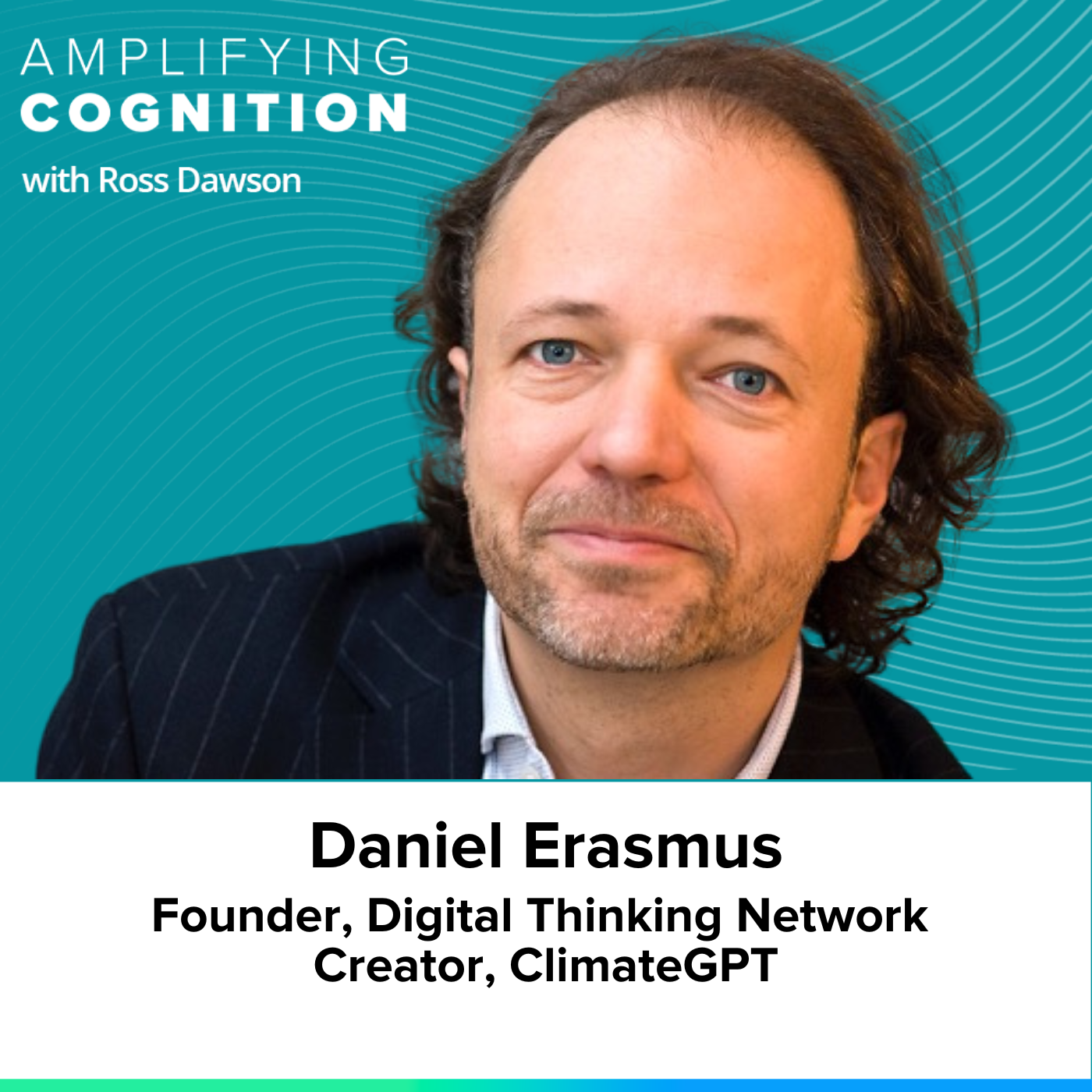
S2 Ep 51Daniel Erasmus on ClimateGPT, AI for climate decisions, social intelligence solutions, and surfacing hidden connections (AC Ep51)
“The promises are tremendous and the peril is climate, not AI. “ – Daniel Erasmus About Daniel Erasmus Daniel is the Founder and Managing Director of futures consulting firm Digital Thinking Network (DTN), CEO of AI sense-making platform Erasmus.AI, and creator of ClimateGPT. He has been applying innovative approaches to scenario planning since 1996 for many leading organizations around the world. Daniel is a visiting professor at Ashridge Business School and a fellow at The Rotterdam School of Management. Websites: www.danielerasmus.com Digital Thinking Network (DTN) www.erasmus.ai www.climategpt.ai LinkedIn: Daniel Erasmus What you will learn Discussing the real existential threat of climate change Exploring AI’s role in addressing climate challenges Daniel Erasmus’s background in foresight and scenario planning The development and impact of ClimateGPT The importance of Human-AI collaboration Equitable access to AI technologies for climate solutions Innovative climate resilience strategies and examples Episode Resources Artificial intelligence (AI) The Promise and the Perils of AI Rotterdam climate initiative BloombergGPT ChatGPT World Economic Forum ClimateGPT Singapore Sea Lion European Central Bank Systemic Risk Board FSB (Financial Stability Board) NOAA (National Oceanic and Atmospheric Administration) Sea Ban (European legislation for a carbon border tax) SDGs (Sustainable Development Goals) TCFD (Task Force on Climate-related Financial Disclosures) TNFD (Taskforce on Nature-related Financial Disclosures) chess.com (freestyle chess competition) Transcript Ross Dawson: Daniel, it is awesome to have you on the show. Daniel Erasmus: It’s great to see you again, mate. It’s been far too long. And it was wonderful seeing you in San Francisco last year. I mean, it was a fascinating event, the title of the event was The “Promise and the Perils of AI”. In the audience, we had Rusty, they’re working on meteorites and a whole set of sort of existential issues facing humanity. And, and the point that I made there is, that people tend to place AI as an existential threat within these, and instead of sort of challenges for human supremacy, but the real threat, the peril is somewhere else. And the peril is not AI, it’s climate change. Climate change is a structural threat that will face humanity, at the scale of the UN estimates 200 million climate refugees by 2050, maybe half a billion, that’s 26 years from now, half a billion a decade later. Now, the European project barely survived one and a half million Syrian refugees. So the kind of things that we are talking about here, we’re going to have to get really, really good at not just anticipating what’s happening but acting on that early preparing for that with the least amount of human and of course, planetary suffering. And so that’s the promise of AI. And I think it’s far more interesting to look at AI with those terms. How can it help us? And how can we, together with AI come to very, very different solutions than we have in the past for the real existential threat, which is climate change? Ross: Yep, absolutely. The challenges we face are unprecedented in complexity and scale. So we hopefully have some tools which can assist us in that. But I think that goes a little bit to your background and where we’ve crossed over in the past is understanding complex systems. So it’d be great just to hear a little bit about your background and how you’ve come to this point from your work in foresight over the years Daniel: I’m South African, my origin, and I witnessed the transition of South Africa from an oppressive racist regime to a democracy, which was perhaps one of the most exciting things to happen in my youthful life, but it was a youthful life. But within that one gets the bones of looking ahead, scenarios transformation, and that the same people in the room, looking at the thing very differently, can come with very, very different conclusions. And then spent almost an hour actually, but over a quarter of a century, running scenarios and foresight processes, largely for multinational companies. So the Fortune 50 type of things, countries, cities, and doing a set of transformation projects around this, of which, there’s certainly some clerk climate work that came out of that Rotterdam climate initiative to half CO2 levels from their 9090 level, which was launched before. Al Gore’s film even came out in 2005, anticipating the global financial crisis for a bank, which led to them having their most profitable year in 150-year history in 2008. Running the first central bank digital currencies for central banks, anticipating the oil price collapse for an oilfield, so several multibillion-dollar exercises for clients, but at one point, one takes a step back and says these are legacy and foresight, which talks to the practice of foresight and bringing people togeth
Pedro Uria-Recio on interlacing humans and AI, brain-computer interfaces, jobs to entrepreneurship, and enabling mindsets for the future (AC Ep50)
“AI is going to change humanity into possibly a new species; we could call it a new form of humanity, which is different from what we have today. “ – Pedro Uria Recio About Pedro Uria Recio Pedro Uria-Recio is a highly experienced analytics and AI executive. He was until recently the Chief Analytics and AI Officer at True Corporation, Thailand’s leading telecom company, and is about to announce his next position. He is also the author of the recently launched book Machines of Tomorrow: From AI Origins to Superintelligence & Posthumanity. He was previously a consultant at McKinsey and is on the Forbes Tech Council. Websites: www.machinesoftomorrow.ai www.true.th allmylinks.com/uriarecio LinkedIn: www.linkedin.com/in/uriarecio Medium: @uriarecio YouTube: @uriarecio Book: Machines of Tomorrow: From AI Origins to Superintelligence & Posthumanity What you will learn Exploring the evolution of AI from past to present Discussing the concept of human-AI interlacing Examining advancements in brain-computer interfaces Understanding AI’s role in future education systems Highlighting the importance of adaptability and critical thinking Predicting the long-term impacts of AI on humanity Emphasizing the need for an entrepreneurial mindset in an AI-driven world Episode Resources Artificial intelligence (AI) Generative AI Large language models OpenAI Artificial General Intelligence (AGI) Brain-computer interfaces (BCIs) Neuralink Elon Musk Blue Brain Project Mind emulation GitHub Copilot Prompt engineering Book Machines of Tomorrow: From AI Origins to Superintelligence & Posthumanity Transcript Ross Dawson: It’s wonderful to have you on the show, Pedro. Pedro Uria Recio: Wonderful. Thank you, Ross. Thank you very much for inviting me. It’s a pleasure to be here with you. Ross: So you’ve got a book, Machines of Tomorrow, which I think has a pretty vast scope, in terms of humanity and machines and where that might go on a pretty grand scale. But one of the central themes there is how humans and AI will be interlaced. And we’d love to just hear more about where you see that now, and how you see that evolving over the next years. Pedro: Wonderful. So in this book, Machines of Tomorrow, what I try to do is I try to explain artificial intelligence, from a human history point of view, from the moment in which artificial intelligence started to be created, or started to be designed, from those aspirations that humans had a very long time ago to create a copy of themselves a machine, like ourselves, to the present to 2024 with generative AI and what is happening right now with open AI, etc, etc. And also looking into the future, right? What is going to happen in the next few decades and in the very long term future, how it is gonna be, and how artificial intelligence is central to human history, right, particularly in the future? One of the aspects that is most important or most central in this book is the concept of interlacing. Which means that humans are going to interlace with artificial intelligence –- we are going to become more intimately related. At this moment, we will have our phones. And we are using our phones for everything –- we can call people that are far behind, or that are in other places; we use it for our daily life. The fact that the phone is outside your body is just an anecdote. In the future, it is going to be inside our bodies, right? It’s going to be inseparable. And we’re going to be interlaced with artificial intelligence, we’re going to be interlaced with electronics, right? And there are a lot of technologies that are being developed at this moment that are pointing in this direction. One of them is will all the cyborg technologies, possibly brain-computer interfaces have the most critical one, then we’ll have robotics, then you have applications of AI to medicine and biology –- how we can be modified, where we live longer, we don’t have cancer, we might see in the dark, et cetera, et cetera. So one of the aspects, not the only one, but one of the aspects of this book is that AI is going to change humanity into possibly a new species; we could call it a new species, a new form of humanity, which is different from what we have today. And that will happen in the long term. It is difficult to know where and how. Ross: So what a start in the present. So of course, there are many phases to this. And I’m kind of interested to look at first of all, the next year or two, and sort of wait, so we’re already in some ways interlaced. A lot of people are using these generative AI tools in particular, as part of the embedded into their thinking processes. They’re already arguably interlaced into the thinking and ways of working. So let’s start with the first next year or two. What do you think are the next steps? And then maybe the next sort of two to five years around? What are the next technologies in the way you see th
Anita Williams Woolley on factors in collective intelligence, AI to nudge collaboration, AI caring for elderly, and AI to strengthen human capability (AC Ep49)
“In collective reasoning, one of the fundamental hurdles is coming up with a shared understanding of what we’re trying to do, and where we’re trying to go. “ – Anita Williams Woolley About Anita Williams Woolley Anita Williams Woolley is the Associate Dean of Research and Professor of Organizational Behavior at Carnegie Mellon University’s Tepper School of Business. She received her doctorate from Harvard University, with subsequent research including seminal work on collective intelligence in teams, first published in Science. Her current work focuses on collective intelligence in human-computer collaboration, with projects funded by DARPA and the NSF, focusing on how AI enhances synchronous and asynchronous collaboration in distributed teams. University Profile: Anita Williams Woolley LinkedIn: Anita Williams Woolley Google Scholar: Anita Williams Woolley ResearchGate: Anita Williams Woolley X: @awoolley95 What you will learn Exploring the concept of collective intelligence The difference between individual and collective intelligence How collective memory, attention, and reasoning work The impact of gender on collective intelligence The role of AI in facilitating human collaboration Integrating AI as a teammate in group settings Future possibilities for human-AI collaboration in problem-solving Episode Resources Collective intelligence Artificial intelligence (AI) Transactive memory systems Social perceptiveness Behavioral synchrony Generative AI Large language models MIS Quarterly DARPA National Science Foundation (NSF) AI Institute AI-CARING Carnegie Mellon University Linda Argote Transcript Ross Dawson: Anita, it’s wonderful to have you on the show. Anita Williams Woolley: Thanks for having me. Ross: So your work is absolutely fascinating. So I’d like to dive in as much as we can, in the time that we have. Much of your work is centered around collective intelligence and I’d love to just pull back to get that framing of collective intelligence relative to human intelligence. So we have some idea of artificial intelligence, which is emerging. So where does collective intelligence fit in that? Anita: Yeah, well, it is. There are a lot of uses of the word intelligence. So it’s good to get some clarity. I guess starting with the notion of individual general intelligence, which is the thing that’s most familiar to most people, it’s this notion that individuals have this underlying capability to perform across multiple domains. And that’s what’s been shown empirically, anyway. So individual intelligence is a concept most people are familiar with. It refers to this. Well, when we’re talking about general human intelligence, it’s a general underlying ability for people to perform across many domains. And empirically, it’s been shown that measures of individual intelligence predict somebody’s performance over time. So it’s a relatively stable attribute. For a long time, when we thought about intelligence and teams, we thought about it in terms of the total intelligence of the individual members combined, the aggregate intelligence. But in our work, we kind of challenged that notion, by conducting studies that showed that there were some attributes of the collective the way the individuals coordinated their inputs, and worked together and amplified each other’s inputs. That was not directly predictable from simply knowing the intelligence of the individual members. And so collective intelligence is the ability of a group to solve a wide range of problems. And it’s something that also seems to be a stable collective ability. Now, of course, in teams and groups, you can change the individual members, and other things can happen that might alter the collective intelligence more readily than you could with an individual in terms of individual intelligence, but we do see that it is fairly stable over time and enables this, you know, greater capability. In some cases, at least, collective intelligence can be higher when you have a higher collective intelligence than a group that is more capable of solving more complex problems. And then, yeah, I guess you also asked about artificial intelligence, right? And so when computer scientists start working on ways to endow a machine with intelligence, what they are essentially doing is providing it with the ability to reason to take in information to perceive things, to kind of identify goals and priorities and to reason and to change and adapt based on information that it receives, which is something humans do quite naturally, so we don’t really think about it. But without artificial intelligence, a machine only does what it’s programmed to do. And that’s it. And so it can do a lot of things that humans can’t do even then, usually computations, or some variant of that. But with artificial intelligence, suddenly, a computer can make decisions and draw
Jeremy Somers on building an AI-assisted creative agency, 80:20 in Humans + AI, AI-amplified storytelling, and the future of agencies (AC Ep48)
“True creativity comes from humans because it stems from our unique individual experiences of life. “ – Jeremy Somers About Jeremy Somers Jeremy Somers is Founder and Director of AI-assisted creative agency NotContent.ai, and of We Are Handsome. He has extensive experience as a Creative Director, working for brands such as Asos, Canon, Mercedes-Benz, Qantas, Spotify, and W Hotels. Websites: www.notcontent.ai www.jeremysomers.com Instagram: @notcontent.ai Beehiv: notcontent.beehiiv What you will learn Exploring Jeremy’s journey from analog to digital in the creative industry The pivotal role of generative AI in transforming creative processes How notcontent.AI merges AI tools with human creativity for enhanced productivity Addressing common misconceptions about AI replacing creative jobs Strategies for integrating AI into traditional creative agency workflows The future of creative agencies in an AI-driven world Insights on maintaining human creativity at the core of AI-assisted outputs Episode Resources Artificial intelligence (AI) Claude-3-Opus ChatGPT 4o Fireflies (transcription tool) Whisper Memos (app) Canva Ethan Mollick notcontent.AI Generative AI Transcript Ross Dawson: Jeremy, it’s awesome to have you on the show. Jeremy Somers: Hey, Ross, thank you for having me. Ross: So you’re a leader in AI-assisted creative agency work. Tell me more. Tell us more. Jeremy: The story begins long before the world of generative AI and AI creativity. My career and life history have always been about creativity. And I started in traditional analog photography, when I was in my teens, and trends went through the whole transition into digital photography. And then I taught myself graphic design. And then I learned it through a very, very early Photoshop version on a bubble, iMac, and the colored ones. And then started working in some of the very first digital agencies in Sydney. And learning through the transition of like, there was no social media and other social media, there is no e-commerce now there is e-commerce, so it’s in digital agencies working on big brands, Nike, and Pepsi, and Microsoft, Samsung, etcetera, etcetera, through this whole transition. And so a lot of my career journey has been in transitional periods of, like, massive shifts in the thing that I’m doing, not just the tools that are available to us, but just societal level shifts of how we communicate as designers and creators and branding people to the outside world. And I happened upon open APIs, Darley white paper very early on, probably coming up on, two and a half years since it was released, I think I’ll check that. But I haven’t found this like paper and nerdily, read through the entire thing, and then read through it again. And then I fully understood what was going on, I had this moment of, sort of cinematic-like, flashback, flash forward moment of, I see the end result of where everything I’ve ever done, creatively, how I’ve done, it has changed, but this is going to change everything in a way, which we’ve never seen before. So I have this, Pivotal epiphany. And I was like, whoa, okay, how can I learn more? One, and two, once I was able to learn more, and you know, so your generative AI suddenly became a thing. I was just like, rabid for learning and looking at tools and learning about who’s doing what and how to kind of get access to it as a creative and as an agency owner, and I happened into the right places at the exact right time. And did a whole bunch of testing things and playing around and just like nerding out on stuff and taught me a whole bunch of new skills and the new taxonomy and way of thinking, and then I thought, okay, how can I take all of this time that I’m spending and turn it into something commercially viable? And I see this end result? We’re not there yet. The technology is not there yet. The people are not there. we’re so, so early on all of this stuff. But how can I, if I can translate it into some sort of commercial vehicle now? And then we’re talking two years ago, I’ll set myself and be way ahead. I’ve seen all of these massive other shifts, and I recognize this is the start of a shift. And I was never early on anything else. So maybe I could be early on this one. That’s how we get to notcontent.AI is one of one of the world’s first creative agencies, today’s AI assistant. Ross: So, AI-assisted creatives. Let’s dig into that. So I mean, you’ve been talking about image generation, of course. There are other forms of communication, occurring, words and videos and smells and all sorts of things. So let’s have a look at the high level, and perhaps you can sort of dig down into detail. So what does that mean, when you’ve got creatives as in presumably creative humans working with tools, and how together they’re creating something better, faster, cheaper, more s
Ross Dawson on Future Job Prosperity: 13 reasons to believe in a positive future of work (AC Ep47)
“If we start to think about humans plus AI, this mindset begins to shape what we are trying to create.” – Ross Dawson About Ross Dawson Ross Dawson is a futurist, keynote speaker, strategy advisor, author, and host of Amplifying Cognition podcast. He is Chairman of the Advanced Human Technologies group of companies and Founder of Humans + AI startup Informivity. He has delivered keynote speeches and strategy workshops in 33 countries and is the bestselling author of 5 books, most recently Thriving on Overload. Website: Ross Dawson LinkedIn: Ross Dawson Twitter: @rossdawson Facebook: Ross Dawson YouTube: Ross Dawson Books Thriving on Overload Other books What you will learn Exploring the dual attitudes toward AI: replacement vs. enhancement Introduction to the amplifying cognition podcast by Ross Dawson Overview of the Maven cohort course on AI-enhanced thinking Debating the future of work with insights from Sangeeta Paul Chattery How AI can amplify human cognition and decision-making Understanding the potential for a positive future of work Inviting listener feedback and discussion on the future of jobs Link to report: Please let Ross know your thoughts and comments on future job prosperity: LinkedIn: Future Job Prosperity X/Twitter: Ross Dawson on Future Job Prosperity Episode Resources Maven cohort course Pew Research Center hyperstition Mobile money agents Augmented reality designer Neural interface design AI auditing Prompt engineering Sangeet Paul Choudary The Economist (Noah Smith) Transcript So this episode is a bit different than usual. It’s just me today. And like to share this mini report I’ve just written about making the case about why we should believe that the future of jobs will be prosperous. And one of the most popular episodes in the podcast has been episode 39 recently with Sangeet Paul Choudary, where we had a kind of a debate around the future of work where he was somewhat less positive, particularly around the evolution of the skill premium in jobs. And I was making the case for a more positive perspective on the future of work. And if we think about the future of humanity, perhaps the most important issue is the future of work. This is how we create value for ourselves for society, the way that we feel we have value we express our personality, our capabilities, we achieve our potential, it’s there’s nothing more important in a way than the future of work though how it is that we contribute and create value in our work, I recall this survey by Pew Research just quite some years ago, but where they asked around 2000 Supposed experts in the future of work around whether they believe that the future of work would be positive, or would be negative, and 48%, were negative. And they painted these sometimes extremely dire predictions of technological mass unemployment and massive disparities. And this really quite bleak view of the future of work. Whereas 52% painted a positive future, sometimes just on balance, feeling as positive, sometimes believing that we could move to a world where we could do whatever we felt was the right things for ourselves and our spirits in the world, and we could fulfill our fullest human potential. So that’s around 50-50. And the issue is we don’t know. And today with the rise of AI, this is making it even more deeply uncertain. There are many views, I’m sure you’ve read many around what will happen with the future of work. I bet that more of the ones you have read have been fairly negative around the prospects for AI replacing workers. But the thing is, we simply don’t know. There’s this marvelous word hyperstition, which is essentially a self fulfilling prophecy. If you believe something and you frame it, then it starts to literally come true. And I think there’s a real risk of that with the sort of the talk that we have around how AI will replace jobs and the attitudes we have to how we use AI to be able to substitute rather than to compliment human workers. But I think in the same way, we need to be able to articulate the positive case as to AI and other technologies. Another shift in society can create a very positive future of work, and hopefully that being able to engender a self-fulfilling prophecy and once we can envisage it, to see that we understand that it is possible to be able to drive that and I think there’s a key point being around. You have to believe something is possible in order to make it happen and I think some people are floundering in finding that positive view of the future of work. And I’d like to be able to make the case that it is possible or potentially even likely if we do the right things. Of course, this is all about this idea of humans plus AI, where if AI comes in, well, you’re not looking to say, well, how does AI replace humans, trying to make it a substitute for humans, but always looking for how humans and AI together can do far
Katri Manninen on AI in screenwriting, consciously choosing AI and human roles, creative workflows, and content automation (AC Ep46)
“We should always remember that we are still humans. We are the ones telling the stories, deciding what we want to tell. And we are doing things for other humans; it’s the other humans who want to hear from us. For me, it’s very grounding amidst all this AI craziness to remember to come back to that relationship: me as a human talking to another human.” – Katri Manninen About Katri Manninen Katri Manninen is a prominent Finnish screenwriter, showrunner, and author. She has written 12 drama series, many based on her original ideas, 29 books, and 4 feature films. She is currently doing a Ph.D. on AI in screenwriting, and has been named “Finland’s Most Artificially Intelligent Screenwriter”. Website: www.kutri.net LinkedIn: Katri Manninen IMDb: Katri Manninen YouTube: @KatriManninenKutriNet Facebook: Kunnanvaltuutettu Katri Manninen Instagram: @mannisenkatri X (Twitter): @katrimanninen What you will learn Exploring katri manninen’s journey from screenwriting to AI Using AI to handle repetitive and formulaic tasks Maintaining human creativity and originality with AI Automating content creation workflows efficiently Enhancing cognitive processes and ideation through AI Ethical considerations in the use of AI for creative work Future possibilities of AI in amplifying creative potential Episode Resources Artificial intelligence (AI) Claude-3-Opus ChatGPT 4o Fireflies (transcription tool) Whisper Memos (app) Canva Ethan Mollick Transcript Ross Dawson: Katri, it’s fantastic to have you on the show. Katri Manninen: It’s so great to be here talking about topics that I love. Ross: Yes, yes, you dive deep. So you’ve been a classic creative for a long time being a screenwriter and a showrunner across many TV series and more. And now you are diving deep into the potential of AI. And so just love to hear how you are using these tools. What’s the starting point for you? When was this awakening for you? Katri: Yeah, I’m also a published author. So writing books is a big part of my life. And I also like these YouTube videos, because I am a transformative coach. So I create. It’s not just the fictional things that I do, but I do a lot of all kinds of things. And like you said, I’m a classic creative in the sense that I am always creating all kinds of things. And I’ve been a professional screenwriter since 1998, which means that I’m quite old. I wasn’t a baby when I started, unfortunately. So I’m a really seasoned screenwriter. And what that means is that I know storytelling well. And I’m really good at seeing what works, and what doesn’t work. What is a high-quality thing? What is generic shit, like, which is a term, the scientific term I coined since getting to know AI? I’ve been thinking about using AI or what AI could start doing for our work. Since I suppose 2018. That’s when I have like, first, some notes or some comments where I wrote something about it like saying like, Okay, do you understand there is this machine learning and it could like if you do daily soap opera, that those everyday episodes that are kind of a very formulaic, following a recipe, that very soon, we could kind of use this machine learning thing to kind of learn the recipe for the like these shows, and they could first start assisting us and then writing for us. My message already then in those first writings was that we should really start thinking about what is in our job as a screenwriter, what kind of work can we do that isn’t formulaic? That it’s not like a recipe, that is something that only humans can do? Where is it where we break the formula where we get outside of it, and that we should, my, my idea was that we should really lean into that direction, and then use those AI, things, which I still back then didn’t know what they could be, how powerful they could be that then use them to kind of assist us with some other stuff. And that is actually the stance that I still have that I do believe that now more than ever, it is very important for a creative person who is creative, creating, new content, and especially like fiction and stuff like that, is that do you think that what can I bring into the table that AI cannot bring, and what we can bring into the table are things that we haven’t seen yet, something that isn’t in the internet in the training material. Another concept that I’m kind of now, trying to tell people is like, okay, when we are doing remember that it might happen one day that AI wakes up, like, we get this AGI that wakes up in the morning, and it’s like, oh, ‘I want to write a book about my horrible training days, when I had to read all the Reddit messages and all these horrible things, I really want to share that story. But until that day, we don’t.’ It’s always a human telling AI what to write. AI is always limited to what it has read or has seen
Tim Burrowes on AI’s impact on media and marketing, evolving business models, and the possibilities for journalism (AC Ep45)
“The entire business model on which people have planned their futures is wobbling underneath them right now, and they’re going to have to hang on to that wobbly platform and find themselves a ladder somewhere.” – Tim Burrowes About Tim Burrowes Tim Burrowes is the Founder and Publisher of email-first media and marketing publication Unmade, and author of Media Unmade. He was previously Founder of media and marketing publisher Mumbrella, which was acquired by Diversified Communications in 2017. Website: www.unmade.media LinkedIn: Tim Burrowes Substack: @unmade Instagram: @timburrowes What you will learn Exploring the impact of AI on media and marketing Dhallenges faced by journalists in the age of AI The transformation of creative agencies through AI AI’s role in enhancing investigative journalism Future training and development for young creatives Business model disruptions caused by Generative AI The balance between human creativity and AI automation Episode Resources Artificial intelligence (AI) Generative AI Programmatic advertising Motley Fool Martin Sorrell Mad Fest Investigative journalism Performance advertising Book Media Unmade: Australian Media’s Most Disruptive Decade by Tim Burrowes Transcript Ross Dawson: It is awesome to have you on the show. Tim Burrowes: Ross, it’s been far too long. It’s been a while. It’s been a pandemic since we last spoke. Ross: Oh, yes, the world has changed and continues to change as we speak. Tim: It certainly has, I reckon the last time we spoke, the world was still talking about the possibilities and excitement of AI when it finally arrived one day. Ross: So you have been central in the world of media and marketing. And as you say, the people talking about AI and edge cases and programmatic advertising and a few kinds of very focused things. But now AI has arrived. How does that change media and marketing in three words or less? Tim: In every way? Ross: Got it. Tim: The truth of it is different things for media, different things for marketing? Gosh, I tried to find where I can, the case is for optimism and positivity. And I guess, in the same way that horses and carts gave way to a thriving automobile industry. And it feels a bit like we might be at that stage for the media and certainly for communications agencies where they’ve got such big disruption coming along. And, of course, so many possibilities and new ways of doing things. But it feels like the entire business model on which people have planned their futures is wobbling underneath them right now. And they’re going to have to hang on to that wobbly platform and find themselves a ladder somewhere. Because, you know, obviously, there’ll be a way through to the other side, because there always is, but wow, we’ve never seen change, like.. Ross: Yeah, well, arguably, you know, major magazines have been pretty wobbly for a long time like this. There’s no single year which hasn’t had its damage. Tim: Yeah. I mean, absolutely. I mean, I’ve been a journalist since 1989. And the theme when I walked into my very first newsroom, well, firstly, and trained on a typewriter, manual typewriter for the first few months, but was it was just as the printing of the newspapers was digitized, a whole bunch of printers were in, in the process of being made redundant right then. So yes, we had this weird kind of battle of the humans against the computerization where, as the sort of protest these these printers, who knew they were doomed, but we’re still at this stage, laying out the newspaper each day, with just put subtle sabotage in while they were having they’re kind of they could see what was coming down the track. So you’d have to be very, very careful because things like the not in not guilty would get removed in articles, and he would become che and all of these subtle things, which were quite hard to spot on the final round of proofreading as the as as people went, when kicking and screaming into the night, and I, that was the printers and sadly, I think it might be the turn of some of the journalists and, Ross: Oh, let’s look into sort of media and marketing. But I mean, company, the theme of amplifying cognition. Alright, so journalists are super smart. And I’ve always said, you know, if you’ve got a journalistic training, you can do well in the world, because you’re able to pull together information makes sense that will communicate well, you know, these are fundamental skills and will continue to be, but how can you know, good journalists today? Use AI? Or what is their relationship to AI? I mean, obviously, there’s going to be a lot of AI reporting, but what are the complementary roles of good journalists in AI today? Oh, what could it be? Tim: There’s no one answer. Obviously, there’s several great examples. And I suppose the one that’s given me the most pau